Skip to content · ⁨본문 바로가기⁩

Variation and selection · ⁨변이 및 선택⁩

IGCSE Biology · ⁨IGCSE 생물학⁩ · Topic 18 · ⁨주제 18⁩

Video lesson for this topic · ⁨이 주제용 영상 수업⁩ Open the video page · ⁨영상 페이지 열기⁩
7:35

변이 및 선택

1800년경 영국의 거의 모든 가루날벌레는 연한 색이었습니다. 50년이 지난 후, 연기가 자욱한 도시에서는 거의 모든 것이 검게 변했습니다. 어떤 날벌레도…

English narration · English + 中文 subtitles burned in · ⁨영어 내레이션 · 영어 + 중국어 자막 burned-in⁩

18.1

Variation · ⁨변이(Variation)⁩

Syllabus
English
Core Supplement
1 Describe variation as differences between individuals of the same species
2 State that continuous variation results in a range of phenotypes between two extremes; examples include body length and body mass
3 State that discontinuous variation results in a limited number of phenotypes with no intermediates; examples include ABO blood groups, seed shape in peas and seed colour in peas
4 State that discontinuous variation is usually caused by genes only and continuous variation is caused by both genes and the environment
5 Investigate and describe examples of continuous and discontinuous variation
6 Describe mutation as genetic change 9 Describe gene mutation as a random change in the base sequence of DNA
7 State that mutation is the way in which new alleles are formed 10 State that mutation, meiosis, random mating and random fertilisation are sources of genetic variation in populations
8 State that ionising radiation and some chemicals increase the rate of mutation
한국어
핵심 보충
1 변이를 같은 종 내 개체 간의 차이로 서술한다
2 연속적 변이는 두 극단 사이의 다양한 표현형을 생성함을 밝히며, 예로는 신장 및 체중이 있다
3 불연속적 변이는 중간 형태가 없는 제한된 수의 표현형을 생성함을 밝히며, 예로는 ABO 혈류군, 완두의 씨 모양 및 씨 색이 있다
4 불연속적 변이는 주로 유전자에 의해 발생하고, 연속적 변이는 유전자와 환경 모두에 의해 발생함을 밝힌다
5 연속적 변이와 불연속적 변이의 예를 조사하고 서술한다
6 돌연변이를 유전적 변화로 서술한다 9 유전자 돌연변이가 DNA 염기 서열의 무작위 변화를 의미함을 설명한다
7 돌연변이가 새로운 대립유전자를 형성하는 방식임을 밝힌다 10 돌연변이, 감수분열, 무작위 교배 및 무작위 수정이 집단 내 유전적 변이의 원천임을 밝힌다
8 이온화 방사선과 일부 화학 물질이 돌연변이 속도를 증가시킨다

Source: Cambridge International syllabus · ⁨출처: Cambridge International syllabus⁩

English

Variation 变异 means the differences between individuals of the same species 物种. There are two types:

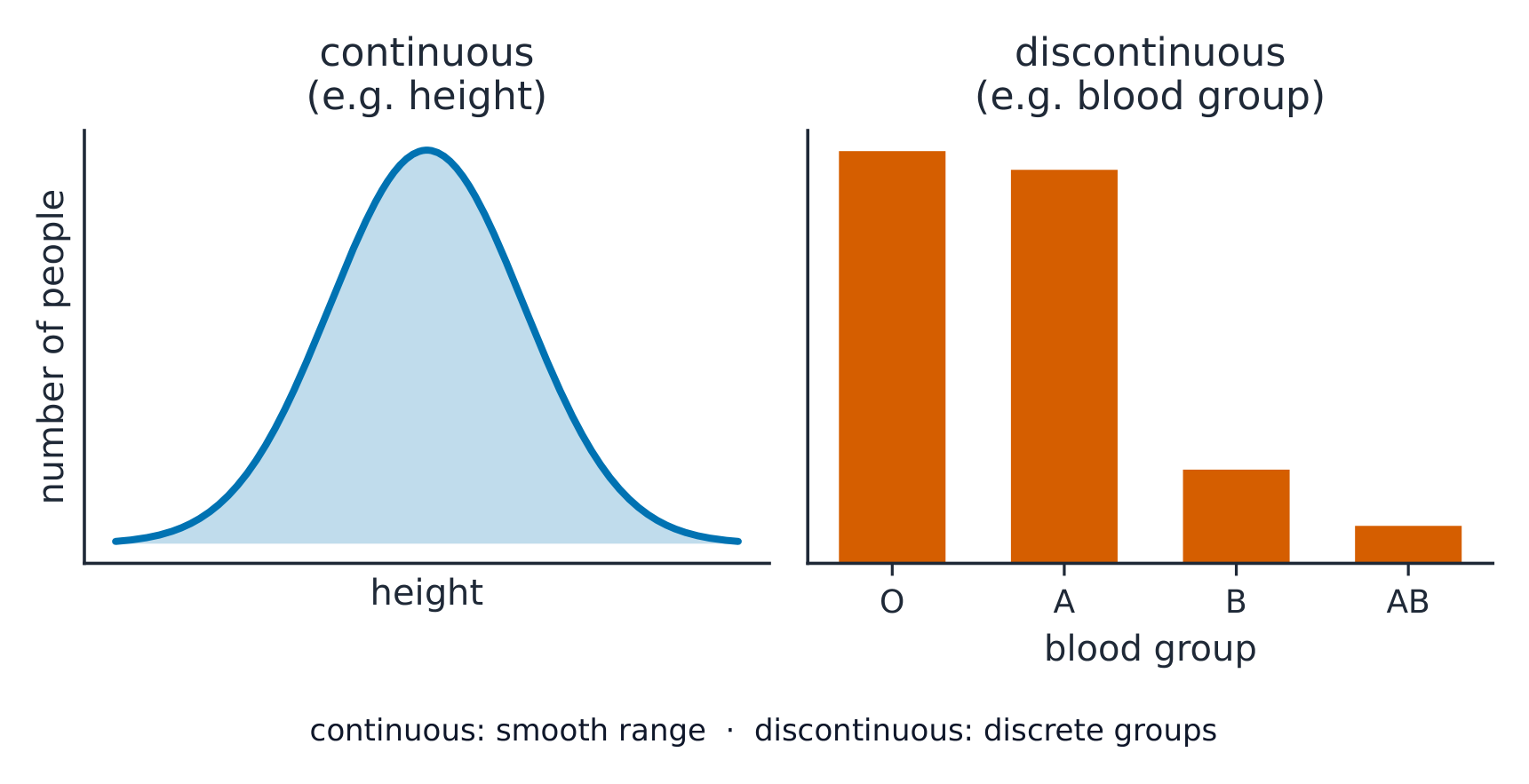
  • continuous variation 连续变异 — a smooth range of phenotypes 表现型 between two extremes (for example body length and body mass).
  • discontinuous variation 不连续变异 — a few separate phenotypes with nothing in between (for example ABO blood groups 血型, or seed shape in peas).

Discontinuous variation is usually caused by genes 基因 only. Continuous variation is caused by both genes and the environment 环境 — for example, your height depends on your genes and also on your diet.

Mutation

A mutation 突变 is a genetic change. Mutations are the way new alleles 等位基因 are made, so they are the original source of all variation. (Supplement) A gene mutation 基因突变 is a random change in the base sequence 碱基序列 of DNA.

Ionising radiation 电离辐射 (such as X-rays) and some chemicals raise the rate 速率 of mutation. (Supplement) Other sources of genetic variation are meiosis 减数分裂, random mating and random fertilisation 受精.

한국어
대규모 인파
사람들은 많은 유전적 형질에서 넓은 변이를 보입니다.

변이란 같은 종개체 간의 차이를 의미합니다. 두 가지 유형이 있습니다:

  • 연속 변이 — 두 극단 사이의 표현형의 매끄러운 범위 (예: 신장 및 체중).
  • 불연속 변이 — 중간에 아무것도 없는 몇 개의 분리된 표현형 (예: ABO 혈액형 또는 완두콩의 씨앗 모양).

불연속 변이는 주로 유전자만에 의해 발생합니다. 연속 변이는 유전자와 환경 모두에 의해 발생합니다 - 예를 들어, 당신의 키는 유전자뿐만 아니라 식단에 따라 달라집니다.

두 그래프: 연속 변이는 신장의 매끄러운 종 모양 곡선으로, 불연속 변이는 O, A, B, AB 혈액형에 대한 네 개의 분리된 막대로 표현됨
연속 변이는 부드러운 범위이며, 불연속 변이는 별도의 그룹으로 나뉩니다

돌연변이

돌연변이는 유전적 변화입니다. 돌연변이는 새로운 대립유전자가 만들어지는 방식이므로, 모든 변이의 원천입니다. (보충) 유전자 돌연변이는 DNA의 염기 서열에서의 무작위 변화입니다.

DNA 염기의 변화가 새로운 대립유전자를 만듦
돌연변이는 DNA 염기 서열을 변경하여 새로운 대립유전자를 만듭니다

이온화 방사선(X선 등)과 일부 화학 물질은 돌연변이율을 높입니다. (보충) 유전적 변이의 다른 원인은 감수분열, 무작위 교배 및 무작위 수정입니다.

Explore · ⁨탐색하기⁩

Variation lab · ⁨변이 실험실⁩

Classify examples of variation by pattern and cause. · ⁨변이의 예를 패턴과 원인에 따라 분류하십시오.⁩

Vocabulary · ⁨어휘⁩ Train · ⁨연습하기⁩
English 한국어
variation/ˌveərɪˈeɪʃn/ 변화
species/ˈspiːsiːz/ 종(species)
continuous variation/kənˈtɪnjuːəs ˌveərɪˈeɪʃn/ 연속적 변이
phenotypes/ˈfenətaɪps/ 표현형
discontinuous variation/dɪskənˈtɪnjuːəs ˌveərɪˈeɪʃn/ 불연속적 변이
ABO blood groups/ˌeɪ biː ˈəʊ blʌd ɡruːps/ ABO 혈액형
genes/dʒiːnz/ 유전자
environment/enˈvaɪrənmənt/ 환경
mutation/mjuːˈteɪʃn/ 변이
alleles/əˈliːlz/ 알레르
gene mutation/dʒiːn mjuːˈteɪʃn/ 유전자 돌연변이
base sequence/beɪs ˈsiːkwəns/ 염기 서열
ionising radiation/ˈaɪənaɪzɪŋ ˌreɪdɪˈeɪʃn/ 이온화 방사선
rate/reɪt/ 비율
meiosis/meɪˈəʊsɪs/ 감수분열 (meiosis)
fertilisation/ˌfɜːtɪlaɪˈzeɪʃn/ 수정
adaptive feature/əˈdæptɪv ˈfiːtʃə/ 적응적 특징
inherited/ɪnˈherɪtɪd/ 유전된
survive/səˈvaɪv/ 생존하다
reproduce/rɪprəˈdjuːs/ 생식하다(reproduce)
Watch lesson · ⁨수업 보기⁩
18.2

Adaptive features · ⁨적응적 특징⁩

Syllabus
English
Core Supplement
1 Describe an adaptive feature as an inherited feature that helps an organism to survive and reproduce in its environment
2 Interpret images or other information about a species to describe its adaptive features
3 Explain the adaptive features of hydrophytes and xerophytes to their environments
한국어
핵심 보충
1 적응적 특성을 생물이 환경에서 생존하고 번식하는 데 도움이 되는 유전적 특성으로 서술한다
2 종에 대한 이미지나 기타 정보를 해석하여 해당 종의 적응적 특성을 서술한다
3 수생식물 및 건생식물의 환경에 대한 적응적 특성을 설명한다

Source: Cambridge International syllabus · ⁨출처: Cambridge International syllabus⁩

English

An adaptive feature 适应特征 is an inherited 遗传 feature that helps an organism to survive 生存 and reproduce 生殖 in its environment.

(Supplement)

  • hydrophytes 水生植物 (water plants) have features such as air spaces to help them float, and stomata on the upper leaf surface.
  • xerophytes 旱生植物 (desert plants) have features such as a thick waxy cuticle, few small stomata, and the ability to store water — all to reduce water loss.
한국어

적응적 특징은 환경에서 개체의 생존과 번식을 돕는 유전된 형질입니다.

황사 사구와 산맥 뒤의 맨바닥 사막 땅에 서 있는 나일트카멜리 한 마리의 사진
나일트카멜리는 사막 생활에 적응했습니다: 봉우리에 지방을 저장하며, 장기간 물 없이도 생존할 수 있습니다

(보충)

  • 수생 식물(hydrophytes) 은 부력을 돕기 위한 공기 공간 및 잎 윗면의 기공과 같은 특징을 가집니다.
  • 건생 식물(xerophytes) (사막 식물)은 두꺼운 왁질 표피, 드문 작은 기공, 물을 저장하는 능력 등의 특징을 가집니다 - 모두 물 손실을 줄이기 위함입니다.
Explore · ⁨탐색하기⁩

Selection shapes adaptations · ⁨선택은 적응을 형성함⁩

On a dark, sooty tree the better-camouflaged moths survive and breed, so the population shifts — adaptive features arise by natural selection. · ⁨어둡고 타르가 묻은 나무에서는 위장 능력이 높은 나방이 생존하고 번식하므로 집단의 특성이 바뀌며 — 적응적 특징은 자연선택을 통해 발생합니다.⁩

Vocabulary · ⁨어휘⁩ Train · ⁨연습하기⁩
English 한국어
hydrophytes/ˈhaɪdrəfaɪts/ 수생 식물
xerophytes/ˈzɪərəfaɪts/ 건생 식물
18.3

Natural selection · ⁨자연선택(Natural selection)⁩

Syllabus
English
Core Supplement
1 Describe natural selection with reference to: (a) genetic variation within populations (b) production of many offspring (c) struggle for survival, including competition for resources (d) a greater chance of reproduction by individuals that are better adapted to the environment than others (e) these individuals pass on their alleles to the next generation 4 Describe adaptation as the process, resulting from natural selection, by which populations become more suited to their environment over many generations
5 Describe the development of strains of antibiotic resistant bacteria as an example of natural selection
2 Describe selective breeding with reference to: (a) selection by humans of individuals with desirable features (b) crossing these individuals to produce the next generation (c) selection of offspring showing the desirable features
3 Outline how selective breeding by artificial selection is carried out over many generations to improve crop plants and domesticated animals and apply this to given contexts 6 Outline the differences between natural and artificial selection
한국어
핵심 보충
1 자연선택을 다음 사항과 함께 서술한다: (a) 집단 내의 유전적 변이 (b) 많은 자손 생산 (c) 생존을 위한 투쟁, 즉 자원 경쟁 포함 (d) 환경에 더 잘 적응한 개체가 다른 개체보다 더 큰 번식 기회 (e) 이러한 개체가 대립유전자를 다음 세대로 전달 4 적응을 자연선택의 결과로서, 여러 세대를 거치며 집단이 환경에 더 적합해지는 과정으로 서술한다
5 항생제 내성 세균 균주의 발달을 자연선택의 예시로 서술한다
2 인공선택(인위적 선택)을 다음 사항과 함께 서술한다: (a) 인간에 의한 desirable한 특성을 가진 개체의 선택 (b) 이 개체들을 교배하여 차세대 생산 (c) desirable한 특성을 보이는 자손의 선택
3 인공선택에 의한 인위적 선택이 여러 세대에 걸쳐 작물 및 가축을 개선하는 과정을 개요로 제시하고 주어진 맥락에 적용한다 6 자연선택과 인위적 선택의 차이를 개요로 제시한다

Source: Cambridge International syllabus · ⁨출처: Cambridge International syllabus⁩

English
Natural selection: the peppered moth

Natural selection 自然选择 explains how a species becomes better suited to its environment:

  1. there is genetic variation in a population (caused by mutation).
  2. organisms produce many offspring 后代 — more than can survive.
  3. there is a struggle to survive, with competition 竞争 for resources 资源 such as food and space.
  4. the individuals that are better adapted 适应 are more likely to survive and reproduce.
  5. they pass on their alleles, so the helpful alleles become more common in the next generation.

(Supplement) Over many generations this makes the population more suited to its environment; this process is called adaptation. A clear example is antibiotic 抗生素-resistant bacteria 细菌: a few bacteria carry a resistant 耐药 allele and survive the antibiotic, then multiply, until the whole population is resistant.

Worked example. A moth species is mostly pale. Soot darkens the tree trunks the moths rest on, and within a few decades most of the moths are dark. Explain by natural selection. Variation is already there: a few dark moths exist by chance, caused by mutation. On sooty bark the dark moths are better camouflaged, so birds eat fewer of them and they are more likely to survive. The survivors reproduce and pass the allele for dark colour to their offspring, so it becomes more common each generation until most moths are dark. Follow the chain: variation, survival, reproduction, the allele becomes more common. The moths did not turn dark in order to hide - the dark ones simply survived more often.

한국어
자연선택: 호랑나비

자연선택은 한 종이 환경에 더 잘 적응하게 되는 과정을 설명합니다:

  1. 집단 내에 유전적 변이가 존재합니다 (돌연변이에 의해 유발됨).
  2. 생물들은 자녀를 많이 낳습니다 — 생존할 수 있는 수보다 많습니다.
  3. 생존을 위한 투쟁이 있으며, 음식과 공간과 같은 자원에 대한 경쟁이 있습니다.
  4. 더 잘 적응한 개체들이 생존하고 번식할 가능성이 높습니다.
  5. 그들은 자신의 대립유전자를 전달하므로, 유용한 대립유전자가 다음 세대에서 더 흔해집니다.
자연선택의 흐름도: 집단 내 변이, 생존 가능한 수보다 많은 자녀, 투쟁과 경쟁, 가장 잘 적응한 개체의 생존과 번식, 그리고 그들의 대립유전자의 전달
자연선택: 가장 잘 적응한 개체가 생존, 번식하여 대립유전자를 전달함
어둡고 거의 검은색인 Peppered moth가 연한 직물 표면에 날개를 편 채로 누워 있는 사진
피박나방의 짙은 색(멜라닌) 형태 — 연탄 먼지로 어두워진 나무껍질에서 유리한 형태

(보충) 여러 세대를 거쳐 이것이 집단을 환경에 더 잘 적응하게 만들며, 이 과정은 적응이라고 부릅니다. 명확한 예시는 항생제-내성 세균입니다: 몇몇 세균은 내성 대립유전자를 가지고 항생제에 생존한 후 증식하여, 전체 집단이 내성을 갖게 됩니다.

해설 예시. 한 나비 종은 대체로 연한 색을 띠고 있다. 나비가 쉬는 나무 줄기에 구름이 짙어져 짙은 색으로 변하고, 몇십 년 내에 대부분의 나비가 짙은 색으로 바뀐다. 자연선택에 의해 설명하시오. 변이는 이미 존재한다: 우연히 일부 짙은색 나비가 있으며, 이는 돌연변이에 의해 발생한다. 구름이 낀 나뭇껍질에서 짙은색 나비는 위장 효과가 좋아 새들이 더 적게 먹으며, 생존할 가능성이 높다. 생존한 개체는 번식하여 짙은색 알레尔的 자손에게 물려주므로, 매 세대마다 그 빈도가 증가하여 결국 대부분 나비가 짙은색이 된다. 이 과정을 따르라: 변이 → 생존 → 번식 → 알레尔的 빈도 증가. 나비들이 숨기려고 짙은색으로 변한 것이 아니라, 단순히 짙은색인 개체들이 더 자주 생존했기 때문이다.

Explore · ⁨탐색하기⁩

Natural selection · ⁨자연 선택⁩

Individuals best suited to their environment survive and pass on their genes — so the population changes over time. · ⁨환경에 가장 잘 적응한 개체가 생존하여 유전자를 전달하므로 — 집단은 시간이 지남에 따라 변화합니다.⁩

Explore · ⁨탐색하기⁩

Natural selection · ⁨자연 선택⁩

Run the generations: birds eat the moths that stand out, so the camouflaged ones survive and breed — the population shifts to match the forest. · ⁨세대를 반복하세요: 새들이 두드러진 나방을 먹으므로, 위장 능력이 높은 ones이 생존하고 번식 — 집단이 숲과 일치하도록 바뀝니다.⁩

Vocabulary · ⁨어휘⁩ Train · ⁨연습하기⁩
English 한국어
natural selection/ˈnætʃərəl sɪˈlekʃn/ 자연선택
many offspring/ˈmeni ˈɒfsprɪŋ/ 많은 자손
competition/ˌkɒmpəˈtɪʃn/ 경쟁
resources/rɪˈzɔːsɪz/ 자원
adapted/əˈdæptɪd/ 적응된
antibiotic/ˌæntɪbaɪˈɒtɪk/ 항생제
bacteria/bækˈtɪərɪə/ 박테리아
resistant/rɪˈzɪstənt/ 내성(저항성)
Watch lesson · ⁨수업 보기⁩
18.3

Selective breeding · ⁨인공선택⁩

English

In selective breeding 选择育种 (also called artificial selection 人工选择), humans choose which organisms breed:

  1. choose the individuals that have the features you want.
  2. cross them to produce the next generation.
  3. choose the offspring that show those features, and repeat over many generations.

This is used to improve crops 农作物 (for example a higher yield) and farm animals (for example cows that give more milk).

(Supplement) The key difference: in natural selection the environment decides which individuals survive; in artificial selection humans decide.

한국어

인공선택(또는 인공선별)에서는 인간이 어떤 생물이 번식할지 결정한다:

  1. 원하는 형질을 가진 개체를 선택한다.
  2. 교배시켜 다음 세대를 산출한다.
  3. 해당 형질을 나타내는 자손을 선택하고, 여러 세대에 걸쳐 반복한다.
인공선택의 흐름도: 원하는 형질을 가진 부모를 선택하고 교배하며, 가장 우수한 자손을 선택하여 여러 세대에 걸쳐 반복하여 작물이나 가축을 개선하는 과정
인공선택에서는 여러 세대에 걸쳐 인간이 교배될 생물체를 선택함

이는 작물(예: 수확량 증가)과 가축(예: 더 많은 우유를 내는 소)을 개선하는 데 사용된다.

(보충) 핵심 차이: 자연선택에서는 환경이 어떤 개체가 생존할지 결정하지만, 인공선택에서는 사람이 결정한다.

목장에 서 있는 일색의 검정·흰색 젖소 무리
우유 생산량을 위해 세대를 거쳐 인공선택을 거친 젖소
Explore · ⁨탐색하기⁩

Selective breeding · ⁨선별 교배⁩

Humans choose which organisms breed, to develop a useful feature over many generations. · ⁨사람들은 어떤 생물이 번식할지 선택하여, 오랜 세대를 걸쳐 유용한 특징을 개발합니다.⁩

Vocabulary · ⁨어휘⁩ Train · ⁨연습하기⁩
English 한국어
selective breeding/sɪˈlektɪv ˈbriːdɪŋ/ 선별 교배
artificial selection/ˌɑːtɪˈfɪʃl sɪˈlekʃn/ 인공선택
crops/krɒps/ 작물
18.3

Exam tips · ⁨시험 팁⁩

English
  • Continuous variation = a range (genes + environment); discontinuous = separate groups (genes only).
  • Mutation makes new alleles — the source of all variation. Radiation and some chemicals raise the mutation rate.
  • Natural selection: variation → too many offspring → struggle and competition → the best-adapted survive and reproduce → they pass on their alleles.
  • Antibiotic resistance in bacteria is natural selection in action.
  • Selective breeding (artificial selection): humans pick the parents; in natural selection, the environment "picks".
한국어
  • 연속적 변이 = 범위 (유전자 + 환경); 불연속적 변이 = 별개의 그룹 (유전자만).
  • 돌연변이는 새로운 알레어를 만들어내며, 모든 변이의 원천이다. 방사능과 특정 화학물질은 돌연변이율을 높인다.
  • 자연선택: 변이 → 자손 과잉 → 투쟁 및 경쟁 → 적응도가 높은 개체가 생존하고 번식함 → 알레어를 자손에게 전달함.
  • 세균의 항생제 내성은 자연선택이 작동하는 예이다.
  • 인공선택(인공선별): 인간이 부모를 골라내지만, 자연선택에서는 환경이 '골라낸다'.

Interactive lessons on this topic · ⁨이 주제에 대한 인터랙티브 수업⁩

Work through it step by step, with instant-check exercises. · ⁨즉시 체크 기능 exercises를 통해 단계별로 진행하세요.⁩

Past Papers · ⁨과거 시험지⁩

More topics in IGCSE Biology · ⁨IGCSE 생물학⁩ · ⁨IGCSE Biology · ⁨IGCSE 생물학⁩ 내 추가 주제⁩

Log in or create account · ⁨로그인 또는 계정 만들기⁩

IGCSE, A-Level & AP