Variation
Introduced| English | Meaning |
|---|---|
| variation/ˌveərɪˈeɪʃn/ | Differences in characteristics between individuals or values within a set. |
| continuous/kənˈtɪnjuːəs/ | Changing without a break or jump, or taking every value within an interval. |
| discontinuous/dɪskənˈtɪnjuːəs/ | discontinuous |
| mutations/mjuːˈteɪʃnz/ | A change in genetic material, such as a DNA sequence or chromosome structure. |
No two alike
- Look around a classroom: everyone is different. Even the same species shows differences.
- These differences are variation 变异, and they come from genes and the environment.
Variation lab
Classify examples of variation by pattern and cause.
Which is an example of genetic variation?
Difficulty 1/5 · 100 coins + a small bonus on first completion today
Blood group is determined by genes; the others are environmental.
Genetic and environmental variation
- Genetic variation comes from your genes (e.g. eye colour, blood group).
- Environmental variation comes from your surroundings (e.g. a scar, a language you speak).
- Most variation is a mix of both (e.g. height).
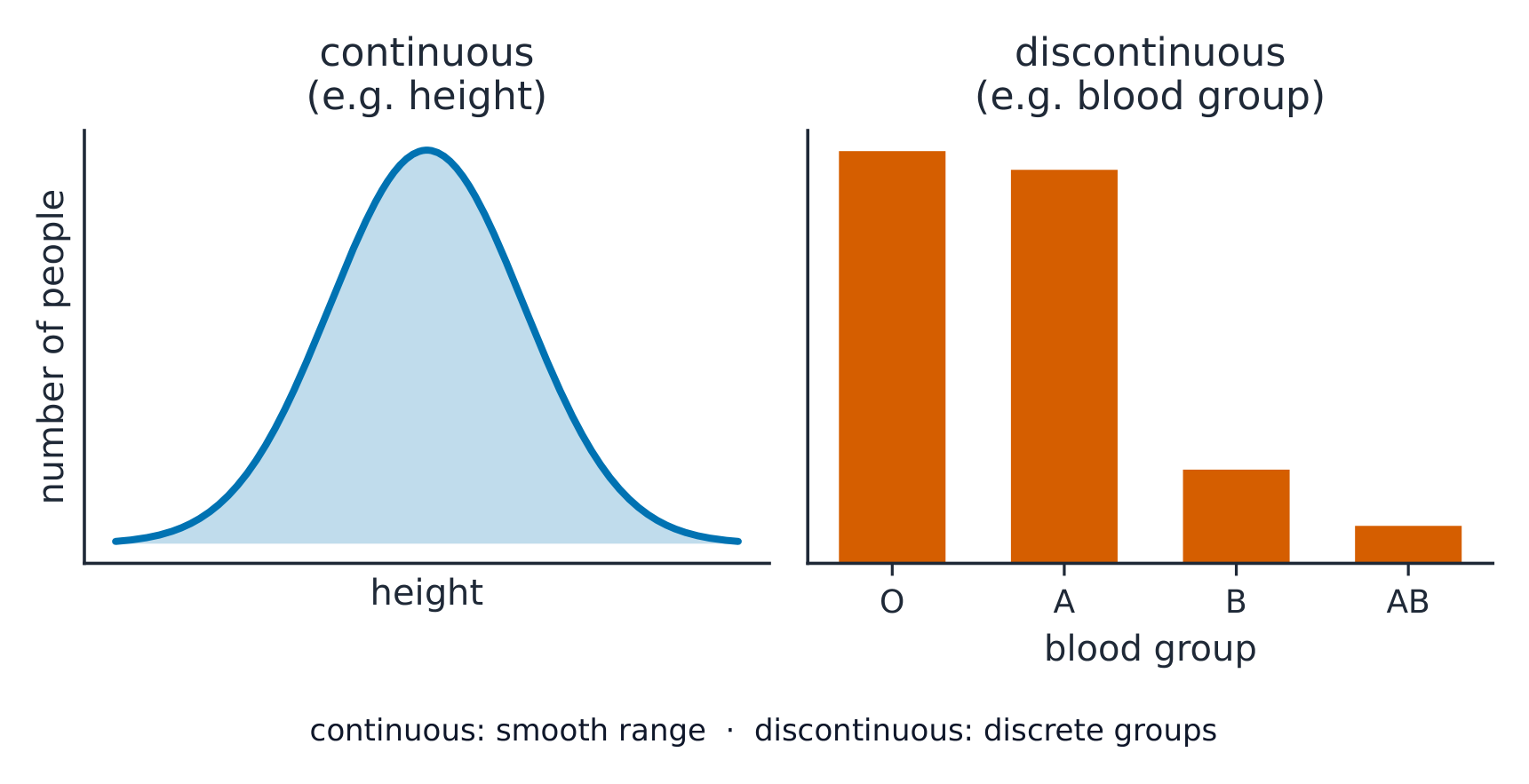
Continuous 连续的 variation is a smooth range; discontinuous 不连续的 variation falls into separate groups
Which shows continuous variation?
Difficulty 1/5 · 100 coins + a small bonus on first completion today
Height varies over a continuous range.
Continuous and discontinuous
- Continuous variation: a range of values (height, mass) — shown on a graph as a smooth curve.
- Discontinuous variation: distinct categories (blood group, tongue rolling).

The dark (melanic) form of the peppered moth — the form favoured on soot-darkened bark
Which create genetic variation? (Select all that apply.)
Difficulty 2/5 · 140 coins + a small bonus on first completion today
Meiosis, fertilisation and mutations create variation; diet is environmental.
Variation is the raw material that natural selection acts on.
Difficulty 1/5 · 100 coins + a small bonus on first completion today
Without variation there could be no natural selection.
A random change to DNA that can create a new allele is a ______.
Difficulty 1/5 · 100 coins + a small bonus on first completion today
Mutations are the source of new alleles.
Where genetic variation comes from
- Meiosis and fertilisation mix alleles, creating new combinations.
- Mutations 突变 (random changes to DNA) create brand-new alleles.
Variation is the raw material for evolution. Without differences between individuals, natural selection would have nothing to act on. Variation makes adaptation possible.
You've got it
- variation comes from genes, the environment, or both
- continuous = a range (height); discontinuous = categories (blood group)
- genetic variation comes from meiosis, fertilisation and mutations