Skip to content · ⁨본문 바로가기⁩

Population and Migration Patterns and Processes

AP Human Geography · ⁨AP 인간지리학⁩ · Topic 2 · ⁨주제 2⁩

Video lesson for this topic · ⁨이 주제용 영상 수업⁩ Open the video page · ⁨영상 페이지 열기⁩
8:48

Population and Migration Patterns and Processes

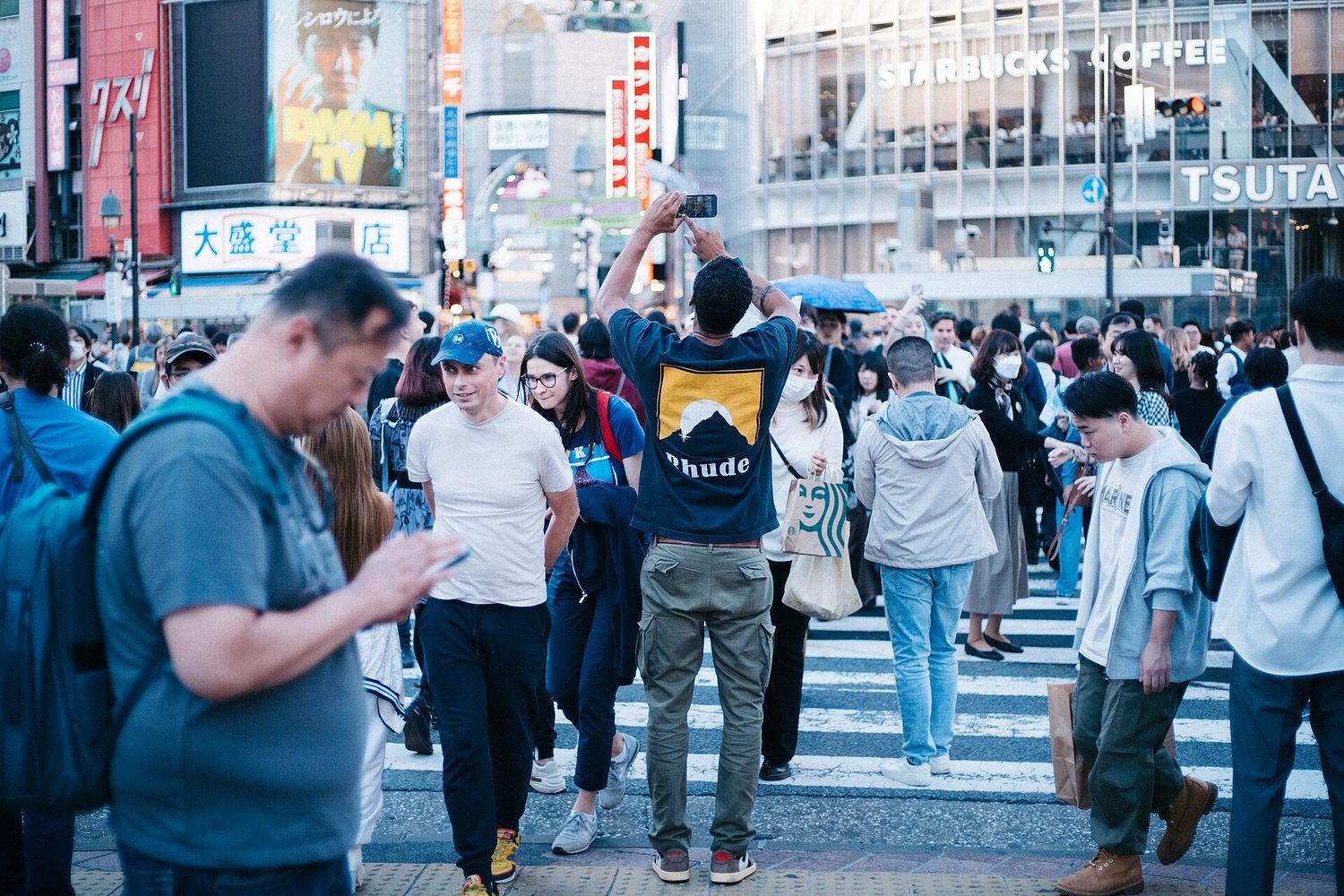
Eight billion people live on this planet. Now look at this street. At one crossing in Tokyo, hundreds of them share a space the size of a school hall.…

English narration · English + 中文 subtitles burned in · ⁨영어 내레이션 · 영어 + 중국어 자막 burned-in⁩

2.1 2.2

Population Distribution and Density · ⁨인구의 분포 및 밀도⁩

Syllabus
English
Enduring UnderstandingLearning ObjectiveEssential Knowledge

PSO-2
Understanding where and how people live is essential to understanding global cultural, political, and economic patterns.

PSO-2.A
Identify the factors that influence the distribution of human populations at different scales.

  • PSO-2.A.1 Physical factors (e.g., climate, landforms, water bodies) and human factors (e.g., culture, economics, history, politics) influence the distribution of population.
  • PSO-2.A.2 Factors that illustrate patterns of population distribution vary according to the scale of analysis.

PSO-2.B
Define methods geographers use to calculate population density.

  • PSO-2.B.1 The three methods for calculating population density are arithmetic, physiological, and agricultural.

PSO-2.C
Explain the differences between and the impact of methods used to calculate population density.

  • PSO-2.C.1 The method used to calculate population density reveals different information about the pressure the population exerts on the land.
한국어
Enduring UnderstandingLearning ObjectiveEssential Knowledge

PSO-2
사람들이 어디에, 어떻게 거주하는지 이해하는 것은 글로벌 문화, 정치, 경제 양상을 이해하는 데 필수적이다.

PSO-2.A
다양한 스케일에서 인구 분포에 영향을 미치는 요인을 식별한다.

  • PSO-2.A.1 물리적 요인(예: 기후, 지형, 수계)과 인문학적 요인(예: 문화, 경제, 역사, 정치)이 인구 분포에 영향을 미친다.
  • PSO-2.A.2 인구 분포 양상을 보여주는 요인은 분석의 스케일에 따라 달라진다.

PSO-2.B
지리학자가 인구 밀도를 계산하는 방법을 정의한다.

  • PSO-2.B.1 인구 밀도를 계산하는 세 가지 방법은 산술적, 생리적, 그리고 농업적이다.

PSO-2.C
인구 밀도 계산에 사용되는 방법의 차이점과 영향을 설명한다.

  • PSO-2.C.1 인구 밀도 계산에 사용되는 방법은 인구가 토지에 가하는 압력에 대해 서로 다른 정보를 드러낸다.
English

Enduring Understanding (PSO-2): Understanding where and how people live is essential to understanding global cultural, political, and economic patterns.

Learning Objective PSO-2.D: Explain how population distribution and density affect society and the environment.

  • PSO-2.D.1 Population distribution and density affect political, economic, and social processes, including the provision of services such as medical care.
  • PSO-2.D.2 Population distribution and density affect the environment and natural resources; this is known as carrying capacity.
한국어

Enduring Understanding (PSO-2): 사람들이 어디에, 어떻게 거주하는지 이해하는 것은 글로벌 문화, 정치, 경제 양상을 이해하는 데 필수적이다.

학습 목표 PSO-2.D: 인구 분포와 밀도가 사회 및 환경에 미치는 영향을 설명하시오.

  • PSO-2.D.1 인구 분포와 밀도는 의료 제공과 같은 서비스 제공을 포함한 정치적, 경제적, 사회적 과정에 영향을 미칩니다.
  • PSO-2.D.2 인구 분포와 밀도는 환경 및 자연자원에 영향을 미치며, 이를 수용력(carrying capacity)이라 합니다.
Source: College Board AP Course and Exam Description · ⁨출처: College Board AP Course and Exam Description⁩

English

People are spread very unevenly across Earth. Population distribution 人口分布 describes where people live; population density 人口密度 measures how crowded a place is. Most people cluster in a few favourable places: mid-latitudes, low-lying land, coasts, and river valleys with water and fertile soil.

Geographers use three density measures:

  • Arithmetic density 算术密度 — total people ÷ total land area.
  • Physiological density 生理密度 — people ÷ area of arable (farmable) land; a better guide to pressure on food supply.
  • Agricultural density 农业密度 — farmers ÷ arable land; a low value suggests more efficient, mechanised farming.

Uneven distribution creates consequences: crowded regions strain housing, water, and services, while empty regions may struggle to provide roads and schools.

한국어

인구는 지구 전체에 매우 불고르게 분포되어 있다. 인구 분포는 사람들이 어디에 사는지를 묘사하며, 인구 밀도는 한 지역의 혼잡 정도를 측정한다. 대부분의 사람은 몇몇 유리한 장소에 집중되어 있다: 중위도, 저지대, 해안선 및 물과 비옥한 토양이 있는 강 유역.

수백 명의 사람들이 한 번에 넓은 거리 교차로를 건너며 그곳의 모든 부분을 채운다
도쿄의 혼잡한 보행자 횡단로: 도시는 사람들을 작은 지역에 끌어모아 극도로 높은 인구 밀도를 제공한다

지리학자는 세 가지 밀도 측정을 사용한다:

  • 산술적 밀도 — 총 인구 ÷ 총 토지 면적.
  • 생리학적 밀도 — 인구 ÷ 농경지(재배 가능) 면적; 식량 공급에 대한 압력을 판단하는 더 나은 지표이다.
  • 농업적 밀도 — 농민 수 ÷ 농경지 면적; 낮은 값은 더 효율적이고 기계화된 농업임을 시사한다.

불고른 분포는 결과를 초래한다: 혼잡한 지역은 주거, 수도 및 서비스의 부담을 겪으며, 빈번한 지역은 도로와 학교를 제공하기 어려울 수 있다.

Vocabulary · ⁨어휘⁩ Train · ⁨연습하기⁩
English 한국어
Population distribution/ˌpɒpjʊˈleɪʃn ˌdɪstrɪˈbjuːʃn/ 인구 분포
population density/ˌpɒpjʊˈleɪʃn ˈdensɪti/ 인구 밀도
Arithmetic density/əˈrɪθmətɪk ˈdensɪti/ 산술 밀도
Physiological density/ˌfɪzɪəˈlɒdʒɪkl ˈdensɪti/ 생리적 밀도
Agricultural density/ˌæɡrɪˈkʌltʃərəl ˈdensɪti/ 농업 밀도
Population composition/ˌpɒpjʊˈleɪʃn ˌkɒmpəˈzɪʃn/ 인구 구성
2.3

Population Composition · ⁨인구 구성⁩

Syllabus
English

Enduring Understanding (PSO-2): Understanding where and how people live is essential to understanding global cultural, political, and economic patterns.

Learning Objective PSO-2.E: Describe elements of population composition used by geographers.

  • PSO-2.E.1 Patterns of age structure and sex ratio vary across different regions and may be mapped and analyzed at different scales.

Learning Objective PSO-2.F: Explain ways that geographers depict and analyze population composition.

  • PSO-2.F.1 Population pyramids are used to assess population growth and decline and to predict markets for goods and services.
한국어

Enduring Understanding (PSO-2): 사람들이 어디에, 어떻게 거주하는지 이해하는 것은 글로벌 문화, 정치, 경제 양상을 이해하는 데 필수적이다.

학습 목표 PSO-2.E: 지리학자가 사용하는 인구 구성의 요소를 서술하시오.

  • PSO-2.E.1 연령 구조 및 성비 패턴은 지역마다 다르며 다양한 규모에서 지도화되고 분석될 수 있습니다.

학습 목표 PSO-2.F: 지리학자가 인구 구성을 묘사하고 분석하는 방법을 설명하시오.

  • PSO-2.F.1 인구 피라미드는 인구 증가 및 감소를 평가하고 재화 및 서비스 시장을 예측하는 데 사용됩니다.

Source: College Board AP Course and Exam Description · ⁨출처: College Board AP Course and Exam Description⁩

English
Reading a population pyramid

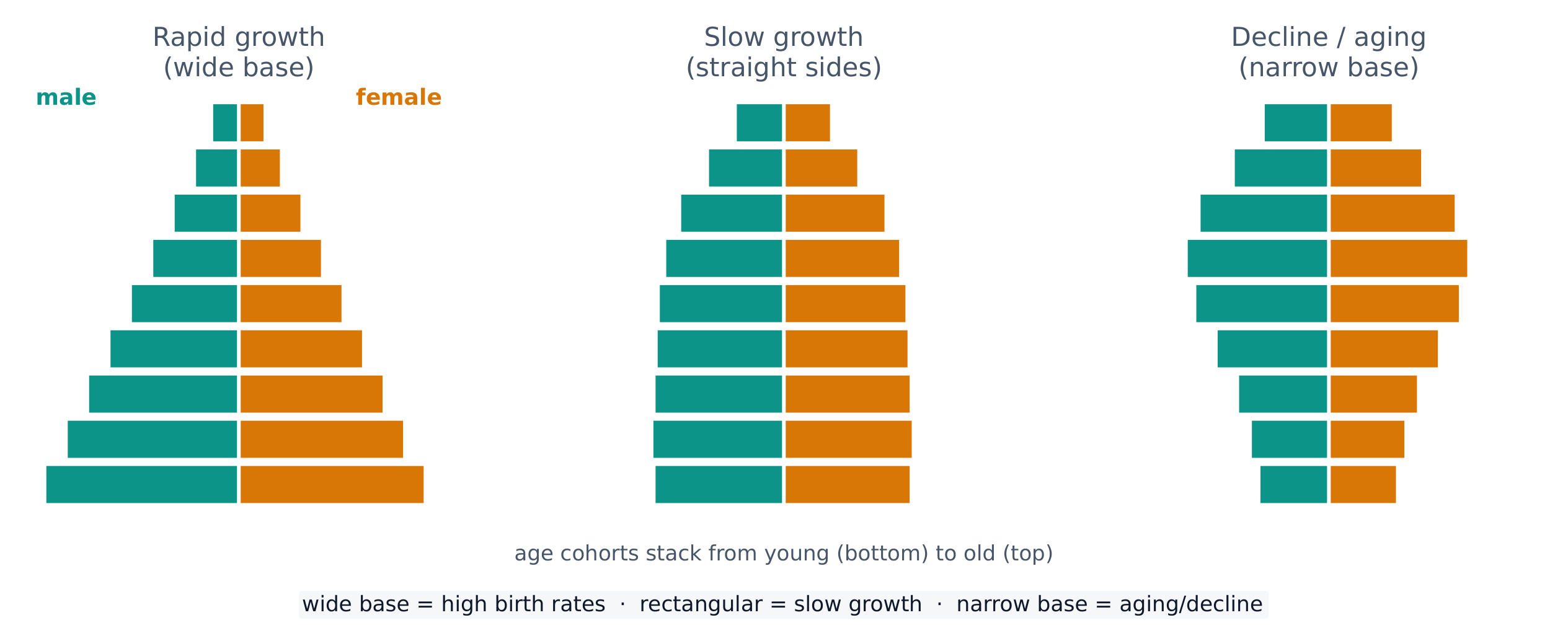
Population composition 人口构成 is the make-up of a population by age and sex. It is shown on a population pyramid 人口金字塔 — back-to-back bar charts of males and females in five-year age cohorts 年龄组.

  • A wide base means high birth rates and rapid growth (many young people).
  • Straight sides mean slow, stable growth.
  • A narrow base with a wide middle means an aging, shrinking population.

The dependency ratio 抚养比 compares dependents (under 15 and over 64) to the working-age population — a high ratio strains the workers who support them.

한국어
인구 피라미드 읽기

인구 구성은 연령과 성별에 따른 인구의 구성 비율을 말한다. 이는 인구 피라미드에 표시되는데, 이는 5년 단위의 ** 연령대**별 남성 및 여성 백분율을 뒤로 대고 그린 막대그래프이다.

세 가지 형태의 인구 피라미드: 급성장, 완만 성장 및 감소
넓은 밑부분은 급성장을 의미하며, 직선 측면은 완만한 성장을, 좁은 밑부분은 감소를 의미한다
  • 넓은 밑부분은 높은 출생률과 급격한 성장을 의미한다(많은 젊은 층).
  • 직선 측면은 느리고 안정적인 성장을 의미한다.
  • 좁은 밑부분과 넓은 중간 부분은 노후화되고 감소하는 인구를 의미한다.

의존 비율은 비근로연령 인구(15세 미만 및 64세 이상)를 근로연령 인구에 비교한 것으로, 이 비율이 높을수록 이를 부양하는 근로자의 부담이 커집니다.

Vocabulary · ⁨어휘⁩ Train · ⁨연습하기⁩
English 한국어
population pyramid/ˌpɒpjʊˈleɪʃn ˈpɪrəmɪd/ 인구 피라미드
age cohorts/eɪdʒ ˈkəʊhɔːts/ 연령 코호트
dependency ratio/dɪˈpendənsi ˈreɪʃɪəʊ/ 부양비율(dependency ratio)
Crude birth rate (CBR)/kruːd bɜːθ reɪt/ 출생률 (CBR)
crude death rate (CDR)/kruːd deθ reɪt/ 사망률 (CDR)
Rate of natural increase (RNI)/reɪt ɒv ˈnætʃərəl ˈɪŋkriːs/ 자연 증가율 (RNI)
Total fertility rate (TFR)/ˈtəʊtl fɜːˈtɪlɪti reɪt/ 총출산율 (TFR)
2.4

Population Dynamics · ⁨인구 역학⁩

Syllabus
English

Enduring Understanding (IMP-2): Changes in population are due to mortality, fertility, and migration, which are influenced by the interplay of environmental, economic, cultural, and political factors.

Learning Objective IMP-2.A: Explain factors that account for contemporary and historical trends in population growth and decline.

  • IMP-2.A.1 Demographic factors that determine a population’s growth and decline are fertility, mortality, and migration.
  • IMP-2.A.2 Geographers use the rate of natural increase and population-doubling time to explain population growth and decline.
  • IMP-2.A.3 Social, cultural, political, and economic factors influence fertility, mortality, and migration rates.
한국어

Enduring Understanding (IMP-2): 인구의 변화는 사망률, 출생률, 이민에 의해 발생하며, 이는 환경, 경제, 문화, 정치적 요인의 상호작용에 의해 영향을 받는다.

학습 목표 IMP-2.A: 인구 증가 및 감소의 현대적 및 역사적 추세를 설명하는 요인을 기술하시오.

  • IMP-2.A.1 인구의 증가와 감소를 결정하는 인구통계학적 요인은 출생률, 사망률, 그리고 이동입니다.
  • IMP-2.A.2 지리학자는 자연증가율과 인구 배가 시간을 사용하여 인구 증가 및 감소를 설명합니다.
  • IMP-2.A.3 사회, 문화, 정치, 경제적 요인은 출생률, 사망률, 이동률에 영향을 미칩니다.

Source: College Board AP Course and Exam Description · ⁨출처: College Board AP Course and Exam Description⁩

English

Populations change through births, deaths, and migration. Key rates (per 1,000 people per year):

  • Crude birth rate (CBR) 粗出生率 and crude death rate (CDR) 粗死亡率.
  • Rate of natural increase (RNI) 自然增长率 = (CBR − CDR) ÷ 10, as a percentage — it ignores migration.
  • Total fertility rate (TFR) 总和生育率 — average children per woman; about 2.1 is replacement level 更替水平.

The doubling time 倍增时间 (years for a population to double) ≈ 70 ÷ RNI%. Small changes in fertility have huge long-run effects.

Worked example (a real AP exam question). "Explain ONE reason why the rate of natural increase (RNI) in urban areas may vary significantly from RNI in rural areas in the same country." (2023) A full-mark answer: "In cities the cost of living — housing, schooling, childcare — is higher, so urban families tend to have fewer children. Fewer births lower the crude birth rate, so the urban RNI falls below the rural RNI, where children still help with farm work." Notice the shape: the command word Explain wants a cause-and-effect chain, so you must name the reason and follow it all the way to the RNI. A bare fact — "cities are expensive" — earns zero.

한국어

인구는 출생, 사망, 이민에 의해 변화합니다. 주요 지표(연간 1,000명당):

  • 총출생률(CBR) 및 총사망률(CDR).
  • 자연 증가율(RNI) = (CBR − CDR) ÷ 10, 백분율로 표시 — 이민은 고려되지 않습니다.
  • 총출산율(TFR) — 여성당 평균 출생아 수; 약 2.1가 **교체 수준(replacement level)**으로 간주된다.

인구 배가 시간(인구가 두 배로 늘어나는 데 걸리는 년수) ≈ 70 ÷ RNI%. 생산율의 작은 변화는 장기적으로 막대한 영향을 미칩니다.

해설 예제 (실제 AP 시험 문제). "동일 국가 내 도시 지역의 자연 증가율(RNI)이 농촌 지역 RNI와 크게 다른 이유 중 하나를 설명하시오." (2023년) 만점 답안: "도시는 주거, 교육, 육아 등 생활비가 높아 도시 가구는 자녀 수가 적은 경향이 있습니다. 출생수가 감소하면 총출생률이 낮아져 도시의 RNI가 농촌보다 낮아지는데, 농촌에서는 여전히 자녀들이 농업 노동을 돕기 때문입니다." 형상을 보면 명령어 **Explain(설명하다)**는 인과 관계 사슬을 요구하므로, 원인을 명시하고 그 결과까지 RNI까지 이어지는 논리를 모두 제시해야 합니다. 단순 사실 나열만으로는 "도시는 비싸다"라는 식으로는 점수를 받을 수 없습니다.

Vocabulary · ⁨어휘⁩ Train · ⁨연습하기⁩
English 한국어
replacement level/rɪˈpleɪsmənt ˈlevl/ 교체 수준
doubling time/ˈdʌblɪŋ taɪm/ 배가 시간
Demographic Transition Model (DTM)/ˌdeməˈɡræfɪk trænˈsɪʃn ˈmɒdl/ 인구 전환 모델 (DTM)
2.5

The Demographic Transition Model · ⁨인구 전환 모델⁩

Syllabus
English

Enduring Understanding (IMP-2): Changes in population are due to mortality, fertility, and migration, which are influenced by the interplay of environmental, economic, cultural, and political factors.

Learning Objective IMP-2.B: Explain theories of population growth and decline.

  • IMP-2.B.1 The demographic transition model can be used to explain population change over time.
  • IMP-2.B.2 The epidemiological transition explains causes of changing death rates.
한국어

Enduring Understanding (IMP-2): 인구의 변화는 사망률, 출생률, 이민에 의해 발생하며, 이는 환경, 경제, 문화, 정치적 요인의 상호작용에 의해 영향을 받는다.

학습 목표 IMP-2.B: 인구 증가 및 감소에 대한 이론을 설명하시오.

  • IMP-2.B.1 인구 전환 모델은 시간에 따른 인구 변화를 설명하는 데 사용할 수 있습니다.
  • IMP-2.B.2 역학적 전환(epidemiological transition)은 사망률 변화의 원인을 설명합니다.

Source: College Board AP Course and Exam Description · ⁨출처: College Board AP Course and Exam Description⁩

English
The demographic transition model

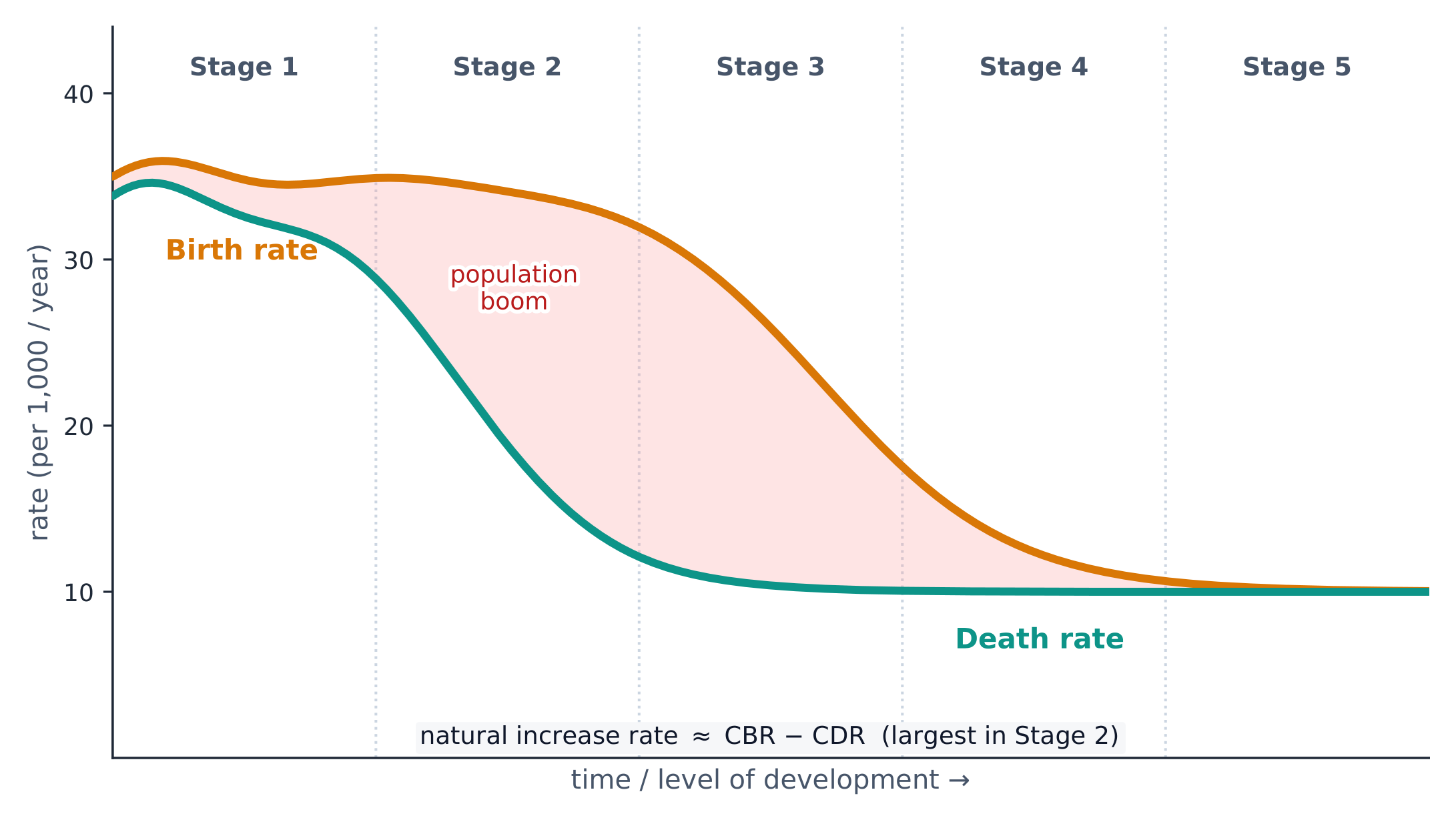
The Demographic Transition Model (DTM) 人口转变模型 shows how birth and death rates change as a country develops, through five stages.

  1. Stage 1 — high, fluctuating CBR and CDR; slow growth (pre-industrial).
  2. Stage 2 — CDR falls (better food, medicine, sanitation) while CBR stays high; population booms.
  3. Stage 3 — CBR falls (urbanisation, education, women in work); growth slows.
  4. Stage 4 — low CBR and CDR; population stable and large.
  5. Stage 5 — CBR falls below CDR; population declines and ages.

The linked epidemiological transition 流行病学转变 describes how the main causes of death shift from infectious disease to chronic, degenerative disease as a country moves through the DTM.

한국어
인구 전환 모델

**인구 전환 모델(DTM)**은 국가가 발전함에 따라 출생률과 사망률이 어떻게 변하는지를 5단계를 통해 보여줍니다.

인구 전환 모델: 5단계별 출생률 및 사망률 추이
사망률이 먼저 하락하고 이후 출생률이 떨어지며, 이 격차가 인구 급증(baby boom)을 초래함
  1. 1단계 — 높은 변동성 있는 CBR 및 CDR; 느린 성장 (산업화 이전).
  2. 2단계 — CDR 하락 (식품, 의약품, 위생 개선으로 인해)while CBR은 높은 수준 유지; 인구 급증.
  3. 3단계 — CBR 하락 (도시화, 교육, 여성의 사회 진출로 인해); 성장률 둔화.
  4. 4단계 — 낮은 CBR 및 CDR; 인구는 안정적이고 대량임.
  5. 5단계 — CBR이 CDR보다 낮아짐; 인구는 감소하며 고령화됨.

연관된 **역학적 전환(epidemiological transition)**은 국가가 DTM을 거치면서 주요 사망 원인이 전염병에서 만성 퇴행성 질환으로 shifted됨을 서술합니다.

Vocabulary · ⁨어휘⁩ Train · ⁨연습하기⁩
English 한국어
epidemiological transition/ˌepɪˌdemɪəˈlɒdʒɪkl trænˈsɪʃn/ 역학적 전환
2.6

Malthusian Theory · ⁨말서스 이론⁩

Syllabus
English

Enduring Understanding (IMP-2): Changes in population are due to mortality, fertility, and migration, which are influenced by the interplay of environmental, economic, cultural, and political factors.

Learning Objective IMP-2.B: Explain theories of population growth and decline.

  • IMP-2.B.3 Malthusian theory and its critiques are used to analyze population change and its consequences.
한국어

Enduring Understanding (IMP-2): 인구의 변화는 사망률, 출생률, 이민에 의해 발생하며, 이는 환경, 경제, 문화, 정치적 요인의 상호작용에 의해 영향을 받는다.

학습 목표 IMP-2.B: 인구 증가 및 감소에 대한 이론을 설명하시오.

  • IMP-2.B.3 말서스 이론 및 그에 대한 비판은 인구 변화와 그 결과를 분석하는 데 사용됩니다.

Source: College Board AP Course and Exam Description · ⁨출처: College Board AP Course and Exam Description⁩

English
Malthusian theory and its critique

In 1798 Thomas Malthus argued that population grows exponentially 指数式 while food supply grows only linearly 线性, so population would outrun food and be checked by famine, disease, and war.

Critics say Malthus underestimated technology: the Green Revolution and modern farming raised food output enormously. Neo-Malthusians 新马尔萨斯主义者 update the worry to include water, energy, and other finite resources. The debate is a favourite exam prompt.

한국어
말서스 이론及其 critiques

1798년 **토머스 말서스(Thomas Malthus)**는 인구가 **지수함수적(exponentially)**으로 증가하는 반면 식품 공급은 오직 **선형적(linearly)**으로만 증가하므로, 인구가 식품을 추월하여 기근, 질병, 전쟁에 의해 억제될 것이라고 주장했습니다.

비판자들은 말서스가 기술을 과소평가했다고 지적합니다. 녹색 혁명과 현대 농업은 식품 생산량을 폭발적으로 늘렸습니다. **신말서주의자(s Neo-Malthusians)**는 물, 에너지 등 기타 유한 자원을 포함한 우려사항을 업데이트했습니다. 이 논쟁은 자주 출제되는 고사 주제입니다.

Vocabulary · ⁨어휘⁩ Train · ⁨연습하기⁩
English 한국어
exponentially/ˌekspəˈnenʃəli/ 지수함수적으로
linearly/ˈlɪnɪəli/ 선형적으로
Neo-Malthusians/ˈniːəʊ mælˈθjuːzɪənz/ neo-Malthusians
2.7

Population Policies · ⁨인구 정책⁩

Syllabus
English

Enduring Understanding (SPS-2): Changes in population have long- and short-term effects on a place’s economy, culture, and politics.

Learning Objective SPS-2.A: Explain the intent and effects of various population and immigration policies on population size and composition.

  • SPS-2.A.1 Types of population policies include those that promote or discourage population growth, such as pronatalist, antinatalist, and immigration policies.
한국어

지속적 이해 (SPS-2): 인구의 변화는 한 지역의 경제, 문화, 정치에 장기적이고 단기적인 영향을 미칩니다.

학습 목표 SPS-2.A: 다양한 인구 및 이민 정책이 인구 규모 및 구성에 미치는 의도와 영향을 설명하시오.

  • SPS-2.A.1 인구 정책의 유형에는 인구 증가를 장려하거나 억제하는 것이 있는데, 예로 친출산주의, 반출산주의, 이민 정책 등이 있습니다.

Source: College Board AP Course and Exam Description · ⁨출처: College Board AP Course and Exam Description⁩

English

Governments try to influence population growth with policies:

  • Pro-natalist 鼓励生育 policies encourage births (cash bonuses, parental leave, childcare) where populations are aging or shrinking — e.g. France, Japan.
  • Anti-natalist 限制生育 policies discourage births where growth is seen as too fast — e.g. India's family-planning campaigns.

Policies have unintended consequences: strong anti-natal policies can skew the sex ratio or speed up aging, which later needs a pro-natal response.

한국어

정부는 다음과 같은 정책을 통해 인구 성장을 조절하려 합니다:

  • **출생 장려 정책(Pro-natalist policies)**은 인구 고령화 또는 감소가 심한 지역에서 출생을 장려합니다 (현금 보너스, 육아휴직, 보육 지원 등) — 예: 프랑스, 일본.
  • **출생 억제 정책(Anti-natalist policies)**은 성장이过快被认为 too fast的情况下抑制出生 — 예:印度的计划生育运动。

政策有 unintended consequences:strong anti-natal policies can skew the sex ratio or speed up aging, which later needs a pro-natal response.

Vocabulary · ⁨어휘⁩ Train · ⁨연습하기⁩
English 한국어
Pro-natalist/prəʊ ˈneɪtəlɪst/ 출산 장려 정책
Anti-natalist/ˈænti ˈneɪtəlɪst/ 출산 억제 정책
aging populations/ˈeɪdʒɪŋ ˌpɒpjʊˈleɪʃnz/ 고령화 인구
2.8 2.9

Women, Aging, and Demographic Change · ⁨女性、老龄化与人口变迁⁩

Syllabus
English

Enduring Understanding (SPS-2): Changes in population have long- and short-term effects on a place’s economy, culture, and politics.

Learning Objective SPS-2.B: Explain how the changing role of females has demographic consequences in different parts of the world.

  • SPS-2.B.1 Changing social values and access to education, employment, health care, and contraception have reduced fertility rates in most parts of the world.
  • SPS-2.B.2 Changing social, economic, and political roles for females have influenced patterns of fertility, mortality, and migration, as illustrated by Ravenstein’s laws of migration.
한국어

지속적 이해 (SPS-2): 인구의 변화는 한 지역의 경제, 문화, 정치에 장기적이고 단기적인 영향을 미칩니다.

학습 목표 SPS-2.B: 여성의 역할 변화가 전 세계 각지에 어떤 인구학적 결과를 가져오는지를 설명하시오.

  • SPS-2.B.1 사회 가치관 변화 및 교육, 고용, 의료, 피임에 대한 접근성 향상이 전 세계 대부분 지역에서 출생률을 낮추었습니다.
  • SPS-2.B.2 여성의 사회, 경제, 정치적 역할 변화는 라벤슈타인의 이동 법칙에 의해 예시된 바와 같이 출생률, 사망률, 이동 패턴에 영향을 미쳤습니다.
English

Enduring Understanding (SPS-2): Changes in population have long- and short-term effects on a place’s economy, culture, and politics.

Learning Objective SPS-2.C: Explain the causes and consequences of an aging population.

  • SPS-2.C.1 Population aging is determined by birth and death rates and life expectancy.
  • SPS-2.C.2 An aging population has political, social, and economic consequences, including the dependency ratio.
한국어

지속적 이해 (SPS-2): 인구의 변화는 한 지역의 경제, 문화, 정치에 장기적이고 단기적인 영향을 미칩니다.

학습 목표 SPS-2.C: 고령화 인구의 원인 및 결과를 설명하시오.

  • SPS-2.C.1 인구 고령화는 출생률, 사망률, 그리고 기대수명에 의해 결정됩니다.
  • SPS-2.C.2 고령화 인구는 종속 비율을 포함한 정치적, 사회적, 경제적 결과를 낳습니다.

Source: College Board AP Course and Exam Description · ⁨출처: College Board AP Course and Exam Description⁩

English

The status of women is one of the strongest drivers of fertility. As female education and employment rise, women marry later and have fewer children, so fertility falls — a key reason countries move through the DTM.

At the other end, aging populations 人口老龄化 (a rising share of over-65s) bring their own challenges: higher pension and healthcare costs, a shrinking workforce, and a rising dependency ratio. Countries respond with later retirement, immigration, or pro-natal policies.

한국어

女性的地位是生育率最重要的驱动因素之一。随着女性教育和就业率的提升,女性晚婚且子女减少,导致生育率下降——这是国家通过DTM转型的关键原因。

另一方面,老龄化人口(65岁以上人口占比上升)带来自身挑战:养老金和医疗成本增加、劳动力萎缩以及依赖比上升。各国通过延迟退休、移民或鼓励生育政策应对。

2.10 2.11

Causes and Types of Migration · ⁨移民的成因与类型⁩

Syllabus
English

Enduring Understanding (IMP-2): Changes in population are due to mortality, fertility, and migration, which are influenced by the interplay of environmental, economic, cultural, and political factors.

Learning Objective IMP-2.C: Explain how different causal factors encourage migration.

  • IMP-2.C.1 Migration is commonly divided into push factors and pull factors.
  • IMP-2.C.2 Push/pull factors and intervening opportunities/obstacles can be cultural, demographic, economic, environmental, or political.
한국어

Enduring Understanding (IMP-2): 인구의 변화는 사망률, 출생률, 이민에 의해 발생하며, 이는 환경, 경제, 문화, 정치적 요인의 상호작용에 의해 영향을 받는다.

학습 목표 IMP-2.C: 다양한 인과 요인이 이동을 촉진하는 방식을 설명하시오.

  • IMP-2.C.1 이동은 일반적으로 밀어내는 요인(push factors)과 끌어당기는 요인(pull factors)으로 나뉩니다.
  • IMP-2.C.2 밀어내는/끌어당기는 요인과 중개 기회/장벽은 문화적, 인구통계학적, 경제적, 환경적, 또는 정치적 요인이 될 수 있습니다.
English

Enduring Understanding (IMP-2): Changes in population are due to mortality, fertility, and migration, which are influenced by the interplay of environmental, economic, cultural, and political factors.

Learning Objective IMP-2.D: Describe types of forced and voluntary migration.

  • IMP-2.D.1 Forced migrations include slavery and events that produce refugees, internally displaced persons, and asylum seekers.
  • IMP-2.D.2 Types of voluntary migrations include transnational, transhumance, internal, chain, step, guest worker, and rural-to-urban.
한국어

Enduring Understanding (IMP-2): 인구의 변화는 사망률, 출생률, 이민에 의해 발생하며, 이는 환경, 경제, 문화, 정치적 요인의 상호작용에 의해 영향을 받는다.

학습 목표 IMP-2.D: 강제 및 자발적 이동의 유형을 서술하시오.

  • IMP-2.D.1 강제 이동에는 노예제와 난민, 국내 피신자, 망명 신청자를 발생시키는 사건이 포함됩니다.
  • IMP-2.D.2 자발적 이동의 유형에는 초국적 이동, 유목(transition), 내부 이동, 체인 이동, 단계 이동, 외국인 근로자, 농촌에서 도시로의 이동 등이 포함됩니다.

Source: College Board AP Course and Exam Description · ⁨출처: College Board AP Course and Exam Description⁩

English

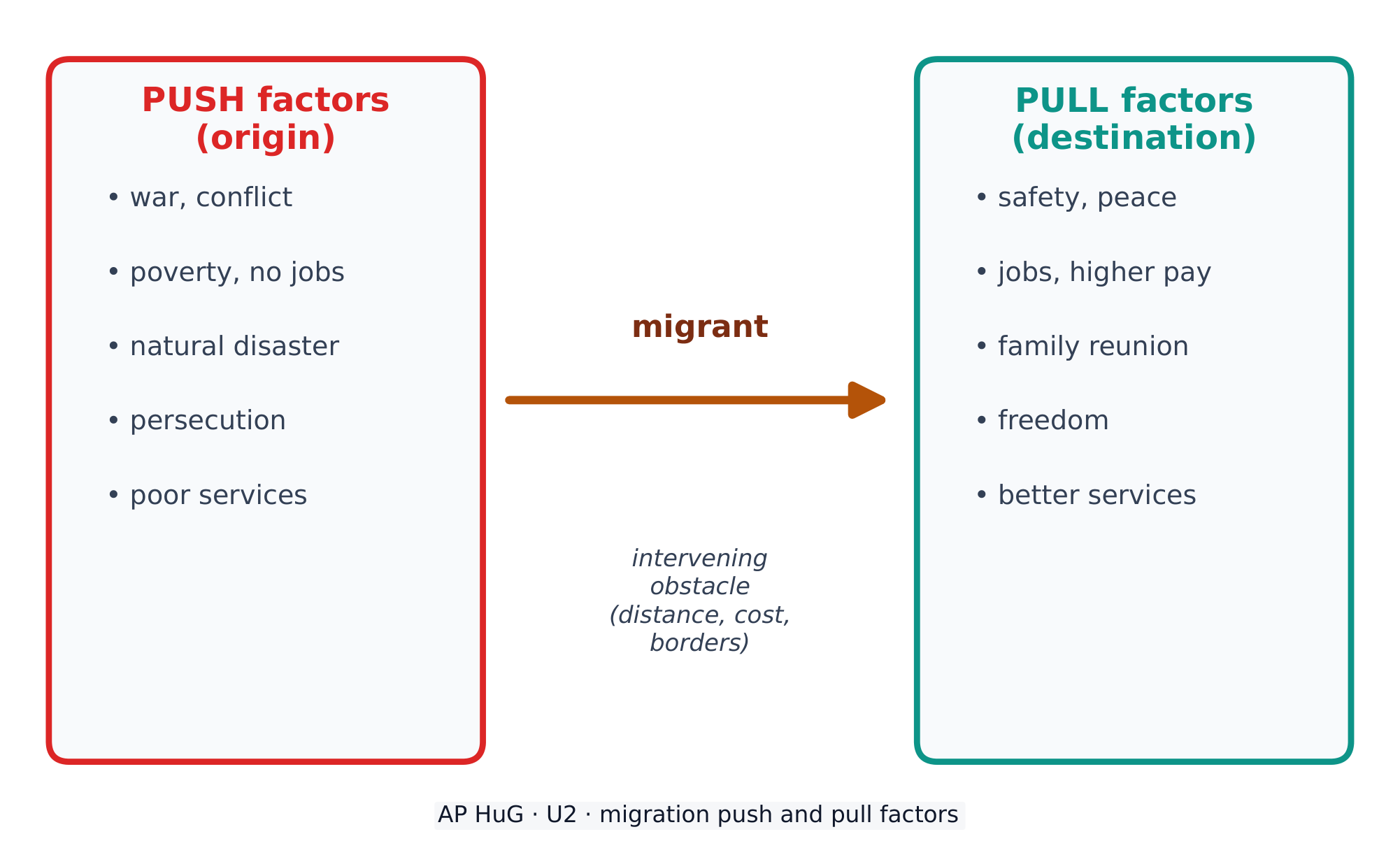
Migration 迁移 is a permanent move to a new location. It is driven by push factors 推力 (reasons to leave: war, poverty, disaster) and pull factors 拉力 (reasons to arrive: jobs, safety, family).

  • Voluntary migration 自愿迁移 is by choice, usually for economic reasons.
  • Forced migration 强迫迁移 is against a person's will — refugees 难民 fleeing danger, or people displaced by disaster.
  • Ravenstein's laws describe patterns: most migrants move short distances, in steps, and are drawn mainly by economic pull.

Migration can be international (between countries) or internal (within a country, such as rural-to-urban).

한국어

移民是指永久迁往新地点的行为。其动力来自push factors(离开的原因:战争、贫困、灾难)和pull factors(到达的原因:工作、安全、家庭团聚)。

Push factors drive people out; pull factors draw them to a new place
移民决策在 intervening obstacle 的背景下权衡 push factors 与 pull factors
  • 자발적 이주는 선택에 의한 것으로, 대부분 경제적 이유 때문이다.
  • 强制移民(forced migration) 违背个人意愿——难民逃离危险,或因灾难流离失所者。
  • 雷文斯坦法则(Ravenstein's laws) 描述了模式:大多数移民迁移距离短、分阶段进行,且主要受经济拉力吸引。

移民可分为 international(跨国)或 internal(国内,如农村向城市迁移)。

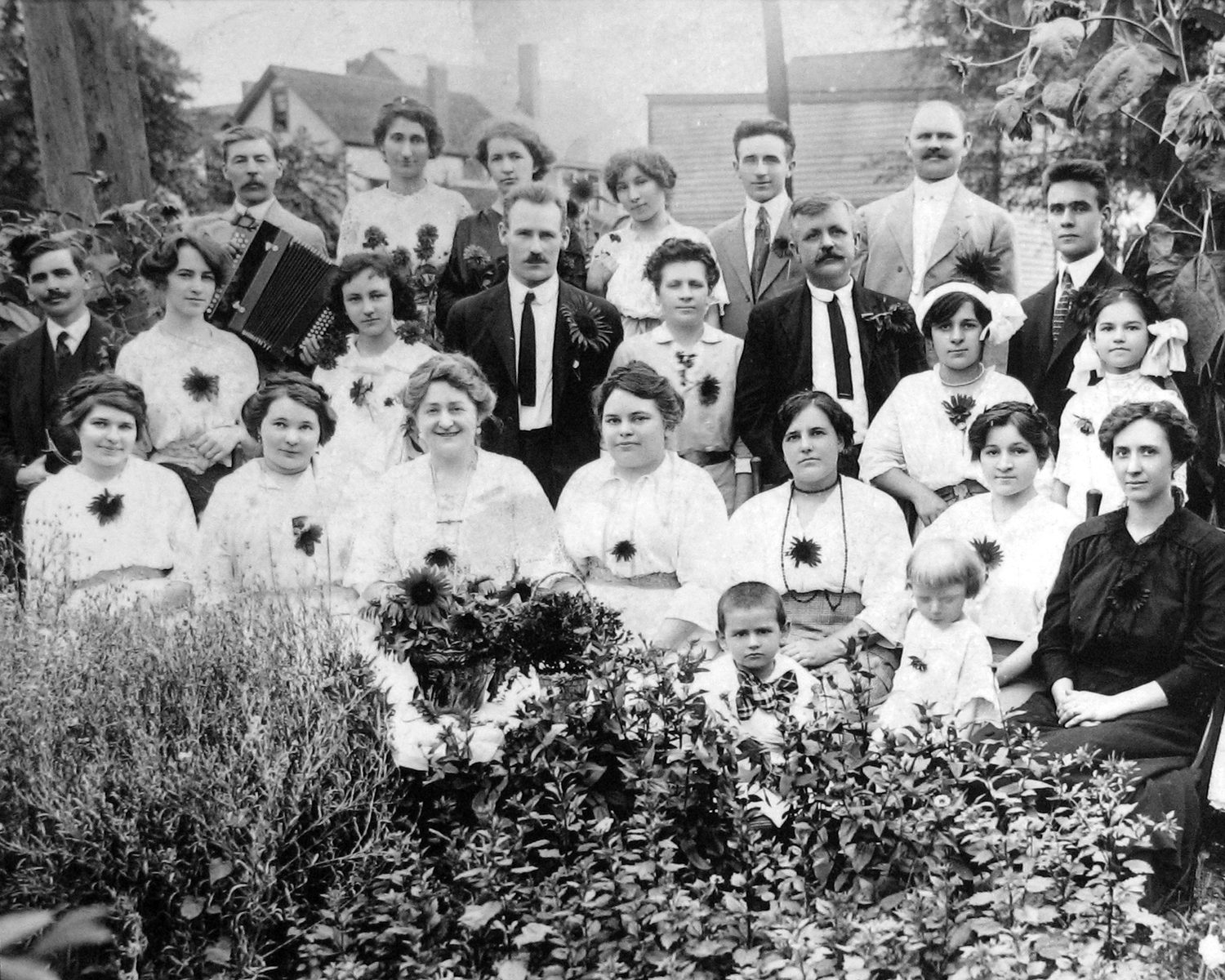
Immigrants arriving in a new city: migration redistributes population and reshapes places
Explore · ⁨탐색하기⁩

Push factor or pull factor? · ⁨밀어내는 요인(Push factor)抑或 끌어당기는 요인(Pull factor)?⁩

A push factor drives people away from the origin; a pull factor draws them toward the destination. · ⁨밀어내는 요인은 people를 기원에서 멀어지게 하고, 끌어당기는 요인은 destination으로 끌어당킵니다.⁩

Vocabulary · ⁨어휘⁩ Train · ⁨연습하기⁩
English 한국어
Migration/maɪˈɡreɪʃn/ 이민
push factors/pʊʃ ˈfæktəz/ 밀어내기 요인
pull factors/pʊl ˈfæktəz/ 끌기 요인
Voluntary migration/ˈvɒləntəri maɪˈɡreɪʃn/ 자발적 이주
Forced migration/fɔːst maɪˈɡreɪʃn/ 강제 이주
refugees/ˈrefjuːdʒiːz/ 난민
2.12

Effects of Migration · ⁨移民的影响⁩

Syllabus
English

Enduring Understanding (IMP-2): Changes in population are due to mortality, fertility, and migration, which are influenced by the interplay of environmental, economic, cultural, and political factors.

Learning Objective IMP-2.E: Explain historical and contemporary geographic effects of migration.

  • IMP-2.E.1 Migration has political, economic, and cultural effects.
한국어

Enduring Understanding (IMP-2): 인구의 변화는 사망률, 출생률, 이민에 의해 발생하며, 이는 환경, 경제, 문화, 정치적 요인의 상호작용에 의해 영향을 받는다.

학습 목표 IMP-2.E: 이동의 역사적 및 현대적 지리적 영향을 설명하시오.

  • IMP-2.E.1 이동은 정치적, 경제적, 문화적 영향을 미칩니다.

Source: College Board AP Course and Exam Description · ⁨출처: College Board AP Course and Exam Description⁩

English

Migration reshapes both the origin and the destination.

  • The destination gains workers and cultural diversity but may face pressure on housing and services and social tension.
  • The origin may lose skilled workers (a brain drain 人才外流) but gain remittances 侨汇 — money migrants send home, a major income source for many countries.
  • Migration changes the age and sex structure of both places, because migrants are often young working-age adults.
한국어

移民重塑 origin 和 destination 两地。

  • destination 获得劳动力和文化多样性,但可能面临住房与服务压力及社会紧张。
  • origin 可能流失熟练工人(brain drain),但获得 remittances(移民寄回国内的汇款),成为许多国家的重要收入来源。
  • 移民改变两地的年龄和性别结构,因为移民多为年轻劳动年龄成年人。
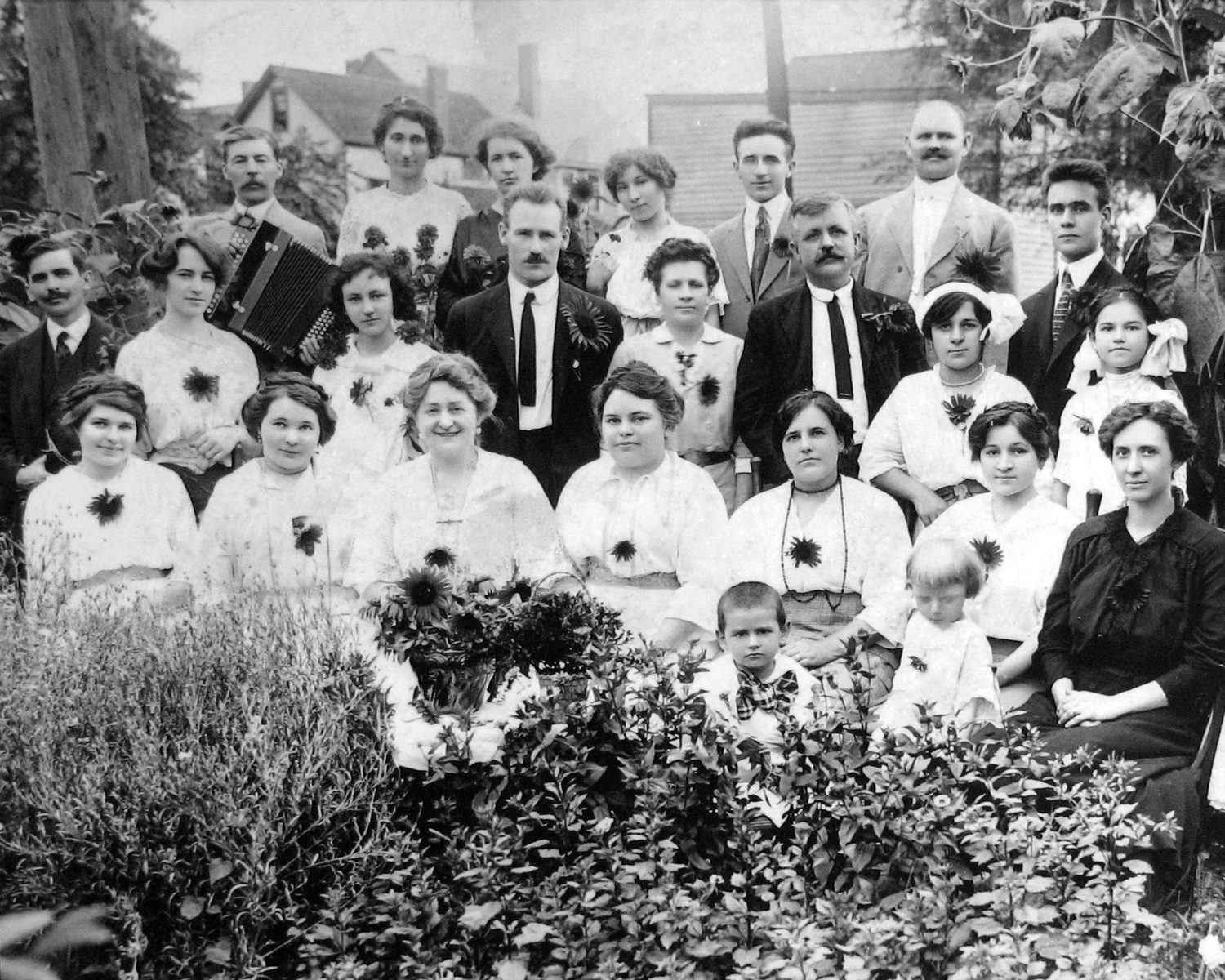
New arrivals reshape cities: migration changes labour markets, culture and demographics in destination places
신규 유입이 도시를 재편함: 이주는 목적지의 노동 시장, 문화 및 인구 통계적 특성을 변화시킵니다
Vocabulary · ⁨어휘⁩ Train · ⁨연습하기⁩
English 한국어
brain drain/breɪn dreɪn/ 브레인 드레인
remittances/rɪˈmɪtənsɪz/ 송금(remittances)
2.12

Exam tips · ⁨시험 팁⁩

English
  • Compute RNI = (CBR − CDR) ÷ 10 as a percent, and read doubling time as about 70 ÷ RNI.
  • Link a population pyramid's shape to fertility and the DTM stage — a wide base means Stage 2.
  • Remember the death rate falls before the birth rate; that is why Stage 2 grows fastest.
  • Separate push from pull and forced from voluntary; a refugee crosses a border, an IDP does not.
  • Weigh migration effects: remittances help the origin, but brain drain and aging hurt it.
한국어
  • RNI = (CBR − CDR) ÷ 10을 계산하여 백분율로 구하고, 배의 시간을 약 70 ÷ RNI으로 읽으십시오.
  • 인구 피라미드의 형태를 출산률과 DTM 단계에 연결하십시오 — 넓은 바닥은 2단계를 의미합니다.
  • 사망률이 출생률보다 먼저 감소한다는 점을 기억하십시오. 바로 이것이 2단계가 가장 빠르게 성장하는 이유입니다.
  • **밀어내기(push)**와 끌어당기기(pull), 그리고 강제와 자발을 구분하십시오. **난민(refugee)**은 국경을 넘어가지만, **내부 유입 IDP(internally displaced person)**는 그렇지 않습니다.
  • 이주의 영향을 고찰하십시오: 송금이 기원지에 도움이 되지만, **두뇌 유출(brain drain)**과 노화는 그들에게 해를 끼칩니다.

Interactive lessons on this topic · ⁨이 주제에 대한 인터랙티브 수업⁩

Work through it step by step, with instant-check exercises. · ⁨즉시 체크 기능 exercises를 통해 단계별로 진행하세요.⁩

Past Papers · ⁨과거 시험지⁩

More topics in AP Human Geography · ⁨AP 인간지리학⁩ · ⁨AP Human Geography · ⁨AP 인간지리학⁩ 내 추가 주제⁩

Log in or create account · ⁨로그인 또는 계정 만들기⁩

IGCSE, A-Level & AP