English
| Enduring Understanding | Learning Objective | Essential Knowledge |
|---|---|---|
REO-1 | 5.A |
|
한국어
| Enduring Understanding | Learning Objective | Essential Knowledge |
|---|---|---|
REO-1 | 5.A |
|
AP English Language and Composition · AP 영어 어법 및 작문 · Topic 5 · 주제 5
 5:41
5:41
단원 5: 조직, 일관성, 및 스타일
CED의 본문 문단에 대한 설명은 정확하며 암기할 가치가 있습니다. 글쓰기 논증의 본문 문단은 주장을 하고, 증거로 them을 지원하며,…
English narration · English + 中文 subtitles burned in · 영어 내레이션 · 영어 + 중국어 자막 burned-in
| Enduring Understanding | Learning Objective | Essential Knowledge |
|---|---|---|
REO-1 | 5.A |
|
| Enduring Understanding | Learning Objective | Essential Knowledge |
|---|---|---|
REO-1 | 5.A |
|
Source: College Board AP Course and Exam Description · 출처: College Board AP Course and Exam Description
Unit 5 turns from what an argument contains to how it holds together. It has two subjects: coherence 连贯 and the beginnings of style 文体.
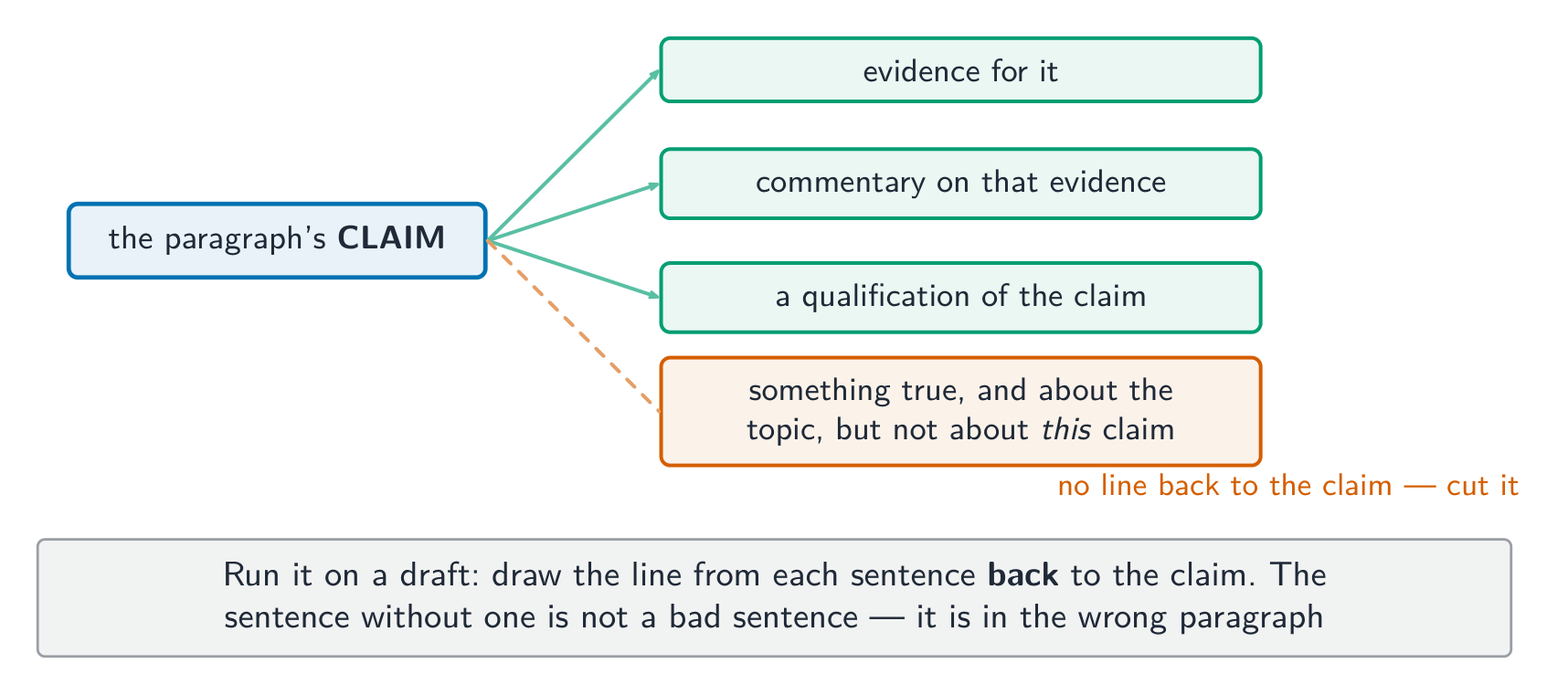
The CED's statement of the body paragraph is exact and worth memorising: the body paragraphs of a written argument make claims, support them with evidence, and provide commentary that explains the relationship of the evidence to the claim.
Three parts, in that order, in every body paragraph. When an AP essay loses evidence-and-commentary points, it is almost always because the third part is missing from paragraphs that have the first two.
단원 5는 논증의 무엇에서 논증이 어떻게 뭉쳐 있는지로 전환된다. 이 단원은 두 가지 주제를 다룬다: **연결성 ( coherence )**과 **문체 ( style )**의 시작이다.
CED의 본론 문단에 대한 설명은 정확하며 암기할 가치가 있다: 논증 글의 본론 문단은 주장을 제기하고, 증거로 이를 지지하며, 증거와 주장 간의 관계를 설명하는 비평을 제공한다.
모든 본론 문단에는 세 가지 부분이 순서대로 존재한다. AP 논증에서 증거 및 비평点が 떨어지는 이유는 거의 항상 첫 번째와 두 번째 부분은 있으나 세 번째 부분이 결여되어 있기 때문이다.
| English | 한국어 |
|---|---|
| coherence/kəʊˈhɪərəns/ | 일관성 |
| style/staɪl/ | 양식 |
| Repetition/ˌrepəˈtɪʃn/ | 반복 |
| synonyms/ˈsɪnənɪmz/ | 동义词 |
| pronoun references/ˈprəʊnaʊn ˈrefrənsɪz/ | 대명사 참조 |
| parallel structure/ˈpærəlel ˈstrʌktʃə/ | 병렬 구조 |
Enduring Understanding (REO-1): Writers guide understanding of a text’s lines of reasoning and claims through that text’s organization and integration of evidence.
Learning Objective 6.A: Writing – Develop a line of reasoning and commentary that explains it throughout an argument.
Enduring Understanding (REO-1): 작가는 텍스트의 조직과 증거의 통합을 통해 텍스트의 추론의 흐름과 주장에 대한 이해를 이끌어낸다.
학습 목표 6.A: 작문 – 논증 전반에 걸쳐 그 이유를 설명하는 추론과 해설을 구축한다.
Source: College Board AP Course and Exam Description · 출처: College Board AP Course and Exam Description
Applied to your own writing: draft the claims first, as a list, before writing any paragraph. You then have the line of reasoning in front of you and can check that it moves.
Then, for each claim, write the paragraph in its three parts deliberately. A useful habit under exam conditions is to make the commentary sentence begin with a word that forces a relationship - because, which means, so, the effect of this is - because those words cannot be followed by a restatement.
자신의 글쓰기에 적용하면: 어떤 문단도 쓰기 전에 주장을 목록으로 먼저 초안으로 작성하라. 그러면 논증의 흐름이 앞에 놓여 있어 논리가 이어지고 있는지 확인할 수 있다.
그 후 각 주장에 대해 의식적으로 세 부분으로 문단을 쓰라. 시험 조건에서 유용한 습관은 비평 문장이 관계성을 강제하는 단어로 시작하게 만드는 것이다. because, which means, so, the effect of this is 같은 단어들은 반복으로 이어질 수 없기 때문이다.

Enduring Understanding (REO-1): Writers guide understanding of a text’s lines of reasoning and claims through that text’s organization and integration of evidence.
Learning Objective 5.B: Reading – Explain how the organization of a text creates unity and coherence and reflects a line of reasoning.
Enduring Understanding (REO-1): 작가는 텍스트의 조직과 증거의 통합을 통해 텍스트의 추론의 흐름과 주장에 대한 이해를 이끌어낸다.
학습 목표 5.B: 독해 – 텍스트의 구조가 통일성과 일관성을 어떻게 형성하고 추론을 반영하는지 설명한다.
Source: College Board AP Course and Exam Description · 출처: College Board AP Course and Exam Description
Coherence occurs at different levels in a piece of writing:
The CED then names the devices that create those links:
연결성은 글쓰기의 다른 수준에서 발생합니다:
CED는 이러한 연결을 생성하는 장치들을 다음과 같이 명시한다:
| English | 한국어 |
|---|---|
| Transitional elements/trænˈsɪʃənl ˈelɪmənts/ | 전환 요소 |
| connotative and denotative meanings/kɒnəˈtætɪv ænd dɪˈnəʊtətɪv ˈmiːnɪŋz/ | 연관 의미와 직관적 의미 |
Enduring Understanding (REO-1): Writers guide understanding of a text’s lines of reasoning and claims through that text’s organization and integration of evidence.
Learning Objective 6.B: Writing – Use transitional elements to guide the reader through the line of reasoning of an argument.
Enduring Understanding (REO-1): 작가는 텍스트의 조직과 증거의 통합을 통해 텍스트의 추론의 흐름과 주장에 대한 이해를 이끌어낸다.
학습 목표 6.B: 작문 – 논증의 추론 흐름을 읽자가 따라갈 수 있도록 전환 요소를 사용한다.
Source: College Board AP Course and Exam Description · 출처: College Board AP Course and Exam Description
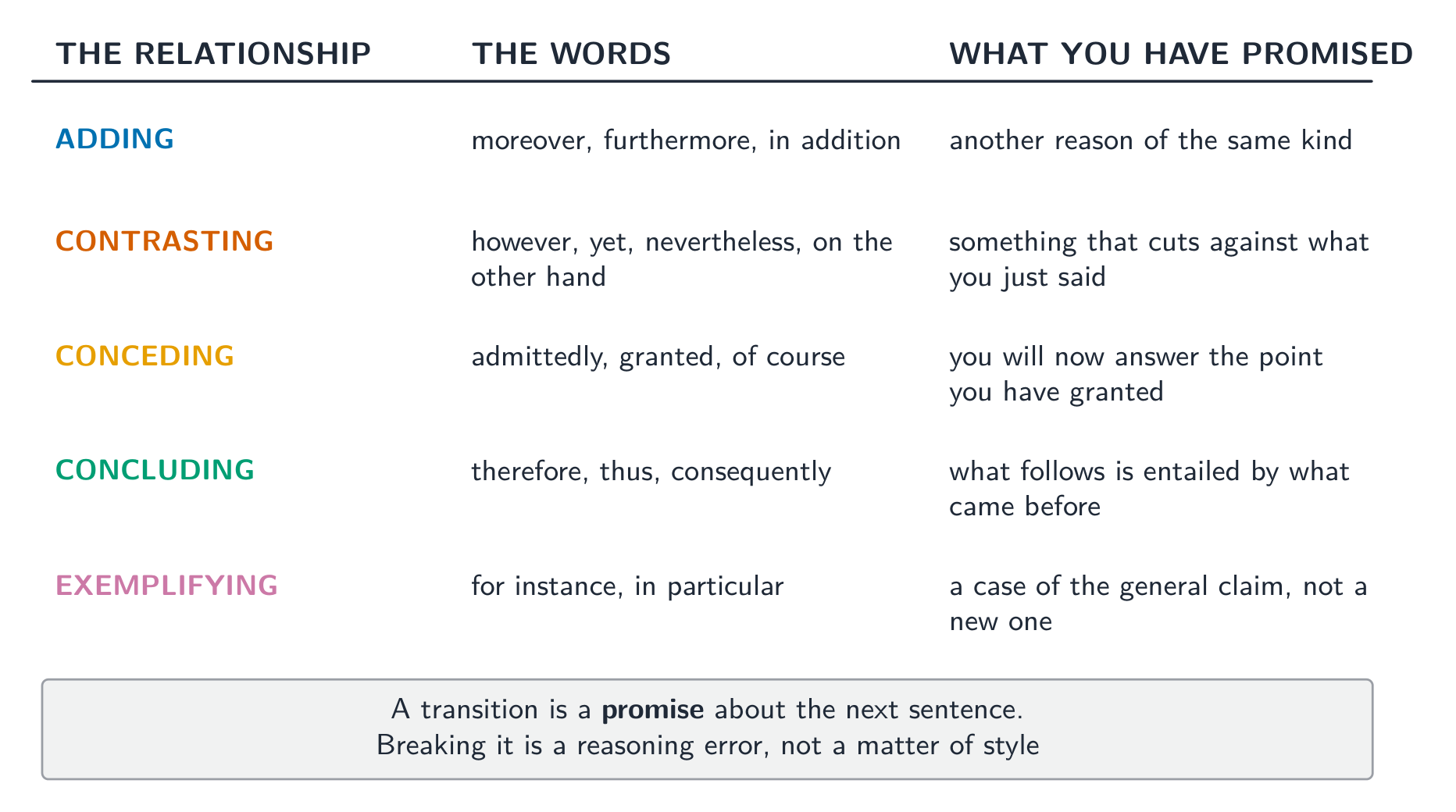
Transitions have a second job the CED names explicitly: they introduce evidence or indicate its relationship to other ideas or evidence.
That is the difference between decorative and functional transitions. Furthermore adds nothing - it says only "here is another sentence". Even in the cases where the effect is smallest tells the reader what relationship is coming. Choose transitions that carry information about the relationship, not ones that merely mark a boundary.
Note also that a transitional element may be a whole paragraph. In a long argument, a short paragraph whose only job is to turn the reasoning is legitimate and often elegant.
전치 요소는 CED가 명시적으로 언급하는 두 번째 임무가 있다: 증거를 도입하거나 그것이 다른 아이디어나 증거와 가지는 관계를 표시하는 것이다.
이는 장식용 전치 요소와 기능적 전치 요소의 차이이다. Furthermore는 아무것도 추가하지 않는다 - 단순히 "여기에 또 다른 문장이 있다"라고 말할 뿐이다. Even in the cases where the effect is smallest은 독자에게 어떤 관계가 오게 될지를 알려준다. 관계에 대한 정보를 전달하는 전치 요소를 선택하되, 단순히 경계를 표시하는 것만으로는 부족하다.
또한 전치 요소는 전체 문단일 수도 있다. 긴 논증 글에서 논증을 전환시키는 유일한 임무에만 전념하는 짧은 문단은 정당할 뿐만 아니라 종종 우아하다.
A transition is a claim about how two ideas stand to each other. Breaking that promise is a reasoning error, not a style problem. · 전환어는 두 개념 간의 관계를 주장하는 것입니다. 그 약속을 어기는 것은 스타일 문제가 아니라 추론 오류입니다.
Enduring Understanding (STL-1): The rhetorical situation informs the strategic stylistic choices that writers make.
Learning Objective 7.A: Reading – Explain how word choice, comparisons, and syntax contribute to the specific tone or style of a text.
지속적 이해 (STL-1): 수사적 상황은 작가들이 하는 전략적 스타일적 선택에 영향을 미친다.
학습 목표 7.A: 독해 – 어휘 선택, 비교, 구법이 텍스트의 특정 톤이나 스타일에 어떻게 기여하는지 설명한다.
Source: College Board AP Course and Exam Description · 출처: College Board AP Course and Exam Description
Unit 5 opens the course's treatment of style with three claims about diction:
The second is the analytically useful one. When a rhetorical-analysis passage calls a policy ambitious rather than expensive, no fact has changed and the reader's disposition has. That is a rhetorical choice, and it is exactly what the question asks you to explain.
단원 5는 문체에 대한 과정의 다루기를 세 가지 어휘(diction)에 대한 주장으로 시작한다:
두 번째는 분석적으로 유용한 경우입니다. 수사적 분석 passage가 정책을 비싸다가 아니라 포괄적이다라고 부를 때, 사실은 변하지 않았지만 독자의 태도는 바뀝니다. 이것이 수사적 선택이며, 질문이 정확히 설명을 요구하는 내용입니다.
Enduring Understanding (STL-1): The rhetorical situation informs the strategic stylistic choices that writers make.
Learning Objective 8.A: Writing – Strategically use words, comparisons, and syntax to convey a specific tone or style in an argument.
지속적 이해 (STL-1): 수사적 상황은 작가들이 하는 전략적 스타일적 선택에 영향을 미친다.
학습 목표 8.A: 글쓰기 – 논증에서 특정 톤이나 스타일을 전달하기 위해 단어를 전략적으로 사용하고, 비교 및 구문을 활용한다.
Source: College Board AP Course and Exam Description · 출처: College Board AP Course and Exam Description
For your own writing, precision is worth more than range. A concrete rule: prefer the word that is exactly right to the word that is impressive. Examiners reward control, and an inflated word used slightly wrongly reads as loss of control.
Worked example (a real AP exam task). In a rhetorical-analysis passage a writer describes a proposal's supporters as "determined" in one paragraph and "unyielding" in the next. A low-scoring answer notes that the writer uses "strong diction". A scoring answer explains the shift: "Both words denote persistence, but 'determined' carries approval and 'unyielding' carries obstruction. By moving from one to the other without changing the facts described, the writer withdraws sympathy from the supporters while appearing only to continue describing them - so the audience's judgement shifts before any counter-argument is made." That is connotation, tone, and effect on audience in one move.
본인의 글쓰기에서 정밀함은 범위를 더 가치 있게 만듭니다. 구체적인 규칙: 눈부신 단어를 선호하기보다 정확히 맞는 단어를 선택하십시오. 채점자는 통제력을 평가하며, 약간의 오류로 사용된 과장된 단어는 통제력 상실을 의미합니다.
작문 예시 (실제 AP 시험 문제). 수사적 분석 passage에서 작가는 한 문단에서 제안의 지지자들을 *'결심에 찬'*이라고 묘사하고 다음 문단에서는 *'불타지 않는'*이라고 묘사합니다. 낮은 점수 답안은 작가가 "강한 어휘(diction)"를 사용했다고 지적할 뿐입니다. 높은 점수 답안은 다음과 같이 변화 이유를 설명합니다: "두 단어 모두 지속성을 나타내지만, '결심에 찬'은 찬성을 내포하고 '불타지 않는'은 저지를 내포합니다. 서술된 사실을 바꾸지 않고 이 둘 사이를 이동함으로써 작가는 지지자에 대한 동정을 거두면서도 마치 단순히 그들을 묘사만 계속하는 것처럼 보여 - 따라서 반박 논리가 제기되기 전에 청중의 판단이 바뀝니다." 이는 한 번의操作中에 함의(connotation), 톤, 그리고 청중에게 미치는 영향을 모두 다룹니다.
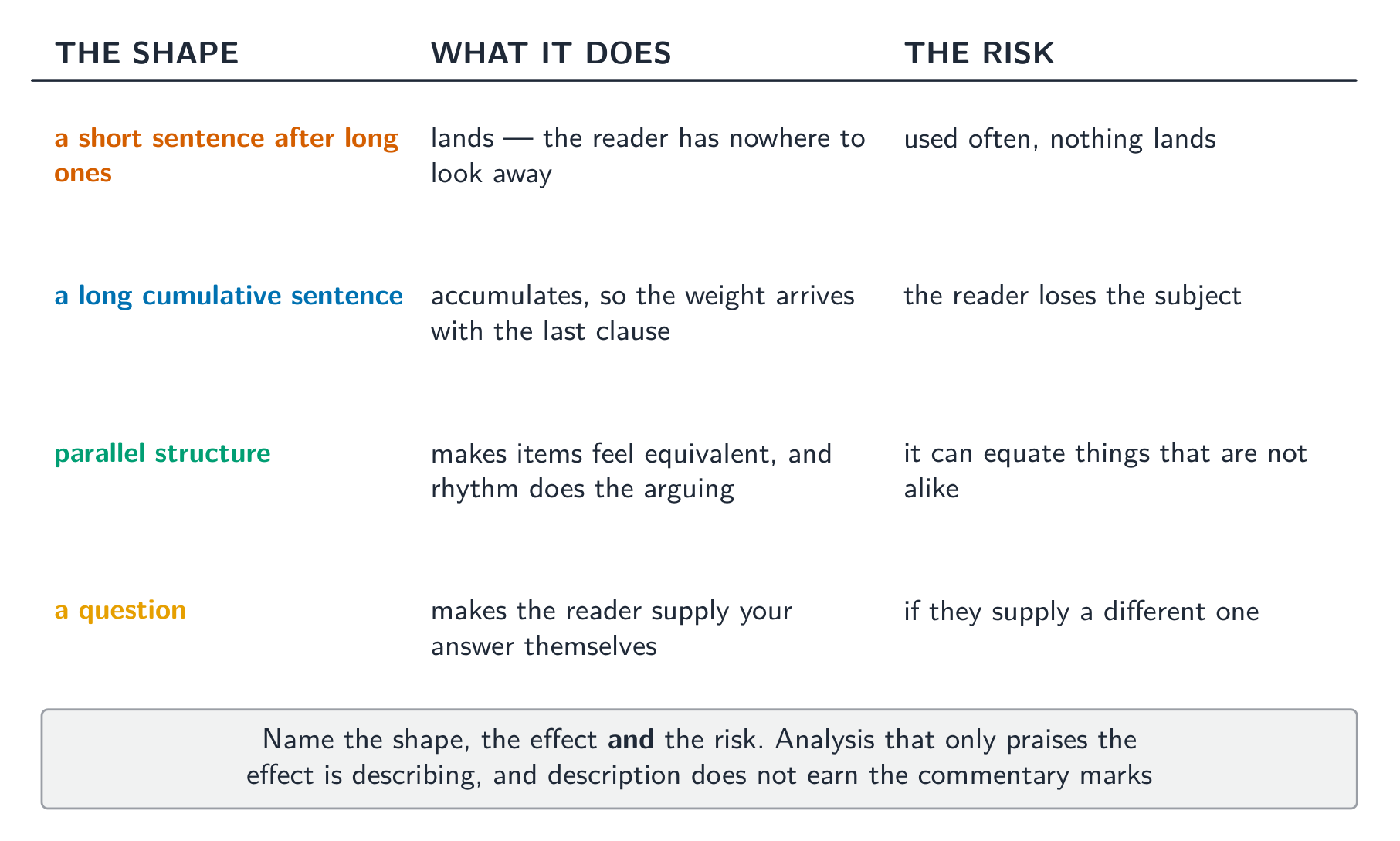
Analysis that only praises the effect is describing — and description does not earn commentary marks. · 효과만을 찬미하는 분석은 서술일 뿐이며, 서술은 해설 점수를 얻지 못합니다.
Work through it step by step, with instant-check exercises. · 즉시 체크 기능 exercises를 통해 단계별로 진행하세요.
Loading subjects… · 과목 로드 중…