세 가지 매우 다른 것들: 밝은 주황색 염료, 진통제, 그리고 단단한 플라스틱. 이 세 가지는 모두 같은 무색 액체인 벤젠으로부터 시작됩니다. 그러나 단일…
English narration · English + 中文 subtitles burned in · 영어 내레이션 · 영어 + 중국어 자막 burned-in
36.1
Organic synthesis · 유기 합성
Syllabus
English
for an organic molecule containing several functional groups: (a) identify organic functional groups using the reactions in the syllabus (b) predict properties and reactions
devise multi-step synthetic routes for preparing organic molecules using the reactions in the syllabus
analyse a given synthetic route in terms of type of reaction and reagents used for each step of it, and possible by-products
한국어
여러 **官能团(functional groups)**을 포함하는 유기 분자에 대해: (a) 과목 요강의 반응을 사용하여 유기官能团을 식별 (b) 성질 및 반응 예측
과목 요강의 반응을 사용하여 유기 분자를制备하기 위한 **다단계 합성 경로(multi-step synthetic routes)**를 설계하시오.
주어진 합성 경로를 각 단계의 반응 유형, 사용된 시약, 그리고 가능한 부산물 관점에서 분석하시오.
Source: Cambridge International syllabus · 출처: Cambridge International syllabus
English
Like the AS synthesis topic, this asks you to join up known reactions to build a target molecule. Now you also have the A Level reactions of arenes, phenol, amines, amides and acyl chlorides.
Identifying functional groups
A molecule may carry several functional group 官能团 types. Use the test reactions to spot each one, then predict its behaviour. For example:
decolourises bromine water with no catalyst, giving a white precipitate → a phenol or a phenylamine (the ring is activated).
reacts violently with cold water, giving fumes of $\text{HCl}$ → an acyl chloride 酰氯.
gives a purple colour with neutral $\text{FeCl}_3$ → a phenol 苯酚.
$\text{Sn}$ / conc $\text{HCl}$, then $\text{NaOH}$ (reduction 还原)
phenylamine
phenylamine
$\text{HNO}_2$, below $10\,°\text{C}$
a diazonium salt
diazonium salt
warm water
phenol; or couple with phenol → azo dye
methylbenzene
hot $\text{KMnO}_4$ (oxidation 氧化)
benzoic acid
carboxylic acid 羧酸
$\text{SOCl}_2$ or $\text{PCl}_5$
acyl chloride
acyl chloride
alcohol / phenol
an ester 酯
acyl chloride
ammonia / amine 胺
an amide 酰胺
amide or nitrile 腈
$\text{LiAlH}_4$
an amine
halogenoalkane
$\text{KCN}$
a nitrile (adds one carbon)
Planning and analysing a route
To devise a synthetic route 合成路线, work backwards from the target: which single reaction makes it, and from what? Repeat until you reach the starting material, then write each step with its reagent 试剂 and conditions.
When you analyse a route, state the type of reaction for each step (for example electrophilic substitution, addition–elimination 加成消去, oxidation or reduction) and watch for likely by-products 副产物 — for example, making an amine from a halogenoalkane also gives over-substituted amines, lowering the yield.
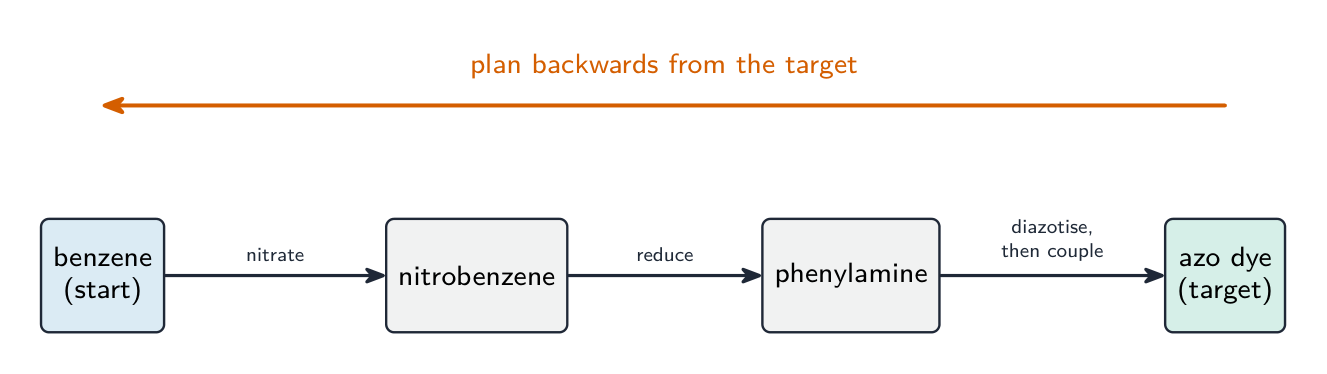
Worked example. Devise a route from benzene to phenylamine, $\text{C}_6\text{H}_5\text{NH}_2$. Work backwards: phenylamine comes from reducing nitrobenzene, and nitrobenzene comes from nitrating benzene - so the route is two steps. Step 1: benzene with concentrated $\text{HNO}_3$ and concentrated $\text{H}_2\text{SO}_4$ at $55\ °\text{C}$; electrophilic substitution gives nitrobenzene (keep below $55\ °\text{C}$, or further substitution follows). Step 2: reduce the nitrobenzene with tin and concentrated $\text{HCl}$, then add $\text{NaOH}$ to free the amine from its salt. There is no direct route - you cannot put an $\text{–NH}_2$ straight onto a ring, which is exactly why this nitrate-then-reduce pair is worth knowing by heart.
한국어
AS 합성 주제처럼, 알려진 반응을 연결하여 목표 분자를 구성하라는 요청입니다. 이제 A-Level 아렌, 페놀, 아민, 아미드 및 아실 염화물의 반응도 사용할 수 있습니다.
기능기 식별
분子是 여러 기능기 종류를 가질 수 있습니다. 각 기능을 발견하고 거동을 예측하기 위해 시험 반응을 사용하십시오. 예를 들어:
$\text{Sn}$ / 농 $\text{HCl}$, 이후 $\text{NaOH}$ (환원)
페닐아민
페닐아민
$\text{HNO}_2$, 아래 $10\,°\text{C}$
디아조늄 염
디아조늄 염
따뜻한 물
페놀; 또는 페놀과 커플링 → 아조 염료
메틸벤젠
뜨거운 $\text{KMnO}_4$ (산화)
벤조산
카복실산
$\text{SOCl}_2$ 또는 $\text{PCl}_5$
아실 염화물
아실 클로라이드
알코올 / 페놀
에스터
아실 클로라이드
암모니아 / 아민
아마이드
아마이드 또는 니트릴
$\text{LiAlH}_4$
아민
할로젠알케인
$\text{KCN}$
니트릴 (탄소 하나 추가)
A Level 반응 지도: 방향족 사슬(상단)과 아실-클로라이드 사슬(하단), 그리고 공급 원료. 목표 물질에서 시작하여 거꾸로 작업하십시오.
경로 계획 및 분석하기
합성 경로를 설계하려면 목표 물질에서 거꾸로 작업하십시오: 어떤 단일 반응으로 만들어지고, 어떤物质로부터 만들어지는가? 시작 물질에 도달할 때까지 반복한 후, 각 단계마다 시약과 조건을 기록하십시오.
목표 분자에서 역방향으로 계산하여, 한 번에 하나의 반응씩 원료에 도달할 때까지 경로를 계획하십시오
경로를 분석할 때, 각 단계의 반응 유형(예: 전자 친화 치환, 가입-제거, 산화 또는 환원)을 명시하고 부산물 발생 가능성을 주의 깊게 확인해야 합니다. 예를 들어 할로겐알케인으로부터 아민을 제조할 경우 과치환된 아민도 함께 생성되어 수율을 낮출 수 있습니다.
작업 예시. 벤젠에서 페닐아민까지의 경로를 설계하십시오. $\text{C}_6\text{H}_5\text{NH}_2$. 역방향으로 접근합니다: 페닐아민은 니트로벤젠을 환원하여 얻을 수 있으며, 니트로벤젠은 벤젠의 질산화를 통해 얻어지므로 이 경로는 두 단계로 구성됩니다. 단계 1: 벤젠에 농축 $\text{HNO}_3$와 농축 $\text{H}_2\text{SO}_4$를 ⟨$55\ °\text{C}$⟩ 온도에서 가합니다. 전자 친화 치환 반응에 의해 니트로벤젠이 생성됩니다($55\ °\text{C}$ 이하로 온도를 유지하지 않으면 추가 치환이 일어난다). 단계 2: 니트로벤젠을 **주석과 농축 $\text{HCl}$**으로 환원한 후, 염 형태로 존재하는 아민을游离(해방)시키기 위해 $\text{NaOH}$를 첨가합니다. 직접적인 경로는 없으며, 고리에 directly $\text{–NH}_2$를 붙일 수 없기 때문에 질산화 후 환원의这套 조합을 암기해 두는 것이 매우 중요합니다.
Explore · 탐색하기
A-Level synthesis planner · A-Level 합성 계획서
Build a route by matching functional-group changes to reagents. · 기능기 변화를 시약과 매칭하여 경로를 구성한다.