describe the formation of polyesters: (a) the reaction between a diol and a dicarboxylic acid or dioyl chloride (b) the reaction of a hydroxycarboxylic acid
describe the formation of polyamides: (a) the reaction between a diamine and a dicarboxylic acid or dioyl chloride (b) the reaction of an aminocarboxylic acid (c) the reaction between amino acids
deduce the repeat unit of a condensation polymer obtained from a given monomer or pair of monomers
identify the monomer(s) present in a given section of a condensation polymer molecule
한국어
폴리에스터의 형성을 서술하시오: (a) 디올과 디카복실산 또는 디아실 염화물 간의 반응 (b) 하이드록시카복실산의 반응
폴리아미드의 형성을 서술하시오: (a) 다이아민과 디카복실산 또는 디아실 염화물 간의 반응 (b) 아미노카복실산의 반응 (c) 아미노산 간의 반응
주어진 모노머 또는 모노머 쌍으로부터 얻어지는 축합 고분자의 반복 단위(repeat unit) 를 추론하시오
주어진 축합 고분자 분자의 특정 구간에 존재하는 모노머를 식별하시오
Source: Cambridge International syllabus · 출처: Cambridge International syllabus
English
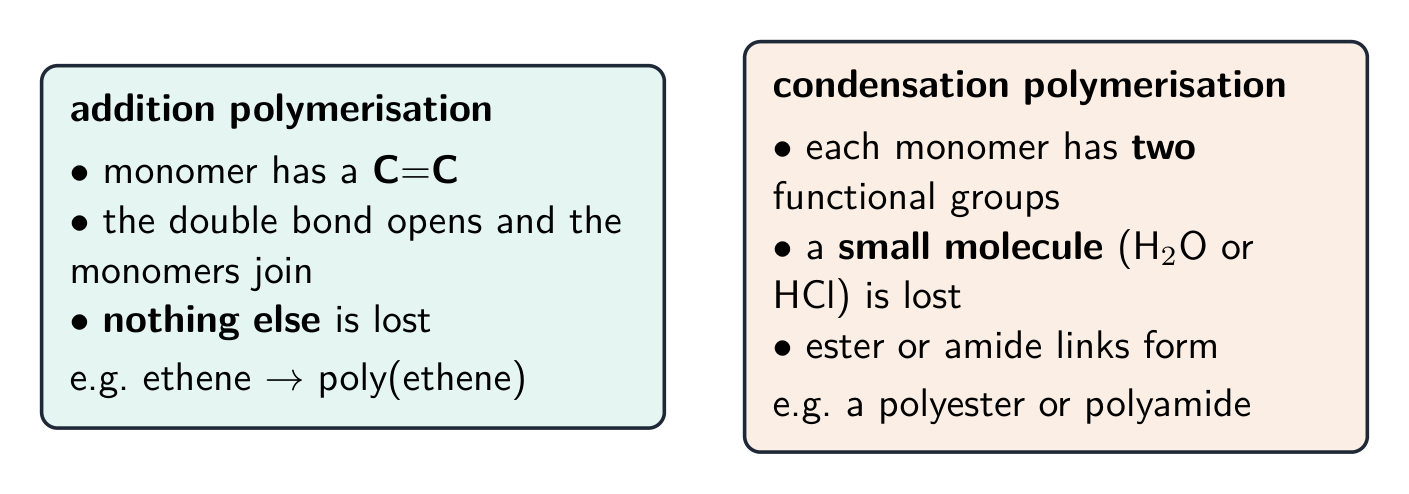
In condensation polymerisation 缩合聚合, monomers join into a long chain and a small molecule (such as water or $\text{HCl}$) is lost each time a new bond forms. Each monomer needs two reactive groups, so the chain can grow at both ends.
Polyesters
A polyester 聚酯 has many ester links along its chain. You can make one from:
a diol 二醇 (two $\text{–OH}$ groups) and a dicarboxylic acid 二羧酸 (two $\text{–COOH}$ groups), or a dioyl chloride.
a single hydroxycarboxylic acid, which has both an $\text{–OH}$ and a $\text{–COOH}$.
Polyamides
A polyamide 聚酰胺 has many amide links. You can make one from:
a diamine 二胺 (two $\text{–NH}_2$ groups) and a dicarboxylic acid or a dioyl chloride.
a single aminocarboxylic acid, or from amino acids 氨基酸 joining together (proteins are natural polyamides).
Repeat units and monomers
The repeat unit 重复单元 of a condensation polymer contains parts of both monomers, minus the atoms lost as the small molecule. To find the monomers 单体 from a section of polymer, break the chain at each ester or amide link, then add back $\text{–OH}$ and $\text{–H}$ (or $\text{–Cl}$).
Worked example. A polymer chain contains repeating $\text{–CONH–}$ links. Name the type of polymer, identify the monomers, and give the small molecule lost. A $\text{–CONH–}$ link is an amide, so this is a polyamide made by condensation polymerisation. To find the monomers, break the chain at each amide link and give the cut ends their atoms back: the carbon side takes $\text{–OH}$, making a dicarboxylic acid, and the nitrogen side takes $\text{–H}$, making a diamine. The small molecule lost at each link is water (or $\text{HCl}$, if an acyl dichloride was used in place of the acid). Each monomer must have two functional groups, or the chain could never keep growing - if the monomer you propose has only one, you have broken the chain in the wrong place.
한국어
탈수중합에서 단량체가 긴 사슬로 연결될 때마다 새로운 결합 형성에 따라 작은 분자(물 또는 $\text{HCl}$ 등)가 하나씩 빠진다. 각 단량체는 두 개의 반응성 기를 가져야 하므로 사슬이 양쪽 끝으로 성장할 수 있다.
축합 결합: 폴리에스터는 에스터 결합을 형성하고, 폴리아마이드는 아미드 결합을 형성하며, 각 새로운 결합이 작은 분자(여기서는 물)를 방출함
폴리에스터
폴리에스터는 사슬 전체에 많은 에스터 결합을 포함합니다. 다음으로 만들 수 있습니다:
다이올(두 $\text{–OH}$ 그룹)과 디카르복실산(두 $\text{–COOH}$ 그룹), 또는 디아실 염화물.
단일 하이드록시카르복실산으로, 이는 $\text{–OH}$과 $\text{–COOH}$을 모두 가집니다.
PET 음료병은 폴리에스터인 축합 고분자입니다. 여기서는 재활용을 위해 수집된 상태입니다
폴리아마이드
폴리아마이드는 많은 아미드 결합을 포함합니다. 다음으로 만들 수 있습니다:
다이아민(두 $\text{–NH}_2$ 그룹)과 디카르복실산 또는 디아실 염화물.
단일 아ミノ카르복실산, 또는 아미노산들이 결합하는 경우(단백질은 천연 폴리아마이드임).
'나일론 로프 트릭': 나일론(폴리아마이드)은 두 반응 용액이 만나는 곳에서 형성되므로, 한 줄의 긴 실을 빼낼 수 있습니다(여기에서는 추가된 지시약 때문에 분홍색입니다)
반복 단위와 단량체
축합 고분자의 반복 단위에는 두 단량체의 일부가 포함되어 있으며, 작은 분자가 빠진 원자들은 제외됩니다. 고분자의 일부분에서 단량체를 찾는 법은 에스터 또는 아미드 결합마다 사슬을 끊고, $\text{–OH}$과 $\text{–H}$(또는 $\text{–Cl}$)을 다시 붙이는 것입니다.
단량체를 찾기 위해 결합마다 사슬을 끊고 끊어진 끝部分에 –OH와 –H를 다시 붙입니다—여기서는 다이올과 디카르복실산을 제공합니다
해설 예제. 고분자 사슬에 반복되는 $\text{–CONH–}$ 결합이 포함되어 있습니다. 이 고분자의 종류를 named하고, 단량체를 식별하며, 빠진 작은 분자를 쓰십시오. $\text{–CONH–}$ 결합은 아미드이므로, 이는 축합 중합으로 만들어진 폴리아마이드입니다. 단량체를 찾기 위해 각 아미드 결합마다 사슬을 끊고 끊어진 끝部分에 원자를 다시 부여합니다: 탄소 측에는 $\text{–OH}$을 받아 디카르복실산이 되고, 질소 측에는 $\text{–H}$을 받아 다이아민이 됩니다. 각 결합에서 빠진 작은 분자는 물이며(또는 산 대신 아실 염화물이 사용되었을 경우 $\text{HCl}$), 각 단량체는 반드시 두 개의 기능기를 가져야 합니다. 그렇지 않으면 사슬은 더 이상 자라지 못합니다—만약 제안한 단량체가 하나만 가진다면, 사슬을 잘못 끊은 것입니다.
Explore · 탐색하기
Condensation polymer route · 중합 고분자 경로
Watch monomers join while a small molecule leaves each time. · 모노머가 결합할 때마다 작은 분자가 빠져나가는 과정을 관찰하십시오.
recognise that poly(alkenes) are chemically inert and can therefore be difficult to biodegrade
recognise that some polymers can be degraded by the action of light
recognise that polyesters and polyamides are biodegradable by acidic and alkaline hydrolysis
한국어
폴리(알켄)은 화학적으로 비활성이며, 이로 인해 생분해가 어려울 수 있음을 인식한다
일부 고분자가 빛의 작용에 의해 분해될 수 있음을 인식한다
폴리에스터와 폴리아미드가 산 및 염기성 수해에 의해 생분해됨을 인식한다
Source: Cambridge International syllabus · 출처: Cambridge International syllabus
English
poly(alkene)s 聚烯烃 are chemically inert — they have only strong, non-polar C–C and C–H bonds, so they are hard to biodegrade 可生物降解 and last a long time.
some polymers are made so that light can break them down (they are photodegradable).
polyesters and polyamides are biodegradable, because their ester and amide links can be broken by acidic or alkaline hydrolysis 水解.
한국어
폴리알켄은 화학적으로 비활성입니다—강하고 극성이 없는 C–C 및 C–H 결합만 가지므로 생분해되기 어렵고 오래 지속됩니다.
빛에 의해 분해되도록 설계된 일부 고분자가 있습니다(광분해성).
폴리에스터와 폴리아마이드는 생분해성입니다. 그들 사이의 에스터 및 아미드 결합은 산성 또는 알칼리성 가수분해에 의해 파괴될 수 있기 때문입니다.
Explore · 탐색하기
Degradable polymer route · 분해성 중합체 경로
Follow how polymer structure controls breakdown. · 중합체 구조가 분해를 어떻게 제어하는지 추적한다.
Condensation polymers (polyesters, polyamides) form with loss of a small molecule ($\text{H}_2\text{O}$ or HCl) — draw the repeat unit and the lost molecule.
Identify the monomers from the polymer by breaking the ester or amide link — a common question.
Predict the type from the monomers: a $\text{C}=\text{C}$ gives addition; two functional groups give condensation.
Polyesters and polyamides are hydrolysable (more degradable); addition polymers are not.
한국어
축합 고분자(폴리에스터, 폴리아마이드)는 작은 분자의 방출과 함께 생성됩니다($\text{H}_2\text{O}$ 또는 HCl)—반복 단위와 빠진 분자를 그리십시오.
고분자로부터 단량체를 식별하기 위해 에스터 또는 아미드 결합을 끊으십시오—자주 출제되는 문제 유형입니다.
단량체로부터 중합 유형을 예측: $\text{C}=\text{C}$은 가중 중합을, 두 개의 기능기는 축합 중합을 의미합니다.
폴리에스터와 폴리아마이드는 가수분해 가능(더 쉽게 분해됨)한 반면, 가중 고분자는 그렇지 않습니다.
Interactive lessons on this topic · 이 주제에 대한 인터랙티브 수업
Work through it step by step, with instant-check exercises. · 즉시 체크 기능 exercises를 통해 단계별로 진행하세요.