Skip to content · ⁨본문 바로가기⁩

Halogen compounds

A-Level Chemistry · ⁨A-Level 화학⁩ · Topic 15 · ⁨주제 15⁩

Video lesson for this topic · ⁨이 주제용 영상 수업⁩ Open the video page · ⁨영상 페이지 열기⁩
7:31

할로겐 화합물

냉동 스프레이 캔의 버튼을 누르면 피부가 시린麻痺感을 느낍니다. 안에는 할로젠 알케인이 들어있습니다:其中一个氢原子被卤素原子取代的烷烃.

English narration · English + 中文 subtitles burned in · ⁨영어 내레이션 · 영어 + 중국어 자막 burned-in⁩

15.1

Halogenoalkanes · ⁨할로젠알케인⁩

Syllabus
English
  1. recall the reactions (reagents and conditions) by which halogenoalkanes can be produced: (a) the free-radical substitution of alkanes by $\text{Cl}_2$ or $\text{Br}_2$ in the presence of ultraviolet light, as exemplified by the reactions of ethane (b) electrophilic addition of an alkene with a halogen, $\text{X}_2$, or hydrogen halide, $\text{HX(g)}$, at room temperature (c) substitution of an alcohol, e.g. by reaction with $\text{HX(g)}$; or with $\text{KCl}$ and concentrated $\text{H}_2\text{SO}_4$ or concentrated $\text{H}_3\text{PO}_4$; or with $\text{PCl}_3$ and heat; or with $\text{PCl}_5$; or with $\text{SOCl}_2$
  2. classify halogenoalkanes into primary, secondary and tertiary
  3. describe the following nucleophilic substitution reactions: (a) the reaction with $\text{NaOH(aq)}$ and heat to produce an alcohol (b) the reaction with $\text{KCN}$ in ethanol and heat to produce a nitrile (c) the reaction with $\text{NH}_3$ in ethanol heated under pressure to produce an amine (d) the reaction with aqueous silver nitrate in ethanol as a method of identifying the halogen present as exemplified by bromoethane
  4. describe the elimination reaction with $\text{NaOH}$ in ethanol and heat to produce an alkene as exemplified by bromoethane
  5. describe the $\text{S}_\text{N}1$ and $\text{S}_\text{N}2$ mechanisms of nucleophilic substitution in halogenoalkanes including the inductive effects of alkyl groups
  6. recall that primary halogenoalkanes tend to react via the $\text{S}_\text{N}2$ mechanism; tertiary halogenoalkanes via the $\text{S}_\text{N}1$ mechanism; and secondary halogenoalkanes by a mixture of the two, depending on structure
  7. describe and explain the different reactivities of halogenoalkanes (with particular reference to the relative strengths of the C–X bonds as exemplified by the reactions of halogenoalkanes with aqueous silver nitrates)
한국어
  1. 할로알카인이 생성되는 반응(시약 및 조건)을 회상한다: (a) 알칸의 자유 라디칼 치환 반응, $\text{Cl}_2$ 또는 $\text{Br}_2$ 존재 하에서 자외선 조사 시, 예로 에탄의 반응 (b) 실온에서 알켄과 할로젠, $\text{X}_2$, 또는 수소 할로화물, $\text{HX(g)}$의 전자 친화성 첨가 반응 (c) 알코올의 치환 반응, 예로 $\text{HX(g)}$과의 반응; 또는 $\text{KCl}$과 농축 $\text{H}_2\text{SO}_4$ 또는 농축 $\text{H}_3\text{PO}_4$; 또는 $\text{PCl}_3$과 가열; 또는 $\text{PCl}_5$; 또는 $\text{SOCl}_2$
  2. 할로알카인을 일차, 이차 및 삼차로 분류한다.
  3. 다음 핵친교 치환 반응을 서술한다: (a) $\text{NaOH(aq)}$과 가열하여 알코올을 생성하는 반응 (b)duplicate ethanol 및 가열条件下에서 $\text{KCN}$과 반응하여 니트릴을 생성하는 반응 (c)duplicate ethanol 및 압력条件下에서 가열하여 $\text{NH}_3$과 반응하여 아민을 생성하는 반응 (d) 브로모에탄의 반응과 같이 수용성 은 질산염을duplicate ethanol으로 사용하여 존재하는 할로젠을 식별하는 방법
  4. 브로모에탄의 반응과 같이duplicate ethanol 및 가열条件下에서 $\text{NaOH}$과 반응하여 알켄을 생성하는 탈수소 반응을 서술한다.
  5. 할로알카인의 핵친교 치환에 대한 $\text{S}_\text{N}1$ 및 $\text{S}_\text{N}2$ 기전을 서술하며, 알킬 그룹의 유도 효과를 포함한다.
  6. 일차 할로알카인은 주로 $\text{S}_\text{N}2$ 기전으로 반응하고, 삼차 할로알카인은 $\text{S}_\text{N}1$ 기전으로 반응하며, 이차 할로알카인은 구조에 따라 두 가지 기전의 혼합으로 반응함을 회상한다.
  7. 할로알카인의 다른 반응성을 서술하고 설명한다(할로알카인의 수용성 은 질산염 반응과 같은 C–X 결합의 상대적 강도에 특히 초점).

Source: Cambridge International syllabus · ⁨출처: Cambridge International syllabus⁩

English

A halogenoalkane 卤代烷 is an alkane with one or more halogen atoms in place of hydrogen (a C–X bond, where X is a halogen).

Making halogenoalkanes

  • free-radical substitution 自由基取代 of an alkane with $\text{Cl}_2$ or $\text{Br}_2$ in ultraviolet light.
  • electrophilic addition 亲电加成 of an alkene with a halogen $\text{X}_2$ or a hydrogen halide $\text{HX}$.
  • substitution of an alcohol 醇, for example by $\text{HX}$, by $\text{PCl}_5$, by $\text{PCl}_3$ with heat, or by $\text{SOCl}_2$.

Three classes

A halogenoalkane is primary 伯, secondary 仲 or tertiary 叔, depending on how many carbon atoms are joined to the carbon that holds the halogen (one, two or three).

한국어

할로젠알케인은 알케인의 수소 원자 하나가 이상 할로젠 원자로 대체된 것(C–X 결합, X는 할로젠)입니다.

냉동 스프레이 캔에서 차가운 할로젠알케인 증기가 분출되는 모습
비휘발성 할로젠알케인은 과거에 냉매 및 스프레이 추진제로 널리 사용되었습니다

할로젠알케인 제조

  • 알케인의 자유 라디칼 치환 반응에 $\text{Cl}_2$ 또는 $\text{Br}_2$을 자외선 하에 가합니다.
  • 알켄의 전자기체 첨가 반응에 할로젠 $\text{X}_2$ 또는 수소 할로젠 $\text{HX}$을 가합니다.
  • 알코올의 치환 반응, 예를 들어 $\text{HX}$에 의한 치환, $\text{PCl}_5$에 의한 치환, 열을 가한 $\text{PCl}_3$에 의한 치환, 또는 $\text{SOCl}_2$에 의한 치환.

세 가지 종류

할로젠알케인은 할로젠이 붙은 탄소에 연결된 탄소 원자의 수(하나, 두 개, 세 개)에 따라 1차, 2차, 또는 3차로 분류됩니다.

브로민이附着된 탄소를 강조한 세 가지 구조: 연결된 탄소가 하나인 1차, 두개인 2차, 세개인 3차
일차, 이차, 삼차 할로젠알케인: 할로젠이 결합된 탄소에 연결된 탄소의 개수에 따라 분류됨
Vocabulary · ⁨어휘⁩ Train · ⁨연습하기⁩
English 한국어
halogenoalkane/ˈheɪləʊdʒnəʊlkeɪn/ 할로젠알케인
free-radical substitution/friː ˈrædɪkl ˌsʌbstɪˈtjuːʃn/ 자유ラ디칼 치환
electrophilic addition/ɪˌlektrəʊˈfɪlɪk əˈdɪʃn/ 전자유기적 첨가
alcohol/ˈælkəhɒl/ 알코올
15.1

Nucleophilic substitution · ⁨친핵 치환⁩

English

The C–X bond is polar, so the carbon is slightly positive. A nucleophilic substitution 亲核取代 happens when a nucleophile 亲核试剂 (a lone-pair species) attacks that carbon and replaces the halogen.

Reagent and conditions Product
$\text{NaOH(aq)}$, heat an alcohol
$\text{KCN}$ in ethanol, heat a nitrile 腈 (adds one carbon to the chain)
$\text{NH}_3$ in ethanol, heated under pressure an amine 胺

To identify the halogen, warm the halogenoalkane with silver nitrate 硝酸银 in ethanol. A silver halide precipitate 沉淀 forms, and its colour shows which halogen is present (white $\text{AgCl}$, cream $\text{AgBr}$, yellow $\text{AgI}$).

한국어

C–X 결합은 극성이므로 탄소는 약간 양전하를 띱니다. 친핵 시약(고유전자 쌍을 가진 입자)이 해당 탄소를 공격하여 할로젠을 교체할 때 친핵 치환이 일어납니다.

끓고 있는 액체를 담은 원형 플라스크에 수직 응축기가 설치되어 증기를 환원시켜 다시 액체로 돌리는 장치
많은 할로젠알케인 반응은 반류 조건에서 혼합물을 가열하여 수행합니다
시약 및 조건 생성물
$\text{NaOH(aq)}$, 가열 알코올
에탄올 중 $\text{KCN}$, 가열 나이트릴 (사슬에 탄소 한 개 추가)
에탄올 중 $\text{NH}_3$, 가압 하에 가열 아민
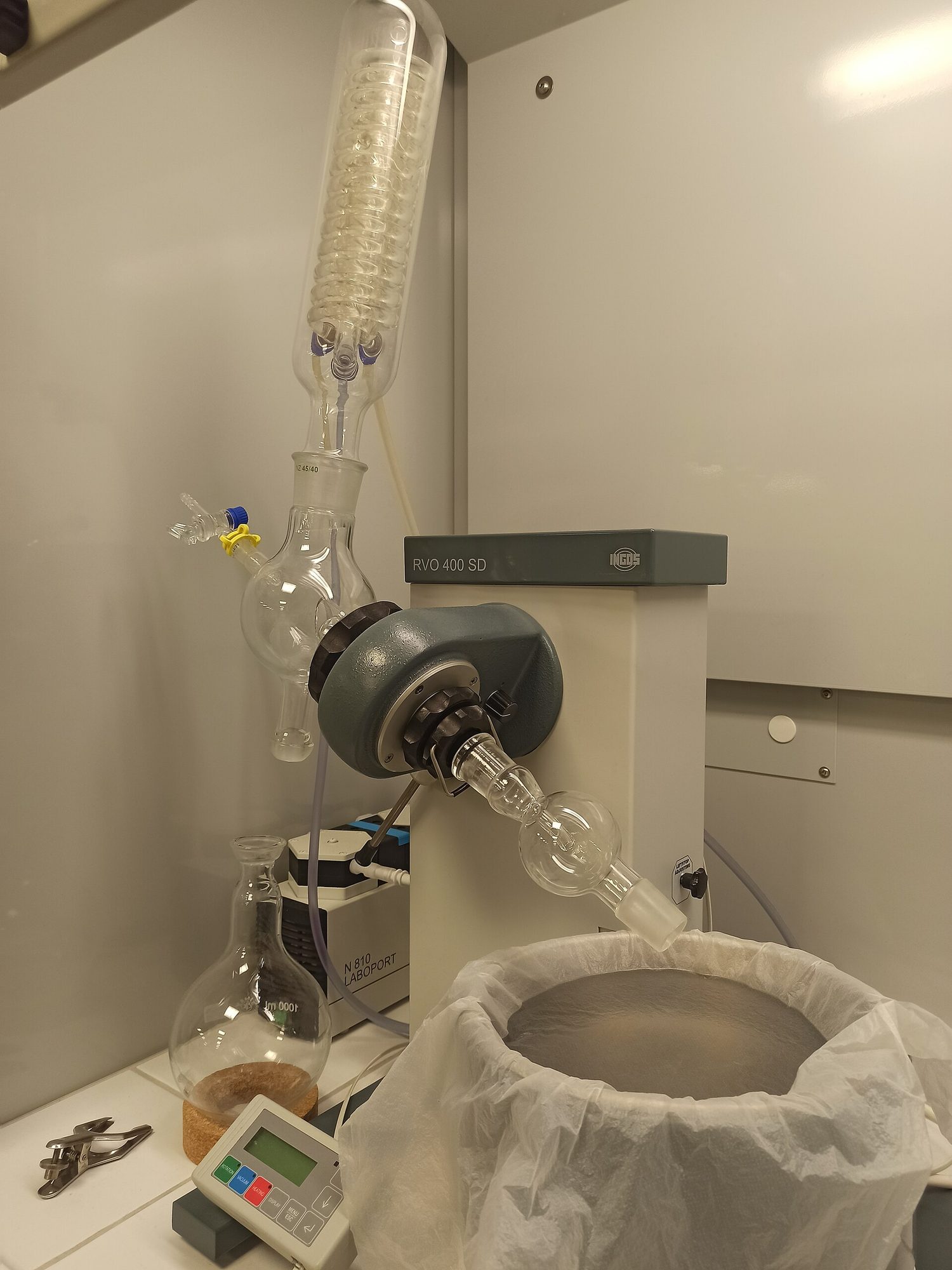
회전식 증발기: 따뜻한 물浴中에서 회전하는 용액 플라스크와 용매 증기가 별도의 수집 플라스크로 응결되는 모습
회전식 증발기는 감압 하에 용제를 제거합니다 — 반응 후 단계입니다

할로젠을 확인하기 위해 할로젠알케인을 에탄올 중의 질산은과 함께 온열합니다. 은 할로겐화물 침전물이 생성되며, 그 색상이 어떤 할로젠이 있는지 알려줍니다(백색 $\text{AgCl}$, 연유색 $\text{AgBr}$, 황색 $\text{AgI}$).

Explore · ⁨탐색하기⁩

Nucleophilic substitution · ⁨친핵성 치환⁩

A nucleophile swaps in for the leaving group on a halogenoalkane. · ⁨친핵성 시약이 할로젠화알케인의脱離基와 교체됩니다.⁩

15.1

Elimination · ⁨탈수소화⁩

English

The same halogenoalkane can instead undergo elimination 消去 to form an alkene 烯烃. The conditions decide which reaction wins:

  • $\text{NaOH}$ in water → nucleophilic substitution → an alcohol.
  • $\text{NaOH}$ in ethanol, heated → elimination → an alkene.
$$\text{C}_2\text{H}_5\text{Br} + \text{NaOH} \rightarrow \text{C}_2\text{H}_4 + \text{NaBr} + \text{H}_2\text{O}$$
한국어

동일한 할로젠알케인이 대신 탈수소화를 거쳐 알켄을 형성할 수도 있습니다. 반응 조건이 어느 반응이 우세할지를 결정합니다:

  • 물 중의 $\text{NaOH}$ → 친핵 치환 → 알코올 생성.
  • 에탄올 중의 $\text{NaOH}$, 가열 → 탈수소화 → 알켄 생성.
$$\text{C}_2\text{H}_5\text{Br} + \text{NaOH} \rightarrow \text{C}_2\text{H}_4 + \text{NaBr} + \text{H}_2\text{O}$$
분지도: 브로모에테인이 수용성 수산화나트륨과 반응하면 치환을 통해 알코올이 되지만, 에탄올 중의 수산화나트륨과 반응하면 탈수소화를 통해 알켄이 됩니다
동일한 할로젠알케인: 물 중의 NaOH는 치환하여 알코올을生成하고, 에탄올 중의 NaOH(가열 시)는 탈수소화하여 알켄을生成합니다
Vocabulary · ⁨어휘⁩ Train · ⁨연습하기⁩
English 한국어
elimination/ɪˌlɪmɪˈneɪʃn/ 탈출(elimination)
alkene/ˈælkiːn/ 알켄
transition state/trænˈsɪʃn steɪt/ 최대 속도 Vmax의 분율로
carbocation/ˌkɑːbəˈkeɪʃn/ 카보카티온
inductive effect/ɪnˈdʌktɪv ɪˈfekt/ 유도 효과
bond energy/bɒnd ˈenədʒi/ 결합 에너지
15.1

The S$_\text{N}$1 and S$_\text{N}$2 mechanisms · ⁨S$_\text{N}$1 및 S$_\text{N}$2 기전⁩

English

Nucleophilic substitution can follow two routes:

  • S$_\text{N}$2: one step. The nucleophile attacks at the same time as the halogen leaves, passing through a crowded transition state 过渡态 where both are half-bonded. The rate depends on both the halogenoalkane and the nucleophile.
  • S$_\text{N}$1: two steps. First the C–X bond breaks to give a carbocation 碳正离子; then the nucleophile attacks it. The rate depends only on the halogenoalkane.

Alkyl groups push electrons towards the positive carbon (the inductive effect 诱导效应), so they stabilise the carbocation. This is why:

  • primary halogenoalkanes mostly react by S$_\text{N}$2.
  • tertiary halogenoalkanes mostly react by S$_\text{N}$1 (their carbocation is well stabilised).
  • secondary halogenoalkanes use a mixture of the two.
한국어

친핵 치환은 두 가지 경로를 따를 수 있습니다:

  • S$_\text{N}$2: 한 단계. 친핵 시약이 할로젠이 떠날 때 동시에 공격하며, 두 가지가 반결합 상태인 혼잡한 전이 상태를 거칩니다. 반응 속도는 할로젠알케인과 친핵 시약 모두에 의존합니다.
  • S$_\text{N}$1: 두 단계. 먼저 C–X 결합이 끊어져 카르보양이온을 생성하고, 그다음 친핵 시약이 이를 공격합니다. 반응 속도는 할로젠알케인에만 의존합니다.
S N 2가 한 단계로 친핵 시약이 할로젠이 떠날 때 동시 공격하며 전이 상태를 거치는 모습; S N 1이 카르보양이온을 거치는 두 단계로 표현된 모습
S$_\text{N}$2는 혼잡한 전이 상태를 거치는 단일 단계이며, S$_\text{N}$1은 카르보양이온을 거치는 두 단계입니다

알킬 기는 양전하를 띤 탄소(유도 효과) 쪽으로 전자를 밀어내어 카르보양이온을 안정화시킵니다. 이것이 바로 다음과 같은 이유입니다:

  • primary 할로젠알칸은 주로 S$_\text{N}$2 메커니즘으로 반응합니다.
  • tertiary 할로젠알칸은 주로 S$_\text{N}$1 메커니즘으로 반응합니다(그들의 카ربocation이 잘 안정화되기 때문입니다).
  • 2차 할로젠알케인은 두 경로가 혼합되어 사용됩니다.
Explore · ⁨탐색하기⁩

The SN2 mechanism, step by step · ⁨SN2 기전의 단계별 설명⁩

Step through nucleophilic substitution. The nucleophile attacks from behind as the halide leaves — all in one smooth step, flipping the molecule inside-out. · ⁨친핵성 치환을 단계별로 살펴봅시다. 할로젠이脱離하는 동안 친핵성 시약이 뒤쪽에서 공격하여,整个过程在一个平滑的步骤中完成,分子构型发生翻转。⁩

Vocabulary · ⁨어휘⁩ Train · ⁨연습하기⁩
English 한국어
primary/ˈpraɪməri/ 일차(Primary)
secondary/ˈsekəndəri/ 이차(Secondary)
tertiary/ˈtɜːʃjəri/ 삼차(Tertiary)
nucleophilic substitution/ˌnjuːklɪəˈfɪlɪk ˌsʌbstɪˈtjuːʃn/ 친핵 치환 반응
nucleophile/ˈnjuːklɪɒfaɪl/ 친핵체
nitrile/ˈnaɪtraɪl/ 니트릴
amine/ˈæmaɪn/ 아민
silver nitrate/ˈsɪlvə ˈnaɪtreɪt/ 은 니트레이트
precipitate/prɪˈsɪpɪteɪt/ 침전물
15.1

Different reactivities · ⁨다른 반응성⁩

English

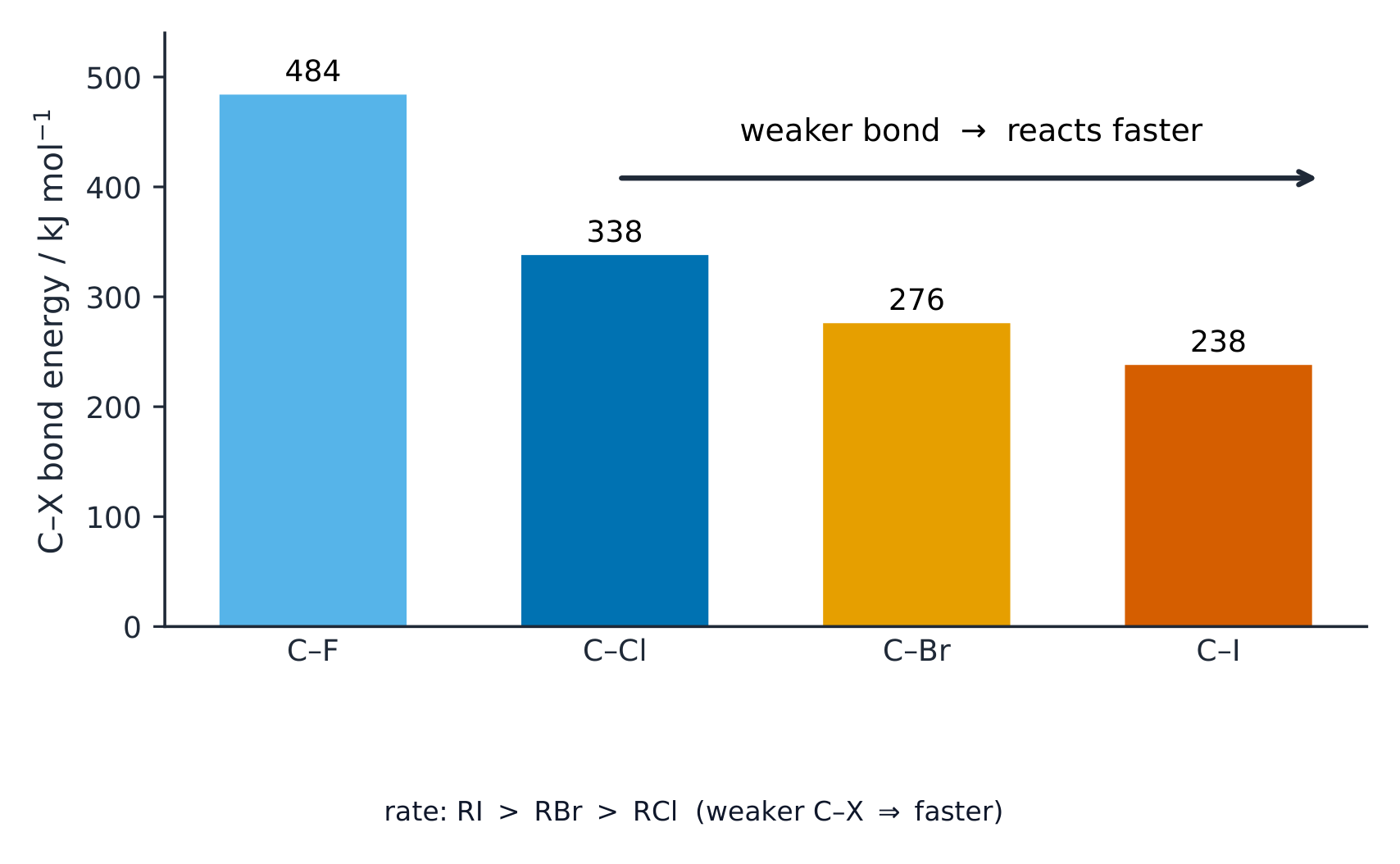
How fast a halogenoalkane reacts depends on the strength of the C–X bond, measured by its bond energy 键能. The C–I bond is the weakest, so iodoalkanes react fastest; the C–Cl bond is the strongest of the three, so chloroalkanes react slowest. So when tested with silver nitrate, an iodoalkane gives its precipitate first — its higher reactivity 反应活性 comes from the weaker C–X bond.

Worked example. Predict the mechanism for the hydrolysis of 1-bromobutane and of 2-bromo-2-methylpropane. Classify the halogenoalkane first. 1-bromobutane is primary: the carbon carrying the $\text{Br}$ is barely shielded, so the nucleophile can attack the back of it and the mechanism is $\text{S}_\text{N}2$ - one step, with the rate depending on both the halogenoalkane and the nucleophile. 2-bromo-2-methylpropane is tertiary: three bulky methyl groups block that attack, but they also stabilise the carbocation formed once the $\text{Br}$ leaves, so it goes $\text{S}_\text{N}1$ - two steps, with the rate depending on the halogenoalkane only. Decide from the class (primary → $\text{S}_\text{N}2$, tertiary → $\text{S}_\text{N}1$), and note that the tertiary one hydrolyses faster despite being the more crowded.

한국어

할로젠알케인의 반응 속도는 C–X 결합의 강도, 즉 결합 에너지에 따라 달라집니다. C–I 결합이 가장 약하므로 아이오도알케인이 가장 빠르게 반응하며, 세 가지 중 C–Cl 결합이 가장 강하므로 클로로알케인이 가장 느리게 반응합니다. 따라서 질산은과로 테스트할 때 아이오도알케인이 먼저 침전물을 생성합니다 — 더 높은 반응성은 약한 C–X 결합에서 기인합니다

C-X 결합 에너지가 C-F에서 C-I로 감소하는 막대 그래프, 약한 결합이 더 빠르게 반응한다는 점을 나타내는 화살표 포함
C–X 결합이 약할수록 할로젠알케인의 반응 속도는 빨라진다 — 따라서 요오도알케인이 가장 빠르게 반응하고 클로로알케인이 가장 느리다

해설 예시. 1-브로무부탄과 2-브로모-2-메틸프로판의 가수분해 메커니즘을 예측하시오. 먼저 할로젠알케인을 분류하시오. 1-브로무부탄은 일차입니다: $\text{Br}$를 가진 탄소가 거의 보호되지 않아 친핵성이 뒷면으로 공격할 수 있으며, 메커니즘은 $\text{S}_\text{N}2$ - 한 단계, 반응 속도는 양쪽인 할로젠알케인과 친핵성에 모두 의존합니다. 2-브로모-2-메틸프로판은 삼차입니다: 세 개의 부피가 큰 메틸 기가 그 공격을 차단하지만, 동시에 $\text{Br}$가 빠져나간 후 형성된 카arbocation(카르보카티온)을 안정화시키므로, 이 과정은 $\text{S}_\text{N}1$ - 두 단계, 반응 속도는 할로젠알케인 에만 의존합니다. 분류에 따라 결정하시오 (일차 → $\text{S}_\text{N}2$, 삼차 → $\text{S}_\text{N}1$). 삼차가 더 혼잡함에도 불구하고 가수분해가 더 빠름을 유의하십시오.

Vocabulary · ⁨어휘⁩ Train · ⁨연습하기⁩
English 한국어
reactivity/rɪəkˈtɪvɪti/ 활성도
15.1

Exam tips · ⁨시험 팁⁩

English
  • Draw nucleophilic substitution with a curly arrow from the nucleophile's lone pair to the $\delta+$ carbon and one from the $\text{C-X}$ bond.
  • Match mechanism to class: $S_\text{N}1$ (tertiary, carbocation, two steps) vs $S_\text{N}2$ (primary, one step, transition state).
  • Reactivity is set by bond enthalpy: $\text{C-I}$ is weakest, so iodoalkanes react fastest (not electronegativity).
  • Elimination (hot, ethanolic KOH) vs substitution (warm, aqueous KOH) — the conditions decide the product; state them.
한국어
  • 친핵성 치환을 그려주십시오. 친핵성의 비결합 전자쌍에서 $\delta+$ 탄소로 가는 곡선 화살표와, $\text{C-X}$ 결합에서 나가는 곡선 화살표를 그리시오.
  • 메커니즘을 분류에 맞추기: $S_\text{N}1$ (삼차, 카arbocation, 두 단계) vs $S_\text{N}2$ (일차, 한 단계, 전이 상태).
  • 반응성은 결합 엔탈피에 의해 결정됩니다: $\text{C-I}$가 가장 약하므로 요오도알케인이 가장 빠르게 반응합니다 (전기음성도가 아닙니다).
  • 제거 반응 (뜨거운 에탄올성 KOH) vs 치환 반응 (따뜻한 수용액 KOH) — 조건이 생성물을 결정하므로, 이를 명시하시오.

Interactive lessons on this topic · ⁨이 주제에 대한 인터랙티브 수업⁩

Work through it step by step, with instant-check exercises. · ⁨즉시 체크 기능 exercises를 통해 단계별로 진행하세요.⁩

Past Papers · ⁨과거 시험지⁩

More topics in A-Level Chemistry · ⁨A-Level 화학⁩ · ⁨A-Level Chemistry · ⁨A-Level 화학⁩ 내 추가 주제⁩

Log in or create account · ⁨로그인 또는 계정 만들기⁩

IGCSE, A-Level & AP