seemingly看起来 (looks / seems)
Form: subject + seemingly看起来 / to listen to听get up / (start, become)起来 / to eat吃get up / (start, become)起来 / to use / with用get up / (start, become)起来 + description
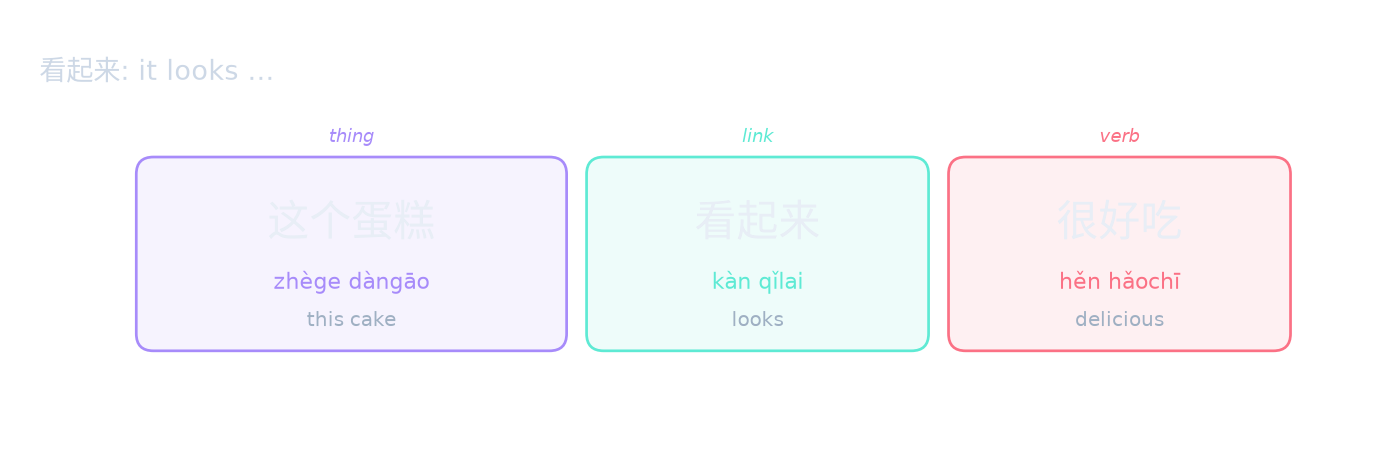
- this这个cake蛋糕seemingly看起来degree / adjective linker很tasty好吃。 Zhège dàngāo kàn qǐlai hěn hǎochī. – This cake looks delicious.
- this这个idea; plan主意to listen to听get up / (start, become)起来not bad / pretty good不错。 Zhège zhǔyi tīng qǐlai búcuò. – That idea sounds good.
- this这个dish (of food); vegetable菜to eat吃get up / (start, become)起来a little有点spicy辣。 – This dish tastes a bit spicy.
- this这个mobile phone手机to use / with用get up / (start, become)起来degree / adjective linker很convenient方便。 – This phone is easy to use.
How it works. Sense verb + get up / (start, become)起来 gives an impression from that sense: to look at; to watch; to read看 (looks), to listen to听 (sounds), to eat吃 (tastes), to use / with用 (is … to use). It goes before the description, which is usually degree / adjective linker很 + adjective. It reports an impression, not a fact you have checked: a cake can look good and taste bad.
| seemingly看起来 / it would appear看上去 | to seem; as if好像 |
|---|---|
| from what you can see | a guess or a feeling, not from looks |
| she / her她it would appear看上去degree / adjective linker很young年轻 | he / him他to seem; as if好像to fall ill生病(completed / change)了 |
Watch out
- Pick the right sense: a plan on the phone to listen to听get up / (start, become)起来degree / adjective linker很interesting有意思; it does not seemingly看起来.
not / haven't没(to have / there is有) comparisons (not as … as)
Form: A + not / haven't没(to have / there is有) + B + (like that那么 / so much这么) + adjective
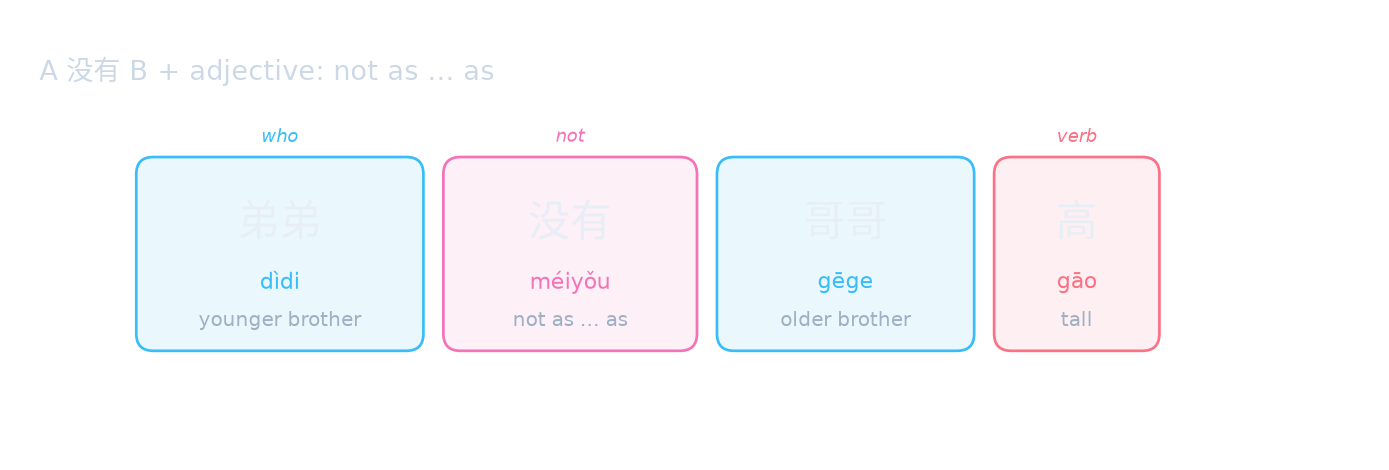
- younger brother弟弟not have / haven't没有older brother哥哥tall; high高。 Dìdi méiyǒu gēge gāo. – The younger brother isn't as tall as the older one.
- I / me我(modifier / structural particle)的Chinese language中文not have / haven't没有you你like that那么good好。 Wǒ de Zhōngwén méiyǒu nǐ nàme hǎo. – My Chinese isn't as good as yours.
- underground railway地铁not have / haven't没有high speed rail高铁fast; soon快。 – The subway isn't as fast as the high-speed train.
How it works. A not have / haven't没有 B + adjective means "A is not as … as B". It is the usual negative of a than / compared to比 comparison. like that那么 or so much这么 before the adjective adds force.
| Positive | Negative |
|---|---|
| older brother哥哥than / compared to比younger brother弟弟tall; high高。 | younger brother弟弟not have / haven't没有older brother哥哥tall; high高。 |
| The older brother is taller. | The younger brother isn't as tall. |
Swap A and B, use not have / haven't没有, and keep the same adjective.
Watch out
- The adjective stays bare: wrong: not have / haven't没有he / him他degree / adjective linker很tall; high高 → not have / haven't没有he / him他tall; high高.
- not … than / unlike不比 is a different idea ("not more … than", used to argue). The plain negative of than / compared to比 is not have / haven't没有.
to let / make让 / to call / be called / (animals) cry, bark叫 / please; to invite请 / to make使 (make / let / ask someone do)
Form: A + to let / make让 / to call / be called / (animals) cry, bark叫 / please; to invite请 / to make使 + B + verb
- mum; mother妈妈不让I / me我evening晚上to go out出去。 Māma bú ràng wǒ wǎnshang chūqu. – Mum won't let me go out in the evening.
- mum; mother妈妈to call / be called / (animals) cry, bark叫I / me我to go去买菜。 Māma jiào wǒ qù mǎi cài. – Mum told me to go and buy vegetables.
- I / me我want / think / miss想please; to invite请you你to have a meal吃饭。 Wǒ xiǎng qǐng nǐ chī fàn. – I'd like to treat you to a meal.
- this这个news; message消息to let / make让I / me我degree / adjective linker很happy; glad高兴。 – This news made me very happy.
How it works. In all four, B is the person who receives the first verb and does the second.
| Verb | Meaning | Example |
|---|---|---|
| to let / make让 | let, allow; make (a feeling) | 不让I / me我to go去, to let / make让I / me我degree / adjective linker很happy; glad高兴 |
| to call / be called / (animals) cry, bark叫 | tell (spoken) | to call / be called / (animals) cry, bark叫I / me我to go去买菜 |
| please; to invite请 | invite, ask politely; treat | please; to invite请teacher老师to have a meal吃饭 |
| to make使 | cause (formal, written) | sports / to exercise运动使人health健康 |
Watch out
- wrong: mum; mother妈妈to let / make让to go去I / me我 → mum; mother妈妈to let / make让I / me我to go去.
- The position of not不 changes the meaning: 不让I / me我to go去 = won't let me go; to let / make让I / me我not不to go去 = tells me not to go.

to pass / process经过 (after going through)
Form: to pass / process经过 + process,result · to pass / process经过 + place (pass through)
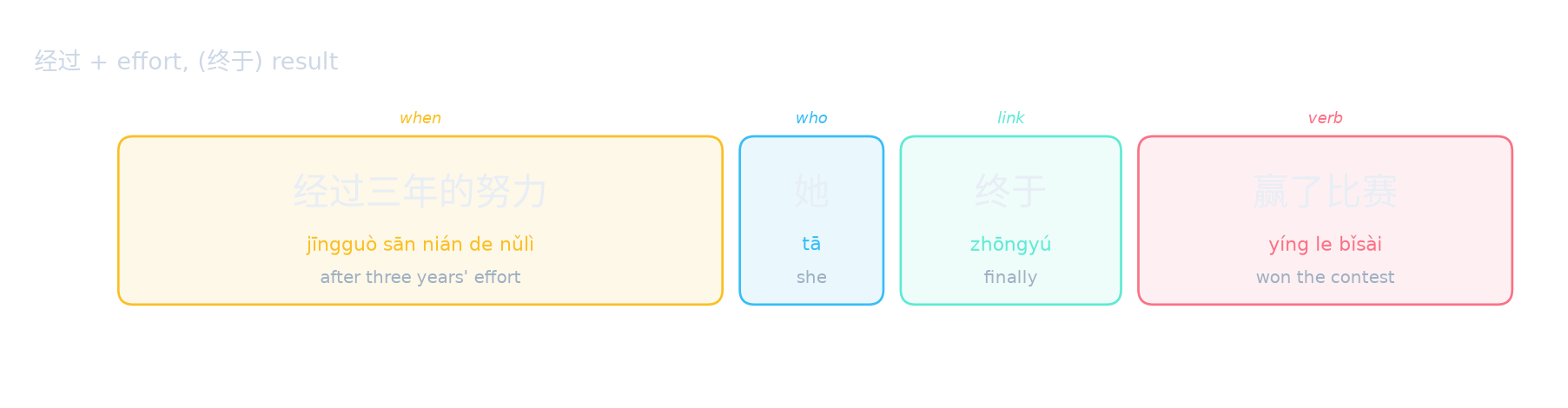
- to pass / process经过三年(modifier / structural particle)的to work hard / effort努力,she / her她finally终于to win赢(completed / change)了competition比赛。 Jīngguò sān nián de nǔlì, tā zhōngyú yíngle bǐsài. – After three years of hard work, she finally won the race.
- to pass / process经过to check检查,doctor医生to speak说nothing没什么big大question / problem问题。 – After the check-up, the doctor said it was nothing serious.
- I / me我every day每天to pass / process经过this这个park公园。 Wǒ měi tiān jīngguò zhège gōngyuán. – I pass this park every day.
- 这趟car车to pass / process经过Beijing北京(yes/no ?)吗? – Does this train go through Beijing?
How it works. to pass / process经过 + a process (effort, study, discussion, a check) comes first; the result follows in the second clause, often with finally终于. The process is usually a noun phrase: to pass / process经过一年(modifier / structural particle)的to study; to learn学习, to pass / process经过everyone大家(modifier / structural particle)的to discuss讨论. As a plain verb, to pass / process经过 means "pass by, go through" a place.
| to pass / process经过 | to pass; through; by means of通过 | after / from now on以后 |
|---|---|---|
| going through a process | the means used | simply "after" a time |
| to pass / process经过many times多次experiment试验 | to pass; through; by means of通过friend朋友,I / me我to find找到(completed / change)了to work; job工作 | to finish class下课after / from now on以后 |
Watch out
- wrong: to pass / process经过to finish class下课 → to finish class下课after / from now on以后: a class ending is not a process.
Practice without the models
Cover the teaching sections before you answer. The answers follow.
seemingly看起来 (looks / seems)
1. Complete: “You look very happy today.” you你today今天…………degree / adjective linker很happy; glad高兴。
2. Your friend describes a plan on the phone. You say: “That sounds interesting.” Which fits?
- A. to listen to听get up / (start, become)起来degree / adjective linker很interesting有意思。
- B. to use / with用get up / (start, become)起来degree / adjective linker很interesting有意思。
- C. seemingly看起来degree / adjective linker很interesting有意思。
- D. to eat吃get up / (start, become)起来degree / adjective linker很interesting有意思。
3. Match each sense verb to its meaning.
-
(1) seemingly看起来
-
(2) to listen to听get up / (start, become)起来
-
(3) to eat吃get up / (start, become)起来
-
(4) to use / with用get up / (start, become)起来
-
A. tastes
-
B. sounds
-
C. is … to use
-
D. looks
4. Build: “This cake looks delicious.”
Put in order: degree / adjective linker很 / tasty好吃。 / this这个cake蛋糕 / seemingly看起来
5. A cake in the bakery window has thick cream and fresh strawberries. You haven't tasted it yet. Use seemingly看起来. Write your answer in Chinese, then say it aloud.
not / haven't没(to have / there is有) comparisons (not as … as)
6. Complete: “The subway isn't as fast as the high-speed train.” underground railway地铁…………high speed rail高铁fast; soon快。
7. Which sentence is correct?
- A. I / me我not have / haven't没有busy忙he / him他。
- B. I / me我not have / haven't没有he / him他degree / adjective linker很busy忙。
- C. I / me我not have / haven't没有he / him他like that那么busy忙。
- D. I / me我not不to have / there is有he / him他busy忙。
8. Build: “My Chinese isn't as good as yours.”
Put in order: you你 / like that那么good好。 / I / me我(modifier / structural particle)的Chinese language中文 / not have / haven't没有
9. True or false? older brother哥哥than / compared to比younger brother弟弟tall; high高 and younger brother弟弟not have / haven't没有older brother哥哥tall; high高 describe the same situation. If false, correct it.
10. In the model, which sentence says the hometown has fewer people than Beijing?
- A. air空气than / compared to比Beijing北京good好。
- B. winter冬天with / and跟Beijing北京the same一样cold冷。
- C. person人also也not have / haven't没有Beijing北京like that那么many; much多。
- D. I / me我(modifier / structural particle)的hometown家乡than / compared to比Beijing北京small小。
11. Two brothers stand back to back. The younger one is shorter, and he does not like it. Use not / haven't没. Write your answer in Chinese, then say it aloud.
to let / make让 / to call / be called / (animals) cry, bark叫 / please; to invite请 / to make使 (make / let / ask someone do)
12. Complete: “My dad doesn't let me play games.” father爸爸not不…………I / me我玩游戏。
13. You invite your teacher to dinner. Which verb is most polite? I / me我want / think / miss想__teacher老师to have a meal吃饭。
- A. to call / be called / (animals) cry, bark叫
- B. to make使
- C. to let / make让
- D. please; to invite请
14. Match each sentence to its meaning.
-
(1) father爸爸to let / make让I / me我to use / with用he / him他(modifier / structural particle)的computer电脑。
-
(2) teacher老师to let / make让we / us我们again / then / (再…也) however再to read (aloud); to study读one time (all the way…一遍。
-
(3) to let / make让I / me我想想。
-
A. The teacher made us read it again.
-
B. Let me think.
-
C. Dad lets me use his computer.
15. Build: “This news made me very happy.”
Put in order: to let / make让 / I / me我 / degree / adjective linker很happy; glad高兴。 / this这个news; message消息
16. True or false? mum; mother妈妈不让I / me我to go去 and mum; mother妈妈to let / make让I / me我not不to go去 mean exactly the same. If false, correct it.
17. Your mum said: “Don't go!” How do you report it?
- A. mum; mother妈妈don't不要to let / make让to go去I / me我。
- B. mum; mother妈妈to let / make让I / me我don't不要to go去。
- C. mum; mother妈妈to let / make让not不I / me我to go去。
- D. mum; mother妈妈to let / make让to go去I / me我don't不要。
18. You want to go out tonight, but your parents have other ideas. Use to let / make让 / to call / be called / (animals) cry, bark叫 / please; to invite请 / to make使. Write your answer in Chinese, then say it aloud.
to pass / process经过 (after going through)
19. Complete: “After a check-up, the doctor said it was nothing serious.” …………to check检查,doctor医生to speak说nothing没什么big大question / problem问题。
20. Which word fits? “After class, let's play basketball.” to finish class下课____,we / us我们to go去to play basketball打篮球(suggestion)吧。
- A. finally终于
- B. to pass / process经过
- C. to pass; through; by means of通过
- D. after / from now on以后
21. Build: “I pass this park every day.”
Put in order: every day每天 / to pass / process经过 / this这个park公园。 / I / me我
22. True or false? to pass; through; by means of通过friend朋友,I / me我to find找到(completed / change)了to work; job工作 stresses the means (a friend) rather than a long process. If false, correct it.
23. Match each English phrase to the Chinese.
-
(1) after class
-
(2) after a year of study
-
(3) through a teacher's introduction
-
A. to pass; through; by means of通过teacher老师(modifier / structural particle)的to introduce介绍
-
B. to finish class下课after / from now on以后
-
C. to pass / process经过一年(modifier / structural particle)的to study; to learn学习
24. A runner who trained every morning for three years has just won her first marathon. Use to pass / process经过. Write your answer in Chinese, then say it aloud.
Answers and explanations
seemingly看起来 (looks / seems)
1. seemingly看起来
seemingly看起来 + Adj reports how someone looks.
2. A. to listen to听get up / (start, become)起来degree / adjective linker很interesting有意思。
You heard the plan, so to listen to听get up / (start, become)起来.
3. (1) D: seemingly看起来 = looks; (2) B: to listen to听get up / (start, become)起来 = sounds; (3) A: to eat吃get up / (start, become)起来 = tastes; (4) C: to use / with用get up / (start, become)起来 = is … to use
Sense verb + get up / (start, become)起来 = comes across as … to that sense.
4. this这个cake蛋糕seemingly看起来degree / adjective linker很tasty好吃。
Subject + seemingly看起来 + degree / adjective linker很 + Adj.
5. Model answer: this这个cake蛋糕seemingly看起来degree / adjective linker很tasty好吃。
Check your answer:
- seemingly看起来 gives what you see, so it does not prove the cake tastes good; tasting is to eat吃get up / (start, become)起来.
- For a guess that is not based on looks (he seems to have left), use to seem; as if好像: he / him他to seem; as if好像to walk / to leave走(completed / change)了.
not / haven't没(to have / there is有) comparisons (not as … as)
6. not have / haven't没有
A not have / haven't没有 B + Adj = A is not as Adj as B.
7. C. I / me我not have / haven't没有he / him他like that那么busy忙。
I / me我not have / haven't没有he / him他like that那么busy忙 is right: A not have / haven't没有 B (like that那么) + bare adjective. degree / adjective linker很 cannot go before the adjective in a comparison, 不有 is never used, and the adjective must follow B.
8. I / me我(modifier / structural particle)的Chinese language中文not have / haven't没有you你like that那么good好。
A + not have / haven't没有 + B + like that那么 + Adj.
9. True.
Both say the older brother is taller.
10. C. person人also也not have / haven't没有Beijing北京like that那么many; much多。
A not have / haven't没有 B like that那么many; much多 = A does not have as many as B.
11. Model answer: younger brother弟弟not have / haven't没有older brother哥哥tall; high高。
Check your answer:
- No degree / adjective linker很 or very非常 before the adjective: not have / haven't没有he / him他tall; high高, not not have / haven't没有he / him他degree / adjective linker很tall; high高.
- not … than / unlike不比 is a different idea ("not more … than", often in an argument); the plain negative of than / compared to比 is not have / haven't没有.
to let / make让 / to call / be called / (animals) cry, bark叫 / please; to invite请 / to make使 (make / let / ask someone do)
12. to let / make让
不让 + person + verb = not allow someone to do something.
13. D. please; to invite请
please; to invite请 is the polite “invite / treat”.
14. (1) C: father爸爸to let / make让I / me我to use / with用he / him他(modifier / structural particle)的computer电脑。 = Dad lets me use his computer.; (2) A: teacher老师to let / make让we / us我们again / then / (再…也) however再to read (aloud); to study读one time (all the way…一遍。 = The teacher made us read it again.; (3) B: to let / make让I / me我想想。 = Let me think.
to let / make让 can mean let or make; the situation decides.
15. this这个news; message消息to let / make让I / me我degree / adjective linker很happy; glad高兴。
Cause + to let / make让 + person + feeling.
16. False.
不让I / me我to go去 refuses permission; to let / make让I / me我not不to go去 tells me not to go. The focus differs.
17. B. mum; mother妈妈to let / make让I / me我don't不要to go去。
An instruction not to go: to let / make让 + person + don't不要 + verb.
18. Model answer: mum; mother妈妈不让I / me我evening晚上to go out出去。
Check your answer:
- Keep the order A + to let / make让 + B + Verb: mum; mother妈妈to let / make让I / me我to go去, not mum; mother妈妈to let / make让to go去I / me我.
- Negate the first verb to refuse permission: 不让I / me我to go去 = "won't let me go"; to let / make让I / me我not不to go去 changes the meaning to "tell me not to go".
to pass / process经过 (after going through)
19. to pass / process经过
to pass / process经过 + process (the check-up), then the result.
20. D. after / from now on以后
A simple point in time takes after / from now on以后; to pass / process经过 needs a process.
21. I / me我every day每天to pass / process经过this这个park公园。
As a verb, to pass / process经过 takes the place as its object.
22. True.
to pass; through; by means of通过 = by means of; to pass / process经过 = after going through a process.
23. (1) B: after class = to finish class下课after / from now on以后; (2) C: after a year of study = to pass / process经过一年(modifier / structural particle)的to study; to learn学习; (3) A: through a teacher's introduction = to pass; through; by means of通过teacher老师(modifier / structural particle)的to introduce介绍
A plain time → after / from now on以后 (after the event); a long process → to pass / process经过; a helper or way → to pass; through; by means of通过.
24. Model answer: to pass / process经过三年(modifier / structural particle)的to work hard / effort努力,she / her她finally终于to win赢(completed / change)了competition比赛。
Check your answer:
- to pass / process经过 needs a process that leads somewhere; for a simple "after (a time)", use after / from now on以后: to finish class下课after / from now on以后, not to pass / process经过to finish class下课.
- Put to pass / process经过 + process first and the result second: to pass / process经过to check检查,doctor医生to speak说not / haven't没question / problem问题.