English narration · English + 中文 subtitles burned in · 英語ナレーション・英語+中文字幕 burning-in
6.1
Photosynthesis · 光合成
Syllabus · シラバス
English
Core
Supplement
1 Describe photosynthesis as the process by which plants synthesise carbohydrates from raw materials using energy from light
2 State the word equation for photosynthesis as: carbon dioxide + water $\rightarrow$ glucose + oxygen in the presence of light and chlorophyll
10 State the balanced chemical equation for photosynthesis as: $6\text{CO}_2 + 6\text{H}_2\text{O} \rightarrow \text{C}_6\text{H}_{12}\text{O}_6 + 6\text{O}_2$
3 State that chlorophyll is a green pigment that is found in chloroplasts
4 State that chlorophyll transfers energy from light into energy in chemicals, for the synthesis of carbohydrates
5 Outline the subsequent use and storage of the carbohydrates made in photosynthesis, limited to: (a) starch as an energy store (b) cellulose to build cell walls (c) glucose used in respiration to provide energy (d) sucrose for transport in the phloem (e) nectar to attract insects for pollination
6 Explain the importance of: (a) nitrate ions for making amino acids (b) magnesium ions for making chlorophyll
7 Investigate the need for chlorophyll, light and carbon dioxide for photosynthesis, using appropriate controls
8 Investigate and describe the effects of varying light intensity, carbon dioxide concentration and temperature on the rate of photosynthesis
9 Investigate and describe the effect of light and dark conditions on gas exchange in an aquatic plant using hydrogencarbonate indicator solution
11 Identify and explain the limiting factors of photosynthesis in different environmental conditions
Source: Cambridge International syllabus · 出典: Cambridge International シラバス
English
Photosynthesis: inputs and outputs
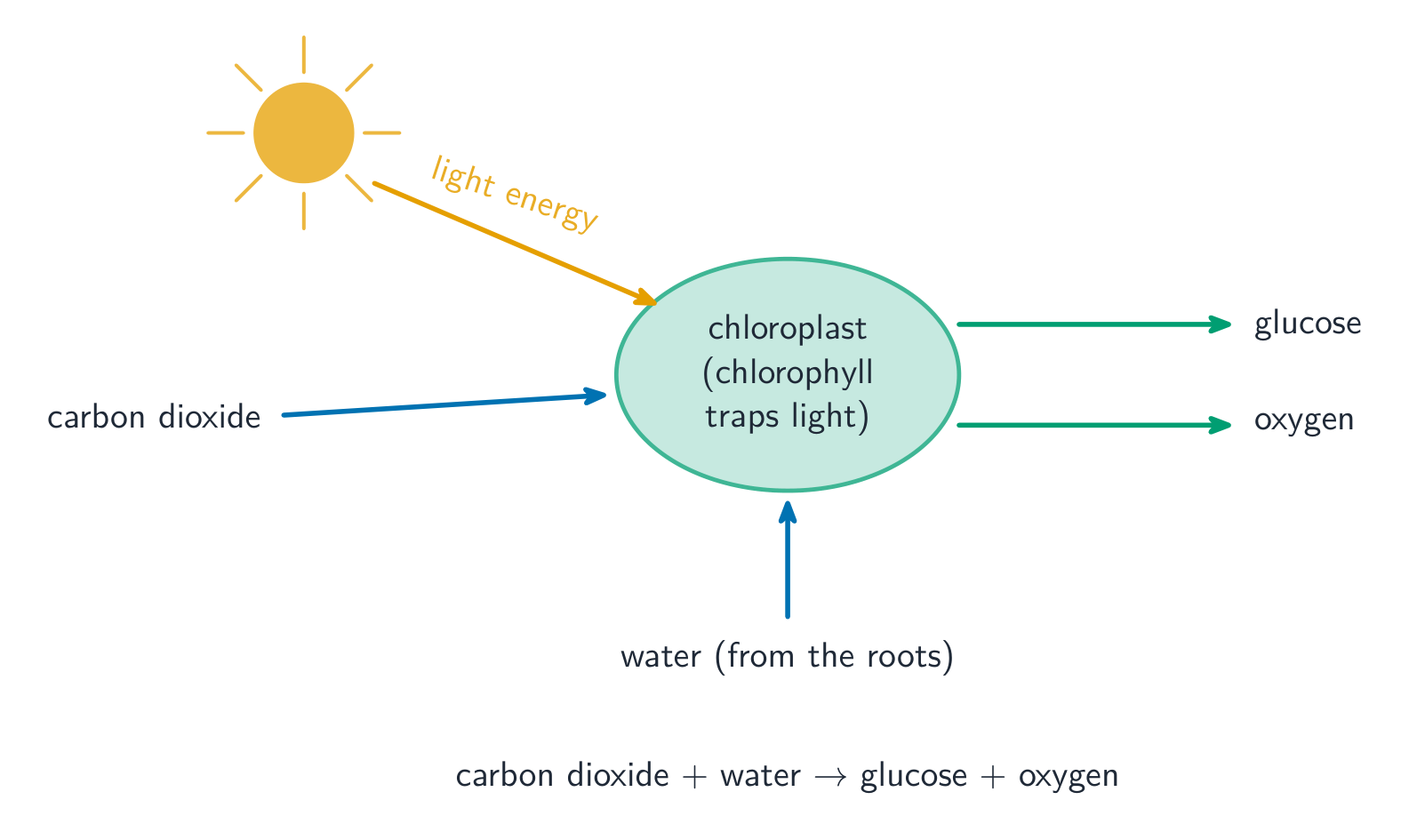
Photosynthesis 光合作用 is the process by which plants make carbohydrates 碳水化合物 from simple raw materials 原料, using energy 能量 from light. It is how plants feed themselves.
In words: plants take in carbon dioxide 二氧化碳 and water, and make glucose 葡萄糖 and oxygen 氧气. This reaction can only happen in the light, and only where there is chlorophyll 叶绿素.
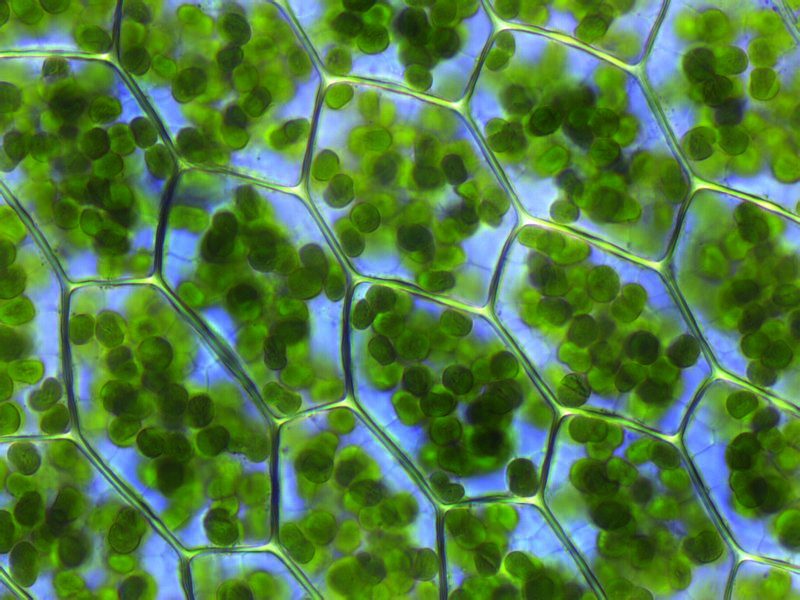
Chlorophyll is a green pigment 色素 found in the chloroplasts 叶绿体. It traps light and transfers the energy from light into energy stored in chemicals. That chemical energy is then used to build carbohydrates.
What the plant does with the glucose
Use
What happens
store
changed to starch 淀粉, an energy store that does not dissolve
build
made into cellulose 纤维素 to build cell walls 细胞壁
release energy
broken down in respiration 呼吸作用 to release energy
transport
changed to sucrose 蔗糖 and moved around the plant in the phloem 韧皮部
attract animals
made into nectar 花蜜 to attract insects 昆虫 for pollination 传粉
Minerals from the soil
Plants also take up mineral ions 离子 from the soil through their roots:
nitrate ions 硝酸根离子 — needed to make amino acids 氨基酸 (and so proteins).
magnesium ions 镁离子 — needed to make chlorophyll.
A plant short of nitrate grows poorly with weak stems; a plant short of magnesium has yellow leaves (it cannot make enough chlorophyll).
The rate of photosynthesis
The rate 速率 of photosynthesis depends on three things:
light intensity 光照强度 — more light gives a faster rate, up to a point.
carbon dioxide concentration 浓度 — more carbon dioxide gives a faster rate.
temperature 温度 — a warmer temperature is faster, until it gets so hot that the enzymes are denatured.
(Supplement) At any moment, the one factor that is in shortest supply holds back the rate. This is called the limiting factor 限制因素. For example, on a dull day light intensity is usually the limiting factor; on a bright day carbon dioxide may be.
Worked example. On a graph of rate against light intensity, the line rises steeply at first and then levels off flat. Which factor is limiting on each part? On the rising part, adding light raises the rate, so light intensity is the limiting factor there. On the flat part, adding more light changes nothing, so light is no longer limiting - something else is, usually carbon dioxide concentration or temperature. The test is always the same: if adding more of a factor speeds the reaction up, that factor was the one holding it back.
Investigating photosynthesis
To show that a plant needs light, chlorophyll and carbon dioxide, you test a leaf for starch after taking one of them away. A control 对照 keeps every other condition the same, so the test is fair. (First leave the plant in the dark to use up its starch.) A leaf with green and white parts shows starch only in the green parts, which have chlorophyll.
You can also watch gas exchange 气体交换 in a water plant using hydrogencarbonate indicator 指示剂, which changes colour as the carbon dioxide level changes. In the light the plant takes in carbon dioxide for photosynthesis; in the dark it gives out carbon dioxide from respiration.
** worked example.** 光強度に対する速度のグラフにおいて、線は最初は急激に上昇し、その後水平になります。各部分で制限している要因は何ですか?上昇部分では、光を増やすことで速度が上がるため、その部分での制限要因は光強度です。水平部分では、光を増やしても変化がないため、光はもはや制限要因ではなく、他(通常は二酸化炭素濃度または温度)が制限要因となっています。テストの方法は常に同じです。ある要因を増やすことで反応が速くなる場合、その要因が以前は反応を遅らせていました。
1 State that most leaves have a large surface area and are thin, and explain how these features are adaptations for photosynthesis
2 Identify in diagrams and images the following structures in the leaf of a dicotyledonous plant: chloroplasts, cuticle, guard cells and stomata, upper and lower epidermis, palisade mesophyll, spongy mesophyll, air spaces, vascular bundles, xylem and phloem
3 Explain how the structures listed in 6.2.2 adapt leaves for photosynthesis
Source: Cambridge International syllabus · 出典: Cambridge International シラバス
English
A leaf is well adapted 适应 for photosynthesis. Most leaves are broad, with a large surface area 表面积 to catch plenty of light, and thin, so that gases and light quickly reach all the cells.
The middle of the leaf, the mesophyll 叶肉, is where most photosynthesis happens. These are the main parts of a leaf:
Structure
Job / how it helps photosynthesis
cuticle 角质层
a clear waxy layer on top; it reduces water loss but still lets light through
upper epidermis 表皮
a clear layer of cells with no chloroplasts; it lets light pass to the cells below
palisade mesophyll 栅栏叶肉
tall, column-shaped cells packed with chloroplasts, near the top; they do most of the photosynthesis
spongy mesophyll 海绵叶肉
rounded cells with air spaces 气腔 between them, so gases can move easily
stomata 气孔
tiny holes, mostly on the lower surface, that let carbon dioxide in and oxygen out
guard cells 保卫细胞
a pair of cells around each stoma; they open and close it
lower epidermis
a thin layer that holds the stomata
vascular bundles 维管束
contain xylem 木质部 (brings water to the leaf) and phloem (carries sugars away)
Learn the word equation exactly: carbon dioxide + water → glucose + oxygen (in light, with chlorophyll).
Chlorophyll is in the chloroplasts; it does not get used up — it transfers light energy.
Link each factor to the rate: more light, more carbon dioxide, warmer (but not too hot) → faster, until a limiting factor stops further increase.
For leaf structure, always link the part to its job: broad and thin to catch light; palisade cells full of chloroplasts; stomata and air spaces for gas exchange.
Type to search notes, lessons, code, vocabulary and past-paper questions across every subject. · すべての科目でノートImplemented、Implemented、コード、語彙、過去問問題を検索するために入力してください。