| Learning Objective | Essential Knowledge |
|---|---|
9.1.A |
|
9.1.B |
Boundary statement: AP Physics 2 only expects students to perform qualitative and quantitative analysis of collisions in one and two dimensions. Students are not expected to know the functional form of the Maxwell-Boltzmann distribution but are expected to be familiar with how features of the distribution are related to the temperature of the gas. |
Tips · ヒント
AP Physics 2は、Physics 1の力学を前提とし、それを踏まえて熱力学、静電気力・電場・ポテンシャル、回路、磁気、幾何光学、波動・物理光学、近代物理学へと代数学ベースの物理学を展開していく。
電場は目に見えず、試験もそれを承知している。 何かが変わったときに quantities がどう変化するかを問う — 距離を倍にする、誘電体を挿入する、電流の向きを反転させる — といった問題に対し、数値を計算することなく理由を述べることが求められる。
それぞれの関係式を単なる数式としてだけでなく、比例関係として覚える。 それがこれらの問題を解きやすくする鍵である。
単位ごとに流体、熱力学、静電気学、回路、磁気、光学、近代物理学のノートがあり、イメージしにくい部分には図解 included。ライブラリには公開された過去問が収められており、Physics 2は「なぜそれが起きるのか」を言葉で説明することに重きを置いているため、数値だけでなく推論の書き方を練習すべきである。
-
9
Thermodynamics
Watch lesson · レッスンを視聴9.1
Kinetic Theory of Temperature and Pressure
Syllabus · シラバス
Source: College Board AP Course and Exam Description · 出典: College Board AP コースおよび試験説明書
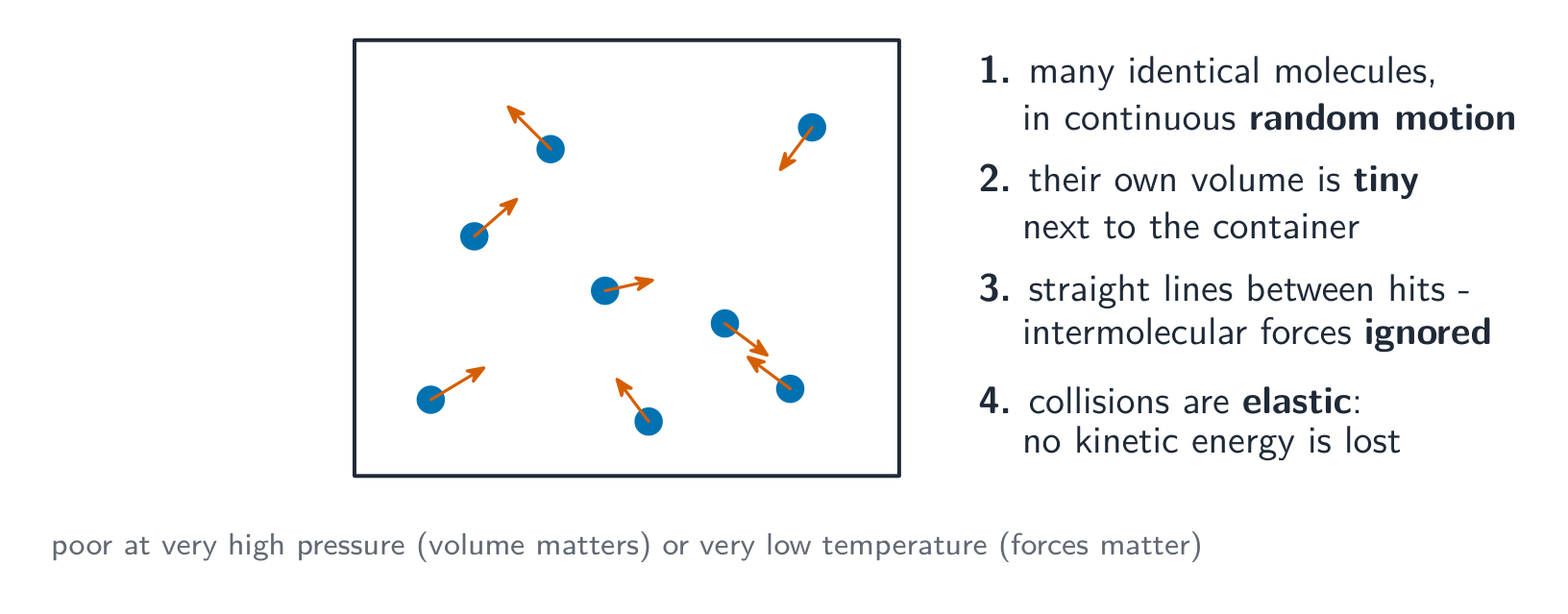
EnglishKinetic theory: gas pressure Thermodynamics 热力学 studies heat and energy in large collections of particles. The kinetic theory 分子运动论 explains gas behavior from the random motion of its molecules:
- Temperature 温度 is a measure of the average kinetic energy of the molecules: $K_{\text{avg}}=\tfrac{3}{2}k_B T$ (with $T$ in kelvin). Hotter means faster-moving molecules.
- Pressure 压强 comes from molecules colliding with the container walls – more frequent or harder collisions give more pressure.
Worked example. Find the average kinetic energy of a gas molecule at $300\ \text{K}$, using $k_B=1.38\times10^{-23}\ \text{J/K}$:
$$K_{\text{avg}}=\tfrac32 k_B T=1.5\times1.38\times10^{-23}\times300=6.2\times10^{-21}\ \text{J}.$$It depends only on temperature, not on the type of gas – at the same $T$, light and heavy molecules share the same average kinetic energy (so the light ones move faster).日本語Kinetic theory: gas pressure Thermodynamics 热力学 studies heat and energy in large collections of particles. The kinetic theory 分子运动论 explains gas behavior from the random motion of its molecules:
The key assumptions of the kinetic theory of an ideal gas - Temperature 温度 is a measure of the average kinetic energy of the molecules: $K_{\text{avg}}=\tfrac{3}{2}k_B T$ (with $T$ in kelvin). Hotter means faster-moving molecules.
- Pressure 压强 comes from molecules colliding with the container walls – more frequent or harder collisions give more pressure.
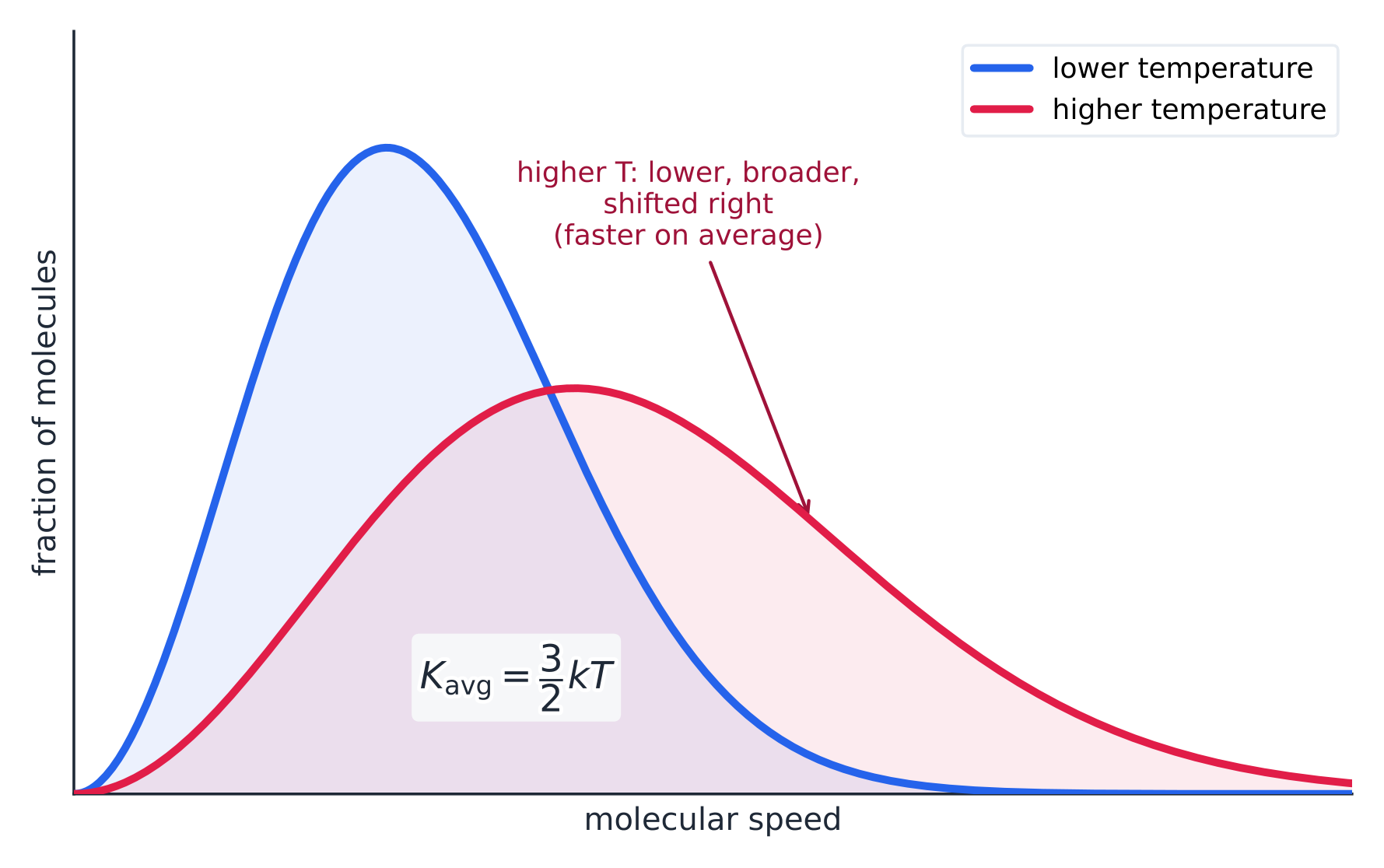
The Maxwell-Boltzmann speed distribution shifts right and flattens at higher temperature Worked example. Find the average kinetic energy of a gas molecule at $300\ \text{K}$, using $k_B=1.38\times10^{-23}\ \text{J/K}$:
$$K_{\text{avg}}=\tfrac32 k_B T=1.5\times1.38\times10^{-23}\times300=6.2\times10^{-21}\ \text{J}.$$It depends only on temperature, not on the type of gas – at the same $T$, light and heavy molecules share the same average kinetic energy (so the light ones move faster).Explore · 探索Explore the spread of molecular speeds · 分子速度の分布 explored する
Raise the temperature and watch the whole speed distribution shift right and flatten — the particles move faster on average, which is exactly what $\bar K = \tfrac{3}{2} k_B T$ means. · 温度を上げると、全速度分布が右にシフトして平たくなり — 粒子は 平均して速く 動く。これが exactly $\bar K = \tfrac{3}{2} k_B T$ の意味である。
Vocabulary · 語彙 Train · 練習するEnglish 日本語 Thermodynamics/ˌθɜːməʊdaɪˈnæmɪks/ 熱力学 kinetic theory/kɪˈnetɪk ˈθɪəri/ 運動論的理論 Temperature/ˈtemprɪtʃə/ 温度 Pressure/ˈpreʃə/ 圧力 9.2
The Ideal Gas Law
Syllabus · シラバス
EnglishLearning Objective 9.2.A: Describe the properties of an ideal gas.
- 9.2.A.1 The classical model of an ideal gas assumes that the instantaneous velocities of atoms are random, the volumes of the atoms are negligible compared to the total volume occupied by the gas, the atoms collide elastically, and the only appreciable forces on the atoms are those that occur during collisions.
- 9.2.A.2 An ideal gas is one in which the relationships between pressure, volume, the number of moles or number of atoms, and temperature of a gas can be modeled using the equation
- Equation: $PV = nRT = N k_B T$
- 9.2.A.3 Graphs modeling the pressure, temperature, and volume of gases can be used to describe or determine properties of that gas.
- 9.2.A.4 A temperature at which an ideal gas has zero pressure can be extrapolated from a graph of pressure as a function of temperature.
日本語学習目標 9.2.A: 理想気体の性質を説明せよ。
- 9.2.A.1 理想気体の古典モデルは、原子の瞬時速度がランダムであり、原子自体の体積は気体が占める全体的な体積に比べて無視できるほど小さく、原子は弾性衝突をし、原子に働く主要な力は衝突時にのみ生じるものであるという仮定に基づいている。
- 9.2.A.2 理想気体とは、圧力、体積、物質量または原子数、および気体の温度の間に成立する関係を、以下の方程式を用いてモデル化できる気体である
- 式: $PV = nRT = N k_B T$
- 9.2.A.3 気体の圧力、温度、および体積をモデル化したグラフは、その気体の性質を説明したり決定したりするために使用できる。
- 9.2.A.4 理想気体の圧力がゼロになる温度は、圧力を温度の関数としてプロットしたグラフから外挿することで求められる。
Source: College Board AP Course and Exam Description · 出典: College Board AP コースおよび試験説明書
EnglishAn ideal gas 理想气体 obeys
$$PV=nRT \qquad(\text{or } PV=Nk_B T),$$linking pressure $P$, volume $V$, amount ($n$ moles or $N$ molecules), and absolute temperature $T$. Use it to predict how a gas responds when you change one quantity and hold others fixed (e.g. heating at constant volume raises pressure).Worked example. A sealed rigid container of gas is at $1.0\times10^{5}\ \text{Pa}$ and $300\ \text{K}$. It is heated to $450\ \text{K}$. Because the volume and amount are fixed, $P/T$ is constant:
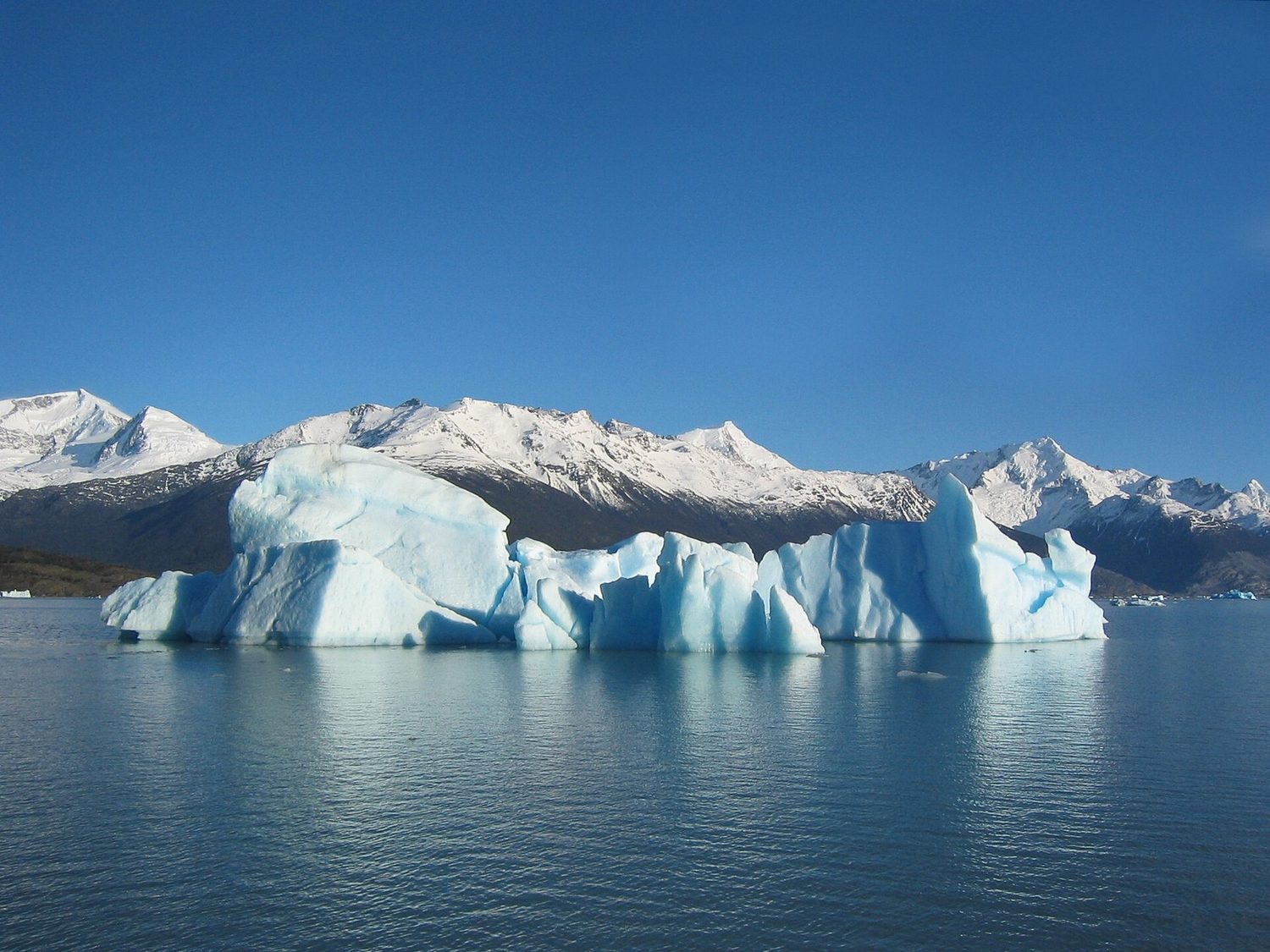
$$P_2=P_1\frac{T_2}{T_1}=1.0\times10^{5}\times\frac{450}{300}=1.5\times10^{5}\ \text{Pa}.$$Always convert temperatures to kelvin before using a gas law – using Celsius here would give nonsense.日本語An iceberg: heat, density and phase changes connect thermodynamics to fluids and buoyancy An ideal gas 理想气体 obeys
$$PV=nRT \qquad(\text{or } PV=Nk_B T),$$linking pressure $P$, volume $V$, amount ($n$ moles or $N$ molecules), and absolute temperature $T$. Use it to predict how a gas responds when you change one quantity and hold others fixed (e.g. heating at constant volume raises pressure).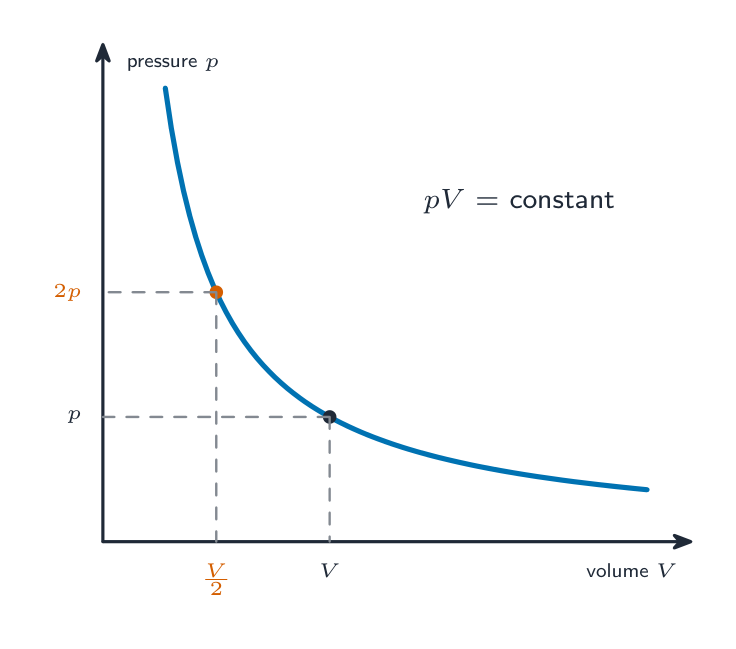
Boyle's law: at constant temperature, pressure times volume is constant Worked example. A sealed rigid container of gas is at $1.0\times10^{5}\ \text{Pa}$ and $300\ \text{K}$. It is heated to $450\ \text{K}$. Because the volume and amount are fixed, $P/T$ is constant:
$$P_2=P_1\frac{T_2}{T_1}=1.0\times10^{5}\times\frac{450}{300}=1.5\times10^{5}\ \text{Pa}.$$Always convert temperatures to kelvin before using a gas law – using Celsius here would give nonsense.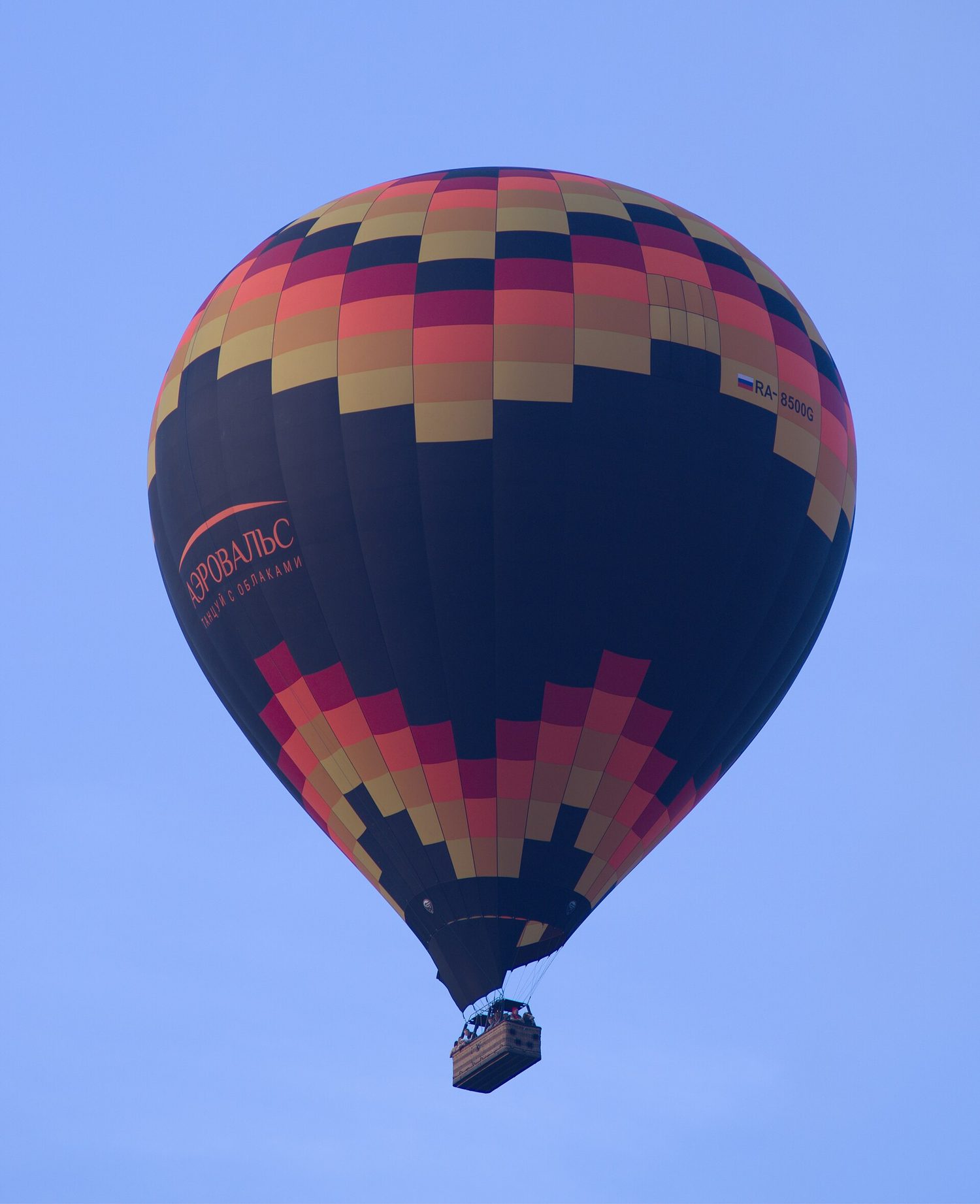
Heating the gas inside a balloon lowers its density, so the balloon rises — the ideal gas law in action Explore · 探索Explore squeezing a gas · ガスを圧縮する様子 explored する
Slide the piston in to shrink the volume. The same particles are crammed into less space, so they hit the walls more often and the pressure climbs — while $PV$ stays constant at fixed temperature. · ピストンを押して体積を縮める。同じ粒子が狭い空間に詰まるため壁への衝突頻度が増加し、圧力が上昇 する — 温度一定では $PV$ が一定のまま。
Vocabulary · 語彙 Train · 練習するEnglish 日本語 ideal gas/aɪˈdɪəl ɡæs/ 理想ガス 9.3
Thermal Energy Transfer and Equilibrium
Syllabus · シラバス
EnglishLearning Objective 9.3.A: Describe the transfer of energy between two systems in thermal contact due to temperature differences of those two systems.
- 9.3.A.1 Two systems are in thermal contact if the systems may transfer energy by thermal processes.
- 9.3.A.1.i Heating is the transfer of energy into a system by thermal processes.
- 9.3.A.1.ii Cooling is the transfer of energy out of a system by thermal processes.
- 9.3.A.2 The thermal processes by which energy may be transferred between systems at different temperatures are conduction, convection, and radiation.
- 9.3.A.3 Energy is transferred through thermal processes spontaneously from a higher-temperature system to a lower-temperature system.
- 9.3.A.3.i In collisions between atoms from different systems, energy is most likely to be transferred from higher-energy atoms to lower-energy atoms.
- 9.3.A.3.ii After many collisions of atoms from different systems, the most probable state is one in which both systems have the same temperature.
- 9.3.A.4 Thermal equilibrium results when no net energy is transferred by thermal processes between two systems in thermal contact with each other.
日本語学習目標 9.3.A: 2つの系間の温度差に起因する熱接触時のエネルギー移動を説明せよ。
- 9.3.A.1 2つの系が熱的に接触しているとは、熱過程によってエネルギーを相互に移動できることを意味する。
- 9.3.A.1.i 加熱とは、熱的プロセスによって系にエネルギーを移行させることである。
- 9.3.A.1.ii 冷却とは、熱的プロセスによって系からエネルギーが移行することである。
- 9.3.A.2 異なる温度にある系間でエネルギーを移動させる熱過程には、伝導、対流、放射がある。
- 9.3.A.3 熱過程によってエネルギーは自発的に高温側から低温側の系へ移動する。
- 9.3.A.3.i 異なる系の原子間の衝突において、エネルギーは最も高い確率で高エネルギーの原子から低エネルギーの原子へ移行する。
- 9.3.A.3.ii 異なる系の原子間の多数の衝突の後で、両方の系が同じ温度を持つ状態が最も確立されやすい。
- 9.3.A.4 熱接触している2つの系間で熱過程による正味のエネルギー移動が生じない場合、熱平衡が成立する。
Source: College Board AP Course and Exam Description · 出典: College Board AP コースおよび試験説明書
EnglishHeat 热量 $Q$ is energy transferred because of a temperature difference; it flows from hot to cold. Two objects in contact reach thermal equilibrium 热平衡 when they share the same temperature, and net heat flow stops. The three transfer methods are conduction 传导, convection 对流, and radiation 辐射.
日本語Heat 热量 $Q$ is energy transferred because of a temperature difference; it flows from hot to cold. Two objects in contact reach thermal equilibrium 热平衡 when they share the same temperature, and net heat flow stops. The three transfer methods are conduction 传导, convection 对流, and radiation 辐射.
Explore · 探索Add heat and watch the temperature · 熱を加えて温度を見る
Adding heat usually raises temperature, but during a phase change the temperature holds flat while the energy breaks bonds. Two bodies in contact settle at one temperature — thermal equilibrium. · 熱を加えると通常温度は上がるが、相転移 中、エネルギーが結合を切断する間、温度は一定で推移する。接触した2つの物体は一つの温度に落ち着き — 熱平衡。
Vocabulary · 語彙 Train · 練習するEnglish 日本語 Heat/hiːt/ 熱 thermal equilibrium/ˈθɜːml ˌiːkwɪˈlɪbrɪəm/ 熱的平衡 conduction/kənˈdʌkʃn/ 媒体を必要としない熱移動の方法は convection/kənˈvekʃn/ 伝導 radiation/ˌreɪdɪˈeɪʃn/ 対流 9.4
The First Law of Thermodynamics
Syllabus · シラバス
EnglishLearning Objective 9.4.A: Describe the internal energy of a system.
- 9.4.A.1 The internal energy of a system is the sum of the kinetic energy of the objects that make up the system and the potential energy of the configuration of those objects.
- 9.4.A.1.i The atoms in an ideal gas do not interact with each other via conservative forces, and the internal structure is not considered. Therefore, an ideal gas does not have internal potential energy.
- 9.4.A.1.ii The internal energy of an ideal monatomic gas is the sum of the kinetic energies of the constituent atoms in the gas.
- Equation: $U = \dfrac{3}{2} nRT = \dfrac{3}{2} N k_B T$
- 9.4.A.2 Changes to a system's internal energy can result in changes to the internal structure and internal behavior of that system without changing the motion of the system's center of mass.
Learning Objective 9.4.B: Describe the behavior of a system using thermodynamic processes.
- 9.4.B.1 The first law of thermodynamics is a restatement of conservation of energy that accounts for energy transferred into or out of a system by work, heating, or cooling.
- 9.4.B.1.i For an isolated system, the total energy is constant.
- 9.4.B.1.ii For a closed system, the change in internal energy is the sum of energy transferred to or from the system by heating, or work done on the system.
- Equation: $\Delta U = Q + W$
- 9.4.B.1.iii The work done on a system by a constant or average external pressure that changes the volume of that system (for example, a piston compressing a gas in a container) is defined as
- Equation: $W = -P \Delta V$
- 9.4.B.2 Pressure-volume graphs (also known as PV diagrams) are representations used to represent thermodynamic processes.
- 9.4.B.2.i Lines of constant temperature on a PV diagram are called isotherms.
- 9.4.B.2.ii The absolute value of the work done on a gas when the gas expands or compresses is equal to the area underneath the curve of a plot of pressure vs. volume for the gas.
- 9.4.B.3 Special cases of thermal processes depend on the relationship between the configuration of the system, the nature of the work done on the system, and the system's surroundings. These include constant volume (isovolumetric), constant temperature (isothermal), and constant pressure (isobaric), as well as processes where no energy is transferred to or from the system through thermal processes (adiabatic).
日本語学習目標 9.4.A: 系全体の内部エネルギーを説明せよ。
- 9.4.A.1 系の内部エネルギーとは、系を構成する物体の運動エネルギーと、それらの物体の配置のポテンシャルエネルギーとの和である。
- 9.4.A.1.i 理想気体中の原子は保存力によって互いに相互作用せず、内部構造も考慮されない。したがって、理想気体には内部ポテンシャルエネルギーは存在しない。
- 9.4.A.1.ii 理想単原子分子ガスの内部エネルギーは、そのガス constituent となる原子の運動エネルギーの和である。
- 数式: $U = \dfrac{3}{2} nRT = \dfrac{3}{2} N k_B T$
- 9.4.A.2 系の内部エネルギーの変化は、系全体(重心)の運動を変化させることなく、その系の内部構造や内部挙動の変化をもたらすことがある。
学習目標 9.4.B: 熱力学過程を用いて系の振る舞いを記述する。
- 9.4.B.1 熱力学第一法則は、仕事、加熱、または冷却によって系に入力・出力されるエネルギーを考慮したエネルギー保存則の再表述である。
- 9.4.B.1.i 孤立系において、全エネルギーは一定である。
- 9.4.B.1.ii 閉系において、内部エネルギーの変化量は、系に入力・出力される加熱によるエネルギーと、系に対してなされた仕事の和に等しい。
- 数式: $\Delta U = Q + W$
- 9.4.B.1.iii 一定または平均的な外部圧力が系の体積を変化させる(例:容器内のガスをピストンで圧縮する場合)際に、系に対してなされた仕事は次のように定義される
- 数式: $W = -P \Delta V$
- 9.4.B.2 圧力-体積グラフ(PV図とも呼ばれる)は、熱力学過程を表すために用いられる図示である。
- 9.4.B.2.i PV図上の一定温度線は断熱曲線ではなく、等温線と呼ばれる。
- 9.4.B.2.ii ガスが膨張または圧縮される際、系に対してなされた仕事の絶対値は、ガスの圧力対体積プロットにおける曲線下面積に等しい。
- 9.4.B.3 熱的プロセスにおける特殊なケースは、系の配置、系に対してなされた仕事の性質、および系周囲との関係に依存する。これには一定体積(等容)、一定温度(等温)、一定圧力(等圧)のプロセスに加え、熱的プロセスを通じて系へエネルギーが入力・出力されない断熱プロセスが含まれる。
Source: College Board AP Course and Exam Description · 出典: College Board AP コースおよび試験説明書
EnglishThe first law 热力学第一定律 is conservation of energy for a gas:
$$\Delta U = Q + W,$$where $\Delta U$ is the change in internal energy 内能 (tied to temperature), $Q$ is heat added to the gas, and $W$ is work done on the gas. On a pressure–volume diagram, the work done by the gas is the area under the process curve. Watch signs: compressing a gas does positive work on it.Worked example. A gas absorbs $500\ \text{J}$ of heat and, as it expands, does $200\ \text{J}$ of work on its surroundings. Find the change in its internal energy. Work done on the gas is $W=-200\ \text{J}$ (it does work, so it loses that energy):
$$\Delta U=Q+W=500+(-200)=300\ \text{J}.$$The internal energy rises by $300\ \text{J}$, so the gas ends up hotter. Getting the sign of $W$ right is the whole game in first-law problems.日本語The first law 热力学第一定律 is conservation of energy for a gas:
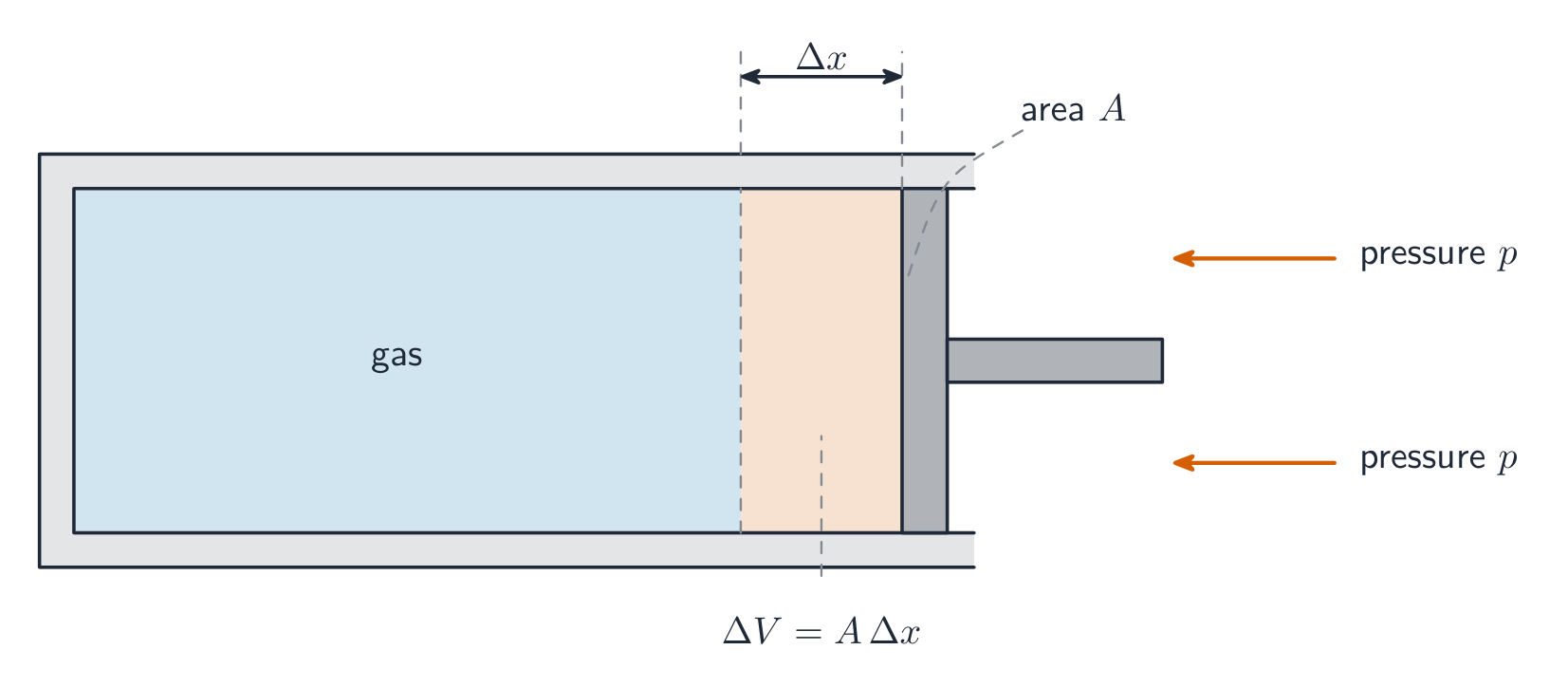
$$\Delta U = Q + W,$$where $\Delta U$ is the change in internal energy 内能 (tied to temperature), $Q$ is heat added to the gas, and $W$ is work done on the gas. On a pressure–volume diagram, the work done by the gas is the area under the process curve. Watch signs: compressing a gas does positive work on it.A gas pushing a piston out by a small distance does work equal to p times the volume change 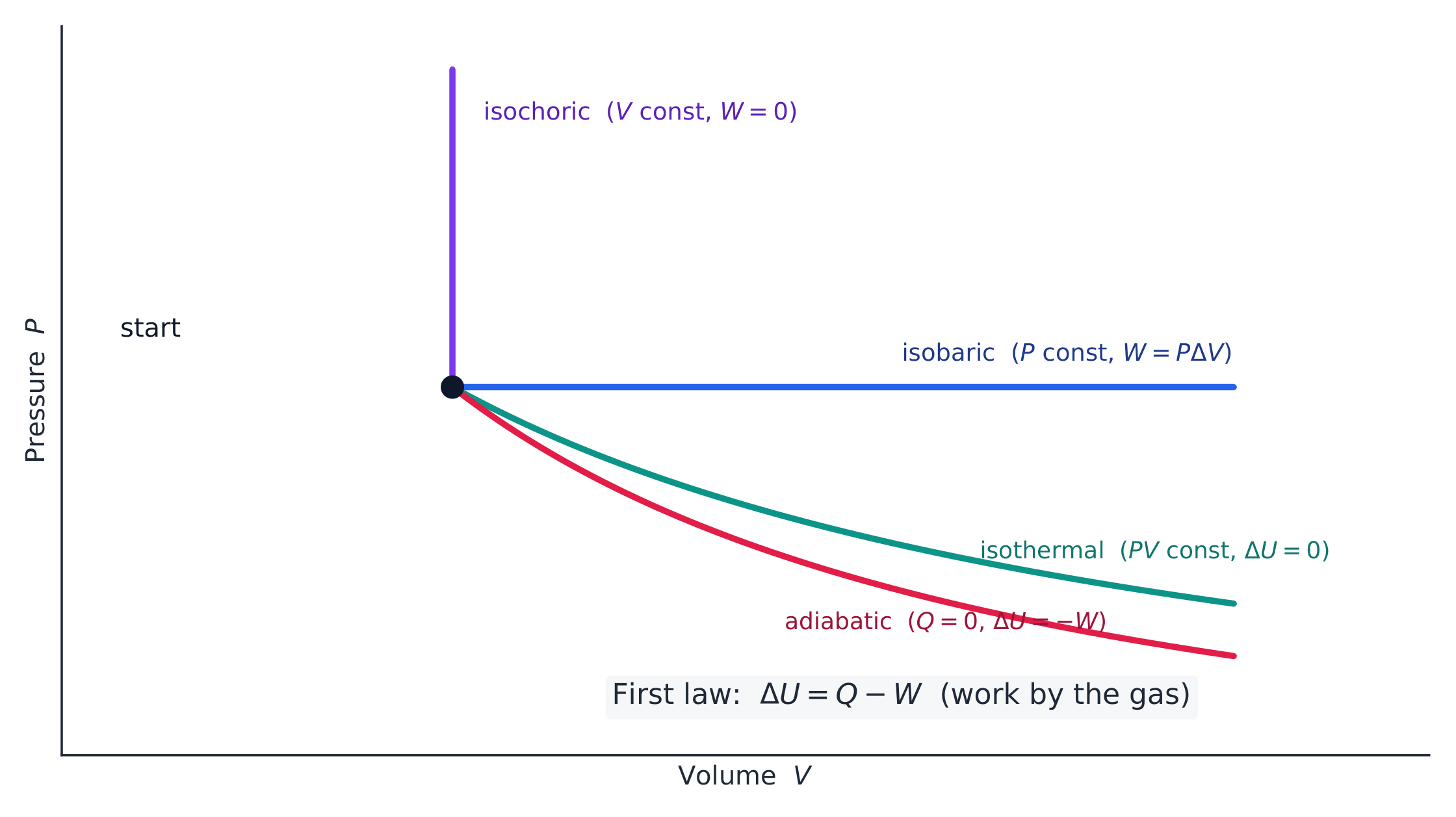
The four thermodynamic processes drawn from a common starting state on a PV diagram 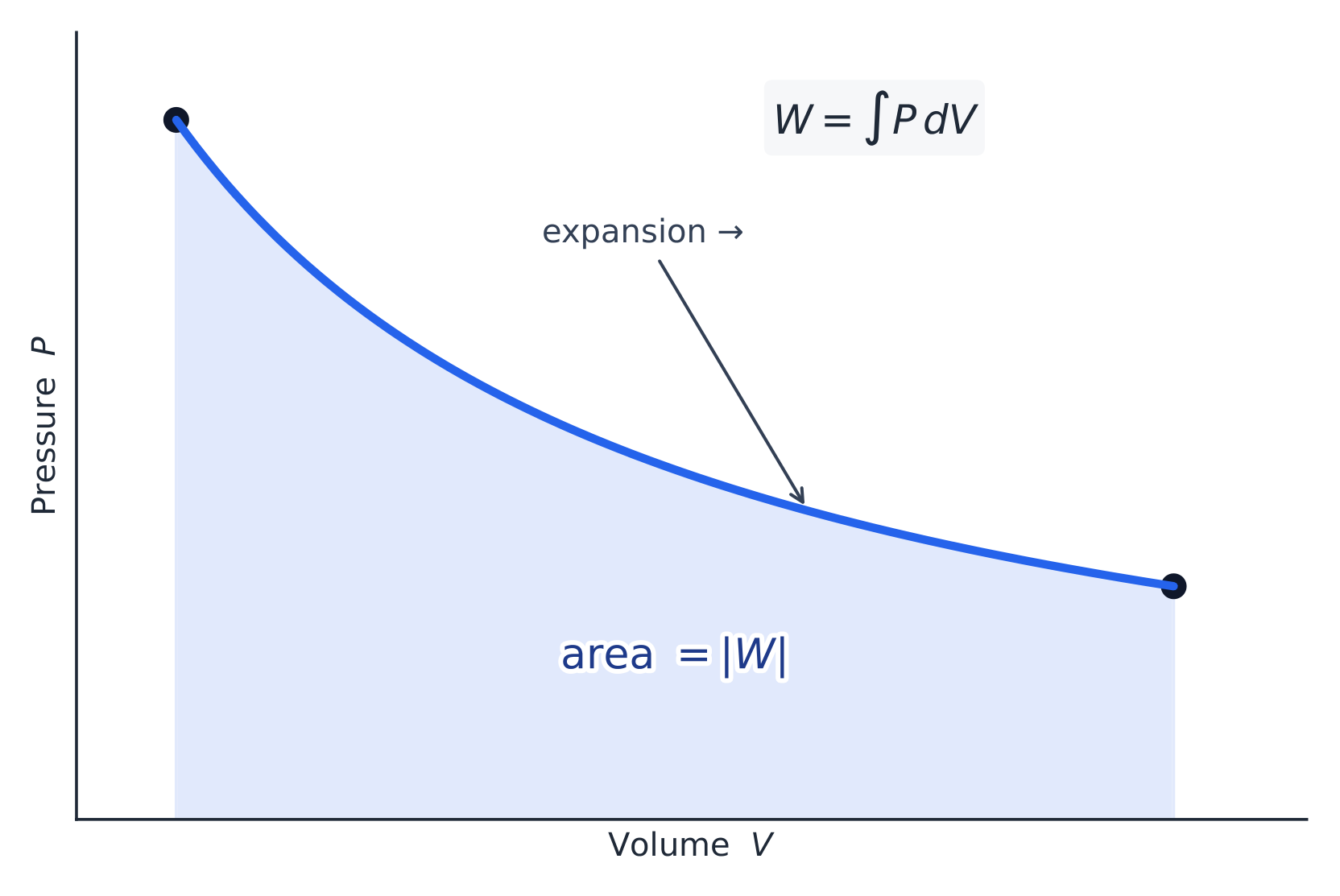
The work done during a volume change equals the area under the P-V curve Worked example. A gas absorbs $500\ \text{J}$ of heat and, as it expands, does $200\ \text{J}$ of work on its surroundings. Find the change in its internal energy. Work done on the gas is $W=-200\ \text{J}$ (it does work, so it loses that energy):
$$\Delta U=Q+W=500+(-200)=300\ \text{J}.$$The internal energy rises by $300\ \text{J}$, so the gas ends up hotter. Getting the sign of $W$ right is the whole game in first-law problems.Vocabulary · 語彙 Train · 練習するEnglish 日本語 first law/fɜːst lɔː/ 第一法則 internal energy/ɪnˈtɜːnl ˈenədʒi/ 内部エネルギー 9.5
Specific Heat and Thermal Conductivity
Syllabus · シラバス
EnglishLearning Objective 9.5.A: Describe the energy required to change the temperature of an object by a certain amount.
- 9.5.A.1 The amount of energy required to change the temperature of a material is related to the material's specific heat.
- Equation: $Q = mc\Delta T$
- 9.5.A.2 The specific heat of a material is an intrinsic property of that material that depends on the arrangement and interactions of the atoms that make up the material.
Learning Objective 9.5.B: Describe the rate at which energy is transferred by conduction through a given material.
- 9.5.B.1 The rate at which energy is transferred by conduction through a given material is related to the thermal conductivity, the physical dimensions of the material, and the temperature difference across the material.
- Equation: $\dfrac{Q}{\Delta t} = \dfrac{kA\Delta T}{L}$
- 9.5.B.2 The thermal conductivity of a material is an intrinsic property of that material that depends on the arrangement and interactions of the atoms that make up the material.
Boundary statement: AP Physics 2 will model specific heat as independent of temperature.
日本語学習目標 9.5.A: 特定の物体の温度をある程度変化させるために必要なエネルギーを記述する。
- 9.5.A.1 物質の温度を変化させるために必要なエネルギー量は、その物質の比熱に関連している。
- 式: $Q = mc\Delta T$
- 9.5.A.2 物質の比熱は、その物質を構成する原子の配置および相互作用に依存する、その物質固有の性質である。
学習目標 9.5.B: 与えられた物質を介して伝導によってエネルギーが移動する速度を記述する。
- 9.5.B.1 与えられた物質を介して伝導によってエネルギーが移動する速度は、熱伝導率、物質の物理的寸法、および物質内の温度差に関連している。
- 式: $\dfrac{Q}{\Delta t} = \dfrac{kA\Delta T}{L}$
- 9.5.B.2 物質の熱伝導率は、その物質を構成する原子の配置および相互作用に依存する、その物質固有の性質である。
境界文: AP Physics 2では、比熱を温度に依存しないものとしてモデル化する。
Source: College Board AP Course and Exam Description · 出典: College Board AP コースおよび試験説明書
English- Specific heat 比热容 $c$ is the heat needed to raise one kilogram by one degree: $Q=mc\,\Delta T$. A high specific heat (like water's) means a substance resists temperature change.
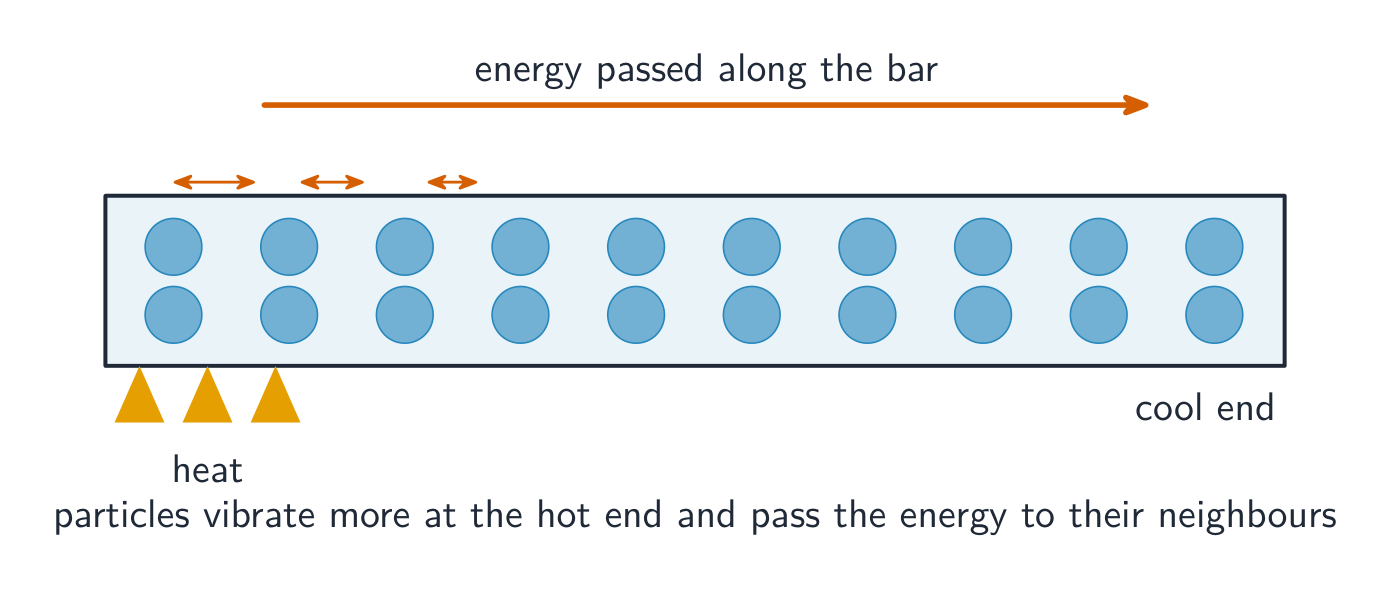
- Thermal conductivity 热导率 measures how fast heat conducts through a material; the rate of conduction rises with area and temperature difference and falls with thickness.
Worked example. How much heat raises the temperature of $2.0\ \text{kg}$ of water from $20\,{}^{\circ}\text{C}$ to $80\,{}^{\circ}\text{C}$? Water's specific heat is $c=4200\ \text{J/(kg}\,{}^{\circ}\text{C)}$:
$$Q=mc\,\Delta T=2.0\times4200\times(80-20)=5.0\times10^{5}\ \text{J}.$$Water's large specific heat is why it is used as a coolant and why coastal climates are mild.日本語- Specific heat 比热容 $c$ is the heat needed to raise one kilogram by one degree: $Q=mc\,\Delta T$. A high specific heat (like water's) means a substance resists temperature change.
- Thermal conductivity 热导率 measures how fast heat conducts through a material; the rate of conduction rises with area and temperature difference and falls with thickness.
Conduction: vibrating particles pass energy along a metal bar Worked example. How much heat raises the temperature of $2.0\ \text{kg}$ of water from $20\,{}^{\circ}\text{C}$ to $80\,{}^{\circ}\text{C}$? Water's specific heat is $c=4200\ \text{J/(kg}\,{}^{\circ}\text{C)}$:
$$Q=mc\,\Delta T=2.0\times4200\times(80-20)=5.0\times10^{5}\ \text{J}.$$Water's large specific heat is why it is used as a coolant and why coastal climates are mild.Explore · 探索Explore how much energy heats a material · 材料を加熱するのに必要なエネルギー explores する
Pick a material, set the mass and temperature rise, and read the energy from $Q = mc\,\Delta T$. Water needs far more energy than the metals to warm by the same amount. · 材料を選び、質量と温度上昇を設定して、$Q = mc\,\Delta T$ からエネルギーを読み取れ。水 は金属よりも同じ温度上昇に遥かに多くのエネルギーを必要とする。
Vocabulary · 語彙 Train · 練習するEnglish 日本語 Specific heat/spəˈsɪfɪk hiːt/ 比熱 Thermal conductivity/ˈθɜːml kɒndəkˈtɪvɪti/ 熱伝導率 9.6
Entropy and the Second Law of Thermodynamics
Syllabus · シラバス
EnglishLearning Objective 9.6.A: Describe the change in entropy for a given system over time.
- 9.6.A.1 The second law of thermodynamics states that the total entropy of an isolated system can never decrease and is constant only when all processes the system undergoes are reversible.
- 9.6.A.2 Entropy can be qualitatively described as the tendency of energy to spread or the unavailability of some of the system's energy to do work.
- 9.6.A.2.i Localized energy will tend to disperse and spread out.
- 9.6.A.2.ii Entropy is a state function and therefore only depends on the current state or configuration of a system, not how the system reached that state.
- 9.6.A.2.iii Maximum entropy occurs when a system is in thermodynamic equilibrium.
- 9.6.A.3 The change in a system's entropy is determined by the system's interactions with its surroundings.
- 9.6.A.3.i Isolated systems spontaneously move toward thermodynamic equilibrium.
- 9.6.A.3.ii The entropy of an isolated system never decreases, but the entropy of a closed system can decrease because energy can be transferred into or out of the system.
Boundary statement: Only qualitative treatment of the second law of thermodynamics is within the scope of AP Physics 2.
日本語学習目標 9.6.A: 与えられた系時間の経過に伴うエントロピーの変化を記述する。
- 9.6.A.1 熱力学第二法則は、孤立系の全エントロピーは決して減少せず、全系が行うプロセスが可逆である場合にのみ一定であることを述べている。
- 9.6.A.2 エントロピーは、エネルギーが拡散しようとする傾向、あるいは系の一部のエネルギーが仕事をするのに利用できない状態として定性的に説明できる。
- 9.6.A.2.i 局所的に集中したエネルギーは分散して広がろうとする。
- 9.6.A.2.ii エントロピーは状態関数であり、したがって系の現在の状態や配置にのみ依存し、その状態に至るまでの経路には依存しない。
- 9.6.A.2.iii 最大エントロピーは、系が熱力学平衡状態にあるときに生じる。
- 9.6.A.3 系のエントロピーの変化は、その系が周囲と相互作用する方法によって決定される。
- 9.6.A.3.i 孤立系は自発的に熱力学平衡状態へと移行する。
- 9.6.A.3.ii 孤立系のエントロピーは決して減少しないが、閉系の場合、エネルギーが系に入力・出力されるためエントロピーは減少することがある。
境界文: AP Physics 2の範囲内では、熱力学第二法則に対する定性的な取扱いのみが対象となる。
Source: College Board AP Course and Exam Description · 出典: College Board AP コースおよび試験説明書
EnglishEntropy 熵 measures the disorder, or the number of ways to arrange, a system. The second law 热力学第二定律: the total entropy of an isolated system never decreases – energy naturally spreads out. This sets the direction of processes: heat flows hot→cold on its own, never the reverse, and no engine can convert heat entirely into work.
日本語Entropy 熵 measures the disorder, or the number of ways to arrange, a system. The second law 热力学第二定律: the total entropy of an isolated system never decreases – energy naturally spreads out. This sets the direction of processes: heat flows hot→cold on its own, never the reverse, and no engine can convert heat entirely into work.
Vocabulary · 語彙 Train · 練習するEnglish 日本語 Entropy/ˈentrəpi/ エントロピー second law/ˈsekənd lɔː/ 第二法則 9.6
Exam tips
- Always convert temperatures to kelvin ($T_{\text{K}}=T_{\text{C}}+273$) before using any gas law.
- In the first law $\Delta U = Q + W$, get the sign of $W$ right: work done on the gas is positive; when the gas expands and does work on its surroundings, $W$ is negative.
- Temperature measures the average kinetic energy of particles, so at the same $T$ lighter molecules move faster.
- On a PV diagram the work done by the gas is the area under the process curve.
- Use $Q=mc\,\Delta T$ for temperature change; the second law fixes the direction — heat flows hot→cold and total entropy never decreases.
-
10
Electric Force, Field, and Potential
Watch lesson · レッスンを視聴10.1
Electric Charge and Electric Force
Syllabus · シラバス
EnglishLearning Objective 10.1.A: Describe the electric force that results from the interactions between charged objects or systems.
- 10.1.A.1 Charge is a fundamental property of all matter.
- 10.1.A.1.i Charge is described as positive or negative.
- 10.1.A.1.ii The magnitude of the charge of a single electron or proton, the elementary charge $e$, can be considered to be the smallest indivisible amount of charge.
- 10.1.A.1.iii The charge of an electron is $-e$, the charge of a proton is $+e$, and a neutron has no electric charge.
- 10.1.A.1.iv A point charge is a model in which the physical size of a charged object or system is negligible in the context of the situation being analyzed.
- 10.1.A.2 Coulomb's law describes the electrostatic force between two charged objects as directly proportional to the magnitude of each of the charges and inversely proportional to the square of the distance between the objects.
- Equation: $\left|\vec{F}_E\right| = \dfrac{1}{4\pi\varepsilon_0}\dfrac{\left|q_1 q_2\right|}{r^2} = k\dfrac{\left|q_1 q_2\right|}{r^2}$
- 10.1.A.3 The direction of the electrostatic force depends on the signs of the charges of the interacting objects and is parallel to the line of separation between the objects.
- 10.1.A.3.i Two objects with charges of the same sign exert repulsive forces on each other.
- 10.1.A.3.ii Two objects with charges of opposite signs exert attractive forces on each other.
- 10.1.A.4 Electric forces are responsible for some of the macroscopic properties of objects in everyday experiences. However, the large number of particle interactions that occur make it more convenient to treat everyday forces in terms of nonfundamental forces called contact forces, such as normal force, friction, and tension.
Learning Objective 10.1.B: Describe the electric and gravitational forces that result from interactions between charged objects with mass.
- 10.1.B.1 Electrostatic forces can be attractive or repulsive, while gravitational forces are always attractive.
- 10.1.B.2 For any two objects that have mass and electric charge, the magnitude of the gravitational force is usually much smaller than the magnitude of the electrostatic force.
- 10.1.B.3 Gravitational forces dominate at larger scales even though they are weaker than electrostatic forces, because systems at large scales tend to be electrically neutral.
Learning Objective 10.1.C: Describe the electric permittivity of a material or medium.
- 10.1.C.1 Electric permittivity is a measurement of the degree to which a material or medium is polarized in the presence of an electric field.
- 10.1.C.2 Electric polarization can be modeled as the induced rearrangement of electrons by an external electric field, resulting in a separation of positive and negative charges within a material or medium.
- 10.1.C.3 Free space has a constant value of electric permittivity, $\varepsilon_0$, that appears in physical relationships.
- 10.1.C.4 The permittivity of matter has a value different from that of free space that arises from the matter's composition and arrangement.
- 10.1.C.4.i In a given material, electric permittivity is determined by the ease with which electrons can change configurations within the material.
- 10.1.C.4.ii Conductors are made from electrically conducting materials in which charge carriers move easily; insulators are made from electrically nonconducting materials in which charge carriers cannot move easily.
Boundary statement: AP Physics 2 only expects students to make calculations of the electric force between four or fewer interacting charged objects or systems. The analysis of the resulting electric force from more charges is allowed in situations of high symmetry.
日本語学習目標 10.1.A: 帯電した物体や系間の相互作用によって生じる静電力を記述する。
- 10.1.A.1 電荷はすべての物質の基本的性質である。
- 10.1.A.1.i 電荷は正または負として記述される。
- 10.1.A.1.ii 単一電子または陽子の電荷の大きさである基本電荷$e$は、最小の分割不能な電荷量とみなすことができる。
- 10.1.A.1.iii 電子の電荷は $-e$、陽子の電荷は $+e$ であり、中性子は電気的に中性である。
- 10.1.A.1.iv 点電荷とは、解析されている状況において、帯電物体や系の物理的なサイズが無視できるほど小さいモデルである。
- 10.1.A.2 クーロンの法則は、2つの帯電物体間の静電力が、それぞれの電荷の大きさに比例し、物体間の距離の二乗に反比例することを記述する。
- 式: $\left|\vec{F}_E\right| = \dfrac{1}{4\pi\varepsilon_0}\dfrac{\left|q_1 q_2\right|}{r^2} = k\dfrac{\left|q_1 q_2\right|}{r^2}$
- 10.1.A.3 静電力の向きは、相互作用する物体の電荷の符号に依存し、物体間の分離線に平行である。
- 10.1.A.3.i 同じ符号の電荷を持つ2つの物体は互いに排斥力を及ぼす。
- 10.1.A.3.ii 反対符号の電荷を持つ2つの物体は互いに引力を及ぼす。
- 10.1.A.4 日常生活での物体のいくつかの巨視的性质は静電力によって引き起こされる。しかし、多数の粒子間相互作用が起こるため、日常で経験する力を、支持力、摩擦力、張力などの非根本的な「接触力」として扱う方が便利である。
学習目標 10.1.B: 質量を持つ帯電物体間の相互作用によって生じる静電力と重力を記述する。
- 10.1.B.1 静電力は引力または斥力のいずれか可以是であるが、重力は常に引力である。
- 10.1.B.2 質量と電気的電荷を有する任意の2つの物体について、重力の大きさは通常、静電力の大きさよりもはるかに小さい。
- 10.1.B.3 重力は静電力よりも弱いにもかかわらず、大規模なスケールで支配的である。これは、大規模なスケールの系が電気的に中性である傾向があるためである。
学習目標 10.1.C: 材料または媒体の電気誘電率を説明する。
- 10.1.C.1 電気誘電率は、材料または媒体が電場中に置かれた際の分極の程度を示す測定値である。
- 10.1.C.2 電気的分極は、外部電場による電子の誘起再配置としてモデル化でき、その結果、材料または媒体内に正負の電荷分離が生じる。
- 10.1.C.3 真空中には物理的な関係式に現れる定数 $\varepsilon_0$ の値を持つ電気誘電率がある。
- 10.1.C.4 物質の電気誘電率は、真空中の値とは異なり、その物質の組成および配列によって決まる。
- 10.1.C.4.i 特定の材料において、電気誘電率は、電子がその材料内で配置を変えやすい度合いによって決定される。
- 10.1.C.4.ii 導体は、電荷キャリアが容易に移動する電気伝導性材料から作られている。絶縁体は、電荷キャリアが容易に移動しない電気非伝導性材料から作られている。
境界文: AP Physics 2では、学生は4つ以下の相互作用する帯電物体または系間の静電力の計算のみを行うことが期待される。より多くの電荷からの結果としての静電力の分析は、高い対称性がある場合に限定して許容される。
Source: College Board AP Course and Exam Description · 出典: College Board AP コースおよび試験説明書
EnglishElectric charge 电荷 is a fundamental property of matter, and it comes in two kinds, positive and negative; like charges repel and opposite charges attract. Charge is conserved and quantized (a multiple of the elementary charge $e$). The force between two point charges is Coulomb's law 库仑定律:
$$F=\frac{k q_1 q_2}{r^2},$$directed along the line joining them – an inverse-square law like gravity, but it can push or pull.The constant $k$ hides a property of the medium: the permittivity 介电常数. Free space has a fixed permittivity of free space $\varepsilon_0$ (with $k = 1/4\pi\varepsilon_0$), while the permittivity of matter differs from $\varepsilon_0$, depending on the material's composition and arrangement - which is why a material between two charges changes the force. Note also that although the electric force is vastly stronger than gravity, gravity dominates at large scales, because large objects are usually electrically neutral (equal + and −), leaving only gravity to act.
Worked example. Two point charges, $+3.0\ \mu\text{C}$ and $-2.0\ \mu\text{C}$, sit $0.10\ \text{m}$ apart ($k=9.0\times10^{9}$). The force between them is
$$F=\frac{k q_1 q_2}{r^2}=\frac{9.0\times10^{9}\times(3.0\times10^{-6})(2.0\times10^{-6})}{(0.10)^2}=5.4\ \text{N},$$attractive, because the charges have opposite signs. (Use the magnitudes for the size and decide the direction from the signs.)日本語Electric charge 电荷 is a fundamental property of matter, and it comes in two kinds, positive and negative; like charges repel and opposite charges attract. Charge is conserved and quantized (a multiple of the elementary charge $e$). The force between two point charges is Coulomb's law 库仑定律:
$$F=\frac{k q_1 q_2}{r^2},$$directed along the line joining them – an inverse-square law like gravity, but it can push or pull.The constant $k$ hides a property of the medium: the permittivity 介电常数. Free space has a fixed permittivity of free space $\varepsilon_0$ (with $k = 1/4\pi\varepsilon_0$), while the permittivity of matter differs from $\varepsilon_0$, depending on the material's composition and arrangement - which is why a material between two charges changes the force. Note also that although the electric force is vastly stronger than gravity, gravity dominates at large scales, because large objects are usually electrically neutral (equal + and −), leaving only gravity to act.
Worked example. Two point charges, $+3.0\ \mu\text{C}$ and $-2.0\ \mu\text{C}$, sit $0.10\ \text{m}$ apart ($k=9.0\times10^{9}$). The force between them is
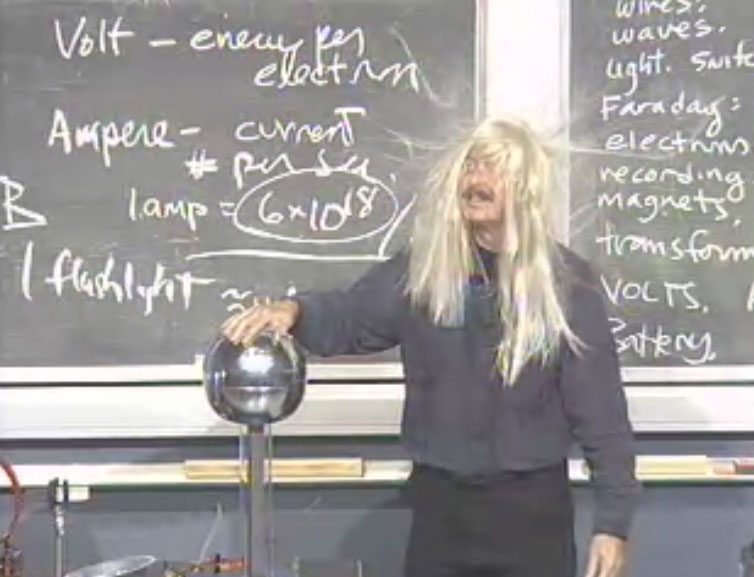
$$F=\frac{k q_1 q_2}{r^2}=\frac{9.0\times10^{9}\times(3.0\times10^{-6})(2.0\times10^{-6})}{(0.10)^2}=5.4\ \text{N},$$attractive, because the charges have opposite signs. (Use the magnitudes for the size and decide the direction from the signs.)Like charges repel: each hair carries the same charge from the Van de Graaff generator, so they push apart Vocabulary · 語彙 Train · 練習するEnglish 日本語 Electric charge/ɪˈlektrɪk tʃɑːdʒ/ 電気荷量 Coulomb's law/ˈkuːlɒmz lɔː/ クオームの法則 permittivity/ˌpɜːmɪˈtɪvəti/ 誘電率 10.2
The Process of Charging
Syllabus · シラバス
EnglishLearning Objective 10.2.A: Describe the behavior of a system using conservation of charge.
- 10.2.A.1 The net charge or charge distribution of a system can change in response to the presence of, or changes in, the net charge or charge distribution of other systems.
- 10.2.A.1.i The net charge of a system can change due to friction or contact between systems.
- 10.2.A.1.ii Induced charge separation occurs when the electrostatic force between two systems alters the distribution of charges within the systems, resulting in the polarization of one or both systems.
- 10.2.A.1.iii Induced charge separation can occur in neutral systems.
- 10.2.A.2 Any change to a system's net charge is due to a transfer of charge between the system and its surroundings.
- 10.2.A.2.i The charging of a system typically involves the transfer of electrons to and from the system.
- 10.2.A.2.ii The net charge of a system will be constant unless there is a transfer of charge to or from the system.
- 10.2.A.3 Grounding involves electrically connecting a charged system to a much larger and approximately neutral system (e.g., Earth).
日本語学習目標 10.2.A: 電荷保存を用いて系の挙動を説明する。
- 10.2.A.1 系の総電荷や電荷分布は、他の系の総電荷や電荷分布が存在したり変化したりすることに応じて変化する可能性がある。
- 10.2.A.1.i 系の総電荷は、系間の摩擦や接触によって変化する可能性がある。
- 10.2.A.1.ii 誘起電荷分離とは、2つの系間の静電力が系内の電荷分布を変化させ、1つ以上の系の分極を引き起こす現象である。
- 10.2.A.1.iii 誘起電荷分離は、中性の系でも生じることができる。
- 10.2.A.2 系の総電荷の変化は、常に系とその周囲との間の電荷移動によるものである。
- 10.2.A.2.i 系の帯電は、通常、電子が系への移動と系からの移動を含むプロセスである。
- 10.2.A.2.ii 系への電荷移動または系からの電荷移動がない限り、系の総電荷は一定に保たれる。
- 10.2.A.3 接地とは、帯電した系を、はるかに大きくほぼ中性の系(例:地球)に電気的に接続することを指す。
Source: College Board AP Course and Exam Description · 出典: College Board AP コースおよび試験説明書
EnglishObjects charge by moving electrons. A conductor 导体 lets charge move freely; an insulator 绝缘体 holds it in place. Three methods:
- Friction: rubbing transfers electrons.
- Conduction 接触起电: touching shares charge.
- Induction 感应起电: a nearby charge rearranges charge in a neutral object, which can then be grounded to leave it charged.
日本語Objects charge by moving electrons. A conductor 导体 lets charge move freely; an insulator 绝缘体 holds it in place. Three methods:
- Friction: rubbing transfers electrons.
- Conduction 接触起电: touching shares charge.
- Induction 感应起电: a nearby charge rearranges charge in a neutral object, which can then be grounded to leave it charged.
Explore · 探索Charge an object by rubbing · 摩擦による帯電
Rubbing transfers electrons from one surface to another, leaving one positively and one negatively charged. Like charges repel, opposite charges attract. · 摩擦により 電子 が一方の表面から他方へ移動し、一方が正に、もう一方が負に帯電する。同極は反発し、異極は引力を示す。
Vocabulary · 語彙 Train · 練習するEnglish 日本語 conductor/kənˈdʌktə/ 導体 insulator/ˈɪnsjuːleɪtə/ 絶縁体 Conduction/kənˈdʌkʃn/ 伝導 Induction/ɪnˈdʌkʃn/ インダクション(入社説明) 10.3
Electric Fields
Syllabus · シラバス
EnglishLearning Objective 10.3.A: Describe the electric field produced by a charged object or configuration of point charges.
- 10.3.A.1 Electric fields may originate from charged objects.
- 10.3.A.2 The electric field at a given point is the ratio of the electric force exerted on a test charge at that point to the charge of the test charge.
- Equation: $\vec{E} = \dfrac{\vec{F}_E}{q}$
- 10.3.A.2.i A test charge is a point charge of small enough magnitude such that its presence does not significantly affect an electric field in its vicinity.
- 10.3.A.2.ii An electric field points away from isolated positive charges and toward isolated negative charges.
- 10.3.A.2.iii The electric force exerted on a positive test charge by an electric field is in the same direction as the electric field.
- 10.3.A.3 The electric field is a vector quantity and can be represented in space using vector field maps.
- 10.3.A.3.i The net electric field at a given location is the vector sum of individual electric fields created by nearby charged objects.
- 10.3.A.3.ii Electric field maps use vectors to depict the magnitude and direction of the electric field at many locations within a given region.
- 10.3.A.3.iii Electric field line diagrams are simplified models of electric field maps and can be used to determine the relative magnitude and direction of the electric field at any position in the diagram.
Learning Objective 10.3.B: Describe the electric field generated by charged conductors or insulators.
- 10.3.B.1 While in electrostatic equilibrium, the excess charge of a solid conductor is distributed on the surface of the conductor, and the electric field within the conductor is zero.
- 10.3.B.1.i At the surface of a charged conductor, the electric field is perpendicular to the surface.
- 10.3.B.1.ii The electric field outside an isolated sphere with spherically symmetric charge distribution is the same as the electric field due to a point charge with the same net charge as the sphere located at the center of the sphere.
- 10.3.B.2 While in electrostatic equilibrium, the excess charge of an insulator is distributed throughout the interior of the insulator as well as at the surface, and the electric field within the insulator may have a nonzero value.
Boundary statement: AP Physics 2 only expects students to make calculations of the electric field resulting from four or fewer charged objects or systems. Analysis of the electric field resulting from more charges is allowed in situations of high symmetry. Students will only be expected to perform qualitative analysis of electric fields within insulators.
日本語学習目標 10.3.A: 帯電物体または点電荷の配置によって生成される電場を説明する。
- 10.3.A.1 電場は、帯電物体に起源を持つことがある。
- 10.3.A.2 特定の点における電場は、その点にある検出電荷に働く静電力を検出電荷の電荷量で割った比である。
- 式: $\vec{E} = \dfrac{\vec{F}_E}{q}$
- 10.3.A.2.i 検出電荷とは、その存在が近傍の電場に著しい影響を与えないほど、大きさが十分小さい点電荷である。
- 10.3.A.2.ii 電場は、孤立した正の電荷からは外向きに、孤立した負の電荷内向きに向かう。
- 10.3.A.2.iii 電場によって正の検出電荷に働く静電力は、電場の方向と同じである。
- 10.3.A.3 電場はベクトル量であり、ベクトル場マップを用いて空間で表現できる。
- 10.3.A.3.i 特定の位置における合成電場は、近接する帯電物体によって生成される個別の電場のベクトル和である。
- 10.3.A.3.ii 電場マップは、特定の領域内の多くの位置における電場の大きさと方向を、ベクトルを使って表す。
- 10.3.A.3.iii 電場線図は電場マップの簡略化されたモデルであり、図中のあらゆる位置における電場の相対的な大きさと方向を特定するために使用できる。
学習目標 10.3.B: 帯電導体または絶縁体によって生成される電場を説明する。
- 10.3.B.1 静電平衡状態にあるとき、固体導体の過剰電荷は導体の表面に分布し、導体内の電場はゼロである。
- 10.3.B.1.i 帯電導体の表面において、電場は表面に対して垂直である。
- 10.3.B.1.ii 球対称な電荷分布を持つ孤立球体の外側の電場は、球体の中心に同一の総電荷を持つ点電荷による電場と同じである。
- 10.3.B.2 静電平衡状態にあるとき、絶縁体の過剰電荷は絶縁体の内部だけでなく表面にも分布し、絶縁体内の電場はゼロでない値を持つことがある。
境界文: AP Physics 2では、学生は4つ以下の帯電物体または系による電場の計算のみを行うことが期待される。より多くの電荷による電場の分析は、高い対称性がある場合に限定して許容される。学生は絶縁体内の電場に対する定性的な分析のみを行うことが期待される。
Source: College Board AP Course and Exam Description · 出典: College Board AP コースおよび試験説明書
EnglishThe electric field of a dipole An electric field 电场 $\vec{E}$ is the force per unit charge that a small positive test charge would feel:
$$\vec{E}=\frac{\vec{F}}{q},\qquad E=\frac{kQ}{r^2}\ \text{for a point charge}.$$Field lines point away from positive charges and toward negative ones; where they are denser, the field is stronger. A charge in a field feels $\vec{F}=q\vec{E}$.Worked example. Find the electric field $0.20\ \text{m}$ from a $+5.0\ \mu\text{C}$ point charge: $E=\dfrac{kQ}{r^2}=\dfrac{9.0\times10^{9}\times5.0\times10^{-6}}{(0.20)^2}=1.1\times10^{6}\ \text{N/C}$, pointing away from the charge. A $+2\ \text{nC}$ charge placed there would feel $F=qE=2\times10^{-9}\times1.1\times10^{6}=2.2\times10^{-3}\ \text{N}$.
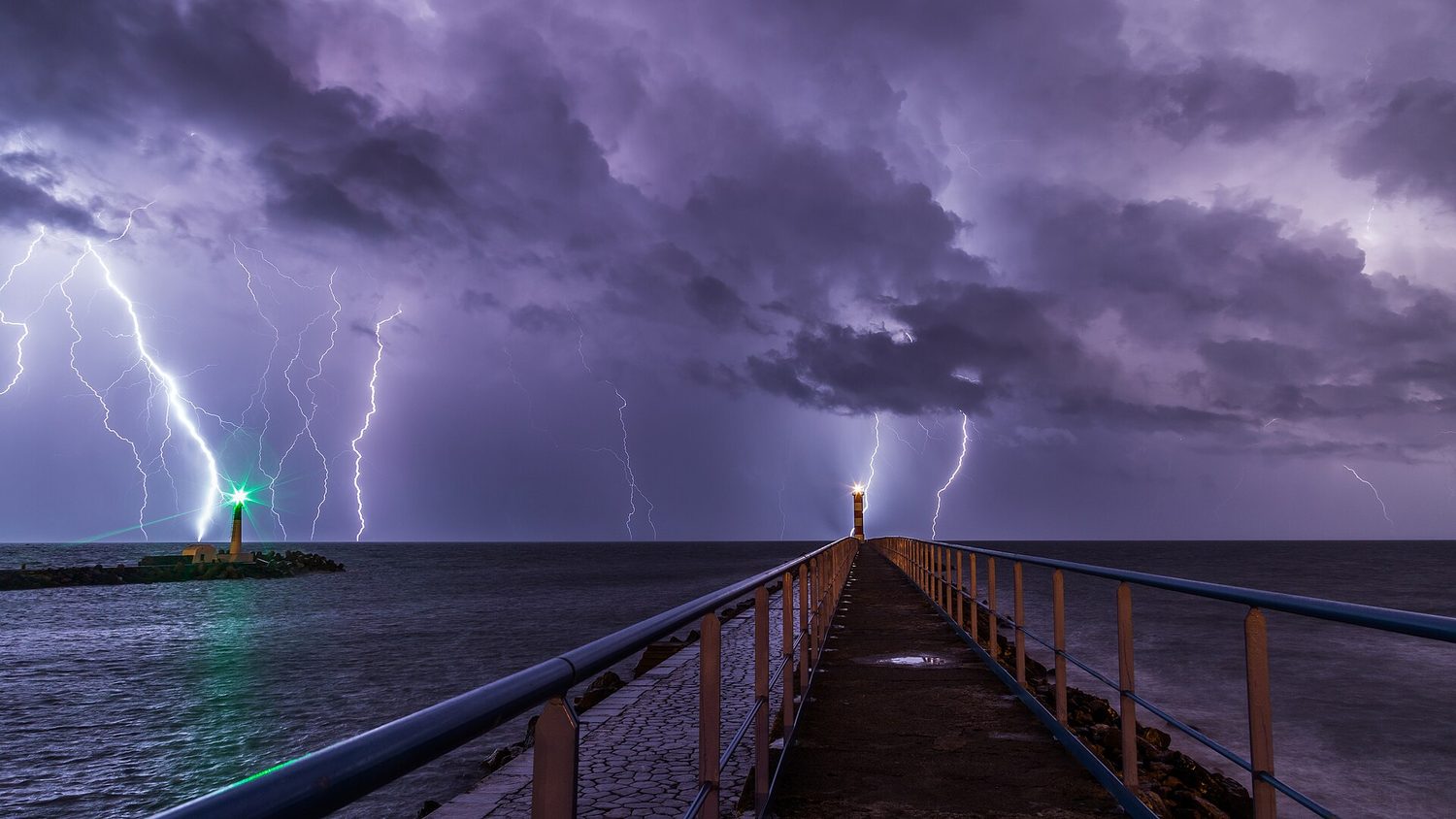
日本語The electric field of a dipole Lightning: charge builds up until the electric field between cloud and ground is strong enough to tear electrons off air molecules, and a huge current flows An electric field 电场 $\vec{E}$ is the force per unit charge that a small positive test charge would feel:
$$\vec{E}=\frac{\vec{F}}{q},\qquad E=\frac{kQ}{r^2}\ \text{for a point charge}.$$Field lines point away from positive charges and toward negative ones; where they are denser, the field is stronger. A charge in a field feels $\vec{F}=q\vec{E}$.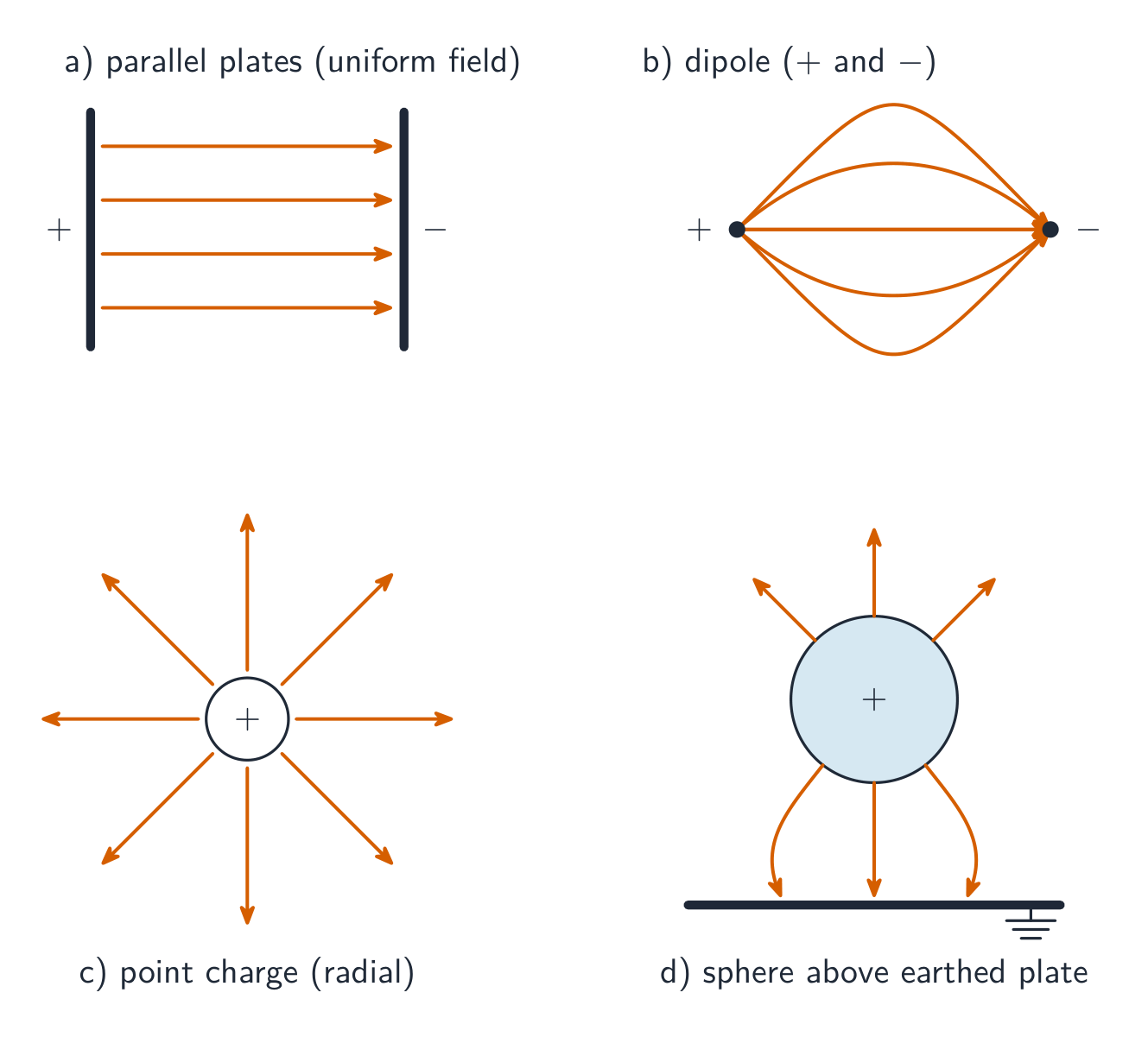
Electric field-line patterns for parallel plates, a dipole, and a point charge Worked example. Find the electric field $0.20\ \text{m}$ from a $+5.0\ \mu\text{C}$ point charge: $E=\dfrac{kQ}{r^2}=\dfrac{9.0\times10^{9}\times5.0\times10^{-6}}{(0.20)^2}=1.1\times10^{6}\ \text{N/C}$, pointing away from the charge. A $+2\ \text{nC}$ charge placed there would feel $F=qE=2\times10^{-9}\times1.1\times10^{6}=2.2\times10^{-3}\ \text{N}$.
Explore · 探索Map the field around a charge · 電荷周囲の電場をマッピングする
An electric field points the way a positive test charge would be pushed: away from a positive charge, toward a negative one. Closer lines mean a stronger field. · 電場の向きは、正のテスト電荷が押される方向を示す:正の電荷からは遠ざかり、負の電荷に向かう。線が密集しているほど、強い電場である。
Vocabulary · 語彙 Train · 練習するEnglish 日本語 electric field/ɪˈlektrɪk fiːld/ 電界 10.4
Electric Potential Energy
Syllabus · シラバス
EnglishLearning Objective 10.4.A: Describe the electric potential energy of a system.
- 10.4.A.1 The electric potential energy of a system of two point charges equals the amount of work required for an external force to bring the point charges to their current positions from infinitely far away.
- 10.4.A.2 The general form for the electric potential energy of two charged objects is given by the equation
- Equation: $U_E = \dfrac{1}{4\pi\varepsilon_0}\dfrac{q_1 q_2}{r} = k\dfrac{q_1 q_2}{r}$
- 10.4.A.3 The total electric potential energy of a system can be determined by finding the sum of the electric potential energies of the individual interactions between each pair of charged objects in the system.
Boundary statement: As the methods to calculate the electric potential energy due to extended charge distributions exceed the scope of the course, AP Physics 2 only requires that students calculate the electric potential energy of configurations of four or fewer point charges.
日本語学習目標 10.4.A: 系の電気ポテンシャルエネルギーを説明する。
- 10.4.A.1 2点電荷の系における電気ポテンシャルエネルギーは、外部の力が点電荷を無限遠から現在の位置まで持ち込むために必要な仕事量に等しい。
- 10.4.A.2 2つの帯電物体の電気ポテンシャルエネルギーの一般形は以下の式で与えられる。
- 式: $U_E = \dfrac{1}{4\pi\varepsilon_0}\dfrac{q_1 q_2}{r} = k\dfrac{q_1 q_2}{r}$
- 10.4.A.3 系の全電気ポテンシャルエネルギーは、系内の各帯電物体の対間での相互作用ごとの電気ポテンシャルエネルギーの和を求めることで決定できる。
範囲の声明: 連続的な電荷分布による電気ポテンシャルエネルギーを計算する方法は授業の範囲を超えるため、AP Physics 2では、学生が4個以下の点電荷の配置に対する電気ポテンシャルエネルギーを計算することを求めるのみである。
Source: College Board AP Course and Exam Description · 出典: College Board AP コースおよび試験説明書
EnglishTwo charges have electric potential energy 电势能 stored in their arrangement:
$$U=\frac{k q_1 q_2}{r}.$$Like charges pushed together store positive energy; opposite charges have negative energy (bound). Moving a charge changes $U$, and the electric force does work equal to $-\Delta U$.日本語Two charges have electric potential energy 电势能 stored in their arrangement:
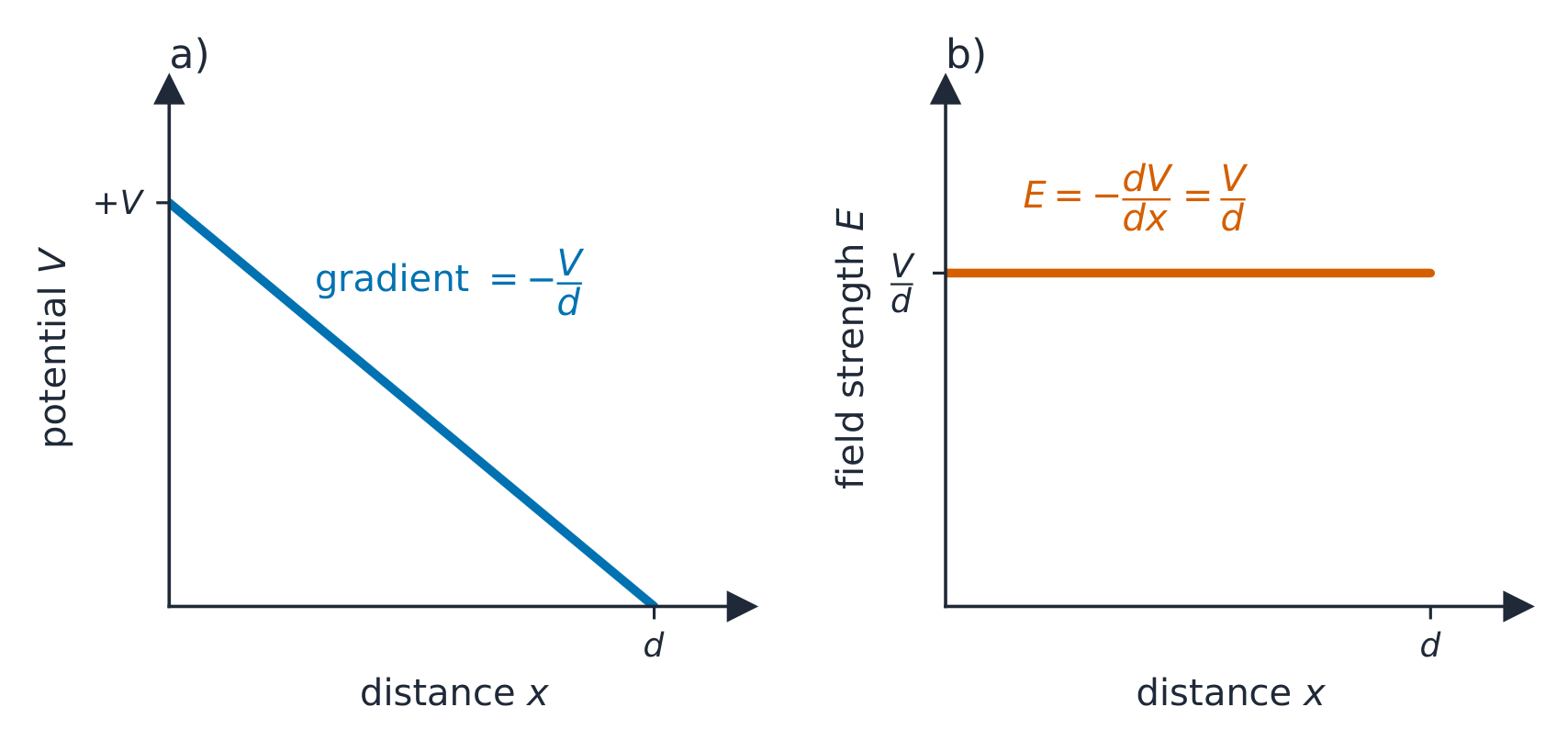
$$U=\frac{k q_1 q_2}{r}.$$Like charges pushed together store positive energy; opposite charges have negative energy (bound). Moving a charge changes $U$, and the electric force does work equal to $-\Delta U$.In a uniform field the potential falls steadily with distance, so E relates to V Vocabulary · 語彙 Train · 練習するEnglish 日本語 electric potential energy/ɪˈlektrɪk pəˈtenʃl ˈenədʒi/ 静電位置エネルギー 10.5
Electric Potential
Syllabus · シラバス
EnglishLearning Objective 10.5.A: Describe the electric potential due to a configuration of charged objects.
- 10.5.A.1 Electric potential describes the electric potential energy per unit charge at a point in space.
- 10.5.A.2 The electric potential due to multiple point charges can be determined by the principle of scalar superposition of the electric potential due to each of the point charges.
- Equation: $V = \dfrac{1}{4\pi\varepsilon_0}\sum_{i}\dfrac{q_i}{r_i}$
- 10.5.A.3 The electric potential difference between two points is the change in electric potential energy per unit charge when a test charge is moved between the two points.
- Equation: $\Delta V = \dfrac{\Delta U_E}{q}$
- 10.5.A.3.i Electric potential difference may also result from chemical processes that cause positive and negative charges to separate, such as in a battery.
- 10.5.A.4 When conductors are in electrical contact, electrons will be redistributed such that the surfaces of the conductors are at the same electric potential.
Learning Objective 10.5.B: Describe the relationship between electric potential and electric field.
- 10.5.B.1 The average electric field between two points in space is equal to the electric potential difference between the two points divided by the distance between the two points.
- Equation: $\left|\vec{E}\right| = \left|\dfrac{\Delta V}{\Delta r}\right|$
- 10.5.B.2 Electric field vector maps and equipotential lines are tools to describe the field produced by a charge or configuration of charges and can be used to predict the motion of charged objects in the field.
- 10.5.B.2.i Equipotential lines represent lines of equal electric potential in space. These lines are also referred to as isolines of electric potential.
- 10.5.B.2.ii Isolines are perpendicular to electric field vectors. An isoline map of electric potential can be constructed from an electric field vector map, and an electric field map may be constructed from an isoline map.
- 10.5.B.2.iii An electric field vector points in the direction of decreasing potential.
- 10.5.B.2.iv There is no component of an electric field along an isoline.
Boundary statement: As the methods to calculate the electric potential due to extended charges exceed the scope of the course, AP Physics 2 only expects that students calculate the electric potential of configurations of four or fewer particles (or more in situations of high symmetry).
日本語学習目標 10.5.A: 帯電物体の配置による電気ポテンシャルを説明する。
- 10.5.A.1 電気ポテンシャルは、空間内の一点における単位電荷あたりの電気ポテンシャルエネルギーを表す。
- 10.5.A.2 複数の点電荷による電気ポテンシャルは、各点電荷による電気ポテンシャルのスカラー叠加の原理によって決定できる。
- 式: $V = \dfrac{1}{4\pi\varepsilon_0}\sum_{i}\dfrac{q_i}{r_i}$
- 10.5.A.3 2点間の電気ポテンシャル差とは、試験電荷を2点間で移動させたときに生じる単位電荷あたりの電気ポテンシャルエネルギーの変化である。
- 式: $\Delta V = \dfrac{\Delta U_E}{q}$
- 10.5.A.3.i 正と負の電荷を分離させる化学反応(例:電池など)によって電気ポテンシャル差が生じる場合もある。
- 10.5.A.4 導体が電気的に接しているとき、電子は再分配され、導体の表面は同じ電気ポテンシャルになる。
学習目標 10.5.B: 電気ポテンシャルと電気場の関係について説明する。
- 10.5.B.1 空間内の2点間の平均電気場は、2点間の電気ポテンシャル差を2点間の距離で割ったものと同じである。
- 式: $\left|\vec{E}\right| = \left|\dfrac{\Delta V}{\Delta r}\right|$
- 10.5.B.2 電気場ベクトルマップと等位線は、電荷または電荷の配置によって生成される場を記述するためのツールであり、その場内における帯電物体の運動を予測するために使用できる。
- 10.5.B.2.i 等位線は、空間内で電気ポテンシャルが等しい点を結んだ線である。これらの線は電気ポテンシャルの等値線とも呼ばれる。
- 10.5.B.2.ii 等値線は電気場ベクトルに垂直である。電気場ベクトルマップから電気ポテンシャルの等値線マップを作成でき、等値線マップから電気場マップを作成することも可能である。
- 10.5.B.2.iii 電気場ベクトルはポテンシャルが減少する方向を指す。
- 10.5.B.2.iv 等値線上に沿って電気場の成分はない。
範囲の声明: 連続した電荷による電気ポテンシャルを計算する方法は授業の範囲を超えるため、AP Physics 2では学生が4個以下の粒子(あるいは高対称性の状況ではそれ以上)の配置に対する電気ポテンシャルを計算することを期待するのみである。
Source: College Board AP Course and Exam Description · 出典: College Board AP コースおよび試験説明書
EnglishElectric potential 电势 $V$ is the potential energy per unit charge – a scalar field, measured in volts:
$$V=\frac{U}{q}=\frac{kQ}{r}.$$The potential difference (voltage) 电压 between two points is the work per unit charge to move between them: $\Delta V=\dfrac{\Delta U}{q}$, and $U=qV$. Positive charges move from high to low potential on their own. Because potential is a scalar, adding the potentials from several charges is much easier than adding field vectors.日本語Electric potential 电势 $V$ is the potential energy per unit charge – a scalar field, measured in volts:
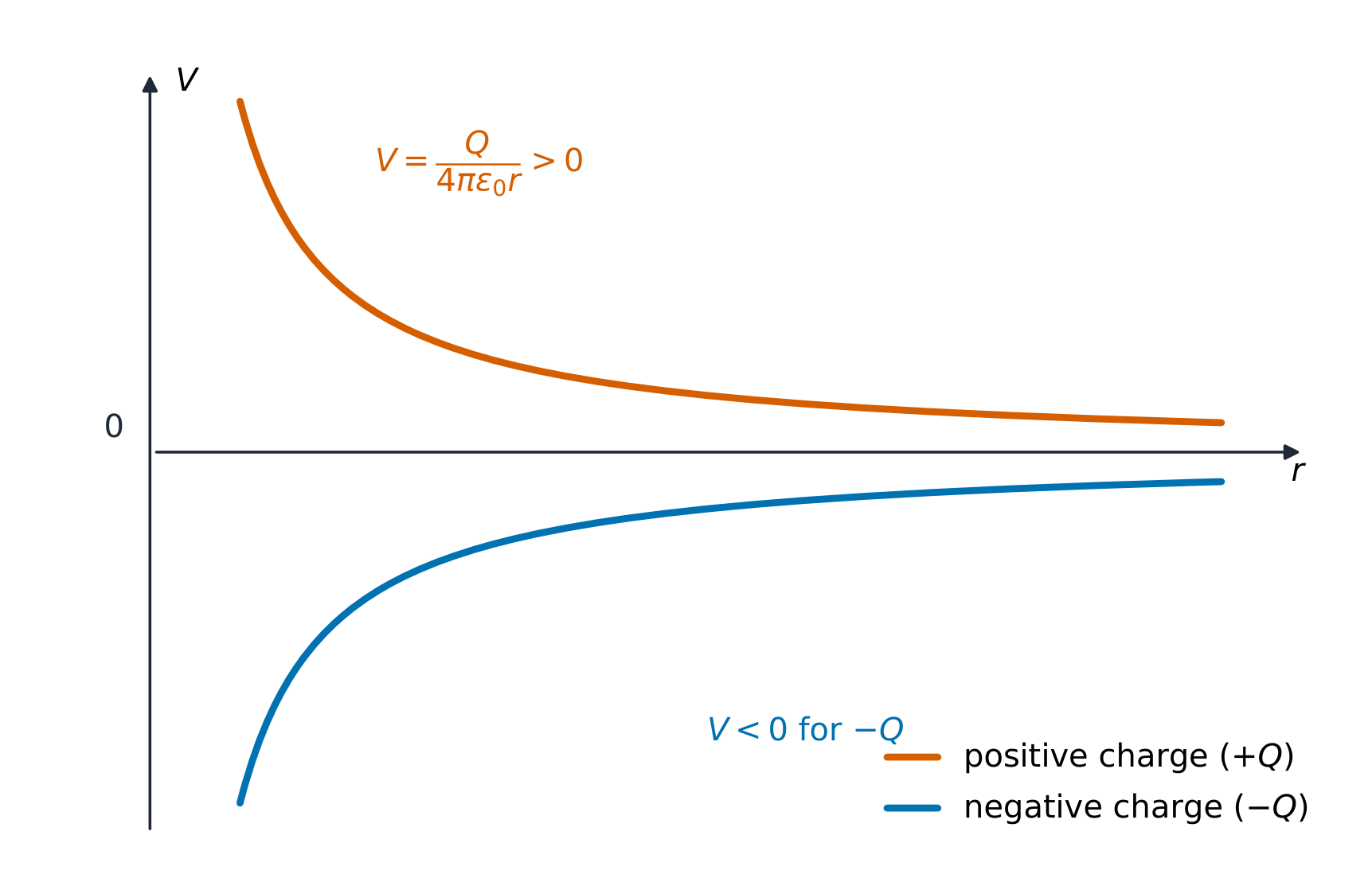
$$V=\frac{U}{q}=\frac{kQ}{r}.$$The potential difference (voltage) 电压 between two points is the work per unit charge to move between them: $\Delta V=\dfrac{\Delta U}{q}$, and $U=qV$. Positive charges move from high to low potential on their own. Because potential is a scalar, adding the potentials from several charges is much easier than adding field vectors.The potential near a point charge varies as 1/r Vocabulary · 語彙 Train · 練習するEnglish 日本語 Electric potential/ɪˈlektrɪk pəˈtenʃl/ 電位 potential difference/pəˈtenʃl ˈdɪfrəns/ 電位差 10.6
Capacitors
Syllabus · シラバス
EnglishLearning Objective 10.6.A: Describe the physical properties of a parallel-plate capacitor.
- 10.6.A.1 A parallel-plate capacitor consists of two separated parallel conducting surfaces that can hold equal amounts of charge with opposite signs.
- 10.6.A.2 Capacitance relates the magnitude of the charge stored on each plate to the electric potential difference created by the separation of those charges.
- Equation: $C = \dfrac{Q}{\Delta V}$
- 10.6.A.2.i The capacitance of a capacitor depends only on the physical properties of the capacitor, such as the capacitor's shape and the material used to separate the plates.
- 10.6.A.2.ii The capacitance of a parallel-plate capacitor is proportional to the area of one of its plates and inversely proportional to the distance between its plates. The constant of proportionality is the product of the dielectric constant, $\kappa$, of the material between the plates and the electric permittivity of free space, $\varepsilon_0$.
- Equation: $C = \kappa\varepsilon_0\dfrac{A}{d}$
- 10.6.A.3 The electric field between two charged parallel plates with uniformly distributed electric charge, such as in a parallel-plate capacitor, is constant in both magnitude and direction, except near the edges of the plates.
- 10.6.A.3.i The magnitude of the electric field between two charged parallel plates, where the plate separation is much smaller than the dimensions of the plates, can be described with the equation
- Equation: $E_C = \dfrac{Q}{\kappa\varepsilon_0 A}$
- 10.6.A.3.ii A charged particle between two oppositely charged parallel plates undergoes constant acceleration and therefore its motion shares characteristics with the projectile motion of an object with mass in the gravitational field near Earth's surface.
- 10.6.A.3.i The magnitude of the electric field between two charged parallel plates, where the plate separation is much smaller than the dimensions of the plates, can be described with the equation
- 10.6.A.4 The electric potential energy stored in a capacitor is equal to the work done by an external force to separate that amount of charge on the capacitor.
- 10.6.A.5 The electric potential energy stored in a capacitor is described by the equation
- Equation: $U_C = \dfrac{1}{2}Q\Delta V$
- 10.6.A.6 Adding a dielectric between two plates of a capacitor changes the capacitance of the capacitor and induces an electric field in the dielectric in the opposite direction to the field between the plates.
Boundary statement: While other shapes are also able to separate charges, only the analysis and descriptions of parallel-plate capacitors are required for AP Physics 2. Edge effects will be ignored unless explicitly stated otherwise.
日本語学習目標 10.6.A: 平行板コンデンサの物理的性質を説明する。
- 10.6.A.1 平行板コンデンサは、互いに離れており、等量かつ逆符号の電荷を蓄えることのできる2枚の平行な導体面からなる。
- 10.6.A.2 静電容量は、各極板上に蓄えられた電荷の大きさと、その電荷の分離によって生じる電気ポテンシャル差の関係を表す。
- 式: $C = \dfrac{Q}{\Delta V}$
- 10.6.A.2.i コンデンサの静電容量は、コンデンサの形状や極板を絶縁するために使用された材料といったコンデンサ自体の物理的性質のみによって決まる。
- 10.6.A.2.ii 平行板コンデンサの静電容量は、その極板の面積に比例し、極板間の距離に反比例する。この比例定数は、極板間の材料の比誘電率 $\kappa$ と真空の電気定数 $\varepsilon_0$ の積である。
- 数式: $C = \kappa\varepsilon_0\dfrac{A}{d}$
- 10.6.A.3 帯電した平行板の間(平行板コンデンサなど)に一様に電荷分布している場合、極板の端部付近を除き、電気場の大きさと方向は一定である。
- 10.6.A.3.i 極板間の距離が極板の寸法よりも十分に小さいとき、2枚の帯電平行板間の電気場の大きさは以下の式で表せる。
- 数式: $E_C = \dfrac{Q}{\kappa\varepsilon_0 A}$
- 10.6.A.3.ii 反対に帯電した2枚の平行板間に置かれた帯電粒子は一定の加速度を受けるため、その運動は地球表面近くの重力場内にある質量を持つ物体の投射運動と同様の特性を持つ。
- 10.6.A.3.i 極板間の距離が極板の寸法よりも十分に小さいとき、2枚の帯電平行板間の電気場の大きさは以下の式で表せる。
- 10.6.A.4 コンデンサに蓄えられている電気ポテンシャルエネルギーは、外部の力がコンデンサ上でその量の電荷を分離するために行った仕事に等しい。
- 10.6.A.5 コンデンサに蓄えられている電気ポテンシャルエネルギーは以下の式で表される。
- 式: $U_C = \dfrac{1}{2}Q\Delta V$
- 10.6.A.6 コンデンサの2枚の極板の間に絶縁体を挿入すると、コンデンサの静電容量が変化し、極板間の電場とは逆向きの電場が絶縁体内に誘起される。
範囲の声明: 他の形状でも電荷を分離することは可能だが、AP Physics 2では平行板コンデンサに関する分析および記述のみが求められ、他の形状については対象外とする。特に明記しない限り、端効果は無視される。
Source: College Board AP Course and Exam Description · 出典: College Board AP コースおよび試験説明書
EnglishDischarging a capacitor: τ = RC Charging a capacitor (RC) A capacitor 电容器 stores charge and energy on two conductors separated by a gap. Its capacitance 电容 relates charge to voltage:
$$C=\frac{Q}{V},$$and the stored energy is $U=\tfrac{1}{2}CV^2$. Capacitance depends on the plates' geometry and the material between them, not on the charge placed on it.Worked example. A $100\ \mu\text{F}$ capacitor is charged to $12\ \text{V}$. It holds $Q=CV=100\times10^{-6}\times12=1.2\times10^{-3}\ \text{C}$ of charge and stores $U=\tfrac12 CV^2=\tfrac12\times100\times10^{-6}\times12^2=7.2\times10^{-3}\ \text{J}$ of energy.
日本語Discharging a capacitor: τ = RC Charging a capacitor (RC) A capacitor 电容器 stores charge and energy on two conductors separated by a gap. Its capacitance 电容 relates charge to voltage:
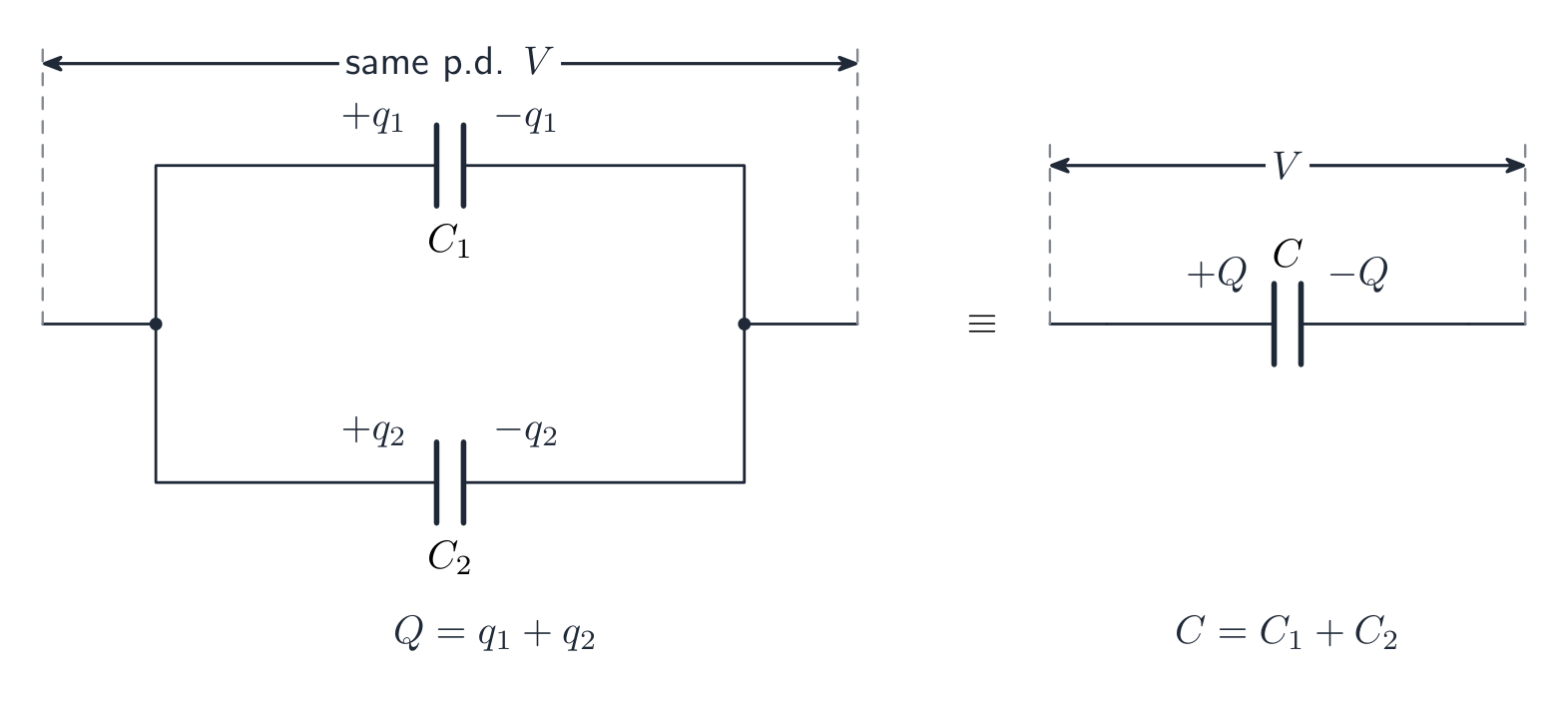
$$C=\frac{Q}{V},$$and the stored energy is $U=\tfrac{1}{2}CV^2$. Capacitance depends on the plates' geometry and the material between them, not on the charge placed on it.Capacitors in parallel share the same p.d., and their charges add Worked example. A $100\ \mu\text{F}$ capacitor is charged to $12\ \text{V}$. It holds $Q=CV=100\times10^{-6}\times12=1.2\times10^{-3}\ \text{C}$ of charge and stores $U=\tfrac12 CV^2=\tfrac12\times100\times10^{-6}\times12^2=7.2\times10^{-3}\ \text{J}$ of energy.
Explore · 探索Charge and discharge a capacitor · コンデンサの充電と放電
A capacitor stores charge on two plates. It fills and empties exponentially, set by the time constant $\tau = RC$ — bigger $R$ or $C$ means slower charging. · コンデンサ は2枚の極板に電荷を蓄える。 時間定数 $\tau = RC$ に決まった指数関数的に充放电され、$R$ や $C$ が大きいほど充電が遅い。
Vocabulary · 語彙 Train · 練習するEnglish 日本語 capacitor/kəˈpæsɪtə/ コンデンサの capacitance/kəˈpæsɪtəns/ 静電容量 10.7
Conservation of Electric Energy
Syllabus · シラバス
EnglishLearning Objective 10.7.A: Describe changes in energy in a system due to a difference in electric potential between two locations.
- 10.7.A.1 When a charged object moves between two locations with different electric potentials, the resulting change in the electric potential energy of the object-field system is given by the following equation.
- Equation: $\Delta U_E = q\Delta V$
- 10.7.A.2 The movement of a charged object between two points with different electric potentials results in a change in kinetic energy of the object consistent with the conservation of energy.
日本語学習目標 10.7.A: 2つの地点間の電位差に起因する系におけるエネルギーの変化を説明せよ。
- 10.7.A.1 帯電物体が異なる電位の2つの地点間を移動するとき、物体-場系の電位エネルギーの変化は以下の式で与えられる。
- 式: $\Delta U_E = q\Delta V$
- 10.7.A.2 帯電物体が異なる電位の2点間を移動すると、保存の法則と整合する物体の運動エネルギーの変化が生じる。
Source: College Board AP Course and Exam Description · 出典: College Board AP コースおよび試験説明書
Energy is conserved for charges just as for masses. A charge released in a field converts electric potential energy into kinetic energy:
$$q\,\Delta V=\tfrac{1}{2}mv^2 \quad(\text{gaining speed as it "falls" through a potential difference}).$$Worked example. An electron ($q=1.6\times10^{-19}\ \text{C}$, $m=9.1\times10^{-31}\ \text{kg}$) is accelerated from rest through a potential difference of $100\ \text{V}$. Its final speed is
$$v=\sqrt{\frac{2q\,\Delta V}{m}}=\sqrt{\frac{2\times1.6\times10^{-19}\times100}{9.1\times10^{-31}}}=5.9\times10^{6}\ \text{m/s}.$$This is exactly how the electron gun in an old television or an electron microscope works.10.7
Exam tips
- Coulomb's law and the point-charge field are inverse-square — doubling the separation makes the force (or field) four times smaller.
- Use magnitudes for the size of a force and decide direction from the signs; the field points the way a positive test charge would move.
- Potential ($V$) is a scalar so potentials from several charges simply add; the field ($E$) is a vector and must be added by direction.
- For a charge accelerated through a voltage use energy conservation $qV=\tfrac12 mv^2$.
- Capacitor relations: $C=Q/V$ (capacitance is fixed by geometry) and energy $U=\tfrac12 CV^2$.
- 10.1.A.1 Charge is a fundamental property of all matter.
-
11
Electric Circuits
Watch lesson · レッスンを視聴11.1
Electric Current · 電気伝導
Syllabus · シラバス
EnglishLearning Objective 11.1.A: Describe the movement of electric charges through a medium.
- 11.1.A.1 Current is the rate at which charge passes through a cross-sectional area of a wire.
- Equation: $I = \dfrac{\Delta q}{\Delta t}$
- 11.1.A.1.i Electric charge moves in a circuit in response to an electric potential difference, sometimes referred to as electromotive force, or $\mathrm{emf}$ ($\varepsilon$).
- 11.1.A.1.ii If the current is zero in a section of wire, the net motion of charge carriers in the wire is also zero, although individual charge carriers will not have zero speed.
- 11.1.A.2 Although current is not a vector quantity, it does have a direction. The direction of current is associated with what the motion of positive charge would be but not with any coordinate system in space.
- 11.1.A.2.i The direction of conventional current is chosen to be the direction in which positive charge would move.
- 11.1.A.2.ii In common circuits, current is actually due to the movement of electrons (negative charge carriers).
日本語学習目標 11.1.A: 電荷が媒質中を移動する様子について説明せよ。
- 11.1.A.1 電流とは、電荷が導線の断面を通過する速さである。
- 式: $I = \dfrac{\Delta q}{\Delta t}$
- 11.1.A.1.i 回路内での電荷の移動は、電位差( sometimes referred to as electromotive force)に応じ、時折 $\mathrm{emf}$ ($\varepsilon$) と呼ばれるものによって引き起こされる。
- 11.1.A.1.ii 導線のある部分で電流がゼロの場合、電荷運搬体の全体としての移動もゼロとなるが、個々の電荷運搬体の速度がゼロになるわけではない。
- 11.1.A.2 電流はベクトル量ではないものの、方向を持つ。電流の方向は正の電荷が動いた方向に関連付けられるが、空間内の座標系には依存しない。
- 11.1.A.2.i 慣用電流の方向は、正の電荷が動いた方向として選ばれる。
- 11.1.A.2.ii 一般的な回路において、電流は実際には電子(負の電荷運搬体)の移動によるものである。
Source: College Board AP Course and Exam Description · 出典: College Board AP コースおよび試験説明書
EnglishElectric current 电流 is the rate at which charge flows past a point, measured in amperes 安培 (A):
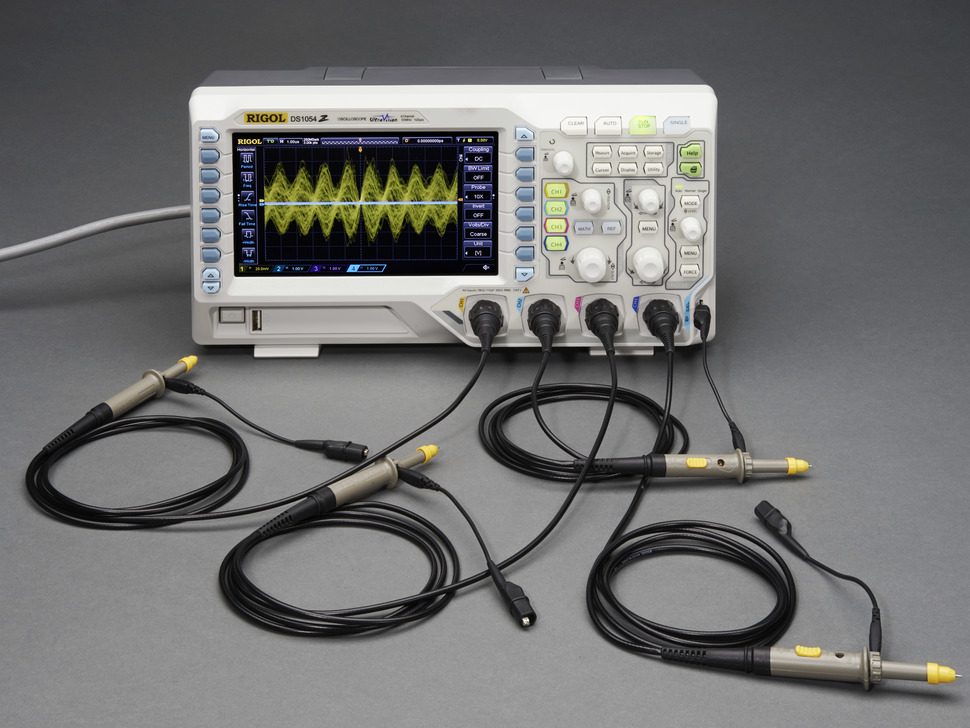
$$I=\frac{\Delta q}{\Delta t}.$$By convention, current points the way positive charge would move (opposite to the electrons in a wire). A steady current needs a complete loop and an energy source (a battery's electromotive force, or emf).日本語オシロスコープ:回路の時間的な挙動は、時間に対する電圧として測定される 電気伝導とは、一点を通過する電荷の流れの速さであり、アンペア (A) で測定されます:
$$I=\frac{\Delta q}{\Delta t}.$$慣例として、伝導は正の電荷が動く方向を指します(導線内の電子とは逆向きです)。定常伝導には完全なループとエネルギー源(バッテリーの起電力、またはemf)が必要です。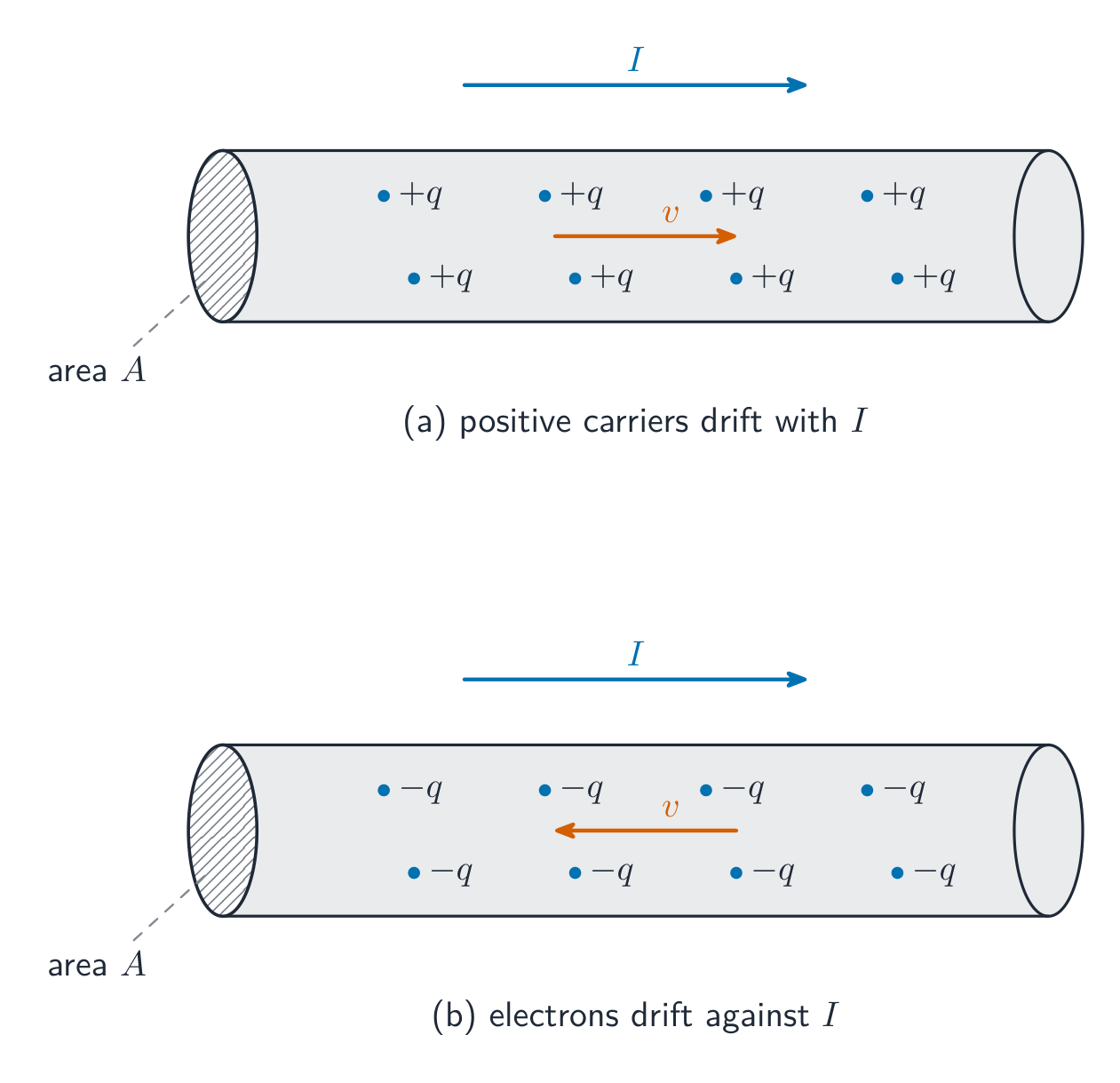
伝導体中を電荷キャリアがゆっくりと漂移して伝導を作る 11.2
Simple Circuits · 単純回路
Syllabus · シラバス
EnglishLearning Objective 11.2.A: Describe the behavior of a circuit.
- 11.2.A.1 A circuit is composed of electrical loops, which may include circuit elements such as wires, batteries, resistors, lightbulbs, capacitors, switches, ammeters, and voltmeters.
- 11.2.A.2 A closed electrical loop is a closed path through which charges may flow.
- 11.2.A.2.i A closed circuit is one in which charges would be able to flow.
- 11.2.A.2.ii An open circuit is one in which charges would not be able to flow.
- 11.2.A.2.iii A short circuit is one in which charges would be able to flow with no change in potential difference.
- 11.2.A.3 A single circuit element may be part of multiple electrical loops.
- 11.2.A.4 Circuit schematics are representations used to describe and analyze electric circuits.
- 11.2.A.4.i The properties of an electric circuit are dependent on the physical arrangement of its constituent elements.
- 11.2.A.4.ii Circuit elements have common symbols that are used to create schematic diagrams. Variable elements are indicated by a diagonal strikethrough arrow across the standard symbol for that element. (Standard symbols: Battery, Bulb, Switch, Capacitor, Resistor, Ammeter, Voltmeter.)
Boundary statement: Unless otherwise specified, all circuit schematic diagrams will be drawn using conventional current.
日本語学習目標 11.2.A: 回路の挙動を説明せよ。
- 11.2.A.1 回路は、導線、電池、抵抗器、電球、コンデンサ、スイッチ、アンメーター、ボルトメーターなどの回路素子を含む電気ループから構成される。
- 11.2.A.2 閉じた電気ループとは、電荷が流れることのできる閉じた経路である。
- 11.2.A.2.i 閉回路とは、電荷が流れることのできる回路である。
- 11.2.A.2.ii 開回路とは、電荷が流れることのできない回路である。
- 11.2.A.2.iii 短絡回路とは、電位差の変化なしに電荷が流れることのできる回路である。
- 11.2.A.3 単一の回路素子が複数の電気ループの一部となることがある。
- 11.2.A.4 回路図式とは、電気回路を記述・解析するために用いられる表現である。
- 11.2.A.4.i 電気回路の性質は、その構成素子の物理的な配置に依存する。
- 11.2.A.4.ii 回路素子には、図式を作成するために用いられる共通の記号がある。可変素子は、その素子の標準記号に斜めのストライクスルー矢印で示される。(標準記号:電池、電球、スイッチ、コンデンサ、抵抗器、アンメーター、ボルトメーター。)
境界文: 特に指定がない限り、すべての回路図式は慣用電流を用いて描かれる。
Source: College Board AP Course and Exam Description · 出典: College Board AP コースおよび試験説明書
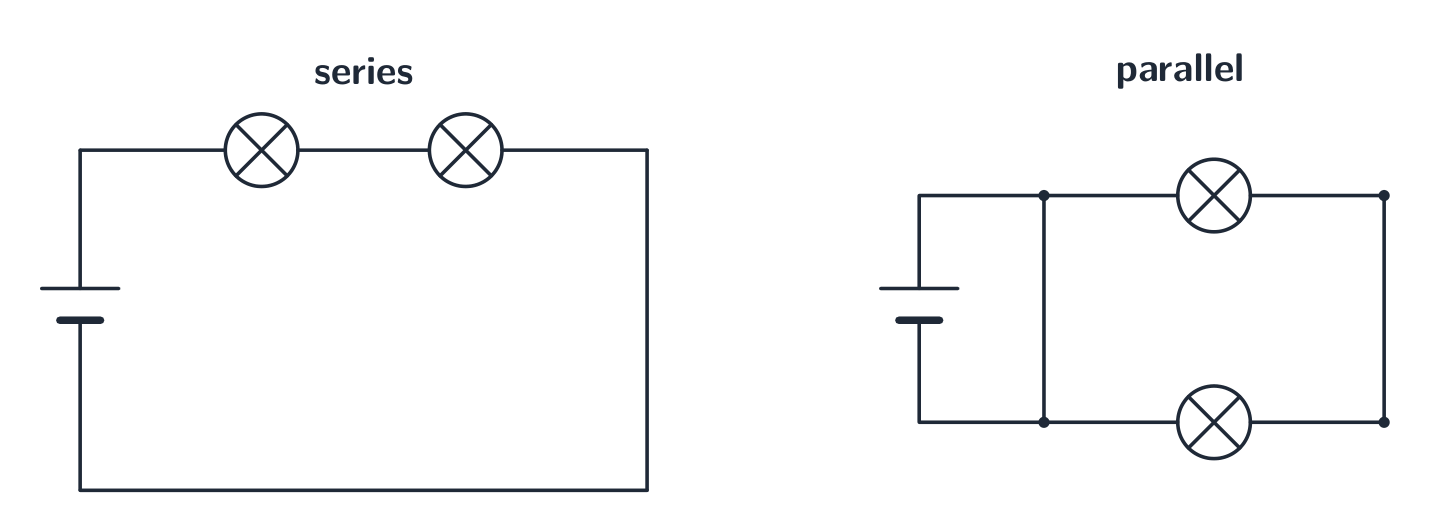
EnglishA circuit is a closed loop of conductors, a source (battery), and components. In a series 串联 path the same current flows through each element; in a parallel 并联 path the same voltage is across each branch. A circuit diagram uses standard symbols; reading it correctly is the first step of any circuit problem.
日本語回路は、導体の閉じたループ、電源(バッテリー)、および素子の組み合わせです。直列接続では各素子を通る電流は同じであり、並列接続では各分岐にかかる電圧は同じです。回路図は標準記号を使用しており、それを正しく読むことはすべての回路問題における第一歩です。
素子は直列または並列に接続できる 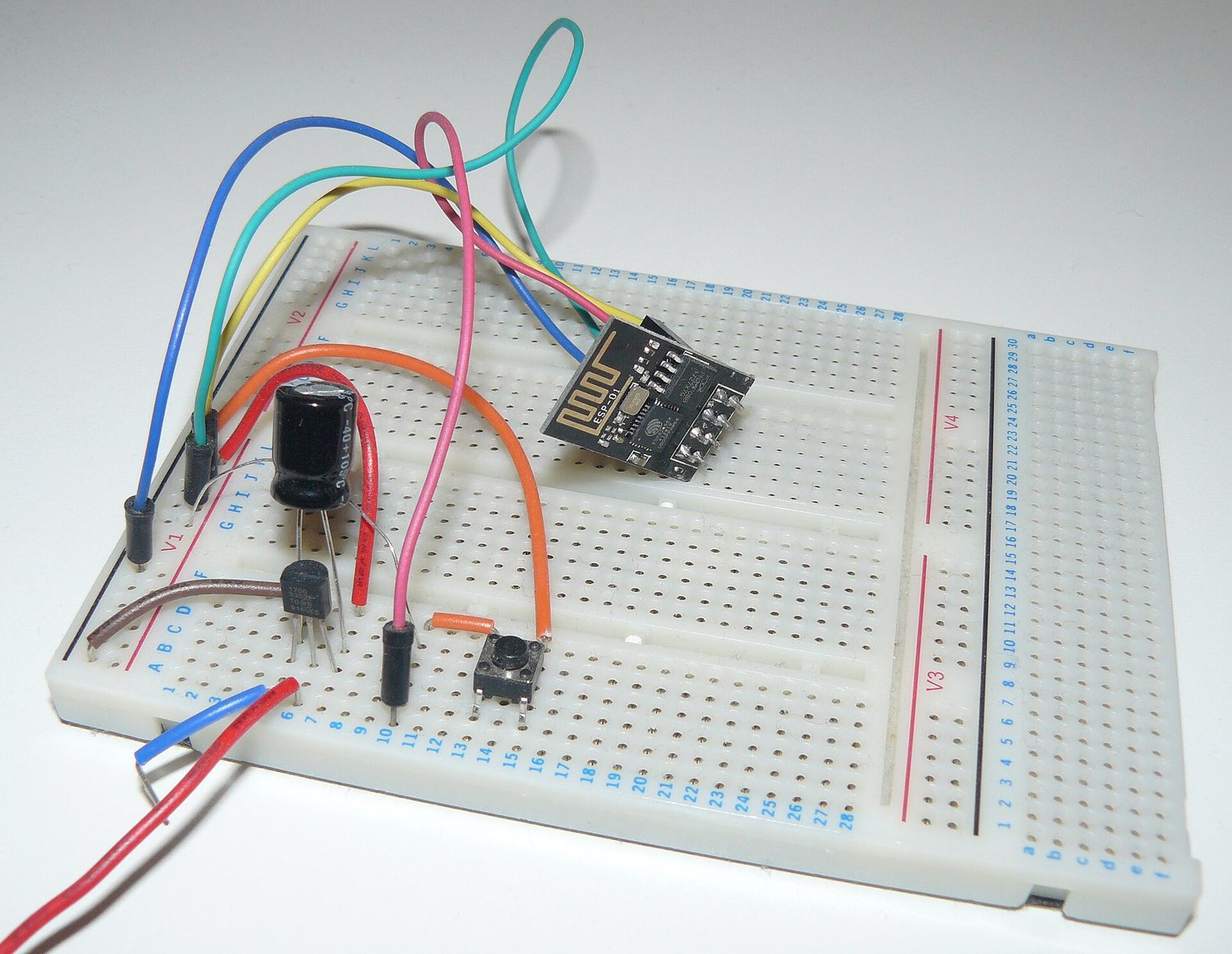
実際の回路:素子をブロードボードに差し込み、ワイヤーで接続して伝導が完全に通る経路を作る Explore · 探索Build series and parallel circuits · 直列・並列回路を組む
In series the same current flows through every bulb and voltage divides; in parallel each branch gets the full voltage. Switch mode to see the bulbs' brightness change. · 直列 では全ランプを通る電流は同じで電圧は分配され、並列 では各枝に全電圧がかかる。モードを変えてランプの明るさの変化を見る。
Vocabulary · 語彙 Train · 練習するEnglish 日本語 Electric current/ɪˈlektrɪk ˈkʌrənt/ 電流 amperes/ˈæmpeəz/ アンペア series/ˈsɪəriːz/ 直列に接続される parallel/ˈpærəlel/ 並列に接続される Resistance/rɪˈzɪstəns/ Resistance Ohm's law/əʊmz lɔː/ オームの法則 resistivity/ˌriːzɪˈstɪvəti/ 比抵抗 Electric power/ɪˈlektrɪk ˈpaʊə/ 電力 light bulb/laɪt bʌlb/ 電球 brightness/ˈbraɪtnəs/ 明るさ equivalent resistance/ɪˈkwɪvələnt rɪˈzɪstəns/ 等価抵抗 ammeter/ˈæmiːtə/ アンメーター voltmeter/ˈvəʊltmiːtə/ ボルテメーター nonideal/ˌnɒnaɪˈdɪəl/ 非理想 Kirchhoff's loop rule/ˈkɜːkhɒfs luːp ruːl/ キルヒホッフのループ則 Kirchhoff's junction rule/ˈkɜːkhɒfs ˈdʒʌŋkʃn ruːl/ キルヒホッフの接点則 RC circuit/ˌɑː ˈsiː ˈsɜːkɪt/ RC回路 11.3
Resistance, Resistivity, and Ohm's Law · 抵抗、比抵抗、およびオームの法則
Syllabus · シラバス
EnglishLearning Objective 11.3.A: Describe the resistance of an object using physical properties of that object.
- 11.3.A.1 Resistance is a measure of the degree to which an object opposes the movement of electric charge.
- 11.3.A.2 The resistance of a resistor with uniform geometry is proportional to its resistivity and length and is inversely proportional to its cross-sectional area.
- Equation: $R = \dfrac{\rho \ell}{A}$
- 11.3.A.2.i Resistivity is a fundamental property of a material that depends on its atomic and molecular structure and quantifies how strongly the material opposes the motion of electric charge.
- 11.3.A.2.ii The resistivity of a conductor typically increases with temperature.
Learning Objective 11.3.B: Describe the electrical characteristics of elements of a circuit.
- 11.3.B.1 Ohm's law relates current, resistance, and potential difference across a conductive element of a circuit.
- Equation: $I = \dfrac{\Delta V}{R}$
- 11.3.B.1.i Materials that obey Ohm's law have constant resistance for all currents and are called ohmic materials.
- 11.3.B.1.ii The resistivity of an ohmic material is constant regardless of temperature.
- 11.3.B.1.iii Resistors can also convert electrical energy to thermal energy, which may change the temperature of both the resistor and the resistor's environment.
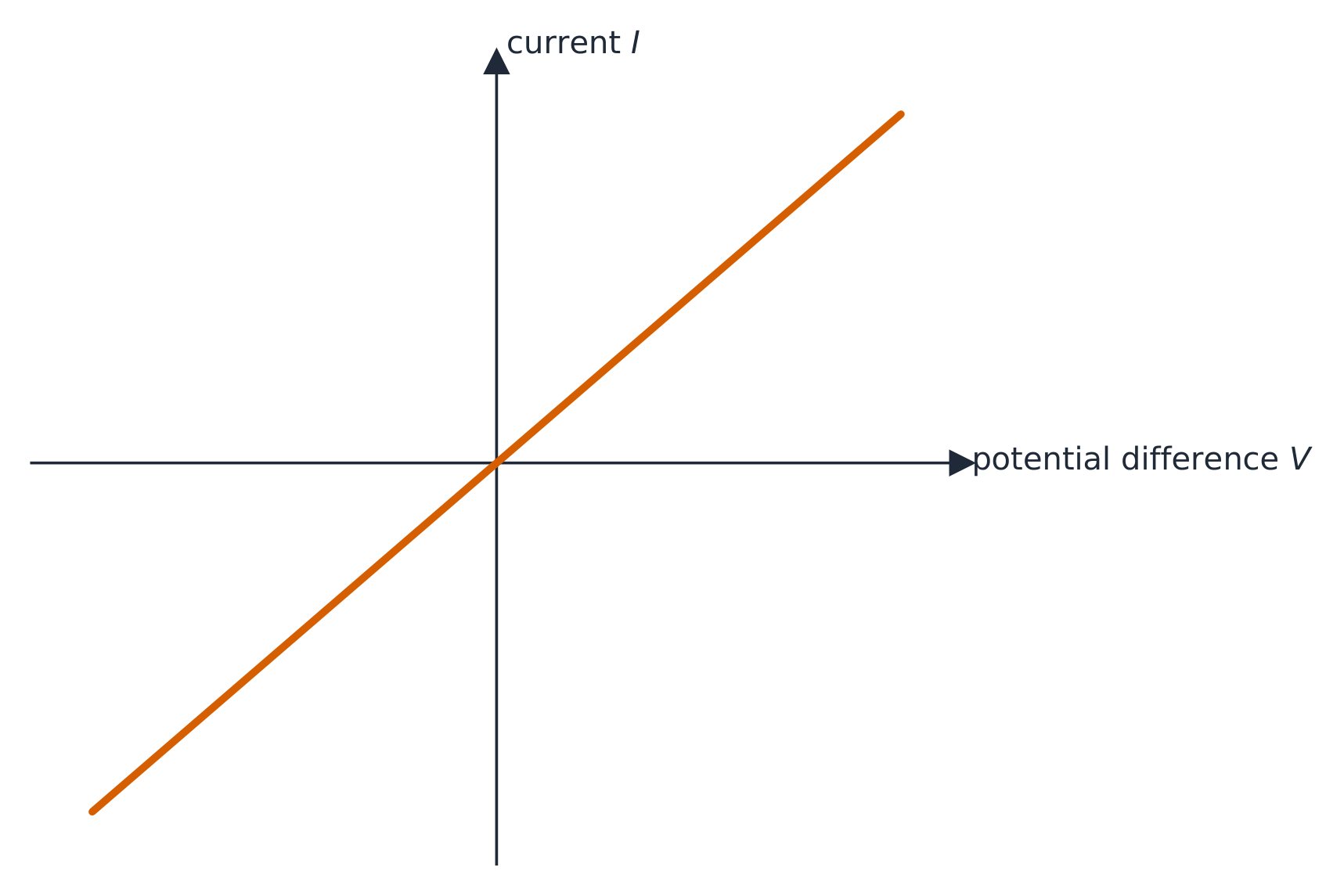
- 11.3.B.1.iv The resistance of an ohmic circuit element can be determined from the slope of a graph of the current in the element as a function of the potential difference across the element.
日本語学習目標 11.3.A: その物体の物理的性質を用いて、物体の抵抗を説明せよ。
- 11.3.A.1 抵抗とは、物体が電荷の移動をどの程度阻止するかを示す指標である。
- 11.3.A.2 均一な形状を持つ抵抗器の抵抗は、その比抵抗および長さに比例し、断面積に反比例する。
- 式: $R = \dfrac{\rho \ell}{A}$
- 11.3.A.2.i 比抵抗は、原子および分子構造に依存する材料の基本的な性質であり、材料が電荷の移動をどの程度強く阻止するかを定量化する。
- 11.3.A.2.ii 導体の比抵抗は一般的に温度の上昇とともに増加する。
学習目標 11.3.B: 回路の素子の電気的特性を説明せよ。
- 11.3.B.1 オームの法則は、回路の導電性素子における電流、抵抗、および電位差の関係を表す。
- 式: $I = \dfrac{\Delta V}{R}$
- 11.3.B.1.i オームの法則に従う材料は、すべての電流に対して一定の抵抗を持ち、オーム性材料と呼ばれる。
- 11.3.B.1.ii オーム性材料の比抵抗は、温度に関わらず一定である。
- 11.3.B.1.iii 抵抗器はまた、電気エネルギーを熱エネルギーに変換することができ、これにより抵抗器自体およびその環境の温度が変化する可能性がある。
- 11.3.B.1.iv オーム性回路素子の抵抗は、その素子にかかる電位差に対する素子内の電流のグラフの傾きから求めることができる。
Source: College Board AP Course and Exam Description · 出典: College Board AP コースおよび試験説明書
EnglishResistance 电阻 $R$ opposes current, measured in ohms. Ohm's law 欧姆定律 links the three key quantities:
$$V=IR.$$A component's resistance depends on the material's resistivity 电阻率 $\rho$, its length, and its cross-sectional area: $R=\dfrac{\rho L}{A}$ – longer and thinner means more resistance.Worked example. A $2.0\ \text{A}$ current flows through a $6.0\ \Omega$ resistor. The voltage across it is $V=IR=2.0\times6.0=12\ \text{V}$.
日本語抵抗 $R$ は伝導を妨げ、オームで測定されます。オームの法則は3つの主要な物理量を結びつけます:
$$V=IR.$$素子の抵抗は、材料の比抵抗 $\rho$、長さ、および断面積に依存します:$R=\dfrac{\rho L}{A}$ – 長く細いほど抵抗が大きくなります。オーム性導体のI-V曲線は原点を通る直線です ** worked example.** $2.0\ \text{A}$ の電流が $6.0\ \Omega$ の抵抗器を通ります。その両端の電圧は $V=IR=2.0\times6.0=12\ \text{V}$ です。
Explore · 探索Apply Ohm's law · オームの法則を適用する
Ohm's law $V=IR$: for a fixed resistance, current is proportional to voltage. Raise the resistance and the same voltage pushes less current. · オームの法則 $V=IR$:抵抗一定の場合、電流は電圧に比例する。抵抗を増やすと、同じ電圧でも流れる電流は減る。
11.4
Electric Power · 電気出力
Syllabus · シラバス
EnglishLearning Objective 11.4.A: Describe the transfer of energy into, out of, or within an electric circuit, in terms of power.
- 11.4.A.1 The rate at which energy is transferred, converted, or dissipated by a circuit element depends on the current in the element and the electric potential difference across it.
- Equation: $P = I \Delta V$
- Equation (derived): $P = I^2 R = \dfrac{(\Delta V)^2}{R}$
- 11.4.A.2 The brightness of a bulb increases with power, so power can be used to qualitatively predict the brightness of bulbs in a circuit.
日本語学習目標 11.4.A: 電力を用いて、電気回路へのエネルギーの流入、流出、または内部移動を説明せよ。
- 11.4.A.1 回路素子によってエネルギーが転移、変換、または散逸される速さは、その素子内の電流およびそれにかかる電位差に依存する。
- 式: $P = I \Delta V$
- 式(導出): $P = I^2 R = \dfrac{(\Delta V)^2}{R}$
- 11.4.A.2 電球の明るさは電力に比例して増すため、回路内の電球の明るさを定性的に予測するために電力を用いることができる。
Source: College Board AP Course and Exam Description · 出典: College Board AP コースおよび試験説明書
EnglishElectric power 电功率 is the rate a component converts electrical energy (to heat, light, motion):
$$P=IV=I^2R=\frac{V^2}{R}.$$Pick the form that uses the quantities you know. A resistor's power all becomes heat.Worked example. The $6.0\ \Omega$ resistor above, carrying $2.0\ \text{A}$, dissipates $P=I^2R=2.0^2\times6.0=24\ \text{W}$ – equivalently $P=IV=2.0\times12=24\ \text{W}$.
A light bulb 灯泡 is just a resistor that glows, and its brightness 亮度 rises with the power it dissipates. So to rank bulbs, compare their power. In a series string every bulb carries the same current, so by $P=I^2R$ the bulb with the largest resistance is brightest; wired in parallel every bulb gets the full battery voltage, so by $P=V^2/R$ the bulb with the smallest resistance is brightest.
日本語電気出力とは、素子が電気エネルギーを熱、光、運動に変換する速さです:
$$P=IV=I^2R=\frac{V^2}{R}.$$既知の物理量を用いる形式を選んでください。抵抗器の出力はすべて熱になります。** worked example.** 上記の $6.0\ \Omega$ の抵抗器に $2.0\ \text{A}$ の電流が流れている場合、$P=I^2R=2.0^2\times6.0=24\ \text{W}$ を消費します – 等価的に $P=IV=2.0\times12=24\ \text{W}$ 。
電球は単に発光する抵抗器に過ぎず、その明るさは消費する出力に比例して増大します。したがって電球を順位付けするには、出力を比較します。直列接続ではすべての電球に同じ電流が流れるため、$P=I^2R$ よりも最大の抵抗を持つ電球が最も明るく、並列接続ではすべての電球にバッテリーの全電圧がかかるため、$P=V^2/R$ よりも最小の抵抗を持つ電球が最も明るくなります。
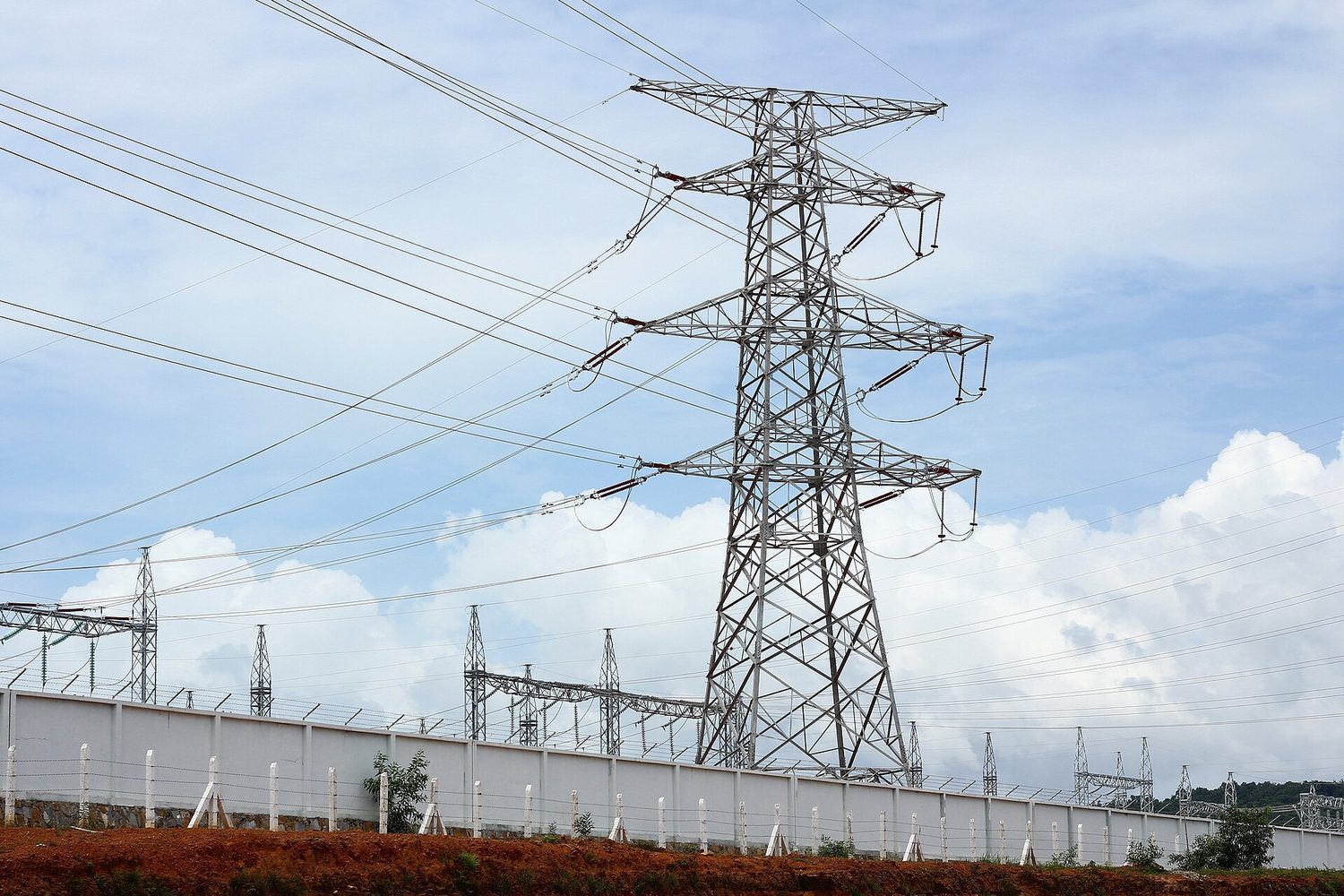
高圧送電線:電流(および I²R 損失)を抑えるため、電気出力は高電圧で送電される Explore · 探索Read an I-V characteristic · I-V特性曲線を読む
Power is $P=IV$. A resistor's I-V line is straight, but a lamp curves as it heats and its resistance rises. The area under I-V relates to the energy delivered. · 電力は $P=IV$ 。抵抗器の I-V 線は直線だが、ランプ は発熱して抵抗が増すため曲線になる。I-V 下面積は供給されたエネルギーに関係する。
11.5
Compound DC Circuits · 複合DC回路

Syllabus · シラバス
EnglishLearning Objective 11.5.A: Describe the equivalent resistance of multiple resistors connected in a circuit.
- 11.5.A.1 Circuit elements may be connected in series and/or in parallel.
- 11.5.A.1.i A series connection is one in which any charge passing through one circuit element must proceed through all elements in that connection and has no other path available. The current in each element in series must be the same.
- 11.5.A.1.ii A parallel connection is one in which charges may flow through one of two or more paths. Across each path, the potential difference is the same.
- 11.5.A.2 A collection of resistors in a circuit may be analyzed as though it were a single resistor with an equivalent resistance $R_{\text{eq}}$.
- 11.5.A.2.i The equivalent resistance of a set of resistors in series is the sum of the individual resistances.
- Equation: $R_{\text{eq},s} = \sum_i R_i$
- 11.5.A.2.ii The inverse of the equivalent resistance of a set of resistors connected in parallel is equal to the sum of the inverses of the individual resistances.
- Equation: $\dfrac{1}{R_{\text{eq},p}} = \sum_i \dfrac{1}{R_i}$
- 11.5.A.2.iii When resistors are connected in parallel, the number of paths available to charges increases, and the equivalent resistance of the group of resistors decreases.
- 11.5.A.2.i The equivalent resistance of a set of resistors in series is the sum of the individual resistances.
Learning Objective 11.5.B: Describe a circuit with resistive wires and a battery with internal resistance.
- 11.5.B.1 Ideal batteries have negligible internal resistance. Ideal wires have negligible resistance.
- 11.5.B.1.i The resistance of wires that are good conductors may normally be neglected, because their resistance is much smaller than that of other elements of a circuit.
- 11.5.B.1.ii The resistance of wires may only be neglected if the circuit contains other elements that do have resistance.
- 11.5.B.1.iii The potential difference a battery would supply if it were ideal is the potential difference measured across the terminals when there is no current in the battery and is sometimes referred to as its $\mathrm{emf}$ ($\varepsilon$).
- 11.5.B.2 The internal resistance of a nonideal battery may be treated as the resistance of a resistor in series with an ideal battery and the remainder of the circuit.
- 11.5.B.3 When there is current in a nonideal battery with internal resistance $r$, the potential difference across the terminals of the battery is reduced relative to the potential difference when there is no current in the battery.
- Equation (derived): $\Delta V_{\text{terminal}} = \varepsilon - Ir$
Learning Objective 11.5.C: Describe the measurement of current and potential difference in a circuit.
- 11.5.C.1 Ammeters are used to measure current at a specific point in a circuit.
- 11.5.C.1.i Ammeters must be connected in series with the element in which current is being measured.
- 11.5.C.1.ii Ideal ammeters have zero resistance so that they do not affect the current in the element that they are in series with.
- 11.5.C.2 Voltmeters are used to measure electric potential difference between two points in a circuit.
- 11.5.C.2.i Voltmeters must be connected in parallel with the element across which potential difference is being measured.
- 11.5.C.2.ii Ideal voltmeters have an infinite resistance so that no charge flows through them.
- 11.5.C.3 Nonideal ammeters and voltmeters will change the properties of the circuit being measured.
Boundary statement: AP Physics 2 only expects students to qualitatively discuss how a nonideal ammeter or voltmeter will affect the results of measurements. Unless otherwise stated, all batteries, wires, and meters are assumed to be ideal.
Boundary statement: Circuits with batteries of different potential differences connected in parallel will not be assessed.
日本語学習目標 11.5.A: 回路に接続された複数の抵抗器の等価抵抗を説明せよ。
- 11.5.A.1 回路素子は直列および/または並列に接続されることができる。
- 11.5.A.1.i 直列接続とは、ある回路素子を通過した電荷がその接続にあるすべての素子を通過せねばならず、他の経路が存在しない状態である。直列接続された各素子の電流は同じでなければならない。
- 11.5.A.1.ii 並列接続とは、電荷が2つ以上の経路のうちいずれか一つを通って流れる接続方法である。各経路間での電位差は等しい。
- 11.5.A.2 回路中の抵抗器の組み合わせは、等価抵抗 $R_{\text{eq}}$ を持つ単一の抵抗器として解析できる。
- 11.5.A.2.i 直列に接続された抵抗器の等価抵抗は、個々の抵抗値の総和である。
- 数式: $R_{\text{eq},s} = \sum_i R_i$
- 11.5.A.2.ii 並列に接続された抵抗器の等価抵抗の逆数は、個々の抵抗値の逆数の総和に等しい。
- 数式: $\dfrac{1}{R_{\text{eq},p}} = \sum_i \dfrac{1}{R_i}$
- 11.5.A.2.iii 抵抗器を並列に接続すると、電荷が流れることができる経路の数が増加し、抵抗器群の等価抵抗は減少する。
- 11.5.A.2.i 直列に接続された抵抗器の等価抵抗は、個々の抵抗値の総和である。
学習目標 11.5.B: 抵抗性導線と内部抵抗を持つ電池を含む回路を説明せよ。
- 11.5.B.1 理想電池は内部抵抗を無視できるほど小さいとする。理想導線もまた抵抗を無視できるほど小さいとする。
- 11.5.B.1.i 良好な伝導体である導線の抵抗は通常無視できる。これは、その抵抗が回路他の要素の抵抗よりもはるかに小さいためである。
- 11.5.B.1.ii 回路中に抵抗を持つ他の要素が存在する場合のみ、導線の抵抗は無視できる。
- 11.5.B.1.iii 理想電池であれば供給されるはずの電位差は、電池に電流が流れていないときに端子間で測定される電位差であり、この値は $\mathrm{emf}$($\varepsilon$)とも呼ばれる。
- 11.5.B.2 非理想電池の内部抵抗は、理想電池と回路残部との間に直列に接続された抵抗器の抵抗として扱うことができる。
- 11.5.B.3 内部抵抗 $r$ を持つ非理想電池に電流が流れている場合、端子間の電位差は、電池に電流が流れていないときの電位差より小さくなる。
- 式(導出): $\Delta V_{\text{terminal}} = \varepsilon - Ir$
学習目標 11.5.C: 回路における電流および電位差の測定方法を説明せよ。
- 11.5.C.1 アメーターは、回路内の特定の点における電流を測定するために用いられる。
- 11.5.C.1.i アメーターは、電流を測定したい素子と直列に接続しなければならない。
- 11.5.C.1.ii 理想アメーターは抵抗がゼロであるため、直列に接続した素子の電流に影響を与えない。
- 11.5.C.2 ボルトメーターは、回路内の2点間の電気的電位差を測定するために用いられる。
- 11.5.C.2.i ボルトメーターは、電位差を測定したい素子と並列に接続しなければならない。
- 11.5.C.2.ii 理想ボルトメーターは抵抗が無限大であるため、電荷が流れない。
- 11.5.C.3 非理想のアメーターやボルトメーターを用いると、測定対象の回路の性質が変化する。
境界文: AP Physics 2では、学生に対して非理想のアメーターまたはボルトメーターが測定結果に与える影響について定性的に議論することを求めるのみである。特に指示がない限り、すべての電池、導線、計測器は理想のものであると仮定される。
境界文: 異なる電位差を持つ電池が並列に接続された回路については評価しない。
Source: College Board AP Course and Exam Description · 出典: College Board AP コースおよび試験説明書
EnglishCombine resistors to find an equivalent resistance 等效电阻:
- Series: $R_{\text{eq}}=R_1+R_2+\cdots$ (resistances add).
- Parallel: $\dfrac{1}{R_{\text{eq}}}=\dfrac{1}{R_1}+\dfrac{1}{R_2}+\cdots$ (the total is less than the smallest).
Reduce the network step by step to find the total current from the battery, then work back to each element.
Worked example. A $12\ \text{V}$ battery drives a $4.0\ \Omega$ and a $12\ \Omega$ resistor in parallel. First combine them: $\dfrac{1}{R_{\text{eq}}}=\dfrac14+\dfrac{1}{12}=\dfrac{4}{12}\Rightarrow R_{\text{eq}}=3.0\ \Omega$. The total current from the battery is $I=\dfrac{V}{R_{\text{eq}}}=\dfrac{12}{3.0}=4.0\ \text{A}$, which splits so that the smaller resistor carries the larger share ($3.0\ \text{A}$ through the $4\ \Omega$, $1.0\ \text{A}$ through the $12\ \Omega$).
日本語抵抗器を結合して等価抵抗を見出します:
直列接続の抵抗は合成抵抗に合計される - 直列: $R_{\text{eq}}=R_1+R_2+\cdots$ (抵抗値が加算される)。
- 並列: $\dfrac{1}{R_{\text{eq}}}=\dfrac{1}{R_1}+\dfrac{1}{R_2}+\cdots$ (全体は最小値より小さい)。
回路を段階的に単純化して、電源からの全電流を求め、そこから各素子に戻って計算する。
** worked example(例題)。** $12\ \text{V}$ の電源から $4.0\ \Omega$ と $12\ \Omega$ の抵抗が並列に接続されている。まずこれらを合成する: $\dfrac{1}{R_{\text{eq}}}=\dfrac14+\dfrac{1}{12}=\dfrac{4}{12}\Rightarrow R_{\text{eq}}=3.0\ \Omega$。電源からの全電流は $I=\dfrac{V}{R_{\text{eq}}}=\dfrac{12}{3.0}=4.0\ \text{A}$ であり、これが分流して、抵抗が小さい方により大きな電流が流れる($3.0\ \text{A}$ が $4\ \Omega$ を通り、$1.0\ \text{A}$ が $12\ \Omega$ を通る)。
11.5
Measuring Current and Voltage · 電流と電圧の測定
Syllabus · シラバス
EnglishLearning Objective 11.5.A: Describe the equivalent resistance of multiple resistors connected in a circuit.
- 11.5.A.1 Circuit elements may be connected in series and/or in parallel.
- 11.5.A.1.i A series connection is one in which any charge passing through one circuit element must proceed through all elements in that connection and has no other path available. The current in each element in series must be the same.
- 11.5.A.1.ii A parallel connection is one in which charges may flow through one of two or more paths. Across each path, the potential difference is the same.
- 11.5.A.2 A collection of resistors in a circuit may be analyzed as though it were a single resistor with an equivalent resistance $R_{\text{eq}}$.
- 11.5.A.2.i The equivalent resistance of a set of resistors in series is the sum of the individual resistances.
- Equation: $R_{\text{eq},s} = \sum_i R_i$
- 11.5.A.2.ii The inverse of the equivalent resistance of a set of resistors connected in parallel is equal to the sum of the inverses of the individual resistances.
- Equation: $\dfrac{1}{R_{\text{eq},p}} = \sum_i \dfrac{1}{R_i}$
- 11.5.A.2.iii When resistors are connected in parallel, the number of paths available to charges increases, and the equivalent resistance of the group of resistors decreases.
- 11.5.A.2.i The equivalent resistance of a set of resistors in series is the sum of the individual resistances.
Learning Objective 11.5.B: Describe a circuit with resistive wires and a battery with internal resistance.
- 11.5.B.1 Ideal batteries have negligible internal resistance. Ideal wires have negligible resistance.
- 11.5.B.1.i The resistance of wires that are good conductors may normally be neglected, because their resistance is much smaller than that of other elements of a circuit.
- 11.5.B.1.ii The resistance of wires may only be neglected if the circuit contains other elements that do have resistance.
- 11.5.B.1.iii The potential difference a battery would supply if it were ideal is the potential difference measured across the terminals when there is no current in the battery and is sometimes referred to as its $\mathrm{emf}$ ($\varepsilon$).
- 11.5.B.2 The internal resistance of a nonideal battery may be treated as the resistance of a resistor in series with an ideal battery and the remainder of the circuit.
- 11.5.B.3 When there is current in a nonideal battery with internal resistance $r$, the potential difference across the terminals of the battery is reduced relative to the potential difference when there is no current in the battery.
- Equation (derived): $\Delta V_{\text{terminal}} = \varepsilon - Ir$
Learning Objective 11.5.C: Describe the measurement of current and potential difference in a circuit.
- 11.5.C.1 Ammeters are used to measure current at a specific point in a circuit.
- 11.5.C.1.i Ammeters must be connected in series with the element in which current is being measured.
- 11.5.C.1.ii Ideal ammeters have zero resistance so that they do not affect the current in the element that they are in series with.
- 11.5.C.2 Voltmeters are used to measure electric potential difference between two points in a circuit.
- 11.5.C.2.i Voltmeters must be connected in parallel with the element across which potential difference is being measured.
- 11.5.C.2.ii Ideal voltmeters have an infinite resistance so that no charge flows through them.
- 11.5.C.3 Nonideal ammeters and voltmeters will change the properties of the circuit being measured.
Boundary statement: AP Physics 2 only expects students to qualitatively discuss how a nonideal ammeter or voltmeter will affect the results of measurements. Unless otherwise stated, all batteries, wires, and meters are assumed to be ideal.
Boundary statement: Circuits with batteries of different potential differences connected in parallel will not be assessed.
日本語学習目標 11.5.A: 回路に接続された複数の抵抗器の等価抵抗を説明せよ。
- 11.5.A.1 回路素子は直列および/または並列に接続されることができる。
- 11.5.A.1.i 直列接続とは、ある回路素子を通過した電荷がその接続にあるすべての素子を通過せねばならず、他の経路が存在しない状態である。直列接続された各素子の電流は同じでなければならない。
- 11.5.A.1.ii 並列接続とは、電荷が2つ以上の経路のうちいずれか一つを通って流れる接続方法である。各経路間での電位差は等しい。
- 11.5.A.2 回路中の抵抗器の組み合わせは、等価抵抗 $R_{\text{eq}}$ を持つ単一の抵抗器として解析できる。
- 11.5.A.2.i 直列に接続された抵抗器の等価抵抗は、個々の抵抗値の総和である。
- 数式: $R_{\text{eq},s} = \sum_i R_i$
- 11.5.A.2.ii 並列に接続された抵抗器の等価抵抗の逆数は、個々の抵抗値の逆数の総和に等しい。
- 数式: $\dfrac{1}{R_{\text{eq},p}} = \sum_i \dfrac{1}{R_i}$
- 11.5.A.2.iii 抵抗器を並列に接続すると、電荷が流れることができる経路の数が増加し、抵抗器群の等価抵抗は減少する。
- 11.5.A.2.i 直列に接続された抵抗器の等価抵抗は、個々の抵抗値の総和である。
学習目標 11.5.B: 抵抗性導線と内部抵抗を持つ電池を含む回路を説明せよ。
- 11.5.B.1 理想電池は内部抵抗を無視できるほど小さいとする。理想導線もまた抵抗を無視できるほど小さいとする。
- 11.5.B.1.i 良好な伝導体である導線の抵抗は通常無視できる。これは、その抵抗が回路他の要素の抵抗よりもはるかに小さいためである。
- 11.5.B.1.ii 回路中に抵抗を持つ他の要素が存在する場合のみ、導線の抵抗は無視できる。
- 11.5.B.1.iii 理想電池であれば供給されるはずの電位差は、電池に電流が流れていないときに端子間で測定される電位差であり、この値は $\mathrm{emf}$($\varepsilon$)とも呼ばれる。
- 11.5.B.2 非理想電池の内部抵抗は、理想電池と回路残部との間に直列に接続された抵抗器の抵抗として扱うことができる。
- 11.5.B.3 内部抵抗 $r$ を持つ非理想電池に電流が流れている場合、端子間の電位差は、電池に電流が流れていないときの電位差より小さくなる。
- 式(導出): $\Delta V_{\text{terminal}} = \varepsilon - Ir$
学習目標 11.5.C: 回路における電流および電位差の測定方法を説明せよ。
- 11.5.C.1 アメーターは、回路内の特定の点における電流を測定するために用いられる。
- 11.5.C.1.i アメーターは、電流を測定したい素子と直列に接続しなければならない。
- 11.5.C.1.ii 理想アメーターは抵抗がゼロであるため、直列に接続した素子の電流に影響を与えない。
- 11.5.C.2 ボルトメーターは、回路内の2点間の電気的電位差を測定するために用いられる。
- 11.5.C.2.i ボルトメーターは、電位差を測定したい素子と並列に接続しなければならない。
- 11.5.C.2.ii 理想ボルトメーターは抵抗が無限大であるため、電荷が流れない。
- 11.5.C.3 非理想のアメーターやボルトメーターを用いると、測定対象の回路の性質が変化する。
境界文: AP Physics 2では、学生に対して非理想のアメーターまたはボルトメーターが測定結果に与える影響について定性的に議論することを求めるのみである。特に指示がない限り、すべての電池、導線、計測器は理想のものであると仮定される。
境界文: 異なる電位差を持つ電池が並列に接続された回路については評価しない。
Source: College Board AP Course and Exam Description · 出典: College Board AP コースおよび試験説明書
EnglishTwo meters read a circuit. An ammeter 电流表 measures the current at a point, so it must be wired in series – the current you want to measure has to flow through it. A voltmeter 电压表 measures the potential difference between two points, so it is wired in parallel, bridging across the component whose voltage you want.
For a meter to read the true value it must barely disturb the circuit:
- an ideal ammeter has zero resistance, so putting it in series does not reduce the current it reads;
- an ideal voltmeter has infinite resistance, so almost no current is diverted through it.
A real, nonideal 非理想 meter is imperfect: a real ammeter has a small resistance (it slightly lowers the current), and a real voltmeter lets a little current leak through (it slightly lowers the voltage it reads). So connecting any meter changes, a little, the very quantity it is measuring.
日本語2つのメーターが回路を読み取る。アンメーターは特定の点における電流を測定するため、直列に接続する必要がある– 測定したい電流が必ず通過しなければならない。ボルトメーターは2点間の電位差を測定するため、並列に接続し、測定したい電圧のある部品の両端に跨ぐようにつなぐ。
メーターが真の値を表示するには、回路への影響が極めて小さくなければならない:
- 理想的アンメーターは抵抗ゼロであるため、直列に接続しても表示される電流を減少させない;
- 理想的ボルトメーターは無限大の抵抗を持つため、ほぼ電流が流れない。
実際の非理想型メーターは不完全である:実在するアンメーターには小さな抵抗があり(電流をわずかに下げる)、実在するボルトメーターはわずかな電流を漏らす(表示される電圧をわずかに下げる)。したがって、いかなるメーターを接続しても、測定しようとしている量そのものがわずかに変化する。
11.6
Kirchhoff's Loop Rule · キルヒホッフのループ則
Syllabus · シラバス
EnglishLearning Objective 11.6.A: Describe a circuit or elements of a circuit by applying Kirchhoff's loop rule.
- 11.6.A.1 Energy changes in simple electrical circuits may be represented in terms of charges moving through electric potential differences within circuit elements.
- Equation: $\Delta U_E = q \Delta V$
- 11.6.A.2 Kirchhoff's loop rule is a consequence of the conservation of energy.
- 11.6.A.3 Kirchhoff's loop rule states that the sum of potential differences across all circuit elements in a single closed loop must equal zero.
- Equation: $\sum \Delta V = 0$
- 11.6.A.4 The values of electric potential at points in a circuit can be represented by a graph of electric potential as a function of position within a loop.
日本語学習目標 11.6.A: キルヒホッフのループ則を用いて、回路または回路の要素を説明せよ。
- 11.6.A.1 単純な電気回路におけるエネルギーの変化は、電荷が回路要素内の電位差を通過して移動することによって表すことができる。
- 式: $\Delta U_E = q \Delta V$
- 11.6.A.2 キルヒホッフのループ則はエネルギー保存則の結果である。
- 11.6.A.3 キルヒホッフのループ則は、単一の閉回路内のすべての回路素子間の電位差の総和がゼロに等しいことを示す。
- 式: $\sum \Delta V = 0$
- 11.6.A.4 回路内の点における電位の値は、ループ内での位置に対する電位のプロットで表現できる。
Source: College Board AP Course and Exam Description · 出典: College Board AP コースおよび試験説明書
EnglishKirchhoff's loop rule 基尔霍夫电压定律 (energy conservation): around any closed loop, the voltage gains and drops sum to zero. Add the battery's emf and subtract each $IR$ drop as you go around. This gives one equation per independent loop.
日本語キルヒホッフのループ則(エネルギー保存):任意の閉じたループにおいて、電圧の上昇と低下の総和はゼロとなる。ループ内を一周する際に、電源の起電力を加え、各 $IR$ の降下を引く。これにより、独立したループごとに1式が得られる。
11.7
Kirchhoff's Junction Rule · キルヒホッフの接点則
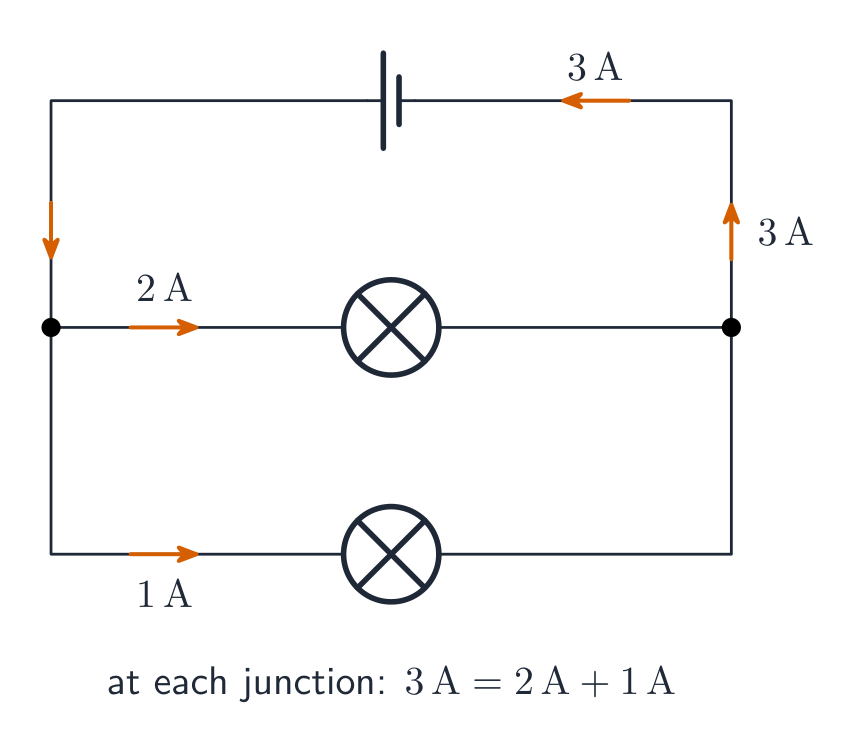
Syllabus · シラバス
EnglishLearning Objective 11.7.A: Describe a circuit or elements of a circuit by applying Kirchhoff's junction rule.
- 11.7.A.1 Kirchhoff's junction rule is a consequence of the conservation of electric charge.
- 11.7.A.2 Kirchhoff's junction rule states that the total amount of charge entering a junction per unit time must equal the total amount of charge exiting that junction per unit time.
- Equation: $\sum I_{\text{in}} = \sum I_{\text{out}}$
日本語学習目標 11.7.A: キルヒホッフの節則を用いて、回路または回路の要素を説明せよ。
- 11.7.A.1 キルヒホッフの節則は電気電荷保存則の結果である。
- 11.7.A.2 キルヒホッフの節則とは、単位時間あたりに節点に流入する電荷の総量は、単位時間あたりにその節点から流出する電荷の総量に等しいという法則である。
- 式: $\sum I_{\text{in}} = \sum I_{\text{out}}$
Source: College Board AP Course and Exam Description · 出典: College Board AP コースおよび試験説明書
EnglishKirchhoff's junction rule 基尔霍夫电流定律 (charge conservation): the total current into any junction equals the total current out. Together with the loop rule, it lets you solve any multi-loop circuit for its unknown currents.
日本語キルヒホッフの接点則(電荷保存):任意の接点へ流入する全電流は、流出する全電流に等しい。ループ則と併用することで、複数のループを持つ回路の未知電流を解くことができる。
接点で電流が分流する:流入量と流出量は等しい 11.8
RC Circuits · RC回路
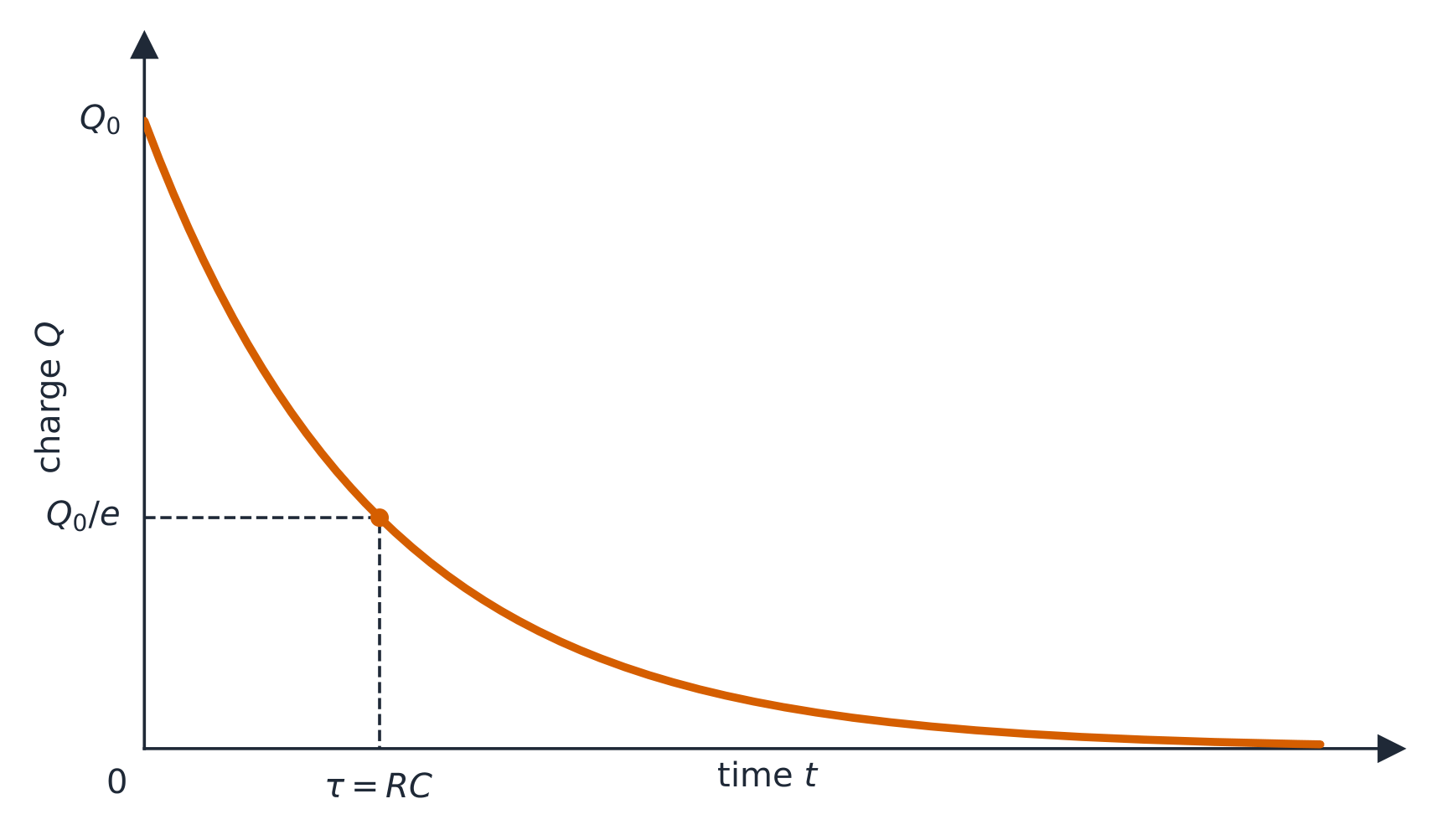
Syllabus · シラバス
EnglishLearning Objective 11.8.A: Describe the equivalent capacitance of multiple capacitors.
- 11.8.A.1 A collection of capacitors in a circuit may be analyzed as though it were a single capacitor with an equivalent capacitance $C_{\text{eq}}$.
- 11.8.A.1.i The inverse of the equivalent capacitance of a set of capacitors connected in series is equal to the sum of the inverses of the individual capacitances.
- Equation: $\dfrac{1}{C_{\text{eq},s}} = \sum_i \dfrac{1}{C_i}$
- 11.8.A.1.ii The equivalent capacitance of a set of capacitors in series is less than the capacitance of the smallest capacitor.
- 11.8.A.1.iii The equivalent capacitance of a set of capacitors in parallel is the sum of the individual capacitances.
- Equation: $C_{\text{eq},p} = \sum_i C_i$
- 11.8.A.1.i The inverse of the equivalent capacitance of a set of capacitors connected in series is equal to the sum of the inverses of the individual capacitances.
- 11.8.A.2 As a result of conservation of charge, each of the capacitors in series must have the same magnitude of charge on each plate.
Learning Objective 11.8.B: Describe the behavior of a circuit containing combinations of resistors and capacitors.
- 11.8.B.1 The time constant $\tau$ is a significant feature of an RC circuit.
- 11.8.B.1.i The time constant of an RC circuit is a measure of how quickly the capacitor will charge or discharge and is defined as $\tau = R_{\text{eq}} C_{\text{eq}}$.
- 11.8.B.1.ii For a charging capacitor, the time constant represents the time required for the capacitor's charge to increase from zero to approximately 63 percent of its final asymptotic value.
- 11.8.B.1.iii For a discharging capacitor, the time constant represents the time required for the capacitor's charge to decrease from fully charged to approximately 37 percent of its initial value.
- 11.8.B.2 The potential difference across a capacitor and the current in the branch of the circuit containing the capacitor each change over time as the capacitor charges and discharges, but both will reach a steady state after a long time interval.
- 11.8.B.2.i Immediately after being placed in a circuit, an uncharged capacitor acts like a wire, and charge can easily flow to or from the plates of the capacitor.
- 11.8.B.2.ii As a capacitor charges, changes to the potential difference across the capacitor affect the charge on the plates of the capacitor, the current circuit branch in which the capacitor is located, and the electric potential energy stored in the capacitor.
- 11.8.B.2.iii The potential difference across a capacitor, the current in the circuit branch in which the capacitor is located, and the electric potential energy stored in the capacitor all change with respect to time and asymptotically approach steady state conditions.
- 11.8.B.2.iv After a long time, a charging capacitor approaches a state of being fully charged, reaching a maximum potential difference at which there is zero current in the circuit branch in which the capacitor is located.
- 11.8.B.2.v Immediately after a charged capacitor begins discharging, the amount of charge on the capacitor plates and the energy stored in the capacitor begin to decrease.
- 11.8.B.2.vi As a capacitor discharges, the amount of charge on the capacitor, the potential difference across the capacitor, and the current in the circuit branch in which the capacitor is located all decrease until a steady state is reached.
- 11.8.B.2.vii After either charging or discharging for times much greater than the time constant, the capacitor and the relevant circuit branch may be modeled using steady-state conditions.
Boundary statement: Descriptions of charging/discharging RC circuits in AP Physics 2 are limited to qualitative descriptions and representations. While students should be able to mathematically describe initial and final states of RC circuits, students are not expected to mathematically model these behaviors with respect to time.
日本語学習目標 11.8.A: 複数のコンデンサの等価静電容量を説明せよ。
- 11.8.A.1 回路中のコンデンサの組み合わせは、等価静電容量 $C_{\text{eq}}$ を持つ単一のコンデンサとして解析できる。
- 11.8.A.1.i 直列に接続されたコンデンサの等価静電容量の逆数は、個々の静電容量の逆数の総和に等しい。
- 数式: $\dfrac{1}{C_{\text{eq},s}} = \sum_i \dfrac{1}{C_i}$
- 11.8.A.1.ii 直列に接続されたコンデンサの等価静電容量は、最も小さなコンデンサの静電容量より小さい。
- 11.8.A.1.iii 並列に接続されたコンデンサの等価静電容量は、個々の静電容量の総和である。
- 数式: $C_{\text{eq},p} = \sum_i C_i$
- 11.8.A.1.i 直列に接続されたコンデンサの等価静電容量の逆数は、個々の静電容量の逆数の総和に等しい。
- 11.8.A.2 電荷保存則の結果、直列に接続された各コンデンサの各極板には同じ大きさの電荷が蓄えられる。
学習目標 11.8.B: 抵抗器とコンデンサの組み合わせを含む回路の挙動を説明せよ。
- 11.8.B.1 時間定数 $\tau$ はRC回路の重要な特徴である。
- 11.8.B.1.i RC回路の時間定数は、コンデンサの充電または放電の速さを示す指標であり、定義式は $\tau = R_{\text{eq}} C_{\text{eq}}$ である。
- 11.8.B.1.ii 充電中のコンデンサにおいて、時間定数は、コンデンサの電荷がゼロから最終的な漸近値の約63%に増加するまでに要する時間を表す。
- 11.8.B.1.iii 放電中のコンデンサにおいて、時間定数は、コンデンサの電荷が完全に充電された状態から初期値の約37%に減少するまでに要する時間を表す。
- 11.8.B.2 コンデンサ両端の電位差と、コンデンサを含む回路の分路における電流は、コンデンサの充放電に伴って時間とともに変化するが、長期間経過すれば両方とも定常状態に達する。
- 11.8.B.2.i 回路に接続された直後、未充電のコンデンサは導線のように振る舞い、電荷がコンデンサの極板へ容易に流入または流出する。
- 11.8.B.2.ii コンデンサが充電されるにつれて、コンデンサ両端の電位差の変化は、コンデンサの極板上の電荷量、コンデンサを含む回路分路の電流、およびコンデンサに蓄えられた静電エネルギーに影響を与える。
- 11.8.B.2.iii コンデンサ両端の電位差、コンデンサを含む回路分路の電流、およびコンデンサに蓄えられた静電エネルギーはすべて時間とともに変化し、漸近的に定常状態に近づく。
- 11.8.B.2.iv 長期間経過すると、充電中のコンデンサは完全に充電された状態に近づき、コンデンサを含む回路分路における電流がゼロとなる最大電位差に達する。
- 11.8.B.2.v 充電されたコンデンサの放電が始まった直後、コンデンサの極板上の電荷量およびコンデンサに蓄えられたエネルギーは減少を始める。
- 11.8.B.2.vi コンデンサが放電されるにつれて、コンデンサの電荷量、コンデンサ両端の電位差、およびコンデンサを含む回路分路の電流はすべて減少し、定常状態に達するまで続く。
- 11.8.B.2.vii 充放電の時間が時間定数に比べて非常に長い場合、コンデンサおよび関連する回路分路は定常状態の条件を用いてモデル化できる。
境界文: AP Physics 2におけるRC回路の充放電に関する記述は、定性的な記述と表現に限定される。学生はRC回路の初期状態および最終状態を数学的に記述できるべきであるが、これらの挙動を時間に対する数学的モデルとして扱うことは求められない。
Source: College Board AP Course and Exam Description · 出典: College Board AP コースおよび試験説明書
EnglishCharging a capacitor (RC) An RC circuit RC电路 contains a resistor and a capacitor. When charging, the capacitor's voltage rises and the current falls, both exponentially, over a characteristic time $\tau=RC$. Key limits: at the first instant the uncharged capacitor acts like a plain wire (maximum current); after a long time it is fully charged and blocks current (acts like a break).
Worked example. For $R=10\ \text{k}\Omega$ and $C=100\ \mu\text{F}$, the time constant is $\tau=RC=(10\times10^{3})(100\times10^{-6})=1.0\ \text{s}$. After one time constant the capacitor reaches about $63\%$ of the supply voltage; after about $5\tau$ it is essentially fully charged.
日本語コンデンサの充電 (RC) RC回路 RC は抵抗器とコンデンサを含む。充電時、コンデンサの電圧は上昇し、電流は減少するが、どちらも特徴的な時間 $\tau=RC$ に伴って指数関数的に変化する。重要な極限値として:最初の瞬間、未充電のコンデンサは単なる導線のように振る舞い(最大電流)、長時間経過後は完全に充電され電流を遮断する(開路のように振る舞う)。
コンデンサの放電に伴う電荷の指数関数的減衰 ** worked example(例題)。** $R=10\ \text{k}\Omega$ と $C=100\ \mu\text{F}$ に対して、時間定数は $\tau=RC=(10\times10^{3})(100\times10^{-6})=1.0\ \text{s}$ である。1つの時間定数経過後、コンデンサは供給電圧の約 $63\%$ に達し、おおよそ $5\tau$ 経過後にはほぼ完全に充電される。
11.8
Exam tips · 試験対策
English- In series the current is the same throughout; in parallel the voltage is the same across each branch — never mix these up.
- Combine resistors: series add; parallel $1/R_{\text{eq}}=\sum 1/R_i$ (the total is less than the smallest).
- Apply Kirchhoff's rules: junction (current in = current out, charge conserved) and loop (voltages sum to zero, energy conserved).
- Pick the power form that fits your knowns: $P=IV=I^2R=V^2/R$.
- An ammeter goes in series (ideal: zero resistance); a voltmeter goes in parallel (ideal: infinite resistance). A real meter slightly disturbs the circuit it measures.
- A bulb is brighter when it dissipates more power – in series the biggest resistance ($I^2R$) glows brightest; in parallel the smallest ($V^2/R$) does.
- In an RC circuit the capacitor acts like a plain wire the instant it starts charging and like a break once fully charged.
日本語- 直列では全線で電流が同じであり、並列では各分岐間での電圧が同じ – これらを混同してはいけない。
- 抵抗を合成する:直列では加算、並列では $1/R_{\text{eq}}=\sum 1/R_i$ (全体は最小値より小さい)。
- キルヒホッフの法則を適用する:接点則(流入電流=流出電流、電荷保存)とループ則(電圧の総和はゼロ、エネルギー保存)。
- 既知量に適した電力の形式を選ぶ:$P=IV=I^2R=V^2/R$。
- アンメーターは直列に接続する(理想的:抵抗ゼロ)、ボルトメーターは並列に接続する(理想的:無限大の抵抗)。実際のメーターは測定対象の回路をわずかに乱す。
- 電球は消費する電力が多いほど明るくなる – 直列では最大の抵抗($I^2R$)が最も明るく発光し、並列では最小($V^2/R$)が最も明るくなる。
- RC回路において、コンデンサは充電開始と同時に単なる導線のように振る舞い、完全に充電された後は開路のように振る舞う。
- 11.1.A.1 Current is the rate at which charge passes through a cross-sectional area of a wire.
-
12
Magnetism and Electromagnetism
Watch lesson · レッスンを視聴12.1
Magnetic Fields · 磁場
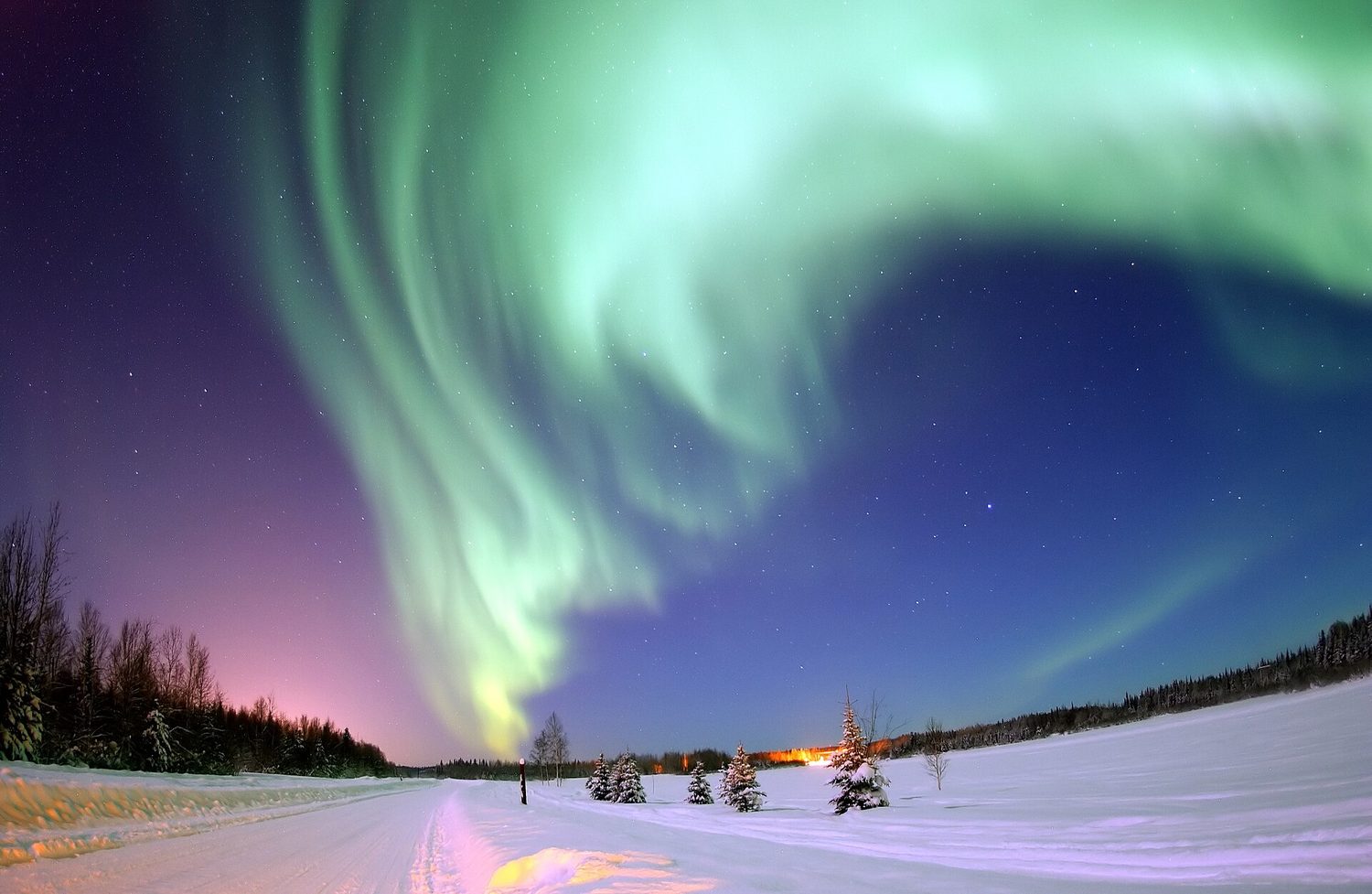
Syllabus · シラバス
EnglishLearning Objective 12.1.A: Describe the properties of a magnetic field.
- 12.1.A.1 A magnetic field is a vector field that can be used to determine the magnetic force exerted on moving electric charges, electric currents, or magnetic materials.
- 12.1.A.1.i Magnetic fields can be produced by magnetic dipoles or combinations of dipoles, but never by monopoles.
- 12.1.A.1.ii Magnetic dipoles have north and south polarity.
- 12.1.A.2 A magnetic field is a vector quantity and can be represented using vector field maps.
- 12.1.A.2.i Magnetic field lines form closed loops.
- 12.1.A.2.ii Magnetic fields in a bar magnet form closed loops, with the external magnetic field pointing away from one end (defined as the north pole) and returning to the other end (defined as the south pole).
Learning Objective 12.1.B: Describe the magnetic behavior of a material as a result of the configuration of magnetic dipoles in the material.
- 12.1.B.1 Magnetic dipoles result from the circular or rotational motion of electric charges. In magnetic materials, this can be the motion of electrons.
- 12.1.B.1.i Permanent magnetism and induced magnetism are system properties that both result from the alignment of magnetic dipoles within a system.
- 12.1.B.1.ii No magnetic north pole is ever found in isolation from a south pole. For example, if a bar magnet is broken in half, both halves are magnetic dipoles.
- 12.1.B.1.iii Magnetic poles of the same polarity will repel; magnetic poles of opposite polarity will attract.
- 12.1.B.1.iv The magnitude of the magnetic field from a magnetic dipole decreases with increasing distance from the dipole.
- 12.1.B.2 A magnetic dipole, such as a magnetic compass, placed in a magnetic field will tend to align with the magnetic field.
- 12.1.B.3 A material's composition influences its magnetic behavior in the presence of an external magnetic field.
- 12.1.B.3.i Ferromagnetic materials such as iron, nickel, and cobalt can be permanently magnetized by an external field that causes the alignment of magnetic domains or atomic magnetic dipoles.
- 12.1.B.3.ii Paramagnetic materials such as aluminum, titanium, and magnesium interact weakly with an external magnetic field, in that the magnetic dipoles of the material do not remain aligned after the external field is removed.
- 12.1.B.3.iii All materials have the property of diamagnetism, in that their electronic structure creates a usually weak alignment of the dipole moments of the material opposite the external magnetic field.
- 12.1.B4 Earth's magnetic field may be approximated as a magnetic dipole.
Learning Objective 12.1.C: Describe the magnetic permeability of a material.
- 12.1.C.1 Magnetic permeability is a measurement of the amount of magnetization in a material in response to an external magnetic field.
- 12.1.C.2 Free space has a constant value of magnetic permeability, known as the vacuum permeability $\mu_0$, that appears in equations representing physical relationships.
- 12.1.C.3 The permeability of matter has values different from that of free space and arises from the matter's composition and arrangement. It is not a constant for a material and varies based on many factors, including temperature, orientation, and strength of the external field.
日本語学習目標 12.1.A: 磁場の性質を説明せよ。
- 12.1.A.1 磁場は、運動する電気荷重、電流、あるいは磁性体にかかる磁力を決定するために用いられるベクトル場である。
- 12.1.A.1.i 磁場は磁気双極子や双極子の組み合わせによって生じるが、単極子によって生じることはない。
- 12.1.A.1.ii 磁気双極子には北極と南極の偏性がある。
- 12.1.A.2 磁場はベクトル量であり、ベクトル線図を用いて表現できる。
- 12.1.A.2.i 磁場線は閉じたループを形成する。
- 12.1.A.2.ii 棒状磁石内の磁場は閉じたループを形成し、外部磁場は一方の端(北極と定義される)から外側へ向かい、もう一方の端(南極と定義される)に戻ってくる。
学習目標 12.1.B: 磁性体内部の磁気双極子の配置による磁性体の磁気的挙動を説明せよ。
- 12.1.B.1 磁気双極子は、電気荷重の円運動または回転運動によって生じる。磁性体においては、これは電子の運動であることがある。
- 12.1.B.1.i 永久磁気と誘起磁気は、どちらも系内の磁気双極子の配列によって生じる系の性質である。
- 12.1.B.1.ii 南極から孤立して北極が存在することはない。例えば、棒状磁石を半分に切断した場合、両方の断片はそれぞれ磁気双極子となる。
- 12.1.B.1.iii 同極性の磁極同士は反発し、異極性の磁極同士は吸引する。
- 12.1.B.1.iv 磁気双極子からの磁場の大きさは、双極子からの距離が増加するにつれて減少する。
- 12.1.B.2 磁気コンパスなどの磁気双極子を磁場内に置くと、その双極子は磁場方向に配列しようとする。
- 12.1.B.3 物質の組成は、外部磁場中存在する際の磁性体の磁気的挙動に影響を与える。
- 12.1.B.3.i 鉄、ニッケル、コバルトなどの強磁性体は、外部磁場によって磁気ドメインや原子レベルの磁気双極子が配列されることで、永久磁石として機能することがある。
- 12.1.B.3.ii アルミウム、チタン、マグネシウムなどの常磁性体は、外部磁場との相互作用が弱く、外部磁場を取り除いた後も材料の磁気双極子の配列が維持されない。
- 12.1.B.3.iii すべての物質は抗磁性という性質を持つ。すなわち、その電子構造により、通常は微弱な配列が生じ、その双極子モーメントの向きが外部磁場と逆向きになる。
- 12.1.B4 地球の磁場は、磁気双極子として近似できる。
学習目標 12.1.C: 磁性体の透磁率を説明せよ。
- 12.1.C.1 透磁率は、外部磁場に対して磁性体がどれだけ磁化されるかを示す指標である。
- 12.1.C.2 真空は物理的関係を表す式に現れる一定値である透磁率(真空透磁率)$\mu_0$を持つ。
- 12.1.C.3 物質の透磁率には真空中の値とは異なる値があり、これは物質の組成と配置に起因する。ある材料に対する一定値ではなく、温度、方向性、外部磁場の強さなどの多くの要因に基づいて変化する。
Source: College Board AP Course and Exam Description · 出典: College Board AP コースおよび試験説明書
EnglishThe magnetic field around a current Different materials respond very differently to a magnetic field, and the course names three. Ferromagnetic 铁磁性 materials (iron, nickel, cobalt) have dipoles that align strongly and stay aligned, so they can be permanent magnets. Paramagnetic 顺磁性 materials (aluminium, titanium) align only weakly and do not stay aligned. Diamagnetic 抗磁性 materials - in fact all materials have some diamagnetism - align weakly opposite the field. This behaviour comes from a material property, the permeability 磁导率: free space has a fixed permeability of free space $\mu_0$, while the permeability of matter differs from it and is not even constant for a given material.
A magnetic field 磁场 $\vec{B}$ surrounds magnets and moving charges. Field lines run from a magnet's north pole to its south pole outside the magnet, and denser lines mean a stronger field. Magnetic poles always come in pairs – cutting a magnet in half makes two smaller magnets, never an isolated pole.
日本語電流周囲の磁気場 オーロラ:太陽からの帯電粒子は地球の磁気場によって極方向へ誘導され、大気に衝突して発光させる 異なる材料は磁気場に対して非常に異なった反応を示し、本コースでは3種類を名指している。強磁性体(鉄、ニッケル、コバルト)は双極子が強く整列し、その状態を維持するため、永久磁石となりうる。常磁性体(アルミ、チタン)は弱く整列するのみで、その状態を維持しない。反磁性体 – 実際にはあらゆる材料に何らかの反磁性がある – は磁場とは逆向きに弱く整列する。この挙動は材料固有の性質である透磁率に由来する:自由空間には固定された真空透磁率 $\mu_0$ があり、物質の透磁率はそれと異なり、ある材料であっても一定ではない場合もある。
磁気場 $\vec{B}$ は磁石や移動する電荷を取り囲んでいる。磁束線は磁石の外側で北極から南極へと走り、線が密集しているほど強い磁場を表す。磁気極は常に対で存在する – 磁石を半分に切っても、孤立した磁気極になることはなく、2つの小さな磁石ができるだけである。
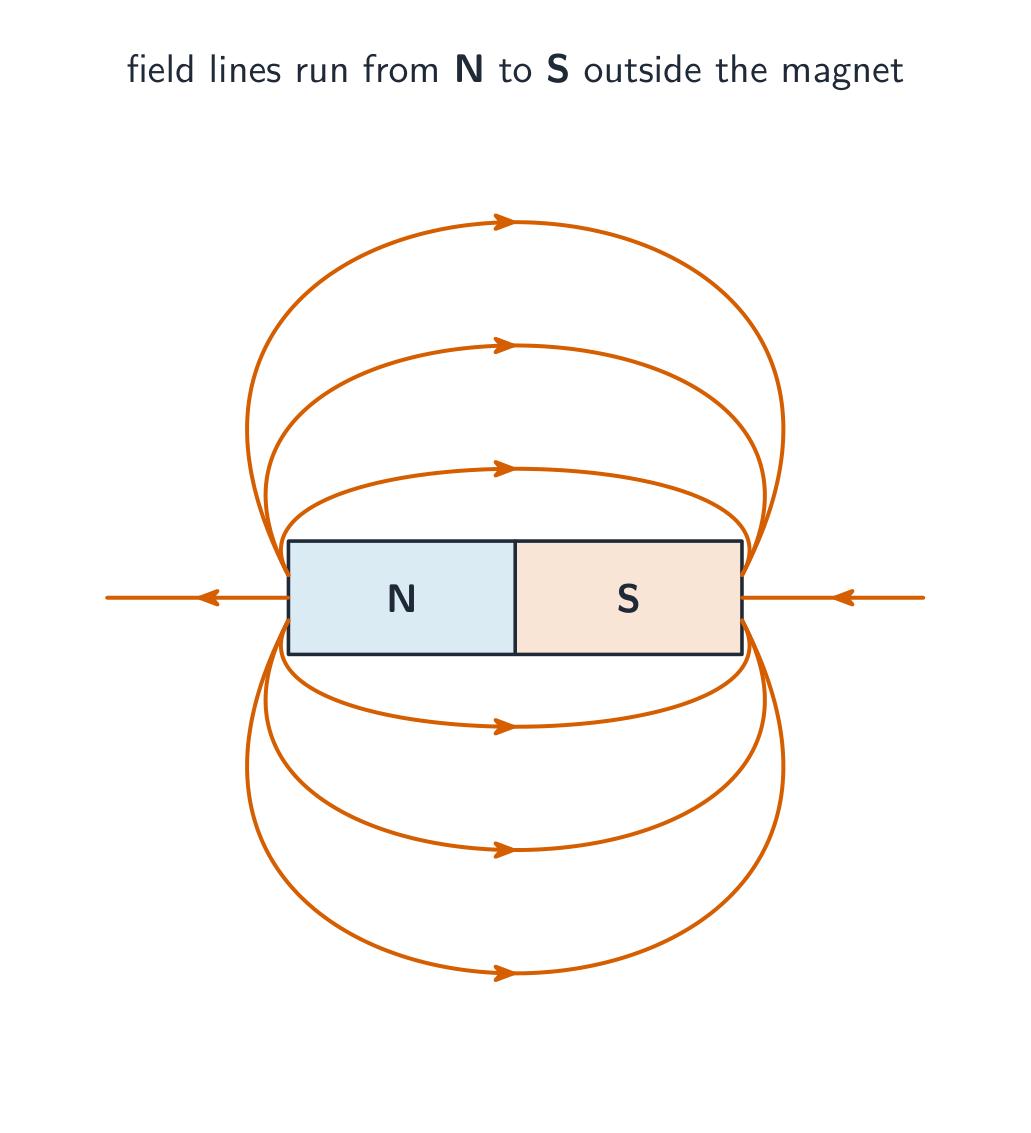
棒状磁石の外側でNからSへ向かう磁束線、磁場が強い場所ほど密に描かれている 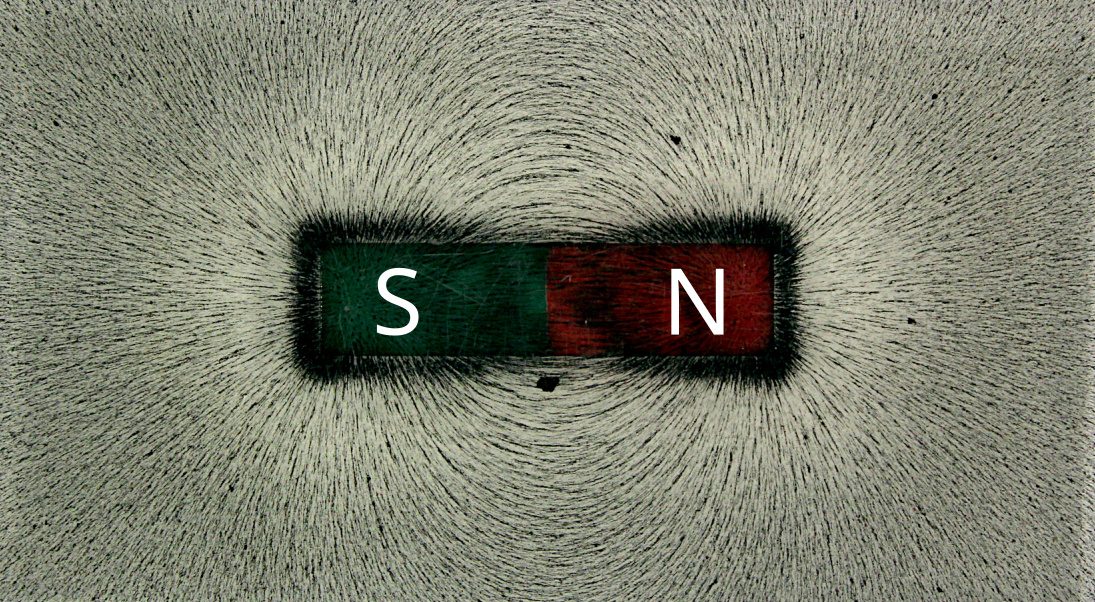
鉄粉が磁気場に沿って並び、棒状磁石の見えない磁束線を可視化する Explore · 探索See a magnet's field lines · 磁石の磁力線を見る
Magnetic field lines run from the north pole to the south pole outside the magnet. Where the lines crowd together the field is strongest. · 磁界 の磁力線は磁石の外側で北極から南極へ向かう。線が密集している場所ほど磁界は強い。
Vocabulary · 語彙 Train · 練習するEnglish 日本語 Ferromagnetic/ˌferəməɡˈnetɪk/ 強磁性体 Paramagnetic/ˌpærəməɡˈnetɪk/ 常磁性体 Diamagnetic/ˌdaɪəməɡˈnetɪk/ 反磁性体 permeability/ˌpɜːməˈbɪlɪti/ 透磁率 magnetic field/mæɡˈnetɪk fiːld/ 磁場 12.2
Magnetism and Moving Charges · 磁気と移動する電荷
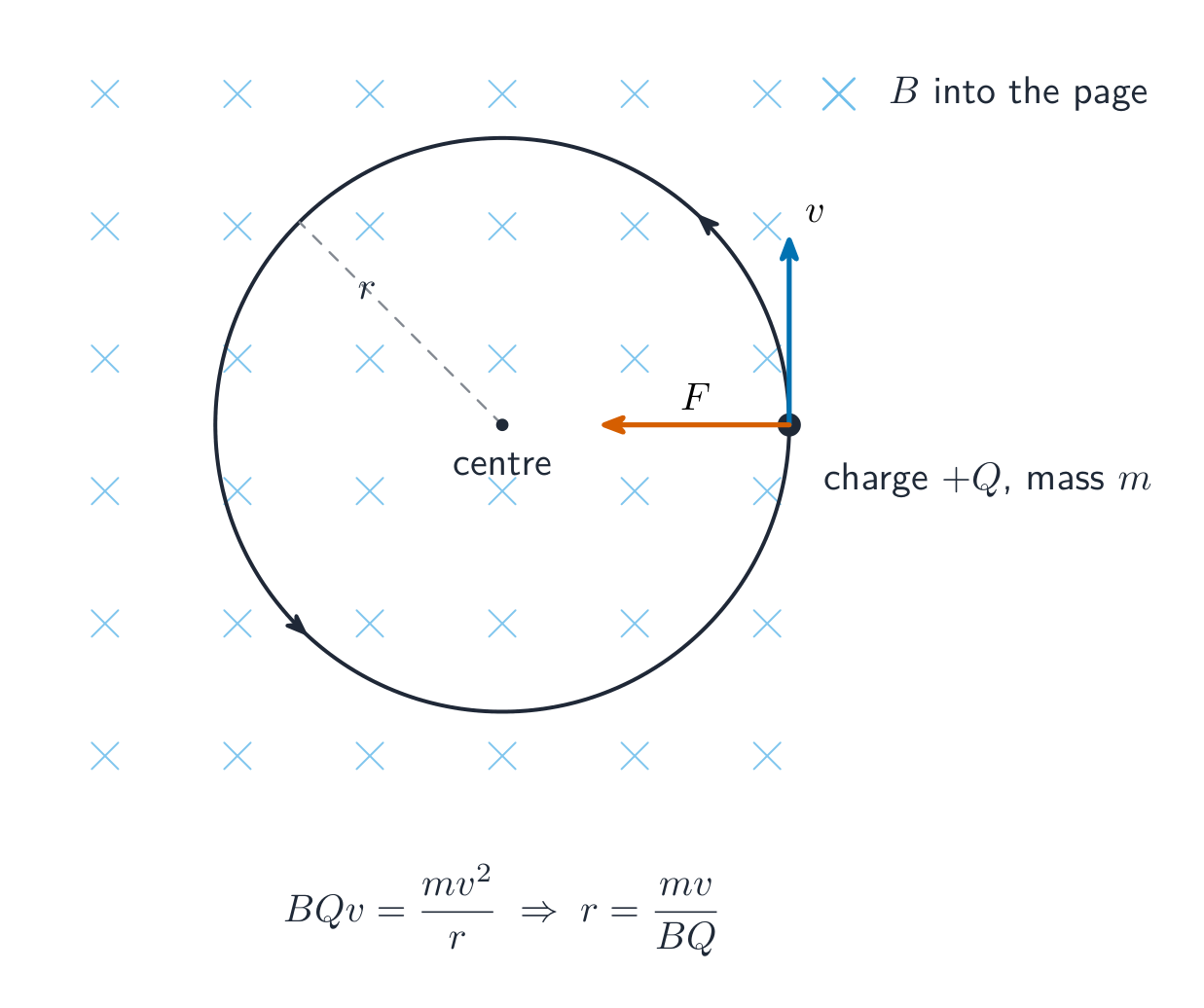
Syllabus · シラバス
EnglishLearning Objective 12.2.A: Describe the magnetic field produced by moving charged objects.
- 12.2.A.1 A single moving charged object produces a magnetic field.
- 12.2.A.1.i The magnetic field at a particular point produced by a moving charged object depends on the object's velocity and the distance between the point and the object.
- 12.2.A.1.ii At a point in space, the direction of the magnetic field produced by a moving charged object is perpendicular to both the velocity of the object and the position vector from the object to that point in space and can be determined using the right-hand rule.
- 12.2.A.1.iii The magnitude of the magnetic field is a maximum when the velocity vector and the position vector from the object to that point in space are perpendicular.
Learning Objective 12.2.B: Describe the force exerted on moving charged objects by a magnetic field.
- 12.2.B.1 Magnetic forces describe interactions between moving charged objects.
- 12.2.B.2 A magnetic field may exert a force on a charged object moving in that field.
- 12.2.B.2.i The magnitude of the force exerted by a magnetic field on a moving charged object is proportional to the magnitude of the charge, the magnitude of the charged object's velocity, and the magnitude of the magnetic field and also depends on the angle between the velocity and magnetic field vectors.
- Equation: $F_B = qvB\sin\theta$
- 12.2.B.2.ii The direction of the force exerted by a magnetic field on a moving charged object is perpendicular to both the direction of the magnetic field and the velocity of the charge, as defined by the right-hand rule.
- 12.2.B.2.i The magnitude of the force exerted by a magnetic field on a moving charged object is proportional to the magnitude of the charge, the magnitude of the charged object's velocity, and the magnitude of the magnetic field and also depends on the angle between the velocity and magnetic field vectors.
- 12.2.B.3 In a region containing both a magnetic field and an electric field, a moving charged object will experience independent forces from each field.
- 12.2.B.4 The Hall effect describes the potential difference created in a conductor by an external magnetic field that has a component perpendicular to the direction of charges moving in the conductor.
Boundary statement: Quantitative treatment of the magnitude of the magnetic force exerted by a magnetic field on a moving charge is limited to angles of 0, 90, and 180 degrees between the velocity and the magnetic field. Qualitative analysis of other angles is permitted.
日本語学習目標 12.2.A: 運動する電荷物体によって生じる磁場を説明する。
- 12.2.A.1 単一の運動する電荷物体は磁場を生ずる。
- 12.2.A.1.i 特定の点における運動する電荷物体によって生じる磁場は、その物体の速度およびその点と物体との距離に依存する。
- 12.2.A.1.ii 空間内の一点において、運動する電荷物体によって生じる磁場の方向は、物体の速度および物体からその空間の点への位置ベクトルの両方に対して垂直であり、右手則を用いて決定できる。
- 12.2.A.1.iii 磁場の大きさ(絶対値)は、速度ベクトルと空間の点への位置ベクトルが垂直な場合に最大となる。
学習目標 12.2.B: 磁場によって運動する電荷物体に作用する力を説明する。
- 12.2.B.1 磁力は運動する電荷物体間の相互作用を表す。
- 12.2.B.2 磁場はその中を運動する電荷物体に力を及ぼすことがある。
- 12.2.B.2.i 磁場が運動する電荷物体に及ぼす力の大きさは、電荷の大きさ、電荷物体の速度の大きさ、および磁場の大きさに比例し、さらに速度と磁場ベクトルのなす角度にも依存する。
- 数式: $F_B = qvB\sin\theta$
- 12.2.B.2.ii 磁場が運動する電荷物体に及ぼす力の方向は、磁場の方向および電荷の速度の方向の両方に対して垂直であり、右手則によって定義される。
- 12.2.B.2.i 磁場が運動する電荷物体に及ぼす力の大きさは、電荷の大きさ、電荷物体の速度の大きさ、および磁場の大きさに比例し、さらに速度と磁場ベクトルのなす角度にも依存する。
- 12.2.B.3 磁場と電場が共存する領域において、運動する電荷物体は各磁場から独立した力を受ける。
- 12.2.B.4 ハール効果とは、導体中の電荷の移動方向に対して成分を持つ外部磁場によって導体内に生じる電位差を指す。
境界声明: 磁場が運動する電荷に及ぼす磁力の大きさの定量的な扱いは、速度と磁場とのなす角が0度、90度、180度のみに限定される。他の角度については定性的な分析が許可されている。
Source: College Board AP Course and Exam Description · 出典: College Board AP コースおよび試験説明書
EnglishA moving charge in a magnetic field A charge moving through a magnetic field feels a magnetic force 磁力:
$$F=qvB\sin\theta,$$where $\theta$ is the angle between the velocity and the field. The force is perpendicular to both $\vec{v}$ and $\vec{B}$ (use the right-hand rule), so it changes direction but not speed – a charge moving perpendicular to a uniform field travels in a circle. A stationary charge, or one moving parallel to the field, feels no magnetic force.Worked example. A proton ($q=1.6\times10^{-19}\ \text{C}$, $m=1.67\times10^{-27}\ \text{kg}$) enters a $0.50\ \text{T}$ field at $2.0\times10^{5}\ \text{m/s}$, at right angles to the field. The magnetic force is
$$F=qvB=1.6\times10^{-19}\times2.0\times10^{5}\times0.50=1.6\times10^{-14}\ \text{N}.$$This force is the centripetal force, so it bends the proton into a circle of radius$$r=\frac{mv}{qB}=\frac{1.67\times10^{-27}\times2.0\times10^{5}}{1.6\times10^{-19}\times0.50}=4.2\times10^{-3}\ \text{m}.$$Setting $qvB=\dfrac{mv^2}{r}$ and cancelling gives that neat $r=mv/(qB)$ – the principle behind mass spectrometers.日本語磁場内の動く電荷 磁場中を移動する電荷は磁力を受けます:
$$F=qvB\sin\theta,$$ここで $\theta$ は速度と磁場のなす角です。力は $\vec{v}$ と $\vec{B}$ の両方に垂直です(右手の法則を使用)。したがって、方向は変わりますが速さは変わりません。均一な磁場に垂直に動く電荷は円を描いて進みます。静止した電荷や、磁場と平行に動く電荷には磁力は働きません。帯電粒子が磁場中を横切ると円軌道を描く ** worked example.** ($q=1.6\times10^{-19}\ \text{C}$, $m=1.67\times10^{-27}\ \text{kg}$) を持つ陽子が $0.50\ \text{T}$ 磁場内に $2.0\times10^{5}\ \text{m/s}$ で入り、磁場に対して直角に入りました。磁力は
$$F=qvB=1.6\times10^{-19}\times2.0\times10^{5}\times0.50=1.6\times10^{-14}\ \text{N}.$$この力は向心力なので、陽子を半径を持つ円に曲げます。$$r=\frac{mv}{qB}=\frac{1.67\times10^{-27}\times2.0\times10^{5}}{1.6\times10^{-19}\times0.50}=4.2\times10^{-3}\ \text{m}.$$$qvB=\dfrac{mv^2}{r}$ を設定して約分すると、綺麗な $r=mv/(qB)$ が得られます——質量分析計の原理です。Vocabulary · 語彙 Train · 練習するEnglish 日本語 magnetic force/mæɡˈnetɪk fɔːs/ 磁気力 12.3
Magnetism and Current-Carrying Wires · 磁性と電流を流す導線
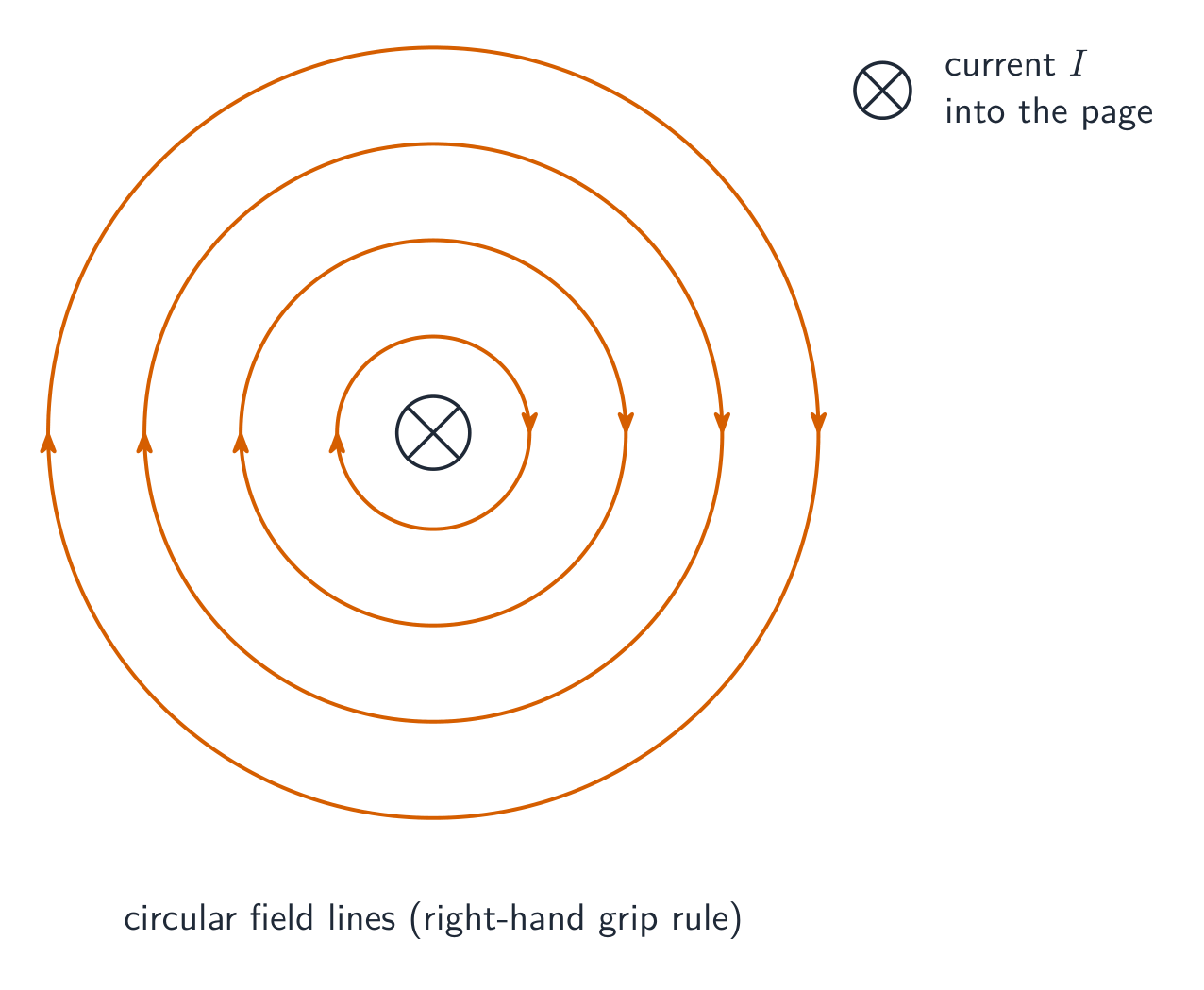
Syllabus · シラバス
EnglishLearning Objective 12.3.A: Describe the magnetic field produced by a current-carrying wire.
- 12.3.A.1 A current-carrying wire produces a magnetic field.
- 12.3.A.1.i The magnetic field vectors around a long, straight, current-carrying wire are tangent to concentric circles centered on that wire. The field has no component toward, away from, or parallel to the long, straight, current-carrying wire.
- 12.3.A.1.ii At a point in space, the magnitude of the magnetic field due to a long, straight, current-carrying wire is proportional to the magnitude of the current in the wire and inversely proportional to the perpendicular distance from the central axis of the wire to the point.
- Equation: $B = \dfrac{\mu_0}{2\pi}\dfrac{I}{r}$
- 12.3.A.1.iii The direction of the magnetic field created by a current-carrying wire is determined with the right-hand rule.
- 12.3.A.1.iv The direction of the magnetic field at the center of a current-carrying loop is directed along the axis of the loop and can be found using the right-hand rule.
- 12.3.A.1.v The magnetic field at a location near two or more current-carrying wires can be determined using vector addition principles.
Learning Objective 12.3.B: Describe the force exerted on a current-carrying wire by a magnetic field.
- 12.3.B.1 A magnetic field may exert a force on a current-carrying wire.
- 12.3.B.1.i The magnitude of the force exerted by a magnetic field on a current-carrying wire is proportional to the current, the length of the portion of the wire within the magnetic field, and the magnitude of the magnetic field, and also depends on the angle between the direction of the current in the wire and the direction of the magnetic field.
- Equation: $F_B = I\ell B\sin\theta$
- 12.3.B.1.ii The direction of the force exerted by the magnetic field on a current-carrying wire is determined by the right-hand rule.
- 12.3.B.1.i The magnitude of the force exerted by a magnetic field on a current-carrying wire is proportional to the current, the length of the portion of the wire within the magnetic field, and the magnitude of the magnetic field, and also depends on the angle between the direction of the current in the wire and the direction of the magnetic field.
日本語学習目標 12.3.A: 電流を流す導線によって生じる磁場を説明する。
- 12.3.A.1 電流を流す導線は磁場を生ずる。
- 12.3.A.1.i 長い直線状の電流を流す導線の周囲の磁場ベクトルは、その導線を中心とする同心円に沿った接線方向である。磁場は、長い直線状の電流を流す導線 toward, away from, or parallel to の成分を持たない。
- 12.3.A.1.ii 空間内の一点において、長い直線状の電流を流す導線による磁場の大きさは、導線内の電流の大きさに比例し、導線の中心軸からその点までの垂直距離に反比例する。
- 数式: $B = \dfrac{\mu_0}{2\pi}\dfrac{I}{r}$
- 12.3.A.1.iii 電流を流す導線によって生じる磁場の方向は、右手則で決定される。
- 12.3.A.1.iv 電流を流すループの中心における磁場の方向はループの軸に沿って向いており、右手則を用いて見つけることができる。
- 12.3.A.1.v 二つ以上の電流を流す導線の近くにある地点における磁場は、ベクトル加算の原理を用いて決定できる。
学習目標 12.3.B: 磁場によって電流を流す導線に作用する力を説明する。
- 12.3.B.1 磁場は電流を流す導線に力を及ぼすことがある。
- 12.3.B.1.i 磁場が電流を流す導線に及ぼす力の大きさは、電流、磁場内にある導線の部分の長さ、および磁場の大きさに比例し、さらに導線内の電流の方向と磁場の方向のなす角度にも依存する。
- 数式: $F_B = I\ell B\sin\theta$
- 12.3.B.1.ii 磁場が電流を流す導線に及ぼす力の方向は、右手則によって決定される。
- 12.3.B.1.i 磁場が電流を流す導線に及ぼす力の大きさは、電流、磁場内にある導線の部分の長さ、および磁場の大きさに比例し、さらに導線内の電流の方向と磁場の方向のなす角度にも依存する。
Source: College Board AP Course and Exam Description · 出典: College Board AP コースおよび試験説明書
EnglishBecause a current is moving charge, a magnetic field pushes on a current-carrying wire:
$$F=BIL\sin\theta.$$A current also creates its own magnetic field: circular field lines wrap around a straight wire (right-hand rule), and a coil (solenoid) makes a field like a bar magnet. This is how electromagnets and motors work.Worked example. A $0.30\ \text{m}$ length of wire carries $4.0\ \text{A}$ at right angles to a $0.20\ \text{T}$ field. The force on it is $F=BIL=0.20\times4.0\times0.30=0.24\ \text{N}$ – the push that turns a motor's coil.
日本語電流は移動する電荷であるため、磁場は電流を流す導線に力を与えます:
$$F=BIL\sin\theta.$$また、電流は自身の磁場を生み出します。直線の導線を取り巻くように同心円状の磁束線が形成され(右手の法則)、コイル(ソレノイド)は棒磁石のような磁場を作ります。これが電磁石やモーターの動作原理です。直線導体を取り巻く同心円状の磁場線 ** worked example.** 長さ $0.30\ \text{m}$ の導線に $4.0\ \text{A}$ の電流が流れ、$0.20\ \text{T}$ 磁場に対して直角に入っています。これにかかる力は $F=BIL=0.20\times4.0\times0.30=0.24\ \text{N}$ —— モーターのコイルを回転させる力です。
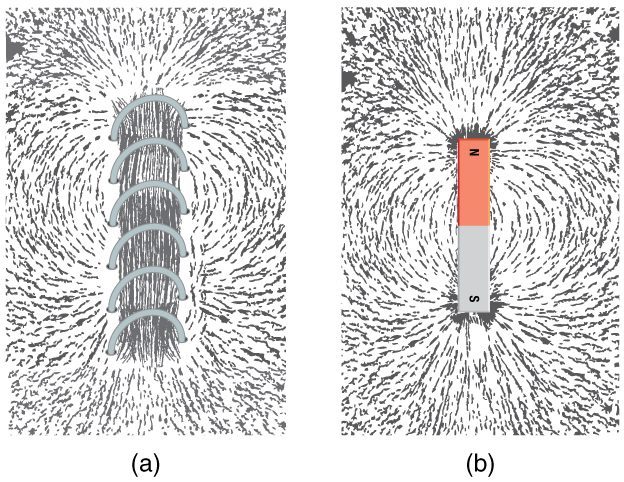
電流が流れるコイル(ソレノイド)は棒磁石のような形状の磁場を生む Explore · 探索Find the force on a current in a field · 磁場中の電流に働く力を見つける
A current in a magnetic field feels a force $F = BIL$, at right angles to both. Use the left-hand rule; reverse the current or field and the force flips. · 磁場中の電流は $F = BIL$ という力を受け、それは両方に直角である。左手の法則を用いる;電流または磁場を逆転させると力も逆転する。
12.4
Electromagnetic Induction and Faraday's Law · 電磁誘起とファラデーの法則
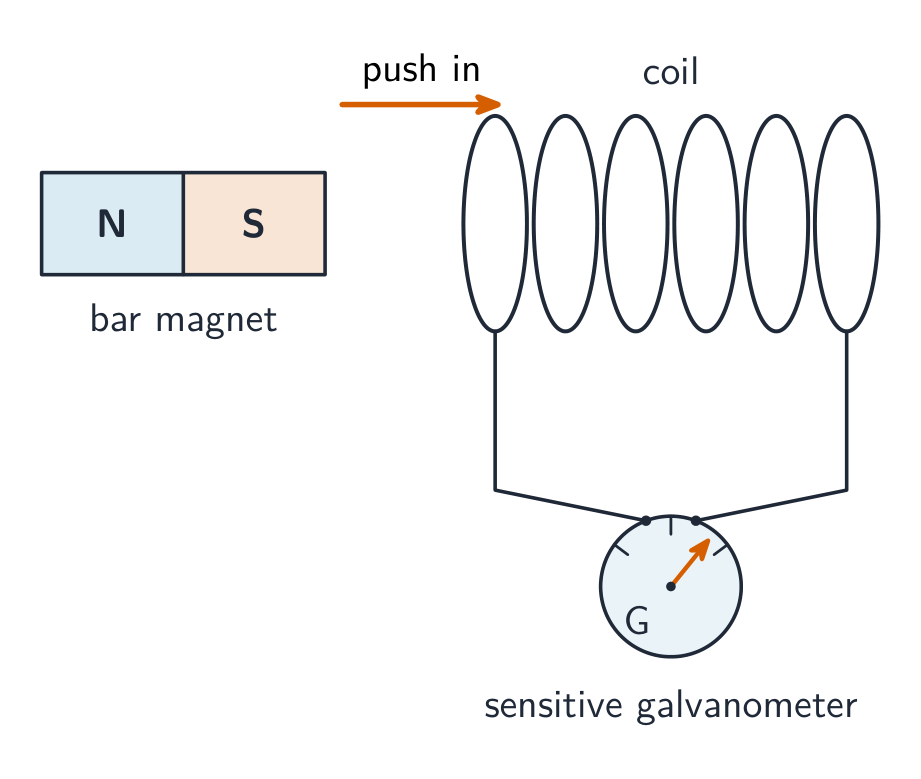
Syllabus · シラバス
EnglishLearning Objective 12.4.A: Describe the induced electric potential difference resulting from a change in magnetic flux.
- 12.4.A.1 Magnetic flux is a description of the amount of the component of a magnetic field that is perpendicular to a cross-sectional area.
- 12.4.A.2 Magnetic flux through a surface is proportional to the magnitude of the component of the magnetic field perpendicular to the surface and to the cross-sectional area of the surface.
- Equation: $\Phi_B = BA\cos\theta$
- 12.4.A.2.i The area vector is defined to be perpendicular to the plane of the surface and directed outward from a closed surface.
- 12.4.A.2.ii The sign of the magnetic flux indicates whether the magnetic field is parallel to or antiparallel to the area vector.
- 12.4.A.3 Faraday’s law describes the relationship between changing magnetic flux and the resulting induced emf in a system.
- Equation: $|\mathcal{E}| = \left|\dfrac{\Delta\Phi_B}{\Delta t}\right|$
- 12.4.A.4 Lenz’s law is used to determine the direction of an induced emf resulting from a changing magnetic flux.
- Equation: $\mathcal{E} = -\dfrac{\Delta\Phi_B}{\Delta t} = -\dfrac{\Delta(BA\cos\theta)}{\Delta t}$
- 12.4.A.4.i An induced emf generates a current that creates a magnetic field that opposes the change in magnetic flux.
- 12.4.A.4.ii The right-hand rule is used to determine the relationships between current, emf, and magnetic flux.
- 12.4.A.5 A common example of electromagnetic induction is a conducting rod on conducting rails in a region with a uniform magnetic field.
- Derived equation: $\mathcal{E} = B\ell v$
日本語学習目標 12.4.A: 磁束の変化に伴って生じる誘起電気電位差を説明する。
- 12.4.A.1 磁束とは、磁場のうち断面積に対して垂直な成分の量を記述するものである。
- 12.4.A.2 面を貫通する磁束は、磁場のうち面に対して垂直な成分の大きさに比例し、面の断面積にも比例する。
- 式: $\Phi_B = BA\cos\theta$
- 12.4.A.2.i 面積ベクトルは、面の平面に対して垂直に定義され、閉じた表面からは外向きに向かう。
- 12.4.A.2.ii 磁束の符号は、磁場が面積ベクトルと平行か反平行かを示す。
- 12.4.A.3 ファラデーの法則は、磁束の変化とそれに伴う系内の誘起起電力との関係性を記述する。
- 式: $|\mathcal{E}| = \left|\dfrac{\Delta\Phi_B}{\Delta t}\right|$
- 12.4.A.4 レンツの法則は、磁束の変化に伴って生じる誘起起電力の方向を決定するために用いられる。
- 式: $\mathcal{E} = -\dfrac{\Delta\Phi_B}{\Delta t} = -\dfrac{\Delta(BA\cos\theta)}{\Delta t}$
- 12.4.A.4.i 誘起起電力は電流を生じ、その電流が作る磁場は磁束の変化に反対する。
- 12.4.A.4.ii 右手の法則は、電流、起電力(EMF)、磁束の間の関係性を決定するために用いられる。
- 12.4.A.5 電磁誘起の一般的な例として、均一な磁場内にある導電レール上の導電棒がある。
- 導出された式: $\mathcal{E} = B\ell v$
Source: College Board AP Course and Exam Description · 出典: College Board AP コースおよび試験説明書
EnglishElectromagnetic induction A changing magnetic field through a loop drives a current – electromagnetic induction 电磁感应. The magnetic flux 磁通量 $\Phi=BA\cos\theta$ measures how much field passes through the loop. Faraday's law 法拉第定律 gives the induced emf:
$$\varepsilon=-\frac{\Delta\Phi}{\Delta t}.$$The flux changes if the field, the area, or the loop's orientation changes. Lenz's law 楞次定律 (the minus sign) says the induced current flows so as to oppose the change that caused it – the basis of generators.Worked example. The magnetic flux through a single loop drops from $0.020\ \text{Wb}$ to $0.008\ \text{Wb}$ in $0.030\ \text{s}$. The average induced emf is
$$\varepsilon=\left|\frac{\Delta\Phi}{\Delta t}\right|=\frac{0.020-0.008}{0.030}=0.40\ \text{V}.$$A coil of $N$ turns would give $N$ times this – which is why generators and transformers use many-turn coils.日本語電磁誘起 ループを通る変化する磁場は電流を駆動します——これが電磁誘起です。磁束 $\Phi=BA\cos\theta$ はループを通る磁場の量を表します。ファラデーの法則は誘起起電力を次のように与えます:
$$\varepsilon=-\frac{\Delta\Phi}{\Delta t}.$$磁束は、磁場、面積、あるいはループの向きが変わることで変化します。レンツの法則(マイナス記号)は、誘起電流がその変化を妨げるように流れることを示しており、発電機の基礎となっています。コイルに磁石を挿入すると起電力が生じ、電流を駆動させる ** worked example.** 単一ループを通る磁束が $0.020\ \text{Wb}$ から $0.008\ \text{Wb}$ に $0.030\ \text{s}$ で減少しました。平均誘起起電力は
$$\varepsilon=\left|\frac{\Delta\Phi}{\Delta t}\right|=\frac{0.020-0.008}{0.030}=0.40\ \text{V}.$$$N$ 巻きのコイルであれば、この $N$ 倍の値になります——これが発電機やトランスが多巻きコイルを使用する理由です。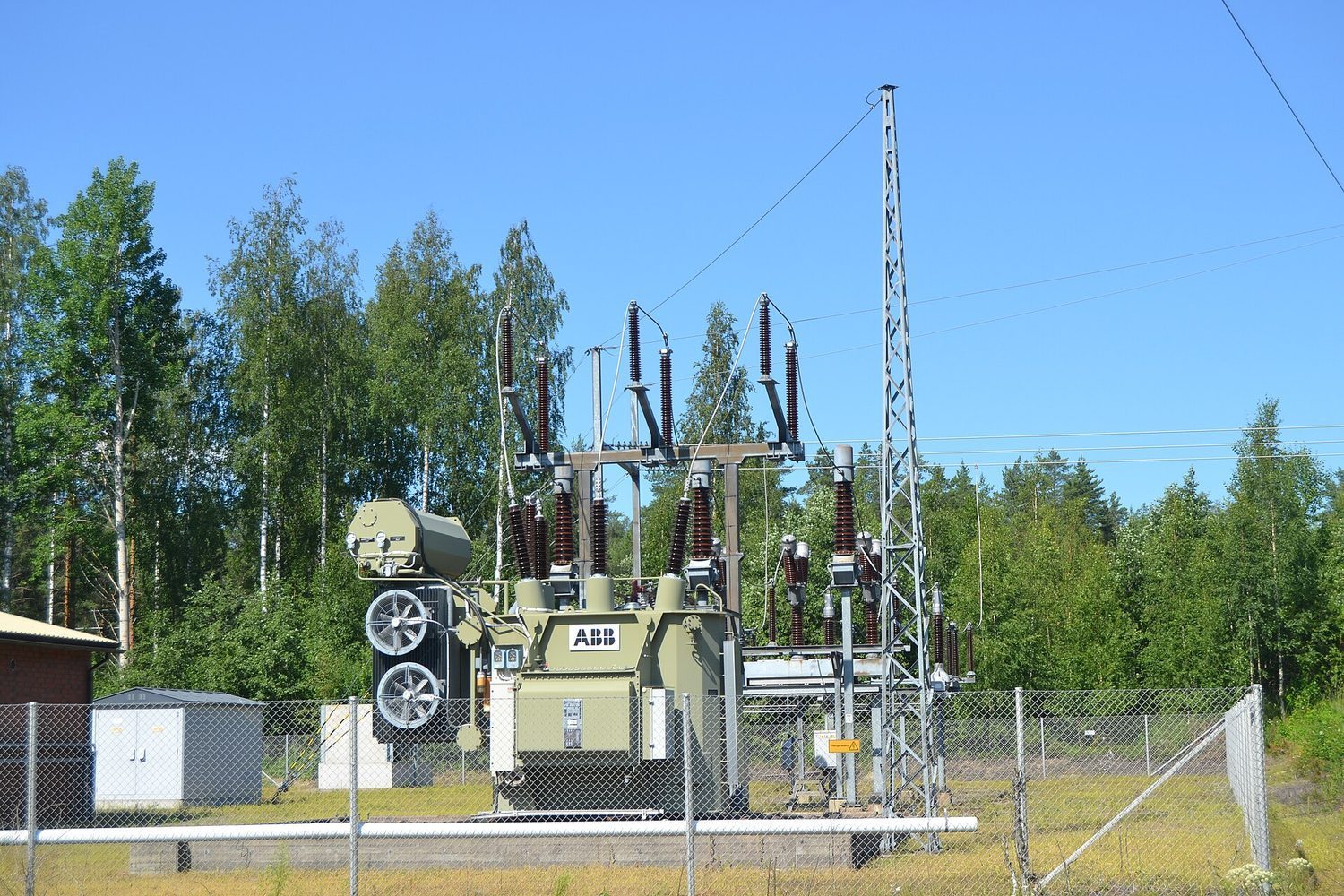
変電所の変圧器: コイル内の磁束変化が送電網を駆動する電圧を生み出す Explore · 探索Induce a voltage by moving a magnet · 磁石を動かして電圧を誘起する
Faraday's law: a changing magnetic flux through a coil induces a voltage. Move the magnet faster and the induced EMF grows; Lenz's law sets its direction to oppose the change. · ファラデーの法則 :コイルを貫く磁束の変化が電圧を誘起する。磁石を速く動かすと誘起 EMF は増大し、レンツの法則 がその方向を変化に反対するよう定める。
Vocabulary · 語彙 Train · 練習するEnglish 日本語 electromagnetic induction/ɪˌlektrəʊməɡˈnetɪk ɪnˈdʌkʃn/ 電磁誘導 magnetic flux/mæɡˈnetɪk flʌks/ 磁気磁束 Faraday's law/ˈfærədeɪz lɔː/ ファラデーの法則 Lenz's law/ˈlentsɪz lɔː/ レンツの法則 12.4
Exam tips · 試験対策
English- The magnetic force $F=qvB\sin\theta$ is perpendicular to the velocity, so it changes direction (a circle) but not speed; a stationary charge or one moving along the field feels no force.
- Use $F=BIL$ for the force on a current-carrying wire (the motor effect).
- A current creates a magnetic field (circles around a wire; a solenoid acts like a bar magnet).
- Induction needs a changing flux $\Phi=BA$ — a stationary magnet in a coil induces nothing.
- Faraday: $\varepsilon=\Delta\Phi/\Delta t$ (times $N$ turns); Lenz: the induced current opposes the change (energy conservation).
日本語- 磁力 $F=qvB\sin\theta$ は速度に垂直なので、方向は変わる(円を描く)が速さは変わらず、静止している電荷や磁場と並行に動く電荷には力が働きません。
- 電流を流す導線にかかる力には $F=BIL$ を用います(モーター効果)。
- 電流は磁場を生み出す(導線の周りに円を描き、ソレノイドは棒磁石のように振る舞う)。
- 誘起には変化する磁束 $\Phi=BA$ が必要です——コイル内の静止した磁石では何も誘起されません。
- ファラデー: $\varepsilon=\Delta\Phi/\Delta t$ (× $N$ 巻き); レンツ: 誘起電流は変化を妨げる(エネルギー保存則)。
- 12.1.A.1 A magnetic field is a vector field that can be used to determine the magnetic force exerted on moving electric charges, electric currents, or magnetic materials.
-
13
Geometric Optics
Watch lesson · レッスンを視聴13.1
Reflection
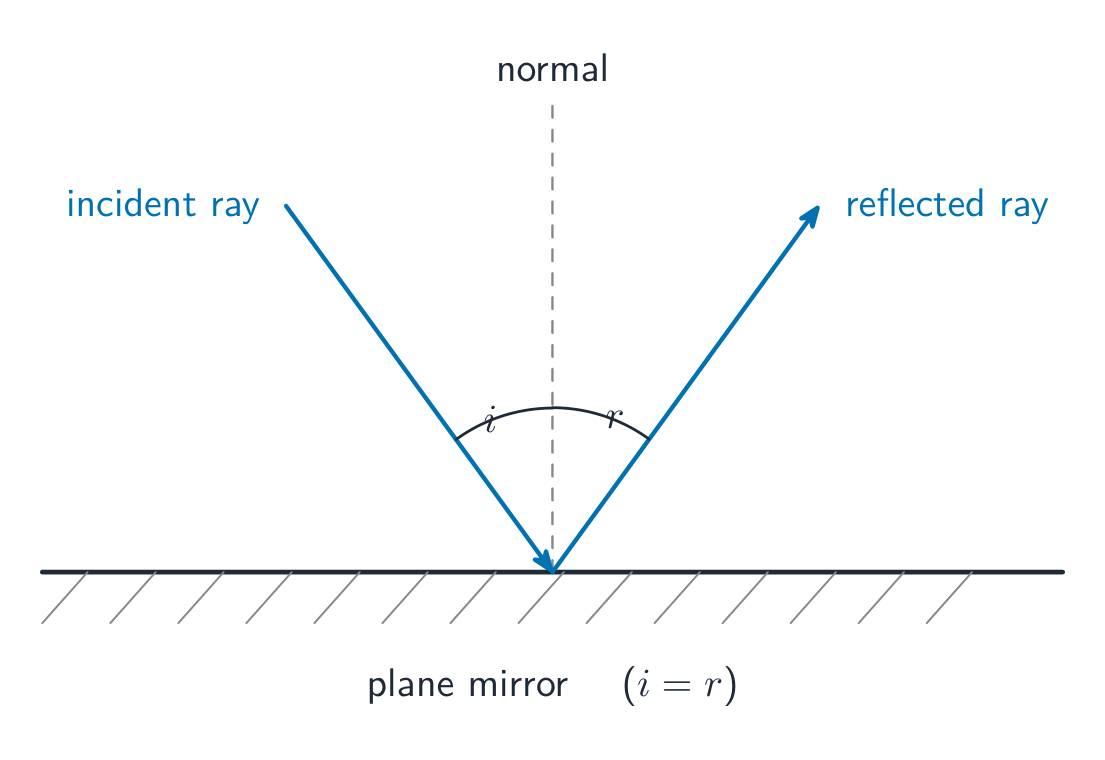
Syllabus · シラバス
EnglishLearning Objective 13.1.A: Describe light as a ray.
- 13.1.A.1 A light ray is a straight line that is perpendicular to the wavefront of a light wave and points in the direction of travel of the wave.
- 13.1.A.1.i Light rays can be used to determine the behavior of light in geometric optics, where the wave nature of light can be neglected.
- 13.1.A.1.ii Rays are not sufficient to understand the spreading of light. In interference and diffraction, the wave nature of the light is important.
- 13.1.A.1.iii A laser is a common source of a single coherent, monochromatic beam of light that can be modeled as a ray. The wave nature of lasers will be considered in Unit 14.
- 13.1.A.2 Ray diagrams depict the path of light before and after an interaction with matter.
Learning Objective 13.1.B: Describe the reflection of light from a surface.
- 13.1.B.1 Light that is incident on a surface can be reflected.
- 13.1.B.2 The law of reflection states that the angle between the incident ray and the normal (the line perpendicular to the surface) is equal to the angle between the reflected ray and the normal.
- Equation: $\theta_i = \theta_r$
- 13.1.B.3 Diffuse reflection is the reflection of light from a rough surface and results in light reflected in many different directions, because the line normal to the surface varies over the area over which the light is incident.
- 13.1.B.4 Specular reflection is the reflection of light from a smooth surface and results in light uniformly reflected from the surface, because the line normal to the surface has an approximately constant direction over the area the light strikes.
日本語学習目標 13.1.A: 光を光線として記述する。
- 13.1.A.1 光線とは、光波の波面前に垂直で、波の進行方向を指す直線である。
- 13.1.A.1.i 光線の波動性を無視できる幾何光学において、光線の挙動を決定するために光線が用いられる。
- 13.1.A.1.ii 光線の拡散を理解するには光線だけでは不十分である。干渉や回折では、光の波動性が重要となる。
- 13.1.A.1.iii レーザーは、光線としてモデル化できる単一のコヒーレントな単色光ビームの一般的な発生源である。レーザーの波動性については、ユニット14で扱う。
- 13.1.A.2 光線図は、物質との相互作用前後における光の経路を示す。
学習目標 13.1.B: 表面からの光の反射を記述する。
- 13.1.B.1 表面に入射した光は反射される。
- 13.1.B.2 反射の法則によれば、入射光線と法線(表面に垂直な直線)との角は、反射光線と法線との角と等しい。
- 式: $\theta_i = \theta_r$
- 13.1.B.3 拡散反射とは、粗い表面からの光の反射であり、入射光の範囲全体で法線の向きが異なるため、光が様々な方向へ反射される。
- 13.1.B.4 鏡面反射とは、滑らかな表面からの光の反射であり、光が当たる範囲内で法線の向きがほぼ一定であるため、光が表面から均等に反射される。
Source: College Board AP Course and Exam Description · 出典: College Board AP コースおよび試験説明書
EnglishGeometric optics 几何光学 treats light as straight-line rays. The law of reflection 反射定律: when light bounces off a surface, the angle of incidence 入射角 equals the angle of reflection 反射角, both measured from the normal (the line perpendicular to the surface). Smooth surfaces reflect a clear image; rough surfaces scatter the rays.
日本語Geometric optics 几何光学 treats light as straight-line rays. The law of reflection 反射定律: when light bounces off a surface, the angle of incidence 入射角 equals the angle of reflection 反射角, both measured from the normal (the line perpendicular to the surface). Smooth surfaces reflect a clear image; rough surfaces scatter the rays.
The law of reflection: the angle of incidence equals the angle of reflection Vocabulary · 語彙 Train · 練習するEnglish 日本語 Geometric optics/ˌdʒiːəʊˈmetrɪk ˈɒptɪks/ 幾何光学 law of reflection/lɔː ɒv rɪˈflekʃn/ 反射の法則 angle of incidence/ˈæŋɡl ɒv ˈɪnsɪdəns/ 入射角 angle of reflection/ˈæŋɡl ɒv rɪˈflekʃn/ 反射角 13.2
Images Formed by Mirrors
Syllabus · シラバス
EnglishLearning Objective 13.2.A: Describe the image formed by a mirror.
- 13.2.A.1 Incident light rays parallel to the principal axis of a concave (converging) mirror will be reflected toward a common location, called the focal point.
- 13.2.A.2 Incident light rays parallel to the principal axis of a convex (diverging) mirror will be reflected such that they appear to have originated from a common location behind the mirror, called the focal point.
- 13.2.A.3 The focal point of a plane mirror is an infinite distance from the mirror.
- 13.2.A.4 The focal point of a spherical mirror may be approximated as a point located on the principal axis of the mirror halfway between the surface of the mirror and the center of the mirror's radius of curvature.
- 13.2.A.5 A real image is formed by a mirror when light rays emanating from a common point are reflected and then intersect at a common point.
- 13.2.A.6 A virtual image is formed by a mirror when reflected light rays diverge such that they appear to have originated from a common point.
- 13.2.A.7 The location of an image depends on the focal length of the mirror and the distance between the object and the surface of the mirror.
- Equation: $\dfrac{1}{s_i} + \dfrac{1}{s_o} = \dfrac{1}{f}$
- 13.2.A.7.i The locations of a mirror's focal point, an object near the mirror, and the image of the object formed by the mirror follow sign conventions that are used to determine those locations relative to the mirror itself.
- 13.2.A.7.ii The distance between the image formed and a plane mirror is equal to the distance between the object and the plane mirror.
- 13.2.A.8 The magnification of an image formed by a mirror is the ratio of the size of the image produced to the size of the object itself and depends on the locations of the object and image relative to the mirror.
- Equation: $|M| = \left| \dfrac{h_i}{h_o} \right| = \left| \dfrac{s_i}{s_o} \right|$
- 13.2.A.9 Ray diagrams can be used to determine the location, type, size, and orientation of images formed by mirrors.
- 13.2.A.9.i The three principal rays are typically used to find the images formed by mirrors. The principal rays are 1) the ray parallel to the principal axis, 2) the ray that reflects at the center of the mirror where the principal axis intersects the mirror, and 3) the ray that passes through the focal point of the mirror.
- 13.2.A.9.ii Images formed by a mirror can be upright or inverted, virtual or real, and reduced, enlarged, or the same size as the object.
Boundary statement: AP Physics 2 limits the study of mirrors to plane mirrors, convex spherical mirrors, and concave spherical mirrors.
日本語学習目標 13.2.A: 鏡によって形成される像を記述する。
- 13.2.A.1 凹面鏡(収束鏡)の主軸に平行な入射光線は、焦点と呼ばれる一点に反射して集まる。
- 13.2.A.2 凸面鏡(発散鏡)の主軸に平行な入射光線は、鏡の裏側にある焦点と呼ばれる一点から出たかのように反射される。
- 13.2.A.3 平面鏡の焦点は、鏡から無限遠の位置にある。
- 13.2.A.4 球面鏡の焦点は、主軸上において鏡の表面と曲率中心の中間点にある点として近似できる。
- 13.2.A.5 実像とは、ある一点から放射された光線が反射されて再び一点で交わることで鏡によって形成される像である。
- 13.2.A.6 虚像とは、反射光線が発散し、それらが一点から出たかのように見えることで鏡によって形成される像である。
- 13.2.A.7 像の位置は、鏡の焦点距離と物体と鏡面との距離に依存する。
- 式: $\dfrac{1}{s_i} + \dfrac{1}{s_o} = \dfrac{1}{f}$
- 13.2.A.7.i 鏡の焦点、鏡の近くの物体、および鏡によって形成される像の位置は、それらが鏡自体に対してどの位置にあるかを決定するために用いられる符号則に従う。
- 13.2.A.7.ii 平面鏡によって形成された像と平面鏡との距離は、物体と平面鏡との距離に等しい。
- 13.2.A.8 鏡によって形成される像の倍率は、生成された像の大きさと物体そのものの大きさの比であり、物体と像が鏡に対してどの位置にあるかに依存する。
- 式: $|M| = \left| \dfrac{h_i}{h_o} \right| = \left| \dfrac{s_i}{s_o} \right|$
- 13.2.A.9 光線図は、鏡によって形成される像の位置、種類、大きさ、向きを決定するために使用できる。
- 13.2.A.9.i 鏡によって形成される像を見つけるために通常用いられる3本の主光線がある。主光線とは、1) 主軸に平行な光線、2) 主軸と鏡の交点である鏡の中心で反射する光線、および3) 鏡の焦点を通る光線のことを指す。
- 13.2.A.9.ii 鏡によって形成される像は、正立または逆立、虚像または実像、縮小、拡大、あるいは物体と同じ大きさであることがある。
境界文: AP Physics 2 は、鏡の研究を平面鏡、凸面球面鏡、凹面球面鏡に限定している。
Source: College Board AP Course and Exam Description · 出典: College Board AP コースおよび試験説明書
EnglishA curved mirror focuses parallel rays at its focal point, a distance $f$ from the mirror. The mirror equation relates object and image distances:
$$\frac{1}{d_o}+\frac{1}{d_i}=\frac{1}{f},\qquad m=-\frac{d_i}{d_o}.$$A concave mirror 凹面镜 (converging) can form a real image 实像 (rays actually meet, projectable, inverted); a convex mirror 凸面镜 always forms a virtual image 虚像 (rays only appear to meet, upright, reduced). The magnification $m$ gives the image's size and orientation. Sign convention matters: a negative image distance means a virtual image behind the mirror or lens.日本語A curved mirror focuses parallel rays at its focal point, a distance $f$ from the mirror. The mirror equation relates object and image distances:
$$\frac{1}{d_o}+\frac{1}{d_i}=\frac{1}{f},\qquad m=-\frac{d_i}{d_o}.$$A concave mirror 凹面镜 (converging) can form a real image 实像 (rays actually meet, projectable, inverted); a convex mirror 凸面镜 always forms a virtual image 虚像 (rays only appear to meet, upright, reduced). The magnification $m$ gives the image's size and orientation. Sign convention matters: a negative image distance means a virtual image behind the mirror or lens.Explore · 探索Form an image with a curved mirror · 曲面鏡で像を形成する
A concave mirror reflects rays through its focus. The object's distance relative to the focal length decides whether the image is real or virtual, enlarged or reduced. · 凹面鏡 は光線を焦点に通す。焦点距離に対する物体の距離が、像が実像か虚像か、拡大か縮小かを決定する。
Vocabulary · 語彙 Train · 練習するEnglish 日本語 concave mirror/kɒnˈkeɪv ˈmɪrə/ 凹面鏡 real image/rɪəl ˈɪmɪdʒ/ 実像 convex mirror/kɒnˈveks ˈmɪrə/ 凸面鏡 virtual image/ˈvɜːtʃuːəl ˈɪmɪdʒ/ 虚像 13.3
Refraction
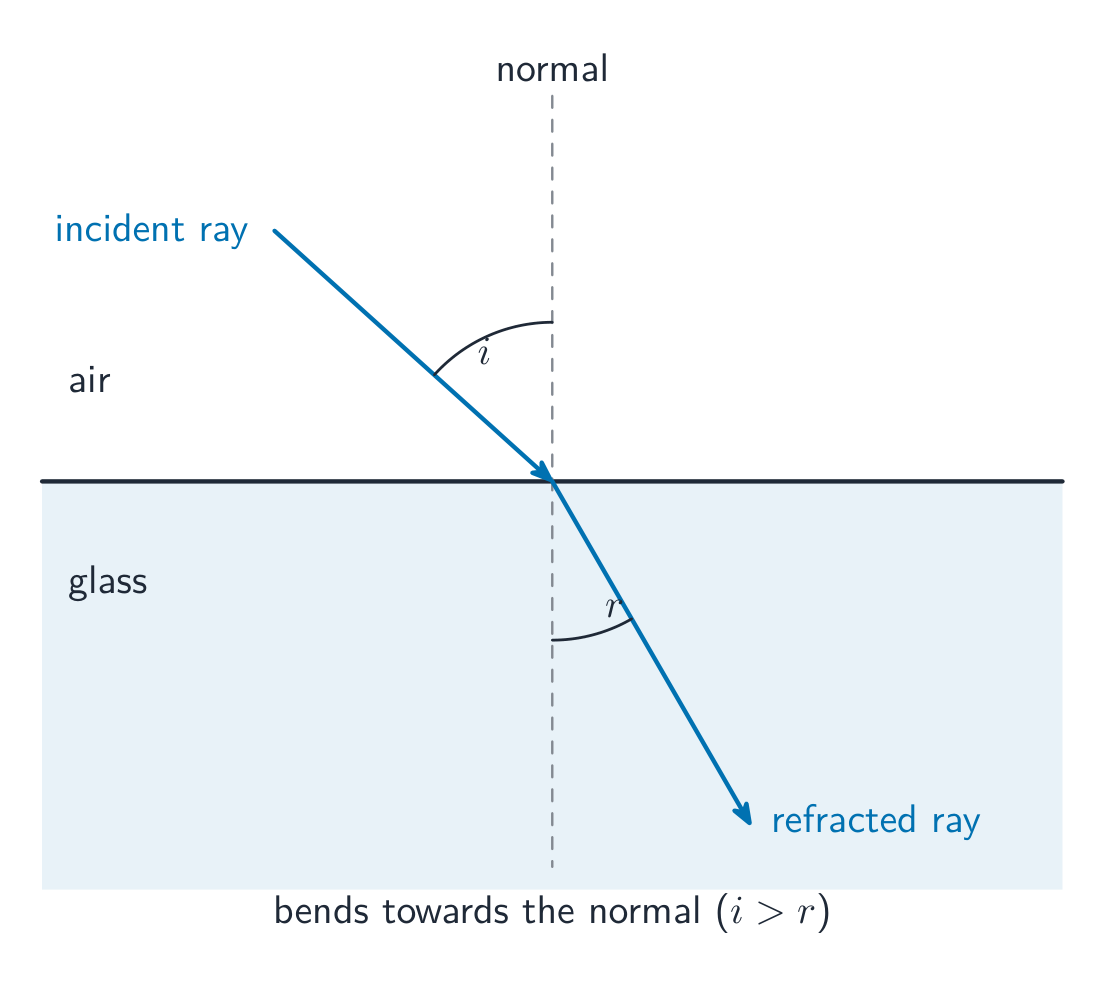
Syllabus · シラバス
EnglishLearning Objective 13.3.A: Describe the refraction of light between two media.
- 13.3.A.1 Refraction is the change in direction of a light ray as the ray passes from one medium into another.
- 13.3.A.2 Refraction is a result of the speed of light changing when light enters a new medium.
- 13.3.A.3 The index of refraction of a given medium is inversely proportional to the speed of light in the medium.
- Equation: $n = \dfrac{c}{v}$
- 13.3.A.4 Snell's law relates the angles of incidence and refraction of a light ray passing from one medium into another to the indices of refraction of the two media.
- Equation: $n_1 \sin\theta_1 = n_2 \sin\theta_2$
- 13.3.A.4.i When a light ray travels from a medium with a higher index of refraction into a medium with a lower index of refraction, the ray refracts away from the normal.
- 13.3.A.4.ii When a light ray travels from a medium with a lower index of refraction into a medium with a higher index of refraction, the ray refracts toward the normal.
- 13.3.A.4.iii When a light ray is incident along the normal to a surface, the transmitted ray is not refracted.
- 13.3.A.5 Total internal reflection may occur when light passes from one medium into another medium with a lower index of refraction.
- 13.3.A.5.i Total internal reflection of light occurs beyond a critical angle of incidence.
- Derived equation: $\theta_{\text{critical}} = \sin^{-1}\left( \dfrac{n_2}{n_1} \right)$
- 13.3.A.5.ii For incident rays at the critical angle, the ray refracts at 90 degrees and travels along the surface of the material.
- 13.3.A.5.iii For incident rays beyond the critical angle, all light is reflected (no light is transmitted into the other medium).
- 13.3.A.5.i Total internal reflection of light occurs beyond a critical angle of incidence.
日本語学習目標 13.3.A: 2つの媒質間の光の屈折を説明する。
- 13.3.A.1 屈折とは、光線が1つの媒質から別の媒質へ通過する際に進行方向が変わる現象である。
- 13.3.A.2 屈折は、光が新しい媒質に入射したときに光速が変化する結果として生じる。
- 13.3.A.3 特定の媒質の屈折率は、その媒質内での光の速度に反比例する。
- 式: $n = \dfrac{c}{v}$
- 13.3.A.4 スネルの法則は、1つの媒質から別の媒質へ通過する光線の入射角と屈折角が、2つの媒質の屈折率と関係することを示している。
- 式: $n_1 \sin\theta_1 = n_2 \sin\theta_2$
- 13.3.A.4.i 光線が高屈折率の媒質から低屈折率の媒質へ進む場合、光線は法線から離れて屈折する。
- 13.3.A.4.ii 光線が低屈折率の媒質から高屈折率の媒質へ進む場合、光線は法線に向かって屈折する。
- 13.3.A.4.iii 光線が表面法線に沿って入射する場合、透過光は屈折しない。
- 13.3.A.5 光が屈折率が低い媒質へ入射する際に全反射が生じることがある。
- 13.3.A.5.i 光の全反射は、入射角が臨界角を超えたときに生じる。
- 導出された数式: $\theta_{\text{critical}} = \sin^{-1}\left( \dfrac{n_2}{n_1} \right)$
- 13.3.A.5.ii 臨界角で入射した光線は90度で屈折し、媒質の表面に沿って伝播する。
- 13.3.A.5.iii 臨界角を超えて入射した光線については、すべての光が反射され(他の媒質への透過はない)。
- 13.3.A.5.i 光の全反射は、入射角が臨界角を超えたときに生じる。
Source: College Board AP Course and Exam Description · 出典: College Board AP コースおよび試験説明書
EnglishLight bends when it passes between materials because its speed changes – refraction 折射. Each material has an index of refraction 折射率 $n=\dfrac{c}{v}$ (how much it slows light). Snell's law 斯涅尔定律:
$$n_1\sin\theta_1=n_2\sin\theta_2.$$Light entering a denser medium (larger $n$) bends toward the normal. Beyond a critical angle, light going to a less-dense medium reflects entirely – total internal reflection 全反射, used in fibre optics.Worked example. A ray in air ($n_1=1.00$) strikes water ($n_2=1.33$) at $40^{\circ}$ to the normal. By Snell's law,
$$\sin\theta_2=\frac{n_1}{n_2}\sin\theta_1=\frac{1.00}{1.33}\sin 40^{\circ}=0.483\;\Rightarrow\;\theta_2=29^{\circ}.$$The ray bends toward the normal, as expected going into the denser medium.Worked example (critical angle). For light trying to leave glass ($n=1.50$) for air, total internal reflection begins at the critical angle $\theta_c$ where the refracted ray grazes the surface:
$$\sin\theta_c=\frac{1}{n}=\frac{1}{1.50}=0.667\;\Rightarrow\;\theta_c=42^{\circ}.$$Any ray hitting the inside surface more steeply than $42^{\circ}$ is trapped – the reason optical fibres carry light for kilometres.日本語Light bends when it passes between materials because its speed changes – refraction 折射. Each material has an index of refraction 折射率 $n=\dfrac{c}{v}$ (how much it slows light). Snell's law 斯涅尔定律:
$$n_1\sin\theta_1=n_2\sin\theta_2.$$Light entering a denser medium (larger $n$) bends toward the normal. Beyond a critical angle, light going to a less-dense medium reflects entirely – total internal reflection 全反射, used in fibre optics.Light refracts, bending towards the normal as it enters glass Worked example. A ray in air ($n_1=1.00$) strikes water ($n_2=1.33$) at $40^{\circ}$ to the normal. By Snell's law,
$$\sin\theta_2=\frac{n_1}{n_2}\sin\theta_1=\frac{1.00}{1.33}\sin 40^{\circ}=0.483\;\Rightarrow\;\theta_2=29^{\circ}.$$The ray bends toward the normal, as expected going into the denser medium.Worked example (critical angle). For light trying to leave glass ($n=1.50$) for air, total internal reflection begins at the critical angle $\theta_c$ where the refracted ray grazes the surface:
$$\sin\theta_c=\frac{1}{n}=\frac{1}{1.50}=0.667\;\Rightarrow\;\theta_c=42^{\circ}.$$Any ray hitting the inside surface more steeply than $42^{\circ}$ is trapped – the reason optical fibres carry light for kilometres.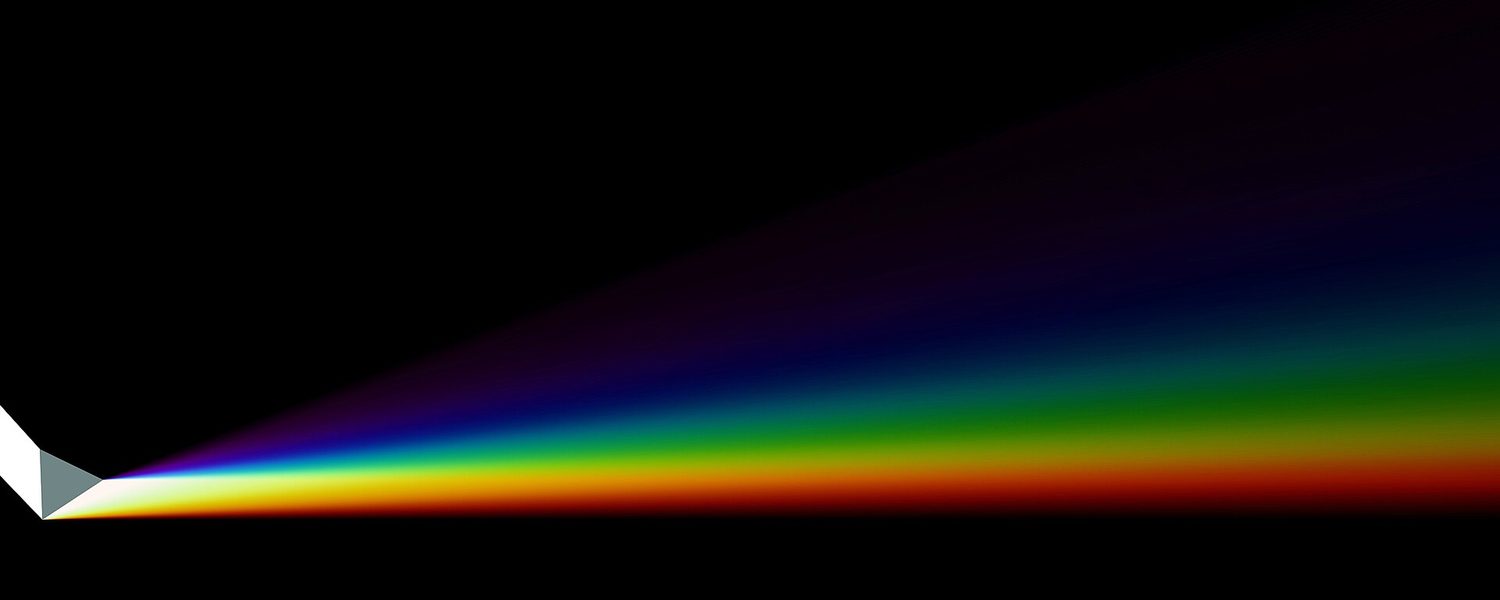
Refraction bends each colour by a different amount, so a prism spreads white light into a rainbow Explore · 探索Bend light as it enters glass · 光がガラスに入射する際に屈折する
Light refracts (bends) when it changes speed between media, following Snell's law. The denser the medium, the more it bends toward the normal. · 光は媒体間で速度が変化するとスネルの法則に従って屈折(曲がる)します。媒体が密なほど、法線に対してより強く曲がります。
Vocabulary · 語彙 Train · 練習するEnglish 日本語 refraction/rɪˈfrækʃn/ 屈折 index of refraction/ˈɪndeks ɒv rɪˈfrækʃn/ 屈折率 Snell's law/snelz lɔː/ スネルの法則 total internal reflection/ˈtəʊtl ɪnˈtɜːnl rɪˈflekʃn/ 全反射 13.4
Images Formed by Lenses
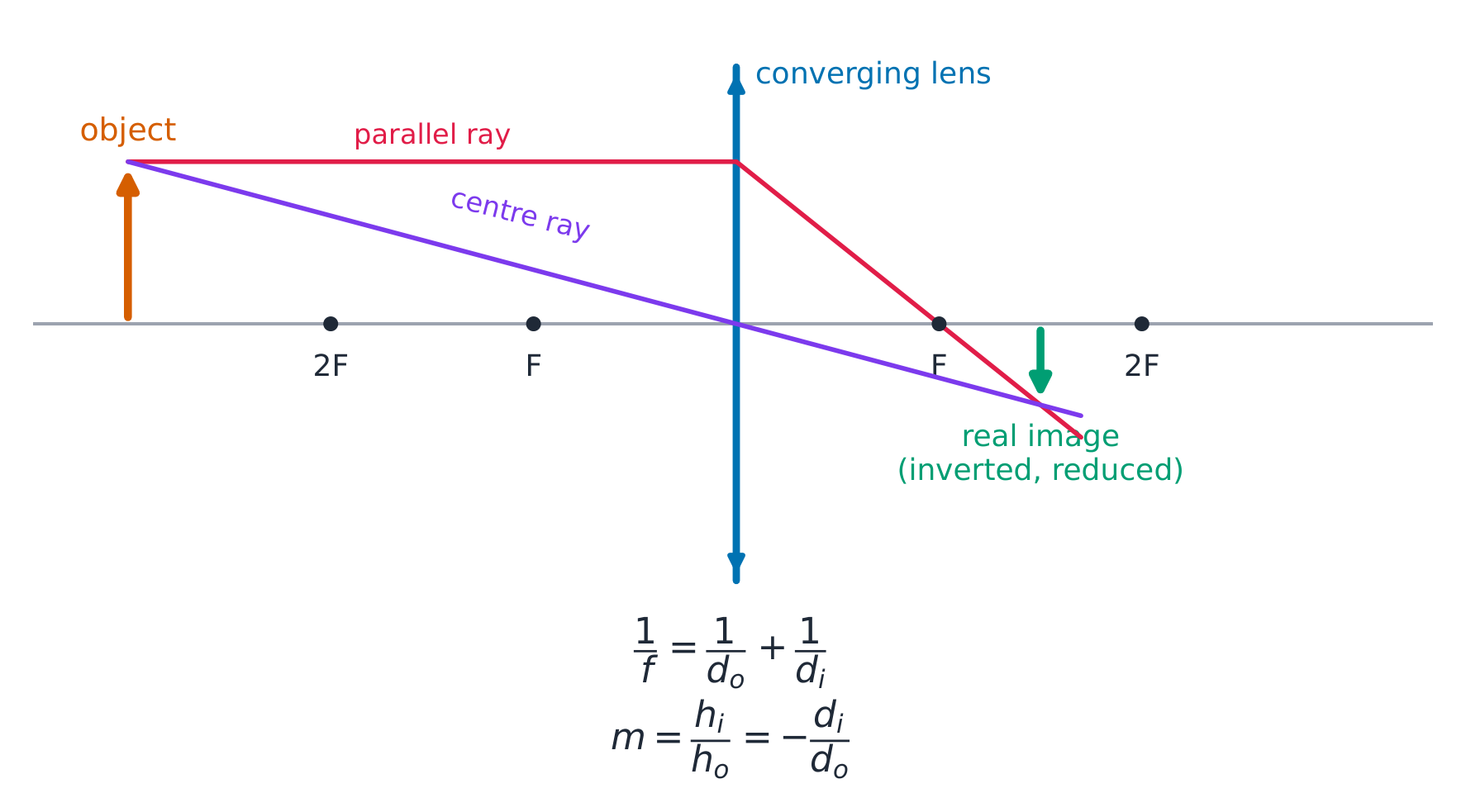
Syllabus · シラバス
EnglishLearning Objective 13.4.A: Describe the image formed by a lens.
- 13.4.A.1 Incident light rays parallel to the principal axis of a thin convex (converging) lens will be refracted and converge toward a common location on the transmitted side of the lens, called the focal point.
- 13.4.A.2 Incident light rays parallel to the principal axis of a thin concave (diverging) lens will be refracted and diverge as if they originated from a focal point on the incident side of the lens.
- 13.4.A.3 A real image is formed by a lens when light rays originating from a common point are refracted such that they intersect at another common point.
- 13.4.A.4 A virtual image is formed by a lens when refracted light rays diverge such that they appear to have originated from a common point.
- 13.4.A.5 For a thin lens, the location of an image depends on the focal length of the lens and the distance between the object and the midline of the lens, as given by the thin-lens equation:
- Equation: $\dfrac{1}{s_i} + \dfrac{1}{s_o} = \dfrac{1}{f}$
- 13.4.A.5.i The locations of a lens's focal point, an object, and the image of the object formed by the lens follow sign conventions that are used to determine those locations relative to the lens itself.
- 13.4.A.5.ii Lenses have a focal point on both sides of the lens that depends on the shape of the respective side of the lens.
- 13.4.A.6 For a thin lens, the magnification of an image is the ratio of the size of the image produced to the size of the object itself and depends on the locations of the object and image relative to the lens.
- Equation: $|M| = \left| \dfrac{h_i}{h_o} \right| = \left| \dfrac{s_i}{s_o} \right|$
- 13.4.A.7 Ray diagrams can be used to determine the location, type, size, and orientation of images formed by lenses.
- 13.4.A.7.i The three principal rays are typically used to find the images formed by lenses. The principal rays are 1) the ray parallel to the principal axis, 2) the ray that passes through the center of the lens where the principal axis intersects the lens, and 3) the ray that passes through the focal point of the lens.
- 13.4.A.7.ii Images formed by a lens can be upright or inverted, virtual or real, and reduced, enlarged, or the same size as the object.
日本語学習目標 13.4.A: レンズによって形成される像を説明せよ。
- 13.4.A.1 薄凸レンズ(収束レンズ)の主軸に平行な入射光線は屈折され、主軸と交わる一点(焦点)に向かって収束する。この点を通る光線は、レンズの透過側にある焦点称为である。
- 13.4.A.2 薄凹レンズ(発散レンズ)の主軸に平行な入射光線は屈折され、入射側の焦点から来たように見えるように発散する。
- 13.4.A.3 実像とは、レンズによって光線が屈折され、一点から発した光線が別の一点で交差して形成される像である。
- 13.4.A.4 虚像とは、レンズによって屈折された光線が発散し、一点から来たように見える形で形成される像である。
- 13.4.A.5 薄レンズにおいて、像の位置は薄レンズ方程式で示される通り、レンズの焦点距離および物体とレンズの中心線の間の距離に依存する:
- 式: $\dfrac{1}{s_i} + \dfrac{1}{s_o} = \dfrac{1}{f}$
- 13.4.A.5.i レンズの焦点、物体、およびレンズによって形成される物体の像の位置には、それらの位置をレンズに対して決定するために用いられる符号則が存在する。
- 13.4.A.5.ii レンズは両側に焦点を持ち、それぞれの側面の形状に応じて決まる。
- 13.4.A.6 薄レンズにおいて、倍率とは、生成される像のサイズと物体自体のサイズの比であり、物体と像のレンズに対する位置に依存する。
- 式: $|M| = \left| \dfrac{h_i}{h_o} \right| = \left| \dfrac{s_i}{s_o} \right|$
- 13.4.A.7 光線図を用いることで、レンズによって形成される像の位置、種類、サイズ、向きを決定できる。
- 13.4.A.7.i レンズによって形成される像を求めるために通常用いられる3つの主光線がある。主光線とは、1) 主軸に平行な光線、2) 主軸とレンズの交点であるレンズの中心を通る光線、3) レンズの焦点を通る光線である。
- 13.4.A.7.ii レンズによって形成される像は、正立または逆立、虚像または実像、縮小または拡大、あるいは物体と同じ大きさであることがある。
Source: College Board AP Course and Exam Description · 出典: College Board AP コースおよび試験説明書
EnglishA converging lens forms a real image A lens bends light through refraction. The thin-lens equation has the same form as the mirror equation:
$$\frac{1}{d_o}+\frac{1}{d_i}=\frac{1}{f},\qquad m=-\frac{d_i}{d_o}.$$A converging 会聚 (convex) lens can form a real, inverted image or, for a close object, a virtual, upright, enlarged image (a magnifying glass). A diverging 发散 (concave) lens always forms a virtual, upright, reduced image. Ray diagrams locate the image quickly using two easy rays: one parallel to the axis that bends to pass through the far focus, and one straight through the centre of the lens (undeviated).Worked example. An object sits $30\ \text{cm}$ from a converging lens of focal length $f=10\ \text{cm}$. Find the image. From the thin-lens equation,
$$\frac{1}{d_i}=\frac{1}{f}-\frac{1}{d_o}=\frac{1}{10}-\frac{1}{30}=\frac{2}{30}\;\Rightarrow\;d_i=15\ \text{cm},$$and the magnification is $m=-d_i/d_o=-15/30=-0.5$. The image is real (positive $d_i$), inverted (negative $m$), and half the object's size – just what a camera lens does.日本語A converging lens forms a real image A lens bends light through refraction. The thin-lens equation has the same form as the mirror equation:
$$\frac{1}{d_o}+\frac{1}{d_i}=\frac{1}{f},\qquad m=-\frac{d_i}{d_o}.$$A converging 会聚 (convex) lens can form a real, inverted image or, for a close object, a virtual, upright, enlarged image (a magnifying glass). A diverging 发散 (concave) lens always forms a virtual, upright, reduced image. Ray diagrams locate the image quickly using two easy rays: one parallel to the axis that bends to pass through the far focus, and one straight through the centre of the lens (undeviated).Two rays locate the image: parallel-then-focus, and straight through the centre 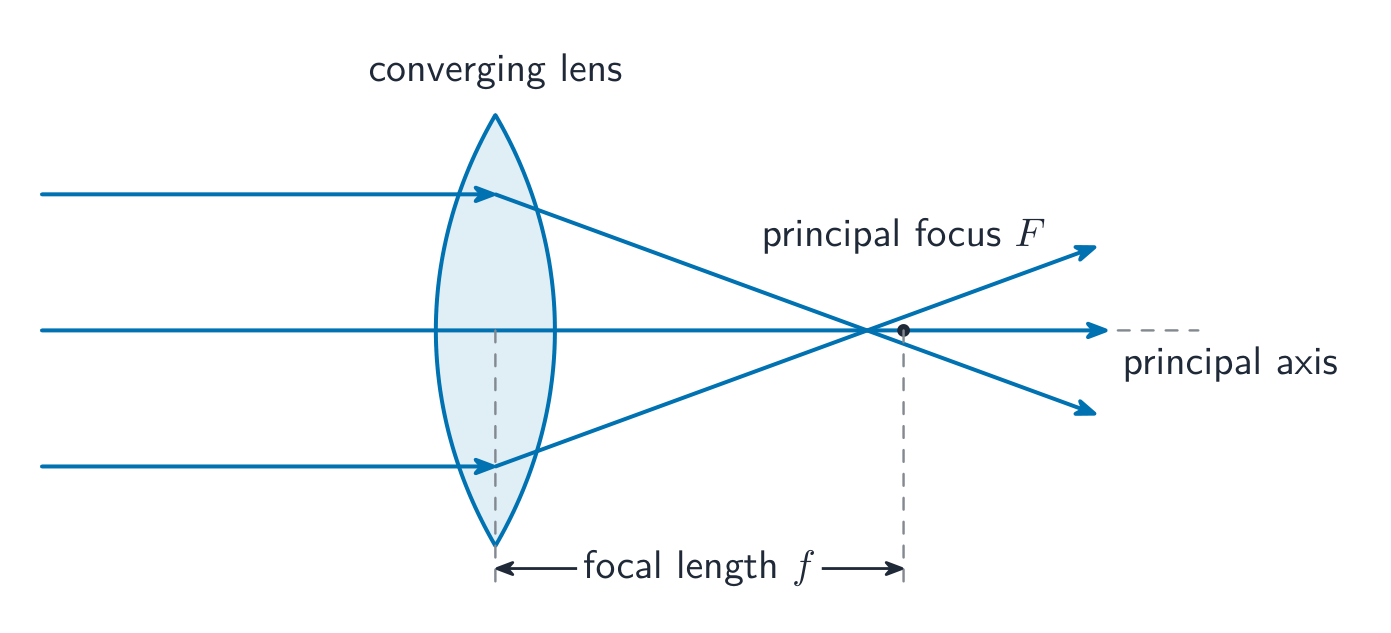
A converging lens brings parallel rays to its principal focus Worked example. An object sits $30\ \text{cm}$ from a converging lens of focal length $f=10\ \text{cm}$. Find the image. From the thin-lens equation,
$$\frac{1}{d_i}=\frac{1}{f}-\frac{1}{d_o}=\frac{1}{10}-\frac{1}{30}=\frac{2}{30}\;\Rightarrow\;d_i=15\ \text{cm},$$and the magnification is $m=-d_i/d_o=-15/30=-0.5$. The image is real (positive $d_i$), inverted (negative $m$), and half the object's size – just what a camera lens does.
A convex lens forms a real, inverted image of a distant scene, exactly as the ray diagram predicts Explore · 探索Form an image with a converging lens · 収束レンズで像を作る
A converging lens bends parallel rays to its focal point. Move the object and watch the image change from large and inverted to virtual and upright inside the focal length. · 収差レンズ は平行光線を焦点に屈折させる。物体を動かすと、大きく上下逆から焦点内ではvirtualで upright な像へ変わる様を見る。
Vocabulary · 語彙 Train · 練習するEnglish 日本語 converging/kənˈvɜːdʒɪŋ/ 会聚する diverging/daɪˈvɜːdʒɪŋ/ 発散する 13.4
Exam tips
- Measure all angles from the normal, not the surface.
- Light entering a denser medium (larger $n$) bends toward the normal; use Snell's law $n_1\sin\theta_1=n_2\sin\theta_2$.
- Total internal reflection happens only going into a less dense medium, beyond the critical angle ($\sin\theta_c=1/n$).
- For mirrors and lenses use $\tfrac1{d_o}+\tfrac1{d_i}=\tfrac1f$ and $m=-d_i/d_o$: a positive $d_i$ is a real image, negative is virtual.
- $n=c/v$, so a bigger index means a slower speed of light in the material.
- 13.1.A.1 A light ray is a straight line that is perpendicular to the wavefront of a light wave and points in the direction of travel of the wave.
-
14
Waves, Sound, and Physical Optics
Watch lesson · レッスンを視聴14.1
Properties of Wave Pulses and Waves
Syllabus · シラバス
EnglishLearning Objective 14.1.A: Describe the physical properties of waves and wave pulses.
- 14.1.A.1 Waves transfer energy between two locations without transferring matter between those locations.
- 14.1.A.1.i A wave pulse is a single disturbance that transfers energy without transferring matter between two locations.
- 14.1.A.1.ii A wave is modeled as a continuous, periodic disturbance with well-defined wavelength and frequency.
- 14.1.A.2 Mechanical waves or wave pulses require a medium in which to propagate. Electromagnetic waves or wave pulses do not require a medium in which to propagate.
- 14.1.A.3 The speed at which a wave or wave pulse propagates through a medium depends on the type of wave and the properties of the medium.
- 14.1.A.3.i The speed of all electromagnetic waves in a vacuum is a universal physical constant, $c = 3.00 \times 10^{8}$ m/s.
- 14.1.A.3.ii The speed at which a wave pulse or wave propagates along a string is dependent upon the tension in the string, $F_T$, and the mass per length of the string.
- Equation: $v_{\text{string}} = \sqrt{\dfrac{F_T}{m/\ell}}$
- 14.1.A.3.iii In a given medium, the speed of sound waves increases with the temperature of the medium.
- 14.1.A.4 In a transverse wave, the direction of the disturbance is perpendicular to the direction of propagation of the wave.
- 14.1.A.5 In a longitudinal wave, the direction of the disturbance is parallel to the direction of propagation of the wave.
- 14.1.A.5.i Sound waves are modeled as mechanical longitudinal waves.
- 14.1.A.5.ii The regions of high and low pressure in a sound wave are called compressions and rarefactions, respectively.
- 14.1.A.6 Amplitude is the maximum displacement of a wave from its equilibrium position.
- 14.1.A.6.i The amplitude of a longitudinal pressure wave may be determined by the maximum increase or decrease in pressure from equilibrium pressure.
- 14.1.A.6.ii The loudness of a sound increases with increasing amplitude.
- 14.1.A.6.iii The energy carried by a wave increases with increasing amplitude.
日本語学習目標 14.1.A: 波および波パルスの物理的性質を説明せよ。
- 14.1.A.1 波は、物質を移動させずに2地点間のエネルギーを輸送する。
- 14.1.A.1.i 波パルスとは、物質を移動させずに2地点間のエネルギーを輸送する単一の攪乱である。
- 14.1.A.1.ii 波は、明確に定義された波長と振動数を持つ連続的で周期的な攪乱としてモデル化される。
- 14.1.A.2 機械波や波パルスは、伝播するための媒質を必要とする。電磁波や波パルスは、伝播のための媒質を必要としない。
- 14.1.A.3 波や波パルスが媒質中を伝播する速度は、波の種類および媒質の性質に依存する。
- 14.1.A.3.i 真空中におけるすべての電磁波の速度は物理定数 $c = 3.00 \times 10^{8}$ m/s である。
- 14.1.A.3.ii 弦上を伝播する波パルスまたは波の速度は、弦の張力 $F_T$ および弦の単位長さあたりの質量に依存する。
- 数式: $v_{\text{string}} = \sqrt{\dfrac{F_T}{m/\ell}}$
- 14.1.A.3.iii 与えられた媒質中では、音波の速度は媒質の温度の上昇とともに増加する。
- 14.1.A.4 横波では、攪乱の方向は波の伝播方向に垂直である。
- 14.1.A.5 縦波では、攪乱の方向は波の伝播方向に平行である。
- 14.1.A.5.i 音波は機械的な縦波としてモデル化される。
- 14.1.A.5.ii 音波における高圧域および低圧域は、それぞれ圧縮部および稀薄部と呼ばれる。
- 14.1.A.6 振幅とは、波が平衡位置から離れる最大の変位である。
- 14.1.A.6.i 縦波圧力波の振幅は、平衡圧からの圧力の最大増減量によって決定される可能性がある。
- 14.1.A.6.ii 音の強さは、振幅の増加とともに増大する。
- 14.1.A.6.iii 波が運ぶエネルギーは、振幅の増加とともに増大する。
Source: College Board AP Course and Exam Description · 出典: College Board AP コースおよび試験説明書
EnglishA wave 波 carries energy through a medium (or space) without carrying the matter along. A single disturbance is a pulse; a repeating one is a wave. Two types:
- Transverse 横波: the medium moves perpendicular to the wave's travel (a wave on a rope, light).
- Longitudinal 纵波: the medium moves along the direction of travel (sound).
日本語Ripple-tank interference: wave paths add constructively and destructively A wave 波 carries energy through a medium (or space) without carrying the matter along. A single disturbance is a pulse; a repeating one is a wave. Two types:
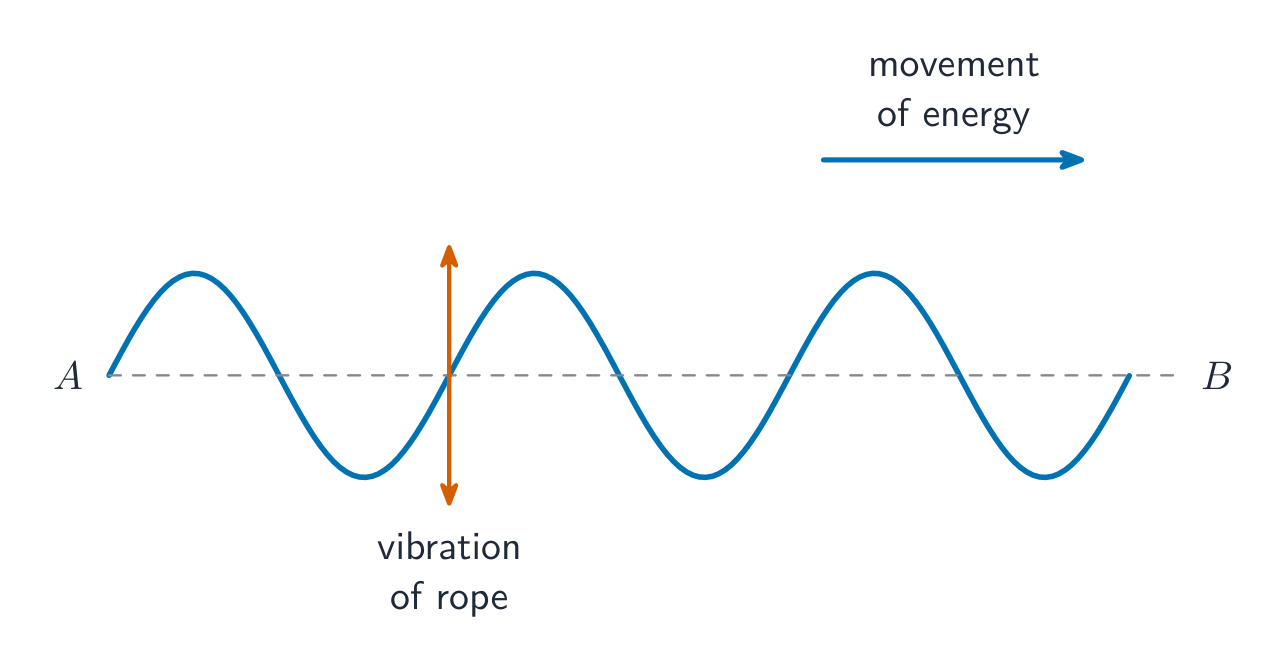
A transverse wave: the medium moves at right angles to the wave's travel - Transverse 横波: the medium moves perpendicular to the wave's travel (a wave on a rope, light).
- Longitudinal 纵波: the medium moves along the direction of travel (sound).
Vocabulary · 語彙 Train · 練習するEnglish 日本語 wave/weɪv/ 波動として扱う Transverse/trænsˈvɜːs/ 横波 Longitudinal/ˌlɒŋɡɪˈtjuːdɪnl/ 縦断的 14.2
Periodic Waves
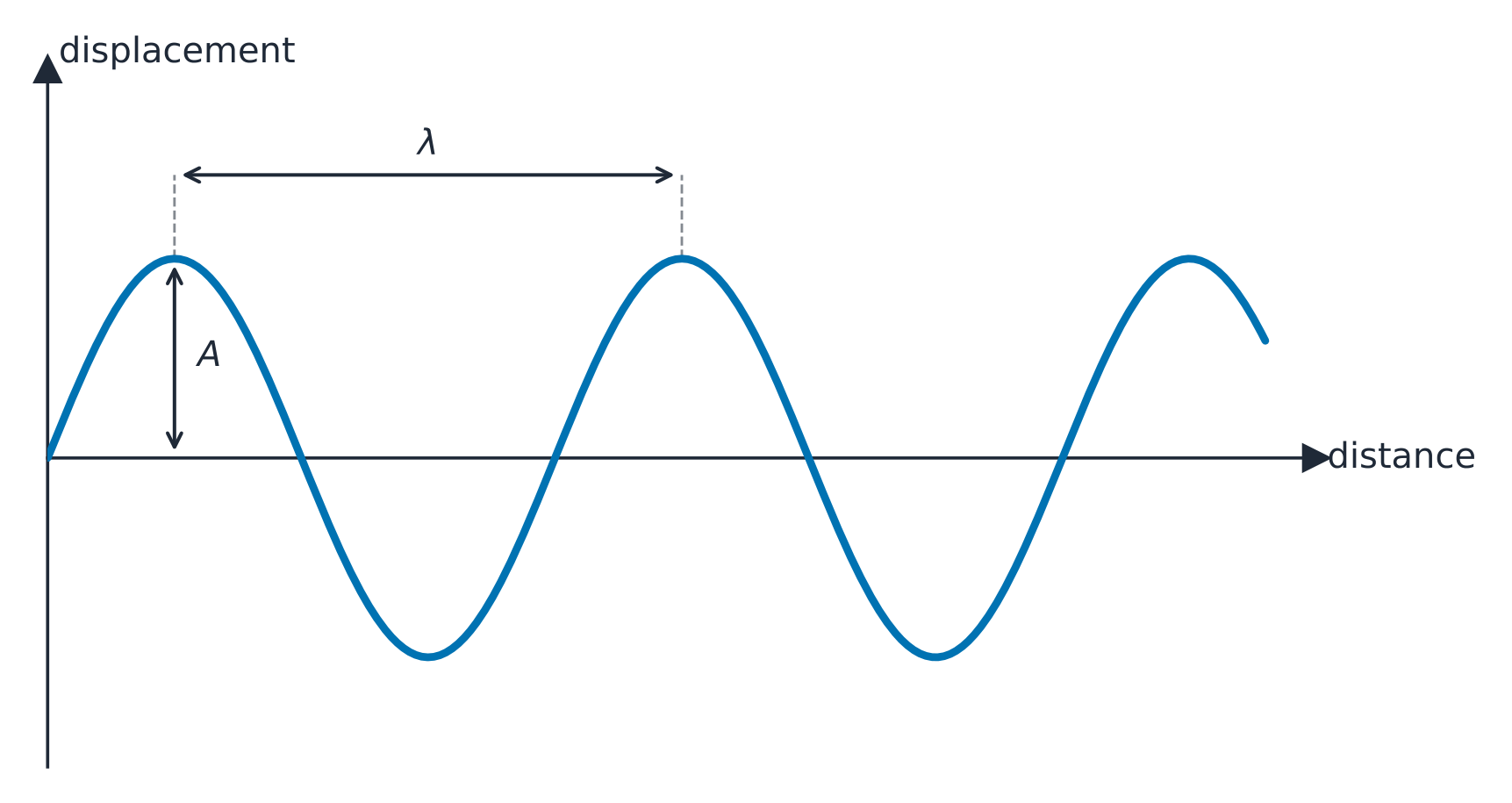
Syllabus · シラバス
EnglishLearning Objective 14.2.A: Describe the physical properties of a periodic wave.
- 14.2.A.1 Periodic waves have regular repetitions that can be described using period and frequency.
- 14.2.A.1.i The period is the time for one complete oscillation of the wave.
- 14.2.A.1.ii The frequency is the rate at which the wave repeats.
- Equation: $T = \dfrac{1}{f}$
- 14.2.A.1.iii The amplitude of a wave is independent of the period and the frequency of that wave.
- 14.2.A.1.iv The energy of a wave increases with increasing frequency.
- 14.2.A.1.v The frequency of a sound wave is related to its pitch.
- 14.2.A.1.vi Wavelength is the distance between successive corresponding positions (such as peaks or troughs) on a wave.
- 14.2.A.2 A sinusoidal wave can be described by equations for the displacement from equilibrium at a specific location as a function of time. A wave can also be described by an equation for the displacement from equilibrium at a specific time as a function of position.
- Equation: $x(t) = A\cos(\omega t) = A\cos(2\pi f t)$
- Equation: $y(x) = A\cos\left(2\pi \dfrac{x}{\lambda}\right)$
- 14.2.A.3 For a periodic wave, the wavelength is proportional to the wave's speed and inversely proportional to the wave's frequency.
- Equation: $\lambda = \dfrac{v}{f}$
日本語学習目標 14.2.A: 周期性波の物理的性質を説明せよ。
- 14.2.A.1 周期性波は、周期および振動数を用いて記述できる規則的な繰り返しを持つ。
- 14.2.A.1.i 周期とは、波の1周期分の振動にかかる時間である。
- 14.2.A.1.ii 振動数は、波が繰り返される速さである。
- 数式: $T = \dfrac{1}{f}$
- 14.2.A.1.iii 波の振幅は、その波の周期および振動数とは無関係である。
- 14.2.A.1.iv 波のエネルギーは、振動数の増加とともに増大する。
- 14.2.A.1.v 音波の振動数は、その音の高さに関連している。
- 14.2.A.1.vi 波長とは、波上の successive な対応する位置(例えば山頂または谷)の間の距離である。
- 14.2.A.2 正弦波は、特定の位置における平衡からの位移を時間の関数として表す式で記述できる。また、特定の時刻における平衡からの位移を位置の関数として表す式でも記述できる。
- 式: $x(t) = A\cos(\omega t) = A\cos(2\pi f t)$
- 式: $y(x) = A\cos\left(2\pi \dfrac{x}{\lambda}\right)$
- 14.2.A.3 周期性のある波において、波長は波の速度に比例し、波の周波数に反比例する。
- 式: $\lambda = \dfrac{v}{f}$
Source: College Board AP Course and Exam Description · 出典: College Board AP コースおよび試験説明書
EnglishTransverse vs longitudinal waves A repeating wave is described by:
- wavelength 波长 $\lambda$ (distance between repeats),
- frequency 频率 $f$ (cycles per second) and period $T=1/f$,
- amplitude 振幅 $A$ (maximum displacement – related to energy),
- wave speed 波速 $v=f\lambda$, set by the medium, not the source.
Worked example. A musical note has frequency $340\ \text{Hz}$ and the speed of sound is $340\ \text{m/s}$. Its wavelength is $\lambda=v/f=340/340=1.0\ \text{m}$. If the same note travels into water (where sound moves at $\approx 1500\ \text{m/s}$) the frequency stays $340\ \text{Hz}$ but the wavelength stretches to $1500/340\approx 4.4\ \text{m}$ – the source sets the frequency, the medium sets the speed and hence the wavelength.
日本語Transverse vs longitudinal waves A repeating wave is described by:
A displacement-distance graph shows the amplitude and wavelength - wavelength 波长 $\lambda$ (distance between repeats),
- frequency 频率 $f$ (cycles per second) and period $T=1/f$,
- amplitude 振幅 $A$ (maximum displacement – related to energy),
- wave speed 波速 $v=f\lambda$, set by the medium, not the source.
Worked example. A musical note has frequency $340\ \text{Hz}$ and the speed of sound is $340\ \text{m/s}$. Its wavelength is $\lambda=v/f=340/340=1.0\ \text{m}$. If the same note travels into water (where sound moves at $\approx 1500\ \text{m/s}$) the frequency stays $340\ \text{Hz}$ but the wavelength stretches to $1500/340\approx 4.4\ \text{m}$ – the source sets the frequency, the medium sets the speed and hence the wavelength.
Explore · 探索Send a periodic wave · 周期性波を送る
A periodic wave carries energy without moving matter. Its speed $v=f\lambda$ links frequency and wavelength; raise the frequency and the wavelength shrinks. · 周期的波は物質を移動させずにエネルギーを伝達します。その速度 $v=f\lambda$ は周波数と波長を結びつけており、周波数を上げると波長は短くなります。
Vocabulary · 語彙 Train · 練習するEnglish 日本語 wavelength/ˈweɪvleŋθ/ 波長 frequency/ˈfriːkwənsi/ 振動数 amplitude/ˈæmplɪtjuːd/ 振幅 wave speed/weɪv spiːd/ 波の速度 14.3
Boundary Behavior and Polarization
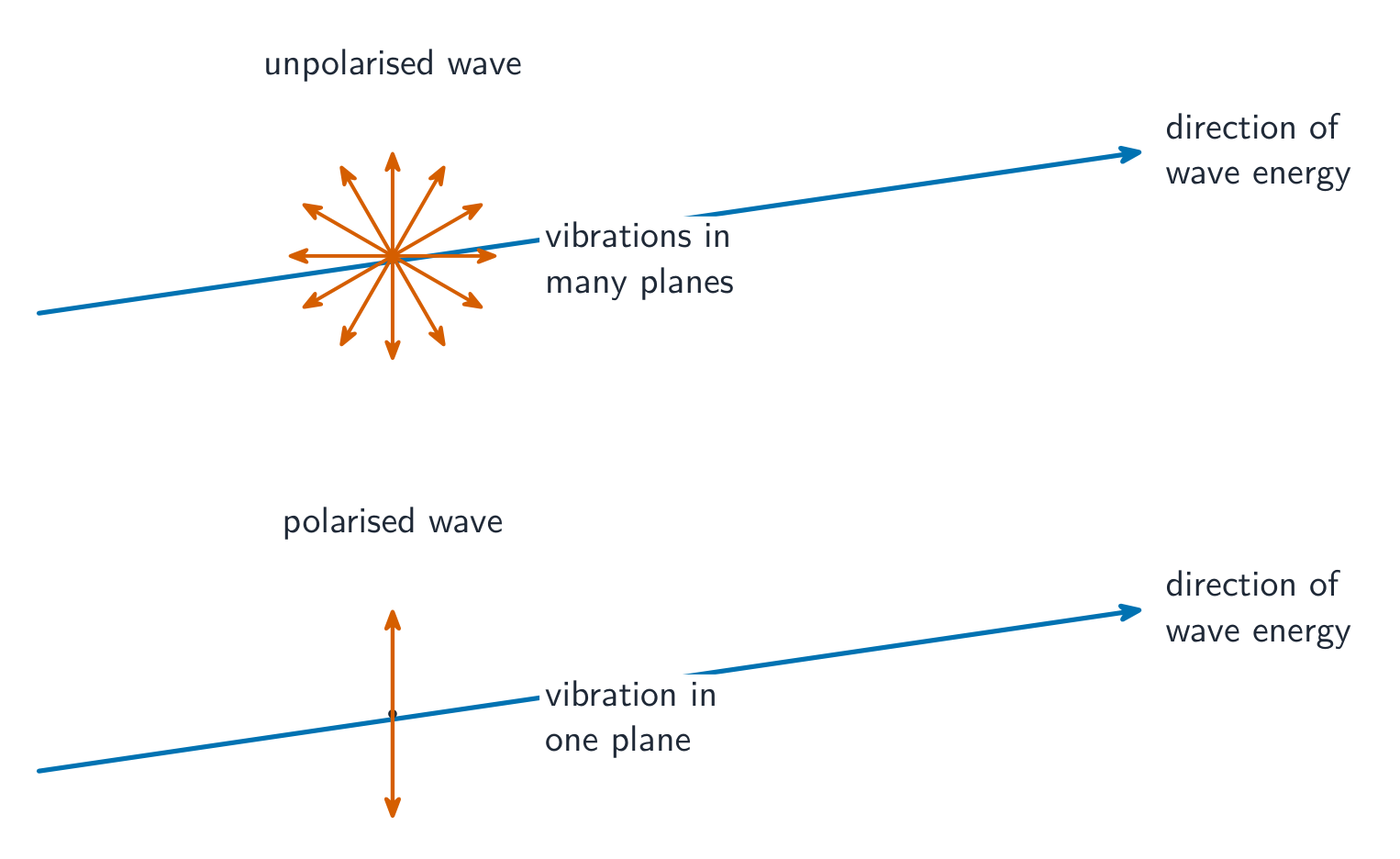
Syllabus · シラバス
EnglishLearning Objective 14.3.A: Describe the interaction between a wave and a boundary.
- 14.3.A.1 A wave that travels from one medium to another can be transmitted or reflected, depending on the properties of the boundary separating the two media.
- 14.3.A.1.i A wave traveling from one medium to another (for example, a wave traveling between low-mass and high-mass strings) will result in reflected and transmitted waves.
- 14.3.A.1.ii A reflected wave is inverted if the transmitted wave travels into a medium in which the speed of the wave decreases.
- 14.3.A.1.iii A reflected wave is not inverted if the transmitted wave travels into a medium in which the speed of the wave increases.
- 14.3.A.1.iv The frequency of a wave does not change when it travels from one medium to another.
- 14.3.A.2 Transverse waves that are reflected from a surface, refracted through a medium, or pass through specific openings may be polarized.
- 14.3.A.2.i Transverse waves can be polarized and oscillate in a single plane.
- 14.3.A.2.ii Longitudinal waves cannot be polarized.
- 14.3.A.3 Polarization of a wave may result in a reduction of the wave's intensity.
- 14.3.A.3.i Intensity is a measure of the amount of power transferred per unit area.
- 14.3.A.3.ii The intensity of a wave is the average power per unit area over one period of the wave.
日本語学習目標 14.3.A: 波と境界との相互作用を説明せよ。
- 14.3.A.1 一つの媒質から別の媒質へ伝播する波は、二つの媒質を分ける境界の性質に応じて、透過または反射する。
- 14.3.A.1.i 一つの媒質から別の媒質へ伝播する波(例:低質量の弦と高質量の弦の間を伝わる波)は、反射波および透過波を生じる。
- 14.3.A.1.ii 透過波が波の速度が減少する媒質に入射する場合、反射波は位相が反転する。
- 14.3.A.1.iii 透過波が波の速度が増加する媒質に入力する場合、反射波は位相が反転しない。
- 14.3.A.1.iv 波が一つの媒質から別の媒質へ移動する際、その周波数は変わらない。
- 14.3.A.2 表面で反射したり、媒質内を屈折したり、あるいは特定の開口部を通過したりした横波は、偏光されることがある。
- 14.3.A.2.i 横波は偏光され、単一平面内で振動することができる。
- 14.3.A.2.ii 縦波は偏光されない。
- 14.3.A.3 波の偏光により、波の強度が減少することがある。
- 14.3.A.3.i 強度とは、単位面積あたりに伝達されるエネルギーの量を示す指標である。
- 14.3.A.3.ii 波の強度とは、波の周期にわたる単位面積あたりの平均出力である。
Source: College Board AP Course and Exam Description · 出典: College Board AP コースおよび試験説明書
EnglishTotal internal reflection At a boundary a wave partly reflects and partly transmits. Reflecting off a denser medium inverts the wave; off a less-dense medium it does not. Polarization 偏振 applies to transverse waves only: a polarizer passes just one direction of oscillation, which is why polarized sunglasses cut glare.
The effect of a polarizer is measured through intensity 强度 - the average power a wave delivers per unit area over one period, in $\text{W m}^{-2}$. Because a polarizer removes the components of the oscillation that are not aligned with it, it reduces the wave's intensity: unpolarized light passing a single ideal polarizer drops to half its intensity, and a second polarizer at an angle cuts it further. Intensity also falls with distance from a source, since the same power spreads over a larger area.
日本語Total internal reflection At a boundary a wave partly reflects and partly transmits. Reflecting off a denser medium inverts the wave; off a less-dense medium it does not. Polarization 偏振 applies to transverse waves only: a polarizer passes just one direction of oscillation, which is why polarized sunglasses cut glare.
The effect of a polarizer is measured through intensity 强度 - the average power a wave delivers per unit area over one period, in $\text{W m}^{-2}$. Because a polarizer removes the components of the oscillation that are not aligned with it, it reduces the wave's intensity: unpolarized light passing a single ideal polarizer drops to half its intensity, and a second polarizer at an angle cuts it further. Intensity also falls with distance from a source, since the same power spreads over a larger area.
Unpolarised waves vibrate in many planes; a polarised wave vibrates in one Vocabulary · 語彙 Train · 練習するEnglish 日本語 Polarization/ˌpəʊləraɪˈzeɪʃn/ 偏光 intensity/ɪnˈtensɪti/ 強度 14.4
Electromagnetic Waves
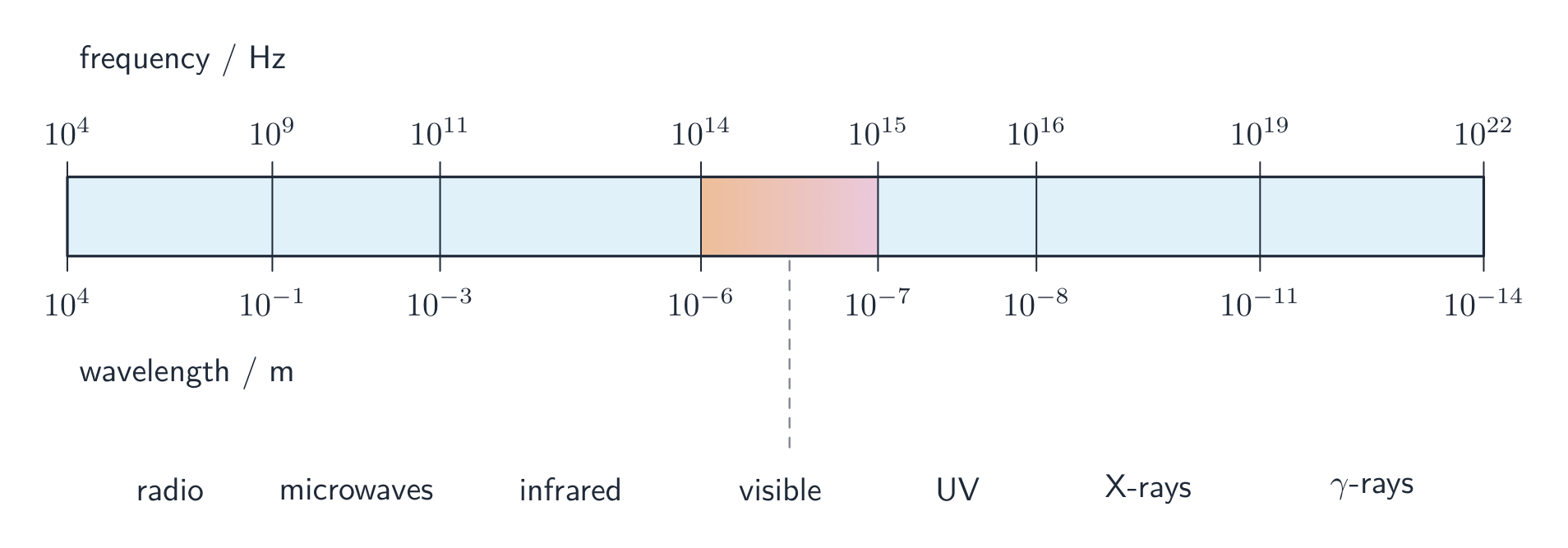
Syllabus · シラバス
EnglishLearning Objective 14.4.A: Describe the properties of an electromagnetic wave.
- 14.4.A.1 Electromagnetic waves consist of oscillating electric and magnetic fields that are mutually perpendicular.
- 14.4.A.1.i Electromagnetic waves are transverse waves because the oscillations of the electric and magnetic fields are perpendicular to the direction of propagation.
- 14.4.A.1.ii Electromagnetic waves are commonly assumed to be plane waves, which are characterized by planar wave fronts.
- 14.4.A.2 Electromagnetic waves do not need a medium through which to propagate.
- 14.4.A.3 Categories of electromagnetic waves are characterized by their wavelengths.
- 14.4.A.3.i Categories of electromagnetic waves include (in order of decreasing wavelength, spanning a range from kilometers to picometers) radio waves, microwaves, infrared, visible, ultraviolet, X-rays, and gamma rays.
- 14.4.A.3.ii Visible electromagnetic waves are further broken into categories of color, including (in order of decreasing wavelength) red, orange, yellow, green, blue, and violet.
- 14.4.A.3.iii Visible electromagnetic waves are also called light. Sometimes, electromagnetic waves of all wavelengths are collectively referred to as light or electromagnetic radiation.
Boundary statement: AP Physics 2 expects students to know the ordering of the electromagnetic spectrum (including visible light). However, students will not be expected to define exact wavelength ranges within the electromagnetic spectrum.
日本語学習目標 14.4.A: 電磁波の性質を説明せよ。
- 14.4.A.1 電磁波は、互いに直交する振動する電気場および磁気場から構成される。
- 14.4.A.1.i 電磁波は横波である。なぜなら、電気場および磁気場の振動は伝播方向と直交しているからである。
- 14.4.A.1.ii 電磁波は一般的に平面波であると仮定される。これは、平面状の波面によって特徴づけられる。
- 14.4.A.2 電磁波は、伝播のための媒質を必要としない。
- 14.4.A.3 電磁波のカテゴリは、その波長によって特徴づけられる。
- 14.4.A.3.i 電磁波のカテゴリには、波長の減少順(キロメートルからピコメートルまでの範囲を含む)で、ラジオ波、マイクロ波、赤外線、可視光、紫外線、X線、ガンマ線が含まれる。
- 14.4.A.3.ii 可視光電磁波はさらに色ごとに分類され、波長の減少順で赤、橙、黄、緑、青、紫が含まれる。
- 14.4.A.3.iii 可視光電磁波は光とも呼ばれる。また、あらゆる波長の電磁波を総称して光や電磁放射ということもある。
出題範囲: AP Physics 2では、学生が電磁スペクトル(可視光を含む)の順序を知っていることを期待する。しかし、電磁スペクトル内の正確な波長範囲を定義することを求めているわけではない。
Source: College Board AP Course and Exam Description · 出典: College Board AP コースおよび試験説明書
EnglishElectromagnetic waves 电磁波 are oscillating electric and magnetic fields that travel through vacuum at the speed of light $c$, needing no medium. They span the spectrum from radio to gamma rays; higher frequency means shorter wavelength and higher photon energy.
日本語Electromagnetic waves 电磁波 are oscillating electric and magnetic fields that travel through vacuum at the speed of light $c$, needing no medium. They span the spectrum from radio to gamma rays; higher frequency means shorter wavelength and higher photon energy.
The electromagnetic spectrum, from radio waves to gamma rays Vocabulary · 語彙 Train · 練習するEnglish 日本語 Electromagnetic waves/ɪˌlektrəʊməɡˈnetɪk weɪvz/ 電磁波 14.5
The Doppler Effect
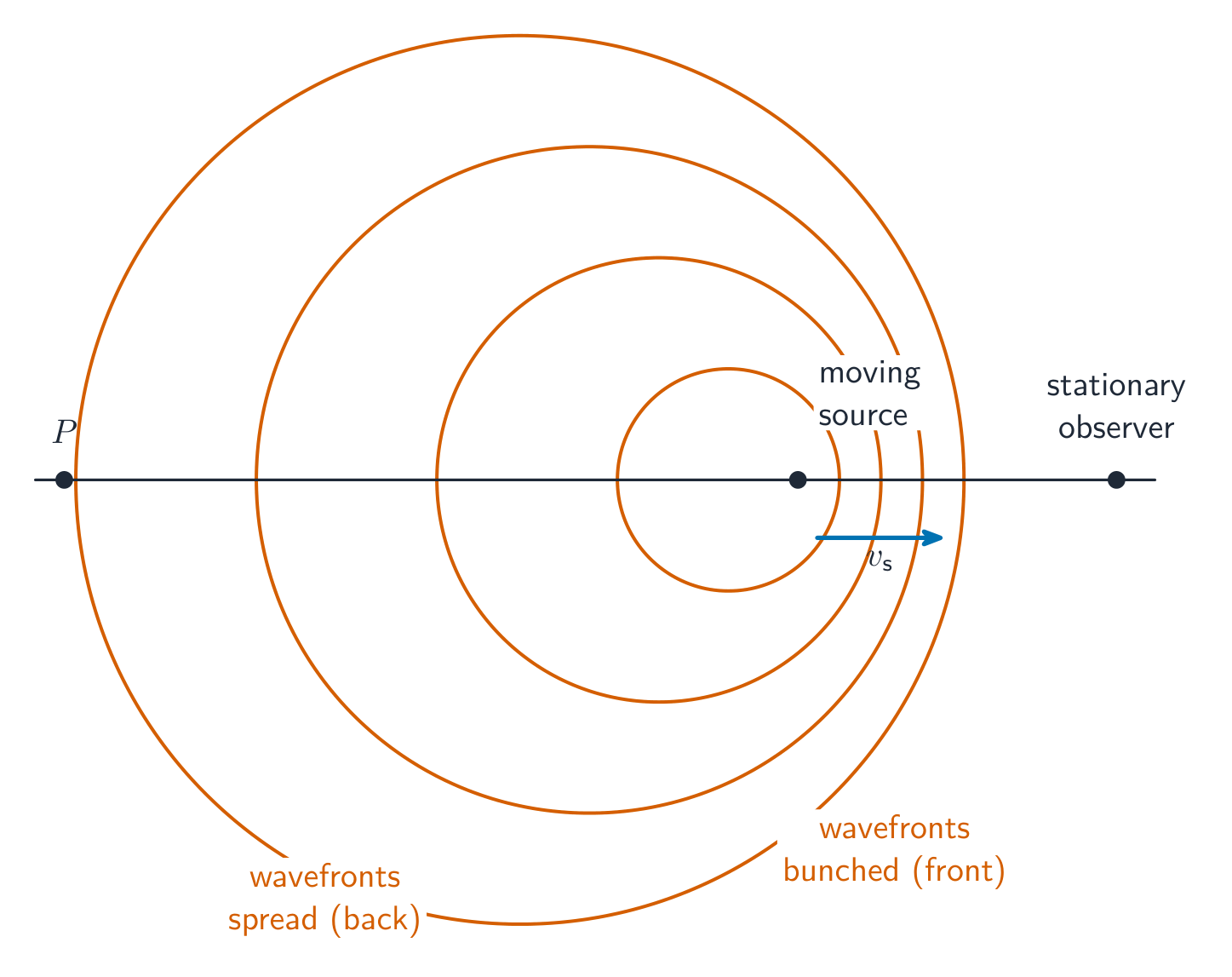
Syllabus · シラバス
EnglishLearning Objective 14.5.A: Describe the properties of a wave based on the relative motion between the source of the wave and the observer of the wave.
- 14.5.A.1 The Doppler effect describes the relationship between the rest frequency of a wave source, the observed frequency of the source, and the relative velocity of the source and the observer.
- 14.5.A.2 A greater relative velocity results in a greater measured difference between the observed and rest frequencies.
- 14.5.A.2.i For a wave source moving at the same velocity as the observer, the observed frequency is equal to the rest frequency.
- 14.5.A.2.ii For a wave source moving toward an observer, the observed frequency is greater than the rest frequency.
- 14.5.A.2.iii For a wave source moving away from an observer, the observed frequency is less than the rest frequency.
Boundary statement: Only qualitative treatments of the Doppler effect are required for AP Physics 2.
日本語学習目標 14.5.A: 波源と観測者の相対運動に基づいて、波の性質を説明せよ。
- 14.5.A.1 ドップラー効果は、波源の静止周波数、観測された周波数、および波源と観測者の相対速度の関係について説明する。
- 14.5.A.2 相対速度が大きいほど、観測された周波数と静止周波数の間の測定差が大きくなる。
- 14.5.A.2.i 波源が観測者と同じ速度で移動する場合、観測された周波数は静止周波数に等しい。
- 14.5.A.2.ii 波源が観測者に近づいて移動する場合、観測された周波数は静止周波数より大きい。
- 14.5.A.2.iii 波源が観測者から遠ざかって移動する場合、観測された周波数は静止周波数より小さい。
出題範囲: AP Physics 2においては、ドップラー効果に対して定性的な扱いのみが要求される。
Source: College Board AP Course and Exam Description · 出典: College Board AP コースおよび試験説明書
EnglishThe Doppler effect The Doppler effect 多普勒效应 is the change in observed frequency when a wave source and observer move relative to each other. Approaching $\Rightarrow$ higher frequency (shorter wavelength); receding $\Rightarrow$ lower frequency. It explains a passing siren's drop in pitch and the redshift of receding galaxies.
日本語The Doppler effect The Doppler effect 多普勒效应 is the change in observed frequency when a wave source and observer move relative to each other. Approaching $\Rightarrow$ higher frequency (shorter wavelength); receding $\Rightarrow$ lower frequency. It explains a passing siren's drop in pitch and the redshift of receding galaxies.
A moving source squashes the wavefronts ahead of it, raising the observed frequency Explore · 探索Hear the Doppler shift · ドップラー効果を感じる
When a source moves, waves bunch up ahead (higher frequency) and stretch behind (lower) — the Doppler effect. Speed it up to exaggerate the shift. · 波源が移動すると、前方では波が密集して周波数が高くなり(高周波)、後方では波が引き伸ばされて周波数が低くなる(低周波)。これをドップラー効果と呼ぶ。シフトを強調するために速度を上げよ。
Vocabulary · 語彙 Train · 練習するEnglish 日本語 Doppler effect/ˈdɒplə ɪˈfekt/ ドップラー効果 14.6
Wave Interference and Standing Waves
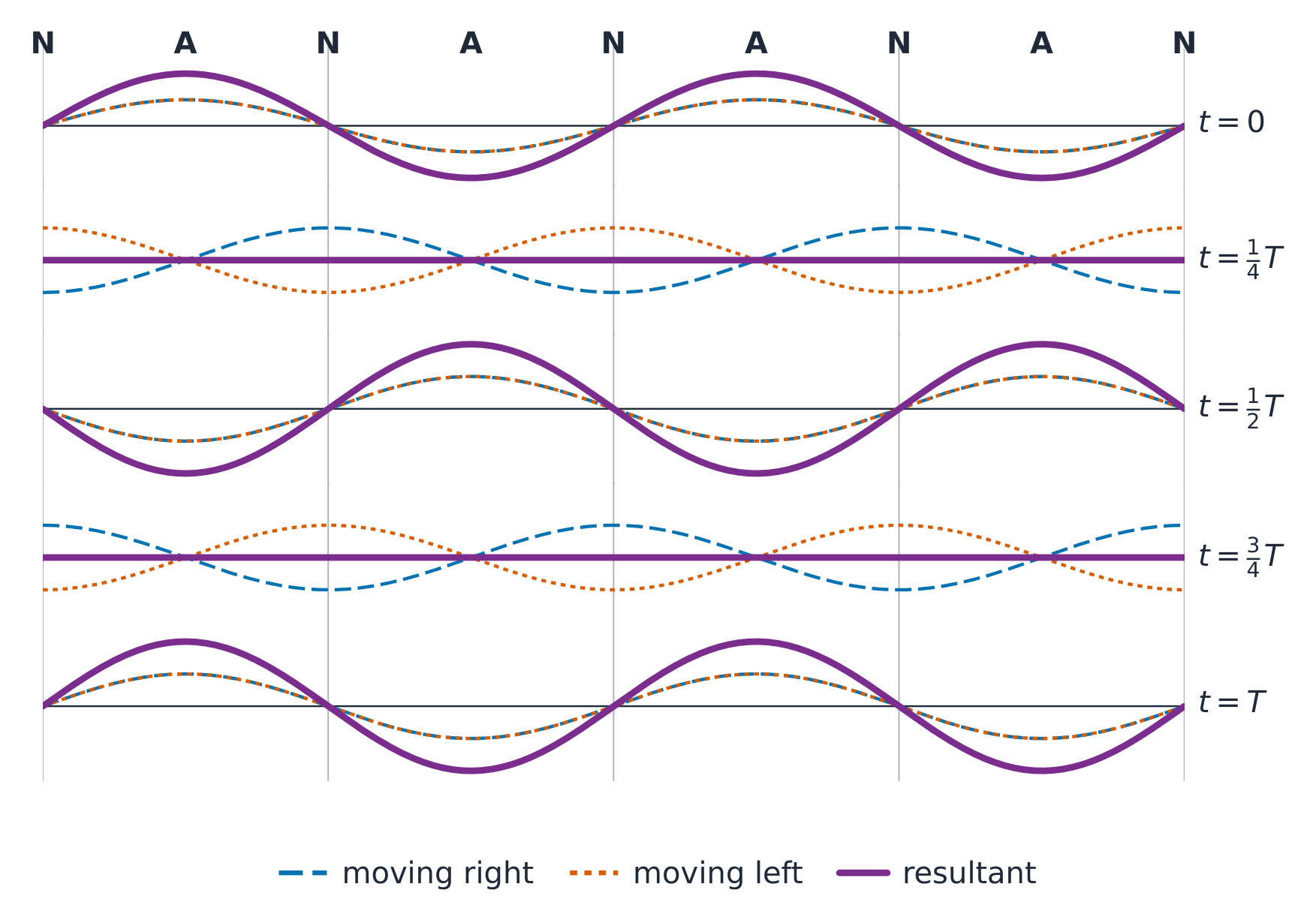
Syllabus · シラバス
Learning Objective Essential Knowledge 14.6.A
Describe the net disturbance that occurs when two or more wave pulses or waves overlap.- 14.6.A.1 Wave interference is the interaction of two or more wave pulses or waves.
- 14.6.A.2 When two or more wave pulses or waves interact with each other, they travel through each other and overlap rather than bouncing off each other.
- 14.6.A.3 When two or more wave pulses or waves overlap, the resulting displacement can be determined by adding the individual displacements. This is called superposition.
- 14.6.A.4 Wave interference may be constructive or destructive.
- 14.6.A.4.i When the displacements of the superposed wave pulses or waves are in the same direction, the interaction is called constructive interference.
- 14.6.A.4.ii When the displacements of the superposed wave pulses or waves are in opposite directions, the interaction is called destructive interference.
- 14.6.A.4.iii Two or more traveling wave pulses or waves can interact in such a way as to produce amplitude variations in the resultant wave pulse or wave.
- 14.6.A.5 Visual representations of wave pulses or waves are useful in determining the result of two interacting wave pulses or waves.
- 14.6.A.6 Beats arise from the addition of two waves of slightly different frequency.
- 14.6.A.6.i Waves with different frequencies are sometimes in phase and sometimes out of phase at locations along the waves, causing periodic amplitude changes in the resultant wave.
- 14.6.A.6.ii The beat frequency is the difference in the frequencies of the two waves.
- Equation: $\left|f_{\text{beat}}\right| = \left|f_1 - f_2\right|$
- 14.6.A.6.iii Tuning forks are devices that are commonly used to demonstrate beat frequencies.
14.6.B
Describe the properties of a standing wave.- 14.6.B.1 Standing waves can result from interference between two waves that are confined to a region and traveling in opposite directions.
- 14.6.B.1.i Standing waves have nodes and antinodes. A node is a point on the standing wave where the amplitude is always zero. An antinode is a point on the standing wave where the amplitude is always at maximum.
- 14.6.B.1.ii The possible wavelengths of a standing wave are determined by the size and boundary conditions of the region to which it is confined.
- 14.6.B.1.iii Common regions where standing waves can form include pipes with open or closed ends, as well as strings with fixed or loose ends.
- 14.6.B.2 A standing wave with the longest possible wavelength is called the fundamental or first harmonic. The second-longest wavelength is typically called the second harmonic, the third-longest wavelength is called the third harmonic, and so on. However, for a standing wave with a node at one end and an antinode at the other end, only odd harmonics can be established.
- 14.6.B.3 Visual representations of standing waves are useful in determining the relationships between length of the region, wavelength, frequency, wave speed, and harmonic.
Source: College Board AP Course and Exam Description · 出典: College Board AP コースおよび試験説明書
EnglishStanding (stationary) waves When waves overlap they superpose (add). Constructive interference 相长干涉 (crests aligned) gives a bigger wave; destructive interference 相消干涉 (crest on trough) cancels. Two waves travelling opposite ways in a bounded medium form a standing wave 驻波 with fixed nodes 波节 (no motion) and antinodes 波腹 (maximum motion) – the basis of resonance on strings and in pipes.
Worked example. A guitar string $0.65\ \text{m}$ long is fixed at both ends. Its fundamental (first harmonic) fits half a wavelength between the ends, so $\lambda=2L=1.30\ \text{m}$. If waves travel along the string at $260\ \text{m/s}$, the note's frequency is $f=v/\lambda=260/1.30=200\ \text{Hz}$. Shortening the string (a fret) raises the pitch.
When two waves of slightly different frequency overlap, they drift in and out of step, so the combined sound swells loud and soft in a slow throb called beats 拍. The beat frequency 拍频 is simply the difference of the two frequencies:
$$f_{\text{beat}}=|f_1-f_2|.$$Two tuning forks of $256\ \text{Hz}$ and $260\ \text{Hz}$ sounded together give $|260-256|=4$ beats each second; a musician tunes an instrument by slowing these beats towards zero against a reference note.日本語Standing (stationary) waves When waves overlap they superpose (add). Constructive interference 相长干涉 (crests aligned) gives a bigger wave; destructive interference 相消干涉 (crest on trough) cancels. Two waves travelling opposite ways in a bounded medium form a standing wave 驻波 with fixed nodes 波节 (no motion) and antinodes 波腹 (maximum motion) – the basis of resonance on strings and in pipes.
A standing wave forms where two waves travelling in opposite directions overlap Worked example. A guitar string $0.65\ \text{m}$ long is fixed at both ends. Its fundamental (first harmonic) fits half a wavelength between the ends, so $\lambda=2L=1.30\ \text{m}$. If waves travel along the string at $260\ \text{m/s}$, the note's frequency is $f=v/\lambda=260/1.30=200\ \text{Hz}$. Shortening the string (a fret) raises the pitch.
When two waves of slightly different frequency overlap, they drift in and out of step, so the combined sound swells loud and soft in a slow throb called beats 拍. The beat frequency 拍频 is simply the difference of the two frequencies:
$$f_{\text{beat}}=|f_1-f_2|.$$Two tuning forks of $256\ \text{Hz}$ and $260\ \text{Hz}$ sounded together give $|260-256|=4$ beats each second; a musician tunes an instrument by slowing these beats towards zero against a reference note.Explore · 探索Set up a standing wave · 定常波を立てる
Two waves travelling opposite ways interfere into a standing wave with fixed nodes and antinodes. Only certain frequencies fit, giving the harmonics. · 逆向きに進む2つの波が干渉して、固定された節と腹を持つ定常波になります。特定の周波数だけが fit するため、調和成分が生じます。
Vocabulary · 語彙 Train · 練習するEnglish 日本語 Constructive interference/kənˈstrʌktɪv ˌɪntəˈfɪərəns/ 建設的干渉 destructive interference/dɪˈstrʌktɪv ˌɪntəˈfɪərəns/ 破壊的干渉 standing wave/ˈstændɪŋ weɪv/ 定在波 nodes/nəʊdz/ ノード antinodes/ˌæntɪˈnəʊdz/ 腹点 beats/biːts/ 拍 beat frequency/biːt ˈfriːkwənsi/ 拍音周波数 14.7
Diffraction
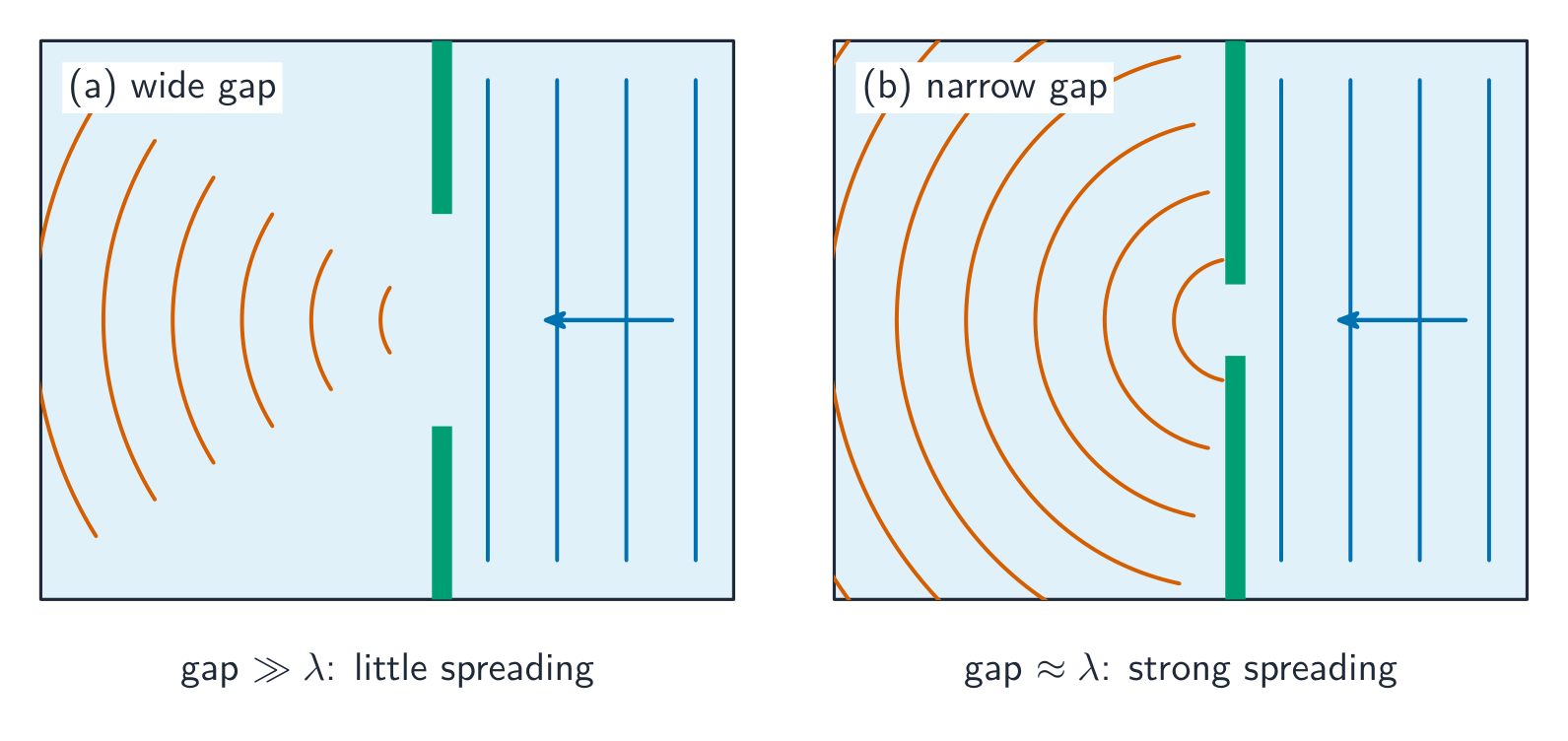
Syllabus · シラバス
Learning Objective Essential Knowledge 14.7.A
Describe the behavior of a wave and the diffraction pattern resulting from a wave passing through a single opening.- 14.7.A.1 Diffraction is the spreading of a wave around the edges of an obstacle or through an opening.
- 14.7.A.2 Diffraction is most pronounced when the size of the opening is comparable to the wavelength of the wave.
- 14.7.A.3 Diffraction of multiple wavefronts through a single opening leads to observable interference patterns.
- 14.7.A.4 Diffraction is commonly demonstrated by monochromatic light of wavelength $\lambda$ incident on a narrow opening of width $a$ that is a distance $L$ from a screen.
- 14.7.A.4.i Constructive and destructive interference of multiple wavefronts originating from the opening will result in bright and dark bands on the screen.
- 14.7.A.4.ii The amount of interference between two wavefronts depends on the path length difference $\Delta D$ of the wavefronts.
- 14.7.A.4.iii The path length difference $\Delta D$ can be described in terms of the opening width $a$ and the angle $\theta$ between the direction of propagation of the wavefront and the normal to the opening by the equation $\Delta D = a\sin\theta$.
- 14.7.A.4.iv For small angles, where $\theta < 10°$, the small angle approximation can be used to relate $\lambda$, $a$, and $L$ to $y_{\min}$, the distance from the middle of the central bright fringe to the $m^{\text{th}}$ order of minimum brightness on the screen.
- Equation: $a\left(\dfrac{y_{\min}}{L}\right) \approx m\lambda$
- 14.7.A.5 The diffraction pattern produced by a wave passing through an opening depends on the shape of the opening.
- 14.7.A.6 Visual representations of single-slit diffraction patterns are useful in determining the physical properties of the slit and the interacting waves.
Source: College Board AP Course and Exam Description · 出典: College Board AP コースおよび試験説明書
EnglishDiffraction 衍射 is the bending and spreading of waves around edges or through openings. The spreading is significant when the opening is comparable to the wavelength – so sound (long wavelength) bends around doorways easily, while light (tiny wavelength) needs a very narrow slit.
日本語Diffraction 衍射 is the bending and spreading of waves around edges or through openings. The spreading is significant when the opening is comparable to the wavelength – so sound (long wavelength) bends around doorways easily, while light (tiny wavelength) needs a very narrow slit.
Waves spread out (diffract) as they pass through a gap Vocabulary · 語彙 Train · 練習するEnglish 日本語 Diffraction/dɪˈfrækʃn/ 回折 14.8
Double-Slit Interference and Diffraction Gratings
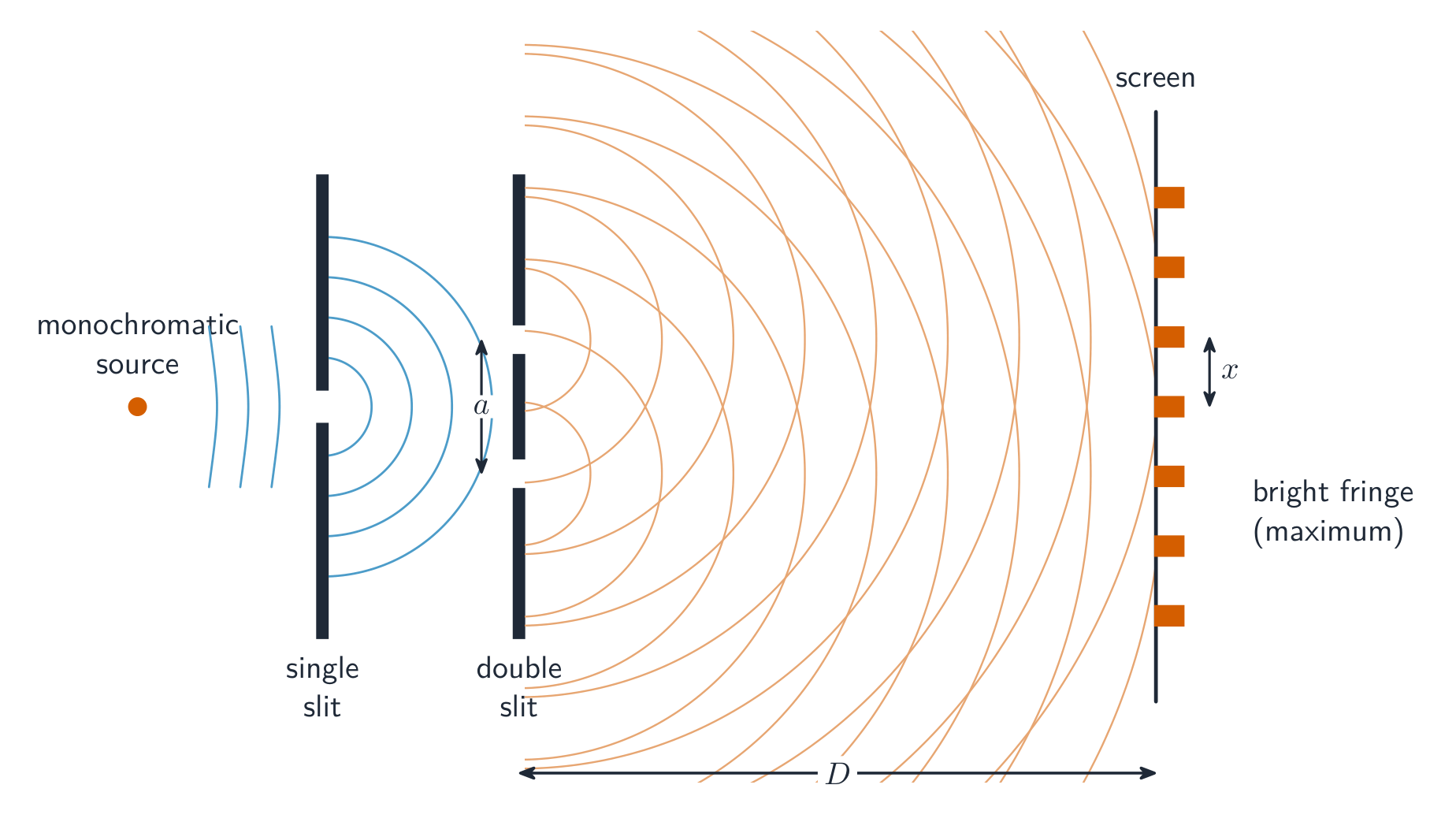
Syllabus · シラバス
Learning Objective Essential Knowledge 14.8.A
Describe the behavior of a wave and the diffraction pattern resulting from the wave passing through multiple openings.- 14.8.A.1 The pattern resulting from monochromatic light of wavelength $\lambda$ incident on two slits a distance $d$ apart is caused by a combination of wave diffraction and wave interference.
- 14.8.A.1.i When only considering wave interference, a double slit creates a pattern of uniformly spaced maxima.
- 14.8.A.1.ii Constructive and destructive interference of the wavefronts originating from each slit will result in bright and dark bands on the screen.
- 14.8.A.1.iii The amount of interference between two wavefronts depends on the path length difference $\Delta D$ of the wavefronts.
- 14.8.A.1.iv The path length difference $\Delta D$ can be described in terms of the slit separation $d$ and the angle $\theta$ between the direction of propagation of the wavefront and the normal to the opening by the equation $\Delta D = d\sin\theta$.
- 14.8.A.1.v For small angles, where $\theta < 10°$, the small angle approximation can be used to relate $\lambda$, $d$, and $L$ to $y_{\max}$, the distance from the middle of the central bright fringe to the $m^{\text{th}}$ order of maximum brightness on the screen.
- Equation: $d\left(\dfrac{y_{\max}}{L}\right) \approx m\lambda$
- 14.8.A.1.vi When considering wave interference and wave diffraction, a double slit creates an interference pattern of maxima and minima superimposed within the envelope created by single-slit diffraction.
- 14.8.A.2 Interference patterns produced by light interacting with a double slit indicate that light has wave properties. The source of this discovery was Young's double-slit experiment.
- 14.8.A.3 Visual representations of double-slit diffraction patterns are useful in determining the physical properties of the slits and the interacting waves.
- 14.8.A.4 A diffraction grating is a collection of evenly spaced parallel slits or openings that produce an interference pattern that is the combination of numerous diffraction patterns superimposed on each other.
- 14.8.A.5 When white light is incident on a diffraction grating, the center maximum is white and the higher-order maxima disperse white light into a rainbow of colors, with the longest-wavelength light (red) appearing farthest from the central maximum.
Source: College Board AP Course and Exam Description · 出典: College Board AP コースおよび試験説明書
EnglishTwo-source interference Coherent 相干 light through two closely spaced slits produces a pattern of bright and dark fringes. Bright fringes occur where the path difference is a whole number of wavelengths:
$$d\sin\theta=m\lambda.$$A diffraction grating 衍射光栅 has many slits, giving sharp, widely spaced bright lines – useful for separating light into its wavelengths.Worked example. Light of wavelength $600\ \text{nm}$ passes through two slits $0.20\ \text{mm}$ apart. The first bright fringe ($m=1$) sits at
$$\sin\theta=\frac{m\lambda}{d}=\frac{1\times600\times10^{-9}}{0.20\times10^{-3}}=3.0\times10^{-3}\;\Rightarrow\;\theta=0.17^{\circ}.$$The tiny angle is why the slits must be very close together and the screen far away to see the fringes clearly.日本語Two-source interference Coherent 相干 light through two closely spaced slits produces a pattern of bright and dark fringes. Bright fringes occur where the path difference is a whole number of wavelengths:
$$d\sin\theta=m\lambda.$$A diffraction grating 衍射光栅 has many slits, giving sharp, widely spaced bright lines – useful for separating light into its wavelengths.Young's double slits give an interference pattern of bright and dark fringes Worked example. Light of wavelength $600\ \text{nm}$ passes through two slits $0.20\ \text{mm}$ apart. The first bright fringe ($m=1$) sits at
$$\sin\theta=\frac{m\lambda}{d}=\frac{1\times600\times10^{-9}}{0.20\times10^{-3}}=3.0\times10^{-3}\;\Rightarrow\;\theta=0.17^{\circ}.$$The tiny angle is why the slits must be very close together and the screen far away to see the fringes clearly.
The fine tracks on a CD act as a diffraction grating, splitting white light into a spectrum Explore · 探索Superpose two waves · 2つの波を重ね合わせる
Where two waves arrive in phase they add (bright fringe); out of phase they cancel (dark fringe). That interference makes the double-slit pattern. · 2つの波が同位相で到達すると加算され(明線)、逆位相则为相互に打ち消し合う(暗線)。この干渉が二重スリットパターンを生む。
Vocabulary · 語彙 Train · 練習するEnglish 日本語 Coherent/kəʊˈhɪərənt/ コヒーレント diffraction grating/dɪˈfrækʃn ˈɡreɪtɪŋ/ 回折格子 14.9
Thin-Film Interference
Syllabus · シラバス
Learning Objective Essential Knowledge 14.9.A
Describe the behavior of light that interacts with a thin film.- 14.9.A.1 When light travels from one medium to another, some of the light is transmitted, some is reflected, and some is absorbed.
- 14.9.A.2 The phase change of a reflected ray depends on the relative indices of refraction of the materials with which the ray interacts.
- 14.9.A.2.i A phase change of 180 degrees occurs when a light ray is reflected from a medium with a greater index of refraction than the medium through which the ray is traveling.
- 14.9.A.2.ii No phase change occurs when a light ray is reflected from a medium with a lower index of refraction than the medium through which the ray is traveling.
- 14.9.A.3 The phase of a wave does not change when it is refracted as it passes from one medium into another.
- 14.9.A.4 Thin-film interference occurs when light interacts with a medium whose thickness is comparable to the light's wavelength.
- 14.9.A.4.i The interactions between the initial reflected light and the light exiting the thin film after being reflected from the second interface exhibit wave interference behavior, resulting in a single wave that is the sum of the two interacting waves.
- 14.9.A.4.ii The amount of constructive or destructive interference between the two reflected waves depends on the relationship between the thickness of the film, the wavelength of light, any phase shifts, and the angle at which the incident light strikes the film.
- 14.9.A.5 Practical examples of thin-film interference include the color variations seen in soap bubbles and oil films, as well as antireflection coatings.
- 14.9.A.5.i The spectrum of colors observed in oil films and soap bubbles arises from differences in the thickness of the film.
- 14.9.A.5.ii Antireflection coatings eliminate reflected light by applying the relationships between indices of refraction, phase shift, and wave interference to create destructive interference of the light reflected from the two surfaces of the coating.
- 14.9.A.5.iii The simplest antireflection coating has a thickness equal to one-quarter of the wavelength of the light in the coating, and the index of refraction of the coating is greater than that of air and less than that of the surface upon which the coating is applied. This assumes incident light is normal to the surface.
Boundary statement: Quantitative analysis of thin-film interference is limited to waves that are normal to the incident surface.
Source: College Board AP Course and Exam Description · 出典: College Board AP コースおよび試験説明書
EnglishLight reflecting off the top and bottom of a thin film 薄膜 (soap bubble, oil slick) interferes with itself. Depending on the film's thickness and a possible half-wavelength phase flip on reflection off a denser medium, particular wavelengths interfere constructively – producing the shifting colours you see.
The same physics is put to work in an antireflection coating 增透膜 on camera lenses, glasses, and solar cells: a thin transparent layer whose two reflected waves interfere destructively, so almost no light reflects and more is transmitted. The simplest coating is one quarter of a wavelength thick (measured in the coating), and its refractive index sits between that of air and the glass beneath, so the reflected light cancels itself out.
日本語Light reflecting off the top and bottom of a thin film 薄膜 (soap bubble, oil slick) interferes with itself. Depending on the film's thickness and a possible half-wavelength phase flip on reflection off a denser medium, particular wavelengths interfere constructively – producing the shifting colours you see.
The same physics is put to work in an antireflection coating 增透膜 on camera lenses, glasses, and solar cells: a thin transparent layer whose two reflected waves interfere destructively, so almost no light reflects and more is transmitted. The simplest coating is one quarter of a wavelength thick (measured in the coating), and its refractive index sits between that of air and the glass beneath, so the reflected light cancels itself out.
Vocabulary · 語彙 Train · 練習するEnglish 日本語 thin film/θɪn fɪlm/ 薄膜 antireflection coating/ˌæntɪrɪˈflekʃn ˈkəʊtɪŋ/ 無反射コーティング 14.9
Exam tips
- Use $v=f\lambda$; the source sets the frequency, and when a wave enters a new medium the frequency stays fixed while the speed and wavelength change.
- Distinguish transverse (vibration perpendicular, can be polarised) from longitudinal (vibration along the travel, e.g. sound).
- Constructive interference needs a path difference of a whole number of wavelengths; destructive needs a half-odd number.
- On a string fixed at both ends the fundamental fits half a wavelength ($\lambda=2L$).
- Diffraction is significant only when the gap is comparable to the wavelength — sound bends round doorways, light needs a very narrow slit.
- Beats: two waves of slightly different frequency throb at $f_{\text{beat}}=|f_1-f_2|$ (e.g. two tuning forks; tuning to zero beats).
- An antireflection coating is a quarter-wavelength-thick layer (index between air and glass) whose two reflections cancel, cutting the reflected light.
- 14.1.A.1 Waves transfer energy between two locations without transferring matter between those locations.
-
15
Modern Physics
Watch lesson · レッスンを視聴15.1
Quantum Theory and Wave-Particle Duality · 量子理論と波動粒子二重性
Syllabus · シラバス
EnglishLearning Objective 15.1.A: Describe the properties and behavior of an object that exhibits both particle-like and wave-like behavior.
- 15.1.A.1 Quantum theory was developed to explain observations of matter and energy that could not be explained using classical mechanics. These phenomena include, but are not limited to, atomic spectra, blackbody radiation, and the photoelectric effect.
- 15.1.A.1.i Quantum theory is necessary to describe the properties of matter at atomic and subatomic scales.
- 15.1.A.1.ii In quantum theory, fundamental particles can exhibit both particle-like and wave-like behavior.
- 15.1.A.2 Light can be modeled both as a wave and as discrete particles, called photons.
- 15.1.A.2.i A photon is a massless, electrically neutral particle with energy proportional to the photon's frequency.
- Relevant equations:
- $E = hf$
- $\lambda = \dfrac{c}{f}$
- 15.1.A.2.ii Photons travel in straight lines unless they interact with matter.
- 15.1.A.2.i A photon is a massless, electrically neutral particle with energy proportional to the photon's frequency.
- 15.1.A.3 The speed of a photon depends on the medium through which the photon travels.
- 15.1.A.3.i The speed of all photons in free space is equal to the speed of light, $c = 3.00 \times 10^{8}$ m/s.
- 15.1.A.3.ii In general, the speed of photons through a given medium is inversely proportional to the index of refraction of that medium.
- 15.1.A.4 Particles can demonstrate wave properties, as shown by variations of Young's double-slit experiment.
- 15.1.A.4.i A wave model of matter is quantified by the de Broglie wavelength, which increases as the momentum of a particle decreases.
- Relevant equation:
- $\lambda = \dfrac{h}{p}$
- 15.1.A.4.ii Quantum theory is necessary to describe systems where the de Broglie wavelength is comparable to the size of the system.
- 15.1.A.4.i A wave model of matter is quantified by the de Broglie wavelength, which increases as the momentum of a particle decreases.
- 15.1.A.5 Values of energy and momentum have discrete, or quantized, values for bound systems described by quantum theory.
日本語学習目標 15.1.A: 粒子としての性質と波としての性質の両方を示す物体の性質と挙動を説明する。
- 15.1.A.1 量子理論は、古典力学では説明できない物質とエネルギーの観測を説明するために発展された。これらの現象には、原子スペクトル、黒体放射、光電効果などが含まれる(これらに限定されない)。
- 15.1.A.1.i 量子理論は、原子レベルおよび亜原子レベルでの物質の性質を記述するために必要である。
- 15.1.A.1.ii 量子理論において、素粒子は粒子としての性質と波としての性質の両方を示すことができる。
- 15.1.A.2 光は波としても、光子と呼ばれる離散的な粒子としてもモデル化できる。
- 15.1.A.2.i 光子は質量を持たず電気的に中性な粒子であり、そのエネルギーは光子の周波数に比例する。
- 関連方程式:
- $E = hf$
- $\lambda = \dfrac{c}{f}$
- 15.1.A.2.ii 光子は物質と相互作用しない限り直進する。
- 15.1.A.2.i 光子は質量を持たず電気的に中性な粒子であり、そのエネルギーは光子の周波数に比例する。
- 15.1.A.3 光子の速度は、光子が通過する媒質に依存する。
- 15.1.A.3.i 真空中におけるすべての光子の速度は、光速 $c = 3.00 \times 10^{8}$ m/s に等しい。
- 15.1.A.3.ii 一般的に、特定の媒質中を通過する光子の速度は、その媒質の屈折率に反比例する。
- 15.1.A.4 粒子も波動性を示すことがあり、ヤングの二重スlit実験の変種によって実証されている。
- 15.1.A.4.i 物質の波動モデルは、ド・ブロイリー波長によって定量化される。ド・ブロイリー波長は、粒子の運動量が減少すると増加する。
- 関連方程式:
- $\lambda = \dfrac{h}{p}$
- 15.1.A.4.ii 量子理論は、ド・ブロイリー波長がシステムのサイズと同程度であるシステムを記述するために必要である。
- 15.1.A.4.i 物質の波動モデルは、ド・ブロイリー波長によって定量化される。ド・ブロイリー波長は、粒子の運動量が減少すると増加する。
- 15.1.A.5 量子理論によって記述される束縛系において、エネルギーおよび運動量の値は離散的、すなわち量子化された値をとる。
Source: College Board AP Course and Exam Description · 出典: College Board AP コースおよび試験説明書
EnglishAt tiny scales, energy comes in discrete packets called quanta 量子. Light is carried by photons 光子, each with energy set by its frequency:
$$E=hf,$$where $h$ is Planck's constant. Wave–particle duality 波粒二象性: light and matter each show both wave behavior (interference, diffraction) and particle behavior (photons, electrons as localized hits). A particle also has a matter wavelength $\lambda=\dfrac{h}{p}$, and particles genuinely produce interference - a variation of Young's double-slit experiment 双缝实验 done with electrons builds up the same fringe pattern as light.Worked example. Find the energy of a photon of orange light with frequency $5.0\times10^{14}\ \text{Hz}$ ($h=6.63\times10^{-34}\ \text{J s}$): $E=hf=6.63\times10^{-34}\times5.0\times10^{14}=3.3\times10^{-19}\ \text{J}$, which is about $2.1\ \text{eV}$ (dividing by $1.6\times10^{-19}$). Visible-light photons carry a few electronvolts – just right to trigger the chemistry of vision and photosynthesis.
日本語雲室:放射能崩壊からの荷電粒子を追跡する近代物理学の装置 微小スケールでは、エネルギーは離散的なパケットであるクオンタとして存在します。光は光子によって運ばれ、各光子のエネルギーはその周波数で決まります:
$$E=hf,$$ここで $h$ はプランク定数です。波動粒子二重性:光と物質はどちらも波動性(干渉、回折)と粒子性(光子、電子の局在した衝突)を示します。粒子はまた物質波長 $\lambda=\dfrac{h}{p}$ を持ち、粒子自体が干渉を生じることも実証されています。電子を用いて行われたヤングの二重スリット実験のバリエーションは、光と同じ縞模様の蓄積を示します。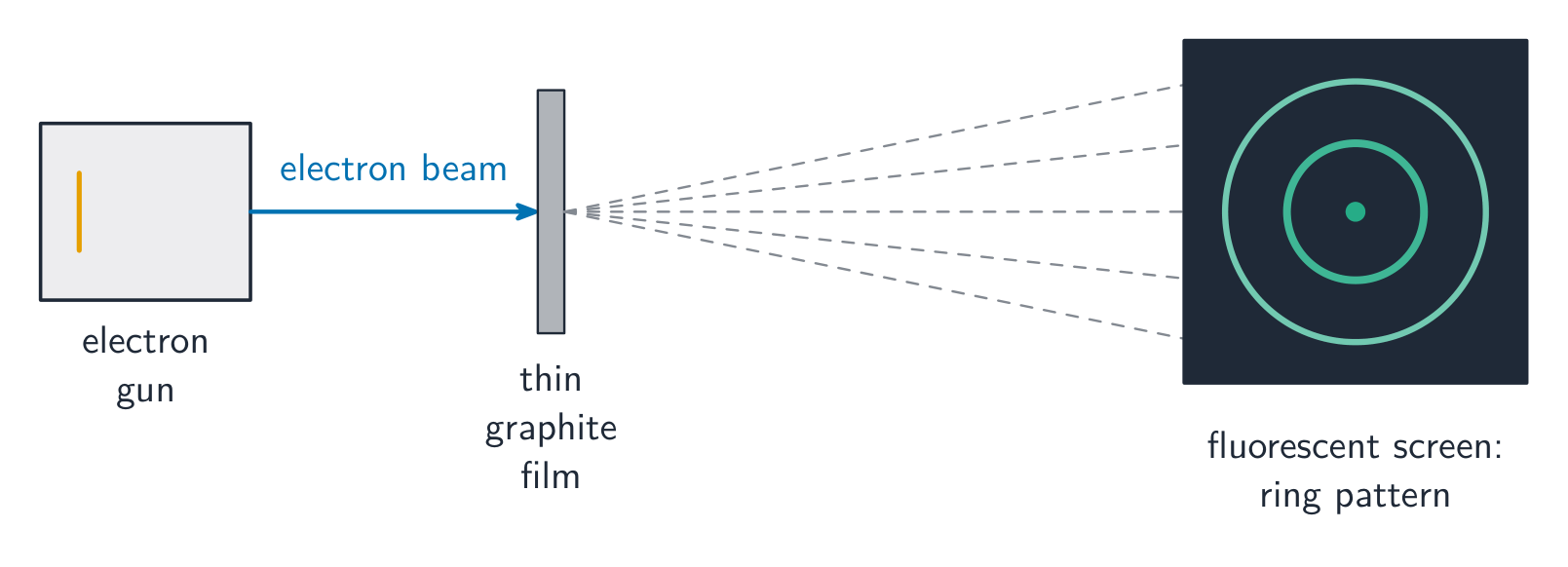
電子が回折パターンを形成し、粒子が波動性を有することを示す ** worked example **。周波数 $5.0\times10^{14}\ \text{Hz}$ ( $h=6.63\times10^{-34}\ \text{J s}$ )の橙色光の光子のエネルギーを求めよ: $E=hf=6.63\times10^{-34}\times5.0\times10^{14}=3.3\times10^{-19}\ \text{J}$ 。これは約 $2.1\ \text{eV}$ に相当する( $1.6\times10^{-19}$ で割る)。可視光の光子は数electronvoltsのエネルギーを持ち、視覚や光合成の化学反応を引き起こすのにちょうど良い値です。
15.2
The Bohr Model of Atomic Structure · ボーアの原子構造モデル
Syllabus · シラバス
EnglishLearning Objective 15.2.A: Describe the properties of an atom.
- 15.2.A.1 Atoms have internal structure.
- 15.2.A.1.i Atoms consist of a small, positively charged nucleus surrounded by one or more negatively charged electrons.
- 15.2.A.1.ii The nucleus of an atom is made up of protons and neutrons.
- 15.2.A.1.iii The number of neutrons and protons in an atom can be represented using nuclear notation.
- 15.2.A.1.iv An ion is an atom with a nonzero net electric charge.
- 15.2.A.2 Each atomic element has a unique number of protons.
- 15.2.A.2.i The number and arrangements of electrons affects how atoms interact.
- 15.2.A.2.ii The total number of neutrons and protons identifies the isotope of an element.
- 15.2.A.2.iii The mass of an atom is dominated by the total mass of the protons and neutrons in its nucleus.
- 15.2.A.3 The Bohr model of the atom is based on classical physics and was the historical representation of the atom that led to the description of the hydrogen atom in terms of discrete energy states.
- 15.2.A.3.i In the Bohr model of the atom, electrons are modeled as moving around the nucleus in circular orbits determined by the electron's charge and mass, as well as the electric force between the electron and the nucleus.
- Relevant equations:
- $F_e = k\dfrac{q_1 q_2}{r^2}$
- $F_{\text{net}} = m\dfrac{v^2}{r}$
- 15.2.A.3.ii The standing wave model of electrons accounts for the existence of specific allowed energy states of an electron in an atom, because the electron orbit's circumference must be an integer multiple of the electron's de Broglie wavelength.
- 15.2.A.3.i In the Bohr model of the atom, electrons are modeled as moving around the nucleus in circular orbits determined by the electron's charge and mass, as well as the electric force between the electron and the nucleus.
Boundary statement: The analysis and description of electron structure is limited to energy levels and will not include such advanced descriptions as orbitals, orbital shapes, or probability functions.
日本語学習目標 15.2.A: 原子の性質を説明する。
- 15.2.A.1 原子には内部構造がある。
- 15.2.A.1.i 原子は、正電荷を持つ微小な原子核と、その周囲を回っている1つ以上の負電荷を持つ電子から構成される。
- 15.2.A.1.ii 原子核は陽子と中性子からなる。
- 15.2.A.1.iii 原子内の中性子数と陽子数は、核記号を用いて表現できる。
- 15.2.A.1.iv イオンとは、非ゼロの純電荷を持つ原子のことである。
- 15.2.A.2 各元素は固有の陽子数を有している。
- 15.2.A.2.i 電子の数や配置は、原子間の相互作用に影響を与える。
- 15.2.A.2.ii 中性子と陽子の合計数は、ある元素の同位体を識別する。
- 15.2.A.2.iii 原子の質量は、主に核内の陽子と中性子の質量の合計によって決まる。
- 15.2.A.3 ボーアの原子モデルは古典力学に基づいており、水素原子を離散的なエネルギー準位として記述するに至った歴史的な原子の表現である。
- 15.2.A.3.i ボーアの原子モデルにおいて、電子は負電荷および質量、ならびに電子と核間の静電力によって決定された円軌道上を核の周りを回るとモデル化される。
- 関連方程式:
- $F_e = k\dfrac{q_1 q_2}{r^2}$
- $F_{\text{net}} = m\dfrac{v^2}{r}$
- 15.2.A.3.ii 電子の定常波モデルは、電子軌道の周囲の長さが電子のド・ブロイ波長に対して整数倍でなければならないため、原子内にある電子の特定の許容エネルギー準位の存在を説明する。
- 15.2.A.3.i ボーアの原子モデルにおいて、電子は負電荷および質量、ならびに電子と核間の静電力によって決定された円軌道上を核の周りを回るとモデル化される。
境界文: 電子構造の解析と記述はエネルギー準位に限定され、軌道、軌道の形状、または確率関数などの高度な記述は含まれない。
Source: College Board AP Course and Exam Description · 出典: College Board AP コースおよび試験説明書
EnglishThe Bohr model 玻尔模型 pictures electrons orbiting the nucleus only in certain allowed energy levels 能级. An electron can jump between levels only by absorbing or emitting a photon whose energy exactly matches the gap:
$$E_{\text{photon}}=|E_{\text{final}}-E_{\text{initial}}|.$$Because the levels are discrete, only specific photon energies are allowed.日本語ボーア模型では、電子は特定の許容されたエネルギー準位のみを核の周りを回ると描かれます。電子が準位間を遷移するのは、そのギャップに正確に一致するエネルギーを持つ光子を吸収または放出する場合に限られます:
$$E_{\text{photon}}=|E_{\text{final}}-E_{\text{initial}}|.$$準位が離散的であるため、特定の光子エネルギーのみが許容されます。15.3
Emission and Absorption Spectra · 放射スペクトルと吸収スペクトル
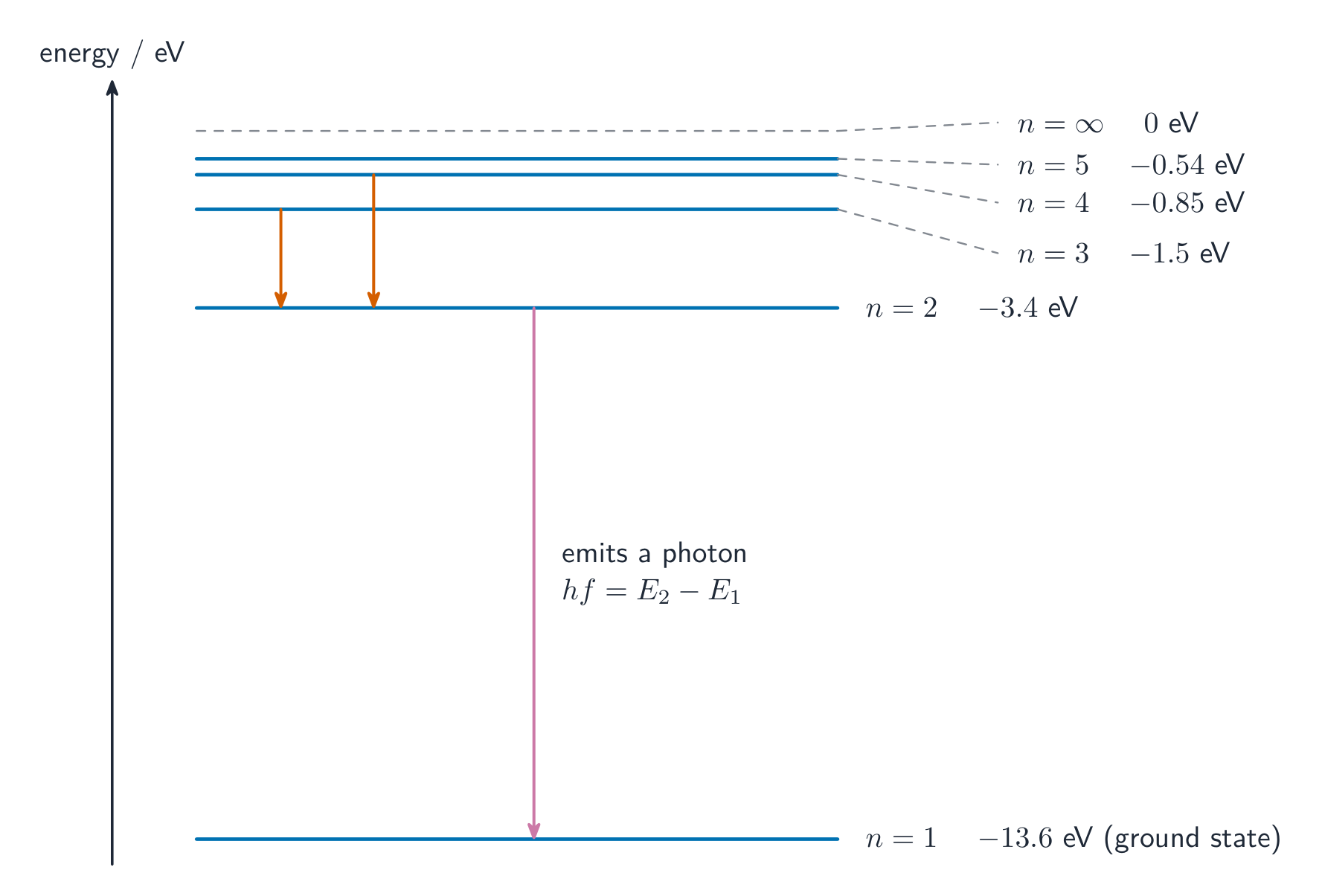
Syllabus · シラバス
EnglishLearning Objective 15.3.A: Describe the emission or absorption of photons by atoms.
- 15.3.A.1 Energy transfer occurs when photons are absorbed or emitted by an atom, which is modeled as a system consisting of a nucleus and an electron.
- 15.3.A.2 Energy can only be absorbed or emitted by an atom if the amount of energy being absorbed or emitted corresponds to the energy difference between two atomic energy states.
- 15.3.A.2.i An atom in a given energy state may absorb a photon of the appropriate energy and transition to a higher energy state.
- 15.3.A.2.ii An atom in an excited energy state may emit a photon of the appropriate energy to spontaneously move to a lower energy state.
- 15.3.A.2.iii Because an atom is modeled as a system consisting of an electron and a nucleus, a change in the energy state of an atom corresponds to a change in the interaction energy between the electron and the nucleus.
- 15.3.A.3 Transitions between two energy states of an atom correspond to the absorption or emission of a photon of a single frequency and, therefore, a single wavelength.
- 15.3.A.4 Atoms of each element have a unique set of allowed energy levels and thereby a unique set of absorption and emission frequencies. The unique set of frequencies determines the element's spectrum.
- 15.3.A.4.i An emission spectrum can be used to determine the elements in a source of light.
- 15.3.A.4.ii An absorption spectrum can be used to determine the elements composing a substance by observing what light the substance has absorbed.
- 15.3.A.4.iii Energy level diagrams are commonly used to visually represent the energy states of an atom.
- 15.3.A.5 Binding energy is the energy required to remove an electron from an atom, causing the atom to become ionized. An atom in the lowest energy level (ground state) will require the greatest amount of energy to remove the electron from the atom.
Boundary statement: In AP Physics 2, only energy level diagrams of single-electron atoms will be considered.
日本語学習目標 15.3.A: 原子による光子の放射および吸収を記述する。
- 15.3.A.1 光子が原子によって吸収または放射される際、エネルギー移動が発生する。これは核と電子からなる系としてモデル化される。
- 15.3.A.2 原子がエネルギーを吸収または放射できるのは、そのエネルギー量が2つの原子エネルギー準位間のエネルギー差に対応する場合のみである。
- 15.3.A.2.i 特定のエネルギー準位にある原子は、適切なエネルギーを持つ光子を吸収し、より高いエネルギー準位へ遷移することがある。
- 15.3.A.2.ii 励起エネルギー準位にある原子は、自発的に低いエネルギー準位へ移動するために、適切なエネルギーを持つ光子を放射することがある。
- 15.3.A.2.iii 原子は電子と核からなる系としてモデル化されるため、原子のエネルギー準位の変化は電子と核間の相互作用エネルギーの変化に対応する。
- 15.3.A.3 原子の2つのエネルギー準位間の遷移は、単一の周波数(したがって単一の波長)を持つ光子の吸収または放射に対応する。
- 15.3.A.4 各元素の原子には、固有の許容エネルギー準位のセットがあり、それにより固有の吸収・放射周波数のセットがある。この固有の周波数セットがその元素のスペクトルを決定する。
- 15.3.A.4.i 放射スペクトルは、光源に含まれる元素を特定するために使用できる。
- 15.3.A.4.ii 吸収スペクトルは、物質がどのような光を吸収したかを観察することで、その物質を構成する元素を特定するために使用できる。
- 15.3.A.4.iii エネルギー準位図は一般的に、原子のエネルギー状態を視覚的に表すために用いられる。
- 15.3.A.5 結合エネルギーとは、原子から電子を取り除き、原子をイオン化させるために必要なエネルギーのことである。最低エネルギー準位(基底状態)にある原子は、電子を取り除くために最大のエネルギーを必要とする。
境界文: AP物理学2では、単一電子原子のエネルギー準位図のみが対象となる。
Source: College Board AP Course and Exam Description · 出典: College Board AP コースおよび試験説明書
English- An emission spectrum 发射光谱 is the set of bright lines given off when electrons drop to lower levels – each line a specific wavelength.
- An absorption spectrum 吸收光谱 is the set of dark lines where those same wavelengths are absorbed from a continuous source.
The line pattern is a fingerprint of the element, since every element has its own energy levels.
日本語- 放射スペクトルとは、電子が低い準位へ遷移した際に放出される明線の集合であり、各線は特定の波長に対応します。
- 吸収スペクトルとは、連続光源からそれらの同じ波長が吸収される位置に現れる暗線の集合です。
水素の離散的なエネルギー準位が明線スペクトルを生み出す この明線のパターンは元素の指紋のようなものであり、なぜなら各元素固有のエネルギー準位を持っているからです。

水素の放射スペクトル:各明線は、電子が固定されたエネルギー準位間で遷移する際に放出される光 Explore · 探索See an element's line spectrum · 元素の線スペクトルを見る
Electrons jump between fixed energy levels, emitting or absorbing photons of exact wavelengths — a line spectrum that fingerprints the element. · 電子は固定されたエネルギー準位間で遷移し、特定の波長を持つ光子を放出または吸収する。これがその元素の「指紋」となる線スペクトルである。
Vocabulary · 語彙 Train · 練習するEnglish 日本語 quanta/ˈkwɒntə/ 量子 photons/ˈfəʊtɒnz/ 光子 Wave–particle duality/weɪv ˈpɑːtɪkl djuːˈælɪti/ 波動-粒子二重性 double-slit experiment/ˈdʌbl slɪt ekˈsperɪmənt/ 二重すリット実験 Bohr model/ˈbəʊə ˈmɒdl/ ボーア模型 energy levels/ˈenədʒi ˈlevlz/ エネルギー準位 emission spectrum/ɪˈmɪʃn ˈspektrəm/ 輝線スペクトル absorption spectrum/əbˈsɔːpʃn ˈspektrəm/ 吸収スペクトル 15.4
Blackbody Radiation · 黒体放射
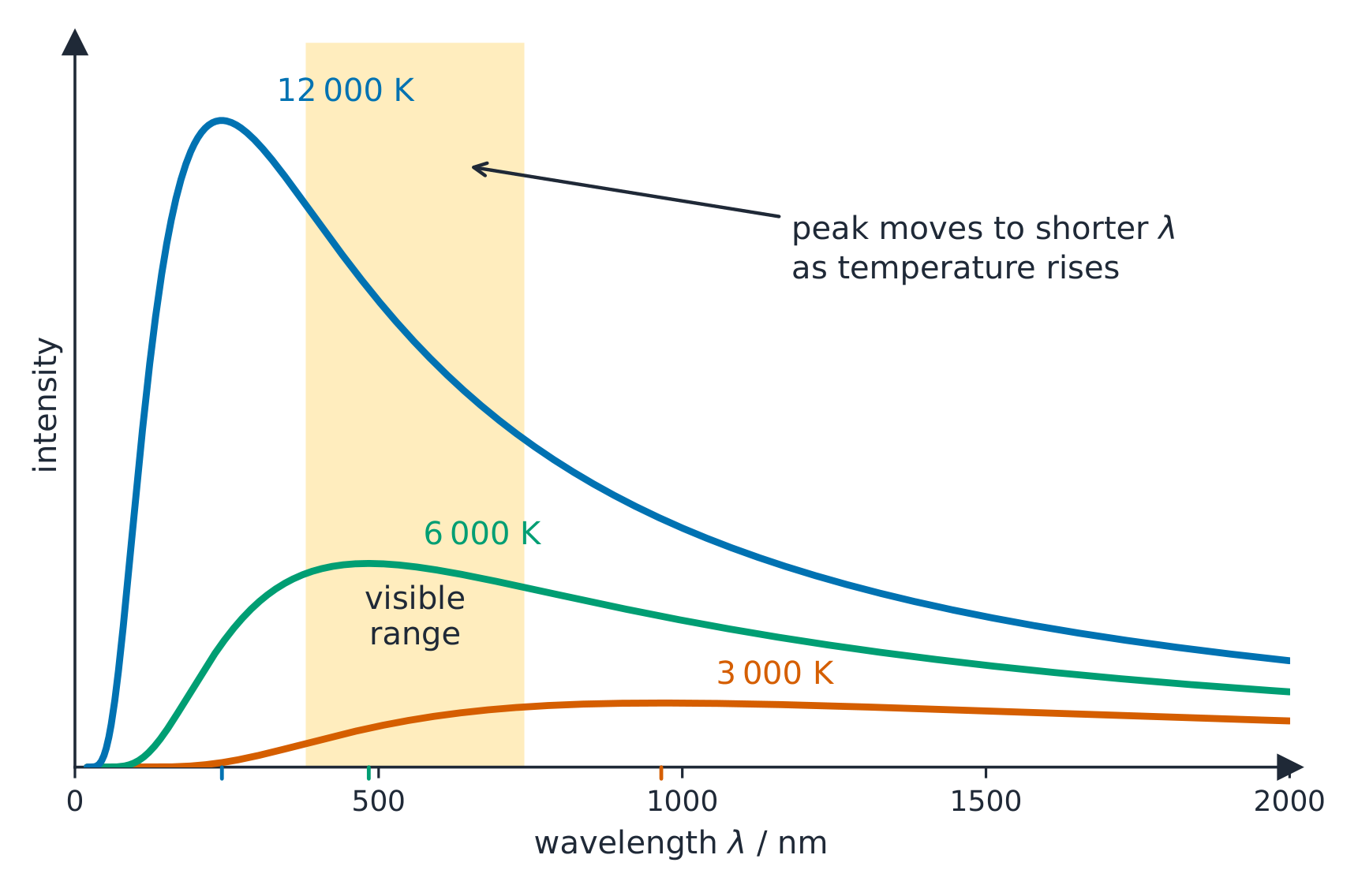
Syllabus · シラバス
Learning Objective Essential Knowledge 15.4.A
Describe the electromagnetic radiation emitted by an object due to its temperature.- 15.4.A.1 Matter will spontaneously convert some of its internal thermal energy into electromagnetic energy.
- 15.4.A.2 A blackbody is an idealized model of matter that absorbs all radiation that falls on the body. If the body is in equilibrium at a constant temperature, then it must in turn emit energy.
- 15.4.A.3 A blackbody will emit a continuous spectrum that only depends on the body's temperature. The radiation emitted by a blackbody is often modeled by plotting intensity per unit wavelength as a function of wavelength.
- 15.4.A.3.i The distribution of the intensity of a blackbody's spectrum as a function of temperature cannot be modeled using only classical physics concepts. A blackbody's spectrum is described by Planck's law, which assumes that the energy of light is quantized.
- 15.4.A.3.ii The peak wavelength emitted by a blackbody (the wavelength at which the blackbody emits the greatest amount of radiation per unit wavelength) decreases with increasing temperature, as described by Wien's law.
- Relevant equation:
- $\lambda_{\max} = \dfrac{b}{T}$
- 15.4.A.3.iii The rate at which energy is emitted (power) by a blackbody is proportional to the surface area of the body and to the temperature of the body raised to the fourth power, as described by the Stefan-Boltzmann law.
- Relevant equation:
- $P = A\sigma T^4$
Source: College Board AP Course and Exam Description · 出典: College Board AP コースおよび試験説明書
EnglishA blackbody 黑体 emits a continuous spectrum that depends only on its temperature. Hotter objects glow brighter and peak at shorter wavelengths (red-hot to white-hot to blue-hot). Explaining this spectrum required quantized energy – a founding problem of quantum theory.
日本語黒体は温度のみに依存する連続スペクトルを放射します。高温物体ほど輝度が高く、ピークは短い波長側へシフトします(赤熱→白熱→青熱)。このスペクトルを説明するには量子化されたエネルギーが必要であり、これは量子力学の成立に不可欠な問題でした。
高温の黒体はより多く放射し、ピークは短い波長側へシフトする Vocabulary · 語彙 Train · 練習するEnglish 日本語 blackbody/ˈblækbɒdi/ 黒体 photoelectric effect/ˌfəʊtəʊɪˈlektrɪk ɪˈfekt/ 光電効果 work function/wɜːk ˈfʌŋkʃn/ 仕事関数 Compton scattering/ˈkɒmptn ˈskætərɪŋ/ コンプトン散乱 nucleus/ˈnjuːklɪəs/ 核 Fission/ˈfɪʃn/ 核分裂 Fusion/ˈfjuːʒn/ 核融合 15.5
The Photoelectric Effect · 光電効果
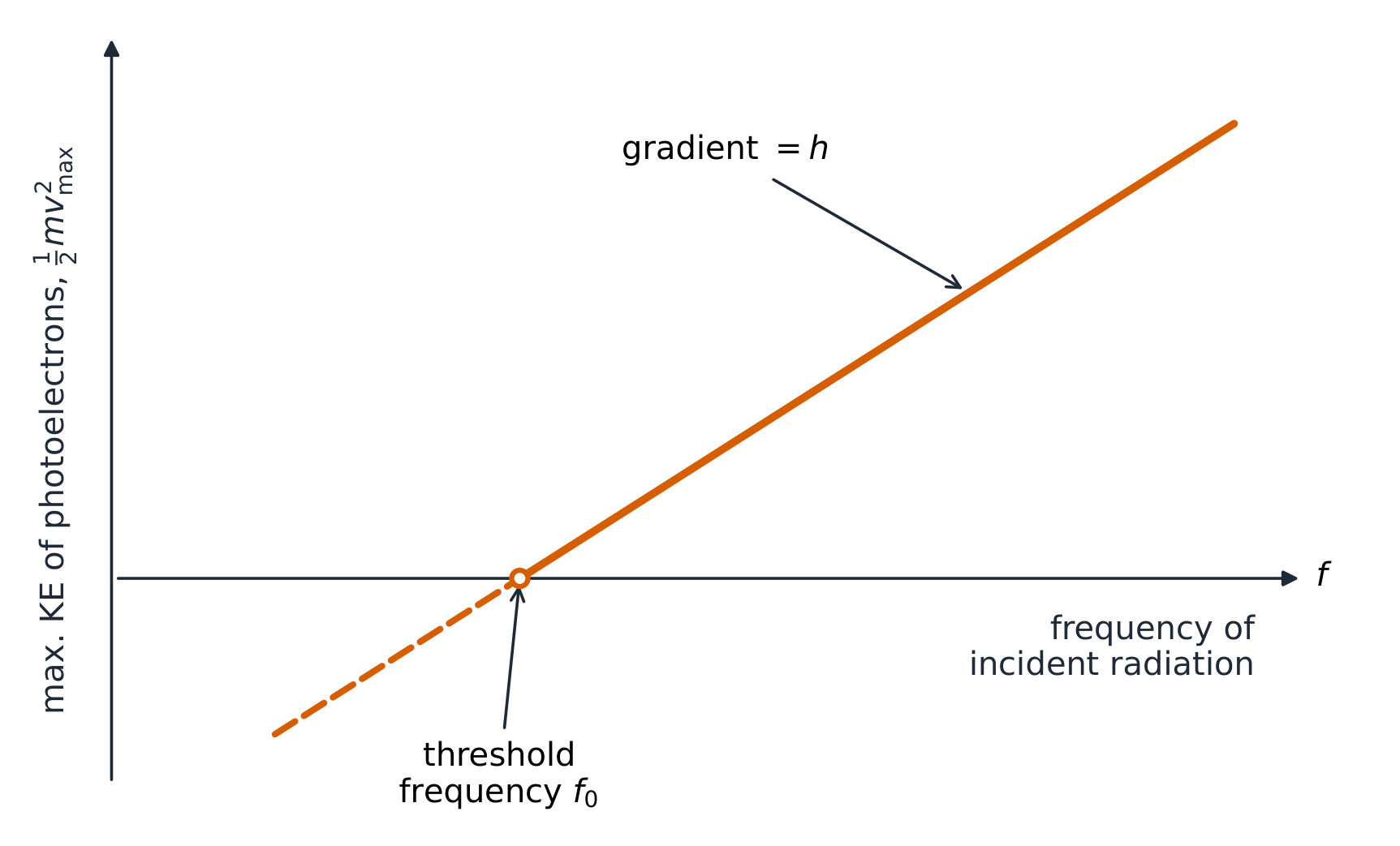
Syllabus · シラバス
EnglishLearning Objective 15.5.A: Describe an interaction between photons and matter using the photoelectric effect.
- 15.5.A.1 The photoelectric effect is the emission of electrons when electromagnetic radiation is incident upon a photoactive material.
- 15.5.A.2 The emission of electrons via the photoelectric effect requires a minimum frequency of incident light, called the threshold frequency.
- 15.5.A.2.i Light that is incident on a material and is at the threshold frequency or higher will induce electron emission, regardless of the number of photons that strike the material.
- 15.5.A.2.ii The energy of the emitted electrons is not dependent on the number of photons that are incident upon the material, which provides evidence that light is a collection of discrete, quantized energy packets called photons.
- 15.5.A.3 The maximum kinetic energy of an emitted electron is related to the frequency of the incident light and the work function of the material, $\phi$.
- 15.5.A.3.i The work function of a material is the minimum energy required to emit an electron from atoms in the material.
- 15.5.A.3.ii The maximum kinetic energy of an emitted electron is given by the equation $K_{\max} = hf - \phi$.
- 15.5.A.3.iii In a typical experimental setup to demonstrate the photoelectric effect and determine the work function of a metal, two metal plates are placed in a vacuum chamber and connected to a variable source of potential difference. One of the plates is illuminated by monochromatic light that causes electrons to be ejected and the potential difference between the plates is adjusted until no current is measured in the circuit.
Boundary statement: Where applicable, work functions for materials will be provided on the exam; students are not expected to know values of work functions or variables of a material that influence the magnitude of its work function.
日本語学習目標 15.5.A: 光電効果を用いて、光子と物質の相互作用を記述する。
- 15.5.A.1 光電効果とは、電磁放射が光活性物質に当たらせることで電子が放出される現象である。
- 15.5.A.2 光電効果による電子の放出には、閾値周波数と呼ばれる入射光の最小周波数が要求される。
- 15.5.A.2.i 閾値周波数以上に入射した光は、物質に当たる光子の数に関わらず、電子の放出を引き起こす。
- 15.5.A.2.ii 放出される電子のエネルギーは、物質に入射する光子の数に依存しない。これは、光が光子と呼ばれる離散的な量子化されたエネルギーパケットの集まりであることを示す証拠である。
- 15.5.A.3 放出される電子の最大運動エネルギーは、入射光の周波数および材料の仕事関数に依存する。 $\phi$。
- 15.5.A.3.i 材料の仕事関数は、その材料中の原子から電子を放出するために必要な最小エネルギーである。
- 15.5.A.3.ii 放出される電子の最大運動エネルギーは、以下の式で表される。 $K_{\max} = hf - \phi$。
- 15.5.A.3.iii 光電効果を示し、金属の仕事関数を測定するための一般的な実験装置では、真空チャンバー内に2枚の金属板を設置し、可変電源で接続する。片方の板を単色光で照射して電子を放出させ、回路に電流が流れなくなるまで板間の電位差を調整する。
境界線: 適用される場合、試験では材料ごとの仕事関数が提示され、学生が仕事関数の値やその大きさに影響を与える材料の変数を記憶する必要はない。
Source: College Board AP Course and Exam Description · 出典: College Board AP コースおよび試験説明書
EnglishThe photoelectric effect Shining light on a metal can eject electrons – the photoelectric effect 光电效应. Key facts (which only the photon picture explains): electrons come out only if the photon's frequency exceeds a threshold, no matter how bright a dimmer, lower-frequency light is. Energy conservation gives
$$K_{\max}=hf-\phi,$$where $\phi$ is the metal's work function 逸出功 (the energy to free an electron).Worked example. Light of frequency $8.0\times10^{14}\ \text{Hz}$ falls on a metal with work function $\phi=3.0\times10^{-19}\ \text{J}$. The most energetic electrons come off with
$$K_{\max}=hf-\phi=(6.63\times10^{-34}\times8.0\times10^{14})-3.0\times10^{-19}=5.3\times10^{-19}-3.0\times10^{-19}=2.3\times10^{-19}\ \text{J}.$$Below the threshold frequency $\phi/h$, $K_{\max}$ would be negative – meaning no electrons escape at all, however bright the light.日本語光電効果 金属に光を当てると電子が放出されることがあります。これを光電効果と呼びます。重要な事実は(これらは光子モデルのみで説明できます)以下の通りです。光子の周波数が閾値を超えた場合에만電子が放出され、低周波数の光であっても明るさが弱くても放出されません。エネルギー保存則により、
$$K_{\max}=hf-\phi,$$ここで $\phi$ は金属の仕事関数(電子を解放するために必要なエネルギー)です。光電子の最大運動エネルギーは周波数に対して直線的に増加する ** worked example.** 周波数 $8.0\times10^{14}\ \text{Hz}$ の光が仕事関数 $\phi=3.0\times10^{-19}\ \text{J}$ の金属に当たったとき、最も運動エネルギーの大きい電子は
$$K_{\max}=hf-\phi=(6.63\times10^{-34}\times8.0\times10^{14})-3.0\times10^{-19}=5.3\times10^{-19}-3.0\times10^{-19}=2.3\times10^{-19}\ \text{J}.$$閾値周波数 $\phi/h$ 未満では $K_{\max}$ が負となります——つまり、光がいくら明るくても、電子は一切放出されません。15.6
Compton Scattering · コンプトン散乱
Syllabus · シラバス
EnglishLearning Objective 15.6.A: Describe the interaction between photons and matter using Compton scattering.
- 15.6.A.1 In Compton scattering, a photon interacts with a free electron. The Compton effect is when a photon that emerges from the interaction has a lower energy and longer wavelength than the incoming photon. The magnitude of the change is related to the direction of the photon after the collision.
- 15.6.A.2 Compton scattering provides evidence that light is a collection of discrete, quantized energy packets called photons.
- 15.6.A.2.i Compton scattering can be explained by treating a photon as a particle and applying conservation of energy and conservation of momentum to the collision between the photon and electron.
- 15.6.A.2.ii The transfer of a photon's energy to an electron results in the energy, momentum, frequency, and wavelength of the photon changing.
- Relevant equations:
- $E = hf$
- $\lambda = \dfrac{h}{p}$
- 15.6.A.3 The change in wavelength experienced by a photon after colliding with an electron is related to how much the photon's direction changes.
- Relevant equation:
- $\Delta\lambda = \dfrac{h}{m_e c}(1 - \cos\theta)$
Boundary statement: AP Physics 2 includes full quantitative and qualitative treatments of conservation of momentum in two dimensions.
日本語学習目標 15.6.A: コンプトン散乱を用いて、光子と物質の相互作用を説明する。
- 15.6.A.1 コンプトン散乱では、光子が自由電子と相互作用する。コンプトン効果とは、相互作用後に出現する光子が、入射した光子よりもエネルギーが低く、波長が長い現象である。この変化の大きさは、衝突後の光子の進行方向に依存する。
- 15.6.A.2 コンプトン散乱は、光が光子と呼ばれる離散的で量子化されたエネルギー塊の集合であることを示す証拠となる。
- 15.6.A.2.i コンプトン散乱は、光子を粒子として扱い、光子と電子の衝突に対してエネルギー保存則および運動量保存則を適用することで説明できる。
- 15.6.A.2.ii 光子のエネルギーが電子へ伝達されることで、光子のエネルギー、運動量、周波数、波長が変化する。
- 関連方程式:
- $E = hf$
- $\lambda = \dfrac{h}{p}$
- 15.6.A.3 電子との衝突によって光子が経験する波長の変化は、光子の進行方向の変化の程度に依存する。
- 関連する式:
- $\Delta\lambda = \dfrac{h}{m_e c}(1 - \cos\theta)$
境界線: AP Physics 2には、2次元における運動量保存則の完全な定量的・定性的な記述が含まれる。
Source: College Board AP Course and Exam Description · 出典: College Board AP コースおよび試験説明書
EnglishIn Compton scattering 康普顿散射, a photon collides with an electron like two particles, transferring some energy and momentum. The scattered photon comes out with less energy (longer wavelength). This is direct evidence that photons carry momentum and behave as particles.
日本語コンプトン散乱では、光子が電子と二つの粒子のような衝突を行い、一部のエネルギーと運動量を伝達します。散乱された光子はより少ないエネルギー(長い波長)を持って出ます。これは光子が運動量を持ち、粒子として振る舞うことを示す直接的な証拠です。
15.7
Fission, Fusion, and Nuclear Decay · 核分裂、核融合、および放射性崩壊
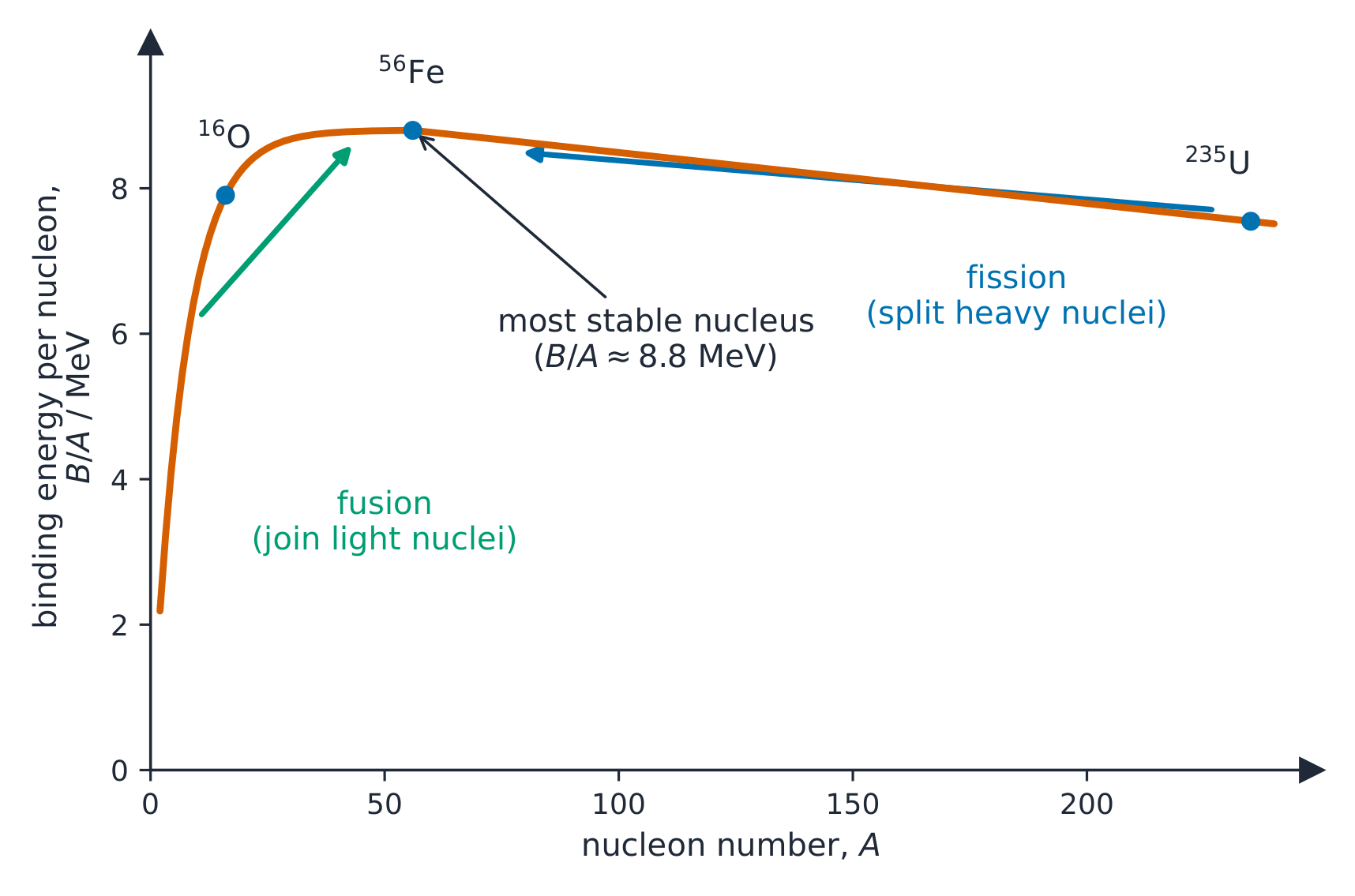
Syllabus · シラバス
EnglishLearning Objective 15.7.A: Describe the physical properties that constrain the behavior of interacting nuclei, subatomic particles, and nucleons.
- 15.7.A.1 The strong force is exerted at nuclear scales and dominates the interactions of nucleons (protons or neutrons).
- 15.7.A.2 Possible nuclear reactions are constrained by the law of conservation of nucleon number.
- 15.7.A.3 The behavior of the constituent particles of a nuclear reaction is constrained by laws of conservation of energy, energy-mass equivalence, and conservation of momentum.
- 15.7.A.4 For all nuclear reactions, mass and energy may be exchanged due to mass-energy equivalence.
- Relevant equation:
- $E = mc^2$
- 15.7.A.5 Energy may be released in nuclear processes in the form of kinetic energy of the products or as photons.
- 15.7.A.6 Nuclear fusion is the process by which two or more smaller nuclei combine to form a larger nucleus, as well as subatomic particles.
- 15.7.A.7 Nuclear fission is the process by which the nucleus of an atom splits into two or more smaller nuclei, as well as subatomic particles.
- 15.7.A.8 Nuclear fission may occur spontaneously or may require an energy input, depending on the binding energy of the nucleus.
Learning Objective 15.7.B: Describe the radioactive decay of a given sample of material consisting of a finite number of nuclei.
- 15.7.B.1 Radioactive decay is the spontaneous transformation of a nucleus into one or more different nuclei.
- 15.7.B.1.i The time at which an individual nucleus undergoes radioactive decay is indeterminable, but decay rates can be described using probability
- 15.7.B.1.ii The half-life, $t_{1/2}$, of a radioactive material is the time it takes for half of the initial number of radioactive nuclei to have spontaneously decayed.
- 15.7.B.1.iii The decay constant $\lambda$ can be related to the half-life of a radioactive material with the equation $\lambda = \dfrac{\ln 2}{t_{1/2}}$.
- 15.7.B.2 A material's decay constant may be used to predict the number of nuclei remaining in a sample after a period of time, or the age of a material if the initial amount of material is known.
- Relevant equation:
- $N = N_0 e^{-\lambda t}$
- Derived equation:
- $\ln\left(\dfrac{N}{N_0}\right) = -\lambda t$
- 15.7.B.3 Different unstable elements and isotopes may have vastly different half-lives, ranging from fractions of a second to billions of years.
日本語学習目標 15.7.A: 相互作用する原子核、素粒子、核子の振る舞いを制約する物理的特性を説明する。
- 15.7.A.1 強い力(核力)は核スケールで働き、核子(陽子または中性子)の相互作用を支配する。
- 15.7.A.2 可能な核反応は、核子数保存則によって制限される。
- 15.7.A.3 核反応の構成粒子の振る舞いは、エネルギー保存則、質量-エネルギー等価性、および運動量保存則によって制限される。
- 15.7.A.4 すべての核反応において、質量-エネルギー等価性により質量とエネルギーが交換されることがある。
- 関連する式:
- $E = mc^2$
- 15.7.A.5 核過程では、生成物の運動エネルギーとして、あるいは光子としてエネルギーが放出されることがある。
- 15.7.A.6 核融合とは、2つ以上の小さな原子核が結合してより大きな原子核、および素粒子を形成するプロセスである。
- 15.7.A.7 核分裂とは、原子核が2つ以上の小さな原子核、および素粒子に分裂するプロセスである。
- 15.7.A.8 核分裂は、原子核の結合エネルギーに応じて、自発的に起こるか、あるいはエネルギー投入を必要とするかする。
学習目標 15.7.B: 有限個の原子核からなる特定の試料の放射性崩壊を説明する。
- 15.7.B.1 放射性崩壊とは、原子核が自発的に1つ以上の異なる原子核に変換されることである。
- 15.7.B.1.i 個々の原子核が放射性崩壊を起こす時期は予測できないが、確率を用いて崩壊速度を記述できる。
- 15.7.B.1.ii 放射性材料の半減期 $t_{1/2}$ は、初期の放射性原子核の半分が自発的に崩壊するのに要する時間である。
- 15.7.B.1.iii 崩壊定数 $\lambda$ は、以下の式を用いて放射性材料の半減期と関連付けられる。 $\lambda = \dfrac{\ln 2}{t_{1/2}}$。
- 15.7.B.2 材料の崩壊定数を用いることで、一定時間の経過後に試料に残存する原子核数を予測したり、初期量が既知であれば材料の年代を決定したりできる。
- 関連する式:
- $N = N_0 e^{-\lambda t}$
- 導出された式:
- $\ln\left(\dfrac{N}{N_0}\right) = -\lambda t$
- 15.7.B.3 不安定な元素や同位体はそれぞれ異なり、半減期は秒の単位から数十億年に及ぶ範囲にある。
Source: College Board AP Course and Exam Description · 出典: College Board AP コースおよび試験説明書
EnglishThe nucleus 原子核 stores enormous energy. Fission 裂变 splits a heavy nucleus into lighter ones, releasing energy (nuclear reactors, bombs). Fusion 聚变 joins light nuclei into a heavier one (the Sun's power). Both release energy because the products have slightly less mass, converted by $E=mc^2$.
Worked example. Even a tiny mass converts to a huge energy. If a nuclear reaction loses $1.0\times10^{-3}\ \text{kg}$ of mass, it releases $E=mc^2=1.0\times10^{-3}\times(3.0\times10^{8})^2=9.0\times10^{13}\ \text{J}$ – roughly the energy of $20\,000$ tonnes of TNT.
日本語原子核には膨大なエネルギーが蓄えられています。核分裂は重い原子核を軽いものへ分割してエネルギーを放出します(原子力発電所、爆弾)。核融合は軽い原子核を結合させて重い原子核を作ります(太陽のエネルギー源)。どちらも生成物の質量がわずかに少なくなるためエネルギーを放出しますが、この質量欠損は $E=mc^2$ を通じてエネルギーに変換されます。
核子あたりの結合エネルギーは鉄付近で最大となるため、核融合も核分裂もエネルギーを放出できる 演習例。 微小な質量でも巨大なエネルギーに変換されます。ある核反応で $1.0\times10^{-3}\ \text{kg}$ の質量減少があった場合、$E=mc^2=1.0\times10^{-3}\times(3.0\times10^{8})^2=9.0\times10^{13}\ \text{J}$ のエネルギーが放出され、これは約 $20\,000$ トンのTNTのエネルギーに相当します。
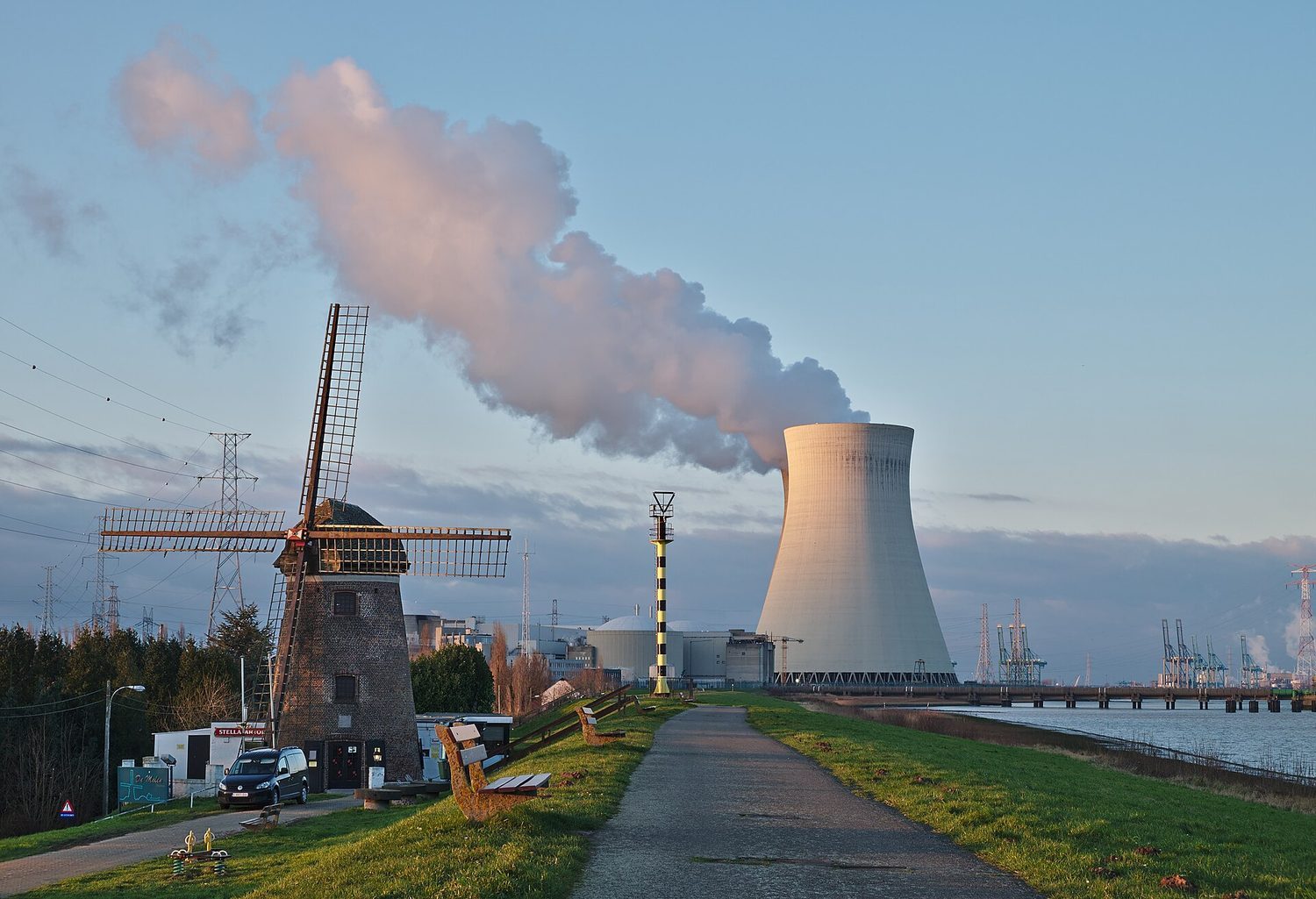
原子力発電所:重い原子核の核分裂によって発電所を駆動するエネルギーが放出される Explore · 探索Balance a nuclear decay equation · 核崩壊方程式を釣り合わせる
In alpha, beta and gamma decay, nucleon and charge numbers must balance. Pick a mode and see how the parent turns into the daughter nuclide. · アルファ崩壊、ベータ崩壊、ガンマ崩壊において、核子数と電荷数は釣り合う必要がある。崩壊モードを選択し、親核種から娘核種への変換を確認せよ。
15.8
Types of Radioactive Decay · 放射性崩壊の種類
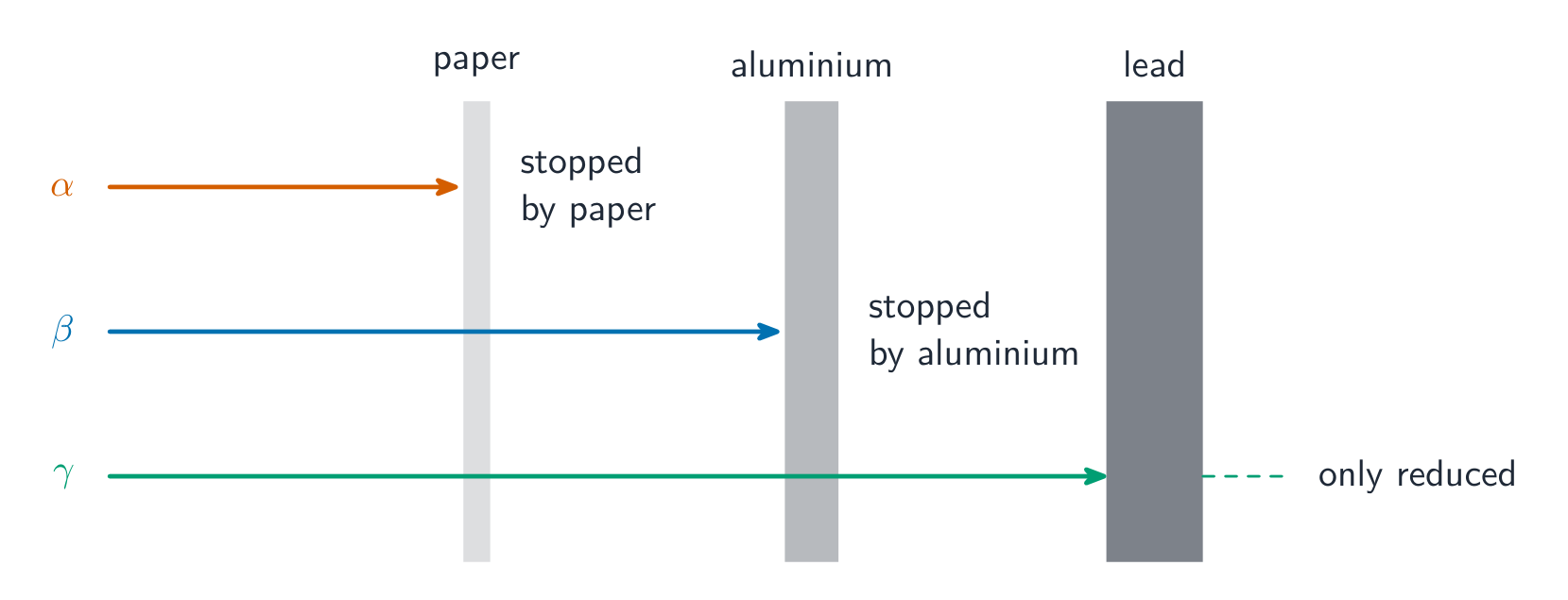
Syllabus · シラバス
EnglishLearning Objective 15.8.A: Describe the processes by which individual nuclei decay.
- 15.8.A.1 Some processes by which nuclei decay emit subatomic particles with unique properties.
- 15.8.A.1.i An alpha particle, or helium nucleus, consists of two neutrons and two protons and is symbolized by $\alpha$ or $\text{He}^{2+}$. (In Physics 2, only He-4 nuclei will be considered.)
- 15.8.A.1.ii Neutrinos and antineutrinos are subatomic particles that have no electrical charge, have negligible mass, and are symbolized by $\nu$ and $\bar{\nu}$, respectively.
- 15.8.A.1.iii Neutrinos and antineutrinos only interact with matter via the weak force and the gravitational force, which results in very little interaction with normal matter.
- 15.8.A.1.iv Positrons, or antielectrons, are subatomic particles that have an electric charge opposite that of an electron, have the same mass as an electron, and are symbolized by $e^+$ or $\beta^+$.
- 15.8.A.2 Nuclei can undergo radioactive decay via alpha decay, beta-minus decay ($\beta^-$), beta-plus decay ($\beta^+$), and gamma decay ($\gamma$).
- 15.8.A.2.i In all nuclear decays, nucleon number (the number of neutrons and protons), lepton number (the number of electrons and neutrinos), and charge are conserved.
- 15.8.A.2.ii Alpha decay occurs when a nucleus ejects an alpha particle.
- 15.8.A.2.iii Beta-minus decay occurs when a neutron changes to a proton by emitting an electron and antineutrino.
- 15.8.A.2.iv Beta-plus decay occurs when a proton changes to a neutron by emitting a positron and neutrino.
- 15.8.A.2.v Gamma decay occurs after a nucleus has undergone alpha or beta decay and the excited nucleus decays to a lower energy state by emitting a photon.
- 15.8.A.3 The type of decay exhibited by a given nucleus is determined by the isotope of the element.
Boundary statement: AP Physics 2 does not expect students to memorize the processes by which specific isotopes decay or the half-lives of specific isotopes. Neutron emission and electron capture are not included in the AP Physics 2 curriculum framework. Additionally, types of neutrinos, the characteristics that distinguish neutrinos and antineutrinos, and an explanation or application of the weak force are not within the scope of this course.
日本語学習目標 15.8.A: 個々の原子核が崩壊するプロセスを説明する。
- 15.8.A.1 原子核が崩壊するいくつかのプロセスでは、固有の性質を持つ素粒子が放出される。
- 15.8.A.1.i アルファ粒子(ヘリウム原子核)は、2つの中性子と2つの陽子から構成され、以下のように表される。 $\alpha$ または $\text{He}^{2+}$。(Physics 2では、He-4の原子核のみを対象とする。)
- 15.8.A.1.ii ニュートリノと反ニュートリノは、電気的電荷を持たず、質量は無視できるほど小さい素粒子であり、それぞれ以下のように表される。 $\nu$ および $\bar{\nu}$。
- 15.8.A.1.iii ニュートリノと反ニュートリノは、弱い力と重力のみを通じて物質と相互作用するため、通常物質との相互作用は極めて少ない。
- 15.8.A.1.iv ポストロン(反電子)とは、電子とは逆の電荷を持ち、電子と同じ質量を持つ素粒子であり、$e^+$または$\beta^+$で表される。
- 15.8.A.2 原子核は、アルファ崩壊、ベータマイナス崩壊($\beta^-$)、ベータプラス崩壊($\beta^+$)、ガンマ崩壊($\gamma$)のいずれかの放射性崩壊を起こすことができる。
- 15.8.A.2.i すべての核崩壊において、核子数(中性子と陽子の数)、レプトン数(電子とニュートリノの数)、電荷は保存される。
- 15.8.A.2.ii アルファ崩壊とは、原子核がアルファ粒子を放出することである。
- 15.8.A.2.iii ベータマイナス崩壊とは、中性子が電子と反ニュートリノを放出して陽子に変化することである。
- 15.8.A.2.iv ベータプラス崩壊とは、陽子がポジトロンとニュートリノを放出して中性子に変化することである。
- 15.8.A.2.v ガマ崩壊とは、原子核がアルファ崩壊またはベータ崩壊を経た後に、励起状態から低いエネルギー状態へ遷移する際に光子を放出して崩壊することである。
- 15.8.A.3 特定の原子核が示す崩壊の種類は、その元素の同位体によって決定される。
範囲の記述: AP Physics 2では、学生が特定の同位体の崩壊過程や半減期を暗記することを期待していない。中性子放出と電子捕獲はAP Physics 2のカリキュラムフレームワークには含まれていない。また、ニュートリノの種類、ニュートリノと反ニュートリノを区別する特性、および弱い力の説明や適用も本コースの範囲外である。
Source: College Board AP Course and Exam Description · 出典: College Board AP コースおよび試験説明書
EnglishRadioactive decay & half-life Unstable nuclei undergo radioactive decay 放射性衰变, emitting:
- Alpha decay 阿尔法衰变 ($\alpha$): a helium nucleus – mass number drops by 4.
- Beta decay 贝塔衰变 ($\beta$) comes in two kinds. In beta-minus ($\beta^-$) a neutron becomes a proton, emitting an electron and an antineutrino 反中微子: $n\rightarrow p+e^-+\bar{\nu}$. In beta-plus ($\beta^+$) a proton becomes a neutron, emitting a positron 正电子 and a neutrino 中微子: $p\rightarrow n+e^++\nu$.
- Gamma decay 伽马衰变 ($\gamma$): a high-energy photon – the nucleus sheds excess energy.
The neutrino and antineutrino (symbols $\nu$, $\bar{\nu}$) are tiny, chargeless, almost-massless particles that carry off energy and keep beta decay balanced. Decay is random, but a sample halves every half-life 半衰期: after each half-life, half of the remaining nuclei have decayed. Every decay equation conserves three quantities: nucleon number (mass number), charge, and lepton number 轻子数 – an electron or neutrino counts as $+1$ lepton, a positron or antineutrino as $-1$, and the totals must match on both sides.
Worked example. A radioactive sample has a half-life of $8.0$ days. What fraction is left after $24$ days? That is $24/8.0=3$ half-lives, so the fraction remaining is $\left(\tfrac12\right)^3=\tfrac18$ – about $12.5\%$. In an alpha decay of uranium-238 ($^{238}_{\ 92}\text{U}$), the daughter has mass number $238-4=234$ and atomic number $92-2=90$: thorium-234.
日本語放射性崩壊と半減期 不安定な原子核は放射性崩壊を起こし、以下のものを放出します:
アルファ線、ベータ線、ガンマ線の透過力 - アルファ崩壊 ($\alpha$):ヘリウム原子核が放出され、質量数は4減ります。
- ベータ崩壊 ($\beta$) は2種類あります。ベータマイナス崩壊 ($\beta^-$) では中性子が陽子に変化し、電子と反ニュートリノを放出します:$n\rightarrow p+e^-+\bar{\nu}$。ベータプラス崩壊 ($\beta^+$) では陽子が中性子に変化し、陽電子とニュートリノを放出します:$p\rightarrow n+e^++\nu$。
- ガンマ崩壊 ($\gamma$) :高エネルギー光子が放出され、原子核は余分なエネルギーを失います。
ニュートリノと反ニュートリノ(記号 $\nu$, $\bar{\nu}$)は非常に小さく、電荷がなく、ほぼ質量のない粒子で、エネルギーを運び、ベータ崩壊のバランスを保ちます。崩壊はランダムですが、サンプルの量は半減期ごとに半分になります。各半減期ごとに残っている原子核の半分が崩壊します。すべての崩壊方程式において、3つの量が保存されます:核子数(質量数)、電荷、およびレプトン数です。電子やニュートリノは $+1$ レプトンとしてカウントされ、陽電子や反ニュートリノは $-1$ レプトンとしてカウントされ、両辺の総和が一致する必要があります。
演習例。 ある放射性サンプルの半減期が $8.0$ 日です。$24$ 日後に残っている割合はいくつですか? これは $24/8.0=3$ 回の半減期にあたるため、残存割合は $\left(\tfrac12\right)^3=\tfrac18$ —— およそ $12.5\%$ です。ウラン-238 ($^{238}_{\ 92}\text{U}$) のアルファ崩壊において、娘核の質量数は $238-4=234$ 、原子番号は $92-2=90$ となり、トリアム-234 となります。
Explore · 探索Watch a sample decay · 試料の崩壊を観測する
Radioactive nuclei decay randomly with a fixed half-life: each half-life halves the number remaining. Step forward and watch the sample shrink. · 放射性核種は一定の半減期でランダムに崩壊し、各半減期ごとに残存数が半分になる。ステップを進めて試料が縮小する様子を見よ。
Vocabulary · 語彙 Train · 練習するEnglish 日本語 radioactive decay/ˌreɪdɪəʊˈæktɪv dɪˈkeɪ/ 放射性崩壊 Alpha decay/ˈælfə dɪˈkeɪ/ アルファ崩壊 Beta decay/ˈbiːtə dɪˈkeɪ/ ベータ崩壊 antineutrino/ˌæntɪnjuːˈtriːnəʊ/ 反ニュートリノ positron/ˈpɒzɪtrɒn/ 陽電子 neutrino/njuːˈtriːnəʊ/ ニュートリノ Gamma decay/ˈɡæmə dɪˈkeɪ/ ガンマ崩壊 half-life/hɑːf laɪf/ 半減期 lepton number/ˈleptɒn ˈnʌmbə/ ルプトン数 15.8
Exam tips · 試験対策
English- Photon energy is $E=hf$; below the threshold frequency no electrons are emitted however bright the light (the photoelectric effect).
- Use $K_{\max}=hf-\phi$ for the fastest photoelectrons ($\phi$ = work function).
- Electrons jump between discrete energy levels by absorbing/emitting a photon whose energy equals the level gap — the source of line spectra.
- In fission and fusion the small mass lost becomes energy via $E=mc^2$.
- Balance decay equations by conserving mass number, charge, and lepton number (write the antineutrino in $\beta^-$, the neutrino in $\beta^+$), and halve the sample every half-life ($(\tfrac12)^n$ after $n$ half-lives).
日本語- 光子エネルギーは $E=hf$ であり、閾値周波数以下であれば、光がいくら明るくても電子は放出されません(光電効果)。
- 最も速い光電子には $K_{\max}=hf-\phi$ を使用します($\phi$ = 仕事関数)。
- 電子は離散的なエネルギー準位間で遷移し、準位間のギャップに等しいエネルギーを持つ光子を吸収・放出することで、これが明線スペクトルの原因となります。
- 核分裂と核融合では、少量の質量損失が $E=mc^2$ を通じてエネルギーに変換されます。
- 質量数、電荷、レプトン数を保存して平衡方程式を解く(反ニュートリノは$\beta^-$、ニュートリノは$\beta^+$として表記)、サンプルの量は半減期ごとに半分になる($(\tfrac12)^n$が$n$回経過した後)。
- 15.1.A.1 Quantum theory was developed to explain observations of matter and energy that could not be explained using classical mechanics. These phenomena include, but are not limited to, atomic spectra, blackbody radiation, and the photoelectric effect.