Skip to content · ⁨コンテンツへスキップ⁩

Production, Cost, and the Perfect Competition Model · ⁨生産、コスト、および完全競争モデル⁩

AP Microeconomics · ⁨AP 経済学⁩ · Topic 3 · ⁨トピック 3⁩

View Slides · ⁨查看幻灯片⁩ Train · ⁨練習する⁩
Video lesson for this topic · ⁨このトピックのビデオレッスン⁩ Open the video page · ⁨動画ページを開く⁩
8:56

生産、コスト & 完全競争

一つの調理器具と一つのオーブンを持つ小さなパン屋を想像してください。最初の製菓職人を雇えば、一日に三十個の追加のパンが作れます。二人目を雇えば、二十六個追加されます。A…

English narration · English + 中文 subtitles burned in · ⁨英語ナレーション・英語+中文字幕 burning-in⁩

3.1

The Production Function · ⁨生産関数⁩

Syllabus · ⁨シラバス⁩
English

Enduring Understanding (PRD-1): Firms' production and cost constraints over different input and output levels shape optimal decisions in the short run and long run.

Learning Objective PRD-1.A: a. Define (using graphs where appropriate) key terms and concepts relating to production and cost. b. Explain (using graphs where appropriate) how production and cost are related in the short run and long run. c. Calculate (using data from a graph or table as appropriate) the various measures of productivity and short-run and long-run costs.

  • PRD-1.A.1 The production function explains the relationship between inputs and outputs both in the short run and the long run.
  • PRD-1.A.2 Marginal product and average product change as input usage changes, and hence, total product changes.
  • PRD-1.A.3 Diminishing marginal returns occur as the firm employs more of one input, holding other inputs constant, to produce a product (output) in the short run.
日本語

持続的理解(PRD-1): 企業の生産とコスト制約は、投入量および産出量の変化に応じて短期間および長期間における最適意思決定を形成する。

学習目標 PRD-1.A: a. 生産およびコストに関連する主要な用語や概念を定義せよ(必要に応じグラフを用いること)。 b. 生産とコストが短期間および長期間においてどのように関連しているかを説明せよ(必要に応じグラフを用いること)。 c. 生産性のさまざまな指標や、短期間および長期間のコストを計算せよ(必要に応じグラフまたは表のデータを用いること)。

  • PRD-1.A.1 生産関数は、短期間および長期間における投入量と産出量の関係を説明する。
  • PRD-1.A.2 投入量の変更に伴い、限界生産量および平均生産量は変化し、したがって総生産量も変化する。
  • PRD-1.A.3 短期間において、他の投入量を一定に保ったままある一つの投入量を増加させて製品(産出物)を生産する場合、限界逓減の法則が発生する。

Source: College Board AP Course and Exam Description · ⁨出典: College Board AP コースおよび試験説明書⁩

English

The production function 生产函数 links inputs to output. In the short run 短期 at least one input (usually capital) is fixed 固定; in the long run 长期 all inputs vary.

  • Total product 总产量 is the total output.
  • Marginal product 边际产量 (MP) is the extra output from one more unit of a variable input (usually labor): $MP=\dfrac{\Delta\ \text{output}}{\Delta\ \text{labor}}$.
  • Average product 平均产量 is output per worker.

As you add workers to fixed capital, MP eventually falls – the law of diminishing marginal returns 边际收益递减法则. This shape of MP is what drives the shape of the cost curves below.

日本語
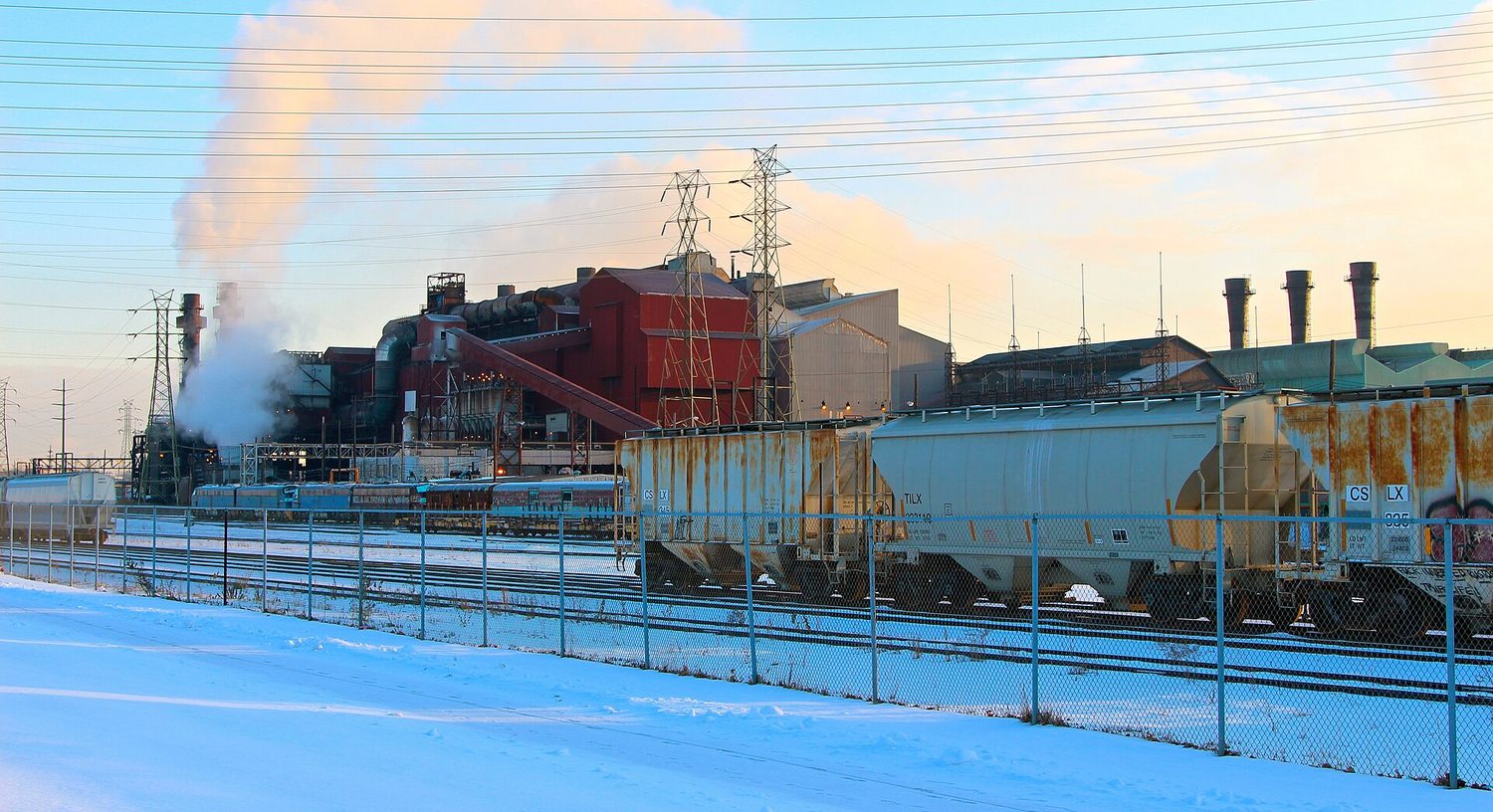
製鉄所:生産関数と費用が企業の供給を形作る

生産関数 は投入量と生産量を結ぶ。短期間 では少なくとも一つの投入要素(通常は 資本)が 固定 されている;長期間 では全ての投入要素が変動する。

  • 総生産量 は総生産量である。
  • 限界生産量 (MP) は可変投入要素(通常は労働)の追加1単位あたりの増加分 — $MP=\dfrac{\Delta\ \text{output}}{\Delta\ \text{labor}}$。
  • 平均生産量 は労働者一人あたりの生産量。

固定された資本に労働者を追加していくと、最終的に MP は減少する — 限界生産逓減の法則。この MP の形状が、後に示す費用曲線の形状を決定する。

工場生産ラインで動作するロボットアーム
生産関数は、労働力やこのロボットのような資本といった投入要素を産出物へ変換します
3.2

Short-Run Production Costs · ⁨短期生産コスト⁩

Syllabus · ⁨シラバス⁩
English

Enduring Understanding (PRD-1): Firms' production and cost constraints over different input and output levels shape optimal decisions in the short run and long run.

Learning Objective PRD-1.A: a. Define (using graphs where appropriate) key terms and concepts relating to production and cost. b. Explain (using graphs where appropriate) how production and cost are related in the short run and long run. c. Calculate (using data from a graph or table as appropriate) the various measures of productivity and short-run and long-run costs.

  • PRD-1.A.4 Fixed costs and variable costs determine the total cost.
  • PRD-1.A.5 Marginal cost, average (fixed, variable, and total) cost, total cost, and total variable cost change as total output changes, but total fixed cost remains constant at all output levels, including zero output.
  • PRD-1.A.6 Production functions with diminishing marginal returns yield an upward-sloping marginal cost curve.
  • PRD-1.A.7 Specialization and the division of labor reduce marginal costs for firms.
  • PRD-1.A.8 Cost curves can shift in response to changes in input costs and productivity.
日本語

持続的理解(PRD-1): 企業の生産とコスト制約は、投入量および産出量の変化に応じて短期間および長期間における最適意思決定を形成する。

学習目標 PRD-1.A: a. 生産およびコストに関連する主要な用語や概念を定義せよ(必要に応じグラフを用いること)。 b. 生産とコストが短期間および長期間においてどのように関連しているかを説明せよ(必要に応じグラフを用いること)。 c. 生産性のさまざまな指標や、短期間および長期間のコストを計算せよ(必要に応じグラフまたは表のデータを用いること)。

  • PRD-1.A.4 固定費と変動費が総コストを決定する。
  • PRD-1.A.5 限界コスト、平均コスト(固定、変動、総)、総コスト、および総変動費は総産出量の変化に伴い変動するが、固定費はゼロの産出を含むあらゆる産出レベルにおいて一定である。
  • PRD-1.A.6 限界逓減の法則を持つ生産関数は、右上がりの限界コスト曲線をもたらす。
  • PRD-1.A.7 専門化および労働の分業は、企業にとって限界コストを低下させる。
  • PRD-1.A.8 コスト曲線は、投入コストおよび生産性の変化に応じてシフトすることがある。

Source: College Board AP Course and Exam Description · ⁨出典: College Board AP コースおよび試験説明書⁩

English
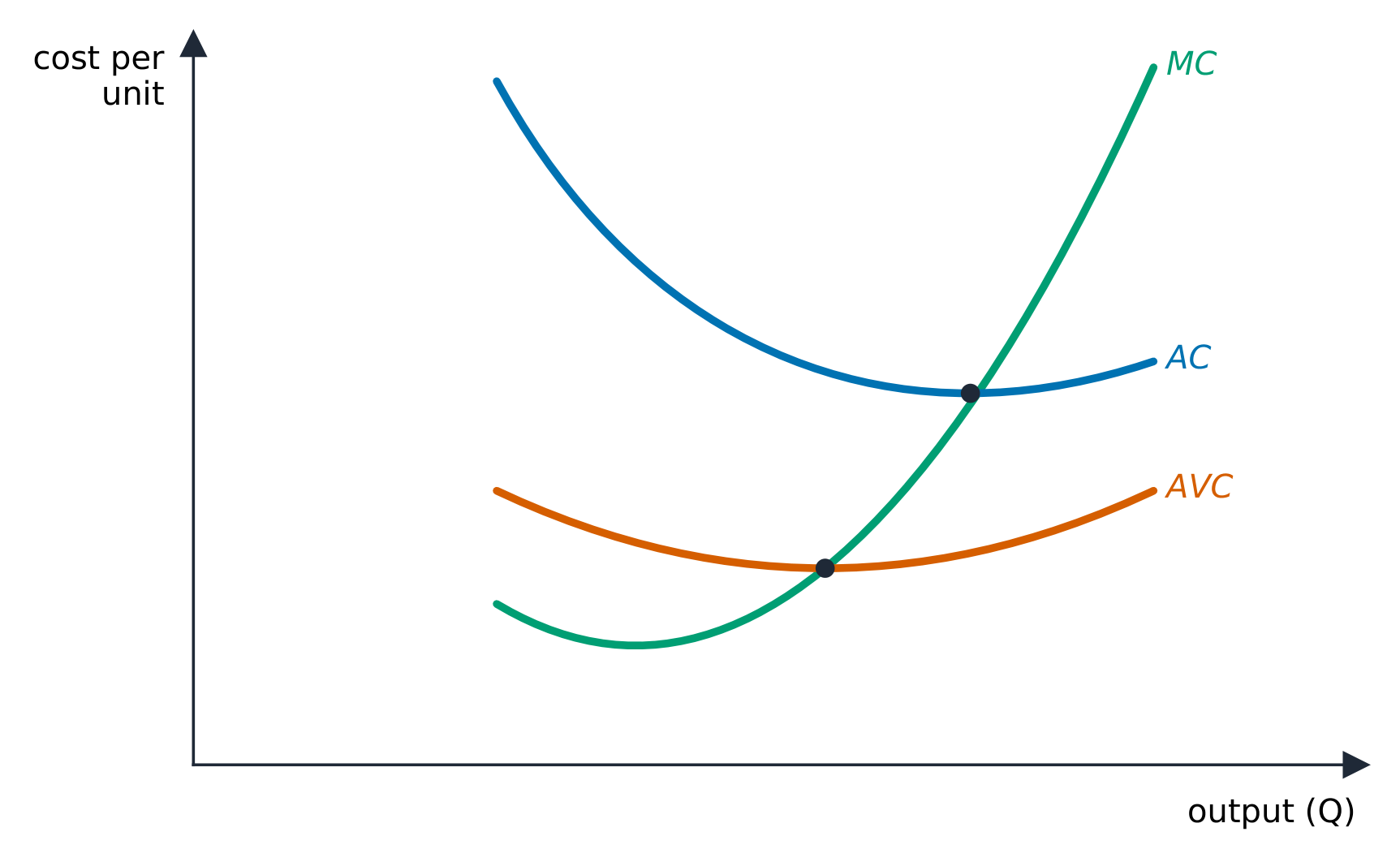
Short-run cost curves (MC, ATC, AVC)

Costs split into fixed and variable:

  • Fixed cost 固定成本 (FC) does not change with output (rent on the factory).
  • Variable cost 可变成本 (VC) rises with output (materials, labor).
  • Total cost 总成本 $TC=FC+VC$.

The per-unit costs matter most:

  • Average fixed cost $AFC=FC/Q$ falls continuously (spreading fixed cost).
  • Average variable cost $AVC=VC/Q$ and average total cost $ATC=TC/Q$ are U-shaped.
  • Marginal cost 边际成本 $MC=\dfrac{\Delta TC}{\Delta Q}$ is the cost of one more unit.

Two key facts: MC is the mirror image of MP (when MP rises, MC falls, and vice versa), and MC cuts both AVC and ATC at their minimum points (when marginal is below average, the average falls; when above, it rises).

Worked example. A firm has fixed cost $FC=\$100$. At $Q=10$ its total cost is $\$300$, so variable cost is $\$200$: then $ATC=\tfrac{300}{10}=\$30$, $AVC=\tfrac{200}{10}=\$20$, and $AFC=\tfrac{100}{10}=\$10$ (note $AFC+AVC=ATC$). If raising output to $Q=11$ pushes total cost to $\$325$, the marginal cost of that $11$th unit is $\dfrac{\Delta TC}{\Delta Q}=\dfrac{325-300}{1}=\$25$.

日本語
短期間の費用曲線(MC, ATC, AVC)

コストは固定費と変動費に分類されます:

短期の限界・平均・平均変動費曲線
短期の限界・平均・平均変動費曲線
  • 固定費(FC)は産出量の変化に伴わず一定です(工場の家賃など)。
  • 変動費(VC)は産出量の増加に伴って上昇します(原材料、人件費)。
  • 総コスト $TC=FC+VC$。

単位あたりのコストが最も重要です:

  • 平均固定費 $AFC=FC/Q$ は減少し続けます(固定費を生産量で分散させるため)。
  • 平均変動費 $AVC=VC/Q$ と 平均総コスト $ATC=TC/Q$ は U字型 を呈します。
  • 限界コスト $MC=\dfrac{\Delta TC}{\Delta Q}$ は追加単位の生産にかかる費用です。

重要な2つの事実:MCはMPの鏡像です(MPが上昇すればMCは下降し、その逆も然り)、かつ MCはAVCおよびATCの最小点を通過します(限界が平均を下回れば平均は下がり、上回れば平均は上昇します)。

** worked example.** ある企業の固定費が $FC=\$100$. At $Q=10$ its total cost is $\$300$ で、変動費が $\$200$: then $ATC=\tfrac{300}{10}=\$30$、$AVC=\tfrac{200}{10}=\$20$, and $AFC=\tfrac{100}{10}=\$10$ ($AFC+AVC=ATC$ に注意)。生産量を $Q=11$ に増やすと総コストが $\$325$, the marginal cost of that $11$th unit is $\dfrac{\Delta TC}{\Delta Q}=\dfrac{325-300}{1}=\$25$ になります。

Explore · ⁨探索⁩

Explore the U-shaped cost curves · ⁨U字型のコスト曲線を調べる⁩

As output rises, marginal cost eventually climbs (diminishing returns) and cuts through the U-shaped average cost at its minimum — the most efficient scale. · ⁨生産量が増加すると、限界費用は最終的に上昇(逓増収益递减)し、U字型の平均費用曲線の最小点である最も効率的な規模で交差します。⁩

Vocabulary · ⁨語彙⁩ Train · ⁨練習する⁩
English 日本語
production function/prəˈdʌkʃn ˈfʌŋkʃn/ 生産関数
short run/ʃɔːt rʌn/ 短期
fixed/fɪkst/ 固定されている
long run/lɒŋ rʌn/ 長期
Total product/ˈtəʊtl ˈprɒdʌkt/ 総生産量
Marginal product/ˈmɑːdʒɪnl ˈprɒdʌkt/ 限界生産量
Average product/ˈævrɪdʒ ˈprɒdʌkt/ 平均生産量
law of diminishing marginal returns/lɔː ɒv dɪˈmɪnɪʃɪŋ ˈmɑːdʒɪnl rɪˈtɜːnz/ 限界生産逓減の法則
Fixed cost/fɪkst kɒst/ 固定費
Variable cost/ˈveərɪəbl kɒst/ 可変費
Total cost/ˈtəʊtl kɒst/ 総コスト
Marginal cost/ˈmɑːdʒɪnl kɒst/ 限界原価
3.3

Long-Run Production Costs · ⁨長期生産コスト⁩

Syllabus · ⁨シラバス⁩
English

Enduring Understanding (PRD-1): Firms' production and cost constraints over different input and output levels shape optimal decisions in the short run and long run.

Learning Objective PRD-1.A: a. Define (using graphs where appropriate) key terms and concepts relating to production and cost. b. Explain (using graphs where appropriate) how production and cost are related in the short run and long run. c. Calculate (using data from a graph or table as appropriate) the various measures of productivity and short-run and long-run costs.

  • PRD-1.A.9 In the long run, firms can adjust all their inputs, and as a result, all costs become variable.
  • PRD-1.A.10 The relationship between inputs and outputs in the long run is described by the scale of production—increasing, decreasing, or constant returns to scale.
  • PRD-1.A.11 The long-run average total cost is characterized by economies of scale, diseconomies of scale, or constant returns to scale (efficient scale).
  • PRD-1.A.12 The minimum efficient scale plays a role in determining the concentration of firms in a market and the market structure.
日本語

持続的理解(PRD-1): 企業の生産とコスト制約は、投入量および産出量の変化に応じて短期間および長期間における最適意思決定を形成する。

学習目標 PRD-1.A: a. 生産およびコストに関連する主要な用語や概念を定義せよ(必要に応じグラフを用いること)。 b. 生産とコストが短期間および長期間においてどのように関連しているかを説明せよ(必要に応じグラフを用いること)。 c. 生産性のさまざまな指標や、短期間および長期間のコストを計算せよ(必要に応じグラフまたは表のデータを用いること)。

  • PRD-1.A.9 長期間において、企業はすべての投入量を変更できるため、結果としてすべてのコストは変動費となる。
  • PRD-1.A.10 長期間における投入量と産出量の関係は、規模の経済(増大、減少、または一定)によって記述される。
  • PRD-1.A.11 長期間の平均総コストは、規模の経済、規模の非経済、または一定の規模の経済(効率的スケール)の特徴を持つ。
  • PRD-1.A.12 最小効率スケールは、市場における企業の集中度および市場構造の決定に役割を果たす。

Source: College Board AP Course and Exam Description · ⁨出典: College Board AP コースおよび試験説明書⁩

English

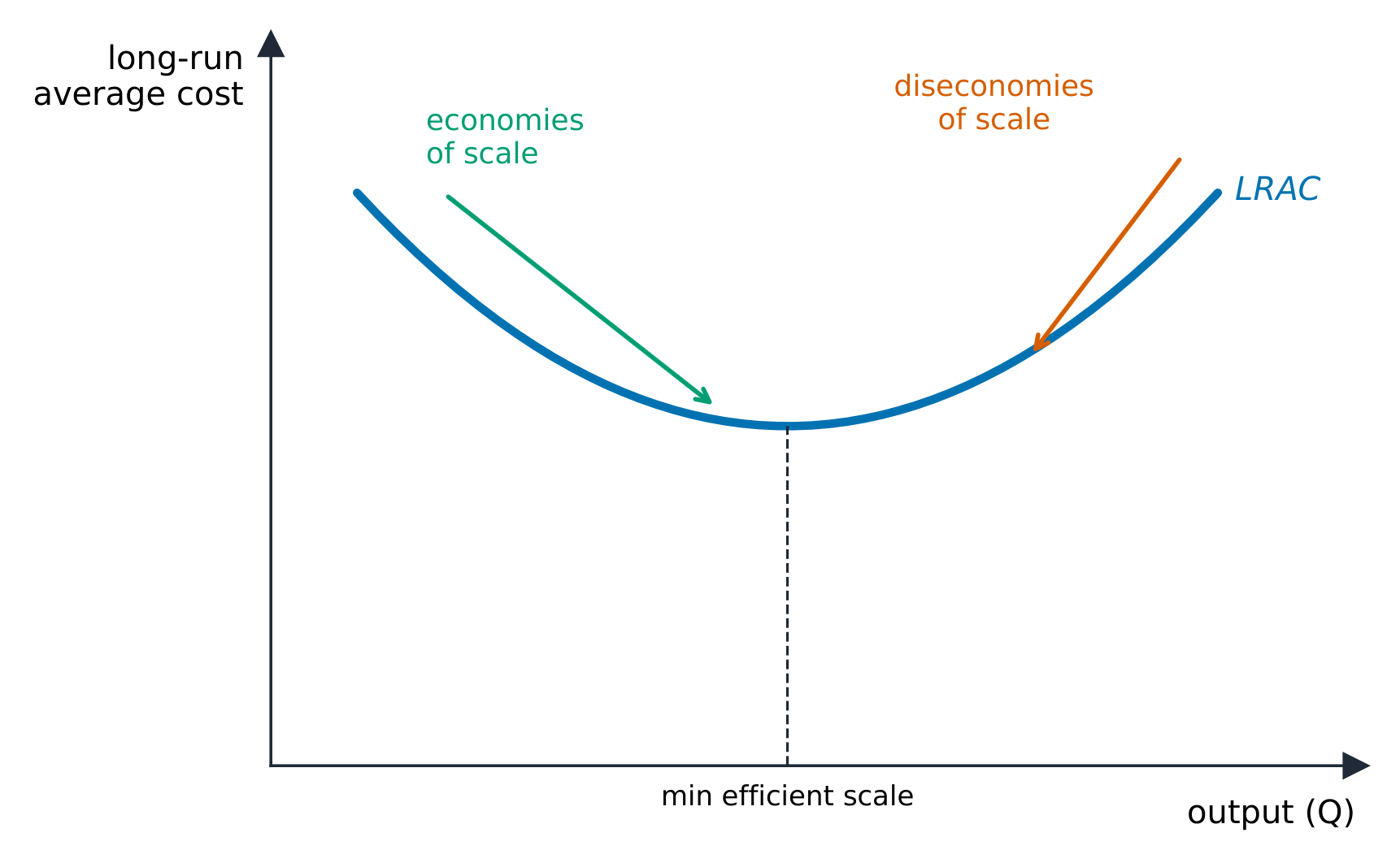
In the long run all inputs – including plant size – can change, so only the long-run average total cost (LRATC) curve matters. Its shape shows returns to scale:

  • Economies of scale 规模经济: LRATC falls as output grows (bulk buying, specialization).
  • Constant returns to scale: LRATC flat.
  • Diseconomies of scale 规模不经济: LRATC rises (a firm too big to manage well).

Exam skill: know that "diminishing returns" is a short-run idea (one fixed input) while "economies of scale" is a long-run idea (all inputs vary) – examiners test the distinction.

日本語

長期では設備規模を含むすべての投入要素に変化が可能であるため、長期平均総コスト(LRATC) の曲線のみが重要です。その形状は規模の利得を示します:

長期平均コスト曲線における規模の経済と不経済
長期平均コスト曲線における規模の利得と不利得
  • 規模の利得: LRATCは産出量の増加とともに低下します(大量購入、専門化など)。
  • 一定の規模の利得: LRATCは一定です。
  • 規模の不利得: LRATCは上昇します(企業が大きすぎて適切に管理できなくなる場合)。

受験スキル: 「限界効用逓減」は短期の概念(固定投入要素が1つ)であり、「規模の利得」は長期の概念(すべての投入要素が可変)であることを理解しておくこと。試験官はこの区別を問うことがあります。

Vocabulary · ⁨語彙⁩ Train · ⁨練習する⁩
English 日本語
Economies of scale/ɪˈkɒnəmiz ɒv skeɪl/ 規模の経済
Diseconomies of scale/ˌdɪsɪˈkɒnəmiz ɒv skeɪl/ 規模の不経済
Explicit costs/ekˈsplɪsɪt kɒsts/ 明示的成本
implicit costs/ɪmˈplɪsɪt kɒsts/ 隠然コスト
Accounting profit/əˈkaʊntɪŋ ˈprɒfɪt/ 会計利益
Economic profit/ˌiːkəˈnɒmɪk ˈprɒfɪt/ 経済利益
normal profit/ˈnɔːml ˈprɒfɪt/ 正常利益
entry/ˈentri/ 参入
exit/ˈeɡzɪt/ 撤退
perfectly competitive/ˈpɜːfektlɪ kəmˈpetɪtɪv/ 完全競争
price taker/praɪs ˈteɪkə/ 価格受容者
allocatively efficient/ˈæləkətɪvli ɪˈfɪʃənt/ 配置効率性が達成される。
productively efficient/prəˈdʌktɪvli ɪˈfɪʃənt/ 生産効率
3.4

Types of Profit · ⁨利益の種類⁩

Syllabus · ⁨シラバス⁩
English

Enduring Understanding (CBA-2): To determine the optimal level at which to pursue an activity whose total benefits exceed total cost, rational economic agents compare marginal benefits and marginal costs.

Learning Objective CBA-2.C: a. Define the different types of profit. b. Explain how firms respond to profit opportunities. c. Calculate a firm's profit or loss.

  • CBA-2.C.1 Firms respond to economic profit (loss) rather than accounting profit.
  • CBA-2.C.2 Accounting profit fails to account for implicit costs (such as cost of financial capital, compensation for risk, or an entrepreneur's time), which, if fully compensated, result in normal profit.
日本語

長期的理解 (CBA-2): 総便益が総コストを上回る活動の最適水準を決定するためには、合理的な経済行動主体は限界便益と限界コストを比較する。

学習目標 CBA-2.C: a. 利益の異なる種類を定義せよ。 b. 企業が利益機会にどう反応するかを説明せよ。 c. 企業の利益または損失を計算せよ。

  • CBA-2.C.1 企業は会計利益ではなく、経済的利益(損失)に対して反応する。
  • CBA-2.C.2 会計利益は、暗黙コスト(金融資本のコスト、リスクへの対価、または起業家の時間など)を考慮していない。これらが完全に補償された場合、正常利益が生じる。

Source: College Board AP Course and Exam Description · ⁨出典: College Board AP コースおよび試験説明書⁩

English

Economists count all opportunity costs, including the owner's:

  • Explicit costs 显性成本 are out-of-pocket payments; implicit costs 隐性成本 are the opportunity costs of owner-supplied resources (forgone salary, forgone interest).
  • Accounting profit 会计利润 $=$ revenue $-$ explicit costs.
  • Economic profit 经济利润 $=$ revenue $-$ explicit $-$ implicit costs.

Because economic profit subtracts more, it is smaller. Zero economic profit (a normal profit 正常利润) still means the owner is earning exactly the opportunity cost of their resources – a perfectly acceptable outcome.

Worked example. A shopkeeper takes in $\$200{,}000$ of revenue and pays $\$120{,}000$ in explicit costs, so accounting profit is $\$80{,}000$. But she gave up a $\$70{,}000$ salary elsewhere and $\$5{,}000$ of interest on the savings she invested – $\$75{,}000$ of implicit costs. Her economic profit is $80{,}000-75{,}000=\$5{,}000$: still positive, so staying in business genuinely beats her next-best alternative.

日本語

経済学者は所有者を含めたすべての機会原価を計上します:

  • 明示的原価は現金での支払い;隠秘的原価は所有者が提供する資源の機会原価(放棄した給与、放棄した利息)です。
  • 会計利益 $=$ 売上高 $-$ 明示的原価。
  • 経済利益 $=$ 売上高 $-$ 明示的 $-$ 隠秘的原価。

経済利益はより多くの原価を差し引くため、値は小さくなります。ゼロ経済利益(適正利益)であっても、所有者は自身の資源の機会原価をちょうど回収していることを意味し、これは非常に適切な結果です。

** worked example.** 店主は売上高として $\$200{,}000$ of revenue and pays $\$120{,}000$ 、明示的原価として $\$80{,}000$. But she gave up a $\$70{,}000$ を受け取り、隠秘的原価として他方での給与 $\$5{,}000$ of interest on the savings she invested – $\$75{,}000$ があります。したがって経済利益は $80{,}000-75{,}000=\$5{,}000$: 依然として正值なので、経営を続けることは次善の代替策よりも実際に優れています。

3.5

Profit Maximization · ⁨利益最大化⁩

Syllabus · ⁨シラバス⁩
English

Enduring Understanding (CBA-2): To determine the optimal level at which to pursue an activity whose total benefits exceed total cost, rational economic agents compare marginal benefits and marginal costs.

Learning Objective CBA-2.D: a. Define (using graphs or data as appropriate) the profit-maximizing rule. b. Explain (using a graph or data as appropriate) the profit-maximizing level of production.

  • CBA-2.D.1 Firms are assumed to produce output to maximize their profits by comparing marginal revenue and marginal cost.
日本語

長期的理解 (CBA-2): 総便益が総コストを上回る活動の最適水準を決定するためには、合理的な経済行動主体は限界便益と限界コストを比較する。

学習目標 CBA-2.D: a. 利益最大化の原則を定義せよ(必要に応じグラフまたはデータを用いること)。 b. 利益最大化の生産レベルを説明せよ(必要に応じグラフまたはデータを用いること)。

  • CBA-2.D.1 企業は、限界収益と限界コストを比較することにより、利益を最大化する生産量を選択すると仮定されている。

Source: College Board AP Course and Exam Description · ⁨出典: College Board AP コースおよび試験説明書⁩

English

Every firm, in every market structure, maximizes profit at the quantity where marginal revenue equals marginal cost:

$$MR=MC.$$
Produce each unit whose MR exceeds its MC; stop when they are equal. Producing less leaves profitable units unmade; producing more adds units that cost more than they earn.

日本語

あらゆる市場構造において、企業は限界収益が限界コストと等しくなる数量で利益を最大化します:

$$MR=MC.$$
MRがMCを上回る各単位を生産し続け、両者が等しくなった時点で停止します。生産不足なら利益となる単位を生み逃しますし、過度な生産なら収益以上のコストがかかる単位が生産されてしまいます。

3.6

Deciding to Produce, Enter, or Exit · ⁨生産・参入・退出の決定⁩

Syllabus · ⁨シラバス⁩
English

Enduring Understanding (PRD-2): Firms' short-run decisions to produce output, and long-run decisions to enter or exit a market, are based on profitability.

Learning Objective PRD-2.A: Explain (using graphs or data where appropriate) firms' short-run decisions to produce positive output levels, or long-run decisions to enter or exit a market in response to profit-making opportunities.

  • PRD-2.A.1 In the short run, firms decide to operate (i.e., produce positive output) or shut down (i.e., produce zero output) by comparing total revenue to total variable cost or price to average variable cost (AVC).
  • PRD-2.A.2 In the absence of barriers to entry or exit, in the long run (i.e., once factors that are fixed in the short run become variable), firms enter a market in which there are profit-making opportunities and exit a market when they anticipate economic losses.
日本語

持続的理解(PRD-2): 企業の短期間の生産決定および長期間の市場参入・退出決定は、収益性に基づいている。

学習目標 PRD-2.A: 企業が利益機会に応じて、短期間で正の生産量を生産する決定を行う、あるいは長期間で市場に参入・退出する決定を行う理由を説明せよ(必要に応じグラフまたはデータを用いること)。

  • PRD-2.A.1 短期間において、企業は総収益と総変動費、または価格と平均変動費(AVC)を比較することで、営業(正の生産量を生産すること)か閉鎖(ゼロの生産量を生産すること)かの決定をする。
  • PRD-2.A.2 参入・退出の障壁がない場合、長期間において(すなわち、短期間で固定であった要素が変動可能になった後)、企業は利益機会がある市場に参入し、経済的損失が予想される市場から退出する。

Source: College Board AP Course and Exam Description · ⁨出典: College Board AP コースおよび試験説明書⁩

English

Even at $MR=MC$, a firm must check whether to operate:

  • Short run – the shutdown rule: keep producing only if price covers average variable cost ($P\geq AVC$). If $P, shut down and lose only fixed cost. So the firm's short-run supply curve is its MC curve above minimum AVC.
  • Profit check: compare $P$ to $ATC$ at the profit-maximizing quantity – $P>ATC$ means economic profit, $P means a loss, $P=ATC$ means break-even.
  • Long run – entry and exit: economic profits attract entry 进入; losses cause exit 退出. This continues until economic profit is zero.
日本語

$MR=MC$ であっても、企業は営業を続けるか否かを検討する必要があります:

  • 短期 – 休業ルール: 価格が平均変動費($P\geq AVC$)をカバーする場合のみ生産を継続します。$P 場合は休業し、固定費のみを損失として負担します。つまり、企業の短期供給曲線は最小AVC以上のMC曲線となります。
  • 利益確認: 利益最大化点における $P$ と $ATC$ を比較します。$P>ATC$ は経済利益、$P は損失、$P=ATC$ は損益分岐点を示します。
  • 長期 – 参入と退出: 経済利益は参入を誘引し、損失は退出を引き起こします。経済利益がゼロになるまでこれが続きます。
3.7

Perfect Competition · ⁨完全競争⁩

Syllabus · ⁨シラバス⁩
English

Enduring Understanding (PRD-3): Even with a common goal of profit-maximization, market structure constrains and influences prices, output, and efficiency.

Learning Objective PRD-3.A: a. Define (using graphs as appropriate) the characteristics of perfectly competitive markets and efficiency. b. Explain (using graphs where appropriate) equilibrium and firm decision making in perfectly competitive markets and how prices in perfectly competitive markets lead to efficient outcomes. c. Calculate (using data from a graph or table as appropriate) economic profit (loss) in perfectly competitive markets.

  • PRD-3.A.1 A perfectly competitive market is efficient. Firms in perfectly competitive markets face no barriers to entry and have no market power.
  • PRD-3.A.2 In perfectly competitive markets, prices communicate to consumers and producers the magnitude of others' marginal costs of production and marginal benefits of consumption and provide incentives to act on that information (i.e., price equals marginal cost in an efficient market).
  • PRD-3.A.3 In perfectly competitive markets, firms can sell all their outputs at a constant price determined by the market.
  • PRD-3.A.4 At a competitive market equilibrium, firms are price takers and select output to maximize profit by producing the level of output where the marginal cost equals marginal revenue (at the price).
  • PRD-3.A.5 At a competitive market equilibrium, the price of a product equals both the private marginal benefit received by the last unit consumed and the private marginal cost incurred to produce the last unit, thus achieving allocative efficiency.
  • PRD-3.A.6 In a short-run competitive equilibrium, price can either be above or below its long-run competitive level resulting in profits or losses, motivating entry or exit of firms and moving prices and quantities toward long-run equilibrium.
  • PRD-3.A.7 In a long-run perfectly competitive equilibrium, productive efficiency implies all operating firms produce at efficient scale, price equals marginal cost and minimum average total cost, and firms earn zero economic profit.
  • PRD-3.A.8 Firms may be in a constant cost, increasing cost, or decreasing cost industry. Long-run prices depend on the portion of the long-run cost curves on which firms operate.
  • PRD-3.A.9 A perfectly competitive market in long-run equilibrium is allocatively and productively efficient.
日本語

持続的理解(PRD-3): 利益最大化という共通の目標を持っていても、市場構造は価格、生産量、ならびに効率性を制限し、影響を与える。

学習目標 PRD-3.A: a. 完全競争市場および効率性の特性を定義せよ(必要に応じグラフを用いること)。 b. 完全競争市場における均衡および企業の意思決定、ならびに完全競争市場の価格がなぜ効率的な結果をもたらすかを説明せよ(必要に応じグラフを用いること)。 c. 完全競争市場における経済的利益(損失)を計算せよ(必要に応じグラフまたは表のデータを用いること)。

  • PRD-3.A.1 完全競争市場は効率的である。完全競争市場の企業は参入障壁に直面せず、市場権限を持たない。
  • PRD-3.A.2 完全競争市場において、価格は消費者および生産者に対し、他者の限界生産コストおよび限界消費便益の大きさを伝達し、その情報に基づく行動に対するインセンティブを提供する(すなわち、効率的な市場では価格が限界コストに等しい)。
  • PRD-3.A.3 完全競争市場において、企業は市場によって決定された一定の価格で全ての生産物を販売できる。
  • PRD-3.A.4 競争均衡において、企業は価格受容者であり、限界コストが限界収益(価格)に等しい生産量を選択することで利益を最大化する。
  • PRD-3.A.5 競争市場の均衡点において、製品の価格は、最終的に消費された単位の個人による限界便益と、最終的に生産された単位の個人による限界コストの両方と等しくなり、配分効率を達成します。
  • PRD-3.A.6 短期競争均衡において、価格は長期競争水準より高い場合も低い場合もあり、利益または損失を生じさせる。これは企業の参入や撤退を促し、価格と数量を長期均衡へと導く。
  • PRD-3.A.7 長期完全競争均衡において、生産効率はすべての操業企業が生産適正規模で生産することを意味する。価格は限界コストおよび最小平均総成本に等しくなり、企業はゼロ経済利潤を得る。
  • PRD-3.A.8 企業は一定コスト産業、増加コスト産業、減少コスト産業のいずれかに属する可能性がある。長期価格は企業が長期的なコスト曲線のどの部分で操業するかによって決まる。
  • PRD-3.A.9 長期均衡にある完全競争市場は、配分効率かつ生産効率である。

Source: College Board AP Course and Exam Description · ⁨出典: College Board AP コースおよび試験説明書⁩

English

A perfectly competitive 完全竞争 market has many small firms, an identical (homogeneous) product, free entry and exit, and perfect information. Each firm is a price taker 价格接受者 – too small to affect the price – so it faces a horizontal demand curve at the market price, and price = marginal revenue = average revenue ($P=MR=AR$).

This is why economists prize perfect competition. In long-run equilibrium it is both allocatively efficient 配置效率 and productively efficient 生产效率. Allocative efficiency holds because the firm produces where $P = MC$: the price (society's marginal benefit from the last unit) equals its marginal cost, so exactly the right amount is made. Productive efficiency holds because free entry drives price down to the minimum of average total cost, so goods are made as cheaply as possible. The market price is itself a signal that communicates everyone's marginal costs and benefits.

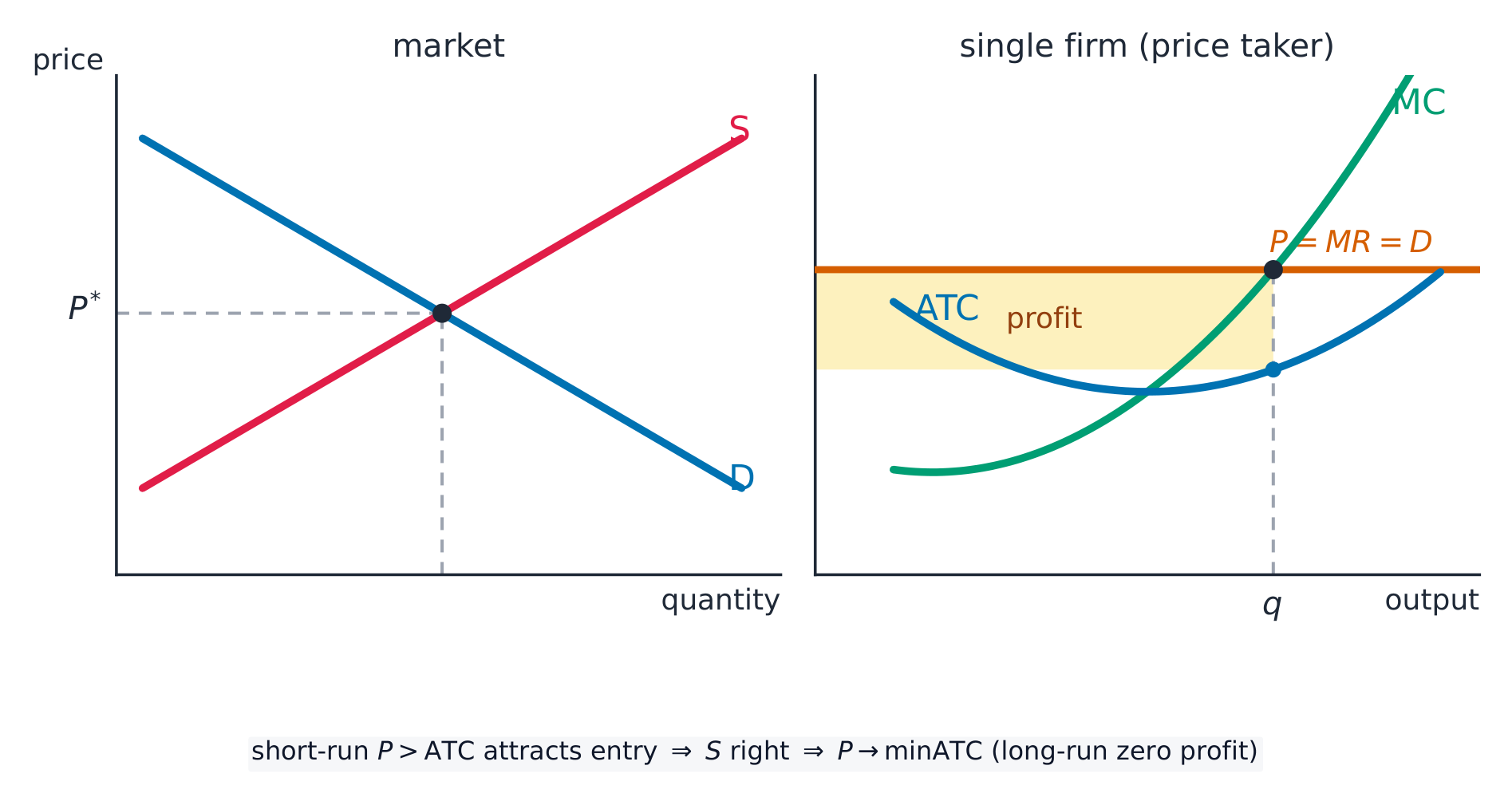
The side-by-side panel is the graph the exam wants: the market (left) fixes the price $P^{*}$; the firm (right) takes it as a horizontal line and produces where $MC=P$. When $P>ATC$ there is a short-run profit (the shaded box); that profit attracts entry, which shifts market supply right and pushes the price down.

  • Short run: the firm can earn profit, break even, or take a loss, producing where $P=MC$.
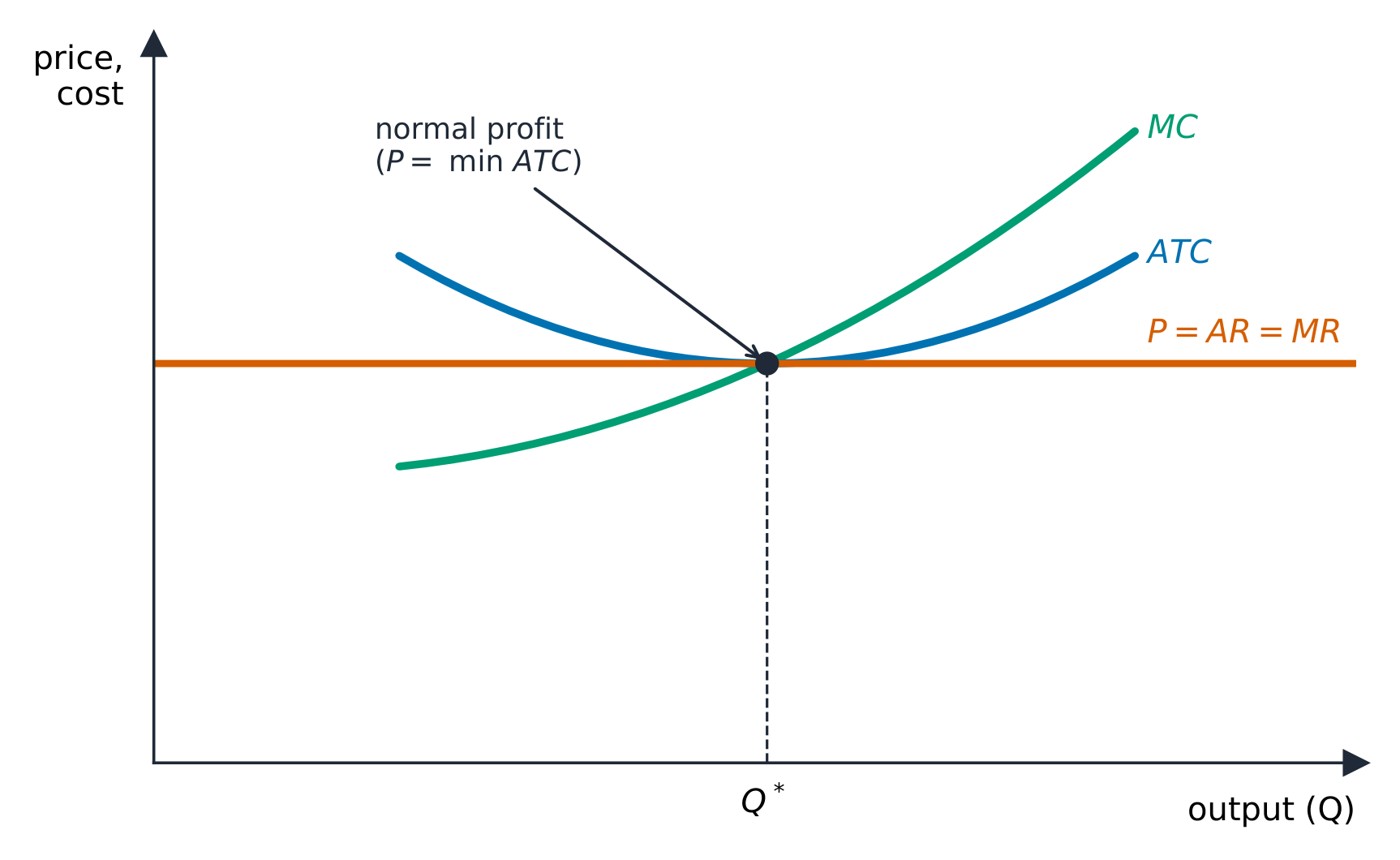
  • Long run: entry and exit drive the firm to zero economic profit, producing where $P=MC=ATC$ at minimum ATC. This double efficiency – productive efficiency (lowest-cost output) and allocative efficiency ($P=MC$, so the last unit's value equals its cost) – is the benchmark against which every other market structure is judged.

Exam skill: be able to draw the side-by-side market and single-firm graphs, show a short-run profit or loss, then show how entry/exit restores long-run equilibrium at minimum ATC.

日本語

完全競争市場には多数の中小企業が存在し、同一(均質)の商品、自由な参入と退出、完全な情報があります。各企業は価格受取人であり、市場価格に影響を与えるほど大きくないため、市場価格において水平な需要曲線を facing します。そして価格=限界収益=平均収益($P=MR=AR$)となります。

これが経済学者が完全競争を重視する理由です。長期均衡においては、配分効率と生産効率の両方が達成されています。配分効率は、企業が $P = MC$ で生産するため成立します。価格(社会が最終単位から得る限界便益)が限界コストと等しいため、まさに必要な量が生産されているからです。生産効率は、自由な参入によって価格が平均総コストの最小点まで押し下げられ、商品が可能な限り安価に生産されるため成立します。市場価格自体がシグナルとなり、皆の限界コストと便益を伝達しています。

市場が価格を設定し、価格受容企業は MC = P で生産する(ここでは短期利潤あり)
市場が価格を設定し、価格受取人は MC = P で生産する(ここでは短期の利益あり)

並べたパネルは試験で求めるグラフです:市場(左側)が価格 $P^{*}$ を固定しており、企業(右側)がそれを水平線として受け入れ、$MC=P$ で生産します。$P>ATC$ のとき短期利益(影付きの長方形)が生じ、この利益が新規参入を招き、市場供給曲線を右へ移動させて価格を下げる原因となります。

完全競争企業の長期では純利潤のみを得る
完全競争企業は長期的に通常利潤のみを達成する
  • 短期間: 企業は利益を得たり、損益分岐したり、損失を出したりできる。$P=MC$で生産される。
  • 長期間: 参入と撤退が企業を経済的ゼロ利潤へと駆動させ、最小平均総成本(ATC)において$P=MC=ATC$で生産される。この二重の効率性——生産効率(最低コストでの生産量)と配置効率($P=MC$、すなわち最終単位の価値がそのコストと等しい)——は、他のすべての市場構造が比較される基準となる。

試験技能: 並置された市場図と単一企業の図を描き、短期間の利益または損失を示し、参入・撤退が最小ATCにおける長期均衡を取り戻す様子を示せるようにすること。

Explore · ⁨探索⁩

A price-taking firm in a competitive market · ⁨競争市場における価格受容企業⁩

In perfect competition the market sets the price and each firm is a price-taker. It produces where price equals marginal cost, earning zero economic profit in the long run. · ⁨完全競争では、市場が価格を決定し、各企業は価格受容者となります。企業は価格が限界費用と等しくなる地点で生産を行い、長期的には経済的利益ゼロを達成します。⁩

3.7

Exam tips · ⁨試験対策⁩

English
  • Know the cost curves: AFC falls, ATC/AVC are U-shaped, and MC cuts ATC and AVC at their minimums.
  • Every firm maximises profit at MR = MC; check the shutdown rule ($P \ge AVC$ in the short run).
  • Distinguish accounting profit (revenue − explicit costs) from economic profit (also minus implicit/opportunity costs); zero economic profit is normal.
  • "Diminishing returns" is short-run (one fixed input); "economies of scale" is long-run (all inputs vary).
  • In perfect competition $P=MR=AR$; entry/exit drive long-run economic profit to zero at minimum ATC.
日本語
  • 費用曲線を知る:AFCは減少し、ATC/AVCはU字型であり、MCがATCおよびAVCの最小値で交差する。
  • 全ての企業はMR = MCで利潤を最大化する。shutdown ruleを確認する(短期間では$P \ge AVC$)。
  • 会計利潤(収益 − 明示的コスト)と経済利潤(さらに隠匿的・機会コストを引いたもの)を区別する;経済的ゼロ利潤は通常利潤である。
  • 「限界報酬逓減」は短期間(固定投入要素が1つ)、「規模の経済」は長期間(全投入要素が変化する)。
  • 完全競争において$P=MR=AR$;参入・撤退が最小ATCで長期の経済利潤をゼロにする。

Interactive lessons on this topic · ⁨このトピックのインタラクティブ授業⁩

Work through it step by step, with instant-check exercises. · ⁨一歩ずつ進め、即時チェック付きの問題で学習します。⁩

Past Papers · ⁨過去問⁩

More topics in AP Microeconomics · ⁨AP 経済学⁩ · ⁨AP Microeconomics · ⁨AP 経済学⁩ の他のトピック⁩

Log in or create account · ⁨ログインまたはアカウント作成⁩

IGCSE, A-Level & AP