Skip to content · ⁨コンテンツへスキップ⁩

Populations · ⁨個体数⁩

AP Environmental Science · Topic 3 · ⁨トピック 3⁩

View Slides · ⁨查看幻灯片⁩ Train · ⁨練習する⁩
Video lesson for this topic · ⁨このトピックのビデオレッスン⁩ Open the video page · ⁨動画ページを開く⁩
7:45

個体数

1944で、29頭のトナカイが小さな島に放たれました。捕食者はおらず、地面には苔が厚く生い茂っていました。20年以内に…

English narration · English + 中文 subtitles burned in · ⁨英語ナレーション・英語+中文字幕 burning-in⁩

3.1

Generalist and Specialist Species · ⁨汎用種と特化種⁩

Syllabus · ⁨シラバス⁩
English

Enduring Understanding (ERT-3): Populations change over time in reaction to a variety of factors.

Learning Objective ERT-3.A: Identify differences between generalist and specialist species.

  • ERT-3.A.1 Specialist species tend to be advantaged in habitats that remain constant, while generalist species tend to be advantaged in habitats that are changing.
日本語

永続的理解 (ERT-3): 個体群は多様な要因への反応として、時間とともに変化する。

学習目標 ERT-3.A: 汎用種と特化種の違いを特定する。

  • ERT-3.A.1 特化種は変化しない生息地で有利になる傾向があり、一方、汎用種は変化する生息地で有利になる傾向がある。
Source: College Board AP Course and Exam Description · ⁨出典: College Board AP コースおよび試験説明書⁩

English

A generalist 广适性物种 can live in many habitats and eat many foods (raccoon, cockroach) – flexible, so it copes well with change. A specialist 狭适性物种 needs specific conditions or foods (panda, koala) – efficient in a stable habitat but very vulnerable if that habitat changes.

日本語

汎用種は多くの生息地で暮らし、多くの食物を食べられる(アライグマ、ゴキブリ)– 柔軟性があり、変化にも耐えられます。特化種は特定の条件や食物を必要とします(パンダ、コアラ)– 安定した生息地では効率的ですが、その環境が変わると非常に脆弱です。

3.2

K-Selected and r-Selected Species · ⁨K選択種とr選択種⁩

Syllabus · ⁨シラバス⁩
English

Enduring Understanding (ERT-3): Populations change over time in reaction to a variety of factors.

Learning Objective ERT-3.B: Identify differences between K- and r-selected species.

  • ERT-3.B.1 K-selected species tend to be large, have few offspring per reproduction event, live in stable environments, expend significant energy for each offspring, mature after many years of extended youth and parental care, have long life spans/life expectancy, and reproduce more than once in their lifetime. Competition for resources in K-selected species' habitats is usually relatively high.
  • ERT-3.B.2 r-selected species tend to be small, have many offspring, expend or invest minimal energy for each offspring, mature early, have short life spans, and may reproduce only once in their lifetime. Competition for resources in r-selected species' habitats is typically relatively low.
  • ERT-3.B.3 Biotic potential refers to the maximum reproductive rate of a population in ideal conditions.
  • ERT-3.B.4 Many species have reproductive strategies that are not uniquely r-selected or K-selected, or they change in different conditions at different times.
  • ERT-3.B.5 K-selected species are typically more adversely affected by invasive species than r-selected species, which are minimally affected by invasive species. Most invasive species are r-selected species.
日本語

永続的理解 (ERT-3): 個体群は多様な要因への反応として、時間とともに変化する。

学習目標 ERT-3.B: K選択種とr選択種の違いを特定する。

  • ERT-3.B.1 K選択種は一般的に大型であり、繁殖イベントあたりの産仔数が少なく、安定した環境に生息し、各産仔に対して多大なエネルギーを費やし、長い幼少期と親によるケアを経た後に成熟し、寿命/生命期待値が長く、生涯にわたって複数回繁殖する。K選択種の生息地における資源競争は通常比較的高い。
  • ERT-3.B.2 r選択種は一般的に小型であり、多くの産仔数をもち、各産仔に対するエネルギー消費または投資が最小限に抑えられ、早期に成熟し、寿命が短く、生涯にわたって一度しか繁殖しないことがある。r選択種の生息地における資源競争は通常比較的低い。
  • ERT-3.B.3 生物学的ポテンシャルとは、理想的な条件下での個体群の最大繁殖率を指す。
  • ERT-3.B.4 多くの種は、r選択的でもK選択的にも一貫せず、あるいは異なる条件下で異なる時期に変化することがある。
  • ERT-3.B.5 K選択種は、侵入種による悪影響をr選択種よりも大きく受ける傾向があり、r選択種は侵入種による影響が最小限に留まる。ほとんどの侵入種はr選択種である。

Source: College Board AP Course and Exam Description · ⁨出典: College Board AP コースおよび試験説明書⁩

English

Two reproductive strategies:

  • $r$-selected species produce many offspring with little care, mature fast, and have short lives (insects, weeds). They colonize quickly and boom-and-bust.
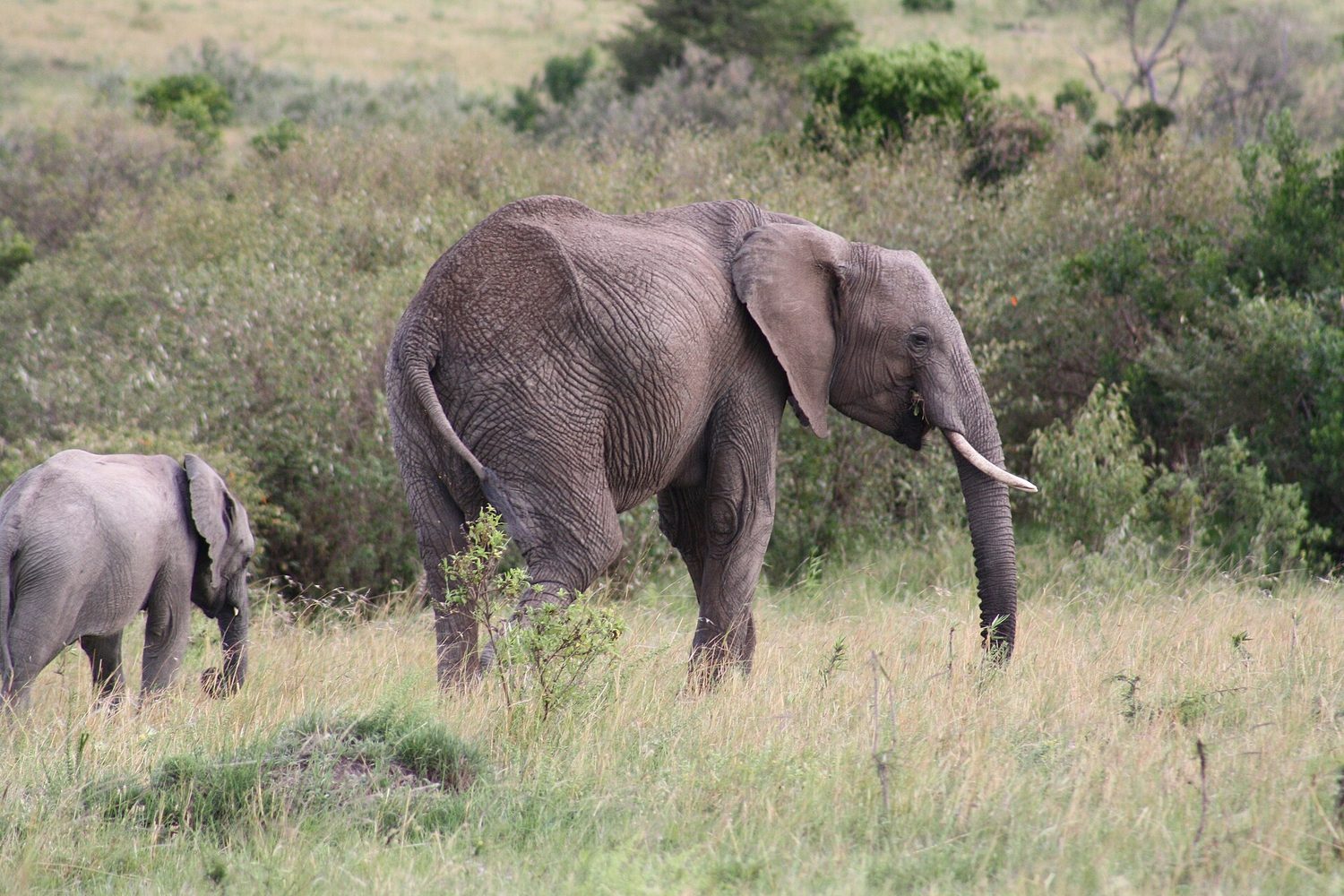
  • $K$-selected species produce few offspring with much care, mature slowly, and live long (elephants, humans). They do well near carrying capacity in stable environments but recover slowly from losses.
日本語

二つの繁殖戦略:

  • $r$-選択された種は、多数の子供を少々の世話だけで産み、早く成熟し、寿命が短いです(昆虫、雑草)。素早く植生し、爆発的に増えた後すぐに減少します。
  • $K$-選択された種は、少数の子供を厚く世話をしながら産み、ゆっくり成熟し、長寿命です(象、人間)。安定した環境で環境収容力に近づくのは得意ですが、個体数減少からの回復は遅いです。
草原を歩く成体の象とその単一の小さな子象
象とその一頭だけの子:K選択種は子供が少ないが、各々に大きく投資するため、個体数が減った場合の回復は遅い
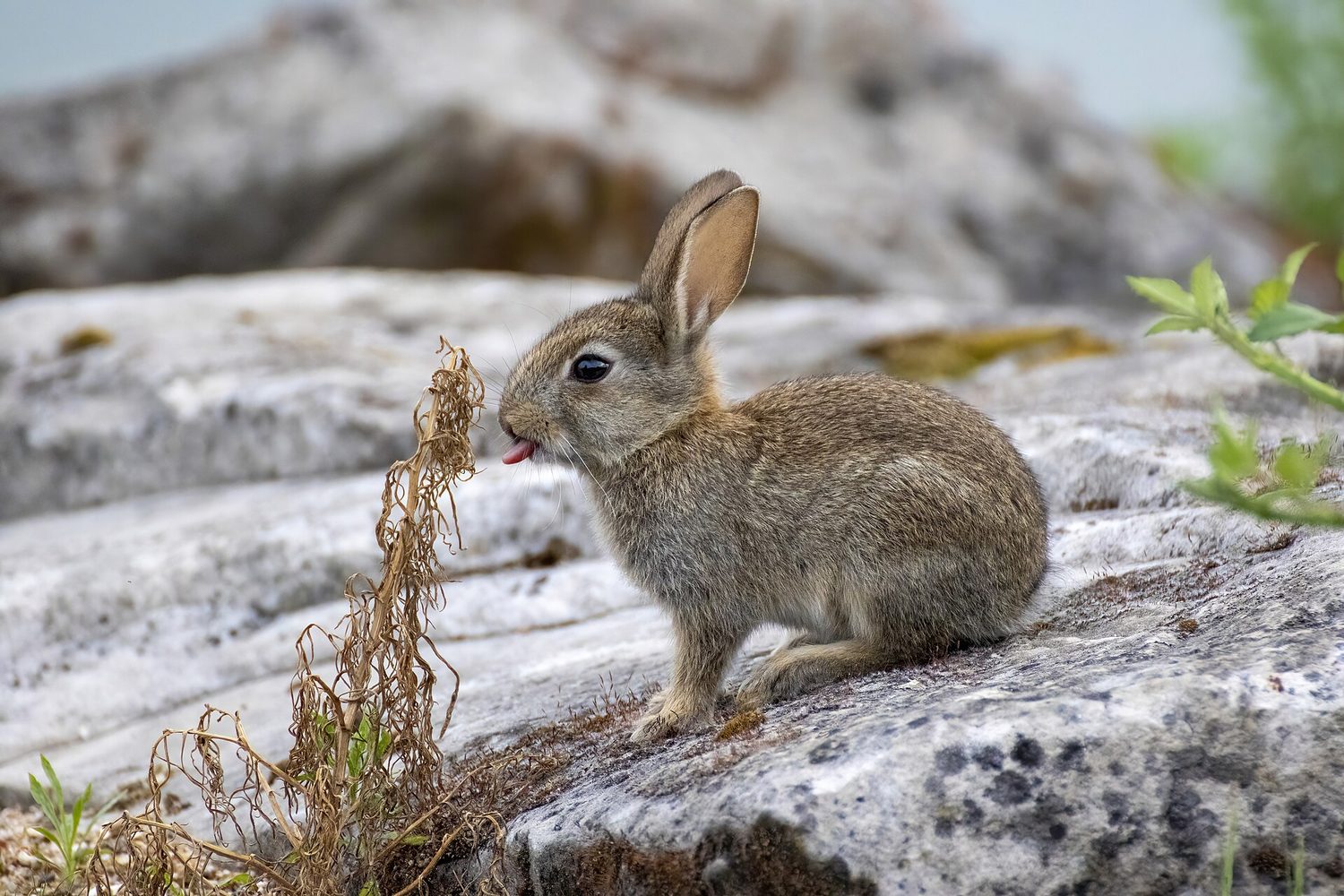
若いウサギ:r選択種は親の投資が少なく、迅速に多数の子供を生む
3.3

Survivorship Curves · ⁨生存曲線⁩

Syllabus · ⁨シラバス⁩
Enduring UnderstandingLearning ObjectiveEssential Knowledge

ERT-3
Populations change over time in reaction to a variety of factors.

ERT-3.C
Explain survivorship curves.

  • ERT-3.C.1 A survivorship curve is a line that displays the relative survival rates of a cohort—a group of individuals of the same age—in a population, from birth to the maximum age reached by any one cohort member. There are Type I, Type II, and Type III curves.
  • ERT-3.C.2 Survivorship curves differ for K-selected and r-selected species, with K-selected species typically following a Type I or Type II curve and r-selected species following a Type III curve.

Source: College Board AP Course and Exam Description · ⁨出典: College Board AP コースおよび試験説明書⁩

English

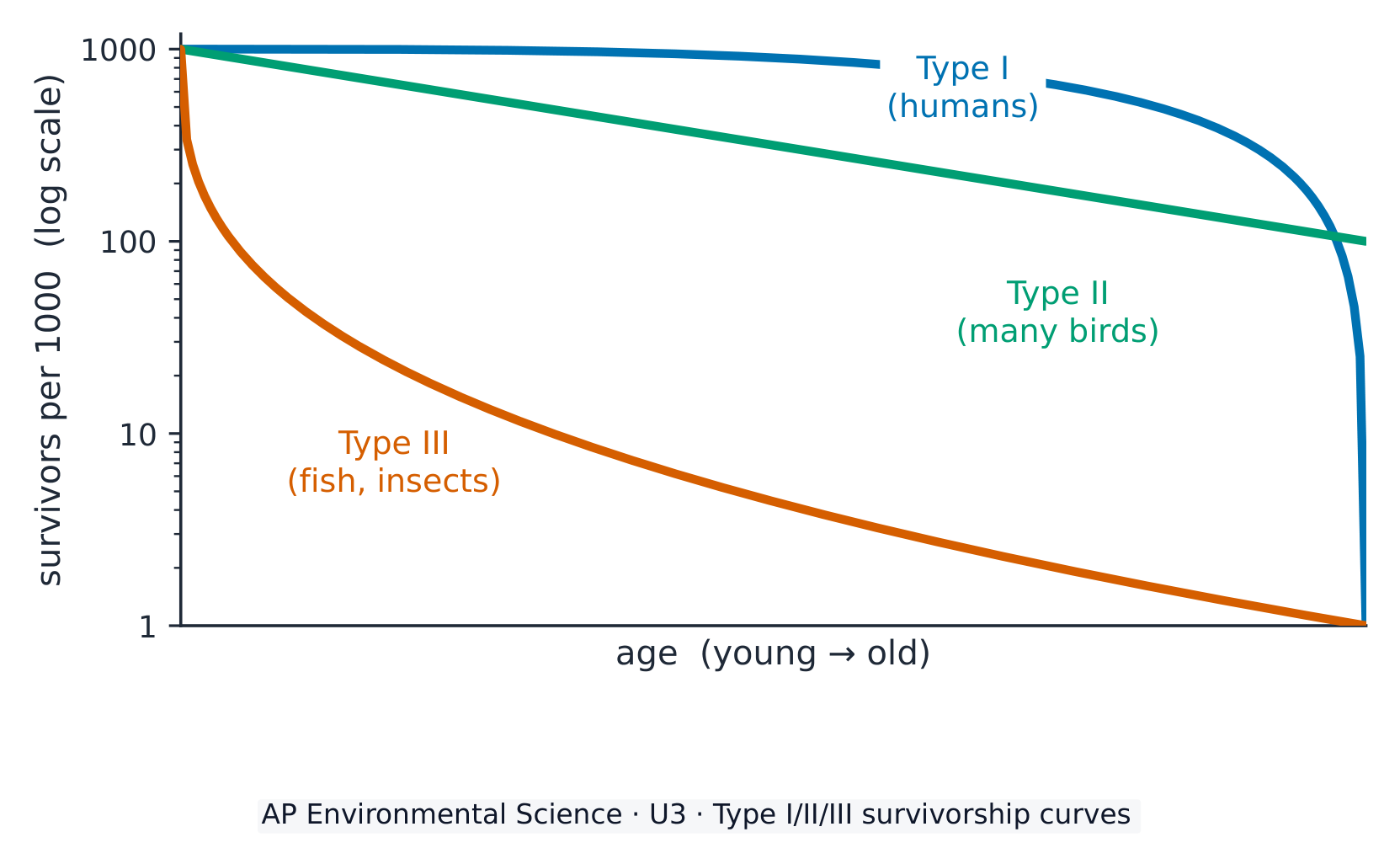
A survivorship curve 存活曲线 plots how many individuals survive at each age (on a log scale). Type I (humans): most survive to old age, then die – a convex curve. Type II (many birds): a constant death rate at all ages – a straight line. Type III ($r$-selected: fish, insects): most die young, a few survive – a concave curve.

日本語

生存曲線は、年齢ごとの生存個体数を対数目盛りにプロットしたものです。タイプI(人間):大多数が高齢まで生き延び、その後死亡する – 凸の曲線。タイプII(多くの鳥類):あらゆる年齢で一定の死亡率 – 直線。タイプIII($r$-選択:魚類、昆虫):大多数が若死し、わずかに生き残る – 凹の曲線。

対数目盛りのタイプI, II, III生存曲線
Vocabulary · ⁨語彙⁩ Train · ⁨練習する⁩
English 日本語
generalist/ˈdʒenərəlɪst/ 汎用種
specialist/ˈspeʃəlɪst/ 特化
survivorship curve/səˈvaɪvəʃɪp kɜːv/ 生存曲線
3.4

Carrying Capacity · ⁨環境収容力⁩

Syllabus · ⁨シラバス⁩
English

Enduring Understanding (ERT-3): Populations change over time in reaction to a variety of factors.

Learning Objective ERT-3.D: Describe carrying capacity.

  • ERT-3.D.1 When a population exceeds its carrying capacity (carrying capacity can be denoted as K), overshoot occurs. There are environmental impacts of population overshoot, including resource depletion.

Learning Objective ERT-3.E: Describe the impact of carrying capacity on ecosystems.

  • ERT-3.E.1 A major ecological effect of population overshoot is dieback of the population (often severe to catastrophic) because the lack of available resources leads to famine, disease, and/or conflict.
日本語

永続的理解 (ERT-3): 個体群は多様な要因への反応として、時間とともに変化する。

学習目標 ERT-3.D: 環境収容力を説明する。

  • ERT-3.D.1 個体群が環境収容力(環境収容力はKで表されることもある)を超えた場合、オーバーシュートが発生する。個体群のオーバーシュートには、資源枯渇を含む環境への影響がある。

学習目標 ERT-3.E: 環境収容力がエコシステムに与える影響について説明する。

  • ERT-3.E.1 個体群のオーバーシュートの主な生態学的効果は、利用可能な資源の欠如が飢餓、疾病、および/または争いを引き起こすことで、個体群の衰退(しばしば深刻かつ壊滅的)を引き起こすことである。

Source: College Board AP Course and Exam Description · ⁨出典: College Board AP コースおよび試験説明書⁩

English
Predator & prey populations cycle
Exponential vs logistic growth

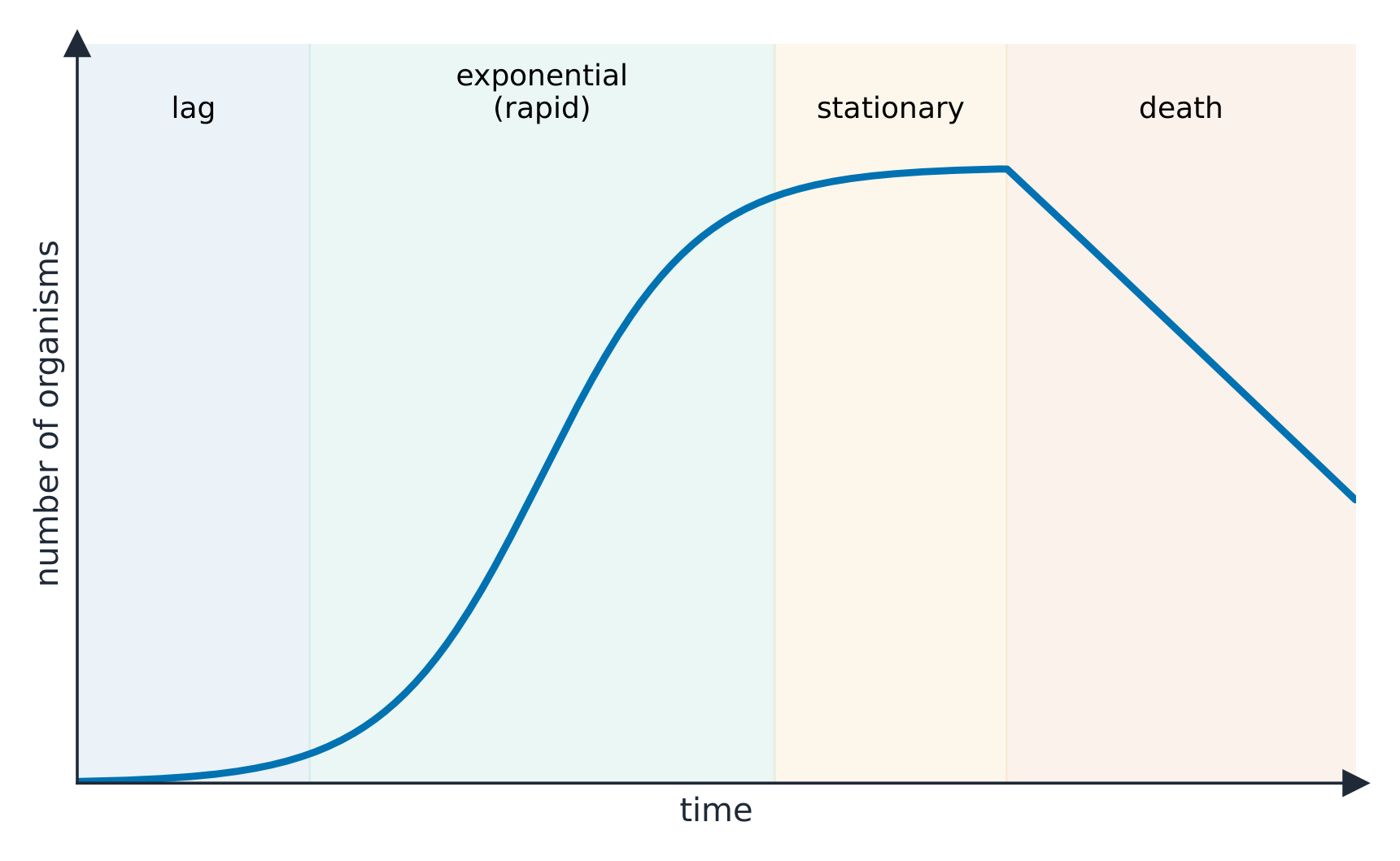
The carrying capacity 环境容纳量 ($K$) is the maximum population an environment can support long-term. A population may overshoot $K$ when resources are temporarily plentiful, then crash (dieback) as resources run out. Populations tend to fluctuate around $K$.

日本語
捕食者と被捕食者の個体数の変動
指数関数的成長とロジスティック成長

環境収容力($K$)とは、環境が長期的に支えられる最大の個体数です。資源が一時的に豊富になると、個体数は** overshoot** $K$ し、資源が枯渇すると崩溃(dieback)します。個体数は通常、$K$ の周りで変動します。

個体数成長が環境の環境収容力で頭打ちになる
個体数成長が環境の環境収容力で頭打ちになります
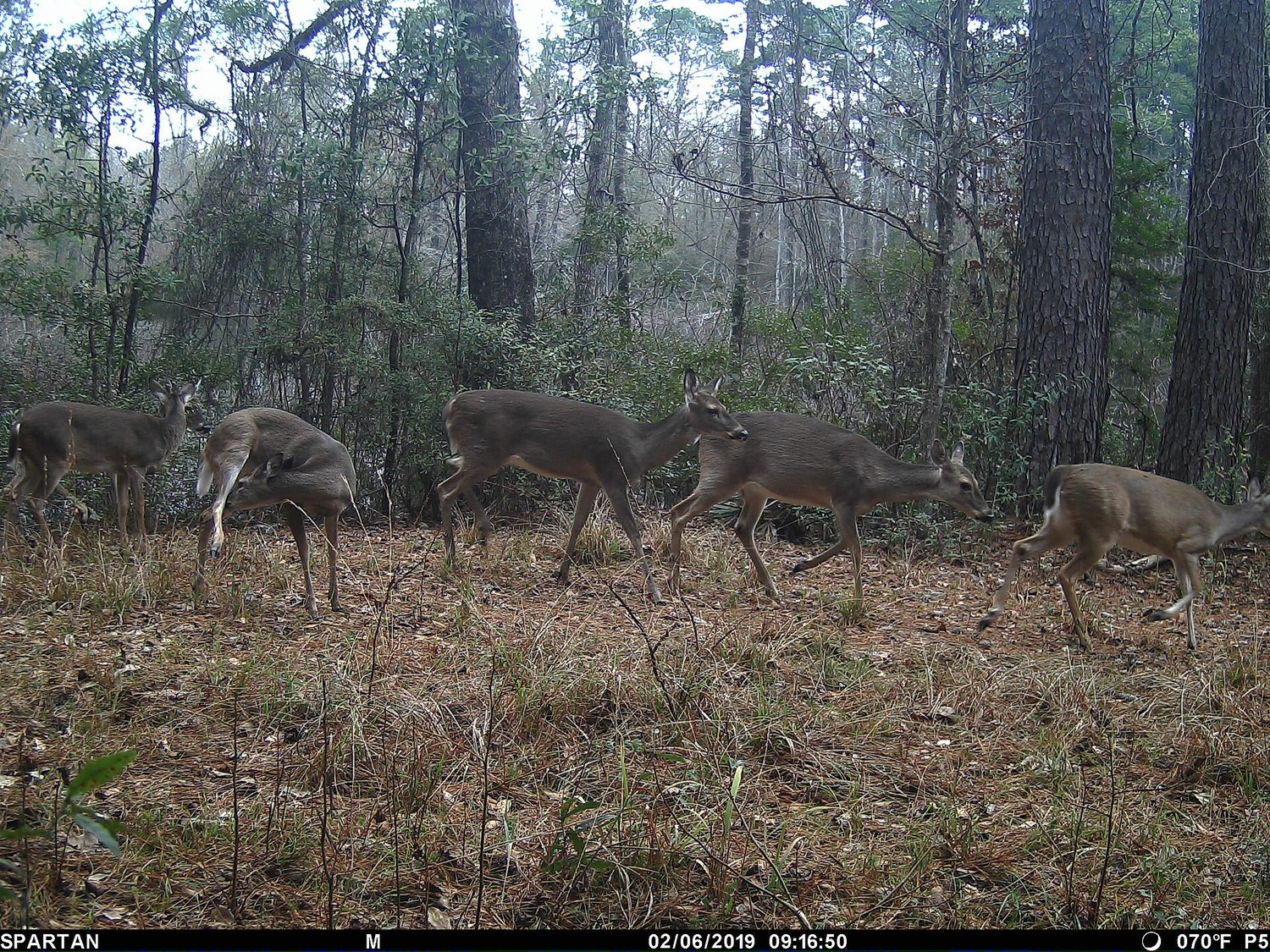
シカ群れ:個体数が環境収容力に近づくと、資源がそれ以上の成長を制限する
シカ群れ:個体数が環境収容力に近づくと、資源がそれ以上の成長を制限します
Explore · ⁨探索⁩

Growth up to carrying capacity · ⁨環境収容力までの成長⁩

A population grows toward the carrying capacity $K$ its resources can support, then levels off. Push the growth rate up and watch it overshoot and settle. · ⁨個体群は資源が支えられる環境収容力$K$に向かい、その後頭打ちになる。成長率を上げると、 overshoot(超過)して安定する様子が観察できる。⁩

Vocabulary · ⁨語彙⁩ Train · ⁨練習する⁩
English 日本語
carrying capacity/ˈkæriɪŋ kəˈpæsɪti/ 環境収容力
exponentially/ˌekspəˈnenʃəli/ 指数関数的に
logistic/ləˈdʒɪstɪk/ ロジスティック
Limiting factors/ˈlɪmɪtɪŋ ˈfæktəz/ 制限要因
age-structure diagram/eɪdʒ ˈstrʌktʃə ˈdaɪəɡræm/ 年齢構成図
total fertility rate/ˈtəʊtl fɜːˈtɪlɪti reɪt/ 総出生率
ecological footprint/ˌekəˈlɒdʒɪkl ˈfʊtprɪnt/ エコロジカル・フットプリント
3.5

Population Growth and Resource Availability · ⁨個体数成長と資源の利用可能性⁩

Syllabus · ⁨シラバス⁩
English

Enduring Understanding (ERT-3): Populations change over time in reaction to a variety of factors.

Learning Objective ERT-3.F: Explain how resource availability affects population growth.

  • ERT-3.F.1 Population growth is limited by environmental factors, especially by the available resources and space.
  • ERT-3.F.2 Resource availability and the total resource base are limited and finite over all scales of time.
  • ERT-3.F.3 When the resources needed by a population for growth are abundant, population growth usually accelerates.
  • ERT-3.F.4 When the resource base of a population shrinks, the increased potential for unequal distribution of resources will ultimately result in increased mortality, decreased fecundity, or both, resulting in population growth declining to, or below, carrying capacity.
日本語

永続的理解 (ERT-3): 個体群は多様な要因への反応として、時間とともに変化する。

学習目標 ERT-3.F: 資源の可用性が個体群成長にどう影響するかを説明する。

  • ERT-3.F.1 個体群成長は環境的要因によって制限され、特に利用可能な資源と空間によって制限される。
  • ERT-3.F.2 資源の可用性と総資源基盤は、あらゆる時間スケールにおいて有限であり限定的である。
  • ERT-3.F.3 個体群の成長に必要な資源が豊富にある場合、個体群成長は通常加速する。
  • ERT-3.F.4 個体群の資源基盤が縮小すると、資源の不均等分配の可能性が増大し、最終的に死亡率の増加、繁殖力の低下、またはその両方につながり、個体群成長が環境収容力まで、あるいはそれ以下まで減少する。

Source: College Board AP Course and Exam Description · ⁨出典: College Board AP コースおよび試験説明書⁩

English

With abundant resources a population grows exponentially 指数增长 ($J$-curve). As resources become limited, growth slows to logistic 逻辑斯蒂增长 ($S$-curve), leveling at $K$. Limiting factors 限制因素 (food, water, space, disease) set the ceiling.

日本語

資源が豊富であれば、個体数は指数関数的に増加します($J$-曲線)。資源が制限されると、成長は論理的($S$-曲線)になり、$K$ で頭打ちになります。制限要因(食物、水、空間、病気)が上限を設定します。

3.6

Age Structure Diagrams · ⁨年齢構成図⁩

Syllabus · ⁨シラバス⁩
English

Enduring Understanding (EIN-1): Human populations change in reaction to a variety of factors, including social and cultural factors.

Learning Objective EIN-1.A: Explain age structure diagrams.

  • EIN-1.A.1 Population growth rates can be interpreted from age structure diagrams by the shape of the structure.
  • EIN-1.A.2 A rapidly growing population will, as a rule, have a higher proportion of younger people compared to stable or declining populations.
日本語

永続的理解 (EIN-1): 人類個体群は社会や文化的要因を含む多様な要因への反応として変化する。

学習目標 EIN-1.A: 年齢構成図を説明する。

  • EIN-1.A.1 個体群の成長率は、年齢構成図の形状によって解釈できる。
  • EIN-1.A.2 急速に成長する個体群は、原則として、安定しているか減少している個体群と比較して、より高い割合の若年層を持つ。

Source: College Board AP Course and Exam Description · ⁨出典: College Board AP コースおよび試験説明書⁩

English

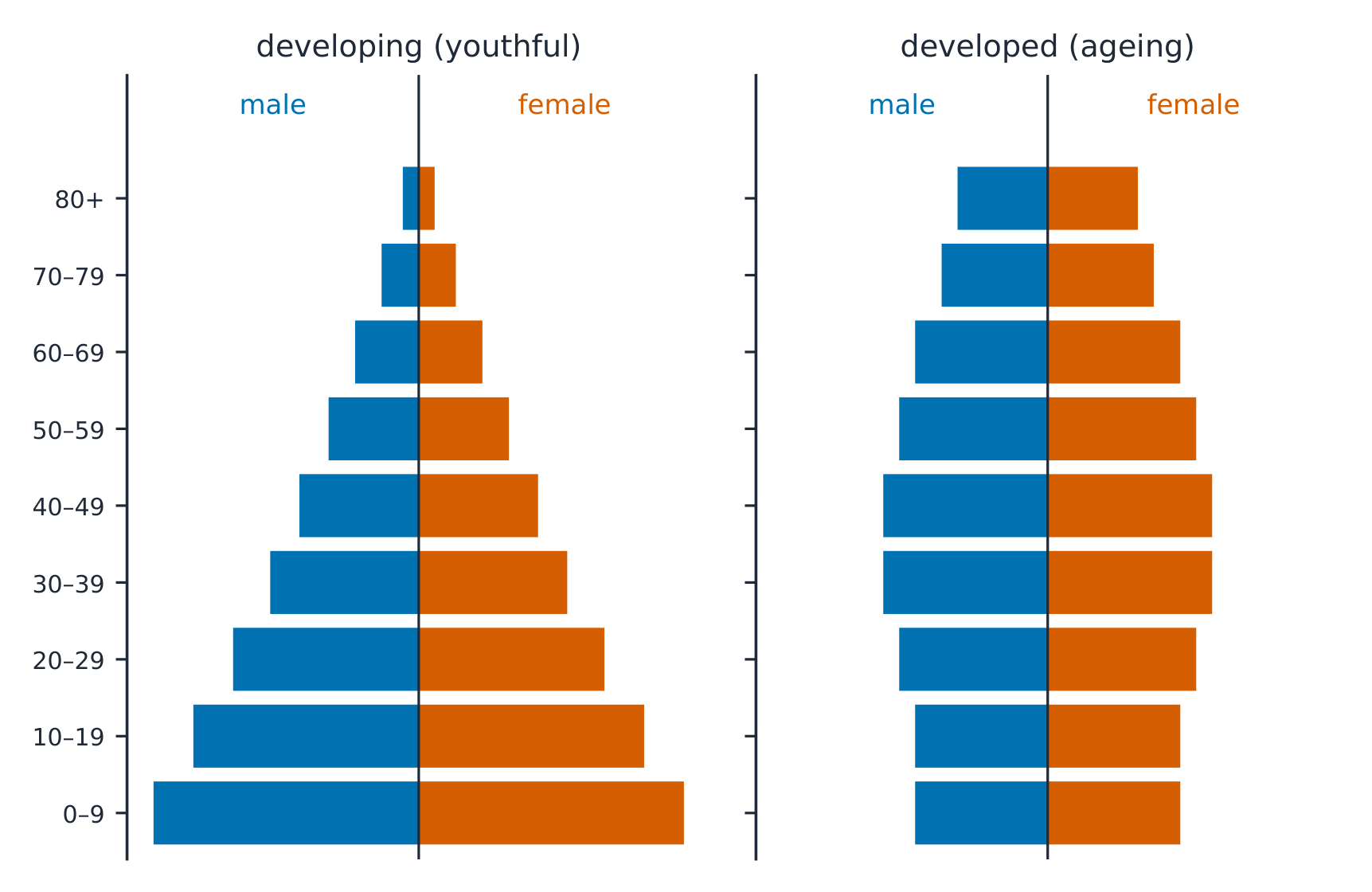
An age-structure diagram 年龄结构图 shows the proportion of a population in each age group. A wide base (many young) predicts rapid growth; even bars predict a stable population; a narrow base predicts decline. They forecast a country's future population.

日本語

年齢構成図は、各年齢層における個体数の割合を示します。幅広い基部(若年層が多い)は急激な成長を予測し、均一なバーは安定した人口を予測し、狭い基部は減少を予測します。これらの図は将来の国ごとの人口を予測するために使われます。

発展途上国と先進国の人口ピラミド
発展途上国と先進国の人口ピラミド
3.7

Total Fertility Rate · ⁨総和出生率⁩

Syllabus · ⁨シラバス⁩
English

Enduring Understanding (EIN-1): Human populations change in reaction to a variety of factors, including social and cultural factors.

Learning Objective EIN-1.B: Explain factors that affect total fertility rate in human populations.

  • EIN-1.B.1 Total fertility rate (TFR) is affected by the age at which females have their first child, educational opportunities for females, access to family planning, and government acts and policies.
  • EIN-1.B.2 If fertility rate is at replacement levels, a population is considered relatively stable.
  • EIN-1.B.3 Factors associated with infant mortality rates include whether mothers have access to good healthcare and nutrition. Changes in these factors can lead to changes in infant mortality rates over time.
日本語

永続的理解 (EIN-1): 人類個体群は社会や文化的要因を含む多様な要因への反応として変化する。

学習目標 EIN-1.B: 人類個体群の総合計出産率に影響を与える要因を説明する。

  • EIN-1.B.1 総和出生率(TFR)は、女性の初産年齢、女性の教育機会、家族計画へのアクセス、および政府の法令や政策によって影響を受ける。
  • EIN-1.B.2 出生率が再生産レベルにある場合、その人口は比較的稳定していると考えられる。
  • EIN-1.B.3 乳児死亡率に関連する要因には、母親が適切な医療と栄養にアクセスできるかどうかが含まれる。これらの要因の変化は、時間の経過に伴う乳児死亡率の変化につながる可能性がある。

Source: College Board AP Course and Exam Description · ⁨出典: College Board AP コースおよび試験説明書⁩

English

The total fertility rate 总生育率 (TFR) is the average number of children per woman. A replacement level of about 2.1 keeps a population steady; above it grows, below it shrinks. TFR falls with education, access to family planning, and lower infant mortality.

日本語

総和出生率(TFR)は、女性一人あたりの平均出産数です。交換水準である約2.1で人口が安定し、上回れば増加し、下回れば減少します。教育、家族計画へのアクセス、乳児死亡率の低下に伴いTFRは低下します。

3.8

Human Population Dynamics · ⁨人類口動態⁩

Syllabus · ⁨シラバス⁩
English

Enduring Understanding (EIN-1): Human populations change in reaction to a variety of factors, including social and cultural factors.

Learning Objective EIN-1.C.1: Explain how human populations experience growth and decline.

  • EIN-1.C.1 Birth rates, infant mortality rates, and overall death rates, access to family planning, access to good nutrition, access to education, and postponement of marriage all affect whether a human population is growing or declining.
  • EIN-1.C.2 Factors limiting global human population include the Earth's carrying capacity and the basic factors that limit human population growth as set forth by Malthusian theory.
  • EIN-1.C.3 Population growth can be affected by both density-independent factors, such as major storms, fires, heat waves, or droughts, and density-dependent factors, such as access to clean water and air, food availability, disease transmission, or territory size.
  • EIN-1.C.4 The rule of 70 states that dividing the number 70 by the percentage population growth rate approximates the population's doubling time.
日本語

永続的理解 (EIN-1): 人類個体群は社会や文化的要因を含む多様な要因への反応として変化する。

学習目標 EIN-1.C.1: 人間人口が成長し、減少する仕組みを説明する。

  • EIN-1.C.1 出生率、乳児死亡率、総合死亡率、家族計画へのアクセス、適切な栄養へのアクセス、教育へのアクセス、結婚の延期は、人間人口が成長するか減少するかに影響を与える。
  • EIN-1.C.2 世界的な人間人口を制限する要因には、地球の環境収容力と、マルサス理論によって示される人間人口の成長を制限する基本的な要因が含まれる。
  • EIN-1.C.3 人口成長は、大規模な嵐、火災、熱波、乾旱などの密度非依存要因と、清潔な水と空気の確保、食料の可用性、疾病の伝播、領土サイズなどの密度依存要因の両方によって影響を受ける。
  • EIN-1.C.4 「70の法則」によると、70を人口成長率の百分率で割ることで、人口の倍増時間を概算できる。

Source: College Board AP Course and Exam Description · ⁨出典: College Board AP コースおよび試験説明書⁩

English

Human population growth depends on birth rate, death rate, and migration. Rapid growth strains resources and increases the ecological footprint 生态足迹. Factors lowering birth rates include education (especially of women), urbanization, and economic development.

Worked example. A country has a birth rate of $30$ per $1000$ and a death rate of $10$ per $1000$. The natural growth rate is $\dfrac{30-10}{10}=2.0\%$ per year (dividing the per-thousand difference by $10$ converts it to a percent). By the rule of 70, the population doubles in about $\dfrac{70}{2.0}=35$ years. If development cut the growth rate to $1.0\%$, the doubling time would stretch to $\dfrac{70}{1.0}=70$ years.

日本語

人類の人口増加は出生率、死亡率、移住に依存します。急速な増加は資源に負担をかけ、生態学的フットプリントを増加させます。出生率を下げる要因には、教育(特に女性の)、都市化、経済発展が含まれます。

** worked example.** 一国の出生率が $30$ 対 $1000$、死亡率が $10$ 対 $1000$ の場合、自然増減率は年 $\dfrac{30-10}{10}=2.0\%$ です(千分率の差を $10$ で割るとパーセントに換算されます)。70の法則により、人口は約 $\dfrac{70}{2.0}=35$ 年で倍増します。開発により成長率が $1.0\%$ に低下した場合、倍増時間は $\dfrac{70}{1.0}=70$ 年に伸びます。

混雑する都市の交差点:人類の人口動態は出生率、死亡率、移住に依存します
3.9

Demographic Transition · ⁨人口転換⁩

Syllabus · ⁨シラバス⁩
English

Enduring Understanding (EIN-1): Human populations change in reaction to a variety of factors, including social and cultural factors.

Learning Objective EIN-1.D: Define the demographic transition.

  • EIN-1.D.1 The demographic transition refers to the transition from high to lower birth and death rates in a country or region as development occurs and that country moves from a pre-industrial to an industrialized economic system. This transition is typically demonstrated through a four-stage demographic transition model (DTM).
  • EIN-1.D.2 Characteristics of developing countries include higher infant mortality rates and more children in the workforce than developed countries.
日本語

永続的理解 (EIN-1): 人類個体群は社会や文化的要因を含む多様な要因への反応として変化する。

学習目標 EIN-1.D: 人口転換を定義する。

  • EIN-1.D.1 人口転換とは、開発が進むにつれて、ある国や地域が高出生率・高死亡率から低出生率・低死亡率へと移行することを指し、その結果、その国は前工業経済から工業化された経済システムへと移行する。この移行は通常、4段階モデル(DTM)を用いて説明される。
  • EIN-1.D.2 発展途上国の特徴には、先進国よりも高い乳児死亡率や、労働力としての児童の割合が高いことが含まれる。

Source: College Board AP Course and Exam Description · ⁨出典: College Board AP コースおよび試験説明書⁩

English

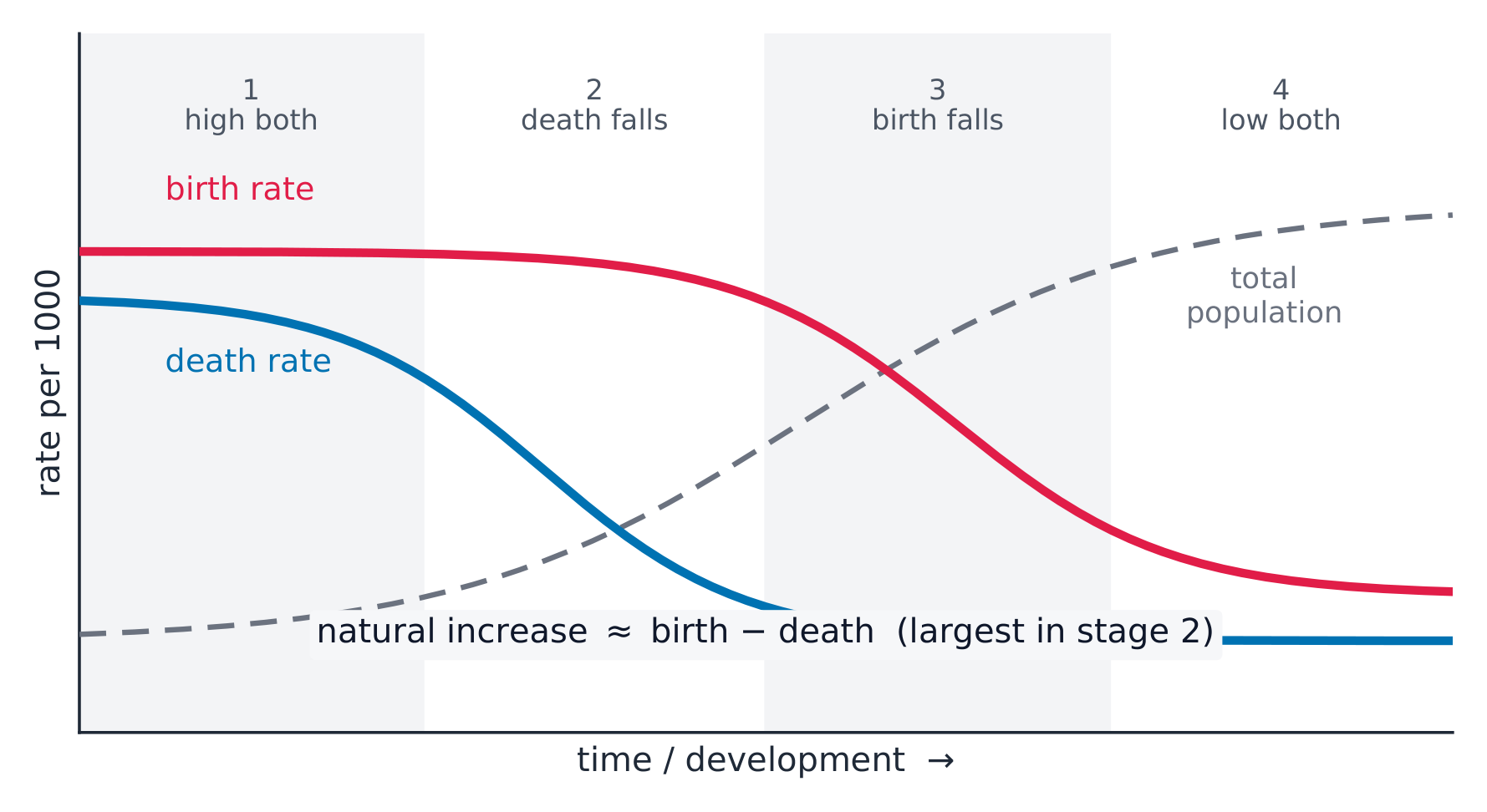
The demographic transition 人口转型 describes how a country's growth changes as it develops, in stages: (1) high birth and death rates (slow growth); (2) death rate falls (rapid growth); (3) birth rate falls (slowing growth); (4) both low (stable). Developed nations are in later stages; many developing nations are in the rapid-growth stages.

The population grows fastest in stages 2 and 3 – the gap between a still-high birth rate and an already-fallen death rate. That lag is why a country's population keeps climbing long after its death rate drops.

日本語

人口転換とは、一国が発展する過程でその成長が段階的にどのように変化するかを示すものです。(1)高い出生率と死亡率(緩やかな成長)、(2)死亡率の低下(急激な成長)、(3)出生率の低下(成長の鈍化)、(4)双方の低さ(安定)。先進国は後期の段階にあり、多くの発展途上国は急成長の段階にあります。

人口転換の4つの段階
人口転換の4つの段階

人口は第2および第3段階で最も速く増加します。まだ高い出生率と既に低下した死亡率との間のギャップです。この遅れのため、死亡率が下がった後も長期間にわたり人口は上昇し続けます。

Vocabulary · ⁨語彙⁩ Train · ⁨練習する⁩
English 日本語
demographic transition/ˌdeməˈɡræfɪk trænˈsɪʃn/ 人口転換
3.9

Exam tips · ⁨試験対策⁩

English
  • Use the rule of 70: doubling time ≈ 70 ÷ growth-rate(%); a growth rate is (births − deaths) per 1000 ÷ 10.
  • Read age-structure diagrams: a wide base predicts rapid growth, even bars a stable population.
  • Contrast r-selected (many offspring, little care) and K-selected (few, much care) strategies.
  • Know the demographic transition stages and what lowers birth rates (education, family planning, development).
  • A falling growth rate still means growth — the population only shrinks when deaths exceed births.
日本語
  • 70の法則を使用する:倍増時間 ≈ 70 ÷ 成長率(%);成長率は (出生数 − 死亡数) ÷ 1000 ÷ 10 で求められる。
  • 年齢構造図表を読む:広い底辺は急成長を予測し、均等なバーは安定した人口を示す。
  • r選択型(多数の子供、少々のケア)と K選択型(少数の子供、多めのケア)の戦略を比較する。
  • 人口転換の各段階と、出生率を下げる要因(教育、家族計画、発展)を理解する。
  • 成長率が低下しても依然として成長を意味する。死亡数が出生数を上回るまで人口は減少しない。

Interactive lessons on this topic · ⁨このトピックのインタラクティブ授業⁩

Work through it step by step, with instant-check exercises. · ⁨一歩ずつ進め、即時チェック付きの問題で学習します。⁩

Past Papers · ⁨過去問⁩

More topics in AP Environmental Science · ⁨AP Environmental Science の他のトピック⁩

Log in or create account · ⁨ログインまたはアカウント作成⁩

IGCSE, A-Level & AP