Skip to content

Aquatic and Terrestrial Pollution

AP Environmental Science · Topic 8

Train
8.1

Sources of Pollution

Syllabus
Enduring UnderstandingLearning ObjectiveEssential Knowledge

STB-3
Human activities, including the use of resources, have physical, chemical, and biological consequences for ecosystems.

STB-3.A
Identify differences between point and nonpoint sources of pollution.

  • STB-3.A.1 A point source refers to a single, identifiable source of a pollutant, such as a smokestack or waste discharge pipe.
  • STB-3.A.2 Nonpoint sources of pollution are diffused and can therefore be difficult to identify, such as pesticide spraying or urban runoff.

Source: College Board AP Course and Exam Description

Pollution sources are point or nonpoint. A point source 点源 comes from a single, identifiable place (a factory pipe, a sewage outfall) – easy to locate and regulate. A nonpoint source 非点源 is spread out (farm runoff, urban street runoff, car exhaust) – much harder to control because it comes from everywhere.

Vocabulary Train
English Chinese Pinyin
point source 点源 diǎn yuán
nonpoint source 非点源 fēi diǎn yuán
8.2

Human Impacts on Ecosystems

Syllabus
Enduring UnderstandingLearning ObjectiveEssential Knowledge

STB-3
Human activities, including the use of resources, have physical, chemical, and biological consequences for ecosystems.

STB-3.B
Describe the impacts of human activities on aquatic ecosystems.

  • STB-3.B.1 Organisms have a range of tolerance for various pollutants. Organisms have an optimum range for each factor where they can maintain homeostasis. Outside of this range, organisms may experience physiological stress, limited growth, reduced reproduction, and in extreme cases, death.
  • STB-3.B.2 Coral reefs have been suffering damage due to a variety of factors, including increasing ocean temperature, sediment runoff, and destructive fishing practices.
  • STB-3.B.3 Oil spills in marine waters cause organisms to die from the hydrocarbons in oil. Oil that floats on the surface of water can coat the feathers of birds and fur of marine mammals. Some components of oil sink to the ocean floor, killing some bottom-dwelling organisms.
  • STB-3.B.4 Oil that washes up on the beach can have economic consequences on the fishing and tourism industries.
  • STB-3.B.5 Oceanic dead zones are areas of low oxygen in the world's oceans caused by increased nutrient pollution.
  • STB-3.B.6 An oxygen sag curve is a plot of dissolved oxygen levels versus the distance from a source of pollution, usually excess nutrients and biological refuse.
  • STB-3.B.7 Heavy metals used for industry, especially mining and burning of fossil fuels, can reach the groundwater, impacting the drinking water supply.
  • STB-3.B.8 Litter that reaches aquatic ecosystems, besides being unsightly, can create intestinal blockage and choking hazards for wildlife and introduce toxic substances to the food chain.
  • STB-3.B.9 Increased sediment in waterways can reduce light infiltration, which can affect primary producers and visual predators. Sediment can also settle, disrupting habitats.
  • STB-3.B.10 When elemental sources of mercury enter aquatic environments, bacteria in the water convert it to highly toxic methylmercury.

Source: College Board AP Course and Exam Description

Human activities – pollution, habitat destruction, overharvesting, introducing species – degrade ecosystems and reduce biodiversity. Because species are interconnected, harming one part can ripple through the whole system.

8.3

Endocrine Disruptors

Syllabus
Enduring UnderstandingLearning ObjectiveEssential Knowledge

STB-3
Human activities, including the use of resources, have physical, chemical, and biological consequences for ecosystems.

STB-3.C
Describe endocrine disruptors.

  • STB-3.C.1 Endocrine disruptors are chemicals that can interfere with the endocrine system of animals.

STB-3.D
Describe the effects of endocrine disruptors on ecosystems.

  • STB-3.D.1 Endocrine disruptors can lead to birth defects, developmental disorders, and gender imbalances in fish and other species.

Source: College Board AP Course and Exam Description

Endocrine disruptors 内分泌干扰物 are chemicals (some pesticides, plasticizers like BPA) that mimic or block hormones, disrupting growth, reproduction, and development in wildlife and humans even at very low doses.

Vocabulary Train
English Chinese Pinyin
Endocrine disruptors 内分泌干扰物 nèi fēn mì gān rǎo wù
8.4

Human Impacts on Wetlands and Mangroves
Syllabus
Enduring UnderstandingLearning ObjectiveEssential Knowledge

STB-3
Human activities, including the use of resources, have physical, chemical, and biological consequences for ecosystems.

STB-3.E
Describe the impacts of human activity on wetlands and mangroves.

  • STB-3.E.1 Wetlands are areas where water covers the soil, either part or all of the time.
  • STB-3.E.2 Wetlands provide a variety of ecological services, including water purification, flood protection, water filtration, and habitat.
  • STB-3.E.3 Threats to wetlands and mangroves include commercial development, dam construction, overfishing, and pollutants from agriculture and industrial waste.

Source: College Board AP Course and Exam Description

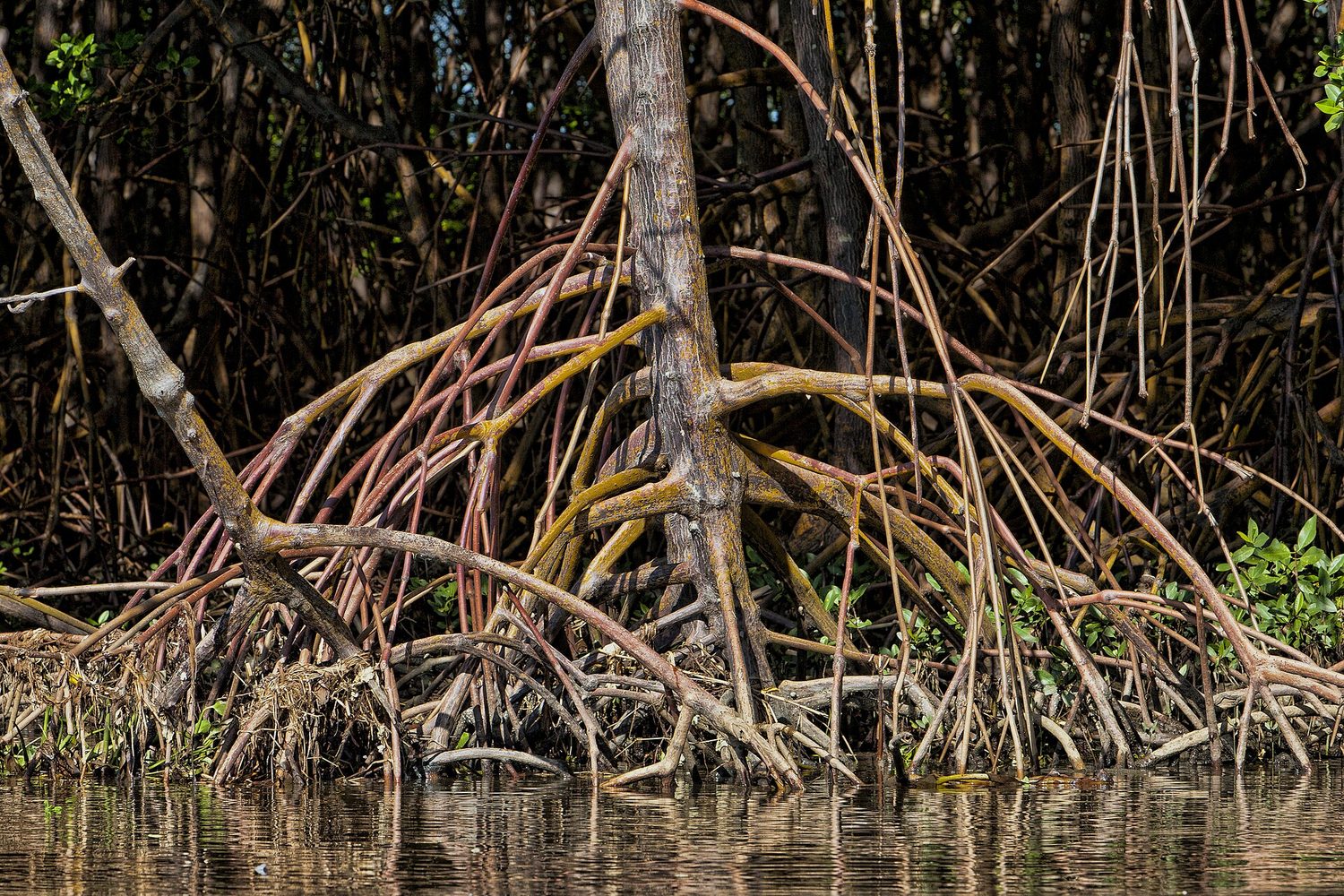
Wetlands 湿地 and mangroves 红树林 filter pollutants, store floodwater, and nurse young fish, but they are drained and cleared for farms, shrimp ponds, and development. Losing them removes valuable ecosystem services and coastal protection.

The dense, arching stilt-roots of mangrove trees rising out of shallow water Mangrove roots: this tangle traps sediment, calms waves, and shelters young fish, all services lost when mangroves are cleared

Vocabulary Train
English Chinese Pinyin
Wetlands 湿地 shī dì
mangroves 红树林 hóng shù lín
8.5

Eutrophication

Syllabus
Enduring UnderstandingLearning ObjectiveEssential Knowledge

STB-3
Human activities, including the use of resources, have physical, chemical, and biological consequences for ecosystems.

STB-3.F
Explain the environmental effects of excessive use of fertilizers and detergents on aquatic ecosystems.

  • STB-3.F.1 Eutrophication occurs when a body of water is enriched in nutrients.
  • STB-3.F.2 The increase in nutrients in eutrophic aquatic environments causes an algal bloom. When the algal bloom dies, microbes digest the algae, along with the oxygen in the water, leading to a decrease in the dissolved oxygen levels in the water. The lack of dissolved oxygen can result in large die-offs of fish and other aquatic organisms.
  • STB-3.F.3 Hypoxic waterways are those bodies of water that are low in dissolved oxygen.
  • STB-3.F.4 Compared to eutrophic waterways, oligotrophic waterways have very low amounts of nutrients, stable algae populations, and high dissolved oxygen.
  • STB-3.F.5 Anthropogenic causes of eutrophication are agricultural runoff and wastewater release.

Source: College Board AP Course and Exam Description

Eutrophication

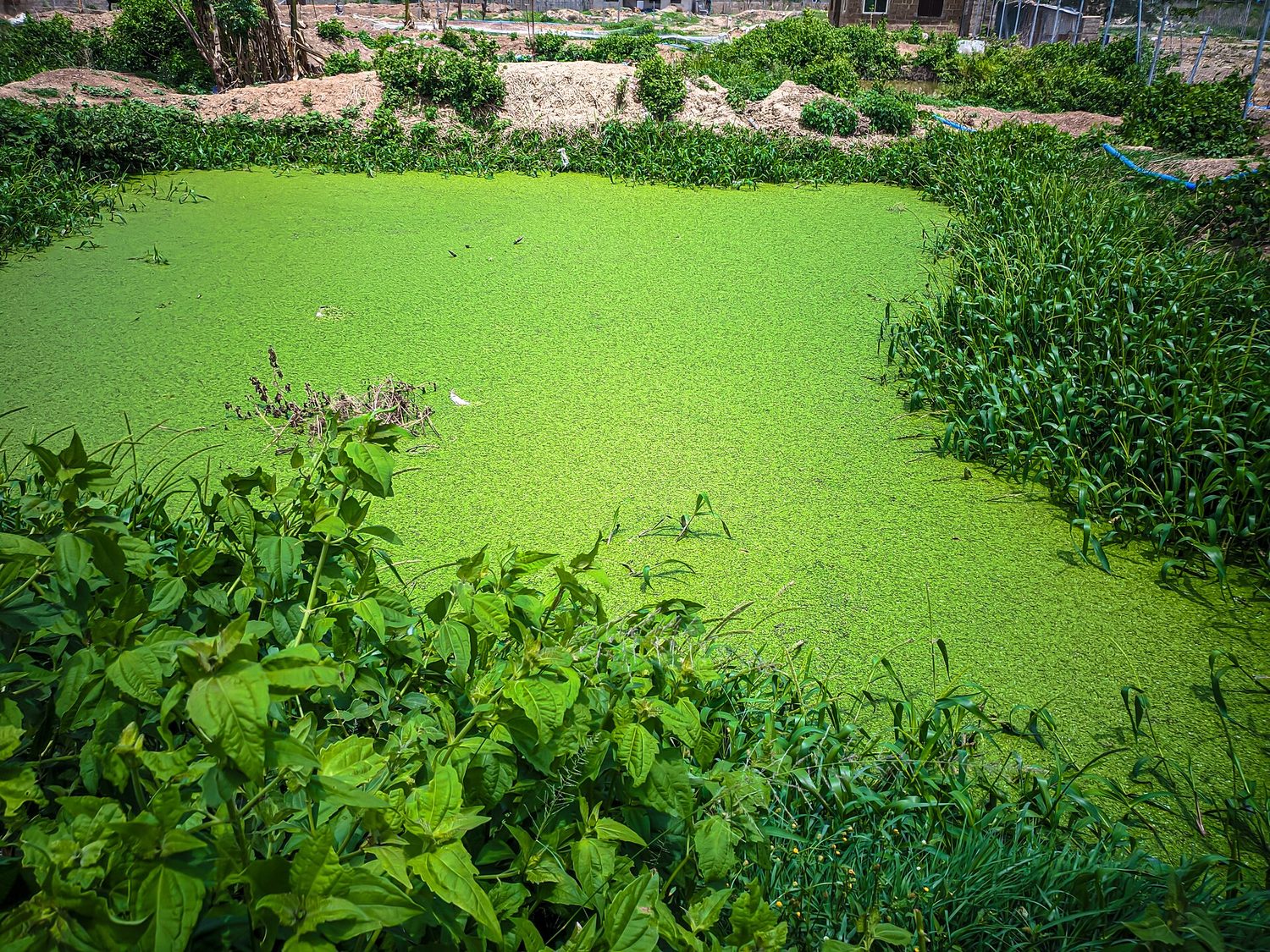
Eutrophication 富营养化 happens when excess nutrients (nitrogen, phosphorus from fertilizer and sewage) trigger algal blooms 藻华. When the algae die, decomposers use up the oxygen, creating hypoxic 缺氧 "dead zones" that suffocate fish.

A small pond whose entire surface is covered with a thick layer of bright green algae A pond choked by an algal bloom: extra nutrients let algae cover the whole surface. When they die and rot, the water loses its oxygen

Extra fertiliser makes algae bloom, then the water loses its oxygen Extra fertiliser makes algae bloom, then the water loses its oxygen

Vocabulary Train
English Chinese Pinyin
Eutrophication 富营养化 fù yíng yǎng huà
algal blooms 藻华 zǎo huá
hypoxic 缺氧 quē yǎng
8.6

Thermal Pollution

Syllabus
Enduring UnderstandingLearning ObjectiveEssential Knowledge

STB-3
Human activities, including the use of resources, have physical, chemical, and biological consequences for ecosystems.

STB-3.G
Describe the effects of thermal pollution on aquatic ecosystems.

  • STB-3.G.1 Thermal pollution occurs when heat released into the water produces negative effects to the organisms in that ecosystem.
  • STB-3.G.2 Variations in water temperature affect the concentration of dissolved oxygen because warm water does not contain as much oxygen as cold water.

Source: College Board AP Course and Exam Description

Thermal pollution 热污染 is heat added to water, usually from power-plant cooling. Warm water holds less dissolved oxygen and stresses aquatic life adapted to cooler temperatures.

Vocabulary Train
English Chinese Pinyin
Thermal pollution 热污染 rè wū rǎn
8.7

Persistent Organic Pollutants (POPs)

Syllabus
Enduring UnderstandingLearning ObjectiveEssential Knowledge

STB-3
Human activities, including the use of resources, have physical, chemical, and biological consequences for ecosystems.

STB-3.H
Describe the effect of persistent organic pollutants (POPs) on ecosystems.

  • STB-3.H.1 Persistent organic pollutants (POPs) do not easily break down in the environment because they are synthetic, carbon-based molecules (such as DDT and PCBs).
  • STB-3.H.2 Persistent organic pollutants (POPs) can be toxic to organisms because they are soluble in fat, which allows them to accumulate in organisms' fatty tissues.
  • STB-3.H.3 Persistent organic pollutants (POPs) can travel over long distances via wind and water before being redeposited.

Source: College Board AP Course and Exam Description

Persistent organic pollutants 持久性有机污染物 (POPs, like DDT and PCBs) resist breakdown, so they last for decades, travel far, and are fat-soluble, so they build up in organisms. This sets up bioaccumulation and biomagnification.

Vocabulary Train
English Chinese Pinyin
Persistent organic pollutants 持久性有机污染物 chí jiǔ xìng yǒu jī wū rǎn wù
8.8

Bioaccumulation and Biomagnification

Syllabus
Enduring UnderstandingLearning ObjectiveEssential Knowledge

STB-3
Human activities, including the use of resources, have physical, chemical, and biological consequences for ecosystems.

STB-3.I
Describe bioaccumulation and biomagnification.

  • STB-3.I.1 Bioaccumulation is the selective absorption and concentration of elements or compounds by cells in a living organism, most commonly fat-soluble compounds.
  • STB-3.I.2 Biomagnification is the increase in concentration of substances per unit of body tissue that occurs in successively higher trophic levels of a food chain or in a food web.

STB-3.J
Describe the effects of bioaccumulation and biomagnification.

  • STB-3.J.1 Some effects that can occur in an ecosystem when a persistent substance is biomagnified in a food chain include eggshell thinning and developmental deformities in top carnivores of the higher trophic levels.
  • STB-3.J.2 Humans also experience harmful effects from biomagnification, including issues with the reproductive, nervous, and circulatory systems.
  • STB-3.J.3 DDT, mercury, and PCBs are substances that bioaccumulate and have significant environmental impacts.

Source: College Board AP Course and Exam Description

Bioaccumulation and biomagnification

Bioaccumulation 生物累积 is the build-up of a toxin within one organism over its life. Biomagnification 生物放大 is the increase in concentration up the food chain – top predators end up with the highest levels, which is why large predatory fish carry the most mercury.

Worked example. Suppose lake water holds DDT at just $0.01\ \text{ppm}$. Plankton concentrate it to $0.5\ \text{ppm}$, small fish to $2\ \text{ppm}$, large fish to $10\ \text{ppm}$, and a fish-eating eagle to $25\ \text{ppm}$. From water to eagle the concentration has multiplied about $\dfrac{25}{0.01}=2500$-fold – which is why a top predator can be poisoned even when the water itself looks only lightly polluted.

Explore

Toxins concentrate up the food chain

Bioaccumulation builds a toxin up in one organism; biomagnification concentrates it at each step up the food chain, so top predators carry the highest doses.

Vocabulary Train
English Chinese Pinyin
Bioaccumulation 生物累积 shēng wù lěi jī
Biomagnification 生物放大 shēng wù fàng dà
8.9

Solid Waste Disposal

Syllabus
Enduring UnderstandingLearning ObjectiveEssential Knowledge

STB-3
Human activities, including the use of resources, have physical, chemical, and biological consequences for ecosystems.

STB-3.K
Describe solid waste disposal methods.

  • STB-3.K.1 Solid waste is any discarded material that is not a liquid or gas. It is generated in domestic, industrial, business, and agricultural sectors.
  • STB-3.K.2 Solid waste is most often disposed of in landfills. Landfills can contaminate groundwater and release harmful gases.
  • STB-3.K.3 Electronic waste, or e-waste, is composed of discarded electronic devices including televisions, cell phones, and computers.
  • STB-3.K.4 A sanitary municipal landfill consists of a bottom liner (plastic or clay), a storm water collection system, a leachate collection system, a cap, and a methane collection system.

STB-3.L
Describe the effects of solid waste disposal methods.

  • STB-3.L.1 Factors in landfill decomposition include the composition of the trash and conditions needed for microbial decomposition of the waste.
  • STB-3.L.2 Solid waste can also be disposed of through incineration, where waste is burned at high temperatures. This method significantly reduces the volume of solid waste but releases air pollutants.
  • STB-3.L.3 Some items are not accepted in sanitary landfills and may be disposed of illegally, leading to environmental problems. One example is used rubber tires, which when left in piles can become breeding grounds for mosquitoes that can spread disease.
  • STB-3.L.4 Some countries dispose of their waste by dumping it in the ocean. This practice, along with other sources of plastic, has led to large floating islands of trash in the oceans. Additionally, wildlife can become entangled in the waste, as well as ingest it.

Source: College Board AP Course and Exam Description

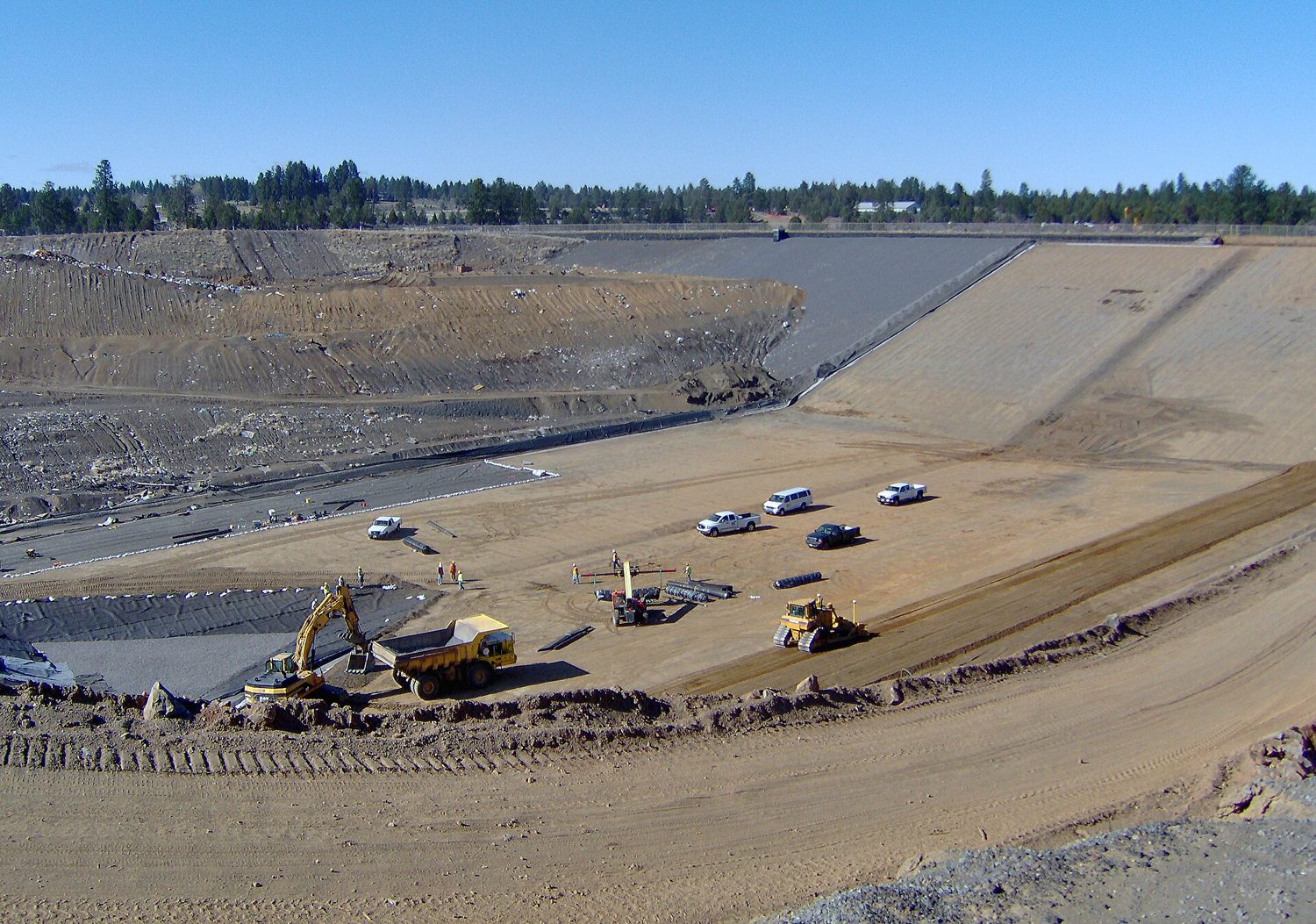
Solid waste is any discarded material that is not a liquid or gas, generated by homes, industry, business, and agriculture. It is buried in sanitary landfills 卫生填埋场 (lined to limit leachate) or burned in incinerators 焚烧炉 (reduces volume but emits pollutants). Landfills take space and can leak; both have environmental costs, so reducing waste is preferred.

Two categories the exam names specifically: e-waste 电子垃圾 (discarded electronics - phones, computers, televisions - which contain toxic metals), and ocean dumping, where plastic and other waste collect into vast floating garbage patches 垃圾带 far out at sea.

A large landfill mound of buried waste rising above a town in the valley below A landfill: solid waste is buried here in lined cells. It takes up land and can leak, which is why reducing waste comes first

Vocabulary Train
English Chinese Pinyin
sanitary landfills 卫生填埋场 wèi shēng tián mái chǎng
incinerators 焚烧炉 fén shāo lú
e-waste 电子垃圾 diàn zǐ lā jī
garbage patches 垃圾带 lā jī dài
8.10

Waste Reduction Methods

Syllabus
Enduring UnderstandingLearning ObjectiveEssential Knowledge

STB-3
Human activities, including the use of resources, have physical, chemical, and biological consequences for ecosystems.

STB-3.M
Describe changes to current practices that could reduce the amount of generated waste and their associated benefits and drawbacks.

  • STB-3.M.1 Recycling is a process by which certain solid waste materials are processed and converted into new products.
  • STB-3.M.2 Recycling is one way to reduce the current global demand on minerals, but this process is energy-intensive and can be costly.
  • STB-3.M.3 Composting is the process of organic matter such as food scraps, paper, and yard waste decomposing. The product of this decomposition can be used as fertilizer. Drawbacks to composting include odor and rodents.
  • STB-3.M.4 E-waste can be reduced by recycling and reuse. E-wastes may contain hazardous chemicals, including heavy metals such as lead and mercury, which can leach from landfills into groundwater if they are not disposed of properly.
  • STB-3.M.5 Landfill mitigation strategies range from burning waste for energy to restoring habitat on former landfills for use as parks.
  • STB-3.M.6 The combustion of gases produced from decomposition of organic material in landfills can be used to turn turbines and generate electricity. This process reduces landfill volume.

Source: College Board AP Course and Exam Description

The waste hierarchy is reduce, reuse, recycle 减量再利用回收, plus composting 堆肥 for organic waste. Reducing consumption is best (no waste to manage); recycling and composting recover materials and cut landfill use.

Vocabulary Train
English Chinese Pinyin
reduce, reuse, recycle 减量、再利用、回收 jiǎn liàng 、 zài lì yòng 、 huí shōu
composting 堆肥 duī féi
8.11

Sewage Treatment

Syllabus
Enduring UnderstandingLearning ObjectiveEssential Knowledge

STB-3
Human activities, including the use of resources, have physical, chemical, and biological consequences for ecosystems.

STB-3.N
Describe best practices in sewage treatment.

  • STB-3.N.1 Primary treatment of sewage is the physical removal of large objects, often through the use of screens and grates, followed by the settling of solid waste in the bottom of a tank.
  • STB-3.N.2 Secondary treatment is a biological process in which bacteria break down organic matter into carbon dioxide and inorganic sludge, which settles in the bottom of a tank. The tank is aerated to increase the rate at which the bacteria break down the organic matter.
  • STB-3.N.3 Tertiary treatment is the use of ecological or chemical processes to remove any pollutants left in the water after primary and secondary treatment.
  • STB-3.N.4 Prior to discharge, the treated water is exposed to one or more disinfectants (usually, chlorine, ozone, or UV light) to kill bacteria.

Source: College Board AP Course and Exam Description

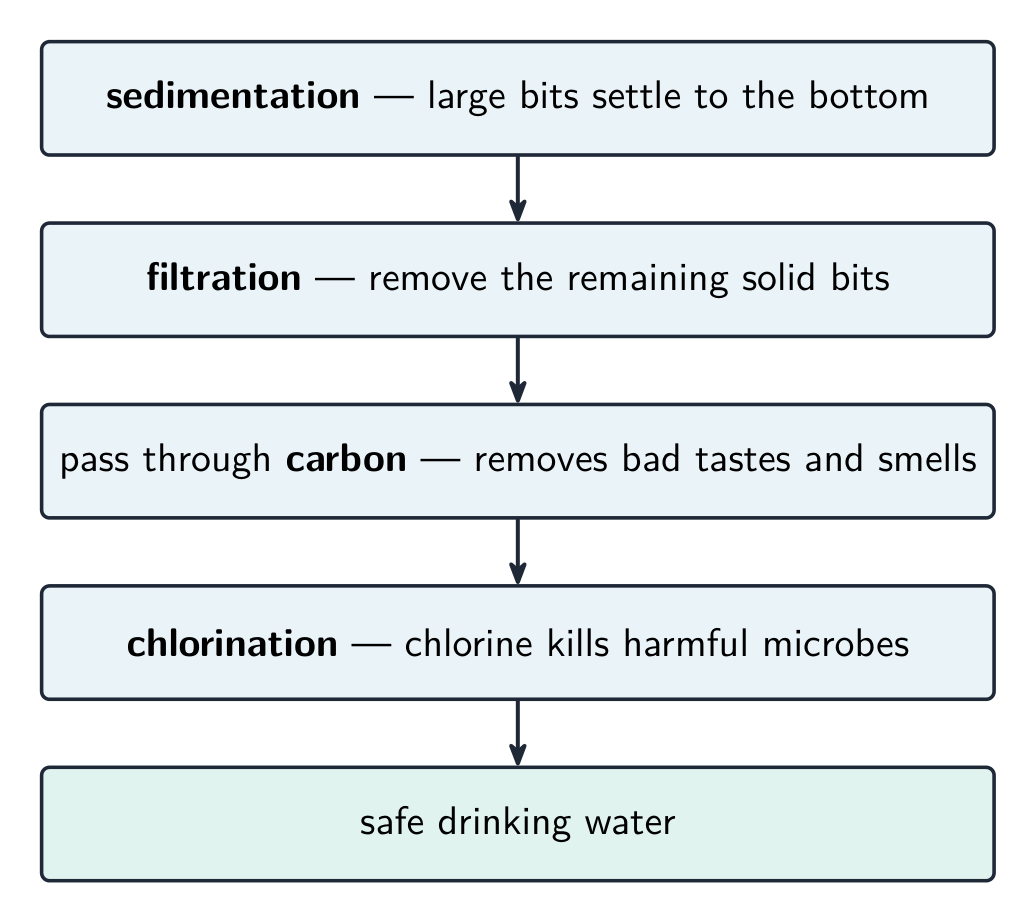
Sewage treatment 污水处理 cleans wastewater in stages: primary (settling out solids), secondary (bacteria break down organic matter), and sometimes tertiary (removing nutrients and disinfecting). This protects waterways from pathogens and nutrient pollution.

Treating water to make it safe: sedimentation, filtration, then disinfection Treating water to make it safe: sedimentation, filtration, then disinfection

Vocabulary Train
English Chinese Pinyin
Sewage treatment 污水处理 wū shuǐ chǔ lǐ
8.12

Lethal Dose 50% (LD50)

Syllabus
Enduring UnderstandingLearning ObjectiveEssential Knowledge

EIN-3
Pollutants can have both direct and indirect impacts on the health of organisms, including humans.

EIN-3.A
Define lethal dose 50% ($LD_{50}$).

  • EIN-3.A.1 Lethal dose 50% ($LD_{50}$) is the dose of a chemical that is lethal to 50% of the population of a particular species.

Source: College Board AP Course and Exam Description

The dose-response curve and LD50

The LD50 半数致死量 is the dose of a substance that kills 50% of a test population. A lower LD50 means a more toxic substance (less is needed to be deadly). It is a standard way to compare toxicity.

Worked example. Chemical A has an LD50 of $5\ \text{mg}$ per kg of body weight; chemical B, $500\ \text{mg/kg}$. Because A's value is $100$ times smaller, A is about $100\times$ more toxic. For a $70\ \text{kg}$ adult, the dose of A expected to be lethal to half of people is $5\ \text{mg/kg}\times70\ \text{kg}=350\ \text{mg}$ – a tiny amount, whereas B would take $500\times70=35{,}000\ \text{mg}$ ($35\ \text{g}$).

Vocabulary Train
English Chinese Pinyin
LD50 半数致死量 bàn shù zhì sǐ liàng
8.13

Dose Response Curve

Syllabus
Enduring UnderstandingLearning ObjectiveEssential Knowledge

EIN-3
Pollutants can have both direct and indirect impacts on the health of organisms, including humans.

EIN-3.B
Evaluate dose response curves.

  • EIN-3.B.1 A dose response curve describes the effect on an organism or mortality rate in a population based on the dose of a particular toxin or drug.

Source: College Board AP Course and Exam Description

A dose–response curve 剂量反应曲线 plots the effect against the dose. Generally, a higher dose causes a greater effect. Some chemicals have a threshold 阈值 (no effect below it); for others any exposure carries risk. These curves guide safety limits.

Vocabulary Train
English Chinese Pinyin
dose–response curve 剂量反应曲线 jì liàng fǎn yìng qū xiàn
threshold 阈值 yù zhí
8.14

Pollution and Human Health

Syllabus
Enduring UnderstandingLearning ObjectiveEssential Knowledge

EIN-3
Pollutants can have both direct and indirect impacts on the health of organisms, including humans.

EIN-3.C
Identify sources of human health issues that are linked to pollution.

  • EIN-3.C.1 It can be difficult to establish a cause and effect between pollutants and human health issues because humans experience exposure to a variety of chemicals and pollutants.
  • EIN-3.C.2 Dysentery is caused by untreated sewage in streams and rivers.
  • EIN-3.C.3 Mesothelioma is a type of cancer caused mainly by exposure to asbestos.
  • EIN-3.C.4 Respiratory problems and overall lung function can be impacted by elevated levels of tropospheric ozone.

Source: College Board AP Course and Exam Description

Pollution harms health directly (respiratory disease from air pollution, poisoning from contaminated water) and indirectly. Dose, duration, and individual sensitivity all affect the outcome. The poor are often most exposed and least protected.

8.15

Pathogens and Infectious Diseases

Syllabus
Enduring UnderstandingLearning ObjectiveEssential Knowledge

EIN-3
Pollutants can have both direct and indirect impacts on the health of organisms, including humans.

EIN-3.D
Explain human pathogens and their cycling through the environment.

  • EIN-3.D.1 Pathogens adapt to take advantage of new opportunities to infect and spread through human populations.
  • EIN-3.D.2 Specific pathogens can occur in many environments regardless of the appearance of sanitary conditions.
  • EIN-3.D.3 As equatorial-type climate zones spread north and south in to what are currently subtropical and temperate climate zones, pathogens, infectious diseases, and any associated vectors are spreading into these areas where the disease has not previously been known to occur.
  • EIN-3.D.4 Poverty-stricken, low-income areas often lack sanitary waste disposal and have contaminated drinking water supplies, leading to havens and opportunities for the spread of infectious diseases.
  • EIN-3.D.5 Plague is a disease carried by organisms infected with the plague bacteria. It is transferred to humans via the bite of an infected organism or through contact with contaminated fluids or tissues.
  • EIN-3.D.6 Tuberculosis is a bacterial infection that typically attacks the lungs. It is spread by breathing in the bacteria from the bodily fluids of an infected person.
  • EIN-3.D.7 Malaria is a parasitic disease caused by bites from infected mosquitoes. It is most often found in sub-Saharan Africa.
  • EIN-3.D.8 West Nile virus is transmitted to humans via bites from infected mosquitoes.
  • EIN-3.D.9 Severe acute respiratory syndrome (SARS) is a form of pneumonia. It is transferred by inhaling or touching infected fluids.
  • EIN-3.D.10 Middle East Respiratory Syndrome (MERS) is a viral respiratory illness that is transferred from animals to humans.
  • EIN-3.D.11 Zika is a virus caused by bites from infected mosquitoes. It can be transmitted through sexual contact.
  • EIN-3.D.12 Cholera is a bacterial disease that is contracted from infected water.

Source: College Board AP Course and Exam Description

Pathogens 病原体 (bacteria, viruses, parasites) spread through contaminated water and food. The exam names specific diseases and expects you to know how each one is transmitted, because the transmission route decides the defence:

Disease Type How it spreads
Cholera 霍乱 bacterial drinking water contaminated with sewage
Dysentery 痢疾 bacterial untreated sewage in streams and rivers
Plague 鼠疫 bacterial bite of an infected organism (e.g. fleas) or contact with infected fluids
Tuberculosis (TB) 结核病 bacterial breathing in bacteria from an infected person's bodily fluids
Malaria 疟疾 parasitic bite of an infected mosquito 蚊子 (mostly sub-Saharan Africa)
West Nile / Zika 西尼罗/寨卡 viral bite of an infected mosquito (Zika also via sexual contact)
SARS / MERS viral inhaling or touching infected fluids; MERS passes from animals to humans

Two big-picture ideas carry marks. Poverty deepens the problem - low-income areas often lack sanitary waste disposal and clean water, giving water-borne diseases a haven. And climate change spreads disease: as warm equatorial climate zones expand toward the poles, mosquitoes and other vectors 传播媒介 - and the diseases they carry - move into temperate regions that never had them before. Clean water, sanitation, and vector control remain the main defences.

Vocabulary Train
English Chinese Pinyin
Pathogens 病原体 bìng yuán tǐ
Cholera 霍乱 huò luàn
Dysentery 痢疾 lì jí
Plague 鼠疫 shǔ yì
Tuberculosis (TB) 结核病 jié hé bìng
Malaria 疟疾 nüè jí
mosquito 蚊子 wén zi
West Nile / Zika 西尼罗/寨卡 xī ní luó / zhài kǎ
vectors 传播媒介 chuán bō méi jiè
8.15

Exam tips

  • Trace eutrophication step by step: nutrient runoff → algal bloom → decay → oxygen depletion → fish die.
  • Bioaccumulation builds up in one organism; biomagnification increases up the food chain, so top predators are hit hardest.
  • Read an LD50: a lower value means more toxic; multiply by body mass for a lethal dose.
  • Order the waste hierarchy reduce > reuse > recycle, and the stages of sewage treatment.
  • Link pathogens to contaminated water and to clean-water/sanitation defences.

Log in or create account

IGCSE & A-Level