Skip to content

Global Change

AP Environmental Science · Topic 9

Train
9.1

Stratospheric Ozone Depletion

Syllabus
Enduring UnderstandingLearning ObjectiveEssential Knowledge

STB-4
Local and regional human activities can have impacts at the global level.

STB-4.A
Explain the importance of stratospheric ozone to life on Earth.

  • STB-4.A.1 The stratospheric ozone layer is important to the evolution of life on Earth and the continued health and survival of life on Earth.
  • STB-4.A.2 Stratospheric ozone depletion is caused by anthropogenic factors, such as chlorofluorocarbons (CFCs), and natural factors, such as the melting of ice crystals in the atmosphere at the beginning of the Antarctic spring.
  • STB-4.A.3 A decrease in stratospheric ozone increases the UV rays that reach the Earth's surface. Exposure to UV rays can lead to skin cancer and cataracts in humans.

Source: College Board AP Course and Exam Description

Stratospheric ozone depletion

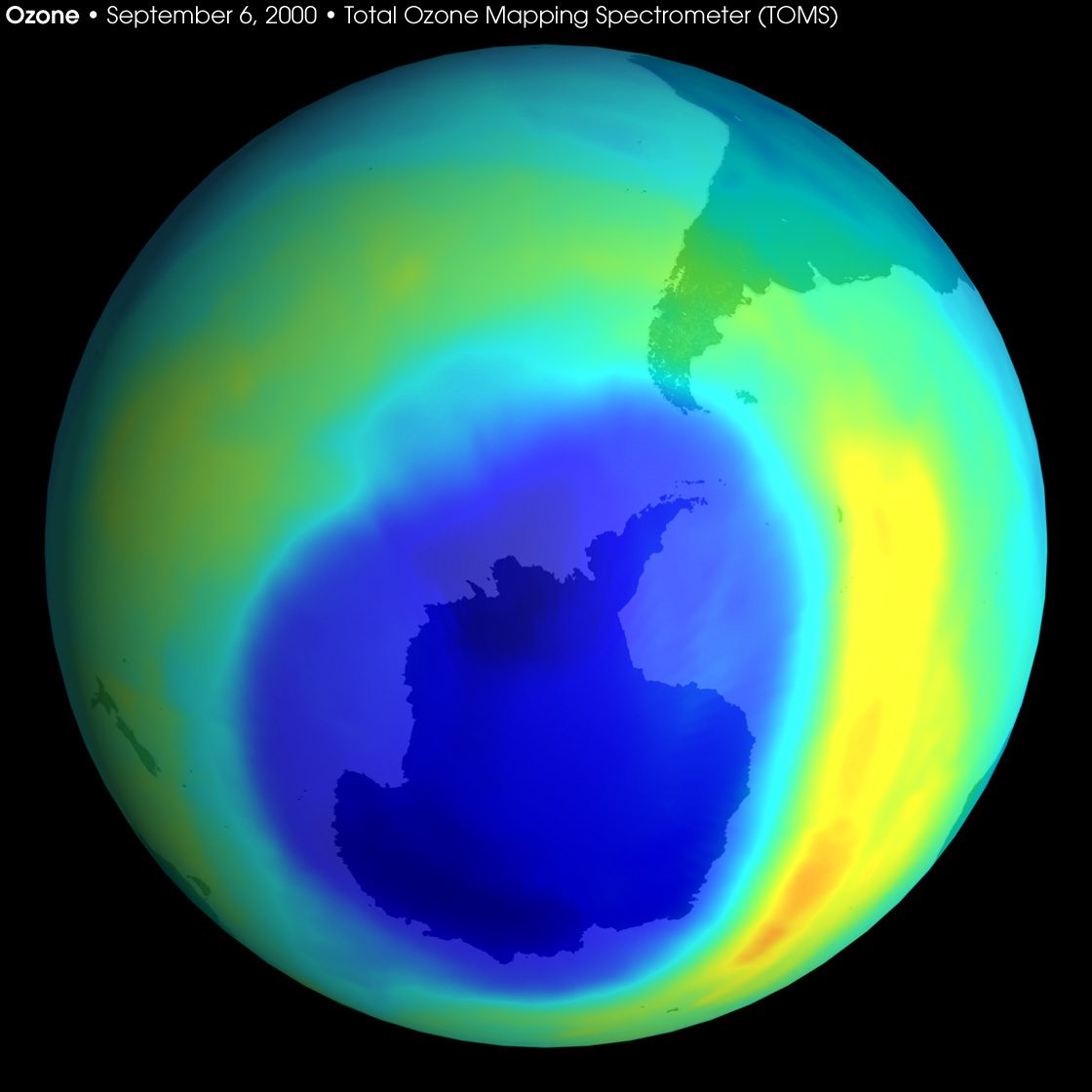
The ozone layer 臭氧层 high in the stratosphere absorbs harmful ultraviolet 紫外线 radiation. CFCs 氯氟烃 (chlorofluorocarbons, once used in coolants and sprays) drift up and release chlorine that destroys ozone, thinning it (the Antarctic "ozone hole"). More UV reaching the surface raises skin cancer, cataracts, and crop damage.

A NASA satellite map of the Southern Hemisphere with a large dark-blue patch of very low ozone centred over Antarctica The ozone hole 臭氧洞 over Antarctica (dark blue) on a NASA map: this is where the ozone layer has thinned the most

Vocabulary Train
English Chinese Pinyin
ozone layer 臭氧层 chòu yǎng céng
ultraviolet 紫外线 zǐ wài xiàn
CFCs 氯氟烃 lǜ fú tīng
The ozone hole 臭氧洞 chòu yǎng dòng
9.2

Reducing Ozone Depletion

Syllabus
Enduring UnderstandingLearning ObjectiveEssential Knowledge

STB-4
Local and regional human activities can have impacts at the global level.

STB-4.B
Describe chemicals used to substitute for chlorofluorocarbons (CFCs).

  • STB-4.B.1 Ozone depletion can be mitigated by replacing ozone-depleting chemicals with substitutes that do not deplete the ozone layer. Hydrofluorocarbons (HFCs) are one such replacement, but some are strong greenhouse gases.

Source: College Board AP Course and Exam Description

The Montreal Protocol 蒙特利尔议定书 (1987) phased out CFCs worldwide and is a rare environmental success – the ozone layer is slowly recovering. Substitutes (like HFCs and HCFCs) replaced CFCs, though some are themselves greenhouse gases.

Vocabulary Train
English Chinese Pinyin
Montreal Protocol 蒙特利尔议定书 méng tè lì ěr yì dìng shū
9.3

The Greenhouse Effect

Syllabus
Enduring UnderstandingLearning ObjectiveEssential Knowledge

STB-4
Local and regional human activities can have impacts at the global level.

STB-4.C
Identify the greenhouse gases.

  • STB-4.C.1 The principal greenhouse gases are carbon dioxide, methane, water vapor, nitrous oxide, and chlorofluorocarbons (CFCs).
  • STB-4.C.2 While water vapor is a greenhouse gas, it doesn't contribute significantly to global climate change because it has a short residence time in the atmosphere.
  • STB-4.C.3 The greenhouse effect results in the surface temperature necessary for life on Earth to exist.

STB-4.D
Identify the sources and potency of the greenhouse gases.

  • STB-4.D.1 Carbon dioxide, which has a global warming potential (GWP) of 1, is used as a reference point for the comparison of different greenhouse gases and their impacts on global climate change. Chlorofluorocarbons (CFCs) have the highest GWP, followed by nitrous oxide, then methane.

Source: College Board AP Course and Exam Description

The greenhouse effect

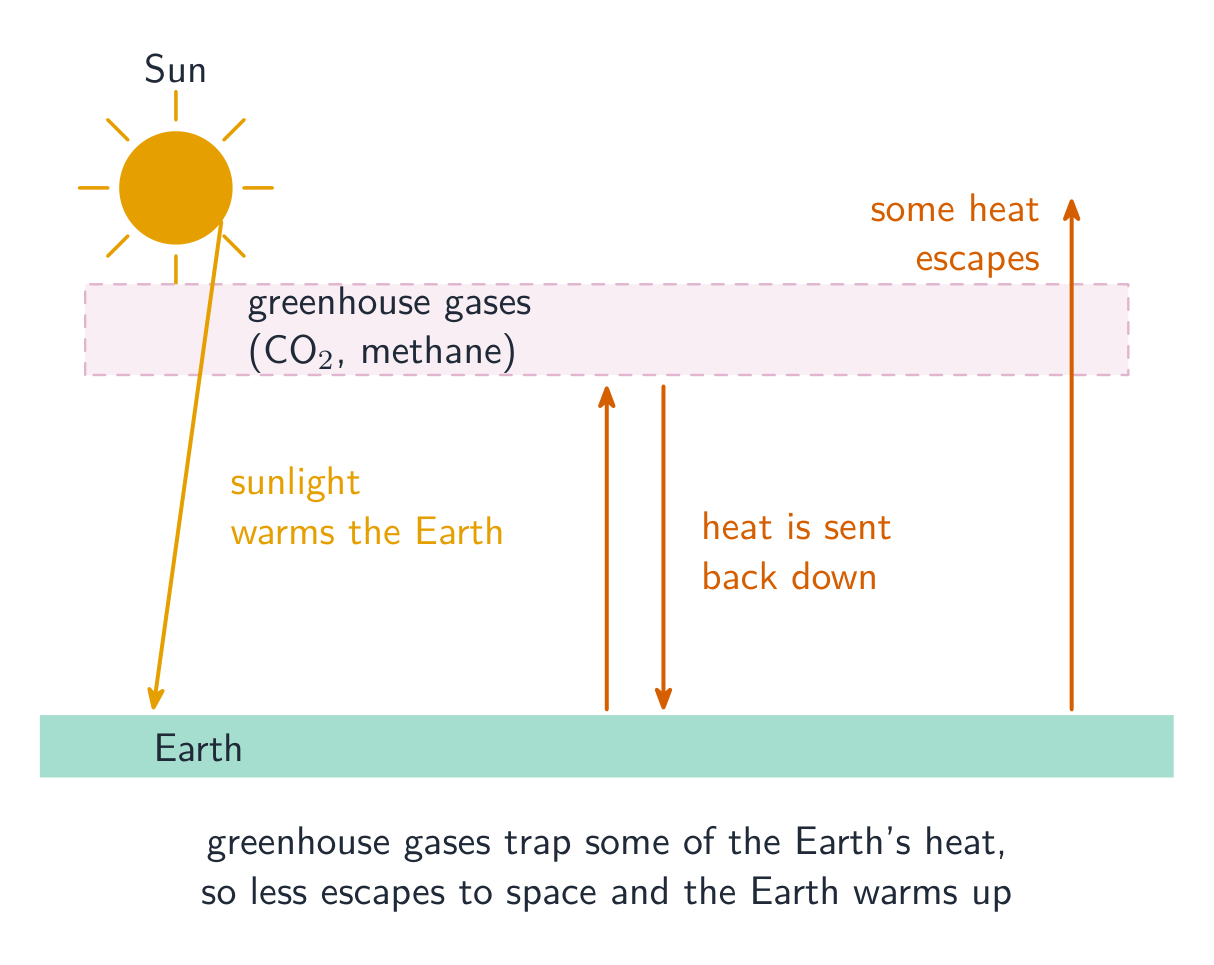
The greenhouse effect 温室效应 keeps Earth warm: greenhouse gases 温室气体 let sunlight in but trap outgoing infrared heat. This natural effect makes Earth livable. The problem is the enhanced greenhouse effect – humans adding extra gases that trap more heat.

Greenhouse gases absorb the heat the Earth gives off and send some back Greenhouse gases absorb the heat the Earth gives off and send some back

Vocabulary Train
English Chinese Pinyin
greenhouse effect 温室效应 wēn shì xiào yìng
greenhouse gases 温室气体 wēn shì qì tǐ
Exercise sheet
9.4

Increases in the Greenhouse Gases

Syllabus
Enduring UnderstandingLearning ObjectiveEssential Knowledge

STB-4
Local and regional human activities can have impacts at the global level.

STB-4.E
Identify the threats to human health and the environment posed by an increase in greenhouse gases.

  • STB-4.E.1 Global climate change, caused by excess greenhouse gases in the atmosphere, can lead to a variety of environmental problems including rising sea levels resulting from melting ice sheets and ocean water expansion, and disease vectors spreading from the tropics toward the poles. These problems can lead to changes in population dynamics and population movements in response.

Source: College Board AP Course and Exam Description

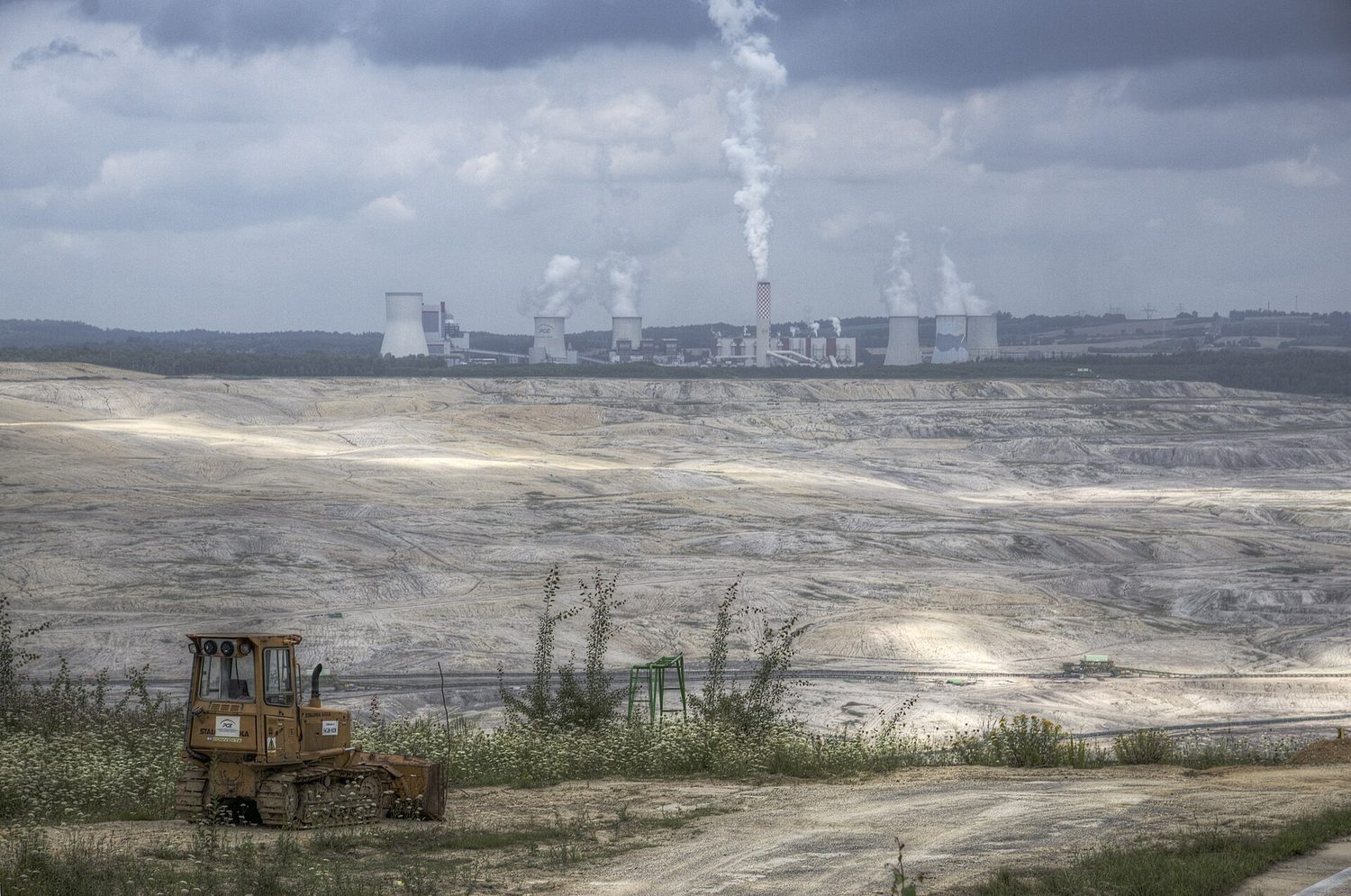
Human activities raise greenhouse gases: $\text{CO}_2$ from burning fossil fuels and deforestation, methane 甲烷 from livestock, landfills, and rice paddies, and nitrous oxide from fertilizers. Methane traps far more heat per molecule than $\text{CO}_2$ but is less abundant.

To compare gases fairly, we use global warming potential (GWP) 全球变暖潜能值 - how much heat one unit of a gas traps over a set time, relative to $\text{CO}_2$. $\text{CO}_2$ is the reference, with GWP = 1, so every other gas is measured against it. Ranked by GWP: CFCs are highest, then nitrous oxide, then methane - all trap far more heat per molecule than $\text{CO}_2$. But GWP alone does not decide impact: $\text{CO}_2$ still causes the most warming overall because it is released in vastly greater quantity. The exam expects both ideas - a high GWP and how much is emitted.

Vocabulary Train
English Chinese Pinyin
methane 甲烷 jiǎ wán
global warming potential (GWP) 全球变暖潜能值 quán qiú biàn nuǎn qián néng zhí
Exercise sheet
9.5

Global Climate Change

Syllabus
Enduring UnderstandingLearning ObjectiveEssential Knowledge

STB-4
Local and regional human activities can have impacts at the global level.

STB-4.F
Explain how changes in climate, both short- and long-term, impact ecosystems.

  • STB-4.F.1 The Earth has undergone climate change throughout geologic time, with major shifts in global temperatures causing periods of warming and cooling as recorded with $\text{CO}_2$ data and ice cores.
  • STB-4.F.2 Effects of climate change include rising temperatures, melting permafrost and sea ice, rising sea levels, and displacement of coastal populations.
  • STB-4.F.3 Marine ecosystems are affected by changes in sea level, some positively, such as in newly created habitats on now-flooded continental shelves, and some negatively, such as deeper communities that may no longer be in the photic zone of seawater.
  • STB-4.F.4 Winds generated by atmospheric circulation help transport heat throughout the Earth. Climate change may change circulation patterns, as temperature changes may impact Hadley cells and the jet stream.
  • STB-4.F.5 Oceanic currents, or the ocean conveyor belt, carry heat throughout the world. When these currents change, it can have a big impact on global climate, especially in coastal regions.
  • STB-4.F.6 Climate change can affect soil through changes in temperature and rainfall, which can impact soil's viability and potentially increase erosion.
  • STB-4.F.7 Earth's polar regions are showing faster response times to global climate change because ice and snow in these regions reflect the most energy back out to space, leading to a positive feedback loop.
  • STB-4.F.8 As the Earth warms, this ice and snow melts, meaning less solar energy is radiated back into space and instead is absorbed by the Earth's surface. This in turn causes more warming of the polar regions.
  • STB-4.F.9 Global climate change response time in the Arctic is due to positive feedback loops involving melting sea ice and thawing tundra, and the subsequent release of greenhouse gases like methane.
  • STB-4.F.10 One consequence of the loss of ice and snow in polar regions is the effect on species that depend on the ice for habitat and food.

Source: College Board AP Course and Exam Description

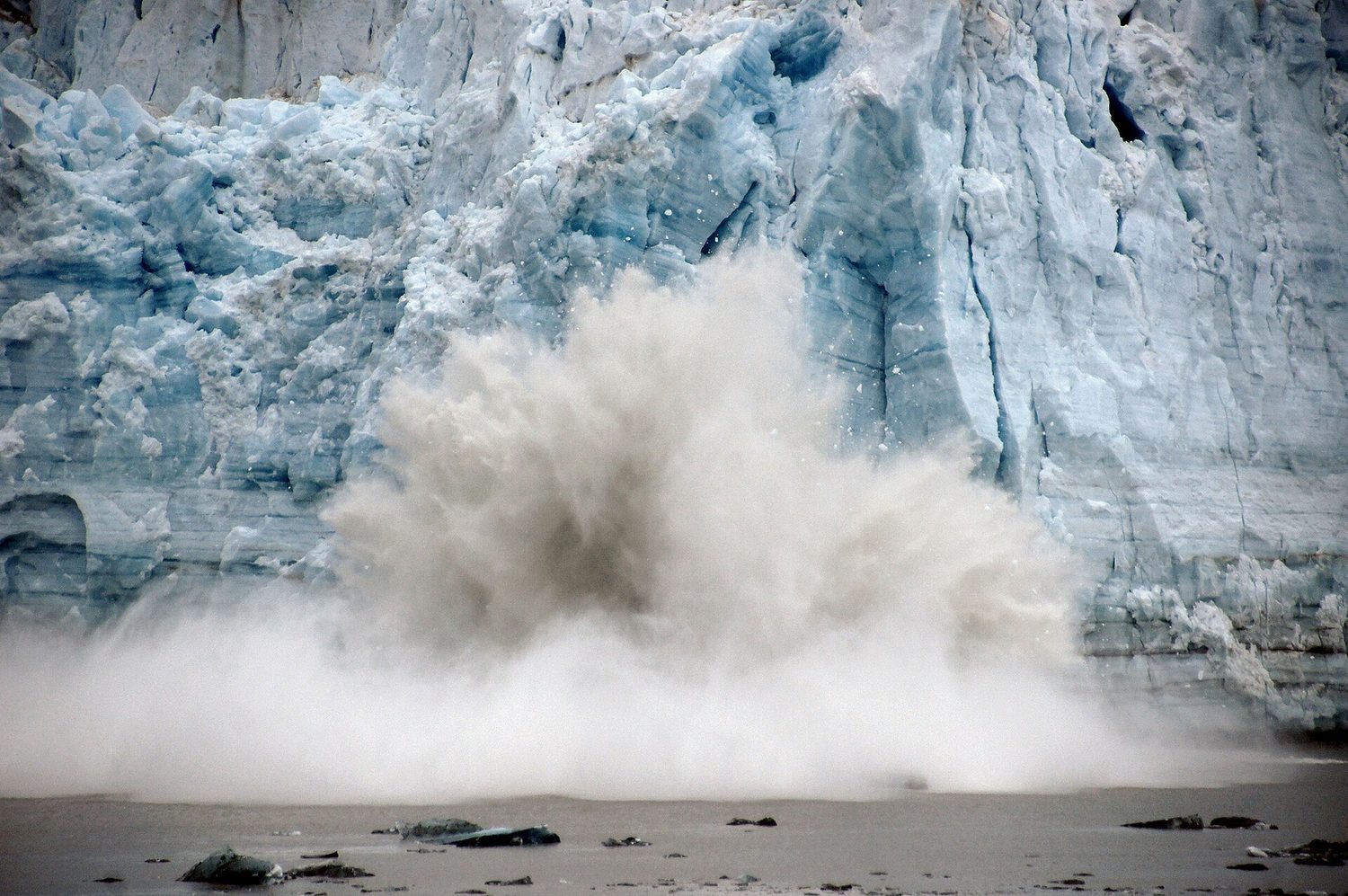
Global climate change 气候变化 is the long-term shift in climate from the enhanced greenhouse effect: rising average temperatures, melting ice, rising sea levels 海平面, more extreme weather, and shifting rainfall. It disrupts ecosystems, agriculture, and human communities worldwide.

A tall wall of glacier ice with a large chunk crashing into the sea in a cloud of spray A glacier 冰川 breaking apart into the sea. Warming melts land ice, which adds water to the ocean and raises sea level

Vocabulary Train
English Chinese Pinyin
Global climate change 气候变化 qì hòu biàn huà
sea levels 海平面 hǎi píng miàn
A glacier 冰川 bīng chuān
Exercise sheet
9.6

Ocean Warming

Syllabus
Enduring UnderstandingLearning ObjectiveEssential Knowledge

STB-4
Local and regional human activities can have impacts at the global level.

STB-4.G
Explain the causes and effects of ocean warming.

  • STB-4.G.1 Ocean warming is caused by the increase in greenhouse gases in the atmosphere.
  • STB-4.G.2 Ocean warming can affect marine species in a variety of ways, including loss of habitat, and metabolic and reproductive changes.
  • STB-4.G.3 Ocean warming is causing coral bleaching, which occurs when the loss of algae within corals cause the corals to bleach white. Some corals recover and some die.

Source: College Board AP Course and Exam Description

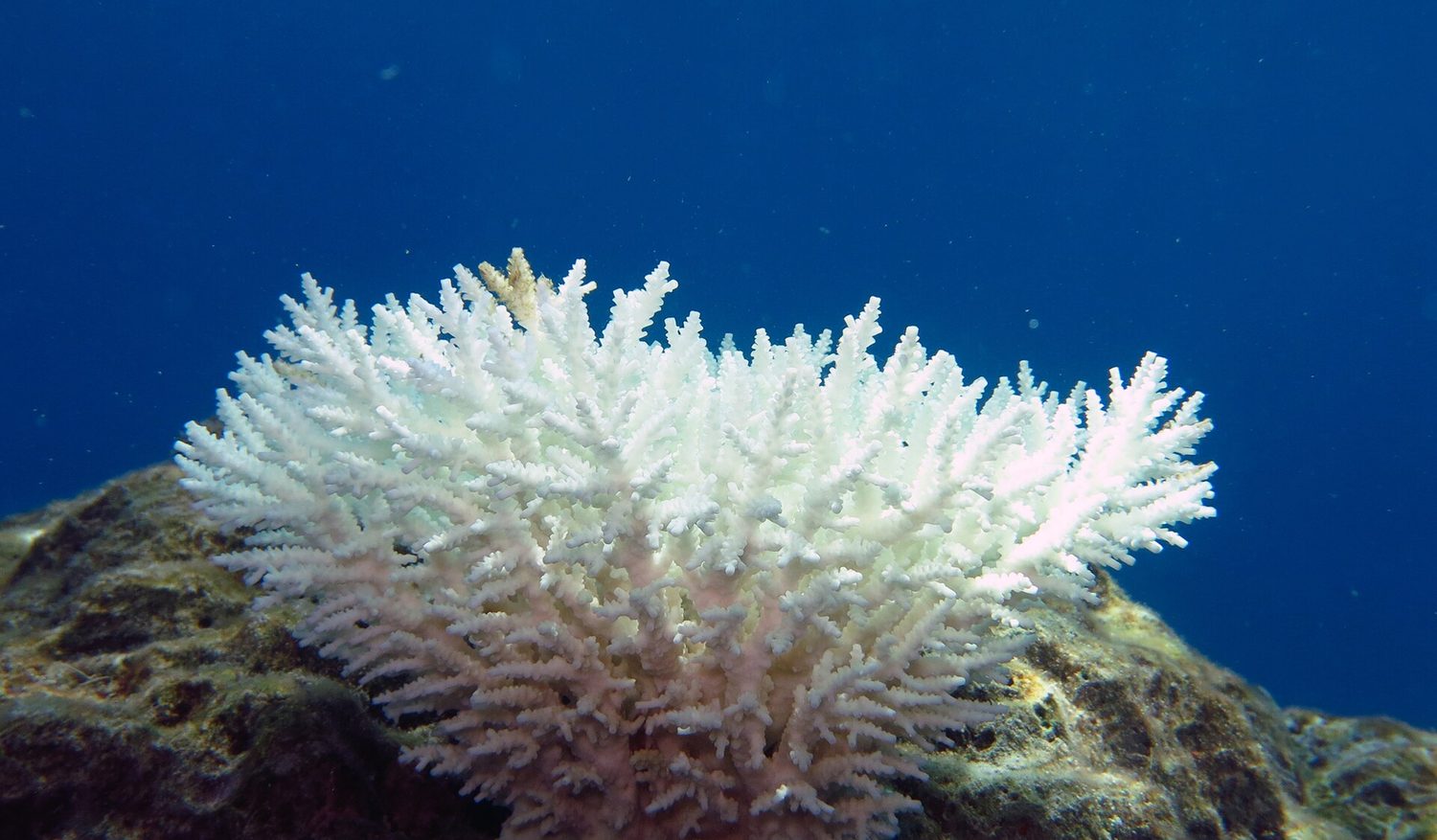
As the climate warms, oceans absorb most of the extra heat. Ocean warming causes coral bleaching 珊瑚白化 (corals expel their algae and can die), shifts species ranges, reduces dissolved oxygen, and – with melting ice – raises sea level through thermal expansion.

A branching coral colony turned completely bone-white, next to darker healthy reef A bleached coral colony: warmer water made it expel its colourful algae, leaving the bare white skeleton. If the heat lasts, the coral dies

Vocabulary Train
English Chinese Pinyin
coral bleaching 珊瑚白化 shān hú bái huà
9.7

Ocean Acidification

Syllabus
Enduring UnderstandingLearning ObjectiveEssential Knowledge

STB-4
Local and regional human activities can have impacts at the global level.

STB-4.H
Explain the causes and effects of ocean acidification.

  • STB-4.H.1 Ocean acidification is the decrease in pH of the oceans, primarily due to increased $\text{CO}_2$ concentrations in the atmosphere, and can be expressed as chemical equations.
  • STB-4.H.2 As more $\text{CO}_2$ is released into the atmosphere, the oceans, which absorb a large part of that $\text{CO}_2$, become more acidic.
  • STB-4.H.3 Anthropogenic activities that contribute to ocean acidification are those that lead to increased $\text{CO}_2$ concentrations in the atmosphere: burning of fossil fuels, vehicle emissions, and deforestation.
  • STB-4.H.4 Ocean acidification damages coral because acidification makes it difficult for them to form shells, due to the loss of calcium carbonate.

Source: College Board AP Course and Exam Description

The ocean absorbs about a quarter of our $\text{CO}_2$, which forms carbonic acid – ocean acidification 海洋酸化. Lower pH makes it harder for corals, shellfish, and plankton to build calcium carbonate 碳酸钙 shells and skeletons, threatening marine food webs.

Explore

How the ocean acidifies

Oceans absorb CO$_2$, which forms carbonic acid and lowers seawater pH. Even a small drop is a big rise in acidity (the scale is logarithmic) and harms shell-builders.

Vocabulary Train
English Chinese Pinyin
ocean acidification 海洋酸化 hǎi yáng suān huà
calcium carbonate 碳酸钙 tàn suān gài
9.8

Invasive Species

Syllabus
Enduring UnderstandingLearning ObjectiveEssential Knowledge

EIN-4
The health of a species is closely tied to its ecosystem, and minor environmental changes can have a large impact.

EIN-4.A
Explain the environmental problems associated with invasive species and strategies to control them.

  • EIN-4.A.1 Invasive species are species that can live, and sometimes thrive, outside of their normal habitat. Invasive species can sometimes be beneficial, but they are considered invasive when they threaten native species.
  • EIN-4.A.2 Invasive species are often generalist, r-selected species and therefore may outcompete native species for resources.
  • EIN-4.A.3 Invasive species can be controlled through a variety of human interventions.

Source: College Board AP Course and Exam Description

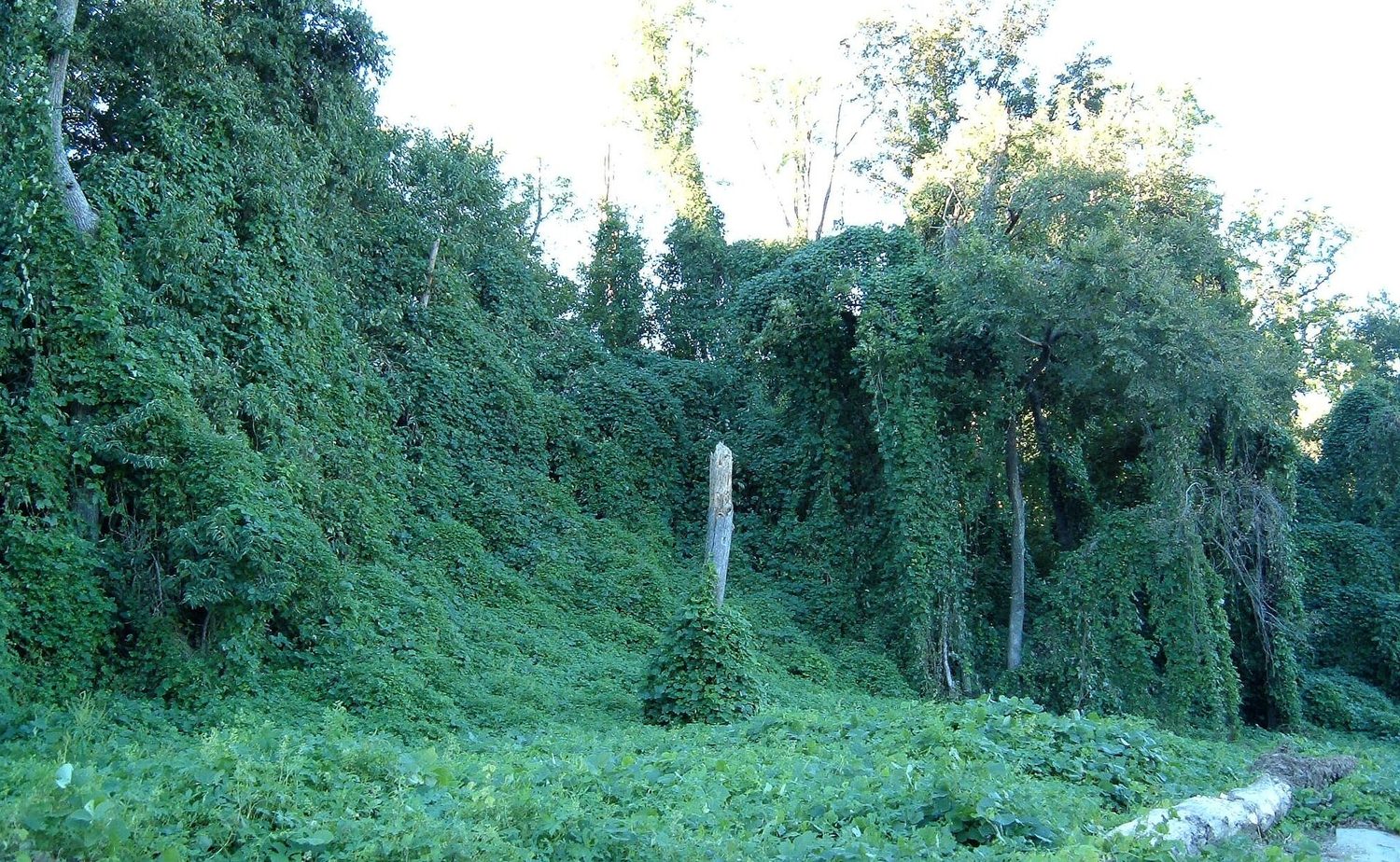
An invasive species 入侵物种 is a non-native species that spreads and harms its new ecosystem. With no natural predators, it outcompetes natives, spreads disease, and reduces biodiversity (kudzu, zebra mussels, Burmese pythons). Human trade and travel move them around.

A hillside of trees completely buried under a thick green blanket of kudzu vine The invasive vine kudzu smothering a stand of trees. With no natural predators in its new home, it blankets and kills what it covers

Vocabulary Train
English Chinese Pinyin
invasive species 入侵物种 rù qīn wù zhǒng
9.9

Endangered Species

Syllabus
Enduring UnderstandingLearning ObjectiveEssential Knowledge

EIN-4
The health of a species is closely tied to its ecosystem, and minor environmental changes can have a large impact.

EIN-4.B
Explain how species become endangered and strategies to combat the problem.

  • EIN-4.B.1 A variety of factors can lead to a species becoming threatened with extinction, such as being extensively hunted, having limited diet, being outcompeted by invasive species, or having specific and limited habitat requirements.
  • EIN-4.B.2 Not all species will be in danger of extinction when exposed to the same changes in their ecosystem. Species that are able to adapt to changes in their environment or that are able to move to a new environment are less likely to face extinction.
  • EIN-4.B.3 Selective pressures are any factors that change the behaviors and fitness of organisms within an environment.
  • EIN-4.B.4 Species in a given ecosystem compete for resources like territory, food, mates, and habitat, and this competition may lead to endangerment or extinction.
  • EIN-4.B.5 Strategies to protect animal populations include criminalizing poaching, protecting animal habitats, and legislation.

Source: College Board AP Course and Exam Description

An endangered species 濒危物种 is at risk of extinction. Causes are summarized as HIPPO: Habitat loss, Invasive species, Pollution, Population (human) growth, and Overharvesting. Protection includes laws (the Endangered Species Act), protected areas, and captive breeding.

Explore

A population under pressure

When deaths outpace births, a population falls toward extinction. Below a critical size, low genetic diversity and chance events make recovery harder.

Vocabulary Train
English Chinese Pinyin
endangered species 濒危物种 bīn wēi wù zhǒng
9.10

Human Impacts on Biodiversity

Syllabus
Enduring UnderstandingLearning ObjectiveEssential Knowledge

EIN-4
The health of a species is closely tied to its ecosystem, and minor environmental changes can have a large impact.

EIN-4.C
Explain how human activities affect biodiversity and strategies to combat the problem.

  • EIN-4.C.1 HIPPCO (habitat destruction, invasive species, population growth, pollution, climate change, and over exploitation) describes the main factors leading to a decrease in biodiversity.
  • EIN-4.C.2 Habitat fragmentation occurs when large habitats are broken into smaller, isolated areas. Causes of habitat fragmentation include the construction of roads and pipelines, clearing for agriculture or development, and logging.
  • EIN-4.C.3 The scale of habitat fragmentation that has an adverse effect on the inhabitants of a given ecosystem will vary from species to species within that ecosystem.
  • EIN-4.C.4 Global climate change can cause habitat loss via changes in temperature, precipitation, and sea level rise.
  • EIN-4.C.5 Some organisms have been somewhat or completely domesticated and are now managed for economic returns, such as honeybee colonies and domestic livestock. This domestication can have a negative impact on the biodiversity of that organism.
  • EIN-4.C.6 Some ways humans can mitigate the impact of loss of biodiversity include creating protected areas, use of habitat corridors, promoting sustainable land use practices, and restoring lost habitats.

Source: College Board AP Course and Exam Description

Together, habitat loss, climate change, pollution, invasive species, and overexploitation are driving a rapid loss of biodiversity – some call it a sixth mass extinction. Reducing these pressures, conserving habitat, and sustainable practices are the ways to slow it and protect the ecosystem services all life depends on.

A specific and heavily-tested driver is habitat fragmentation 栖息地破碎化: large continuous habitats are broken into smaller, isolated patches by roads, pipelines, and development. Fragmentation is worse than simple area loss, because the small patches cut populations off from each other, reduce genetic diversity, and expose more edge to predators and invasive species.

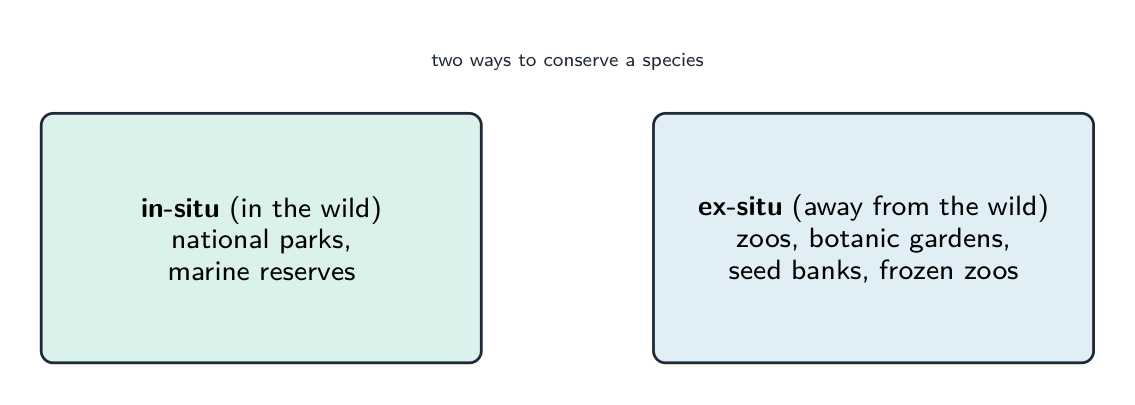
In-situ and ex-situ conservation protect species In-situ and ex-situ conservation protect species

Worked example. Atmospheric CO$_2$ rose from about 280 ppm before industrialisation to about 420 ppm today. The percent increase is $\dfrac{420-280}{280}\times100\% = \dfrac{140}{280}\times100\% = 50\%$. This roughly 50% rise in the main long-lived greenhouse gas is the core driver of the enhanced greenhouse effect and modern warming.

Vocabulary Train
English Chinese Pinyin
habitat fragmentation 栖息地破碎化 qī xī dì pò suì huà
9.10

Exam tips

  • Keep ozone depletion (CFCs let in more UV) and climate change (greenhouse gases trap more heat) as two different problems.
  • Explain the natural greenhouse effect and the enhanced version from extra CO₂ and methane.
  • Connect ocean warming (coral bleaching) and ocean acidification (CO₂ → carbonic acid → weaker shells).
  • An invasive species is dangerous because it has no natural predators in its new home.
  • Summarise threats to biodiversity with HIPPO (Habitat loss, Invasive species, Pollution, Population, Overharvesting).

Log in or create account

IGCSE & A-Level