| Enduring Understanding | Learning Objective | Essential Knowledge |
|---|---|---|
ERT-1 | ERT-1.A |
|
The Living World: Ecosystems
AP Environmental Science · Topic 1
 8:06
8:06
The Living World: Ecosystems
Picture a grassland. Grass covers the ground everywhere you look. Rabbits and other grazers are common — you can find them all day. But the big cats that hunt…
English narration · English + 中文 subtitles burned in
1.1
Introduction to Ecosystems
Syllabus
Source: College Board AP Course and Exam Description
An ecosystem 生态系统 is all the living things (biotic) and non-living things (abiotic) in an area, interacting together. Organisms depend on each other and on their physical environment, and interactions like predation 捕食, competition 竞争, and symbiosis 共生 (mutualism, commensalism, parasitism) shape the community.
Explore
Explore how a population grows
Change the growth rate $r$ and the carrying capacity $K$. Growth is fast when a population is small, then levels off as resources run short and the ecosystem fills up.
Vocabulary
Train
| English |
|---|
| ecosystem/ˈiːkəʊsɪstəm/ |
| predation/prɪˈdeɪʃn/ |
| competition/ˌkɒmpəˈtɪʃn/ |
| symbiosis/ˌsɪmbaɪˈəʊsɪs/ |
1.2
Terrestrial Biomes
Syllabus
| Enduring Understanding | Learning Objective | Essential Knowledge |
|---|---|---|
ERT-1 | ERT-1.B |
|
Source: College Board AP Course and Exam Description
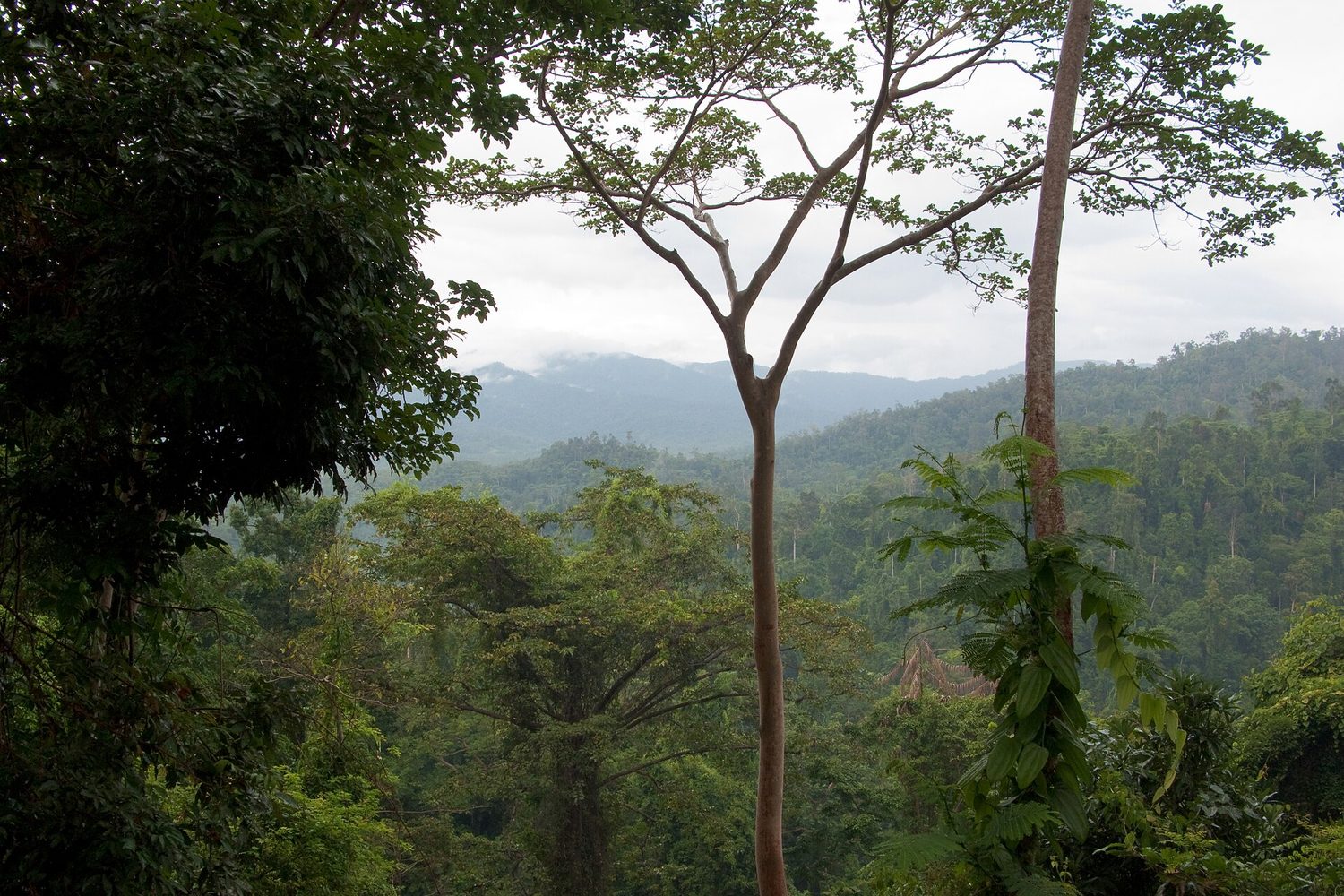
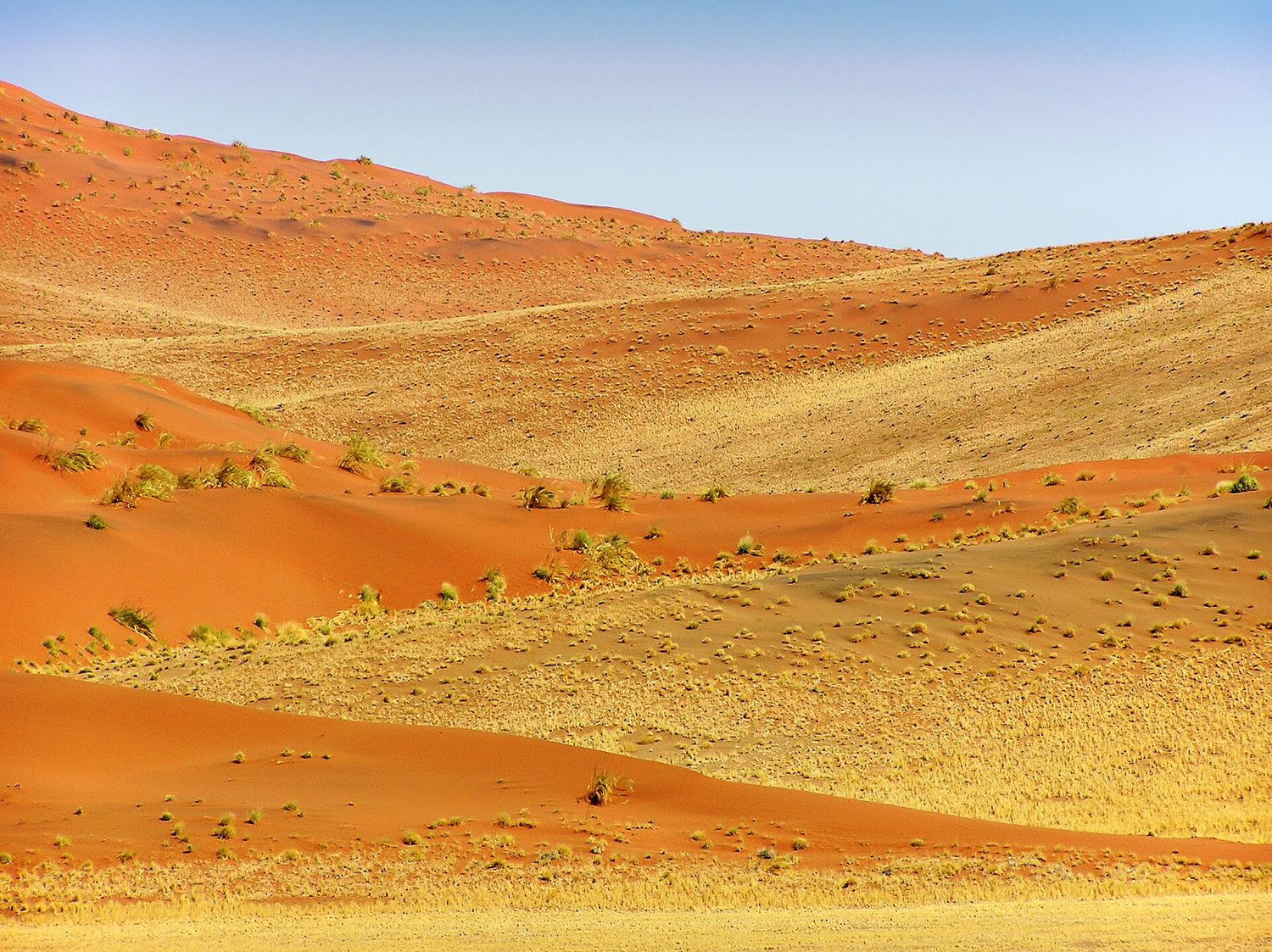
A biome 生物群系 is a large region defined by its climate and characteristic life. Terrestrial biomes (deserts, grasslands, tropical rainforest, temperate forest, taiga, tundra) are determined mainly by temperature and precipitation 降水. Each has plants and animals adapted to those conditions.
The two images below sit at opposite ends of the precipitation scale, which is why their life looks so different:
Vocabulary
Train
| English |
|---|
| biome/ˈbaɪəʊm/ |
| temperature and precipitation/ˈtemprɪtʃə ænd prɪˌsɪpɪˈteɪʃn/ |
| tropical rainforest/ˈtrɒpɪkl ˈreɪnfɒrɪst/ |
| desert/ˈdezət/ |
1.3
Aquatic Biomes
Syllabus
| Enduring Understanding | Learning Objective | Essential Knowledge |
|---|---|---|
ERT-1 | ERT-1.C |
|
Source: College Board AP Course and Exam Description
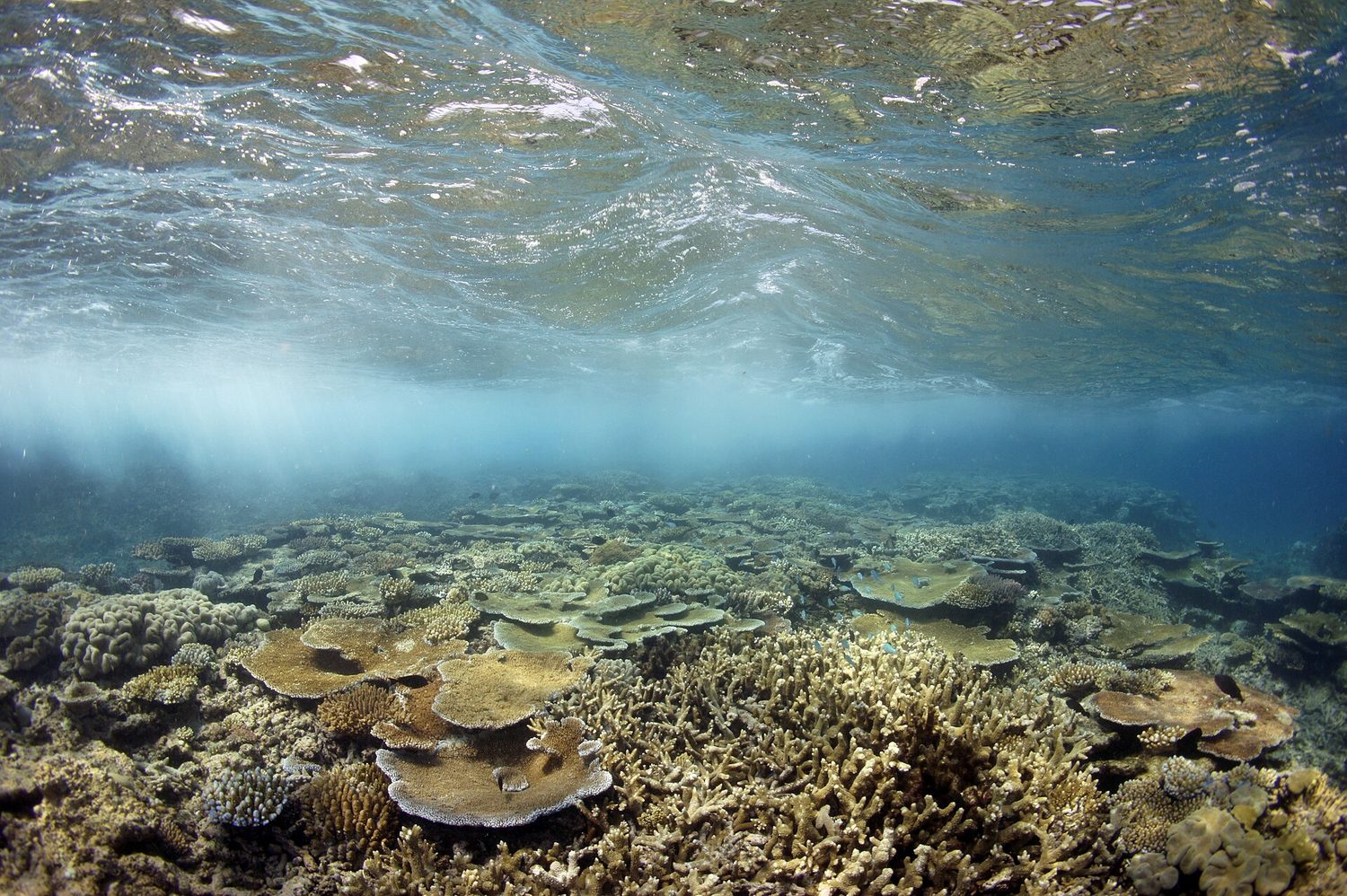
Aquatic biomes cover more of Earth than land. Freshwater (streams, lakes, wetlands) and marine (open ocean, coral reefs, estuaries) systems differ in salinity 盐度, sunlight, and nutrients. Estuaries 河口 (where rivers meet the sea) and coral reefs are especially productive and biodiverse.
Vocabulary
Train
| English |
|---|
| salinity/seɪˈlɪnɪti/ |
| Estuaries/ˈestjuːəriz/ |
| coral reef/ˈkɒrəl riːf/ |
1.4
The Carbon Cycle
Syllabus
| Enduring Understanding | Learning Objective | Essential Knowledge |
|---|---|---|
ERT-1 | ERT-1.D |
|
Source: College Board AP Course and Exam Description
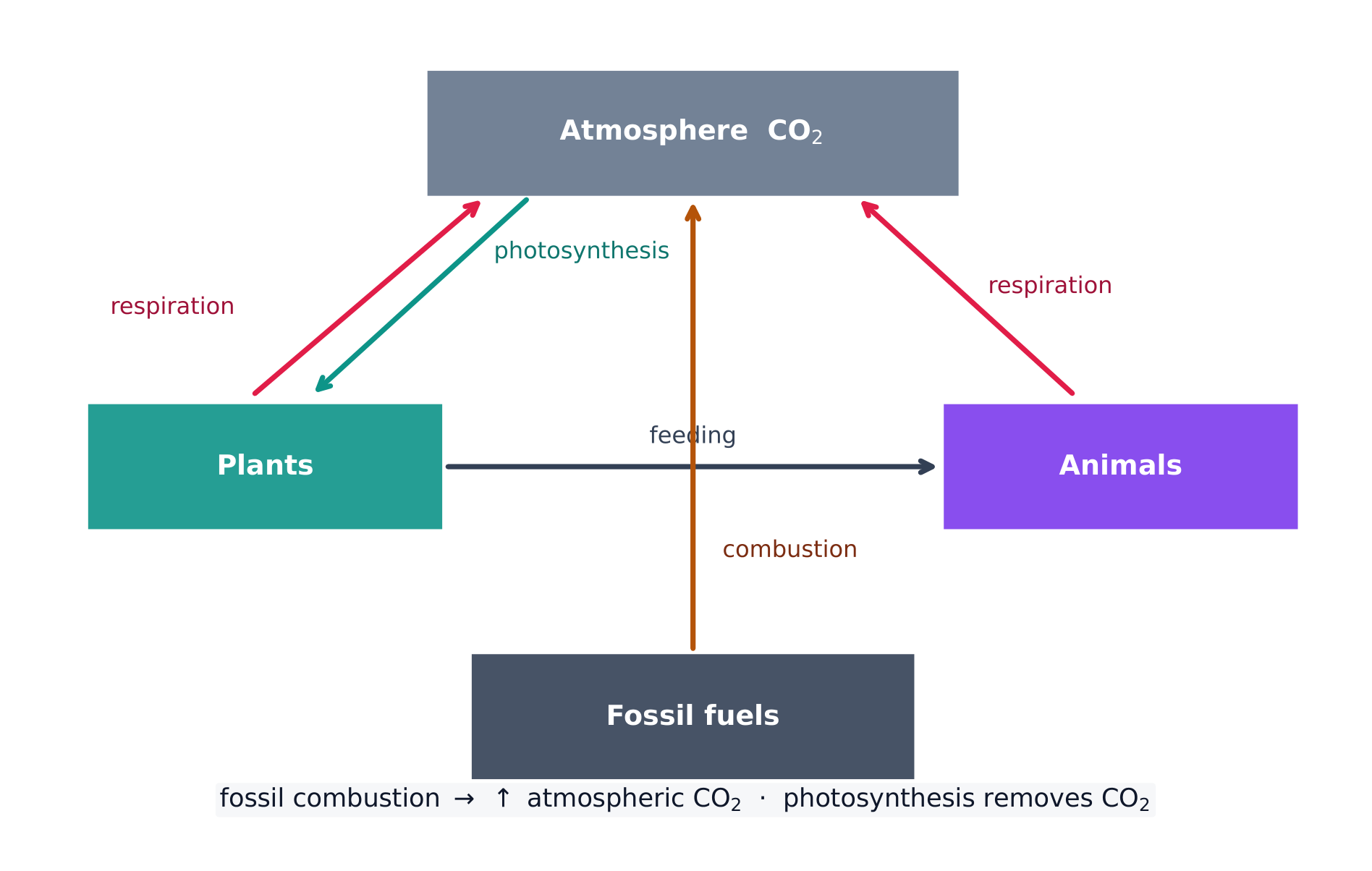
The carbon cycle 碳循环 moves carbon between the atmosphere, organisms, oceans, and rocks. Photosynthesis removes $\text{CO}_2$; respiration, decomposition, and burning fossil fuels 化石燃料 return it. Burning fossil fuels adds carbon far faster than natural processes remove it.
Vocabulary
Train
| English |
|---|
| carbon cycle/ˈkɑːbən ˈsaɪkl/ |
| fossil fuels/ˈfɒsl ˈfjuːəlz/ |
1.5
The Nitrogen Cycle
Syllabus
| Enduring Understanding | Learning Objective | Essential Knowledge |
|---|---|---|
ERT-1 | ERT-1.E |
|
Source: College Board AP Course and Exam Description
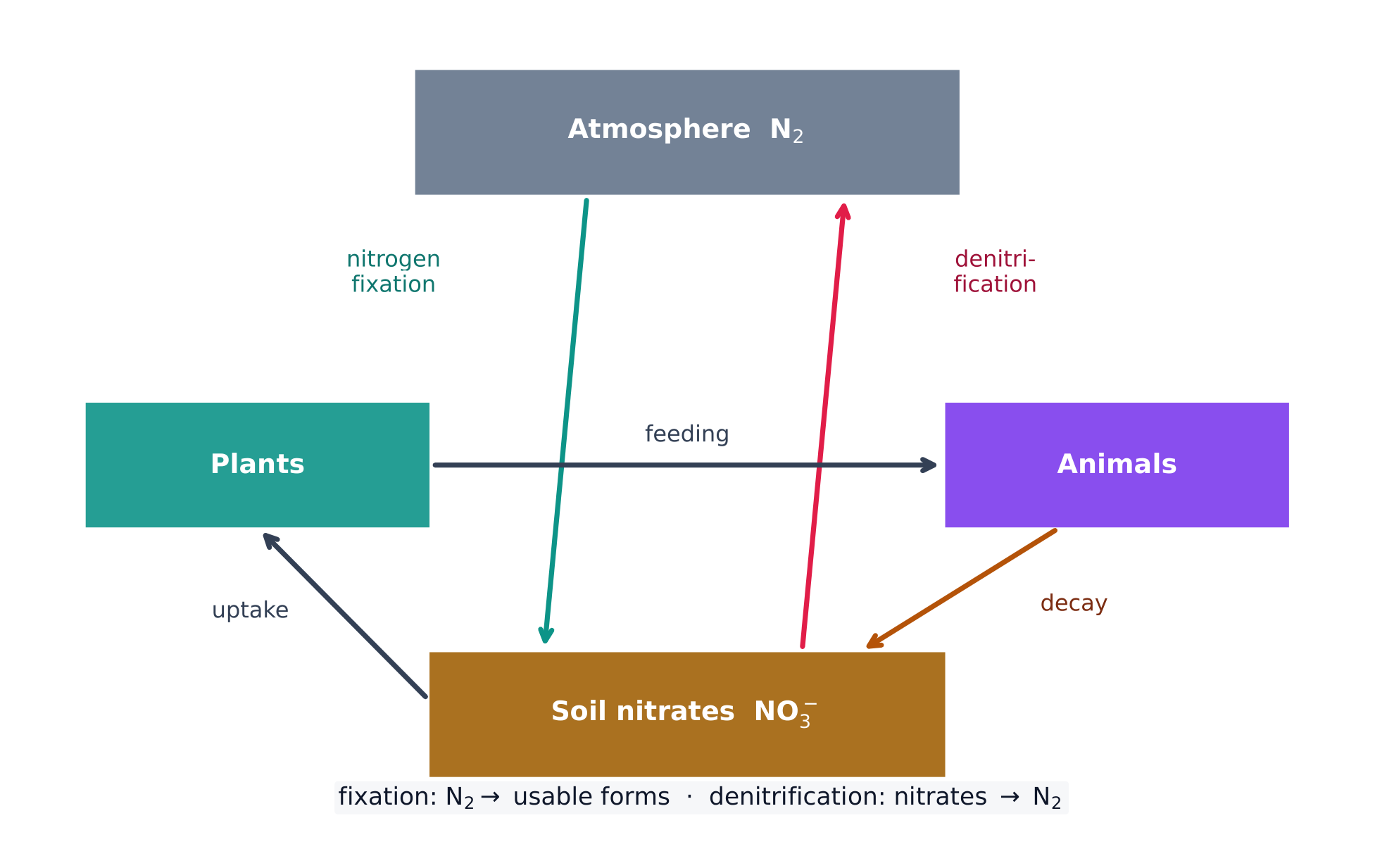
The nitrogen cycle 氮循环 makes nitrogen usable for life. Nitrogen fixation 固氮 (by bacteria) converts atmospheric $\text{N}_2$ to ammonia; nitrification and assimilation pass it through organisms; denitrification returns $\text{N}_2$ to the air. Fertilizer adds reactive nitrogen, which can pollute water.
Vocabulary
Train
| English |
|---|
| nitrogen cycle/ˈnaɪtrədʒn ˈsaɪkl/ |
| Nitrogen fixation/ˈnaɪtrədʒn fɪkˈseɪʃn/ |
1.6
The Phosphorus Cycle
Syllabus
| Enduring Understanding | Learning Objective | Essential Knowledge |
|---|---|---|
ERT-1 | ERT-1.F |
|
Source: College Board AP Course and Exam Description
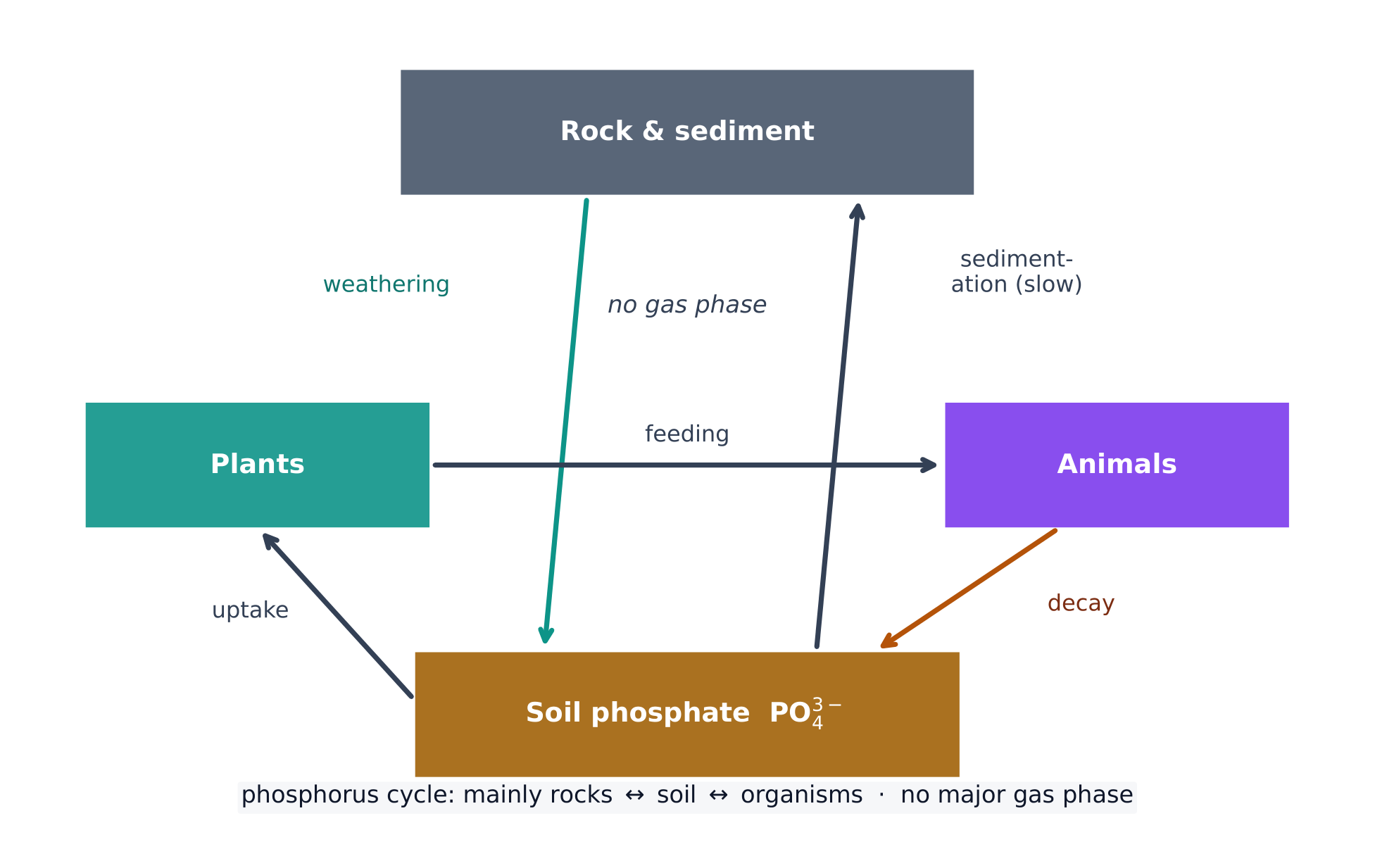
The phosphorus cycle 磷循环 has no atmospheric (gas) stage – phosphorus moves through rock, soil, water, and organisms. It is slow and often the limiting nutrient 限制性营养 for growth, so added phosphorus (fertilizer, detergents) can trigger algal blooms.
Vocabulary
Train
| English |
|---|
| phosphorus cycle/ˈfɒsfɔːrəs ˈsaɪkl/ |
| limiting nutrient/ˈlɪmɪtɪŋ ˈnjuːtrɪənt/ |
1.7
The Hydrologic (Water) Cycle
Syllabus
| Enduring Understanding | Learning Objective | Essential Knowledge |
|---|---|---|
ERT-1 | ERT-1.G |
|
Source: College Board AP Course and Exam Description
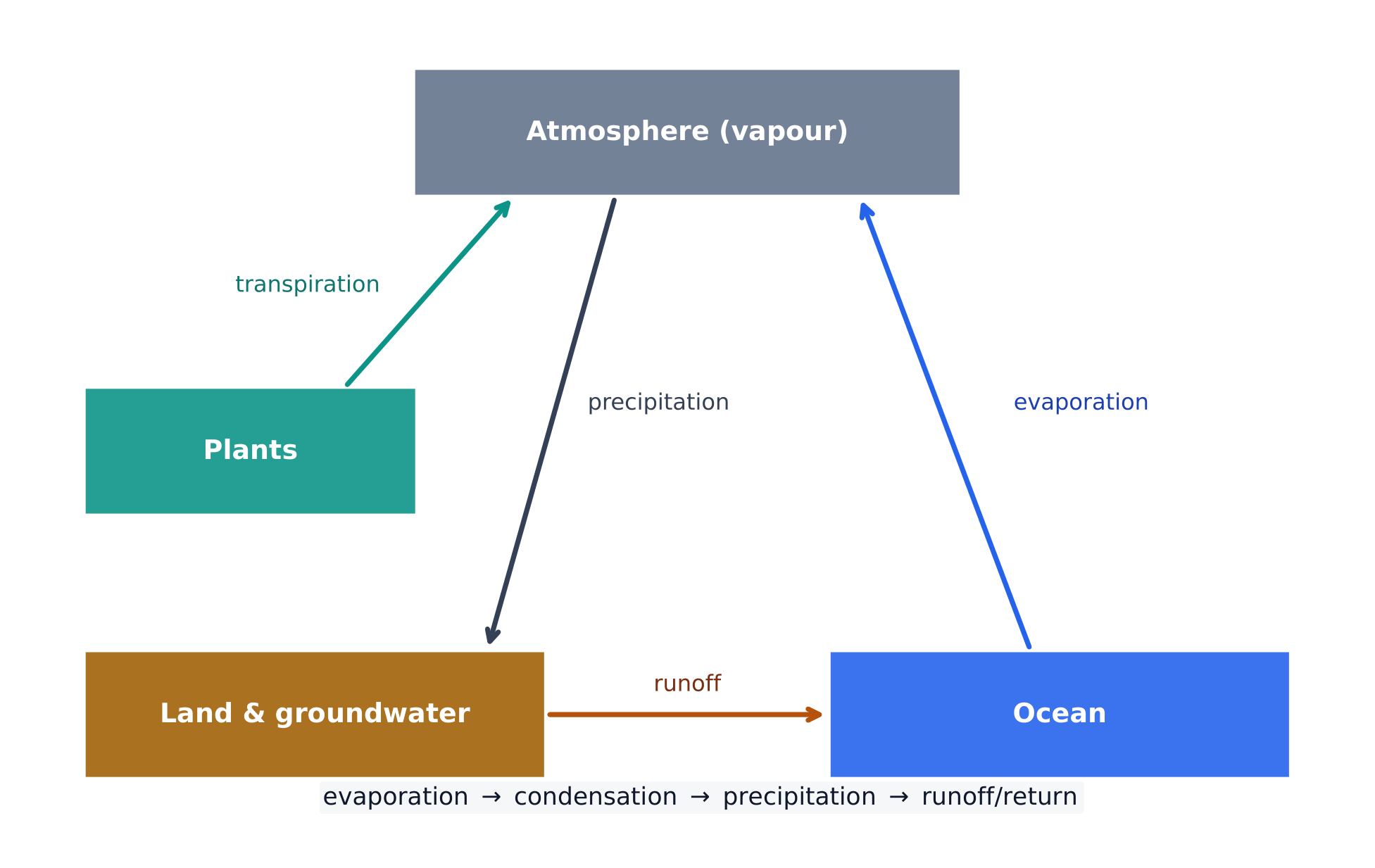
The water cycle 水循环 moves water by evaporation 蒸发, transpiration 蒸腾 (from plants), condensation, precipitation, and runoff. It distributes fresh water and shapes climate; human use and land changes can alter its flow.
Vocabulary
Train
| English |
|---|
| water cycle/ˈwɔːtə ˈsaɪkl/ |
| evaporation/ɪˌvæpəˈreɪʃn/ |
| transpiration/trænspəˈreɪʃn/ |
1.8
Primary Productivity
Syllabus
| Enduring Understanding | Learning Objective | Essential Knowledge |
|---|---|---|
ENG-1 | ENG-1.A |
|
Source: College Board AP Course and Exam Description
Primary productivity 初级生产力 is the rate at which producers capture energy (usually by photosynthesis). Gross primary productivity (GPP) is the total captured; net primary productivity (NPP) is what remains after the producers' own respiration – the energy available to the rest of the ecosystem. Warm, wet, sunlit systems (rainforests, reefs) are most productive.
Worked example. If producers in a grassland capture $20{,}000\ \text{kcal/m}^2/\text{yr}$ of energy (GPP) and burn $8{,}000\ \text{kcal/m}^2/\text{yr}$ in their own respiration, then $\text{NPP}=\text{GPP}-R=20{,}000-8{,}000=12{,}000\ \text{kcal/m}^2/\text{yr}$. Only that NPP – not the full GPP – is available to the consumers above.
Explore
Explore GPP, respiration and NPP
The energy producers capture (GPP) splits into what they burn for their own respiration $R$ and what is left over as new biomass — $\text{NPP} = \text{GPP} - R$, and useful + wasted always equals the input.
Vocabulary
Train
| English |
|---|
| Primary productivity/ˈpraɪməri ˌprɒdəkˈtɪvɪti/ |
1.9
Trophic Levels
Syllabus
| Enduring Understanding | Learning Objective | Essential Knowledge |
|---|---|---|
ENG-1 | ENG-1.B |
|
Source: College Board AP Course and Exam Description
Organisms occupy trophic levels 营养级: producers 生产者 (make their own food), then primary, secondary, and tertiary consumers 消费者, with decomposers 分解者 recycling nutrients at every level. Each level depends on the energy captured below it.
Vocabulary
Train
| English |
|---|
| trophic levels/ˈtrəʊfɪk ˈlevlz/ |
| producers/prəˈdjuːsəz/ |
| primary, secondary, and tertiary consumers/ˈpraɪməri ˈsekəndəri ænd ˈtɜːʃjəri kənˈsuːməz/ |
| decomposers/ˌdiːkəmˈpəʊzəz/ |
1.10
Energy Flow and the 10% Rule
Syllabus
| Enduring Understanding | Learning Objective | Essential Knowledge |
|---|---|---|
ENG-1 | ENG-1.C |
|
Source: College Board AP Course and Exam Description
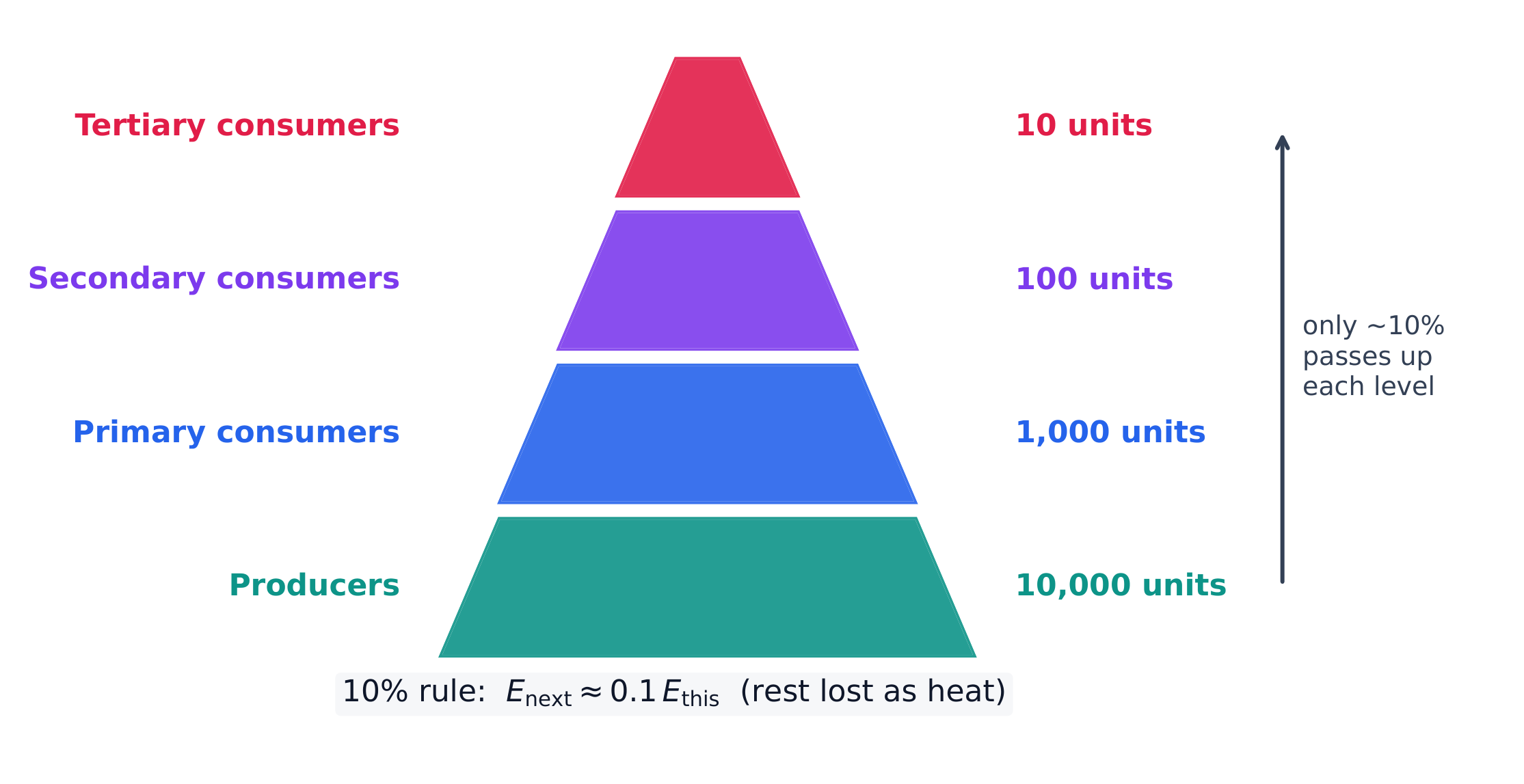
Energy flows one way through an ecosystem and is lost as heat at each transfer. The 10% rule: only about 10% of the energy at one trophic level passes to the next; the other 90% powers life processes and escapes as heat. This is why food chains are short and top predators are few.
Worked example. Continuing from $12{,}000\ \text{kcal/m}^2/\text{yr}$ of NPP at the producer level, the primary consumers receive about $10\%=1{,}200\ \text{kcal}$, secondary consumers $\approx120\ \text{kcal}$, and tertiary consumers only $\approx12\ \text{kcal}$. After three transfers the energy has shrunk a thousand-fold – the arithmetic reason a fourth or fifth trophic level rarely has enough to support it.
Explore
Explore the 10% rule
Set the energy producers capture and the ecological efficiency, then watch only about a tenth pass to each level up — this is why the apex predator is left with so little and food chains stay short.
1.11
Food Chains and Food Webs
Syllabus
| Enduring Understanding | Learning Objective | Essential Knowledge |
|---|---|---|
ENG-1 | ENG-1.D |
|
Source: College Board AP Course and Exam Description
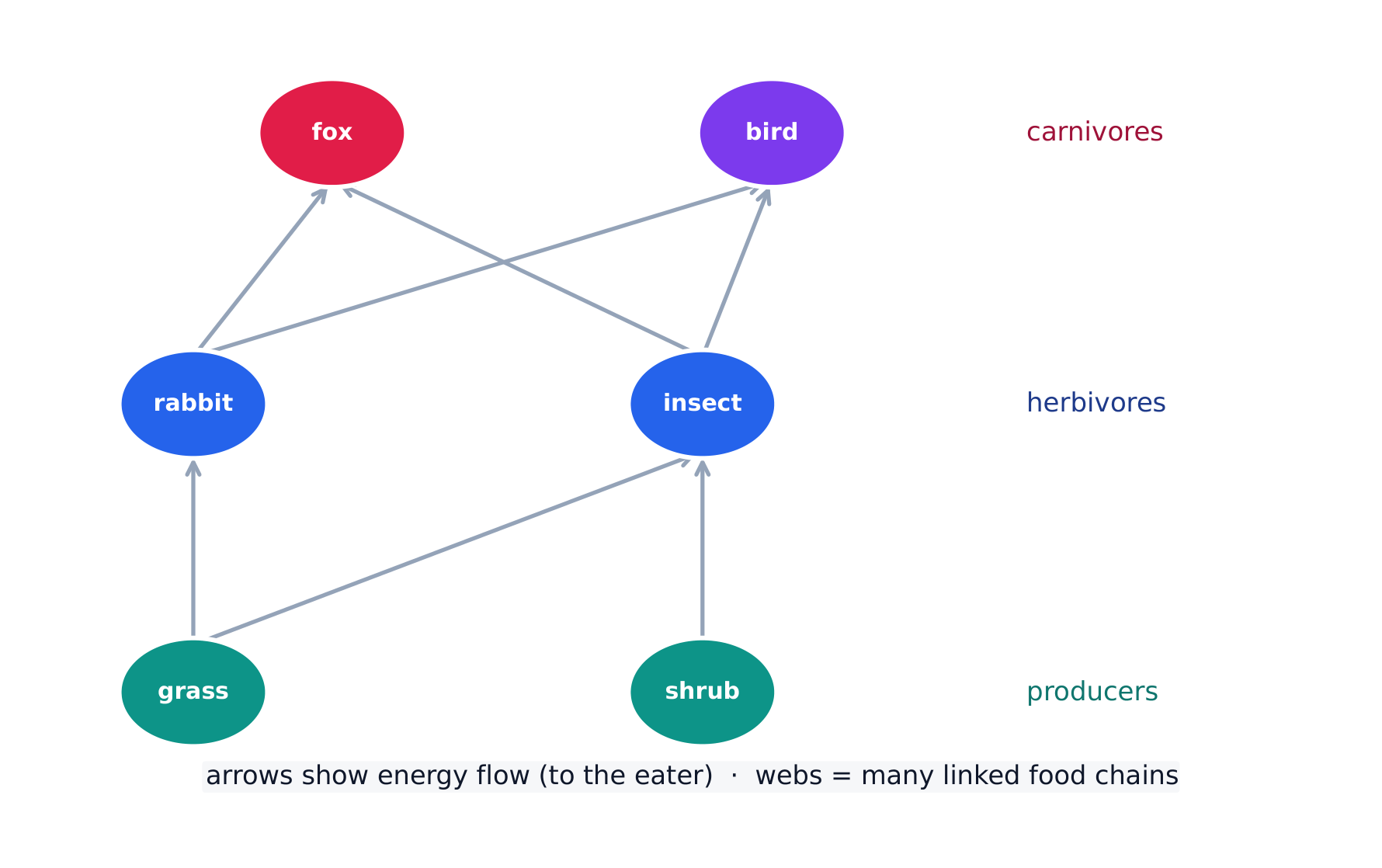
A food chain 食物链 is a single line of who-eats-whom; a food web 食物网 links many chains into a realistic picture of feeding relationships. Because species are interconnected, removing one (especially a keystone species 关键种) can disrupt the whole web.
Vocabulary
Train
| English |
|---|
| food chain/fuːd tʃeɪn/ |
| food web/fuːd web/ |
| keystone species/ˈkiːstəʊn ˈspiːsiːz/ |
1.11
Exam tips
- Remember energy flows and is lost (the 10% rule) while matter cycles (carbon, nitrogen, phosphorus, water).
- Apply the 10% rule down a food chain and know NPP = GPP − respiration (only NPP is available to consumers).
- Learn each biogeochemical cycle's stores and how humans disturb it (burning fossil fuels adds CO₂; fertiliser adds nitrogen/phosphorus).
- Producers are most abundant because so little energy reaches the top.
- Use correct units and show your arithmetic on the free-response math questions (no calculator — keep numbers round).
Interactive lessons on this topic
Work through it step by step, with instant-check exercises.