English
This handout covers Topic 1: Pure Mathematics 纯数学 1. It is the algebra 代数 and calculus 微积分 core of the course. Each ## section is one syllabus subtopic.
A-Level 数学 (9709) は一つのブロックとして教わるのではなく、科目ごとの構成になっています:純数学 1, 2, 3、力学、および 確率・統計 1 および 2。受験する科目は所属校の出願要件によります — 復習計画を立てる前に必ず確認してください。統計に出願しているのに、 Mechanics の演習だけをこなす意味はありません。
純数学が柱(スパイン)です。 他のすべての分野は、あなたが思考せずにも微分、積分、代数処理ができることを前提としています。純数学に弱点があれば、それは純数学での点数低下として現れるのではなく、力学や統計での点数低下として表れます。
手順点(M marks)は比較的緩やかで、書き出した内容に基づいて付与されます。 全工程を示すことは、この科目において最もリターンが高い習慣です。
This handout covers Topic 1: Pure Mathematics 纯数学 1. It is the algebra 代数 and calculus 微积分 core of the course. Each ## section is one syllabus subtopic.

| Candidates should be able to: | Notes and examples |
|---|---|
| carry out the process of completing the square for a quadratic polynomial $ax^2 + bx + c$ and use a completed square form | e.g. to locate the vertex of the graph of $y = ax^2 + bx + c$ or to sketch the graph |
| find the discriminant of a quadratic polynomial $ax^2 + bx + c$ and use the discriminant | e.g. to determine the number of real roots of the equation $ax^2 + bx + c = 0$. Knowledge of the term ‘repeated root’ is included. |
| solve quadratic equations, and quadratic inequalities, in one unknown | By factorising, completing the square and using the formula. |
| solve by substitution a pair of simultaneous equations of which one is linear and one is quadratic | e.g. $x + y + 1 = 0$ and $x^2 + y^2 = 25$, $2x + 3y = 7$ and $3x^2 = 4 + 4xy$. |
| recognise and solve equations in $x$ which are quadratic in some function of $x$. | e.g. $x^4 - 5x^2 + 4 = 0$, $6x + \sqrt{x} - 1 = 0$, $\tan^2 x = 1 + \tan x$. |
出典: Cambridge International シラバス
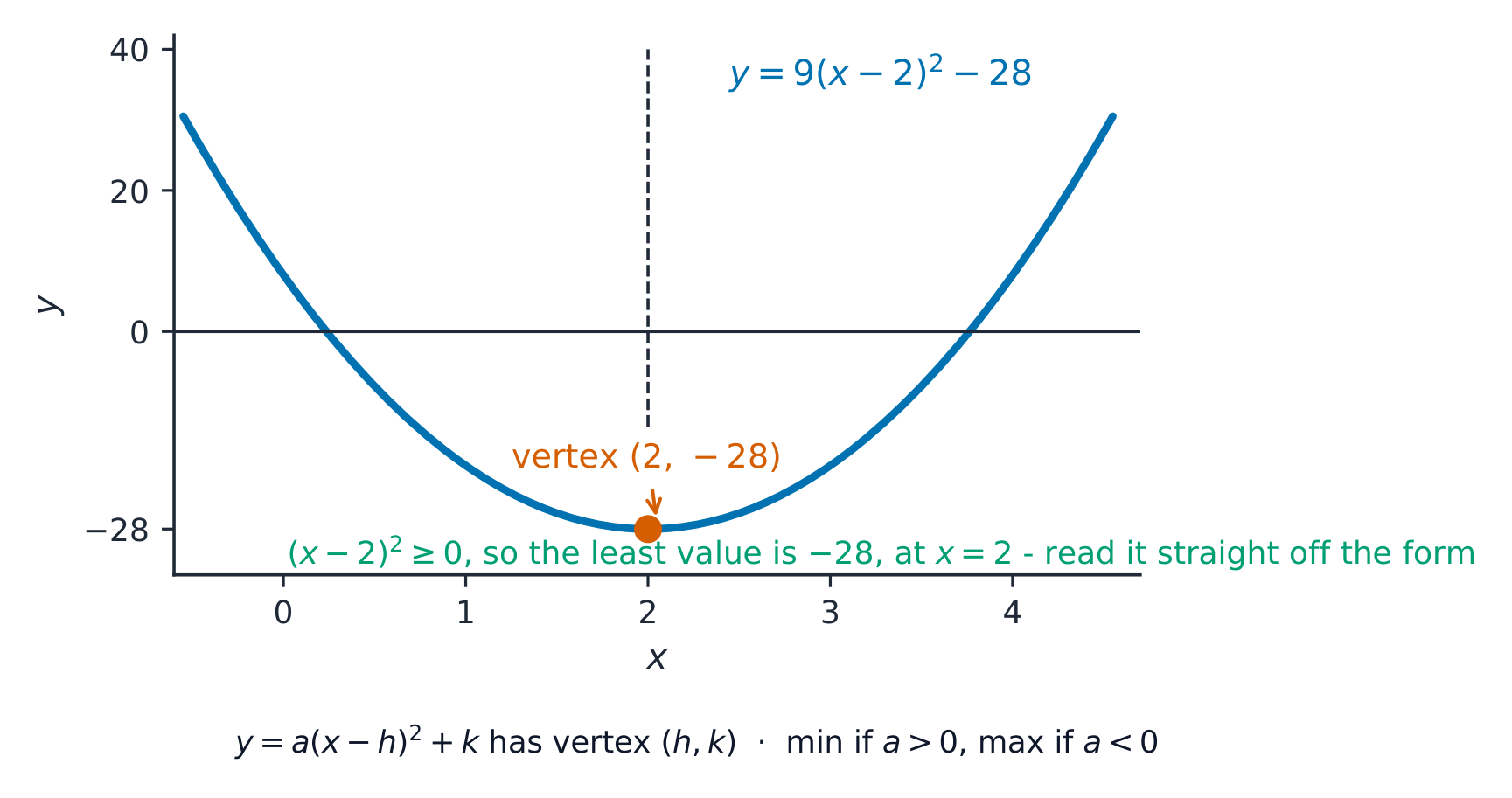
A quadratic 二次式 is an expression of the form $ax^2 + bx + c$, where $a \neq 0$. The letters $a$, $b$, $c$ are the coefficients 系数 (the fixed numbers). Much of this section is about solving the equation $ax^2 + bx + c = 0$.
To complete the square 配方 means to write the quadratic in the form
Worked example. Write $9x^2 - 36x + 8$ in the form $p(x + q)^2 + r$.
Take the factor $9$ out of the first two terms, then complete the square inside:
The discriminant 判别式 of $ax^2 + bx + c$ is
| Discriminant | Roots |
|---|---|
| $b^2 - 4ac > 0$ | two distinct 相异 real roots |
| $b^2 - 4ac = 0$ | one repeated real root |
| $b^2 - 4ac < 0$ | no real roots |

Worked example. Find the values of the constant $k$ for which $3kx^2 + (k + 8)x + 3 = 0$ has two distinct real roots.
Here $a = 3k$, $b = k + 8$, $c = 3$. For two distinct real roots you need $b^2 - 4ac > 0$:
To solve a quadratic equation 二次方程, factorise, complete the square, or use the formula
To solve a pair of simultaneous equations 联立方程 where one is linear and one is quadratic, use substitution 代入: rearrange the linear equation for one letter, then put that into the quadratic. This gives a single quadratic to solve.
Some equations are quadratic in some function of $x$. For example $x^4 - 5x^2 + 4 = 0$ is quadratic in $x^2$: let $u = x^2$, solve $u^2 - 5u + 4 = 0$, then go back to $x$. You will use this idea again in trigonometry.
y = ax² + bx + c
a, b, c をドラッグする。係数が変化すると、頂点、対称軸、零点(x軸との交点)がどう動くか観察する。
| English | 日本語 |
|---|---|
| Pure Mathematics/pjʊə ˌmæθɪˈmætɪks/ | 純数学 |
| quadratic/kwɒˈdrætɪk/ | 二次式 |
| complete the square/kəmˈpliːt ðə skweə/ | 平方完成 |
| vertex/ˈvɜːteks/ | 頂点 |
| discriminant/dɪˈskrɪmɪnənt/ | 判別式 |
| real roots/rɪəl ruːts/ | 実根 |
| distinct/dɪˈstɪŋkt/ | 異なる |
| quadratic equation/kwɒˈdrætɪk ɪˈkweɪʒn/ | 二次方程式 |
| quadratic inequality/kwɒˈdrætɪk ɪniːˈkwɒlɪti/ | 二次不等式 |
| simultaneous equations/ˌsɪməlˈteɪnɪəs ɪˈkweɪʒnz/ | 連立方程式 |
| substitution/ˌsʌbstɪˈtjuːʃn/ | 代入法 |
| coefficient/ˌkəʊɪˈfɪʃənt/ | 係数 |
| parabola/pəˈræbələ/ | 放物線 |
| 受験者は以下のことをできること: | メモと例 |
|---|---|
| 関数、定義域、値域、単射(一対一の対応)、逆関数、および関数の合成の用語を理解する。 | |
| 簡単なケースで与えられた関数の値域を特定し、2つの与えられた関数の合成を求める | e.g. ⟨$f : x \mapsto \frac{1}{x}$ ⟩ の ⟨$x \geqslant 1$ ⟩ に対する値域、$g : x \mapsto x^2 + 1$ の ⟨$x \in \mathbb{R}$ ⟩ に対する値域。合成関数 $gf$ が形成できるのは、$f$ の値域が $g$ の定義域に含まれている場合に限るという条件を含む。 |
| 与えられた関数が一一対応かどうかを判定し、簡単なケースで一一対応関数の逆関数を求める | e.g. ⟨$h : x \mapsto (2x + 3)^2 - 4$ ⟩ の ⟨$x < -\frac{3}{2}$ ⟩ の逆関数の導出。 |
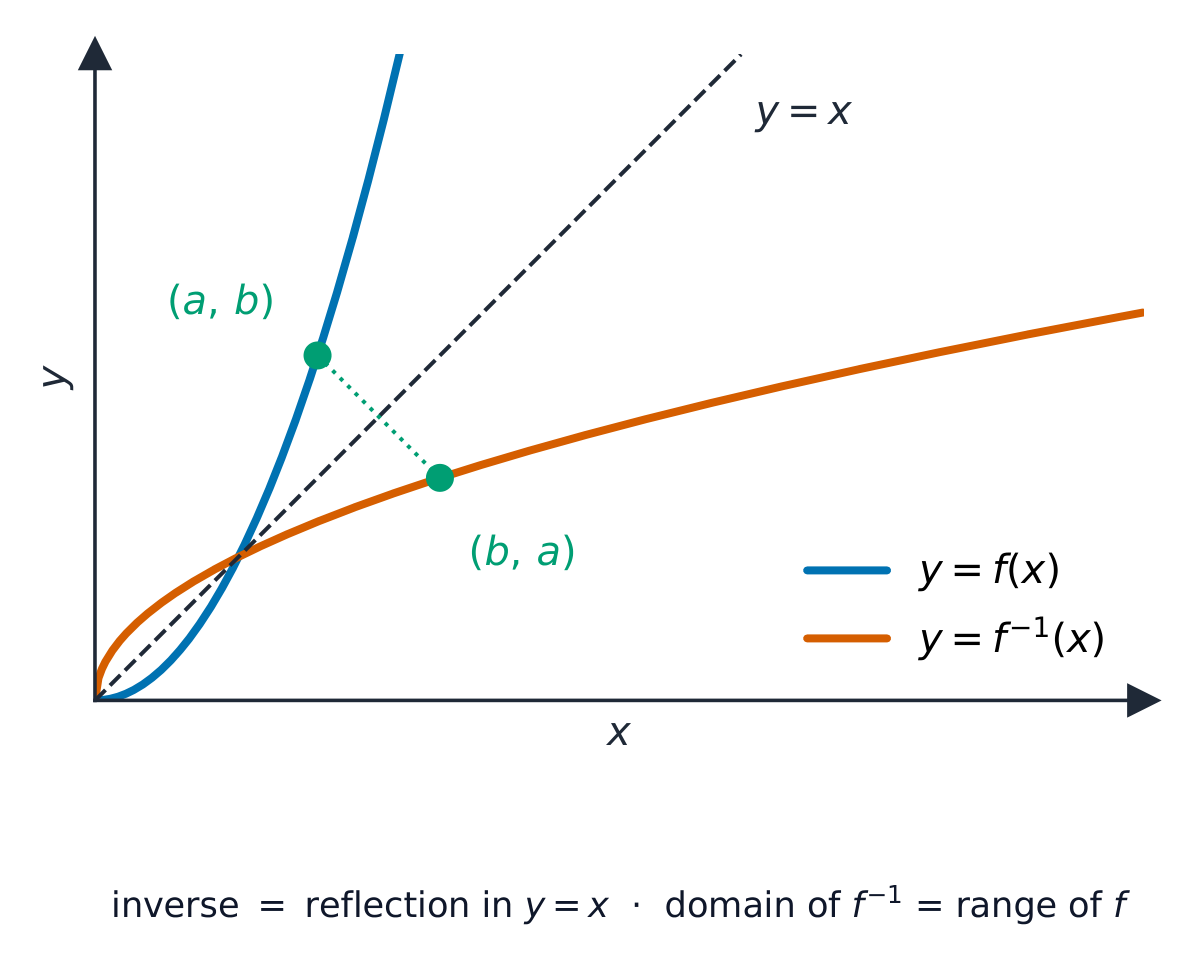
| 単射(一対一の対応)な関数とその逆関数の関係を図形的に示す。 | 図には対称軸 $y = x$ の表示を含めるべきである。 |
| $y = f(x)$ のグラフの 変換($y = f(x) + a$, $y = f(x + a)$, $y = af(x)$, $y = f(ax)$ およびそれらの単純な組み合わせ)を理解し、使用する。 | 「平行移動」、「反射」、「伸縮」といった用語を用いて変換を記述する。問題には代数関数、三角関数、または特定の性質を持つ他のグラフが含まれる可能性がある。 |
出典: Cambridge International シラバス
A function 函数 is a rule that sends each input to exactly one output. Write it as $f(x)$. The composition of functions 复合函数 $fg(x)$ means apply $g$ first, then apply $f$ to the result.
A function is one-one 一一对应 if different inputs always give different outputs. (No output is repeated.) Only a one-one function has an inverse function 反函数 $f^{-1}$, which reverses the rule.
The composition 复合 of two functions means doing one after the other. $fg(x)$ means "do $g$ first, then $f$": $fg(x) = f(g(x))$. The composite function $fg$ exists only when the range of $g$ lies inside the domain of $f$.
To find $f^{-1}$: write $y = f(x)$, make $x$ the subject, then swap letters.
Worked example. The function $f(x) = (x + 3)^2 - 12$ is defined for $x \geqslant 0$. Find $f^{-1}(x)$.
Write $y = (x + 3)^2 - 12$ and solve for $x$:
The graph of $y = f^{-1}(x)$ is the reflection 反射 of $y = f(x)$ in the line $y = x$.
You should know these transformations 变换 of $y = f(x)$:
| New equation | Effect on the graph |
|---|---|
| $y = f(x) + a$ | translation 平移 up by $a$ |
| $y = f(x + a)$ | translation left by $a$ |
| $y = a\,f(x)$ | stretch 伸缩 in the $y$-direction, scale factor $a$ |
| $y = f(ax)$ | stretch in the $x$-direction, scale factor $\tfrac{1}{a}$ |
When two transformations are combined, the order can matter. State each one fully (type, direction, and amount).

y = ax³ + bx² + cx + d
関数は各入力をちょうど1つの出力に変換する — 係数をドラッグして、曲線が上昇したり下降したりする場所を見る。
| English | 日本語 |
|---|---|
| function/ˈfʌŋkʃn/ | 関数 |
| composition of functions/ˌkɒmpəˈzɪʃn ɒv ˈfʌŋkʃnz/ | 関数の合成 |
| domain/dəˈmeɪn/ | 定義域 |
| range/reɪndʒ/ | 値域 |
| one-one/wʌn wʌn/ | 一対一 |
| inverse function/ɪnˈvɜːs ˈfʌŋkʃn/ | 逆関数 |
| composition/ˌkɒmpəˈzɪʃn/ | 合成 |
| reflection/rɪˈflekʃn/ | 反射 |
| transformations/trænsfɔːˈmeɪʃnz/ | 変換 |
| translation/trænˈsleɪʃn/ | 平行移動 |
| stretch/stretʃ/ | 伸縮 |

| Candidates should be able to: | Notes and examples |
|---|---|
| find the equation of a straight line given sufficient information | e.g. given two points, or one point and the gradient. |
| interpret and use any of the forms $y = mx + c$, $y - y_1 = m(x - x_1)$, $ax + by + c = 0$ in solving problems | Including calculations of distances, gradients, midpoints, points of intersection and use of the relationship between the gradients of parallel and perpendicular lines. |
| understand that the equation $(x - a)^2 + (y - b)^2 = r^2$ represents the circle with centre $(a, b)$ and radius $r$ | Including use of the expanded form $x^2 + y^2 + 2gx + 2fy + c = 0$. |
| use algebraic methods to solve problems involving lines and circles | Including use of elementary geometrical properties of circles, e.g. tangent perpendicular to radius, angle in a semicircle, symmetry. Implicit differentiation is not included. |
| understand the relationship between a graph and its associated algebraic equation, and use the relationship between points of intersection of graphs and solutions of equations. | e.g. to determine the set of values of $k$ for which the line $y = x + k$ intersects, touches or does not meet a quadratic curve. |
出典: Cambridge International シラバス
Coordinate geometry 坐标几何 studies lines and circles using their equations.
The gradient 斜率 (steepness) of the line joining $(x_1, y_1)$ and $(x_2, y_2)$ is
The circle 圆 with centre 圆心 $(a, b)$ and radius 半径 $r$ has equation
A tangent 切线 to a circle touches it at one point and is perpendicular to the radius at that point. This right-angle fact solves most circle problems.
Worked example. The points $P(1, 1)$ and $Q(7, 11)$ are the ends of a diameter 直径 of a circle. Find the equation of the circle.
The centre is the midpoint of $PQ$:
y = ax + b
傾き a が直線を傾け、切片 b が直線を上下にずらす。
| English | 日本語 |
|---|---|
| Coordinate geometry/kəʊˈɔːdɪnət dʒiˈɒmətri/ | 座標幾何学 |
| gradient/ˈɡreɪdɪənt/ | 傾き |
| equation of a straight line/ɪˈkweɪʒn əvə streɪt laɪn/ | 直線の方程式 |
| parallel/ˈpærəlel/ | 平行 |
| perpendicular/ˌpɜːpənˈdɪkjʊlə/ | 垂直 |
| circle/ˈsɜːkl/ | 円 |
| centre/ˈsentə/ | 中心 |
| radius/ˈreɪdɪəs/ | 半径 |
| tangent/ˈtændʒənt/ | 接線 |
| diameter/daɪˈæmɪtə/ | 直径 |

| 受験者は以下のことをできること: | メモと例 |
|---|---|
| ラジアンの定義を理解し、ラジアンと度の間の関係を用いる | |
| 円の弧の長さと扇形の面積に関する問題解決に、公式 $s = r\theta$ と $A = \frac{1}{2}r^2\theta$ を用いる。 | 三角形内の長さと角度の計算、および三角形の面積を含む。 |
出典: Cambridge International シラバス
A radian 弧度 is another way to measure angles. One radian is the angle at the centre of a circle that cuts off an arc 弧 equal in length to the radius. The link between radians and degrees 度 is
For a sector 扇形 with radius $r$ and angle $\theta$ in radians:

Worked example. A sector has centre $O$ and the angle at $O$ is $\tfrac{2}{3}\pi$ radians. Show that the segment cut off by the chord has area about $0.614 r^2$.
角度(ラジアン)と半径を変更する。弧長 $s = r\theta$ と扇形面積 $\tfrac12 r^2\theta$ の更新状況を見る。
| English | 日本語 |
|---|---|
| radian/ˈreɪdɪən/ | ラジアン |
| arc/ɑːk/ | 弧 |
| degrees/dɪˈɡriːz/ | 度 |
| sector/ˈsektə/ | 扇形 |
| chord/kɔːd/ | 弦 |
| segment/ˈseɡmənt/ | 弓形 |

| 受験者は以下のことをできること: | メモと例 |
|---|---|
| 正弦、余弦、正接関数のグラフ(任意の角度、度法またはラジアン法のいずれかを用いて)を描き、使用する。 | 例として $y = 3 \sin x$, $y = 1 - \cos 2x$, $y = \tan(x + \frac{1}{4}\pi)$ などを含む。 |
| $30^\circ$、$45^\circ$、$60^\circ$ および関連する角度における sin(正弦)、cos(余弦)、tan(正接) の正確な値を用いる。 | 例として $\cos 150^\circ = -\frac{1}{2}\sqrt{3}$、$\sin \frac{3}{4}\pi = \frac{1}{\sqrt{2}}$ など。 |
| 逆三角関数関係式の主値を表す記号 $\sin^{-1} x$、$\cos^{-1} x$、$\tan^{-1} x$ を用いる。 | これらの関数に関する専門的な知識は不要だが、逆関数の例としての理解が求められる。 |
| 恒等式 $\frac{\sin \theta}{\cos \theta} \equiv \tan \theta$ と $\sin^2 \theta + \cos^2 \theta \equiv 1$ を用いる。 | 恒等式の証明、式の整理、方程式の解法などに応用される。 |
| 指定された区間内にある単純な三角方程式のすべての解を求める。(一般解の形は含まれない。) | 例として、$3 \sin 2x + 1 = 0$ を $-\pi < x < \pi$、$3 \sin^2 \theta - 5 \cos \theta - 1 = 0$ で $0^\circ \leqslant \theta \leqslant 360^\circ$ の範囲で解くなど。 |
出典: Cambridge International シラバス
You must know the shape of the graphs of the sine 正弦, cosine 余弦 and tangent function 正切 (written $\sin$, $\cos$, $\tan$). The sine and cosine graphs wave between $-1$ and $1$ and repeat every $360^\circ$ ($2\pi$). Learn these exact values:
| $\theta$ | $30^\circ$ | $45^\circ$ | $60^\circ$ |
|---|---|---|---|
| $\sin\theta$ | $\tfrac12$ | $\tfrac{1}{\sqrt2}$ | $\tfrac{\sqrt3}{2}$ |
| $\cos\theta$ | $\tfrac{\sqrt3}{2}$ | $\tfrac{1}{\sqrt2}$ | $\tfrac12$ |
| $\tan\theta$ | $\tfrac{1}{\sqrt3}$ | $1$ | $\sqrt3$ |

The notations $\sin^{-1}x$, $\cos^{-1}x$, $\tan^{-1}x$ mean the inverse angle (the principal value 主值).
An identity 恒等式 is true for every value of the angle. The two you must know are
To solve a trigonometric equation 三角方程, first reduce it to one function, then find every solution in the given interval.
Worked example. Solve $6\sin\theta = 1 + \dfrac{2}{\sin\theta}$ for $-180^\circ < \theta < 180^\circ$.
Multiply through by $\sin\theta$ to clear the fraction. This makes a quadratic in $\sin\theta$:
The four solutions are $\theta = -150^\circ,\ -30^\circ,\ 41.8^\circ,\ 138.2^\circ$.
y = a·sin(bx + c) + d の振幅、周期、シフトをドラッグして、基本波に対する曲線の変化を見る。
角度を単位円上までドラッグする。高さは $\sin\theta$ 、横方向の距離は $\cos\theta$ ——これがグラフの由来である。
| English | 日本語 |
|---|---|
| sine/saɪn/ | 正弦 |
| cosine/ˈkəʊsaɪn/ | 余弦 |
| tangent function/ˈtændʒənt ˈfʌŋkʃn/ | 正接 |
| principal value/ˈprɪnsɪpl ˈvæljuː/ | 主値 |
| identity/aɪˈdentɪti/ | 恒等式 |
| trigonometric equation/ˌtrɪɡənəʊˈmetrɪk ɪˈkweɪʒn/ | 三角方程式 |

| 受験者は以下のことをできること: | メモと例 |
|---|---|
| $(a + b)^n$ の展開式を用い、$n$ は正の整数とする。 | 記号 $\begin{pmatrix} n \\ r \end{pmatrix}$ と $n!$ の知識を含む。最大項や係数の性質に関する知識は不要である。 |
| 等差数列と等比数列を認識する。 | |
| 等差数列または等比数列に関連する問題解決のために、第$n$項の公式および初めから$n$項までの和の公式を用いる。 | 数字 $a$、$b$、$c$ が $2b = a + c$ (または同等)の場合に「等差数列」にあり、$b^2 = ac$ (または同等)の場合に「等比数列」にあるという知識を含む。複数の数列を含む問題がある。 |
| 等比数列の収束条件を用い、収束する等比数列の無限大の和の公式を用いる。 |
出典: Cambridge International シラバス
For a positive integer $n$, the binomial expansion 二项展开式 is
Worked example. Find the first three terms, in ascending powers of $x$, of $(2 - px)^5$.
A progression 数列 (sequence) is a list of terms following a rule.
A GP is convergent — it converges 收敛 (settles to a limit) — when $|r| < 1$. Then it has a sum to infinity 无穷和
Worked example. The third term of a GP is $18$ and the sum of the first three terms is $26$. The common ratio is negative. Find the sum to infinity.
From $ar^2 = 18$ you get $a = \dfrac{18}{r^2}$. Put this into $a(1 + r + r^2) = 26$:
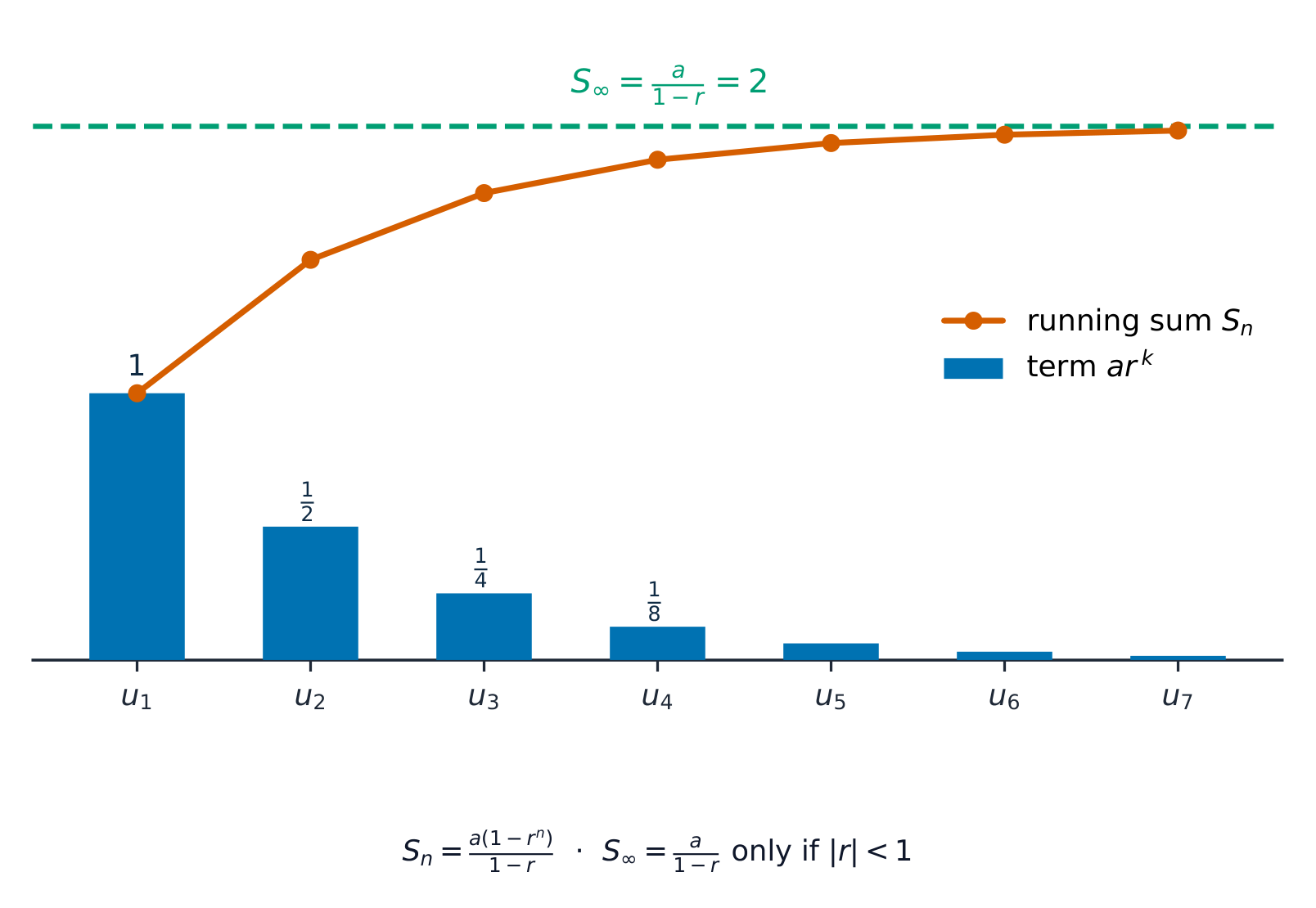
等差(dを加える)と等比(rをかける)数列を切り替えて、項とその和がどのように積み上がっていくか観察する。
| English | 日本語 |
|---|---|
| binomial expansion/baɪˈnəʊmɪəl ekˈspænʃn/ | 二項展開式 |
| binomial coefficient/baɪˈnəʊmɪəl ˌkəʊɪˈfɪʃənt/ | 二項係数 |
| progression/prəˈɡreʃn/ | 数列 |
| arithmetic progression/əˈrɪθmətɪk prəˈɡreʃn/ | 等差数列 |
| common difference/ˈkɒmən ˈdɪfrəns/ | 公差 |
| term/tɜːm/ | 項 |
| geometric progression/ˌdʒiːəʊˈmetrɪk prəˈɡreʃn/ | 等比数列 |
| common ratio/ˈkɒmən ˈreɪʃɪəʊ/ | 公比 |
| converges/kənˈvɜːdʒɪz/ | 収束する |
| sum to infinity/sʌm tʊ ɪnˈfɪnɪti/ | 無限和 |
| Candidates should be able to: | Notes and examples |
|---|---|
| understand the gradient of a curve at a point as the limit of the gradients of a suitable sequence of chords, and use the notations $f'(x)$, $f''(x)$, $\frac{\text{d}y}{\text{d}x}$, and $\frac{\text{d}^2y}{\text{d}x^2}$ for first and second derivatives | Only an informal understanding of the idea of a limit is expected. e.g. includes consideration of the gradient of the chord joining the points with $x$ coordinates $2$ and $(2 + h)$ on the curve $y = x^3$. Formal use of the general method of differentiation from first principles is not required. |
| use the derivative of $x^n$ (for any rational $n$), together with constant multiples, sums and differences of functions, and of composite functions using the chain rule | e.g. find $\frac{\text{d}y}{\text{d}x}$, given $y = \sqrt{2x^3 + 5}$. |
| apply differentiation to gradients, tangents and normals, increasing and decreasing functions and rates of change | Including connected rates of change, e.g. given the rate of increase of the radius of a circle, find the rate of increase of the area for a specific value of one of the variables. |
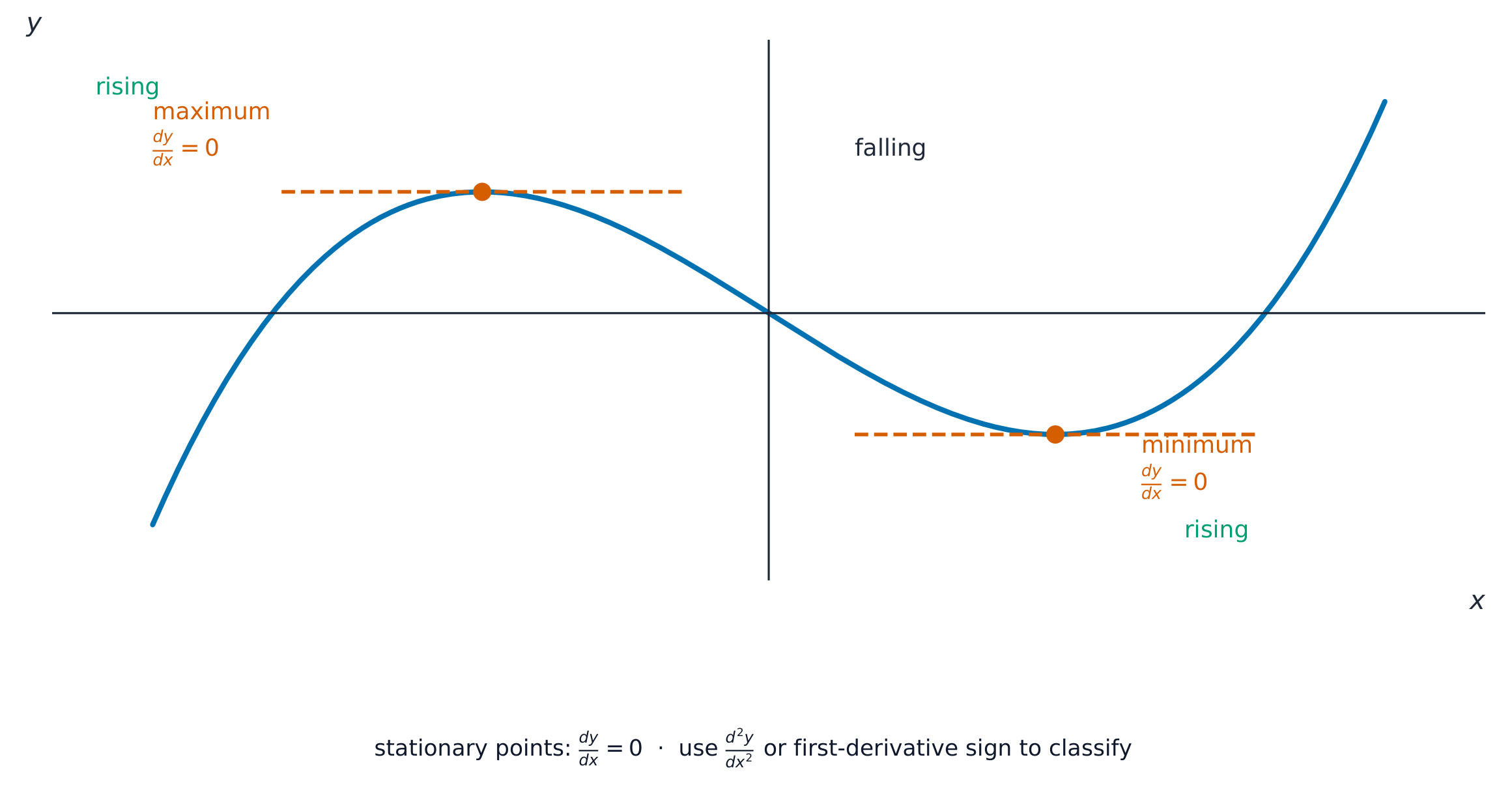
| locate stationary points and determine their nature, and use information about stationary points in sketching graphs. | Including use of the second derivative for identifying maxima and minima; alternatives may be used in questions where no method is specified. Knowledge of points of inflexion is not included. |
出典: Cambridge International シラバス
Differentiation 微分 finds the gradient of a curve 曲线斜率 at each point. The gradient is the limit 极限 of the gradients of shorter and shorter chords, called the derivative 导数.
Write the derivative as $f'(x)$ or $\dfrac{dy}{dx}$. The basic rule is
A stationary point 驻点 is where $\dfrac{dy}{dx} = 0$. Test its nature with the second derivative: $f''(x) > 0$ gives a minimum point 极小值点, and $f''(x) < 0$ gives a maximum point 极大值点. When $f''(x) = 0$ the test is inconclusive: the point may be a point of inflexion 拐点, where the curve changes concavity (the way it bends) – check the sign of $\dfrac{dy}{dx}$ just before and after to decide.
Worked example. The curve $y = 4x^{1/2} - x$ has a maximum point at $x = a$. Find $a$.
y = ax³ + bx² + cx + d
点を曲線上にスライドさせる。接線はその地点での勾配 $\frac{dy}{dx}$ を示す——曲線の湾曲が大きい場所ほど急になる。
| English | 日本語 |
|---|---|
| Differentiation/ˌdɪfəˌrenʃɪˈeɪʃn/ | 微分 |
| gradient of a curve/ˈɡreɪdɪənt əvə kɜːv/ | 曲線の傾き |
| limit/ˈlɪmɪt/ | 極限 |
| derivative/dɪˈrɪvətɪv/ | 導関数 |
| chain rule/tʃeɪn ruːl/ | 連鎖の法則 |
| second derivative/ˈsekənd dɪˈrɪvətɪv/ | 二階導関数 |
| normal/ˈnɔːml/ | 法線 |
| increasing function/ɪnˈkriːsɪŋ ˈfʌŋkʃn/ | 増加関数 |
| decreasing function/ˈdiːkriːsɪŋ ˈfʌŋkʃn/ | 減少関数 |
| rate of change/reɪt ɒv tʃeɪndʒ/ | 変化率 |
| stationary point/ˈsteɪʃənəri pɔɪnt/ | 定常点 |
| minimum point/ˈmɪnɪməm pɔɪnt/ | 極小点 |
| maximum point/ˈmæksɪməm pɔɪnt/ | 極大点 |
| point of inflexion/pɔɪnt ɒv ɪnˈflekʃn/ | 変曲点 |
| 受験者は以下のことをできること: | メモと例 |
|---|---|
| 積分を微分の逆操作として理解し、$(ax + b)^n$ を積分する($n$ は任意の有理数であり、$-1$ を除く)。定数倍、和、差を含む。 | 例として $\int (2x^3 - 5x + 1) \text{d}x$、$\int \frac{1}{(2x + 3)^2} \text{d}x$。 |
| 積分定数の評価を含む問題を解く。 | 例として、$(1, -2)$ を通る曲線の方程式を求め、$\frac{\text{d}y}{\text{d}x} = \sqrt{2x + 1}$ となる場合など。 |
| 定積分を評価する。 | 「 improper 」积分の簡単な例、例えば $\int_{0}^{1} x^{-\frac{1}{2}} \text{d}x$ や $\int_{1}^{\infty} x^{-2} \text{d}x$ などを含む。 |
| 定積分を用いて次のものを求める: - 曲線と軸に平行な直線で囲まれた領域の面積、あるいは曲線と直線、または2つの曲線の間の面積 - 一方の軸周りの回転体の体積。 | 回転体の体積は、回転軸で囲まれていない領域を含むことがある。例として、$y = 9 - x^2$ と $y = 5$ の間の領域を $x$ 軸周りに回転させる場合。 |
出典: Cambridge International シラバス
Integration 积分 is the reverse of differentiation. Reversing the power rule gives
A definite integral 定积分 has limits and gives a number:
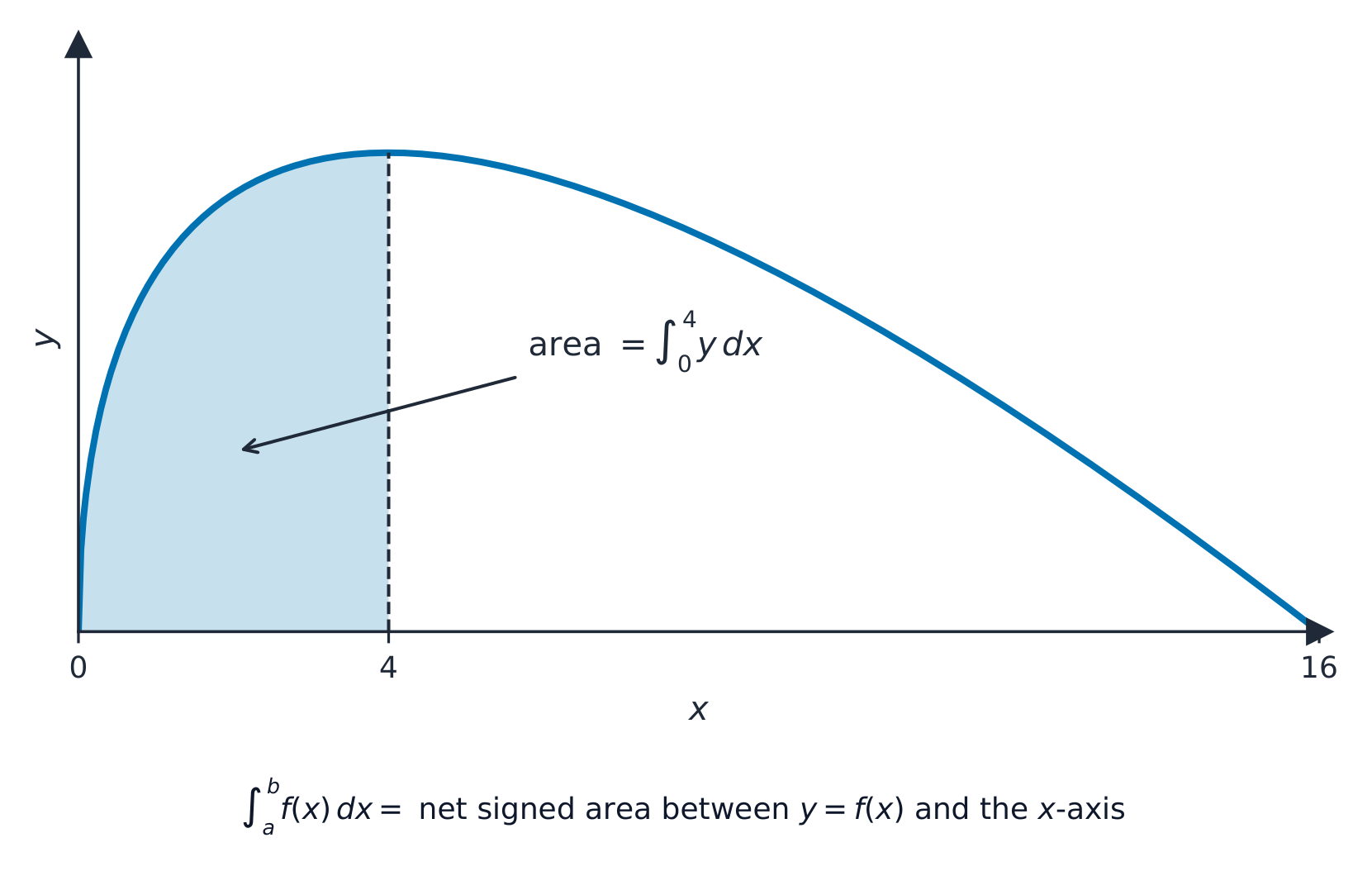
Worked example. The curve $y = 4x^{1/2} - x$ meets the $x$-axis again at $x = 16$. Find the area between the curve and the $x$-axis from $x = 0$ to $x = 4$.
An improper integral 广义积分 has an infinite limit or an endpoint where the integrand is undefined; evaluate it as a limit. For example,
When a region is turned all the way around an axis it sweeps out a solid. The volume of revolution 旋转体体积 about the $x$-axis is

y = ax³ + bx² + cx + d
境界値をドラッグする。定積分は曲線とx軸の間の着色部分の面積である。
| English | 日本語 |
|---|---|
| Integration/ˌɪntɪˈɡreɪʃn/ | 積分 |
| constant of integration/ˈkɒnstənt ɒv ˌɪntɪˈɡreɪʃn/ | 積分定数 |
| definite integral/ˈdefɪnət ˈɪntɪɡrəl/ | 定積分 |
| region/ˈriːdʒn/ | 領域 |
| improper integral/ɪmˈprɒpə ˈɪntɪɡrəl/ | 広義積分 |
| volume of revolution/ˈvɒljuːm ɒv ˌrevəˈluːʃn/ | 回転体体積 |
| English | 日本語 |
|---|---|
| algebra/ˈældʒɪbrə/ | 代数学 |
| calculus/ˈkælkjʊləs/ | 微積分 |
この資料はトピック2: 純数学2 を扱っています。絶対値と多項式の代数、対数と指数関数、より多くの三角関数、および微分・積分の新しい方法を追加します。
| Candidates should be able to: | Notes and examples |
|---|---|
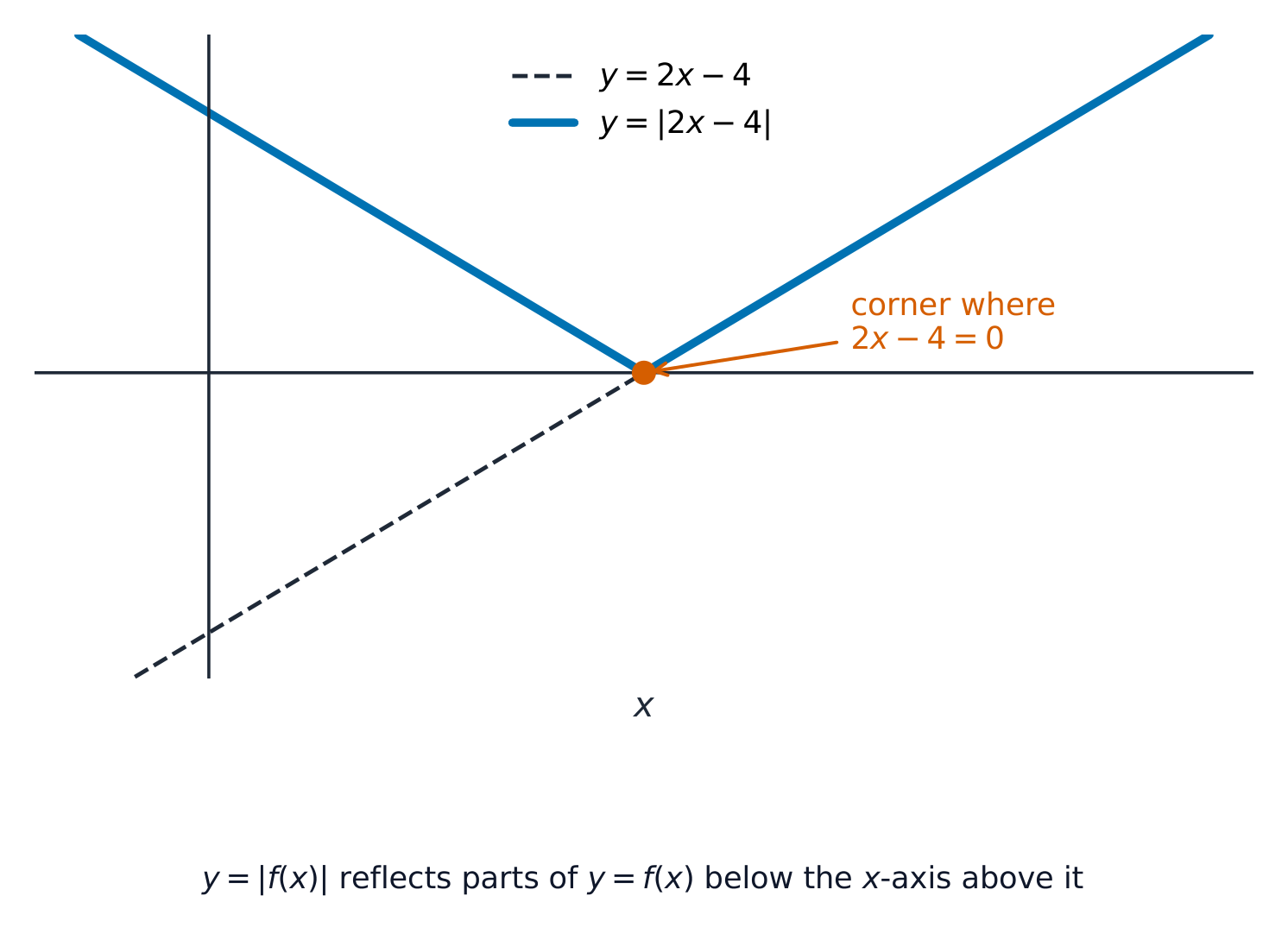
| understand the meaning of $|x|$, sketch the graph of $y = |ax + b|$ and use relations such as $|a| = |b| \iff a^2 = b^2$ and $|x - a| < b \iff a - b < x < a + b$ when solving equations and inequalities | Graphs of $y = |f(x)|$ and $y = f(|x|)$ for non-linear functions $f$ are not included. e.g. $|3x - 2| = |2x + 7|$, $2x + 5 < |x + 1|$ |
| divide a polynomial, of degree not exceeding 4, by a linear or quadratic polynomial, and identify the quotient and remainder (which may be zero) | |
| use the factor theorem and the remainder theorem. | e.g. to find factors and remainders, solve polynomial equations or evaluate unknown coefficients. Including factors of the form $(ax + b)$ in which the coefficient of $x$ is not unity, and including calculation of remainders. |
出典: Cambridge International シラバス
絶対値$|x|$とは、符号を取り除いた数の大きさのことなので、$|x| \geqslant 0$は常に正またはゼロです。$y = |ax + b|$のグラフは「V」字型をしており、$x$軸で反射します。方程式・不等式を解くための有用な2つの法則があります。
** worked example(解法例)。** $|3x + 8| < 9$ を解け。
不等式を $-9 < 3x + 8 < 9$ の形に書いて二番目の規則を使う:
多項式とは、$x$ のべき乗の和であり、例えば $2x^4 + 3x^2 - 5$ のようなものです。最高次の幂を次数と言います。ある多項式を別の多項式で割ると、商と剰余が得られます。
** worked example.** 多項式 ⟨$p(x) = 2x^4 + kx^3 + kx^2 + 17x + 18$⟩ に因数 ⟨$(x + 2)$⟩ があります。$k$ を求めよ。
因数定理により ⟨$p(-2) = 0$⟩ :
y = a|x − b| + c
絶対値関数は V字型を作る。頂点を b と c で移動させ、腕の勾配を a で変化させる。
| English | 日本語 |
|---|---|
| Pure Mathematics/pjʊə ˌmæθɪˈmætɪks/ | 純数学 |
| logarithms/ˈlɒɡərɪθəmz/ | 対数 |
| exponential function/ˌekspəˈnenʃl ˈfʌŋkʃn/ | 指数関数 |
| modulus/ˈmɒdjʊləs/ | 絶対値 |
| polynomial/ˌpɒlɪˈnəʊmɪəl/ | 多項式 |
| degree/dɪˈɡriː/ | 次数 |
| quotient/ˈkwəʊʃənt/ | 商 |
| remainder/rɪˈmeɪndə/ | 余数 |
| remainder theorem/rɪˈmeɪndə ˈθɪərəm/ | 剰余の定理 |
| factor theorem/ˈfæktə ˈθɪərəm/ | 因式の定理 |
| indices/ˈɪndɪsiːz/ | 指数 |
| laws of logarithms/lɔːz ɒv ˈlɒɡərɪθəmz/ | 対数の法則 |
| natural logarithm/ˈnætʃərəl ˈlɒɡərɪθəm/ | 自然対数 |
| linear form/ˈlɪnɪə fɔːm/ | 線形形式 |

| Candidates should be able to: | Notes and examples |
|---|---|
| understand the relationship between logarithms and indices, and use the laws of logarithms (excluding change of base) | |
| understand the definition and properties of $e^x$ and $\ln x$, including their relationship as inverse functions and their graphs | Including knowledge of the graph of $y = e^{kx}$ for both positive and negative values of $k$. |
| use logarithms to solve equations and inequalities in which the unknown appears in indices | e.g. $2^x < 5$, $3 \times 2^{3x-1} < 5$, $3^{x+1} = 4^{2x-1}$ |
| use logarithms to transform a given relationship to linear form, and hence determine unknown constants by considering the gradient and/or intercept. | e.g. $y = kx^n$ gives $\ln y = \ln k + n \ln x$ which is linear in $\ln x$ and $\ln y$ $y = k(a^x)$ gives $\ln y = \ln k + x \ln a$ which is linear in $x$ and $\ln y$. |
出典: Cambridge International シラバス

対数は「何乗か?」という問いに対する答えです。$a^x = y$ ならば $x = \log_a y$ です。対数と指数(べき)は逆の概念です。対数の法則は以下の通りです。
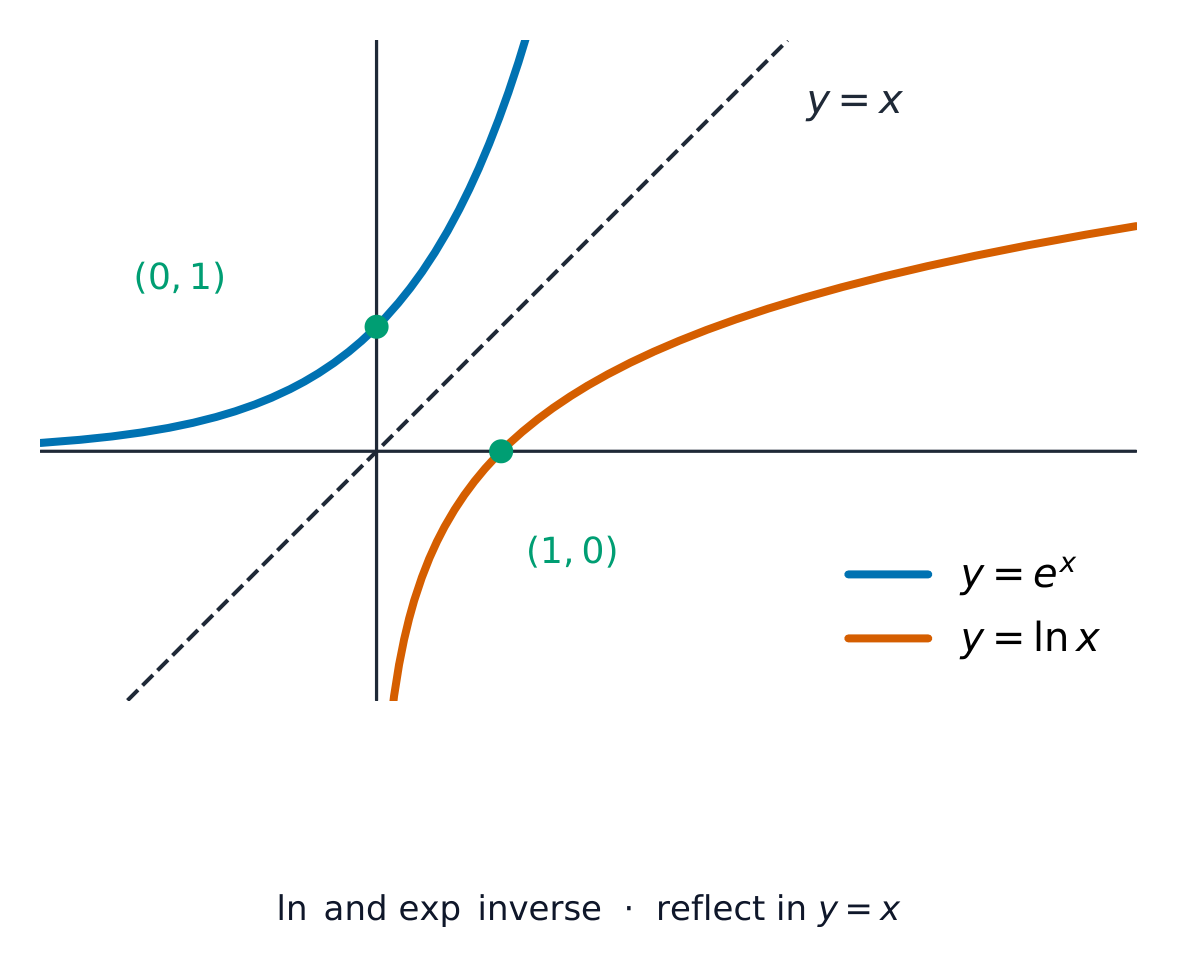
指数関数 $e^x$ と自然対数 $\ln x$ は逆関数なので、$\ln(e^x) = x$ および $e^{\ln x} = x$ です。未知数が指数にある場合は、両辺の対数を取ります。
** worked example(解法例)。** $4^x < 0.05$ を解け。
一次式形式: ⟨$y = Ax^n$⟩ のような関係式において、両辺の対数を取ると直線になります:$\ln y = \ln A + n\ln x$ 。$\ln y$ を横軸、$\ln x$ を縦軸にとると、傾きが $n$ 、切片が $\ln A$ の直線になり、未知定数を求めることができます。
y = a·bˣ
底 b を変更する:b > 1 の場合曲線は増加し、0 < b < 1 の場合減少する — また、常に点 (0, a) を通る。

| 受験者は以下のことをできること: | メモと例 |
|---|---|
| セカント, コセカント, コタンジェント関数がそれぞれコサイン, サイン, タンジェントとどのような関係にあるかを理解し、任意の角度に対する6つの三角関数の性質およびグラフを用いる。 | |
| 式の変形・正確な値の計算、方程式の解法に用いる三角恒等式を用い、文脈に適した恒等式を選択する。特に以下の利用に慣れていること: – $\sec^2 \theta \equiv 1 + \tan^2 \theta$ および $\csc^2 \theta \equiv 1 + \cot^2 \theta$ – $\sin(A \pm B)$, $\cos(A \pm B)$, $\tan(A \pm B)$ の展開式 – $\sin 2A$, $\cos 2A$, $\tan 2A$ の公式 – $a \sin \theta + b \cos \theta$ を $R \sin(\theta \pm \alpha)$ および $R \cos(\theta \pm \alpha)$ の形に表すこと。 | e.g. $\cos(x - 30^\circ) - 3 \sin(x - 60^\circ)$ の変形。 e.g. $\tan \theta + \cot \theta = 4$, $2 \sec^2 \theta - \tan \theta = 5$, $3 \cos \theta + 2 \sin \theta = 1$ の解法。 |
出典: Cambridge International シラバス
さらに3つの関数があります。これらは既知の関数の逆数です:セカント $\sec\theta = \dfrac{1}{\cos\theta}$ 、コセカント $\csc\theta = \dfrac{1}{\sin\theta}$ 、そしてコタンジェント $\cot\theta = \dfrac{1}{\tan\theta}$ です。
これらの三角恒等式を暗記し、問題に応じて適切なものを選択する必要があります。
** worked example.** $2\tan^2\theta + 3\sec\theta = 18$を $-180^\circ < \theta < 180^\circ$について解きます。
$\tan^2\theta$ を $\sec^2\theta - 1$ に置き換えて、1つの関数に変換します:
角度をドラッグして $\sin$、$\cos$、$\tan$ の関係を見る——三角方程式を解くための鍵である。
| English | 日本語 |
|---|---|
| secant/ˈsiːkənt/ | 正割 |
| cosecant/ˈkəʊsekənt/ | 余割 |
| cotangent/ˈkəʊtændʒənt/ | 余切 |
| trigonometric identities/ˌtrɪɡənəʊˈmetrɪk aɪˈdentɪtiz/ | 三角恒等式 |
| compound angle/ˈkɒmpaʊnd ˈæŋɡl/ | 合成角 |
| double angle/ˈdʌbl ˈæŋɡl/ | 倍角 |
| R-formula/ɑː ˈfɔːmjʊlə/ | R-公式 |
| product rule/ˈprɒdʌkt ruːl/ | 積の法則 |
| quotient rule/ˈkwəʊʃənt ruːl/ | 商の法則 |
| parametric equations/ˌpærəˈmetrɪk ɪˈkweɪʒnz/ | パラメータ方程式 |
| implicitly/ɪmˈplɪsɪtli/ | 暗黙的 |
| 受験者は以下のことをできること: | メモと例 |
|---|---|
| $e^x$, $\ln x$, $\sin x$, $\cos x$, $\tan x$ の導関数、定数倍、和、差、合成関数を用いる。 | |
| 積と商の微分を行う。 | e.g. $\frac{2x - 4}{3x + 2}$, $x^2 \ln x$, $x e^{1 - x^2}$。 |
| パラメータ表示または暗黙的に定義された関数の第一導関数を求め、用いる。 | 例: $x = t - e^{2t}$、$y = t + e^{2t}$。例: $x^2 + y^2 = xy + 7$。接線や法線を含む問題での使用を含む。 |
出典: Cambridge International シラバス
これらの標準的な微分係数を暗記してください。
2つの関数の積や商に対しては、以下を使います。
曲線がパラメータ方程式 $x = x(t)$ , $y = y(t)$ で与えられている場合、勾配は $\dfrac{dy}{dx} = \dfrac{dy/dt}{dx/dt}$ です。$y$ が明示的に解かれていない(変数として整理されていない)場合、$x$ について各項を微分し、$y$ に対して連鎖の法則を用いてから、$\dfrac{dy}{dx}$ について解きます。
worked example. ⟨$y = 6x\cos(x^2 + 1)$⟩ が与えられたとき、$\dfrac{dy}{dx}$ を求めよ。
$u = 6x$ と $v = \cos(x^2 + 1)$ について積の微分法則を使い($v$ については連鎖の法則を用いる):
y = ax³ + bx² + cx + d
点を動かす:その x における導関数は接線を表す。曲線が転換する地点では勾配はゼロである。
| 受験者は以下のことをできること: | メモと例 |
|---|---|
| '逆微分'の概念を $e^{ax + b}$, $\frac{1}{ax + b}$, $\sin(ax + b)$, $\cos(ax + b)$, $\sec^2(ax + b)$ の積分まで拡張する。置換積分の一般的な手法に関する知識は不要である。 | |
| 積分計算において三角関数的関係を用いる。 | e.g. 二重角の公式を用いて $\sin^2 x$ または $\cos^2(2x)$ を積分する場合。 |
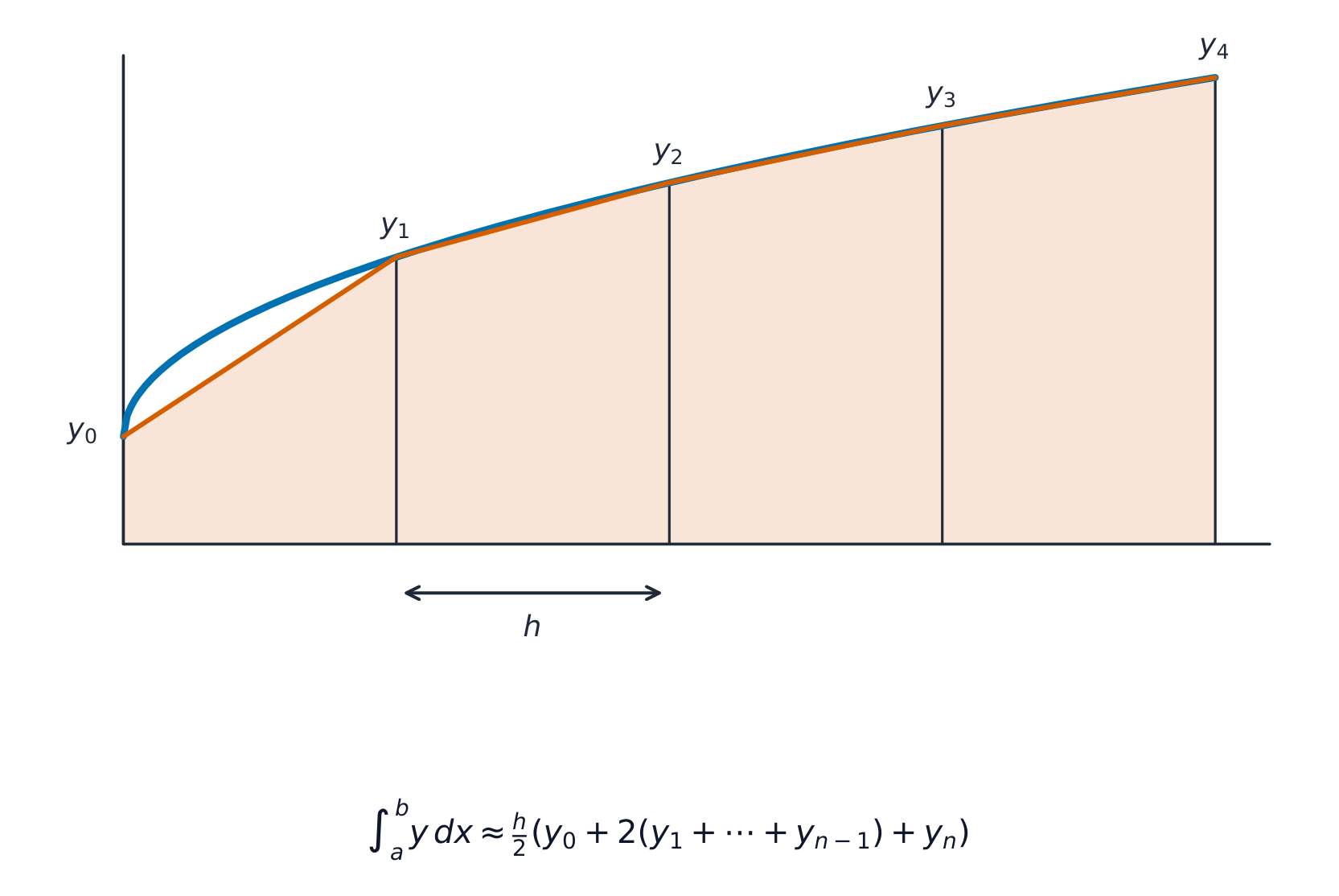
| 台形則を理解し、用它で定積分の値を推定する。 | 簡単なケースでは概略図を用いて、台形則による推定が過大評価か過小評価かを判定する場合も含む。 |
出典: Cambridge International シラバス
積分は微分の逆操作です。新しい微分結果をすべて逆にしていきます。難しい積分には置換積分(Pure 3で発展)が必要な場合があります。内部の線形関数が $(ax + b)$ の場合:
** worked example.** $\displaystyle\int 6\sin^2 x\,dx$ を求める。
$\sin^2 x = \tfrac12(1 - \cos 2x)$を使用します:
area = ∫ f(x) dx
積分は依然として面積を測ります。a と b をドラッグして、曲線下の帯の合計を求めなさい。
| English | 日本語 |
|---|---|
| trapezium rule/trəˈpiːzɪəm ruːl/ | 台形則 |
| root/ruːt/ | 根 |
| 受験者は以下のことをできること: | メモと例 |
|---|---|
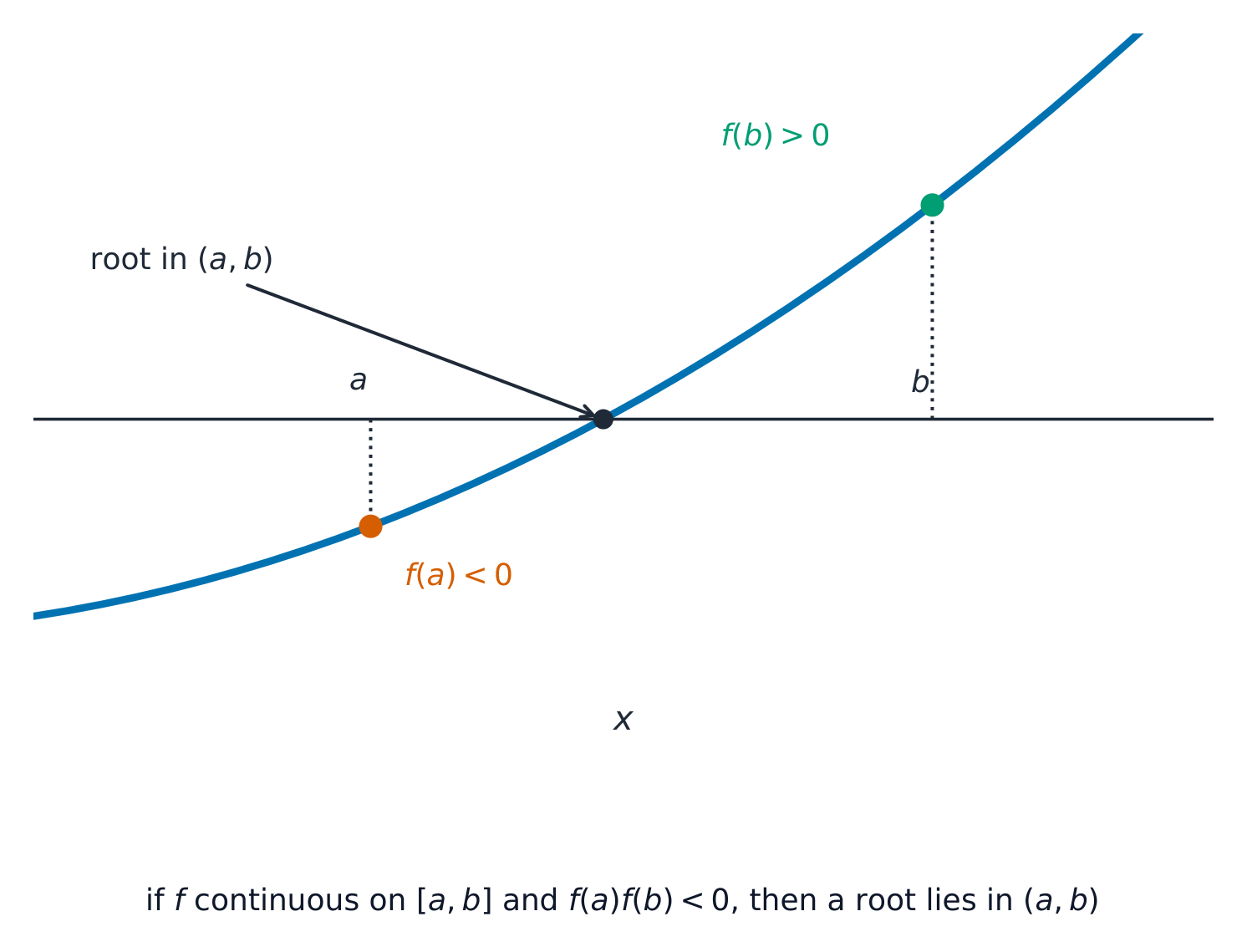
| 図形的考察および/または符号の変化の探索によって、方程式の根のおおよその位置を特定する。 | e.g. 根が含まれる連続する整数のペアを見つける場合。 |
| 方程式の根に収束する近似の列の概念を理解し、その表記を用いる。 | |
| $x_{n + 1} = \text{F}(x_n)$ のような形式的の simple 反復公式が解いている方程式とどのように関連しているかを理解し、与えられた反復、または方程式の変形に基づく反復を用いて、指定された精度で根を求める。 | 収束条件に関する知識は含まれないが、反復が収束しない可能性があることを理解することが期待される。 |
出典: Cambridge International シラバス
多くの方程式は正確に解くことができません。根(解)を見つけるための2つのアイデアがあります。
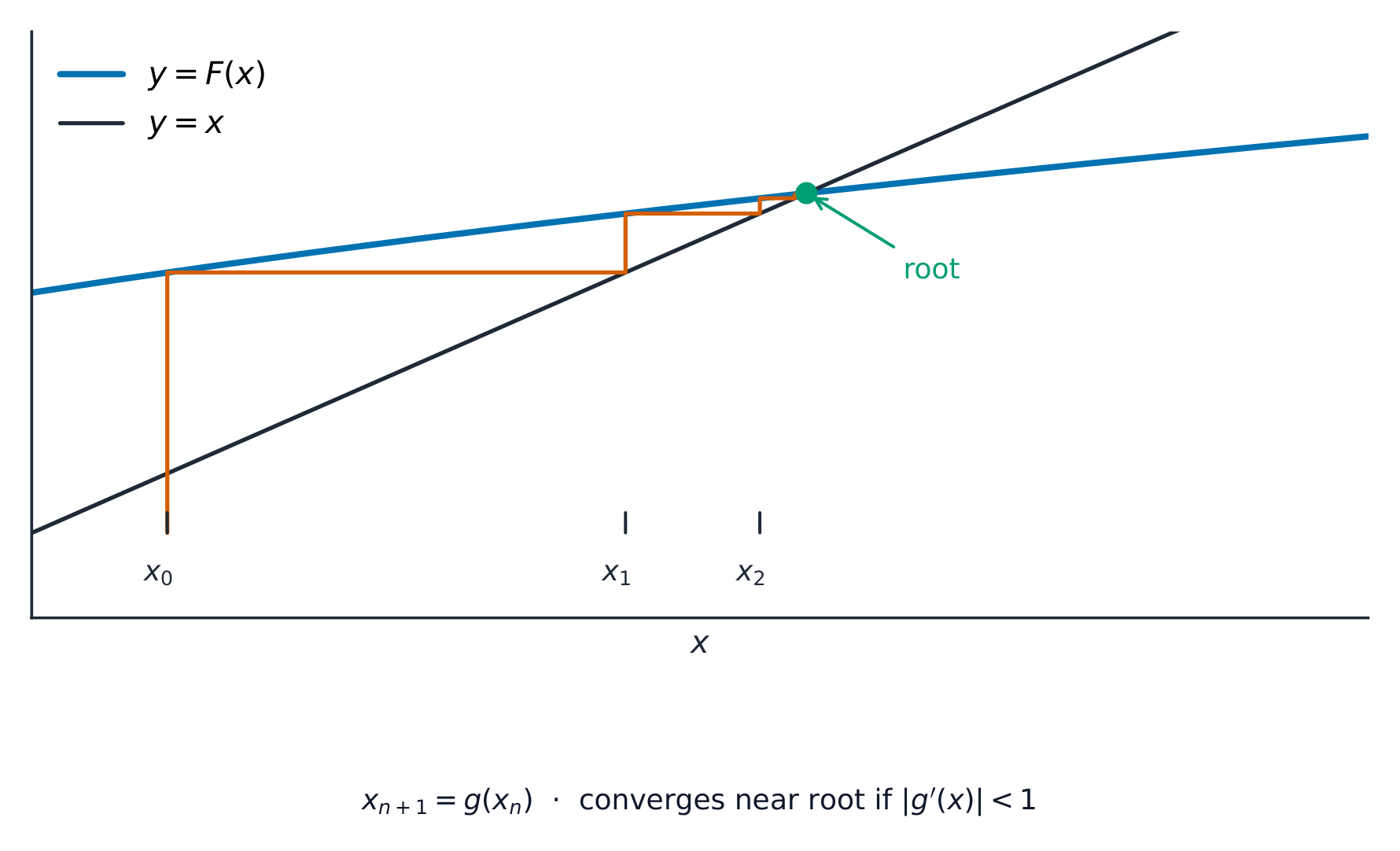
** worked example.** 方程式の根$\beta$は$x = \sqrt[3]{-2x - 4.5}$および$-1.4 < \beta < -1.0$を満たし、反復$x_{n+1} = \sqrt[3]{-2x_n - 4.5}$を$x_0 = -1.2$で用います。
y = ax³ + bx² + cx + d
根とは曲線がゼロと交差する点です。符号の変化がある場合、f(x) は2つのx値の間に根を閉じ込めます。
| English | 日本語 |
|---|---|
| sign change/saɪn tʃeɪndʒ/ | 符号の変化 |
| iteration/ˌɪtəˈreɪʃn/ | 反復 |
| iterative formula/ˈɪtərətɪv ˈfɔːmjʊlə/ | 反復公式 |
| converge/kənˈvɜːdʒ/ | 収束 |
| integration by substitution/ˌɪntɪˈɡreɪʃn baɪ ˌsʌbstɪˈtjuːʃn/ | 置換積分 |
This handout covers Topic 3: Pure Mathematics 纯数学 3. Subtopics 3.1–3.6 build on the algebra, logarithms, trigonometry, differentiation, integration and numerical methods of Pure Mathematics 2, so this handout explains what is new in Pure 3 and then covers the three big new areas: vectors, differential equations and complex numbers.
| Candidates should be able to: | Notes and examples |
|---|---|
| • understand the meaning of $|x|$, sketch the graph of $y = |ax + b|$ and use relations such as $|a| = |b| \iff a^2 = b^2$ and $|x - a| < b \iff a - b < x < a + b$ when solving equations and inequalities | Graphs of $y = |\text{f}(x)|$ and $y = \text{f}(|x|)$ for non-linear functions $\text{f}$ are not included. e.g. $|3x - 2| = |2x + 7|$, $2x + 5 < |x + 1|$. |
| • divide a polynomial, of degree not exceeding 4, by a linear or quadratic polynomial, and identify the quotient and remainder (which may be zero) | |
| • use the factor theorem and the remainder theorem | e.g. to find factors and remainders, solve polynomial equations or evaluate unknown coefficients. Including factors of the form $(ax + b)$ in which the coefficient of $x$ is not unity, and including calculation of remainders. |
| • recall an appropriate form for expressing rational functions in partial fractions, and carry out the decomposition, in cases where the denominator is no more complicated than – $(ax + b)(cx + d)(ex + f)$ – $(ax + b)(cx + d)^2$ – $(ax + b)(cx^2 + d)$ | Excluding cases where the degree of the numerator exceeds that of the denominator |
| • use the expansion of $(1 + x)^n$, where $n$ is a rational number and $|x| < 1$. | Finding the general term in an expansion is not included. Adapting the standard series to expand e.g. $(2 - \frac{1}{2}x)^{-1}$ is included, and determining the set of values of $x$ for which the expansion is valid in such cases is also included. |
出典: Cambridge International シラバス
Two new tools join the algebra from Pure 2.
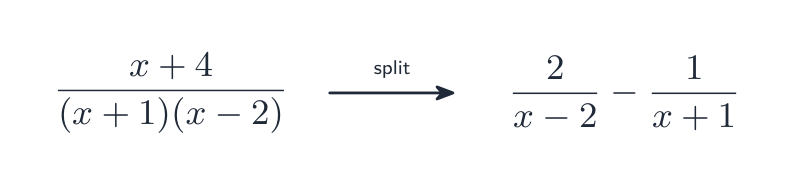
A single fraction with a factorised bottom can be split into a sum of simpler fractions. This is called writing it in partial fractions 部分分式, and it makes a rational function 有理函数 (a fraction of polynomials) easy to integrate or expand. Match the form to the bottom:
First check the top is lower degree than the bottom. If it is not ("top-heavy"), divide the polynomial first: dividing gives a quotient 商 plus a remainder 余数 over the original bottom, and you split only that remaining proper fraction.
One fraction with a factorised bottom splits into a sum of simpler fractions.
Worked example. Express $\dfrac{x+4}{(x+1)(x-2)}$ in partial fractions.
Write $\dfrac{x+4}{(x+1)(x-2)} = \dfrac{A}{x+1} + \dfrac{B}{x-2}$, so $x + 4 = A(x-2) + B(x+1)$. Put $x = 2$: $6 = 3B$, so $B = 2$. Put $x = -1$: $3 = -3A$, so $A = -1$. Hence
The binomial expansion 二项展开式 also works when the power is a fraction or is negative, as long as $|x| < 1$:
y = a/(x − b) + c
部分分数分解は、複雑な分数を単純な逆数の要素に分割します。各要素には垂直および水平な漸近線があります。
| English | 日本語 |
|---|---|
| Pure Mathematics/pjʊə ˌmæθɪˈmætɪks/ | 純数学 |
| partial fractions/ˈpɑːʃl ˈfrækʃnz/ | 部分分数 |
| rational function/ˈræʃənl ˈfʌŋkʃn/ | 有理関数 |
| quotient/ˈkwəʊʃənt/ | 商 |
| remainder/rɪˈmeɪndə/ | 余数 |
| binomial expansion/baɪˈnəʊmɪəl ekˈspænʃn/ | 二項展開式 |
| Candidates should be able to: | Notes and examples |
|---|---|
| understand the relationship between logarithms and indices, and use the laws of logarithms (excluding change of base) | |
| understand the definition and properties of $e^x$ and $\ln x$, including their relationship as inverse functions and their graphs | Including knowledge of the graph of $y = e^{kx}$ for both positive and negative values of $k$. |
| use logarithms to solve equations and inequalities in which the unknown appears in indices | e.g. $2^x < 5$, $3 \times 2^{3x-1} < 5$, $3^{x+1} = 4^{2x-1}$. |
| use logarithms to transform a given relationship to linear form, and hence determine unknown constants by considering the gradient and/or intercept. | e.g. $y = kx^n$ gives $\ln y = \ln k + n \ln x$ which is linear in $\ln x$ and $\ln y$. $y = k(a^x)$ gives $\ln y = \ln k + x \ln a$ which is linear in $x$ and $\ln y$. |
| 受験者は以下のことをできること: | メモと例 |
|---|---|
| セカント, コセカント, コタンジェント関数がそれぞれコサイン, サイン, タンジェントとどのような関係にあるかを理解し、任意の角度に対する6つの三角関数の性質およびグラフを用いる。 | |
| 式の変形・正確な値の計算、方程式の解法に用いる三角恒等式を用い、文脈に適した恒等式を選択する。特に以下の利用に慣れていること: – $\sec^2 \theta \equiv 1 + \tan^2 \theta$ および $\cosec^2 \theta \equiv 1 + \cot^2 \theta$ – $\sin(A \pm B)$, $\cos(A \pm B)$, $\tan(A \pm B)$ の展開式 – $\sin 2A$, $\cos 2A$, $\tan 2A$ の公式 – $a \sin \theta + b \cos \theta$ を $R \sin(\theta \pm \alpha)$ および $R \cos(\theta \pm \alpha)$ の形に表すこと。 | e.g. $\cos(x - 30^\circ) - 3 \sin(x - 60^\circ)$ の変形。 e.g. $\tan \theta + \cot \theta = 4$, $2 \sec^2 \theta - \tan \theta = 5$, $3 \cos \theta + 2 \sin \theta = 1$ の解法。 |
| 受験者は以下のことをできること: | メモと例 |
|---|---|
| • 図形的考察および/または 符号の変化の探索によって、方程式の 根を概算する。 | 例:根が含まれる連続する整数のペアを見つける。 |
| • 方程式の根に 収束する近似列の概念を理解し、その表記法を使用する | |
| • $x_{n+1} = \text{F}(x_n)$ の形をした与えられた簡単な 反復公式 が解いている方程式とどのように関連しているかを理解し、与えられた 反復計算 または方程式の変形に基づく反復を用いて、指定された精度での根を求める。 | 収束のための条件に関する知識は含まれないが、反復計算が収束しないことがあるという理解が期待される。 |
出典: Cambridge International シラバス
Subtopics 3.2, 3.3 and 3.6 are the same skills you met in Pure 2: the laws of logarithms with $e^x$ and $\ln x$; the identities $\sec^2\theta \equiv 1 + \tan^2\theta$ and $\csc^2\theta \equiv 1 + \cot^2\theta$, the compound- and double-angle formulae, and the $R$-form of $a\sin\theta + b\cos\theta$; and solving an equation numerically by a sign change 变号 and an iterative formula 迭代公式 $x_{n+1} = F(x_n)$. Use them exactly as before.
The three new trig functions are the reciprocals 倒数 of the familiar ones: the secant 正割 $\sec\theta = \dfrac{1}{\cos\theta}$, the cosecant 余割 $\csc\theta = \dfrac{1}{\sin\theta}$, and the cotangent 余切 $\cot\theta = \dfrac{1}{\tan\theta} = \dfrac{\cos\theta}{\sin\theta}$. (Memory aid: match the third letter — sec goes with cosine.) The two Pythagorean identities above come straight from dividing $\sin^2\theta + \cos^2\theta \equiv 1$ by $\cos^2\theta$ or $\sin^2\theta$. For a numerical method, an iteration $x_{n+1}=F(x_n)$ converges 收敛 to the root when successive values get closer together.
(cos θ, sin θ)
R公式は a sin θ + b cos θ を一つの波形として書き換えます。これらはすべてこの円上に存在します。
| English | 日本語 |
|---|---|
| sign change/saɪn tʃeɪndʒ/ | 符号の変化 |
| iterative formula/ˈɪtərətɪv ˈfɔːmjʊlə/ | 反復公式 |
| reciprocals/rɪˈsɪprəklz/ | 逆数 |
| secant/ˈsiːkənt/ | 正割 |
| cosecant/ˈkəʊsekənt/ | 余割 |
| cotangent/ˈkəʊtændʒənt/ | 余切 |
| converges/kənˈvɜːdʒɪz/ | 収束する |
| 受験者は以下のことをできること: | メモと例 |
|---|---|
| $e^x$, $\ln x$, $\sin x$, $\cos x$, $\tan x$, $\tan^{-1} x$ の導関数、定数倍、和、差、合成を用いる。 | $\sin^{-1} x$ および $\cos^{-1} x$ の導関数は必要ない。 |
| 積と商の微分を行う。 | e.g. $\frac{2x - 4}{3x + 2}$, $x^2 \ln x$, $x e^{1-x^2}$。 |
| 関数のパラメータ表示または暗黙的定義における第一微分値を求め、用いる。 | 例:$x = t - e^{2t}$, $y = t + e^{2t}$。例:$x^2 + y^2 = xy + 7$。接線や法線に関する問題での使用を含む。 |
出典: Cambridge International シラバス
The methods are those of Pure 2 (the product, quotient and chain rules, with parametric and implicit curves). One derivative is added — the inverse tangent 反正切:
Worked example. Differentiate $y = \tan^{-1}(3x)$.
Use the chain rule with the result above: $\dfrac{dy}{dx} = \dfrac{1}{1 + (3x)^2} \times 3 = \dfrac{3}{1 + 9x^2}.$
勾配 = dy/dx
暗黙的かどうかにかかわらず、導関数は依然として接線の傾きです。点をスライドさせて確認してください。
| English | 日本語 |
|---|---|
| inverse tangent/ɪnˈvɜːs ˈtændʒənt/ | 逆正接 |
| Candidates should be able to: | Notes and examples |
|---|---|
| extend the idea of 'reverse differentiation' to include the integration of $e^{ax + b}$, $\frac{1}{ax + b}$, $\sin(ax + b)$, $\cos(ax + b)$, $\sec^2(ax + b)$ and $\frac{1}{x^2 + a^2}$ | Including examples such as $\frac{1}{2 + 3x^2}$. |
| use trigonometrical relationships in carrying out integration | e.g. use of double-angle formulae to integrate $\sin^2 x$ or $\cos^2(2x)$. |
| integrate rational functions by means of decomposition into partial fractions | Restricted to types of partial fractions as specified in topic 3.1 above. |
| recognise an integrand of the form $\frac{k f'(x)}{f(x)}$, and integrate such functions | e.g. integration of $\frac{x}{x^2 + 1}$, $\tan x$. |
| recognise when an integrand can usefully be regarded as a product, and use integration by parts | e.g. integration of $x \sin 2x$, $x^2 e^{-x}$, $\ln x$, $x \tan^{-1} x$. |
| use a given substitution to simplify and evaluate either a definite or an indefinite integral. | e.g. to integrate $\sin^2 2x \cos x$ using the substitution $u = \sin x$. |
出典: Cambridge International シラバス
Pure 3 adds several powerful methods.
Worked example. Find $\displaystyle\int x\cos x\,dx$.
Use integration by parts with $u = x$ and $\dfrac{dv}{dx} = \cos x$, so $\dfrac{du}{dx} = 1$ and $v = \sin x$:
area = ∫ f(x) dx
すべての積分方法はこの面積を測るものであり、区間を動かして合計します。
| English | 日本語 |
|---|---|
| Integration by parts/ˌɪntɪˈɡreɪʃn baɪ pɑːts/ | 部分積分 |
| Integration by substitution/ˌɪntɪˈɡreɪʃn baɪ ˌsʌbstɪˈtjuːʃn/ | 置換積分 |

| 受験者は以下のことをできること: | メモと例 |
|---|---|
| • ベクトルの標準的な表記法、すなわち $\begin{pmatrix} x \\ y \end{pmatrix}$, $x\mathbf{i} + y\mathbf{j}$, $\begin{pmatrix} x \\ y \\ z \end{pmatrix}$, $x\mathbf{i} + y\mathbf{j} + z\mathbf{k}$, $\overrightarrow{AB}$, $\mathbf{a}$ を使用する | |
| • ベクトルの加算と減算、スカラーによるベクトルの乗算を行い、これらの操作を幾何学的に解釈する | 例: ‘$OABC$ は平行四辺形である’ という命題は $\overrightarrow{OB} = \overrightarrow{OA} + \overrightarrow{OC}$ と等価である。比の定理の一般形は含まれないが、$AB$ の中点の位置ベクトルが $\frac{1}{2}(\overrightarrow{OA} + \overrightarrow{OB})$ であることを理解することが期待される。 |
| • ベクトルの 大きさを計算し、単位ベクトル、変位ベクトル、位置ベクトルを使用する | 2次元または3次元において。 |
| • 直線の方程式が $\mathbf{r} = \mathbf{a} + t\mathbf{b}$ の形式で表される際に用いられるすべての記号の意味を理解し、十分な情報を与えられた場合に直線の方程式を求める | e.g. 直線上の一点の位置ベクトルと方向ベクトルが与えられている場合や、直線上の2点の位置ベクトルが与えられている場合に、直線の方程式を求める。 |
| • 2本の直線が 平行か、交わるか、ねじれているかを判定し、交点が存在する場合その点を見つける | 2本のねじれ直線間の最短距離の計算は不要である。2本のねじれ直線の共通垂線の方程式を求めることも不要である。 |
| • 2つのベクトルの 内積を計算するための公式を使用し、直線や点に関する問題に内積を用いる。 | 例: 2本の直線間の角度を求めること、ある点から直線への垂線の足を見つけること; 長方形、四面体(ピラミッド)などの3D物体を含む問題となる場合がある。外積に関する知識は不要である。 |
出典: Cambridge International シラバス
A vector 向量 has both size and direction. Write it as a column, or as $x\mathbf{i} + y\mathbf{j} + z\mathbf{k}$, or as $\overrightarrow{AB}$.
A straight line through point $\mathbf{a}$ in direction $\mathbf{b}$ has vector equation $\mathbf{r} = \mathbf{a} + t\mathbf{b}$. Two lines may be parallel 平行, may intersect 相交 at a point, or may be skew lines 异面直线 (not parallel and never meeting).

The scalar product 数量积 (dot product) of $\mathbf{a}$ and $\mathbf{b}$ is

Worked example. Find the angle between $\mathbf{a} = \mathbf{i} + 2\mathbf{j} + 2\mathbf{k}$ and $\mathbf{b} = 2\mathbf{i} + 2\mathbf{j} + \mathbf{k}$.
2つのベクトルをドラッグする。合成ベクトル(先尾接続)と内積(垂直ならゼロ)を見る。
| English | 日本語 |
|---|---|
| vector/ˈvektə/ | ベクトル |
| magnitude/ˈmæɡnɪtjuːd/ | 大きさ |
| unit vector/ˈjuːnɪt ˈvektə/ | 単位ベクトル |
| position vector/pəˈzɪʃn ˈvektə/ | 位置ベクトル |
| displacement vector/dɪˈspleɪsmənt ˈvektə/ | 変位ベクトル |
| scalar/ˈskeɪlə/ | スカラー |
| parallel/ˈpærəlel/ | 平行 |
| intersect/ˌɪntəˈsekt/ | 交差する |
| skew lines/skjuː laɪnz/ | 異面直線 |
| scalar product/ˈskeɪlə ˈprɒdʌkt/ | 内積 |

| 受験者は以下のことをできること: | メモと例 |
|---|---|
| 変化率を含む単純な文脈を 微分方程式として構成する | 必要に応じて比例定数の導入と評価も含まれる。 |
| 変数分離可能な 一次微分方程式の一般解を積分によって求める | 上記のトピック 3.5 に含まれる任意の積分技法を含む。 |
| 初期条件を用いて 特解を求める | |
| 方程式によってモデル化されている問題の文脈において、微分方程式の解を解釈する。 | 微分方程式が‘現実の’状況をモデル化するために使われる場合、その文脈に関する専門的な知識は必要ない。 |
出典: Cambridge International シラバス
A differential equation 微分方程 links a quantity to its rate of change. To solve a first-order equation whose variables are separable 可分离变量, put all the $y$ terms on one side and all the $x$ terms on the other, then integrate both sides. This gives the general solution 通解, which contains a constant. An initial condition 初始条件 (a known value) fixes the constant and gives the particular solution 特解.
Worked example. Solve $\dfrac{dy}{dx} = xy$, given that $y = 1$ when $x = 0$.
Separate the variables and integrate:
各小さな線分はその地点での勾配 $\frac{dy}{dx}$ を示す。解曲線は矢印に従って進む——始点を変えると異なる曲線が得られる。
| English | 日本語 |
|---|---|
| differential equation/ˌdɪfəˈrenʃl ɪˈkweɪʒn/ | 微分方程式 |
| separable/ˈsepərəbl/ | 変数分離可能 |
| general solution/ˈdʒenərəl səˈluːʃn/ | 一般解 |
| initial condition/ɪˈnɪʃl kənˈdɪʃn/ | 初期条件 |
| particular solution/pəˈtɪkjʊlə səˈluːʃn/ | 特解 |

| 受験者は以下のことをできること: | メモと例 |
|---|---|
| 複素数の概念を理解し、実部、虚部、絶対値、偏角、共役複素数の用語の意味を思い出し、2つの複素数が等しいのは両方の実部と虚部が等しい場合のみであることを用いる | 表記 $\text{Re } z$, $\text{Im } z$, $|z|$, $\arg z$, $z^*$ を知っているべきである。複素数の偏角は通常、$\theta$ であり $-\pi < \theta \leqslant \pi$ である角度を指すが、場合によっては区間 $0 \leqslant \theta < 2\pi$ の方が便利なこともある。問題で特に指定がない限り、どちらの区間を用いた答えでもよい。 |
| カルテシアン座標形式 $x + \text{i}y$ で表された2つの複素数の加算、減算、乗算、除算を行う | 乗算または除算を含む計算については、計算過程の完全な詳細を示す必要がある。 |
| 実係数多項方程式において、非実の根は常に共役な対として現れるという結果を用いる | 例:立方方程式や四次方程式を解く際、ある複素根が与えられている場合。 |
| アルグアン図を用いて複素数を幾何学的に表現する | |
| 極形式 $r(\cos \theta + \text{i}\sin \theta) \equiv r\text{e}^{\text{i}\theta}$ で表された2つの複素数の乗算と除算を行う | 結果 $|z_1 z_2| = |z_1||z_2|$ と $\arg(z_1 z_2) = \arg(z_1) + \arg(z_2)$ 、およびそれに対応する除算の結果を含む。 |
| 複素数の2つの 平方根を求める | 例: 正確なカルテシアン座標形式での $5 + 12\text{i}$ の平方根。計算過程の完全な詳細を示す必要がある。 |
| 複素数の共役、および2つの複素数の加算、減算、乗算、除算の幾何学的効果について、単純な説明で理解する | |
| アルグアン図における 軌跡を用いて、複素数を含む単純な方程式や不等式を図示する | 例: $|z - a| < k$, $|z - a| = |z - b|$, $\arg(z - a) = \alpha$ 。 |
出典: Cambridge International シラバス
A complex number 复数 has the form $z = x + iy$, where $i^2 = -1$. Here $x$ is the real part 实部 and $y$ is the imaginary part 虚部. This $x + iy$ is the Cartesian form 直角坐标形式. Two complex numbers are equal only when their real parts match and their imaginary parts match.

To divide, multiply top and bottom by the conjugate of the bottom.
Worked example. Write $\dfrac{3 + i}{1 - i}$ in the form $x + iy$.
An equation or inequality in $z$ describes a locus 轨迹 (a path or region) on the Argand diagram. For example $|z - a| = r$ is a circle of radius $r$ centred at $a$.

点をドラッグする。複素数 $a + bi$ は平面上の点であり、その絶対値は原点からの距離、偏角は角度である。
| English | 日本語 |
|---|---|
| complex number/ˈkɒmpleks ˈnʌmbə/ | 複素数 |
| real part/rɪəl pɑːt/ | 実部 |
| imaginary part/ɪˈmædʒɪnəri pɑːt/ | 虚部 |
| Cartesian form/kɑːˈtiːzɪən fɔːm/ | 直交座標形式 |
| conjugate/ˈkɒndʒuːɡeɪt/ | 共役 |
| modulus/ˈmɒdjʊləs/ | 絶対値 |
| argument/ˈɑːɡjuːmənt/ | 偏角 |
| Argand diagram/ˈɑːɡænd ˈdaɪəɡræm/ | アルガンド図 |
| polar form/ˈpəʊlə fɔːm/ | 極座標形式 |
| locus/ˈləʊkəs/ | 軌跡 |
This handout covers Topic 4: Mechanics 力学. It studies how forces make objects move. Throughout this topic, take the acceleration of free fall as $g = 10\ \text{m s}^{-2}$.
| 受験者は以下のことをできること: | メモと例 |
|---|---|
| 与えられた状況で作用する力を同定する | 例: 力の図を描くことで。 |
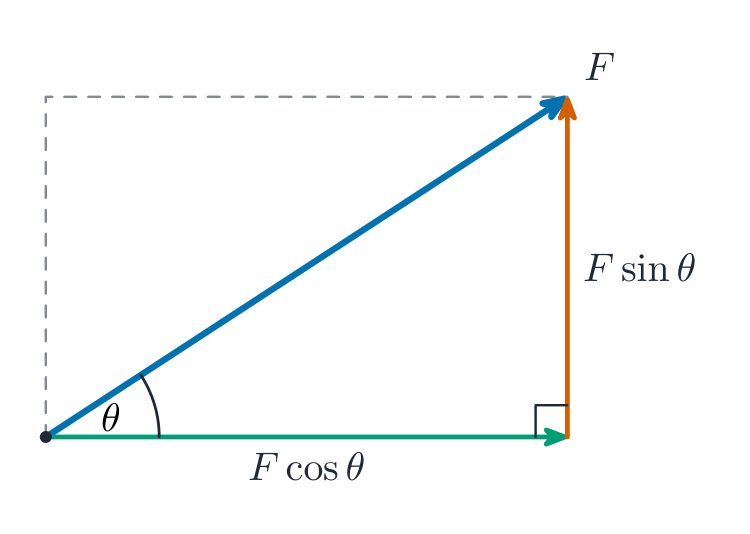
| 力のベクトル性を理解し、成分と合成を求め、適用する | 計算が常に要求され、スケール図による近似解は不要である。 |
| 粒子が平衡状態にある場合、作用する力のベクトル和がゼロになる、あるいは等価的に、いかなる方向の成分和もゼロになるという原理を用いる | 分解による解答が通常期待されるが、同等の方法(例:力の三角形、ラミーの定理、適切な場合)も許容される;これらの他の方法は必須知識ではなく、問題文中で言及されない。 |
| 2つの表面間の接触力が、法線成分と摩擦成分の2つの成分として表せることを理解する | |
| '滑らかな'接触のモデルを使用し、このモデルの限界を理解する | |
| 限界摩擦力および限界平衡の概念を理解し、摩擦係数の定義を recall し、適切に応じて $F = \mu R$ または $F \leqslant \mu R$ の関係式を用いる | 問題文において「すべりかけ」は「限界平衡状態」を意味する場合がある。 |
| ニュートンの第三法則を用いる。 | 例:地面に作用する粒子の力と、粒子に作用する地面の力は、大きさが等しく向きが逆向きである。 |
出典: Cambridge International シラバス
A force 力 is a push or a pull. It is a vector, so it has size and direction. Because it is a vector, you can split a force into components 分量 (usually horizontal and vertical), and you can add several forces into one resultant 合力.
A particle is in equilibrium 平衡 when the forces are balanced: the vector sum of the forces is zero. In practice this means the components in any direction add to zero.

When two surfaces touch, the contact force 接触力 between them has two parts: the normal reaction 法向反作用力 $R$, at right angles to the surface, and the friction 摩擦力 $F$, along the surface, which opposes sliding. A "smooth" surface is a model with no friction.
Friction can only grow up to a maximum. At that maximum the body is in limiting equilibrium 极限平衡, about to slip, and the friction is limiting friction 最大静摩擦力. The maximum is set by the coefficient of friction 摩擦系数 $\mu$:

By Newton's third law 牛顿第三定律, the two surfaces push on each other with equal and opposite forces.
Worked example. A block of weight $20\text{ N}$ rests on a rough horizontal table with coefficient of friction $\mu = 0.4$. Find the largest horizontal force that can be applied before the block slides.
The table's normal reaction balances the weight, so $R = 20\text{ N}$. The block is on the point of slipping when friction reaches its maximum $F = \mu R = 0.4 \times 20 = 8\text{ N}$. In equilibrium the applied force equals the friction, so the largest force it can resist is $8\text{ N}$.
合力 = a + b
力は頭から尾へ足されます。釣合にあるのは合力がゼロのときです。
| English | 日本語 |
|---|---|
| Mechanics/mɪˈkænɪks/ | 力学 |
| force/fɔːs/ | 力 |
| components/kəmˈpəʊnənts/ | 成分 |
| resultant/rɪˈzʌltənt/ | 合力 |
| equilibrium/ˌiːkwɪˈlɪbrɪəm/ | 平衡 |
| contact force/ˈkɒntækt fɔːs/ | 接触力 |
| normal reaction/ˈnɔːml rɪˈækʃn/ | 法線反力 |
| friction/ˈfrɪkʃn/ | 摩擦力 |
| limiting friction/ˈlɪmɪtɪŋ ˈfrɪkʃn/ | 最大静止摩擦力 |
| coefficient of friction/ˌkəʊɪˈfɪʃənt ɒv ˈfrɪkʃn/ | 摩擦係数 |
| Newton's third law/ˈnjuːtnz θɜːd lɔː/ | ニュートンの第三法則 |
| limiting equilibrium/ˈlɪmɪtɪŋ ˌiːkwɪˈlɪbrɪəm/ | 限界平衡 |

| 受験者は以下のことをできること: | メモと例 |
|---|---|
| 距離および速さがスカラー量であり、変位、速度、加速度がベクトル量であることを理解する | 1次元の運動のみを範囲とする。「減速」という用語は、 sometimes 速度が減少する文脈で使用されることがある。 |
| 変位-時間グラフおよび速度-時間グラフを描き解釈し、特に以下の点に留意する – 速度-時間グラフの下の面積は変位を表す – 変位-時間グラフの傾きは速度を表す – 速度-時間グラフの傾きは加速度を表す | |
| 時間に対する微分および積分を用いて、変位、速度、加速度に関する簡単な問題を解く | 必要な微積分の技法は、Paper 1: Pure Mathematics 1 の内容から限定される。 |
| 直線運動における一定の加速度を持つ運動に適切な公式を用いる。 | 問題では、異なる粒子の運動に関する情報を用いて複数の方程式を立てる必要があるかもしれない。 |
出典: Cambridge International シラバス
Distance 距离 and speed 速率 are scalars (size only). Displacement 位移, velocity 速度 and acceleration 加速度 are vectors (size and direction).
On a velocity-time graph 速度时间图, the area under the graph is the displacement and the gradient is the acceleration (a negative acceleration is a deceleration 减速度). On a displacement-time graph, the gradient is the velocity. More generally, differentiate with respect to time to go from displacement to velocity to acceleration, and integrate to go back.
For motion with constant acceleration 匀加速, use these formulae (the "suvat" equations):
Worked example. A car starts from rest and accelerates at $2.5\ \text{m s}^{-2}$ for $4\ \text{s}$. Find its speed and the distance travelled.
初期速度と加速度を変更する。勾配は加速度、直線下の面積は変位である。
| English | 日本語 |
|---|---|
| distance/ˈdɪstəns/ | 距離 |
| speed/spiːd/ | 速率 |
| displacement/dɪˈspleɪsmənt/ | 変位 |
| velocity/vəˈlɒsɪti/ | 速度 |
| acceleration/əkˌseləˈreɪʃn/ | 加速度 |
| velocity-time graph/vəˈlɒsɪti taɪm ɡræf/ | 速度-時間図 |
| constant acceleration/ˈkɒnstənt əkˌseləˈreɪʃn/ | 等加速度 |
| deceleration/dɪˌseləˈreɪʃn/ | 減速 |

| 受験者は以下のことをできること: | メモと例 |
|---|---|
| 直線運動量の定義を用い、そのベクトル性を示して理解する | 1次元の運動のみを範囲とする。 |
| 直線運動量の保存則を用いて、2つの物体の直接衝突としてモデル化できる問題を解く。 | 衝突時に合体する場合を含む2つの物体の直接衝突を含む。インパルスや反発係数の知識は不要である。 |
出典: Cambridge International シラバス
The linear momentum 动量 of a body is $\text{mass} \times \text{velocity}$. It is a vector. In a direct collision of two bodies, the total momentum is unchanged. This is the conservation of linear momentum 动量守恒:

Worked example. A body of mass $2\ \text{kg}$ moving at $3\ \text{m s}^{-1}$ hits a stationary body of mass $1\ \text{kg}$, and they stick together. Find their common speed afterwards.
各質量と速度を設定して衝突させる。前後を通じて全体的な運動量は一定である。
| English | 日本語 |
|---|---|
| momentum/məʊˈmentəm/ | 運動量 |
| conservation of momentum/ˌkɒnsəˈveɪʃn ɒv məʊˈmentəm/ | 運動量の保存 |

| Candidates should be able to: | Notes and examples |
|---|---|
| • apply Newton’s laws of motion to the linear motion of a particle of constant mass moving under the action of constant forces, which may include friction, tension in an inextensible string and thrust in a connecting rod | If any other forces resisting motion are to be considered (e.g. air resistance) this will be indicated in the question. |
| • use the relationship between mass and weight | $W = mg$. In this component, questions are mainly numerical, and use of the approximate numerical value $10\text{ (ms}^{-2}\text{)}$ for $g$ is expected. |
| • solve simple problems which may be modelled as the motion of a particle moving vertically or on an inclined plane with constant acceleration | Including, for example, motion of a particle on a rough plane where the acceleration while moving up the plane is different from the acceleration while moving down the plane. |
| • solve simple problems which may be modelled as the motion of connected particles. | e.g. particles connected by a light inextensible string passing over a smooth pulley, or a car towing a trailer by means of either a light rope or a light rigid tow-bar. |
出典: Cambridge International シラバス
Newton's laws of motion 牛顿运动定律 connect force and acceleration. The key one is: resultant force $=$ mass 质量 $\times$ acceleration,
For motion on an inclined plane 斜面, split each force into a part along the slope and a part at right angles to it, then apply $F = ma$ along the slope. For connected particles 连接质点 (joined by a string), apply $F = ma$ to each body, or to the whole system.
Worked example. A block of mass $12\ \text{kg}$ is pulled up a rough plane by a rope parallel to the slope. The plane is at $20^\circ$ to the horizontal, the coefficient of friction is $0.4$, and the acceleration is $2\ \text{m s}^{-2}$. Find the tension in the rope.
The normal reaction is $R = mg\cos 20^\circ = 120\cos 20^\circ = 112.8\ \text{N}$, so the friction is $F = \mu R = 0.4 \times 112.8 = 45.1\ \text{N}$. Along the slope, $T - mg\sin 20^\circ - F = ma$:
F = ma
合力が加速度を生じさせる。釣り合う力⇒加速度なし。
| English | 日本語 |
|---|---|
| Newton's laws of motion/ˈnjuːtnz lɔːz ɒv ˈməʊʃn/ | ニュートンの運動の法則 |
| mass/mæs/ | 質量 |
| weight/weɪt/ | 重力 |
| tension/ˈtenʃn/ | 張力 |
| inclined plane/ɪnˈklaɪnd pleɪn/ | 斜面 |
| connected particles/kəˈnektɪd ˈpɑːtɪklz/ | 接続質点 |
| thrust/θrʌst/ | 推進力 |
| air resistance/eə rɪˈzɪstəns/ | 空気抵抗 |

| 受験者は以下のことをできること: | メモと例 |
|---|---|
| • 力がなした仕事の概念を理解し、その作用点が力とは平行でない変位を受ける場合に一定の力がなした仕事を計算する | $W = Fd \cos \theta$;内積の使用は不要である。 |
| • 重力位置エネルギーおよび運動エネルギーの概念を理解し、適切な公式を用いる | |
| • 系の変化におけるエネルギーの変化と外力がなした仕事の間の関係を理解・適用し、必要に応じてエネルギー保存則を用いる | 運動が直線ではない場合(例:滑らかな曲線の「滑り台」上の子供)を含み、全体としてのエネルギー変化のみを考慮すればよい場合。 |
| 出力の定義(力が仕事をなす速さ)を用い、運動方向に作用する力に対する出力、力、速度の間の関係を用いる | (平均)出力の計算として $$\frac{\text{Work done}}{\text{Time taken}}$$ $P = Fv$ を含む。 |
| 例として、坂道を進む自動車の瞬間的な加速度や抵抗力を含む問題を解く。 |
出典: Cambridge International シラバス
The work done 功 by a constant force is the scalar product of force and displacement — the force times the distance moved in the direction of the force: $W = Fd\cos\theta$, where $\theta$ is the angle between the force and the motion. Work is measured in joules (J).
Energy comes in forms you can calculate:
The work done by the outside forces equals the change in the total energy. When no friction acts, the total energy stays the same — the conservation of energy 能量守恒.
Power 功率 is the rate of doing work. For a force pulling in the direction of motion, $P = Fv$ (power $=$ force $\times$ velocity). Power is measured in watts (W).
Worked example. A car engine works at $12\ \text{kW}$ while the car moves at $20\ \text{m s}^{-1}$ on a level road. Find the driving force.
物体を落下させ、エネルギーの変換を観察する。摩擦がない場合、下降中全体を通してGPE + KE は一定である。
| English | 日本語 |
|---|---|
| work done/wɜːk dʌn/ | 仕事 |
| kinetic energy/kɪˈnetɪk ˈenədʒi/ | 運動エネルギー |
| gravitational potential energy/ˌɡrævɪˈteɪʃənl pəˈtenʃl ˈenədʒi/ | 重力位置エネルギー |
| conservation of energy/ˌkɒnsəˈveɪʃn ɒv ˈenədʒi/ | エネルギーの保存 |
| power/ˈpaʊə/ | 仕事率 |
This handout covers Topic 5: Probability & Statistics 概率统计 1. It is about describing data, counting choices, and working out the chance of events.

| 受験者は以下のことをできること: | メモと例 |
|---|---|
| • 生統計データを提示する適切な方法を選択し、特定の表示方法の利点および/または欠点を議論する | |
| 茎葉図、箱ひげ図、ヒストグラム、累積頻度曲線を描き解釈する | バック・トゥ・バック茎葉図を含む。 |
| 集中傾向(平均、中央値、最頻値)および変動(全Range、四分位 Range、標準偏差)の異なる指標を理解・適用する | 例として、データセットの比較対照において。 |
| • 累積頻度図を使用する | 例:中央値、四分位値、百分位数の推定、ある値より上(または下)にある分布の割合、または2つの値の間の割合を推定する場合。 |
| • データ自体から与えられた総計 $\Sigma x$ と $\Sigma x^2$、またはコード化された総計 $\Sigma(x - a)$ と $\Sigma(x - a)^2$ から、一組のデータの平均と標準偏差を計算し使用する(集計データを含む)。また、最大2つのデータセットを含む問題解決にこれらの総計を使用する。 |
出典: Cambridge International シラバス
Choose a diagram that suits the data. You should be able to draw and read:
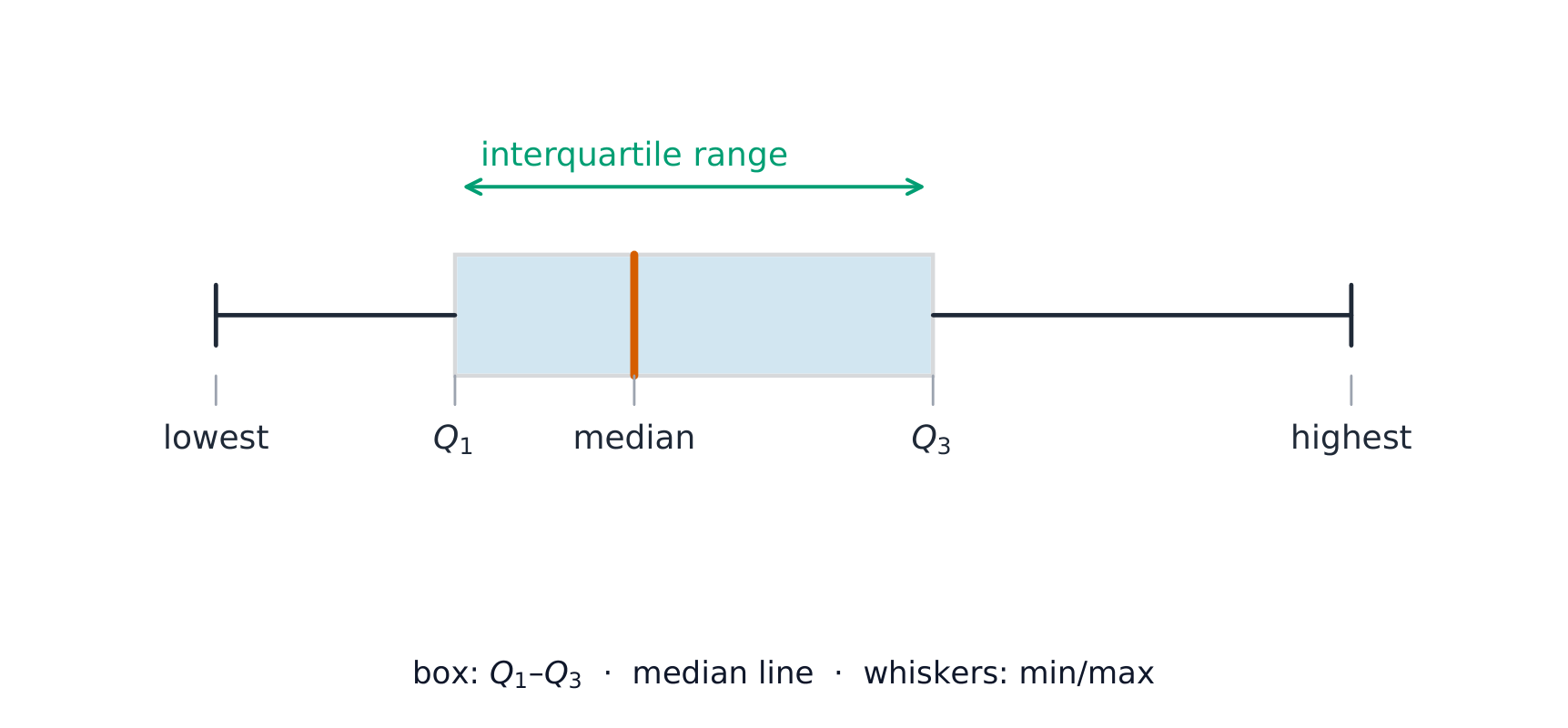
A measure of central tendency 集中趋势 is a single "middle" value:
A measure of variation 离散程度 shows how spread out the data is:
You often work from the totals $\sum x$ and $\sum x^2$. The square of the standard deviation is the variance 方差.
Worked example. For $10$ values, $\sum x = 50$ and $\sum x^2 = 300$. Find the mean and standard deviation.
Coding 编码 makes big numbers easier. Replace each value by $t=x-a$ for a convenient assumed mean 假定平均数 $a$. Then $\bar{x}=a+\bar{t}$, while the standard deviation is unchanged (shifting every value does not spread the data). So from the coded totals $\sum(x-a)$ and $\sum(x-a)^2$ you get $\bar x$ and $\sigma$ directly, and two data sets can be compared through their coded totals.
P(−k < Z < k)
ばらつきは標準偏差で測られる——データの約68%は1 sd内、95%は2 sd内に含まれる。
| English | 日本語 |
|---|---|
| stem-and-leaf diagram/stem ænd liːf ˈdaɪəɡræm/ | 茎葉図 |
| back-to-back/bæk tə bæk/ | 背負い型 |
| box-and-whisker plot/bɒks ænd ˈwɪskə plɒt/ | 箱ひげ図 |
| histogram/ˈhɪstəɡræm/ | ヒストグラム |
| cumulative frequency/ˈkjuːmjʊlətɪv ˈfriːkwənsi/ | 累積度数 |
| measure of central tendency/ˈmeʒə ɒv ˈsentrəl ˈtendənsi/ | 中央傾向の measure |
| mean/miːn/ | 平均値 |
| median/ˈmiːdiːən/ | 中央値 |
| mode/məʊd/ | 最頻値 |
| variation/ˌveərɪˈeɪʃn/ | ばらつき |
| range (of data)/reɪndʒ/ | 範囲(データ) |
| interquartile range/ˌɪntəˈkwɔːtaɪl reɪndʒ/ | 四分位範囲 |
| standard deviation/ˈstændəd ˌdiːvɪˈeɪʃn/ | 標準偏差 |
| variance/ˈveərɪəns/ | 分散 |
| Coding/ˈkəʊdɪŋ/ | 符号化 |
| assumed mean/əˈsjuːmd miːn/ | 仮定平均値 |
| central tendency/ˈsentrəl ˈtendənsi/ | 集中傾向 |
| 受験者は以下のことをできること: | メモと例 |
|---|---|
| • 順列と組合せの用語を理解し、単純な選択に関する問題を解く | |
| • 直線における物体の配置に関する問題を解く。重複を含むもの(例:「NEEDLESS」という単語の文字の並び替えの数)、制限を含むもの(例:特定の2人が隣り合う場合や隣り合わない場合の、何人かが直線上に並ぶ方法の数)などを含む。 | 2つ(またはそれ以上)の行で人が座るようなケースが問題に含まれることがある。円形に物体を配置する問題が含まれることはない。 |
出典: Cambridge International シラバス
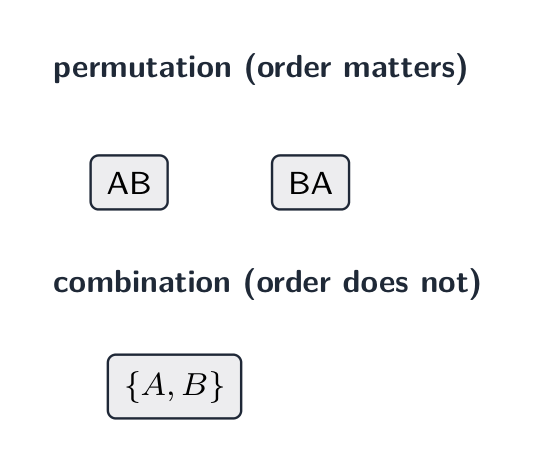
A permutation 排列 is an arrangement where order matters; a combination 组合 is a selection where order does not matter. The numbers are
Worked example. How many different arrangements are there of the letters of the word NEEDLESS?
There are $8$ letters, with E repeated $3$ times and S repeated $2$ times:

数え上げの問題において順序が重要かどうかを選択する。
| English | 日本語 |
|---|---|
| permutation/ˌpɜːmjuːˈteɪʃn/ | 順列 |
| combination/ˌkɒmbɪˈneɪʃn/ | 組合せ |

| 受験者は以下のことをできること: | メモと例 |
|---|---|
| • 等確率素事象の列挙、または順列や組合せを用いた計算により、単純なケースでの確率を評価する | 例:2つの公平なサイコロを投げたときの合計点。例:異なる色のボールが入った袋から無作為にボールを引くこと。 |
| • 適切な場合に、確率の加法および乗法を用いる | 一般公式 $\text{P}(A \cup B) = \text{P}(A) + \text{P}(B) - \text{P}(A \cap B)$ の明示的な使用は不要である。 |
| • 排反および独立な事象の意味を理解する。特に、事象 $A$ と $B$ が独立かどうかを $\text{P}(A \cap B)$ と $\text{P}(A) \times \text{P}(B)$ の値を比較することで判定する | |
| • 単純なケースで条件付き確率を計算して使用する。 | 例:等確率素事象の標本空間、または木図で表せる状況。単純なケースでは $\text{P}(A|B) = \frac{\text{P}(A \cap B)}{\text{P}(B)}$ の使用が必要になることがある。 |
出典: Cambridge International シラバス
Find a probability by counting equally likely outcomes, or by using permutations and combinations. Combine probabilities with these rules:

Two events are mutually exclusive events 互斥事件 if they cannot both happen, and independent events 独立事件 if one happening does not change the chance of the other. To test independence, check whether $P(A \cap B) = P(A)\times P(B)$. A conditional probability 条件概率 is the chance of $A$ given that $B$ has happened: $P(A \mid B) = \dfrac{P(A \cap B)}{P(B)}$.
Worked example. Events have $P(A) = 0.5$, $P(B) = 0.4$ and $P(A \cap B) = 0.2$. Are $A$ and $B$ independent?
Test: $P(A)\times P(B) = 0.5 \times 0.4 = 0.2 = P(A \cap B)$. The values are equal, so $A$ and $B$ are independent.
確率を変化させて木図を読む。P(A and B) や条件付き確率がどのように組み合わさっているかの説明である。
| English | 日本語 |
|---|---|
| mutually exclusive events/ˈmjuːtʃuːəli eksˈkluːsɪv ɪˈvents/ | 排反事象 |
| independent events/ˌɪndɪˈpendənt ɪˈvents/ | 独立事象 |
| conditional probability/kənˈdɪʃənl ˌprɒbəˈbɪlɪti/ | 条件確率 |
| 受験者は以下のことをできること: | メモと例 |
|---|---|
| • 与えられた離散型確率変数 $X$ に関連する確率分布表を作成し、 $\text{E}(X)$ と $\text{Var}(X)$ を計算する | |
| • 二項分布および幾何分布の確率の公式を使用し、これらの分布が適切なモデルとなる現実の状況を認識する | 記号 $\text{B}(n, p)$ と $\text{Geo}(p)$ を含む。 $\text{Geo}(p)$ は、 $p_r = p(1 - p)^{r-1}$ が $r = 1, 2, 3, \dots$ である分布を示す。 |
| • 二項分布の期待値および分散の公式、および幾何分布の期待値の公式を使用する。 | 公式の証明は不要である。 |
出典: Cambridge International シラバス
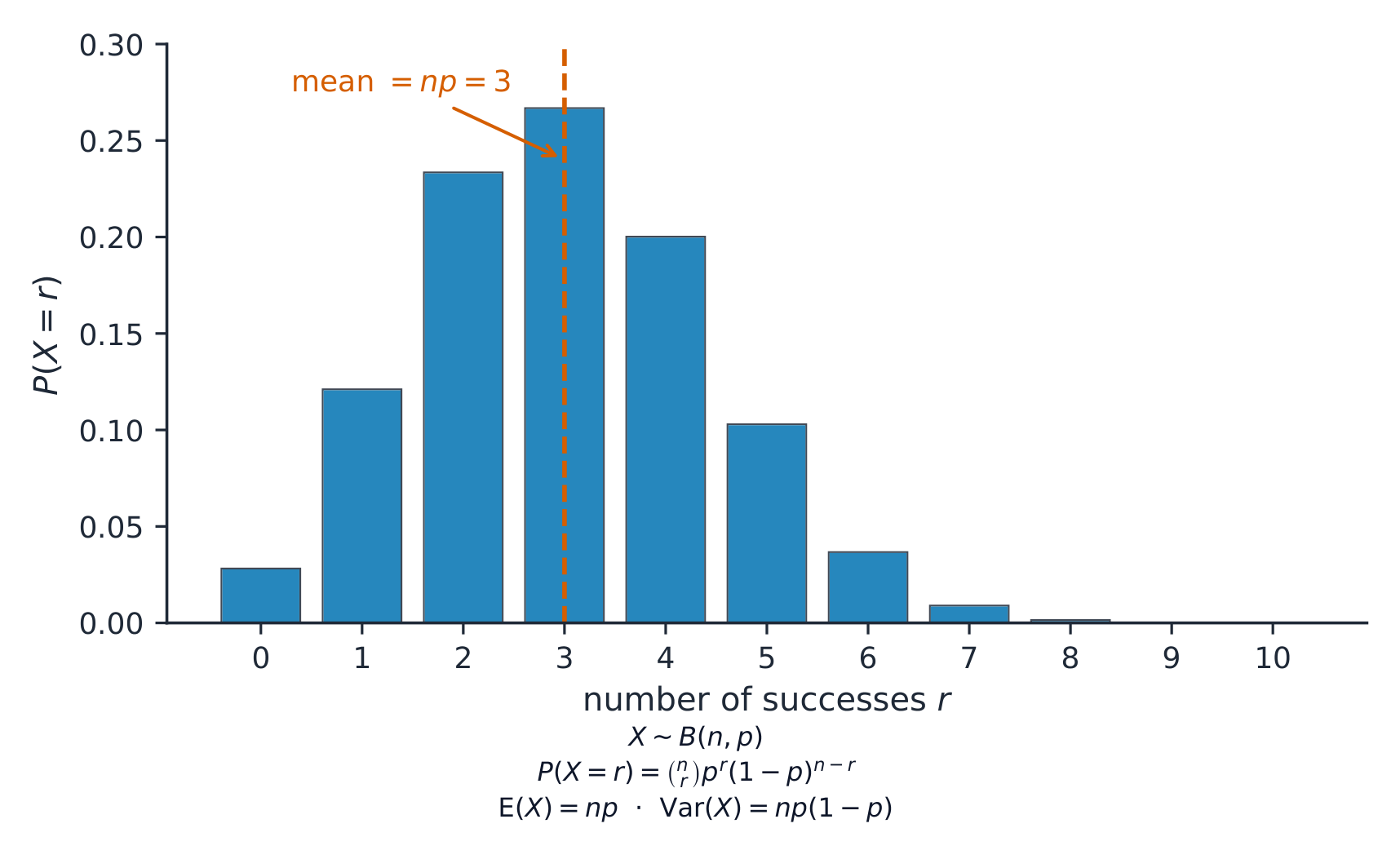
A discrete random variable 离散型随机变量 $X$ takes separate values, each with a probability. List them in a probability distribution table 概率分布表; the probabilities must add to $1$. Then the expectation 期望 (mean) and variance are
Two special models:
Worked example. $X \sim B(10, 0.3)$. Find $P(X = 2)$ and $E(X)$.
二項分布の n と p を変更し、棒グラフを見てください。各成功数の確率が表示されます。
| English | 日本語 |
|---|---|
| discrete random variable/dɪˈskriːt ˈrændəm ˈveərɪəbl/ | 離散型確率変数 |
| probability distribution table/ˌprɒbəˈbɪlɪti ˌdɪstrɪˈbjuːʃn ˈteɪbl/ | 確率分布表 |
| expectation/ekspɪkˈteɪʃn/ | 期待値 |
| binomial distribution/baɪˈnəʊmɪəl ˌdɪstrɪˈbjuːʃn/ | 二項分布 |
| geometric distribution/ˌdʒiːəʊˈmetrɪk ˌdɪstrɪˈbjuːʃn/ | 幾何分布 |

| Candidates should be able to: | Notes and examples |
|---|---|
| understand the use of a normal distribution to model a continuous random variable, and use normal distribution tables | Sketches of normal curves to illustrate distributions or probabilities may be required. |
| solve problems concerning a variable $X$, where $X \sim N(\mu, \sigma^2)$, including: – finding the value of $P(X > x_1)$, or a related probability, given the values of $x_1$, $\mu$, $\sigma$. – finding a relationship between $x_1$, $\mu$ and $\sigma$ given the value of $P(X > x_1)$ or a related probability | For calculations involving standardisation, full details of the working should be shown. e.g. $Z = \frac{(X - \mu)}{\sigma}$ |
| recall conditions under which the normal distribution can be used as an approximation to the binomial distribution, and use this approximation, with a continuity correction, in solving problems. | $n$ sufficiently large to ensure that both $np > 5$ and $nq > 5$. |
出典: Cambridge International シラバス
The normal distribution 正态分布 models a continuous random variable 连续型随机变量 with a symmetric bell shape. Write $X \sim N(\mu, \sigma^2)$, where $\mu$ is the mean and $\sigma$ is the standard deviation. To use the tables, by standardisation 标准化 convert to the variable $Z \sim N(0, 1)$:
Then $P(X < x) = P\!\left(Z < \dfrac{x - \mu}{\sigma}\right)$, which you read from the normal table $\Phi$.

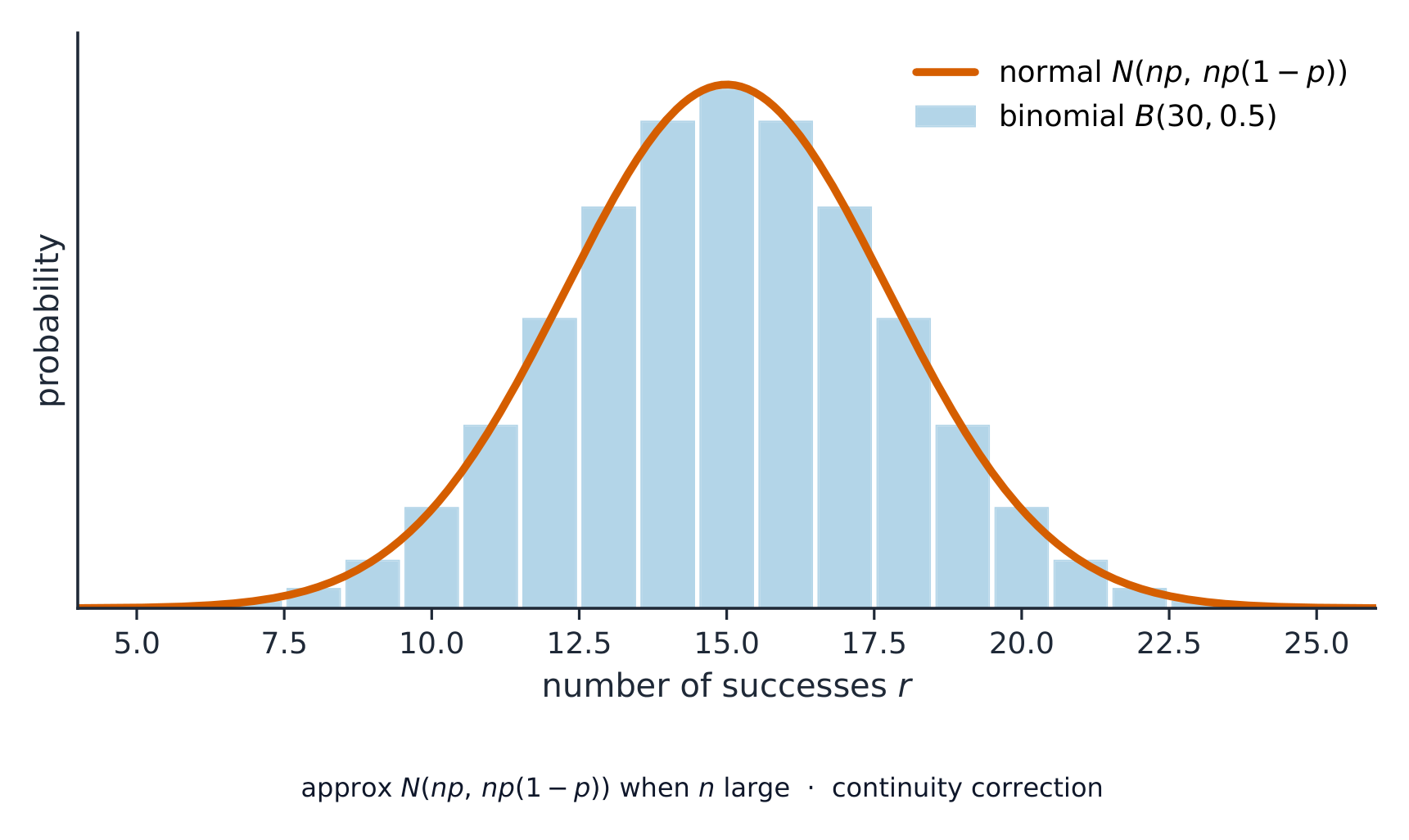
The normal distribution is also a good approximation 近似 to the binomial when $n$ is large. Because you replace a discrete variable by a continuous one, apply a continuity correction 连续性校正 (adjust by $0.5$).
Worked example. Bags of rice have mass $X \sim N(\mu, 0.14^2)$. Given that $P(X < 1.48) = 0.22$, find $\mu$.
From the table, $P(Z < z) = 0.22$ gives $z = -0.772$. So
面積を着色して確率を求める。z値は点が平均から標準偏差いくつ離れているかを測る。
| English | 日本語 |
|---|---|
| normal distribution/ˈnɔːml ˌdɪstrɪˈbjuːʃn/ | 正規分布 |
| continuous random variable/kənˈtɪnjuːəs ˈrændəm ˈveərɪəbl/ | 連続型確率変数 |
| standardisation/ˌstændədaɪˈzeɪʃn/ | 標準化 |
| approximation/əˌprɒksɪˈmeɪʃn/ | 近似 |
| continuity correction/kɒntɪˈnjuːɪti kəˈrekʃn/ | 連続性補正 |
| Probability & Statistics/ˌprɒbəˈbɪlɪti ænd stəˈtɪstɪks/ | 確率と統計 |
This handout covers Topic 6: Probability & Statistics 概率统计 2. It adds the Poisson model, combining random variables, continuous distributions, and the ideas of estimation and testing.

| 受験者は以下のことをできること: | メモと例 |
|---|---|
| • 公式を使用して、分布 $\text{Po}(\lambda)$ の確率を計算する | |
| • $X \sim \text{Po}(\lambda)$ ならば、 $X$ の平均と分散はともに $\lambda$ に等しいという事実を使用する | 証明は不要である。 |
| • ポアソン分布がランダム事象の分布にどのような関連性を持つかを理解し、ポアソン分布をモデルとして使用する | |
| • 適切な場合に、ポアソン分布を二項分布の近似として使用する | $n$ が大きく、 $p$ が小さいという条件を知っているべきである; $n > 50$ および $np < 5$ は概ね等しい。 |
| • 適切な場合に、連続性補正を用いて正規分布をポアソン分布の近似として使用する。 | $\lambda$ が大きいという条件を知っているべきである; $\lambda > 15$ は概ね等しい。 |
出典: Cambridge International シラバス
The Poisson distribution 泊松分布 $X \sim \mathrm{Po}(\lambda)$ models the number of random events in a fixed interval, when events happen at a steady average rate $\lambda$:
Worked example. $X \sim \mathrm{Po}(3)$. Find $P(X = 2)$.

平均 λ を変更してください。ポアソン分布は一定区間内の ランダムな出来事 の数をモデル化します。稀な出来事は歪んだ形状を示します。
| English | 日本語 |
|---|---|
| Poisson distribution/ˈpɔɪsn ˌdɪstrɪˈbjuːʃn/ | ポアソン分布 |
| approximation/əˌprɒksɪˈmeɪʃn/ | 近似 |
| 受験者は以下のことをできること: | メモと例 |
|---|---|
| • 問題解決時に以下の結果を使用する – $\text{E}(aX + b) = a\text{E}(X) + b$ および $\text{Var}(aX + b) = a^2\text{Var}(X)$ – $\text{E}(aX + bY) = a\text{E}(X) + b\text{E}(Y)$ – $\text{Var}(aX + bY) = a^2\text{Var}(X) + b^2\text{Var}(Y)$ ( $X$ と $Y$ が独立の場合) – $X$ が正規分布に従うなら、 $aX + b$ も正規分布に従う – $X$ と $Y$ が独立な正規分布に従うなら、 $aX + bY$ は正規分布に従う – $X$ と $Y$ が独立なポアソン分布に従うなら、 $X + Y$ はポアソン分布に従う。 | これらの結果の証明は不要である。 |
出典: Cambridge International シラバス
When you change a variable by a linear rule, the expectation 期望 (mean) and variance 方差 follow these rules:
Worked example. $X$ has mean $5$ and variance $4$. Find $E(3X - 1)$ and $\mathrm{Var}(3X - 1)$.
E(aX + b) = aE(X) + b
スケーリング因子を変化させると、期待値がどのように変化するかを確認せよ。
| English | 日本語 |
|---|---|
| expectation/ekspɪkˈteɪʃn/ | 期待値 |
| variance/ˈveərɪəns/ | 分散 |
| normal distribution/ˈnɔːml ˌdɪstrɪˈbjuːʃn/ | 正規分布 |
| 受験者は以下のことをできること: | メモと例 |
|---|---|
| • 連続型確率変数の概念を理解し、確率密度関数の性質を記憶して使用する | 単一の区間のみで定義される密度関数について;定義域は無限である場合もある。例: $\frac{3}{x^4}$ ( $x \geqslant 1$ の場合)。 |
| • 確率密度関数を使用して、確率に関する問題を解き、分布の平均と分散を計算する。 | 密度関数による面積の直接的な考慮によって、分布の中央値やその他の百分位数の位置を求める場合も含む。累積分布関数の明示的な知識は含まれない。 |
出典: Cambridge International シラバス
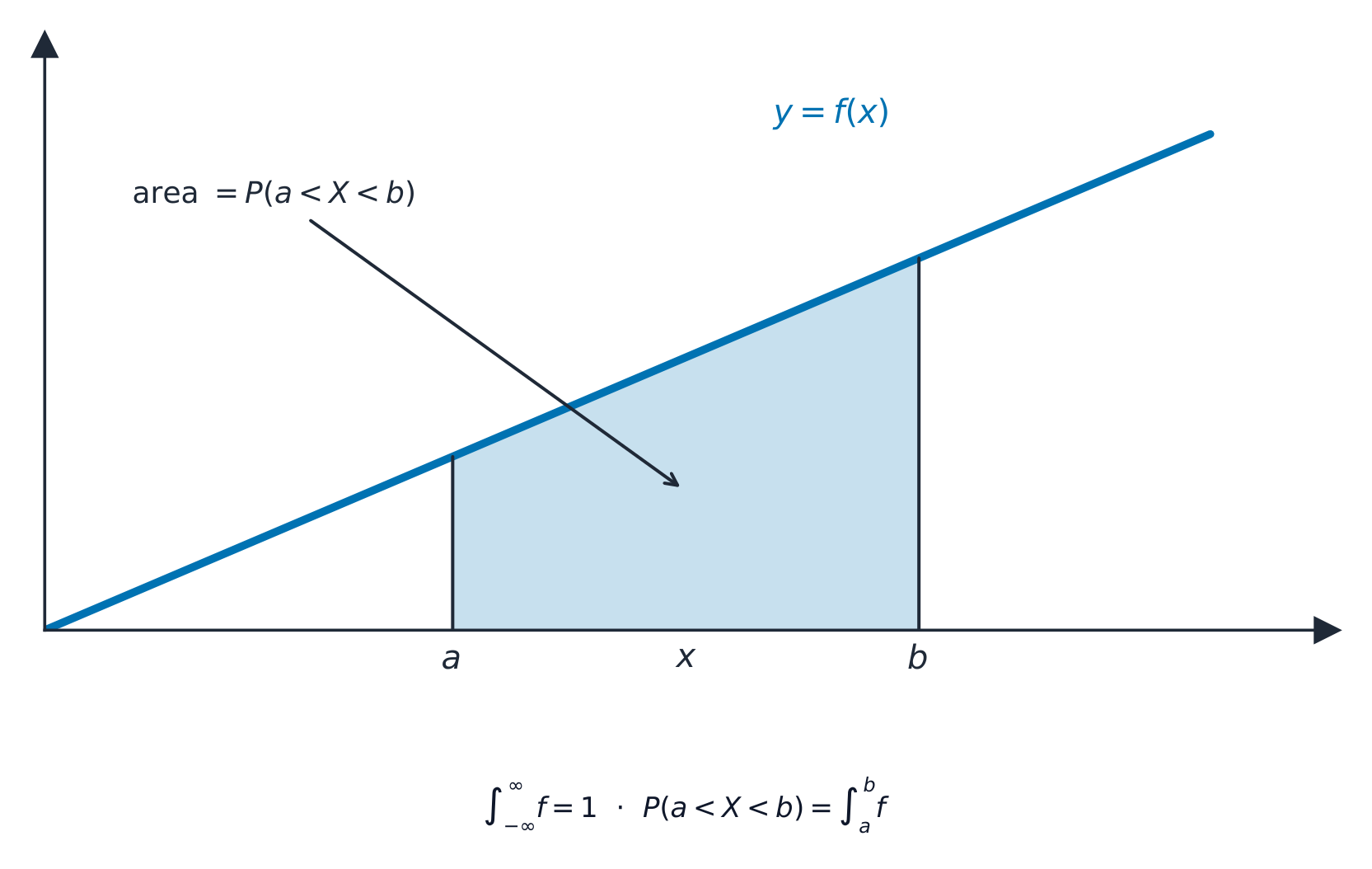
A continuous random variable 连续型随机变量 can take any value in a range. Its probabilities come from a probability density function 概率密度函数 $f(x)$, with two key properties:
The cumulative distribution function 累积分布函数 is $F(x) = P(X \leqslant x) = \int_{-\infty}^{x} f(t)\,dt$; the median 中位数 solves $F(m) = 0.5$, and other percentiles 百分位数 solve $F(x) = p$.
Worked example. A continuous variable has $f(x) = \tfrac12 x$ for $0 \leqslant x \leqslant 2$ (and $0$ elsewhere). Find $E(X)$.
The variance uses the same idea, $\mathrm{Var}(X)=\displaystyle\int_{-\infty}^{\infty}x^2 f(x)\,dx-\big(E(X)\big)^2$. For the same $f(x)=\tfrac12 x$ on $[0,2]$: $\displaystyle\int_0^2 x^2\cdot\tfrac12 x\,dx=\left[\tfrac{x^4}{8}\right]_0^2=2$, so $\mathrm{Var}(X)=2-\left(\tfrac43\right)^2=2-\tfrac{16}{9}=\tfrac{2}{9}$.
P(a < X < b) = ∫ f(x) dx
連続型確率変数において、確率とは密度曲線の下にある 面積 のことである(2つの値の間)。
| English | 日本語 |
|---|---|
| continuous random variable/kənˈtɪnjuːəs ˈrændəm ˈveərɪəbl/ | 連続型確率変数 |
| probability density function/ˌprɒbəˈbɪlɪti ˈdensɪti ˈfʌŋkʃn/ | 確率密度関数 |
| cumulative distribution function/ˈkjuːmjʊlətɪv ˌdɪstrɪˈbjuːʃn ˈfʌŋkʃn/ | 累積分布関数 |
| median/ˈmiːdiːən/ | 中央値 |
| percentiles/pəˈsentaɪlz/ | 百分位 |

| Candidates should be able to: | Notes and examples |
|---|---|
| • understand the distinction between a sample and a population, and appreciate the necessity for randomness in choosing samples | |
| • explain in simple terms why a given sampling method may be unsatisfactory | Including an elementary understanding of the use of random numbers in producing random samples. Knowledge of particular sampling methods, such as quota or stratified sampling, is not required. |
| • recognise that a sample mean can be regarded as a random variable, and use the facts that $\text{E}(\overline{X}) = \mu$ and that $\text{Var}(\overline{X}) = \frac{\sigma^2}{n}$ | |
| • use the fact that $\overline{X}$ has a normal distribution if $X$ has a normal distribution | |
| • use the Central Limit Theorem where appropriate | Only an informal understanding of the Central Limit Theorem (CLT) is required; for large sample sizes, the distribution of a sample mean is approximately normal. |
| • calculate unbiased estimates of the population mean and variance from a sample, using either raw or summarised data | Only a simple understanding of the term 'unbiased' is required, e.g. that although individual estimates will vary the process gives an accurate result 'on average'. |
| • determine and interpret a confidence interval for a population mean in cases where the population is normally distributed with known variance or where a large sample is used | |
| • determine, from a large sample, an approximate confidence interval for a population proportion. |
出典: Cambridge International シラバス
A sample 样本 is a small group chosen from the whole population 总体. A random sample needs randomness 随机性, so that every member has a fair chance of being chosen.
Some methods are unsatisfactory because they are biased 有偏: sampling only volunteers, or the first 20 people to arrive, over-represents certain kinds of people. A genuinely random sample uses random numbers – number every member of the population, then draw numbers (from a table or a generator) to decide who is in the sample.
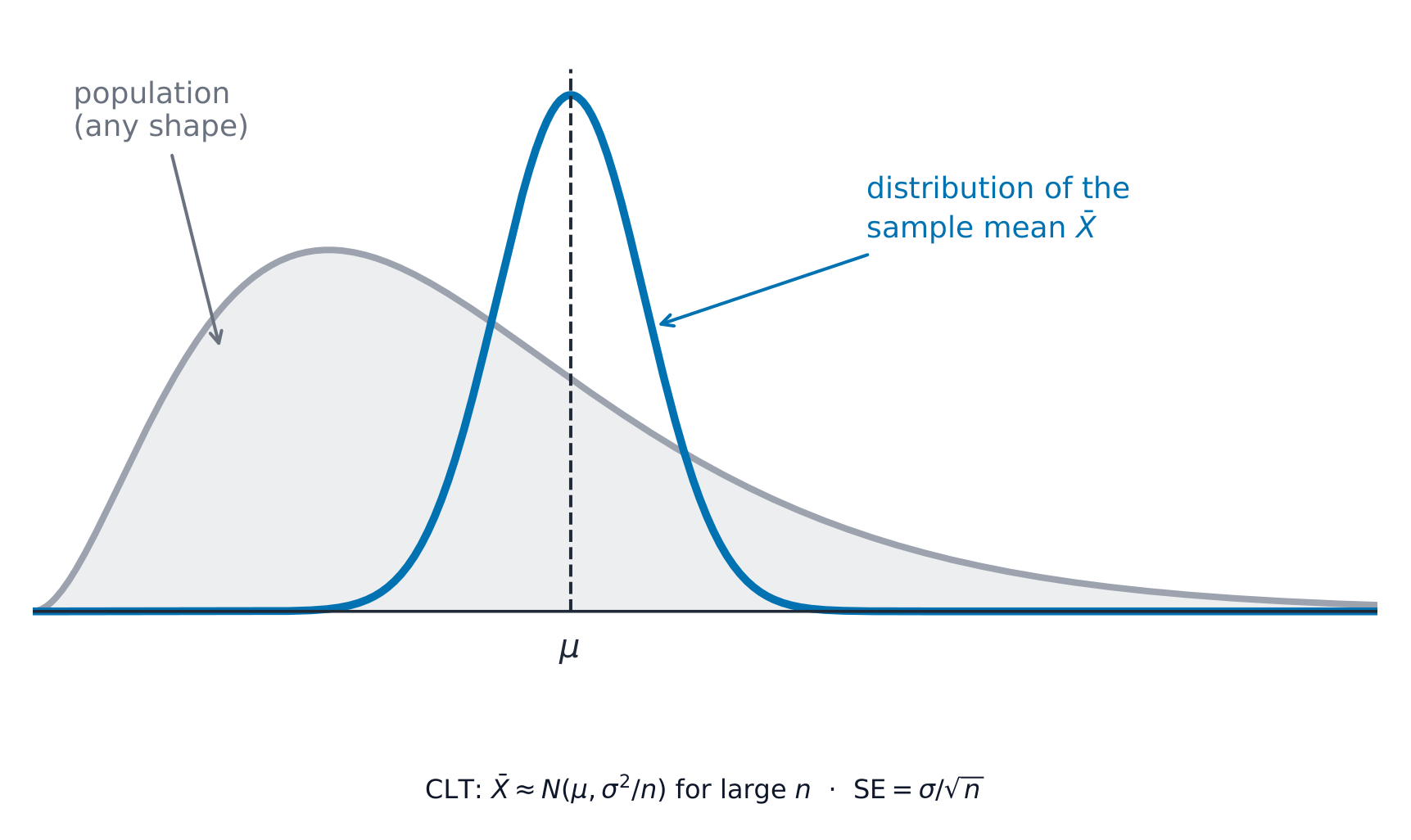
The sample mean $\bar{X}$ is itself a random variable, with
From a sample you can find unbiased estimates 无偏估计 of the population mean and variance. A confidence interval 置信区间 gives a range that probably contains the true mean. When the population is normal with known $\sigma$ (or the sample is large), a $95\%$ interval is

You can also find a confidence interval for a population proportion 总体比例 from a large sample.
Worked example. A sample of $n = 64$ has mean $\bar{x} = 50$, from a population with $\sigma = 8$. Find a $95\%$ confidence interval for the population mean.
X̄ ~ N(μ, σ²/n)
中心極限定理により、標本平均は 正規 曲線に従い、標本サイズが大きくなるほど狭くなる。
| English | 日本語 |
|---|---|
| sample/ˈsæmpl/ | 標本 |
| population/ˌpɒpjʊˈleɪʃn/ | 母集団 |
| randomness/ˈrændəmnəs/ | ランダム性 |
| biased/ˈbaɪəst/ | 偏り |
| Central Limit Theorem/ˈsentrəl ˈlɪmɪt ˈθɪərəm/ | 中心極限定理 |
| unbiased estimates/ʌnˈbaɪəst ˈestɪməts/ | 不偏推定量 |
| confidence interval/ˈkɒnfɪdəns ˈɪntəvl/ | 信頼区間 |
| population proportion/ˌpɒpjʊˈleɪʃn prəˈpɔːʃn/ | 母集団比率 |

| 受験者は以下のことをできること: | メモと例 |
|---|---|
| • 仮説検定の本質、片側検定と両側検定の違い、ならびに帰無仮説、対立仮説、有意水準、棄却域(または臨界領域)、受容域、検定統計量といった用語を理解する | 仮説検定の結果は、問題が提示された文脈に基づいて解釈されることが期待される。 |
| • 二項分布またはポアソン分布に従う母集団からの単一観測について、仮説を立てて仮説検定を行う。必要に応じて、直接の確率評価、または二項分布・ポアソン分布に対する正規近似を用いる | |
| • 母集団が分散が既知の正規分布に従う場合、または大きな標本を使用する場合において、母集団の平均に関する仮説を立てて仮説検定を行う | |
| • 第一類誤りおよび第二類誤りの用語を仮説検定に関連して理解する | |
| • 正規分布に基づく検定や二項分布・ポアソン分布の確率の直接評価を含む特定の状況において、第一類誤りおよび第二類誤りを起こす確率を計算する。 |
出典: Cambridge International シラバス
A hypothesis test 假设检验 uses sample data to judge a claim. You set up two statements: the null hypothesis 原假设 $H_0$ (the claim being tested, usually "no change") and the alternative hypothesis 备择假设 $H_1$ (what you suspect instead). The test is one-tailed 单尾 if $H_1$ points one way (e.g. $\mu > 50$) and two-tailed 双尾 if it allows both ways ($\mu \neq 50$).
You fix a significance level 显著性水平 (often $5\%$), work out a test statistic 检验统计量 from the data, and see whether it lands in the rejection region 拒绝域 (also called the critical region); if it does you reject $H_0$, otherwise the statistic is in the acceptance region.
Two mistakes are possible: a Type I error 第一类错误 is rejecting $H_0$ when it is actually true; a Type II error 第二类错误 is accepting $H_0$ when it is actually false. You can find their probabilities from the rejection region: $P(\text{Type I})=P(\text{statistic in the rejection region}\mid H_0)$ – this equals the significance level – and $P(\text{Type II})=P(\text{statistic in the acceptance region}\mid H_1$ true for a stated value$)$, computed from the binomial, Poisson, or normal distribution.
Worked example. A population is claimed to have mean $50$, with $\sigma = 8$. A sample of $n = 64$ gives $\bar{x} = 52$. Test at the $5\%$ level whether the mean has changed.
$H_0\!: \mu = 50$ and $H_1\!: \mu \neq 50$ (two-tailed). The test statistic is
Worked example (a binomial test). A coin is claimed fair but suspected of landing heads too rarely: $H_0\!:p=0.5$, $H_1\!:p<0.5$. In $n=30$ tosses you see $X=9$ heads. Under $H_0$, $X\sim B(30,0.5)$, so the one-tailed tail probability is
z < −z* のとき H₀ を棄却する
塗りつぶされた尾部分は棄却域であり、検定統計量がここに入れば H₀ を棄却する。
| English | 日本語 |
|---|---|
| hypothesis test/haɪˈpɒθəsɪs test/ | 仮説検定 |
| null hypothesis/nʌl haɪˈpɒθəsɪs/ | 帰無仮説 |
| alternative hypothesis/ɔːlˈtɜːnətɪv haɪˈpɒθəsɪs/ | 対立仮説 |
| one-tailed/wʌn teɪld/ | 片側検定 |
| two-tailed/tuː teɪld/ | 両側検定 |
| significance level/sɪɡˈnɪfɪkəns ˈlevl/ | 有意水準 |
| test statistic/test stəˈtɪstɪk/ | 検定統計量 |
| rejection region/rɪˈdʒekʃn ˈriːdʒn/ | 棄却域 |
| Type I error/taɪp aɪ ˈerə/ | 第I類誤り |
| Type II error/taɪp ˈtuː ˈerə/ | 第II類誤り |
| Probability & Statistics/ˌprɒbəˈbɪlɪti ænd stəˈtɪstɪks/ | 確率と統計 |
科目を読み込み中...