Skip to content · ⁨コンテンツへスキップ⁩

Organic synthesis · ⁨有機合成⁩

A-Level Chemistry · ⁨A-Level 化学⁩ · Topic 36 · ⁨トピック 36⁩

View Slides · ⁨查看幻灯片⁩ Train · ⁨練習する⁩
Video lesson for this topic · ⁨このトピックのビデオレッスン⁩ Open the video page · ⁨動画ページを開く⁩
7:52

有機合成(A2)

3つの全く異なるもの:鮮やかな橙色の染料、鎮痛剤、そして頑丈なプラスチック。これらすべては同じ無色の液体——ベンゼンから始まる。しかし単一の…

English narration · English + 中文 subtitles burned in · ⁨英語ナレーション・英語+中文字幕 burning-in⁩

36.1

Organic synthesis · ⁨有機合成⁩

Syllabus · ⁨シラバス⁩
English
  1. for an organic molecule containing several functional groups: (a) identify organic functional groups using the reactions in the syllabus (b) predict properties and reactions
  2. devise multi-step synthetic routes for preparing organic molecules using the reactions in the syllabus
  3. analyse a given synthetic route in terms of type of reaction and reagents used for each step of it, and possible by-products
日本語
  1. 複数の官能基を含む有機分子について: (a) 履修内容の反応を用いて有機官能基を特定 (b) 性質および反応を予測する
  2. 履修内容の反応を用いて有機分子を調製するための多段階合成ルートを考案する
  3. 与えられた合成ルートを反応の種類、各工程で使用される試薬、および副生成物について分析する

Source: Cambridge International syllabus · ⁨出典: Cambridge International シラバス⁩

English

Like the AS synthesis topic, this asks you to join up known reactions to build a target molecule. Now you also have the A Level reactions of arenes, phenol, amines, amides and acyl chlorides.

Identifying functional groups

A molecule may carry several functional group 官能团 types. Use the test reactions to spot each one, then predict its behaviour. For example:

  • decolourises bromine water with no catalyst, giving a white precipitate → a phenol or a phenylamine (the ring is activated).
  • reacts violently with cold water, giving fumes of $\text{HCl}$ → an acyl chloride 酰氯.
  • gives a purple colour with neutral $\text{FeCl}_3$ → a phenol 苯酚.

A map of the A Level reactions

Start Reagent and conditions Product
benzene (an arene 芳烃) $\text{HNO}_3$ / $\text{H}_2\text{SO}_4$ (electrophilic substitution 亲电取代) nitrobenzene
nitrobenzene $\text{Sn}$ / conc $\text{HCl}$, then $\text{NaOH}$ (reduction 还原) phenylamine
phenylamine $\text{HNO}_2$, below $10\,°\text{C}$ a diazonium salt
diazonium salt warm water phenol; or couple with phenol → azo dye
methylbenzene hot $\text{KMnO}_4$ (oxidation 氧化) benzoic acid
carboxylic acid 羧酸 $\text{SOCl}_2$ or $\text{PCl}_5$ acyl chloride
acyl chloride alcohol / phenol an ester 酯
acyl chloride ammonia / amine 胺 an amide 酰胺
amide or nitrile 腈 $\text{LiAlH}_4$ an amine
halogenoalkane $\text{KCN}$ a nitrile (adds one carbon)

Planning and analysing a route

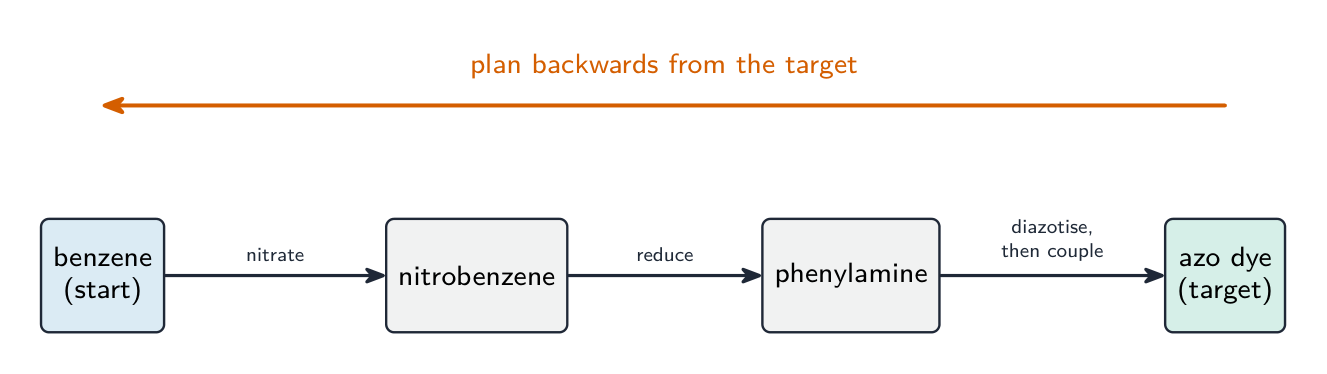
To devise a synthetic route 合成路线, work backwards from the target: which single reaction makes it, and from what? Repeat until you reach the starting material, then write each step with its reagent 试剂 and conditions.

When you analyse a route, state the type of reaction for each step (for example electrophilic substitution, addition–elimination 加成消去, oxidation or reduction) and watch for likely by-products 副产物 — for example, making an amine from a halogenoalkane also gives over-substituted amines, lowering the yield.

Worked example. Devise a route from benzene to phenylamine, $\text{C}_6\text{H}_5\text{NH}_2$. Work backwards: phenylamine comes from reducing nitrobenzene, and nitrobenzene comes from nitrating benzene - so the route is two steps. Step 1: benzene with concentrated $\text{HNO}_3$ and concentrated $\text{H}_2\text{SO}_4$ at $55\ °\text{C}$; electrophilic substitution gives nitrobenzene (keep below $55\ °\text{C}$, or further substitution follows). Step 2: reduce the nitrobenzene with tin and concentrated $\text{HCl}$, then add $\text{NaOH}$ to free the amine from its salt. There is no direct route - you cannot put an $\text{–NH}_2$ straight onto a ring, which is exactly why this nitrate-then-reduce pair is worth knowing by heart.

日本語

AS合成トピックと同様に、既知の反応をつなげてターゲット分子を構築することを問う。今度はA-Levelの芳香族化合物、フェノール、アミン、アミド、アシルクロリドの反応も追加された。

官能基の特定

1つの分子が複数の官能基種を持つことがある。検出反応を使ってそれぞれを見分け、振る舞いを予測せよ。例えば:

  • 触媒なしで臭素水を脱色し、白色沈殿を作る → フェノールまたはフェニルアミン(環が活性化されている)。
  • 冷水と激しく反応し、$\text{HCl}$の煙を出す → アシルクロリド。
  • 中性の$\text{FeCl}_3$と反応して紫色を示す → フェノール。
A-Level試験の3列表:触媒なしの臭素水、冷水、中性塩化鉄(III)。各々における観察結果と官能基を示す
A-Levelで追加された同定試験:各試薬は特定の官能基を示唆する特徴的な結果を与える

A-Level反応のマップ

出発 試薬と条件 生成物
ベンゼン(芳香族化合物) $\text{HNO}_3$ / $\text{H}_2\text{SO}_4$(求電子置換反応) ニトロベンゼン
ニトロベンゼン $\text{Sn}$ / 濃$\text{HCl}$、次に$\text{NaOH}$(還元) フェニルアミン
フェニルアミン $\text{HNO}_2$、$10\,°\text{C}$未満 ジアゾニウム塩
ジアゾニウム塩 温かい水 フェノール、またはフェノールとカップリング → アゾ染料
メチルベンゼン 熱い$\text{KMnO}_4$(酸化) ベンゾ酸
カルボン酸 $\text{SOCl}_2$ または $\text{PCl}_5$ アシルクロリド
アシル塩化物 アルコール /フェノール エステル
アシル塩化物 アンモニア / アミン アミド
アミドまたはニトリル $\text{LiAlH}_4$ アミン
ハロゲン化アルカン $\text{KCN}$ ニトリル(炭素が1つ増える)
A Level反応のネットワーク:ベンゼンからニトロベンゼン、フェニルアミン、ジアゾニウム塩、フェノールまたはアゾ染料への経路と、カルボン酸からアシル塩化物、エステルおよびアミドへの経路
A-Level反応のマップ:芳香族鎖(上)とアシルクロリド鎖(下)、およびそれぞれの投入原料。目標化合物から逆算する

ルートの設計と分析

合成ルートを考案するには、標的物質から逆向きに進む:それを生成する単一の反応は何であり、その原料は何か? 出発物質に達するまで繰り返した後、各ステップに試薬と条件を記す。

ベンゼンからアゾ染料への合成チェーン、各進行方向のステップに試薬を示し、上方に大きな矢印で計画が標的物質から出発物質へ逆向きに行うことを示す
ターゲットから逆算して、1つずつ反応を遡り、出発物質に到達するまでルートを計画する

ルートに分析を行う際は、各ステップの反応種別(例:求電子置換、付加-除去、酸化、還元など)を明記し、予想される副産物に注意する。例えば、ハロゲン化アルカンからアミンを合成する場合、多置換アミンも生成され、収率が低下することがある。

** worked example.** ベンゼンからフェニルアミンへのルートを考案する、$\text{C}_6\text{H}_5\text{NH}_2$。逆向きで考える:フェニルアミンは還元によってニトロベンゼンから得られ、ニトロベンゼンはベンゼンのニトロ化によって得られる。よってルートは2ステップとなる。 ステップ1:ベンゼンに濃硫酸 $\text{HNO}_3$ と濃硝酸 $\text{H}_2\text{SO}_4$ を$55\ °\text{C}$ で反応させる。求電子置換によりニトロベンゼンが生成される($55\ °\text{C}$以下に保つ。それ以上高温だとさらに置換が進む)。 ステップ2:ニトロベンゼンをスズと濃硫酸 $\text{HCl}$ で還元し、次に $\text{NaOH}$ を加えてアミンを塩から遊離させる。直接合成のルートはない。環に直接$\text{–NH}_2$ を導入することはできないため、この「ニトロ化→還元」の組み合わせを暗記しておく必要がある。

Explore · ⁨探索⁩

A-Level synthesis planner · ⁨A-Level 合成プランナー⁩

Build a route by matching functional-group changes to reagents. · ⁨官能基の変化に試薬を対応させることで経路を構築する。⁩

Vocabulary · ⁨語彙⁩ Train · ⁨練習する⁩
English 日本語
functional group/ˈfʌŋkʃənl ɡruːp/ 官能基
acyl chloride/əˈkɪl ˈklɔːraɪd/ アシルクロリド
phenol/ˈfenɒl/ フェノール
arene/ˈæren/ アレーン
electrophilic substitution/ɪˌlektrəʊˈfɪlɪk ˌsʌbstɪˈtjuːʃn/ 求電子置換
reduction/rɪˈdʌkʃn/ 還元
oxidation/ˌɒksɪˈdeɪʃn/ 酸化反応
carboxylic acid/ˌkɑːbəkˈsɪlɪk ˈæsɪd/ カルボン酸
ester/ˈestə/ エステル
amine/ˈæmaɪn/ アミン
amide/əˈmaɪd/ アミド
nitrile/ˈnaɪtraɪl/ ニトリル
synthetic route/sɪnˈθetɪk ruːt/ 合成経路
reagent/rɪˈeɪdʒənt/ 試薬
addition–elimination/əˈdɪʃn ɪˌlɪmɪˈneɪʃn/ 付加-脱離
by-product/baɪ ˈprɒdʌkt/ 副生成物
36.1

Exam tips · ⁨試験対策⁩

English
  • Combine AS and A-level steps and watch for benzene-ring reactions and carbon-count changes.
  • State every reagent and condition, and note when a step produces a racemic mixture.
  • Choose the shortest route that reaches the target functional group.
日本語
  • ASおよびA-Levelのステップを統合し、ベンゼン環反応や炭素数の変化に注意する。
  • 全ての試薬と条件を明記し、ステップがラセミ混合物を生じる場合に注記する。
  • 標的官能基に至る最も短いルートを選ぶ。

Interactive lessons on this topic · ⁨このトピックのインタラクティブ授業⁩

Work through it step by step, with instant-check exercises. · ⁨一歩ずつ進め、即時チェック付きの問題で学習します。⁩

Past Papers · ⁨過去問⁩

More topics in A-Level Chemistry · ⁨A-Level 化学⁩ · ⁨A-Level Chemistry · ⁨A-Level 化学⁩ の他のトピック⁩

Log in or create account · ⁨ログインまたはアカウント作成⁩

IGCSE, A-Level & AP