Skip to content · ⁨コンテンツへスキップ⁩

Enzymes · ⁨酵素⁩

A-Level Biology · ⁨A-Level 生物⁩ · Topic 3 · ⁨トピック 3⁩

View Slides · ⁨查看幻灯片⁩ Train · ⁨練習する⁩
Video lesson for this topic · ⁨このトピックのビデオレッスン⁩ Open the video page · ⁨動画ページを開く⁩
13:51

酵素

細胞内では、毎秒何千もの化学反応が起こり、それらが単独で行うことよりもはるかに速い。その秘密は特殊な種類のタンパク質…

English narration · English + 中文 subtitles burned in · ⁨英語ナレーション・英語+中文字幕 burning-in⁩

3.1

What enzymes are · ⁨エンザイムとは何か⁩

Syllabus · ⁨シラバス⁩
English
  1. state that enzymes are globular proteins that catalyse reactions inside cells (intracellular enzymes) or are secreted to catalyse reactions outside cells (extracellular enzymes)
  2. explain the mode of action of enzymes in terms of an active site, enzyme–substrate complex, lowering of activation energy and enzyme specificity, including the lock-and-key hypothesis and the induced-fit hypothesis
  3. investigate the progress of enzyme-catalysed reactions by measuring rates of formation of products using catalase and rates of disappearance of substrate using amylase
  4. outline the use of a colorimeter for measuring the progress of enzyme-catalysed reactions that involve colour changes
日本語
  1. 酵素は、細胞内で反応を触媒する細胞内酵素、または細胞外へ分泌されて反応を触媒する細胞外酵素であるグロブリンタンパク質であることを述べること
  2. 活性部位、酵素-基質複合体、活性化エネルギーの低下、および酵素特異性の観点から酵素の作用様式を説明し、鍵と鍵穴モデルおよび誘導適合モデルを含めること
  3. 触媒を用いて生成物の生成速度を測定し、アミラーゼを用いて基質の消失速度を測定することで、酵素触媒反応の進行を調査すること
  4. 色変化を伴う酵素触媒反応の進行を測定するために用いられるカラーメーターの使用法を概説すること

Source: Cambridge International syllabus · ⁨出典: Cambridge International シラバス⁩

English
Enzyme action: lock and key

Enzymes 酶 are globular proteins 球状蛋白质 — a type of protein 蛋白质 with a rounded, soluble shape. They are biological catalysts: they catalyse 催化 (speed up) the chemical reactions in living things, and they are not used up, so each enzyme works again and again.

Enzymes work in two places:

  • intracellular 细胞内 enzymes work inside the cell 细胞 that made them. An example is catalase 过氧化氢酶, which breaks down harmful hydrogen peroxide.
  • extracellular 细胞外 enzymes are secreted 分泌 (sent out) to work outside the cell. An example is amylase 淀粉酶, which is released into the gut to digest 消化 starch 淀粉.
日本語
エンザイムの作用:ロック・アンド・キー

エンザイムは球状タンパク質の一種であり、丸みを帯びて水溶性の形状をしたタンパク質です。它们是生物触媒であり、生体内の化学反応を触媒(加速)しますが、消耗しないため、各エンザイムは繰り返し機能します。

エンザイムは2箇所で機能します:

  • 細胞内エンザイムは、それを作った細胞内部で機能します。例として、有害な過酸化水素を分解するカタラーゼがあります。
  • 細胞外エンザイムは分泌(体外へ放出)されて細胞外で機能します。例として、胃腸内に分泌されてデンプンを消化するアミラーゼがあります。
泡立ち、活発に発酵している酵母から二酸化炭素を排出している様子
酵母のエンザイムは糖を発酵させ、二酸化炭素の気泡を発生させます
Vocabulary · ⁨語彙⁩ Train · ⁨練習する⁩
English 日本語
enzyme/ˈenzaɪm/ 酵素
globular protein/ˈɡlɒbjʊlə ˈprəʊtiːn/ 球状タンパク質
protein/ˈprəʊtiːn/ タンパク質
catalyse/ˈkætəlaɪz/ 触媒作用をする
intracellular/ˌɪntrəˈseljʊlə/ 細胞内
cell/sel/ 電池
catalase/ˈkætəleɪz/ カタラーゼ
extracellular/ˌekstrəˈseljʊlə/ 細胞外
secrete/sɪˈkriːt/ 分泌する
amylase/ˈæmɪleɪz/ アミラーゼ
digest/ˈdaɪdʒest/ ダイジェスト
starch/stɑːtʃ/ デンプン
active site/ˈæktɪv saɪt/ active site(活性部位)
substrate/ˈsʌbstreɪt/ substrate(基質)
enzyme–substrate complex/ˈenzaɪm ˈsʌbstreɪt ˈkɒmpleks/ enzyme–substrate complex(酵素-基質複合体)
3.1

How enzymes work · ⁨エンザイムの働き方⁩

English

Each enzyme has a special pocket called the active site 活性位点. The molecule it acts on is its substrate 底物. The substrate fits into the active site to form an enzyme–substrate complex 酶底物复合物. The reaction then happens, and the products 产物 leave, freeing the active site for the next substrate.

Specificity

An enzyme is specific: it usually works on only one substrate. This is because the shape of the active site is complementary 互补 to (fits) the shape of that substrate and no other. We call this specificity 专一性.

Two ideas explain how the substrate fits:

  • the lock-and-key hypothesis 锁钥学说 — the active site is a fixed shape, and only a substrate with the matching shape fits, like a key in a lock.
  • the induced-fit hypothesis 诱导契合学说 — the active site is not quite the right shape at first. When the substrate binds, the active site changes shape a little to wrap around it tightly. This idea fits the evidence better.

Lowering activation energy

Every reaction needs a small "push" of energy to start, called the activation energy 活化能. An enzyme lowers the activation energy. This lets the reaction go quickly at the cell's normal temperature 温度, instead of needing high heat.

日本語

各酵素には、活性部位と呼ばれる特別なポケットがあります。この酵素が作用する分子を基質といいます。基質は活性部位に結合して酵素-基質複合体を形成します。その後反応が起こり、生成物が離れることで、次の基質のための活性部位が開放されます。

特異性

酵素は特異的です:通常、一つの基質に対してのみ機能します。これは、活性部位の形状がその基質の形状と相補的(一致)しており、他の基質とは一致しないためです。これを特異性と呼びます。

基質がどうやって結合するかを説明する2つの説があります:

  • 鍵と錠前説 — 活性部位は固定された形状をしており、鍵が錠前に合うように、形状が完全に一致する基質だけが結合します。
  • 適合誘起説 — 最初、活性部位の形状は完全には合いません。基質が結合すると、活性部位がわずかに形状を変化させて基質を包み込み、密着させます。この説の方が証拠により合致します。
二つの図:鍵と錠前説では三角形の基質が硬質なくぼみにフィットし、適合誘起説では酵素が丸い基質を取り込む
鍵と錠前説:固定された活性部位。適合誘起説:基質を掴むために形状が変わる活性部位

活性化エネルギーの低下

すべての反応には、開始に必要な小さなエネルギーの「押し」が必要であり、これを活性化エネルギーといいます。酵素はこの活性化エネルギーを下げます。これにより、細胞の通常の温度で素早く反応が進むようになり、高温を必要としなくなります。

2つの山を持つエネルギープロファイル:酵素なしの高さの山と、酵素ありの低い山があり、どちらも同じ反応物と生成物を結んでいる
酵素の経路は活性化エネルギーが低く($E_A$)、より多くの分子が反応できるようになる
Explore · ⁨探索⁩

The catalytic cycle · ⁨触媒サイクル⁩

Step through the cycle. The enzyme binds its substrate, the reaction happens, the products leave — and the same enzyme is free to go again. · ⁨サイクルを順に確認する。酵素が基質に結合し、反応が起こり、生成物が離脱する。そして同じ酵素が再び自由になって反復できる。⁩

Vocabulary · ⁨語彙⁩ Train · ⁨練習する⁩
English 日本語
activation energy/ˌæktɪˈveɪʃn ˈenədʒi/ 活性化エネルギー
3.1

Measuring the rate of a reaction · ⁨反応速度の測定⁩

English

You can follow an enzyme reaction in two ways:

  • measure how fast product is made. With catalase, oxygen gas is a product, so you collect the gas and measure its volume over time.
  • measure how fast substrate disappears. With amylase, you remove samples and use the iodine test; the blue-black colour fades as the starch is used up.

A colorimeter 比色计 makes this exact. It shines light through the tube and measures how much light is absorbed, so a colour change becomes a number you can plot.

The rate of reaction 反应速率 is steepest at the start (most substrate present), so the initial rate (the slope at time zero) is the fairest value to compare.

Worked example. In the first $20$ seconds of a catalase reaction, $16\ \text{cm}^3$ of oxygen is collected. Estimate the rate of reaction.

$$\text{rate} = \frac{\text{volume of product}}{\text{time}} = \frac{16}{20} = 0.8\ \text{cm}^3\,\text{s}^{-1}.$$

Because the reaction is fastest at the start, measuring over this short early interval gives a value close to the initial rate; averaging over a longer time would include the slower later stages and underestimate it.

日本語

酵素反応を追跡する方法は2つあります:

  • 生成物がどれだけ速く作られるかを測定する。カタラーゼの場合、酸素ガスが生成物であるため、ガスを回収し、時間経過とともにその体積を測定します。
  • 基質がどれだけ速く消失するかを測定する。アミラーゼの場合、サンプルを採取してヨウ素試験を行い、デンプンが消費されるにつれて青黒い色が薄くなります。

分光光度計はこれを正確に行います。光を试管に通し、吸光量を測定することで、色の変化をプロット可能な数値に変換します。

反応速度は开始时に最も急なため、初期速度(時間ゼロにおける傾き)が比較するための最も適切な値となります。

時間を横軸とした生成物の曲線:始点で最も急勾配になり、後に水平になる。時間ゼロにおける破線の接線が初期速度を示している
开始时に生成物が最も速く蓄積し、初期速度は時間ゼロにおける接線の傾きであり、比較するための最も適切な値です

** worked example.** カタラーゼ反応の最初の $20$ 秒間で、$16\ \text{cm}^3$ の酸素が収集されました。反応速度を推定してください。

$$\text{rate} = \frac{\text{volume of product}}{\text{time}} = \frac{16}{20} = 0.8\ \text{cm}^3\,\text{s}^{-1}.$$

反応は开始时に最も速いため、この短い初期区間での測定は初期速度に近い値を与えます。より長い時間で平均をとると、後期の遅い段階も含まれ、過小評価されてしまいます。

Vocabulary · ⁨語彙⁩ Train · ⁨練習する⁩
English 日本語
product/ˈprɒdʌkt/ 生成物
complementary/ˌkɒmplɪˈmentəri/ 補色
specificity/ˌspesɪˈfɪsɪti/ 特異性
lock-and-key hypothesis/lɒk ænd kiː haɪˈpɒθəsɪs/ 鍵と鍵穴説
induced-fit hypothesis/ɪnˈdjuːst fɪt haɪˈpɒθəsɪs/ 誘導適合説
3.2

Factors that affect enzyme activity · ⁨酵素活性に影響を与える要因⁩

Syllabus · ⁨シラバス⁩
English
  1. investigate and explain the effects of the following factors on the rate of enzyme-catalysed reactions: • temperature • pH (using buffer solutions) • enzyme concentration • substrate concentration • inhibitor concentration
  2. explain that the maximum rate of reaction ($V_{\text{max}}$) is used to derive the Michaelis–Menten constant ($K_{\text{m}}$), which is used to compare the affinity of different enzymes for their substrates
  3. explain the effects of reversible inhibitors, both competitive and non-competitive, on enzyme activity
  4. investigate the difference in activity between an enzyme immobilised in alginate and the same enzyme free in solution, and state the advantages of using immobilised enzymes
日本語
  1. 以下の要因が酵素触媒反応の速度に与える影響を調査・説明すること: • 温度 • pH(緩衝液を用いる) • 酵素濃度 • 基質濃度 • 阻害剤濃度
  2. 最大反応速度($V_{\text{max}}$)が、異なる酵素の基質に対する親和性を比較するために用いられるマイケリス定数($K_{\text{m}}$)を導き出すために使われることを説明すること
  3. 可逆的阻害剤である競合的阻害剤および非競合的阻害剤が酵素活性に与える影響を説明すること
  4. アルジネート中に固定化された酵素と、同じ酵素が溶液中で自由にある場合の活性の違いを調査し、固定化酵素を使用する利点を述べること

Source: Cambridge International syllabus · ⁨出典: Cambridge International シラバス⁩

English

Temperature

As temperature rises, molecules gain more kinetic energy 动能 and collide 碰撞 more often, so the rate rises. But above the optimum temperature 最适温度 the enzyme begins to denature 变性: the heat breaks the bonds holding its shape, so the active site changes and no longer fits the substrate. The rate then falls quickly.

pH

Each enzyme has an optimum pH. If the pH moves too far from it, the enzyme denatures and the rate drops. To study pH fairly, you keep it steady with a buffer solution 缓冲液.

Enzyme concentration

With plenty of substrate, more enzyme means more active sites, so the rate goes up in proportion to enzyme concentration.

Substrate concentration

At first, adding more substrate speeds the reaction. But once every active site is busy, adding more makes no difference — the rate levels off at a maximum.

Inhibitor concentration

An inhibitor 抑制剂 is a molecule that slows an enzyme. The more inhibitor present, the lower the rate.

日本語

温度

温度が上がると、分子はより多くの運動エネルギーを得て衝突する頻度が増えるため、速度は上昇します。しかし、最適温度を超えると酵素は変性し始めます:熱によって形状を保つ結合が切断され、活性部位の形状が変わって基質に合わなくなります。それ以降、速度は急速に低下します。

温度に対する反応速度のグラフ:最適温度でピークに達した後、酵素の変性によって急激に低下する
速度は最適温度まで上昇し、酵素の変性に伴って急速に低下します

pH

各酵素には最適pHがあります。pHが最適値から大きくずれると、酵素は変性して速度は低下します。公平にpHを調べるためには、緩衝液を用いて一定に保ちます。

pHに対する反応速度の釣鐘型グラフ:最適pHでピークに達し、両側で低下する
速度は最適pHでピークに達し、両側で低下します

酵素濃度

基質が十分にある場合、酵素を増やすと活性部位の数が増えるため、速度は酵素濃度に比例して上昇します。

基質濃度

当初、基質を増やすと反応は加速しますが、すべての活性部位が飽和した後は、さらに増やしても効果はありません—速度は最大値で頭打ちになります。

阻害剤濃度

阻害剤とは、酵素の働きを遅らせる分子のことです。阻害剤が多いほど、速度は低くなります。

Explore · ⁨探索⁩

How temperature changes enzyme activity · ⁨温度変化が酵素活性に与える影響⁩

Drag the temperature slider. Activity rises to an optimum, then crashes as the enzyme denatures and its active site loses shape. · ⁨温度スライダーをドラッグ。活性は最適温度まで上昇しますが、酵素が変性して活性部位の形状を失うと急落します。⁩

Vocabulary · ⁨語彙⁩ Train · ⁨練習する⁩
English 日本語
temperature/ˈtemprɪtʃə/ 温度
colorimeter/ˌkʌləˈrɪmɪtə/ カラーimeter(色度計)
rate of reaction/reɪt ɒv rɪˈækʃn/ 反応速度
kinetic energy/kɪˈnetɪk ˈenədʒi/ 運動エネルギー
collide/kəˈlaɪd/ 衝突
optimum temperature/ˈɒptɪməm ˈtemprɪtʃə/ 最適温度
denature/ˈdenətʃə/ 変性
buffer solution/ˈbʌfə səˈluːʃn/ 緩衝溶液
inhibitor/ɪnˈhɪbɪtə/ 阻害剤
Michaelis–Menten constant/ˈmaɪkəliz ˈmentn ˈkɒnstənt/ ミカエリス定数
affinity/əˈfɪnɪti/ 親和性
reversible/rɪˈvɜːsɪbl/ 可逆
competitive inhibitor/kəmˈpetɪtɪv ɪnˈhɪbɪtə/ 競合阻害剤
non-competitive inhibitor/nɒn kəmˈpetɪtɪv ɪnˈhɪbɪtə/ 非競合阻害剤
Watch lesson · ⁨レッスンを視聴⁩
3.2

V_max and the Michaelis–Menten constant · ⁨V_max とマイケリス・メンテン定数⁩

English

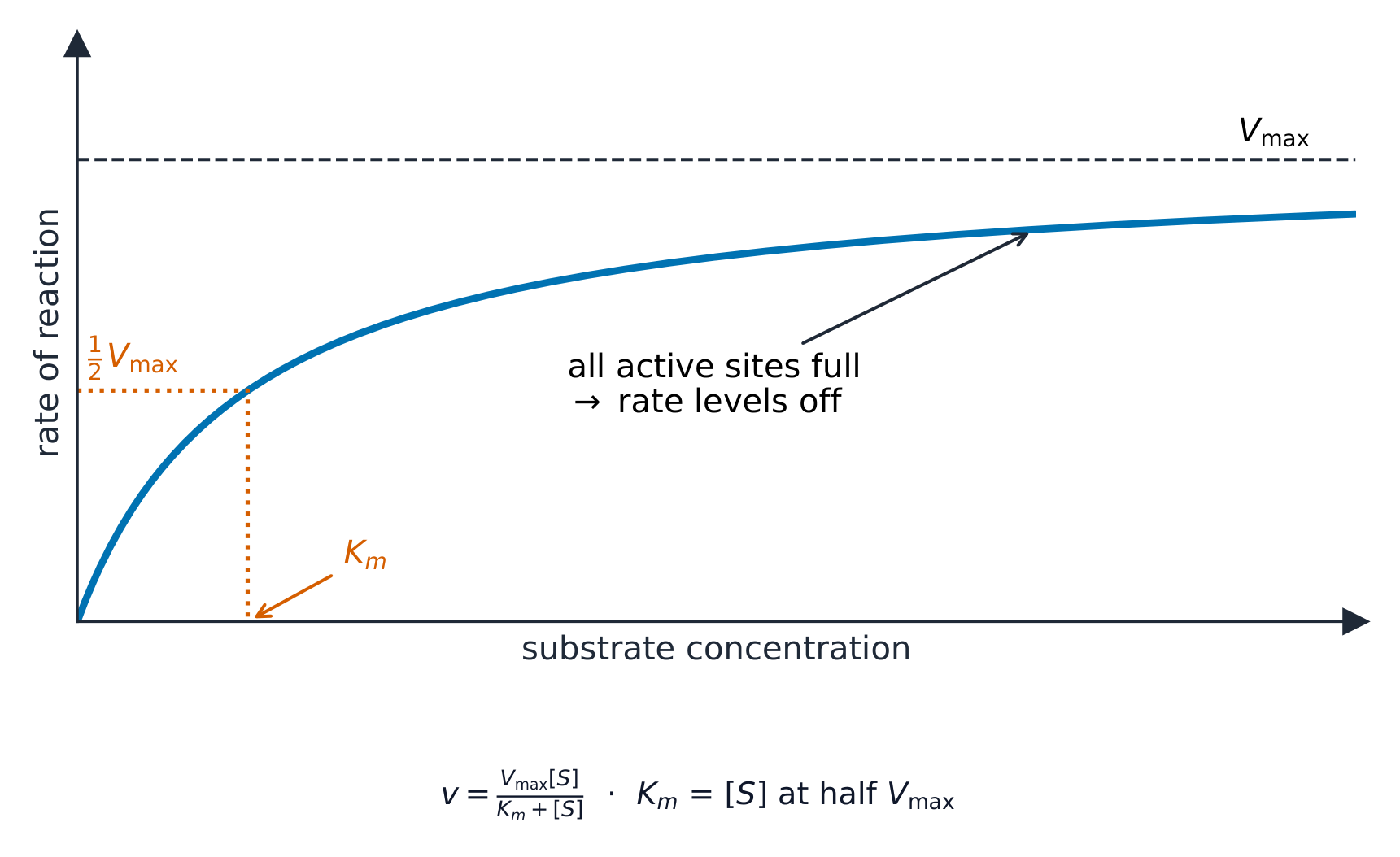
The levelling-off rate, when all active sites are full, is the maximum rate, written $V_{\text{max}}$.

The Michaelis–Menten constant 米氏常数 ($K_{\text{m}}$) is the substrate concentration that gives half of $V_{\text{max}}$. It tells you about the enzyme's affinity 亲和力 (pulling power) for its substrate:

  • a low $K_{\text{m}}$ means the enzyme reaches half-speed at a low substrate concentration, so it has a high affinity.
  • a high $K_{\text{m}}$ means a low affinity.

So $K_{\text{m}}$ lets you compare how strongly different enzymes hold their substrates.

日本語

すべての活性部位が飽和した際の頭打ちの速度を最大速度といい、$V_{\text{max}}$ で表します。

マイケリス・メンテン定数 ($K_{\text{m}}$) は、$V_{\text{max}}$ の半分となる基質濃度です。これは酵素の基質に対する親和性(引き付け力)について教えてくれます:

  • 低い $K_{\text{m}}$ は、酵素が低い基質濃度で半分の速度に達することを意味し、したがって高い親和性を持つことを示す。
  • 高い $K_{\text{m}}$ は低い親和性を意味する。

したがって、$K_{\text{m}}$ を用いることで、異なる酵素が基質をどれだけ強く保持するかを比較できます。

基質濃度に対する反応速度の曲線:Vmaxでプラトーに達し、Vmaxの半分およびそれに対応するKmが示されている
すべての活性部位が飽和した際に速度は$V_{\text{max}}$ に達し、$K_{\text{m}}$ は$V_{\text{max}}$ の半分を与える基質濃度です
Explore · ⁨探索⁩

Substrate concentration and Vmax · ⁨基質濃度とVmax⁩

Add more substrate: the rate climbs, then plateaus at $V_{max}$ once every active site is busy. $K_m$ is the substrate concentration that gives half of $V_{max}$. · ⁨基質を増やす: 速度は上昇し、すべての活性部位が飽和すると$V_{max}$で限速します。$K_m$は$V_{max}$の半分を与える基質濃度です。⁩

3.2

Reversible inhibitors · ⁨可逆的阻害剤⁩

English

Some inhibitors are reversible 可逆: they can leave the enzyme again. There are two types.

Type Where it binds Effect of adding more substrate Effect on $V_{\text{max}}$ and $K_{\text{m}}$
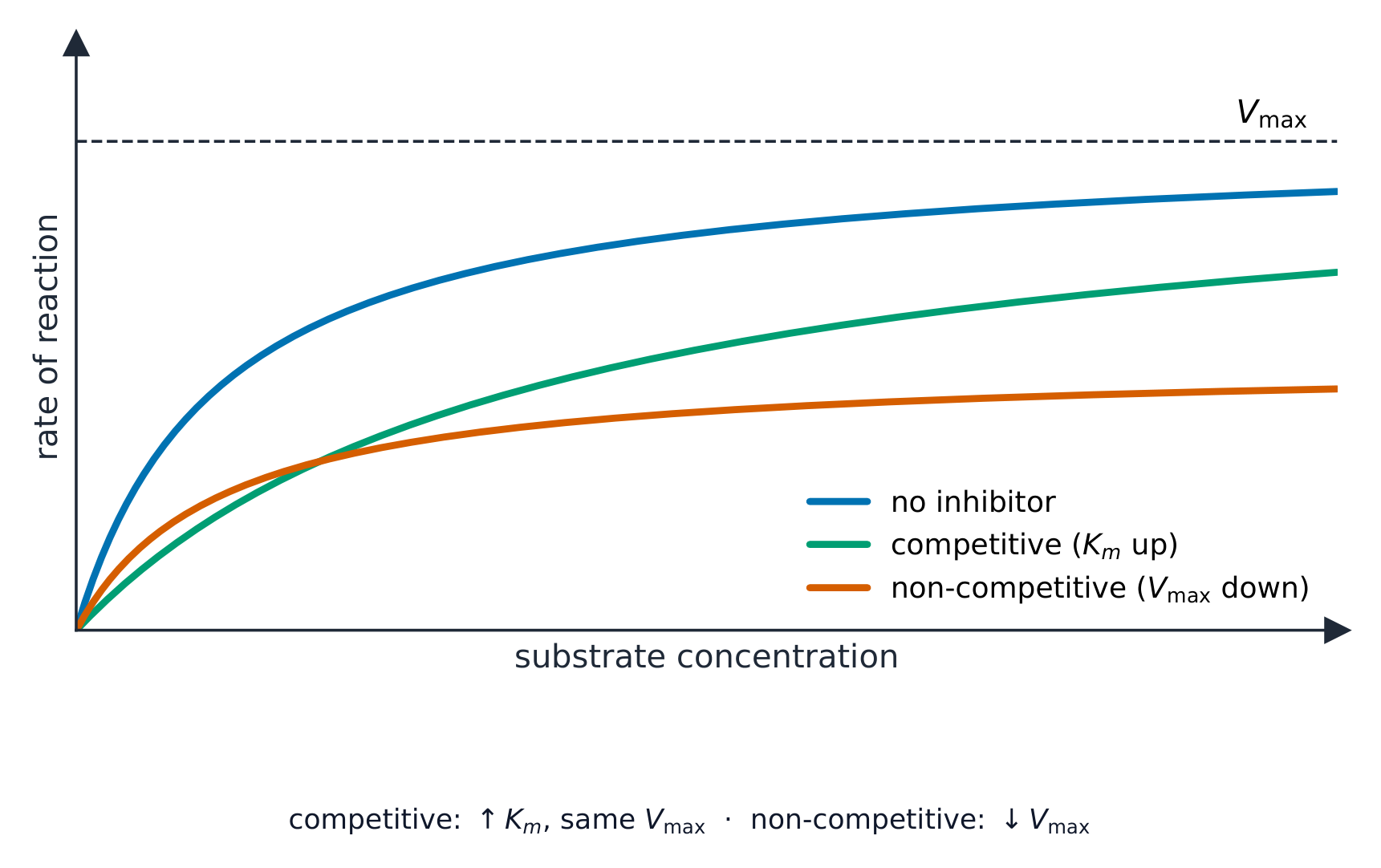
competitive inhibitor 竞争性抑制剂 in the active site (it has a similar shape to the substrate) more substrate out-competes it, so its effect is reduced $V_{\text{max}}$ unchanged; $K_{\text{m}}$ rises
non-competitive inhibitor 非竞争性抑制剂 at another site, changing the active site's shape adding more substrate does not help $V_{\text{max}}$ falls; $K_{\text{m}}$ unchanged
日本語

一部の阻害剤は可逆的です:酵素から再び離れることができます。2つのタイプがあります。

種類 結合部位 基質を追加した影響 $V_{\text{max}}$ および $K_{\text{m}}$ への影響
競合阻害剤 活性部位に結合する(基質と似た形をしている) 基質を増やすことで競合し、その影響が弱まる $V_{\text{max}}$ 変化なし;$K_{\text{m}}$ 上昇
非競合阻害剤 別の部位に結合し、活性部位の形を変える 基質を増やしても効果はない $V_{\text{max}}$ 低下;$K_{\text{m}}$ 変化なし
基質濃度に対する3つの反応速度曲線:阻害剤なしではVmaxに達する、競合阻害は同じVmaxに達するが遅れる、非競合阻害はより低いVmaxで頭打ちになる
競合阻害剤は$K_{\text{m}}$を上げる(基質を増やすことで克服できる)、非競合阻害剤は$V_{\text{max}}$を下げる
3.2

Immobilised enzymes · ⁨固定化酵素⁩

English

An immobilised enzyme 固定化酶 is fixed in place — for example, trapped inside small beads of alginate 海藻酸盐 — instead of floating free in solution. The substrate solution flows past the beads.

A free enzyme usually works a little faster, because the substrate can reach it easily. But immobilised enzymes have big practical advantages:

  • the enzyme is not washed away, so it can be used again and again.
  • the product is pure — it is not mixed with enzyme.
  • the enzyme is more stable, so it survives changes in temperature and pH better.
  • the process can run continuously, with substrate flowing in and product flowing out.
日本語

固定化酵素とは、溶液中で自由に浮遊するのではなく、例えばアルギネートという小さなビーズの中に固定されている酵素のことである。基質溶液はビーズの上を流れる。

酵素を含むビーズに一方から基質が入り、他方から生成物が出ていく様子を描写した図で、酵素はビーズ内に留まっている
酵素はビーズ内に留まり、基質は入って生成物は出ていくため、酵素が洗い流されることはない

遊離酵素の方が基質にアクセスしやすいため、わずかに速く働くことが多い。しかし、固定化酵素には実用上の大きな利点がある:

  • 酵素が洗い流されないため、何度も再利用できる。
  • 生成物が純粋であり、酵素が混ざらない。
  • 酵素が安定しており、温度やpHの変化に耐えられる。
  • 基質を入れて生成物を出すことで、プロセスを連続して行える。
白色の生体洗剤のスプーン
生体洗剤には、低温でも食品や血液の汚れを分解する酵素が含まれている
Vocabulary · ⁨語彙⁩ Train · ⁨練習する⁩
English 日本語
immobilised enzyme/ɪˈməʊbəlaɪzd ˈenzaɪm/ 固定化酵素
alginate/ˈældʒɪneɪt/ アルジネート
3.2

Exam tips · ⁨試験対策⁩

English
  • Explain enzyme action with the induced-fit model (the active site moulds around the substrate) — now preferred to lock-and-key.
  • Above the optimum the enzyme denatures (hydrogen bonds and tertiary structure break) — write "denatures", never "dies" or "is killed".
  • Distinguish inhibitors: competitive binds the active site (overcome by more substrate, same $V_{max}$); non-competitive binds elsewhere (lower $V_{max}$).
  • Compare rates using the initial rate (tangent at time zero) — the fairest measure, before substrate becomes limiting.
日本語
  • 誘導適合モデルを用いて酵素作用を説明する(活性部位が基質を取り込む)。これはlock-and-keyモデルよりも現在好まれている。
  • 最適値を超えると酵素は変性する(水素結合および三次元構造が崩れる)。「死ぶ」または「殺される」と書かず、「変性する」と書くこと。
  • 阻害剤を区別する:競合阻害剤は活性部位に結合する(基質を増やすことで克服でき、$V_{max}$は同じ)、非競合阻害剤は他の部位に結合する($V_{max}$を下げる)。
  • 初期速度(t=0における接線)を用いて速度を比較する。基質が律速因子となる前の最も公平な指標である。

Interactive lessons on this topic · ⁨このトピックのインタラクティブ授業⁩

Work through it step by step, with instant-check exercises. · ⁨一歩ずつ進め、即時チェック付きの問題で学習します。⁩

Past Papers · ⁨過去問⁩

More topics in A-Level Biology · ⁨A-Level 生物⁩ · ⁨A-Level Biology · ⁨A-Level 生物⁩ の他のトピック⁩

Log in or create account · ⁨ログインまたはアカウント作成⁩

IGCSE, A-Level & AP