| Inti | Tambahan |
|---|---|
| 1 Jelaskan penggunaan penggaris dan gelas ukur untuk menemukan panjang atau volume | |
| 2 Jelaskan cara mengukur berbagai interval waktu menggunakan jam dan timer digital | |
| 3 Tentukan nilai rata-rata untuk jarak pendek dan interval waktu singkat dengan mengukur beberapa kali (termasuk periode ayunan pendulum) | |
| 4 Pahami bahwa besaran skalar hanya memiliki besaran (ukuran) saja dan besaran vektor memiliki besaran dan arah | |
| 5 Tahu bahwa besaran-besaran berikut adalah skalar: jarak, kecepatan, waktu, massa, energi, dan suhu | |
| 6 Tahu bahwa besaran-besaran berikut adalah vektor: gaya, berat, kecepatan, percepatan, momentum, kuat medan listrik dan kuat medan gravitasi | |
| 7 Tentukan, secara perhitungan atau grafik, resultan dari dua vektor yang saling tegak lurus, terbatas hanya pada gaya atau kecepatan |
Tips
IGCSE Physics (0625) has six topics: motion, forces and energy; thermal physics; waves; electricity and magnetism; nuclear physics; space physics.
Check your tier first. Papers exist for six components, and which you sit depends on whether you are entered for Core or Extended. Extended-only content is a large part of the syllabus and is wasted revision if you are on Core.
The commonest lost marks are the cheapest to fix: missing units, the wrong number of significant figures, and answers that give a number without the formula that produced it. Definitions are marked against exact wording — learn them as written, not as remembered.
-
1
Gerakan, gaya dan energi
Tonton pelajaran1.1
Measurement 测量

Silabus
Sumber: Silabus Cambridge International
Resolving a vector into components Length and volume
Use a ruler 直尺 to measure length. Read the scale with your eye straight in front of the mark to avoid a reading error.
The water an irregular solid pushes up gives its volume 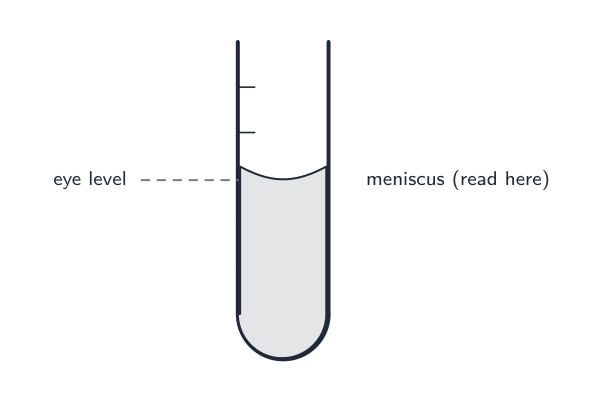
Read a measuring cylinder at the bottom of the meniscus, with your eye level Use a measuring cylinder 量筒 to measure the volume of a liquid. Read the scale at the bottom of the curved surface (the meniscus 弯月面), with your eye level with it.
Measuring time
Use a stopwatch 秒表 or a digital timer 数字计时器 to measure a time interval. A clock is fine for long times (minutes or hours). A stopwatch is started and stopped by hand, so each reading has a reaction time 反应时间 error of about 0.2 s. To make this error matter less, time a long interval, or time many repeats and divide (see below).
Measuring small amounts
A single small length or a short time is hard to measure well. The trick is to measure many and divide 测多个再相除:
- To find the thickness of one page, measure 100 pages and divide by 100.
- To find the time for one swing of a pendulum 摆, measure the time for 20 swings and divide by 20. One full swing is called the period 周期.
This makes the uncertainty 不确定度 (the size of the error) much smaller.
Scalars and vectors
A scalar quantity 标量 has size (magnitude 大小) only. A vector quantity 矢量 has size and direction.
- Scalars: distance, speed, time, mass 质量, energy 能量, temperature 温度.
- Vectors: force 力, weight 重力, velocity 速度, acceleration 加速度, momentum 动量, electric field strength 电场强度, gravitational field strength 重力场强度.
To add two vectors at right angles (90°), draw them as two sides of a rectangle. The resultant 合矢量 is the diagonal. Find its size with Pythagoras and its direction with trigonometry.
$$R = \sqrt{a^2 + b^2}$$
Two vectors at right angles add to a resultant $R$, the diagonal of the rectangle JelajahiSkalar & vektor
resultan = a + b
Tambah dua vektor hujung-ke-hujung untuk mencari hasil tambah.
Kosa kata LatihEnglish Bahasa Indonesia ruler/ˈruːlə/ penguasa measuring cylinder/ˈmeʒərɪŋ ˈsɪlɪndə/ gelas ukur meniscus/ˈmenɪskəs/ meniskus stopwatch/ˈstɒpwɒtʃ/ stopwatch digital timer/ˈdɪdʒɪtl ˈtaɪmə/ timer digital reaction time/rɪˈækʃn taɪm/ waktu reaksi measure many and divide/ˈmeʒə ˈmeni ænd dɪˈvaɪd/ ukur banyak dan bagi pendulum/ˈpendjʊləm/ bandul period/ˈpɪərɪəd/ tempoh uncertainty/ʌnˈsɜːtənti/ ketidakpastian scalar quantity/ˈskeɪlə ˈkwɒntɪti/ besaran skalar magnitude/ˈmæɡnɪtjuːd/ besarnya vector quantity/ˈvektə ˈkwɒntɪti/ besaran vektor mass/mæs/ massa energy/ˈenədʒi/ tenaga temperature/ˈtemprɪtʃə/ suhu force/fɔːs/ gaya weight/weɪt/ berat velocity/vəˈlɒsɪti/ kecepatan (vektor) acceleration/əkˌseləˈreɪʃn/ percepatan momentum/məʊˈmentəm/ momentum electric field strength/ɪˈlektrɪk fiːld streŋθ/ kekuatan medan listrik gravitational field strength/ˌɡrævɪˈteɪʃənl fiːld streŋθ/ kekuatan medan gravitasi resultant/rɪˈzʌltənt/ resultan 1.2
Motion 运动
Silabus
Inti Tambahan 1 Definisikan kecepatan sebagai jarak tempuh per satuan waktu; ingat dan gunakan persamaan $$v = \frac{s}{t}$$2 Definisikan kecepatan (velocity) sebagai kecepatan dalam arah tertentu 3 Ingat dan gunakan persamaan $$\text{average speed} = \frac{\text{total distance travelled}}{\text{total time taken}}$$9 Definisikan percepatan sebagai perubahan kecepatan per satuan waktu; ingat dan gunakan persamaan $$a = \frac{\Delta v}{\Delta t}$$4 Gambar sketsa, plot, dan interpretasikan grafik jarak–waktu dan grafik kecepatan–waktu 5 Tentukan, secara kualitatif, berdasarkan data yang diberikan atau bentuk grafik jarak–waktu atau grafik kecepatan–waktu, kapan suatu benda: (a) diam (b) bergerak dengan kecepatan konstan (c) mengalami percepatan (d) mengalami perlambatan 10 Tentukan dari data yang diberikan atau bentuk grafik kecepatan–waktu, kapan suatu benda bergerak dengan: (a) percepatan konstan (b) percepatan berubah 6 Hitung kecepatan dari gradien bagian garis lurus pada grafik jarak–waktu 11 Hitung percepatan dari gradien grafik kecepatan–waktu 7 Hitung luas di bawah grafik kecepatan–waktu untuk menentukan jarak tempuh bagi gerak dengan kecepatan konstan atau percepatan konstan 12 Tahu bahwa perlambatan adalah percepatan negatif dan gunakan hal ini dalam perhitungan 8 Nyatakan bahwa percepatan jatuh bebas $g$ untuk benda di dekat permukaan Bumi kira-kira konstan dan kira-kira $9.8\text{ m/s}^2$ 13 Jelaskan gerak benda yang jatuh dalam medan gravitasi seragam dengan dan tanpa hambatan udara/cairan, termasuk merujuk pada kecepatan terminal Sumber: Silabus Cambridge International
Speed and velocity
Speed 速率 is the distance travelled per unit time.
$$v = \frac{s}{t}$$Velocity is speed in a stated direction. So velocity is a vector but speed is a scalar.
$$\text{average speed} = \frac{\text{total distance}}{\text{total time}}$$Acceleration
Acceleration is the change in velocity per unit time.
$$a = \frac{\Delta v}{\Delta t}$$Here $\Delta v$ means "the change in velocity". A deceleration 减速 (slowing down) is a negative acceleration.
Worked example. A car speeds up from $8\ \text{m/s}$ to $20\ \text{m/s}$ in $4.0\ \text{s}$. Find its acceleration.
$$a = \frac{\Delta v}{\Delta t} = \frac{20 - 8}{4.0} = 3.0\ \text{m/s}^2$$Motion graphs
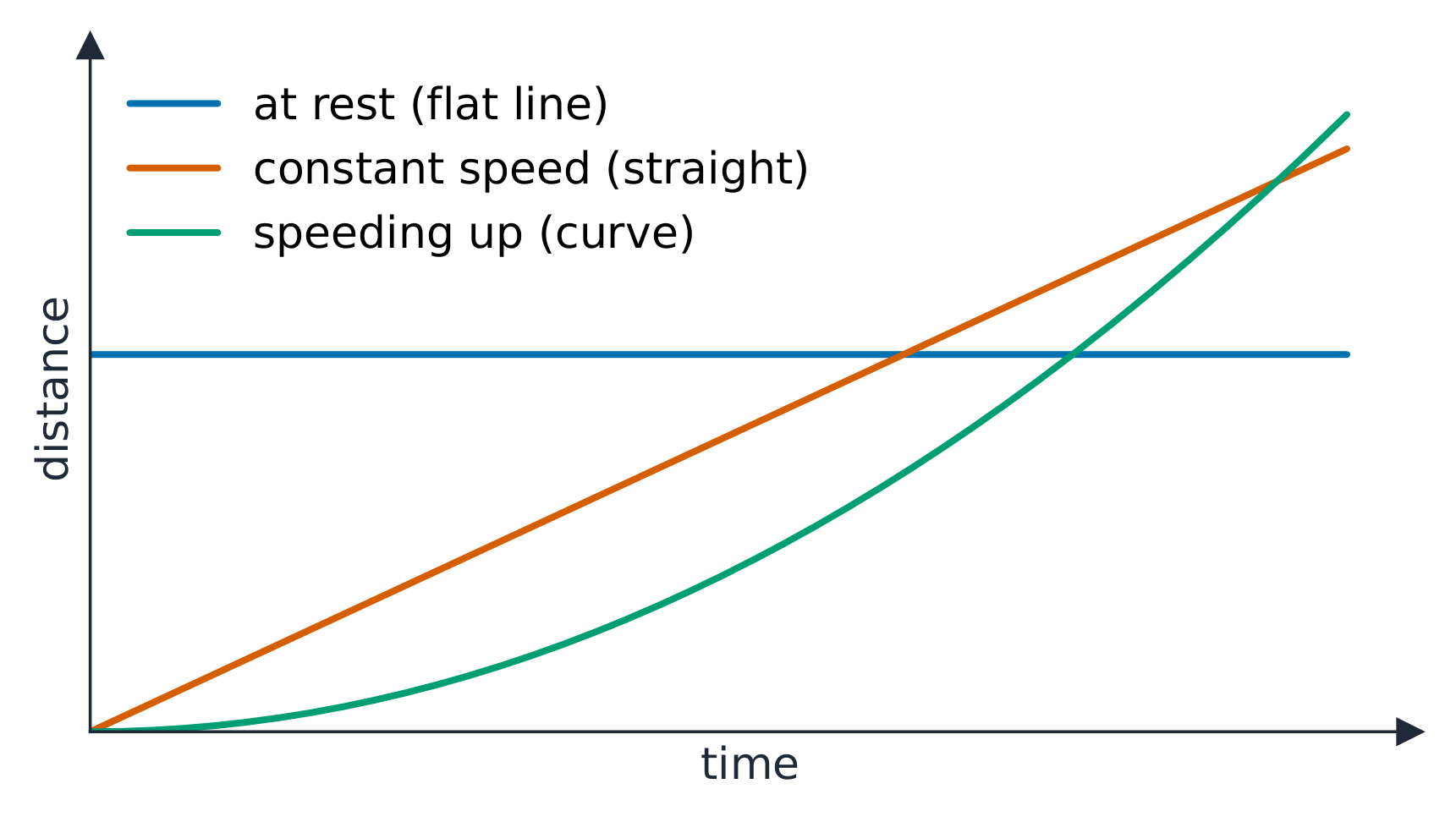
A distance–time graph 距离-时间图 shows how far an object has gone:
- A flat (horizontal) line means the object is at rest 静止.
- A straight slope means constant speed. The gradient 斜率 (steepness) is the speed.
- A curve that gets steeper means the object is speeding up.
The shape of a distance–time line: flat is at rest, a straight slope is constant speed, a rising curve is speeding up A speed–time graph 速度-时间图 shows how fast an object is going:
- A flat line means constant speed.
- A straight slope means constant acceleration. The gradient is the acceleration.
- The area under the line 线下面积 is the distance travelled.
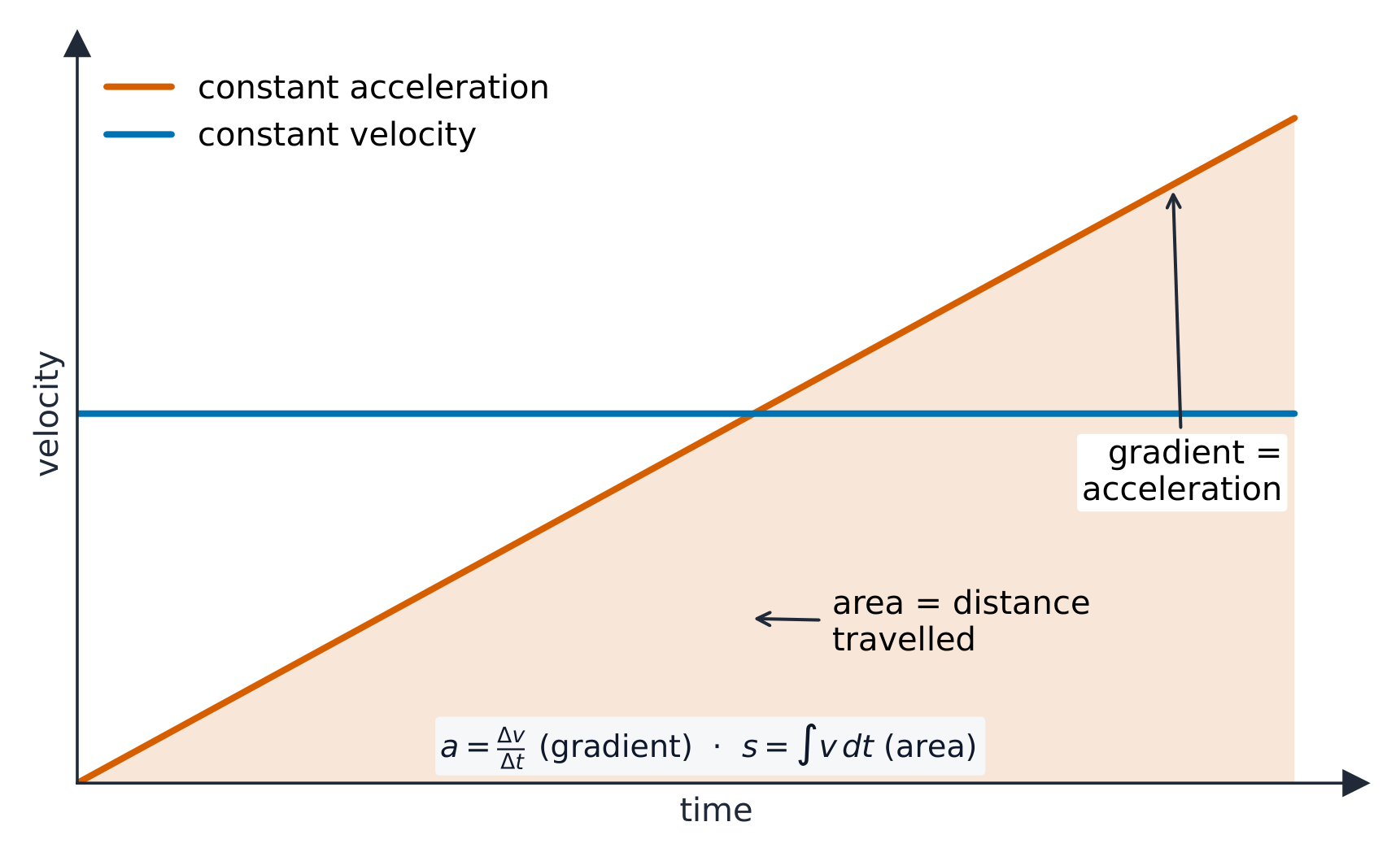
On a velocity–time graph the gradient is the acceleration and the area under the line is the distance travelled Falling objects
Near the Earth the gravitational field is uniform 均匀 (the same strength everywhere), so all objects speed up as they fall at the same rate. This is the acceleration of free fall 自由落体加速度, $g \approx 9.8\ \text{m/s}^2$.
When an object falls through air, air resistance 空气阻力 (a drag force) acts upward. As it speeds up, air resistance grows. When air resistance equals the weight, the resultant force is zero and the object stops speeding up. It then falls at a steady terminal velocity 收尾速度.
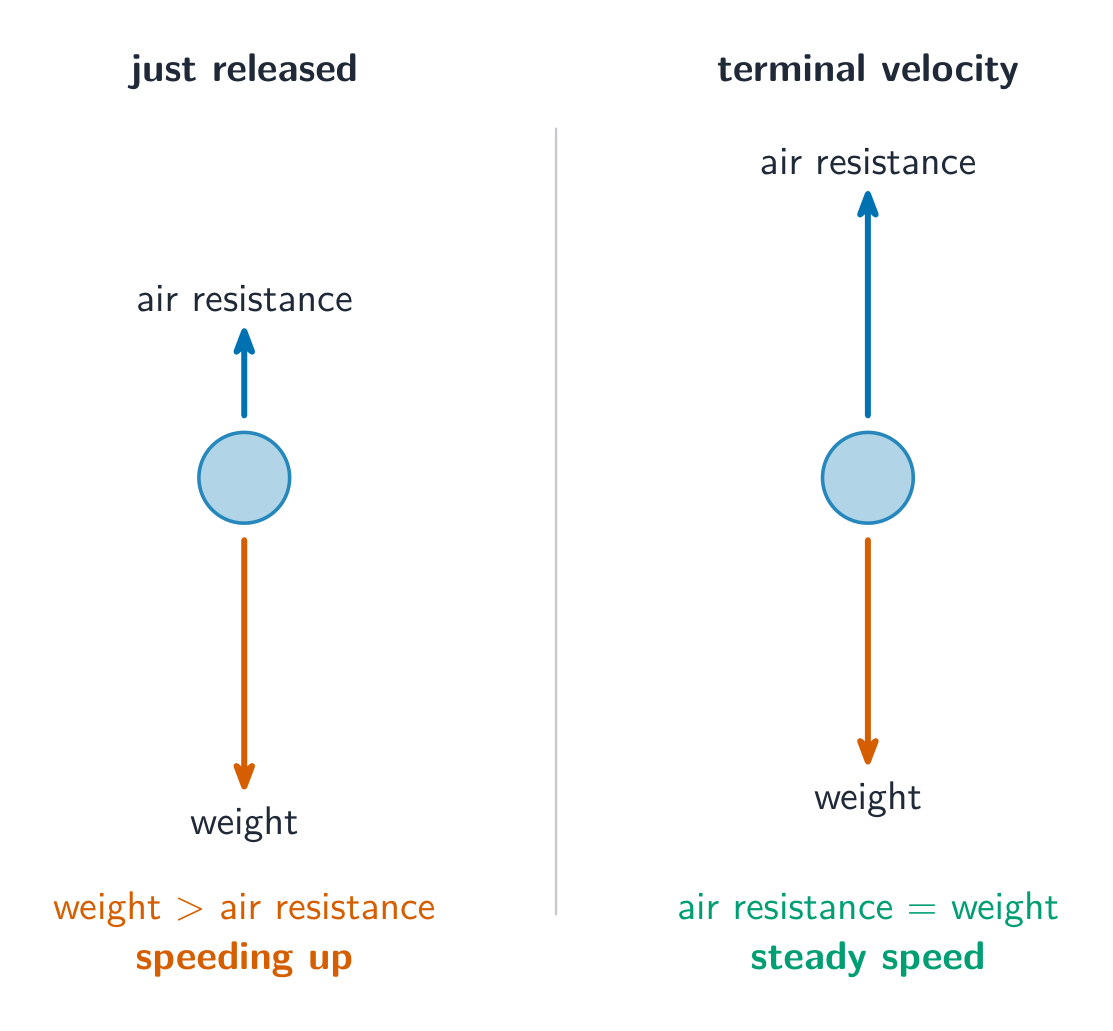
At first the weight is bigger than the air resistance, so the object speeds up; at terminal velocity the two are equal and the speed is steady JelajahiGrafik kecepatan–waktu
Ubah u dan a. Gradien adalah percepatan; luas di bawah garis adalah jarak tempuh.
Kosa kata LatihEnglish Bahasa Indonesia motion/ˈməʊʃn/ gerakan speed/spiːd/ kecepatan (besaran skalar) deceleration/dɪˌseləˈreɪʃn/ perlambatan distance–time graph/ˈdɪstəns taɪm ɡræf/ grafik jarak–waktu at rest/æt rest/ diam gradient/ˈɡreɪdɪənt/ gradien speed–time graph/spiːd taɪm ɡræf/ grafik kecepatan–waktu area under the line/ˈeərɪə ˈʌndə ðə laɪn/ luas di bawah garis uniform/ˈjuːnɪfɔːm/ seragam acceleration of free fall/əkˌseləˈreɪʃn ɒv friː fɔːl/ percepatan jatuh bebas air resistance/eə rɪˈzɪstəns/ hambatan udara terminal velocity/ˈtɜːmɪnl vəˈlɒsɪti/ kecepatan terminal 1.3
Mass and weight
Silabus
Inti Tambahan 1 Nyatakan bahwa massa adalah ukuran jumlah materi dalam suatu benda yang diam relatif terhadap pengamat 2 Nyatakan bahwa berat adalah gaya gravitasi pada suatu benda yang memiliki massa 5 Deskripsikan, dan gunakan konsep, berat sebagai efek medan gravitasi pada massa 3 Definisikan kuat medan gravitasi sebagai gaya per satuan massa; ingat dan gunakan persamaan $$g = \frac{W}{m}$$dan tahu bahwa ini setara dengan percepatan jatuh bebas4 Tahu bahwa berat (dan massa) dapat dibandingkan menggunakan neraca Sumber: Silabus Cambridge International
Mass is the amount of matter 物质 in an object. It is measured in kilograms (kg) and does not change when you move the object.
Weight is the force of gravity on a mass. It is measured in newtons (N). Weight can change: it is smaller on the Moon because the Moon's gravity is weaker.
Gravitational field strength is the force per unit mass:
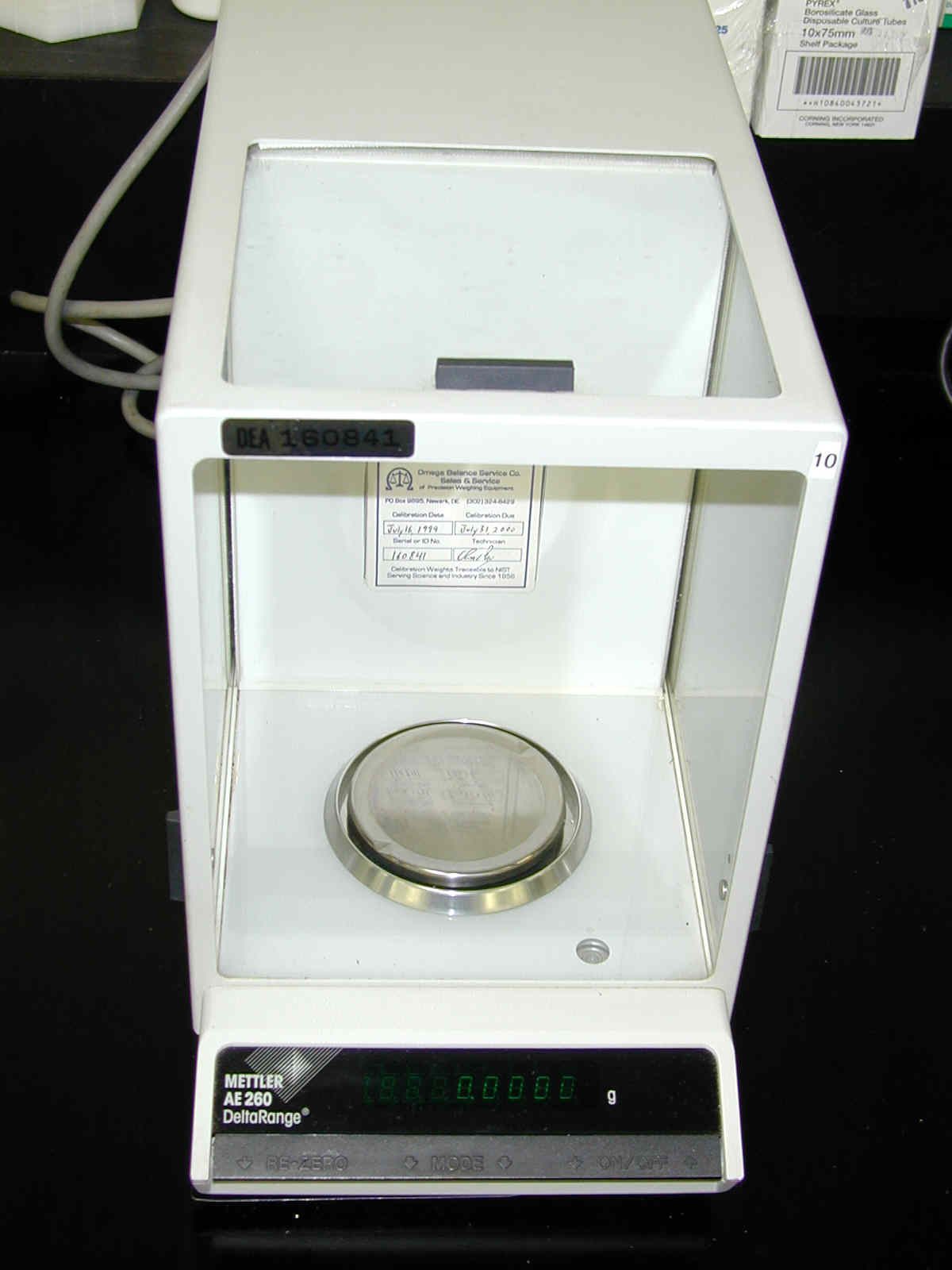
$$g = \frac{W}{m}$$This $g$ has the same value as the acceleration of free fall ($\approx 9.8\ \text{N/kg}$). You can compare masses with a balance 天平.
A laboratory balance measures mass; weight is the gravitational force on that mass JelajahiBerat dan massa
W = mg
Berat berbanding lurus dengan massa — gradiennya adalah kuat medan gravitasi g (sekitar 10 N/kg di Bumi).
Kosa kata LatihEnglish Bahasa Indonesia matter/ˈmætə/ materi balance/ˈbæləns/ keseimbangan 1.4
Density 密度

Silabus
Inti Tambahan 1 Definisikan kepadatan sebagai massa per satuan volume; ingat dan gunakan persamaan $$\rho = \frac{m}{V}$$2 Deskripsikan cara menentukan kepadatan cairan, benda padat berbentuk teratur, dan benda padat tidak beraturan yang tenggelam dalam cairan (volume melalui perpindahan), termasuk perhitungan yang sesuai 3 Tentukan apakah suatu benda mengapung berdasarkan data kepadatan 4 Tentukan apakah satu cairan akan mengapung di atas cairan lain berdasarkan data kepadatan, dengan syarat cairan tersebut tidak bercampur Sumber: Silabus Cambridge International
Density is the mass per unit volume.
$$\rho = \frac{m}{V}$$The symbol $\rho$ is the Greek letter "rho". The unit is $\text{kg/m}^3$ or $\text{g/cm}^3$.
To find density: measure the mass with a balance, find the volume, then divide.
- Regular solid 规则固体 (like a box): measure the sides and calculate the volume.
- Irregular solid 不规则固体 (a strange shape): lower it into water in a measuring cylinder. The rise in water level is its volume. This is the displacement method 排水法.
- Liquid: put an empty measuring cylinder on the balance and read its mass. Pour in the liquid, read the volume on the cylinder, and read the mass again. The mass of the liquid is the difference between the two mass readings.
An object floats 漂浮 if its density is less than the density of the liquid. It sinks if its density is greater. In the same way, one liquid floats on top of another (if the two do not mix) when its density is lower: oil floats on water.
Worked example. A stone of mass $54\ \text{g}$ is lowered into a measuring cylinder. The water level rises from $20\ \text{cm}^3$ to $40\ \text{cm}^3$. Find the density of the stone.
The volume of the stone is the rise in water level, $40 - 20 = 20\ \text{cm}^3$, so
$$\rho = \frac{m}{V} = \frac{54}{20} = 2.7\ \text{g/cm}^3$$An iceberg floats with most of its volume hidden: ice is slightly less dense than water JelajahiMelayang dan densitas
Ubah densitas benda dan cairan: benda akan melayang jika lebih ringan, dan semakin padat benda itu, semakin banyak bagian yang tenggelam di bawah air. Besi tenggelam di air tetapi melayang di raksa.
Kosa kata LatihEnglish Bahasa Indonesia density/ˈdensɪti/ densitas regular solid/ˈreɡjʊlə ˈsɒlɪd/ padat beraturan irregular solid/ɪˈreɡjʊlə ˈsɒlɪd/ padat tidak beraturan displacement method/dɪˈspleɪsmənt ˈmeθəd/ metode perpindahan volume floats/fləʊts/ mengambang 1.5
Forces
Silabus
1.5.1 Efek gaya
Inti Tambahan 1 Tahu bahwa gaya dapat menghasilkan perubahan pada ukuran dan bentuk benda 9 Definisikan konstanta pegas sebagai gaya per satuan perpanjangan; ingat dan gunakan persamaan $$k = \frac{F}{x}$$2 Gambar sketsa, plot, dan interpretasikan grafik beban–perpanjangan untuk padatan elastis dan deskripsikan prosedur eksperimen yang terkait 10 Definisikan dan gunakan istilah ‘batas proporsionalitas’ untuk grafik beban–perpanjangan dan identifikasi titik ini pada grafik (pemahaman tentang batas elastis tidak diperlukan) 3 Tentukan resultan dari dua atau lebih gaya yang bekerja sepanjang garis lurus yang sama 11 Ingat dan gunakan persamaan $F = ma$ dan tahu bahwa gaya dan percepatan berada dalam arah yang sama 4 Tahu bahwa suatu benda tetap diam atau terus bergerak lurus dengan kecepatan konstan kecuali dipengaruhi oleh resultan gaya 5 Nyatakan bahwa resultan gaya dapat mengubah kecepatan benda dengan mengubah arah geraknya atau kecepatannya 12 Deskripsikan, secara kualitatif, gerak dalam lintasan melingkar akibat gaya tegak lurus terhadap gerak sebagai: (a) kecepatan meningkat jika gaya meningkat, dengan massa dan jari-jari konstan (b) jari-jari berkurang jika gaya meningkat, dengan massa dan kecepatan konstan (c) massa yang lebih besar memerlukan gaya yang lebih besar untuk mempertahankan kecepatan dan jari-jari konstan ($F = \frac{mv^2}{r}$ tidak diperlukan) 6 Deskripsikan gesekan solid sebagai gaya antara dua permukaan yang dapat menghambat gerak dan menghasilkan pemanasan 7 Tahu bahwa gesekan (hambatan) bekerja pada benda yang bergerak melalui cairan 8 Tahu bahwa gesekan (hambatan) bekerja pada benda yang bergerak melalui gas (misalnya hambatan udara) 1.5.2 Efek tumpuk gaya
Inti Tambahan 1 Deskripsikan tumpuk gaya sebagai ukuran efek tumpuknya dan berikan contoh sehari-hari 2 Definisikan momen gaya sebagai $\text{moment} = \text{force} \times \text{perpendicular distance from the pivot}$; ingat dan gunakan persamaan ini 3 Terapkan prinsip tumpuk pada situasi dengan satu gaya di setiap sisi engsel, termasuk penyeimbangan balok 5 Terapkan prinsip tumpuk pada situasi lainnya, termasuk yang memiliki lebih dari satu gaya di setiap sisi engsel 4 Nyatakan bahwa, ketika tidak ada resultan gaya dan tidak ada resultan tumpuk, suatu benda berada dalam keseimbangan 6 Deskripsikan eksperimen untuk membuktikan bahwa tidak ada resultan tumpuk pada benda dalam keseimbangan 1.5.3 Pusat gravitasi
Inti Tambahan 1 Nyatakan apa yang dimaksud dengan pusat gravitasi 2 Deskripsikan eksperimen untuk menentukan posisi pusat gravitasi pelat bidang tidak beraturan 3 Deskripsikan, secara kualitatif, efek posisi pusat gravitasi terhadap stabilitas benda sederhana Sumber: Silabus Cambridge International
The principle of moments Hooke's law & the elastic limit A force is a push or a pull. A force can change the shape 形状, the speed, or the direction of an object.
Stretching (Hooke's law)
When you hang a load on a spring, it stretches. The stretch is called the extension 伸长量.
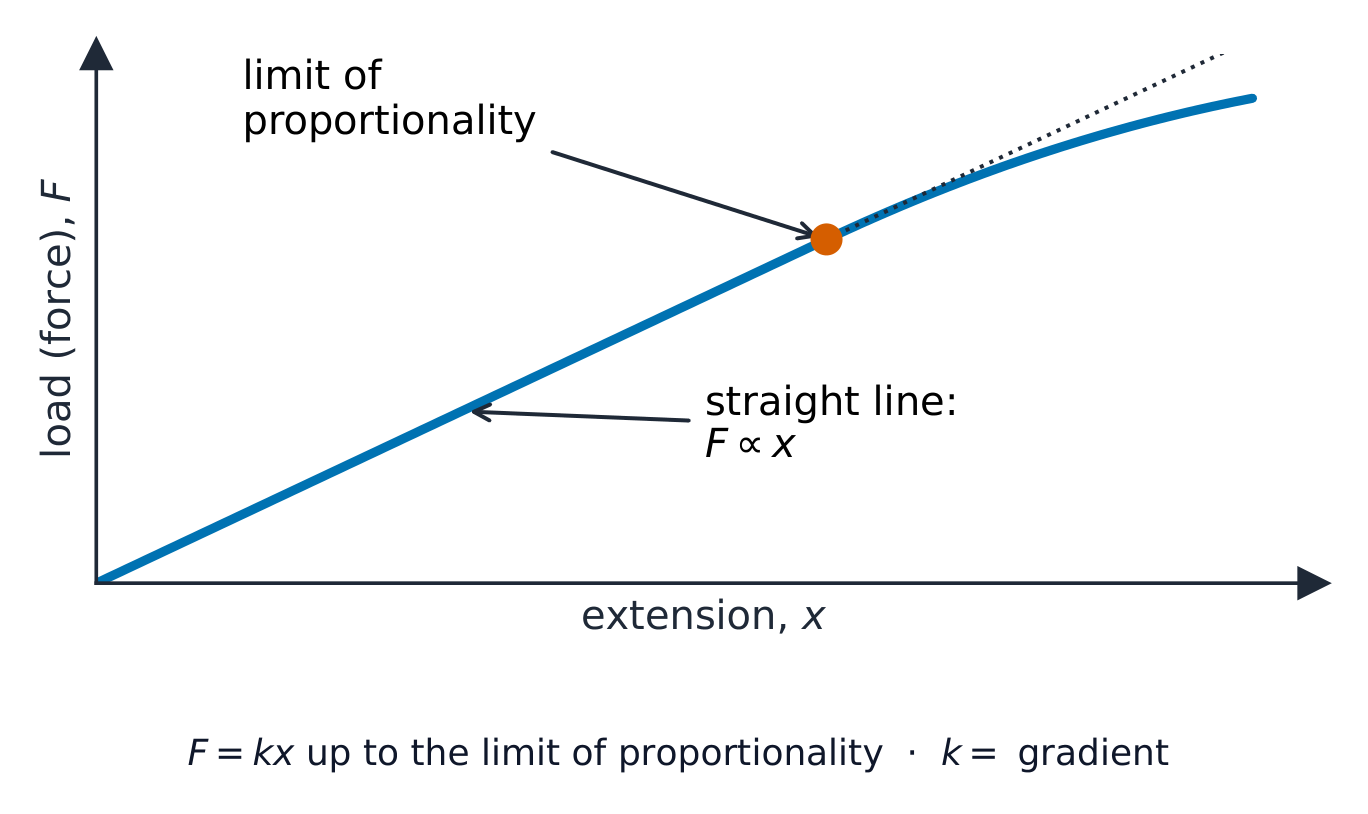
On a load–extension graph 载荷-伸长图 the line is straight at first: extension is proportional to load. The point where the line stops being straight is the limit of proportionality 比例极限.
Load is proportional to extension until the limit of proportionality, then the line curves The experiment. Hang the spring from a clamp and stand a ruler beside it. Read the position of the bottom of the spring with no load: this is the original length. Add loads one at a time (for example 1 N each) and record the new length each time. The extension is the new length minus the original length. Plot load on the y-axis against extension on the x-axis.
The spring constant 弹簧常数 is the force per unit extension:
$$k = \frac{F}{x}$$A large $k$ means a stiff spring.
Resultant force and Newton's laws
Add forces on a straight line to get the resultant force 合力 (forces one way are positive, the other way negative).
- If the resultant force is zero, the object stays at rest or keeps moving in a straight line at constant speed. (Newton's first law.)
- If the resultant force is not zero, the object accelerates in the direction of the force:
$$F = ma$$
A free-body diagram shows every force on the box as a labelled arrow Worked example. A $1200\ \text{kg}$ car has a $3000\ \text{N}$ driving force and $600\ \text{N}$ of friction. Find its acceleration.
First find the resultant force: $3000 - 600 = 2400\ \text{N}$. Then
$$a = \frac{F}{m} = \frac{2400}{1200} = 2.0\ \text{m/s}^2$$Motion in a circle
A resultant force at right angles to the motion does not change the speed. It changes the direction, so the object moves in a circle at a steady speed. This is circular motion 圆周运动. The force always points towards the centre of the circle: the pull of the string on a whirling ball, or the gravity of the Sun on a planet.
For an object moving in a circle:
- a bigger force is needed to keep the same mass moving at a higher speed in a circle of the same radius 半径;
- a bigger force makes the same mass at the same speed move in a smaller circle (a smaller radius);
- a bigger mass needs a bigger force to keep the same speed and the same radius.
Friction
Friction 摩擦力 is the force between two surfaces that touch. It tries to stop motion and makes things heat up. Drag (friction in a liquid or gas, like air resistance) also slows objects down.
Moments — the turning effect
The moment 力矩 of a force is its turning effect about a pivot 支点.
$$\text{moment} = \text{force} \times \text{perpendicular distance from the pivot}$$The unit is the newton metre (N m).
Principle of moments 力矩原理: when an object is balanced (in equilibrium 平衡),
$$\text{total clockwise moment} = \text{total anticlockwise moment}$$An object is in equilibrium when there is no resultant force and no resultant moment.
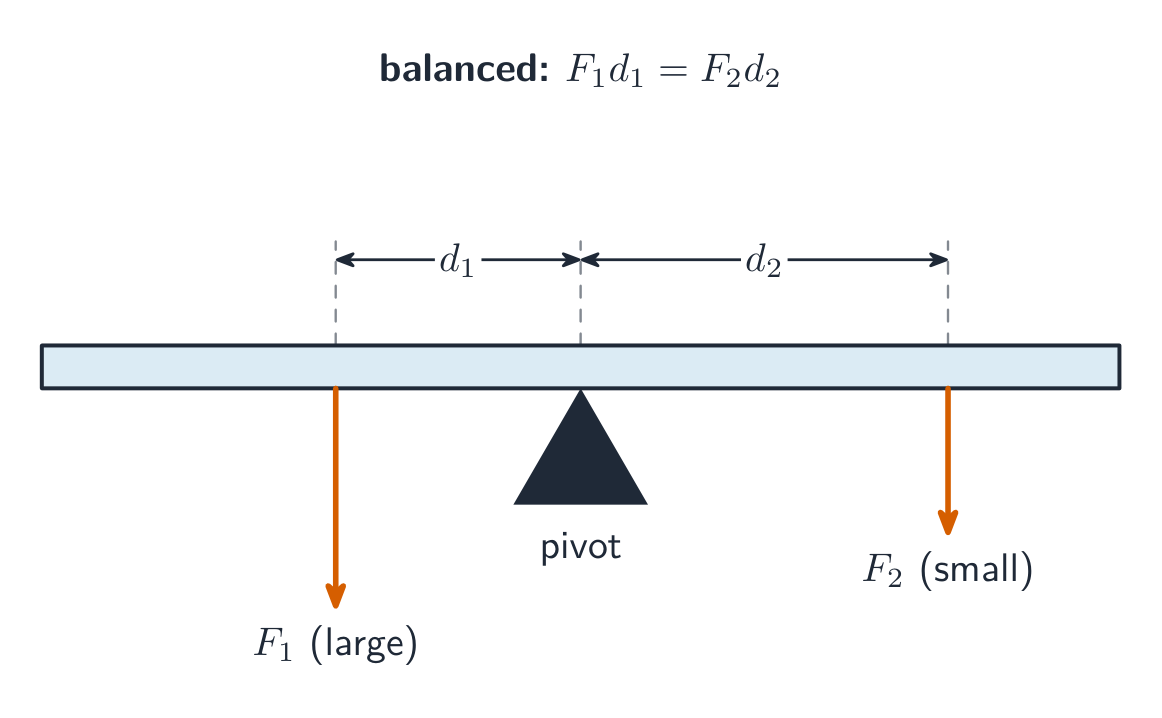
The beam balances when the clockwise moment equals the anticlockwise moment Worked example. A $30\ \text{N}$ weight sits $0.20\ \text{m}$ to the left of a pivot. How far to the right must a $20\ \text{N}$ weight sit to balance the beam?
Balanced, so anticlockwise moment $=$ clockwise moment:
$$30 \times 0.20 = 20 \times d \quad\Rightarrow\quad d = \frac{6.0}{20} = 0.30\ \text{m}$$Checking the principle by experiment. Balance a metre rule at its centre on a pivot. Hang a known weight on each side and move them until the rule balances again. Measure each distance from the pivot. Force × distance on the left equals force × distance on the right, within the small errors of measurement, so there is no resultant moment on a balanced object.
Centre of gravity
The centre of gravity 重心 is the single point where all the weight of an object seems to act.
For a flat shape (lamina 薄片), hang it from a pin and let it settle; draw a vertical line down from the pin using a plumb line. Repeat from another point. The centre of gravity is where the lines cross.
The stability 稳定性 of an object depends on where its centre of gravity is. An object is more stable 稳定 when its centre of gravity is low and its base is wide. It tips over when a vertical line down from the centre of gravity passes outside the base.
JelajahiGaya & Hukum Newton
F = ma (resultan)
Gaya resultan menentukan percepatan; gaya seimbang ⇒ tidak ada percepatan.
Kosa kata LatihEnglish Bahasa Indonesia measurement/ˈmeʒəmənt/ pengukuran shape/ʃeɪp/ bentuk extension/ekˈstenʃn/ ekstensi load–extension graph/ləʊd ekˈstenʃn ɡræf/ grafik beban–perpanjangan limit of proportionality/ˈlɪmɪt ɒv prəˌpɔːʃəˈnælɪti/ batas proporsionalitas spring constant/sprɪŋ ˈkɒnstənt/ konstanta pegas resultant force/rɪˈzʌltənt fɔːs/ resultan gaya circular motion/ˈsɜːkjʊlə ˈməʊʃn/ gerak melingkar radius/ˈreɪdɪəs/ jari-jari friction/ˈfrɪkʃn/ gesekan moment/ˈməʊmənt/ momen pivot/ˈpɪvət/ engsel principle of moments/ˈprɪnsɪpl ɒv ˈməʊmənts/ prinsip momen equilibrium/ˌiːkwɪˈlɪbrɪəm/ kesetimbangan centre of gravity/ˈsentə ɒv ˈɡrævɪti/ pusat gravitasi lamina/ˈlæmɪnə/ lamina stability/stəˈbɪlɪti/ stabilitas stable/ˈsteɪbl/ stabil 1.6
Momentum
Silabus
Inti Tambahan 1 Definisikan momentum sebagai massa $\times$ kecepatan; ingat dan gunakan persamaan $p = mv$ 2 Definisikan impuls sebagai gaya $\times$ waktu di mana gaya tersebut bekerja; ingat dan gunakan persamaan $\text{impulse} = F\Delta t = \Delta(mv)$ 3 Terapkan prinsip kekekalan momentum untuk menyelesaikan masalah sederhana dalam satu dimensi 4 Definisikan gaya resultan sebagai perubahan momentum per satuan waktu; ingat dan gunakan persamaan $F = \frac{\Delta p}{\Delta t}$ Sumber: Silabus Cambridge International
Conservation of momentum in a collision Momentum is mass times velocity. It is a vector.
$$p = mv$$Impulse 冲量 is the force times the time it acts, and it equals the change in momentum:
$$\text{impulse} = F\,\Delta t = \Delta(mv)$$So the resultant force is the change in momentum per unit time:
$$F = \frac{\Delta p}{\Delta t}$$Conservation of momentum 动量守恒: when objects collide and no outside force acts, the total momentum before equals the total momentum after.
$$m_1 u_1 + m_2 u_2 = m_1 v_1 + m_2 v_2$$(Here $u$ is a velocity before and $v$ is a velocity after.)
Worked example. A $2.0\ \text{kg}$ trolley moving at $3.0\ \text{m/s}$ hits a stationary $1.0\ \text{kg}$ trolley and they stick together. Find their common velocity afterwards.
Total momentum is conserved, so
$$(2.0 \times 3.0) + (1.0 \times 0) = (2.0 + 1.0)\,v \quad\Rightarrow\quad v = \frac{6.0}{3.0} = 2.0\ \text{m/s}$$JelajahiMomentum dalam tabrakan
Atur massa dan kecepatan lalu tabrakan. Total momentum kekal.
Kosa kata LatihEnglish Bahasa Indonesia impulse/ˈɪmpʌls/ impuls conservation of momentum/ˌkɒnsəˈveɪʃn ɒv məʊˈmentəm/ kekekalan momentum 1.7
Energy, work and power
Silabus
1.7.1 Energi
Inti Tambahan 1 Nyatakan bahwa energi dapat disimpan sebagai kinetik, potensial gravitasi, kimia, elastis (regangan), nuklir, elektrostatis dan internal (termal) 2 Jelaskan bagaimana energi ditransfer antara penyimpanan selama peristiwa dan proses, termasuk contoh transfer oleh gaya (usaha mekanik yang dilakukan), arus listrik (usaha listrik yang dilakukan), pemanasan, dan oleh gelombang elektromagnetik, suara, serta gelombang lainnya 4 Ingat dan gunakan persamaan untuk energi kinetik $E_k = \frac{1}{2}mv^2$ 5 Ingat dan gunakan persamaan untuk perubahan energi potensial gravitasi $\Delta E_p = mg\Delta h$ 3 Tahu prinsip kekekalan energi dan terapkan prinsip ini pada contoh sederhana termasuk interpretasi diagram alur sederhana 6 Tahu prinsip kekekalan energi dan terapkan prinsip ini pada contoh kompleks yang melibatkan beberapa tahap, termasuk interpretasi diagram Sankey 1.7.2 Usaha
Inti Tambahan 1 Pahami bahwa usaha mekanik atau listrik yang dilakukan sama dengan energi yang ditransfer 2 Ingat dan gunakan persamaan untuk kerja mekanis $W = Fd = \Delta E$ 1.7.3 Sumber energi
Inti Tambahan 1 Jelaskan bagaimana energi berguna dapat diperoleh, atau daya listrik dihasilkan, dari: (a) energi kimia yang tersimpan dalam bahan bakar fosil (b) energi kimia yang tersimpan dalam biofuel (c) air, termasuk energi yang tersimpan dalam gelombang, pasang surut dan air di belakang bendungan hidroelektrik (d) sumber geotermal (e) bahan bakar nuklir (f) cahaya dari Matahari untuk menghasilkan daya listrik (sel surya) (g) inframerah dan gelombang elektromagnetik lainnya dari Matahari untuk memanaskan air (panel surya) dan menjadi sumber energi angin termasuk referensi ke ketel, turbin dan generator saat digunakan 4 Tahu bahwa radiasi dari Matahari adalah sumber utama energi untuk semua sumber energi kita kecuali geotermal, nuklir dan pasang surut 2 Jelaskan keunggulan dan kelemahan setiap metode dalam hal kesetaraan, ketersediaan, keandalan, skala dan dampak lingkungan 5 Tahu bahwa energi dilepaskan melalui fusi nuklir di Matahari 6 Tahu bahwa penelitian sedang dilakukan untuk menyelidiki bagaimana energi yang dilepaskan oleh fusi nuklir dapat digunakan untuk menghasilkan energi listrik dalam skala besar 3 Pahami, secara kualitatif, konsep efisiensi transfer energi 7 Definisikan efisiensi sebagai: (a) $(\%) \text{ efficiency} = \frac{\text{(useful energy output)}}{\text{(total energy input)}} (\times 100\%)$ (b) $(\%) \text{ efficiency} = \frac{\text{(useful power output)}}{\text{(total power input)}} (\times 100\%)$ ingat dan gunakan persamaan-persamaan ini 1.7.4 Daya
Inti Tambahan 1 Definisikan daya sebagai usaha per satuan waktu dan juga sebagai energi yang ditransfer per satuan waktu; ingat dan gunakan persamaan (a) $P = \frac{W}{t}$ (b) $P = \frac{\Delta E}{t}$ Sumber: Silabus Cambridge International
Energy stores
Energy can be stored 储存 in different ways: kinetic 动能, gravitational potential 重力势能, chemical 化学能, elastic (strain) 弹性势能, nuclear 核能, electrostatic 静电能, and internal (thermal) 内能.
Energy is transferred 转移 between stores by forces (mechanical work), by electric currents, by heating, and by waves (such as light and sound).
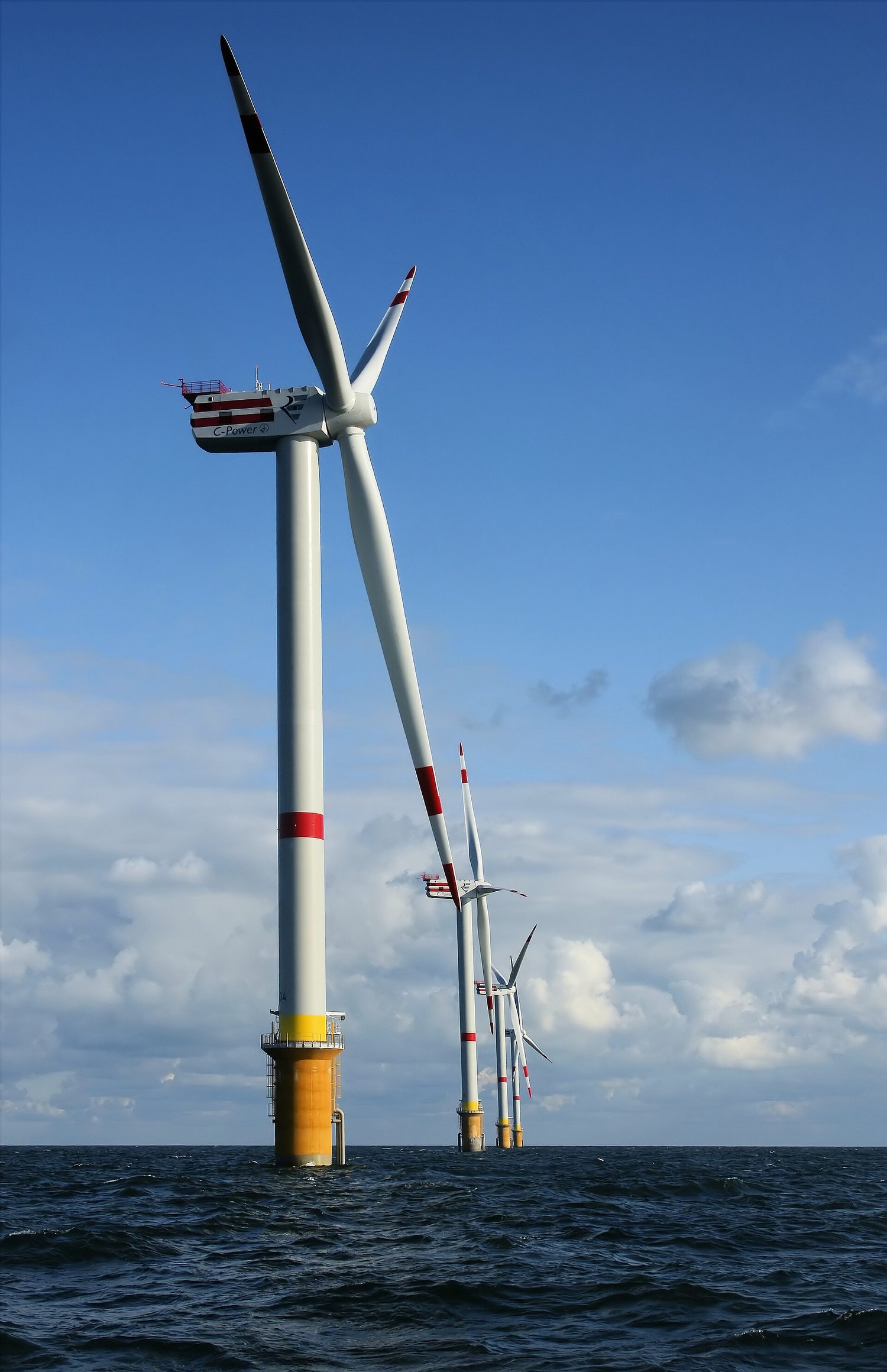
Wind turbines transfer energy from the kinetic store of the moving air to electricity Kinetic and potential energy
Kinetic energy is the energy of a moving object:
$$E_k = \frac{1}{2}mv^2$$The change in gravitational potential energy when an object goes up or down by a height $\Delta h$:
$$\Delta E_p = mg\,\Delta h$$Conservation of energy
The principle of conservation of energy 能量守恒定律 says energy is never made or destroyed; it only moves between stores. A falling object turns gravitational potential energy into kinetic energy. A Sankey diagram 桑基图 shows how the input energy splits into useful energy and wasted 浪费 energy.
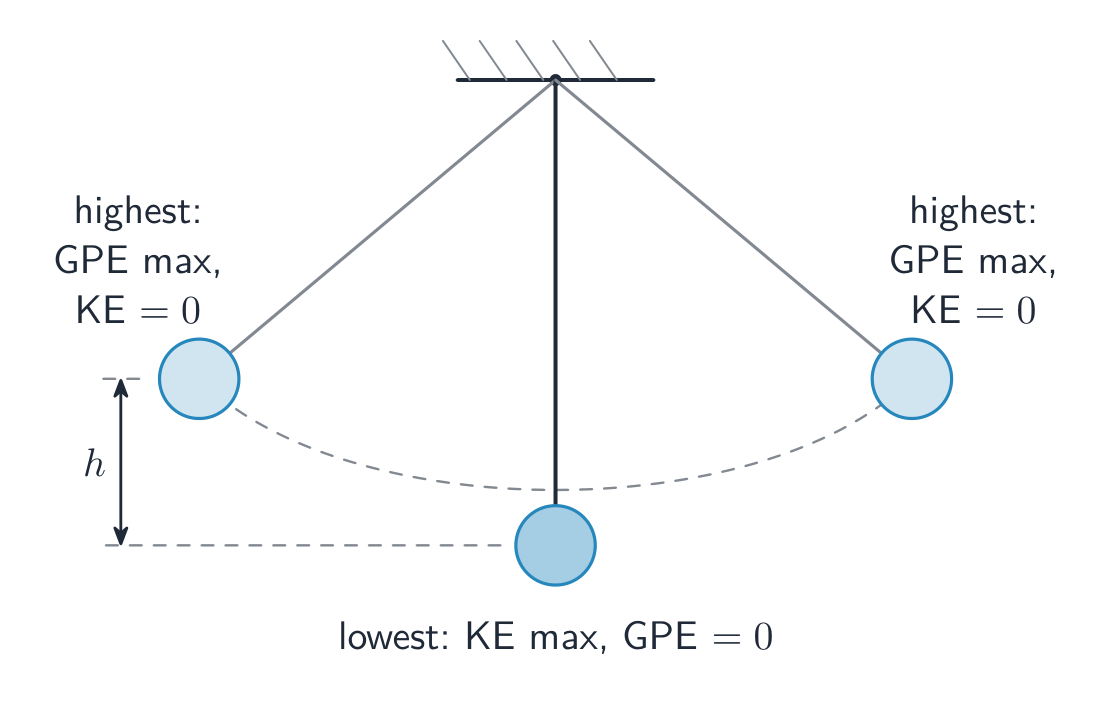
Energy moves between gravitational potential energy (at the highest points) and kinetic energy (at the lowest point) 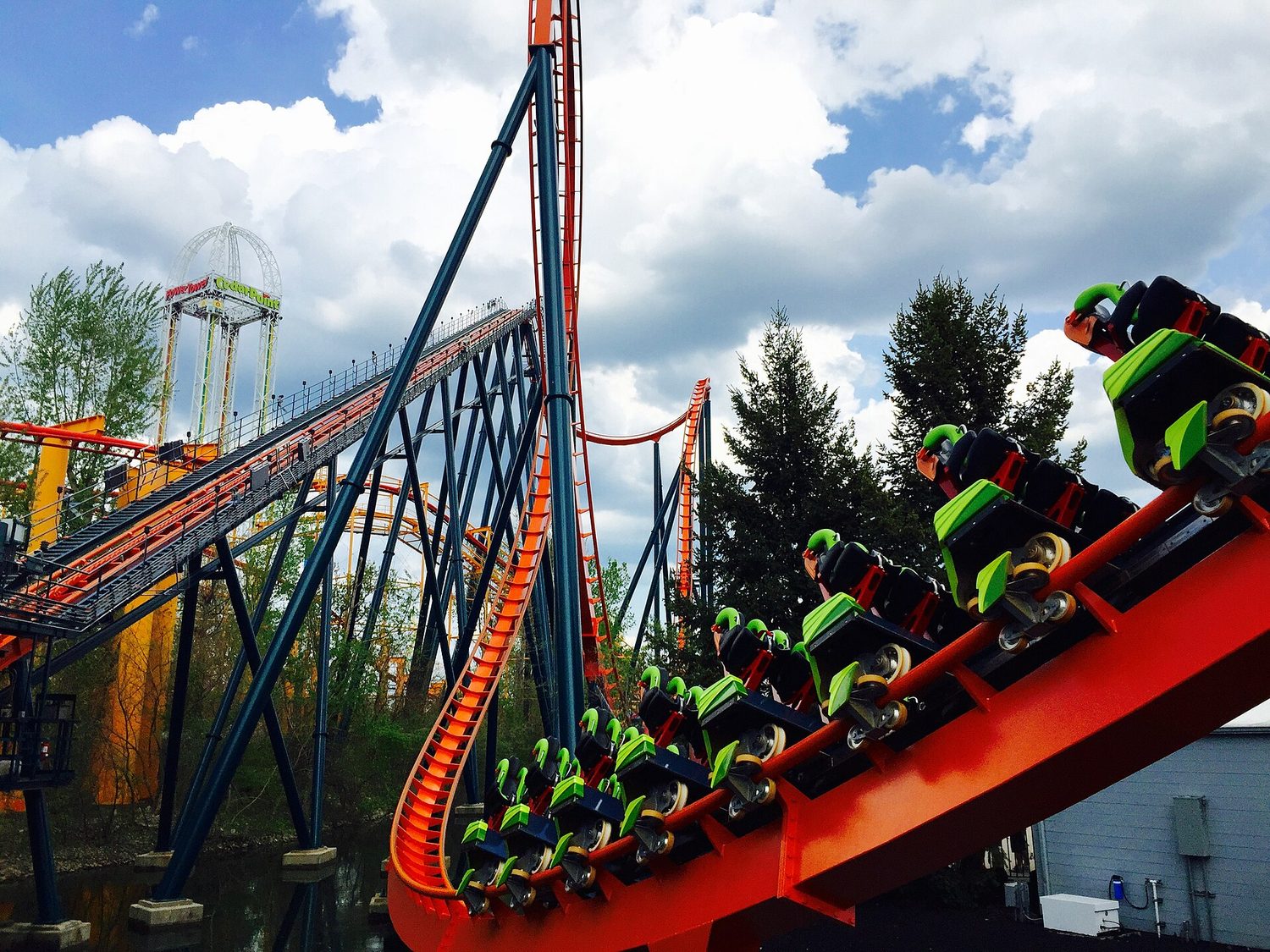
On a roller-coaster, gravitational potential energy stored at the top of the hill becomes kinetic energy as the cars speed down Worked example. A $0.50\ \text{kg}$ ball is dropped from a height of $1.8\ \text{m}$. Ignoring air resistance, find its speed just before it lands. (Take $g = 10\ \text{m/s}^2$.)
All the gravitational potential energy becomes kinetic energy, so $\tfrac{1}{2}mv^2 = mg\,\Delta h$. The mass cancels, leaving $v^2 = 2g\,\Delta h$:
$$v = \sqrt{2 \times 10 \times 1.8} = \sqrt{36} = 6.0\ \text{m/s}$$Because the mass cancels, every object dropped from this height would land at the same speed.
Work
Work done 做功 equals the energy transferred. When a force moves an object:
$$W = Fd = \Delta E$$The unit of work and energy is the joule 焦耳 (J).
Power
Power 功率 is the work done (or energy transferred) per unit time.
$$P = \frac{W}{t} = \frac{\Delta E}{t}$$The unit is the watt 瓦特 (W). $1\ \text{W} = 1\ \text{J/s}$.
Efficiency
Efficiency 效率 tells you how much of the input energy becomes useful energy.
$$\text{efficiency} = \frac{\text{useful energy output}}{\text{total energy input}} \times 100\%$$Efficiency is always less than 100% because some energy is always wasted (usually as heat). The same idea works with power:
$$\text{efficiency} = \frac{\text{useful power output}}{\text{total power input}} \times 100\%$$Worked example. A motor is supplied with $200\ \text{J}$ of electrical energy and lifts a load, giving it $150\ \text{J}$ of gravitational potential energy. Find its efficiency.
$$\text{efficiency} = \frac{150}{200} \times 100\% = 75\%$$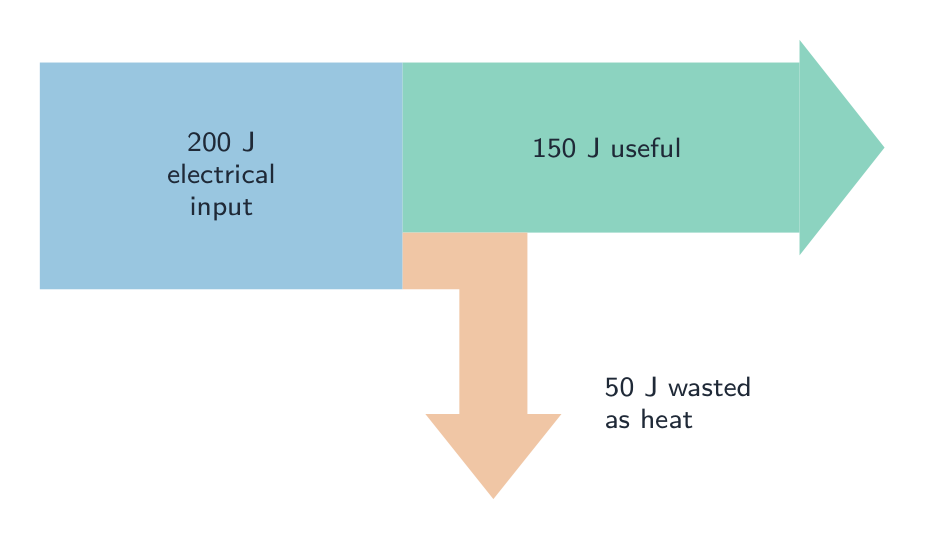
A Sankey diagram for this motor: the band widths are proportional to the energy, so the 200 J input splits into 150 J useful and 50 J wasted as heat Energy resources
We generate electricity from many energy resources. Most spin a turbine that drives a generator – often by boiling water to make steam (fossil fuels, nuclear fuel, geothermal, biofuels), or directly by moving water or air (hydroelectric, waves, tides, wind). Solar cells make electricity from sunlight directly; solar panels heat water.
Resource Renewable? Notes fossil fuels (coal, oil, gas) no reliable, high output, but CO₂ and pollution nuclear fuel no huge output, no CO₂, but radioactive waste biofuels yes roughly carbon-neutral if replanted hydroelectric yes reliable, but a dam floods land wind yes clean, but intermittent solar yes clean, but only in daylight geothermal / tidal yes reliable but limited to certain places When you compare resources, use these five ideas: renewability 可再生性 (will it run out?), availability 可用性 (is it always there? the wind can drop and the Sun sets), reliability 可靠性 (does it give a steady output?), scale 规模 (how much energy can it supply?) and environmental impact 环境影响 (pollution, carbon dioxide, land flooded by a dam).
Most of these trace back to the Sun (fossil fuels are ancient stored sunlight; wind and waves come from solar heating) – the exceptions are geothermal, nuclear, and tidal energy. The Sun itself is powered by nuclear fusion 核聚变, joining hydrogen nuclei into helium. Scientists are researching how to use fusion in power stations on Earth, but no fusion reactor yet gives out more electrical energy than it uses.
JelajahiAliran energi & efisiensi
Energi input terbagi menjadi output berguna dan energi terbuang; efisiensi adalah fraksi yang berguna, dan totalnya selalu kekal.
JelajahiKekekalan energi
Jatuhkan benda: GPE berubah menjadi KE, dan total tetap sama ketika tidak ada gesekan.
Kosa kata LatihEnglish Bahasa Indonesia stored/stɔːd/ tersimpan kinetic/kɪˈnetɪk/ kinetik gravitational potential/ˌɡrævɪˈteɪʃənl pəˈtenʃl/ potensial gravitasi chemical/ˈkemɪkl/ kimia elastic (strain)/ɪˈlæstɪk/ elastis (regangan) nuclear/ˈnjuːklɪə/ nuklir electrostatic/ɪˌlektrəʊˈstætɪk/ elektrostatik internal (thermal)/ɪnˈtɜːnl/ internal (termal) transferred/trænsˈfɜːd/ dipindahkan principle of conservation of energy/ˈprɪnsɪpl ɒv ˌkɒnsəˈveɪʃn ɒv ˈenədʒi/ prinsip kekekalan energi Sankey diagram/ˈsæŋki ˈdaɪəɡræm/ diagram Sankey wasted/ˈweɪstɪd/ sia-sia work done/wɜːk dʌn/ kerja yang dilakukan joule/dʒuːl/ joule power/ˈpaʊə/ kuasa watt/wɒt/ watt efficiency/ɪˈfɪʃənsi/ efisiensi renewability/rɪˌnjuːəˈbɪlɪti/ daya perbaruan availability/əˌveɪləˈbɪlɪti/ ketersediaan reliability/rɪˌlaɪəˈbɪlɪti/ keandalan scale/skeɪl/ skala environmental impact/enˌvaɪrənˈmentl ˈɪmpækt/ dampak lingkungan nuclear fusion/ˈnjuːklɪə ˈfjuːʒn/ fusi nuklir 1.8
Pressure 压强
Silabus
Inti Tambahan 1 Definisikan tekanan sebagai gaya per satuan luas; ingat dan gunakan persamaan $p = \frac{F}{A}$ 2 Jelaskan bagaimana tekanan bervariasi dengan gaya dan luas dalam konteks contoh sehari-hari 3 Jelaskan, secara kualitatif, bagaimana tekanan di bawah permukaan cairan berubah seiring kedalaman dan densitas cairan 4 Ingat dan gunakan persamaan untuk perubahan tekanan di bawah permukaan cairan $\Delta p = \rho g \Delta h$ Sumber: Silabus Cambridge International
Pressure is the force per unit area.
$$p = \frac{F}{A}$$The unit is the pascal 帕斯卡 (Pa). $1\ \text{Pa} = 1\ \text{N/m}^2$.
A small area gives a large pressure (a sharp knife cuts well). A large area gives a small pressure (snowshoes stop you sinking).
Pressure in a liquid
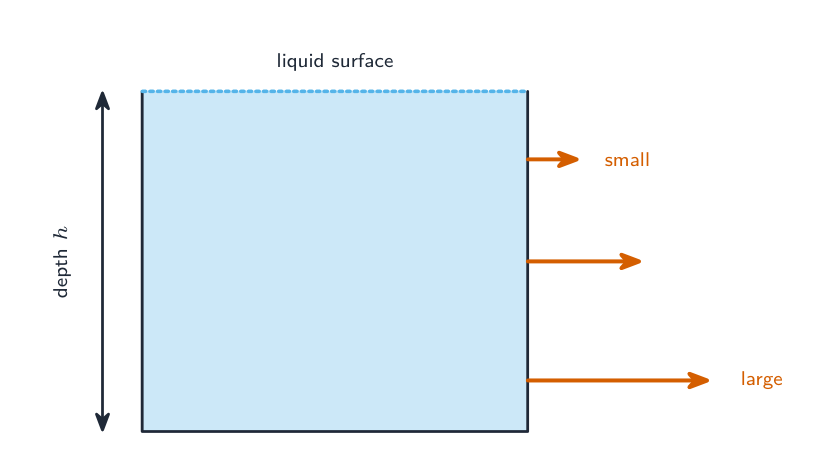
In a liquid, pressure increases with depth 深度 and with the liquid's density:
$$\Delta p = \rho g \,\Delta h$$This is why a dam is built thicker at the bottom, where the water pressure is greatest. Pressure in a liquid acts in all directions.
The deeper the liquid, the greater the pressure, so the outward push on the wall grows with depth 
A real dam is built much thicker at the bottom, because the water pushes hardest where it is deepest Worked example. Find the extra pressure at a depth of $2.0\ \text{m}$ in water (density $1000\ \text{kg/m}^3$, $g = 10\ \text{N/kg}$).
$$\Delta p = \rho g\,\Delta h = 1000 \times 10 \times 2.0 = 20\,000\ \text{Pa}$$JelajahiTekanan
p = ρg·h
Tekanan dalam cecair adalah berkadar dengan kedalaman.
Kosa kata LatihEnglish Bahasa Indonesia pressure/ˈpreʃə/ tekanan pascal/ˈpæskl/ pascal depth/depθ/ kedalaman 1.8
Exam tips
- On a distance–time graph the gradient is the speed; on a speed–time graph the gradient is the acceleration and the area under the line is the distance travelled. Never read one graph as if it were the other.
- Mass (kg) is the amount of matter and is the same everywhere; weight (N) is the force of gravity, $W = mg$. On the Moon your mass is unchanged but your weight is smaller.
- Speed is a scalar; velocity is a vector. Something moving at steady speed around a curve is still accelerating, because its direction keeps changing.
- In Hooke's law, load is proportional to extension only up to the limit of proportionality. Use the extension (stretched length − original length), never the whole length.
- Momentum $p = mv$ is conserved in a collision. Give each velocity a $+$ or $-$ sign for its direction before you add them.
- Convert units first (cm → m, g → kg). Use $p = F/A$ for a solid pressing on a surface, but $p = \rho g h$ for the pressure inside a liquid — they are different formulas.
-
2
Termodinamika
Tonton pelajaran2.1
States of matter 物态
Silabus
2.1.1 Keadaan materi
Inti Tambahan 1 Tahu sifat-sifat pembeda dari padat, cair dan gas 2 Tahu istilah-istilah untuk perubahan keadaan antara padat, cair dan gas (transisi gas ke padat dan padat ke gas tidak diperlukan) 2.1.2 Model partikel
Inti Tambahan 1 Jelaskan struktur partikel padat, cair dan gas dalam hal susunan, pemisahan dan gerak partikel dan wakilkan keadaan-keadaan ini menggunakan diagram partikel sederhana 6 Tahu bahwa gaya dan jarak antar partikel (atom, molekul, ion dan elektron) serta gerak partikel mempengaruhi sifat padat, cair dan gas 2 Jelaskan hubungan antara gerak partikel dan suhu, termasuk gagasan bahwa ada suhu terendah yang mungkin ($-273\,{}^{\circ}\text{C}$), yang dikenal sebagai nol mutlak, di mana partikel memiliki energi kinetik paling sedikit 3 Jelaskan tekanan dan perubahan tekanan gas dalam hal gerak partikel-partikelnya dan tumbukan mereka dengan suatu permukaan 7 Jelaskan tekanan dan perubahan tekanan gas dalam hal gaya yang dikeluarkan oleh partikel yang menumbuk permukaan, menciptakan gaya per satuan luas 4 Tahu bahwa gerak acak partikel mikroskopis dalam suspensi merupakan bukti bagi model partikel kinetik materi 8 Tahu bahwa partikel mikroskopis dapat digerakkan oleh tumbukan dengan molekul-molekul cepat bergerak dan gunakan istilah atom atau molekul dengan benar sebagai berbeda dari partikel mikroskopis 5 Jelaskan dan jelaskan gerak ini (kadang-kadang dikenal sebagai gerak Brown) dalam hal tumbukan acak antara partikel mikroskopis dalam suspensi dan partikel gas atau cairan 2.1.3 Gas dan skala suhu mutlak
Inti Tambahan 1 Jelaskan secara kualitatif, dalam hal partikel, efek terhadap tekanan massa gas tetap dari: (a) perubahan suhu pada volume tetap (b) perubahan volume pada suhu tetap 3 Ingat dan gunakan persamaan $pV = \text{constant}$ untuk massa gas tetap pada suhu tetap, termasuk representasi graf dari hubungan ini 2 Konversi suhu antara kelvin dan derajat Celcius; ingat dan gunakan persamaan $T\text{ (in K)} = \theta\text{ (in }^{\circ}\text{C)} + 273$ Sumber: Silabus Cambridge International
Kinetic theory: gas pressure Matter exists in three states: solid 固体, liquid 液体 and gas 气体.
State Shape Volume Particles Solid fixed fixed close together, in a regular pattern, vibrating Liquid takes the shape of the container fixed close together, no pattern, can move past each other Gas fills the container changes far apart, fast, random motion The changes of state are: melting (solid → liquid), boiling/evaporating (liquid → gas), condensation 凝结 (gas → liquid) and solidification 凝固 (liquid → solid). In condensation the gas particles slow down and come close together to form a liquid. In solidification the liquid particles lose energy and settle into fixed positions.
Kosa kata LatihEnglish Bahasa Indonesia states of matter/steɪts ɒv ˈmætə/ wujud zat solid/ˈsɒlɪd/ padat liquid/ˈlɪkwɪd/ cair gas/ɡæs/ gas condensation/kɒndenˈseɪʃn/ kondensasi solidification/səˌlɪdɪfɪˈkeɪʃn/ pembekuan 2.1
The kinetic particle model 分子动理论
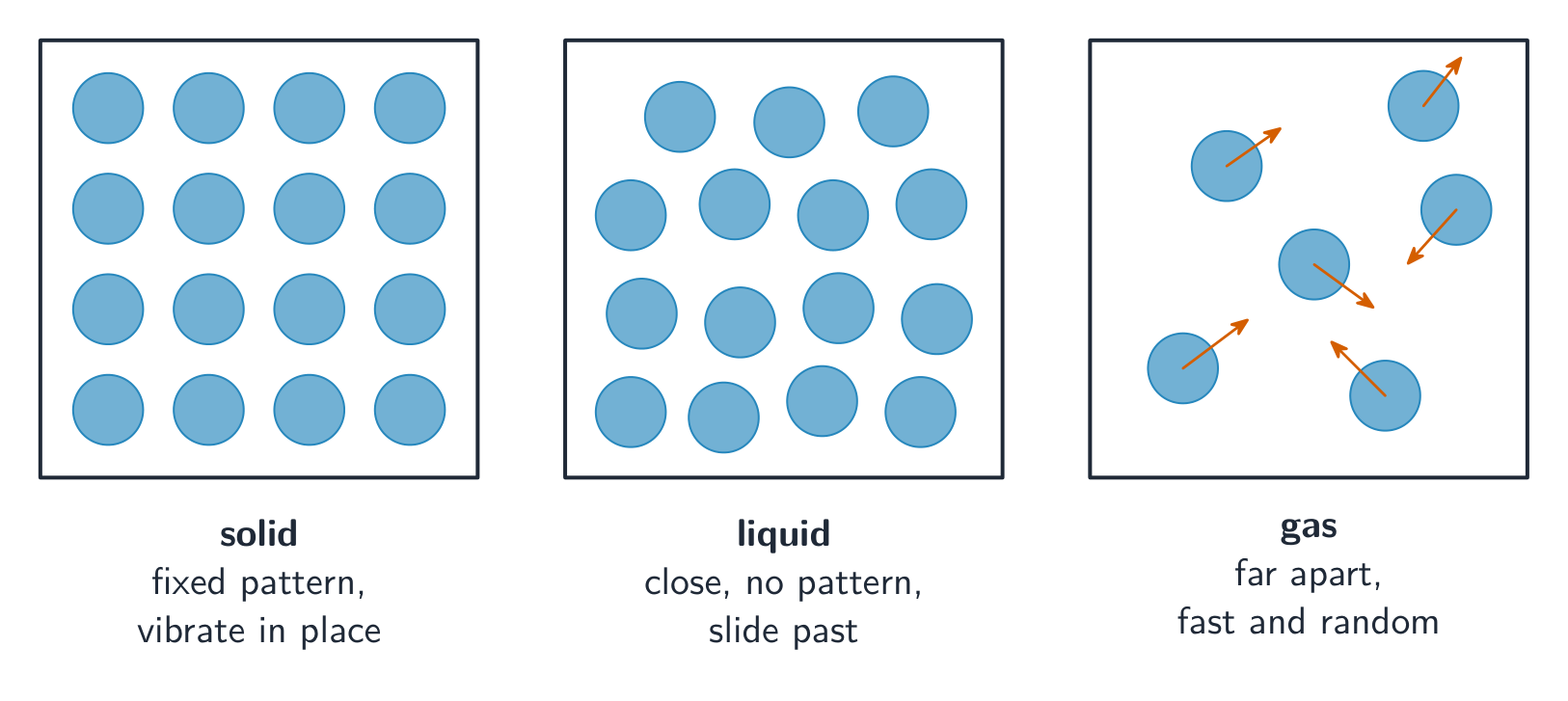
All matter is made of tiny particles 粒子 that are always moving. This is the kinetic particle model.
- In a solid the particles only vibrate 振动 about fixed positions.
- In a liquid they are still close but can slide past each other.
- In a gas they are far apart and move quickly in random directions.
The same particles in three states: fixed and ordered in a solid, close but disordered in a liquid, far apart and fast in a gas Temperature and particle energy
When you heat a substance, its particles move faster, so they have more kinetic energy 动能. Temperature 温度 is a measure of the average kinetic energy of the particles.
The lowest possible temperature is absolute zero 绝对零度, $-273\,{}^{\circ}\text{C}$. At this point the particles have the least possible energy.
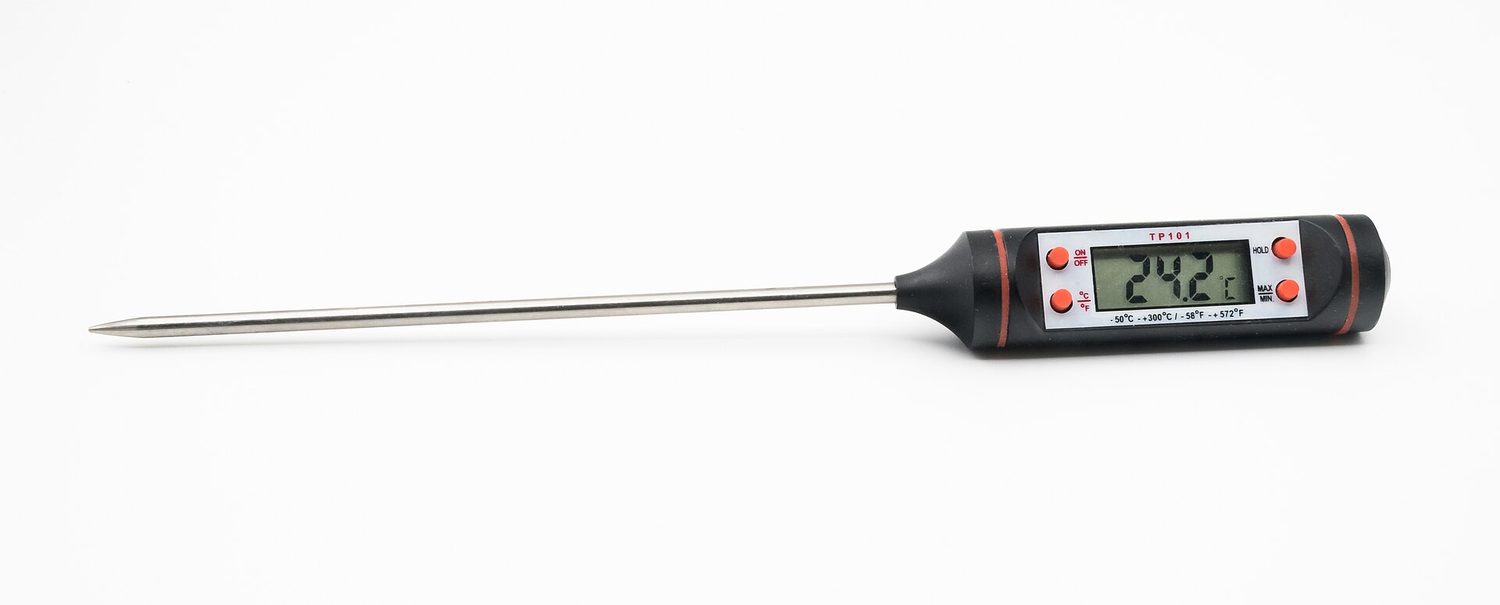
A digital thermometer measures temperature by sensing the kinetic energy of the particles it touches Gas pressure
Gas particles hit the walls of their container. Each hit is a tiny push. The pressure 压强 of the gas is the total force of these hits per unit area.

The gas pressure is the total force of countless particle hits on each unit area of the wall - Heating a gas (at constant volume) makes particles move faster and hit harder and more often, so the pressure rises.
- Squeezing a gas into a smaller volume (at constant temperature) means more hits per second on each unit of area, so the pressure rises.
For a fixed mass of gas at constant temperature:
$$pV = \text{constant}$$So if the volume halves, the pressure doubles.

At constant temperature the pressure–volume graph is a curve: halve the volume and the pressure doubles, so $pV$ stays constant Worked example. A gas has a volume of $200\ \text{cm}^3$ at a pressure of $100\ \text{kPa}$. It is squeezed to $50\ \text{cm}^3$ at constant temperature. Find the new pressure.
Since $pV$ stays constant, $p_1 V_1 = p_2 V_2$:
$$100 \times 200 = p_2 \times 50 \quad\Rightarrow\quad p_2 = \frac{20\,000}{50} = 400\ \text{kPa}$$Brownian motion
If you look at smoke in air under a microscope, you see tiny specks moving in a jerky, random way. This is Brownian motion 布朗运动. The specks are pushed by fast, invisible air particles hitting them. It is strong evidence for the kinetic particle model.
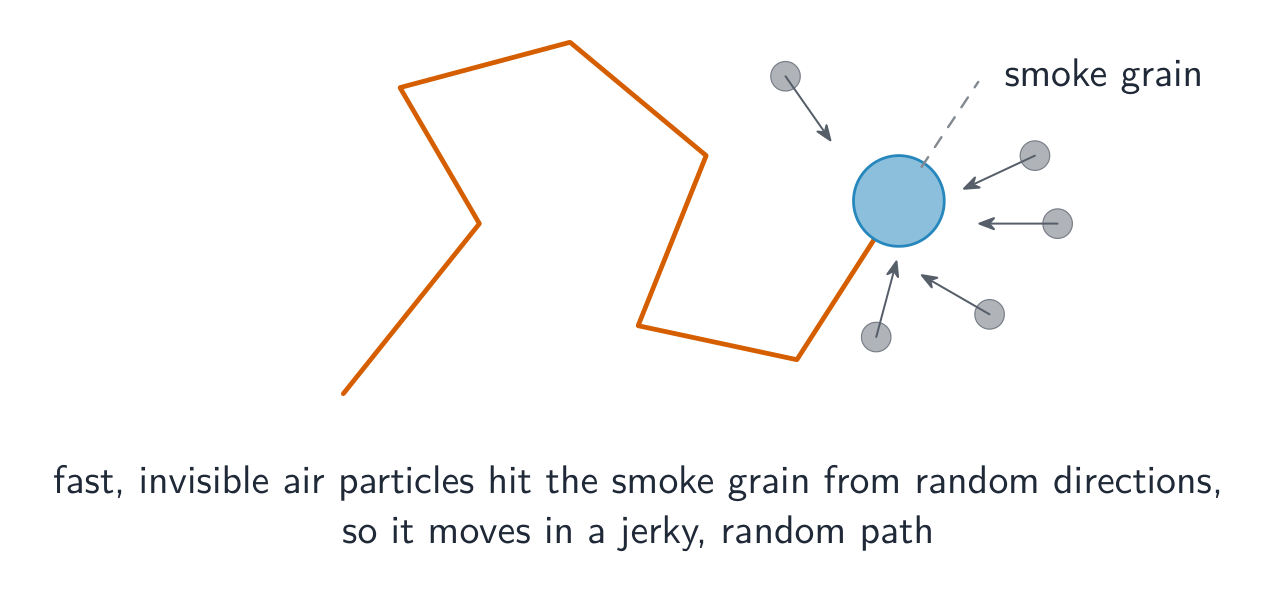
Random hits from fast air particles push a smoke grain along a jerky, random path The kelvin scale
Scientists often use the kelvin 开尔文 (K) temperature scale, which starts at absolute zero. To convert:
$$T\text{ (in K)} = \theta\text{ (in }^{\circ}\text{C}) + 273$$So $0\,{}^{\circ}\text{C} = 273\ \text{K}$.
Worked example. Convert $25\,{}^{\circ}\text{C}$ to kelvin, and $200\ \text{K}$ to degrees Celsius.
$$25 + 273 = 298\ \text{K}, \qquad 200 - 273 = -73\,{}^{\circ}\text{C}$$JelajahiMemampatkan gas (Hukum Boyle)
Geserkan piston masuk untuk mengecilkan isipadu. Zarah yang sama dipadatkan ke ruang yang lebih kecil, jadi mereka menampar dinding lebih kerap dan tekanan meningkat — manakala tekanan × isipadu kekal tetap.
Kosa kata LatihEnglish Bahasa Indonesia kinetic particle model/kɪˈnetɪk ˈpɑːtɪkl ˈmɒdl/ model partikel kinetik particle/ˈpɑːtɪkl/ partikel vibrate/vaɪˈbreɪt/ bergetar kinetic energy/kɪˈnetɪk ˈenədʒi/ energi kinetik temperature/ˈtemprɪtʃə/ suhu absolute zero/ˈæbsəluːt ˈzɪərəʊ/ nol mutlak pressure/ˈpreʃə/ tekanan Brownian motion/ˈbraʊnɪən ˈməʊʃn/ Gerak Brown kelvin/ˈkelvɪn/ kelvin 2.2
Thermal expansion 热膨胀
Silabus
2.2.1 Pemuaian termal padatan, cecair dan gas
Inti Tambahan 1 Jelaskan secara kualitatif pemuaian termal pada padatan, cecair dan gas pada tekanan malar 3 Jelaskan, berdasarkan pergerakan dan susunan zarah, urutan magnitud relatif pemuaian padatan, cecair dan gas apabila suhu mereka meningkat 2 Terangkan beberapa aplikasi dan kesan harian daripada pemuaian termal 2.2.2 Kapasiti hab tentu
Inti Tambahan 1 Tahu bahawa kenaikan suhu sesuatu objek meningkatkan tenaga dalamnya 2 Terangkan kenaikan suhu sesuatu objek sebagai peningkatan tenaga kinetik purata semua zarah dalam objek tersebut 3 Takrifkan kapasiti hab tentu sebagai tenaga yang diperlukan per unit jisim per unit kenaikan suhu; ingat dan gunakan persamaan $$c = \frac{\Delta E}{m\Delta\theta}$$4 Terangkan eksperimen untuk mengukur kapasiti hab tentu bagi padatan dan cecair 2.2.3 Peleburan, pendidihan dan penewapan
Inti Tambahan 1 Terangkan peleburan dan pendidihan dari segi input tenaga tanpa perubahan suhu 6 Terangkan perbezaan antara pendidihan dan penewapan 2 Tahu suhu peleburan dan pendidihan air pada tekanan atmosfera piawai 3 Terangkan kondensasi dan pembekuan dari segi zarah 4 Terangkan penewapan dari segi keluarnya zarah yang lebih berenergi dari permukaan cecair 7 Terangkan bagaimana suhu, luas permukaan dan pergerakan udara di atas permukaan mempengaruhi penewapan 5 Tahu bahawa penewapan menyebabkan penyejukan cecair 8 Jelaskan penyejukan sesuatu objek yang bersentuhan dengan cecair yang sedang menewap Sumber: Silabus Cambridge International
When matter is heated, its particles move more and take up more space, so the material expands. Gases expand the most, then liquids, then solids. This order comes from the forces between the particles: in a solid the particles are held tightly in a lattice 晶格 (a fixed pattern), so they can only vibrate a little more; in a liquid they are held less strongly; in a gas the forces are very weak, so the particles spread out much more.
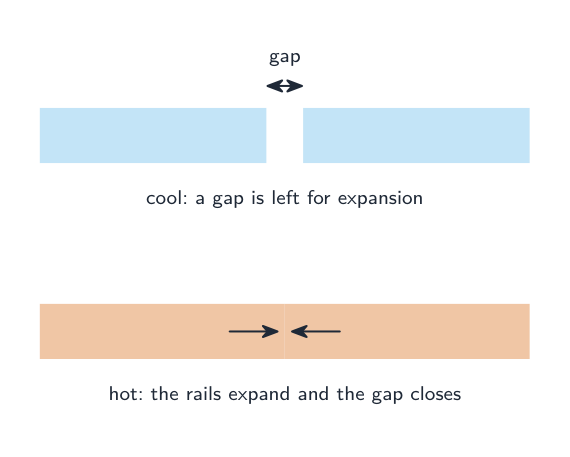
Everyday examples: gaps are left between railway lines; bridges sit on rollers; a tight metal lid loosens when heated.
A small gap is left between rails when cool, so when they expand in the heat the gap closes instead of buckling the track JelajahiPemanasan dan kapasiti haba tentu
Q = mcΔT
Tenaga haba yang diperlukan adalah berkadar dengan kenaikan suhu untuk jisim bahan tertentu.
Kosa kata LatihEnglish Bahasa Indonesia thermal expansion/ˈθɜːml ekˈspænʃn/ pemuaian termal lattice/ˈlætɪs/ kisi 2.2
Internal energy and specific heat capacity

The internal energy 内能 of an object is the total energy of all its particles. Heating an object raises its internal energy and usually its temperature.
The specific heat capacity 比热容 is the energy needed to raise the temperature of 1 kg of a material by 1 °C.
$$c = \frac{\Delta E}{m\,\Delta\theta}$$A material with a high specific heat capacity (like water) needs a lot of energy to warm up and cools down slowly.
Worked example. How much energy is needed to heat $2.0\ \text{kg}$ of water from $20\,{}^{\circ}\text{C}$ to $70\,{}^{\circ}\text{C}$? The specific heat capacity of water is $4200\ \text{J/(kg}\,{}^{\circ}\text{C)}$.
Rearranging $c = \frac{\Delta E}{m\,\Delta\theta}$ gives $\Delta E = mc\,\Delta\theta$, with $\Delta\theta = 70 - 20 = 50\,{}^{\circ}\text{C}$:
$$\Delta E = 2.0 \times 4200 \times 50 = 420\,000\ \text{J} = 420\ \text{kJ}$$Measuring specific heat capacity. For a solid, use a metal block with two holes: one for an electric heater 加热器 and one for a thermometer 温度计. Measure the mass $m$ of the block. Switch on the heater for a measured time $t$ and record the current $I$ and the voltage $V$, so the energy supplied is $E = IVt$ (or read the energy from a joulemeter). Record the temperature rise $\Delta\theta$. Then $c = \dfrac{E}{m\,\Delta\theta}$. For a liquid, heat a measured mass of the liquid in a container and stir it, so the temperature is the same all through. Wrap the block or the container in insulating material 隔热材料, so less energy escapes to the air.
Boiling water: internal energy rises with temperature; specific heat capacity is energy per kg per °C Kosa kata LatihEnglish Bahasa Indonesia internal energy/ɪnˈtɜːnl ˈenədʒi/ energi dalam specific heat capacity/spəˈsɪfɪk hiːt kəˈpæsɪti/ kapasitas panas spesifik heater/ˈhiːtə/ pemanas thermometer/θɜːˈmɒmɪtə/ termometer insulating material/ˈɪnsjuːleɪtɪŋ məˈtɪərɪəl/ bahan isolator 2.2
Melting, boiling and evaporation
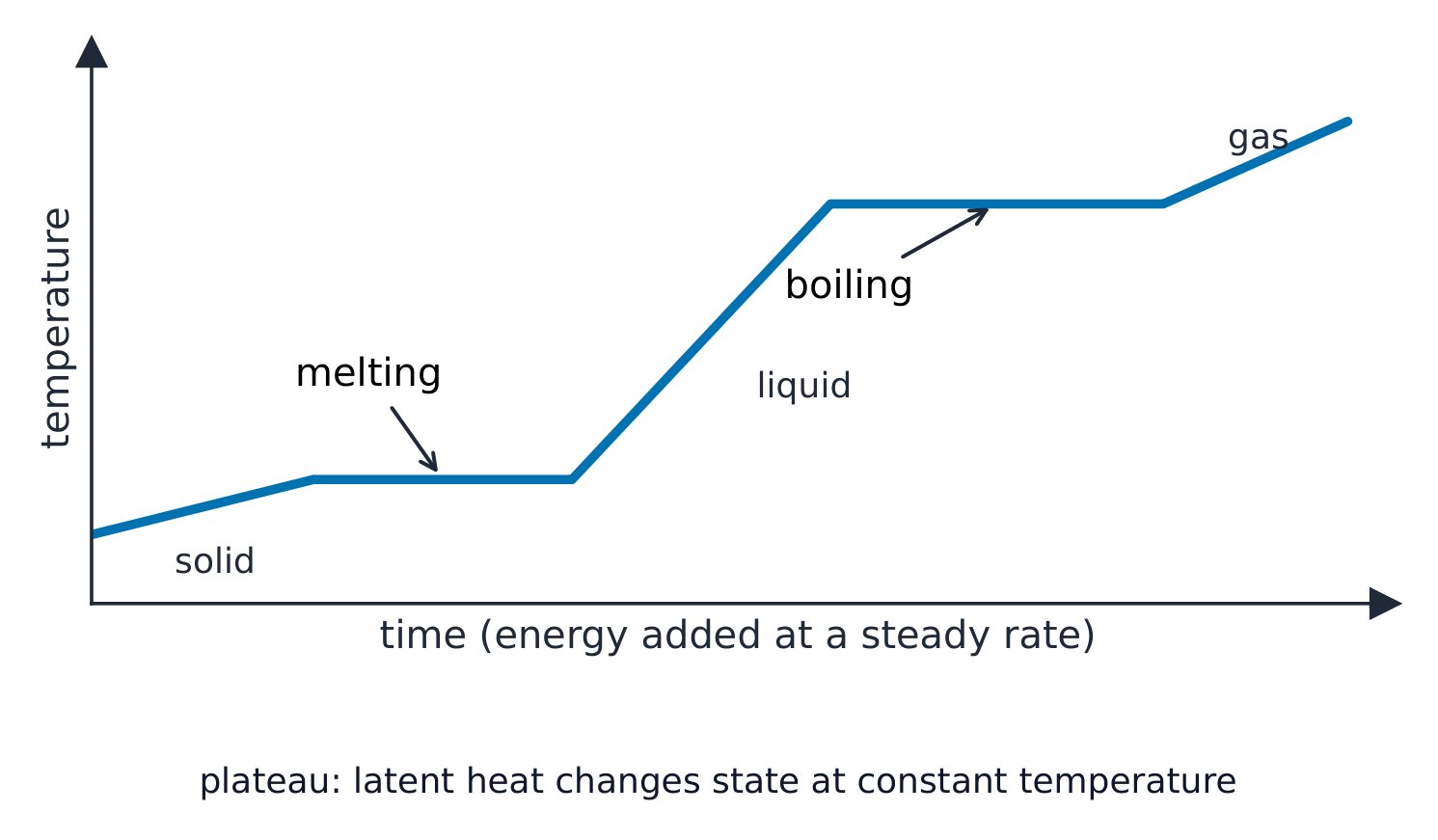
Melting 熔化 and boiling 沸腾 need energy, but the temperature stays the same while the state changes. This energy breaks the forces between particles. For water at normal air pressure, melting is at $0\,{}^{\circ}\text{C}$ and boiling at $100\,{}^{\circ}\text{C}$.
While the substance melts and while it boils the temperature stays flat, even though energy is still being added Evaporation 蒸发 is when a liquid changes to a gas at its surface, below the boiling point. The fastest particles escape from the surface. Because the fastest (most energetic) particles leave, the average energy of those left behind falls, so the liquid cools down 冷却. An object touching an evaporating liquid also cools, because the liquid takes energy from it: this is why sweat cools your skin.
Evaporation is faster when the temperature is higher, the surface area is larger, and there is more air movement over the surface.
JelajahiKurva pemanasan — perhatikan suhu berhenti seketika
Apabila bahan sedang melebur atau mendidih, suhu kekal rata walaupun haba masih masuk — tenaga memecahkan ikatan bukannya memanaskannya.
Kosa kata LatihEnglish Bahasa Indonesia melting/ˈmeltɪŋ/ melebur boiling/ˈbɔɪlɪŋ/ didih evaporation/ɪˌvæpəˈreɪʃn/ penguapan cools down/kuːlz daʊn/ mendingin 2.3
Transfer of thermal energy 热能传递

Silabus
2.3.1 Konduksi
Inti Tambahan 1 Terangkan eksperimen untuk menunjukkan sifat pengalir hab yang baik dan pengalir hab yang buruk (penebat hab) 2 Terangkan konduksi termal dalam semua padatan dari gegaran kisi atom atau molekul serta dari pergerakan elektron bebas (terdelokalisasi) dalam pengalir logam 3 Terangkan, dari segi zarah, mengapa konduksi termal adalah lemah dalam gas dan kebanyakan cecair 4 Tahu bahawa terdapat banyak padatan yang menghantar tenaga termal lebih baik daripada penebat hab tetapi kurang baik berbanding pengalir hab yang baik 2.3.2 Konveksyen
Inti Tambahan 1 Tahu bahawa konveksyen merupakan kaedah penting pemindahan tenaga termal dalam cecair dan gas 2 Jelaskan konveksyen dalam cecair dan gas dari segi perubahan ketumpatan dan terangkan eksperimen untuk menggambarkan konveksyen 2.3.3 Radiasi
Inti Tambahan 1 Tahu bahawa radiasi termal ialah radiasi inframerah dan semua objek memancarkan radiasi ini 2 Tahu bahawa pemindahan tenaga termal melalui radiasi termal tidak memerlukan medium 4 Tahu bahawa bagi sesuatu objek untuk berada pada suhu malar, ia perlu memindahkan tenaga keluar dari objek pada kadar yang sama dengan kadar penerimaan tenaganya 3 Terangkan kesan warna permukaan (hitam atau putih) dan tekstur (mat atau berkilat) terhadap pemancaran, penyerapan dan pantulan radiasi inframerah 5 Tahu apa yang berlaku kepada sesuatu objek jika kadar penerimaan tenaganya kurang atau lebih daripada kadar pemindahan tenaganya ke luar objek 6 Tahu bagaimana suhu Bumi dipengaruhi oleh faktor-faktor yang mengawal keseimbangan antara radiasi masuk dan radiasi yang dipancarkan dari permukaan Bumi 7 Terangkan eksperimen untuk membezakan antara pemancar radiasi inframerah yang baik dan yang buruk 8 Terangkan eksperimen untuk membezakan antara penyerap radiasi inframerah yang baik dan yang buruk 9 Terangkan bagaimana kadar pemancaran radiasi bergantung kepada suhu permukaan dan luas permukaan sesuatu objek 2.3.4 Kesan pemindahan tenaga termal
Inti Tambahan 1 Jelaskan beberapa aplikasi dan kesan asas harian daripada konduksi, konveksyen dan radiasi, termasuk: (a) pemanasan objek seperti periuk dapur (b) memanaskan bilik melalui konveksyen 2 Jelaskan beberapa aplikasi dan kesan kompleks daripada konduksi, konveksyen dan radiasi di mana lebih daripada satu jenis pemindahan tenaga termal adalah signifikan, termasuk: (a) api membakar kayu atau arang batu (b) radiator dalam kereta Sumber: Silabus Cambridge International
Thermal energy moves from hotter places to colder places in three ways.
Conduction
Conduction 热传导 is the transfer of thermal energy through a material without the material moving. The particles in a solid sit in a lattice. Heated particles vibrate more and pass the energy to their neighbours. In metals, free electrons (delocalised electrons 自由电子) carry energy quickly, so metals are good thermal conductors 热导体.
Materials that conduct badly (like air, wood and plastic) are thermal insulators 热绝缘体.
Testing conductors. Fix a drawing pin with a little wax to one end of rods of copper, iron, glass and wood, and heat the other ends equally. The pin drops first from the copper rod, then from the iron rod, and last (or never) from the glass and the wood: metals are the best conductors. A metal rod held in a flame soon feels hot; a wooden rod does not.
Gases and most liquids are bad conductors because their particles are far apart and only pass on energy when they happen to collide. There is no lattice and there are no free electrons.
In conduction the vibrating particles pass energy to their neighbours, so energy flows from the hot end to the cool end Convection
Convection 对流 happens in liquids and gases. When a fluid is heated it expands, becomes less dense, and rises. Cooler, denser fluid sinks to take its place. This circle of moving fluid is a convection current.
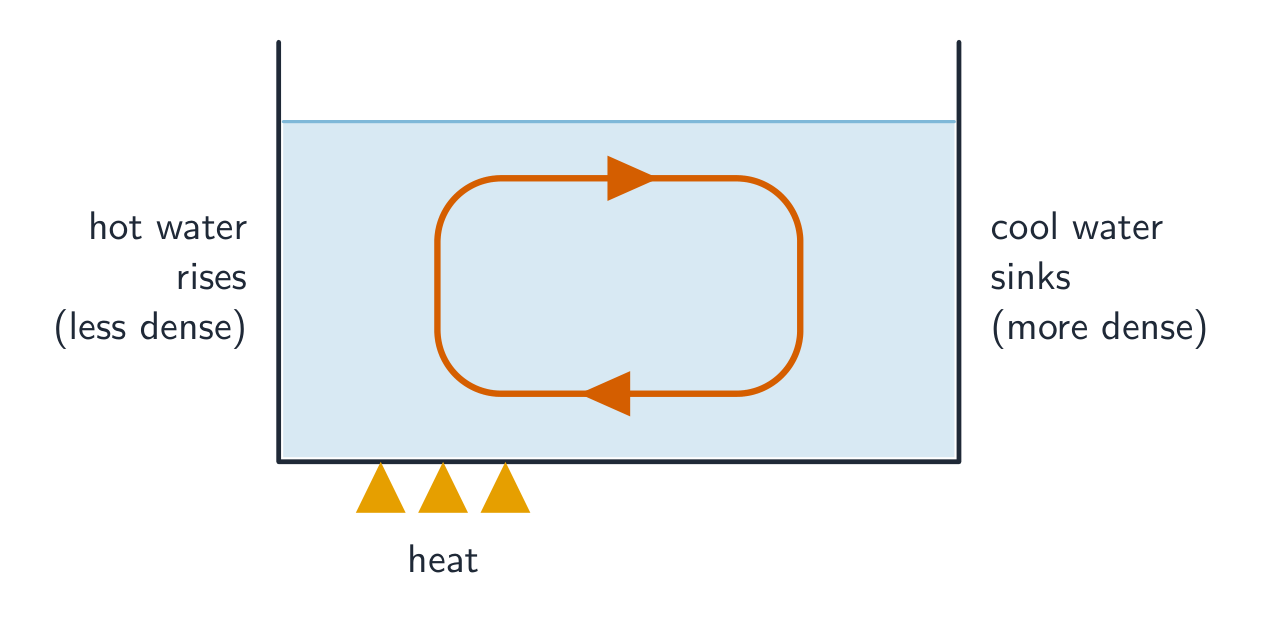
Heated fluid rises and cooler fluid sinks, setting up a convection current Showing convection. Drop a crystal of purple potassium permanganate 高锰酸钾 into a beaker of water and heat the beaker gently under the crystal. A coloured stream rises above the heat, spreads across the top and sinks at the sides. In air, a lit candle under one chimney of a smoke box pulls smoke down the other chimney and up above the flame.
Convection cannot happen in a solid because the particles cannot move from place to place.
Radiation
Thermal radiation 热辐射 is energy carried by infrared 红外线 waves. All objects emit it, and it needs no material to travel through — it can cross empty space (this is how energy reaches us from the Sun).
A surface that is dull 暗淡 and black is a good emitter 发射体 and a good absorber 吸收体 of infrared. A surface that is shiny and white is a poor emitter and a good reflector 反射体.

A dull black surface emits (and absorbs) infrared much better than a shiny, white one Comparing surfaces. Fill two cans, one dull black and one shiny silver, with hot water at the same temperature, and put a thermometer in each. The black can cools faster, so it is the better emitter. Then put the same two cans, full of cold water, at equal distances from a heater. The black can warms faster, so it is the better absorber. A Leslie cube 莱斯利立方体 (a metal box with one side of each finish) shows the same thing.

A thermal (infrared) camera turns the infrared given off by a warm hand into a picture; brighter means hotter An object stays at a constant temperature when it emits energy at the same rate as it absorbs energy. The rate of emission is greater when the surface is hotter and larger. If an object absorbs energy faster than it emits it, its temperature rises; if it emits faster than it absorbs, its temperature falls.
The Earth's temperature. The Earth absorbs radiation from the Sun and emits infrared radiation back into space. Its average temperature stays constant only when the two rates are equal. Anything that changes this balance changes the temperature. Gases in the atmosphere 大气 such as carbon dioxide absorb some of the emitted infrared and send part of it back down, so more of these gases warms the Earth. Clouds and ice reflect incoming sunlight, so less ice means more energy is absorbed, and the Earth warms further.
Everyday examples
- A kitchen pan has a metal base that conducts energy quickly to the food, and a plastic or wooden handle that is an insulator, so you can hold it.
- A radiator 散热器 heats a room by convection: the air next to it warms, rises, and cooler air flows in to take its place, so the whole room warms.
- Sitting near a fire you feel its radiation on your face at once; the air between you and the fire is a poor conductor.
- A vacuum flask 保温瓶 keeps a drink hot by stopping all three transfers: the vacuum between its double walls stops conduction and convection, and its shiny silver surfaces stop radiation.
JelajahiLaboratorium transfer panas
Bandingkan jalur-jalur perpindahan energi termal.
Kosa kata LatihEnglish Bahasa Indonesia transfer of thermal energy/ˈtrænsfɜː ɒv ˈθɜːml ˈenədʒi/ transfer energi termal conduction/kənˈdʌkʃn/ konduksi delocalised electrons/dɪˈlɒkəlaɪzd ɪˈlektrɒnz/ elektron terdelokalisasi thermal conductor/ˈθɜːml kənˈdʌktə/ konduktor termal thermal insulator/ˈθɜːml ˈɪnsjuːleɪtə/ isolator termal convection/kənˈvekʃn/ konveksi potassium permanganate/pəˈtæsɪəm pəˈmæŋɡəneɪt/ kalium permanganat thermal radiation/ˈθɜːml ˌreɪdɪˈeɪʃn/ radiasi termal infrared/ˌɪnfrəˈred/ inframerah dull/dʌl/ matap emitter/ɪˈmɪtə/ pemancar absorber/əbˈsɔːbə/ penyerap reflector/rɪˈflektə/ pemantul Leslie cube/ˈlesli kjuːb/ kubus Leslie atmosphere/ˈætməsfɪə/ atmosfer radiator/ˈreɪdɪeɪtə/ radiator vacuum flask/ˈvækjuːm flæsk/ botol vakum 2.3
Exam tips
- In the kinetic particle model, heating a gas makes its particles move faster and hit the walls harder and more often, so the pressure rises. The particles themselves do not get bigger.
- Evaporation happens only at the surface and at any temperature; boiling happens throughout the liquid at one fixed temperature. Evaporation cools the liquid left behind, because the fastest particles escape.
- During melting and boiling the temperature stays constant even though energy is still being supplied — that energy breaks the forces between particles.
- For specific heat capacity use $\Delta E = mc\,\Delta\theta$, where $\Delta\theta$ is the change in temperature, not the final temperature.
- Dull black surfaces are the best emitters and absorbers of infrared; shiny, light surfaces are the best reflectors. Convection needs a fluid to flow, so it cannot happen in a solid.
-
3
Gelombang
Tonton pelajaran3.1
General properties of waves

Silabus
Inti Tambahan 1 Tahu bahawa gelombang memindahkan tenaga tanpa memindahkan jirim 2 Terangkan maksud gerakan gelombang seperti yang ditunjukkan oleh getaran dalam tali dan spring, serta eksperimen menggunakan gelombang air 3 Terangkan ciri-ciri gelombang dari segi gelombang, panjang gelombang, frekuensi, puncak, lembah, amplitud dan kelajuan gelombang 4 Ingat dan gunakan persamaan kelajuan gelombang $v = f \lambda$ 5 Tahu bahawa bagi gelombang melintang, arah getaran adalah tegak lurus dengan arah perambatan dan faham bahawa radiasi elektromagnet, gelombang air dan gelombang S seismik (sekunder) boleh dimodelkan sebagai gelombang melintang 6 Tahu bahawa bagi gelombang panjang, arah getaran adalah selari dengan arah perambatan dan faham bahawa gelombang bunyi dan gelombang P seismik (primer) boleh dimodelkan sebagai gelombang panjang 7 Terangkan bagaimana gelombang boleh mengalami: (a) pemantulan pada satah rata (b) pembiasan akibat perubahan kelajuan (c) difraksi melalui celah sempit 9 Terangkan bagaimana panjang gelombang dan saiz celah mempengaruhi difraksi melalui celah 8 Terangkan penggunaan tangki riak untuk menunjukkan: (a) pemantulan pada satah rata (b) pembiasan akibat perubahan kelajuan disebabkan oleh perubahan kedalaman (c) difraksi akibat celah (d) difraksi akibat tepi 10 Terangkan bagaimana panjang gelombang mempengaruhi difraksi di tepi Sumber: Silabus Cambridge International
Transverse vs longitudinal waves A wave 波 carries energy 能量 from place to place without carrying matter. For example, a water wave makes a floating cork bob up and down, but the cork does not travel along with the wave. You can make a wave on a rope by shaking one end up and down, or on a long spring by pushing one end back and forth. In a ripple tank 波纹水槽 (a shallow tray of water with a light above it) you can watch water waves on a screen below.
Describing a wave
- wavefront 波前: a line joining points on a wave that move together (for example, the top of one ripple)
- wavelength 波长 ($\lambda$): the distance between two neighbouring wavefronts (one full wave)
- frequency 频率 ($f$): the number of waves passing a point each second, measured in hertz (Hz)
- crest 波峰 (also called the peak 峰, the top) and trough 波谷 (bottom)
- amplitude 振幅: the largest distance a point moves from its rest position
- wave speed 波速 ($v$): how fast a wavefront travels
The parts of a wave: wavelength, amplitude, crest and trough These are linked by the wave equation:
$$v = f\lambda$$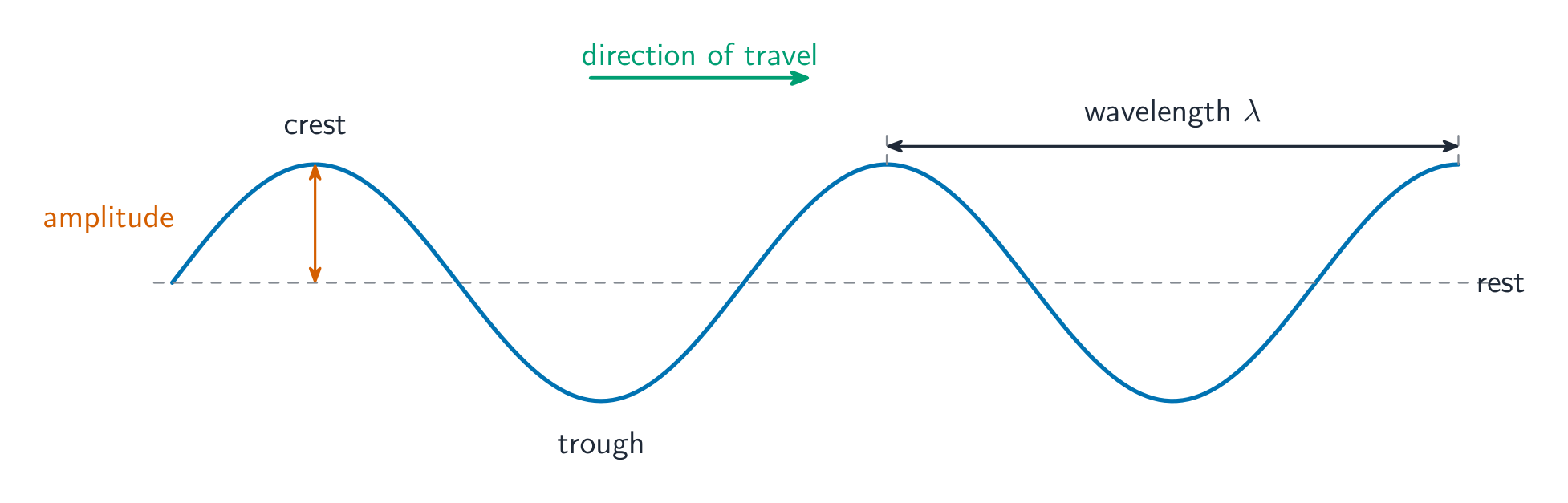
The wavelength is the distance between two crests; the amplitude is the height from the rest position to a crest Worked example. A sound wave travels at $340\ \text{m/s}$ and has a frequency of $170\ \text{Hz}$. Find its wavelength.
Rearranging $v = f\lambda$ gives $\lambda = \dfrac{v}{f}$:
$$\lambda = \frac{340}{170} = 2.0\ \text{m}$$Two types of wave
- In a transverse wave 横波 the particles vibrate at right angles (90°) to the direction the wave travels (its propagation 传播). Light, water waves and seismic S-waves (the sideways shaking in an earthquake) are transverse.
- In a longitudinal wave 纵波 the particles vibrate along the same direction as the wave travels. Sound and seismic P-waves are longitudinal.
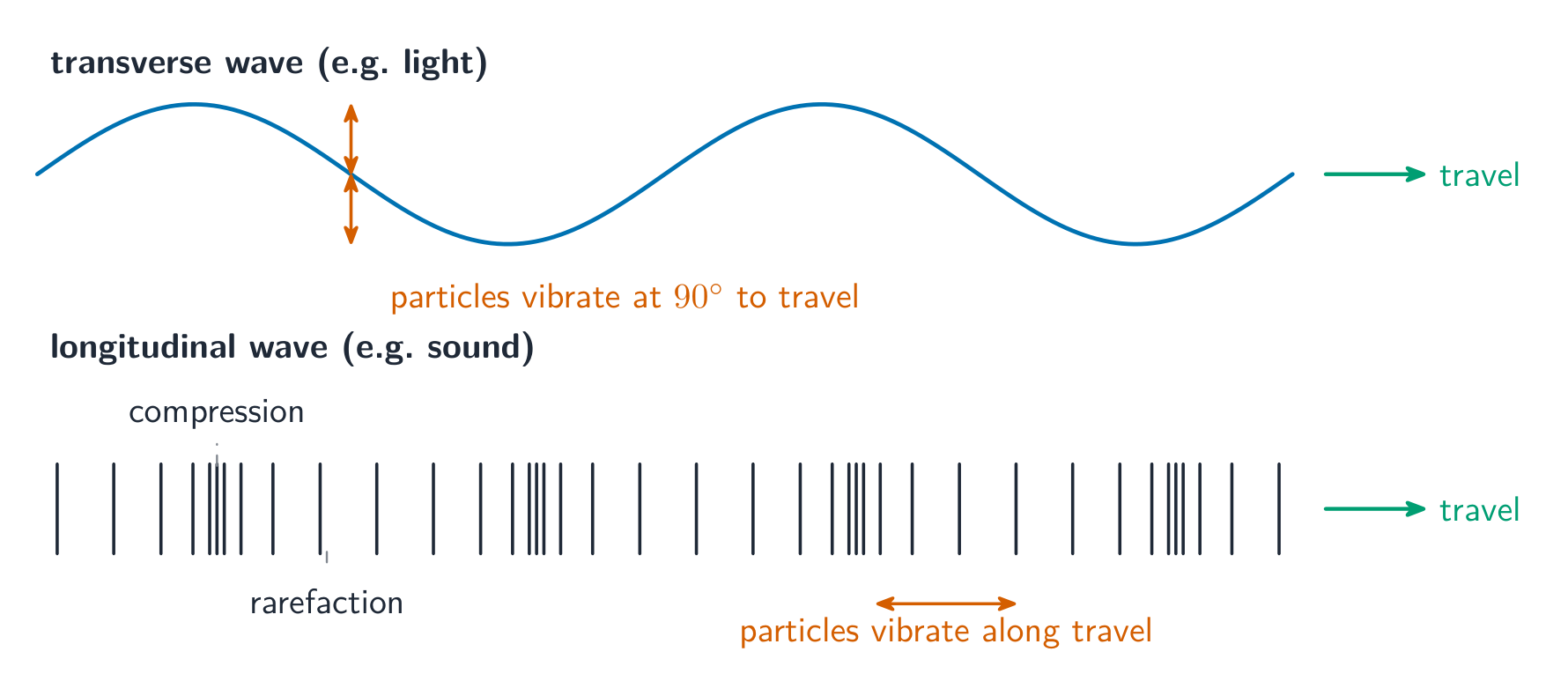
In a transverse wave the particles vibrate across the travel direction; in a longitudinal wave they vibrate along it, making compressions and rarefactions Wave behaviour
All waves can show three behaviours, which you can see in a ripple tank:
- reflection 反射: the wave bounces off a surface.
- refraction 折射: the wave changes speed (and usually direction) when it enters a different material or depth.
- diffraction 衍射: the wave spreads out after passing through a gap or around an edge. The spreading is greatest when the gap is about the same size as the wavelength.

Plane waves passing through a narrow gap spread out into curved waves — diffraction is strongest when the gap is about one wavelength wide 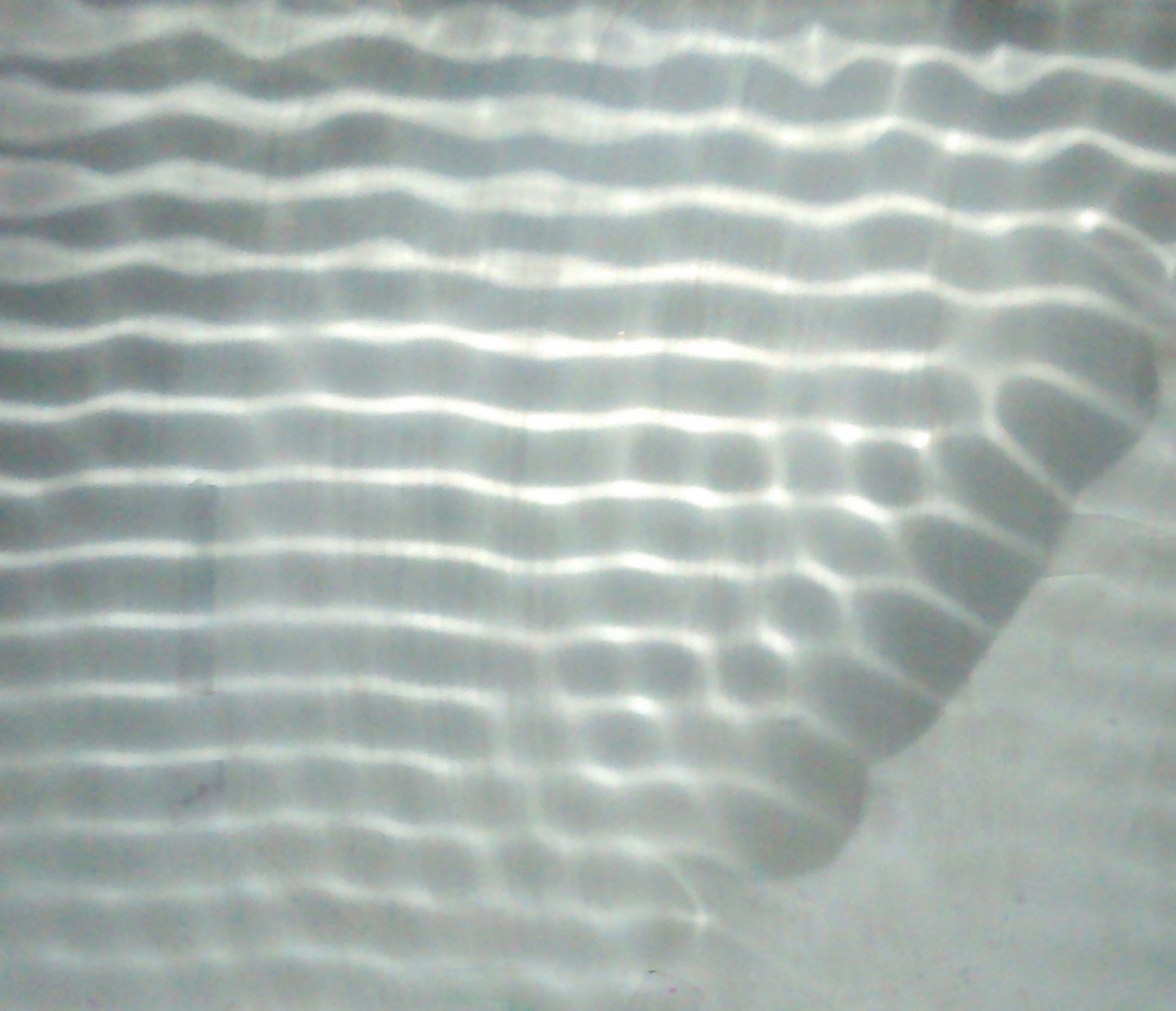
Plane waves in a ripple tank reflect off a straight barrier: the reflected wavefronts leave at the same angle they arrived JelajahiSifat-sifat gelombang
y = a sin(bx + c)
Sebuah gelombang: a adalah amplitudo, b menentukan panjang gelombang.
JelajahiGelombang transversal & longitudinal
Beralih antara gelombang transversal (partikel naik-turun, seperti air dan cahaya) dan longitudinal (partikel meluncur bolak-balik, membentuk rapatan, seperti suara). Gelombangnya bergerak; partikelnya tetap di tempat.
JelajahiDua gelombang tumpang tindih
Ubah gelombang kedua. Di mana gelombang bertemu, mereka berjumlah — terkadang memperkuat, terkadang membatalkan.
Kosa kata LatihEnglish Bahasa Indonesia wave/weɪv/ gelombang energy/ˈenədʒi/ tenaga ripple tank/ˈrɪpl tæŋk/ bak riak wavefront/ˈweɪvfrʌnt/ gelombang muka wavelength/ˈweɪvleŋθ/ panjang gelombang frequency/ˈfriːkwənsi/ frekuensi crest/krest/ puncak peak/piːk/ puncak trough/trɒf/ Titik terendah dari siklus bisnis adalah amplitude/ˈæmplɪtjuːd/ amplitudo wave speed/weɪv spiːd/ kecepatan gelombang transverse wave/trænsˈvɜːs weɪv/ gelombang melintang propagation/ˌprɒpəˈɡeɪʃn/ propagasi longitudinal wave/ˌlɒŋɡɪˈtjuːdɪnl weɪv/ gelombang longitudinal reflection/rɪˈflekʃn/ pemantulan refraction/rɪˈfrækʃn/ pembiasan diffraction/dɪˈfrækʃn/ difraksi light/laɪt/ cahaya sound/saʊnd/ suara 3.2
Light 光
Silabus
3.2.1 Pemantulan cahaya
Inti Tambahan 1 Definisikan dan gunakan istilah normal, sudut datang dan sudut pantul 2 Jelaskan pembentukan bayangan optik oleh cermin datar dan berikan karakteristiknya, yaitu: ukuran sama, jarak dari cermin sama, maya 3 Nyatakan bahwa untuk pemantulan, sudut datang sama dengan sudut pantul; hafalkan dan gunakan hubungan ini 4 Gunakan konstruksi sederhana, pengukuran, dan perhitungan untuk pemantulan oleh cermin datar 3.2.2 Pembiasan cahaya
Inti Tambahan 1 Definisikan dan gunakan istilah normal, sudut datang dan sudut bias 2 Deskripsikan suatu percobaan untuk menunjukkan pembiasan cahaya oleh balok transparan dengan berbagai bentuk 6 Definisikan indeks bias $n$, sebagai rasio kecepatan gelombang di dua daerah yang berbeda 3 Deskripsikan perambatan cahaya melalui bahan transparan (dibatasi hanya pada batas antara dua medium) 7 Hafalkan dan gunakan persamaan $$n = \frac{\sin i}{\sin r}$$4 Nyatakan makna sudut kritis 8 Hafalkan dan gunakan persamaan $$n = \frac{1}{\sin c}$$5 Deskripsikan pemantulan internal dan pemantulan dalam total menggunakan contoh eksperimen dan kehidupan sehari-hari 9 Deskripsikan penggunaan serat optik, khususnya dalam telekomunikasi 3.2.3 Lensa tipis
Inti Tambahan 1 Deskripsikan kerja lensa konvergen tipis dan lensa divergen tipis terhadap berkas cahaya sejajar 2 Definisikan dan gunakan istilah panjang fokus, sumbu utama dan fokus utama (titik fokus) 3 Gambarkan dan gunakan diagram sinar untuk pembentukan bayangan nyata oleh lensa konvergen 6 Gambarkan dan gunakan diagram sinar untuk pembentukan bayangan maya oleh lensa konvergen 4 Deskripsikan karakteristik bayangan menggunakan istilah diperbesar/sama ukuran/diperkecil, tegak/terbalik dan nyata/maya 7 Deskripsikan penggunaan satu lensa sebagai kaca pembesar 5 Ketahuilah bahwa bayangan maya terbentuk ketika sinar-sinar divergen diekstrapolasikan ke belakang dan tidak membentuk proyeksi yang terlihat pada layar 8 Deskripsikan penggunaan lensa konvergen dan divergen untuk mengoreksi rabun jauh dan rabun dekat 3.2.4 Dispersi cahaya
Inti Tambahan 1 Deskripsikan dispersi cahaya seperti yang ditunjukkan oleh pembiasan cahaya putih oleh prisma kaca 2 Ketahuilah tujuh warna tradisional spektrum tampak secara berurutan berdasarkan frekuensi dan berdasarkan panjang gelombang 3 Hafalkan bahwa cahaya tampak dengan frekuensi tunggal disebut monokromatik Sumber: Silabus Cambridge International
A converging lens forms an image Total internal reflection Reflection
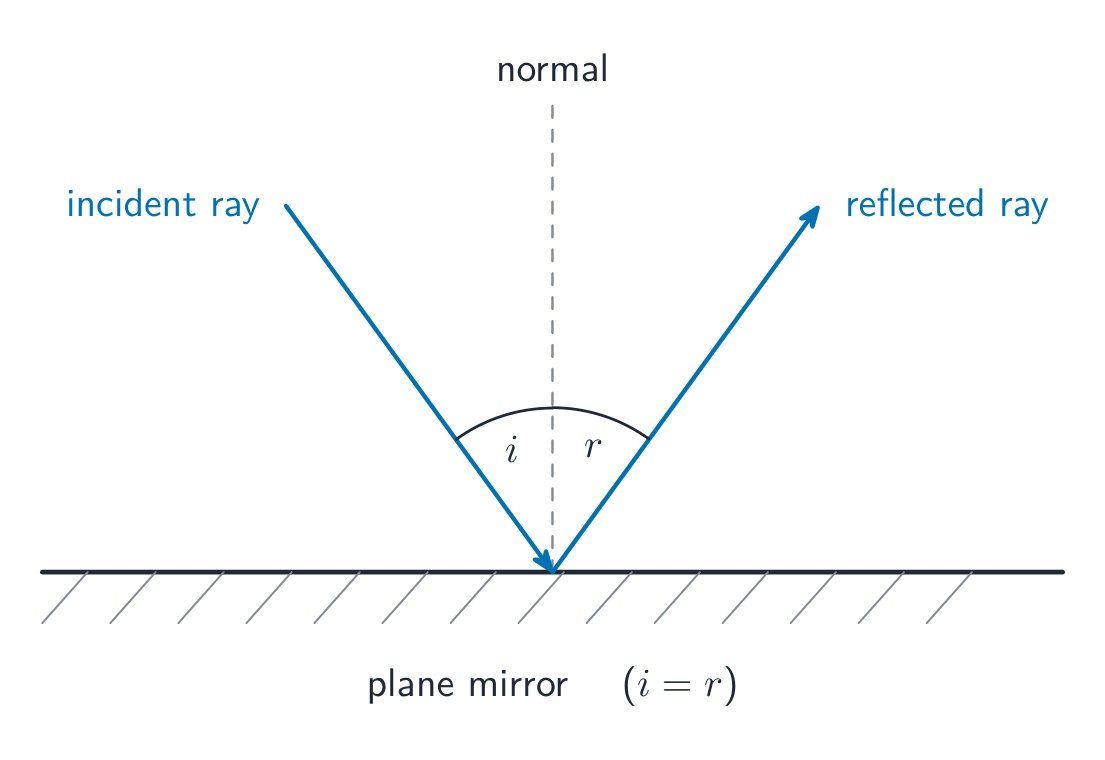
When light hits a mirror, it reflects. We measure angles from the normal 法线 (a line at 90° to the surface).
The law of reflection: the angle of incidence 入射角 equals the angle of reflection 反射角.
A plane mirror 平面镜 forms an image that is the same size as the object, the same distance behind the mirror, and virtual (it cannot be caught on a screen).
At a plane mirror the angle of incidence $i$ equals the angle of reflection $r$, both measured from the normal Refraction
When light passes from one material into another, it changes speed and bends. The angle in the second material is the angle of refraction 折射角.
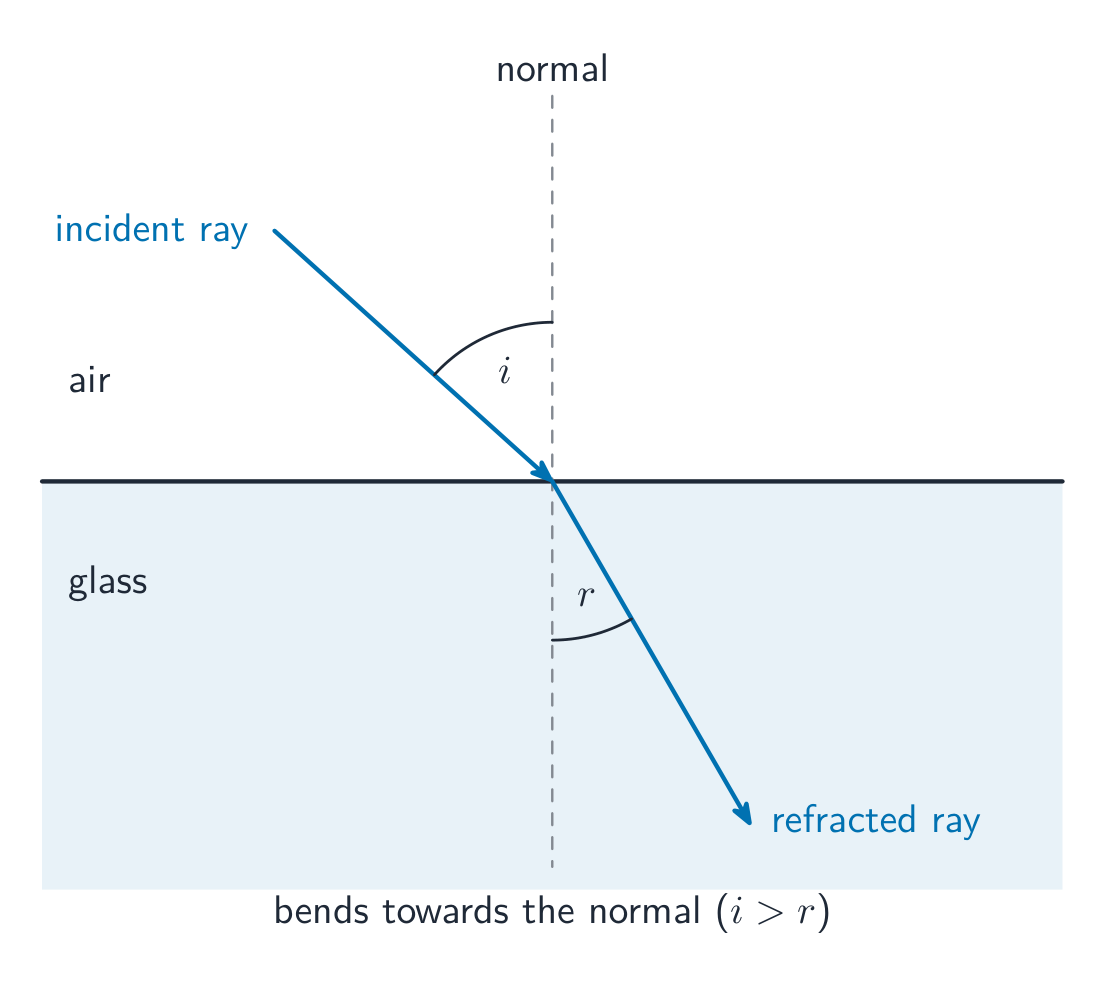
Going from air into glass the light slows down and bends towards the normal, so $i > r$ Seeing refraction. Shine a narrow ray from a ray box 光线盒 into a rectangular glass block standing on paper. Mark the ray going in and the ray coming out, remove the block, and join the marks to draw the ray inside the glass. Draw the normal where the ray enters and measure the angle of incidence and the angle of refraction with a protractor. Repeat with a semicircular block or a prism: the ray always bends towards the normal on entering the glass and away from the normal on leaving.
The refractive index 折射率 $n$ compares the speed of light in the two materials:
$$n = \frac{\sin i}{\sin r}$$Worked example. A ray of light passes from air into glass. The angle of incidence is 60° and the angle of refraction is 35°. Find the refractive index of the glass. (Take $\sin i = 0.87$ and $\sin r = 0.57$.)
$$n = \frac{\sin i}{\sin r} = \frac{0.87}{0.57} = 1.5$$When light tries to leave glass or water and the angle is too large, it cannot get out and instead reflects completely. This is total internal reflection 全反射. It happens when the angle inside is bigger than the critical angle 临界角 $c$:
$$n = \frac{1}{\sin c}$$
Below the critical angle the light refracts out; above it the light is totally internally reflected This effect is used in optical fibres 光纤, thin glass threads that carry light signals for telephones and the internet.

Total internal reflection keeps light bouncing along each fibre until it shines out at the tip Lenses
A converging lens 凸透镜 (fat in the middle) bends parallel rays inwards to a point called the principal focus 焦点. The principal axis 主光轴 is the straight line through the centre of the lens at right angles to it; the principal focus lies on this axis. The distance from the centre of the lens to the principal focus is the focal length 焦距. A diverging lens 凹透镜 (thin in the middle) spreads parallel rays out, as if they came from a focus on the incoming side.
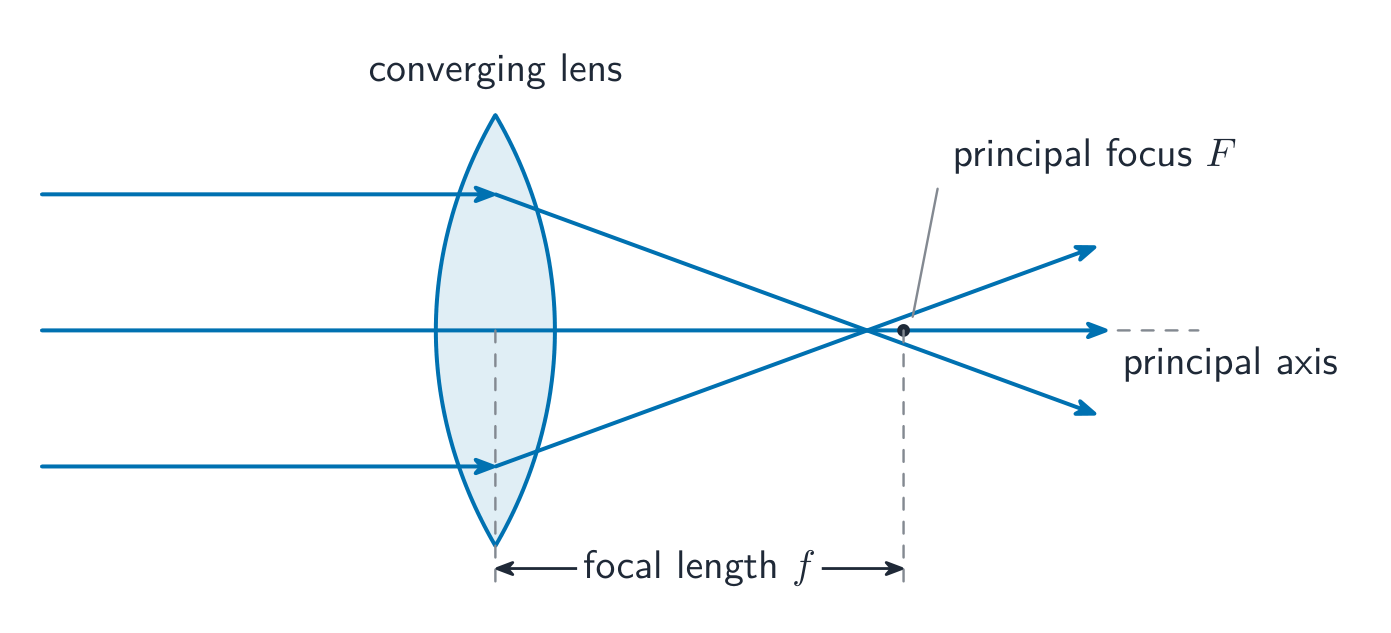
A converging lens bends parallel rays to meet at the principal focus; the focal length $f$ is the lens-to-focus distance A converging lens can form a real image 实像 (rays really meet; can be shown on a screen) or, when the object is very close, a virtual image 虚像 (rays only seem to come from it). Used close to the eye, a converging lens is a magnifying glass 放大镜.
Describe an image with three pairs of words: enlarged 放大的 or diminished 缩小的 (or the same size), upright 正立 or inverted 倒立 (upside down), and real or virtual. An object far beyond the focus gives a diminished, inverted, real image (as in a camera). An object between the focus and the lens gives an enlarged, upright, virtual image (a magnifying glass).
Correcting sight. A person with short-sightedness 近视 sees near things clearly but distant things are blurred: the eye focuses the light in front of the retina 视网膜 (the back of the eye). A diverging lens in front of the eye spreads the rays out first, so they focus on the retina. A person with long-sightedness 远视 sees distant things clearly but near things are blurred: the eye focuses the light behind the retina. A converging lens brings the rays together a little before they enter the eye.

Held away from the eye, a converging lens forms a real image – here the houses behind it appear upside down Dispersion
A glass prism 棱镜 splits white light into the colours of the spectrum 光谱. This splitting is called dispersion 色散.

A prism refracts violet light most and red light least, so white light spreads into a spectrum The order of colours is red, orange, yellow, green, blue, indigo, violet. Red light has the longest wavelength and the lowest frequency; violet is the opposite. Light of a single frequency (one pure colour) is monochromatic 单色.

White light entering a real glass prism spreads into the full spectrum of colours JelajahiBelokkan sinar cahaya
Terangi cahaya ke dalam air, kaca, atau berlian dan ubah sudutnya. Sinar tersebut melambat dan membengkok ke arah garis normal — semakin padat material (n lebih tinggi), semakin banyak ia membengkok. Pembelokan inilah yang menyebabkan sedotan terlihat patah dalam gelas, dan mengapa berlian berkilau.
JelajahiPembentukan bayangan oleh lensa konvergen
Jejakkan tiga sinar khusus dari objek — tempat mereka bertemu adalah bayangannya. Pindahkan objek lebih dekat dari titik fokus untuk mengubahnya menjadi kaca pembesar.
Kosa kata LatihEnglish Bahasa Indonesia normal/ˈnɔːml/ normal angle of incidence/ˈæŋɡl ɒv ˈɪnsɪdəns/ sudut datang angle of reflection/ˈæŋɡl ɒv rɪˈflekʃn/ sudut pantul plane mirror/pleɪn ˈmɪrə/ cermin datar angle of refraction/ˈæŋɡl ɒv rɪˈfrækʃn/ sudut bias ray box/reɪ bɒks/ kotak sinar refractive index/rɪˈfræktɪv ˈɪndeks/ indeks bias total internal reflection/ˈtəʊtl ɪnˈtɜːnl rɪˈflekʃn/ pemantulan internal total critical angle/ˈkrɪtɪkl ˈæŋɡl/ sudut kritis optical fibre/ˈɒptɪkl ˈfaɪbə/ serat optik converging lens/kənˈvɜːdʒɪŋ lenz/ lensa konvergen principal focus/ˈprɪnsɪpl ˈfəʊkəs/ fokus utama principal axis/ˈprɪnsɪpl ˈæksɪs/ sumbu utama focal length/ˈfəʊkl leŋθ/ panjang fokus diverging lens/daɪˈvɜːdʒɪŋ lenz/ lensa divergen real image/rɪəl ˈɪmɪdʒ/ bayangan nyata virtual image/ˈvɜːtʃuːəl ˈɪmɪdʒ/ bayangan maya magnifying glass/ˈmæɡnɪfaɪɪŋ ɡlæs/ kaca pembesar enlarged/enˈlɑːdʒd/ diperbesar diminished/dɪˈmɪnɪʃt/ diperkecil upright/ˈʌpraɪt/ tegak inverted/ɪnˈvɜːtɪd/ terbalik short-sightedness/ʃɔːt ˈsaɪtɪdnəs/ miopi retina/ˈretɪnə/ retina long-sightedness/lɒŋ ˈsaɪtɪdnəs/ hipermetropi prism/ˈprɪzəm/ prisma spectrum/ˈspektrəm/ spektrum dispersion/dɪˈspɜːʃn/ dispersi monochromatic/ˌmɒnəʊkrəʊˈmætɪk/ monokromatik 3.3
The electromagnetic spectrum 电磁波谱
Silabus
Inti Tambahan 1 Ketahuilah daerah-daerah utama spektrum elektromagnetik secara berurutan berdasarkan frekuensi dan berdasarkan panjang gelombang 2 Ketahuilah bahwa semua gelombang elektromagnetik merambat dengan kecepatan tinggi yang sama dalam ruang hampa 6 Ketahuilah bahwa kecepatan gelombang elektromagnetik dalam ruang hampa adalah $3.0 \times 10^8\text{ m/s}$ dan kira-kira sama di udara 3 Deskripsikan penggunaan典型 dari berbagai daerah spektrum elektromagnetik termasuk: (a) gelombang radio; transmisi radio dan televisi, astronomi, identifikasi frekuensi radio (RFID) (b) gelombang mikro; televisi satelit, telepon seluler (handphone), oven gelombang mikro (c) inframerah; grill listrik, komunikasi jarak pendek seperti remote kontrol televisi, alarm pencuri, pencitraan termal, serat optik (d) cahaya tampak; penglihatan, fotografi, penerangan (e) ultraviolet; penanda keamanan, mendeteksi uang palsu, sterilisasi air (f) Sinar-X; pemindaian medis, pemindai keamanan (g) Sinar gamma; sterilisasi makanan dan peralatan medis, deteksi kanker dan pengobatannya 4 Deskripsikan efek berbahaya bagi manusia akibat paparan berlebihan radiasi elektromagnetik, termasuk: (a) gelombang mikro; pemanasan internal sel tubuh (b) inframerah; luka bakar kulit (c) ultraviolet; kerusakan sel permukaan dan mata, menyebabkan kanker kulit dan penyakit mata (d) Sinar-X dan sinar gamma; mutasi atau kerusakan pada sel di dalam tubuh 5 Ketahuilah bahwa komunikasi dengan satelit buatan utamanya menggunakan gelombang mikro: (a) beberapa telepon satelit menggunakan satelit orbit rendah (b) beberapa telepon satelit dan televisi penyiaran langsung satelit menggunakan satelit geostasioner 7 Ketahuilah bahwa banyak sistem komunikasi penting bergantung pada radiasi elektromagnetik termasuk: (a) telepon seluler (handphone) dan internet nirkabel menggunakan gelombang mikro karena gelombang mikro dapat menembus sebagian dinding dan hanya memerlukan antena pendek untuk transmisi dan penerimaan (b) Bluetooth menggunakan gelombang radio karena gelombang radio menembus dinding tetapi sinyal melemah saat melakukannya (c) serat optik (cahaya tampak atau inframerah) digunakan untuk televisi kabel dan broadband berkecepatan tinggi karena kaca tembus pandang terhadap cahaya tampak dan sebagian inframerah; cahaya tampak dan inframerah panjang gelombang pendek dapat membawa laju data yang tinggi 8 Ketahuilah perbedaan antara sinyal digital dan analog 9 Ketahuilah bahwa suara dapat ditransmisikan sebagai sinyal digital atau analog 10 Jelaskan manfaat sinyal digital termasuk peningkatan laju transmisi data dan jangkauan yang lebih luas karena regenerasi sinyal yang akurat Sumber: Silabus Cambridge International
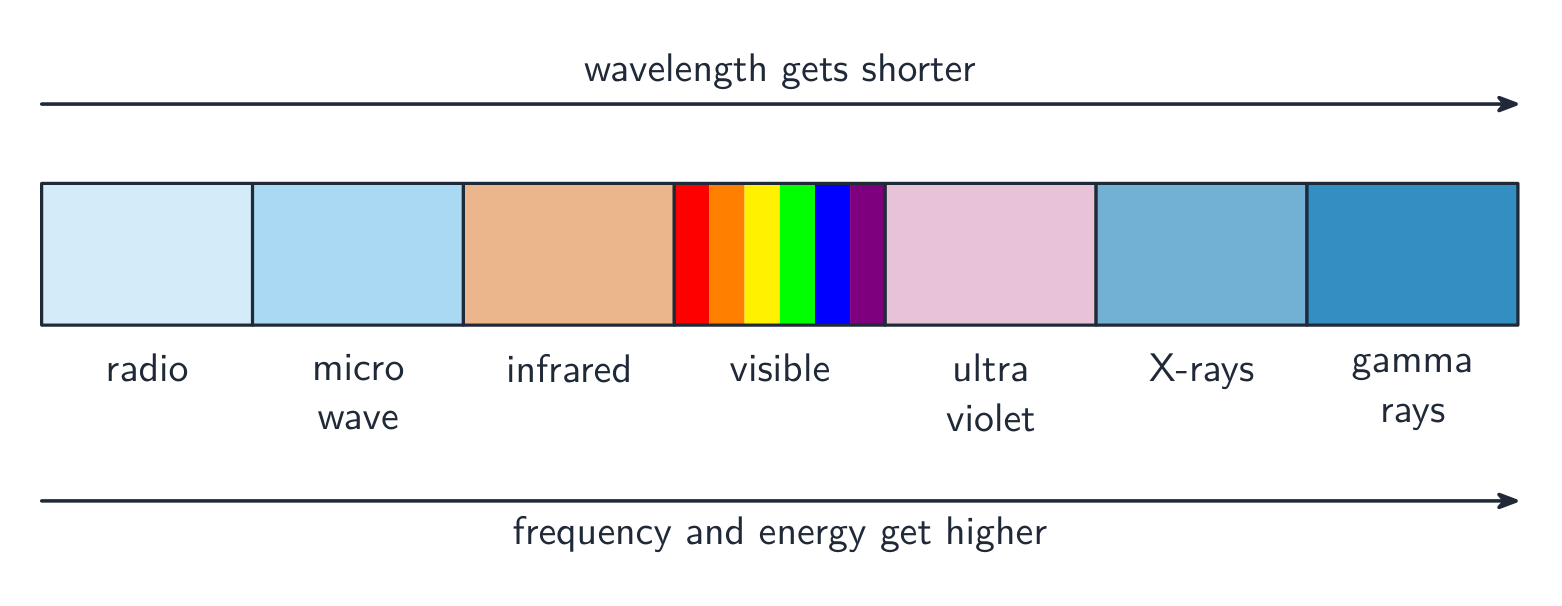
The electromagnetic spectrum is a family of waves that all travel at the same high speed in a vacuum 真空, $3.0 \times 10^8\ \text{m/s}$. In order from longest wavelength (lowest frequency) to shortest:
Region A typical use Danger from too much radio waves 无线电波 radio and TV signals, astronomy, RFID tags — microwaves 微波 mobile phones, satellite TV, cooking heating of body cells infrared 红外线 remote controls, thermal imaging, grills, optical fibres skin burns visible light seeing, photography — ultraviolet 紫外线 sterilising water, checking bank notes skin cancer, eye damage X-rays X射线 medical and security scans damage to cells gamma rays 伽马射线 sterilising equipment, treating cancer mutation of cells As you go from radio waves to gamma rays, the frequency rises, the wavelength falls, and the energy (and danger) rises. The speed of electromagnetic waves in air is almost the same as in a vacuum.
Satellites. Communication with artificial satellites 人造卫星 mainly uses microwaves, because they pass through the atmosphere. Some satellite phones use satellites in low orbit 低轨道, close to the Earth. Other satellite phones, and direct broadcast satellite television, use satellites in geostationary orbit 地球静止轨道, which stay above the same point on the Earth.
From radio waves to gamma rays the wavelength falls while the frequency and energy rise Digital and analogue signals
Radio waves and microwaves carry information as signals, and a signal is either analogue 模拟 or digital 数字. An analogue signal varies continuously and can take any value; a digital signal is a stream of just two values, on or off (
1or0). Sound can be sent as either kind of signal: a microphone gives an analogue signal, which can be turned into a digital one.Modern communication prefers digital signalling for two reasons the exam asks for:
- a higher rate of data transmission;
- a greater range: a weak digital signal can be regenerated back to a clean
1/0exactly, because only two levels have to be told apart, so noise picked up along the way is removed. An analogue signal cannot be cleaned up this way, so its noise builds up.
JelajahiGeserkan sepanjang spektrum
Gelombang radio, cahaya tampak, dan sinar gamma semuanya merupakan gelombang yang sama — hanya panjang gelombangnya yang berubah, beserta frekuensinya, energi foton, dan penggunaannya sehari-hari.
Kosa kata LatihEnglish Bahasa Indonesia electromagnetic spectrum/ɪˌlektrəʊməɡˈnetɪk ˈspektrəm/ spektrum elektromagnetik vacuum/ˈvækjuːm/ vakum radio waves/ˈreɪdɪəʊ weɪvz/ gelombang radio microwave/ˈmaɪkrəʊweɪv/ gelombang mikro infrared/ˌɪnfrəˈred/ inframerah ultraviolet/ˌʊltrəˈvaɪəlɪt/ ultraviolet X-rays/eks reɪz/ Sinar-X gamma rays/ˈɡæmə reɪz/ sinar gamma artificial satellites/ˌɑːtɪˈfɪʃl ˈsætəlaɪts/ satelit buatan low orbit/ləʊ ˈɔːbɪt/ orbit rendah geostationary orbit/ˌdʒiːəʊˈsteɪʃənəri ˈɔːbɪt/ orbit geostasioner analogue/ˈænəlɒɡ/ analog digital/ˈdɪdʒɪtl/ digital 3.4
Sound 声音

Silabus
Inti Tambahan 1 Deskripsikan produksi bunyi oleh sumber bergetar 2 Deskripsikan sifat longitudinal dari gelombang bunyi 10 Deskripsikan kompresi dan rarefaksi 3 Nyatakan kisaran frekuensi yang dapat didengar manusia secara kasar sebagai 20Hz hingga 20000Hz 4 Ketahuilah bahwa diperlukan medium untuk mentransmisikan gelombang bunyi 5 Ketahuilah bahwa kecepatan bunyi di udara kira-kira 330–350m/s 11 Ketahuilah bahwa, secara umum, bunyi merambat lebih cepat dalam zat padat daripada dalam zat cair dan lebih cepat dalam zat cair daripada dalam gas 6 Deskripsikan sebuah metode yang melibatkan pengukuran jarak dan waktu untuk menentukan kecepatan bunyi di udara 7 Jelaskan bagaimana perubahan amplitudo dan frekuensi memengaruhi kekerasan dan nada gelombang bunyi 8 Jelaskan gema sebagai pantulan gelombang bunyi 9 Definisikan ultrasonik sebagai bunyi dengan frekuensi lebih tinggi dari 20kHz 12 Jelaskan penggunaan ultrasonik dalam pengujian tak merusak material, pemindaian jaringan lunak medis, dan sonar termasuk perhitungan kedalaman atau jarak berdasarkan waktu dan kecepatan gelombang Sumber: Silabus Cambridge International
Sound is made by a vibrating object. It is a longitudinal wave: the air is squeezed into a compression 压缩 (particles close together) and stretched into a rarefaction 稀疏 (particles far apart).
- Sound needs a medium 介质 (a material) to travel through, so it cannot travel through a vacuum.
- Humans can hear frequencies from about $20\ \text{Hz}$ to $20\,000\ \text{Hz}$.
- Sound travels much slower than light (about $340\ \text{m/s}$ in air), and faster in liquids and solids than in gases.
- A larger amplitude makes a louder sound (greater loudness 响度); a higher frequency makes a higher pitch 音调. So a dolphin's rapid clicks are high-pitched, and a hard drum-hit (big vibration) is loud.
A reflected sound is an echo 回声.
Measuring the speed of sound. Two students stand a known distance apart, for example 500 m, measured with a tape or a trundle wheel. One bangs two blocks of wood together. The other starts a stopwatch when they see the blocks hit and stops it when they hear the bang. Light arrives almost at once, so the time measured is the time the sound takes, and speed = distance ÷ time. Repeat and take an average to reduce the reaction-time error. The echo method needs one person: clap at a known distance from a large wall and time the reflected sound, remembering that the sound travels there and back.
Worked example. A student stands 85 m from a large wall and claps once. The echo returns 0.50 s later. Find the speed of sound.
The sound travels to the wall and back, a distance of $2 \times 85 = 170\ \text{m}$, in $0.50\ \text{s}$:
$$v = \frac{s}{t} = \frac{170}{0.50} = 340\ \text{m/s}$$Ultrasound 超声波 is sound above $20\,000\ \text{Hz}$ – too high for humans to hear. Its uses rely on reflection: sonar measures water depth, medical scanning images a baby or soft tissue, and non-destructive testing finds cracks inside metal without cutting it open. Like an echo, an ultrasound pulse travels there and back, so halve the total distance to reach the object.
Worked example. A sonar pulse returns from the seabed $0.10\ \text{s}$ after it is sent; sound travels at $1500\ \text{m/s}$ in water. The pulse covers $s = v\times t = 1500\times0.10 = 150\ \text{m}$ there and back, so the sea is $150/2 = 75\ \text{m}$ deep.
A microphone converts sound vibrations in air into an electrical signal JelajahiSuara
y = a sin(bt + c)
Lebih keras = amplitudo lebih besar; nada lebih tinggi = frekuensi lebih tinggi.
Kosa kata LatihEnglish Bahasa Indonesia compression/kəmˈpreʃn/ pemampatan rarefaction/ˌreərɪˈfækʃn/ renggangan medium/ˈmiːdɪəm/ medium loudness/ˈlaʊdnəs/ kekerasan suara pitch/pɪtʃ/ nada echo/ˈekəʊ/ echo Ultrasound/ˌʊltrəˈsaʊnd/ Ultrasonik 3.4
Exam tips
- Learn $v = f\lambda$ and be ready to rearrange it. Measure all angles of incidence, reflection and refraction from the normal (the line at 90° to the surface), never from the surface itself.
- Transverse waves vibrate across the direction of travel (light, water); longitudinal waves vibrate along it (sound). Sound needs a medium, so it cannot cross a vacuum; light can.
- Total internal reflection happens only when light travels from a denser material to a less dense one and the angle inside is bigger than the critical angle.
- Know the electromagnetic spectrum in order — radio, microwave, infrared, visible, ultraviolet, X-ray, gamma. All travel at the same speed in a vacuum; frequency and energy rise from radio to gamma.
- Going into a denser material (air → glass) light slows down and bends towards the normal; leaving it (glass → air) light speeds up and bends away.
-
4
Listrik dan magnetisme
Tonton pelajaran4.1
Magnetism
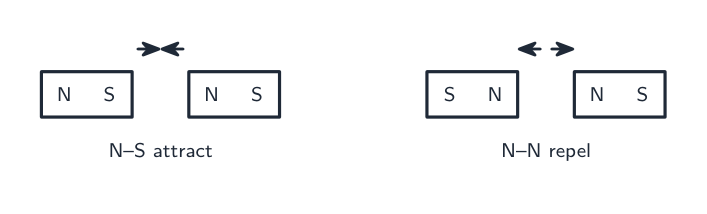
Silabus
Inti Tambahan 1 Jelaskan gaya antara kutub magnet dan antara magnet serta bahan magnetik, termasuk penggunaan istilah kutub utara (kutub N), kutub selatan (kutub S), penarikan dan tolakan, bermagnet dan tidak bermagnet 10 Jelaskan bahwa gaya magnet disebabkan oleh interaksi antara medan magnet 2 Jelaskan magnetisasi induksi 3 Nyatakan perbedaan antara sifat magnet sementara (terbuat dari besi lunak) dan sifat magnet permanen (terbuat dari baja 4 Nyatakan perbedaan antara bahan magnetik dan non-magnetik 5 Jelaskan medan magnet sebagai daerah di mana sebuah kutub magnet mengalami gaya 6 Gambar pola dan arah garis-garis medan magnet di sekitar magnet batang 11 Tahu bahwa kekuatan relatif medan magnet direpresentasikan oleh jarak antar garis medan magnet 7 Nyatakan bahwa arah medan magnet pada suatu titik adalah arah gaya pada kutub N magnet di titik tersebut 8 Jelaskan pemetaan garis-garis medan magnet dengan kompas atau serbuk besi dan penggunaan kompas untuk menentukan arah medan magnet 9 Jelaskan penggunaan magnet permanen dan elektromagnet Sumber: Silabus Cambridge International
A magnet 磁体 can attract some metals. Every magnet has two ends, called poles 磁极: a north pole 北极 (N pole) and a south pole 南极 (S pole).
Like poles repel; unlike poles attract The rule for two poles is like the rule for charges:
- Poles that are the same (N and N, or S and S) repel 排斥 (push apart): this is repulsion 排斥力.
- Poles that are different (N and S) attract 吸引 (pull together): this is attraction 吸引力.
A magnet attracts a magnetic material 磁性材料, such as iron, steel, cobalt and nickel. Other materials (copper, plastic, wood) are non-magnetic and feel no force.
Induced magnetism
Put a piece of iron near or touching a magnet, and the iron becomes a magnet itself. This is induced magnetism 感应磁性. The end of the iron nearest the magnet gains the opposite pole, so the two then attract.
Temporary and permanent magnets
- Soft iron 软铁 is easy to magnetise 磁化 but loses its magnetism quickly. It is used for a temporary magnet 临时磁体.
- Steel 钢 is harder to magnetise but keeps its magnetism. It is used for a permanent magnet 永磁体.
So an unmagnetised 未磁化 piece of soft iron is the best core for an electromagnet, while steel is best for a bar magnet.
Magnetic fields
A magnetic field 磁场 is a region 区域 where a magnetic pole feels a force. We draw it with magnetic field lines 磁场线:
- The lines come out of the N pole and go into the S pole.
- The field direction at a point is the direction of the force on the N pole of a small test magnet placed there.
- Where the lines are close together the field is strong; where they are far apart the field is weak.

The field lines of a bar magnet come out of the N pole and go into the S pole You can show the pattern by sprinkling iron filings 铁屑 on paper over a magnet, or by moving a small plotting compass 指南针 around it (the needle points along the field).

Iron filings line up along the field lines, showing the field pattern of a bar magnet Uses of magnets
- Permanent magnets: fridge door catches, compass needles, loudspeakers.
- Electromagnets 电磁铁 (magnetic only while a current flows): cranes that lift scrap iron, electric bells, relays. An electromagnet can be switched on and off and made stronger, which a permanent magnet cannot.
Magnetic forces happen because the fields of the two magnets push and pull on each other.
JelajahiMemvisualisasikan medan magnet
Jarum kompas menelusuri medan dari K ke U; beralih antara tarik-menarik dan tolak-menolak dan lihat seluruh pola tersusun ulang, dengan titik netral muncul untuk kutub serupa.
Kosa kata LatihEnglish Bahasa Indonesia magnet/ˈmæɡnɪt/ magnet poles/pəʊlz/ kutub north pole/nɔːθ pəʊl/ kutub utara south pole/saʊθ pəʊl/ kutub selatan repel/rɪˈpel/ tolak-menolak repulsion/rɪˈpʌlʃn/ tolakan attract/əˈtrækt/ tarik-menarik attraction/əˈtrækʃn/ tarikan magnetic material/mæɡˈnetɪk məˈtɪərɪəl/ bahan magnetik induced magnetism/ɪnˈdjuːst ˈmæɡnɪtɪzəm/ magnetisme induksi soft iron/sɒft ˈaɪən/ besi lunak magnetise/ˈmæɡnɪtaɪz/ memagnetkan temporary magnet/ˈtemprəri ˈmæɡnɪt/ magnet sementara steel/stiːl/ baja permanent magnet/ˈpɜːmənənt ˈmæɡnɪt/ magnet permanen unmagnetised/ʌnˈmæɡnɪtaɪzd/ tidak bermagnet magnetic field/mæɡˈnetɪk fiːld/ medan magnet region/ˈriːdʒn/ wilayah magnetic field lines/mæɡˈnetɪk fiːld laɪnz/ Garis medan magnetik iron filings/ˈaɪən ˈfaɪlɪŋz/ serbuk besi compass/ˈkʌmpəs/ kompas electromagnet/ɪˌlektrəʊˈmæɡnɪt/ elektromagnet 4.2
Static electricity

Silabus
4.2.1 Muatan listrik
Inti Tambahan 1 Nyatakan bahwa terdapat muatan positif dan negatif 7 Nyatakan bahwa muatan diukur dalam coulomb 2 Nyatakan bahwa muatan positif menolak muatan positif lain, muatan negatif menolak muatan negatif lain, tetapi muatan positif menarik muatan negatif 8 Jelaskan medan listrik sebagai daerah di mana muatan listrik mengalami gaya 3 Jelaskan percobaan sederhana untuk menunjukkan produksi muatan elektrostatik melalui gesekan dan untuk menunjukkan deteksi muatan elektrostatik 9 Nyatakan bahwa arah medan listrik pada suatu titik adalah arah gaya pada muatan positif di titik tersebut 4 Jelaskan bahwa pembangkitan listrik pada benda padat melalui gesekan hanya melibatkan perpindahan muatan negatif (elektron) 10 Jelaskan pola medan listrik sederhana, termasuk arah medan: (a) di sekitar muatan titik (b) di sekitar bola konduktor bermuatan (c) di antara dua pelat konduktor sejajar yang bermuatan berlawanan (efek ujung tidak akan diujikan) 5 Jelaskan percobaan untuk membedakan antara konduktor listrik dan isolator 6 Ingat dan gunakan model elektron sederhana untuk menjelaskan perbedaan antara konduktor listrik dan isolator serta berikan contoh典型 4.2.2 Arus listrik
Inti Tambahan 1 Tahu bahwa arus listrik berkaitan dengan aliran muatan 5 Definisikan arus listrik sebagai muatan yang melewati suatu titik per satuan waktu; ingat dan gunakan persamaan $I = \frac{Q}{t}$ 2 Jelaskan penggunaan amperemeter (analog dan digital) dengan berbagai rentang pengukuran 3 Jelaskan konduksi listrik pada logam dalam hal pergerakan elektron bebas 6 Nyatakan bahwa arus konvensional mengalir dari positif ke negatif dan aliran elektron bebas mengalir dari negatif ke positif 4 Tahu perbedaan antara arus searah (d.c.) dan arus bolak-balik (a.c.) 4.2.3 Gaya gerak listrik dan beda potensial
Inti Tambahan 1 Definisikan gaya gerak listrik (e.m.f.) sebagai kerja listrik yang dilakukan oleh sumber dalam memindahkan satu unit muatan mengelilingi rangkaian lengkap 6 Ingat dan gunakan persamaan untuk e.m.f. $E = \frac{W}{Q}$ 2 Tahu bahwa e.m.f. diukur dalam volt (V) 3 Definisikan beda potensial (p.d.) sebagai kerja yang dilakukan oleh satu unit muatan yang melewati komponen 7 Ingat dan gunakan persamaan untuk p.d. $V = \frac{W}{Q}$ 4 Tahu bahwa p.d. antara dua titik diukur dalam volt (V) 5 Jelaskan penggunaan voltmeter (analog dan digital) dengan berbagai rentang pengukuran 4.2.4 Hambatan
Inti Tambahan 1 Ingat dan gunakan persamaan untuk hambatan $R = \frac{V}{I}$ 4 Sketsa dan jelaskan grafik arus–tegangan untuk resistor hambatan tetap, lampu pijar, dan dioda 2 Jelaskan percobaan untuk menentukan hambatan menggunakan voltmeter dan amperemeter serta lakukan perhitungan yang sesuai 3 Nyatakan secara kualitatif hubungan hambatan kawat logam terhadap panjangnya dan luas penampangnya 5 Ingat dan gunakan hubungan berikut untuk konduktor listrik logam: (a) hambatan berbanding lurus dengan panjang (b) hambatan berbanding terbalik dengan luas penampang 4.2.5 Energi listrik dan daya listrik
Inti Tambahan 1 Pahami bahwa rangkaian listrik mentransfer energi dari sumber energi listrik, seperti sel listrik atau pasokan listrik utama, ke komponen rangkaian dan kemudian ke lingkungan 2 Ingat dan gunakan persamaan untuk daya listrik $P = IV$ 3 Ingat dan gunakan persamaan untuk energi listrik $E = IVt$ 4 Definisikan kilowatt-jam (kWh) dan hitung biaya penggunaan peralatan listrik di mana satuan energi adalah kWh Sumber: Silabus Cambridge International
There are two kinds of electric charge 电荷: positive charge 正电荷 and negative charge 负电荷. The rule is like the rule for poles — same charges repel, different charges attract.
Every hair picks up the same charge from the dome, and like charges repel — so the hairs push apart Charging by friction
When you rub two different materials together, electrons 电子 (tiny negative particles) move from one to the other. This is charging by friction 摩擦起电.
- The material that gains electrons becomes negative.
- The material that loses electrons becomes positive.
Only the negative electrons move; the positive charge stays in place. For example, a plastic rod rubbed with a cloth becomes negative because electrons move from the cloth onto the rod, leaving the cloth positive.
Detecting a charge. A charged rod picks up small pieces of paper, and it bends a thin stream of water from a tap. Hang one charged rod from a thread and bring another charged rod near it: if the two have the same kind of charge, the hanging rod swings away. Repulsion is the only sure test for a charge, because attraction also happens with uncharged objects.
Conductors and insulators
- A conductor 导体 (copper and other metals) lets charge flow through it easily, because it has free electrons that can move.
- An insulator 绝缘体 (plastic, rubber, glass) does not let charge flow, because its electrons cannot move freely.
To test a material, join it in a circuit with a lamp and a battery: the lamp lights only for a conductor.
Electric fields and ions
Charge is measured in coulombs 库仑 (C). An electric field 电场 is a region where an electric charge feels a force. Its direction at a point is the direction of the force on a positive charge. Simple field patterns (the arrows show the direction):
- around a point charge 点电荷: straight lines, pointing away from a positive charge and towards a negative charge;
- around a charged ball (sphere): the same, spreading out evenly all around;
- between two parallel plates with opposite charges: straight, evenly spaced lines from the positive plate to the negative plate.

Electric field lines point away from a positive charge and towards a negative one; between parallel plates the field is uniform An atom is normally neutral. If it loses electrons it becomes a positive ion 离子; if it gains electrons it becomes a negative ion.
JelajahiUsap balon dan watch ia terisi muatan
Menggosok memindahkan elektron ke balon, menjadikannya negatif — kemudian ia menarik dinding atau rambut Anda yang netral, tetapi menolak balon negatif lainnya.
Kosa kata LatihEnglish Bahasa Indonesia electric charge/ɪˈlektrɪk tʃɑːdʒ/ muatan listrik positive charge/ˈpɒzɪtɪv tʃɑːdʒ/ muatan positif negative charge/ˈneɡətɪv tʃɑːdʒ/ muatan negatif electron/ɪˈlektrɒn/ elektron charging by friction/ˈtʃɑːdʒɪŋ baɪ ˈfrɪkʃn/ pengisian dengan gesekan conductor/kənˈdʌktə/ konduktor insulator/ˈɪnsjuːleɪtə/ isolator coulomb/ˈkuːlɒm/ coulomb electric field/ɪˈlektrɪk fiːld/ medan listrik point charge/pɔɪnt tʃɑːdʒ/ muatan titik ion/ˈaɪɒn/ ion 4.2
Electric current
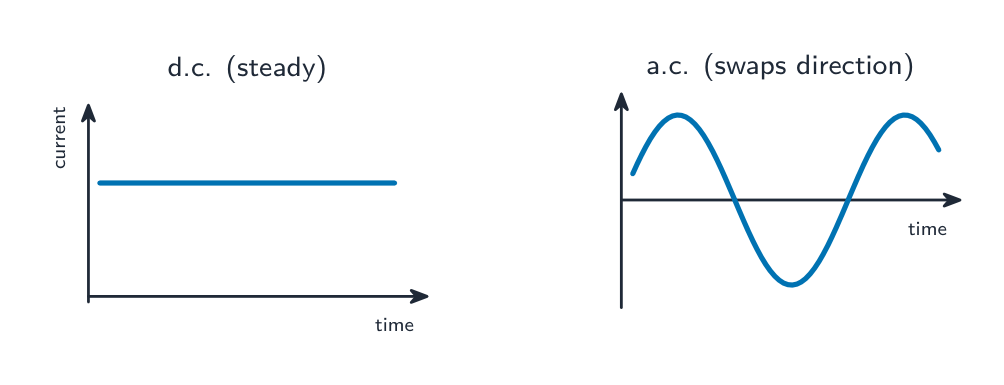
An electric current 电流 is a flow of electric charge. It is measured in amperes 安培 (A) with an ammeter 电流表, joined in series in the circuit.
An analogue 模拟 ammeter has a needle that moves over a scale; a digital 数字 ammeter shows the reading as a number. Both come with different ranges 量程. Choose the range just above the biggest current you expect, so the reading is accurate: a 0–1 A range for a current of about 0.4 A, or a 0–100 mA range for a few milliamps.
Current is the charge that passes a point each second:
$$I = \frac{Q}{t}$$Here $I$ is current (A), $Q$ is charge (C) and $t$ is time (s). Rearranged, $Q = It$.
Worked example. A current of $3.0\ \text{A}$ flows through a lamp for $20\ \text{s}$. How much charge passes through it?
$$Q = It = 3.0 \times 20 = 60\ \text{C}$$In a metal the current is a flow of free electrons 自由电子. There are two "directions" to know:
- Conventional current 常规电流 is taken to flow from + to − round the outside of the cell.
- The free electrons really drift the other way, from − to +.
A direct current 直流电 (d.c.) always flows one way, as from a battery. An alternating current 交流电 (a.c.) keeps swapping direction many times each second, as from the mains supply 市电.
Direct current is steady in one direction; alternating current keeps swapping direction, crossing zero many times each second Kosa kata LatihEnglish Bahasa Indonesia electric current/ɪˈlektrɪk ˈkʌrənt/ arus listrik ampere/ˈæmpeə/ ampere ammeter/ˈæmiːtə/ amperemeter analogue/ˈænəlɒɡ/ analog digital/ˈdɪdʒɪtl/ digital ranges/ˈreɪndʒɪz/ rentang free electrons/friː ɪˈlektrɒnz/ elektron bebas conventional current/kənˈvenʃənl ˈkʌrənt/ arus konvensional direct current/daɪˈrekt ˈkʌrənt/ arus terus alternating current/ˈɔːltəneɪtɪŋ ˈkʌrənt/ arus bolak-balik mains supply/meɪnz səˈplaɪ/ pasokan listrik utama 4.2
E.m.f. and potential difference

A cell gives energy 能量 to the charges that move through it. Two quantities describe this, and both are measured in volts 伏特 (V).
- The electromotive force 电动势 (e.m.f.) of a source is the electrical work it does to drive unit charge all the way round a complete circuit 电路.
- The potential difference 电势差 (p.d.) across a component is the work done by unit charge as it passes through that component.
A voltmeter 电压表 measures e.m.f. or p.d. It is joined in parallel (across the component). Like ammeters, voltmeters are analogue or digital and have different ranges: pick the range just above the largest voltage you expect.
A voltmeter across the cell reads the e.m.f. (energy each coulomb is given); a voltmeter across the lamp reads the p.d. (energy each coulomb spends there). Both are work done per unit charge:
$$E = \frac{W}{Q}, \qquad V = \frac{W}{Q}$$where $W$ is the energy transferred (J) and $Q$ is the charge (C). For example, if a cell does $120\ \text{J}$ of work moving $60\ \text{C}$ of charge round a circuit, its e.m.f. is $120 / 60 = 2\ \text{V}$.
Kosa kata LatihEnglish Bahasa Indonesia energy/ˈenədʒi/ tenaga volt/vəʊlt/ volt electromotive force/ɪˌlektrəʊˈməʊtɪv fɔːs/ gaya gerak listrik circuit/ˈsɜːkɪt/ sirkuit potential difference/pəˈtenʃl ˈdɪfrəns/ beda potensial voltmeter/ˈvəʊltmiːtə/ voltmeter 4.2
Resistance

Resistance 电阻 measures how hard it is for current to flow. A bigger resistance gives a smaller current. It is measured in ohms 欧姆 (Ω).
$$R = \frac{V}{I}$$Measuring resistance. Connect the component in series with a cell, a switch, an ammeter and a variable resistor 可变电阻器, and connect a voltmeter across the component. Close the switch, read $I$ and $V$, then change the variable resistor to get several more pairs of readings. Either calculate $R = V/I$ for each pair and take the average, or plot $V$ against $I$: for a metal wire at constant temperature the graph is a straight line through the origin, and its gradient is $R$.
Worked example. A $12\ \text{V}$ battery drives a current of $0.50\ \text{A}$ through a lamp. Find the lamp's resistance.
$$R = \frac{V}{I} = \frac{12}{0.50} = 24\ \Omega$$For a metal wire at constant temperature:
- a longer wire has a bigger resistance — resistance is directly proportional 成正比 to length, $R \propto l$;
- a thicker wire has a smaller resistance — resistance is inversely proportional 成反比 to cross-sectional area 横截面积, $R \propto \dfrac{1}{A}$.
So doubling the length doubles the resistance; doubling the area halves it. (Area depends on the diameter squared, so a small change in diameter changes the resistance a lot.)
Current–voltage graphs show how three components behave:
Component Shape of the I–V graph What it tells you resistor 电阻器 (fixed) straight line through the origin resistance is constant, so $I \propto V$ filament lamp 灯丝灯泡 S-shaped, getting flatter as $V$ rises the wire heats up, so its resistance rises diode 二极管 current one way only very high resistance the "wrong" way A resistor gives a straight line; a filament lamp curves as it heats up; a diode lets current pass only one way JelajahiHukum Ohm
V = IR
Untuk konduktor ohmik, arus sebanding dengan tegangan — kemiringan adalah 1/hambatan.
JelajahiKarakteristik I–V
Resistor memberikan garis lurus; lampu filamen dan dioda tidak. Pilih komponen dan baca I dan R dari kurva.
JelajahiPenolakan
V = R·I
Hukum Ohm: tegangan berbanding lurus dengan arus — gradiennya adalah hambatan R.
Kosa kata LatihEnglish Bahasa Indonesia resistance/rɪˈzɪstəns/ penolakan ohm/əʊm/ ohm variable resistor/ˈveərɪəbl rɪˈzɪstə/ resistor variabel directly proportional/daɪˈrektli prəˈpɔːʃənl/ berbanding lurus inversely proportional/ɪnˈvɜːsli prəˈpɔːʃənl/ berbanding terbalik cross-sectional area/krɒs ˈsekʃənl ˈeərɪə/ luas penampang resistor/rɪˈzɪstə/ resistor filament lamp/ˈfɪləmənt læmp/ lampu filamen diode/ˈdaɪəʊd/ dioda 4.2
Electrical energy and power
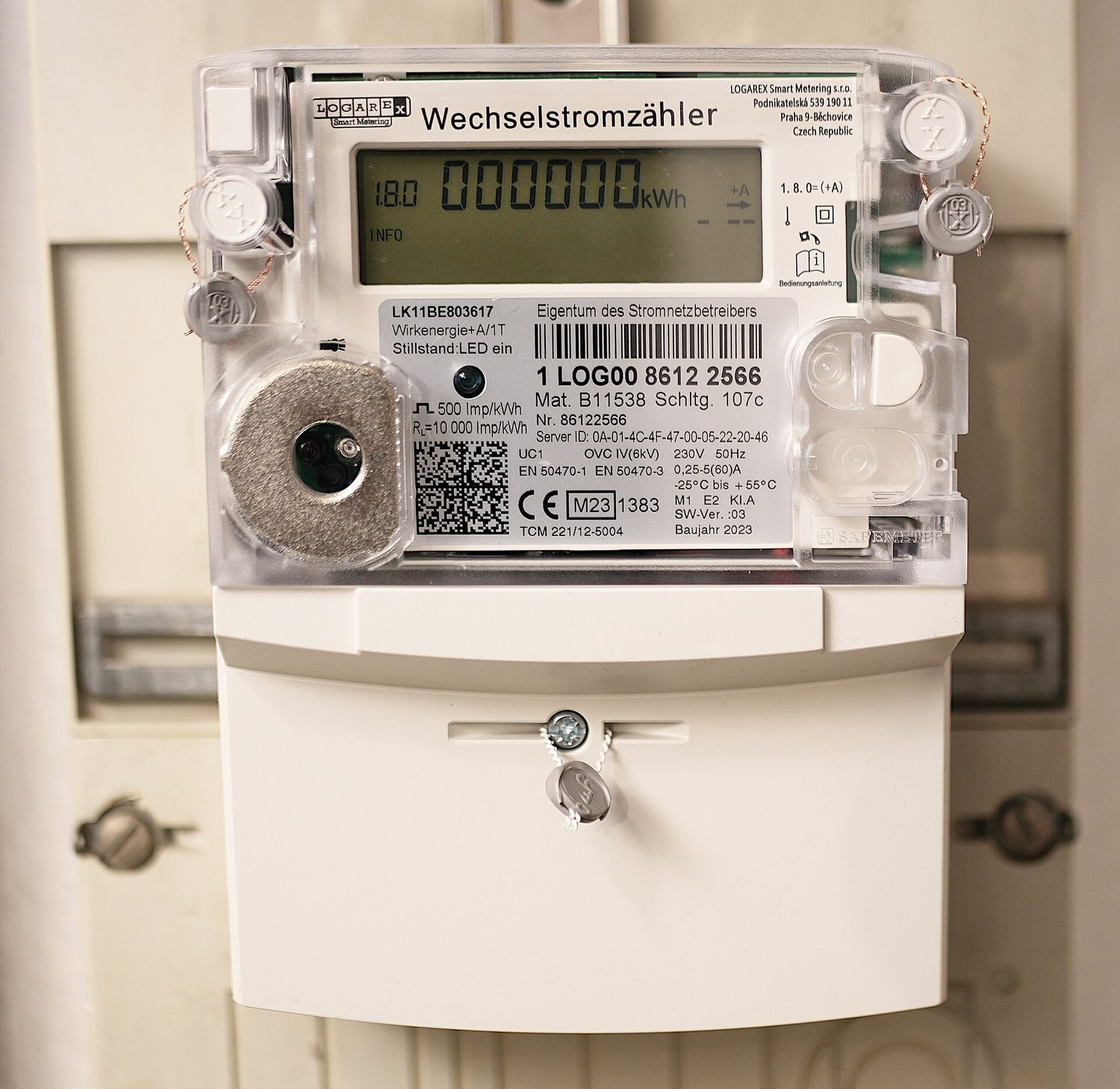
A circuit transfers energy from a source (a cell or the mains) to the components, and then into the surroundings (often as heat, light or sound).
Electrical power 电功率 is the energy transferred each second, measured in watts 瓦特 (W):
$$P = IV$$The electrical energy 电能 transferred in a time $t$, measured in joules 焦耳 (J), is:
$$E = IVt$$Worked example. A $12\ \text{V}$ motor draws a current of $2.0\ \text{A}$. Find its power, and the energy it transfers in $30\ \text{s}$.
$$P = IV = 2.0 \times 12 = 24\ \text{W}$$$$E = Pt = 24 \times 30 = 720\ \text{J}$$The kilowatt-hour
Home electricity bills use a bigger energy unit, the kilowatt-hour 千瓦时 (kWh). One kilowatt-hour is the energy used by a $1\ \text{kW}$ appliance 电器 in $1$ hour.
$$\text{energy (kWh)} = \text{power (kW)} \times \text{time (h)}$$$$\text{cost} = \text{energy (kWh)} \times \text{price per kWh}$$For example, a $2\ \text{kW}$ heater 加热器 used for $3$ hours uses $2 \times 3 = 6\ \text{kWh}$. If one kWh costs $20$ cents, the cost is $6 \times 20 = 120$ cents.
A household electricity meter counts the energy used, in kilowatt-hours (kWh) — the number it shows is what you pay for Kosa kata LatihEnglish Bahasa Indonesia electrical power/ɪˈlektrɪkl ˈpaʊə/ daya listrik watt/wɒt/ watt electrical energy/ɪˈlektrɪkl ˈenədʒi/ energi listrik joule/dʒuːl/ joule kilowatt-hour/ˈkɪləwɒt ˈaʊə/ kilowatt-jam appliance/əˈplaɪəns/ peralatan listrik heater/ˈhiːtə/ pemanas 4.3
Circuits
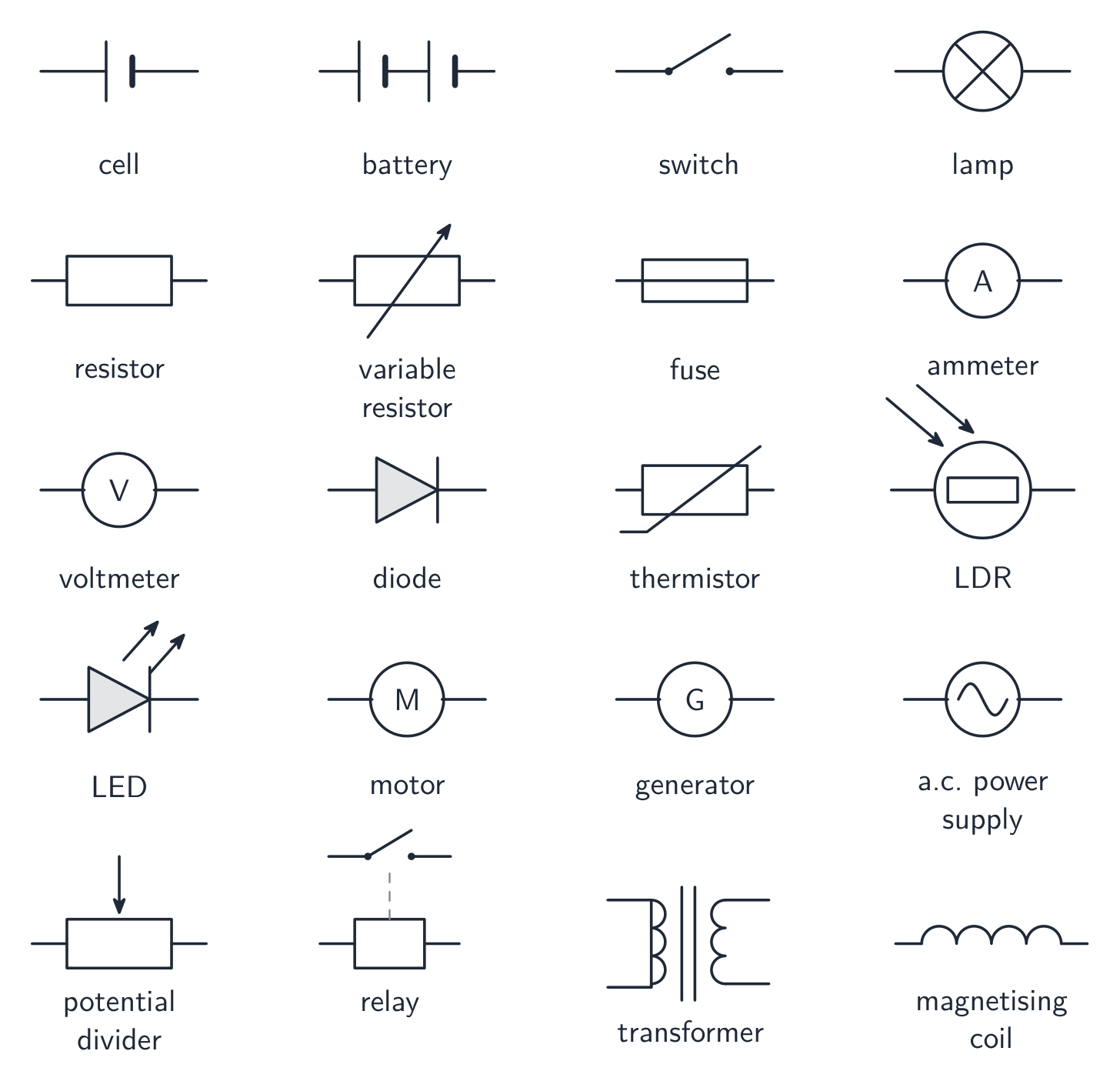
Silabus
4.3.1 Diagram rangkaian dan komponen rangkaian
Inti Tambahan 1 Gambar dan tafsirkan diagram rangkaian yang berisi sel, baterai, sumber daya, generator, pembagi potensial, sakelar, resistor (tetap dan variabel), pemanas, termistor (NTC saja), resistor peka cahaya (LDR), lampu, motor, bel, amperemeter, voltmeter, kumparan pemagnetan, transformator, sekring, dan relay serta pahami bagaimana komponen-komponen ini berperilaku dalam rangkaian 2 Gambar dan tafsirkan diagram rangkaian yang berisi dioda dan light-emitting diodes (LEDs) serta pahami bagaimana komponen-komponen ini berperilaku dalam rangkaian 4.3.2 Rangkaian seri dan paralel
Inti Tambahan 1 Pahami bahwa arus pada setiap titik dalam rangkaian seri adalah sama 8 Ingat dan gunakan dalam perhitungan, fakta bahwa: (a) jumlah arus yang masuk ke sebuah percabangan dalam rangkaian paralel sama dengan jumlah arus yang keluar dari percabangan tersebut (b) total tegangan antara dua titik (p.d.) melintasi komponen dalam rangkaian seri sama dengan jumlah tegangan individual melintasi setiap komponen (c) tegangan antara dua titik (p.d.) melintasi susunan resistor paralel sama dengan tegangan antara dua titik (p.d.) melintasi salah satu cabang dalam susunan resistor paralel tersebut 2 Pahami cara membangun dan menggunakan rangkaian seri dan paralel 3 Hitung e.m.f. gabungan dari beberapa sumber dalam seri 4 Hitung resistansi gabungan dari dua atau lebih resistor dalam seri 5 Nyatakan bahwa, untuk rangkaian paralel, arus dari sumber lebih besar daripada arus dalam setiap cabangnya 9 Jelaskan bahwa jumlah arus yang masuk ke sebuah percabangan sama dengan jumlah arus yang keluar dari percabangan tersebut 6 Nyatakan bahwa resistansi gabungan dari dua resistor dalam paralel lebih kecil daripada resistansi masing-masing resistor secara terpisah 10 Hitung resistansi gabungan dari dua resistor dalam paralel 7 Nyatakan keuntungan menghubungkan lampu secara paralel dalam rangkaian pencahayaan 4.3.3 Aksi dan penggunaan komponen rangkaian
Inti Tambahan 1 Pahami bahwa tegangan antara dua titik (p.d.) melintasi konduktor listrik meningkat seiring dengan meningkatnya resistansinya untuk arus konstan 2 Jelaskan aksi dari pembagi potensial variabel 3 Ingat dan gunakan persamaan untuk dua resistor yang digunakan sebagai pembagi potensial $$\frac{R_1}{R_2} = \frac{V_1}{V_2}$$Sumber: Silabus Cambridge International
Circuit components
You should know these components and how they behave:
Component What it does cell 电池 / battery 电池组 drives current round the circuit (a battery is two or more cells) power supply 电源 a source of d.c. or a.c. switch 开关 breaks or completes the circuit resistor (fixed) gives a fixed resistance variable resistor a resistance you can change, to control the current fuse 保险丝 melts and breaks the circuit if the current is too big lamp / heater turns electrical energy into light / into heat thermistor 热敏电阻 its resistance falls as it gets hotter light-dependent resistor 光敏电阻 (LDR) its resistance falls as the light gets brighter diode / light-emitting diode 发光二极管 (LED) lets current one way only; an LED also gives out light relay 继电器 a switch worked by an electromagnet (small current controls a big one) motor 电动机 turns electrical energy into movement bell 电铃 makes a sound transformer 变压器 changes the size of an a.c. voltage The standard symbols used to draw circuit diagrams 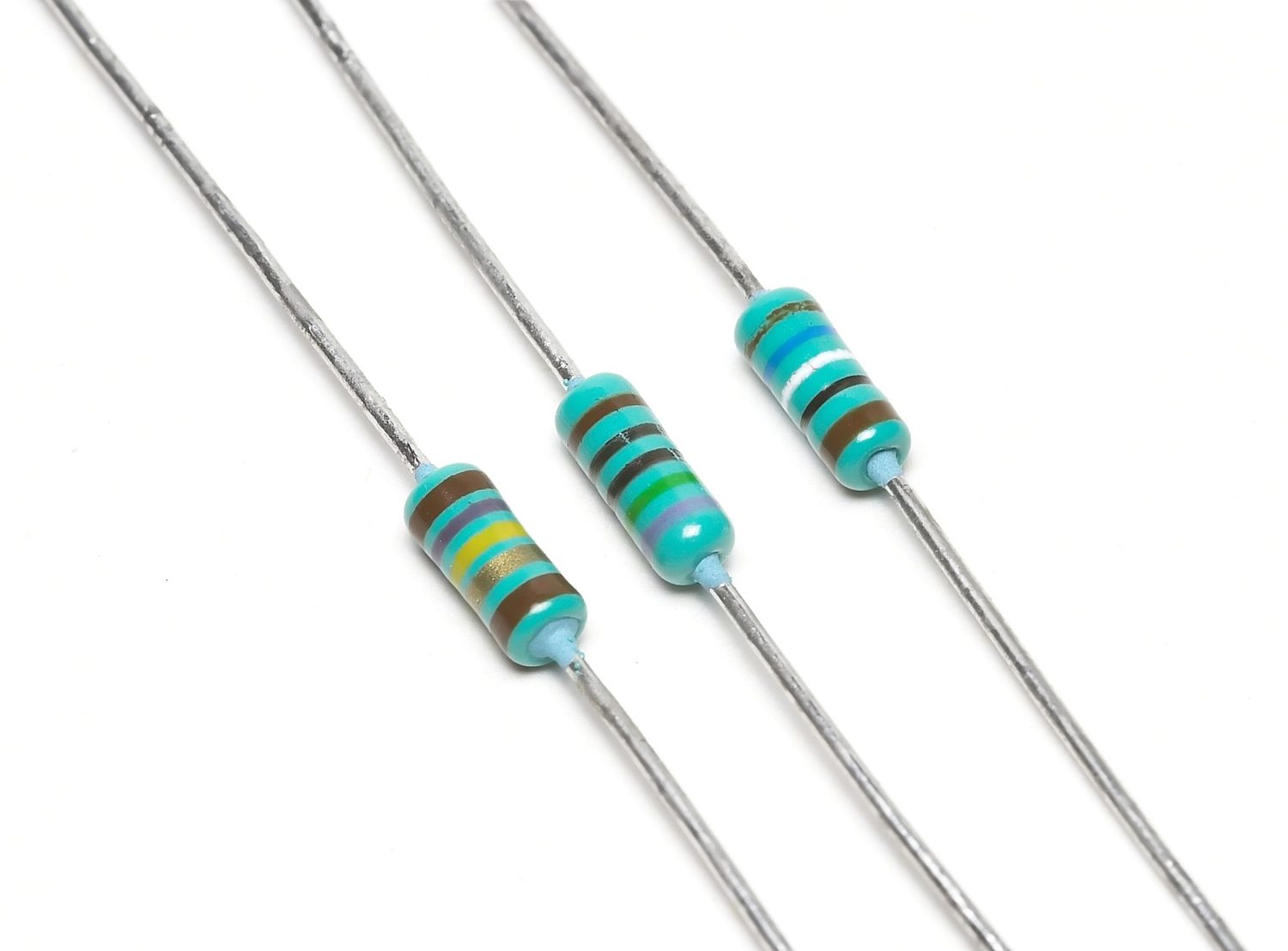
Real resistors: the coloured bands give each one's resistance in ohms Series and parallel
In a series 串联 circuit the parts form one single loop:
- the current is the same at every point;
- the supply p.d. is shared between the components;
- cells in series add their e.m.f.s (when they point the same way);
- resistors in series add up: $R_{\text{total}} = R_1 + R_2 + \dots$
In a parallel 并联 circuit the parts are on separate branches:
- each branch gets the full supply p.d.;
- the current splits, so the current from the source is bigger than the current in any one branch;
- the total resistance 总电阻 is less than the smallest single resistance.
Lamps in a home are wired in parallel: each gets the full voltage, and if one fails the others stay on.

In a series circuit the components share one loop; in a parallel circuit each lamp has its own branch For calculations (with the rules above):
- at a junction 节点, the total current flowing in equals the total current flowing out;
- in series, the supply p.d. equals the sum of the p.d.s across the components;
- in parallel, the p.d. across each branch is the same;
- two resistors in parallel combine as
$$\frac{1}{R_{\text{total}}} = \frac{1}{R_1} + \frac{1}{R_2}$$Worked example. A $6\ \Omega$ resistor and a $3\ \Omega$ resistor are connected in parallel. Find their combined resistance.
$$\frac{1}{R_{\text{total}}} = \frac{1}{6} + \frac{1}{3} = \frac{1}{6} + \frac{2}{6} = \frac{3}{6} = \frac{1}{2} \quad\Rightarrow\quad R_{\text{total}} = 2\ \Omega$$Notice the combined resistance ($2\ \Omega$) is smaller than the smaller of the two resistors.
Potential dividers
Two resistors in series share the supply voltage. This is a potential divider 分压器. For the same current, a bigger resistance has a bigger p.d. across it, so the bigger resistor takes the bigger share:
$$\frac{R_1}{R_2} = \frac{V_1}{V_2}$$A variable potential divider (or a variable resistor) lets you change the output voltage smoothly, for example from $0\ \text{V}$ up to the full supply. If you use a thermistor or an LDR as one of the resistors, the output voltage changes with temperature or light — handy for switching a heater or a lamp on and off automatically.
JelajahiBangun arus dengan hukum Ohm
Naikkan tegangan dan elektron berakselerasi dan bohlam menyala lebih terang; tambahkan hambatan dan arus turun. I = V/R, kecerahan = daya.
Kosa kata LatihEnglish Bahasa Indonesia cell/sel/ sel battery/ˈbætəri/ baterai power supply/ˈpaʊə səˈplaɪ/ catu daya switch/swɪtʃ/ saklar fuse/fjuːz/ sekat thermistor/ˈθɜːmɪstə/ termistor light-dependent resistor/laɪt dɪˈpendənt rɪˈzɪstə/ resistor peka cahaya light-emitting diode/laɪt ɪˈmɪtɪŋ ˈdaɪəʊd/ dioda pemancar cahaya relay/ˈriːleɪ/ relay motor/ˈməʊtə/ motor bell/bel/ bel transformer/trænsˈfɔːmə/ transformator series/ˈsɪəriːz/ seri parallel/ˈpærəlel/ paralel total resistance/ˈtəʊtl rɪˈzɪstəns/ total resistansi junction/ˈdʒʌŋkʃn/ sambungan potential divider/pəˈtenʃl dɪˈvaɪdə/ pembagi potensial 4.4
Electrical safety
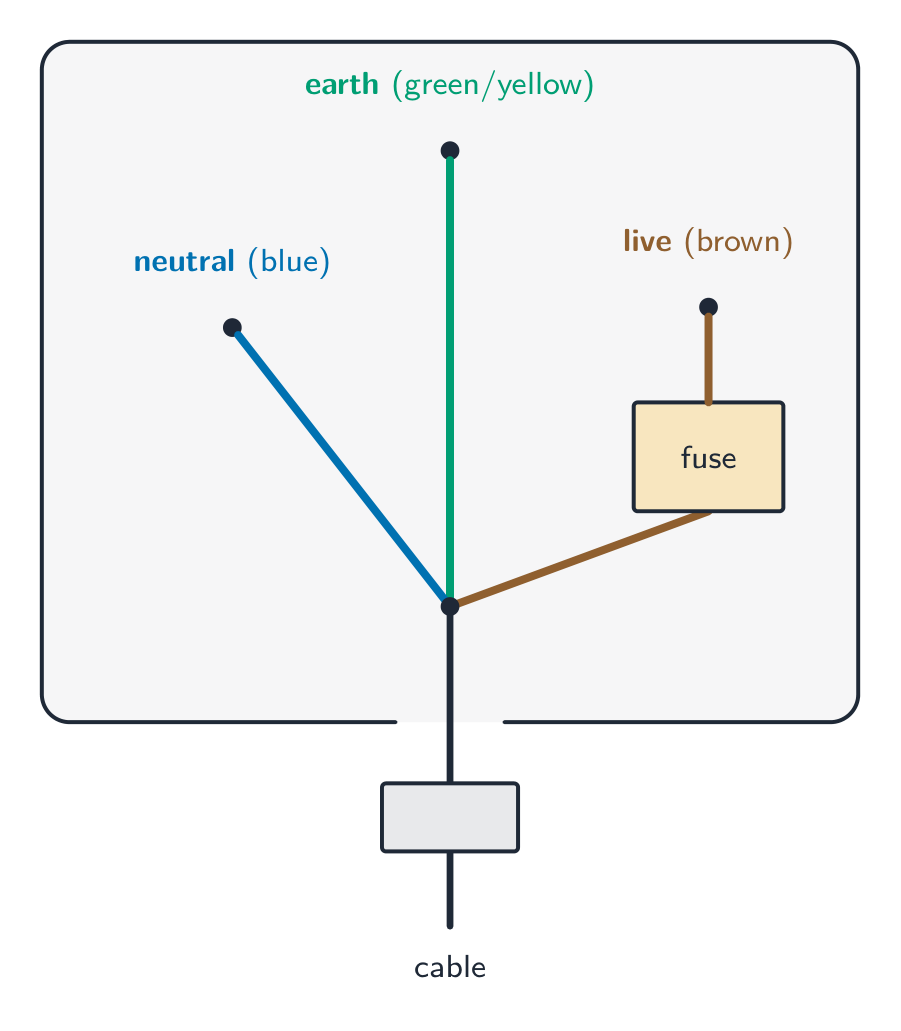
Silabus
Inti Tambahan 1 Nyatakan bahaya-bahaya berikut: (a) isolasi yang rusak (b) kabel yang terlalu panas (c) kondisi lembap (d) arus berlebih akibat kelebihan beban pada stopkontak tunggal, ganda, steker, dan kabel perpanjangan saat menggunakan suplai listrik utama 2 Pahami bahwa rangkaian listrik utama terdiri dari kabel fasa (line wire), kabel netral dan kabel tanah serta jelaskan mengapa sakelar harus terhubung ke kabel fasa agar rangkaian dapat dimatikan dengan aman 3 Jelaskan fungsi dan operasi pemutus sirkuit otomatis (trip switches) dan sekring serta pilih rating sekring dan pengaturan trip switch yang sesuai 4 Jelaskan mengapa casing luar alat listrik harus berupa non-konduktif (isolasi ganda) atau ditanahkan (earthed) 5 Nyatakan bahwa sekring tanpa kabel tanah melindungi rangkaian dan kabelisasi untuk peralatan berisolasi ganda Sumber: Silabus Cambridge International
A home is fed by the mains. The mains is dangerous if it is used wrongly.
Hazards
These are hazards 危险 (dangers) with mains electricity:
- damaged insulation 绝缘层 — bare wires can give a shock or start a fire;
- overheating 过热 cables — too much current makes a cable hot, which can start a fire;
- damp 潮湿 conditions — water lets current pass into a person, raising the risk of a shock;
- overloading 过载 — plugging too many appliances into one socket 插座 draws too much current.
Live, neutral and earth
A mains cable has three wires:
- the live wire 火线 carries the high voltage;
- the neutral wire 零线 completes the circuit at about zero voltage;
- the earth wire 地线 is a safety wire joined to the ground.
A switch (and a fuse) must be fitted in the live wire. Then, when the switch is off, the appliance is cut off from the high voltage and is safe to touch.
In a three-pin plug the live (brown) and neutral (blue) carry the current, the earth (green/yellow) is the safety wire, and the fuse always sits in the live wire. Fuses, trip switches and earthing
A fuse is a thin wire that melts if the current gets too big, breaking the circuit before the cable overheats. Choose a fuse rating 额定值 just above the normal working current — for example a $13\ \text{A}$ fuse for an appliance that normally uses about $10\ \text{A}$.
A trip switch 跳闸开关 (circuit breaker) does the same job but acts faster and can be reset instead of replaced.
The metal casing 外壳 of an appliance must be made safe in one of two ways:
- earthed 接地: the casing is joined to the earth wire. If a live wire touches the casing, a large current flows to earth and blows the fuse.
- double-insulated 双重绝缘: the casing is plastic, so it can never become live. Such an appliance needs no earth wire; its fuse still protects the cable.

A home consumer unit: each MCB is a trip switch that cuts off its circuit when the current gets too big; the RCD (80 A, 30 mA) cuts off even faster if it detects a fault to earth JelajahiRute keamanan listrik
Ikuti arus gangguan dan lihat bagaimana perangkat keselamatan melindungi manusia.
Kosa kata LatihEnglish Bahasa Indonesia hazard/ˈhæzəd/ hazard insulation/ˌɪnsjuːˈleɪʃn/ isolasi overheating/ˌəʊvəˈhiːtɪŋ/ kepanasan berlebih damp/dæmp/ lembap overloading/ˌəʊvəˈləʊdɪŋ/ pemuatan ulang socket/ˈsɒkɪt/ soket live wire/laɪv ˈwaɪə/ kawat hidup neutral wire/ˈnjuːtrəl ˈwaɪə/ kawat netral earth wire/ɜːθ ˈwaɪə/ kawat tanah fuse rating/fjuːz ˈreɪtɪŋ/ rating sekering trip switch/trɪp swɪtʃ/ suis trip casing/ˈkeɪsɪŋ/ casing earthed/ɜːθt/ terhubung ke bumi double-insulated/ˈdʌbl ˈɪnsjuːleɪtɪd/ berisolasi ganda 4.5
Electromagnetic effects

Silabus
4.5.1 Induksi elektromagnetik
Inti Tambahan 1 Pahami bahwa konduktor yang bergerak melintasi medan magnet atau perubahan medan magnet yang beririsan dengan konduktor dapat menginduksi e.m.f. dalam konduktor tersebut 4 Pahami bahwa arah e.m.f. induksi berlawanan dengan perubahan yang menyebabkannya 2 Deskripsikan eksperimen untuk mendemonstrasikan induksi elektromagnetik 5 Nyatakan dan gunakan arah relatif gaya, medan, dan arus induksi 3 Nyatakan faktor-faktor yang mempengaruhi besaran e.m.f. induksi 4.5.2 Generator a.c.
Inti Tambahan 1 Deskripsikan bentuk sederhana generator a.c. (kumparan berputar atau magnet berputar) dan penggunaan cincin gelincir (slip rings) serta sikat (brushes) jika diperlukan 2 Sketsa dan tafsirkan grafik e.m.f. terhadap waktu untuk generator a.c. sederhana dan hubungkan posisi kumparan generator dengan puncak, lembah, dan nol dari e.m.f. 4.5.3 Efek magnetik dari arus
Inti Tambahan 1 Deskripsikan pola dan arah medan magnet akibat arus pada kawat lurus dan solenoida 4 Nyatakan variasi kualitatif kekuatan medan magnet di sekitar kawat lurus dan solenoida 2 Deskripsikan eksperimen untuk mengidentifikasi pola medan magnet (termasuk arah) akibat arus pada kawat lurus dan solenoida 3 Jelaskan bagaimana efek magnetik dari arus digunakan dalam relay dan speaker dan berikan contoh aplikasinya 5 Deskripsikan efek pada medan magnet di sekitar kawat lurus dan solenoida akibat perubahan besaran dan arah arus 4.5.4 Gaya pada konduktor pembawa arus
Inti Tambahan 1 Deskripsikan eksperimen untuk menunjukkan bahwa gaya bekerja pada konduktor pembawa arus dalam medan magnet, termasuk efek dari membalik: (a) arus (b) arah medan 2 Ingat dan gunakan arah relatif gaya, medan magnet, dan arus 3 Tentukan arah gaya pada berkas partikel bermuatan dalam medan magnet 4.5.5 Motor d.c.
Inti Tambahan 1 Pahami bahwa kumparan pembawa arus dalam medan magnet dapat mengalami efek torsi dan efek torsi ini meningkat dengan menambah: (a) jumlah lilitan pada kumparan (b) arus (c) kekuatan medan magnet 2 Jelaskan operasi motor listrik, termasuk aksi komutator cincin terbelah (split-ring commutator) dan sikat 4.5.6 Transformator
Inti Tambahan 1 Deskripsikan konstruksi transformator sederhana dengan inti besi lunak, seperti yang digunakan untuk transformasi tegangan 6 Jelaskan prinsip operasi transformator berinti besi sederhana 2 Gunakan istilah primer, sekunder, peningkat tegangan (step-up) dan penurun tegangan (step-down) 3 Ingat dan gunakan persamaan $$\frac{V_p}{V_s} = \frac{N_p}{N_s}$$di mana p dan s merujuk pada primer dan sekunder7 Ingat dan gunakan persamaan untuk efisiensi 100% dalam transformator $$I_p V_p = I_s V_s$$di mana p dan s merujuk pada primer dan sekunder4 Jelaskan penggunaan transformator dalam transmisi listrik bertegangan tinggi 5 Sebutkan keunggulan transmisi tegangan tinggi 8 Ingat dan gunakan persamaan $$P = I^2 R$$untuk menjelaskan mengapa rugi-rugi daya pada kabel lebih kecil ketika tegangan lebih besarSumber: Silabus Cambridge International
The transformer: turns ratio Electromagnetic induction The magnetic effect of a current
A current in a wire makes a magnetic field around it.
- Around a straight wire the field lines are circles around the wire; the field is stronger close to the wire. Reverse the current and the field reverses.
- A solenoid 螺线管 (a long coil 线圈 of wire) makes a field just like a bar magnet, with a N pole at one end and a S pole at the other. The field inside is strong and even.
You can show both patterns with iron filings or a plotting compass. The field gets stronger if you increase the current, add more turns, or place a soft-iron core inside.
A current makes circular field lines around a straight wire, and a bar-magnet-like field for a solenoid The magnetic effect is used in a relay and in a loudspeaker. In a relay, a small current in a coil magnetises a soft-iron core, which pulls a switch closed in a second circuit. The second circuit can carry a large current, so a small switch or a sensor can safely control a motor or a heater (for example, the ignition switch of a car starts its motor through a relay). In a loudspeaker 扬声器 a changing current in a coil makes the coil push and pull a paper cone, which moves the air and makes sound.
Electromagnetic induction
When a wire moves across a magnetic field, or the field through a coil changes, an e.m.f. is induced in the wire. If the wire is part of a complete circuit, this e.m.f. drives a current. This is electromagnetic induction 电磁感应.
To show it: move a magnet in and out of a coil joined to a sensitive meter, and watch the needle flick. The induced e.m.f. is bigger when you use a stronger magnet, move faster, or use more turns on the coil. The induced e.m.f. always acts to oppose the change that causes it. The direction of the induced current is given by Fleming's right-hand rule 弗莱明右手定则: hold the thumb, first finger and second finger of the right hand at right angles to one another; the thumb points along the motion of the wire, the first finger along the field (N to S), and the second finger then gives the induced current.
The a.c. generator
An a.c. generator 交流发电机 turns movement into electricity. A coil is spun in a magnetic field (or a magnet is spun near a coil). As it turns, the field through the coil keeps changing, so an alternating e.m.f. is induced.
- Slip rings 滑环 and carbon brushes 电刷 carry the current out to the circuit while the coil keeps turning.
- The e.m.f. is largest when the coil is flat (moving fastest across the field) and zero when the coil is upright (moving along the field). So the e.m.f.–time graph is a wave: peak, zero, opposite peak, zero, for each turn.

Turning the coil induces an alternating e.m.f.; the slip rings carry the a.c. out to the circuit Force on a current-carrying conductor
When a current-carrying wire lies in a magnetic field, the field of the wire and the field of the magnet push on each other, so the wire feels a force. This is the motor effect.
- Reverse the current, or reverse the field, and the force reverses.
- Make the current bigger or the field stronger, and the force is bigger.
The force, the field and the current are at right angles to one another. You can find the force direction with Fleming's left-hand rule 弗莱明左手定则: thumb = force (motion), first finger = field (N to S), second finger = current.
Showing the force. Lay a stiff copper wire (or a strip of aluminium foil) between the poles of a U-shaped magnet and connect it to a cell through a switch. When the current flows, the wire jumps up or down. Reverse the cell and the wire jumps the other way; turn the magnet over and it reverses again. A bigger current or a stronger magnet gives a bigger jump.
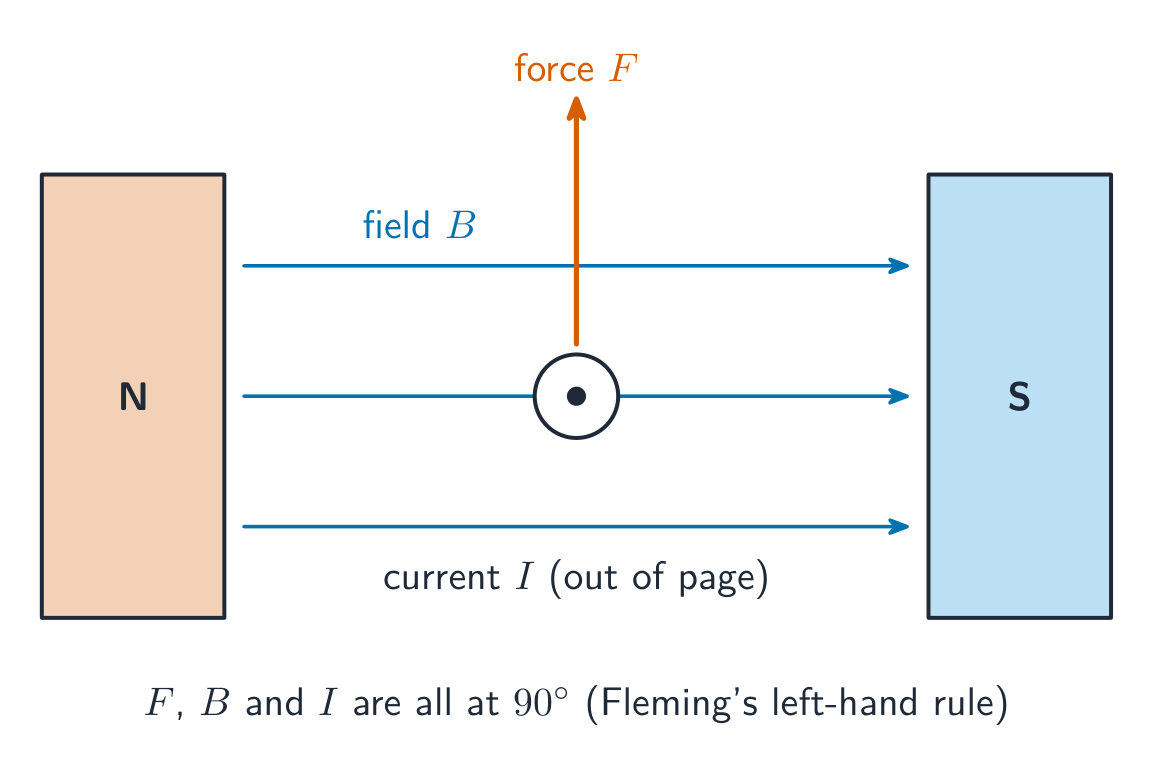
A current-carrying wire in a magnetic field feels a force at right angles to both the field and the current A moving stream of charged particles is a current, so a magnetic field pushes it sideways too — it deflects 偏转 the beam. (Remember electrons flow opposite to the conventional current.)
The d.c. motor
A coil carrying a current in a magnetic field feels a turning effect 转动效应, because the forces on its two sides act in opposite directions. This is a d.c. motor 直流电动机. The turning effect is bigger with more turns on the coil, a bigger current, or a stronger field.
A split-ring commutator 换向器 swaps the current direction in the coil every half-turn. This keeps the coil turning the same way instead of stopping after half a turn.
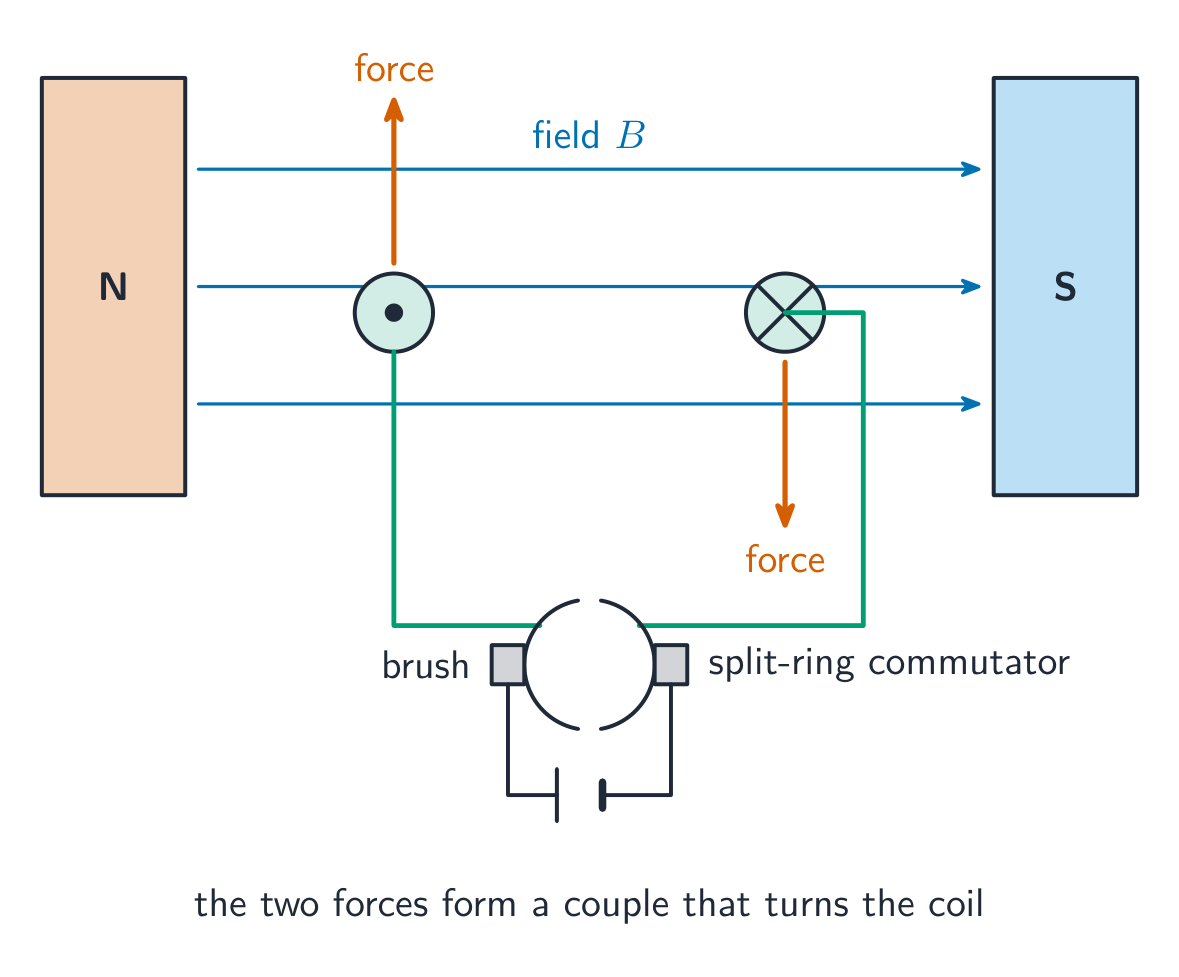
The forces on the two sides of the coil form a couple; the split-ring commutator keeps it turning one way 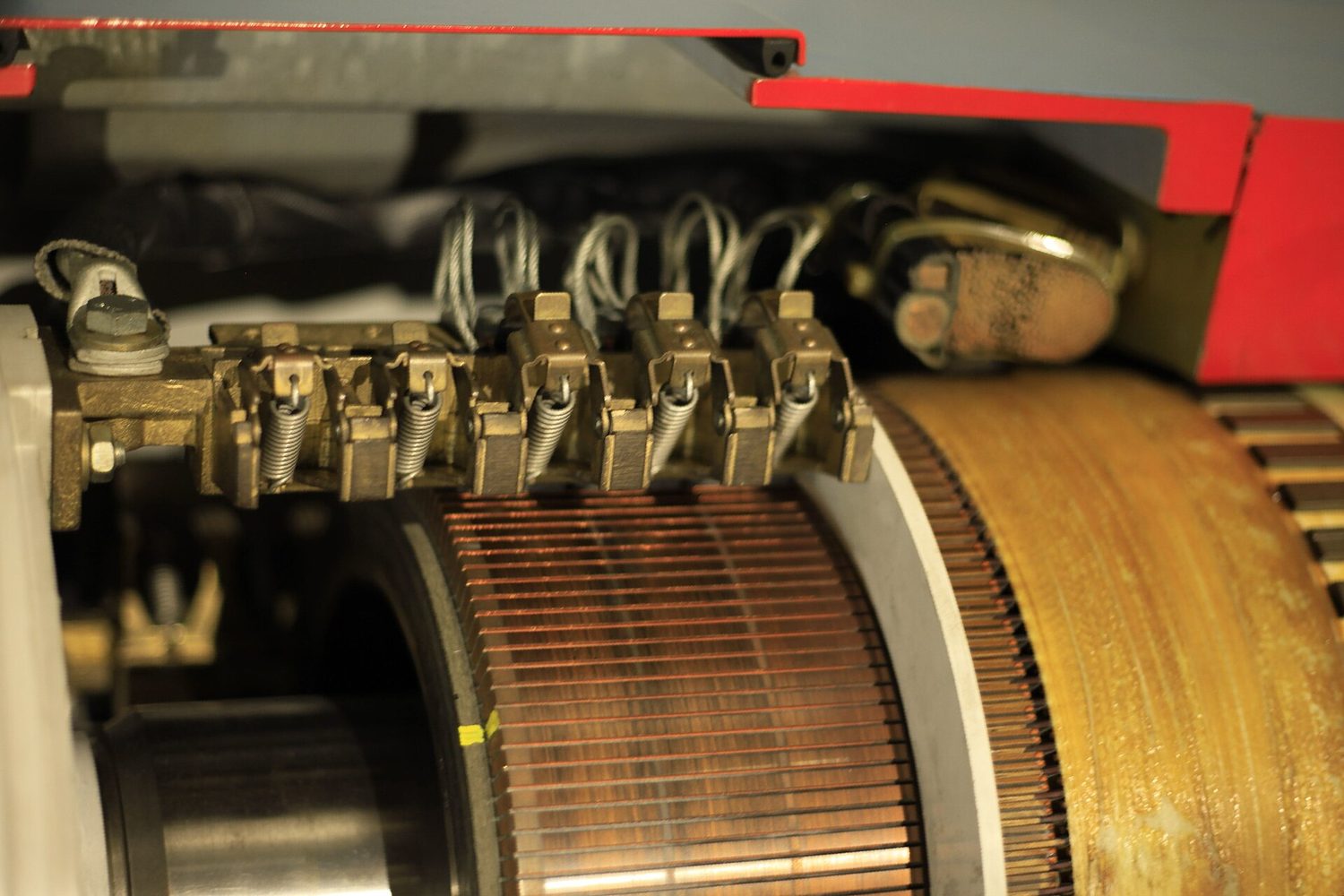
In a real d.c. machine, carbon brushes press on the copper commutator bars to feed current to the spinning coil The transformer
A transformer changes the size of an a.c. voltage. It has two coils wound on a soft-iron core 软铁芯:
- the primary coil 原线圈 takes in the a.c. voltage;
- the secondary coil 副线圈 gives out the changed voltage.
The a.c. in the primary makes a changing magnetic field in the core. The core carries this field to the secondary, where it induces an a.c. e.m.f. The voltages and the numbers of turns are linked by:
$$\frac{V_p}{V_s} = \frac{N_p}{N_s}$$Worked example. A transformer has $1200$ turns on the primary coil and $100$ turns on the secondary coil. The primary is connected to a $240\ \text{V}$ a.c. supply. Find the secondary voltage.
$$\frac{240}{V_s} = \frac{1200}{100} = 12 \quad\Rightarrow\quad V_s = \frac{240}{12} = 20\ \text{V}$$Fewer turns on the secondary, so this is a step-down transformer.
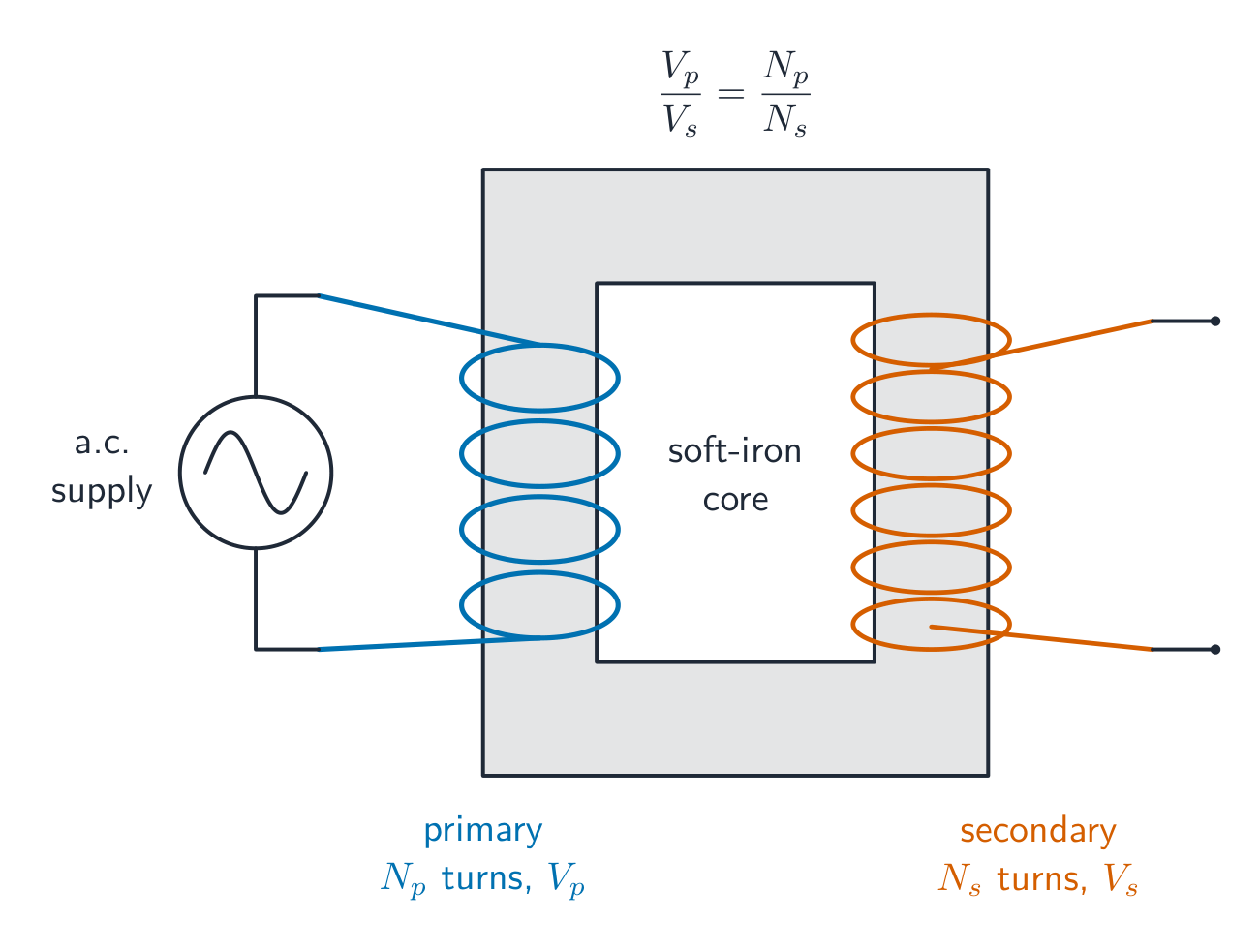
The changing field in the core links the two coils; the voltage ratio equals the turns ratio 
A real transformer on a power pole steps the high voltage in the cables down to a safer voltage for homes If the secondary has more turns it is a step-up 升压 transformer (voltage rises); fewer turns make a step-down 降压 transformer (voltage falls). For example, a transformer changing $240\ \text{V}$ to $12\ \text{V}$ is a step-down type, and the primary has $20$ times as many turns as the secondary.
If a transformer is 100% efficient, the power in equals the power out:
$$I_p V_p = I_s V_s$$So a step-up transformer raises the voltage but lowers the current.
Why we use high voltage to send power
Electricity is sent across the country by high-voltage transmission 高压输电. The power lost as heat in the cables is
$$P = I^2 R$$where $R$ is the resistance of the cables. A step-up transformer raises the voltage and so lowers the current for the same power ($P = IV$). A smaller current means much less power wasted in the cables. A step-down transformer then lowers the voltage again to a safe value before it reaches homes.
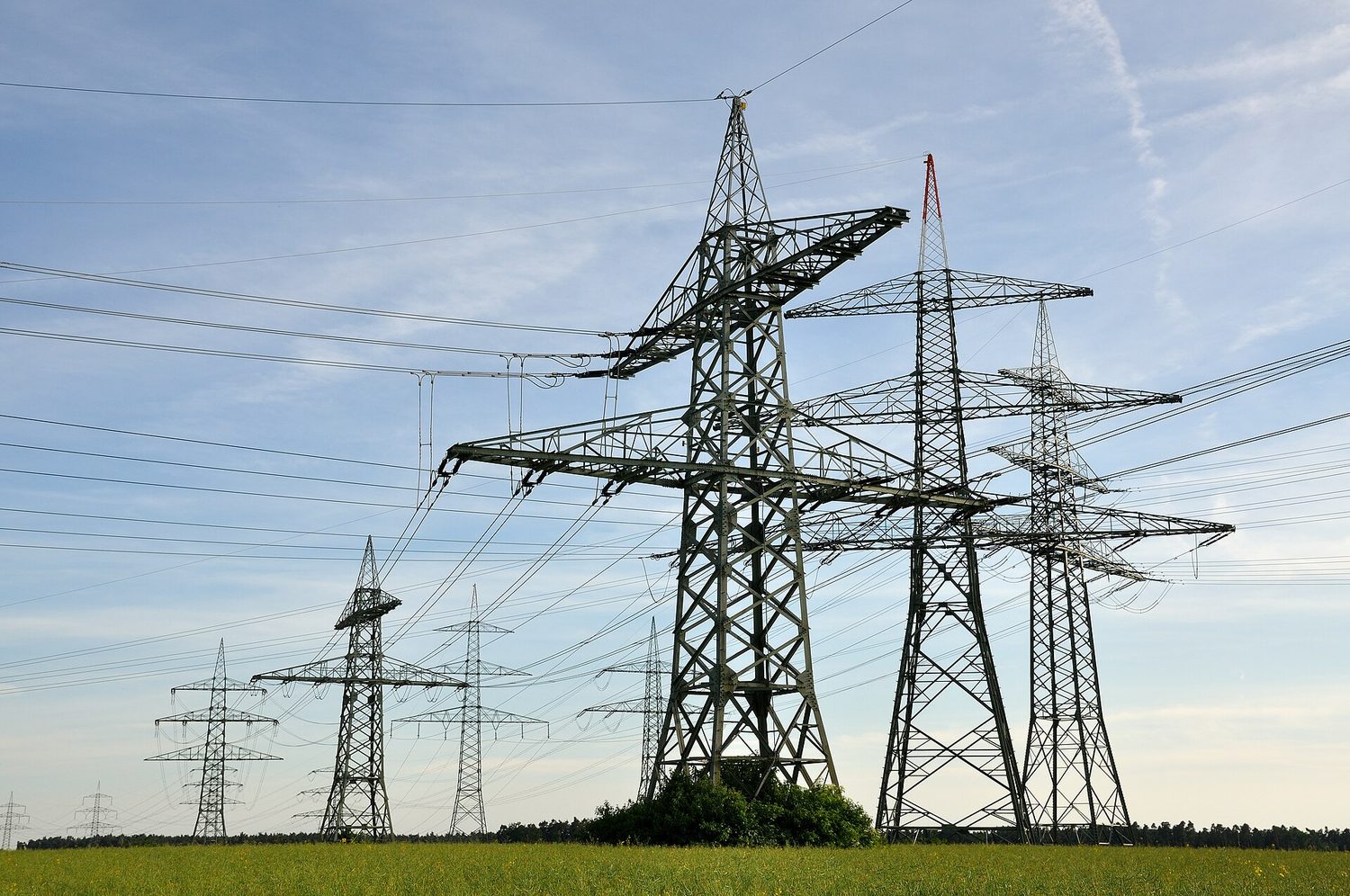
Pylons hold the cables that carry electricity at very high voltage, which keeps the current — and the wasted power — low JelajahiGaya yang memutar motor
Arus dalam medan magnet didorong tegak lurus terhadap keduanya — balik arah arus atau balik magnet dan dorongannya berlawanan arah. Itulah yang memutar motor.
JelajahiGenerator
V = a sin(bt)
Kumparan yang berputar menginduksi tegangan sinusoidal — keluaran AC.
JelajahiTrafo
Tambah lilitan pada sekunder untuk menaikkan tegangan, kurangi untuk menurunkannya — Vs/Vp = Ns/Np, persis seperti cara jaringan listrik mentransfer daya secara efisien.
Kosa kata LatihEnglish Bahasa Indonesia solenoid/ˈsəʊlənɔɪd/ solenaoid coil/kɔɪl/ kumparan loudspeaker/ˈlaʊdspiːkə/ pembesar suara electromagnetic induction/ɪˌlektrəʊməɡˈnetɪk ɪnˈdʌkʃn/ induksi elektromagnetik Fleming's right-hand rule/ˈflemɪŋz raɪt hænd ruːl/ aturan tangan kanan Fleming a.c. generator/ˌeɪ ˈsiː ˈdʒenəreɪtə/ jenerater arus ulang-alik slip rings/slɪp rɪŋz/ cincin gelincir brushes/ˈbrʌʃɪz/ berus Fleming's left-hand rule/ˈflemɪŋz left hænd ruːl/ aturan tangan kiri Fleming deflect/dɪˈflekt/ membelokkan turning effect/ˈtɜːnɪŋ ɪˈfekt/ efek berputar d.c. motor/ˌdiː ˈsiː ˈməʊtə/ motor arus terus split-ring commutator/splɪt rɪŋ ˈkɒmjuːteɪtə/ komutator cincin belah soft-iron core/sɒft ˈaɪən kɔː/ inti besi lunak primary coil/ˈpraɪməri kɔɪl/ kumparan primer secondary coil/ˈsekəndəri kɔɪl/ kumparan sekunder step-up/step ʌp/ penaik voltan step-down/step daʊn/ penurun voltan high-voltage transmission/haɪ ˈvəʊltɪdʒ trænˈsmɪʃn/ transmisi tegangan tinggi 4.5
Exam tips
- Current is the same everywhere in a series circuit; in a parallel circuit it splits between the branches. Voltage (p.d.) is shared out in series, but is the same across every parallel branch.
- Adding resistors in series increases the total resistance ($R_1 + R_2$); adding them in parallel makes the total less than the smallest single resistor.
- An ammeter goes in series and has very low resistance; a voltmeter goes in parallel across a component and has very high resistance.
- In a transformer $\dfrac{V_p}{V_s} = \dfrac{N_p}{N_s}$: more turns on the secondary steps the voltage up, fewer steps it down. Transformers only work on a.c.
- Power is sent across country at high voltage so the current — and the heat wasted in the cables, $P = I^2R$ — is small.
- Fit the switch and the fuse in the live wire, and choose a fuse rating just above the appliance's normal working current.
-
5
Fisika nuklir
Tonton pelajaran5.1
The atom

Silabus
5.1.1 Atom
Inti Tambahan 1 Jelaskan struktur atom berdasarkan inti bermuatan positif dan elektron bermuatan negatif yang mengorbit inti 3 Jelaskan bagaimana hamburan partikel alfa ($\alpha$) oleh selembar logam tipis mendukung model nuklir atom, dengan memberikan bukti untuk: (a) inti yang sangat kecil yang dikelilingi sebagian besar ruang hampa (b) inti yang mengandung sebagian besar massa atom (c) inti yang bermuatan positif 2 Pahami bagaimana atom dapat membentuk ion positif dengan melepaskan elektron atau membentuk ion negatif dengan menerima elektron 5.1.2 Inti
Inti Tambahan 1 Jelaskan komposisi inti dalam hal proton dan neutron 6 Jelaskan proses fisi nuklir dan fusi nuklir sebagai pemisahan atau penggabungan inti, termasuk persamaan nuclida dan deskripsi kualitatif perubahan massa dan energi tanpa nilai numerik 2 Sebutkan muatan relatif proton, neutron, dan elektron secara berurutan +1, 0, dan –1 3 Definisikan istilah nomor proton (nomor atom) $Z$ dan nomor nukleon (nomor massa) $A$ serta mampu menghitung jumlah neutron dalam sebuah inti 7 Pahami hubungan antara nomor proton dan muatan relatif pada inti 8 Pahami hubungan antara nomor nukleon dan massa relatif sebuah inti 4 Gunakan notasi nuclida $^{A}_{Z}\text{X}$ 5 Jelaskan makna isotop dan sebutkan bahwa suatu unsur dapat memiliki lebih dari satu isotop Sumber: Silabus Cambridge International
An atom 原子 is made of a tiny central nucleus 原子核 with electrons 电子 moving around it (in orbit 轨道, like planets around the Sun).
- The nucleus has a positive charge 电荷.
- The electrons have a negative charge.
- The atom as a whole is neutral, because the positive and negative charges are equal.
Almost all the mass 质量 is in the nucleus, but the nucleus is very small compared with the whole atom. So an atom is mostly empty space.
The nuclear atom: a tiny dense nucleus of protons and neutrons, with electrons in orbits around it Ions
An atom is neutral, but it can gain or lose electrons to become an ion 离子.
- Lose one or more electrons → a positive ion (now there are more protons than electrons).
- Gain one or more electrons → a negative ion.
The alpha-scattering experiment
This experiment gave the evidence for the nuclear model. Alpha particles α粒子 (small, fast, positive) were fired at a very thin gold foil 金箔, and the scattering 散射 (the way they bounced off) was watched.
The results and what they tell us:
- Almost all the alpha particles went straight through. → The atom is mostly empty space.
- A few were deflected 偏转 (bent) through small angles. → The nucleus has a positive charge, which pushes the positive alpha particles away.
- A very few bounced almost straight back. → The nucleus is very small and very heavy, and holds most of the mass of the atom.

Most alpha particles pass straight through; a few are deflected and a very few bounce back off the tiny dense nucleus JelajahiDi dalam atom
Inti atom yang kecil dan padat berada di tengah dengan elektron di kulit di sekitarnya — seret nomor proton dan lihat kulit terisi dari dalam ke luar.
Kosa kata LatihEnglish Bahasa Indonesia atom/ˈætəm/ atom nucleus/ˈnjuːklɪəs/ inti sel electron/ɪˈlektrɒn/ elektron orbit/ˈɔːbɪt/ orbit charge/tʃɑːdʒ/ muatan mass/mæs/ massa ion/ˈaɪɒn/ ion alpha particle/ˈælfə ˈpɑːtɪkl/ partikel alfa gold foil/ɡəʊld fɔɪl/ kertas emas scattering/ˈskætərɪŋ/ penyebaran deflected/dɪˈflektɪd/ terbelokkan 5.1
Inside the nucleus
The nucleus is made of two kinds of particle, together called nucleons 核子:
- protons 质子, which have a relative 相对 charge of $+1$;
- neutrons 中子, which have a relative charge of $0$ (they are neutral).
An electron has a relative charge of $-1$. A proton and a neutron each have a relative mass of about $1$; an electron is almost massless in comparison.
Two numbers describe a nucleus:
- the proton number 质子数 $Z$ (also called the atomic number) — the number of protons;
- the nucleon number 核子数 $A$ (also called the mass number) — the number of protons plus neutrons.
So the number of neutrons is $A - Z$.
We write a nucleus in nuclide 核素 notation:
$$^{A}_{Z}\text{X}$$where X is the chemical symbol. For example, $^{197}_{\ 79}\text{Au}$ has $79$ protons and $197 - 79 = 118$ neutrons. The relative charge of the whole nucleus is just $+Z$ (here $+79$), and its relative mass is about $A$.
Isotopes
Isotopes 同位素 are atoms of the same element (the same $Z$) but with different numbers of neutrons (different $A$). They behave the same in chemistry but differently in the nucleus. For example, $^{12}_{\ 6}\text{C}$ and $^{14}_{\ 6}\text{C}$ are both carbon.
Isotopes of carbon have the same six protons but different numbers of neutrons, so they are the same element with a different mass Nuclear fission and fusion
In nuclear fission 核裂变, a heavy nucleus absorbs a neutron and then splits into two smaller nuclei, giving out two or three neutrons and a lot of energy 能量:
$$^{235}_{\ 92}\text{U} + ^{1}_{0}\text{n} \rightarrow\ ^{141}_{\ 56}\text{Ba} + ^{92}_{36}\text{Kr} + 3\,{}^{1}_{0}\text{n}$$
A neutron splits a U-235 nucleus into two smaller nuclei, releasing more neutrons and energy The top numbers (nucleon numbers) balance on both sides, and so do the bottom numbers (proton numbers). You can use this to find a missing number — for example, how many neutrons are released.
In nuclear fusion 核聚变, two light nuclei join to make a heavier one, also giving out energy. This is how the Sun makes its energy, joining hydrogen 氢 nuclei to make helium 氦. The reaction below — two heavy forms of hydrogen (deuterium and tritium) joining into helium — is the one used in fusion reactors on Earth:
$$^{2}_{1}\text{H} + ^{3}_{1}\text{H} \rightarrow\ ^{4}_{2}\text{He} + ^{1}_{0}\text{n}$$
In fusion two light nuclei join into a heavier one, releasing a neutron and energy — the deuterium–tritium reaction used in fusion reactors In both fission and fusion, a small amount of mass is lost and turned into energy.

A nuclear power station uses the energy from fission to make electricity; the towers release waste heat as steam JelajahiReaksi berantai fisi
Neutron membelah inti uranium, yang melepaskan energi DAN neutron lebih lanjut — neutron tersebut membelah inti lainnya, dan seterusnya.
Kosa kata LatihEnglish Bahasa Indonesia nucleon/ˈnjuːklɪən/ nukleus proton/ˈprəʊtɒn/ proton relative/ˈrelətɪv/ relatif neutron/ˈnjuːtrɒn/ neutron proton number/ˈprəʊtɒn ˈnʌmbə/ nombor proton nucleon number/ˈnjuːklɪən ˈnʌmbə/ nomor nukleon nuclide/ˈnjuːklaɪd/ nuklida isotope/ˈaɪsətəʊp/ isotop nuclear fission/ˈnjuːklɪə ˈfɪʃn/ fisi nuklir energy/ˈenədʒi/ tenaga nuclear fusion/ˈnjuːklɪə ˈfjuːʒn/ fusi nuklir hydrogen/ˈhaɪdrədʒn/ hidrogen helium/ˈhiːlɪəm/ helium 5.2
Radioactivity
Silabus
5.2.1 Deteksi radioaktivitas
Inti Tambahan 1 Pahami maksud dari radiasi latar belakang 2 Pahami sumber-sumber yang berkontribusi signifikan terhadap radiasi latar belakang termasuk: (a) gas radon (di udara) (b) batuan dan bangunan (c) makanan dan minuman (d) sinar kosmik 3 Pahami bahwa radiasi nuklir pengion dapat diukur menggunakan detektor yang terhubung ke counter 4 Gunakan tingkat hitung yang diukur dalam hitungan / detik atau hitungan / menit 5 Gunakan pengukuran radiasi latar belakang untuk menentukan tingkat hitung yang telah dikoreksi 5.2.2 Tiga jenis emisi nuklir
Inti Tambahan 1 Jelaskan emisi radiasi dari inti sebagai proses spontan dan acak dalam arah 2 Identifikasi emisi alfa ($\alpha$), beta ($\beta$) dan gamma ($\gamma$) dari inti dengan mengingat: (a) sifatnya (b) efek pengionan relatifnya (c) kemampuan tembusannya yang relatif ($\beta^+$ tidak disertakan, partikel-$\beta$ akan dianggap merujuk pada $\beta^-$) 3 Jelaskan pembelokan partikel-$\alpha$, partikel-$\beta$ dan radiasi-$\gamma$ dalam medan listrik dan medan magnet 4 Jelaskan efek pengionan relatifnya dengan mengacu pada: (a) energi kinetik (b) muatan listrik 5.2.3 Peluruhan radioaktif
Inti Tambahan 1 Pahami bahwa peluruhan radioaktif adalah perubahan pada inti tidak stabil yang dapat menghasilkan emisi partikel-$\alpha$ atau partikel-$\beta$ dan/atau radiasi-$\gamma$, serta pahami bahwa perubahan ini bersifat spontan dan acak 3 Pahami bahwa isotop suatu unsur dapat bersifat radioaktif karena kelebihan neutron dalam inti dan/atau inti yang terlalu berat 2 Sebutkan bahwa selama peluruhan-$\alpha$ atau peluruhan-$\beta$, inti berubah menjadi inti unsur lain 4 Jelaskan efek peluruhan-$\alpha$, peluruhan-$\beta$ dan emisi-$\gamma$ pada inti, termasuk peningkatan stabilitas dan pengurangan jumlah neutron berlebih; perubahan berikut terjadi pada inti selama emisi-$\beta$ neutron $\rightarrow$ proton + elektron 5 Gunakan persamaan peluruhan, dengan notasi nuclida, untuk menunjukkan emisi partikel-$\alpha$, partikel-$\beta$ dan radiasi-$\gamma$ 5.2.4 Waktu paruh
Inti Tambahan 1 Definisikan waktu paruh dari isotop tertentu sebagai waktu yang diperlukan agar setengah dari inti isotop tersebut dalam sampel apa pun meluruh; ingat dan gunakan definisi ini dalam perhitungan sederhana, yang mungkin melibatkan informasi dalam tabel atau kurva peluruhan (perhitungan tidak akan mencakup radiasi latar belakang) 2 Hitung waktu paruh dari data atau kurva peluruhan di mana radiasi latar belakang belum dikurangkan 3 Jelaskan bagaimana jenis radiasi yang dipancarkan dan waktu paruh isotop menentukan isotop mana yang digunakan untuk aplikasi termasuk: (a) alarm kebakaran rumah (asap) (b) irradiasi makanan untuk membunuh bakteri (c) sterilisasi peralatan menggunakan sinar gamma (d) pengukuran dan kontrol ketebalan material dengan pilihan radiasi yang terkait dengan penembusan dan penyerapan (e) diagnosis dan pengobatan kanker menggunakan sinar gamma 5.2.5 Tindakan keamanan
Inti Tambahan 1 Sebutkan efek radiasi nuklir pengion pada makhluk hidup, termasuk kematian sel, mutasi, dan kanker 2 Jelaskan bagaimana bahan radioaktif dipindahkan, digunakan, dan disimpan dengan aman 3 Jelaskan tindakan keamanan untuk semua radiasi pengion dalam hal mengurangi waktu paparan, meningkatkan jarak antara sumber dan jaringan hidup, serta menggunakan peredam untuk menyerap radiasi Sumber: Silabus Cambridge International
Radioactive decay & half-life A nucleus that is unstable 不稳定 will sooner or later break down and give out radiation 辐射. This is radioactive 放射性 decay 衰变. A nucleus may be unstable because it has too many neutrons, or because it is too heavy.
Decay is spontaneous 自发 (it happens on its own, and you cannot speed it up or slow it down) and random 随机 (you cannot say which nucleus will decay next, or exactly when).
Background radiation
Some radiation is around us all the time. This is background radiation 背景辐射. Its main sources are:
- radon 氡 gas in the air (usually the biggest source);
- rocks and buildings;
- food and drink;
- cosmic rays 宇宙射线 from space.
Measuring radiation
Radiation can be measured with a detector 探测器 joined to a counter 计数器. The count rate 计数率 is the number of counts each second (or each minute).
To find the true count rate from a source, first measure the background count rate on its own, then subtract it. The answer is the corrected 修正 count rate:
$$\text{corrected count rate} = \text{measured count rate} - \text{background count rate}$$Worked example. A detector placed next to a source reads $250$ counts/min. With the source taken away, the background count rate is $30$ counts/min. Find the corrected count rate.
$$250 - 30 = 220\ \text{counts/min}$$A portable Geiger counter detects ionising radiation and shows the count rate on its screen JelajahiPeluruhan radioaktif
N = N₀·bᵗ
Jumlah inti tidak stabil meluruh secara eksponensial.
Kosa kata LatihEnglish Bahasa Indonesia unstable/ʌnˈsteɪbl/ tidak stabil radiation/ˌreɪdɪˈeɪʃn/ radiasi radioactive/ˌreɪdɪəʊˈæktɪv/ radioaktif decay/dɪˈkeɪ/ peluruhan spontaneous/spɒnˈteɪnɪəs/ spontan random/ˈrændəm/ acak background radiation/ˈbækɡraʊnd ˌreɪdɪˈeɪʃn/ radiasi latar belakang radon/ˈreɪdɒn/ radon cosmic rays/ˈkɒzmɪk reɪz/ sinar kosmik detector/dɪˈtektə/ detektor counter/ˈkaʊntə/ counter count rate/kaʊnt reɪt/ laju hitung corrected/kəˈrektɪd/ diberbaiki 5.2
The three types of radiation

The radiation can be one of three types. Each type is ionising 电离, which means it can knock electrons off atoms in its path.
Type What it is Ionising effect Stopped by alpha (α) a helium nucleus: 2 protons + 2 neutrons, charge $+2$ strongest a sheet of paper, or a few cm of air beta (β) a fast-moving electron, charge $-1$ medium a few mm of aluminium 铝 gamma (γ) a high-energy electromagnetic wave 电磁波, no charge weakest thick lead 铅 or concrete (only reduced, never fully stopped) So an alpha particle is the most ionising but the least penetrating 穿透 (it is easily absorbed 吸收). A beta particle β粒子 is in the middle. Gamma radiation γ射线 is the least ionising but the most penetrating.
Paper stops alpha, a few millimetres of aluminium stops beta, and thick lead only reduces gamma We can explain the ionising effects from charge and kinetic energy 动能: an alpha particle has a large charge ($+2$) and is slow and heavy, so it pulls strongly on the electrons it passes and ionises a lot. A beta particle has a smaller charge and moves faster, so it ionises less.
Deflection in fields
Because alpha and beta particles are charged, they are deflected by an electric field 电场 and by a magnetic field 磁场. They bend in opposite directions, because their charges have opposite signs, and the lighter beta particle bends more. Gamma rays have no charge, so they are not deflected at all.

Alpha and beta bend in opposite directions; the lighter beta bends more, and uncharged gamma is not deflected Kosa kata LatihEnglish Bahasa Indonesia ionising/ˈaɪənaɪzɪŋ/ ionisasi aluminium/ˌæljʊˈmɪnɪəm/ aluminium electromagnetic wave/ɪˌlektrəʊməɡˈnetɪk weɪv/ gelombang elektromagnetik lead/liːd/ pemimpin penetrating/ˈpenɪtreɪtɪŋ/ menembus absorbed/əbˈsɔːbd/ diserap beta particle/ˈbiːtə ˈpɑːtɪkl/ partikel beta gamma radiation/ˈɡæmə ˌreɪdɪˈeɪʃn/ radiasi gamma kinetic energy/kɪˈnetɪk ˈenədʒi/ energi kinetik electric field/ɪˈlektrɪk fiːld/ medan listrik magnetic field/mæɡˈnetɪk fiːld/ medan magnet 5.2
Decay equations
When a nucleus decays, the nucleon and proton numbers must balance on both sides.
Alpha decay — the nucleus loses 2 protons and 2 neutrons, so $A$ falls by $4$ and $Z$ falls by $2$. It becomes a different element:
$$^{A}_{Z}\text{X} \rightarrow\ ^{A-4}_{Z-2}\text{Y} + ^{4}_{2}\alpha$$Worked example. A radium nucleus $^{226}_{\ 88}\text{Ra}$ emits an alpha particle. Find the nucleon number and proton number of the new nucleus.
Alpha decay lowers $A$ by $4$ and $Z$ by $2$:
$$^{226}_{\ 88}\text{Ra} \rightarrow\ ^{222}_{\ 86}\text{Rn} + ^{4}_{2}\alpha$$So the new nucleus (radon) has nucleon number $222$ and proton number $86$.
Beta decay — inside the nucleus a neutron changes into a proton plus an electron:
$$\text{neutron} \rightarrow \text{proton} + \text{electron}$$The fast electron leaves as the beta particle. So $A$ stays the same but $Z$ rises by $1$, giving a different element:
$$^{24}_{11}\text{Na} \rightarrow\ ^{24}_{12}\text{Mg} + ^{\ \ 0}_{-1}\beta$$Gamma emission — the nucleus loses only energy, so $A$ and $Z$ do not change. Alpha and beta decay leave the nucleus more stable 稳定; gamma is often given out at the same time to carry away spare energy.
Kosa kata LatihEnglish Bahasa Indonesia stable/ˈsteɪbl/ stabil 5.2
Half-life

Because decay is random, we cannot follow one nucleus. Instead we describe a large sample 样品 using its half-life.
The half-life 半衰期 of an isotope is the time taken for half the unstable nuclei in a sample to decay. After each half-life, the count rate (or the number of unstable nuclei left) falls to half.
For example, if a source has a count rate of $800$ counts/min and a half-life of $3$ hours:
Time / hours 0 3 6 9 Count rate / (counts/min) 800 400 200 100 After $6$ hours (two half-lives) the count rate has halved twice: $800 \to 400 \to 200$. You can read a half-life off a decay graph by finding the time for the count rate to drop from any value to half of it. If the readings include background radiation, subtract the background count rate from every reading first, then find the half-life from the corrected values.
Worked example. The activity of a source falls from $800$ counts/min to $100$ counts/min. Its half-life is $5$ days. How long did this take?
Count the halvings: $800 \to 400 \to 200 \to 100$ is three half-lives, so the time is $3 \times 5 = 15\ \text{days}$.
Each half-life $T$ the count rate halves: $N_0 \to N_0/2 \to N_0/4 \to N_0/8$ JelajahiWaktu paruh — perhatikan peluruhan inti
Setiap inti memiliki peluang tetap untuk meluruh secara acak. Majukan waktu: sekitar setengah inti yang tersisa meluruh setiap waktu paruh — sehingga hitungannya berkurang setengah, lalu berkurang lagi.
Kosa kata LatihEnglish Bahasa Indonesia sample/ˈsæmpl/ sampel half-life/hɑːf laɪf/ waktu paruh 5.2
Uses of radioactivity

The isotope chosen for a job depends on its type of radiation and its half-life:
- smoke alarms 烟雾报警器 use an alpha source (alpha is easily blocked, so it is safe outside the alarm, and a long half-life means it lasts for years);
- using radiation on food, or on equipment, kills bacteria 细菌 and germs — this needs penetrating gamma rays to sterilise 消毒 the sealed item;
- measuring and controlling the thickness of paper or metal sheets uses a beta source (the amount that passes through changes with the thickness);
- a medical tracer 医用示踪剂 is a small amount of a gamma-emitting isotope with a short half-life, injected into the body: a detector outside the body follows where it goes, gamma rays escape from the body easily, and the activity soon falls to a safe level;
- gamma rays are used to find and to treat cancer 癌症 inside the body, because they can pass out of (or into) the body.
Radiotherapy: a mesh mask holds the patient still while alignment lasers aim gamma rays precisely at a tumour to treat cancer Kosa kata LatihEnglish Bahasa Indonesia smoke alarm/sməʊk əˈlɑːm/ alarm asap bacteria/bækˈtɪərɪə/ bakteri sterilise/ˈsterəlaɪz/ sterilkan medical tracer/ˈmedɪkl ˈtreɪsə/ pelacak medis cancer/ˈkænsə/ kanker 5.2
Safety
Ionising radiation harms living cells 细胞. It can cause cell death, mutations 突变 (changes to the genes) and cancer.
When working with radioactive sources, keep the dose 剂量 (the amount of radiation received) low by:
- reducing the exposure 照射 time — spend as little time near the source as possible;
- increasing the distance between you and the source;
- using shielding 屏蔽, such as lead, between the source and your body.
Radioactive sources should be handled with tongs (not bare hands), kept pointing away from people, and stored in a lead-lined box.
Kosa kata LatihEnglish Bahasa Indonesia living cells/ˈlɪvɪŋ selz/ sel hidup mutation/mjuːˈteɪʃn/ mutasi dose/dəʊs/ dosis exposure/ekˈspəʊʒə/ paparan shielding/ˈʃiːldɪŋ/ penyamaran 5.2
Exam tips
- The nucleon number (top) is protons + neutrons; the proton number (bottom) is protons only. Number of neutrons = nucleon number − proton number.
- Isotopes have the same proton number but different nucleon numbers — the same element with a different number of neutrons.
- Rank the radiations two ways: alpha is the most ionising but least penetrating (stopped by paper); gamma is the least ionising but most penetrating (needs thick lead). Beta is in between (stopped by a few mm of aluminium).
- In every decay equation the top numbers must balance and the bottom numbers must balance. Alpha decay: $A-4$, $Z-2$. Beta decay: $A$ unchanged, $Z+1$.
- Always subtract the background count rate before using a source's readings. After $n$ half-lives the count rate has halved $n$ times — count the halvings rather than guessing from the total time.
-
6
Fisika luar angkasa
Tonton pelajaran6.1
Bumi, Matahari dan Bulan
Silabus
6.1.1 Bumi
Inti Tambahan 1 Pahami bahwa Bumi adalah planet yang berotasi pada porosnya, yang miring, sekali dalam sekitar 24 jam, dan gunakan ini untuk menjelaskan pengamatan tentang gerakan harian semu Matahari serta siklus periodik siang dan malam 2 Pahami bahwa Bumi mengorbit Matahari sekali dalam sekitar 365 hari dan gunakan ini untuk menjelaskan sifat periodik musim-musim 4 Tentukan kecepatan orbit rata-rata dari persamaan $v = \frac{2\pi r}{T}$ di mana $r$ adalah jari-jari rata-rata orbit dan $T$ adalah periode orbit; hafalkan dan gunakan persamaan ini 3 Pahami bahwa dibutuhkan waktu sekitar satu bulan bagi Bulan untuk mengorbit Bumi dan gunakan ini untuk menjelaskan sifat periodik siklus fase Bulan 6.1.2 Sistem Tata Surya
Inti Tambahan 1 Deskripsikan Sistem Tata Surya yang mencakup: (a) satu bintang, yaitu Matahari (b) delapan planet bernama dan ketahui urutan mereka dari Matahari (c) planet-planet kecil yang mengorbit Matahari, termasuk planet kerdil seperti Pluto dan asteroid di sabuk asteroid (d) bulan-bulan, yang mengorbit planet-planet (e) benda-benda tata surya yang lebih kecil, termasuk komet dan satelit alami 7 Pahami bahwa planet, planet-planet kecil, dan komet memiliki orbit elips, dan ingatlah bahwa Matahari tidak berada di tengah orbit elips, kecuali ketika orbit tersebut hampir berbentuk lingkaran 8 Analisis dan interpretasikan data planet mengenai jarak orbit, durasi orbit, densitas, suhu permukaan, dan kekuatan medan gravitasi seragam di permukaan planet 2 Pahami bahwa, jika dibandingkan satu sama lain, empat planet terdekat dengan Matahari bersifat batuan dan kecil, sementara empat planet terjauh dari Matahari bersifat gas dan besar, dan jelaskan perbedaan ini dengan merujuk pada model akresi untuk pembentukan Sistem Tata Surya, yang meliputi: (a) ketergantungan model terhadap gravitasi (b) keberadaan banyak unsur dalam awan antariksa gas dan debu (c) rotasi material dalam awan dan pembentukan cakram akresi 3 Pahami bahwa kekuatan medan gravitasi (a) di permukaan sebuah planet bergantung pada massa planet (b) di sekitar sebuah planet menurun seiring bertambahnya jarak dari planet tersebut 4 Hitung waktu yang dibutuhkan cahaya untuk menempuh jarak signifikan seperti antara objek-objek dalam Sistem Tata Surya 5 Pahami bahwa Matahari mengandung sebagian besar massa Sistem Tata Surya dan hal ini menjelaskan mengapa planet-planet mengorbit Matahari 6 Pahami bahwa gaya yang menjaga suatu benda tetap mengorbit Matahari adalah tarikan gravitasi Matahari 9 Pahami bahwa kekuatan medan gravitasi Matahari menurun dan bahwa kecepatan orbit planet-planet menurun seiring bertambahnya jarak dari Matahari 10 Pahami bahwa benda dalam orbit elips bergerak lebih cepat ketika dekat dengan Matahari dan jelaskan hal ini menggunakan hukum kekekalan energi Sumber: Silabus Cambridge International
Bumi berputar (rotasi) pada sumbunya sekali dalam sekitar $24$ jam. Sumbu tersebut miring (tidak tegak lurus). Putaran ini memberikan kita siang dan malam, serta membuat Matahari tampak bergerak melintasi langit setiap hari.
Bumi juga bergerak mengelilingi Matahari dalam sebuah orbit, sekali dalam sekitar $365$ hari (satu tahun). Karena sumbu miring, bagian-bagian berbeda dari Bumi condong ke arah Matahari pada waktu yang berbeda sepanjang tahun. Ini menghasilkan musim: musim panas terjadi di setengah Bumi yang condong ke arah Matahari.
Sumbu mempertahankan kemiringan yang sama sepanjang tahun, sehingga setiap belahan bumi condong ke arah Matahari selama satu setengah orbit dan menjauh untuk setengah lainnya Bulan mengorbit Bumi sekali dalam sekitar satu bulan. Saat bergerak mengelilinginya, kita melihat berbagai bagian sisi yang terang, yang menghasilkan fase-fase Bulan (bulan baru, bulan separuh, bulan purnama).

Setengah Bulan yang terang selalu menghadap Matahari, jadi saat mengorbit kita melihat berbagai bagiannya: bulan baru di antara kita dan Matahari, bulan purnama di seberang Matahari, dan bulan separuh di antaranya Jadi, dari terpendek hingga terpanjang: satu hari (putaran Bumi) < satu bulan (orbit Bulan) < satu tahun (orbit Bumi).

Bulan purnama, satelit alami Bumi JelajahiMengapa Bulan berubah bentuk
Matahari selalu menerangi separuh Bulan; fase hanyalah seberapa banyak bagian yang terang itu menghadap kita saat Bulan mengorbit — bukan bayangan Bumi.
Kosa kata LatihEnglish Bahasa Indonesia orbit/ˈɔːbɪt/ orbit seasons/ˈsiːznz/ musim Moon/muːn/ Bulan phases/ˈfeɪzɪz/ fasa circumference/sɜːˈkʌmfrəns/ keliling orbital speed/ˈɔːbɪtl spiːd/ kecepatan orbit 6.1
Kecepatan orbit

Untuk objek yang bergerak mengelilingi lingkaran, jarak untuk satu orbit penuh adalah keliling $2\pi r$, di mana $r$ adalah jari-jari orbit. Kecepatan orbit adalah jarak ini dibagi dengan periode $T$ (waktu untuk satu orbit):
$$v = \frac{2\pi r}{T}$$Persamaan yang sama berlaku untuk planet, bulan, dan satelit.
Contoh terpecahkan. Sebuah stasiun luar angkasa mengorbit Bumi pada jari-jari $r = 7000\ \text{km}$ dan membutuhkan waktu $T = 5800\ \text{s}$ untuk satu orbit. Temukan kecepatan orbitnya.
Pertama konversikan jari-jari ke meter: $7000\ \text{km} = 7.0 \times 10^6\ \text{m}$. Kemudian
$$v = \frac{2\pi r}{T} = \frac{2\pi \times 7.0 \times 10^6}{5800} \approx 7600\ \text{m/s}$$ISS dalam orbit: kecepatan orbit adalah kecepatan yang menjaga satelit tetap dalam gerak melingkar bebas jatuh Kosa kata LatihEnglish Bahasa Indonesia period/ˈpɪərɪəd/ tempoh planet/ˈplænɪt/ planet rocky/ˈrɒki/ batu gaseous/ˈɡeɪsɪəs/ gas 6.1
Sistem Tata Surya

Sistem Tata Surya memiliki satu bintang, yaitu Matahari, di pusatnya. Di sekelilingnya bergerak delapan planet. Berdasarkan urutan dari Matahari, mereka adalah: Merkurius, Venus, Bumi, Mars, Jupiter, Saturnus, Uranus, dan Neptunus.
- Empat planet terdekat dengan Matahari berukuran kecil dan berbatu.
- Empat planet terjauh dari Matahari berukuran besar dan gas — mereka terdiri sebagian besar dari gas, tanpa permukaan padat untuk berdiri.
- Dua raksasa yang lebih dekat, Jupiter dan Saturnus, adalah raksasa gas. Dua raksasa terluar, Uranus dan Neptunus, adalah raksasa es: mereka menyimpan lebih banyak es, sehingga bukan benar-benar raksasa gas.
Matahari dan delapan planetnya secara berurutan: empat planet kecil berbatu, kemudian sabuk asteroid, lalu empat planet besar gas — raksasa gas Jupiter dan Saturnus serta raksasa es Uranus dan Neptunus (tidak sesuai skala) 
Mars, planet merah, salah satu planet dalam berbatu 
Jupiter, planet terbesar, dengan pita gas berputarnya 
Saturnus dan cincangnya, difoto oleh pesawat ruang angkasa Cassini Sistem Tata Surya juga berisi:
- planet-planet kecil, seperti planet kerdil seperti Pluto, dan asteroid (sebagian besar terletak di sabuk asteroid antara Mars dan Jupiter);
- bulan (satelit alami) yang mengorbit planet-planet;
- komet dan benda-benda kecil lainnya.
Orbit dan gravitasi
Matahari memegang sebagian besar massa Sistem Tata Surya. Gravitasi (tarikan gravitasionalnya) merenggang dan menjaga planet-planet tetap dalam orbit mereka. Gaya ini adalah tarikan gravitasi Matahari.
Kekuatan medan gravitasi memberi tahu Anda seberapa kuat gravitasi tersebut:
- di permukaan planet, nilainya lebih besar untuk planet dengan massa lebih banyak;
- di sekitar planet, nilainya melemah semakin jauh Anda bergerak.
Dengan cara yang sama, gravitasi Matahari menjadi lebih lemah semakin jauh ke luar, sehingga planet-planet bagian luar bergerak lebih lambat (kecepatan orbit lebih kecil) dibandingkan planet-planet bagian dalam.
Data planet
Soal ujian sering memberikan tabel seperti ini dan meminta Anda untuk membaca pola dari dalamnya.
Planet Jarak dari Matahari / juta km Periode orbit Kepadatan / g/cm³ Suhu permukaan / °C Medan gravitasi $g$ / N/kg Merkurius 58 88 hari 5.4 170 3.7 Venus 108 225 hari 5.2 460 8.9 Bumi 150 365 hari 5.5 15 9.8 Mars 228 687 hari 3.9 −60 3.7 Jupiter 779 11.9 tahun 1.3 −110 23 Saturnus 1430 29.5 tahun 0.7 −140 9.0 Uranus 2870 84 tahun 1.3 −195 8.7 Neptunus 4500 165 tahun 1.6 −200 11 Pola yang perlu diperhatikan: semakin jauh sebuah planet dari Matahari, semakin panjang periode orbitnya dan semakin rendah suhu permukaannya. Empat planet bagian dalam memiliki kepadatan tinggi (batu dan logam), sementara empat planet bagian luar memiliki kepadatan rendah (gas dan es). Kekuatan medan gravitasi di permukaan bergantung pada massa dan ukuran planet, bukan pada jaraknya dari Matahari.
Orbit elips
Sebagian besar orbit bukan lingkaran sempurna melainkan elips (lingkaran yang diregangkan), dan Matahari tidak berada di tengah elips. Komet memiliki orbit yang sangat meregang. Sebuah benda dalam orbit elips bergerak lebih cepat ketika dekat dengan Matahari. Hal ini dijelaskan melalui hukum kekekalan energi — total energi tetap sama, jadi saat energi potensial gravitasi benda turun (mendekati Matahari), energi kinetiknya meningkat (benda melaju lebih cepat).

Matahari terletak di salah satu titik fokus elips; planet berakselerasi saat mendekat dan memperlambat saat menjauh Waktu tempuh cahaya
Jarak di ruang angkasa sangat besar, jadi kita sering menghitung berapa lama waktu yang dibutuhkan cahaya untuk melewatinya. Cahaya merambat dengan kecepatan $3.0 \times 10^8\ \text{m/s}$. Menggunakan $\text{time} = \dfrac{\text{distance}}{\text{speed}}$, cahaya dari Matahari (sekitar $1.5 \times 10^{11}\ \text{m}$ jauhnya) membutuhkan waktu sekitar $500\ \text{s}$, atau kurang lebih $8$ menit, untuk mencapai Bumi.
JelajahiTonton perlombaan planet
Semakin dekat sebuah planet ke Matahari, semakin cepat ia mengorbit — Merkurius dalam 88 hari, Jupiter dalam 12 tahun — karena gravitasi Matahari lebih kuat di area dekat.
Kosa kata LatihEnglish Bahasa Indonesia Solar System/ˈsəʊlə ˈsɪstəm/ Sistem Suria gas/ɡæs/ gas gas giant/ɡæs ˈdʒaɪənt/ raksasa gas ice giant/aɪs ˈdʒaɪənt/ raksasa es dwarf planet/dwɔːf ˈplænɪt/ planet kerdil asteroid/ˈæstərɔɪd/ asteroid satellite/ˈsætəlaɪt/ satelit comet/ˈkɒmɪt/ komet gravity/ˈɡrævɪti/ gravitasi gravitational field strength/ˌɡrævɪˈteɪʃənl fiːld streŋθ/ kekuatan medan gravitasi ellipse/ɪˈlɪps/ elips conservation of energy/ˌkɒnsəˈveɪʃn ɒv ˈenədʒi/ hukum kekekalan energi energy/ˈenədʒi/ tenaga gravitational potential energy/ˌɡrævɪˈteɪʃənl pəˈtenʃl ˈenədʒi/ energi potensial gravitasi kinetic energy/kɪˈnetɪk ˈenədʒi/ energi kinetik dust/dʌst/ debu element/ˈelɪmənt/ unsur accretion/əˈkreʃn/ akresi accretion disc/əˈkreʃn dɪsk/ cakram akresi 6.1
Pembentukan Tata Surya

Planet-planet terbentuk dari awan raksasa gas dan debu di ruang angkasa, yang mengandung banyak unsur kimia elemen. Ini adalah model akresi:
- gravitasi menarik awan tersebut menyatu;
- awan tersebut berputar, sehingga meratakan diri menjadi cakram akresi yang berputar;
- sebagian besar materi jatuh ke pusat dan membentuk Matahari, sementara planet-planet tumbuh dari sisa material di cakram tersebut.
Di dekat Matahari muda yang panas, hanya batu dan logam yang dapat tetap solid, sehingga planet-planet bagian dalam bersifat batuan. Di tempat yang jauh dan dingin, gas juga dapat terkumpul, sehingga planet-planet bagian luar tumbuh besar dan berupa gas.
Cakram akresi nyata di sekitar bintang muda HL Tauri: celah-celah gelap adalah tempat planet baru sedang mengumpulkan debu — Tata Surya kita bermula dengan cara yang sama 6.2
Matahari sebagai bintang

Silabus
6.2.1 Matahari sebagai Bintang
Inti Tambahan 1 Pahami bahwa Matahari adalah bintang berukuran sedang, terdiri sebagian besar dari hidrogen dan helium, dan memancarkan sebagian besar energinya di daerah inframerah, cahaya tampak, dan ultraviolet dari spektrum elektromagnetik 2 Pahami bahwa bintang-bintang didorong oleh reaksi nuklir yang melepaskan energi dan bahwa pada bintang stabil, reaksi nuklir melibatkan fusi hidrogen menjadi helium 6.2.2 Bintang
Inti Tambahan 1 Nyatakan bahwa: (a) galaksi masing-masing terdiri dari miliaran bintang (b) Matahari adalah bintang di galaksi yang dikenal sebagai Bima Sakti (c) bintang-bintang lain yang membentuk Bima Sakti jauh lebih jauh dari Bumi daripada jarak Matahari dari Bumi (d) jarak astronomis dapat diukur dalam tahun cahaya, di mana satu tahun cahaya adalah jarak yang ditempuh (di ruang hampa) oleh cahaya dalam satu tahun 2 Pahami bahwa satu tahun cahaya setara dengan $9.5 \times 10^{15}$ m 3 Deskripsikan siklus hidup bintang: (a) bintang terbentuk dari awan antariksa gas dan debu yang mengandung hidrogen (b) protobintang adalah awan antariksa yang runtuh dan meningkatkan suhunya akibat tarikan gravitasi internalnya (c) protobintang menjadi bintang stabil ketika gaya tarik gravitasi searah dengan gaya dorak akibat suhu tinggi di pusat bintang (d) semua bintang akhirnya kehabisan hidrogen sebagai bahan bakar reaksi nuklir (e) sebagian besar bintang membesar membentuk raksasa merah dan bintang bermassa besar membesar membentuk supergiant merah ketika sebagian besar hidrogen di pusat bintang telah diubah menjadi helium (f) raksasa merah dari bintang kurang bermassa membentuk nebula planet dengan bintang katai putih di pusatnya (g) supergiant merah meledak sebagai supernova, membentuk nebula yang mengandung hidrogen dan elemen berat baru, meninggalkan bintang neutron atau lubang hitam di pusatnya (h) nebula dari supernova dapat membentuk bintang baru dengan planet yang mengorbitnya 6.2.3 Semesta
Inti Tambahan 1 Tahu bahwa Bima Sakti adalah salah satu dari miliaran galaksi yang membentuk Alam Semesta dan bahwa diameter Bima Sakti kira-kira 100 000 tahun cahaya 2 Deskripsikan pergeseran merah sebagai peningkatan panjang gelombang radiasi elektromagnetik yang dipancarkan dari bintang dan galaksi yang menjauh 3 Pahami bahwa cahaya yang dipancarkan dari galaksi jauh tampak mengalami pergeseran merah dibandingkan dengan cahaya yang dipancarkan di Bumi 4 Pahami bahwa pergeseran merah pada cahaya dari galaksi jauh merupakan bukti bahwa Semesta sedang meluas dan mendukung Teori Big Bang 5 Pahami bahwa radiasi mikrogelombang dengan frekuensi tertentu teramati di semua titik di ruang di sekitar kita dan dikenal sebagai radiasi latar belakang mikrogelombang kosmik (CMBR) 6 Jelaskan bahwa CMBR dihasilkan sesaat setelah Alam Semesta terbentuk dan radiasi ini telah meregang ke wilayah mikrogelombang dari spektrum elektromagnetik seiring dengan ekspansi Alam Semesta 7 Ketahui bahwa kecepatan $v$ di mana sebuah galaksi menjauhi Bumi dapat ditemukan dari perubahan panjang gelombang cahaya bintang galaksi akibat pergeseran merah (redshift) 8 Ketahui bahwa jarak $d$ galaksi yang jauh dapat ditentukan menggunakan kecerahan supernova di galaksi tersebut 9 Definisikan konstanta Hubble $H_0$ sebagai rasio antara kecepatan galaksi menjauhi Bumi terhadap jaraknya dari Bumi; ingat dan gunakan persamaan $$H_0 = \frac{v}{d}$$10 Ketahui bahwa estimasi saat ini untuk $H_0$ adalah $2.2 \times 10^{-18}$ per detik 11 Ketahui bahwa persamaan $$\frac{d}{v} = \frac{1}{H_0}$$mewakili estimasi usia Alam Semesta dan bahwa ini merupakan bukti bagi gagasan bahwa seluruh materi di Alam Semesta pernah ada pada satu titik tunggalSumber: Silabus Cambridge International
Matahari adalah bintang berukuran sedang, terdiri sebagian besar dari hidrogen dan helium. Ia memancarkan sebagian besar energinya dalam bagian inframerah, cahaya tampak, dan ultraviolet dari spektrum elektromagnetik.
Bintang bertenaga oleh reaksi nuklir di intinya. Pada bintang yang stabil, reaksi tersebut adalah fusi nuklir: inti hidrogen bergabung membentuk helium, melepaskan jumlah energi yang sangat besar.
Matahari, bintang terdekat kami, terlihat dalam cahaya ultraviolet Kosa kata LatihEnglish Bahasa Indonesia rotate/rəʊˈteɪt/ berputar axis/ˈæksɪs/ sumbu tilted/ˈtɪltɪd/ miring Sun/sʌn/ Matahari helium/ˈhiːlɪəm/ helium ultraviolet/ˌʊltrəˈvaɪəlɪt/ ultraviolet electromagnetic spectrum/ɪˌlektrəʊməɡˈnetɪk ˈspektrəm/ spektrum elektromagnetik nuclear reaction/ˈnjuːklɪə rɪˈækʃn/ reaksi nuklir nuclear fusion/ˈnjuːklɪə ˈfjuːʒn/ fusi nuklir 6.2
Bintang, galaksi, dan Alam Semesta
Sebuah galaksi adalah kumpulan miliaran bintang yang terikat oleh gravitasi. Matahari kita adalah satu bintang di galaksi yang disebut Bumi Maya (Milky Way). Semua bintang lain di Bumi Maya berada jauh lebih jauh dari Bumi daripada Matahari.
Galaksi spiral: miliaran bintang terikat bersama oleh gravitasi Jarak antar bintang sangat besar sehingga kita mengukurnya dalam satuan tahun cahaya. Satu tahun cahaya adalah jarak yang ditempuh cahaya selama satu tahun (di vakum ruang angkasa), yaitu sekitar $9.5 \times 10^{15}\ \text{m}$.
Bumi Maya selebar sekitar $100\,000$ tahun cahaya (diameter-nya). Galaksi ini hanyalah salah satu dari miliaran galaksi. Semua galaksi ini bersama-sama membentuk Alam Semesta.

Teleskop raksasa meneliti langit malam; laser membantu teleskop menghasilkan gambar tajam bintang-bintang yang jauh Kosa kata LatihEnglish Bahasa Indonesia galaxy/ˈɡæləksi/ galaksi Milky Way/ˈmɪlki weɪ/ Galaksi Sutra light-year/laɪt jɪə/ tahun cahaya diameter/daɪˈæmɪtə/ diameter 6.2
Siklus hidup bintang
Bintang lahir, hidup, dan mati dalam waktu yang sangat panjang:
- Bintang terbentuk dari awan antar-bintang gas dan debu yang mengandung hidrogen.
- Gravitasi menarik awan ke dalam, dan ia memanaskan diri. Awan yang runtuh dan memanas ini disebut protobintang.
- Protobintang menjadi bintang yang stabil ketika tarikan gravitasi ke dalam seimbang dengan dorongan ke luar yang disebabkan oleh suhu yang sangat tinggi di pusatnya.
- Suatu saat, setiap bintang akan kehabisan bahan bakar hidrogen untuk fusi.
Apa yang terjadi selanjutnya tergantung pada massa bintang tersebut:
- Bintang menengah (seperti Matahari) membengkak menjadi raksasa merah. Kemudian ia membuang lapisan luarnya sebagai awan bersinar yang disebut nebula planetary, meninggalkan keratei putih yang kecil dan panas di pusatnya.
- Bintang yang jauh lebih berat membengkak menjadi raksasa super merah lalu meledak sebagai supernova. Ledakan ini menyebarkan nebula yang berisi hidrogen dan elemen-elemen berat baru, serta meninggalkan bintang neutron atau lubang hitam.
Setiap bintang bermula dari nebula; cara berakirnya bergantung pada massanya Nebula dari supernova dapat kemudian membentuk bintang baru, dengan planet yang mengorbitnya — sehingga Sistem Tata Surya kita berasal dari bintang-bintang sebelumnya.
JelajahiSiklus hidup sebuah bintang
Gravitasi menarik awan gas bersama; fusi menyalakan bintang; saat bahan bakarnya menipis, ia membengkak dan akhirnya memudar.
JelajahiSiklus hidup bintang mirip Matahari
Langkahkan bagaimana bintang seperti Matahari kita lahir, hidup, dan mati.
Kosa kata LatihEnglish Bahasa Indonesia star/stɑː/ bintang hydrogen/ˈhaɪdrədʒn/ hidrogen nebula/ˈnebjʊlə/ nebula white dwarf/waɪt dwɔːf/ katai putih red supergiant/red ˈsuːpədʒaɪənt/ supergiant merah supernova/ˌsuːpəˈnəʊvə/ supernova neutron star/ˈnjuːtrɒn stɑː/ bintang neutron black hole/blæk həʊl/ lubang hitam receding/rɪˈsiːdɪŋ/ menjauh wavelength/ˈweɪvleŋθ/ panjang gelombang 6.2
Alam semesta yang meluas

Ketika sebuah bintang atau galaksi bergerak menjauh dari kita (berada dalam keadaan menjauh), cahaya yang kita terima darinya memiliki panjang gelombang yang lebih panjang daripada normal — cahayanya bergeser menuju ujung merah spektrum. Ini disebut redshift (pergeseran merah).
Garis gelap dalam spektrum galaksi jauh bergeser ke arah ujung merah — inilah redshift Cahaya dari galaksi jauh mengalami redshift, dan semakin jauh sebuah galaksi, semakin besar redshift-nya. Hal ini menunjukkan bahwa galaksi-galaksi tersebut saling menjauh: Alam semesta sedang meluas. Jika kita memutar waktu mundur, semuanya pernah berada bersama di satu titik tunggal — ini adalah bukti untuk teori Big Bang.
Setiap galaksi bergerak menjauh dari kami, dan yang lebih jauh bergerak menjauh lebih cepat — Alam Semesta sedang mengembang Bukti tambahan dan usia Alam semesta
Radiasi gelombang mikro yang redup ditemukan datang dari setiap arah di ruang angkasa. Ini adalah radiasi latar belakang gelombang mikro kosmik (CMBR). Radiasi ini tercipta sebagai radiasi berenergi tinggi segera setelah Big Bang, dan telah meregang menjadi bagian gelombang mikro spektrum seiring dengan meluasnya Alam semesta.

Seluruh langit dipetakan menggunakan gelombang mikro: pendaran redup ini mencapai kita dari setiap arah sebagai sisa panas dari Alam semesta muda — bukti kuat untuk Big Bang Untuk sebuah galaksi jauh:
- kecepatannya $v$ untuk menjauh dapat ditemukan dari redshift cahaya bintangnya;
- jaraknya $d$ dapat ditemukan dari kecerahan sebuah supernova yang terlihat di dalamnya.
Konstanta Hubble $H_0$ menghubungkan keduanya:
$$H_0 = \frac{v}{d}$$Nilainya saat ini sekitar $2.2 \times 10^{-18}$ per detik. Membalikkan nilai ini memberikan estimasi untuk usia Alam semesta:
$$\frac{d}{v} = \frac{1}{H_0}$$Contoh terpecahkan. Konstanta Hubble adalah sekitar $H_0 = 2.2 \times 10^{-18}$ per detik. Perkirakan usia Alam Semesta.
$$\frac{1}{H_0} = \frac{1}{2.2 \times 10^{-18}} \approx 4.5 \times 10^{17}\ \text{s}$$Itu kira-kira $14$ miliar tahun.
Ini bekerja karena setiap galaksi tampaknya telah dimulai dari satu titik tunggal yang sama pada waktu yang sama — dukungan lebih lanjut untuk Big Bang.
JelajahiAlam Semesta yang Mengembang
v = H₀·d
Galaksi menjauh semakin cepat semakin jauh jaraknya — kecepatan berbanding lurus dengan jarak.
Kosa kata LatihEnglish Bahasa Indonesia Universe/ˈjuːnɪvɜːs/ Alam Semesta interstellar cloud/ˌɪntəˈstelə klaʊd/ awan antarbintang protostar/ˈprəʊtəʊstɑː/ protobintang stable/ˈsteɪbl/ stabil fuel/ˈfjuːəl/ bahan bakar red giant/red ˈdʒaɪənt/ raksasa merah redshift/ˈredʃɪft/ pergeseran merah expanding/ekˈspændɪŋ/ meluas Big Bang/bɪɡ bæŋ/ Big Bang microwave/ˈmaɪkrəʊweɪv/ gelombang mikro radiation/ˌreɪdɪˈeɪʃn/ radiasi cosmic microwave background radiation/ˈkɒzmɪk ˈmaɪkrəʊweɪv ˈbækɡraʊnd ˌreɪdɪˈeɪʃn/ radiasi latar belakang gelombang mikro kosmik Hubble constant/ˈhʌbl ˈkɒnstənt/ konstanta Hubble 6.2
Tips ujian
- Dalam $v = \dfrac{2\pi r}{T}$, $r$ adalah jari-jari orbit dan $T$ adalah waktu untuk satu orbit penuh dalam detik — konversikan km ke m dan jam ke detik terlebih dahulu.
- Planet yang lebih dekat dengan Matahari merasakan gravitasi yang lebih kuat, sehingga mereka mengorbit lebih cepat dan membutuhkan waktu lebih sedikit. Dalam orbit elips, suatu benda mempercepat saat mendekati Matahari (energi potensial gravitasi berubah menjadi energi kinetik).
- Satu tahun cahaya adalah jarak, bukan waktu — seberapa jauh cahaya menempuh dalam satu tahun.
- Sebuah bintang stabil ketika tarikan gravitasi ke dalam seimbang dengan dorongan keluar dari energi yang dilepaskan oleh fusi di intinya. Apa yang akan terjadi padanya ketika bahan bakar habis tergantung pada massanya.
- Redshift — cahaya dari galaksi jauh bergeser ke panjang gelombang yang lebih panjang (lebih merah), dengan pergeseran yang lebih besar semakin jauh — adalah bukti bahwa Alam semesta sedang meluas, yang mendukung Big Bang.