Hampir setiap watt listrik yang pernah Anda gunakan bermula dengan cara yang sama, dengan magnet dan gulungan kawat yang bergerak saling melewatinya. Tanpa bahan bakar, tanpa pembakaran: hanya…
English narration · English + 中文 subtitles burned in · Narasi bahasa Inggris · Subtitle bahasa Inggris + 中文 disematkan langsung
13.1
Magnetic Flux · Fluks Magnetik
Syllabus · Silabus
English
Learning Objective 13.1.A: Describe the magnetic flux through an arbitrary area or geometric shape.
13.1.A.1 For a magnetic field $\vec{B}$ that is constant across an area $\vec{A}$, the magnetic flux through the area is defined as $\Phi_B = \vec{B} \cdot \vec{A}$ .
13.1.A.1.i The area vector is defined as perpendicular to the plane of the surface and outward from a closed surface.
13.1.A.1.ii The sign of flux is given by the dot product of the magnetic field vector and the area vector.
13.1.A.2 The total magnetic flux passing through a surface is defined by the surface integral of the magnetic field over the surface area.
Tujuan Pembelajaran 13.1.A: Deskripsikan fluks magnetik melalui area sembarang atau bentuk geometris.
13.1.A.1 Untuk medan magnet $\vec{B}$ yang konstan di seluruh area $\vec{A}$, fluks magnetik melalui area tersebut didefinisikan sebagai $\Phi_B = \vec{B} \cdot \vec{A}$ .
13.1.A.1.i Vektor luas didefinisikan tegak lurus terhadap bidang permukaan dan mengarah keluar dari permukaan tertutup.
13.1.A.1.ii Tanda fluks ditentukan oleh hasil kali titik antara vektor medan magnet dan vektor luas.
13.1.A.2 Total fluks magnetik yang melewati suatu permukaan didefinisikan oleh integral permukaan dari medan magnet terhadap luas permukaan.
Source: College Board AP Course and Exam Description · Sumber: Deskripsi Kursus dan Ujian College Board AP
English
Magnetic flux 磁通量 measures how much magnetic field passes through a surface. For a uniform field through a flat loop it is the dot product $\Phi_B=\vec{B}\cdot\vec{A}=BA\cos\theta$; in general it is the surface integral 面积分
$$\Phi_B=\int \vec{B}\cdot d\vec{A}.$$
The area vector 面积矢量 is perpendicular to the surface (outward from a closed one), and the sign of the flux comes from the dot product. Flux changes if $B$ changes, the area changes, or the loop turns – keep all three routes in mind, because each one is an exam question.
Bahasa Indonesia
Fluks magnetik mengukur seberapa banyak medan magnet yang menembus suatu permukaan. Untuk medan seragam melalui loop datar, fluksnya adalah hasil titik $\Phi_B=\vec{B}\cdot\vec{A}=BA\cos\theta$; secara umum fluksnya adalah integral permukaan
$$\Phi_B=\int \vec{B}\cdot d\vec{A}.$$
Vektor luas tegak lurus terhadap permukaan (mengarah keluar dari permukaan tertutup), dan tanda fluks berasal dari hasil titik. Fluks berubah jika $B$ berubah, luas berubah, atau loop berputar – ingat ketiga kemungkinan ini, karena masing-masing bisa menjadi soal ujian.
13.2.A.1.i When the area of the surface being considered is constant, the induced emf is equal to the area multiplied by the rate of change in the component of the magnetic field perpendicular to the surface.
13.2.A.1.ii When the magnetic field is constant, the induced emf is equal to the magnetic field multiplied by the rate of change in area perpendicular to the magnetic field.
13.2.A.1.iii When an emf is induced in a long solenoid, the total induced emf is equal to the induced emf in a single loop multiplied by the number of loops in the solenoid.
13.2.A.2 Lenz's law is used to determine the direction of an induced emf resulting from a changing magnetic flux.
13.2.A.2.i An induced emf generates a current that creates a magnetic field that opposes the change in magnetic flux.
13.2.A.2.ii The right-hand rule is used to determine the relationships between current, emf, and magnetic flux.
13.2.A.3 Maxwell's equations are the collection of equations that fully describe electromagnetism. Maxwell's third equation is Faraday's law of induction, which describes the relationship between a changing magnetic flux and an induced electric field.
13.2.A.4 Maxwell's equations can be used to show that electric and magnetic fields obey wave equations and that electromagnetic waves travel at a constant speed in free space.
Boundary statement: AP Physics C: Electricity & Magnetism does not expect students to mathematically derive the speed of light in free space from Maxwell's equations. This relationship is included above solely as an indication of the further applications, implications, and connections to physical phenomena that students may study in more advanced physics courses.
Bahasa Indonesia
Tujuan Pembelajaran 13.2.A: Deskripsikan beda potensial listrik induksi yang timbul akibat perubahan fluks magnetik.
13.2.A.1 Hukum Faraday mendeskripsikan hubungan antara perubahan fluks magnetik dan emf induksi yang dihasilkan dalam suatu sistem.
13.2.A.1.i Ketika luas permukaan yang dipertimbangkan tetap konstan, emf induksi sama dengan luas dikalikan dengan laju perubahan komponen medan magnet yang tegak lurus terhadap permukaan.
13.2.A.1.ii Ketika medan magnet konstan, GGL induksi sama dengan medan magnet dikalikan dengan laju perubahan luas yang tegak lurus terhadap medan magnet.
13.2.A.1.iii Ketika GGL diinduksi dalam solenoida panjang, total GGL induksi sama dengan GGL induksi pada satu lingkaran dikalikan dengan jumlah lingkaran dalam solenoida.
13.2.A.2 Hukum Lenz digunakan untuk menentukan arah GGL induksi yang dihasilkan dari perubahan fluks magnet.
13.2.A.2.i GGL induksi menghasilkan arus yang menciptakan medan magnet yang berlawanan dengan perubahan fluks magnet.
13.2.A.2.ii Aturan tangan kanan digunakan untuk menentukan hubungan antara arus, GGL, dan fluks magnet.
13.2.A.3 Persamaan Maxwell adalah kumpulan persamaan yang secara penuh mendeskripsikan elektromagnetisme. Persamaan ketiga Maxwell adalah hukum induksi Faraday, yang menggambarkan hubungan antara fluks magnet yang berubah dan medan listrik terinduksi.
13.2.A.4 Persamaan Maxwell dapat digunakan untuk menunjukkan bahwa medan listrik dan magnet mematuhi persamaan gelombang dan bahwa gelombang elektromagnetik merambat dengan kecepatan konstan di ruang hampa.
Pernyataan Batas: AP Physics C: Listrik & Magnetisme tidak mengharapkan siswa menurunkan secara matematis kecepatan cahaya di ruang hampa dari persamaan Maxwell. Hubungan ini disertakan di atas semata-mata sebagai indikasi penerapan lebih lanjut, implikasi, dan koneksi ke fenomena fisika yang mungkin dipelajari siswa dalam mata pelajaran fisika yang lebih maju.
Source: College Board AP Course and Exam Description · Sumber: Deskripsi Kursus dan Ujian College Board AP
English
Electromagnetic induction
A changing flux induces an emf 电动势 – Faraday's law 法拉第定律:
$$\varepsilon=-\frac{d\Phi_B}{dt}.$$
With constant area, $\varepsilon=-A\,\dfrac{dB_\perp}{dt}$; with constant field, $\varepsilon=-B\,\dfrac{dA_\perp}{dt}$. A coil of $N$ turns multiplies the single-loop emf: $|\varepsilon_{\text{sol}}|=N\left|\dfrac{d\Phi_B}{dt}\right|$.
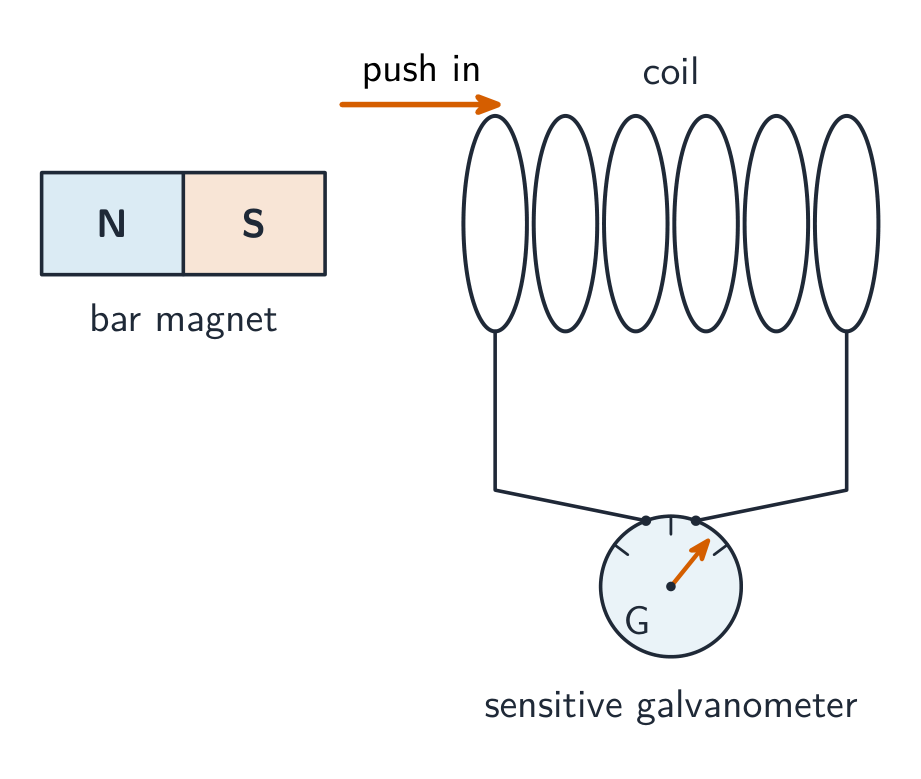
Lenz's law 楞次定律 is the minus sign: the induced current 感应电流 flows so that its own magnetic field opposes the change in flux that created it. Push a magnet toward a loop and the loop pushes back; pull it away and the loop pulls it in. Use the right-hand rule 右手定则 to turn "oppose the change" into a current direction.
A rod of length $L$ sliding at speed $v$ across a field is the special case worth memorising – the motional emf 动生电动势$\varepsilon=BLv$.
Worked example. A $0.20\ \text{m}$ rod slides at $3.0\ \text{m/s}$ across a $0.50\ \text{T}$ field: $\varepsilon=BLv=0.50(0.20)(3.0)=0.30\ \text{V}$. Equivalently, if a single loop's flux drops from $0.020\ \text{Wb}$ to $0.008\ \text{Wb}$ in $0.030\ \text{s}$, the average emf is $\varepsilon=\dfrac{0.012}{0.030}=0.40\ \text{V}$.
Faraday's law is also the third of Maxwell's equations 麦克斯韦方程组, in a deeper form: a changing magnetic flux creates a circulating electric field, $\oint\vec{E}\cdot d\vec{l}=-\dfrac{d\Phi_B}{dt}$ – that field is what pushes the charges around the loop. Together, Maxwell's equations predict electromagnetic waves 电磁波 travelling at $c=1/\sqrt{\varepsilon_0\mu_0}$ (you should know this connection, but AP will not ask you to derive it).
Bahasa Indonesia
Induksi elektromagnetik
Perubahan fluks menginduksi ggl – hukum Faraday:
$$\varepsilon=-\frac{d\Phi_B}{dt}.$$
Dengan luas konstan, $\varepsilon=-A\,\dfrac{dB_\perp}{dt}$; dengan medan konstan, $\varepsilon=-B\,\dfrac{dA_\perp}{dt}$. Kumparan dengan $N$ lilitan mengalikan ggl satu loop tunggal: $|\varepsilon_{\text{sol}}|=N\left|\dfrac{d\Phi_B}{dt}\right|$.
Hukum Lenz adalah tanda minus: arus terinduksi mengalir sedemikian rupa sehingga medan magnetnya sendiri melawan perubahan fluks yang menyebabkannya. Dorong magnet ke arah loop dan loop mendorong kembali; tarik menjauh dan loop menarik masuk. Gunakan aturan tangan kanan untuk mengubah "melawan perubahan" menjadi arah arus.
Memindahkan magnet masuk ke dalam kumparan menginduksi g.g.b yang menggerakkan arus
Sebuah batang sepanjang $L$ yang bergerak meluncur dengan kecepatan $v$ melintasi medan adalah kasus khusus yang perlu dihafal – yaitu gagal listrik gerak$\varepsilon=BLv$.
Contoh terpecahkan. Batang $0.20\ \text{m}$ meluncur dengan $3.0\ \text{m/s}$ melintasi medan $0.50\ \text{T}$: $\varepsilon=BLv=0.50(0.20)(3.0)=0.30\ \text{V}$. Setara, jika fluks satu loop turun dari $0.020\ \text{Wb}$ menjadi $0.008\ \text{Wb}$ dalam waktu $0.030\ \text{s}$, maka ggl rata-ratanya adalah $\varepsilon=\dfrac{0.012}{0.030}=0.40\ \text{V}$.
Hukum Faraday juga merupakan persamaan ketiga Maxwell, dalam bentuk yang lebih mendalam: perubahan fluks magnetik menciptakan medan listrik siklik, $\oint\vec{E}\cdot d\vec{l}=-\dfrac{d\Phi_B}{dt}$ – medan inilah yang mendorong muatan mengelilingi loop. Bersama-sama, persamaan Maxwell memprediksi gelombang elektromagnetik yang merambat dengan kecepatan $c=1/\sqrt{\varepsilon_0\mu_0}$ (Anda harus tahu koneksi ini, tetapi AP tidak akan meminta Anda menurunkannya).
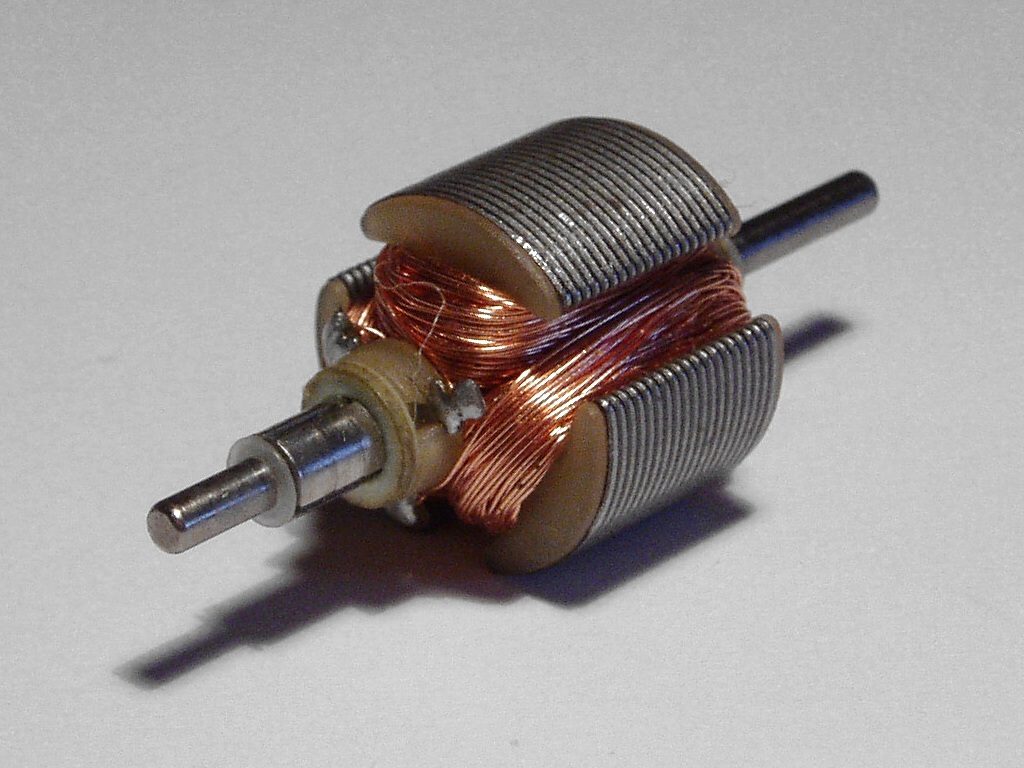
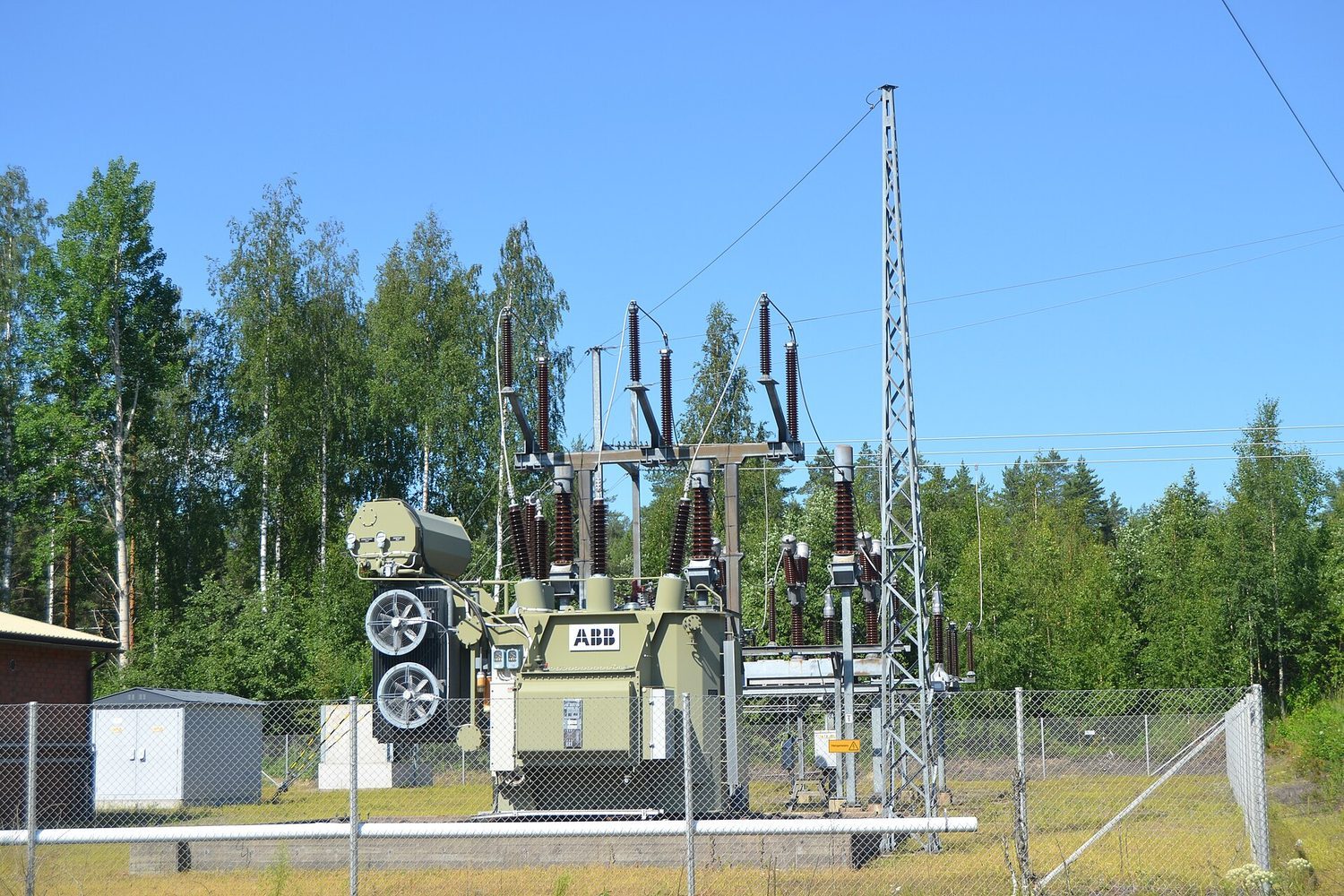
Kumparan kawat berputar dalam medan magnet: menggerakkannya melewati medan menginduksi arus, dasar sebuah generatorTransformator gardu listrik: perubahan fluks magnet dalam kumparan menginduksi tegangan yang menyalurkan listrik ke jaringan
Explore · Jelajahi
Induce a current by moving a magnet · Induksikan arus dengan menggerakkan magnet
A changing magnetic flux through a coil induces an EMF (Faraday's law); its direction opposes the change (Lenz's law). Move the magnet faster for a bigger EMF. · Fluks magnet yang berubah melalui kumpalan menginduksi GGL (hukum Faraday); arahnya berlawanan dengan perubahan (hukum Lenz). Gerakkan magnet lebih cepat untuk GGL yang lebih besar.
Induced Currents and Magnetic Forces · Arus Terinduksi dan Gaya Magnetik
Syllabus · Silabus
English
Learning Objective 13.3.A: Describe the force exerted on a conductor due to the interaction between an external magnetic field and an induced current within that conductor.
13.3.A.1 When an induced current is created in a conductive loop, the already-present magnetic field will exert a magnetic force on the moving charge carriers within the loop.
13.3.A.2 When current is induced in a conducting loop, magnetic forces are only exerted on the segments of the loop that are within the external magnetic field. These magnetic forces may cause translational or rotational acceleration.
13.3.A.3 The force on a conducting loop is proportional to the induced current in the loop, which depends on the rate of change of magnetic flux, the resistance of the loop, and the velocity of the loop.
13.3.A.4 Newton's second law can be applied to a conducting loop moving in a magnetic field as it experiences an induced emf.
Bahasa Indonesia
Tujuan Pembelajaran 13.3.A: Deskripsikan gaya yang bekerja pada konduktor akibat interaksi antara medan magnet eksternal dan arus terinduksi di dalam konduktor tersebut.
13.3.A.1 Ketika arus terinduksi tercipta dalam lingkar konduktif, medan magnet yang sudah ada akan memberikan gaya magnet pada pembawa muatan yang bergerak di dalam lingkar tersebut.
13.3.A.2 Ketika arus diinduksi dalam lingkar konduktif, gaya magnet hanya diberikan pada segmen-segmen lingkar yang berada di dalam medan magnet eksternal. Gaya-gaya magnet ini dapat menyebabkan akselerasi translasi atau rotasi.
13.3.A.3 Gaya pada lingkar konduktif sebanding dengan arus terinduksi dalam lingkar, yang bergantung pada laju perubahan fluks magnet, resistansi lingkar, dan kecepatan lingkar.
13.3.A.4 Hukum kedua Newton dapat diterapkan pada lingkar konduktif yang bergerak dalam medan magnet saat mengalami GGL induksi.
Source: College Board AP Course and Exam Description · Sumber: Deskripsi Kursus dan Ujian College Board AP
English
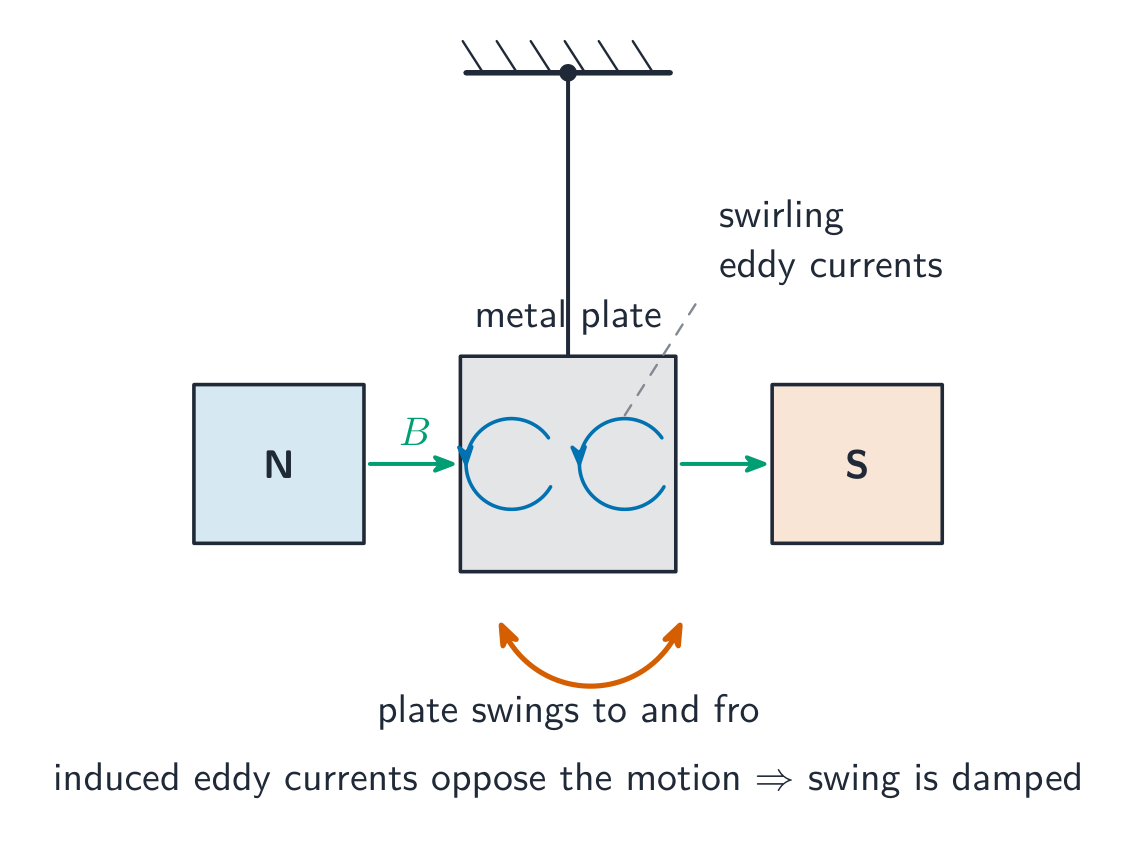
Once an induced current flows, the external field exerts forces on it ($\vec{F}=\int I\,d\vec{l}\times\vec{B}$) – and by Lenz's law those forces always resist the motion that causes the induction. Only the segments of the loop actually inside the field feel a force, which can make a loop accelerate, rotate, or brake. This is the origin of eddy currents 涡电流 braking, and you can apply Newton's second law to a moving loop or rod like any other mechanics problem.
The classic setup is a rod sliding on conducting rails connected by a resistor:
Worked example (the full chain). Rails $L=0.20\ \text{m}$ apart with resistance $R=0.60\ \Omega$ sit in a $0.50\ \text{T}$ field into the page. The rod is pushed at a constant $3.0\ \text{m/s}$. Then: $\varepsilon=BLv=0.30\ \text{V}$; $I=\varepsilon/R=0.50\ \text{A}$; the field pushes back on the rod with $F=BIL=0.50(0.50)(0.20)=0.050\ \text{N}$. The pushing force does work at $P=Fv=0.15\ \text{W}$ – exactly the $P=I^2R=0.15\ \text{W}$ dissipated in the resistor. Mechanical work becomes electrical energy: that is a generator 发电机, and energy is conserved. Released with no push, the rod slows exponentially: $ma=-\dfrac{B^2L^2}{R}v$.
Exam skill. FRQs walk this exact chain: flux $\to$ emf $\to$ current $\to$ force $\to$ Newton's second law. Write each link separately and check the direction with Lenz's law at the end.
Bahasa Indonesia
Setelah arus terinduksi mengalir, medan eksternal memberikan gaya padanya ($\vec{F}=\int I\,d\vec{l}\times\vec{B}$) – dan menurut hukum Lenz, gaya-gaya tersebut selalu menentang gerakan yang menyebabkan induksi. Hanya segmen loop yang benar-benar berada di dalam medan yang merasakan gaya, yang dapat membuat loop berakselerasi, berputar, atau mengerem. Ini adalah asal mula pengereman arus pusar, dan Anda dapat menerapkan hukum kedua Newton pada loop atau batang yang bergerak seperti masalah mekanika lainnya.
Arus pusar terinduksi menentang gerakan, cepat meredam pelat logam yang berayun dalam medan
Pengaturan klasik adalah batang yang meluncur di atas rel konduktif yang dihubungkan oleh resistor:
Batang meluncur di atas rel: arus terinduksi merasakan gaya yang menentang gerakan
Contoh terpecahkan (rangkaian lengkap). Rel $L=0.20\ \text{m}$ terpisah dengan hambatan $R=0.60\ \Omega$ berada dalam medan $0.50\ \text{T}$ yang mengarah ke dalam bidang. Batang didorong dengan kecepatan konstan $3.0\ \text{m/s}$. Maka: $\varepsilon=BLv=0.30\ \text{V}$; $I=\varepsilon/R=0.50\ \text{A}$; medan mendorong balik batang dengan gaya $F=BIL=0.50(0.50)(0.20)=0.050\ \text{N}$. Gaya dorong melakukan kerja pada laju $P=Fv=0.15\ \text{W}$ – tepat sebesar $P=I^2R=0.15\ \text{W}$ yang dihamburkan pada resistor. Kerja mekanis berubah menjadi energi listrik: itu adalah generator, dan energi kekal. Dilepaskan tanpa dorongan, batang melambat secara eksponensial: $ma=-\dfrac{B^2L^2}{R}v$.
Keterampilan ujian. FRQ mengikuti rantai persis ini: fluks $\to$ ggl $\to$ arus $\to$ gaya $\to$ Hukum Kedua Newton. Tulis setiap hubungan secara terpisah dan periksa arahnya dengan hukum Lenz di akhir.
13.4
Inductance · Induktansi
Syllabus · Silabus
English
Learning Objective 13.4.A: Describe the physical and electrical properties of an inductor.
13.4.A.1 Inductance is the tendency of a conductor to oppose a change in electrical current.
13.4.A.1.i Inductance of a conductor depends on the physical properties of the conductor. Straight wires are typically modeled as having zero inductance.
13.4.A.1.ii An inductor, such as a solenoid, is a circuit element that has significant inductance.
13.4.A.1.iii The inductance of a solenoid is dependent on the total number of turns, the length of the solenoid, the cross-sectional area of the solenoid, and magnetic permeability of the solenoid's core.
13.4.A.2 Inductors store energy in the magnetic field that is generated by current in the inductor.
Equation:$U_L = \dfrac{1}{2} L I^2$
13.4.A.2.i The energy stored in the magnetic field generated by an inductor in which current is flowing can be dissipated through a resistor or used to charge a capacitor.
13.4.A.2.ii The transfer of energy generated in an inductor to other forms of energy obeys conservation laws.
13.4.A.3 By applying Faraday's law to an inductor and using the definition of inductance, induced emf can be related to inductance and the rate of change of current.
Equation:$\mathcal{E}_i = -L\dfrac{dI}{dt}$
Bahasa Indonesia
Tujuan Pembelajaran 13.4.A: Deskripsikan sifat fisik dan elektrik dari sebuah induktor.
13.4.A.1 Induktansi adalah kecenderungan konduktor untuk melawan perubahan arus listrik.
13.4.A.1.i Induktansi suatu konduktor bergantung pada sifat fisik konduktor tersebut. Kawat lurus biasanya dimodelkan memiliki induktansi nol.
13.4.A.1.ii Sebuah induktor, seperti solenoida, adalah elemen sirkuit yang memiliki induktansi signifikan.
13.4.A.1.iii Induktansi solenoida bergantung pada total jumlah lilitan, panjang solenoida, luas penampang solenoida, dan permeabilitas magnetik inti solenoida.
13.4.A.2 Induktor menyimpan energi dalam medan magnet yang dihasilkan oleh arus dalam induktor.
Persamaan:$U_L = \dfrac{1}{2} L I^2$
13.4.A.2.i Energi yang tersimpan dalam medan magnet yang dihasilkan oleh induktor di mana arus mengalir dapat didispersikan melalui resistor atau digunakan untuk mengisi kapasitor.
13.4.A.2.ii Transfer energi yang dihasilkan dalam induktor ke bentuk energi lain mematuhi hukum kekekalan.
13.4.A.3 Dengan menerapkan hukum Faraday pada induktor dan menggunakan definisi induktansi, GGL induksi dapat dikaitkan dengan induktansi dan laju perubahan arus.
Persamaan:$\mathcal{E}_i = -L\dfrac{dI}{dt}$
Source: College Board AP Course and Exam Description · Sumber: Deskripsi Kursus dan Ujian College Board AP
English
Inductance 电感 is a conductor's tendency to oppose a change in its own current: changing current changes its own flux, which self-induces an emf. From Faraday's law,
$$\varepsilon=-L\frac{dI}{dt}.$$
An inductor 电感器 is a circuit element built to have large inductance – usually a solenoid 螺线管, where geometry gives
with $N$ total turns, area $A$, length $\ell$, and the magnetic permeability 磁导率 of the core. (Straight wires are modelled as having zero inductance.) An inductor carrying current $I$ stores energy in its magnetic field:
$$U_L=\tfrac{1}{2}LI^2,$$
which can later be dissipated in a resistor or moved into a capacitor – conservation of energy applies as usual.
Bahasa Indonesia
Induktansi adalah kecenderungan konduktor untuk melawan perubahan arus miliknya: arus yang berubah mengubah fluksnya sendiri, yang menginduksi ggl sendiri. Dari hukum Faraday,
$$\varepsilon=-L\frac{dI}{dt}.$$
Sebuah induktor adalah elemen rangkaian yang dirancang untuk memiliki induktansi besar – biasanya berupa solenoida, di mana geometri memberikan
dengan $N$ jumlah lilitan total, luas $A$, panjang $\ell$, dan permeabilitas magnetik inti. (Kawat lurus dimodelkan memiliki induktansi nol.) Induktor yang mengalirkan arus $I$ menyimpan energi dalam medan magnetnya:
$$U_L=\tfrac{1}{2}LI^2,$$
yang kemudian dapat didisipasikan pada resistor atau dipindahkan ke kapasitor – hukum kekekalan energi berlaku seperti biasa.
Circuits with Resistors and Inductors · Rangkaian dengan Resistor dan Induktor
Syllabus · Silabus
English
Learning Objective 13.5.A: Describe the physical and electrical properties of a circuit containing a combination of resistors and a single inductor.
13.5.A.1 A resistor will dissipate energy that was stored in an inductor as the current changes.
13.5.A.2 Kirchhoff's loop rule can be applied to a series LR circuit with a battery of emf $\mathcal{E}$, resulting in a differential equation that describes the current in the loop.
Equation (derived):$\mathcal{E} = IR + L\dfrac{dI}{dt}$
13.5.A.3 The time constant is a significant feature of the behavior of an LR circuit.
13.5.A.3.i The time constant of a circuit is a measure of how quickly an LR circuit will reach a steady state and is described with the equation $\tau = \dfrac{L}{R_{\text{eq}}}$ .
13.5.A.3.ii The time constant represents the time an LR circuit would take to reach a steady state if the system continued to change at the initial rate of change.
13.5.A.3.iii For an inductor that has zero initial current, the time constant represents the time required for the current in the inductor to reach approximately 63 percent of its final asymptotic value.
13.5.A.3.iv For an inductor with an initial current, the time constant represents the time required for the current in the inductor to reach approximately 37 percent of its initial value.
13.5.A.4 The electric properties of inductors change during the time interval in which the current in the inductor changes, but will exhibit steady state behavior after a long time interval.
13.5.A.4.i When a switch is initially closed or opened in a circuit containing an inductor, the induced emf will be equal in magnitude and opposite in direction to the applied potential difference across the branch containing the inductor.
13.5.A.4.ii The potential difference across an inductor, the current in the inductor, and the energy stored in the inductor are exponential with respect to time and have asymptotes that are determined by the initial conditions of the circuit.
13.5.A.4.iii After a time much greater than the time constant of the circuit, an inductor will behave as a conducting wire with zero resistance.
Bahasa Indonesia
Tujuan Pembelajaran 13.5.A: Deskripsikan sifat fisik dan elektrik dari sirkuit yang mengandung kombinasi resistor dan satu induktor.
13.5.A.1 Resistor akan mendispersikan energi yang tersimpan dalam induktor seiring dengan perubahan arus.
13.5.A.2 Aturan loop Kirchhoff dapat diterapkan pada sirkuit LR seri dengan baterai GGL $\mathcal{E}$, menghasilkan persamaan diferensial yang mendeskripsikan arus dalam loop.
Persamaan (turunan):$\mathcal{E} = IR + L\dfrac{dI}{dt}$
13.5.A.3 Konstanta waktu merupakan fitur penting dari perilaku sirkuit LR.
13.5.A.3.i Konstanta waktu dari sebuah sirkuit adalah ukuran seberapa cepat sirkuit LR akan mencapai keadaan tunak dan dijelaskan dengan persamaan $\tau = \dfrac{L}{R_{\text{eq}}}$.
13.5.A.3.ii Konstanta waktu mewakili waktu yang dibutuhkan sirkuit LR untuk mencapai keadaan tunak jika sistem terus berubah pada laju awal perubahan.
13.5.A.3.iii Untuk induktor yang memiliki arus awal nol, konstanta waktu mewakili waktu yang diperlukan agar arus dalam induktor mencapai sekitar 63 persen dari nilai asimtotik akhirnya.
13.5.A.3.iv Untuk induktor dengan arus awal, konstanta waktu mewakili waktu yang diperlukan agar arus dalam induktor mencapai sekitar 37 persen dari nilainya awal.
13.5.A.4 Sifat elektrik induktor berubah selama interval waktu di mana arus dalam induktor berubah, namun akan menampilkan perilaku keadaan tunak setelah interval waktu yang lama.
13.5.A.4.i Ketika sakelar awalnya ditutup atau dibuka dalam sirkuit yang mengandung induktor, GGL induksi akan sama besar dan berlawanan arah dengan beda potensial terapan pada cabang yang mengandung induktor.
13.5.A.4.ii Beda potensial pada induktor, arus dalam induktor, dan energi yang tersimpan dalam induktor bersifat eksponensial terhadap waktu dan memiliki asimtot yang ditentukan oleh kondisi awal rangkaian.
13.5.A.4.iii Setelah waktu yang jauh lebih besar dari konstanta waktu rangkaian, sebuah induktor akan berperilaku sebagai kawat penghantar dengan hambatan nol.
Source: College Board AP Course and Exam Description · Sumber: Deskripsi Kursus dan Ujian College Board AP
English
In an RL circuit RL电路, Kirchhoff's loop rule for a battery $\varepsilon$, resistor $R$, and inductor $L$ in series gives a differential equation 微分方程:
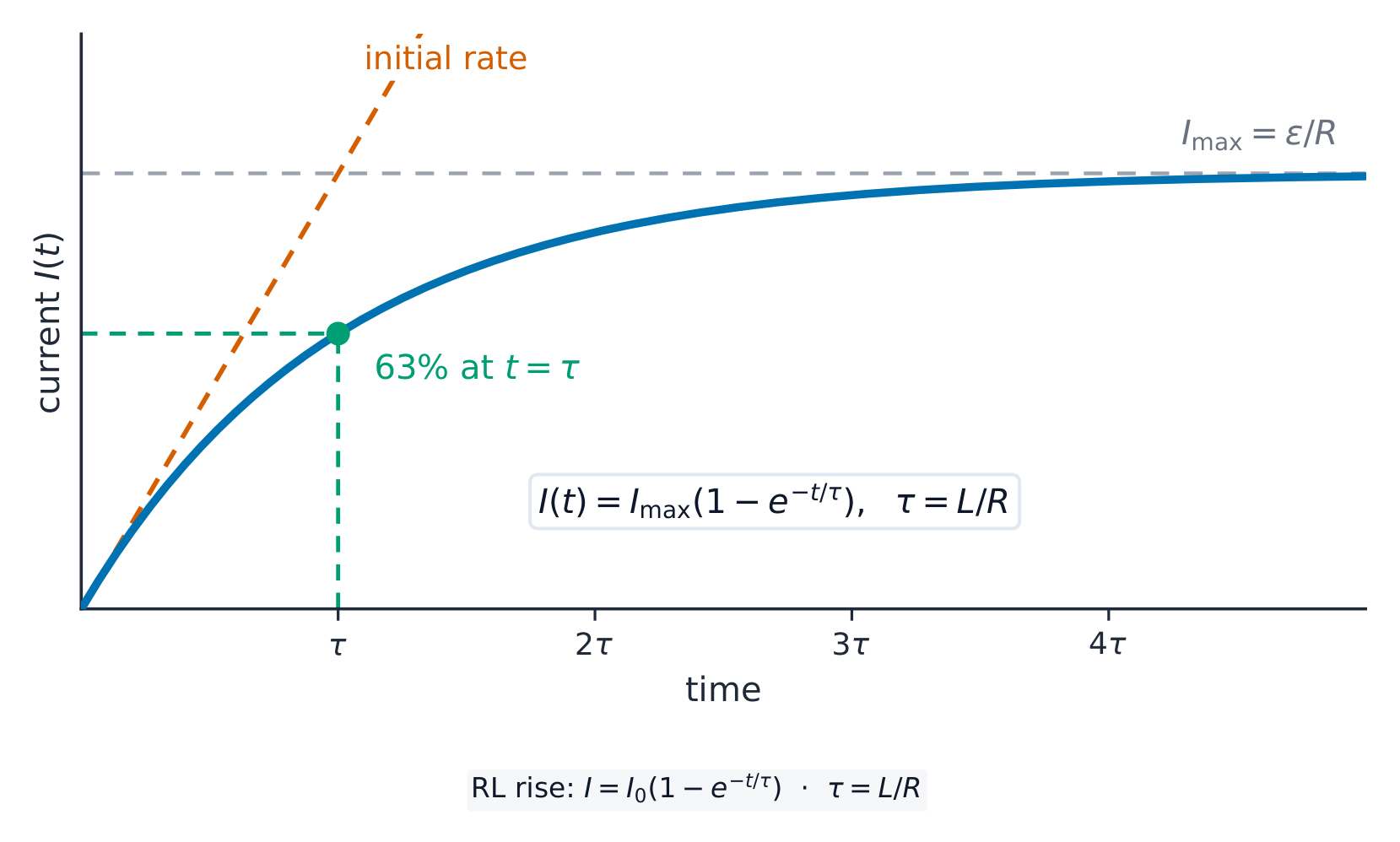
The time constant 时间常数$\tau$ sets the pace: after one $\tau$ a rising current reaches about $63\%$ of its final value (a decaying one falls to $37\%$); it is also how long the change would take at the initial rate. Learn the two limits – they answer most conceptual questions:
Just after the switch closes ($t=0$): current cannot jump, so the inductor momentarily blocks it, self-inducing an emf equal and opposite to the applied potential difference.
Long after ($t\gg\tau$): the current is steady, $dI/dt=0$, and the inductor behaves as a plain wire – the exact opposite of a capacitor.
Worked example.$\varepsilon=12\ \text{V}$, $R=6.0\ \Omega$, $L=3.0\ \text{H}$: final current $\varepsilon/R=2.0\ \text{A}$, $\tau=L/R=0.50\ \text{s}$. At $t=0.50\ \text{s}$ the current is $2.0(1-e^{-1})\approx1.3\ \text{A}$. At $t=0$ the inductor's potential difference is the full $12\ \text{V}$; as $t\to\infty$ it falls to zero. Current, inductor voltage, and stored energy are all exponential in time.
Bahasa Indonesia
Dalam rangkaian RL RL, aturan loop Kirchhoff untuk baterai $\varepsilon$, resistor $R$, dan induktor $L$ yang dirangkai seri menghasilkan persamaan diferensial:
Konstanta waktu$\tau$ menetapkan kecepatan: setelah satu $\tau$, arus yang naik mencapai sekitar $63\%$ dari nilai akhirnya (arus yang turun turun menjadi $37\%$); ini juga merupakan durasi perubahan jika terjadi pada laju awal. Pelajari dua batas limit tersebut – mereka menjawab sebagian besar pertanyaan konseptual:
Baru saja setelah sakelar ditutup ($t=0$): arus tidak bisa melompat mendadak, sehingga induktor sementara memblokir arus, menginduksi emf sendiri yang sama besar dan berlawanan arah dengan beda potensial yang diterapkan.
Lama setelah ($t\gg\tau$): arus sudah stabil, $dI/dt=0$, dan induktor berperilaku seperti kawat biasa – kebalikan sempurna dari kapasitor.
Arus dalam rangkaian RL meningkat secara eksponensial, mencapai 63% pada satu konstanta waktu
Contoh terpecahkan.$\varepsilon=12\ \text{V}$, $R=6.0\ \Omega$, $L=3.0\ \text{H}$: arus akhir $\varepsilon/R=2.0\ \text{A}$, $\tau=L/R=0.50\ \text{s}$. Pada $t=0.50\ \text{s}$ arusnya adalah $2.0(1-e^{-1})\approx1.3\ \text{A}$. Pada $t=0$ beda potensial induktor adalah penuh $12\ \text{V}$; saat $t\to\infty$ ia turun menjadi nol. Arus, tegangan induktor, dan energi tersimpan semuanya berubah secara eksponensial terhadap waktu.
Circuits with Capacitors and Inductors · Rangkaian dengan Kapasitor dan Induktor
Syllabus · Silabus
English
Learning Objective 13.6.A: Describe the physical and electrical properties of a circuit containing a combination of capacitors and a single inductor.
13.6.A.1 In circuits containing only a charged capacitor and an inductor (LC circuits), the maximum current in the inductor can be determined using conservation of energy within the circuit.
13.6.A.2 In LC circuits, the time dependence of the charge stored in the capacitor can be modeled as simple harmonic motion.
Tujuan Pembelajaran 13.6.A: Jelaskan sifat fisik dan listrik dari suatu rangkaian yang mengandung kombinasi kapasitor dan satu induktor tunggal.
13.6.A.1 Dalam rangkaian yang hanya berisi kapasitor bermuatan dan induktor (rangkaian LC), arus maksimum dalam induktor dapat ditentukan menggunakan hukum kekekalan energi di dalam rangkaian.
13.6.A.2 Dalam rangkaian LC, ketergantungan waktu muatan yang tersimpan dalam kapasitor dapat dimodelkan sebagai gerak harmonik sederhana.
Source: College Board AP Course and Exam Description · Sumber: Deskripsi Kursus dan Ujian College Board AP
English
LC circuit: energy sloshes like a spring
An LC circuit LC电路 has no resistance, so nothing dissipates energy: it oscillates 振荡, sloshing energy between the capacitor's electric field and the inductor's magnetic field. The loop rule gives
$$\frac{d^2q}{dt^2}=-\frac{1}{LC}\,q,$$
the same equation as a mass on a spring – simple harmonic motion 简谐运动 with charge playing the role of displacement and
$$\omega=\frac{1}{\sqrt{LC}}.$$
The total energy $\dfrac{q^2}{2C}+\tfrac12LI^2$ stays constant: all in the capacitor at maximum charge, all in the inductor at maximum current.
Worked example.$L=2.0\ \text{H}$, $C=8.0\ \mu\text{F}$: $\omega=\dfrac{1}{\sqrt{2.0(8.0\times10^{-6})}}=250\ \text{rad/s}$, period $T=2\pi/\omega\approx0.025\ \text{s}$. If the capacitor starts charged to $12\ \text{V}$, then $U=\tfrac12CV^2=5.8\times10^{-4}\ \text{J}$, and the maximum current follows from $\tfrac12LI_{\max}^2=U$: $I_{\max}=\sqrt{2U/L}=0.024\ \text{A}$ – conservation of energy 能量守恒, no calculus needed.
Bahasa Indonesia
Rangkaian LC: energi bergelombang seperti pegas
Sebuah rangkaian LC LC tidak memiliki hambatan, sehingga tidak ada energi yang terdisipasi: rangkaian ini berosilasi, memindahkan energi antara medan listrik kapasitor dan medan magnet induktor. Aturan loop memberikan
$$\frac{d^2q}{dt^2}=-\frac{1}{LC}\,q,$$
persamaan yang sama dengan massa pada pegas – gerak harmonik sederhana dengan muatan berperan sebagai perpindahan dan
$$\omega=\frac{1}{\sqrt{LC}}.$$
Energi total $\dfrac{q^2}{2C}+\tfrac12LI^2$ tetap konstan: seluruhnya pada kapasitor saat muatan maksimum, seluruhnya pada induktor saat arus maksimum.
Contoh terpecahkan.$L=2.0\ \text{H}$, $C=8.0\ \mu\text{F}$: $\omega=\dfrac{1}{\sqrt{2.0(8.0\times10^{-6})}}=250\ \text{rad/s}$, periode $T=2\pi/\omega\approx0.025\ \text{s}$. Jika kapasitor dimulai dengan bermuatan $12\ \text{V}$, maka $U=\tfrac12CV^2=5.8\times10^{-4}\ \text{J}$, dan arus maksimum diturunkan dari $\tfrac12LI_{\max}^2=U$: $I_{\max}=\sqrt{2U/L}=0.024\ \text{A}$ – kekekalan energi, tanpa perlu kalkulus.
13.6
Exam tips · Tips ujian
English
Compute flux$\Phi_B=\int \vec B\cdot d\vec A$ and get the induced EMF from Faraday's law$\varepsilon=-\tfrac{d\Phi_B}{dt}$.
Use Lenz's law (the minus sign) to fix the direction: the induced current opposes the change in flux.
Flux changes three ways — changing $B$, changing area, or changing angle — identify which and differentiate.
For a rod of length $L$ moving at speed $v$, the motional EMF is $BLv$.
An inductor stores energy $\tfrac12 LI^2$ and resists changes in current (RL time constant $\tau=L/R$).
Bahasa Indonesia
Hitung fluks magnet$\Phi_B=\int \vec B\cdot d\vec A$ dan dapatkan GGL induksi dari hukum Faraday$\varepsilon=-\tfrac{d\Phi_B}{dt}$.
Gunakan hukum Lenz (tanda minus) untuk menentukan arah: arus induksi berlawanan dengan perubahan fluks.
Fluks berubah dengan tiga cara – mengubah $B$, mengubah luas, atau mengubah sudut – identifikasi mana yang terjadi dan lakukan diferensiasi.
Untuk batang sepanjang $L$ bergerak dengan kecepatan $v$, GGL gerak adalah $BLv$.
Induktor menyimpan energi $\tfrac12 LI^2$ dan menentang perubahan arus (konstanta waktu RL $\tau=L/R$).
Interactive lessons on this topic · Pelajaran interaktif untuk topik ini
Work through it step by step, with instant-check exercises. · Kerjakan langkah demi langkah, dengan latihan pengecekan instan.
More topics in AP Physics C: Electricity and Magnetism · AP Fisika C: Listrik dan Magnetisme · Topik lain dalam AP Physics C: Electricity and Magnetism · AP Fisika C: Listrik dan Magnetisme
Pick one and the site follows you — notes, papers, videos and practice all open on it. · Pilih satu dan situs mengikuti Anda — catatan, kertas, video, dan latihan semua terbuka di sana.
Type to search notes, lessons, code, vocabulary and past-paper questions across every subject. · Ketik untuk mencari catatan, pelajaran, kode, kosakata, dan pertanyaan soal lama di setiap mata pelajaran.