Skip to content · ⁨Lompat ke konten⁩
Subjects · ⁨Materi⁩

AP Physics 2 · ⁨AP Fisika 2⁩

Tips

AP Physics 2 continues algebra-based physics into thermodynamics, electric force, field and potential, circuits, magnetism, geometric optics, waves and physical optics, and modern physics. It assumes the mechanics of Physics 1 rather than repeating it.

Fields are invisible, and the exam knows it. Questions ask what happens to a quantity when something else changes — double the separation, insert a dielectric, reverse the current — and to justify it without computing a number.

Learn each relationship as a proportionality, not just a formula. That is what makes those questions tractable.

Unit-by-unit notes cover fluids, thermodynamics, electrostatics, circuits, magnetism, optics and modern physics, with diagrams for the parts that are hard to picture. The library holds the released past papers; Physics 2 leans heavily on explaining in words why something happens, so practise writing the reasoning and not only the number.

  • 9

    Thermodynamics · ⁨Termodinamika⁩

    Watch lesson · ⁨Tonton pelajaran⁩
    9.1

    Kinetic Theory of Temperature and Pressure

    Syllabus · ⁨Silabus⁩
    English

    Learning Objective 9.1.A: Describe the pressure a gas exerts on its container in terms of atomic motion within that gas.

    • 9.1.A.1 Atoms in a gas collide with and exert forces on other atoms in the gas and with the container in which the gas is contained.
      • 9.1.A.1.i Collisions involving pairs of atoms or an atom and a fixed object can be described and analyzed using conservation of momentum principles.
      • 9.1.A.1.ii The pressure exerted by a gas on a surface is the ratio of the sum of the magnitudes of the perpendicular components of the forces exerted by the gas's atoms on the surface to the area of the surface.
        • Equation: $P = \dfrac{F_{\perp}}{A}$
      • 9.1.A.1.iii Pressure exists throughout the gas itself, not just at the boundary between the gas and the container.

    Learning Objective 9.1.B: Describe the temperature of a system in terms of the atomic motion within that system.

    • 9.1.B.1 The temperature of a system is characterized by the average kinetic energy of the atoms within that system.
      • 9.1.B.1.i The Maxwell–Boltzmann distribution provides a graphical representation of the energies and speeds of atoms at a given temperature.
      • 9.1.B.1.ii The root-mean-square speed corresponding to the average kinetic energy for an ideal gas is related to the temperature of the gas by
        • Equation: $K_{\text{avg}} = \dfrac{3}{2} k_B T = \dfrac{1}{2} m v_{\text{rms}}^2$

    Boundary statement: AP Physics 2 only expects students to perform qualitative and quantitative analysis of collisions in one and two dimensions. Students are not expected to know the functional form of the Maxwell-Boltzmann distribution but are expected to be familiar with how features of the distribution are related to the temperature of the gas.

    Bahasa Indonesia

    Tujuan Pembelajaran 9.1.A: Jelaskan tekanan yang diberikan gas pada wadahnya berdasarkan gerakan atom di dalam gas tersebut.

    • 9.1.A.1 Atom-atom dalam gas bertumbukan dengan dan memberikan gaya pada atom lain dalam gas serta pada wadah tempat gas berada.
      • 9.1.A.1.i Tumbukan yang melibatkan pasangan atom atau satu atom dengan objek tetap dapat dideskripsikan dan dianalisis menggunakan prinsip kekekalan momentum.
      • 9.1.A.1.ii Tekanan yang diberikan gas pada suatu permukaan adalah rasio dari jumlah besar komponen tegak lurus dari gaya-gaya yang diberikan atom-atom gas pada permukaan terhadap luas permukaan tersebut.
        • Persamaan: $P = \dfrac{F_{\perp}}{A}$
      • 9.1.A.1.iii Tekanan ada di seluruh gas itu sendiri, bukan hanya di batas antara gas dan wadah.

    Tujuan Pembelajaran 9.1.B: Jelaskan suhu suatu sistem berdasarkan gerakan atom di dalam sistem tersebut.

    • 9.1.B.1 Suhu suatu sistem dikarakterisasi oleh energi kinetik rata-rata atom-atom di dalam sistem tersebut.
      • 9.1.B.1.i Distribusi Maxwell–Boltzmann menyediakan representasi grafis dari energi dan kecepatan atom pada suhu tertentu.
      • 9.1.B.1.ii Kecepatan kuadrat-tengah-kuadrat (root-mean-square speed) yang sesuai dengan energi kinetik rata-rata untuk gas ideal terkait dengan suhu gas melalui
        • Persamaan: $K_{\text{avg}} = \dfrac{3}{2} k_B T = \dfrac{1}{2} m v_{\text{rms}}^2$

    Pernyataan Batasan: AP Fisika 2 hanya mengharapkan siswa melakukan analisis kualitatif dan kuantitatif tumbukan dalam satu dan dua dimensi. Siswa tidak diharapkan mengetahui bentuk fungsi distribusi Maxwell-Boltzmann, tetapi diharapkan memahami bagaimana fitur-fitur distribusi tersebut berkaitan dengan suhu gas.
    Source: College Board AP Course and Exam Description · ⁨Sumber: Deskripsi Kursus dan Ujian College Board AP⁩

    Kinetic theory: gas pressure

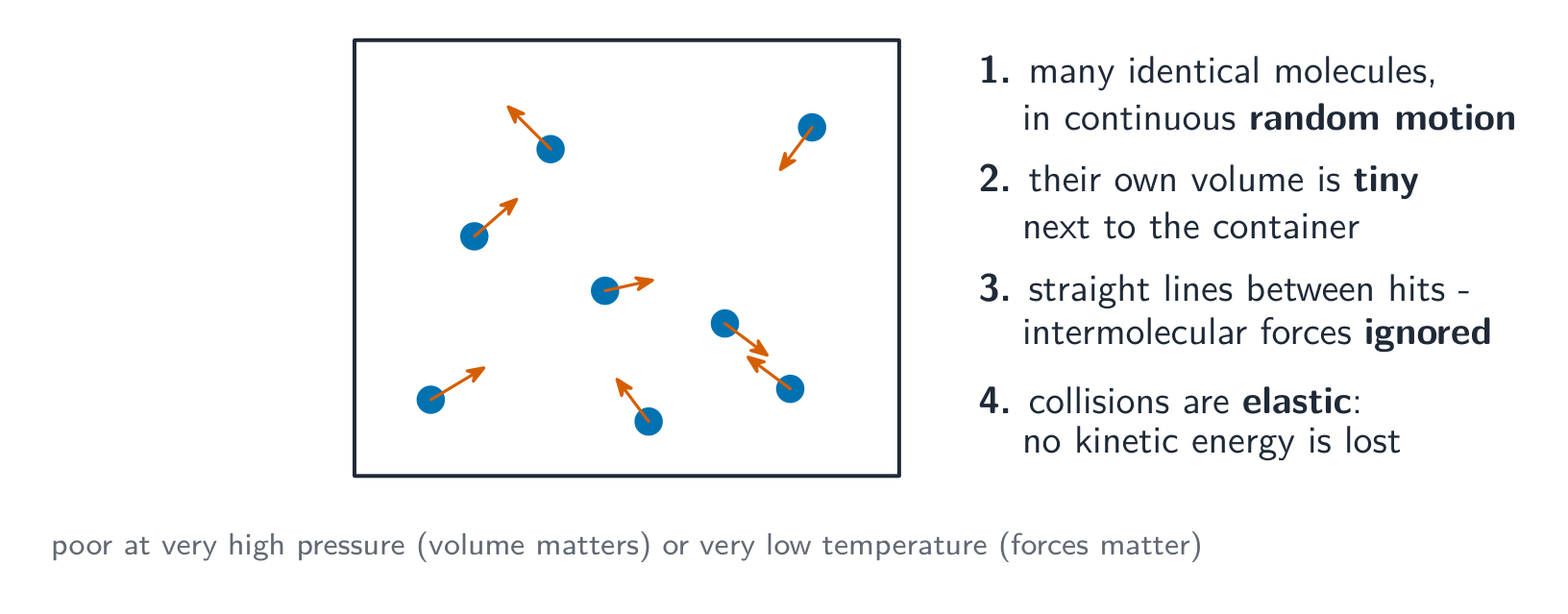
    Thermodynamics 热力学 studies heat and energy in large collections of particles. The kinetic theory 分子运动论 explains gas behavior from the random motion of its molecules:

    The key assumptions of the kinetic theory of an ideal gas
    The key assumptions of the kinetic theory of an ideal gas
    • Temperature 温度 is a measure of the average kinetic energy of the molecules: $K_{\text{avg}}=\tfrac{3}{2}k_B T$ (with $T$ in kelvin). Hotter means faster-moving molecules.
    • Pressure 压强 comes from molecules colliding with the container walls – more frequent or harder collisions give more pressure.
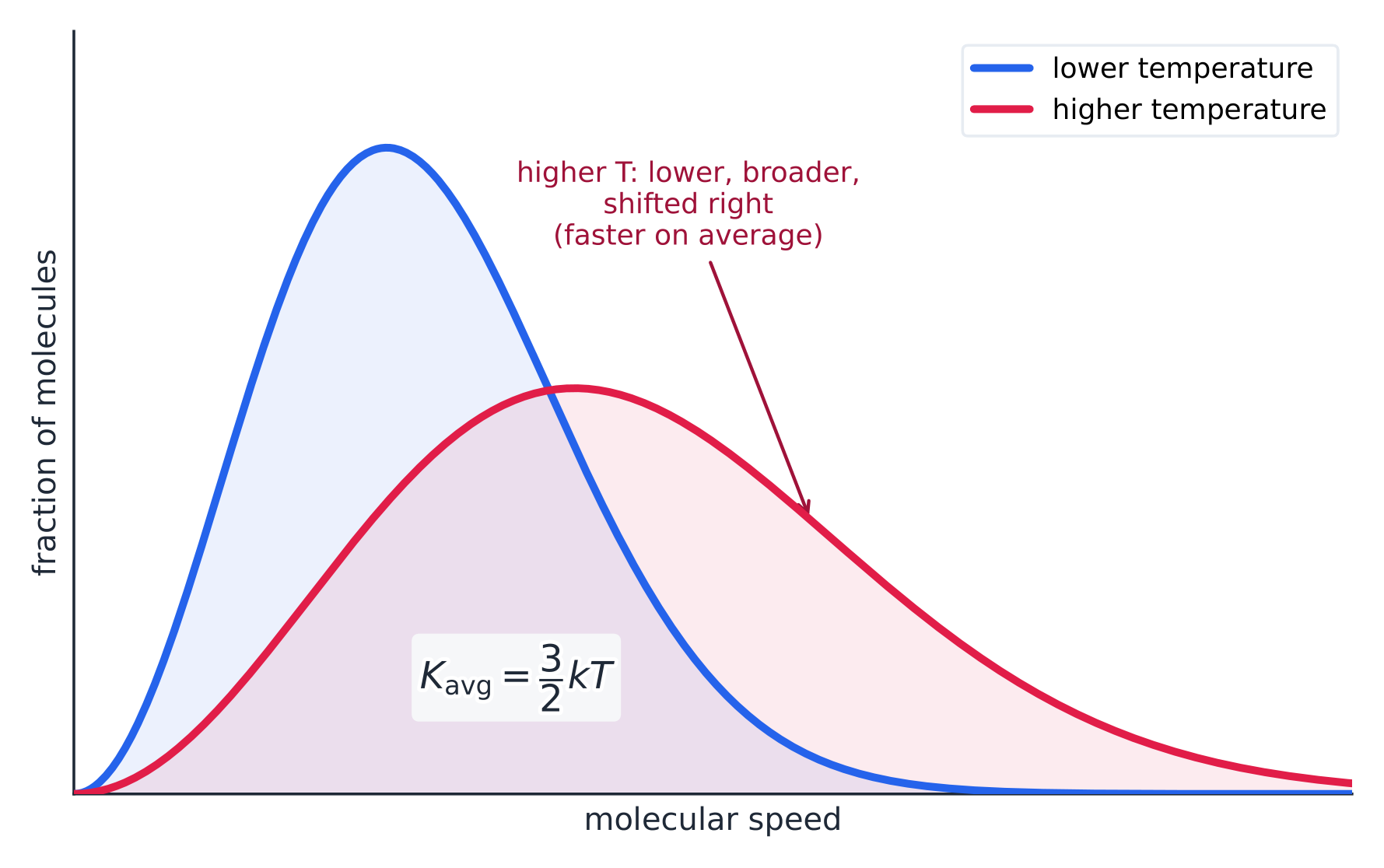
    The Maxwell-Boltzmann speed distribution shifts right and flattens at higher temperature
    The Maxwell-Boltzmann speed distribution shifts right and flattens at higher temperature

    Worked example. Find the average kinetic energy of a gas molecule at $300\ \text{K}$, using $k_B=1.38\times10^{-23}\ \text{J/K}$:

    $$K_{\text{avg}}=\tfrac32 k_B T=1.5\times1.38\times10^{-23}\times300=6.2\times10^{-21}\ \text{J}.$$
    It depends only on temperature, not on the type of gas – at the same $T$, light and heavy molecules share the same average kinetic energy (so the light ones move faster).

    Explore · ⁨Jelajahi⁩

    Explore the spread of molecular speeds · ⁨Jelajahi penyebaran kecepatan molekul⁩

    Raise the temperature and watch the whole speed distribution shift right and flatten — the particles move faster on average, which is exactly what $\bar K = \tfrac{3}{2} k_B T$ means. · ⁨Naikkan suhu dan saksikan seluruh distribusi kecepatan bergeser ke kanan dan memipih — partikel bergerak lebih cepat rata-rata, yang persis seperti yang dimaksud oleh $\bar K = \tfrac{3}{2} k_B T$.⁩

    Vocabulary · ⁨Kosa kata⁩ Train · ⁨Latih⁩
    English Bahasa Indonesia
    Thermodynamics/ˌθɜːməʊdaɪˈnæmɪks/ Termodinamika
    kinetic theory/kɪˈnetɪk ˈθɪəri/ teori kinetik
    Temperature/ˈtemprɪtʃə/ Suhu
    Pressure/ˈpreʃə/ Tekanan
    Watch lesson · ⁨Tonton pelajaran⁩
    9.2

    The Ideal Gas Law

    Syllabus · ⁨Silabus⁩
    English

    Learning Objective 9.2.A: Describe the properties of an ideal gas.
    • 9.2.A.1 The classical model of an ideal gas assumes that the instantaneous velocities of atoms are random, the volumes of the atoms are negligible compared to the total volume occupied by the gas, the atoms collide elastically, and the only appreciable forces on the atoms are those that occur during collisions.
    • 9.2.A.2 An ideal gas is one in which the relationships between pressure, volume, the number of moles or number of atoms, and temperature of a gas can be modeled using the equation
      • Equation: $PV = nRT = N k_B T$
    • 9.2.A.3 Graphs modeling the pressure, temperature, and volume of gases can be used to describe or determine properties of that gas.
    • 9.2.A.4 A temperature at which an ideal gas has zero pressure can be extrapolated from a graph of pressure as a function of temperature.
    Bahasa Indonesia

    Tujuan Pembelajaran 9.2.A: Jelaskan sifat-sifat gas ideal.

    • 9.2.A.1 Model klasik gas ideal mengasumsikan bahwa kecepatan sesaat atom bersifat acak, volume atom dapat diabaikan dibandingkan dengan total volume yang ditempati gas, atom bertumbukan secara elastis, dan satu-satunya gaya yang signifikan pada atom adalah gaya yang terjadi selama tumbukan.
    • 9.2.A.2 Gas ideal adalah gas di mana hubungan antara tekanan, volume, jumlah mol atau jumlah atom, dan suhu gas dapat dimodelkan menggunakan persamaan
      • Persamaan: $PV = nRT = N k_B T$
    • 9.2.A.3 Grafik yang memodelkan tekanan, suhu, dan volume gas dapat digunakan untuk mendeskripsikan atau menentukan sifat gas tersebut.
    • 9.2.A.4 Suhu pada mana gas ideal memiliki nol tekanan dapat diekstrapolasikan dari grafik tekanan sebagai fungsi suhu.

    Source: College Board AP Course and Exam Description · ⁨Sumber: Deskripsi Kursus dan Ujian College Board AP⁩

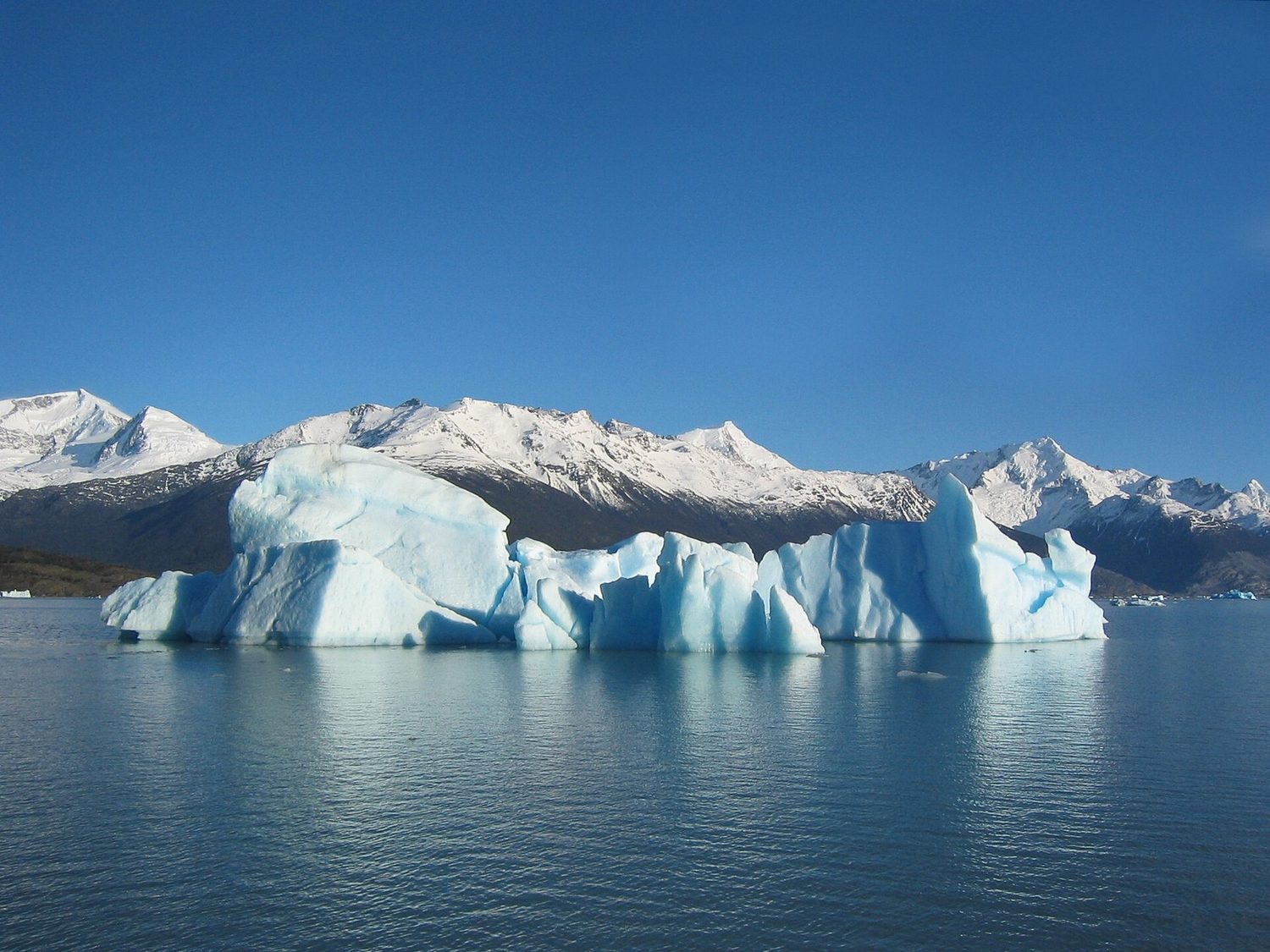
    An iceberg: heat, density and phase changes connect thermodynamics to fluids and buoyancy
    An iceberg: heat, density and phase changes connect thermodynamics to fluids and buoyancy

    An ideal gas 理想气体 obeys

    $$PV=nRT \qquad(\text{or } PV=Nk_B T),$$
    linking pressure $P$, volume $V$, amount ($n$ moles or $N$ molecules), and absolute temperature $T$. Use it to predict how a gas responds when you change one quantity and hold others fixed (e.g. heating at constant volume raises pressure).

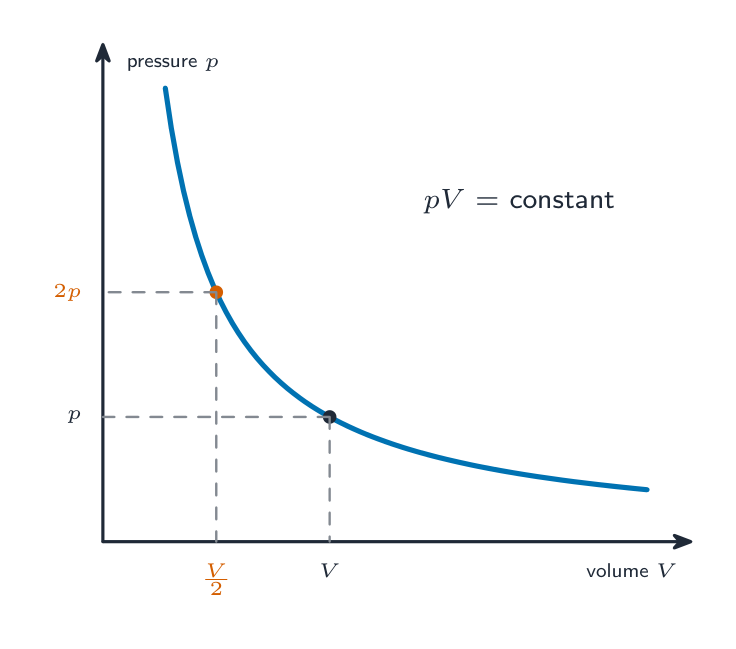
    Boyle's law: at constant temperature, pressure times volume is constant
    Boyle's law: at constant temperature, pressure times volume is constant

    Worked example. A sealed rigid container of gas is at $1.0\times10^{5}\ \text{Pa}$ and $300\ \text{K}$. It is heated to $450\ \text{K}$. Because the volume and amount are fixed, $P/T$ is constant:

    $$P_2=P_1\frac{T_2}{T_1}=1.0\times10^{5}\times\frac{450}{300}=1.5\times10^{5}\ \text{Pa}.$$
    Always convert temperatures to kelvin before using a gas law – using Celsius here would give nonsense.

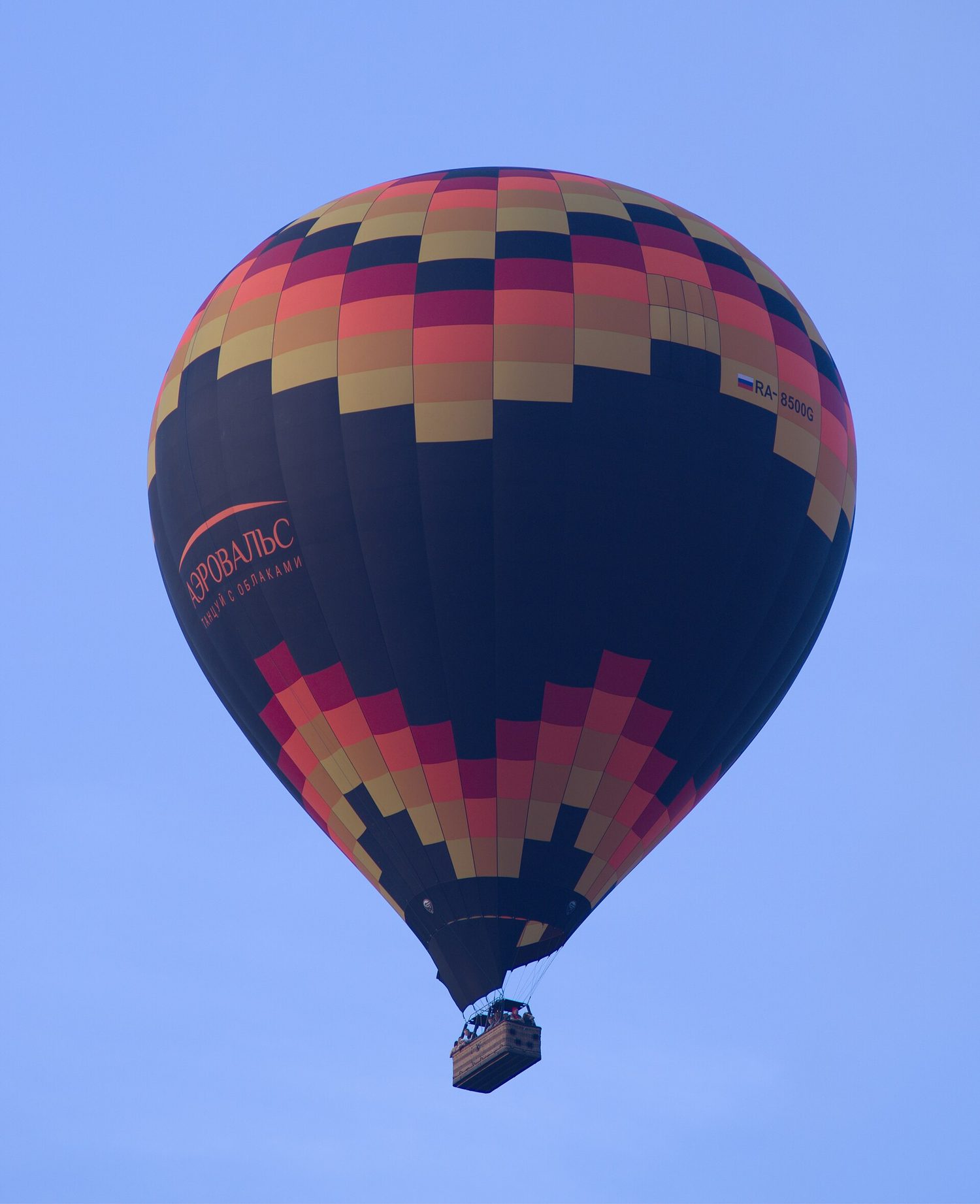
    A hot air balloon rising into the sky
    Heating the gas inside a balloon lowers its density, so the balloon rises — the ideal gas law in action
    Explore · ⁨Jelajahi⁩

    Explore squeezing a gas · ⁨Jelajahi pemampatan gas⁩

    Slide the piston in to shrink the volume. The same particles are crammed into less space, so they hit the walls more often and the pressure climbs — while $PV$ stays constant at fixed temperature. · ⁨Geser piston masuk untuk mengecilkan volume. Partikel yang sama terjepit dalam ruang yang lebih kecil, sehingga mereka menabrak dinding lebih sering dan tekanan meningkat — sementara $PV$ tetap konstan pada suhu tetap.⁩

    Vocabulary · ⁨Kosa kata⁩ Train · ⁨Latih⁩
    English Bahasa Indonesia
    ideal gas/aɪˈdɪəl ɡæs/ gas ideal
    Watch lesson · ⁨Tonton pelajaran⁩
    9.3

    Thermal Energy Transfer and Equilibrium

    Syllabus · ⁨Silabus⁩
    English

    Learning Objective 9.3.A: Describe the transfer of energy between two systems in thermal contact due to temperature differences of those two systems.

    • 9.3.A.1 Two systems are in thermal contact if the systems may transfer energy by thermal processes.
      • 9.3.A.1.i Heating is the transfer of energy into a system by thermal processes.
      • 9.3.A.1.ii Cooling is the transfer of energy out of a system by thermal processes.
    • 9.3.A.2 The thermal processes by which energy may be transferred between systems at different temperatures are conduction, convection, and radiation.
    • 9.3.A.3 Energy is transferred through thermal processes spontaneously from a higher-temperature system to a lower-temperature system.
      • 9.3.A.3.i In collisions between atoms from different systems, energy is most likely to be transferred from higher-energy atoms to lower-energy atoms.
      • 9.3.A.3.ii After many collisions of atoms from different systems, the most probable state is one in which both systems have the same temperature.
    • 9.3.A.4 Thermal equilibrium results when no net energy is transferred by thermal processes between two systems in thermal contact with each other.
    Bahasa Indonesia

    Tujuan Pembelajaran 9.3.A: Jelaskan perpindahan energi antara dua sistem yang bersentuhan termal akibat perbedaan suhu kedua sistem tersebut.

    • 9.3.A.1 Dua sistem berada dalam kontak termal jika sistem tersebut dapat mentransfer energi melalui proses-termal.
      • 9.3.A.1.i Pemanasan adalah perpindahan energi masuk ke dalam sistem melalui proses-termal.
      • 9.3.A.1.ii Pendinginan adalah perpindahan energi keluar dari sistem melalui proses-termal.
    • 9.3.A.2 Proses-termal melalui mana energi dapat dipindahkan antara sistem dengan suhu berbeda adalah konduksi, konveksi, dan radiasi.
    • 9.3.A.3 Energi dipindahkan melalui proses-termal secara spontan dari sistem ber suhu tinggi ke sistem ber suhu rendah.
      • 9.3.A.3.i Dalam tumbukan antara atom dari sistem yang berbeda, energi paling mungkin dipindahkan dari atom ber energi tinggi ke atom ber energi rendah.
      • 9.3.A.3.ii Setelah banyak tumbukan atom dari sistem yang berbeda, keadaan yang paling mungkin adalah keadaan di mana kedua sistem memiliki suhu yang sama.
    • 9.3.A.4 Kesetimbangan termal terjadi ketika tidak ada transfer energi bersih melalui proses-termal antara dua sistem yang saling bersentuhan termal.

    Source: College Board AP Course and Exam Description · ⁨Sumber: Deskripsi Kursus dan Ujian College Board AP⁩

    Heat 热量 $Q$ is energy transferred because of a temperature difference; it flows from hot to cold. Two objects in contact reach thermal equilibrium 热平衡 when they share the same temperature, and net heat flow stops. The three transfer methods are conduction 传导, convection 对流, and radiation 辐射.

    Explore · ⁨Jelajahi⁩

    Add heat and watch the temperature · ⁨Tambahkan panas dan saksikan suhu⁩

    Adding heat usually raises temperature, but during a phase change the temperature holds flat while the energy breaks bonds. Two bodies in contact settle at one temperature — thermal equilibrium. · ⁨Menambahkan panas biasanya menaikkan suhu, tetapi selama perubahan fase suhu tetap datar sementara energi memutus ikatan. Dua tubuh yang bersentuhan mencapai satu suhu — keseimbangan termal.⁩

    Vocabulary · ⁨Kosa kata⁩ Train · ⁨Latih⁩
    English Bahasa Indonesia
    Heat/hiːt/ Kalor
    thermal equilibrium/ˈθɜːml ˌiːkwɪˈlɪbrɪəm/ kesetimbangan termal
    conduction/kənˈdʌkʃn/ konduksi
    convection/kənˈvekʃn/ konveksi
    radiation/ˌreɪdɪˈeɪʃn/ radiasi
    Watch lesson · ⁨Tonton pelajaran⁩
    9.4

    The First Law of Thermodynamics

    Syllabus · ⁨Silabus⁩
    English

    Learning Objective 9.4.A: Describe the internal energy of a system.

    • 9.4.A.1 The internal energy of a system is the sum of the kinetic energy of the objects that make up the system and the potential energy of the configuration of those objects.
      • 9.4.A.1.i The atoms in an ideal gas do not interact with each other via conservative forces, and the internal structure is not considered. Therefore, an ideal gas does not have internal potential energy.
      • 9.4.A.1.ii The internal energy of an ideal monatomic gas is the sum of the kinetic energies of the constituent atoms in the gas.
        • Equation: $U = \dfrac{3}{2} nRT = \dfrac{3}{2} N k_B T$
    • 9.4.A.2 Changes to a system's internal energy can result in changes to the internal structure and internal behavior of that system without changing the motion of the system's center of mass.

    Learning Objective 9.4.B: Describe the behavior of a system using thermodynamic processes.

    • 9.4.B.1 The first law of thermodynamics is a restatement of conservation of energy that accounts for energy transferred into or out of a system by work, heating, or cooling.
      • 9.4.B.1.i For an isolated system, the total energy is constant.
      • 9.4.B.1.ii For a closed system, the change in internal energy is the sum of energy transferred to or from the system by heating, or work done on the system.
        • Equation: $\Delta U = Q + W$
      • 9.4.B.1.iii The work done on a system by a constant or average external pressure that changes the volume of that system (for example, a piston compressing a gas in a container) is defined as
        • Equation: $W = -P \Delta V$
    • 9.4.B.2 Pressure-volume graphs (also known as PV diagrams) are representations used to represent thermodynamic processes.
      • 9.4.B.2.i Lines of constant temperature on a PV diagram are called isotherms.
      • 9.4.B.2.ii The absolute value of the work done on a gas when the gas expands or compresses is equal to the area underneath the curve of a plot of pressure vs. volume for the gas.
    • 9.4.B.3 Special cases of thermal processes depend on the relationship between the configuration of the system, the nature of the work done on the system, and the system's surroundings. These include constant volume (isovolumetric), constant temperature (isothermal), and constant pressure (isobaric), as well as processes where no energy is transferred to or from the system through thermal processes (adiabatic).
    Bahasa Indonesia

    Tujuan Pembelajaran 9.4.A: Jelaskan energi dalam suatu sistem.

    • 9.4.A.1 Energi dalam suatu sistem adalah jumlah dari energi kinetik objek-objek yang membentuk sistem dan energi potensial dari konfigurasi objek-objek tersebut.
      • 9.4.A.1.i Atom-atom dalam gas ideal tidak berinteraksi satu sama lain melalui gaya konservatif, dan struktur internalnya tidak dipertimbangkan. Oleh karena itu, gas ideal tidak memiliki energi potensial internal.
      • 9.4.A.1.ii Energi dalam gas monoatomik ideal adalah jumlah dari energi kinetik atom-atom penyusun di dalam gas tersebut.
        • Persamaan: $U = \dfrac{3}{2} nRT = \dfrac{3}{2} N k_B T$
    • 9.4.A.2 Perubahan pada energi dalam suatu sistem dapat menyebabkan perubahan pada struktur internal dan perilaku internal sistem tersebut tanpa mengubah gerakan pusat massa sistem.

    Tujuan Pembelajaran 9.4.B: Jelaskan perilaku sistem menggunakan proses termodinamika.

    • 9.4.B.1 Hukum pertama termodinamika merupakan ungkapan ulang dari kekekalan energi yang memperhitungkan energi yang ditransfer masuk atau keluar dari sistem melalui usaha, pemanasan, atau pendinginan.
      • 9.4.B.1.i Untuk sistem terisolasi, total energi bersifat konstan.
      • 9.4.B.1.ii Untuk sistem tertutup, perubahan energi dalam adalah jumlah dari energi yang ditransfer masuk atau keluar dari sistem melalui pemanasan, atau usaha yang dilakukan pada sistem.
        • Persamaan: $\Delta U = Q + W$
      • 9.4.B.1.iii Usaha yang dilakukan pada sistem oleh tekanan eksternal konstan atau rata-rata yang mengubah volume sistem tersebut (misalnya, piston yang memampatkan gas dalam wadah) didefinisikan sebagai
        • Persamaan: $W = -P \Delta V$
    • 9.4.B.2 Grafik tekanan-volume (juga dikenal sebagai diagram PV) adalah representasi yang digunakan untuk menggambarkan proses termodinamika.
      • 9.4.B.2.i Garis suhu tetap pada diagram PV disebut isoterma.
      • 9.4.B.2.ii Nilai mutlak dari usaha yang dilakukan pada gas saat gas mengembang atau terkompresi sama dengan luas di bawah kurva plot tekanan terhadap volume untuk gas tersebut.
    • 9.4.B.3 Kasus khusus dari proses termal bergantung pada hubungan antara konfigurasi sistem, sifat usaha yang dilakukan pada sistem, dan lingkungan sistem. Ini termasuk volume tetap (isovolumetrik), suhu tetap (isotermal), dan tekanan tetap (isobarik), serta proses di mana tidak ada energi yang ditransfer masuk atau keluar dari sistem melalui proses termal (adiabatik).

    Source: College Board AP Course and Exam Description · ⁨Sumber: Deskripsi Kursus dan Ujian College Board AP⁩

    The first law 热力学第一定律 is conservation of energy for a gas:

    $$\Delta U = Q + W,$$
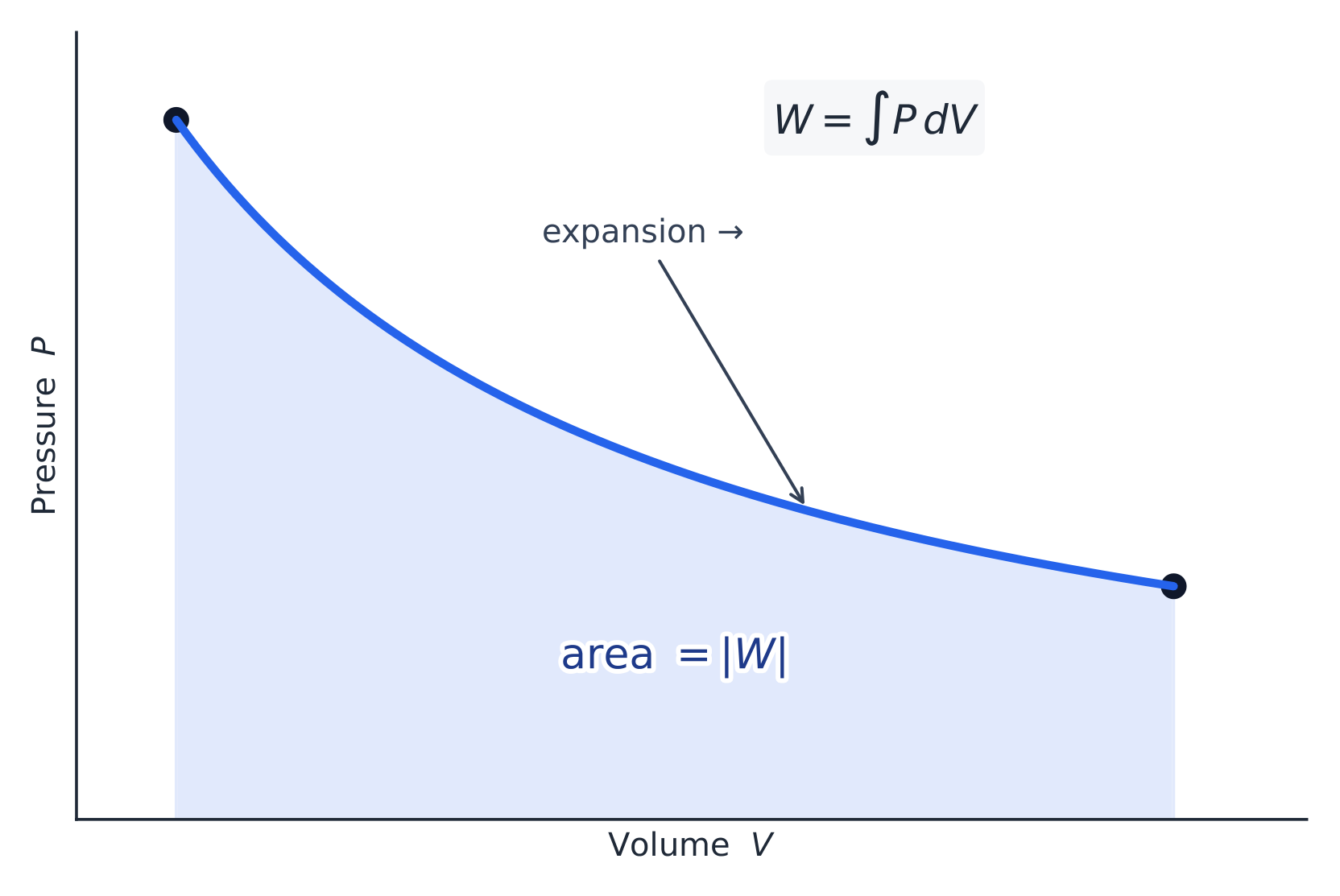
    where $\Delta U$ is the change in internal energy 内能 (tied to temperature), $Q$ is heat added to the gas, and $W$ is work done on the gas. On a pressure–volume diagram, the work done by the gas is the area under the process curve. Watch signs: compressing a gas does positive work on it.

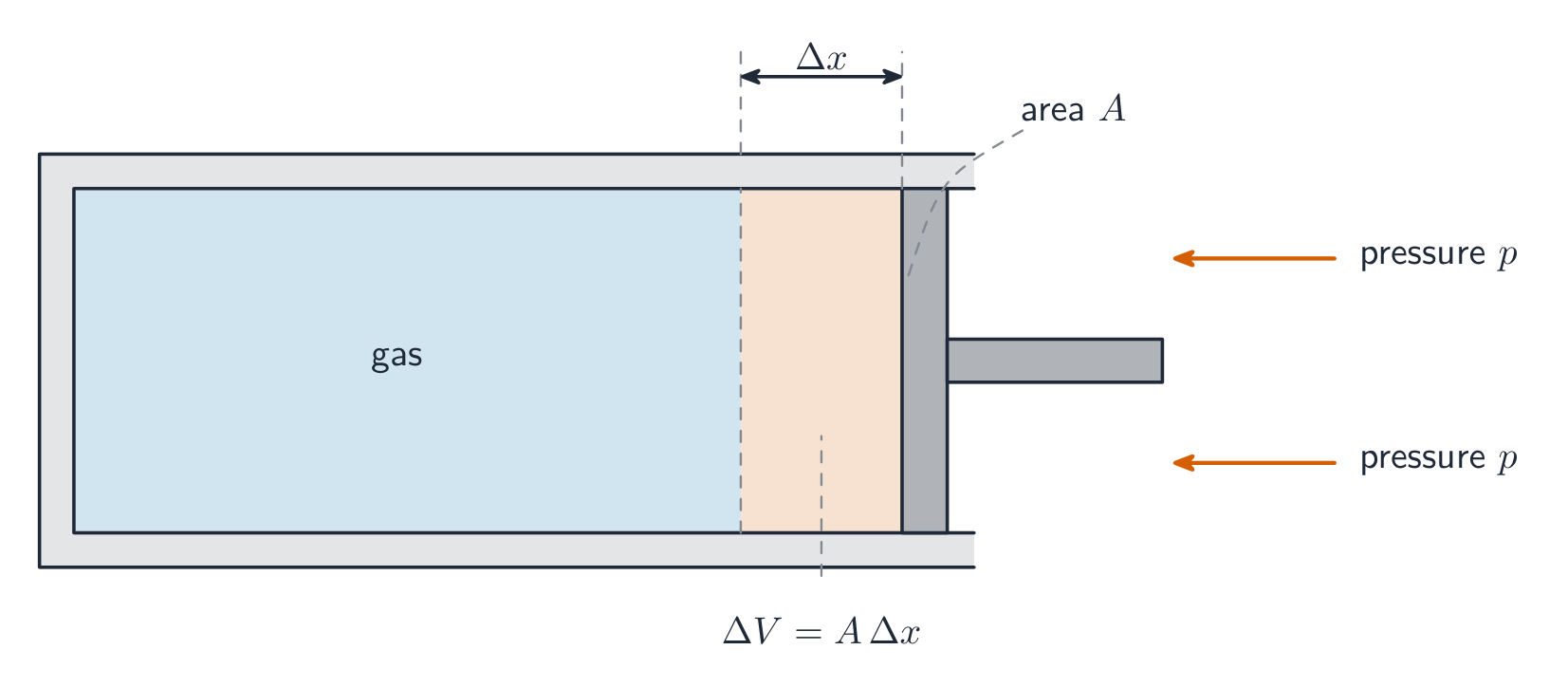
    A gas pushing a piston out by a small distance does work equal to p times the volume change
    A gas pushing a piston out by a small distance does work equal to p times the volume change
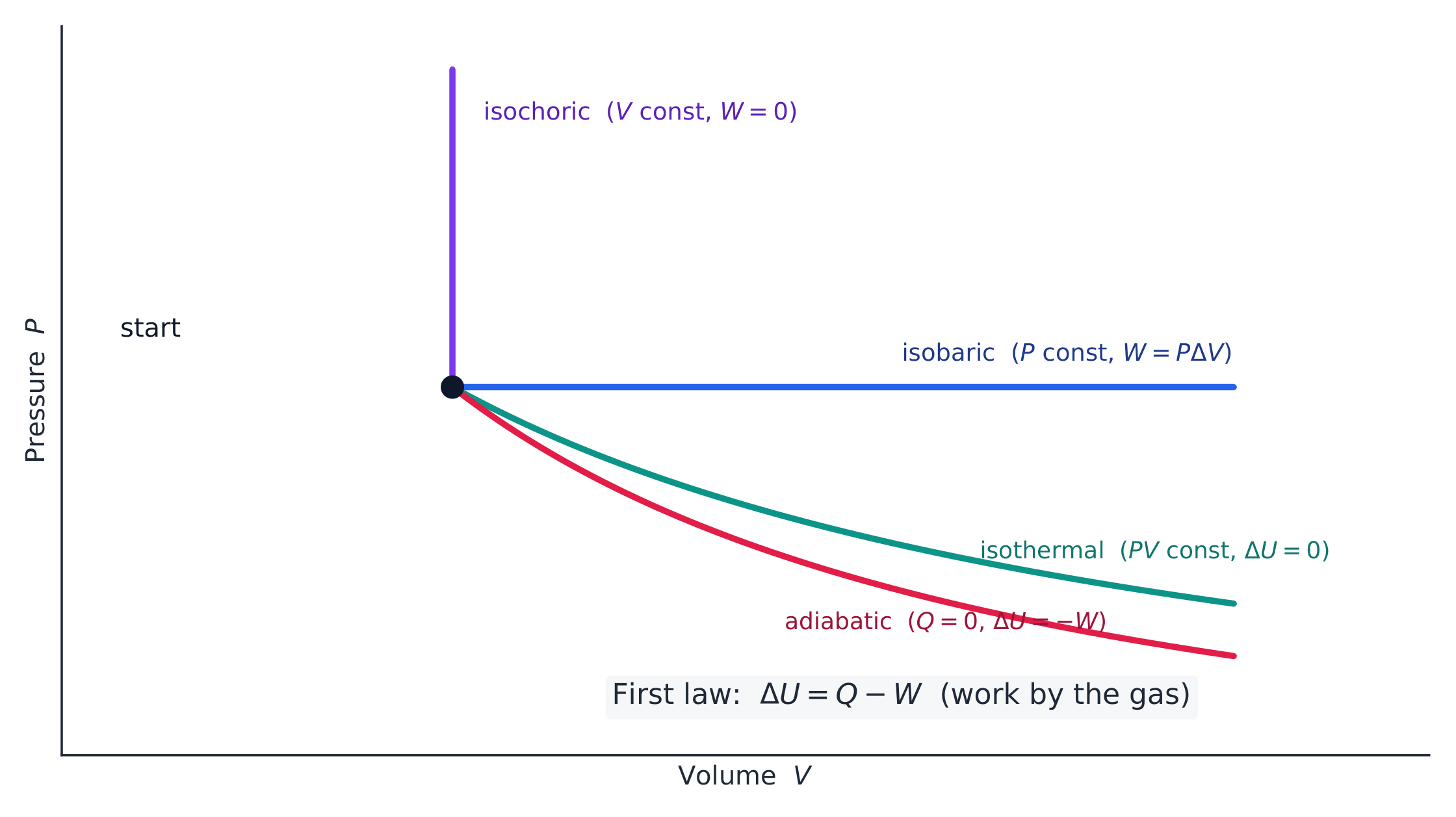
    The four thermodynamic processes drawn from a common starting state on a PV diagram
    The four thermodynamic processes drawn from a common starting state on a PV diagram
    The work done during a volume change equals the area under the P-V curve
    The work done during a volume change equals the area under the P-V curve

    Worked example. A gas absorbs $500\ \text{J}$ of heat and, as it expands, does $200\ \text{J}$ of work on its surroundings. Find the change in its internal energy. Work done on the gas is $W=-200\ \text{J}$ (it does work, so it loses that energy):

    $$\Delta U=Q+W=500+(-200)=300\ \text{J}.$$
    The internal energy rises by $300\ \text{J}$, so the gas ends up hotter. Getting the sign of $W$ right is the whole game in first-law problems.

    Vocabulary · ⁨Kosa kata⁩ Train · ⁨Latih⁩
    English Bahasa Indonesia
    first law/fɜːst lɔː/ hukum pertama
    internal energy/ɪnˈtɜːnl ˈenədʒi/ energi dalam
    9.5

    Specific Heat and Thermal Conductivity

    Syllabus · ⁨Silabus⁩
    English

    Learning Objective 9.5.A: Describe the energy required to change the temperature of an object by a certain amount.

    • 9.5.A.1 The amount of energy required to change the temperature of a material is related to the material's specific heat.
      • Equation: $Q = mc\Delta T$
    • 9.5.A.2 The specific heat of a material is an intrinsic property of that material that depends on the arrangement and interactions of the atoms that make up the material.

    Learning Objective 9.5.B: Describe the rate at which energy is transferred by conduction through a given material.

    • 9.5.B.1 The rate at which energy is transferred by conduction through a given material is related to the thermal conductivity, the physical dimensions of the material, and the temperature difference across the material.
      • Equation: $\dfrac{Q}{\Delta t} = \dfrac{kA\Delta T}{L}$
    • 9.5.B.2 The thermal conductivity of a material is an intrinsic property of that material that depends on the arrangement and interactions of the atoms that make up the material.

    Boundary statement: AP Physics 2 will model specific heat as independent of temperature.

    Bahasa Indonesia

    Tujuan Pembelajaran 9.5.A: Jelaskan energi yang diperlukan untuk mengubah suhu benda sejumlah tertentu.

    • 9.5.A.1 Jumlah energi yang diperlukan untuk mengubah suhu suatu bahan berkaitan dengan kalor jenis bahan tersebut.
      • Persamaan: $Q = mc\Delta T$
    • 9.5.A.2 Kalor jenis suatu bahan adalah sifat intrinsik dari bahan tersebut yang bergantung pada susunan dan interaksi atom-atom yang menyusun bahan.

    Tujuan Pembelajaran 9.5.B: Jelaskan laju perpindahan energi melalui konduksi melalui suatu bahan tertentu.

    • 9.5.B.1 Laju perpindahan energi melalui konduksi melalui suatu bahan tertentu berkaitan dengan konduktivitas termal, dimensi fisik bahan, dan perbedaan suhu melintasi bahan tersebut.
      • Persamaan: $\dfrac{Q}{\Delta t} = \dfrac{kA\Delta T}{L}$
    • 9.5.B.2 Konduktivitas termal suatu bahan adalah sifat intrinsik dari bahan tersebut yang bergantung pada susunan dan interaksi atom-atom yang menyusun bahan.

    Pernyataan Batas: AP Physics 2 akan memodelkan kalor jenis sebagai independen terhadap suhu.

    Source: College Board AP Course and Exam Description · ⁨Sumber: Deskripsi Kursus dan Ujian College Board AP⁩

    • Specific heat 比热容 $c$ is the heat needed to raise one kilogram by one degree: $Q=mc\,\Delta T$. A high specific heat (like water's) means a substance resists temperature change.
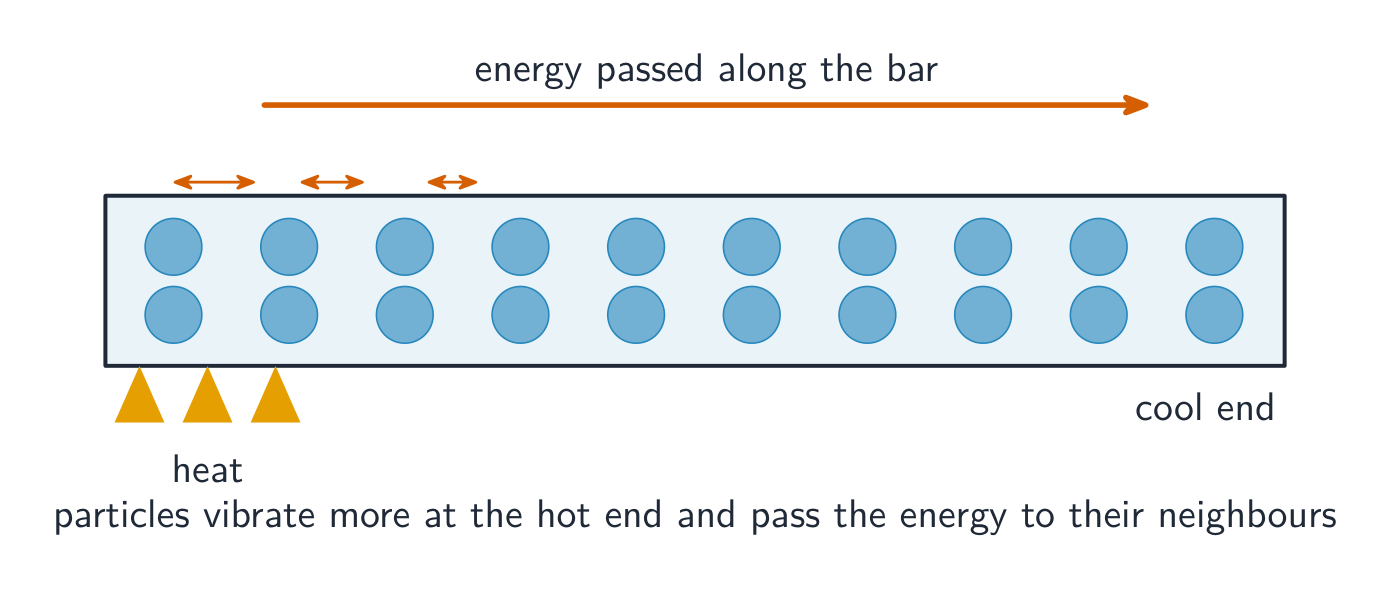
    • Thermal conductivity 热导率 measures how fast heat conducts through a material; the rate of conduction rises with area and temperature difference and falls with thickness.
    Conduction: vibrating particles pass energy along a metal bar
    Conduction: vibrating particles pass energy along a metal bar

    Worked example. How much heat raises the temperature of $2.0\ \text{kg}$ of water from $20\,{}^{\circ}\text{C}$ to $80\,{}^{\circ}\text{C}$? Water's specific heat is $c=4200\ \text{J/(kg}\,{}^{\circ}\text{C)}$:

    $$Q=mc\,\Delta T=2.0\times4200\times(80-20)=5.0\times10^{5}\ \text{J}.$$
    Water's large specific heat is why it is used as a coolant and why coastal climates are mild.

    Explore · ⁨Jelajahi⁩

    Explore how much energy heats a material · ⁨Jelajahi berapa banyak energi memanaskan suatu material⁩

    Pick a material, set the mass and temperature rise, and read the energy from $Q = mc\,\Delta T$. Water needs far more energy than the metals to warm by the same amount. · ⁨Pilih material, tetapkan massa dan kenaikan suhu, lalu baca energi dari $Q = mc\,\Delta T$. Air membutuhkan jauh lebih banyak energi daripada logam untuk dipanaskan sebesar jumlah yang sama.⁩

    Vocabulary · ⁨Kosa kata⁩ Train · ⁨Latih⁩
    English Bahasa Indonesia
    Specific heat/spəˈsɪfɪk hiːt/ Kalor spesifik
    Thermal conductivity/ˈθɜːml kɒndəkˈtɪvɪti/ Konduktivitas termal
    Watch lesson · ⁨Tonton pelajaran⁩
    9.6

    Entropy and the Second Law of Thermodynamics

    Syllabus · ⁨Silabus⁩
    English

    Learning Objective 9.6.A: Describe the change in entropy for a given system over time.

    • 9.6.A.1 The second law of thermodynamics states that the total entropy of an isolated system can never decrease and is constant only when all processes the system undergoes are reversible.
    • 9.6.A.2 Entropy can be qualitatively described as the tendency of energy to spread or the unavailability of some of the system's energy to do work.
      • 9.6.A.2.i Localized energy will tend to disperse and spread out.
      • 9.6.A.2.ii Entropy is a state function and therefore only depends on the current state or configuration of a system, not how the system reached that state.
      • 9.6.A.2.iii Maximum entropy occurs when a system is in thermodynamic equilibrium.
    • 9.6.A.3 The change in a system's entropy is determined by the system's interactions with its surroundings.
      • 9.6.A.3.i Isolated systems spontaneously move toward thermodynamic equilibrium.
      • 9.6.A.3.ii The entropy of an isolated system never decreases, but the entropy of a closed system can decrease because energy can be transferred into or out of the system.

    Boundary statement: Only qualitative treatment of the second law of thermodynamics is within the scope of AP Physics 2.

    Bahasa Indonesia

    Tujuan Pembelajaran 9.6.A: Jelaskan perubahan entropi untuk suatu sistem tertentu sepanjang waktu.

    • 9.6.A.1 Hukum kedua termodinamika menyatakan bahwa total entropi sistem terisolasi tidak pernah berkurang dan hanya konstan ketika semua proses yang dilalui sistem bersifat reversibel.
    • 9.6.A.2 Entropi dapat dijelaskan secara kualitatif sebagai kecenderungan energi untuk menyebar atau ketidaktersediaan sebagian energi sistem untuk melakukan kerja.
      • 9.6.A.2.i Energi terlokalisasi cenderung untuk tersebar dan menyebarkan diri.
      • 9.6.A.2.ii Entropi adalah fungsi keadaan sehingga hanya bergantung pada keadaan atau konfigurasi saat ini dari suatu sistem, bukan bagaimana sistem mencapai keadaan tersebut.
      • 9.6.A.2.iii Entropi maksimum terjadi ketika sistem berada dalam kesetimbangan termodinamika.
    • 9.6.A.3 Perubahan entropi sistem ditentukan oleh interaksi sistem dengan lingkungannya.
      • 9.6.A.3.i Sistem terisolasi bergerak menuju kesetimbangan termodinamika secara spontan.
      • 9.6.A.3.ii Entropi sistem terisolasi tidak pernah berkurang, tetapi entropi sistem tertutup dapat berkurang karena energi dapat ditransfer masuk atau keluar dari sistem.

    Pernyataan Batas: Hanya perlakuan kualitatif dari hukum kedua termodinamika yang berada dalam cakupan AP Physics 2.

    Source: College Board AP Course and Exam Description · ⁨Sumber: Deskripsi Kursus dan Ujian College Board AP⁩

    Entropy 熵 measures the disorder, or the number of ways to arrange, a system. The second law 热力学第二定律: the total entropy of an isolated system never decreases – energy naturally spreads out. This sets the direction of processes: heat flows hot→cold on its own, never the reverse, and no engine can convert heat entirely into work.

    Vocabulary · ⁨Kosa kata⁩ Train · ⁨Latih⁩
    English Bahasa Indonesia
    Entropy/ˈentrəpi/ Entropi
    second law/ˈsekənd lɔː/ hukum kedua
    9.6

    Exam tips

    • Always convert temperatures to kelvin ($T_{\text{K}}=T_{\text{C}}+273$) before using any gas law.
    • In the first law $\Delta U = Q + W$, get the sign of $W$ right: work done on the gas is positive; when the gas expands and does work on its surroundings, $W$ is negative.
    • Temperature measures the average kinetic energy of particles, so at the same $T$ lighter molecules move faster.
    • On a PV diagram the work done by the gas is the area under the process curve.
    • Use $Q=mc\,\Delta T$ for temperature change; the second law fixes the direction — heat flows hot→cold and total entropy never decreases.
  • 10

    Electric Force, Field, and Potential · ⁨Gaya Listrik, Medan, dan Potensial⁩

    Watch lesson · ⁨Tonton pelajaran⁩
    10.1

    Electric Charge and Electric Force · ⁨Muatan Listrik dan Gaya Listrik⁩

    Syllabus · ⁨Silabus⁩
    English

    Learning Objective 10.1.A: Describe the electric force that results from the interactions between charged objects or systems.

    • 10.1.A.1 Charge is a fundamental property of all matter.
      • 10.1.A.1.i Charge is described as positive or negative.
      • 10.1.A.1.ii The magnitude of the charge of a single electron or proton, the elementary charge $e$, can be considered to be the smallest indivisible amount of charge.
      • 10.1.A.1.iii The charge of an electron is $-e$, the charge of a proton is $+e$, and a neutron has no electric charge.
      • 10.1.A.1.iv A point charge is a model in which the physical size of a charged object or system is negligible in the context of the situation being analyzed.
    • 10.1.A.2 Coulomb's law describes the electrostatic force between two charged objects as directly proportional to the magnitude of each of the charges and inversely proportional to the square of the distance between the objects.
      • Equation: $\left|\vec{F}_E\right| = \dfrac{1}{4\pi\varepsilon_0}\dfrac{\left|q_1 q_2\right|}{r^2} = k\dfrac{\left|q_1 q_2\right|}{r^2}$
    • 10.1.A.3 The direction of the electrostatic force depends on the signs of the charges of the interacting objects and is parallel to the line of separation between the objects.
      • 10.1.A.3.i Two objects with charges of the same sign exert repulsive forces on each other.
      • 10.1.A.3.ii Two objects with charges of opposite signs exert attractive forces on each other.
    • 10.1.A.4 Electric forces are responsible for some of the macroscopic properties of objects in everyday experiences. However, the large number of particle interactions that occur make it more convenient to treat everyday forces in terms of nonfundamental forces called contact forces, such as normal force, friction, and tension.

    Learning Objective 10.1.B: Describe the electric and gravitational forces that result from interactions between charged objects with mass.

    • 10.1.B.1 Electrostatic forces can be attractive or repulsive, while gravitational forces are always attractive.
    • 10.1.B.2 For any two objects that have mass and electric charge, the magnitude of the gravitational force is usually much smaller than the magnitude of the electrostatic force.
    • 10.1.B.3 Gravitational forces dominate at larger scales even though they are weaker than electrostatic forces, because systems at large scales tend to be electrically neutral.

    Learning Objective 10.1.C: Describe the electric permittivity of a material or medium.

    • 10.1.C.1 Electric permittivity is a measurement of the degree to which a material or medium is polarized in the presence of an electric field.
    • 10.1.C.2 Electric polarization can be modeled as the induced rearrangement of electrons by an external electric field, resulting in a separation of positive and negative charges within a material or medium.
    • 10.1.C.3 Free space has a constant value of electric permittivity, $\varepsilon_0$, that appears in physical relationships.
    • 10.1.C.4 The permittivity of matter has a value different from that of free space that arises from the matter's composition and arrangement.
      • 10.1.C.4.i In a given material, electric permittivity is determined by the ease with which electrons can change configurations within the material.
      • 10.1.C.4.ii Conductors are made from electrically conducting materials in which charge carriers move easily; insulators are made from electrically nonconducting materials in which charge carriers cannot move easily.

    Boundary statement: AP Physics 2 only expects students to make calculations of the electric force between four or fewer interacting charged objects or systems. The analysis of the resulting electric force from more charges is allowed in situations of high symmetry.

    Bahasa Indonesia

    Tujuan Pembelajaran 10.1.A: Jelaskan gaya listrik yang timbul dari interaksi antara benda atau sistem bermuatan.

    • 10.1.A.1 Muatan adalah sifat fundamental dari semua materi.
      • 10.1.A.1.i Muatan digambarkan sebagai positif atau negatif.
      • 10.1.A.1.ii Besar muatan satu elektron atau proton, yaitu muatan elementer $e$, dapat dianggap sebagai jumlah muatan terkecil yang tak terbagi.
      • 10.1.A.1.iii Muatan elektron adalah $-e$, muatan proton adalah $+e$, dan neutron tidak memiliki muatan listrik.
      • 10.1.A.1.iv Muatan titik adalah model di mana ukuran fisik objek atau sistem bermuatan dianggap sangat kecil dalam konteks situasi yang sedang dianalisis.
    • 10.1.A.2 Hukum Coulomb menggambarkan gaya elektrostatik antara dua benda bermuatan sebagai berbanding lurus dengan besar masing-masing muatan dan berbanding terbalik dengan kuadrat jarak antar benda.
      • Persamaan: $\left|\vec{F}_E\right| = \dfrac{1}{4\pi\varepsilon_0}\dfrac{\left|q_1 q_2\right|}{r^2} = k\dfrac{\left|q_1 q_2\right|}{r^2}$
    • 10.1.A.3 Arah gaya elektrostatik bergantung pada tanda-tanda muatan benda-benda yang berinteraksi dan sejajar dengan garis pemisah antara benda-benda tersebut.
      • 10.1.A.3.i Dua benda dengan muatan bertanda sama saling mendorong (gaya tolak-menolak).
      • 10.1.A.3.ii Dua benda dengan muatan bertanda berbeda saling menarik (gaya tarik-menarik).
    • 10.1.A.4 Gaya listrik bertanggung jawab atas beberapa sifat makroskopis objek dalam pengalaman sehari-hari. Namun, banyaknya interaksi partikel yang terjadi membuat lebih praktis untuk memperlakukan gaya-gaya sehari-hari dalam istilah gaya non-fundamental yang disebut gaya kontak, seperti gaya normal, gesekan, dan tegangan.

    Tujuan Pembelajaran 10.1.B: Jelaskan gaya listrik dan gravitasi yang timbul dari interaksi antara benda bermuatan dengan massa.

    • 10.1.B.1 Gaya elektrostatik bisa bersifat tarik-menarik atau tolak-menolak, sementara gaya gravitasi selalu bersifat tarik-menarik.
    • 10.1.B.2 Untuk dua objek apa pun yang memiliki massa dan muatan listrik, besaran gaya gravitasi biasanya jauh lebih kecil daripada besaran gaya elektrostatik.
    • 10.1.B.3 Gaya gravitasi mendominasi pada skala yang lebih besar meskipun lebih lemah daripada gaya elektrostatik, karena sistem pada skala besar cenderung netral secara listrik.

    Tujuan Pembelajaran 10.1.C: Jelaskan permitivitas listrik suatu bahan atau medium.

    • 10.1.C.1 Permitivitas listrik adalah ukuran sejauh mana suatu bahan atau medium terpolarisasi di hadapan medan listrik.
    • 10.1.C.2 Polarisasi listrik dapat dimodelkan sebagai pengaturan ulang elektron yang diinduksi oleh medan listrik eksternal, menghasilkan pemisahan muatan positif dan negatif di dalam suatu bahan atau medium.
    • 10.1.C.3 Ruang hampa memiliki nilai konstan permitivitas listrik, $\varepsilon_0$, yang muncul dalam hubungan fisik.
    • 10.1.C.4 Permitivitas materi memiliki nilai berbeda dari ruang hampa yang timbul dari komposisi dan susunan materinya.
      • 10.1.C.4.i Dalam suatu bahan tertentu, permitivitas listrik ditentukan oleh kemudahan elektron untuk mengubah konfigurasi di dalam bahan tersebut.
      • 10.1.C.4.ii Konduktor dibuat dari bahan penghantar listrik di mana pembawa muatan bergerak dengan mudah; isolator dibuat dari bahan non-penghantar listrik di mana pembawa muatan tidak dapat bergerak dengan mudah.

    Pernyataan Batasan: AP Fisika 2 hanya mengharapkan siswa melakukan perhitungan gaya listrik antara empat objek bermuatan atau sistem berinteraksi atau kurang. Analisis gaya listrik yang dihasilkan dari lebih banyak muatan diperbolehkan dalam situasi simetri tinggi.

    Source: College Board AP Course and Exam Description · ⁨Sumber: Deskripsi Kursus dan Ujian College Board AP⁩

    English

    Electric charge 电荷 is a fundamental property of matter, and it comes in two kinds, positive and negative; like charges repel and opposite charges attract. Charge is conserved and quantized (a multiple of the elementary charge $e$). The force between two point charges is Coulomb's law 库仑定律:

    $$F=\frac{k q_1 q_2}{r^2},$$
    directed along the line joining them – an inverse-square law like gravity, but it can push or pull.

    The constant $k$ hides a property of the medium: the permittivity 介电常数. Free space has a fixed permittivity of free space $\varepsilon_0$ (with $k = 1/4\pi\varepsilon_0$), while the permittivity of matter differs from $\varepsilon_0$, depending on the material's composition and arrangement - which is why a material between two charges changes the force. Note also that although the electric force is vastly stronger than gravity, gravity dominates at large scales, because large objects are usually electrically neutral (equal + and −), leaving only gravity to act.

    Worked example. Two point charges, $+3.0\ \mu\text{C}$ and $-2.0\ \mu\text{C}$, sit $0.10\ \text{m}$ apart ($k=9.0\times10^{9}$). The force between them is

    $$F=\frac{k q_1 q_2}{r^2}=\frac{9.0\times10^{9}\times(3.0\times10^{-6})(2.0\times10^{-6})}{(0.10)^2}=5.4\ \text{N},$$
    attractive, because the charges have opposite signs. (Use the magnitudes for the size and decide the direction from the signs.)

    Bahasa Indonesia

    Muatan listrik adalah sifat fundamental materi, dan tersedia dalam dua jenis, positif dan negatif; muatan sejenis tolak-menolak dan muatan berlawanan tarik-menarik. Muatan terjaga dan terkuantisasi (kelipatan dari muatan elementer $e$). Gaya antara dua muatan titik adalah hukum Coulomb:

    $$F=\frac{k q_1 q_2}{r^2},$$
    berarah sepanjang garis penghubung mereka – hukum kuadrat terbalik seperti gravitasi, tetapi bisa mendorong atau menarik.

    Konstanta $k$ menyembunyikan sifat medium: permitivitas. Ruang hampa memiliki permitivitas ruang hampa tetap $\varepsilon_0$ (dengan $k = 1/4\pi\varepsilon_0$), sementara permitivitas materi berbeda dari $\varepsilon_0$, tergantung komposisi dan susunan material – itulah sebabnya material di antara dua muatan mengubah gaya. Perhatikan juga bahwa meskipun gaya listrik jauh lebih kuat daripada gravitasi, gravitasi mendominasi pada skala besar, karena objek besar biasanya netral secara elektrik (+ dan − setara), menyisakan hanya gravitasi yang bekerja.

    Contoh terpecahkan. Dua muatan titik, $+3.0\ \mu\text{C}$ dan $-2.0\ \mu\text{C}$, terletak $0.10\ \text{m}$ jaraknya ($k=9.0\times10^{9}$). Gaya di antara keduanya adalah

    $$F=\frac{k q_1 q_2}{r^2}=\frac{9.0\times10^{9}\times(3.0\times10^{-6})(2.0\times10^{-6})}{(0.10)^2}=5.4\ \text{N},$$
    menarik, karena muatan memiliki tanda berlawanan. (Gunakan besaran untuk ukuran dan tentukan arah dari tanda.)

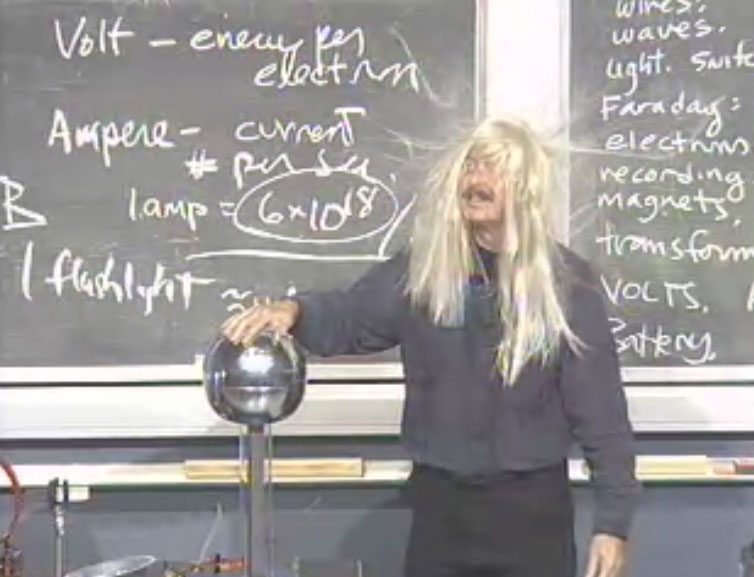
    Seseorang menyentuh generator Van de Graaff dengan rambut berdiri tegak
    Muatan sejenis tolak-menolak: setiap helai rambut membawa muatan yang sama dari generator Van de Graaff, sehingga saling mendorong
    10.2

    The Process of Charging · ⁨Proses Pengisian⁩

    Syllabus · ⁨Silabus⁩
    English

    Learning Objective 10.2.A: Describe the behavior of a system using conservation of charge.

    • 10.2.A.1 The net charge or charge distribution of a system can change in response to the presence of, or changes in, the net charge or charge distribution of other systems.
      • 10.2.A.1.i The net charge of a system can change due to friction or contact between systems.
      • 10.2.A.1.ii Induced charge separation occurs when the electrostatic force between two systems alters the distribution of charges within the systems, resulting in the polarization of one or both systems.
      • 10.2.A.1.iii Induced charge separation can occur in neutral systems.
    • 10.2.A.2 Any change to a system's net charge is due to a transfer of charge between the system and its surroundings.
      • 10.2.A.2.i The charging of a system typically involves the transfer of electrons to and from the system.
      • 10.2.A.2.ii The net charge of a system will be constant unless there is a transfer of charge to or from the system.
    • 10.2.A.3 Grounding involves electrically connecting a charged system to a much larger and approximately neutral system (e.g., Earth).
    Bahasa Indonesia

    Tujuan Pembelajaran 10.2.A: Jelaskan perilaku sistem menggunakan kekekalan muatan.

    • 10.2.A.1 Muatan bersih atau distribusi muatan sistem dapat berubah sebagai respons terhadap keberadaan, atau perubahan, muatan bersih atau distribusi muatan sistem lain.
      • 10.2.A.1.i Muatan bersih sistem dapat berubah akibat gesekan atau kontak antar sistem.
      • 10.2.A.1.ii Pemisahan muatan terinduksi terjadi ketika gaya elektrostatik antara dua sistem mengubah distribusi muatan di dalam sistem, menghasilkan polarisasi satu atau kedua sistem.
      • 10.2.A.1.iii Pemisahan muatan terinduksi dapat terjadi pada sistem netral.
    • 10.2.A.2 Setiap perubahan pada muatan bersih suatu sistem disebabkan oleh perpindahan muatan antara sistem dan lingkungannya.
      • 10.2.A.2.i Pengisian sistem biasanya melibatkan perpindahan elektron masuk dan keluar dari sistem.
      • 10.2.A.2.ii Muatan bersih sistem akan tetap konstan kecuali ada perpindahan muatan masuk atau keluar dari sistem.
    • 10.2.A.3 Pembumian melibatkan koneksi listrik sistem bermuatan ke sistem yang jauh lebih besar dan hampir netral (misalnya, Bumi).

    Source: College Board AP Course and Exam Description · ⁨Sumber: Deskripsi Kursus dan Ujian College Board AP⁩

    English

    Objects charge by moving electrons. A conductor 导体 lets charge move freely; an insulator 绝缘体 holds it in place. Three methods:

    • Friction: rubbing transfers electrons.
    • Conduction 接触起电: touching shares charge.
    • Induction 感应起电: a nearby charge rearranges charge in a neutral object, which can then be grounded to leave it charged.
    Bahasa Indonesia

    Objek bermuatan dengan memindahkan elektron. Konduktor membiarkan muatan bergerak bebas; isolator menahannya di tempat. Tiga metode:

    • Fricion (gesekan): gesekan memindahkan elektron.
    • Konduksi: sentuhan membagikan muatan.
    • Induksi: muatan dekat menyusun ulang muatan dalam objek netral, yang kemudian dapat dibumikan untuk menyisakan muatan padanya.
    Explore · ⁨Jelajahi⁩

    Charge an object by rubbing · ⁨Muati objek dengan menggosok⁩

    Rubbing transfers electrons from one surface to another, leaving one positively and one negatively charged. Like charges repel, opposite charges attract. · ⁨Penggosokan mentransfer elektron dari satu permukaan ke permukaan lain, meninggalkan satu positif dan satu negatif bermuatan. Muatan sejenis tolak, muatan berlawanan tarik.⁩

    10.3

    Electric Fields · ⁨Medan Listrik⁩

    Syllabus · ⁨Silabus⁩
    English

    Learning Objective 10.3.A: Describe the electric field produced by a charged object or configuration of point charges.

    • 10.3.A.1 Electric fields may originate from charged objects.
    • 10.3.A.2 The electric field at a given point is the ratio of the electric force exerted on a test charge at that point to the charge of the test charge.
      • Equation: $\vec{E} = \dfrac{\vec{F}_E}{q}$
      • 10.3.A.2.i A test charge is a point charge of small enough magnitude such that its presence does not significantly affect an electric field in its vicinity.
      • 10.3.A.2.ii An electric field points away from isolated positive charges and toward isolated negative charges.
      • 10.3.A.2.iii The electric force exerted on a positive test charge by an electric field is in the same direction as the electric field.
    • 10.3.A.3 The electric field is a vector quantity and can be represented in space using vector field maps.
      • 10.3.A.3.i The net electric field at a given location is the vector sum of individual electric fields created by nearby charged objects.
      • 10.3.A.3.ii Electric field maps use vectors to depict the magnitude and direction of the electric field at many locations within a given region.
      • 10.3.A.3.iii Electric field line diagrams are simplified models of electric field maps and can be used to determine the relative magnitude and direction of the electric field at any position in the diagram.

    Learning Objective 10.3.B: Describe the electric field generated by charged conductors or insulators.

    • 10.3.B.1 While in electrostatic equilibrium, the excess charge of a solid conductor is distributed on the surface of the conductor, and the electric field within the conductor is zero.
      • 10.3.B.1.i At the surface of a charged conductor, the electric field is perpendicular to the surface.
      • 10.3.B.1.ii The electric field outside an isolated sphere with spherically symmetric charge distribution is the same as the electric field due to a point charge with the same net charge as the sphere located at the center of the sphere.
    • 10.3.B.2 While in electrostatic equilibrium, the excess charge of an insulator is distributed throughout the interior of the insulator as well as at the surface, and the electric field within the insulator may have a nonzero value.

    Boundary statement: AP Physics 2 only expects students to make calculations of the electric field resulting from four or fewer charged objects or systems. Analysis of the electric field resulting from more charges is allowed in situations of high symmetry. Students will only be expected to perform qualitative analysis of electric fields within insulators.

    Bahasa Indonesia

    Tujuan Pembelajaran 10.3.A: Jelaskan medan listrik yang dihasilkan oleh benda bermuatan atau konfigurasi muatan titik.

    • 10.3.A.1 Medan listrik dapat berasal dari benda-benda bermuatan.
    • 10.3.A.2 Medan listrik pada suatu titik adalah rasio gaya listrik yang diberikan pada muatan uji di titik tersebut terhadap muatan muatan uji.
      • Persamaan: $\vec{E} = \dfrac{\vec{F}_E}{q}$
      • 10.3.A.2.i Muatan uji adalah muatan titik dengan besaran cukup kecil sehingga keberadaannya tidak secara signifikan memengaruhi medan listrik di sekitarnya.
      • 10.3.A.2.ii Medan listrik mengarah menjauhi muatan positif terisolasi dan menuju muatan negatif terisolasi.
      • 10.3.A.2.iii Gaya listrik yang diberikan pada muatan uji positif oleh medan listrik berada pada arah yang sama dengan medan listrik.
    • 10.3.A.3 Medan listrik adalah besaran vektor dan dapat direpresentasikan dalam ruang menggunakan peta medan vektor.
      • 10.3.A.3.i Medan listrik total pada lokasi tertentu adalah hasil penjumlahan vektor dari medan listrik individu yang diciptakan oleh objek-objek bermuatan di dekatnya.
      • 10.3.A.3.ii Peta medan listrik menggunakan vektor untuk menggambarkan besaran dan arah medan listrik di banyak lokasi dalam suatu daerah tertentu.
      • 10.3.A.3.iii Diagram garis medan listrik adalah model sederhana dari peta medan listrik dan dapat digunakan untuk menentukan besaran relatif dan arah medan listrik pada posisi mana pun dalam diagram.

    Tujuan Pembelajaran 10.3.B: Jelaskan medan listrik yang dihasilkan oleh konduktor atau isolator bermuatan.

    • 10.3.B.1 Saat dalam kesetimbangan elektrostatik, kelebihan muatan konduktor solid terdistribusi pada permukaan konduktor, dan medan listrik di dalam konduktor adalah nol.
      • 10.3.B.1.i Di permukaan konduktor bermuatan, medan listrik tegak lurus terhadap permukaan.
      • 10.3.B.1.ii Medan listrik di luar bola terisolasi dengan distribusi muatan simetris bola adalah sama dengan medan listrik akibat muatan titik dengan jumlah muatan bersih yang sama dengan bola yang terletak di pusat bola.
    • 10.3.B.2 Saat dalam kesetimbangan elektrostatik, kelebihan muatan isolator terdistribusi di seluruh bagian dalam isolator serta di permukaannya, dan medan listrik di dalam isolator mungkin memiliki nilai tak nol.

    Pernyataan Batasan: AP Fisika 2 hanya mengharapkan siswa melakukan perhitungan medan listrik yang dihasilkan dari empat objek bermuatan atau sistem atau kurang. Analisis medan listrik yang dihasilkan dari lebih banyak muatan diperbolehkan dalam situasi simetri tinggi. Siswa hanya diharapkan melakukan analisis kualitatif medan listrik di dalam isolator.

    Source: College Board AP Course and Exam Description · ⁨Sumber: Deskripsi Kursus dan Ujian College Board AP⁩

    English
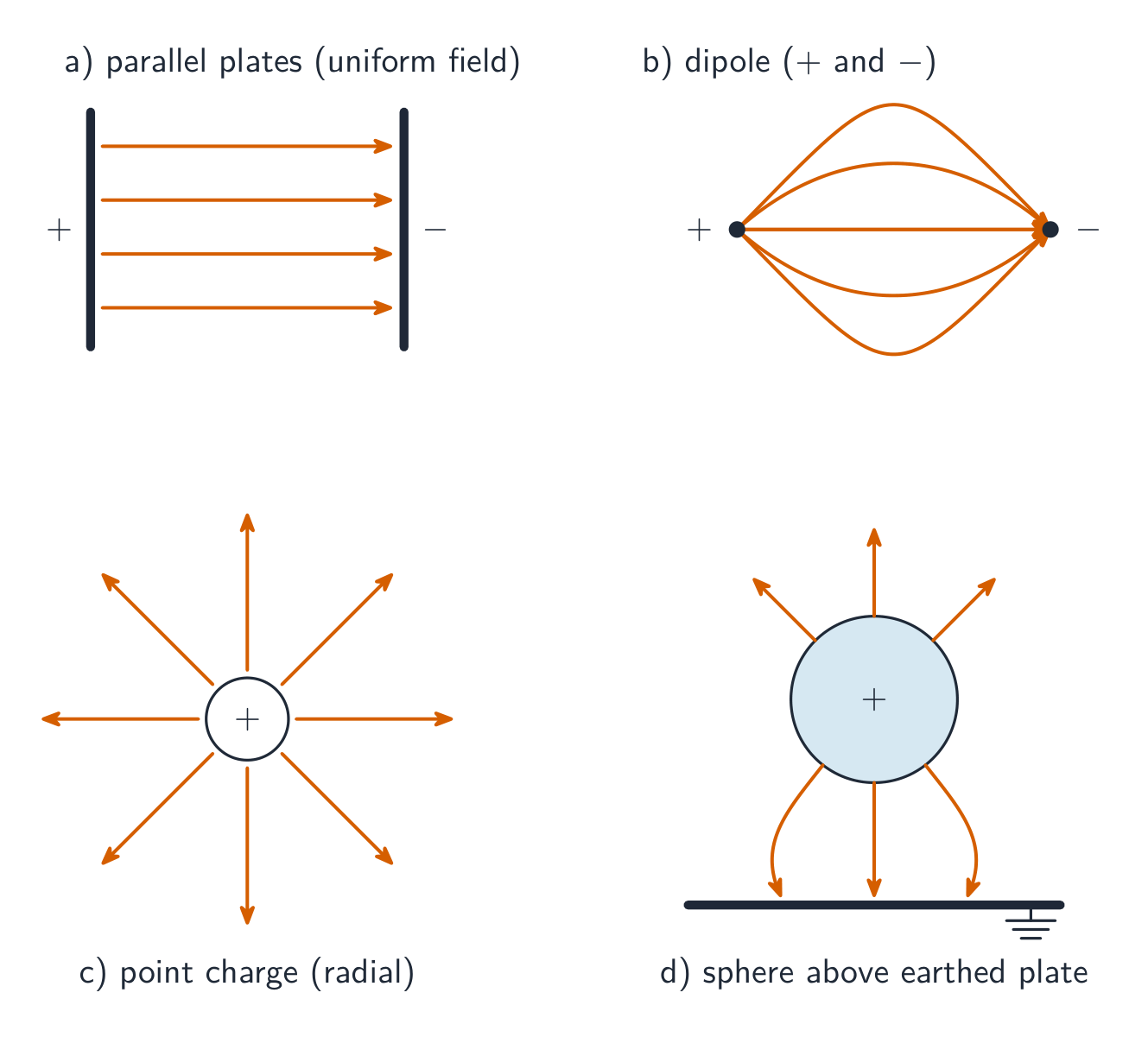
    The electric field of a dipole

    An electric field 电场 $\vec{E}$ is the force per unit charge that a small positive test charge would feel:

    $$\vec{E}=\frac{\vec{F}}{q},\qquad E=\frac{kQ}{r^2}\ \text{for a point charge}.$$
    Field lines point away from positive charges and toward negative ones; where they are denser, the field is stronger. A charge in a field feels $\vec{F}=q\vec{E}$.

    Worked example. Find the electric field $0.20\ \text{m}$ from a $+5.0\ \mu\text{C}$ point charge: $E=\dfrac{kQ}{r^2}=\dfrac{9.0\times10^{9}\times5.0\times10^{-6}}{(0.20)^2}=1.1\times10^{6}\ \text{N/C}$, pointing away from the charge. A $+2\ \text{nC}$ charge placed there would feel $F=qE=2\times10^{-9}\times1.1\times10^{6}=2.2\times10^{-3}\ \text{N}$.

    Bahasa Indonesia
    Medan listrik dari sebuah dipol
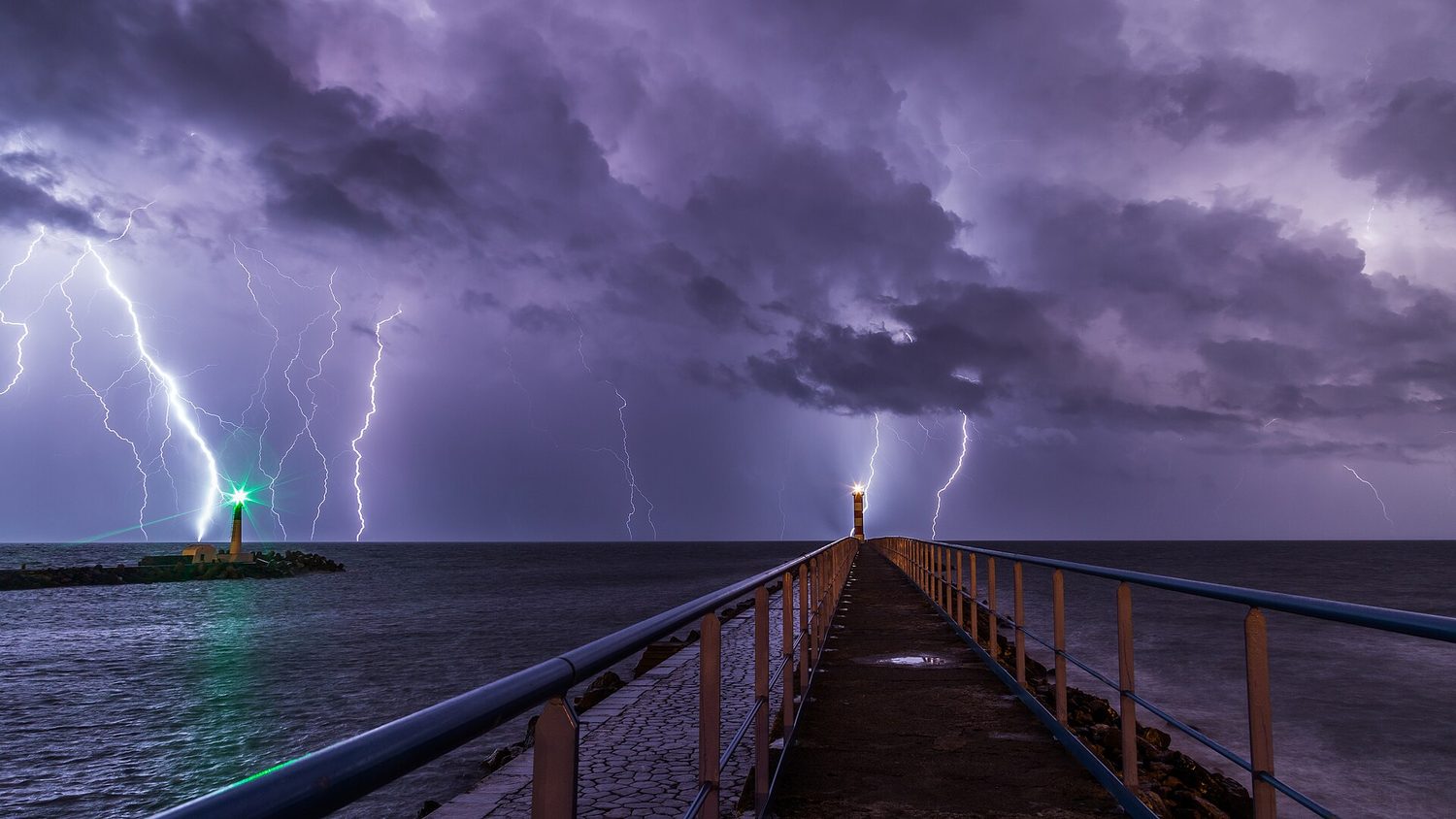
    Beberapa petir bercabang terang menyambar dari langit mendung ke pelabuhan
    Petir: muatan terkumpul hingga medan listrik antara awan dan tanah cukup kuat untuk melepaskan elektron dari molekul udara, dan arus besar mengalir

    Medan listrik $\vec{E}$ adalah gaya per satuan muatan yang akan dirasakan oleh muatan uji positif kecil:

    $$\vec{E}=\frac{\vec{F}}{q},\qquad E=\frac{kQ}{r^2}\ \text{for a point charge}.$$
    Garis-garis medan mengarah menjauhi muatan positif dan menuju ke muatan negatif; di mana garis lebih padat, medan lebih kuat. Muatan dalam medan merasakan $\vec{F}=q\vec{E}$.

    Pola garis medan listrik untuk pelat sejajar, dipol, dan muatan titik
    Pola garis medan listrik untuk pelat sejajar, dipol, dan muatan titik

    Contoh terpecahkan. Temukan medan listrik $0.20\ \text{m}$ dari muatan titik $+5.0\ \mu\text{C}$: $E=\dfrac{kQ}{r^2}=\dfrac{9.0\times10^{9}\times5.0\times10^{-6}}{(0.20)^2}=1.1\times10^{6}\ \text{N/C}$, mengarah menjauhi muatan. Muatan $+2\ \text{nC}$ yang diletakkan di sana akan merasakan $F=qE=2\times10^{-9}\times1.1\times10^{6}=2.2\times10^{-3}\ \text{N}$.

    Explore · ⁨Jelajahi⁩

    Map the field around a charge · ⁨Peta medan di sekitar muatan⁩

    An electric field points the way a positive test charge would be pushed: away from a positive charge, toward a negative one. Closer lines mean a stronger field. · ⁨Medan listrik menunjukkan arah dorongan terhadap muatan uji positif: menjauhi muatan positif, menuju muatan negatif. Garis yang lebih rapat berarti medan yang lebih kuat.⁩

    Vocabulary · ⁨Kosa kata⁩ Train · ⁨Latih⁩
    English Bahasa Indonesia
    Electric charge/ɪˈlektrɪk tʃɑːdʒ/ Muatan listrik
    Coulomb's law/ˈkuːlɒmz lɔː/ Hukum Coulomb
    permittivity/ˌpɜːmɪˈtɪvəti/ permitivitas
    conductor/kənˈdʌktə/ konduktor
    insulator/ˈɪnsjuːleɪtə/ isolator
    Conduction/kənˈdʌkʃn/ Konduksi
    Induction/ɪnˈdʌkʃn/ Orientasi
    electric field/ɪˈlektrɪk fiːld/ medan listrik
    electric potential energy/ɪˈlektrɪk pəˈtenʃl ˈenədʒi/ energi potensial listrik
    Electric potential/ɪˈlektrɪk pəˈtenʃl/ Potensi elektrik
    10.4

    Electric Potential Energy · ⁨Energi Potensial Listrik⁩

    Syllabus · ⁨Silabus⁩
    English

    Learning Objective 10.4.A: Describe the electric potential energy of a system.

    • 10.4.A.1 The electric potential energy of a system of two point charges equals the amount of work required for an external force to bring the point charges to their current positions from infinitely far away.
    • 10.4.A.2 The general form for the electric potential energy of two charged objects is given by the equation
      • Equation: $U_E = \dfrac{1}{4\pi\varepsilon_0}\dfrac{q_1 q_2}{r} = k\dfrac{q_1 q_2}{r}$
    • 10.4.A.3 The total electric potential energy of a system can be determined by finding the sum of the electric potential energies of the individual interactions between each pair of charged objects in the system.

    Boundary statement: As the methods to calculate the electric potential energy due to extended charge distributions exceed the scope of the course, AP Physics 2 only requires that students calculate the electric potential energy of configurations of four or fewer point charges.

    Bahasa Indonesia

    Tujuan Pembelajaran 10.4.A: Jelaskan energi potensial listrik dari suatu sistem.

    • 10.4.A.1 Energi potensial listrik dari sistem dua muatan titik sama dengan jumlah kerja yang diperlukan oleh gaya eksternal untuk membawa muatan titik tersebut ke posisi saat ini dari jarak tak hingga.
    • 10.4.A.2 Bentuk umum untuk energi potensial listrik dari dua benda bermuatan diberikan oleh persamaan
      • Persamaan: $U_E = \dfrac{1}{4\pi\varepsilon_0}\dfrac{q_1 q_2}{r} = k\dfrac{q_1 q_2}{r}$
    • 10.4.A.3 Total energi potensial listrik dari suatu sistem dapat ditentukan dengan mencari jumlah energi potensial listrik dari interaksi individual antara setiap pasangan benda bermuatan dalam sistem tersebut.

    Pernyataan Batas: Karena metode untuk menghitung energi potensial listrik akibat distribusi muatan yang meluas melebihi jangkauan kurikulum, AP Physics 2 hanya mensyaratkan siswa untuk menghitung energi potensial listrik dari konfigurasi empat atau lebih sedikit muatan titik.

    Source: College Board AP Course and Exam Description · ⁨Sumber: Deskripsi Kursus dan Ujian College Board AP⁩

    English

    Two charges have electric potential energy 电势能 stored in their arrangement:

    $$U=\frac{k q_1 q_2}{r}.$$
    Like charges pushed together store positive energy; opposite charges have negative energy (bound). Moving a charge changes $U$, and the electric force does work equal to $-\Delta U$.

    Bahasa Indonesia

    Dua muatan memiliki energi potensial listrik yang tersimpan dalam susunannya:

    $$U=\frac{k q_1 q_2}{r}.$$
    Muatan sejenis yang didorong bersama menyimpan energi positif; muatan berlawanan memiliki energi negatif (terikat). Memindahkan muatan mengubah $U$, dan gaya listrik melakukan usaha sama dengan $-\Delta U$.

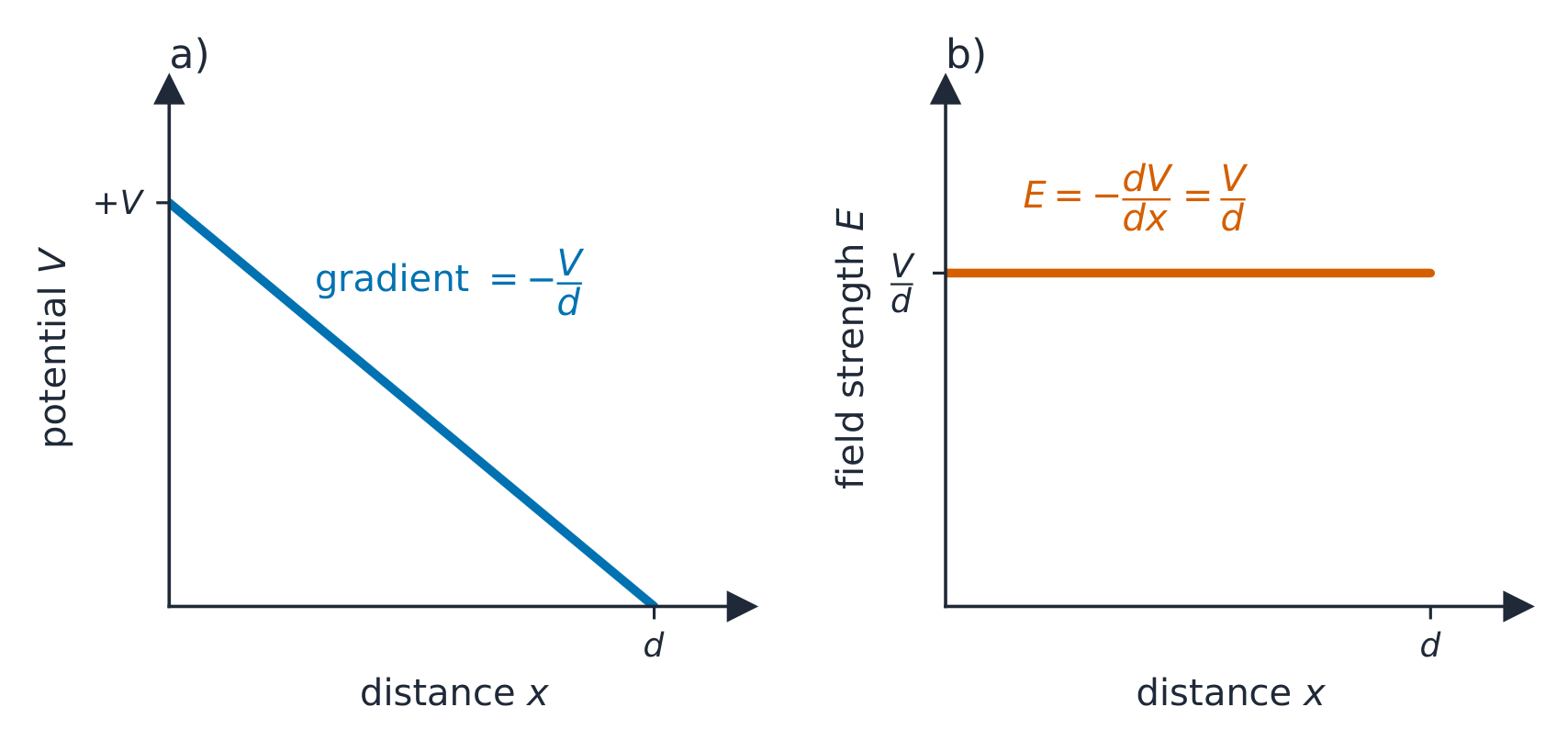
    Dalam medan seragam, potensial menurun secara teratur seiring jarak, sehingga E berkaitan dengan V
    Dalam medan seragam, potensial menurun secara teratur seiring jarak, sehingga E berkaitan dengan V
    10.5

    Electric Potential · ⁨Potensial Listrik⁩

    Syllabus · ⁨Silabus⁩
    English

    Learning Objective 10.5.A: Describe the electric potential due to a configuration of charged objects.

    • 10.5.A.1 Electric potential describes the electric potential energy per unit charge at a point in space.
    • 10.5.A.2 The electric potential due to multiple point charges can be determined by the principle of scalar superposition of the electric potential due to each of the point charges.
      • Equation: $V = \dfrac{1}{4\pi\varepsilon_0}\sum_{i}\dfrac{q_i}{r_i}$
    • 10.5.A.3 The electric potential difference between two points is the change in electric potential energy per unit charge when a test charge is moved between the two points.
      • Equation: $\Delta V = \dfrac{\Delta U_E}{q}$
      • 10.5.A.3.i Electric potential difference may also result from chemical processes that cause positive and negative charges to separate, such as in a battery.
    • 10.5.A.4 When conductors are in electrical contact, electrons will be redistributed such that the surfaces of the conductors are at the same electric potential.

    Learning Objective 10.5.B: Describe the relationship between electric potential and electric field.

    • 10.5.B.1 The average electric field between two points in space is equal to the electric potential difference between the two points divided by the distance between the two points.
      • Equation: $\left|\vec{E}\right| = \left|\dfrac{\Delta V}{\Delta r}\right|$
    • 10.5.B.2 Electric field vector maps and equipotential lines are tools to describe the field produced by a charge or configuration of charges and can be used to predict the motion of charged objects in the field.
      • 10.5.B.2.i Equipotential lines represent lines of equal electric potential in space. These lines are also referred to as isolines of electric potential.
      • 10.5.B.2.ii Isolines are perpendicular to electric field vectors. An isoline map of electric potential can be constructed from an electric field vector map, and an electric field map may be constructed from an isoline map.
      • 10.5.B.2.iii An electric field vector points in the direction of decreasing potential.
      • 10.5.B.2.iv There is no component of an electric field along an isoline.

    Boundary statement: As the methods to calculate the electric potential due to extended charges exceed the scope of the course, AP Physics 2 only expects that students calculate the electric potential of configurations of four or fewer particles (or more in situations of high symmetry).

    Bahasa Indonesia

    Tujuan Pembelajaran 10.5.A: Jelaskan potensial listrik akibat konfigurasi benda-benda bermuatan.

    • 10.5.A.1 Potensial listrik menggambarkan energi potensial listrik per satuan muatan pada suatu titik di ruang.
    • 10.5.A.2 Potensial listrik akibat beberapa muatan titik dapat ditentukan melalui prinsip superposisi skalar dari potensial listrik akibat masing-masing muatan titik.
      • Persamaan: $V = \dfrac{1}{4\pi\varepsilon_0}\sum_{i}\dfrac{q_i}{r_i}$
    • 10.5.A.3 Selisih potensial listrik antara dua titik adalah perubahan energi potensial listrik per satuan muatan ketika sebuah muatan uji dipindahkan di antara kedua titik tersebut.
      • Persamaan: $\Delta V = \dfrac{\Delta U_E}{q}$
      • 10.5.A.3.i Selisih potensial listrik juga dapat timbul dari proses kimia yang menyebabkan pemisahan muatan positif dan negatif, seperti dalam baterai.
    • 10.5.A.4 Ketika konduktor berada dalam kontak listrik, elektron akan terdistribusi ulang sehingga permukaan konduktor berada pada potensial listrik yang sama.

    Tujuan Pembelajaran 10.5.B: Jelaskan hubungan antara potensial listrik dan medan listrik.

    • 10.5.B.1 Medan listrik rata-rata antara dua titik di ruang sama dengan selisih potensial listrik antara kedua titik tersebut dibagi dengan jarak antara kedua titik tersebut.
      • Persamaan: $\left|\vec{E}\right| = \left|\dfrac{\Delta V}{\Delta r}\right|$
    • 10.5.B.2 Peta vektor medan listrik dan garis-garis ekuipotensial adalah alat untuk menjelaskan medan yang dihasilkan oleh suatu muatan atau konfigurasi muatan dan dapat digunakan untuk memprediksi gerak benda bermuatan dalam medan tersebut.
      • 10.5.B.2.i Garis-garis ekuipotensial mewakili garis dengan potensial listrik yang sama di ruang. Garis-garis ini juga disebut sebagai isoline potensial listrik.
      • 10.5.B.2.ii Isolines tegak lurus terhadap vektor medan listrik. Peta isoline potensial listrik dapat dibuat dari peta vektor medan listrik, dan peta medan listrik dapat dibuat dari peta isoline.
      • 10.5.B.2.iii Vektor medan listrik mengarah ke arah penurunan potensial.
      • 10.5.B.2.iv Tidak ada komponen medan listrik sepanjang isoline.

    Pernyataan Batas: Karena metode untuk menghitung potensial listrik akibat muatan yang meluas melebihi jangkauan kurikulum, AP Physics 2 hanya mengharapkan siswa untuk menghitung potensial listrik dari konfigurasi empat atau lebih sedikit partikel (atau lebih banyak dalam situasi simetri tinggi).

    Source: College Board AP Course and Exam Description · ⁨Sumber: Deskripsi Kursus dan Ujian College Board AP⁩

    English

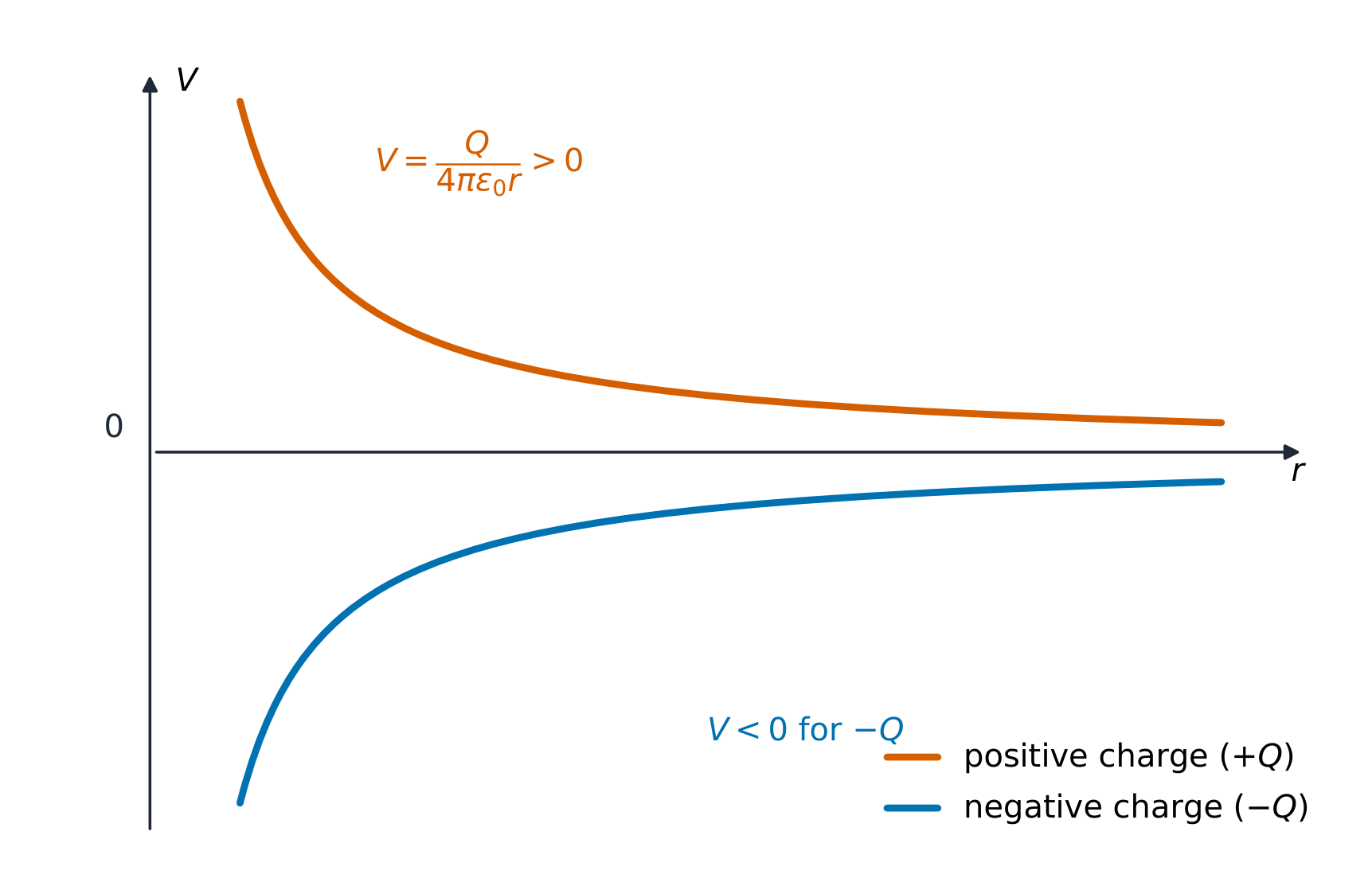
    Electric potential 电势 $V$ is the potential energy per unit charge – a scalar field, measured in volts:

    $$V=\frac{U}{q}=\frac{kQ}{r}.$$
    The potential difference (voltage) 电压 between two points is the work per unit charge to move between them: $\Delta V=\dfrac{\Delta U}{q}$, and $U=qV$. Positive charges move from high to low potential on their own. Because potential is a scalar, adding the potentials from several charges is much easier than adding field vectors.

    Bahasa Indonesia

    Potensial listrik $V$ adalah energi potensial per satuan muatan – sebuah bidang skalar, diukur dalam volt:

    $$V=\frac{U}{q}=\frac{kQ}{r}.$$
    Perbedaan potensial (tegangan) antara dua titik adalah usaha per satuan muatan untuk memindahkannya dari satu ke titik lain: $\Delta V=\dfrac{\Delta U}{q}$, dan $U=qV$. Muatan positif bergerak dari potensial tinggi ke rendah secara alami. Karena potensial adalah skalar, menjumlahkan potensial dari beberapa muatan jauh lebih mudah daripada menjumlahkan vektor medan.

    Potensial dekat muatan titik berubah sebanding dengan 1/r
    Potensial dekat muatan titik bervariasi sebagai 1/r
    10.6

    Capacitors · ⁨Kapasitor⁩

    Syllabus · ⁨Silabus⁩
    English

    Learning Objective 10.6.A: Describe the physical properties of a parallel-plate capacitor.

    • 10.6.A.1 A parallel-plate capacitor consists of two separated parallel conducting surfaces that can hold equal amounts of charge with opposite signs.
    • 10.6.A.2 Capacitance relates the magnitude of the charge stored on each plate to the electric potential difference created by the separation of those charges.
      • Equation: $C = \dfrac{Q}{\Delta V}$
      • 10.6.A.2.i The capacitance of a capacitor depends only on the physical properties of the capacitor, such as the capacitor's shape and the material used to separate the plates.
      • 10.6.A.2.ii The capacitance of a parallel-plate capacitor is proportional to the area of one of its plates and inversely proportional to the distance between its plates. The constant of proportionality is the product of the dielectric constant, $\kappa$, of the material between the plates and the electric permittivity of free space, $\varepsilon_0$.
        • Equation: $C = \kappa\varepsilon_0\dfrac{A}{d}$
    • 10.6.A.3 The electric field between two charged parallel plates with uniformly distributed electric charge, such as in a parallel-plate capacitor, is constant in both magnitude and direction, except near the edges of the plates.
      • 10.6.A.3.i The magnitude of the electric field between two charged parallel plates, where the plate separation is much smaller than the dimensions of the plates, can be described with the equation
        • Equation: $E_C = \dfrac{Q}{\kappa\varepsilon_0 A}$
      • 10.6.A.3.ii A charged particle between two oppositely charged parallel plates undergoes constant acceleration and therefore its motion shares characteristics with the projectile motion of an object with mass in the gravitational field near Earth's surface.
    • 10.6.A.4 The electric potential energy stored in a capacitor is equal to the work done by an external force to separate that amount of charge on the capacitor.
    • 10.6.A.5 The electric potential energy stored in a capacitor is described by the equation
      • Equation: $U_C = \dfrac{1}{2}Q\Delta V$
    • 10.6.A.6 Adding a dielectric between two plates of a capacitor changes the capacitance of the capacitor and induces an electric field in the dielectric in the opposite direction to the field between the plates.

    Boundary statement: While other shapes are also able to separate charges, only the analysis and descriptions of parallel-plate capacitors are required for AP Physics 2. Edge effects will be ignored unless explicitly stated otherwise.

    Bahasa Indonesia

    Tujuan Pembelajaran 10.6.A: Jelaskan sifat fisik kapasitor pelat sejajar.

    • 10.6.A.1 Kapasitor pelat sejajar terdiri dari dua permukaan konduktor sejajar yang terpisah dan dapat menampung jumlah muatan yang sama dengan tanda berlawanan.
    • 10.6.A.2 Kapasitas menghubungkan besaran muatan yang tersimpan pada setiap pelat dengan selisih potensial listrik yang dihasilkan oleh pemisahan muatan tersebut.
      • Persamaan: $C = \dfrac{Q}{\Delta V}$
      • 10.6.A.2.i Kapasitas kapasitor hanya bergantung pada sifat fisik kapasitor, seperti bentuk kapasitor dan bahan yang digunakan untuk memisahkan pelat-pelatnya.
      • 10.6.A.2.ii Kapasitas kapasitor pelat sejajar sebanding dengan luas salah satu pelatnya dan berbanding terbalik dengan jarak antar pelatnya. Konstanta proporsionalitas adalah hasil kali konstanta dielektrik, $\kappa$, dari bahan di antara pelat dan permitivitas ruang hampa, $\varepsilon_0$.
        • Persamaan: $C = \kappa\varepsilon_0\dfrac{A}{d}$
    • 10.6.A.3 Medan listrik antara dua pelat sejajar bermuatan dengan distribusi muatan listrik seragam, seperti pada kapasitor pelat sejajar, konstan baik dalam besaran maupun arah, kecuali di dekat tepi pelat.
      • 10.6.A.3.i Besaran medan listrik antara dua pelat sejajar bermuatan, di mana jarak antar pelat jauh lebih kecil daripada dimensi pelat, dapat dijelaskan dengan persamaan
        • Persamaan: $E_C = \dfrac{Q}{\kappa\varepsilon_0 A}$
      • 10.6.A.3.ii Partikel bermuatan di antara dua pelat sejajar bermuatan berlawanan mengalami percepatan konstan, sehingga geraknya memiliki karakteristik yang mirip dengan gerak peluru benda bermassa dalam medan gravitasi di dekat permukaan Bumi.
    • 10.6.A.4 Energi potensial listrik yang tersimpan dalam kapasitor sama dengan kerja yang dilakukan oleh gaya eksternal untuk memisahkan jumlah muatan tersebut pada kapasitor.
    • 10.6.A.5 Energi potensial listrik yang tersimpan dalam kapasitor dijelaskan oleh persamaan
      • Persamaan: $U_C = \dfrac{1}{2}Q\Delta V$
    • 10.6.A.6 Menambahkan dielektrik di antara dua pelat kapasitor mengubah kapasitas kapasitor dan menginduksi medan listrik di dalam dielektrik yang berlawanan arah dengan medan di antara pelat-pelatnya.

    Pernyataan Batas: Meskipun bentuk lain juga mampu memisahkan muatan, hanya analisis dan deskripsi kapasitor pelat sejajar yang disyaratkan untuk AP Physics 2. Efek tepi akan diabaikan kecuali dinyatakan secara eksplisit sebaliknya.

    Source: College Board AP Course and Exam Description · ⁨Sumber: Deskripsi Kursus dan Ujian College Board AP⁩

    English
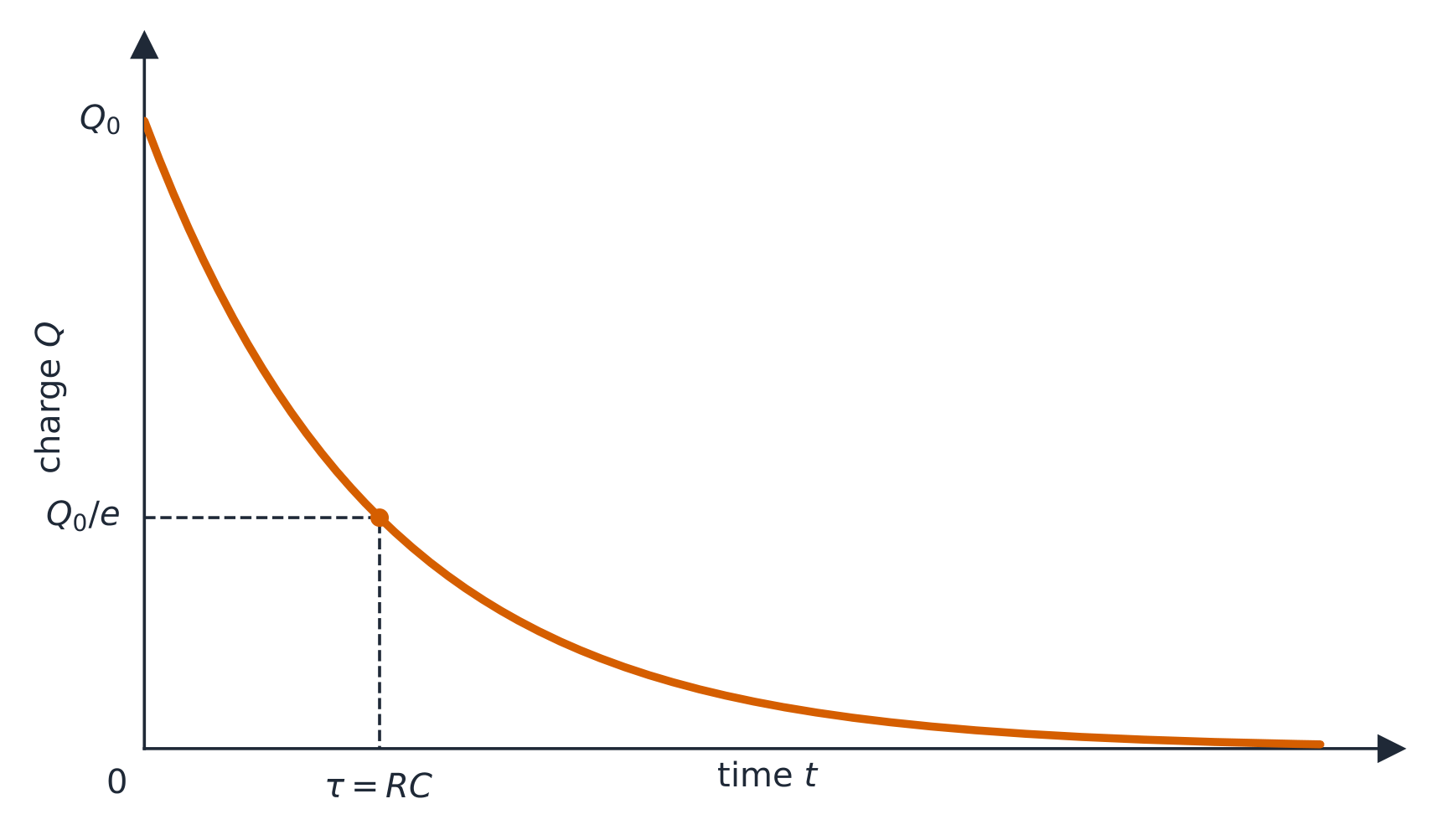
    Discharging a capacitor: τ = RC
    Charging a capacitor (RC)

    A capacitor 电容器 stores charge and energy on two conductors separated by a gap. Its capacitance 电容 relates charge to voltage:

    $$C=\frac{Q}{V},$$
    and the stored energy is $U=\tfrac{1}{2}CV^2$. Capacitance depends on the plates' geometry and the material between them, not on the charge placed on it.

    Worked example. A $100\ \mu\text{F}$ capacitor is charged to $12\ \text{V}$. It holds $Q=CV=100\times10^{-6}\times12=1.2\times10^{-3}\ \text{C}$ of charge and stores $U=\tfrac12 CV^2=\tfrac12\times100\times10^{-6}\times12^2=7.2\times10^{-3}\ \text{J}$ of energy.

    Bahasa Indonesia
    Mengosongkan kapasitor: τ = RC
    Mengisi kapasitor (RC)

    Sebuah kapasitor menyimpan muatan dan energi pada dua konduktor yang dipisahkan oleh celah. Kapasitansinya menghubungkan muatan dengan tegangan:

    $$C=\frac{Q}{V},$$
    dan energi yang tersimpan adalah $U=\tfrac{1}{2}CV^2$. Kapasitas bergantung pada geometri pelat dan material di antaranya, bukan pada muatan yang diletakkan di atasnya.

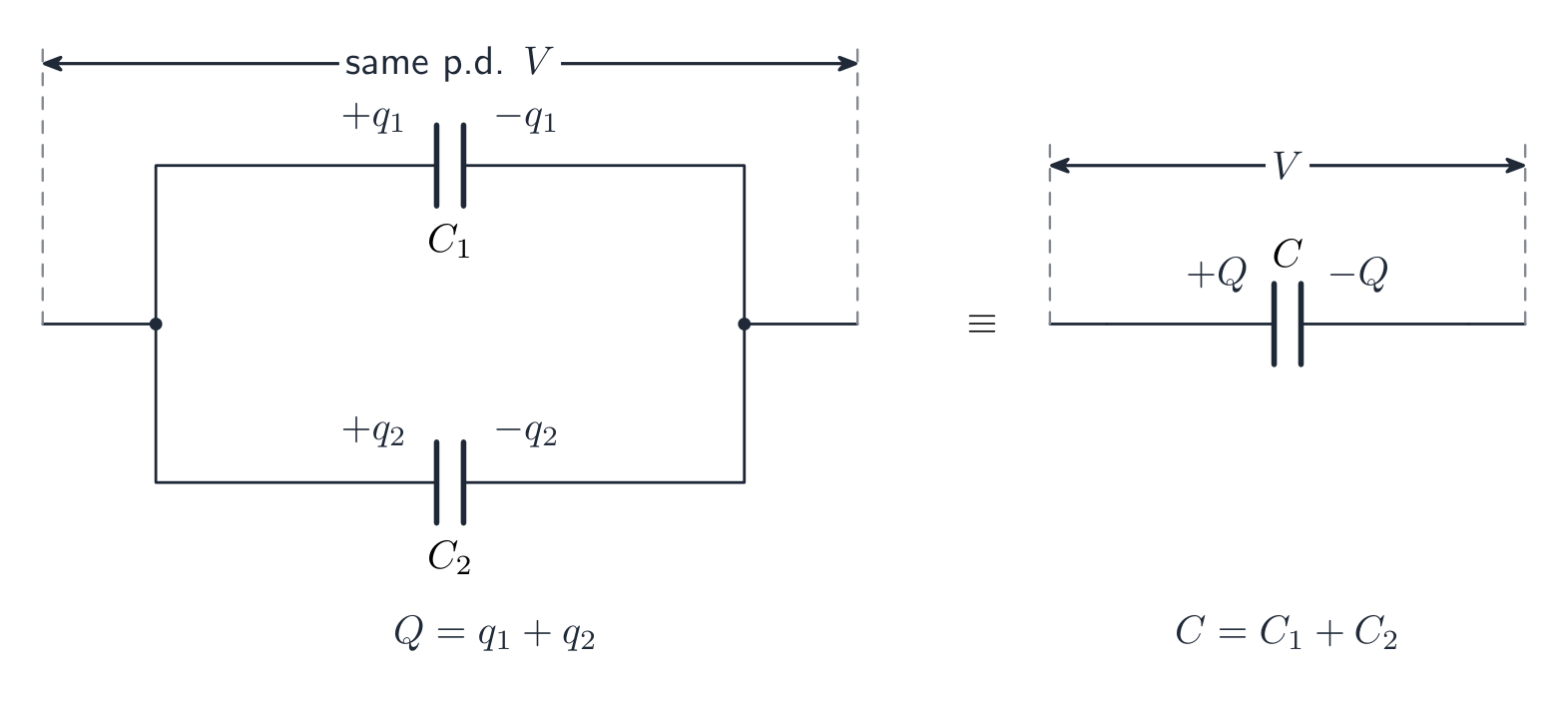
    Kapasitor paralel memiliki beda potensial yang sama, dan muatannya bertambah
    Kapasitor dalam seri berbagi p.d. yang sama, dan muatannya dijumlahkan

    Contoh terpecahkan. Sebuah kapasitor $100\ \mu\text{F}$ diisi hingga $12\ \text{V}$. Ia menahan $Q=CV=100\times10^{-6}\times12=1.2\times10^{-3}\ \text{C}$ muatan dan menyimpan $U=\tfrac12 CV^2=\tfrac12\times100\times10^{-6}\times12^2=7.2\times10^{-3}\ \text{J}$ energi.

    Explore · ⁨Jelajahi⁩

    Charge and discharge a capacitor · ⁨Muati dan kosongkan kapasitor⁩

    A capacitor stores charge on two plates. It fills and empties exponentially, set by the time constant $\tau = RC$ — bigger $R$ or $C$ means slower charging. · ⁨Kapasitor menyimpan muatan pada dua pelat. Ia terisi dan kosong secara eksponensial, ditentukan oleh konstanta waktu $\tau = RC$ — semakin besar $R$ atau $C$, semakin lambat pengisian.⁩

    Vocabulary · ⁨Kosa kata⁩ Train · ⁨Latih⁩
    English Bahasa Indonesia
    capacitor/kəˈpæsɪtə/ kapasitor
    capacitance/kəˈpæsɪtəns/ kapasitansi
    10.7

    Conservation of Electric Energy · ⁨Kekekalan Energi Listrik⁩

    Syllabus · ⁨Silabus⁩
    English

    Learning Objective 10.7.A: Describe changes in energy in a system due to a difference in electric potential between two locations.

    • 10.7.A.1 When a charged object moves between two locations with different electric potentials, the resulting change in the electric potential energy of the object-field system is given by the following equation.
      • Equation: $\Delta U_E = q\Delta V$
    • 10.7.A.2 The movement of a charged object between two points with different electric potentials results in a change in kinetic energy of the object consistent with the conservation of energy.
    Bahasa Indonesia

    Tujuan Pembelajaran 10.7.A: Jelaskan perubahan energi dalam suatu sistem akibat perbedaan potensial listrik antara dua lokasi.

    • 10.7.A.1 Ketika benda bermuatan bergerak di antara dua lokasi dengan potensial listrik yang berbeda, perubahan energi potensial listrik dari sistem benda-medan diberikan oleh persamaan berikut.
      • Persamaan: $\Delta U_E = q\Delta V$
    • 10.7.A.2 Pergerakan benda bermuatan di antara dua titik dengan potensial listrik yang berbeda menghasilkan perubahan energi kinetik pada benda yang sesuai dengan hukum kekekalan energi.

    Source: College Board AP Course and Exam Description · ⁨Sumber: Deskripsi Kursus dan Ujian College Board AP⁩

    English

    Energy is conserved for charges just as for masses. A charge released in a field converts electric potential energy into kinetic energy:

    $$q\,\Delta V=\tfrac{1}{2}mv^2 \quad(\text{gaining speed as it "falls" through a potential difference}).$$

    Worked example. An electron ($q=1.6\times10^{-19}\ \text{C}$, $m=9.1\times10^{-31}\ \text{kg}$) is accelerated from rest through a potential difference of $100\ \text{V}$. Its final speed is

    $$v=\sqrt{\frac{2q\,\Delta V}{m}}=\sqrt{\frac{2\times1.6\times10^{-19}\times100}{9.1\times10^{-31}}}=5.9\times10^{6}\ \text{m/s}.$$
    This is exactly how the electron gun in an old television or an electron microscope works.

    Bahasa Indonesia

    Energi kekal untuk muatan sama seperti untuk massa. Muatan yang dilepaskan dalam medan mengonversi energi potensial listrik menjadi energi kinetik:

    $$q\,\Delta V=\tfrac{1}{2}mv^2 \quad(\text{gaining speed as it "falls" through a potential difference}).$$

    Contoh terpecahkan. Sebuah elektron ($q=1.6\times10^{-19}\ \text{C}$, $m=9.1\times10^{-31}\ \text{kg}$) dipercepat dari keadaan diam melalui perbedaan potensial $100\ \text{V}$. Kecepatan akhirnya adalah

    $$v=\sqrt{\frac{2q\,\Delta V}{m}}=\sqrt{\frac{2\times1.6\times10^{-19}\times100}{9.1\times10^{-31}}}=5.9\times10^{6}\ \text{m/s}.$$
    Inilah cara kerja pistol elektron di televisi lama atau mikroskop elektron.

    Vocabulary · ⁨Kosa kata⁩ Train · ⁨Latih⁩
    English Bahasa Indonesia
    potential difference/pəˈtenʃl ˈdɪfrəns/ beda potensial
    10.7

    Exam tips · ⁨Tips ujian⁩

    English
    • Coulomb's law and the point-charge field are inverse-square — doubling the separation makes the force (or field) four times smaller.
    • Use magnitudes for the size of a force and decide direction from the signs; the field points the way a positive test charge would move.
    • Potential ($V$) is a scalar so potentials from several charges simply add; the field ($E$) is a vector and must be added by direction.
    • For a charge accelerated through a voltage use energy conservation $qV=\tfrac12 mv^2$.
    • Capacitor relations: $C=Q/V$ (capacitance is fixed by geometry) and energy $U=\tfrac12 CV^2$.
    Bahasa Indonesia
    • Hukum Coulomb dan medan muatan titik bersifat kuadrat terbalik — menggandakan jarak pisahnya membuat gaya (atau medan) menjadi empat kali lebih kecil.
    • Gunakan besaran untuk ukuran gaya dan tentukan arah dari tanda; medan menunjuk ke arah di mana muatan uji positif akan bergerak.
    • Potensial ($V$) adalah skalar sehingga potensial dari beberapa muatan cukup dijumlahkan; medan ($E$) adalah vektor dan harus ditambahkan berdasarkan arah.
    • Untuk muatan yang dipercepat melalui tegangan gunakan kekekalan energi $qV=\tfrac12 mv^2$.
    • Hubungan kapasitor: $C=Q/V$ (kapasitas tetap ditentukan oleh geometri) dan energi $U=\tfrac12 CV^2$.
  • 11

    Electric Circuits · ⁨Rangkaian Listrik⁩

    Watch lesson · ⁨Tonton pelajaran⁩
    11.1

    Electric Current · ⁨Arus Listrik⁩

    Syllabus · ⁨Silabus⁩
    English

    Learning Objective 11.1.A: Describe the movement of electric charges through a medium.

    • 11.1.A.1 Current is the rate at which charge passes through a cross-sectional area of a wire.
      • Equation: $I = \dfrac{\Delta q}{\Delta t}$
      • 11.1.A.1.i Electric charge moves in a circuit in response to an electric potential difference, sometimes referred to as electromotive force, or $\mathrm{emf}$ ($\varepsilon$).
      • 11.1.A.1.ii If the current is zero in a section of wire, the net motion of charge carriers in the wire is also zero, although individual charge carriers will not have zero speed.
    • 11.1.A.2 Although current is not a vector quantity, it does have a direction. The direction of current is associated with what the motion of positive charge would be but not with any coordinate system in space.
      • 11.1.A.2.i The direction of conventional current is chosen to be the direction in which positive charge would move.
      • 11.1.A.2.ii In common circuits, current is actually due to the movement of electrons (negative charge carriers).
    Bahasa Indonesia

    Tujuan Pembelajaran 11.1.A: Jelaskan pergerakan muatan listrik melalui suatu medium.

    • 11.1.A.1 Arus adalah laju muatan yang melewati luas penampang kawat.
      • Persamaan: $I = \dfrac{\Delta q}{\Delta t}$
      • 11.1.A.1.i Muatan listrik bergerak dalam sirkuit sebagai respons terhadap beda potensial listrik, terkadang disebut sebagai gaya gerak listrik (electromotive force), atau $\mathrm{emf}$ ($\varepsilon$).
      • 11.1.A.1.ii Jika arus bernilai nol pada bagian kawat, maka gerakan bersih pembawa muatan dalam kawat juga nol, meskipun pembawa muatan individu tidak memiliki kecepatan nol.
    • 11.1.A.2 Meskipun arus bukanlah besaran vektor, arus memiliki arah. Arah arus dikaitkan dengan apa yang akan terjadi jika muatan positif bergerak, bukan dengan sistem koordinat mana pun di ruang.
      • 11.1.A.2.i Arah arus konvensional dipilih sebagai arah di mana muatan positif akan bergerak.
      • 11.1.A.2.ii Dalam sirkuit umum, arus sebenarnya disebabkan oleh pergerakan elektron (pembawa muatan negatif).

    Source: College Board AP Course and Exam Description · ⁨Sumber: Deskripsi Kursus dan Ujian College Board AP⁩

    English

    Electric current 电流 is the rate at which charge flows past a point, measured in amperes 安培 (A):

    $$I=\frac{\Delta q}{\Delta t}.$$
    By convention, current points the way positive charge would move (opposite to the electrons in a wire). A steady current needs a complete loop and an energy source (a battery's electromotive force, or emf).

    Bahasa Indonesia
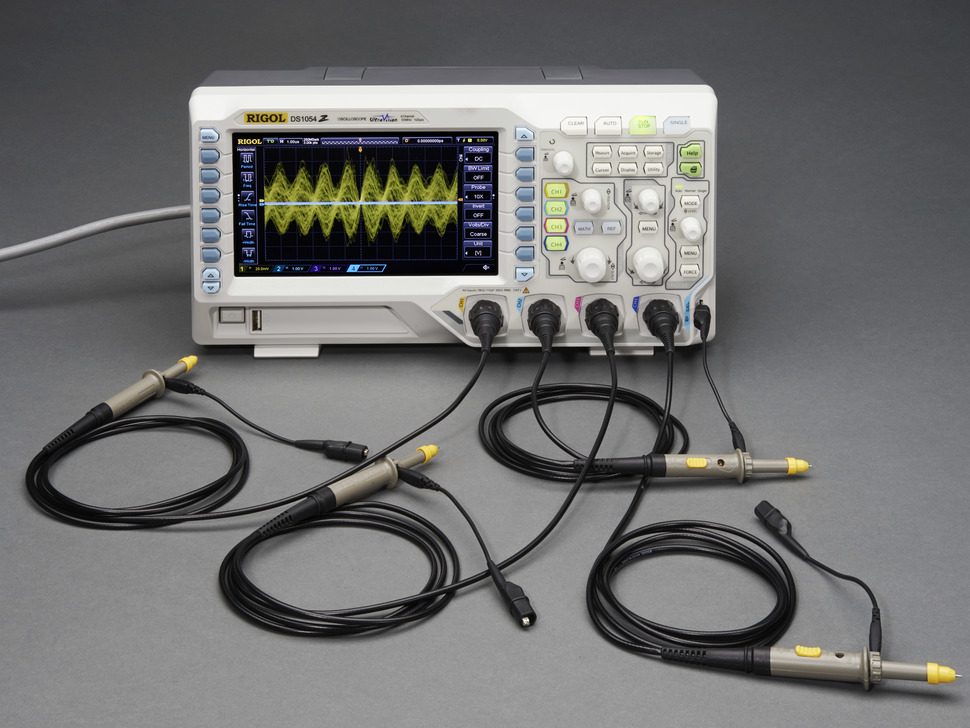
    Osiloskop: perilaku rangkaian terhadap waktu diukur sebagai tegangan terhadap waktu
    Oscilloskop: perilaku rangkaian terhadap waktu diukur sebagai tegangan terhadap waktu

    Arus listrik adalah laju alir muatan melewati suatu titik, diukur dalam ampere (A):

    $$I=\frac{\Delta q}{\Delta t}.$$
    Secara konvensi, arus mengarah ke tempat muatan positif akan bergerak (berlawanan dengan elektron dalam kawat). Arus stabil memerlukan loop lengkap dan sumber energi (gaya gerak listrik atau emf dari baterai).

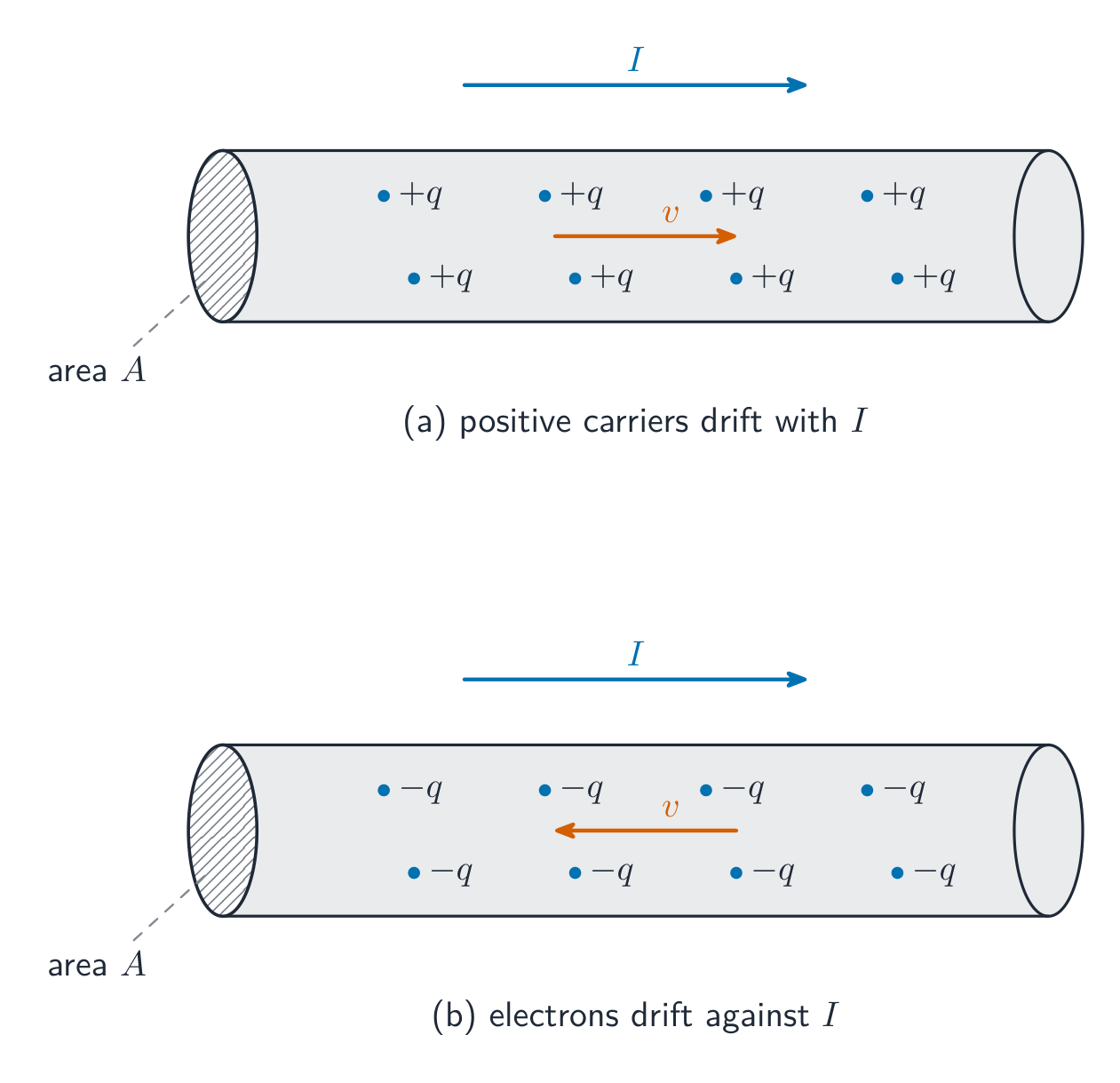
    Pembawa muatan mengalir lambat melalui konduktor untuk menghasilkan arus
    Pembawa muatan melambat merayap melalui konduktor untuk menghasilkan arus
    11.2

    Simple Circuits · ⁨Rangkaian Sederhana⁩

    Syllabus · ⁨Silabus⁩
    English

    Learning Objective 11.2.A: Describe the behavior of a circuit.

    • 11.2.A.1 A circuit is composed of electrical loops, which may include circuit elements such as wires, batteries, resistors, lightbulbs, capacitors, switches, ammeters, and voltmeters.
    • 11.2.A.2 A closed electrical loop is a closed path through which charges may flow.
      • 11.2.A.2.i A closed circuit is one in which charges would be able to flow.
      • 11.2.A.2.ii An open circuit is one in which charges would not be able to flow.
      • 11.2.A.2.iii A short circuit is one in which charges would be able to flow with no change in potential difference.
    • 11.2.A.3 A single circuit element may be part of multiple electrical loops.
    • 11.2.A.4 Circuit schematics are representations used to describe and analyze electric circuits.
      • 11.2.A.4.i The properties of an electric circuit are dependent on the physical arrangement of its constituent elements.
      • 11.2.A.4.ii Circuit elements have common symbols that are used to create schematic diagrams. Variable elements are indicated by a diagonal strikethrough arrow across the standard symbol for that element. (Standard symbols: Battery, Bulb, Switch, Capacitor, Resistor, Ammeter, Voltmeter.)

    Boundary statement: Unless otherwise specified, all circuit schematic diagrams will be drawn using conventional current.

    Bahasa Indonesia

    Tujuan Pembelajaran 11.2.A: Jelaskan perilaku sebuah sirkuit.

    • 11.2.A.1 Sebuah sirkuit terdiri dari loop listrik, yang dapat mencakup elemen-elemen sirkuit seperti kawat, baterai, resistor, bola lampu, kapasitor, sakelar, ammeter, dan voltmeter.
    • 11.2.A.2 Loop listrik tertutup adalah jalur tertutup tempat muatan dapat mengalir.
      • 11.2.A.2.i Sirkuit tertutup adalah sirkuit di mana muatan dapat mengalir.
      • 11.2.A.2.ii Sirkuit terbuka adalah sirkuit di mana muatan tidak dapat mengalir.
      • 11.2.A.2.iii Sirkuit pendek adalah sirkuit di mana muatan dapat mengalir tanpa perubahan beda potensial.
    • 11.2.A.3 Satu elemen sirkuit mungkin merupakan bagian dari beberapa loop listrik.
    • 11.2.A.4 Skema sirkuit adalah representasi yang digunakan untuk menggambarkan dan menganalisis sirkuit listrik.
      • 11.2.A.4.i Properti dari sebuah sirkuit listrik bergantung pada pengaturan fisik dari elemen-elemen penyusunnya.
      • 11.2.A.4.ii Elemen-elemen sirkuit memiliki simbol-simbol umum yang digunakan untuk membuat diagram skematik. Elemen variabel ditunjukkan dengan panah coret diagonal melintasi simbol standar untuk elemen tersebut. (Simbol standar: Baterai, Bohlam, Sakelar, Kapasitor, Resistor, Ammeter, Voltmeter.)

    Pernyataan Batas: Kecuali ditentukan lain, semua diagram skematik sirkuit akan digambar menggunakan arus konvensional.

    Source: College Board AP Course and Exam Description · ⁨Sumber: Deskripsi Kursus dan Ujian College Board AP⁩

    English

    A circuit is a closed loop of conductors, a source (battery), and components. In a series 串联 path the same current flows through each element; in a parallel 并联 path the same voltage is across each branch. A circuit diagram uses standard symbols; reading it correctly is the first step of any circuit problem.

    Bahasa Indonesia

    Sebuah rangkaian adalah loop tertutup konduktor, sumber (baterai), dan komponen. Dalam jalur seri, arus yang sama mengalir melalui setiap elemen; dalam jalur paralel, tegangan yang sama ada di setiap cabang. Diagram rangkaian menggunakan simbol standar; membacanya dengan benar adalah langkah pertama dari setiap masalah rangkaian.

    Komponen dapat dihubungkan secara seri atau paralel
    Komponen dapat disambung dalam seri atau paralel
    Sirkuit elektronik yang dibangun di atas papan prototipe
    Rangkaian nyata: komponen ditekan ke dalam breadboard dan disambung dengan kawat agar arus memiliki lintasan lengkap
    Explore · ⁨Jelajahi⁩

    Build series and parallel circuits · ⁨Bangun rangkaian seri dan paralel⁩

    In series the same current flows through every bulb and voltage divides; in parallel each branch gets the full voltage. Switch mode to see the bulbs' brightness change. · ⁨Dalam seri, arus yang sama mengalir melalui setiap bola lampu dan tegangan terbagi; dalam paralel, setiap cabang mendapat tegangan penuh. Ubah mode untuk melihat perubahan kecerahan bola lampu.⁩

    Vocabulary · ⁨Kosa kata⁩ Train · ⁨Latih⁩
    English Bahasa Indonesia
    Electric current/ɪˈlektrɪk ˈkʌrənt/ Arus listrik
    amperes/ˈæmpeəz/ ampere
    series/ˈsɪəriːz/ seri
    parallel/ˈpærəlel/ paralel
    Resistance/rɪˈzɪstəns/ Penolakan
    Ohm's law/əʊmz lɔː/ Hukum Ohm
    resistivity/ˌriːzɪˈstɪvəti/ resistivitas
    Electric power/ɪˈlektrɪk ˈpaʊə/ Daya listrik
    light bulb/laɪt bʌlb/ Bohlam lampu
    brightness/ˈbraɪtnəs/ kecerahan
    equivalent resistance/ɪˈkwɪvələnt rɪˈzɪstəns/ resistansi ekuivalen
    11.3

    Resistance, Resistivity, and Ohm's Law · ⁨Resistansi, Resistivitas, dan Hukum Ohm⁩

    Syllabus · ⁨Silabus⁩
    English

    Learning Objective 11.3.A: Describe the resistance of an object using physical properties of that object.

    • 11.3.A.1 Resistance is a measure of the degree to which an object opposes the movement of electric charge.
    • 11.3.A.2 The resistance of a resistor with uniform geometry is proportional to its resistivity and length and is inversely proportional to its cross-sectional area.
      • Equation: $R = \dfrac{\rho \ell}{A}$
      • 11.3.A.2.i Resistivity is a fundamental property of a material that depends on its atomic and molecular structure and quantifies how strongly the material opposes the motion of electric charge.
      • 11.3.A.2.ii The resistivity of a conductor typically increases with temperature.

    Learning Objective 11.3.B: Describe the electrical characteristics of elements of a circuit.

    • 11.3.B.1 Ohm's law relates current, resistance, and potential difference across a conductive element of a circuit.
      • Equation: $I = \dfrac{\Delta V}{R}$
      • 11.3.B.1.i Materials that obey Ohm's law have constant resistance for all currents and are called ohmic materials.
      • 11.3.B.1.ii The resistivity of an ohmic material is constant regardless of temperature.
      • 11.3.B.1.iii Resistors can also convert electrical energy to thermal energy, which may change the temperature of both the resistor and the resistor's environment.
      • 11.3.B.1.iv The resistance of an ohmic circuit element can be determined from the slope of a graph of the current in the element as a function of the potential difference across the element.
    Bahasa Indonesia

    Tujuan Pembelajaran 11.3.A: Jelaskan resistansi suatu objek menggunakan sifat fisik dari objek tersebut.

    • 11.3.A.1 Resistansi adalah ukuran seberapa besar suatu objek menolak pergerakan muatan listrik.
    • 11.3.A.2 Resistansi dari sebuah resistor dengan geometri seragam berbanding lurus dengan resistivitas dan panjangnya, serta berbanding terbalik dengan luas penampangnya.
      • Persamaan: $R = \dfrac{\rho \ell}{A}$
      • 11.3.A.2.i Resistivitas adalah sifat fundamental dari suatu material yang bergantung pada struktur atom dan molekulnya, serta mengkuantifikasi seberapa kuat material tersebut menolak pergerakan muatan listrik.
      • 11.3.A.2.ii Resistivitas konduktor biasanya meningkat seiring dengan kenaikan suhu.

    Tujuan Pembelajaran 11.3.B: Jelaskan karakteristik listrik dari elemen-elemen sebuah sirkuit.

    • 11.3.B.1 Hukum Ohm menghubungkan arus, resistansi, dan beda potensial pada elemen konduktif dalam sebuah sirkuit.
      • Persamaan: $I = \dfrac{\Delta V}{R}$
      • 11.3.B.1.i Material yang mematuhi Hukum Ohm memiliki resistansi tetap untuk semua arus dan disebut material ohmik.
      • 11.3.B.1.ii Resistivitas material ohmik tetap terlepas dari suhu.
      • 11.3.B.1.iii Resistor juga dapat mengubah energi listrik menjadi energi termal, yang dapat mengubah suhu resistor maupun lingkungan sekitarnya.
      • 11.3.B.1.iv Resistansi elemen sirkuit ohmik dapat ditentukan dari kemiringan grafik arus pada elemen tersebut sebagai fungsi dari beda potensial melintasinya.

    Source: College Board AP Course and Exam Description · ⁨Sumber: Deskripsi Kursus dan Ujian College Board AP⁩

    English

    Resistance 电阻 $R$ opposes current, measured in ohms. Ohm's law 欧姆定律 links the three key quantities:

    $$V=IR.$$
    A component's resistance depends on the material's resistivity 电阻率 $\rho$, its length, and its cross-sectional area: $R=\dfrac{\rho L}{A}$ – longer and thinner means more resistance.

    Worked example. A $2.0\ \text{A}$ current flows through a $6.0\ \Omega$ resistor. The voltage across it is $V=IR=2.0\times6.0=12\ \text{V}$.

    Bahasa Indonesia

    Resistansi $R$ melawan arus, diukur dalam ohm. Hukum Ohm menghubungkan tiga besaran utama:

    $$V=IR.$$
    Resistansi komponen bergantung pada resistivitas materi $\rho$, panjangnya, dan luas penampangnya: $R=\dfrac{\rho L}{A}$ – semakin panjang dan tipis berarti resistansi lebih besar.

    Garis I-V dari konduktor ohmik lurus melewati titik asal
    Garis I-V konduktor ohmik lurus melalui titik asal

    Contoh terpecahkan. Arus $2.0\ \text{A}$ mengalir melalui resistor $6.0\ \Omega$. Tegangan di atasnya adalah $V=IR=2.0\times6.0=12\ \text{V}$.

    Explore · ⁨Jelajahi⁩

    Apply Ohm's law · ⁨Terapkan Hukum Ohm⁩

    Ohm's law $V=IR$: for a fixed resistance, current is proportional to voltage. Raise the resistance and the same voltage pushes less current. · ⁨Hukum Ohm $V=IR$: untuk hambatan tetap, arus berbanding lurus dengan tegangan. Naikkan hambatan dan tegangan yang sama mendorong arus lebih sedikit.⁩

    11.4

    Electric Power · ⁨Daya Listrik⁩

    Syllabus · ⁨Silabus⁩
    English

    Learning Objective 11.4.A: Describe the transfer of energy into, out of, or within an electric circuit, in terms of power.

    • 11.4.A.1 The rate at which energy is transferred, converted, or dissipated by a circuit element depends on the current in the element and the electric potential difference across it.
      • Equation: $P = I \Delta V$
      • Equation (derived): $P = I^2 R = \dfrac{(\Delta V)^2}{R}$
    • 11.4.A.2 The brightness of a bulb increases with power, so power can be used to qualitatively predict the brightness of bulbs in a circuit.
    Bahasa Indonesia

    Tujuan Pembelajaran 11.4.A: Jelaskan transfer energi masuk, keluar, atau di dalam sebuah sirkuit listrik, berdasarkan daya.

    • 11.4.A.1 Laju transfer, konversi, atau pelepasan energi oleh elemen sirkuit bergantung pada arus dalam elemen tersebut dan beda potensial listrik melintasinya.
      • Persamaan: $P = I \Delta V$
      • Persamaan (turunan): $P = I^2 R = \dfrac{(\Delta V)^2}{R}$
    • 11.4.A.2 Kecerahan bohlam meningkat seiring dengan peningkatan daya, sehingga daya dapat digunakan untuk memprediksi secara kualitatif kecerahan bohlam dalam sebuah sirkuit.

    Source: College Board AP Course and Exam Description · ⁨Sumber: Deskripsi Kursus dan Ujian College Board AP⁩

    English

    Electric power 电功率 is the rate a component converts electrical energy (to heat, light, motion):

    $$P=IV=I^2R=\frac{V^2}{R}.$$
    Pick the form that uses the quantities you know. A resistor's power all becomes heat.

    Worked example. The $6.0\ \Omega$ resistor above, carrying $2.0\ \text{A}$, dissipates $P=I^2R=2.0^2\times6.0=24\ \text{W}$ – equivalently $P=IV=2.0\times12=24\ \text{W}$.

    A light bulb 灯泡 is just a resistor that glows, and its brightness 亮度 rises with the power it dissipates. So to rank bulbs, compare their power. In a series string every bulb carries the same current, so by $P=I^2R$ the bulb with the largest resistance is brightest; wired in parallel every bulb gets the full battery voltage, so by $P=V^2/R$ the bulb with the smallest resistance is brightest.

    Bahasa Indonesia

    Daya listrik adalah laju komponen mengonversi energi listrik (menjadi panas, cahaya, gerakan):

    $$P=IV=I^2R=\frac{V^2}{R}.$$
    Pilih bentuk yang menggunakan besaran yang Anda ketahui. Daya resistor semuanya berubah menjadi panas.

    Contoh terpecahkan. Resistor $6.0\ \Omega$ di atas, membawa $2.0\ \text{A}$, menyebarkan $P=I^2R=2.0^2\times6.0=24\ \text{W}$ – setara dengan $P=IV=2.0\times12=24\ \text{W}$.

    Sebuah bohlam lampu hanyalah resistor yang bersinar, dan kecerahannya meningkat seiring dengan daya yang ia sebar. Jadi untuk mengurutkan bohlam, bandingkan dayanya. Dalam rangkaian seri setiap bohlam carrying arus yang sama, jadi oleh $P=I^2R$ bohlam dengan resistansi terbesar paling terang; dikoneksikan dalam paralel setiap bohlam mendapatkan tegangan baterai penuh, jadi oleh $P=V^2/R$ bohlam dengan resistansi terkecil paling terang.

    Saluran listrik bertegangan tinggi: daya listrik ditransmisikan dengan tegangan tinggi agar arus (dan kerugian I²R) tetap rendah
    Saluran listrik tegangan tinggi: daya listrik ditransmisikan sebagai tegangan tinggi agar arus (dan rugi-rugi I²R) tetap rendah
    Explore · ⁨Jelajahi⁩

    Read an I-V characteristic · ⁨Baca karakteristik I-V⁩

    Power is $P=IV$. A resistor's I-V line is straight, but a lamp curves as it heats and its resistance rises. The area under I-V relates to the energy delivered. · ⁨Daya adalah $P=IV$. Garis I-V resistor lurus, tetapi lampu melengkung saat memanas dan hambatannya naik. Area di bawah I-V berkaitan dengan energi yang disalurkan.⁩

    11.5

    Compound DC Circuits · ⁨Rangkaian DC Majemuk⁩

    Syllabus · ⁨Silabus⁩
    Learning ObjectiveEssential Knowledge

    11.5.A
    Describe the equivalent resistance of multiple resistors connected in a circuit.

    • 11.5.A.1 Circuit elements may be connected in series and/or in parallel.
      • 11.5.A.1.i A series connection is one in which any charge passing through one circuit element must proceed through all elements in that connection and has no other path available. The current in each element in series must be the same.
      • 11.5.A.1.ii A parallel connection is one in which charges may flow through one of two or more paths. Across each path, the potential difference is the same.
    • 11.5.A.2 A collection of resistors in a circuit may be analyzed as though it were a single resistor with an equivalent resistance $R_{\text{eq}}$.
      • 11.5.A.2.i The equivalent resistance of a set of resistors in series is the sum of the individual resistances.
        • Equation: $R_{\text{eq},s} = \sum_i R_i$
      • 11.5.A.2.ii The inverse of the equivalent resistance of a set of resistors connected in parallel is equal to the sum of the inverses of the individual resistances.
        • Equation: $\dfrac{1}{R_{\text{eq},p}} = \sum_i \dfrac{1}{R_i}$
      • 11.5.A.2.iii When resistors are connected in parallel, the number of paths available to charges increases, and the equivalent resistance of the group of resistors decreases.

    11.5.B
    Describe a circuit with resistive wires and a battery with internal resistance.

    • 11.5.B.1 Ideal batteries have negligible internal resistance. Ideal wires have negligible resistance.
      • 11.5.B.1.i The resistance of wires that are good conductors may normally be neglected, because their resistance is much smaller than that of other elements of a circuit.
      • 11.5.B.1.ii The resistance of wires may only be neglected if the circuit contains other elements that do have resistance.
      • 11.5.B.1.iii The potential difference a battery would supply if it were ideal is the potential difference measured across the terminals when there is no current in the battery and is sometimes referred to as its $\mathrm{emf}$ ($\varepsilon$).
    • 11.5.B.2 The internal resistance of a nonideal battery may be treated as the resistance of a resistor in series with an ideal battery and the remainder of the circuit.
    • 11.5.B.3 When there is current in a nonideal battery with internal resistance $r$, the potential difference across the terminals of the battery is reduced relative to the potential difference when there is no current in the battery.
      • Equation (derived): $\Delta V_{\text{terminal}} = \varepsilon - Ir$

    11.5.C
    Describe the measurement of current and potential difference in a circuit.

    • 11.5.C.1 Ammeters are used to measure current at a specific point in a circuit.
      • 11.5.C.1.i Ammeters must be connected in series with the element in which current is being measured.
      • 11.5.C.1.ii Ideal ammeters have zero resistance so that they do not affect the current in the element that they are in series with.
    • 11.5.C.2 Voltmeters are used to measure electric potential difference between two points in a circuit.
      • 11.5.C.2.i Voltmeters must be connected in parallel with the element across which potential difference is being measured.
      • 11.5.C.2.ii Ideal voltmeters have an infinite resistance so that no charge flows through them.
    • 11.5.C.3 Nonideal ammeters and voltmeters will change the properties of the circuit being measured.

    Boundary statement: AP Physics 2 only expects students to qualitatively discuss how a nonideal ammeter or voltmeter will affect the results of measurements. Unless otherwise stated, all batteries, wires, and meters are assumed to be ideal.

    Boundary statement: Circuits with batteries of different potential differences connected in parallel will not be assessed.

    Source: College Board AP Course and Exam Description · ⁨Sumber: Deskripsi Kursus dan Ujian College Board AP⁩

    English

    Combine resistors to find an equivalent resistance 等效电阻:

    • Series: $R_{\text{eq}}=R_1+R_2+\cdots$ (resistances add).
    • Parallel: $\dfrac{1}{R_{\text{eq}}}=\dfrac{1}{R_1}+\dfrac{1}{R_2}+\cdots$ (the total is less than the smallest).

    Reduce the network step by step to find the total current from the battery, then work back to each element.

    Worked example. A $12\ \text{V}$ battery drives a $4.0\ \Omega$ and a $12\ \Omega$ resistor in parallel. First combine them: $\dfrac{1}{R_{\text{eq}}}=\dfrac14+\dfrac{1}{12}=\dfrac{4}{12}\Rightarrow R_{\text{eq}}=3.0\ \Omega$. The total current from the battery is $I=\dfrac{V}{R_{\text{eq}}}=\dfrac{12}{3.0}=4.0\ \text{A}$, which splits so that the smaller resistor carries the larger share ($3.0\ \text{A}$ through the $4\ \Omega$, $1.0\ \text{A}$ through the $12\ \Omega$).

    Bahasa Indonesia

    Gabungkan resistor untuk menemukan resistansi ekuivalen:

    Resistor dalam seri dijumlahkan menjadi satu hambatan pengganti
    Resistor dalam seri dijumlahkan menjadi satu hambatan pengganti
    • Seri: $R_{\text{eq}}=R_1+R_2+\cdots$ (hambatan dijumlahkan).
    • Paralel: $\dfrac{1}{R_{\text{eq}}}=\dfrac{1}{R_1}+\dfrac{1}{R_2}+\cdots$ (totalnya lebih kecil dari yang terkecil).

    Sederhanakan rangkaian langkah demi langkah untuk mencari arus total dari baterai, lalu kerjakan mundur ke setiap elemen.

    Contoh soal. Sebuah baterai $12\ \text{V}$ menggerakkan resistor $4.0\ \Omega$ dan $12\ \Omega$ secara paralel. Pertama gabungkan: $\dfrac{1}{R_{\text{eq}}}=\dfrac14+\dfrac{1}{12}=\dfrac{4}{12}\Rightarrow R_{\text{eq}}=3.0\ \Omega$. Arus total dari baterai adalah $I=\dfrac{V}{R_{\text{eq}}}=\dfrac{12}{3.0}=4.0\ \text{A}$, yang kemudian terbagi sehingga resistor yang lebih kecil membawa bagian arus yang lebih besar ($3.0\ \text{A}$ melalui $4\ \Omega$, $1.0\ \text{A}$ melalui $12\ \Omega$).

    11.5

    Measuring Current and Voltage · ⁨Mengukur Arus dan Tegangan⁩

    Syllabus · ⁨Silabus⁩
    Learning ObjectiveEssential Knowledge

    11.5.A
    Describe the equivalent resistance of multiple resistors connected in a circuit.

    • 11.5.A.1 Circuit elements may be connected in series and/or in parallel.
      • 11.5.A.1.i A series connection is one in which any charge passing through one circuit element must proceed through all elements in that connection and has no other path available. The current in each element in series must be the same.
      • 11.5.A.1.ii A parallel connection is one in which charges may flow through one of two or more paths. Across each path, the potential difference is the same.
    • 11.5.A.2 A collection of resistors in a circuit may be analyzed as though it were a single resistor with an equivalent resistance $R_{\text{eq}}$.
      • 11.5.A.2.i The equivalent resistance of a set of resistors in series is the sum of the individual resistances.
        • Equation: $R_{\text{eq},s} = \sum_i R_i$
      • 11.5.A.2.ii The inverse of the equivalent resistance of a set of resistors connected in parallel is equal to the sum of the inverses of the individual resistances.
        • Equation: $\dfrac{1}{R_{\text{eq},p}} = \sum_i \dfrac{1}{R_i}$
      • 11.5.A.2.iii When resistors are connected in parallel, the number of paths available to charges increases, and the equivalent resistance of the group of resistors decreases.

    11.5.B
    Describe a circuit with resistive wires and a battery with internal resistance.

    • 11.5.B.1 Ideal batteries have negligible internal resistance. Ideal wires have negligible resistance.
      • 11.5.B.1.i The resistance of wires that are good conductors may normally be neglected, because their resistance is much smaller than that of other elements of a circuit.
      • 11.5.B.1.ii The resistance of wires may only be neglected if the circuit contains other elements that do have resistance.
      • 11.5.B.1.iii The potential difference a battery would supply if it were ideal is the potential difference measured across the terminals when there is no current in the battery and is sometimes referred to as its $\mathrm{emf}$ ($\varepsilon$).
    • 11.5.B.2 The internal resistance of a nonideal battery may be treated as the resistance of a resistor in series with an ideal battery and the remainder of the circuit.
    • 11.5.B.3 When there is current in a nonideal battery with internal resistance $r$, the potential difference across the terminals of the battery is reduced relative to the potential difference when there is no current in the battery.
      • Equation (derived): $\Delta V_{\text{terminal}} = \varepsilon - Ir$

    11.5.C
    Describe the measurement of current and potential difference in a circuit.

    • 11.5.C.1 Ammeters are used to measure current at a specific point in a circuit.
      • 11.5.C.1.i Ammeters must be connected in series with the element in which current is being measured.
      • 11.5.C.1.ii Ideal ammeters have zero resistance so that they do not affect the current in the element that they are in series with.
    • 11.5.C.2 Voltmeters are used to measure electric potential difference between two points in a circuit.
      • 11.5.C.2.i Voltmeters must be connected in parallel with the element across which potential difference is being measured.
      • 11.5.C.2.ii Ideal voltmeters have an infinite resistance so that no charge flows through them.
    • 11.5.C.3 Nonideal ammeters and voltmeters will change the properties of the circuit being measured.

    Boundary statement: AP Physics 2 only expects students to qualitatively discuss how a nonideal ammeter or voltmeter will affect the results of measurements. Unless otherwise stated, all batteries, wires, and meters are assumed to be ideal.

    Boundary statement: Circuits with batteries of different potential differences connected in parallel will not be assessed.

    Source: College Board AP Course and Exam Description · ⁨Sumber: Deskripsi Kursus dan Ujian College Board AP⁩

    English

    Two meters read a circuit. An ammeter 电流表 measures the current at a point, so it must be wired in series – the current you want to measure has to flow through it. A voltmeter 电压表 measures the potential difference between two points, so it is wired in parallel, bridging across the component whose voltage you want.

    For a meter to read the true value it must barely disturb the circuit:

    • an ideal ammeter has zero resistance, so putting it in series does not reduce the current it reads;
    • an ideal voltmeter has infinite resistance, so almost no current is diverted through it.

    A real, nonideal 非理想 meter is imperfect: a real ammeter has a small resistance (it slightly lowers the current), and a real voltmeter lets a little current leak through (it slightly lowers the voltage it reads). So connecting any meter changes, a little, the very quantity it is measuring.

    Bahasa Indonesia

    Dua alat ukur membaca suatu rangkaian. Ammeter mengukur arus pada suatu titik, sehingga harus dirangkai seri – arus yang ingin diukur harus mengalir melewati alat tersebut. Voltmeter mengukur beda potensial antara dua titik, sehingga dirangkai paralel, melintasi komponen whose tegangannya ingin Anda ukur.

    Agar sebuah alat ukur dapat menampilkan nilai yang benar, alat itu hampir tidak boleh mengganggu rangkaian:

    • amperemeter ideal memiliki hambatan nol, sehingga memasukkannya secara seri tidak mengurangi arus yang terbaca;
    • voltmeter ideal memiliki hambatan tak hingga, sehingga hampir tidak ada arus yang dialihkan melalui alat tersebut.

    Alat ukur nyata yang nonideal tidak sempurna: amperemeter nyata memiliki hambatan kecil (sedikit menurunkan arus), dan voltmeter nyata membiarkan sedikit arus bocor (sedikit menurunkan tegangan yang terbaca). Jadi, menghubungkan alat ukur apa pun akan mengubah, sedikit sekali, besaran yang sedang diukurnya.

    Vocabulary · ⁨Kosa kata⁩ Train · ⁨Latih⁩
    English Bahasa Indonesia
    ammeter/ˈæmiːtə/ amperemeter
    voltmeter/ˈvəʊltmiːtə/ voltmeter
    nonideal/ˌnɒnaɪˈdɪəl/ Nonideal
    Kirchhoff's loop rule/ˈkɜːkhɒfs luːp ruːl/ Aturan loop Kirchhoff
    Kirchhoff's junction rule/ˈkɜːkhɒfs ˈdʒʌŋkʃn ruːl/ Aturan titik simpul Kirchhoff
    RC circuit/ˌɑː ˈsiː ˈsɜːkɪt/ sirkuit RC
    11.6

    Kirchhoff's Loop Rule · ⁨Aturan Loop Kirchhoff⁩

    Syllabus · ⁨Silabus⁩
    English

    Learning Objective 11.6.A: Describe a circuit or elements of a circuit by applying Kirchhoff's loop rule.

    • 11.6.A.1 Energy changes in simple electrical circuits may be represented in terms of charges moving through electric potential differences within circuit elements.
      • Equation: $\Delta U_E = q \Delta V$
    • 11.6.A.2 Kirchhoff's loop rule is a consequence of the conservation of energy.
    • 11.6.A.3 Kirchhoff's loop rule states that the sum of potential differences across all circuit elements in a single closed loop must equal zero.
      • Equation: $\sum \Delta V = 0$
    • 11.6.A.4 The values of electric potential at points in a circuit can be represented by a graph of electric potential as a function of position within a loop.
    Bahasa Indonesia

    Tujuan Pembelajaran 11.6.A: Deskripsikan sebuah sirkuit atau elemen-elemen sirkuit dengan menerapkan aturan loop Kirchhoff.

    • 11.6.A.1 Perubahan energi dalam sirkuit listrik sederhana dapat direpresentasikan dalam istilah muatan yang bergerak melalui beda potensial listrik di dalam elemen-elemen sirkuit.
      • Persamaan: $\Delta U_E = q \Delta V$
    • 11.6.A.2 Aturan loop Kirchhoff merupakan konsekuensi dari kekekalan energi.
    • 11.6.A.3 Aturan loop Kirchhoff menyatakan bahwa jumlah beda potensial di seluruh elemen sirkuit dalam satu loop tertutup harus sama dengan nol.
      • Persamaan: $\sum \Delta V = 0$
    • 11.6.A.4 Nilai-nilai potensial listrik pada titik-titik dalam sirkuit dapat direpresentasikan oleh grafik potensial listrik sebagai fungsi posisi dalam sebuah loop.

    Source: College Board AP Course and Exam Description · ⁨Sumber: Deskripsi Kursus dan Ujian College Board AP⁩

    English

    Kirchhoff's loop rule 基尔霍夫电压定律 (energy conservation): around any closed loop, the voltage gains and drops sum to zero. Add the battery's emf and subtract each $IR$ drop as you go around. This gives one equation per independent loop.

    Bahasa Indonesia

    Aturan loop Kirchhoff (kekekalan energi): di sekitar loop tertutup mana pun, penjumlahan kenaikan dan penurunan tegangan bernilai nol. Tambahkan emf baterai dan kurangi setiap penurunan $IR$ saat bergerak mengelilinginya. Ini memberikan satu persamaan per loop independen.

    11.7

    Kirchhoff's Junction Rule · ⁨Aturan Simpul Kirchhoff⁩

    Syllabus · ⁨Silabus⁩
    English

    Learning Objective 11.7.A: Describe a circuit or elements of a circuit by applying Kirchhoff's junction rule.

    • 11.7.A.1 Kirchhoff's junction rule is a consequence of the conservation of electric charge.
    • 11.7.A.2 Kirchhoff's junction rule states that the total amount of charge entering a junction per unit time must equal the total amount of charge exiting that junction per unit time.
      • Equation: $\sum I_{\text{in}} = \sum I_{\text{out}}$
    Bahasa Indonesia

    Tujuan Pembelajaran 11.7.A: Deskripsikan sebuah sirkuit atau elemen-elemen sirkuit dengan menerapkan aturan titik simpul Kirchhoff.

    • 11.7.A.1 Aturan titik simpul Kirchhoff merupakan konsekuensi dari kekekalan muatan listrik.
    • 11.7.A.2 Aturan titik simpul Kirchhoff menyatakan bahwa total jumlah muatan yang masuk ke sebuah titik simpul per satuan waktu harus sama dengan total jumlah muatan yang keluar dari titik simpul tersebut per satuan waktu.
      • Persamaan: $\sum I_{\text{in}} = \sum I_{\text{out}}$

    Source: College Board AP Course and Exam Description · ⁨Sumber: Deskripsi Kursus dan Ujian College Board AP⁩

    English

    Kirchhoff's junction rule 基尔霍夫电流定律 (charge conservation): the total current into any junction equals the total current out. Together with the loop rule, it lets you solve any multi-loop circuit for its unknown currents.

    Bahasa Indonesia

    Aturan simpul Kirchhoff (kekekalan muatan): total arus masuk ke suatu simpul sama dengan total arus keluar. Bersama dengan aturan loop, hal ini memungkinkan Anda menyelesaikan rangkaian multi-loop apa pun untuk mencari arus-arus yang belum diketahui.

    Arus terbagi di simpul: apa yang masuk sama dengan apa yang keluar
    Arus terbagi di simpul: apa yang masuk sama dengan apa yang keluar
    11.8

    RC Circuits · ⁨Rangkaian RC⁩

    Syllabus · ⁨Silabus⁩
    English

    Learning Objective 11.8.A: Describe the equivalent capacitance of multiple capacitors.

    • 11.8.A.1 A collection of capacitors in a circuit may be analyzed as though it were a single capacitor with an equivalent capacitance $C_{\text{eq}}$.
      • 11.8.A.1.i The inverse of the equivalent capacitance of a set of capacitors connected in series is equal to the sum of the inverses of the individual capacitances.
        • Equation: $\dfrac{1}{C_{\text{eq},s}} = \sum_i \dfrac{1}{C_i}$
      • 11.8.A.1.ii The equivalent capacitance of a set of capacitors in series is less than the capacitance of the smallest capacitor.
      • 11.8.A.1.iii The equivalent capacitance of a set of capacitors in parallel is the sum of the individual capacitances.
        • Equation: $C_{\text{eq},p} = \sum_i C_i$
    • 11.8.A.2 As a result of conservation of charge, each of the capacitors in series must have the same magnitude of charge on each plate.

    Learning Objective 11.8.B: Describe the behavior of a circuit containing combinations of resistors and capacitors.

    • 11.8.B.1 The time constant $\tau$ is a significant feature of an RC circuit.
      • 11.8.B.1.i The time constant of an RC circuit is a measure of how quickly the capacitor will charge or discharge and is defined as $\tau = R_{\text{eq}} C_{\text{eq}}$.
      • 11.8.B.1.ii For a charging capacitor, the time constant represents the time required for the capacitor's charge to increase from zero to approximately 63 percent of its final asymptotic value.
      • 11.8.B.1.iii For a discharging capacitor, the time constant represents the time required for the capacitor's charge to decrease from fully charged to approximately 37 percent of its initial value.
    • 11.8.B.2 The potential difference across a capacitor and the current in the branch of the circuit containing the capacitor each change over time as the capacitor charges and discharges, but both will reach a steady state after a long time interval.
      • 11.8.B.2.i Immediately after being placed in a circuit, an uncharged capacitor acts like a wire, and charge can easily flow to or from the plates of the capacitor.
      • 11.8.B.2.ii As a capacitor charges, changes to the potential difference across the capacitor affect the charge on the plates of the capacitor, the current circuit branch in which the capacitor is located, and the electric potential energy stored in the capacitor.
      • 11.8.B.2.iii The potential difference across a capacitor, the current in the circuit branch in which the capacitor is located, and the electric potential energy stored in the capacitor all change with respect to time and asymptotically approach steady state conditions.
      • 11.8.B.2.iv After a long time, a charging capacitor approaches a state of being fully charged, reaching a maximum potential difference at which there is zero current in the circuit branch in which the capacitor is located.
      • 11.8.B.2.v Immediately after a charged capacitor begins discharging, the amount of charge on the capacitor plates and the energy stored in the capacitor begin to decrease.
      • 11.8.B.2.vi As a capacitor discharges, the amount of charge on the capacitor, the potential difference across the capacitor, and the current in the circuit branch in which the capacitor is located all decrease until a steady state is reached.
      • 11.8.B.2.vii After either charging or discharging for times much greater than the time constant, the capacitor and the relevant circuit branch may be modeled using steady-state conditions.

    Boundary statement: Descriptions of charging/discharging RC circuits in AP Physics 2 are limited to qualitative descriptions and representations. While students should be able to mathematically describe initial and final states of RC circuits, students are not expected to mathematically model these behaviors with respect to time.

    Bahasa Indonesia

    Tujuan Pembelajaran 11.8.A: Deskripsikan kapasitansi ekuivalen dari beberapa kapasitor.

    • 11.8.A.1 Kumpulan kapasitor dalam suatu sirkuit dapat dianalisis seolah-olah merupakan sebuah kapasitor tunggal dengan kapasitansi ekuivalen $C_{\text{eq}}$.
      • 11.8.A.1.i Kebalikan dari kapasitansi ekuivalen dari sekumpulan kapasitor yang dirangkai seri sama dengan jumlah dari kebalikan dari kapasitansi-kapasitansi individual.
        • Persamaan: $\dfrac{1}{C_{\text{eq},s}} = \sum_i \dfrac{1}{C_i}$
      • 11.8.A.1.ii Kapasitansi ekuivalen dari sekumpulan kapasitor yang dirangkai seri kurang dari kapasitansi kapasitor terkecil.
      • 11.8.A.1.iii Kapasitansi ekuivalen dari sekumpulan kapasitor yang dirangkai paralel adalah jumlah dari kapasitansi-kapasitansi individual.
        • Persamaan: $C_{\text{eq},p} = \sum_i C_i$
    • 11.8.A.2 Akibat dari kekekalan muatan, masing-masing kapasitor dalam rangkaian seri harus memiliki besaran muatan yang sama pada setiap pelatnya.

    Tujuan Pembelajaran 11.8.B: Deskripsikan perilaku sirkuit yang mengandung kombinasi resistor dan kapasitor.

    • 11.8.B.1 Konstanta waktu $\tau$ adalah fitur penting dari sirkuit RC.
      • 11.8.B.1.i Konstanta waktu dari sirkuit RC merupakan ukuran seberapa cepat kapasitor akan mengisi atau mengosongkan muatannya dan didefinisikan sebagai $\tau = R_{\text{eq}} C_{\text{eq}}$.
      • 11.8.B.1.ii Untuk kapasitor yang sedang mengisi, konstanta waktu mewakili waktu yang diperlukan agar muatan kapasitor meningkat dari nol menjadi sekitar 63 persen dari nilai asimtotik akhirnya.
      • 11.8.B.1.iii Untuk kapasitor yang sedang mengosongkan, konstanta waktu mewakili waktu yang diperlukan agar muatan kapasitor menurun dari kondisi terisi penuh menjadi sekitar 37 persen dari nilai awalnya.
    • 11.8.B.2 Beda potensial pada kapasitor dan arus dalam cabang rangkaian yang mengandung kapasitor masing-masing berubah seiring berjalannya waktu saat kapasitor mengisi dan mengosongkan, namun keduanya akan mencapai keadaan tunak setelah selang waktu yang lama.
      • 11.8.B.2.i Segera setelah dimasukkan ke dalam rangkaian, kapasitor yang belum bermuatan bertindak seperti kawat, dan muatan dapat mengalir dengan mudah masuk atau keluar dari pelat kapasitor.
      • 11.8.B.2.ii Saat kapasitor mengisi, perubahan beda potensial pada kapasitor memengaruhi muatan pada pelat kapasitor, arus dalam cabang rangkaian tempat kapasitor berada, dan energi potensial listrik yang tersimpan di dalamnya.
      • 11.8.B.2.iii Beda potensial pada kapasitor, arus dalam cabang rangkaian tempat kapasitor berada, dan energi potensial listrik yang tersimpan di dalamnya semuanya berubah terhadap waktu dan secara asimtotik mendekati kondisi keadaan tunak.
      • 11.8.B.2.iv Setelah selang waktu yang lama, kapasitor yang sedang mengisi mendekati keadaan terisi penuh, mencapai beda potensial maksimum di mana tidak ada arus dalam cabang rangkaian tempat kapasitor berada.
      • 11.8.B.2.v Segera setelah kapasitor yang bermuatan mulai mengosongkan, jumlah muatan pada pelat kapasitor dan energi yang tersimpan di dalamnya mulai berkurang.
      • 11.8.B.2.vi Saat kapasitor mengosongkan, jumlah muatan pada kapasitor, beda potensial pada kapasitor, dan arus dalam cabang rangkaian tempat kapasitor berada semuanya berkurang hingga keadaan tunak tercapai.
      • 11.8.B.2.vii Setelah pengisian atau pengosongan selama waktu yang jauh lebih besar daripada konstanta waktu, kapasitor dan cabang rangkaian yang relevan dapat dimodelkan menggunakan kondisi keadaan tunak.

    Pernyataan Batas: Deskripsi tentang rangkaian RC pengisian/pengosongan dalam AP Physics 2 dibatasi pada deskripsi kualitatif dan representasi. Meskipun siswa harus mampu mendeskripsikan secara matematis keadaan awal dan akhir rangkaian RC, siswa tidak diharapkan untuk memodelkan perilaku ini secara matematis terhadap waktu.

    Source: College Board AP Course and Exam Description · ⁨Sumber: Deskripsi Kursus dan Ujian College Board AP⁩

    English
    Charging a capacitor (RC)

    An RC circuit RC电路 contains a resistor and a capacitor. When charging, the capacitor's voltage rises and the current falls, both exponentially, over a characteristic time $\tau=RC$. Key limits: at the first instant the uncharged capacitor acts like a plain wire (maximum current); after a long time it is fully charged and blocks current (acts like a break).

    Worked example. For $R=10\ \text{k}\Omega$ and $C=100\ \mu\text{F}$, the time constant is $\tau=RC=(10\times10^{3})(100\times10^{-6})=1.0\ \text{s}$. After one time constant the capacitor reaches about $63\%$ of the supply voltage; after about $5\tau$ it is essentially fully charged.

    Bahasa Indonesia
    Mengisi kapasitor (RC)

    Sebuah rangkaian RC RC mengandung resistor dan kapasitor. Saat pengisian, tegangan kapasitor naik dan arus turun, keduanya secara eksponensial, selama waktu karakteristik $\tau=RC$. Batasan utama: pada detik pertama kapasitor yang belum terisi bertindak seperti kawat biasa (arus maksimum); setelah waktu yang lama ia terisi penuh dan memblokir arus (berperilaku seperti pemutus).

    Muatan pada kapasitor meluruh secara eksponensial saat melepaskan muatan
    Muatan pada kapasitor meluruh secara eksponensial saat melepaskan muatan

    Contoh soal. Untuk $R=10\ \text{k}\Omega$ dan $C=100\ \mu\text{F}$, konstanta waktu adalah $\tau=RC=(10\times10^{3})(100\times10^{-6})=1.0\ \text{s}$. Setelah satu konstanta waktu kapasitor mencapai sekitar $63\%$ dari tegangan suplai; setelah sekitar $5\tau$ ia pada dasarnya terisi penuh.

    11.8

    Exam tips · ⁨Tips ujian⁩

    English
    • In series the current is the same throughout; in parallel the voltage is the same across each branch — never mix these up.
    • Combine resistors: series add; parallel $1/R_{\text{eq}}=\sum 1/R_i$ (the total is less than the smallest).
    • Apply Kirchhoff's rules: junction (current in = current out, charge conserved) and loop (voltages sum to zero, energy conserved).
    • Pick the power form that fits your knowns: $P=IV=I^2R=V^2/R$.
    • An ammeter goes in series (ideal: zero resistance); a voltmeter goes in parallel (ideal: infinite resistance). A real meter slightly disturbs the circuit it measures.
    • A bulb is brighter when it dissipates more power – in series the biggest resistance ($I^2R$) glows brightest; in parallel the smallest ($V^2/R$) does.
    • In an RC circuit the capacitor acts like a plain wire the instant it starts charging and like a break once fully charged.
    Bahasa Indonesia
    • Dalam seri arusnya sama di seluruh tempat; dalam paralel tegangannya sama di setiap cabang – jangan pernah mencampur keduanya.
    • Gabungkan resistor: seri ditambah; paralel $1/R_{\text{eq}}=\sum 1/R_i$ (totalnya lebih kecil dari yang terkecil).
    • Terapkan aturan Kirchhoff: simpul (arus masuk = arus keluar, muatan kekal) dan loop (tegangan menjumlahkan nol, energi kekal).
    • Pilih bentuk daya yang sesuai dengan data yang Anda miliki: $P=IV=I^2R=V^2/R$.
    • Ammeter dipasang secara seri (ideal: hambatan nol); voltmeter dipasang secara paralel (ideal: hambatan tak hingga). Alat ukur nyata sedikit mengganggu rangkaian yang diukurnya.
    • Bohlam menyala lebih terang ketika menyerap lebih banyak daya – dalam seri hambatan terbesar ($I^2R$) menyala paling terang; dalam paralel yang terkecil ($V^2/R$) yang melakukan hal itu.
    • Dalam rangkaian RC kapasitor bertindak seperti kawat biasa pada detik pertama mulai mengisi dan seperti pemutus setelah terisi penuh.
  • 12

    Magnetism and Electromagnetism · ⁨Magnetisme dan Elektromagnetisme⁩

    Watch lesson · ⁨Tonton pelajaran⁩
    12.1

    Magnetic Fields · ⁨Medan Magnet⁩

    Syllabus · ⁨Silabus⁩
    English

    Learning Objective 12.1.A: Describe the properties of a magnetic field.

    • 12.1.A.1 A magnetic field is a vector field that can be used to determine the magnetic force exerted on moving electric charges, electric currents, or magnetic materials.
      • 12.1.A.1.i Magnetic fields can be produced by magnetic dipoles or combinations of dipoles, but never by monopoles.
      • 12.1.A.1.ii Magnetic dipoles have north and south polarity.
    • 12.1.A.2 A magnetic field is a vector quantity and can be represented using vector field maps.
      • 12.1.A.2.i Magnetic field lines form closed loops.
      • 12.1.A.2.ii Magnetic fields in a bar magnet form closed loops, with the external magnetic field pointing away from one end (defined as the north pole) and returning to the other end (defined as the south pole).

    Learning Objective 12.1.B: Describe the magnetic behavior of a material as a result of the configuration of magnetic dipoles in the material.

    • 12.1.B.1 Magnetic dipoles result from the circular or rotational motion of electric charges. In magnetic materials, this can be the motion of electrons.
      • 12.1.B.1.i Permanent magnetism and induced magnetism are system properties that both result from the alignment of magnetic dipoles within a system.
      • 12.1.B.1.ii No magnetic north pole is ever found in isolation from a south pole. For example, if a bar magnet is broken in half, both halves are magnetic dipoles.
      • 12.1.B.1.iii Magnetic poles of the same polarity will repel; magnetic poles of opposite polarity will attract.
      • 12.1.B.1.iv The magnitude of the magnetic field from a magnetic dipole decreases with increasing distance from the dipole.
    • 12.1.B.2 A magnetic dipole, such as a magnetic compass, placed in a magnetic field will tend to align with the magnetic field.
    • 12.1.B.3 A material's composition influences its magnetic behavior in the presence of an external magnetic field.
      • 12.1.B.3.i Ferromagnetic materials such as iron, nickel, and cobalt can be permanently magnetized by an external field that causes the alignment of magnetic domains or atomic magnetic dipoles.
      • 12.1.B.3.ii Paramagnetic materials such as aluminum, titanium, and magnesium interact weakly with an external magnetic field, in that the magnetic dipoles of the material do not remain aligned after the external field is removed.
      • 12.1.B.3.iii All materials have the property of diamagnetism, in that their electronic structure creates a usually weak alignment of the dipole moments of the material opposite the external magnetic field.
    • 12.1.B4 Earth's magnetic field may be approximated as a magnetic dipole.

    Learning Objective 12.1.C: Describe the magnetic permeability of a material.

    • 12.1.C.1 Magnetic permeability is a measurement of the amount of magnetization in a material in response to an external magnetic field.
    • 12.1.C.2 Free space has a constant value of magnetic permeability, known as the vacuum permeability $\mu_0$, that appears in equations representing physical relationships.
    • 12.1.C.3 The permeability of matter has values different from that of free space and arises from the matter's composition and arrangement. It is not a constant for a material and varies based on many factors, including temperature, orientation, and strength of the external field.
    Bahasa Indonesia

    Tujuan Pembelajaran 12.1.A: Jelaskan sifat-sifat medan magnet.

    • 12.1.A.1 Medan magnet adalah medan vektor yang dapat digunakan untuk menentukan gaya magnet yang bekerja pada muatan listrik bergerak, arus listrik, atau material magnet.
      • 12.1.A.1.i Medan magnet dapat dihasilkan oleh dipol magnet atau kombinasi dipol, tetapi tidak pernah oleh monopole.
      • 12.1.A.1.ii Dipol magnet memiliki kutub utara dan selatan.
    • 12.1.A.2 Medan magnet adalah besaran vektor dan dapat direpresentasikan menggunakan peta medan vektor.
      • 12.1.A.2.i Garis-garis medan magnet membentuk lintasan tertutup.
      • 12.1.A.2.ii Medan magnet pada magnet batang membentuk lintasan tertutup, dengan medan magnet eksternal menunjuk menjauhi salah satu ujung (didefinisikan sebagai kutub utara) dan kembali ke ujung lainnya (didefinisikan sebagai kutub selatan).

    Tujuan Pembelajaran 12.1.B: Jelaskan perilaku magnetik suatu material akibat konfigurasi dipol magnet di dalamnya.

    • 12.1.B.1 Dipol magnet berasal dari gerakan melingkar atau rotasi muatan listrik. Dalam material magnetik, hal ini dapat berupa gerakan elektron.
      • 12.1.B.1.i Kemagnetan permanen dan kemagnetan induksi adalah sifat sistem yang keduanya berasal dari penyelarasan dipol magnet di dalam sistem.
      • 12.1.B.1.ii Tidak pernah ditemukan kutub utara magnet secara terpisah dari kutub selatan. Sebagai contoh, jika sebuah magnet batang dipatahkan menjadi dua bagian, kedua bagian tersebut tetap merupakan dipol magnet.
      • 12.1.B.1.iii Kutub magnet dengan polaritas yang sama akan tolak-menolak; kutub magnet dengan polaritas yang berlawanan akan tarik-menarik.
      • 12.1.B.1.iv Besar medan magnet dari sebuah dipol magnet berkurang seiring bertambahnya jarak dari dipol tersebut.
    • 12.1.B.2 Dipol magnet, seperti kompas magnet, yang diletakkan dalam medan magnet cenderung sejajar dengan medan magnet tersebut.
    • 12.1.B.3 Komposisi suatu material memengaruhi perilaku magnetiknya di hadapan medan magnet eksternal.
      • 12.1.B.3.i Material feromagnetik seperti besi, nikel, dan kobalt dapat dimagnetkan secara permanen oleh medan eksternal yang menyebabkan penyelarasan domain magnet atau dipol magnet atom.
      • 12.1.B.3.ii Material paramagnetik seperti aluminium, titanium, dan magnesium berinteraksi lemah dengan medan magnet eksternal, di mana dipol magnet material tersebut tidak tetap menyelaraskan diri setelah medan eksternal dihilangkan.
      • 12.1.B.3.iii Semua material memiliki sifat diamagnetisme, di mana struktur elektron mereka menciptakan penyelarasan momen dipol material yang biasanya lemah dan berlawanan arah dengan medan magnet eksternal.
    • 12.1.B4 Medan magnet Bumi dapat didekati sebagai sebuah dipol magnet.

    Tujuan Pembelajaran 12.1.C: Jelaskan permeabilitas magnetik suatu material.

    • 12.1.C.1 Permeabilitas magnetik adalah pengukuran jumlah magnetisasi dalam suatu material sebagai respons terhadap medan magnet eksternal.
    • 12.1.C.2 Ruang hampa memiliki nilai konstan permeabilitas magnetik, yang dikenal sebagai permeabilitas vakum $\mu_0$, yang muncul dalam persamaan yang merepresentasikan hubungan fisik.
    • 12.1.C.3 Permeabilitas materi memiliki nilai berbeda dari ruang bebas dan timbul dari komposisi serta susunan materinya. Nilai ini bukan konstanta untuk suatu material dan bervariasi berdasarkan banyak faktor, termasuk suhu, orientasi, dan kekuatan medan eksternal.

    Source: College Board AP Course and Exam Description · ⁨Sumber: Deskripsi Kursus dan Ujian College Board AP⁩

    English
    The magnetic field around a current

    Different materials respond very differently to a magnetic field, and the course names three. Ferromagnetic 铁磁性 materials (iron, nickel, cobalt) have dipoles that align strongly and stay aligned, so they can be permanent magnets. Paramagnetic 顺磁性 materials (aluminium, titanium) align only weakly and do not stay aligned. Diamagnetic 抗磁性 materials - in fact all materials have some diamagnetism - align weakly opposite the field. This behaviour comes from a material property, the permeability 磁导率: free space has a fixed permeability of free space $\mu_0$, while the permeability of matter differs from it and is not even constant for a given material.

    A magnetic field 磁场 $\vec{B}$ surrounds magnets and moving charges. Field lines run from a magnet's north pole to its south pole outside the magnet, and denser lines mean a stronger field. Magnetic poles always come in pairs – cutting a magnet in half makes two smaller magnets, never an isolated pole.

    Bahasa Indonesia
    Medan magnet di sekitar arus listrik
    Tirai cahaya hijau berkilau di langit malam di atas lanskap bersalju
    Aurora: partikel bermuatan dari Matahari diarahkan oleh medan magnet Bumi menuju kutub, di mana mereka menabrak udara dan membuatnya bercahaya

    Bahan-bahan berbeda bereaksi sangat berbeda terhadap medan magnet, dan kursus ini menyebutkan tiga jenis. Bahan feromagnetik (besi, nikel, kobalt) memiliki dipol yang sejajar kuat dan tetap sejajar, sehingga dapat menjadi magnet permanen. Bahan paramagnetik (aluminium, titanium) hanya sejajar lemah dan tidak tetap sejajar. Bahan diamagnetik - sebenarnya semua bahan memiliki sedikit diamagnetisme - sejajar lemah berlawanan arah medan. Perilaku ini berasal dari sifat material, yaitu permeabilitas: ruang hampa memiliki permeabilitas ruang hampa tetap $\mu_0$, sementara permeabilitas materi berbeda darinya dan bahkan tidak konstan untuk suatu bahan tertentu.

    Sebuah medan magnet $\vec{B}$ mengelilingi magnet dan muatan yang bergerak. Garis-garis medan berjalan dari kutub utara magnet ke kutub selatan di luar magnet, dan garis yang lebih rapat berarti medan yang lebih kuat. Kutub magnet selalu datang dalam pasangan – memotong magnet menjadi dua bagian menghasilkan dua magnet yang lebih kecil, bukan kutub tunggal.

    Garis-garis medan berjalan dari K ke U di luar magnet batang, lebih rapat di mana medan lebih kuat
    Garis-garis medan berjalan dari N ke S di luar magnet batang, lebih rapat di mana medan lebih kuat
    Serbuk besi membentuk garis melengkung di sekitar magnet batang
    Serbuk besi berbaris sepanjang medan magnet, membuat garis-garis medan magnet magnet batang yang tak terlihat menjadi terlihat
    Explore · ⁨Jelajahi⁩

    See a magnet's field lines · ⁨Lihat garis medan magnet⁩

    Magnetic field lines run from the north pole to the south pole outside the magnet. Where the lines crowd together the field is strongest. · ⁨Garis medan magnet berjalan dari kutub utara ke kutub selatan di luar magnet. Di mana garis-garis memadat, medan paling kuat.⁩

    Vocabulary · ⁨Kosa kata⁩ Train · ⁨Latih⁩
    English Bahasa Indonesia
    Ferromagnetic/ˌferəməɡˈnetɪk/ Feromagnetik
    Paramagnetic/ˌpærəməɡˈnetɪk/ Paramagnetik
    Diamagnetic/ˌdaɪəməɡˈnetɪk/ Diamagnetik
    permeability/ˌpɜːməˈbɪlɪti/ permeabilitas
    magnetic field/mæɡˈnetɪk fiːld/ medan magnet
    12.2

    Magnetism and Moving Charges · ⁨Kemagnetan dan Muatan Bergerak⁩

    Syllabus · ⁨Silabus⁩
    English

    Learning Objective 12.2.A: Describe the magnetic field produced by moving charged objects.

    • 12.2.A.1 A single moving charged object produces a magnetic field.
      • 12.2.A.1.i The magnetic field at a particular point produced by a moving charged object depends on the object's velocity and the distance between the point and the object.
      • 12.2.A.1.ii At a point in space, the direction of the magnetic field produced by a moving charged object is perpendicular to both the velocity of the object and the position vector from the object to that point in space and can be determined using the right-hand rule.
      • 12.2.A.1.iii The magnitude of the magnetic field is a maximum when the velocity vector and the position vector from the object to that point in space are perpendicular.

    Learning Objective 12.2.B: Describe the force exerted on moving charged objects by a magnetic field.

    • 12.2.B.1 Magnetic forces describe interactions between moving charged objects.
    • 12.2.B.2 A magnetic field may exert a force on a charged object moving in that field.
      • 12.2.B.2.i The magnitude of the force exerted by a magnetic field on a moving charged object is proportional to the magnitude of the charge, the magnitude of the charged object's velocity, and the magnitude of the magnetic field and also depends on the angle between the velocity and magnetic field vectors.
        • Equation: $F_B = qvB\sin\theta$
      • 12.2.B.2.ii The direction of the force exerted by a magnetic field on a moving charged object is perpendicular to both the direction of the magnetic field and the velocity of the charge, as defined by the right-hand rule.
    • 12.2.B.3 In a region containing both a magnetic field and an electric field, a moving charged object will experience independent forces from each field.
    • 12.2.B.4 The Hall effect describes the potential difference created in a conductor by an external magnetic field that has a component perpendicular to the direction of charges moving in the conductor.

    Boundary statement: Quantitative treatment of the magnitude of the magnetic force exerted by a magnetic field on a moving charge is limited to angles of 0, 90, and 180 degrees between the velocity and the magnetic field. Qualitative analysis of other angles is permitted.

    Bahasa Indonesia

    Tujuan Pembelajaran 12.2.A: Deskripsikan medan magnet yang dihasilkan oleh objek bermuatan bergerak.

    • 12.2.A.1 Sebuah objek bermuatan tunggal yang bergerak menghasilkan medan magnet.
      • 12.2.A.1.i Medan magnet pada titik tertentu yang dihasilkan oleh objek bermuatan bergerak bergantung pada kecepatan objek dan jarak antara titik tersebut dengan objek.
      • 12.2.A.1.ii Pada suatu titik di ruang, arah medan magnet yang dihasilkan oleh objek bermuatan bergerak tegak lurus terhadap baik kecepatan objek maupun vektor posisi dari objek ke titik tersebut di ruang, dan dapat ditentukan menggunakan aturan tangan kanan.
      • 12.2.A.1.iii Besar medan magnet maksimum ketika vektor kecepatan dan vektor posisi dari objek ke titik tersebut di ruang saling tegak lurus.

    Tujuan Pembelajaran 12.2.B: Deskripsikan gaya yang diberikan oleh medan magnet pada objek bermuatan bergerak.

    • 12.2.B.1 Gaya magnet menggambarkan interaksi antar objek bermuatan bergerak.
    • 12.2.B.2 Medan magnet dapat memberikan gaya pada objek bermuatan yang bergerak di dalam medan tersebut.
      • 12.2.B.2.i Besar gaya yang diberikan oleh medan magnet pada objek bermuatan bergerak berbanding lurus dengan besar muatan, besar kecepatan objek bermuatan, dan besar medan magnet, serta juga bergantung pada sudut antara vektor kecepatan dan vektor medan magnet.
        • Persamaan: $F_B = qvB\sin\theta$
      • 12.2.B.2.ii Arah gaya yang diberikan oleh medan magnet pada objek bermuatan bergerak tegak lurus terhadap baik arah medan magnet maupun kecepatan muatan, sebagaimana didefinisikan oleh aturan tangan kanan.
    • 12.2.B.3 Di daerah yang memuat kedua medan magnet dan medan listrik, objek bermuatan bergerak akan mengalami gaya independen dari masing-masing medan.
    • 12.2.B.4 Efek Hall mendeskripsikan beda potensial yang tercipta dalam konduktor akibat medan magnet eksternal yang memiliki komponen tegak lurus terhadap arah muatan yang bergerak dalam konduktor tersebut.

    Pernyataan Batas: Penanganan kuantitatif mengenai besar gaya magnet yang diberikan oleh medan magnet pada muatan bergerak dibatasi hanya pada sudut 0, 90, dan 180 derajat antara kecepatan dan medan magnet. Analisis kualitatif untuk sudut lainnya diperbolehkan.

    Source: College Board AP Course and Exam Description · ⁨Sumber: Deskripsi Kursus dan Ujian College Board AP⁩

    English
    A moving charge in a magnetic field

    A charge moving through a magnetic field feels a magnetic force 磁力:

    $$F=qvB\sin\theta,$$
    where $\theta$ is the angle between the velocity and the field. The force is perpendicular to both $\vec{v}$ and $\vec{B}$ (use the right-hand rule), so it changes direction but not speed – a charge moving perpendicular to a uniform field travels in a circle. A stationary charge, or one moving parallel to the field, feels no magnetic force.

    Worked example. A proton ($q=1.6\times10^{-19}\ \text{C}$, $m=1.67\times10^{-27}\ \text{kg}$) enters a $0.50\ \text{T}$ field at $2.0\times10^{5}\ \text{m/s}$, at right angles to the field. The magnetic force is

    $$F=qvB=1.6\times10^{-19}\times2.0\times10^{5}\times0.50=1.6\times10^{-14}\ \text{N}.$$
    This force is the centripetal force, so it bends the proton into a circle of radius
    $$r=\frac{mv}{qB}=\frac{1.67\times10^{-27}\times2.0\times10^{5}}{1.6\times10^{-19}\times0.50}=4.2\times10^{-3}\ \text{m}.$$
    Setting $qvB=\dfrac{mv^2}{r}$ and cancelling gives that neat $r=mv/(qB)$ – the principle behind mass spectrometers.

    Bahasa Indonesia
    Muatan yang bergerak dalam medan magnet

    Muatan yang bergerak melalui medan magnet mengalami gaya magnet:

    $$F=qvB\sin\theta,$$
    di mana $\theta$ adalah sudut antara kecepatan dan medan. Gaya tersebut tegak lurus terhadap kedua $\vec{v}$ dan $\vec{B}$ (gunakan aturan tangan kanan), sehingga mengubah arah tetapi tidak mengubah kecepatan – muatan yang bergerak tegak lurus terhadap medan seragam akan bergerak dalam lintasan lingkaran. Muatan diam, atau yang bergerak sejajar dengan medan, tidak mengalami gaya magnet.

    Partikel bermuatan yang bergerak melintasi medan magnet mengikuti lintasan lingkaran
    Partikel bermuatan yang bergerak melintasi medan magnet mengikuti lintasan lingkaran

    Contoh terpecahkan. Proton ($q=1.6\times10^{-19}\ \text{C}$, $m=1.67\times10^{-27}\ \text{kg}$) memasuki medan $0.50\ \text{T}$ pada $2.0\times10^{5}\ \text{m/s}$, tegak lurus terhadap medan. Gaya magnetnya adalah

    $$F=qvB=1.6\times10^{-19}\times2.0\times10^{5}\times0.50=1.6\times10^{-14}\ \text{N}.$$
    Gaya ini adalah gaya sentripetal, sehingga membengkokkan proton menjadi lingkaran dengan jari-jari
    $$r=\frac{mv}{qB}=\frac{1.67\times10^{-27}\times2.0\times10^{5}}{1.6\times10^{-19}\times0.50}=4.2\times10^{-3}\ \text{m}.$$
    Menetapkan $qvB=\dfrac{mv^2}{r}$ dan mencoret memberikan hasil $r=mv/(qB)$ yang rapi – prinsip di balik spektrometer massa.

    Vocabulary · ⁨Kosa kata⁩ Train · ⁨Latih⁩
    English Bahasa Indonesia
    magnetic force/mæɡˈnetɪk fɔːs/ Gaya magnetik
    12.3

    Magnetism and Current-Carrying Wires · ⁨Magnetisme dan Kawat Pembawa Arus⁩

    Syllabus · ⁨Silabus⁩
    English

    Learning Objective 12.3.A: Describe the magnetic field produced by a current-carrying wire.

    • 12.3.A.1 A current-carrying wire produces a magnetic field.
      • 12.3.A.1.i The magnetic field vectors around a long, straight, current-carrying wire are tangent to concentric circles centered on that wire. The field has no component toward, away from, or parallel to the long, straight, current-carrying wire.
      • 12.3.A.1.ii At a point in space, the magnitude of the magnetic field due to a long, straight, current-carrying wire is proportional to the magnitude of the current in the wire and inversely proportional to the perpendicular distance from the central axis of the wire to the point.
        • Equation: $B = \dfrac{\mu_0}{2\pi}\dfrac{I}{r}$
      • 12.3.A.1.iii The direction of the magnetic field created by a current-carrying wire is determined with the right-hand rule.
      • 12.3.A.1.iv The direction of the magnetic field at the center of a current-carrying loop is directed along the axis of the loop and can be found using the right-hand rule.
      • 12.3.A.1.v The magnetic field at a location near two or more current-carrying wires can be determined using vector addition principles.

    Learning Objective 12.3.B: Describe the force exerted on a current-carrying wire by a magnetic field.

    • 12.3.B.1 A magnetic field may exert a force on a current-carrying wire.
      • 12.3.B.1.i The magnitude of the force exerted by a magnetic field on a current-carrying wire is proportional to the current, the length of the portion of the wire within the magnetic field, and the magnitude of the magnetic field, and also depends on the angle between the direction of the current in the wire and the direction of the magnetic field.
        • Equation: $F_B = I\ell B\sin\theta$
      • 12.3.B.1.ii The direction of the force exerted by the magnetic field on a current-carrying wire is determined by the right-hand rule.
    Bahasa Indonesia

    Tujuan Pembelajaran 12.3.A: Deskripsikan medan magnet yang dihasilkan oleh kawat pembawa arus.

    • 12.3.A.1 Kawat pembawa arus menghasilkan medan magnet.
      • 12.3.A.1.i Vektor-vektor medan magnet di sekitar kawat panjang, lurus, pembawa arus bersinggungan dengan lingkaran konsentris yang berpusat pada kawat tersebut. Medan tidak memiliki komponen menuju, menjauhi, atau sejajar dengan kawat panjang, lurus, pembawa arus.
      • 12.3.A.1.ii Pada suatu titik di ruang, besar medan magnet akibat kawat panjang, lurus, pembawa arus berbanding lurus dengan besar arus dalam kawat dan berbanding terbalik dengan jarak tegak lurus dari sumbu pusat kawat ke titik tersebut.
        • Persamaan: $B = \dfrac{\mu_0}{2\pi}\dfrac{I}{r}$
      • 12.3.A.1.iii Arah medan magnet yang dihasilkan oleh kawat pembawa arus ditentukan dengan aturan tangan kanan.
      • 12.3.A.1.iv Arah medan magnet di tengah sebuah loop pembawa arus mengarah sepanjang sumbu loop dan dapat ditemukan menggunakan aturan tangan kanan.
      • 12.3.A.1.v Medan magnet di lokasi dekat dua atau lebih kawat pembawa arus dapat ditentukan menggunakan prinsip penjumlahan vektor.

    Tujuan Pembelajaran 12.3.B: Deskripsikan gaya yang diberikan oleh medan magnet pada kawat pembawa arus.

    • 12.3.B.1 Medan magnet dapat memberikan gaya pada kawat pembawa arus.
      • 12.3.B.1.i Besar gaya yang diberikan oleh medan magnet pada kawat pembawa arus berbanding lurus dengan arus, panjang bagian kawat di dalam medan magnet, dan besar medan magnet, serta juga bergantung pada sudut antara arah arus dalam kawat dan arah medan magnet.
        • Persamaan: $F_B = I\ell B\sin\theta$
      • 12.3.B.1.ii Arah gaya yang diberikan oleh medan magnet pada kawat pembawa arus ditentukan oleh aturan tangan kanan.

    Source: College Board AP Course and Exam Description · ⁨Sumber: Deskripsi Kursus dan Ujian College Board AP⁩

    English

    Because a current is moving charge, a magnetic field pushes on a current-carrying wire:

    $$F=BIL\sin\theta.$$
    A current also creates its own magnetic field: circular field lines wrap around a straight wire (right-hand rule), and a coil (solenoid) makes a field like a bar magnet. This is how electromagnets and motors work.

    Worked example. A $0.30\ \text{m}$ length of wire carries $4.0\ \text{A}$ at right angles to a $0.20\ \text{T}$ field. The force on it is $F=BIL=0.20\times4.0\times0.30=0.24\ \text{N}$ – the push that turns a motor's coil.

    Bahasa Indonesia

    Karena arus merupakan muatan yang bergerak, medan magnet mendorong kawat pembawa arus:

    $$F=BIL\sin\theta.$$
    Arus juga membentuk medannya sendiri: garis-garis medan melingkar membungkus kawat lurus (aturan tangan kanan), dan kumparan (solenoid) menghasilkan medan seperti batang magnet. Inilah cara kerja elektromagnet dan motor listrik.

    Garis-garis medan melingkar konsentris mengelilingi kawat pembawa arus lurus
    Garis-garis medan melingkar konsentris mengelilingi kawat pembawa arus lurus

    Contoh terpecahkan. Sebuah kawat sepanjang $0.30\ \text{m}$ dialiri arus $4.0\ \text{A}$ tegak lurus terhadap medan $0.20\ \text{T}$. Gaya yang bekerja padanya adalah $F=BIL=0.20\times4.0\times0.30=0.24\ \text{N}$ – dorongan yang memutar kumparan motor.

    Kumparan pembawa arus (solenoid) menghasilkan medan magnet berbentuk persis seperti batang magnet
    Kumparan pembawa arus (solenoid) menghasilkan medan magnet berbentuk persis seperti batang magnet
    Explore · ⁨Jelajahi⁩

    Find the force on a current in a field · ⁨Temukan gaya pada arus dalam medan⁩

    A current in a magnetic field feels a force $F = BIL$, at right angles to both. Use the left-hand rule; reverse the current or field and the force flips. · ⁨Arus dalam medan magnet mengalami gaya $F = BIL$, tegak lurus terhadap keduanya. Gunakan aturan tangan kiri; balikkan arus atau medan dan gayanya berbalik.⁩

    12.4

    Electromagnetic Induction and Faraday's Law · ⁨Induksi Elektromagnetik dan Hukum Faraday⁩

    Syllabus · ⁨Silabus⁩
    English

    Learning Objective 12.4.A: Describe the induced electric potential difference resulting from a change in magnetic flux.

    • 12.4.A.1 Magnetic flux is a description of the amount of the component of a magnetic field that is perpendicular to a cross-sectional area.
    • 12.4.A.2 Magnetic flux through a surface is proportional to the magnitude of the component of the magnetic field perpendicular to the surface and to the cross-sectional area of the surface.
      • Equation: $\Phi_B = BA\cos\theta$
      • 12.4.A.2.i The area vector is defined to be perpendicular to the plane of the surface and directed outward from a closed surface.
      • 12.4.A.2.ii The sign of the magnetic flux indicates whether the magnetic field is parallel to or antiparallel to the area vector.
    • 12.4.A.3 Faraday’s law describes the relationship between changing magnetic flux and the resulting induced emf in a system.
      • Equation: $|\mathcal{E}| = \left|\dfrac{\Delta\Phi_B}{\Delta t}\right|$
    • 12.4.A.4 Lenz’s law is used to determine the direction of an induced emf resulting from a changing magnetic flux.
      • Equation: $\mathcal{E} = -\dfrac{\Delta\Phi_B}{\Delta t} = -\dfrac{\Delta(BA\cos\theta)}{\Delta t}$
      • 12.4.A.4.i An induced emf generates a current that creates a magnetic field that opposes the change in magnetic flux.
      • 12.4.A.4.ii The right-hand rule is used to determine the relationships between current, emf, and magnetic flux.
    • 12.4.A.5 A common example of electromagnetic induction is a conducting rod on conducting rails in a region with a uniform magnetic field.
      • Derived equation: $\mathcal{E} = B\ell v$
    Bahasa Indonesia

    Tujuan Pembelajaran 12.4.A: Deskripsikan beda potensial induksi yang timbul dari perubahan fluks magnet.

    • 12.4.A.1 Fluks magnet adalah deskripsi dari jumlah komponen medan magnet yang tegak lurus terhadap suatu luas penampang.
    • 12.4.A.2 Fluks magnet melalui suatu permukaan berbanding lurus dengan besar komponen medan magnet yang tegak lurus terhadap permukaan dan luas penampang permukaan tersebut.
      • Persamaan: $\Phi_B = BA\cos\theta$
      • 12.4.A.2.i Vektor luas didefinisikan tegak lurus terhadap bidang permukaan dan mengarah keluar dari permukaan tertutup.
      • 12.4.A.2.ii Tanda fluks magnet menunjukkan apakah medan magnet sejajar atau berlawanan arah dengan vektor luas.
    • 12.4.A.3 Hukum Faraday mendeskripsikan hubungan antara perubahan fluks magnet dan emf induksi yang dihasilkan dalam suatu sistem.
      • Persamaan: $|\mathcal{E}| = \left|\dfrac{\Delta\Phi_B}{\Delta t}\right|$
    • 12.4.A.4 Hukum Lenz digunakan untuk menentukan arah emf induksi yang timbul dari perubahan fluks magnet.
      • Persamaan: $\mathcal{E} = -\dfrac{\Delta\Phi_B}{\Delta t} = -\dfrac{\Delta(BA\cos\theta)}{\Delta t}$
      • 12.4.A.4.i Emf induksi menghasilkan arus yang menciptakan medan magnet yang melawan perubahan fluks magnet.
      • 12.4.A.4.ii Aturan tangan kanan digunakan untuk menentukan hubungan antara arus, ggl, dan fluks magnetik.
    • 12.4.A.5 Contoh umum induksi elektromagnetik adalah batang konduktor pada rel konduktor di daerah dengan medan magnet seragam.
      • Persamaan Turunan: $\mathcal{E} = B\ell v$

    Source: College Board AP Course and Exam Description · ⁨Sumber: Deskripsi Kursus dan Ujian College Board AP⁩

    English
    Electromagnetic induction

    A changing magnetic field through a loop drives a current – electromagnetic induction 电磁感应. The magnetic flux 磁通量 $\Phi=BA\cos\theta$ measures how much field passes through the loop. Faraday's law 法拉第定律 gives the induced emf:

    $$\varepsilon=-\frac{\Delta\Phi}{\Delta t}.$$
    The flux changes if the field, the area, or the loop's orientation changes. Lenz's law 楞次定律 (the minus sign) says the induced current flows so as to oppose the change that caused it – the basis of generators.

    Worked example. The magnetic flux through a single loop drops from $0.020\ \text{Wb}$ to $0.008\ \text{Wb}$ in $0.030\ \text{s}$. The average induced emf is

    $$\varepsilon=\left|\frac{\Delta\Phi}{\Delta t}\right|=\frac{0.020-0.008}{0.030}=0.40\ \text{V}.$$
    A coil of $N$ turns would give $N$ times this – which is why generators and transformers use many-turn coils.

    Bahasa Indonesia
    Induksi elektromagnetik

    Medan magnet yang berubah melalui sebuah loop menginduksi arus – induksi elektromagnetik. Fluks magnet $\Phi=BA\cos\theta$ mengukur seberapa banyak medan yang menembus loop. Hukum Faraday memberikan emf yang diinduksi:

    $$\varepsilon=-\frac{\Delta\Phi}{\Delta t}.$$
    Fluks berubah jika medan, luas area, atau orientasi loop berubah. Hukum Lenz (tanda minus) menyatakan bahwa arus diinduksi mengalir sedemikian rupa untuk melawan perubahan yang menyebabkannya – dasar dari generator listrik.

    Memindahkan magnet masuk ke dalam kumparan menginduksi g.g.b yang menggerakkan arus
    Memindahkan magnet masuk ke dalam kumparan menginduksi g.g.b yang menggerakkan arus

    Contoh terpecahkan. Fluks magnet melalui satu loop turun dari $0.020\ \text{Wb}$ menjadi $0.008\ \text{Wb}$ dalam waktu $0.030\ \text{s}$. Rata-rata emf yang diinduksi adalah

    $$\varepsilon=\left|\frac{\Delta\Phi}{\Delta t}\right|=\frac{0.020-0.008}{0.030}=0.40\ \text{V}.$$
    Kumparan dengan $N$ lilitan akan menghasilkan $N$ kali nilai ini – itulah sebabnya generator dan transformator menggunakan kumparan bertekanan tinggi.

    Transformator gardu listrik: perubahan fluks magnet dalam kumparan menginduksi tegangan yang menyalurkan listrik ke jaringan
    Transformator gardu listrik: perubahan fluks magnet dalam kumparan menginduksi tegangan yang menyalurkan listrik ke jaringan
    Explore · ⁨Jelajahi⁩

    Induce a voltage by moving a magnet · ⁨Induksi tegangan dengan menggerakkan magnet⁩

    Faraday's law: a changing magnetic flux through a coil induces a voltage. Move the magnet faster and the induced EMF grows; Lenz's law sets its direction to oppose the change. · ⁨Hukum Faraday: fluks magnetik yang berubah melalui kumparan menginduksi tegangan. Gerakkan magnet lebih cepat dan GGL induksi bertambah; Hukum Lenz menentukan arahnya untuk melawan perubahan.⁩

    Vocabulary · ⁨Kosa kata⁩ Train · ⁨Latih⁩
    English Bahasa Indonesia
    electromagnetic induction/ɪˌlektrəʊməɡˈnetɪk ɪnˈdʌkʃn/ induksi elektromagnetik
    magnetic flux/mæɡˈnetɪk flʌks/ fluks magnetik
    Faraday's law/ˈfærədeɪz lɔː/ Hukum Faraday
    Lenz's law/ˈlentsɪz lɔː/ Hukum Lenz
    12.4

    Exam tips · ⁨Tips ujian⁩

    English
    • The magnetic force $F=qvB\sin\theta$ is perpendicular to the velocity, so it changes direction (a circle) but not speed; a stationary charge or one moving along the field feels no force.
    • Use $F=BIL$ for the force on a current-carrying wire (the motor effect).
    • A current creates a magnetic field (circles around a wire; a solenoid acts like a bar magnet).
    • Induction needs a changing flux $\Phi=BA$ — a stationary magnet in a coil induces nothing.
    • Faraday: $\varepsilon=\Delta\Phi/\Delta t$ (times $N$ turns); Lenz: the induced current opposes the change (energy conservation).
    Bahasa Indonesia
    • Gaya magnet $F=qvB\sin\theta$ bersifat tegak lurus terhadap kecepatan, sehingga mengubah arah (menjadi lingkaran) tetapi bukan kecepatan; muatan diam atau yang bergerak sejajar dengan medan tidak merasakan gaya.
    • Gunakan $F=BIL$ untuk gaya pada kawat pembawa arus (efek motor).
    • Arus membentuk medan magnet (lingkaran di sekitar kawat; solenoid bertindak seperti batang magnet).
    • Induksi memerlukan fluks berubah $\Phi=BA$ – magnet diam dalam kumparan tidak menginduksi apa pun.
    • Faraday: $\varepsilon=\Delta\Phi/\Delta t$ (dikalikan $N$ lilitan); Lenz: arus diinduksi melawan perubahan (kekekalan energi).
  • 13

    Geometric Optics · ⁨Optik Geometris⁩

    Watch lesson · ⁨Tonton pelajaran⁩
    13.1

    Reflection · ⁨Refleksi⁩

    Syllabus · ⁨Silabus⁩
    English

    Learning Objective 13.1.A: Describe light as a ray.

    • 13.1.A.1 A light ray is a straight line that is perpendicular to the wavefront of a light wave and points in the direction of travel of the wave.
      • 13.1.A.1.i Light rays can be used to determine the behavior of light in geometric optics, where the wave nature of light can be neglected.
      • 13.1.A.1.ii Rays are not sufficient to understand the spreading of light. In interference and diffraction, the wave nature of the light is important.
      • 13.1.A.1.iii A laser is a common source of a single coherent, monochromatic beam of light that can be modeled as a ray. The wave nature of lasers will be considered in Unit 14.
    • 13.1.A.2 Ray diagrams depict the path of light before and after an interaction with matter.

    Learning Objective 13.1.B: Describe the reflection of light from a surface.

    • 13.1.B.1 Light that is incident on a surface can be reflected.
    • 13.1.B.2 The law of reflection states that the angle between the incident ray and the normal (the line perpendicular to the surface) is equal to the angle between the reflected ray and the normal.
      • Equation: $\theta_i = \theta_r$
    • 13.1.B.3 Diffuse reflection is the reflection of light from a rough surface and results in light reflected in many different directions, because the line normal to the surface varies over the area over which the light is incident.
    • 13.1.B.4 Specular reflection is the reflection of light from a smooth surface and results in light uniformly reflected from the surface, because the line normal to the surface has an approximately constant direction over the area the light strikes.
    Bahasa Indonesia

    Tujuan Pembelajaran 13.1.A: Deskripsikan cahaya sebagai sinar.

    • 13.1.A.1 Sinar cahaya adalah garis lurus yang tegak lurus terhadap muka gelombang dari gelombang cahaya dan mengarah ke arah rambat gelombang tersebut.
      • 13.1.A.1.i Sinar cahaya dapat digunakan untuk menentukan perilaku cahaya dalam optik geometri, di mana sifat gelombang cahaya dapat diabaikan.
      • 13.1.A.1.ii Sinar tidak cukup untuk memahami penyebaran cahaya. Dalam interferensi dan difraksi, sifat gelombang dari cahaya sangat penting.
      • 13.1.A.1.iii Laser adalah sumber umum dari satu berkas cahaya koheren tunggal, monokromatik yang dapat dimodelkan sebagai sinar. Sifat gelombang laser akan dipertimbangkan dalam Unit 14.
    • 13.1.A.2 Diagram sinar menggambarkan lintasan cahaya sebelum dan sesudah interaksi dengan materi.

    Tujuan Pembelajaran 13.1.B: Deskripsikan pemantulan cahaya dari sebuah permukaan.

    • 13.1.B.1 Cahaya yang datang pada suatu permukaan dapat dipantulkan.
    • 13.1.B.2 Hukum pemantulan menyatakan bahwa sudut antara sinar datang dan garis normal (garis tegak lurus terhadap permukaan) sama dengan sudut antara sinar pantul dan garis normal.
      • Persamaan: $\theta_i = \theta_r$
    • 13.1.B.3 Pemantulan difus adalah pemantulan cahaya dari permukaan kasar yang menghasilkan cahaya terpantul ke banyak arah yang berbeda, karena garis normal terhadap permukaan bervariasi di atas area di mana cahaya datang.
    • 13.1.B.4 Pemantulan spekular adalah pemantulan cahaya dari permukaan halus yang menghasilkan cahaya terpantul secara seragam dari permukaan, karena garis normal terhadap permukaan memiliki arah yang hampir konstan di atas area tempat cahaya mengenai.

    Source: College Board AP Course and Exam Description · ⁨Sumber: Deskripsi Kursus dan Ujian College Board AP⁩

    English

    Geometric optics 几何光学 treats light as straight-line rays. The law of reflection 反射定律: when light bounces off a surface, the angle of incidence 入射角 equals the angle of reflection 反射角, both measured from the normal (the line perpendicular to the surface). Smooth surfaces reflect a clear image; rough surfaces scatter the rays.

    Bahasa Indonesia

    Optika geometri memperlakukan cahaya sebagai sinar garis lurus. Hukum pemantulan: ketika cahaya memantul dari permukaan, sudut datang sama dengan sudut pantul, keduanya diukur dari garis normal (garis tegak lurus terhadap permukaan). Permukaan halus memantulkan gambar jelas; permukaan kasar menyebarkan sinar-sinar tersebut.

    Hukum pemantulan: sudut datang sama dengan sudut pantul
    Hukum pemantulan: sudut datang sama dengan sudut pantul
    Watch lesson · ⁨Tonton pelajaran⁩
    13.2

    Images Formed by Mirrors · ⁨Citra yang Terbentuk oleh Cermin⁩

    Syllabus · ⁨Silabus⁩
    English

    Learning Objective 13.2.A: Describe the image formed by a mirror.

    • 13.2.A.1 Incident light rays parallel to the principal axis of a concave (converging) mirror will be reflected toward a common location, called the focal point.
    • 13.2.A.2 Incident light rays parallel to the principal axis of a convex (diverging) mirror will be reflected such that they appear to have originated from a common location behind the mirror, called the focal point.
    • 13.2.A.3 The focal point of a plane mirror is an infinite distance from the mirror.
    • 13.2.A.4 The focal point of a spherical mirror may be approximated as a point located on the principal axis of the mirror halfway between the surface of the mirror and the center of the mirror's radius of curvature.
    • 13.2.A.5 A real image is formed by a mirror when light rays emanating from a common point are reflected and then intersect at a common point.
    • 13.2.A.6 A virtual image is formed by a mirror when reflected light rays diverge such that they appear to have originated from a common point.
    • 13.2.A.7 The location of an image depends on the focal length of the mirror and the distance between the object and the surface of the mirror.
      • Equation: $\dfrac{1}{s_i} + \dfrac{1}{s_o} = \dfrac{1}{f}$
      • 13.2.A.7.i The locations of a mirror's focal point, an object near the mirror, and the image of the object formed by the mirror follow sign conventions that are used to determine those locations relative to the mirror itself.
      • 13.2.A.7.ii The distance between the image formed and a plane mirror is equal to the distance between the object and the plane mirror.
    • 13.2.A.8 The magnification of an image formed by a mirror is the ratio of the size of the image produced to the size of the object itself and depends on the locations of the object and image relative to the mirror.
      • Equation: $|M| = \left| \dfrac{h_i}{h_o} \right| = \left| \dfrac{s_i}{s_o} \right|$
    • 13.2.A.9 Ray diagrams can be used to determine the location, type, size, and orientation of images formed by mirrors.
      • 13.2.A.9.i The three principal rays are typically used to find the images formed by mirrors. The principal rays are 1) the ray parallel to the principal axis, 2) the ray that reflects at the center of the mirror where the principal axis intersects the mirror, and 3) the ray that passes through the focal point of the mirror.
      • 13.2.A.9.ii Images formed by a mirror can be upright or inverted, virtual or real, and reduced, enlarged, or the same size as the object.

    Boundary statement: AP Physics 2 limits the study of mirrors to plane mirrors, convex spherical mirrors, and concave spherical mirrors.

    Bahasa Indonesia

    Tujuan Pembelajaran 13.2.A: Deskripsikan citra yang terbentuk oleh cermin.

    • 13.2.A.1 Sinar cahaya datang yang sejajar dengan sumbu utama cermin cekung (konvergen) akan dipantulkan menuju titik persekutuan, yang disebut titik fokus.
    • 13.2.A.2 Sinar cahaya datang yang sejajar dengan sumbu utama cermin cembung (divergen) akan dipantulkan sedemikian rupa sehingga tampak berasal dari titik persekutuan di belakang cermin, yang disebut titik fokus.
    • 13.2.A.3 Titik fokus cermin datar berada pada jarak tak hingga dari cermin.
    • 13.2.A.4 Titik fokus cermin bola dapat didekati sebagai titik yang terletak pada sumbu utama cermin di tengah-tengah antara permukaan cermin dan pusat kelengkungan jari-jari cermin.
    • 13.2.A.5 Citra nyata terbentuk oleh cermin ketika sinar-sinar cahaya yang memancar dari titik persekutuan dipantulkan dan kemudian berpotongan di satu titik persekutuan.
    • 13.2.A.6 Citra maya terbentuk oleh cermin ketika sinar-sinar cahaya pantul menyimpang sedemikian rupa sehingga tampak berasal dari satu titik persekutuan.
    • 13.2.A.7 Lokasi citra bergantung pada panjang fokus cermin dan jarak antara benda dan permukaan cermin.
      • Persamaan: $\dfrac{1}{s_i} + \dfrac{1}{s_o} = \dfrac{1}{f}$
      • 13.2.A.7.i Lokasi titik fokus cermin, benda dekat cermin, dan citra benda yang dibentuk oleh cermin mengikuti konvensi tanda yang digunakan untuk menentukan lokasi-lokasi tersebut relatif terhadap cermin itu sendiri.
      • 13.2.A.7.ii Jarak antara citra yang terbentuk dan cermin datar sama dengan jarak antara benda dan cermin datar.
    • 13.2.A.8 Perbesaran citra yang dibentuk oleh cermin adalah rasio ukuran citra yang dihasilkan terhadap ukuran benda itu sendiri dan bergantung pada lokasi objek dan citra relatif terhadap cermin.
      • Persamaan: $|M| = \left| \dfrac{h_i}{h_o} \right| = \left| \dfrac{s_i}{s_o} \right|$
    • 13.2.A.9 Diagram sinar dapat digunakan untuk menentukan lokasi, jenis, ukuran, dan orientasi citra yang dibentuk oleh cermin.
      • 13.2.A.9.i Tiga sinar utama biasanya digunakan untuk menemukan citra yang dibentuk oleh cermin. Sinar-sinar utama adalah 1) sinar yang sejajar dengan sumbu utama, 2) sinar yang dipantulkan di tengah cermin di mana sumbu utama memotong cermin, dan 3) sinar yang melewati titik fokus cermin.
      • 13.2.A.9.ii Citra yang dibentuk oleh cermin dapat tegak atau terbalik, maya atau nyata, dan diperkecil, diperbesar, atau sama besar dengan benda.

    Pernyataan Batas: AP Physics 2 membatasi studi cermin hanya pada cermin datar, cermin bola cembung, dan cermin bola cekung.

    Source: College Board AP Course and Exam Description · ⁨Sumber: Deskripsi Kursus dan Ujian College Board AP⁩

    English

    A curved mirror focuses parallel rays at its focal point, a distance $f$ from the mirror. The mirror equation relates object and image distances:

    $$\frac{1}{d_o}+\frac{1}{d_i}=\frac{1}{f},\qquad m=-\frac{d_i}{d_o}.$$
    A concave mirror 凹面镜 (converging) can form a real image 实像 (rays actually meet, projectable, inverted); a convex mirror 凸面镜 always forms a virtual image 虚像 (rays only appear to meet, upright, reduced). The magnification $m$ gives the image's size and orientation. Sign convention matters: a negative image distance means a virtual image behind the mirror or lens.

    Bahasa Indonesia

    Cermin lengkung memfokuskan sinar sejajar pada titik fokus-nya, berjarak $f$ dari cermin. Persamaan cermin menghubungkan jarak benda dan jarak citra:

    $$\frac{1}{d_o}+\frac{1}{d_i}=\frac{1}{f},\qquad m=-\frac{d_i}{d_o}.$$
    Cermin cekung (konvergen) dapat membentuk citra nyata (sinar benar-benar bertemu, dapat diproyeksikan, terbalik); cermin cembung selalu membentuk citra maya (sinar hanya tampak bertemu, tegak, diperkecil). Perbesaran $m$ memberikan ukuran dan orientasi citra. Konvensi tanda penting: jarak citra negatif berarti citra maya di belakang cermin atau lensa.

    Explore · ⁨Jelajahi⁩

    Form an image with a curved mirror · ⁨Bentuk bayangan dengan cermin cekung⁩

    A concave mirror reflects rays through its focus. The object's distance relative to the focal length decides whether the image is real or virtual, enlarged or reduced. · ⁨Cermin cekung memantulkan sinar melalui fokusnya. Jarak benda relatif terhadap panjang fokus menentukan apakah bayangan nyata atau maya, diperbesar atau diperkecil.⁩

    Watch lesson · ⁨Tonton pelajaran⁩
    13.3

    Refraction · ⁨Pembiakan⁩

    Syllabus · ⁨Silabus⁩
    English

    Learning Objective 13.3.A: Describe the refraction of light between two media.

    • 13.3.A.1 Refraction is the change in direction of a light ray as the ray passes from one medium into another.
    • 13.3.A.2 Refraction is a result of the speed of light changing when light enters a new medium.
    • 13.3.A.3 The index of refraction of a given medium is inversely proportional to the speed of light in the medium.
      • Equation: $n = \dfrac{c}{v}$
    • 13.3.A.4 Snell's law relates the angles of incidence and refraction of a light ray passing from one medium into another to the indices of refraction of the two media.
      • Equation: $n_1 \sin\theta_1 = n_2 \sin\theta_2$
      • 13.3.A.4.i When a light ray travels from a medium with a higher index of refraction into a medium with a lower index of refraction, the ray refracts away from the normal.
      • 13.3.A.4.ii When a light ray travels from a medium with a lower index of refraction into a medium with a higher index of refraction, the ray refracts toward the normal.
      • 13.3.A.4.iii When a light ray is incident along the normal to a surface, the transmitted ray is not refracted.
    • 13.3.A.5 Total internal reflection may occur when light passes from one medium into another medium with a lower index of refraction.
      • 13.3.A.5.i Total internal reflection of light occurs beyond a critical angle of incidence.
        • Derived equation: $\theta_{\text{critical}} = \sin^{-1}\left( \dfrac{n_2}{n_1} \right)$
      • 13.3.A.5.ii For incident rays at the critical angle, the ray refracts at 90 degrees and travels along the surface of the material.
      • 13.3.A.5.iii For incident rays beyond the critical angle, all light is reflected (no light is transmitted into the other medium).
    Bahasa Indonesia

    Tujuan Pembelajaran 13.3.A: Deskripsikan pembiasan cahaya antara dua medium.

    • 13.3.A.1 Pembiasan adalah perubahan arah sinar cahaya saat sinar tersebut berpindah dari satu medium ke medium lain.
    • 13.3.A.2 Pembiasan merupakan akibat dari perubahan kecepatan cahaya ketika cahaya memasuki medium baru.
    • 13.3.A.3 Indeks bias suatu medium tertentu berbanding terbalik dengan kecepatan cahaya di dalam medium tersebut.
      • Persamaan: $n = \dfrac{c}{v}$
    • 13.3.A.4 Hukum Snellius menghubungkan sudut datang dan sudut bias sinar cahaya yang berpindah dari satu medium ke medium lain dengan indeks bias kedua medium tersebut.
      • Persamaan: $n_1 \sin\theta_1 = n_2 \sin\theta_2$
      • 13.3.A.4.i Ketika sinar cahaya merambat dari medium dengan indeks bias lebih tinggi ke medium dengan indeks bias lebih rendah, sinar tersebut membias menjauhi garis normal.
      • 13.3.A.4.ii Ketika sinar cahaya merambat dari medium dengan indeks bias lebih rendah ke medium dengan indeks bias lebih tinggi, sinar tersebut membias mendekati garis normal.
      • 13.3.A.4.iii Ketika sinar cahaya datang sepanjang garis normal terhadap permukaan, sinar transmisi tidak dibias.
    • 13.3.A.5 Pemantulan total dapat terjadi ketika cahaya melewati dari satu medium ke medium lain dengan indeks bias yang lebih rendah.
      • 13.3.A.5.i Pemantulan total cahaya terjadi pada sudut datang melebihi sudut kritis.
        • Persamaan turunan: $\theta_{\text{critical}} = \sin^{-1}\left( \dfrac{n_2}{n_1} \right)$
      • 13.3.A.5.ii Untuk sinar datang pada sudut kritis, sinar dibiaskan sebesar 90 derajat dan merambat sepanjang permukaan material.
      • 13.3.A.5.iii Untuk sinar datang melebihi sudut kritis, seluruh cahaya dipantulkan (tidak ada cahaya yang ditransmisikan ke medium lain).

    Source: College Board AP Course and Exam Description · ⁨Sumber: Deskripsi Kursus dan Ujian College Board AP⁩

    English

    Light bends when it passes between materials because its speed changes – refraction 折射. Each material has an index of refraction 折射率 $n=\dfrac{c}{v}$ (how much it slows light). Snell's law 斯涅尔定律:

    $$n_1\sin\theta_1=n_2\sin\theta_2.$$
    Light entering a denser medium (larger $n$) bends toward the normal. Beyond a critical angle, light going to a less-dense medium reflects entirely – total internal reflection 全反射, used in fibre optics.

    Worked example. A ray in air ($n_1=1.00$) strikes water ($n_2=1.33$) at $40^{\circ}$ to the normal. By Snell's law,

    $$\sin\theta_2=\frac{n_1}{n_2}\sin\theta_1=\frac{1.00}{1.33}\sin 40^{\circ}=0.483\;\Rightarrow\;\theta_2=29^{\circ}.$$
    The ray bends toward the normal, as expected going into the denser medium.

    Worked example (critical angle). For light trying to leave glass ($n=1.50$) for air, total internal reflection begins at the critical angle $\theta_c$ where the refracted ray grazes the surface:

    $$\sin\theta_c=\frac{1}{n}=\frac{1}{1.50}=0.667\;\Rightarrow\;\theta_c=42^{\circ}.$$
    Any ray hitting the inside surface more steeply than $42^{\circ}$ is trapped – the reason optical fibres carry light for kilometres.

    Bahasa Indonesia

    Cahaya membelok saat melewati antar material karena kecepatannya berubah – pembiasan. Setiap material memiliki indeks bias $n=\dfrac{c}{v}$ (seberapa banyak ia memperlambat cahaya). Hukum Snell:

    $$n_1\sin\theta_1=n_2\sin\theta_2.$$
    Cahaya yang memasuki medium lebih padat ($n$ lebih besar) akan membengkok menuju garis normal. Melewati sudut kritis, cahaya yang menuju medium kurang padat akan dipantulkan sepenuhnya – pemantulan internal total, digunakan dalam optik serat.

    Cahaya dibias, membengkok menuju garis normal saat memasuki kaca
    Cahaya dibias, membengkok menuju garis normal saat memasuki kaca

    Contoh terpecahkan. Sinar di udara ($n_1=1.00$) mengenai air ($n_2=1.33$) pada sudut $40^{\circ}$ terhadap garis normal. Berdasarkan hukum Snell,

    $$\sin\theta_2=\frac{n_1}{n_2}\sin\theta_1=\frac{1.00}{1.33}\sin 40^{\circ}=0.483\;\Rightarrow\;\theta_2=29^{\circ}.$$
    Sinar membengkok menuju garis normal, sesuai harapan saat memasuki medium yang lebih padat.

    Contoh terpecahkan (sudut kritis). Untuk cahaya yang mencoba keluar dari kaca ($n=1.50$) menuju udara, pemantulan internal total dimulai pada sudut kritis $\theta_c$ di mana sinar bias menyentuh permukaan secara mendatar:

    $$\sin\theta_c=\frac{1}{n}=\frac{1}{1.50}=0.667\;\Rightarrow\;\theta_c=42^{\circ}.$$
    Setiap sinar yang mengenai permukaan bagian dalam dengan kemiringan lebih curam dari $42^{\circ}$ akan terperangkap – alasan mengapa serat optik dapat mentransmisikan cahaya selama beberapa kilometer.

    Cahaya putih terurai menjadi spektrum melalui prisma kaca
    Pembiasan membengkokkan setiap warna dengan jumlah berbeda, sehingga prisma menyebarkan cahaya putih menjadi pelangi
    Explore · ⁨Jelajahi⁩

    Bend light as it enters glass · ⁨Belokkan cahaya saat memasuki kaca⁩

    Light refracts (bends) when it changes speed between media, following Snell's law. The denser the medium, the more it bends toward the normal. · ⁨Cahaya dibiaskan (membengkok) saat mengubah kecepatan antar media, mengikuti hukum Snell. Semakin padat medium, semakin banyak ia membengkok ke arah normal.⁩

    Vocabulary · ⁨Kosa kata⁩ Train · ⁨Latih⁩
    English Bahasa Indonesia
    Geometric optics/ˌdʒiːəʊˈmetrɪk ˈɒptɪks/ Optika geometri
    law of reflection/lɔː ɒv rɪˈflekʃn/ hukum pemantulan
    angle of incidence/ˈæŋɡl ɒv ˈɪnsɪdəns/ sudut datang
    angle of reflection/ˈæŋɡl ɒv rɪˈflekʃn/ sudut pantul
    concave mirror/kɒnˈkeɪv ˈmɪrə/ Cermin cekung
    real image/rɪəl ˈɪmɪdʒ/ bayangan nyata
    convex mirror/kɒnˈveks ˈmɪrə/ Cermin cembung
    virtual image/ˈvɜːtʃuːəl ˈɪmɪdʒ/ bayangan maya
    refraction/rɪˈfrækʃn/ pembiasan
    index of refraction/ˈɪndeks ɒv rɪˈfrækʃn/ Indeks bias
    Snell's law/snelz lɔː/ Hukum Snell
    total internal reflection/ˈtəʊtl ɪnˈtɜːnl rɪˈflekʃn/ pemantulan internal total
    Watch lesson · ⁨Tonton pelajaran⁩
    13.4

    Images Formed by Lenses · ⁨Gambar yang Terbentuk oleh Lensa⁩

    Syllabus · ⁨Silabus⁩
    English

    Learning Objective 13.4.A: Describe the image formed by a lens.

    • 13.4.A.1 Incident light rays parallel to the principal axis of a thin convex (converging) lens will be refracted and converge toward a common location on the transmitted side of the lens, called the focal point.
    • 13.4.A.2 Incident light rays parallel to the principal axis of a thin concave (diverging) lens will be refracted and diverge as if they originated from a focal point on the incident side of the lens.
    • 13.4.A.3 A real image is formed by a lens when light rays originating from a common point are refracted such that they intersect at another common point.
    • 13.4.A.4 A virtual image is formed by a lens when refracted light rays diverge such that they appear to have originated from a common point.
    • 13.4.A.5 For a thin lens, the location of an image depends on the focal length of the lens and the distance between the object and the midline of the lens, as given by the thin-lens equation:
      • Equation: $\dfrac{1}{s_i} + \dfrac{1}{s_o} = \dfrac{1}{f}$
      • 13.4.A.5.i The locations of a lens's focal point, an object, and the image of the object formed by the lens follow sign conventions that are used to determine those locations relative to the lens itself.
      • 13.4.A.5.ii Lenses have a focal point on both sides of the lens that depends on the shape of the respective side of the lens.
    • 13.4.A.6 For a thin lens, the magnification of an image is the ratio of the size of the image produced to the size of the object itself and depends on the locations of the object and image relative to the lens.
      • Equation: $|M| = \left| \dfrac{h_i}{h_o} \right| = \left| \dfrac{s_i}{s_o} \right|$
    • 13.4.A.7 Ray diagrams can be used to determine the location, type, size, and orientation of images formed by lenses.
      • 13.4.A.7.i The three principal rays are typically used to find the images formed by lenses. The principal rays are 1) the ray parallel to the principal axis, 2) the ray that passes through the center of the lens where the principal axis intersects the lens, and 3) the ray that passes through the focal point of the lens.
      • 13.4.A.7.ii Images formed by a lens can be upright or inverted, virtual or real, and reduced, enlarged, or the same size as the object.
    Bahasa Indonesia

    Tujuan Pembelajaran 13.4.A: Deskripsikan gambar yang terbentuk oleh sebuah lensa.

    • 13.4.A.1 Sinar datang sejajar dengan sumbu utama lensa cembung tipis (konvergen) akan dibiaskan dan konvergen menuju titik bersama di sisi transmisi lensa, yang disebut titik fokus.
    • 13.4.A.2 Sinar datang sejajar dengan sumbu utama lensa cekung tipis (divergen) akan dibiaskan dan divergen seolah-olah berasal dari titik fokus di sisi datang lensa.
    • 13.4.A.3 Gambar nyata terbentuk oleh lensa ketika sinar-sinar yang berasal dari titik bersama dibiaskan sehingga berpotongan di titik bersama lainnya.
    • 13.4.A.4 Gambar maya terbentuk oleh lensa ketika sinar-sinar yang dibiaskan divergen sehingga tampak berasal dari titik bersama.
    • 13.4.A.5 Untuk lensa tipis, posisi gambar bergantung pada panjang fokus lensa dan jarak antara objek dengan garis tengah lensa, seperti yang diberikan oleh persamaan lensa tipis:
      • Persamaan: $\dfrac{1}{s_i} + \dfrac{1}{s_o} = \dfrac{1}{f}$
      • 13.4.A.5.i Posisi titik fokus lensa, objek, dan gambar objek yang dibentuk oleh lensa mengikuti konvensi tanda yang digunakan untuk menentukan posisi-posisi tersebut relatif terhadap lensa itu sendiri.
      • 13.4.A.5.ii Lensa memiliki titik fokus di kedua sisinya yang bergantung pada bentuk masing-masing sisi lensa.
    • 13.4.A.6 Untuk lensa tipis, perbesaran gambar adalah rasio ukuran gambar yang dihasilkan terhadap ukuran objek itu sendiri dan bergantung pada posisi objek dan gambar relatif terhadap lensa.
      • Persamaan: $|M| = \left| \dfrac{h_i}{h_o} \right| = \left| \dfrac{s_i}{s_o} \right|$
    • 13.4.A.7 Diagram sinar dapat digunakan untuk menentukan posisi, jenis, ukuran, dan orientasi gambar yang dibentuk oleh lensa.
      • 13.4.A.7.i Tiga sinar utama biasanya digunakan untuk menemukan gambar yang dibentuk oleh lensa. Sinar-sinar utama tersebut adalah 1) sinar sejajar dengan sumbu utama, 2) sinar yang melalui pusat lensa di mana sumbu utama berpotongan dengan lensa, dan 3) sinar yang melalui titik fokus lensa.
      • 13.4.A.7.ii Gambar yang dibentuk oleh lensa dapat tegak atau terbalik, maya atau nyata, serta diperkecil, diperbesar, atau sama ukurannya dengan objek.

    Source: College Board AP Course and Exam Description · ⁨Sumber: Deskripsi Kursus dan Ujian College Board AP⁩

    English
    A converging lens forms a real image

    A lens bends light through refraction. The thin-lens equation has the same form as the mirror equation:

    $$\frac{1}{d_o}+\frac{1}{d_i}=\frac{1}{f},\qquad m=-\frac{d_i}{d_o}.$$
    A converging 会聚 (convex) lens can form a real, inverted image or, for a close object, a virtual, upright, enlarged image (a magnifying glass). A diverging 发散 (concave) lens always forms a virtual, upright, reduced image. Ray diagrams locate the image quickly using two easy rays: one parallel to the axis that bends to pass through the far focus, and one straight through the centre of the lens (undeviated).

    Worked example. An object sits $30\ \text{cm}$ from a converging lens of focal length $f=10\ \text{cm}$. Find the image. From the thin-lens equation,

    $$\frac{1}{d_i}=\frac{1}{f}-\frac{1}{d_o}=\frac{1}{10}-\frac{1}{30}=\frac{2}{30}\;\Rightarrow\;d_i=15\ \text{cm},$$
    and the magnification is $m=-d_i/d_o=-15/30=-0.5$. The image is real (positive $d_i$), inverted (negative $m$), and half the object's size – just what a camera lens does.

    Bahasa Indonesia
    Lensa konvergen membentuk bayangan nyata

    Sebuah lensa membengkokkan cahaya melalui pembiasan. Persamaan lensa tipis memiliki bentuk yang sama dengan persamaan cermin:

    $$\frac{1}{d_o}+\frac{1}{d_i}=\frac{1}{f},\qquad m=-\frac{d_i}{d_o}.$$
    Sebuah konvergen (cembung) lensa dapat membentuk bayangan nyata, terbalik atau, untuk objek dekat, bayangan semu, tegak, diperbesar (kaca pembesar). Sebuah divergen (cekung) lensa selalu membentuk bayangan semu, tegak, dan diperkecil. Diagram sinar melokalisasi bayangan dengan cepat menggunakan dua sinar mudah: satu sejajar dengan sumbu yang membengkok untuk melewati fokus jauh, dan satu lurus melalui pusat lensa (tidak terdeviasi).

    Dua sinar melokalisasi bayangan: paralel-lalu-fokus, dan lurus melalui pusat
    Dua sinar melokalisasi bayangan: paralel-lalu-fokus, dan lurus melalui pusat
    Lensa konvergen membawa sinar sejajar ke fokus utamanya
    Lensa konvergen membawa sinar sejajar ke fokus utamanya

    Contoh terpecahkan. Sebuah objek berada $30\ \text{cm}$ dari sebuah lensa konvergen dengan panjang fokus $f=10\ \text{cm}$. Temukan bayangannya. Dari persamaan lensa tipis,

    $$\frac{1}{d_i}=\frac{1}{f}-\frac{1}{d_o}=\frac{1}{10}-\frac{1}{30}=\frac{2}{30}\;\Rightarrow\;d_i=15\ \text{cm},$$
    dan perbesaran adalah $m=-d_i/d_o=-15/30=-0.5$. Bayangannya adalah nyata (positif $d_i$), terbalik (negatif $m$), dan setengah ukuran objek – persis seperti yang dilakukan lensa kamera.

    Kaca pembesar menunjukkan gambar terbalik di belakangnya *Lensa cembung membentuk bayangan nyata, terbalik dari pemandangan jauh, tepat seperti yang diprediksi diagram sinar
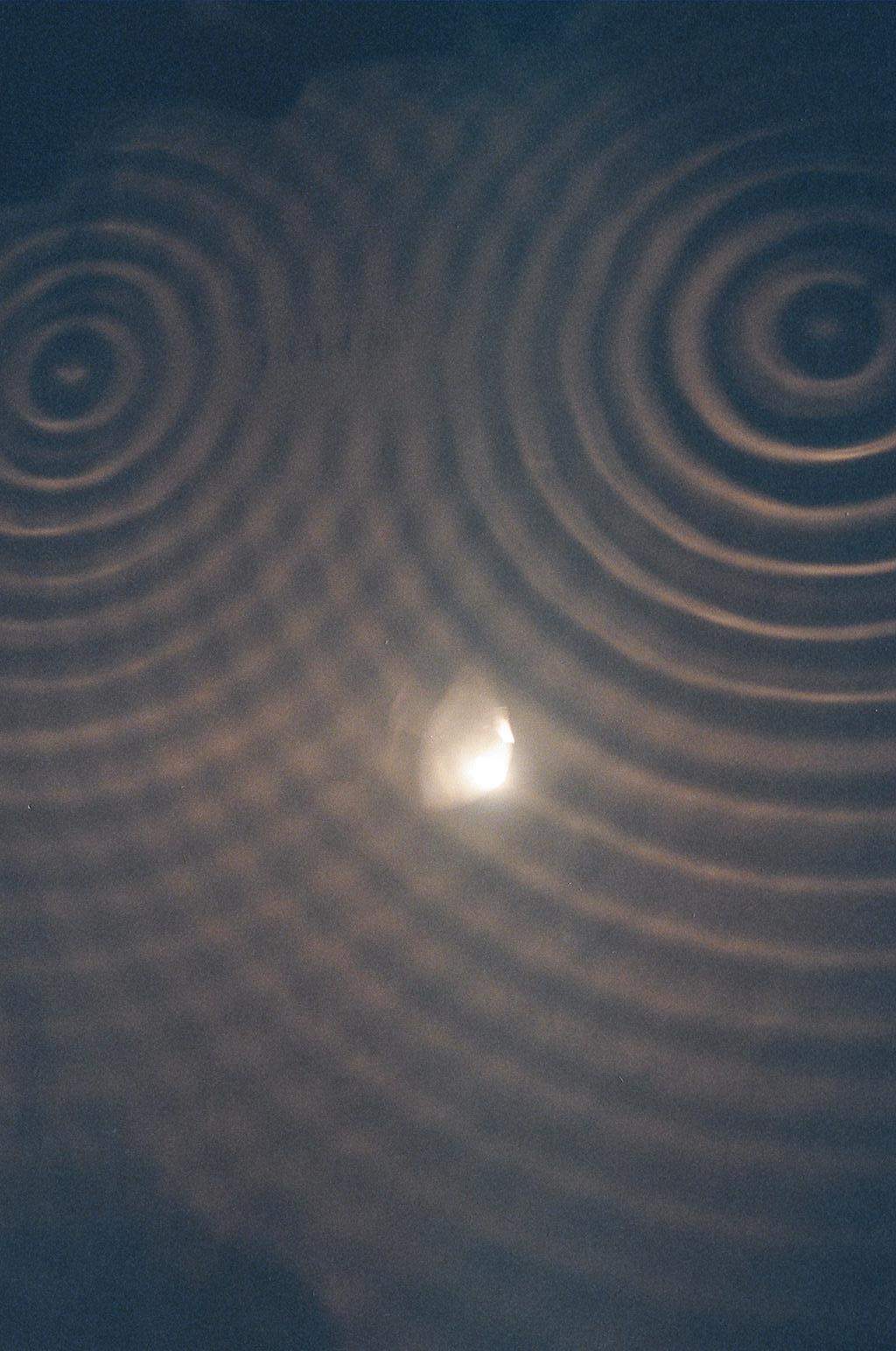
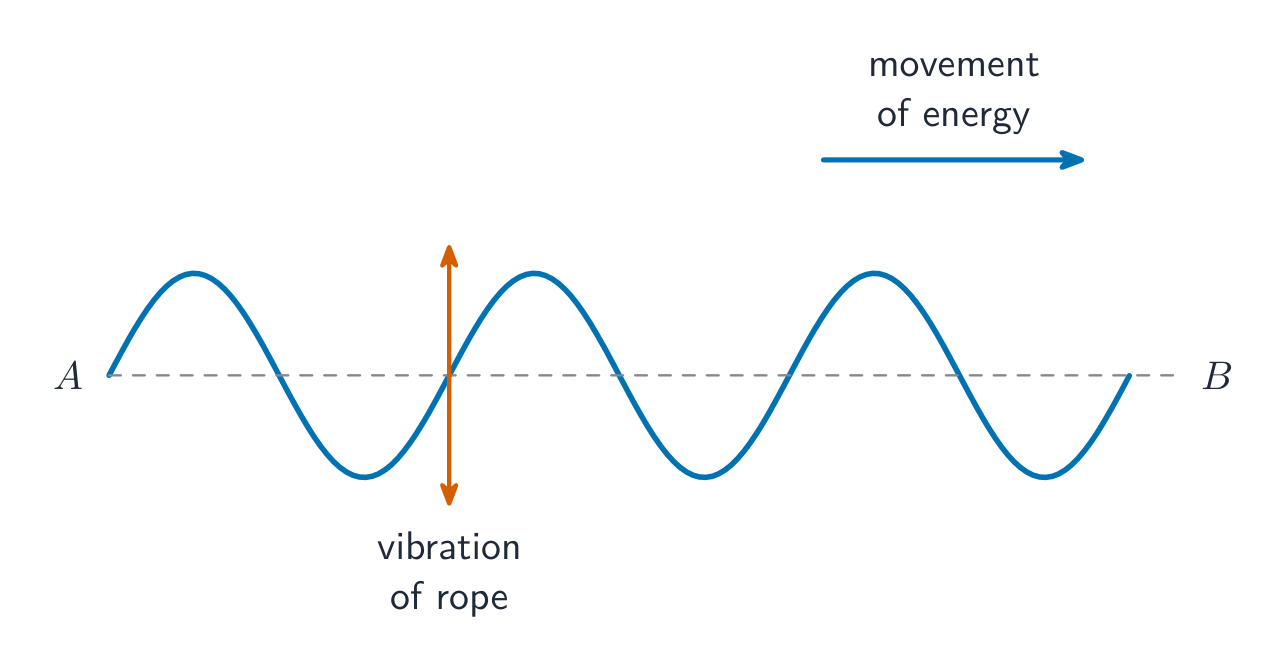
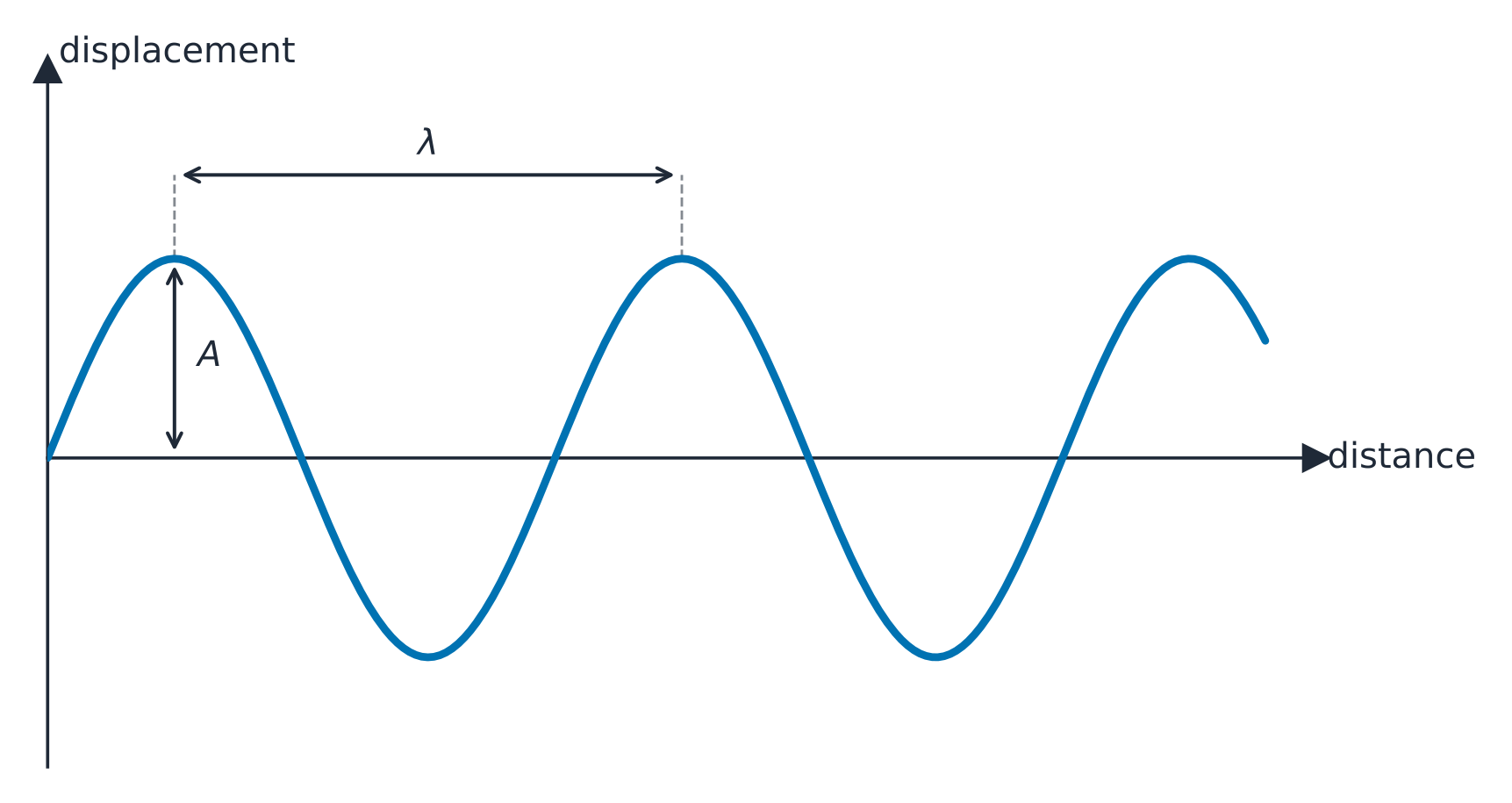
    Explore · ⁨Jelajahi⁩

    Form an image with a converging lens · ⁨Bentuk bayangan dengan lensa konvergen⁩

    A converging lens bends parallel rays to its focal point. Move the object and watch the image change from large and inverted to virtual and upright inside the focal length. · ⁨Lensa konvergen membengkokkan sinar sejajar ke titik fokusnya. Gerakkan benda dan saksikan bayangan berubah dari besar dan terbalik menjadi maya dan tegak di dalam panjang fokus.⁩

    Vocabulary · ⁨Kosa kata⁩ Train · ⁨Latih⁩
    English Bahasa Indonesia
    converging/kənˈvɜːdʒɪŋ/ Konvergen
    diverging/daɪˈvɜːdʒɪŋ/ Divergen
    Watch lesson · ⁨Tonton pelajaran⁩
    13.4

    Exam tips · ⁨Tips ujian⁩

    English
    • Measure all angles from the normal, not the surface.
    • Light entering a denser medium (larger $n$) bends toward the normal; use Snell's law $n_1\sin\theta_1=n_2\sin\theta_2$.
    • Total internal reflection happens only going into a less dense medium, beyond the critical angle ($\sin\theta_c=1/n$).
    • For mirrors and lenses use $\tfrac1{d_o}+\tfrac1{d_i}=\tfrac1f$ and $m=-d_i/d_o$: a positive $d_i$ is a real image, negative is virtual.
    • $n=c/v$, so a bigger index means a slower speed of light in the material.
    Bahasa Indonesia
    • Ukur semua sudut dari garis normal, bukan permukaannya.
    • Cahaya masuk ke medium yang lebih padat (indeks $n$ lebih besar) membengkok menuju garis normal; gunakan hukum Snell $n_1\sin\theta_1=n_2\sin\theta_2$.
    • Pemantulan internal total hanya terjadi saat memasuki medium yang kurang padat, melebihi sudut kritis ($\sin\theta_c=1/n$).
    • Untuk cermin dan lensa gunakan $\tfrac1{d_o}+\tfrac1{d_i}=\tfrac1f$ dan $m=-d_i/d_o$: positif $d_i$ adalah bayangan nyata, negatif adalah bayangan semu.
    • $n=c/v$, sehingga indeks yang lebih besar berarti kecepatan cahaya yang lebih lambat dalam material tersebut.
  • 14

    Waves, Sound, and Physical Optics · ⁨Gelombang, Suara, dan Optik Fisik⁩

    Watch lesson · ⁨Tonton pelajaran⁩
    14.1

    Properties of Wave Pulses and Waves · ⁨Sifat Gelombang Nadi dan Gelombang⁩

    Syllabus · ⁨Silabus⁩
    English

    Learning Objective 14.1.A: Describe the physical properties of waves and wave pulses.

    • 14.1.A.1 Waves transfer energy between two locations without transferring matter between those locations.
      • 14.1.A.1.i A wave pulse is a single disturbance that transfers energy without transferring matter between two locations.
      • 14.1.A.1.ii A wave is modeled as a continuous, periodic disturbance with well-defined wavelength and frequency.
    • 14.1.A.2 Mechanical waves or wave pulses require a medium in which to propagate. Electromagnetic waves or wave pulses do not require a medium in which to propagate.
    • 14.1.A.3 The speed at which a wave or wave pulse propagates through a medium depends on the type of wave and the properties of the medium.
      • 14.1.A.3.i The speed of all electromagnetic waves in a vacuum is a universal physical constant, $c = 3.00 \times 10^{8}$ m/s.
      • 14.1.A.3.ii The speed at which a wave pulse or wave propagates along a string is dependent upon the tension in the string, $F_T$, and the mass per length of the string.
        • Equation: $v_{\text{string}} = \sqrt{\dfrac{F_T}{m/\ell}}$
      • 14.1.A.3.iii In a given medium, the speed of sound waves increases with the temperature of the medium.
    • 14.1.A.4 In a transverse wave, the direction of the disturbance is perpendicular to the direction of propagation of the wave.
    • 14.1.A.5 In a longitudinal wave, the direction of the disturbance is parallel to the direction of propagation of the wave.
      • 14.1.A.5.i Sound waves are modeled as mechanical longitudinal waves.
      • 14.1.A.5.ii The regions of high and low pressure in a sound wave are called compressions and rarefactions, respectively.
    • 14.1.A.6 Amplitude is the maximum displacement of a wave from its equilibrium position.
      • 14.1.A.6.i The amplitude of a longitudinal pressure wave may be determined by the maximum increase or decrease in pressure from equilibrium pressure.
      • 14.1.A.6.ii The loudness of a sound increases with increasing amplitude.
      • 14.1.A.6.iii The energy carried by a wave increases with increasing amplitude.
    Bahasa Indonesia

    Tujuan Pembelajaran 14.1.A: Deskripsikan sifat fisik gelombang dan pulsa gelombang.

    • 14.1.A.1 Gelombang mentransfer energi antara dua lokasi tanpa memindahkan materi antara lokasi-lokasi tersebut.
      • 14.1.A.1.i Pulsa gelombang adalah gangguan tunggal yang mentransfer energi tanpa memindahkan materi antara dua lokasi.
      • 14.1.A.1.ii Gelombang dimodelkan sebagai gangguan kontinu dan periodik dengan panjang gelombang dan frekuensi yang terdefinisi dengan jelas.
    • 14.1.A.2 Gelombang mekanis atau pulsa gelombang memerlukan medium tempat merambat. Gelombang elektromagnetik atau pulsa gelombang tidak memerlukan medium tempat merambat.
    • 14.1.A.3 Kecepatan perambatan gelombang atau pulsa gelombang melalui suatu medium bergantung pada jenis gelombang dan sifat medium tersebut.
      • 14.1.A.3.i Kecepatan semua gelombang elektromagnetik dalam ruang hampa adalah konstanta fisika universal, $c = 3.00 \times 10^{8}$ m/s.
      • 14.1.A.3.ii Kecepatan perambatan pulsa gelombang atau gelombang sepanjang tali bergantung pada tegangan tali, $F_T$, dan massa per satuan panjang tali.
        • Persamaan: $v_{\text{string}} = \sqrt{\dfrac{F_T}{m/\ell}}$
      • 14.1.A.3.iii Dalam suatu medium tertentu, kecepatan gelombang suara meningkat seiring dengan kenaikan suhu medium.
    • 14.1.A.4 Pada gelombang transversal, arah gangguan tegak lurus terhadap arah perambatan gelombang.
    • 14.1.A.5 Pada gelombang longitudinal, arah gangguan sejajar dengan arah perambatan gelombang.
      • 14.1.A.5.i Gelombang suara dimodelkan sebagai gelombang longitudinal mekanis.
      • 14.1.A.5.ii Daerah bertekanan tinggi dan rendah dalam gelombang suara disebut kompresi dan regangan, masing-masing.
    • 14.1.A.6 Amplitudo adalah simpangan maksimum gelombang dari posisi kesetimbangannya.
      • 14.1.A.6.i Amplitudo gelombang tekanan longitudinal dapat ditentukan dari peningkatan atau penurunan maksimum tekanan dari tekanan kesetimbangan.
      • 14.1.A.6.ii Kerasnya bunyi meningkat seiring dengan bertambahnya amplitudo.
      • 14.1.A.6.iii Energi yang dibawa oleh gelombang meningkat seiring dengan bertambahnya amplitudo.

    Source: College Board AP Course and Exam Description · ⁨Sumber: Deskripsi Kursus dan Ujian College Board AP⁩

    English

    A wave 波 carries energy through a medium (or space) without carrying the matter along. A single disturbance is a pulse; a repeating one is a wave. Two types:

    • Transverse 横波: the medium moves perpendicular to the wave's travel (a wave on a rope, light).
    • Longitudinal 纵波: the medium moves along the direction of travel (sound).
    Bahasa Indonesia
    Interferensi bak riak: jalur gelombang bertambah secara konstruktif dan destruktif
    Interferensi bak riak: jalur gelombang bertambah secara konstruktif dan destruktif

    Sebuah gelombang membawa energi melalui medium (atau ruang) tanpa membawa materinya bersama. Gangguan tunggal adalah nadi; yang berulang adalah gelombang. Dua jenis:

    Gelombang transversal: medium bergerak tegak lurus terhadap perjalanan gelombang
    Gelombang transversal: medium bergerak tegak lurus terhadap perjalanan gelombang
    • Transversal: medium bergerak tegak lurus terhadap perjalanan gelombang (gelombang pada tali, cahaya).
    • Longitudinal: medium bergerak sepanjang arah perjalanan (suara).
    Vocabulary · ⁨Kosa kata⁩ Train · ⁨Latih⁩
    English Bahasa Indonesia
    wave/weɪv/ gelombang
    Transverse/trænsˈvɜːs/ Melintang
    Longitudinal/ˌlɒŋɡɪˈtjuːdɪnl/ Longitudinal
    wavelength/ˈweɪvleŋθ/ panjang gelombang
    frequency/ˈfriːkwənsi/ frekuensi
    amplitude/ˈæmplɪtjuːd/ amplitudo
    wave speed/weɪv spiːd/ kecepatan gelombang
    Polarization/ˌpəʊləraɪˈzeɪʃn/ Polarisasi
    intensity/ɪnˈtensɪti/ intensitas
    Electromagnetic waves/ɪˌlektrəʊməɡˈnetɪk weɪvz/ Gelombang elektromagnetik
    14.2

    Periodic Waves · ⁨Gelombang Periodik⁩

    Syllabus · ⁨Silabus⁩
    English

    Learning Objective 14.2.A: Describe the physical properties of a periodic wave.

    • 14.2.A.1 Periodic waves have regular repetitions that can be described using period and frequency.
      • 14.2.A.1.i The period is the time for one complete oscillation of the wave.
      • 14.2.A.1.ii The frequency is the rate at which the wave repeats.
        • Equation: $T = \dfrac{1}{f}$
      • 14.2.A.1.iii The amplitude of a wave is independent of the period and the frequency of that wave.
      • 14.2.A.1.iv The energy of a wave increases with increasing frequency.
      • 14.2.A.1.v The frequency of a sound wave is related to its pitch.
      • 14.2.A.1.vi Wavelength is the distance between successive corresponding positions (such as peaks or troughs) on a wave.
    • 14.2.A.2 A sinusoidal wave can be described by equations for the displacement from equilibrium at a specific location as a function of time. A wave can also be described by an equation for the displacement from equilibrium at a specific time as a function of position.
      • Equation: $x(t) = A\cos(\omega t) = A\cos(2\pi f t)$
      • Equation: $y(x) = A\cos\left(2\pi \dfrac{x}{\lambda}\right)$
    • 14.2.A.3 For a periodic wave, the wavelength is proportional to the wave's speed and inversely proportional to the wave's frequency.
      • Equation: $\lambda = \dfrac{v}{f}$
    Bahasa Indonesia

    Tujuan Pembelajaran 14.2.A: Deskripsikan sifat fisik gelombang periodik.

    • 14.2.A.1 Gelombang periodik memiliki pengulangan teratur yang dapat dijelaskan menggunakan periode dan frekuensi.
      • 14.2.A.1.i Periode adalah waktu untuk satu osilasi lengkap gelombang.
      • 14.2.A.1.ii Frekuensi adalah laju berulang gelombang.
        • Persamaan: $T = \dfrac{1}{f}$
      • 14.2.A.1.iii Amplitudo gelombang tidak bergantung pada periode dan frekuensi gelombang tersebut.
      • 14.2.A.1.iv Energi gelombang meningkat seiring dengan bertambahnya frekuensi.
      • 14.2.A.1.v Frekuensi gelombang suara berkaitan dengan nadanya.
      • 14.2.A.1.vi Panjang gelombang adalah jarak antar posisi berkorespondensi yang bersesuaian secara berurutan (seperti puncak atau lembah) pada gelombang.
    • 14.2.A.2 Gelombang sinusoidal dapat dijelaskan melalui persamaan perpindahan dari kesetimbangan pada suatu lokasi tertentu sebagai fungsi waktu. Gelombang juga dapat dijelaskan melalui persamaan perpindahan dari kesetimbangan pada waktu tertentu sebagai fungsi posisi.
      • Persamaan: $x(t) = A\cos(\omega t) = A\cos(2\pi f t)$
      • Persamaan: $y(x) = A\cos\left(2\pi \dfrac{x}{\lambda}\right)$
    • 14.2.A.3 Untuk gelombang periodik, panjang gelombang berbanding lurus dengan kecepatan gelombang dan berbanding terbalik dengan frekuensi gelombangnya.
      • Persamaan: $\lambda = \dfrac{v}{f}$

    Source: College Board AP Course and Exam Description · ⁨Sumber: Deskripsi Kursus dan Ujian College Board AP⁩

    English
    Transverse vs longitudinal waves

    A repeating wave is described by:

    • wavelength 波长 $\lambda$ (distance between repeats),
    • frequency 频率 $f$ (cycles per second) and period $T=1/f$,
    • amplitude 振幅 $A$ (maximum displacement – related to energy),
    • wave speed 波速 $v=f\lambda$, set by the medium, not the source.

    Worked example. A musical note has frequency $340\ \text{Hz}$ and the speed of sound is $340\ \text{m/s}$. Its wavelength is $\lambda=v/f=340/340=1.0\ \text{m}$. If the same note travels into water (where sound moves at $\approx 1500\ \text{m/s}$) the frequency stays $340\ \text{Hz}$ but the wavelength stretches to $1500/340\approx 4.4\ \text{m}$ – the source sets the frequency, the medium sets the speed and hence the wavelength.

    Bahasa Indonesia
    Gelombang transversal vs longitudinal

    Gelombang berulang dijelaskan oleh:

    Graf perpindahan-jarak menunjukkan amplitudo dan panjang gelombang
    Graf perpindahan-jarak menunjukkan amplitudo dan panjang gelombang
    • panjang gelombang $\lambda$ (jarak antara pengulangan),
    • frekuensi $f$ (siklus per detik) dan periode $T=1/f$,
    • amplitudo $A$ (perpindahan maksimum – terkait dengan energi),
    • kecepatan gelombang $v=f\lambda$, ditentukan oleh medium, bukan sumbernya.

    Contoh terpecahkan. Sebuah nada musik memiliki frekuensi $340\ \text{Hz}$ dan kecepatan suara adalah $340\ \text{m/s}$. Panjang gelombangnya adalah $\lambda=v/f=340/340=1.0\ \text{m}$. Jika nada yang sama merambat ke dalam air (di mana suara bergerak pada $\approx 1500\ \text{m/s}$) frekuensinya tetap $340\ \text{Hz}$ tetapi panjang gelombangnya meregang menjadi $1500/340\approx 4.4\ \text{m}$ – sumber menetapkan frekuensi, medium menetapkan kecepatan dan karenanya panjang gelombang.

    Explore · ⁨Jelajahi⁩

    Send a periodic wave · ⁨Kirim gelombang periodik⁩

    A periodic wave carries energy without moving matter. Its speed $v=f\lambda$ links frequency and wavelength; raise the frequency and the wavelength shrinks. · ⁨Gelombang periodik membawa energi tanpa memindahkan materi. Kecepatan-nya $v=f\lambda$ menghubungkan frekuensi dan panjang gelombang; naikkan frekuensi dan panjang gelombang menyusut.⁩

    14.3

    Boundary Behavior and Polarization · ⁨Perilaku Batas dan Polarisasi⁩

    Syllabus · ⁨Silabus⁩
    English

    Learning Objective 14.3.A: Describe the interaction between a wave and a boundary.

    • 14.3.A.1 A wave that travels from one medium to another can be transmitted or reflected, depending on the properties of the boundary separating the two media.
      • 14.3.A.1.i A wave traveling from one medium to another (for example, a wave traveling between low-mass and high-mass strings) will result in reflected and transmitted waves.
      • 14.3.A.1.ii A reflected wave is inverted if the transmitted wave travels into a medium in which the speed of the wave decreases.
      • 14.3.A.1.iii A reflected wave is not inverted if the transmitted wave travels into a medium in which the speed of the wave increases.
      • 14.3.A.1.iv The frequency of a wave does not change when it travels from one medium to another.
    • 14.3.A.2 Transverse waves that are reflected from a surface, refracted through a medium, or pass through specific openings may be polarized.
      • 14.3.A.2.i Transverse waves can be polarized and oscillate in a single plane.
      • 14.3.A.2.ii Longitudinal waves cannot be polarized.
    • 14.3.A.3 Polarization of a wave may result in a reduction of the wave's intensity.
      • 14.3.A.3.i Intensity is a measure of the amount of power transferred per unit area.
      • 14.3.A.3.ii The intensity of a wave is the average power per unit area over one period of the wave.
    Bahasa Indonesia

    Tujuan Pembelajaran 14.3.A: Deskripsikan interaksi antara gelombang dan batas.

    • 14.3.A.1 Gelombang yang merambat dari satu medium ke medium lain dapat ditransmisikan atau dipantulkan, tergantung pada sifat batas pemisah kedua medium tersebut.
      • 14.3.A.1.i Gelombang yang merambat dari satu medium ke medium lain (misalnya, gelombang yang merambat antara tali bermassa rendah dan tinggi) akan menghasilkan gelombang pantul dan gelombang transmisi.
      • 14.3.A.1.ii Gelombang pantul terbalik jika gelombang transmisi merambat masuk ke medium di mana kecepatan gelombangnya menurun.
      • 14.3.A.1.iii Gelombang pantul tidak terbalik jika gelombang transmisi merambat masuk ke medium di mana kecepatan gelombaknya meningkat.
      • 14.3.A.1.iv Frekuensi gelombang tidak berubah ketika merambat dari satu medium ke medium lain.
    • 14.3.A.2 Gelombang transversal yang dipantulkan dari permukaan, dibiaskan melalui medium, atau melewati bukaan tertentu dapat terpolarisasi.
      • 14.3.A.2.i Gelombang transversal dapat terpolarisasi dan bergetar dalam satu bidang tunggal.
      • 14.3.A.2.ii Gelombang longitudinal tidak dapat terpolarisasi.
    • 14.3.A.3 Polarisasi gelombang dapat menyebabkan penurunan intensitas gelombang.
      • 14.3.A.3.i Intensitas adalah ukuran jumlah daya yang ditransfer per satuan luas.
      • 14.3.A.3.ii Intensitas gelombang adalah rata-rata daya per satuan luas selama satu periode gelombang.

    Source: College Board AP Course and Exam Description · ⁨Sumber: Deskripsi Kursus dan Ujian College Board AP⁩

    English
    Total internal reflection

    At a boundary a wave partly reflects and partly transmits. Reflecting off a denser medium inverts the wave; off a less-dense medium it does not. Polarization 偏振 applies to transverse waves only: a polarizer passes just one direction of oscillation, which is why polarized sunglasses cut glare.

    The effect of a polarizer is measured through intensity 强度 - the average power a wave delivers per unit area over one period, in $\text{W m}^{-2}$. Because a polarizer removes the components of the oscillation that are not aligned with it, it reduces the wave's intensity: unpolarized light passing a single ideal polarizer drops to half its intensity, and a second polarizer at an angle cuts it further. Intensity also falls with distance from a source, since the same power spreads over a larger area.

    Bahasa Indonesia
    Pemantulan internal total

    Di sebuah batas gelombang sebagian dipantulkan dan sebagian ditransmisikan. Memantul dari medium yang lebih padat membalik gelombang; dari medium yang kurang padat tidak. Polarisasi berlaku hanya untuk gelombang transversal: polarizer hanya meneruskan satu arah osilasi, itulah sebabnya kacamata hitam terpolarisasi mengurangi silau.

    Efek polarizer diukur melalui intensitas - daya rata-rata yang disalurkan gelombang per satuan luas selama satu periode, dalam $\text{W m}^{-2}$. Karena polarizer menghilangkan komponen osilasi yang tidak sejajar dengannya, polarizer tersebut mengurangi intensitas gelombang: cahaya tak terpolarisasi yang melewati satu polarizer ideal turun menjadi setengah intensitasnya, dan polarizer kedua pada sudut tertentu memotongnya lebih lanjut. Intensitas juga menurun dengan jarak dari sumber, karena daya yang sama menyebar di area yang lebih luas.

    Gelombang tak terpolarisasi bergetar di banyak bidang; gelombang terpolarisasi bergetar di satu bidang
    Gelombang tak terpolarisasi bergetar di banyak bidang; gelombang terpolarisasi bergetar di satu bidang
    14.4

    Electromagnetic Waves · ⁨Gelombang Elektromagnetik⁩

    Syllabus · ⁨Silabus⁩
    English

    Learning Objective 14.4.A: Describe the properties of an electromagnetic wave.

    • 14.4.A.1 Electromagnetic waves consist of oscillating electric and magnetic fields that are mutually perpendicular.
      • 14.4.A.1.i Electromagnetic waves are transverse waves because the oscillations of the electric and magnetic fields are perpendicular to the direction of propagation.
      • 14.4.A.1.ii Electromagnetic waves are commonly assumed to be plane waves, which are characterized by planar wave fronts.
    • 14.4.A.2 Electromagnetic waves do not need a medium through which to propagate.
    • 14.4.A.3 Categories of electromagnetic waves are characterized by their wavelengths.
      • 14.4.A.3.i Categories of electromagnetic waves include (in order of decreasing wavelength, spanning a range from kilometers to picometers) radio waves, microwaves, infrared, visible, ultraviolet, X-rays, and gamma rays.
      • 14.4.A.3.ii Visible electromagnetic waves are further broken into categories of color, including (in order of decreasing wavelength) red, orange, yellow, green, blue, and violet.
      • 14.4.A.3.iii Visible electromagnetic waves are also called light. Sometimes, electromagnetic waves of all wavelengths are collectively referred to as light or electromagnetic radiation.

    Boundary statement: AP Physics 2 expects students to know the ordering of the electromagnetic spectrum (including visible light). However, students will not be expected to define exact wavelength ranges within the electromagnetic spectrum.

    Bahasa Indonesia

    Tujuan Pembelajaran 14.4.A: Deskripsikan sifat-sifat gelombang elektromagnetik.

    • 14.4.A.1 Gelombang elektromagnetik terdiri dari medan listrik dan medan magnet yang berosilasi dan saling tegak lurus.
      • 14.4.A.1.i Gelombang elektromagnetik adalah gelombang transversal karena osilasi medan listrik dan medan magnet tegak lurus terhadap arah rambatnya.
      • 14.4.A.1.ii Gelombang elektromagnetik umumnya diasumsikan sebagai gelombang bidang, yang dikarakteristikkan oleh muka gelombang planar.
    • 14.4.A.2 Gelombang elektromagnetik tidak memerlukan medium untuk merambat.
    • 14.4.A.3 Kategori gelombang elektromagnetik dikarakteristikkan oleh panjang gelombangnya.
      • 14.4.A.3.i Kategori gelombang elektromagnetik meliputi (berurutan berdasarkan penurunan panjang gelombang, mencakup rentang dari kilometer hingga pikometer) gelombang radio, mikrogelombang, inframerah, tampak, ultraviolet, sinar-X, dan sinar gamma.
      • 14.4.A.3.ii Gelombang elektromagnetik tampak dibagi lagi menjadi kategori warna, termasuk (berurutan berdasarkan penurunan panjang gelombang) merah, oranye, kuning, hijau, biru, dan ungu.
      • 14.4.A.3.iii Gelombang elektromagnetik tampak juga disebut cahaya. Terkadang, semua gelombang elektromagnetik dari berbagai panjang gelombang secara kolektif disebut sebagai cahaya atau radiasi elektromagnetik.

    Pernyataan Batas: AP Physics 2 mengharapkan siswa mengetahui urutan spektrum elektromagnetik (termasuk cahaya tampak). Namun, siswa tidak diharapkan mendefinisikan rentang panjang gelombang yang tepat dalam spektrum elektromagnetik.

    Source: College Board AP Course and Exam Description · ⁨Sumber: Deskripsi Kursus dan Ujian College Board AP⁩

    English

    Electromagnetic waves 电磁波 are oscillating electric and magnetic fields that travel through vacuum at the speed of light $c$, needing no medium. They span the spectrum from radio to gamma rays; higher frequency means shorter wavelength and higher photon energy.

    Bahasa Indonesia

    Gelombang elektromagnetik adalah medan listrik dan magnetik yang berosilasi yang merambat melalui vakum pada kecepatan cahaya $c$, tidak memerlukan medium. Mereka mencakup spektrum dari radio hingga sinar gamma; frekuensi yang lebih tinggi berarti panjang gelombang yang lebih pendek dan energi foton yang lebih tinggi.

    Spektrum elektromagnetik, dari gelombang radio hingga sinar gamma
    Spektrum elektromagnetik, dari gelombang radio hingga sinar gamma
    14.5

    The Doppler Effect · ⁨Efek Doppler⁩

    Syllabus · ⁨Silabus⁩
    English

    Learning Objective 14.5.A: Describe the properties of a wave based on the relative motion between the source of the wave and the observer of the wave.

    • 14.5.A.1 The Doppler effect describes the relationship between the rest frequency of a wave source, the observed frequency of the source, and the relative velocity of the source and the observer.
    • 14.5.A.2 A greater relative velocity results in a greater measured difference between the observed and rest frequencies.
      • 14.5.A.2.i For a wave source moving at the same velocity as the observer, the observed frequency is equal to the rest frequency.
      • 14.5.A.2.ii For a wave source moving toward an observer, the observed frequency is greater than the rest frequency.
      • 14.5.A.2.iii For a wave source moving away from an observer, the observed frequency is less than the rest frequency.

    Boundary statement: Only qualitative treatments of the Doppler effect are required for AP Physics 2.

    Bahasa Indonesia

    Tujuan Pembelajaran 14.5.A: Deskripsikan sifat gelombang berdasarkan gerakan relatif antara sumber gelombang dan pengamat gelombang.

    • 14.5.A.1 Efek Doppler menggambarkan hubungan antara frekuensi diam sumber gelombang, frekuensi yang diamati dari sumber, dan kecepatan relatif sumber dan pengamat.
    • 14.5.A.2 Kecepatan relatif yang lebih besar menghasilkan perbedaan terukur yang lebih besar antara frekuensi yang diamati dan frekuensi diam.
      • 14.5.A.2.i Untuk sumber gelombang yang bergerak dengan kecepatan yang sama seperti pengamat, frekuensi yang diamati sama dengan frekuensi diam.
      • 14.5.A.2.ii Untuk sumber gelombang yang bergerak mendekati pengamat, frekuensi yang diamati lebih besar daripada frekuensi diam.
      • 14.5.A.2.iii Untuk sumber gelombang yang menjauhi pengamat, frekuensi yang diamati lebih kecil daripada frekuensi diam.

    Pernyataan Batas: Hanya perlakuan kualitatif efek Doppler yang diperlukan untuk AP Physics 2.

    Source: College Board AP Course and Exam Description · ⁨Sumber: Deskripsi Kursus dan Ujian College Board AP⁩

    English
    The Doppler effect

    The Doppler effect 多普勒效应 is the change in observed frequency when a wave source and observer move relative to each other. Approaching $\Rightarrow$ higher frequency (shorter wavelength); receding $\Rightarrow$ lower frequency. It explains a passing siren's drop in pitch and the redshift of receding galaxies.

    Bahasa Indonesia
    Efek Doppler

    Efek Doppler adalah perubahan frekuensi yang diamati ketika sumber gelombang dan pengamat bergerak relatif satu sama lain. Mendekat $\Rightarrow$ frekuensi lebih tinggi (panjang gelombang lebih pendek); menjauh $\Rightarrow$ frekuensi lebih rendah. Ini menjelaskan penurunan nada sirene yang lewat dan redshift galaksi yang menjauh.

    Sumber yang bergerak memampatkan muka gelombang di depannya, meningkatkan frekuensi yang teramati
    Sumber yang bergerak memampatkan muka gelombang di depannya, meningkatkan frekuensi yang teramati
    Explore · ⁨Jelajahi⁩

    Hear the Doppler shift · ⁨Dengar pergeseran Doppler⁩

    When a source moves, waves bunch up ahead (higher frequency) and stretch behind (lower) — the Doppler effect. Speed it up to exaggerate the shift. · ⁨Ketika sumber bergerak, gelombang terkumpul di depan (frekuensi lebih tinggi) dan meregang di belakang (lebih rendah) — efek Doppler. Percepati untuk melebih-lebihkan pergeseran.⁩

    Vocabulary · ⁨Kosa kata⁩ Train · ⁨Latih⁩
    English Bahasa Indonesia
    Doppler effect/ˈdɒplə ɪˈfekt/ Efek Doppler
    Constructive interference/kənˈstrʌktɪv ˌɪntəˈfɪərəns/ Interferensi konstruktif
    destructive interference/dɪˈstrʌktɪv ˌɪntəˈfɪərəns/ interferensi destruktif
    14.6

    Wave Interference and Standing Waves · ⁨Interferensi Gelombang dan Gelombang Berdiri⁩

    Syllabus · ⁨Silabus⁩
    English

    Learning Objective 14.6.A: Describe the net disturbance that occurs when two or more wave pulses or waves overlap.

    • 14.6.A.1 Wave interference is the interaction of two or more wave pulses or waves.
    • 14.6.A.2 When two or more wave pulses or waves interact with each other, they travel through each other and overlap rather than bouncing off each other.
    • 14.6.A.3 When two or more wave pulses or waves overlap, the resulting displacement can be determined by adding the individual displacements. This is called superposition.
    • 14.6.A.4 Wave interference may be constructive or destructive.
      • 14.6.A.4.i When the displacements of the superposed wave pulses or waves are in the same direction, the interaction is called constructive interference.
      • 14.6.A.4.ii When the displacements of the superposed wave pulses or waves are in opposite directions, the interaction is called destructive interference.
      • 14.6.A.4.iii Two or more traveling wave pulses or waves can interact in such a way as to produce amplitude variations in the resultant wave pulse or wave.
    • 14.6.A.5 Visual representations of wave pulses or waves are useful in determining the result of two interacting wave pulses or waves.
    • 14.6.A.6 Beats arise from the addition of two waves of slightly different frequency.
      • 14.6.A.6.i Waves with different frequencies are sometimes in phase and sometimes out of phase at locations along the waves, causing periodic amplitude changes in the resultant wave.
      • 14.6.A.6.ii The beat frequency is the difference in the frequencies of the two waves.
        • Equation: $\left|f_{\text{beat}}\right| = \left|f_1 - f_2\right|$
      • 14.6.A.6.iii Tuning forks are devices that are commonly used to demonstrate beat frequencies.

    Learning Objective 14.6.B: Describe the properties of a standing wave.

    • 14.6.B.1 Standing waves can result from interference between two waves that are confined to a region and traveling in opposite directions.
      • 14.6.B.1.i Standing waves have nodes and antinodes. A node is a point on the standing wave where the amplitude is always zero. An antinode is a point on the standing wave where the amplitude is always at maximum.
      • 14.6.B.1.ii The possible wavelengths of a standing wave are determined by the size and boundary conditions of the region to which it is confined.
      • 14.6.B.1.iii Common regions where standing waves can form include pipes with open or closed ends, as well as strings with fixed or loose ends.
    • 14.6.B.2 A standing wave with the longest possible wavelength is called the fundamental or first harmonic. The second-longest wavelength is typically called the second harmonic, the third-longest wavelength is called the third harmonic, and so on. However, for a standing wave with a node at one end and an antinode at the other end, only odd harmonics can be established.
    • 14.6.B.3 Visual representations of standing waves are useful in determining the relationships between length of the region, wavelength, frequency, wave speed, and harmonic.
    Bahasa Indonesia

    Tujuan Pembelajaran 14.6.A: Deskripsikan gangguan total yang terjadi ketika dua atau lebih denyut gelombang atau gelombang tumpang tindih.

    • 14.6.A.1 Interferensi gelombang adalah interaksi dua atau lebih denyut gelombang atau gelombang.
    • 14.6.A.2 Ketika dua atau lebih denyut gelombang atau gelombang berinteraksi satu sama lain, mereka merambat menembus satu sama lain dan tumpang tindih alih-alih memantul satu sama lain.
    • 14.6.A.3 Ketika dua atau lebih denyut gelombang atau gelombang tumpang tindih, perpindahan yang dihasilkan dapat ditentukan dengan menjumlahkan perpindahan individu. Hal ini disebut superposisi.
    • 14.6.A.4 Interferensi gelombang dapat bersifat konstruktif atau destruktif.
      • 14.6.A.4.i Ketika perpindahan dari denyut gelombang atau gelombang yang bersuperposisi berada dalam arah yang sama, interaksi tersebut disebut interferensi konstruktif.
      • 14.6.A.4.ii Ketika perpindahan dari denyut gelombang atau gelombang yang bersuperposisi berada dalam arah yang berlawanan, interaksi tersebut disebut interferensi destruktif.
      • 14.6.A.4.iii Dua atau lebih denyut gelombang atau gelombang yang merambat dapat berinteraksi sedemikian rupa sehingga menghasilkan variasi amplitudo dalam denyut gelombang atau gelombang hasil.
    • 14.6.A.5 Representasi visual dari denyut gelombang atau gelombang berguna dalam menentukan hasil dari dua denyut gelombang atau gelombang yang berinteraksi.
    • 14.6.A.6 Beat muncul dari penjumlahan dua gelombang dengan frekuensi yang sedikit berbeda.
      • 14.6.A.6.i Gelombang dengan frekuensi yang berbeda terkadang sefasa dan terkadang tidak sefasa di sepanjang lokasi pada gelombang, menyebabkan perubahan amplitudo periodik pada gelombang resultan.
      • 14.6.A.6.ii Frekuensi beat adalah selisih dari frekuensi kedua gelombang tersebut.
        • Persamaan: $\left|f_{\text{beat}}\right| = \left|f_1 - f_2\right|$
      • 14.6.A.6.iii Garpu tala adalah perangkat yang umum digunakan untuk mendemonstrasikan frekuensi beat.

    Tujuan Pembelajaran 14.6.B: Jelaskan sifat-sifat gelombang berdiri.

    • 14.6.B.1 Gelombang berdiri dapat timbul dari interferensi antara dua gelombang yang terkurung di suatu daerah dan merambat ke arah berlawanan.
      • 14.6.B.1.i Gelombang berdiri memiliki nodus dan antinodus. Nodus adalah titik pada gelombang berdiri di mana amplitudonya selalu nol. Antinodus adalah titik pada gelombang berdiri di mana amplitudonya selalu maksimum.
      • 14.6.B.1.ii Panjang gelombang yang mungkin terjadi pada gelombang berdiri ditentukan oleh ukuran dan kondisi batas daerah tempat gelombang itu terkurung.
      • 14.6.B.1.iii Daerah umum di mana gelombang berdiri dapat terbentuk meliputi pipa dengan ujung terbuka atau tertutup, serta dawai dengan ujung tetap atau longgar.
    • 14.6.B.2 Gelombang berdiri dengan panjang gelombang terpanjang disebut fundamental atau harmonik pertama. Panjang gelombang terpanjang kedua biasanya disebut harmonik kedua, panjang gelombang terpanjang ketiga disebut harmonik ketiga, dan seterusnya. Namun, untuk gelombang berdiri dengan nodus di satu ujung dan antinodus di ujung lainnya, hanya harmonik ganjil yang dapat terbentuk.
    • 14.6.B.3 Representasi visual dari gelombang berdiri berguna dalam menentukan hubungan antara panjang daerah, panjang gelombang, frekuensi, kecepatan rambat gelombang, dan harmonik.

    Source: College Board AP Course and Exam Description · ⁨Sumber: Deskripsi Kursus dan Ujian College Board AP⁩

    English
    Standing (stationary) waves

    When waves overlap they superpose (add). Constructive interference 相长干涉 (crests aligned) gives a bigger wave; destructive interference 相消干涉 (crest on trough) cancels. Two waves travelling opposite ways in a bounded medium form a standing wave 驻波 with fixed nodes 波节 (no motion) and antinodes 波腹 (maximum motion) – the basis of resonance on strings and in pipes.

    Worked example. A guitar string $0.65\ \text{m}$ long is fixed at both ends. Its fundamental (first harmonic) fits half a wavelength between the ends, so $\lambda=2L=1.30\ \text{m}$. If waves travel along the string at $260\ \text{m/s}$, the note's frequency is $f=v/\lambda=260/1.30=200\ \text{Hz}$. Shortening the string (a fret) raises the pitch.

    When two waves of slightly different frequency overlap, they drift in and out of step, so the combined sound swells loud and soft in a slow throb called beats 拍. The beat frequency 拍频 is simply the difference of the two frequencies:

    $$f_{\text{beat}}=|f_1-f_2|.$$
    Two tuning forks of $256\ \text{Hz}$ and $260\ \text{Hz}$ sounded together give $|260-256|=4$ beats each second; a musician tunes an instrument by slowing these beats towards zero against a reference note.

    Bahasa Indonesia
    Gelombang berdiri (diam)

    Ketika gelombang tumpang tindih, mereka superposisi (ditambahkan). Interferensi konstruktif (puncak sejajar) menghasilkan gelombang lebih besar; interferensi destruktif (puncak di lembah) saling meniadakan. Dua gelombang merambat berlawanan arah dalam medium terbatas membentuk gelombang berdiri dengan simpul tetap (tanpa gerak) dan perut (gerak maksimum) – dasar resonansi pada senar dan pipa.

    Gelombang berdiri terbentuk di mana dua gelombang yang merambat berlawanan arah bertumpuk *Gelombang berdiri terbentuk di mana dua gelombang yang merambat berlawanan arah bertumpuk

    Contoh terpecahkan. Senar gitar $0.65\ \text{m}$ panjangnya dikencangkan di kedua ujungnya. Frekuensi fundamental (harmonik pertama) memuat setengah panjang gelombang di antara kedua ujung, sehingga $\lambda=2L=1.30\ \text{m}$. Jika gelombang merambat sepanjang senar pada $260\ \text{m/s}$, frekuensi nada tersebut adalah $f=v/\lambda=260/1.30=200\ \text{Hz}$. Memendekkan senar (melalui fret) menaikkan tinggi nada.

    Ketika dua gelombang dengan frekuensi sedikit berbeda bertumpuk, mereka bergeser masuk dan keluar dari kesesuaian fase, sehingga suara gabungan mengeras dan melunak secara perlahan dalam denyutan lambat yang disebut beat. Frekuensi beat hanyalah selisih dari kedua frekuensi tersebut:

    $$f_{\text{beat}}=|f_1-f_2|.$$
    Dua garpu tala dengan $256\ \text{Hz}$ dan $260\ \text{Hz}$ jika dipetik bersamaan menghasilkan $|260-256|=4$ beat per detik; seorang musisi menyetel instrumen dengan memperlambat beat-beat ini menuju nol terhadap nada referensi.

    Explore · ⁨Jelajahi⁩

    Set up a standing wave · ⁨Siapkan gelombang berdiri⁩

    Two waves travelling opposite ways interfere into a standing wave with fixed nodes and antinodes. Only certain frequencies fit, giving the harmonics. · ⁨Dua gelombang yang merambat berlawanan arah berinterferensi menjadi gelombang berdiri dengan simpul dan perut tetap. Hanya frekuensi tertentu yang muat, menghasilkan harmonik.⁩

    Vocabulary · ⁨Kosa kata⁩ Train · ⁨Latih⁩
    English Bahasa Indonesia
    standing wave/ˈstændɪŋ weɪv/ gelombang diam
    nodes/nəʊdz/ nod
    antinodes/ˌæntɪˈnəʊdz/ Antinoda
    beats/biːts/ detak
    beat frequency/biːt ˈfriːkwənsi/ Frekuensi selisih
    14.7

    Diffraction · ⁨Difraksi⁩

    Syllabus · ⁨Silabus⁩
    English

    Learning Objective 14.7.A: Describe the behavior of a wave and the diffraction pattern resulting from a wave passing through a single opening.

    • 14.7.A.1 Diffraction is the spreading of a wave around the edges of an obstacle or through an opening.
    • 14.7.A.2 Diffraction is most pronounced when the size of the opening is comparable to the wavelength of the wave.
    • 14.7.A.3 Diffraction of multiple wavefronts through a single opening leads to observable interference patterns.
    • 14.7.A.4 Diffraction is commonly demonstrated by monochromatic light of wavelength $\lambda$ incident on a narrow opening of width $a$ that is a distance $L$ from a screen.
      • 14.7.A.4.i Constructive and destructive interference of multiple wavefronts originating from the opening will result in bright and dark bands on the screen.
      • 14.7.A.4.ii The amount of interference between two wavefronts depends on the path length difference $\Delta D$ of the wavefronts.
      • 14.7.A.4.iii The path length difference $\Delta D$ can be described in terms of the opening width $a$ and the angle $\theta$ between the direction of propagation of the wavefront and the normal to the opening by the equation $\Delta D = a\sin\theta$.
      • 14.7.A.4.iv For small angles, where $\theta < 10°$, the small angle approximation can be used to relate $\lambda$, $a$, and $L$ to $y_{\min}$, the distance from the middle of the central bright fringe to the $m^{\text{th}}$ order of minimum brightness on the screen.
        • Equation: $a\left(\dfrac{y_{\min}}{L}\right) \approx m\lambda$
    • 14.7.A.5 The diffraction pattern produced by a wave passing through an opening depends on the shape of the opening.
    • 14.7.A.6 Visual representations of single-slit diffraction patterns are useful in determining the physical properties of the slit and the interacting waves.
    Bahasa Indonesia

    Tujuan Pembelajaran 14.7.A: Jelaskan perilaku gelombang dan pola difraksi yang dihasilkan dari gelombang yang melewati satu celah tunggal.

    • 14.7.A.1 Difraksi adalah penyebaran gelombang di sekitar tepi penghalang atau melalui sebuah celah.
    • 14.7.A.2 Difraksi paling nyata ketika ukuran celah sebanding dengan panjang gelombang gelombang tersebut.
    • 14.7.A.3 Difraksi beberapa muka gelombang melalui satu celah tunggal menghasilkan pola interferensi yang dapat diamati.
    • 14.7.A.4 Difraksi sering didemonstrasikan oleh cahaya monokromatik dengan panjang gelombang $\lambda$ yang mengenai celah sempit dengan lebar $a$ yang berjarak $L$ dari layar.
      • 14.7.A.4.i Interferensi konstruktif dan destruktif dari beberapa muka gelombang yang berasal dari celah akan menghasilkan pita terang dan gelap pada layar.
      • 14.7.A.4.ii Besarnya interferensi antara dua muka gelombang bergantung pada perbedaan panjang lintasan $\Delta D$ dari muka gelombang tersebut.
      • 14.7.A.4.iii Perbedaan panjang lintasan $\Delta D$ dapat dijelaskan dalam hal lebar celah $a$ dan sudut $\theta$ antara arah perambatan muka gelombang dan normal terhadap celah menggunakan persamaan $\Delta D = a\sin\theta$.
      • 14.7.A.4.iv Untuk sudut kecil, di mana $\theta < 10°$, pendekatan sudut kecil dapat digunakan untuk menghubungkan $\lambda$, $a$, dan $L$ dengan $y_{\min}$, jarak dari tengah pita terang sentral ke orde $m^{\text{th}}$ kecerahan minimum pada layar.
        • Persamaan: $a\left(\dfrac{y_{\min}}{L}\right) \approx m\lambda$
    • 14.7.A.5 Pola difraksi yang dihasilkan oleh gelombang yang melewati celah bergantung pada bentuk celah tersebut.
    • 14.7.A.6 Representasi visual dari pola difraksi celah tunggal berguna dalam menentukan sifat fisik celah dan gelombang yang berinteraksi.

    Source: College Board AP Course and Exam Description · ⁨Sumber: Deskripsi Kursus dan Ujian College Board AP⁩

    English

    Diffraction 衍射 is the bending and spreading of waves around edges or through openings. The spreading is significant when the opening is comparable to the wavelength – so sound (long wavelength) bends around doorways easily, while light (tiny wavelength) needs a very narrow slit.

    Bahasa Indonesia

    Difraksi adalah pembelokan dan penyebaran gelombang di sekitar tepi atau melalui celah. Penyebaran menjadi signifikan ketika ukuran celah sebanding dengan panjang gelombang – sehingga suara (panjang gelombang panjang) mudah membelok di sekitar pintu, sedangkan cahaya (panjang gelombang sangat kecil) memerlukan celah yang sangat sempit.

    Gelombang menyebar (difraksi) saat melewati celah
    Gelombang menyebar (terdifraksi) saat melewati celah
    Vocabulary · ⁨Kosa kata⁩ Train · ⁨Latih⁩
    English Bahasa Indonesia
    Diffraction/dɪˈfrækʃn/ Difraksi
    Coherent/kəʊˈhɪərənt/ Koheren
    diffraction grating/dɪˈfrækʃn ˈɡreɪtɪŋ/ kisi difraksi
    thin film/θɪn fɪlm/ Film tipis
    antireflection coating/ˌæntɪrɪˈflekʃn ˈkəʊtɪŋ/ Lapisan anti-pantulan
    14.8

    Double-Slit Interference and Diffraction Gratings · ⁨Interferensi Celah Ganda dan Kisi Difraksi⁩

    Syllabus · ⁨Silabus⁩
    English

    Learning Objective 14.8.A: Describe the behavior of a wave and the diffraction pattern resulting from the wave passing through multiple openings.

    • 14.8.A.1 The pattern resulting from monochromatic light of wavelength $\lambda$ incident on two slits a distance $d$ apart is caused by a combination of wave diffraction and wave interference.
      • 14.8.A.1.i When only considering wave interference, a double slit creates a pattern of uniformly spaced maxima.
      • 14.8.A.1.ii Constructive and destructive interference of the wavefronts originating from each slit will result in bright and dark bands on the screen.
      • 14.8.A.1.iii The amount of interference between two wavefronts depends on the path length difference $\Delta D$ of the wavefronts.
      • 14.8.A.1.iv The path length difference $\Delta D$ can be described in terms of the slit separation $d$ and the angle $\theta$ between the direction of propagation of the wavefront and the normal to the opening by the equation $\Delta D = d\sin\theta$.
      • 14.8.A.1.v For small angles, where $\theta < 10°$, the small angle approximation can be used to relate $\lambda$, $d$, and $L$ to $y_{\max}$, the distance from the middle of the central bright fringe to the $m^{\text{th}}$ order of maximum brightness on the screen.
        • Equation: $d\left(\dfrac{y_{\max}}{L}\right) \approx m\lambda$
      • 14.8.A.1.vi When considering wave interference and wave diffraction, a double slit creates an interference pattern of maxima and minima superimposed within the envelope created by single-slit diffraction.
    • 14.8.A.2 Interference patterns produced by light interacting with a double slit indicate that light has wave properties. The source of this discovery was Young's double-slit experiment.
    • 14.8.A.3 Visual representations of double-slit diffraction patterns are useful in determining the physical properties of the slits and the interacting waves.
    • 14.8.A.4 A diffraction grating is a collection of evenly spaced parallel slits or openings that produce an interference pattern that is the combination of numerous diffraction patterns superimposed on each other.
    • 14.8.A.5 When white light is incident on a diffraction grating, the center maximum is white and the higher-order maxima disperse white light into a rainbow of colors, with the longest-wavelength light (red) appearing farthest from the central maximum.
    Bahasa Indonesia

    Tujuan Pembelajaran 14.8.A: Jelaskan perilaku gelombang dan pola difraksi yang dihasilkan dari gelombang yang melewati banyak celah.

    • 14.8.A.1 Pola yang dihasilkan dari cahaya monokromatik dengan panjang gelombang $\lambda$ yang mengenai dua celah berjarak $d$ disebabkan oleh kombinasi difraksi gelombang dan interferensi gelombang.
      • 14.8.A.1.i Ketika hanya mempertimbangkan interferensi gelombang, celah ganda menciptakan pola maksimum dengan jarak yang seragam.
      • 14.8.A.1.ii Interferensi konstruktif dan destruktif dari muka gelombang yang berasal dari setiap celah akan menghasilkan pita terang dan gelap pada layar.
      • 14.8.A.1.iii Besarnya interferensi antara dua muka gelombang bergantung pada perbedaan panjang lintasan $\Delta D$ dari muka gelombang tersebut.
      • 14.8.A.1.iv Perbedaan panjang lintasan $\Delta D$ dapat dijelaskan dalam hal pemisahan celah $d$ dan sudut $\theta$ antara arah perambatan muka gelombang dan normal terhadap celah menggunakan persamaan $\Delta D = d\sin\theta$.
      • 14.8.A.1.v Untuk sudut kecil, di mana $\theta < 10°$, pendekatan sudut kecil dapat digunakan untuk menghubungkan $\lambda$, $d$, dan $L$ dengan $y_{\max}$, jarak dari tengah pita terang sentral ke orde $m^{\text{th}}$ kecerahan maksimum pada layar.
        • Persamaan: $d\left(\dfrac{y_{\max}}{L}\right) \approx m\lambda$
      • 14.8.A.1.vi Saat mempertimbangkan interferensi gelombang dan difraksi gelombang, celah ganda menciptakan pola interferensi maksimum dan minimum yang tersusun di dalam amplop yang diciptakan oleh difraksi celah tunggal.
    • 14.8.A.2 Pola interferensi yang dihasilkan oleh cahaya yang berinteraksi dengan celah ganda menunjukkan bahwa cahaya memiliki sifat gelombang. Sumber penemuan ini adalah eksperimen celah ganda Young.
    • 14.8.A.3 Representasi visual dari pola difraksi celah ganda berguna dalam menentukan sifat fisik celah dan gelombang yang berinteraksi.
    • 14.8.A.4 Kisi difraksi adalah kumpulan celah atau bukaan sejajar yang teratur yang menghasilkan pola interferensi yang merupakan kombinasi dari banyak pola difraksi yang saling menumpuk.
    • 14.8.A.5 Ketika cahaya putih jatuh pada kisi difraksi, maksimum pusatnya berwarna putih dan maksimum orde lebih tinggi menyebarkan cahaya putih menjadi pelangi warna, dengan cahaya berpanjang gelombang terpanjang (merah) muncul paling jauh dari maksimum pusat.

    Source: College Board AP Course and Exam Description · ⁨Sumber: Deskripsi Kursus dan Ujian College Board AP⁩

    English
    Two-source interference

    Coherent 相干 light through two closely spaced slits produces a pattern of bright and dark fringes. Bright fringes occur where the path difference is a whole number of wavelengths:

    $$d\sin\theta=m\lambda.$$
    A diffraction grating 衍射光栅 has many slits, giving sharp, widely spaced bright lines – useful for separating light into its wavelengths.

    Worked example. Light of wavelength $600\ \text{nm}$ passes through two slits $0.20\ \text{mm}$ apart. The first bright fringe ($m=1$) sits at

    $$\sin\theta=\frac{m\lambda}{d}=\frac{1\times600\times10^{-9}}{0.20\times10^{-3}}=3.0\times10^{-3}\;\Rightarrow\;\theta=0.17^{\circ}.$$
    The tiny angle is why the slits must be very close together and the screen far away to see the fringes clearly.

    Bahasa Indonesia
    Interferensi sumber ganda

    Cahaya koheren melalui dua celah yang berdekatan menghasilkan pola garis terang dan gelap. Garis terang terjadi di mana beda lintasan merupakan kelipatan bulat dari panjang gelombang:

    $$d\sin\theta=m\lambda.$$
    Sebuah kisi difraksi memiliki banyak celah, memberikan garis terang yang tajam dan berjauhan – berguna untuk memisahkan cahaya ke dalam panjang gelombangnya.

    Celah ganda Young menghasilkan pola interferensi garis terang dan gelap
    Celah ganda Young menghasilkan pola interferensi garis terang dan gelap

    Contoh terpecahkan. Cahaya dengan panjang gelombang $600\ \text{nm}$ melewati dua celah $0.20\ \text{mm}$ jaraknya. Garis terang pertama ($m=1$) terletak pada

    $$\sin\theta=\frac{m\lambda}{d}=\frac{1\times600\times10^{-9}}{0.20\times10^{-3}}=3.0\times10^{-3}\;\Rightarrow\;\theta=0.17^{\circ}.$$
    Sudut yang sangat kecil inilah sebabnya celah harus sangat berdekatan dan layar jauh agar garis-garis terlihat jelas.

    Warna pelangi yang dipantulkan dari permukaan CD *Lintasan halus pada CD bertindak sebagai kisi difraksi, memecah cahaya putih menjadi spektrum
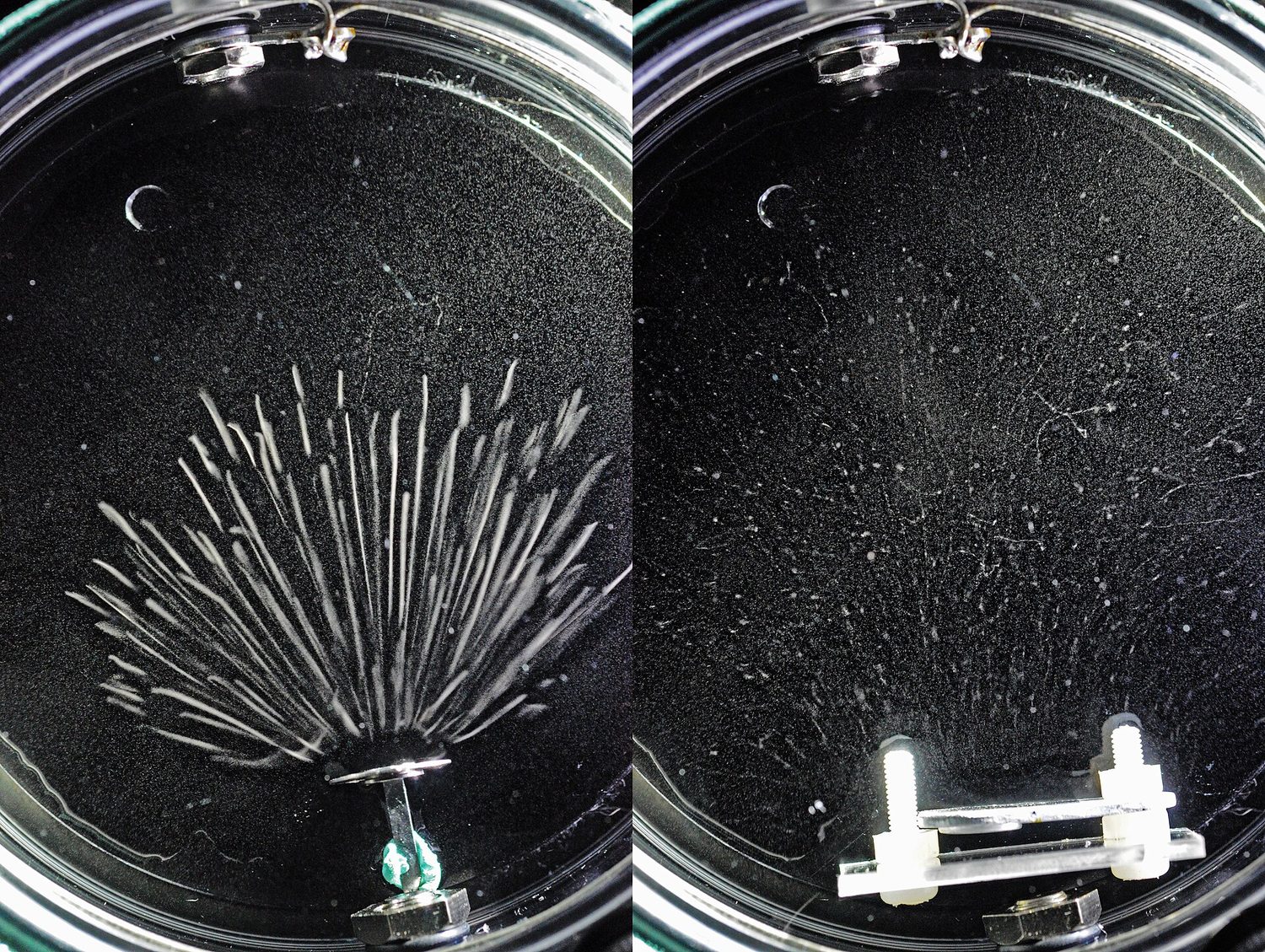
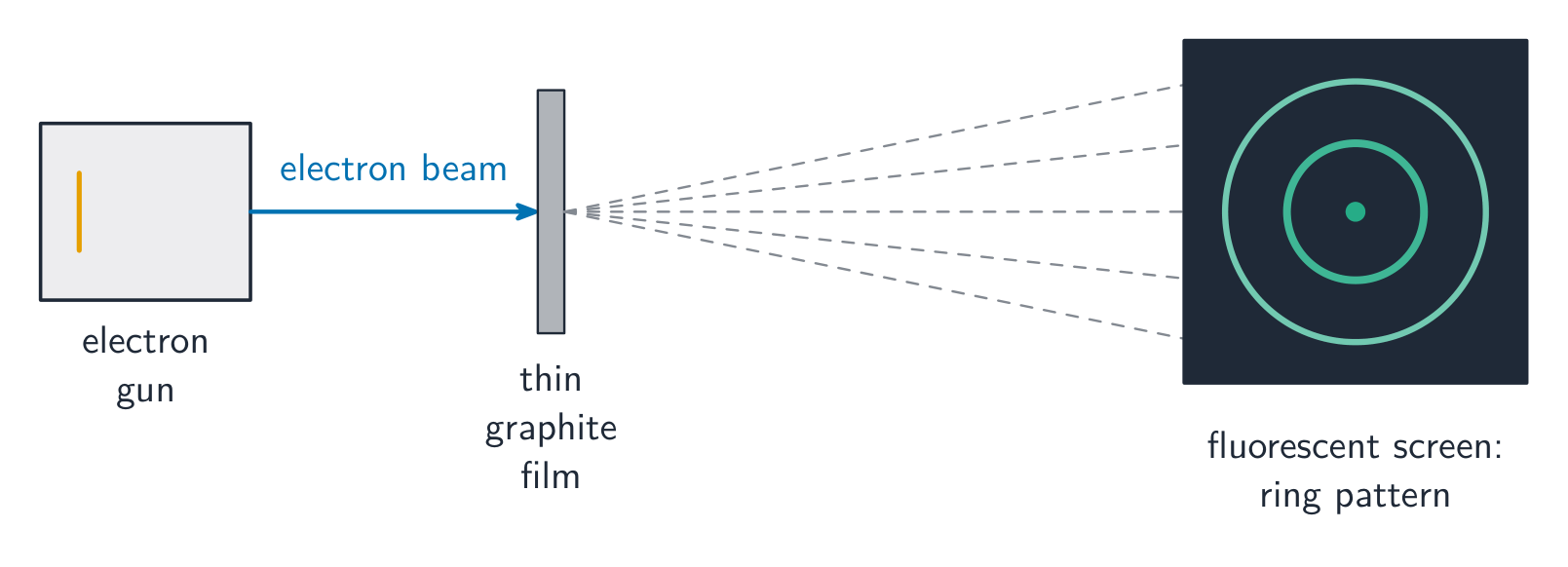
    Explore · ⁨Jelajahi⁩

    Superpose two waves · ⁨Superposisi dua gelombang⁩

    Where two waves arrive in phase they add (bright fringe); out of phase they cancel (dark fringe). That interference makes the double-slit pattern. · ⁨Di mana dua gelombang tiba sefasa, mereka berjumlah (garis terang); tidak sefasa mereka saling meniadakan (garis gelap). Interferensi inilah yang membentuk pola celah ganda.⁩

    14.9

    Thin-Film Interference · ⁨Interferensi Lapisan Tipis⁩

    Syllabus · ⁨Silabus⁩
    English

    Learning Objective 14.9.A: Describe the behavior of light that interacts with a thin film.

    • 14.9.A.1 When light travels from one medium to another, some of the light is transmitted, some is reflected, and some is absorbed.
    • 14.9.A.2 The phase change of a reflected ray depends on the relative indices of refraction of the materials with which the ray interacts.
      • 14.9.A.2.i A phase change of 180 degrees occurs when a light ray is reflected from a medium with a greater index of refraction than the medium through which the ray is traveling.
      • 14.9.A.2.ii No phase change occurs when a light ray is reflected from a medium with a lower index of refraction than the medium through which the ray is traveling.
    • 14.9.A.3 The phase of a wave does not change when it is refracted as it passes from one medium into another.
    • 14.9.A.4 Thin-film interference occurs when light interacts with a medium whose thickness is comparable to the light's wavelength.
      • 14.9.A.4.i The interactions between the initial reflected light and the light exiting the thin film after being reflected from the second interface exhibit wave interference behavior, resulting in a single wave that is the sum of the two interacting waves.
      • 14.9.A.4.ii The amount of constructive or destructive interference between the two reflected waves depends on the relationship between the thickness of the film, the wavelength of light, any phase shifts, and the angle at which the incident light strikes the film.
    • 14.9.A.5 Practical examples of thin-film interference include the color variations seen in soap bubbles and oil films, as well as antireflection coatings.
      • 14.9.A.5.i The spectrum of colors observed in oil films and soap bubbles arises from differences in the thickness of the film.
      • 14.9.A.5.ii Antireflection coatings eliminate reflected light by applying the relationships between indices of refraction, phase shift, and wave interference to create destructive interference of the light reflected from the two surfaces of the coating.
      • 14.9.A.5.iii The simplest antireflection coating has a thickness equal to one-quarter of the wavelength of the light in the coating, and the index of refraction of the coating is greater than that of air and less than that of the surface upon which the coating is applied. This assumes incident light is normal to the surface.

    Boundary statement: Quantitative analysis of thin-film interference is limited to waves that are normal to the incident surface.

    Bahasa Indonesia

    Tujuan Pembelajaran 14.9.A: Jelaskan perilaku cahaya yang berinteraksi dengan lapisan tipis.

    • 14.9.A.1 Ketika cahaya merambat dari satu medium ke medium lain, sebagian cahaya diteruskan, sebagian dipantulkan, dan sebagian diserap.
    • 14.9.A.2 Perubahan fasa sinar pantul bergantung pada indeks bias relatif bahan dengan mana sinar tersebut berinteraksi.
      • 14.9.A.2.i Perubahan fasa sebesar 180 derajat terjadi ketika sinar cahaya dipantulkan dari medium dengan indeks bias yang lebih besar daripada medium tempat sinar tersebut merambat.
      • 14.9.A.2.ii Tidak ada perubahan fasa yang terjadi ketika sinar cahaya dipantulkan dari medium dengan indeks bias yang lebih rendah daripada medium tempat sinar tersebut merambat.
    • 14.9.A.3 Fasa gelombang tidak berubah ketika mengalami pembiasan saat berpindah dari satu medium ke medium lain.
    • 14.9.A.4 Interferensi lapisan tipis terjadi ketika cahaya berinteraksi dengan medium yang ketebalannya sebanding dengan panjang gelombang cahayanya.
      • 14.9.A.4.i Interaksi antara cahaya pantul awal dan cahaya yang keluar dari lapisan tipis setelah dipantulkan dari antarmuka kedua menunjukkan perilaku interferensi gelombang, menghasilkan satu gelombang yang merupakan jumlah dari dua gelombang yang berinteraksi.
      • 14.9.A.4.ii Besarnya interferensi konstruktif atau destruktif antara dua gelombang pantul bergantung pada hubungan antara ketebalan lapisan, panjang gelombang cahaya, pergeseran fasa apa pun, dan sudut di mana cahaya datang mengenai lapisan.
    • 14.9.A.5 Contoh praktis interferensi lapisan tipis meliputi variasi warna yang terlihat pada gelembung sabun dan lapisan minyak, serta lapisan anti-pantulan.
      • 14.9.A.5.i Spektrum warna yang diamati pada lapisan minyak dan gelembung sabun timbul dari perbedaan ketebalan lapisan.
      • 14.9.A.5.ii Lapisan anti-pantulan menghilangkan cahaya pantul dengan menerapkan hubungan antara indeks bias, pergeseran fasa, dan interferensi gelombang untuk menciptakan interferensi destruktif cahaya yang dipantulkan dari dua permukaan lapisan.
      • 14.9.A.5.iii Lapisan anti-pantulan paling sederhana memiliki ketebalan sama dengan seperempat dari panjang gelombang cahaya dalam lapisan tersebut, dan indeks bias lapisan lebih besar daripada udara dan lebih kecil daripada permukaan tempat lapisan diterapkan. Ini mengasumsikan cahaya datang tegak lurus terhadap permukaan.

    Pernyataan Batasan: Analisis kuantitatif interferensi lapisan tipis terbatas pada gelombang yang tegak lurus terhadap permukaan datang.

    Source: College Board AP Course and Exam Description · ⁨Sumber: Deskripsi Kursus dan Ujian College Board AP⁩

    English

    Light reflecting off the top and bottom of a thin film 薄膜 (soap bubble, oil slick) interferes with itself. Depending on the film's thickness and a possible half-wavelength phase flip on reflection off a denser medium, particular wavelengths interfere constructively – producing the shifting colours you see.

    The same physics is put to work in an antireflection coating 增透膜 on camera lenses, glasses, and solar cells: a thin transparent layer whose two reflected waves interfere destructively, so almost no light reflects and more is transmitted. The simplest coating is one quarter of a wavelength thick (measured in the coating), and its refractive index sits between that of air and the glass beneath, so the reflected light cancels itself out.

    Bahasa Indonesia

    Cahaya yang dipantulkan dari bagian atas dan bawah lapisan tipis (gelembung sabun, noda minyak) mengalami interferensi dengan dirinya sendiri. Bergantung pada ketebalan lapisan dan kemungkinan pembalikan fase setengah panjang gelombang saat pantulan dari medium yang lebih padat, panjang gelombang tertentu mengalami interferensi konstruktif – menghasilkan warna-warna berubah-ubah yang Anda lihat.

    Fisika yang sama diterapkan dalam lapisan anti-pantulan pada lensa kamera, kacamata, dan sel surya: lapisan transparan tipis yang dua gelombangnya mengalami interferensi destruktif, sehingga hampir tidak ada cahaya yang dipantulkan dan lebih banyak ditransmisikan. Lapisan paling sederhana memiliki ketebalan seperempat panjang gelombang (diukur di dalam lapisan), dan indeks biasnya berada di antara indeks bias udara dan kaca di bawahnya, sehingga cahaya yang dipantulkan saling meniadakan.

    14.9

    Exam tips · ⁨Tips ujian⁩

    English
    • Use $v=f\lambda$; the source sets the frequency, and when a wave enters a new medium the frequency stays fixed while the speed and wavelength change.
    • Distinguish transverse (vibration perpendicular, can be polarised) from longitudinal (vibration along the travel, e.g. sound).
    • Constructive interference needs a path difference of a whole number of wavelengths; destructive needs a half-odd number.
    • On a string fixed at both ends the fundamental fits half a wavelength ($\lambda=2L$).
    • Diffraction is significant only when the gap is comparable to the wavelength — sound bends round doorways, light needs a very narrow slit.
    • Beats: two waves of slightly different frequency throb at $f_{\text{beat}}=|f_1-f_2|$ (e.g. two tuning forks; tuning to zero beats).
    • An antireflection coating is a quarter-wavelength-thick layer (index between air and glass) whose two reflections cancel, cutting the reflected light.
    Bahasa Indonesia
    • Gunakan $v=f\lambda$; sumber menetapkan frekuensi, dan ketika gelombang memasuki medium baru, frekuensinya tetap konstan sementara kecepatan dan panjang gelombang berubah.
    • Bedakan transversal (getaran tegak lurus, dapat terpolarisasi) dari longitudinal (getaran sepanjang rambat, mis. suara).
    • Interferensi konstruktif membutuhkan beda lintasan berupa kelipatan bulat panjang gelombang; interferensi destruktif membutuhkan bilangan ganjil setengah.
    • Pada senar yang dikencangkan di kedua ujung, fundamental memuat setengah panjang gelombang ($\lambda=2L$).
    • Difraksi hanya signifikan ketika celah sebanding dengan panjang gelombang — suara membelok di sekitar pintu, cahaya memerlukan celah yang sangat sempit.
    • Beat: dua gelombang dengan frekuensi sedikit berbeda berdenyut pada $f_{\text{beat}}=|f_1-f_2|$ (mis. dua garpu tala; penyetelan hingga nol beat).
    • Lapisan anti-pantulan adalah lapisan setebal seperempat panjang gelombang (indeks antara udara dan kaca) yang dua pantulannya saling meniadakan, mengurangi cahaya yang dipantulkan.
  • 15

    Modern Physics · ⁨Fisika Modern⁩

    Watch lesson · ⁨Tonton pelajaran⁩
    15.1

    Quantum Theory and Wave-Particle Duality · ⁨Teori Kuantum dan Dualisme Gelombang-Partikel⁩

    Syllabus · ⁨Silabus⁩
    English

    Learning Objective 15.1.A: Describe the properties and behavior of an object that exhibits both particle-like and wave-like behavior.

    • 15.1.A.1 Quantum theory was developed to explain observations of matter and energy that could not be explained using classical mechanics. These phenomena include, but are not limited to, atomic spectra, blackbody radiation, and the photoelectric effect.
      • 15.1.A.1.i Quantum theory is necessary to describe the properties of matter at atomic and subatomic scales.
      • 15.1.A.1.ii In quantum theory, fundamental particles can exhibit both particle-like and wave-like behavior.
    • 15.1.A.2 Light can be modeled both as a wave and as discrete particles, called photons.
      • 15.1.A.2.i A photon is a massless, electrically neutral particle with energy proportional to the photon's frequency.
        • Relevant equations:
        • $E = hf$
        • $\lambda = \dfrac{c}{f}$
      • 15.1.A.2.ii Photons travel in straight lines unless they interact with matter.
    • 15.1.A.3 The speed of a photon depends on the medium through which the photon travels.
      • 15.1.A.3.i The speed of all photons in free space is equal to the speed of light, $c = 3.00 \times 10^{8}$ m/s.
      • 15.1.A.3.ii In general, the speed of photons through a given medium is inversely proportional to the index of refraction of that medium.
    • 15.1.A.4 Particles can demonstrate wave properties, as shown by variations of Young's double-slit experiment.
      • 15.1.A.4.i A wave model of matter is quantified by the de Broglie wavelength, which increases as the momentum of a particle decreases.
        • Relevant equation:
        • $\lambda = \dfrac{h}{p}$
      • 15.1.A.4.ii Quantum theory is necessary to describe systems where the de Broglie wavelength is comparable to the size of the system.
    • 15.1.A.5 Values of energy and momentum have discrete, or quantized, values for bound systems described by quantum theory.
    Bahasa Indonesia

    Tujuan Pembelajaran 15.1.A: Jelaskan sifat dan perilaku objek yang menunjukkan perilaku seperti partikel dan seperti gelombang.

    • 15.1.A.1 Teori kuantum dikembangkan untuk menjelaskan pengamatan materi dan energi yang tidak dapat dijelaskan menggunakan mekanika klasik. Fenomena ini mencakup, namun tidak terbatas pada, spektrum atom, radiasi benda hitam, dan efek fotoelektrik.
      • 15.1.A.1.i Teori kuantum diperlukan untuk menggambarkan sifat materi pada skala atom dan subatom.
      • 15.1.A.1.ii Dalam teori kuantum, partikel fundamental dapat menunjukkan perilaku seperti partikel dan seperti gelombang.
    • 15.1.A.2 Cahaya dapat dimodelkan baik sebagai gelombang maupun sebagai partikel diskrit, yang disebut foton.
      • 15.1.A.2.i Foton adalah partikel tanpa massa dan netral secara listrik dengan energi yang sebanding dengan frekuensi foton.
        • Persamaan yang Relevan:
        • $E = hf$
        • $\lambda = \dfrac{c}{f}$
      • 15.1.A.2.ii Foton merambat dalam garis lurus kecuali berinteraksi dengan materi.
    • 15.1.A.3 Kecepatan foton bergantung pada medium tempat foton tersebut merambat.
      • 15.1.A.3.i Kecepatan semua foton di ruang hampa sama dengan kecepatan cahaya, $c = 3.00 \times 10^{8}$ m/s.
      • 15.1.A.3.ii Secara umum, kecepatan foton melalui suatu medium berbanding terbalik dengan indeks bias medium tersebut.
    • 15.1.A.4 Partikel dapat menunjukkan sifat gelombang, seperti yang ditunjukkan oleh variasi eksperimen belah celah Young.
      • 15.1.A.4.i Model gelombang materi dikuantifikasi oleh panjang gelombang de Broglie, yang meningkat seiring dengan berkurangnya momentum partikel.
        • Persamaan yang Relevan:
        • $\lambda = \dfrac{h}{p}$
      • 15.1.A.4.ii Teori kuantum diperlukan untuk menggambarkan sistem di mana panjang gelombang de Broglie sebanding dengan ukuran sistem.
    • 15.1.A.5 Nilai energi dan momentum memiliki nilai diskrit, atau terkuantisasi, untuk sistem terikat yang dijelaskan oleh teori kuantum.

    Source: College Board AP Course and Exam Description · ⁨Sumber: Deskripsi Kursus dan Ujian College Board AP⁩

    English

    At tiny scales, energy comes in discrete packets called quanta 量子. Light is carried by photons 光子, each with energy set by its frequency:

    $$E=hf,$$
    where $h$ is Planck's constant. Wave–particle duality 波粒二象性: light and matter each show both wave behavior (interference, diffraction) and particle behavior (photons, electrons as localized hits). A particle also has a matter wavelength $\lambda=\dfrac{h}{p}$, and particles genuinely produce interference - a variation of Young's double-slit experiment 双缝实验 done with electrons builds up the same fringe pattern as light.

    Worked example. Find the energy of a photon of orange light with frequency $5.0\times10^{14}\ \text{Hz}$ ($h=6.63\times10^{-34}\ \text{J s}$): $E=hf=6.63\times10^{-34}\times5.0\times10^{14}=3.3\times10^{-19}\ \text{J}$, which is about $2.1\ \text{eV}$ (dividing by $1.6\times10^{-19}$). Visible-light photons carry a few electronvolts – just right to trigger the chemistry of vision and photosynthesis.

    Bahasa Indonesia
    Ruang awan: fisika modern melacak partikel bermuatan dari peluruhan radioaktif
    Kamari awan: fisika modern melacak partikel bermuatan dari peluruhan radioaktif

    Pada skala mikroskopis, energi datang dalam paket diskrit yang disebut kuanta. Cahaya dibawa oleh foton, masing-masing dengan energi yang ditentukan oleh frekuensinya:

    $$E=hf,$$
    di mana $h$ adalah konstanta Planck. Dualisme gelombang-partikel: cahaya dan materi masing-masing menunjukkan perilaku gelombang (interferensi, difraksi) dan perilaku partikel (foton, elektron sebagai bentukan lokal). Partikel juga memiliki panjang gelombang materi $\lambda=\dfrac{h}{p}$, dan partikel benar-benar menghasilkan interferensi – variasi dari eksperimen celah ganda Young yang dilakukan dengan elektron membangun pola garis yang sama seperti cahaya.

    Elektron membentuk pola difraksi, menunjukkan bahwa partikel memiliki sifat gelombang
    Elektron membentuk pola difraksi, menunjukkan bahwa partikel memiliki sifat gelombang

    Contoh terpecahkan. Temukan energi foton cahaya jingga dengan frekuensi $5.0\times10^{14}\ \text{Hz}$ ($h=6.63\times10^{-34}\ \text{J s}$): $E=hf=6.63\times10^{-34}\times5.0\times10^{14}=3.3\times10^{-19}\ \text{J}$, yang kira-kira $2.1\ \text{eV}$ (dibagi dengan $1.6\times10^{-19}$). Foton cahaya tampak membawa beberapa elektronvolt – pas untuk memicu kimia penglihatan dan fotosintesis.

    15.2

    The Bohr Model of Atomic Structure · ⁨Model Bohr Struktur Atom⁩

    Syllabus · ⁨Silabus⁩
    English

    Learning Objective 15.2.A: Describe the properties of an atom.

    • 15.2.A.1 Atoms have internal structure.
      • 15.2.A.1.i Atoms consist of a small, positively charged nucleus surrounded by one or more negatively charged electrons.
      • 15.2.A.1.ii The nucleus of an atom is made up of protons and neutrons.
      • 15.2.A.1.iii The number of neutrons and protons in an atom can be represented using nuclear notation.
      • 15.2.A.1.iv An ion is an atom with a nonzero net electric charge.
    • 15.2.A.2 Each atomic element has a unique number of protons.
      • 15.2.A.2.i The number and arrangements of electrons affects how atoms interact.
      • 15.2.A.2.ii The total number of neutrons and protons identifies the isotope of an element.
      • 15.2.A.2.iii The mass of an atom is dominated by the total mass of the protons and neutrons in its nucleus.
    • 15.2.A.3 The Bohr model of the atom is based on classical physics and was the historical representation of the atom that led to the description of the hydrogen atom in terms of discrete energy states.
      • 15.2.A.3.i In the Bohr model of the atom, electrons are modeled as moving around the nucleus in circular orbits determined by the electron's charge and mass, as well as the electric force between the electron and the nucleus.
        • Relevant equations:
        • $F_e = k\dfrac{q_1 q_2}{r^2}$
        • $F_{\text{net}} = m\dfrac{v^2}{r}$
      • 15.2.A.3.ii The standing wave model of electrons accounts for the existence of specific allowed energy states of an electron in an atom, because the electron orbit's circumference must be an integer multiple of the electron's de Broglie wavelength.

    Boundary statement: The analysis and description of electron structure is limited to energy levels and will not include such advanced descriptions as orbitals, orbital shapes, or probability functions.

    Bahasa Indonesia

    Tujuan Pembelajaran 15.2.A: Jelaskan sifat-sifat atom.

    • 15.2.A.1 Atom memiliki struktur internal.
      • 15.2.A.1.i Atom terdiri dari inti kecil bermuatan positif yang dikelilingi oleh satu atau lebih elektron bermuatan negatif.
      • 15.2.A.1.ii Inti atom terdiri dari proton dan neutron.
      • 15.2.A.1.iii Jumlah neutron dan proton dalam sebuah atom dapat direpresentasikan menggunakan notasi nuklir.
      • 15.2.A.1.iv Ion adalah atom dengan muatan listrik bersih yang tidak nol.
    • 15.2.A.2 Setiap unsur atom memiliki jumlah proton yang unik.
      • 15.2.A.2.i Jumlah dan susunan elektron memengaruhi bagaimana atom berinteraksi.
      • 15.2.A.2.ii Total jumlah neutron dan proton mengidentifikasi isotop dari suatu unsur.
      • 15.2.A.2.iii Massa sebuah atom didominasi oleh total massa proton dan neutron di dalam intinya.
    • 15.2.A.3 Model Bohr atom didasarkan pada fisika klasik dan merupakan representasi historis atom yang mengarah pada deskripsi atom hidrogen dalam keadaan energi diskrit.
      • 15.2.A.3.i Dalam model Bohr atom, elektron dimodelkan bergerak mengelilingi inti dalam orbit melingkar yang ditentukan oleh muatan dan massa elektron, serta gaya listrik antara elektron dan inti.
        • Persamaan yang Relevan:
        • $F_e = k\dfrac{q_1 q_2}{r^2}$
        • $F_{\text{net}} = m\dfrac{v^2}{r}$
      • 15.2.A.3.ii Model gelombang berdiri elektron menjelaskan keberadaan keadaan energi tertentu yang diizinkan bagi elektron dalam atom, karena keliling lintasan elektron harus merupakan kelipatan bulat dari panjang gelombang de Broglie elektron.

    Pernyataan Batas: Analisis dan deskripsi struktur elektron dibatasi hanya pada tingkat energi dan tidak akan mencakup deskripsi canggih seperti orbital, bentuk orbital, atau fungsi probabilitas.

    Source: College Board AP Course and Exam Description · ⁨Sumber: Deskripsi Kursus dan Ujian College Board AP⁩

    English

    The Bohr model 玻尔模型 pictures electrons orbiting the nucleus only in certain allowed energy levels 能级. An electron can jump between levels only by absorbing or emitting a photon whose energy exactly matches the gap:

    $$E_{\text{photon}}=|E_{\text{final}}-E_{\text{initial}}|.$$
    Because the levels are discrete, only specific photon energies are allowed.

    Bahasa Indonesia

    Model Bohr menggambarkan elektron yang mengorbit inti hanya pada tingkat energi tertentu yang diizinkan. Elektron dapat berpindah antar tingkat hanya dengan menyerap atau memancarkan foton whose energy exactly matches the gap:

    $$E_{\text{photon}}=|E_{\text{final}}-E_{\text{initial}}|.$$
    Karena tingkat-tingkat tersebut terkuantisasi, hanya energi foton tertentu yang diizinkan.

    15.3

    Emission and Absorption Spectra · ⁨Spektra Emisi dan Absorpsi⁩

    Syllabus · ⁨Silabus⁩
    English

    Learning Objective 15.3.A: Describe the emission or absorption of photons by atoms.

    • 15.3.A.1 Energy transfer occurs when photons are absorbed or emitted by an atom, which is modeled as a system consisting of a nucleus and an electron.
    • 15.3.A.2 Energy can only be absorbed or emitted by an atom if the amount of energy being absorbed or emitted corresponds to the energy difference between two atomic energy states.
      • 15.3.A.2.i An atom in a given energy state may absorb a photon of the appropriate energy and transition to a higher energy state.
      • 15.3.A.2.ii An atom in an excited energy state may emit a photon of the appropriate energy to spontaneously move to a lower energy state.
      • 15.3.A.2.iii Because an atom is modeled as a system consisting of an electron and a nucleus, a change in the energy state of an atom corresponds to a change in the interaction energy between the electron and the nucleus.
    • 15.3.A.3 Transitions between two energy states of an atom correspond to the absorption or emission of a photon of a single frequency and, therefore, a single wavelength.
    • 15.3.A.4 Atoms of each element have a unique set of allowed energy levels and thereby a unique set of absorption and emission frequencies. The unique set of frequencies determines the element's spectrum.
      • 15.3.A.4.i An emission spectrum can be used to determine the elements in a source of light.
      • 15.3.A.4.ii An absorption spectrum can be used to determine the elements composing a substance by observing what light the substance has absorbed.
      • 15.3.A.4.iii Energy level diagrams are commonly used to visually represent the energy states of an atom.
    • 15.3.A.5 Binding energy is the energy required to remove an electron from an atom, causing the atom to become ionized. An atom in the lowest energy level (ground state) will require the greatest amount of energy to remove the electron from the atom.

    Boundary statement: In AP Physics 2, only energy level diagrams of single-electron atoms will be considered.

    Bahasa Indonesia

    Tujuan Pembelajaran 15.3.A: Deskripsikan emisi atau absorpsi foton oleh atom.

    • 15.3.A.1 Transfer energi terjadi ketika foton diserap atau dipancarkan oleh sebuah atom, yang dimodelkan sebagai sistem yang terdiri dari inti dan elektron.
    • 15.3.A.2 Energi hanya dapat diserap atau dipancarkan oleh atom jika jumlah energi yang diserap atau dipancarkan sesuai dengan selisih energi antara dua keadaan energi atom.
      • 15.3.A.2.i Atom dalam keadaan energi tertentu dapat menyerap foton dengan energi yang tepat dan beralih ke keadaan energi yang lebih tinggi.
      • 15.3.A.2.ii Atom dalam keadaan energi tereksitasi dapat memancarkan foton dengan energi yang tepat untuk secara spontan berpindah ke keadaan energi yang lebih rendah.
      • 15.3.A.2.iii Karena atom dimodelkan sebagai sistem yang terdiri dari elektron dan inti, perubahan keadaan energi atom berkorelasi dengan perubahan energi interaksi antara elektron dan inti.
    • 15.3.A.3 Transisi antara dua keadaan energi atom berkorelasi dengan penyerapan atau pemindaan foton dengan frekuensi tunggal, dan karenanya dengan panjang gelombang tunggal.
    • 15.3.A.4 Atom dari setiap unsur memiliki himpunan tingkat energi yang diizinkan yang unik, sehingga memiliki himpunan frekuensi absorpsi dan emisi yang unik. Himpunan frekuensi yang unik ini menentukan spektra unsur tersebut.
      • 15.3.A.4.i Spektra emisi dapat digunakan untuk menentukan unsur-unsur dalam sumber cahaya.
      • 15.3.A.4.ii Spektra absorpsi dapat digunakan untuk menentukan unsur-unsur penyusun suatu zat dengan mengamati cahaya apa yang telah diserap oleh zat tersebut.
      • 15.3.A.4.iii Diagram tingkat energi umumnya digunakan untuk merepresentasikan secara visual keadaan energi sebuah atom.
    • 15.3.A.5 Energi ikat adalah energi yang diperlukan untuk melepaskan elektron dari atom, menyebabkan atom menjadi terionisasi. Atom pada tingkat energi terendah (keadaan dasar) akan memerlukan jumlah energi terbesar untuk melepaskan elektron dari atom tersebut.

    Pernyataan Batas: Dalam AP Physics 2, hanya diagram tingkat energi atom satu-elektron yang akan dipertimbangkan.

    Source: College Board AP Course and Exam Description · ⁨Sumber: Deskripsi Kursus dan Ujian College Board AP⁩

    English
    • An emission spectrum 发射光谱 is the set of bright lines given off when electrons drop to lower levels – each line a specific wavelength.
    • An absorption spectrum 吸收光谱 is the set of dark lines where those same wavelengths are absorbed from a continuous source.

    The line pattern is a fingerprint of the element, since every element has its own energy levels.

    Bahasa Indonesia
    • Spektra emisi adalah kumpulan garis terang yang dipancarkan ketika elektron turun ke tingkat yang lebih rendah – setiap garis memiliki panjang gelombang spesifik.
    • Spektra absorpsi adalah kumpulan garis gelap di mana panjang gelombang yang sama diserap dari sumber kontinu.
    Tingkat energi diskrit hidrogen menghasilkan spektra garis
    Tingkat energi diskrit hidrogen menghasilkan spektra garis

    Pola garis ini merupakan sidik jari dari unsur tersebut, karena setiap unsur memiliki tingkat energinya sendiri.

    Empat garis emisi tampak hidrogen pada latar belakang hitam
    Spektra emisi hidrogen: setiap garis terang adalah cahaya dari elektron yang turun antara tingkat energi tetap
    Explore · ⁨Jelajahi⁩

    See an element's line spectrum · ⁨Lihat spektrum garis suatu unsur⁩

    Electrons jump between fixed energy levels, emitting or absorbing photons of exact wavelengths — a line spectrum that fingerprints the element. · ⁨Elektron melompat antar tingkat energi tetap, memancarkan atau menyerap foton dengan panjang gelombang pasti — sebuah spektrum garis yang menjadi sidik jari unsur tersebut.⁩

    Vocabulary · ⁨Kosa kata⁩ Train · ⁨Latih⁩
    English Bahasa Indonesia
    quanta/ˈkwɒntə/ kuanta
    photons/ˈfəʊtɒnz/ foton
    Wave–particle duality/weɪv ˈpɑːtɪkl djuːˈælɪti/ Dualitas gelombang-partikel
    double-slit experiment/ˈdʌbl slɪt ekˈsperɪmənt/ Eksperimen celah ganda
    Bohr model/ˈbəʊə ˈmɒdl/ model Bohr
    energy levels/ˈenədʒi ˈlevlz/ tingkat energi
    emission spectrum/ɪˈmɪʃn ˈspektrəm/ spektrum emisi
    absorption spectrum/əbˈsɔːpʃn ˈspektrəm/ spektrum penyerapan
    15.4

    Blackbody Radiation · ⁨Radiasi Benda Hitam⁩

    Syllabus · ⁨Silabus⁩
    English

    Learning Objective 15.4.A: Describe the electromagnetic radiation emitted by an object due to its temperature.

    • 15.4.A.1 Matter will spontaneously convert some of its internal thermal energy into electromagnetic energy.
    • 15.4.A.2 A blackbody is an idealized model of matter that absorbs all radiation that falls on the body. If the body is in equilibrium at a constant temperature, then it must in turn emit energy.
    • 15.4.A.3 A blackbody will emit a continuous spectrum that only depends on the body's temperature. The radiation emitted by a blackbody is often modeled by plotting intensity per unit wavelength as a function of wavelength.
      • 15.4.A.3.i The distribution of the intensity of a blackbody's spectrum as a function of temperature cannot be modeled using only classical physics concepts. A blackbody's spectrum is described by Planck's law, which assumes that the energy of light is quantized.
      • 15.4.A.3.ii The peak wavelength emitted by a blackbody (the wavelength at which the blackbody emits the greatest amount of radiation per unit wavelength) decreases with increasing temperature, as described by Wien's law.
        • Relevant equation:
        • $\lambda_{\max} = \dfrac{b}{T}$
      • 15.4.A.3.iii The rate at which energy is emitted (power) by a blackbody is proportional to the surface area of the body and to the temperature of the body raised to the fourth power, as described by the Stefan-Boltzmann law.
        • Relevant equation:
        • $P = A\sigma T^4$
    Bahasa Indonesia

    Tujuan Pembelajaran 15.4.A: Deskripsikan radiasi elektromagnetik yang dipancarkan oleh suatu benda akibat suhunya.

    • 15.4.A.1 Materi akan secara spontan mengonversi sebagian energi termal internalnya menjadi energi elektromagnetik.
    • 15.4.A.2 Benda hitam adalah model idealisasi materi yang menyerap semua radiasi yang jatuh padanya. Jika benda berada dalam kesetimbangan pada suhu konstan, maka ia harus memancarkan energi.
    • 15.4.A.3 Benda hitam akan memancarkan spektra kontinu yang hanya bergantung pada suhu benda. Radiasi yang dipancarkan oleh benda hitam sering dimodelkan dengan menggambar intensitas per satuan panjang gelombang sebagai fungsi dari panjang gelombang.
      • 15.4.A.3.i Distribusi intensitas spektra benda hitam sebagai fungsi suhu tidak dapat dimodelkan hanya menggunakan konsep fisika klasik. Spektra benda hitam dijelaskan oleh hukum Planck, yang mengasumsikan bahwa energi cahaya terkuantisasi.
      • 15.4.A.3.ii Panjang gelombang puncak yang dipancarkan oleh benda hitam (panjang gelombang di mana benda hitam memancarkan jumlah radiasi terbesar per satuan panjang gelombang) menurun seiring kenaikan suhu, sebagaimana dijelaskan oleh hukum Wien.
        • Persamaan yang Relevan:
        • $\lambda_{\max} = \dfrac{b}{T}$
      • 15.4.A.3.iii Laju di mana energi dipancarkan (daya) oleh benda hitam sebanding dengan luas permukaan benda dan suhu benda yang dipangkatkan empat, sebagaimana dijelaskan oleh hukum Stefan-Boltzmann.
        • Persamaan yang Relevan:
        • $P = A\sigma T^4$

    Source: College Board AP Course and Exam Description · ⁨Sumber: Deskripsi Kursus dan Ujian College Board AP⁩

    English

    A blackbody 黑体 emits a continuous spectrum that depends only on its temperature. Hotter objects glow brighter and peak at shorter wavelengths (red-hot to white-hot to blue-hot). Explaining this spectrum required quantized energy – a founding problem of quantum theory.

    Bahasa Indonesia

    Sebuah benda hitam memancarkan spektra kontinu yang hanya bergantung pada suhunya. Objek yang lebih panas bersinar lebih terang dan puncaknya berada pada panjang gelombang yang lebih pendek (merah-panas hingga putih-panas hingga biru-panas). Menjelaskan spektra ini memerlukan energi terkuantisasi – sebuah masalah fondasi teori kuantum.

    Benda hitam yang lebih panas memancarkan lebih banyak energi, dan puncaknya bergeser ke panjang gelombang yang lebih pendek
    Benda hitam yang lebih panas memancarkan lebih banyak, dan puncaknya bergeser ke panjang gelombang yang lebih pendek
    Vocabulary · ⁨Kosa kata⁩ Train · ⁨Latih⁩
    English Bahasa Indonesia
    blackbody/ˈblækbɒdi/ benda hitam
    photoelectric effect/ˌfəʊtəʊɪˈlektrɪk ɪˈfekt/ efek fotolistrik
    work function/wɜːk ˈfʌŋkʃn/ fungsi kerja
    Compton scattering/ˈkɒmptn ˈskætərɪŋ/ hamburan Compton
    nucleus/ˈnjuːklɪəs/ inti sel
    Fission/ˈfɪʃn/ Fisi
    Fusion/ˈfjuːʒn/ Fusi
    15.5

    The Photoelectric Effect · ⁨Efek Fotolistrik⁩

    Syllabus · ⁨Silabus⁩
    English

    Learning Objective 15.5.A: Describe an interaction between photons and matter using the photoelectric effect.

    • 15.5.A.1 The photoelectric effect is the emission of electrons when electromagnetic radiation is incident upon a photoactive material.
    • 15.5.A.2 The emission of electrons via the photoelectric effect requires a minimum frequency of incident light, called the threshold frequency.
      • 15.5.A.2.i Light that is incident on a material and is at the threshold frequency or higher will induce electron emission, regardless of the number of photons that strike the material.
      • 15.5.A.2.ii The energy of the emitted electrons is not dependent on the number of photons that are incident upon the material, which provides evidence that light is a collection of discrete, quantized energy packets called photons.
    • 15.5.A.3 The maximum kinetic energy of an emitted electron is related to the frequency of the incident light and the work function of the material, $\phi$.
      • 15.5.A.3.i The work function of a material is the minimum energy required to emit an electron from atoms in the material.
      • 15.5.A.3.ii The maximum kinetic energy of an emitted electron is given by the equation $K_{\max} = hf - \phi$.
      • 15.5.A.3.iii In a typical experimental setup to demonstrate the photoelectric effect and determine the work function of a metal, two metal plates are placed in a vacuum chamber and connected to a variable source of potential difference. One of the plates is illuminated by monochromatic light that causes electrons to be ejected and the potential difference between the plates is adjusted until no current is measured in the circuit.

    Boundary statement: Where applicable, work functions for materials will be provided on the exam; students are not expected to know values of work functions or variables of a material that influence the magnitude of its work function.

    Bahasa Indonesia

    Tujuan Pembelajaran 15.5.A: Deskripsikan interaksi antara foton dan materi menggunakan efek fotoelektrik.

    • 15.5.A.1 Efek fotoelektrik adalah emisi elektron ketika radiasi elektromagnetik mengenai material fotoaktif.
    • 15.5.A.2 Emisi elektron melalui efek fotoelektrik memerlukan frekuensi minimum cahaya insiden, yang disebut frekuensi ambang.
      • 15.5.A.2.i Cahaya yang mengenai material dan memiliki frekuensi ambang atau lebih tinggi akan menginduksi emisi elektron, terlepas dari jumlah foton yang mengenai material.
      • 15.5.A.2.ii Energi elektron yang dipancarkan tidak bergantung pada jumlah foton yang mengenai material, yang memberikan bukti bahwa cahaya merupakan kumpulan paket energi diskrit dan terkuantisasi yang disebut foton.
    • 15.5.A.3 Energi kinetik maksimum dari elektron yang dipancarkan berkaitan dengan frekuensi cahaya insiden dan fungsi kerja material, $\phi$.
      • 15.5.A.3.i Fungsi kerja suatu material adalah energi minimum yang diperlukan untuk memancarkan elektron dari atom-atom dalam material tersebut.
      • 15.5.A.3.ii Energi kinetik maksimum dari elektron yang dipancarkan diberikan oleh persamaan $K_{\max} = hf - \phi$.
      • 15.5.A.3.iii Dalam susunan eksperimen tipikal untuk mendemonstrasikan efek fotolistrik dan menentukan fungsi kerja logam, dua pelat logam ditempatkan di dalam ruang vakum dan dihubungkan ke sumber beda potensial variabel. Salah satu pelat diterangi oleh cahaya monokromatik yang menyebabkan elektron terlempar, dan beda potensial antara pelat-pelat tersebut disesuaikan hingga tidak ada arus yang terukur dalam sirkuit.

    Pernyataan batas: Di mana berlaku, fungsi kerja untuk material akan disediakan pada ujian; siswa tidak diharapkan mengetahui nilai fungsi kerja atau variabel material yang memengaruhi besaran fungsi kerjanya.

    Source: College Board AP Course and Exam Description · ⁨Sumber: Deskripsi Kursus dan Ujian College Board AP⁩

    English
    The photoelectric effect

    Shining light on a metal can eject electrons – the photoelectric effect 光电效应. Key facts (which only the photon picture explains): electrons come out only if the photon's frequency exceeds a threshold, no matter how bright a dimmer, lower-frequency light is. Energy conservation gives

    $$K_{\max}=hf-\phi,$$
    where $\phi$ is the metal's work function 逸出功 (the energy to free an electron).

    Worked example. Light of frequency $8.0\times10^{14}\ \text{Hz}$ falls on a metal with work function $\phi=3.0\times10^{-19}\ \text{J}$. The most energetic electrons come off with

    $$K_{\max}=hf-\phi=(6.63\times10^{-34}\times8.0\times10^{14})-3.0\times10^{-19}=5.3\times10^{-19}-3.0\times10^{-19}=2.3\times10^{-19}\ \text{J}.$$
    Below the threshold frequency $\phi/h$, $K_{\max}$ would be negative – meaning no electrons escape at all, however bright the light.

    Bahasa Indonesia
    Efek fotolistrik

    Menyinari logam dengan cahaya dapat mengeluarkan elektron – efek fotolistrik. Fakta kunci (yang hanya dijelaskan oleh gambar foton): elektron keluar hanya jika frekuensi foton melebihi ambang batas, tidak peduli seberapa terang cahaya berfrekuensi lebih rendah yang lebih redup. Kekekalan energi memberikan

    $$K_{\max}=hf-\phi,$$
    di mana $\phi$ adalah fungsi kerja logam (energi untuk membebaskan elektron).

    Energi kinetik maksimum fotoelektron meningkat secara linear dengan frekuensi
    Energi kinetik maksimum fotoelektron meningkat secara linear dengan frekuensi

    Contoh dikerjakan. Cahaya dengan frekuensi $8.0\times10^{14}\ \text{Hz}$ jatuh pada logam dengan fungsi kerja $\phi=3.0\times10^{-19}\ \text{J}$. Elektron paling enerjik keluar dengan

    $$K_{\max}=hf-\phi=(6.63\times10^{-34}\times8.0\times10^{14})-3.0\times10^{-19}=5.3\times10^{-19}-3.0\times10^{-19}=2.3\times10^{-19}\ \text{J}.$$
    Di bawah frekuensi ambang $\phi/h$, $K_{\max}$ akan menjadi negatif – berarti tidak ada elektron yang melarikan diri sama sekali, tidak peduli seberapa terang cahayanya.

    15.6

    Compton Scattering · ⁨Hamburan Compton⁩

    Syllabus · ⁨Silabus⁩
    English

    Learning Objective 15.6.A: Describe the interaction between photons and matter using Compton scattering.

    • 15.6.A.1 In Compton scattering, a photon interacts with a free electron. The Compton effect is when a photon that emerges from the interaction has a lower energy and longer wavelength than the incoming photon. The magnitude of the change is related to the direction of the photon after the collision.
    • 15.6.A.2 Compton scattering provides evidence that light is a collection of discrete, quantized energy packets called photons.
      • 15.6.A.2.i Compton scattering can be explained by treating a photon as a particle and applying conservation of energy and conservation of momentum to the collision between the photon and electron.
      • 15.6.A.2.ii The transfer of a photon's energy to an electron results in the energy, momentum, frequency, and wavelength of the photon changing.
        • Relevant equations:
        • $E = hf$
        • $\lambda = \dfrac{h}{p}$
    • 15.6.A.3 The change in wavelength experienced by a photon after colliding with an electron is related to how much the photon's direction changes.
      • Relevant equation:
      • $\Delta\lambda = \dfrac{h}{m_e c}(1 - \cos\theta)$

    Boundary statement: AP Physics 2 includes full quantitative and qualitative treatments of conservation of momentum in two dimensions.

    Bahasa Indonesia

    Tujuan Pembelajaran 15.6.A: Deskripsikan interaksi antara foton dan materi menggunakan hamburan Compton.

    • 15.6.A.1 Dalam hamburan Compton, sebuah foton berinteraksi dengan elektron bebas. Efek Compton terjadi ketika foton yang keluar dari interaksi memiliki energi lebih rendah dan panjang gelombang lebih panjang daripada foton masuk. Besarnya perubahan ini berkaitan dengan arah foton setelah tabrakan.
    • 15.6.A.2 Hamburan Compton memberikan bukti bahwa cahaya merupakan kumpulan paket energi diskrit dan terkuantisasi yang disebut foton.
      • 15.6.A.2.i Hamburan Compton dapat dijelaskan dengan memperlakukan foton sebagai partikel dan menerapkan kekekalan energi serta kekekalan momentum pada tabrakan antara foton dan elektron.
      • 15.6.A.2.ii Perpindahan energi foton ke elektron mengakibatkan perubahan energi, momentum, frekuensi, dan panjang gelombang foton tersebut.
        • Persamaan yang Relevan:
        • $E = hf$
        • $\lambda = \dfrac{h}{p}$
    • 15.6.A.3 Perubahan panjang gelombang yang dialami foton setelah menabrak elektron berkaitan dengan seberapa besar arah foton berubah.
      • Persamaan relevan:
      • $\Delta\lambda = \dfrac{h}{m_e c}(1 - \cos\theta)$

    Pernyataan batas: AP Fisika 2 mencakup perlakuan kuantitatif dan kualitatif penuh mengenai kekekalan momentum dalam dua dimensi.

    Source: College Board AP Course and Exam Description · ⁨Sumber: Deskripsi Kursus dan Ujian College Board AP⁩

    English

    In Compton scattering 康普顿散射, a photon collides with an electron like two particles, transferring some energy and momentum. The scattered photon comes out with less energy (longer wavelength). This is direct evidence that photons carry momentum and behave as particles.

    Bahasa Indonesia

    Dalam hamburan Compton, sebuah foton bertabrakan dengan elektron seperti dua partikel, mentransfer sebagian energi dan momentum. Foton yang terhambur keluar dengan energi lebih sedikit (panjang gelombang lebih panjang). Ini adalah bukti langsung bahwa foton membawa momentum dan berperilaku sebagai partikel.

    15.7

    Fission, Fusion, and Nuclear Decay · ⁨Fisi, Fusi, dan Peluruhan Nuklir⁩

    Syllabus · ⁨Silabus⁩
    English

    Learning Objective 15.7.A: Describe the physical properties that constrain the behavior of interacting nuclei, subatomic particles, and nucleons.

    • 15.7.A.1 The strong force is exerted at nuclear scales and dominates the interactions of nucleons (protons or neutrons).
    • 15.7.A.2 Possible nuclear reactions are constrained by the law of conservation of nucleon number.
    • 15.7.A.3 The behavior of the constituent particles of a nuclear reaction is constrained by laws of conservation of energy, energy-mass equivalence, and conservation of momentum.
    • 15.7.A.4 For all nuclear reactions, mass and energy may be exchanged due to mass-energy equivalence.
      • Relevant equation:
      • $E = mc^2$
    • 15.7.A.5 Energy may be released in nuclear processes in the form of kinetic energy of the products or as photons.
    • 15.7.A.6 Nuclear fusion is the process by which two or more smaller nuclei combine to form a larger nucleus, as well as subatomic particles.
    • 15.7.A.7 Nuclear fission is the process by which the nucleus of an atom splits into two or more smaller nuclei, as well as subatomic particles.
    • 15.7.A.8 Nuclear fission may occur spontaneously or may require an energy input, depending on the binding energy of the nucleus.

    Learning Objective 15.7.B: Describe the radioactive decay of a given sample of material consisting of a finite number of nuclei.

    • 15.7.B.1 Radioactive decay is the spontaneous transformation of a nucleus into one or more different nuclei.
      • 15.7.B.1.i The time at which an individual nucleus undergoes radioactive decay is indeterminable, but decay rates can be described using probability
      • 15.7.B.1.ii The half-life, $t_{1/2}$, of a radioactive material is the time it takes for half of the initial number of radioactive nuclei to have spontaneously decayed.
      • 15.7.B.1.iii The decay constant $\lambda$ can be related to the half-life of a radioactive material with the equation $\lambda = \dfrac{\ln 2}{t_{1/2}}$.
    • 15.7.B.2 A material's decay constant may be used to predict the number of nuclei remaining in a sample after a period of time, or the age of a material if the initial amount of material is known.
      • Relevant equation:
      • $N = N_0 e^{-\lambda t}$
      • Derived equation:
      • $\ln\left(\dfrac{N}{N_0}\right) = -\lambda t$
    • 15.7.B.3 Different unstable elements and isotopes may have vastly different half-lives, ranging from fractions of a second to billions of years.
    Bahasa Indonesia

    Tujuan Pembelajaran 15.7.A: Deskripsikan sifat fisik yang membatasi perilaku inti yang saling berinteraksi, partikel subatomik, dan nukleon.

    • 15.7.A.1 Gaya kuat bekerja pada skala nuklir dan mendominasi interaksi nukleon (proton atau neutron).
    • 15.7.A.2 Reaksi nuklir yang mungkin dibatasi oleh hukum kekekalan bilangan nukleon.
    • 15.7.A.3 Perilaku partikel penyusun reaksi nuklir dibatasi oleh hukum kekekalan energi, kesetaraan energi-massa, dan kekekalan momentum.
    • 15.7.A.4 Untuk semua reaksi nuklir, massa dan energi dapat bertukar karena kesetaraan massa-energi.
      • Persamaan relevan:
      • $E = mc^2$
    • 15.7.A.5 Energi dapat dilepaskan dalam proses nuklir dalam bentuk energi kinetik produk atau sebagai foton.
    • 15.7.A.6 Fusi nuklir adalah proses di mana dua atau lebih inti kecil bergabung membentuk inti yang lebih besar, serta partikel subatomik.
    • 15.7.A.7 Fisi nuklir adalah proses di mana inti atom membelah menjadi dua atau lebih inti yang lebih kecil, serta partikel subatomik.
    • 15.7.A.8 Fisi nuklir dapat terjadi secara spontan atau memerlukan input energi, tergantung pada energi ikat inti tersebut.

    Tujuan Pembelajaran 15.7.B: Deskripsikan peluruhan radioaktif dari sampel material tertentu yang terdiri dari jumlah inti yang terbatas.

    • 15.7.B.1 Peluruhan radioaktif adalah transformasi spontan dari sebuah inti menjadi satu atau lebih inti yang berbeda.
      • 15.7.B.1.i Waktu ketika sebuah inti individual mengalami peluruhan radioaktif tidak dapat ditentukan, tetapi laju peluruhan dapat dijelaskan menggunakan probabilitas
      • 15.7.B.1.ii Waktu paruh, $t_{1/2}$, dari bahan radioaktif adalah waktu yang dibutuhkan agar setengah dari jumlah awal inti radioaktif telah meluruh secara spontan.
      • 15.7.B.1.iii Konstanta peluruhan $\lambda$ dapat dikaitkan dengan waktu paruh bahan radioaktif dengan persamaan $\lambda = \dfrac{\ln 2}{t_{1/2}}$.
    • 15.7.B.2 Konstanta peluruhan suatu material dapat digunakan untuk memprediksi jumlah inti yang tersisa dalam sampel setelah periode waktu tertentu, atau usia material jika jumlah awal material diketahui.
      • Persamaan relevan:
      • $N = N_0 e^{-\lambda t}$
      • *Persamaan turunan:
      • $\ln\left(\dfrac{N}{N_0}\right) = -\lambda t$
    • 15.7.B.3 Elemen tak stabil dan isotop yang berbeda dapat memiliki waktu paruh yang sangat bervariasi, mulai dari pecahan detik hingga miliaran tahun.

    Source: College Board AP Course and Exam Description · ⁨Sumber: Deskripsi Kursus dan Ujian College Board AP⁩

    English

    The nucleus 原子核 stores enormous energy. Fission 裂变 splits a heavy nucleus into lighter ones, releasing energy (nuclear reactors, bombs). Fusion 聚变 joins light nuclei into a heavier one (the Sun's power). Both release energy because the products have slightly less mass, converted by $E=mc^2$.

    Worked example. Even a tiny mass converts to a huge energy. If a nuclear reaction loses $1.0\times10^{-3}\ \text{kg}$ of mass, it releases $E=mc^2=1.0\times10^{-3}\times(3.0\times10^{8})^2=9.0\times10^{13}\ \text{J}$ – roughly the energy of $20\,000$ tonnes of TNT.

    Bahasa Indonesia

    Inti menyimpan energi yang sangat besar. Fisi memecah inti berat menjadi inti yang lebih ringan, melepaskan energi (reaktor nuklir, bom). Fusi menggabungkan inti ringan menjadi inti yang lebih berat (tenaga Matahari). Keduanya melepaskan energi karena produknya memiliki massa sedikit lebih sedikit, dikonversi oleh $E=mc^2$.

    Energi ikat per nukleon mencapai puncak di dekat besi, sehingga baik fusi maupun fisi dapat melepaskan energi
    Energi ikat per nukleon mencapai puncak dekat besi, sehingga baik fusi maupun fisi dapat melepaskan energi

    Contoh dikerjakan. Bahkan massa kecil pun berubah menjadi energi yang sangat besar. Jika reaksi nuklir kehilangan $1.0\times10^{-3}\ \text{kg}$ massa, ia melepaskan $E=mc^2=1.0\times10^{-3}\times(3.0\times10^{8})^2=9.0\times10^{13}\ \text{J}$ – sekitar energi dari $20\,000$ ton TNT.

    Pembangkit listrik tenaga nuklir: fisi inti berat melepaskan energi yang menggerakkan pembangkit tersebut
    Pembangkit listrik tenaga nuklir: fisi inti berat melepaskan energi yang menggerakkan pembangkit
    Explore · ⁨Jelajahi⁩

    Balance a nuclear decay equation · ⁨Seimbangkan persamaan peluruhan nuklir⁩

    In alpha, beta and gamma decay, nucleon and charge numbers must balance. Pick a mode and see how the parent turns into the daughter nuclide. · ⁨Dalam peluruhan alfa, beta dan gamma, nomor nukleon dan muatan harus seimbang. Pilih mode dan lihat bagaimana nukl induk berubah menjadi nukl anak.⁩

    15.8

    Types of Radioactive Decay · ⁨Jenis Peluruhan Radioaktif⁩

    Syllabus · ⁨Silabus⁩
    Learning ObjectiveEssential Knowledge

    15.8.A
    Describe the processes by which individual nuclei decay.

    • 15.8.A.1 Some processes by which nuclei decay emit subatomic particles with unique properties.
      • 15.8.A.1.i An alpha particle, or helium nucleus, consists of two neutrons and two protons and is symbolized by $\alpha$ or $\text{He}^{2+}$. (In Physics 2, only He-4 nuclei will be considered.)
      • 15.8.A.1.ii Neutrinos and antineutrinos are subatomic particles that have no electrical charge, have negligible mass, and are symbolized by $\nu$ and $\bar{\nu}$, respectively.
      • 15.8.A.1.iii Neutrinos and antineutrinos only interact with matter via the weak force and the gravitational force, which results in very little interaction with normal matter.
      • 15.8.A.1.iv Positrons, or antielectrons, are subatomic particles that have an electric charge opposite that of an electron, have the same mass as an electron, and are symbolized by $e^+$ or $\beta^+$.
    • 15.8.A.2 Nuclei can undergo radioactive decay via alpha decay, beta-minus decay ($\beta^-$), beta-plus decay ($\beta^+$), and gamma decay ($\gamma$).
      • 15.8.A.2.i In all nuclear decays, nucleon number (the number of neutrons and protons), lepton number (the number of electrons and neutrinos), and charge are conserved.
      • 15.8.A.2.ii Alpha decay occurs when a nucleus ejects an alpha particle.
      • 15.8.A.2.iii Beta-minus decay occurs when a neutron changes to a proton by emitting an electron and antineutrino.
      • 15.8.A.2.iv Beta-plus decay occurs when a proton changes to a neutron by emitting a positron and neutrino.
      • 15.8.A.2.v Gamma decay occurs after a nucleus has undergone alpha or beta decay and the excited nucleus decays to a lower energy state by emitting a photon.
    • 15.8.A.3 The type of decay exhibited by a given nucleus is determined by the isotope of the element.

    Boundary statement: AP Physics 2 does not expect students to memorize the processes by which specific isotopes decay or the half-lives of specific isotopes. Neutron emission and electron capture are not included in the AP Physics 2 curriculum framework. Additionally, types of neutrinos, the characteristics that distinguish neutrinos and antineutrinos, and an explanation or application of the weak force are not within the scope of this course.

    Source: College Board AP Course and Exam Description · ⁨Sumber: Deskripsi Kursus dan Ujian College Board AP⁩

    English
    Radioactive decay & half-life

    Unstable nuclei undergo radioactive decay 放射性衰变, emitting:

    • Alpha decay 阿尔法衰变 ($\alpha$): a helium nucleus – mass number drops by 4.
    • Beta decay 贝塔衰变 ($\beta$) comes in two kinds. In beta-minus ($\beta^-$) a neutron becomes a proton, emitting an electron and an antineutrino 反中微子: $n\rightarrow p+e^-+\bar{\nu}$. In beta-plus ($\beta^+$) a proton becomes a neutron, emitting a positron 正电子 and a neutrino 中微子: $p\rightarrow n+e^++\nu$.
    • Gamma decay 伽马衰变 ($\gamma$): a high-energy photon – the nucleus sheds excess energy.

    The neutrino and antineutrino (symbols $\nu$, $\bar{\nu}$) are tiny, chargeless, almost-massless particles that carry off energy and keep beta decay balanced. Decay is random, but a sample halves every half-life 半衰期: after each half-life, half of the remaining nuclei have decayed. Every decay equation conserves three quantities: nucleon number (mass number), charge, and lepton number 轻子数 – an electron or neutrino counts as $+1$ lepton, a positron or antineutrino as $-1$, and the totals must match on both sides.

    Worked example. A radioactive sample has a half-life of $8.0$ days. What fraction is left after $24$ days? That is $24/8.0=3$ half-lives, so the fraction remaining is $\left(\tfrac12\right)^3=\tfrac18$ – about $12.5\%$. In an alpha decay of uranium-238 ($^{238}_{\ 92}\text{U}$), the daughter has mass number $238-4=234$ and atomic number $92-2=90$: thorium-234.

    Bahasa Indonesia
    Peluruhan radioaktif & waktu paruh

    Inti tidak stabil mengalami peluruhan radioaktif, memancarkan:

    Daya tembus radiasi alfa, beta, dan gamma
    Daya tembus radiasi alfa, beta, dan gamma
    • Peluruhan alfa ($\alpha$): inti helium – nomor massa turun sebanyak 4.
    • Peluruhan beta ($\beta$) datang dalam dua jenis. Dalam beta-minus ($\beta^-$) neutron berubah menjadi proton, memancarkan elektron dan antineutrino: $n\rightarrow p+e^-+\bar{\nu}$. Dalam beta-plus ($\beta^+$) proton berubah menjadi neutron, memancarkan positron dan neutrino: $p\rightarrow n+e^++\nu$.
    • Peluruhan gamma ($\gamma$): foton berenergi tinggi – inti menanggalkan energi berlebih.

    Neutrino dan antineutrino (simbol $\nu$, $\bar{\nu}$) adalah partikel yang sangat kecil, tanpa muatan, hampir tak bermassa yang membawa energi dan menjaga keseimbangan peluruhan beta. Peluruhan bersifat acak, namun sampel berkurang setengah setiap waktu paruh: setelah setiap waktu paruh, setengah dari inti yang tersisa telah meluruh. Setiap persamaan peluruhan mengawetkan tiga besaran: nomor nukleon (nomor massa), muatan, dan nomor lepton – elektron atau neutrino dihitung sebagai $+1$ lepton, positron atau antineutrino sebagai $-1$, dan total harus cocok di kedua sisi.

    Contoh dikerjakan. Sampel radioaktif memiliki waktu paruh $8.0$ hari. Berapa fraksi yang tersisa setelah $24$ hari? Itu adalah $24/8.0=3$ waktu paruh, jadi fraksi yang tersisa adalah $\left(\tfrac12\right)^3=\tfrac18$ – sekitar $12.5\%$. Dalam peluruhan alfa uranium-238 ($^{238}_{\ 92}\text{U}$), anak memiliki nomor massa $238-4=234$ dan nomor atom $92-2=90$: torium-234.

    Explore · ⁨Jelajahi⁩

    Watch a sample decay · ⁨Amati peluruhan sampel⁩

    Radioactive nuclei decay randomly with a fixed half-life: each half-life halves the number remaining. Step forward and watch the sample shrink. · ⁨Nuklir radioaktif meluruh secara acak dengan waktu paruh tetap: setiap waktu paruh mengurangi jumlah tersisa menjadi setengah. Majukan langkah dan saksikan sampel mengecil.⁩

    Vocabulary · ⁨Kosa kata⁩ Train · ⁨Latih⁩
    English Bahasa Indonesia
    radioactive decay/ˌreɪdɪəʊˈæktɪv dɪˈkeɪ/ peluruhan radioaktif
    Alpha decay/ˈælfə dɪˈkeɪ/ Peluruhan Alpha
    Beta decay/ˈbiːtə dɪˈkeɪ/ Peluruhan Beta
    antineutrino/ˌæntɪnjuːˈtriːnəʊ/ antineutrino
    positron/ˈpɒzɪtrɒn/ positron
    neutrino/njuːˈtriːnəʊ/ neutrino
    Gamma decay/ˈɡæmə dɪˈkeɪ/ Peluruhan Gamma
    half-life/hɑːf laɪf/ waktu paruh
    lepton number/ˈleptɒn ˈnʌmbə/ Nomor lepton
    15.8

    Exam tips · ⁨Tips ujian⁩

    English
    • Photon energy is $E=hf$; below the threshold frequency no electrons are emitted however bright the light (the photoelectric effect).
    • Use $K_{\max}=hf-\phi$ for the fastest photoelectrons ($\phi$ = work function).
    • Electrons jump between discrete energy levels by absorbing/emitting a photon whose energy equals the level gap — the source of line spectra.
    • In fission and fusion the small mass lost becomes energy via $E=mc^2$.
    • Balance decay equations by conserving mass number, charge, and lepton number (write the antineutrino in $\beta^-$, the neutrino in $\beta^+$), and halve the sample every half-life ($(\tfrac12)^n$ after $n$ half-lives).
    Bahasa Indonesia
    • Energi foton adalah $E=hf$; di bawah frekuensi ambang tidak ada elektron yang dipancarkan seberapa terang pun cahayanya (efek fotolistrik).
    • Gunakan $K_{\max}=hf-\phi$ untuk fotoelektron tercepat ($\phi$ = fungsi kerja).
    • Elektron berpindah antar tingkat energi diskrit dengan menyerap/memancarkan foton whose energy equals the level gap — sumber spektra garis.
    • Dalam fisi dan fusi, massa hilang kecil berubah menjadi energi melalui $E=mc^2$.
    • Seimbangkan persamaan peluruhan dengan mengawalkan nomor massa, muatan, dan nomor lepton (tulis antineutrino dalam $\beta^-$, neutrino dalam $\beta^+$), dan kurangi sampel menjadi setengah setiap waktu paruh ($(\tfrac12)^n$ setelah $n$ waktu paruh).

Log in or create account · ⁨Masuk atau buat akun⁩

IGCSE, A-Level & AP