Lebih dari seratus tahun yang lalu, para fisikawan menembakkan partika alfa kecil ke selembar kertas emas, lebih tipis dari kertas. Mereka berharap partikel tersebut melaju lurus…
English narration · English + 中文 subtitles burned in · Narasi bahasa Inggris · Subtitle bahasa Inggris + 中文 disematkan langsung
11.1
The nuclear atom · Atom nuklir
Syllabus · Silabus
English
infer from the results of the $\alpha$-particle scattering experiment the existence and small size of the nucleus
describe a simple model for the nuclear atom to include protons, neutrons and orbital electrons
distinguish between nucleon number and proton number
understand that isotopes are forms of the same element with different numbers of neutrons in their nuclei
understand and use the notation $_Z^A\text{X}$ for the representation of nuclides
understand that nucleon number and charge are conserved in nuclear processes
describe the composition, mass and charge of $\alpha$-, $\beta$- and $\gamma$-radiations (both $\beta^-$ (electrons) and $\beta^+$ (positrons) are included)
understand that an antiparticle has the same mass but opposite charge to the corresponding particle, and that a positron is the antiparticle of an electron
state that (electron) antineutrinos are produced during $\beta^-$ decay and (electron) neutrinos are produced during $\beta^+$ decay
understand that $\alpha$-particles have discrete energies but that $\beta$-particles have a continuous range of energies because (anti)neutrinos are emitted in $\beta$-decay
represent $\alpha$- and $\beta$-decay by a radioactive decay equation of the form $^{238}_{92}\text{U} \rightarrow ^{234}_{90}\text{Th} + ^4_2\alpha$
use the unified atomic mass unit (u) as a unit of mass
Bahasa Indonesia
inferensikan dari hasil percobaan hamburan $\alpha$-partikel keberadaan dan ukuran kecilnya inti atom
deskripsikan model sederhana atom nuklir yang mencakup proton, neutron, dan elektron orbital
bedakan antara nomor nukleon dan nomor proton
pahami bahwa isotop adalah bentuk unsur yang sama dengan jumlah neutron berbeda di dalam intinya
pahami dan gunakan notasi $_Z^A\text{X}$ untuk representasi nuklida
pahami bahwa nomor nukleon dan muatan kekal dalam proses nuklir
deskripsikan komposisi, massa, dan muatan dari radiasi $\alpha$-, $\beta$- dan $\gamma$- (baik $\beta^-$ (elektron) maupun $\beta^+$ (positron) termasuk)
pahami bahwa antipartikel memiliki massa yang sama tetapi muatan berlawanan dengan partikel yang sesuai, dan bahwa positron adalah antipartikel dari elektron
nyatakan bahwa (elektron) antineutrino dihasilkan selama peluruhan $\beta^-$ dan (elektron) neutrino dihasilkan selama peluruhan $\beta^+$
pahami bahwa $\alpha$-partikel memiliki energi diskrit tetapi $\beta$-partikel memiliki rentang energi kontinu karena (anti)neutrino dipancarkan dalam peluruhan $\beta$
representasikan peluruhan $\alpha$- dan $\beta$- menggunakan persamaan peluruhan radioaktif berbentuk $^{238}_{92}\text{U} \rightarrow ^{234}_{90}\text{Th} + ^4_2\alpha$
gunakan satuan massa atom terpadu (u) sebagai satuan massa
Source: Cambridge International syllabus · Sumber: Silabus Cambridge International
English
Geiger–Marsden α-particle scattering
Alpha particles α粒子 fired at a thin gold foil were seen to:
mostly pass straight through, with very little deflection 偏转,
sometimes deflect through small angles,
rarely (about $1$ in $8000$) deflect through angles greater than $90°$.
From this Rutherford worked out:
the atom is mostly empty space (most α-particles pass straight through),
there is a tiny, dense, positively charged nucleus 原子核 at the centre (the rare large deflections need a concentrated charge to push the α away),
almost all of the atom's mass is in this nucleus.
Order of magnitude: atom diameter $\sim 10^{-10}\ \text{m}$, nucleus diameter $\sim 10^{-15}\ \text{m}$ — the nucleus is about $10^{5}$ times smaller than the atom.
The three results and what each proves — the mark scheme pairs them exactly like this:
Observation
Conclusion
the vast majority pass straight through with little or no deflection
most of the atom is empty space
a small number are deflected through small angles
there is a concentrated positive charge (the nucleus) that repels the positive α-particles
a very small minority (about 1 in 8000) are deflected through more than 90°, some straight back
the nucleus is very small compared with the atom, and contains almost all of the atom's mass
Three details of the experiment are also asked: the foil is thin so that each α-particle meets at most one nucleus (and is not absorbed); the chamber is a vacuum so the α-particles are not stopped or scattered by air; gold is used because it can be beaten into a very thin sheet and has a heavy, highly charged nucleus.
Worked example. Explain why a very small minority of the α-particles are scattered through angles greater than 90°.
Only an α-particle that approaches a nucleus almost head-on is turned back. The nucleus and the α-particle are both positive, so the electrostatic 静电 repulsion is very large at small separation, and the nucleus is much more massive than the α-particle, so it is the α-particle that is turned round. Because the nucleus is tiny, very few α-particles get that close — hence the small minority. As the α-particle approaches, its kinetic energy is converted to electric potential energy; at the point of closest approach it is momentarily at rest and all of its kinetic energy has become potential energy.
The deflection depends on how close the path passes to the nucleus: the smaller the distance, the larger the angle, and the paths are symmetrical about the line through the nucleus.
Simple nuclear model
An atom has:
a central nucleus of protons 质子 (positive, charge $+e$) and neutrons 中子 (no charge),
electrons 电子 (charge $-e$) around the nucleus.
The proton and neutron have almost the same mass ($\approx 1\ \text{u}$); the electron is about $\tfrac{1}{1836}$ of the proton's mass.
Worked example. Describe the structure of an atom of uranium-238, $^{238}_{92}\text{U}$.
A nucleus containing 92 protons and $238 - 92 = 146$ neutrons, with 92 electrons in orbit around it. "Orbital electrons" is the syllabus phrase — the electrons are outside the nucleus, and the neutral atom has as many electrons as protons.
Notation and key numbers
For a nuclide 核素 written $^{A}_{Z}\text{X}$:
proton number 质子数$Z$ (also the atomic number): the number of protons. It fixes the element.
nucleon number 核子数$A$ (also the mass number): the total number of nucleons 核子 (protons + neutrons).
number of neutrons $N = A - Z$.
A neutral atom has the same number of electrons as protons.
Isotopes
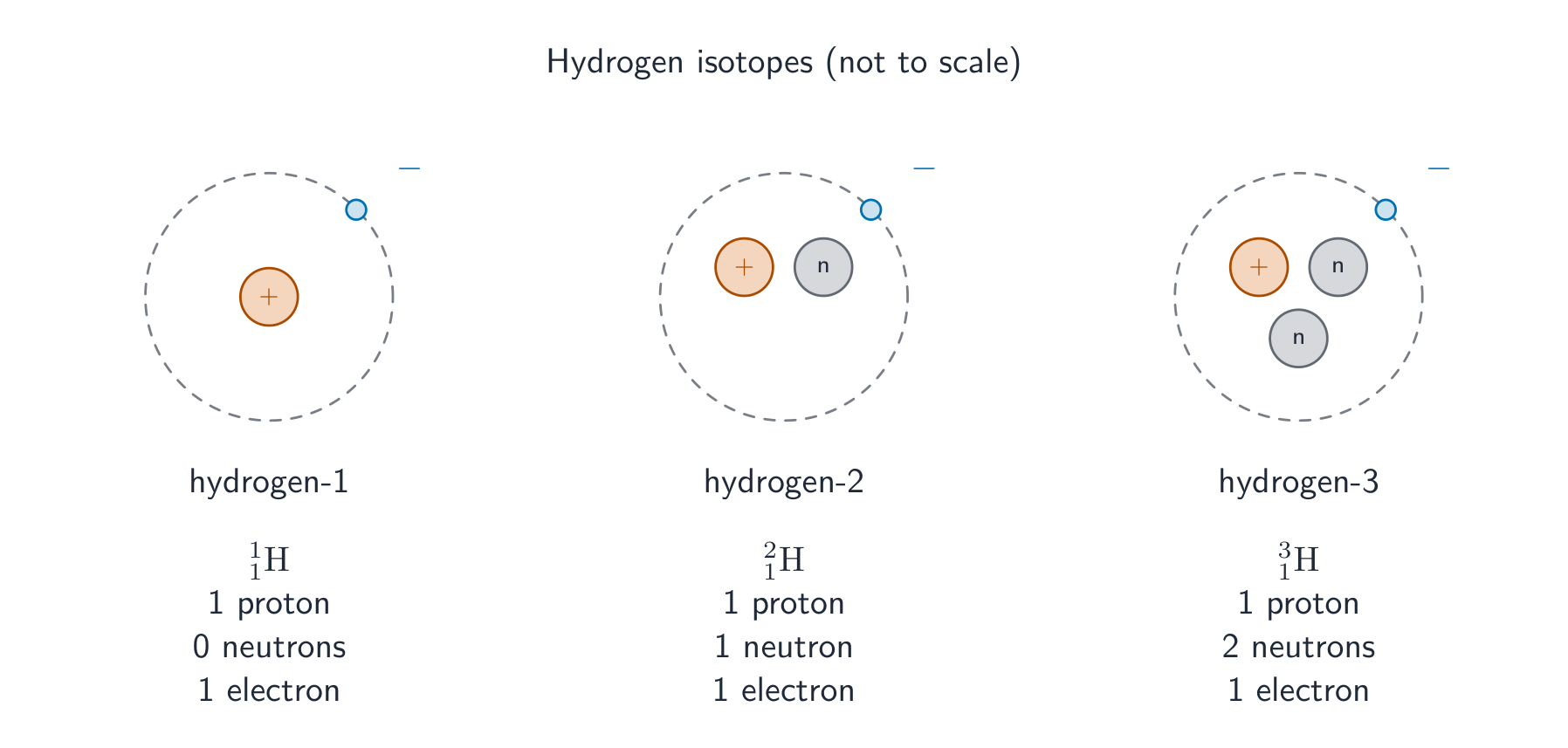
Isotopes 同位素 are atoms of the same element (same $Z$) with different numbers of neutrons (different $A$). They behave the same chemically but differently in the nucleus. Example: $^{12}_{6}\text{C}$ and $^{14}_{6}\text{C}$ are isotopes of carbon.
The examiner's wording: isotopes are nuclei (or atoms) with the same number of protons but different numbers of neutrons — equivalently the same proton number $Z$ and different nucleon numbers $A$. Hydrogen has three:
Worked example. Tritium, $^{3}_{1}\text{H}$, is an isotope of hydrogen. State the numbers of protons, neutrons and electrons in a neutral tritium atom, and give the quark composition of its nucleus.
$Z = 1$ proton; $A - Z = 3 - 1 = 2$ neutrons; 1 electron (neutral, so electrons $=$ protons). The nucleus is one proton (uud) and two neutrons (udd, udd): 4 up quarks and 5 down quarks. Charge check: $4 \times \tfrac{2}{3} - 5 \times \tfrac{1}{3} = +1$, the proton number. A "labelled diagram" of the atom is the nucleus (1 p, 2 n) with one electron orbiting outside it.
Conservation laws in nuclear processes
In any nuclear process:
nucleon number $A$ is conserved (total $A$ before $=$ total $A$ after),
charge is conserved (this is conservation of charge 电荷守恒).
These two rules let you balance decay and reaction equations.
Unified atomic mass unit
The unified atomic mass unit 统一原子质量单位, symbol $\text{u}$, is set so that an atom of $^{12}_{6}\text{C}$ has mass exactly $12\ \text{u}$. Numerically,
A proton has mass $\approx 1.007\ \text{u}$; a neutron $\approx 1.009\ \text{u}$; an electron $\approx 5.5 \times 10^{-4}\ \text{u}$.
Worked example. A nucleus X has 14 nucleons and $p$ protons. Its charge-to-mass ratio is $4.1 \times 10^{7}\ \text{C kg}^{-1}$. Find $p$ and identify X.
Charge $= pe$; mass $\approx 14\ \text{u}$. So $\dfrac{pe}{14\text{u}} = 4.1 \times 10^{7}$, giving $p = \dfrac{4.1 \times 10^{7} \times 14 \times 1.66 \times 10^{-27}}{1.60 \times 10^{-19}} = 5.96 \approx 6$. Six protons and 14 nucleons: X is carbon-14, $^{14}_{6}\text{C}$. Keep every figure until the end, then round to the nearest whole number of protons.
Bahasa Indonesia
Pemencaran partikel α Geiger–Marsden
Partikel alfa α ditembakkan ke arah selembar emas tipis dan terlihat:
sebagian besar tembus lurus, dengan sedikit pembelokan,
kadang-kadang membelok melalui sudut kecil,
jarang (sekitar $1$ dari $8000$) membelok melalui sudut lebih besar dari $90°$.
Dari hal ini Rutherford menyimpulkan:
atom adalah sebagian besar ruang kosong (sebagian besar partikel α menembus lurus),
terdapat inti yang sangat kecil, padat, bermuatan positif di tengah (pembelokan besar yang langka memerlukan muatan terkonsentrasi untuk mendorong α menjauh),
hampir seluruh massa atom berada di dalam inti ini.
Orde besaran: diameter atom $\sim 10^{-10}\ \text{m}$, diameter inti $\sim 10^{-15}\ \text{m}$ — inti sekitar $10^{5}$ kali lebih kecil daripada atom.
Tiga hasil dan apa yang dibuktikan masing-masing — kunci jawaban memasangkannya persis seperti ini:
Pengamatan
Kesimpulan
mayoritas besar menembus lurus dengan sedikit atau tanpa pembelokan
sebagian besar atom adalah ruang kosong
sejumlah kecil mengalami pembelokan melalui sudut kecil
terdapat muatan positif terkonsentrasi (inti) yang menolak partikel α positif
sebagian sangat kecil (sekitar 1 dari 8000) membelok lebih dari 90°, beberapa memantul lurus kembali
inti sangat kecil dibandingkan atom, dan mengandung hampir seluruh massa atom
Tiga detail percobaan juga ditanyakan: daun emas tipis sehingga setiap partikel α bertemu paling banyak satu inti (dan tidak diserap); ruang vakum agar partikel α tidak dihentikan atau disebar oleh udara; emas digunakan karena dapat dipalu menjadi lembaran sangat tipis dan memiliki inti berat serta bermuatan tinggi.
Contoh terpecahkan. Jelaskan mengapa sebagian sangat kecil partikel α disebar melalui sudut lebih besar dari 90°.
Hanya partikel α yang mendekati inti hampir head-on yang dipantulkan kembali. Inti dan partikel α keduanya positif, sehingga tolakan elektrostatik sangat besar pada jarak pemisahan yang kecil, dan inti jauh lebih masif daripada partikel α, sehingga partikel αlah yang berbelok balik. Karena inti sangat kecil, sangat sedikit partikel α yang mendekat sedekat itu — karenanya sebagian kecil. Saat partikel α mendekat, energi kinetiknya diubah menjadi energi potensial listrik; pada titik pendekatan terdekat ia berhenti sesaat dan seluruh energi kinetiknya telah menjadi energi potensial.
Pembelokan bergantung pada seberapa dekat lintasan melewati inti: semakin kecil jaraknya, semakin besar sudutnya, dan lintasan simetris terhadap garis yang melalui inti.
Eksperimen hamburan $\alpha$ — partikel $\alpha$ menabrak daun emas tipis dalam vakumSebagian besar partikel $\alpha$ tembus hampir lurus; beberapa dibelokkan tajam oleh inti kecil
Model nuklir sederhana
Atom memiliki:
inti pusat proton (positif, muatan $+e$) dan neutron (tidak bermuatan),
elektron (muatan $-e$) mengelilingi inti.
Proton dan neutron memiliki massa hampir sama ($\approx 1\ \text{u}$); elektron sekitar $\tfrac{1}{1836}$ dari massa proton.
Model sederhana atom helium dan atom litium (tidak sesuai skala)
Contoh terpecahkan. Deskripsikan struktur atom uranium-238, $^{238}_{92}\text{U}$.
Inti berisi 92 proton dan $238 - 92 = 146$ neutron, dengan 92 elektron mengorbitnya. "Elektron orbital" adalah frasa kurikulum — elektron berada di luar inti, dan atom netral memiliki jumlah elektron sebanyak proton.
Notasi dan angka kunci
Untuk nuklida yang ditulis $^{A}_{Z}\text{X}$:
Notasi nuclid: nomor nukleon di atas, nomor proton di bawah
nomor proton$Z$ (juga nomor atom): jumlah proton. Menentukan unsur.
nomor nukleon$A$ (juga nomor massa): total jumlah nukleon (proton + neutron).
jumlah neutron $N = A - Z$.
Atom netral memiliki jumlah elektron yang sama dengan proton.
Isotop
Isotop adalah atom dari unsur yang sama (sama $Z$) dengan jumlah neutron berbeda (berbeda $A$). Mereka berperilaku sama secara kimia tetapi berbeda di dalam inti. Contoh: $^{12}_{6}\text{C}$ dan $^{14}_{6}\text{C}$ adalah isotop karbon.
Kalimat penguji: isotop adalah inti (atau atom) dengan jumlah proton yang sama tetapi jumlah neutron berbeda — ekuivalen dengan nomor proton yang sama $Z$ dan nomor nukleon berbeda $A$. Hidrogen memiliki tiga:
Tiga isotop hidrogen: satu proton yang sama, jumlah neutron berbeda
Contoh terpecahkan. Tritium, $^{3}_{1}\text{H}$, adalah isotop hidrogen. Sebutkan jumlah proton, neutron, dan elektron dalam atom tritium netral, dan berikan komposisi kuark dari intinya.
$Z = 1$ proton; $A - Z = 3 - 1 = 2$ neutron; 1 elektron (netral, sehingga elektron $=$ proton). Inti atom terdiri dari satu proton (uud) dan dua neutron (udd, udd): 4 kuark naik dan 5 kuark turun. Pengecekan muatan: $4 \times \tfrac{2}{3} - 5 \times \tfrac{1}{3} = +1$, nomor proton. "Diagram berlabel" atom adalah inti (1 p, 2 n) dengan satu elektron yang mengorbit di luarnya.
Hukum kekekalan dalam proses nuklir
Dalam setiap proses nuklir:
nomor nukleon $A$ dipertahankan (total $A$ sebelum $=$ total $A$ setelah),
muatan kekal (ini adalah kekekalan muatan).
Dua aturan ini memungkinkan Anda menyetarakan persamaan peluruhan dan reaksi.
Satuan massa atom terpadu
Satuan massa atom terpadu, simbol $\text{u}$, ditetapkan sedemikian rupa sehingga sebuah atom $^{12}_{6}\text{C}$ memiliki massa tepat $12\ \text{u}$. Secara numeris,
$$1\ \text{u} = 1.661 × 10^{-27}\ \text{kg}.$$
Sebuah proton memiliki massa $\approx 1.007\ \text{u}$; sebuah neutron $\approx 1.009\ \text{u}$; sebuah elektron $\approx 5.5 \times 10^{-4}\ \text{u}$.
Contoh soal terpecahkan. Sebuah inti X memiliki 14 nukleon dan $p$ proton. Rasio muatan-terhadap-massanya adalah $4.1 \times 10^{7}\ \text{C kg}^{-1}$. Temukan $p$ dan identifikasi X.
Muatan $= pe$; massa $\approx 14\ \text{u}$. Maka $\dfrac{pe}{14\text{u}} = 4.1 \times 10^{7}$, menghasilkan $p = \dfrac{4.1 \times 10^{7} \times 14 \times 1.66 \times 10^{-27}}{1.60 \times 10^{-19}} = 5.96 \approx 6$. Enam proton dan 14 nukleon: X adalah karbon-14, $^{14}_{6}\text{C}$. Pertahankan setiap angka hingga akhir, lalu bulatkan ke bilangan bulat terdekat untuk jumlah proton.
Explore · Jelajahi
Nuclear atom evidence lab · Laboratorium bukti atom inti
Connect observations to the nuclear model of the atom. · Hubungkan observasi dengan model inti atom.
Explore · Jelajahi
Radioactive decay · Peluruhan radioaktif
A = A₀·bᵗ
Activity decays exponentially — set the base b below 1. · Aktivitas menurun secara eksponensial — atur basis b di bawah 1.
An unstable nucleus rearranges itself and gives out one of three kinds of radiation 辐射. This is radioactive 放射性 decay. Each kind has its own properties.
α-radiation
Made of: a helium-4 nucleus, $^{4}_{2}\alpha$ (two protons + two neutrons).
Mass: $\approx 4\ \text{u}$.
Charge: $+2e$.
Range in air: a few cm. Stopped by a sheet of paper.
Ionising power: strong — it is good at ionising 电离.
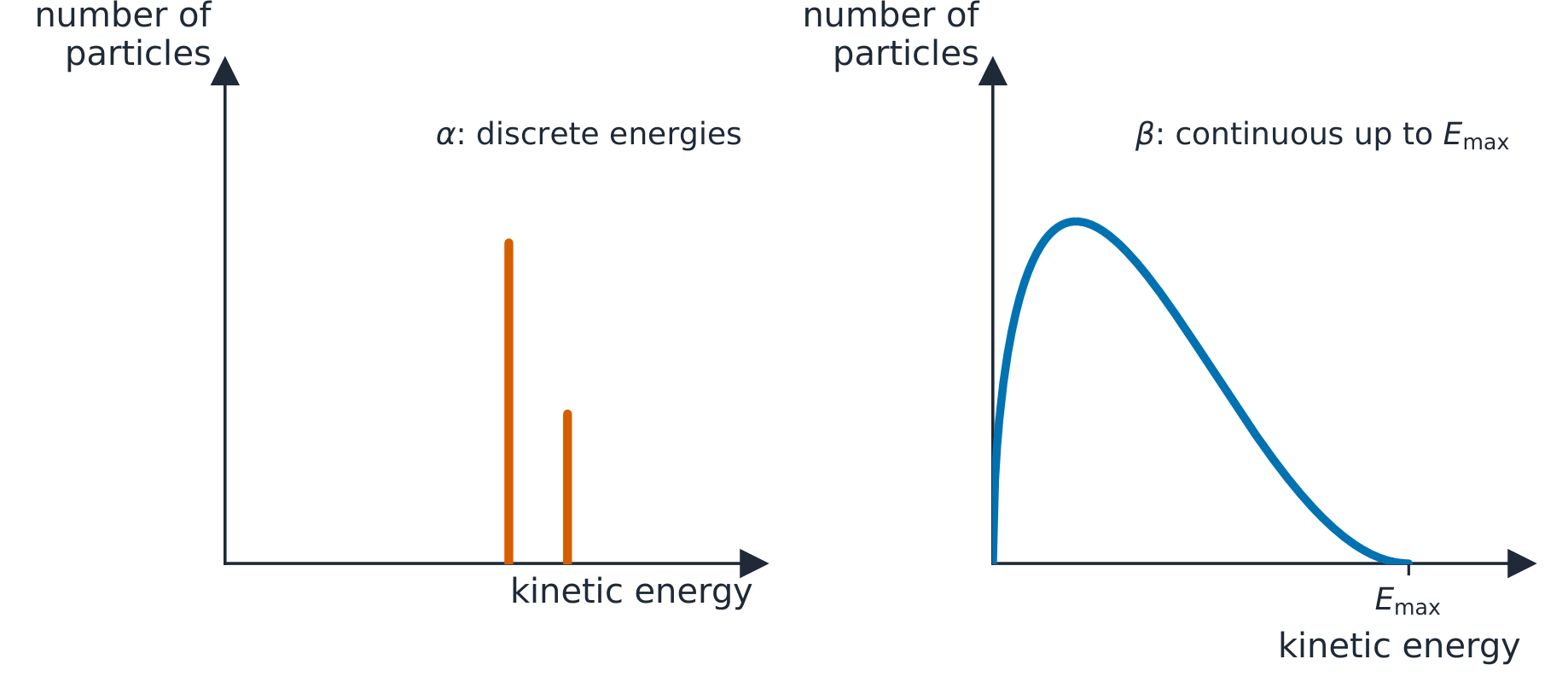
Energy spectrum: discrete 分立 (one decay gives α-particles at one or a few sharp energies).
A cloud chamber 云室 makes the tracks visible: each α-particle leaves a short, straight, thick trail of tiny droplets as it ionises the air. The short equal lengths show the α-particles all carry about the same energy.
β-radiation
Two types of beta particle β粒子:
$\beta^{-}$: a fast electron, given out when a neutron turns into a proton.
$\beta^{+}$: a positron 正电子 (the electron's antiparticle), given out when a proton in a proton-rich nucleus turns into a neutron.
Properties (both types):
Mass: $\approx 1/1836\ \text{u}$ (much less than α).
Charge: $-e$ for $\beta^{-}$, $+e$ for $\beta^{+}$.
Range in air: about $1\ \text{m}$. Stopped by a few mm of aluminium.
Energy spectrum: continuous 连续 up to a maximum (see below).
γ-radiation
Made of: a high-energy photon 光子 — part of the electromagnetic spectrum 电磁波谱.
Mass: zero (rest mass).
Charge: zero.
Range in air: large (follows the inverse-square law). Strongly attenuated 衰减 by several cm of lead or about a metre of concrete.
Ionising power: weakest.
Energy spectrum: discrete (a gamma ray γ射线 is given out as the nucleus drops between two nuclear energy levels).
A nucleus often gives out a γ-photon as a "tidy-up" step after an α or β decay leaves the daughter nucleus 子核 in an excited state 激发态.
Mass and charge, side by side — a table question asks for exactly these, in units of $\text{u}$ and $e$:
Worked example. Compare an α-particle with a $\beta^{+}$ particle in terms of their masses and charges (3 marks).
Both are positively charged, but the α-particle's charge ($+2e$) is twice that of the $\beta^{+}$ ($+e$). The α-particle's mass ($4\ \text{u}$) is about $7300$ times the mass of the $\beta^{+}$ ($5.5 \times 10^{-4}\ \text{u}$). Give a ratio, not just "heavier": twice the charge and about 7000 times the mass are the marking points.
Because they carry charge, α- and β-particles are deflected by electric and magnetic fields — in opposite directions for opposite signs, the light β far more than the heavy α — while γ-rays, being uncharged, pass straight through.
Antiparticles, neutrinos and antineutrinos
Every particle has an antiparticle 反粒子 with the same mass but opposite charge. The positron is the antiparticle of the electron.
In β-decay, a third particle is always given out as well:
$\beta^{-}$ decay: an antineutrino 反中微子$\bar{\nu}_{\text{e}}$.
$\beta^{+}$ decay: a neutrino 中微子$\nu_{\text{e}}$.
Neutrinos and antineutrinos have zero charge, very small mass, and barely interact — they are very hard to detect, but they must be there to balance energy, momentum 动量 and other conserved quantities in β-decay.
Why β has a continuous spectrum (and α does not)
In α-decay the energy 能量 released is shared between just two particles (the daughter nucleus and the α). Conservation of momentum and energy then fixes the α's energy to one value (discrete).
In β-decay the energy is shared between three particles (the daughter nucleus, the β, and the (anti)neutrino). The β can take any share from zero up to a maximum, so its energy spectrum is continuous.
Worked example. The energy spectrum of the $\beta^{-}$ particles from a source is continuous, from zero up to a maximum. Explain why (3 marks).
Each decay releases a fixed amount of energy. That energy is shared between the $\beta^{-}$ particle, the antineutrino and the recoiling daughter nucleus. The antineutrino can take any share, so the $\beta^{-}$ particle is left with any energy from zero up to the maximum — the maximum being when the antineutrino carries away almost none. (For an α-particle there are only two bodies, so momentum conservation fixes the share and the energy is discrete.)
Worked example. Uranium-238, $^{238}_{92}\text{U}$, decays by α-emission; carbon-14, $^{14}_{6}\text{C}$, decays by $\beta^{-}$-emission. Find each daughter nuclide.
α-decay lowers $A$ by 4 and $Z$ by 2; $\beta^{-}$-decay leaves $A$ unchanged and raises $Z$ by 1:
Determine quantitatively the changes. α-emission: $A$ decreases by 4, $Z$ decreases by 2. $\beta^{-}$-emission: $A$ unchanged, $Z$ increases by 1. $\beta^{+}$-emission: $A$ unchanged, $Z$ decreases by 1. γ-emission: no change in either. A decay chain that ends at a known nuclide is solved from these: the number of α-decays is $(A_{\text{start}} - A_{\text{end}})/4$, and then the number of $\beta^{-}$-decays makes $Z$ come out right.
Worked example. Thorium-230, $^{230}_{90}\text{Th}$, decays in stages, by α- and $\beta^{-}$-emission, to lead-206, $^{206}_{82}\text{Pb}$. Find the number of each kind of decay.
α-decays: $(230 - 206)/4 = 6$. Six α-decays alone would lower $Z$ by 12, to 78; the final $Z$ is 82, so there are $82 - 78 = 4$$\beta^{-}$-decays.
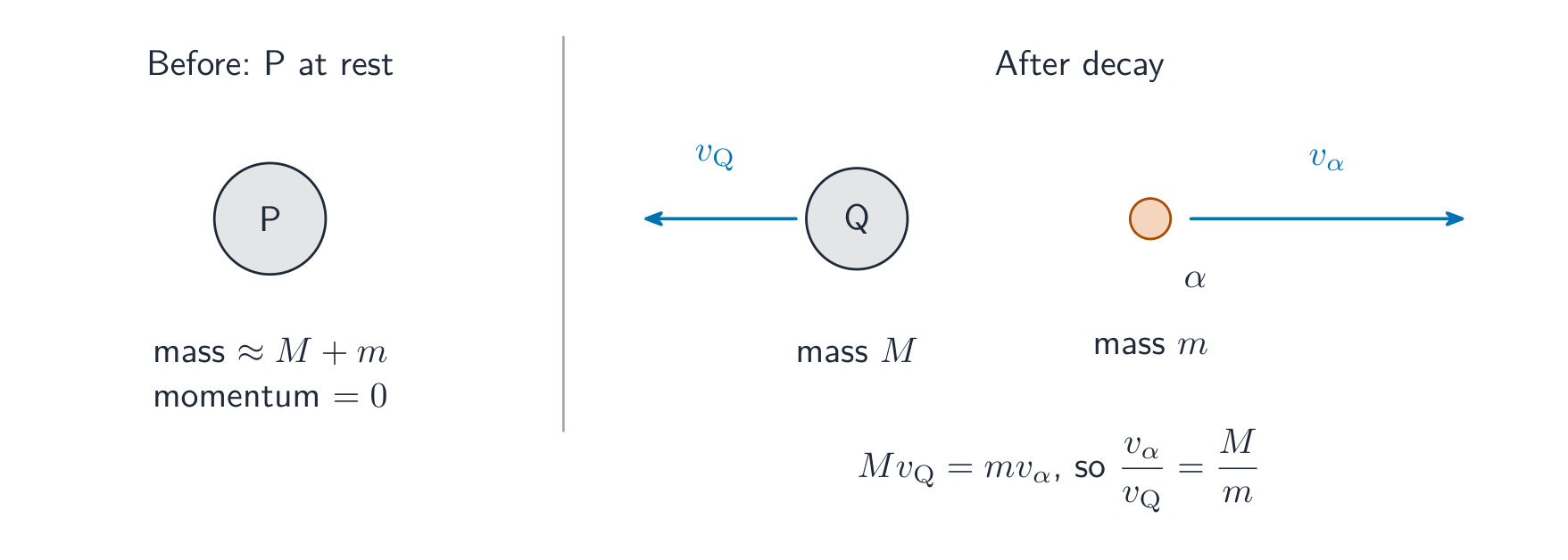
A nucleus at rest recoils. When a stationary nucleus emits an α-particle, momentum is conserved: the daughter nucleus and the α-particle move off in opposite directions with momenta of equal magnitude. Since $p = mv$, the lighter α-particle moves much faster, and since $E_{\text{k}} = p^{2}/2m$ it also takes most of the kinetic energy — the shares are in inverse proportion to the masses.
Worked example. A stationary nucleus P of mass $243\ \text{u}$ emits an α-particle of mass $4\ \text{u}$ at $1.5 \times 10^{7}\ \text{m s}^{-1}$. Find the speed of the daughter nucleus Q and the ratio of the kinetic energy of the α-particle to that of Q.
Q has mass $243 - 4 = 239\ \text{u}$. Momentum: $239 v_{\text{Q}} = 4 \times 1.5 \times 10^{7}$, so $v_{\text{Q}} = 2.5 \times 10^{5}\ \text{m s}^{-1}$, in the opposite direction to the α-particle. Kinetic energies: $\dfrac{E_{\alpha}}{E_{\text{Q}}} = \dfrac{p^{2}/2m_{\alpha}}{p^{2}/2m_{\text{Q}}} = \dfrac{m_{\text{Q}}}{m_{\alpha}} = \dfrac{239}{4} \approx 60$. The α-particle takes about 98% of the energy released.
Bahasa Indonesia
Inti atom yang tidak stabil mengatur ulang dirinya sendiri dan memancarkan salah satu dari tiga jenis radiasi. Ini adalah peluruhan radioaktif. Setiap jenis memiliki sifatnya masing-masing.
Radiasi α
Terdiri dari: inti helium-4, $^{4}_{2}\alpha$ (dua proton + dua neutron).
Massa: $\approx 4\ \text{u}$.
Muatan: $+2e$.
Jangkauan di udara: beberapa cm. Dihentikan oleh selembar kertas.
Daya ionisasi: kuat — sangat efektif dalam mengionisasi.
Spektrum energi: diskrit (satu peluruhan menghasilkan partikel α pada satu atau beberapa energi tajam).
Awan ruang membuat jejak terlihat: setiap partikel α meninggalkan jejak pendek, lurus, dan tebal berupa tetesan-tetesan kecil saat mengionisasi udara. Panjang kesamaan yang pendek menunjukkan bahwa semua partikel α membawa energi yang hampir sama.
Jejak partikel alfa dalam ruang awan, menyebar dari sumber americium-241
Radiasi β
Dua jenis partikel beta β:
$\beta^{-}$: elektron cepat, dipancarkan ketika neutron berubah menjadi proton.
$\beta^{+}$: positron (antipartikel elektron), dipancarkan ketika proton dalam inti yang kaya proton berubah menjadi neutron.
Sifat (kedua jenis):
Massa: $\approx 1/1836\ \text{u}$ (jauh lebih kecil daripada α).
Muatan: $-e$ untuk $\beta^{-}$, $+e$ untuk $\beta^{+}$.
Jangkauan di udara: sekitar $1\ \text{m}$. Dihentikan oleh beberapa mm aluminium.
Spektrum energi: kontinu hingga maksimum (lihat di bawah).
Radiasi γ
Terdiri dari: foton berenergi tinggi — bagian dari spektrum elektromagnetik.
Massa: nol (massa diam).
Muatan: nol.
Jangkauan di udara: besar (mengikuti hukum kuadrat terbalik). Sangat melemah oleh beberapa cm timah atau sekitar satu meter beton.
Daya ionisasi: terlemah.
Spektrum energi: diskrit (sinar gamma γ dipancarkan ketika inti jatuh antara dua tingkat energi nuklir).
Inti sering memancarkan foton γ sebagai langkah "perapi" setelah peluruhan α atau β meninggalkan inti anak dalam keadaan tereksitasi.
Daya tembus: $\alpha$ dihentikan oleh kertas, $\beta$ oleh aluminium, $\gamma$ hanya melemah oleh timbal
Massa dan muatan, berdampingan — pertanyaan tabel meminta keduanya secara eksplisit, dalam satuan $\text{u}$ dan $e$:
Contoh soal terpecahkan. Bandingkan partikel α dengan partikel $\beta^{+}$ berdasarkan massa dan muatan mereka (3 poin).
Keduanya bermuatan positif, tetapi muatan partikel α ($+2e$) dua kali lipat dari muatan $\beta^{+}$ ($+e$). Massa partikel α ($4\ \text{u}$) sekitar $7300$ kali massa partikel $\beta^{+}$ ($5.5 \times 10^{-4}\ \text{u}$). Berikan rasio, bukan hanya "lebih berat": muatan dua kali lipat dan massa sekitar 7000 kali lipat adalah poin penilaian.
Karena membawa muatan, partikel α dan β dibelokkan oleh medan listrik dan magnetik — dalam arah berlawanan untuk tanda berlawanan, partikel β yang ringan jauh lebih banyak dibelokkan daripada partikel α yang berat — sementara sinar γ, karena tidak bermuatan, menembus lurus.
Antipartikel, neutrino dan antineutrino
Setiap partikel memiliki antipartikel dengan massa yang sama tetapi muatan berlawanan. Positron adalah antipartikel dari elektron.
Dalam peluruhan β, partikel ketiga selalu dipancarkan juga:
Neutrino dan antineutrino memiliki muatan nol, massa sangat kecil, dan hampir tidak berinteraksi — mereka sangat sulit dideteksi, tetapi mereka harus ada untuk menyeimbangkan energi, momentum dan besaran kekal lainnya dalam peluruhan β.
Mengapa β memiliki spektrum kontinu (dan α tidak)
Dalam peluruhan α, energi yang dilepaskan dibagi hanya antara dua partikel (inti anak dan α). Hukum kekekalan momentum dan energi kemudian menetapkan energi α pada satu nilai tertentu (diskrit).
Dalam peluruhan β, energi dibagi antara tiga partikel (inti anak, β, dan (anti)neutrino). Partikel β dapat mengambil sebagian dari nol hingga maksimum, sehingga spektrum energinya bersifat kontinu.
Partikel α dari satu peluruhan memiliki energi tetap (diskrit); partikel β berbagi energi dengan (anti)neutrino, sehingga spektrumnya kontinu hingga mencapai maksimum
Contoh terpecahkan. Spektrum energi dari partikel $\beta^{-}$ dari suatu sumber bersifat kontinu, mulai dari nol hingga maksimum. Jelaskan mengapa (3 poin).
Setiap peluruhan melepaskan sejumlah energi tetap. Energi tersebut dibagi antara partikel $\beta^{-}$, antineutrino, dan inti anak yang memantul balik. Antineutrino dapat mengambil sebagian berapa pun, sehingga partikel $\beta^{-}$ tersisa dengan energi berkisar dari nol hingga maksimum — di mana maksimum terjadi ketika antineutrino membawa hampir tidak ada energi. (Untuk partikel α hanya ada dua badan, sehingga kekekalan momentum menetapkan bagiannya dan energinya bersifat diskrit.)
Tentukan perubahan secara kuantitatif. Pemancaran α: $A$ berkurang 4, $Z$ berkurang 2. Pemancaran $\beta^{-}$: $A$ tak berubah, $Z$ bertambah 1. Pemancaran $\beta^{+}$: $A$ tak berubah, $Z$ berkurang 1. Pemancaran γ: tidak ada perubahan pada keduanya. Rantai peluruhan yang berakhir pada nuclid yang diketahui diselesaikan dari hal ini: jumlah peluruhan α adalah $(A_{\text{start}} - A_{\text{end}})/4$, dan kemudian jumlah peluruhan $\beta^{-}$ membuat $Z$ menjadi tepat.
Contoh terpecahkan. Thorium-230, $^{230}_{90}\text{Th}$, meluruh bertahap melalui pemancaran α dan $\beta^{-}$, menuju timbal-206, $^{206}_{82}\text{Pb}$. Tentukan jumlah masing-masing jenis peluruhan.
Peluruhan α: $(230 - 206)/4 = 6$. Enam peluruhan α saja akan menurunkan $Z$ sebesar 12, menjadi 78; hasil akhir $Z$ adalah 82, jadi terdapat $82 - 78 = 4$ peluruhan $\beta^{-}$.
Nukleus yang diam mengalami pemantulan balik. Ketika nukleus yang diam memancarkan partikel α, momentum kekal: inti anak dan partikel α bergerak menjauh dalam arah berlawanan dengan besar momentum yang sama. Karena $p = mv$, partikel α yang lebih ringan bergerak jauh lebih cepat, dan karena $E_{\text{k}} = p^{2}/2m$ ia juga mengambil sebagian besar energi kinetik — bagian-bagiannya berbanding terbalik dengan massa.
Nukleus yang diam meluruh: anak memantul balik dengan momentum yang sama besar dan berlawanan arah dengan partikel α
Contoh terpecahkan. Nukleus diam P bermassa $243\ \text{u}$ memancarkan partikel α bermassa $4\ \text{u}$ dengan kecepatan $1.5 \times 10^{7}\ \text{m s}^{-1}$. Tentukan kecepatan inti anak Q dan rasio energi kinetik partikel α terhadap energi kinetik Q.
Q memiliki massa $243 - 4 = 239\ \text{u}$. Momentum: $239 v_{\text{Q}} = 4 \times 1.5 \times 10^{7}$, sehingga $v_{\text{Q}} = 2.5 \times 10^{5}\ \text{m s}^{-1}$, ke arah berlawanan dengan partikel α. Energi kinetik: $\dfrac{E_{\alpha}}{E_{\text{Q}}} = \dfrac{p^{2}/2m_{\alpha}}{p^{2}/2m_{\text{Q}}} = \dfrac{m_{\text{Q}}}{m_{\alpha}} = \dfrac{239}{4} \approx 60$. Partikel α mengambil sekitar 98% dari energi yang dilepaskan.
understand that a quark is a fundamental particle and that there are six flavours (types) of quark: up, down, strange, charm, top and bottom
recall and use the charge of each flavour of quark and understand that its respective antiquark has the opposite charge (no knowledge of any other properties of quarks is required)
recall that protons and neutrons are not fundamental particles and describe protons and neutrons in terms of their quark composition
understand that a hadron may be either a baryon (consisting of three quarks) or a meson (consisting of one quark and one antiquark)
describe the changes to quark composition that take place during $\beta^-$ and $\beta^+$ decay
recall that electrons and neutrinos are fundamental particles called leptons
Bahasa Indonesia
pahami bahwa kuark adalah partikel fundamental dan terdapat enam jenis (rasa) kuark: up, down, strange, charm, top, dan bottom
ingat dan gunakan muatan setiap rasa kuark serta pahami bahwa antikuark yang sesuai memiliki muatan berlawanan (tidak diperlukan pengetahuan tentang sifat lain kuark)
ingat bahwa proton dan neutron bukan partikel fundamental dan deskripsikan proton serta neutron berdasarkan komposisi kuark-nya
pahami bahwa hadron dapat berupa baryon (terdiri dari tiga kuark) atau meson (terdiri dari satu kuark dan satu antikuark)
deskripsikan perubahan pada komposisi kuark yang terjadi selama peluruhan $\beta^-$ dan $\beta^+$
ingat bahwa elektron dan neutrino adalah partikel fundamental yang disebut lepton
Source: Cambridge International syllabus · Sumber: Silabus Cambridge International
English
Some particles are fundamental particles 基本粒子 (point-like, with no smaller parts as far as we know); others are built from fundamental ones.
The one-mark definition: a fundamental particle is one that cannot be broken down into smaller particles (it has no internal structure). Electrons, neutrinos and quarks are fundamental; protons and neutrons are not.
Quarks
A quark 夸克 is a fundamental particle. There are six flavours 味:
up (u), charge $+\tfrac{2}{3}e$,
down (d), charge $-\tfrac{1}{3}e$,
charm (c), charge $+\tfrac{2}{3}e$,
strange (s), charge $-\tfrac{1}{3}e$,
top (t), charge $+\tfrac{2}{3}e$,
bottom (b), charge $-\tfrac{1}{3}e$.
Each quark has an antiquark 反夸克 with the same size of charge but the opposite sign: $\bar{u}$ (charge $-\tfrac{2}{3}e$), $\bar{d}$ (charge $+\tfrac{1}{3}e$). No other quark property is tested.
Written as the table a question asks you to complete:
Worked example. By reference to quark composition, show that the charge of a proton is $+1.6 \times 10^{-19}\ \text{C}$.
A proton is uud: charge $= \tfrac{2}{3}e + \tfrac{2}{3}e - \tfrac{1}{3}e = +e = +1.6 \times 10^{-19}\ \text{C}$. Write the three fractions and their sum — the mark is for the arithmetic, not the answer.
Hadrons: baryons and mesons
Particles built from quarks are hadrons 强子. Two types:
baryons 重子 — three quarks. Examples: proton (u u d), neutron (u d d). Charge check: $\tfrac{2}{3} + \tfrac{2}{3} - \tfrac{1}{3} = +1$ for the proton; $\tfrac{2}{3} - \tfrac{1}{3} - \tfrac{1}{3} = 0$ for the neutron.
mesons 介子 — one quark and one antiquark (for example $\pi^{+}$ is u$\bar{\text{d}}$).
Protons and neutrons are not fundamental — they are baryons made of quarks.
"Compare baryons and mesons in terms of their constituent particles" (2 marks): both are hadrons made of quarks; a baryon is three quarks (or three antiquarks, for an antibaryon), a meson is one quark and one antiquark. Any charge you are given must come out of the quark charges:
Worked example. (a) A meson has charge $-1e$. Give a possible quark composition. (b) A meson Q has charge 0. Give a possible composition. (c) A baryon is made of three quarks of different flavours, u, d and s. Find its charge. (d) Give the quark composition of an antineutron and its charge.
(a) d$\bar{\text{u}}$: $-\tfrac{1}{3} - \tfrac{2}{3} = -1$ (s$\bar{\text{u}}$ also works). (b) u$\bar{\text{u}}$: $+\tfrac{2}{3} - \tfrac{2}{3} = 0$ (or d$\bar{\text{d}}$). (c) uds: $\tfrac{2}{3} - \tfrac{1}{3} - \tfrac{1}{3} = 0$. (d) The antineutron is the antiparticle of udd, so it is $\bar{\text{u}}\bar{\text{d}}\bar{\text{d}}$: $-\tfrac{2}{3} + \tfrac{1}{3} + \tfrac{1}{3} = 0$ — the same mass and charge as the neutron, since both have charge zero.
Quark changes in β-decay
In $\beta^{-}$ decay a neutron turns into a proton; in quark terms, one down quark turns into an up quark:
"Describe $\beta^{+}$ decay in terms of the fundamental particles involved" (2 marks): an up quark in a proton changes into a down quark, so the proton becomes a neutron, and a positron and an electron neutrino are emitted — $\text{u} \to \text{d} + \beta^{+} + \nu_{\text{e}}$. For $\beta^{-}$ decay swap the roles: a down quark becomes an up quark, emitting an electron and an electron antineutrino. Name the (anti)neutrino: it is the "other lepton" the question asks for, and it is what makes the β energy continuous.
Leptons
Leptons 轻子 are fundamental particles that are not made of quarks. The leptons you need are the electron and the electron neutrino, with their antiparticles the positron and the electron antineutrino. (Heavier leptons — the muon and tau — exist but are not tested.) Asked for "two different leptons", give electron and neutrino.
Classifying particles
To answer "which are fundamental?": quarks and leptons (electrons, positrons, neutrinos, antineutrinos) are fundamental; protons, neutrons, baryons, mesons and hadrons are not — they are built from quarks.
Worked example. In the list — antineutrino, $\beta^{+}$ particle, neutron, positron, proton — underline the hadrons.
Neutron and proton (three quarks each). The antineutrino and the positron are leptons; the $\beta^{+}$ particle is a positron. The same list asked as "which are not fundamental?" has the same answer: neutron and proton.
Antimatter. Every particle has an antiparticle of the same mass and opposite charge; a positron and an electron are alike in mass (and in the size of their charge) and differ in the sign of their charge. An antihydrogen atom is an antiproton (charge $-e$, made of $\bar{\text{u}}\bar{\text{u}}\bar{\text{d}}$) with a positron in orbit.
Bahasa Indonesia
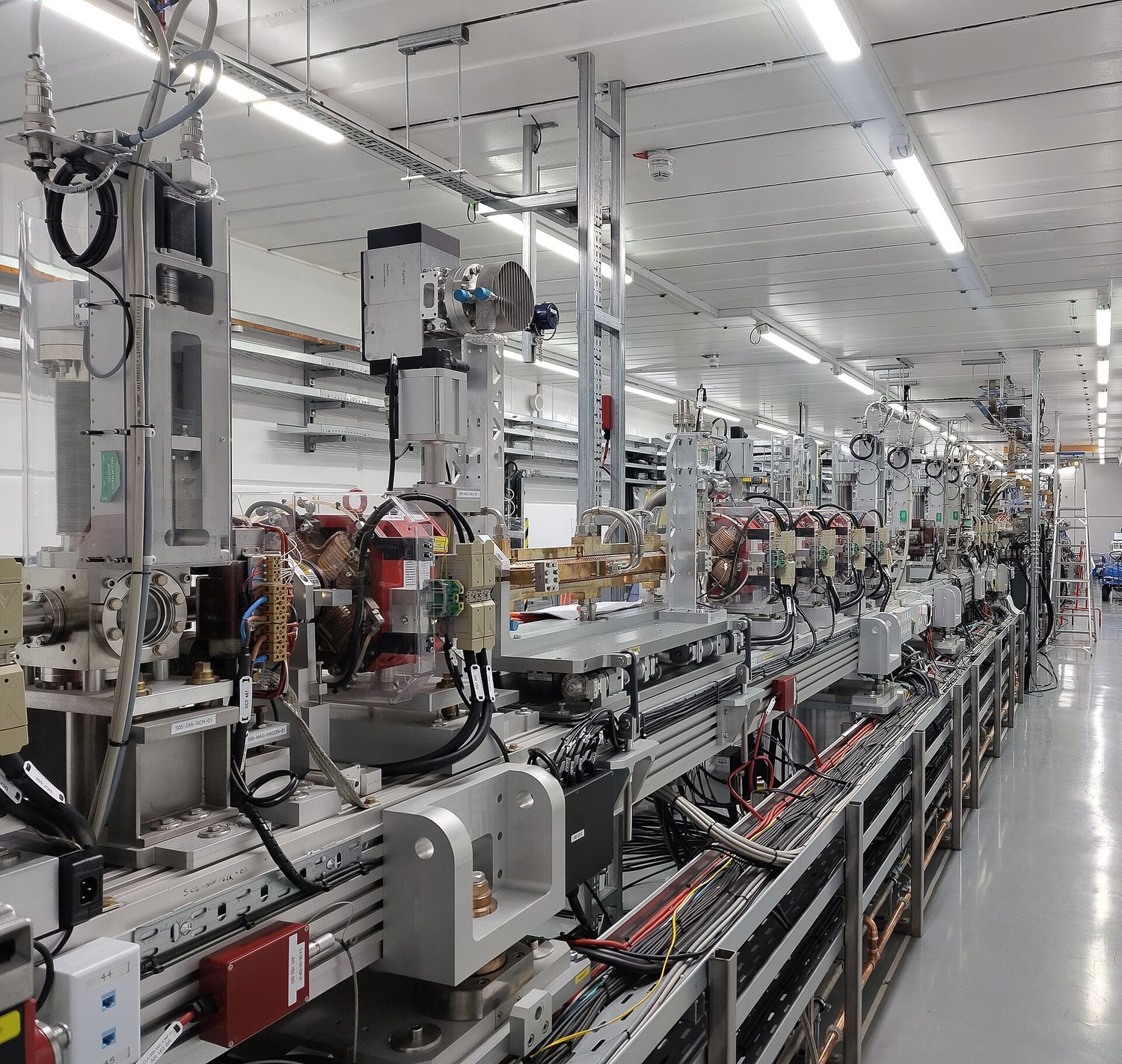
Ruang gelembung mengungkap jejak melengkung dari partikel bermuatan.Tempat partikel berasal: akselerator linear menggunakan medan listrik untuk mendorong partikel bermuatan cukup cepat guna menyelidiki inti atom
Beberapa partikel adalah partikel fundamental (titik-titik, tanpa komponen lebih kecil sejauh yang kita ketahui); yang lain dibangun dari partikel fundamental.
Definisi bernilai satu poin: partikel fundamental adalah partikel yang tidak dapat diuraikan menjadi partikel yang lebih kecil (tidak memiliki struktur internal). Elektron, neutrino, dan kuark adalah fundamental; proton dan neutron bukan.
Kuark
Kuark adalah partikel fundamental. Ada enam rasa:
up (u), muatan $+\tfrac{2}{3}e$,
down (d), muatan $-\tfrac{1}{3}e$,
charm (c), muatan $+\tfrac{2}{3}e$,
strange (s), muatan $-\tfrac{1}{3}e$,
top (t), muatan $+\tfrac{2}{3}e$,
bottom (b), muatan $-\tfrac{1}{3}e$.
Setiap kuark memiliki antikuark dengan besaran muatan yang sama tetapi tanda berlawanan: $\bar{u}$ (muatan $-\tfrac{2}{3}e$), $\bar{d}$ (muatan $+\tfrac{1}{3}e$). Tidak ada properti kuark lainnya yang diujikan.
Enam kuark: up/charm/top membawa $+\tfrac23 e$, down/strange/bottom membawa $-\tfrac13 e$
Ditulis sebagai tabel yang meminta Anda untuk melengkapi:
Contoh terpecahkan. Dengan merujuk kepada komposisi kuark, tunjukkan bahawa cas proton ialah $+1.6 \times 10^{-19}\ \text{C}$.
Proton ialah uud: cas $= \tfrac{2}{3}e + \tfrac{2}{3}e - \tfrac{1}{3}e = +e = +1.6 \times 10^{-19}\ \text{C}$. Tulis tiga pecahan dan hasil tambah mereka — markah diberikan untuk pengiraan, bukan jawapan.
Hadron: baryon dan meson
Zarah yang dibina daripada kuark dipanggil hadron. Dua jenis:
baryon — tiga kuark. Contoh: proton (u u d), neutron (u d d). Semakan cas: $\tfrac{2}{3} + \tfrac{2}{3} - \tfrac{1}{3} = +1$ bagi proton; $\tfrac{2}{3} - \tfrac{1}{3} - \tfrac{1}{3} = 0$ bagi neutron.
meson — satu kuark dan satu antikuarak (contohnya $\pi^{+}$ ialah u$\bar{\text{d}}$).
Proton dan neutron adalah bukan zarah asas — mereka adalah baryon yang terdiri daripada kuark.
"Bandingkan baryon dan meson dari segi zarah penyusunnya" (2 markah): kedua-duanya adalah hadron yang dibuat daripada kuark; baryon terdiri daripada tiga kuark (atau tiga antikuarak, bagi antibaryon), manakala meson terdiri daripada satu kuark dan satu antikuarak. Sebarang cas yang diberikan mestilah bersumber daripada cas kuark tersebut:
Contoh terpecahkan. (a) Satu meson mempunyai cas $-1e$. Berikan satu kemungkinan komposisi kuark. (b) Satu meson Q mempunyai cas 0. Berikan satu kemungkinan komposisi. (c) Satu baryon terdiri daripada tiga kuark dengan perisa berbeza, iaitu u, d dan s. Cari casnya. (d) Berikan komposisi kuark bagi antineutron dan casnya.
(a) d$\bar{\text{u}}$: $-\tfrac{1}{3} - \tfrac{2}{3} = -1$ (s$\bar{\text{u}}$ juga bisa). (b) u$\bar{\text{u}}$: $+\tfrac{2}{3} - \tfrac{2}{3} = 0$ (atau d$\bar{\text{d}}$). (c) uds: $\tfrac{2}{3} - \tfrac{1}{3} - \tfrac{1}{3} = 0$. (d) Antineutron adalah antipartikel dari udd, jadi ia adalah $\bar{\text{u}}\bar{\text{d}}\bar{\text{d}}$: $-\tfrac{2}{3} + \tfrac{1}{3} + \tfrac{1}{3} = 0$ — massa dan muatan yang sama dengan neutron, karena keduanya memiliki muatan nol.
Perubahan kuark dalam penjejakan β
Dalam penjejakan $\beta^{-}$, neutron bertukar menjadi proton; dalam istilah kuark, satu kuark bawah bertukar menjadi kuark atas:
Penjejakan beta-minus: satu kuark bawah menjadi kuark atas, menukar neutron menjadi proton
"Huraikan penjejakan $\beta^{+}$ dari segi zarah-zarah asas yang terlibat" (2 markah): satu kuark atas dalam proton berubah menjadi kuark bawah, maka proton menjadi neutron, dan positron serta neutrino elektron dipancarkan — $\text{u} \to \text{d} + \beta^{+} + \nu_{\text{e}}$. Untuk penjejakan $\beta^{-}$, tukar peranan: satu kuark bawah menjadi kuark atas, memancarkan elektron dan antineutrino elektron. Nyatakan nama (anti)neutrino: ia adalah "lepton lain" yang diminta oleh soalan, dan ia menyebabkan tenaga β adalah berterusan.
Lepton
Lepton adalah zarah asas yang tidak terdiri daripada kuark. Lepton yang perlu anda tahu ialah elektron dan neutrino elektron, dengan antimaterinya分别是positron dan antineutrino elektron. (Lepton yang lebih berat — muon dan tau — wujud tetapi tidak diuji.) Jika diminta "dua lepton berbeza", nyatakan elektron dan neutrino.
Pengelompokan zarah
Untuk menjawab "yang mana adalah zarah asas": kuark dan lepton (elektron, positron, neutrino, antineutrino) adalah asas; proton, neutron, baryon, meson dan hadron adalah bukan asas — mereka dibina daripada kuark.
Zarah asas (kuark, lepton) berbanding hadron (baryon, meson)
Neutron dan proton (masing-masing tiga kuark). Antineutrino dan positron adalah lepton; zarah $\beta^{+}$merupakan positron. Senarai yang sama jika ditanya "yang mana bukan zarah asas?" mempunyai jawapan yang sama: neutron dan proton.
Antimateri. Setiap zarah mempunyai antimateri dengan jisim yang sama dan cas yang bertentangan; positron dan elektron sepadan dalam jisim (dan saiz cas) dan berbeza dalam tanda cas. Atom antihidrogen ialah antiproton (cas $-e$, terdiri daripada $\bar{\text{u}}\bar{\text{u}}\bar{\text{d}}$) dengan sebuah positron dalam orbit.
Explore · Jelajahi
Fundamental particle lab · Lab partikel fundamental
Sort particles by the family or interaction that defines them. · Urutkan partikel berdasarkan keluarga atau interaksi yang mendefinisikannya.
Definitions the examiner accepts · Definisi yang diterima oleh penguji
English
A definition question is marked against fixed wording. Learn these exactly, and give one answer only.
Term
Definition
proton number $Z$
the number of protons in a nucleus
nucleon number $A$
the total number of protons and neutrons in a nucleus
isotopes
nuclei of the same element (same number of protons) with different numbers of neutrons
nuclide
a nucleus with a particular number of protons and a particular number of neutrons
unified atomic mass unit
one twelfth of the mass of an atom of carbon-12
antiparticle
a particle with the same mass as the corresponding particle but the opposite charge
fundamental particle
a particle that cannot be broken down into smaller particles
hadron
a particle made of quarks: a baryon (three quarks) or a meson (a quark and an antiquark)
lepton
a fundamental particle that is not made of quarks, such as the electron or the neutrino
α-particle
a helium-4 nucleus: two protons and two neutrons, charge $+2e$, mass $4\ \text{u}$
$\beta^{-}$ / $\beta^{+}$ particle
an electron / a positron emitted from a nucleus when a neutron becomes a proton / a proton becomes a neutron
Bahasa Indonesia
Soal definisi dinilai berdasarkan frasa tetap. Hafalkan ini persis, dan berikan hanya satu jawaban.
Istilah
Definisi
nombor proton $Z$
bilangan proton dalam nukleus
nombor nukleon $A$
jumlah bilangan proton dan neutron dalam nukleus
isotop
nukleus unsur yang sama (bilangan proton yang sama) dengan bilangan neutron yang berbeza
nuklid
nukleus dengan bilangan proton tertentu dan bilangan neutron tertentu
unit jisim atom seragam
satu belasan jisim atom karbon-12
antimateri
zarah dengan jisim yang sama seperti zarah berkaitan tetapi cas yang bertentangan
zarah asas
zarah yang tidak boleh dipecahkan kepada zarah yang lebih kecil
hadron
zarah yang terdiri daripada kuark: baryon (tiga kuark) atau meson (satu kuark dan satu antikuarak)
lepton
zarah asas yang tidak terdiri daripada kuark, seperti elektron atau neutrino
zarah α
nukleus helium-4: dua proton dan dua neutron, cas $+2e$, jisim $4\ \text{u}$
zarah $\beta^{-}$ / $\beta^{+}$
elektron / positron yang dipancarkan dari nukleus apabila neutron menjadi proton / proton menjadi neutron
11.2
Exam tips · Tips ujian
English
Describe the nuclear atom (a small, dense, positive nucleus) using the alpha-scattering evidence — pair each observation with its conclusion.
Compare $\alpha$, $\beta$ and $\gamma$ by charge, mass, ionising power and penetration; when asked to compare two particles, give the ratio ("twice the charge", "about 7000 times the mass").
Use quark composition (proton $uud$, neutron $udd$) and check that charge and nucleon number balance in every equation you write.
In $\beta^-$ decay a neutron becomes a proton, an electron and an antineutrino; in $\beta^{+}$ decay a proton becomes a neutron, a positron and a neutrino. Name the (anti)neutrino every time.
A nucleus at rest that decays gives its two products equal and opposite momentum, so the lighter one is faster and carries most of the kinetic energy.
For a decay chain, count the α-decays from the change in $A$ first, then fix $Z$ with $\beta$-decays.
Common mistakes
Concluding "the nucleus is positive" from the straight-through result. That result shows empty space; the large-angle deflections show the concentrated positive charge.
Defining isotopes by "different mass" only. The mark needs same number of protons, different number of neutrons.
Writing $^{0}_{-1}\beta$ for $\beta^{+}$ decay. A positron is $^{0}_{+1}\beta$, and $Z$ goes down by one.
Forgetting the (anti)neutrino in a β-decay equation, or putting a neutrino with $\beta^{-}$. $\beta^{-}$ goes with the antineutrino, $\beta^{+}$ with the neutrino.
Saying protons or neutrons are fundamental. Only quarks and leptons are.
Giving a meson as "two quarks". It is a quark and an antiquark.
Treating an antiquark's charge as the same sign as the quark's. $\bar{\text{u}}$ is $-\tfrac{2}{3}e$, $\bar{\text{d}}$ is $+\tfrac{1}{3}e$.
Bahasa Indonesia
Huraikan atom nuklear (nukleus kecil, padat, positif) menggunakan bukti pemancaran alfa — padankan setiap pemerhatian dengan kesimpulannya.
Bandingkan $\alpha$, $\beta$ dan $\gamma$ melalui cas, jisim, kuasa pengionan dan penembusan; apabila diminta membandingkan dua zarah, berikan nisbahnya ("kas dua kali ganda", "jisim kira-kira 7000 kali ganda").
Gunakan komposisi kuark (proton $uud$, neutron $udd$) dan periksa bahwa muatan dan nomor nukleon seimbang di setiap persamaan yang Anda tulis.
Dalam peluruhan $\beta^-$, sebuah neutron berubah menjadi proton, elektron, dan antineutrino; dalam peluruhan $\beta^{+}$, sebuah proton berubah menjadi neutron, positron, dan neutrino. Sebutkan (anti)neutrino setiap kali.
Nukleus yang diam saat meluruh memberikan dua produknya momentum yang sama besar dan berlawanan arah, sehingga partikel yang lebih ringan bergerak lebih cepat dan membawa sebagian besar energi kinetik.
Untuk rantai peluruhan, hitung jumlah peluruhan α dari perubahan $A$ pertama, lalu sesuaikan $Z$ dengan peluruhan $\beta$.
Kesalahan umum
Menyimpulkan "nukleus bermuatan positif" dari hasil lurus. Hasil ini menunjukkan ruang hampa; defleksi sudut besar menunjukkan muatan positif yang terkonsentrasi.
Mendefinisikan isotop hanya dengan "massa berbeda". Nilai soal memerlukan jumlah proton sama, jumlah neutron berbeda.
Menulis $^{0}_{-1}\beta$ untuk peluruhan $\beta^{+}$. Positron adalah $^{0}_{+1}\beta$, dan $Z$ turun satu satuan.
Melupakan (anti)neutrino dalam persamaan peluruhan β, atau menempatkan neutrino bersama $\beta^{-}$. $\beta^{-}$ disertai antineutrino, $\beta^{+}$ disertai neutrino.
Mengatakan proton atau neutron bersifat fundamental. Hanya kuark dan lepton yang bersifat fundamental.
Memberikan meson sebagai "dua kuark". Seharusnya adalah kuark dan anti-kuark.
Memperlakukan muatan anti-kuark sebagai tanda yang sama dengan kuark. $\bar{\text{u}}$ adalah $-\tfrac{2}{3}e$, $\bar{\text{d}}$ adalah $+\tfrac{1}{3}e$.
Interactive lessons on this topic · Pelajaran interaktif untuk topik ini
Work through it step by step, with instant-check exercises. · Kerjakan langkah demi langkah, dengan latihan pengecekan instan.
Pick one and the site follows you — notes, papers, videos and practice all open on it. · Pilih satu dan situs mengikuti Anda — catatan, kertas, video, dan latihan semua terbuka di sana.
Type to search notes, lessons, code, vocabulary and past-paper questions across every subject. · Ketik untuk mencari catatan, pelajaran, kode, kosakata, dan pertanyaan soal lama di setiap mata pelajaran.