Natrium dan argon berada pada baris yang sama dalam Tabel Periodik, dengan hanya enam elemen di antaranya. Masukkan natrium ke dalam air dingin dan ia meleleh menjadi bola berkilau…
English narration · English + 中文 subtitles burned in · Narasi bahasa Inggris · Subtitle bahasa Inggris + 中文 disematkan langsung
9.1
Physical properties across Period 3 · Sifat fisik melintasi Periode 3
Syllabus · Silabus
English
describe qualitatively (and indicate the periodicity in) the variations in atomic radius, ionic radius, melting point and electrical conductivity of the elements
explain the variation in melting point and electrical conductivity in terms of the structure and bonding of the elements
Bahasa Indonesia
deskripsikan secara kualitatif (dan tunjukkan periodisitasnya) variasi jari-jari atom, jari-jari ion, titik lebur dan konduktivitas listrik dari unsur-unsur tersebut
jelaskan variasi titik lebur dan konduktivitas listrik berdasarkan struktur dan ikatan unsur-unsur tersebut
Source: Cambridge International syllabus · Sumber: Silabus Cambridge International
English
Periodicity 周期性 means that properties repeat in a regular pattern as you go across each period 周期 of the Periodic Table. Period 3 (Na to Ar) is the standard example.
Property
Trend across Period 3
atomic radius 原子半径
gets smaller (more nuclear charge pulls the same shell in)
ionic radius 离子半径
positive ions are small; from $\text{P}^{3-}$ onwards the negative ions are larger
melting point 熔点
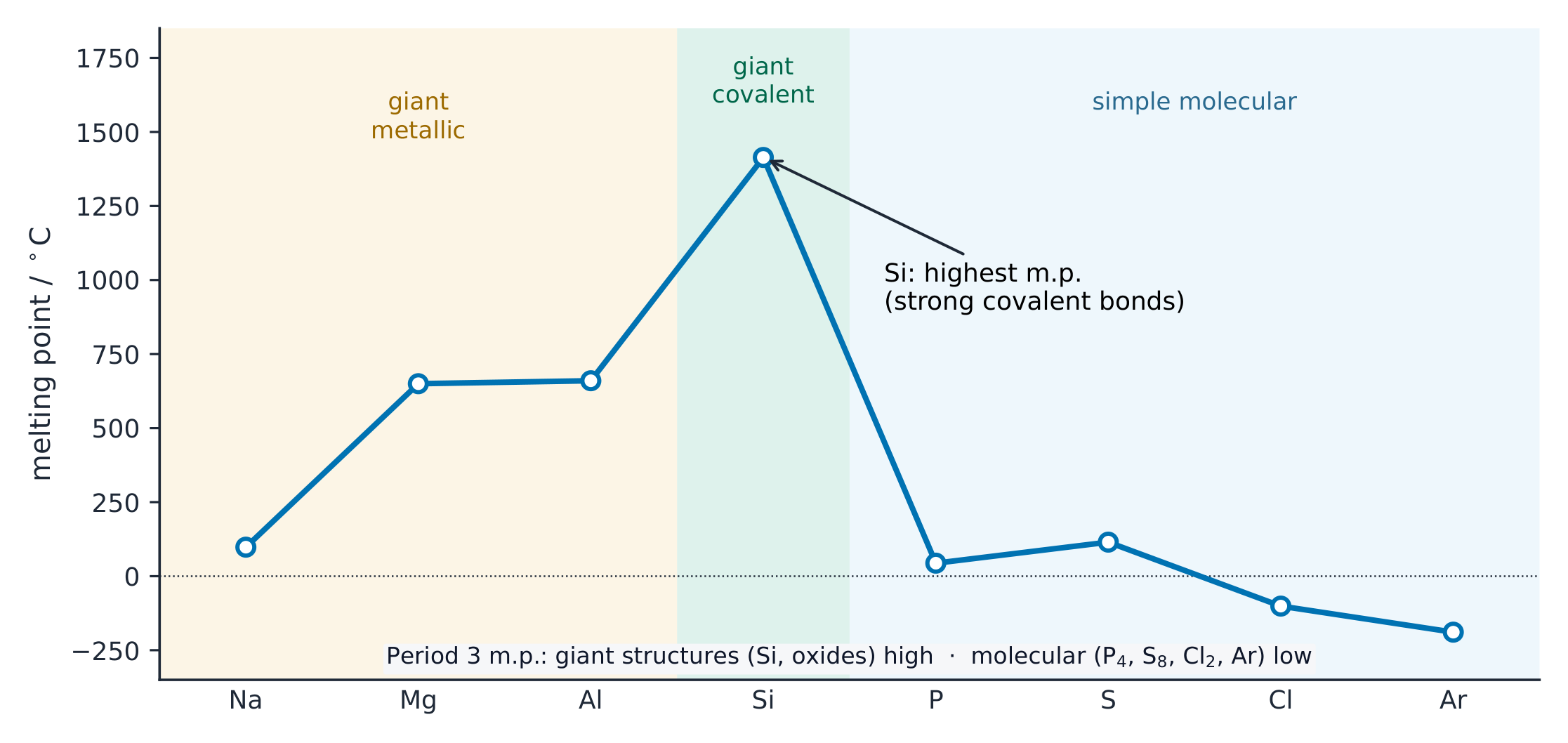
rises to a peak at silicon, then falls sharply
electrical conductivity 导电性
high for Na, Mg, Al; almost zero from Si onwards
The melting point and conductivity follow from the structure and bonding:
Na, Mg, Al are giant metallic 金属晶体. Melting points rise (Na → Al) because each atom gives more delocalised electrons and the ions get smaller, so the bonding is stronger. They conduct well.
Si is giant molecular 原子晶体 (giant covalent). It has the highest melting point, because strong covalent bonds must be broken. It barely conducts.
P, S, Cl, Ar are simple molecular 分子晶体 (or single atoms). Their melting points are low, because the only forces that break are the weak van der Waals' forces 范德华力between the molecules - the strong covalent bonds inside each molecule are never broken at all. They do not conduct.
Name van der Waals' forces when you explain that drop: it is the marking point, and "the covalent bonds are weak" is the error that loses it. Melting $\text{S}_8$ pulls whole molecules apart from each other; it does not touch a single $\text{S–S}$ bond. Their sizes still follow the molecule: $\text{S}_8$ melts higher than $\text{P}_4$ because it is bigger, with more electrons and so stronger van der Waals' forces, while $\text{Ar}$ (a single atom) is lowest of all.
Bahasa Indonesia
Sifat-sifat berulang dalam pola teratur melintasi setiap periode tabel.
Periodisitas berarti sifat-sifat berulang dalam pola teratur saat Anda bergerak melintasi setiap periode Tabel Periodik. Periode 3 (Na hingga Ar) adalah contoh standar.
Radius atom menurun melintasi Periode 3: peningkatan muatan inti menarik kulit luar yang sama ke dalam
Sifat
Tren melintasi Periode 3
radius atom
menjadi lebih kecil (muatan inti lebih besar menarik kulit yang sama masuk)
radius ion
ion positif kecil; mulai dari $\text{P}^{3-}$ ke bawah, ion negatif lebih besar
titik lebur
naik mencapai puncak pada silikon, lalu turun tajam
konduktivitas listrik
tinggi untuk Na, Mg, Al; hampir nol mulai dari Si ke bawah
Titik lebur dan konduktivitas bersumber dari struktur dan ikatannya:
Na, Mg, Al bersifat logam raksasa. Titik lebur naik (Na → Al) karena setiap atom menyumbang lebih banyak elektron terdelokalisasi dan ionnya menjadi lebih kecil, sehingga ikatannya lebih kuat. Mereka menghantarkan listrik dengan baik.
Si bersifat molekul raksasa (kovalen raksasa). Memiliki titik lebur tertinggi, karena ikatan kovalen yang kuat harus dipatahkan. Hampir tidak menghantarkan listrik.
P, S, Cl, Ar bersifat molekul sederhana (atau atom tunggal). Titik leburnya rendah, karena gaya yang terputus hanyalah gaya van der Waals yang lemah antara molekul-molekul tersebut - ikatan kovalen kuat di dalam setiap molekul sama sekali tidak terputus. Mereka tidak menghantarkan listrik.
Sebutkan gaya van der Waals ketika Anda menjelaskan penurunan ini: itu adalah poin penilaian, dan "ikatan kovalennya lemah" adalah kesalahan yang membuatnya kehilangan poin. Pelelehan $\text{S}_8$ memisahkan seluruh molekul satu sama lain; ia tidak menyentuh ikatan $\text{S–S}$ tunggal. Ukurannya masih mengikuti molekul: $\text{S}_8$ meleleh lebih tinggi daripada $\text{P}_4$ karena lebih besar, memiliki lebih banyak elektron sehingga gaya van der Waals lebih kuat, sementara $\text{Ar}$ (atom tunggal) yang terendah di antara semua.
Titik lebur melintasi Periode 3 mencapai puncaknya pada silikon (kovalen raksasa); tinggi untuk logam dan rendah untuk elemen molekuler sederhana
Explore · Jelajahi
Trends across Period 3 · Tren melintasi Periode 3
Switch between atomic radius, ionisation energy and melting point, and step across Period 3 to see each periodic trend. · Beralih antara jari-jari atom, energi ionisasi, dan titik leleh, dan melangkah melintasi Periode 3 untuk melihat setiap tren periodik.
Chemical properties across Period 3 · Sifat kimia melintasi Periode 3
Syllabus · Silabus
English
describe, and write equations for, the reactions of the elements with oxygen (to give $\text{Na}_2\text{O}$, $\text{MgO}$, $\text{Al}_2\text{O}_3$, $\text{P}_4\text{O}_{10}$, $\text{SO}_2$), chlorine (to give $\text{NaCl}$, $\text{MgCl}_2$, $\text{AlCl}_3$, $\text{SiCl}_4$, $\text{PCl}_5$) and water ($\text{Na}$ and $\text{Mg}$ only)
state and explain the variation in the oxidation number of the oxides ($\text{Na}_2\text{O}$, $\text{MgO}$, $\text{Al}_2\text{O}_3$, $\text{P}_4\text{O}_{10}$, $\text{SO}_2$ and $\text{SO}_3$ only) and chlorides ($\text{NaCl}$, $\text{MgCl}_2$, $\text{AlCl}_3$, $\text{SiCl}_4$, $\text{PCl}_5$ only) in terms of their outer shell (valence shell) electrons
describe, and write equations for, the reactions, if any, of the oxides $\text{Na}_2\text{O}$, $\text{MgO}$, $\text{Al}_2\text{O}_3$, $\text{SiO}_2$, $\text{P}_4\text{O}_{10}$, $\text{SO}_2$ and $\text{SO}_3$ with water including the likely pHs of the solutions obtained
describe, explain, and write equations for, the acid/base behaviour of the oxides $\text{Na}_2\text{O}$, $\text{MgO}$, $\text{Al}_2\text{O}_3$, $\text{P}_4\text{O}_{10}$, $\text{SO}_2$ and $\text{SO}_3$ and the hydroxides $\text{NaOH}$, $\text{Mg(OH)}_2$ and $\text{Al(OH)}_3$ including, where relevant, amphoteric behaviour in reactions with acids and bases (sodium hydroxide only)
describe, explain, and write equations for, the reactions of the chlorides $\text{NaCl}$, $\text{MgCl}_2$, $\text{AlCl}_3$, $\text{SiCl}_4$, $\text{PCl}_5$ with water including the likely pHs of the solutions obtained
explain the variations and trends in 9.2.2, 9.2.3, 9.2.4 and 9.2.5 in terms of bonding and electronegativity
suggest the types of chemical bonding present in the chlorides and oxides from observations of their chemical and physical properties
Bahasa Indonesia
deskripsikan, dan tuliskan persamaan untuk, reaksi unsur-unsur dengan oksigen (untuk menghasilkan $\text{Na}_2\text{O}$, $\text{MgO}$, $\text{Al}_2\text{O}_3$, $\text{P}_4\text{O}_{10}$, $\text{SO}_2$), klorin (untuk menghasilkan $\text{NaCl}$, $\text{MgCl}_2$, $\text{AlCl}_3$, $\text{SiCl}_4$, $\text{PCl}_5$) dan air (hanya $\text{Na}$ dan $\text{Mg}$)
menyatakan dan menjelaskan variasi bilangan oksidasi dari oksida ($\text{Na}_2\text{O}$, $\text{MgO}$, $\text{Al}_2\text{O}_3$, $\text{P}_4\text{O}_{10}$, $\text{SO}_2$ dan $\text{SO}_3$ saja) dan klorida ($\text{NaCl}$, $\text{MgCl}_2$, $\text{AlCl}_3$, $\text{SiCl}_4$, $\text{PCl}_5$ saja) berdasarkan elektron kulit luar (kulit valensi) mereka
menggambarkan, dan menuliskan persamaan untuk, reaksi (jika ada) dari oksida $\text{Na}_2\text{O}$, $\text{MgO}$, $\text{Al}_2\text{O}_3$, $\text{SiO}_2$, $\text{P}_4\text{O}_{10}$, $\text{SO}_2$ dan $\text{SO}_3$ dengan air termasuk kemungkinan pH larutan yang diperoleh
deskripsikan, jelaskan, dan tuliskan persamaan untuk, perilaku asam/basa dari oksida $\text{Na}_2\text{O}$, $\text{MgO}$, $\text{Al}_2\text{O}_3$, $\text{P}_4\text{O}_{10}$, $\text{SO}_2$ dan $\text{SO}_3$ serta hidroksida $\text{NaOH}$, $\text{Mg(OH)}_2$ dan $\text{Al(OH)}_3$ termasuk, jika relevan, perilaku amfoterik dalam reaksi dengan asam dan basa (hanya natrium hidroksida)
deskripsikan, jelaskan, dan tuliskan persamaan untuk reaksi $\text{NaCl}$, $\text{MgCl}_2$, $\text{AlCl}_3$, $\text{SiCl}_4$, $\text{PCl}_5$ klorida dengan air termasuk perkiraan pH larutan yang dihasilkan
jelaskan variasi dan tren dalam 9.2.2, 9.2.3, 9.2.4 dan 9.2.5 berdasarkan ikatan dan keelektronegatifan
usulkan jenis ikatan kimia yang terdapat pada klorida dan oksida berdasarkan pengamatan sifat kimia dan fisiknya
Source: Cambridge International syllabus · Sumber: Silabus Cambridge International
Sodium reacts fast; magnesium reacts only very slowly with cold water.
Oxidation number of the oxides and chlorides
The oxidation number 氧化数 of the Period 3 element in its oxide or chloride rises across the period, because it equals the number of outer-shell (valence shell 价层) electrons 电子 the atom uses in bonding:
Oxides
$\text{Na}_2\text{O}$
$\text{MgO}$
$\text{Al}_2\text{O}_3$
$\text{P}_4\text{O}_{10}$
$\text{SO}_2$ / $\text{SO}_3$
oxidation number
$+1$
$+2$
$+3$
$+5$
$+4$ / $+6$
The chlorides $\text{NaCl}$, $\text{MgCl}_2$, $\text{AlCl}_3$, $\text{SiCl}_4$, $\text{PCl}_5$ show oxidation numbers $+1$ to $+5$ in the same way.
Oxides with water, and acid–base behaviour
Across the period the oxides 氧化物 change from basic to acidic:
Metal oxides (left) are basic; non-metal oxides (right) are acidic. $\text{Al}_2\text{O}_3$ and its hydroxide 氢氧化物$\text{Al(OH)}_3$ are amphoteric — they react with both acids and bases:
These trends follow from the change in bonding and electronegativity 电负性. On the left, the elements are metals with low electronegativity, so their oxides and chlorides are ionic and basic (or neutral). On the right, the elements are non-metals with high electronegativity, so their oxides and chlorides are covalent and acidic. You can use a chloride's or oxide's properties (melting point, conductivity, effect on water) to suggest whether its bonding is ionic or covalent.
Worked example. Predict the pH when $\text{Na}_2\text{O}$, $\text{Al}_2\text{O}_3$ and $\text{SO}_3$ are each added to water. Acid-base character follows the metal to non-metal change across Period 3. $\text{Na}_2\text{O}$ is ionic and basic: it dissolves to give $\text{NaOH}$, so the pH is about 13. $\text{SO}_3$ is covalent and acidic: it reacts to give $\text{H}_2\text{SO}_4$, so the pH is about 1. $\text{Al}_2\text{O}_3$ sits at the changeover - it is amphoteric and essentially insoluble in water, so the pH stays about 7. The trap is that last one: amphoteric does not mean neutral, it means the oxide reacts with acids and with alkalis - it simply does not react with water.
Natrium bereaksi cepat; magnesium hanya bereaksi sangat lambat dengan air dingin.
Bilangan oksidasi oksida dan klorida
Bilangan oksidasi unsur Periode 3 dalam oksida atau kloridanya meningkat melintasi periode, karena sama dengan jumlah elektron kulit luar (kulit valensi) yang digunakan atom dalam pengikatan:
Oksida
$\text{Na}_2\text{O}$
$\text{MgO}$
$\text{Al}_2\text{O}_3$
$\text{P}_4\text{O}_{10}$
$\text{SO}_2$ / $\text{SO}_3$
bilangan oksidasi
$+1$
$+2$
$+3$
$+5$
$+4$ / $+6$
Klorida $\text{NaCl}$, $\text{MgCl}_2$, $\text{AlCl}_3$, $\text{SiCl}_4$, $\text{PCl}_5$ menunjukkan bilangan oksidasi $+1$ hingga $+5$ dengan cara yang sama.
Oksida dengan air, dan perilaku asam-basa
Melintasi periode, oksida berubah dari basa menjadi asam:
Oksida Periode 3 berubah dari basa (logam) melalui amfoterik (Al$_2$O$_3$) menjadi asam (non-logam)
Oksida logam (kiri) bersifat basa; oksida non-logam (kanan) bersifat asam. $\text{Al}_2\text{O}_3$ dan hidroksida$\text{Al(OH)}_3$-nya bersifat amfoterik — mereka bereaksi dengan keduanya asam dan basa:
Aluminium oksida bersifat amfoterik — bereaksi dengan asam (berperilaku sebagai basa) dan dengan basa (berperilaku sebagai asam)
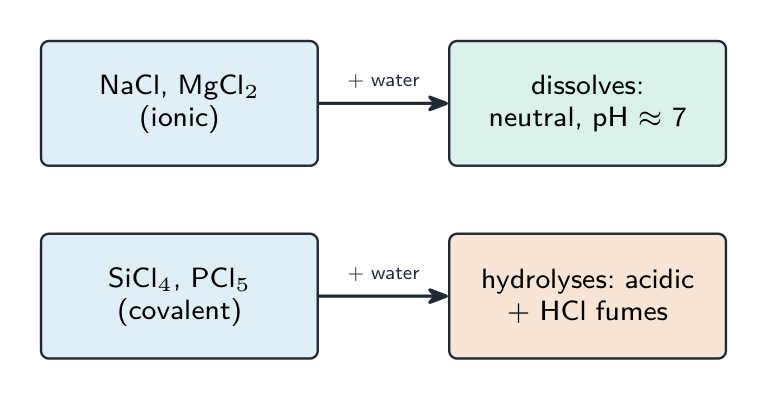
Klorida dengan air
$\text{NaCl}$ dan $\text{MgCl}_2$ bersifat ionik. Mereka hanya melarut, memberikan larutan yang mendekati netral.
$\text{SiCl}_4$ dan $\text{PCl}_5$ bersifat kovalen. Mereka mengalami hidrolisis (bereaksi dengan air) untuk menghasilkan larutan asam dan uap $\text{HCl}$:
Klorida ionik hanya melarut (netral); klorida kovalen bereaksi dengan air (terhidrolisis) untuk menghasilkan larutan asam dan uap HCl
Menjelaskan tren
Tren ini muncul dari perubahan ikatan dan elektronegativitas. Di sebelah kiri, unsur-unsur adalah logam dengan elektronegativitas rendah, sehingga oksida dan kloridanya bersifat ionik dan basa (atau netral). Di sebelah kanan, unsur-unsur adalah non-logam dengan elektronegativitas tinggi, sehingga oksida dan kloridanya bersifat kovalen dan asam. Anda dapat menggunakan sifat klorida atau oksida (titik lebur, konduktivitas, efek terhadap air) untuk menyimpulkan apakah ikatannya bersifat ionik atau kovalen.
Contoh kerja. Prediksikan pH ketika $\text{Na}_2\text{O}$, $\text{Al}_2\text{O}_3$, dan $\text{SO}_3$ masing-masing ditambahkan ke dalam air. Sifat asam-basa mengikuti perubahan logam ke non-logam di sepanjang Periode 3. $\text{Na}_2\text{O}$ bersifat ionik dan basa: ia melarut menghasilkan $\text{NaOH}$, sehingga pH sekitar 13. $\text{SO}_3$ bersifat kovalen dan asam: ia bereaksi menghasilkan $\text{H}_2\text{SO}_4$, sehingga pH sekitar 1. $\text{Al}_2\text{O}_3$ berada pada titik transisi - ia bersifat amfoter dan hampir tidak larut dalam air, sehingga pH tetap sekitar 7. Jebakan ada pada poin terakhir: amfoter bukan berarti netral, artinya oksidanya bereaksi dengan asam dan dengan alkali - hanya saja tidak bereaksi dengan air.
Explore · Jelajahi
Period 3 reaction lab · Laboratorium reaksi Periode 3
Classify Period 3 reactions by what they reveal about bonding and acidity. · Klasifikasikan reaksi Periode 3 berdasarkan apa yang ditunjukkan mengenai ikatan dan keasaman.
Explore · Jelajahi
Oxide and chloride hydrolysis route · Jalur hidrolisis oksida dan klorida
Follow how Period 3 oxides and chlorides change pH in water. · Ikuti bagaimana oksida dan klorida Periode 3 mengubah pH dalam air.
Periodicity of other elements · Periodisitas unsur lainnya
Syllabus · Silabus
English
predict the characteristic properties of an element in a given group by using knowledge of chemical periodicity
deduce the nature, possible position in the Periodic Table and identity of unknown elements from given information about physical and chemical properties
Bahasa Indonesia
ramalkan sifat khas suatu elemen dalam kelompok tertentu menggunakan pengetahuan tentang periodisitas kimia
deduksikan sifat, kemungkinan posisi dalam Tabel Periodik, dan identitas elemen tidak diketahui dari informasi yang diberikan mengenai sifat fisik dan kimia
Source: Cambridge International syllabus · Sumber: Silabus Cambridge International
English
The same idea works for any group. If you know the pattern down a group and across a period, you can:
predict the properties of an element from its position (for example, a Group 1 element will be a reactive metal forming a $+1$ ion).
deduce the likely position and identity of an unknown element from its physical and chemical properties.
Bahasa Indonesia
Ide yang sama berlaku untuk kelompok mana pun. Jika Anda mengetahui pola menurun dalam satu kelompok dan melintasi periode, Anda dapat:
memprediksi sifat suatu unsur berdasarkan posisinya (misalnya, unsur Kelompok 1 akan menjadi logam reaktif yang membentuk ion $+1$).
menyimpulkan kemungkinan posisi dan identitas unsur tak dikenal dari sifat fisika dan kimianya.
Explore · Jelajahi
Periodic trends · Tren periodik
Step across Period 3 to see a property rise or fall, then repeat in the next period — that recurring pattern is periodicity. · Langkah melintasi Periode 3 untuk melihat sifat naik atau turun, lalu ulangi di periode berikutnya — pola berulang itu adalah periodisitas.
Always pair the trend with its reason: atomic radius falls across Period 3 (rising nuclear charge, similar shielding).
Explain the melting-point pattern by structure: giant metallic (Na→Al), giant covalent (Si, highest), then simple molecular ($\text{P}_4$, $\text{S}_8$, $\text{Cl}_2$) and monatomic (Ar).
Oxides go basic → amphoteric ($\text{Al}_2\text{O}_3$) → acidic across the period; link to ionic-to-covalent bonding.
For reactions of oxides/chlorides with water, give the products and the resulting pH.
Bahasa Indonesia
Selalu pasangkan tren dengan alasannya: jari-jari atom mengecil melintasi Periode 3 (peningkatan muatan inti, pelindung serupa).
Jelaskan pola titik lebur berdasarkan struktur: logam raksasa (Na→Al), kovalen raksasa (Si, tertinggi), kemudian molekul sederhana ($\text{P}_4$, $\text{S}_8$, $\text{Cl}_2$) dan monatomik (Ar).
Oksida berubah dari basa → amfoter ($\text{Al}_2\text{O}_3$) → asam melintasi periode; hubungkan dengan ikatan ionik-ke-kovalen.
Untuk reaksi oksida/klorida dengan air, berikan produk dan pH yang dihasilkan.
Interactive lessons on this topic · Pelajaran interaktif untuk topik ini
Work through it step by step, with instant-check exercises. · Kerjakan langkah demi langkah, dengan latihan pengecekan instan.
Pick one and the site follows you — notes, papers, videos and practice all open on it. · Pilih satu dan situs mengikuti Anda — catatan, kertas, video, dan latihan semua terbuka di sana.
Type to search notes, lessons, code, vocabulary and past-paper questions across every subject. · Ketik untuk mencari catatan, pelajaran, kode, kosakata, dan pertanyaan soal lama di setiap mata pelajaran.