Perhatikan tiga hal yang sangat berbeda. Tali nilon. Botol minuman plastik. Protein dalam rambut Anda. Sepertinya tidak memiliki kesamaan apa pun. Namun ketiganya…
English narration · English + 中文 subtitles burned in · Narasi bahasa Inggris · Subtitle bahasa Inggris + 中文 disematkan langsung
describe the formation of polyesters: (a) the reaction between a diol and a dicarboxylic acid or dioyl chloride (b) the reaction of a hydroxycarboxylic acid
describe the formation of polyamides: (a) the reaction between a diamine and a dicarboxylic acid or dioyl chloride (b) the reaction of an aminocarboxylic acid (c) the reaction between amino acids
deduce the repeat unit of a condensation polymer obtained from a given monomer or pair of monomers
identify the monomer(s) present in a given section of a condensation polymer molecule
Bahasa Indonesia
deskripsikan pembentukan poliester: (a) reaksi antara diol dan asam dikarboksilat atau diklorida asil (b) reaksi asam hidroksikarboksilat
deskripsikan pembentukan poliamida: (a) reaksi antara diamina dan asam dikarboksilat atau diklorida asil (b) reaksi asam aminokarboksilat (c) reaksi antar asam amino
turunkan unit ulang dari polimer kondensasi yang diperoleh dari monomer tertentu atau pasangan monomer
identifikasi monomer yang ada dalam bagian molekul polimer kondensasi tertentu
Source: Cambridge International syllabus · Sumber: Silabus Cambridge International
English
In condensation polymerisation 缩合聚合, monomers join into a long chain and a small molecule (such as water or $\text{HCl}$) is lost each time a new bond forms. Each monomer needs two reactive groups, so the chain can grow at both ends.
Polyesters
A polyester 聚酯 has many ester links along its chain. You can make one from:
a diol 二醇 (two $\text{–OH}$ groups) and a dicarboxylic acid 二羧酸 (two $\text{–COOH}$ groups), or a dioyl chloride.
a single hydroxycarboxylic acid, which has both an $\text{–OH}$ and a $\text{–COOH}$.
Polyamides
A polyamide 聚酰胺 has many amide links. You can make one from:
a diamine 二胺 (two $\text{–NH}_2$ groups) and a dicarboxylic acid or a dioyl chloride.
a single aminocarboxylic acid, or from amino acids 氨基酸 joining together (proteins are natural polyamides).
Repeat units and monomers
The repeat unit 重复单元 of a condensation polymer contains parts of both monomers, minus the atoms lost as the small molecule. To find the monomers 单体 from a section of polymer, break the chain at each ester or amide link, then add back $\text{–OH}$ and $\text{–H}$ (or $\text{–Cl}$).
Worked example. A polymer chain contains repeating $\text{–CONH–}$ links. Name the type of polymer, identify the monomers, and give the small molecule lost. A $\text{–CONH–}$ link is an amide, so this is a polyamide made by condensation polymerisation. To find the monomers, break the chain at each amide link and give the cut ends their atoms back: the carbon side takes $\text{–OH}$, making a dicarboxylic acid, and the nitrogen side takes $\text{–H}$, making a diamine. The small molecule lost at each link is water (or $\text{HCl}$, if an acyl dichloride was used in place of the acid). Each monomer must have two functional groups, or the chain could never keep growing - if the monomer you propose has only one, you have broken the chain in the wrong place.
Bahasa Indonesia
Dalam polimerisasi kondensasi, monomer bergabung menjadi rantai panjang dan molekul kecil (seperti air atau $\text{HCl}$) hilang setiap kali ikatan baru terbentuk. Setiap monomer membutuhkan dua gugus reaktif, sehingga rantai dapat tumbuh di kedua ujungnya.
Ikatan kondensasi: poliester membentuk ikatan ester dan poliamida membentuk ikatan amida; setiap ikatan baru melepaskan molekul kecil (dalam hal ini air)
Poliester
Poliester memiliki banyak ikatan ester sepanjang rantai. Anda dapat membuat salah satunya dari:
diol (dua gugus $\text{–OH}$) dan asam dikarboksilat (dua gugus $\text{–COOH}$), atau diasil klorida.
asam hidroksikarboksilat tunggal, yang memiliki baik $\text{–OH}$ maupun $\text{–COOH}$.
Botol minuman PET terbuat dari poliester — sebuah polimer kondensasi, dikumpulkan di sini untuk daur ulang
Poliamida
Poliamida memiliki banyak ikatan amida. Anda dapat membuat salah satunya dari:
diamina (dua $\text{–NH}_2$) dan asam dikarboksilat atau diasil klorida.
asam aminokarboksilat tunggal, atau dari asam amino yang bergabung bersama (protein adalah poliamida alami).
"Trik tali nilon": nilon (poliamida) terbentuk ketika dua larutan reaktan bertemu, sehingga satu benang panjang dapat ditarik keluar (merah muda di sini karena indikator ditambahkan)
Unit pengulang dan monomer
Unit pengulang polimer kondensasi berisi bagian dari kedua monomer, dikurangi atom yang hilang sebagai molekul kecil. Untuk menemukan monomer dari sebagian polimer, putuskan rantai pada setiap ikatan ester atau amida, lalu tambahkan kembali $\text{–OH}$ dan $\text{–H}$ (atau $\text{–Cl}$).
Untuk menemukan monomer, putus rantai pada setiap ikatan dan tambahkan kembali –OH dan –H ke ujung potongan — di sini memberikan diol dan asam dikarboksilat
Contoh terpecahkan. Rantai polimer mengandung ikatan $\text{–CONH–}$ berulang. Sebutkan jenis polimer, identifikasi monomernya, dan sebutkan molekul kecil yang hilang. Ikatan $\text{–CONH–}$ adalah amida, jadi ini adalah poliamida yang dibuat melalui kondensasi polimerisasi. Untuk menemukan monomernya, putus rantai pada setiap ikatan amida dan kembalikan atom pada ujung potongan: sisi karbon mengambil $\text{–OH}$, membentuk asam dikarboksilat, dan sisi nitrogen mengambil $\text{–H}$, membentuk diamina. Molekul kecil yang hilang pada setiap ikatan adalah air (atau $\text{HCl}$, jika asil diklorida digunakan menggantikan asam). Setiap monomer harus memiliki dua gugus fungsi, atau rantai tidak akan pernah terus tumbuh - jika monomer yang Anda usulkan hanya memiliki satu, Anda telah memutus rantai di tempat yang salah.
Predicting the type of polymerisation · Memprediksi jenis polimerisasi
Syllabus · Silabus
English
predict the type of polymerisation reaction for a given monomer or pair of monomers
deduce the type of polymerisation reaction which produces a given section of a polymer molecule
Bahasa Indonesia
prediksi jenis polimerisasi reaksi untuk monomer tertentu atau pasangan monomer
turunkan jenis reaksi polimerisasi yang menghasilkan bagian molekul polimer tertentu
Source: Cambridge International syllabus · Sumber: Silabus Cambridge International
English
Clue
Type
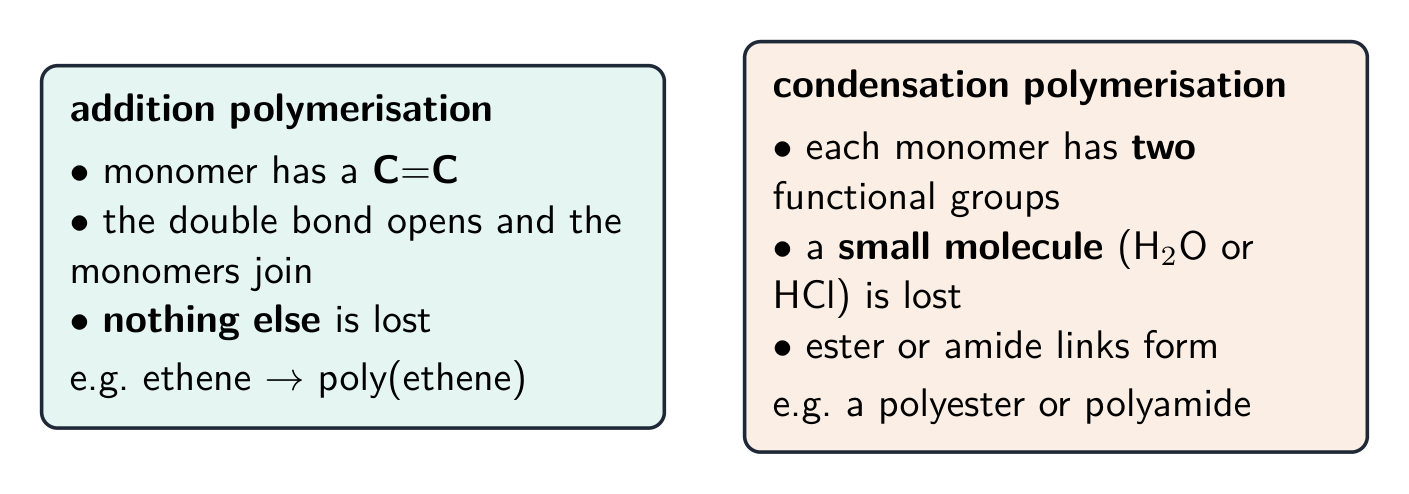
the monomer has a C=C double bond, and nothing else is lost
addition polymerisation 加成聚合
each monomer has two functional groups, and a small molecule is lost; the chain has ester or amide links
condensation polymerisation
Bahasa Indonesia
Petunjuk
Jenis
monomer memiliki ikatan rangkap C=C, dan tidak ada yang lain hilang
polimerisasi adisi
setiap monomer memiliki dua gugus fungsi, dan molekul kecil hilang; rantai memiliki ikatan ester atau amida
polimerisasi kondensasi
Dua jenis polimerisasi: adisi membuka C=C dan kehilangan apa-apa; kondensasi menggabungkan monomer dua gugus dan kehilangan molekul kecil
Explore · Jelajahi
Polymerisation type lab · Lab polimerisasi tipe
Classify monomers by whether they form addition or condensation polymers. · Klasifikasikan monomer berdasarkan apakah mereka membentuk polimer adisi atau kondensasi.
Degradable polymers · Polimer yang dapat terdegradasi
Syllabus · Silabus
English
recognise that poly(alkenes) are chemically inert and can therefore be difficult to biodegrade
recognise that some polymers can be degraded by the action of light
recognise that polyesters and polyamides are biodegradable by acidic and alkaline hydrolysis
Bahasa Indonesia
mengenali bahwa polialkena bersifat inert secara kimia dan oleh karena itu sulit untuk terurai secara hayati
mengenali bahwa beberapa polimer dapat terurai oleh aksi cahaya
mengenali bahwa poliester dan poliamida terurai secara hayati melalui hidrolisis asam dan basa
Source: Cambridge International syllabus · Sumber: Silabus Cambridge International
English
poly(alkene)s 聚烯烃 are chemically inert — they have only strong, non-polar C–C and C–H bonds, so they are hard to biodegrade 可生物降解 and last a long time.
some polymers are made so that light can break them down (they are photodegradable).
polyesters and polyamides are biodegradable, because their ester and amide links can be broken by acidic or alkaline hydrolysis 水解.
Bahasa Indonesia
poli(alkena) bersifat inert secara kimia — mereka hanya memiliki ikatan C–C dan C–H yang kuat dan non-polar, sehingga sulit untuk terurai secara hayati dan bertahan lama.
beberapa polimer dibuat agar cahaya dapat menguraikannya (mereka fotodegradable).
poliester dan poliamida dapat terurai secara hayati, karena ikatan ester dan amida mereka dapat dipecah oleh hidrolisis asam atau basa.
Explore · Jelajahi
Degradable polymer route · Rute polimer dapat terurai
Follow how polymer structure controls breakdown. · Ikuti bagaimana struktur polimer mengontrol pembongkaran.
Condensation polymers (polyesters, polyamides) form with loss of a small molecule ($\text{H}_2\text{O}$ or HCl) — draw the repeat unit and the lost molecule.
Identify the monomers from the polymer by breaking the ester or amide link — a common question.
Predict the type from the monomers: a $\text{C}=\text{C}$ gives addition; two functional groups give condensation.
Polyesters and polyamides are hydrolysable (more degradable); addition polymers are not.
Bahasa Indonesia
Polimer kondensasi (poliester, poliamida) terbentuk dengan hilangnya molekul kecil ($\text{H}_2\text{O}$ atau HCl) — gambar unit pengulang dan molekul yang hilang.
Identifikasi monomer dari polimer dengan memutus ikatan ester atau amida — pertanyaan umum.
Prediksi jenisnya dari monomer: $\text{C}=\text{C}$ memberikan adisi; dua gugus fungsi memberikan kondensasi.
Poliester dan poliamida dapat terhidrolisis (lebih mudah terurai); polimer adisi tidak.
Interactive lessons on this topic · Pelajaran interaktif untuk topik ini
Work through it step by step, with instant-check exercises. · Kerjakan langkah demi langkah, dengan latihan pengecekan instan.
Pick one and the site follows you — notes, papers, videos and practice all open on it. · Pilih satu dan situs mengikuti Anda — catatan, kertas, video, dan latihan semua terbuka di sana.
Type to search notes, lessons, code, vocabulary and past-paper questions across every subject. · Ketik untuk mencari catatan, pelajaran, kode, kosakata, dan pertanyaan soal lama di setiap mata pelajaran.