Skip to content · ⁨Lompat ke konten⁩

Equilibria · ⁨Kesetimbangan⁩

A-Level Chemistry · ⁨Kimia A-Level⁩ · Topic 25 · ⁨Topik 25⁩

Video lesson for this topic · ⁨Pelajaran video untuk topik ini⁩ Open the video page · ⁨Buka halaman video⁩
7:56

Kesetimbangan (A2)

Darah Anda dijaga pada pH tujuh point empat. Menggesernya beberapa persepuluh ke arah mana pun dan Anda harus masuk rumah sakit. Namun sepanjang hari, asam terus mengalir — dari makanan Anda, dan dari…

English narration · English + 中文 subtitles burned in · ⁨Narasi bahasa Inggris · Subtitle bahasa Inggris + 中文 disematkan langsung⁩

25.1

Conjugate acids and bases · ⁨Asam dan basa konjugat⁩

Syllabus · ⁨Silabus⁩
English
  1. understand and use the terms conjugate acid and conjugate base
  2. define conjugate acid–base pairs, identifying such pairs in reactions
  3. define mathematically the terms pH, $K_a$, $\text{p}K_a$ and $K_w$ and use them in calculations ($K_b$ and the equation $K_w = K_a \times K_b$ will not be tested)
  4. calculate $[\text{H}^+(\text{aq})]$ and pH values for: (a) strong acids (b) strong alkalis (c) weak acids
  5. (a) define a buffer solution (b) explain how a buffer solution can be made (c) explain how buffer solutions control pH; use chemical equations in these explanations (d) describe and explain the uses of buffer solutions, including the role of $\text{HCO}_3^-$ in controlling pH in blood
  6. calculate the pH of buffer solutions, given appropriate data
  7. understand and use the term solubility product, $K_{\text{sp}}$
  8. write an expression for $K_{\text{sp}}$
  9. calculate $K_{\text{sp}}$ from concentrations and vice versa
  10. (a) understand and use the common ion effect to explain the different solubility of a compound in a solution containing a common ion (b) perform calculations using $K_{\text{sp}}$ values and concentration of a common ion
Bahasa Indonesia
  1. memahami dan menggunakan istilah asam konjugat dan basa konjugat
  2. mendefinisikan pasangan asam-basa konjugat, mengidentifikasi pasangan tersebut dalam reaksi
  3. mendefinisikan secara matematis istilah pH, $K_a$, $\text{p}K_a$ dan $K_w$ dan menggunakannya dalam perhitungan ($K_b$ dan persamaan $K_w = K_a \times K_b$ tidak akan diujikan)
  4. menghitung $[\text{H}^+(\text{aq})]$ dan nilai pH untuk: (a) asam kuat (b) basa kuat (c) asam lemah
  5. (a) mendefinisikan larutan penyangga (b) menjelaskan bagaimana larutan penyangga dapat dibuat (c) menjelaskan bagaimana larutan penyangga mengontrol pH; gunakan persamaan kimia dalam penjelasan ini (d) menggambarkan dan menjelaskan penggunaan larutan penyangga, termasuk peran $\text{HCO}_3^-$ dalam mengontrol pH dalam darah
  6. menghitung pH larutan penyangga, diberikan data yang sesuai
  7. memahami dan menggunakan istilah hasil kali kelarutan, $K_{\text{sp}}$
  8. menulis ekspresi untuk $K_{\text{sp}}$
  9. menghitung $K_{\text{sp}}$ dari konsentrasi dan sebaliknya
  10. (a) memahami dan menggunakan efek ion bersama untuk menjelaskan kelarutan berbeda suatu senyawa dalam larutan yang mengandung ion bersama (b) melakukan perhitungan menggunakan nilai $K_{\text{sp}}$ dan konsentrasi ion bersama

Source: Cambridge International syllabus · ⁨Sumber: Silabus Cambridge International⁩

English
Titration curve and equivalence point

When a Brønsted acid loses an $\text{H}^+$, what is left is its conjugate base 共轭碱. When a base gains an $\text{H}^+$, it becomes its conjugate acid 共轭酸. The two species that differ by just one $\text{H}^+$ form a conjugate acid–base pair 共轭酸碱对.

For example, in $\text{CH}_3\text{COOH} \rightleftharpoons \text{CH}_3\text{COO}^- + \text{H}^+$, the pair is $\text{CH}_3\text{COOH}$ (acid) and $\text{CH}_3\text{COO}^-$ (its conjugate base).

Bahasa Indonesia
Kurva titrasi dan titik ekuivalensi

Ketika asam Brønsted melepaskan sebuah $\text{H}^+$, yang tersisa adalah basa konjugatnya. Ketika basa menerima sebuah $\text{H}^+$, ia menjadi asam konjugatnya. Dua spesies yang berbeda hanya oleh satu $\text{H}^+$ membentuk pasangan asam-basa konjugat.

Sebagai contoh, dalam $\text{CH}_3\text{COOH} \rightleftharpoons \text{CH}_3\text{COO}^- + \text{H}^+$, pasangannya adalah $\text{CH}_3\text{COOH}$ (asam) dan $\text{CH}_3\text{COO}^-$ (basa konjugatnya).

Asam etanoat melepaskan proton ke basa konjugasinya, dan amonia menerima proton menjadi asam konjugatnya, dengan pasangan konjugat yang dilingkupi kurung siku
Pasangan konjugat berbeda oleh satu proton: asam melepaskan H$^+$ untuk menghasilkan basa konjugatnya; basa menerima H$^+$ untuk menghasilkan asam konjugatnya
Explore · ⁨Jelajahi⁩

pH and H⁺ concentration · ⁨pH dan konsentrasi H⁺⁩

pH = −log[H⁺]: slide it and watch [H⁺] change tenfold per unit. A conjugate acid–base pair differ by a single proton. · ⁨pH = −log[H⁺]: geser dan perhatikan [H⁺] berubah sepuluh kali lipat per satuan. Pasangan asam-basa konjugat berbeda oleh satu proton.⁩

25.1

pH and the equilibrium constants · ⁨pH dan konstanta kesetimbangan⁩

English
  • pH measures acidity: $\text{pH} = -\log[\text{H}^+]$, so $[\text{H}^+] = 10^{-\text{pH}}$.
  • the acid dissociation constant 酸解离常数 of a weak acid $\text{HA}$ is $K_a = \dfrac{[\text{H}^+][\text{A}^-]}{[\text{HA}]}$, and $\text{p}K_a = -\log K_a$. A larger $K_a$ (smaller $\text{p}K_a$) means a stronger acid.
  • the ionic product of water 水的离子积 is $K_w = [\text{H}^+][\text{OH}^-] = 1.0 \times 10^{-14}$ at $298\ \text{K}$.

Calculating pH

  • strong acid 强酸: fully ionised, so $[\text{H}^+]$ equals the acid concentration; then take $-\log$.
  • strong alkali 强碱: find $[\text{OH}^-]$ from the concentration, then use $[\text{H}^+] = K_w / [\text{OH}^-]$.
  • weak acid 弱酸: only partly ionised, so use $[\text{H}^+] = \sqrt{K_a \times [\text{HA}]}$.

Worked example. Find the pH of $0.050\ \text{mol dm}^{-3}$ hydrochloric acid (a strong acid).

It is fully ionised, so $[\text{H}^+] = 0.050\ \text{mol dm}^{-3}$, giving $\text{pH} = -\log(0.050) = 1.30$.

Worked example. Find the pH of $0.10\ \text{mol dm}^{-3}$ sodium hydroxide (a strong base). ($K_w = 1.0 \times 10^{-14}$.)

$[\text{OH}^-] = 0.10$, so $[\text{H}^+] = K_w/[\text{OH}^-] = (1.0 \times 10^{-14})/0.10 = 1.0 \times 10^{-13}$, giving $\text{pH} = 13.0$.

Worked example. Find the pH of $0.10\ \text{mol dm}^{-3}$ ethanoic acid (a weak acid). ($K_a = 1.8 \times 10^{-5}$.)

$$[\text{H}^+] = \sqrt{K_a \times [\text{HA}]} = \sqrt{(1.8 \times 10^{-5})(0.10)} = 1.3 \times 10^{-3}, \qquad \text{pH} = -\log(1.3 \times 10^{-3}) = 2.87.$$
Bahasa Indonesia
  • pH mengukur keasaman: $\text{pH} = -\log[\text{H}^+]$, sehingga $[\text{H}^+] = 10^{-\text{pH}}$.
  • konstanta disosiasi asam dari asam lemah $\text{HA}$ adalah $K_a = \dfrac{[\text{H}^+][\text{A}^-]}{[\text{HA}]}$, dan $\text{p}K_a = -\log K_a$. Nilai $K_a$ yang lebih besar ($\text{p}K_a$ yang lebih kecil) berarti asam yang lebih kuat.
  • hasil kali ion air adalah $K_w = [\text{H}^+][\text{OH}^-] = 1.0 \times 10^{-14}$ pada $298\ \text{K}$.
Skala pH berjalan dari asam melalui netral hingga basa, dengan pH = -log dari konsentrasi ion hidrogen
Skala pH: pH = -log dari konsentrasi ion hidrogen
Kertas indikator pH di samping tabel warna
Kertas indikator memperkirakan pH larutan berdasarkan warnanya

Menghitung pH

  • asam kuat: terionisasi sepenuhnya, sehingga $[\text{H}^+]$ sama dengan konsentrasi asam; kemudian ambil $-\log$.
  • basa kuat: cari $[\text{OH}^-]$ dari konsentrasi, lalu gunakan $[\text{H}^+] = K_w / [\text{OH}^-]$.
  • asam lemah: hanya terionisasi sebagian, sehingga gunakan $[\text{H}^+] = \sqrt{K_a \times [\text{HA}]}$.

Contoh dikerjakan. Temukan pH $0.050\ \text{mol dm}^{-3}$ asam klorida (asam kuat).

Terionisasi sepenuhnya, sehingga $[\text{H}^+] = 0.050\ \text{mol dm}^{-3}$, menghasilkan $\text{pH} = -\log(0.050) = 1.30$.

Contoh dikerjakan. Temukan pH $0.10\ \text{mol dm}^{-3}$ natrium hidroksida (basa kuat). ($K_w = 1.0 \times 10^{-14}$.)

$[\text{OH}^-] = 0.10$, sehingga $[\text{H}^+] = K_w/[\text{OH}^-] = (1.0 \times 10^{-14})/0.10 = 1.0 \times 10^{-13}$, menghasilkan $\text{pH} = 13.0$.

Contoh dikerjakan. Temukan pH $0.10\ \text{mol dm}^{-3}$ asam etanoat (asam lemah). ($K_a = 1.8 \times 10^{-5}$.)

$$[\text{H}^+] = \sqrt{K_a \times [\text{HA}]} = \sqrt{(1.8 \times 10^{-5})(0.10)} = 1.3 \times 10^{-3}, \qquad \text{pH} = -\log(1.3 \times 10^{-3}) = 2.87.$$
25.1

Buffer solutions · ⁨Larutan penyangga⁩

English

A buffer solution 缓冲溶液 resists a change in pH when a small amount of acid or alkali is added. You make one from a weak acid and its conjugate base (for example ethanoic acid and sodium ethanoate).

It works because the mixture holds a store of both partners:

  • added $\text{H}^+$ is removed by the conjugate base: $\text{CH}_3\text{COO}^- + \text{H}^+ \rightarrow \text{CH}_3\text{COOH}$.
  • added $\text{OH}^-$ is removed by the weak acid: $\text{CH}_3\text{COOH} + \text{OH}^- \rightarrow \text{CH}_3\text{COO}^- + \text{H}_2\text{O}$.

To find the pH, put the concentrations of the acid and its salt into the $K_a$ expression. Buffers are important in living things — for example, $\text{HCO}_3^-$ keeps the pH of blood close to $7.4$.

Bahasa Indonesia

Sebuah larutan penyangga menahan perubahan pH ketika sejumlah kecil asam atau basa ditambahkan. Anda membuatnya dari asam lemah dan basa konjugatnya (contohnya asam etanoat dan natrium etanoat).

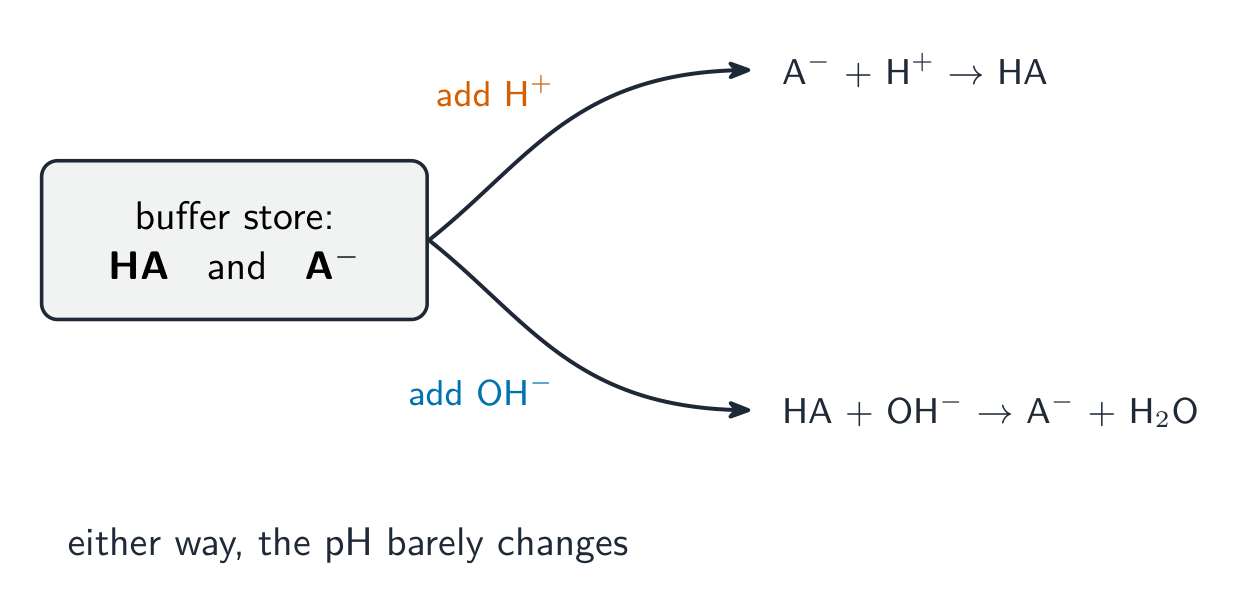
Hal ini bekerja karena campuran menyimpan kedua pasangannya:

  • $\text{H}^+$ yang ditambahkan dihilangkan oleh basa konjugat: $\text{CH}_3\text{COO}^- + \text{H}^+ \rightarrow \text{CH}_3\text{COOH}$.
  • $\text{OH}^-$ yang ditambahkan dihilangkan oleh asam lemah: $\text{CH}_3\text{COOH} + \text{OH}^- \rightarrow \text{CH}_3\text{COO}^- + \text{H}_2\text{O}$.
Tangki penyangga HA dan A-, dengan H+ yang ditambahkan disingkirkan oleh A- dan OH- yang ditambahkan disingkirkan oleh HA
Penyangga menyimpan toko asam lemah dan basa konjugatnya: H$^+$ yang ditambahkan diserap oleh A$^-$ dan OH$^-$ yang ditambahkan oleh HA, sehingga pH hampir tidak berubah

Untuk mencari pH, masukkan konsentrasi asam dan garamnya ke dalam ekspresi $K_a$. Penyangga penting dalam makhluk hidup — misalnya, $\text{HCO}_3^-$ menjaga pH darah tetap dekat dengan $7.4$.

Explore · ⁨Jelajahi⁩

Buffers and the titration curve · ⁨Buffer dan kurva titrasi⁩

Add alkali to acid: the flat part is where a buffer resists pH change, and the steep jump is the equivalence point. · ⁨Tambahkan alkali ke asam: bagian datar adalah tempat buffer menahan perubahan pH, dan lonjakan curam adalah titik ekuivalensi.⁩

25.1

Solubility product · ⁨Hasil kali kelarutan⁩

English

For a salt that barely dissolves, the solubility product 溶度积 ($K_{\text{sp}}$) is the product of the ion concentrations in a saturated solution, each raised to the power of its number in the formula:

$$K_{\text{sp}} = [\text{Ag}^+][\text{Cl}^-] \qquad K_{\text{sp}} = [\text{Ca}^{2+}][\text{F}^-]^2$$

You can find $K_{\text{sp}}$ from the solubility, or the solubility from $K_{\text{sp}}$.

The common ion effect

The common ion effect 同离子效应 is the way a salt becomes less soluble in a solution that already contains one of its ions. The extra ion pushes the dissolving equilibrium back (Le Chatelier), so less salt dissolves. You can calculate the new solubility using $K_{\text{sp}}$ and the concentration of the common ion.

Bahasa Indonesia

Untuk garam yang sukar larut, hasil kali kelarutan ($K_{\text{sp}}$) adalah hasil kali konsentrasi ion dalam larutan jenuh, masing-masing dipangkatkan dengan jumlah atomnya dalam rumus kimia:

$$K_{\text{sp}} = [\text{Ag}^+][\text{Cl}^-] \qquad K_{\text{sp}} = [\text{Ca}^{2+}][\text{F}^-]^2$$

Anda dapat menemukan $K_{\text{sp}}$ dari kelarutan, atau kelarutan dari $K_{\text{sp}}$.

Stalaktit menggantung dari atap gua
Stalaktit tumbuh saat kalsium karbonat yang terlarut perlahan keluar kembali dari larutan — kesetimbangan kelarutan nyata

Efek ion senama

Efek ion senama adalah cara suatu garam menjadi kurang larut dalam larutan yang sudah mengandung salah satu ionnya. Ion tambahan mendorong kesetimbangan pelarutan kembali (Le Chatelier), sehingga kurang garam yang larut. Anda dapat menghitung kelarutan baru menggunakan $K_{\text{sp}}$ dan konsentrasi ion senama.

Explore · ⁨Jelajahi⁩

Solubility product lab · ⁨Laboratorium produk kelarutan⁩

ionic product compared with Ksp · ⁨produk ionik dibandingkan dengan Ksp⁩

Increase ion concentration and see when precipitation becomes likely. · ⁨Tingkatkan konsentrasi ion dan lihat kapan pengendapan menjadi mungkin.⁩

25.2

Partition coefficients · ⁨Koefisien partisi⁩

Syllabus · ⁨Silabus⁩
English
  1. state what is meant by the term partition coefficient, $K_{\text{pc}}$
  2. calculate and use a partition coefficient for a system in which the solute is in the same physical state in the two solvents
  3. understand the factors affecting the numerical value of a partition coefficient in terms of the polarities of the solute and the solvents used
Bahasa Indonesia
  1. menyatakan apa yang dimaksud dengan istilah koefisien partisi, $K_{\text{pc}}$
  2. menghitung dan menggunakan koefisien partisi untuk sistem di mana zat terlarut berada dalam wujud fisik yang sama dalam kedua pelarut
  3. memahami faktor-faktor yang mempengaruhi nilai numerik koefisien partisi berdasarkan kepolaran zat terlarut dan pelarut yang digunakan

Source: Cambridge International syllabus · ⁨Sumber: Silabus Cambridge International⁩

English

When a solute is shaken with two solvents that do not mix, it spreads between them. The partition coefficient 分配系数 ($K_{\text{pc}}$) is the ratio of its concentrations in the two layers (at constant temperature):

$$K_{\text{pc}} = \frac{[\text{solute in solvent 1}]}{[\text{solute in solvent 2}]}$$

This works when the solute 溶质 is in the same physical state in both solvents. The value depends on the polarity 极性 of the solute and of each solvent 溶剂: a non-polar solute dissolves more in the non-polar solvent, while a polar solute prefers the polar solvent.

Bahasa Indonesia

Ketika zat terlarut diaduk dengan dua pelarut yang tidak bercampur, ia menyebar di antara keduanya. Koefisien partisi ($K_{\text{pc}}$) adalah rasio konsentrasinya di kedua lapisan (pada suhu konstan):

$$K_{\text{pc}} = \frac{[\text{solute in solvent 1}]}{[\text{solute in solvent 2}]}$$

Ini berlaku ketika zat terlarut berada dalam keadaan fisik yang sama di kedua pelarut. Nilainya bergantung pada kekutuban zat terlarut dan setiap pelarut: zat terlarut non-polar lebih larut dalam pelarut non-polar, sedangkan zat terlarut polar lebih menyukai pelarut polar.

Dua lapisan pelarut yang tidak campur dengan zat terlarut yang tersebar di antaranya, lebih banyak di lapisan atas non-polar daripada air di bawahnya
Zat terlarut yang diaduk dengan dua pelarut yang tidak bercampur menyebar di antaranya; koefisien partisi adalah rasio konsentrasinya di kedua lapisan
Explore · ⁨Jelajahi⁩

Partition coefficient lab · ⁨Laboratorium koefisien partisi⁩

Kpc = concentration organic / concentration aqueous · ⁨Kpc = konsentrasi organik / konsentrasi air⁩

Change organic-layer concentration and see the partition ratio. · ⁨Ubah konsentrasi lapisan organik dan lihat rasio partisinya.⁩

Vocabulary · ⁨Kosa kata⁩ Train · ⁨Latih⁩
English Bahasa Indonesia
conjugate base/ˈkɒndʒuːɡeɪt beɪs/ basa konjugasi
conjugate acid/ˈkɒndʒuːɡeɪt ˈæsɪd/ asid konjugat
conjugate acid–base pair/ˈkɒndʒuːɡeɪt ˈæsɪd beɪs peə/ pasangan asam-basa konjugat
acid dissociation constant/ˈæsɪd dɪˌsəʊsɪˈeɪʃn ˈkɒnstənt/ konstanta disosiasi asam
ionic product of water/aɪˈɒnɪk ˈprɒdʌkt ɒv ˈwɔːtə/ produk ion air
strong acid/strɒŋ ˈæsɪd/ asam kuat
strong alkali/strɒŋ ˈælkəlaɪ/ alkali kuat
weak acid/wiːk ˈæsɪd/ asam lemah
buffer solution/ˈbʌfə səˈluːʃn/ larutan pen neutralan
solubility product/ˌsɒljuːˈbɪlɪti ˈprɒdʌkt/ hasil darab kebolehlarutan
common ion effect/ˈkɒmən ˈaɪɒn ɪˈfekt/ kesan ion biasa
partition coefficient/pɑːˈtɪʃn ˌkəʊɪˈfɪʃənt/ pekali pembahagian
solute/ˈsɒljuːt/ zat terlarut
polarity/pəʊˈlærɪti/ polariitas
solvent/ˈsɒlvənt/ pelarut
25.2

Exam tips · ⁨Tips ujian⁩

English
  • $\text{pH} = -\log[\text{H}^+]$; for a strong acid $[\text{H}^+]$ = concentration, for a weak acid use $[\text{H}^+] = \sqrt{K_a[\text{HA}]}$.
  • For a base, get $[\text{H}^+]$ from $K_w = [\text{H}^+][\text{OH}^-] = 1.0 \times 10^{-14}$.
  • For a buffer use $[\text{H}^+] = K_a \times [\text{acid}]/[\text{salt}]$ and explain how it removes added $\text{H}^+$/$\text{OH}^-$.
  • Write the $K_{sp}$ expression with the correct powers; the number of decimal places in a pH equals the significant figures of $[\text{H}^+]$.
Bahasa Indonesia
  • $\text{pH} = -\log[\text{H}^+]$; untuk asam kuat $[\text{H}^+]$ = konsentrasi, untuk asam lemah gunakan $[\text{H}^+] = \sqrt{K_a[\text{HA}]}$.
  • Untuk basa, dapatkan $[\text{H}^+]$ dari $K_w = [\text{H}^+][\text{OH}^-] = 1.0 \times 10^{-14}$.
  • Untuk penyangga gunakan $[\text{H}^+] = K_a \times [\text{acid}]/[\text{salt}]$ dan jelaskan bagaimana itu menghilangkan $\text{H}^+$/$\text{OH}^-$ yang ditambahkan.
  • Tulis ekspresi $K_{sp}$ dengan pangkat yang benar; jumlah angka desimal dalam pH sama dengan angka penting dari $[\text{H}^+]$.

Interactive lessons on this topic · ⁨Pelajaran interaktif untuk topik ini⁩

Work through it step by step, with instant-check exercises. · ⁨Kerjakan langkah demi langkah, dengan latihan pengecekan instan.⁩

Past Papers · ⁨Soal-Soil Masa Lalu⁩

More topics in A-Level Chemistry · ⁨Kimia A-Level⁩ · ⁨Topik lain dalam A-Level Chemistry · ⁨Kimia A-Level⁩⁩

Log in or create account · ⁨Masuk atau buat akun⁩

IGCSE, A-Level & AP