Anda baru saja membuat senyawa baru. Itu adalah cairan bening dalam labu, tanpa label, dan Anda tidak dapat melihat satu molekul pun. Bagaimana Anda membuktikan apa itu? Anda bertanya…
English narration · English + 中文 subtitles burned in · Narasi bahasa Inggris · Subtitle bahasa Inggris + 中文 disematkan langsung
22.1
Infrared spectroscopy · Spektroskopi inframerah
Syllabus · Silabus
English
analyse an infrared spectrum of a simple molecule to identify functional groups (see the Data section for the functional groups required)
Bahasa Indonesia
analisis spektrum inframerah molekul sederhana untuk mengidentifikasi gugus fungsi (lihat Bagian Data untuk gugus fungsi yang diperlukan)
Source: Cambridge International syllabus · Sumber: Silabus Cambridge International
English
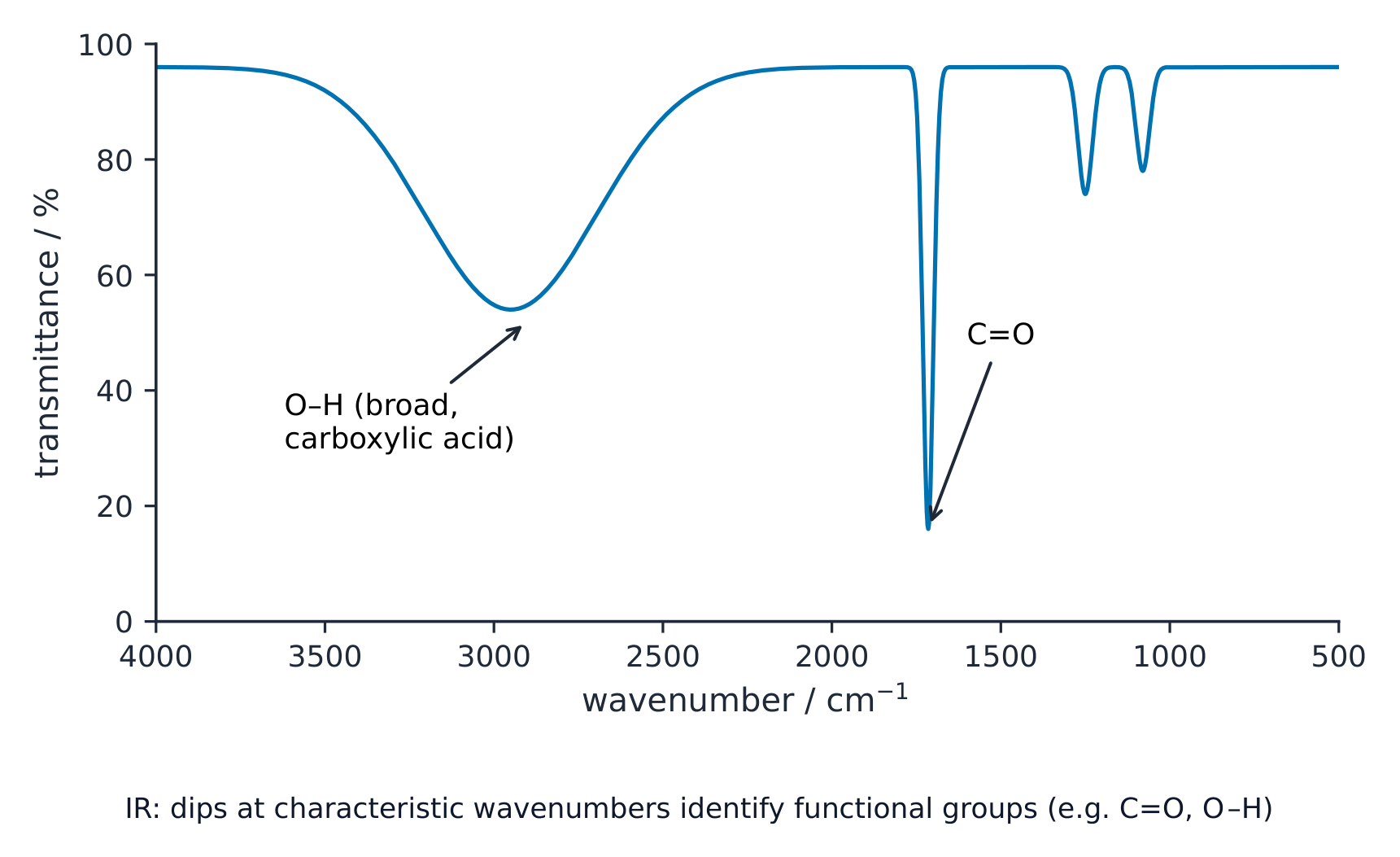
Infrared spectroscopy 红外光谱 helps you find the functional group 官能团 in a molecule. Each kind of bond soaks up (absorbs) infrared radiation at its own range of frequencies. Where the bond shows strong absorption 吸收, the spectrum has a dip.
The position is measured in wavenumber 波数 (in $\text{cm}^{-1}$). You are given a data table, so you do not memorise the numbers. You just match the dips to bonds:
a broad dip around $3200$–$3650\ \text{cm}^{-1}$ → an O–H bond in an alcohol.
a dip around $1700\ \text{cm}^{-1}$ → a C=O bond (aldehyde, ketone, acid or ester).
a broad dip $2500$–$3000\ \text{cm}^{-1}$ together with a C=O dip → a carboxylic acid.
This is useful for checking a reaction. For example, if propene has been turned into propan-2-ol, the C=C dip should be gone and an O–H dip should appear.
Bahasa Indonesia
Spektroskopi inframerah membantu Anda menemukan gugus fungsi dalam molekul. Setiap jenis ikatan menyerap (menyerap) radiasi inframerah pada rentang frekuensinya sendiri. Di mana ikatan menunjukkan penyerapan kuat, spektrum memiliki lembah.
Spectrometer inframerah memancarkan inframerah melalui sampel dan mencatat bilangan gelombang mana yang diserap oleh ikatannya
Posisi diukur dalam bilangan gelombang (dalam $\text{cm}^{-1}$). Anda diberikan tabel data, jadi Anda tidak menghafal angka-angkanya. Anda hanya mencocokkan lembah dengan ikatan:
lembah lebar di sekitar $3200$–$3650\ \text{cm}^{-1}$ → ikatan O–H dalam alkohol.
lembah di sekitar $1700\ \text{cm}^{-1}$ → ikatan C=O (aldehid, keton, asam atau ester).
lembah lebar $2500$–$3000\ \text{cm}^{-1}$ bersama dengan lembah C=O → asam karboksilat.
Ini berguna untuk memeriksa reaksi. Misalnya, jika propena telah diubah menjadi propan-2-ol, lembah C=C seharusnya hilang dan lembah O–H seharusnya muncul.
Spektrum inframerah: setiap ikatan memberikan lembah pada bilangan gelombangnya sendiri. Lembah O–H lebar bersama dengan lembah C=O mengidentifikasi asam karboksilat
Explore · Jelajahi
IR spectroscopy lab · Lab spektroskopi IR
Match an absorption to the bond or functional group it reveals. · Cocokkan serapan dengan ikatan atau gugus fungsi yang diungkapkannya.
analyse mass spectra in terms of $m/e$ values and isotopic abundances (knowledge of the working of the mass spectrometer is not required)
calculate the relative atomic mass of an element given the relative abundances of its isotopes, or its mass spectrum
deduce the molecular mass of an organic molecule from the molecular ion peak in a mass spectrum
suggest the identity of molecules formed by simple fragmentation in a given mass spectrum
deduce the number of carbon atoms, $n$, in a compound using the $[M + 1]^+$ peak and the formula
$$n = \frac{100 \times \text{abundance of } [M + 1]^+ \text{ ion}}{1.1 \times \text{abundance of } M^+ \text{ ion}}$$
deduce the presence of bromine and chlorine atoms in a compound using the $[M + 2]^+$ peak
Bahasa Indonesia
analisis spektrum massa berdasarkan nilai $m/e$ dan kelimpahan isotop (pengetahuan tentang cara kerja spektrometer massa tidak diperlukan)
hitung massa atom relatif suatu unsur jika diketahui kelimpahan relatif isotopnya, atau spektrum massanya
turunkan massa molekul dari puncak ion molekul dalam spektrum massa
usulkan identitas molekul yang terbentuk melalui fragmentasi sederhana dalam spektrum massa tertentu
turunkan jumlah atom karbon, $n$, dalam suatu senyawa menggunakan puncak $[M + 1]^+$ dan rumus
$$n = \frac{100 \times \text{abundance of } [M + 1]^+ \text{ ion}}{1.1 \times \text{abundance of } M^+ \text{ ion}}$$
turunkan keberadaan atom bromin dan klorin dalam suatu senyawa menggunakan puncak $[M + 2]^+$
Source: Cambridge International syllabus · Sumber: Silabus Cambridge International
English
In mass spectrometry 质谱, a molecule is turned into ions and sorted by its mass-to-charge ratio 质荷比 ($m/e$). The spectrum is a set of peaks at different $m/e$ values.
Relative atomic mass from isotopes
An element's isotope 同位素 mixture gives several peaks. From the isotopic abundance 同位素丰度 (how common each isotope is) you can find the relative atomic mass 相对原子质量 — a weighted average:
For example, chlorine is 75% $^{35}\text{Cl}$ and 25% $^{37}\text{Cl}$, giving $A_r = \dfrac{35 \times 75 + 37 \times 25}{100} = 35.5$.
The molecular ion and fragmentation
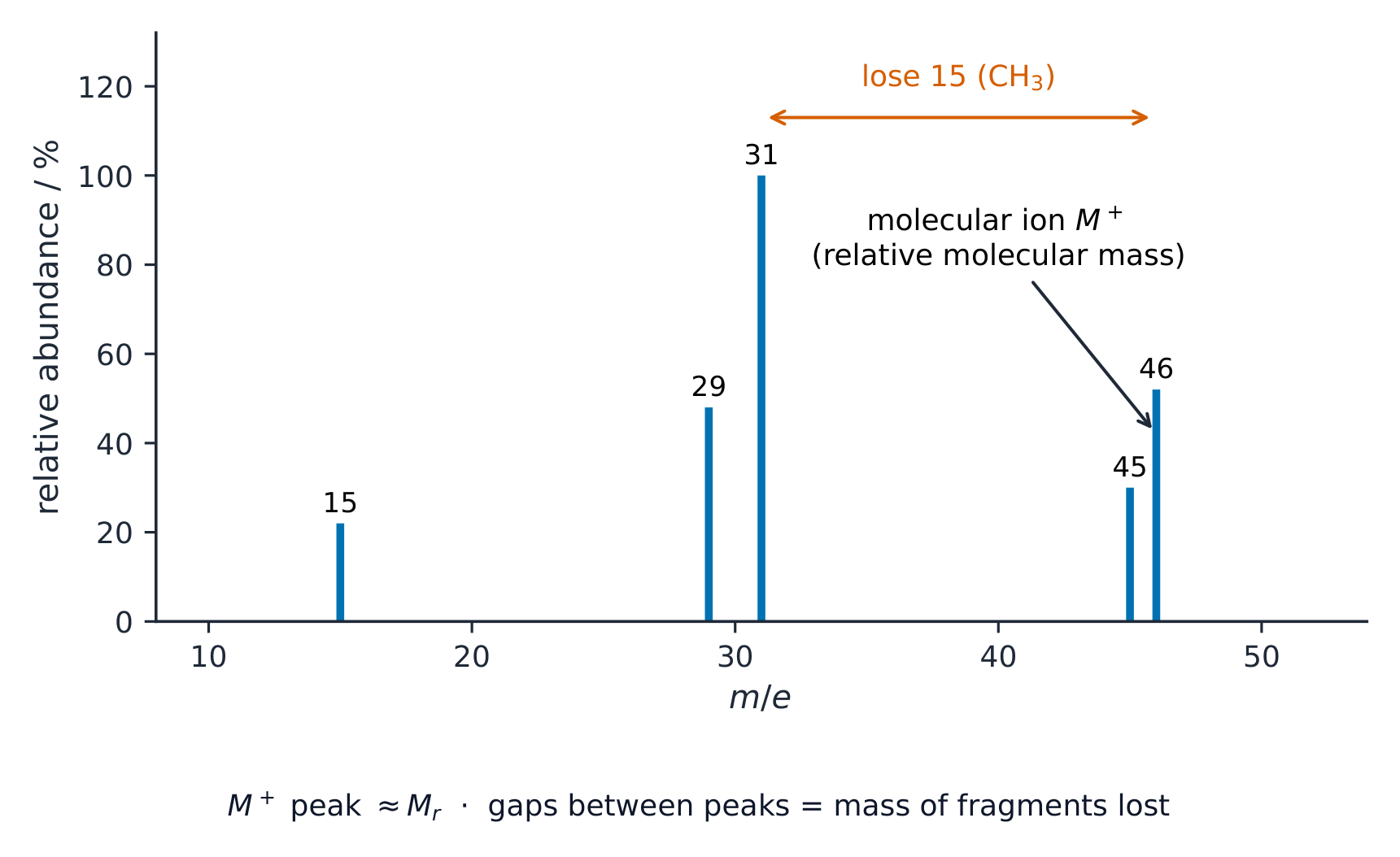
The peak at the highest $m/e$ (the molecular ion 分子离子 peak, or molecular ion peak 分子离子峰, $M^+$) gives the relative molecular mass of the whole molecule.
The molecule also breaks into smaller pieces — this is fragmentation 碎裂. The gap between two peaks tells you the mass of the lost piece, so you can suggest each fragment 碎片. For example, a loss of 15 means a $\text{CH}_3$ group was lost, and a loss of 29 means $\text{CHO}$ or $\text{C}_2\text{H}_5$.
The [M + 1] and [M + 2] peaks
a small [M + 1] peak comes from the $^{13}\text{C}$ isotope. The number of carbon atoms $n$ is:
$$n = \frac{100 \times \text{abundance of } [M + 1]^+}{1.1 \times \text{abundance of } M^+}$$
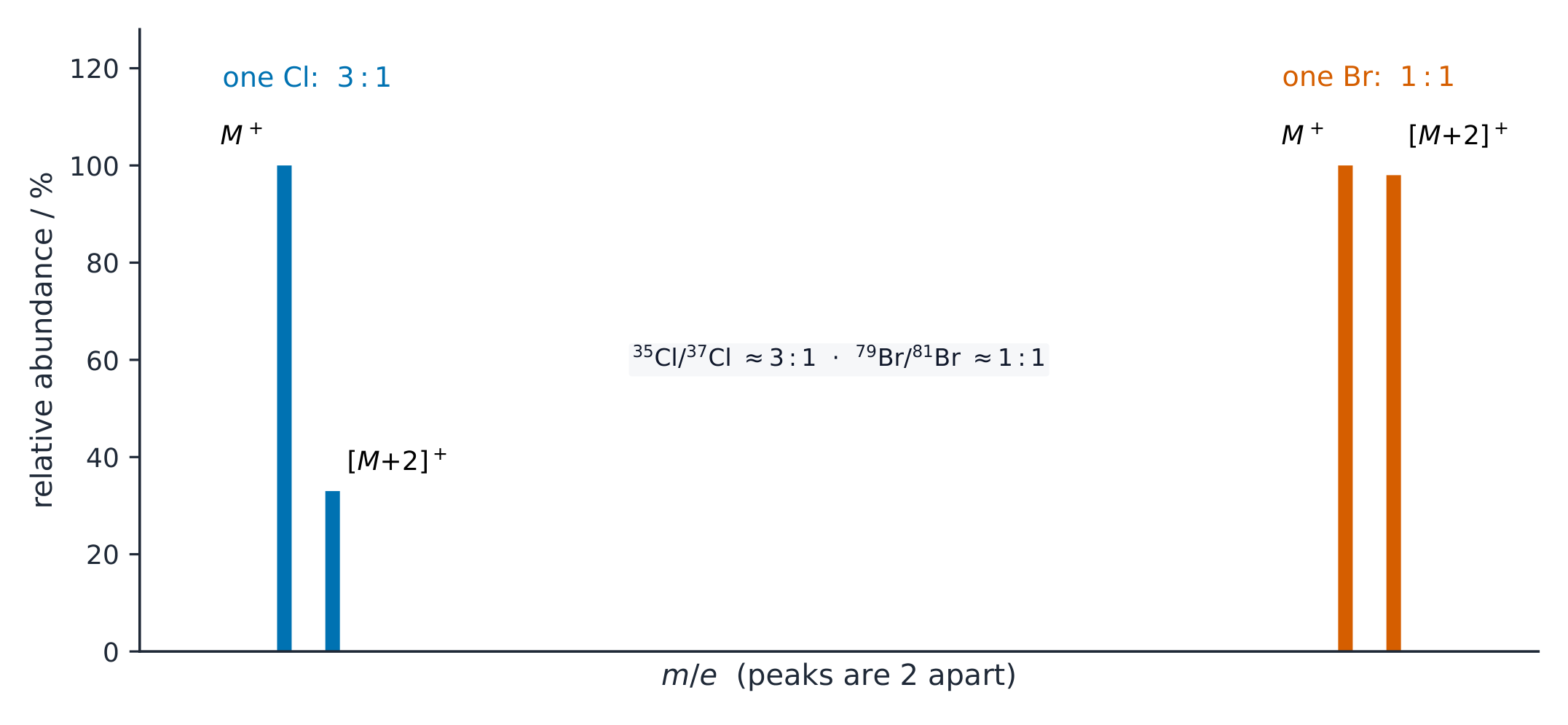
an [M + 2] peak shows chlorine or bromine. One chlorine gives an $[M + 2]$ peak about one third the height of $M^+$ (from $^{37}\text{Cl}$); one bromine gives an $[M + 2]$ peak about the same height as $M^+$ (from $^{81}\text{Br}$).
Worked example. A compound shows a molecular ion at $m/e = 108$ and a peak of almost equal height at $m/e = 110$. Its infrared spectrum shows no broad absorption near $3300\ \text{cm}^{-1}$. Deduce its identity. Two peaks two units apart with roughly equal heights are the $1:1$ signature of one bromine atom (from $^{79}\text{Br}$ and $^{81}\text{Br}$); one chlorine would have given a $3:1$ ratio instead. Take the bromine away from the molecular ion: $108 - 79 = 29$, which fits a $\text{C}_2\text{H}_5$ fragment. The absence of a broad peak near $3300\ \text{cm}^{-1}$ rules out an $\text{O-H}$, so there is no alcohol group. The compound is bromoethane, $\text{C}_2\text{H}_5\text{Br}$. Read the $[M+2]$ratio rather than merely noting the peak: $1:1$ means bromine, $3:1$ means chlorine.
Bahasa Indonesia
Dalam spektrometri massa, sebuah molekul diubah menjadi ion dan diurutkan berdasarkan rasio massa-terhadap-muatan ($m/e$). Spektrumnya adalah sekumpulan puncak pada nilai $m/e$ yang berbeda.
Spektrometer massa modern: sampel dimuat di bagian depan, lalu mesin mengionisasinya dan mengurutkan ion berdasarkan rasio massa-terhadap-muatannya untuk menghasilkan spektrum
Massa atom relatif dari isotop
Campuran isotop suatu elemen memberikan beberapa puncak. Dari kelimpahan isotop (seberapa umum setiap isotop) Anda dapat menemukan massa atom relatif — rata-rata tertimbang:
Sebagai contoh, klorin adalah 75% $^{35}\text{Cl}$ dan 25% $^{37}\text{Cl}$, menghasilkan $A_r = \dfrac{35 \times 75 + 37 \times 25}{100} = 35.5$.
Ion molekuler dan fragmentasi
Puncak pada $m/e$ tertinggi (puncak ion molekuler, atau puncak ion molekuler, $M^+$) memberikan massa molekul relatif dari seluruh molekul.
Molekul juga pecah menjadi potongan lebih kecil — ini adalah fragmentasi. Jarak antara dua puncak memberi tahu Anda massa potongan yang hilang, sehingga Anda dapat menyarankan setiap fragment. Sebagai contoh, hilangnya 15 berarti gugus $\text{CH}_3$ hilang, dan hilangnya 29 berarti $\text{CHO}$ atau $\text{C}_2\text{H}_5$.
Spektrum massa: puncak $m/e$ tertinggi adalah ion molekuler ($M^+$, yaitu $M_r$); jarak antar puncak memberikan massa fragmen yang hilang
Puncak [M + 1] dan [M + 2]
puncak [M + 1] kecil berasal dari isotop $^{13}\text{C}$. Jumlah atom karbon $n$ adalah:
$$n = \frac{100 \times \text{abundance of } [M + 1]^+}{1.1 \times \text{abundance of } M^+}$$
puncak [M + 2] menunjukkan klorin atau bromin. Satu klorin menghasilkan puncak $[M + 2]$ sekitar sepertiga tinggi dari $M^+$ (dari $^{37}\text{Cl}$); satu bromin menghasilkan puncak $[M + 2]$ sekitar tinggi yang sama dengan $M^+$ (dari $^{81}\text{Br}$).
Puncak $[M+2]$ yang berada dua satuan massa di atas $M^+$ menunjukkan halogen: satu klorin memberikan rasio $3:1$, satu bromin memberikan rasio $1:1$
Contoh terpecahkan. Senyawa menunjukkan ion molekuler pada $m/e = 108$ dan puncak dengan tinggi hampir sama pada $m/e = 110$. Spektrum inframerahnya menunjukkan tidak ada serapan lebar di sekitar $3300\ \text{cm}^{-1}$. Tentukan identitasnya. Dua puncak terpisah dua satuan dengan ketinggian kira-kira sama adalah tanda khas $1:1$ dari satu atom bromin (dari $^{79}\text{Br}$ dan $^{81}\text{Br}$); satu klorin akan memberikan rasio $3:1$ sebaliknya. Angkat bromin dari ion molekuler: $108 - 79 = 29$, yang sesuai dengan fragmen $\text{C}_2\text{H}_5$. Tidak adanya puncak lebar di sekitar $3300\ \text{cm}^{-1}$ menyingkirkan kemungkinan $\text{O-H}$, sehingga tidak ada gugus alkohol. Senyawanya adalah bromoetana, $\text{C}_2\text{H}_5\text{Br}$. Bacalah rasio $[M+2]$secara spesifik daripada sekadar mencatat puncak: $1:1$ berarti bromin, $3:1$ berarti klorin.
Explore · Jelajahi
Mass spectrometry route · Rute spektrometri massa
Follow a molecule through ionisation, separation and detection. · Ikuti sebuah molekul melalui ionisasi, pemisahan, dan deteksi.
Pick one and the site follows you — notes, papers, videos and practice all open on it. · Pilih satu dan situs mengikuti Anda — catatan, kertas, video, dan latihan semua terbuka di sana.
Type to search notes, lessons, code, vocabulary and past-paper questions across every subject. · Ketik untuk mencari catatan, pelajaran, kode, kosakata, dan pertanyaan soal lama di setiap mata pelajaran.