Skip to content · ⁨Lompat ke konten⁩

Enzymes · ⁨Enzim⁩

A-Level Biology · ⁨Biologi A-Level⁩ · Topic 3 · ⁨Topik 3⁩

Video lesson for this topic · ⁨Pelajaran video untuk topik ini⁩ Open the video page · ⁨Buka halaman video⁩
13:51

Enzim

Di dalam setiap sel, ribuan reaksi kimia terjadi setiap detik — jauh lebih cepat daripada jika dilakukan sendiri. Rahasia nya adalah jenis khusus protein…

English narration · English + 中文 subtitles burned in · ⁨Narasi bahasa Inggris · Subtitle bahasa Inggris + 中文 disematkan langsung⁩

3.1

What enzymes are · ⁨Apa itu enzim⁩

Syllabus · ⁨Silabus⁩
English
  1. state that enzymes are globular proteins that catalyse reactions inside cells (intracellular enzymes) or are secreted to catalyse reactions outside cells (extracellular enzymes)
  2. explain the mode of action of enzymes in terms of an active site, enzyme–substrate complex, lowering of activation energy and enzyme specificity, including the lock-and-key hypothesis and the induced-fit hypothesis
  3. investigate the progress of enzyme-catalysed reactions by measuring rates of formation of products using catalase and rates of disappearance of substrate using amylase
  4. outline the use of a colorimeter for measuring the progress of enzyme-catalysed reactions that involve colour changes
Bahasa Indonesia
  1. nyatakan bahwa enzim adalah protein globular yang mengkatalisis reaksi di dalam sel (enzim intraseluler) atau disekresikan untuk mengkatalisis reaksi di luar sel (enzim ekstraseluler)
  2. jelaskan mekanisme kerja enzim berdasarkan sisi aktif, kompleks enzim-substrat, penurunan energi aktivasi dan spesifisitas enzim, termasuk hipotesis kunci dan gembok serta hipotesis penyesuaian terinduksi
  3. selidiki perkembangan reaksi yang dikatalisis enzim dengan mengukur laju pembentukan produk menggunakan katalase dan laju hilangnya substrat menggunakan amilase
  4. uraikan penggunaan kolorimeter untuk mengukur perkembangan reaksi yang dikatalisis enzim yang melibatkan perubahan warna

Source: Cambridge International syllabus · ⁨Sumber: Silabus Cambridge International⁩

English
Enzyme action: lock and key

Enzymes 酶 are globular proteins 球状蛋白质 — a type of protein 蛋白质 with a rounded, soluble shape. They are biological catalysts: they catalyse 催化 (speed up) the chemical reactions in living things, and they are not used up, so each enzyme works again and again.

Enzymes work in two places:

  • intracellular 细胞内 enzymes work inside the cell 细胞 that made them. An example is catalase 过氧化氢酶, which breaks down harmful hydrogen peroxide.
  • extracellular 细胞外 enzymes are secreted 分泌 (sent out) to work outside the cell. An example is amylase 淀粉酶, which is released into the gut to digest 消化 starch 淀粉.
Bahasa Indonesia
Kerja enzim: kunci dan gembok

Enzim adalah protein globular — jenis protein dengan bentuk bulat dan larut. Mereka adalah katalis biologis: mereka mempercepat (catalyse) reaksi kimia dalam makhluk hidup, dan mereka tidak habis terpakai, sehingga setiap enzim bekerja berulang kali.

Enzim bekerja di dua tempat:

  • enzim intraseluler bekerja di dalam sel yang将它们产生。Contoh adalah katalase, yang memecah hidrogen peroksida berbahaya.
  • enzim ekstraseluler disekresikan (dikeluarkan) untuk bekerja di luar sel. Contoh adalah amilase, yang dilepaskan ke saluran pencernaan untuk mencerna amilum.
Ragi yang berbusa dan aktif fermentasi menghasilkan karbon dioksida
Enzim ragi memfermentasi gula, menghasilkan gelembung karbon dioksida
Vocabulary · ⁨Kosa kata⁩ Train · ⁨Latih⁩
English Bahasa Indonesia
enzyme/ˈenzaɪm/ enzim
globular protein/ˈɡlɒbjʊlə ˈprəʊtiːn/ protein globular
protein/ˈprəʊtiːn/ protein
catalyse/ˈkætəlaɪz/ mempercepatkan (katalisis)
intracellular/ˌɪntrəˈseljʊlə/ intraseluler
cell/sel/ sel
catalase/ˈkætəleɪz/ katalase
extracellular/ˌekstrəˈseljʊlə/ ekstraseluler
secrete/sɪˈkriːt/ melepaskan
amylase/ˈæmɪleɪz/ amilase
digest/ˈdaɪdʒest/ digest
starch/stɑːtʃ/ pati
active site/ˈæktɪv saɪt/ situs aktif
substrate/ˈsʌbstreɪt/ substrat
enzyme–substrate complex/ˈenzaɪm ˈsʌbstreɪt ˈkɒmpleks/ kompleks enzim–substrat
3.1

How enzymes work · ⁨Bagaimana enzim bekerja⁩

English

Each enzyme has a special pocket called the active site 活性位点. The molecule it acts on is its substrate 底物. The substrate fits into the active site to form an enzyme–substrate complex 酶底物复合物. The reaction then happens, and the products 产物 leave, freeing the active site for the next substrate.

Specificity

An enzyme is specific: it usually works on only one substrate. This is because the shape of the active site is complementary 互补 to (fits) the shape of that substrate and no other. We call this specificity 专一性.

Two ideas explain how the substrate fits:

  • the lock-and-key hypothesis 锁钥学说 — the active site is a fixed shape, and only a substrate with the matching shape fits, like a key in a lock.
  • the induced-fit hypothesis 诱导契合学说 — the active site is not quite the right shape at first. When the substrate binds, the active site changes shape a little to wrap around it tightly. This idea fits the evidence better.

Lowering activation energy

Every reaction needs a small "push" of energy to start, called the activation energy 活化能. An enzyme lowers the activation energy. This lets the reaction go quickly at the cell's normal temperature 温度, instead of needing high heat.

Bahasa Indonesia

Setiap enzim memiliki saku khusus yang disebut situs aktif. Molekul yang kerjakannya adalah substrat-nya. Substrat masuk ke situs aktif untuk membentuk kompleks enzim–substrat. Reaksi kemudian terjadi, dan produk-nya keluar, membebaskan situs aktif untuk substrat berikutnya.

Spesifisitas

Enzim bersifat spesifik: biasanya hanya bekerja pada satu substrat. Hal ini karena bentuk situs aktif komplementer (pas) dengan bentuk substrat tersebut dan tidak ada substrat lain. Kita menyebut hal ini spesifisitas.

Dua konsep menjelaskan bagaimana substrat masuk:

  • hipotesis kunci-gembok — situs aktif memiliki bentuk tetap, dan hanya substrat dengan bentuk yang cocok yang dapat masuk, seperti kunci di dalam gembok.
  • hipotesis pas-induksi — situs aktif awalnya bukan bentuk yang tepat. Ketika substrat berikatan, situs aktif berubah bentuk sedikit untuk membungkusnya erat. Ide ini lebih sesuai dengan bukti yang ada.
Dua diagram: pada kunci-gembok substrat segitiga masuk ke alur kaku; pada pas-induksi enzim membentuk diri mengelilingi substrat bulat
Kunci-gembok: situs aktif tetap. Pas-induksi: situs aktif berubah bentuk untuk menggenggam substrat

Menurunkan energi aktivasi

Setiap reaksi membutuhkan dorongan energi kecil untuk memulai, yang disebut energi aktivasi. Enzim menurunkan energi aktivasi. Hal ini memungkinkan reaksi berjalan cepat pada suhu normal sel, alih-alih memerlukan panas tinggi.

Profil energi dengan dua bukit: bukit tinggi tanpa enzim dan bukit lebih rendah dengan enzim, keduanya menghubungkan reaktan dan produk yang sama
Rute enzim memiliki energi aktivasi lebih rendah ($E_A$), sehingga lebih banyak molekul dapat bereaksi
Explore · ⁨Jelajahi⁩

The catalytic cycle · ⁨Siklus katalitik⁩

Step through the cycle. The enzyme binds its substrate, the reaction happens, the products leave — and the same enzyme is free to go again. · ⁨Lalui siklus tersebut. Enzim mengikat substratnya, reaksi terjadi, produk keluar — dan enzim yang sama bebas untuk melakukan lagi.⁩

Vocabulary · ⁨Kosa kata⁩ Train · ⁨Latih⁩
English Bahasa Indonesia
activation energy/ˌæktɪˈveɪʃn ˈenədʒi/ energi pengaktifan
3.1

Measuring the rate of a reaction · ⁨Mengukur laju reaksi⁩

English

You can follow an enzyme reaction in two ways:

  • measure how fast product is made. With catalase, oxygen gas is a product, so you collect the gas and measure its volume over time.
  • measure how fast substrate disappears. With amylase, you remove samples and use the iodine test; the blue-black colour fades as the starch is used up.

A colorimeter 比色计 makes this exact. It shines light through the tube and measures how much light is absorbed, so a colour change becomes a number you can plot.

The rate of reaction 反应速率 is steepest at the start (most substrate present), so the initial rate (the slope at time zero) is the fairest value to compare.

Worked example. In the first $20$ seconds of a catalase reaction, $16\ \text{cm}^3$ of oxygen is collected. Estimate the rate of reaction.

$$\text{rate} = \frac{\text{volume of product}}{\text{time}} = \frac{16}{20} = 0.8\ \text{cm}^3\,\text{s}^{-1}.$$

Because the reaction is fastest at the start, measuring over this short early interval gives a value close to the initial rate; averaging over a longer time would include the slower later stages and underestimate it.

Bahasa Indonesia

Anda dapat mengikuti reaksi enzim dengan dua cara:

  • mengukur seberapa cepat produk terbentuk. Dengan katalase, gas oksigen adalah produk, jadi Anda mengumpulkan gas tersebut dan mengukur volumenya seiring waktu.
  • mengukur seberapa cepat substrat hilang. Dengan amilase, Anda mengambil sampel dan menggunakan uji yodium; warna biru-hitam memudar saat pati habis terpakai.

Kolorimeter membuat hal ini akurat. Alat ini menerangi cahaya melalui tabung dan mengukur berapa banyak cahaya yang diserap, sehingga perubahan warna menjadi angka yang dapat Anda plot.

Laju reaksi paling curam di awal (paling banyak substrat tersedia), sehingga laju awal (kemiringan pada waktu nol) adalah nilai yang paling adil untuk dibandingkan.

Kurva produk terbentuk melawan waktu yang paling curam di awal dan melandai; garis singgung putus-putus pada waktu nol menandakan laju awal
Produk terkumpul paling cepat di awal; laju awal adalah kemiringan garis singgung pada waktu nol — nilai yang paling adil untuk dibandingkan

Contoh terarah. Pada $20$ detik pertama reaksi katalase, $16\ \text{cm}^3$ oksigen terkumpul. Perkirakan laju reaksi.

$$\text{rate} = \frac{\text{volume of product}}{\text{time}} = \frac{16}{20} = 0.8\ \text{cm}^3\,\text{s}^{-1}.$$

Karena reaksi tercepat di awal, pengukuran selama interval awal pendek ini memberikan nilai yang mendekati laju awal; rata-rata selama waktu yang lebih panjang akan mencakup tahap lambat di akhir dan meremehkan nilainya.

Vocabulary · ⁨Kosa kata⁩ Train · ⁨Latih⁩
English Bahasa Indonesia
product/ˈprɒdʌkt/ produk
complementary/ˌkɒmplɪˈmentəri/ komplementer
specificity/ˌspesɪˈfɪsɪti/ spesifisiti
lock-and-key hypothesis/lɒk ænd kiː haɪˈpɒθəsɪs/ hipotesis kunci dan gembok
induced-fit hypothesis/ɪnˈdjuːst fɪt haɪˈpɒθəsɪs/ hipotesis sesuaian terangsang
3.2

Factors that affect enzyme activity · ⁨Faktor yang mempengaruhi aktivitas enzim⁩

Syllabus · ⁨Silabus⁩
English
  1. investigate and explain the effects of the following factors on the rate of enzyme-catalysed reactions: • temperature • pH (using buffer solutions) • enzyme concentration • substrate concentration • inhibitor concentration
  2. explain that the maximum rate of reaction ($V_{\text{max}}$) is used to derive the Michaelis–Menten constant ($K_{\text{m}}$), which is used to compare the affinity of different enzymes for their substrates
  3. explain the effects of reversible inhibitors, both competitive and non-competitive, on enzyme activity
  4. investigate the difference in activity between an enzyme immobilised in alginate and the same enzyme free in solution, and state the advantages of using immobilised enzymes
Bahasa Indonesia
  1. selidiki dan jelaskan efek faktor-faktor berikut terhadap laju reaksi yang dikatalisis enzim: • suhu • pH (menggunakan larutan penyangga) • konsentrasi enzim • konsentrasi substrat • konsentrasi inhibitor
  2. jelaskan bahwa laju reaksi maksimum ($V_{\text{max}}$) digunakan untuk menurunkan konstanta Michaelis–Menten ($K_{\text{m}}$), yang digunakan untuk membandingkan afinitas berbagai enzim terhadap substratnya
  3. jelaskan efek inhibitor reversibel, baik kompetitif maupun non-kompetitif, terhadap aktivitas enzim
  4. selidiki perbedaan aktivitas antara enzim yang diimobilisasi dalam alginat dan enzim yang sama bebas dalam larutan, dan nyatakan keuntungan menggunakan enzim terimobilisasi

Source: Cambridge International syllabus · ⁨Sumber: Silabus Cambridge International⁩

English

Temperature

As temperature rises, molecules gain more kinetic energy 动能 and collide 碰撞 more often, so the rate rises. But above the optimum temperature 最适温度 the enzyme begins to denature 变性: the heat breaks the bonds holding its shape, so the active site changes and no longer fits the substrate. The rate then falls quickly.

pH

Each enzyme has an optimum pH. If the pH moves too far from it, the enzyme denatures and the rate drops. To study pH fairly, you keep it steady with a buffer solution 缓冲液.

Enzyme concentration

With plenty of substrate, more enzyme means more active sites, so the rate goes up in proportion to enzyme concentration.

Substrate concentration

At first, adding more substrate speeds the reaction. But once every active site is busy, adding more makes no difference — the rate levels off at a maximum.

Inhibitor concentration

An inhibitor 抑制剂 is a molecule that slows an enzyme. The more inhibitor present, the lower the rate.

Bahasa Indonesia

Suhu

Saat suhu naik, molekul mendapatkan lebih banyak energi kinetik dan bertabrakan lebih sering, sehingga laju meningkat. Namun, di atas suhu optimum, enzim mulai terdenaturasi: panas memutus ikatan yang menahan bentuknya, sehingga situs aktif berubah dan tidak lagi pas dengan substrat. Laju kemudian turun dengan cepat.

Grafik laju reaksi terhadap suhu, naik menuju puncak pada titik optimum lalu turun tajam karena enzim terdenaturasi
Laju naik menuju optimum, lalu turun cepat saat enzim terdenaturasi

pH

Setiap enzim memiliki pH optimum. Jika pH menyimpang terlalu jauh darinya, enzim terdenaturasi dan laju menurun. Untuk mempelajari pH secara adil, Anda mempertahankannya stabil dengan larutan penyangga.

Grafik berbentuk lonceng laju reaksi terhadap pH, memuncak pada pH optimum dan menurun ke kedua sisinya
Laju memuncak pada pH optimum dan menurun di kedua sisi

Konsentrasi enzim

Dengan substrat yang melimpah, lebih banyak enzim berarti lebih banyak situs aktif, sehingga laju naik sebanding dengan konsentrasi enzim.

Konsentrasi substrat

Awalnya, menambah substrat mempercepat reaksi. Namun, begitu setiap situs aktif sibuk, menambah lebih banyak tidak mengubah apa pun — laju melandai pada tingkat maksimum.

Konsentrasi inhibitor

Inhibitor adalah molekul yang memperlambat enzim. Semakin banyak inhibitor yang ada, semakin rendah lajunya.

Explore · ⁨Jelajahi⁩

How temperature changes enzyme activity · ⁨Bagaimana perubahan suhu mempengaruhi aktivitas enzim⁩

Drag the temperature slider. Activity rises to an optimum, then crashes as the enzyme denatures and its active site loses shape. · ⁨Geser slider suhu. Aktivitas naik menuju optimum, lalu turun drastis saat enzim terdenaturasi dan situs aktifnya kehilangan bentuk.⁩

Vocabulary · ⁨Kosa kata⁩ Train · ⁨Latih⁩
English Bahasa Indonesia
temperature/ˈtemprɪtʃə/ suhu
colorimeter/ˌkʌləˈrɪmɪtə/ kolorimeter
rate of reaction/reɪt ɒv rɪˈækʃn/ laju reaksi
kinetic energy/kɪˈnetɪk ˈenədʒi/ energi kinetik
collide/kəˈlaɪd/ berlanggar
optimum temperature/ˈɒptɪməm ˈtemprɪtʃə/ suhu optimum
inhibitor/ɪnˈhɪbɪtə/ inhibitor
Michaelis–Menten constant/ˈmaɪkəliz ˈmentn ˈkɒnstənt/ konstanta Michaelis–Menten
affinity/əˈfɪnɪti/ afinitas
reversible/rɪˈvɜːsɪbl/ reversibel
competitive inhibitor/kəmˈpetɪtɪv ɪnˈhɪbɪtə/ penghalang kompetitif
non-competitive inhibitor/nɒn kəmˈpetɪtɪv ɪnˈhɪbɪtə/ penghalang bukan kompetitif
Watch lesson · ⁨Tonton pelajaran⁩
3.2

V_max and the Michaelis–Menten constant · ⁨V_max dan konstanta Michaelis–Menten⁩

English

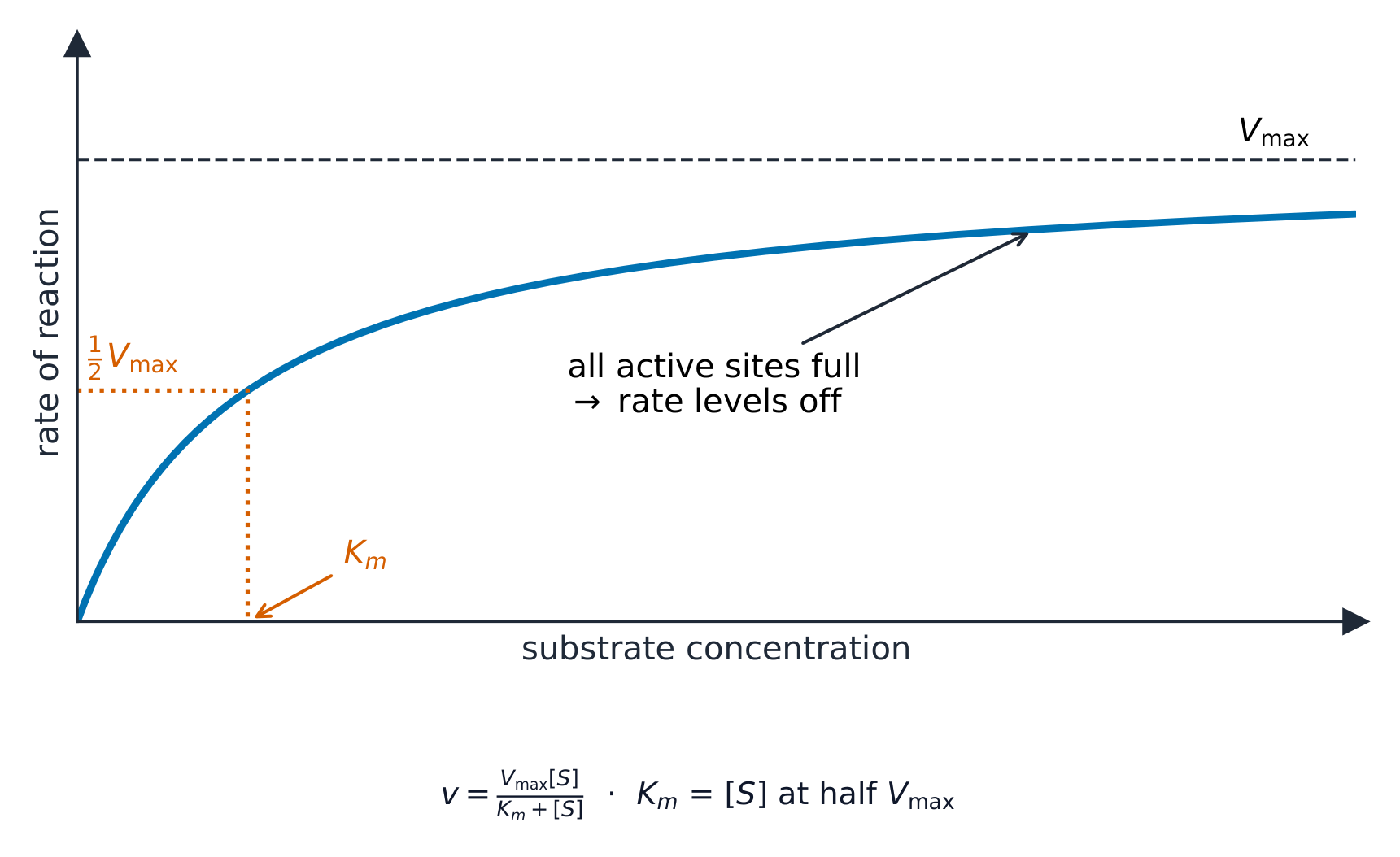
The levelling-off rate, when all active sites are full, is the maximum rate, written $V_{\text{max}}$.

The Michaelis–Menten constant 米氏常数 ($K_{\text{m}}$) is the substrate concentration that gives half of $V_{\text{max}}$. It tells you about the enzyme's affinity 亲和力 (pulling power) for its substrate:

  • a low $K_{\text{m}}$ means the enzyme reaches half-speed at a low substrate concentration, so it has a high affinity.
  • a high $K_{\text{m}}$ means a low affinity.

So $K_{\text{m}}$ lets you compare how strongly different enzymes hold their substrates.

Bahasa Indonesia

Laju melandai, ketika semua situs aktif penuh, adalah laju maksimum, ditulis $V_{\text{max}}$.

Konstanta Michaelis–Menten ($K_{\text{m}}$) adalah konsentrasi substrat yang menghasilkan setengah dari $V_{\text{max}}$. Ini memberi tahu Anda tentang afinitas (daya tarik) enzim terhadap substratnya:

  • rendah $K_{\text{m}}$ berarti enzim mencapai setengah kecepatan pada konsentrasi substrat rendah, sehingga memiliki afinitas tinggi.
  • tinggi $K_{\text{m}}$ berarti afinitas rendah.

Jadi $K_{\text{m}}$ memungkinkan Anda membandingkan seberapa kuat enzim berbeda mengikat substratnya.

Kurva laju reaksi terhadap konsentrasi substrat naik menuju dataran tinggi pada Vmax, dengan setengah Vmax dan Km yang sesuai ditandai
Laju naik menuju $V_{\text{max}}$ ketika semua situs aktif penuh; $K_{\text{m}}$ adalah konsentrasi substrat yang menghasilkan setengah $V_{\text{max}}$
Explore · ⁨Jelajahi⁩

Substrate concentration and Vmax · ⁨Konsentrasi substrat dan Vmax⁩

Add more substrate: the rate climbs, then plateaus at $V_{max}$ once every active site is busy. $K_m$ is the substrate concentration that gives half of $V_{max}$. · ⁨Tambahkan lebih banyak substrat: laju meningkat, lalu mendatar pada $V_{max}$ ketika setiap situs aktif sedang sibuk. $K_m$ adalah konsentrasi substrat yang menghasilkan setengah dari $V_{max}$.⁩

3.2

Reversible inhibitors · ⁨Inhibitor reversibel⁩

English

Some inhibitors are reversible 可逆: they can leave the enzyme again. There are two types.

Type Where it binds Effect of adding more substrate Effect on $V_{\text{max}}$ and $K_{\text{m}}$
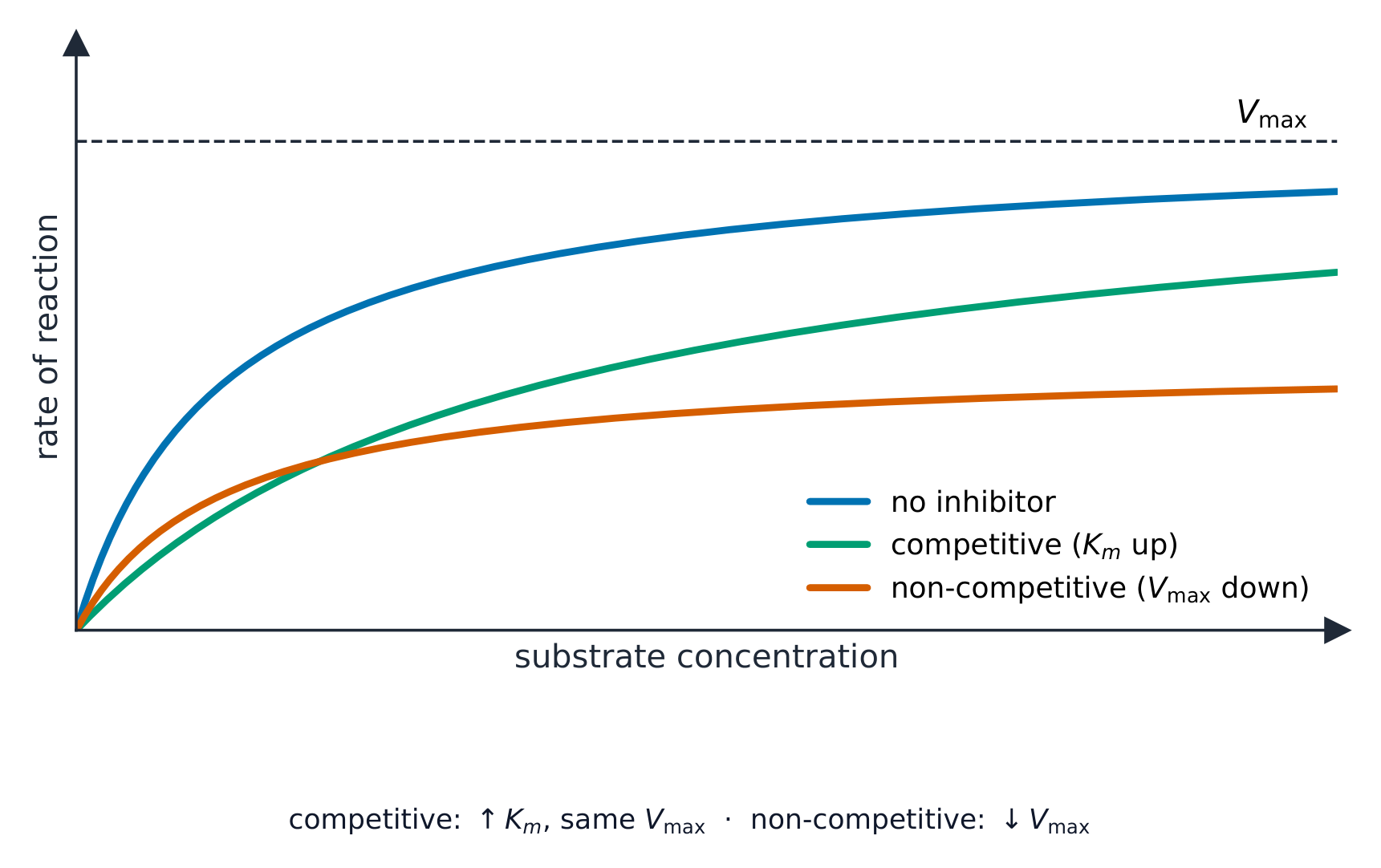
competitive inhibitor 竞争性抑制剂 in the active site (it has a similar shape to the substrate) more substrate out-competes it, so its effect is reduced $V_{\text{max}}$ unchanged; $K_{\text{m}}$ rises
non-competitive inhibitor 非竞争性抑制剂 at another site, changing the active site's shape adding more substrate does not help $V_{\text{max}}$ falls; $K_{\text{m}}$ unchanged
Bahasa Indonesia

Beberapa inhibitor bersifat reversibel: mereka dapat meninggalkan enzim lagi. Ada dua jenis.

Tipe Tempat pengikatan Efek penambahan substrat lebih lanjut Efek pada $V_{\text{max}}$ dan $K_{\text{m}}$
inhibitor kompetitif di situs aktif (memiliki bentuk yang mirip dengan substrat) lebih banyak substrat akan mengunggulinya, sehingga efeknya berkurang $V_{\text{max}}$ tidak berubah; $K_{\text{m}}$ meningkat
inhibitor non-kompetitif di situs lain, mengubah bentuk situs aktif menambah substrat tidak membantu $V_{\text{max}}$ menurun; $K_{\text{m}}$ tidak berubah
Tiga kurva laju terhadap konsentrasi substrat: tanpa inhibitor mencapai Vmax; kompetitif mencapai Vmax yang sama namun lebih lambat; non-kompetitif melandai pada Vmax yang lebih rendah
Inhibitor kompetitif meningkatkan $K_{\text{m}}$ (lebih banyak substrat dapat mengatasinya); inhibitor non-kompetitif menurunkan $V_{\text{max}}$
3.2

Immobilised enzymes · ⁨Enzim terimobilisasi⁩

English

An immobilised enzyme 固定化酶 is fixed in place — for example, trapped inside small beads of alginate 海藻酸盐 — instead of floating free in solution. The substrate solution flows past the beads.

A free enzyme usually works a little faster, because the substrate can reach it easily. But immobilised enzymes have big practical advantages:

  • the enzyme is not washed away, so it can be used again and again.
  • the product is pure — it is not mixed with enzyme.
  • the enzyme is more stable, so it survives changes in temperature and pH better.
  • the process can run continuously, with substrate flowing in and product flowing out.
Bahasa Indonesia

Enzim terimobilisasi adalah enzim yang terikat tetap — misalnya, terperangkap di dalam butiran kecil alginat — alih-alih melayang bebas dalam larutan. Larutan substrat mengalir melewati butiran-butiran tersebut.

Butiran berisi enzim dengan substrat mengalir masuk dari satu sisi dan produk mengalir keluar dari sisi lainnya, sementara enzim tetap terperangkap di dalamnya
Enzim tetap terperangkap di dalam butiran saat substrat mengalir masuk dan produk mengalir keluar — sehingga enzim tidak pernah tercuci hilang

Enzim bebas biasanya bekerja sedikit lebih cepat, karena substrat dapat menjangkaunya dengan mudah. Namun, enzim terimobilisasi memiliki keuntungan praktis yang besar:

  • enzim tidak tercuci hilang, sehingga dapat digunakan berulang kali.
  • produknya murni — tidak dicampur dengan enzim.
  • enzim lebih stabil, sehingga bertahan lebih baik terhadap perubahan suhu dan pH.
  • proses dapat berjalan secara terus-menerus, dengan substrat mengalir masuk dan produk mengalir keluar.
Sendok bedak cuci biologis berwarna putih
Bedak cuci biologis mengandung enzim yang mencerna noda makanan dan darah pada suhu rendah
Vocabulary · ⁨Kosa kata⁩ Train · ⁨Latih⁩
English Bahasa Indonesia
immobilised enzyme/ɪˈməʊbəlaɪzd ˈenzaɪm/ enzim terimobilisasi
alginate/ˈældʒɪneɪt/ alginat
3.2

Exam tips · ⁨Tips ujian⁩

English
  • Explain enzyme action with the induced-fit model (the active site moulds around the substrate) — now preferred to lock-and-key.
  • Above the optimum the enzyme denatures (hydrogen bonds and tertiary structure break) — write "denatures", never "dies" or "is killed".
  • Distinguish inhibitors: competitive binds the active site (overcome by more substrate, same $V_{max}$); non-competitive binds elsewhere (lower $V_{max}$).
  • Compare rates using the initial rate (tangent at time zero) — the fairest measure, before substrate becomes limiting.
Bahasa Indonesia
  • Jelaskan kerja enzim dengan model kecocokan terinduksi (situs aktif membentuk mengikuti substrat) — kini lebih disukai daripada kunci-gembok.
  • Di atas titik optimum enzim mengalami denaturasi (ikatan hidrogen dan struktur tersier putus) — tulis "denatures", jangan "dies" atau "is killed".
  • Bedakan inhibitor: kompetitif berikatan dengan situs aktif (diatasi oleh lebih banyak substrat, $V_{max}$ sama); non-kompetitif berikatan di tempat lain (menurunkan $V_{max}$).
  • Bandingkan laju menggunakan laju awal (garis singgung pada waktu nol) — ukuran yang paling adil, sebelum substrat menjadi pembatas.
Vocabulary · ⁨Kosa kata⁩ Train · ⁨Latih⁩
English Bahasa Indonesia
denature/ˈdenətʃə/ denaturasi
buffer solution/ˈbʌfə səˈluːʃn/ larutan pen neutralan

Interactive lessons on this topic · ⁨Pelajaran interaktif untuk topik ini⁩

Work through it step by step, with instant-check exercises. · ⁨Kerjakan langkah demi langkah, dengan latihan pengecekan instan.⁩

Past Papers · ⁨Soal-Soil Masa Lalu⁩

More topics in A-Level Biology · ⁨Biologi A-Level⁩ · ⁨Topik lain dalam A-Level Biology · ⁨Biologi A-Level⁩⁩

Log in or create account · ⁨Masuk atau buat akun⁩

IGCSE, A-Level & AP