כמעט כל ואט חשמל שהשתמשת בו אי פעם החל באותו אופן, עם מגנט וסליל חוט הנעים זה ליד זה. ללא דלק, ללא בעירה: רק…
English narration · English + 中文 subtitles burned in · קריאת קול באנגלית · תרגום אנגלי + סינית שרוף בתוך הסרטון
13.1
Magnetic Flux · זרימת מגנטים
Syllabus · סיילבוס
English
Learning Objective 13.1.A: Describe the magnetic flux through an arbitrary area or geometric shape.
13.1.A.1 For a magnetic field $\vec{B}$ that is constant across an area $\vec{A}$, the magnetic flux through the area is defined as $\Phi_B = \vec{B} \cdot \vec{A}$ .
13.1.A.1.i The area vector is defined as perpendicular to the plane of the surface and outward from a closed surface.
13.1.A.1.ii The sign of flux is given by the dot product of the magnetic field vector and the area vector.
13.1.A.2 The total magnetic flux passing through a surface is defined by the surface integral of the magnetic field over the surface area.
Source: College Board AP Course and Exam Description · מקור: תיאור הקורס והמבחן של College Board AP
English
Magnetic flux 磁通量 measures how much magnetic field passes through a surface. For a uniform field through a flat loop it is the dot product $\Phi_B=\vec{B}\cdot\vec{A}=BA\cos\theta$; in general it is the surface integral 面积分
$$\Phi_B=\int \vec{B}\cdot d\vec{A}.$$
The area vector 面积矢量 is perpendicular to the surface (outward from a closed one), and the sign of the flux comes from the dot product. Flux changes if $B$ changes, the area changes, or the loop turns – keep all three routes in mind, because each one is an exam question.
עברית
זרימת מגנטים מדדת כמה שדה מגנטי עובר דרך משטח. עבור שדה אחיד דרך לולאה שטוחה זהו המכפלה הסקלרית $\Phi_B=\vec{B}\cdot\vec{A}=BA\cos\theta$; באופן כללי זו אינטגרל משטחי
$$\Phi_B=\int \vec{B}\cdot d\vec{A}.$$
ווקטור השטח הוא ניצב למשטח (כלפי חוץ ממסגרת סגורה), ותוסיף הזרימה נובעת מהמכפלה הסקלרית. הזרימה משתנה אם $B$ משתנה, השטח משתנה, או הלולאה מתהפכת – שמור את שלושת הדרך במחשבה, כי כל אחת מהן היא שאלת בחינה.
13.2
Electromagnetic Induction · השראה אלקטרומגנטית
Syllabus · סיילבוס
English
Learning Objective 13.2.A: Describe the induced electric potential difference resulting from a change in magnetic flux.
13.2.A.1 Faraday's law describes the relationship between changing magnetic flux and the resulting induced emf in a system.
13.2.A.1.i When the area of the surface being considered is constant, the induced emf is equal to the area multiplied by the rate of change in the component of the magnetic field perpendicular to the surface.
13.2.A.1.ii When the magnetic field is constant, the induced emf is equal to the magnetic field multiplied by the rate of change in area perpendicular to the magnetic field.
13.2.A.1.iii When an emf is induced in a long solenoid, the total induced emf is equal to the induced emf in a single loop multiplied by the number of loops in the solenoid.
13.2.A.2 Lenz's law is used to determine the direction of an induced emf resulting from a changing magnetic flux.
13.2.A.2.i An induced emf generates a current that creates a magnetic field that opposes the change in magnetic flux.
13.2.A.2.ii The right-hand rule is used to determine the relationships between current, emf, and magnetic flux.
13.2.A.3 Maxwell's equations are the collection of equations that fully describe electromagnetism. Maxwell's third equation is Faraday's law of induction, which describes the relationship between a changing magnetic flux and an induced electric field.
13.2.A.4 Maxwell's equations can be used to show that electric and magnetic fields obey wave equations and that electromagnetic waves travel at a constant speed in free space.
Boundary statement: AP Physics C: Electricity & Magnetism does not expect students to mathematically derive the speed of light in free space from Maxwell's equations. This relationship is included above solely as an indication of the further applications, implications, and connections to physical phenomena that students may study in more advanced physics courses.
עברית
מטרת לימוד 13.2.A: לתאר את הפרש הפוטנציאל החשמלי המושרה הנובע משינוי בפflux המגנטי.
13.2.A.1 חוק פראדיי מתאר את הקשר בין שינוי בפflux המגנטי לבין ה-EMF המושרה בתוצאתו במערכת.
13.2.A.2 חוק לנץ משמש לקביעת הכיוון של ה-EMF המושרה הנובע משינוי בפflux המגנטי.
13.2.A.2.i EMF מושרד מייצר זרם היוצר שדה מגנטי הנגד לשינוי בפflux המגנטי.
13.2.A.2.ii כלל היד הימנית משמש לקביעת הקשרים בין זרם, EMF ופflux מגנטי.
13.2.A.3 משוואות מקסוול הן קבוצת המשוואות המתארת במלואה את האלקטרומגנטיות. משוואה שלישית של מקסוול היא חוק האינדוקציה של פאראדי, המתאר את הקשר בין שינוי בשיטת השדה המגנטי לשדה חשמלי מופעל.
ניסוח לגבול: AP Physics C: חשמל ומגנטיות אינה מצפה מתלמידים לבצע נגזרות מתמטיות למהירות האור בחלל ריק מתוך משוואות מקסוול. קשר זה כלול לעיל רק כהמחשה של יישומים, השפעות וקשרים נוספים לתופעות פיזיקליות שבהם התלמידים עשויים ללמוד בקורסי פיזיקה מתקדמים יותר.
Source: College Board AP Course and Exam Description · מקור: תיאור הקורס והמבחן של College Board AP
English
Electromagnetic induction
A changing flux induces an emf 电动势 – Faraday's law 法拉第定律:
$$\varepsilon=-\frac{d\Phi_B}{dt}.$$
With constant area, $\varepsilon=-A\,\dfrac{dB_\perp}{dt}$; with constant field, $\varepsilon=-B\,\dfrac{dA_\perp}{dt}$. A coil of $N$ turns multiplies the single-loop emf: $|\varepsilon_{\text{sol}}|=N\left|\dfrac{d\Phi_B}{dt}\right|$.
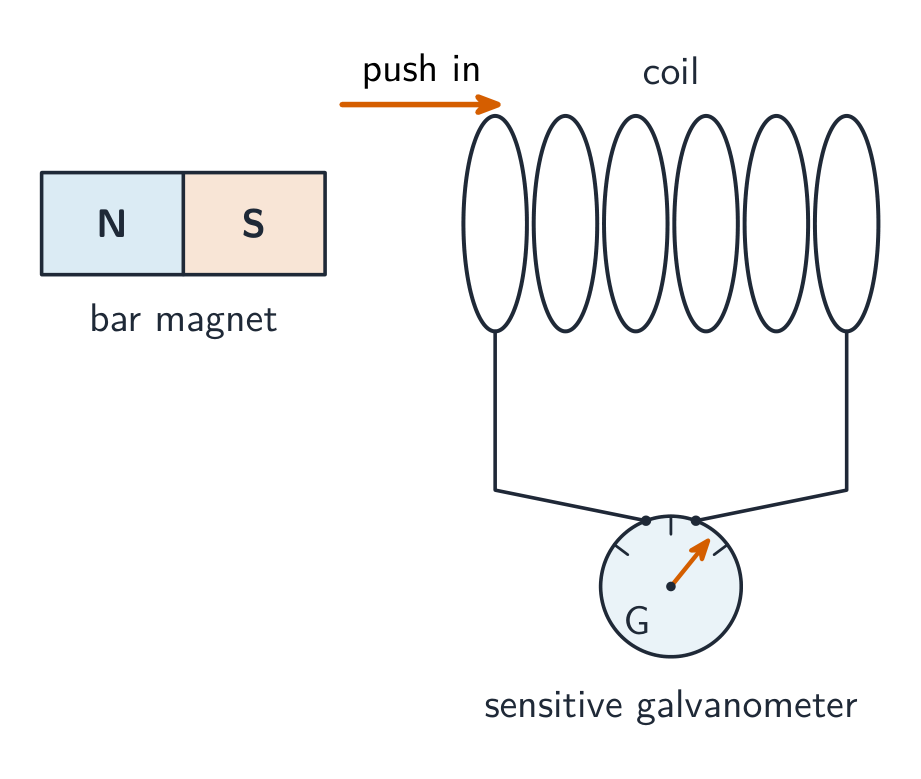
Lenz's law 楞次定律 is the minus sign: the induced current 感应电流 flows so that its own magnetic field opposes the change in flux that created it. Push a magnet toward a loop and the loop pushes back; pull it away and the loop pulls it in. Use the right-hand rule 右手定则 to turn "oppose the change" into a current direction.
A rod of length $L$ sliding at speed $v$ across a field is the special case worth memorising – the motional emf 动生电动势$\varepsilon=BLv$.
Worked example. A $0.20\ \text{m}$ rod slides at $3.0\ \text{m/s}$ across a $0.50\ \text{T}$ field: $\varepsilon=BLv=0.50(0.20)(3.0)=0.30\ \text{V}$. Equivalently, if a single loop's flux drops from $0.020\ \text{Wb}$ to $0.008\ \text{Wb}$ in $0.030\ \text{s}$, the average emf is $\varepsilon=\dfrac{0.012}{0.030}=0.40\ \text{V}$.
Faraday's law is also the third of Maxwell's equations 麦克斯韦方程组, in a deeper form: a changing magnetic flux creates a circulating electric field, $\oint\vec{E}\cdot d\vec{l}=-\dfrac{d\Phi_B}{dt}$ – that field is what pushes the charges around the loop. Together, Maxwell's equations predict electromagnetic waves 电磁波 travelling at $c=1/\sqrt{\varepsilon_0\mu_0}$ (you should know this connection, but AP will not ask you to derive it).
עברית
השראת אלקטרומגנטית
שינוי בזרימת השדה גורם להופעת המ"ע – חוק פאראדי:
$$\varepsilon=-\frac{d\Phi_B}{dt}.$$
עם שטח קבוע, $\varepsilon=-A\,\dfrac{dB_\perp}{dt}$; עם שדה קבוע, $\varepsilon=-B\,\dfrac{dA_\perp}{dt}$. סליל בעל $N$ הליכות מכפיל את ה-EMF של לולאה אחת: $|\varepsilon_{\text{sol}}|=N\left|\dfrac{d\Phi_B}{dt}\right|$.
חוק לנץ הוא סימן החסר: הזרם המושפע זורם כך שהשדה המגנטי שלו מונע את השינוי בזרימה שיצר אותו. דוחפים מגנט לעבר לולאה והלולאה דוחפת בחזרה; משלחים אותו והלולאה מושכת אותו פנימה. השתמשו בכלל היד הימנית כדי להפוך "להנגד את השינוי" לכיוון הזרם.
זוזת מקטב לתוך סליל מופעת כוח אלקטרו-מניעי (e.m.f.) שמדריך זרם
מוט באורך $L$ הנע במהירות $v$ בשדה הוא המקרה הפרטי ששווה לשנן – ההמ"ע תנועה$\varepsilon=BLv$.
דוגמה מפורטת. מוט $0.20\ \text{m}$ נע במהירות $3.0\ \text{m/s}$ בשדה $0.50\ \text{T}$: $\varepsilon=BLv=0.50(0.20)(3.0)=0.30\ \text{V}$. באופן שקול, אם זרימת לולאה אחידה יורדת מ$0.020\ \text{Wb}$ ל$0.008\ \text{Wb}$ בתוך $0.030\ \text{s}$, ההמ"ע הממוצעת היא $\varepsilon=\dfrac{0.012}{0.030}=0.40\ \text{V}$.
חוק פאראדי הוא גם השלישי במשוואות מקסוול, בצורה עמוקה יותר: זרימה מגנטית משתנה יוצרת שדה חשמלי מסתובב, $\oint\vec{E}\cdot d\vec{l}=-\dfrac{d\Phi_B}{dt}$ – שדה זה הוא מה שמדחוף את המטענים סביב הלולאה. ביחד, משוואות מקסוול חוזה גלי אלקטרומגנטיים הנעים במהירות $c=1/\sqrt{\varepsilon_0\mu_0}$ (אתם צריכים לדעת קשר זה, אך AP לא יבקש ממכם להוכיח אותו).
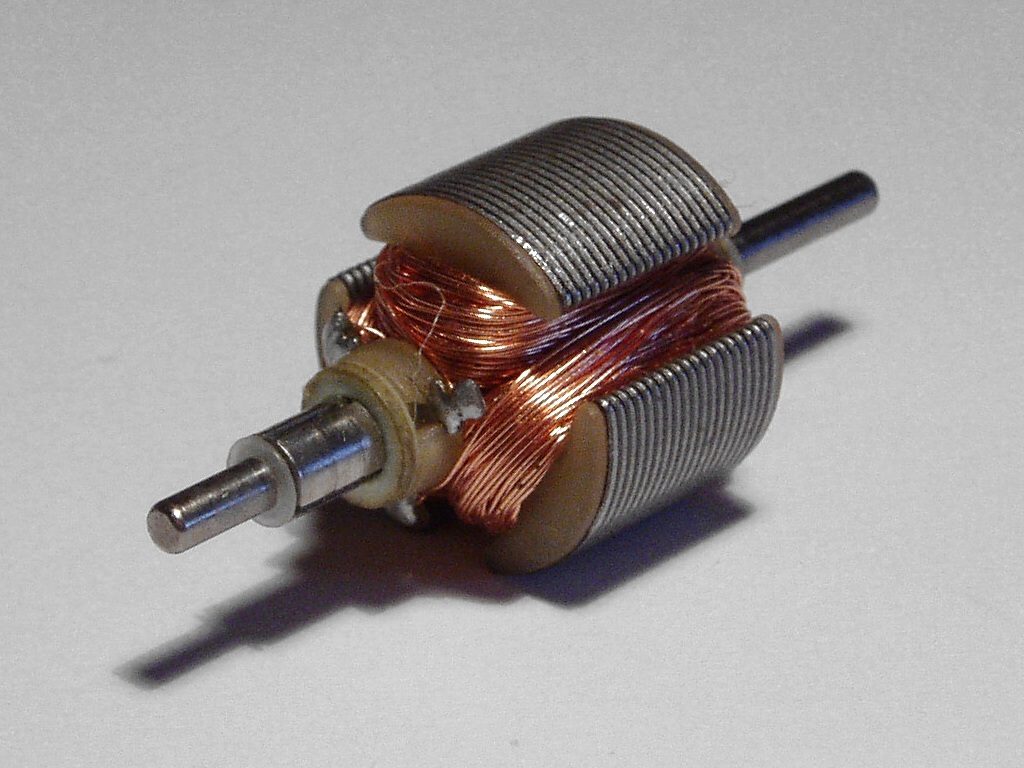
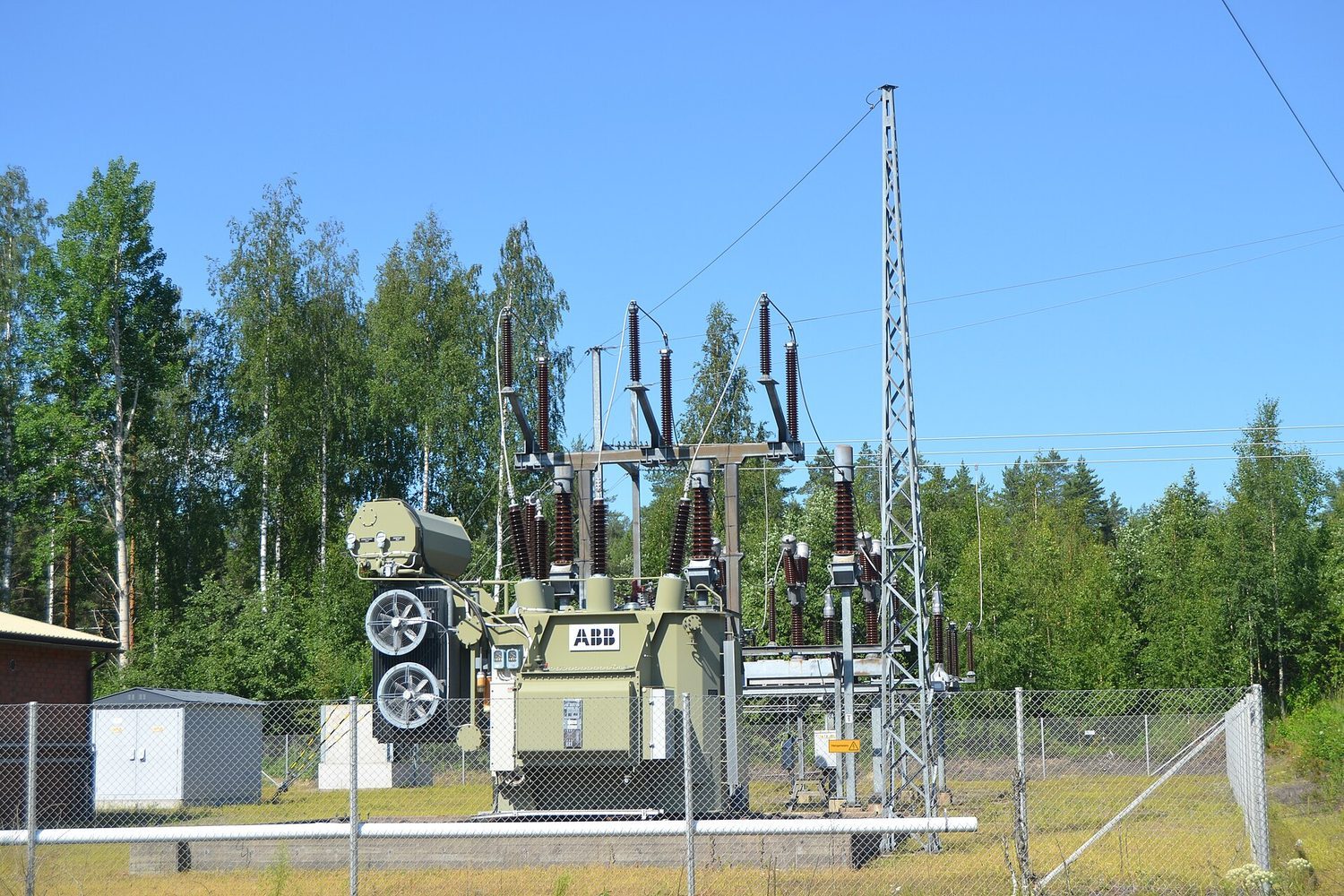
סלילי חוט מסתובבים בשדה מגנטי: הזזתם בשדה גורמים להופעת זרם, זו הבסיס לגנרטורמתחנת חשמל: הזרם המגנטי המשתנה בסלילים מופע את המתחים המספקים חשמל לרשת
Explore · חקור
Induce a current by moving a magnet · להפעיל זרם על ידי הזזת מגנט
A changing magnetic flux through a coil induces an EMF (Faraday's law); its direction opposes the change (Lenz's law). Move the magnet faster for a bigger EMF. · שינוי בשטף מגנטי דרך סליל מעורר כוח חשמלי (חוק פארادאי); כיוונו מתנגד לשינוי (חוק לנץ). הזזת המגנט מהר יותר תניב כוח חשמלי גדול יותר.
Induced Currents and Magnetic Forces · זרמים מושעים וכוחות מגנטיים
Syllabus · סיילבוס
English
Learning Objective 13.3.A: Describe the force exerted on a conductor due to the interaction between an external magnetic field and an induced current within that conductor.
13.3.A.1 When an induced current is created in a conductive loop, the already-present magnetic field will exert a magnetic force on the moving charge carriers within the loop.
13.3.A.2 When current is induced in a conducting loop, magnetic forces are only exerted on the segments of the loop that are within the external magnetic field. These magnetic forces may cause translational or rotational acceleration.
13.3.A.3 The force on a conducting loop is proportional to the induced current in the loop, which depends on the rate of change of magnetic flux, the resistance of the loop, and the velocity of the loop.
13.3.A.4 Newton's second law can be applied to a conducting loop moving in a magnetic field as it experiences an induced emf.
עברית
מטרות למידה 13.3.A: תאר את הכוח הפועל על מוליך בשל האינטראקציה בין שדה מגנטי חיצוני לזרם מופעל בתוך המוליך.
13.3.A.1 כאשר נוצר זרם מופעל בטבעת מוליכה, השדה המגנטי הקיים יפעיל כוח מגנטי על נשיאי המטען הנעים בתוך הטבעת.
13.3.A.2 כאשר זרם מופעל בטבעת מוליכה, כוחות מגנטיים פועלים רק על המקטעים של הטבעת הנמצאים בתוך השדה המגנטי החיצוני. כוחות מגנטיים אלו עשויים לגרום להאצה תרגולית או סיבובית.
13.3.A.3 הכוח הפועל על טבעת מוליכה פרופורציונלי לזרם המופעל בה, התלוי בקצב השינוי בשיטת השדה המגנטי, ההתנגדות של הטבעת ובמהירות הטבעת.
13.3.A.4 ניתן להחיל את חוק השני של ניוטון על טבעת מוליכה הנעה בשדה מגנטי בעת חוויתה EMF מופעל.
Source: College Board AP Course and Exam Description · מקור: תיאור הקורס והמבחן של College Board AP
English
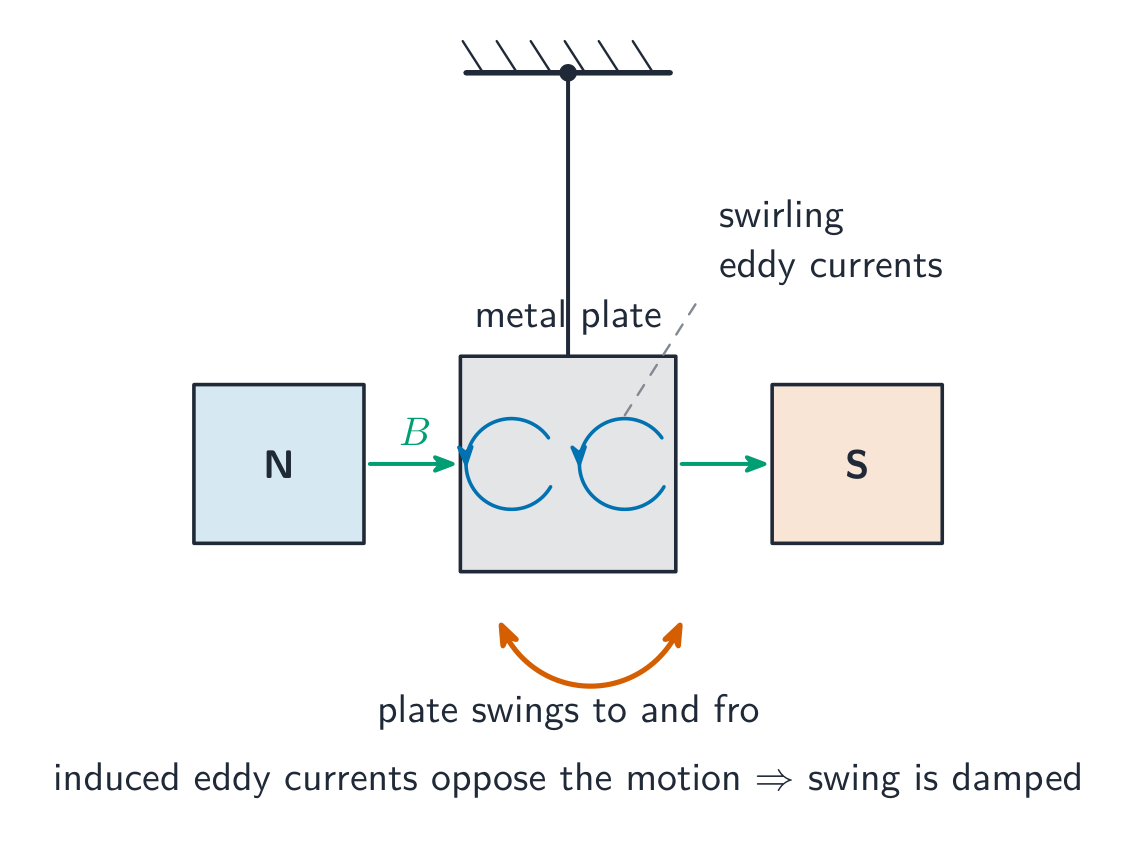
Once an induced current flows, the external field exerts forces on it ($\vec{F}=\int I\,d\vec{l}\times\vec{B}$) – and by Lenz's law those forces always resist the motion that causes the induction. Only the segments of the loop actually inside the field feel a force, which can make a loop accelerate, rotate, or brake. This is the origin of eddy currents 涡电流 braking, and you can apply Newton's second law to a moving loop or rod like any other mechanics problem.
The classic setup is a rod sliding on conducting rails connected by a resistor:
Worked example (the full chain). Rails $L=0.20\ \text{m}$ apart with resistance $R=0.60\ \Omega$ sit in a $0.50\ \text{T}$ field into the page. The rod is pushed at a constant $3.0\ \text{m/s}$. Then: $\varepsilon=BLv=0.30\ \text{V}$; $I=\varepsilon/R=0.50\ \text{A}$; the field pushes back on the rod with $F=BIL=0.50(0.50)(0.20)=0.050\ \text{N}$. The pushing force does work at $P=Fv=0.15\ \text{W}$ – exactly the $P=I^2R=0.15\ \text{W}$ dissipated in the resistor. Mechanical work becomes electrical energy: that is a generator 发电机, and energy is conserved. Released with no push, the rod slows exponentially: $ma=-\dfrac{B^2L^2}{R}v$.
Exam skill. FRQs walk this exact chain: flux $\to$ emf $\to$ current $\to$ force $\to$ Newton's second law. Write each link separately and check the direction with Lenz's law at the end.
עברית
ברגע שעובר זרם מושע, השדה החיצוני מפעיל כוחות עליו ($\vec{F}=\int I\,d\vec{l}\times\vec{B}$) – ובשל חוק לנץ, כוחות אלו תמיד מונעים את התנועה שגרמה להשעה. רק הקטעים של הלולאה שנמצאים בפועל בתוך השדה מרגישים בכוח, ודבר יכול לגרום ללולאה להאיץ, לסובב או לבלום. זוהי העלילה של בלמי זרמים עוקפיים, וניתן לחשב את חוק ניוטון השני עבור לולאה או מוט נעים כמו כל בעיה אחרת במכניקה.
ההתקן הקלאסי הוא מוט החולק על מסילות מוליכות המחוברות על ידי נגד:
ההרכבה הקלאסית היא מוט הנע על מסילות מוליכות המחוברות באמצעות נגד:
מוט הנע על מסילות: הזרם המושע מרגיש בכוח המנוגד לתנועה
דוגמה מפורטת (השרשרת המלאה). מסילות $L=0.20\ \text{m}$ מרחוק זה מזה עם התנגדות $R=0.60\ \Omega$ נמצאות בשדה $0.50\ \text{T}$ הפונה לתוך הדף. המוט נדחף במהירות קבועה $3.0\ \text{m/s}$. אז: $\varepsilon=BLv=0.30\ \text{V}$; $I=\varepsilon/R=0.50\ \text{A}$; השדה דוחף בחזרה על המוט בכוח של $F=BIL=0.50(0.50)(0.20)=0.050\ \text{N}$. כוח הדחיפה מבצע עבודה בקצב $P=Fv=0.15\ \text{W}$ – בדיוק ה$P=I^2R=0.15\ \text{W}$ המבוזר בנגד. עבודה מכנית הופכת לאנחיה חשמלית: זהו גנרטור, ואנחיה שמורה. אם משחררים אותו ללא דחיפה, המוט מאט באופן אקספוננציאלי: $ma=-\dfrac{B^2L^2}{R}v$.
מיומנות למבחן. FRQs עוברים על אותה שרשרת בדיוק: זרימה $\to$ המ"ע $\to$ זרם $\to$ כוח $\to$ חוק ניוטון השני. כתבו כל קשר בנפרד ובדקו את הכיוון עם חוק לנץ בסוף.
13.4
Inductance · אינדוקטיביות
Syllabus · סיילבוס
English
Learning Objective 13.4.A: Describe the physical and electrical properties of an inductor.
13.4.A.1 Inductance is the tendency of a conductor to oppose a change in electrical current.
13.4.A.1.i Inductance of a conductor depends on the physical properties of the conductor. Straight wires are typically modeled as having zero inductance.
13.4.A.1.ii An inductor, such as a solenoid, is a circuit element that has significant inductance.
13.4.A.1.iii The inductance of a solenoid is dependent on the total number of turns, the length of the solenoid, the cross-sectional area of the solenoid, and magnetic permeability of the solenoid's core.
13.4.A.2 Inductors store energy in the magnetic field that is generated by current in the inductor.
Equation:$U_L = \dfrac{1}{2} L I^2$
13.4.A.2.i The energy stored in the magnetic field generated by an inductor in which current is flowing can be dissipated through a resistor or used to charge a capacitor.
13.4.A.2.ii The transfer of energy generated in an inductor to other forms of energy obeys conservation laws.
13.4.A.3 By applying Faraday's law to an inductor and using the definition of inductance, induced emf can be related to inductance and the rate of change of current.
Equation:$\mathcal{E}_i = -L\dfrac{dI}{dt}$
עברית
מטרות למידה 13.4.A: תאר את המאפיינים הפיזיקליים והחשמליים של סליל השראה.
13.4.A.1 השראה היא הנטייה של מוליך להתנגד לשינוי בזרם חשמלי.
13.4.A.1.i השראה של מוליך תלויה במאפיינים הפיזיקליים שלו. חוטים ישרים מתודגמים בדרך כלל כבעלי השראה אפסית.
13.4.A.1.ii סליל השראה, כמו סולנויד, הוא אלמנט מעגל חשמלי בעל השראה משמעותית.
13.4.A.1.iii השראה של סולנויד תלויה בסך הכל מסלילים, באורך הסולנויד, בשטח החתך שלו ובמחזוריות המגנטית (Permeability) של ליבת הסולנויד.
13.4.A.2 סלילי השראה מאחסנים אנרגיה בשדה המגנטי שנוצר על ידי הזרם בסליל.
משוואה:$U_L = \dfrac{1}{2} L I^2$
13.4.A.2.i האנרגיה הארוזה בשדה המגנטי שנוצר על ידי סליל השראה דרך זורם בו יכולה להיות מפוזרת דרך נגד או משמשת לטעינת קבל.
13.4.A.2.ii העברת האנרגיה שנוצרה בסליל השראה לצורות אנרגיה אחרות עומדת בחוקי השימור.
13.4.A.3 על ידי היישום של חוק פאראדי לסליל השראה ובשימוש בהגדרת ההשראה, ניתן לקשר את ה-EMF המופעל להשראה ולקצב השינוי בזרם.
משוואה:$\mathcal{E}_i = -L\dfrac{dI}{dt}$
Source: College Board AP Course and Exam Description · מקור: תיאור הקורס והמבחן של College Board AP
English
Inductance 电感 is a conductor's tendency to oppose a change in its own current: changing current changes its own flux, which self-induces an emf. From Faraday's law,
$$\varepsilon=-L\frac{dI}{dt}.$$
An inductor 电感器 is a circuit element built to have large inductance – usually a solenoid 螺线管, where geometry gives
with $N$ total turns, area $A$, length $\ell$, and the magnetic permeability 磁导率 of the core. (Straight wires are modelled as having zero inductance.) An inductor carrying current $I$ stores energy in its magnetic field:
$$U_L=\tfrac{1}{2}LI^2,$$
which can later be dissipated in a resistor or moved into a capacitor – conservation of energy applies as usual.
עברית
אינדוקטיביות היא נטייתו של מוליך להתנגד לשינוי בזרם שלו: זרם משתנה משנה את הזרימה שלו, וזה גורם להופעת המ"ע עצמית. ממשוואת פאראדי,
$$\varepsilon=-L\frac{dI}{dt}.$$
סליל הוא רכיב במעגל חשמלי המיועד להפיק אינדוקטוריות גבוהות – בדרך כלל סולנויד, שבו הגיאומטריה נותנת
עם $N$ הליכוד כולל, שטח $A$, אורך $\ell$ ונבילות מגנטית של ליבת הסליל. (חוטים ישרים מודלים כאילו יש להם אינדוקטוריות אפס.) סליל העובר בו זרם $I$ מאחסן אנרגיה בשדה המגנטי שלו:
$$U_L=\tfrac{1}{2}LI^2,$$
שהיא יכולה להתפרק מאוחר יותר בתנגדות או לעבור לקבל – חוק שימור האנרגיה חל כרגיל.
13.5
Circuits with Resistors and Inductors · מעגלים עם תנגדות וסליבים
Syllabus · סיילבוס
English
Learning Objective 13.5.A: Describe the physical and electrical properties of a circuit containing a combination of resistors and a single inductor.
13.5.A.1 A resistor will dissipate energy that was stored in an inductor as the current changes.
13.5.A.2 Kirchhoff's loop rule can be applied to a series LR circuit with a battery of emf $\mathcal{E}$, resulting in a differential equation that describes the current in the loop.
Equation (derived):$\mathcal{E} = IR + L\dfrac{dI}{dt}$
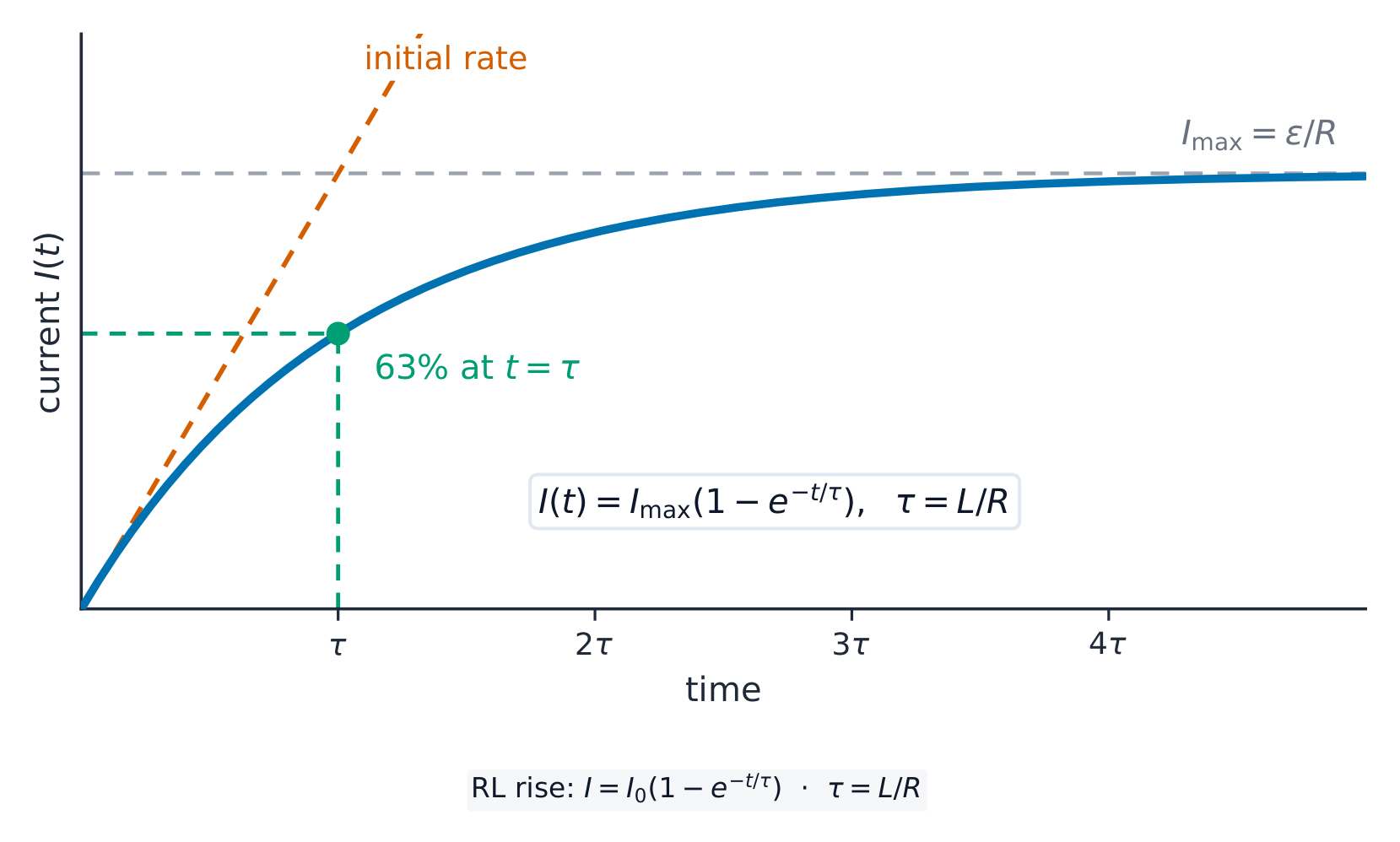
13.5.A.3 The time constant is a significant feature of the behavior of an LR circuit.
13.5.A.3.i The time constant of a circuit is a measure of how quickly an LR circuit will reach a steady state and is described with the equation $\tau = \dfrac{L}{R_{\text{eq}}}$ .
13.5.A.3.ii The time constant represents the time an LR circuit would take to reach a steady state if the system continued to change at the initial rate of change.
13.5.A.3.iii For an inductor that has zero initial current, the time constant represents the time required for the current in the inductor to reach approximately 63 percent of its final asymptotic value.
13.5.A.3.iv For an inductor with an initial current, the time constant represents the time required for the current in the inductor to reach approximately 37 percent of its initial value.
13.5.A.4 The electric properties of inductors change during the time interval in which the current in the inductor changes, but will exhibit steady state behavior after a long time interval.
13.5.A.4.i When a switch is initially closed or opened in a circuit containing an inductor, the induced emf will be equal in magnitude and opposite in direction to the applied potential difference across the branch containing the inductor.
13.5.A.4.ii The potential difference across an inductor, the current in the inductor, and the energy stored in the inductor are exponential with respect to time and have asymptotes that are determined by the initial conditions of the circuit.
13.5.A.4.iii After a time much greater than the time constant of the circuit, an inductor will behave as a conducting wire with zero resistance.
עברית
מטרות למידה 13.5.A: תאר את התכונות הפיזיקליות והחשמליות של מעגל המכיל שילוב של נגדים וסולנואיד אחד.
13.5.A.1 נגד יפזר אנרגיה שהתאגרה בסולנואיד כאשר הזורם משתנה.
13.5.A.2 ניתן ליישם את חוק הלולאה של קירכוף על מעגל LR סריתי עם מקור כוח $\mathcal{E}$, מה שמוביל למשוואה דיפרנציאלית המתארת את הזורם במעגל.
משוואה (מובקעת):$\mathcal{E} = IR + L\dfrac{dI}{dt}$
13.5.A.3 זמן האופיין הוא מאפיין משמעותי בהתנהגותו של מעגל LR.
13.5.A.3.i זמן האופיין של מעגל הוא מדד לכמה מהר מעגל LR יגיע למצב יציב, ומתואר באמצעות המשוואה $\tau = \dfrac{L}{R_{\text{eq}}}$.
13.5.A.3.ii זמן האופיין מייצג את הזמן שעבר מעגל LR כדי להגיע למצב יציב, אם המערכת הייתה ממשיכה לשנות עצמה בקצב השינוי ההתחלתי.
13.5.A.3.iii עבור סולנואיד בעל זורם התחלתי אפס, זמן האופיין מייצג את הזמן הנדרש כדי שהזורם בסולנואיד יגיע לכ-63 אחוזים מערכו האסימפטוטי הסופי.
13.5.A.3.iv עבור סולנואיד עם זורם התחלתי, זמן האופיין מייצג את הזמן הנדרש כדי שהזורם בסולנואיד יגיע לכ-37 אחוזים מערכו ההתחלתי.
13.5.A.4 התכונות החשמליות של סולנואידים משתנות במהלך פרק הזמן בו הזורם בהם משתנה, אך יציגו התנהגות מצב יציב לאחר פרק זמן ארוך.
13.5.A.4.i כאשר מתג נסגר או נפתח בתחילה במעגל המכיל סולנואיד, ה-EMF המיוצר יהיה שווה בגודלו והפוך בכיוונו לגבי ההפרש הפוטנציאלי המופעל על הענף המכיל את הסולנואיד.
13.5.A.4.ii ההפרש הפוטנציאלי על פני סולנואיד, הזורם בסולנואיד והאנרגיה האגורה בו הם פונקציות מעריכיות ביחס לזמן ויש להן אסימפטות הקבועות על ידי תנאי ההתחלה של המעגל.
13.5.A.4.iii לאחר זמן הגדול משמעותית מזמן האופיין של המעגל, סולנואיד יתנהג כמו חוט מוליך בעל התנגדות אפס.
Source: College Board AP Course and Exam Description · מקור: תיאור הקורס והמבחן של College Board AP
English
In an RL circuit RL电路, Kirchhoff's loop rule for a battery $\varepsilon$, resistor $R$, and inductor $L$ in series gives a differential equation 微分方程:
The time constant 时间常数$\tau$ sets the pace: after one $\tau$ a rising current reaches about $63\%$ of its final value (a decaying one falls to $37\%$); it is also how long the change would take at the initial rate. Learn the two limits – they answer most conceptual questions:
Just after the switch closes ($t=0$): current cannot jump, so the inductor momentarily blocks it, self-inducing an emf equal and opposite to the applied potential difference.
Long after ($t\gg\tau$): the current is steady, $dI/dt=0$, and the inductor behaves as a plain wire – the exact opposite of a capacitor.
Worked example.$\varepsilon=12\ \text{V}$, $R=6.0\ \Omega$, $L=3.0\ \text{H}$: final current $\varepsilon/R=2.0\ \text{A}$, $\tau=L/R=0.50\ \text{s}$. At $t=0.50\ \text{s}$ the current is $2.0(1-e^{-1})\approx1.3\ \text{A}$. At $t=0$ the inductor's potential difference is the full $12\ \text{V}$; as $t\to\infty$ it falls to zero. Current, inductor voltage, and stored energy are all exponential in time.
עברית
במעגל RL RL, חוק לולאת קירשוף לסוללה $\varepsilon$, תנגדות $R$ וסליל $L$ בסדר נותן משוואה דיפרנציאלית:
ה-קבוע הזמן$\tau$ קובע את הקצב: לאחר זמן $\tau$ אחד, זרם עולה מגיע לכ-$63\%$ מהערך הסופי שלו (זרם דועה יורד ל-$37\%$); זה גם הזמן שהשינוי היה לוקח בקצב ההתחלתי. למדו את שני הגבולות – הם עונים על רוב השאלות הקונספטואליות:
מיד אחרי סגירת המתג ($t=0$): הזרם לא יכול לקפוץ, ולכן הסליל חוסם אותו לרגע, ומייצר EMF עצמי שווה והפוך לפוטנציאל המופעל.
לאחר זמן רב ($t\gg\tau$): הזרם יציב, $dI/dt=0$, והסליל מתנהג כמו חוט פשוט – בדיוק ההפך מקבל.
הזרם במעגל RL עולה אקספוננציאלית, ומגיע ל-63% בזמן קבוע אחד
דוגמה מופתרת.$\varepsilon=12\ \text{V}$, $R=6.0\ \Omega$, $L=3.0\ \text{H}$: זרם סופי $\varepsilon/R=2.0\ \text{A}$, $\tau=L/R=0.50\ \text{s}$. ב$t=0.50\ \text{s}$ הזרם הוא $2.0(1-e^{-1})\approx1.3\ \text{A}$. ב$t=0$ הפרש הפוטנציאלים של הסליל הוא כולו $12\ \text{V}$; כאשר $t\to\infty$ הוא צומח לאפס. הזרם, מתח הסליל והאנרגיה המאוגרת הם כולם פונקציות אקספוננציאליות בזמן.
13.6
Circuits with Capacitors and Inductors · מעגלים עם קבלים וסליבים
Syllabus · סיילבוס
English
Learning Objective 13.6.A: Describe the physical and electrical properties of a circuit containing a combination of capacitors and a single inductor.
13.6.A.1 In circuits containing only a charged capacitor and an inductor (LC circuits), the maximum current in the inductor can be determined using conservation of energy within the circuit.
13.6.A.2 In LC circuits, the time dependence of the charge stored in the capacitor can be modeled as simple harmonic motion.
13.6.A.3 התדר הזוויתי של מעגל LC מתנדנד ניתן לגזירה ממשוואה דיפרנציאלית המתארת מעגל LC.
משוואה (מובקעת):$\omega = \dfrac{1}{\sqrt{LC}}$
Source: College Board AP Course and Exam Description · מקור: תיאור הקורס והמבחן של College Board AP
English
LC circuit: energy sloshes like a spring
An LC circuit LC电路 has no resistance, so nothing dissipates energy: it oscillates 振荡, sloshing energy between the capacitor's electric field and the inductor's magnetic field. The loop rule gives
$$\frac{d^2q}{dt^2}=-\frac{1}{LC}\,q,$$
the same equation as a mass on a spring – simple harmonic motion 简谐运动 with charge playing the role of displacement and
$$\omega=\frac{1}{\sqrt{LC}}.$$
The total energy $\dfrac{q^2}{2C}+\tfrac12LI^2$ stays constant: all in the capacitor at maximum charge, all in the inductor at maximum current.
Worked example.$L=2.0\ \text{H}$, $C=8.0\ \mu\text{F}$: $\omega=\dfrac{1}{\sqrt{2.0(8.0\times10^{-6})}}=250\ \text{rad/s}$, period $T=2\pi/\omega\approx0.025\ \text{s}$. If the capacitor starts charged to $12\ \text{V}$, then $U=\tfrac12CV^2=5.8\times10^{-4}\ \text{J}$, and the maximum current follows from $\tfrac12LI_{\max}^2=U$: $I_{\max}=\sqrt{2U/L}=0.024\ \text{A}$ – conservation of energy 能量守恒, no calculus needed.
עברית
מעגל LC: האנרגיה רועדת כמו בקפיץ
למעגל LC אין התנגדות, ולכן אין פיזור אנרגיה: הוא מתנודה, ומעביר אנרגיה בין השדה החשמלי של הקבל לשדה המגנטי של הסליל. חוק הלולאה נותן
$$\frac{d^2q}{dt^2}=-\frac{1}{LC}\,q,$$
אותה משוואה כמו מסה בקפיץ – תנועה הרמונית פשוטה כאשר המטען משחק את תפקיד ההזחה ו
$$\omega=\frac{1}{\sqrt{LC}}.$$
האנרגיה הכוללת $\dfrac{q^2}{2C}+\tfrac12LI^2$ נשארת קבועה: כולה בקבל בטעינה מקסימלית, כולה בסליל בזרם מקסימלי.
דוגמה מפורטת.$L=2.0\ \text{H}$, $C=8.0\ \mu\text{F}$: $\omega=\dfrac{1}{\sqrt{2.0(8.0\times10^{-6})}}=250\ \text{rad/s}$, תקופה $T=2\pi/\omega\approx0.025\ \text{s}$. אם הקבל מתחיל טעון ל-$12\ \text{V}$, אז $U=\tfrac12CV^2=5.8\times10^{-4}\ \text{J}$, והזרם המקסימלי נובע מ-$\tfrac12LI_{\max}^2=U$: $I_{\max}=\sqrt{2U/L}=0.024\ \text{A}$ – שימור אנרגיה, ללא צורך באינטגרציה.
13.6
Exam tips · טיפים לבחינות
English
Compute flux$\Phi_B=\int \vec B\cdot d\vec A$ and get the induced EMF from Faraday's law$\varepsilon=-\tfrac{d\Phi_B}{dt}$.
Use Lenz's law (the minus sign) to fix the direction: the induced current opposes the change in flux.
Flux changes three ways — changing $B$, changing area, or changing angle — identify which and differentiate.
For a rod of length $L$ moving at speed $v$, the motional EMF is $BLv$.
An inductor stores energy $\tfrac12 LI^2$ and resists changes in current (RL time constant $\tau=L/R$).
More topics in AP Physics C: Electricity and Magnetism · פיזיקה AP C: חשמל ומגנטיות · נושאים נוספים בAP Physics C: Electricity and Magnetism · פיזיקה AP C: חשמל ומגנטיות
Pick one and the site follows you — notes, papers, videos and practice all open on it. · בחרו נושא אחד והאתר יעקוב אחריו — הערות, מסמכים, וידאו ותרגולים פתוחים בו.
Type to search notes, lessons, code, vocabulary and past-paper questions across every subject. · הקלד כדי לחפש הערות, שיעורים, קוד, אוצר מילים ושאלות מבחנים בכל הנושאים.