Skip to content · ⁨דלג לתוכן⁩

Thermodynamics · ⁨תרמודינמיקה⁩

AP Physics 2 · ⁨פיזיקה AP 2⁩ · Topic 9 · ⁨נושא 9⁩

Video lesson for this topic · ⁨שיעור וידאו לנושא זה⁩ Open the video page · ⁨פתח את עמוד הוידאו⁩
8:56

תרמודינמיקה

הניחו כוס קפה חמה על שולחן. היא תמיד מתקררת. היא לעולם לא מחממת בחזרה על ידי שאיבת חום מהחדר הקר. שני הכיוונים היו מאזנים את האנרגיה…

English narration · English + 中文 subtitles burned in · ⁨קריאת קול באנגלית · תרגום אנגלי + סינית שרוף בתוך הסרטון⁩

9.1

Kinetic Theory of Temperature and Pressure · ⁨תורת המיקום של טמפרטורה ולחץ⁩

Syllabus · ⁨סיילבוס⁩
English

Learning Objective 9.1.A: Describe the pressure a gas exerts on its container in terms of atomic motion within that gas.

  • 9.1.A.1 Atoms in a gas collide with and exert forces on other atoms in the gas and with the container in which the gas is contained.
    • 9.1.A.1.i Collisions involving pairs of atoms or an atom and a fixed object can be described and analyzed using conservation of momentum principles.
    • 9.1.A.1.ii The pressure exerted by a gas on a surface is the ratio of the sum of the magnitudes of the perpendicular components of the forces exerted by the gas's atoms on the surface to the area of the surface.
      • Equation: $P = \dfrac{F_{\perp}}{A}$
    • 9.1.A.1.iii Pressure exists throughout the gas itself, not just at the boundary between the gas and the container.

Learning Objective 9.1.B: Describe the temperature of a system in terms of the atomic motion within that system.

  • 9.1.B.1 The temperature of a system is characterized by the average kinetic energy of the atoms within that system.
    • 9.1.B.1.i The Maxwell–Boltzmann distribution provides a graphical representation of the energies and speeds of atoms at a given temperature.
    • 9.1.B.1.ii The root-mean-square speed corresponding to the average kinetic energy for an ideal gas is related to the temperature of the gas by
      • Equation: $K_{\text{avg}} = \dfrac{3}{2} k_B T = \dfrac{1}{2} m v_{\text{rms}}^2$

Boundary statement: AP Physics 2 only expects students to perform qualitative and quantitative analysis of collisions in one and two dimensions. Students are not expected to know the functional form of the Maxwell-Boltzmann distribution but are expected to be familiar with how features of the distribution are related to the temperature of the gas.

עברית

מטרות למידה 9.1.A: לתאר את הלחץ שמפעיל גז על מיכלו באמצעות תנועת האטומים בתוך הגז.

  • 9.1.A.1 אטומים בגז מתנגשים עם אטומים אחרים בגז ועם המיכל בו הגז מוחזק, ומפעילים כוחות עליהם.
    • 9.1.A.1.i התנגשויות המעורבות בזוגות של אטומים או אטום וגוף קבוע ניתנות לתיאור ולניתוח באמצעות עקרונות שימור התנע.
    • 9.1.A.1.ii הלחץ שמפעיל גז על משטח הוא היחס בין סכום גדלי הרכבים האנכיים של הכוחות המופעלים על המשטח על ידי אטומי הגז לבין שטח המשטח.
      • משוואה: $P = \dfrac{F_{\perp}}{A}$
    • 9.1.A.1.iii לחץ קיים בכל הגז עצמו, ולא רק בגבול שבין הגז לבין המיכל.

מטרות למידה 9.1.B: לתאר את הטמפרטורה של מערכת באמצעות התנועה האטומית בתוך המערכת.

  • 9.1.B.1 הטמפרטורה של מערכת מאופיינת על ידי האנרגיה הקינטית הממוצעת של האטומים בתוך המערכת.
    • 9.1.B.1.i חלוקת מקסוול-בולצמן מספקת הצגה גרפית של האנרגיות והמהירויות של אטומים בטמפרטורה נתונה.
    • 9.1.B.1.ii מהירות השורש הממוצע הרבעוני המתאימה לאנרגיה הקינטית הממוצעת עבור גז אידיאלי קשורה לטמפרטורת הגז על ידי
      • משוואה: $K_{\text{avg}} = \dfrac{3}{2} k_B T = \dfrac{1}{2} m v_{\text{rms}}^2$

הצהרת גבול: AP Physics 2 מצפה מהתלמידים רק לבצע ניתוח איכותי וכמותי להתנגשויות בממד אחד ושתיים. התלמידים אינם צריכים לדעת את הצורה הפונקציונלית של חלוקת מקסוול-בולצמן, אך צריכים להיות מוכנים לכיצד מאפייני החלוקה קשורים לטמפרטורת הגז.
Source: College Board AP Course and Exam Description · ⁨מקור: תיאור הקורס והמבחן של College Board AP⁩

English
Kinetic theory: gas pressure

Thermodynamics 热力学 studies heat and energy in large collections of particles. The kinetic theory 分子运动论 explains gas behavior from the random motion of its molecules:

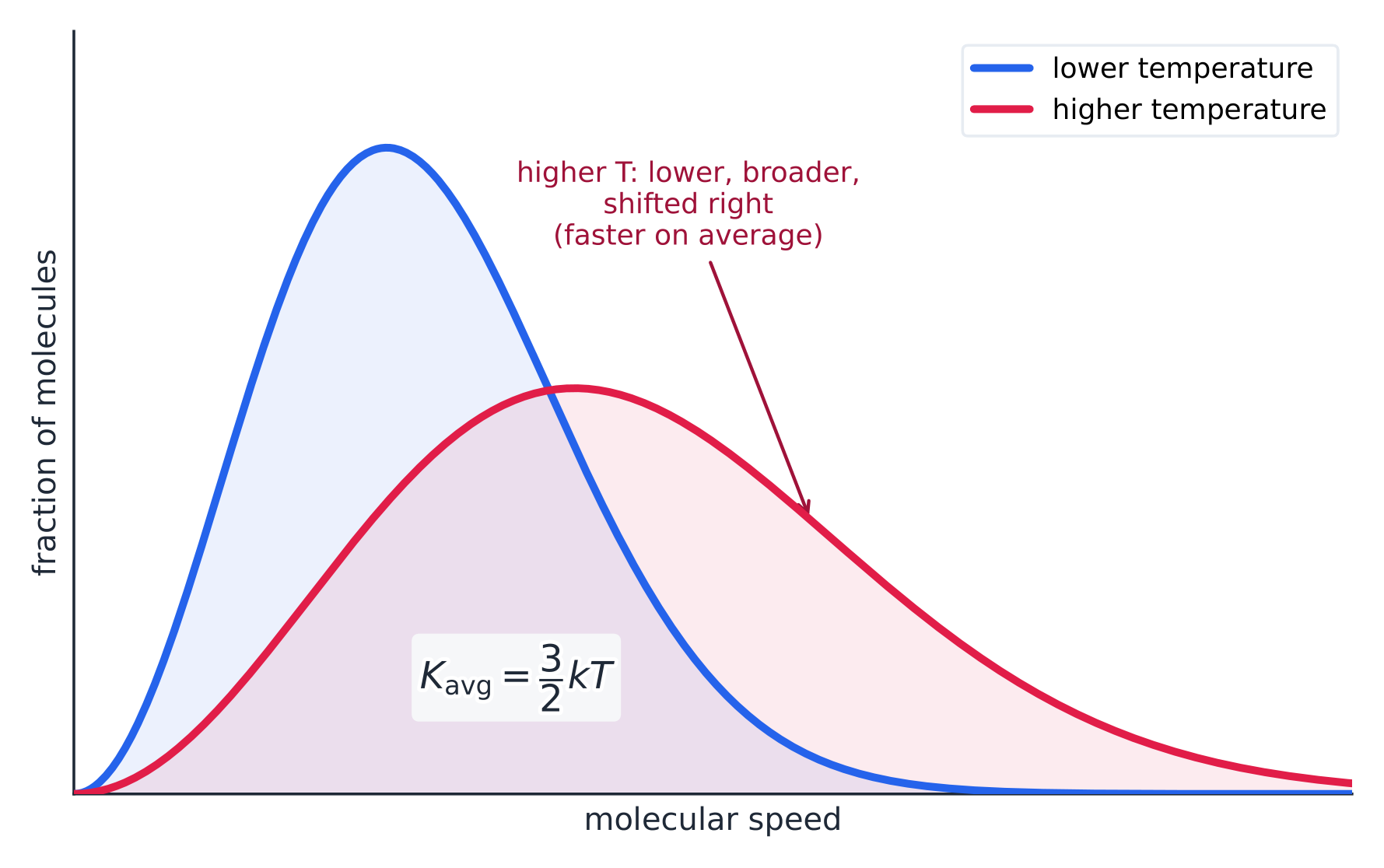
  • Temperature 温度 is a measure of the average kinetic energy of the molecules: $K_{\text{avg}}=\tfrac{3}{2}k_B T$ (with $T$ in kelvin). Hotter means faster-moving molecules.
  • Pressure 压强 comes from molecules colliding with the container walls – more frequent or harder collisions give more pressure.

Worked example. Find the average kinetic energy of a gas molecule at $300\ \text{K}$, using $k_B=1.38\times10^{-23}\ \text{J/K}$:

$$K_{\text{avg}}=\tfrac32 k_B T=1.5\times1.38\times10^{-23}\times300=6.2\times10^{-21}\ \text{J}.$$
It depends only on temperature, not on the type of gas – at the same $T$, light and heavy molecules share the same average kinetic energy (so the light ones move faster).

עברית
תורת הקינטיקה: לחץ גז

תרמודינמיקה לומדת חום ואנרגיה בקבוצות גדולות של חלקיקים. התורה הקינטית מסבירה את התנהגות הגז מתנועתו האקראית של המולקules שלו:

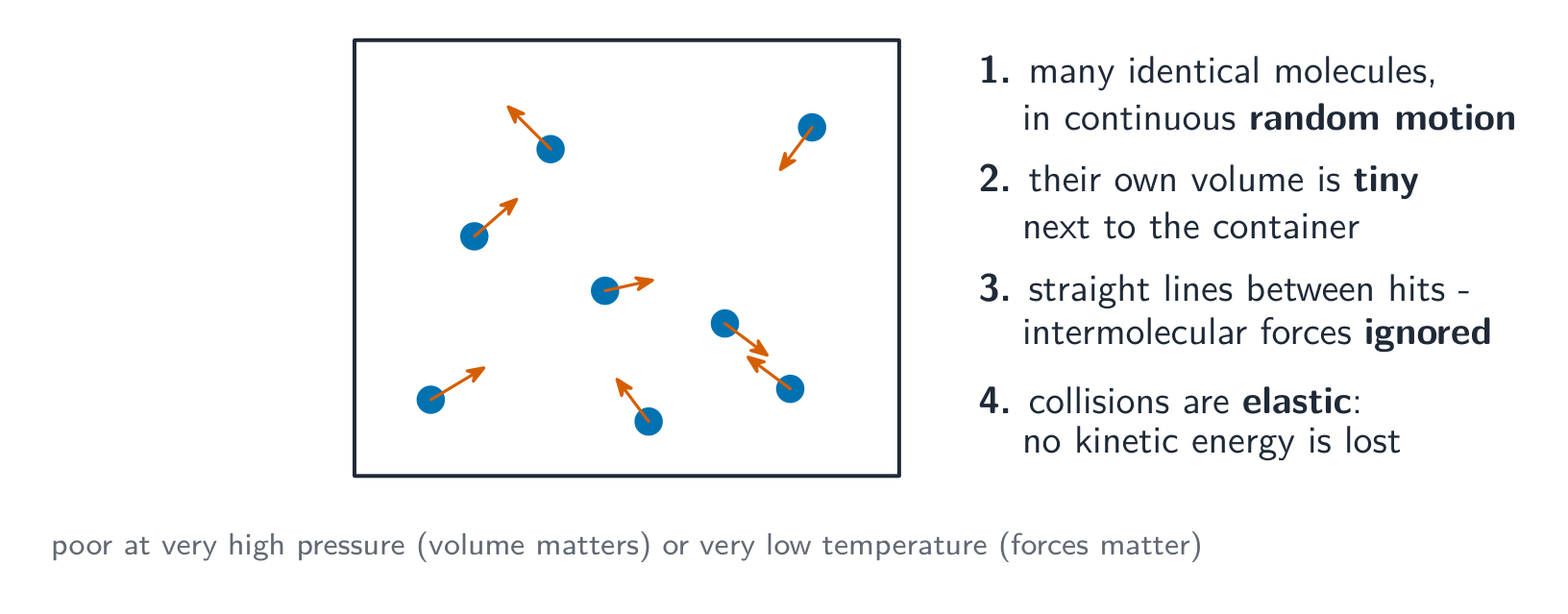
ההנחות המרכזיות בתורת המיקום של גז אידיאלי
ההנחות המרכזיות של תורת הקינטיקה עבור גז אידיאלי
  • טמפרטורה היא מדד לאנרגיה קינטית ממוצעת של המולקules: $K_{\text{avg}}=\tfrac{3}{2}k_B T$ (עם $T$ בקלווין). חם יותר פירושו מולקules הנעות מהר יותר.
  • לחץ נובע ממולקules הנפגעות עם דפנות המכל – פגיעות תכופות יותר או קשות יותר נותנות לחץ גבוה יותר.
התפלגות מהירות מקסוול-בולצמן זזה ימינה ומשטחת בחום גבוה יותר

דוגמה פותרת. מצא את האנרגיה הקינטית הממוצעת של מולקולת גז ב$300\ \text{K}$, על ידי שימוש ב$k_B=1.38\times10^{-23}\ \text{J/K}$:

$$K_{\text{avg}}=\tfrac32 k_B T=1.5\times1.38\times10^{-23}\times300=6.2\times10^{-21}\ \text{J}.$$
היא תלויה רק בטמפרטורה, ולא בסוג הגז – באותה $T$, מולקules קלות וכבדות חולקות אותה אנרגיה קינטית ממוצעת (ולכן הקלות נעות מהר יותר).

Explore · ⁨חקור⁩

Explore the spread of molecular speeds · ⁨חקור את התפוצץ מהירויות המולקולות⁩

Raise the temperature and watch the whole speed distribution shift right and flatten — the particles move faster on average, which is exactly what $\bar K = \tfrac{3}{2} k_B T$ means. · ⁨העלאת הטמפרטורה גורמת לכל עקומת ההתפלגות להזיז ימינה ולהתשטח — החלקיקים נעים במהירות ממוצעת גבוהה יותר, בדיוק מה ש$\bar K = \tfrac{3}{2} k_B T$ מייצג.⁩

Watch lesson · ⁨צפה בשיעור⁩
9.2

The Ideal Gas Law · ⁨חוק הגז האידיאלי⁩

Syllabus · ⁨סיילבוס⁩
English

Learning Objective 9.2.A: Describe the properties of an ideal gas.

  • 9.2.A.1 The classical model of an ideal gas assumes that the instantaneous velocities of atoms are random, the volumes of the atoms are negligible compared to the total volume occupied by the gas, the atoms collide elastically, and the only appreciable forces on the atoms are those that occur during collisions.
  • 9.2.A.2 An ideal gas is one in which the relationships between pressure, volume, the number of moles or number of atoms, and temperature of a gas can be modeled using the equation
    • Equation: $PV = nRT = N k_B T$
  • 9.2.A.3 Graphs modeling the pressure, temperature, and volume of gases can be used to describe or determine properties of that gas.
  • 9.2.A.4 A temperature at which an ideal gas has zero pressure can be extrapolated from a graph of pressure as a function of temperature.
עברית

מטרות למידה 9.2.A: לתאר את תכונות הגז האידיאלי.

  • 9.2.A.1 המודל הקלאסי של גז אידיאלי מניח שהמהירויות הרגעיות של אטומים הן אקראיות, נפחי האטומים זניחים בהשוואה לנפח הכולל שתופס הגז, האטומים מתנגשים אלסטית, והכוחים המשמעותיים היחידים הפועלים על האטומים הם אלו הנובעים מהתנגשויות.
  • 9.2.A.2 גז אידיאלי הוא גז שבו ניתן לדגם את הקשרים בין הלחץ, הנפח, מספר המולים או מספר האטומים, וטמפרטורת הגז באמצעות המשוואה
    • משוואה: $PV = nRT = N k_B T$
  • 9.2.A.3 גרפים המדמים את הלחץ, הטמפרטורה והנפח של גזים יכולים לשמש לתאר או לקבוע תכונות של הגז.
  • 9.2.A.4 טמפרטורה שבה לגז אידיאלי לחץ אפס ניתן להערכה מגרף של לחץ כפונקציה של טמפרטורה.

Source: College Board AP Course and Exam Description · ⁨מקור: תיאור הקורס והמבחן של College Board AP⁩

English

An ideal gas 理想气体 obeys

$$PV=nRT \qquad(\text{or } PV=Nk_B T),$$
linking pressure $P$, volume $V$, amount ($n$ moles or $N$ molecules), and absolute temperature $T$. Use it to predict how a gas responds when you change one quantity and hold others fixed (e.g. heating at constant volume raises pressure).

Worked example. A sealed rigid container of gas is at $1.0\times10^{5}\ \text{Pa}$ and $300\ \text{K}$. It is heated to $450\ \text{K}$. Because the volume and amount are fixed, $P/T$ is constant:

$$P_2=P_1\frac{T_2}{T_1}=1.0\times10^{5}\times\frac{450}{300}=1.5\times10^{5}\ \text{Pa}.$$
Always convert temperatures to kelvin before using a gas law – using Celsius here would give nonsense.

עברית
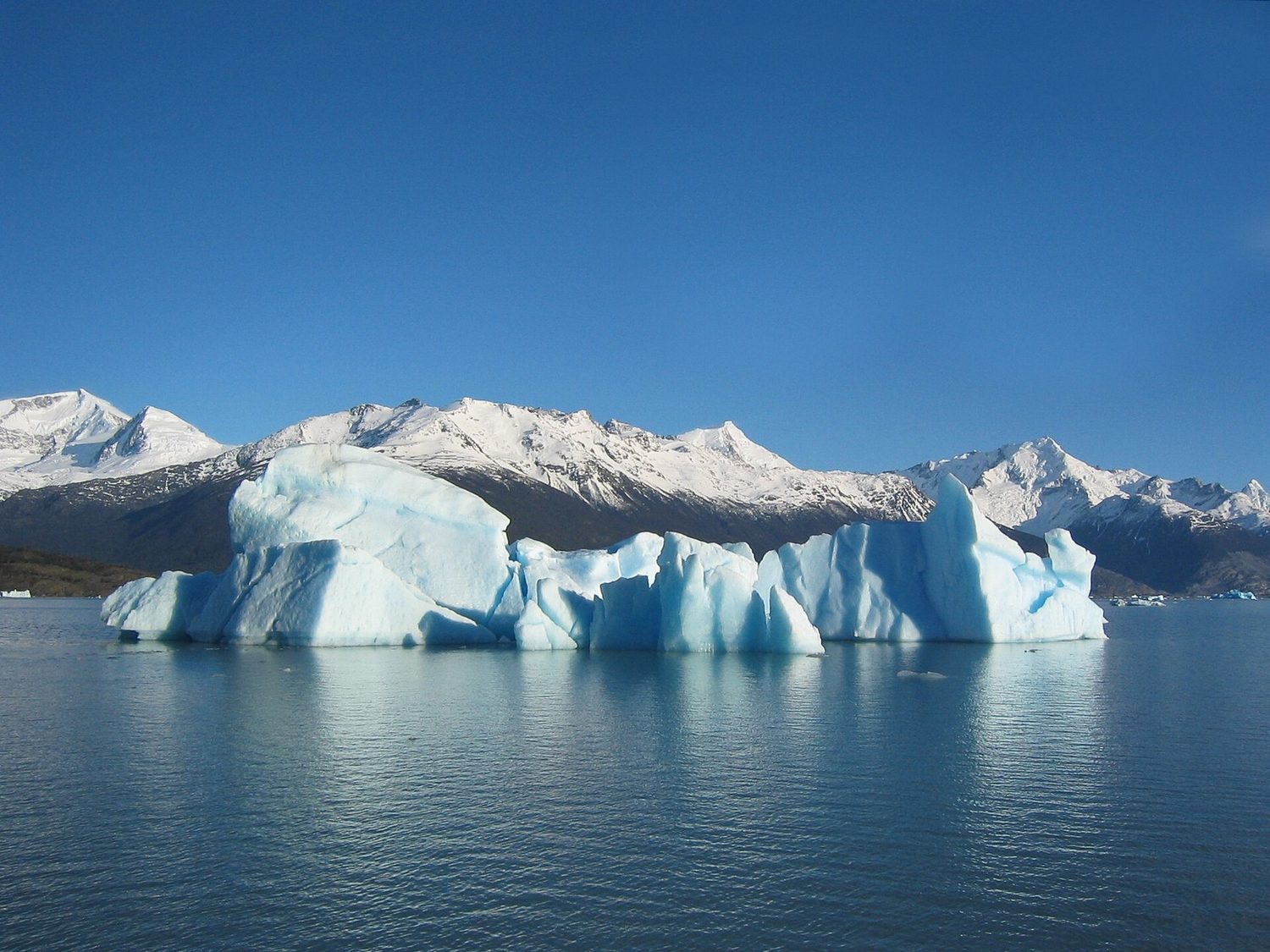
הר הרעבים: חום, צפיפות ושינויי פאזה מחברים תרמודינמיקה לנוזלים ולהצפה

גז אידיאלי מקיים

$$PV=nRT \qquad(\text{or } PV=Nk_B T),$$
קושרים בין לחץ $P$, נפח $V$, כמות ($n$ מולים או $N$ מולקules), וטמפרטורה מוחלטת $T$. השתמש בה כדי לחזות כיצד גז מגיב כאשר משנה כמות אחת ומחזיק את שאר הקבועות (למשל, חימום בנפח קבוע מעלה את הלחץ).

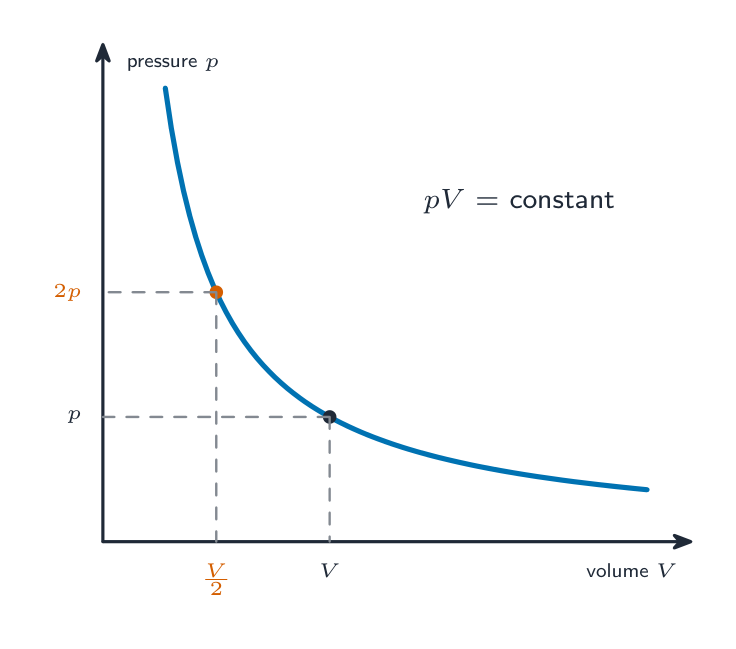
חוק בואיל: בטמפרטורה קבועה, מכפלת לחץ ונפח היא קבועה

דוגמה מופתרת. מיכל אטום וקשיח המכיל גז נמצא ב$1.0\times10^{5}\ \text{Pa}$ וב$300\ \text{K}$. הוא מתחמם ל$450\ \text{K}$. מכיוון שהנפח וכמות החומר קבועים, $P/T$ נשאר קבוע:

$$P_2=P_1\frac{T_2}{T_1}=1.0\times10^{5}\times\frac{450}{300}=1.5\times10^{5}\ \text{Pa}.$$
תמיד להמיר טמפרטורות לקלווין לפני שימוש בחוקי הגזים – השימוש בסלקיוס כאן יוביל לתוצאה חסרת משמעות.

בלון אוויר חם עולה לשמיים *חימום הגז בתוך בלון מפחית את צפיפותו, ולכן הבלון עולה – חוק הגז האידיאלי בפעולה
Explore · ⁨חקור⁩

Explore squeezing a gas · ⁨חקור דחיסה של גז⁩

Slide the piston in to shrink the volume. The same particles are crammed into less space, so they hit the walls more often and the pressure climbs — while $PV$ stays constant at fixed temperature. · ⁨הזז את הבוכנה פנימה כדי לצמצם את הנפח. אותם חלקיקים נלחצים לחלל קטן יותר, ולכן הם פוגעים בקירות תדירות יותר והלחץ עולה — בעוד ש$PV$ נשאר קבוע בטמפרטורה קבועה.⁩

Watch lesson · ⁨צפה בשיעור⁩
9.3

Thermal Energy Transfer and Equilibrium · ⁨העברת אנרגיה תרמית ואיזון⁩

Syllabus · ⁨סיילבוס⁩
English

Learning Objective 9.3.A: Describe the transfer of energy between two systems in thermal contact due to temperature differences of those two systems.

  • 9.3.A.1 Two systems are in thermal contact if the systems may transfer energy by thermal processes.
    • 9.3.A.1.i Heating is the transfer of energy into a system by thermal processes.
    • 9.3.A.1.ii Cooling is the transfer of energy out of a system by thermal processes.
  • 9.3.A.2 The thermal processes by which energy may be transferred between systems at different temperatures are conduction, convection, and radiation.
  • 9.3.A.3 Energy is transferred through thermal processes spontaneously from a higher-temperature system to a lower-temperature system.
    • 9.3.A.3.i In collisions between atoms from different systems, energy is most likely to be transferred from higher-energy atoms to lower-energy atoms.
    • 9.3.A.3.ii After many collisions of atoms from different systems, the most probable state is one in which both systems have the same temperature.
  • 9.3.A.4 Thermal equilibrium results when no net energy is transferred by thermal processes between two systems in thermal contact with each other.
עברית

מטרות למידה 9.3.A: לתאר את העברת האנרגיה בין שני מערכים במגע תרמי עקב הבדלי הטמפרטורה שלהם.

  • 9.3.A.1 שני מערכים נמצאים במגע תרמי אם ייתכן שהמערכים יעבירו אנרגיה באמצעות תהליכים תרמיים.
    • 9.3.A.1.i חימום הוא העברת אנרגיה אל מערכת על ידי תהליכים תרמיים.
    • 9.3.A.1.ii קירור הוא העברת אנרגיה מחוץ למערכת על ידי תהליכים תרמיים.
  • 9.3.A.2 התהליכים התרמיים באמצעותיהם אנרגיה יכולה לעבור בין מערכים בטמפרטורות שונות הם הולכה, סחיפה וקרניות.
  • 9.3.A.3 אנרגיה מועברת דרך תהליכים תרמיים באופן ספונטני ממערכת בעלת טמפרטורה גבוהה יותר למערכת בעלת טמפרטורה נמוכה יותר.
    • 9.3.A.3.i בהתנגשויות בין אטומים ממערכות שונות, הסבירות הגבוהה ביותר היא להעביר אנרגיה מאטומים בעלי אנרגיה גבוהה יותר לאטומים בעלי אנרגיה נמוכה יותר.
    • 9.3.A.3.ii לאחר מספר רב של התנגשויות של אטומים ממערכות שונות, המצב הסביר ביותר הוא מצב שבו לשתי המערכים יש אותה טמפרטורה.
  • 9.3.A.4 שיווי משקל תרמי נוצר כאשר אין העברה נטו של אנרגיה על ידי תהליכים תרמיים בין שני מערכים הנמצאים במגע תרמי זה עם זה.

Source: College Board AP Course and Exam Description · ⁨מקור: תיאור הקורס והמבחן של College Board AP⁩

English

Heat 热量 $Q$ is energy transferred because of a temperature difference; it flows from hot to cold. Two objects in contact reach thermal equilibrium 热平衡 when they share the same temperature, and net heat flow stops. The three transfer methods are conduction 传导, convection 对流, and radiation 辐射.

עברית

חום $Q$ הוא אנרגיה המועברת בשל הפרש טמפרטורות; הוא זורם מחם לקר. שני גופים במגע מגיעים לאיזון תרמי כאשר יש להם אותה טמפרטורה, והזרימה הנטו של החום נפסקת. שלושת שיטות ההעברה הן הולכה, הסעה וקרניזה.

Explore · ⁨חקור⁩

Add heat and watch the temperature · ⁨הוסף חום וצפה לטמפרטורה⁩

Adding heat usually raises temperature, but during a phase change the temperature holds flat while the energy breaks bonds. Two bodies in contact settle at one temperature — thermal equilibrium. · ⁨הוספת חום מעלה בדרך כלל את הטמפרטורה, אך במהלך שינוי מצב הטמפרטורה נשארת יציבה בעוד האנרגיה שוברת קשרים. שני גופים במגע מגיעים לאותה טמפרטורה — איזון תרמי.⁩

Watch lesson · ⁨צפה בשיעור⁩
9.4

The First Law of Thermodynamics · ⁨החוק הראשון של התרמודינמיקה⁩

Syllabus · ⁨סיילבוס⁩
English

Learning Objective 9.4.A: Describe the internal energy of a system.

  • 9.4.A.1 The internal energy of a system is the sum of the kinetic energy of the objects that make up the system and the potential energy of the configuration of those objects.
    • 9.4.A.1.i The atoms in an ideal gas do not interact with each other via conservative forces, and the internal structure is not considered. Therefore, an ideal gas does not have internal potential energy.
    • 9.4.A.1.ii The internal energy of an ideal monatomic gas is the sum of the kinetic energies of the constituent atoms in the gas.
      • Equation: $U = \dfrac{3}{2} nRT = \dfrac{3}{2} N k_B T$
  • 9.4.A.2 Changes to a system's internal energy can result in changes to the internal structure and internal behavior of that system without changing the motion of the system's center of mass.

Learning Objective 9.4.B: Describe the behavior of a system using thermodynamic processes.

  • 9.4.B.1 The first law of thermodynamics is a restatement of conservation of energy that accounts for energy transferred into or out of a system by work, heating, or cooling.
    • 9.4.B.1.i For an isolated system, the total energy is constant.
    • 9.4.B.1.ii For a closed system, the change in internal energy is the sum of energy transferred to or from the system by heating, or work done on the system.
      • Equation: $\Delta U = Q + W$
    • 9.4.B.1.iii The work done on a system by a constant or average external pressure that changes the volume of that system (for example, a piston compressing a gas in a container) is defined as
      • Equation: $W = -P \Delta V$
  • 9.4.B.2 Pressure-volume graphs (also known as PV diagrams) are representations used to represent thermodynamic processes.
    • 9.4.B.2.i Lines of constant temperature on a PV diagram are called isotherms.
    • 9.4.B.2.ii The absolute value of the work done on a gas when the gas expands or compresses is equal to the area underneath the curve of a plot of pressure vs. volume for the gas.
  • 9.4.B.3 Special cases of thermal processes depend on the relationship between the configuration of the system, the nature of the work done on the system, and the system's surroundings. These include constant volume (isovolumetric), constant temperature (isothermal), and constant pressure (isobaric), as well as processes where no energy is transferred to or from the system through thermal processes (adiabatic).
עברית

מטרות למידה 9.4.A: לתאר את האנרגיה הפנימית של מערכת.

  • 9.4.A.1 האנרגיה הפנימית של מערכת היא סכום האנרגיה הקינטית של הגופים המרכיבים את המערכת ואנרגיית הפוטנציאל של ההתארגנות של גופים אלו.
    • 9.4.A.1.i האטומים בגז אידיאלי אינם פועלים זה על זה באמצעות כוחות שימור, והמבנה הפנימי אינו נלקח בחשבון. לכן, לגז אידיאלי אין אנרגיית פוטנציאל פנימית.
    • 9.4.A.1.ii האנרגיה הפנימית של גז אידיאלי חד-אטומי היא סכום האנרגיות הקינטיות של האטומים המרכיבים אותו.
      • משוואה: $U = \dfrac{3}{2} nRT = \dfrac{3}{2} N k_B T$
  • 9.4.A.2 שינויים באנרגיה הפנימית של מערכת עשויים להוביל לשינויים במבנה הפנימי ובתנהגות הפנימית של המערכת מבלי לשנות את תנועת מרכז המסה שלה.

מטרות למידה 9.4.B: לתאר את התנהגות המערכת באמצעות תהליכים תרמודינמיים.

  • 9.4.B.1 החוק הראשון של התרמודינמיקה הוא ניסוח חוזר של שימור האנרגיה שמביא בחשבון אנרגיה שהועברה אל או מחוץ למערכת דרך עבודה, חימום או קירור.
    • 9.4.B.1.i עבור מערכת מבודדת, האנרגיה הכוללת היא קבועה.
    • 9.4.B.1.ii עבור מערכת סגורה, השינוי באנרגיה פנימית הוא הסכום של האנרגיה שהועברה למערכת או ממנה בחימום, או העבודה שנעשתה על המערכת.
      • משוואה: $\Delta U = Q + W$
    • 9.4.B.1.iii העבודה שנעשתה על מערכת על ידי לחץ חיצוני קבוע או ממוצע המשנה את נפח המערכת (למשל, בוכנה הדוחסת גז במיכל) מוגדרת כ
      • משוואה: $W = -P \Delta V$
  • 9.4.B.2 גרפים של לחץ-נפח (הידועים גם כדיאגרמות PV) הם ייצוגים המשמשים לייצוג תהליכים טרמודינמיים.
    • 9.4.B.2.i קווים של טמפרטורה קבועה בתרשים PV נקראים איזותרמות.
    • 9.4.B.2.ii הערך המוחלט של העבודה שנעשתה על גז כאשר הגז מתרחב או דוחס שווה לשטח מתחת לעקומה של פלט של לחץ מול נפח עבור הגז.
  • 9.4.B.3 מקרים מיוחדים של תהליכים תרמיים תלויים בקשר בין תצורת המערכת, אופי העבודה הנעשית על המערכת והסביבה שלה. כוללים נפח קבוע (איזובולי), טמפרטורה קבועה (איזותרמי), ולחץ קבוע (איזוברי), כמו גם תהליכים בהם לא מועבר אנרגיה למערכת או ממנה באמצעות תהליכים תרמיים (אדיאבטי).

Source: College Board AP Course and Exam Description · ⁨מקור: תיאור הקורס והמבחן של College Board AP⁩

English

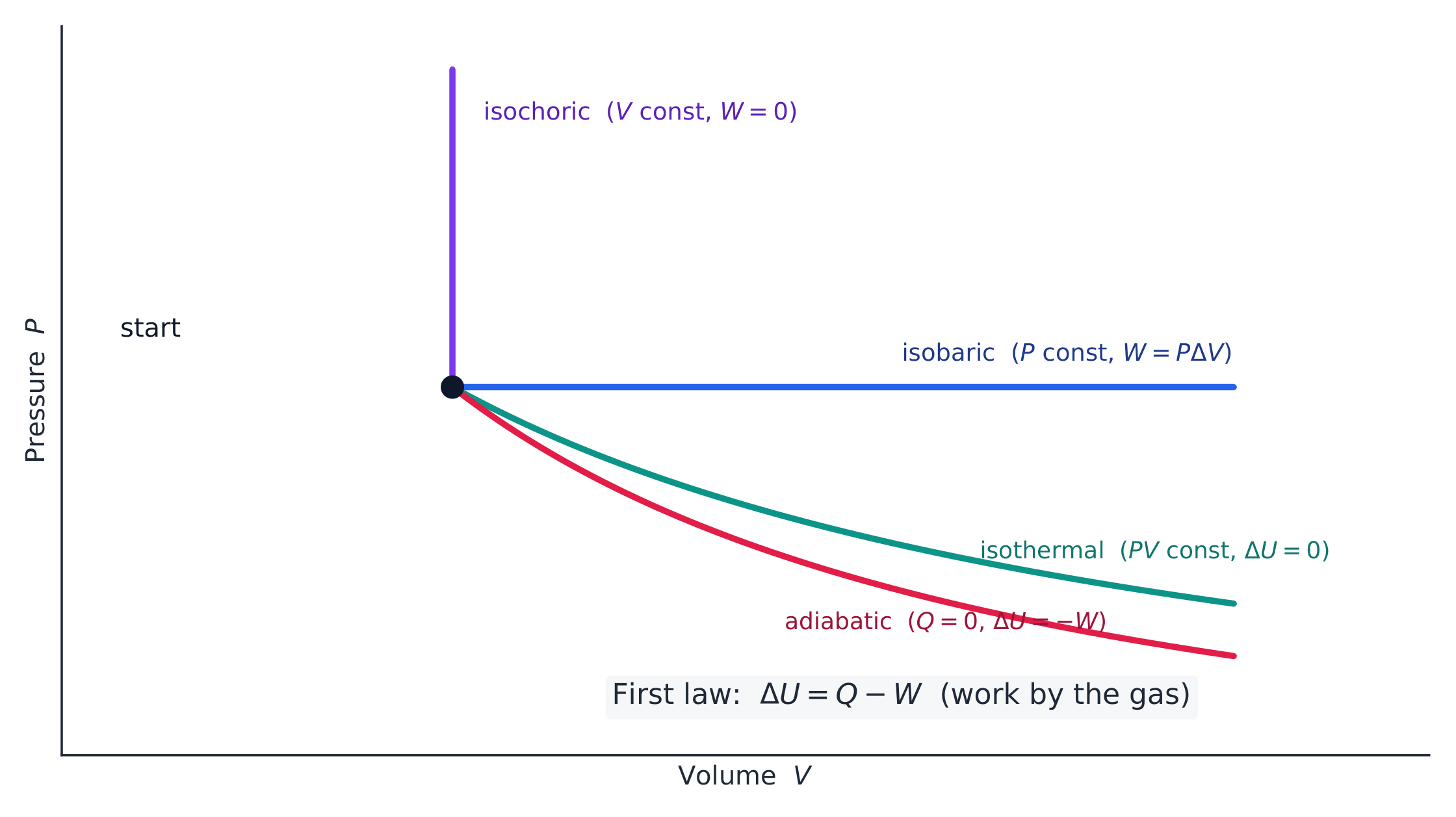
The first law 热力学第一定律 is conservation of energy for a gas:

$$\Delta U = Q + W,$$
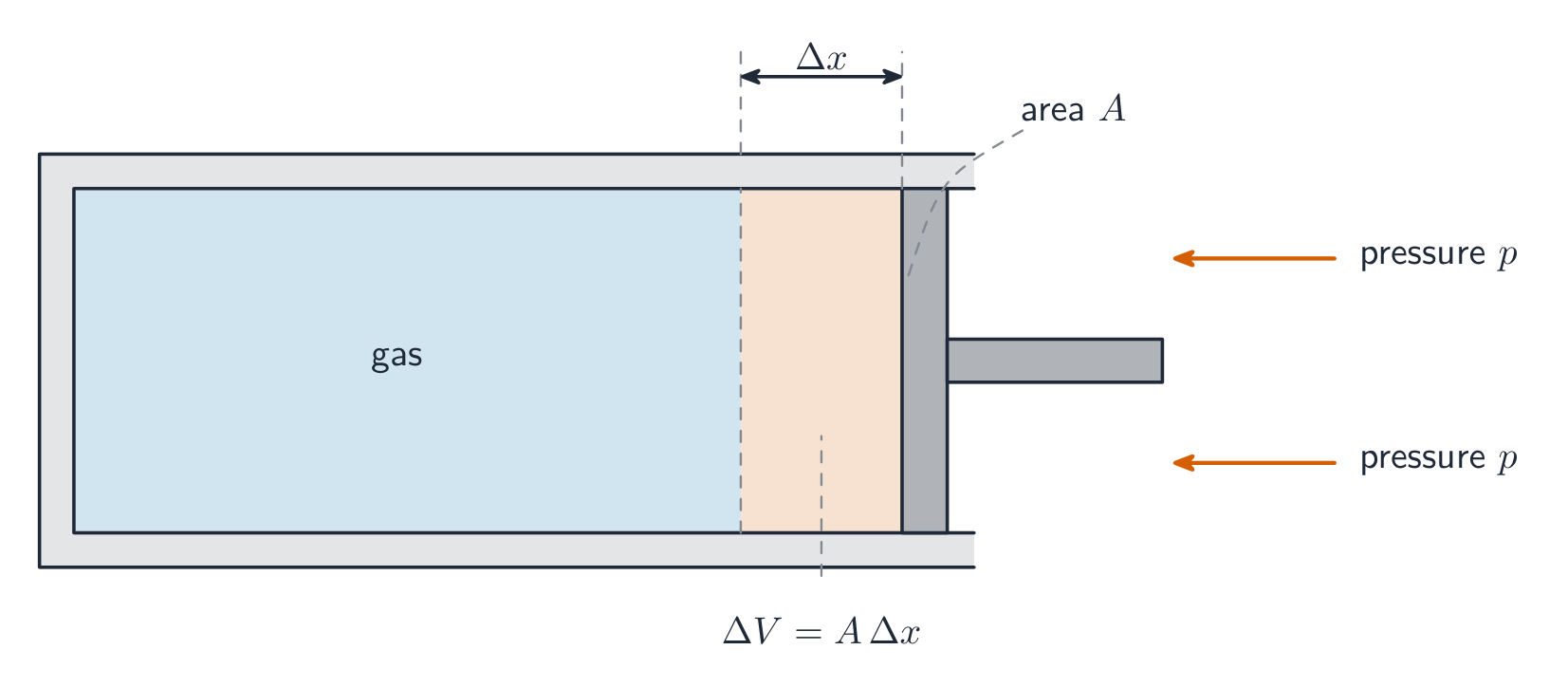
where $\Delta U$ is the change in internal energy 内能 (tied to temperature), $Q$ is heat added to the gas, and $W$ is work done on the gas. On a pressure–volume diagram, the work done by the gas is the area under the process curve. Watch signs: compressing a gas does positive work on it.

Worked example. A gas absorbs $500\ \text{J}$ of heat and, as it expands, does $200\ \text{J}$ of work on its surroundings. Find the change in its internal energy. Work done on the gas is $W=-200\ \text{J}$ (it does work, so it loses that energy):

$$\Delta U=Q+W=500+(-200)=300\ \text{J}.$$
The internal energy rises by $300\ \text{J}$, so the gas ends up hotter. Getting the sign of $W$ right is the whole game in first-law problems.

עברית

החוק הראשון הוא שימור האנרגיה עבור גז:

$$\Delta U = Q + W,$$
כאן $\Delta U$ הוא השינוי באנרגיה פנימית (קשור לטמפרטורה), $Q$ הוא החום שהוסף לגז, ו$W$ הוא העבודה שנעשה עלגז. בגרף לחץ–נפח, העבודה שנעשה על ידיגז היא השטח מתחת לעקבת התהליך. לשים לב למינים: דחיסת גז מבצעת עבודה חיובית עליו.

גז דוחף בוכנה החוצה למרחק קטן ועושה עבודה השווה ל-p כפול השינוי בנפח *גז דוחף בוכנה החוצה למרחק קטן ועושה עבודה השווה ל-p כפול השינוי בנפח

ארבעת תהליכי הטרמודינמיקה שגורמו ממצב התחלתי משותף בגרף PV *ארבעת תהליכי התרמודינמיקה מצוירים ממצב התחלה משותף בגרף PV
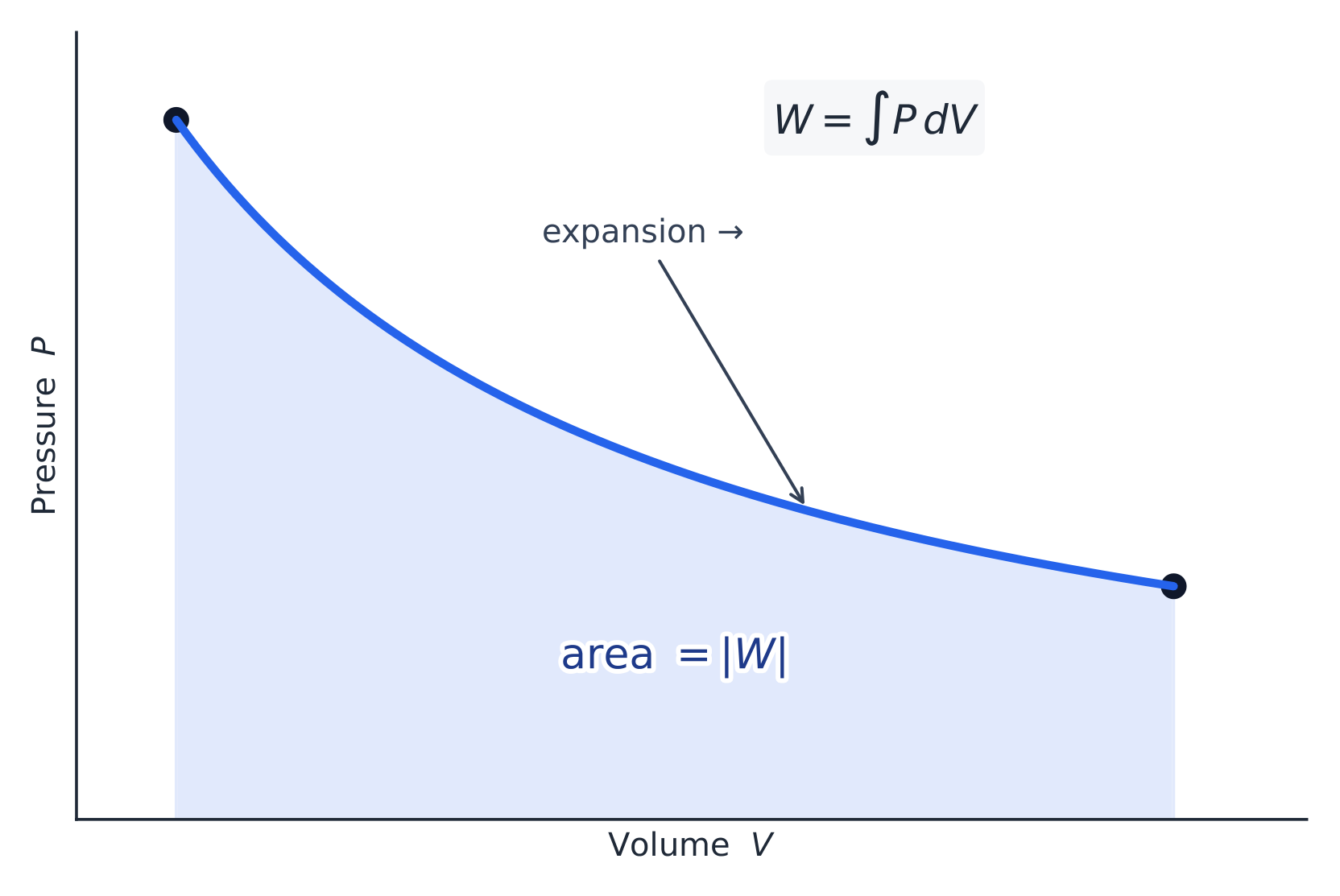
העבודה שנעשתה במהלך שינוי נפח שווה לשטח מתחת לעקומת P-V *העבודה שנעשה במהלך שינוי נפח שווה לשטח מתחת לעקבת P-V
דוגמה מודגמת. גז סופג $500\ \text{J}$ של חום ועוד, בזמן התפשטותו, מבצע $200\ \text{J}$ של עבודה על הסביבה. מצא את השינוי באנרגיה הפנימית שלו. עבודה שנעשה על הגז היא $W=-200\ \text{J}$ (הוא מבצע עבודה, ולכן מאבד את האנרגיה הזאת):

$$\Delta U=Q+W=500+(-200)=300\ \text{J}.$$
האנרגיה הפנימית עולה ב-$300\ \text{J}$, ולכן הגז מסתיים חם יותר. קביעת סימן נכונה ל$W$ היא כל הקושי בבעיות החוק הראשון.

9.5

Specific Heat and Thermal Conductivity · ⁨חום ספציפי ומוליכות תרמית⁩

Syllabus · ⁨סיילבוס⁩
English

Learning Objective 9.5.A: Describe the energy required to change the temperature of an object by a certain amount.

  • 9.5.A.1 The amount of energy required to change the temperature of a material is related to the material's specific heat.
    • Equation: $Q = mc\Delta T$
  • 9.5.A.2 The specific heat of a material is an intrinsic property of that material that depends on the arrangement and interactions of the atoms that make up the material.

Learning Objective 9.5.B: Describe the rate at which energy is transferred by conduction through a given material.

  • 9.5.B.1 The rate at which energy is transferred by conduction through a given material is related to the thermal conductivity, the physical dimensions of the material, and the temperature difference across the material.
    • Equation: $\dfrac{Q}{\Delta t} = \dfrac{kA\Delta T}{L}$
  • 9.5.B.2 The thermal conductivity of a material is an intrinsic property of that material that depends on the arrangement and interactions of the atoms that make up the material.

Boundary statement: AP Physics 2 will model specific heat as independent of temperature.

עברית

מטרות למידה 9.5.A: לתאר את האנרגיה הדרושה לשינוי הטמפרטורה של גוף בכמות מסוימת.

  • 9.5.A.1 כמות האנרגיה הדרושה לשינוי הטמפרטורה של חומר קשורה לחום הספציפי שלו.
    • משוואה: $Q = mc\Delta T$
  • 9.5.A.2 החום הספציפי של חומר הוא תכונה מהותית שלו התלויה בסידור ובאינטראקציות של האטומים המרכיבים אותו.

מטרות למידה 9.5.B: לתאר את הקצב שבו אנרגיה מועברת על ידי הולכה בחומר נתון.

  • 9.5.B.1 הקצב שבו אנרגיה מועברת על ידי הולכה בחומר נתון קשור למוליכות התרמית, לממדים הפיזיים של החומר ולפרש הטמפרטורות בצדדים השונים של החומר.
    • משוואה: $\dfrac{Q}{\Delta t} = \dfrac{kA\Delta T}{L}$
  • 9.5.B.2 המוליכות התרמית של חומר היא תכונה מהותית שלו התלויה בסידור ובאינטראקציות של האטומים המרכיבים אותו.

הצהרת גבול: AP Physics 2 ידגים חום ספציפי כבלתי תלוי בטמפרטורה.

Source: College Board AP Course and Exam Description · ⁨מקור: תיאור הקורס והמבחן של College Board AP⁩

English
  • Specific heat 比热容 $c$ is the heat needed to raise one kilogram by one degree: $Q=mc\,\Delta T$. A high specific heat (like water's) means a substance resists temperature change.
  • Thermal conductivity 热导率 measures how fast heat conducts through a material; the rate of conduction rises with area and temperature difference and falls with thickness.

Worked example. How much heat raises the temperature of $2.0\ \text{kg}$ of water from $20\,{}^{\circ}\text{C}$ to $80\,{}^{\circ}\text{C}$? Water's specific heat is $c=4200\ \text{J/(kg}\,{}^{\circ}\text{C)}$:

$$Q=mc\,\Delta T=2.0\times4200\times(80-20)=5.0\times10^{5}\ \text{J}.$$
Water's large specific heat is why it is used as a coolant and why coastal climates are mild.

עברית
  • חום ספציפי $c$ הוא החום הנדרש כדי להעלות טמפרטורה של קילוגרם אחד בדרגה אחת: $Q=mc\,\Delta T$. חום ספציפי גבוה (כמו של מים) מעיד על כך שחומר מתנגד לשינוי טמפרטורה.
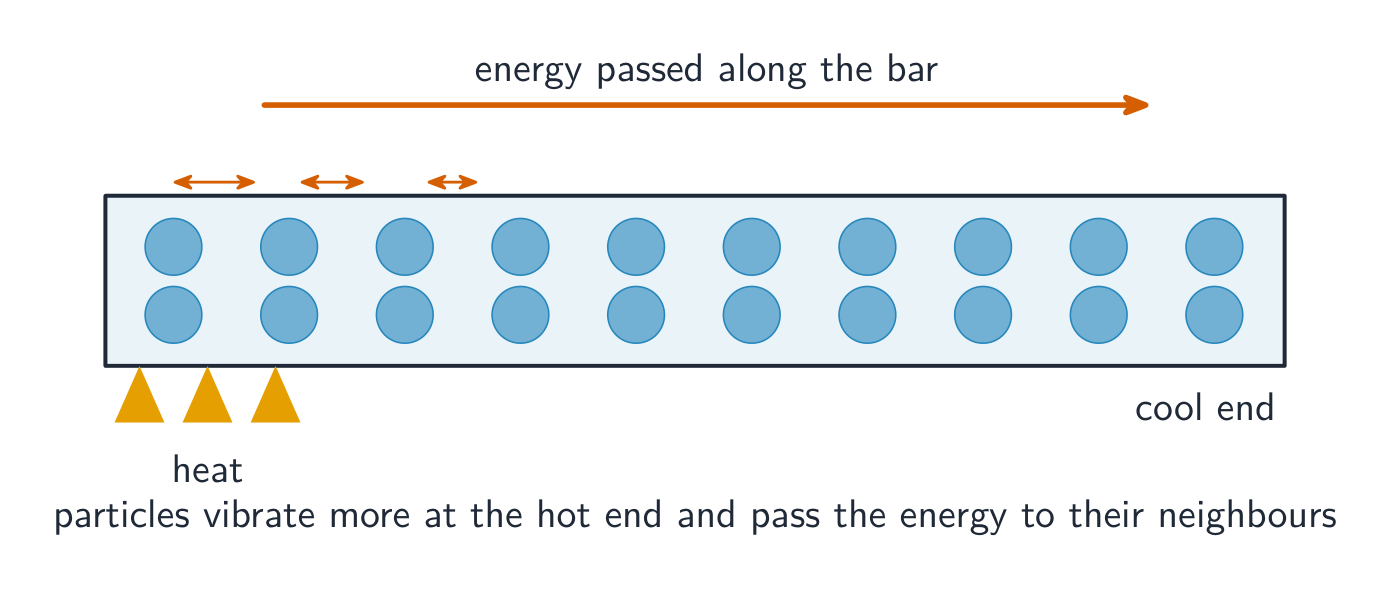
  • מוליכות תרמית מודדת כמה מהר החום מוליך דרך חומר; קצב ההולכה עולה עם שטח והפרש טמפרטורות ויורד עם עובי.
הולכה: חלקיקים רועדים מעבירים אנרגיה לאורך מוט מתכת

דוגמה מופרדת. כמה חום מעלה את הטמפרטורה של $2.0\ \text{kg}$ מים מ-$20\,{}^{\circ}\text{C}$ ל-$80\,{}^{\circ}\text{C}$? החום הספציפי של המים הוא $c=4200\ \text{J/(kg}\,{}^{\circ}\text{C)}$:

$$Q=mc\,\Delta T=2.0\times4200\times(80-20)=5.0\times10^{5}\ \text{J}.$$
החום הספציפי הגבוה של המים הוא הסיבה לכך שהוא משמש כנוזל קירור ולכן אקלים חופי הוא מתון.

Explore · ⁨חקור⁩

Explore how much energy heats a material · ⁨חקור כמה אנרגיה מחממת חומר⁩

Pick a material, set the mass and temperature rise, and read the energy from $Q = mc\,\Delta T$. Water needs far more energy than the metals to warm by the same amount. · ⁨בחר חומר, הגדר מסה ועליית טמפרטורה, וקרא את האנרגיה מ$Q = mc\,\Delta T$. מים דורשים הרבה יותר אנרגיה ממתכות כדי להתחמם באותה מידה.⁩

Vocabulary · ⁨מילון מונחים⁩ Train · ⁨אימון⁩
English עברית
Thermodynamics/ˌθɜːməʊdaɪˈnæmɪks/ תרמודינמיקה
kinetic theory/kɪˈnetɪk ˈθɪəri/ תאוריה קינטית
Temperature/ˈtemprɪtʃə/ טמפרטורה
Pressure/ˈpreʃə/ לחץ
ideal gas/aɪˈdɪəl ɡæs/ גז אידיאלי
Heat/hiːt/ חום
thermal equilibrium/ˈθɜːml ˌiːkwɪˈlɪbrɪəm/ איזון תרמי
conduction/kənˈdʌkʃn/ הולכה
convection/kənˈvekʃn/ הסעה
radiation/ˌreɪdɪˈeɪʃn/ קרנית
first law/fɜːst lɔː/ חוק ראשון
internal energy/ɪnˈtɜːnl ˈenədʒi/ אנרגיה פנימית
Specific heat/spəˈsɪfɪk hiːt/ חום ספציפי
Thermal conductivity/ˈθɜːml kɒndəkˈtɪvɪti/ מוליכות תרמית
Entropy/ˈentrəpi/ אנטרופיה
second law/ˈsekənd lɔː/ חוק שני
Watch lesson · ⁨צפה בשיעור⁩
9.6

Entropy and the Second Law of Thermodynamics · ⁨אנטרופיה וחוק השני של התרמודינמיקה⁩

Syllabus · ⁨סיילבוס⁩
Learning ObjectiveEssential Knowledge

9.6.A
Describe the change in entropy for a given system over time.

  • 9.6.A.1 The second law of thermodynamics states that the total entropy of an isolated system can never decrease and is constant only when all processes the system undergoes are reversible.
  • 9.6.A.2 Entropy can be qualitatively described as the tendency of energy to spread or the unavailability of some of the system's energy to do work.
    • 9.6.A.2.i Localized energy will tend to disperse and spread out.
    • 9.6.A.2.ii Entropy is a state function and therefore only depends on the current state or configuration of a system, not how the system reached that state.
    • 9.6.A.2.iii Maximum entropy occurs when a system is in thermodynamic equilibrium.
  • 9.6.A.3 The change in a system's entropy is determined by the system's interactions with its surroundings.
    • 9.6.A.3.i Isolated systems spontaneously move toward thermodynamic equilibrium.
    • 9.6.A.3.ii The entropy of an isolated system never decreases, but the entropy of a closed system can decrease because energy can be transferred into or out of the system.

Boundary statement: Only qualitative treatment of the second law of thermodynamics is within the scope of AP Physics 2.

Source: College Board AP Course and Exam Description · ⁨מקור: תיאור הקורס והמבחן של College Board AP⁩

English

Entropy 熵 measures the disorder, or the number of ways to arrange, a system. The second law 热力学第二定律: the total entropy of an isolated system never decreases – energy naturally spreads out. This sets the direction of processes: heat flows hot→cold on its own, never the reverse, and no engine can convert heat entirely into work.

עברית

אנטרופיה מדודת את האי-סדר או את מספר האפשרויות לסידור, של מערכת. החוק השני: האנטרופיה הכוללת של מערכת מבודדת לעולם לא יורדת – אנרגיה מתפשטת באופן טבעי. דבר זה קובע את ה-כיוון של תהליכים: חום זורם מחם לקר באופן עצמאי, לעולם לא להפך, ואף מנוע אינו יכול להפוך חום לחלוטין לעבודה.

9.6

Exam tips · ⁨טיפים לבחינות⁩

English
  • Always convert temperatures to kelvin ($T_{\text{K}}=T_{\text{C}}+273$) before using any gas law.
  • In the first law $\Delta U = Q + W$, get the sign of $W$ right: work done on the gas is positive; when the gas expands and does work on its surroundings, $W$ is negative.
  • Temperature measures the average kinetic energy of particles, so at the same $T$ lighter molecules move faster.
  • On a PV diagram the work done by the gas is the area under the process curve.
  • Use $Q=mc\,\Delta T$ for temperature change; the second law fixes the direction — heat flows hot→cold and total entropy never decreases.
עברית
  • תמיד יש להמיר טמפרטורות ל-קלวิน ($T_{\text{K}}=T_{\text{C}}+273$) לפני השימוש בכל חוק גזים.
  • בחוק הראשון $\Delta U = Q + W$, יש לקבל נכון את הסימן של $W$: עבודה שנעשתה על הגז היא חיובית; כאשר הגז מתרחב ועושה עבודה על הסביבה שלו, $W$ הוא שלילי.
  • טמפרטורה מדדת את האנרגיה הקינטית הממוצעת של חלקיקים, כך שבאותה $T$ מולקולות קלות יותר נעות מהר יותר.
  • בגרף PV, העבודה שנעשתה על ידי הגז היא ה-שטח מתחת לעקומת התהליך.
  • השתמש ב-$Q=mc\,\Delta T$ לשינוי בטמפרטורה; החוק השני קובע את הכיוון – חום זורם מחם לקר והאנטרופיה הכוללת לעולם לא יורדת.

Interactive lessons on this topic · ⁨שיעורים אינטראקטיביים בנושא זה⁩

Work through it step by step, with instant-check exercises. · ⁨לעבור על הדברים צעד אחר צעד, עם תרגילים לבדיקה מיידית.⁩

Past Papers · ⁨מבחני עבר⁩

More topics in AP Physics 2 · ⁨פיזיקה AP 2⁩ · ⁨נושאים נוספים בAP Physics 2 · ⁨פיזיקה AP 2⁩⁩

Log in or create account · ⁨היכנס או צור חשבון⁩

IGCSE, A-Level & AP