Skip to content · ⁨דלג לתוכן⁩

Geometric Optics · ⁨אופטיקה גיאומטרית⁩

AP Physics 2 · ⁨פיזיקה AP 2⁩ · Topic 13 · ⁨נושא 13⁩

Video lesson for this topic · ⁨שיעור וידאו לנושא זה⁩ Open the video page · ⁨פתח את עמוד הוידאו⁩
9:32

אופטיקה גיאומטרית

הכנס עיפרון ישר לכוס מים, והוא נראה שבור. הצב את עצמך לתוך הקערה של כף זהב, והפנים שלך תהפוך הפוכות. אין דבר מעוות, ואין דבר…

English narration · English + 中文 subtitles burned in · ⁨קריאת קול באנגלית · תרגום אנגלי + סינית שרוף בתוך הסרטון⁩

13.1

Reflection · ⁨השתקפות⁩

Syllabus · ⁨סיילבוס⁩
English

Learning Objective 13.1.A: Describe light as a ray.

  • 13.1.A.1 A light ray is a straight line that is perpendicular to the wavefront of a light wave and points in the direction of travel of the wave.
    • 13.1.A.1.i Light rays can be used to determine the behavior of light in geometric optics, where the wave nature of light can be neglected.
    • 13.1.A.1.ii Rays are not sufficient to understand the spreading of light. In interference and diffraction, the wave nature of the light is important.
    • 13.1.A.1.iii A laser is a common source of a single coherent, monochromatic beam of light that can be modeled as a ray. The wave nature of lasers will be considered in Unit 14.
  • 13.1.A.2 Ray diagrams depict the path of light before and after an interaction with matter.

Learning Objective 13.1.B: Describe the reflection of light from a surface.

  • 13.1.B.1 Light that is incident on a surface can be reflected.
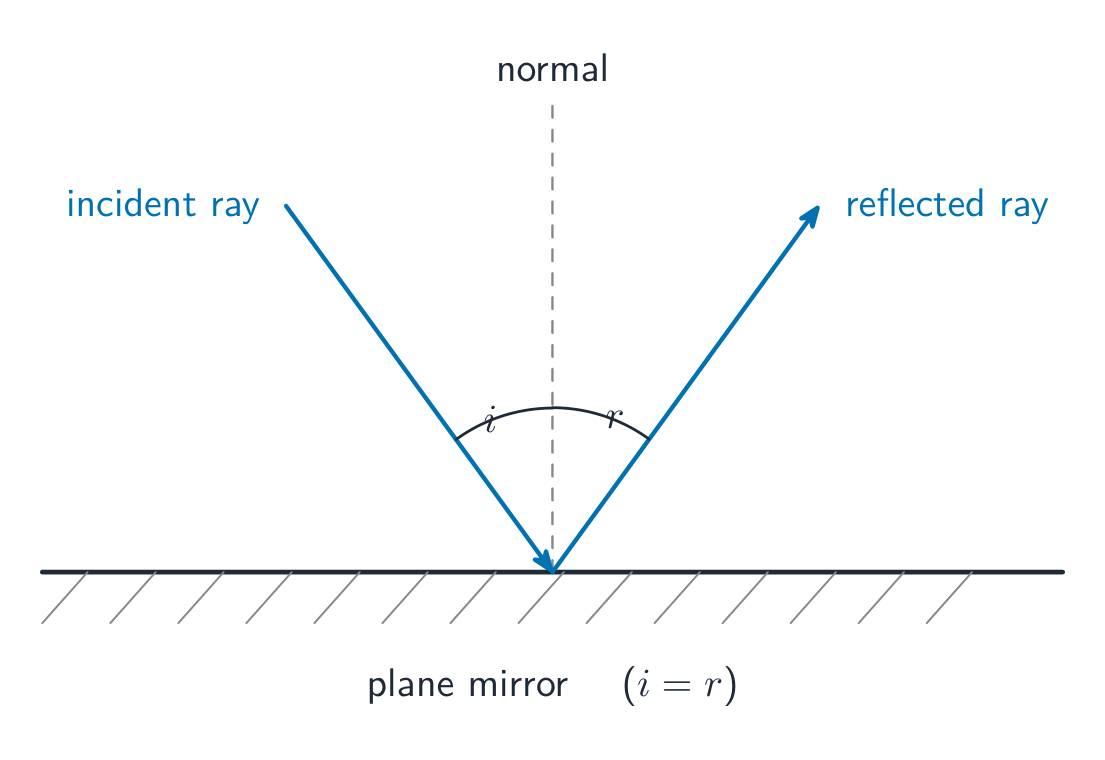
  • 13.1.B.2 The law of reflection states that the angle between the incident ray and the normal (the line perpendicular to the surface) is equal to the angle between the reflected ray and the normal.
    • Equation: $\theta_i = \theta_r$
  • 13.1.B.3 Diffuse reflection is the reflection of light from a rough surface and results in light reflected in many different directions, because the line normal to the surface varies over the area over which the light is incident.
  • 13.1.B.4 Specular reflection is the reflection of light from a smooth surface and results in light uniformly reflected from the surface, because the line normal to the surface has an approximately constant direction over the area the light strikes.
עברית

מטרת הלמידה 13.1.A: תאר אור כקרן.

  • 13.1.A.1 קרן אור היא ישר הנמצא בניצב למחזית הגל של גל אור ומצביע לכיוון התנועה של הגל.
    • 13.1.A.1.i ניתן להשתמש בקרני אור כדי לקבוע את התנהגות האור באופטיקה גיאומטרית, שבה ניתן להתעלם מהטבע הגלי של האור.
    • 13.1.A.1.ii קרניים אינן מספיקות להבנת התפשטות האור. בהתאכזבות ובפיזור, הטבע הגלי של האור הוא חשוב.
    • 13.1.A.1.iii לייזר הוא מקור נפוץ לקרן אור אחת קוהרנטית ומונוכרמטית שאפשר לדגמן כקרן. הטבע הגלי של הלייזרים ידון ביחידה 14.
  • 13.1.A.2 דיאגרמות קרנים מציגות את מסלול האור לפני ואחרי אינטראקציה עם חומר.

מטרת הלמידה 13.1.B: תאר את החזרת האור מפני משטח.

  • 13.1.B.1 אור הפוגע במשטח יכול להיות מוחזר.
  • 13.1.B.2 חוק ההחזרה קובע כי הזווית בין הקרן הפוגעת לבין הנורמל (הישר הנמצא בניצב למשטח) שווה לזווית בין הקרן המוחזרת לבין הנורמל.
    • משוואה: $\theta_i = \theta_r$
  • 13.1.B.3 החזרה פיזורית היא החזרת אור ממשטח מחוספס וגורמת לאור להחזיר בכיוונים שונים רבים, מכיוון שהנורמל למשטח משתנה על פני השטח עליו פוגע האור.
  • 13.1.B.4 החזרה ספקולרית היא החזרת אור ממשטח חלק וגורמת לאור להחזיר באופן אחיד מהמשטח, מכיוון שהנורמל למשטח בעלת כיוון קבוע בקירוב על פני השטח שעליו פוגע האור.
Source: College Board AP Course and Exam Description · ⁨מקור: תיאור הקורס והמבחן של College Board AP⁩

English

Geometric optics 几何光学 treats light as straight-line rays. The law of reflection 反射定律: when light bounces off a surface, the angle of incidence 入射角 equals the angle of reflection 反射角, both measured from the normal (the line perpendicular to the surface). Smooth surfaces reflect a clear image; rough surfaces scatter the rays.

עברית

אופטיקה גיאומטרית טיפלת באור כקרניים ישרות. חוק ההשתקפות: כאשר אור קופץ מפני שטח, זווית הפגיעה שווה לזווית ההשתקפות, שתיהן נמדדות ביחס לנורמל (הקו האנכי לפני השטח). משטחים חלקים משקפים תמונה ברורה; משטחים מחוספסים מפזרים את הקרניים.

חוק ההשתקפות: זווית הפגיעה שווה לזווית ההשתקפות
Watch lesson · ⁨צפה בשיעור⁩
13.2

Images Formed by Mirrors · ⁨תמונות שנוצרות על ידי מראות⁩

Syllabus · ⁨סיילבוס⁩
English

Learning Objective 13.2.A: Describe the image formed by a mirror.

  • 13.2.A.1 Incident light rays parallel to the principal axis of a concave (converging) mirror will be reflected toward a common location, called the focal point.
  • 13.2.A.2 Incident light rays parallel to the principal axis of a convex (diverging) mirror will be reflected such that they appear to have originated from a common location behind the mirror, called the focal point.
  • 13.2.A.3 The focal point of a plane mirror is an infinite distance from the mirror.
  • 13.2.A.4 The focal point of a spherical mirror may be approximated as a point located on the principal axis of the mirror halfway between the surface of the mirror and the center of the mirror's radius of curvature.
  • 13.2.A.5 A real image is formed by a mirror when light rays emanating from a common point are reflected and then intersect at a common point.
  • 13.2.A.6 A virtual image is formed by a mirror when reflected light rays diverge such that they appear to have originated from a common point.
  • 13.2.A.7 The location of an image depends on the focal length of the mirror and the distance between the object and the surface of the mirror.
    • Equation: $\dfrac{1}{s_i} + \dfrac{1}{s_o} = \dfrac{1}{f}$
    • 13.2.A.7.i The locations of a mirror's focal point, an object near the mirror, and the image of the object formed by the mirror follow sign conventions that are used to determine those locations relative to the mirror itself.
    • 13.2.A.7.ii The distance between the image formed and a plane mirror is equal to the distance between the object and the plane mirror.
  • 13.2.A.8 The magnification of an image formed by a mirror is the ratio of the size of the image produced to the size of the object itself and depends on the locations of the object and image relative to the mirror.
    • Equation: $|M| = \left| \dfrac{h_i}{h_o} \right| = \left| \dfrac{s_i}{s_o} \right|$
  • 13.2.A.9 Ray diagrams can be used to determine the location, type, size, and orientation of images formed by mirrors.
    • 13.2.A.9.i The three principal rays are typically used to find the images formed by mirrors. The principal rays are 1) the ray parallel to the principal axis, 2) the ray that reflects at the center of the mirror where the principal axis intersects the mirror, and 3) the ray that passes through the focal point of the mirror.
    • 13.2.A.9.ii Images formed by a mirror can be upright or inverted, virtual or real, and reduced, enlarged, or the same size as the object.

Boundary statement: AP Physics 2 limits the study of mirrors to plane mirrors, convex spherical mirrors, and concave spherical mirrors.

עברית

מטרת הלמידה 13.2.A: תאר את התמונה שנוצרה על ידי מראה.

  • 13.2.A.1 קרני אור הפוגעות מקבילות לציר הראשי של מראה קעורה (מאירה) יוחזרו אל נקודה משותפת הנקראת נקודת המוקד.
  • 13.2.A.2 קרני אור הפוגעות מקבילות לציר הראשי של מראה קמורה (מפוזרת) יוחזרו כך שייראו כאילו יצאו מנקודה משותפת מאחורי המראה, הנקראת נקודת המוקד.
  • 13.2.A.3 נקודת המוקד של מראה שטוחה נמצאת במרחק אינסופי מהמראה.
  • 13.2.A.4 נקודת המוקד של מראה כדורית ניתנת לקירוב כנקודה הנמצאת על ציר הראשי של המראה במחצית המרחק בין פני המראה לבין מרכז רדיאוס העיקום שלה.
  • 13.2.A.5 תמונה אמיתית נוצרת על ידי מראה כאשר קרני אור הפולאות מנקודה משותפת מוחזרות ולאחר מכן נחתכות בנקודה משותפת.
  • 13.2.A.6 תמונה וירטואלית נוצרת על ידי מראה כאשר קרני האור המוחזרות מתפצלות כך שנראות כאילו יצאו מאחד נקודה משותפת.
  • 13.2.A.7 מיקום התמונה תלוי באורך הפוקוס של המראה ובמרחק שבין האובייקט לבין פני המראה.
    • משוואה: $\dfrac{1}{s_i} + \dfrac{1}{s_o} = \dfrac{1}{f}$
    • 13.2.A.7.i מיקומם של נקודת המוקד של המראה, אובייקס הקרוב למראה, ותמונת האובייקס הנוצרת על ידי המראה עוברים לפי סימנים (סיכונים) המשמשים לקביעת מיקומם ביחס למראה עצמו.
    • 13.2.A.7.ii המרחק בין התמונה הנוצרת לבין מראה שטוח שווה למרחק שבין האובייקס לבין המראה השטוח.
  • 13.2.A.8 הגדלת התמונה הנוצרת על ידי מראה היא היחס בין גודל התמונה הנוצר לגודל האובייקס עצמו, והיא תלויה במיקומם של האובייקס והתמונה ביחס למראה.
    • משוואה: $|M| = \left| \dfrac{h_i}{h_o} \right| = \left| \dfrac{s_i}{s_o} \right|$
  • 13.2.A.9 ניתן להשתמש בתרשימי קרניים כדי לקבוע את המיקום, הסוג, הגודל והכוונת התמונות הנוצרות על ידי מראות.
    • 13.2.A.9.i שלושת קרני המרכזיות משמשות בדרך כלל למציאת התמונות הנוצרות על ידי מראות. קרני המרכזיות הן: 1) הקרן המקבילה לציר הראשי, 2) הקרן שהתבדרה במרכז המראה שבו הציר הראשי חוצה את המראה, ו-3) הקרן העוברת דרך נקודת המוקד של המראה.
    • 13.2.A.9.ii תמונות הנוצרות על ידי מראה יכולות להיות זקופות או הפוכות, וירטואליות או אמיתיות, ומוקטנות, מוגדלות או זהות בגודלן לאובייקט.

הצהרת גבול: AP Physics 2 מגביל את לימודי המראות למראות שטוחים, מראות כדוריים קעורים ומראות כדוריים קעורים.

Source: College Board AP Course and Exam Description · ⁨מקור: תיאור הקורס והמבחן של College Board AP⁩

English

A curved mirror focuses parallel rays at its focal point, a distance $f$ from the mirror. The mirror equation relates object and image distances:

$$\frac{1}{d_o}+\frac{1}{d_i}=\frac{1}{f},\qquad m=-\frac{d_i}{d_o}.$$
A concave mirror 凹面镜 (converging) can form a real image 实像 (rays actually meet, projectable, inverted); a convex mirror 凸面镜 always forms a virtual image 虚像 (rays only appear to meet, upright, reduced). The magnification $m$ gives the image's size and orientation. Sign convention matters: a negative image distance means a virtual image behind the mirror or lens.

עברית

מראה מעוגלת ממקדת קרניים מקבילות בנקודת המוקד שלה, במרחק $f$ מהמראה. משוואת המראה מקשרת בין מרחקי האובייקט והתמונה:

$$\frac{1}{d_o}+\frac{1}{d_i}=\frac{1}{f},\qquad m=-\frac{d_i}{d_o}.$$
מראה קעורה (מתכנסת) יכולה ליצור תמונה אמיתית (קרניים נפגשות בפועל, ניתן להקרין, הפוכה); מראה קמורה תמיד יוצרת תמונה וירטואלית (קרניים נראות כנפגשות, זקופה, מוקטנת). ה-הגדלה $m$ נותנת את גודל התמונה וכיוונה. חשיבות יש לסימן: מרחק תמונה שלילי מצביע על תמונה וירטואלית מאחורי המראה או העדשה.

Explore · ⁨חקור⁩

Form an image with a curved mirror · ⁨יצור תמונה עם מראה מעוגל⁩

A concave mirror reflects rays through its focus. The object's distance relative to the focal length decides whether the image is real or virtual, enlarged or reduced. · ⁨מראה קעורה מחזירת קרניים דרך מיקודה. המרחק של האובייקט ביחס לאורך המיקוד קובע האם התמונה היא אמיתית או וירטואלית, וגדולה או מוקטנת.⁩

Watch lesson · ⁨צפה בשיעור⁩
13.3

Refraction · ⁨שבירה⁩

Syllabus · ⁨סיילבוס⁩
English

Learning Objective 13.3.A: Describe the refraction of light between two media.

  • 13.3.A.1 Refraction is the change in direction of a light ray as the ray passes from one medium into another.
  • 13.3.A.2 Refraction is a result of the speed of light changing when light enters a new medium.
  • 13.3.A.3 The index of refraction of a given medium is inversely proportional to the speed of light in the medium.
    • Equation: $n = \dfrac{c}{v}$
  • 13.3.A.4 Snell's law relates the angles of incidence and refraction of a light ray passing from one medium into another to the indices of refraction of the two media.
    • Equation: $n_1 \sin\theta_1 = n_2 \sin\theta_2$
    • 13.3.A.4.i When a light ray travels from a medium with a higher index of refraction into a medium with a lower index of refraction, the ray refracts away from the normal.
    • 13.3.A.4.ii When a light ray travels from a medium with a lower index of refraction into a medium with a higher index of refraction, the ray refracts toward the normal.
    • 13.3.A.4.iii When a light ray is incident along the normal to a surface, the transmitted ray is not refracted.
  • 13.3.A.5 Total internal reflection may occur when light passes from one medium into another medium with a lower index of refraction.
    • 13.3.A.5.i Total internal reflection of light occurs beyond a critical angle of incidence.
      • Derived equation: $\theta_{\text{critical}} = \sin^{-1}\left( \dfrac{n_2}{n_1} \right)$
    • 13.3.A.5.ii For incident rays at the critical angle, the ray refracts at 90 degrees and travels along the surface of the material.
    • 13.3.A.5.iii For incident rays beyond the critical angle, all light is reflected (no light is transmitted into the other medium).
עברית

מטרות למידה 13.3.A: לתאר את שבירת האור בין שני תווכים.

  • 13.3.A.1 שבירה היא שינוי בכיוון קרן האור כאשר היא עוברת מתוך תווך אחד לתוך תווך אחר.
  • 13.3.A.2 שבירה היא תוצאה של שינוי מהירות האור כאשר אור נכנס לתווך חדש.
  • 13.3.A.3 מקדם השבירה של תווך נתון הוא פרופורציוני הפוך למהירות האור בתווך.
    • משוואה: $n = \dfrac{c}{v}$
  • 13.3.A.4 חוק סנל קובע קשר בין זוויות ההסתברות והשבירה של קרן אור העוברת מתוך תווך אחד לתוך תווך אחר, לבין מקדמי השבירה של שני התווכים.
    • משוואה: $n_1 \sin\theta_1 = n_2 \sin\theta_2$
    • 13.3.A.4.i כאשר קרן אור עוברת מתוך תווך עם מקדם שבירה גבוהה יותר לתוך תווך עם מקדם שבירה נמוך יותר, הקרן מתבדרת הרחוק מהנורמל.
    • 13.3.A.4.ii כאשר קרן אור עוברת מתוך תווך עם מקדם שבירה נמוך יותר לתוך תווך עם מקדם שבירה גבוה יותר, הקרן מתבדרת לכיוון הנורמל.
    • 13.3.A.4.iii כאשר קרן אור נופעת לאורך הנורמל לפני משטח, הקרן המעבירה אינה מתבדרת.
  • 13.3.A.5 החזרה פנימנית מלאה עשויה להתרחש כאשר אור עובר מתוך תווך אחד לתוך תווך עם מקדם שבירה נמוך יותר.
    • 13.3.A.5.i החזרה פנימנית מלאה של אור מתרחשת מעבר לזווית הסתברות קריטית.
      • משוואה נגזרת: $\theta_{\text{critical}} = \sin^{-1}\left( \dfrac{n_2}{n_1} \right)$
    • 13.3.A.5.ii עבור קרניים נופלות בזווית הקריטית, הקרן מתעוותת ב-90 מעלות ונסיעה לאורך פני השטח של החומר.
    • 13.3.A.5.iii עבור קרניים נופלות מעבר לזווית הקריטית, כל האור מוסת (אין אור המועבר לתווך השני).

Source: College Board AP Course and Exam Description · ⁨מקור: תיאור הקורס והמבחן של College Board AP⁩

English

Light bends when it passes between materials because its speed changes – refraction 折射. Each material has an index of refraction 折射率 $n=\dfrac{c}{v}$ (how much it slows light). Snell's law 斯涅尔定律:

$$n_1\sin\theta_1=n_2\sin\theta_2.$$
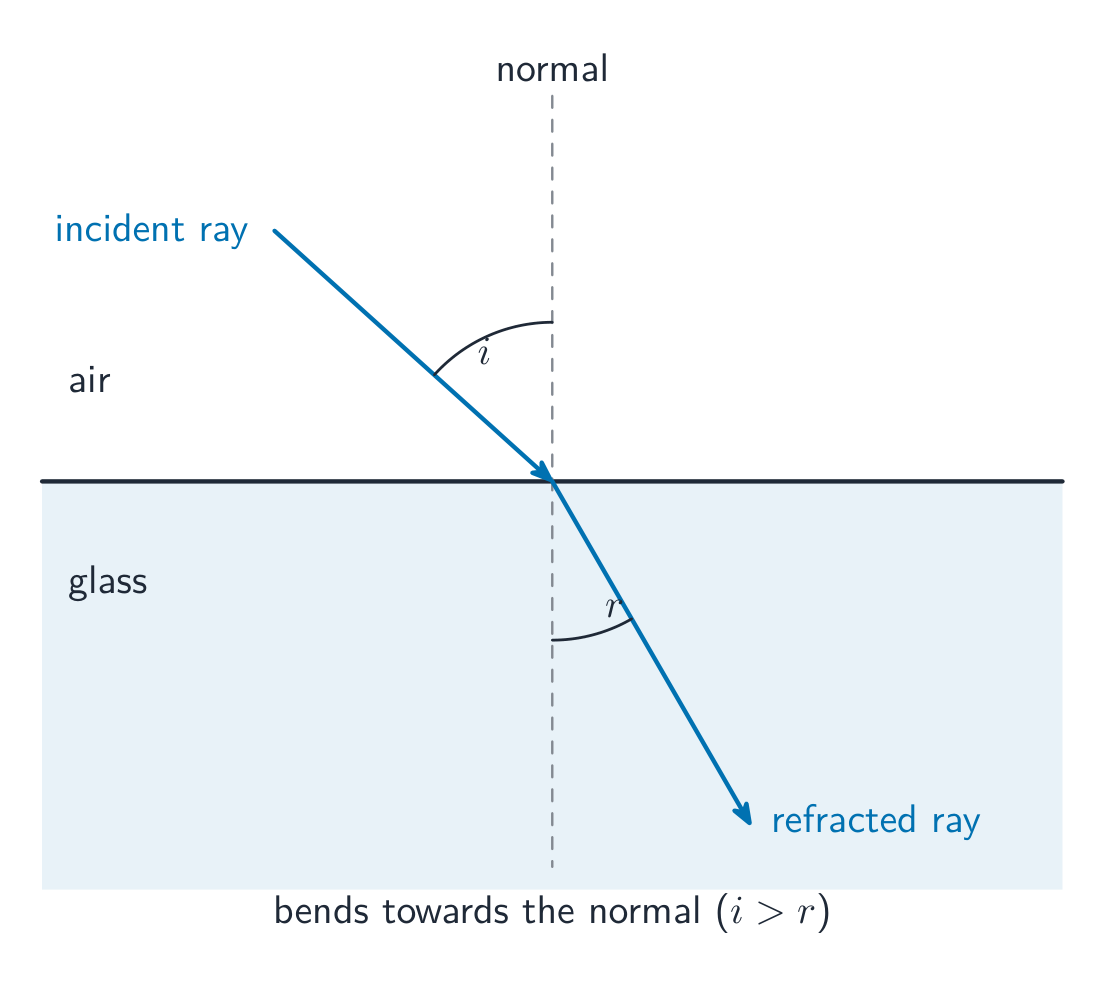
Light entering a denser medium (larger $n$) bends toward the normal. Beyond a critical angle, light going to a less-dense medium reflects entirely – total internal reflection 全反射, used in fibre optics.

Worked example. A ray in air ($n_1=1.00$) strikes water ($n_2=1.33$) at $40^{\circ}$ to the normal. By Snell's law,

$$\sin\theta_2=\frac{n_1}{n_2}\sin\theta_1=\frac{1.00}{1.33}\sin 40^{\circ}=0.483\;\Rightarrow\;\theta_2=29^{\circ}.$$
The ray bends toward the normal, as expected going into the denser medium.

Worked example (critical angle). For light trying to leave glass ($n=1.50$) for air, total internal reflection begins at the critical angle $\theta_c$ where the refracted ray grazes the surface:

$$\sin\theta_c=\frac{1}{n}=\frac{1}{1.50}=0.667\;\Rightarrow\;\theta_c=42^{\circ}.$$
Any ray hitting the inside surface more steeply than $42^{\circ}$ is trapped – the reason optical fibres carry light for kilometres.

עברית

אור מתכופף כאשר עובר בין חומרים בשל שינוי מהירותו – שבירה. לכל חומר יש מדד שבירה $n=\dfrac{c}{v}$ (כמה הוא מאט את האור). חוק סנל:

$$n_1\sin\theta_1=n_2\sin\theta_2.$$
אור הנכנס לתווך צפוף יותר (מדד $n$ גדול יותר) מתכופף כלפי הנורמל. מעבר לזווית קריטית, אור העובר לתווך פחות צפוף משתקף לחלוטין – השתקפות פנימית מלאה, המשמשת באופטיקה סיבית.

אור מתכופף, מתכופף כלפי הנורמל כשנכנס לזכוכית

דוגמא מפורסנת. קרן באוויר ($n_1=1.00$) פוגעת במים ($n_2=1.33$) בזווית $40^{\circ}$ לנורמל. לפי חוק סנל,

$$\sin\theta_2=\frac{n_1}{n_2}\sin\theta_1=\frac{1.00}{1.33}\sin 40^{\circ}=0.483\;\Rightarrow\;\theta_2=29^{\circ}.$$
הקרן מתכופפת כלפי הנורמל, כפי שצפוי בכניסה לתווך צפוף יותר.

דוגמא מפורסנת (זווית קריטית). עבור אור המנסה לצאת מזכוכית ($n=1.50$) לאוויר, ההשתקפות הפנימית המלאה מתחילה בזווית הקריטית $\theta_c$ שבה הקרן השבורה רוחשת את הפני השטח:

$$\sin\theta_c=\frac{1}{n}=\frac{1}{1.50}=0.667\;\Rightarrow\;\theta_c=42^{\circ}.$$
כל קרן הפוגעת בפנים השטח בזווית תלולה יותר מ$42^{\circ}$ נכלאת – הסיבה לכך שאופטיקה סיבית מעבירה אור למרחקים של קילומטרים.

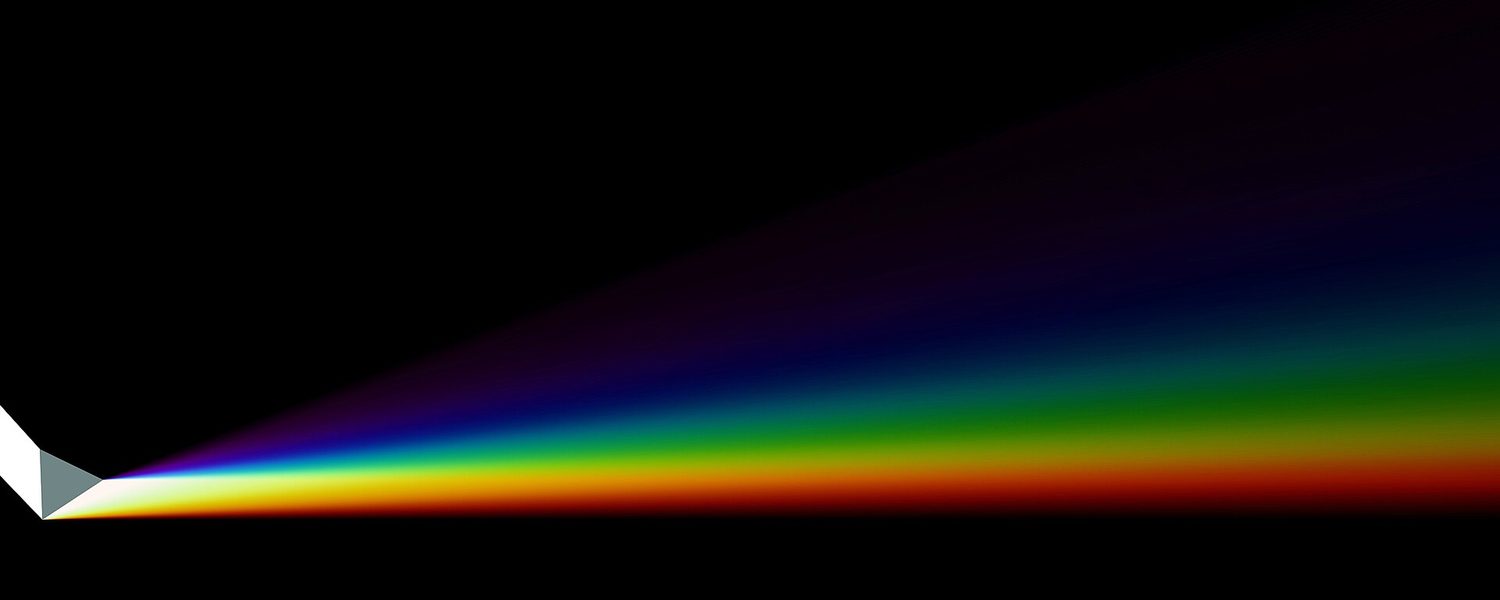
אור לבן מתפצל לספקטרום דרך משושה זכוכית
השבירה מכופפת כל צבע בכמות שונה, ולכן משושה מפזר אור לבן לגשרון
Explore · ⁨חקור⁩

Bend light as it enters glass · ⁨כופף אור בעת כניסה לגلاس⁩

Light refracts (bends) when it changes speed between media, following Snell's law. The denser the medium, the more it bends toward the normal. · ⁨אור מתכופף (שביר) כאשר משנה מהירות בין תווכים, בהתאם לחוק סנל. ככל שהתווה צפוף יותר, כך האור מתכופף יותר לעבר הנורמל.⁩

Vocabulary · ⁨מילון מונחים⁩ Train · ⁨אימון⁩
English עברית
Geometric optics/ˌdʒiːəʊˈmetrɪk ˈɒptɪks/ אופטיקה גיאומטרית
law of reflection/lɔː ɒv rɪˈflekʃn/ חוק ההשתקפות
angle of incidence/ˈæŋɡl ɒv ˈɪnsɪdəns/ זווית פגיעה
angle of reflection/ˈæŋɡl ɒv rɪˈflekʃn/ זווית השתקפות
concave mirror/kɒnˈkeɪv ˈmɪrə/ מראה קעורה
real image/rɪəl ˈɪmɪdʒ/ תמונה ממשית
convex mirror/kɒnˈveks ˈmɪrə/ מראה בולטת
virtual image/ˈvɜːtʃuːəl ˈɪmɪdʒ/ תמונה וירטואלית
refraction/rɪˈfrækʃn/ שבירה
index of refraction/ˈɪndeks ɒv rɪˈfrækʃn/ מדד שבירה
Snell's law/snelz lɔː/ חוק סנל
total internal reflection/ˈtəʊtl ɪnˈtɜːnl rɪˈflekʃn/ השתקפות פנימית מלאה
Watch lesson · ⁨צפה בשיעור⁩
13.4

Images Formed by Lenses · ⁨תמונות שנוצרות על ידי עדשות⁩

Syllabus · ⁨סיילבוס⁩
English

Learning Objective 13.4.A: Describe the image formed by a lens.

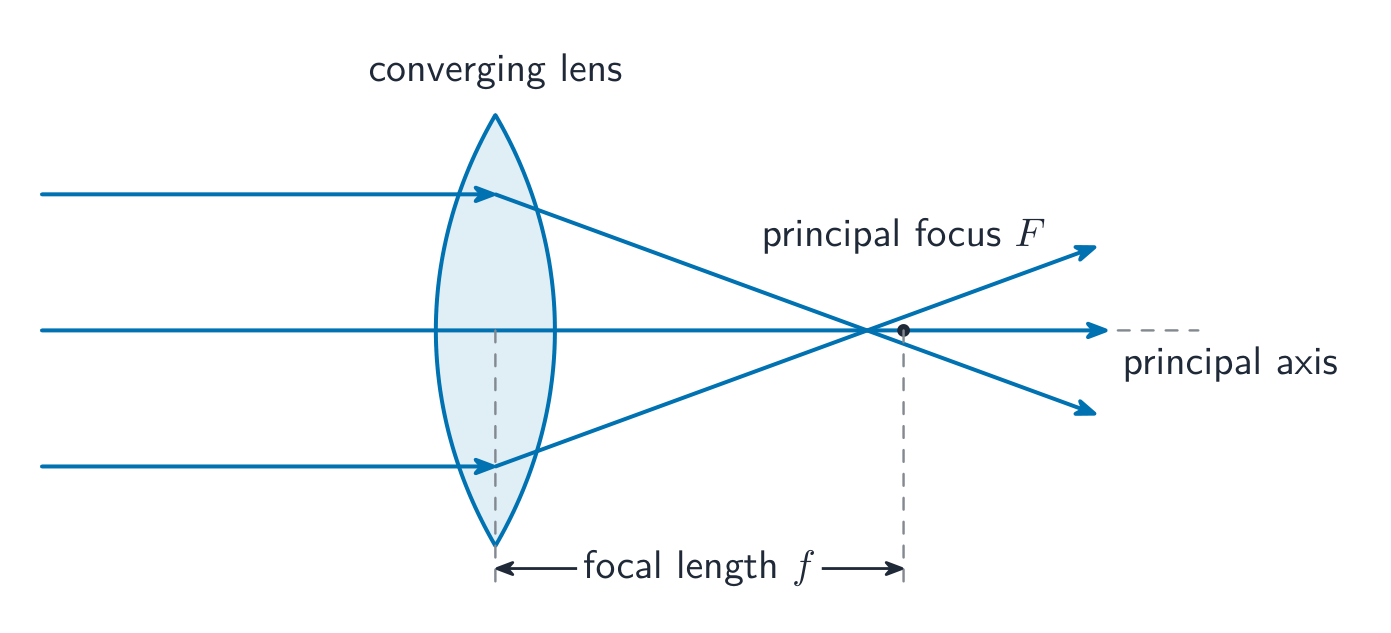
  • 13.4.A.1 Incident light rays parallel to the principal axis of a thin convex (converging) lens will be refracted and converge toward a common location on the transmitted side of the lens, called the focal point.
  • 13.4.A.2 Incident light rays parallel to the principal axis of a thin concave (diverging) lens will be refracted and diverge as if they originated from a focal point on the incident side of the lens.
  • 13.4.A.3 A real image is formed by a lens when light rays originating from a common point are refracted such that they intersect at another common point.
  • 13.4.A.4 A virtual image is formed by a lens when refracted light rays diverge such that they appear to have originated from a common point.
  • 13.4.A.5 For a thin lens, the location of an image depends on the focal length of the lens and the distance between the object and the midline of the lens, as given by the thin-lens equation:
    • Equation: $\dfrac{1}{s_i} + \dfrac{1}{s_o} = \dfrac{1}{f}$
    • 13.4.A.5.i The locations of a lens's focal point, an object, and the image of the object formed by the lens follow sign conventions that are used to determine those locations relative to the lens itself.
    • 13.4.A.5.ii Lenses have a focal point on both sides of the lens that depends on the shape of the respective side of the lens.
  • 13.4.A.6 For a thin lens, the magnification of an image is the ratio of the size of the image produced to the size of the object itself and depends on the locations of the object and image relative to the lens.
    • Equation: $|M| = \left| \dfrac{h_i}{h_o} \right| = \left| \dfrac{s_i}{s_o} \right|$
  • 13.4.A.7 Ray diagrams can be used to determine the location, type, size, and orientation of images formed by lenses.
    • 13.4.A.7.i The three principal rays are typically used to find the images formed by lenses. The principal rays are 1) the ray parallel to the principal axis, 2) the ray that passes through the center of the lens where the principal axis intersects the lens, and 3) the ray that passes through the focal point of the lens.
    • 13.4.A.7.ii Images formed by a lens can be upright or inverted, virtual or real, and reduced, enlarged, or the same size as the object.
עברית

מטרות למידה 13.4.A: תאר את התמונה הנוצרת על ידי עדשה.

  • 13.4.A.1 קרני אור הפוגעות במקביל לציר הראשי של עדשה דקה קמורה (מתכנסת) יישברו ויתכנסו אל נקודה משותפת בצד ההעברת-האור של העדשה, הנקראת נקודת המוקד.
  • 13.4.A.2 קרני אור הפוגעות במקביל לציר הראשי של עדשה דקה קעורה (מפוזרת) יישברו ויתפזרו כאילו נובעות מנקודת מוקד בצד הפגיעה של העדשה.
  • 13.4.A.3 תמונה אמיתית נוצרת על ידי עדשה כאשר קרני אור הפועמות מנקודה משותפת נשברות כך שהן נחתכות בנקודה משותפת אחרת.
  • 13.4.A.4 תמונה זרה נוצרת על ידי עדשה כאשר קרני אור נשברות מתפזרות כך שהן נראות כאילו נובעות מנקודה משותפת.
  • 13.4.A.5 לעדשה דקה, מיקום התמונה תלוי באורך המוקד של העדשה ובמרחק שבין האובייקט לבין הציר המרכזי של העדשה, כפי שנתון במשוואת העדשה הדקה:
    • משוואה: $\dfrac{1}{s_i} + \dfrac{1}{s_o} = \dfrac{1}{f}$
    • 13.4.A.5.i מיקומי נקודת המוקד של עדשה, האובייקט והתמונה של האובייקט הנוצרת על ידי העדשה עוקבים אחרי קונבנציות סימן המשמשות לקביעת מיקומים אלו ביחס לעדשה עצמה.
    • 13.4.A.5.ii לעדשות יש נקודת מוקד בשני צדיה שתלויה בצורת הצד הרלוונטי של העדשה.
  • 13.4.A.6 לעדשה דקה, הגדלת התמונה היא היחס בין גודל התמונה שנוצרה לגודל האובייקט עצמו ותלויה במיקומי האובייקט והתמונה ביחס לעדשה.
    • משוואה: $|M| = \left| \dfrac{h_i}{h_o} \right| = \left| \dfrac{s_i}{s_o} \right|$
  • 13.4.A.7 ניתן להשתמש בתרשימי קרניים כדי לקבוע את המיקום, הסוג, הגודל והכיוון של תמונות שנוצרו על ידי עדשות.
    • 13.4.A.7.i שלושת קרני המוקד משמשים בדרך כלל למציאת תמונות שנוצרו על ידי עדשות. קרני המוקד הן: 1) הקרן המקבילה לציר הראשי, 2) הקרן שעוברת דרך מרכז העדשה שם הציר הראשי חותך אותה, ו-3) הקרן שעוברת דרך נקודת המוקד של העדשה.
    • 13.4.A.7.ii תמונות שנוצרו על ידי עדשה יכולות להיות אנכיות או הפוכות, זרות או אמיתיות, ומוקטנות, מוגדלות או באותו גודל כמו האובייקט.

Source: College Board AP Course and Exam Description · ⁨מקור: תיאור הקורס והמבחן של College Board AP⁩

English
A converging lens forms a real image

A lens bends light through refraction. The thin-lens equation has the same form as the mirror equation:

$$\frac{1}{d_o}+\frac{1}{d_i}=\frac{1}{f},\qquad m=-\frac{d_i}{d_o}.$$
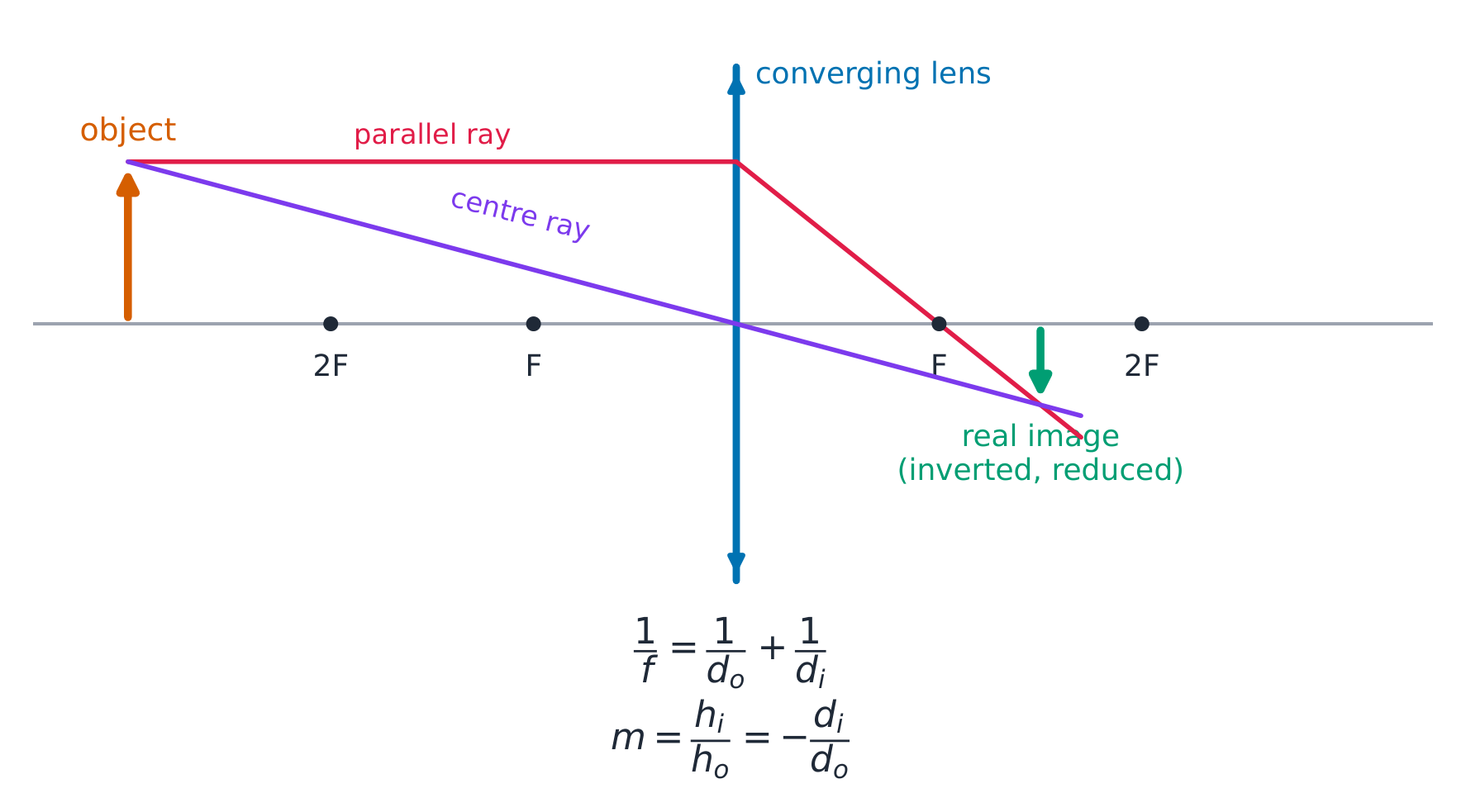
A converging 会聚 (convex) lens can form a real, inverted image or, for a close object, a virtual, upright, enlarged image (a magnifying glass). A diverging 发散 (concave) lens always forms a virtual, upright, reduced image. Ray diagrams locate the image quickly using two easy rays: one parallel to the axis that bends to pass through the far focus, and one straight through the centre of the lens (undeviated).

Worked example. An object sits $30\ \text{cm}$ from a converging lens of focal length $f=10\ \text{cm}$. Find the image. From the thin-lens equation,

$$\frac{1}{d_i}=\frac{1}{f}-\frac{1}{d_o}=\frac{1}{10}-\frac{1}{30}=\frac{2}{30}\;\Rightarrow\;d_i=15\ \text{cm},$$
and the magnification is $m=-d_i/d_o=-15/30=-0.5$. The image is real (positive $d_i$), inverted (negative $m$), and half the object's size – just what a camera lens does.

עברית
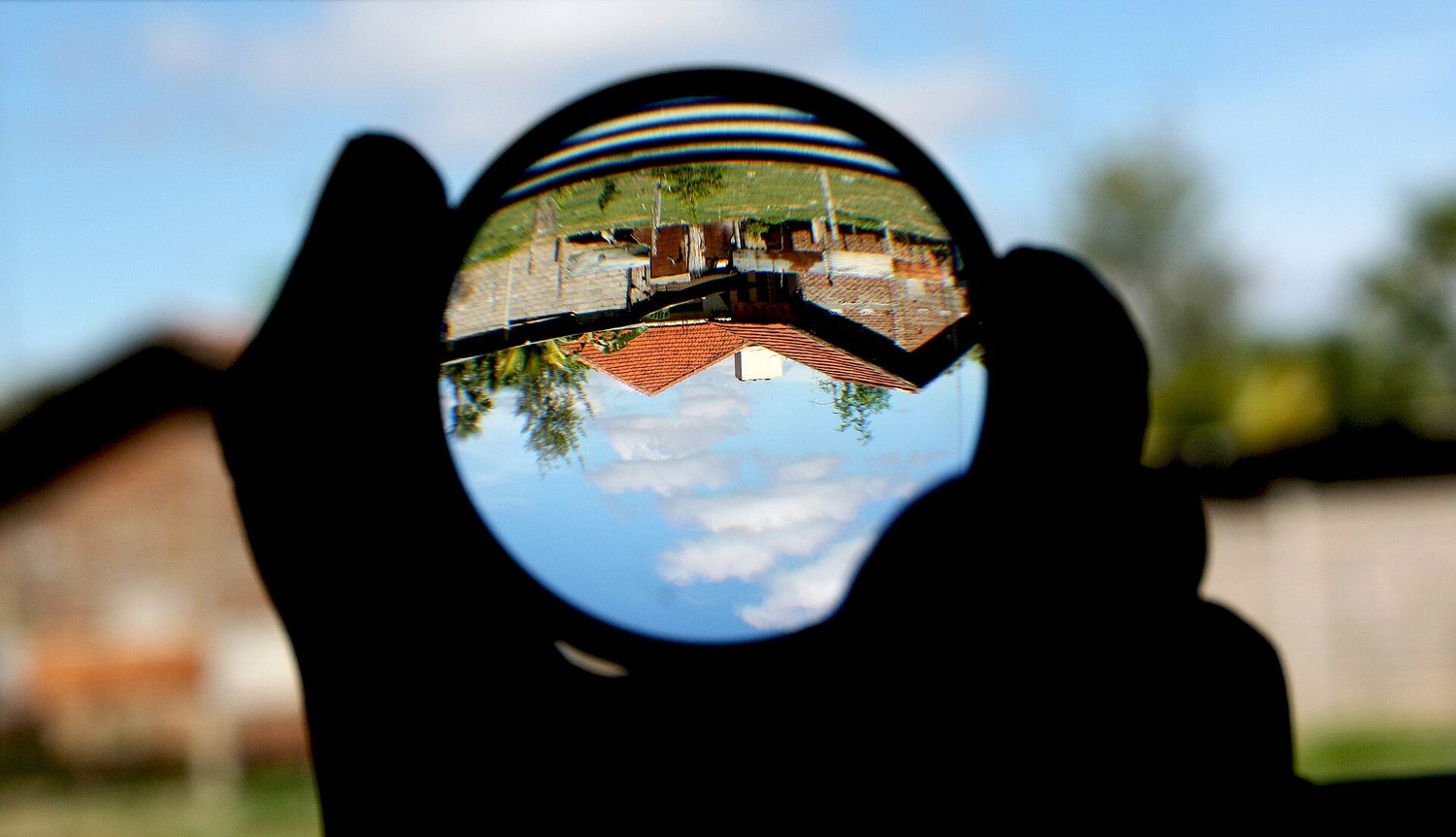
עדשה מתכנסת יוצרת תמונה אמיתית

עדשה מכופפת אור באמצעות שבירה. משוואת העדשה הדקה היא בעלת אותה צורה כמו משוואת המראה:

$$\frac{1}{d_o}+\frac{1}{d_i}=\frac{1}{f},\qquad m=-\frac{d_i}{d_o}.$$
עדשה מתכנסת (קמורה) יכולה ליצור תמונה אמיתית הפוכה או, עבור אובייקט קרוב, תמונה וירטואלית זקופה ומוגדלת (זכוכית מגדלת). עדשה מתפצלת (קעורה) תמיד יוצרת תמונה וירטואלית זקופה ומוקטנת. דיאגרמות קרניים ממוקמות את התמונה במהירות באמצעות שתי קרניים פשוטות: אחת מקבילה לציר שהיא מתכופפת כדי לעבור דרך המוקד הרחוק, ואחת ישרה דרך מרכז העדשה (בלתי מוסטת).

שתי קרניים ממוקמות את התמונה: מקבילה-אז-מוקד, וישרה דרך המרכז
שתי קרנות ממוקמות את התמונה: מקבילה-לאחר מכן מתמקדת, וישר דרך המרכז

עדשה מחברת מביאה קרניים מקבילות למיקודה הראשי שלה *עדשה מחברת מביאה קרניים מקבילות למיקודה הראשי שלה
דוגמה פותרת. חפץ נמצא $30\ \text{cm}$ ממערכת עדשה מחברת בעלת מיקוד $f=10\ \text{cm}$. מצאו את התמונה. מהמשוואה לעדשה דקה,

$$\frac{1}{d_i}=\frac{1}{f}-\frac{1}{d_o}=\frac{1}{10}-\frac{1}{30}=\frac{2}{30}\;\Rightarrow\;d_i=15\ \text{cm},$$
ומגדולת האופק היא $m=-d_i/d_o=-15/30=-0.5$. התמונה היא אמיתית ($d_i$ חיובי), הפוכה ($m$ שלילי) וחצי מגודל החפץ – בדיוק מה שעושה עדשת מצלמה.

זכוכית מגדלת המראה תמונה הפוכה מאחוריה *עדשה קעורה יוצרת תמונה אמיתית והפוכה של נוף רחוק, בדיוק כפי שהתרשים הקרינתי צופה

Explore · ⁨חקור⁩

Form an image with a converging lens · ⁨יצור תמונה עם עדשה מכנסת⁩

A converging lens bends parallel rays to its focal point. Move the object and watch the image change from large and inverted to virtual and upright inside the focal length. · ⁨עדשה מכנסת מכנסת קרניים מקבילות לנקודת המיקוד שלה. הזז את האובייקט וצפה בשינוי התמונה מגדולה והפוכה לוירטואלית וישרה בתוך אורך המיקוד.⁩

Vocabulary · ⁨מילון מונחים⁩ Train · ⁨אימון⁩
English עברית
converging/kənˈvɜːdʒɪŋ/ מתכנס
diverging/daɪˈvɜːdʒɪŋ/ מתפזר
Watch lesson · ⁨צפה בשיעור⁩
13.4

Exam tips · ⁨טיפים לבחינות⁩

English
  • Measure all angles from the normal, not the surface.
  • Light entering a denser medium (larger $n$) bends toward the normal; use Snell's law $n_1\sin\theta_1=n_2\sin\theta_2$.
  • Total internal reflection happens only going into a less dense medium, beyond the critical angle ($\sin\theta_c=1/n$).
  • For mirrors and lenses use $\tfrac1{d_o}+\tfrac1{d_i}=\tfrac1f$ and $m=-d_i/d_o$: a positive $d_i$ is a real image, negative is virtual.
  • $n=c/v$, so a bigger index means a slower speed of light in the material.
עברית
  • מדדו כל הזוויות ביחס לניצב, לא לפני השטח.
  • אור הנכנס לתווך צפוף יותר ($n$ גדול יותר) מתכופף כלפי הניצב; השתמשו בחוק סנל $n_1\sin\theta_1=n_2\sin\theta_2$.
  • השתקפות פנימית מוחלטת מתרחשת רק בכניסה לתווך פחות צפוף, מעבר לזווית הקריטית ($\sin\theta_c=1/n$).
  • עבור מראות ועדשות השתמשו ב$\tfrac1{d_o}+\tfrac1{d_i}=\tfrac1f$ וב$m=-d_i/d_o$: ⟨$d_i$⟩ חיובי הוא תמונה אמיתית, שלילי הוא וירטואלי.
  • $n=c/v$, ולכן אינדקס גבוה יותר משמעותו מהירות אור נמוכה יותר בחומר.

Interactive lessons on this topic · ⁨שיעורים אינטראקטיביים בנושא זה⁩

Work through it step by step, with instant-check exercises. · ⁨לעבור על הדברים צעד אחר צעד, עם תרגילים לבדיקה מיידית.⁩

Past Papers · ⁨מבחני עבר⁩

More topics in AP Physics 2 · ⁨פיזיקה AP 2⁩ · ⁨נושאים נוספים בAP Physics 2 · ⁨פיזיקה AP 2⁩⁩

Log in or create account · ⁨היכנס או צור חשבון⁩

IGCSE, A-Level & AP