Skip to content · ⁨דלג לתוכן⁩
Subjects · ⁨נושאים⁩

AP Physics 2 · ⁨פיזיקה AP 2⁩

Tips · ⁨טיפים⁩

AP Physics 2 continues algebra-based physics into thermodynamics, electric force, field and potential, circuits, magnetism, geometric optics, waves and physical optics, and modern physics. It assumes the mechanics of Physics 1 rather than repeating it.

Fields are invisible, and the exam knows it. Questions ask what happens to a quantity when something else changes — double the separation, insert a dielectric, reverse the current — and to justify it without computing a number.

Learn each relationship as a proportionality, not just a formula. That is what makes those questions tractable.

Unit-by-unit notes cover fluids, thermodynamics, electrostatics, circuits, magnetism, optics and modern physics, with diagrams for the parts that are hard to picture. The library holds the released past papers; Physics 2 leans heavily on explaining in words why something happens, so practise writing the reasoning and not only the number.

  • 9

    Thermodynamics · ⁨תרמודינמיקה⁩

    Watch lesson · ⁨צפה בשיעור⁩
    9.1

    Kinetic Theory of Temperature and Pressure · ⁨תורת המיקום של טמפרטורה ולחץ⁩

    Syllabus · ⁨סיילבוס⁩
    English

    Learning Objective 9.1.A: Describe the pressure a gas exerts on its container in terms of atomic motion within that gas.

    • 9.1.A.1 Atoms in a gas collide with and exert forces on other atoms in the gas and with the container in which the gas is contained.
      • 9.1.A.1.i Collisions involving pairs of atoms or an atom and a fixed object can be described and analyzed using conservation of momentum principles.
      • 9.1.A.1.ii The pressure exerted by a gas on a surface is the ratio of the sum of the magnitudes of the perpendicular components of the forces exerted by the gas's atoms on the surface to the area of the surface.
        • Equation: $P = \dfrac{F_{\perp}}{A}$
      • 9.1.A.1.iii Pressure exists throughout the gas itself, not just at the boundary between the gas and the container.

    Learning Objective 9.1.B: Describe the temperature of a system in terms of the atomic motion within that system.

    • 9.1.B.1 The temperature of a system is characterized by the average kinetic energy of the atoms within that system.
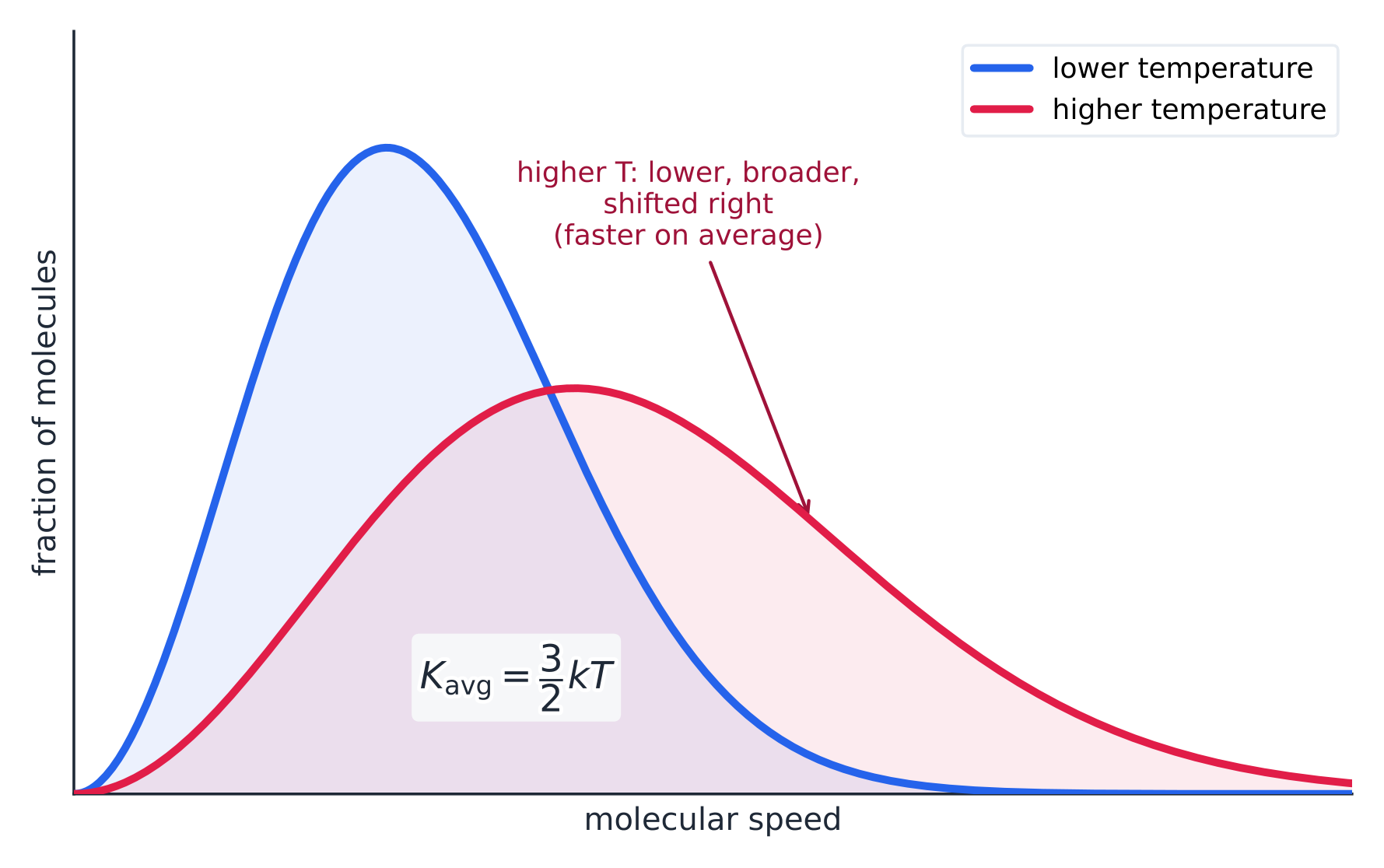
      • 9.1.B.1.i The Maxwell–Boltzmann distribution provides a graphical representation of the energies and speeds of atoms at a given temperature.
      • 9.1.B.1.ii The root-mean-square speed corresponding to the average kinetic energy for an ideal gas is related to the temperature of the gas by
        • Equation: $K_{\text{avg}} = \dfrac{3}{2} k_B T = \dfrac{1}{2} m v_{\text{rms}}^2$

    Boundary statement: AP Physics 2 only expects students to perform qualitative and quantitative analysis of collisions in one and two dimensions. Students are not expected to know the functional form of the Maxwell-Boltzmann distribution but are expected to be familiar with how features of the distribution are related to the temperature of the gas.

    עברית

    מטרות למידה 9.1.A: לתאר את הלחץ שמפעיל גז על מיכלו באמצעות תנועת האטומים בתוך הגז.

    • 9.1.A.1 אטומים בגז מתנגשים עם אטומים אחרים בגז ועם המיכל בו הגז מוחזק, ומפעילים כוחות עליהם.
      • 9.1.A.1.i התנגשויות המעורבות בזוגות של אטומים או אטום וגוף קבוע ניתנות לתיאור ולניתוח באמצעות עקרונות שימור התנע.
      • 9.1.A.1.ii הלחץ שמפעיל גז על משטח הוא היחס בין סכום גדלי הרכבים האנכיים של הכוחות המופעלים על המשטח על ידי אטומי הגז לבין שטח המשטח.
        • משוואה: $P = \dfrac{F_{\perp}}{A}$
      • 9.1.A.1.iii לחץ קיים בכל הגז עצמו, ולא רק בגבול שבין הגז לבין המיכל.

    מטרות למידה 9.1.B: לתאר את הטמפרטורה של מערכת באמצעות התנועה האטומית בתוך המערכת.

    • 9.1.B.1 הטמפרטורה של מערכת מאופיינת על ידי האנרגיה הקינטית הממוצעת של האטומים בתוך המערכת.
      • 9.1.B.1.i חלוקת מקסוול-בולצמן מספקת הצגה גרפית של האנרגיות והמהירויות של אטומים בטמפרטורה נתונה.
      • 9.1.B.1.ii מהירות השורש הממוצע הרבעוני המתאימה לאנרגיה הקינטית הממוצעת עבור גז אידיאלי קשורה לטמפרטורת הגז על ידי
        • משוואה: $K_{\text{avg}} = \dfrac{3}{2} k_B T = \dfrac{1}{2} m v_{\text{rms}}^2$

    הצהרת גבול: AP Physics 2 מצפה מהתלמידים רק לבצע ניתוח איכותי וכמותי להתנגשויות בממד אחד ושתיים. התלמידים אינם צריכים לדעת את הצורה הפונקציונלית של חלוקת מקסוול-בולצמן, אך צריכים להיות מוכנים לכיצד מאפייני החלוקה קשורים לטמפרטורת הגז.
    Source: College Board AP Course and Exam Description · ⁨מקור: תיאור הקורס והמבחן של College Board AP⁩

    English
    Kinetic theory: gas pressure

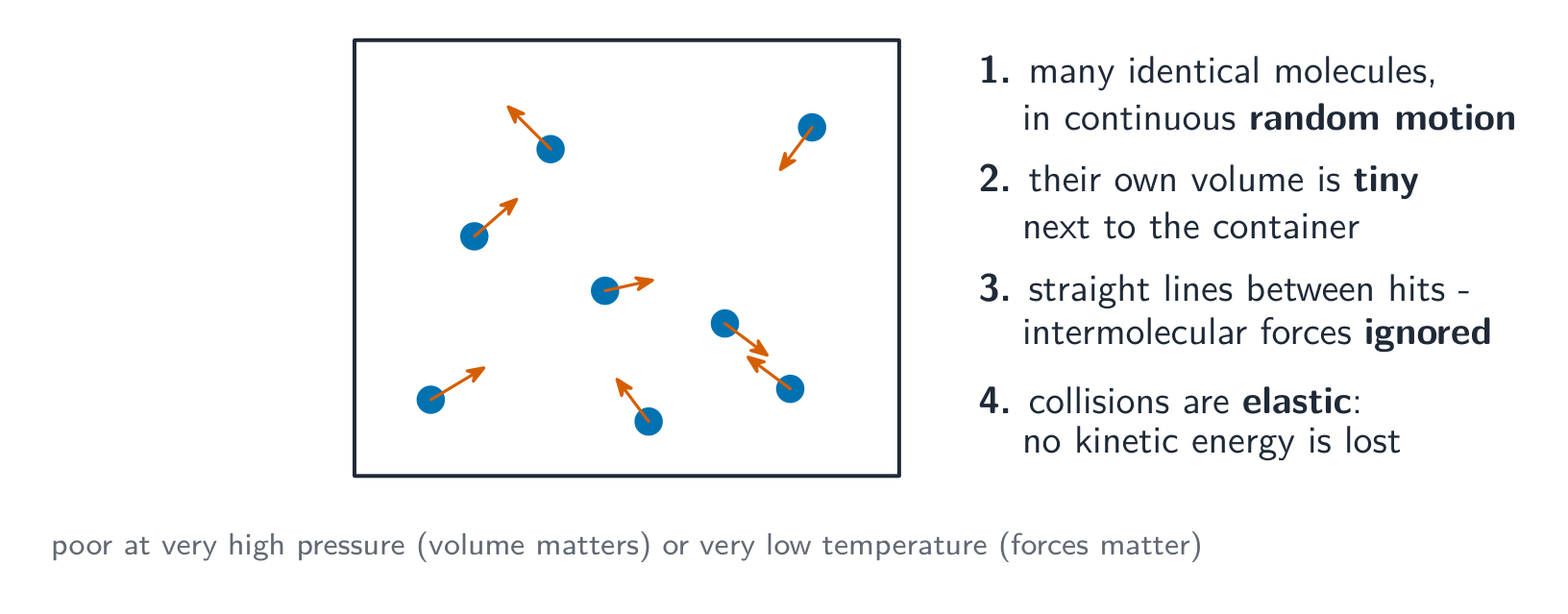
    Thermodynamics 热力学 studies heat and energy in large collections of particles. The kinetic theory 分子运动论 explains gas behavior from the random motion of its molecules:

    • Temperature 温度 is a measure of the average kinetic energy of the molecules: $K_{\text{avg}}=\tfrac{3}{2}k_B T$ (with $T$ in kelvin). Hotter means faster-moving molecules.
    • Pressure 压强 comes from molecules colliding with the container walls – more frequent or harder collisions give more pressure.

    Worked example. Find the average kinetic energy of a gas molecule at $300\ \text{K}$, using $k_B=1.38\times10^{-23}\ \text{J/K}$:

    $$K_{\text{avg}}=\tfrac32 k_B T=1.5\times1.38\times10^{-23}\times300=6.2\times10^{-21}\ \text{J}.$$
    It depends only on temperature, not on the type of gas – at the same $T$, light and heavy molecules share the same average kinetic energy (so the light ones move faster).

    עברית
    תורת הקינטיקה: לחץ גז

    תרמודינמיקה לומדת חום ואנרגיה בקבוצות גדולות של חלקיקים. התורה הקינטית מסבירה את התנהגות הגז מתנועתו האקראית של המולקules שלו:

    ההנחות המרכזיות בתורת המיקום של גז אידיאלי
    ההנחות המרכזיות של תורת הקינטיקה עבור גז אידיאלי
    • טמפרטורה היא מדד לאנרגיה קינטית ממוצעת של המולקules: $K_{\text{avg}}=\tfrac{3}{2}k_B T$ (עם $T$ בקלווין). חם יותר פירושו מולקules הנעות מהר יותר.
    • לחץ נובע ממולקules הנפגעות עם דפנות המכל – פגיעות תכופות יותר או קשות יותר נותנות לחץ גבוה יותר.
    התפלגות מהירות מקסוול-בולצמן זזה ימינה ומשטחת בחום גבוה יותר
    התפלגות מהירות מקסוול-בולצמן זזה ימינה ומשטחת בחום גבוה יותר

    דוגמה פותרת. מצא את האנרגיה הקינטית הממוצעת של מולקולת גז ב$300\ \text{K}$, על ידי שימוש ב$k_B=1.38\times10^{-23}\ \text{J/K}$:

    $$K_{\text{avg}}=\tfrac32 k_B T=1.5\times1.38\times10^{-23}\times300=6.2\times10^{-21}\ \text{J}.$$
    היא תלויה רק בטמפרטורה, ולא בסוג הגז – באותה $T$, מולקules קלות וכבדות חולקות אותה אנרגיה קינטית ממוצעת (ולכן הקלות נעות מהר יותר).

    Explore · ⁨חקור⁩

    Explore the spread of molecular speeds · ⁨חקור את התפוצץ מהירויות המולקולות⁩

    Raise the temperature and watch the whole speed distribution shift right and flatten — the particles move faster on average, which is exactly what $\bar K = \tfrac{3}{2} k_B T$ means. · ⁨העלאת הטמפרטורה גורמת לכל עקומת ההתפלגות להזיז ימינה ולהתשטח — החלקיקים נעים במהירות ממוצעת גבוהה יותר, בדיוק מה ש$\bar K = \tfrac{3}{2} k_B T$ מייצג.⁩

    Watch lesson · ⁨צפה בשיעור⁩
    9.2

    The Ideal Gas Law · ⁨חוק הגז האידיאלי⁩

    Syllabus · ⁨סיילבוס⁩
    English

    Learning Objective 9.2.A: Describe the properties of an ideal gas.

    • 9.2.A.1 The classical model of an ideal gas assumes that the instantaneous velocities of atoms are random, the volumes of the atoms are negligible compared to the total volume occupied by the gas, the atoms collide elastically, and the only appreciable forces on the atoms are those that occur during collisions.
    • 9.2.A.2 An ideal gas is one in which the relationships between pressure, volume, the number of moles or number of atoms, and temperature of a gas can be modeled using the equation
      • Equation: $PV = nRT = N k_B T$
    • 9.2.A.3 Graphs modeling the pressure, temperature, and volume of gases can be used to describe or determine properties of that gas.
    • 9.2.A.4 A temperature at which an ideal gas has zero pressure can be extrapolated from a graph of pressure as a function of temperature.
    עברית

    מטרות למידה 9.2.A: לתאר את תכונות הגז האידיאלי.

    • 9.2.A.1 המודל הקלאסי של גז אידיאלי מניח שהמהירויות הרגעיות של אטומים הן אקראיות, נפחי האטומים זניחים בהשוואה לנפח הכולל שתופס הגז, האטומים מתנגשים אלסטית, והכוחים המשמעותיים היחידים הפועלים על האטומים הם אלו הנובעים מהתנגשויות.
    • 9.2.A.2 גז אידיאלי הוא גז שבו ניתן לדגם את הקשרים בין הלחץ, הנפח, מספר המולים או מספר האטומים, וטמפרטורת הגז באמצעות המשוואה
      • משוואה: $PV = nRT = N k_B T$
    • 9.2.A.3 גרפים המדמים את הלחץ, הטמפרטורה והנפח של גזים יכולים לשמש לתאר או לקבוע תכונות של הגז.
    • 9.2.A.4 טמפרטורה שבה לגז אידיאלי לחץ אפס ניתן להערכה מגרף של לחץ כפונקציה של טמפרטורה.

    Source: College Board AP Course and Exam Description · ⁨מקור: תיאור הקורס והמבחן של College Board AP⁩

    English

    An ideal gas 理想气体 obeys

    $$PV=nRT \qquad(\text{or } PV=Nk_B T),$$
    linking pressure $P$, volume $V$, amount ($n$ moles or $N$ molecules), and absolute temperature $T$. Use it to predict how a gas responds when you change one quantity and hold others fixed (e.g. heating at constant volume raises pressure).

    Worked example. A sealed rigid container of gas is at $1.0\times10^{5}\ \text{Pa}$ and $300\ \text{K}$. It is heated to $450\ \text{K}$. Because the volume and amount are fixed, $P/T$ is constant:

    $$P_2=P_1\frac{T_2}{T_1}=1.0\times10^{5}\times\frac{450}{300}=1.5\times10^{5}\ \text{Pa}.$$
    Always convert temperatures to kelvin before using a gas law – using Celsius here would give nonsense.

    עברית
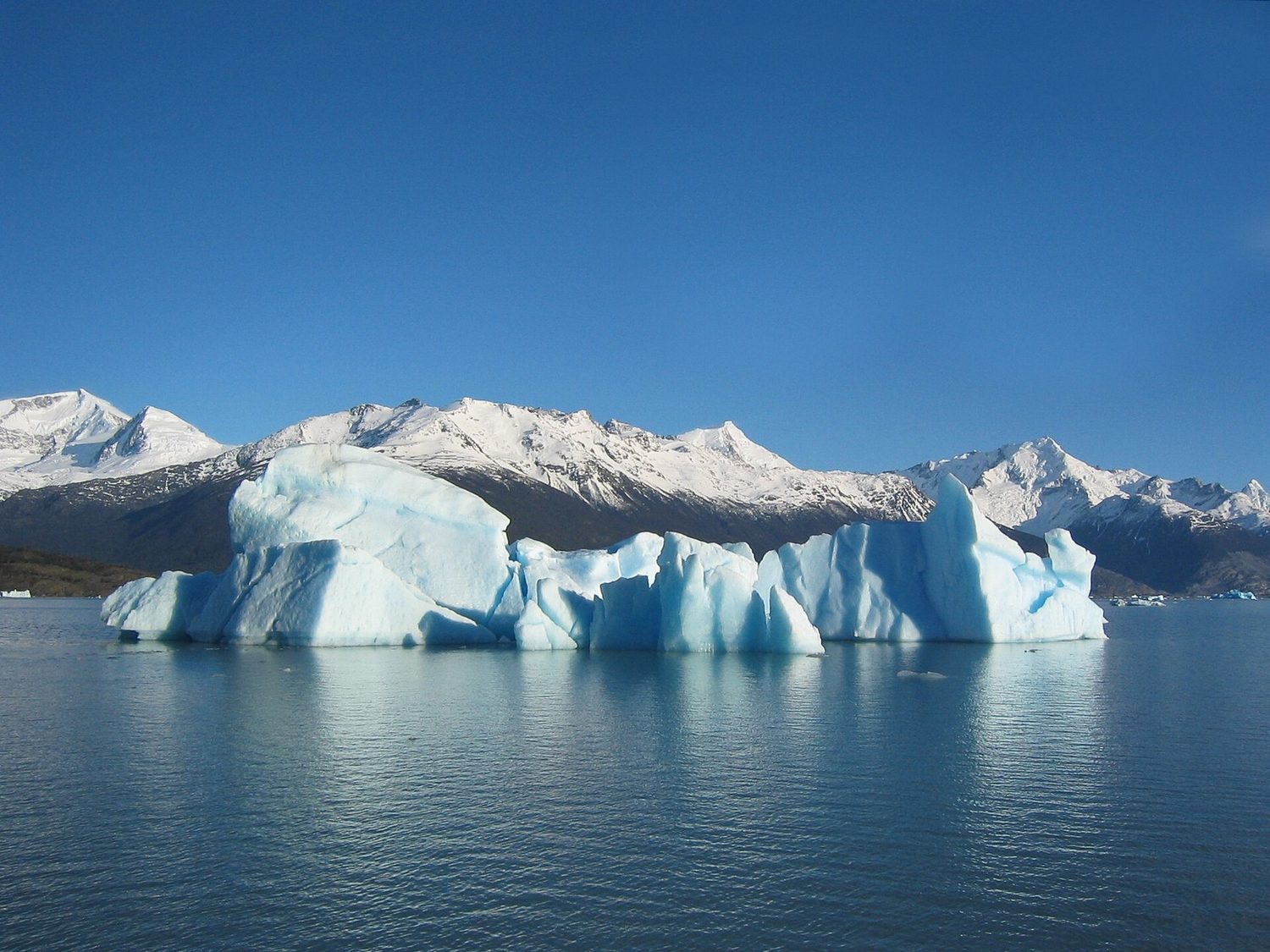
    הר הרעבים: חום, צפיפות ושינויי פאזה מחברים תרמודינמיקה לנוזלים ולהצפה
    הר הרעבים: חום, צפיפות ושינויי פאזה מחברים תרמודינמיקה לנוזלים ולהצפה

    גז אידיאלי מקיים

    $$PV=nRT \qquad(\text{or } PV=Nk_B T),$$
    קושרים בין לחץ $P$, נפח $V$, כמות ($n$ מולים או $N$ מולקules), וטמפרטורה מוחלטת $T$. השתמש בה כדי לחזות כיצד גז מגיב כאשר משנה כמות אחת ומחזיק את שאר הקבועות (למשל, חימום בנפח קבוע מעלה את הלחץ).

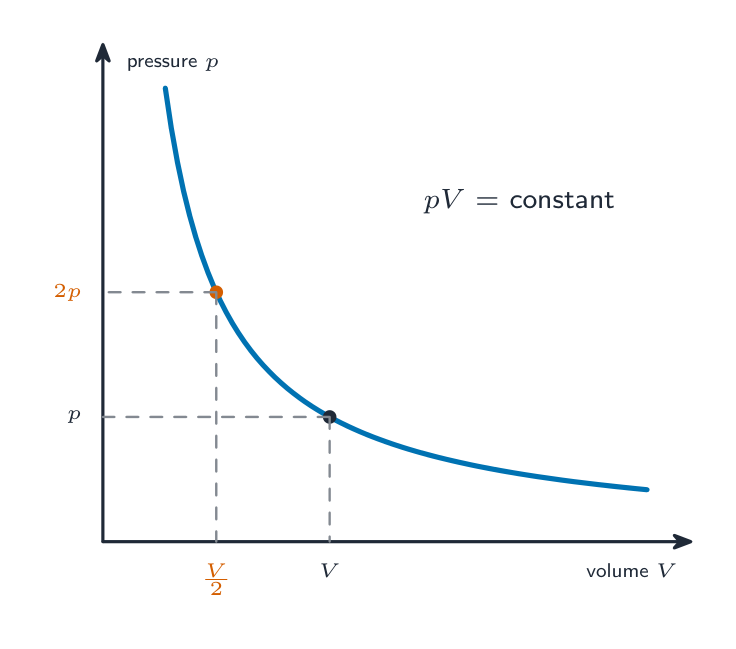
    חוק בואיל: בטמפרטורה קבועה, מכפלת לחץ ונפח היא קבועה
    חוק בואיל: בטמפרטורה קבועה, מכפלת לחץ ונפח היא קבועה

    דוגמה מופתרת. מיכל אטום וקשיח המכיל גז נמצא ב$1.0\times10^{5}\ \text{Pa}$ וב$300\ \text{K}$. הוא מתחמם ל$450\ \text{K}$. מכיוון שהנפח וכמות החומר קבועים, $P/T$ נשאר קבוע:

    $$P_2=P_1\frac{T_2}{T_1}=1.0\times10^{5}\times\frac{450}{300}=1.5\times10^{5}\ \text{Pa}.$$
    תמיד להמיר טמפרטורות לקלווין לפני שימוש בחוקי הגזים – השימוש בסלקיוס כאן יוביל לתוצאה חסרת משמעות.

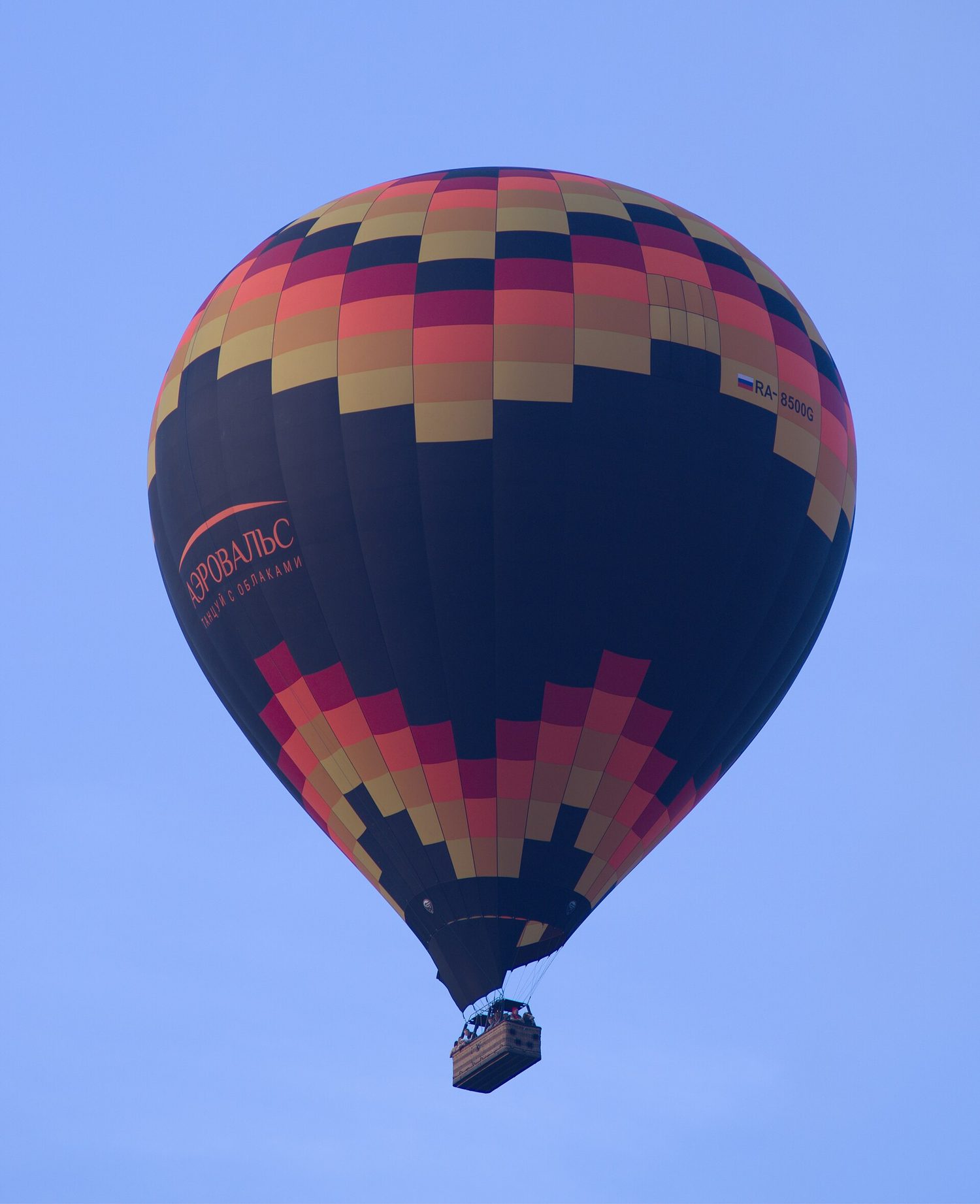
    בלון אוויר חם עולה לשמיים *חימום הגז בתוך בלון מפחית את צפיפותו, ולכן הבלון עולה – חוק הגז האידיאלי בפעולה
    Explore · ⁨חקור⁩

    Explore squeezing a gas · ⁨חקור דחיסה של גז⁩

    Slide the piston in to shrink the volume. The same particles are crammed into less space, so they hit the walls more often and the pressure climbs — while $PV$ stays constant at fixed temperature. · ⁨הזז את הבוכנה פנימה כדי לצמצם את הנפח. אותם חלקיקים נלחצים לחלל קטן יותר, ולכן הם פוגעים בקירות תדירות יותר והלחץ עולה — בעוד ש$PV$ נשאר קבוע בטמפרטורה קבועה.⁩

    Watch lesson · ⁨צפה בשיעור⁩
    9.3

    Thermal Energy Transfer and Equilibrium · ⁨העברת אנרגיה תרמית ואיזון⁩

    Syllabus · ⁨סיילבוס⁩
    English

    Learning Objective 9.3.A: Describe the transfer of energy between two systems in thermal contact due to temperature differences of those two systems.

    • 9.3.A.1 Two systems are in thermal contact if the systems may transfer energy by thermal processes.
      • 9.3.A.1.i Heating is the transfer of energy into a system by thermal processes.
      • 9.3.A.1.ii Cooling is the transfer of energy out of a system by thermal processes.
    • 9.3.A.2 The thermal processes by which energy may be transferred between systems at different temperatures are conduction, convection, and radiation.
    • 9.3.A.3 Energy is transferred through thermal processes spontaneously from a higher-temperature system to a lower-temperature system.
      • 9.3.A.3.i In collisions between atoms from different systems, energy is most likely to be transferred from higher-energy atoms to lower-energy atoms.
      • 9.3.A.3.ii After many collisions of atoms from different systems, the most probable state is one in which both systems have the same temperature.
    • 9.3.A.4 Thermal equilibrium results when no net energy is transferred by thermal processes between two systems in thermal contact with each other.
    עברית

    מטרות למידה 9.3.A: לתאר את העברת האנרגיה בין שני מערכים במגע תרמי עקב הבדלי הטמפרטורה שלהם.

    • 9.3.A.1 שני מערכים נמצאים במגע תרמי אם ייתכן שהמערכים יעבירו אנרגיה באמצעות תהליכים תרמיים.
      • 9.3.A.1.i חימום הוא העברת אנרגיה אל מערכת על ידי תהליכים תרמיים.
      • 9.3.A.1.ii קירור הוא העברת אנרגיה מחוץ למערכת על ידי תהליכים תרמיים.
    • 9.3.A.2 התהליכים התרמיים באמצעותיהם אנרגיה יכולה לעבור בין מערכים בטמפרטורות שונות הם הולכה, סחיפה וקרניות.
    • 9.3.A.3 אנרגיה מועברת דרך תהליכים תרמיים באופן ספונטני ממערכת בעלת טמפרטורה גבוהה יותר למערכת בעלת טמפרטורה נמוכה יותר.
      • 9.3.A.3.i בהתנגשויות בין אטומים ממערכות שונות, הסבירות הגבוהה ביותר היא להעביר אנרגיה מאטומים בעלי אנרגיה גבוהה יותר לאטומים בעלי אנרגיה נמוכה יותר.
      • 9.3.A.3.ii לאחר מספר רב של התנגשויות של אטומים ממערכות שונות, המצב הסביר ביותר הוא מצב שבו לשתי המערכים יש אותה טמפרטורה.
    • 9.3.A.4 שיווי משקל תרמי נוצר כאשר אין העברה נטו של אנרגיה על ידי תהליכים תרמיים בין שני מערכים הנמצאים במגע תרמי זה עם זה.

    Source: College Board AP Course and Exam Description · ⁨מקור: תיאור הקורס והמבחן של College Board AP⁩

    English

    Heat 热量 $Q$ is energy transferred because of a temperature difference; it flows from hot to cold. Two objects in contact reach thermal equilibrium 热平衡 when they share the same temperature, and net heat flow stops. The three transfer methods are conduction 传导, convection 对流, and radiation 辐射.

    עברית

    חום $Q$ הוא אנרגיה המועברת בשל הפרש טמפרטורות; הוא זורם מחם לקר. שני גופים במגע מגיעים לאיזון תרמי כאשר יש להם אותה טמפרטורה, והזרימה הנטו של החום נפסקת. שלושת שיטות ההעברה הן הולכה, הסעה וקרניזה.

    Explore · ⁨חקור⁩

    Add heat and watch the temperature · ⁨הוסף חום וצפה לטמפרטורה⁩

    Adding heat usually raises temperature, but during a phase change the temperature holds flat while the energy breaks bonds. Two bodies in contact settle at one temperature — thermal equilibrium. · ⁨הוספת חום מעלה בדרך כלל את הטמפרטורה, אך במהלך שינוי מצב הטמפרטורה נשארת יציבה בעוד האנרגיה שוברת קשרים. שני גופים במגע מגיעים לאותה טמפרטורה — איזון תרמי.⁩

    Watch lesson · ⁨צפה בשיעור⁩
    9.4

    The First Law of Thermodynamics · ⁨החוק הראשון של התרמודינמיקה⁩

    Syllabus · ⁨סיילבוס⁩
    English

    Learning Objective 9.4.A: Describe the internal energy of a system.

    • 9.4.A.1 The internal energy of a system is the sum of the kinetic energy of the objects that make up the system and the potential energy of the configuration of those objects.
      • 9.4.A.1.i The atoms in an ideal gas do not interact with each other via conservative forces, and the internal structure is not considered. Therefore, an ideal gas does not have internal potential energy.
      • 9.4.A.1.ii The internal energy of an ideal monatomic gas is the sum of the kinetic energies of the constituent atoms in the gas.
        • Equation: $U = \dfrac{3}{2} nRT = \dfrac{3}{2} N k_B T$
    • 9.4.A.2 Changes to a system's internal energy can result in changes to the internal structure and internal behavior of that system without changing the motion of the system's center of mass.

    Learning Objective 9.4.B: Describe the behavior of a system using thermodynamic processes.

    • 9.4.B.1 The first law of thermodynamics is a restatement of conservation of energy that accounts for energy transferred into or out of a system by work, heating, or cooling.
      • 9.4.B.1.i For an isolated system, the total energy is constant.
      • 9.4.B.1.ii For a closed system, the change in internal energy is the sum of energy transferred to or from the system by heating, or work done on the system.
        • Equation: $\Delta U = Q + W$
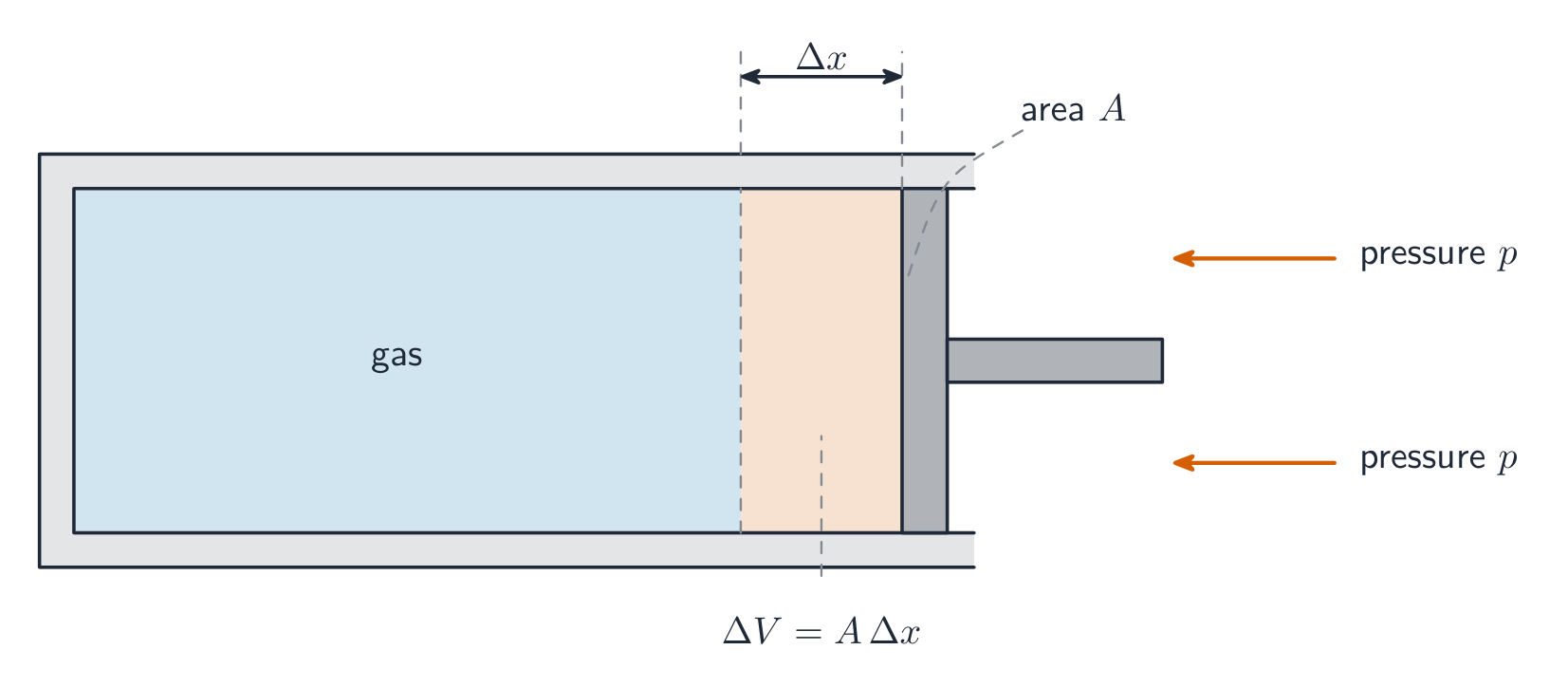
      • 9.4.B.1.iii The work done on a system by a constant or average external pressure that changes the volume of that system (for example, a piston compressing a gas in a container) is defined as
        • Equation: $W = -P \Delta V$
    • 9.4.B.2 Pressure-volume graphs (also known as PV diagrams) are representations used to represent thermodynamic processes.
      • 9.4.B.2.i Lines of constant temperature on a PV diagram are called isotherms.
      • 9.4.B.2.ii The absolute value of the work done on a gas when the gas expands or compresses is equal to the area underneath the curve of a plot of pressure vs. volume for the gas.
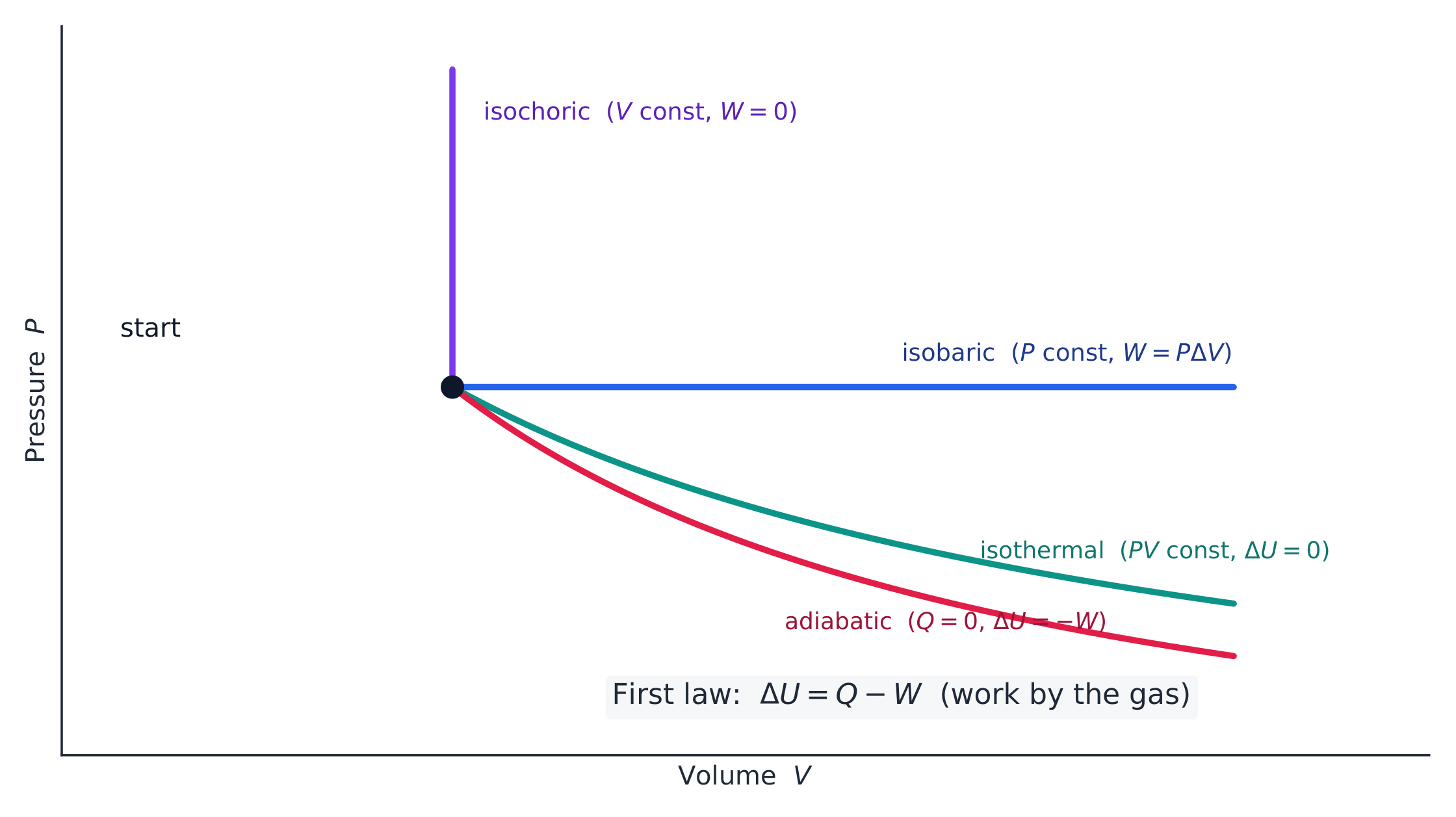
    • 9.4.B.3 Special cases of thermal processes depend on the relationship between the configuration of the system, the nature of the work done on the system, and the system's surroundings. These include constant volume (isovolumetric), constant temperature (isothermal), and constant pressure (isobaric), as well as processes where no energy is transferred to or from the system through thermal processes (adiabatic).
    עברית

    מטרות למידה 9.4.A: לתאר את האנרגיה הפנימית של מערכת.

    • 9.4.A.1 האנרגיה הפנימית של מערכת היא סכום האנרגיה הקינטית של הגופים המרכיבים את המערכת ואנרגיית הפוטנציאל של ההתארגנות של גופים אלו.
      • 9.4.A.1.i האטומים בגז אידיאלי אינם פועלים זה על זה באמצעות כוחות שימור, והמבנה הפנימי אינו נלקח בחשבון. לכן, לגז אידיאלי אין אנרגיית פוטנציאל פנימית.
      • 9.4.A.1.ii האנרגיה הפנימית של גז אידיאלי חד-אטומי היא סכום האנרגיות הקינטיות של האטומים המרכיבים אותו.
        • משוואה: $U = \dfrac{3}{2} nRT = \dfrac{3}{2} N k_B T$
    • 9.4.A.2 שינויים באנרגיה הפנימית של מערכת עשויים להוביל לשינויים במבנה הפנימי ובתנהגות הפנימית של המערכת מבלי לשנות את תנועת מרכז המסה שלה.

    מטרות למידה 9.4.B: לתאר את התנהגות המערכת באמצעות תהליכים תרמודינמיים.

    • 9.4.B.1 החוק הראשון של התרמודינמיקה הוא ניסוח חוזר של שימור האנרגיה שמביא בחשבון אנרגיה שהועברה אל או מחוץ למערכת דרך עבודה, חימום או קירור.
      • 9.4.B.1.i עבור מערכת מבודדת, האנרגיה הכוללת היא קבועה.
      • 9.4.B.1.ii עבור מערכת סגורה, השינוי באנרגיה פנימית הוא הסכום של האנרגיה שהועברה למערכת או ממנה בחימום, או העבודה שנעשתה על המערכת.
        • משוואה: $\Delta U = Q + W$
      • 9.4.B.1.iii העבודה שנעשתה על מערכת על ידי לחץ חיצוני קבוע או ממוצע המשנה את נפח המערכת (למשל, בוכנה הדוחסת גז במיכל) מוגדרת כ
        • משוואה: $W = -P \Delta V$
    • 9.4.B.2 גרפים של לחץ-נפח (הידועים גם כדיאגרמות PV) הם ייצוגים המשמשים לייצוג תהליכים טרמודינמיים.
      • 9.4.B.2.i קווים של טמפרטורה קבועה בתרשים PV נקראים איזותרמות.
      • 9.4.B.2.ii הערך המוחלט של העבודה שנעשתה על גז כאשר הגז מתרחב או דוחס שווה לשטח מתחת לעקומה של פלט של לחץ מול נפח עבור הגז.
    • 9.4.B.3 מקרים מיוחדים של תהליכים תרמיים תלויים בקשר בין תצורת המערכת, אופי העבודה הנעשית על המערכת והסביבה שלה. כוללים נפח קבוע (איזובולי), טמפרטורה קבועה (איזותרמי), ולחץ קבוע (איזוברי), כמו גם תהליכים בהם לא מועבר אנרגיה למערכת או ממנה באמצעות תהליכים תרמיים (אדיאבטי).

    Source: College Board AP Course and Exam Description · ⁨מקור: תיאור הקורס והמבחן של College Board AP⁩

    English

    The first law 热力学第一定律 is conservation of energy for a gas:

    $$\Delta U = Q + W,$$
    where $\Delta U$ is the change in internal energy 内能 (tied to temperature), $Q$ is heat added to the gas, and $W$ is work done on the gas. On a pressure–volume diagram, the work done by the gas is the area under the process curve. Watch signs: compressing a gas does positive work on it.

    Worked example. A gas absorbs $500\ \text{J}$ of heat and, as it expands, does $200\ \text{J}$ of work on its surroundings. Find the change in its internal energy. Work done on the gas is $W=-200\ \text{J}$ (it does work, so it loses that energy):

    $$\Delta U=Q+W=500+(-200)=300\ \text{J}.$$
    The internal energy rises by $300\ \text{J}$, so the gas ends up hotter. Getting the sign of $W$ right is the whole game in first-law problems.

    עברית

    החוק הראשון הוא שימור האנרגיה עבור גז:

    $$\Delta U = Q + W,$$
    כאן $\Delta U$ הוא השינוי באנרגיה פנימית (קשור לטמפרטורה), $Q$ הוא החום שהוסף לגז, ו$W$ הוא העבודה שנעשה עלגז. בגרף לחץ–נפח, העבודה שנעשה על ידיגז היא השטח מתחת לעקבת התהליך. לשים לב למינים: דחיסת גז מבצעת עבודה חיובית עליו.

    גז דוחף בוכנה החוצה למרחק קטן ועושה עבודה השווה ל-p כפול השינוי בנפח *גז דוחף בוכנה החוצה למרחק קטן ועושה עבודה השווה ל-p כפול השינוי בנפח

    ארבעת תהליכי הטרמודינמיקה שגורמו ממצב התחלתי משותף בגרף PV *ארבעת תהליכי התרמודינמיקה מצוירים ממצב התחלה משותף בגרף PV
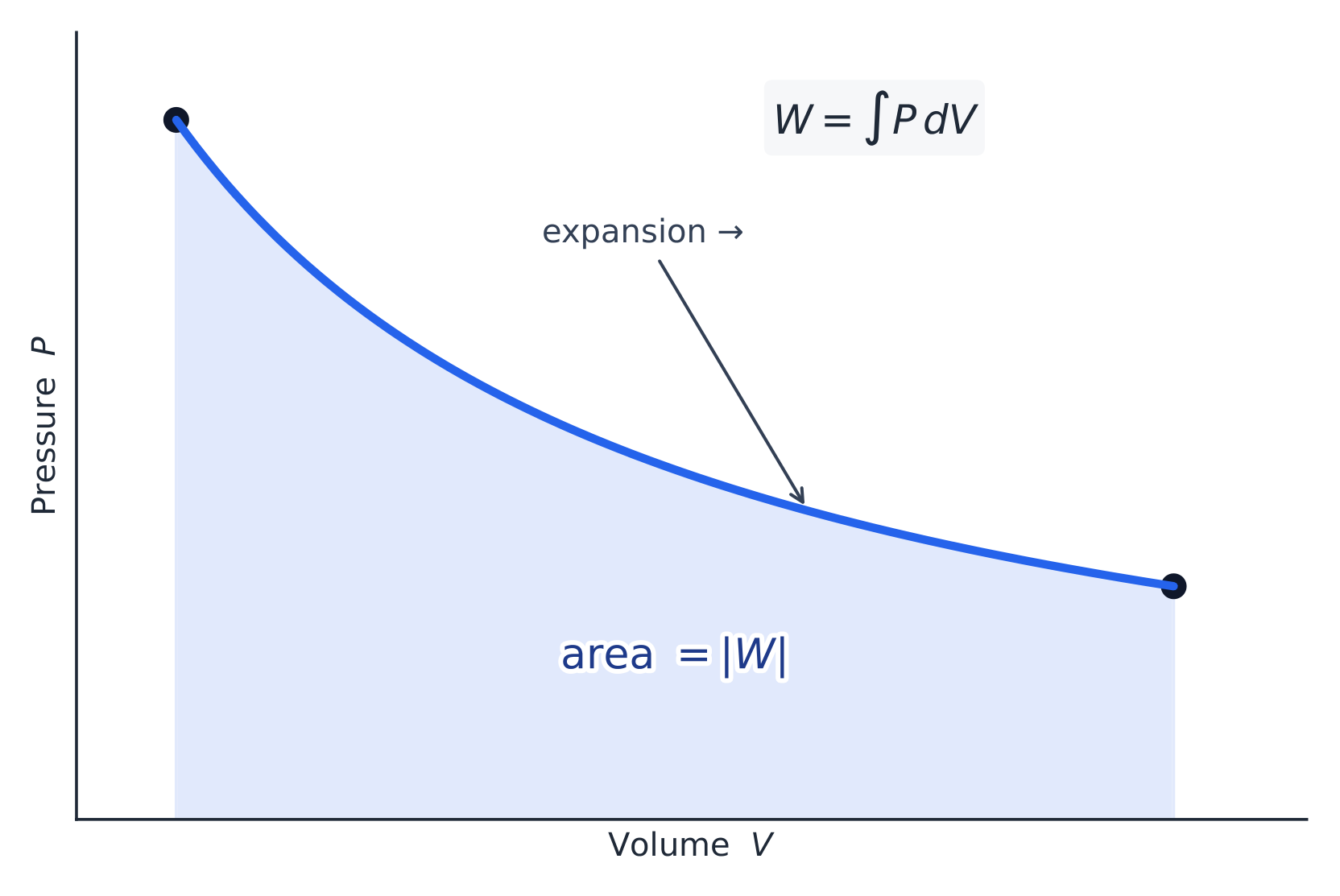
    העבודה שנעשתה במהלך שינוי נפח שווה לשטח מתחת לעקומת P-V *העבודה שנעשה במהלך שינוי נפח שווה לשטח מתחת לעקבת P-V
    דוגמה מודגמת. גז סופג $500\ \text{J}$ של חום ועוד, בזמן התפשטותו, מבצע $200\ \text{J}$ של עבודה על הסביבה. מצא את השינוי באנרגיה הפנימית שלו. עבודה שנעשה על הגז היא $W=-200\ \text{J}$ (הוא מבצע עבודה, ולכן מאבד את האנרגיה הזאת):

    $$\Delta U=Q+W=500+(-200)=300\ \text{J}.$$
    האנרגיה הפנימית עולה ב-$300\ \text{J}$, ולכן הגז מסתיים חם יותר. קביעת סימן נכונה ל$W$ היא כל הקושי בבעיות החוק הראשון.

    9.5

    Specific Heat and Thermal Conductivity · ⁨חום ספציפי ומוליכות תרמית⁩

    Syllabus · ⁨סיילבוס⁩
    English

    Learning Objective 9.5.A: Describe the energy required to change the temperature of an object by a certain amount.

    • 9.5.A.1 The amount of energy required to change the temperature of a material is related to the material's specific heat.
      • Equation: $Q = mc\Delta T$
    • 9.5.A.2 The specific heat of a material is an intrinsic property of that material that depends on the arrangement and interactions of the atoms that make up the material.

    Learning Objective 9.5.B: Describe the rate at which energy is transferred by conduction through a given material.

    • 9.5.B.1 The rate at which energy is transferred by conduction through a given material is related to the thermal conductivity, the physical dimensions of the material, and the temperature difference across the material.
      • Equation: $\dfrac{Q}{\Delta t} = \dfrac{kA\Delta T}{L}$
    • 9.5.B.2 The thermal conductivity of a material is an intrinsic property of that material that depends on the arrangement and interactions of the atoms that make up the material.

    Boundary statement: AP Physics 2 will model specific heat as independent of temperature.

    עברית

    מטרות למידה 9.5.A: לתאר את האנרגיה הדרושה לשינוי הטמפרטורה של גוף בכמות מסוימת.

    • 9.5.A.1 כמות האנרגיה הדרושה לשינוי הטמפרטורה של חומר קשורה לחום הספציפי שלו.
      • משוואה: $Q = mc\Delta T$
    • 9.5.A.2 החום הספציפי של חומר הוא תכונה מהותית שלו התלויה בסידור ובאינטראקציות של האטומים המרכיבים אותו.

    מטרות למידה 9.5.B: לתאר את הקצב שבו אנרגיה מועברת על ידי הולכה בחומר נתון.

    • 9.5.B.1 הקצב שבו אנרגיה מועברת על ידי הולכה בחומר נתון קשור למוליכות התרמית, לממדים הפיזיים של החומר ולפרש הטמפרטורות בצדדים השונים של החומר.
      • משוואה: $\dfrac{Q}{\Delta t} = \dfrac{kA\Delta T}{L}$
    • 9.5.B.2 המוליכות התרמית של חומר היא תכונה מהותית שלו התלויה בסידור ובאינטראקציות של האטומים המרכיבים אותו.

    הצהרת גבול: AP Physics 2 ידגים חום ספציפי כבלתי תלוי בטמפרטורה.

    Source: College Board AP Course and Exam Description · ⁨מקור: תיאור הקורס והמבחן של College Board AP⁩

    English
    • Specific heat 比热容 $c$ is the heat needed to raise one kilogram by one degree: $Q=mc\,\Delta T$. A high specific heat (like water's) means a substance resists temperature change.
    • Thermal conductivity 热导率 measures how fast heat conducts through a material; the rate of conduction rises with area and temperature difference and falls with thickness.

    Worked example. How much heat raises the temperature of $2.0\ \text{kg}$ of water from $20\,{}^{\circ}\text{C}$ to $80\,{}^{\circ}\text{C}$? Water's specific heat is $c=4200\ \text{J/(kg}\,{}^{\circ}\text{C)}$:

    $$Q=mc\,\Delta T=2.0\times4200\times(80-20)=5.0\times10^{5}\ \text{J}.$$
    Water's large specific heat is why it is used as a coolant and why coastal climates are mild.

    עברית
    • חום ספציפי $c$ הוא החום הנדרש כדי להעלות טמפרטורה של קילוגרם אחד בדרגה אחת: $Q=mc\,\Delta T$. חום ספציפי גבוה (כמו של מים) מעיד על כך שחומר מתנגד לשינוי טמפרטורה.
    • מוליכות תרמית מודדת כמה מהר החום מוליך דרך חומר; קצב ההולכה עולה עם שטח והפרש טמפרטורות ויורד עם עובי.
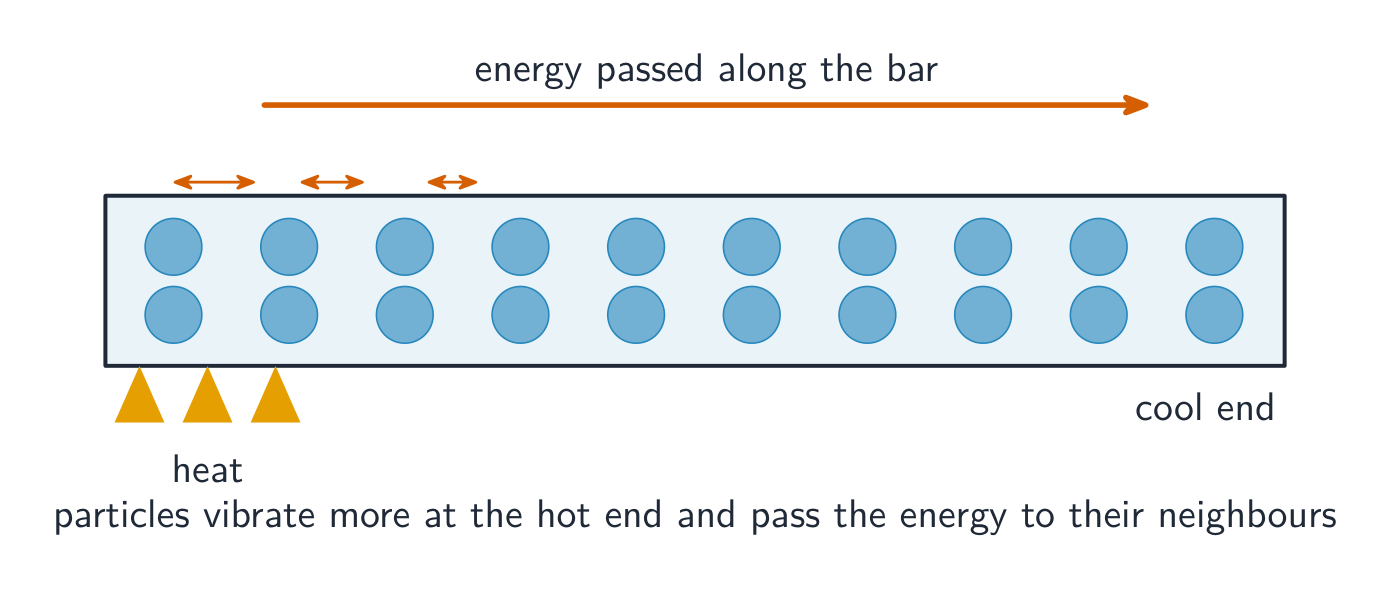
    הולכה: חלקיקים רועדים מעבירים אנרגיה לאורך מוט מתכת
    הולכה: חלקיקים רועדים מעבירים אנרגיה לאורך מוט מתכת

    דוגמה מופרדת. כמה חום מעלה את הטמפרטורה של $2.0\ \text{kg}$ מים מ-$20\,{}^{\circ}\text{C}$ ל-$80\,{}^{\circ}\text{C}$? החום הספציפי של המים הוא $c=4200\ \text{J/(kg}\,{}^{\circ}\text{C)}$:

    $$Q=mc\,\Delta T=2.0\times4200\times(80-20)=5.0\times10^{5}\ \text{J}.$$
    החום הספציפי הגבוה של המים הוא הסיבה לכך שהוא משמש כנוזל קירור ולכן אקלים חופי הוא מתון.

    Explore · ⁨חקור⁩

    Explore how much energy heats a material · ⁨חקור כמה אנרגיה מחממת חומר⁩

    Pick a material, set the mass and temperature rise, and read the energy from $Q = mc\,\Delta T$. Water needs far more energy than the metals to warm by the same amount. · ⁨בחר חומר, הגדר מסה ועליית טמפרטורה, וקרא את האנרגיה מ$Q = mc\,\Delta T$. מים דורשים הרבה יותר אנרגיה ממתכות כדי להתחמם באותה מידה.⁩

    Vocabulary · ⁨מילון מונחים⁩ Train · ⁨אימון⁩
    English עברית
    Thermodynamics/ˌθɜːməʊdaɪˈnæmɪks/ תרמודינמיקה
    kinetic theory/kɪˈnetɪk ˈθɪəri/ תאוריה קינטית
    Temperature/ˈtemprɪtʃə/ טמפרטורה
    Pressure/ˈpreʃə/ לחץ
    ideal gas/aɪˈdɪəl ɡæs/ גז אידיאלי
    Heat/hiːt/ חום
    thermal equilibrium/ˈθɜːml ˌiːkwɪˈlɪbrɪəm/ איזון תרמי
    conduction/kənˈdʌkʃn/ הולכה
    convection/kənˈvekʃn/ הסעה
    radiation/ˌreɪdɪˈeɪʃn/ קרנית
    first law/fɜːst lɔː/ חוק ראשון
    internal energy/ɪnˈtɜːnl ˈenədʒi/ אנרגיה פנימית
    Specific heat/spəˈsɪfɪk hiːt/ חום ספציפי
    Thermal conductivity/ˈθɜːml kɒndəkˈtɪvɪti/ מוליכות תרמית
    Entropy/ˈentrəpi/ אנטרופיה
    second law/ˈsekənd lɔː/ חוק שני
    Watch lesson · ⁨צפה בשיעור⁩
    9.6

    Entropy and the Second Law of Thermodynamics · ⁨אנטרופיה וחוק השני של התרמודינמיקה⁩

    Syllabus · ⁨סיילבוס⁩
    Learning ObjectiveEssential Knowledge

    9.6.A
    Describe the change in entropy for a given system over time.

    • 9.6.A.1 The second law of thermodynamics states that the total entropy of an isolated system can never decrease and is constant only when all processes the system undergoes are reversible.
    • 9.6.A.2 Entropy can be qualitatively described as the tendency of energy to spread or the unavailability of some of the system's energy to do work.
      • 9.6.A.2.i Localized energy will tend to disperse and spread out.
      • 9.6.A.2.ii Entropy is a state function and therefore only depends on the current state or configuration of a system, not how the system reached that state.
      • 9.6.A.2.iii Maximum entropy occurs when a system is in thermodynamic equilibrium.
    • 9.6.A.3 The change in a system's entropy is determined by the system's interactions with its surroundings.
      • 9.6.A.3.i Isolated systems spontaneously move toward thermodynamic equilibrium.
      • 9.6.A.3.ii The entropy of an isolated system never decreases, but the entropy of a closed system can decrease because energy can be transferred into or out of the system.

    Boundary statement: Only qualitative treatment of the second law of thermodynamics is within the scope of AP Physics 2.

    Source: College Board AP Course and Exam Description · ⁨מקור: תיאור הקורס והמבחן של College Board AP⁩

    English

    Entropy 熵 measures the disorder, or the number of ways to arrange, a system. The second law 热力学第二定律: the total entropy of an isolated system never decreases – energy naturally spreads out. This sets the direction of processes: heat flows hot→cold on its own, never the reverse, and no engine can convert heat entirely into work.

    עברית

    אנטרופיה מדודת את האי-סדר או את מספר האפשרויות לסידור, של מערכת. החוק השני: האנטרופיה הכוללת של מערכת מבודדת לעולם לא יורדת – אנרגיה מתפשטת באופן טבעי. דבר זה קובע את ה-כיוון של תהליכים: חום זורם מחם לקר באופן עצמאי, לעולם לא להפך, ואף מנוע אינו יכול להפוך חום לחלוטין לעבודה.

    9.6

    Exam tips · ⁨טיפים לבחינות⁩

    English
    • Always convert temperatures to kelvin ($T_{\text{K}}=T_{\text{C}}+273$) before using any gas law.
    • In the first law $\Delta U = Q + W$, get the sign of $W$ right: work done on the gas is positive; when the gas expands and does work on its surroundings, $W$ is negative.
    • Temperature measures the average kinetic energy of particles, so at the same $T$ lighter molecules move faster.
    • On a PV diagram the work done by the gas is the area under the process curve.
    • Use $Q=mc\,\Delta T$ for temperature change; the second law fixes the direction — heat flows hot→cold and total entropy never decreases.
    עברית
    • תמיד יש להמיר טמפרטורות ל-קלวิน ($T_{\text{K}}=T_{\text{C}}+273$) לפני השימוש בכל חוק גזים.
    • בחוק הראשון $\Delta U = Q + W$, יש לקבל נכון את הסימן של $W$: עבודה שנעשתה על הגז היא חיובית; כאשר הגז מתרחב ועושה עבודה על הסביבה שלו, $W$ הוא שלילי.
    • טמפרטורה מדדת את האנרגיה הקינטית הממוצעת של חלקיקים, כך שבאותה $T$ מולקולות קלות יותר נעות מהר יותר.
    • בגרף PV, העבודה שנעשתה על ידי הגז היא ה-שטח מתחת לעקומת התהליך.
    • השתמש ב-$Q=mc\,\Delta T$ לשינוי בטמפרטורה; החוק השני קובע את הכיוון – חום זורם מחם לקר והאנטרופיה הכוללת לעולם לא יורדת.
  • 10

    Electric Force, Field, and Potential · ⁨כוח חשמלי, שדה חשמלי ופוטנציאל⁩

    Watch lesson · ⁨צפה בשיעור⁩
    10.1

    Electric Charge and Electric Force · ⁨מטען חשמלי וכוח חשמלי⁩

    Syllabus · ⁨סיילבוס⁩
    English

    Learning Objective 10.1.A: Describe the electric force that results from the interactions between charged objects or systems.

    • 10.1.A.1 Charge is a fundamental property of all matter.
      • 10.1.A.1.i Charge is described as positive or negative.
      • 10.1.A.1.ii The magnitude of the charge of a single electron or proton, the elementary charge $e$, can be considered to be the smallest indivisible amount of charge.
      • 10.1.A.1.iii The charge of an electron is $-e$, the charge of a proton is $+e$, and a neutron has no electric charge.
      • 10.1.A.1.iv A point charge is a model in which the physical size of a charged object or system is negligible in the context of the situation being analyzed.
    • 10.1.A.2 Coulomb's law describes the electrostatic force between two charged objects as directly proportional to the magnitude of each of the charges and inversely proportional to the square of the distance between the objects.
      • Equation: $\left|\vec{F}_E\right| = \dfrac{1}{4\pi\varepsilon_0}\dfrac{\left|q_1 q_2\right|}{r^2} = k\dfrac{\left|q_1 q_2\right|}{r^2}$
    • 10.1.A.3 The direction of the electrostatic force depends on the signs of the charges of the interacting objects and is parallel to the line of separation between the objects.
      • 10.1.A.3.i Two objects with charges of the same sign exert repulsive forces on each other.
      • 10.1.A.3.ii Two objects with charges of opposite signs exert attractive forces on each other.
    • 10.1.A.4 Electric forces are responsible for some of the macroscopic properties of objects in everyday experiences. However, the large number of particle interactions that occur make it more convenient to treat everyday forces in terms of nonfundamental forces called contact forces, such as normal force, friction, and tension.

    Learning Objective 10.1.B: Describe the electric and gravitational forces that result from interactions between charged objects with mass.

    • 10.1.B.1 Electrostatic forces can be attractive or repulsive, while gravitational forces are always attractive.
    • 10.1.B.2 For any two objects that have mass and electric charge, the magnitude of the gravitational force is usually much smaller than the magnitude of the electrostatic force.
    • 10.1.B.3 Gravitational forces dominate at larger scales even though they are weaker than electrostatic forces, because systems at large scales tend to be electrically neutral.

    Learning Objective 10.1.C: Describe the electric permittivity of a material or medium.

    • 10.1.C.1 Electric permittivity is a measurement of the degree to which a material or medium is polarized in the presence of an electric field.
    • 10.1.C.2 Electric polarization can be modeled as the induced rearrangement of electrons by an external electric field, resulting in a separation of positive and negative charges within a material or medium.
    • 10.1.C.3 Free space has a constant value of electric permittivity, $\varepsilon_0$, that appears in physical relationships.
    • 10.1.C.4 The permittivity of matter has a value different from that of free space that arises from the matter's composition and arrangement.
      • 10.1.C.4.i In a given material, electric permittivity is determined by the ease with which electrons can change configurations within the material.
      • 10.1.C.4.ii Conductors are made from electrically conducting materials in which charge carriers move easily; insulators are made from electrically nonconducting materials in which charge carriers cannot move easily.

    Boundary statement: AP Physics 2 only expects students to make calculations of the electric force between four or fewer interacting charged objects or systems. The analysis of the resulting electric force from more charges is allowed in situations of high symmetry.

    עברית

    מטרת הלמידה 10.1.A: לתאר את הכוח החשמלי הנובע מאינטראקציות בין אובייקטים טוענים או מערכות.

    • 10.1.A.1 מטען הוא תכונה יסודית של כל החומר.
      • 10.1.A.1.i מטען מתואר כחיובי או שלילי.
      • 10.1.A.1.ii גודל המטען של אלקטרון או פרוטון בודד, המטען היסודי $e$, יכול להיחשב לכמות המטען הקטנה ביותר שאין לחלקה.
      • 10.1.A.1.iii המטען של אלקטרון הוא $-e$, המטען של פרוטון הוא $+e$, ונוטרון אין לו מטען חשמלי.
      • 10.1.A.1.iv מטען נקודתי הוא דגם שבו הגודל הפיזיקלי של חפץ או מערכת מטענת זניח בהקשר הניתוח המתבצע.
    • 10.1.A.2 חוק קולון מתאר את הכוח האלקטרוסטטי בין שני חפצים מטענים כפרופורציונלי ישיר לגודל המטען של כל אחד מהם, והופך ביחס הפוך לריבוע המרחק בין החפצים.
      • משוואה: $\left|\vec{F}_E\right| = \dfrac{1}{4\pi\varepsilon_0}\dfrac{\left|q_1 q_2\right|}{r^2} = k\dfrac{\left|q_1 q_2\right|}{r^2}$
    • 10.1.A.3 הכיוון של הכוח האלקטרוסטטי תלוי במיניות המטענים של החפצים המגיבים, והוא מקביל לקו ההפרדה בין החפצים.
      • 10.1.A.3.i שני חפצים בעלי מטענים מאותה מיניות מפעילים כוחות דחייה זה על זה.
      • 10.1.A.3.ii שני חפצים בעלי מטענים במיניות הפוכות מפעילים כוחות משיכה זה על זה.
    • 10.1.A.4 כוחות חשמליים אחראים לחלק מהמאפיינים המקרוסקופיים של חפצים בחוויות היומיום. עם זאת, מספרם הגדול של אינטראקציות חלקיקים שהתרחשות עושה נוח יותר לטפל בכוחות יומיומיים באמצעות כוחות לא-יסודיים הנקראים כוחות מגע, כמו כוח נורמלי, חיכוך ומתיחה.

    מטרת למידה 10.1.B: לתאר את הכוחות החשמליים והכבישתיים הנובעים ממינימום בין חפצים מטענים בעלי מסה.

    • 10.1.B.1 כוחות אלקטרוסטטיים יכולים להיות משיכתיים או דוחים, בעוד שכוחות כבישתיים הם תמיד משיכתיים.
    • 10.1.B.2 עבור כל שני חפצים בעלי מסה ומטען חשמלי, גודל הכוח הכבישתי הוא בדרך כלל הרבה קטן מגודל הכוח האלקטרוסטטי.
    • 10.1.B.3 כוחות כבישתיים שולטים בקנה מידה גדול גם אם הם חלשים מכוחות אלקטרוסטטיים, משום שמערכות בקנה מידה גדול נוטות להיות ניטרליות חשמלית.

    מטרת למידה 10.1.C: לתאר את הדיאלקטריקה (הpermittivity החשמלי) של חומר או תווך.

    • 10.1.C.1 דיאלקטריקה היא מדידה של רמת הקיטוב של חומר או תווך בנוכחות שדה חשמלי.
    • 10.1.C.2 קיטוב חשמלי ניתן לדגם כמערעור המיוצר של אלקטרונים על ידי שדה חשמלי חיצוני, resulting in הפרדת מטענים חיוביים ושליליים בתוך חומר או תווך.
    • 10.1.C.3 לריק יש ערך קבוע של דיאלקטריקה, $\varepsilon_0$, המופיע בקשרים פיזיקליים.
    • 10.1.C.4 לדיאלקטריקה של חומר יש ערך השונה מזה של הריק, הנובע מההרכב והסידור של החומר.
      • 10.1.C.4.i בחומר נתון, הדיאלקטריקה נקבעת לפי קלות שינוי המצבים של אלקטרונים בתוך החומר.
      • 10.1.C.4.ii מוליכים עשויים מחומרים מוליכי חשמל בהם נשאי מטען נעים בקלות; בדידים עשויים מחומרים לא-מוליכי חשמל בהם נשאי מטען אינם נעים בקלות.

    הצהרת גבול: AP Physics 2 מצפה רק מתלמידים לבצע חישובים של הכוח החשמלי בין ארבעה או פחות אובייקטים טעונים המופעלים זה על זה או מערכות. ניתוח הכוח החשמלי הנגרם מאחוזי מטען נוספים מותר במצבים בעלי סימטריה גבוהה.

    Source: College Board AP Course and Exam Description · ⁨מקור: תיאור הקורס והמבחן של College Board AP⁩

    English

    Electric charge 电荷 is a fundamental property of matter, and it comes in two kinds, positive and negative; like charges repel and opposite charges attract. Charge is conserved and quantized (a multiple of the elementary charge $e$). The force between two point charges is Coulomb's law 库仑定律:

    $$F=\frac{k q_1 q_2}{r^2},$$
    directed along the line joining them – an inverse-square law like gravity, but it can push or pull.

    The constant $k$ hides a property of the medium: the permittivity 介电常数. Free space has a fixed permittivity of free space $\varepsilon_0$ (with $k = 1/4\pi\varepsilon_0$), while the permittivity of matter differs from $\varepsilon_0$, depending on the material's composition and arrangement - which is why a material between two charges changes the force. Note also that although the electric force is vastly stronger than gravity, gravity dominates at large scales, because large objects are usually electrically neutral (equal + and −), leaving only gravity to act.

    Worked example. Two point charges, $+3.0\ \mu\text{C}$ and $-2.0\ \mu\text{C}$, sit $0.10\ \text{m}$ apart ($k=9.0\times10^{9}$). The force between them is

    $$F=\frac{k q_1 q_2}{r^2}=\frac{9.0\times10^{9}\times(3.0\times10^{-6})(2.0\times10^{-6})}{(0.10)^2}=5.4\ \text{N},$$
    attractive, because the charges have opposite signs. (Use the magnitudes for the size and decide the direction from the signs.)

    עברית

    מטען חשמלי הוא תכונה בסיסית של החומר, וישנם שני סוגים שלו, חיובי ושלילי; מטענים דומים דוחים ומטענים הפוכים נמשכים. מטען שמור ומותגש (כפולה של המטען היסודי $e$). הכוח בין שני מטעני נקודה הוא חוק קולון:

    $$F=\frac{k q_1 q_2}{r^2},$$
    בכיוון לאורך הקו המחבר ביניהם – חוק ריבועי הפוך כמו כוח הכבידה, אך הוא יכול לדחוף או למשוך.

    הקבוע $k$ מסתיר תכונה של המרחב: ה-פרמיטיביות. חלל ריק בעל פרמיטיביות קבועה של חלל ריק $\varepsilon_0$ (עם $k = 1/4\pi\varepsilon_0$), בעוד שהפרמיטיביות של חומר שונה מ-$\varepsilon_0$, בהתאם להרכב והארגון של החומר - מה שמסביר מדוע חומר בין שני מטענים משנה את הכוח. שימו לב גם כי אף שכוח חשמלי הוא הרבה חזק מכבידה, כבידה שולטת בקנה מידה גדול, מכיוון שגופים גדולים הם לרוב ניטרליים חשמלית (+ ו-− שווים), ונותר רק כבידה לפעול.

    דוגמה מופרדת. שני מטעני נקודה, $+3.0\ \mu\text{C}$ ו-$-2.0\ \mu\text{C}$, נמצאים במרחק $0.10\ \text{m}$ זה מזה ($k=9.0\times10^{9}$). הכוח ביניהם הוא

    $$F=\frac{k q_1 q_2}{r^2}=\frac{9.0\times10^{9}\times(3.0\times10^{-6})(2.0\times10^{-6})}{(0.10)^2}=5.4\ \text{N},$$
    משיכה, מכיוון למטענים יש סימנים הפוכים. (השתמש בגדלים כדי לקבוע את הגודל ובחר את הכיוון מהסימנים.)

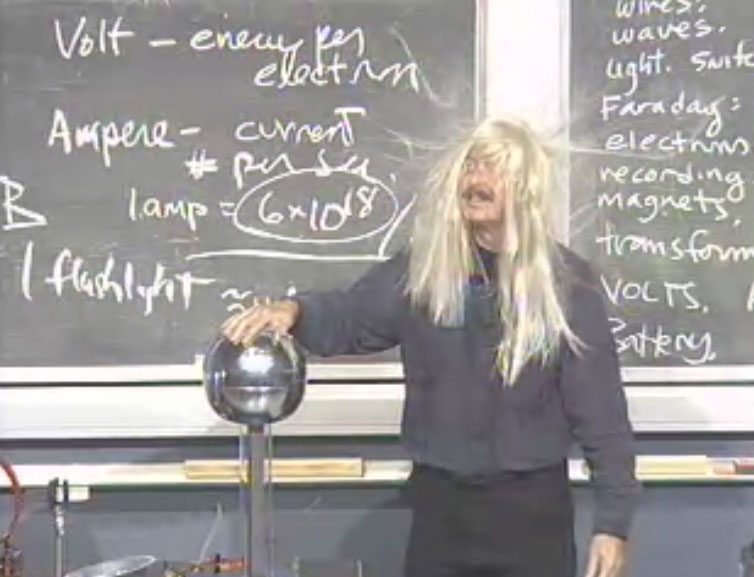
    אדם שנוגע בגנרטור ואן דה גראף עם השיער עומד על קצהו
    מטענים דומים דוחים: כל שיער נושא אותו מטען מגנרטור ואן דה גראף, ולכן הם דוחים זה את זה
    10.2

    The Process of Charging · ⁨תהליך הטעינה⁩

    Syllabus · ⁨סיילבוס⁩
    English

    Learning Objective 10.2.A: Describe the behavior of a system using conservation of charge.

    • 10.2.A.1 The net charge or charge distribution of a system can change in response to the presence of, or changes in, the net charge or charge distribution of other systems.
      • 10.2.A.1.i The net charge of a system can change due to friction or contact between systems.
      • 10.2.A.1.ii Induced charge separation occurs when the electrostatic force between two systems alters the distribution of charges within the systems, resulting in the polarization of one or both systems.
      • 10.2.A.1.iii Induced charge separation can occur in neutral systems.
    • 10.2.A.2 Any change to a system's net charge is due to a transfer of charge between the system and its surroundings.
      • 10.2.A.2.i The charging of a system typically involves the transfer of electrons to and from the system.
      • 10.2.A.2.ii The net charge of a system will be constant unless there is a transfer of charge to or from the system.
    • 10.2.A.3 Grounding involves electrically connecting a charged system to a much larger and approximately neutral system (e.g., Earth).
    עברית

    מטרות למידה 10.2.A: לתאר את התנהגות מערכת באמצעות שימור מטען.

    • 10.2.A.1 המטען הכולל או חלוקת המטען של מערכת יכולים להשתנות כתוצאה מהנוכחות או משנויים במטען הכולל או בחלוקת המטען של מערכות אחרות.
      • 10.2.A.1.i המטען הכולל של מערכת יכול להשתנות בשל חיכוך או מגע בין מערכות.
      • 10.2.A.1.ii הפרדת מטען מושרית מתרחשת כאשר הכוח האלקטרוסטטי בין שתי מערכות משנה את חלוקת המטענים בתוך המערכות, מה שמוביל לקיטוב של אחת או של שתי המערכות.
      • 10.2.A.1.iii הפרדת מטען מושרית יכולה להתרחש במערכות ניטרליות.
    • 10.2.A.2 כל שינוי במטען הכולל של מערכת נובע ממעבר מטען בין המערכת לסביבתה.
      • 10.2.A.2.i הטענת מערכת כוללת בדרך כלל מעבר אלקטרונים אל ועד המערכת.
      • 10.2.A.2.ii המטען הכולל של מערכת יישאר קבוע אלא אם כן ישנן מעברי מטען אל או מהמערכת.
    • 10.2.A.3 האדמה (Grounding) כוללת חיבור חשמלי של מערכת טעונה למערכת גדולה הרבה וניטרלית בקירוב (למשל, כדור הארץ).

    Source: College Board AP Course and Exam Description · ⁨מקור: תיאור הקורס והמבחן של College Board AP⁩

    English

    Objects charge by moving electrons. A conductor 导体 lets charge move freely; an insulator 绝缘体 holds it in place. Three methods:

    • Friction: rubbing transfers electrons.
    • Conduction 接触起电: touching shares charge.
    • Induction 感应起电: a nearby charge rearranges charge in a neutral object, which can then be grounded to leave it charged.
    עברית

    גופים נטענים על ידי הזזת אלקטרונים. מוליך מאפשר למטען לנוע בחופשיות; מבודד מחזיק אותו במקומו. שלושה שיטות:

    • חיכוך: שפשוף מעביר אלקטרונים.
    • הולכה: מגע משתף מטען.
    • אינדוקציה: מטען סמוך מעצב מחדש את המטען באובייקט ניטרלי, שאז ניתן להחברו לאדמה כדי לשאור אותו טעון.
    Explore · ⁨חקור⁩

    Charge an object by rubbing · ⁨טעינת גוף בשחיקה⁩

    Rubbing transfers electrons from one surface to another, leaving one positively and one negatively charged. Like charges repel, opposite charges attract. · ⁨שחיקה מעבירה אלקטרונים מפני שטח אחד לאחר, ומשאירה אחד טעון חיובית ואחד טעון negatively. מטענים זהים דוחים, מטענים הפוכים מושכים.⁩

    10.3

    Electric Fields · ⁨שדות חשמליים⁩

    Syllabus · ⁨סיילבוס⁩
    English

    Learning Objective 10.3.A: Describe the electric field produced by a charged object or configuration of point charges.

    • 10.3.A.1 Electric fields may originate from charged objects.
    • 10.3.A.2 The electric field at a given point is the ratio of the electric force exerted on a test charge at that point to the charge of the test charge.
      • Equation: $\vec{E} = \dfrac{\vec{F}_E}{q}$
      • 10.3.A.2.i A test charge is a point charge of small enough magnitude such that its presence does not significantly affect an electric field in its vicinity.
      • 10.3.A.2.ii An electric field points away from isolated positive charges and toward isolated negative charges.
      • 10.3.A.2.iii The electric force exerted on a positive test charge by an electric field is in the same direction as the electric field.
    • 10.3.A.3 The electric field is a vector quantity and can be represented in space using vector field maps.
      • 10.3.A.3.i The net electric field at a given location is the vector sum of individual electric fields created by nearby charged objects.
      • 10.3.A.3.ii Electric field maps use vectors to depict the magnitude and direction of the electric field at many locations within a given region.
      • 10.3.A.3.iii Electric field line diagrams are simplified models of electric field maps and can be used to determine the relative magnitude and direction of the electric field at any position in the diagram.

    Learning Objective 10.3.B: Describe the electric field generated by charged conductors or insulators.

    • 10.3.B.1 While in electrostatic equilibrium, the excess charge of a solid conductor is distributed on the surface of the conductor, and the electric field within the conductor is zero.
      • 10.3.B.1.i At the surface of a charged conductor, the electric field is perpendicular to the surface.
      • 10.3.B.1.ii The electric field outside an isolated sphere with spherically symmetric charge distribution is the same as the electric field due to a point charge with the same net charge as the sphere located at the center of the sphere.
    • 10.3.B.2 While in electrostatic equilibrium, the excess charge of an insulator is distributed throughout the interior of the insulator as well as at the surface, and the electric field within the insulator may have a nonzero value.

    Boundary statement: AP Physics 2 only expects students to make calculations of the electric field resulting from four or fewer charged objects or systems. Analysis of the electric field resulting from more charges is allowed in situations of high symmetry. Students will only be expected to perform qualitative analysis of electric fields within insulators.

    עברית

    מטרות למידה 10.3.A: לתאר את השדה החשמלי הנוצר על ידי אובייקט טעון או תצורת מטעני נקודה.

    • 10.3.A.1 שדות חשמליים עשויים לנגוע באובייקטים טעונים.
    • 10.3.A.2 השדה החשמלי בנקודה נתונה הוא היחס בין הכוח החשמלי הפועל על מטען מבחן בנקודה זו לבין גודל המטען של מטען הבחון.
      • משוואה: $\vec{E} = \dfrac{\vec{F}_E}{q}$
      • 10.3.A.2.i מטען מבחן הוא מטען נקודה בגודל קטן מספיק כך שהנוכחות שלו אינה משפיעה באופן משמעותי על השדה החשמלי בסביבתו.
      • 10.3.A.2.ii שדה חשמלי מצביע הרחק ממטענים חיוביים בודדים וכלפי מטענים שליליים בודדים.
      • 10.3.A.2.iii הכוח החשמלי הפועל על מטען מבחן חיובי על ידי שדה חשמלי הוא באותה כיוון כמו השדה החשמלי.
    • 10.3.A.3 השדה החשמלי הוא גודל וקטורי ואפשר להציגו במרחב באמצעות מפות שדות וקטורים.
      • 10.3.A.3.i השדה החשמלי הכולל במקום נתון הוא הסכום הוקטורי של שדות חשמליים בודדים שנוצרו על ידי אובייקטים טעונים סמוכים.
      • 10.3.A.3.ii מפות שדה חשמלי משתמשות בווקטורים כדי להציג את הגודל והכיוון של השדה החשמלי במיקומים רבים בתוך אזור נתון.
      • 10.3.A.3.iii דיאגרמות קווי שדה חשמלי הן מודלים פשוטים של מפות שדה חשמלי וניתן להשתמש בהן כדי לקבוע את הגודל היחסי והכיוון של השדה החשמלי בכל מיקום בדיאגרמה.

    מטרות למידה 10.3.B: לתאר את השדה החשמלי שנוצר על ידי מוליכים טעונים או מבודדים טעונים.

    • 10.3.B.1 בזמן איזון אלקטרוסטטי, המטען העודף של מוליך מוצק מתפלג על פני השטח של המוליך, והשדה החשמלי בתוך המוליך הוא אפס.
      • 10.3.B.1.i בפני השטח של מוליך טעון, השדה החשמלי מאונך לפני השטח.
      • 10.3.B.1.ii השדה החשמלי מחוץ לכדור מבודד עם חלוקת מטען סימטרית-כדורית זהה לשדה החשמלי שנוצר ממטען נקודתי בעל מטען נקי זהה לזה של הכדור הנמצא במרכז הכדור.
    • 10.3.B.2 בזמן איזון אלקטרוסטטי, המטען העודף של מבודד מתפלג בכל האזור הפנימי של המבודד וגם בפני השטח שלו, והשדה החשמלי בתוך המבודד עשוי להיות שונה מאפס.

    הצהרת גבול: AP Physics 2 מצפה רק מהתלמידים לבצע חישובים של השדה החשמלי הנובע מארבעה או פחות גופים טעונים או מערכות. ניתוח של השדה החשמלי הנובע ממטענים נוספים מותר במקרים בעלי סימטריה גבוהה. התלמידים יצטרכו רק לבצע ניתוח איכותי של שדות חשמלי בתוך מבודדים.

    Source: College Board AP Course and Exam Description · ⁨מקור: תיאור הקורס והמבחן של College Board AP⁩

    English
    The electric field of a dipole

    An electric field 电场 $\vec{E}$ is the force per unit charge that a small positive test charge would feel:

    $$\vec{E}=\frac{\vec{F}}{q},\qquad E=\frac{kQ}{r^2}\ \text{for a point charge}.$$
    Field lines point away from positive charges and toward negative ones; where they are denser, the field is stronger. A charge in a field feels $\vec{F}=q\vec{E}$.

    Worked example. Find the electric field $0.20\ \text{m}$ from a $+5.0\ \mu\text{C}$ point charge: $E=\dfrac{kQ}{r^2}=\dfrac{9.0\times10^{9}\times5.0\times10^{-6}}{(0.20)^2}=1.1\times10^{6}\ \text{N/C}$, pointing away from the charge. A $+2\ \text{nC}$ charge placed there would feel $F=qE=2\times10^{-9}\times1.1\times10^{6}=2.2\times10^{-3}\ \text{N}$.

    עברית
    השדה החשמלי של דו-קוטב
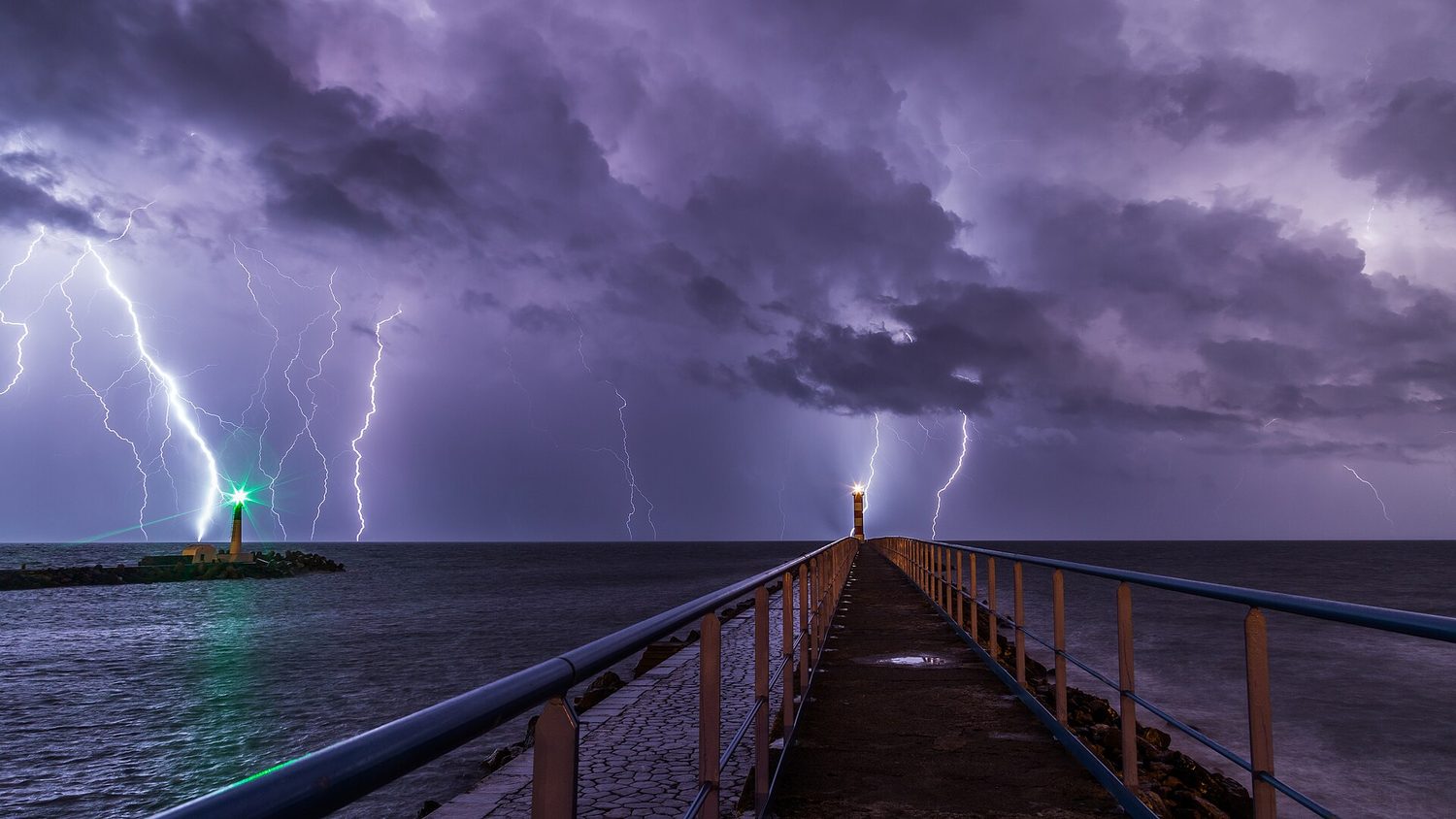
    מספר נתיקי ברק בהירים וענפניים פוגעים מלמעלה בשמי סוערים מעל נמל
    ברק: מטען מצטבר עד שהשדה החשמלי בין הענן לקרקע חזק מספיק כדי לנתק אלקטרונים ממולקלות האוויר, וזרם ענק זורם

    שדה חשמלי $\vec{E}$ הוא הכוח ליחידת מטען שמטען בדיקה חיובי קטן יחוש:

    $$\vec{E}=\frac{\vec{F}}{q},\qquad E=\frac{kQ}{r^2}\ \text{for a point charge}.$$
    קווי השדה מופנים הרחק מטענות חיוביות וכלפי שליליות; ככל שהם צפופים יותר, השדה חזק יותר. מטען בשדה מרגיש ב$\vec{F}=q\vec{E}$.

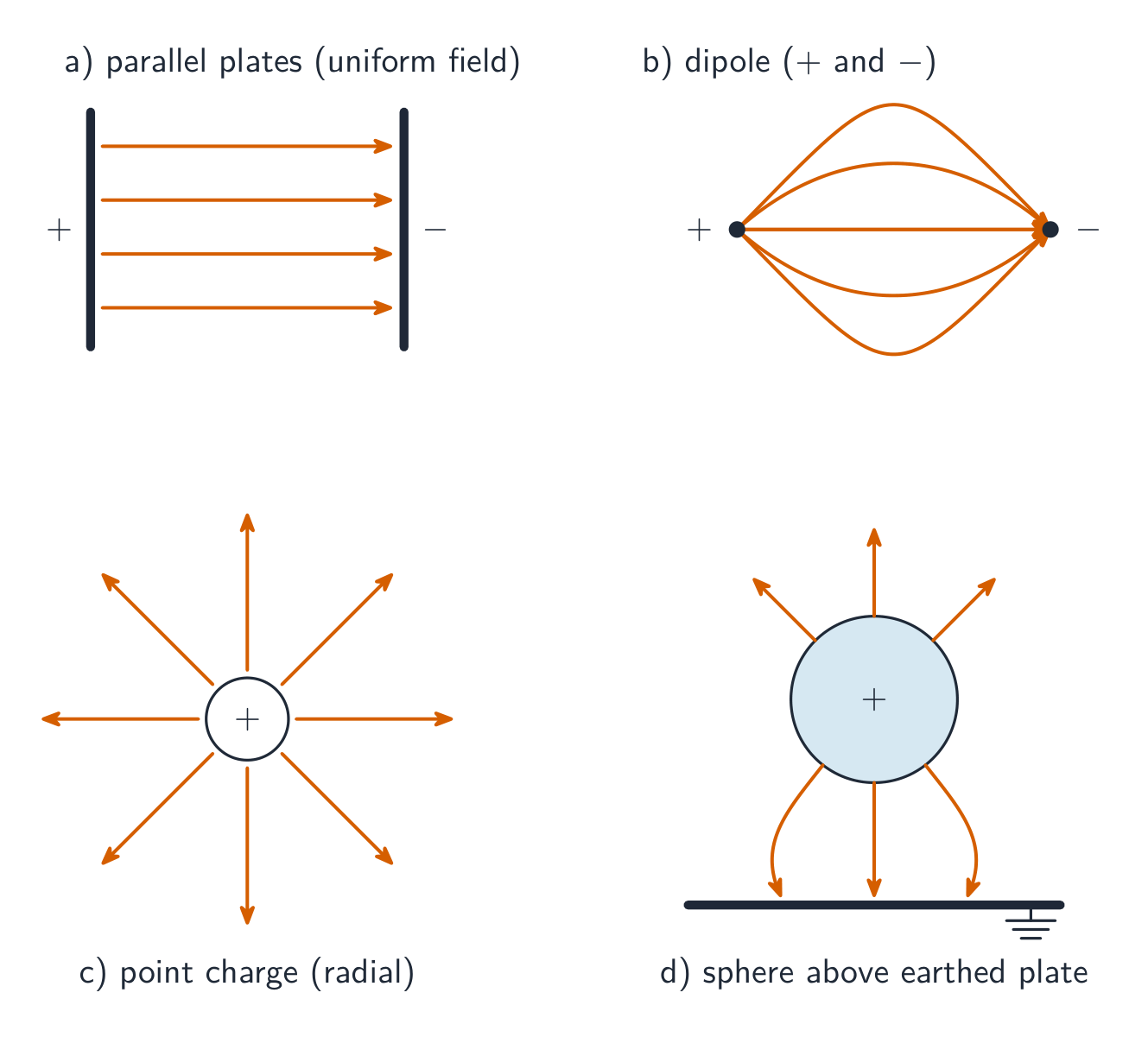
    דפוסי קווי שדה חשמלי ללוחות מקבילים, דואידי וטען נקודתי
    דפוסי קווי שדה חשמלי ללוחות מקבילים, דואידי וטען נקודתי

    דוגמה מוצגת. חשב את השדה החשמלי $0.20\ \text{m}$ ממטען נקודתי $+5.0\ \mu\text{C}$: $E=\dfrac{kQ}{r^2}=\dfrac{9.0\times10^{9}\times5.0\times10^{-6}}{(0.20)^2}=1.1\times10^{6}\ \text{N/C}$, המצביע הרחק מהטען. מטען $+2\ \text{nC}$ שנמצא שם יחוש $F=qE=2\times10^{-9}\times1.1\times10^{6}=2.2\times10^{-3}\ \text{N}$.

    Explore · ⁨חקור⁩

    Map the field around a charge · ⁨שרטט שדה סביב מטען⁩

    An electric field points the way a positive test charge would be pushed: away from a positive charge, toward a negative one. Closer lines mean a stronger field. · ⁨שדה חשמלי מצביע לכיוון שהטעון הניסיון החיובית תדחף: הרחק ממטען חיובי, לכיוון מטען שלילי. קווים צפופים יותר מעידים על שדה חזק יותר.⁩

    Vocabulary · ⁨מילון מונחים⁩ Train · ⁨אימון⁩
    English עברית
    Electric charge/ɪˈlektrɪk tʃɑːdʒ/ מטען חשמלי
    Coulomb's law/ˈkuːlɒmz lɔː/ חוק קולון
    permittivity/ˌpɜːmɪˈtɪvəti/ עקביות
    conductor/kənˈdʌktə/ מו Interructor
    insulator/ˈɪnsjuːleɪtə/ בודד חשמלי
    Conduction/kənˈdʌkʃn/ הולכה
    Induction/ɪnˈdʌkʃn/ אינדוקציה
    electric field/ɪˈlektrɪk fiːld/ שדה חשמלי
    electric potential energy/ɪˈlektrɪk pəˈtenʃl ˈenədʒi/ אנרגיה פוטנציאלית חשמלית
    Electric potential/ɪˈlektrɪk pəˈtenʃl/ פוטנציאל חשמלי
    10.4

    Electric Potential Energy · ⁨אנרגיה פוטנציאלית חשמלית⁩

    Syllabus · ⁨סיילבוס⁩
    English

    Learning Objective 10.4.A: Describe the electric potential energy of a system.

    • 10.4.A.1 The electric potential energy of a system of two point charges equals the amount of work required for an external force to bring the point charges to their current positions from infinitely far away.
    • 10.4.A.2 The general form for the electric potential energy of two charged objects is given by the equation
      • Equation: $U_E = \dfrac{1}{4\pi\varepsilon_0}\dfrac{q_1 q_2}{r} = k\dfrac{q_1 q_2}{r}$
    • 10.4.A.3 The total electric potential energy of a system can be determined by finding the sum of the electric potential energies of the individual interactions between each pair of charged objects in the system.

    Boundary statement: As the methods to calculate the electric potential energy due to extended charge distributions exceed the scope of the course, AP Physics 2 only requires that students calculate the electric potential energy of configurations of four or fewer point charges.

    עברית

    מטרות למידה 10.4.A: לתאר את האנרגיה הפוטנציאלית החשמלית של מערכת.

    • 10.4.A.1 האנרגיה הפוטנציאלית החשמלית של מערכת של שני מטענים נקודתיים שווה לכמות העבודה הנדרשת מכוח חיצוני להביא את המטענים הנקודתיים למיקומם הנוכחי מרחק אינסופי.
    • 10.4.A.2 הצורה הכללית לאנרגיה הפוטנציאלית החשמלית של שני גופים טעונים נתונה על ידי המשוואה
      • משוואה: $U_E = \dfrac{1}{4\pi\varepsilon_0}\dfrac{q_1 q_2}{r} = k\dfrac{q_1 q_2}{r}$
    • 10.4.A.3 האנרגיה הפוטנציאלית החשמלית הכוללת של מערכת יכולה להימצאת על ידי חיבור סכום האנרגיות הפוטנציאליות החשמליות של האינטראקציות הבודדות בין כל זוג של גופים טעונים במערכת.

    הצהרת גבול: מכיוון שהשיטות לחישוב האנרגיה הפוטנציאלית החשמלית הנובעת מפירוקי מטען מורחבים עוברות מגבולות הקורס, AP Physics 2 דורשת רק מהתלמידים לחשב את האנרגיה הפוטנציאלית החשמלית של תצורות של ארבעה או פחות מטענים נקודתיים.

    Source: College Board AP Course and Exam Description · ⁨מקור: תיאור הקורס והמבחן של College Board AP⁩

    English

    Two charges have electric potential energy 电势能 stored in their arrangement:

    $$U=\frac{k q_1 q_2}{r}.$$
    Like charges pushed together store positive energy; opposite charges have negative energy (bound). Moving a charge changes $U$, and the electric force does work equal to $-\Delta U$.

    עברית

    לשני מטענים יש אנרגיה פוטנציאלית חשמלית מאוחסת בסידורם:

    $$U=\frac{k q_1 q_2}{r}.$$
    מטענים זהים הנדחפים יחד מאחסנים אנרגיה חיובית; מטענים מנוגדים יש להם אנרגיה שלילית (קשורים). הזזת מטען משנה $U$, והכוח החשמלי מבצע עבודה השווה ל-$-\Delta U$.

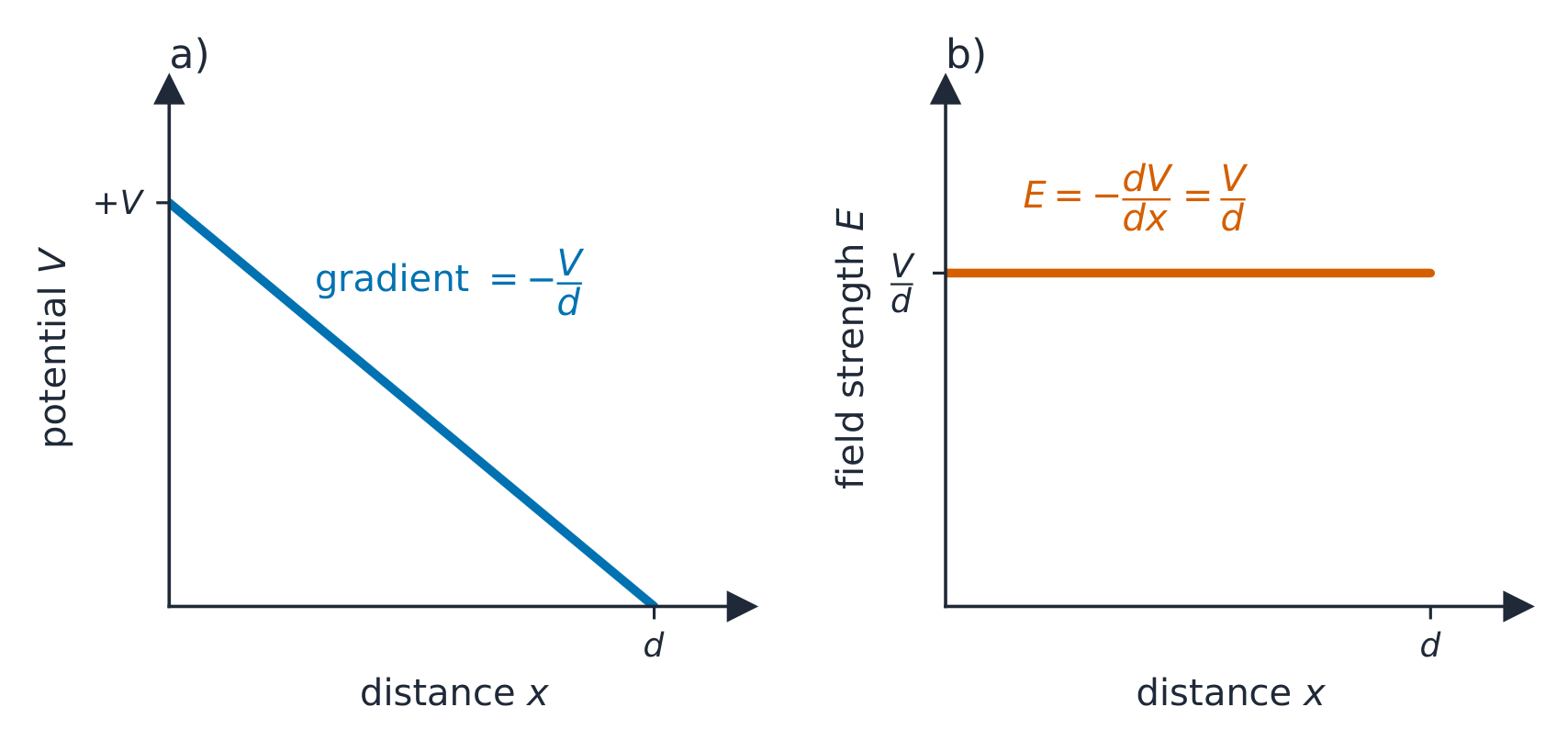
    בשדה אחיד הפוטנציאל יורד באופן קבוע עם המרחק, ולכן E קשור ל-V
    בשדה אחיד הפוטנציאל יורד באופן קבוע עם המרחק, ולכן E קשור ל-V
    10.5

    Electric Potential · ⁨פוטנציאל חשמלי⁩

    Syllabus · ⁨סיילבוס⁩
    English

    Learning Objective 10.5.A: Describe the electric potential due to a configuration of charged objects.

    • 10.5.A.1 Electric potential describes the electric potential energy per unit charge at a point in space.
    • 10.5.A.2 The electric potential due to multiple point charges can be determined by the principle of scalar superposition of the electric potential due to each of the point charges.
      • Equation: $V = \dfrac{1}{4\pi\varepsilon_0}\sum_{i}\dfrac{q_i}{r_i}$
    • 10.5.A.3 The electric potential difference between two points is the change in electric potential energy per unit charge when a test charge is moved between the two points.
      • Equation: $\Delta V = \dfrac{\Delta U_E}{q}$
      • 10.5.A.3.i Electric potential difference may also result from chemical processes that cause positive and negative charges to separate, such as in a battery.
    • 10.5.A.4 When conductors are in electrical contact, electrons will be redistributed such that the surfaces of the conductors are at the same electric potential.

    Learning Objective 10.5.B: Describe the relationship between electric potential and electric field.

    • 10.5.B.1 The average electric field between two points in space is equal to the electric potential difference between the two points divided by the distance between the two points.
      • Equation: $\left|\vec{E}\right| = \left|\dfrac{\Delta V}{\Delta r}\right|$
    • 10.5.B.2 Electric field vector maps and equipotential lines are tools to describe the field produced by a charge or configuration of charges and can be used to predict the motion of charged objects in the field.
      • 10.5.B.2.i Equipotential lines represent lines of equal electric potential in space. These lines are also referred to as isolines of electric potential.
      • 10.5.B.2.ii Isolines are perpendicular to electric field vectors. An isoline map of electric potential can be constructed from an electric field vector map, and an electric field map may be constructed from an isoline map.
      • 10.5.B.2.iii An electric field vector points in the direction of decreasing potential.
      • 10.5.B.2.iv There is no component of an electric field along an isoline.

    Boundary statement: As the methods to calculate the electric potential due to extended charges exceed the scope of the course, AP Physics 2 only expects that students calculate the electric potential of configurations of four or fewer particles (or more in situations of high symmetry).

    עברית

    מטרות למידה 10.5.A: לתאר את הפוטנציאל החשמלי הנובע מתצורת של גופים טעונים.

    • 10.5.A.1 פוטנציאל חשמלי מתאר את האנרגיה הפוטנציאלית החשמלית ליחידת מטען בנקודה במרחב.
    • 10.5.A.2 הפוטנציאל החשמלי הנובע ממספר מטענים נקודתיים יכול להימצא באמצעות עקרון הסופרפוזיציה הסקלרית של הפוטנציאל החשמלי הנובע מכל אחד מהמטענים הנקודתיים.
      • משוואה: $V = \dfrac{1}{4\pi\varepsilon_0}\sum_{i}\dfrac{q_i}{r_i}$
    • 10.5.A.3 הפרש הפוטנציאל החשמלי בין שתי נקודות הוא השינוי באנרגיה הפוטנציאלית החשמלית ליחידת מטען כאשר מטען מבחנה מוזז בין שתי הנקודות.
      • משוואה: $\Delta V = \dfrac{\Delta U_E}{q}$
      • 10.5.A.3.i פרש פוטנציאל חשמלי עשוי גם לנבוע מתהליכים כימיים הגורמים להפרדת מטענים חיוביים ומשליליים, כגון בסוללה.
    • 10.5.A.4 כאשר מוליכים נמצאים במגע חשמלי, אלקטרונים יתפצלו מחדש כך שמשטחי המוליכים יהיו באותו פוטנציאל חשמלי.

    מטרת למידה 10.5.B: תאר את הקשר בין פוטנציאל חשמלי לשדה חשמלי.

    • 10.5.B.1 השדה החשמלי הממוצע בין שתי נקודות במרחב שווה להפרש הפוטנציאל החשמלי בין שתי הנקודות מחולק במרחק בין שתי הנקודות.
      • משוואה: $\left|\vec{E}\right| = \left|\dfrac{\Delta V}{\Delta r}\right|$
    • 10.5.B.2 מפות וקטוריות של שדה חשמלי וקווי איזופוטנציאל הן כלים לתיאור השדה שמיוצר על ידי מטען או קונפיגורציה של מטענים, וניתן להשתמש בהם לחזות את התנועה של גופים טעונים בשדה זה.
      • 10.5.B.2.i קווי איזופוטנציאל מייצגים קווים בעלי פוטנציאל חשמלי שווה במרחב. קווים אלו מכונים גם קווי שוויון (isolines) של פוטנציאל חשמלי.
      • 10.5.B.2.ii קווי שוויון מאונכים לווקטורי השדה החשמלי. ניתן לבנות מפת איזופוטנציאל מתוך מפת וקטורים של שדה חשמלי, ומפה של שדה חשמלי יכולה להיבנות מתוך מפת קווי שוויון.
      • 10.5.B.2.iii וקטור השדה החשמלי מצביע בכיוון הפחתת הפוטנציאל.
      • 10.5.B.2.iv אין רכיב של שדה חשמלאורך קו שוויון.

    ניסוח גבול: מכיוון שיטות לחישוב הפוטנציאל החשמלי עקב מטענים מורחבים עולות מעבר לתחום הלימודים, AP Physics 2 דורש מהתלמידים רק לחשב את הפוטנציאל החשמלי של קונפיגורציות של ארבעה חלקיקים או פחות (או יותר במצבים של סימטריה גבוהה).

    Source: College Board AP Course and Exam Description · ⁨מקור: תיאור הקורס והמבחן של College Board AP⁩

    English

    Electric potential 电势 $V$ is the potential energy per unit charge – a scalar field, measured in volts:

    $$V=\frac{U}{q}=\frac{kQ}{r}.$$
    The potential difference (voltage) 电压 between two points is the work per unit charge to move between them: $\Delta V=\dfrac{\Delta U}{q}$, and $U=qV$. Positive charges move from high to low potential on their own. Because potential is a scalar, adding the potentials from several charges is much easier than adding field vectors.

    עברית

    פוטנציאל חשמלי $V$ הוא האנרגיה הפוטנציאלית ליחידת מטען – שדה סקלארי, נמדד בוולטים:

    $$V=\frac{U}{q}=\frac{kQ}{r}.$$
    הפרש הפוטנציאל (מתח) בין שתי נקודות הוא העבודה ליחידת מטען להזזה ביניהן: $\Delta V=\dfrac{\Delta U}{q}$, ו-$U=qV$. מטענים חיוביים זזים מ autofי פוטנציאל גבוה לנמוך באופן עצמאי. מכיוון שהפוטנציאל הוא סקלארי, חיבור הפוטנציאלים ממספר מטענים קל הרבה יותר מחיבור וקטורי שדה.

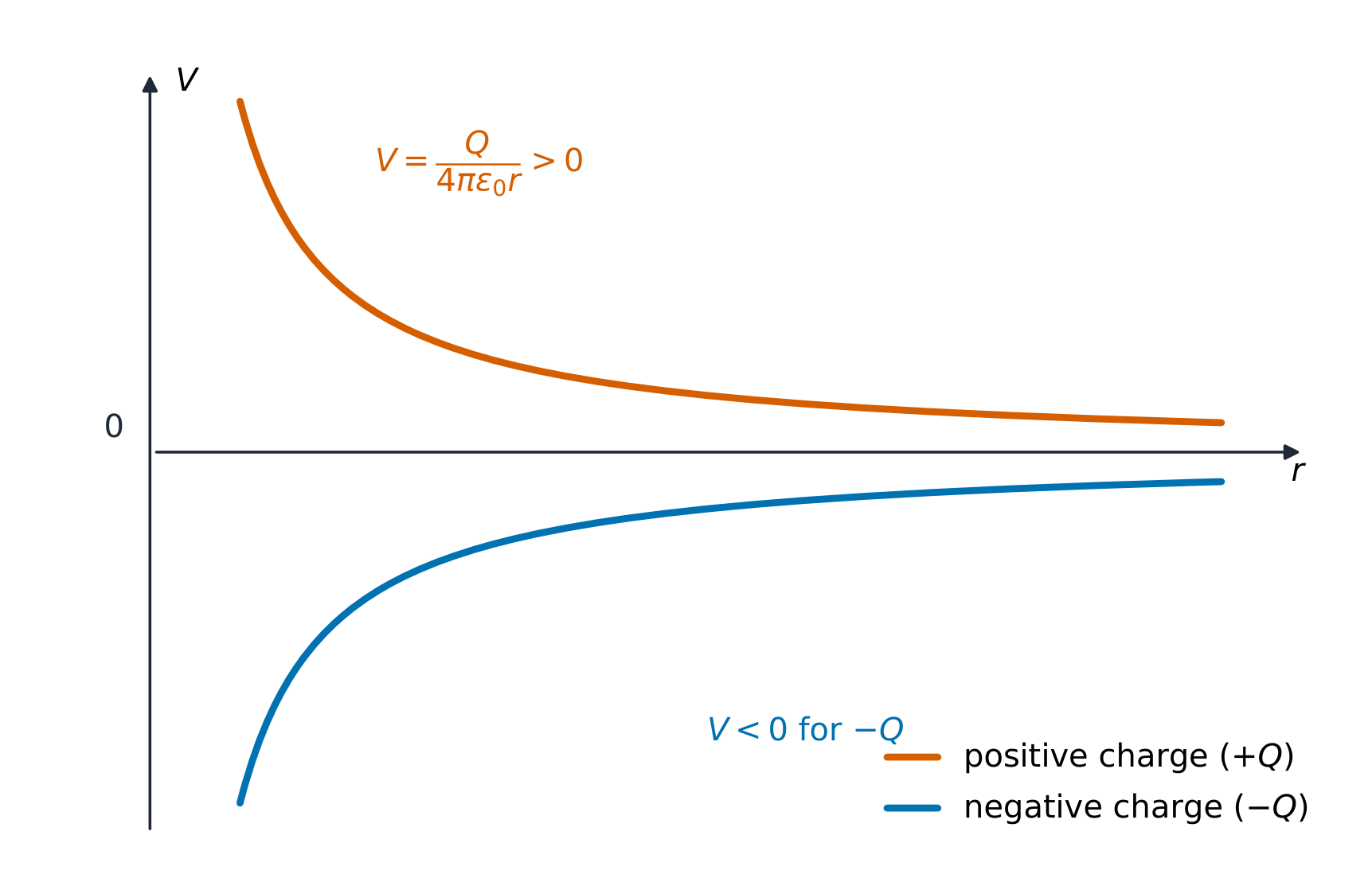
    הפוטנציאל ליד מטען נקודתי משתנה לפי 1/r
    הפוטנציאל סמוך לטען נקודתי משתנה לפי 1/r
    10.6

    Capacitors · ⁨קבלים⁩

    Syllabus · ⁨סיילבוס⁩
    English

    Learning Objective 10.6.A: Describe the physical properties of a parallel-plate capacitor.

    • 10.6.A.1 A parallel-plate capacitor consists of two separated parallel conducting surfaces that can hold equal amounts of charge with opposite signs.
    • 10.6.A.2 Capacitance relates the magnitude of the charge stored on each plate to the electric potential difference created by the separation of those charges.
      • Equation: $C = \dfrac{Q}{\Delta V}$
      • 10.6.A.2.i The capacitance of a capacitor depends only on the physical properties of the capacitor, such as the capacitor's shape and the material used to separate the plates.
      • 10.6.A.2.ii The capacitance of a parallel-plate capacitor is proportional to the area of one of its plates and inversely proportional to the distance between its plates. The constant of proportionality is the product of the dielectric constant, $\kappa$, of the material between the plates and the electric permittivity of free space, $\varepsilon_0$.
        • Equation: $C = \kappa\varepsilon_0\dfrac{A}{d}$
    • 10.6.A.3 The electric field between two charged parallel plates with uniformly distributed electric charge, such as in a parallel-plate capacitor, is constant in both magnitude and direction, except near the edges of the plates.
      • 10.6.A.3.i The magnitude of the electric field between two charged parallel plates, where the plate separation is much smaller than the dimensions of the plates, can be described with the equation
        • Equation: $E_C = \dfrac{Q}{\kappa\varepsilon_0 A}$
      • 10.6.A.3.ii A charged particle between two oppositely charged parallel plates undergoes constant acceleration and therefore its motion shares characteristics with the projectile motion of an object with mass in the gravitational field near Earth's surface.
    • 10.6.A.4 The electric potential energy stored in a capacitor is equal to the work done by an external force to separate that amount of charge on the capacitor.
    • 10.6.A.5 The electric potential energy stored in a capacitor is described by the equation
      • Equation: $U_C = \dfrac{1}{2}Q\Delta V$
    • 10.6.A.6 Adding a dielectric between two plates of a capacitor changes the capacitance of the capacitor and induces an electric field in the dielectric in the opposite direction to the field between the plates.

    Boundary statement: While other shapes are also able to separate charges, only the analysis and descriptions of parallel-plate capacitors are required for AP Physics 2. Edge effects will be ignored unless explicitly stated otherwise.

    עברית

    מטרת למידה 10.6.A: תאר את התכונות הפיזיקליות של קבל לוחות מקבילים.

    • 10.6.A.1 קבל לוחות מקבילים מורכב משני משטחים מוליכים מקבילים ומרוחקים שאינם יכולים לאחסן כמות שווה של מטען עם סימנים הפוכים.
    • 10.6.A.2 הקיבול קובע את הקשר בין הגודל של המטען האגור בכל לוח לבין הפרש הפוטנציאל החשמלי שנוצר על ידי ההפרדה בין מטענים אלו.
      • משוואה: $C = \dfrac{Q}{\Delta V}$
      • 10.6.A.2.i הקיבול של קבל תלוי רק בתכונות הפיזיקליות שלו, כמו צורת הקבל והחומר המשמש להפריד בין הלוחות.
      • 10.6.A.2.ii הקיבול של קבל לוחות מקבילים פרופורציונלי לשטח אחד מהלוחות והופך ליחס הפוך למרחק בין הלוחות. קבוע הפרופורציונליות הוא מכפלת קבוע הדיאלקטרי $\kappa$ של החומר שבין הלוחות והpermittivity החשמלי של הריק, $\varepsilon_0$.
        • משוואה: $C = \kappa\varepsilon_0\dfrac{A}{d}$
    • 10.6.A.3 השדה החשמלי בין שני לוחות מקבילים טעונים עם חלוקה אחידה של מטען חשמלי, כמו בקבל לוחות מקבילים, הוא קבוע בגודלו ובכיוונו, למעט בסמוך לקצוות הלוחות.
      • 10.6.A.3.i הגודל של השדה החשמלי בין שני לוחות מקבילים טעונים, כאשר מרווח הלוחות קטן משמעותית מממדי הלוחות, ניתן לתאר באמצעות המשוואה
        • משוואה: $E_C = \dfrac{Q}{\kappa\varepsilon_0 A}$
      • 10.6.A.3.ii חלקיק טעון בין שני לוחות מקבילים עם מטענים הפוכים חווה תאוצה קבועה ולכן התנועה שלו משתפת מאפיינים עם תנועת זריקה של גוף בעל מסה בשדה הכבידה סמוך לפני השטח של כדור הארץ.
    • 10.6.A.4 אנרגיית הפוטנציאל החשמלית האגורה בקבל שווה לעבודה שנעשה על ידי כוח חיצוני כדי להפריד את כמות המטען הזו על הקבל.
    • 10.6.A.5 אנרגיית הפוטנציאל החשמלית האגורה בקבל מתוארת על ידי המשוואה
      • משוואה: $U_C = \dfrac{1}{2}Q\Delta V$
    • 10.6.A.6 הוספת דיאלקטר בין שתי פלטות של קבל משנה את הקיבולת של הקבל וגורם להיווצרות שדה חשמלי בתוך הדיאלקטר בכיוון הפוך לשדה שבין הפלטות.

    הצהרת גבול: בעוד שצורות אחרות יכולות גם הן להפריד מטענים, רק ניתוח ותיאורים של קבלים עם פלטות מקבילות נדרשים לקורס AP Physics 2. השפעות שפה יוותרו מעבר ללא ציון מפורש אחרת.

    Source: College Board AP Course and Exam Description · ⁨מקור: תיאור הקורס והמבחן של College Board AP⁩

    English
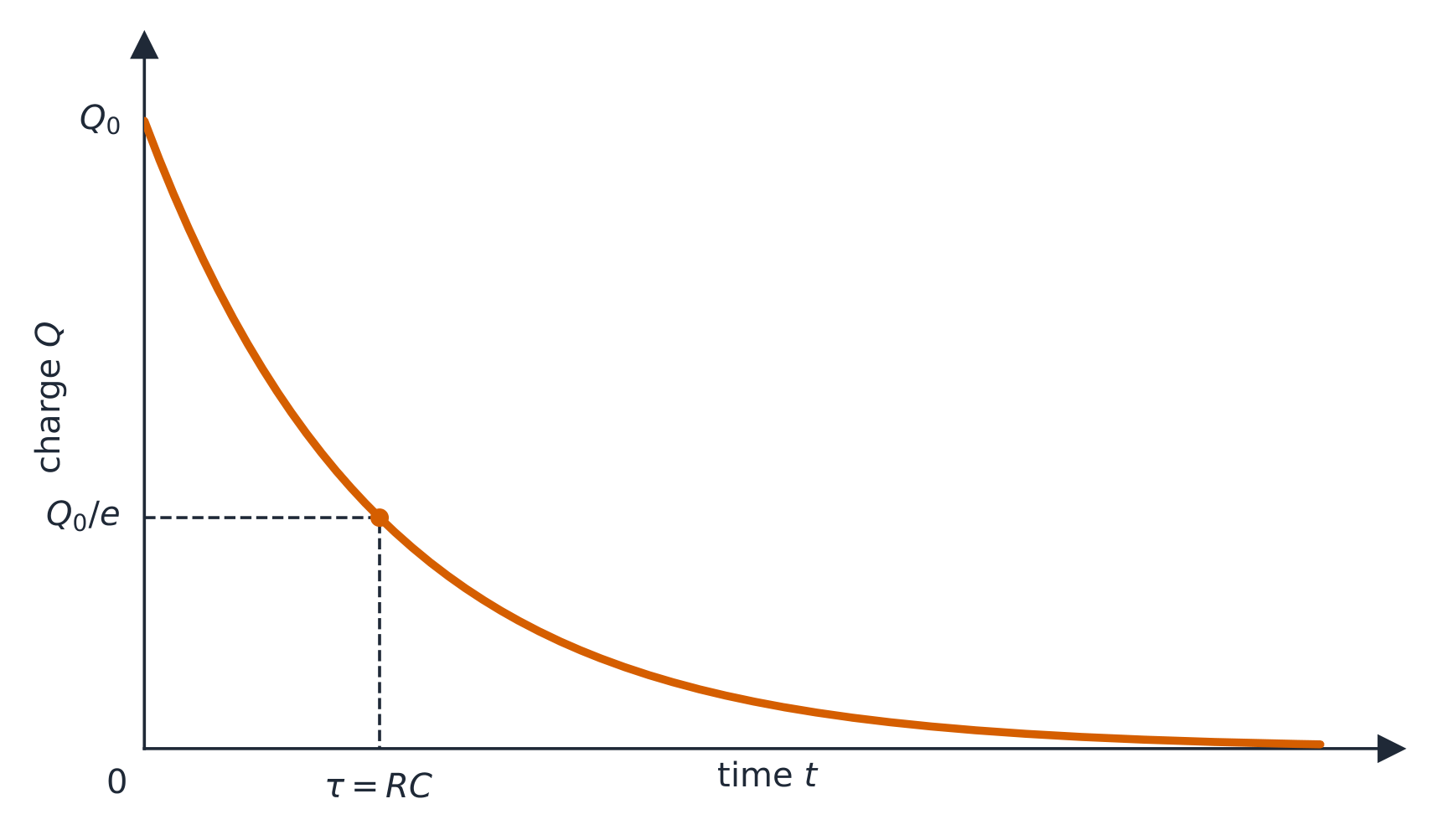
    Discharging a capacitor: τ = RC
    Charging a capacitor (RC)

    A capacitor 电容器 stores charge and energy on two conductors separated by a gap. Its capacitance 电容 relates charge to voltage:

    $$C=\frac{Q}{V},$$
    and the stored energy is $U=\tfrac{1}{2}CV^2$. Capacitance depends on the plates' geometry and the material between them, not on the charge placed on it.

    Worked example. A $100\ \mu\text{F}$ capacitor is charged to $12\ \text{V}$. It holds $Q=CV=100\times10^{-6}\times12=1.2\times10^{-3}\ \text{C}$ of charge and stores $U=\tfrac12 CV^2=\tfrac12\times100\times10^{-6}\times12^2=7.2\times10^{-3}\ \text{J}$ of energy.

    עברית
    פריקת קבל: τ = RC
    טעינת קבל (RC)

    קבל מאחסן מטען ואנרגיה על שני מוליכים המופרדים במרווח. ה-קיבול שלו מקשר את המטען למתח:

    $$C=\frac{Q}{V},$$
    והאנרגיה המאוחסת היא $U=\tfrac{1}{2}CV^2$. הקיבול תלוי בגיאומטריית הפלטות ובחומר שביןיהם, ולא במטען שמצופה עליו.

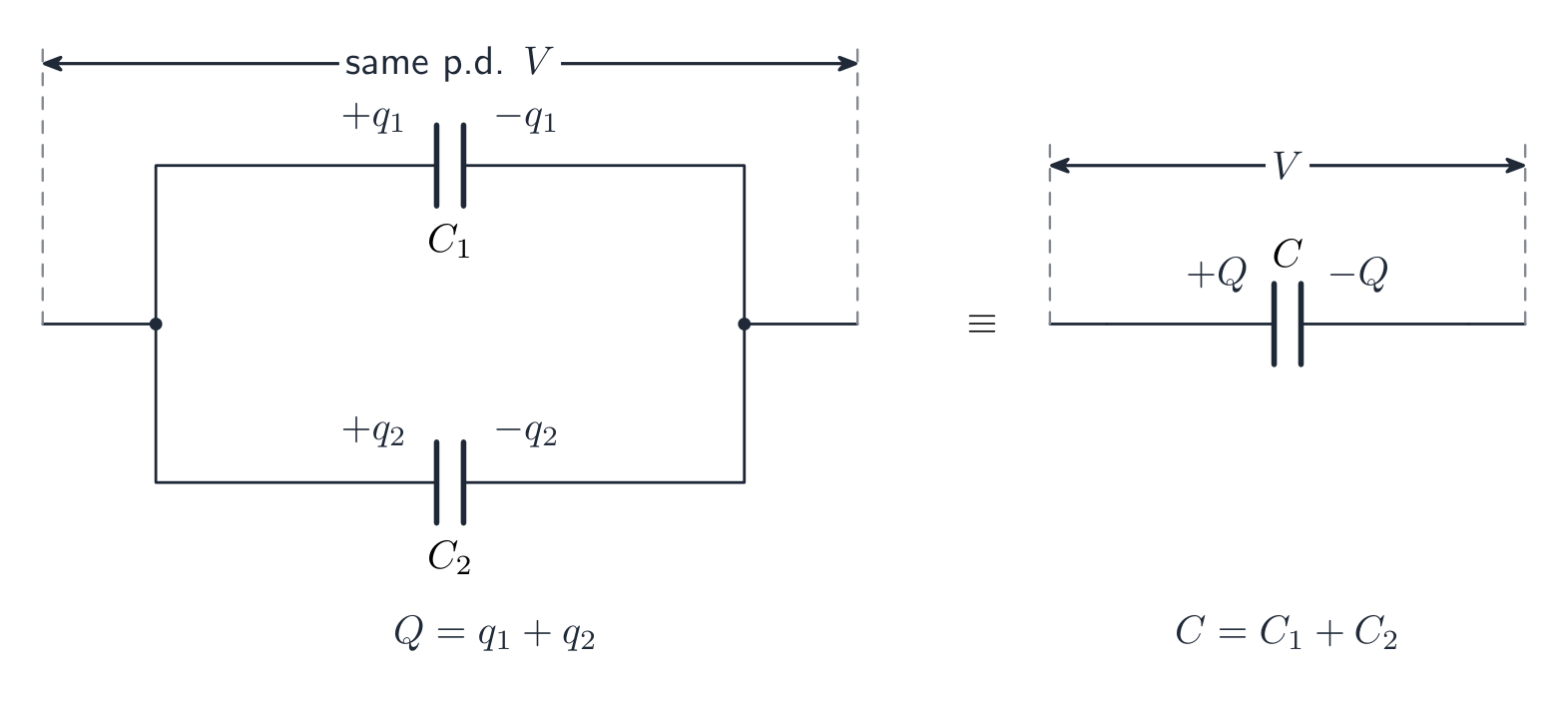
    קבלים במקביל חולקים אותו מתח, ומטעניהם נוספים
    קבלים במקביל חולקים אותו מתח, ומטעניהם נוספים

    דוגמה מפורטת. קבל בעל ערך של $100\ \mu\text{F}$ טעון למתח של $12\ \text{V}$. הוא מחזיק מטען של $Q=CV=100\times10^{-6}\times12=1.2\times10^{-3}\ \text{C}$ ואוחסן אנרגיה של $U=\tfrac12 CV^2=\tfrac12\times100\times10^{-6}\times12^2=7.2\times10^{-3}\ \text{J}$.

    Explore · ⁨חקור⁩

    Charge and discharge a capacitor · ⁨טעינה ופריקת קבל⁩

    A capacitor stores charge on two plates. It fills and empties exponentially, set by the time constant $\tau = RC$ — bigger $R$ or $C$ means slower charging. · ⁨קבל מאגר מטען על שני פלטות. הוא נטען ומתרוקן באופן אקספוננציאלי, בהתאם לקבוע הזמן $\tau = RC$ — ערך גדול יותר של $R$ או $C$ גורם לטעינה איטית יותר.⁩

    Vocabulary · ⁨מילון מונחים⁩ Train · ⁨אימון⁩
    English עברית
    capacitor/kəˈpæsɪtə/ קבל
    capacitance/kəˈpæsɪtəns/ קיבול
    10.7

    Conservation of Electric Energy · ⁨שימור אנרגיה חשמלית⁩

    Syllabus · ⁨סיילבוס⁩
    English

    Learning Objective 10.7.A: Describe changes in energy in a system due to a difference in electric potential between two locations.

    • 10.7.A.1 When a charged object moves between two locations with different electric potentials, the resulting change in the electric potential energy of the object-field system is given by the following equation.
      • Equation: $\Delta U_E = q\Delta V$
    • 10.7.A.2 The movement of a charged object between two points with different electric potentials results in a change in kinetic energy of the object consistent with the conservation of energy.
    עברית

    מטרת למידה 10.7.A: לתאר שינויים באנרגיה במערכת עקב הבדל בפוטנציאל חשמלי בין שני מיקומים.

    • 10.7.A.1 כאשר גוף טעון זז בין שני מיקומים עם פוטנציאל חשמלי שונה, השינוי resulting באנרגיה הפוטנציאלית החשמלית של מערכת הגוף-שדה נתון על ידי המשוואה הבאה.
      • משוואה: $\Delta U_E = q\Delta V$
    • 10.7.A.2 תנועת גוף טעון בין שני נקודות עם פוטנציאל חשמלי שונה גורמת לשינוי באנרגיה הקינטית של הגוף בהתאם לשימור האנרגיה.

    Source: College Board AP Course and Exam Description · ⁨מקור: תיאור הקורס והמבחן של College Board AP⁩

    English

    Energy is conserved for charges just as for masses. A charge released in a field converts electric potential energy into kinetic energy:

    $$q\,\Delta V=\tfrac{1}{2}mv^2 \quad(\text{gaining speed as it "falls" through a potential difference}).$$

    Worked example. An electron ($q=1.6\times10^{-19}\ \text{C}$, $m=9.1\times10^{-31}\ \text{kg}$) is accelerated from rest through a potential difference of $100\ \text{V}$. Its final speed is

    $$v=\sqrt{\frac{2q\,\Delta V}{m}}=\sqrt{\frac{2\times1.6\times10^{-19}\times100}{9.1\times10^{-31}}}=5.9\times10^{6}\ \text{m/s}.$$
    This is exactly how the electron gun in an old television or an electron microscope works.

    עברית

    אנרגיה נשמרת עבור מטענים בדיוק כמו עבור מסות. מטען משוחרר בשדה ממיר אנרגיה פוטנציאלית חשמלית לאנרגיה קינטית:

    $$q\,\Delta V=\tfrac{1}{2}mv^2 \quad(\text{gaining speed as it "falls" through a potential difference}).$$

    דוגמה מפורטת. אלקטרון (מסה $q=1.6\times10^{-19}\ \text{C}$, מטען $m=9.1\times10^{-31}\ \text{kg}$) מואץ ממצב רכינה דרך הפרש פוטנציאל של $100\ \text{V}$. מהירותו הסופית היא

    $$v=\sqrt{\frac{2q\,\Delta V}{m}}=\sqrt{\frac{2\times1.6\times10^{-19}\times100}{9.1\times10^{-31}}}=5.9\times10^{6}\ \text{m/s}.$$
    זוהי בדיוק הדרכה שבה עובד אקדח האלקטרונים בטלוויזיה ישנה או במיקרוסקופ אלקטרונים.

    Vocabulary · ⁨מילון מונחים⁩ Train · ⁨אימון⁩
    English עברית
    potential difference/pəˈtenʃl ˈdɪfrəns/ הפרש פוטנציאלים
    10.7

    Exam tips · ⁨טיפים לבחינות⁩

    English
    • Coulomb's law and the point-charge field are inverse-square — doubling the separation makes the force (or field) four times smaller.
    • Use magnitudes for the size of a force and decide direction from the signs; the field points the way a positive test charge would move.
    • Potential ($V$) is a scalar so potentials from several charges simply add; the field ($E$) is a vector and must be added by direction.
    • For a charge accelerated through a voltage use energy conservation $qV=\tfrac12 mv^2$.
    • Capacitor relations: $C=Q/V$ (capacitance is fixed by geometry) and energy $U=\tfrac12 CV^2$.
    עברית
    • חוק קולון ושדה מטען נקודתי הם ריבועיים הפוכים — הכפלת המרחק גורמת לכך שהכוח (או השדה) יהיה פי ארבע חלש.
    • השתמש בערכים מוחלטים לגודל הכוח והחלט על הכיוון לפי הסימנים; השדה מצביע בכיוון שבו מטען בדיקה חיובי היה זז.
    • פוטנציאל ($V$) הוא סקלר, ולכן פוטנציאלים ממספר מטענים פשוט נוספים; שדה ($E$) הוא וקטור ועל כן יש להוסיף אותו לפי כיוון.
    • עבור מטען שנaccelerated דרך מתח השתמש בשימור אנרגיה $qV=\tfrac12 mv^2$.
    • יחסי קבל: $C=Q/V$ (הקיבול קבוע בהתאם לגיאומטריה) ואנרגיה $U=\tfrac12 CV^2$.
  • 11

    Electric Circuits · ⁨מעגלים חשמליים⁩

    Watch lesson · ⁨צפה בשיעור⁩
    11.1

    Electric Current · ⁨זרם חשמלי⁩

    Syllabus · ⁨סיילבוס⁩
    English

    Learning Objective 11.1.A: Describe the movement of electric charges through a medium.

    • 11.1.A.1 Current is the rate at which charge passes through a cross-sectional area of a wire.
      • Equation: $I = \dfrac{\Delta q}{\Delta t}$
      • 11.1.A.1.i Electric charge moves in a circuit in response to an electric potential difference, sometimes referred to as electromotive force, or $\mathrm{emf}$ ($\varepsilon$).
      • 11.1.A.1.ii If the current is zero in a section of wire, the net motion of charge carriers in the wire is also zero, although individual charge carriers will not have zero speed.
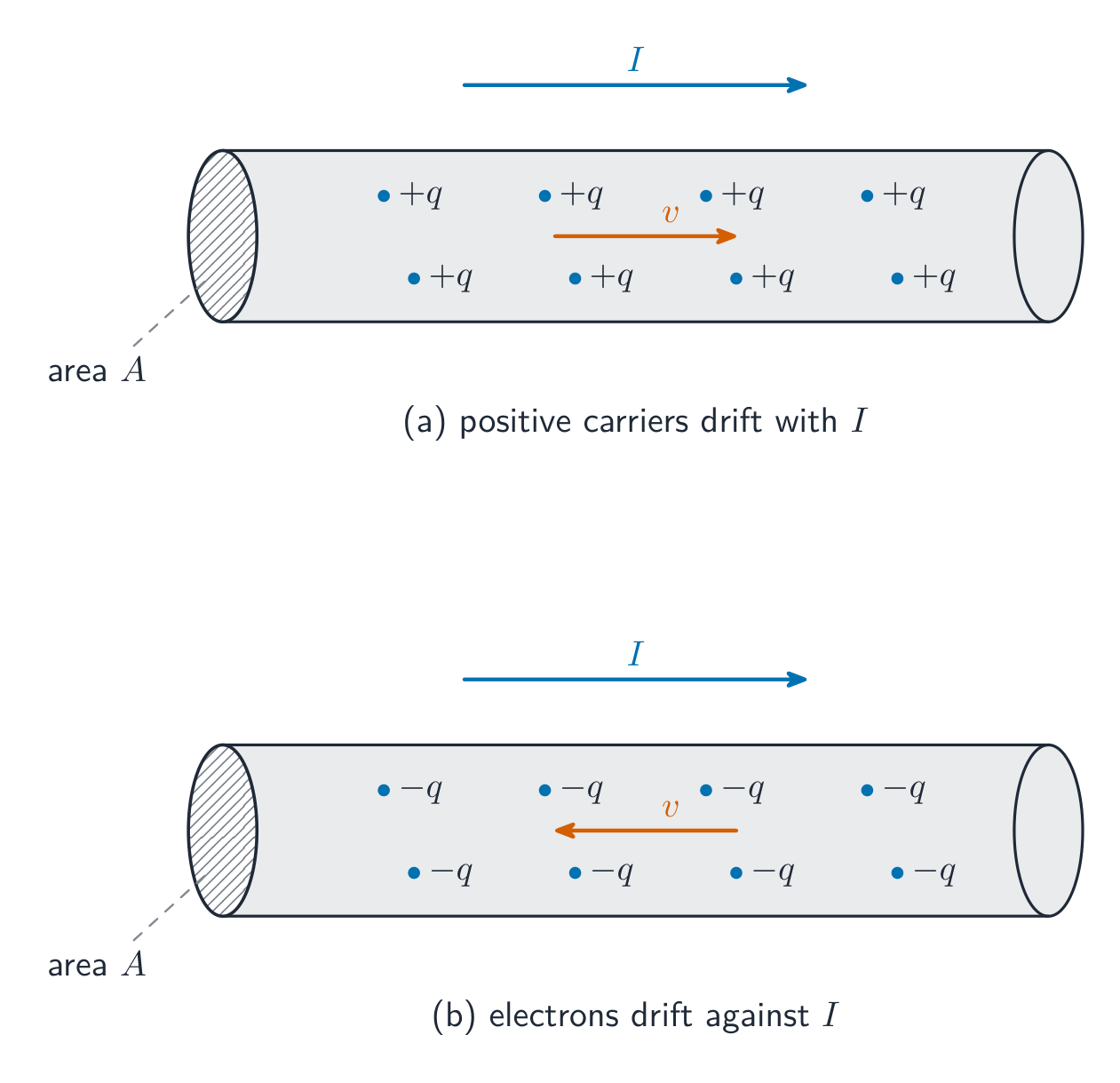
    • 11.1.A.2 Although current is not a vector quantity, it does have a direction. The direction of current is associated with what the motion of positive charge would be but not with any coordinate system in space.
      • 11.1.A.2.i The direction of conventional current is chosen to be the direction in which positive charge would move.
      • 11.1.A.2.ii In common circuits, current is actually due to the movement of electrons (negative charge carriers).
    עברית

    מטרת למידה 11.1.A: לתאר את תנועת מטענים חשמליים דרך תווך.

    • 11.1.A.1 זרם הוא הקצב שעבורו מטען עובר דרך שטח חתך של חוט.
      • משוואה: $I = \dfrac{\Delta q}{\Delta t}$
      • 11.1.A.1.i מטען חשמלי זז במעגל כתוצאה מהבדל פוטנציאל חשמלי, המכונה לעיתים כוח אlectromotive או $\mathrm{emf}$ ($\varepsilon$).
      • 11.1.A.1.ii אם הזרם הוא אפס בחלק מהחוט, התנועה הנטו של נושאי המטען בחוט היא גם כן אפס, למרות שהמהירות של כל נושא מטען בנפרד אינה אפס.
    • 11.1.A.2 למרות שזרם אינו גדל וקטורי, יש לו כיוון. הכיוון של הזרם קשור לכיוון שתנועת מטען חיובי הייתה מתרחשת, אך אינו קשור לכל מערכת צירים במרחב.
      • 11.1.A.2.i הכיוון של הזרם המקובל נבחר להיות הכיוון בו מטען חיובי היה זז.
      • 11.1.A.2.ii במעגלים רגילים, הזרם נובע למעשה מתנועת אלקטרונים (נושאי מטען שליליים).

    Source: College Board AP Course and Exam Description · ⁨מקור: תיאור הקורס והמבחן של College Board AP⁩

    English

    Electric current 电流 is the rate at which charge flows past a point, measured in amperes 安培 (A):

    $$I=\frac{\Delta q}{\Delta t}.$$
    By convention, current points the way positive charge would move (opposite to the electrons in a wire). A steady current needs a complete loop and an energy source (a battery's electromotive force, or emf).

    עברית
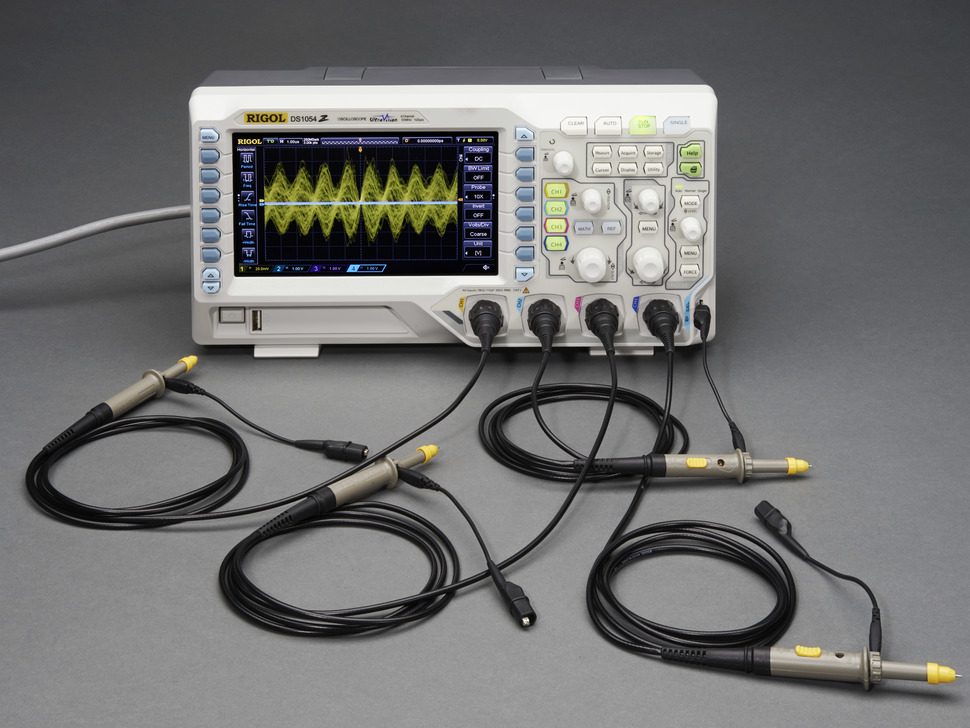
    אוסילוסקופ: התנהגות מעגל לאורך הזמן נמדדת כמתח כנגד זמן
    אוסילוסקופ: התנהגות מעגל לאורך הזמן נמדדת כמתח כנגד זמן

    זרם חשמלי הוא קצב זרימת המטען דרך נקודה, שנמדד ב-אמפרים (A):

    $$I=\frac{\Delta q}{\Delta t}.$$
    לפי מוסכמה, כיוון הזרם מצביע על הכיוון שבו יזוז מטען חיובי (ניגוד לכיוון הזרם של אלקטרונים בחוט). זרם יציב דורש לולאה סגורה ומקור אנרגיה (הכוח האלקטרו-מנועי, או emf, של הסוללה).

    נשיאי מטען זזים לאט דרך מוליך ליצירת זרם
    נשיאי מטען זזים לאט דרך מוליך ליצירת זרם
    11.2

    Simple Circuits · ⁨מעגלים פשוטים⁩

    Syllabus · ⁨סיילבוס⁩
    English

    Learning Objective 11.2.A: Describe the behavior of a circuit.

    • 11.2.A.1 A circuit is composed of electrical loops, which may include circuit elements such as wires, batteries, resistors, lightbulbs, capacitors, switches, ammeters, and voltmeters.
    • 11.2.A.2 A closed electrical loop is a closed path through which charges may flow.
      • 11.2.A.2.i A closed circuit is one in which charges would be able to flow.
      • 11.2.A.2.ii An open circuit is one in which charges would not be able to flow.
      • 11.2.A.2.iii A short circuit is one in which charges would be able to flow with no change in potential difference.
    • 11.2.A.3 A single circuit element may be part of multiple electrical loops.
    • 11.2.A.4 Circuit schematics are representations used to describe and analyze electric circuits.
      • 11.2.A.4.i The properties of an electric circuit are dependent on the physical arrangement of its constituent elements.
      • 11.2.A.4.ii Circuit elements have common symbols that are used to create schematic diagrams. Variable elements are indicated by a diagonal strikethrough arrow across the standard symbol for that element. (Standard symbols: Battery, Bulb, Switch, Capacitor, Resistor, Ammeter, Voltmeter.)

    Boundary statement: Unless otherwise specified, all circuit schematic diagrams will be drawn using conventional current.

    עברית

    מטרת למידה 11.2.A: לתאר את התנהגותו של מעגל חשמלי.

    • 11.2.A.1 מעגל חשמלי מורכב ממעגלים חשמליים, שעלולים לכלול אלמנטים כמו חוטים, סוללות, נגדים, נורות, קבלים, מתגים, אמפרמטרים ווולטמטרים.
    • 11.2.A.2 מעגל חשמלי סגור הוא מסלול סגור דרכו מטענים יכולים לזרום.
      • 11.2.A.2.i מעגל סגור הוא אחד שבו מטענים היו יכולים לזרום.
      • 11.2.A.2.ii מעגל פתוח הוא אחד שבו מטענים לא היו יכולים לזרום.
      • 11.2.A.2.iii קצר חשמלי הוא מצב שבו מטענים יוכלו לזרום ללא שינוי בהפרש הפוטנציאל.
    • 11.2.A.3 אלמנט מעגל אחד עשוי להיות חלק ממספר לולאות חשמליות.
    • 11.2.A.4 תרשימי מעגלים הם נציגים המשמשים לתאר ולנתח מעגלים חשמליים.
      • 11.2.A.4.i המאפיינים של מעגל חשמלי תלויים בסידור הפיזי של האלמנטים המרכיבים אותו.
      • 11.2.A.4.ii לאלמנטי מעגל יש סמלים מקובלים המשמשים ליצירת תרשימים. אלמנטים משתנים מסומנים על ידי חץ אלכסוני חוצה את הסמל הסטנדרטי עבור אלמנט זה. (סמלים סטנדרטיים: סוללה, נורת חשמל, מתג, קבל, נגד, אמפרמטר, וולטמטר.)

    הצהרת גבול: אלא אם כן צוין אחרת, כל תרשימי המעגלים יצורו באמצעות זרם קונבנציונלי.

    Source: College Board AP Course and Exam Description · ⁨מקור: תיאור הקורס והמבחן של College Board AP⁩

    English

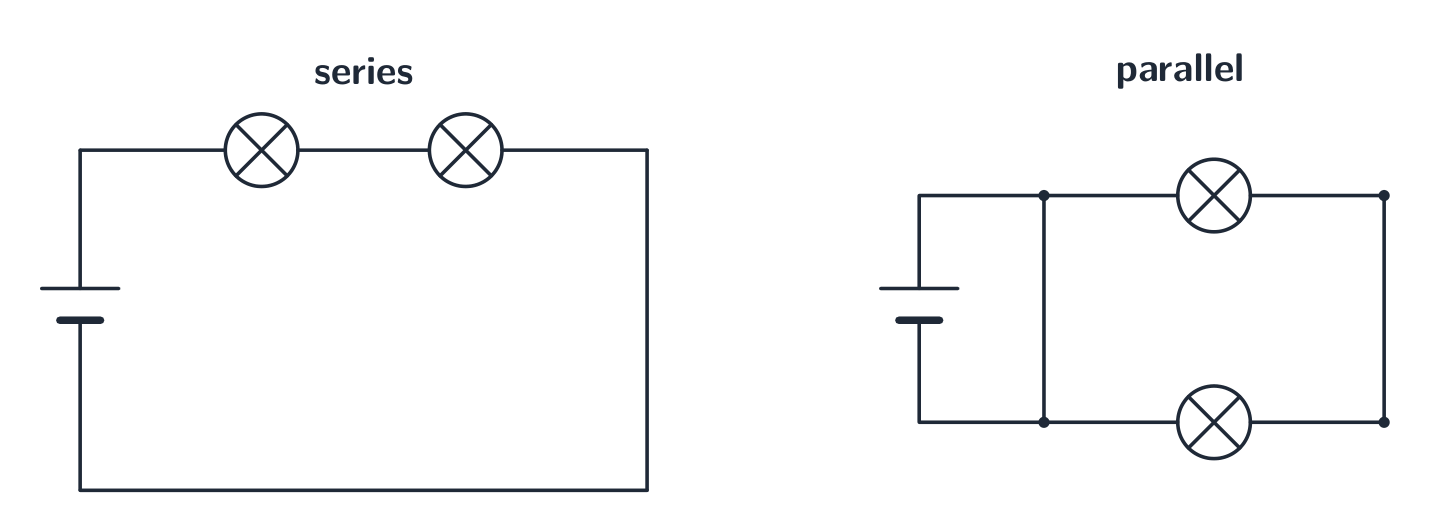
    A circuit is a closed loop of conductors, a source (battery), and components. In a series 串联 path the same current flows through each element; in a parallel 并联 path the same voltage is across each branch. A circuit diagram uses standard symbols; reading it correctly is the first step of any circuit problem.

    עברית

    מעגל הוא לולאת מוליכים סגורה, מקור (סוללה) ורכיבים. במסלול סדרתי אותו זרם זורם דרך כל רכיב; במסלול מקביל אותה מתח קיים בכל ענף. תרשים מעגל משתמש בסמלים סטנדרטיים; קריאתו הנכונה היא השלב הראשון בכל בעיית מעגל.

    מרכיבים יכולים להיות מחוברים בסדר או במקביל
    רכיבים יכולים להיות מחוברים בסדר או במקביל
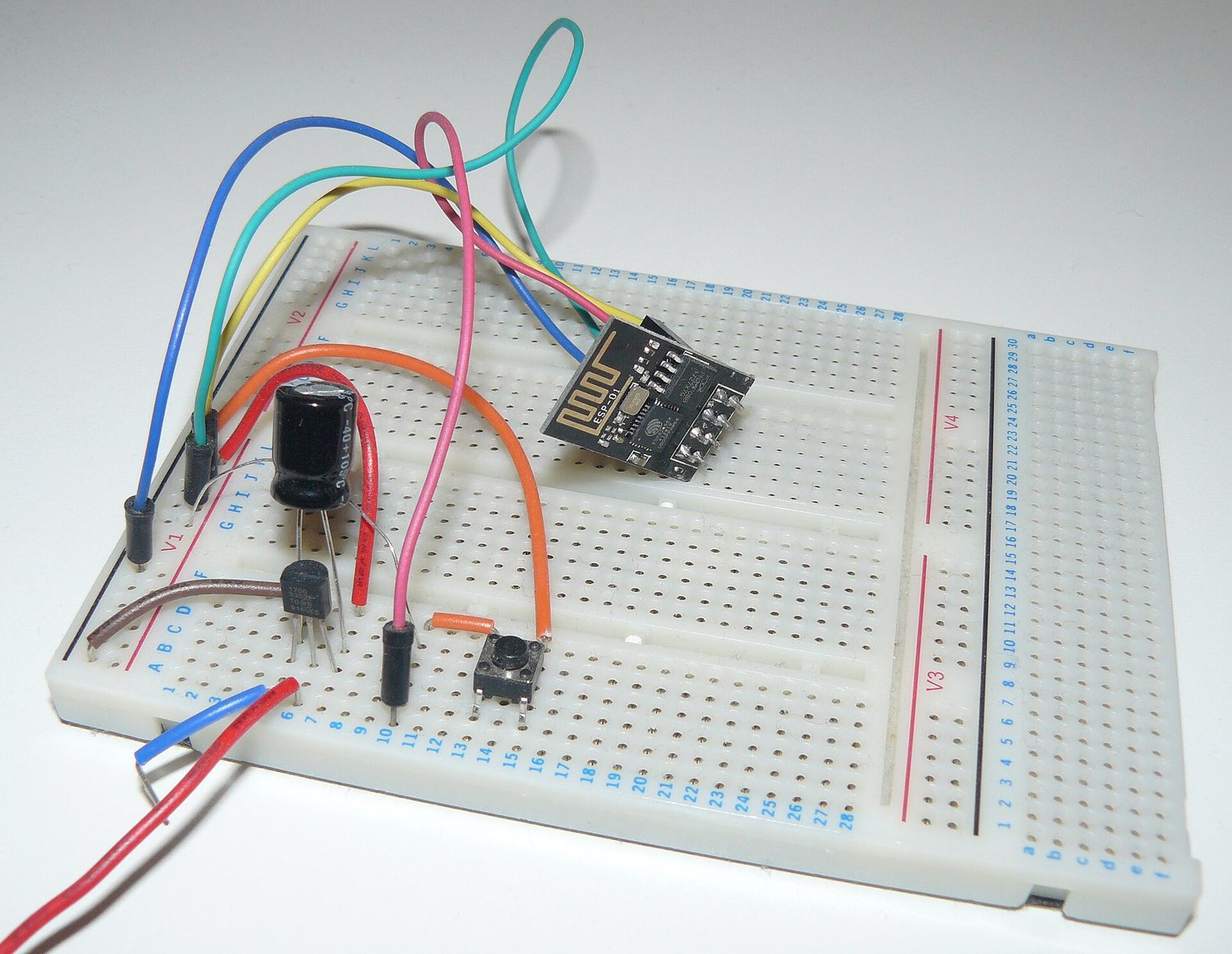
    מעגל אלקטרוני הבנוי על לוח ניסויים
    מעגל אמיתי: רכיבים הוכנסו ללוח ניסויים וחוברו באמצעות חוטים כך לזרם יש מסלול סגור
    Explore · ⁨חקור⁩

    Build series and parallel circuits · ⁨בנה מעגלים בסדר ובמקביל⁩

    In series the same current flows through every bulb and voltage divides; in parallel each branch gets the full voltage. Switch mode to see the bulbs' brightness change. · ⁨בסדר, אותה עוצמה זורמת דרך כל נורה והמתח מתחלק; במקביל, לכל ענף מגיע המתח המלא. החלף מצב כדי לראות כיצד בהירות הנורות משתנה.⁩

    Vocabulary · ⁨מילון מונחים⁩ Train · ⁨אימון⁩
    English עברית
    Electric current/ɪˈlektrɪk ˈkʌrənt/ זרם חשמלי
    amperes/ˈæmpeəz/ אמפרים
    series/ˈsɪəriːz/ סדרתי
    parallel/ˈpærəlel/ מקביל
    Resistance/rɪˈzɪstəns/ התנגדות חשמלית
    Ohm's law/əʊmz lɔː/ חוק אום
    resistivity/ˌriːzɪˈstɪvəti/ התנגדות סגולית
    Electric power/ɪˈlektrɪk ˈpaʊə/ הספק חשמלי
    light bulb/laɪt bʌlb/ נורת תאורה
    brightness/ˈbraɪtnəs/ בהירות
    equivalent resistance/ɪˈkwɪvələnt rɪˈzɪstəns/ התנגדות שקולה
    ammeter/ˈæmiːtə/ ממוס
    voltmeter/ˈvəʊltmiːtə/ וולמטר
    nonideal/ˌnɒnaɪˈdɪəl/ לא אידיאלי
    Kirchhoff's loop rule/ˈkɜːkhɒfs luːp ruːl/ חוק הלולאה של קירשוף
    Kirchhoff's junction rule/ˈkɜːkhɒfs ˈdʒʌŋkʃn ruːl/ חוק הצומת של קירשוף
    RC circuit/ˌɑː ˈsiː ˈsɜːkɪt/ מעגל RC
    11.3

    Resistance, Resistivity, and Ohm's Law · ⁨התנגדות, התנגדות ספציפית, וחוק אוהם⁩

    Syllabus · ⁨סיילבוס⁩
    English

    Learning Objective 11.3.A: Describe the resistance of an object using physical properties of that object.

    • 11.3.A.1 Resistance is a measure of the degree to which an object opposes the movement of electric charge.
    • 11.3.A.2 The resistance of a resistor with uniform geometry is proportional to its resistivity and length and is inversely proportional to its cross-sectional area.
      • Equation: $R = \dfrac{\rho \ell}{A}$
      • 11.3.A.2.i Resistivity is a fundamental property of a material that depends on its atomic and molecular structure and quantifies how strongly the material opposes the motion of electric charge.
      • 11.3.A.2.ii The resistivity of a conductor typically increases with temperature.

    Learning Objective 11.3.B: Describe the electrical characteristics of elements of a circuit.

    • 11.3.B.1 Ohm's law relates current, resistance, and potential difference across a conductive element of a circuit.
      • Equation: $I = \dfrac{\Delta V}{R}$
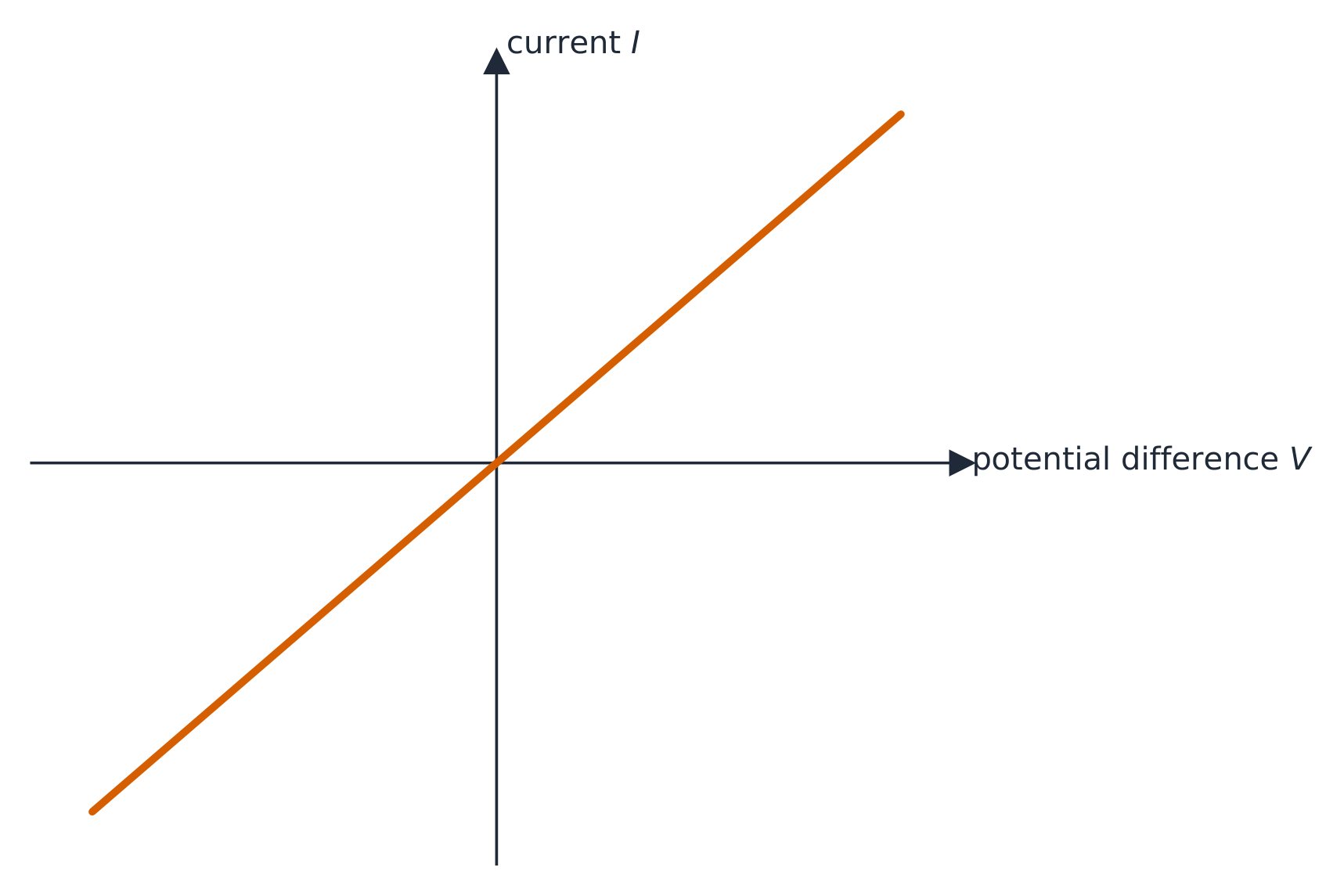
      • 11.3.B.1.i Materials that obey Ohm's law have constant resistance for all currents and are called ohmic materials.
      • 11.3.B.1.ii The resistivity of an ohmic material is constant regardless of temperature.
      • 11.3.B.1.iii Resistors can also convert electrical energy to thermal energy, which may change the temperature of both the resistor and the resistor's environment.
      • 11.3.B.1.iv The resistance of an ohmic circuit element can be determined from the slope of a graph of the current in the element as a function of the potential difference across the element.
    עברית

    מטרה לימודית 11.3.A: לתאר את ההתנגדות של חפץ באמצעות מאפיינים פיזיקליים שלו.

    • 11.3.A.1 התנגדות היא מדד לדרגה שבה חפץ מונע את תנועת המטען החשמלי.
    • 11.3.A.2 ההתנגדות של נגד בעל גיאומטריה אחידה פרופורציונלית להתנגדות הסגולית ולאורכו, והופכת פרופורציונלית לשטח החתך שלו.
      • משוואה: $R = \dfrac{\rho \ell}{A}$
      • 11.3.A.2.i התנגדות סגולית היא מאפיין בסיסי של חומר התלוי במבנה האטומי והמולקולרי שלו ומכמת עד כמה החומר מונע תנועת מטען חשמלי.
      • 11.3.A.2.ii ההתנגדות הסגולית של מוליך עולה לרוב עם הטמפרטורה.

    מטרה לימודית 11.3.B: לתאר את המאפיינים החשמליים של אלמנטים במעגל.

    • 11.3.B.1 חוק אוהם מקשר בין זרם, התנגדות והפרש פוטנציאל על פני אלמנט מוליך במעגל.
      • משוואה: $I = \dfrac{\Delta V}{R}$
      • 11.3.B.1.i חומרים העומדים בחוק אוהם בעלי התנגדות קבועה לכל הזרמים ונקראים חומרים אוםיים.
      • 11.3.B.1.ii ההתנגדות הסגולית של חומר אומי קבועה ללא קשר לטמפרטורה.
      • 11.3.B.1.iii נגדים יכולים גם להמיר אנרגיה חשמלית לאנרגיה תרמית, מה שעשוי לשנות את טמפרטורת הנגד ואת הסביבה סביבו.
      • 11.3.B.1.iv ההתנגדות של אלמנט מעגל אומי ניתן לקבוע מהשיפוע של גרף הזרם באלמנט כתפקוד הפרש הפוטנציאל על פניו.

    Source: College Board AP Course and Exam Description · ⁨מקור: תיאור הקורס והמבחן של College Board AP⁩

    English

    Resistance 电阻 $R$ opposes current, measured in ohms. Ohm's law 欧姆定律 links the three key quantities:

    $$V=IR.$$
    A component's resistance depends on the material's resistivity 电阻率 $\rho$, its length, and its cross-sectional area: $R=\dfrac{\rho L}{A}$ – longer and thinner means more resistance.

    Worked example. A $2.0\ \text{A}$ current flows through a $6.0\ \Omega$ resistor. The voltage across it is $V=IR=2.0\times6.0=12\ \text{V}$.

    עברית

    התנגדות $R$ מתנגדת לזרם, שנמדדת באומים. חוק אוהם מקשר בין שלושת הגדלים העיקריים:

    $$V=IR.$$
    התנגדותו של רכיב תלויה בהתנגדות הספציפית $\rho$ של החומר, באורכו ובשטח החתך שלו: $R=\dfrac{\rho L}{A}$ – אורך גדול יותר ועובי קטן יותר גורמים להתנגדות גבוהה יותר.

    קו ה-I-V של מוליך אופייני הוא ישר העובר דרך הראשית
    קו ה-I-V של מוליך אופייני הוא ישר העובר דרך הראשית

    דוגמה מפורטת. זרם בגודל $2.0\ \text{A}$ זורם דרך נגד בגודל $6.0\ \Omega$. המתח על פניו הוא $V=IR=2.0\times6.0=12\ \text{V}$.

    Explore · ⁨חקור⁩

    Apply Ohm's law · ⁨החל את חוק אוהם⁩

    Ohm's law $V=IR$: for a fixed resistance, current is proportional to voltage. Raise the resistance and the same voltage pushes less current. · ⁨חוק אוהם $V=IR$: עבור התנגדות קבועה, העוצמה פרופורציונלית למתח. הגדלת ההתנגדות תגרום לכך שהאותו מתח יניע עוצמה פחותה.⁩

    11.4

    Electric Power · ⁨הספק חשמלי⁩

    Syllabus · ⁨סיילבוס⁩
    English

    Learning Objective 11.4.A: Describe the transfer of energy into, out of, or within an electric circuit, in terms of power.

    • 11.4.A.1 The rate at which energy is transferred, converted, or dissipated by a circuit element depends on the current in the element and the electric potential difference across it.
      • Equation: $P = I \Delta V$
      • Equation (derived): $P = I^2 R = \dfrac{(\Delta V)^2}{R}$
    • 11.4.A.2 The brightness of a bulb increases with power, so power can be used to qualitatively predict the brightness of bulbs in a circuit.
    עברית

    מטרה לימודית 11.4.A: לתאר את העברת האנרגיה לתוך, מחוץ או בתוך מעגל חשמלי, בגדרות הספק.

    • 11.4.A.1 קצב העברת אנרגיה, המרתה או פיזוריה על ידי רכיב במעגל תלוי בעוצמת הזרם ברכיב ובהפרש הפוטנציאל החשמלי בינו.
      • משוואה: $P = I \Delta V$
      • משוואה (מובקעת): $P = I^2 R = \dfrac{(\Delta V)^2}{R}$
    • 11.4.A.2 בהירות נורה עולה עם ההספק, ולכן ניתן להשתמש בהספק כדי לחזות באופן איכותני את בהירות הנורות במעגל.

    Source: College Board AP Course and Exam Description · ⁨מקור: תיאור הקורס והמבחן של College Board AP⁩

    English

    Electric power 电功率 is the rate a component converts electrical energy (to heat, light, motion):

    $$P=IV=I^2R=\frac{V^2}{R}.$$
    Pick the form that uses the quantities you know. A resistor's power all becomes heat.

    Worked example. The $6.0\ \Omega$ resistor above, carrying $2.0\ \text{A}$, dissipates $P=I^2R=2.0^2\times6.0=24\ \text{W}$ – equivalently $P=IV=2.0\times12=24\ \text{W}$.

    A light bulb 灯泡 is just a resistor that glows, and its brightness 亮度 rises with the power it dissipates. So to rank bulbs, compare their power. In a series string every bulb carries the same current, so by $P=I^2R$ the bulb with the largest resistance is brightest; wired in parallel every bulb gets the full battery voltage, so by $P=V^2/R$ the bulb with the smallest resistance is brightest.

    עברית

    הספק חשמלי הוא הקצב בו רכיב ממיר אנרגיה חשמלית (לתחום, לאור, לתנועה):

    $$P=IV=I^2R=\frac{V^2}{R}.$$
    בחר את הצורה שמשתמשת בגדלים הידועים לך. ההספק של נגד הופך כולו לחום.

    דוגמה מפורטת. הנגד $6.0\ \Omega$ לעיל, העובר דרכו זרם של $2.0\ \text{A}$, מפזר $P=I^2R=2.0^2\times6.0=24\ \text{W}$ – שווה ערך ל$P=IV=2.0\times12=24\ \text{W}$.

    נורת חשמל היא פשוט נגד שמזהיר, וה-בהירות שלו עולה עם ה-הספק שפול. לכן כדי למיין נורות, השוו את ההספק שלהן. במתח ברצף כל נורה עובר בה אותה זרם, ולכן לפי $P=I^2R$ הנורה בעלת נגד הגדול ביותר תהיה המבהירה ביותר; אם מחוונות במקביל, לכל נורה מגיע מתח הסוללה המלא, ולכן לפי $P=V^2/R$ הנורה בעלת נגד הקטן ביותר תהיה המבהירה ביותר.

    קווי מתח גבוה: כוח חשמלי מועבר במתח גבוה כך שהזרם (והפסד I²R) נשאר נמוך
    קווי מתח גבוה: כוח חשמלי מועבר במתח גבוה כך שהזרם (והפסד I²R) נשאר נמוך
    Explore · ⁨חקור⁩

    Read an I-V characteristic · ⁨קרא מאפיין I-V⁩

    Power is $P=IV$. A resistor's I-V line is straight, but a lamp curves as it heats and its resistance rises. The area under I-V relates to the energy delivered. · ⁨ההספק הוא $P=IV$. קו ה-I-V של נגד הוא ישר, אך של מנורה הוא מעוגל בשל חימום ועליית ההתנגדות שלו. השטח מתחת לקו ה-I-V קשור לאנרגיה שהועברה.⁩

    11.5

    Compound DC Circuits · ⁨מעגלים DC מורכבים⁩

    Syllabus · ⁨סיילבוס⁩
    English

    Learning Objective 11.5.A: Describe the equivalent resistance of multiple resistors connected in a circuit.

    • 11.5.A.1 Circuit elements may be connected in series and/or in parallel.
      • 11.5.A.1.i A series connection is one in which any charge passing through one circuit element must proceed through all elements in that connection and has no other path available. The current in each element in series must be the same.
      • 11.5.A.1.ii A parallel connection is one in which charges may flow through one of two or more paths. Across each path, the potential difference is the same.
    • 11.5.A.2 A collection of resistors in a circuit may be analyzed as though it were a single resistor with an equivalent resistance $R_{\text{eq}}$.
      • 11.5.A.2.i The equivalent resistance of a set of resistors in series is the sum of the individual resistances.
        • Equation: $R_{\text{eq},s} = \sum_i R_i$
      • 11.5.A.2.ii The inverse of the equivalent resistance of a set of resistors connected in parallel is equal to the sum of the inverses of the individual resistances.
        • Equation: $\dfrac{1}{R_{\text{eq},p}} = \sum_i \dfrac{1}{R_i}$
      • 11.5.A.2.iii When resistors are connected in parallel, the number of paths available to charges increases, and the equivalent resistance of the group of resistors decreases.

    Learning Objective 11.5.B: Describe a circuit with resistive wires and a battery with internal resistance.

    • 11.5.B.1 Ideal batteries have negligible internal resistance. Ideal wires have negligible resistance.
      • 11.5.B.1.i The resistance of wires that are good conductors may normally be neglected, because their resistance is much smaller than that of other elements of a circuit.
      • 11.5.B.1.ii The resistance of wires may only be neglected if the circuit contains other elements that do have resistance.
      • 11.5.B.1.iii The potential difference a battery would supply if it were ideal is the potential difference measured across the terminals when there is no current in the battery and is sometimes referred to as its $\mathrm{emf}$ ($\varepsilon$).
    • 11.5.B.2 The internal resistance of a nonideal battery may be treated as the resistance of a resistor in series with an ideal battery and the remainder of the circuit.
    • 11.5.B.3 When there is current in a nonideal battery with internal resistance $r$, the potential difference across the terminals of the battery is reduced relative to the potential difference when there is no current in the battery.
      • Equation (derived): $\Delta V_{\text{terminal}} = \varepsilon - Ir$

    Learning Objective 11.5.C: Describe the measurement of current and potential difference in a circuit.

    • 11.5.C.1 Ammeters are used to measure current at a specific point in a circuit.
      • 11.5.C.1.i Ammeters must be connected in series with the element in which current is being measured.
      • 11.5.C.1.ii Ideal ammeters have zero resistance so that they do not affect the current in the element that they are in series with.
    • 11.5.C.2 Voltmeters are used to measure electric potential difference between two points in a circuit.
      • 11.5.C.2.i Voltmeters must be connected in parallel with the element across which potential difference is being measured.
      • 11.5.C.2.ii Ideal voltmeters have an infinite resistance so that no charge flows through them.
    • 11.5.C.3 Nonideal ammeters and voltmeters will change the properties of the circuit being measured.

    Boundary statement: AP Physics 2 only expects students to qualitatively discuss how a nonideal ammeter or voltmeter will affect the results of measurements. Unless otherwise stated, all batteries, wires, and meters are assumed to be ideal.

    Boundary statement: Circuits with batteries of different potential differences connected in parallel will not be assessed.

    עברית

    מטרות למידה 11.5.A: לתאר התנגדות שקולה של מספר מתנגדים מחוברים במעגל.

    • 11.5.A.1 רכיבי מעגל יכולים להיות מחוברים בסדרה וב/או במקביל.
      • 11.5.A.1.i חיבור בסדרה הוא חיבור שבו כל מטען חולף דרך רכיב מעגלי אחד חייב לעבור דרך כל הרכיבים בחיבור זה ואין לו אופנה אחרת. עוצמת הזרם בכל רכיב בסדרה חייבת להיות זהה.
      • 11.5.A.1.ii חיבור במקביל הוא חיבור שבו מטענים יכולים לזרום דרך אחת משתי או יותר אופנות. לאורך כל אופנה, הפרש הפוטנציאל הוא זהה.
    • 11.5.A.2 סט של מתנגדים במעגל יכול להתנתח כאילו היהו מתנגד יחיד עם התנגדות שקולה $R_{\text{eq}}$.
      • 11.5.A.2.i ההתנגדות השקולה של סט של מתנגדים בסדרה היא סכום ההתנגדויות הבודדות.
        • משוואה: $R_{\text{eq},s} = \sum_i R_i$
      • 11.5.A.2.ii ההופך של ההתנגדות השקולה של סט של מתנגדים המקוונים במקביל שווה לסכום ההופכים של ההתנגדויות הבודדות.
        • משוואה: $\dfrac{1}{R_{\text{eq},p}} = \sum_i \dfrac{1}{R_i}$
      • 11.5.A.2.iii כאשר מתנגדים מקוונים במקביל, מספר האופנות הזמינות למטענים עולה, וההתנגדות השקולה של קבוצת המתנגדים יורדת.

    מטרות למידה 11.5.B: לתאר מעגל עם חוטים התנגדותיים וסוללה עם התנגדות פנימית.

    • 11.5.B.1 סוללות אידיאליות יש להן התנגדות פנימית זניחה. חוטים אידיאליים יש להם התנגדות זניחה.
      • 11.5.B.1.i התנגדות חוטים שהם מוליכים טובים יכולה בדרך כלל להתעלם ממנה, מכיוון שהתנגדותם קטנה משמעותית מזו של רכיבים אחרים במעגל.
      • 11.5.B.1.ii התנגדות החוטים יכולה להתעלם ממנה רק אם המעגל מכיל רכיבים אחרים שיש להם התנגדות.
      • 11.5.B.1.iii הפרש הפוטנציאל שמסוללה הייתה מספקת אם הייתה אידיאלית הוא הפרש הפוטנציאל שנמדד בין הקולות כאשר אין זרם בסוללה, ומכונה לעיתים קרובות כ-$\mathrm{emf}$ ($\varepsilon$).
    • 11.5.B.2 ההתנגדות הפנימית של סוללה שאינה אידיאלית יכולה להתנהל כהתנגדות של מתנגד בסדרה עם סוללה אידיאלית ושאר המעגל.
    • 11.5.B.3 כאשר יש זרם בסוללה שאינה אידיאלית עם התנגדות פנימית $r$, הפרש הפוטנציאל בין קולות הסוללה מצומצם ביחס להפרש הפוטנציאל כאשר אין זרם בסוללה.
      • משוואה (מובקעת): $\Delta V_{\text{terminal}} = \varepsilon - Ir$

    מטרות למידה 11.5.C: לתאר מדידת זרם והפרש פוטנציאל במעגל.

    • 11.5.C.1 אמפרמטרים משמשים למדידת זרם בנקודה ספציפית במעגל.
      • 11.5.C.1.i אמפרמטרים חייבים להיות מחוברים בסדרה עם האלמנט בו נמדד הזרם.
      • 11.5.C.1.ii אמפרמטרים אידיאליים הם בעלי התנגדות אפס כדי שלא ישנו את הזרם באלמנט בו הם מחוברים בסדרה.
    • 11.5.C.2 וולטמטרים משמשים למדידת הפרש פוטנציאל חשמלי בין שתי נקודות במעגל.
      • 11.5.C.2.i וולטמטרים חייבים להיות מחוברים במקביל לאלמנט שעליו נמדד הפרש הפוטנציאל.
      • 11.5.C.2.ii וולטמטרים אידיאליים הם בעלי התנגדות אינסופית כך שאין דרך זורם דרכם.
    • 11.5.C.3 אמפרמטרים ווולטמטרים לא-אידיאליים יעבירו שינוי בתכונות המעגל הנמדד.

    הצהרת גבול: מבחן AP Physics 2 מצפה מהתלמידים לדון באופן איכותי רק כיצד אמפרמטר או וולטמטר לא-אידיאליים ישפיעו על תוצאות המדידה. אלא אם כן צוין אחרת, כל הסוללות, החוטים והמדדים נחשבים לאידיאליים.

    הצהרת גבול: מעגלים הכוללים סוללות עם הפרשי פוטנציאל שונים המחוברות במקביל לא ייכללו במבחן.

    Source: College Board AP Course and Exam Description · ⁨מקור: תיאור הקורס והמבחן של College Board AP⁩

    English

    Combine resistors to find an equivalent resistance 等效电阻:

    • Series: $R_{\text{eq}}=R_1+R_2+\cdots$ (resistances add).
    • Parallel: $\dfrac{1}{R_{\text{eq}}}=\dfrac{1}{R_1}+\dfrac{1}{R_2}+\cdots$ (the total is less than the smallest).

    Reduce the network step by step to find the total current from the battery, then work back to each element.

    Worked example. A $12\ \text{V}$ battery drives a $4.0\ \Omega$ and a $12\ \Omega$ resistor in parallel. First combine them: $\dfrac{1}{R_{\text{eq}}}=\dfrac14+\dfrac{1}{12}=\dfrac{4}{12}\Rightarrow R_{\text{eq}}=3.0\ \Omega$. The total current from the battery is $I=\dfrac{V}{R_{\text{eq}}}=\dfrac{12}{3.0}=4.0\ \text{A}$, which splits so that the smaller resistor carries the larger share ($3.0\ \text{A}$ through the $4\ \Omega$, $1.0\ \text{A}$ through the $12\ \Omega$).

    עברית

    אחדו נגדים כדי למצוא נגד שקול:

    נגדים בסדרה מתחברים לנגד שקול אחד
    נגדים בסדרה מתחברים לנגד שקול אחד
    • סדרה: $R_{\text{eq}}=R_1+R_2+\cdots$ (הנגדים נוספים).
    • מקביל: $\dfrac{1}{R_{\text{eq}}}=\dfrac{1}{R_1}+\dfrac{1}{R_2}+\cdots$ (הסה

    צמצם את הרשת צעד אחר צעד כדי למצוא את הזרם הכולל מהסוללה, ולאחר מכן חשב חזרה לכל אלמנט.

    דוגמה מודגמת. סוללת $12\ \text{V}$ מניעה זרם דרך נגדים $4.0\ \Omega$ ו-$12\ \Omega$ במקביל. קודם איחד אותם: $\dfrac{1}{R_{\text{eq}}}=\dfrac14+\dfrac{1}{12}=\dfrac{4}{12}\Rightarrow R_{\text{eq}}=3.0\ \Omega$. הזרם הכולל מהסוללה הוא $I=\dfrac{V}{R_{\text{eq}}}=\dfrac{12}{3.0}=4.0\ \text{A}$, שהוא מתפצל כך שהנגד הקטן נושא את החלק הגדול יותר ($3.0\ \text{A}$ דרך ה-$4\ \Omega$, $1.0\ \text{A}$ דרך ה-$12\ \Omega$).

    11.5

    Measuring Current and Voltage · ⁨מדידת זרם ומתח⁩

    Syllabus · ⁨סיילבוס⁩
    English

    Learning Objective 11.5.A: Describe the equivalent resistance of multiple resistors connected in a circuit.

    • 11.5.A.1 Circuit elements may be connected in series and/or in parallel.
      • 11.5.A.1.i A series connection is one in which any charge passing through one circuit element must proceed through all elements in that connection and has no other path available. The current in each element in series must be the same.
      • 11.5.A.1.ii A parallel connection is one in which charges may flow through one of two or more paths. Across each path, the potential difference is the same.
    • 11.5.A.2 A collection of resistors in a circuit may be analyzed as though it were a single resistor with an equivalent resistance $R_{\text{eq}}$.
      • 11.5.A.2.i The equivalent resistance of a set of resistors in series is the sum of the individual resistances.
        • Equation: $R_{\text{eq},s} = \sum_i R_i$
      • 11.5.A.2.ii The inverse of the equivalent resistance of a set of resistors connected in parallel is equal to the sum of the inverses of the individual resistances.
        • Equation: $\dfrac{1}{R_{\text{eq},p}} = \sum_i \dfrac{1}{R_i}$
      • 11.5.A.2.iii When resistors are connected in parallel, the number of paths available to charges increases, and the equivalent resistance of the group of resistors decreases.

    Learning Objective 11.5.B: Describe a circuit with resistive wires and a battery with internal resistance.

    • 11.5.B.1 Ideal batteries have negligible internal resistance. Ideal wires have negligible resistance.
      • 11.5.B.1.i The resistance of wires that are good conductors may normally be neglected, because their resistance is much smaller than that of other elements of a circuit.
      • 11.5.B.1.ii The resistance of wires may only be neglected if the circuit contains other elements that do have resistance.
      • 11.5.B.1.iii The potential difference a battery would supply if it were ideal is the potential difference measured across the terminals when there is no current in the battery and is sometimes referred to as its $\mathrm{emf}$ ($\varepsilon$).
    • 11.5.B.2 The internal resistance of a nonideal battery may be treated as the resistance of a resistor in series with an ideal battery and the remainder of the circuit.
    • 11.5.B.3 When there is current in a nonideal battery with internal resistance $r$, the potential difference across the terminals of the battery is reduced relative to the potential difference when there is no current in the battery.
      • Equation (derived): $\Delta V_{\text{terminal}} = \varepsilon - Ir$

    Learning Objective 11.5.C: Describe the measurement of current and potential difference in a circuit.

    • 11.5.C.1 Ammeters are used to measure current at a specific point in a circuit.
      • 11.5.C.1.i Ammeters must be connected in series with the element in which current is being measured.
      • 11.5.C.1.ii Ideal ammeters have zero resistance so that they do not affect the current in the element that they are in series with.
    • 11.5.C.2 Voltmeters are used to measure electric potential difference between two points in a circuit.
      • 11.5.C.2.i Voltmeters must be connected in parallel with the element across which potential difference is being measured.
      • 11.5.C.2.ii Ideal voltmeters have an infinite resistance so that no charge flows through them.
    • 11.5.C.3 Nonideal ammeters and voltmeters will change the properties of the circuit being measured.

    Boundary statement: AP Physics 2 only expects students to qualitatively discuss how a nonideal ammeter or voltmeter will affect the results of measurements. Unless otherwise stated, all batteries, wires, and meters are assumed to be ideal.

    Boundary statement: Circuits with batteries of different potential differences connected in parallel will not be assessed.

    עברית

    מטרות למידה 11.5.A: לתאר התנגדות שקולה של מספר מתנגדים מחוברים במעגל.

    • 11.5.A.1 רכיבי מעגל יכולים להיות מחוברים בסדרה וב/או במקביל.
      • 11.5.A.1.i חיבור בסדרה הוא חיבור שבו כל מטען חולף דרך רכיב מעגלי אחד חייב לעבור דרך כל הרכיבים בחיבור זה ואין לו אופנה אחרת. עוצמת הזרם בכל רכיב בסדרה חייבת להיות זהה.
      • 11.5.A.1.ii חיבור במקביל הוא חיבור שבו מטענים יכולים לזרום דרך אחת משתי או יותר אופנות. לאורך כל אופנה, הפרש הפוטנציאל הוא זהה.
    • 11.5.A.2 סט של מתנגדים במעגל יכול להתנתח כאילו היהו מתנגד יחיד עם התנגדות שקולה $R_{\text{eq}}$.
      • 11.5.A.2.i ההתנגדות השקולה של סט של מתנגדים בסדרה היא סכום ההתנגדויות הבודדות.
        • משוואה: $R_{\text{eq},s} = \sum_i R_i$
      • 11.5.A.2.ii ההופך של ההתנגדות השקולה של סט של מתנגדים המקוונים במקביל שווה לסכום ההופכים של ההתנגדויות הבודדות.
        • משוואה: $\dfrac{1}{R_{\text{eq},p}} = \sum_i \dfrac{1}{R_i}$
      • 11.5.A.2.iii כאשר מתנגדים מקוונים במקביל, מספר האופנות הזמינות למטענים עולה, וההתנגדות השקולה של קבוצת המתנגדים יורדת.

    מטרות למידה 11.5.B: לתאר מעגל עם חוטים התנגדותיים וסוללה עם התנגדות פנימית.

    • 11.5.B.1 סוללות אידיאליות יש להן התנגדות פנימית זניחה. חוטים אידיאליים יש להם התנגדות זניחה.
      • 11.5.B.1.i התנגדות חוטים שהם מוליכים טובים יכולה בדרך כלל להתעלם ממנה, מכיוון שהתנגדותם קטנה משמעותית מזו של רכיבים אחרים במעגל.
      • 11.5.B.1.ii התנגדות החוטים יכולה להתעלם ממנה רק אם המעגל מכיל רכיבים אחרים שיש להם התנגדות.
      • 11.5.B.1.iii הפרש הפוטנציאל שמסוללה הייתה מספקת אם הייתה אידיאלית הוא הפרש הפוטנציאל שנמדד בין הקולות כאשר אין זרם בסוללה, ומכונה לעיתים קרובות כ-$\mathrm{emf}$ ($\varepsilon$).
    • 11.5.B.2 ההתנגדות הפנימית של סוללה שאינה אידיאלית יכולה להתנהל כהתנגדות של מתנגד בסדרה עם סוללה אידיאלית ושאר המעגל.
    • 11.5.B.3 כאשר יש זרם בסוללה שאינה אידיאלית עם התנגדות פנימית $r$, הפרש הפוטנציאל בין קולות הסוללה מצומצם ביחס להפרש הפוטנציאל כאשר אין זרם בסוללה.
      • משוואה (מובקעת): $\Delta V_{\text{terminal}} = \varepsilon - Ir$

    מטרות למידה 11.5.C: לתאר מדידת זרם והפרש פוטנציאל במעגל.

    • 11.5.C.1 אמפרמטרים משמשים למדידת זרם בנקודה ספציפית במעגל.
      • 11.5.C.1.i אמפרמטרים חייבים להיות מחוברים בסדרה עם האלמנט בו נמדד הזרם.
      • 11.5.C.1.ii אמפרמטרים אידיאליים הם בעלי התנגדות אפס כדי שלא ישנו את הזרם באלמנט בו הם מחוברים בסדרה.
    • 11.5.C.2 וולטמטרים משמשים למדידת הפרש פוטנציאל חשמלי בין שתי נקודות במעגל.
      • 11.5.C.2.i וולטמטרים חייבים להיות מחוברים במקביל לאלמנט שעליו נמדד הפרש הפוטנציאל.
      • 11.5.C.2.ii וולטמטרים אידיאליים הם בעלי התנגדות אינסופית כך שאין דרך זורם דרכם.
    • 11.5.C.3 אמפרמטרים ווולטמטרים לא-אידיאליים יעבירו שינוי בתכונות המעגל הנמדד.

    הצהרת גבול: מבחן AP Physics 2 מצפה מהתלמידים לדון באופן איכותי רק כיצד אמפרמטר או וולטמטר לא-אידיאליים ישפיעו על תוצאות המדידה. אלא אם כן צוין אחרת, כל הסוללות, החוטים והמדדים נחשבים לאידיאליים.

    הצהרת גבול: מעגלים הכוללים סוללות עם הפרשי פוטנציאל שונים המחוברות במקביל לא ייכללו במבחן.

    Source: College Board AP Course and Exam Description · ⁨מקור: תיאור הקורס והמבחן של College Board AP⁩

    English

    Two meters read a circuit. An ammeter 电流表 measures the current at a point, so it must be wired in series – the current you want to measure has to flow through it. A voltmeter 电压表 measures the potential difference between two points, so it is wired in parallel, bridging across the component whose voltage you want.

    For a meter to read the true value it must barely disturb the circuit:

    • an ideal ammeter has zero resistance, so putting it in series does not reduce the current it reads;
    • an ideal voltmeter has infinite resistance, so almost no current is diverted through it.

    A real, nonideal 非理想 meter is imperfect: a real ammeter has a small resistance (it slightly lowers the current), and a real voltmeter lets a little current leak through (it slightly lowers the voltage it reads). So connecting any meter changes, a little, the very quantity it is measuring.

    עברית

    שני מדדים קוראים במעגל. מיליאמפרמטר מדוד את הזרם בנקודה, ולכן יש לחבר אותו בסדרה – הזרם שאתם רוצים למדוד חייב לזרום דרכו. ולטמטר מדוד את הפרש הפוטנציאלים בין שתי נקודות, ולכן הוא מחובר במקביל, ועובר על פני המרכיב שבו אתם רוצים למדוד מתח.

    כדי שמד יקרא את הערך האמיתי, הוא חייב להפריע מעט מאוד למעגל:

    • מיליאמפרמטר אידיאלי בעל התנגדות אפס, ולכן חיבורו בסדרה לא מפחית את הזרם שהוא קורא;
    • ולטמטר אידיאלי בעל התנגדות אינסופית, ולכן כמעט לא זורם דרכו זרם.

    מד אמיתי, לא-אידיאלי, הוא מושלם: מיליאמפרמטר אמיתי יש לו התנגדות קטנה (שהיא מעט מורידה את הזרם), וולטמטר אמיתי מאפשר לדליפת מעט זרם דרכו (שהיא מעט מורידה את המתח שהוא קורא). לכן, חיבור כל מד משנה, מעט, את הכמות עצמה שהוא מודד.

    11.6

    Kirchhoff's Loop Rule · ⁨חוק הלולאה של קירכהוף⁩

    Syllabus · ⁨סיילבוס⁩
    English

    Learning Objective 11.6.A: Describe a circuit or elements of a circuit by applying Kirchhoff's loop rule.

    • 11.6.A.1 Energy changes in simple electrical circuits may be represented in terms of charges moving through electric potential differences within circuit elements.
      • Equation: $\Delta U_E = q \Delta V$
    • 11.6.A.2 Kirchhoff's loop rule is a consequence of the conservation of energy.
    • 11.6.A.3 Kirchhoff's loop rule states that the sum of potential differences across all circuit elements in a single closed loop must equal zero.
      • Equation: $\sum \Delta V = 0$
    • 11.6.A.4 The values of electric potential at points in a circuit can be represented by a graph of electric potential as a function of position within a loop.
    עברית

    מטרת למידה 11.6.A: לתאר מעגל או אלמנטים במעגל באמצעות יישום חוק הלולאה של קירכהוף.

    • 11.6.A.1 שינויים באנרגיה במעגלים חשמליים פשוטים יכולים להוצג באמצעות מטענים הנעים דרך הפרשי פוטנציאל חשמלי בתוך אלמנטים במעגל.
      • משוואה: $\Delta U_E = q \Delta V$
    • 11.6.A.2 חוק הלולאה של קירכהוף הוא תוצאה של חוק השימור של אנרגיה.
    • 11.6.A.3 חוק הלולאה של קירכהוף קובע שהסכום של הפרשי הפוטנציאל על פני כל אלמנטים במעגל בלולאה סגורה אחת חייב להיות שווה לאפס.
      • משוואה: $\sum \Delta V = 0$
    • 11.6.A.4 ערכי הפוטנציאל החשמלי בנקודות במעגל יכולים להיות מיוצגים בגרף של פוטנציאל חשמלי כתפקיד מיקום בתוך לולאה.

    Source: College Board AP Course and Exam Description · ⁨מקור: תיאור הקורס והמבחן של College Board AP⁩

    English

    Kirchhoff's loop rule 基尔霍夫电压定律 (energy conservation): around any closed loop, the voltage gains and drops sum to zero. Add the battery's emf and subtract each $IR$ drop as you go around. This gives one equation per independent loop.

    עברית

    חוק הלולאה של קירכהוף (שימור אנרגיה): סביב כל לולאה סגורה, הסכום של ערכי המתח והירידות שווה ל-אפס. הוסיפו את ה-EMF של הסוללה וחשבו כל $IR$ ירידה כשאתם מסתובבים. זה נותן משוואה אחת לכל לולאה עצמאית.

    11.7

    Kirchhoff's Junction Rule · ⁨חוק הצומת של קירכהוף⁩

    Syllabus · ⁨סיילבוס⁩
    English

    Learning Objective 11.7.A: Describe a circuit or elements of a circuit by applying Kirchhoff's junction rule.

    • 11.7.A.1 Kirchhoff's junction rule is a consequence of the conservation of electric charge.
    • 11.7.A.2 Kirchhoff's junction rule states that the total amount of charge entering a junction per unit time must equal the total amount of charge exiting that junction per unit time.
      • Equation: $\sum I_{\text{in}} = \sum I_{\text{out}}$
    עברית

    מטרת למידה 11.7.A: לתאר מעגל או אלמנטים במעגל באמצעות יישום חוק הצומת של קירכהוף.

    • 11.7.A.1 חוק הצומת של קירכהוף הוא תוצאה של חוק השימור של מטען חשמלי.
    • 11.7.A.2 חוק הצומת של קירכהוף קובע שהסך הכל של המטען הנכנס לצומת ביחידת זמן חייב להיות שווה לסך הכל של המטען היוצא מצומת זה ביחידת זמן.
      • משוואה: $\sum I_{\text{in}} = \sum I_{\text{out}}$

    Source: College Board AP Course and Exam Description · ⁨מקור: תיאור הקורס והמבחן של College Board AP⁩

    English

    Kirchhoff's junction rule 基尔霍夫电流定律 (charge conservation): the total current into any junction equals the total current out. Together with the loop rule, it lets you solve any multi-loop circuit for its unknown currents.

    עברית

    חוק הנקודות של קירכוף (שימור מטען): הסך הכללי של הזרם נכנס לכל נקודה שווה לסך הכללי של הזרם יוצא. יחד עם חוק הלולאה, הוא מאפשר לפתור כל מעגל רב-לולאתי עבור הזרמים הלא ידועים.

    הזרם מתפצל בנקודה: מה שנכנס שווה למה שיצא
    הזרם מתפצל בנקודה: מה שנכנס שווה למה שיצא
    11.8

    RC Circuits · ⁨מעגלי RC⁩

    Syllabus · ⁨סיילבוס⁩
    English

    Learning Objective 11.8.A: Describe the equivalent capacitance of multiple capacitors.

    • 11.8.A.1 A collection of capacitors in a circuit may be analyzed as though it were a single capacitor with an equivalent capacitance $C_{\text{eq}}$.
      • 11.8.A.1.i The inverse of the equivalent capacitance of a set of capacitors connected in series is equal to the sum of the inverses of the individual capacitances.
        • Equation: $\dfrac{1}{C_{\text{eq},s}} = \sum_i \dfrac{1}{C_i}$
      • 11.8.A.1.ii The equivalent capacitance of a set of capacitors in series is less than the capacitance of the smallest capacitor.
      • 11.8.A.1.iii The equivalent capacitance of a set of capacitors in parallel is the sum of the individual capacitances.
        • Equation: $C_{\text{eq},p} = \sum_i C_i$
    • 11.8.A.2 As a result of conservation of charge, each of the capacitors in series must have the same magnitude of charge on each plate.

    Learning Objective 11.8.B: Describe the behavior of a circuit containing combinations of resistors and capacitors.

    • 11.8.B.1 The time constant $\tau$ is a significant feature of an RC circuit.
      • 11.8.B.1.i The time constant of an RC circuit is a measure of how quickly the capacitor will charge or discharge and is defined as $\tau = R_{\text{eq}} C_{\text{eq}}$.
      • 11.8.B.1.ii For a charging capacitor, the time constant represents the time required for the capacitor's charge to increase from zero to approximately 63 percent of its final asymptotic value.
      • 11.8.B.1.iii For a discharging capacitor, the time constant represents the time required for the capacitor's charge to decrease from fully charged to approximately 37 percent of its initial value.
    • 11.8.B.2 The potential difference across a capacitor and the current in the branch of the circuit containing the capacitor each change over time as the capacitor charges and discharges, but both will reach a steady state after a long time interval.
      • 11.8.B.2.i Immediately after being placed in a circuit, an uncharged capacitor acts like a wire, and charge can easily flow to or from the plates of the capacitor.
      • 11.8.B.2.ii As a capacitor charges, changes to the potential difference across the capacitor affect the charge on the plates of the capacitor, the current circuit branch in which the capacitor is located, and the electric potential energy stored in the capacitor.
      • 11.8.B.2.iii The potential difference across a capacitor, the current in the circuit branch in which the capacitor is located, and the electric potential energy stored in the capacitor all change with respect to time and asymptotically approach steady state conditions.
      • 11.8.B.2.iv After a long time, a charging capacitor approaches a state of being fully charged, reaching a maximum potential difference at which there is zero current in the circuit branch in which the capacitor is located.
      • 11.8.B.2.v Immediately after a charged capacitor begins discharging, the amount of charge on the capacitor plates and the energy stored in the capacitor begin to decrease.
      • 11.8.B.2.vi As a capacitor discharges, the amount of charge on the capacitor, the potential difference across the capacitor, and the current in the circuit branch in which the capacitor is located all decrease until a steady state is reached.
      • 11.8.B.2.vii After either charging or discharging for times much greater than the time constant, the capacitor and the relevant circuit branch may be modeled using steady-state conditions.

    Boundary statement: Descriptions of charging/discharging RC circuits in AP Physics 2 are limited to qualitative descriptions and representations. While students should be able to mathematically describe initial and final states of RC circuits, students are not expected to mathematically model these behaviors with respect to time.

    עברית

    מטרת הלמידה 11.8.A: לתאר את הקיבול השווה של קבלים מרובים.

    • 11.8.A.1 קבוצת קבלים במעגל עשויה להיות מנותחת כאילו מדובר בקבל יחיד בעל קיבול שווה $C_{\text{eq}}$.
      • 11.8.A.1.i ההופך לקיבול השווה של סדרת קבלים מחוברים בסדרה שווה לסכום ההופכים של הקיבולים הבודדים.
        • משוואה: $\dfrac{1}{C_{\text{eq},s}} = \sum_i \dfrac{1}{C_i}$
      • 11.8.A.1.ii הקיבול השווה של סדרת קבלים הוא קטן מהקיבול של הקבל הקטן ביותר.
      • 11.8.A.1.iii הקיבול השווה של סדרת קבלים מחוברים במקביל הוא סכום הקיבולים הבודדים.
        • משוואה: $C_{\text{eq},p} = \sum_i C_i$
    • 11.8.A.2 כתוצאה משמירת המטען, לכל אחד מהקבלים בסדרה חייב להיות אותו גודל של מטען על כל פלטה.

    מטרת הלמידה 11.8.B: לתאר את התנהגות מעגל המכיל שילובים של נגדיויות וקבלים.

    • 11.8.B.1 זמן האופי $\tau$ הוא מאפיין חשוב של מעגל RC.
      • 11.8.B.1.i זמן האופי של מעגל RC הוא מדד למהירות טעינת או פריקת הקבל, ומוגדר כ-$\tau = R_{\text{eq}} C_{\text{eq}}$.
      • 11.8.B.1.ii עבור קבל הנטען, זמן האופי מייצג את הזמן הדרוש למטען הקבל לעלות מאפס לכ-63 אחוזים מהערך האסימפטוטי הסופי שלו.
      • 11.8.B.1.iii עבור קבל הנפרק, זמן האופי מייצג את הזמן הדרוש למטען הקבל לרדת ממטען מלא לכ-37 אחוזים מהערך ההתחלתי שלו.
    • 11.8.B.2 הפרש הפוטנציאל על פני קבל והזרם בענף המעגל המכיל את הקבל משתנים לאורך הזמן כאשר הקבל נטען ונפרק, אך שניהם יגיעו למצב יציב לאחר פרק זמן ארוך.
      • 11.8.B.2.i מיד לאחר הוספתו למעגל, קבל ללא מטען מתנהג כמו חוט, ומטען יכול לזרום בקלות אל או מחוץ לפלטות הקבל.
      • 11.8.B.2.ii כאשר קבל נטען, שינויים בפרש הפוטנציאל על פני הקבל משפיעים על המטען בפלטות הקבל, על זרם הענף במעגל בו הקבל ממוקם, ועל אנרגיית הפוטנציאל החשמית האגורה בקבל.
      • 11.8.B.2.iii פרש הפוטנציאל על פני הקבל, הזרם בענף המעגל בו הקבל ממוקם, ואנרגיית הפוטנציאל החשמית האגורה בקבל כולם משתנים בהתאם לזמן ומתקרבים אסימפטוטית למצבי יציבות.
      • 11.8.B.2.iv לאחר זמן רב, קבל הנטען מתקרב למצב של טעינה מלאה, ומגיע לפרש פוטנציאל מקסימלי שבו הזרם בענף המעגל בו הקבל ממוקם הוא אפס.
      • 11.8.B.2.v מיד לאחר שהקבל הטעון מתחיל להיפרק, כמות המטען על פלטות הקבל והאנרגיה האגורה בו מתחילים לרדת.
      • 11.8.B.2.vi כאשר קבל נפרק, כמות המטען על הקבל, פרש הפוטנציאל על פני הקבל, והזרם בענף המעגל בו הקבל ממוקם כולם יורדים עד שמגיעים למצב יציב.
      • 11.8.B.2.vii לאחר טעינה או פריקה לזמנים ארוכים משמעותית מזמן האופי, ניתן לדגמן את הקבל ואת ענף המעגל הרלוונטי באמצעות תנאי מצב יציב.

    הצהרת גבול: תיאורי טעינה/פריקה של מעגלי RC באפפיזיקס 2 מוגבלים לתיאורים איכותניים ולנציגות. בעוד שתלמידים אמורים להיות מסוגלים לתאר מתמטית מצבים התחלתיים וסופיים של מעגלי RC, אין ציפייה שתלמידים ידגמו התנהגויות אלו מתמטית בהתאם לזמן.

    Source: College Board AP Course and Exam Description · ⁨מקור: תיאור הקורס והמבחן של College Board AP⁩

    English
    Charging a capacitor (RC)

    An RC circuit RC电路 contains a resistor and a capacitor. When charging, the capacitor's voltage rises and the current falls, both exponentially, over a characteristic time $\tau=RC$. Key limits: at the first instant the uncharged capacitor acts like a plain wire (maximum current); after a long time it is fully charged and blocks current (acts like a break).

    Worked example. For $R=10\ \text{k}\Omega$ and $C=100\ \mu\text{F}$, the time constant is $\tau=RC=(10\times10^{3})(100\times10^{-6})=1.0\ \text{s}$. After one time constant the capacitor reaches about $63\%$ of the supply voltage; after about $5\tau$ it is essentially fully charged.

    עברית
    טעינת קבל (RC)

    מעגל RC מכיל נגד ומקבל. בזמן טעינה, המתח על המקפר עולה והזרם יורד, שניהם אקספוננציאלית, לאורך זמן אופייני $\tau=RC$. גבולות מרכזיים: ברגע הראשון, מקפר לא טעון פועל כחוט רגיל (זרם מקסימלי); לאחר זמן רב הוא טעון לחלוטין וחוסם זרם (פועל כמו ניתוק).

    המטען בקבל דועך באופן אקספוננציאלי בזמן פריקה
    המטען על מקפר דועה אקספוננציאלית בזמן פריקה

    דוגמה פותרת. עבור $R=10\ \text{k}\Omega$ ו$C=100\ \mu\text{F}$, זמן הקבוע הוא $\tau=RC=(10\times10^{3})(100\times10^{-6})=1.0\ \text{s}$. לאחר זמן קבוע אחד, המקפר מגיע לכ-$63\%$ ממתיח המקור; לאחר כ-$5\tau$ הוא טעון למעשה לחלוטין.

    11.8

    Exam tips · ⁨טיפים לבחינות⁩

    English
    • In series the current is the same throughout; in parallel the voltage is the same across each branch — never mix these up.
    • Combine resistors: series add; parallel $1/R_{\text{eq}}=\sum 1/R_i$ (the total is less than the smallest).
    • Apply Kirchhoff's rules: junction (current in = current out, charge conserved) and loop (voltages sum to zero, energy conserved).
    • Pick the power form that fits your knowns: $P=IV=I^2R=V^2/R$.
    • An ammeter goes in series (ideal: zero resistance); a voltmeter goes in parallel (ideal: infinite resistance). A real meter slightly disturbs the circuit it measures.
    • A bulb is brighter when it dissipates more power – in series the biggest resistance ($I^2R$) glows brightest; in parallel the smallest ($V^2/R$) does.
    • In an RC circuit the capacitor acts like a plain wire the instant it starts charging and like a break once fully charged.
    עברית
    • בסדרה הזרם זהה בכל הרשת; במקביל המתח זהה על כל ענף – לעולם אל תערבו ביניהם.
    • שלבו נגדים: בסדרה מתחברים; במקביל $1/R_{\text{eq}}=\sum 1/R_i$ (הסך הכללי קטן מזה הקטן ביותר).
    • השתמשו בחוקי קירכוף: נקודות (זרם נכנס = זרם יוצא, שמירת מטען) ולולאות (סך המתחים אפס, שמירת אנרגיה).
    • בחרו את צורת ההספק שמתאימה לנתונים הידועים לכם: $P=IV=I^2R=V^2/R$.
    • אמפרמטר מחובר בסדרה (אידיאלי: התנגדות אפס); וולטמטר מחובר במקביל (אידיאלי: התנגדות אינסופית). מד מציאותי משבש מעט את המעגל שהוא מודד.
    • נורה זוהרת יותר כאשר היא מפזרת יותר הספק – בסדרה הנגד הגדול ביותר ($I^2R$) זוהר הכי טוב; במקביל הקטן ביותר ($V^2/R$) עושה זאת.
    • במעגל RC המקפר פועל כחוט רגיל ברגע שהטעינה מתחילה וכניתוק ברגע שהוא טעון לחלוטין.
  • 12

    Magnetism and Electromagnetism · ⁨מגנטיות וחשמל-מגנטיות⁩

    Watch lesson · ⁨צפה בשיעור⁩
    12.1

    Magnetic Fields · ⁨שדות מגנטיים⁩

    Syllabus · ⁨סיילבוס⁩
    English

    Learning Objective 12.1.A: Describe the properties of a magnetic field.

    • 12.1.A.1 A magnetic field is a vector field that can be used to determine the magnetic force exerted on moving electric charges, electric currents, or magnetic materials.
      • 12.1.A.1.i Magnetic fields can be produced by magnetic dipoles or combinations of dipoles, but never by monopoles.
      • 12.1.A.1.ii Magnetic dipoles have north and south polarity.
    • 12.1.A.2 A magnetic field is a vector quantity and can be represented using vector field maps.
      • 12.1.A.2.i Magnetic field lines form closed loops.
      • 12.1.A.2.ii Magnetic fields in a bar magnet form closed loops, with the external magnetic field pointing away from one end (defined as the north pole) and returning to the other end (defined as the south pole).

    Learning Objective 12.1.B: Describe the magnetic behavior of a material as a result of the configuration of magnetic dipoles in the material.

    • 12.1.B.1 Magnetic dipoles result from the circular or rotational motion of electric charges. In magnetic materials, this can be the motion of electrons.
      • 12.1.B.1.i Permanent magnetism and induced magnetism are system properties that both result from the alignment of magnetic dipoles within a system.
      • 12.1.B.1.ii No magnetic north pole is ever found in isolation from a south pole. For example, if a bar magnet is broken in half, both halves are magnetic dipoles.
      • 12.1.B.1.iii Magnetic poles of the same polarity will repel; magnetic poles of opposite polarity will attract.
      • 12.1.B.1.iv The magnitude of the magnetic field from a magnetic dipole decreases with increasing distance from the dipole.
    • 12.1.B.2 A magnetic dipole, such as a magnetic compass, placed in a magnetic field will tend to align with the magnetic field.
    • 12.1.B.3 A material's composition influences its magnetic behavior in the presence of an external magnetic field.
      • 12.1.B.3.i Ferromagnetic materials such as iron, nickel, and cobalt can be permanently magnetized by an external field that causes the alignment of magnetic domains or atomic magnetic dipoles.
      • 12.1.B.3.ii Paramagnetic materials such as aluminum, titanium, and magnesium interact weakly with an external magnetic field, in that the magnetic dipoles of the material do not remain aligned after the external field is removed.
      • 12.1.B.3.iii All materials have the property of diamagnetism, in that their electronic structure creates a usually weak alignment of the dipole moments of the material opposite the external magnetic field.
    • 12.1.B4 Earth's magnetic field may be approximated as a magnetic dipole.

    Learning Objective 12.1.C: Describe the magnetic permeability of a material.

    • 12.1.C.1 Magnetic permeability is a measurement of the amount of magnetization in a material in response to an external magnetic field.
    • 12.1.C.2 Free space has a constant value of magnetic permeability, known as the vacuum permeability $\mu_0$, that appears in equations representing physical relationships.
    • 12.1.C.3 The permeability of matter has values different from that of free space and arises from the matter's composition and arrangement. It is not a constant for a material and varies based on many factors, including temperature, orientation, and strength of the external field.
    עברית

    מטרות למידה 12.1.A: תאר את מאפייני השדה המגנטי.

    • 12.1.A.1 שדה מגנטי הוא שדה וקטורי שיכול לשמש לקביעת הכוח המגנטי הפועל על מטענים חשמליים נעים, זרמים חשמליים או חומרים מגנטיים.
      • 12.1.A.1.i שדות מגנטיים יכולים להיות מופקים ממגנטים דו-קוטביים (דיפולים) או משילובים של דיפולים, אך לעולם לא ממגנטים חד-קוטביים (מונופולים).
      • 12.1.A.1.ii למגנטים דו-קוטביים יש קוטביות צפונית ודרומית.
    • 12.1.A.2 שדה מגנטי הוא גודל וקטורי ואפשר להציג אותו באמצעות מפות שדה וקטוריות.
      • 12.1.A.2.i קווי השדה המגנטי יוצרים לולאות סגורות.
      • 12.1.A.2.ii בשדה המגנטי של מקלט בר, קווי השדה יוצרים לולאות סגורות, כאשר השדה החיצוני מצביע הרחק מקצה אחד (שהוגדר כקוטב הצפוני) וחוזר לקצה השני (שהוגדר כקוטב הדרומי).

    מטרות למידה 12.1.B: תאר את ההתנהגות המגנטית של חומר כתוצאה מהקונפיגורציה של הדיפולים המגנטיים בתוכו.

    • 12.1.B.1 דיפולים מגנטיים נובעים מתנועה מעגלית או סיבובית של מטענים חשמליים. בחומרים מגנטיים, זה עשוי להיות תנועת אלקטרונים.
      • 12.1.B.1.i מגנטיות קבועה ומגנטיות מושרדת הן מאפייני מערכת הנובעים משנייהם מהסדרת הדיפולים המגנטיים בתוך המערכת.
      • 12.1.B.1.ii לעולם לא נמצא קוטב צפוני בודד ללא קוטב דרומי. לדוגמה, אם מקלט בר נשבר לחצי, כל מחצית היא דיפול מגנטי.
      • 12.1.B.1.iii קוטבים מגנטיים בעלי אותה קוטביות ידחו זה את זה; קוטבים מגנטיים בעלי קוטביות הפוכה יתארו זה עם זה.
      • 12.1.B.1.iv הגודל של השדה המגנטי מדיפול מגנטי יור随着 העלייה במרחק מהדיפול.
    • 12.1.B.2 דיפול מגנטי, כמו מצפן מגנטי, הממוקם בשדה מגנטי י tende להתארגן בהתאם לשדה המגנטי.
    • 12.1.B.3 הרכב החומר משפיע על התנהגותו המגנטית בנוכחות שדה מגנטי חיצוני.
      • 12.1.B.3.i חומרים פרומגנטיים כמו ברזל, ניקל וקובלט יכולים להיות מוגנטיים באופן קבוע על ידי שדה חיצוני הגורם לסדרת הדומיינים המגנטיים או הדיפולים האטומיים המגנטיים.
      • 12.1.B.3.ii חומרים פאראמגנטיים כמו אלומיניום, טיטניום ומגנזיום מתאימים בצורה חלשה לשדה מגנטי חיצוני, שכן הדיפולים המגנטיים של החומר אינם נשארים מסודרים לאחר הסרת השדה החיצוני.
      • 12.1.B.3.iii לכל החומרים יש את התכונה של דיאמגנטיות, שבה המבנה האלקטרוני שלהם יוצר סדרת דיפולים בדרך כלל חלשה בכיוון הפוך לשדה המגנטי החיצוני.
    • 12.1.B.4 ניתן לקרב את השדה המגנטי של כדור הארץ כדיפול מגנטי.

    מטרה לימודית 12.1.C: לתאר את הנפגעות המגנטית של חומר.

    • 12.1.C.1 נפגעות מגנטית היא מידה לכמות ההתמגנות בחומר כתגובה לשדה מגנטי חיצוני.
    • 12.1.C.2 לחלל הפנוי יש ערך קבוע של נפגעות מגנטית, המכונה נפגעות וקום $\mu_0$, הופיע במשוואות המייצגות קשרים פיזיקליים.
    • 12.1.C.3 לנפגעות החומר יש ערכים שונים מזה של החלל הפנוי והיא נובעת מההרכב והסידור של החומר. היא אינה קבועה עבור חומר מסוים ומשתנה בהתאם לגורמים רבים, כולל טמפרטורה, כיוון וחוזק השדה החיצוני.

    Source: College Board AP Course and Exam Description · ⁨מקור: תיאור הקורס והמבחן של College Board AP⁩

    English
    The magnetic field around a current

    Different materials respond very differently to a magnetic field, and the course names three. Ferromagnetic 铁磁性 materials (iron, nickel, cobalt) have dipoles that align strongly and stay aligned, so they can be permanent magnets. Paramagnetic 顺磁性 materials (aluminium, titanium) align only weakly and do not stay aligned. Diamagnetic 抗磁性 materials - in fact all materials have some diamagnetism - align weakly opposite the field. This behaviour comes from a material property, the permeability 磁导率: free space has a fixed permeability of free space $\mu_0$, while the permeability of matter differs from it and is not even constant for a given material.

    A magnetic field 磁场 $\vec{B}$ surrounds magnets and moving charges. Field lines run from a magnet's north pole to its south pole outside the magnet, and denser lines mean a stronger field. Magnetic poles always come in pairs – cutting a magnet in half makes two smaller magnets, never an isolated pole.

    עברית
    השדה המגנטי סביב זרם
    מסכות אור ירוקות זוהרות בשמי הלילה מעל נוף שלגی
    אורור: חלקיקים טעונים מהשמש מכוונים על ידי השדה המגנטי של כדור הארץ לכיוון הקטבים, שם הם פוגעים באוויר וגורמים לו לזרוח

    חומרים שונים מגיבים בצורה שונה מאוד לשדה מגנטי, והקורס מציין שלושה. חומרים פרומגנטיים (ברזל, ניקל, קובלט) בעלי דו-קוטבים המתיישרים בחוזקה ונשארים מאונכים, ולכן יכולים להיות מגנטים קבועים. חומרים פאראמגנטיים (אלומיניום, טיטניום) מתיישרים רק במידה חלשה ואינם נשארים מאונכים. חומרים דיאמגנטיים – למעשה כל החומרים מצגימים דיאמגנטיזה מסוימת – מתיישרים במידה חלשה נגד השדה. התנהגות זו נובעת מתכונת של החומר, החדירות: ריקון בעל חדירות קבועה של ריקון $\mu_0$, בעוד שחדירות החומר שונה ממנה ואף אינה קבועה לחומר נתון.

    שדה מגנטי $\vec{B}$ מקיף מגנטים ומטענים זזים. קווי השדה עוברים מקוטב הצפון של המגנט לקוטב הדרום שלו מחוץ למגנט, וקווים צפופים יותר משמעים שדה חזק יותר. קוטבים מגנטיים תמיד מגיעים בזוגות – חיתוך מגנט למחצית יוצר שני מגנטים קטנים יותר, לעולם לא קוטב מבודד.

    קווי השדה עוברים מ-N ל-S מחוץ למגנט סגול, צפופים יותר כשהשדה חזק יותר
    קווי השדה עוברים מ-N ל-S מחוץ למגנט סגול, צפופים יותר כשהשדה חזק יותר
    גרעיני ברזל יוצרים קווים מעוגלים סביב מגנט סגול
    גרעיני ברזל מתיישרים לאורך השדה המגנטי, מה שהופך את קווי השדה הנסתרים של המגנט הסגול לגלויים
    Explore · ⁨חקור⁩

    See a magnet's field lines · ⁨ראה קווי שדה מגנטי⁩

    Magnetic field lines run from the north pole to the south pole outside the magnet. Where the lines crowd together the field is strongest. · ⁨קווי השדה המגנטי עוברים מקוטב הצפון לקוטב הדרום מחוץ למגנט. ככל שקווים צפופים יותר, כך השדה חזק יותר.⁩

    Vocabulary · ⁨מילון מונחים⁩ Train · ⁨אימון⁩
    English עברית
    Ferromagnetic/ˌferəməɡˈnetɪk/ פרומגנטי
    Paramagnetic/ˌpærəməɡˈnetɪk/ פראמגנטי
    Diamagnetic/ˌdaɪəməɡˈnetɪk/ דיאמגנטי
    permeability/ˌpɜːməˈbɪlɪti/ פרמאיבליות
    magnetic field/mæɡˈnetɪk fiːld/ שדה מגנטי
    12.2

    Magnetism and Moving Charges · ⁨מגנטיות ומטענים זזים⁩

    Syllabus · ⁨סיילבוס⁩
    English

    Learning Objective 12.2.A: Describe the magnetic field produced by moving charged objects.

    • 12.2.A.1 A single moving charged object produces a magnetic field.
      • 12.2.A.1.i The magnetic field at a particular point produced by a moving charged object depends on the object's velocity and the distance between the point and the object.
      • 12.2.A.1.ii At a point in space, the direction of the magnetic field produced by a moving charged object is perpendicular to both the velocity of the object and the position vector from the object to that point in space and can be determined using the right-hand rule.
      • 12.2.A.1.iii The magnitude of the magnetic field is a maximum when the velocity vector and the position vector from the object to that point in space are perpendicular.

    Learning Objective 12.2.B: Describe the force exerted on moving charged objects by a magnetic field.

    • 12.2.B.1 Magnetic forces describe interactions between moving charged objects.
    • 12.2.B.2 A magnetic field may exert a force on a charged object moving in that field.
      • 12.2.B.2.i The magnitude of the force exerted by a magnetic field on a moving charged object is proportional to the magnitude of the charge, the magnitude of the charged object's velocity, and the magnitude of the magnetic field and also depends on the angle between the velocity and magnetic field vectors.
        • Equation: $F_B = qvB\sin\theta$
      • 12.2.B.2.ii The direction of the force exerted by a magnetic field on a moving charged object is perpendicular to both the direction of the magnetic field and the velocity of the charge, as defined by the right-hand rule.
    • 12.2.B.3 In a region containing both a magnetic field and an electric field, a moving charged object will experience independent forces from each field.
    • 12.2.B.4 The Hall effect describes the potential difference created in a conductor by an external magnetic field that has a component perpendicular to the direction of charges moving in the conductor.

    Boundary statement: Quantitative treatment of the magnitude of the magnetic force exerted by a magnetic field on a moving charge is limited to angles of 0, 90, and 180 degrees between the velocity and the magnetic field. Qualitative analysis of other angles is permitted.

    עברית

    מטרה לימודית 12.2.A: לתאר את השדה המגנטי הנוצר על ידי אובייקטים טעונים הזזים.

    • 12.2.A.1 אובייקט טעון זז יחיד מייצר שדה מגנטי.
      • 12.2.A.1.i השדה המגנטי בנקודה ספציפית הנוצר על ידי אובייקט טעון זז תלוי במהירות האובייקט ובמרחק בין הנקודה לבין האובייקט.
      • 12.2.A.1.ii בנקודה במרחב, הכיוון של השדה המגנטי הנוצר על ידי אובייקט טעון זז מאונך גם למהירות האובייקט וגם לווקטור המיקום מהאובייקט לנקודה זו במרחב,并可确定使用右手定则。 (Note: The original text had a mix of English and Chinese here; translating the full concept: ) ניתן לקבוע זאת באמצעות כלל היד הימנית.
      • 12.2.A.1.iii הגודל של השדה המגנטי הוא מקסימלי כאשר וקטור המהירות ווקטור המיקום מהאובייקט לנקודה זו במרחב מאונכים זה לזה.

    מטרה לימודית 12.2.B: לתאר את הכוח הפועל על אובייקטים טעונים זזים על ידי שדה מגנטי.

    • 12.2.B.1 כוחות מגנטיים מתארים אינטראקציות בין אובייקטים טעונים זזים.
    • 12.2.B.2 שדה מגנטי עשוי להפעיל כוח על אובייקט טעון הנע בשדה זה.
      • 12.2.B.2.i גודל הכוח המופעל על ידי שדה מגנטי על אובייקט טעון זז פרופורציונלי לגודל המטען, לגודל מהירות האובייקט הטעון ולגודל השדה המגנטי, וכן תלוי בזווית בין וקטורי המהירות והשדה המגנטי.
        • משוואה: $F_B = qvB\sin\theta$
      • 12.2.B.2.ii כיוון הכוח המופעל על ידי שדה מגנטי על אובייקט טעון זז מאונך גם לכיוון השדה המגנטי וגם למהירות המטען, כפי שמוגדר על ידי כלל היד הימנית.
    • 12.2.B.3 באזור הכולל גם שדה מגנטי וגם שדה חשמלי, אובייקט טעון זז יחווה כוחות עצמאיים מכל שדה.
    • 12.2.B.4 אפקט הול מתאר את הפרש הפוטנציאל הנוצר במוליך על ידי שדה מגנטי חיצוני שמרכיב מאונך לכיוון המטענים הנעים במוליך.

    ניסוח גבול: טיפול כמותי בגודל הכוח המגנטי הפועל על מטען זז מוגבל לזוויות של 0, 90 ו-180 מעלות בין המהירות לשדה המגנטי. ניתוח איכותי של זוויות אחרות מותר.

    Source: College Board AP Course and Exam Description · ⁨מקור: תיאור הקורס והמבחן של College Board AP⁩

    English
    A moving charge in a magnetic field

    A charge moving through a magnetic field feels a magnetic force 磁力:

    $$F=qvB\sin\theta,$$
    where $\theta$ is the angle between the velocity and the field. The force is perpendicular to both $\vec{v}$ and $\vec{B}$ (use the right-hand rule), so it changes direction but not speed – a charge moving perpendicular to a uniform field travels in a circle. A stationary charge, or one moving parallel to the field, feels no magnetic force.

    Worked example. A proton ($q=1.6\times10^{-19}\ \text{C}$, $m=1.67\times10^{-27}\ \text{kg}$) enters a $0.50\ \text{T}$ field at $2.0\times10^{5}\ \text{m/s}$, at right angles to the field. The magnetic force is

    $$F=qvB=1.6\times10^{-19}\times2.0\times10^{5}\times0.50=1.6\times10^{-14}\ \text{N}.$$
    This force is the centripetal force, so it bends the proton into a circle of radius
    $$r=\frac{mv}{qB}=\frac{1.67\times10^{-27}\times2.0\times10^{5}}{1.6\times10^{-19}\times0.50}=4.2\times10^{-3}\ \text{m}.$$
    Setting $qvB=\dfrac{mv^2}{r}$ and cancelling gives that neat $r=mv/(qB)$ – the principle behind mass spectrometers.

    עברית
    מטען נע בשדה מגנטי

    מטען הנע דרך שדה מגנטי מרגיש כוח מגנטי:

    $$F=qvB\sin\theta,$$
    כאן $\theta$ הוא הזווית בין המהירות לבין השדה. הכוח הוא אנכי גם ל$\vec{v}$ וגם ל$\vec{B}$ (השתמשו בכלל היד הימנית), ולכן הוא משנה כיוון אך לא מהירות – מטען הנע אנכית לשדה אחיד נע על מעגל. מטען רדום או אחד הנע במקביל לשדה אינו מרגיש בכוח מגנטי.

    חלקיק טעון הנע אופקית לשדה מגנטי עוקף מסלול מעגלי
    חלקיק טעון הנע אופקית לשדה מגנטי עוקף מסלול מעגלי

    דוגמה פתורה. פרוטון ($q=1.6\times10^{-19}\ \text{C}$, $m=1.67\times10^{-27}\ \text{kg}$) נכנס לשדה $0.50\ \text{T}$ במהירות $2.0\times10^{5}\ \text{m/s}$, אנכית לשדה. הכוח המגנטי הוא

    $$F=qvB=1.6\times10^{-19}\times2.0\times10^{5}\times0.50=1.6\times10^{-14}\ \text{N}.$$
    כוח זה הוא הכוח הצנטריפטי, ולכן הוא מכופף את הפרוטון למעגל בעל רדיוס
    $$r=\frac{mv}{qB}=\frac{1.67\times10^{-27}\times2.0\times10^{5}}{1.6\times10^{-19}\times0.50}=4.2\times10^{-3}\ \text{m}.$$
    השוואת $qvB=\dfrac{mv^2}{r}$ וביטול גורם לתוצאה נקייה של $r=mv/(qB)$ – העקרון שמניע את ספקטרומטרי המסה.

    Vocabulary · ⁨מילון מונחים⁩ Train · ⁨אימון⁩
    English עברית
    magnetic force/mæɡˈnetɪk fɔːs/ כוח מגנטי
    12.3

    Magnetism and Current-Carrying Wires · ⁨מגנטיות וחוטים המוליכים זרם⁩

    Syllabus · ⁨סיילבוס⁩
    English

    Learning Objective 12.3.A: Describe the magnetic field produced by a current-carrying wire.

    • 12.3.A.1 A current-carrying wire produces a magnetic field.
      • 12.3.A.1.i The magnetic field vectors around a long, straight, current-carrying wire are tangent to concentric circles centered on that wire. The field has no component toward, away from, or parallel to the long, straight, current-carrying wire.
      • 12.3.A.1.ii At a point in space, the magnitude of the magnetic field due to a long, straight, current-carrying wire is proportional to the magnitude of the current in the wire and inversely proportional to the perpendicular distance from the central axis of the wire to the point.
        • Equation: $B = \dfrac{\mu_0}{2\pi}\dfrac{I}{r}$
      • 12.3.A.1.iii The direction of the magnetic field created by a current-carrying wire is determined with the right-hand rule.
      • 12.3.A.1.iv The direction of the magnetic field at the center of a current-carrying loop is directed along the axis of the loop and can be found using the right-hand rule.
      • 12.3.A.1.v The magnetic field at a location near two or more current-carrying wires can be determined using vector addition principles.

    Learning Objective 12.3.B: Describe the force exerted on a current-carrying wire by a magnetic field.

    • 12.3.B.1 A magnetic field may exert a force on a current-carrying wire.
      • 12.3.B.1.i The magnitude of the force exerted by a magnetic field on a current-carrying wire is proportional to the current, the length of the portion of the wire within the magnetic field, and the magnitude of the magnetic field, and also depends on the angle between the direction of the current in the wire and the direction of the magnetic field.
        • Equation: $F_B = I\ell B\sin\theta$
      • 12.3.B.1.ii The direction of the force exerted by the magnetic field on a current-carrying wire is determined by the right-hand rule.
    עברית

    מטרה לימודית 12.3.A: לתאר את השדה המגנטי הנוצר על ידי חוט המעביר זרם.

    • 12.3.A.1 חוט המעביר זרם יוצר שדה מגנטי.
      • 12.3.A.1.i וקטורי השדה המגנטי סביב חוט ארוך, ישר ומעביר זרם הם משיקים לעיגולים ממוקדים שמרכזם הוא החוט. לשדה אין רכיב הנשאל אליו, נסוג ממנו או מקביל לחוט הארוך, הישר ומעביר הזרם.
      • 12.3.A.1.ii בנקודה במרחב, הגודל של השדה המגנטי הנובע מחוט ארוך, ישר ומעביר זרם פרופורציונלי לגודל הזרם בחוט והופך ביחס הפוך למרחק האנכי מהציר המרכזי של החוט לנקודה.
        • משוואה: $B = \dfrac{\mu_0}{2\pi}\dfrac{I}{r}$
      • 12.3.A.1.iii כיוון השדה המגנטי הנוצר על ידי חוט מעביר זרם נקבע באמצעות כלל היד הימנית.
      • 12.3.A.1.iv כיוון השדה המגנטי במרכז לולאה המעבירה זרם הוא לאורך ציר הלולאה ואפשר למצוא אותו באמצעות כלל היד הימנית.
      • 12.3.A.1.v את השדה המגנטי במקום הקרוב לשני חוטים או יותר המעבירים זרם ניתן לקבוע באמצעות עקרונות חיבור וקטורי.

    מטרת למידה 12.3.B: לתאר את הכוח הפועל על חוט המעביר זרם על ידי שדה מגנטי.

    • 12.3.B.1 שדה מגנטי עשוי לפעול בכוח על חוט המעביר זרם.
      • 12.3.B.1.i גודל הכוח הפועל על ידי שדה מגנטי על חוט המעביר זרם פרופורציונלי לזרם, לאורך החלק מהחוט הנמצא בתוך השדה המגנטי ולגודל השדה המגנטי, וכן תלוי בזווית שבין כיוון הזרם בחוט לבין כיוון השדה המגנטי.
        • משוואה: $F_B = I\ell B\sin\theta$
      • 12.3.B.1.ii כיוון הכוח הפועל על ידי השדה המגנטי על חוט המעביר זרם נקבע באמצעות כלל היד הימנית.

    Source: College Board AP Course and Exam Description · ⁨מקור: תיאור הקורס והמבחן של College Board AP⁩

    English

    Because a current is moving charge, a magnetic field pushes on a current-carrying wire:

    $$F=BIL\sin\theta.$$
    A current also creates its own magnetic field: circular field lines wrap around a straight wire (right-hand rule), and a coil (solenoid) makes a field like a bar magnet. This is how electromagnets and motors work.

    Worked example. A $0.30\ \text{m}$ length of wire carries $4.0\ \text{A}$ at right angles to a $0.20\ \text{T}$ field. The force on it is $F=BIL=0.20\times4.0\times0.30=0.24\ \text{N}$ – the push that turns a motor's coil.

    עברית

    מכיוון שזרם הוא מטען נע, שדה מגנטי דוחף על חוט המעביר זרם:

    $$F=BIL\sin\theta.$$
    זרם גם יוצר את השדה המגנטי שלו: קווי שדה מעגליים עוטפים חוט ישר (כלל היד הימנית), וסליל (סולנויד) יוצר שדה כמו מגנט סגול. כך עובדים מגנטים חשמליים ומנועים.

    קווי שדה מעגליים קונצנטריים מקיפים חוט ישר המעביר זרם
    קווי שדה מעגליים קונצנטריים עוטפים חוט ישר המוליך זרם

    דוגמה פתורה. חוט באורך $0.30\ \text{m}$ מוליך זרם $4.0\ \text{A}$ אנכית לשדה $0.20\ \text{T}$. הכוח עליו הוא $F=BIL=0.20\times4.0\times0.30=0.24\ \text{N}$ – הדחיפה שמסובבת את הסליל של המנוע.

    סליל המעביר זרם (סולנואיד) יוצר שדה מגנטי דומה בדיוק לשדה של מקטב מוטרב
    סליל המעביר זרם (סולנואיד) יוצר שדה מגנטי דומה בדיוק לשדה של מקטב מוטרב
    Explore · ⁨חקור⁩

    Find the force on a current in a field · ⁨מצא את הכוח על זרם בשדה⁩

    A current in a magnetic field feels a force $F = BIL$, at right angles to both. Use the left-hand rule; reverse the current or field and the force flips. · ⁨זרם בשדה מגנטי חווה כוח $F = BIL$, בניצוב לשני הקווים. השתמש בכלל היד השמאלית; הפכת הזרם או השדה תהפוך את הכוח.⁩

    12.4

    Electromagnetic Induction and Faraday's Law · ⁨השראה אלקטרומגנטית וחוק פארדיי⁩

    Syllabus · ⁨סיילבוס⁩
    English

    Learning Objective 12.4.A: Describe the induced electric potential difference resulting from a change in magnetic flux.

    • 12.4.A.1 Magnetic flux is a description of the amount of the component of a magnetic field that is perpendicular to a cross-sectional area.
    • 12.4.A.2 Magnetic flux through a surface is proportional to the magnitude of the component of the magnetic field perpendicular to the surface and to the cross-sectional area of the surface.
      • Equation: $\Phi_B = BA\cos\theta$
      • 12.4.A.2.i The area vector is defined to be perpendicular to the plane of the surface and directed outward from a closed surface.
      • 12.4.A.2.ii The sign of the magnetic flux indicates whether the magnetic field is parallel to or antiparallel to the area vector.
    • 12.4.A.3 Faraday’s law describes the relationship between changing magnetic flux and the resulting induced emf in a system.
      • Equation: $|\mathcal{E}| = \left|\dfrac{\Delta\Phi_B}{\Delta t}\right|$
    • 12.4.A.4 Lenz’s law is used to determine the direction of an induced emf resulting from a changing magnetic flux.
      • Equation: $\mathcal{E} = -\dfrac{\Delta\Phi_B}{\Delta t} = -\dfrac{\Delta(BA\cos\theta)}{\Delta t}$
      • 12.4.A.4.i An induced emf generates a current that creates a magnetic field that opposes the change in magnetic flux.
      • 12.4.A.4.ii The right-hand rule is used to determine the relationships between current, emf, and magnetic flux.
    • 12.4.A.5 A common example of electromagnetic induction is a conducting rod on conducting rails in a region with a uniform magnetic field.
      • Derived equation: $\mathcal{E} = B\ell v$
    עברית

    מטרת למידה 12.4.A: לתאר את הפרש הפוטנציאל החשמלי המושרה כתוצאה משינוי בזרימת השדה המגנטי.

    • 12.4.A.1 זרימת השדה המגנטי היא תיאור של כמות הרכיב של השדה המגנטי שהוא אנכי למישור חתך מסוים.
    • 12.4.A.2 זרימת השדה המגנטי דרך משטח פרופורציונלית לגודל הרכיב של השדה המגנטי האנכי למשטח ולמישור החתך של המשטח.
      • משוואה: $\Phi_B = BA\cos\theta$
      • 12.4.A.2.i וקטור השטח מוגדר כאנכי למישור המשטח ובכיוון החוצה ממנו משטח סגור.
      • 12.4.A.2.ii סימן זרימת השדה המגנטי מצביע אם השדה המגנטי מקביל או אנטי-מקביל לוקטור השטח.
    • 12.4.A.3 חוק פאראדיי מתאר את הקשר בין שינוי בזרימת השדה המגנטי לבין ה-EMF המושרה בתוצאתו במערכת.
      • משוואה: $|\mathcal{E}| = \left|\dfrac{\Delta\Phi_B}{\Delta t}\right|$
    • 12.4.A.4 חוק לנץ משמש לקביעת כיוון של EMF מושרה הנובע משינוי בזרימת השדה המגנטי.
      • משוואה: $\mathcal{E} = -\dfrac{\Delta\Phi_B}{\Delta t} = -\dfrac{\Delta(BA\cos\theta)}{\Delta t}$
      • 12.4.A.4.i EMF מושרה מייצר זרם היוצר שדה מגנטי הנגד לשינוי בזרימת השדה המגנטי.
      • 12.4.A.4.ii כלל היד הימנית משמש לקביעת הקשרים בין זרם, EMF וזרימת השדה המגנטי.
    • 12.4.A.5 דוגמה נפוצה להשראה אלקטרומגנטית היא מוט מוליך על מסילות מוליכות באזור עם שדה מגנטי אחיד.
      • משוואה גזורה: $\mathcal{E} = B\ell v$

    Source: College Board AP Course and Exam Description · ⁨מקור: תיאור הקורס והמבחן של College Board AP⁩

    English
    Electromagnetic induction

    A changing magnetic field through a loop drives a current – electromagnetic induction 电磁感应. The magnetic flux 磁通量 $\Phi=BA\cos\theta$ measures how much field passes through the loop. Faraday's law 法拉第定律 gives the induced emf:

    $$\varepsilon=-\frac{\Delta\Phi}{\Delta t}.$$
    The flux changes if the field, the area, or the loop's orientation changes. Lenz's law 楞次定律 (the minus sign) says the induced current flows so as to oppose the change that caused it – the basis of generators.

    Worked example. The magnetic flux through a single loop drops from $0.020\ \text{Wb}$ to $0.008\ \text{Wb}$ in $0.030\ \text{s}$. The average induced emf is

    $$\varepsilon=\left|\frac{\Delta\Phi}{\Delta t}\right|=\frac{0.020-0.008}{0.030}=0.40\ \text{V}.$$
    A coil of $N$ turns would give $N$ times this – which is why generators and transformers use many-turn coils.

    עברית
    השראת אלקטרומגנטית

    שדה מגנטי משתנה החודר לתוך לולעה מדריך זרם – השראה אלקטרומגנטית. הזרם המגנטי $\Phi=BA\cos\theta$ מדד את כמות השדה העוברת דרך הלולאה. חוק פארדיי נותן את הכוח האלקטרו-מניעת המופעל:

    $$\varepsilon=-\frac{\Delta\Phi}{\Delta t}.$$
    הזרם משתנה אם השדה, השטח או ההתייחסות הלולאה משתנים. חוק לנץ (הסימן המינוס) קובע שהזרם המופעל זורם בכיוון שמצליח להתנגד לשינוי שיצר אותו – הבסיס למחולleys.

    זזת מקטב לתוך סליל מופעת כוח אלקטרו-מניעי (e.m.f.) שמדריך זרם
    זוזת מקטב לתוך סליל מופעת כוח אלקטרו-מניעי (e.m.f.) שמדריך זרם

    דוגמה פתרה. השטף המגנטי דרך לולאה אחת יורד מ-$0.020\ \text{Wb}$ ל-$0.008\ \text{Wb}$ בתוך $0.030\ \text{s}$. ה-EMF המופעל הממוצע הוא

    $$\varepsilon=\left|\frac{\Delta\Phi}{\Delta t}\right|=\frac{0.020-0.008}{0.030}=0.40\ \text{V}.$$
    סליל בעל $N$ הילוכים יניב ⟨$N$⟩ פעמים זה – ולכן מחולleys ומפסים משתמשים בסלילים רבים-הילכיים.

    מתחנת חשמל: הזרם המגנטי המשתנה בסלילים מופע את המתחים המספקים חשמל לרשת
    מתחנת חשמל: הזרם המגנטי המשתנה בסלילים מופע את המתחים המספקים חשמל לרשת
    Explore · ⁨חקור⁩

    Induce a voltage by moving a magnet · ⁨יצר מתח על ידי הזזת מגנט⁩

    Faraday's law: a changing magnetic flux through a coil induces a voltage. Move the magnet faster and the induced EMF grows; Lenz's law sets its direction to oppose the change. · ⁨חוק פאראדיי: שינוי בפלוקס המגנטי דרך סליל יוצר מתח. הזזת המגנט מהר יותר מגבירה את ה-EMF המושבה; חוק לנץ קובע את הכיוון שלו כדי להתנגד לשינוי.⁩

    Vocabulary · ⁨מילון מונחים⁩ Train · ⁨אימון⁩
    English עברית
    electromagnetic induction/ɪˌlektrəʊməɡˈnetɪk ɪnˈdʌkʃn/ הנדסה אלקטרומגנטית
    magnetic flux/mæɡˈnetɪk flʌks/ רוחב זרם מגנטי
    Faraday's law/ˈfærədeɪz lɔː/ חוק פאראדיי
    Lenz's law/ˈlentsɪz lɔː/ חוק לנץ
    12.4

    Exam tips · ⁨טיפים לבחינות⁩

    English
    • The magnetic force $F=qvB\sin\theta$ is perpendicular to the velocity, so it changes direction (a circle) but not speed; a stationary charge or one moving along the field feels no force.
    • Use $F=BIL$ for the force on a current-carrying wire (the motor effect).
    • A current creates a magnetic field (circles around a wire; a solenoid acts like a bar magnet).
    • Induction needs a changing flux $\Phi=BA$ — a stationary magnet in a coil induces nothing.
    • Faraday: $\varepsilon=\Delta\Phi/\Delta t$ (times $N$ turns); Lenz: the induced current opposes the change (energy conservation).
    עברית
    • הכוח המגנטי $F=qvB\sin\theta$ הוא אנכי לכיוון המהירות, ולכן משנה כיוון (מעגל) אך לא מהירות; מטען שבווי or אחד הנע לאורך השדה אינו מרגיש כוח.
    • השתמש ב$F=BIL$ לכוח על חוט המעביר זרם (אפקט המנוע).
    • זרם יוצר שדה מגנטי (מעגלים סביב חוט; סולנואיד פועל כמו מקטב מוטרב).
    • השראה דורשת זרם משתנה $\Phi=BA$ – מקטב שבווי בתוך סליל אינו מופע כלום.
    • פארדיי: $\varepsilon=\Delta\Phi/\Delta t$ (פעמי $N$ הילוכים); לנץ: הזרם המופעל מתנגד לשינוי (שימור אנרגיה).
  • 13

    Geometric Optics · ⁨אופטיקה גיאומטרית⁩

    Watch lesson · ⁨צפה בשיעור⁩
    13.1

    Reflection · ⁨השתקפות⁩

    Syllabus · ⁨סיילבוס⁩
    English

    Learning Objective 13.1.A: Describe light as a ray.

    • 13.1.A.1 A light ray is a straight line that is perpendicular to the wavefront of a light wave and points in the direction of travel of the wave.
      • 13.1.A.1.i Light rays can be used to determine the behavior of light in geometric optics, where the wave nature of light can be neglected.
      • 13.1.A.1.ii Rays are not sufficient to understand the spreading of light. In interference and diffraction, the wave nature of the light is important.
      • 13.1.A.1.iii A laser is a common source of a single coherent, monochromatic beam of light that can be modeled as a ray. The wave nature of lasers will be considered in Unit 14.
    • 13.1.A.2 Ray diagrams depict the path of light before and after an interaction with matter.

    Learning Objective 13.1.B: Describe the reflection of light from a surface.

    • 13.1.B.1 Light that is incident on a surface can be reflected.
    • 13.1.B.2 The law of reflection states that the angle between the incident ray and the normal (the line perpendicular to the surface) is equal to the angle between the reflected ray and the normal.
      • Equation: $\theta_i = \theta_r$
    • 13.1.B.3 Diffuse reflection is the reflection of light from a rough surface and results in light reflected in many different directions, because the line normal to the surface varies over the area over which the light is incident.
    • 13.1.B.4 Specular reflection is the reflection of light from a smooth surface and results in light uniformly reflected from the surface, because the line normal to the surface has an approximately constant direction over the area the light strikes.
    עברית

    מטרת הלמידה 13.1.A: תאר אור כקרן.

    • 13.1.A.1 קרן אור היא ישר הנמצא בניצב למחזית הגל של גל אור ומצביע לכיוון התנועה של הגל.
      • 13.1.A.1.i ניתן להשתמש בקרני אור כדי לקבוע את התנהגות האור באופטיקה גיאומטרית, שבה ניתן להתעלם מהטבע הגלי של האור.
      • 13.1.A.1.ii קרניים אינן מספיקות להבנת התפשטות האור. בהתאכזבות ובפיזור, הטבע הגלי של האור הוא חשוב.
      • 13.1.A.1.iii לייזר הוא מקור נפוץ לקרן אור אחת קוהרנטית ומונוכרמטית שאפשר לדגמן כקרן. הטבע הגלי של הלייזרים ידון ביחידה 14.
    • 13.1.A.2 דיאגרמות קרנים מציגות את מסלול האור לפני ואחרי אינטראקציה עם חומר.

    מטרת הלמידה 13.1.B: תאר את החזרת האור מפני משטח.

    • 13.1.B.1 אור הפוגע במשטח יכול להיות מוחזר.
    • 13.1.B.2 חוק ההחזרה קובע כי הזווית בין הקרן הפוגעת לבין הנורמל (הישר הנמצא בניצב למשטח) שווה לזווית בין הקרן המוחזרת לבין הנורמל.
      • משוואה: $\theta_i = \theta_r$
    • 13.1.B.3 החזרה פיזורית היא החזרת אור ממשטח מחוספס וגורמת לאור להחזיר בכיוונים שונים רבים, מכיוון שהנורמל למשטח משתנה על פני השטח עליו פוגע האור.
    • 13.1.B.4 החזרה ספקולרית היא החזרת אור ממשטח חלק וגורמת לאור להחזיר באופן אחיד מהמשטח, מכיוון שהנורמל למשטח בעלת כיוון קבוע בקירוב על פני השטח שעליו פוגע האור.

    Source: College Board AP Course and Exam Description · ⁨מקור: תיאור הקורס והמבחן של College Board AP⁩

    English

    Geometric optics 几何光学 treats light as straight-line rays. The law of reflection 反射定律: when light bounces off a surface, the angle of incidence 入射角 equals the angle of reflection 反射角, both measured from the normal (the line perpendicular to the surface). Smooth surfaces reflect a clear image; rough surfaces scatter the rays.

    עברית

    אופטיקה גיאומטרית טיפלת באור כקרניים ישרות. חוק ההשתקפות: כאשר אור קופץ מפני שטח, זווית הפגיעה שווה לזווית ההשתקפות, שתיהן נמדדות ביחס לנורמל (הקו האנכי לפני השטח). משטחים חלקים משקפים תמונה ברורה; משטחים מחוספסים מפזרים את הקרניים.

    חוק ההשתקפות: זווית הפגיעה שווה לזווית ההשתקפות
    חוק ההשתקפות: זווית הפגיעה שווה לזווית ההשתקפות
    Watch lesson · ⁨צפה בשיעור⁩
    13.2

    Images Formed by Mirrors · ⁨תמונות שנוצרות על ידי מראות⁩

    Syllabus · ⁨סיילבוס⁩
    English

    Learning Objective 13.2.A: Describe the image formed by a mirror.

    • 13.2.A.1 Incident light rays parallel to the principal axis of a concave (converging) mirror will be reflected toward a common location, called the focal point.
    • 13.2.A.2 Incident light rays parallel to the principal axis of a convex (diverging) mirror will be reflected such that they appear to have originated from a common location behind the mirror, called the focal point.
    • 13.2.A.3 The focal point of a plane mirror is an infinite distance from the mirror.
    • 13.2.A.4 The focal point of a spherical mirror may be approximated as a point located on the principal axis of the mirror halfway between the surface of the mirror and the center of the mirror's radius of curvature.
    • 13.2.A.5 A real image is formed by a mirror when light rays emanating from a common point are reflected and then intersect at a common point.
    • 13.2.A.6 A virtual image is formed by a mirror when reflected light rays diverge such that they appear to have originated from a common point.
    • 13.2.A.7 The location of an image depends on the focal length of the mirror and the distance between the object and the surface of the mirror.
      • Equation: $\dfrac{1}{s_i} + \dfrac{1}{s_o} = \dfrac{1}{f}$
      • 13.2.A.7.i The locations of a mirror's focal point, an object near the mirror, and the image of the object formed by the mirror follow sign conventions that are used to determine those locations relative to the mirror itself.
      • 13.2.A.7.ii The distance between the image formed and a plane mirror is equal to the distance between the object and the plane mirror.
    • 13.2.A.8 The magnification of an image formed by a mirror is the ratio of the size of the image produced to the size of the object itself and depends on the locations of the object and image relative to the mirror.
      • Equation: $|M| = \left| \dfrac{h_i}{h_o} \right| = \left| \dfrac{s_i}{s_o} \right|$
    • 13.2.A.9 Ray diagrams can be used to determine the location, type, size, and orientation of images formed by mirrors.
      • 13.2.A.9.i The three principal rays are typically used to find the images formed by mirrors. The principal rays are 1) the ray parallel to the principal axis, 2) the ray that reflects at the center of the mirror where the principal axis intersects the mirror, and 3) the ray that passes through the focal point of the mirror.
      • 13.2.A.9.ii Images formed by a mirror can be upright or inverted, virtual or real, and reduced, enlarged, or the same size as the object.

    Boundary statement: AP Physics 2 limits the study of mirrors to plane mirrors, convex spherical mirrors, and concave spherical mirrors.

    עברית

    מטרת הלמידה 13.2.A: תאר את התמונה שנוצרה על ידי מראה.

    • 13.2.A.1 קרני אור הפוגעות מקבילות לציר הראשי של מראה קעורה (מאירה) יוחזרו אל נקודה משותפת הנקראת נקודת המוקד.
    • 13.2.A.2 קרני אור הפוגעות מקבילות לציר הראשי של מראה קמורה (מפוזרת) יוחזרו כך שייראו כאילו יצאו מנקודה משותפת מאחורי המראה, הנקראת נקודת המוקד.
    • 13.2.A.3 נקודת המוקד של מראה שטוחה נמצאת במרחק אינסופי מהמראה.
    • 13.2.A.4 נקודת המוקד של מראה כדורית ניתנת לקירוב כנקודה הנמצאת על ציר הראשי של המראה במחצית המרחק בין פני המראה לבין מרכז רדיאוס העיקום שלה.
    • 13.2.A.5 תמונה אמיתית נוצרת על ידי מראה כאשר קרני אור הפולאות מנקודה משותפת מוחזרות ולאחר מכן נחתכות בנקודה משותפת.
    • 13.2.A.6 תמונה וירטואלית נוצרת על ידי מראה כאשר קרני האור המוחזרות מתפצלות כך שנראות כאילו יצאו מאחד נקודה משותפת.
    • 13.2.A.7 מיקום התמונה תלוי באורך הפוקוס של המראה ובמרחק שבין האובייקט לבין פני המראה.
      • משוואה: $\dfrac{1}{s_i} + \dfrac{1}{s_o} = \dfrac{1}{f}$
      • 13.2.A.7.i מיקומם של נקודת המוקד של המראה, אובייקס הקרוב למראה, ותמונת האובייקס הנוצרת על ידי המראה עוברים לפי סימנים (סיכונים) המשמשים לקביעת מיקומם ביחס למראה עצמו.
      • 13.2.A.7.ii המרחק בין התמונה הנוצרת לבין מראה שטוח שווה למרחק שבין האובייקס לבין המראה השטוח.
    • 13.2.A.8 הגדלת התמונה הנוצרת על ידי מראה היא היחס בין גודל התמונה הנוצר לגודל האובייקס עצמו, והיא תלויה במיקומם של האובייקס והתמונה ביחס למראה.
      • משוואה: $|M| = \left| \dfrac{h_i}{h_o} \right| = \left| \dfrac{s_i}{s_o} \right|$
    • 13.2.A.9 ניתן להשתמש בתרשימי קרניים כדי לקבוע את המיקום, הסוג, הגודל והכוונת התמונות הנוצרות על ידי מראות.
      • 13.2.A.9.i שלושת קרני המרכזיות משמשות בדרך כלל למציאת התמונות הנוצרות על ידי מראות. קרני המרכזיות הן: 1) הקרן המקבילה לציר הראשי, 2) הקרן שהתבדרה במרכז המראה שבו הציר הראשי חוצה את המראה, ו-3) הקרן העוברת דרך נקודת המוקד של המראה.
      • 13.2.A.9.ii תמונות הנוצרות על ידי מראה יכולות להיות זקופות או הפוכות, וירטואליות או אמיתיות, ומוקטנות, מוגדלות או זהות בגודלן לאובייקט.

    הצהרת גבול: AP Physics 2 מגביל את לימודי המראות למראות שטוחים, מראות כדוריים קעורים ומראות כדוריים קעורים.

    Source: College Board AP Course and Exam Description · ⁨מקור: תיאור הקורס והמבחן של College Board AP⁩

    English

    A curved mirror focuses parallel rays at its focal point, a distance $f$ from the mirror. The mirror equation relates object and image distances:

    $$\frac{1}{d_o}+\frac{1}{d_i}=\frac{1}{f},\qquad m=-\frac{d_i}{d_o}.$$
    A concave mirror 凹面镜 (converging) can form a real image 实像 (rays actually meet, projectable, inverted); a convex mirror 凸面镜 always forms a virtual image 虚像 (rays only appear to meet, upright, reduced). The magnification $m$ gives the image's size and orientation. Sign convention matters: a negative image distance means a virtual image behind the mirror or lens.

    עברית

    מראה מעוגלת ממקדת קרניים מקבילות בנקודת המוקד שלה, במרחק $f$ מהמראה. משוואת המראה מקשרת בין מרחקי האובייקט והתמונה:

    $$\frac{1}{d_o}+\frac{1}{d_i}=\frac{1}{f},\qquad m=-\frac{d_i}{d_o}.$$
    מראה קעורה (מתכנסת) יכולה ליצור תמונה אמיתית (קרניים נפגשות בפועל, ניתן להקרין, הפוכה); מראה קמורה תמיד יוצרת תמונה וירטואלית (קרניים נראות כנפגשות, זקופה, מוקטנת). ה-הגדלה $m$ נותנת את גודל התמונה וכיוונה. חשיבות יש לסימן: מרחק תמונה שלילי מצביע על תמונה וירטואלית מאחורי המראה או העדשה.

    Explore · ⁨חקור⁩

    Form an image with a curved mirror · ⁨יצור תמונה עם מראה מעוגל⁩

    A concave mirror reflects rays through its focus. The object's distance relative to the focal length decides whether the image is real or virtual, enlarged or reduced. · ⁨מראה קעורה מחזירת קרניים דרך מיקודה. המרחק של האובייקט ביחס לאורך המיקוד קובע האם התמונה היא אמיתית או וירטואלית, וגדולה או מוקטנת.⁩

    Watch lesson · ⁨צפה בשיעור⁩
    13.3

    Refraction · ⁨שבירה⁩

    Syllabus · ⁨סיילבוס⁩
    English

    Learning Objective 13.3.A: Describe the refraction of light between two media.

    • 13.3.A.1 Refraction is the change in direction of a light ray as the ray passes from one medium into another.
    • 13.3.A.2 Refraction is a result of the speed of light changing when light enters a new medium.
    • 13.3.A.3 The index of refraction of a given medium is inversely proportional to the speed of light in the medium.
      • Equation: $n = \dfrac{c}{v}$
    • 13.3.A.4 Snell's law relates the angles of incidence and refraction of a light ray passing from one medium into another to the indices of refraction of the two media.
      • Equation: $n_1 \sin\theta_1 = n_2 \sin\theta_2$
      • 13.3.A.4.i When a light ray travels from a medium with a higher index of refraction into a medium with a lower index of refraction, the ray refracts away from the normal.
      • 13.3.A.4.ii When a light ray travels from a medium with a lower index of refraction into a medium with a higher index of refraction, the ray refracts toward the normal.
      • 13.3.A.4.iii When a light ray is incident along the normal to a surface, the transmitted ray is not refracted.
    • 13.3.A.5 Total internal reflection may occur when light passes from one medium into another medium with a lower index of refraction.
      • 13.3.A.5.i Total internal reflection of light occurs beyond a critical angle of incidence.
        • Derived equation: $\theta_{\text{critical}} = \sin^{-1}\left( \dfrac{n_2}{n_1} \right)$
      • 13.3.A.5.ii For incident rays at the critical angle, the ray refracts at 90 degrees and travels along the surface of the material.
      • 13.3.A.5.iii For incident rays beyond the critical angle, all light is reflected (no light is transmitted into the other medium).
    עברית

    מטרות למידה 13.3.A: לתאר את שבירת האור בין שני תווכים.

    • 13.3.A.1 שבירה היא שינוי בכיוון קרן האור כאשר היא עוברת מתוך תווך אחד לתוך תווך אחר.
    • 13.3.A.2 שבירה היא תוצאה של שינוי מהירות האור כאשר אור נכנס לתווך חדש.
    • 13.3.A.3 מקדם השבירה של תווך נתון הוא פרופורציוני הפוך למהירות האור בתווך.
      • משוואה: $n = \dfrac{c}{v}$
    • 13.3.A.4 חוק סנל קובע קשר בין זוויות ההסתברות והשבירה של קרן אור העוברת מתוך תווך אחד לתוך תווך אחר, לבין מקדמי השבירה של שני התווכים.
      • משוואה: $n_1 \sin\theta_1 = n_2 \sin\theta_2$
      • 13.3.A.4.i כאשר קרן אור עוברת מתוך תווך עם מקדם שבירה גבוהה יותר לתוך תווך עם מקדם שבירה נמוך יותר, הקרן מתבדרת הרחוק מהנורמל.
      • 13.3.A.4.ii כאשר קרן אור עוברת מתוך תווך עם מקדם שבירה נמוך יותר לתוך תווך עם מקדם שבירה גבוה יותר, הקרן מתבדרת לכיוון הנורמל.
      • 13.3.A.4.iii כאשר קרן אור נופעת לאורך הנורמל לפני משטח, הקרן המעבירה אינה מתבדרת.
    • 13.3.A.5 החזרה פנימנית מלאה עשויה להתרחש כאשר אור עובר מתוך תווך אחד לתוך תווך עם מקדם שבירה נמוך יותר.
      • 13.3.A.5.i החזרה פנימנית מלאה של אור מתרחשת מעבר לזווית הסתברות קריטית.
        • משוואה נגזרת: $\theta_{\text{critical}} = \sin^{-1}\left( \dfrac{n_2}{n_1} \right)$
      • 13.3.A.5.ii עבור קרניים נופלות בזווית הקריטית, הקרן מתעוותת ב-90 מעלות ונסיעה לאורך פני השטח של החומר.
      • 13.3.A.5.iii עבור קרניים נופלות מעבר לזווית הקריטית, כל האור מוסת (אין אור המועבר לתווך השני).

    Source: College Board AP Course and Exam Description · ⁨מקור: תיאור הקורס והמבחן של College Board AP⁩

    English

    Light bends when it passes between materials because its speed changes – refraction 折射. Each material has an index of refraction 折射率 $n=\dfrac{c}{v}$ (how much it slows light). Snell's law 斯涅尔定律:

    $$n_1\sin\theta_1=n_2\sin\theta_2.$$
    Light entering a denser medium (larger $n$) bends toward the normal. Beyond a critical angle, light going to a less-dense medium reflects entirely – total internal reflection 全反射, used in fibre optics.

    Worked example. A ray in air ($n_1=1.00$) strikes water ($n_2=1.33$) at $40^{\circ}$ to the normal. By Snell's law,

    $$\sin\theta_2=\frac{n_1}{n_2}\sin\theta_1=\frac{1.00}{1.33}\sin 40^{\circ}=0.483\;\Rightarrow\;\theta_2=29^{\circ}.$$
    The ray bends toward the normal, as expected going into the denser medium.

    Worked example (critical angle). For light trying to leave glass ($n=1.50$) for air, total internal reflection begins at the critical angle $\theta_c$ where the refracted ray grazes the surface:

    $$\sin\theta_c=\frac{1}{n}=\frac{1}{1.50}=0.667\;\Rightarrow\;\theta_c=42^{\circ}.$$
    Any ray hitting the inside surface more steeply than $42^{\circ}$ is trapped – the reason optical fibres carry light for kilometres.

    עברית

    אור מתכופף כאשר עובר בין חומרים בשל שינוי מהירותו – שבירה. לכל חומר יש מדד שבירה $n=\dfrac{c}{v}$ (כמה הוא מאט את האור). חוק סנל:

    $$n_1\sin\theta_1=n_2\sin\theta_2.$$
    אור הנכנס לתווך צפוף יותר (מדד $n$ גדול יותר) מתכופף כלפי הנורמל. מעבר לזווית קריטית, אור העובר לתווך פחות צפוף משתקף לחלוטין – השתקפות פנימית מלאה, המשמשת באופטיקה סיבית.

    אור מתכופף, מתכופף כלפי הנורמל כשנכנס לזכוכית
    אור מתכופף, מתכופף כלפי הנורמל כשנכנס לזכוכית

    דוגמא מפורסנת. קרן באוויר ($n_1=1.00$) פוגעת במים ($n_2=1.33$) בזווית $40^{\circ}$ לנורמל. לפי חוק סנל,

    $$\sin\theta_2=\frac{n_1}{n_2}\sin\theta_1=\frac{1.00}{1.33}\sin 40^{\circ}=0.483\;\Rightarrow\;\theta_2=29^{\circ}.$$
    הקרן מתכופפת כלפי הנורמל, כפי שצפוי בכניסה לתווך צפוף יותר.

    דוגמא מפורסנת (זווית קריטית). עבור אור המנסה לצאת מזכוכית ($n=1.50$) לאוויר, ההשתקפות הפנימית המלאה מתחילה בזווית הקריטית $\theta_c$ שבה הקרן השבורה רוחשת את הפני השטח:

    $$\sin\theta_c=\frac{1}{n}=\frac{1}{1.50}=0.667\;\Rightarrow\;\theta_c=42^{\circ}.$$
    כל קרן הפוגעת בפנים השטח בזווית תלולה יותר מ$42^{\circ}$ נכלאת – הסיבה לכך שאופטיקה סיבית מעבירה אור למרחקים של קילומטרים.

    אור לבן מתפצל לספקטרום דרך משושה זכוכית
    השבירה מכופפת כל צבע בכמות שונה, ולכן משושה מפזר אור לבן לגשרון
    Explore · ⁨חקור⁩

    Bend light as it enters glass · ⁨כופף אור בעת כניסה לגلاس⁩

    Light refracts (bends) when it changes speed between media, following Snell's law. The denser the medium, the more it bends toward the normal. · ⁨אור מתכופף (שביר) כאשר משנה מהירות בין תווכים, בהתאם לחוק סנל. ככל שהתווה צפוף יותר, כך האור מתכופף יותר לעבר הנורמל.⁩

    Vocabulary · ⁨מילון מונחים⁩ Train · ⁨אימון⁩
    English עברית
    Geometric optics/ˌdʒiːəʊˈmetrɪk ˈɒptɪks/ אופטיקה גיאומטרית
    law of reflection/lɔː ɒv rɪˈflekʃn/ חוק ההשתקפות
    angle of incidence/ˈæŋɡl ɒv ˈɪnsɪdəns/ זווית פגיעה
    angle of reflection/ˈæŋɡl ɒv rɪˈflekʃn/ זווית השתקפות
    concave mirror/kɒnˈkeɪv ˈmɪrə/ מראה קעורה
    real image/rɪəl ˈɪmɪdʒ/ תמונה ממשית
    convex mirror/kɒnˈveks ˈmɪrə/ מראה בולטת
    virtual image/ˈvɜːtʃuːəl ˈɪmɪdʒ/ תמונה וירטואלית
    refraction/rɪˈfrækʃn/ שבירה
    index of refraction/ˈɪndeks ɒv rɪˈfrækʃn/ מדד שבירה
    Snell's law/snelz lɔː/ חוק סנל
    total internal reflection/ˈtəʊtl ɪnˈtɜːnl rɪˈflekʃn/ השתקפות פנימית מלאה
    Watch lesson · ⁨צפה בשיעור⁩
    13.4

    Images Formed by Lenses · ⁨תמונות שנוצרות על ידי עדשות⁩

    Syllabus · ⁨סיילבוס⁩
    English

    Learning Objective 13.4.A: Describe the image formed by a lens.

    • 13.4.A.1 Incident light rays parallel to the principal axis of a thin convex (converging) lens will be refracted and converge toward a common location on the transmitted side of the lens, called the focal point.
    • 13.4.A.2 Incident light rays parallel to the principal axis of a thin concave (diverging) lens will be refracted and diverge as if they originated from a focal point on the incident side of the lens.
    • 13.4.A.3 A real image is formed by a lens when light rays originating from a common point are refracted such that they intersect at another common point.
    • 13.4.A.4 A virtual image is formed by a lens when refracted light rays diverge such that they appear to have originated from a common point.
    • 13.4.A.5 For a thin lens, the location of an image depends on the focal length of the lens and the distance between the object and the midline of the lens, as given by the thin-lens equation:
      • Equation: $\dfrac{1}{s_i} + \dfrac{1}{s_o} = \dfrac{1}{f}$
      • 13.4.A.5.i The locations of a lens's focal point, an object, and the image of the object formed by the lens follow sign conventions that are used to determine those locations relative to the lens itself.
      • 13.4.A.5.ii Lenses have a focal point on both sides of the lens that depends on the shape of the respective side of the lens.
    • 13.4.A.6 For a thin lens, the magnification of an image is the ratio of the size of the image produced to the size of the object itself and depends on the locations of the object and image relative to the lens.
      • Equation: $|M| = \left| \dfrac{h_i}{h_o} \right| = \left| \dfrac{s_i}{s_o} \right|$
    • 13.4.A.7 Ray diagrams can be used to determine the location, type, size, and orientation of images formed by lenses.
      • 13.4.A.7.i The three principal rays are typically used to find the images formed by lenses. The principal rays are 1) the ray parallel to the principal axis, 2) the ray that passes through the center of the lens where the principal axis intersects the lens, and 3) the ray that passes through the focal point of the lens.
      • 13.4.A.7.ii Images formed by a lens can be upright or inverted, virtual or real, and reduced, enlarged, or the same size as the object.
    עברית

    מטרות למידה 13.4.A: תאר את התמונה הנוצרת על ידי עדשה.

    • 13.4.A.1 קרני אור הפוגעות במקביל לציר הראשי של עדשה דקה קמורה (מתכנסת) יישברו ויתכנסו אל נקודה משותפת בצד ההעברת-האור של העדשה, הנקראת נקודת המוקד.
    • 13.4.A.2 קרני אור הפוגעות במקביל לציר הראשי של עדשה דקה קעורה (מפוזרת) יישברו ויתפזרו כאילו נובעות מנקודת מוקד בצד הפגיעה של העדשה.
    • 13.4.A.3 תמונה אמיתית נוצרת על ידי עדשה כאשר קרני אור הפועמות מנקודה משותפת נשברות כך שהן נחתכות בנקודה משותפת אחרת.
    • 13.4.A.4 תמונה זרה נוצרת על ידי עדשה כאשר קרני אור נשברות מתפזרות כך שהן נראות כאילו נובעות מנקודה משותפת.
    • 13.4.A.5 לעדשה דקה, מיקום התמונה תלוי באורך המוקד של העדשה ובמרחק שבין האובייקט לבין הציר המרכזי של העדשה, כפי שנתון במשוואת העדשה הדקה:
      • משוואה: $\dfrac{1}{s_i} + \dfrac{1}{s_o} = \dfrac{1}{f}$
      • 13.4.A.5.i מיקומי נקודת המוקד של עדשה, האובייקט והתמונה של האובייקט הנוצרת על ידי העדשה עוקבים אחרי קונבנציות סימן המשמשות לקביעת מיקומים אלו ביחס לעדשה עצמה.
      • 13.4.A.5.ii לעדשות יש נקודת מוקד בשני צדיה שתלויה בצורת הצד הרלוונטי של העדשה.
    • 13.4.A.6 לעדשה דקה, הגדלת התמונה היא היחס בין גודל התמונה שנוצרה לגודל האובייקט עצמו ותלויה במיקומי האובייקט והתמונה ביחס לעדשה.
      • משוואה: $|M| = \left| \dfrac{h_i}{h_o} \right| = \left| \dfrac{s_i}{s_o} \right|$
    • 13.4.A.7 ניתן להשתמש בתרשימי קרניים כדי לקבוע את המיקום, הסוג, הגודל והכיוון של תמונות שנוצרו על ידי עדשות.
      • 13.4.A.7.i שלושת קרני המוקד משמשים בדרך כלל למציאת תמונות שנוצרו על ידי עדשות. קרני המוקד הן: 1) הקרן המקבילה לציר הראשי, 2) הקרן שעוברת דרך מרכז העדשה שם הציר הראשי חותך אותה, ו-3) הקרן שעוברת דרך נקודת המוקד של העדשה.
      • 13.4.A.7.ii תמונות שנוצרו על ידי עדשה יכולות להיות אנכיות או הפוכות, זרות או אמיתיות, ומוקטנות, מוגדלות או באותו גודל כמו האובייקט.

    Source: College Board AP Course and Exam Description · ⁨מקור: תיאור הקורס והמבחן של College Board AP⁩

    English
    A converging lens forms a real image

    A lens bends light through refraction. The thin-lens equation has the same form as the mirror equation:

    $$\frac{1}{d_o}+\frac{1}{d_i}=\frac{1}{f},\qquad m=-\frac{d_i}{d_o}.$$
    A converging 会聚 (convex) lens can form a real, inverted image or, for a close object, a virtual, upright, enlarged image (a magnifying glass). A diverging 发散 (concave) lens always forms a virtual, upright, reduced image. Ray diagrams locate the image quickly using two easy rays: one parallel to the axis that bends to pass through the far focus, and one straight through the centre of the lens (undeviated).

    Worked example. An object sits $30\ \text{cm}$ from a converging lens of focal length $f=10\ \text{cm}$. Find the image. From the thin-lens equation,

    $$\frac{1}{d_i}=\frac{1}{f}-\frac{1}{d_o}=\frac{1}{10}-\frac{1}{30}=\frac{2}{30}\;\Rightarrow\;d_i=15\ \text{cm},$$
    and the magnification is $m=-d_i/d_o=-15/30=-0.5$. The image is real (positive $d_i$), inverted (negative $m$), and half the object's size – just what a camera lens does.

    עברית
    עדשה מתכנסת יוצרת תמונה אמיתית

    עדשה מכופפת אור באמצעות שבירה. משוואת העדשה הדקה היא בעלת אותה צורה כמו משוואת המראה:

    $$\frac{1}{d_o}+\frac{1}{d_i}=\frac{1}{f},\qquad m=-\frac{d_i}{d_o}.$$
    עדשה מתכנסת (קמורה) יכולה ליצור תמונה אמיתית הפוכה או, עבור אובייקט קרוב, תמונה וירטואלית זקופה ומוגדלת (זכוכית מגדלת). עדשה מתפצלת (קעורה) תמיד יוצרת תמונה וירטואלית זקופה ומוקטנת. דיאגרמות קרניים ממוקמות את התמונה במהירות באמצעות שתי קרניים פשוטות: אחת מקבילה לציר שהיא מתכופפת כדי לעבור דרך המוקד הרחוק, ואחת ישרה דרך מרכז העדשה (בלתי מוסטת).

    שתי קרניים ממוקמות את התמונה: מקבילה-אז-מוקד, וישרה דרך המרכז
    שתי קרנות ממוקמות את התמונה: מקבילה-לאחר מכן מתמקדת, וישר דרך המרכז

    עדשה מחברת מביאה קרניים מקבילות למיקודה הראשי שלה *עדשה מחברת מביאה קרניים מקבילות למיקודה הראשי שלה
    דוגמה פותרת. חפץ נמצא $30\ \text{cm}$ ממערכת עדשה מחברת בעלת מיקוד $f=10\ \text{cm}$. מצאו את התמונה. מהמשוואה לעדשה דקה,

    $$\frac{1}{d_i}=\frac{1}{f}-\frac{1}{d_o}=\frac{1}{10}-\frac{1}{30}=\frac{2}{30}\;\Rightarrow\;d_i=15\ \text{cm},$$
    ומגדולת האופק היא $m=-d_i/d_o=-15/30=-0.5$. התמונה היא אמיתית ($d_i$ חיובי), הפוכה ($m$ שלילי) וחצי מגודל החפץ – בדיוק מה שעושה עדשת מצלמה.

    זכוכית מגדלת המראה תמונה הפוכה מאחוריה *עדשה קעורה יוצרת תמונה אמיתית והפוכה של נוף רחוק, בדיוק כפי שהתרשים הקרינתי צופה
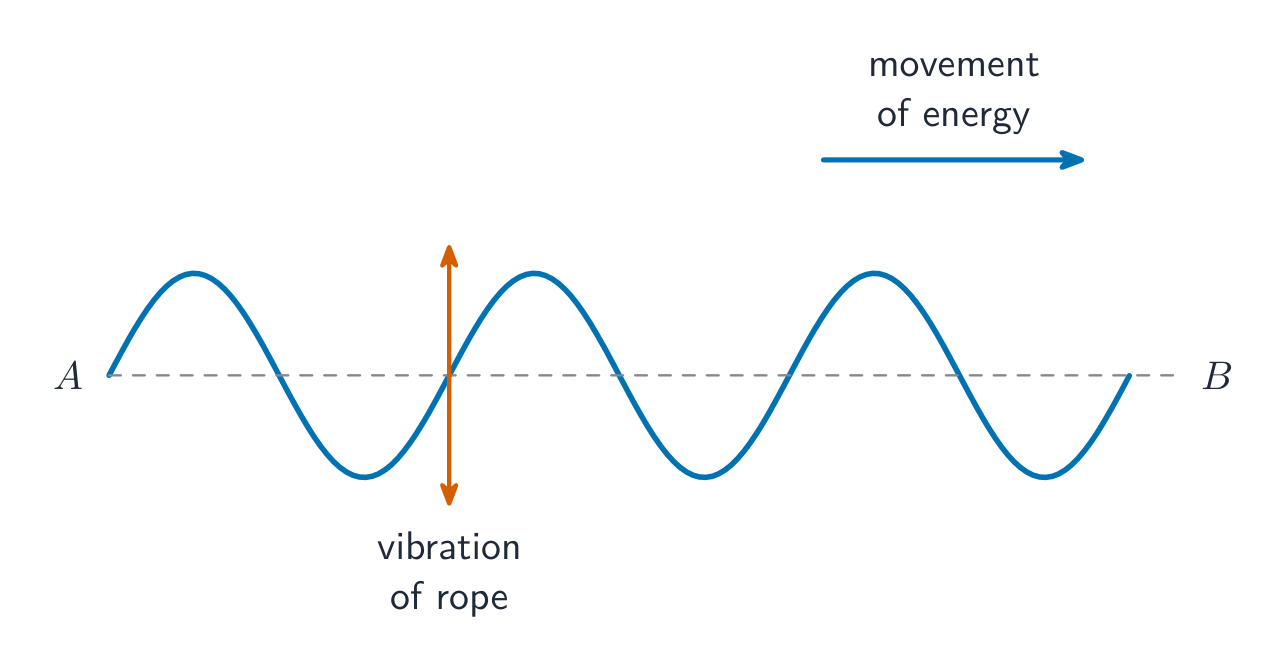
    Explore · ⁨חקור⁩

    Form an image with a converging lens · ⁨יצור תמונה עם עדשה מכנסת⁩

    A converging lens bends parallel rays to its focal point. Move the object and watch the image change from large and inverted to virtual and upright inside the focal length. · ⁨עדשה מכנסת מכנסת קרניים מקבילות לנקודת המיקוד שלה. הזז את האובייקט וצפה בשינוי התמונה מגדולה והפוכה לוירטואלית וישרה בתוך אורך המיקוד.⁩

    Vocabulary · ⁨מילון מונחים⁩ Train · ⁨אימון⁩
    English עברית
    converging/kənˈvɜːdʒɪŋ/ מתכנס
    diverging/daɪˈvɜːdʒɪŋ/ מתפזר
    Watch lesson · ⁨צפה בשיעור⁩
    13.4

    Exam tips · ⁨טיפים לבחינות⁩

    English
    • Measure all angles from the normal, not the surface.
    • Light entering a denser medium (larger $n$) bends toward the normal; use Snell's law $n_1\sin\theta_1=n_2\sin\theta_2$.
    • Total internal reflection happens only going into a less dense medium, beyond the critical angle ($\sin\theta_c=1/n$).
    • For mirrors and lenses use $\tfrac1{d_o}+\tfrac1{d_i}=\tfrac1f$ and $m=-d_i/d_o$: a positive $d_i$ is a real image, negative is virtual.
    • $n=c/v$, so a bigger index means a slower speed of light in the material.
    עברית
    • מדדו כל הזוויות ביחס לניצב, לא לפני השטח.
    • אור הנכנס לתווך צפוף יותר ($n$ גדול יותר) מתכופף כלפי הניצב; השתמשו בחוק סנל $n_1\sin\theta_1=n_2\sin\theta_2$.
    • השתקפות פנימית מוחלטת מתרחשת רק בכניסה לתווך פחות צפוף, מעבר לזווית הקריטית ($\sin\theta_c=1/n$).
    • עבור מראות ועדשות השתמשו ב$\tfrac1{d_o}+\tfrac1{d_i}=\tfrac1f$ וב$m=-d_i/d_o$: ⟨$d_i$⟩ חיובי הוא תמונה אמיתית, שלילי הוא וירטואלי.
    • $n=c/v$, ולכן אינדקס גבוה יותר משמעותו מהירות אור נמוכה יותר בחומר.
  • 14

    Waves, Sound, and Physical Optics · ⁨גלים, קול ואופטיקה פיזיקלית⁩

    Watch lesson · ⁨צפה בשיעור⁩
    14.1

    Properties of Wave Pulses and Waves · ⁨תכונות של פולסי גלים וגלים⁩

    Syllabus · ⁨סיילבוס⁩
    English

    Learning Objective 14.1.A: Describe the physical properties of waves and wave pulses.

    • 14.1.A.1 Waves transfer energy between two locations without transferring matter between those locations.
      • 14.1.A.1.i A wave pulse is a single disturbance that transfers energy without transferring matter between two locations.
      • 14.1.A.1.ii A wave is modeled as a continuous, periodic disturbance with well-defined wavelength and frequency.
    • 14.1.A.2 Mechanical waves or wave pulses require a medium in which to propagate. Electromagnetic waves or wave pulses do not require a medium in which to propagate.
    • 14.1.A.3 The speed at which a wave or wave pulse propagates through a medium depends on the type of wave and the properties of the medium.
      • 14.1.A.3.i The speed of all electromagnetic waves in a vacuum is a universal physical constant, $c = 3.00 \times 10^{8}$ m/s.
      • 14.1.A.3.ii The speed at which a wave pulse or wave propagates along a string is dependent upon the tension in the string, $F_T$, and the mass per length of the string.
        • Equation: $v_{\text{string}} = \sqrt{\dfrac{F_T}{m/\ell}}$
      • 14.1.A.3.iii In a given medium, the speed of sound waves increases with the temperature of the medium.
    • 14.1.A.4 In a transverse wave, the direction of the disturbance is perpendicular to the direction of propagation of the wave.
    • 14.1.A.5 In a longitudinal wave, the direction of the disturbance is parallel to the direction of propagation of the wave.
      • 14.1.A.5.i Sound waves are modeled as mechanical longitudinal waves.
      • 14.1.A.5.ii The regions of high and low pressure in a sound wave are called compressions and rarefactions, respectively.
    • 14.1.A.6 Amplitude is the maximum displacement of a wave from its equilibrium position.
      • 14.1.A.6.i The amplitude of a longitudinal pressure wave may be determined by the maximum increase or decrease in pressure from equilibrium pressure.
      • 14.1.A.6.ii The loudness of a sound increases with increasing amplitude.
      • 14.1.A.6.iii The energy carried by a wave increases with increasing amplitude.
    עברית

    מטרות למידה 14.1.A: תאר את המאפיינים הפיזיקליים של גלים ופולסי גלים.

    • 14.1.A.1 גלים מעבירים אנרגיה בין שני מיקומים מבלי להעביר חומר בין מיקומים אלו.
      • 14.1.A.1.i פולס גל הוא הפרעה יחידה המעבירה אנרגיה מבלי להעביר חומר בין שני מיקומים.
      • 14.1.A.1.ii גל מדגם כהפרעה רציפה, מחזורית עם אורך גל ותדר מוגדרים היטב.
    • 14.1.A.2 גלי מכניים או דופקות גל דורשים תווך כדי להתפשט. גלים אלקטרומגנטיים או דופקות גל אינן דורשות תווך להתפשטות.
    • 14.1.A.3 מהירות ההתפשטות של גל או דופקת גל בתווך תלויה בסוג הגל ובמאפייני התווך.
      • 14.1.A.3.i מהירותם של כל הגלים האלקטרומגנטיים בוואקום היא קבוע פיזיקלי אוניברסלי, $c = 3.00 \times 10^{8}$ מ"ש.
      • 14.1.A.3.ii מהירות ההתפשטות של דופקת גל או גלאורך חוט תלויה במתיחה בחוט, $F_T$, ובמסה ליחידת אורך של החוט.
        • משוואה: $v_{\text{string}} = \sqrt{\dfrac{F_T}{m/\ell}}$
      • 14.1.A.3.iii בתווך נתון, מהירותם של גלי הקול עולה עם עליית טמפרטורת התווך.
    • 14.1.A.4 בגל רוחבי, כיוון ההפרעה הוא מאונך לכיוון ההתפשטות של הגל.
    • 14.1.A.5 בגל אורכי, כיוון ההפרעה הוא מקביל לכיוון ההתפשטות של הגל.
      • 14.1.A.5.i גלי קול מדומים כגלים אורכיים מכניים.
      • 14.1.A.5.ii אזורים בעלי לחץ גבוה ונמוך בגל קול נקראים, בהתאמה, דחיסות ודילול.
    • 14.1.A.6 המשרעת היא סטייתו המקסימלית של גל ממיקום האיזון שלו.
      • 14.1.A.6.i משרעתו של גל לחץ אוריכונית יכולה להיחשב על בסיס העלייה או הירידה המקסימליות בלחץ ביחס ללחץ האיזון.
      • 14.1.A.6.ii עוצמת הקול עולה עם עליית המשרעת.
      • 14.1.A.6.iii האנרגיה הנעית על ידי גל עולה עם עליית המשרעת.

    Source: College Board AP Course and Exam Description · ⁨מקור: תיאור הקורס והמבחן של College Board AP⁩

    English

    A wave 波 carries energy through a medium (or space) without carrying the matter along. A single disturbance is a pulse; a repeating one is a wave. Two types:

    • Transverse 横波: the medium moves perpendicular to the wave's travel (a wave on a rope, light).
    • Longitudinal 纵波: the medium moves along the direction of travel (sound).
    עברית

    התערבות באגן גלים: מסלולי הגלים נוספים בצורה בניינית והרסנית *התערבות באגן גלים: מסלולי הגלים נוספים בצורה בניינית והרסנית

    גל נושא אנרגיה דרך תווך (או חלל) מבלי להעביר את החומר עמם. הפרעה יחידה היא פולס; פרעה חוזרת היא גל. שני סוגים:

    גל רוחבי: התווך נע באופן מאונך לכיוון התנועה של הגל *גל רוחבי: התווך נע באופן מאונך לכיוון התנועה של הגל
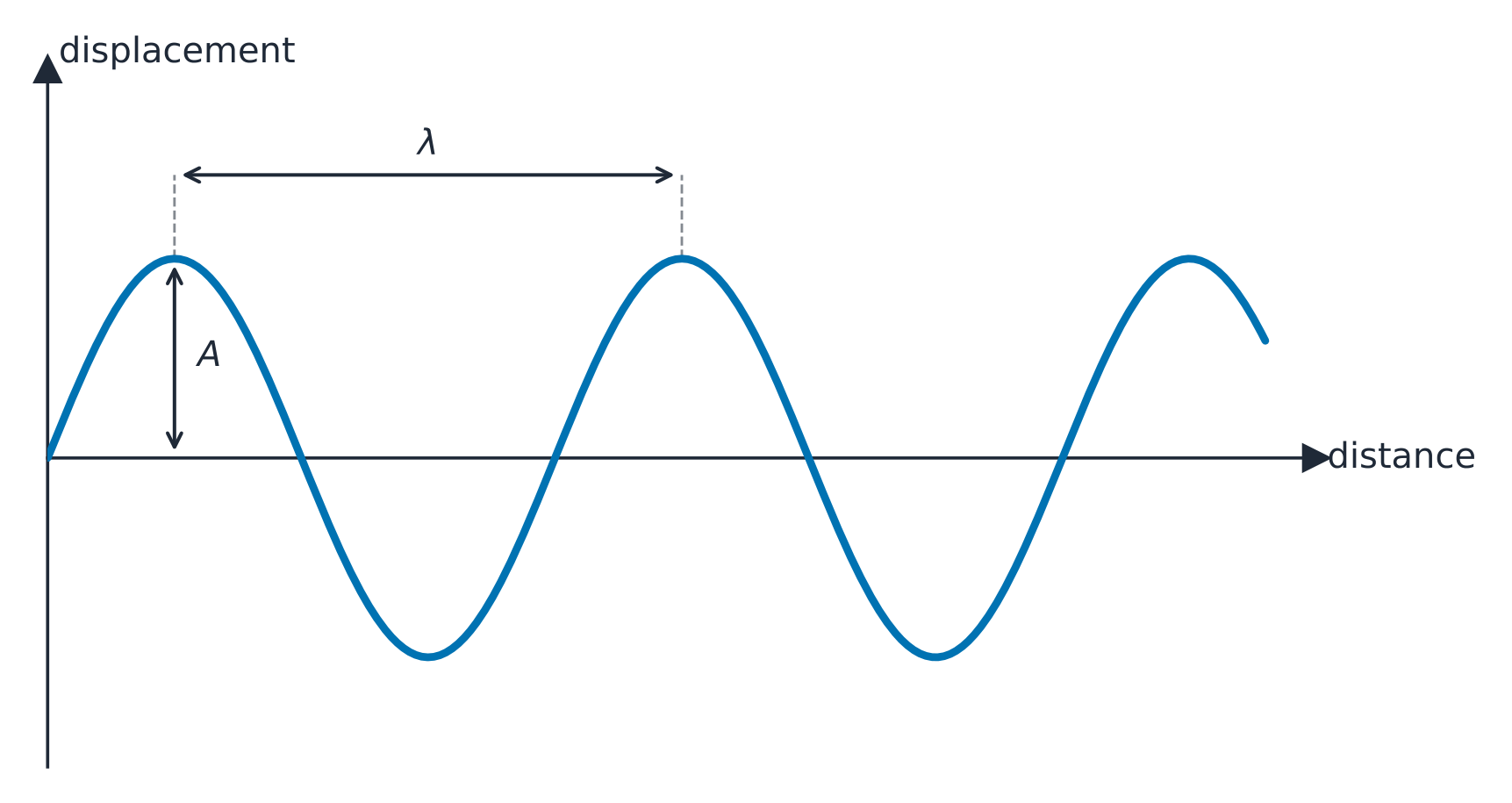
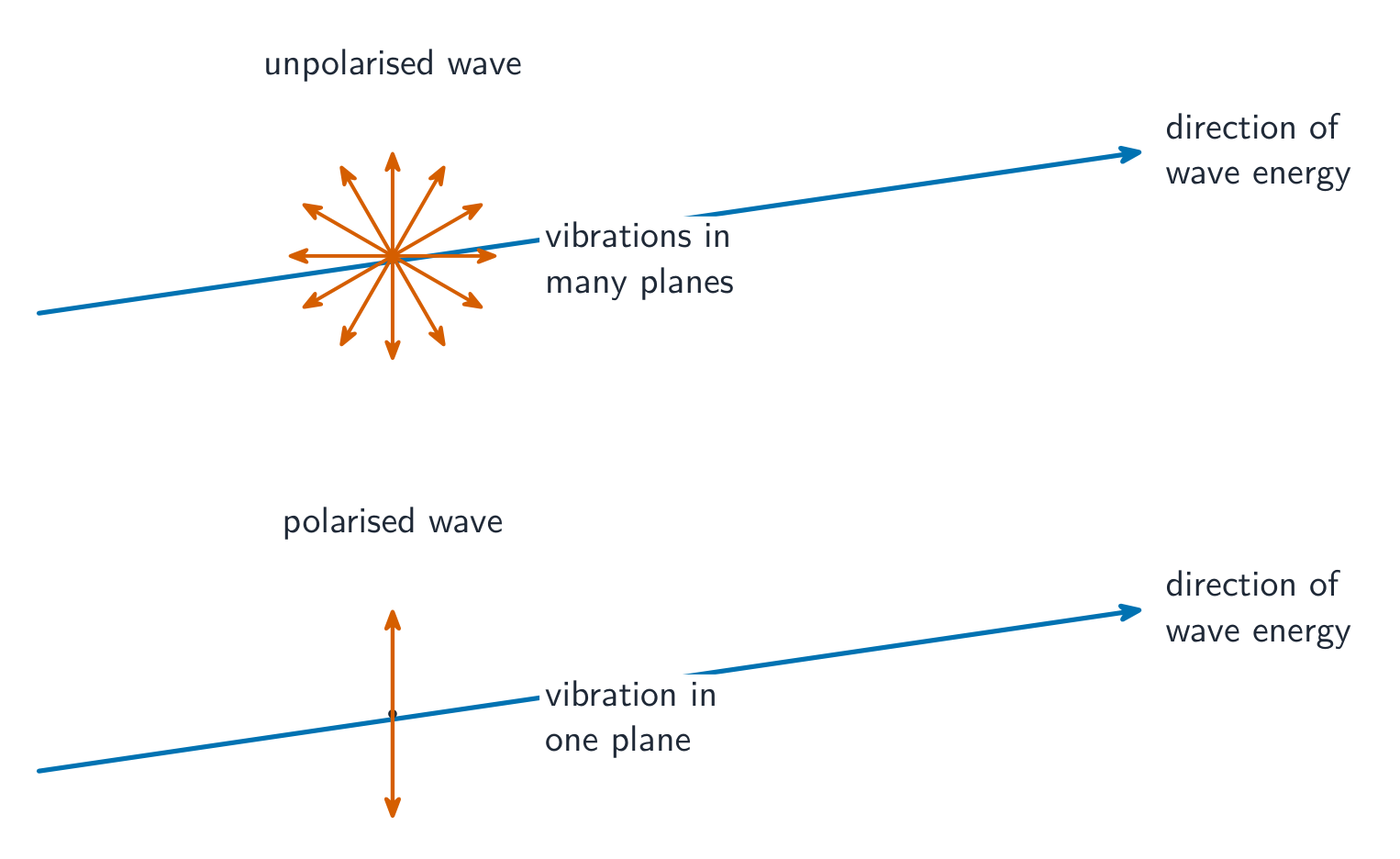
    • רוחבי: התווך נע מאונך לכיוון התנועה של הגל (גל על חבל, אור).
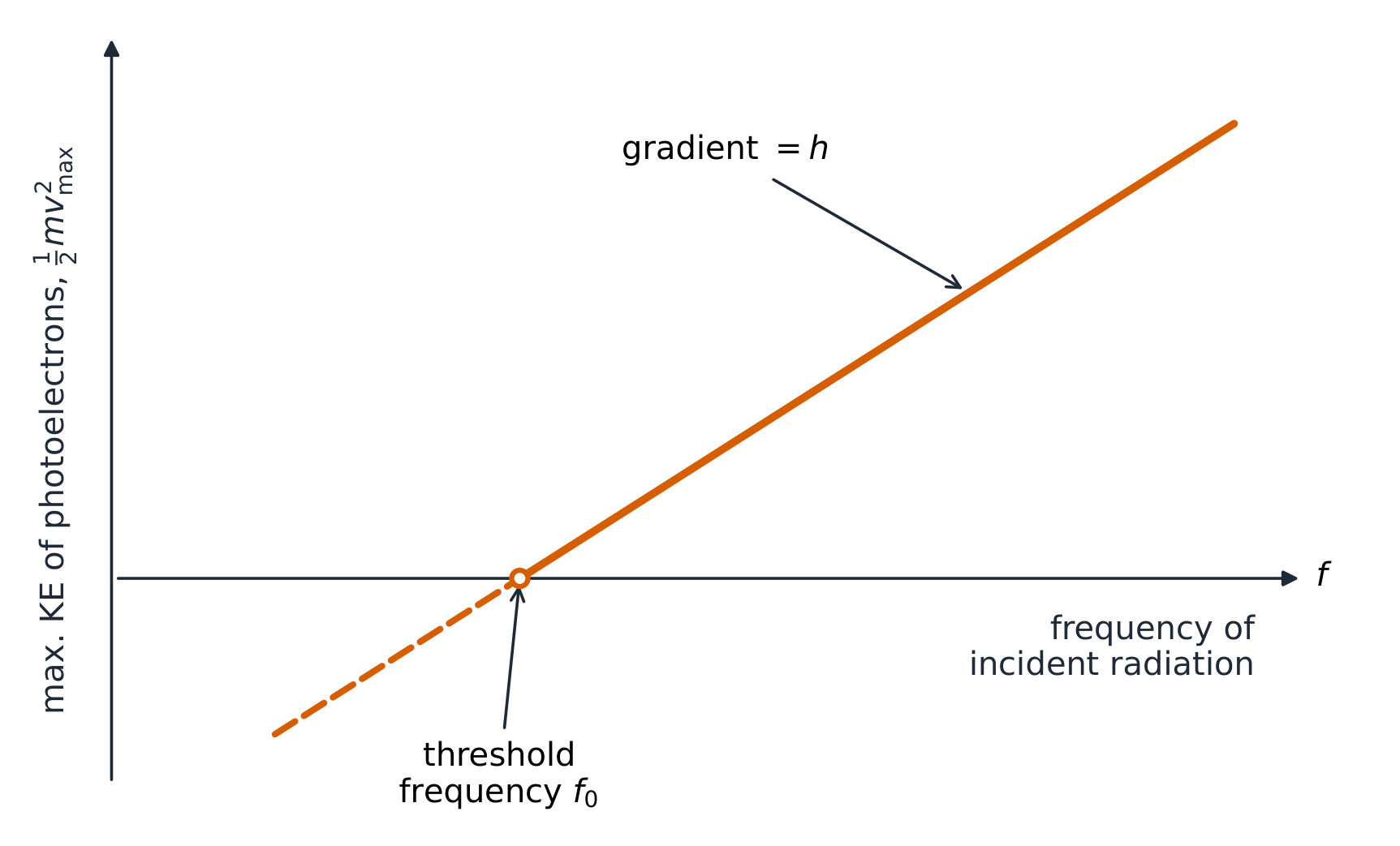
    • אורך: התווך נע לאורך כיוון התנועה (קול).
    Vocabulary · ⁨מילון מונחים⁩ Train · ⁨אימון⁩
    English עברית
    wave/weɪv/ גל
    Transverse/trænsˈvɜːs/ רוחבי
    14.2

    Periodic Waves · ⁨גלים מחזוריים⁩

    Syllabus · ⁨סיילבוס⁩
    English

    Learning Objective 14.2.A: Describe the physical properties of a periodic wave.

    • 14.2.A.1 Periodic waves have regular repetitions that can be described using period and frequency.
      • 14.2.A.1.i The period is the time for one complete oscillation of the wave.
      • 14.2.A.1.ii The frequency is the rate at which the wave repeats.
        • Equation: $T = \dfrac{1}{f}$
      • 14.2.A.1.iii The amplitude of a wave is independent of the period and the frequency of that wave.
      • 14.2.A.1.iv The energy of a wave increases with increasing frequency.
      • 14.2.A.1.v The frequency of a sound wave is related to its pitch.
      • 14.2.A.1.vi Wavelength is the distance between successive corresponding positions (such as peaks or troughs) on a wave.
    • 14.2.A.2 A sinusoidal wave can be described by equations for the displacement from equilibrium at a specific location as a function of time. A wave can also be described by an equation for the displacement from equilibrium at a specific time as a function of position.
      • Equation: $x(t) = A\cos(\omega t) = A\cos(2\pi f t)$
      • Equation: $y(x) = A\cos\left(2\pi \dfrac{x}{\lambda}\right)$
    • 14.2.A.3 For a periodic wave, the wavelength is proportional to the wave's speed and inversely proportional to the wave's frequency.
      • Equation: $\lambda = \dfrac{v}{f}$
    עברית

    מטרת למידה 14.2.A: תאר את המאפיינים הפיזיקליים של גל מחזורי.

    • 14.2.A.1 לגלים מחזוריים ישן חזרות קבועות שיכולות להיות מתוארות באמצעות מחזור ותדר.
      • 14.2.A.1.i המחזור הוא הזמן הנדרש לתנודת גל מלאה אחת.
      • 14.2.A.1.ii התדר הוא קצב חזרתו של הגל.
        • משוואה: $T = \dfrac{1}{f}$
      • 14.2.A.1.iii המשרעת של גל אינה תלויה במחזור ובתדר של אותו גל.
      • 14.2.A.1.iv אנרגייתו של גל עולה עם עליית התדר.
      • 14.2.A.1.v התדר של גל קולי קשור לגובה הצליל שלו.
      • 14.2.A.1.vi אורך גל הוא המרחק בין עמדות תואמות ברצף (כגון פסגות או שפל) על גל.
    • 14.2.A.2 גל סינוסואידלי ניתן לתיאור באמצעות משוואות למיקום ביחס לאיזון במיקום ספציפי כפונקציה של זמן. גל ניתן גם לתיאור באמצעות משוואה למיקום ביחס לאיזון בזמן ספציפי כפונקציה של מיקום.
      • משוואה: $x(t) = A\cos(\omega t) = A\cos(2\pi f t)$
      • משוואה: $y(x) = A\cos\left(2\pi \dfrac{x}{\lambda}\right)$
    • 14.2.A.3 עבור גל מחזורי, אורך הגל פרופורציונלי למהירות הגל והופך לפרופורציוני הפוך לתדירות הגל.
      • משוואה: $\lambda = \dfrac{v}{f}$

    Source: College Board AP Course and Exam Description · ⁨מקור: תיאור הקורס והמבחן של College Board AP⁩

    English
    Transverse vs longitudinal waves

    A repeating wave is described by:

    • wavelength 波长 $\lambda$ (distance between repeats),
    • frequency 频率 $f$ (cycles per second) and period $T=1/f$,
    • amplitude 振幅 $A$ (maximum displacement – related to energy),
    • wave speed 波速 $v=f\lambda$, set by the medium, not the source.

    Worked example. A musical note has frequency $340\ \text{Hz}$ and the speed of sound is $340\ \text{m/s}$. Its wavelength is $\lambda=v/f=340/340=1.0\ \text{m}$. If the same note travels into water (where sound moves at $\approx 1500\ \text{m/s}$) the frequency stays $340\ \text{Hz}$ but the wavelength stretches to $1500/340\approx 4.4\ \text{m}$ – the source sets the frequency, the medium sets the speed and hence the wavelength.

    עברית
    גלים רוחביים מול אורכיים

    גל חוזר מתואר על ידי:

    גרף תזוזה-מרחק מראה את המשרעת ואורך הגל
    גרף הזזה-מרחק המציג את המשרעת ואורך הגל
    • אורך גל $\lambda$ (המרחק בין חזרות),
    • תדר $f$ (מחזורים לשנייה) ו-תקופה $T=1/f$,
    • משרעת $A$ (ההזזה המקסימלית – קשורה לאנרגיה),
    • מהירות גל $v=f\lambda$, נקבעת על ידי המדיה, ולא על ידי המקור.

    דוגמה מפורטת. תווית מוזיקלית בעלת תדר $340\ \text{Hz}$ ומהירות הקול היא $340\ \text{m/s}$. אורך הגל שלה הוא $\lambda=v/f=340/340=1.0\ \text{m}$. אם אותו תווית עובר לתוך מים (בהם הקול נע ב$\approx 1500\ \text{m/s}$), התדר נשאר $340\ \text{Hz}$ אך אורך הגל מתאריך ל$1500/340\approx 4.4\ \text{m}$ – המקור קובע את התדר, המדיה קובעת את המהירות ולכן גם את אורך הגל.

    Explore · ⁨חקור⁩

    Send a periodic wave · ⁨שלח גל מחזורי⁩

    A periodic wave carries energy without moving matter. Its speed $v=f\lambda$ links frequency and wavelength; raise the frequency and the wavelength shrinks. · ⁨גל מחזורי מוביל אנרגיה ללא תנועת חומר. ה-מהירות $v=f\lambda$ מקשרת בין התדר לאורך הגל; עליית התדר גוררת צמצום באורך הגל.⁩

    Vocabulary · ⁨מילון מונחים⁩ Train · ⁨אימון⁩
    English עברית
    Longitudinal/ˌlɒŋɡɪˈtjuːdɪnl/ אורכי
    wavelength/ˈweɪvleŋθ/ אורך גל
    frequency/ˈfriːkwənsi/ תדר
    amplitude/ˈæmplɪtjuːd/ משרעת
    wave speed/weɪv spiːd/ מהירות גל
    Polarization/ˌpəʊləraɪˈzeɪʃn/ קיטוב
    intensity/ɪnˈtensɪti/ עוצמה
    Electromagnetic waves/ɪˌlektrəʊməɡˈnetɪk weɪvz/ גלי אלקטרומגנטיים
    14.3

    Boundary Behavior and Polarization · ⁨התנהגות בגבול ופולריזציה⁩

    Syllabus · ⁨סיילבוס⁩
    English

    Learning Objective 14.3.A: Describe the interaction between a wave and a boundary.

    • 14.3.A.1 A wave that travels from one medium to another can be transmitted or reflected, depending on the properties of the boundary separating the two media.
      • 14.3.A.1.i A wave traveling from one medium to another (for example, a wave traveling between low-mass and high-mass strings) will result in reflected and transmitted waves.
      • 14.3.A.1.ii A reflected wave is inverted if the transmitted wave travels into a medium in which the speed of the wave decreases.
      • 14.3.A.1.iii A reflected wave is not inverted if the transmitted wave travels into a medium in which the speed of the wave increases.
      • 14.3.A.1.iv The frequency of a wave does not change when it travels from one medium to another.
    • 14.3.A.2 Transverse waves that are reflected from a surface, refracted through a medium, or pass through specific openings may be polarized.
      • 14.3.A.2.i Transverse waves can be polarized and oscillate in a single plane.
      • 14.3.A.2.ii Longitudinal waves cannot be polarized.
    • 14.3.A.3 Polarization of a wave may result in a reduction of the wave's intensity.
      • 14.3.A.3.i Intensity is a measure of the amount of power transferred per unit area.
      • 14.3.A.3.ii The intensity of a wave is the average power per unit area over one period of the wave.
    עברית

    מטרות למידה 14.3.A: תאר את האינטראקציה בין גל לבין גבול.

    • 14.3.A.1 גל העובר מאחד תווך לשני אחר יכול להיות מעבר או החזר, בהתאם לתכונות הגבול המפריד בין שני התווכים.
      • 14.3.A.1.i גל הנע ממדיה אחד למדיה אחר (למשל, גל הנע בין מיתרים בעלי מסה נמוכה ומיתרים בעלי מסה גבוהה) יוביל לגלים מחוזזים ומעברים.
      • 14.3.A.1.ii גל מחוזז יהיה הפוך אם הגל המעבר נכנס למדיה שבה מהירות הגל יורדת.
      • 14.3.A.1.iii גל מחוזז אינו הופך אם הגל המעבר נכנס למדיה שבה מהירות הגל עולה.
      • 14.3.A.1.iv התדר של גל אינו משתנה כאשר הוא נע ממדיה אחת למדיה אחרת.
    • 14.3.A.2 גלים רוחביים המוחזרים מפני שטח, מתעוותים דרך תווך, או עוברים דרך פתחים ספציפיים עשויים להיות מקוטבים.
      • 14.3.A.2.i גלים רוחביים יכולים להיות מקוטבים ומתנודדים במישור יחיד.
      • 14.3.A.2.ii גלים אורכיים אינם יכולים להיות מקוטבים.
    • 14.3.A.3 קיטוב של גל עשוי להוביל לצמצום בעוצמת הגל.
      • 14.3.A.3.i עוצמה היא מדד לכמות ההספק המועבר ליחידת שטח.
      • 14.3.A.3.ii עוצמת גל היא הספק ממוצע ליחידת שטח לאורך תקופה אחת של הגל.

    Source: College Board AP Course and Exam Description · ⁨מקור: תיאור הקורס והמבחן של College Board AP⁩

    English
    Total internal reflection

    At a boundary a wave partly reflects and partly transmits. Reflecting off a denser medium inverts the wave; off a less-dense medium it does not. Polarization 偏振 applies to transverse waves only: a polarizer passes just one direction of oscillation, which is why polarized sunglasses cut glare.

    The effect of a polarizer is measured through intensity 强度 - the average power a wave delivers per unit area over one period, in $\text{W m}^{-2}$. Because a polarizer removes the components of the oscillation that are not aligned with it, it reduces the wave's intensity: unpolarized light passing a single ideal polarizer drops to half its intensity, and a second polarizer at an angle cuts it further. Intensity also falls with distance from a source, since the same power spreads over a larger area.

    עברית
    השתכפות פנימית מלאה

    בגבול גל חלקית נשבר וחלקית עובר. השתכבות ממדיה צפופה יותר הופכת הפוכה את הגל; ממדיה פחות צפופה היא אינה הופכת אותו. פולריזציה חלה רק על גלים רוחביים: מקטב מעביר כיוון תנודה אחד בלבד, ומכאן שמשקפי שמש מקוטבים חוסמים סנוור.

    האפקט של מקטב נמדד דרך עוצמה - ההספק הממוצע שהגל מספק לכל יחידת שטח בתוך תקופה אחת, ב$\text{W m}^{-2}$. מכיוון שמקטב מסיר את רכיבי התנודה שאינם מקבילים אליו, הוא מפחית את עוצמת הגל: אור לא מקוטב העובר דרך מקטב אידיאלי יורד לעומת חצי מעוצמתו, ומקטב שני בזווית מסוימת מפחית אותה עוד. עוצמה גם יורדת עם המרחק מהמקור, משום שהאותו הספק מתפשט על שטח גדול יותר.

    גלים לא-מקוטבים רועדים בכמה מישורים; גל מקוטב רועד במישור אחד
    גלים לא מקוטבים מתנדדים במספר מישורים; גל מקוטב מתנדד במישור אחד
    14.4

    Electromagnetic Waves · ⁨גלים אלקטרומגנטיים⁩

    Syllabus · ⁨סיילבוס⁩
    English

    Learning Objective 14.4.A: Describe the properties of an electromagnetic wave.

    • 14.4.A.1 Electromagnetic waves consist of oscillating electric and magnetic fields that are mutually perpendicular.
      • 14.4.A.1.i Electromagnetic waves are transverse waves because the oscillations of the electric and magnetic fields are perpendicular to the direction of propagation.
      • 14.4.A.1.ii Electromagnetic waves are commonly assumed to be plane waves, which are characterized by planar wave fronts.
    • 14.4.A.2 Electromagnetic waves do not need a medium through which to propagate.
    • 14.4.A.3 Categories of electromagnetic waves are characterized by their wavelengths.
      • 14.4.A.3.i Categories of electromagnetic waves include (in order of decreasing wavelength, spanning a range from kilometers to picometers) radio waves, microwaves, infrared, visible, ultraviolet, X-rays, and gamma rays.
      • 14.4.A.3.ii Visible electromagnetic waves are further broken into categories of color, including (in order of decreasing wavelength) red, orange, yellow, green, blue, and violet.
      • 14.4.A.3.iii Visible electromagnetic waves are also called light. Sometimes, electromagnetic waves of all wavelengths are collectively referred to as light or electromagnetic radiation.

    Boundary statement: AP Physics 2 expects students to know the ordering of the electromagnetic spectrum (including visible light). However, students will not be expected to define exact wavelength ranges within the electromagnetic spectrum.

    עברית

    מטרות למידה 14.4.A: תאר את תכונותיו של גל אלקטרומגנטי.

    • 14.4.A.1 גלים אלקטרומגנטיים מורכבים משדות חשמלי ומגנטיים מתנודדים שהם מאונכים זה לזה.
      • 14.4.A.1.i גלי אלקטרומגנטיים הם גלים רוחביים משום שהתנודות של השדות החשמלי והמגנטי מאונכות לכיוון ההתפשטות.
      • 14.4.A.1.ii נהוג להניח שגלי אלקטרומגנטיים הם גלי מישור, המאופיינים במיתרי גל מישוריים.
    • 14.4.A.2 גלי אלקטרומגנטיים אינם זקוקים לתווך דרכו יתפשטו.
    • 14.4.A.3 קטגוריות של גלי אלקטרומגנטיים מאופיינות באורכי הגל שלהן.
      • 14.4.A.3.i הקטגוריות הן (בסדר יורד של אורך גל, בטווח מילומטריות לפיקומטריות): גלי רדיו, מיקרוגלים, אינפרא אדום, אור נראה, אולטרה סגול, קרני X וקרני גاما.
      • 14.4.A.3.ii גלי אלקטרומגנטיים נראים מתחלקים ל categories צבע, כולל (בסדר יורד של אורך גל): אדום, כתום, צהוב, ירוק, תכלת וסגול.
      • 14.4.A.3.iii גלי אלקטרומגנטיים נראים מכונים גם אור. לעיתים, גלי אלקטרומגנטיים בכל אורכי הגל מכונים בקיצור אור או קרינה אלקטרומגנטית.

    הצהרת גבול: ב-AP Physics 2 מצופה מהתלמידים לדעת את סדר הספקטרם האלקטרומגנטי (כולל אור נראה). עם זאת, לא מצופה מהם להגדיר טווחי אורך גל מדויקים בתוך הספקטרם.

    Source: College Board AP Course and Exam Description · ⁨מקור: תיאור הקורס והמבחן של College Board AP⁩

    English

    Electromagnetic waves 电磁波 are oscillating electric and magnetic fields that travel through vacuum at the speed of light $c$, needing no medium. They span the spectrum from radio to gamma rays; higher frequency means shorter wavelength and higher photon energy.

    עברית

    גלים אלקטרומגנטיים הם שדות חשמלי ומגנטיים מתנדדים הנעים בוואקום במהירות האור $c$, ללא צורך במדיה. הם משתרעים על פני הספקטרום מאריות ועד קרני גמא; תדר גבוה יותר משמעותו אורך גל קצר יותר ואנרגיית פוטון גבוהה יותר.

    הספקטרום האלקטרומגנטי, מגלי רדיו ועד קרני גاما
    הספקטרום האלקטרומגנטי, מאריות ועד קרני גמא
    14.5

    The Doppler Effect · ⁨אפקט דופלר⁩

    Syllabus · ⁨סיילבוס⁩
    English

    Learning Objective 14.5.A: Describe the properties of a wave based on the relative motion between the source of the wave and the observer of the wave.

    • 14.5.A.1 The Doppler effect describes the relationship between the rest frequency of a wave source, the observed frequency of the source, and the relative velocity of the source and the observer.
    • 14.5.A.2 A greater relative velocity results in a greater measured difference between the observed and rest frequencies.
      • 14.5.A.2.i For a wave source moving at the same velocity as the observer, the observed frequency is equal to the rest frequency.
      • 14.5.A.2.ii For a wave source moving toward an observer, the observed frequency is greater than the rest frequency.
      • 14.5.A.2.iii For a wave source moving away from an observer, the observed frequency is less than the rest frequency.

    Boundary statement: Only qualitative treatments of the Doppler effect are required for AP Physics 2.

    עברית

    מטרת למידה 14.5.A: לתאר את תכונות הגל על בסיס התנועה היחסית בין מקור הגל לבין הצופה בגל.

    • 14.5.A.1 אפקט דופלר מתאר את הקשר בין תדירות השקט של מקור הגל, התדירות הנצפתה של המקור והמהירות היחסית של המקור והצופה.
    • 14.5.A.2 מהירות יחסית גדולה יותר מובילה להפרש גדול יותר שנמדד בין התדירות הנצפתה לתדירות השקט.
      • 14.5.A.2.i עבור מקור גל הנע באותה מהירות כמו הצופה, התדירות הנצפתה שווה לתדירות השקט.
      • 14.5.A.2.ii עבור מקור גל הנע כלפי צופה, התדירות הנצפתה גדולה מתדירות השקט.
      • 14.5.A.2.iii עבור מקור גל הנע הרחק מצופה, התדירות הנצפתה קטנה מתדירות השקט.

    הצהרת גבול: ב-AP Physics 2 נדרשים רק טיפולים איכותניים של אפקט דופלר.

    Source: College Board AP Course and Exam Description · ⁨מקור: תיאור הקורס והמבחן של College Board AP⁩

    English
    The Doppler effect

    The Doppler effect 多普勒效应 is the change in observed frequency when a wave source and observer move relative to each other. Approaching $\Rightarrow$ higher frequency (shorter wavelength); receding $\Rightarrow$ lower frequency. It explains a passing siren's drop in pitch and the redshift of receding galaxies.

    עברית
    אפקט דופלר

    אפקט דופלר הוא שינוי בתדר הנצפה כאשר מקור גל וצופה נעים יחסית זה לזה. קירוב $\Rightarrow$ תדר גבוה (גל קצר יותר); התרחקות $\Rightarrow$ תדר נמוך. האפקט מסביר את הירידה בגובה הצליל של סירנה עוברת וההתאדמות של גלקסיות הרחקות.

    מקור נעוד צופר את חזית הגלים לפניו, מה שמעלה את התדר הנצפה
    מקור נע דוחס את חזיתות הגל לפניו, ומרים את התדר הנצפה
    Explore · ⁨חקור⁩

    Hear the Doppler shift · ⁨שמע את שינוי דופלר⁩

    When a source moves, waves bunch up ahead (higher frequency) and stretch behind (lower) — the Doppler effect. Speed it up to exaggerate the shift. · ⁨כאשר מקור נע, הגלים מצטופפים קדימה (תדר גבוה יותר) ומתינים אחורה (תדר נמוך יותר) — זהו אפקט דופלר. האץ את המהירות כדי להגדיל את השינוי.⁩

    Vocabulary · ⁨מילון מונחים⁩ Train · ⁨אימון⁩
    English עברית
    Doppler effect/ˈdɒplə ɪˈfekt/ אפקט דופלר
    Constructive interference/kənˈstrʌktɪv ˌɪntəˈfɪərəns/ התאבקות בונה
    destructive interference/dɪˈstrʌktɪv ˌɪntəˈfɪərəns/ התערבות הרסנית
    14.6

    Wave Interference and Standing Waves · ⁨התאבכות גלים וגלי עומד⁩

    Syllabus · ⁨סיילבוס⁩
    English

    Learning Objective 14.6.A: Describe the net disturbance that occurs when two or more wave pulses or waves overlap.

    • 14.6.A.1 Wave interference is the interaction of two or more wave pulses or waves.
    • 14.6.A.2 When two or more wave pulses or waves interact with each other, they travel through each other and overlap rather than bouncing off each other.
    • 14.6.A.3 When two or more wave pulses or waves overlap, the resulting displacement can be determined by adding the individual displacements. This is called superposition.
    • 14.6.A.4 Wave interference may be constructive or destructive.
      • 14.6.A.4.i When the displacements of the superposed wave pulses or waves are in the same direction, the interaction is called constructive interference.
      • 14.6.A.4.ii When the displacements of the superposed wave pulses or waves are in opposite directions, the interaction is called destructive interference.
      • 14.6.A.4.iii Two or more traveling wave pulses or waves can interact in such a way as to produce amplitude variations in the resultant wave pulse or wave.
    • 14.6.A.5 Visual representations of wave pulses or waves are useful in determining the result of two interacting wave pulses or waves.
    • 14.6.A.6 Beats arise from the addition of two waves of slightly different frequency.
      • 14.6.A.6.i Waves with different frequencies are sometimes in phase and sometimes out of phase at locations along the waves, causing periodic amplitude changes in the resultant wave.
      • 14.6.A.6.ii The beat frequency is the difference in the frequencies of the two waves.
        • Equation: $\left|f_{\text{beat}}\right| = \left|f_1 - f_2\right|$
      • 14.6.A.6.iii Tuning forks are devices that are commonly used to demonstrate beat frequencies.

    Learning Objective 14.6.B: Describe the properties of a standing wave.

    • 14.6.B.1 Standing waves can result from interference between two waves that are confined to a region and traveling in opposite directions.
      • 14.6.B.1.i Standing waves have nodes and antinodes. A node is a point on the standing wave where the amplitude is always zero. An antinode is a point on the standing wave where the amplitude is always at maximum.
      • 14.6.B.1.ii The possible wavelengths of a standing wave are determined by the size and boundary conditions of the region to which it is confined.
      • 14.6.B.1.iii Common regions where standing waves can form include pipes with open or closed ends, as well as strings with fixed or loose ends.
    • 14.6.B.2 A standing wave with the longest possible wavelength is called the fundamental or first harmonic. The second-longest wavelength is typically called the second harmonic, the third-longest wavelength is called the third harmonic, and so on. However, for a standing wave with a node at one end and an antinode at the other end, only odd harmonics can be established.
    • 14.6.B.3 Visual representations of standing waves are useful in determining the relationships between length of the region, wavelength, frequency, wave speed, and harmonic.
    עברית

    מטרת למידה 14.6.A: לתאר את ההפרעה הכוללת המתרחשת כאשר שני פולסים או יותר של גלים חופפים זה על זה.

    • 14.6.A.1 התערבות גלים היא האינטראקציה בין שני פולסים או יותר של גלים.
    • 14.6.A.2 כאשר שני פולסים או יותר של גלים נפגשים זה עם זה, הם חודרים זה דרך זה וחופפים במקום לקפוץ זה על זה.
    • 14.6.A.3 כאשר שני פולסים גליים או יותר חופפים זה על גבי זה, ניתן לקבוע את ההפרעה הנוצרת על ידי חיבור ההפרעות הבודדות. תהום זה נקרא סופרפוזיציה.
    • 14.6.A.4 התערבות גלית עשויה להיות בונה או מרסה.
      • 14.6.A.4.i כאשר ההפרעות של פולסי הגלים החופפים או הגלים עצמם נמצאות באותה כיוון, האינטראקציה מכונה התערבות בונה.
      • 14.6.A.4.ii כאשר ההפרעות של פולסי הגלים החופפים או הגלים עצמם נמצאות בכיוונים הפוכים, האינטראקציה מכונה התערבות מרסה.
      • 14.6.A.4.iii שני פולסים גליים או יותר המעבר יכולים להתייחס זה לזה כך שיובילו לשינויים באמפליטודה בפולס הגלי או בגל הנובע.
    • 14.6.A.5 ייצוגים ויזואליים של פולסים גליים או גלים שימושיים לקביעת התוצאה של שני פולסים גליים או גלים המתאיירים זה עם זה.
    • 14.6.A.6 מקצבים (Beats) נוצרים כתוצאה מהוספת שני גלים בתדירות השונה מעט.
      • 14.6.A.6.i גלים בתדרים שונים נמצאים לעיתים קרובות באותו פאזה ולעיתים מחוץ לפאזה במיקומים לאורך הגלים, מה שמגרום לשינויים תקופתיים באמפליטודה בגל הנובע.
      • 14.6.A.6.ii תדירות המקצבים היא ההפרש בין תדרים של שני הגלים.
        • משוואה: $\left|f_{\text{beat}}\right| = \left|f_1 - f_2\right|$
      • 14.6.A.6.iii מזמזמים הם מכשירים המשמשים לעיתים קרובות להמחשת תדרי מקצבים.

    מטרה לימודית 14.6.B: לתאר את מאפייני הגל העומד.

    • 14.6.B.1 גלים עומדים יכולים להיווצר כתוצאה מהתערבות בין שני גלים המוגבלים לאזור מסוים והמתקדמים בכיוונים הפוכים.
      • 14.6.B.1.i לגלים עומדים יש צמתים ונודות. צומת הוא נקודה בגל העומד בה האמפליטודה היא אפס תמיד. נודה היא נקודה בגל העומד בה האמפליטודה היא מקסימלית תמיד.
      • 14.6.B.1.ii אורכי הגל האפשריים לגל עומד נקבעים על ידי גודלו ותנאי הגבול של האזור אליו הוא מוגבל.
      • 14.6.B.1.iii אזורים נפוצים בהם גלים עומדים יכולים להתקיים כוללים צינורות עם קצוות פתוחים או סגורים, ainsi que מיתרים עם קצוות קבועים או רופפים.
    • 14.6.B.2 גל עומד בעל אורך הגל הארוך ביותר מכונה היסוד או הרמוניה הראשונה. אורך הגל השני באורכו נקרא בדרך כלל הרמוניה השנייה, אורך הגל השלישי באורכו נקרא הרמוניה השלישית, וכך הלאה. עם זאת, עבור גל עומד עם צומת בקצה אחד ונודה בקצה השני, רק הרמוניות אי-זוגיות יכולות להתקיים.
    • 14.6.B.3 ייצוגים ויזואליים של גלים עומדים שימושיים לקביעת הקשרים בין אורך האזור, אורך גל, תדר, מהירות גל והרמוניה.

    Source: College Board AP Course and Exam Description · ⁨מקור: תיאור הקורס והמבחן של College Board AP⁩

    English
    Standing (stationary) waves

    When waves overlap they superpose (add). Constructive interference 相长干涉 (crests aligned) gives a bigger wave; destructive interference 相消干涉 (crest on trough) cancels. Two waves travelling opposite ways in a bounded medium form a standing wave 驻波 with fixed nodes 波节 (no motion) and antinodes 波腹 (maximum motion) – the basis of resonance on strings and in pipes.

    Worked example. A guitar string $0.65\ \text{m}$ long is fixed at both ends. Its fundamental (first harmonic) fits half a wavelength between the ends, so $\lambda=2L=1.30\ \text{m}$. If waves travel along the string at $260\ \text{m/s}$, the note's frequency is $f=v/\lambda=260/1.30=200\ \text{Hz}$. Shortening the string (a fret) raises the pitch.

    When two waves of slightly different frequency overlap, they drift in and out of step, so the combined sound swells loud and soft in a slow throb called beats 拍. The beat frequency 拍频 is simply the difference of the two frequencies:

    $$f_{\text{beat}}=|f_1-f_2|.$$
    Two tuning forks of $256\ \text{Hz}$ and $260\ \text{Hz}$ sounded together give $|260-256|=4$ beats each second; a musician tunes an instrument by slowing these beats towards zero against a reference note.

    עברית
    גלי עומד (ניחוד)

    כשגלים חופפים הם מתחברים (מוסיפים). התאבכות בונה (פסגות מיושרות) נותנת גל גדול יותר; התאבכות הורסת (פסגה על שפל) מבטלת. שני גלים המעבר בכיוונים מנוגדים בתווך מוגבל יוצרים גל עומד עם נקודות קשר קבועות (ללא תנועה) ו-נקודות אנטי-קשר (תנועה מקסימלית) – הבסיס לתהודה במיתרים ובצינורות.

    גל עומד נוצר שם שני גלים המעברים בכיוונים מנוגדים חופפים
    גל עומד נוצר שם שני גלים המעברים בכיוונים מנוגדים חופפים

    דוגמה פותרת. מיתר גיטרה $0.65\ \text{m}$ ארוך תקוע בשתי קצוותיו. ה-בסיסי (ההרמונית הראשונה) מתאים לחצי אורך גל בין הקצוות, ולכן $\lambda=2L=1.30\ \text{m}$. אם גלים מעברים לאורך המיתר ב$260\ \text{m/s}$, תדר הצליל הוא $f=v/\lambda=260/1.30=200\ \text{Hz}$. קיצור המיתר (באמצעות טונר) מגביה את הגובה הצלילי.

    כששני גלים בעלי תדר שונה מעט חופפים, הם מחליפים אי-התאמה, ולכן הצליל המשולף מתנפץ חזק וחלש בקצב איטי הנקרא פולסים. תדר הפולסים הוא פשוט ההפרש בין שני התדרים:

    $$f_{\text{beat}}=|f_1-f_2|.$$
    שני מזמרים בעלי $256\ \text{Hz}$ ו$260\ \text{Hz}$ שמיע together נותנים $|260-256|=4$ פולסים בכל שנייה; מוזיקאי מתכוון כלי על ידי להאטת פולסים אלו לעבר אפס מול נקודת ייחוס.

    Explore · ⁨חקור⁩

    Set up a standing wave · ⁨הכן גל עומד⁩

    Two waves travelling opposite ways interfere into a standing wave with fixed nodes and antinodes. Only certain frequencies fit, giving the harmonics. · ⁨שני גלים הנעים בכיוונים מנוגדים מתערבבים ליצירת גל עומד עם נקודות קיבוע ונקודות קוץ קבועות. רק תדרים מסוימים מתאימים, מה שמניב את ההרמוניות.⁩

    Vocabulary · ⁨מילון מונחים⁩ Train · ⁨אימון⁩
    English עברית
    standing wave/ˈstændɪŋ weɪv/ גל עומד
    nodes/nəʊdz/ צמתים
    antinodes/ˌæntɪˈnəʊdz/ נקודות נטו
    beats/biːts/ הפרעות
    beat frequency/biːt ˈfriːkwənsi/ תדר הפרעות
    14.7

    Diffraction · ⁨פיזור⁩

    Syllabus · ⁨סיילבוס⁩
    English

    Learning Objective 14.7.A: Describe the behavior of a wave and the diffraction pattern resulting from a wave passing through a single opening.

    • 14.7.A.1 Diffraction is the spreading of a wave around the edges of an obstacle or through an opening.
    • 14.7.A.2 Diffraction is most pronounced when the size of the opening is comparable to the wavelength of the wave.
    • 14.7.A.3 Diffraction of multiple wavefronts through a single opening leads to observable interference patterns.
    • 14.7.A.4 Diffraction is commonly demonstrated by monochromatic light of wavelength $\lambda$ incident on a narrow opening of width $a$ that is a distance $L$ from a screen.
      • 14.7.A.4.i Constructive and destructive interference of multiple wavefronts originating from the opening will result in bright and dark bands on the screen.
      • 14.7.A.4.ii The amount of interference between two wavefronts depends on the path length difference $\Delta D$ of the wavefronts.
      • 14.7.A.4.iii The path length difference $\Delta D$ can be described in terms of the opening width $a$ and the angle $\theta$ between the direction of propagation of the wavefront and the normal to the opening by the equation $\Delta D = a\sin\theta$.
      • 14.7.A.4.iv For small angles, where $\theta < 10°$, the small angle approximation can be used to relate $\lambda$, $a$, and $L$ to $y_{\min}$, the distance from the middle of the central bright fringe to the $m^{\text{th}}$ order of minimum brightness on the screen.
        • Equation: $a\left(\dfrac{y_{\min}}{L}\right) \approx m\lambda$
    • 14.7.A.5 The diffraction pattern produced by a wave passing through an opening depends on the shape of the opening.
    • 14.7.A.6 Visual representations of single-slit diffraction patterns are useful in determining the physical properties of the slit and the interacting waves.
    עברית

    מטרה לימודית 14.7.A: לתאר את התנהגותו של גל ואת דגם העקיפה הנובע מעברו דרך פתח יחיד.

    • 14.7.A.1 עקיפה היא התפשטותו של גל סביב קצוות של מכשול או דרך פתח.
    • 14.7.A.2 גלישה בולטת ביותר כאשר גודל הפתח דומה לאורך הגל.
    • 14.7.A.3 גלישה של מספר חזיתות גל דרך פתח יחיד מובילה להיווצרות תבניות התאבכות נצפות.
    • 14.7.A.4 דפraction מתבטא בדרך כלל באור חד-צבעי בעל אורך גל $\lambda$ הפוגע בפתיחה צרה בעלת רוחב $a$ הנמצאת במרחק $L$ ממסך.
      • 14.7.A.4.i התאבכות בונה והרסנית של חזיתות גל רבות שנובעות מהפתח תוביל ללהבנות בהירות וחשוכות על המסך.
      • 14.7.A.4.ii עוצמת ההתאבכות בין שתי חזיתות גל תלויה בהפרש האורך $\Delta D$ של החזיתות.
      • 14.7.A.4.iii הפרש האורך $\Delta D$ ניתן לתאר באמצעות רוחב הפתח $a$ והזווית $\theta$ בין כיוון התפשטות החזית לבין הנורמל לפתח, באמצעות המשוואה $\Delta D = a\sin\theta$.
      • 14.7.A.4.iv עבור זוויות קטנות, כאשר $\theta < 10°$, ניתן להשתמש בקירוב הזווית הקטנה כדי לקשר בין $\lambda$, $a$, ו$L$ ל$y_{\min}$, המרחק מאמצע הפס בהיר מרכזי אל סדר ה$m^{\text{th}}$ של מינימום תאורה על המסך.
        • משוואה: $a\left(\dfrac{y_{\min}}{L}\right) \approx m\lambda$
    • 14.7.A.5 תבנית הגלישה הנוצרת על ידי גל העובר דרך פתח תלויה בצורת הפתח.
    • 14.7.A.6 תצוגות ויזואליות של תבניות גלישה בפתח יחיד מועילות לקביעת התכונות הפיזיקליות של הפתח וגלים המתאבכים.

    Source: College Board AP Course and Exam Description · ⁨מקור: תיאור הקורס והמבחן של College Board AP⁩

    English

    Diffraction 衍射 is the bending and spreading of waves around edges or through openings. The spreading is significant when the opening is comparable to the wavelength – so sound (long wavelength) bends around doorways easily, while light (tiny wavelength) needs a very narrow slit.

    עברית

    פיזור הוא כיפוף והתפשטות של גלים סביב קצוות או דרך פתחים. ההתפשטות משמעותית כאשר הפתח דומה באורכו לגל – כך שצליל (אורך גל ארוך) מתכופף סביב דלתות בקלות, בעוד שאור (אורך גל זעיר) דורש סדק צר מאוד.

    גלים מתפשטים (מתפרקים) כאשר הם עוברים דרך פתח
    גלים מתפשטים (מתפזרים) כשהם עוברים דרך חריץ
    Vocabulary · ⁨מילון מונחים⁩ Train · ⁨אימון⁩
    English עברית
    Diffraction/dɪˈfrækʃn/ דיפרקציה
    Coherent/kəʊˈhɪərənt/ קוהרנטי
    diffraction grating/dɪˈfrækʃn ˈɡreɪtɪŋ/ רשת דיפרקציה
    thin film/θɪn fɪlm/ סרט דק
    antireflection coating/ˌæntɪrɪˈflekʃn ˈkəʊtɪŋ/ ציפוי אנטי-השתקפות
    14.8

    Double-Slit Interference and Diffraction Gratings · ⁨התאבכות בשני חריצים ורשתות פיזור⁩

    Syllabus · ⁨סיילבוס⁩
    English

    Learning Objective 14.8.A: Describe the behavior of a wave and the diffraction pattern resulting from the wave passing through multiple openings.

    • 14.8.A.1 The pattern resulting from monochromatic light of wavelength $\lambda$ incident on two slits a distance $d$ apart is caused by a combination of wave diffraction and wave interference.
      • 14.8.A.1.i When only considering wave interference, a double slit creates a pattern of uniformly spaced maxima.
      • 14.8.A.1.ii Constructive and destructive interference of the wavefronts originating from each slit will result in bright and dark bands on the screen.
      • 14.8.A.1.iii The amount of interference between two wavefronts depends on the path length difference $\Delta D$ of the wavefronts.
      • 14.8.A.1.iv The path length difference $\Delta D$ can be described in terms of the slit separation $d$ and the angle $\theta$ between the direction of propagation of the wavefront and the normal to the opening by the equation $\Delta D = d\sin\theta$.
      • 14.8.A.1.v For small angles, where $\theta < 10°$, the small angle approximation can be used to relate $\lambda$, $d$, and $L$ to $y_{\max}$, the distance from the middle of the central bright fringe to the $m^{\text{th}}$ order of maximum brightness on the screen.
        • Equation: $d\left(\dfrac{y_{\max}}{L}\right) \approx m\lambda$
      • 14.8.A.1.vi When considering wave interference and wave diffraction, a double slit creates an interference pattern of maxima and minima superimposed within the envelope created by single-slit diffraction.
    • 14.8.A.2 Interference patterns produced by light interacting with a double slit indicate that light has wave properties. The source of this discovery was Young's double-slit experiment.
    • 14.8.A.3 Visual representations of double-slit diffraction patterns are useful in determining the physical properties of the slits and the interacting waves.
    • 14.8.A.4 A diffraction grating is a collection of evenly spaced parallel slits or openings that produce an interference pattern that is the combination of numerous diffraction patterns superimposed on each other.
    • 14.8.A.5 When white light is incident on a diffraction grating, the center maximum is white and the higher-order maxima disperse white light into a rainbow of colors, with the longest-wavelength light (red) appearing farthest from the central maximum.
    עברית

    מטרות למידה 14.8.A: תאר את התנהגותו של גל ותבנית הגלישה הנוצרת מתוך מעבר הגל דרך פתחים מרובים.

    • 14.8.A.1 התבנית הנוצרת מתוך אור מונוכרטי בעל אורך גל $\lambda$ הנפגש עם שני פס双-פתחים במרחק $d$ זה מזה נובעת משילוב של גלישת גלים והתאבכות גלים.
      • 14.8.A.1.i כאשר נסתכל רק על התאבכות גלים, פס双-פתח יוצר תבנית של מקסימומים במרווח אחיד.
      • 14.8.A.1.ii התאבכות בונה והרסנית של חזיתות הגל הנובעות מפס双-פתח כל אחד תוביל ללהבנות בהירות וחשוכות על המסך.
      • 14.8.A.1.iii עוצמת ההתאבכות בין שתי חזיתות גל תלויה בהפרש האורך $\Delta D$ של החזיתות.
      • 14.8.A.1.iv הפרש אורכי הדרך $\Delta D$ ניתן לתאר באמצעות הפרדת החריצים $d$ והזווית $\theta$ בין כיוון התפשטות חזית הגל לבין הנורמל לפתיחות על ידי המשוואה $\Delta D = d\sin\theta$.
      • 14.8.A.1.v עבור זוויות קטנות, כאשר $\theta < 10°$, ניתן להשתמש בקירוב הזווית הקטנה כדי לקשר בין $\lambda$, $d$ ו$L$ ל$y_{\max}$, המרחק מאמצע הפריזה הבהירה המרכזית עד לסדר ה$m^{\text{th}}$ של מקסימום בהירות על המסך.
        • משוואה: $d\left(\dfrac{y_{\max}}{L}\right) \approx m\lambda$
      • 14.8.A.1.vi כאשר נסתכל גם על התאבכות גלים וגם על גלישת גלים, פס双-פתח יוצר תבנית התאבכות של מקסימומים ומינימום המוטבעים בתוך האנבלופ הנוצר מגלישה בפתח יחיד.
    • 14.8.A.2 תבניות ההתאבכות הנוצרות מאור המגיב עם פס双-פתח מעידות על כך שאור הוא בעל תכונות גליות. מקור גילוי זה הוא ניסוי פס双-פתח של יאנג.
    • 14.8.A.3 תצוגות ויזואליות של תבניות גלישה בפס双-פתח מועילות לקביעת התכונות הפיזיקליות של הפס双-פתחים וגלים המתאבכים.
    • 14.8.A.4 רשת פיזור היא קבוצה של חריצים מקבילים המרווחים באופן אחיד או פתחים היוצרים דפוס התערבותי הנובע משילובם של מספר גדול של דפוסי פיזור המופיעים זה על גבי זה.
    • 14.8.A.5 כאשר אור לבן פוגע ברשת פיזור, המקסימום במרכז הוא לבן, והמקסימומים ברמות גבוהות מפזרים את האור הלבן לספקטרום צבעים, כאשר האור בעל אורך הגל הארוך ביותר (אדום) מופיע הרחק ביותר מהמקסימום המרכזי.

    Source: College Board AP Course and Exam Description · ⁨מקור: תיאור הקורס והמבחן של College Board AP⁩

    English
    Two-source interference

    Coherent 相干 light through two closely spaced slits produces a pattern of bright and dark fringes. Bright fringes occur where the path difference is a whole number of wavelengths:

    $$d\sin\theta=m\lambda.$$
    A diffraction grating 衍射光栅 has many slits, giving sharp, widely spaced bright lines – useful for separating light into its wavelengths.

    Worked example. Light of wavelength $600\ \text{nm}$ passes through two slits $0.20\ \text{mm}$ apart. The first bright fringe ($m=1$) sits at

    $$\sin\theta=\frac{m\lambda}{d}=\frac{1\times600\times10^{-9}}{0.20\times10^{-3}}=3.0\times10^{-3}\;\Rightarrow\;\theta=0.17^{\circ}.$$
    The tiny angle is why the slits must be very close together and the screen far away to see the fringes clearly.

    עברית
    התאבכות משני מקורות

    אור קוהרנטי העובר דרך שני חריצים קרובים מייצר דפוס של פסות בהירות וכהות. פסות בהירות נוצרות שם שההפרש במסלול הוא מספר שלם מאורכי גל:

    $$d\sin\theta=m\lambda.$$
    רשת פיזור היא רבה חריצים, ומייצרת קווים בהירים חדשים ומרוחקים – שימושי להפרדת אור למרכיביו לפי אורכי גל.

    חריצי יאנג הכפולים נותנים דגם התערבות של פסים בהירים וכהים
    חריצי Young יוצרים דפוס התאבכות של פסים בהירים וכהים

    דוגמא מופת. אור באורך גל $600\ \text{nm}$ עובר דרך שני חריצים המרוחקים $0.20\ \text{mm}$ זה מזה. הפס הבהיר הראשון ($m=1$) ממוקם ב

    $$\sin\theta=\frac{m\lambda}{d}=\frac{1\times600\times10^{-9}}{0.20\times10^{-3}}=3.0\times10^{-3}\;\Rightarrow\;\theta=0.17^{\circ}.$$
    הזווית הקטנה היא הסיבה לכך שהחריצים חייבים להיות קרובים מאוד זה לזה והמסך רחוק כדי לראות את הפסים בבירור.

    צבעי הקשת המוחזרים מפני השטח של דיסק CD
    השבילים העדינים על דיסק CD פועלים כרשת הרצה, ומפרדים אור לבן לספקטרום
    Explore · ⁨חקור⁩

    Superpose two waves · ⁨הרכב שני גלים⁩

    Where two waves arrive in phase they add (bright fringe); out of phase they cancel (dark fringe). That interference makes the double-slit pattern. · ⁨כאשר שני גלים מגיעים בפזה, הם מתחברים (פס בהיר); כשהם מחוץ לפזה, הם מבטלים זה את זה (פס כהה). ערבוב זה יוצר את דוגמת החריצים הכפולים.⁩

    14.9

    Thin-Film Interference · ⁨התאבכות בממברנות דקות⁩

    Syllabus · ⁨סיילבוס⁩
    English

    Learning Objective 14.9.A: Describe the behavior of light that interacts with a thin film.

    • 14.9.A.1 When light travels from one medium to another, some of the light is transmitted, some is reflected, and some is absorbed.
    • 14.9.A.2 The phase change of a reflected ray depends on the relative indices of refraction of the materials with which the ray interacts.
      • 14.9.A.2.i A phase change of 180 degrees occurs when a light ray is reflected from a medium with a greater index of refraction than the medium through which the ray is traveling.
      • 14.9.A.2.ii No phase change occurs when a light ray is reflected from a medium with a lower index of refraction than the medium through which the ray is traveling.
    • 14.9.A.3 The phase of a wave does not change when it is refracted as it passes from one medium into another.
    • 14.9.A.4 Thin-film interference occurs when light interacts with a medium whose thickness is comparable to the light's wavelength.
      • 14.9.A.4.i The interactions between the initial reflected light and the light exiting the thin film after being reflected from the second interface exhibit wave interference behavior, resulting in a single wave that is the sum of the two interacting waves.
      • 14.9.A.4.ii The amount of constructive or destructive interference between the two reflected waves depends on the relationship between the thickness of the film, the wavelength of light, any phase shifts, and the angle at which the incident light strikes the film.
    • 14.9.A.5 Practical examples of thin-film interference include the color variations seen in soap bubbles and oil films, as well as antireflection coatings.
      • 14.9.A.5.i The spectrum of colors observed in oil films and soap bubbles arises from differences in the thickness of the film.
      • 14.9.A.5.ii Antireflection coatings eliminate reflected light by applying the relationships between indices of refraction, phase shift, and wave interference to create destructive interference of the light reflected from the two surfaces of the coating.
      • 14.9.A.5.iii The simplest antireflection coating has a thickness equal to one-quarter of the wavelength of the light in the coating, and the index of refraction of the coating is greater than that of air and less than that of the surface upon which the coating is applied. This assumes incident light is normal to the surface.

    Boundary statement: Quantitative analysis of thin-film interference is limited to waves that are normal to the incident surface.

    עברית

    מטרות למידה 14.9.A: לתאר את התנהגות האור המתאימה עם סרט דק.

    • 14.9.A.1 כאשר אור עובר מתוך תווך אחד לתווך אחר, חלק מהאור מעבר, חלק נשקף וחלק נבלע.
    • 14.9.A.2 שינוי הפאזה של קרן נשקפת תלוי במקדם השבירה היחסי של החומרים בהם הקרן מתאימה.
      • 14.9.A.2.i מתרחש שינוי פאזה של 180 מעלות כאשר קרן אור נשקפת מתווך בעל מקדם שבירה גדול יותר מאשר התווך שבו הקרן נעה.
      • 14.9.A.2.ii אין שינוי פאזה כאשר קרן אור נשקפת מתווך בעל מקדם שבירה נמוך יותר מאשר התווך שבו הקרן נעה.
    • 14.9.A.3 הפאזה של גל אינה משתנה כאשר הוא מתשביר עובר מתוך תווך אחד לתווך אחר.
    • 14.9.A.4 התערבות בסרט דק מתרחשת כאשר אור מתאים לתווך שהעובי שלו כמותו של אורך הגל של האור.
      • 14.9.A.4.i האינטראקציה בין האור הנשקף ההתחלתי לבין האור היוצא מהסרט הדק לאחר שנשקף מהממשקה השנייה מציגה התנהגות התערבותית גלית, ויוצרת גל יחיד שהוא הסכום של שני הגלים המתאימים.
      • 14.9.A.4.ii כמות ההתערבות הבונה או ההרסנית בין שני הגלים הנשקפים תלויה בקשר בין עובי הסרט, אורך הגל של האור, כל שינוי פאזה, והזווית שבה האור הפוגע פוגע בסרט.
    • 14.9.A.5 דוגמאות מעשיות להתערבות בסרט דק כוללת את שינויי הצבע הנראים בבועות סבון ובסרטי שמן, כמו גם ציפויים אנטי-החזרתיים.
      • 14.9.A.5.i ספקטרום הצבעים הנצפה בסרטי שמן ובבועות סבון נובע מהבדלים בעובי הסרט.
      • 14.9.A.5.ii ציפויים אנטי-החזרתיים מבטלים אור נשקף על ידי יישום הקשרים בין מקדמי השבירה, שינוי פאזה והתערבות גלית כדי ליצור התערבות הרסנית של האור הנשקף משתי המשטחים של הציפוי.
      • 14.9.A.5.iii ציפוי אנטי-החזרתי פשוט ביותר הוא בעובי השווה לרביע מאורך הגל של האור בתוך הציפוי, ומקדם השבירה של הציפוי גדול ממקדם השבירה של האוויר וקטן ממקדם השבירה של המשטח עליו הציפוי מופעל. הנחה זו תקפה כאשר אור פוגע באופן ניצב למשטח.

    הצהרת גבול: ניתוח כמותי של התערבות בסרט דק מוגבל לגלים הפוגעים באופן ניצב למשטח הפגיעה.

    Source: College Board AP Course and Exam Description · ⁨מקור: תיאור הקורס והמבחן של College Board AP⁩

    English

    Light reflecting off the top and bottom of a thin film 薄膜 (soap bubble, oil slick) interferes with itself. Depending on the film's thickness and a possible half-wavelength phase flip on reflection off a denser medium, particular wavelengths interfere constructively – producing the shifting colours you see.

    The same physics is put to work in an antireflection coating 增透膜 on camera lenses, glasses, and solar cells: a thin transparent layer whose two reflected waves interfere destructively, so almost no light reflects and more is transmitted. The simplest coating is one quarter of a wavelength thick (measured in the coating), and its refractive index sits between that of air and the glass beneath, so the reflected light cancels itself out.

    עברית

    אור המשתקף מהחלק העליון והתחתון של ממברנה דקה (בועת סבון, שכבת שמן) מתאבך עם עצמו. בהתאם לעובי הממברנה ולשינוי פאז של מחצית אורך הגל בשעת ההשתקפות ממדיה צפוף יותר, אורכי גל מסוימים מתאבכים בצורה בנייה – ויוצרים את צבעי המעבר שרואים.

    אותו עיקרון פיזיקלי מונח בשימוש בציפוי אנטי-השתקפות על עדשות מצלמות, משקפיים ותאי סולאריים: שכבה שקופה דקה שבה שתי האורות המשתקפות מתאבכות הרסנית, כך שכמעט אף אור לא משתקף ויותר עובר דרכה. הציפוי הפשוט ביותר הוא בעובי של רביע מאורך הגל (נמדד בתוך הציפוי), ומדד השבירה שלו נמצא בין מדד השבירה של האוויר לזה של הזכוכית מתחתיו, כך שהאור המשתקף מבטל את עצמו.

    14.9

    Exam tips · ⁨טיפים לבחינות⁩

    English
    • Use $v=f\lambda$; the source sets the frequency, and when a wave enters a new medium the frequency stays fixed while the speed and wavelength change.
    • Distinguish transverse (vibration perpendicular, can be polarised) from longitudinal (vibration along the travel, e.g. sound).
    • Constructive interference needs a path difference of a whole number of wavelengths; destructive needs a half-odd number.
    • On a string fixed at both ends the fundamental fits half a wavelength ($\lambda=2L$).
    • Diffraction is significant only when the gap is comparable to the wavelength — sound bends round doorways, light needs a very narrow slit.
    • Beats: two waves of slightly different frequency throb at $f_{\text{beat}}=|f_1-f_2|$ (e.g. two tuning forks; tuning to zero beats).
    • An antireflection coating is a quarter-wavelength-thick layer (index between air and glass) whose two reflections cancel, cutting the reflected light.
    עברית
    • השתמש ב-$v=f\lambda$; ה-מקור קובע את התדר, וכשאור נכנס למדיה חדשה התדר נשאר קבוע בעוד שהמהירות ואורך הגל משתנים.
    • הבדל בין רוחבי (רעידה אנכית, ניתן לקוטב) ל-אורכי (רעידה לאורך הכיוון, כמו קול).
    • התאבכות בנייה דורשת הפרש מסלול של מספר שלם מאורכי גל; התאבכות הרסנית דורשת מספר אי-זוגי של מחציות.
    • במיתר המוצק בשתי קצוותיו, התדר היסודי מכיל חצי אורך גל ($\lambda=2L$).
    • הרצה משמעותית רק כאשר החריץ דומה בגודלו לאורך הגל – קול מתעקף סביב דלתות, בעוד שאור זקוק לחריץ צר מאוד.
    • עוצמות: שני אורות בתדר מעט שונה פולסים בקצב $f_{\text{beat}}=|f_1-f_2|$ (למשל, שתי מזמרות; התאמת תדרים לעוצמות אפס).
    • ציפוי אנטי-השתקפות הוא שכבה בעובי של רביע מאורך גל (מדד שבירה בין אוויר לזכוכית) שבה שתי ההשתקפויות מבטלות זו את זו, ומפחיתות את האור המשתקף.
  • 15

    Modern Physics · ⁨פיזיקה מודרנית⁩

    Watch lesson · ⁨צפה בשיעור⁩
    15.1

    Quantum Theory and Wave-Particle Duality · ⁨תורת הקוונטים ודואליות גל-חלקיק⁩

    Syllabus · ⁨סיילבוס⁩
    Learning ObjectiveEssential Knowledge

    15.1.A
    Describe the properties and behavior of an object that exhibits both particle-like and wave-like behavior.

    • 15.1.A.1 Quantum theory was developed to explain observations of matter and energy that could not be explained using classical mechanics. These phenomena include, but are not limited to, atomic spectra, blackbody radiation, and the photoelectric effect.
      • 15.1.A.1.i Quantum theory is necessary to describe the properties of matter at atomic and subatomic scales.
      • 15.1.A.1.ii In quantum theory, fundamental particles can exhibit both particle-like and wave-like behavior.
    • 15.1.A.2 Light can be modeled both as a wave and as discrete particles, called photons.
      • 15.1.A.2.i A photon is a massless, electrically neutral particle with energy proportional to the photon's frequency.
        • Relevant equations:
        • $E = hf$
        • $\lambda = \dfrac{c}{f}$
      • 15.1.A.2.ii Photons travel in straight lines unless they interact with matter.
    • 15.1.A.3 The speed of a photon depends on the medium through which the photon travels.
      • 15.1.A.3.i The speed of all photons in free space is equal to the speed of light, $c = 3.00 \times 10^{8}$ m/s.
      • 15.1.A.3.ii In general, the speed of photons through a given medium is inversely proportional to the index of refraction of that medium.
    • 15.1.A.4 Particles can demonstrate wave properties, as shown by variations of Young's double-slit experiment.
      • 15.1.A.4.i A wave model of matter is quantified by the de Broglie wavelength, which increases as the momentum of a particle decreases.
        • Relevant equation:
        • $\lambda = \dfrac{h}{p}$
      • 15.1.A.4.ii Quantum theory is necessary to describe systems where the de Broglie wavelength is comparable to the size of the system.
    • 15.1.A.5 Values of energy and momentum have discrete, or quantized, values for bound systems described by quantum theory.

    Source: College Board AP Course and Exam Description · ⁨מקור: תיאור הקורס והמבחן של College Board AP⁩

    English

    At tiny scales, energy comes in discrete packets called quanta 量子. Light is carried by photons 光子, each with energy set by its frequency:

    $$E=hf,$$
    where $h$ is Planck's constant. Wave–particle duality 波粒二象性: light and matter each show both wave behavior (interference, diffraction) and particle behavior (photons, electrons as localized hits). A particle also has a matter wavelength $\lambda=\dfrac{h}{p}$, and particles genuinely produce interference - a variation of Young's double-slit experiment 双缝实验 done with electrons builds up the same fringe pattern as light.

    Worked example. Find the energy of a photon of orange light with frequency $5.0\times10^{14}\ \text{Hz}$ ($h=6.63\times10^{-34}\ \text{J s}$): $E=hf=6.63\times10^{-34}\times5.0\times10^{14}=3.3\times10^{-19}\ \text{J}$, which is about $2.1\ \text{eV}$ (dividing by $1.6\times10^{-19}$). Visible-light photons carry a few electronvolts – just right to trigger the chemistry of vision and photosynthesis.

    עברית
    תא ענן: פיזיקה מודרנית עוקבת אחרי חלקיקים טעונים מפיעול רדיואקטיבי
    תא ענן: פיזיקה מודרנית עוקבת אחרי חלקיקים טעונים מפיעול רדיואקטיבי

    בגישורים מיcroscopic, אנרגיה מגיעה בחבילות בדידות הנקראות קוונטים. אור מועבר על ידי פוטונים, שכל אחד מהם בעל אנרגיה הנקבעת לפי תדרו:

    $$E=hf,$$
    שבו $h$ הוא קבוע פלאנק. דואליות גל-חלקיק: לאור ולחומר יש גם התנהגות גלית (התאבכות, הרצה) וגם התנהגות חלקיקית (פוטונים, אלקטרונים כפגיעות ממוקדות). לחלקיק יש גם אורך גל חומר $\lambda=\dfrac{h}{p}$, וחלקיקים באמת יוצרים התאבכות - גרסה של ניסוי החרייציים של Young שנעשה עם אלקטרונים בונה את אותו דפוס פסים כמו אור.

    אלקטרונים יוצרים דפוס עקיפה, המראה כי לחלקיקים יש טבע גלי
    אלקטרונים יוצרים דפוס עקיפה, המראה כי לחלקיקים יש טבע גלי

    דוגמה מופרזת. חשב את האנרגיה של פוטון של אור כתום בתדר $5.0\times10^{14}\ \text{Hz}$ ($h=6.63\times10^{-34}\ \text{J s}$): $E=hf=6.63\times10^{-34}\times5.0\times10^{14}=3.3\times10^{-19}\ \text{J}$, שהוא בקירוב $2.1\ \text{eV}$ (חלוקה ב-$1.6\times10^{-19}$). פוטונים באור נראה נושאים מספר מעט אלקטרון-וולטים – בדיוק כמות הנדרשה כדי להפעיל את הכימיה של הראייה והפוטוסינתזה.

    15.2

    The Bohr Model of Atomic Structure · ⁨המודל של בוהר למבנה האטומי⁩

    Syllabus · ⁨סיילבוס⁩
    English

    Learning Objective 15.2.A: Describe the properties of an atom.

    • 15.2.A.1 Atoms have internal structure.
      • 15.2.A.1.i Atoms consist of a small, positively charged nucleus surrounded by one or more negatively charged electrons.
      • 15.2.A.1.ii The nucleus of an atom is made up of protons and neutrons.
      • 15.2.A.1.iii The number of neutrons and protons in an atom can be represented using nuclear notation.
      • 15.2.A.1.iv An ion is an atom with a nonzero net electric charge.
    • 15.2.A.2 Each atomic element has a unique number of protons.
      • 15.2.A.2.i The number and arrangements of electrons affects how atoms interact.
      • 15.2.A.2.ii The total number of neutrons and protons identifies the isotope of an element.
      • 15.2.A.2.iii The mass of an atom is dominated by the total mass of the protons and neutrons in its nucleus.
    • 15.2.A.3 The Bohr model of the atom is based on classical physics and was the historical representation of the atom that led to the description of the hydrogen atom in terms of discrete energy states.
      • 15.2.A.3.i In the Bohr model of the atom, electrons are modeled as moving around the nucleus in circular orbits determined by the electron's charge and mass, as well as the electric force between the electron and the nucleus.
        • Relevant equations:
        • $F_e = k\dfrac{q_1 q_2}{r^2}$
        • $F_{\text{net}} = m\dfrac{v^2}{r}$
      • 15.2.A.3.ii The standing wave model of electrons accounts for the existence of specific allowed energy states of an electron in an atom, because the electron orbit's circumference must be an integer multiple of the electron's de Broglie wavelength.

    Boundary statement: The analysis and description of electron structure is limited to energy levels and will not include such advanced descriptions as orbitals, orbital shapes, or probability functions.

    עברית

    מטרת הלמידה 15.2.A: לתאר את מאפייני האטום.

    • 15.2.A.1 לאטומים יש מבנה פנימי.
      • 15.2.A.1.i אטומים מורכבים מגרעין קטן וחיובי המוקף באחד או יותר אלקטרונים טעונים במטען שלילי.
      • 15.2.A.1.ii גרעין האטום מורכב מפרוטונים וניטרונים.
      • 15.2.A.1.iii מספר הניטרונים והפרוטונים באטום ניתן לייצוג באמצעות סימון גרעיני.
      • 15.2.A.1.iv יון הוא אטום בעל מטען חשמלי נטו שאינו אפס.
    • 15.2.A.2 לכל אלמנט אטומי יש מספר ייחודי של פרוטונים.
      • 15.2.A.2.i המספר וההתארגנות של האלקטרונים משפיעים על אופן האינטראקציה בין אטומים.
      • 15.2.A.2.ii הסכום הכולל של הניטרונים והפרוטונים מזהה את האיזוטופ של האלמנט.
      • 15.2.A.2.iii מסת האטום נשלטת על ידי הסכום הכולל של מסת הפרוטונים והניטרונים בגרעין שלו.
    • 15.2.A.3 דגם בור של האטום מבוסס על פיזיקה קלאסית ונציג את ההצגה ההיסטורית של האטום שהובילה לתיאור אטום המימן בתנאי אנרגיה בדידים.
      • 15.2.A.3.i בדגם בור של האטום, האלקטרונים מתוארים כנעים סביב הגרעין במסילות מעגליות הנקבעות על ידי המטען והמסה של האלקטרון, כמו גם הכוח החשמלי בין האלקטרון לגרעין.
        • משוואות רלוונטיות:
        • $F_e = k\dfrac{q_1 q_2}{r^2}$
        • $F_{\text{net}} = m\dfrac{v^2}{r}$
      • 15.2.A.3.ii דגם גל עומד של אלקטרונים מסביר את קיומם של תנאי אנרגיה מותרים ספציפיים לאלקטרון באטום, מכיוון שצף המסילה צריך להיות כפולה שלמה מאורך הגל של דה-ברוליי של האלקטרון.

    הצהרת גבול: ניתוח ותיאור מבנה האלקטרונים מוגבלים לרמות אנרגיה ולא יכללו תיאורים מתקדמים יותר כגון אורביטלים, צורות אורביטלים או פונקציות סיכום

    Source: College Board AP Course and Exam Description · ⁨מקור: תיאור הקורס והמבחן של College Board AP⁩

    English

    The Bohr model 玻尔模型 pictures electrons orbiting the nucleus only in certain allowed energy levels 能级. An electron can jump between levels only by absorbing or emitting a photon whose energy exactly matches the gap:

    $$E_{\text{photon}}=|E_{\text{final}}-E_{\text{initial}}|.$$
    Because the levels are discrete, only specific photon energies are allowed.

    עברית

    המודל של בוהר מתאר אלקטרונים המקיפים את הגרעין רק ברמות אנרגיה מותרות מסוימות. אלקטרון יכול לקפוץ בין רמות רק על ידי ספיגה או פליטה של פוטון שאנרגייתו תואמת בדיוק את הפער:

    $$E_{\text{photon}}=|E_{\text{final}}-E_{\text{initial}}|.$$
    מכיוון שרמות האנרגיה הן דיסקרטיות, מותרות רק אנרגיות פוטון ספציפיות.

    15.3

    Emission and Absorption Spectra · ⁨ספקטרום פליטה וספקטרום ספיגה⁩

    Syllabus · ⁨סיילבוס⁩
    English

    Learning Objective 15.3.A: Describe the emission or absorption of photons by atoms.

    • 15.3.A.1 Energy transfer occurs when photons are absorbed or emitted by an atom, which is modeled as a system consisting of a nucleus and an electron.
    • 15.3.A.2 Energy can only be absorbed or emitted by an atom if the amount of energy being absorbed or emitted corresponds to the energy difference between two atomic energy states.
      • 15.3.A.2.i An atom in a given energy state may absorb a photon of the appropriate energy and transition to a higher energy state.
      • 15.3.A.2.ii An atom in an excited energy state may emit a photon of the appropriate energy to spontaneously move to a lower energy state.
      • 15.3.A.2.iii Because an atom is modeled as a system consisting of an electron and a nucleus, a change in the energy state of an atom corresponds to a change in the interaction energy between the electron and the nucleus.
    • 15.3.A.3 Transitions between two energy states of an atom correspond to the absorption or emission of a photon of a single frequency and, therefore, a single wavelength.
    • 15.3.A.4 Atoms of each element have a unique set of allowed energy levels and thereby a unique set of absorption and emission frequencies. The unique set of frequencies determines the element's spectrum.
      • 15.3.A.4.i An emission spectrum can be used to determine the elements in a source of light.
      • 15.3.A.4.ii An absorption spectrum can be used to determine the elements composing a substance by observing what light the substance has absorbed.
      • 15.3.A.4.iii Energy level diagrams are commonly used to visually represent the energy states of an atom.
    • 15.3.A.5 Binding energy is the energy required to remove an electron from an atom, causing the atom to become ionized. An atom in the lowest energy level (ground state) will require the greatest amount of energy to remove the electron from the atom.

    Boundary statement: In AP Physics 2, only energy level diagrams of single-electron atoms will be considered.

    עברית

    מטרות למידה 15.3.A: לתאר פליטה או ספיגה של פוטונים על ידי אטומים.

    • 15.3.A.1 העברת אנרגיה מתרחשת כאשר פוטונים נספגים או נפלטים על ידי אטום, הממודל כמערכת המורכבת מגרעין ואלקטרון.
    • 15.3.A.2 אנרגיה יכולה לספוג או לפלוט רק אם כמות האנרגיה המתקבלת או המופקת תואמת להפרש האנרגיה בין שני מצבי אנרגיה אטומיים.
      • 15.3.A.2.i אטום במצב אנרגיה נתון עשוי לספוג פוטון באנרגיה המתאימה ולעבור למצב אנרגיה גבוה יותר.
      • 15.3.A.2.ii אטום במצב אנרגיה מופעל עשוי לפלוט פוטון באנרגיה המתאימה כדי לעבור באופן ספונטני למצב אנרגיה נמוך יותר.
      • 15.3.A.2.iii מכיוון שאטום ממודל כמערכת המורכבת מאלקטרון וגרעין, שינוי במצב האנרגיה של אטום תואם לשינוי באנרגיית האינטראקציה בין האלקטרון לגרעין.
    • 15.3.A.3 מעברים בין שני מצבי אנרגיה של אטום תואמים לספיגה או פליטה של פוטון בתדר יחיד, ולכן באורך גל יחיד.
    • 15.3.A.4 לאטומים של כל אלמנט יש סט ייחודי של רמות אנרגיה מותרות, ולכן סט ייחודי של תדרים לספיגה ופליטה. הסט הייחודי של התדרים קובע את הספקטרום של האלמנט.
      • 15.3.A.4.i ניתן להשתמש בספקטרום פליטה כדי לקבוע את האלמנטים המקור של אור.
      • 15.3.A.4.ii ניתן להשתמש בספקטרום ספיגה כדי לקבוע את האלמנטים המרכיבים חומר על ידי התבוננות באור שהחומר ספג.
      • 15.3.A.4.iii דיאגרמות רמות אנרגיה משמשות לעיתים קרובות להציג ויזואלית את מצבי האנרגיה של אטום.
    • 15.3.A.5 אנרגיית הקשירה היא האנרגיה הנדרשת להוצאת אלקטרון מאטום, מה שגורם לאטום להתיון. אטום ברמת אנרגיה נמוכה ביותר (מצב יסוד) ידורש כמות אנרגיה מרבית להוצאת האלקטרון ממנו.

    ניסוח גבול: בפיזיקה AP 2, רק דיאגרמות רמות אנרגיה של אטומים בעלי אלקטרון אחד ייחשבו.

    Source: College Board AP Course and Exam Description · ⁨מקור: תיאור הקורס והמבחן של College Board AP⁩

    English
    • An emission spectrum 发射光谱 is the set of bright lines given off when electrons drop to lower levels – each line a specific wavelength.
    • An absorption spectrum 吸收光谱 is the set of dark lines where those same wavelengths are absorbed from a continuous source.

    The line pattern is a fingerprint of the element, since every element has its own energy levels.

    עברית
    • ספקטרום פליטה הוא סט הקווים בהירים הפולטים כאשר אלקטרונים צונחים לרמות נמוכות יותר – כל קו מייצג אורך גל ספציפי.
    • ספקטרום ספיגה הוא סט הקווים הכהים שבהם אותם אורכים גל נספגים ממקור רציף.
    רמות האנרגיה הדיסקרטיות של מימן מייצרות ספקטרום קווי
    רמות האנרגיה הדיסקרטיות של מימן מייצרות ספקטרום קווי

    הדפוס הקווי הוא חתימת אצבע של היסוד, מכיוון שכל יסוד בעל רמות אנרגיה משלו.

    ארבעת קווי הפליטה הנראים של מימן על רקע שחור
    ספקטרום הפליטה של מימן: כל קו בהיר הוא אור מהמעבר של אלקטרון בין רמות אנרגיה קבועות
    Explore · ⁨חקור⁩

    See an element's line spectrum · ⁨ראו ספקטרום קווים של אלמנט⁩

    Electrons jump between fixed energy levels, emitting or absorbing photons of exact wavelengths — a line spectrum that fingerprints the element. · ⁨אלקטרונים קופצים בין רמות אנרגיה קבועות, פולטים או בולעים פוטונים בעלות אורכי גל מדויקים — ספקטרום קווי המשמש כחתימה הייחודית של האלמנט.⁩

    Vocabulary · ⁨מילון מונחים⁩ Train · ⁨אימון⁩
    English עברית
    quanta/ˈkwɒntə/ קוונטים
    photons/ˈfəʊtɒnz/ פוטונים
    Wave–particle duality/weɪv ˈpɑːtɪkl djuːˈælɪti/ דואליות גל-חלקיק
    double-slit experiment/ˈdʌbl slɪt ekˈsperɪmənt/ ניסוי הסדק הכפול
    Bohr model/ˈbəʊə ˈmɒdl/ מודל בור
    energy levels/ˈenədʒi ˈlevlz/ רמות אנרגיה
    emission spectrum/ɪˈmɪʃn ˈspektrəm/ ספקטר פליטה
    absorption spectrum/əbˈsɔːpʃn ˈspektrəm/ ספקטרום ספיגה
    15.4

    Blackbody Radiation · ⁨קריעת גוף שחור⁩

    Syllabus · ⁨סיילבוס⁩
    English

    Learning Objective 15.4.A: Describe the electromagnetic radiation emitted by an object due to its temperature.

    • 15.4.A.1 Matter will spontaneously convert some of its internal thermal energy into electromagnetic energy.
    • 15.4.A.2 A blackbody is an idealized model of matter that absorbs all radiation that falls on the body. If the body is in equilibrium at a constant temperature, then it must in turn emit energy.
    • 15.4.A.3 A blackbody will emit a continuous spectrum that only depends on the body's temperature. The radiation emitted by a blackbody is often modeled by plotting intensity per unit wavelength as a function of wavelength.
      • 15.4.A.3.i The distribution of the intensity of a blackbody's spectrum as a function of temperature cannot be modeled using only classical physics concepts. A blackbody's spectrum is described by Planck's law, which assumes that the energy of light is quantized.
      • 15.4.A.3.ii The peak wavelength emitted by a blackbody (the wavelength at which the blackbody emits the greatest amount of radiation per unit wavelength) decreases with increasing temperature, as described by Wien's law.
        • Relevant equation:
        • $\lambda_{\max} = \dfrac{b}{T}$
      • 15.4.A.3.iii The rate at which energy is emitted (power) by a blackbody is proportional to the surface area of the body and to the temperature of the body raised to the fourth power, as described by the Stefan-Boltzmann law.
        • Relevant equation:
        • $P = A\sigma T^4$
    עברית

    מטרת למידה 15.4.A: תאר את הקריעה האלקטרומגנטית המופקת על ידי חפץ בשל טמפרטורתו.

    • 15.4.A.1 חומר יהפוך ספונטנית חלק מאנרגייתו התרמית הפנימית לאנרגיה אלקטרומגנטית.
    • 15.4.A.2 גוף שחור הוא דגם אידיאלי של חומר שסופג כל קריעה הנופלת עליו. אם הגוף נמצא באיזון בטמפרטורה קבועה, אזי הוא בהכרח יפלוט אנרגיה.
    • 15.4.A.3 גוף שחור יפלוט ספקטרום רציף שתלוי רק בטמפרטורת הגוף. קריעה המופקת על ידי גוף שחור מתמודלה לעיתים קרובות על ידי ציור העוצמה ליחידת אורך גל כפונקציה של אורך הגל.
      • 15.4.A.3.i החלוקה של עוצמת הספקטרום של גוף שחור כפונקציה של טמפרטורה לא יכולה להיות מתמודלת רק באמצעות מושגי פיזיקה קלאסית. ספקטרום של גוף שחור מתואר על ידי חוק פלאנק, שמניח שהאנרגיה של האור מכונהנת.
      • 15.4.A.3.ii אורך הגל המקסימלי המופלט על ידי גוף שחור (אורך הגל בו הגוף מפיק את כמות הקריעה הגדולה ביותר ליחידת אורך גל) קטן עם עליית הטמפרטורה, כפי שמתואר בחוק ויין.
        • משוואה רלוונטית:
        • $\lambda_{\max} = \dfrac{b}{T}$
      • 15.4.A.3.iii קצב פליטת האנרגיה (ההספק) על ידי גוף שחור פרופורציונלי לשטח השטח של הגוף ולטמפרטורת הגוף מעורבת בריבוע, כפי שמתואר בחוק סטפן-בולצמן.
        • משוואה רלוונטית:
        • $P = A\sigma T^4$

    Source: College Board AP Course and Exam Description · ⁨מקור: תיאור הקורס והמבחן של College Board AP⁩

    English

    A blackbody 黑体 emits a continuous spectrum that depends only on its temperature. Hotter objects glow brighter and peak at shorter wavelengths (red-hot to white-hot to blue-hot). Explaining this spectrum required quantized energy – a founding problem of quantum theory.

    עברית

    גוף שחור פולט ספקטרום רציף התלוי רק בטמפרטורה שלו. גופים חמים זוהרים בחוזקה רבה יותר ומקדם את השיא לאורכי גל קצרים יותר (אדום-חם לבן-חם לכחול-חם). הסבר ספקטרום זה דרש אנרגיה מקוונתית – בעיית יסוד בתורת הקוונטים.

    גוף שחור חמים יותר קורן יותר, ושיאו זז לאורכי גל קצרים יותר
    גוף שחור חמים יותר קורן יותר, ושיאו זז לאורכי גל קצרים יותר
    Vocabulary · ⁨מילון מונחים⁩ Train · ⁨אימון⁩
    English עברית
    blackbody/ˈblækbɒdi/ גוף שחור
    photoelectric effect/ˌfəʊtəʊɪˈlektrɪk ɪˈfekt/ אפקט הפוטואלקטרי
    work function/wɜːk ˈfʌŋkʃn/ פונקציית עבודה
    Compton scattering/ˈkɒmptn ˈskætərɪŋ/ פיזור קומפטון
    nucleus/ˈnjuːklɪəs/ ליבה
    Fission/ˈfɪʃn/ ספיטה גרעינית
    Fusion/ˈfjuːʒn/ היתוך
    15.5

    The Photoelectric Effect · ⁨האפקט הפוטואלקטרי⁩

    Syllabus · ⁨סיילבוס⁩
    English

    Learning Objective 15.5.A: Describe an interaction between photons and matter using the photoelectric effect.

    • 15.5.A.1 The photoelectric effect is the emission of electrons when electromagnetic radiation is incident upon a photoactive material.
    • 15.5.A.2 The emission of electrons via the photoelectric effect requires a minimum frequency of incident light, called the threshold frequency.
      • 15.5.A.2.i Light that is incident on a material and is at the threshold frequency or higher will induce electron emission, regardless of the number of photons that strike the material.
      • 15.5.A.2.ii The energy of the emitted electrons is not dependent on the number of photons that are incident upon the material, which provides evidence that light is a collection of discrete, quantized energy packets called photons.
    • 15.5.A.3 The maximum kinetic energy of an emitted electron is related to the frequency of the incident light and the work function of the material, $\phi$.
      • 15.5.A.3.i The work function of a material is the minimum energy required to emit an electron from atoms in the material.
      • 15.5.A.3.ii The maximum kinetic energy of an emitted electron is given by the equation $K_{\max} = hf - \phi$.
      • 15.5.A.3.iii In a typical experimental setup to demonstrate the photoelectric effect and determine the work function of a metal, two metal plates are placed in a vacuum chamber and connected to a variable source of potential difference. One of the plates is illuminated by monochromatic light that causes electrons to be ejected and the potential difference between the plates is adjusted until no current is measured in the circuit.

    Boundary statement: Where applicable, work functions for materials will be provided on the exam; students are not expected to know values of work functions or variables of a material that influence the magnitude of its work function.

    עברית

    מטרת למידה 15.5.A: תאר אינטראקציה בין פוטונים וחומר באמצעות האפקט הפוטואלקטרי.

    • 15.5.A.1 האפקט הפוטואלקטרי הוא שחרור אלקטרונים כאשר קריעה אלקטרומגנטית פוגעת בחומר פעיל פוטו-אלקטרית.
    • 15.5.A.2 שחרור אלקטרונים באמצעות האפקט הפוטואלקטרי דורש תדר מינימלי של אור פוגע, הנקרא תדר סף.
      • 15.5.A.2.i אור הפוגע בחומר ובתדר הסף או גבוה יותר יגרום לשחרור אלקטרונים, ללא קשר לכמות הפוטונים הפוגעים בחומר.
      • 15.5.A.2.ii אנרגיית האלקטרונים המשוחררים אינה תלויה בכמות הפוטונים הפוגעים בחומר, מה שמספק ראיה לכך שאור הוא אוסף של חבילות אנרגיה בדידות ומכונהנות הנקראות פוטונים.
    • 15.5.A.3 האנרגיה הקינטית המקסימלית של אלקטרון מופקת קשורה לתדר האור הפוגע ולפונקציית העבודה של החומר, $\phi$.
      • 15.5.A.3.i פונקציית העבודה של חומר היא האנרגיה המינימלית הנדרשת לשחרור אלקטרון מאטומים בחומר.
      • 15.5.A.3.ii האנרגיה הקינטית המקסימלית של אלקטרון מופקת נתונה על ידי המשוואה $K_{\max} = hf - \phi$.
      • 15.5.A.3.iii במתקן ניסויי סטנדרטי להדגמת האפקט הפוטואלקטרי ולמדידת פונקציית העבודה של מתכת, שתי צלעות מתכת מונחות בתא ואקום ומחוברות למקור מתח משתנה. אחת הצלעות מופעלת באור מונוכרומטי הגורם לשחרור אלקטרונים, והמתח בין הצלעות מכוון עד שאין זורם הנמדד במעגל החשמלי.

    הצהרת גבול: כאשר רלוונטי, ערכים של פונקציות עבודה לחומרים יסופקו במבחן; תלמידים אינם מצופים לדעת ערכים של פונקציות עבודה או משתנים של חומר המשפיעים על גודל פונקציית העבודה שלו.

    Source: College Board AP Course and Exam Description · ⁨מקור: תיאור הקורס והמבחן של College Board AP⁩

    English
    The photoelectric effect

    Shining light on a metal can eject electrons – the photoelectric effect 光电效应. Key facts (which only the photon picture explains): electrons come out only if the photon's frequency exceeds a threshold, no matter how bright a dimmer, lower-frequency light is. Energy conservation gives

    $$K_{\max}=hf-\phi,$$
    where $\phi$ is the metal's work function 逸出功 (the energy to free an electron).

    Worked example. Light of frequency $8.0\times10^{14}\ \text{Hz}$ falls on a metal with work function $\phi=3.0\times10^{-19}\ \text{J}$. The most energetic electrons come off with

    $$K_{\max}=hf-\phi=(6.63\times10^{-34}\times8.0\times10^{14})-3.0\times10^{-19}=5.3\times10^{-19}-3.0\times10^{-19}=2.3\times10^{-19}\ \text{J}.$$
    Below the threshold frequency $\phi/h$, $K_{\max}$ would be negative – meaning no electrons escape at all, however bright the light.

    עברית
    האפקט הפוטואלקטרי

    הארת מתכת באור גורמת לשחרור אלקטרונים – זהו האפקט הפוטואלקטרי. עובדות מפתח (שתיאוריה הלייזרית בלבד מסבירה): אלקטרונים משתחררים רק אם תדר הפוטון עולה על סף מסוים, ללא קשר לעוצמת האור. שימור אנרגיה נותן

    $$K_{\max}=hf-\phi,$$
    כאן $\phi$ הוא פונקציית העבודה של המתכת (האנרגיה הנדרשת לשחרור אלקטרון).

    האנרגיה הקינטית המקסימלית של פוטואלקטרונים עולה ליניארית עם התדר *האנרגיה הקינטית המקסימלית של פוטואלקטרונים עולה ליניארית עם התדר

    דוגמה מפורטת. אור בתדר $8.0\times10^{14}\ \text{Hz}$ פוגע במתכת בעלת פונקציית עבודה $\phi=3.0\times10^{-19}\ \text{J}$. האלקטרונים המהירים ביותר יוצאים עם

    $$K_{\max}=hf-\phi=(6.63\times10^{-34}\times8.0\times10^{14})-3.0\times10^{-19}=5.3\times10^{-19}-3.0\times10^{-19}=2.3\times10^{-19}\ \text{J}.$$
    מתחת לתדר הסף $\phi/h$, $K_{\max}$ היה שלילי – כלומר לא יצאו אלקטרונים בכלל, ללא קשר לעוצמת האור.

    15.6

    Compton Scattering · ⁨פיזור קומפטון⁩

    Syllabus · ⁨סיילבוס⁩
    English

    Learning Objective 15.6.A: Describe the interaction between photons and matter using Compton scattering.

    • 15.6.A.1 In Compton scattering, a photon interacts with a free electron. The Compton effect is when a photon that emerges from the interaction has a lower energy and longer wavelength than the incoming photon. The magnitude of the change is related to the direction of the photon after the collision.
    • 15.6.A.2 Compton scattering provides evidence that light is a collection of discrete, quantized energy packets called photons.
      • 15.6.A.2.i Compton scattering can be explained by treating a photon as a particle and applying conservation of energy and conservation of momentum to the collision between the photon and electron.
      • 15.6.A.2.ii The transfer of a photon's energy to an electron results in the energy, momentum, frequency, and wavelength of the photon changing.
        • Relevant equations:
        • $E = hf$
        • $\lambda = \dfrac{h}{p}$
    • 15.6.A.3 The change in wavelength experienced by a photon after colliding with an electron is related to how much the photon's direction changes.
      • Relevant equation:
      • $\Delta\lambda = \dfrac{h}{m_e c}(1 - \cos\theta)$

    Boundary statement: AP Physics 2 includes full quantitative and qualitative treatments of conservation of momentum in two dimensions.

    עברית

    מטרת הלמידה 15.6.A: לתאר את האינטראקציה בין פוטונים לחומר באמצעות פיזור קומפטון.

    • 15.6.A.1 בפיזור קומפטון, פוטון אינטראקטיבי עם אלקטרון חופשי. אפקט קומפטון הוא כאשר פוטון היוצא מהאינטראקציה בעל אנרגיה נמוכה ואורך גל ארוך יותר מהפוטון הנכנס. הגודל של השינוי קשור לכיוון הפוטון לאחר ההתנגשות.
    • 15.6.A.2 פיזור קומפטון מספק ראיה לכך שהאור הוא סדרה של חבלי אנרגיה דיסקרטיים וכמותיים הנקראים פוטונים.
      • 15.6.A.2.i פיזור קומפטון ניתן להסבר על ידי התנהגות הפוטון כחלקיק וחלת שימור האנרגיה ושימור התנע להתנגשות בין הפוטון לאלקטרון.
      • 15.6.A.2.ii העברת אנרגיה מפוטון לאלקטרון מובילה לשינוי באנרגיה, תנע, תדר ואורך הגל של הפוטון.
        • משוואות רלוונטיות:
        • $E = hf$
        • $\lambda = \dfrac{h}{p}$
    • 15.6.A.3 השינוי באורך הגל שעבר פוטון לאחר התנגשות עם אלקטרון קשור לכמה כיוון הפוטון משתנה.
      • *משוואה רלוונטית:
      • $\Delta\lambda = \dfrac{h}{m_e c}(1 - \cos\theta)$

    הצהרת גבול: AP Physics 2 כולל טיפולים כמותיים ואיכותיים מלאים של שימור תנע בשתי מידות.

    Source: College Board AP Course and Exam Description · ⁨מקור: תיאור הקורס והמבחן של College Board AP⁩

    English

    In Compton scattering 康普顿散射, a photon collides with an electron like two particles, transferring some energy and momentum. The scattered photon comes out with less energy (longer wavelength). This is direct evidence that photons carry momentum and behave as particles.

    עברית

    בפיזור קומפטון, פוטון מתנגש באלקטרון כמו שני חלקיקים ומעביר חלק מאנרגייתו ותנועתו. הפוטון המפוץ יוצא עם אנרגיה פחותה (אורך גל ארוך יותר). זהו ראיה ישירה לכך לפוטונים נושאים תנע ופעולות כחלקיקים.

    15.7

    Fission, Fusion, and Nuclear Decay · ⁨fissión, סינתזה, ודעיכה גרעينية⁩

    Syllabus · ⁨סיילבוס⁩
    English

    Learning Objective 15.7.A: Describe the physical properties that constrain the behavior of interacting nuclei, subatomic particles, and nucleons.

    • 15.7.A.1 The strong force is exerted at nuclear scales and dominates the interactions of nucleons (protons or neutrons).
    • 15.7.A.2 Possible nuclear reactions are constrained by the law of conservation of nucleon number.
    • 15.7.A.3 The behavior of the constituent particles of a nuclear reaction is constrained by laws of conservation of energy, energy-mass equivalence, and conservation of momentum.
    • 15.7.A.4 For all nuclear reactions, mass and energy may be exchanged due to mass-energy equivalence.
      • Relevant equation:
      • $E = mc^2$
    • 15.7.A.5 Energy may be released in nuclear processes in the form of kinetic energy of the products or as photons.
    • 15.7.A.6 Nuclear fusion is the process by which two or more smaller nuclei combine to form a larger nucleus, as well as subatomic particles.
    • 15.7.A.7 Nuclear fission is the process by which the nucleus of an atom splits into two or more smaller nuclei, as well as subatomic particles.
    • 15.7.A.8 Nuclear fission may occur spontaneously or may require an energy input, depending on the binding energy of the nucleus.

    Learning Objective 15.7.B: Describe the radioactive decay of a given sample of material consisting of a finite number of nuclei.

    • 15.7.B.1 Radioactive decay is the spontaneous transformation of a nucleus into one or more different nuclei.
      • 15.7.B.1.i The time at which an individual nucleus undergoes radioactive decay is indeterminable, but decay rates can be described using probability
      • 15.7.B.1.ii The half-life, $t_{1/2}$, of a radioactive material is the time it takes for half of the initial number of radioactive nuclei to have spontaneously decayed.
      • 15.7.B.1.iii The decay constant $\lambda$ can be related to the half-life of a radioactive material with the equation $\lambda = \dfrac{\ln 2}{t_{1/2}}$.
    • 15.7.B.2 A material's decay constant may be used to predict the number of nuclei remaining in a sample after a period of time, or the age of a material if the initial amount of material is known.
      • Relevant equation:
      • $N = N_0 e^{-\lambda t}$
      • Derived equation:
      • $\ln\left(\dfrac{N}{N_0}\right) = -\lambda t$
    • 15.7.B.3 Different unstable elements and isotopes may have vastly different half-lives, ranging from fractions of a second to billions of years.
    עברית

    מטרת הלמידה 15.7.A: לתאר את התכונות הפיזיקליות שמגבילות את התנהגות הגרעינים המתאימים, חלקיקים תת-גרעיתיים ונוקליונים.

    • 15.7.A.1 הכוח החזק פועל בקנה מידה גרעיני ושולט באינטראקציות של נוקליונים (פרוטונים או נייטרונים).
    • 15.7.A.2 תגובות גרעיניות אפשריות מוגבלות על ידי חוק שימור מספר הנוקליונים.
    • 15.7.A.3 התנהגות החלקיקים המרכיבים של תגובה גרעינית מוגבלת על ידי חוקי שימור האנרגיה, השוויון אנרגיה-מסה, ושימור התנע.
    • 15.7.A.4 עבור כל תגובה גרעינית, מסה ואנרגיה יכולות להיות מוחלפות עקב השוויון אנרגיה-מסה.
      • *משוואה רלוונטית:
      • $E = mc^2$
    • 15.7.A.5 אנרגיה עשויה לשחרר בתהליכים גרעניים בצורת אנרגיה קינטית של המוצרים או כפוטונים.
    • 15.7.A.6 היתוך גרעיני הוא התהליך שבו שני גרעינים או יותר קטנים מתאחדים ליצירת גרעין גדול יותר, כמו גם חלקיקים תת-גרעיתיים.
    • 15.7.A.7 גרעינות היא התהליך שבו גרעין של אטום נסד לשני גרעינים או יותר קטנים, כמו גם חלקיקים תת-גרעיתיים.
    • 15.7.A.8 סדקת גרעין עשויה להתרחש באופן ספונטני או לדורש הזנת אנרגיה, תלוי באנרגיית הקישור של הגרעין.

    מטרות למידה 15.7.B: לתאר את הדעיכה הרדיואקטיבית של דוגמה נתונה לחומר המורכבת ממספר סופי של גרעינים.

    • 15.7.B.1 דעיכה רדיואקטיבית היא שינוי ספונטני של גרעין לגרעין אחד או יותר שונים.
      • 15.7.B.1.i הזמן שבו גרעין יחיד יעבור דעיכה רדיואקטיבית אינו ניתן לקביעה, אך קצבי הדעיכה יכולים להתואר באמצעות הסתברות
      • 15.7.B.1.ii מחצית החיים, $t_{1/2}$, של חומר רדיואקטיבי הוא הזמן הדרוש לכך שמחצית מהמספר ההתחלתי של גרעינים רדיואקטיביים ידעכו באופן ספונטני.
      • 15.7.B.1.iii קבוע הדעיכה $\lambda$ יכול לקשר למחצית החיים של חומר רדיואקטיבי באמצעות המשוואה $\lambda = \dfrac{\ln 2}{t_{1/2}}$.
    • 15.7.B.2 קבוע הדעיכה של חומר יכול לשמש לחיזוי מספר הגרעינים שנותרו בדוגמה לאחר תקופת זמן כלשהי, או לגיל החומר אם כמות החומר ההתחלתית ידועה.
      • *משוואה רלוונטית:
      • $N = N_0 e^{-\lambda t}$
      • משוואה נגזרת:
      • $\ln\left(\dfrac{N}{N_0}\right) = -\lambda t$
    • 15.7.B.3 אלמנטים ואיזוטופים לא יציבים שונים עשויים להיות בעלי מחציות חיים שונות מאוד, הנעות משברירים של שנייה ועד מיליארדי שנים.

    Source: College Board AP Course and Exam Description · ⁨מקור: תיאור הקורס והמבחן של College Board AP⁩

    English

    The nucleus 原子核 stores enormous energy. Fission 裂变 splits a heavy nucleus into lighter ones, releasing energy (nuclear reactors, bombs). Fusion 聚变 joins light nuclei into a heavier one (the Sun's power). Both release energy because the products have slightly less mass, converted by $E=mc^2$.

    Worked example. Even a tiny mass converts to a huge energy. If a nuclear reaction loses $1.0\times10^{-3}\ \text{kg}$ of mass, it releases $E=mc^2=1.0\times10^{-3}\times(3.0\times10^{8})^2=9.0\times10^{13}\ \text{J}$ – roughly the energy of $20\,000$ tonnes of TNT.

    עברית

    הגרעין מאחסן אנרגיה עצומה. פישיון מפצל גרעין כבד לגרעינים קלים יותר, משחרר אנרגיה (מסדי כוח גרעיניים, פצצות). סינתזה מחברת גרעינים קלים לגרעין כבד יותר (הכוח של השמש). שניהם משחררים אנרגיה מכיוון שהמוצרים הם בעלי מסה מעט פחותה, המוסבת על ידי $E=mc^2$.

    אנרגיית קישור לכל נוקלאון מגיעה לשיאה בסביבות ברזל, ולכן גם סינתזה וגם פישיון יכולים לשחרר אנרגיה *אנרגיית קישור לכל נוקלאון מגיעה לשיאה בסביבות ברזל, ולכן גם סינתזה וגם פישיון יכולים לשחרר אנרגיה

    דוגמה מפורטת. אפילו מסה זעירה הופכת לאנרגיה עצומה. אם תגובה גרעינית מאבדת $1.0\times10^{-3}\ \text{kg}$ ממסה, היא משחררת $E=mc^2=1.0\times10^{-3}\times(3.0\times10^{8})^2=9.0\times10^{13}\ \text{J}$ – בערך האנרגיה של $20\,000$ טון TNT.

    תחנת כוח גרעינית: פישיון של גרעינים כבדים משחרר את האנרגיה המניעה את התחנה *תחנת כוח גרעינית: פישיון של גרעינים כבדים משחרר את האנרגיה המניעה את התחנה
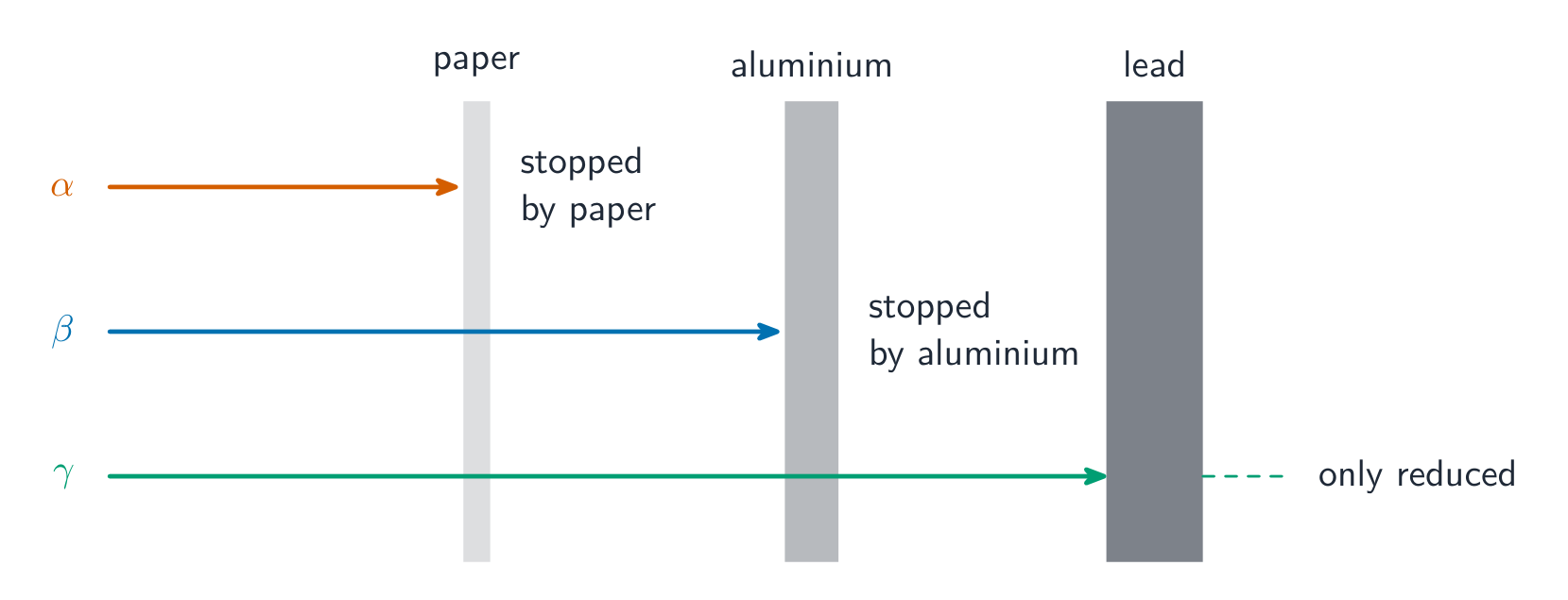
    Explore · ⁨חקור⁩

    Balance a nuclear decay equation · ⁨איזנו משוואת דעיכה גרעינית⁩

    In alpha, beta and gamma decay, nucleon and charge numbers must balance. Pick a mode and see how the parent turns into the daughter nuclide. · ⁨בדעיכות אלפא, בטה ו-גמא, מספרי Nuclon ומטען חייבים להיות מאוזנים. בחרו מצב וראו כיצד הגרעין ההורה הופך לגרעין בת.⁩

    15.8

    Types of Radioactive Decay · ⁨סוגי דעיכה רادیולוגית⁩

    Syllabus · ⁨סיילבוס⁩
    English

    Learning Objective 15.8.A: Describe the processes by which individual nuclei decay.

    • 15.8.A.1 Some processes by which nuclei decay emit subatomic particles with unique properties.
      • 15.8.A.1.i An alpha particle, or helium nucleus, consists of two neutrons and two protons and is symbolized by $\alpha$ or $\text{He}^{2+}$. (In Physics 2, only He-4 nuclei will be considered.)
      • 15.8.A.1.ii Neutrinos and antineutrinos are subatomic particles that have no electrical charge, have negligible mass, and are symbolized by $\nu$ and $\bar{\nu}$, respectively.
      • 15.8.A.1.iii Neutrinos and antineutrinos only interact with matter via the weak force and the gravitational force, which results in very little interaction with normal matter.
      • 15.8.A.1.iv Positrons, or antielectrons, are subatomic particles that have an electric charge opposite that of an electron, have the same mass as an electron, and are symbolized by $e^+$ or $\beta^+$.
    • 15.8.A.2 Nuclei can undergo radioactive decay via alpha decay, beta-minus decay ($\beta^-$), beta-plus decay ($\beta^+$), and gamma decay ($\gamma$).
      • 15.8.A.2.i In all nuclear decays, nucleon number (the number of neutrons and protons), lepton number (the number of electrons and neutrinos), and charge are conserved.
      • 15.8.A.2.ii Alpha decay occurs when a nucleus ejects an alpha particle.
      • 15.8.A.2.iii Beta-minus decay occurs when a neutron changes to a proton by emitting an electron and antineutrino.
      • 15.8.A.2.iv Beta-plus decay occurs when a proton changes to a neutron by emitting a positron and neutrino.
      • 15.8.A.2.v Gamma decay occurs after a nucleus has undergone alpha or beta decay and the excited nucleus decays to a lower energy state by emitting a photon.
    • 15.8.A.3 The type of decay exhibited by a given nucleus is determined by the isotope of the element.

    Boundary statement: AP Physics 2 does not expect students to memorize the processes by which specific isotopes decay or the half-lives of specific isotopes. Neutron emission and electron capture are not included in the AP Physics 2 curriculum framework. Additionally, types of neutrinos, the characteristics that distinguish neutrinos and antineutrinos, and an explanation or application of the weak force are not within the scope of this course.

    עברית

    מטרות למידה 15.8.A: לתאר את התהליכים על ידי גרעינים בודדים עוברים דעיכה.

    • 15.8.A.1 חלק מתהליכי הדעיכה של גרעינים פולטים חלקיקים תת-אטומיים עם מאפיינים ייחודיים.
      • 15.8.A.1.i חלקיק אלפא, או גרעין הליום, מורכב משני ניוטרונים ושני פרוטונים ומסומן ב $\alpha$ או $\text{He}^{2+}$. (בפיזיקה 2, ייחשבו רק גרעיני He-4.)
      • 15.8.A.1.ii ניטרינו ואנטי-ניטרינו הם חלקיקים תת-אטומיים שאין להם מטען חשמלי, יש להם מסה זניחה, ומסומנים ב $\nu$ ו $\bar{\nu}$ בהתאמה.
      • 15.8.A.1.iii ניטרינו ואנטי-ניטרינו מגיבים עם חומר רק באמצעות הכוח החלש והכוח הכבישתי, מה שגרור אינטראקציה מינימלית עם חומר רגיל.
      • 15.8.A.1.iv פוזיטרונים, או אנטי-אלקטרונים, הם חלקיקים תת-אטומיים שיש להם מטען חשמלי הפוך לזה של אלקטרון, יש להם אותה מסה כמו אלקטרון, ומסומנים ב $e^+$ או $\beta^+$.
    • 15.8.A.2 גרעינים יכולים לעבור דעיכה רדיואקטיבית דרך דעיכת אלפא, דעיכת בטא-מינוס ($\beta^-$), דעיכת בטא-פלוס ($\beta^+$), ודעיכת גמא ($\gamma$).
      • 15.8.A.2.i בכל דעיכות גרעينية, מספר נוקלאונים (מספר הניוטרונים והפרוטונים), מספר לפטונים (מספר האלקטרונים והניטרינו) ומטען חשמלי נשמרים.
      • 15.8.A.2.ii דעיכת אלפא מתרחשת כאשר גרעין פולט חלקיק אלפא.
      • 15.8.A.2.iii דעיכת בטא-מינוס מתרחשת כאשר ניוטרון הופך לפרוטון על ידי פליטת אלקטרון ואנטי-ניטרינו.
      • 15.8.A.2.iv דעיכת בטא-פלוס מתרחשת כאשר פרוטון הופך לניטרון על ידי פליטת פוזיטרון וניטרينو.
      • 15.8.A.2.v דעיכת גמא מתרחשת לאחר לגרעין עברה דעיכת אלפא או בטא, והגרעין המוגרה דועכת למצב אנרגטי נמוך יותר על ידי פליטת פוטון.
    • 15.8.A.3 סוג הדעיכה המוצג על ידי גרעין נתון נקבע לפי האיזוטופ של היסוד.

    *הצהרת גבול: AP Physics 2 אינו מצפה מהתלמידים לשנן את התהליכים באמצעותם איזוטופים ספציפיים דועכים או את מחציות החיים שלהם. פליטת ניטרונים וכליאת אלקטרונים אינם כלולים במסגרת הלימודים של AP Physics 2. בנוסף, סוגי הניטרינו, המאפיינים המבדילים ביניהם לבין אנטי-ניטרינו, והסבר או יישום הכוח החלש אינם בתחום ההשקעה של הקורס הזה.

    Source: College Board AP Course and Exam Description · ⁨מקור: תיאור הקורס והמבחן של College Board AP⁩

    English
    Radioactive decay & half-life

    Unstable nuclei undergo radioactive decay 放射性衰变, emitting:

    • Alpha decay 阿尔法衰变 ($\alpha$): a helium nucleus – mass number drops by 4.
    • Beta decay 贝塔衰变 ($\beta$) comes in two kinds. In beta-minus ($\beta^-$) a neutron becomes a proton, emitting an electron and an antineutrino 反中微子: $n\rightarrow p+e^-+\bar{\nu}$. In beta-plus ($\beta^+$) a proton becomes a neutron, emitting a positron 正电子 and a neutrino 中微子: $p\rightarrow n+e^++\nu$.
    • Gamma decay 伽马衰变 ($\gamma$): a high-energy photon – the nucleus sheds excess energy.

    The neutrino and antineutrino (symbols $\nu$, $\bar{\nu}$) are tiny, chargeless, almost-massless particles that carry off energy and keep beta decay balanced. Decay is random, but a sample halves every half-life 半衰期: after each half-life, half of the remaining nuclei have decayed. Every decay equation conserves three quantities: nucleon number (mass number), charge, and lepton number 轻子数 – an electron or neutrino counts as $+1$ lepton, a positron or antineutrino as $-1$, and the totals must match on both sides.

    Worked example. A radioactive sample has a half-life of $8.0$ days. What fraction is left after $24$ days? That is $24/8.0=3$ half-lives, so the fraction remaining is $\left(\tfrac12\right)^3=\tfrac18$ – about $12.5\%$. In an alpha decay of uranium-238 ($^{238}_{\ 92}\text{U}$), the daughter has mass number $238-4=234$ and atomic number $92-2=90$: thorium-234.

    עברית
    פירוק רדיואקטיבי ומחצית חיים

    גרעינים לא יציבים עוברים דעיכה רادیולוגית, פולטים:

    כוח החדירה של קרינה אלפא, בטא וגמא *כוח החדירה של קרינה אלפא, בטא וגמא

    • פירוק אלפא ($\alpha$): גרעין הליום – מספר המסה יורד ב-4.
    • פירוק בטא ($\beta$) בא בשני סוגים. ב-בטא מינוס ($\beta^-$) ניוטרון הופך לפרוטון, פולט אלקטרון ו-אנטרינו: $n\rightarrow p+e^-+\bar{\nu}$. ב-בטא פלוס ($\beta^+$) פרוטון הופך לניוטרון, פולט פוזיטרון ו-נרינו: $p\rightarrow n+e^++\nu$.
    • פירוק גמא ($\gamma$): פוטון בעל אנרגיה גבוהה – הגרעין משחרר עודף אנרגיה.

    הנרינו והאנטרינו (סימנים $\nu$, $\bar{\nu}$) הם חלקיקים קטנים, ללא מטען וכמעט ללא מסה, שמובילים אנרגיה ומאזנים את הפירוק הבטאי. הפירוק הוא אקראי, אך לדוגמה יש מחצית חיים: לאחר כל מחצית חיים, מחצית מגרעינים הנותרים מתפרקים. בכל משוואת פירוק נשמרים שלושה גדלים: מספר נוקליאונים (מספר המסה), מטען, ומספר להפטונים – אלקטרון או נרינו נחשבים כ$+1$ להפטון, פוזיטרון או אנטרינו כ$-1$, והסכומים צריכים להתאים בשני האגפים.

    דוגמא מופת. לדוגמה רדיואקטיבית יש זמן מחצית חיים של $8.0$ ימים. מהו השבר שנותר לאחר $24$ ימים? כלומר, זהו $24/8.0=3$ זמני מחצית חיים, ולכן השבר הנותר הוא $\left(\tfrac12\right)^3=\tfrac18$ – כ-$12.5\%$. בפירוק אלפא של אורן-238 ($^{238}_{\ 92}\text{U}$), למוצר הבת יש מספר מסה $238-4=234$ ומספר אטומי $92-2=90$: תוריום-234.

    Explore · ⁨חקור⁩

    Watch a sample decay · ⁨צפו בדעיכת דגימה⁩

    Radioactive nuclei decay randomly with a fixed half-life: each half-life halves the number remaining. Step forward and watch the sample shrink. · ⁨גרעינים רדיואקטיביים דועכים אקראית עם חצי חיים קבוע: בכל חצי חיים, מספר הגרעינים שנותרים יורד לחציו. צעדו קדימה וצפו כיצד הדגימה מתכווצת.⁩

    Vocabulary · ⁨מילון מונחים⁩ Train · ⁨אימון⁩
    English עברית
    radioactive decay/ˌreɪdɪəʊˈæktɪv dɪˈkeɪ/ דעיכת רדיואקטיבית
    Alpha decay/ˈælfə dɪˈkeɪ/ קרינה אלפא
    Beta decay/ˈbiːtə dɪˈkeɪ/ קרינת בטא
    antineutrino/ˌæntɪnjuːˈtriːnəʊ/ אנטי-נוטרינו
    positron/ˈpɒzɪtrɒn/ פוזיטרון
    neutrino/njuːˈtriːnəʊ/ ניטרינו
    Gamma decay/ˈɡæmə dɪˈkeɪ/ קרינת גמא
    half-life/hɑːf laɪf/ זמן מחצית חיים
    lepton number/ˈleptɒn ˈnʌmbə/ מספר לפטונים
    15.8

    Exam tips · ⁨טיפים לבחינות⁩

    English
    • Photon energy is $E=hf$; below the threshold frequency no electrons are emitted however bright the light (the photoelectric effect).
    • Use $K_{\max}=hf-\phi$ for the fastest photoelectrons ($\phi$ = work function).
    • Electrons jump between discrete energy levels by absorbing/emitting a photon whose energy equals the level gap — the source of line spectra.
    • In fission and fusion the small mass lost becomes energy via $E=mc^2$.
    • Balance decay equations by conserving mass number, charge, and lepton number (write the antineutrino in $\beta^-$, the neutrino in $\beta^+$), and halve the sample every half-life ($(\tfrac12)^n$ after $n$ half-lives).
    עברית
    • אנרגיית הפוטון היא $E=hf$; מתחת לתדר הסף לא יופלטו אלקטרונים בכל התיירות התאורה (אפקט הפוטואלקטרי).
    • השתמש ב$K_{\max}=hf-\phi$ עבור האלקטרונים הפוטואלקטריים המהירים ביותר ($\phi$ = פונקציית העבודה).
    • אלקטרונים דוהרים בין רמות אנרגיה דיסקרטיות על ידי ספיגה/פליטה של פוטון whose אנרגיה שווה למרווח הרמות – המקור לספקטרי הקווים.
    • בפיצול ובמיזוג המסה הקטנה האבוד הופכת לאנרגיה לפי $E=mc^2$.
    • איזון משוואות פירוק על ידי שמירה על מספר המסה, המטען ומספר ההלפטונים (כתוב את האנטרינו ב$\beta^-$, את הנרינו ב$\beta^+$), וחלק את הדוגמה במחצית בכל מחצית חיים ($(\tfrac12)^n$ לאחר $n$ מחציות חיים).

Log in or create account · ⁨היכנס או צור חשבון⁩

IGCSE, A-Level & AP