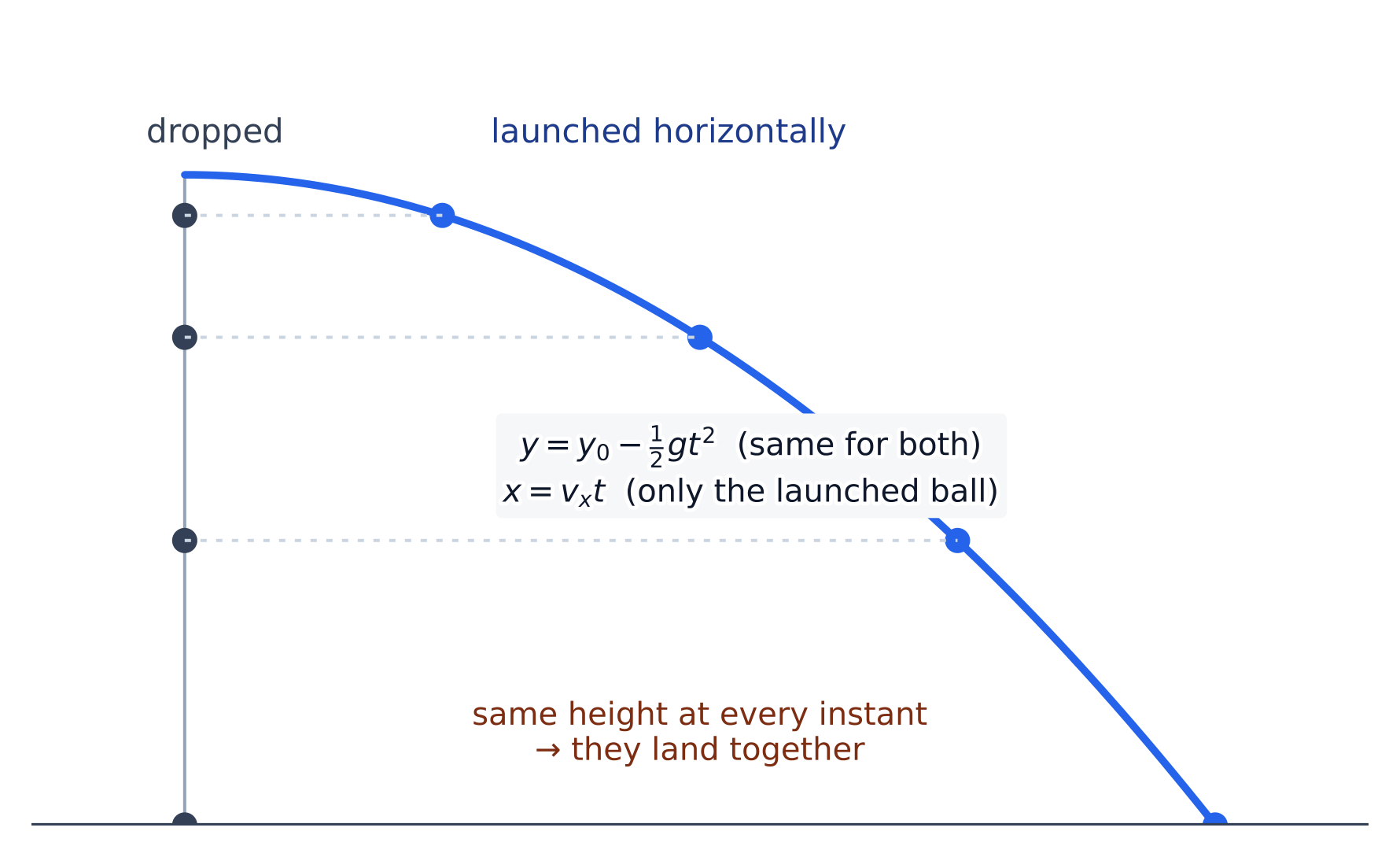
שני כדורים עוזבים שולחן בו-זמנית. האחד פשוט מושחרר. השני משוגע אופקית בחוזקה. מי מהם יפגע ברצפה ראשון? <slow>הם נפגעים…
English narration · English + 中文 subtitles burned in · קריאת קול באנגלית · תרגום אנגלי + סינית שרוף בתוך הסרטון
1.1
Scalars and Vectors in One Dimension · סקאלרים ווקטורים בממד אחד
Syllabus · סיילבוס
English
Learning Objective 1.1.A: Describe a scalar or vector quantity using magnitude and direction, as appropriate.
1.1.A.1 Scalars are quantities described by magnitude only; vectors are quantities described by both magnitude and direction.
1.1.A.2 Vectors can be visually modeled as arrows with appropriate direction and lengths proportional to their magnitude.
1.1.A.3 Distance and speed are examples of scalar quantities, while position, displacement, velocity, and acceleration are examples of vector quantities.
1.1.A.3.i Vectors are notated with an arrow above the symbol for that quantity.
Equation:$\vec{v} = \vec{v}_0 + \vec{a}t$
1.1.A.3.ii Vector notation is not required for vector components along an axis. In one dimension, the sign of the component completely describes the direction of that component.
Derived equation:$v_x = v_{x0} + a_x t$
Learning Objective 1.1.B: Describe a vector sum in one dimension.
1.1.B.1 When determining a vector sum in a given one-dimensional coordinate system, opposite directions are denoted by opposite signs.
עברית
מטרות למידה 1.1.A: תיאור כמויות סקלריות או וקטוריות באמצעות גודל וכיוון, בהתאם לצורך.
1.1.A.1 סקאלרים הן כמויות המתוארות על ידי גודל בלבד; וקטורים הן כמויות המתוארות על ידי גודל וכיוון.
1.1.A.2 וקטורים יכולים להיות דגמונים ויזואלית כחצים עם כיוון מתאים ואורכים פרופורציונליים לגודל שלהם.
1.1.A.3 מרחק ומהירות הם דוגמאות לסקאלרים, בעוד שמיקום, הזזה, מהירות ותאוצה הם דוגמאות לוקטורים.
1.1.A.3.i וקטורים מסומנים בחץ מעל הסמל של הכמות הרלוונטית.
משוואה:$\vec{v} = \vec{v}_0 + \vec{a}t$
1.1.A.3.ii סימון וקטורי אינו נדרש לרכיבי וקטור לאורך ציר נתון. בממד אחד, הסימן של הרכיב מתאר לחלוטין את כיוונו של הרכיב.
משוואה נגזרת:$v_x = v_{x0} + a_x t$
מטרות למידה 1.1.B: תיאור סכום וקטורים בממד אחד.
1.1.B.1 בקביעת סכום וקטורים במערכת קואורדינטות חד-ממדית נתונה, כיוונים מנוגדים מסומנים בסימנים מנוגדים.
Source: College Board AP Course and Exam Description · מקור: תיאור הקורס והמבחן של College Board AP
English
Kinematics 运动学 describes how objects move, without asking why. First, two kinds of quantity:
A scalar 标量 has only size (magnitude 大小): distance 距离, speed, time, mass.
A vector 矢量 has magnitude and direction: displacement, velocity, acceleration, force.
The difference matters. Distance is the total path length travelled – a scalar that only grows. Displacement is the straight-line change in position, with a direction. Walk $3\ \text{m}$ east then $1\ \text{m}$ back west: the distance is $4\ \text{m}$, but the displacement is only $2\ \text{m}$ east.
In one dimension, direction is just a sign (+ or −) along a chosen axis. Choosing the positive direction first is essential – every vector's sign depends on it. A velocity of $-5\ \text{m/s}$ does not mean "slow"; it means $5\ \text{m/s}$ in the negative direction.
עברית
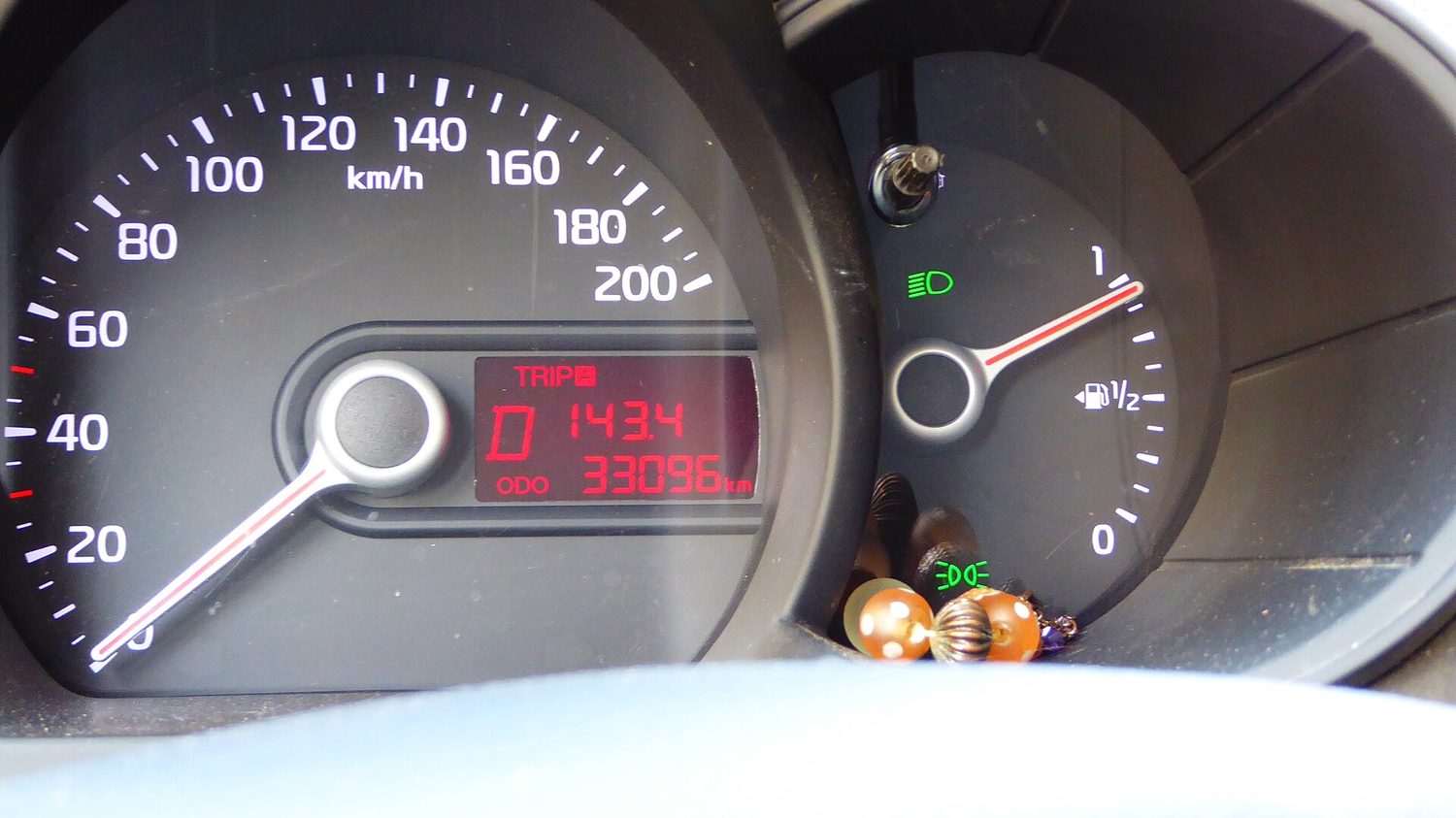
מד מהירות ברכב: המהירות היא הגודל של המהירות — סקלר של קצב תנועה
קינמטיקה מתארת איך אובייקטים זזים, ללא שאלה מדוע. תחילה, שני סוגי כמות:
סקלר יש לו רק גודל (גודל: מרחק, מהירות, זמן, מסה).
לווקטור יש גודל וגם כיוון: תזחה, מהירות, תאוצה, כוח.
ההבדל משמעותי. מרחק הוא אורך מסלול הכולל שנע – גדיל (סקלאר) שמגדל רק. תזחה היא שינוי במיקום בקו ישר, עם כיוון. הליכה $3\ \text{m}$ מזרחית ואז $1\ \text{m}$ מערבית חזרה: המרחק הוא $4\ \text{m}$, אך התזחה היא רק $2\ \text{m}$ מזרחית.
במימד אחד, הכיוון הוא פשוט סימן (+ או −) לאורך ציר נבחר. בחירת הכיוון החיובי מראש היא קריטית – הסימן של כל ווקטור תלוי בזה. מהירות של $-5\ \text{m/s}$ אינה אומרת "איטי"; היא אומרת $5\ \text{m/s}$ בכיוון השלילי.
Displacement, Velocity, and Acceleration · תזחה, מהירות ותאוצה
Syllabus · סיילבוס
English
Learning Objective 1.2.A: Describe a change in an object's position.
1.2.A.1 When using the object model, the size, shape, and internal configuration are ignored. The object may be treated as a single point with extensive properties such as mass and charge.
1.2.A.2 Displacement is the change in an object's position.
Equation:$\Delta x = x - x_0$
Learning Objective 1.2.B: Describe the average velocity and acceleration of an object.
1.2.B.1 Averages of velocity and acceleration are calculated considering the initial and final states of an object over an interval of time.
1.2.B.2 Average velocity is the displacement of an object divided by the interval of time in which that displacement occurs.
Learning Objective 1.2.B: Describe the velocity and acceleration of an object.
1.2.B.4 An object is accelerating if the magnitude and/or direction of the object's velocity are changing.
1.2.B.5 Calculating average velocity or average acceleration over a very small time interval yields a value that is very close to the instantaneous velocity or instantaneous acceleration.
עברית
מטרות למידה 1.2.A: תיאור שינוי במיקום של גוף.
1.2.A.1 בעת שימוש במודל הגוף הנקודתי, גודל, צורה ומבנה פנימי מתעלמים מהם. הגוף עשוי להתחשב כנקודה אחת עם מאפיינים נרחבים כמו מסה ומטען.
1.2.A.2 הזזה היא השינוי במיקום של גוף.
משוואה:$\Delta x = x - x_0$
מטרות למידה 1.2.B: תאר את המהירות הממוצעת והתאוצה הממוצעת של גוף.
1.2.B.1 ממוצעים של מהירות ותאוצה מחושבים על בסיס מצב ההתחלה והמצב הסופי של הגוף לאורך מרווח זמן נתון.
1.2.B.2 מהירות ממוצעת היא ההזזה של הגוף חלקי מרווח הזמן שבו ההזזה מתרחשת.
1.2.B.4 לגוף יש תאוצה אם הגודל ו/או הכיוון של המהירות שלו משתנים.
1.2.B.5 חישוב מהירות ממוצעת או תאוצה ממוצעת במרווח זמן קטן מאוד מניב ערך הקרוב מאוד למהירות רגעית או לתאוצה רגעית.
Source: College Board AP Course and Exam Description · מקור: תיאור הקורס והמבחן של College Board AP
English
Projectile motion is two independent motions
Three linked vectors describe motion along a line:
Displacement 位移$\Delta x$ is the change in position – a vector from start to end (not the total path length, which is distance).
Velocity 速度 is the rate of change of position, $v=\dfrac{\Delta x}{\Delta t}$. Its sign gives direction; its magnitude is speed 速率.
Acceleration 加速度 is the rate of change of velocity, $a=\dfrac{\Delta v}{\Delta t}$.
Be careful to separate average velocity 平均速度 (total displacement over total time) from instantaneous velocity 瞬时速度 (the velocity at one instant, the slope of the position–time graph at that point). They are equal only when the velocity is constant.
An object speeds up when $v$ and $a$ have the same sign, and slows down (deceleration 减速) when they have opposite signs. Note that a negative acceleration does not always mean slowing down – a ball falling faster and faster has negative velocity and negative acceleration.
For constant acceleration, the four kinematic equations (often called SUVAT) apply:
Pick the equation that contains the three quantities you know plus the one you want, so only one unknown is left. They apply only while $a$ is constant.
Worked example. A car starts from rest and accelerates uniformly at $2.0\ \text{m/s}^2$ for $6.0\ \text{s}$. Find its final velocity and the distance it travels.
List what you know: $v_0=0$, $a=2.0\ \text{m/s}^2$, $t=6.0\ \text{s}$.
Worked example (free fall). A ball is thrown straight up at $15\ \text{m/s}$. Taking $g=9.8\ \text{m/s}^2$ and up as positive, how high does it rise, and how long is it in the air before returning to the thrower's hand?
At the highest point the velocity is momentarily zero, and $a=-g=-9.8\ \text{m/s}^2$ throughout (this is free fall 自由落体, ignoring air resistance 空气阻力):
$$v^2=v_0^2+2a\,\Delta x \;\Rightarrow\; 0=15^2+2(-9.8)\Delta x \;\Rightarrow\; \Delta x=\frac{225}{19.6}=11.5\ \text{m}.$$
Time to the top: $0=15-9.8\,t \Rightarrow t=1.53\ \text{s}$. By symmetry the fall takes the same time, so the total is $3.1\ \text{s}$.
עברית
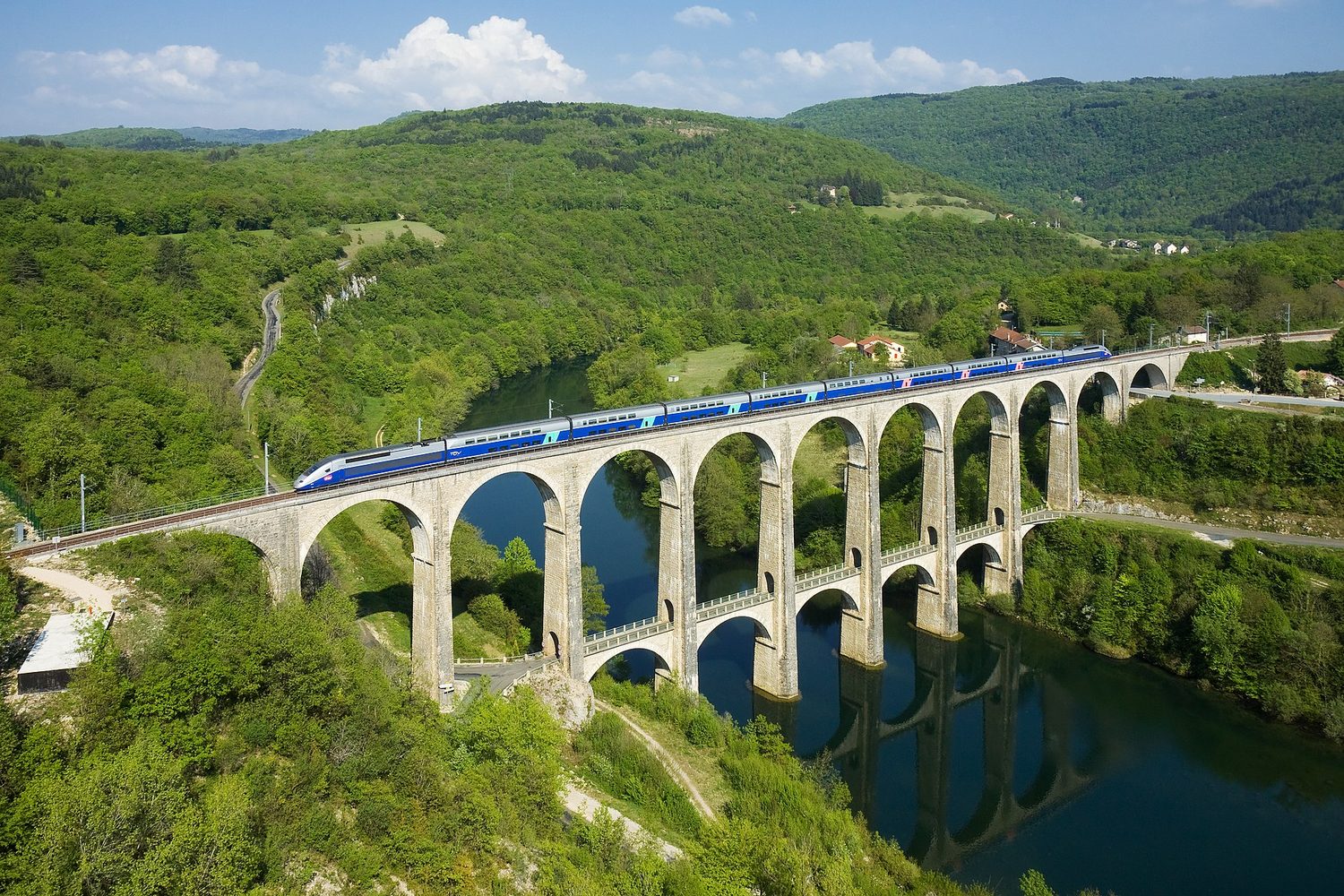
רכבת מהירה: קינמטיקה מתארת תזחה, מהירות ותאוצה לאורך זןתנועת פרויקטייל היא שתי תנועות עצמאיות
שלושה ווקטורים מקושרים מתארים תנועה לאורך קו:
תזחה$\Delta x$ היא השינוי במיקום – ווקטור מהנקודה ההתחלתית לנקודה הסופית (לא אורך המסלול הכולל, שהוא מרחק).
מהירות היא קצב שינוי המיקום, $v=\dfrac{\Delta x}{\Delta t}$. הסימן שלה נותן את הכיוון; הגודל שלה הוא מהירות. *
תאוצה היא קצב שינוי המהירות, $a=\dfrac{\Delta v}{\Delta t}$.
יש להיזהר ולהפריד בין מהירות ממוצעת (תזחה כוללת חולקת בזמן כולל) לבין מהירות רגעית (המהירות ברגע נתון, השיפוע של גרף המיקום-זמן בנקודה זו). הן שוות רק כאשר המהירות קבועה.
גוף מאיץ כאשר $v$ ו$a$ הם בעלי אותו סימן, ומאט (תאוצה שלילית) כאשר יש להם סימנים נגדיים. שים לב שתאוצה שלילית לא תמיד אומרת האטה – כדור הנופל מהר יותר ויותר יש לו מהירות שלילית וגם תאוצה שלילית.
עבור תאוצה קבועה, חלות ארבע המשוואות הקינמטיות (שנקראות לעיתים SUVAT):
דוגמה מפורטת (נפילה חופשית). כדור זרקו ישר למעלה ב$15\ \text{m/s}$. בהנחת that $g=9.8\ \text{m/s}^2$ and up are positive, how high does it rise, and how long is it in the air before returning to the thrower's hand?
ברגע העליון ביותר המהירות היא אפס לרגע, ו$a=-g=-9.8\ \text{m/s}^2$ לאורך כל זמן זה (זהו נפילה חופשית, ללא התחשבות במתח אוויר):
$$v^2=v_0^2+2a\,\Delta x \;\Rightarrow\; 0=15^2+2(-9.8)\Delta x \;\Rightarrow\; \Delta x=\frac{225}{19.6}=11.5\ \text{m}.$$
זמן לעלייה: $0=15-9.8\,t \Rightarrow t=1.53\ \text{s}$. לפי סימטריה, הזמן לירידה הוא זהה, ולכן הסך הכולל הוא $3.1\ \text{s}$.
Note: The equations above are written to indicate motion in the x-direction, but these equations can be used in any single dimension as appropriate.
1.3.A.3 Near the surface of Earth, the vertical acceleration caused by the force of gravity is downward, constant, and has a measured value approximately equal to $a_g = g \approx 10 \ m/s^2$.
1.3.A.4 Graphs of position, velocity, and acceleration as functions of time can be used to find the relationships between those quantities.
1.3.A.4.i An object's instantaneous velocity is the rate of change of the object's position, which is equal to the slope of a line tangent to a point on a graph of the object's position as a function of time.
1.3.A.4.ii An object's instantaneous acceleration is the rate of change of the object's velocity, which is equal to the slope of a line tangent to a point on a graph of the object's velocity as a function of time.
1.3.A.4.iii The displacement of an object during a time interval is equal to the area under the curve of a graph of the object's velocity as a function of time (i.e., the area bounded by the function and the horizontal axis for the appropriate interval).
1.3.A.4.iv The change in velocity of an object during a time interval is equal to the area under the curve of a graph of the acceleration of the object as a function of time.
Boundary statement: AP Physics 1 does not expect students to quantitatively analyze nonuniform acceleration. However, students will be expected to be able to qualitatively analyze, sketch appropriate graphs of, and discuss situations in which acceleration is nonuniform.
Boundary statement: For all situations in which a numerical quantity is required for $g$, the value $g \approx 10 \ m/s^2$ will be used. However, students will not be penalized for correctly using the more precise commonly accepted values of $g = 9.81 \ \text{m/s}^2$ or $g = 9.8 \ \text{m/s}^2$.
עברית
מטרות למידה 1.3.A: תאר את המיקום, המהירות והתאוצה של גוף באמצעות ייצוגים של תנועתו.
1.3.A.1 תנועה יכולה להיות מיוצגת באמצעות דיאגרמות תנועה, איורים, גרפים, משוואות ותיאורים ספרתיים.
1.3.A.2 עבור תאוצה קבועה, ניתן להשתמש בשלוש משוואות קינמטיות כדי לתאר תנועה ליניארית רגעית בממד אחד:
משוואה:$v_x = v_{x0} + a_x t$
משוואה:$x = x_0 + v_{x0}t + \dfrac{1}{2}a_x t^2$
משוואה:$v_x^2 = v_{x0}^2 + 2a_x(x - x_0)$
הערה: המשוואות לעיל כתובות כדי לציין תנועה בכיוון x, אך משוואות אלו ניתנות לשימוש בכל ממד יחיד בהתאם.
1.3.A.3 בקרבת פני השטח של כדור הארץ, התאוצה האנכית הנובעת מכוח הכבידה היא כלפי מטה, קבועה, ולוקחת ערך מדוד השווה בקירוב ל$a_g = g \approx 10 \ m/s^2$.
1.3.A.4 גרפים של מיקום, מהירות ותאוצה כפונקציות של הזמן יכולים לשמש למציאת הקשרים בין גדלים אלו.
1.3.A.4.i המהירות הרגעית של גוף היא קצב השינוי במיקומו, והיא שווה לשיפוע הישר המשיק לנקודה בגרף המיקום של הגוף כפונקציה של הזמן.
1.3.A.4.ii התאוצה הרגעית של גוף היא קצב השינוי במהירותו, והיא שווה לשיפוע הישר המשיק לנקודה בגרף המהירות של הגוף כפונקציה של הזמן.
1.3.A.4.iii ההזזה של גוף במרווח זמן נתון שווה לשטח התחתון לגרף המהירות של הגוף כפונקציה של הזמן (כלומר, השטח המוגבל על ידי הפונקציה והציר האופקי עבור המרווח המתאים).
1.3.A.4.iv השינוי במהירות של גוף במרווח זמן נתון שווה לשטח התחתון לגרף התאוצה של הגוף כפונקציה של הזמן.
הצהרת גבול: AP Physics 1 אינה צופה שמ学生 ינתחו כמותית תאוצה לא אחידה. עם זאת, סטודנטים יצטרכו לנתח באופן איכותי, להציג גרפים מתאימים ולדון במצבים בהם התאוצה היא לא אחידה.
הצהרת גבול: בכל מצב שבו נדרשת כמות מספרית עבור $g$, הערך $g \approx 10 \ m/s^2$ ישמש. עם זאת, סטודנטים לא יוקללו על שימוש נכון בערכים המקובלים והמדויקים יותר של $g = 9.81 \ \text{m/s}^2$ או $g = 9.8 \ \text{m/s}^2$.
Source: College Board AP Course and Exam Description · מקור: תיאור הקורס והמבחן של College Board AP
English
The same motion appears as a description, a graph, a table, or an equation, and you should move between them:
On a position–time graph, the slope is velocity (steeper = faster; a curve = changing velocity).
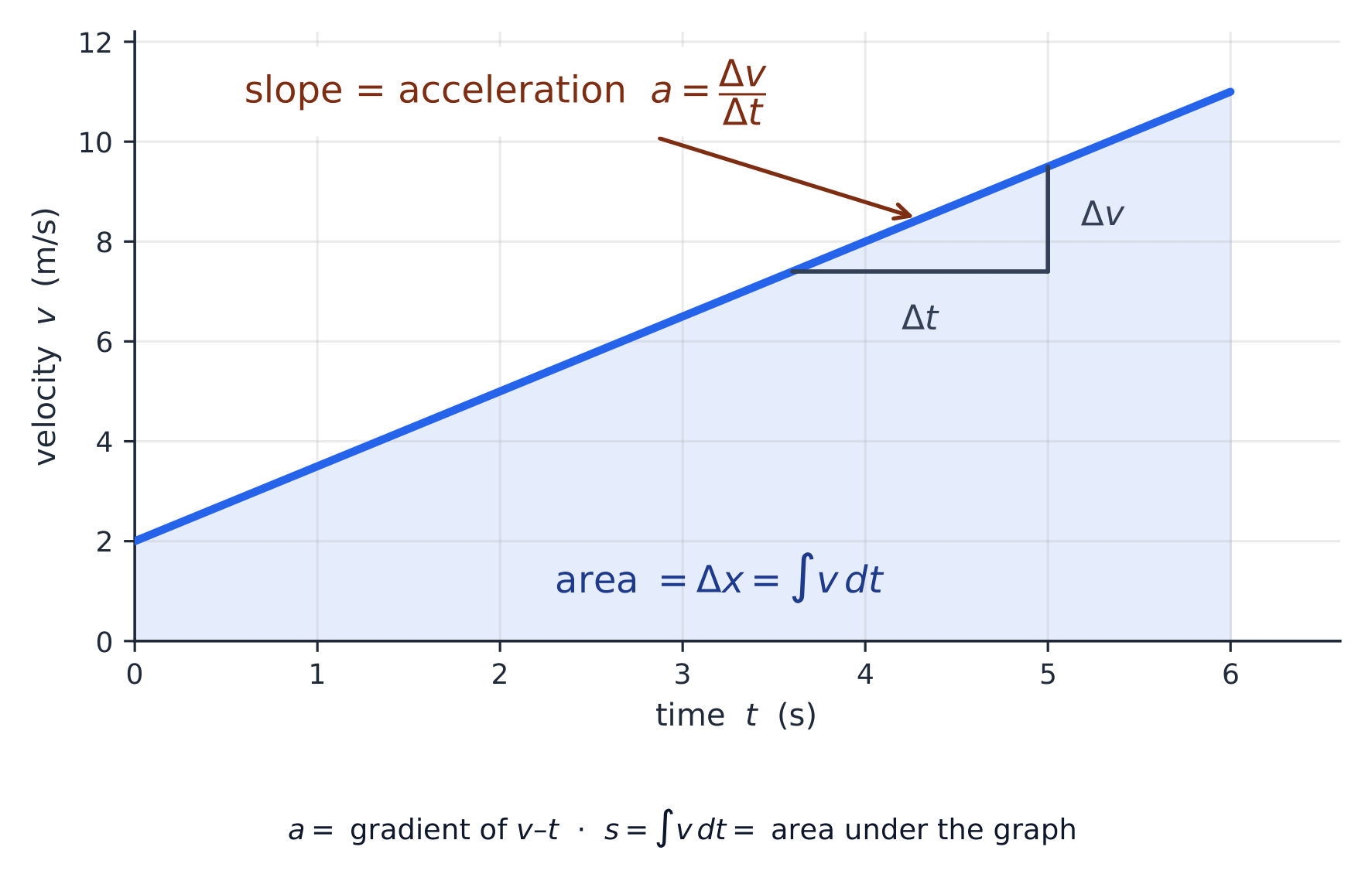
On a velocity–time graph, the slope is acceleration, and the area under the line is displacement.
Reading slopes and areas off graphs is a core exam skill. To get displacement from a velocity–time graph, split the area into triangles and rectangles and add them up; area below the time axis counts as negative displacement (motion the other way).
Worked example. A cyclist speeds up uniformly from rest to $8.0\ \text{m/s}$ in $4.0\ \text{s}$, then holds $8.0\ \text{m/s}$ for $6.0\ \text{s}$. Find the total distance from the velocity–time graph.
אותה תנועה יכולה להופיע כתיאור, גרף, טבלה או משוואה, ועליך לעבור ביניהם:
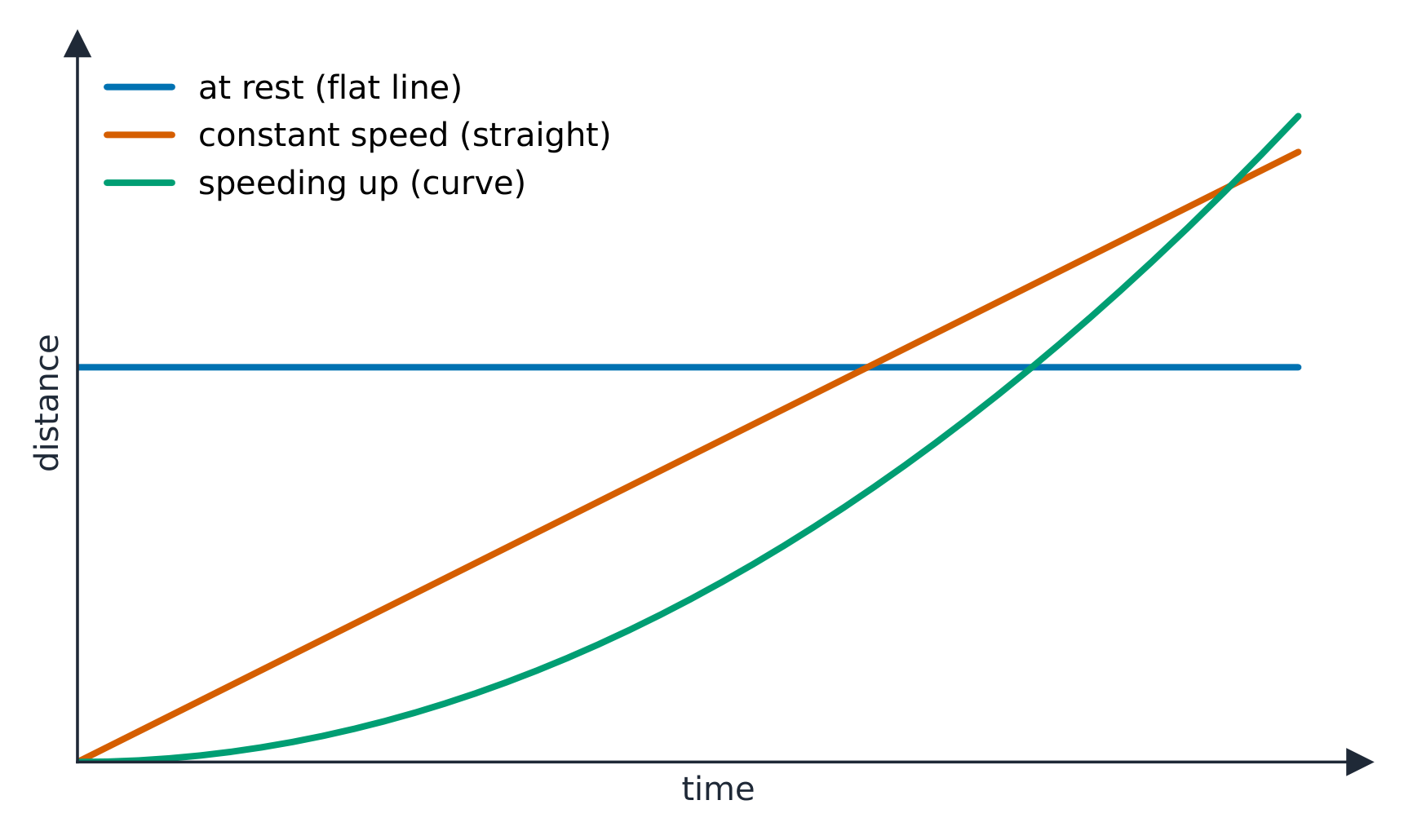
קריאת גרף מרחב-זמן: קו אופקי פירושו שבת, שיפוע ישר פירושו מהירות קבועה
בגרף מיקום–זמן, השיפוע מייצג את המהירות (שיפוע תלול יותר = מהירות גבוהה יותר; עקומה = שינוי במהירות).
בגרף מהירות–זמן, השיפוע מייצג את התאוצה, והשטח מתחת לקו מייצג את ההסחה.
קריאת שיפועים ושטחים מגרפים היא מיומנות ליבה לבחינה. כדי למצוא הסחה מגרף מהירות–זמן, חלק את השטח למثلשים ומלבנים וסכם אותם; שטח מתחת לציר הזמן נחשב להסחה שלילית (תנועה בכיוון הפוך).
בגרף מהירות–זמן השיפוע הוא התאוצה והשטח המוצלע הוא ההסחה
דוגמה מפורטת. רוכב אופניים מאיץ באופן אחיד ממצב של שבת ל$8.0\ \text{m/s}$ בזמן $4.0\ \text{s}$, ואז שומר על $8.0\ \text{m/s}$ במשך $6.0\ \text{s}$. מצאו את המרחק הכולל מגרף המהירות–זמן.
Explore the velocity–time graph · חקרו את הגרף מהירות-זמן
Change the start velocity $u$ and the acceleration $a$. The gradient (slope) of the line is the acceleration; the area between the line and the time axis is the displacement. · שנו את המהירות ההתחלתית $u$ ואת התאוצה $a$. ה-שיפוע (gradient) של הקו הוא ה-תאוצה; ה-שטח בין הקו לציר הזמן הוא ה-הזזה.
Reference Frames and Relative Motion · מערכות ייחוס ותנועה יחסית
Syllabus · סיילבוס
English
Learning Objective 1.4.A: Describe the reference frame of a given observer.
1.4.A.1 The choice of reference frame will determine the direction and magnitude of quantities measured by an observer in that reference frame.
Learning Objective 1.4.B: Describe the motion of objects as measured by observers in different inertial reference frames.
1.4.B.1 Measurements from a given reference frame may be converted to measurements from another reference frame.
1.4.B.2 The observed velocity of an object results from the combination of the object's velocity and the velocity of the observer's reference frame.
1.4.B.2.i Combining the motion of an object and the motion of an observer in a given reference frame involves the addition or subtraction of vectors.
1.4.B.2.ii The acceleration of any object is the same as measured from all inertial reference frames.
Boundary statement: Unless otherwise stated, the frame of reference of any problem may be assumed to be inertial.
Boundary statement: Adding or subtracting vectors to find relative velocities is restricted to motion along one dimension for AP Physics 1.
עברית
מטרות למידה 1.4.A: לתאר את מערכת הייחוס של צופה נתון.
1.4.A.1 בחירת מערכת הייחוס תקבע את הכיוון והגודל של כמויות שנמדדות על ידי צופה במערכת זו.
מטרות למידה 1.4.B: לתאר את תנועת אובייקטים כפי שנמדדו על ידי צופים במערכות ייחוס אינרציאליות שונות.
1.4.B.1 מדידות ממערכת ייחוס נתונה יכולות להיות מומשות למדידות ממערכת ייחוס אחרת.
1.4.B.2 המהירות הנצפתה של אובייקט נובעת משילוב מהירות האובייקט ומהירות מערכת הייחוס של הצופה.
1.4.B.2.i שילוב תנועת אובייקט ותנועת צופה במערכת ייחוס נתונה מחייב חיבור או חיסור של וקטורים.
1.4.B.2.ii התאוצה של כל אובייקט זהה כפי שנמדדת מכל מערכות הייחוס האינרציאליות.
הצהרת גבול: אלא אם כן צוין אחרת, ניתן להניח שמערכת הייחוס של כל בעיה היא אינרציאלית.
הצהרת גבול: חיבור או חיסור של וקטורים למציאת מהירויות יחסיות מוגבלים לתנועה לאורך מימד אחד ב-AP Physics 1.
Source: College Board AP Course and Exam Description · מקור: תיאור הקורס והמבחן של College Board AP
English
All motion is measured against a reference frame 参考系. Velocities measured in different frames differ, and you combine them by vector addition. The velocity of A relative to C is
$$\vec{v}_{A/C}=\vec{v}_{A/B}+\vec{v}_{B/C}.$$
A person walking on a moving train has one velocity relative to the train and another relative to the ground – this is relative motion 相对运动. A useful shortcut: the velocity of A relative to B is $\vec{v}_{A/B}=\vec{v}_A-\vec{v}_B$ (subtract B's velocity).
A frame that is not accelerating is an inertial reference frame 惯性参考系: one in which a free object (no net force) obeys Newton's first law, staying at rest or moving at constant velocity. A frame that accelerates – a braking car – is non-inertial, where objects seem to speed up with no force acting on them.
Worked example. A boat points straight across a river and moves at $3.0\ \text{m/s}$ relative to the water. The current flows at $4.0\ \text{m/s}$ along the river. Find the boat's speed and direction relative to the bank.
The two velocities are perpendicular, so add them as a right triangle:
$$v=\sqrt{3.0^2+4.0^2}=5.0\ \text{m/s},\qquad \theta=\tan^{-1}\!\frac{4.0}{3.0}=53^{\circ}\ \text{downstream from straight across.}$$
עברית
כל תנועה נמדדת ביחס למערכת ייחוס. מהירויות שנמדדות במערכות ייחוס שונות שונות, ועליכם לשלב אותן בעזרת חיבור וקטורי. המהירות של A ביחס ל-C היא
$$\vec{v}_{A/C}=\vec{v}_{A/B}+\vec{v}_{B/C}.$$
אדם הולך בתוך רכבת נעה יש לו מהירות אחת ביחס לרכבת ומהירות אחרת ביחס לקרקע – זהו תנועה יחסית. קיצור דרך שימושי: המהירות של A ביחס ל-B היא $\vec{v}_{A/B}=\vec{v}_A-\vec{v}_B$ (חסרו את המהירות של B).
מערכת ייחוס שאינה מאיצה היא מערכת ייחוס אינרציאלית: מערכת שבה גוף חופשי (ללא כוח נטו) מקיים את החוק הראשון של ניוטון, נשאר בשבת או נע במהירות קבועה. מערכת שאינה מאיצה – כמו רכב שמוסע – היא לא אינרציאלית, שבה נראה כאילו גופים מאיצים ללא פעולת כוח עליהם.
דוגמה מפורטת. סירה פונה ישר לחצות נהר ונעה במהירות $3.0\ \text{m/s}$ ביחס למים. הזרם זורם במהירות $4.0\ \text{m/s}$ לאורך הנهر. מצאו את מהירות הכיוון של הסירה ביחס לגדה.
שתי המהירויות מאונכות זו לזו, ולכן יש לחבר אותן כמשולש ישר זווית:
$$v=\sqrt{3.0^2+4.0^2}=5.0\ \text{m/s},\qquad \theta=\tan^{-1}\!\frac{4.0}{3.0}=53^{\circ}\ \text{downstream from straight across.}$$
1.5
Vectors and Motion in Two Dimensions · וקטורים ותנועה במישור
Syllabus · סיילבוס
English
Learning Objective 1.5.A: Describe the perpendicular components of a vector.
1.5.A.1 Vectors can be mathematically modeled as the resultant of two perpendicular components.
1.5.A.2 Vectors can be resolved into components using a chosen coordinate system.
1.5.A.3 Vectors can be resolved into perpendicular components using trigonometric functions and relationships.
Equation:$\sin \theta = \dfrac{a}{c}$
Equation:$\cos \theta = \dfrac{b}{c}$
Equation:$\tan \theta = \dfrac{a}{b}$
Equation:$a^2 + b^2 = c^2$
Learning Objective 1.5.B: Describe the motion of an object moving in two dimensions.
1.5.B.1 Motion in two dimensions can be analyzed using one-dimensional kinematic relationships if the motion is separated into components.
1.5.B.2 Projectile motion is a special case of two-dimensional motion that has zero acceleration in one dimension and constant, nonzero acceleration in the second dimension.
עברית
מטרות למידה 1.5.A: לתאר את הרכיבים האנכיים של וקטור.
1.5.A.1 וקטורים יכולים לדגם מתמטי כהשורה (הריסולט) של שני רכיבים אנכיים.
1.5.A.2 וקטורים יכולים להתפצל לרכיבים באמצעות מערכת קואורדינטות שנבחרה.
1.5.A.3 וקטורים יכולים להתפצל לרכיבים אנכיים באמצעות פונקציות טריגונומטריות ויחסים.
משוואה:$\sin \theta = \dfrac{a}{c}$
משוואה:$\cos \theta = \dfrac{b}{c}$
משוואה:$\tan \theta = \dfrac{a}{b}$
משוואה:$a^2 + b^2 = c^2$
מטרות למידה 1.5.B: לתאר את תנועת אובייקט הנע בשני מימדים.
1.5.B.1 תנועה בשני מימדים ניתנת לניתוח באמצעות קינמטיקה חד-ממדית אם התנועה מפוצלת לרכיבים.
1.5.B.2 תנועת זריקה היא מקרה פרטי של תנועה בשני מימדים שבה יש אפס תאוצה במימד אחד ותאוצה קבועה ולא-אפס במימד השני.
Source: College Board AP Course and Exam Description · מקור: תיאור הקורס והמבחן של College Board AP
English
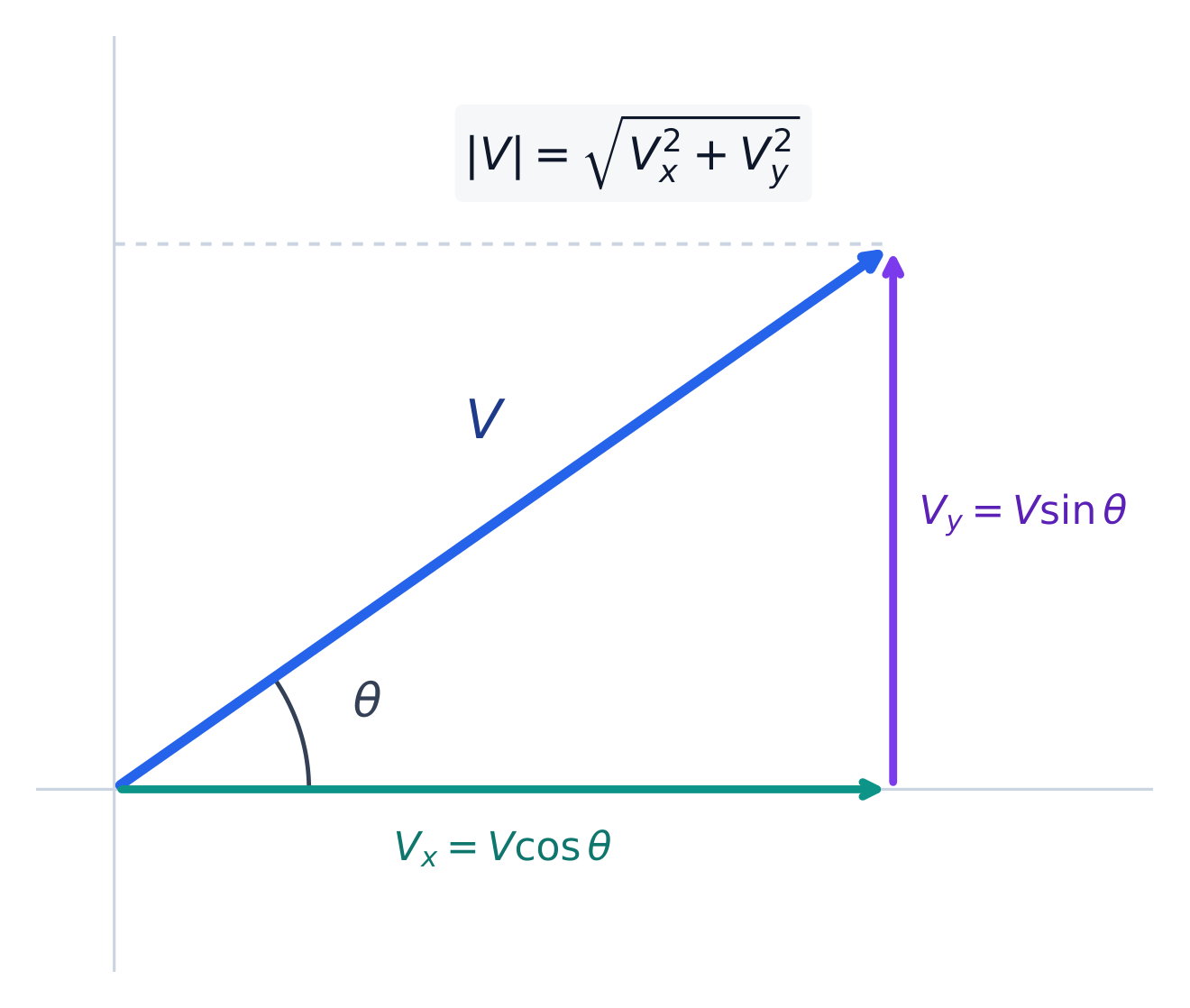
In two dimensions, resolve each vector into components 分量 along perpendicular axes ($x$ and $y$), handle each axis separately, then recombine. A velocity $v$ at angle $\theta$ to the horizontal has components $v_x=v\cos\theta$ and $v_y=v\sin\theta$.
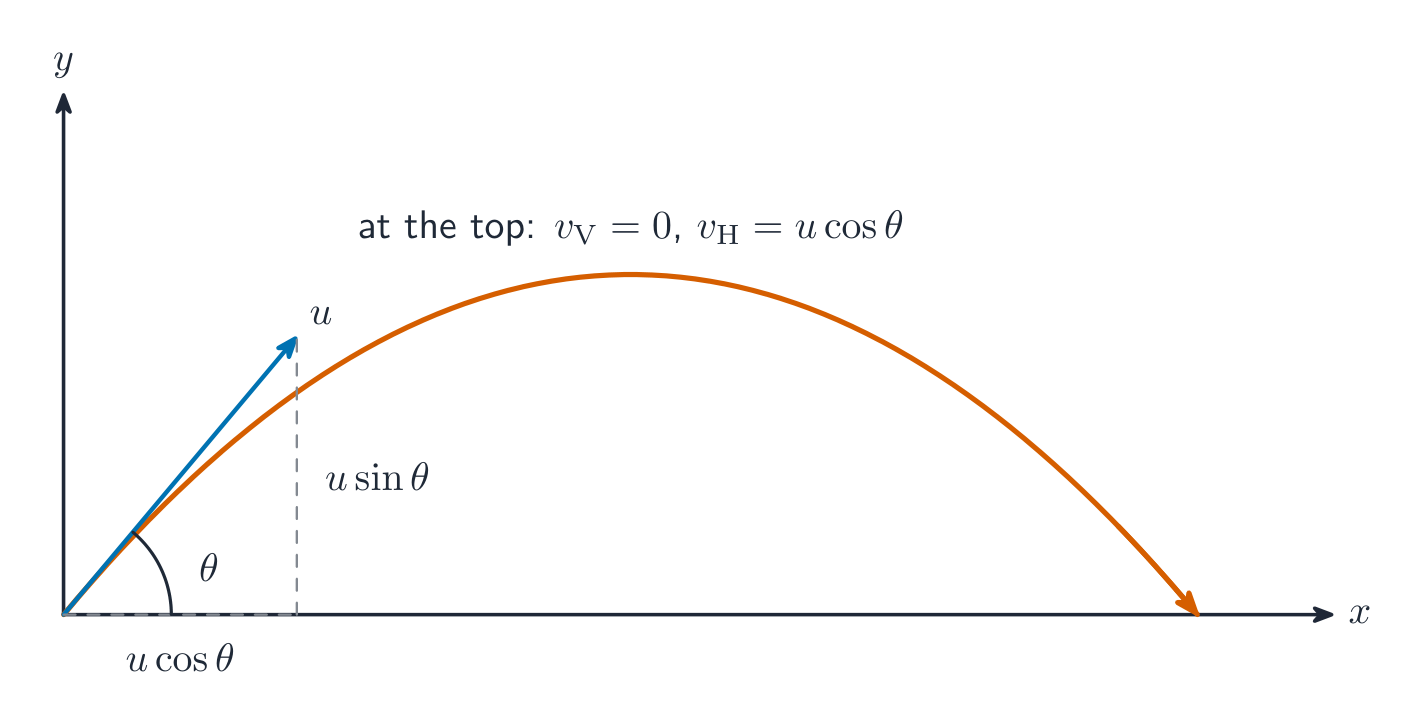
For projectile motion 抛体运动 (an object moving under gravity alone): the horizontal and vertical motions are independent. Horizontally, velocity is constant ($a_x=0$); vertically, acceleration is $-g$ (down). The two motions share only the time. So a projectile's path (its trajectory 轨迹) is a parabola, and you solve it as two one-dimensional problems joined by $t$.
Worked example. A ball is kicked at $20\ \text{m/s}$, $30^{\circ}$ above the horizontal. Taking $g=9.8\ \text{m/s}^2$, find the time of flight, the maximum height, and the horizontal range 射程 (assume it lands at launch height).
Vertical motion sets the time. At the top $v_y=0$, so $0=10-9.8\,t \Rightarrow t_{\text{up}}=1.02\ \text{s}$, and the total flight is $2t_{\text{up}}=2.0\ \text{s}$. The maximum height is
A common trap: at the top of the flight the vertical velocity is zero, but the ball is not at rest – its horizontal velocity $v_{0x}$ never changes. The speed at the top equals $v_{0x}=17.3\ \text{m/s}$.
עברית
במישור, פירקו כל וקטור לרכיבים לאורך צירים מאונכים ($x$ ו$y$), טיפל בכל ציר בנפרד, ואז שלב מחדש. למהירות $v$ בזווית $\theta$ האופק יש רכיבים $v_x=v\cos\theta$ ו$v_y=v\sin\theta$.
וקטור מהירות מפורק למרכיביו האופקי והאנכי
עבור תנועת פרציל (גוף הנע תחת כובד בלבד): התנועה האופקית והתנועה האנכית הן עצמאיות. אופקית, המהירות קבועה ($a_x=0$); אנכית, התאוצה היא $-g$ (למטה). לשתי התנועות יש רק את ה-זמן המשותף. כך שמסלול הפרציל (מסלול התעופה) הוא פרבולה, ואפשר לפתור אותו כשתי בעיות חד-ממדיות המחוברות על ידי $t$.
פרויקטיל שנורה בזווית: התנועה האופקית והתנועה האנכית הן בלתי תלויותכדור המושחך וכדור שנורה אופקית נופלים יחד – התנועות האנכיות זהות
דוגמה מופרשת. כדור מוכתם ב$20\ \text{m/s}$, בזווית $30^{\circ}$ מעל האופק. בהינתן $g=9.8\ \text{m/s}^2$, מצאו את זמן התעופה, הגובה המרבי וה-טווח האופקי (הניחו שהכדור נוחת בגובה ההשקה).
תנועה אנכית קובעת את הזמן. בנקודה הגבוהה ביותר $v_y=0$, ולכן $0=10-9.8\,t \Rightarrow t_{\text{up}}=1.02\ \text{s}$, והזמן הכולל בטיסה הוא $2t_{\text{up}}=2.0\ \text{s}$. הגובה המרבי הוא
לכידה נפוצה: בנקודת העלייה המהירות האנכית היא אפס, אך הכדור אינו במצב רגיעה – המהירות האופקית שלו $v_{0x}$ לעולם אינה משתנה. הגודל בנקודה זו שווה ל$v_{0x}=17.3\ \text{m/s}$.
Explore · חקור
Explore projectile motion · חקרו תנועת פריל
Fire the ball, then change the angle and speed. The horizontal motion stays steady while gravity pulls it down — together they trace a parabola. Find the launch angle that gives the longest range, and try the Moon. · שחררו את הכדור, ולאחר מכן שנו את הזווית ואת המהירות. התנועה האופקית נשארת יציבה בעוד שכבידה מושכת את הכדור כלפי מטה — יחד הם משרטטים פרבולה. מצאו את זווית השיגור שתניא את ה-טווח הארוך ביותר, ונסו גם את הירח.
Explore · חקור
Explore vectors and their components · חקרו וקטורים ורכיביהם
Drag the vectors to change their $x$- and $y$-components. See how a single vector is built from independent horizontal and vertical parts, and how two vectors add tip-to-tail into a resultant. · גרור את הווקטורים כדי לשנות את רכיבי ה$x$- וה$y$-. התבונן כיצד וקטור יחיד נבנה מחלקים אופקיים ואנכיים עצמאיים, וכיצד שני וקטורים מתחברים קצה לקצה ליצירת וֶקטור תוצאתי.
Choose the right kinematic equation by listing the three quantities you know plus the one you want, so only one unknown remains; the SUVAT equations apply only while acceleration is constant.
Fix a positive direction first — every displacement, velocity, and acceleration then carries a sign; a negative velocity means "moving the other way", not "slow".
Treat a projectile as two independent 1-D problems sharing only the time $t$: constant velocity horizontally, $a=-g$ vertically. At the top $v_y=0$ but $v_x$ is unchanged.
On a velocity–time graph the gradient is the acceleration and the area is the displacement (area below the axis is negative).
Distinguish distance (scalar, total path) from displacement (vector, start-to-end), and speed from velocity.
עברית
בחרו את המשוואה הקינטית המתאימה על ידי ספירת שלושת הגדלים הידועים שלכם ועוד אחד שמבוקשים, כך שנותר רק משתנה אחד; משוואות SUVAT חלות רק כאשר התאוצה קבועה.
קבעו כיוון חיובי תחילה – כל הזזה, מהירות ותאוצה יהיו עם סימן; מהירות שלילית פירושה "מתקדם בכיוון הפוך", ולא "איטי".
טפלו בפרויקטיל כ-שתי בעיות 1-D בלתי תלויות המשותפות רק לזמן $t$: מהירות קבועה אופקית, $a=-g$ אנכית. בנקודת העלייה $v_y=0$ אך $v_x$ נשאר ללא שינוי.
בגרף מהירות–זמן, השיפוע הוא התאוצה וה-שטח הוא ההזזה (שטח מתחת לציר הוא שלילי).
הבדילו בין מרחק (גודל סקלרי, סך אורך המסלול) לבין הזזה (וקטור, מקום התחלה לקצה), ובין מהירות גודל לבין מהירות (וקטור).
Interactive lessons on this topic · שיעורים אינטראקטיביים בנושא זה
Work through it step by step, with instant-check exercises. · לעבור על הדברים צעד אחר צעד, עם תרגילים לבדיקה מיידית.
Pick one and the site follows you — notes, papers, videos and practice all open on it. · בחרו נושא אחד והאתר יעקוב אחריו — הערות, מסמכים, וידאו ותרגולים פתוחים בו.
Type to search notes, lessons, code, vocabulary and past-paper questions across every subject. · הקלד כדי לחפש הערות, שיעורים, קוד, אוצר מילים ושאלות מבחנים בכל הנושאים.