Skip to content · ⁨דלג לתוכן⁩
Subjects · ⁨נושאים⁩

AP Calculus AB · ⁨קלקולוס AB - AP⁩

Tips · ⁨טיפים⁩

AP Calculus AB covers limits and continuity, differentiation and its applications, integration and accumulation of change, differential equations, and applications of integration including areas and volumes. It is roughly one semester of university calculus.

The exam is about meaning as much as method. You will be asked what a derivative means in context — with units — and to justify a maximum or a point of inflection by the sign of a derivative, not by inspection of a graph.

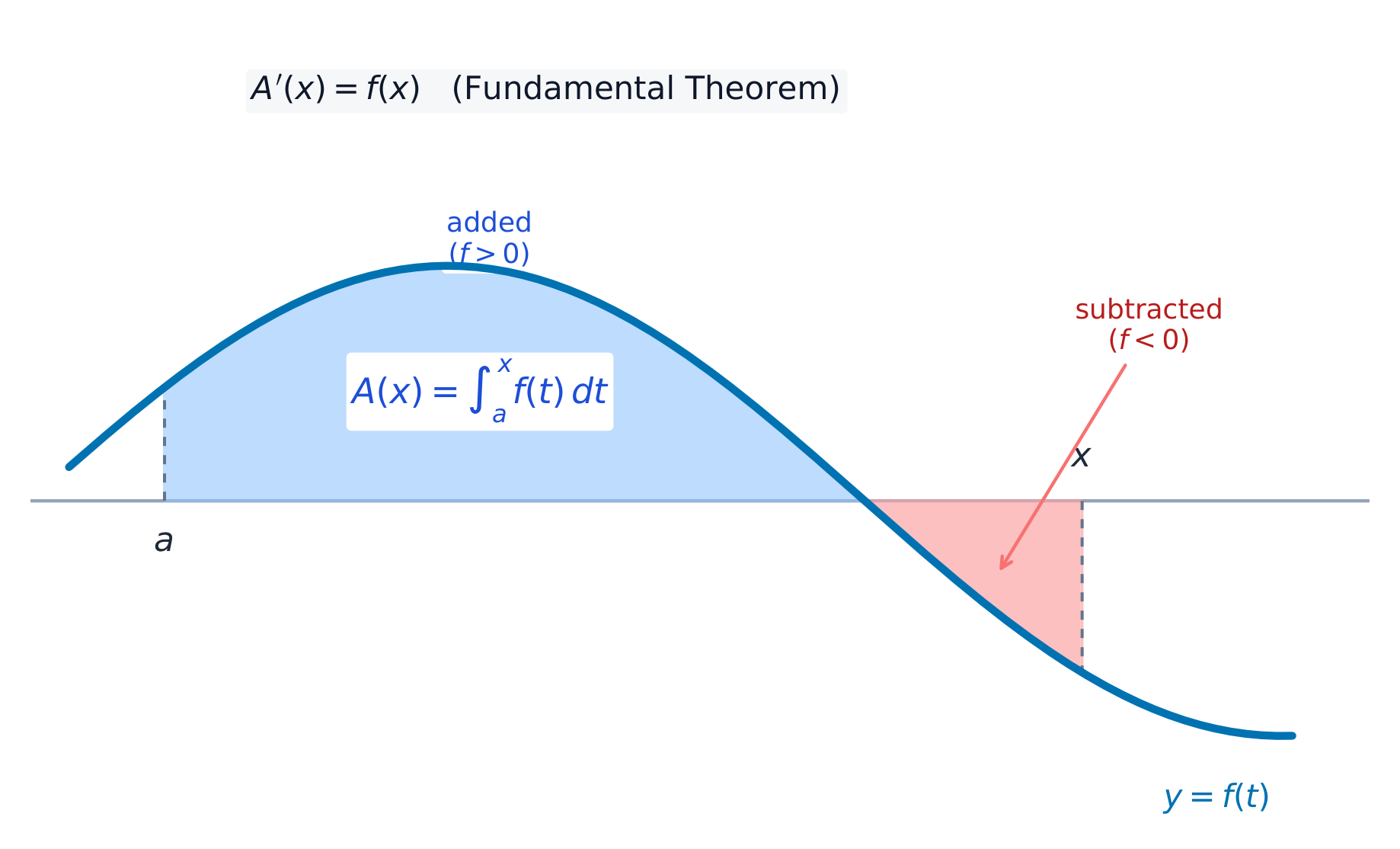
The Fundamental Theorem of Calculus is the spine of the course. Understanding it as "the integral of a rate gives the total change" is what makes accumulation questions readable.

Notes take each unit in order, with the theorems stated the way the exam expects them to be cited. Past FRQs with scoring guidelines are in the library — AB marks often go to the justification in words, so the worked solutions write the reasoning out instead of stopping at the answer.

  • 1

    Limits and Continuity · ⁨גבולות רציפות⁩

    Watch lesson · ⁨צפה בשיעור⁩
    1.1

    Introducing Calculus: Can Change Occur at an Instant?

    Syllabus · ⁨סיילבוס⁩
    English

    Enduring Understanding (CHA-1): Calculus allows us to generalize knowledge about motion to diverse problems involving change.

    Learning Objective CHA-1.A: Interpret the rate of change at an instant in terms of average rates of change over intervals containing that instant.

    • CHA-1.A.1 Calculus uses limits to understand and model dynamic change.
    • CHA-1.A.2 Because an average rate of change divides the change in one variable by the change in another, the average rate of change is undefined at a point where the change in the independent variable would be zero.
    • CHA-1.A.3 The limit concept allows us to define instantaneous rate of change in terms of average rates of change.
    עברית

    הבנה מתמשכת (CHA-1): קלקולוס מאפשר לנו לשכלל ידע על תנועה לבעיות מגוונות הכוללות שינוי.

    מטרות למידה CHA-1.A: פרש את קצב השינוי ברגע נתון בהתייחס לקצבי שינוי ממוצעים בתחומים המכילים רגע זה.

    • CHA-1.A.1 קלקולוס משתמש בגבולות כדי להבין ולמודל שינוי דינמי.
    • CHA-1.A.2 מכיוון שקצב שינוי ממוצע מחלק את השינוי במשתנה אחד בשינוי במשתנה אחר, קצב השינוי הממוצע אינו מוגדר בנקודה שבה השינוי במשתנה התלוי יהיה אפס.
    • CHA-1.A.3 מושג הגבול מאפשר לנו להגדיר קצב שינוי מיידי בהתייחס לקצבי שינוי ממוצעים.

    Source: College Board AP Course and Exam Description · ⁨מקור: תיאור הקורס והמבחן של College Board AP⁩

    Calculus is the mathematics of change 变化 and of accumulation 累积. It answers two big questions: how fast is something changing right now, and how much has piled up so far? Unit 1 builds the one tool both questions rest on – the limit 极限.

    Start with a puzzle. A car's speedometer reads $60$ km/h. What does that mean at a single instant 瞬间? Speed is distance over time. But at one instant no time passes and no distance is covered, so the fraction looks like $\tfrac{0}{0}$ – undefined.

    • The average rate of change 平均变化率 uses a whole interval 区间: the change in one quantity divided by the change in another. It divides by zero, and so is undefined, when the change in the input would be zero.
    • The instantaneous rate of change 瞬时变化率 is what we want at a point. It is the value the average rate approaches 趋近 as the interval shrinks toward zero length.

    The clever move is not to plug in zero (undefined), but to watch what the average rate approaches as the interval gets smaller and smaller. That approaching value is a limit. So calculus lets us describe change at an instant – as a limit of average rates over ever-shorter intervals. This one idea powers the derivative 导数 (Unit 2) and, run in reverse, the integral 积分 (Unit 6). Everything else in this unit defines limits carefully and computes them reliably.

    Explore · ⁨חקור⁩

    Explore rate of change at an instant · ⁨חקרו קצב שינוי ברגע נתון⁩

    y = ax³ + bx² + cx + d

    Slide the point along the curve. The tangent line is the limit of ever-shorter average rates — its slope is the instantaneous rate of change $\frac{dy}{dx}$ at that point. · ⁨החליזו את הנקודה לאורך העקומה. המשיק הוא הגבול של קצבים ממוצעים קצרים越来越 — השיפוע שלו הוא קצב השינוי הרגעי $\frac{dy}{dx}$ בנקודה זו.⁩

    Vocabulary · ⁨מילון מונחים⁩ Train · ⁨אימון⁩
    English עברית
    change/tʃeɪndʒ/ שינוי
    accumulation/əˌkjuːmjʊˈleɪʃn/ צבירה
    limit/ˈlɪmɪt/ גבול
    at a single instant/ætə ˈsɪŋɡl ˈɪnstənt/ ברגע יחיד
    average rate of change/ˈævrɪdʒ reɪt ɒv tʃeɪndʒ/ ממוצע קצב השינוי
    interval/ˈɪntəvl/ interval
    instantaneous rate of change/ˌɪnstənˈteɪnɪəs reɪt ɒv tʃeɪndʒ/ קצב שינוי רגעי
    approaches/əˈprəʊtʃɪz/ מתקרבת ל
    derivative/dɪˈrɪvətɪv/ נגזרת
    integral/ˈɪntɪɡrəl/ אינטגרל
    hole/həʊl/ חור
    1.2

    Defining Limits and Using Limit Notation

    Syllabus · ⁨סיילבוס⁩
    English

    Enduring Understanding (LIM-1): Reasoning with definitions, theorems, and properties can be used to justify claims about limits.

    Learning Objective LIM-1.A: Represent limits analytically using correct notation.

    • LIM-1.A.1 Given a function $f$, the limit of $f(x)$ as $x$ approaches $c$ is a real number $R$ if $f(x)$ can be made arbitrarily close to $R$ by taking $x$ sufficiently close to $c$ (but not equal to $c$). If the limit exists and is a real number, then the common notation is $\lim_{x \to c} f(x) = R$.
      • Exclusion statement: The epsilon-delta definition of a limit is not assessed on the AP Calculus AB or BC Exam. However, teachers may include this topic in the course if time permits.

    Learning Objective LIM-1.B: Interpret limits expressed in analytic notation.

    • LIM-1.B.1 A limit can be expressed in multiple ways, including graphically, numerically, and analytically.
    עברית

    הבנה נמשכת (LIM-1): נימוקים בעזרת הגדרות, משפטים ותכונות יכולים לשמש להוכחת טענות לגבי גבולות.

    מטרת למידה LIM-1.A: נציג גבולות אנליטית באמצעות סימון תקין.

    • LIM-1.A.1 נתונה פונקציה $f$, הגבול של $f(x)$ כאשר $x$ מתקרית ל$c$ הוא מספר ממשי $R$ אם $f(x)$ יכול להיות קרוב ככל שנדרש ל$R$ על ידי לקיחת $x$ קרוב כפי שהנדרש ל$c$ (אך לא שווה ל$c$). אם הגבול קיים והוא מספר ממשי, הסימון הנפוץ הוא $\lim_{x \to c} f(x) = R$.
      • הצהרת בלילה: ההגדרה אפסילון-דלתא של גבול אינה נבדקת במבחן AP Calculus AB או BC. עם זאת, מורים יכולים לכלול נושא זה בקורס אם יש זמן.

    מטרת למידה LIM-1.B: פרש גבולות המופעים בסימון אנליטי.

    • LIM-1.B.1 גבול ניתן לביטוי במגוון דרכים, כולל גרפית, מספרית ואנליטית.

    Source: College Board AP Course and Exam Description · ⁨מקור: תיאור הקורס והמבחן של College Board AP⁩

    A smooth bridge curve: limits describe the value a graph approaches as we zoom in
    A smooth bridge curve: limits describe the value a graph approaches as we zoom in

    Given a function $f$, the limit of $f(x)$ as $x$ approaches $c$ is a real number $R$ if $f(x)$ can be made arbitrarily 任意地 close to $R$ by taking $x$ sufficiently 足够 close to $c$ – but not equal to $c$. We write

    $$\lim_{x \to c} f(x) = R$$
    and read it: "the limit of $f(x)$, as $x$ approaches $c$, equals $R$."

    The last words are the heart of a limit: it describes the behavior 行为 of $f$ near $c$, not the value at $c$. The function may be undefined at $c$, or defined but equal to something else – the limit does not care.

    A limit can be shown in three ways: graphically 用图象, numerically 用数值 (a table), and analytically 用解析式 (algebra). Learning to move between these representations is a core skill.

    (Note: the epsilon-delta definition of a limit is not tested on the AP Exam, so this handout does not use it.)

    Vocabulary · ⁨מילון מונחים⁩ Train · ⁨אימון⁩
    English עברית
    arbitrarily/ˌɑːbɪˈtrerɪli/ ללא הגבלה
    sufficiently/səˈfɪʃəntli/ באופן מספק
    behavior/bɪˈheɪvjə/ התנהגות
    graphically/ˈɡræfɪkli/ גרפית
    numerically/njuːˈmerɪkli/ מספרית
    analytically/ˌænəˈlɪtɪkli/ אנליטית
    1.3

    Estimating Limit Values from Graphs

    Syllabus · ⁨סיילבוס⁩
    English

    Enduring Understanding (LIM-1): Reasoning with definitions, theorems, and properties can be used to justify claims about limits.

    Learning Objective LIM-1.C: Estimate limits of functions.

    • LIM-1.C.1 The concept of a limit includes one sided limits.
    • LIM-1.C.2 Graphical information about a function can be used to estimate limits.
    • LIM-1.C.3 Because of issues of scale, graphical representations of functions may miss important function behavior.
    • LIM-1.C.4 A limit might not exist for some functions at particular values of $x$. Some ways that the limit might not exist are if the function is unbounded, if the function is oscillating near this value, or if the limit from the left does not equal the limit from the right.
      • Illustrative examples for LIM-1.C.4:
        • $\lim_{x \to 0} \dfrac{1}{x^2} = \infty$
        • $\lim_{x \to 0} \dfrac{|x|}{x}$ does not exist.
        • $\lim_{x \to 0} \sin\left(\dfrac{1}{x}\right)$ does not exist.
        • $\lim_{x \to 0} \dfrac{1}{x}$ does not exist.
    עברית

    הבנה נמשכת (LIM-1): נימוקים בעזרת הגדרות, משפטים ותכונות יכולים לשמש להוכחת טענות לגבי גבולות.

    מטרת למידה LIM-1.C: הערך גבולות של פונקציות.

    • LIM-1.C.1 מושג הגבול כולל גם גבולות חד-כיווניים.
    • LIM-1.C.2 ניתן להשתמש במידע גרפי על פונקציה כדי להעריך גבולות.
    • LIM-1.C.3 בשל בעיות קנה מידה, ייצוגים גרפיים של פונקציות עשויים לפספס התנהגות חשובה של הפונקציה.
    • LIM-1.C.4 ייתכן שגבול לא קיים עבור חלק מהפונקציות בערכים מסוימים של $x$. כמה צורות בהן הגבול עשוי שלא להתקיים הן אם הפונקציה אינה מוגבלת, אם הפונקציה מתנדנדת בסביבת הערך הזה, או אם הגבול מצד שמאל אינו שווה לגבול מצד ימין.
      • דוגמאות להמחשה עבור LIM-1.C.4:
        • $\lim_{x \to 0} \dfrac{1}{x^2} = \infty$
        • $\lim_{x \to 0} \dfrac{|x|}{x}$ אינו קיים.
        • $\lim_{x \to 0} \sin\left(\dfrac{1}{x}\right)$ אינו קיים.
        • $\lim_{x \to 0} \dfrac{1}{x}$ אינו קיים.

    Source: College Board AP Course and Exam Description · ⁨מקור: תיאור הקורס והמבחן של College Board AP⁩

    A graph is often the fastest way to read a limit. To find $\displaystyle \lim_{x \to c} f(x)$, run your finger along the curve toward $x = c$ from each side and ask: what height is the curve heading for?

    • Trace from the left (inputs smaller than $c$): this gives the left-hand limit 左极限, $\displaystyle \lim_{x \to c^-} f(x)$.
    • Trace from the right (inputs larger than $c$): this gives the right-hand limit 右极限, $\displaystyle \lim_{x \to c^+} f(x)$.
    • These are the one-sided limits 单侧极限. If both head to the same height $R$, then the two-sided limit exists and $\displaystyle \lim_{x \to c} f(x) = R$.

    Crucially, ignore the point itself. Graphs mark the difference between the limit and the value:

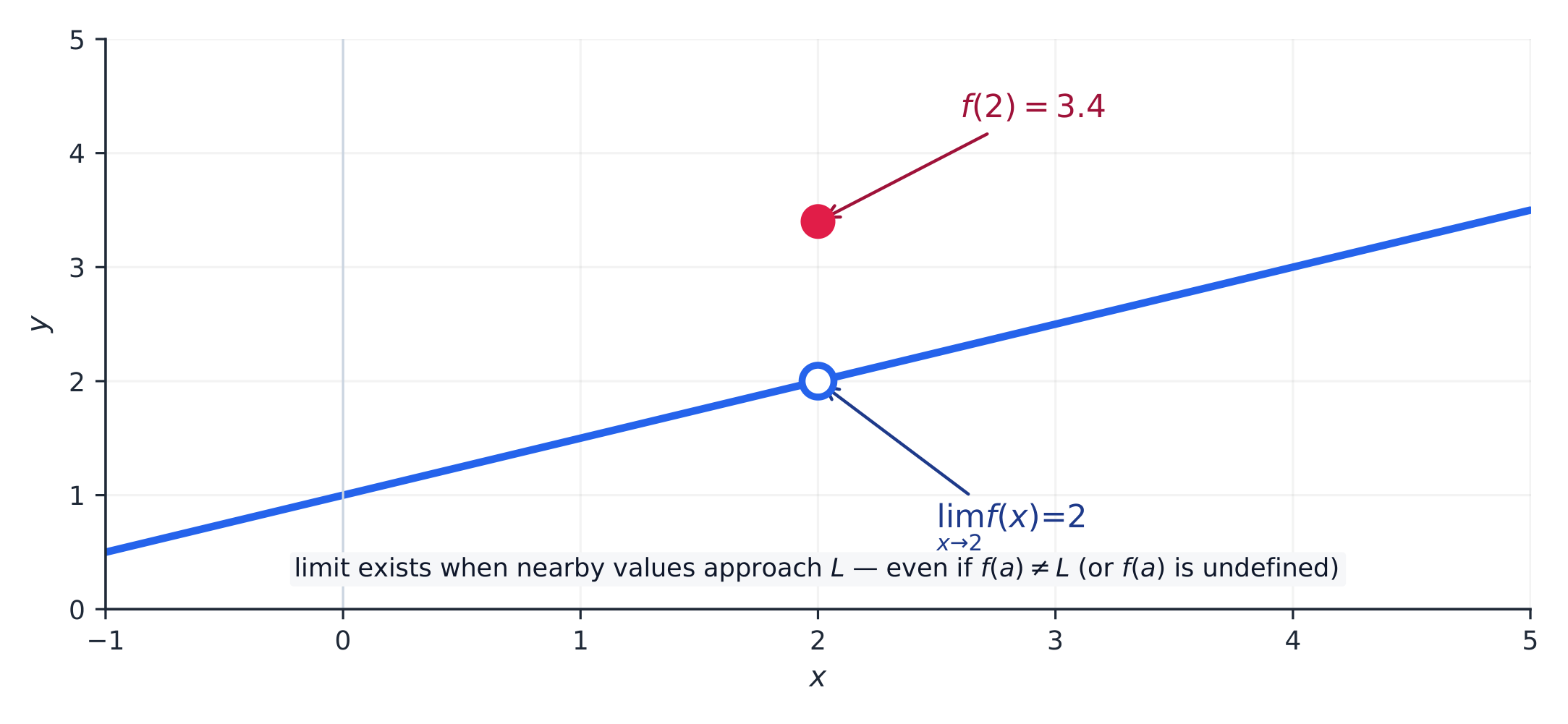
    • An open circle 空心圆 marks a height the curve approaches but does not reach – a "hole" 空洞.
    • A closed circle 实心圆 marks the actual value $f(c)$.

    So a curve may approach $R = 3$ from both sides (limit is $3$) while a filled dot sits at height $5$ (value $f(c) = 5$). The limit is $3$; the two need not match.

    A limit exists at x=2 even though the function value f(2) is different
    The open circle is the height the curve approaches (the limit); the filled dot is the actual value $f(2)$ – they need not agree.

    A limit does not exist (often written DNE) when the two sides disagree (a jump 跳跃), when the function is unbounded 无界 (grows without limit), or when it oscillates 振荡 forever near $c$. For example:

    $$\lim_{x \to 0} \frac{1}{x^2} = \infty, \qquad \lim_{x \to 0} \frac{|x|}{x}\ \text{DNE}, \qquad \lim_{x \to 0} \sin\!\left(\frac{1}{x}\right)\ \text{DNE}.$$

    Watch the scale 比例 of a graph: a zoomed-out picture can hide important behavior near a point, so confirm with algebra when you can.

    Explore · ⁨חקור⁩

    Read a limit off the graph · ⁨קרא גבול מהגרף⁩

    y = ax² + bx + c

    The limit as $x\to c$ is the height the curve heads toward from both sides — it is about where the function is going, not its value at $c$. Follow the curve toward an $x$ and read the $y$ it approaches. · ⁨הגבול ב-$x\to c$ הוא הגובה שאליו הכיפה שואפת משני הצדדים — מדובר בכיוון שבו הפונקציה מתכוונת, ולא בערכה ב-$c$. עקוב אחר הכיפה כפי she is heading toward an $x$ וקרא את ה$y$ אליו היא מתקרבת.⁩

    Vocabulary · ⁨מילון מונחים⁩ Train · ⁨אימון⁩
    English עברית
    left-hand limit/left hænd ˈlɪmɪt/ גבול משמאל
    right-hand limit/raɪt hænd ˈlɪmɪt/ גבול מימין
    one-sided limits/wʌn ˈsaɪdɪd ˈlɪmɪts/ גבולות חד-צדדיים
    open circle/ˈəʊpən ˈsɜːkl/ מעגל פתוח
    closed circle/kləʊzd ˈsɜːkl/ מעגל סגור
    jump/dʒʌmp/ קפיצה
    unbounded/ʌnˈbaʊndɪd/ בלתי מוגבל
    oscillates/ˈɒsɪleɪts/ מתנודדת
    scale/skeɪl/ קנה מידה
    1.4

    Estimating Limit Values from Tables

    Syllabus · ⁨סיילבוס⁩
    English

    Enduring Understanding (LIM-1): Reasoning with definitions, theorems, and properties can be used to justify claims about limits.

    Learning Objective LIM-1.C: Estimate limits of functions.

    • LIM-1.C.5 Numerical information can be used to estimate limits.
    עברית

    הבנה נמשכת (LIM-1): נימוקים בעזרת הגדרות, משפטים ותכונות יכולים לשמש להוכחת טענות לגבי גבולות.

    מטרת למידה LIM-1.C: הערך גבולות של פונקציות.

    • LIM-1.C.5 ניתן להשתמש במידע מספרי כדי להעריך גבולות.

    Source: College Board AP Course and Exam Description · ⁨מקור: תיאור הקורס והמבחן של College Board AP⁩

    When you have data or a formula but no picture, a table 表格 of values estimates a limit numerically. Choose inputs that creep toward $c$ from both sides and watch the outputs.

    For example, to estimate $\displaystyle \lim_{x \to 2} \frac{x^2 - 4}{x - 2}$ (which is $\tfrac{0}{0}$ at $x=2$):

    $x$ $1.9$ $1.99$ $1.999$ $\to 2 \leftarrow$ $2.001$ $2.01$ $2.1$
    $f(x)$ $3.9$ $3.99$ $3.999$ ? $4.001$ $4.01$ $4.1$

    Both sides march toward $4$, so we estimate the limit is $4$. A table only suggests a value – it is a numerical estimate, not a proof.

    Vocabulary · ⁨מילון מונחים⁩ Train · ⁨אימון⁩
    English עברית
    table/ˈteɪbl/ טבלה
    1.5

    Determining Limits Using Algebraic Properties of Limits

    Syllabus · ⁨סיילבוס⁩
    English

    Enduring Understanding (LIM-1): Reasoning with definitions, theorems, and properties can be used to justify claims about limits.

    Learning Objective LIM-1.D: Determine the limits of functions using limit theorems.

    • LIM-1.D.1 One-sided limits can be determined analytically or graphically.
    • LIM-1.D.2 Limits of sums, differences, products, quotients, and composite functions can be found using limit theorems.
    עברית

    הבנה נמשכת (LIM-1): נימוקים בעזרת הגדרות, משפטים ותכונות יכולים לשמש להוכחת טענות לגבי גבולות.

    מטרת למידה LIM-1.D: קבע את גבולות הפונקציות באמצעות משפטי גבולות.

    • LIM-1.D.1 ניתן לקבוע גבולות חד-כיווניים אנליטית או גרפית.
    • LIM-1.D.2 ניתן למצוא גבולות של סכומים, הפרשים, מכפלות, מנה ופונקציות מורכבות באמצעות משפטי גבולות.

    Source: College Board AP Course and Exam Description · ⁨מקור: תיאור הקורס והמבחן של College Board AP⁩

    Most limits are found analytically using limit theorems 极限定理. If $\lim_{x\to c} f(x)$ and $\lim_{x\to c} g(x)$ both exist, the limit of a combination is the same combination of the limits:

    • Sum / difference: $\displaystyle \lim_{x\to c}\big[f(x)\pm g(x)\big] = \lim_{x\to c}f(x) \pm \lim_{x\to c}g(x)$
    • Product: $\displaystyle \lim_{x\to c}\big[f(x)\,g(x)\big] = \lim_{x\to c}f(x)\cdot\lim_{x\to c}g(x)$
    • Quotient: $\displaystyle \lim_{x\to c}\frac{f(x)}{g(x)} = \frac{\lim_{x\to c}f(x)}{\lim_{x\to c}g(x)}$, provided the bottom limit is not $0$.
    • Composite 复合函数: if $g$ is continuous at $\lim_{x\to c} f(x)$, then $\displaystyle \lim_{x\to c} g\big(f(x)\big) = g\!\left(\lim_{x\to c} f(x)\right)$.

    The practical rule: for a function built from polynomials, roots, and the like, first try direct substitution 直接代入 – put $x = c$ in. If you get a real number, that is the limit. One-sided limits obey the same theorems, read from one direction only.

    Vocabulary · ⁨מילון מונחים⁩ Train · ⁨אימון⁩
    English עברית
    limit theorems/ˈlɪmɪt ˈθɪərəmz/ משפטיות גבול
    Composite/ˈkɒmpəzɪt/ פונקציה מורכבת
    direct substitution/daɪˈrekt ˌsʌbstɪˈtjuːʃn/ הצבה ישירה
    1.6

    Determining Limits Using Algebraic Manipulation

    Syllabus · ⁨סיילבוס⁩
    English

    Enduring Understanding (LIM-1): Reasoning with definitions, theorems, and properties can be used to justify claims about limits.

    Learning Objective LIM-1.E: Determine the limits of functions using equivalent expressions for the function or the squeeze theorem.

    • LIM-1.E.1 It may be necessary or helpful to rearrange expressions into equivalent forms before evaluating limits.
      • Illustrative examples for LIM-1.E.1:
        • Factoring and dividing common factors of rational functions
        • Multiplying by an expression involving the conjugate of a sum or difference in order to simplify functions involving radicals
        • Using alternate forms of trigonometric functions
    עברית

    הבנה נמשכת (LIM-1): נימוקים בעזרת הגדרות, משפטים ותכונות יכולים לשמש להוכחת טענות לגבי גבולות.

    מטרת למידה LIM-1.E: קבע את גבולות הפונקציות באמצעות ביטויים מקבילים לפונקציה או באמצעות משפט הסחיפה.

    • LIM-1.E.1 ייתכן שתהיה צורך או שהיה נוח לשנות את הביטוי לצורות מקבילות לפני חישוב הגבולות.
      • דוגמאות להמחשה עבור LIM-1.E.1:
        • פירוק ושילוח גורמים משותפים בפונקציות רציונליות
        • כפל באיבר המכיל את המלווה של סכום או הפרש כדי לפשט פונקציות הכוללות שורשים
        • שימוש בצורות חלופיות של פונקציות טריגונומטריות

    Source: College Board AP Course and Exam Description · ⁨מקור: תיאור הקורס והמבחן של College Board AP⁩

    Direct substitution sometimes gives the indeterminate form 未定式 $\tfrac{0}{0}$. This does not mean the limit fails – it means you must rewrite the function into an equivalent form 等价形式 that removes the trouble, then substitute. Three standard moves:

    • Factor and cancel 因式分解并约分 a rational function 有理函数. Example: $\displaystyle \lim_{x\to 2}\frac{x^2-4}{x-2} = \lim_{x\to 2}\frac{(x-2)(x+2)}{x-2} = \lim_{x\to 2}(x+2) = 4$.
    • Multiply by the conjugate 共轭 to simplify a radical 根式. Example: $\displaystyle \lim_{x\to 0}\frac{\sqrt{x+1}-1}{x} = \lim_{x\to 0}\frac{x}{x\big(\sqrt{x+1}+1\big)} = \frac{1}{2}$.
    • Use alternate forms of trigonometric functions (identities) to simplify.

    The cancelled factor is why the original graph had a hole: the two functions agree everywhere except at $x=c$, so they share the same limit there.

    Vocabulary · ⁨מילון מונחים⁩ Train · ⁨אימון⁩
    English עברית
    indeterminate form/ˌɪndɪˈtɜːmɪnət fɔːm/ צורה לא מוגדרת
    equivalent form/ɪˈkwɪvələnt fɔːm/ צורה שקולה
    Factor and cancel/ˈfæktə ænd ˈkænsl/ גורמי שיתוף וביטול
    rational function/ˈræʃənl ˈfʌŋkʃn/ פונקציה רציונלית
    conjugate/ˈkɒndʒuːɡeɪt/ זוגי
    radical/ˈrædɪkl/ שורש
    1.7

    Selecting Procedures for Determining Limits

    Syllabus · ⁨סיילבוס⁩
    English

    This topic is intended to focus on the skill of selecting an appropriate procedure for determining limits. Students should be given opportunities to practice when and how to apply all learning objectives relating to determining limits.

    עברית

    נושא זה נועד להתמקד במיומנות בחירת הליך מתאים לקביעת גבולות. יש לספק לתלמידים הזדמנויות לתרגול מתי וכיצד להשתמש בכל מטרת הלמידה הקשורה לקביעת גבולות.

    Source: College Board AP Course and Exam Description · ⁨מקור: תיאור הקורס והמבחן של College Board AP⁩

    This is a skill topic, not new content: choose the right tool for the limit in front of you.

    1. Try direct substitution first. A real answer means you are done.
    2. Getting $\tfrac{0}{0}$? Rewrite – factor and cancel, or use the conjugate, or a trig identity – then substitute.
    3. A non-zero number over $0$ (like $\tfrac{5}{0}$)? The limit is infinite or DNE – check the sign from each side (see vertical asymptotes below).
    4. As $x\to\pm\infty$? Compare the dominant 主导 terms (see limits at infinity).
    5. Trapped between two functions? The squeeze theorem may apply.
    Vocabulary · ⁨מילון מונחים⁩ Train · ⁨אימון⁩
    English עברית
    dominant/ˈdɒmɪnənt/ דומיננטי
    1.8

    Determining Limits Using the Squeeze Theorem

    Syllabus · ⁨סיילבוס⁩
    English

    Enduring Understanding (LIM-1): Reasoning with definitions, theorems, and properties can be used to justify claims about limits.

    Learning Objective LIM-1.E: Determine the limits of functions using equivalent expressions for the function or the squeeze theorem.

    • LIM-1.E.2 The limit of a function may be found by using the squeeze theorem.
      • Illustrative examples for LIM-1.E.2: The squeeze theorem can be used to show $\lim_{x \to 0} \dfrac{\sin x}{x} = 1$ and $\lim_{x \to 0} \dfrac{1 - \cos x}{x} = 0$.
    עברית

    הבנה נמשכת (LIM-1): נימוקים בעזרת הגדרות, משפטים ותכונות יכולים לשמש להוכחת טענות לגבי גבולות.

    מטרת למידה LIM-1.E: קבע את גבולות הפונקציות באמצעות ביטויים מקבילים לפונקציה או באמצעות משפט הסחיפה.

    • LIM-1.E.2 ניתן למצוא את הגבול של פונקציה על ידי שימוש במשפט הסחיפה.
      • דוגמאות מדגמות ל-LIM-1.E.2: משפט הסחיפה יכול לשמש להראי $\lim_{x \to 0} \dfrac{\sin x}{x} = 1$ ו$\lim_{x \to 0} \dfrac{1 - \cos x}{x} = 0$.

    Source: College Board AP Course and Exam Description · ⁨מקור: תיאור הקורס והמבחן של College Board AP⁩

    The squeeze theorem 夹逼定理 (also called the sandwich theorem) finds a limit by trapping the function between two others. If $g(x) \le f(x) \le h(x)$ near $c$, and

    $$\lim_{x\to c} g(x) = \lim_{x\to c} h(x) = L,$$
    then $f$ is squeezed to the same place: $\displaystyle \lim_{x\to c} f(x) = L$.

    The two famous results proved this way, both used throughout calculus, are:

    $$\lim_{x\to 0}\frac{\sin x}{x} = 1 \qquad\text{and}\qquad \lim_{x\to 0}\frac{1-\cos x}{x} = 0.$$

    The squeeze theorem: if g and h both approach L at c, the trapped function f is forced to L
    The wiggly $f$ is trapped between $g$ and $h$. Because both bounds meet at $L$, $f$ has nowhere to go but $L$.
    Vocabulary · ⁨מילון מונחים⁩ Train · ⁨אימון⁩
    English עברית
    squeeze theorem/skwiːz ˈθɪərəm/ משפט הדחקה
    1.9

    Connecting Multiple Representations of Limits

    Syllabus · ⁨סיילבוס⁩
    English

    This topic is intended to focus on connecting representations. Students should be given opportunities to practice when and how to apply all learning objectives relating to limits and translating mathematical information from a single representation or across multiple representations.

    עברית

    נושא זה נועד להתמקד בחיבור בין ייצוגים. יש לספק לתלמידים הזדמנויות לתרגול מתי וכיצד להשתמש בכל מטרת הלמידה הקשורה לגבולות ולהמרת מידע מתמטי מייצוג אחד או בין מספר ייצוגים.

    Source: College Board AP Course and Exam Description · ⁨מקור: תיאור הקורס והמבחן של College Board AP⁩

    Another skill topic: the same limit lives in a graph, a table, and an algebraic form, and you should be able to translate between them. A graph shows the shape and any holes or jumps; a table gives numerical evidence; algebra gives an exact value and a reason. Strong answers use one representation to confirm another.

    1.10

    Exploring Types of Discontinuities

    Syllabus · ⁨סיילבוס⁩
    English

    Enduring Understanding (LIM-2): Reasoning with definitions, theorems, and properties can be used to justify claims about continuity.

    Learning Objective LIM-2.A: Justify conclusions about continuity at a point using the definition.

    • LIM-2.A.1 Types of discontinuities include removable discontinuities, jump discontinuities, and discontinuities due to vertical asymptotes.
    עברית

    הבנה מתמשכת (LIM-2): ניתן להשתמש בניתוח עם הגדרות, משפטים ותכונות כדי להסביר טענות לגבי רציפות.

    מטרת למידה LIM-2.A: הסבר מסקנות לגבי רציפות בנקודה באמצעות ההגדרה.

    • LIM-2.A.1 סוגי אי-רציפות כוללים אי-רציפות ניתנת לפיקוח, אי-רציפות קפיצה ואי-רציפות עקב אסימפטוטות אנכיות.

    Source: College Board AP Course and Exam Description · ⁨מקור: תיאור הקורס והמבחן של College Board AP⁩

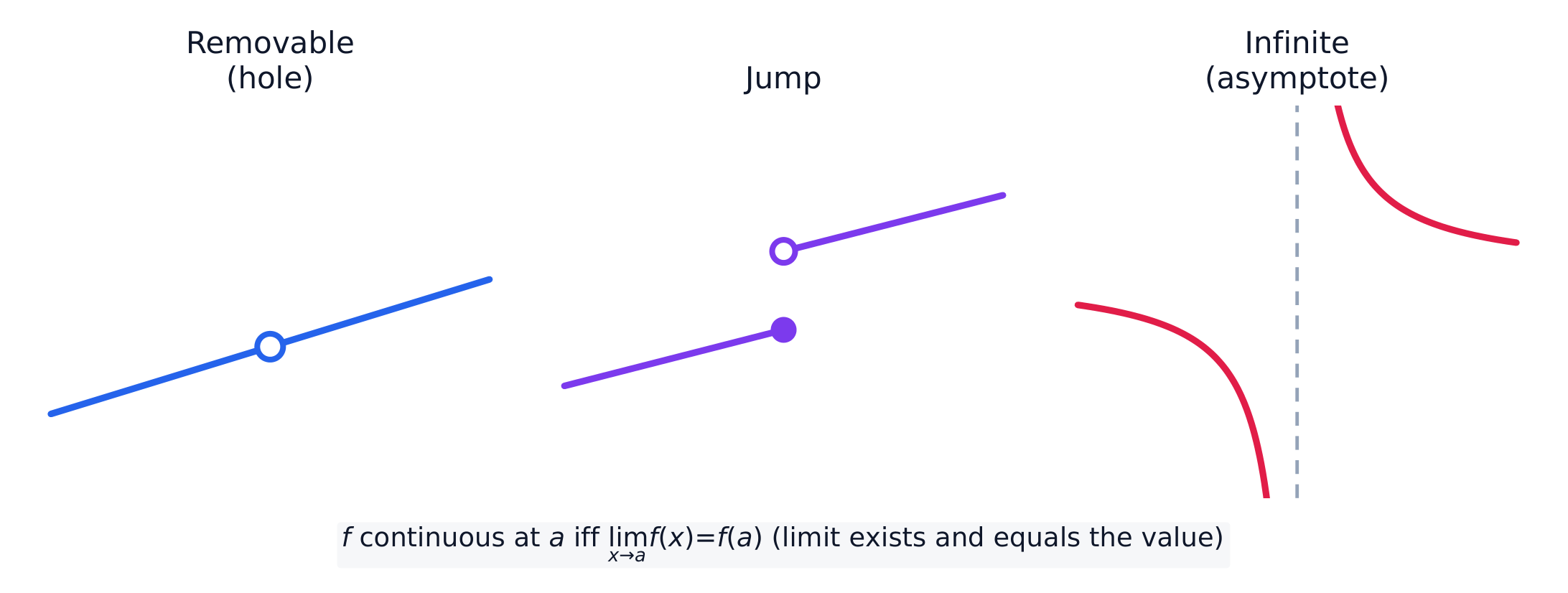
    A function is discontinuous 间断 at $c$ when its graph "breaks" there. There are three types:

    • Removable discontinuity 可去间断 – a single hole. The two-sided limit exists, but the point is missing or misplaced.
    • Jump discontinuity 跳跃间断 – the two one-sided limits exist but disagree, so the curve jumps.
    • Infinite discontinuity 无穷间断 – the function blows up to $\pm\infty$ at a vertical asymptote 垂直渐近线.
    The three types of discontinuity: removable hole, jump, and infinite
    Three ways a graph can break: a removable hole, a jump, and an infinite (asymptote) discontinuity.
    Vocabulary · ⁨מילון מונחים⁩ Train · ⁨אימון⁩
    English עברית
    discontinuous/dɪskənˈtɪnjuːəs/ בלתי רציף
    Removable discontinuity/rɪˈmuːvəbl dɪskɒntɪˈnjuːɪti/ ניתוק הילד
    Jump discontinuity/dʒʌmp dɪskɒntɪˈnjuːɪti/ ניתוק קפיצה
    Infinite discontinuity/ˈɪnfɪnət dɪskɒntɪˈnjuːɪti/ ניתוק אינסופי
    vertical asymptote/ˈvɜːtɪkl ˈæsɪmptəʊt/ אסימפטוטה אנכית
    1.11

    Defining Continuity at a Point

    Syllabus · ⁨סיילבוס⁩
    English

    Enduring Understanding (LIM-2): Reasoning with definitions, theorems, and properties can be used to justify claims about continuity.

    Learning Objective LIM-2.A: Justify conclusions about continuity at a point using the definition.

    • LIM-2.A.2 A function $f$ is continuous at $x = c$ provided that $f(c)$ exists, $\lim_{x \to c} f(x)$ exists, and $\lim_{x \to c} f(x) = f(c)$.
    עברית

    הבנה מתמשכת (LIM-2): ניתן להשתמש בניתוח עם הגדרות, משפטים ותכונות כדי להסביר טענות לגבי רציפות.

    מטרת למידה LIM-2.A: הסבר מסקנות לגבי רציפות בנקודה באמצעות ההגדרה.

    • LIM-2.A.2 פונקציה $f$ רציפה בנקודה $x = c$ בתנאי ש$f(c)$ קיים, $\lim_{x \to c} f(x)$ קיים, ו$\lim_{x \to c} f(x) = f(c)$.

    Source: College Board AP Course and Exam Description · ⁨מקור: תיאור הקורס והמבחן של College Board AP⁩

    Continuity is defined by a three-part test. A function $f$ is continuous 连续 at $x=c$ exactly when all three hold:

    $$\boxed{\;f(c)\text{ exists}\quad\text{and}\quad \lim_{x\to c} f(x)\text{ exists}\quad\text{and}\quad \lim_{x\to c} f(x) = f(c)\;}$$

    In words: the point is there, the limit is there, and the two agree. If any one fails, $f$ is discontinuous at $c$. This test is the backbone of nearly every continuity question, so learn it as a checklist.

    Vocabulary · ⁨מילון מונחים⁩ Train · ⁨אימון⁩
    English עברית
    continuous/kənˈtɪnjuːəs/ רציף
    1.12

    Confirming Continuity over an Interval

    Syllabus · ⁨סיילבוס⁩
    English

    Enduring Understanding (LIM-2): Reasoning with definitions, theorems, and properties can be used to justify claims about continuity.

    Learning Objective LIM-2.B: Determine intervals over which a function is continuous.

    • LIM-2.B.1 A function is continuous on an interval if the function is continuous at each point in the interval.
    • LIM-2.B.2 Polynomial, rational, power, exponential, logarithmic, and trigonometric functions are continuous on all points in their domains.
    עברית

    הבנה מתמשכת (LIM-2): ניתן להשתמש בניתוח עם הגדרות, משפטים ותכונות כדי להסביר טענות לגבי רציפות.

    מטרת למידה LIM-2.B: קביעת מרווחים עליהם פונקציה היא רציפה.

    • LIM-2.B.1 פונקציה היא רציפה במרווח אם היא רציפה בכל נקודה בתוך המרווח.
    • LIM-2.B.2 פונקציות פולינומיות, רציונליות, חזקה, מעריכיות, לוגריתמיות וטריגונומטריות הן רציפות בכל הנקודות בתחום ההגדרה שלהן.

    Source: College Board AP Course and Exam Description · ⁨מקור: תיאור הקורס והמבחן של College Board AP⁩

    A function is continuous on an interval 在区间上连续 if it is continuous at every point of that interval. You rarely check point by point, because whole families are continuous on their domains:

    Polynomial, rational, power, exponential 指数, logarithmic 对数, and trigonometric 三角 functions are continuous at every point of their domains.

    So a rational function is continuous everywhere except where its denominator is zero; $\ln x$ is continuous for $x>0$; and so on. Knowing this lets you declare continuity quickly and correctly.

    Vocabulary · ⁨מילון מונחים⁩ Train · ⁨אימון⁩
    English עברית
    continuous on an interval/kənˈtɪnjuːəs ɒn ən ˈɪntəvl/ רציף על קטע
    exponential/ˌekspəˈnenʃl/ אקספוננציאלית
    logarithmic/ˌlɒɡəˈrɪθmɪk/ לוגריתמי
    trigonometric/ˌtrɪɡənəʊˈmetrɪk/ טריגונומטרי
    1.13

    Removing Discontinuities

    Syllabus · ⁨סיילבוס⁩
    English

    Enduring Understanding (LIM-2): Reasoning with definitions, theorems, and properties can be used to justify claims about continuity.

    Learning Objective LIM-2.C: Determine values of $x$ or solve for parameters that make discontinuous functions continuous, if possible.

    • LIM-2.C.1 If the limit of a function exists at a discontinuity in its graph, then it is possible to remove the discontinuity by defining or redefining the value of the function at that point, so it equals the value of the limit of the function as $x$ approaches that point.
    • LIM-2.C.2 In order for a piecewise-defined function to be continuous at a boundary to the partition of its domain, the value of the expression defining the function on one side of the boundary must equal the value of the expression defining the other side of the boundary, as well as the value of the function at the boundary.
    עברית

    הבנה מתמשכת (LIM-2): ניתן להשתמש בניתוח עם הגדרות, משפטים ותכונות כדי להסביר טענות לגבי רציפות.

    מטרת למידה LIM-2.C: קביעת ערכים של $x$ או פתרון עבור פרמטרים הופכים פונקציות לא רציפות לרציפות, אם это אפשרי.

    • LIM-2.C.1 אם הגבול של פונקציה קיים בנקודת אי-רציפות בגרף שלה, אז ניתן להסיר את האי-רציפות על ידי הגדרה או שינוי הגדרה של הערך של הפונקציה בנקודה זו, כך שהוא יתאים לערך הגבול של הפונקציה כאשר $x$ מתקרית לנקודה זו.
    • LIM-2.C.2 כדי שפונקציה המוגדרת בחלקים תהיה רציפה בגבול החלוקה של התחום שלה, הערך של הביטוי המגדיר את הפונקציה באחד מצדי הגבול חייב להתאים לערך הביטוי המגדיר את הצד השני של הגבול, ainsi que לערך הפונקציה עצמו בנקודת הגבול.

    Source: College Board AP Course and Exam Description · ⁨מקור: תיאור הקורס והמבחן של College Board AP⁩

    If the limit exists at a hole, the discontinuity is removable: redefine the function at that one point to equal the limit, and the graph is repaired. Formally, set the missing value to $\displaystyle \lim_{x\to c} f(x)$.

    For a piecewise-defined function 分段函数, continuity at a boundary $x=c$ needs the two pieces to meet: the left piece's value, the right piece's value, and $f(c)$ must all be equal. This is a common exam setup – you solve for a parameter 参数 (an unknown constant) that makes the pieces match:

    $$\lim_{x\to c^-} f(x) = \lim_{x\to c^+} f(x) = f(c).$$

    Vocabulary · ⁨מילון מונחים⁩ Train · ⁨אימון⁩
    English עברית
    piecewise-defined function/ˈpiːswaɪz dɪˈfaɪnd ˈfʌŋkʃn/ פונקציה מוגדרת לפי מקרים
    parameter/pəˈræmɪtə/ פרמטר
    1.14

    Connecting Infinite Limits and Vertical Asymptotes

    Syllabus · ⁨סיילבוס⁩
    English

    Enduring Understanding (LIM-2): Reasoning with definitions, theorems, and properties can be used to justify claims about continuity.

    Learning Objective LIM-2.D: Interpret the behavior of functions using limits involving infinity.

    • LIM-2.D.1 The concept of a limit can be extended to include infinite limits.
    • LIM-2.D.2 Asymptotic and unbounded behavior of functions can be described and explained using limits.
    עברית

    הבנה מתמשכת (LIM-2): ניתן להשתמש בניתוח עם הגדרות, משפטים ותכונות כדי להסביר טענות לגבי רציפות.

    מטרת למידה LIM-2.D: פרשן את התנהגות הפונקציות באמצעות גבולות המעורבים באינסוף.

    • LIM-2.D.1 מושג הגבול יכול להיות מורחב כדי לכלול גבולות אינסופיים.
    • LIM-2.D.2 התנהגות אסימפטוטית ולא מוגבלת של פונקציות יכולה להיות מתוארת ומוסברת באמצעות גבולות.

    Source: College Board AP Course and Exam Description · ⁨מקור: תיאור הקורס והמבחן של College Board AP⁩

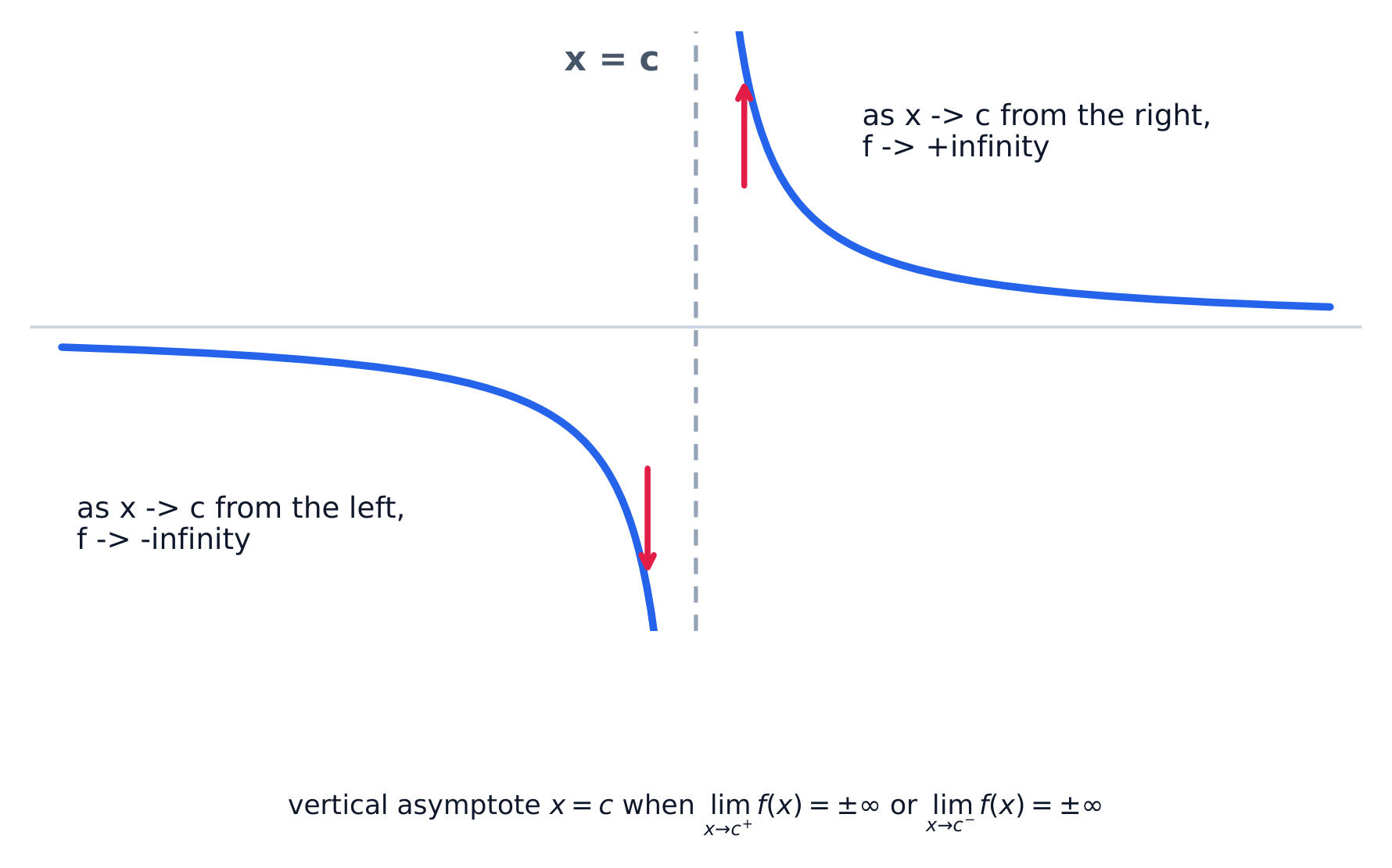
    The idea of a limit extends to infinite limits 无穷极限. When a function grows without bound near $x=c$, we write $\lim_{x\to c} f(x) = \pm\infty$. This describes a vertical asymptote at $x=c$: the graph hugs the vertical line $x=c$ and shoots off toward $\pm\infty$.

    This happens where a non-zero number is divided by something approaching $0$, such as at a zero of a denominator that does not cancel. Always check each side separately – the two sides can shoot opposite ways (one to $+\infty$, one to $-\infty$).

    An infinite limit at a vertical asymptote x = c, where the two sides shoot to opposite infinities
    Near a vertical asymptote the graph hugs the line $x=c$. Here the left side falls to $-\infty$ and the right side climbs to $+\infty$, so the two-sided limit does not exist.
    Explore · ⁨חקור⁩

    Explore infinite limits and vertical asymptotes · ⁨חקרו גבולות אינסופיים ואסימפטוטות אנכיות⁩

    y = a/(x − b) + c

    With $y=\dfrac{a}{x-b}+c$, watch the curve blow up to $\pm\infty$ near $x=b$. The vertical asymptote is the line $x=b$ where the infinite limit lives — the two sides can shoot opposite ways. · ⁨עם $y=\dfrac{a}{x-b}+c$, צפו בעקומה מתפוצצת ל$\pm\infty$ סמוך ל$x=b$. האסימפטוטה האנכית היא הקו $x=b$ שבו נמצא הגבול האינסופי — הצדדים יכולים ללכת בכיוונים מנוגדים.⁩

    Vocabulary · ⁨מילון מונחים⁩ Train · ⁨אימון⁩
    English עברית
    infinite limits/ˈɪnfɪnət ˈlɪmɪts/ גבולות אינסופיים
    1.15

    Connecting Limits at Infinity and Horizontal Asymptotes

    Syllabus · ⁨סיילבוס⁩
    English

    Enduring Understanding (LIM-2): Reasoning with definitions, theorems, and properties can be used to justify claims about continuity.

    Learning Objective LIM-2.D: Interpret the behavior of functions using limits involving infinity.

    • LIM-2.D.3 The concept of a limit can be extended to include limits at infinity.
    • LIM-2.D.4 Limits at infinity describe end behavior.
    • LIM-2.D.5 Relative magnitudes of functions and their rates of change can be compared using limits.
    עברית

    הבנה מתמשכת (LIM-2): ניתן להשתמש בניתוח עם הגדרות, משפטים ותכונות כדי להסביר טענות לגבי רציפות.

    מטרת למידה LIM-2.D: פרשן את התנהגות הפונקציות באמצעות גבולות המעורבים באינסוף.

    • LIM-2.D.3 מושג הגבול יכול להיות מורחב כדי לכלול גבולות באינסוף.
    • LIM-2.D.4 גבולות באינסוף מתארים התנהגות בקצוות.
    • LIM-2.D.5 גדלים יחסיים של פונקציות וקצבי השינוי שלהן יכולים להיות מושווים באמצעות גבולות.

    Source: College Board AP Course and Exam Description · ⁨מקור: תיאור הקורס והמבחן של College Board AP⁩

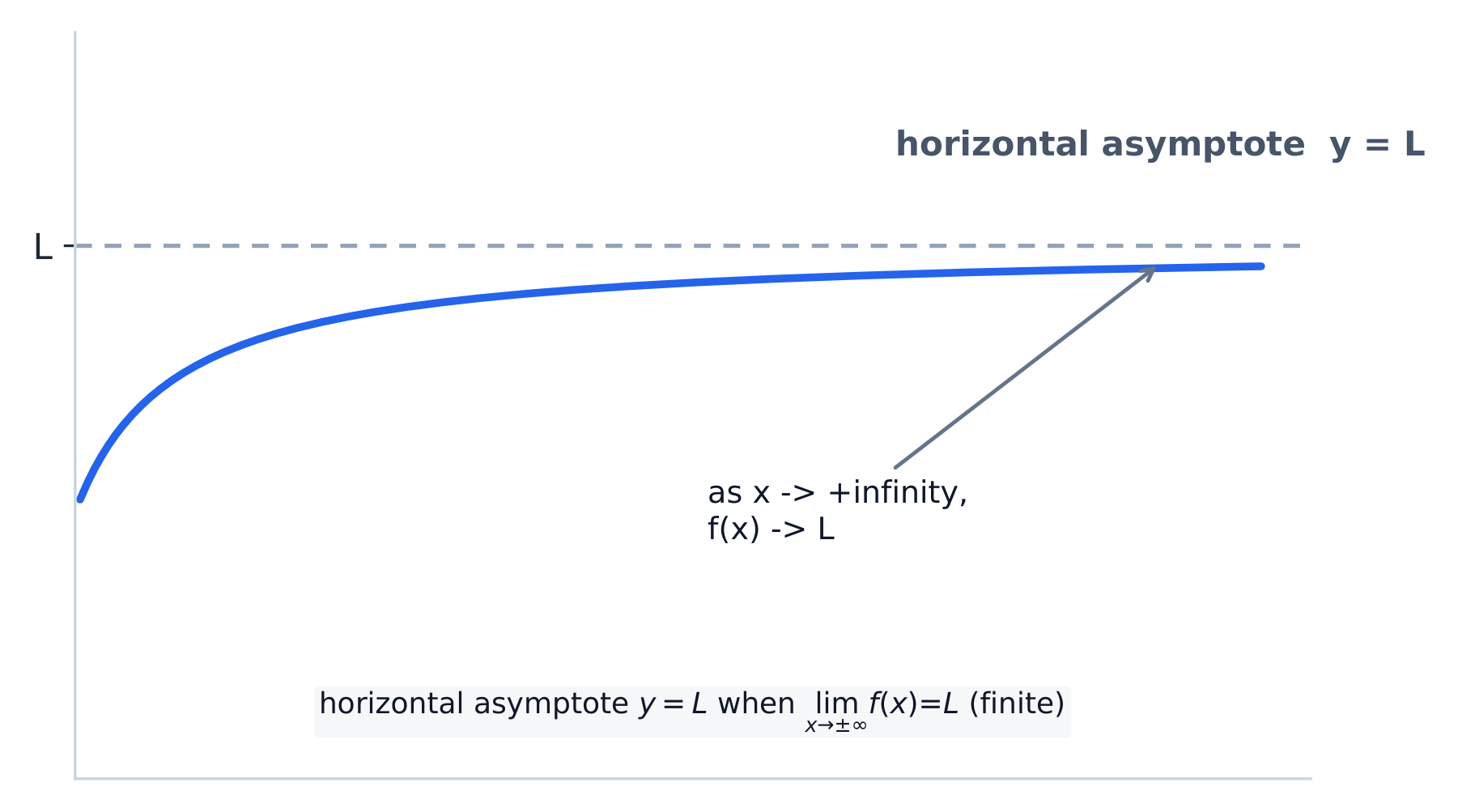
    We can also let the input grow: limits at infinity 无穷远处的极限 describe the end behavior 末端行为 of a function as $x\to\pm\infty$. If the outputs settle toward a finite value $L$, then $y=L$ is a horizontal asymptote 水平渐近线.

    A limit at infinity: as x grows the outputs settle toward a horizontal asymptote y = L
    As $x\to+\infty$ the curve flattens toward the line $y=L$. The horizontal asymptote records this end behavior.

    For a rational function, compare the degrees 次数 of the top and bottom:

    • top degree < bottom degree $\Rightarrow$ limit is $0$ (asymptote $y=0$);
    • top degree = bottom degree $\Rightarrow$ limit is the ratio of the leading coefficients 首项系数之比;
    • top degree > bottom degree $\Rightarrow$ the function is unbounded (no horizontal asymptote).

    More generally, we compare the relative magnitudes 相对大小 (relative growth rates) of functions: far out, an exponential beats any polynomial, and a polynomial beats any logarithm. On the exam, "as $t\to\infty$, which quantity is larger/where does the rate settle?" is answered with a limit at infinity.

    Explore · ⁨חקור⁩

    Explore limits at infinity and horizontal asymptotes · ⁨חקרו גבולות באינסוף ואסימפטוטות אופקיות⁩

    y = a/(x − b) + c

    Follow the curve far out to the right and left. As $x\to\pm\infty$ the outputs settle toward $c$, so $y=c$ is a horizontal asymptote — the finite value of the limit at infinity. · ⁨עקבו אחרי העקומה רחוק ימינה ושמאלה. כאשר $x\to\pm\infty$, הפלטות מתייצבות לעבר $c$, ולכן $y=c$ היא אסימפטוטה אופקית — הערך הסופי של הגבול באינסוף.⁩

    Vocabulary · ⁨מילון מונחים⁩ Train · ⁨אימון⁩
    English עברית
    limits at infinity/ˈlɪmɪts æt ɪnˈfɪnɪti/ גבולים באינסוף
    end behavior/end bɪˈheɪvjə/ התנהגות בקצוות
    horizontal asymptote/ˌhɒrɪˈzɒntl ˈæsɪmptəʊt/ אסימפטורה אופקית
    degrees/dɪˈɡriːz/ מעלות
    ratio of the leading coefficients/ˈreɪʃɪəʊ ɒvðə ˈliːdɪŋ ˌkəʊɪˈfɪʃənts/ יחס המקדמים המובילים
    relative magnitudes/ˈrelətɪv ˈmæɡnɪtjuːdz/ גודלים יחסיים
    1.16

    Working with the Intermediate Value Theorem (IVT)

    Syllabus · ⁨סיילבוס⁩
    Enduring UnderstandingLearning ObjectiveEssential Knowledge

    FUN-1
    Existence theorems allow us to draw conclusions about a function's behavior on an interval without precisely locating that behavior.

    FUN-1.A
    Explain the behavior of a function on an interval using the Intermediate Value Theorem.

    • FUN-1.A.1 If $f$ is a continuous function on the closed interval $[a, b]$ and $d$ is a number between $f(a)$ and $f(b)$, then the Intermediate Value Theorem guarantees that there is at least one number $c$ between $a$ and $b$, such that $f(c) = d$.

    Source: College Board AP Course and Exam Description · ⁨מקור: תיאור הקורס והמבחן של College Board AP⁩

    The Intermediate Value Theorem 介值定理 is an existence theorem 存在性定理 – it guarantees a value exists without telling you where:

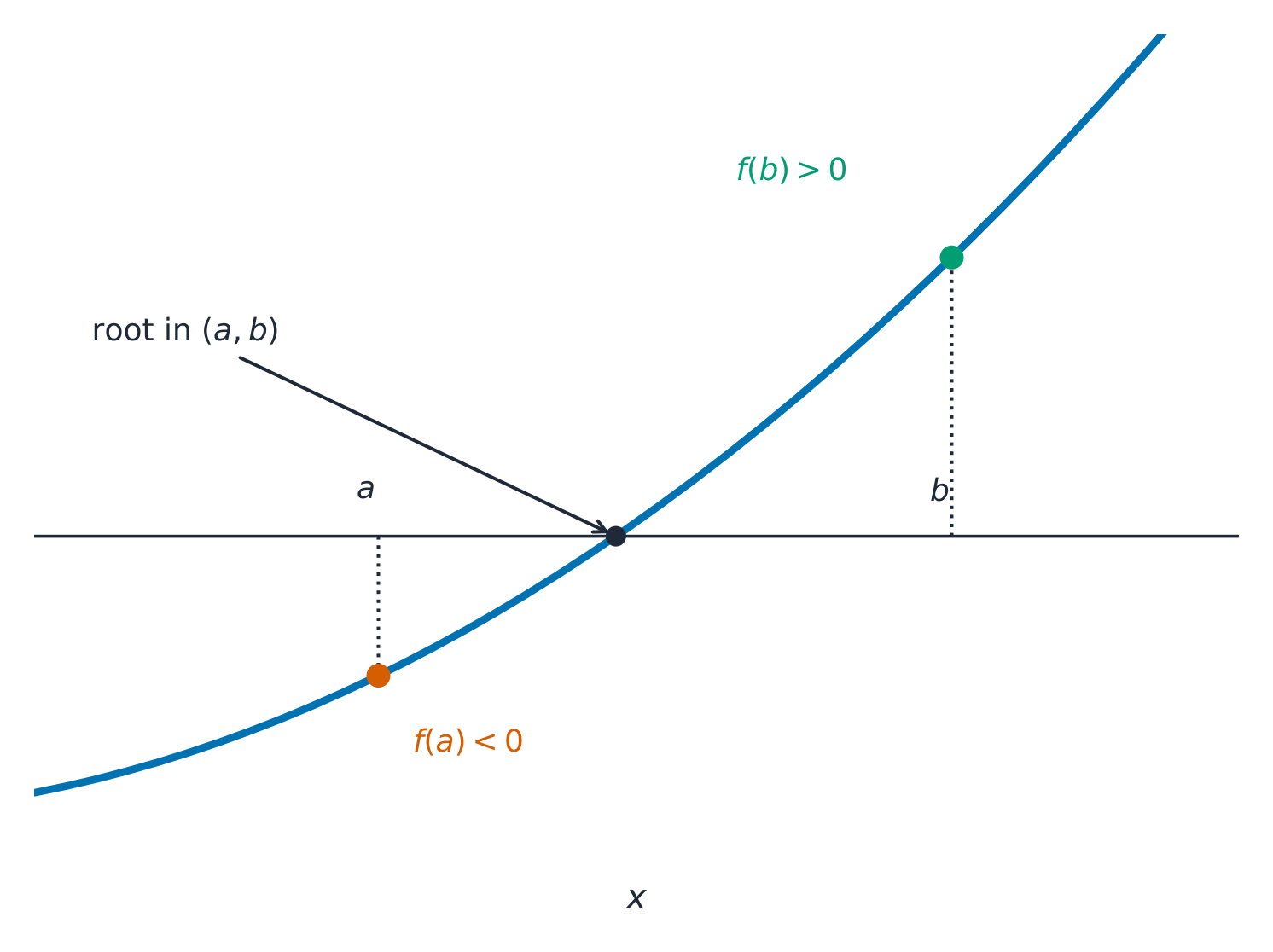
    Opposite signs of f(a) and f(b) trap a root between a and b
    Opposite signs of f(a) and f(b) trap a root between a and b

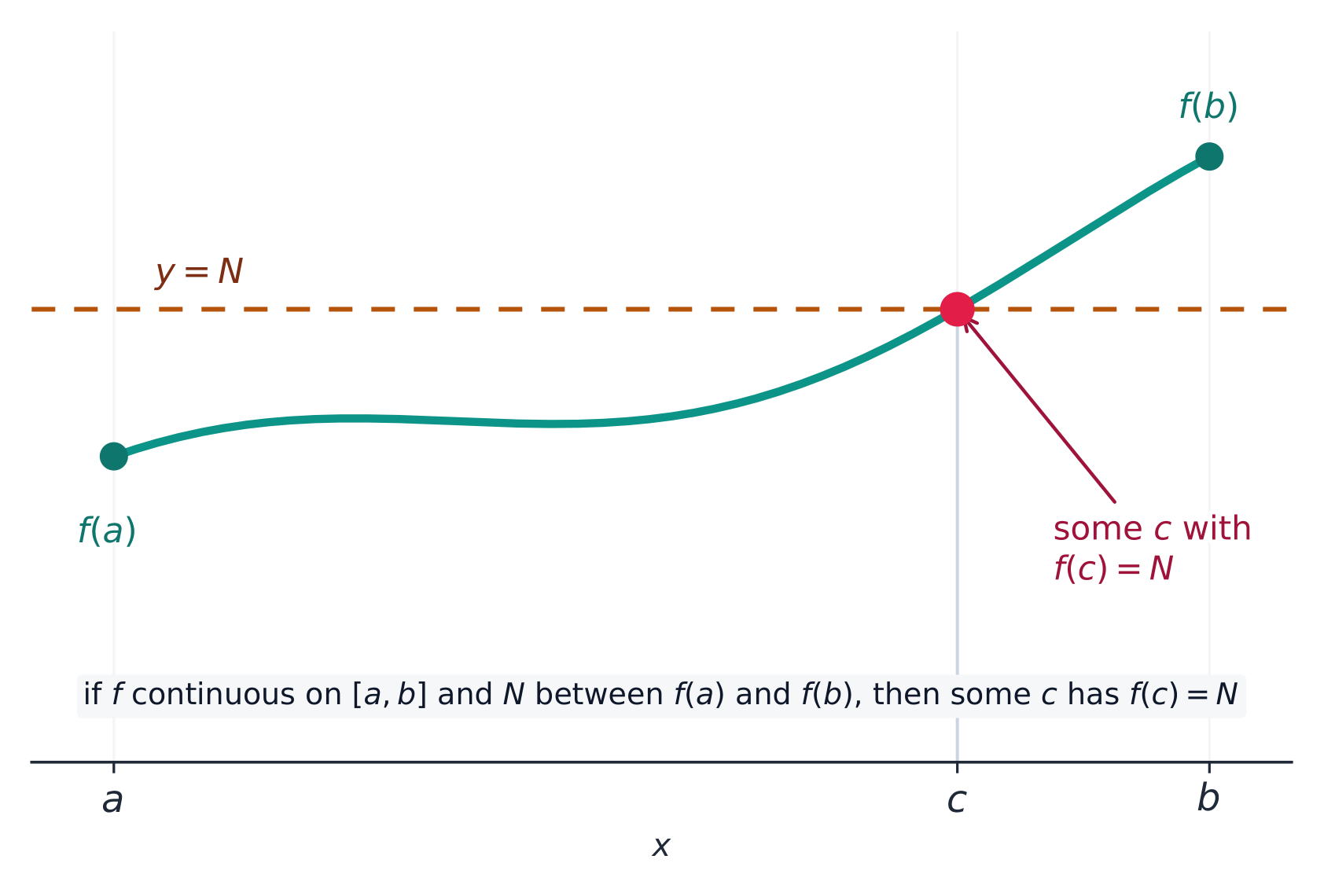
    If $f$ is continuous on the closed interval $[a,b]$, and $d$ is any number between $f(a)$ and $f(b)$, then there is at least one number $c$ in $(a,b)$ with $f(c)=d$.

    An unbroken curve cannot skip a height between its endpoints – it must pass through every one.

    The Intermediate Value Theorem: a continuous curve hits every height between f(a) and f(b)
    A continuous curve from $(a,f(a))$ to $(b,f(b))$ must cross every height $d$ in between at least once.

    Exam skill – how to justify with the IVT. These questions appear almost every year (for example, "Must there be a value $c$ with $R(c)=155$?" or "Is there a time when $r'(t)=-6$?"). A full-credit justification has three moves:

    1. State continuity. Say the function is continuous on $[a,b]$ (often because it is differentiable, or given continuous).
    2. Show $d$ is trapped. Compute the two endpoint values and show the target $d$ lies between them, e.g. $f(a) < d < f(b)$.
    3. Conclude by name. "By the Intermediate Value Theorem, there is a $c$ in $(a,b)$ with $f(c)=d$."

    Skipping the continuity statement, or not showing $d$ is between the endpoints, loses the point – the theorem requires both conditions.

    Worked example. Evaluate $\lim_{x\to 3}\dfrac{x^2-9}{x-3}$. Direct substitution gives $\tfrac{0}{0}$ (indeterminate), so factor: $\dfrac{(x-3)(x+3)}{x-3}=x+3$ for $x\ne 3$. Then $\lim_{x\to 3}(x+3)=6$. The graph has a removable discontinuity (a hole) at $x=3$ — the limit exists even though the function is undefined there.

    Explore · ⁨חקור⁩

    Why a continuous curve can't skip a value · ⁨למה כיפה רציפה לא יכולה לדלג על ערך⁩

    y = ax³ + bx² + cx + d

    The Intermediate Value Theorem: a function continuous on $[a,b]$ takes every $y$ between $f(a)$ and $f(b)$ at some point inside. An unbroken curve cannot leap over a height — it must pass through it. · ⁨משפט הערך הביניים: פונקציה רציפה על $[a,b]$ לוקחת כל ערך בין $y$ בין $f(a)$ לבין $f(b)$ בנקודה כלשהי בפנים. עקומה רציפה לא יכולה לקפוץ מעל גובה — היא חייבת לעבור דרכו.⁩

    Vocabulary · ⁨מילון מונחים⁩ Train · ⁨אימון⁩
    English עברית
    Intermediate Value Theorem/ˌɪntəˈmiːdɪət ˈvæljuː ˈθɪərəm/ משער הערכים האמצעיים
    existence theorem/eɡˈzɪstəns ˈθɪərəm/ משפט קיום
    1.16

    Exam tips

    • A limit describes what $f(x)$ approaches, which need not equal $f(a)$ — the two-sided limit exists only if both sides agree.
    • Try direct substitution first; for a $\tfrac00$ form, factor and cancel or rationalise before substituting.
    • A function is continuous at $a$ when the limit exists, $f(a)$ is defined, and they are equal.
    • Use the Intermediate Value Theorem to guarantee a root: a continuous function that changes sign on $[a,b]$ takes every value between.
    • Read horizontal asymptotes from end behaviour (limits at $\pm\infty$) and vertical asymptotes where the denominator (not the numerator) is zero.
  • 2

    Differentiation: Definition and Fundamental Properties · ⁨גזירה: הגדרה ומאפיינים בסיסיים⁩

    Watch lesson · ⁨צפה בשיעור⁩
    2.1

    Average and Instantaneous Rates of Change · ⁨קצבי שינוי ממוצע ורגעי⁩

    Syllabus · ⁨סיילבוס⁩
    English

    Enduring Understanding (CHA-2): Derivatives allow us to determine rates of change at an instant by applying limits to knowledge about rates of change over intervals.

    Learning Objective CHA-2.A: Determine average rates of change using difference quotients.

    • CHA-2.A.1 The difference quotients $\dfrac{f(a+h)-f(a)}{h}$ and $\dfrac{f(x)-f(a)}{x-a}$ express the average rate of change of a function over an interval.

    Learning Objective CHA-2.B: Represent the derivative of a function as the limit of a difference quotient.

    • CHA-2.B.1 The instantaneous rate of change of a function at $x=a$ can be expressed by $\lim\limits_{h\to 0}\dfrac{f(a+h)-f(a)}{h}$ or $\lim\limits_{x\to a}\dfrac{f(x)-f(a)}{x-a}$, provided the limit exists. These are equivalent forms of the definition of the derivative and are denoted $f'(a)$.
    עברית

    הבנה עומדת (CHA-2): נגזרות מאפשרות לנו לקבוע קצבי שינוי ברגע נתון על ידי יישום גבולות על ידע אודות קצבי שינוי בתחומים.

    מטרת לימוד CHA-2.A: קביעת קצבי שינוי ממוצע באמצעות מנת ההפרש.

    • CHA-2.A.1 מנות ההפרש $\dfrac{f(a+h)-f(a)}{h}$ ו$\dfrac{f(x)-f(a)}{x-a}$ מבטאות את קצב השינוי הממוצע של פונקציה בתחום.

    מטרת לימוד CHA-2.B: היצוג הנגזרת של פונקציה כגבול של מנת ההפרש.

    • CHA-2.B.1 קצב השינוי הרגעי של פונקציה ב$x=a$ ניתן לבטא על ידי $\lim\limits_{h\to 0}\dfrac{f(a+h)-f(a)}{h}$ או $\lim\limits_{x\to a}\dfrac{f(x)-f(a)}{x-a}$, בהנחה שהגבול קיים. אלו הן צורות שקולות להגדרת הנגזרה ומסומנות כ$f'(a)$.

    Source: College Board AP Course and Exam Description · ⁨מקור: תיאור הקורס והמבחן של College Board AP⁩

    English
    The derivative from first principles

    Unit 1 built the limit. Unit 2 uses it to define the derivative 导数 – the exact rate of change at a point.

    Over an interval, the average rate of change is a difference quotient 差商. Two equivalent forms appear:

    $$\frac{f(a+h)-f(a)}{h} \qquad\text{and}\qquad \frac{f(x)-f(a)}{x-a}.$$
    The first uses a step of size $h$ from $a$; the second uses two points $x$ and $a$. Both compute $\dfrac{\text{change in output}}{\text{change in input}}$ over the interval.

    The instantaneous 瞬时 rate of change at $x=a$ is what the difference quotient approaches as the interval shrinks to zero. This limit is the derivative at $a$, written $f'(a)$:

    $$f'(a) = \lim_{h\to 0}\frac{f(a+h)-f(a)}{h} = \lim_{x\to a}\frac{f(x)-f(a)}{x-a},$$
    provided the limit exists.

    עברית
    רוכבת הרים במעלה גבעה: הנגזרת מדד את קצב השינוי הרגעי של המיקום
    רוכבת הרים במעלה גבעה: הנגזרת מדד את קצב השינוי הרגעי של המיקום
    הנגזרת מעקרונות ראשונים

    יחידה 1 בנתה את הגבול. יחידה 2 משתמשת בו כדי להגדיר את ה-נגזרת – קצב השינוי המדויק בנקודה.

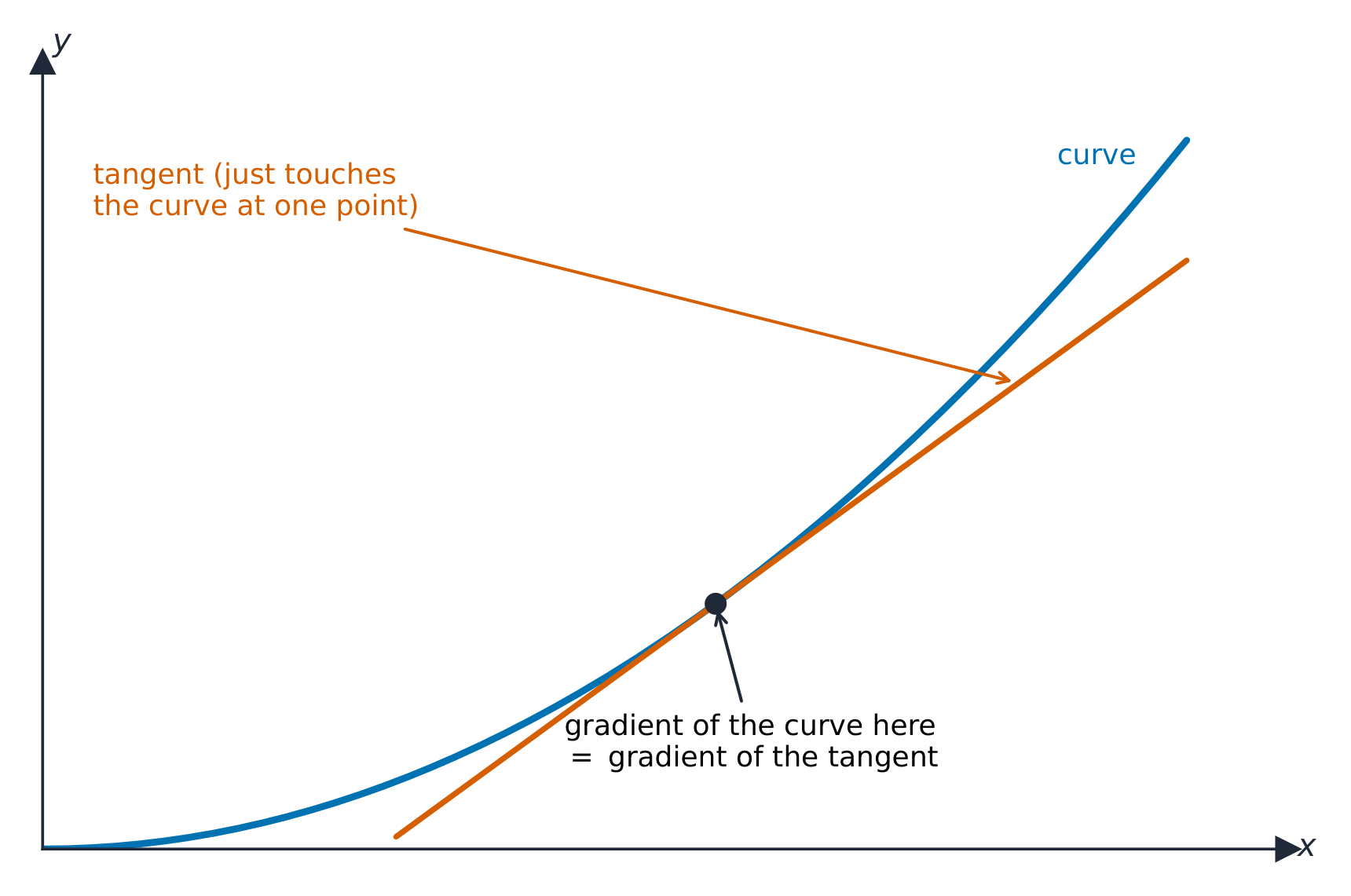
    קצב השינוי הרגעי הוא שיפוע המשיק בנקודה
    קצב השינוי הרגעי הוא שיפוע המשיק בנקודה

    על פני מרווח, קצב השינוי הממוצע הוא מנה הפרשים. מופיעים שני צורות שקולות:

    $$\frac{f(a+h)-f(a)}{h} \qquad\text{and}\qquad \frac{f(x)-f(a)}{x-a}.$$
    הראשונה משתמשת בצעד בגודל $h$ מ-$a$; השנייה משתמשת בשתי נקודות $x$ ו-$a$. שתיהן מחשבות את $\dfrac{\text{change in output}}{\text{change in input}}$ על פני המרווח.

    קצב השינוי הרגעי בנקודה $x=a$ הוא לעבר מהו מנה ההפרשים כשהמרווח מתכווץ לאפס. גבול זה הוא הנגזרת בנקודה $a$, הכתובה $f'(a)$:

    $$f'(a) = \lim_{h\to 0}\frac{f(a+h)-f(a)}{h} = \lim_{x\to a}\frac{f(x)-f(a)}{x-a},$$
    בהנחה שהגבול קיים.

    Explore · ⁨חקור⁩

    From average rate to instantaneous rate · ⁨מקצב ממוצע למקצב מיידי⁩

    y = ax³ + bx² + cx + d

    Slide the point: the secant through two nearby points tips toward the tangent as they merge. The tangent's slope is the derivative — the instantaneous rate of change. · ⁨זז את הנקודה: המיתר העובר דרך שתי נקודות קרובות נוטה למשיק כשהן מתמזגות. שיפוע המשיק הוא הנגזרת — המקצב המיידי של השינוי.⁩

    Vocabulary · ⁨מילון מונחים⁩ Train · ⁨אימון⁩
    English עברית
    derivative/dɪˈrɪvətɪv/ נגזרת
    difference quotient/ˈdɪfrəns ˈkwəʊʃənt/ מנת ההפרש
    instantaneous/ˌɪnstənˈteɪnɪəs/ תנאי מיידי
    first principles/fɜːst ˈprɪnsɪplz/ הגדרות בסיסיות
    notations/nəʊˈteɪʃnz/ סמנויות
    slope/sləʊp/ שיפוע
    tangent line/ˈtændʒənt laɪn/ משיק
    2.2

    Defining the Derivative and Its Notation · ⁨הגדרת הנגזרת וסימניה⁩

    Syllabus · ⁨סיילבוס⁩
    English

    Enduring Understanding (CHA-2): Derivatives allow us to determine rates of change at an instant by applying limits to knowledge about rates of change over intervals.

    Learning Objective CHA-2.B: Represent the derivative of a function as the limit of a difference quotient.

    • CHA-2.B.2 The derivative of $f$ is the function whose value at $x$ is $\lim\limits_{h\to 0}\dfrac{f(x+h)-f(x)}{h}$, provided this limit exists.
    • CHA-2.B.3 For $y=f(x)$, notations for the derivative include $\dfrac{dy}{dx}$, $f'(x)$, and $y'$.
    • CHA-2.B.4 The derivative can be represented graphically, numerically, analytically, and verbally.

    Learning Objective CHA-2.C: Determine the equation of a line tangent to a curve at a given point.

    • CHA-2.C.1 The derivative of a function at a point is the slope of the line tangent to a graph of the function at that point.
    עברית

    הבנה עומדת (CHA-2): נגזרות מאפשרות לנו לקבוע קצבי שינוי ברגע נתון על ידי יישום גבולות על ידע אודות קצבי שינוי בתחומים.

    מטרת לימוד CHA-2.B: היצוג הנגזרת של פונקציה כגבול של מנת ההפרש.

    • CHA-2.B.2 הנגזרת של $f$ היא הפונקציה שערךה ב$x$ הוא $\lim\limits_{h\to 0}\dfrac{f(x+h)-f(x)}{h}$, בתנאי שהגבול קיים.
    • CHA-2.B.3 עבור $y=f(x)$, סימוני הנגזרת כוללים $\dfrac{dy}{dx}$, $f'(x)$ ו$y'$.
    • CHA-2.B.4 לנגזרת יש ייצוג גרפי, מספרי, אנליטי ובעל מילוליות.

    מטרה לימודית CHA-2.C: קביעת משוואת הקו המשיק לעקומה בנקודה נתונה.

    • CHA-2.C.1 הנגזרת של פונקציה בנקודה היא השיפוע של הקו המשי לגרף הפונקציה בנקודה זו.

    Source: College Board AP Course and Exam Description · ⁨מקור: תיאור הקורס והמבחן של College Board AP⁩

    English

    Let the point $a$ vary and the derivative becomes a new function:

    $$f'(x) = \lim_{h\to 0}\frac{f(x+h)-f(x)}{h}.$$
    This is the definition of the derivative (sometimes called differentiating "by first principles" 用定义求导). Its value at each $x$ is the instantaneous rate of change there.

    Common notations 记号 for the derivative of $y=f(x)$ are:

    $$\frac{dy}{dx}, \qquad f'(x), \qquad y'.$$
    The derivative can be represented graphically, numerically, analytically, and verbally – be ready to move between them.

    Geometric meaning. The derivative at a point is the slope 斜率 of the tangent line 切线 to the graph there. So the tangent line at $x=a$ passes through $\big(a, f(a)\big)$ with slope $f'(a)$:

    $$y - f(a) = f'(a)\,(x-a).$$
    Writing this line is a routine exam task, so keep the point-slope form ready.

    עברית

    תן לנקודה $a$ להשתנות והנגזרת הופכת ל-פונקציה חדשה:

    $$f'(x) = \lim_{h\to 0}\frac{f(x+h)-f(x)}{h}.$$
    זוהי ההגדרה של הנגזרת (לעיתים מכונה "דיפרנציאלציה מעקרונות ראשונים"). הערך שלה בכל $x$ הוא קצב השינוי הרגעי שם.

    סימונים נפוצים לנגזרת של $y=f(x)$ הם:

    $$\frac{dy}{dx}, \qquad f'(x), \qquad y'.$$
    את הנגזרת ניתן לייצג גרפית, מספרית, אנליטית ובמילים – היכן שאתה מוכן לעבור ביניהן.

    משמעות גיאומטרית. הנגזרת בנקודה היא השיפוע של המשיק לגרף שם. לכן המשיק ב$x=a$ עובר דרך $\big(a, f(a)\big)$ עם שיפוע $f'(a)$:

    $$y - f(a) = f'(a)\,(x-a).$$
    כתיבת משוואת קו זה היא משימה שוטפת במבחנים, ולכן יש להחזיק את צורת נקודה-שיפוע מוכנה.

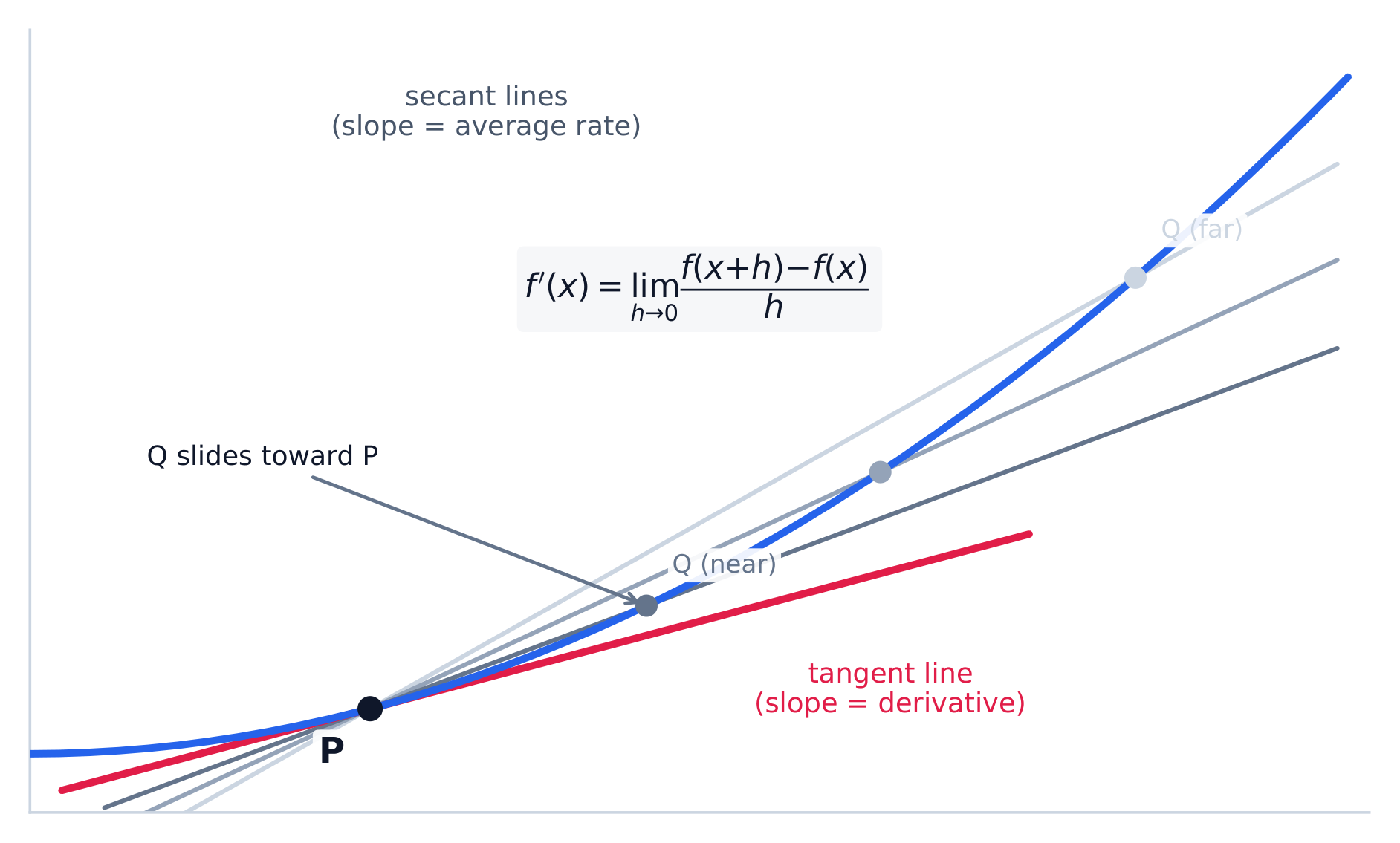
    שיפועי הסיבסטר נערכים לשיפוע המשיק: הנגזרת היא הגבול של קצבי התנודות
    כאשר $Q$ מחליק לעבר $P$, השיפוע של כל סיבסטר (שהוא קצב תנודות) מתקרב לשיפוע המשיק – הנגזרת $f'(a)$.
    2.3

    Estimating a Derivative at a Point · ⁨הערכת נגזרת בנקודה⁩

    Syllabus · ⁨סיילבוס⁩
    English

    Enduring Understanding (CHA-2): Derivatives allow us to determine rates of change at an instant by applying limits to knowledge about rates of change over intervals.

    Learning Objective CHA-2.D: Estimate derivatives.

    • CHA-2.D.1 The derivative at a point can be estimated from information given in tables or graphs.
    • CHA-2.D.2 Technology can be used to calculate or estimate the value of a derivative of a function at a point.
    עברית

    הבנה עומדת (CHA-2): נגזרות מאפשרות לנו לקבוע קצבי שינוי ברגע נתון על ידי יישום גבולות על ידע אודות קצבי שינוי בתחומים.

    מטרה לימודית CHA-2.D: הערכת נגזרות.

    • CHA-2.D.1 ניתן להעריך את הנגזרה בנקודה מתוך מידע הנתון בטבלאות או בגרפים.
    • CHA-2.D.2 ניתן להשתמש בטכנולוגיה לחישוב או להערכת ערך הנגזרה של פונקציה בנקודה.

    Source: College Board AP Course and Exam Description · ⁨מקור: תיאור הקורס והמבחן של College Board AP⁩

    English

    You do not always have a formula. When a function is given by a table 表格 or a graph, estimate the derivative $f'(a)$ with a difference quotient over a small interval around $a$. A table with values on both sides of $a$ gives the best estimate:

    $$f'(a) \approx \frac{f(b)-f(c)}{b-c},\qquad \text{where } c < a < b \text{ are the closest table inputs}.$$
    Technology (a calculator) can also estimate a derivative at a point.

    Exam skill (appears almost every year). Questions such as "Approximate $M'(7.5)$ using the average rate of change of $M$ over the interval $5 \le t \le 10$" ask for exactly this difference quotient. Show the setup:

    $$M'(7.5) \approx \frac{M(10)-M(5)}{10-5}.$$
    Full credit needs the numbers plugged in and the correct units 单位 (output units per input unit), since these come from real-world models.

    עברית

    לא תמיד יש לנו פורמולה. כאשר הפונקציה נתונה בטבלה או בגרף, ניתן להעריך את הנגזרת $f'(a)$ באמצעות מנת ההפרש על מרווח קטן סביב $a$. טבלה עם ערכים משני צדי $a$ מספקת את ההערכה הטובה ביותר:

    $$f'(a) \approx \frac{f(b)-f(c)}{b-c},\qquad \text{where } c < a < b \text{ are the closest table inputs}.$$
    טכנולוגיה (כמו מחשבון) יכולה גם היא להעריך נגזרת בנקודה.

    מיומנות למבחן (מופיעה כמעט בכל שנה). שאלות כמו "הערכו את $M'(7.5)$ באמצעות קצב התנודות הממוצע של $M$ על המרווח $5 \le t \le 10$" מבקשות בדיוק את מנת ההפרש הזו. הצגו את ההגדרה:

    $$M'(7.5) \approx \frac{M(10)-M(5)}{10-5}.$$
    קבלת ציון מלא דורשת החדלת המספרים וגם יחידות הנכונות (יחידות יציאה ליחידת כניסה), שכן אלו נובעות מדגמים בעולם האמיתי.

    Vocabulary · ⁨מילון מונחים⁩ Train · ⁨אימון⁩
    English עברית
    table/ˈteɪbl/ טבלה
    units/ˈjuːnɪts/ יחידות מידה
    differentiable/ˈdɪfərenʃɪəbl/ דיפרנציאלי
    continuous/kənˈtɪnjuːəs/ רציף
    corner/ˈkɔːnə/ פינה
    vertical tangent/ˈvɜːtɪkl ˈtændʒənt/ משיק אנכי
    power rule/ˈpaʊə ruːl/ כלל החזקות
    Constant multiple/ˈkɒnstənt ˈmʌltɪpl/ כפולה קבועה
    polynomial/ˌpɒlɪˈnəʊmɪəl/ פולינום
    2.4

    When Does a Derivative Exist? · ⁨מתי קיימת נגזרת?⁩

    Syllabus · ⁨סיילבוס⁩
    English

    Enduring Understanding (FUN-2): Recognizing that a function's derivative may also be a function allows us to develop knowledge about the related behaviors of both.

    Learning Objective FUN-2.A: Explain the relationship between differentiability and continuity.

    • FUN-2.A.1 If a function is differentiable at a point, then it is continuous at that point. In particular, if a point is not in the domain of $f$, then it is not in the domain of $f'$.
    • FUN-2.A.2 A continuous function may fail to be differentiable at a point in its domain.
      • Illustrative examples for FUN-2.A.2:
        • The left hand and right hand limits of the difference quotient are not equal, as in $f(x)=|x|$ at $x=0$.
        • The tangent line is vertical and has no slope, as in $f(x)=\sqrt[3]{x}$ at $x=0$.
    עברית

    הבנה מתמשכת (FUN-2): ההבנה כי נגזרת של פונקציה יכולה להיות גם כן פונקציה מאפשרת לנו לפתח ידע על התנהגויות הקשורות של שניהם.

    מטרה לימודית FUN-2.A: הסבר על הקשר בין תכללות לקטינות.

    • FUN-2.A.1 אם פונקציה תכלילה בנקודה, אזי היא רציפה בנקודה זו. במיוחד, אם נקודה אינה שייכת לתחום ההגדרה של $f$, היא אינה שייכת לתחום ההגדרה של $f'$.
    • FUN-2.A.2 פונקציה רציפה עשויה לא להיות תכלילה בנקודה בתחום ההגדרה שלה.
      • דוגמאות מדגמיים ל-FUN-2.A.2:
        • הגבול השמאלי והגבול הימני של מנה ההפרש אינם שווים, כמו ב$f(x)=|x|$ ב$x=0$.
        • הקו המשי אנכי ואינו בעל שיפוע, כמו ב$f(x)=\sqrt[3]{x}$ ב$x=0$.

    Source: College Board AP Course and Exam Description · ⁨מקור: תיאור הקורס והמבחן של College Board AP⁩

    English

    Differentiability is stronger than continuity. The key relationship:

    If $f$ is differentiable 可导 at a point, then $f$ is continuous 连续 there.

    So differentiability implies continuity. The reverse is false: a continuous function can fail to be differentiable. Two ways this happens:

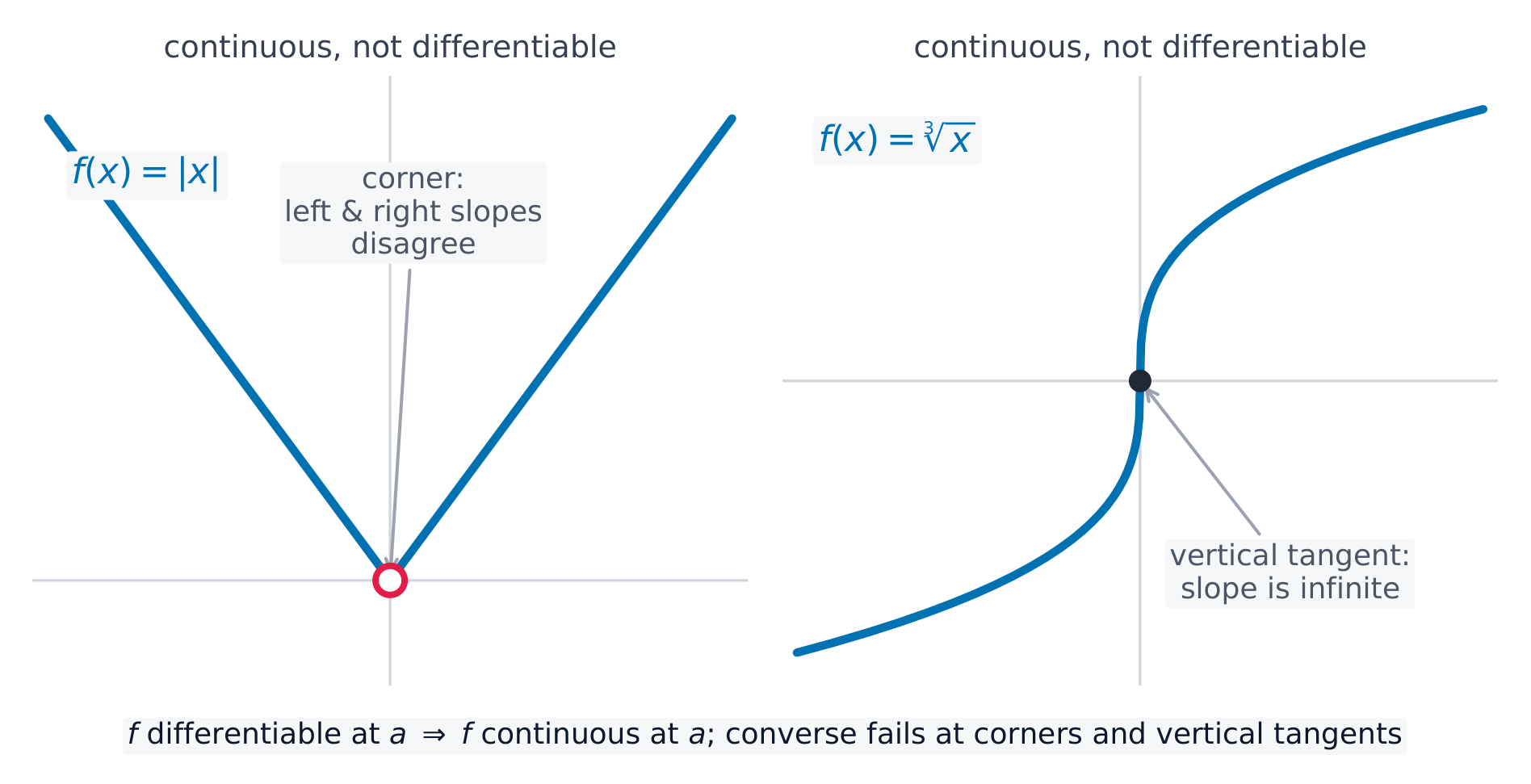
    • A corner 尖点: the left and right difference-quotient limits disagree, as with $f(x)=|x|$ at $x=0$.
    • A vertical tangent 垂直切线: the slope is infinite (no real number), as with $f(x)=\sqrt[3]{x}$ at $x=0$.

    Also, a point outside the domain of $f$ cannot be in the domain of $f'$. Use the contrapositive on the exam: if $f$ is not continuous at $a$, then $f$ is not differentiable at $a$.

    עברית

    נגזרות חזקה יותר מרציפות. הקשר המרכזי:

    אם $f$ נגזרת בנקודה, אזי $f$ רציפה שם.

    לכן נגזרות מ imply רציפות. ההפך אינו נכון: פונקציה רציפה עשויה לא להיות נגזרת. שתי דרכים לכך:

    • פינה: גבולות מנות ההפרש מימין ומשמאל אינם תואמים, כפי שקורה עם $f(x)=|x|$ ב$x=0$.
    • משיק אנכי: השיפוע הוא אינסופי (אין מספר ממשי), כפי שקורה עם $f(x)=\sqrt[3]{x}$ ב$x=0$.
    שתי דרכים שבהן פונקציה רציפה אינה נגזרת: פינה ומשיק אנכי
    שתי דרכים שבהן פונקציה רציפה אינה נגזרת: פינה ומשיק אנכי

    כמו כן, נקודה מחוץ לתחום ההגדרה של $f$ לא יכולה להיות בתחום ההגדרה של $f'$. השתמש במשלל באמחן: אם $f$ אינה רציפה ב-$a$, אזי $f$ אינה נגזרת ב-$a$.

    2.5

    The Power Rule · ⁨חוק החזקות⁩

    Syllabus · ⁨סיילבוס⁩
    English

    Enduring Understanding (FUN-3): Recognizing opportunities to apply derivative rules can simplify differentiation.

    Learning Objective FUN-3.A: Calculate derivatives of familiar functions.

    • FUN-3.A.1 Direct application of the definition of the derivative and specific rules can be used to calculate the derivative for functions of the form $f(x)=x^{r}$.
    עברית

    הבנה עומדת (FUN-3): זיהוי הזדמנויות ליישום כללי נגזירות יכול לפשט תהליך הנגזור.

    מטרה לימודית FUN-3.A: חישוב נגזרות של פונקציות מוכרות.

    • FUN-3.A.1 ניתן להשתמש בהגדרה הישירה של הנגזרת ובחוקי נגזרה ספציפיים כדי לחשב את הנגזר של פונקציות מהצורה $f(x)=x^{r}$.

    Source: College Board AP Course and Exam Description · ⁨מקור: תיאור הקורס והמבחן של College Board AP⁩

    English

    From here we use rules instead of the limit definition each time. The power rule 幂法则 handles any power of $x$:

    $$\frac{d}{dx}\,x^{r} = r\,x^{\,r-1}\qquad\text{for any real } r.$$
    It works for whole-number powers, negative powers ($\tfrac{1}{x}=x^{-1}$), and roots ($\sqrt{x}=x^{1/2}$) – rewrite as a power first, then apply the rule.

    עברית

    מהשלב הזה אנו משתמשים ב-כללים במקום בהגדרת הגבול בכל פעם. כלל החזקה מטפל בכל חזקה של $x$:

    $$\frac{d}{dx}\,x^{r} = r\,x^{\,r-1}\qquad\text{for any real } r.$$
    הנוסחה פועלת עבור חזקות של מספרים שלמים, חזקות שליליות ($\tfrac{1}{x}=x^{-1}$), ושורשים ($\sqrt{x}=x^{1/2}$) – יש לכתוב תחילה כחזקה ולאחר מכן להחיל את הכלל.

    Explore · ⁨חקור⁩

    A power function and its steepening slope · ⁨פונקציית חזקה ומשיקה מתחדדת⁩

    y = ax³ + bx² + cx + d

    The power rule $\frac{d}{dx}x^n = nx^{n-1}$ drops the exponent as a factor. For $x^3$ the slope grows quickly as $x$ moves from 0 — the curve steepens. · ⁨כלל החזקות $\frac{d}{dx}x^n = nx^{n-1}$ מוריד את המעלה כגורם. עבור $x^3$ השיפוע גדל במהירות ככל ש-$x$ זז מ-0 — הכיפה הופכת לתלולה יותר.⁩

    2.6

    Constant, Sum, Difference, and Constant Multiple Rules · ⁨כללי קבוע, סכום, הפרש והכפלה בקבוע⁩

    Syllabus · ⁨סיילבוס⁩
    English

    Enduring Understanding (FUN-3): Recognizing opportunities to apply derivative rules can simplify differentiation.

    Learning Objective FUN-3.A: Calculate derivatives of familiar functions.

    • FUN-3.A.2 Sums, differences, and constant multiples of functions can be differentiated using derivative rules.
    • FUN-3.A.3 The power rule combined with sum, difference, and constant multiple properties can be used to find the derivatives for polynomial functions.
    עברית

    הבנה עומדת (FUN-3): זיהוי הזדמנויות ליישום כללי נגזירות יכול לפשט תהליך הנגזור.

    מטרה לימודית FUN-3.A: חישוב נגזרות של פונקציות מוכרות.

    • FUN-3.A.2 ניתן לגזור סכומים, הפרשים וכפילות בקבוע של פונקציות באמצעות חוקי נגזרה.
    • FUN-3.A.3 ניתן להשתמש בחוק החזקה בשילוב עם תכונות הסכום, ההפרש והכפילה בקבוע כדי למצוא את הנגזרים של פונקציות פולינומיות.

    Source: College Board AP Course and Exam Description · ⁨מקור: תיאור הקורס והמבחן של College Board AP⁩

    English

    These rules let you differentiate term by term:

    • Constant: $\dfrac{d}{dx}\,k = 0$ (a constant does not change).
    • Constant multiple 常数倍: $\dfrac{d}{dx}\big[k\,f(x)\big] = k\,f'(x)$.
    • Sum / difference: $\dfrac{d}{dx}\big[f(x)\pm g(x)\big] = f'(x)\pm g'(x)$.

    Combined with the power rule, they differentiate any polynomial 多项式 term by term. Example:

    $$\frac{d}{dx}\big(4x^3 - 5x + 7\big) = 12x^2 - 5.$$

    עברית

    כללים אלו מאפשרים לך לגזור איבר-איבר:

    • קבוע: $\dfrac{d}{dx}\,k = 0$ (קבוע אינו משתנה).
    • כפולה בקבוע: $\dfrac{d}{dx}\big[k\,f(x)\big] = k\,f'(x)$.
    • סכום / הפרש: $\dfrac{d}{dx}\big[f(x)\pm g(x)\big] = f'(x)\pm g'(x)$.

    בשילוב עם כלל החזקה, הם מגזרים כל איבר פולינומי איבר-איבר. לדוגמה:

    $$\frac{d}{dx}\big(4x^3 - 5x + 7\big) = 12x^2 - 5.$$

    2.7

    Derivatives of sin x, cos x, e^x, and ln x · ⁨גזירות של sin x, cos x, e^x ו- ln x⁩

    Syllabus · ⁨סיילבוס⁩
    English

    Enduring Understanding (FUN-3): Recognizing opportunities to apply derivative rules can simplify differentiation.

    Learning Objective FUN-3.A: Calculate derivatives of familiar functions.

    • FUN-3.A.4 Specific rules can be used to find the derivatives for sine, cosine, exponential, and logarithmic functions.

    Enduring Understanding (LIM-3): Reasoning with definitions, theorems, and properties can be used to determine a limit.

    Learning Objective LIM-3.A: Interpret a limit as a definition of a derivative.

    • LIM-3.A.1 In some cases, recognizing an expression for the definition of the derivative of a function whose derivative is known offers a strategy for determining a limit.
    עברית

    הבנה עומדת (FUN-3): זיהוי הזדמנויות ליישום כללי נגזירות יכול לפשט תהליך הנגזור.

    מטרה לימודית FUN-3.A: חישוב נגזרות של פונקציות מוכרות.

    • FUN-3.A.4 ניתן להשתמש בחוקי נגזרה ספציפיים כדי למצוא את הנגזרים של פונקציות סינוס, קוסינוס, אקספוננציאליות ולוגריתמיות.

    הבנה מתמשכת (LIM-3): ניתן להשתמש במסקרים, משפטים וחוקים כדי לקבוע גבול.

    מטרת לימוד LIM-3.A: לפרש גבול כהגדרה של נגזר.

    • LIM-3.A.1 במקרים מסוימים, זיהוי ביטוי המייצג הגדרת הנגזר של פונקציה שנגזרה שלה ידועה מציע אסטרטגיה לקביעת גבול.

    Source: College Board AP Course and Exam Description · ⁨מקור: תיאור הקורס והמבחן של College Board AP⁩

    English

    Learn these four building-block derivatives by heart:

    $$\frac{d}{dx}\sin x = \cos x, \qquad \frac{d}{dx}\cos x = -\sin x,$$
    $$\frac{d}{dx}e^{x} = e^{x}, \qquad \frac{d}{dx}\ln x = \frac{1}{x}\ \ (x>0).$$
    Note the minus sign on the derivative of cosine, and that $e^{x}$ is its own derivative.

    A limit that is really a derivative (LIM-3.A.1). Sometimes a limit is secretly the definition of a known derivative. If you recognize

    $$\lim_{h\to 0}\frac{f(a+h)-f(a)}{h}$$
    for a function $f$ whose derivative you know, just evaluate $f'(a)$. For example, $\displaystyle \lim_{h\to 0}\frac{\sin\!\big(\tfrac{\pi}{2}+h\big)-1}{h} = \left.\frac{d}{dx}\sin x\right|_{x=\pi/2} = \cos\tfrac{\pi}{2} = 0$.

    עברית

    למד ארבע הגזרות הבסיסיות הללו בעל פה:

    $$\frac{d}{dx}\sin x = \cos x, \qquad \frac{d}{dx}\cos x = -\sin x,$$
    $$\frac{d}{dx}e^{x} = e^{x}, \qquad \frac{d}{dx}\ln x = \frac{1}{x}\ \ (x>0).$$
    שים לב לסימן הפחות בגזירה של קוסינוס, ולעובדה ש- $e^{x}$ היא גזירה עצמה.

    גבול שהוא למעשה גזירה (LIM-3.A.1). לעיתים גבול הוא בסוד ההגדרה של גזירה ידועה. אם תזהה

    $$\lim_{h\to 0}\frac{f(a+h)-f(a)}{h}$$
    עבור פונקציה $f$ שגזרתה אתה מכיר, פשוט חשב ערך $f'(a)$. לדוגמה, $\displaystyle \lim_{h\to 0}\frac{\sin\!\big(\tfrac{\pi}{2}+h\big)-1}{h} = \left.\frac{d}{dx}\sin x\right|_{x=\pi/2} = \cos\tfrac{\pi}{2} = 0$.

    Explore · ⁨חקור⁩

    The shape of sin x (whose slope is cos x) · ⁨צורת sin x (ששיפועה הוא cos x)⁩

    y = asin(bx + c) + d

    The derivative of $\sin x$ is $\cos x$: the slope of the sine curve is largest where sine crosses zero and zero at its peaks. Watch the curve to feel where its slope is steep or flat. · ⁨הנגזרת של $\sin x$ היא $\cos x$: שיפוע הכיפה של הסינוס גדול ביותר כאשר סינוס חוצה אפס ואפס בשיאיה. צפה בכיפה כדי להרגיש היכן השיפוע תלול או שטוח.⁩

    2.8

    The Product Rule · ⁨כלל המכפלה⁩

    Syllabus · ⁨סיילבוס⁩
    English

    Enduring Understanding (FUN-3): Recognizing opportunities to apply derivative rules can simplify differentiation.

    Learning Objective FUN-3.B: Calculate derivatives of products and quotients of differentiable functions.

    • FUN-3.B.1 Derivatives of products of differentiable functions can be found using the product rule.
    עברית

    הבנה עומדת (FUN-3): זיהוי הזדמנויות ליישום כללי נגזירות יכול לפשט תהליך הנגזור.

    מטרת לימוד FUN-3.B: חישוב נגזרות של מכפלות ומכסמים של פונקציות ניתנות לנגזור.

    • FUN-3.B.1 ניתן למצוא נגזרות של מכפלות של פונקציות הניתנות לגזירה באמצעות חוק המכפלה.

    Source: College Board AP Course and Exam Description · ⁨מקור: תיאור הקורס והמבחן של College Board AP⁩

    English
    The product rule as a growing rectangle

    A product of two functions is not differentiated by multiplying the derivatives. Use the product rule 乘积法则:

    $$\frac{d}{dx}\big[u\,v\big] = u'v + uv'.$$
    "Derivative of the first times the second, plus the first times the derivative of the second." Example:
    $$\frac{d}{dx}\big(x^2 e^{x}\big) = 2x\,e^{x} + x^2 e^{x}.$$
    Exam questions often build a new function from given pieces, e.g. $k'(x) = \big(f(x)\big)^2 g(x)$, and ask you to combine rules while reading values from a table.

    עברית
    כלל המכפלה כמלבן גדל

    מכפלה של שתי פונקציות לא מגוזרת על ידי כפל הגזרות. השתמש ב-כלל המכפלה:

    $$\frac{d}{dx}\big[u\,v\big] = u'v + uv'.$$
    "גזרת הראשונה כפול השנייה, פלוס הראשונה כפול גזרת השנייה." לדוגמה:
    $$\frac{d}{dx}\big(x^2 e^{x}\big) = 2x\,e^{x} + x^2 e^{x}.$$
    שאלות במבחנים בונות לעיתים פונקציה חדשה מחלקי נתונים, כמו $k'(x) = \big(f(x)\big)^2 g(x)$, ומבקשות ממך לשלב כללים תוך קריאת ערכים מטבלה.

    Vocabulary · ⁨מילון מונחים⁩ Train · ⁨אימון⁩
    English עברית
    product rule/ˈprɒdʌkt ruːl/ כלל המכפלה
    2.9

    The Quotient Rule · ⁨כלל המנה⁩

    Syllabus · ⁨סיילבוס⁩
    English

    Enduring Understanding (FUN-3): Recognizing opportunities to apply derivative rules can simplify differentiation.

    Learning Objective FUN-3.B: Calculate derivatives of products and quotients of differentiable functions.

    • FUN-3.B.2 Derivatives of quotients of differentiable functions can be found using the quotient rule.
    עברית

    הבנה עומדת (FUN-3): זיהוי הזדמנויות ליישום כללי נגזירות יכול לפשט תהליך הנגזור.

    מטרת לימוד FUN-3.B: חישוב נגזרות של מכפלות ומכסמים של פונקציות ניתנות לנגזור.

    • FUN-3.B.2 ניתן למצוא נגזרות של מנות של פונקציות הניתנות לגזירה באמצעות חוק המנה.

    Source: College Board AP Course and Exam Description · ⁨מקור: תיאור הקורס והמבחן של College Board AP⁩

    English

    For a quotient, use the quotient rule 商法则:

    $$\frac{d}{dx}\!\left[\frac{u}{v}\right] = \frac{u'v - uv'}{v^{2}}.$$
    "Bottom times derivative of top, minus top times derivative of bottom, all over bottom squared." The order matters because of the minus sign, so write the numerator carefully. Example:
    $$\frac{d}{dx}\!\left(\frac{x}{\cos x}\right) = \frac{1\cdot\cos x - x\cdot(-\sin x)}{\cos^2 x} = \frac{\cos x + x\sin x}{\cos^2 x}.$$

    עברית

    עבור מנה, השתמש ב-כלל המנה:

    $$\frac{d}{dx}\!\left[\frac{u}{v}\right] = \frac{u'v - uv'}{v^{2}}.$$
    "המכנה כפול גזרת המונה, מינוס המונה כפול גזרת המכנה, הכל חלקי המכנה בריבוע." הסדר חשוב בשל סימן הפחות, ולכן יש לכתוב את המונה בזהירות. לדוגמה:
    $$\frac{d}{dx}\!\left(\frac{x}{\cos x}\right) = \frac{1\cdot\cos x - x\cdot(-\sin x)}{\cos^2 x} = \frac{\cos x + x\sin x}{\cos^2 x}.$$

    2.10

    Derivatives of tan x, cot x, sec x, and csc x · ⁨נגזרות של tan x, cot x, sec x ו- csc x⁩

    Syllabus · ⁨סיילבוס⁩
    English

    Enduring Understanding (FUN-3): Recognizing opportunities to apply derivative rules can simplify differentiation.

    Learning Objective FUN-3.B: Calculate derivatives of products and quotients of differentiable functions.

    • FUN-3.B.3 Rearranging tangent, cotangent, secant, and cosecant functions using identities allows differentiation using derivative rules.
    עברית

    הבנה עומדת (FUN-3): זיהוי הזדמנויות ליישום כללי נגזירות יכול לפשט תהליך הנגזור.

    מטרת לימוד FUN-3.B: חישוב נגזרות של מכפלות ומכסמים של פונקציות ניתנות לנגזור.

    • FUN-3.B.3 עיבוד מחדש של פונקציות טנגנס, קוטנגנס, צ'קנטנס וקוסקנטנס באמצעות זהויות מאפשר נגזור באמצעות כללי נגזור.

    Source: College Board AP Course and Exam Description · ⁨מקור: תיאור הקורס והמבחן של College Board AP⁩

    English
    The quotient rule: differentiating a fraction

    The remaining trigonometric derivatives are not memorized separately – you rewrite them with identities 恒等式 and apply the quotient (or product) rule. For instance, $\tan x = \dfrac{\sin x}{\cos x}$, so the quotient rule gives

    $$\frac{d}{dx}\tan x = \frac{\cos x\cos x - \sin x(-\sin x)}{\cos^2 x} = \frac{1}{\cos^2 x} = \sec^2 x.$$
    The same method (writing $\cot x=\tfrac{\cos x}{\sin x}$, $\sec x=\tfrac{1}{\cos x}$, $\csc x=\tfrac{1}{\sin x}$) gives $-\csc^2 x$, $\sec x\tan x$, and $-\csc x\cot x$.

    Higher-order derivatives. Differentiating $f'$ again gives the second derivative 二阶导数 $f''(x)$ (or $\tfrac{d^2y}{dx^2}$) – the rate of change of the rate of change. An exam part like "Find $k''(3)$" just means differentiate twice, then substitute. You can also estimate a second derivative from a table by applying the average-rate-of-change method to the $f'$ values.

    Worked example. Differentiate $f(x)=x^2\sin x$ with the product rule $(uv)'=u'v+uv'$: take $u=x^2$ ($u'=2x$) and $v=\sin x$ ($v'=\cos x$), giving $f'(x)=2x\sin x+x^2\cos x$. Always read the structure first — a product needs the product rule, not the power rule applied to each factor separately.

    עברית
    כלל המנה: גזירה של שבר

    הנגזרות הטריגונומטריות הנותרות אינן נחשבות בנפרד – משתמשים בזהויות כדי לכתוב אותן מחדש ומיישמים את כלל המנה (או מכפלה). לדוגמה, $\tan x = \dfrac{\sin x}{\cos x}$, ולכן כלל המנה נותן

    $$\frac{d}{dx}\tan x = \frac{\cos x\cos x - \sin x(-\sin x)}{\cos^2 x} = \frac{1}{\cos^2 x} = \sec^2 x.$$
    אותה שיטה (כתיבת $\cot x=\tfrac{\cos x}{\sin x}$, $\sec x=\tfrac{1}{\cos x}$, $\csc x=\tfrac{1}{\sin x}$) נותנת $-\csc^2 x$, $\sec x\tan x$ ו-$-\csc x\cot x$.

    נגזרות מסדר גבוה. גזירת $f'$ פעם נוספת נותנת את ה-נגזרת השנייה $f''(x)$ (או $\tfrac{d^2y}{dx^2}$) – קצב השינוי של קצב השינוי. חלק מבחן כמו "מצאו $k''(3)$" פשוט אומר לגזור פעמיים ואז להציב. ניתן גם להעריך נגזרת שנייה מטבלה על ידי יישום שיטת קצב שינוי ממוצע על ערכי ה-$f'$.

    דוגמה מופרדת. גזרו את $f(x)=x^2\sin x$ באמצעות כלל המכפלה $(uv)'=u'v+uv'$: לקחת את $u=x^2$ ($u'=2x$) ואת $v=\sin x$ ($v'=\cos x$), ולקבל $f'(x)=2x\sin x+x^2\cos x$. תמיד קראו תחילה את המבנה – מכפלה דורשת את כלל המכפלה, ולא את כלל החזקה הישום לכל גורם בנפרד.

    Vocabulary · ⁨מילון מונחים⁩ Train · ⁨אימון⁩
    English עברית
    quotient rule/ˈkwəʊʃənt ruːl/ כלל המנה
    identities/aɪˈdentɪtiz/ זהויות
    second derivative/ˈsekənd dɪˈrɪvətɪv/ גזירה שנייה
    2.10

    Exam tips · ⁨טיפים לבחינות⁩

    English
    • The derivative is the slope of the tangent — the limit of the secant slope $\tfrac{f(x+h)-f(x)}{h}$ as $h\to0$.
    • Memorise the rules: power, product, quotient, and the derivatives of $\sin$, $\cos$, $e^x$, and $\ln x$.
    • Differentiability implies continuity, but not the reverse (a corner or cusp is continuous yet not differentiable).
    • Distinguish average rate of change (secant slope over an interval) from instantaneous rate (the derivative at a point).
    • Give a tangent-line equation as $y-f(a)=f'(a)(x-a)$.
    עברית
    • הנגזרת היא שיפוע המשיק – הגבול של שיפוע המיתר $\tfrac{f(x+h)-f(x)}{h}$ כאשר $h\to0$.
    • זכרו את הכללים: חזקה, מכפלה, מנה, ואת הנגזרות של $\sin$, $\cos$, $e^x$ ו-$\ln x$.
    • ההבדליה implicates רציפות, אך לא ההפך (פינה או קוצ' הם רציפים אך לא הבדליים).
    • הבדילו בין קצב שינוי ממוצע (שיפוע מיתר על פני מרווח) לבין קצב שינוי מיידי (הנגזרת בנקודה).
    • נתנו משוואת קו המשיק כ-$y-f(a)=f'(a)(x-a)$.
  • 3

    Differentiation: Composite, Implicit, and Inverse Functions · ⁨גזירה: פונקציות מורכבות, איplcit ופונקציות הפוכות⁩

    Watch lesson · ⁨צפה בשיעור⁩
    3.1

    The Chain Rule

    Syllabus · ⁨סיילבוס⁩
    English

    Enduring Understanding (FUN-3): Recognizing opportunities to apply derivative rules can simplify differentiation.

    Learning Objective FUN-3.C: Calculate derivatives of compositions of differentiable functions.

    • FUN-3.C.1 The chain rule provides a way to differentiate composite functions.
    עברית

    הבנה עומדת (FUN-3): זיהוי הזדמנויות ליישום כללי נגזירות יכול לפשט תהליך הנגזור.

    מטרת לימוד FUN-3.C: לחשב נגזרות של הרכבות של פונקציות הניתנות לגזירה.

    • FUN-3.C.1 חוק השרשרת מספק דרך לגזור פונקציות מורכבות.

    Source: College Board AP Course and Exam Description · ⁨מקור: תיאור הקורס והמבחן של College Board AP⁩

    The chain rule

    Unit 2 differentiated single functions. Unit 3 differentiates functions built inside other functions. The chain rule 链式法则 differentiates a composite function 复合函数 $f\big(g(x)\big)$:

    $$\frac{d}{dx}\,f\big(g(x)\big) = f'\big(g(x)\big)\cdot g'(x).$$
    "Derivative of the outer function (leaving the inside alone), times the derivative of the inside." The inner derivative $g'(x)$ is the piece students forget, so always ask "what is the inside, and what is its derivative?" Example:
    $$\frac{d}{dx}\sin(x^2) = \cos(x^2)\cdot 2x.$$

    In Leibniz notation, with $y=f(u)$ and $u=g(x)$, the rule reads $\dfrac{dy}{dx}=\dfrac{dy}{du}\cdot\dfrac{du}{dx}$ – the intermediate $du$ appears to "cancel." Exam questions often give a table for $f$, $g$, $f'$, $g'$ and ask for $h'(a)$ where $h(x)=f\big(g(x)\big)$; evaluate $f'\big(g(a)\big)\cdot g'(a)$ by reading values.

    Worked example. Differentiate $h(x)=(2x^2+1)^5$. The outer function is "(something)$^5$", the inner is $2x^2+1$:

    $$h'(x)=5(2x^2+1)^4\cdot\frac{d}{dx}(2x^2+1)=5(2x^2+1)^4\cdot 4x=20x(2x^2+1)^4.$$

    Matryoshka dolls: the chain rule differentiates nested functions layer by layer — outer first, then the next inside
    Matryoshka dolls: the chain rule differentiates nested functions layer by layer — outer first, then the next inside
    Vocabulary · ⁨מילון מונחים⁩ Train · ⁨אימון⁩
    English עברית
    chain rule/tʃeɪn ruːl/ כלל שרשרת
    composite function/ˈkɒmpəzɪt ˈfʌŋkʃn/ פונקציה מורכבת
    3.2

    Implicit Differentiation

    Syllabus · ⁨סיילבוס⁩
    English

    Enduring Understanding (FUN-3): Recognizing opportunities to apply derivative rules can simplify differentiation.

    Learning Objective FUN-3.D: Calculate derivatives of implicitly defined functions.

    • FUN-3.D.1 The chain rule is the basis for implicit differentiation.
    עברית

    הבנה עומדת (FUN-3): זיהוי הזדמנויות ליישום כללי נגזירות יכול לפשט תהליך הנגזור.

    מטרת לימוד FUN-3.D: לחשב נגזרות של פונקציות המוגדרות אינפליסיטית.

    • FUN-3.D.1 חוק השרשרת הוא הבסיס לגזירה אינפליסיטית.

    Source: College Board AP Course and Exam Description · ⁨מקור: תיאור הקורס והמבחן של College Board AP⁩

    Some curves are defined implicitly – by an equation in $x$ and $y$ that is not solved for $y$, such as $x^2+y^2=25$. Implicit differentiation 隐函数求导 finds $\dfrac{dy}{dx}$ without solving for $y$ first. It is just the chain rule, treating $y$ as a function of $x$.

    The method: differentiate both sides with respect to $x$; every time you differentiate a $y$-term, multiply by $\dfrac{dy}{dx}$ (the chain rule); then solve algebraically for $\dfrac{dy}{dx}$. For $x^2+y^2=25$:

    $$2x + 2y\frac{dy}{dx}=0 \;\Longrightarrow\; \frac{dy}{dx} = -\frac{x}{y}.$$

    Worked example. Find the tangent line to the circle $x^2+y^2=25$ at the point $(3,4)$. From above $\dfrac{dy}{dx}=-\dfrac{x}{y}=-\dfrac{3}{4}$ there, so the tangent is

    $$y-4=-\tfrac{3}{4}(x-3).$$
    Notice the tangent is perpendicular to the radius, as geometry promises – a good sanity check.

    Implicit differentiation gives the tangent to a circle, perpendicular to the radius
    Implicit differentiation gives the tangent to a circle, perpendicular to the radius

    Exam skill – "Show that $\dfrac{dy}{dx}=\ldots$". This exact prompt appears most years (e.g. "Show that $\dfrac{dy}{dx}=\dfrac{2y}{y^2-2x}$"). Because the target is given, you must show every algebra step cleanly: differentiate both sides, use the product/chain rules on mixed $xy$ terms, collect all $\dfrac{dy}{dx}$ terms on one side, factor, and divide. A correct final line that skips the algebra earns little. Follow-up parts then ask for a tangent line, or where the tangent is horizontal ($\tfrac{dy}{dx}=0$, so the numerator is $0$) or vertical (the denominator is $0$).

    Vocabulary · ⁨מילון מונחים⁩ Train · ⁨אימון⁩
    English עברית
    Implicit differentiation/ɪmˈplɪsɪt ˌdɪfəˌrenʃɪˈeɪʃn/ גזירה איזומית
    3.3

    Differentiating Inverse Functions

    Syllabus · ⁨סיילבוס⁩
    English

    Enduring Understanding (FUN-3): Recognizing opportunities to apply derivative rules can simplify differentiation.

    Learning Objective FUN-3.E: Calculate derivatives of inverse and inverse trigonometric functions.

    • FUN-3.E.1 The chain rule and definition of an inverse function can be used to find the derivative of an inverse function, provided the derivative exists.
    עברית

    הבנה עומדת (FUN-3): זיהוי הזדמנויות ליישום כללי נגזירות יכול לפשט תהליך הנגזור.

    מטרות למידה FUN-3.E: חשבנו נגזרות של פונקציות הפוכות ופונקציות טריגונומטריות הפוכות.

    • FUN-3.E.1 ניתן להשתמש בכלל השרשרת ובהגדרה של פונקציה הפוכה כדי לחשב את הנגזרת של פונקציה הפוכה, בתנאי שהנגזרת קיימת.

    Source: College Board AP Course and Exam Description · ⁨מקור: תיאור הקורס והמבחן של College Board AP⁩

    If $g$ is the inverse function 反函数 of $f$ (so $f(g(x))=x$), the chain rule links their derivatives:

    $$g'(x) = \frac{1}{f'\big(g(x)\big)},\qquad\text{provided } f'\big(g(x)\big)\neq 0.$$
    In words: the derivative of the inverse at a point is the reciprocal 倒数 of the derivative of the original function at the matching point. A common exam setup gives a table and a point $(a,b)$ on $f$ (so $(b,a)$ is on $g$), then asks for $g'(b)=\dfrac{1}{f'(a)}$.

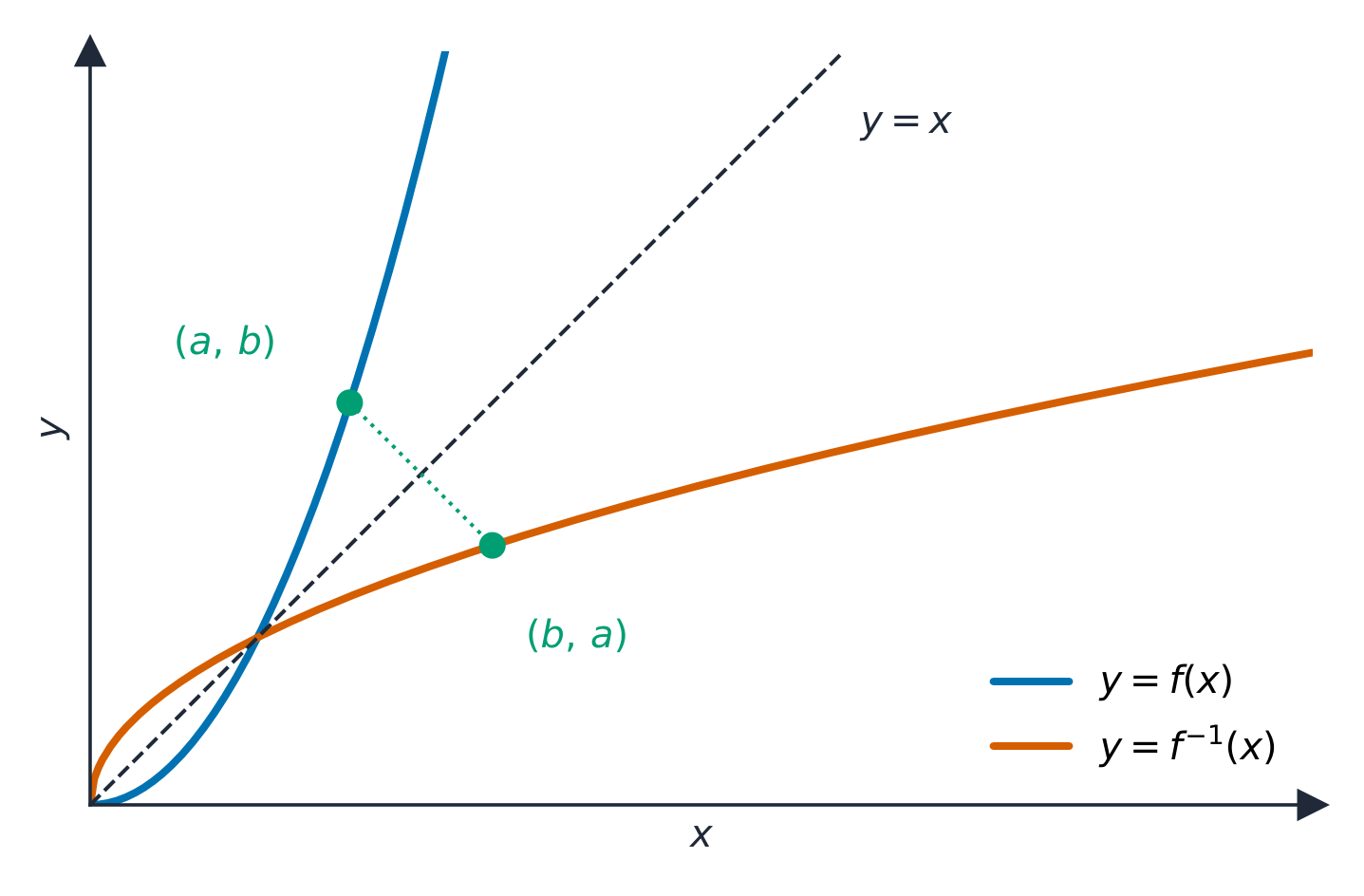
    The inverse function is the mirror image of the function in the line y = x
    The inverse function is the mirror image of the function in the line y = x

    Worked example. Suppose $f(2)=5$ and $f'(2)=3$, and $g$ is the inverse of $f$. Because $(2,5)$ lies on $f$, the point $(5,2)$ lies on $g$, and

    $$g'(5)=\frac{1}{f'(2)}=\frac{1}{3}.$$
    The graphs of $f$ and $g$ are mirror images across $y=x$, so their slopes at matching points are reciprocals.

    Explore · ⁨חקור⁩

    An exponential and its inverse the logarithm · ⁨פונקציה אקספוננציאלית וההפך שלה, הלוגריתם⁩

    y = a·e^(bx) + c

    Inverse functions are mirror images across $y=x$, and their slopes are reciprocals: $\frac{d}{dx}[f^{-1}(x)] = \dfrac{1}{f'(f^{-1}(x))}$. Where one is steep, its inverse is shallow. · ⁨פונקציות הפוכות הן תמונות ראי של זה בזה לאורך $y=x$, ושיפועיהן הם ההפוכים: $\frac{d}{dx}[f^{-1}(x)] = \dfrac{1}{f'(f^{-1}(x))}$. כאשר אחת תלולה, ההפכה שלה שטוחה.⁩

    Vocabulary · ⁨מילון מונחים⁩ Train · ⁨אימון⁩
    English עברית
    inverse function/ɪnˈvɜːs ˈfʌŋkʃn/ פונקציה הפוכה
    reciprocal/rɪˈsɪprəkl/ הופכי
    3.4

    Differentiating Inverse Trigonometric Functions

    Syllabus · ⁨סיילבוס⁩
    English

    Enduring Understanding (FUN-3): Recognizing opportunities to apply derivative rules can simplify differentiation.

    Learning Objective FUN-3.E: Calculate derivatives of inverse and inverse trigonometric functions.

    • FUN-3.E.2 The chain rule applied with the definition of an inverse function, or the formula for the derivative of an inverse function, can be used to find the derivatives of inverse trigonometric functions.
    עברית

    הבנה עומדת (FUN-3): זיהוי הזדמנויות ליישום כללי נגזירות יכול לפשט תהליך הנגזור.

    מטרות למידה FUN-3.E: חשבנו נגזרות של פונקציות הפוכות ופונקציות טריגונומטריות הפוכות.

    • FUN-3.E.2 ניתן להשתמש בכלל השרשרת בשילוב עם הגדרת פונקציה הפוכה, או בנוסחה לנגזרת של פונקציה הפוכה, כדי לחשב את הנגזרות של פונקציות טריגונומטריות הפוכות.

    Source: College Board AP Course and Exam Description · ⁨מקור: תיאור הקורס והמבחן של College Board AP⁩

    The same idea gives the derivatives of the inverse trigonometric functions 反三角函数. The three you should know:

    $$\frac{d}{dx}\arcsin x = \frac{1}{\sqrt{1-x^2}}, \quad \frac{d}{dx}\arctan x = \frac{1}{1+x^2}, \quad \frac{d}{dx}\text{arcsec}\,x = \frac{1}{|x|\sqrt{x^2-1}}.$$
    Combine these with the chain rule when the input is itself a function, e.g. $\dfrac{d}{dx}\arctan(3x)=\dfrac{3}{1+9x^2}$.

    Vocabulary · ⁨מילון מונחים⁩ Train · ⁨אימון⁩
    English עברית
    inverse trigonometric functions/ɪnˈvɜːs ˌtrɪɡənəʊˈmetrɪk ˈfʌŋkʃnz/ פונקציות טריגונומטריות הפוכות
    3.5

    Selecting Procedures for Calculating Derivatives

    Syllabus · ⁨סיילבוס⁩
    English

    This topic is intended to focus on the skill of selecting an appropriate procedure for calculating derivatives. Students should be given opportunities to practice when and how to apply all learning objectives relating to calculating derivatives.

    עברית

    נושא זה מיועד להתמקד במיומנות בחירת הליך מתאים לחישוב נגזרות. יש לתת לסטודנטים הזדמנויות לאמן את המועד והדרך ליישום כל מטרות הלמידה הקשורות לחישוב נגזרות.

    Source: College Board AP Course and Exam Description · ⁨מקור: תיאור הקורס והמבחן של College Board AP⁩

    A skill topic: real derivatives mix several rules, so read the structure of the expression first, from the outside in.

    • Is it a sum? Differentiate term by term.
    • A product or quotient? Apply that rule, and expect to use the chain rule inside.
    • A composite (something inside something)? Chain rule.
    • Given implicitly? Implicit differentiation.

    Name the outermost operation, apply its rule, and recurse inward. Neatness prevents the sign and bookkeeping errors that cost marks.

    3.6

    Calculating Higher-Order Derivatives

    Syllabus · ⁨סיילבוס⁩
    English

    Enduring Understanding (FUN-3): Recognizing opportunities to apply derivative rules can simplify differentiation.

    Learning Objective FUN-3.F: Determine higher order derivatives of a function.

    • FUN-3.F.1 Differentiating $f'$ produces the second derivative $f''$, provided the derivative of $f'$ exists; repeating this process produces higher-order derivatives of $f$.
    • FUN-3.F.2 Higher-order derivatives are represented with a variety of notations. For $y = f(x)$, notations for the second derivative include $\dfrac{d^2 y}{dx^2}$, $f''(x)$, and $y''$. Higher-order derivatives can be denoted $\dfrac{d^n y}{dx^n}$ or $f^{(n)}(x)$.
    עברית

    הבנה עומדת (FUN-3): זיהוי הזדמנויות ליישום כללי נגזירות יכול לפשט תהליך הנגזור.

    מטרות למידה FUN-3.F: קבעו נגזרות של דרגה גבוהה לפונקציה.

    • FUN-3.F.1 גזירה $f'$ מניבה את הנגזרה השנייה $f''$, בתנאי שהנגזרת של $f'$ קיימת; חזרה על תהליך זה מניבה נגזרות של דרגה גבוהה יותר של $f$.
    • FUN-3.F.2 נגזרות של דרגה גבוהה מיוצגות באמצעות מגוון סימונים. עבור $y = f(x)$, הסימונים לנגזרה השנייה כוללים $\dfrac{d^2 y}{dx^2}$, $f''(x)$ ו-$y''$. נגזרות של דרגה גבוהה יותר יכולות להיות מסומנות ב-$\dfrac{d^n y}{dx^n}$ או $f^{(n)}(x)$.

    Source: College Board AP Course and Exam Description · ⁨מקור: תיאור הקורס והמבחן של College Board AP⁩

    Differentiating $f'$ produces the second derivative 二阶导数 $f''$; repeating gives higher-order derivatives. The notations:

    $$f''(x)=\frac{d^2y}{dx^2}=y'', \qquad\text{and in general}\qquad f^{(n)}(x)=\frac{d^n y}{dx^n}.$$
    The second derivative measures how the slope is changing; it drives concavity 凹凸性 and acceleration in later units. To find $f''$ implicitly, differentiate the expression for $\dfrac{dy}{dx}$ again (with the quotient and chain rules), then substitute $\dfrac{dy}{dx}$ back in.

    Explore · ⁨חקור⁩

    Slope of the slope: the second derivative · ⁨שיפוע של שיפוע: הנגזרת השנייה⁩

    y = ax³ + bx² + cx + d

    Differentiating again gives the second derivative — the rate at which the slope changes. Where the tangent's slope is itself increasing, the curve bends upward (concave up). · ⁨גזירה שוב נותנת את הנגזרת השנייה — הקצב בו השיפוע משתנה. כאשר שיפוע המשיק עצמו גדל, הכיפה מתכופפת כלפי מעלה (קעורה כלפי מעלה).⁩

    Vocabulary · ⁨מילון מונחים⁩ Train · ⁨אימון⁩
    English עברית
    second derivative/ˈsekənd dɪˈrɪvətɪv/ גזירה שנייה
    concavity/kənˈkævɪti/ קעירות
    3.6

    Exam tips

    • Use the chain rule for composite functions — differentiate the outside, then multiply by the derivative of the inside (the most-forgotten factor).
    • For implicit differentiation, differentiate both sides with respect to $x$ and attach $\tfrac{dy}{dx}$ each time $y$ is differentiated, then solve.
    • Get the second derivative by differentiating twice (velocity → acceleration).
    • Combine rules carefully in layered expressions (chain inside product, etc.).
    • The inverse function's graph is the reflection in $y=x$; its slope is the reciprocal of the original's at the matching point.
  • 4

    Contextual Applications of Differentiation · ⁨יישומים בהקשר לגזירה⁩

    Watch lesson · ⁨צפה בשיעור⁩
    4.1

    Interpreting the Derivative in Context · ⁨פרשנות הנגזרה בהקשר⁩

    Syllabus · ⁨סיילבוס⁩
    Enduring UnderstandingLearning ObjectiveEssential Knowledge

    CHA-3
    Derivatives allow us to solve real-world problems involving rates of change.

    CHA-3.A
    Interpret the meaning of a derivative in context.

    • CHA-3.A.1 The derivative of a function can be interpreted as the instantaneous rate of change with respect to its independent variable.
    • CHA-3.A.2 The derivative can be used to express information about rates of change in applied contexts.
    • CHA-3.A.3 The unit for $f'(x)$ is the unit for $f$ divided by the unit for $x$.

    Source: College Board AP Course and Exam Description · ⁨מקור: תיאור הקורס והמבחן של College Board AP⁩

    English

    Once you can compute derivatives, you use them to describe the real world. The derivative $f'(x)$ is the instantaneous rate of change of $f$ with respect to its input. Reading and reporting this rate correctly is a graded skill.

    Units matter. The unit of $f'(x)$ is the unit of $f$ divided by the unit of $x$. If $C(t)$ is a number of acres and $t$ is in weeks, then $C'(t)$ is in acres per week. On the exam, "Using correct units, interpret the meaning of $g'(140)$" wants a full sentence: the value, the quantity, the rate word "per", and the moment. For example: "$g'(140)=2.3$ means that at $x=140$, the quantity is increasing at about $2.3$ units per unit of $x$."

    עברית

    ברגע שתוכל לחשב נגזרות, תשתמש בהן כדי לתאר את העולם האמיתי. הנגזרת $f'(x)$ هي קצב השינוי המיידי של $f$ ביחס לקלט שלה. קריאה ודיווח על קצב זה בצורה נכונה הם מיומנות שמוקדמת עליהן נקודות.

    היחידות חשובות. היחידה של $f'(x)$ היא יחידת ה-$f$ מחולקת ביחידת ה-$x$. אם $C(t)$ הוא מספר דונמים ו$t$ הוא בשבועות, אזי $C'(t)$ הוא בדונמים לשבוע. במבחן, "השתמש ביחידות נכונות, פרש את המשמעות של $g'(140)$" דורש משפט מלא: ה-ערך, ה-כמות, מילת הקצב לכל, וה-רגע. לדוגמה: "$g'(140)=2.3$ אומר שב-$x=140$, הכמות עולה בכ-$2.3$ יחידות לכל יחידת $x$."

    4.2

    Straight-Line Motion: Position, Velocity, and Acceleration · ⁨תנועה בקו ישר: מיקום, מהירות ואצה⁩

    Syllabus · ⁨סיילבוס⁩
    English

    Enduring Understanding (CHA-3): Derivatives allow us to solve real-world problems involving rates of change.

    Learning Objective CHA-3.B: Calculate rates of change in applied contexts.

    • CHA-3.B.1 The derivative can be used to solve rectilinear motion problems involving position, speed, velocity, and acceleration.
    עברית

    הבנה נשארית (CHA-3): נגזרות מאפשרות לנו לפתור בעיות מהעולם האמיתי הקשורות לקצבי שינוי.

    מטרות למידה CHA-3.B: חשבו קצבי שינוי בהקשרים אפליקטיביים.

    • CHA-3.B.1 ניתן להשתמש בנגזרת כדי לפתור בעיות תנועה מלבנית הקשורות למיקום, מהירות, וקטור מהירות ותאוצה.

    Source: College Board AP Course and Exam Description · ⁨מקור: תיאור הקורס והמבחן של College Board AP⁩

    English

    For a particle moving on a line, three functions of time are linked by differentiation:

    • position 位置 $s(t)$;
    • velocity 速度 $v(t)=s'(t)$ – signed; its sign gives direction;
    • acceleration 加速度 $a(t)=v'(t)=s''(t)$.

    Key readings (frequent exam parts):

    • The particle is at rest 静止 when $v(t)=0$.
    • It moves right/up when $v(t)>0$ and left/down when $v(t)<0$; it changes direction where $v$ changes sign.
    • Speed 速率 is $|v(t)|$. Speed is increasing when $v$ and $a$ have the same sign (the particle is speeding up), and decreasing when they have opposite signs.

    Worked example. A particle moves with $s(t)=t^3-6t^2+9t$. Then $v(t)=3t^2-12t+9=3(t-1)(t-3)$, so it is at rest at $t=1$ and $t=3$, and changes direction at each. At $t=2$, $v(2)=3(1)(-1)=-3<0$ (moving left) and $a(2)=6(2)-12=0$; just after, $a>0$ while $v<0$, so it is slowing down there. Distinguish carefully between velocity (has direction) and speed (does not) – the exam tests this exact difference.

    עברית

    לחלקיק הנע על קו, שלושה פונקציות של הזמן מקושרות על ידי נגזירה:

    בגרף מהירות-זמן, השטח הוא הסחה והשיפוע הוא האצה
    בגרף מהירות-זמן, השטח הוא הזזה והשיפוע הוא תאוצה
    • מיקום $s(t)$;
    • מהירות $v(t)=s'(t)$ – ממוספרת; הסימן שלה נותן כיוון;
    • תאוצה $a(t)=v'(t)=s''(t)$.

    קריאות עיקריות (חלקים נפוצים בשאלוני מבחן):

    • החלקיק נמצא במצב רכינה כאשר $v(t)=0$.
    • הוא נע ימינה/למעלה כאשר $v(t)>0$ ושמאלה/למטה כאשר $v(t)<0$; הוא משנה כיוון במקום שבו $v$ משנה סימן.
    • מהירות קטנאה היא $|v(t)|$. המהירות הקטנאה גדלה כאשר $v$ ו$a$ הם בעלי סימן זהה (החלקיק מאיץ), וקטנה כאשר להם סימנים הפוכים.

    דוגמה מופרשת. חלקיק נע עם $s(t)=t^3-6t^2+9t$. אזי $v(t)=3t^2-12t+9=3(t-1)(t-3)$, ולכן הוא במצב רכינה ב$t=1$ וב$t=3$, ומשנה כיוון בכל אחד מהם. ב$t=2$, $v(2)=3(1)(-1)=-3<0$ (נע שמאלה) ו$a(2)=6(2)-12=0$; מיד לאחר מכן, $a>0$ בעוד ש$v<0$, ולכן הוא מתעכב שם. הבדלו בקפדנות בין מהירות (יש לה כיוון) לבין מהירות קטנאה (אין לה) – המבחן בודק בדיוק ההבדל הזה.

    רכבת הרים על מסלול מעגלי
    רכבת הרים היא קלקולוס שמוסכים: המהירות היא הנגזרת של המיקום, והתאוצה היא הנגזרת של המהירות
    Explore · ⁨חקור⁩

    Velocity is the slope of position · ⁨מהירות היא שיפוע המיקום⁩

    y = ax³ + bx² + cx + d

    For straight-line motion, velocity is the derivative (slope) of position and acceleration the derivative of velocity. Slide the point to read the instantaneous velocity. · ⁨בתנועה בקו ישר, מהירות היא הנגזרת (השיפוע) של המיקום ותאוצה היא הנגזרת של המהירות. הזז את הנקודה כדי לקרוא את המהירות המיידית.⁩

    Vocabulary · ⁨מילון מונחים⁩ Train · ⁨אימון⁩
    English עברית
    position/pəˈzɪʃn/ מיקום
    velocity/vəˈlɒsɪti/ מהירות וקטורית
    acceleration/əkˌseləˈreɪʃn/ תאוצה
    at rest/æt rest/ במצב רוגע
    Speed/spiːd/ מהירות
    4.3

    Rates of Change Beyond Motion · ⁨קצבי שינוי מעבר לתנועה⁩

    Syllabus · ⁨סיילבוס⁩
    English

    Enduring Understanding (CHA-3): Derivatives allow us to solve real-world problems involving rates of change.

    Learning Objective CHA-3.C: Interpret rates of change in applied contexts.

    • CHA-3.C.1 The derivative can be used to solve problems involving rates of change in applied contexts.
    עברית

    הבנה נשארית (CHA-3): נגזרות מאפשרות לנו לפתור בעיות מהעולם האמיתי הקשורות לקצבי שינוי.

    מטרות למידה CHA-3.C: פרש קצבי שינוי בהקשרים יישומיים.

    • CHA-3.C.1 הנגזרת יכולה לשמש לפתרון בעיות הקשורות בקצבי שינוי בהקשרים יישומיים.

    Source: College Board AP Course and Exam Description · ⁨מקור: תיאור הקורס והמבחן של College Board AP⁩

    English

    The same derivative idea models any changing quantity: a draining tank, a spreading population, a cooling cup. Whenever a problem says "the rate at which...", it is describing a derivative. Read the units to know which quantity's rate you have, then interpret in context.

    עברית

    אותו עיקרון של נגזרות מדגל כל כמות משתנה: מיכל שנשחק, אוכלוסייה שהתפשטת, כוס מתקררת. בכל פעם שהבעיה אומרת "הקצב שבו...", היא מתארת נגזרת. קראו את היחידות כדי לדעת האילו קצב יש לכם, ואז פרשו בהקשר.

    4.4

    Introduction to Related Rates · ⁨מבוא לקצבים מקושרים⁩

    Syllabus · ⁨סיילבוס⁩
    English

    Enduring Understanding (CHA-3): Derivatives allow us to solve real-world problems involving rates of change.

    Learning Objective CHA-3.D: Calculate related rates in applied contexts.

    • CHA-3.D.1 The chain rule is the basis for differentiating variables in a related rates problem with respect to the same independent variable.
    • CHA-3.D.2 Other differentiation rules, such as the product rule and the quotient rule, may also be necessary to differentiate all variables with respect to the same independent variable.
    עברית

    הבנה נשארית (CHA-3): נגזרות מאפשרות לנו לפתור בעיות מהעולם האמיתי הקשורות לקצבי שינוי.

    מטרות למידה CHA-3.D: חשב קצבים תלויים בהקשרים יישומיים.

    • CHA-3.D.1 כלל השרשרת הוא הבסיס לגזירה של משתנים בבעיה על קצבים תלויים ביחס למשתנה עצמאי זהה.
    • CHA-3.D.2 כללי גזירה נוספים, כגון כלל המכפלה וכלל המנה, עשויים להיות נדרשים גם כדי לגזור את כל המשתנים ביחס למשתנה עצמאי זהה.

    Source: College Board AP Course and Exam Description · ⁨מקור: תיאור הקורס והמבחן של College Board AP⁩

    English
    Related rates: a sliding ladder

    In a related rates 相关变化率 problem, several quantities change together over time, and you know some rates but want another. The engine is the chain rule: differentiate a relationship with respect to time $t$. Every variable becomes a function of $t$, so each derivative picks up a "$\,/\,dt$" factor. Product and quotient rules may also be needed.

    עברית
    שיעורים קשורים: סולם מחליק

    בבעיית קצבים מקושרים, כמה כמויות משתנות יחד לאורך זמן, ויש לכם קצבים מסוימים אך אתם רוצים קצב אחר. המנוע הוא כלל השרשרת: גזרו קשר לפי זמן $t$. כל משתנה הופך לפונקציה של $t$, ולכן כל נגזרת לוקחת פקטור "$\,/\,dt$". ייתכן שתצטרכו גם כללי מכפלה ומחלקה.

    בלון עולה: קצבים מקושרים מקשרים איך מהירות השינוי של הרדיוס, הנפח וגובה משתנים יחד
    בלון עולה: קצבים מקושרים מקשרים איך מהירות השינוי של הרדיוס, הנפח וגובה משתנים יחד
    Vocabulary · ⁨מילון מונחים⁩ Train · ⁨אימון⁩
    English עברית
    related rates/rɪˈleɪtɪd reɪts/ קצבים קשורים
    local linearity/ˈləʊkl lɪˈnɪərɪti/ ליניאריות מקומית
    linear approximation/ˈlɪnɪə əˌprɒksɪˈmeɪʃn/ הקרבה ליניארית
    overestimate/ˌəʊvəˈrestɪmət/ הערכת יתר
    indeterminate form/ˌɪndɪˈtɜːmɪnət fɔːm/ צורה לא מוגדרת
    L'Hospital's Rule/ˈelhɒspɪtlz ruːl/ כלל ל'ופיטל
    4.5

    Solving Related Rates Problems · ⁨פתירת בעיות קצבים מקושרים⁩

    Syllabus · ⁨סיילבוס⁩
    English

    Enduring Understanding (CHA-3): Derivatives allow us to solve real-world problems involving rates of change.

    Learning Objective CHA-3.E: Interpret related rates in applied contexts.

    • CHA-3.E.1 The derivative can be used to solve related rates problems; that is, finding a rate at which one quantity is changing by relating it to other quantities whose rates of change are known.
    עברית

    הבנה נשארית (CHA-3): נגזרות מאפשרות לנו לפתור בעיות מהעולם האמיתי הקשורות לקצבי שינוי.

    מטרות למידה CHA-3.E: פרש קצבים תלויים בהקשרים יישומיים.

    • CHA-3.E.1 הנגזרת יכולה לשמש לפתרון בעיות על קצבים תלויים, כלומר, מציאת קצב שבו כמות נתונה משתנה על ידי קישורה לכמויות אחרות whose קצבי השינוי שלהן ידועים.

    Source: College Board AP Course and Exam Description · ⁨מקור: תיאור הקורס והמבחן של College Board AP⁩

    English

    A reliable procedure – and a full-credit template on the exam:

    1. Name the variables and write down the given rates and the unknown rate (e.g. "$\dfrac{dh}{dt}=-2$ cm/day, find $\dfrac{dV}{dt}$").
    2. Write an equation relating the quantities (often a geometric or volume formula).
    3. Differentiate both sides with respect to $t$ (chain rule) – before substituting numbers.
    4. Substitute the known values at the instant of interest, and solve for the unknown rate.
    5. State the answer with units and the correct sign (a decreasing quantity has a negative rate).

    Worked example. Air is pumped into a spherical balloon so its volume grows at $\dfrac{dV}{dt}=100\ \text{cm}^3/\text{s}$. How fast is the radius growing when $r=5\ \text{cm}$? Start from $V=\tfrac43\pi r^3$ and differentiate with respect to $t$ first:

    $$\frac{dV}{dt}=4\pi r^2\frac{dr}{dt}\;\Rightarrow\;100=4\pi(5)^2\frac{dr}{dt}\;\Rightarrow\;\frac{dr}{dt}=\frac{100}{100\pi}=\frac{1}{\pi}\approx 0.32\ \text{cm/s}.$$
    Substituting $r=5$ too early is the classic error – differentiate the general relationship, then plug in.

    עברית

    procedure אמין – ותבנית מלאה לנקודות מלאות במבחן:

    1. הגדירו את המשתנים וכתבו את הקצבים הנתונים ואת הקצב המבוקש (למשל "$\dfrac{dh}{dt}=-2$ ס"מ/יום, מצאו $\dfrac{dV}{dt}$").
    2. כתוב משוואה המקשרת בין הכמויות (לרוב נוסחה גיאומטרית או לנופח).
    3. גזר שני האגפים לפי $t$ (כלל השרשרת) – לפני הצבת מספרים.
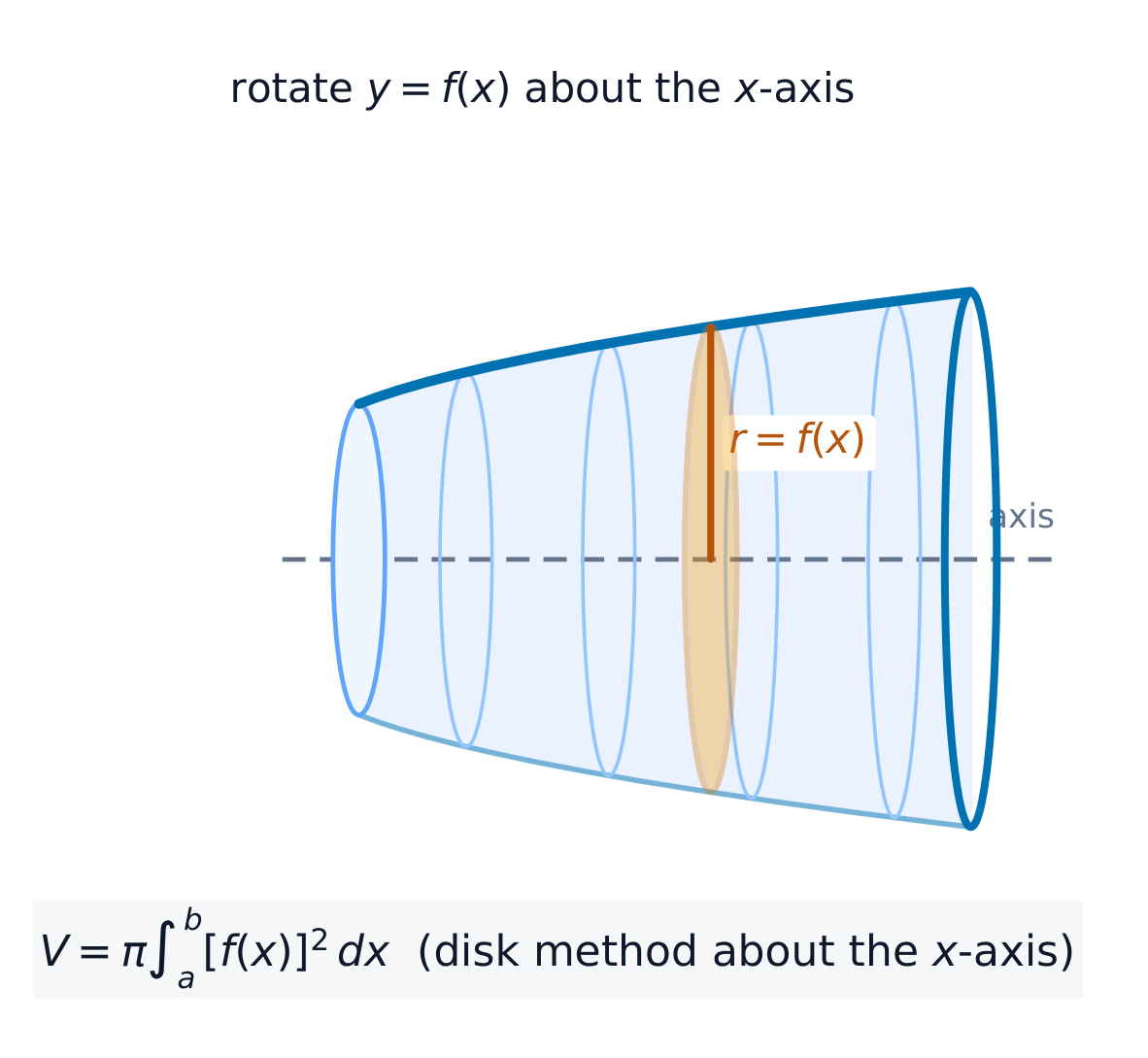
    4. הצב את הערכים הידועים ברגע הרלוונטי, ופתור עבור הקצב המבוקש.
    5. ציין תשובה עם יחידות מידה והסימן הנכון (כמות יורדת בעלת קצב שלילי).

    דוגמה מופת. אוויר מדוחס לתוך בלון סpherical כך שהנופח שלו גדל בקצב $\dfrac{dV}{dt}=100\ \text{cm}^3/\text{s}$. באיזה מהירות גדל הרדיוס כאשר $r=5\ \text{cm}$? התחל מ-$V=\tfrac43\pi r^3$ וגזר לפי $t$ קודם:

    $$\frac{dV}{dt}=4\pi r^2\frac{dr}{dt}\;\Rightarrow\;100=4\pi(5)^2\frac{dr}{dt}\;\Rightarrow\;\frac{dr}{dt}=\frac{100}{100\pi}=\frac{1}{\pi}\approx 0.32\ \text{cm/s}.$$
    הצבה של $r=5$ מדי מוקדם היא טעות קלאסית – גזר את הקשר הכללי, ולאחר מכן הצב ערכים.
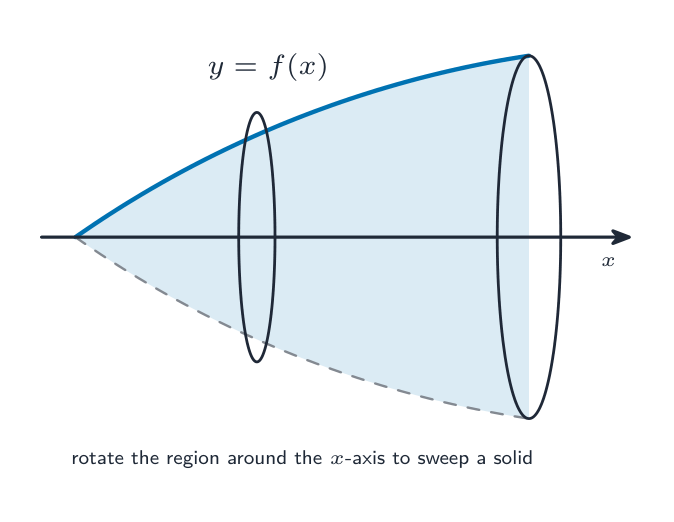
    בלון מתנפח מקשר בין dV/dt ל-dr/dt דרך כלל השרשרת
    בלון מתנפח מקשר בין dV/dt ל-dr/dt דרך כלל השרשרת
    4.6

    Local Linearity and Linearization · ⁨ליניאריות מקומית וליניאריזציה⁩

    Syllabus · ⁨סיילבוס⁩
    English

    Enduring Understanding (CHA-3): Derivatives allow us to solve real-world problems involving rates of change.

    Learning Objective CHA-3.F: Approximate a value on a curve using the equation of a tangent line.

    • CHA-3.F.1 The tangent line is the graph of a locally linear approximation of the function near the point of tangency.
    • CHA-3.F.2 For a tangent line approximation, the function's behavior near the point of tangency may determine whether a tangent line value is an underestimate or an overestimate of the corresponding function value.
    עברית

    הבנה נשארית (CHA-3): נגזרות מאפשרות לנו לפתור בעיות מהעולם האמיתי הקשורות לקצבי שינוי.

    מטרות למידה CHA-3.F: הערך ערך על גרף באמצעות משוואת המשיק.

    • CHA-3.F.1 המשיק הוא הגרף של הערכה ליניארית מקומית של הפונקציה בסמוך לנקודת המשיק.
    • CHA-3.F.2 עבור הערכה במשיק, התנהגות הפונקציה בסמוך לנקודת המשיק עשויה לקבוע האם ערך המשיק הוא הערכה תחתונה או עליונה לערך המתאים של הפונקציה.

    Source: College Board AP Course and Exam Description · ⁨מקור: תיאור הקורס והמבחן של College Board AP⁩

    English
    Local linearity and linearisation

    Near a point of tangency, a smooth curve looks like its tangent line – this is local linearity 局部线性. So the tangent line gives a linear approximation 线性近似 (linearization) of the function near that point:

    $$f(x) \approx L(x) = f(a) + f'(a)(x-a).$$
    Use it to estimate $f$ at an $x$ close to $a$.

    Worked example. Estimate $\sqrt{4.1}$. Take $f(x)=\sqrt{x}$ and $a=4$: $f(4)=2$ and $f'(x)=\dfrac{1}{2\sqrt{x}}$ so $f'(4)=\dfrac14$. Then $L(4.1)=2+\tfrac14(4.1-4)=2.025$ (the true value is $2.0248\ldots$). Because $\sqrt{x}$ is concave down, the tangent lies above the curve, so this is a slight overestimate 高估 – justify over/under with the sign of $f''$.

    עברית
    ליניאריות מקומית וליניאריזציה

    קרוב לנקודת מגע, עקום חלק נראה כמו המשיק שלו – זהו ליניאריות מקומית. לכן, המשיק מספק הערכת ליניארית (ליניאריזציה) של הפונקציה בסביבת נקודה זו:

    $$f(x) \approx L(x) = f(a) + f'(a)(x-a).$$
    השתמש בה כדי להעריך $f$ ב-$x$ קרוב ל-$a$.

    המשיק הוא ההערכה הליניארית הטובה ביותר לעקום בסביבת נקודת המגע
    המשיק הוא ההערכה הליניארית הטובה ביותר לעקום בסביבת נקודת המגע

    דוגמה מופת. הערך $\sqrt{4.1}$. בחר ב-$f(x)=\sqrt{x}$ וב-$a=4$: $f(4)=2$ ו-$f'(x)=\dfrac{1}{2\sqrt{x}}$ כך ש-$f'(4)=\dfrac14$. לאחר מכן $L(4.1)=2+\tfrac14(4.1-4)=2.025$ (הערך האמיתי הוא $2.0248\ldots$). מכיוון ש-$\sqrt{x}$ קעור למטה, המשיק נמצא מעל העקום, ולכן זוהי הערכה מעט מוגזמת – נמק אם יש הערכת יתר או חסר על פי סימן ה-$f''$.

    Explore · ⁨חקור⁩

    Approximate a curve with its tangent line · ⁨לקרב כיפה עם קו המשיק שלה⁩

    y = ax³ + bx² + cx + d

    Local linearity: near a point a smooth curve looks like its tangent line, so the tangent gives a good linear approximation of nearby values. · ⁨ליניאריות מקומית: סמוך לנקודה, כיפה חלקה נראית כמו קו המשיק שלה, ולכן המשיק מספק קירוי ליניארי טוב לערכים סמוכים.⁩

    4.7

    L'Hospital's Rule for Indeterminate Forms · ⁨חוק לופיטל לצורות לא מיודדות⁩

    Syllabus · ⁨סיילבוס⁩
    Enduring UnderstandingLearning ObjectiveEssential Knowledge

    LIM-4
    L'Hospital's Rule allows us to determine the limits of some indeterminate forms.

    LIM-4.A
    Determine limits of functions that result in indeterminate forms.

    • LIM-4.A.1 When the ratio of two functions tends to $\dfrac{0}{0}$ or $\dfrac{\infty}{\infty}$ in the limit, such forms are said to be indeterminate.
      • Exclusion statement: There are many other indeterminate forms, such as $\infty - \infty$, for example, but these will not be assessed on either the AP Calculus AB or BC Exam. However, teachers may include these topics, if time permits.
    • LIM-4.A.2 Limits of the indeterminate forms $\dfrac{0}{0}$ or $\dfrac{\infty}{\infty}$ may be evaluated using L'Hospital's Rule.

    Source: College Board AP Course and Exam Description · ⁨מקור: תיאור הקורס והמבחן של College Board AP⁩

    English

    When direct substitution in a quotient of limits gives the indeterminate form 未定式 $\dfrac{0}{0}$ or $\dfrac{\infty}{\infty}$, you may use L'Hospital's Rule 洛必达法则:

    $$\lim_{x\to c}\frac{f(x)}{g(x)} = \lim_{x\to c}\frac{f'(x)}{g'(x)},$$
    provided the right-hand limit exists. Differentiate the top and bottom separately (this is not the quotient rule), then try the limit again. First confirm the form really is $\tfrac{0}{0}$ or $\tfrac{\infty}{\infty}$ – applying the rule to any other form is a mistake.

    Worked example. Evaluate $\displaystyle\lim_{x\to 0}\frac{\sin x}{x}$. Substituting gives $\tfrac00$, so differentiate top and bottom: $\displaystyle\lim_{x\to 0}\frac{\cos x}{1}=\cos 0=1$ – confirming the famous limit from Unit 1.

    עברית

    כשצבת ישירה במנה של גבולות נותנת את צורה לא מיודדת של $\dfrac{0}{0}$ או $\dfrac{\infty}{\infty}$, ניתן להשתמש ב-חוק לופיטל:

    $$\lim_{x\to c}\frac{f(x)}{g(x)} = \lim_{x\to c}\frac{f'(x)}{g'(x)},$$
    בתנאי שהגבול מצד ימין קיים. גזר את המונה והמכנה בנפרד (זו אינה כלל המנה), ולאחר מכן נסה לחשב את הגבול שוב. תחילה ודא שהצורה אכן היא $\tfrac{0}{0}$ או $\tfrac{\infty}{\infty}$ – יישום החוק לכל צורה אחרת הוא שגיאה.

    דוגמה מופת. חשב את $\displaystyle\lim_{x\to 0}\frac{\sin x}{x}$. הצבה נותנת $\tfrac00$, ולכן גזר מונה ומכנה: $\displaystyle\lim_{x\to 0}\frac{\cos x}{1}=\cos 0=1$ – מאשר את הגבול המפורסם מייחידה 1.

    4.7

    Exam tips · ⁨טיפים לבחינות⁩

    English
    • In motion problems: velocity is the derivative of position, acceleration the derivative of velocity; speed increases when velocity and acceleration share a sign.
    • For related rates, differentiate the relating equation with respect to time, then substitute the given values last.
    • Use the tangent line for a linear approximation near a known point; it is accurate only close by.
    • Read the sign of a rate: positive means the quantities move together, negative means opposite.
    • Always state units and interpret the answer in context.
    עברית
    • בבעיות תנועה: מהירות היא הנגזרת של מיקום, תאוצה היא הנגזרת של המהירות; מהירות עולה כאשר למהירות ולתאוצה יש אותו סימן.
    • עבור קצבים קשורים, נגזור את המשוואה המקשרת לפי זמן, ולאחר מכן נציב את הערכים הנתונים בסוף.
    • השתמש בקו המשיק ל-הערכה ליניארית סמוך לנקודה ידועה; הוא מדויק רק בקרבתה.
    • קרא את הסימן של הקצב: חיובי פירונו שהכמויות נעות בכיוון זהה, שלילי פירונו בכיוונים הפוכים.
    • תמיד ציין יחידות ופרשן את התשובה בהקשר.
  • 5

    Analytical Applications of Differentiation · ⁨יישומים אנליטיים של נגזרת⁩

    Watch lesson · ⁨צפה בשיעור⁩
    5.1

    The Mean Value Theorem

    Syllabus · ⁨סיילבוס⁩
    English

    Enduring Understanding (FUN-1): Existence theorems allow us to draw conclusions about a function's behavior on an interval without precisely locating that behavior.

    Learning Objective FUN-1.B: Justify conclusions about functions by applying the Mean Value Theorem over an interval.

    • FUN-1.B.1 If a function $f$ is continuous over the interval $[a, b]$ and differentiable over the interval $(a, b)$, then the Mean Value Theorem guarantees a point within that open interval where the instantaneous rate of change equals the average rate of change over the interval.
    עברית

    הבנה נמשכת (FUN-1): משפטי קיום מאפשרים לנו להסיק מס关于 התנהגות הפונקציה על מרווח ללא מיקום מדויק של התנהגות זו.

    מטרת הלמידה FUN-1.B: להצדיק מסקנות לגבי פונקציות על ידי יישום משפט הערך הממוצע על מרווח.

    • FUN-1.B.1 אם פונקציה $f$ רציפה במרווח $[a, b]$ וניתנת לנגזירה במרווח $(a, b)$, אזי משפט הערך הממוצע מבטיח קיום נקודה בתוך המרווח הפתוח שבה הקצב המיידי השווה לקצב הממוצע במרווח.

    Source: College Board AP Course and Exam Description · ⁨מקור: תיאור הקורס והמבחן של College Board AP⁩

    The Mean Value Theorem

    The Mean Value Theorem 中值定理 (MVT) links the average rate of change to an instantaneous one:

    If $f$ is continuous on $[a,b]$ and differentiable on $(a,b)$, then there is at least one point $c$ in $(a,b)$ where

    $$f'(c) = \frac{f(b)-f(a)}{b-a}.$$

    In words: somewhere inside the interval, the instantaneous rate equals the average rate. Geometrically, some tangent line is parallel to the line joining the endpoints.

    The Mean Value Theorem: some tangent is parallel to the secant over the interval
    The Mean Value Theorem: some tangent is parallel to the secant over the interval

    Exam skill. Like the IVT, the MVT is an existence theorem, and questions ask you to justify. Full credit needs: (1) state $f$ is continuous on $[a,b]$ and differentiable on $(a,b)$; (2) compute the average rate $\frac{f(b)-f(a)}{b-a}$; (3) conclude "by the MVT there is a $c$ in $(a,b)$ with $f'(c)$ equal to that value." Both hypotheses must be named.

    Worked example. Verify the MVT for $f(x)=x^2$ on $[1,3]$. It is a polynomial, so continuous and differentiable everywhere. The average rate is $\dfrac{f(3)-f(1)}{3-1}=\dfrac{9-1}{2}=4$. Setting $f'(c)=2c=4$ gives $c=2$, which does lie in $(1,3)$ – the guaranteed point.

    Explore · ⁨חקור⁩

    The Mean Value Theorem · ⁨משפט הערך הממוצע⁩

    y = ax³ + bx² + cx + d

    The MVT guarantees a point where the tangent is parallel to the secant — the instantaneous rate equals the average rate somewhere inside the interval. · ⁨ה-MVT מבטיח נקודה שבה ה-משיק מקביל ל-מיתר — הקצב המיידי שווה לקצב הממוצע במשהו בתוך התחום.⁩

    Vocabulary · ⁨מילון מונחים⁩ Train · ⁨אימון⁩
    English עברית
    Mean Value Theorem/miːn ˈvæljuː ˈθɪərəm/ משפט ערך הממוצע
    5.2

    Extreme Values and Critical Points

    Syllabus · ⁨סיילבוס⁩
    English

    Enduring Understanding (FUN-1): Existence theorems allow us to draw conclusions about a function's behavior on an interval without precisely locating that behavior.

    Learning Objective FUN-1.C: Justify conclusions about functions by applying the Extreme Value Theorem.

    • FUN-1.C.1 If a function $f$ is continuous over the interval $(a, b)$, then the Extreme Value Theorem guarantees that $f$ has at least one minimum value and at least one maximum value on $[a, b]$.
    • FUN-1.C.2 A point on a function where the first derivative equals zero or fails to exist is a critical point of the function.
    • FUN-1.C.3 All local (relative) extrema occur at critical points of a function, though not all critical points are local extrema.
    עברית

    הבנה נמשכת (FUN-1): משפטי קיום מאפשרים לנו להסיק מס关于 התנהגות הפונקציה על מרווח ללא מיקום מדויק של התנהגות זו.

    מטרת הלמידה FUN-1.C: להצדיק מסקנות לגבי פונקציות על ידי יישום משפט הערך הקיצוני.

    • FUN-1.C.1 אם פונקציה $f$ רציפה במרווח $(a, b)$, אזי משפט הערך הקיצוני מבטיח כי $f$ יש לה לפחות ערך מינימום אחד ולפחות ערך מקסימום אחד ב $[a, b]$.
    • FUN-1.C.2 נקודה בפונקציה שבה הנגזרת הראשונה שווה לאפס או שאינה קיימת היא נקודה קריטית של הפונקציה.
    • FUN-1.C.3 כל הקיצונים המקומיים (יחסיים) מתרחשים בנקודות קריטיות של פונקציה, אך לא כל הנקודות הקריטיות הן קיצונים מקומיים.

    Source: College Board AP Course and Exam Description · ⁨מקור: תיאור הקורס והמבחן של College Board AP⁩

    A mountain peak reflected in a lake: extrema and critical points mark highest and lowest values
    A mountain peak reflected in a lake: extrema and critical points mark highest and lowest values

    The Extreme Value Theorem 极值定理 (EVT) guarantees extremes exist: a function continuous on a closed interval $[a,b]$ attains both an absolute maximum and an absolute minimum on it.

    At a maximum or minimum the derivative is zero
    At a maximum or minimum the derivative is zero

    A critical point 临界点 is an interior point where $f'(x)=0$ or $f'(x)$ does not exist. All local (relative) extrema 局部极值 occur at critical points – but not every critical point is an extremum. So critical points are the candidates; you must test each.

    Vocabulary · ⁨מילון מונחים⁩ Train · ⁨אימון⁩
    English עברית
    Extreme Value Theorem/ekˈstriːm ˈvæljuː ˈθɪərəm/ משפט הערך הקיצוני
    critical point/ˈkrɪtɪkl pɔɪnt/ נקודה קריטית
    local (relative) extrema/ˈləʊkl ekˈstremə/ אקסטרימות מקומיות (יחסיות)
    5.3

    Increasing and Decreasing Intervals

    Syllabus · ⁨סיילבוס⁩
    English

    Enduring Understanding (FUN-4): A function's derivative can be used to understand some behaviors of the function.

    Learning Objective FUN-4.A: Justify conclusions about the behavior of a function based on the behavior of its derivatives.

    • FUN-4.A.1 The first derivative of a function can provide information about the function and its graph, including intervals where the function is increasing or decreasing.
    עברית

    הבנה מתמשכת (FUN-4): ניתן להשתמש בנגזרת של פונקציה כדי להבין חלק מההתנהגות שלה.

    מטרת למידה FUN-4.A: להסביר מסקנות לגבי התנהגותה של פונקציה על בסיס התנהגות הנגזרות שלה.

    • FUN-4.A.1 הנגזרת הראשונה של פונקציה יכולה לספק מידע על הפונקציה ועל הגרף שלה, כולל תחומים שבהם הפונקציה עולה או יורדת.

    Source: College Board AP Course and Exam Description · ⁨מקור: תיאור הקורס והמבחן של College Board AP⁩

    The first derivative tells you where $f$ rises or falls:

    • $f'(x) > 0$ on an interval $\Rightarrow$ $f$ is increasing 递增 there;
    • $f'(x) < 0$ $\Rightarrow$ $f$ is decreasing 递减.

    On the exam, "find the intervals where $f$ is increasing" means: find the critical points, then test the sign of $f'$ between them, and justify with the sign of $f'$ (a stated reason, not just an interval).

    Vocabulary · ⁨מילון מונחים⁩ Train · ⁨אימון⁩
    English עברית
    increasing/ɪnˈkriːsɪŋ/ עולה
    decreasing/ˈdiːkriːsɪŋ/ ירידתי
    5.4

    The First Derivative Test

    Syllabus · ⁨סיילבוס⁩
    English

    Enduring Understanding (FUN-4): A function's derivative can be used to understand some behaviors of the function.

    Learning Objective FUN-4.A: Justify conclusions about the behavior of a function based on the behavior of its derivatives.

    • FUN-4.A.2 The first derivative of a function can determine the location of relative (local) extrema of the function.
    עברית

    הבנה מתמשכת (FUN-4): ניתן להשתמש בנגזרת של פונקציה כדי להבין חלק מההתנהגות שלה.

    מטרת למידה FUN-4.A: להסביר מסקנות לגבי התנהגותה של פונקציה על בסיס התנהגות הנגזרות שלה.

    • FUN-4.A.2 הנגזרת הראשונה של פונקציה יכולה לקבוע את המיקום של האקסטרומים היחסיים (המקומיים) שלה.

    Source: College Board AP Course and Exam Description · ⁨מקור: תיאור הקורס והמבחן של College Board AP⁩

    To classify a critical point $x=c$ as a local max, local min, or neither, check how $f'$ changes sign there:

    • $f'$ changes $+$ to $-$ at $c$ $\Rightarrow$ local maximum 极大值;
    • $f'$ changes $-$ to $+$ at $c$ $\Rightarrow$ local minimum 极小值;
    • $f'$ does not change sign $\Rightarrow$ neither.

    Always state the sign change as your justification.

    Worked example. Classify the critical points of $f(x)=x^3-3x^2$. Here $f'(x)=3x^2-6x=3x(x-2)$, zero at $x=0$ and $x=2$. Testing signs: $f'>0$ for $x<0$, $f'<0$ on $(0,2)$, and $f'>0$ for $x>2$. So $f'$ turns $+\to-$ at $x=0$ (a local maximum, $f(0)=0$) and $-\to+$ at $x=2$ (a local minimum, $f(2)=-4$).

    The sign of f-prime sets where a function increases or decreases and locates its local extrema
    Where $f' > 0$ the graph rises and where $f' < 0$ it falls; a local max sits where $f'$ turns $+$ to $-$, a local min where it turns $-$ to $+$.
    Vocabulary · ⁨מילון מונחים⁩ Train · ⁨אימון⁩
    English עברית
    local maximum/ˈləʊkl ˈmæksɪməm/ מקסימום מקומי
    local minimum/ˈləʊkl ˈmɪnɪməm/ מינימום מקומי
    5.5

    The Candidates Test for Absolute Extrema

    Syllabus · ⁨סיילבוס⁩
    English

    Enduring Understanding (FUN-4): A function's derivative can be used to understand some behaviors of the function.

    Learning Objective FUN-4.A: Justify conclusions about the behavior of a function based on the behavior of its derivatives.

    • FUN-4.A.3 Absolute (global) extrema of a function on a closed interval can only occur at critical points or at endpoints.
    עברית

    הבנה מתמשכת (FUN-4): ניתן להשתמש בנגזרת של פונקציה כדי להבין חלק מההתנהגות שלה.

    מטרת למידה FUN-4.A: להסביר מסקנות לגבי התנהגותה של פונקציה על בסיס התנהגות הנגזרות שלה.

    • FUN-4.A.3 אקסטרומים מוחלטים (גלובליים) של פונקציה בתחום סגור יכולים להתקבל רק בנקודות קריטיות או בקצוות.

    Source: College Board AP Course and Exam Description · ⁨מקור: תיאור הקורס והמבחן של College Board AP⁩

    On a closed interval, absolute (global) extrema occur only at critical points or endpoints. The candidates test:

    1. List all critical points in $[a,b]$ and the two endpoints.
    2. Evaluate $f$ at each candidate.
    3. The largest output is the absolute maximum; the smallest is the absolute minimum.

    Show the table of values – the comparison is the argument.

    5.6

    Concavity and Points of Inflection

    Syllabus · ⁨סיילבוס⁩
    English

    Enduring Understanding (FUN-4): A function's derivative can be used to understand some behaviors of the function.

    Learning Objective FUN-4.A: Justify conclusions about the behavior of a function based on the behavior of its derivatives.

    • FUN-4.A.4 The graph of a function is concave up (down) on an open interval if the function's derivative is increasing (decreasing) on that interval.
    • FUN-4.A.5 The second derivative of a function provides information about the function and its graph, including intervals of upward or downward concavity.
    • FUN-4.A.6 The second derivative of a function may be used to locate points of inflection for the graph of the original function.
    עברית

    הבנה מתמשכת (FUN-4): ניתן להשתמש בנגזרת של פונקציה כדי להבין חלק מההתנהגות שלה.

    מטרת למידה FUN-4.A: להסביר מסקנות לגבי התנהגותה של פונקציה על בסיס התנהגות הנגזרות שלה.

    • FUN-4.A.4 גרף של פונקציה הוא קמור כלפי מעלה (מטה) בתחום פתוח אם נגזרת הפונקציה עולה (יורדת) בתחום זה.
    • FUN-4.A.5 הנגזרת השנייה של פונקציה מספקת מידע על הפונקציה ועל הגרף שלה, כולל תחומי קמירות כלפי מעלה או כלפי מטה.
    • FUN-4.A.6 ניתן להשתמש בנגזרת השנייה של פונקציה כדי למקם נקודות אינפלקציה בגרף הפונקציה המקורית.

    Source: College Board AP Course and Exam Description · ⁨מקור: תיאור הקורס והמבחן של College Board AP⁩

    The second derivative describes bending:

    • $f'' > 0$ $\Rightarrow$ $f$ is concave up 上凹 (curving like a cup; $f'$ is increasing);
    • $f'' < 0$ $\Rightarrow$ $f$ is concave down 下凹 ($f'$ is decreasing).

    A point of inflection 拐点 is where concavity changes, i.e. where $f''$ changes sign (not merely where $f''=0$). Report its $x$-coordinate and justify with the sign change of $f''$.

    Concavity comes from the sign of the second derivative; it flips at an inflection point
    Concavity comes from the sign of the second derivative; it flips at an inflection point
    Explore · ⁨חקור⁩

    Where concavity flips · ⁨כאשר הכיול מתהפך⁩

    y = ax³ + bx² + cx + d

    Concavity is the sign of $f''$: concave up holds water, concave down spills it. A point of inflection is where it switches. · ⁨כיול הוא סימן $f''$: כיול כלפי מעלה מחזיק מים, כיול כלפי מטה שופך אותם. נקודת קימור היא הנקודה שבה זה משתנה.⁩

    Vocabulary · ⁨מילון מונחים⁩ Train · ⁨אימון⁩
    English עברית
    concave up/kɒnˈkeɪv ʌp/ קעור כלפי מעלה
    concave down/kɒnˈkeɪv daʊn/ קעור כלפי מטה
    point of inflection/pɔɪnt ɒv ɪnˈflekʃn/ נקודת התבונה
    5.7

    The Second Derivative Test

    Syllabus · ⁨סיילבוס⁩
    English

    Enduring Understanding (FUN-4): A function's derivative can be used to understand some behaviors of the function.

    Learning Objective FUN-4.A: Justify conclusions about the behavior of a function based on the behavior of its derivatives.

    • FUN-4.A.7 The second derivative of a function may determine whether a critical point is the location of a relative (local) maximum or minimum.
    • FUN-4.A.8 When a continuous function has only one critical point on an interval on its domain and the critical point corresponds to a relative (local) extremum of the function on the interval, then that critical point also corresponds to the absolute (global) extremum of the function on the interval.
    עברית

    הבנה מתמשכת (FUN-4): ניתן להשתמש בנגזרת של פונקציה כדי להבין חלק מההתנהגות שלה.

    מטרת למידה FUN-4.A: להסביר מסקנות לגבי התנהגותה של פונקציה על בסיס התנהגות הנגזרות שלה.

    • FUN-4.A.7 הנגזרת השנייה של פונקציה יכולה לקבוע האם נקודה קריטית היא מקום האקסטרום היחסי (המקומי) של מקסימום או מינימום.
    • FUN-4.A.8 כאשר לפונקציה רציפה יש רק נקודה קריטית אחת בתחום בתחום ההגדרה שלה, והנקודה הקריטית מתאימה לאקסטרום יחסי (מקומי) של הפונקציה בתחום, אז הנקודה הקריטית הזו מתאימה גם לאקסטרום מוחלט (גלובלי) של הפונקציה בתחום.

    Source: College Board AP Course and Exam Description · ⁨מקור: תיאור הקורס והמבחן של College Board AP⁩

    An alternative way to classify a critical point $c$ where $f'(c)=0$:

    • $f''(c) > 0$ $\Rightarrow$ concave up $\Rightarrow$ local minimum;
    • $f''(c) < 0$ $\Rightarrow$ concave down $\Rightarrow$ local maximum;
    • $f''(c) = 0$ $\Rightarrow$ the test is inconclusive – fall back on the first derivative test.

    Special case: if a continuous function has only one critical point on an interval and it is a local extremum, that point is also the absolute extremum there.

    5.8

    Sketching a Function and Its Derivatives

    Syllabus · ⁨סיילבוס⁩
    Enduring UnderstandingLearning ObjectiveEssential Knowledge

    FUN-4
    A function's derivative can be used to understand some behaviors of the function.

    FUN-4.A
    Justify conclusions about the behavior of a function based on the behavior of its derivatives.

    • FUN-4.A.9 Key features of functions and their derivatives can be identified and related to their graphical, numerical, and analytical representations.
    • FUN-4.A.10 Graphical, numerical, and analytical information from $f'$ and $f''$ can be used to predict and explain the behavior of $f$.

    Source: College Board AP Course and Exam Description · ⁨מקור: תיאור הקורס והמבחן של College Board AP⁩

    Key features of $f$, $f'$, and $f''$ mirror each other. To sketch or read graphs:

    • $f$ increasing $\Leftrightarrow$ $f'$ above the axis; $f$ has a local max $\Leftrightarrow$ $f'$ crosses from $+$ to $-$.
    • $f$ concave up $\Leftrightarrow$ $f'$ increasing $\Leftrightarrow$ $f''$ above the axis; $f$ has an inflection point $\Leftrightarrow$ $f'$ has a local extremum $\Leftrightarrow$ $f''$ crosses zero.
    5.9

    Connecting f, f-prime, and f-double-prime

    Syllabus · ⁨סיילבוס⁩
    English

    Enduring Understanding (FUN-4): A function's derivative can be used to understand some behaviors of the function.

    Learning Objective FUN-4.A: Justify conclusions about the behavior of a function based on the behavior of its derivatives.

    • FUN-4.A.11 Key features of the graphs of $f$, $f'$, and $f''$ are related to one another.
    עברית

    הבנה מתמשכת (FUN-4): ניתן להשתמש בנגזרת של פונקציה כדי להבין חלק מההתנהגות שלה.

    מטרת למידה FUN-4.A: להסביר מסקנות לגבי התנהגותה של פונקציה על בסיס התנהגות הנגזרות שלה.

    • FUN-4.A.11 מאפיינים מרכזיים של גרפי $f$, $f'$ ו$f''$ קשורים זה לזה.

    Source: College Board AP Course and Exam Description · ⁨מקור: תיאור הקורס והמבחן של College Board AP⁩

    This is the skill of reading one graph to describe another. A very common exam setup gives the graph of $f'$ and asks about $f$: where is $f$ increasing (where $f'>0$), where are $f$'s extrema (where $f'$ crosses zero, with a sign change), where is $f$ concave up (where $f'$ is increasing). Answer questions about $f$ using the height and slope of the $f'$ graph.

    Explore · ⁨חקור⁩

    Slope and bend from the graph · ⁨שיפוע וכיול מהגרף⁩

    y = ax³ + bx² + cx + d

    Where $f'>0$ the function rises; where $f''>0$ it bends up. Slide the tangent to link the shape of $f$ to the signs of its derivatives. · ⁨כאשר $f'>0$ הפונקציה עולה; כאשר $f''>0$ היא מכיולה כלפי מעלה. החלק את המשיק כדי לקשר בין צורת $f$ לסמנים של הנגזרות שלה.⁩

    5.10

    Introduction to Optimization

    Syllabus · ⁨סיילבוס⁩
    English

    Enduring Understanding (FUN-4): A function's derivative can be used to understand some behaviors of the function.

    Learning Objective FUN-4.B: Calculate minimum and maximum values in applied contexts or analysis of functions.

    • FUN-4.B.1 The derivative can be used to solve optimization problems; that is, finding a minimum or maximum value of a function on a given interval.
    עברית

    הבנה מתמשכת (FUN-4): ניתן להשתמש בנגזרת של פונקציה כדי להבין חלק מההתנהגות שלה.

    מטרת הלמידה FUN-4.B: לחשב ערכים מינימליים ומקסימליים בהקשרים יישומיים או באנליזה של פונקציות.

    • FUN-4.B.1 הנגזרת יכולה לשמש לפתרון בעיות אופטימיזציה; כלומר, למצוא ערך מינימלי או מקסימלי של פונקציה על מרווח נתון.

    Source: College Board AP Course and Exam Description · ⁨מקור: תיאור הקורס והמבחן של College Board AP⁩

    Optimisation: the best box

    Optimization 最优化 uses the derivative to find the largest or smallest value of a quantity on an interval. It is the candidates/derivative-test machinery applied to a real goal.

    Fenced enclosures: optimization finds the dimensions that maximise area for a fixed fence length
    Fenced enclosures: optimization finds the dimensions that maximise area for a fixed fence length
    Vocabulary · ⁨מילון מונחים⁩ Train · ⁨אימון⁩
    English עברית
    Optimization/ˌɒptɪmaɪˈzeɪʃn/ אופטימיזציה
    5.11

    Solving Optimization Problems

    Syllabus · ⁨סיילבוס⁩
    English

    Enduring Understanding (FUN-4): A function's derivative can be used to understand some behaviors of the function.

    Learning Objective FUN-4.C: Interpret minimum and maximum values calculated in applied contexts.

    • FUN-4.C.1 Minimum and maximum values of a function take on specific meanings in applied contexts.
    עברית

    הבנה מתמשכת (FUN-4): ניתן להשתמש בנגזרת של פונקציה כדי להבין חלק מההתנהגות שלה.

    מטרת הלמידה FUN-4.C: לפרש ערכים מינימליים ומקסימליים שחושבו בהקשרים יישומיים.

    • FUN-4.C.1 לערכים מינימליים ומקסימליים של פונקציה יש משמעויות ספציפיות בהקשרים יישומיים.

    Source: College Board AP Course and Exam Description · ⁨מקור: תיאור הקורס והמבחן של College Board AP⁩

    A dependable procedure:

    1. Write the quantity to optimize as a function of one variable (use a constraint equation to eliminate extras).
    2. State the interval of allowed inputs.
    3. Find critical points ($f'=0$ or undefined) and test them (first- or second-derivative test, or candidates test if the interval is closed).
    4. Answer the question asked, with units and interpretation in context – the maximum area, the minimum cost, etc.

    Worked example. A farmer has $100\ \text{m}$ of fence for a rectangular pen against a wall, so only three sides need fencing. Maximize the area. Let the two ends be $x$ and the side parallel to the wall be $y$; the constraint is $2x+y=100$, so $y=100-2x$. The area is

    $$A(x)=x(100-2x)=100x-2x^2,\qquad A'(x)=100-4x=0\;\Rightarrow\;x=25.$$
    Since $A''=-4<0$ this is a maximum, giving $y=50$ and $A=25\times50=1250\ \text{m}^2$.

    5.12

    Behaviors of Implicit Relations

    Syllabus · ⁨סיילבוס⁩
    English

    Enduring Understanding (FUN-4): A function's derivative can be used to understand some behaviors of the function.

    Learning Objective FUN-4.D: Determine critical points of implicit relations.

    • FUN-4.D.1 A point on an implicit relation where the first derivative equals zero or does not exist is a critical point of the function.

    Learning Objective FUN-4.E: Justify conclusions about the behavior of an implicitly defined function based on evidence from its derivatives.

    • FUN-4.E.1 Applications of derivatives can be extended to implicitly defined functions.
    • FUN-4.E.2 Second derivatives involving implicit differentiation may be relations of $x$, $y$, and $\dfrac{dy}{dx}$.
    עברית

    הבנה מתמשכת (FUN-4): ניתן להשתמש בנגזרת של פונקציה כדי להבין חלק מההתנהגות שלה.

    מטרת הלמידה FUN-4.D: לקבוע נקודות קריטיות של יחסים אי-לכאניים.

    • FUN-4.D.1 נקודה ביחס אי-לכאני שבה הנגזרת הראשונה שווה לאפס או שאינה קיימת היא נקודה קריטית של הפונקציה.

    מטרת הלמידה FUN-4.E: להצדיק מסקנות לגבי ההתנהגות של פונקציה המוגדרת אי-לכאנית על בסיס עדות הנגזרות שלה.

    • FUN-4.E.1 יישומי הנגזרות יכולים להיות מורחבים לפונקציות המוגדרות אי-לכאנית.
    • FUN-4.E.2 נגזרות שניות הכוללות נגזירה אי-לכאנית עשויות להיות יחסים של $x$, $y$ ו $\dfrac{dy}{dx}$.

    Source: College Board AP Course and Exam Description · ⁨מקור: תיאור הקורס והמבחן של College Board AP⁩

    All of this extends to implicitly defined relations. A critical point of an implicit relation is where $\dfrac{dy}{dx}=0$ (horizontal tangent) or is undefined (vertical tangent). Because $\dfrac{dy}{dx}$ is usually a relation in $x$ and $y$, and the second derivative involves $x$, $y$, and $\dfrac{dy}{dx}$, substitute your first-derivative expression back in when finding $\dfrac{d^2y}{dx^2}$, then reason about concavity from its sign.

    5.12

    Exam tips

    • $f'>0$ means increasing, $f'<0$ decreasing; candidates for extrema are where $f'=0$ or is undefined.
    • Classify a critical point with the first-derivative sign change or the second-derivative test ($f''>0$ minimum, $f''<0$ maximum).
    • $f''>0$ is concave up, $f''<0$ concave down; a point of inflection is where concavity changes ($f''$ changes sign).
    • For an absolute extremum on a closed interval, also check the endpoints.
    • Justify every conclusion by citing the sign of $f'$ or $f''$ — the exam demands the reasoning, not just the answer.
  • 6

    Integration and Accumulation of Change · ⁨אינטגרציה ואגירת שינוי⁩

    Watch lesson · ⁨צפה בשיעור⁩
    6.1

    Exploring Accumulations of Change

    Syllabus · ⁨סיילבוס⁩
    English

    Enduring Understanding (CHA-4): Definite integrals allow us to solve problems involving the accumulation of change over an interval.

    Learning Objective CHA-4.A: Interpret the meaning of areas associated with the graph of a rate of change in context.

    • CHA-4.A.1 The area of the region between the graph of a rate of change function and the $x$ axis gives the accumulation of change.
    • CHA-4.A.2 In some cases, accumulation of change can be evaluated by using geometry.
    • CHA-4.A.3 If a rate of change is positive (negative) over an interval, then the accumulated change is positive (negative).
    • CHA-4.A.4 The unit for the area of a region defined by rate of change is the unit for the rate of change multiplied by the unit for the independent variable.
    עברית

    הבנה מתמשכת (CHA-4): אינטגרלים מוגדרים מאפשרים לפתור בעיות הקשורות לצבירה של שינוי בתחום נתון.

    מטרות למידה CHA-4.A: לפרש את משמעות השטחים הקשורים לגרף של קצב שינוי בהקשר הנתון.

    • CHA-4.A.1 שטח האזור שבין גרף הפונקציה המייצגת קצב שינוי לבין ציר ה$x$ נותן את צבירת השינוי.
    • CHA-4.A.2 במקרים מסוימים, ניתן לחשב את צבירת השינוי באמצעות גיאומטריה.
    • CHA-4.A.3 אם קצב שינוי הוא חיובי (שלילי) לאורך תחום, אזי צבירת השינוי היא חיובית (שלילית).
    • CHA-4.A.4 היחידה לשטח אזור המוגדר על ידי קצב שינוי היא יחידת קצב השינוי כפול יחידת המשתנה החופשי.

    Source: College Board AP Course and Exam Description · ⁨מקור: תיאור הקורס והמבחן של College Board AP⁩

    A water tank: integration accumulates change — total volume from a rate of flow
    A water tank: integration accumulates change — total volume from a rate of flow

    Differentiation found rates. Integration runs the idea in reverse: given a rate of change, it finds the accumulated change 累积变化. The key picture: the area between the graph of a rate function and the $x$-axis gives the total accumulation.

    • If the rate is positive over an interval, the accumulated change is positive; if negative, negative. Area below the axis counts as negative.
    • Simple regions (triangles, rectangles) can be found with geometry 几何.
    • Units: the area's unit is the rate's unit times the input's unit. A rate in vehicles-per-hour times hours gives vehicles.
    Vocabulary · ⁨מילון מונחים⁩ Train · ⁨אימון⁩
    English עברית
    accumulated change/əˈkjuːmjʊleɪtɪd tʃeɪndʒ/ שינוי מצטבר
    geometry/dʒiˈɒmətri/ גיאומטריה
    6.2

    Approximating Areas with Riemann Sums

    Syllabus · ⁨סיילבוס⁩
    English

    Enduring Understanding (LIM-5): Definite integrals can be approximated using geometric and numerical methods.

    Learning Objective LIM-5.A: Approximate a definite integral using geometric and numerical methods.

    • LIM-5.A.1 Definite integrals can be approximated for functions that are represented graphically, numerically, analytically, and verbally.
    • LIM-5.A.2 Definite integrals can be approximated using a left Riemann sum, a right Riemann sum, a midpoint Riemann sum, or a trapezoidal sum; approximations can be computed using either uniform or nonuniform partitions.
    • LIM-5.A.3 Definite integrals can be approximated using numerical methods, with or without technology.
    • LIM-5.A.4 Depending on the behavior of a function, it may be possible to determine whether an approximation for a definite integral is an underestimate or overestimate for the value of the definite integral.
    עברית

    הבנה מתמשכת (LIM-5): אינטגרלים מוגדרים ניתנים לקירוב באמצעות שיטות גיאומטריות ומספריות.

    מטרות למידה LIM-5.A: לקרב אינטגרל מוגדר באמצעות שיטות גיאומטריות ומספריות.

    • LIM-5.A.1 אינטגרלים מוגדרים ניתנים לקירוב עבור פונקציות המוצגות בגרף, בטבלאות נתונים, אנalitically ובאופן מילולי.
    • LIM-5.A.2 אינטגרלים מוגדרים ניתנים לקירוב באמצעות סכום רימן שמאלי, סכום רימן ימני, סכום רימן באמצע, או סכום טרפז; הקירובים יכולים להיות מחושבים באמצעות חלוקות אחידות או לא-אחידות.
    • LIM-5.A.3 אינטגרלים מוגדרים ניתנים לקירוב באמצעות שיטות מספריות, עם או בלי שימוש בטכנולוגיה.
    • LIM-5.A.4 בהתאם להתנהגות הפונקציה, ייתכן שניתן לקבוע האם הקירוב לאינטגרל מוגדר הוא הערכה נמוכה או גבוהה לערך האינטגרל המוגדר.

    Source: College Board AP Course and Exam Description · ⁨מקור: תיאור הקורס והמבחן של College Board AP⁩

    The integral as area (Riemann sums)
    Trapezoidal sums approximate area

    When exact area is hard, approximate it with a Riemann sum 黎曼和 – split the interval into subintervals and add up rectangle (or trapezoid) areas. The four standard estimates:

    A Riemann sum: rectangles of width dx approximate the area under a curve
    Each rectangle has area $f(x)\,\Delta x$; adding them estimates the area, and as the strips narrow the sum approaches the definite integral.
    • Left Riemann sum – rectangle height from the left endpoint of each subinterval.
    • Right Riemann sum – height from the right endpoint.
    • Midpoint Riemann sum – height from the midpoint 中点.
    • Trapezoidal sum 梯形法 – average the two endpoint heights (a trapezoid).

    Subintervals may be uniform (equal width) or nonuniform – read widths from the table.

    Over- or underestimate? Judge from the behavior of the function: for an increasing function, a left sum underestimates and a right sum overestimates; a trapezoidal sum overestimates when the function is concave up and underestimates when concave down. Exam parts ask you to state which and why.

    Worked example. A table gives $f(0)=3$, $f(2)=5$, $f(4)=8$, $f(6)=9$. Estimate $\int_0^6 f(x)\,dx$ with a right Riemann sum of three equal subintervals ($\Delta x=2$). Use the right endpoint of each strip:

    $$2\big(f(2)+f(4)+f(6)\big)=2(5+8+9)=44.$$
    Since $f$ is increasing, this right sum is an overestimate; the left sum $2(3+5+8)=32$ would be an underestimate.

    Explore · ⁨חקור⁩

    Approximate area with rectangles · ⁨הערכת שטח בעזרת מלבנים⁩

    y = ax³ + bx² + cx + d

    A Riemann sum approximates the area under a curve with rectangles. Add more, thinner rectangles and the estimate converges to the exact definite integral. · ⁨סכום רימן מעריך את השטח תחת העקומה באמצעות מלבנים. הוספת מלבנים רבים ודקים יותר גורמת להערכה להתכנס ל-אינטגרל מסוים מדויק.⁩

    Vocabulary · ⁨מילון מונחים⁩ Train · ⁨אימון⁩
    English עברית
    Riemann sum/ˈriːmən sʌm/ סכום ריימן
    midpoint/ˈmɪdpɔɪnt/ נקודת אמצע
    Trapezoidal sum/ˈtræpɪzɔɪdl sʌm/ סכום טרפזים
    6.3

    Riemann Sums and Integral Notation

    Syllabus · ⁨סיילבוס⁩
    Enduring UnderstandingLearning ObjectiveEssential Knowledge

    LIM-5
    Definite integrals can be approximated using geometric and numerical methods.

    LIM-5.B
    Interpret the limiting case of the Riemann sum as a definite integral.

    • LIM-5.B.1 The limit of an approximating Riemann sum can be interpreted as a definite integral.
    • LIM-5.B.2 A Riemann sum, which requires a partition of an interval $I$, is the sum of products, each of which is the value of the function at a point in a subinterval multiplied by the length of that subinterval of the partition.

    LIM-5.C
    Represent the limiting case of the Riemann sum as a definite integral.

    • LIM-5.C.1 The definite integral of a continuous function $f$ over the interval $[a, b]$, denoted by $\int_{a}^{b} f(x)\,dx$, is the limit of Riemann sums as the widths of the subintervals approach 0. That is, $\int_{a}^{b} f(x)\,dx = \lim_{\max \Delta x_i \to 0} \sum_{i=1}^{n} f(x_i^{*})\Delta x_i$, where $n$ is the number of subintervals, $\Delta x_i$ is the width of the $i$th subinterval, and $x_i^{*}$ is a value in the $i$th subinterval.
    • LIM-5.C.2 A definite integral can be translated into the limit of a related Riemann sum, and the limit of a Riemann sum can be written as a definite integral.

    Source: College Board AP Course and Exam Description · ⁨מקור: תיאור הקורס והמבחן של College Board AP⁩

    As the subinterval widths shrink to zero, the Riemann sum approaches an exact value – the definite integral 定积分:

    $$\int_a^b f(x)\,dx = \lim_{\max \Delta x_i \to 0}\sum_{i=1}^{n} f(x_i^{*})\,\Delta x_i.$$
    Here $\Delta x_i$ is the width of the $i$th subinterval and $x_i^{*}$ a point inside it. So a definite integral is the limit of a Riemann sum, and you should be able to translate each into the other.

    Vocabulary · ⁨מילון מונחים⁩ Train · ⁨אימון⁩
    English עברית
    definite integral/ˈdefɪnət ˈɪntɪɡrəl/ אינטגרל מוגדר
    6.4

    The Fundamental Theorem of Calculus and Accumulation Functions

    Syllabus · ⁨סיילבוס⁩
    English

    Enduring Understanding (FUN-5): The Fundamental Theorem of Calculus connects differentiation and integration.

    Learning Objective FUN-5.A: Represent accumulation functions using definite integrals.

    • FUN-5.A.1 The definite integral can be used to define new functions.
      • Illustrative examples for FUN-5.A.1: $f(x) = \int_{0}^{x} e^{-t^2}\,dt$.
    • FUN-5.A.2 If $f$ is a continuous function on an interval containing $a$, then $\dfrac{d}{dx}\left( \int_{a}^{x} f(t)\,dt \right) = f(x)$, where $x$ is in the interval.
    עברית

    הבנה מתמשכת (FUN-5): משפט היסוד של החישוב האינטגרלי מקשר בין גזירה לאינטגרציה.

    מטרת למידה FUN-5.A: נציג פונקציות הצטברות באמצעות אינטגרלים מוגדרים.

    • FUN-5.A.1 אינטגרל מוגדר יכול לשמש להגדרת פונקציות חדשות.
      • דוגמאות מדגישות ל-FUN-5.A.1: $f(x) = \int_{0}^{x} e^{-t^2}\,dt$.
    • FUN-5.A.2 אם $f$ היא פונקציה רציפה במרווח המכיל את $a$, אזי $\dfrac{d}{dx}\left( \int_{a}^{x} f(t)\,dt \right) = f(x)$, כאשר $x$ נמצא במרווח.

    Source: College Board AP Course and Exam Description · ⁨מקור: תיאור הקורס והמבחן של College Board AP⁩

    The Fundamental Theorem of Calculus

    A definite integral with a variable upper limit defines a new accumulation function 累积函数. The Fundamental Theorem of Calculus 微积分基本定理 (first part) says differentiation undoes this accumulation: if $f$ is continuous, then

    $$\frac{d}{dx}\int_a^x f(t)\,dt = f(x).$$
    So if $g(x)=\int_a^x f(t)\,dt$, then $g'(x)=f(x)$ and $g''(x)=f'(x)$. This is the engine behind the very common "let $g(x)=\int_a^x f(t)\,dt$" questions.

    The accumulation function adds signed area; the FTC says its derivative is f
    The accumulation function adds signed area; the FTC says its derivative is f
    Explore · ⁨חקור⁩

    Accumulate area as an integral · ⁨צבירת שטח כאינטגרל⁩

    y = ax³ + bx² + cx + d

    An accumulation function $\int_a^x f(t)\,dt$ builds up signed area as $x$ moves. The Fundamental Theorem says its derivative is just $f(x)$. · ⁨פונקציית הצטברות $\int_a^x f(t)\,dt$ בונה שטח עם סימן ככל ש-$x$ זז. משפט היסוד אומר שהנגזרת שלו היא פשוט $f(x)$.⁩

    Vocabulary · ⁨מילון מונחים⁩ Train · ⁨אימון⁩
    English עברית
    accumulation function/əˌkjuːmjʊˈleɪʃn ˈfʌŋkʃn/ פונקציית הצטברות
    Fundamental Theorem of Calculus/ˌfʌndəˈmentl ˈθɪərəm ɒv ˈkælkjʊləs/ המשפט היסודי של החשבון האינפיניטסימלי
    6.5

    Behavior of Accumulation Functions

    Syllabus · ⁨סיילבוס⁩
    English

    Enduring Understanding (FUN-5): The Fundamental Theorem of Calculus connects differentiation and integration.

    Learning Objective FUN-5.A: Represent accumulation functions using definite integrals.

    • FUN-5.A.3 Graphical, numerical, analytical, and verbal representations of a function $f$ provide information about the function $g$ defined as $g(x) = \int_{a}^{x} f(t)\,dt$.
    עברית

    הבנה מתמשכת (FUN-5): משפט היסוד של החישוב האינטגרלי מקשר בין גזירה לאינטגרציה.

    מטרת למידה FUN-5.A: נציג פונקציות הצטברות באמצעות אינטגרלים מוגדרים.

    • FUN-5.A.3 נציגות גרפית, מספרית, אנליטית ובעל-פה של פונקציה $f$ מספקות מידע על הפונקציה $g$ המוגדרת כ-$g(x) = \int_{a}^{x} f(t)\,dt$.

    Source: College Board AP Course and Exam Description · ⁨מקור: תיאור הקורס והמבחן של College Board AP⁩

    Because $g'(x)=f(x)$, everything from Unit 5 applies to an accumulation function using the graph of $f$:

    • $g$ is increasing where $f>0$ and decreasing where $f<0$;
    • $g$ has a local extremum where $f$ crosses zero (with a sign change);
    • $g$ is concave up where $f$ is increasing; inflection points of $g$ occur where $f$ has a local extremum.

    To get a value of $g$, compute the signed area: $g(x)=\int_a^x f(t)\,dt$, adding areas above the axis and subtracting areas below.

    6.6

    Properties of Definite Integrals

    Syllabus · ⁨סיילבוס⁩
    English

    Enduring Understanding (FUN-6): Recognizing opportunities to apply knowledge of geometry and mathematical rules can simplify integration.

    Learning Objective FUN-6.A: Calculate a definite integral using areas and properties of definite integrals.

    • FUN-6.A.1 In some cases, a definite integral can be evaluated by using geometry and the connection between the definite integral and area.
    • FUN-6.A.2 Properties of definite integrals include the integral of a constant times a function, the integral of the sum of two functions, reversal of limits of integration, and the integral of a function over adjacent intervals.
    • FUN-6.A.3 The definition of the definite integral may be extended to functions with removable or jump discontinuities.
    עברית

    הבנה מתמשכת (FUN-6): זיהוי הזדמנויות להטמעת ידע גיאומטרי וכללי מתמטיים יכול להקל ביצוע אינטגרציה.

    מטרת למידה FUN-6.A: חשב אינטגרל מוגדר באמצעות שטחים ותכונות של אינטגרלים מוגדרים.

    • FUN-6.A.1 במקרים מסוימים, אינטגרל מוגדר ניתן לחשב באמצעות גיאומטריה והקשר בין האינטגרל המוגדר לשטח.
    • FUN-6.A.2 תכונות של אינטגרלים מוגדרים כוללות: אינטגרל של קבוע כפול פונקציה, אינטגרל של סכום של שתי פונקציות, הפוך של גבולות האינטגרציה, ואינטגרל של פונקציה על מרווחים סמוכים.
    • FUN-6.A.3 הגדרת האינטגרל המוגדר ניתנת להרחבה לפונקציות עם אי-רציפות ניתנות לסילוק או אי-רציפות דליפה.

    Source: College Board AP Course and Exam Description · ⁨מקור: תיאור הקורס והמבחן של College Board AP⁩

    These properties simplify computation and appear constantly:

    $$\int_a^a f = 0,\qquad \int_b^a f = -\int_a^b f,\qquad \int_a^b \big(f\pm g\big) = \int_a^b f \pm \int_a^b g,$$
    $$\int_a^b k\,f = k\int_a^b f,\qquad \int_a^c f + \int_c^b f = \int_a^b f.$$
    The last (splitting at an interior point $c$) lets you build a total integral from pieces read off a graph.

    6.7

    The Fundamental Theorem and Evaluating Integrals

    Syllabus · ⁨סיילבוס⁩
    English

    Enduring Understanding (FUN-6): Recognizing opportunities to apply knowledge of geometry and mathematical rules can simplify integration.

    Learning Objective FUN-6.B: Evaluate definite integrals analytically using the Fundamental Theorem of Calculus.

    • FUN-6.B.1 An antiderivative of a function $f$ is a function $g$ whose derivative is $f$.
    • FUN-6.B.2 If a function $f$ is continuous on an interval containing $a$, the function defined by $F(x) = \int_{a}^{x} f(t)\,dt$ is an antiderivative of $f$ for $x$ in the interval.
    • FUN-6.B.3 If $f$ is continuous on the interval $[a, b]$ and $F$ is an antiderivative of $f$, then $\int_{a}^{b} f(x)\,dx = F(b) - F(a)$.
    עברית

    הבנה מתמשכת (FUN-6): זיהוי הזדמנויות להטמעת ידע גיאומטרי וכללי מתמטיים יכול להקל ביצוע אינטגרציה.

    מטרה ללמידה FUN-6.B: לחשב אינטגרלים מוגדרים אנליטית באמצעות משפט היסוד של החישוב האינפיניטסימלי.

    • FUN-6.B.1 פונקציה $f$ היא נגזרת של פונקציה $g$ כאשר הנגזרת שלה היא $f$.
    • FUN-6.B.2 אם פונקציה $f$ רציפה על קטע המכיל $a$, הפונקציה המוגדרת על ידי $F(x) = \int_{a}^{x} f(t)\,dt$ היא נגזרת של $f$ עבור $x$ בקטע.
    • FUN-6.B.3 אם $f$ רציפה על הקטע $[a, b]$ ו-$F$ היא נגזרת של $f$, אזי $\int_{a}^{b} f(x)\,dx = F(b) - F(a)$.

    Source: College Board AP Course and Exam Description · ⁨מקור: תיאור הקורס והמבחן של College Board AP⁩

    The second part of the Fundamental Theorem evaluates a definite integral using an antiderivative 原函数. If $F'=f$, then

    $$\int_a^b f(x)\,dx = F(b)-F(a).$$
    So: find any antiderivative $F$, then subtract its values at the two limits. This is how most exact integrals are computed. It also gives the net change view: $\int_a^b g'(t)\,dt = g(b)-g(a)$, so a starting value plus accumulated change gives a later value, e.g. $g(5)=g(0)+\int_0^5 g'(t)\,dt$.

    Worked example. Evaluate $\int_1^3 (2x+1)\,dx$. An antiderivative is $F(x)=x^2+x$, so

    $$\int_1^3(2x+1)\,dx=F(3)-F(1)=(9+3)-(1+1)=12-2=10.$$

    A definite integral is the signed area between the curve and the x-axis
    A definite integral is the signed area between the curve and the x-axis
    Vocabulary · ⁨מילון מונחים⁩ Train · ⁨אימון⁩
    English עברית
    antiderivative/ˌæntɪdɪˈrɪvətɪv/ פונקציה קדומה
    6.8

    Antiderivatives and Indefinite Integrals

    Syllabus · ⁨סיילבוס⁩
    English

    Enduring Understanding (FUN-6): Recognizing opportunities to apply knowledge of geometry and mathematical rules can simplify integration.

    Learning Objective FUN-6.C: Determine antiderivatives of functions and indefinite integrals, using knowledge of derivatives.

    • FUN-6.C.1 $\int f(x)\,dx$ is an indefinite integral of the function $f$ and can be expressed as $\int f(x)\,dx = F(x) + C$, where $F'(x) = f(x)$ and $C$ is any constant.
    • FUN-6.C.2 Differentiation rules provide the foundation for finding antiderivatives.
    • FUN-6.C.3 Many functions do not have closed-form antiderivatives.
    עברית

    הבנה מתמשכת (FUN-6): זיהוי הזדמנויות להטמעת ידע גיאומטרי וכללי מתמטיים יכול להקל ביצוע אינטגרציה.

    מטרה ללמידה FUN-6.C: למצוא נגזרות של פונקציות ואינטגרלים לא מוגדרים, תוך שימוש במידע על נגזרות.

    • FUN-6.C.1 $\int f(x)\,dx$ הוא אינטגרל לא מוגדר של הפונקציה $f$ וניתן לבטא אותו כ-$\int f(x)\,dx = F(x) + C$, כאשר $F'(x) = f(x)$ ו-$C$ הוא כל קבוע.
    • FUN-6.C.2 כללי גזירה מספקים את הבסיס למציאת נגזרות.
    • FUN-6.C.3 לעיתים קרובות לפונקציות אין נגזרות בצורה סגולה (closed-form).

    Source: College Board AP Course and Exam Description · ⁨מקור: תיאור הקורס והמבחן של College Board AP⁩

    An indefinite integral 不定积分 is the family of all antiderivatives, written with a constant of integration 积分常数:

    $$\int f(x)\,dx = F(x)+C.$$
    Reverse each derivative rule to build the basic antiderivatives:
    $$\int x^n\,dx = \frac{x^{n+1}}{n+1}+C\ (n\neq -1),\quad \int \frac{1}{x}\,dx = \ln|x|+C,\quad \int e^x\,dx = e^x+C,$$
    $$\int \cos x\,dx = \sin x + C,\quad \int \sin x\,dx = -\cos x + C.$$

    Vocabulary · ⁨מילון מונחים⁩ Train · ⁨אימון⁩
    English עברית
    indefinite integral/ɪnˈdefɪnət ˈɪntɪɡrəl/ אינטגרל לא מוגדר
    constant of integration/ˈkɒnstənt ɒv ˌɪntɪˈɡreɪʃn/ קבוע אינטגרציה
    6.9

    Integrating Using Substitution

    Syllabus · ⁨סיילבוס⁩
    English

    Enduring Understanding (FUN-6): Recognizing opportunities to apply knowledge of geometry and mathematical rules can simplify integration.

    Learning Objective FUN-6.D: For integrands requiring substitution or rearrangements into equivalent forms: (a) Determine indefinite integrals. (b) Evaluate definite integrals.

    • FUN-6.D.1 Substitution of variables is a technique for finding antiderivatives.
    • FUN-6.D.2 For a definite integral, substitution of variables requires corresponding changes to the limits of integration.
    עברית

    הבנה מתמשכת (FUN-6): זיהוי הזדמנויות להטמעת ידע גיאומטרי וכללי מתמטיים יכול להקל ביצוע אינטגרציה.

    מטרות למידה FUN-6.D: עבור פונקציות שדורשות הצבה או עיצוב מחודש לצורות שקולות: (א) לקבוע אינטגרלים בלתי מוגדרים. (ב) לחשב אינטגרלים מוגדרים.

    • FUN-6.D.1 הצבת משתנים היא טכניקה למציאת נגזרות.
    • FUN-6.D.2 עבור אינטגרל מוגדר, הצבת משתנים דורשת שינויים מתאימים בגבולות האינטגרציה.

    Source: College Board AP Course and Exam Description · ⁨מקור: תיאור הקורס והמבחן של College Board AP⁩

    $u$-substitution 换元积分法 reverses the chain rule. Choose an inside function $u=g(x)$, so $du=g'(x)\,dx$, and rewrite the integral entirely in $u$:

    $$\int f\big(g(x)\big)g'(x)\,dx = \int f(u)\,du.$$
    Look for a function and its derivative both present. For a definite integral, either change the limits to $u$-values or convert back to $x$ before substituting the original limits.

    Worked example. Evaluate $\int 2x\cos(x^2)\,dx$. The inside function is $u=x^2$, whose derivative $2x\,dx=du$ is present, so

    $$\int 2x\cos(x^2)\,dx=\int \cos u\,du=\sin u + C=\sin(x^2)+C.$$
    Spotting that $2x$ is exactly $\dfrac{du}{dx}$ is the whole trick.

    6.10

    Long Division and Completing the Square

    Syllabus · ⁨סיילבוס⁩
    English

    Enduring Understanding (FUN-6): Recognizing opportunities to apply knowledge of geometry and mathematical rules can simplify integration.

    Learning Objective FUN-6.D: For integrands requiring substitution or rearrangements into equivalent forms: (a) Determine indefinite integrals. (b) Evaluate definite integrals.

    • FUN-6.D.3 Techniques for finding antiderivatives include rearrangements into equivalent forms, such as long division and completing the square.
    עברית

    הבנה מתמשכת (FUN-6): זיהוי הזדמנויות להטמעת ידע גיאומטרי וכללי מתמטיים יכול להקל ביצוע אינטגרציה.

    מטרות למידה FUN-6.D: עבור פונקציות שדורשות הצבה או עיצוב מחודש לצורות שקולות: (א) לקבוע אינטגרלים בלתי מוגדרים. (ב) לחשב אינטגרלים מוגדרים.

    • FUN-6.D.3 טכניקות למציאת מקורבות כוללות עיצוב מחודש לצורות שקולות, כגון חלוקה ארוכה והשלמה לריבוע מושלם.

    Source: College Board AP Course and Exam Description · ⁨מקור: תיאור הקורס והמבחן של College Board AP⁩

    Two algebraic set-up moves let more integrals fit the basic forms: polynomial long division 多项式长除法 when the top degree is $\ge$ the bottom degree of a rational function, and completing the square 配方法 to turn a quadratic denominator into a form that integrates to an arctangent or logarithm.

    Vocabulary · ⁨מילון מונחים⁩ Train · ⁨אימון⁩
    English עברית
    polynomial long division/ˌpɒlɪˈnəʊmɪəl lɒŋ dɪˈvɪʒn/ חילוק ארוך של פולינומים
    completing the square/kəmˈpliːtɪŋ ðə skweə/ השלמת ריבוע מושלם
    6.14

    Selecting Techniques for Antidifferentiation

    Syllabus · ⁨סיילבוס⁩
    English

    This topic is intended to focus on the skill of selecting an appropriate procedure for antidifferentiation. Students should be given opportunities to practice when and how to apply all learning objectives relating to antidifferentiation.

    עברית

    נושא זה נועד להתמקד במיומנות בחירת הליך המתאים לאנטי-אינטגרציה. יש לתת לסטודנטים הזדמנויות לתרגל מתי וכיצד ליישם את כל מטרות הלמידה הקשורות לאנטי-אינטגרציה.

    Source: College Board AP Course and Exam Description · ⁨מקור: תיאור הקורס והמבחן של College Board AP⁩

    A skill topic: match the integral to a method. Try a basic antiderivative first; look for a $u$-substitution (an inside function whose derivative is also present); use algebra (division, completing the square, splitting a fraction) to reshape the integrand into a standard form. Naming the structure first prevents wasted effort.

    6.14

    Exam tips

    • Integration is antidifferentiation; use the power rule $\int x^n\,dx=\tfrac{x^{n+1}}{n+1}+C$ and don't forget the $+C$.
    • The Fundamental Theorem links the two: $\int_a^b f'(x)\,dx=f(b)-f(a)$, and $\tfrac{d}{dx}\int_a^x f(t)\,dt=f(x)$.
    • Approximate a definite integral with Riemann sums or the trapezoidal rule from a table of values.
    • A definite integral is a signed area (below the axis counts negative); split at sign changes for total area.
    • Use u-substitution and remember to change the limits (or back-substitute) accordingly.
    Vocabulary · ⁨מילון מונחים⁩ Train · ⁨אימון⁩
    English עברית
    u-substitution/juː ˌsʌbstɪˈtjuːʃn/ הצבה: u-substitution
  • 7

    Differential Equations · ⁨משוואות דיפרנציאליות⁩

    Watch lesson · ⁨צפה בשיעור⁩
    7.1

    Modeling Situations with Differential Equations

    Syllabus · ⁨סיילבוס⁩
    English

    Enduring Understanding (FUN-7): Solving differential equations allows us to determine functions and develop models.

    Learning Objective FUN-7.A: Interpret verbal statements of problems as differential equations involving a derivative expression.

    • FUN-7.A.1 Differential equations relate a function of an independent variable and the function's derivatives.
    עברית

    הבנה מתמשכת (FUN-7): פתרון משוואות דיפרנציאליות מאפשר לנו לקבוע פונקציות ולפתח מודלים.

    מטרה ללמידה FUN-7.A: לפרש ניסוחים מילוליים של בעיות כמשוואות דיפרנציאליות הכוללות ביטוי נגזרת.

    • FUN-7.A.1 משוואות דיפרנציאליות מקשרות בין פונקציה של משתנה עצמאי לבין הנגזרות שלה.

    Source: College Board AP Course and Exam Description · ⁨מקור: תיאור הקורס והמבחן של College Board AP⁩

    A differential equation 微分方程 is an equation that relates a function to its own derivatives. It describes a situation by its rate of change. For example, "the rate of change of a quantity is proportional to its size" becomes

    $$\frac{dy}{dt} = ky.$$
    Learning to translate a sentence about a rate into a differential equation is the first skill of this unit.

    Vocabulary · ⁨מילון מונחים⁩ Train · ⁨אימון⁩
    English עברית
    differential equation/ˌdɪfəˈrenʃl ɪˈkweɪʒn/ משוואה דיפרנציאלית
    7.2

    Verifying Solutions for Differential Equations

    Syllabus · ⁨סיילבוס⁩
    English

    Enduring Understanding (FUN-7): Solving differential equations allows us to determine functions and develop models.

    Learning Objective FUN-7.B: Verify solutions to differential equations.

    • FUN-7.B.1 Derivatives can be used to verify that a function is a solution to a given differential equation.
    • FUN-7.B.2 There may be infinitely many general solutions to a differential equation.
    עברית

    הבנה מתמשכת (FUN-7): פתרון משוואות דיפרנציאליות מאפשר לנו לקבוע פונקציות ולפתח מודלים.

    מטרה ללמידה FUN-7.B: לבדוק פתרונות למשוואות דיפרנציאליות.

    • FUN-7.B.1 ניתן להשתמש בנגזרות כדי לבדוק האם פונקציה היא פתרון למשוואה דיפרנציאלית נתונה.
    • FUN-7.B.2 עשויה להיות אינסוף פתרונות כלליים למשוואה דיפרנציאלית.

    Source: College Board AP Course and Exam Description · ⁨מקור: תיאור הקורס והמבחן של College Board AP⁩

    A solution 解 of a differential equation is a function that makes it true. You can verify a proposed solution by differentiating it and substituting into the equation: if both sides match, it is a solution. Note a differential equation usually has infinitely many solutions – a whole family – differing by a constant.

    Vocabulary · ⁨מילון מונחים⁩ Train · ⁨אימון⁩
    English עברית
    solution/səˈluːʃn/ פתרון
    7.3

    Sketching Slope Fields

    Syllabus · ⁨סיילבוס⁩
    English

    Enduring Understanding (FUN-7): Solving differential equations allows us to determine functions and develop models.

    Learning Objective FUN-7.C: Estimate solutions to differential equations.

    • FUN-7.C.1 A slope field is a graphical representation of a differential equation on a finite set of points in the plane.
    • FUN-7.C.2 Slope fields provide information about the behavior of solutions to first-order differential equations.
    עברית

    הבנה מתמשכת (FUN-7): פתרון משוואות דיפרנציאליות מאפשר לנו לקבוע פונקציות ולפתח מודלים.

    מטרות למידה FUN-7.C: הערכה פתרונות למשוואות דיפרנציאליות.

    • FUN-7.C.1 שדה שיפועים הוא ייצוג גרפי של משוואה דיפרנציאלית על ערכה סופית של נקודות במישור.
    • FUN-7.C.2 שדות שיפועים מספקים מידע על התנהגות הפתרונות למשוואות דיפרנציאליות מהדרגה הראשונה.

    Source: College Board AP Course and Exam Description · ⁨מקור: תיאור הקורס והמבחן של College Board AP⁩

    Slope fields & solution curves

    A slope field 斜率场 draws the differential equation as a grid of short segments: at each point $(x,y)$ the segment has slope $\dfrac{dy}{dx}$ evaluated there. To sketch one, plug several points into the right-hand side and draw a small segment with that slope at each. The picture shows the shape of the solution curves without solving.

    A slope field shows dy/dx at each point; a solution curve follows the segments
    Each short segment has the slope $\dfrac{dy}{dx}$ at that point; a solution curve threads through, staying tangent to the field.

    Exam skill. A common part gives a portion of a slope field and asks you to sketch the particular solution through a given point – start at the point and follow the segments, staying tangent to them.

    Explore · ⁨חקור⁩

    Read a differential equation as a slope field · ⁨קריאת משוואה דיפרנציאלית כשדה שיפועים⁩

    A slope field draws the slope $dy/dx$ at each point. A solution curve threads through, always tangent to the little segments — you can sketch it by following the flow. · ⁨שדה שיפועים מצייר את השיפוע $dy/dx$ בכל נקודה. עקומת פתרון חודרת דרךיו, תמיד משיקה למקטעים הקטנים — ניתן לשער אותה על ידי מעקב אחר הזרימה.⁩

    Vocabulary · ⁨מילון מונחים⁩ Train · ⁨אימון⁩
    English עברית
    slope field/sləʊp fiːld/ שדה שיפועים
    7.4

    Reasoning Using Slope Fields

    Syllabus · ⁨סיילבוס⁩
    English

    Enduring Understanding (FUN-7): Solving differential equations allows us to determine functions and develop models.

    Learning Objective FUN-7.C: Estimate solutions to differential equations.

    • FUN-7.C.3 Solutions to differential equations are functions or families of functions.
    עברית

    הבנה מתמשכת (FUN-7): פתרון משוואות דיפרנציאליות מאפשר לנו לקבוע פונקציות ולפתח מודלים.

    מטרות למידה FUN-7.C: הערכה פתרונות למשוואות דיפרנציאליות.

    • FUN-7.C.3 פתרונות למשוואות דיפרנציאליות הם פונקציות או משפחות פונקציות.

    Source: College Board AP Course and Exam Description · ⁨מקור: תיאור הקורס והמבחן של College Board AP⁩

    Solutions to a differential equation are functions or families of functions. Read a slope field to reason about behavior: where the segments are flat ($\tfrac{dy}{dx}=0$) the solution is momentarily level; where they steepen the solution rises or falls faster; horizontal rows of equal slope suggest the rate depends only on $y$ (or only on $x$).

    7.6

    Finding General Solutions Using Separation of Variables

    Syllabus · ⁨סיילבוס⁩
    English

    Enduring Understanding (FUN-7): Solving differential equations allows us to determine functions and develop models.

    Learning Objective FUN-7.D: Determine general solutions to differential equations.

    • FUN-7.D.1 Some differential equations can be solved by separation of variables.
    • FUN-7.D.2 Antidifferentiation can be used to find general solutions to differential equations.
    עברית

    הבנה מתמשכת (FUN-7): פתרון משוואות דיפרנציאליות מאפשר לנו לקבוע פונקציות ולפתח מודלים.

    מטרות למידה FUN-7.D: קביעת פתרונות כלליים למשוואות דיפרנציאליות.

    • FUN-7.D.1 חלק ממשוואות הדיפרנציאליות ניתן לפתור באמצעות הפרדת משתנים.
    • FUN-7.D.2 אנטי-אינטגרציה יכולה לשמש למציאת פתרונות כלליים למשוואות דיפרנציאליות.

    Source: College Board AP Course and Exam Description · ⁨מקור: תיאור הקורס והמבחן של College Board AP⁩

    Many exam differential equations are solved by separation of variables 分离变量法. If $\dfrac{dy}{dx}$ factors into a function of $x$ times a function of $y$, move all $y$'s to one side and all $x$'s to the other, then integrate both sides:

    $$\frac{dy}{dx}=g(x)h(y)\;\Longrightarrow\;\int \frac{dy}{h(y)} = \int g(x)\,dx.$$
    Add the constant of integration once (on the $x$-side). This gives the general solution 通解.

    Worked example. Solve $\dfrac{dy}{dx}=xy$ with the initial condition $y(0)=2$. Separate and integrate:

    $$\int\frac{dy}{y}=\int x\,dx\;\Rightarrow\;\ln|y|=\frac{x^2}{2}+C\;\Rightarrow\;y=Ae^{x^2/2}.$$
    Applying $y(0)=2$ gives $A=2$, so the particular solution is $y=2e^{x^2/2}$.

    Vocabulary · ⁨מילון מונחים⁩ Train · ⁨אימון⁩
    English עברית
    separation of variables/ˌsepəˈreɪʃn ɒv ˈveərɪəblz/ הפרדת משתנים
    general solution/ˈdʒenərəl səˈluːʃn/ פתרון כללי
    7.7

    Finding Particular Solutions Using Initial Conditions and Separation of Variables

    Syllabus · ⁨סיילבוס⁩
    English

    Enduring Understanding (FUN-7): Solving differential equations allows us to determine functions and develop models.

    Learning Objective FUN-7.E: Determine particular solutions to differential equations.

    • FUN-7.E.1 A general solution may describe infinitely many solutions to a differential equation. There is only one particular solution passing through a given point.
    • FUN-7.E.2 The function $F$ defined by $F(x) = y_0 + \int_a^x f(t)\,dt$ is a particular solution to the differential equation $\dfrac{dy}{dx} = f(x)$, satisfying $F(a) = y_0$.
    • FUN-7.E.3 Solutions to differential equations may be subject to domain restrictions.
    עברית

    הבנה מתמשכת (FUN-7): פתרון משוואות דיפרנציאליות מאפשר לנו לקבוע פונקציות ולפתח מודלים.

    מטרות למידה FUN-7.E: קביעת פתרונות פרטיים למשוואות דיפרנציאליות.

    • FUN-7.E.1 פתרון כללי עשוי לתאר אינסוף פתרונות למשוואה דיפרנציאלית. קיים רק פתרון פרטי אחד העובר דרך נקודה נתונה.
    • FUN-7.E.2 הפונקציה $F$ המוגדרת על ידי $F(x) = y_0 + \int_a^x f(t)\,dt$ היא פתרון פרטי למשוואה הדיפרנציאלית $\dfrac{dy}{dx} = f(x)$, המקיימת $F(a) = y_0$.
    • FUN-7.E.3 פתרונות למשוואות דיפרנציאליות עשויים להיות מוגבלים בתחום ההגדרה שלהם.

    Source: College Board AP Course and Exam Description · ⁨מקור: תיאור הקורס והמבחן של College Board AP⁩

    An initial condition 初始条件 – a known point $(x_0,y_0)$ – pins down one curve from the family. Substitute it to solve for the constant $C$; the result is the particular solution 特解. There is exactly one solution through a given point. Watch for domain restrictions 定义域限制: keep the branch that contains the initial point (for example, the correct sign of a square root).

    The constant gives a family of curves; an initial condition picks out one
    The constant gives a family of curves; an initial condition picks out one
    Vocabulary · ⁨מילון מונחים⁩ Train · ⁨אימון⁩
    English עברית
    initial condition/ɪˈnɪʃl kənˈdɪʃn/ תנאי התחלה
    particular solution/pəˈtɪkjʊlə səˈluːʃn/ פתרון פרטי
    domain restrictions/dəˈmeɪn rɪˈstrɪkʃnz/ מגבלות תחום הגדרה
    7.8

    Exponential Models with Differential Equations

    Syllabus · ⁨סיילבוס⁩
    English

    Enduring Understanding (FUN-7): Solving differential equations allows us to determine functions and develop models.

    Learning Objective FUN-7.F: Interpret the meaning of a differential equation and its variables in context.

    • FUN-7.F.1 Specific applications of finding general and particular solutions to differential equations include motion along a line and exponential growth and decay.
    • FUN-7.F.2 The model for exponential growth and decay that arises from the statement "The rate of change of a quantity is proportional to the size of the quantity" is $\dfrac{dy}{dt} = ky$.

    Learning Objective FUN-7.G: Determine general and particular solutions for problems involving differential equations in context.

    • FUN-7.G.1 The exponential growth and decay model, $\dfrac{dy}{dt} = ky$, with initial condition $y = y_0$ when $t = 0$, has solutions of the form $y = y_0 e^{kt}$.
    עברית

    הבנה מתמשכת (FUN-7): פתרון משוואות דיפרנציאליות מאפשר לנו לקבוע פונקציות ולפתח מודלים.

    מטרות למידה FUN-7.F: פרשנות המשמעות של משוואה דיפרנציאלית ושתניה בהקשר.

    • FUN-7.F.1 יישומים ספציפיים למציאת פתרונות כלליים ופרטיים למשוואות דיפרנציאליות כוללים תנועה לאורך קו וגדילה ואפיון אקספוננציאליים.
    • FUN-7.F.2 המודל לגדילה ואפיון אקספוננציאליים הנובע מהניסוח "קצב השינוי של כמות הוא פרופורציונלי לגודלה" הוא $\dfrac{dy}{dt} = ky$.

    מטרות למידה FUN-7.G: קביעת פתרונות כלליים ופרטיים לבעיות המכילות משוואות דיפרנציאליות בהקשר.

    • FUN-7.G.1 המודל לצמיחה ודעיכה מעריכית, $\dfrac{dy}{dt} = ky$, עם תנאי התחלתי $y = y_0$ כאשר $t = 0$, בעל פתרונות מהצורה $y = y_0 e^{kt}$.

    Source: College Board AP Course and Exam Description · ⁨מקור: תיאור הקורס והמבחן של College Board AP⁩

    E. coli under a microscope: differential equations model exponential growth of populations
    E. coli under a microscope: differential equations model exponential growth of populations

    The most important model is exponential growth and decay 指数增长与衰减. The equation $\dfrac{dy}{dt}=ky$ (rate proportional to size) has the solution:

    $$y = y_0\,e^{kt},$$
    where $y_0$ is the value at $t=0$. Here $k>0$ gives growth and $k<0$ gives decay. You can derive this by separation of variables ($\int \tfrac{dy}{y} = \int k\,dt$), and it models processes like population growth, radioactive decay, and Newton's law of cooling. A follow-up part may ask for $\dfrac{d^2y}{dt^2}$: differentiate $\dfrac{dy}{dt}=ky$ again (using $\dfrac{dy}{dt}=ky$) to express it in terms of $y$.

    Worked example. A sample decays by $\dfrac{dy}{dt}=-0.10\,y$ (in years) from $y_0=50\ \text{g}$. The solution is $y=50e^{-0.10t}$, so after $10$ years $y=50e^{-1}=18.4\ \text{g}$. Its half-life solves $25=50e^{-0.10t}$, i.e. $e^{-0.10t}=\tfrac12$, giving $t=\dfrac{\ln 2}{0.10}=6.9\ \text{years}$ – independent of the starting amount.

    A cooling cup of coffee: Newton's law of cooling is a classic differential equation model
    A cooling cup of coffee: Newton's law of cooling is a classic differential equation model
    Explore · ⁨חקור⁩

    An exponential growth/decay model · ⁨מודל גידול/דעיכה אקספוננציאלי⁩

    y = a·e^(bx) + c

    The equation $dy/dt=ky$ has exponential solutions: quantity changes at a rate proportional to itself, giving unbounded growth ($k>0$) or decay to zero ($k<0$). · ⁨המשוואה $dy/dt=ky$ יש לה פתרונות אקספוננציאליים: הכמות משתנה בקצב פרופורציונלי לעצמה, מה שמוביל לגידול בלתי מוגבל ($k>0$) או לדעיכה לאפס ($k<0$).⁩

    Vocabulary · ⁨מילון מונחים⁩ Train · ⁨אימון⁩
    English עברית
    exponential growth and decay/ˌekspəˈnenʃl ɡrəʊθ ænd dɪˈkeɪ/ גידול ודעיכה אקספוננציאליים
    7.8

    Exam tips

    • Solve a separable equation by getting all $y$ on one side and all $x$ on the other, then integrating both sides (add $+C$ once).
    • Use the initial condition to find $C$ (a particular solution).
    • Sketch or read a slope field: the little segments show $\tfrac{dy}{dx}$ at each point, and a solution curve follows them.
    • Recognise exponential models $\tfrac{dy}{dt}=ky\Rightarrow y=Ce^{kt}$ (growth/decay).
    • A differential equation gives the slope — you must integrate to recover the function.
  • 8

    Applications of Integration · ⁨יישומי אינטגרציה⁩

    Watch lesson · ⁨צפה בשיעור⁩
    8.1

    Average Value of a Function · ⁨ערך ממוצע של פונקציה⁩

    Syllabus · ⁨סיילבוס⁩
    English

    Enduring Understanding (CHA-4): Definite integrals allow us to solve problems involving the accumulation of change over an interval.

    Learning Objective CHA-4.B: Determine the average value of a function using definite integrals.

    • CHA-4.B.1 The average value of a continuous function $f$ over an interval $[a, b]$ is $\dfrac{1}{b-a}\int_{a}^{b} f(x)\,dx$.
    עברית

    הבנה מתמשכת (CHA-4): אינטגרלים מוגדרים מאפשרים לפתור בעיות הקשורות לצבירה של שינוי בתחום נתון.

    מטרות למידה CHA-4.B: חישוב הערך הממוצע של פונקציה באמצעות אינטגרלים מוגדרים.

    • CHA-4.B.1 הערך הממוצע של פונקציה רציפה $f$ על קטע $[a, b]$ הוא $\dfrac{1}{b-a}\int_{a}^{b} f(x)\,dx$.

    Source: College Board AP Course and Exam Description · ⁨מקור: תיאור הקורס והמבחן של College Board AP⁩

    English

    The average value 平均值 of a continuous function $f$ over $[a,b]$ is the integral divided by the interval length:

    $$f_{\text{avg}} = \frac{1}{b-a}\int_a^b f(x)\,dx.$$
    It is the constant height of a rectangle on $[a,b]$ with the same area as under $f$. Do not confuse it with the average rate of change (which divides change in $f$ by the interval), or with a Riemann-sum average of a few values – the exam distinguishes these carefully. Report units in context (e.g. the average rate "in vehicles per hour").

    Worked example. The average value of $f(x)=x^2$ on $[0,3]$ is

    $$f_{\text{avg}}=\frac{1}{3-0}\int_0^3 x^2\,dx=\frac{1}{3}\left[\frac{x^3}{3}\right]_0^3=\frac{1}{3}(9)=3.$$

    עברית

    הערך הממוצע של פונקציה רציפה $f$ על $[a,b]$ הוא האינטגרל מחולק באורך התחום:

    $$f_{\text{avg}} = \frac{1}{b-a}\int_a^b f(x)\,dx.$$
    זהו הגובה הקבוע של מלבן על $[a,b]$ בעל אותה שטח כמו מתחת ל-$f$. אל תבלבו בינו לבין קצב שינוי ממוצע (שמחלק שינוי ב-$f$ בתחום), או עם ממוצע סכומי רימן של מספר ערכים בלבד – הבחן מבדיל בין אלו בקפידה. דווחו על היחידות בהקשר (למשל, הקצב הממוצע "ברכבים לשעה").

    דוגמה מופרזת. הערך הממוצע של $f(x)=x^2$ על $[0,3]$ הוא

    $$f_{\text{avg}}=\frac{1}{3-0}\int_0^3 x^2\,dx=\frac{1}{3}\left[\frac{x^3}{3}\right]_0^3=\frac{1}{3}(9)=3.$$

    Explore · ⁨חקור⁩

    The average value of a function · ⁨הערך הממוצע של פונקציה⁩

    y = ax³ + bx² + cx + d

    The average value of $f$ on $[a,b]$ is its integral divided by the width — the constant height whose rectangle has the same area as under the curve. · ⁨הערך הממוצע של $f$ על $[a,b]$ הוא האינטגרל שלה חלקי הרוחב — הגובה הקבוע שעבורו למלבן יש אותו שטח כמו תחת העקומה.⁩

    8.2

    Position, Velocity, and Acceleration Using Integrals · ⁨מיקום, מהירות ותאוצה באמצעות אינטגרלים⁩

    Syllabus · ⁨סיילבוס⁩
    English

    Enduring Understanding (CHA-4): Definite integrals allow us to solve problems involving the accumulation of change over an interval.

    Learning Objective CHA-4.C: Determine values for positions and rates of change using definite integrals in problems involving rectilinear motion.

    • CHA-4.C.1 For a particle in rectilinear motion over an interval of time, the definite integral of velocity represents the particle's displacement over the interval of time, and the definite integral of speed represents the particle's total distance traveled over the interval of time.
    עברית

    הבנה מתמשכת (CHA-4): אינטגרלים מוגדרים מאפשרים לפתור בעיות הקשורות לצבירה של שינוי בתחום נתון.

    מטרות למידה CHA-4.C: קביעת ערכים עבור מיקומים וקצבי שינוי באמצעות אינטגרלים מוגדרים בבעיות הקשורות לתנועה ישרקוויתית.

    • CHA-4.C.1 לגוף הנע בתנועה ישרקוויתית לאורך קטע זמן, האינטגרל המוגדר של המהירות מייצג את ההזזה של הגוף לאורך קטע הזמן, והאינטגרל המוגדר של השטח (speed) מייצג את המרחק הכולל שעבר הגוף לאורך קטע הזמן.

    Source: College Board AP Course and Exam Description · ⁨מקור: תיאור הקורס והמבחן של College Board AP⁩

    English

    Integration reverses the motion links of Unit 4. For a particle in straight-line motion over $[t_1,t_2]$:

    • Displacement 位移 (net change in position) $= \displaystyle\int_{t_1}^{t_2} v(t)\,dt$.
    • Total distance travelled 总路程 $= \displaystyle\int_{t_1}^{t_2} |v(t)|\,dt$ – integrate speed, so direction changes add up instead of cancelling.
    • Position at a later time $= x(t_1) + \displaystyle\int_{t_1}^{t} v(s)\,ds$; velocity from acceleration $= v(t_1)+\int a$.

    The displacement-versus-distance distinction (with the absolute value) is a classic graded point.

    עברית

    אינטגרציה הופכת הפוכה את קשרי התנועה של יחידה 4. עבור חלקיק בתנועה בקו ישר לאורך $[t_1,t_2]$:

    • הזזה (שינוי נקי במיקום) $= \displaystyle\int_{t_1}^{t_2} v(t)\,dt$.
    • מרחק כולל שנעבר $= \displaystyle\int_{t_1}^{t_2} |v(t)|\,dt$ – יש לבצע אינטגרציה של מהירות, כך ששינויי כיוון יתכנסו במקום להתבטל.
    • מיקום בזמן מאוחר יותר $= x(t_1) + \displaystyle\int_{t_1}^{t} v(s)\,ds$; מהירות מהתאוצה $= v(t_1)+\int a$.

    ההבחנה בין הזזה למרחק (עם ערך מוחלט) היא נקודת דירוג קלאסית.

    8.3

    Accumulation Functions and Definite Integrals in Applied Contexts · ⁨פונקציות הצטברות ואינטגרלים מוגדרים בהקמים אפליקטיביים⁩

    Syllabus · ⁨סיילבוס⁩
    English

    Enduring Understanding (CHA-4): Definite integrals allow us to solve problems involving the accumulation of change over an interval.

    Learning Objective CHA-4.D: Interpret the meaning of a definite integral in accumulation problems.

    • CHA-4.D.1 A function defined as an integral represents an accumulation of a rate of change.
    • CHA-4.D.2 The definite integral of the rate of change of a quantity over an interval gives the net change of that quantity over that interval.

    Learning Objective CHA-4.E: Determine net change using definite integrals in applied contexts.

    • CHA-4.E.1 The definite integral can be used to express information about accumulation and net change in many applied contexts.
    עברית

    הבנה מתמשכת (CHA-4): אינטגרלים מוגדרים מאפשרים לפתור בעיות הקשורות לצבירה של שינוי בתחום נתון.

    מטרות למידה CHA-4.D: פרשנות המשמעות של אינטגרל מוגדר בבעיות הצטברות.

    • CHA-4.D.1 פונקציה המוגדרת כאינטגרל מייצגת הצטברות של קצב שינוי.
    • CHA-4.D.2 האינטגרל המוגדר של קצב השינוי של כמות כלשהי לאורך קטע נותן את השינוי הנטו של כמות זו לאורך הקטע.

    מטרות למידה CHA-4.E: קביעת השינוי הנטו באמצעות אינטגרלים מוגדרים בהקשרים יישומיים.

    • CHA-4.E.1 האינטגרל המובנה יכול לשמש לביטוי מידע על הצטברות ושינוי נקי בהקשרים אפליקטיביים רבים.

    Source: College Board AP Course and Exam Description · ⁨מקור: תיאור הקורס והמבחן של College Board AP⁩

    English

    A function defined as an integral accumulates a rate of change. The net change 净变化 theorem is the everyday tool: the definite integral of a rate over an interval gives the net change of the quantity:

    $$\text{(final)} = \text{(initial)} + \int_a^b (\text{rate})\,dt.$$
    So "how much water is in the tank at $t=5$" = starting amount + $\int_0^5(\text{inflow}-\text{outflow})\,dt$. Watch signs (in minus out) and units. Many multi-part FRQs are built entirely on this idea – often paired with "write, but do not evaluate, an integral expression that gives the total...".

    עברית

    פונקציה המוגדרת כאינטגרל מצטברת קצב שינוי. משפט השינוי הנקי הוא הכלי היומיומי: האינטגרל המוגדר של קצב על מרווח נותן את השינוי הנקי של הכמות:

    $$\text{(final)} = \text{(initial)} + \int_a^b (\text{rate})\,dt.$$
    לכן "כמות המים במיכל בזמן $t=5$" = כמות התחלה + $\int_0^5(\text{inflow}-\text{outflow})\,dt$. שמרו על סימנים (כניסה פחות יציאה) ועל יחידות. הרבה שאלות FRQ רב-שלבים בנויות לחלוטין על רעיון זה – לעיתים קרובות מלווה בפקודה "כתבו, אך אל תחשבו, ביטוי אינטגרלי הנותן את ה... הכולל".

    8.4

    Finding the Area Between Curves (Functions of x) · ⁨מציאת השטח בין עקומות (פונקציות של x)⁩

    Syllabus · ⁨סיילבוס⁩
    English

    Enduring Understanding (CHA-5): Definite integrals allow us to solve problems involving the accumulation of change in area or volume over an interval.

    Learning Objective CHA-5.A: Calculate areas in the plane using the definite integral.

    • CHA-5.A.1 Areas of regions in the plane can be calculated with definite integrals.
    עברית

    הבנה מתמשכת (CHA-5): אינטגרלים מוגדרים מאפשרים לפתור בעיות הקשורות להצטברות שינוי בשטח או בנפח לאורך קטע.

    מטרות למידה CHA-5.A: לחשב שטחים במישור באמצעות אינטגרל מובנה.

    • CHA-5.A.1 שטחים של אזורים במישור ניתן לחשב באמצעות אינטגרלים מובנים.

    Source: College Board AP Course and Exam Description · ⁨מקור: תיאור הקורס והמבחן של College Board AP⁩

    English

    The area between two curves $y=f(x)$ (top) and $y=g(x)$ (bottom) on $[a,b]$ is:

    $$A = \int_a^b \big[f(x)-g(x)\big]\,dx = \int_a^b (\text{top} - \text{bottom})\,dx.$$
    Find the intersection points first to set the limits, and always subtract bottom from top.

    Worked example. Find the area between $y=x$ and $y=x^2$. They cross at $x=0$ and $x=1$, and on $(0,1)$ the line $y=x$ is on top, so

    $$A=\int_0^1 (x-x^2)\,dx=\left[\frac{x^2}{2}-\frac{x^3}{3}\right]_0^1=\frac12-\frac13=\frac16.$$

    עברית

    השטח בין שתי עקומות $y=f(x)$ (למעלה) ו$y=g(x)$ (למטה) על $[a,b]$ הוא:

    $$A = \int_a^b \big[f(x)-g(x)\big]\,dx = \int_a^b (\text{top} - \text{bottom})\,dx.$$
    מצאו תחילה את נקודות החיתוך כדי לקבוע את הגבולות, וחסרו תמיד את העקומה התחתונה מהעליונה.

    דוגמה מפורטת. מצאו את השטח בין $y=x$ ל$y=x^2$. הן נחתכות ב$x=0$ וב$x=1$, ועל $(0,1)$ הישר $y=x$ נמצא למעלה, ולכן

    $$A=\int_0^1 (x-x^2)\,dx=\left[\frac{x^2}{2}-\frac{x^3}{3}\right]_0^1=\frac12-\frac13=\frac16.$$

    השטח בין שתי עקומות הוא האינטגרל של עליון פחות תחתון
    האזור המוצלע נמתח מחיתוך אחד $a$ לחיתוך הבא $b$; שטחו הוא $\int_a^b(\text{top}-\text{bottom})\,dx$.
    8.5

    Finding the Area Between Curves (Functions of y) · ⁨מציאת השטח בין עקומות (פונקציות של y)⁩

    Syllabus · ⁨סיילבוס⁩
    English

    Enduring Understanding (CHA-5): Definite integrals allow us to solve problems involving the accumulation of change in area or volume over an interval.

    Learning Objective CHA-5.A: Calculate areas in the plane using the definite integral.

    • CHA-5.A.2 Areas of regions in the plane can be calculated using functions of either $x$ or $y$.
    עברית

    הבנה מתמשכת (CHA-5): אינטגרלים מוגדרים מאפשרים לפתור בעיות הקשורות להצטברות שינוי בשטח או בנפח לאורך קטע.

    מטרות למידה CHA-5.A: לחשב שטחים במישור באמצעות אינטגרל מובנה.

    • CHA-5.A.2 שטחים של אזורים במישור ניתן לחשב באמצעות פונקציות של $x$ או $y$.

    Source: College Board AP Course and Exam Description · ⁨מקור: תיאור הקורס והמבחן של College Board AP⁩

    English

    Some regions are easier described with horizontal slices – integrate with respect to $y$:

    $$A = \int_c^d \big[x_{\text{right}}(y) - x_{\text{left}}(y)\big]\,dy = \int_c^d (\text{right}-\text{left})\,dy.$$
    Choose $x$- or $y$-slices to keep a single top/bottom (or right/left) pair over the whole region.

    עברית

    חלק מאזורים קל יותר לתאר עם פרוסות אופקיות – לבצע אינטגרציה לפי $y$:

    $$A = \int_c^d \big[x_{\text{right}}(y) - x_{\text{left}}(y)\big]\,dy = \int_c^d (\text{right}-\text{left})\,dy.$$
    בחרו פרוסות $x$ או $y$ כדי לשמור על זוג אחד עליון/תחתון (או ימני/שמאלי) בכל האזור.

    8.6

    Area Between Curves With More Than Two Intersections · ⁨שטח בין עקומות עם יותר משתי נקודות חיתוך⁩

    Syllabus · ⁨סיילבוס⁩
    English

    Enduring Understanding (CHA-5): Definite integrals allow us to solve problems involving the accumulation of change in area or volume over an interval.

    Learning Objective CHA-5.A: Calculate areas in the plane using the definite integral.

    • CHA-5.A.3 Areas of certain regions in the plane may be calculated using a sum of two or more definite integrals or by evaluating a definite integral of the absolute value of the difference of two functions.
    עברית

    הבנה מתמשכת (CHA-5): אינטגרלים מוגדרים מאפשרים לפתור בעיות הקשורות להצטברות שינוי בשטח או בנפח לאורך קטע.

    מטרות למידה CHA-5.A: לחשב שטחים במישור באמצעות אינטגרל מובנה.

    • CHA-5.A.3 שטחים של אזורים מסוימים במישור ייתכן שניתן לחשב באמצעות סכום של שני אינטגרלים מובנים או יותר, או על ידי חילוק אינטגרל מובן של הערך המוחלט של ההפר בין שתי פונקציות.

    Source: College Board AP Course and Exam Description · ⁨מקור: תיאור הקורס והמבחן של College Board AP⁩

    English

    If the curves cross more than twice, one function is on top for part of the region and the other on top elsewhere. Split into a sum of integrals at each crossing, or integrate the absolute value of the difference:

    $$A = \int_a^b \big|f(x)-g(x)\big|\,dx.$$
    Determine which curve is higher on each subinterval before writing the integrals.

    עברית

    אם העקומות נחתכות יותר משתי פעמים, פונקציה אחת נמצאת למעלה בחלק מהאזור והשנייה למעלה באזור אחר. חלוקה לסכום אינטגרלים בנקודות החיתוך, או אינטגרציה של ערך המוחלט של ההפרש:

    $$A = \int_a^b \big|f(x)-g(x)\big|\,dx.$$
    קבעו איזה עקומה גבוהה יותר בכל תת-מרווח לפני כתיבת האינטגרלים.

    8.7

    Volumes with Cross Sections: Squares and Rectangles · ⁨נפחים עם חתכים: ריבועים ומלבנים⁩

    Syllabus · ⁨סיילבוס⁩
    English

    Enduring Understanding (CHA-5): Definite integrals allow us to solve problems involving the accumulation of change in area or volume over an interval.

    Learning Objective CHA-5.B: Calculate volumes of solids with known cross sections using definite integrals.

    • CHA-5.B.1 Volumes of solids with square and rectangular cross sections can be found using definite integrals and the area formulas for these shapes.
    עברית

    הבנה מתמשכת (CHA-5): אינטגרלים מוגדרים מאפשרים לפתור בעיות הקשורות להצטברות שינוי בשטח או בנפח לאורך קטע.

    מטרות למידה CHA-5.B: לחשב נפחי גוף בעל חתכים מוכרים באמצעות אינטגרלים מובנים.

    • CHA-5.B.1 נפחי גופים בעלי חתך ריבועי ומלבני ניתן למצוא באמצעות אינטגרלים מובנים ונוסחאות השטח לצורות אלו.

    Source: College Board AP Course and Exam Description · ⁨מקור: תיאור הקורס והמבחן של College Board AP⁩

    English

    If a solid has a known cross section 横截面 perpendicular to an axis, its volume is the integral of the cross-sectional area:

    $$V = \int_a^b A(x)\,dx.$$
    For square cross sections with side equal to the region's height $s(x)=f(x)-g(x)$, use $A(x)=[s(x)]^2$; for a rectangle of height $k\cdot s(x)$, use $A(x)=k\,[s(x)]^2$. The exam phrase "the base of a solid... cross sections are squares/rectangles" signals exactly this.

    עברית
    עשן יוצר כלי: מרחבי סיבוב הם נפחים הנוצרים על ידי סיבוב אזור מישורי
    עשן יוצר כלי: מרחבי סיבוב הם נפחים הנוצרים על ידי סיבוב אזור מישורי

    אם לגוף יש חתך ידוע מאונך לציר, הנפח שלו הוא אינטגרל של שטח החתך:

    $$V = \int_a^b A(x)\,dx.$$
    עבור חתכים ריבועיים עם צלע השווה לגובה האזור $s(x)=f(x)-g(x)$, השתמשו ב$A(x)=[s(x)]^2$; עבור מלבן בגובה $k\cdot s(x)$, השתמשו ב$A(x)=k\,[s(x)]^2$. הביטוי במבחן "הבסיס של גוף... החתכים הם ריבועים/מלבנים" מעיד בדיוק על כך.

    8.8

    Volumes with Cross Sections: Triangles and Semicircles · ⁨נפחים עם חתכים: משולשים וחצי-עיגולים⁩

    Syllabus · ⁨סיילבוס⁩
    English

    Enduring Understanding (CHA-5): Definite integrals allow us to solve problems involving the accumulation of change in area or volume over an interval.

    Learning Objective CHA-5.B: Calculate volumes of solids with known cross sections using definite integrals.

    • CHA-5.B.2 Volumes of solids with triangular cross sections can be found using definite integrals and the area formulas for these shapes.
    • CHA-5.B.3 Volumes of solids with semicircular and other geometrically defined cross sections can be found using definite integrals and the area formulas for these shapes.
      • Illustrative examples for CHA-5.B.3:
        • The volume of a funnel whose cross sections are circles can be found using the area formula for a circle and definite integrals (see 2016 AB Exam FRQ #5(b)).
        • The volume of a solid whose cross sectional area is defined using a function can be found using the known area function and a definite integral (see 2009 AB Exam FRQ #4(c)).
    עברית

    הבנה מתמשכת (CHA-5): אינטגרלים מוגדרים מאפשרים לפתור בעיות הקשורות להצטברות שינוי בשטח או בנפח לאורך קטע.

    מטרות למידה CHA-5.B: לחשב נפחי גוף בעל חתכים מוכרים באמצעות אינטגרלים מובנים.

    • CHA-5.B.2 נפחי גופים בעלי חתך משולשי ניתן למצוא באמצעות אינטגרלים מובנים ונוסחאות השטח לצורות אלו.
    • CHA-5.B.3 נפחי גופים בעלי חתך חצי-עיגולי והגדרות גיאומטריות אחרות ניתן למצוא באמצעות אינטגרלים מובנים ונוסחאות השטח לצורות אלו.
      • דוגמאות מדגמיות עבור CHA-5.B3:
        • נפח משפך שעבורו החתכים הם עיגולים ניתן למצוא באמצעות נוסחת השטח לעיגול ואינטגרלים מובנים (ראו מבחן AB 2016 FRQ #5(b)).
        • נפח גוף שעבורו שטח החתך מוגדר באמצעות פונקציה ניתן למצוא באמצעות פונקציית השטח הידועה ואינטגרל מובן (ראו מבחן AB 2009 FRQ #4(c)).

    Source: College Board AP Course and Exam Description · ⁨מקור: תיאור הקורס והמבחן של College Board AP⁩

    English

    Same method, different area formula: for an equilateral triangle 三角形 of side $s$, $A=\tfrac{\sqrt{3}}{4}s^2$; for a semicircle 半圆 of diameter $s$, $A=\tfrac{\pi}{8}s^2$. Set the shape's key length equal to the region's slice length $s(x)$, then integrate $A(x)$.

    עברית

    אותו שיטה, נוסחת שטח שונה: עבור משולש שווה-צלעות עם צלע $s$, $A=\tfrac{\sqrt{3}}{4}s^2$; עבור חצי-עיגול בקוטר $s$, $A=\tfrac{\pi}{8}s^2$. הצבו את האורך המרכזי של הצורה לשווה לאורך הפס של האזור $s(x)$, ולאחר מכן אינטגרציה $A(x)$.

    8.9

    Volume with the Disc Method (About the x- or y-Axis) · ⁨נפח בעזרת שיטת הדיסק (סביב ציר ה-x או ציר ה-y)⁩

    Syllabus · ⁨סיילבוס⁩
    English

    Enduring Understanding (CHA-5): Definite integrals allow us to solve problems involving the accumulation of change in area or volume over an interval.

    Learning Objective CHA-5.C: Calculate volumes of solids of revolution using definite integrals.

    • CHA-5.C.1 Volumes of solids of revolution around the $x$- or $y$-axis may be found by using definite integrals with the disc method.
    עברית

    הבנה מתמשכת (CHA-5): אינטגרלים מוגדרים מאפשרים לפתור בעיות הקשורות להצטברות שינוי בשטח או בנפח לאורך קטע.

    מטרות למידה CHA-5.C: חישוב נפחי גופי סיבוב באמצעות אינטגרלים מוגדרים.

    • CHA-5.C.1 נפחי גופי סיבוב סביב ציר $x$ או ציר $y$ ניתן למצוא באמצעות שימוש באינטגרלים מובנים בשיטת הדיסק.

    Source: College Board AP Course and Exam Description · ⁨מקור: תיאור הקורס והמבחן של College Board AP⁩

    English
    Solids of revolution: the disc method

    Revolving a region around an axis makes a solid of revolution 旋转体. If the region touches the axis, each slice is a disc 圆盘 of radius $r$ = the function value:

    $$V = \pi\int_a^b [r(x)]^2\,dx.$$
    Around the $x$-axis, $r=f(x)$ and integrate in $x$; around the $y$-axis, express $x$ as a function of $y$ and integrate in $y$.

    Worked example. Revolve the region under $y=\sqrt{x}$ from $x=0$ to $x=4$ about the $x$-axis. Each disc has radius $r=\sqrt{x}$, so

    $$V=\pi\int_0^4 (\sqrt{x})^2\,dx=\pi\int_0^4 x\,dx=\pi\left[\frac{x^2}{2}\right]_0^4=8\pi.$$

    עברית
    מרחבי סיבוב: שיטת הדיסק

    סיבוב אזור סביב ציר יוצר מרחב סיבוב. אם האזור נוגע בציר, כל פס הוא דיסק ברדיוס $r$ = ערך הפונקציה:

    $$V = \pi\int_a^b [r(x)]^2\,dx.$$
    סביב ציר ה-$x$, $r=f(x)$ ואינטגרלו ב$x$; סביב ציר ה-$y$, ביטאו את $x$ כפונקציה של $y$ ואינטגרלו ב$y$.

    שיטת הדיסקים: סיבוב y=f(x) סביב ציר יוצר דיסקים ברדיוס f(x)
    שיטת הדיסק: סיבוב y=f(x) סביב הציר יוצר דיסקים ברדיוס f(x)

    דוגמה מפורטת. סובבים את האזור מתחת ל-$y=\sqrt{x}$ בין $x=0$ ל-$x=4$ סביב ציר ה-$x$. לכל דיסק יש רדיוס $r=\sqrt{x}$, ולכן

    $$V=\pi\int_0^4 (\sqrt{x})^2\,dx=\pi\int_0^4 x\,dx=\pi\left[\frac{x^2}{2}\right]_0^4=8\pi.$$

    סיבוב אזור סביב ציר יוצר גוף סיבוב
    סיבוב אזור סביב ציר יוצר מרחב סיבוב
    Vocabulary · ⁨מילון מונחים⁩ Train · ⁨אימון⁩
    English עברית
    average value/ˈævrɪdʒ ˈvæljuː/ ערך ממוצע
    Displacement/dɪˈspleɪsmənt/ הזזה
    Total distance travelled/ˈtəʊtl ˈdɪstəns ˈtrævld/ מרחק כולל שנסע
    net change/net tʃeɪndʒ/ שינוי נטו
    cross section/krɒs ˈsekʃn/ חתך רוחב
    triangle/ˈtraɪæŋɡl/ משולש
    semicircle/ˈsemɪsɜːkl/ חצי מעגל
    solid of revolution/ˈsɒlɪd ɒv ˌrevəˈluːʃn/ גוף סיבוב
    disc/dɪsk/ דיסק
    8.10

    Volume with the Disc Method (About Other Axes) · ⁨נפח בעזרת שיטת הדיסק (סביב צירים אחרים)⁩

    Syllabus · ⁨סיילבוס⁩
    English

    Enduring Understanding (CHA-5): Definite integrals allow us to solve problems involving the accumulation of change in area or volume over an interval.

    Learning Objective CHA-5.C: Calculate volumes of solids of revolution using definite integrals.

    • CHA-5.C.2 Volumes of solids of revolution around any horizontal or vertical line in the plane may be found by using definite integrals with the disc method.
    עברית

    הבנה מתמשכת (CHA-5): אינטגרלים מוגדרים מאפשרים לפתור בעיות הקשורות להצטברות שינוי בשטח או בנפח לאורך קטע.

    מטרות למידה CHA-5.C: חישוב נפחי גופי סיבוב באמצעות אינטגרלים מוגדרים.

    • CHA-5.C.2 נפחי גופי סיבוב סביב כל קו אופקי אנכי במישור ניתן לחשב באמצעות אינטגרלים מוגדרים בשיטת הדיסק.

    Source: College Board AP Course and Exam Description · ⁨מקור: תיאור הקורס והמבחן של College Board AP⁩

    English

    Around any horizontal or vertical line $y=k$ or $x=k$, the radius is the distance from the curve to that line, e.g. $r(x)=|f(x)-k|$. Set up the radius carefully, then use $V=\pi\int r^2$.

    עברית

    סביב כל קו אופקי או אנכי $y=k$ או $x=k$, הרדיוס הוא ה-מרחק מהעקומה לקו זה, לדוגמה $r(x)=|f(x)-k|$. הגדרו את הרדיוס בזהירות, ואז השתמשו ב-$V=\pi\int r^2$.

    8.11 8.12

    Volume with the Washer Method · ⁨נפח בשיטת הדאור (Washer Method)⁩

    Syllabus · ⁨סיילבוס⁩
    English

    Enduring Understanding (CHA-5): Definite integrals allow us to solve problems involving the accumulation of change in area or volume over an interval.

    Learning Objective CHA-5.C: Calculate volumes of solids of revolution using definite integrals.

    • CHA-5.C.3 Volumes of solids of revolution around the $x$- or $y$-axis whose cross sections are ring shaped may be found using definite integrals with the washer method.
    עברית

    הבנה מתמשכת (CHA-5): אינטגרלים מוגדרים מאפשרים לפתור בעיות הקשורות להצטברות שינוי בשטח או בנפח לאורך קטע.

    מטרות למידה CHA-5.C: חישוב נפחי גופי סיבוב באמצעות אינטגרלים מוגדרים.

    • CHA-5.C.3 נפחי גופי סיבוב סביב ציר ה-$x$ או ציר ה-$y$ שחוציהם בצורת טבעת ניתן לחשב באמצעות אינטגרלים מוגדרים בשיטת החליפה.
    English

    Enduring Understanding (CHA-5): Definite integrals allow us to solve problems involving the accumulation of change in area or volume over an interval.

    Learning Objective CHA-5.C: Calculate volumes of solids of revolution using definite integrals.

    • CHA-5.C.4 Volumes of solids of revolution around any horizontal or vertical line whose cross sections are ring shaped may be found using definite integrals with the washer method.
    עברית

    הבנה מתמשכת (CHA-5): אינטגרלים מוגדרים מאפשרים לפתור בעיות הקשורות להצטברות שינוי בשטח או בנפח לאורך קטע.

    מטרות למידה CHA-5.C: חישוב נפחי גופי סיבוב באמצעות אינטגרלים מוגדרים.

    • CHA-5.C.4 נפחי גופי סיבוב סביב כל קו אופקי אנכי שחוציהם בצורת טבעת ניתן לחשב באמצעות אינטגרלים מוגדרים בשיטת החליפה.

    Source: College Board AP Course and Exam Description · ⁨מקור: תיאור הקורס והמבחן של College Board AP⁩

    English
    Volume by the washer method

    When the region does not touch the axis, each slice is a washer 垫圈 (a ring) with an outer radius $R$ and inner radius $r$:

    $$V = \pi\int_a^b \Big([R]^2 - [r]^2\Big)\,dx.$$
    $R$ is the distance from the axis to the farther boundary and $r$ to the nearer one. Around a line other than an axis, both radii are measured as distances to that line – a very common exam variation (e.g. revolving about $y=-2$).

    עברית
    נפח בשיטת הדאור

    כאשר האזור אינו נוגע בציר, כל פרוסה היא דאור (טבעת) עם רדיוס חיצוני $R$ ורדיוס פנימי $r$:

    $$V = \pi\int_a^b \Big([R]^2 - [r]^2\Big)\,dx.$$
    $R$ הוא המרחק מהציר לגבול ה-רחוק ביותר ו-$r$ לגבול ה-קרוב ביותר. סביב קו שאינו ציר, שני הרדיוסים נמדדים כמרחקים אליו – משתנה מבחן נפוץ מאוד (למשל, סיבוב סביב $y=-2$).

    Vocabulary · ⁨מילון מונחים⁩ Train · ⁨אימון⁩
    English עברית
    washer/ˈwɒʃə/ עוּגָה (חישוק)
    8.11 8.12

    Exam tips · ⁨טיפים לבחינות⁩

    English
    • Area between curves is $\int(\text{top}-\text{bottom})\,dx$ — find the intersection points for the limits and keep top minus bottom.
    • For a volume of revolution, add up disc/washer cross-sections of area $\pi r^2$ (or $\pi(R^2-r^2)$).
    • The average value of $f$ on $[a,b]$ is $\tfrac{1}{b-a}\int_a^b f\,dx$.
    • Accumulated change is $\int$ of a rate: total = initial value $+\int_a^b(\text{rate})\,dt$.
    • Integration means "adding up infinitely many tiny pieces" — set up the integrand as one thin slice.
    עברית
    • שטח בין עקומות הוא $\int(\text{top}-\text{bottom})\,dx$ — מצאו את נקודות החיתוך עבור הגבולות ושמרו על עליון פחות תחתון.
    • עבור נפח סיבוב, חברו את חצאי המבחן של דיסק/דאור בשטח $\pi r^2$ (או $\pi(R^2-r^2)$).
    • הערך הממוצע של $f$ על $[a,b]$ הוא $\tfrac{1}{b-a}\int_a^b f\,dx$.
    • שינוי מצטבר הוא $\int$ של קצב: סך הכל = ערך התחלתי $+\int_a^b(\text{rate})\,dt$.
    • אינטגרציה פירושה "חיבור אינסוף חלקים זעירים" – הגדירו את האינטגרנד כפרוסה דקה אחת.

Log in or create account · ⁨היכנס או צור חשבון⁩

IGCSE, A-Level & AP