רכבת הרים אין לה מנוע על המסילה. שרשרת מושכת אותה למעלה הגבעה הראשונה — ולאחר מכן, היא לבדה. אז איך היא רצה דרך כל לולאה…
English narration · English + 中文 subtitles burned in · קריאת קול באנגלית · תרגום אנגלי + סינית שרוף בתוך הסרטון
5.1
Work, energy and power · עבודה, אנרגיה והספק
Syllabus · סיילבוס
English
understand the concept of work, and recall and use $\text{work done} = \text{force} \times \text{displacement in the direction of the force}$
recall and apply the principle of conservation of energy
recall and understand that the efficiency of a system is the ratio of useful energy output from the system to the total energy input
use the concept of efficiency to solve problems
define power as work done per unit time
solve problems using $P = W/t$
derive $P = Fv$ and use it to solve problems
עברית
להבין את מושג העבודה, ולזכור ולהשתמש ב $\text{work done} = \text{force} \times \text{displacement in the direction of the force}$
לזכור ולשמש בעקרון שימור האנרגיה
לזכור ולהבין כי יעילות של מערכת היא היחס בין האנרגיה המועילה היוצאת ממנה לבין סך האנרגיה הנכנסת אליה
להשתמש במושג היעילות לפתרון בעיות
להגדיר הספק כעבודה שנעשתה ליחידת זמן
לפתור בעיות באמצעות $P = W/t$
לגזור $P = Fv$ ולהשתמש בו לפתרון בעיות
Source: Cambridge International syllabus · מקור: הסיילבוס הבינלאומי של קמבריד'ג'
English
Work done by a force
Work 功 is done when a force moves its point of contact along the line of the force. For the one-mark definition write: work done is the product of the force and the distance moved in the direction of the force. The work done by a constant force $F$ that causes a displacement 位移$s$ is
$$W = F \cdot s \cdot \cos\theta,$$
where $\theta$ is the angle between the force and the displacement. Only the component 分量 of the force along the displacement does work.
Worked example. A child pulls a sledge $5.0\ \text{m}$ across the snow with a rope, using a force of $20\ \text{N}$ at $60°$ to the ground. Find the work done by the rope.
Unit: $\text{J} = \text{N m}$. Work is a scalar 标量.
Special cases:
force in the same direction as the motion ($\theta = 0$): $W = Fs$, positive work, energy 能量 given to the object.
force at right angles to the motion ($\theta = 90°$): $W = 0$. The normal contact force 支持力 on a car on a flat road does no work.
force opposite to the motion ($\theta = 180°$): $W = -Fs$, negative work, energy taken from the object (for example friction 摩擦力).
For an object moving up a slope at angle $\alpha$ to the horizontal 水平, the work done against gravity in rising a height $h$ is $mgh$, while the work done by a horizontal push over the slope length $L$ uses $\cos\alpha$.
Two multiple-choice tests of the definition: no work is done on an object that slides at constant velocity along a frictionless surface (no force along the motion), or on one that is simply held still (no distance moved); work is done when a force lifts it. And when a box is pushed at constant velocity across a rough floor, the work done by the push is $F \times d$ for the whole distance, however the path is split into stages.
Worked example. A block of mass $4.9\ \text{kg}$ is pushed at constant velocity up a rough slope of length $8.0\ \text{m}$ that rises $1.5\ \text{m}$, by a force of $12\ \text{N}$ acting along the slope. Find the work done against friction.
Constant velocity means no change in kinetic energy, so the work done by the push is shared between the gain in gravitational potential energy and the work done against friction. Work by the push: $12 \times 8.0 = 96\ \text{J}$. Gain in GPE, using the vertical rise: $4.9 \times 9.81 \times 1.5 = 72\ \text{J}$. So the work done against friction is $96 - 72 = 24\ \text{J}$, and the friction force is $24 / 8.0 = 3.0\ \text{N}$. Using the slope length in $mgh$ is the commonest error on this question.
Conservation of energy
Energy is never made or destroyed — it only changes from one form to another, or moves from one object to another. In a closed system 封闭系统, the total energy stays constant. This is conservation of energy 能量守恒, stated for the marks as: energy cannot be created or destroyed; it can only be transferred from one form to another (so the total energy of a closed system is constant).
When you write an energy equation, list every form the energy starts as and ends as. Common forms in this syllabus: kinetic, gravitational potential, elastic potential energy 弹性势能, electrical 电能, thermal, sound, chemical energy 化学能.
A ball rolling down a frictionless 无摩擦ramp 斜坡 turns gravitational potential energy 重力势能 into kinetic energy 动能: $mgh = \tfrac{1}{2} m v^{2}$, so $v = \sqrt{2gh}$. With friction, some of this energy becomes thermal energy 热能 of the ramp and the air.
Worked example. A ball is released from rest at the top of a smooth ramp $1.2\ \text{m}$ high. Find its speed at the bottom (take $g = 9.81\ \text{m s}^{-2}$).
All the gravitational potential energy becomes kinetic energy, so $v = \sqrt{2gh}$ (the mass cancels):
The same idea reads a graph. For a ball falling from height $H$ with air resistance negligible, the GPE falls in a straight line with height ($mgh$), the KE rises in a straight line ($mg(H - h)$), and the two add to the constant $mgH$ at every height.
The energy chain can pass through a spring. A block that hits a spring with kinetic energy $110\ \text{J}$ while sliding a little downhill, so that its GPE falls by a further $20\ \text{J}$ before the spring stops it, stores $110 + 20 = 130\ \text{J}$ of elastic potential energy at the greatest compression, if nothing is lost to friction. The spring's force–compression graph then gives the compression: the energy stored is the area under the line, $\tfrac{1}{2} F_{0} x_{0}$ for a spring that obeys Hooke's law (topic 6), so a maximum force of $2600\ \text{N}$ means $x_{0} = 2 \times 130 / 2600 = 0.10\ \text{m}$. At that instant the resultant force on the block is the spring force minus the component of the weight down the slope, and its acceleration follows from $F = ma$ (topic 3).
Efficiency
The efficiency 效率 of a system is
$$\text{efficiency} = \frac{\text{useful energy output}}{\text{total energy input}} \times 100\%.$$
The same idea with power:
$$\text{efficiency} = \frac{\text{useful power output}}{\text{total power input}} \times 100\%.$$
Efficiency is always less than 100% in a real system, because some input energy becomes "useless" forms — usually thermal energy. If a total energy $E$ is supplied and an amount $Q$ is wasted, the useful output is $E - Q$ and the efficiency is $(E - Q) / E$; a motor rated at $1.7\ \text{kW}$ input with efficiency $53\%$ delivers $0.53 \times 1.7 = 0.90\ \text{kW}$ of useful output.
For an electric motor lifting a load with efficiency $\eta$ at voltage 电压$V$ and current 电流$I$, the useful output power is $\eta V I$. From this you can find a force, a lifting speed, or a tension 张力.
Worked example. An electric motor lifts a $50\ \text{kg}$ load at a steady $0.40\ \text{m s}^{-1}$ while drawing $250\ \text{W}$ of electrical power. Find its efficiency (take $g = 9.81\ \text{m s}^{-2}$).
The useful output power is $P = mgv = 50 \times 9.81 \times 0.40 = 196\ \text{W}$, so
Worked example. A motor raises a block with a force of $240\ \text{N}$ through a vertical distance of $12\ \text{m}$ in $60\ \text{s}$. The input power to the motor is $900\ \text{W}$. Find the useful output power and the efficiency.
Work done on the block: $W = Fd = 240 \times 12 = 2880\ \text{J}$. Useful output power: $P = W / t = 2880 / 60 = 48\ \text{W}$. Efficiency: $48 / 900 \times 100\% = 5.3\%$. Most of the input goes into thermal energy in the motor and its cable. Turned round, a lift motor of useful output $20\ \text{kW}$ raising $1500\ \text{kg}$ through $20\ \text{m}$ takes $t = mgh / P = 1500 \times 9.81 \times 20 / 20\,000 = 15\ \text{s}$.
עברית
טורבינות רוח ממירות את האנרגיה הקינטית של הרוח לאנרגיה חשמלית.
עבודה שנעשתה על ידי כוח
עבודה נעשית כאשר כוח מזז את נקודת המגע שלו לאורך קו הפעולה. להגדרה בעלת דירוג אחד יש לכתוב: עבודה היא מכפלת הכוח במרחק שנסע בכיוון הכוח. העבודה שנעשתה על ידי כוח קבוע $F$ הגורם לתזזה$s$ היא
$$W = F \cdot s \cdot \cos\theta,$$
כאן $\theta$ הוא הזווית בין הכוח לבין התזזה. רק ה-מרכיב של הכוח לאורך התזזה מבצע עבודה.
רק המרכיב של הכוח לאורך התזזה ($F\cos\theta$) מבצע עבודה
דוגמה מפורטת. ילד מושל גלישה $5.0\ \text{m}$ מעל השלג באמצעות חבל, בשימוש בכוח של $20\ \text{N}$ בזווית $60°$ כלפי הקרקע. מצאו את העבודה שנעשתה על ידי החבל.
כוח באותו כיוון כמו התנועה ($\theta = 0$): $W = Fs$, עבודה חיובית, אנרגיה ניתנת לגוף.
כוח מאונך לתנועה ($\theta = 90°$): $W = 0$. הכוח תמיכה על רכב בכביש שטוח אינו מבצע עבודה.
כוח נגד התנועה ($\theta = 180°$): $W = -Fs$, עבודה שלילית, אנרגיה נלקחת מהגוף (למשל חיכוך).
עבודה חיובית ($W = +Fs$): כוח לאורך התנועה (למעלה). עבודה שלילית ($W = -Fs$): כוח נגד התנועה, לדוגמה חיכוך (למטה)
לגוף הנע לעלה על מדרון בזווית $\alpha$ כלפיהאופק, העבודה שנעשתה נגד הכבידה בהרמת גובה $h$ היא $mgh$, בעוד שהעבודה שנעשתה על ידי דחיפה אופקית לאורך אורך המדרון $L$ משתמשת ב$\cos\alpha$.
שני מבחנים מרובי-אפשרויות להגדרה: אין עבודה על גוף החולק במהירות קבועה על פני משטח חסר חיכוך (אין כוח לאורך התנועה), או על גוף שנשאר פשוט במקום (לא נע מרחק); עבודה נעשית כאשר כוח מרימ אותו. וכאשר קופסה נדחפת במהירות קבועה על רצפה מחוספסת, העבודה שנעשתה על ידי הדחיפה היא $F \times d$ לכל אורך המרחק, עם זאת המסלול מחולק לשלבים.
דוגמה מפורטת. בלוק המסה שלו $4.9\ \text{kg}$ נדחק במהירות קבועה לעלה על מדרון מחוספס באורך $8.0\ \text{m}$ שמגיע לגובה $1.5\ \text{m}$, על ידי כוח של $12\ \text{N}$ הפועל לאורך המדרון. מצאו את העבודה שנעשתה נגד החיכוך.
תיבה שנדחפה כלפי מעלה במשטח מחוספס במהירות קבועה: העבודה שביצע הכוח הדוחף מכסה את ההפרש באנרגיה פוטנציאלית כבידתית (GPE), שדורש רק את הגובה האנכי $h$, ואת העבודה נגד החיכוך לאורך כל אורך המשטח $L$
מהירות קבועה פירושה שאין שינוי באנרגיה הקינטית, ולכן העבודה שביצע הכוח הדוחף חולקת בין ההפרש באנרגיה פוטנציאלית כבידתית לבין העבודה שביצעה נגד החיכוך. עבודה של הכוח הדוחף: $12 \times 8.0 = 96\ \text{J}$. הפרש ב-GPE, תוך שימוש בגובה האנכי: $4.9 \times 9.81 \times 1.5 = 72\ \text{J}$. לכן, העבודה שביוצאה נגד החיכוך היא $96 - 72 = 24\ \text{J}$, וכוח החיכוך הוא $24 / 8.0 = 3.0\ \text{N}$. שימוש באורך המשטח ב$mgh$ הוא הטעות הנפוצה ביותר בשאלה זו.
שימור אנרגיה
אנרגיה ** לעולם אינה נוצרת או הופכת** — היא רק משנה מצורה לצורה אחרת, או עוברת מאובייקט לאובייקט אחר. במערכת סגורה, האנרגיה הכוללת נשארת קבועה. זהו שימור אנרגיה, המנוסח למטרות ציון כ: אנרגיה לא ניתן ליצור או להרוס; היא יכולה רק לעבור ממצורה למצורה אחרת (ולכן האנרגיה הכוללת של מערכת סגורה היא קבועה).
כשכותבים משוואת אנרגיה, יש לרשום כל צורה בה האנרגיה מתחילה ומסתיימת. צורות נפוצות בסילבוס זה: אנרגיה קינטית, אנרגיה פוטנציאלית כבידתית, אנרגיה פוטנציאלית אלסטית, חשמלית, תרמלית, קולית, אנרגיה כימית.
כדור שמסתובב מטה במדרון ללא חיכוך ממיר אנרגיה פוטנציאלית כבידתית לאנרגיה קינטית: $mgh = \tfrac{1}{2} m v^{2}$, לכן $v = \sqrt{2gh}$. עם חיכוך, חלק מאנרגיה זו הופך לאנרגיה תרמלית של המדרון והאוויר.
*במדרון ללא חיכוך, GPE הופכת לKE בעוד שהאנרגיה הכוללת נשארת קבועה
דוגמה מפורטת. כדור משוחרר ממצב רגע בראש דרך חלקה $1.2\ \text{m}$ גבוהה. מצאו את מהירותו בתחתית (קבלו $g = 9.81\ \text{m s}^{-2}$).
כל האנרגיה הפוטנציאלית הכבידתית הופכת לאנרגיה קינטית, לכן $v = \sqrt{2gh}$ (המסה מתאפסת):
אותו רעיון קריא גם גרף. עבור כדור הצולל מגובה $H$ עם התנגדות אוויר זניחה, ה-GPE יורד בקו ישר לפי הגובה ($mgh$), ה-KE עולה בקו ישר ($mg(H - h)$), ושניהם מתחברים לקבוע $mgH$ בכל גובה.
*כדור הצולל: GPE ו-KE משתנים שניהם בקו ישר לפי הגובה, והסכום שלהם הוא קבוע
שרשרת האנרגיה יכולה לעבור דרך קפיץ. בלוק הפוגע בקפיץ באנרגיה קינטית $110\ \text{J}$ תוך כדי החלקה מעט למטה, כך שהאנרגיה הפוטנציאלית הגרavitational (GPE) שלו יורדת עוד ב$20\ \text{J}$ לפני שהקפיץ עצור אותו, מאחסן $110 + 20 = 130\ \text{J}$ אנרגיה פוטנציאלית אלסטית בדחיסה המקסימלית, אם אין איבוד חיכוך. גרף הכוח-דחיסה של הקפיץ נותן את הדחיסה: האנרגיה המאוחסנת היא השטח מתחת לקו, $\tfrac{1}{2} F_{0} x_{0}$ עבור קפיץ שעומד בחוק הוק (נושא 6), ולכן כוח מקסימלי של $2600\ \text{N}$ פירושו $x_{0} = 2 \times 130 / 2600 = 0.10\ \text{m}$. ברגע זה, הכוח הנתון על הבלוק הוא כוח הקפיץ מינוס הרכיב של המשקל לאורך השיפוע, והתאוצה שלו נובעת מ$F = ma$ (נושא 3).
*האנרגיה המאוחסנת בקפיץ היא השטח מתחת לגרף הכוח–הלחיצה שלו: $\tfrac{1}{2} F_{0} x_{0}$, ששווה ל$\tfrac{1}{2} k x_{0}^{2}$
יעילות
היעילות של מערכת היא
$$\text{efficiency} = \frac{\text{useful energy output}}{\text{total energy input}} \times 100\%.$$
אותה רעיון עם הספק:
$$\text{efficiency} = \frac{\text{useful power output}}{\text{total power input}} \times 100\%.$$
יעילות היא תמיד פחות מ-⟦100%⟧ במערכת אמיתית, מכיוון שחלק מאנרגיית הקלט הופך לצורות "לא שימושיות" — לרוב אנרגיה תרמית. אם סופקה אנרגיה כוללת $E$ וכמות $Q$ אבדה, הפלט השימושי הוא $E - Q$ והיעילות היא $(E - Q) / E$; מנוע המדורג בקלט של $1.7\ \text{kW}$ ועם יעילות של $53\%$ מספק $0.53 \times 1.7 = 0.90\ \text{kW}$ של פלט שימושי.
יעילות: רק חלק מאנרגיית הקלט יוצאת כפלט שימושי; שארית נאבדת, בדרך כלל כחום
למנוע חשמלי המרים עומס עם יעילות $\eta$ במתח$V$ ובזרם$I$, ההסק השימושי הוא $\eta V I$. ממנו ניתן למצוא כוח, מהירות הרמה או מתיחה.
דוגמה פתורה. מנוע חשמלי מרים עומס של $50\ \text{kg}$ במהירות יציבה של $0.40\ \text{m s}^{-1}$ תוך צריכת $250\ \text{W}$ של הסק חשמלי. מצאו את היעילות (קחו $g = 9.81\ \text{m s}^{-2}$).
ההסק השימושי הוא $P = mgv = 50 \times 9.81 \times 0.40 = 196\ \text{W}$, ולכן
דוגמה פתורה. מנוע מרים קובייה בכוח של $240\ \text{N}$ על מרחק אנכי של $12\ \text{m}$ בזמן של $60\ \text{s}$. ההסק הנכנס למנוע הוא $900\ \text{W}$. מצאו את ההסק השימושי ואת היעילות.
עבודה על הקובייה: $W = Fd = 240 \times 12 = 2880\ \text{J}$. הסק שימושי: $P = W / t = 2880 / 60 = 48\ \text{W}$. יעילות: $48 / 900 \times 100\% = 5.3\%$. רוב ההסק הנכנס הופך לאנרגיה תרמית במנוע ובכבל שלו. בהפך, מנוע מעלית עם פלט שימושי של $20\ \text{kW}$ המרים $1500\ \text{kg}$ על מרחק של $20\ \text{m}$ צורך $t = mgh / P = 1500 \times 9.81 \times 20 / 20\,000 = 15\ \text{s}$.
Explore · חקור
Energy flow & efficiency · זרימת אנרגיה ויעילות
The input energy divides into useful work and wasted energy; efficiency = useful ÷ input, and useful + wasted always equals the input. · האנרגיה הנכנסת מתחלקת לעבודה מועילה ואנרגיה מבוזבזת; יעילות = מועיל ÷ נכנס, ועוד מועיל + מבוזבז שווה תמיד לנכנס.
Explore · חקור
Work, energy & power · עבודה, אנרגיה והספק
PE + KE = constant · PE + KE = קבוע
Work transfers energy; as it falls, PE becomes KE with the total fixed. · עבודה מעבירה אנרגיה; כשהיא נופלת, PE הופך ל-KG עם הסך הכל קבוע.
Power 功率 is the rate of doing work, or the rate of transferring energy:
$$P = \frac{W}{t} = \frac{\Delta E}{\Delta t}.$$
Unit: $\text{W} = \text{J s}^{-1}$. Power is a scalar.
Power, force and velocity
For an object moving at velocity 速度$v$ with a force $F$ along the direction of motion, in a short time $\Delta t$ the displacement is $v\,\Delta t$ and the work done is $F v\,\Delta t$. Dividing by $\Delta t$:
$$P = F v.$$
This is one of the most useful results in mechanics. A "derive $P = Fv$" answer needs exactly those three lines: $P = W / t$, $W = Fs$ for a force along the motion, and $s / t = v$; then use it to solve problems in which a vehicle or a load moves at constant speed.
Worked example. A car travels at a steady $25\ \text{m s}^{-1}$ against a total resistive force of $600\ \text{N}$. Find the output power of its engine.
At constant speed the driving force equals the resistive force, so
For a car at constant velocity $v$ on a flat road, the engine power must balance the total resistive force: $P = F_{\text{resist}} \cdot v$. If the drag 阻力 grows with $v^{2}$, doubling the speed roughly quadruples the power needed.
For lifting a weight 重力$mg$ straight up at constant speed $v$, the useful output power is $P = mg \cdot v$.
For an aircraft hovering at a fixed height, the lift force equals the weight, and a large power is needed because air must be pushed downwards all the time.
A crane raising $600\ \text{kg}$ at a steady $12\ \text{m}$ per minute lifts at $v = 0.20\ \text{m s}^{-1}$, so its useful output power is $mgv = 600 \times 9.81 \times 0.20 = 1.2\ \text{kW}$. Convert the speed to $\text{m s}^{-1}$ first.
A sailboat pushed by a constant wind force at constant velocity must also feel an equal resistive force from the water: constant velocity means zero resultant force, so the wind's power $Fv$ is all going into work against the water.
עברית
הסק הוא קצב ביצוע העבודה, או קצב העברת האנרגיה:
אותה עבודה שנעשית בזמן קצר יותר משמעותה הספק גדול יותר
$$P = \frac{W}{t} = \frac{\Delta E}{\Delta t}.$$
יחידה: $\text{W} = \text{J s}^{-1}$. הסק הוא גודל סקלרי.
הסק, כוח ומהירות
לגוף הנע במהירות$v$ בכוח $F$ לאורך כיוון התנועה, בזמן קצר $\Delta t$ ההזזה היא $v\,\Delta t$ והעבודה שנעשתה היא $F v\,\Delta t$. בחילוק ב-$\Delta t$:
$$P = F v.$$
זו אחת התוצאות החשובות ביותר במכניקה. תשובה "הראו כי $P = Fv$" דורשת בדיוק שלושה שורות אלו: $P = W / t$, $W = Fs$ לכוח לאורך התנועה, ו$s / t = v$; לאחר מכן השתמשו בו כדי לפתור בעיות שבהן רכב או עומס נעים במהירות קבועה.
דוגמה פתורה. רכב נוסע במהירות יציבה של $25\ \text{m s}^{-1}$ נגד סך כוחות ההתנגדות של $600\ \text{N}$. מצאו את ההסק של מנועו.
עבור רכב הנע במהירות קבועה $v$ על כביש שטוח, הסק המנוע חייב לאזן את סך כוחות ההתנגדות: $P = F_{\text{resist}} \cdot v$. אם המגנטיה גדלה עם $v^{2}$, הכפלת המהירות מעלה בערך ארבע פעמים את ההסק הנדרש.
להרמת משקל$mg$ ישר למעלה במהירות קבועה $v$, ההספק התפוקתית המיועדת הוא $P = mg \cdot v$.
עבור מטוס תוחם בגובה קבוע, כוח הרמה שווה למשקלו, ונדרש הספק רב משום שאוויר חייב להיות דוחף כלפי מטה באופן מתמיד.
מנוף המרים $600\ \text{kg}$ במהירות יציבה של $12\ \text{m}$ לדקה, עושה זאת ב$v = 0.20\ \text{m s}^{-1}$, ולכן ההספק התפוקתית המיועד שלו הוא $mgv = 600 \times 9.81 \times 0.20 = 1.2\ \text{kW}$. יש להמיר את המהירות ל$\text{m s}^{-1}$ תחילה.
סירה עם מפרשים הנדחפת על ידי כוח רוח קבוע במהירות קבועה חייבת גם להרגיש כוח התנגדות שווה מהמים: מהירות קבועה פירושה אפס כוח נטו, ולכן ההספק של הרוח $Fv$ כולו הופך לעבודה נגד המים.
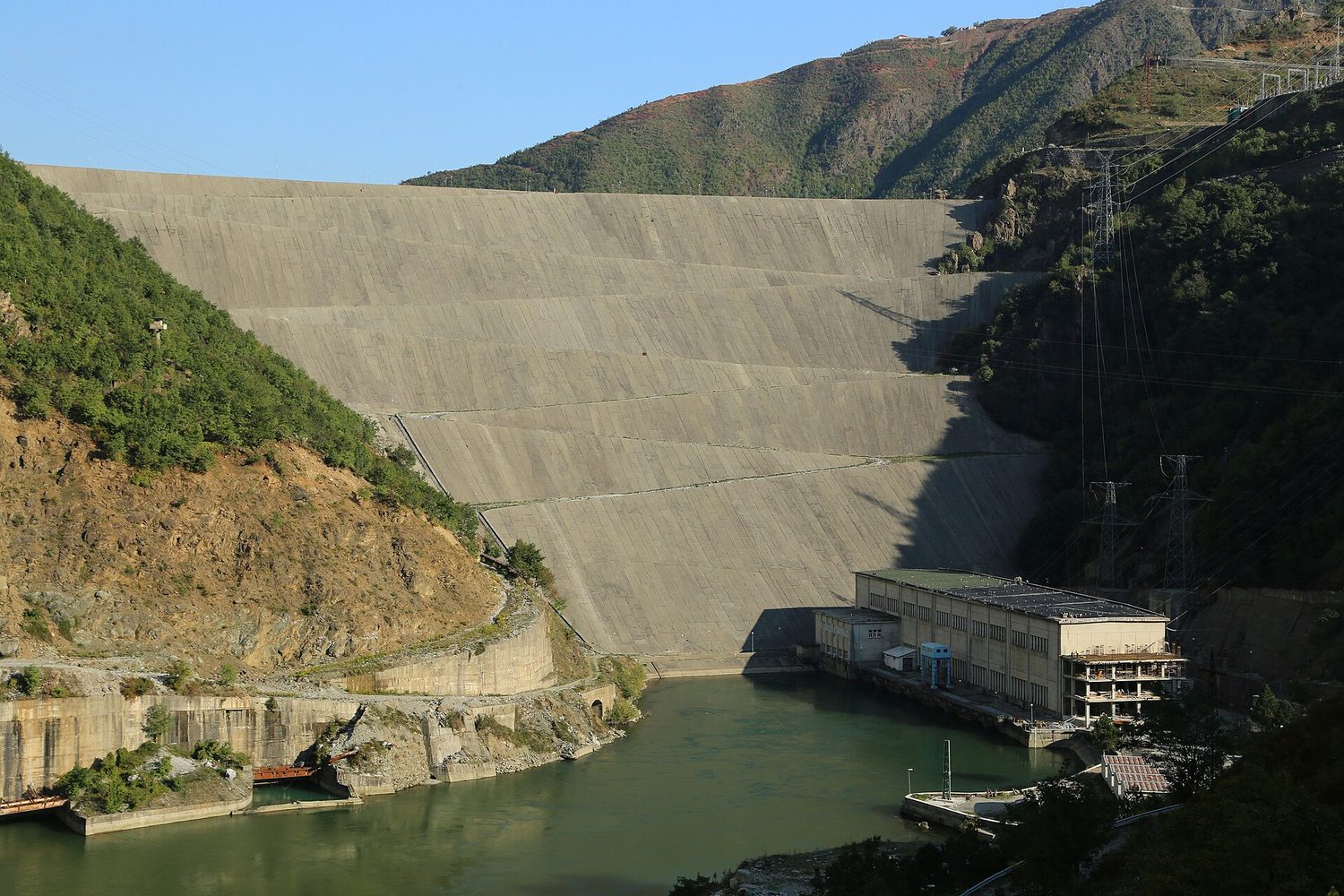
תחנת כוח הידרואלקטרית מסומנת במגאוואט: אנרגיית המים המאוגרת, מחולקת בזמן הנדרש לשחרורם
5.2
Gravitational potential energy · אנרגיה פוטנציאלית כבידתית
Syllabus · סיילבוס
English
derive, using $W = Fs$, the formula $\Delta E_{\text{P}} = mg\Delta h$ for gravitational potential energy changes in a uniform gravitational field
recall and use the formula $\Delta E_{\text{P}} = mg\Delta h$ for gravitational potential energy changes in a uniform gravitational field
derive, using the equations of motion, the formula for kinetic energy$E_{\text{K}} = \frac{1}{2}mv^2$
recall and use $E_{\text{K}} = \frac{1}{2}mv^2$
עברית
נגזר, באמצעות $W = Fs$, את הנוסחה $\Delta E_{\text{P}} = mg\Delta h$ לשינויים באנרגיה פוטנציאלית כבידתית בשדה כביד אחיד
נגזר, באמצעות משוואות התנועה, את הנוסחה ל-אנרגיה קינטית$E_{\text{K}} = \frac{1}{2}mv^2$
לזכור ולהשתמש ב$E_{\text{K}} = \frac{1}{2}mv^2$
Source: Cambridge International syllabus · מקור: הסיילבוס הבינלאומי של קמבריד'ג'
English
Energy exchange in a pendulum
In a uniform gravitational field (close to a planet's surface), the change in gravitational potential energy of mass 质量$m$ rising or falling through a height $\Delta h$ is
$$\Delta E_{\text{P}} = m g \Delta h.$$
Where it comes from
The work done against gravity to raise a mass $m$ slowly (no change in kinetic energy) through height $\Delta h$ equals the gravitational potential energy gained:
the gravitational force on the mass is $mg$ downwards,
the force needed to lift it slowly is $mg$ upwards,
the work done by this force is $W = F \cdot s = mg \cdot \Delta h$,
this work becomes $\Delta E_{\text{P}}$.
So $\Delta E_{\text{P}} = mg \Delta h$. To use it you need $m$ and $\Delta h$ (and $g$). You do not need speed or time. The two-mark derivation wants the same four lines, with the condition stated: the block is raised at constant speed, so the lifting force equals the weight $mg$, and the work done by that force over the vertical distance $\Delta h$ is $mg\Delta h$, which is the gain in gravitational potential energy. A $100\ \text{g}$ object falling $10\ \text{m}$ loses $0.100 \times 9.81 \times 10 = 9.8\ \text{J}$, about $10\ \text{J}$; the mass must be in kilograms.
עברית
החלפת אנרגיה בפנדול
בשדה כבידה אחיד (קרוב לפני השטח של כוכב לכת), השינוי באנרגיה הפוטנציאלית הכבידתית של מסה$m$ העולה או יורדת בגובה $\Delta h$ הוא
$$\Delta E_{\text{P}} = m g \Delta h.$$
מקורה
העבודה שנעשתה נגד הכבידה להרמת מסה $m$ לאט (ללא שינוי באנרגיה הקינטית) בגובה $\Delta h$ שווה לאנרגיה הפוטנציאלית הכבידתית שהיא רוכשת:
כוח הכבידה על המסה הוא $mg$ כלפי מטה,
הכוח הנדרש להרים אותה לאט הוא $mg$ כלפי מעלה,
העבודה שנעשתה על ידי כוח זה היא $W = F \cdot s = mg \cdot \Delta h$,
עבודה זו הופכת ל$\Delta E_{\text{P}}$.
לכן $\Delta E_{\text{P}} = mg \Delta h$. כדי להשתמש בו יש צורך ב$m$ וב$\Delta h$ (וגם ב$g$). אין צורך במהירות או בזמן. גזירת הניקוד כפול דורשת אותן ארבע שורות, עם ההנחה נקובה: הבלוק מורם במהירות קבועה, ולכן כוח הרמה שווה למשקל $mg$, ועבודת כוח זה על המרחק האנכי $\Delta h$ היא $mg\Delta h$, שזהו העלייה באנרגיה הפוטנציאלית כבדית. גוף בעל $100\ \text{g}$ שנופל מ$10\ \text{m}$ מאבד $0.100 \times 9.81 \times 10 = 9.8\ \text{J}$, בערך $10\ \text{J}$; המסה חייבת להיות בק"ג.
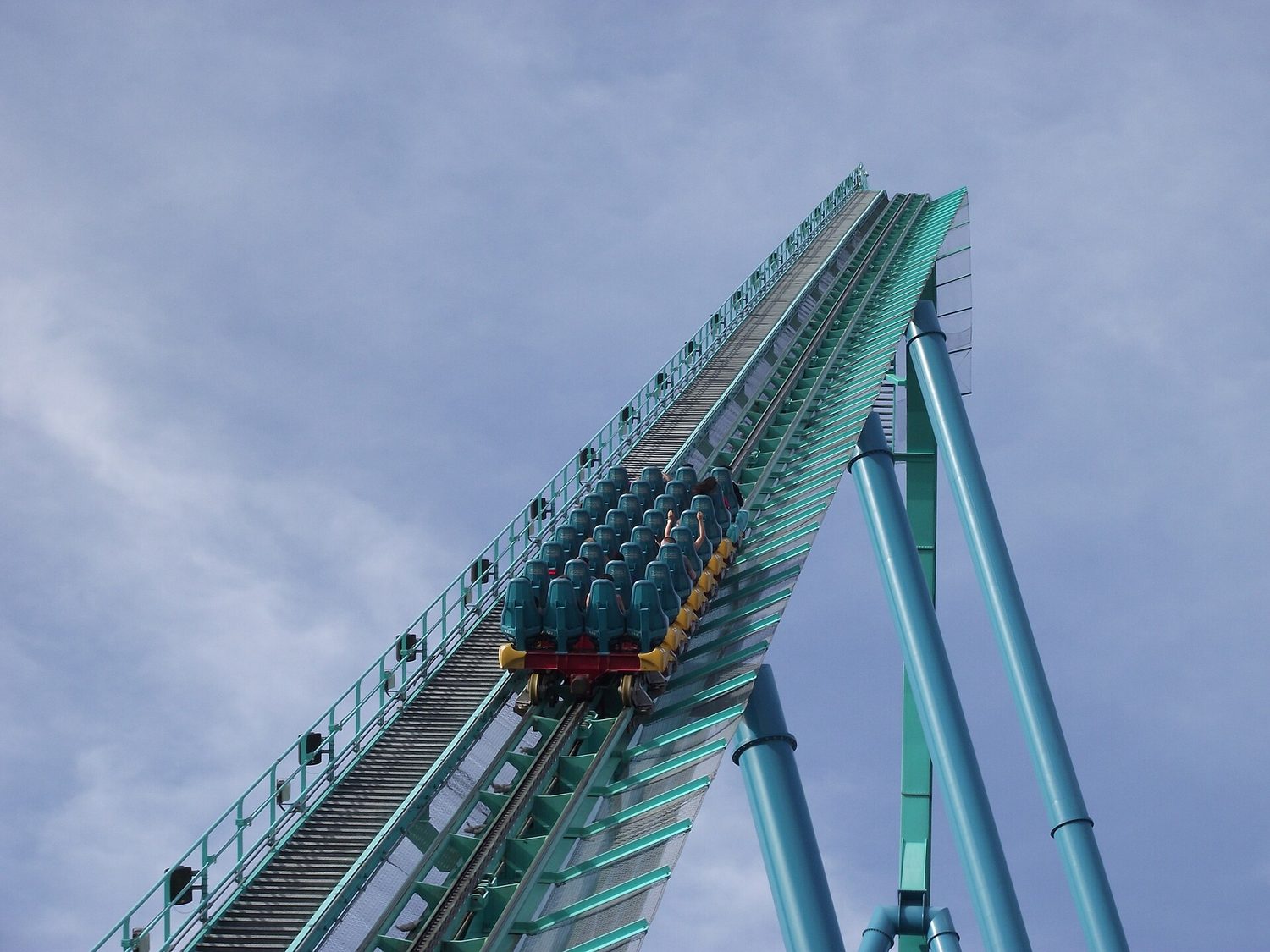
האנרגיה הפוטנציאלית הכבידתית תלויה רק בגובה שהושג, ולא במסלול שהתוהרכבת הרים נמשכת למעלה בגבעת הרמה: העבודה המבוצעת נגד כוח הכבידה מאוחסנת כאנרגיה פוטנציאלית כבידתית
5.2
Kinetic energy · אנרגיה קינטית
English
The kinetic energy of an object of mass $m$ moving at speed $v$ is
$$E_{\text{K}} = \tfrac{1}{2} m v^{2}.$$
Where it comes from
Apply a resultant force $F$ to a mass $m$ that starts at rest. It speeds up evenly from $0$ to $v$ over a displacement $s$. From $v^{2} = u^{2} + 2as$ with $u = 0$,
$$s = \frac{v^{2}}{2a}.$$
The work done on the mass is
$$W = F \cdot s = m a \cdot \frac{v^{2}}{2a} = \tfrac{1}{2} m v^{2}.$$
All this work becomes kinetic energy, so $E_{\text{K}} = \tfrac{1}{2} m v^{2}$. In the exam, state the assumptions as you go: the object starts from rest, the force is constant, so the acceleration is uniform, and $F = ma$ is Newton's second law.
Because $E_{\text{K}} \propto v^{2}$, quadrupling the speed multiplies the kinetic energy by sixteen: an object with $1500\ \text{J}$ at $10\ \text{m s}^{-1}$ has $24\,000\ \text{J}$ at $40\ \text{m s}^{-1}$. The same square is why a stopping force is found from energy: a ball of mass $1.2\ \text{kg}$ moving at $3.0\ \text{m s}^{-1}$ that is stopped by a cushion over $0.020\ \text{m}$ loses $\tfrac{1}{2} \times 1.2 \times 3.0^{2} = 5.4\ \text{J}$, so the average force on it is $5.4 / 0.020 = 270\ \text{N}$: the work done by the cushion equals the kinetic energy lost.
Kinetic energy and momentum
Combining $p = mv$ and $E_{\text{K}} = \tfrac{1}{2} m v^{2}$:
$$E_{\text{K}} = \frac{p^{2}}{2m}.$$
This is handy when the momentum 动量 is given but not the velocity. For a momentum change from $p_{1}$ to $p_{2}$ at constant mass, the change in kinetic energy is $(p_{2}^{2} - p_{1}^{2}) / (2m)$.
עברית
האנרגיה הקינטית של גוף במסה $m$ הנע במהירות $v$ היא
$$E_{\text{K}} = \tfrac{1}{2} m v^{2}.$$
מקורה
יישום כוח נתון $F$ על מסה $m$ שמתחילה ממצב רכינה. היא מאיצה באופן אחיד מ$0$ ל$v$ לאורך תזוזה $s$. מ$v^{2} = u^{2} + 2as$ עם $u = 0$,
$$s = \frac{v^{2}}{2a}.$$
העבודה שנעשתה על המסה היא
$$W = F \cdot s = m a \cdot \frac{v^{2}}{2a} = \tfrac{1}{2} m v^{2}.$$
כל עבודה זו הופכת לאנרגיה קינטית, ולכן $E_{\text{K}} = \tfrac{1}{2} m v^{2}$. במבחן, ציין את ההנחות בזמן ביצוען: הגוף מתחיל ממצב רגיעה, הכוח הוא קבוע, ולכן ההאצה היא אחידה, ו$F = ma$ הוא חוק牛顿 השני.
מכיוון ש$E_{\text{K}} \propto v^{2}$, הכפלת המהירות פי ארבע מגבירה את האנרגיה הקינטית פי שש-עשרה: גוף בעל $1500\ \text{J}$ ב$10\ \text{m s}^{-1}$ יש לו $24\,000\ \text{J}$ ב$40\ \text{m s}^{-1}$. אותו ריבוע הוא הסיבה לכך שכוח עצירה מחושב באמצעות אנרגיה: כדור במסה $1.2\ \text{kg}$ הנע ב$3.0\ \text{m s}^{-1}$ שמופסק על ידי כרית לאורך $0.020\ \text{m}$ מאבד $\tfrac{1}{2} \times 1.2 \times 3.0^{2} = 5.4\ \text{J}$, ולכן הכוח הממוצע עליו הוא $5.4 / 0.020 = 270\ \text{N}$: העבודה שנעשתה על ידי הכרית שווה לאנרגיה הקינטית שהוחרבה.
אנרגיה קינטית ותנע
שילוב $p = mv$ ו$E_{\text{K}} = \tfrac{1}{2} m v^{2}$:
$$E_{\text{K}} = \frac{p^{2}}{2m}.$$
זה יעיל כאשר תנע נתון אך מהירות אינה נתונה. עבור שינוי תנע מ$p_{1}$ ל$p_{2}$ במסה קבועה, השינוי באנרגיה קינטית הוא $(p_{2}^{2} - p_{1}^{2}) / (2m)$.
קפיץ מקל: אנרגיה קינטית מהריצה מאוחסנת במקל המכופף, ולאחר מכן מוחזרת כגובה
Explore · חקור
Kinetic & potential energy · אנרגיה קינטית ואנרגיה פוטנציאלית
PE + KE = constant · PE + KE = קבוע
Potential energy turns into kinetic energy — the total never changes. · אנרגיה פוטנציאלית הופכת ל-אנרגיה קינטית — הסך הכל לעולם אינו משתנה.
5.2
Using energy methods · שימוש בשיטות אנרגטיות
English
A useful plan for problems that mix forces and energy:
Find the start and end states. Write the kinetic and potential energies in each.
List any work done by outside forces (friction, a push). Friction usually takes energy out; a push can add it.
Conservation of energy: $E_{\text{start}} + W_{\text{in}} = E_{\text{end}} + W_{\text{lost as heat etc.}}$.
Examples:
A box pushed at constant velocity up a ramp of length $L$ rising by $h$: $E_{\text{K}}$ does not change, so the work done by the push goes into $\Delta E_{\text{P}}$ plus the work done against friction.
A block sliding into a spring 弹簧 with kinetic energy $E_{\text{K}}$ on a frictionless surface: at greatest compression 压缩$x$, all the kinetic energy has become elastic potential energy $\tfrac{1}{2} k x^{2}$ (where $k$ is the spring constant 劲度系数).
A ball dropped from height $h_{1}$ that bounces to height $h_{2}$: the ratio $h_{2}/h_{1}$ is the fraction of mechanical energy kept, $h_{2}/h_{1} = (v_{\text{up}}/v_{\text{down}})^{2}$.
A projectile 抛体 thrown to the same height at different angles: the final speed is the same (only the height matters); use components to get its direction.
A bungee jumper 蹦极者: from the platform to the point where the cord goes taut, GPE becomes KE; from there the cord stretches and takes energy as elastic potential energy, so the KE reaches its maximum where the cord's pull first equals the weight, then falls to zero at the lowest point, where GPE lost $=$ elastic PE stored (plus any thermal energy).
עברית
תוכנית שימושית לבעיות המשלבות כוחות ואנרגיה:
מצא את המצאים ההתחלתי והסופי. כתוב את האנרגיות הקינטיות והפוטנציאליות בכל אחד.
רשום כל עבודה שנעשתה על ידי כוחות חיצוניים (חיכוך, דחיפה). חיכוך בדרך כלל מוריד אנרגיה; דחיפה יכולה להוסיף אותה.
קופסה שנדחפת במהירות קבועה לאורך מגננה באורך $L$ העולה בגובה $h$: $E_{\text{K}}$ אינו משתנה, ולכן העבודה שנעשתה על ידי הדחיפה הופכת ל$\Delta E_{\text{P}}$ בתוספת העבודה נגד החיכוך.
בלוק שזז לתוך קפיץ עם אנרגיה קinetית $E_{\text{K}}$ על פני שטח ללא חיכוך: בנקודת הצמצום המקסימלי$x$, כל האנרגיה הקינטית הפכה לאנרגיה פוטנציאלית אלסטית $\tfrac{1}{2} k x^{2}$ (כאשר $k$ הוא קבוע הקפיץ).
כדור שמורידים מגובה $h_{1}$ וקופץ לגובה $h_{2}$: היחס $h_{2}/h_{1}$ הוא השבר מהאנרגיה המכנית שנשמרת, $h_{2}/h_{1} = (v_{\text{up}}/v_{\text{down}})^{2}$.
פריל הנורה לגובה זהה בזוויות שונות: מהירות הסיום זהה (רק הגובה חשוב); השתמש במרכיבים כדי למצוא את הכיוון.
קפיץ: מהפלטפורמה עד הנקודה שבה הקבל הופך למתוח, GPE הופך לKE; מכאן הקבל מתמתח וסופח אנרגיה כאנרגיה פוטנציאלית אלסטית, כך שה-KE מגיע לנקודת המקסימום כאשר מתיחת הקבל שווה לראשונה למשקל, ואז יורד לאפס בנקודה הנמוכה ביותר, שבה GPE שאבד $=$ PE אלסטית מאוחסנת (בתוספת אנרגיה תרמית אם קיים).
אנרגיה קינטית של בלוק הופכת לאנרגיה פוטנציאלית אלסטית כאשר הוא מצמצם את הקפיץ
Explore · חקור
Conservation of energy · שימור אנרגיה
Drop the mass and watch GPE turn into KE. With no friction the total energy stays the same — that's the energy method. · הורידו את המסה וצפו בהמרת אנרגיה פוטנציאלית גרavitציונית (GPE) לאנרגיה קינטית (KE). ללא חיכוך, האנרגיה הכוללת נשארת זהה — זוהי השיטה האנרגטית.
5.2
Definitions the examiner accepts · הגדרות מקובלות בקורס
English
A definition question is marked against fixed wording. Learn these exactly, and give one answer only.
Term
Definition
work done by a force
the product of the force and the distance moved in the direction of the force
principle of conservation of energy
energy cannot be created or destroyed, only transferred from one form to another, so the total energy of a closed system is constant
efficiency
the ratio of useful energy (or power) output from a system to the total energy (or power) input, usually as a percentage
power
the work done per unit time, or the rate at which energy is transferred
gravitational potential energy
the energy an object has because of its position in a gravitational field
kinetic energy
the energy an object has because of its motion
elastic potential energy
the energy stored in an object that has been stretched or compressed
עברית
שאלת הגדרה מוקדמת לפי טקסט קבוע. לימודן במדויק, ותן תשובה אחת בלבד.
מונח
הגדרה
עבודה שנעשתה על ידי כוח
מכפלת הכוח והמרחק שנסעה בכיוון הכוח
עקרון שימור האנרגיה
אנרגיה אינה נוצרת או נשללת, אלא רק מועברת מצורה אחת לאחרת, ולכן האנרגיה הכוללת של מערכת סגורה היא קבועה
יעילות
היחס בין האנרגיה (או ההספק) המועילה היוצאת ממערכת לבין האנרגיה (או ההספק) הכולל הנכנסת, בדרך כלל כאחוז
הספק
העבודה שנעשתה ליחידת זמן, או הקצב שבו אנרגיה מועברת
אנרגיה פוטנציאלית כבידתית
האנרגיה שיש לגוף בשל מיקומו בשדה כבידה
אנרגיה קינטית
האנרגיה שיש לגוף בשל תנועתו
אנרגיה פוטנציאלית אלסטית
האנרגיה הארוזה בגוף שנמתח או התכווץ
5.2
Exam tips · טיפים לבחינות
English
Work $=$ force $\times$ distance moved in the direction of the force — use $Fs\cos\theta$ when they are at an angle.
Use conservation of energy: loss in GPE $=$ gain in KE ($+$ work done against resistance).
Power $=$ work $/$ time $= Fv$; efficiency $=$ useful output $\div$ total input.
GPE uses the vertical height gained, not the distance along a slope.
Common mistakes
Giving the change in height as the answer to a change-in-energy question. Finish the calculation: $\Delta E_{\text{P}} = mg\Delta h$.
Using the distance along a slope as the height in $mg\Delta h$, or using mass where weight is needed. Use the vertical height gained, and check whether the quantity wanted is $m$ in kg or $W$ in N.
Putting the resistive force into $P = Fv$ for a car that is accelerating. $F$ is the driving force; only at constant speed does it equal the resistive force.
Efficiency above 100%, or efficiency as output divided by wasted. It is useful output divided by total input, and the total input is always the larger number.
Reading a force–extension graph's gradient when the question wants the energy. Energy stored is the area under the line, not its slope.
עברית
עבודה $=$ כוח $\times$ מרחק שנסעה בכיוון הכוח — השתמש ב$Fs\cos\theta$ כאשר הם בזווית.
השתמש בשימור אנרגיה: הפסד ב-GPE $=$ גAIN ב-KE ($+$ עבודה שנעשתה נגד התנגדות).
הספק $=$ עבודה $/$ זמן $= Fv$; יעילות $=$ תפוקת שימושית $\div$ כניסה כוללת.
GPE משתמש בגובההאנכי שנצבר, ולא במרחק לאורך השיפול.
טעויות נפוצות
מתן השינוי בגובה כתשובה לשאלה על שינוי באנרגיה. השלם את החישוב: $\Delta E_{\text{P}} = mg\Delta h$.
שימוש במרחק לאורך המדרון כגובה ב-$mg\Delta h$, או שימוש במסה במקום משקל. השתמש בגובה האנכי שנצבר, ובדוק האם הכמות הנדרשת היא $m$ בק"ג או $W$ ב-N.
הצבת הכוח ההתנגדותי בתוך $P = Fv$ לרכב המאיץ. $F$ הוא כוח הנהיגה; רק במהירות קבועה הוא שווה לכוח ההתנגדותי.
יעילות מעל 100%, או יעילות כביצוע חלקי לחולף. זהו ביצוע מועיל מחולק בסך כל הקלט, וסך כל הקלט תמיד הוא המספר הגדול יותר.
קריאת שיפוע גרף כוח-מתיחה כאשר השאלה דורשת אנרגיה. האנרגיה המאגרת היא השטח מתחת לקו, ולא השיפוע שלו.
Interactive lessons on this topic · שיעורים אינטראקטיביים בנושא זה
Work through it step by step, with instant-check exercises. · לעבור על הדברים צעד אחר צעד, עם תרגילים לבדיקה מיידית.
Pick one and the site follows you — notes, papers, videos and practice all open on it. · בחרו נושא אחד והאתר יעקוב אחריו — הערות, מסמכים, וידאו ותרגולים פתוחים בו.
Type to search notes, lessons, code, vocabulary and past-paper questions across every subject. · הקלד כדי לחפש הערות, שיעורים, קוד, אוצר מילים ושאלות מבחנים בכל הנושאים.


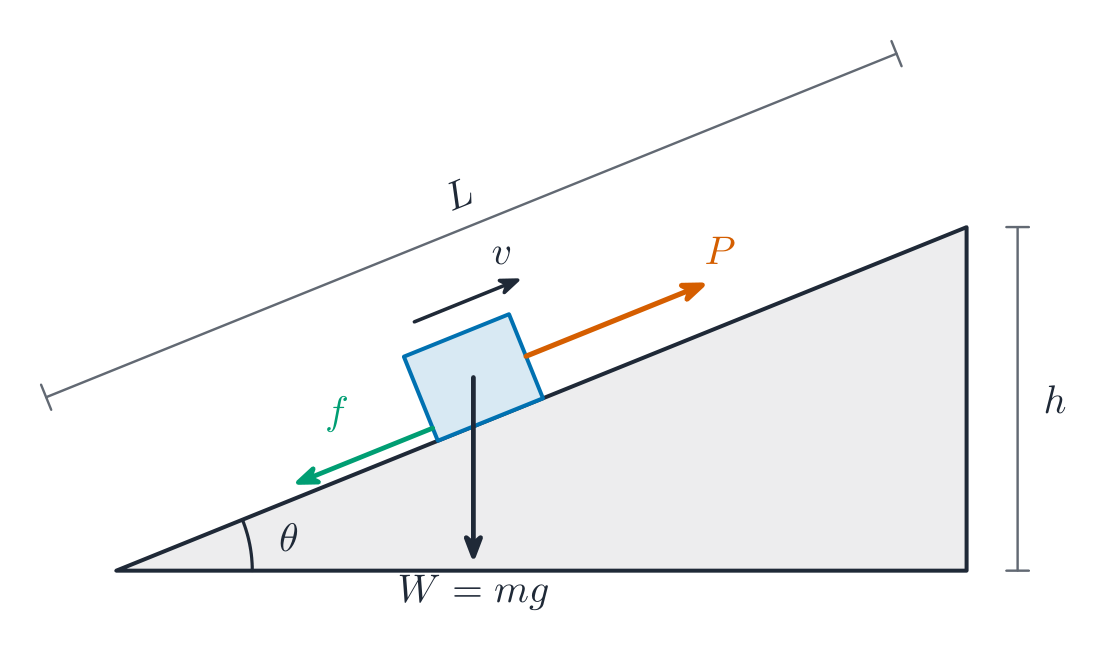
 *במדרון ללא חיכוך, GPE הופכת לKE בעוד שהאנרגיה הכוללת נשארת קבועה
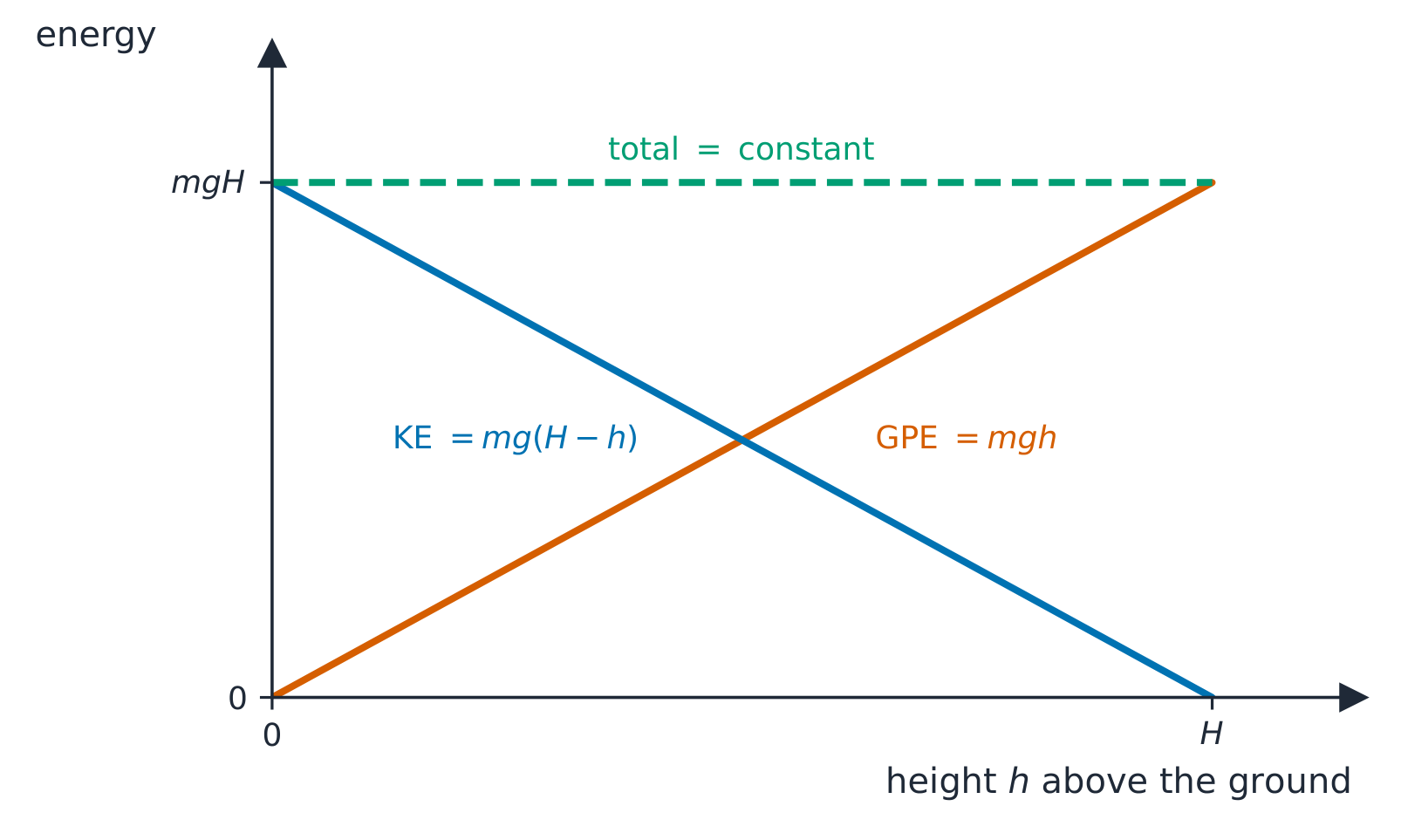 *כדור הצולל: GPE ו-KE משתנים שניהם בקו ישר לפי הגובה, והסכום שלהם הוא קבוע
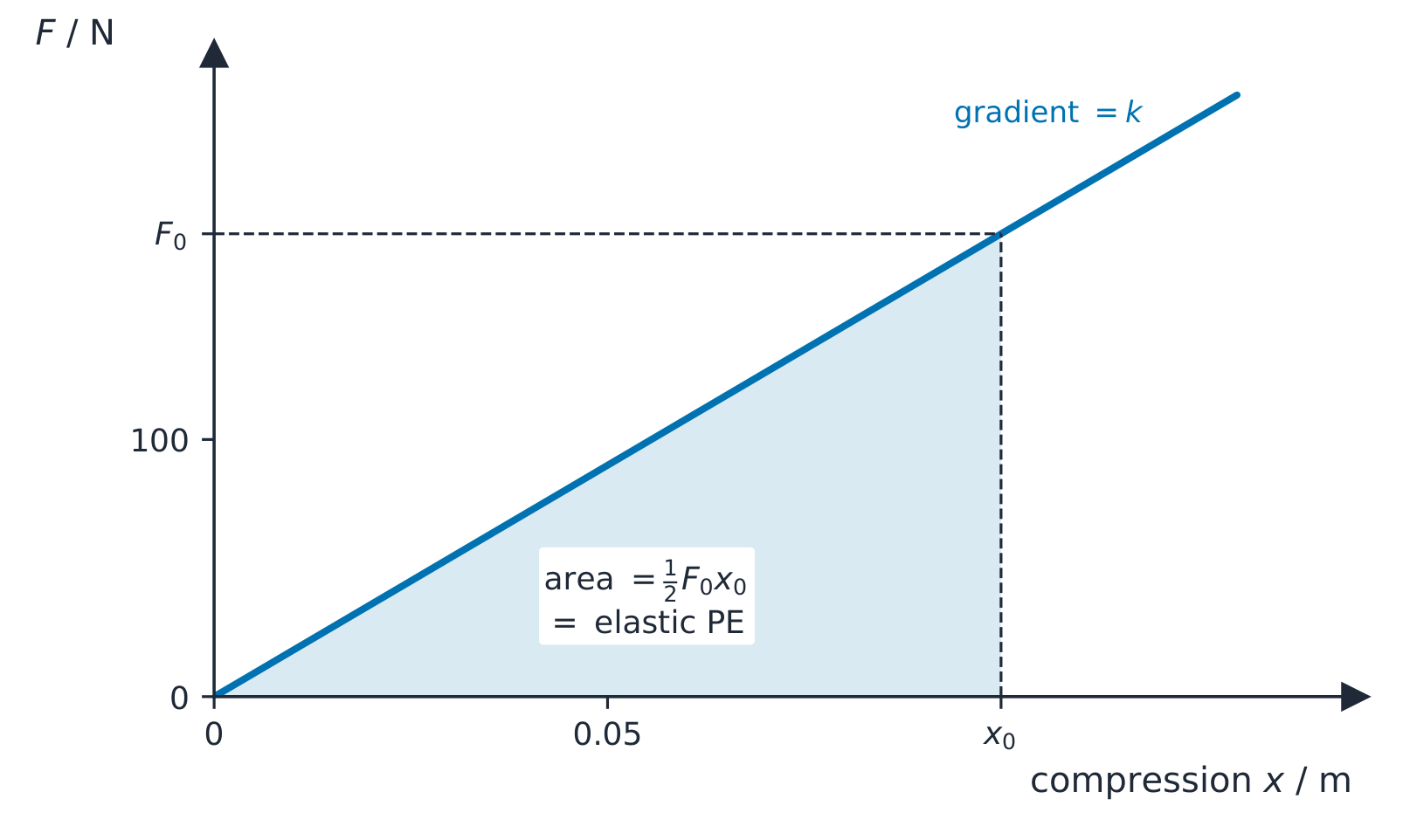 *האנרגיה המאוחסנת בקפיץ היא השטח מתחת לגרף הכוח–הלחיצה שלו: