תקין את צמיג האופניים, במהירות ובכוח רב, ויקרה דבר מפתיע: המשאבה תתחמם. מספיק חמה כדי להרגיש. לא חימת אותה עם להבה. אז איפה…
English narration · English + 中文 subtitles burned in · קריאת קול באנגלית · תרגום אנגלי + סינית שרוף בתוך הסרטון
16.1
Internal energy · אנרגיה פנימית
Syllabus · סיילבוס
English
understand that internal energy is determined by the state of the system and that it can be expressed as the sum of a random distribution of kinetic and potential energies associated with the molecules of a system
relate a rise in temperature of an object to an increase in its internal energy
עברית
הבן ש-אנרגיה פנימית נקבעת על ידי מצב המערכת ואפשר לבטאה כסכום של חלוקה אקראית של אנרגיות קינטיות ופוטנציאליות הקשורות למולקולות מערכת
קשר עליית טמפרטורה של גוף לעלייה באנרגיה הפנימית שלו
Source: Cambridge International syllabus · מקור: הסיילבוס הבינלאומי של קמבריד'ג'
English
The internal energy 内能$U$ of a system is the sum of:
the random kinetic energies 动能 of its molecules 分子 — they fly through space (translational 平动 motion), and unless they are single atoms they also spin (rotational 转动) and shake (vibrational 振动), and
the potential energies from the forces between the molecules.
For a real solid, liquid or gas, both parts matter. In the ideal-gas 理想气体 model the intermolecular 分子间 forces are ignored, so the molecular potential energy is zero and the internal energy is purely kinetic.
The two-mark definition.The internal energy of a system is the sum of the random distribution of the kinetic and potential energies of its molecules (or atoms). Both marks need "sum of kinetic and potential energies" and "random" (or "of the molecules") — leaving out "random" describes the energy of a moving object, not its internal energy. For an ideal gas, "with reference to kinetic and potential energy": the internal energy is the total kinetic energy of the molecules only, because there are no intermolecular forces and therefore no potential energy.
Two key points:
$U$ depends only on the state of the system (its temperature 温度, pressure 压强, volume 体积, amount of substance 物质的量) — not on the path taken to get there.
$U$ is a sum over the molecules, not the kinetic energy of the whole object moving. A moving train of gas has bulk kinetic energy, but that is separate from $U$ — $U$ is the energy of the random molecular motion.
Temperature and internal energy
Raising an object's temperature raises the random kinetic energy of its molecules, and so raises its internal energy.
For an ideal gas every molecule has average translational kinetic energy $\tfrac{3}{2} k T$ (Topic 15). With zero intermolecular potential energy, the total internal energy is
$$U = \tfrac{3}{2} N k T = \tfrac{3}{2} n R T.$$
So the internal energy of an ideal gas is directly proportional to the thermodynamic temperature 热力学温度. Doubling $T$ doubles $U$. This is only exact for an ideal gas.
During a phase change 相变 (melting or boiling) of a real substance, $U$ rises because the molecular potential energy rises (bonds breaking), even though the temperature stays constant.
Describing a change in internal energy — always name both energies. A three-mark "describe and explain, with reference to molecular kinetic and potential energies" answer says what happens to each:
a gas heated at constant volume: the kinetic energy of the molecules increases, because temperature is a measure of their mean kinetic energy; the potential energy is unchanged (no work is done, the molecules' separation does not change); so the internal energy increases.
a wire stretched within its elastic limit at constant temperature: the kinetic energy of the atoms is unchanged (same temperature); the potential energy increases, because the atoms are pulled further apart against the interatomic forces; so the internal energy increases.
ice melting at $0\ ^{\circ}\text{C}$: the kinetic energy is unchanged (constant temperature); the potential energy increases as the bonds between molecules are broken and the separation grows; so the internal energy increases by the latent heat supplied.
Worked example. A fixed mass of ideal gas is heated at constant pressure. Sketch the variation of its internal energy $U$ with its volume $V$.
At constant pressure $V \propto T$ (Charles's law) and for an ideal gas $U \propto T$, so $U \propto V$: a straight line through the origin. The origin is on the line because at absolute zero both $V$ (extrapolated) and $U$ are zero.
עברית
האנרגיה הפנימית$U$ של מערכת היא סך הכול:
האנרגיות הקינטיות האקראיות של המולקולות שלה — הן עוברות בחלל (תנועה תנועתית), ואילו אם הן אינן אטום בודד הן גם מסתובבות (תנועה סיבובית) ומרעדות (תנועה רטטית), וכן
האנרגיות הפוטנציאליות הנובעות מכוחות בין המולקולות.
לגוף מוצק, נוזלי או גז אמיתי, שתי החלקים חשובים. בדגם הגז האידיאלי כוחות בין-מולקולאריים מתעלמים, ולכן האנרגיה הפוטנציאלית המולקולרית היא אפס והאנרגיה הפנימית היא קינטית בלבד.
ההגדרה בשתי נקודות.האנרגיה הפנימית של מערכת היא סך הכול ההתפלגות האקראית של האנרגיות הקינטיות והפוטנציאליות של מולקולותיו (או אטומיו). שתי הנקודות דורשות "סך הכול אנרגיות קינטיות ופוטנציאליות" וגם "אקראי" (או "של המולקולות") — omission of "random" מתאר את אנרגיית גוף נע, ולא את האנרגיה הפנימית שלו. לגז אידיאלי, "בהתייחס לאנרגיות קינטיות ופוטנציאליות": האנרגיה הפנימית היא סך כל האנרגיה הקינטית של המולקולות בלבד, מכיוון שאין כוחות בין-מולקולאריים ולכן אין אנרגיה פוטנציאלית.
האנרגיה הפנימית היא האנרגיה הקינטית האקראית של המולקולות (החצים) בתוספת האנרגיה הפוטנציאלית של הכוחות ביניהן (הקפיצים)
שתי נקודות מרכזיות:
$U$ תלוי רק במצב של המערכת (טמפרטורה, לחץ, נפח, כמות חומר) — ולא בדרך שבה הגיעו למצב זה.
$U$ הוא סכום על פני המולקולות, ולא האנרגיה הקינטית של כלל הגוף הנע. רכבת גז הנעה בעלת אנרגיה קינטית מקרוסקופית, אך זו נפרדת מ-$U$ — $U$ היא האנרגיה של התנועה המולקולרית האקראית.
טמפרטורה ואנרגיה פנימית
העלאת הטמפרטורה של גוף מעלה את האנרגיה הקינטית האקראית של מולקולותיו, ולכן מעלה גם את האנרגיה הפנימית שלו.
לגז אידיאלי לכל מולקולה יש אנרגיה קינטית תרגולתית ממוצעת $\tfrac{3}{2} k T$ (נושא 15). עם אפס אנרגיה פוטנציאלית בין-מולקולרית, האנרגיה הפנימית הכוללת היא
$$U = \tfrac{3}{2} N k T = \tfrac{3}{2} n R T.$$
לכן האנרגיה הפנימית של גז אידיאלי פרופורציונלית ישירות ל-טמפרטורה התרמודינמית. הכפלת $T$ מכפילה פי שניים את $U$. הדבר רק מדויק לגז אידיאלי.
בעת שינוי מצב (התכה או רתיחה) של חומר אמיתי, $U$ עולה משום שהאנרגיה הפוטנציאלית המולקולרית עולה (שבירת קשרים), גם אם הטמפרטורה נשארת קבועה.
תיאור שינוי באנרגיה פנימית — תמיד ציין שתי אנרגיות. תשובה בשלושה נקודות "תאר והסבר, בהתייחס לאנרגיות קינטיות ופוטנציאליות מולקולריות" אומרת מה קורה ל-כל אחת:
גז מתחמם בנפח קבוע: האנרגיה הקינטית של המולקולות עולה, משום שהטמפרטורה היא מדד לממוצע האנרגיה הקינטית שלהן; האנרגיה הפוטנציאלית אינה משתנה (לא בוצע עבודה, המרחק בין המולקולות לא השתנה); ולכן האנרגיה הפנימית עולה.
חוטי מתוח בתוך הגבול האלסטי שלו בטמפרטורה קבועה: האנרגיה הקינטית של האטומים אינה משתנה (אותה טמפרטורה); האנרגיה הפוטנציאלית עולה, משום שהאטומים נמשכים הרחק זה מזה נגד כוחות האטומיים; ולכן האנרגיה הפנימית עולה.
קרח נמס ב-$0\ ^{\circ}\text{C}$: האנרגיה הקינטית אינה משתנה (טמפרטורה קבועה); האנרגיה הפוטנציאלית עולה כשהקשרים בין המולקולות נשברים והמרחק גדל; ולכן האנרגיה הפנימית עולה במידת החום הסתורי שסופק.
דוגמה פתורה. מסת גז אידיאלי קבועה מתחממת בלחץ קבוע. ערך גרף של השינוי באנרגיה הפנימית $U$ כפונקציה של הנפח $V$.
בלחץ קבוע $V \propto T$ (חוק שארל) ולגז אידיאלי $U \propto T$, ולכן $U \propto V$: קו ישר העובר דרך הראשית. הראשית נמצאת על הקו משום שבטמפרטורה האבסולוטית גם $V$ (באקסטרפולציה) וגם $U$ הם אפס.
Explore · חקור
The spread of molecular energies · הפיזור באנרגיות המולקולריות
Internal energy is the total random kinetic + potential energy of the molecules. Heat the gas and the whole speed distribution shifts to higher energy. · אנרגיה פנימית היא סך האנרגיה הקינטית והפוטנציאלית האקראיות של המולקולות. חימום הגז גורם להזזה כללית של חלוקת המהירויות אל אנרגיות גבוהות יותר.
first law of thermodynamics/fɜːst lɔː ɒv ˌθɜːməʊdaɪˈnæmɪks/
חוק ראשון בתרמודינמיקה
conservation of energy/ˌkɒnsəˈveɪʃn ɒv ˈenədʒi/
שימור אנרגיה
isothermal/ˌaɪsəˈθɜːml/
איזותרמי
adiabatic/ˌædiəˈbætɪk/
אדיאבטי
heat capacity/hiːt kəˈpæsɪti/
קיבולת חוםית
monatomic/ˌmɒnəˈtɒmɪk/
אחד-אטומי
16.2
Work done on or by a gas · עבודה שנעשתה על ידי גז או על ידי גז
Syllabus · סיילבוס
English
recall and use $W = p\Delta V$ for the work done when the volume of a gas changes at constant pressure and understand the difference between the work done by the gas and the work done on the gas
recall and use the first law of thermodynamics$\Delta U = q + W$ expressed in terms of the increase in internal energy, the heating of the system (energy transferred to the system by heating) and the work done on the system
עברית
זכור ושתמש ב-$W = p\Delta V$ עבור העבודה שנעשתה כאשר נפח הגז משתנה ב-לחץ קבוע והבן את ההבדל בין העבודה שנעשתה על ידי הגז לבין העבודה שנעשתה על הגז
זכור ושתמש ב-חוק הראשון של התרמודינמיקה$\Delta U = q + W$ המבטא את העלייה ב-אנרגיה פנימית, חימום המערכת (העברה של אנרגיה למערכת באמצעות חימום) ועבודה שנעשתה על המערכת
Source: Cambridge International syllabus · מקור: הסיילבוס הבינלאומי של קמבריד'ג'
English
When a gas changes volume against an outside pressure, mechanical work is done. At constant pressure $p$ with a small volume change $\Delta V$, the size of the work is
$$W = p \Delta V.$$
Worked example. A gas at a constant pressure of $1.0 \times 10^{5}\ \text{Pa}$ expands from $2.0 \times 10^{-3}\ \text{m}^{3}$ to $5.0 \times 10^{-3}\ \text{m}^{3}$. Find the work done by the gas.
Worked example. An ideal gas of mass $0.35\ \text{kg}$ is heated at a constant pressure of $2.0 \times 10^{5}\ \text{Pa}$; its internal energy rises by $7600\ \text{J}$ and its volume increases by $1.2 \times 10^{-2}\ \text{m}^{3}$. Find the work done by the gas and the thermal energy supplied. The gas is then heated at constant volume until its internal energy rises by the same $7600\ \text{J}$; explain why less thermal energy is needed.
Work done by the gas $= p\Delta V = 2.0 \times 10^{5} \times 1.2 \times 10^{-2} = 2400\ \text{J}$, so the work done on it is $W = -2400\ \text{J}$. First law: $q = \Delta U - W = 7600 - (-2400) = 1.0 \times 10^{4}\ \text{J}$. At constant volume no work is done ($\Delta V = 0$, $W = 0$), so the whole of the thermal energy goes into internal energy: $q = \Delta U = 7600\ \text{J}$. The extra $2400\ \text{J}$ at constant pressure was the work the gas did pushing back the surroundings as it expanded.
Worked example. An aluminium block of volume $3.612 \times 10^{-3}\ \text{m}^{3}$ is heated from $0\ ^{\circ}\text{C}$ to $40\ ^{\circ}\text{C}$; its volume increases by $1.0 \times 10^{-5}\ \text{m}^{3}$ against atmospheric pressure ($1.0 \times 10^{5}\ \text{Pa}$). Compare the work it does on the atmosphere with the thermal energy it receives ($m = 9.75\ \text{kg}$, $c = 900\ \text{J kg}^{-1}\ \text{K}^{-1}$).
Work done by the block $= p\Delta V = 1.0 \times 10^{5} \times 1.0 \times 10^{-5} = 1.0\ \text{J}$; thermal energy $q = mc\Delta T = 9.75 \times 900 \times 40 = 3.5 \times 10^{5}\ \text{J}$. The work is about $3 \times 10^{-6}$ of the heating, so for a solid $\Delta U \approx q$: solids and liquids barely expand, and $p\Delta V$ only matters for a gas.
Sign convention in this syllabus
This syllabus writes the first law as $\Delta U = q + W$, where $W$ is the work done on the gas and $q$ is the energy put in by heating.
when the gas is compressed, $\Delta V$ is negative and the work done on the gas is positive — the gas gains energy.
when the gas expands, $\Delta V$ is positive and the work done on the gas is negative — the gas loses energy (it does work on the surroundings).
Watch which form a question wants:
"work done on the gas" — positive when compressing.
"work done by the gas" — the opposite sign, positive when expanding.
At constant volume ($\Delta V = 0$), no work is done.
עברית
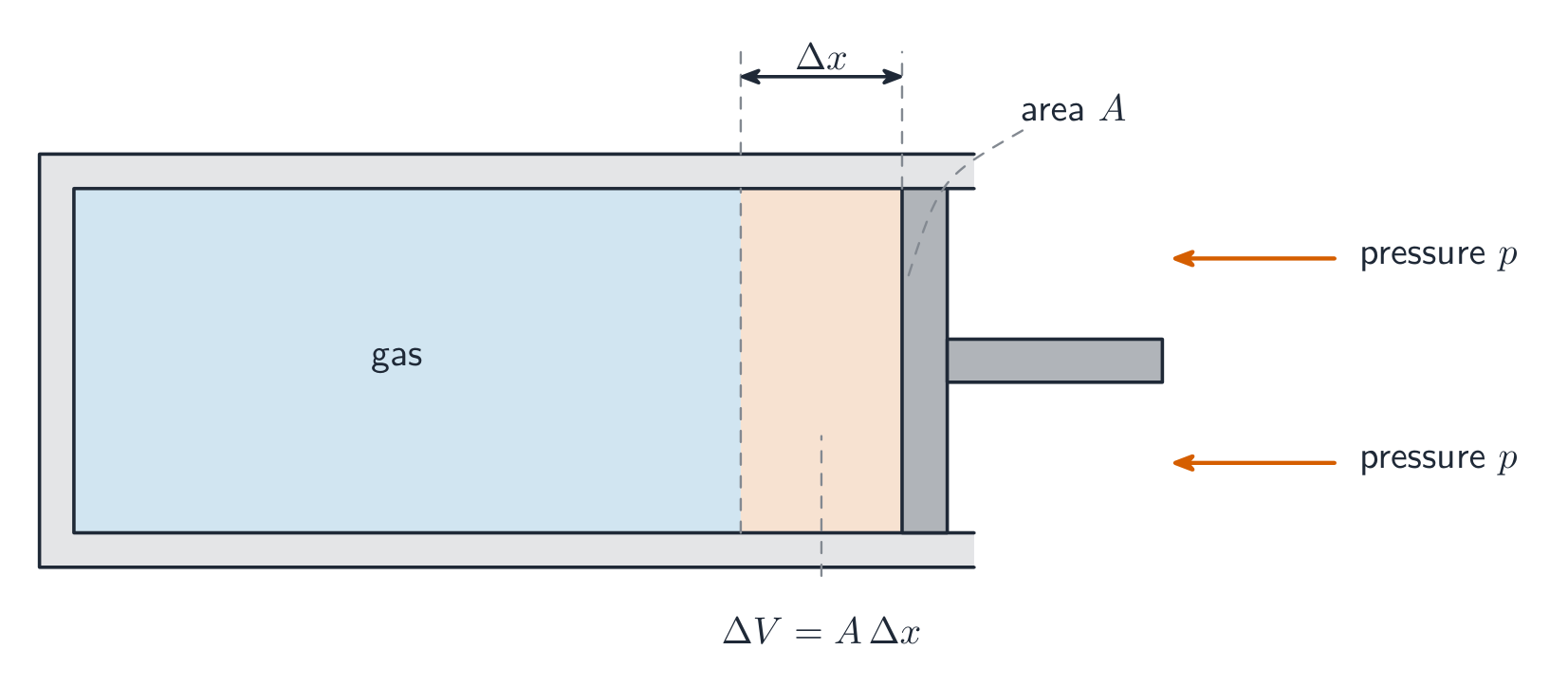
טורבינת קיטור מבצעת עבודה כאשר קיטור מתרחב דוחף את להביה.גז הדוחף בוכנה בשטח $A$ למרחק של $\Delta x$ מבצע עבודה $W = p\,\Delta V$ על הסביבה (נפח שהוסח $\Delta V = A\,\Delta x$)
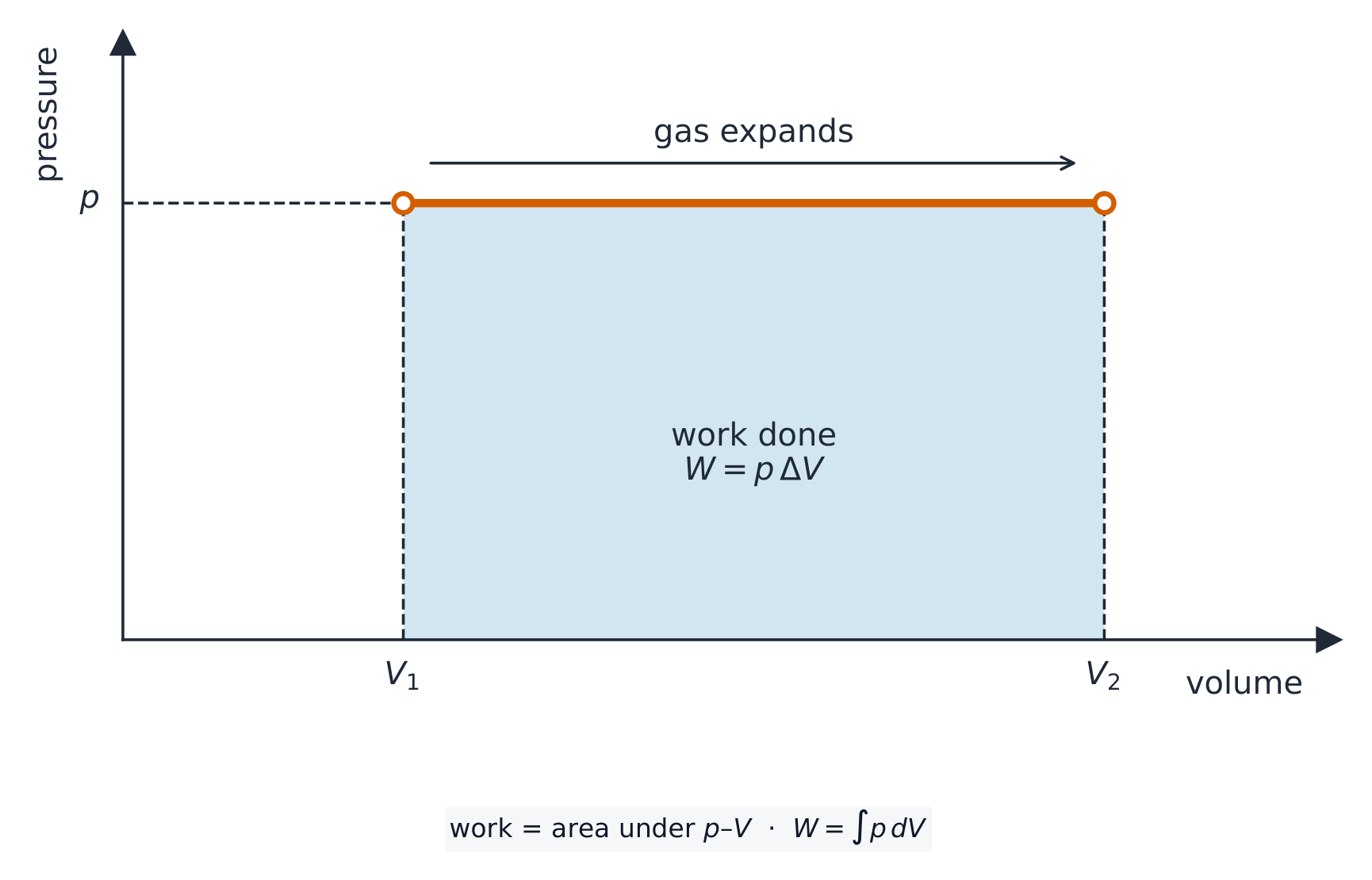
כשגז משנה נפח נגד לחץ חיצוני, מתבצעת עבודה מכנית. בלחץ קבוע $p$ עם שינוי נפח קטן $\Delta V$, גודל העבודה הוא
$$W = p \Delta V.$$
דוגמה מוצגת. גז בלחץ קבוע של $1.0 \times 10^{5}\ \text{Pa}$ מתרחב מ-$2.0 \times 10^{-3}\ \text{m}^{3}$ ל-$5.0 \times 10^{-3}\ \text{m}^{3}$. מצאו את העבודה שנעשתה על ידי הגז.
דוגמה מוצגת. גז אידיאלי במסה $0.35\ \text{kg}$ מחומם בלחץ קבוע של $2.0 \times 10^{5}\ \text{Pa}$; אנרגיה פנימית שלו עולה ב-$7600\ \text{J}$ והנפח שלו עולה ב-$1.2 \times 10^{-2}\ \text{m}^{3}$. מצאו את העבודה שנעשתה על ידי הגז ואת האנרגיה החוםית שסופקה. לאחר מכן מחממים את הגז בנפח קבוע עד שאנרגיה פנימית שלו עולה באותו $7600\ \text{J}$; הסבר מדוע נדרשת אנרגיה חוםית פחותה.
עבודה שנעשתה על ידי הגז $= p\Delta V = 2.0 \times 10^{5} \times 1.2 \times 10^{-2} = 2400\ \text{J}$, ולכן העבודה שנעשתה עליו היא $W = -2400\ \text{J}$. חוק ראשון: $q = \Delta U - W = 7600 - (-2400) = 1.0 \times 10^{4}\ \text{J}$. בנפח קבוע לא מתבצעת עבודה ($\Delta V = 0$, $W = 0$), ולכן כל האנרגיה החוםית הולכת לאנרגיה פנימית: $q = \Delta U = 7600\ \text{J}$. ה-$2400\ \text{J}$ הנוספים בלחץ קבוע היו העבודה שהגז ביצע בדחיפת הסביבה כשהתרחב.
דוגמה מוצגת. בלוק אלומיניום בנפח $3.612 \times 10^{-3}\ \text{m}^{3}$ מחומם מ-$0\ ^{\circ}\text{C}$ ל-$40\ ^{\circ}\text{C}$; הנפח שלו עולה ב-$1.0 \times 10^{-5}\ \text{m}^{3}$ נגד לחץ האטמוספרי ($1.0 \times 10^{5}\ \text{Pa}$). השוו את העבודה שהוא מבצע על האטמוספירה לבין האנרגיה החוםית שקיבל ($m = 9.75\ \text{kg}$, $c = 900\ \text{J kg}^{-1}\ \text{K}^{-1}$).
עבודה שנעשתה על ידי הבלוק $= p\Delta V = 1.0 \times 10^{5} \times 1.0 \times 10^{-5} = 1.0\ \text{J}$; אנרגיה חוםית $q = mc\Delta T = 9.75 \times 900 \times 40 = 3.5 \times 10^{5}\ \text{J}$. העבודה היא כ-$3 \times 10^{-6}$ מהחימום, ולכן עבור מוצק $\Delta U \approx q$: מוצקים ונוזלים מתרחבים מעט מאוד, ו-$p\Delta V$ רלוונטי רק לגזים.
בגרף לחץ-נפח, העבודה שנעשתה בלחץ קבוע היא השטח מתחת לקו: $W = p\,\Delta V$
סמני convention בסיילבוס זה
סימפון זה כותב את החוק הראשון כ$\Delta U = q + W$, כאשר $W$ הוא העבודה שנעשתה על הגז ו-$q$ היא האנרגיה שהוזנה על ידי חימום.
עבודה שנעשתה על הגז: חיובית כשהוא נת(public), שלילית כשהוא מתרחב
כאשר הגז נת(public), $\Delta V$ הוא שלילי והעבודה שנעשתה על הגז היא חיובית — הגז מרוויח אנרגיה.
כאשר הגז מתרחב, $\Delta V$ הוא חיובי והעבודה שנעשתה על הגז היא שלילית — הגז מאבד אנרגיה (הוא מבצע עבודה על הסביבה).
שימו לב איזה סוג שאלה נדרש:
"עבודה שנעשתה על הגז" — חיובית בעת דחיסה.
"עבודה שנעשתה על ידי הגז" — הסימן הפוך, חיובי בעת התרחבות.
First law of thermodynamics · החוק הראשון של התרמודינמיקה
English
The first law of thermodynamics 热力学第一定律 says that energy is conserved when heat and work pass between a system and its surroundings:
$$\Delta U = q + W,$$
where $\Delta U$ is the rise in internal energy, $q$ is the energy added by heating (positive in, negative out), and $W$ is the work done on the gas (positive when compressed). This is conservation of energy 能量守恒 for a gas.
As the exam asks it. "State the first law of thermodynamics, identifying any symbols" (2 marks): the increase in internal energy of a system, $\Delta U$, is equal to the sum of the thermal energy transferred to the system by heating, $q$, and the work done on the system, $W$: $\Delta U = q + W$. Every symbol must be defined with its direction — "to the system" and "on the system" are what make the signs mean something. "State two ways in which the first law says the internal energy of a system may be changed": by heating (thermal energy transferred into or out of the system) and by doing work on or by the system.
Worked example. A gas absorbs $500\ \text{J}$ of heat while it expands and does $200\ \text{J}$ of work on its surroundings. Find the change in its internal energy.
The gas does work, so the work done on it is $W = -200\ \text{J}$:
$$\Delta U = q + W = 500 + (-200) = 300\ \text{J}.$$
Explaining with the first law. A three-mark "use the first law to explain" answer has three steps: say what $q$ is (and its sign), say what $W$ is (and its sign), then combine them for $\Delta U$ — and, if asked, say what the change in internal energy means for the molecules.
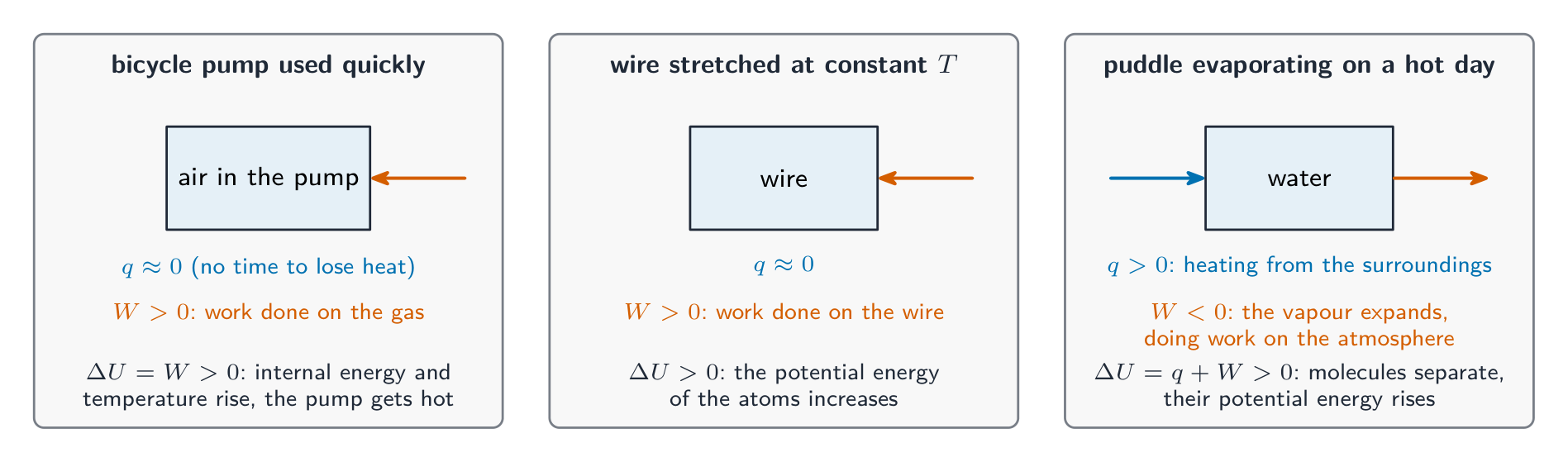
Why a bicycle pump gets hot when used quickly: the air is compressed, so work is done on it ($W > 0$); the compression is fast, so there is no time for thermal energy to leave ($q \approx 0$); therefore $\Delta U = W > 0$ — the internal energy, and so the temperature, of the air rises, and the pump warms up.
A spring stretched at constant temperature within its elastic limit: work is done on the spring by the stretching force ($W > 0$); there is no thermal energy transfer ($q = 0$); so the internal energy increases — stored as the elastic potential energy of the atoms, which are pulled further apart.
Water evaporating from a puddle on a hot day: thermal energy is transferred to the water from the surroundings ($q > 0$); the vapour formed occupies a far larger volume than the liquid, so the system does work on the atmosphere ($W < 0$); the internal energy still increases ($q$ is larger than the work done), and the increase is potential energy — the molecules are separated against the attractive forces between them.
Reading the equation
$\Delta U$ is fixed by the change of state (for an ideal gas, by the change in temperature). The same $\Delta U$ can come from different mixes of $q$ and $W$:
all heat, no work: $\Delta U = q$ (constant-volume heating).
all work, no heat: $\Delta U = W$ (insulated compression or expansion).
Standard processes
For an ideal gas, $\Delta U = \tfrac{3}{2} n R \Delta T$ — it depends only on $\Delta T$.
Process
What stays constant
$\Delta U$
$W$ (on gas)
$q$
Isothermal
$T$
$0$
$W$
$-W$
Constant volume
$V$
$\tfrac{3}{2}n R \Delta T$
$0$
$\Delta U$
Constant pressure
$p$
$\tfrac{3}{2}n R \Delta T$
$-p \Delta V$
$\Delta U - W$
Adiabatic
(no heat)
varies
$W$
$0$
Read each row with the first law $\Delta U = q + W$:
Isothermal 等温 (constant $T$): $\Delta T = 0$, so $\Delta U = 0$. Then $q = -W$ — any heat that goes in comes straight back out as work.
Adiabatic 绝热 (no heat flow): $q = 0$, so $\Delta U = W$. The gas warms up only because work is done on it.
Constant volume (sealed rigid container): no work is done ($\Delta V = 0$), so all the heat goes into internal energy: $q = \Delta U$.
Constant pressure (gas pushing a piston 活塞): the gas does work as it expands, so the heat you supply does two jobs — it raises the internal energy and does the expansion work.
So for the same rise in internal energy, heating at constant pressure needs more thermal energy than heating at constant volume, by exactly the work $p\Delta V$ the gas does while expanding — the constant-volume gas keeps every joule; the constant-pressure gas hands some back to the surroundings.
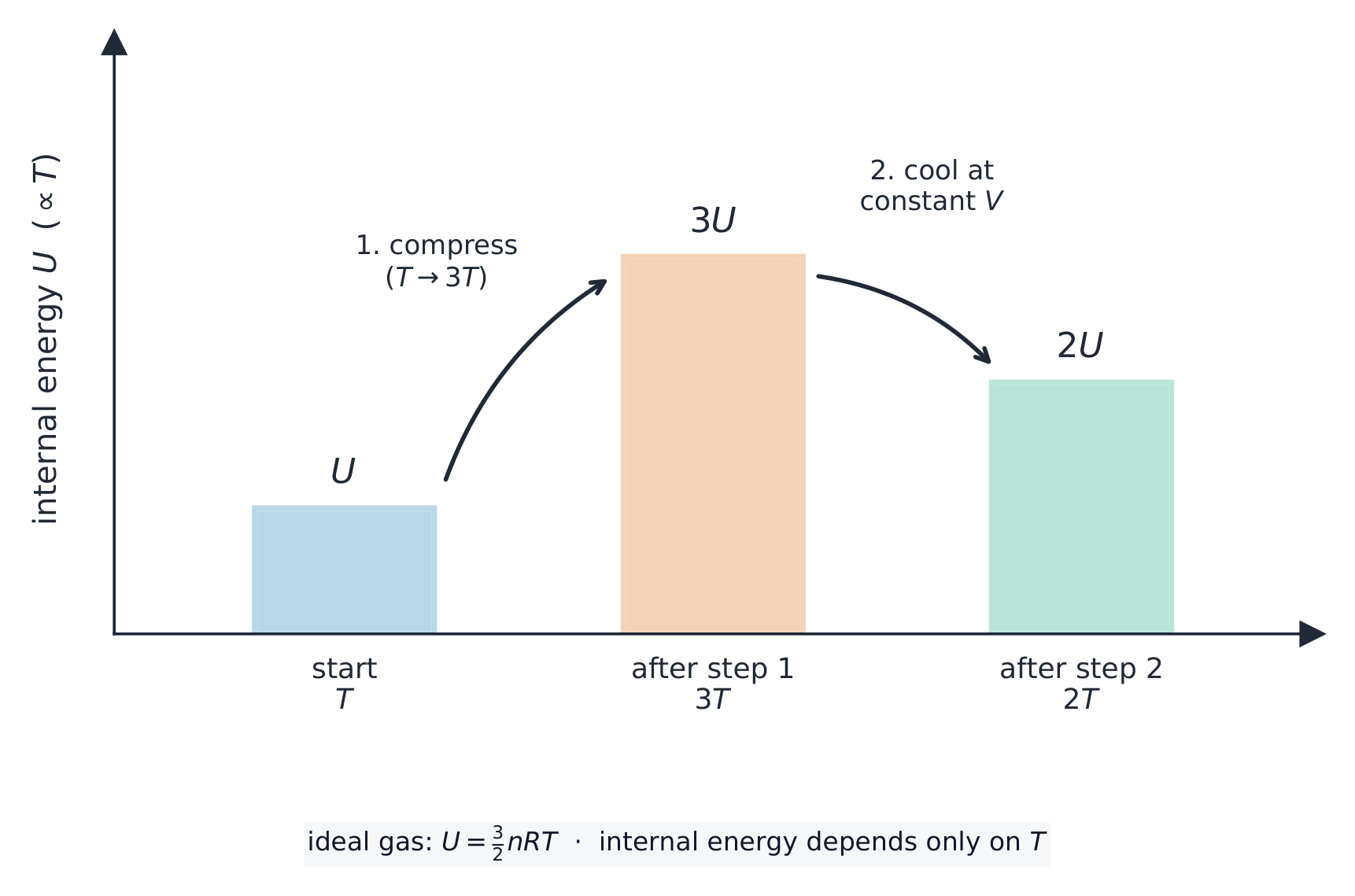
Worked example: two-step process
A sample of ideal gas at temperature $T$ with internal energy $U$ goes through:
compression to temperature $3T$; work $W$ is done on the gas.
Check: total $\Delta U = 2U - U = U$, taking the gas from $T$ to $2T$ ($U \to 2U$) — consistent.
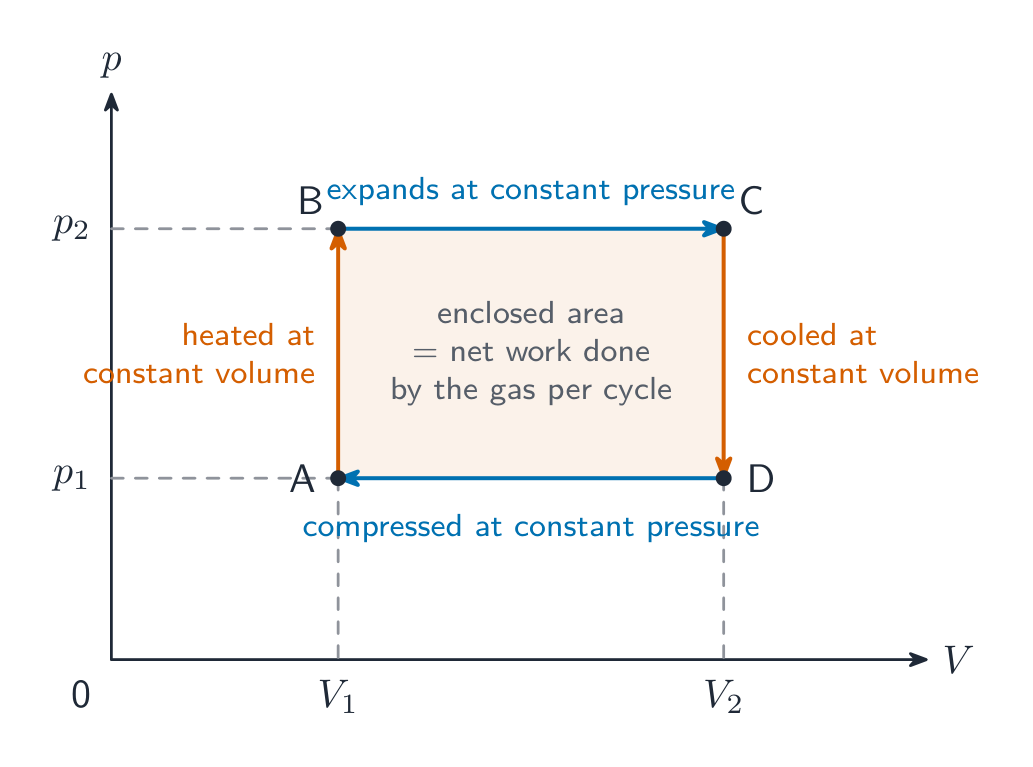
Worked example: a cycle on a $p$–$V$ diagram
A fixed mass of ideal gas is taken round the cycle ABCDA: A to B at constant volume $V_{1}$ (pressure $p_{1} \to p_{2}$), B to C at constant pressure $p_{2}$ (volume $V_{1} \to V_{2}$), C to D at constant volume, D to A at constant pressure $p_{1}$. Complete a table of the signs of $q$, $W$ and $\Delta U$ for each leg, and explain the internal-energy change from B to C.
Leg
Process
$W$ (on gas)
$\Delta U$
$q$
A → B
constant volume, pressure rises
$0$ (no volume change)
$+$ (temperature rises, $pV$ larger)
$+$ ($q = \Delta U$)
B → C
constant pressure, expands
$-$ (gas does work $p_{2}(V_{2} - V_{1})$)
$+$ ($T \propto V$ at constant $p$)
$+$ (and larger than $\Delta U$)
C → D
constant volume, pressure falls
$0$
$-$
$-$ (thermal energy leaves)
D → A
constant pressure, compressed
$+$ (work done on the gas $p_{1}(V_{2} - V_{1})$)
$-$
$-$ (larger in size than $\Delta U$)
From B to C the gas expands at constant pressure, so its temperature rises ($V/T$ constant) and its internal energy increases; it does work on the surroundings ($W$ negative), so the thermal energy supplied must cover both: $q = \Delta U - W$, larger than the rise in internal energy. Round the whole cycle $\Delta U = 0$ (the gas returns to its starting state), so the net thermal energy in equals the net work done by the gas — the area enclosed by the rectangle, $(p_{2} - p_{1})(V_{2} - V_{1})$.
Heat capacity at constant volume
For constant-volume heating of an ideal gas, $q = \Delta U = \tfrac{3}{2} n R \Delta T$. So the molar heat capacity 热容 at constant volume is $\tfrac{3}{2} R$ for a monatomic 单原子 ideal gas. (You are not required to use the symbol $C_V$, but the result $q = \tfrac{3}{2} n R \Delta T$ for constant-volume heating is.)
Heating without a temperature change
If heat is supplied during a phase change at constant pressure (e.g. boiling water), the temperature stays constant but the internal energy still rises (the latent heat 潜热 separates the molecules), and the gas does expansion work. The first law still holds: $\Delta U = q + W$.
עברית
תחנת כוח היא מנוע חום: היא ממרת חום לעבודה שימונית.
החוק הראשון של התרמודינמיקה קובע כי אנרגיה נשמרת כאשר חום ועבודה עוברים בין מערכת לסביבתה:
$$\Delta U = q + W,$$
כאן $\Delta U$ הוא העלייה באנרגיה פנימית, $q$ היא האנרגיה שנוספה על ידי חימום (חיובי בתוך, שלילי בחוץ), ו$W$ היא העבודה שנעשתה על הגז (חיובי בעת דחיסה). זהו שימור אנרגיה עבור גז.
כפי שמבקשים בבחינה. "ציינו את החוק הראשון בתרמודינמיקה, תוך זיהוי כל הסמלים" (2 נקודות): הגידול באנרגיה הפנימית של מערכת, $\Delta U$, שווה לסכום האנרגיה התרמית שהועברה למערכת על ידי חימום, $q$, ועבודה שנעשתה על המערכת, $W$: $\Delta U = q + W$. חובה להגדיר כל סמל עם הכיוון שלו — "למערכת" ו"על המערכת" הם מה שנותן למשמעות סימנים משמעות. "ציינו שתי דרכים שבהן החוק הראשון אומר שאנרגיה פנימית של מערכת עשויה השתנות": על ידי חימום (העברת אנרגיה תרמית לתוך או החוצה ממערכת) ועל ידי ביצוע עבודה על או על ידי המערכת.
גם חימום ($q$) וגם עבודה שנעשתה על הגז ($W$) מכניסים אנרגיה, ומרימים את האנרגיה הפנימית ב-$\Delta U$
דוגמה מופרדת. גז סופג $500\ \text{J}$ של חום בזמן שהוא מתרחב ועושה $200\ \text{J}$ של עבודה על הסביבה שלו. מצא את השינוי באנרגיה הפנימית שלו.
הגז עושה עבודה, ולכן העבודה שנעשתה עליו היא $W = -200\ \text{J}$:
$$\Delta U = q + W = 500 + (-200) = 300\ \text{J}.$$
הסבר באמצעות החוק הראשון. תשובה על 3 נקודות "השתמש בחוק הראשון להסבר" מכילה שלושה צעדים: אמור מהי $q$ (וכיוונה), אמור מהי $W$ (וכיוונה), ואז שלב אותן כדי לקבל $\Delta U$ — ואם נתבקש, אמור מה השינוי באנרגיה הפנימית מבטא עבור המולקולות.
השלוש הסברונים הקלאסיים לחוק הראשון: נתו $q$ עם הסימן שלו, $W$ עם הסימן שלו, ואז $\Delta U$
למה משאבת אופניים מתחממת כשהיא משתמשים בה במהירות: האוויר נדחס, ולכן עבודה נעשתה עליו ($W > 0$); הדחיסה היא מהירה, ולכן אין זמן לאנרגיה תרמית לצאת ($q \approx 0$); ולכן $\Delta U = W > 0$ — האנרגיה הפנימית, ולכן הטמפרטורה, של האוויר עולים, והמשאבה מתחממת.
קפיץ שנמתח בטמפרטורה קבועה בתוך הגבול האלסטי שלו: עבודה נעשתה על הקפיץ על ידי כוח המתיחה ($W > 0$); אין העברת אנרגיה תרמית ($q = 0$); ולכן האנרגיה הפנימית עולה — מאוחסת כאנרגיה פוטנציאלית אלסטית של האטומים, שנמשכים רחוק יותר זה מזה.
מים נדדים מבריכה ביום חם: אנרגיה תרמית מועברת למים מהסביבה ($q > 0$); הקיטור שנוצר תופס נפח גדול הרבה יותר מהנוזל, ולכן המערכת עושה עבודה על האטמוספירה ($W < 0$); האנרגיה הפנימית עדיין עולה ($q$ גדול מהעבודה שנעשתה), והעלייה היא אנרגיה פוטנציאלית — המולקולות נפרדות נגד כוחות המשיכה ביניהן.
קריאת המשוואה
$\Delta U$ קבוע על ידי שינוי המצב (עבור גז אידיאלי, על ידי שינוי בטמפרטורה). אותו $\Delta U$ יכול לבוא ממערובים שונים של $q$ ו$W$:
כל החום, ללא עבודה: $\Delta U = q$ (חימום בנפח קבוע).
כל העבודה, ללא חום: $\Delta U = W$ (דחיסה או הרחבה מבודדות).
תהליכים סטנדרטיים
לגז אידיאלי, $\Delta U = \tfrac{3}{2} n R \Delta T$ — היא תלויה רק ב-$\Delta T$.
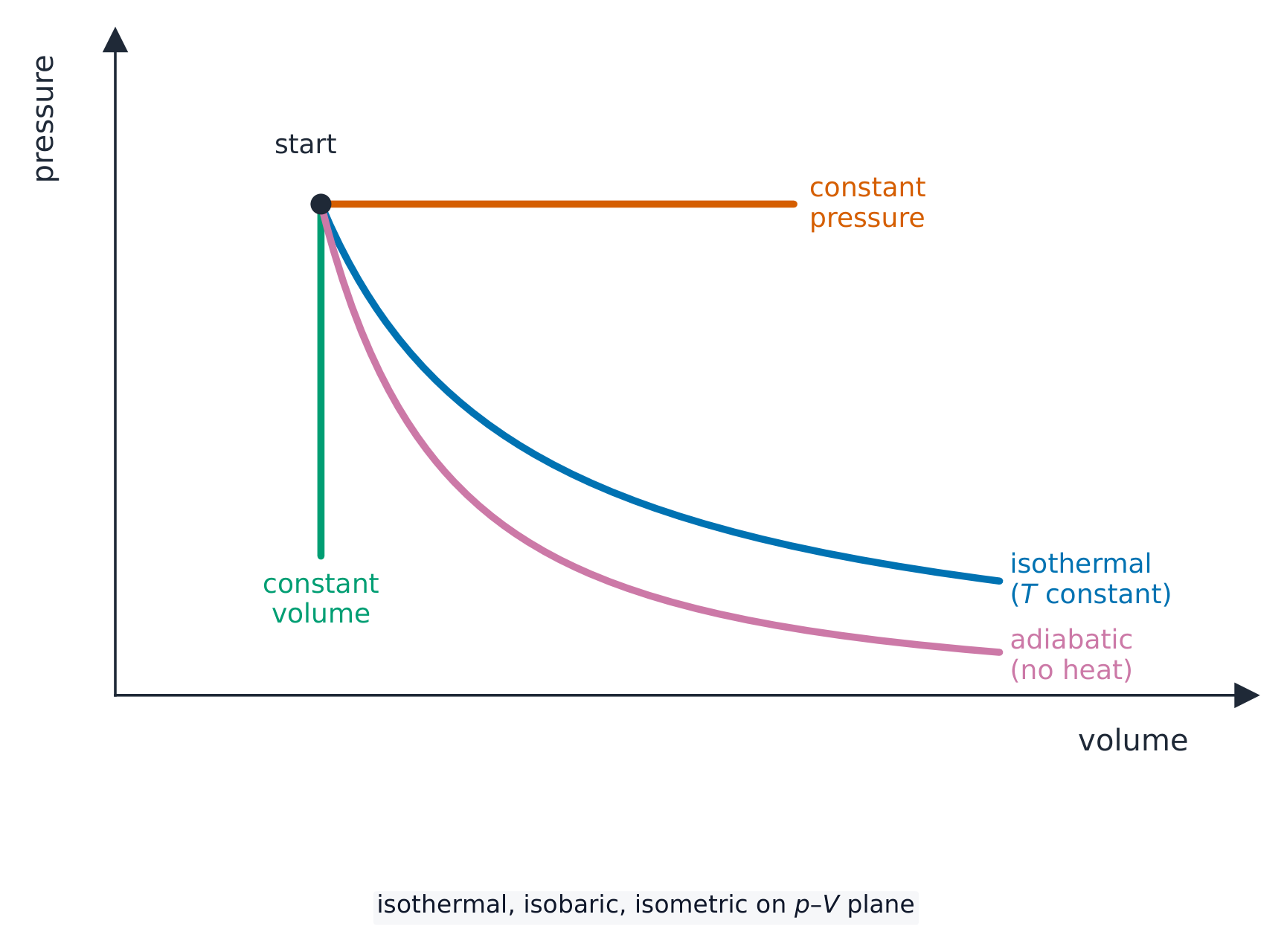
ארבעת התהליכים הסטנדרטיים, כולם החל מאותו מצב
תהליך
מה נשאר קבוע
$\Delta U$
$W$ (על הגז)
$q$
איסותרמי
$T$
$0$
$W$
$-W$
נפח קבוע
$V$
$\tfrac{3}{2}n R \Delta T$
$0$
$\Delta U$
לחץ קבוע
$p$
$\tfrac{3}{2}n R \Delta T$
$-p \Delta V$
$\Delta U - W$
אדיאבטי
(ללא חום)
משתנה
$W$
$0$
קראו כל שורה לפי החוק הראשון $\Delta U = q + W$:
איסותרמי ($T$ קבוע): $\Delta T = 0$, ולכן $\Delta U = 0$. אזי $q = -W$ — כל חום שנכנס יוצא ישירות כעבודה.
אדיאבטי (ללא זרימת חום): $q = 0$, ולכן $\Delta U = W$. הגז מתחמם רק בגלל שהעבודה מתבצעת עליו.
נפח קבוע (מיכל קשיח סגור): אין עבודה ($\Delta V = 0$), ולכן כל החום הולך לאנרגיה פנימית: $q = \Delta U$.
לחץ קבוע (גז דוחף בוכנה): הגז מבצע עבודה כאשר הוא מתרחב, ולכן החום שמספקים עושה שני דברים — הוא מעלה את האנרגיה הפנימית וגם מבצע את עבודת ההתרחבות.
לכן עבור אותה עליה באנרגיה פנימית, חימום בלחץ קבוע דורש יותר אנרגיה תרמית מאשר חימום בנפח קבוע, בדיוק בכמות העבודה $p\Delta V$ שמבצע הגז בזמן ההתרחבות — גז בנפח קבוע שומר על כל ג'ול; גז בלחץ קבוע מחזיר חלק למערכת החיצונית.
דוגמה מפורטת: תהליך דו-שלבי
דוגמית של גז אידיאלי בטמפרטורה $T$ ואנרגיה פנימית $U$ עוברת דרך:
דחיסה לטמפרטורה $3T$; עבודה $W$ מתבצעת על הגז.
קירור בנפח קבוע לטמפרטורה $2T$.
אנרגיה פנימית נעקבת אחר הטמפרטורה: $U \to 3U$ בעת הדחיסה ל$3T$, ולאחר מכן $3U \to 2U$ בקירור ל$2T$
שלב 1 ($T \to 3T$): $U = \tfrac{3}{2}nRT$, ולכן $U \to 3U$, מה שנותן $\Delta U_{1} = 2U$. $W_{1} = +W$. ולכן $q_{1} = \Delta U_{1} - W_{1} = 2U - W$.
בדיקה: סך הכל $\Delta U = 2U - U = U$, העובר את הגז מ$T$ ל$2T$ ($U \to 2U$) — תואם.
דוגמה פותרת: מחזור על גרף $p$–$V$
מחזור: לכל צעד יש לקבוע $W$ מתוך שינוי הנפח ו$\Delta U$ מתוך שינוי הטמפרטורה, ו$q$ נובע מהחוק הראשון של התרמודינמיקה
כמות קבועה של גז אידיאלי עוברת במחזור ABCDA: מ-A ל-B בנפח קבוע $V_{1}$ (לחץ $p_{1} \to p_{2}$), מ-B ל-C בלחץ קבוע $p_{2}$ (נפח $V_{1} \to V_{2}$), מ-C ל-D בנפח קבוע, ומ-D ל-A בלחץ קבוע $p_{1}$. השלם טבלה עם סימני $q$, $W$ ו-$\Delta U$ עבור כל צעד, והסבר את השינוי באנרגיה הפנימית מ-B ל-C.
צעד
תהליך
$W$ (על הגז)
$\Delta U$
$q$
A → B
נפח קבוע, הלחץ עולה
$0$ (אין שינוי בנפח)
$+$ (הטמפרטורה עולה, $pV$ גדול יותר)
$+$ ($q = \Delta U$)
B → C
לחץ קבוע, ההרחבה
$-$ (הגז מבצע עבודה $p_{2}(V_{2} - V_{1})$)
$+$ ($T \propto V$ בלחץ קבוע $p$)
$+$ (וגדול יותר מ-$\Delta U$)
C → D
נפח קבוע, הלחץ יורד
$0$
$-$
$-$ (אנרגיה תרמית יוצאת)
D → A
לחץ קבוע, הדחיסה
$+$ (עבודה נעשתה על הגז $p_{1}(V_{2} - V_{1})$)
$-$
$-$ (גדול יותר בגודלו מ-$\Delta U$)
מ-B ל-C הגז מתרחב בלחץ קבוע, ולכן הטמפרטורה שלו עולה ($V/T$ קבוע) והאנרגיה הפנימית שלו עולה; הוא מבצע עבודה על הסביבה ($W$ שלילי), ולכן החום המוזרק חייב לכסות גם כן: $q = \Delta U - W$, גדול יותר מעליית האנרגיה הפנימית. במהלך כל המחזור $\Delta U = 0$ (הגז חוזר למצאו ההתחלתי), ולכן סך החום הנכנס שווה לסך העבודה שהובילה על ידי הגז — השטח הסגור על ידי המלבן, $(p_{2} - p_{1})(V_{2} - V_{1})$.
קיבול חום בנפח קבוע
עבור חימום בנפח קבוע של גז אידיאלי, $q = \Delta U = \tfrac{3}{2} n R \Delta T$. ולכן קיבול החום המולרי בנפח קבוע הוא $\tfrac{3}{2} R$ לגז אידיאלי חד-אטומי. (אינך מחויב להשתמש בסמל $C_V$, אך התוצאה $q = \tfrac{3}{2} n R \Delta T$ לחימום בנפח קבוע היא.)
בנפח קבוע כל החום מגביר $U$ ($q = \Delta U$); בלחץ קבוע הגז גם מבצע עבודה
חימום ללא שינוי בטמפרטורה
אם חום מסופק במהלך שינוי מצב בטמפרטורה קבועה (למשל, רתיחת מים), הטמפרטורה נשארת קבועה אך האנרגיה הפנימה עדיין עולה (החום הסתיר מפריד בין המולקולות), והגז מבצע עבודה של הרחבה. החוק הראשון עדיין תקף: $\Delta U = q + W$.
Explore · חקור
Work done on a gas · עבודה שנעשה על גז
Push the piston in and you do work on the gas (W = pΔV); the first law says that work plus the heat added equals the rise in internal energy. · דחוס את הבוכנה והערכה עושה עבודה על הגז (W = pΔV); החוק הראשון אומר שעבודה פלוס חום שנוסף שווים לעלייה באנרגיה הפנימית.
16.2
Definitions the examiner accepts · הגדרות מקובלות בקורס
English
A definition question is marked against fixed wording. Learn these exactly, and give one answer only.
Term
Definition
internal energy
the sum of the random distribution of the kinetic and potential energies of the molecules of a system
internal energy of an ideal gas
the total random kinetic energy of its molecules, since with no intermolecular forces there is no potential energy
first law of thermodynamics
the increase in internal energy of a system equals the thermal energy transferred to the system by heating plus the work done on the system: $\Delta U = q + W$
work done on a gas at constant pressure
$W = p\Delta V$ in size; positive when the gas is compressed, negative when it expands (the gas then does work on its surroundings)
thermal energy transfer (heating)
energy transferred to or from a system because of a temperature difference; $q$ is positive when it enters
isothermal change
a change at constant temperature, so for an ideal gas $\Delta U = 0$ and $q = -W$
adiabatic change
a change with no thermal energy transfer, $q = 0$, so $\Delta U = W$
עברית
שאלת הגדרה מוקדמת לפי טקסט קבוע. לימודן במדויק, ותן תשובה אחת בלבד.
מונח
הגדרה
אנרגיה פנימה
סכום ההתפלגות האקראית של האנרגיות הקינטיות והפוטנציאליות של מולקולות מערכת
אנרגיה פנימה של גז אידיאלי
סך האנרגיה הקינטית האקראית של מולקולותיו, שכן ללא כוחות ביניים-מולקולריים אין אנרגיה פוטנציאלית
החוק הראשון של התרמודינמיקה
העלייה באנרגיה הפנימה של מערכת שווה לאנרגיה תרמית שהועברה למערכת על ידי חימום plus העבודה שנעשתה על המערכת: $\Delta U = q + W$
עבודה שנעשתה על גז בטמפרטורה קבועה
$W = p\Delta V$ בגודלה; חיובית כאשר הגז דחוס, שלילית כאשר הוא מתרחב (ואז הגז מבצע עבודה על הסביבה)
העברת אנרגיה תרמית (חימום)
אנרגיה שהועברה לתוך או מחוץ למערכת בשל הפרשי טמפרטורות; $q$ היא חיובית כאשר היא נכנסת
שינוי איזותרמי
שינוי בטמפרטורה קבועה, ולכן עבור גז אידיאלי $\Delta U = 0$ ו$q = -W$
שינוי אדיאבטי
שינוי ללא העברת אנרגיה תרמית, $q = 0$, ולכן $\Delta U = W$
16.2
Exam tips · טיפים לבחינות
English
First law: $\Delta U = q + W$ — define every symbol with its direction: $q$ is energy transferred to the system by heating, $W$ is work done on the system.
For an ideal gas, internal energy depends only on temperature ($\Delta U \propto \Delta T$) and is kinetic energy only; for a solid or liquid the potential energy changes too.
Work done by a gas at constant pressure $= p\Delta V$; read the sign from expansion (by) or compression (on), and remember that at constant volume $W = 0$.
A "describe and explain" answer names both kinetic and potential energy and says what happens to each; an "explain using the first law" answer gives $q$, $W$ and then $\Delta U$, each with its sign.
Round a complete cycle $\Delta U = 0$, so net heating equals net work done by the gas — the area enclosed on the $p$–$V$ diagram.
Common mistakes
Defining internal energy as "the total energy of the molecules" or forgetting "random" or "potential". The mark scheme wants the sum of random kinetic and potential energies.
Using $W = p\Delta V$ with the wrong sign. When the gas expands the work done on it is negative.
Saying the internal energy of an ideal gas rises when it is compressed isothermally. At constant temperature $\Delta U = 0$: the work done on it leaves again as heat.
Treating a phase change as $\Delta U = 0$ because the temperature is constant. The potential energy rises; $\Delta U$ is the latent heat minus any expansion work.
Forgetting that a gas heated at constant pressure does work, so it needs more heating than at constant volume for the same $\Delta U$.
Applying $\Delta U = \tfrac{3}{2}nR\Delta T$ to a real gas, a liquid or a solid. It is the ideal-gas result only.
עברית
החוק הראשון: $\Delta U = q + W$ — הגדר כל סממן עם הכיוון שלו: $q$ היא אנרגיה שהועברה לתוך המערכת על ידי חימום, $W$ היא עבודה שנעשתה על המערכת.
עבור גז אידיאלי, האנרגיה הפנימה תלויה רק בטמפרטורה ($\Delta U \propto \Delta T$) והיא אנרגיה קינטית בלבד; עבור מוצק או נוזל גם האנרגיה הפוטנציאלית משתנה.
עבודה שנעשתה על ידי גז בטמפרטורה קבועה $= p\Delta V$; קבע את הסימן מהתרחבות (על ידי) או דחיסה (על), וזכור שבנפח קבוע $W = 0$.
תשובה בסגנון "מתאר ומסביר" ציינת גם אנרגיה קינטית וגם פוטנציאלית ותאמר מה קורה לכל אחת; תשובה בסגנון "הסבר באמצעות החוק הראשון" תיתן $q$, $W$ ולאחר מכן $\Delta U$, כל אחד עם הסימן שלו.
בעיגול מחזור מלא $\Delta U = 0$, ולכן החימום הנטו שווה לעבודה הנטו שנעשתה על ידי הגז — השטח הכלוא בתוך $p$–$V$ דיאגרמה.
טעויות נפוצות
הגדרת האנרגיה הפנימה כ"סך האנרגיה של המולקולות" או שכחון את "אקראי" או "פוטנציאל". תוכנית הלימודים דורשת את סכום האנרגיה הקינטית והפוטנציאלית האקראיות.
שימוש ב-$W = p\Delta V$ עם הסימן הלא נכון. כאשר הגז מתרחב העבודה שנעשתה עליו היא שלילית.
אמירה שהאנרגיה הפנימה של גז אידיאלי עולה כאשר הוא דחס איזותרמית. בטמפרטורה קבועה $\Delta U = 0$: העבודה שנעשתה עליו יוצאת שוב בחום.
התנהגות של שינוי מצב כ$\Delta U = 0$ בשל הטמפרטורה הקבועה. האנרגיה הפוטנציאלית עולה; $\Delta U$ הוא החום הסתיר מינוס כל עבודת הרחבה.
שכחון שגז שמחומם בטמפרטורה קבועה מבצע עבודה, ולכן הוא זקוק לחימום רב יותר מאשר בטמפרטורה קבועה עבור אותו $\Delta U$.
יישום $\Delta U = \tfrac{3}{2}nR\Delta T$ לגז אמיתי, נוזל או מוצק. זהו תוצאה לגז אידיאלי בלבד.
Interactive lessons on this topic · שיעורים אינטראקטיביים בנושא זה
Work through it step by step, with instant-check exercises. · לעבור על הדברים צעד אחר צעד, עם תרגילים לבדיקה מיידית.
Pick one and the site follows you — notes, papers, videos and practice all open on it. · בחרו נושא אחד והאתר יעקוב אחריו — הערות, מסמכים, וידאו ותרגולים פתוחים בו.
Type to search notes, lessons, code, vocabulary and past-paper questions across every subject. · הקלד כדי לחפש הערות, שיעורים, קוד, אוצר מילים ושאלות מבחנים בכל הנושאים.