The first law of thermodynamics
Introduced| English | Meaning |
|---|---|
| first law of thermodynamics/fɜːst lɔː ɒv ˌθɜːməʊdaɪˈnæmɪks/ | Energy is conserved: a system's internal energy changes through heat transfer and work, with signs determined by the chosen convention. |
| sign convention/saɪn kənˈvenʃn/ | sign convention |
| conservation of energy/ˌkɒnsəˈveɪʃn ɒv ˈenədʒi/ | The principle that energy cannot be created or destroyed, only transferred or transformed. |
| isothermal/ˌaɪsəˈθɜːml/ | Taking place at constant temperature. |
| adiabatic/ˌædiəˈbætɪk/ | Taking place without heat transfer between a system and its surroundings. |
Why a bicycle pump gets hot
- Pump up a tyre quickly and the barrel becomes too hot to hold comfortably. Nothing burned, nothing was heated, and no energy was supplied except by your arm.
- The arm did work on the air, compressing it. The compression was fast enough that no heat had time to escape, so all that work had nowhere to go but into the air's internal energy.
- Energy in equals energy stored. That single sentence, written carefully with signs, is the first law of thermodynamics.
- This lesson is $W = p\Delta V$, the sign convention 符号约定, the first law 热力学第一定律, and the four standard processes.
Work done when a gas changes volume
- When a gas changes volume against an outside pressure, mechanical work is done. At constant pressure $p$ with volume change $\Delta V$:
- On a $p$-$V$ graph this is the area under the line, which is why a constant-pressure change gives a simple rectangle.
- A gas that expands does work on its surroundings. A gas that is compressed has work done on it.
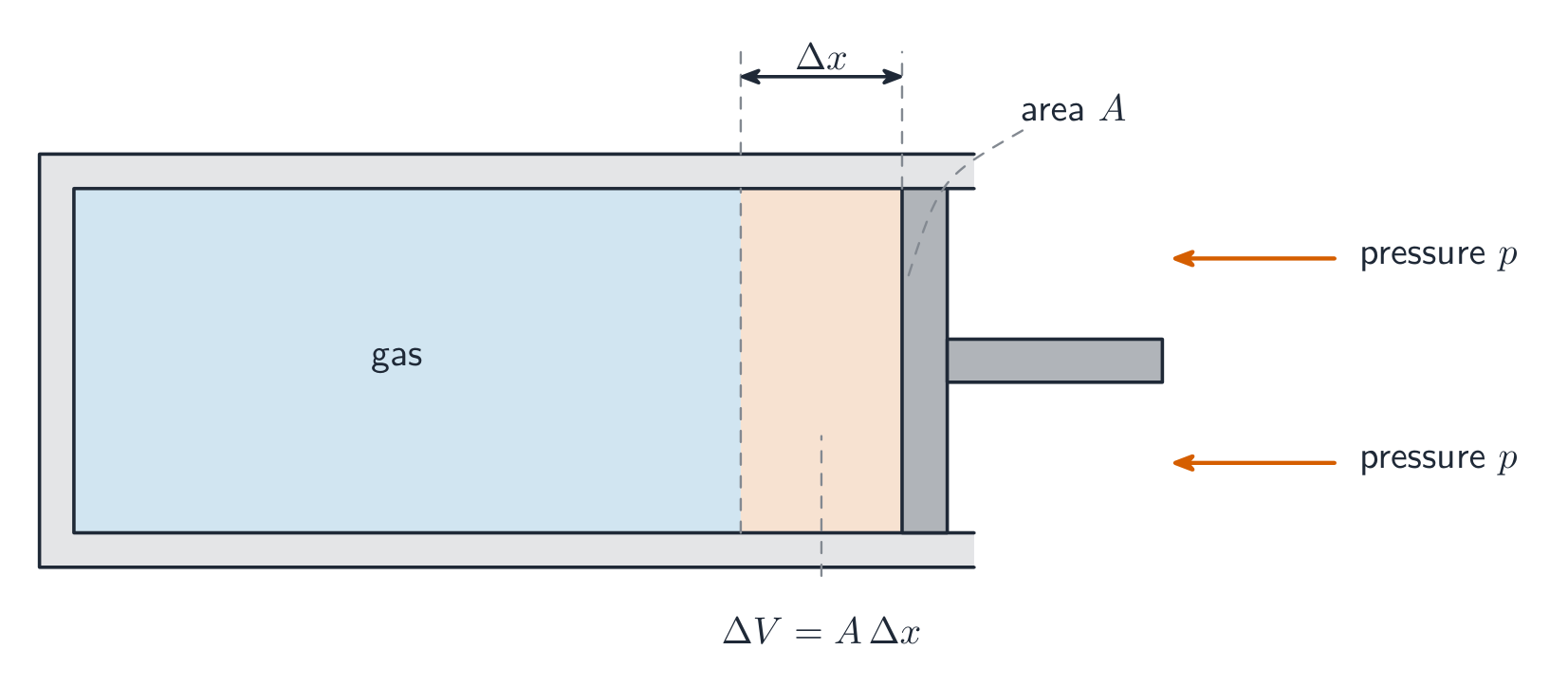
Force times distance, rewritten as pressure times swept volume
The work done by a gas expanding at constant pressure is:
Difficulty 1/5 · 100 coins + a small bonus on first completion today
Force = $pA$, distance = $\Delta x$, so work $= pA\Delta x = p\,\Delta V$.
The sign convention
- This syllabus writes the first law with $W$ as the work done on the gas.
- Compressed: $\Delta V$ is negative, the work done on the gas is positive, and the gas gains energy.
- Expanding: $\Delta V$ is positive, the work done on the gas is negative, and the gas loses energy to the surroundings.
- Read the question carefully. "Work done on the gas" and "work done by the gas" are equal in size and opposite in sign, and swapping them is the commonest error in this topic.

One quantity, two names, opposite signs
When a gas expands, it does work on its surroundings.
Difficulty 1/5 · 100 coins + a small bonus on first completion today
Yes — it pushes the piston/atmosphere outward. So the work done on the gas is negative.
A gas expands. In this syllabus's convention, what is the sign of W, the work done ON the gas?
Difficulty 1/5 · 100 coins + a small bonus on first completion today
Work done BY the gas and work done ON it are equal in size and opposite in sign. Confusing the two is the commonest error in this topic.
The first law
- $\Delta U$ is the increase in internal energy, $q$ is the energy transferred to the system by heating, and $W$ is the work done on the system.
- The two-mark statement must define every symbol with its direction: "to the system" and "on the system" are where the marks are.
- It is conservation of energy 能量守恒 applied to a gas: energy arrives by heating or by work, and what arrives is stored.
Work done on a gas
Push the piston in and you do work on the gas (W = pΔV); the first law says that work plus the heat added equals the rise in internal energy.
The first law of thermodynamics: $\Delta U = q +$ ____.
Difficulty 1/5 · 100 coins + a small bonus on first completion today
$\Delta U = q + W$, where $W$ is the work done on the gas and $q$ is the heat added.
A two-mark statement of the first law must define its symbols with direction. Which are correct? Select all that apply.
Difficulty 2/5 · 140 coins + a small bonus on first completion today
"To the system" and "on the system" are where the marks are. Defining W as the work done by the system flips the sign of the whole equation.
Worked example: heat in, work out
- A gas absorbs $500\ \text{J}$ of heat while it expands and does $200\ \text{J}$ of work on its surroundings. Find the change in its internal energy.
- The heating is into the gas, so $q = +500\ \text{J}$.
- The gas does work, so the work done on it is $W = -200\ \text{J}$. This is the step the sign convention exists for.
- $\Delta U = q + W = 500 + (-200) = +300\ \text{J}$: the internal energy rises by 300 J.
$100\ \text{J}$ of heat is added to a gas while $30\ \text{J}$ of work is done on it. What is the rise in internal energy?
Difficulty 2/5 · 140 coins + a small bonus on first completion today
$\Delta U = q + W = 100 + 30 = 130\ \text{J}$.
Worked example: the same rise, two ways
- An ideal gas is heated at a constant pressure of $2.0 \times 10^5\ \text{Pa}$; its internal energy rises by $7600\ \text{J}$ while its volume increases by $1.2 \times 10^{-2}\ \text{m}^3$. Find the thermal energy supplied. Then find it again for the same rise in $U$ at constant volume.
- Work done by the gas is $p\Delta V = 2.0 \times 10^5 \times 1.2 \times 10^{-2} = 2400\ \text{J}$, so the work done on it is $W = -2400\ \text{J}$.
- First law: $q = \Delta U - W = 7600 - (-2400) = 1.0 \times 10^4\ \text{J}$.
- At constant volume no work is done, so $q = \Delta U = 7600\ \text{J}$.
- The extra 2400 J in the first case is exactly the energy the gas spent pushing its surroundings back. Same $\Delta U$, different $q$, because the work differed.
An ideal gas at constant pressure 2.0 x 10^5 Pa gains 7600 J of internal energy while expanding by 1.2 x 10^-2 m^3. How many joules of thermal energy were supplied?
Difficulty 2/5 · 140 coins + a small bonus on first completion today
Work done by the gas is 2400 J, so W on the gas is -2400 J and q = 7600 - (-2400) = 10 000 J. At constant volume the same rise would need only 7600 J.
The four standard processes
| Process | Constant | $\Delta U$ | $W$ on gas | $q$ |
|---|---|---|---|---|
| isothermal 等温 | $T$ | $0$ | $W$ | $-W$ |
| constant volume | $V$ | $\tfrac32 nR\Delta T$ | $0$ | $\Delta U$ |
| constant pressure | $p$ | $\tfrac32 nR\Delta T$ | $-p\Delta V$ | $\Delta U - W$ |
| adiabatic 绝热 | no heat | $W$ | $W$ | $0$ |
- Each row is just $\Delta U = q + W$ with one quantity zero. Isothermal: $\Delta T = 0$, so $\Delta U = 0$ and $q = -W$, meaning heat in comes straight back out as work. Adiabatic: $q = 0$, so $\Delta U = W$, which is the bicycle pump.
- For an ideal gas $\Delta U = \tfrac32 nR\Delta T$ always, because $U$ depends only on temperature.
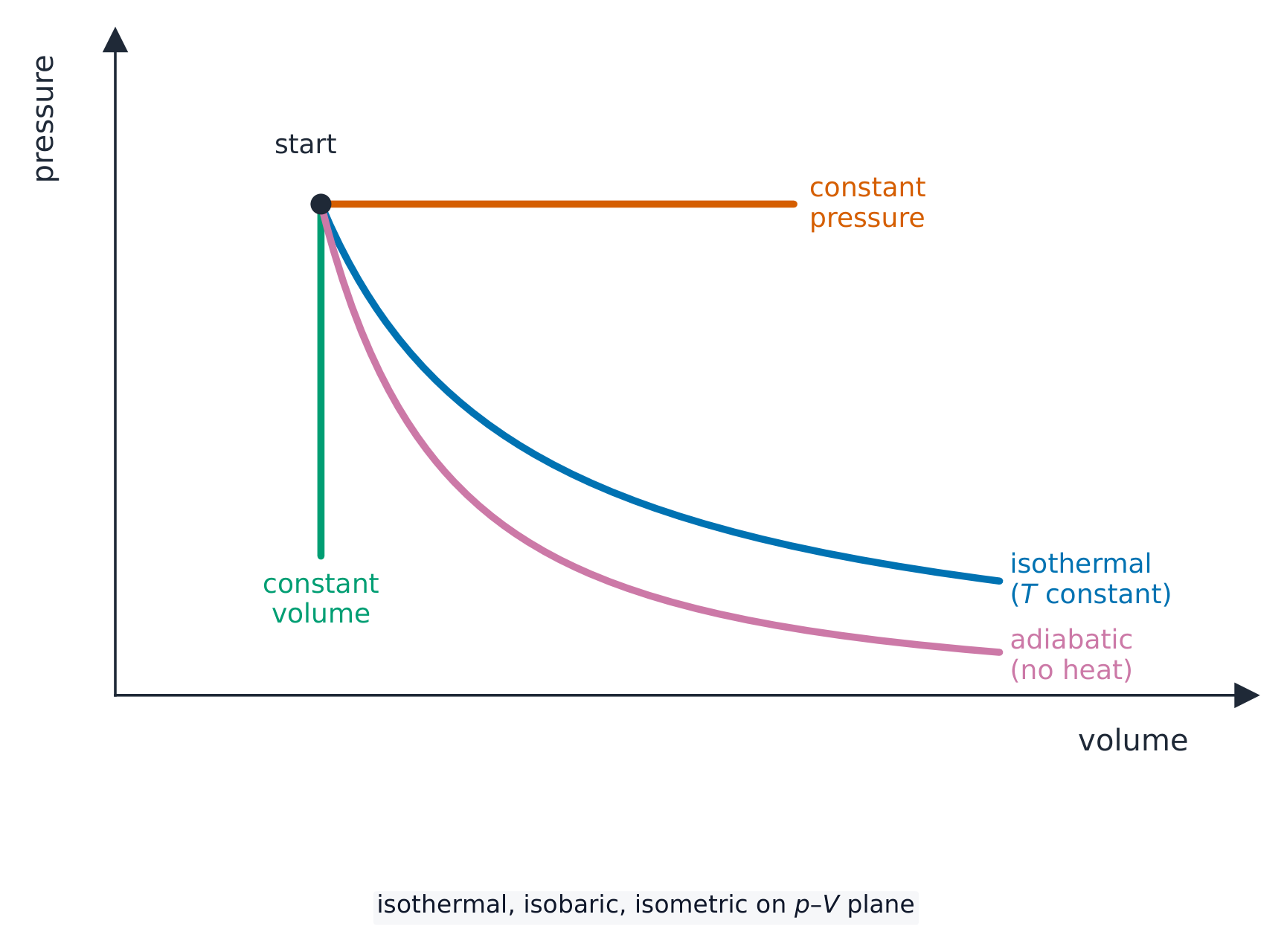
Four paths, one law
Match each process to what it makes zero.
Difficulty 2/5 · 140 coins + a small bonus on first completion today
Constant $T$ → no change in internal energy; constant $V$ → no work; adiabatic → no heat flow.
In an isothermal change of an ideal gas, the internal energy does not change.
Difficulty 1/5 · 100 coins + a small bonus on first completion today
For an ideal gas $U \propto T$, so constant $T$ means $\Delta U = 0$ (and then $q = -W$).
Worked example: explain with the first law
- A three-mark "use the first law to explain" answer has three steps: state $q$ with its sign, state $W$ with its sign, then combine for $\Delta U$.
- Why a bicycle pump gets hot: the air is compressed, so work is done on it, $W > 0$; the compression is fast, so no thermal energy has time to leave, $q \approx 0$; therefore $\Delta U = W > 0$, the temperature rises and the pump warms.
- Water evaporating on a hot day: thermal energy is transferred to the water, $q > 0$; the vapour occupies a far larger volume, so the system does work on the atmosphere, $W < 0$; $q$ exceeds the work done, so $\Delta U$ still increases, as potential energy, the molecules having been separated.
Put the first-law explanation of why a bicycle pump gets hot in order.
Difficulty 3/5 · 200 coins + a small bonus on first completion today
State q with its sign, state W with its sign, combine, then say what the change means. That is the three-mark shape for every first-law explanation.
Marks that slip away
- $W$ in this syllabus is the work done on the gas. Expansion makes it negative.
- The two-mark statement of the law must define each symbol with direction: heating to the system, work on the system.
- At constant volume $W = 0$, so all the heat becomes internal energy. At constant pressure some of it leaves as work.
- $p\Delta V$ matters for gases. For a heated solid the work done against the atmosphere is a millionth of the heating, so $\Delta U \approx q$.
You've got it
- $W = p\Delta V$ at constant pressure, the area under a $p$-$V$ line; expansion does work on the surroundings
- the sign convention: $W$ is the work done on the gas, positive when compressed and negative when expanding
- the first law $\Delta U = q + W$ is conservation of energy, with $q$ the heating to the system and $W$ the work on it, and every symbol defined with its direction
- isothermal $\Delta U = 0$ so $q = -W$; constant volume $W = 0$ so $q = \Delta U$; adiabatic $q = 0$ so $\Delta U = W$