גע בערמת מתכת, ואז בשולחן עץ, באותו חדר. המתכת מרגישה הרבה יותר קרה. אז היא בהכרח קרה יותר — נכון? לא. קח מדחום טמפרטורה, והשניים…
English narration · English + 中文 subtitles burned in · קריאת קול באנגלית · תרגום אנגלי + סינית שרוף בתוך הסרטון
14.1
Thermal equilibrium · איזון תרמי
Syllabus · סיילבוס
English
understand that (thermal) energy is transferred from a region of higher temperature to a region of lower temperature
understand that regions of equal temperature are in thermal equilibrium
עברית
להבין שאנרגיה (תרמית) מועברת מאזור בעל טמפרטורה גבוהה יותר לאזור בעל טמפרטורה נמוכה יותר
להבין שאזורים בעלי טמפרטורה שווה נמצאים באיזון תרמי
Source: Cambridge International syllabus · מקור: הסיילבוס הבינלאומי של קמבריד'ג'
English
Heat 热量 (thermal energy) flows from a higher temperature to a lower temperature. When two bodies touch, energy moves until their temperatures are equal — they reach thermal equilibrium 热平衡. At equilibrium there is no net flow of energy.
Two regions at the same temperature 温度 are in thermal equilibrium with each other — no net energy flows, even though particles still exchange energy.
Temperature decides the direction of heat flow. It is not a measure of how much thermal energy 热能 a body holds. A small cup of boiling water (100 °C) holds far less energy than a swimming pool at 25 °C, but a piece of metal put in the cup gains energy while one put in the pool loses it.
The examiner's wording.Two objects are in thermal equilibrium when there is no net transfer of thermal energy between them; that happens when they are at the same temperature. Asked for "the reason why two objects at the same temperature are in thermal equilibrium", the one mark is: there is no net flow of thermal energy between them — energy still passes both ways, but equally. Thermal energy is the energy transferred because of a temperature difference; temperature is what decides the direction.
Worked example. Two metal cuboids P and Q are in thermal contact and in thermal equilibrium. State what this means, and describe what happens when a hotter cuboid is placed against them.
No net thermal energy passes between P and Q, because they are at the same temperature. A hotter cuboid transfers thermal energy to them (from higher to lower temperature) until all three reach one common temperature; then, and only then, is the whole group in thermal equilibrium.
עברית
חום (אנרגיה תרמית) זורם מטמפרטורה גבוהה לטמפרטורה נמוכה. כאשר שני גופים נוגעים, האנרגיה זורמת עד שמטמפרטורותיהן מתשווה — הם מגיעים לאיזון תרמי. באיזון אין זרימה נטו של אנרגיה.
שתי אזורות בטמפרטורה זהה נמצאות באיזון תרמי זו עם זו — אין זרימה נטו של אנרגיה, גם אם חלקיקים עדיין מחליפים אנרגיה.
הטמפרטורה קובעת את כיוון זרימת החום. היא אינה מדד לכמות אנרגיה תרמית שגוף מחזיק. כוס קטנה של מים רותחים (100 °C) מחזיקה הרבה פחות אנרגיה מאגן שחייה ב-25 °C, אך חתיכת מתכת שנכנסת לכוס מקבלת אנרגיה בעוד אחת שנכנסת לאגן מאבדת אותה.
חום זורם מחם לקר עד ששניהם מגיעים לאותה טמפרטורה — איזון תרמי
ניסוח המבקר.שני עצמים באיזון תרמי כאשר אין העברת אנרגיה תרמית נטו ביניהם; הדבר קורה כאשר הטמפרטורות שלהן זהות. כששאלו על "הסיבה ששני עצטים בטמפרטורה זהה נמצאים באיזון תרמי", נקודה אחת היא: אין זרימה נטו של אנרגיה תרמית ביניהם — האנרגיה עדיין עוברת בשני הכיוונים, אך באופן שווה. אנרגיה תרמית היא האנרגיה המועברת בשל הפרש טמפרטורות; הטמפרטורה היא מה שקובע את הכיוון.
דוגמה מפורטת. שני בלוקי מתכת P ו-Q נמצאים במגע תרמי ובאיזון תרמי. ציין מה המשמעות, וכלל מה קורה כאשר בלוק חם יותר מונח עליהם.
אין אנרגיה תרמית נטו עוברת בין P ל-Q, כי הטמפרטורות שלהן זהות. בלוק חם יותר מעביר אליהם אנרגיה תרמית (מגבוה לנמוך) עד ששלושתם מגיעים לאותה טמפרטורה משותפת; אז, ואז בלבד, כל הקבוצה נמצאת באיזון תרמי.
Explore · חקור
Thermal equilibrium route · תהליך איזון תרמי
Watch energy transfer until two objects reach the same temperature. · עקבו אחרי העברת האנרגיה עד ששני הגופים מגיעים לאותה טמפרטורה.
understand that a physical property that varies with temperature may be used for the measurement of temperature and state examples of such properties, including the density of a liquid, volume of a gas at constant pressure, resistance of a metal, e.m.f. of a thermocouple
understand that the scale of thermodynamic temperature does not depend on the property of any particular substance
convert temperatures between kelvin and degrees Celsius and recall that $T/\text{K} = \theta/\text{ }^{\circ}\text{C} + 273.15$
understand that the lowest possible temperature is zero kelvin on the thermodynamic temperature scale and that this is known as absolute zero
עברית
להבין שתכונה פיזיקלית המשתנה עם הטמפרטורה עשויה לשמש למדידת טמפרטורה ולציין דוגמאות לתכונות אלו, כגון צפיפות של נוזל, נפח של גז בלחץ קבוע, התנגדות של מתכת, כוח חשמלי (e.m.f.) של זוג חום-חשמלי
להבין שסולם הטמפרטורה התרמודינמית אינו תלוי בתכונה של חומר ספציפי כלשהו
להמיר טמפרטורות בין קלวิน לבין מעלות צלזיוס ולזכור ש$T/\text{K} = \theta/\text{ }^{\circ}\text{C} + 273.15$
להבין שהטמפרטורה הנמוכה ביותר האפשרית היא אפס קלวิน בסולם הטמפרטורה התרמודינמית ושזה ידוע כאפס מוחלט
Source: Cambridge International syllabus · מקור: הסיילבוס הבינלאומי של קמבריד'ג'
English
Any physical property that changes in a repeatable way with temperature can make a thermometer 温度计. Examples:
volume of a liquid — a liquid-in-glass thermometer (mercury or alcohol). As the temperature rises, the liquid expands and rises up a narrow capillary 毛细管.
volume of a gas at constant pressure — a gas thermometer. The gas volume rises in step with the absolute temperature.
resistance of a metal — a resistance thermometer. A metal's resistance 电阻 rises nearly in step with temperature over a wide range.
e.m.f. of a thermocouple — a thermocouple 热电偶 is two different metals joined at two points; the electromotive force 电动势 it makes depends on the temperature difference between the joins.
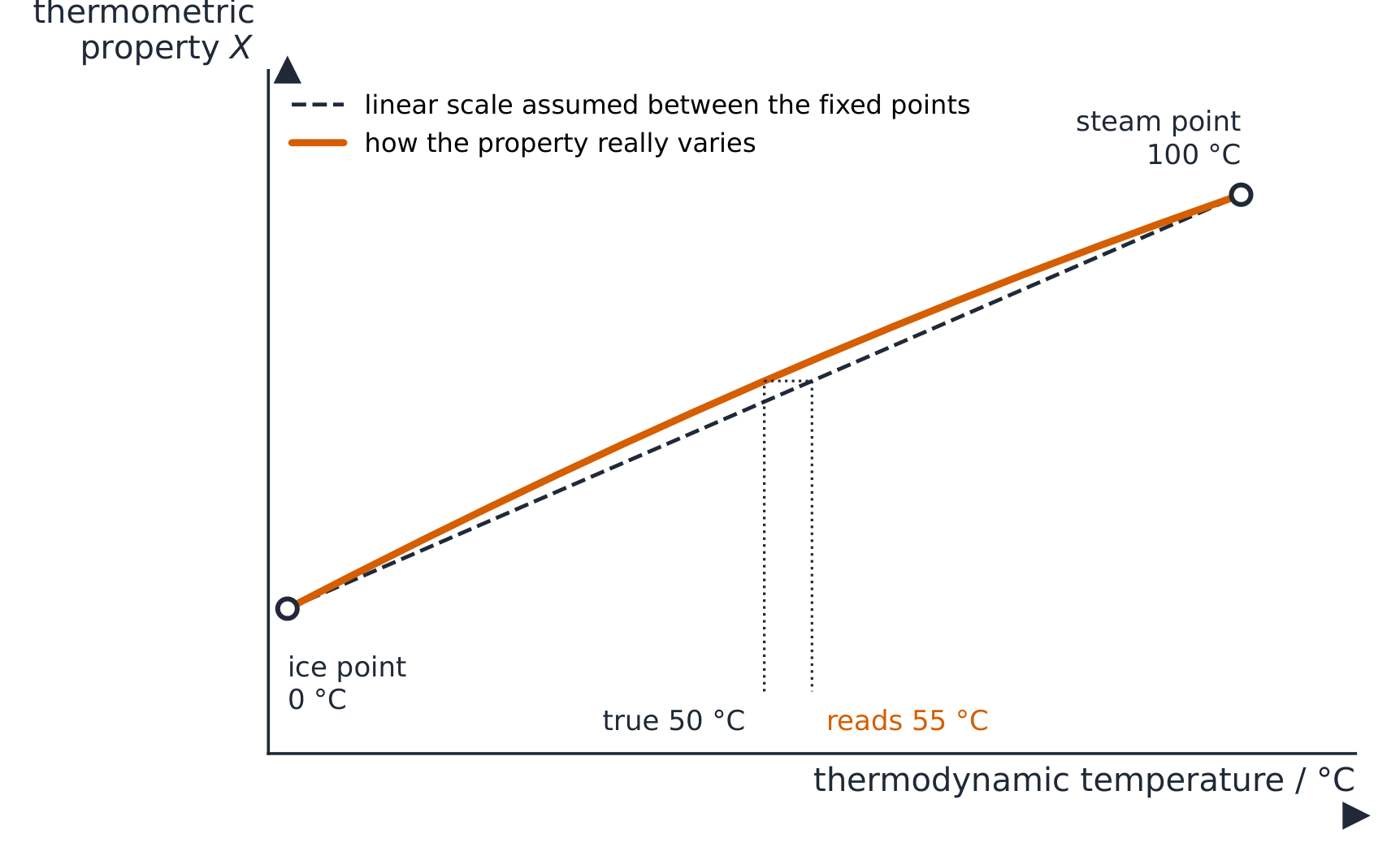
Different thermometers can read slightly differently if the property does not change in a straight line; they agree only at the calibration 校准 points.
Fixed points and calibration. A thermometer is calibrated at two fixed points 固定点 that are easy to reproduce — the ice point ($0\ ^{\circ}\text{C}$, pure melting ice) and the steam point ($100\ ^{\circ}\text{C}$, steam above boiling water at standard pressure). The value of the property is measured at each, and the scale between them is drawn assuming the property changes linearly with temperature. That assumption is the weakness: mercury's expansion, a metal's resistance and a thermocouple's e.m.f. all vary slightly differently between the fixed points, so two thermometers that agree at $0$ and $100\ ^{\circ}\text{C}$ can disagree at $50\ ^{\circ}\text{C}$.
Why a liquid-in-glass thermometer does not measure thermodynamic temperature (the one-mark reason): its reading depends on the property of a particular substance — the expansion of mercury or alcohol — and on the assumption that this expansion is linear between the fixed points. The thermodynamic scale depends on no substance at all.
Why water is a poor thermometric liquid. Its density does not change steadily with temperature: it is greatest at $4\ ^{\circ}\text{C}$, so between $0$ and $8\ ^{\circ}\text{C}$ two different temperatures give the same density and the reading is ambiguous, and the change per degree is small, so the thermometer is insensitive. Mercury's density falls steadily and almost linearly over the whole range, which is why it was chosen.
Worked example. A platinum resistance thermometer is a coil of platinum wire in a glass tube, connected to a circuit that measures its resistance. Explain how it measures temperature, and give one disadvantage compared with a thermocouple.
The resistance of the platinum increases with temperature in a known, almost linear way; the resistance is measured at the ice point and the steam point, and any other temperature is read from where the measured resistance falls on the linear scale between them (or from a calibration graph). Disadvantage: the coil, tube and the fluid around them have a large thermal capacity, so the thermometer responds slowly and cannot follow a rapidly changing temperature; it is also bulky and needs a circuit to read it. (Its advantages: accurate, stable and usable over a very wide range.)
Worked example. In a constant-volume gas thermometer the pressure of the gas is $1.05 \times 10^{5}\ \text{Pa}$ when the bulb is in melting ice and $1.19 \times 10^{5}\ \text{Pa}$ when it is in a warm room. Find the thermodynamic temperature of the room, and explain why this thermometer, unlike a liquid-in-glass one, gives thermodynamic temperature directly.
For a fixed mass of gas at constant volume the pressure is proportional to the thermodynamic temperature, so $\dfrac{T}{273.15} = \dfrac{1.19 \times 10^{5}}{1.05 \times 10^{5}}$, giving $T = 310\ \text{K}$ ($36\ ^{\circ}\text{C}$). The pressure of a (nearly) ideal gas depends only on its temperature, not on which gas it is, so the reading does not rely on the property of a particular substance — the defining feature of the thermodynamic scale.
עברית
מדחום מודד את הטמפרטורה על סקאלה מוגדרת.
כל תכונה פיזיקלית שנשנית בשינוי חוזר ונשנה בהתאם לטמפרטורה יכולה לשמש כ-מדחום. דוגמאות:
נפח נוזל — מדחום נוזלי-זכוכית (כסף או אלכוהול). כאשר הטמפרטורה עולה, הנוזל מתרחב ועולה בתוך צינור קפיילרי צר.
נפח גז בלחץ קבוע — מדחום גז. נפח הגז עולה בהתאם לטמפרטורה המוחלטת.
התנגדות של מתכת — מדחום התנגדות. ההתנגדות של מתכת עולה בקרבה לטמפרטורה בטווח רחב.
כוח חשמלי (e.m.f.) של זוג חומרים — זוג חומרים הוא שני מתכות שונות המחוברות בשתי נקודות; הכוח החשמלי שמייצר תלוי בהפרש הטמפרטורות בין הנקודות.
מדחומים שונים עשויים לתת קריאות שונות מעט אם התכונה אינה משתנה בקו ישר; הם מסכימים רק בנקודות ה-קייליברציה.
נקודות קבועות וקייליברציה. מדחום מקובל בנקודות קבועות אחת שתיים שקלות לחזור עליהן — נקודת הקרח ($0\ ^{\circ}\text{C}$, קרח טהור נמס) ונקודת האדים ($100\ ^{\circ}\text{C}$, אדים מעל מים רותחים בלחץ סטנדרטי). הערך של התכונה נמדד בכל אחת מהן, והסקאלה ביניהן מצוירת באופן שבו התכונה משתנה ליניארית עם הטמפרטורה. הנחה זו היא הנקודה החלשה: התרחבות הכסף, התנגדות המתכת וכוח החשמלי של זוג החומרים משתנים בצורה שונה מעט בין נקודות הקבועות, כך ששני מדחומים שהסכימו ב$0$ וב$100\ ^{\circ}\text{C}$ עשויים להסתדר ב$50\ ^{\circ}\text{C}$.
מדחום המקובל בנקודות קבועות ומניח ליניאריות ביניהן, מודד טמפרטורה שתלויה בכך כיצד התכונה שלו משתנה בפועל
מדוע מדחום נוזלי-זכוכית אינו מודד טמפרטורה תרמודינמית (הסיבה לניקוד אחד): הקריאה שלו תלויה בתכונה של חומר ספציפי — ההתרחבות של כסף או אלכוהול — ובנחתוך שההתרחבות הזו היא ליניארית בין נקודות הקבועות. הסקאלה התרמודינמית אינה תלויה בחומר כלשהו כלל.
מדוע מים הם נוזל פחות טוב למדידת טמפרטורה. הצפיפות שלהם אינה משתנה באופן אחיד עם הטמפרטורה: היא מקסימלית ב$4\ ^{\circ}\text{C}$, ולכן בין $0$ ל$8\ ^{\circ}\text{C}$ שתי טמפרטורות שונות נותנות אותו צפיפות, והקריאה היא מטעה, והשינוי לכל מעלה הוא קטן, ולכן המדחום הוא לא רגיש. צפיפות הכסף יורדת באופן אחיד וקרוב לליניארי בכל הטווח, ולכן נבחר.
דוגמה מוצעת. מדחום התנגדות פלטינה הוא סליל חוט פלטינה בצינור זכוכית, מחובר למעגל המודד את ההתנגדות שלו. הסבר כיצד הוא מודד טמפרטורה, ותן חיסרון אחד בהשוואה לזוג חומרים.
ההתנגדות של הפלטינה עולה עם הטמפרטורה בדרך ידועה, קרובה לליניארית; ההתנגדות נמדדת בנקודת הקרח ונקודת האדים, וכל טמפרטורה אחרת נקראת מהמיקום שבו ההתנגדות הנמדדת נופלת על הסקאלה הליניארית ביניהם (או מגרף הקייליברציה). חיסרון: לסליל, לצינור ולחומר סביבם יש קיבולת תרמית גדולה, ולכן המדחום מגיב לאט ואינו יכול לעקוב אחר טמפרטורה משתנה במהירות; הוא גם תפוס מקום ודורש מעגל כדי לקרוא אותו. (יתרונותיו: מדויק, יציב ושימושי בטווח רחב מאוד.)
מדחום גז בעל נפח קבוע — לחץ הגז נמצא מהפרש הגובה h
דוגמה מוצעת. במדחום גז בעל נפח קבוע, לחץ הגז הוא $1.05 \times 10^{5}\ \text{Pa}$ כאשר הנורה נמצאת בקרח נמס ו$1.19 \times 10^{5}\ \text{Pa}$ כאשר היא נמצאת בחדר חם. מצא את הטמפרטורה התרמודינמית של החדר, והסבר מדוע מדחום זה, בניגוד למדחום נוזלי-זכוכית, נותן טמפרטורה תרמודינמית ישירות.
למסה קבועה של גז בנפח קבוע, הלחץ פרופורציונלי לטמפרטורה התרמודינמית, ולכן $\dfrac{T}{273.15} = \dfrac{1.19 \times 10^{5}}{1.05 \times 10^{5}}$, מה שנותן $T = 310\ \text{K}$ ($36\ ^{\circ}\text{C}$). הלחץ של גז (קרוב ל) אידיאלי תלוי רק בטמפרטורה שלו, ולא בסוג הגז, ולכן הקריאה אינה תלויה בתכונה של חומר ספציפי — מאפיין המגדיר את הסקאלה התרמודינמית.
Thermodynamic temperature scale · קנה מידה לטמפרטורה תרמודינמית
English
The thermodynamic temperature 热力学温度 (or absolute temperature 绝对温度) scale does not depend on any one substance — only on the laws of thermodynamics. Its unit is the kelvin 开尔文 (K).
Absolute zero
The lowest possible temperature is zero kelvin ($0\ \text{K}$), called absolute zero 绝对零度. There a system has its least possible internal energy 内能 — particles have no random motion to speak of. Nothing can be cooled below this.
As the exam asks it. "State the magnitude and unit of absolute zero on the thermodynamic scale": $0\ \text{K}$ (the unit is the kelvin). "State the temperature of absolute zero on the Celsius scale": $-273.15\ ^{\circ}\text{C}$ (accept $-273\ ^{\circ}\text{C}$). "What is absolute zero?": the temperature at which a system has its minimum internal energy — the particles have the least kinetic and potential energy they can have — and below which it is impossible to go. The thermodynamic scale is fixed by absolute zero and by the triple point 三相点 of water, defined as $273.16\ \text{K}$; it does not depend on the property of any particular substance.
Celsius scale
The Celsius 摄氏度 scale $\theta$ is shifted from the thermodynamic scale by a fixed amount:
So $0\ ^{\circ}\text{C} = 273.15\ \text{K}$ and $100\ ^{\circ}\text{C} = 373.15\ \text{K}$. A kelvin and a degree Celsius are the same size, so a temperature difference of $1\ \text{K}$ equals $1\ ^{\circ}\text{C}$ — but the absolute values differ by $273.15$.
In gas-law calculations you must always use absolute temperatures in kelvin. Using °C gives wrong answers.
עברית
קנה המידה לטמפרטורה תרמודינמית (או טמפרטורה מוחלטת) אינו תלוי בחומר כלשהו — אלא רק בחוקי התרמודינמיקה. היחידה שלו היא קלווין (K).
אפס מוחלט
הטמפרטורה הנמוכה האפשרית היא אפס קלווין ($0\ \text{K}$), הנקראת אפס מוחלט. שם למערכת יש את ה-אנרגיה פנימית המינימלית האפשרית — לחלקיקים אין תנועה אקראית ממש. אין דבר שיכול להתקרר מתחת לזה.
כפי שהבחינה שואלת. "ציינו את הגודל ואת היחידה של אפס מוחלט בקנה המידה התרמודינמי": $0\ \text{K}$ (היחידה היא קלווין). "ציינו את הטמפרטורה של אפס מוחלט בקנה המידה הצלזיוס": $-273.15\ ^{\circ}\text{C}$ (מתקבל גם $-273\ ^{\circ}\text{C}$). "מהו אפס מוחלט?": הטמפרטורה שבה למערכת יש את האנרגיה הפנימית המינימלית — לחלקיקים יש את האנרגיה הקינטית והפוטנציאלית המינימליות האפשריות להם — ומתחת אליה לא ניתן לרדת. קנה המידה התרמודינמי קבוע על ידי אפס מוחלט ועל ידי נקודת השילוב של המים, המוגדרת כ$273.16\ \text{K}$; הוא אינו תלוי בתכונה של חומר כלשהו.
השלכת קו הלחץ-טמפרטורה אחורה לאפס לחץ נותנת את אפס מוחלט, כ-−273 °C
קנה מידה צלזיוס
קנה המידה לצלזיוס$\theta$ מוזז מן הקנה המידה התרמודינמי בשיעור קבוע:
לכן $0\ ^{\circ}\text{C} = 273.15\ \text{K}$ ו$100\ ^{\circ}\text{C} = 373.15\ \text{K}$. קלווין אחד ודרגת צלזיוס אחת הם באותו גודל, ולכן הפרש טמפרטורות של $1\ \text{K}$ שווה ל$1\ ^{\circ}\text{C}$ — אך הערכים המוחלטים שונים ב$273.15$.
בחישובים לפי חוק הגזים יש להשתמש תמיד בטמפרטורות מוחלטות בקלווין. שימוש ב°C נותן תשובות שגויות.
specific latent heat of fusion/spəˈsɪfɪk ˈleɪtənt hiːt ɒv ˈfjuːʒn/
חום ספציפי של התמוגות
specific latent heat of vaporisation/spəˈsɪfɪk ˈleɪtənt hiːt ɒv ˌveɪpəraɪˈzeɪʃn/
חום ספציפי של אידוי
atmospheric pressure/ˌætməsˈferɪk ˈpreʃə/
לחץ אטמוספרי
phase change/feɪz tʃeɪndʒ/
שינוי פאזה
intermolecular/ˌɪntəməˈlekjʊlə/
אינטרא-מולקולרית
14.3
Specific heat capacity · קיבולת חום סגולית
Syllabus · סיילבוס
English
define and use specific heat capacity
define and use specific latent heat and distinguish between specific latent heat of fusion and specific latent heat of vaporisation
עברית
להגדיר ולהשתמש בקיבולת החום הסגולית
להגדיר ולהשתמש בחום הסגולי הלואי ולהבחין בין חום הסגולי הלואי של ליכוס לבין חום הסגולי הלואי של אידוי
Source: Cambridge International syllabus · מקור: הסיילבוס הבינלאומי של קמבריד'ג'
English
The specific heat capacity 比热容$c$ of a substance is the energy 能量 needed to raise the temperature of unit mass by one kelvin:
$$c = \frac{Q}{m \Delta T} \qquad\Longleftrightarrow\qquad Q = m c \Delta T.$$
Unit: $\text{J kg}^{-1}\ \text{K}^{-1}$.
The two-mark definition:specific heat capacity is the energy required per unit mass of the substance to raise its temperature by one kelvin (or by one degree). Both "per unit mass" and "per unit temperature rise" are needed; "the energy to heat 1 kg by 1 K" scores, "the energy to heat the substance" does not.
Examples:
water: $c \approx 4200\ \text{J kg}^{-1}\ \text{K}^{-1}$ (high — why water is a good coolant and why oceans steady the climate).
To find an unknown $c$ by experiment: supply known energy $Q$ electrically ($Q = VIt$, from the power 功率), then measure the temperature rise $\Delta T$ of a known mass 质量$m$. Then $c = Q/(m\Delta T)$. Reduce heat loss with insulation 隔热 and use a rise of about 10 K (big enough to measure well, small enough to limit losses).
Worked example. How much energy is needed to heat $0.50\ \text{kg}$ of water from $20\ ^{\circ}\text{C}$ to $100\ ^{\circ}\text{C}$? (Specific heat capacity of water $c = 4200\ \text{J kg}^{-1}\ \text{K}^{-1}$.)
A temperature difference is the same in K and °C, so $\Delta T = 80$:
When two bodies reach thermal equilibrium with no heat lost to the surroundings, the energy gained by the colder one equals the energy lost by the hotter one:
Worked example.$0.20\ \text{kg}$ of water at $80\ ^{\circ}\text{C}$ is mixed with $0.30\ \text{kg}$ of water at $20\ ^{\circ}\text{C}$, with no heat lost. Find the final temperature.
The heat lost by the hot water equals the heat gained by the cold water (the $c$ of water cancels):
Worked example. A beaker of mass $42\ \text{g}$ and specific heat capacity $840\ \text{J kg}^{-1}\ \text{K}^{-1}$ contains $120\ \text{g}$ of a liquid. A heater supplies energy at $810\ \text{W}$ and the temperature of the beaker and liquid rises from $19\ ^{\circ}\text{C}$ to $47\ ^{\circ}\text{C}$ in $15\ \text{s}$. Find the specific heat capacity of the liquid. The experiment is then repeated with water in place of the liquid; state and explain how the temperature rise differs.
Energy supplied $Q = Pt = 810 \times 15 = 1.22 \times 10^{4}\ \text{J}$, $\Delta T = 28\ \text{K}$. It heats both the beaker and the liquid: $Q = m_{\text{b}}c_{\text{b}}\Delta T + m_{\text{l}}c_{\text{l}}\Delta T$, so $1.215 \times 10^{4} = 0.042 \times 840 \times 28 + 0.120 \times c_{\text{l}} \times 28$, i.e. $1.215 \times 10^{4} = 988 + 3.36c_{\text{l}}$, giving $c_{\text{l}} = 3.3 \times 10^{3}\ \text{J kg}^{-1}\ \text{K}^{-1}$. Forgetting the beaker is the usual lost mark. With water ($c = 4200$, higher) the same energy in the same time produces a smaller temperature rise, since $\Delta T = Q/(mc)$ and $mc$ is larger. If energy is lost to the surroundings the true $Q$ absorbed is less than $Pt$, so a value of $c$ found this way is an overestimate.
Worked example. Two metal blocks X and Y are placed in contact and insulated from the surroundings. X (mass $0.50\ \text{kg}$, initially $80\ ^{\circ}\text{C}$, $c = 390\ \text{J kg}^{-1}\ \text{K}^{-1}$) and Y (mass $0.50\ \text{kg}$, initially $20\ ^{\circ}\text{C}$, $c = 900\ \text{J kg}^{-1}\ \text{K}^{-1}$) reach a common final temperature. Explain, in terms of energy, why the final temperature is nearer to Y's starting temperature, and find it.
Thermal energy flows from X (hotter) to Y until they are in thermal equilibrium; the energy lost by X equals the energy gained by Y. Because Y has the larger specific heat capacity, a given amount of energy changes its temperature less than it changes X's, so Y warms by fewer degrees than X cools and the final temperature lies nearer to $20\ ^{\circ}\text{C}$. Numerically: $0.50 \times 390 \times (80 - T) = 0.50 \times 900 \times (T - 20)$, so $390(80 - T) = 900(T - 20)$, $31200 + 18000 = 1290T$, $T = 38\ ^{\circ}\text{C}$.
Worked example. An aluminium block has volume $3.612 \times 10^{-3}\ \text{m}^{3}$ and density $2.70 \times 10^{3}\ \text{kg m}^{-3}$. Find the energy needed to raise its temperature by $40\ \text{K}$ ($c = 900\ \text{J kg}^{-1}\ \text{K}^{-1}$).
Mass $= \rho V = 2.70 \times 10^{3} \times 3.612 \times 10^{-3} = 9.75\ \text{kg}$, so $Q = mc\Delta T = 9.75 \times 900 \times 40 = 3.5 \times 10^{5}\ \text{J}$. A mass hidden behind a density and a volume is a common first step.
עברית
קיבולת החום הסגולית$c$ של חומר היא האנרגיה הנדרשת להעלות את הטמפרטורה של מסה יחידה בקלווין אחד:
$$c = \frac{Q}{m \Delta T} \qquad\Longleftrightarrow\qquad Q = m c \Delta T.$$
יחידה: $\text{J kg}^{-1}\ \text{K}^{-1}$.
ההגדרה לשתי נקודות:קיבולת החום הסגולית היא האנרגיה הנדרשת למסה יחידה של החומר כדי להעלות את טמפרטורתו בקלווין אחד (או בדרגה אחת). שני הביטויים "למסה יחידה" ו"להעלאת טמפרטורה" נדרשים; "האנרגיה לחמם 1 ק"ג ב-K 1" זוכה לנקודות, "האנרגיה לחמם את החומר" לא.
דוגמאות:
מים: $c \approx 4200\ \text{J kg}^{-1}\ \text{K}^{-1}$ (גבוהה — מדוע מים הם נוזלי קירור טובים ומדוע האוקיינוסים מייצבים את האקלים).
*קיבול החום הספציפי של המים גבוה משמעותית מחומרים מוצרים רגילים — הסיבה לכך שהוא מקרר טוב מאוד
כדי למצוא $c$ לא ידוע באמצעות ניסוי: לספק אנרגיה ידועה $Q$ חשמלית ($Q = VIt$, מתוך ההספק), ולמדוד את עליית הטמפרטורה $\Delta T$ של מסה ידועה $m$. לאחר מכן $c = Q/(m\Delta T)$. להפחית איבוד חום על ידי בידוד ולהשתמש בעלייה של כ-10 K (גדולה מספיק כדי למדוד היטב, קטנה מספיק כדי להגביל את האיבודים).
דוגמה פתורה. כמה אנרגיה נדרשת לחמם $0.50\ \text{kg}$ של מים מ$20\ ^{\circ}\text{C}$ ל$100\ ^{\circ}\text{C}$? (קיבול החום הספציפי של מים $c = 4200\ \text{J kg}^{-1}\ \text{K}^{-1}$.)
הפרש טמפרטורות זהה ביחידות K ו°C, ולכן $\Delta T = 80$:
דוגמה פתורה.$0.20\ \text{kg}$ של מים בטמפרטורה $80\ ^{\circ}\text{C}$ מעורבים עם $0.30\ \text{kg}$ של מים בטמפרטורה $20\ ^{\circ}\text{C}$, ללא איבוד חום. מצאו את הטמפרטורה הסופית.
החום שהושקע על ידי המים החמים שווה לחום שנרכש על ידי המים הקרים (ה-$c$ של המים מתבטל):
דוגמה פתורה. כוס ניסויים בעלת מסה $42\ \text{g}$ וקיבול חום ספציפי $840\ \text{J kg}^{-1}\ \text{K}^{-1}$ מכילה $120\ \text{g}$ של נוזל. מחמם מספק אנרגיה בקצב $810\ \text{W}$ והטמפרטורה של הכוס והנוזל עולה מ$19\ ^{\circ}\text{C}$ ל$47\ ^{\circ}\text{C}$ בתוך זמן $15\ \text{s}$. מצאו את קיבול החום הספציפי של הנוזל. הניסוי חוזר עם מים במקום הנוזל; ציינו והסבירו כיצד עליית הטמפרטורה משתנה.
אנרגיה שהוספקה $Q = Pt = 810 \times 15 = 1.22 \times 10^{4}\ \text{J}$, $\Delta T = 28\ \text{K}$. היא מחממת גם את הבקבוק וגם את הנוזל: $Q = m_{\text{b}}c_{\text{b}}\Delta T + m_{\text{l}}c_{\text{l}}\Delta T$, ולכן $1.215 \times 10^{4} = 0.042 \times 840 \times 28 + 0.120 \times c_{\text{l}} \times 28$, כלומר $1.215 \times 10^{4} = 988 + 3.36c_{\text{l}}$, מה שמוביל ל-$c_{\text{l}} = 3.3 \times 10^{3}\ \text{J kg}^{-1}\ \text{K}^{-1}$. שוכחים את הבקבוק הוא הנקודה האופיינית שאבדים בה. עם מים ($c = 4200$, גבוה יותר) אותה אנרגיה באותו זמן מייצרת עלייה טמפרטורית קטנה יותר, מכיוון ש-$\Delta T = Q/(mc)$ ו-$mc$ גדול יותר. אם אנרגיה מאבדת לסביבה, ה-$Q$ האמיתי שנבלע הוא פחות מ-$Pt$, ולכן ערך של $c$ שנמצא כך הוא הערכת יתר.
דוגמה פתורה. שני בלוקים מתכתיים X ו-Y מונחים במגע ומבודדים מהסביבה. X (מסה $0.50\ \text{kg}$, בהתחלה $80\ ^{\circ}\text{C}$, $c = 390\ \text{J kg}^{-1}\ \text{K}^{-1}$) ו-Y (מסה $0.50\ \text{kg}$, בהתחלה $20\ ^{\circ}\text{C}$, $c = 900\ \text{J kg}^{-1}\ \text{K}^{-1}$) מגיעים לטמפרטורה סופית משותפת. הסבירו, במונחי אנרגיה, מדוע הטמפרטורה הסופית קרובה יותר לטמפרטורת ההתחלה של Y, ומצאו אותה.
אנרגיה תרמית זורמת מ-X (חם יותר) ל-Y עד שהם מגיעים לשיווי משקל תרמי; האנרגיה שהושקעה על ידי X שווה לאנרגיה שנרכשה על ידי Y. מכיוון ש momento Y יש קיבול חום ספציפי גדול יותר, כמות אנרגיה נתונה משנה את טמפרטורתו פחות מאשר את טמפרטורת X, ולכן Y מתחמם בפחות מעלות מאשר X מקרר, והטמפרטורה הסופית נמצאת קרובה יותר ל$20\ ^{\circ}\text{C}$. מספרית: $0.50 \times 390 \times (80 - T) = 0.50 \times 900 \times (T - 20)$, ולכן $390(80 - T) = 900(T - 20)$, $31200 + 18000 = 1290T$, $T = 38\ ^{\circ}\text{C}$.
דוגמה פתורה. בלוק אלומיניום בעל נפח $3.612 \times 10^{-3}\ \text{m}^{3}$ וצפיפות $2.70 \times 10^{3}\ \text{kg m}^{-3}$. מצאו את האנרגיה הנדרשת להעלות את טמפרטורתו ב-$40\ \text{K}$ ($c = 900\ \text{J kg}^{-1}\ \text{K}^{-1}$).
המסה היא $= \rho V = 2.70 \times 10^{3} \times 3.612 \times 10^{-3} = 9.75\ \text{kg}$, ולכן $Q = mc\Delta T = 9.75 \times 900 \times 40 = 3.5 \times 10^{5}\ \text{J}$. חישוב מססה הערוכה מאחורי צפיפות ונפח הוא צעד ראשון נפוץ.
Explore · חקור
Energy to heat it: E = mcΔT · אנרגיה לחימומו: E = mcΔT
Pick a material, set the mass and the temperature rise, and read the energy. Water needs far more energy than the metals. · בחרו חומר, הגדירו את המסה ואת עליית הטמפרטורה, וקראו את האנרגיה. למים נדרשת הרבה יותר אנרגיה מאשר למתכות.
Explore · חקור
Specific heat capacity · חום ספציפי
Q = mcΔT
The heat needed is proportional to the temperature rise — the gradient depends on mass and the material's specific heat capacity. · כמות החום הנדרשת יחסית לעליית הטמפרטורה — השיפוע תלוי במסה ובחום הספציפי של החומר.
14.3
Specific latent heat · חום ספציפי של שינוי מצב
English
When a substance changes state (solid ↔ liquid, or liquid ↔ gas) at constant temperature, energy must be supplied (or removed) with no temperature change. This energy is the latent heat 潜热.
The specific latent heat 比潜热$L$ is the energy to change the state of unit mass at constant temperature:
$$L = \frac{Q}{m} \qquad\Longleftrightarrow\qquad Q = m L.$$
Unit: $\text{J kg}^{-1}$.
The two-mark definition:specific latent heat is the energy required per unit mass to change the state of a substance without a change of temperature. "Without a change in temperature" (or "at constant temperature") is the second mark and the one most often missed. Add "from solid to liquid" for fusion or "from liquid to gas" for vaporisation when a particular one is asked for.
Two kinds:
specific latent heat of fusion 熔化$L_{\text{f}}$ — for melting or freezing (solid ↔ liquid).
specific latent heat of vaporisation 汽化$L_{\text{v}}$ — for boiling or condensing (liquid ↔ gas).
For water at atmospheric pressure: $L_{\text{f}} \approx 3.34 \times 10^{5}\ \text{J kg}^{-1}$ (at $0\ ^{\circ}\text{C}$); $L_{\text{v}} \approx 2.26 \times 10^{6}\ \text{J kg}^{-1}$ (at $100\ ^{\circ}\text{C}$). So $L_{\text{v}}$ is about 7 times $L_{\text{f}}$.
Worked example. A $2.0\ \text{kW}$ heater boils water already at $100\ ^{\circ}\text{C}$. How long does it take to turn $0.10\ \text{kg}$ of this water into steam? ($L_{\text{v}} = 2.26 \times 10^{6}\ \text{J kg}^{-1}$, no heat lost.)
The energy needed is $Q = mL_{\text{v}} = 0.10 \times 2.26 \times 10^{6} = 2.26 \times 10^{5}\ \text{J}$. From $Q = Pt$,
Worked example. Water in a kettle stays at $100\ ^{\circ}\text{C}$ while it boils, even though the element keeps heating it. Explain this with reference to molecular energies (3 marks).
Temperature is a measure of the mean kinetic energy of the molecules. During boiling the energy supplied is used to separate the molecules — to do work against the attractive forces between them and against the atmosphere as the vapour expands — so it increases the potential energy of the molecules, not their kinetic energy. With the mean kinetic energy unchanged, the temperature stays constant until all the water has become steam.
Why $L_{\text{v}} > L_{\text{f}}$
Two reasons, both from the particle picture of matter:
Bonds: in melting, only some of the intermolecular 分子间 bonds break; the particles stay close as a liquid. In boiling, all the bonds must break so the particles can separate. Breaking all of them needs more energy.
Work against the atmosphere: when a liquid turns to gas it expands hugely (vapour has about $10^{3}$ times the liquid's volume 体积), so it does work pushing back the surrounding atmospheric pressure 大气压强. That work comes from the energy supplied.
Write both reasons and name the energies: the marks are for bonds broken (potential energy increased) — some in melting, all in boiling, and work done against the atmosphere in the large expansion. "Boiling needs more energy" restates the question.
Worked example. A dish holds $7.2 \times 10^{-5}\ \text{m}^{3}$ of a liquid of density $710\ \text{kg m}^{-3}$ and specific latent heat of vaporisation $3.6 \times 10^{5}\ \text{J kg}^{-1}$. It evaporates completely. Find the energy absorbed, and suggest, with a reason, whether the substance's specific latent heat of fusion is likely to be smaller or larger than this.
Mass $= \rho V = 710 \times 7.2 \times 10^{-5} = 5.1 \times 10^{-2}\ \text{kg}$, so the energy absorbed is $Q = mL_{\text{v}} = 5.1 \times 10^{-2} \times 3.6 \times 10^{5} = 1.8 \times 10^{4}\ \text{J}$. Its $L_{\text{f}}$ is likely to be smaller: melting breaks only some of the intermolecular bonds and the volume barely changes, whereas vaporising breaks them all and does work against the atmosphere — for water $L_{\text{f}}$ is about a seventh of $L_{\text{v}}$.
Multi-step problems
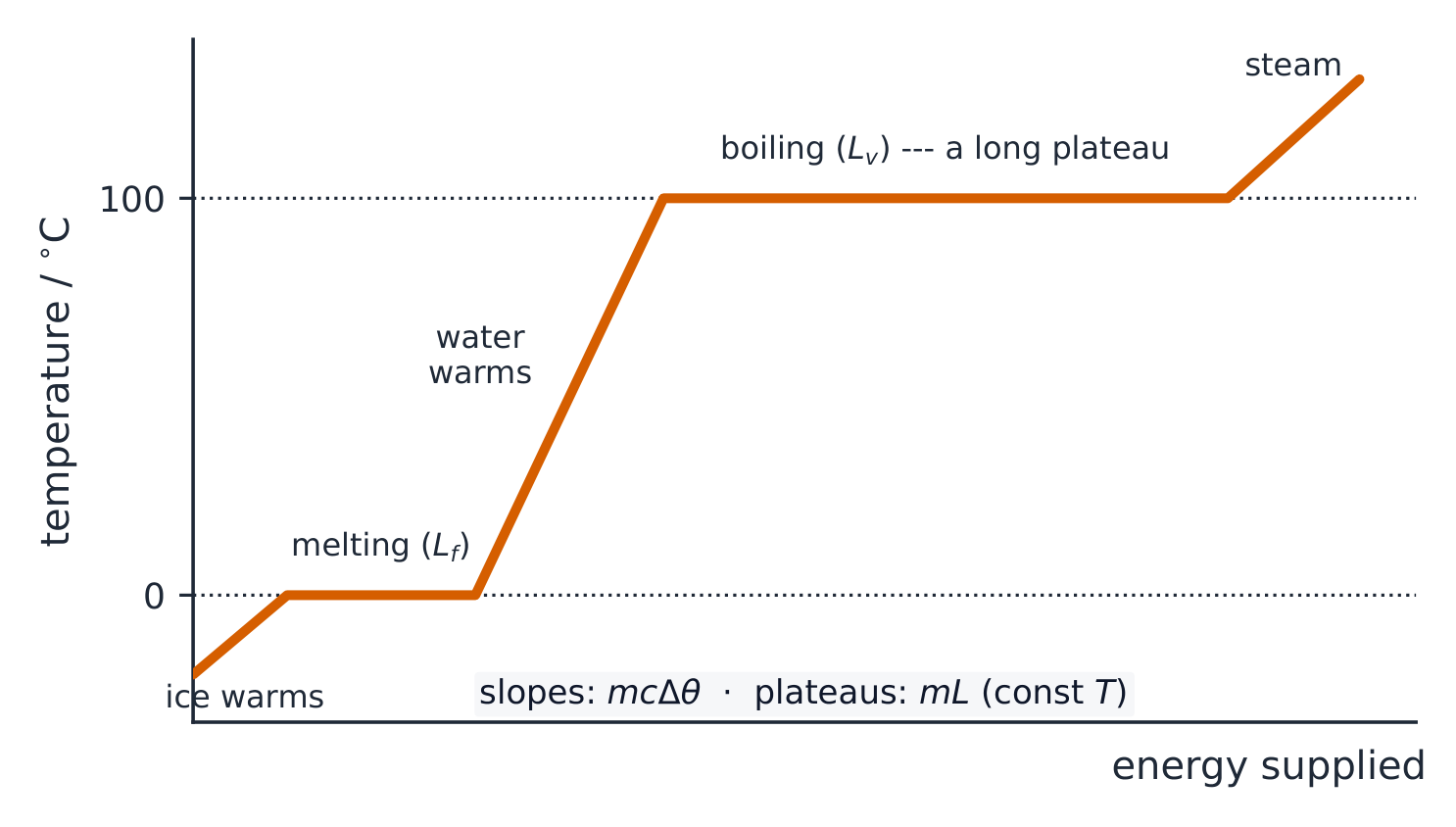
If a problem mixes temperature change and a phase change 相变 (e.g. ice at $-5\ ^{\circ}\text{C}$ warming to water at $30\ ^{\circ}\text{C}$):
heat the solid from $-5\ ^{\circ}\text{C}$ to $0\ ^{\circ}\text{C}$: $Q_{1} = m c_{\text{ice}} \times 5$.
melt at $0\ ^{\circ}\text{C}$: $Q_{2} = m L_{\text{f}}$.
heat the water from $0\ ^{\circ}\text{C}$ to $30\ ^{\circ}\text{C}$: $Q_{3} = m c_{\text{water}} \times 30$.
Total: $Q_{1} + Q_{2} + Q_{3}$. A phase change is at constant temperature, so use $mL$ there, not $mc\Delta T$.
When a question gives heater power $P$ and asks for the time, use $Q = Pt$ (assuming no heat loss). Insulating (lagging) the container and using a small mass are common ways to improve the experiment.
Worked example. An ice cube of mass $37.0\ \text{g}$ at $0.0\ ^{\circ}\text{C}$ is dropped into $208\ \text{g}$ of water at $26.4\ ^{\circ}\text{C}$ in an insulated beaker. Find the final temperature when all the ice has melted. ($c_{\text{water}} = 4.20\ \text{kJ kg}^{-1}\ \text{K}^{-1}$, $L_{\text{f}} = 334\ \text{kJ kg}^{-1}$.)
The ice gains energy twice — to melt, then to warm from $0$ to $T$ — and the water loses energy cooling from $26.4$ to $T$. Working in grams and kilojoules: $37.0 \times 0.334 + 37.0 \times 4.20 \times 10^{-3}\,T = 208 \times 4.20 \times 10^{-3}\,(26.4 - T)$, i.e. $12.4 + 0.155T = 23.1 - 0.874T$, so $1.03T = 10.7$ and $T = 10\ ^{\circ}\text{C}$. Three energy terms, one equation; the commonest error is to forget that the melted ice must also be warmed.
עברית
כשחומר עובר שינוי מצב (מוצק ↔ נוזל, או נוזל ↔ גז) בטמפרטורה קבועה, יש לספק (أو להסיר) אנרגיה ללא שינוי בטמפרטורה. אנרגיה זו נקראת חום נסתר.
החום הספציפי של שינוי המצב$L$ הוא האנרגיה הנדרשת לשינוי המצב של יחידת מסה בטמפרטורה קבועה:
$$L = \frac{Q}{m} \qquad\Longleftrightarrow\qquad Q = m L.$$
יחידה: $\text{J kg}^{-1}$.
הגדרה בעלת שני נקודות:חום ספציפי של מעבר פאזה הוא הכמות האנרגטית הנדרשת לכל יחידת מסה כדי לשנות את מצב הצורה ללא שינוי בטמפרטורה. "ללא שינוי בטמפרטורה" (או "בטמפרטורה קבועה") היא הנקודה השנייה והיא זו שמעטפת ביותר. יש להוסיף "ממצב מוצק לנוזלי" לגשר או "ממצב נוזלי לגז" לקיטור כאשר מבוקש סוג ספציפי.
שני סוגים:
חום ספציפי של התמרה$L_{\text{f}}$ — עבור המסה או הקיפאון (מוצק ↔ נוזל).
חום ספציפי של קיטור$L_{\text{v}}$ — עבור רתיחה או ערפל (נוזלי ↔ גז).
עבור מים בלחץ אטמוספרי: $L_{\text{f}} \approx 3.34 \times 10^{5}\ \text{J kg}^{-1}$ (בטמפרטורת $0\ ^{\circ}\text{C}$); $L_{\text{v}} \approx 2.26 \times 10^{6}\ \text{J kg}^{-1}$ (בטמפרטורת $100\ ^{\circ}\text{C}$). כלומר, $L_{\text{v}}$ הוא פי 7 לערך מ-$L_{\text{f}}$.
עקומת חימום: החלקים המשיקים מחממים את הצורה ($mc\Delta T$); הצדדים השטוחים הם מעברי הפאזה ($mL$)
דוגמה פתורה. חום חשמלי בעל הספק $2.0\ \text{kW}$ מרתח מים שכבר בטמפרטורת $100\ ^{\circ}\text{C}$. כמה זמן לוקח להפוך $0.10\ \text{kg}$ מהמים הללו לקיטור? ($L_{\text{v}} = 2.26 \times 10^{6}\ \text{J kg}^{-1}$, ללא איבוד חום.)
האנרגיה הנדרשת היא $Q = mL_{\text{v}} = 0.10 \times 2.26 \times 10^{6} = 2.26 \times 10^{5}\ \text{J}$. מכיוון שהספק הוא $Q = Pt$,
דוגמה פתורה. מים בקומקום נשארים בטמפרטורת $100\ ^{\circ}\text{C}$ בזמן הרתיחה, למרות שאלמנט החימום ממשיך לחמם אותם. הסבר תופעה זו בהתייחס לאנרגיות המולקולריות (3 נקודות).
הטמפרטורה היא מדד ל-אנרגיה קינטית הממוצעת של המולקולות. במהלך הרתיחה, האנרגיה המסופקת משמשת להפרדת המולקולות — לבצע עבודה נגד כוחות המשיכה ביניהן ונגד האטמוספירה כאשר הקיטור מתרחב — ולכן היא מגבירה את ה-אנרגיה הפוטנציאלית של המולקולות, ולא את האנרגיה הקינטית שלהן. מכיוון שהאנרגיה הקינטית הממוצעת נשארת ללא שינוי, הטמפרטורה נשארת קבועה עד שכל המים הופכים לקיטור.
למה $L_{\text{v}} > L_{\text{f}}$
שתי סיבות, שתיהן נובעות מתמונת החלקיקים של החומר:
קשרים: בגשר, רק חלק מהקשרים בין-מולקולריים נשברים; החלקיקים נשארים קרובים זה לזה כנוזל. ברתיחה, כל הקשרים חייבים להישבר כדי שהחלקיקים יוכלו להתרחק. שבירת כולם דורשת יותר אנרגיה.
עבודה נגד האטמוספירה: כאשר נוזל הופך לגז, הוא מתרחב באופן משמעותי (לקיטור יש כ-$10^{3}$ פעמים את ה-נפח של הנוזל), ולכן הוא מבצע עבודה בדחיפת לחץ האטמוספרי הסביבתי. עבודה זו נובעת מאנרגיה המסופקת.
כתבו את שתי הסיבות וציינו את האנרגיות: הנקודות הן עבור שבירת קשרים (עלייה באנרגיה פוטנציאלית) — חלקית בגשר, מלאה ברתיחה, ועבור עבודה שנעשתה נגד האטמוספירה בתרחבות הגדולה. המשפט "רתיחה דורשת יותר אנרגיה" הוא פשוט חזרה של השאלה.
דוגמה פתורה. צלחת מכילה $7.2 \times 10^{-5}\ \text{m}^{3}$ של נוזל בצפיפות $710\ \text{kg m}^{-3}$ ובחום ספציפי של קיטור $3.6 \times 10^{5}\ \text{J kg}^{-1}$. הנוזל מתאדים לחלוטין. מצאו את האנרגיה שנבלעה, והציעו, עם נימוק, האם חום הספציפי של גשר של החומר סביר להיות קטן או גדול מהערך הזה.
מסה $= \rho V = 710 \times 7.2 \times 10^{-5} = 5.1 \times 10^{-2}\ \text{kg}$, ולכן האנרגיה שנבלעה היא $Q = mL_{\text{v}} = 5.1 \times 10^{-2} \times 3.6 \times 10^{5} = 1.8 \times 10^{4}\ \text{J}$. ה-$L_{\text{f}}$ שלו ככל הנראה יהיה קטן יותר: ההמסה שוברת רק חלק מהקשרים בין-מולקולריים והנפח משתנה מעט בלבד, בעוד שההידרקות שוברת אותם כולם ועושה עבודה נגד האטמוספירה — עבור מים $L_{\text{f}}$ הוא כשביעית מ-$L_{\text{v}}$.
בעיות רב-שלבים
אם בעיה מערבבת שינוי בטמפרטורה ומעבר פאזה (למשל, קרח בטמפרטורת $-5\ ^{\circ}\text{C}$ המתחמם למים בטמפרטורת $30\ ^{\circ}\text{C}$):
התכה ב-$0\ ^{\circ}\text{C}$: $Q_{2} = m L_{\text{f}}$.
חימום המים מ-$0\ ^{\circ}\text{C}$ ל-$30\ ^{\circ}\text{C}$: $Q_{3} = m c_{\text{water}} \times 30$.
סך הכל: $Q_{1} + Q_{2} + Q_{3}$. שינוי פאזה מתרחש בטמפרטורה קבועה, לכן השתמשו ב-$mL$ במקום ב-$mc\Delta T$.
*חלקו בעיה מעורבת לשלבים — חימום, שינוי מצב, חימום — ולאחר מכן חברו את האנרגיות
כאשר שאלה נותנת הספק מחמם $P$ ושואלת על הזמן, השתמשו ב-$Q = Pt$ (בהנחה שאין איבוד חום). בידוד (בידוד תרמי) המכל ושימוש בכמות חומר קטנה הם דרכים נפוצות לשיפור הניסוי.
דוגמה פתורה. קוביית קרח במסה $37.0\ \text{g}$ בטמפרטורה $0.0\ ^{\circ}\text{C}$ מושלכת לתוך $208\ \text{g}$ מים בטמפרטורה $26.4\ ^{\circ}\text{C}$ בבקבוק בידוד. מצאו את הטמפרטורה הסופית לאחר שהכל הקרח התכה. ($c_{\text{water}} = 4.20\ \text{kJ kg}^{-1}\ \text{K}^{-1}$, $L_{\text{f}} = 334\ \text{kJ kg}^{-1}$.)
הקרח מקבל אנרגיה פעמיים — להתכה, ואז לחמום מ-$0$ ל-$T$ — והמים מאבדים אנרגיה בהתקררות מ-$26.4$ ל-$T$. עבודה בגרמים ובקילו-ג'ול: $37.0 \times 0.334 + 37.0 \times 4.20 \times 10^{-3}\,T = 208 \times 4.20 \times 10^{-3}\,(26.4 - T)$, כלומר $12.4 + 0.155T = 23.1 - 0.874T$, ולכן $1.03T = 10.7$ ו-$T = 10\ ^{\circ}\text{C}$. שלושה איברים באנרגיה, משוואה אחת; הטעות הנפוצה ביותר היא לשכוח שהקרח המותך צריך גם להיות מחומם.
Definitions the examiner accepts · הגדרות מקובלות בקורס
English
A definition question is marked against fixed wording. Learn these exactly, and give one answer only.
Term
Definition
thermal equilibrium
the state of two objects between which there is no net transfer of thermal energy; they are at the same temperature
thermal energy
energy transferred from one object to another because of a temperature difference
thermodynamic temperature scale
a temperature scale that does not depend on the property of any particular substance, fixed by absolute zero and the triple point of water
absolute zero
the lowest possible temperature, $0\ \text{K}$ ($-273.15\ ^{\circ}\text{C}$), at which a system has its minimum internal energy
kelvin and Celsius
$T/\text{K} = \theta/^{\circ}\text{C} + 273.15$; a temperature difference is the same number in both
specific heat capacity
the energy required per unit mass of a substance to raise its temperature by one kelvin
specific latent heat
the energy required per unit mass to change the state of a substance without a change of temperature
specific latent heat of fusion
the specific latent heat for the change from solid to liquid
specific latent heat of vaporisation
the specific latent heat for the change from liquid to gas
עברית
שאלת הגדרה מוקדמת לפי טקסט קבוע. לימודן במדויק, ותן תשובה אחת בלבד.
מונח
הגדרה
איזון תרמי
המצב של שני גופים ביניהם אין העברה נטו של אנרגיה תרמית; הם באותה טמפרטורה
אנרגיה תרמית
אנרגיה המועברת מגוף אחד למשנהו עקב הפרש טמפרטורות
סקאלת טמפרטורה תרמודינמית
סקאלת טמפרטורה שאינה תלויה בתכונה של חומר מסוים, המוגדרת על ידי אפס מוחלט ונקודה משולשת של מים
אפס מוחלט
הטמפרטורה הנמוכה ביותר האפשרית, $0\ \text{K}$ ($-273.15\ ^{\circ}\text{C}$), שבה לגוף יש את האנרגיה הפנימית המינימלית
קלווין וצלזיוס
$T/\text{K} = \theta/^{\circ}\text{C} + 273.15$; הפרש טמפרטורות הוא אותו מספר בשתי סקالات
קיבולת חום סגולית
האנרגיה הנדרשת ליחידת מסה של חומר כדי להרים את טמפרטורתו בקלווין אחד
חום סתרי סגולי
האנרגיה הנדרשת ליחידת מסה כדי לשנות את מצב החומר ללא שינוי בטמפרטורה
חום סתרי התכה סגולי
החום הסתרי עבור השינוי ממצב מוצק לנוזלי
חום סתרי אידוי סגולי
החום הסתרי עבור השינוי ממצב נוזלי לגז
14.3
Exam tips · טיפים לבחינות
English
Thermal equilibrium means no net flow of thermal energy (equal temperature); the thermodynamic scale does not depend on any particular substance and is fixed by absolute zero and the triple point.
Convert temperatures with $T/\text{K} = \theta/^\circ\text{C} + 273.15$ and use kelvin in energy and gas equations; a temperature difference is the same in K and °C.
Use $Q = mc\Delta T$ for heating and $Q = mL$ for a change of state (no temperature change) — never mix the two, and in a mixing problem write one equation: energy lost $=$ energy gained, with every term.
A container heated with the liquid takes its share of the energy: include $m_{\text{beaker}}c_{\text{beaker}}\Delta T$.
For a "why" about latent heat, name the energies: potential energy of the molecules rises (bonds broken, work against the atmosphere), kinetic energy and hence temperature do not.
Common mistakes
Defining specific heat capacity without "per unit mass" or without "per kelvin". Both are needed; the unit $\text{J kg}^{-1}\ \text{K}^{-1}$ is the reminder.
Leaving "at constant temperature" out of the latent-heat definition. That phrase is what distinguishes latent heat from heating.
Using $mc\Delta T$ across a change of state, or $mL$ for a temperature rise.
Forgetting the beaker, the calorimeter or the melted ice's own warming in an energy equation.
Saying the thermodynamic scale "uses kelvin" as its defining feature. The feature is that it depends on no particular substance.
Adding $273.15$ to a temperature difference. Differences are the same in both scales.
עברית
איזון תרמי פירושו זרימת נטו אפסית של אנרגיה תרמית (טמפרטורה שווה); הסקאלה התרמודינמית אינה תלויה בחומר מסוים ומוגדרת על ידי אפס מוחלט ונקודה משולשת.
ממירו טמפרטורות עם $T/\text{K} = \theta/^\circ\text{C} + 273.15$ והשתמשו ב-קלווין במשוואות אנרגיה וגז; הפרש טמפרטורות הוא אותו בערך ב-K וב-°C.
השתמש ב-$Q = mc\Delta T$ לחימום וב-$Q = mL$ לשינוי מצב (ללא שינוי טמפרטורה) — לעולם אל תערבב ביניהם, ובבעיית ערבוב כתוב משוואה אחת: אנרגיה מאבדת $=$ אנרגיה נוספת, עם כל האיברים.
מיכל המחומם עם הנוזל לוקח את חלקו באנרגיה: יש לכלול $m_{\text{beaker}}c_{\text{beaker}}\Delta T$.
עבור "למה" לגבי חום סתרי, ציין את האנרגיות: אנרגיה פוטנציאלית של המולקולות עולה (קשרים נשברים, עבודה נגד האטמוספירה), אנרגיה קינטית ולכן הטמפרטורה אינם משתנים.
טעויות נפוצות
הגדרת קיבולת החום הסגיר ללא "לכל יחידת מסה" או ללא "לכל קלווין". שני הדברים נדרשים; היחידה $\text{J kg}^{-1}\ \text{K}^{-1}$ היא הזכר.
השארת הביטוי " בטמפרטורה קבועה" מחוץ להגדרת החום הסתרי. ביטוי זה הוא מה שמבדיל בין חום סתרי לחימום.
השימוש ב-$mc\Delta T$ במהלך שינוי מצב, או ב-$mL$ עבור עליית טמפרטורה.
לשכוח את הכוס, הקלורימטר או חימומו של הקרח המותך עצמו במשוואת האנרגיה.
לומר שהסולם התרמודינמי "משתמש בקלווין" כמאפיין ההגדרה שלו. המאפיין הוא שהוא אינו תלוי בחומר מסוים.
הוספת $273.15$ להפרש טמפרטורות. הפרשים זהים בשני הסולמות.
Interactive lessons on this topic · שיעורים אינטראקטיביים בנושא זה
Work through it step by step, with instant-check exercises. · לעבור על הדברים צעד אחר צעד, עם תרגילים לבדיקה מיידית.
Pick one and the site follows you — notes, papers, videos and practice all open on it. · בחרו נושא אחד והאתר יעקוב אחריו — הערות, מסמכים, וידאו ותרגולים פתוחים בו.
Type to search notes, lessons, code, vocabulary and past-paper questions across every subject. · הקלד כדי לחפש הערות, שיעורים, קוד, אוצר מילים ושאלות מבחנים בכל הנושאים.




 *חלקו בעיה מעורבת לשלבים — חימום, שינוי מצב, חימום — ולאחר מכן חברו את האנרגיות