Temperature scales
Introduced| English | Meaning |
|---|---|
| thermometer/θɜːˈmɒmɪtə/ | An instrument used to measure temperature. |
| thermocouple/ˈθɜːməkʌpl/ | A temperature sensor that uses the voltage generated by junctions of two different conductors at different temperatures. |
| thermodynamic/ˌθɜːməʊdaɪˈnæmɪk/ | thermodynamic |
| kelvin/ˈkelvɪn/ | The SI unit of thermodynamic temperature, with zero at absolute zero. |
| absolute zero/ˈæbsəluːt ˈzɪərəʊ/ | The lowest temperature on the thermodynamic temperature scale, equal to zero kelvin. |
| Celsius/ˈselsɪəs/ | A temperature scale on which a change of one degree equals a change of one kelvin, with zero degrees equal to 273.15 kelvin. |
How a thermometer 温度计 works
- A thermometer needs something that changes with temperature.
- A liquid expands, a metal's resistance rises, a gas swells.
- Read that change and you read the temperature.
Temperature scale lab
Kelvin index = Celsius index + 2.73
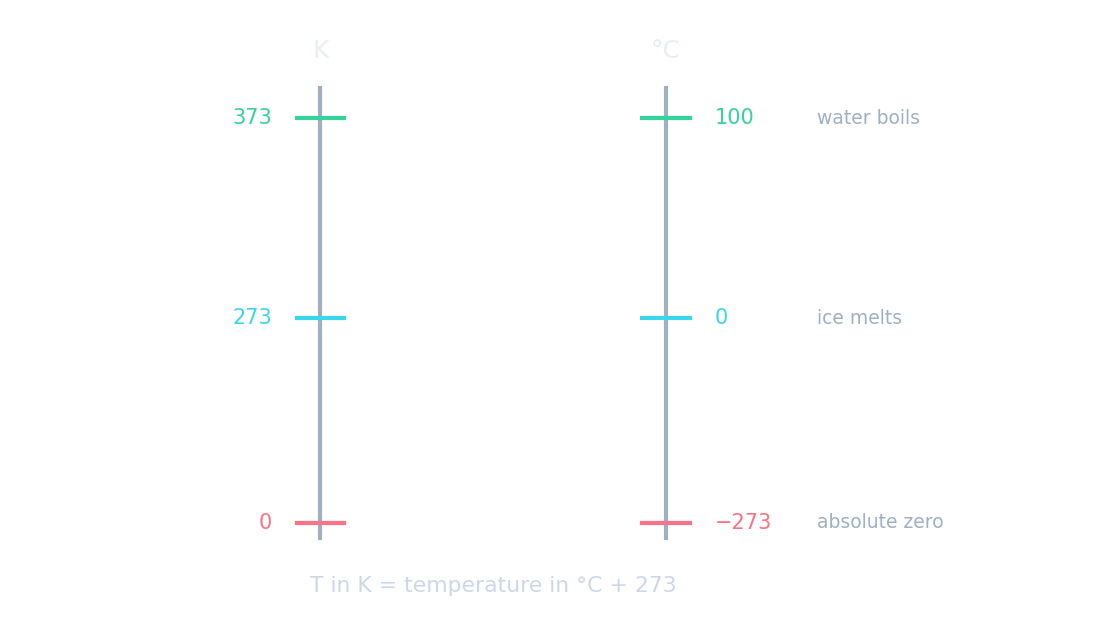
Slide Celsius temperature and see the Kelvin scale shift by 273.
Kinds of thermometer
- Anything that changes repeatably with temperature works:
- expansion of a liquid, resistance of a metal, e.m.f. of a thermocouple 热电偶, volume of a gas.

A thermometer measures temperature on a defined scale
Select all the properties that can be used to measure temperature.
Difficulty 2/5 · 140 coins + a small bonus on first completion today
Any property that changes repeatably with temperature works. The fixed colour of the case does not.
The absolute scale
- The thermodynamic 热力学 (absolute) scale uses the kelvin 开尔文 (K) and depends on no single substance.
- Absolute zero 绝对零度 ($0\ \text{K}$) is the lowest possible temperature — least internal energy. Nothing is colder.
Absolute zero (0 K) is:
Difficulty 1/5 · 100 coins + a small bonus on first completion today
At 0 K a system has its least possible internal energy; nothing can be made colder.
Kelvin and Celsius 摄氏度
- $T/\text{K} = \theta/°\text{C} + 273.15$. So $0\ °\text{C} = 273\ \text{K}$.
- A kelvin and a Celsius degree are the same size, so a change of $1\ \text{K} = 1\ °\text{C}$.
- Always use kelvin in gas-law calculations.

Extrapolating the pressure-temperature line back to zero pressure gives absolute zero, about -273 degC
What is $27\ °\text{C}$ in kelvin?
Difficulty 2/5 · 140 coins + a small bonus on first completion today
$T/\text{K} = \theta/°\text{C} + 273 = 27 + 273 = 300\ \text{K}$.
A temperature rise of 1 K is the same as a rise of 1 °C.
Difficulty 1/5 · 100 coins + a small bonus on first completion today
The two scales have the same size of degree — only their zero points differ (by 273.15).
In gas-law calculations, the temperature must be in:
Difficulty 1/5 · 100 coins + a small bonus on first completion today
Gas laws use absolute temperature — kelvin. Using °C gives wrong answers.
A temperature is 27 degrees Celsius. What is it in kelvin?
Difficulty 2/5 · 140 coins + a small bonus on first completion today
T = 27 + 273 = 300 K. A temperature DIFFERENCE, though, is the same number in both scales: a rise of 27 C is a rise of 27 K.
Why the thermodynamic scale is special
- It does not depend on the property of any particular substance — it is defined from the behaviour of an ideal gas, with absolute zero and the triple point of water as its fixed points.
- A liquid-in-glass thermometer assumes its liquid expands uniformly with temperature. That is only approximately true, so it agrees with the thermodynamic scale exactly only at the points where it was calibrated.
- That is the exam's "explain why a liquid-in-glass thermometer does not measure thermodynamic temperature".
What makes the thermodynamic scale special? Select all that apply.
Difficulty 2/5 · 140 coins + a small bonus on first completion today
The unit is a consequence, not the defining feature. A mercury thermometer's scale depends on how mercury happens to expand; this one depends on nothing of the sort.
Choosing a thermometer
- Platinum resistance: resistance varies linearly and repeatably with temperature over a wide range — very accurate. But it has a large thermal capacity, so it is slow and cannot follow a rapidly changing temperature.
- Thermocouple: two metal junctions give an e.m.f.; tiny, fast, wide range, measures at a point — ideal for a changing temperature.
- Liquid in glass: cheap and simple; limited range, slow, and reads only where the bulb is.
Match each thermometer to its key feature.
Difficulty 2/5 · 140 coins + a small bonus on first completion today
A large thermal capacity makes the resistance thermometer accurate but slow; a thermocouple's tiny junction responds fast; the absolute scale is defined from ideal-gas behaviour, not a material.
Match each thermometer to the property it uses.
Difficulty 2/5 · 140 coins + a small bonus on first completion today
A thermocouple has a small thermal capacity and responds fast, which is why it is chosen for a rapidly changing temperature.
Worked example: finding absolute zero, then converting
A fixed volume of gas has pressure $100\ \text{kPa}$ at $0\ °\text{C}$ and $136.6\ \text{kPa}$ at $100\ °\text{C}$. Then: a gas is heated from $27\ °\text{C}$ to $742\ °\text{C}$.
- Gradient: $\dfrac{136.6 - 100}{100} = 0.366\ \dfrac{\text{kPa}}{°\text{C}}$; pressure is a straight line in temperature.
- Extrapolate to zero pressure: $\theta = -\dfrac{100}{0.366} = -273\ °\text{C}$ — absolute zero.
- Convert: $27\ °\text{C} = 300\ \text{K}$; $742\ °\text{C} = 1015\ \text{K}$.
- Temperature change: $742 - 27 = 715\ °\text{C} = 715\ \text{K}$ — a difference is the same number on both scales.
- Check: absolute zero is where the pressure of an ideal gas would fall to zero; the gas would liquefy long before, which is why the point is found by extrapolation, not by cooling.
A gas is heated from $20\ °\text{C}$ to $95\ °\text{C}$. What is the temperature change, in K?
Difficulty 2/5 · 140 coins + a small bonus on first completion today
A change is the same number on both scales: $95 - 20 = 75\ °\text{C} = 75\ \text{K}$. Adding 273 would be wrong here.
Add $273$ to convert a Celsius temperature to kelvin, but a temperature difference is the same number on both scales — do not add $273$ to a $\Delta T$. A kelvin temperature can never be negative. And absolute zero is the temperature of minimum internal energy, not zero energy — "the molecules stop moving" is not an accepted answer.
Absolute zero is the temperature at which a substance has its ____ internal energy.
Difficulty 1/5 · 100 coins + a small bonus on first completion today
Not zero energy — the minimum possible. That is why "the molecules stop moving" is not accepted.
You've got it
- a thermometer uses any property that changes repeatably with temperature; the thermodynamic scale depends on no substance
- absolute zero $= 0\ \text{K} = -273.15\ °\text{C}$, the lowest possible temperature (minimum internal energy)
- $T/\text{K} = \theta/°\text{C} + 273$; a difference is the same in K and °C; use kelvin in gas laws