לפני מעל מאה שנה, פיזיקאים כונו חלקיקי אלפא קטנים ללוח דק של זהב, דק יותר מנייר. הם צפו שהחלקיקים יעבורו ישר…
English narration · English + 中文 subtitles burned in · קריאת קול באנגלית · תרגום אנגלי + סינית שרוף בתוך הסרטון
11.1
The nuclear atom · האטום הגרעיני
Syllabus · סיילבוס
English
infer from the results of the $\alpha$-particle scattering experiment the existence and small size of the nucleus
describe a simple model for the nuclear atom to include protons, neutrons and orbital electrons
distinguish between nucleon number and proton number
understand that isotopes are forms of the same element with different numbers of neutrons in their nuclei
understand and use the notation $_Z^A\text{X}$ for the representation of nuclides
understand that nucleon number and charge are conserved in nuclear processes
describe the composition, mass and charge of $\alpha$-, $\beta$- and $\gamma$-radiations (both $\beta^-$ (electrons) and $\beta^+$ (positrons) are included)
understand that an antiparticle has the same mass but opposite charge to the corresponding particle, and that a positron is the antiparticle of an electron
state that (electron) antineutrinos are produced during $\beta^-$ decay and (electron) neutrinos are produced during $\beta^+$ decay
understand that $\alpha$-particles have discrete energies but that $\beta$-particles have a continuous range of energies because (anti)neutrinos are emitted in $\beta$-decay
represent $\alpha$- and $\beta$-decay by a radioactive decay equation of the form $^{238}_{92}\text{U} \rightarrow ^{234}_{90}\text{Th} + ^4_2\alpha$
use the unified atomic mass unit (u) as a unit of mass
עברית
היסק מהתוצאות של ניסוי פיזור חלקיקי $\alpha$ קיום וקטנות הגודל של הגרעין
לתאר דגם פשוט לאטום גרעיני המכלול פרוטונים, נוטרונים ואלקטרונים אורביטליים
להבדיל בין מספר נוקלאונים לבין מספר פרוטונים
להבין ש-איזוטופים הם צורות של אותו יסוד עם מספרים שונים של נייטרונים בגרעין שלהם
להבין ולשמש בסימון $_Z^A\text{X}$ לייצוג גרעינים (nuclides)
להבין שמספר נוקלאונים ומטען חשמלי נשמרים בתהליכים גרעینیים
לתאר את ההרכב, המסה והמטען של קרינת $\alpha$-, $\beta$- ו-striker-$\gamma$- (כלל גם $\beta^-$ (אלקטרונים) ו-striker-$\beta^+$ (פוזיטרונים))
להבין ש-אנטיחלק בעל אותה מסה אך מטען הפוך לחלק המתאים לו, וכי פוזיטרון הוא האנטיחלק של אלקטרון
לציין ש-(אלקטרוני) אנטרינו נוצרים במהלך דעיכה של $\beta^-$ ו-(אלקטרוני) ניטרנו נוצרים במהלך דעיכה של $\beta^+$
להבין שקרינה של $\alpha$-בעלת אנרגיות דיסקרטיות אך קרינה של $\beta$-יש לה טווח רציף של אנרגיות משום שה(אנטי)ניטרנו נפלטים בדעיכה של $\beta$-
לייצג דעיכה של $\alpha$-ועבור דעיכה של $\beta$-באמצעות משוואת דעיכה רדיואקטיבית בצורה $^{238}_{92}\text{U} \rightarrow ^{234}_{90}\text{Th} + ^4_2\alpha$
להשתמש ביחידת המסה האטומית המאוחדת (u) כיחידת מסה
Source: Cambridge International syllabus · מקור: הסיילבוס הבינלאומי של קמבריד'ג'
English
Geiger–Marsden α-particle scattering
Alpha particles α粒子 fired at a thin gold foil were seen to:
mostly pass straight through, with very little deflection 偏转,
sometimes deflect through small angles,
rarely (about $1$ in $8000$) deflect through angles greater than $90°$.
From this Rutherford worked out:
the atom is mostly empty space (most α-particles pass straight through),
there is a tiny, dense, positively charged nucleus 原子核 at the centre (the rare large deflections need a concentrated charge to push the α away),
almost all of the atom's mass is in this nucleus.
Order of magnitude: atom diameter $\sim 10^{-10}\ \text{m}$, nucleus diameter $\sim 10^{-15}\ \text{m}$ — the nucleus is about $10^{5}$ times smaller than the atom.
The three results and what each proves — the mark scheme pairs them exactly like this:
Observation
Conclusion
the vast majority pass straight through with little or no deflection
most of the atom is empty space
a small number are deflected through small angles
there is a concentrated positive charge (the nucleus) that repels the positive α-particles
a very small minority (about 1 in 8000) are deflected through more than 90°, some straight back
the nucleus is very small compared with the atom, and contains almost all of the atom's mass
Three details of the experiment are also asked: the foil is thin so that each α-particle meets at most one nucleus (and is not absorbed); the chamber is a vacuum so the α-particles are not stopped or scattered by air; gold is used because it can be beaten into a very thin sheet and has a heavy, highly charged nucleus.
Worked example. Explain why a very small minority of the α-particles are scattered through angles greater than 90°.
Only an α-particle that approaches a nucleus almost head-on is turned back. The nucleus and the α-particle are both positive, so the electrostatic 静电 repulsion is very large at small separation, and the nucleus is much more massive than the α-particle, so it is the α-particle that is turned round. Because the nucleus is tiny, very few α-particles get that close — hence the small minority. As the α-particle approaches, its kinetic energy is converted to electric potential energy; at the point of closest approach it is momentarily at rest and all of its kinetic energy has become potential energy.
The deflection depends on how close the path passes to the nucleus: the smaller the distance, the larger the angle, and the paths are symmetrical about the line through the nucleus.
Simple nuclear model
An atom has:
a central nucleus of protons 质子 (positive, charge $+e$) and neutrons 中子 (no charge),
electrons 电子 (charge $-e$) around the nucleus.
The proton and neutron have almost the same mass ($\approx 1\ \text{u}$); the electron is about $\tfrac{1}{1836}$ of the proton's mass.
Worked example. Describe the structure of an atom of uranium-238, $^{238}_{92}\text{U}$.
A nucleus containing 92 protons and $238 - 92 = 146$ neutrons, with 92 electrons in orbit around it. "Orbital electrons" is the syllabus phrase — the electrons are outside the nucleus, and the neutral atom has as many electrons as protons.
Notation and key numbers
For a nuclide 核素 written $^{A}_{Z}\text{X}$:
proton number 质子数$Z$ (also the atomic number): the number of protons. It fixes the element.
nucleon number 核子数$A$ (also the mass number): the total number of nucleons 核子 (protons + neutrons).
number of neutrons $N = A - Z$.
A neutral atom has the same number of electrons as protons.
Isotopes
Isotopes 同位素 are atoms of the same element (same $Z$) with different numbers of neutrons (different $A$). They behave the same chemically but differently in the nucleus. Example: $^{12}_{6}\text{C}$ and $^{14}_{6}\text{C}$ are isotopes of carbon.
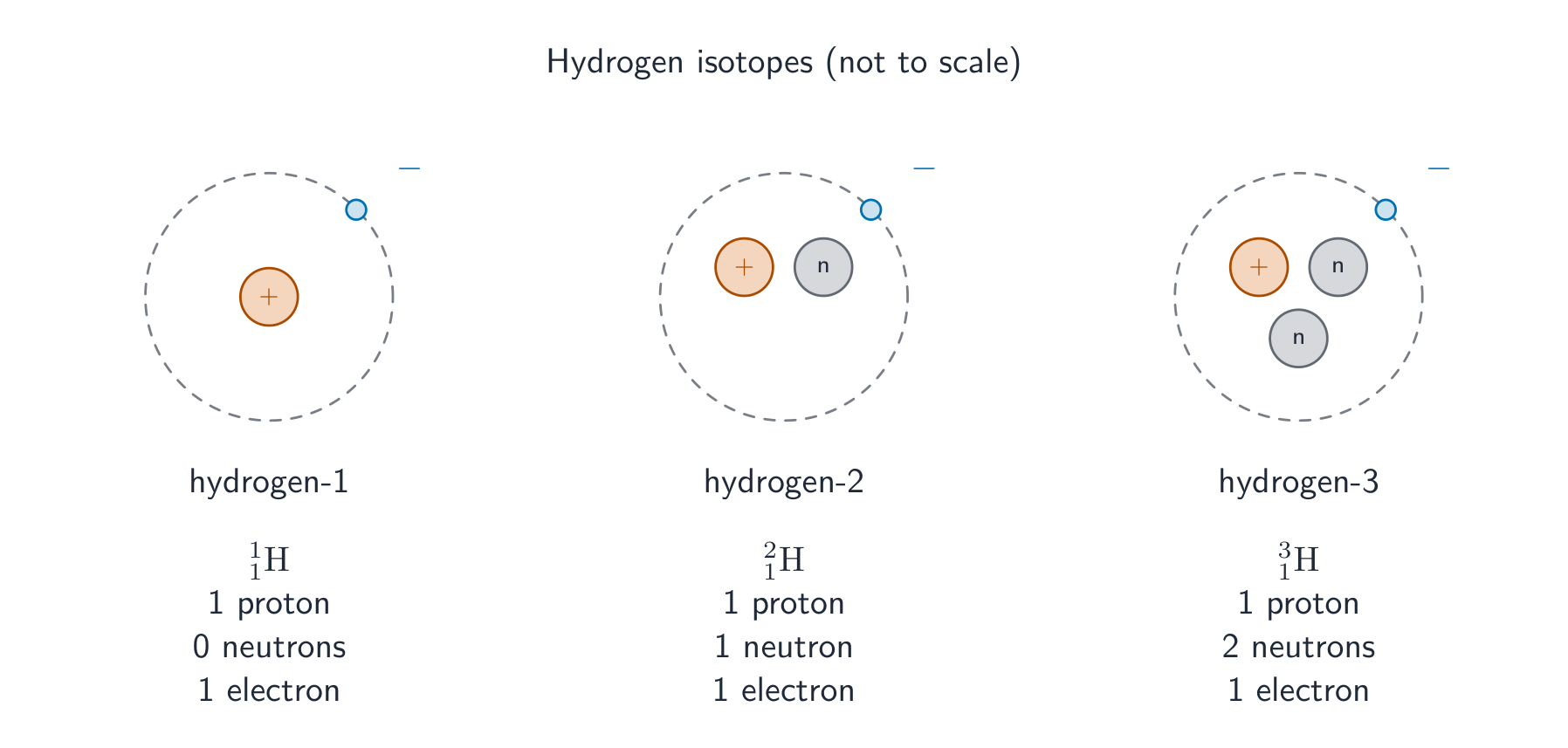
The examiner's wording: isotopes are nuclei (or atoms) with the same number of protons but different numbers of neutrons — equivalently the same proton number $Z$ and different nucleon numbers $A$. Hydrogen has three:
Worked example. Tritium, $^{3}_{1}\text{H}$, is an isotope of hydrogen. State the numbers of protons, neutrons and electrons in a neutral tritium atom, and give the quark composition of its nucleus.
$Z = 1$ proton; $A - Z = 3 - 1 = 2$ neutrons; 1 electron (neutral, so electrons $=$ protons). The nucleus is one proton (uud) and two neutrons (udd, udd): 4 up quarks and 5 down quarks. Charge check: $4 \times \tfrac{2}{3} - 5 \times \tfrac{1}{3} = +1$, the proton number. A "labelled diagram" of the atom is the nucleus (1 p, 2 n) with one electron orbiting outside it.
Conservation laws in nuclear processes
In any nuclear process:
nucleon number $A$ is conserved (total $A$ before $=$ total $A$ after),
charge is conserved (this is conservation of charge 电荷守恒).
These two rules let you balance decay and reaction equations.
Unified atomic mass unit
The unified atomic mass unit 统一原子质量单位, symbol $\text{u}$, is set so that an atom of $^{12}_{6}\text{C}$ has mass exactly $12\ \text{u}$. Numerically,
A proton has mass $\approx 1.007\ \text{u}$; a neutron $\approx 1.009\ \text{u}$; an electron $\approx 5.5 \times 10^{-4}\ \text{u}$.
Worked example. A nucleus X has 14 nucleons and $p$ protons. Its charge-to-mass ratio is $4.1 \times 10^{7}\ \text{C kg}^{-1}$. Find $p$ and identify X.
Charge $= pe$; mass $\approx 14\ \text{u}$. So $\dfrac{pe}{14\text{u}} = 4.1 \times 10^{7}$, giving $p = \dfrac{4.1 \times 10^{7} \times 14 \times 1.66 \times 10^{-27}}{1.60 \times 10^{-19}} = 5.96 \approx 6$. Six protons and 14 nucleons: X is carbon-14, $^{14}_{6}\text{C}$. Keep every figure until the end, then round to the nearest whole number of protons.
עברית
פיזור חלקיקי אלפא בגייגר-מרסדן
חלקיקי אלפא α שיוצרו לעבר דקית זהב נצפו כי:
רובם עברו ישר, עם סטייה מועטה מאוד,
לעיתים סטו בזוויות קטנות,
לעיתים רחוקות (כ-$1$ ב-$8000$) מסתובבים בזוויות גדולות מ-$90°$.
מכאן רת'רפורד הבין:
האטום הוא בעיקר ריק (רוב חלקיקי אלפא עוברים ישר),
קיים גרעין קטן, צפוף וחיובי במרכז (הסטיות הגדולות הנדירות דורשות מטען מרוכז כדי לדחות את אלפא),
כמעט כל מסת האטום נמצאת בגרעין זה.
סדר גודל: קוטר אטום $\sim 10^{-10}\ \text{m}$, קוטר גרעין $\sim 10^{-15}\ \text{m}$ — הגרעין קטן פי-$10^{5}$ מהאטום.
השלושה תוצאות ומה כל אחת מוכיחה – תוכנית הציונים זוג אותן בדיוק כך:
תצפית
מסקנה
רוב הרבים עוברים ישר ללא סטייה או עם סטייה מזערת
חלק רב מהאטום הוא ריק
מספר קטן נסטים בזוויות קטנות
קיים מטען חיובי מרוכז (הגרעין) הדוחה חלקיקי α החיוביים
אחוזים בודדים מאוד (כ-1 ב-8000) מושברים בזווית של יותר מ-90°, חלקם ישירות לאחור
הגרעין קטן מאוד ביחס לסוגר, ומכיל כמעט כל מסת הסוגר
שלושה פרטים נוספים על המערכת גם כן נדרשים: הנייר דק כך שכל חלקיק α פוגע בקורא אחד בלבד (והוא אינו נבלע); התא הוא ריקון כדי שהחלקיקים לא ייעצרו או יתפזרו על ידי אוויר; זהב משמש כי ניתן למתוח אותו לדף דק מאוד והוא מכיל גרעין כבד ובעל מטען גבוה.
דוגמה מופרדת. הסבר מדוע מינימלי מאוד מחלקיקי α מתפזרים בזוויות גדולות מ-90°.
רק חלקיק α שמגיע לגרעין כמעט ראש-ראש יוסח. הגרעין וחלקיק α הם שניהם חיוביים, ולכן הדחייה חשמלית גדולה מאוד במרחק קצר, והגרעין כבד יותר משמעותית מחלקיק α, ולכן החלקיק הוא שנסח. מכיוון שהגרעין זעיר, מעט מאוד חלקיקי α מגיעים לכך קרוב — מכאן המינימליות הקטנה. ככל שהחלקיק מתקרב, אנרגיה הקינטית שלו הופכת לאנרגיה פוטנציאלית חשמלית; בנקודת הקרבה המקסימלית הוא נמצא לרגע בהתראה וכל אנרגייתו הקינטית הפכה לאנרגיה פוטנציאלית.
הסטייה תלויה בכמה הדרך עוברת קרוב לגרעין: ככל שהמרחק קטן יותר, כך הזווית גדולה יותר, והדרך סימטריות ביחס לקו העובר דרך הגרעין.
ניסוי פיזור $\alpha$ — חלקיקי $\alpha$ פוגעים בנייר זהב דק בוואuumרוב חלקיקי $\alpha$ עוברים כמעט ישר; מעט נסטים בחוזקה על ידי הגרעין הזעיר
מודל גרעיני פשוט
לאטום יש:
גרעין מרכזי של פרוטונים (חיוביים, מטען $+e$) ונוטרונים (ללא מטען),
אלקטרונים (מטען $-e$) סביב הגרעין.
לפרוטון ולנוטרון יש כמעט אותה מסה ($\approx 1\ \text{u}$); האלקטרון קל כ-$\tfrac{1}{1836}$ ממסת הפרוטון.
מודלים פשוטים של אטום הליום ואטום ליתיום (לא בקנה מידה)
דוגמה מופרדת. תאר את מבנה אטום של אורניום-238, $^{238}_{92}\text{U}$.
גרעין המכיל 92 פרוטונים ו$238 - 92 = 146$ נוטרונים, עם 92 אלקטרונים המקיפים אותו. "אלקטרונים אורביטליים" הוא הביטוי בסyllabus — האלקטרונים נמצאים מחוץ לגרעין, והאטום הניטרלי מכיל מספר אלקטרונים השווה למספר הפרוטונים.
סימון ומספרים מפתח
עבור ניוקליד הכתוב $^{A}_{Z}\text{X}$:
סימון נוקלידי: מספר מסה למעלה, מספר אטומי למטה
מספר פרוטונים$Z$ (גם המספר האטומי): מספר הפרוטונים. הוא קובע את היסוד.
מספר נוקלאונים$A$ (גם המספר האטומי-משקלי): הסך הכל של נוקלאונים (פרוטונים + נייטרונים).
מספר נייטרונים $N = A - Z$.
אטום ניטרלי יש לו אותו מספר אלקטרונים כמו פרוטונים.
איזוטופים
איזוטופים הם אטומים מאותו יסוד (אותו $Z$) עם מספר שונה של נייטרונים (מספר שונה של $A$). הם מתנהגים זהה כימית אך שונה בגרעין. דוגמה: $^{12}_{6}\text{C}$ ו$^{14}_{6}\text{C}$ הם איזוטופים של פחמן.
ניסוח בוחן: איזוטופים הם גרעינים (או אטומים) עם אותו מספר פרוטונים אך מספר שונה של נייטרונים – כלומר אותה מספר פרוטונים $Z$ ומספרי נוקלאונים שונים $A$. למימן יש שלושה:
שלושת האיזוטופים של המימן: אותו פרוטון אחד, מספרים שונים של נייטרונים
דוגמה מופיעה. טרציום, $^{3}_{1}\text{H}$, הוא איזוטופ של מימן. ציין את מספרי הפרוטונים, הנייטרונים והאלקטרונים באטום טרציום ניטרלי, ותן את הרכב הקווארקיים של הגרעין.
$Z = 1$ פרוטון; $A - Z = 3 - 1 = 2$ נייטרונים; 1 אלקטרון (נטרל, ולכן אלקטרונים $=$ פרוטונים). הגרעין הוא פרוטון אחד (uud) ושני נייטרונים (udd, udd): 4 קווארקים עליונים ו5 קווארקים תחתונים. בדיקת מטען: $4 \times \tfrac{2}{3} - 5 \times \tfrac{1}{3} = +1$, מספר הפרוטונים. "תרשים מסומן" של האטום הוא הגרעין (1 p, 2 n) עם אלקטרון אחד המקיף אותו.
חוקי שימור בתהליכים גרעيني
בכל תהליך גרעיני:
מספר נוקלאונים $A$ שמר (סך $A$ לפני $=$ סך $A$ אחרי),
מטען שמר (זהו שימור מטען).
שתי כללים אלו מאפשרים לאזן משוואיות עיכוב ותגובה.
יחידת מסת אטום מאוחדת
היחידה האטומית המאוחדת, סמל $\text{u}$, מוגדר כך שסוגר של $^{12}_{6}\text{C}$ יש מסת בדיוק $12\ \text{u}$. במספרים,
דוגמה פותרת. גרעין X מכיל 14 נוקלאונים ו$p$ פרוטונים. יחס הטען למסה שלו הוא $4.1 \times 10^{7}\ \text{C kg}^{-1}$. מצאו את $p$ והזהו את X.
טען $= pe$; מסה $\approx 14\ \text{u}$. לכן $\dfrac{pe}{14\text{u}} = 4.1 \times 10^{7}$, מה שמוביל ל-$p = \dfrac{4.1 \times 10^{7} \times 14 \times 1.66 \times 10^{-27}}{1.60 \times 10^{-19}} = 5.96 \approx 6$. שישה פרוטונים ו-14 נוקלאונים: X הוא קרבון-14, $^{14}_{6}\text{C}$. שמרו על כל הספרות עד לסוף, ואז עגלו למספר השלם הקרוב ביותר של פרוטונים.
Explore · חקור
Nuclear atom evidence lab · מעבדה להוכחות האטום הגרעיני
Connect observations to the nuclear model of the atom. · קשרו את התצפיות למודל האטום הגרעיני.
Explore · חקור
Radioactive decay · קריעה רדיואקטיבית
A = A₀·bᵗ
Activity decays exponentially — set the base b below 1. · הפעילות ירידה אקספוננציאלית — הוגדר בסיס b מתחת ל-1.
An unstable nucleus rearranges itself and gives out one of three kinds of radiation 辐射. This is radioactive 放射性 decay. Each kind has its own properties.
α-radiation
Made of: a helium-4 nucleus, $^{4}_{2}\alpha$ (two protons + two neutrons).
Mass: $\approx 4\ \text{u}$.
Charge: $+2e$.
Range in air: a few cm. Stopped by a sheet of paper.
Ionising power: strong — it is good at ionising 电离.
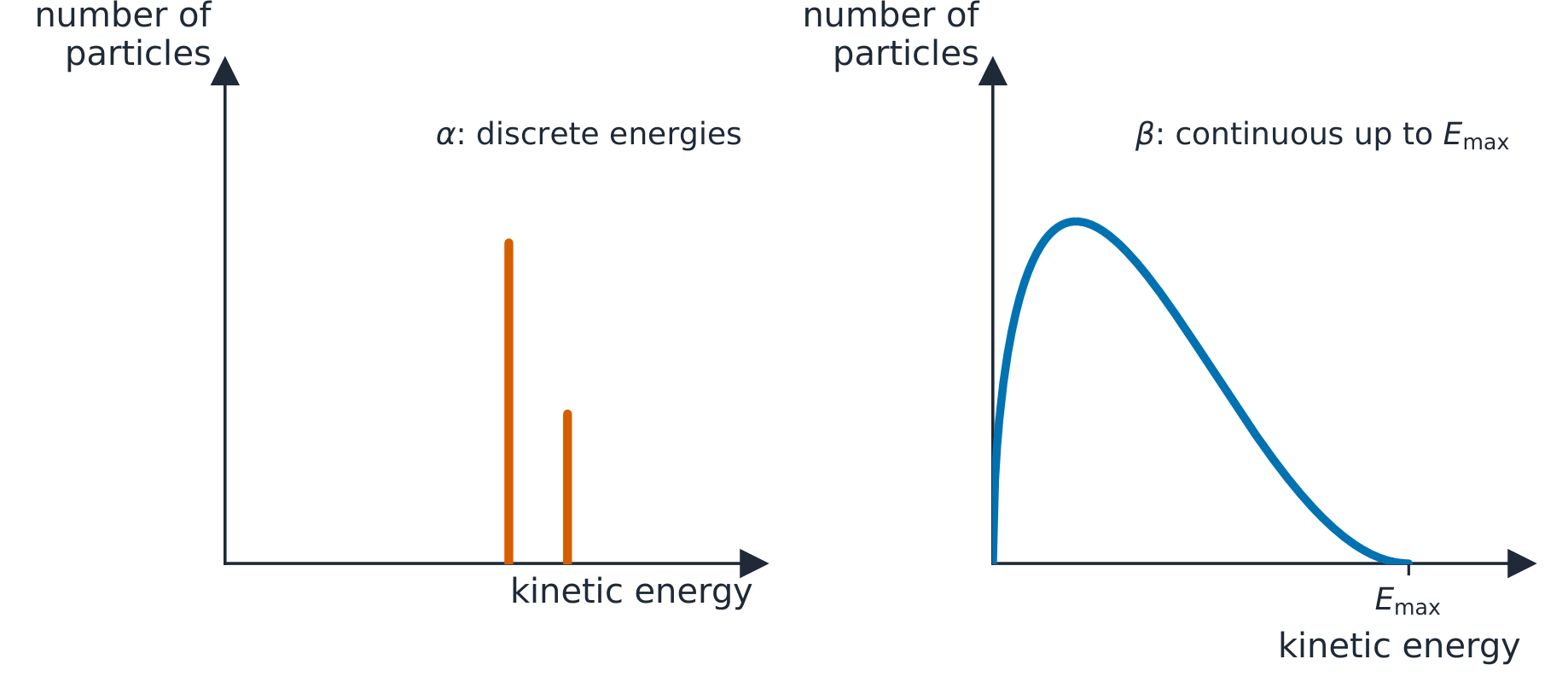
Energy spectrum: discrete 分立 (one decay gives α-particles at one or a few sharp energies).
A cloud chamber 云室 makes the tracks visible: each α-particle leaves a short, straight, thick trail of tiny droplets as it ionises the air. The short equal lengths show the α-particles all carry about the same energy.
β-radiation
Two types of beta particle β粒子:
$\beta^{-}$: a fast electron, given out when a neutron turns into a proton.
$\beta^{+}$: a positron 正电子 (the electron's antiparticle), given out when a proton in a proton-rich nucleus turns into a neutron.
Properties (both types):
Mass: $\approx 1/1836\ \text{u}$ (much less than α).
Charge: $-e$ for $\beta^{-}$, $+e$ for $\beta^{+}$.
Range in air: about $1\ \text{m}$. Stopped by a few mm of aluminium.
Energy spectrum: continuous 连续 up to a maximum (see below).
γ-radiation
Made of: a high-energy photon 光子 — part of the electromagnetic spectrum 电磁波谱.
Mass: zero (rest mass).
Charge: zero.
Range in air: large (follows the inverse-square law). Strongly attenuated 衰减 by several cm of lead or about a metre of concrete.
Ionising power: weakest.
Energy spectrum: discrete (a gamma ray γ射线 is given out as the nucleus drops between two nuclear energy levels).
A nucleus often gives out a γ-photon as a "tidy-up" step after an α or β decay leaves the daughter nucleus 子核 in an excited state 激发态.
Mass and charge, side by side — a table question asks for exactly these, in units of $\text{u}$ and $e$:
Worked example. Compare an α-particle with a $\beta^{+}$ particle in terms of their masses and charges (3 marks).
Both are positively charged, but the α-particle's charge ($+2e$) is twice that of the $\beta^{+}$ ($+e$). The α-particle's mass ($4\ \text{u}$) is about $7300$ times the mass of the $\beta^{+}$ ($5.5 \times 10^{-4}\ \text{u}$). Give a ratio, not just "heavier": twice the charge and about 7000 times the mass are the marking points.
Because they carry charge, α- and β-particles are deflected by electric and magnetic fields — in opposite directions for opposite signs, the light β far more than the heavy α — while γ-rays, being uncharged, pass straight through.
Antiparticles, neutrinos and antineutrinos
Every particle has an antiparticle 反粒子 with the same mass but opposite charge. The positron is the antiparticle of the electron.
In β-decay, a third particle is always given out as well:
$\beta^{-}$ decay: an antineutrino 反中微子$\bar{\nu}_{\text{e}}$.
$\beta^{+}$ decay: a neutrino 中微子$\nu_{\text{e}}$.
Neutrinos and antineutrinos have zero charge, very small mass, and barely interact — they are very hard to detect, but they must be there to balance energy, momentum 动量 and other conserved quantities in β-decay.
Why β has a continuous spectrum (and α does not)
In α-decay the energy 能量 released is shared between just two particles (the daughter nucleus and the α). Conservation of momentum and energy then fixes the α's energy to one value (discrete).
In β-decay the energy is shared between three particles (the daughter nucleus, the β, and the (anti)neutrino). The β can take any share from zero up to a maximum, so its energy spectrum is continuous.
Worked example. The energy spectrum of the $\beta^{-}$ particles from a source is continuous, from zero up to a maximum. Explain why (3 marks).
Each decay releases a fixed amount of energy. That energy is shared between the $\beta^{-}$ particle, the antineutrino and the recoiling daughter nucleus. The antineutrino can take any share, so the $\beta^{-}$ particle is left with any energy from zero up to the maximum — the maximum being when the antineutrino carries away almost none. (For an α-particle there are only two bodies, so momentum conservation fixes the share and the energy is discrete.)
Worked example. Uranium-238, $^{238}_{92}\text{U}$, decays by α-emission; carbon-14, $^{14}_{6}\text{C}$, decays by $\beta^{-}$-emission. Find each daughter nuclide.
α-decay lowers $A$ by 4 and $Z$ by 2; $\beta^{-}$-decay leaves $A$ unchanged and raises $Z$ by 1:
Determine quantitatively the changes. α-emission: $A$ decreases by 4, $Z$ decreases by 2. $\beta^{-}$-emission: $A$ unchanged, $Z$ increases by 1. $\beta^{+}$-emission: $A$ unchanged, $Z$ decreases by 1. γ-emission: no change in either. A decay chain that ends at a known nuclide is solved from these: the number of α-decays is $(A_{\text{start}} - A_{\text{end}})/4$, and then the number of $\beta^{-}$-decays makes $Z$ come out right.
Worked example. Thorium-230, $^{230}_{90}\text{Th}$, decays in stages, by α- and $\beta^{-}$-emission, to lead-206, $^{206}_{82}\text{Pb}$. Find the number of each kind of decay.
α-decays: $(230 - 206)/4 = 6$. Six α-decays alone would lower $Z$ by 12, to 78; the final $Z$ is 82, so there are $82 - 78 = 4$$\beta^{-}$-decays.
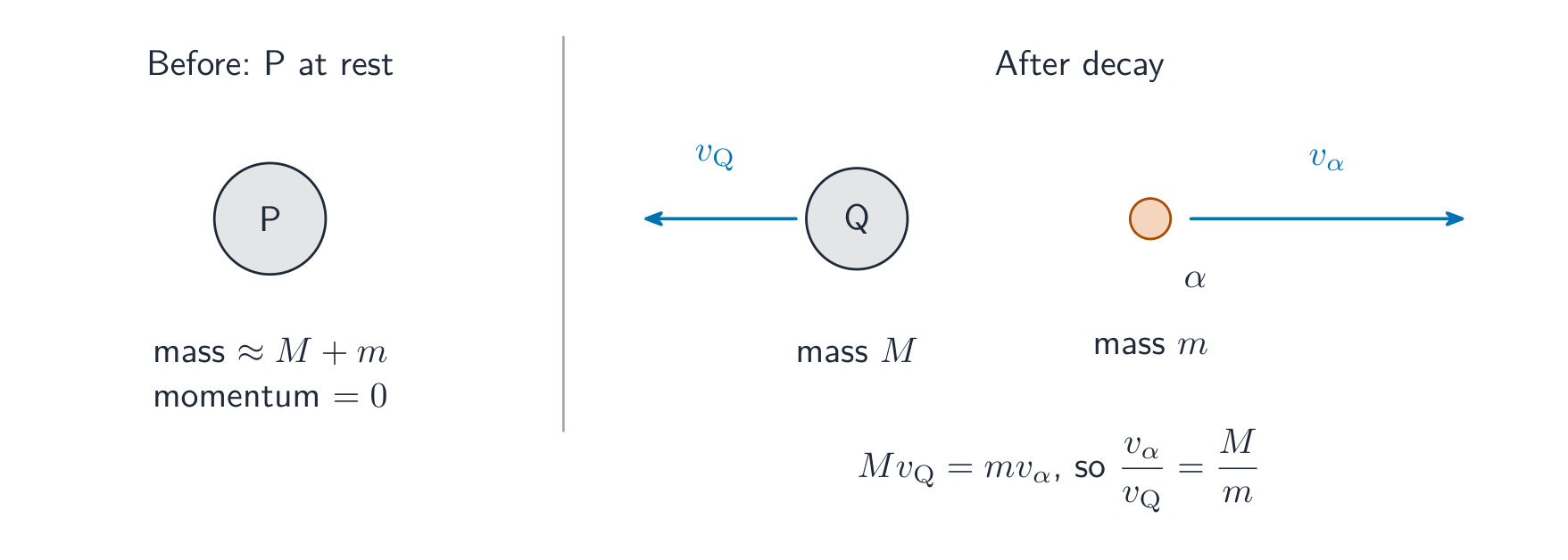
A nucleus at rest recoils. When a stationary nucleus emits an α-particle, momentum is conserved: the daughter nucleus and the α-particle move off in opposite directions with momenta of equal magnitude. Since $p = mv$, the lighter α-particle moves much faster, and since $E_{\text{k}} = p^{2}/2m$ it also takes most of the kinetic energy — the shares are in inverse proportion to the masses.
Worked example. A stationary nucleus P of mass $243\ \text{u}$ emits an α-particle of mass $4\ \text{u}$ at $1.5 \times 10^{7}\ \text{m s}^{-1}$. Find the speed of the daughter nucleus Q and the ratio of the kinetic energy of the α-particle to that of Q.
Q has mass $243 - 4 = 239\ \text{u}$. Momentum: $239 v_{\text{Q}} = 4 \times 1.5 \times 10^{7}$, so $v_{\text{Q}} = 2.5 \times 10^{5}\ \text{m s}^{-1}$, in the opposite direction to the α-particle. Kinetic energies: $\dfrac{E_{\alpha}}{E_{\text{Q}}} = \dfrac{p^{2}/2m_{\alpha}}{p^{2}/2m_{\text{Q}}} = \dfrac{m_{\text{Q}}}{m_{\alpha}} = \dfrac{239}{4} \approx 60$. The α-particle takes about 98% of the energy released.
עברית
סוגר לא יציב מתארגן מחדש ושולח אחד משלושת סוגי ה-קרנים. תהליך זה נקרא דעיכה רדיואקטיבית. לכל סוג יש מאפיינים משלו.
קרינת α
מורכבת מ: סוגר הליום-4, $^{4}_{2}\alpha$ (שני פרוטונים + שני ניטרונים).
מסה: $\approx 4\ \text{u}$.
טען: $+2e$.
טווח באוויר: כמה ס"מ. נעצרת על ידי דף נייר.
יכולת יוניזציה: חזקה — היא טובה ב-יוניזציה.
ספקטרום אנרגטי: דיסקרטי (דעיכה אחת מייצרת חלקיקי α בעל אנרגיה אחת או מעט אנרגיות חדות).
חדר ענן הופך את העקבות לנראות: כל חלקיק α משאיר עקבה קצרה, ישרה ועבה של טיפות זעירות כאשר הוא יוניזציה את האוויר. האורכים הקצרים והשווים מראים שכל חלקיקי α נושאים כמעט אותה אנרגיה.
עקבות חלקיקי אלפא בחדר ענן, פואות ממקור אמריציום-241
קרינת β
שני סוגים של חלקיק ביטה β:
$\beta^{-}$: אלקטרון מהיר, הנפלט כאשר ניטרון הופך לפרוטון.
$\beta^{+}$: פוזיטרון (אנטי-חלקיק של האלקטרון), הנפלט כאשר פרוטון בליבה עשירה בפרוטונים הופך לניוטרון.
מאפיינים (שני הסוגים):
מסה: $\approx 1/1836\ \text{u}$ (קטנה משמעותית מ-α).
מטען: $-e$ עבור $\beta^{-}$, $+e$ עבור $\beta^{+}$.
טווח באוויר: כ-$1\ \text{m}$. נעצר על ידי מספר מ"מ אלומיניום.
ספקטרום אנרגיה: רציף עד למקסימום (ראו להלן).
קרינת גاما
מורכב מ: פוטון בעל אנרגיה גבוהה — חלק מהספקטרום האלקטרומגנטי.
מסה: אפס (מסת שוקת).
מטען: אפס.
טווח באוויר: גדול (עוקב אחרי חוק הריבוע ההפוך). מתעמעם בחוזקה על ידי מספר ס"מ עופרת או כמטר בטון.
יכולת יוניזציה: החלשה ביותר.
ספקטרום אנרגיה: דיסקרטי (פוטון גاما γ נפלט כאשר הגרעין עובר בין שתי רמות אנרגיה גרעיניות).
גרעין נוטה לפלוט פוטון γ כ"צעד איסוף" לאחר דעיכה α או β השאירה את הגרעין הבת במצב מעורר.
יכולת חדירה: $\alpha$ נעצר על ידי נייר, $\beta$ על ידי אלומיניום, $\gamma$ מתעמעם רק על ידי עופרת
מסה ומטען, צמוד זה לזה — שאלה בטבלה מבקשת בדיוק אלו, ביחידות של $\text{u}$ ו-$e$:
דוגמה מופת. השווה בין חלקיק α לחלקיק $\beta^{+}$ מבחינת המסה והמטען שלהם (3 נקודות).
שניהם מטענם חיובית, אך מטען חלקיק ה-α ($+2e$) הוא פי שניים ממטען החלקיק $\beta^{+}$ ($+e$). מסת חלקיק ה-α ($4\ \text{u}$) היא כ-$7300$ פעמים ממסת החלקיק $\beta^{+}$ ($5.5 \times 10^{-4}\ \text{u}$). תן יחס, ולא רק "כבד יותר": פי שניים במטען ו-כ-7000 פעמים במסה הם נקודות ההערכה.
בגלל שמטענים, חלקיקי α וחלקיקי β מוטהים על ידי שדות חשמליים ומגנטיים — בכיוונים הפוכים עבור מטענים מנוגדים, כאשר חלקיק ה-β הקל מוטה הרבה יותר מהחלקיק ה-α הכבד — בעוד שקרני γ, שאין להן מטען, עוברות ישר דרך השדה.
אנטי-חלקיקים, נייטרינו ואנטי-נייטרינו
לכל חלקיק יש אנטי-חלקיק עם אותה מסה אך מטען הפוך. הפוזיטרון הוא האנטי-חלקיק של האלקטרון.
לנייטרינו ולאנטי-נייטרינו אין מטען, למסה קטנה מאוד, והם פועלים בידוד רב — קשה מאוד לזהות אותם, אך הם חייבים להיות קיים כדי לאזן אנרגיה, תנע וכמויות אחרות הנשמרות בקריעה β.
מדוע ל-β יש ספקטרום רציף (ול-α אין)
בקריעת α, האנרגיה השחררת מחולקת בין שני חלקיקים בלבד (גרעין הבת וחלקיק ה-α). שימור התנע והאנרגיה קובעים אז את אנרגיית ה-α לערך אחד (דיסקרטי).
בקריעת β, האנרגיה מחולקת בין שלושה חלקיקים (גרעין הבת, החלקיק β, וה(אנטי)נייטרינו). החלקיק β יכול לקבל כל חלק מאפס ועד למקסימום, ולכן הספקטרום האנרגטי שלו הוא רציף.
חלקיקי α מקריעה אחת יש להם אנרגיות קבועות (דיסקרטיות); חלקיקי β מחלקים את האנרגיה עם (אנטי)נייטרינו, ולכן הספקטרום שלהם רציף עד למקסימום
דוגמה מפורטת. ספקטרום האנרגיה של חלקיקי $\beta^{-}$ ממקור הוא רציף, מאפס ועד למקסימום. הסבר מדוע (3 נקודות).
כל דעיכה משחררת כמות קבועה של אנרגיה. אנרגיה זו מתחלקת בין חלקיק ה$\beta^{-}$, האנטי-ניטרינו והגרעין הבת המוחזר לאחור. האנטי-ניטרינו יכול לקבל כל חלק, ולכן חלקיק ה$\beta^{-}$ נשאר עם כל ערך אנרגיה מ-0 ועד למקסימום — המקסימום הוא כאשר האנטי-ניטרינו נושא איתו כמעט כלום. (לחלקיק אלפא ישנם רק שני גופים, ולכן שימור התנע קובע את החלוקה והאנרגיה היא דיסקרטית.)
דוגמה פותרת. אורניום-238, $^{238}_{92}\text{U}$, דועך על ידי פליעת אלפא; פחמן-14, $^{14}_{6}\text{C}$, דועך על ידי פליעת $\beta^{-}$. מצאו כל גרעין בת.
דעיכת אלפא מפחיתה את $A$ ב-4 ואת $Z$ ב-2; דעיכת $\beta^{-}$ משאירה את $A$ ללא שינוי ומגדילה את $Z$ ב-1:
קבעו כמותית את השינויים. פליעת אלפא: $A$ יורד ב-4, $Z$ יורד ב-2. פליעת $\beta^{-}$: $A$ ללא שינוי, $Z$ עולה ב-1. פליעת $\beta^{+}$: $A$ ללא שינוי, $Z$ יורד ב-1. פליעת גמא: אין שינוי באף אחד. שרשרת דעיכה שמסתיימת בגרעין ידוע נפתרת מכך: מספר הדעיכות האלפא הוא $(A_{\text{start}} - A_{\text{end}})/4$, ואז מספר הדעיכות ה$\beta^{-}$ גורם לכך ש$Z$ יצא נכון.
דוגמה מפורטת. תוריום-230, $^{230}_{90}\text{Th}$, מתפרק בשלבים, באמצעות פליעת α ופליעת $\beta^{-}$, לתובע-206, $^{206}_{82}\text{Pb}$. מצאו את מספר כל סוג של פירוק.
דעיכות אלפא: $(230 - 206)/4 = 6$. שש דעיכות אלפא לבדן היו מורידות את $Z$ ב-12, ל-78; הערך הסופי של $Z$ הוא 82, ולכן ישנן $82 - 78 = 4$ דעיכות $\beta^{-}$.
גרעין במנוחה מוחזר לאחור. כאשר גרעין רדיואקטיבי במנוחה פולט חלקיק אלפא, התנע שמר: הגרעין הבת וחלקיק האלפא זזים בכיוונים נגדיים עם תנעים בעלי גודל שווה. מכיוון ש$p = mv$, חלקיק האלפא הקל יותר, נע מהר הרבה יותר, ומכיוון ש$E_{\text{k}} = p^{2}/2m$ הוא גם נושא את רוב האנרגיה הקינטית — החלוקה היא ביחס הפוך למסה.
גרעין במנוחה דועך: הבת מוחזרת לאחור עם תנאי שווה ונגדי לתנאי חלקיק האלפא
דוגמה פותרת. גרעין P במנוחה בקטלת $243\ \text{u}$ פולט חלקיק אלפא בקטלת $4\ \text{u}$ במהירות $1.5 \times 10^{7}\ \text{m s}^{-1}$. מצאו את מהירות הגרעין הבת Q ואת היחס בין האנרגיה הקינטית של חלקיק האלפא לזו של Q.
understand that a quark is a fundamental particle and that there are six flavours (types) of quark: up, down, strange, charm, top and bottom
recall and use the charge of each flavour of quark and understand that its respective antiquark has the opposite charge (no knowledge of any other properties of quarks is required)
recall that protons and neutrons are not fundamental particles and describe protons and neutrons in terms of their quark composition
understand that a hadron may be either a baryon (consisting of three quarks) or a meson (consisting of one quark and one antiquark)
describe the changes to quark composition that take place during $\beta^-$ and $\beta^+$ decay
recall that electrons and neutrinos are fundamental particles called leptons
עברית
להבין ש-קוורק הוא חלקיק יסודי וקיימים שישה טעמים (סוגים) של קוורקים: מעלה, מטה, מוזר, חמוד, כבד ו-תחתון
לזכור ולשמש במטען כל טעם של קוורק ולהבין שהאנטיקוורק המתאים לו בעל מטען הפוך (לא נדרש ידע בכל תכונה אחרת של קוורקים)
לזכור ש-פרוטונים ו-נייטרונים אינם חלקיקים יסודיים ולתאר פרוטונים ונייטרונים באמצעות הרכב הקוורקי שלהם
להבין ש-הדרון עשוי להיות או בריון (המורכב משישה קוורקים) או מזון (המורכב מקוורק אחד ואנטיקוורק אחד)
לתאר את השינויים בהרכב הקוורקי发生的ים במהלך דעיכה של $\beta^-$ ועבור דעיכה של $\beta^+$
לזכור שאלקטרונים וניטרנו הם חלקיקים יסודיים הנקראים לפטונים
Source: Cambridge International syllabus · מקור: הסיילבוס הבינלאומי של קמבריד'ג'
English
Some particles are fundamental particles 基本粒子 (point-like, with no smaller parts as far as we know); others are built from fundamental ones.
The one-mark definition: a fundamental particle is one that cannot be broken down into smaller particles (it has no internal structure). Electrons, neutrinos and quarks are fundamental; protons and neutrons are not.
Quarks
A quark 夸克 is a fundamental particle. There are six flavours 味:
up (u), charge $+\tfrac{2}{3}e$,
down (d), charge $-\tfrac{1}{3}e$,
charm (c), charge $+\tfrac{2}{3}e$,
strange (s), charge $-\tfrac{1}{3}e$,
top (t), charge $+\tfrac{2}{3}e$,
bottom (b), charge $-\tfrac{1}{3}e$.
Each quark has an antiquark 反夸克 with the same size of charge but the opposite sign: $\bar{u}$ (charge $-\tfrac{2}{3}e$), $\bar{d}$ (charge $+\tfrac{1}{3}e$). No other quark property is tested.
Written as the table a question asks you to complete:
Worked example. By reference to quark composition, show that the charge of a proton is $+1.6 \times 10^{-19}\ \text{C}$.
A proton is uud: charge $= \tfrac{2}{3}e + \tfrac{2}{3}e - \tfrac{1}{3}e = +e = +1.6 \times 10^{-19}\ \text{C}$. Write the three fractions and their sum — the mark is for the arithmetic, not the answer.
Hadrons: baryons and mesons
Particles built from quarks are hadrons 强子. Two types:
baryons 重子 — three quarks. Examples: proton (u u d), neutron (u d d). Charge check: $\tfrac{2}{3} + \tfrac{2}{3} - \tfrac{1}{3} = +1$ for the proton; $\tfrac{2}{3} - \tfrac{1}{3} - \tfrac{1}{3} = 0$ for the neutron.
mesons 介子 — one quark and one antiquark (for example $\pi^{+}$ is u$\bar{\text{d}}$).
Protons and neutrons are not fundamental — they are baryons made of quarks.
"Compare baryons and mesons in terms of their constituent particles" (2 marks): both are hadrons made of quarks; a baryon is three quarks (or three antiquarks, for an antibaryon), a meson is one quark and one antiquark. Any charge you are given must come out of the quark charges:
Worked example. (a) A meson has charge $-1e$. Give a possible quark composition. (b) A meson Q has charge 0. Give a possible composition. (c) A baryon is made of three quarks of different flavours, u, d and s. Find its charge. (d) Give the quark composition of an antineutron and its charge.
(a) d$\bar{\text{u}}$: $-\tfrac{1}{3} - \tfrac{2}{3} = -1$ (s$\bar{\text{u}}$ also works). (b) u$\bar{\text{u}}$: $+\tfrac{2}{3} - \tfrac{2}{3} = 0$ (or d$\bar{\text{d}}$). (c) uds: $\tfrac{2}{3} - \tfrac{1}{3} - \tfrac{1}{3} = 0$. (d) The antineutron is the antiparticle of udd, so it is $\bar{\text{u}}\bar{\text{d}}\bar{\text{d}}$: $-\tfrac{2}{3} + \tfrac{1}{3} + \tfrac{1}{3} = 0$ — the same mass and charge as the neutron, since both have charge zero.
Quark changes in β-decay
In $\beta^{-}$ decay a neutron turns into a proton; in quark terms, one down quark turns into an up quark:
"Describe $\beta^{+}$ decay in terms of the fundamental particles involved" (2 marks): an up quark in a proton changes into a down quark, so the proton becomes a neutron, and a positron and an electron neutrino are emitted — $\text{u} \to \text{d} + \beta^{+} + \nu_{\text{e}}$. For $\beta^{-}$ decay swap the roles: a down quark becomes an up quark, emitting an electron and an electron antineutrino. Name the (anti)neutrino: it is the "other lepton" the question asks for, and it is what makes the β energy continuous.
Leptons
Leptons 轻子 are fundamental particles that are not made of quarks. The leptons you need are the electron and the electron neutrino, with their antiparticles the positron and the electron antineutrino. (Heavier leptons — the muon and tau — exist but are not tested.) Asked for "two different leptons", give electron and neutrino.
Classifying particles
To answer "which are fundamental?": quarks and leptons (electrons, positrons, neutrinos, antineutrinos) are fundamental; protons, neutrons, baryons, mesons and hadrons are not — they are built from quarks.
Worked example. In the list — antineutrino, $\beta^{+}$ particle, neutron, positron, proton — underline the hadrons.
Neutron and proton (three quarks each). The antineutrino and the positron are leptons; the $\beta^{+}$ particle is a positron. The same list asked as "which are not fundamental?" has the same answer: neutron and proton.
Antimatter. Every particle has an antiparticle of the same mass and opposite charge; a positron and an electron are alike in mass (and in the size of their charge) and differ in the sign of their charge. An antihydrogen atom is an antiproton (charge $-e$, made of $\bar{\text{u}}\bar{\text{u}}\bar{\text{d}}$) with a positron in orbit.
עברית
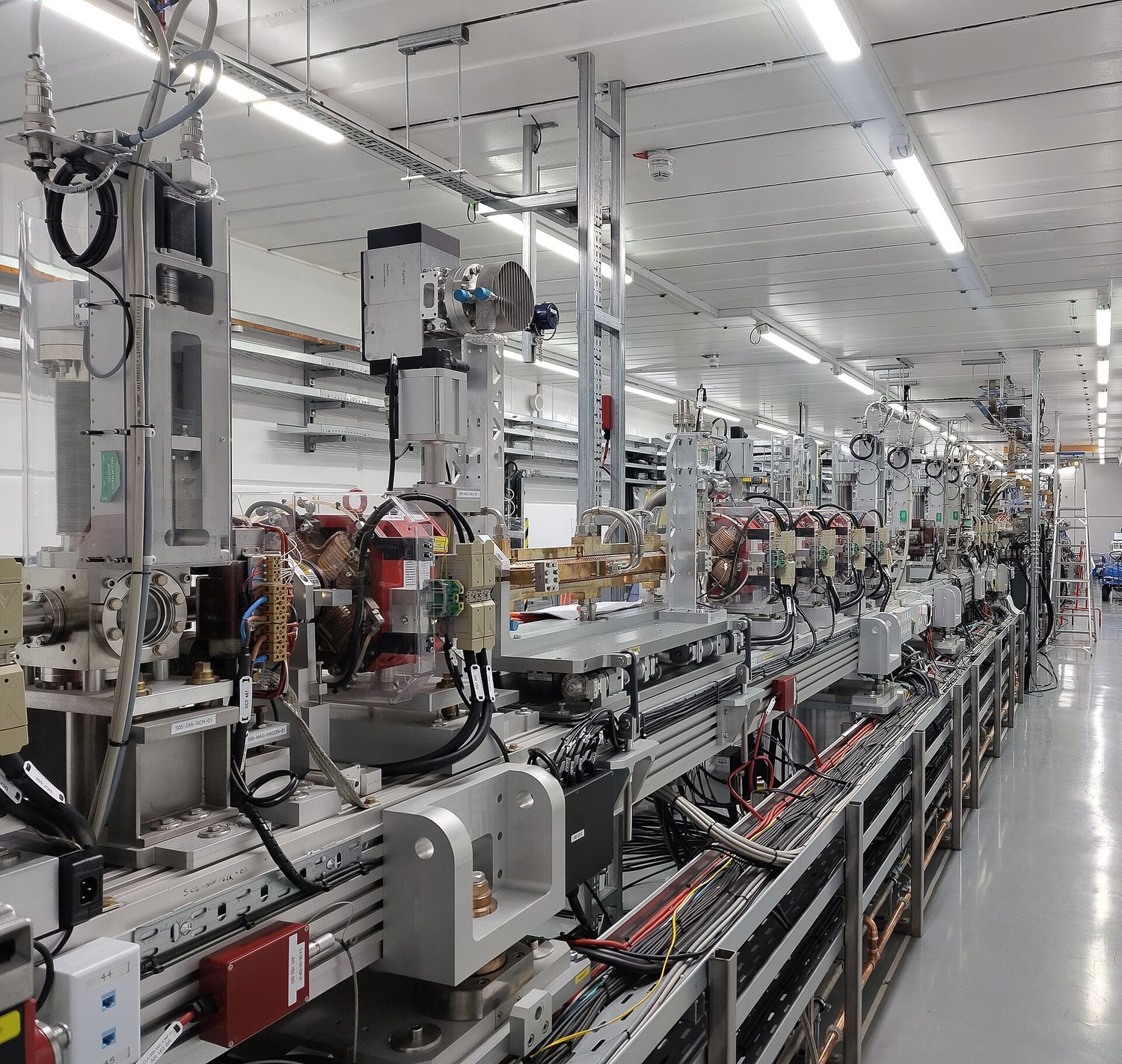
תא בועות חושף את המסלולים המעוגלים של חלקיקים טעונים.ממנו מגיעים החלקיקים: מאיץ קווי משתמש בשדות חשמליים כדי להאיץ חלקיקים טעונים למספיק מהירות כדי לחקור את הגרעין.
חלק מהחלקיקים הם חלקיקים יסודיים (נקודתיים, ללא חלקים קטנים יותר ככל שנודע); אחרים בנויים מחלקיקים יסודיים.
ההגדרה לשער אחת: חלקיק יסודי הוא אחד שאינו ניתן לפירוק לחלקיקים קטנים יותר (אין לו מבנה פנימי). אלקטרונים, נייטרינו וקווארקים הם יסודיים; פרוטונים וניוטرونים אינם כאלה.
קווארקים
קווארק הוא חלקיק יסודי. ישנם שישה טעמים:
מעלה (u), מטע $+\tfrac{2}{3}e$,
מטה (d), מטע $-\tfrac{1}{3}e$,
אופק (c), מטע $+\tfrac{2}{3}e$,
מוזר (s), מטע $-\tfrac{1}{3}e$,
עליון (t), מטע $+\tfrac{2}{3}e$,
תחתון (b), מטע $-\tfrac{1}{3}e$.
לכל קווארק יש אנטי-קווארק בעל אותה גודל של מטע אך סימן הפוך: $\bar{u}$ (מטע $-\tfrac{2}{3}e$), $\bar{d}$ (מטע $+\tfrac{1}{3}e$). אין תכונה אחרת של קווארק הנבדקת.
שישת הקווארקים: מעלה/אופק/עליון נושאים $+\tfrac23 e$, מטה/מוזר/תחתון נושאים $-\tfrac13 e$
דוגמה פתורה. באמצעות התייחסות להרכב הקווארקים, הראה כי המטען של פרוטון הוא $+1.6 \times 10^{-19}\ \text{C}$.
פרוטון הוא uud: מטען $= \tfrac{2}{3}e + \tfrac{2}{3}e - \tfrac{1}{3}e = +e = +1.6 \times 10^{-19}\ \text{C}$. כתוב את שלושת השברים ואת הסכום שלהם — הנקודות הן על החישוב האריטמטי, לא התוצאה.
חדרונים: בריאונים ומסונים
חלקיקים הבנויים מקווארקים הם חדרונים. שני סוגים:
בריאונים — שלושה קווארקים. דוגמאות: פרוטון (u u d), נייטרון (u d d). בדיקת מטען: $\tfrac{2}{3} + \tfrac{2}{3} - \tfrac{1}{3} = +1$ לפרוטון; $\tfrac{2}{3} - \tfrac{1}{3} - \tfrac{1}{3} = 0$ לנייטרון.
מסונים — קווארק אחד ואנטי-קווארק אחד (למשל $\pi^{+}$ הוא u$\bar{\text{d}}$).
פרוטונים ונייטרונים אינם יסודיים — הם בריאונים המורכבים מקווארקים.
"השוו בין בריאונים ומסונים בהתבסס על החלקיקים המרכיבים אותם" (2 נקודות): שניהם חדרונים המורכבים מקווארקים; בריאון הוא שלושה קווארקים (או שלושה אנטי-קווארקים, עבור אנטי-בריאון), מסון הוא קווארק אחד ואנטי-קווארק אחד. כל מטען שנתון עליך צריך לצאת ממטעני הקווארקים:
דוגמה פתורה. (א) למסון יש מטען $-1e$. תן הרכב קווארקים אפשרי. (ב) למסון Q יש מטען 0. תן הרכב אפשרי. (ג) בריאון מורכב משלושה קווארקים בעלי טעמים שונים, u, d ו-s. מצא את מטענו. (ד) תן את ההרכב הקווארקי של אנטי-נייטרון ואת מטענו.
(א) d$\bar{\text{u}}$: $-\tfrac{1}{3} - \tfrac{2}{3} = -1$ (s$\bar{\text{u}}$ גם מתאים). (ב) u$\bar{\text{u}}$: $+\tfrac{2}{3} - \tfrac{2}{3} = 0$ (או d$\bar{\text{d}}$). (ג) uds: $\tfrac{2}{3} - \tfrac{1}{3} - \tfrac{1}{3} = 0$. (ד) האנטי-נייטרון הוא האנטי-חלקיק של udd, ולכן הוא $\bar{\text{u}}\bar{\text{d}}\bar{\text{d}}$: $-\tfrac{2}{3} + \tfrac{1}{3} + \tfrac{1}{3} = 0$ — אותו מסה ומטען כמו הנייטרון, שכן לשניהם מטען אפס.
שינויי קווארק בדעיכת β
בדעיכת $\beta^{-}$ נייטרון הופך לפרוטון; במונחי קווארקים, קווארק תחתון אחד הופך לקווארק עליון:
דעיכת מינוס-ביטה: קווארק תחתון הופך לקווארק עליון, מה שהופך נייטרון לפרוטון
"תאר את דעיכת $\beta^{+}$ במונחי החלקיקים היסודיים המעורבים" (2 נקודות): קווארק עליון בפרוטון משתנה לקווארק תחתון, ולכן הפרוטון הופך לנייטרון, ונפלטים פוזיטרון וניטרינו אלקטרוני — $\text{u} \to \text{d} + \beta^{+} + \nu_{\text{e}}$. עבור דעיכת $\beta^{-}$ החלף את התפקידים: קווארק תחתון הופך לקווארק עליון, בפליטת אלקטרון ואנטי-ניטרינו אלקטרוני. קרא את ה(אנטי)ניטרינו: זהו ה"להפטון השני" שהשאלה מבקשת, והוא מה שגורם לאנרגיית הβ להיות רציפה.
להפטונים
להפטונים הם חלקיקים יסודיים שאינם מורכבים מקווארקים. הלהפטונים שאתה צריך הם אלקטרון וניטרינו אלקטרוני, עם האנטי-חלקיקים שלהם פוזיטרון ואנטי-ניטרינו אלקטרוני. (להפטונים כבדים יותר — המיון והטאו — קיימים אך אינם נבדקים.) אם נתבקש לתת "שני להפטונים שונים", תן אלקטרון וניטרينو.
סיווג חלקיקים
כדי לענות על השאלה "אילו מהם בסיסיים": קווארקים ולייטונים (אלקטרונים, פוזיטרונים, נייטרינוזים ואנטי-נייטרינוזים) הם בסיסיים; פרוטונים, נייטרונים, בריונים, מזונים והדרונים אינם — אלא מורכבים מקווארקים.
חלקיקים בסיסיים (קווארקים, לייטונים) מול הדרונים (בריונים, מזונים)
דוגמה מופתרת. ברשימה – אנטי-נייטרינו, חלקיק $\beta^{+}$, נייטרון, פוזיטרון, פרוטון – תחת קו את ההדרונים.
נייטרון ופרוטון (שלושה קווארקים כל אחד). האנטי-נייטרינו והפוזיטרון הם לייטונים; החלקיק $\beta^{+}$הוא פוזיטרון. אותה רשימה שהוצגה בשאלה "אילו מהם אינם בסיסיים?" מתאימה לאותה תשובה: נייטרון ופרוטון.
חומר נגדי. לכל חלקיק יש אנטי-חלקיק באותה מסה ומטען הפוך; פוזיטרון ואלקטרון זהים במסה (ובגודל המטען שלהם) אך שונים בסימן המטען. אטום אנטי-מימן הוא אנטי-פרוטון (מטען $-e$, מורכב מ$\bar{\text{u}}\bar{\text{u}}\bar{\text{d}}$) עם פוזיטרון במסלול.
Explore · חקור
Fundamental particle lab · מעבדת חלקיקים יסודיים
Sort particles by the family or interaction that defines them. · סדר את החלקיקים לפי המשפחה או האינטראקציה שמגדירים אותם.
Definitions the examiner accepts · הגדרות מקובלות בקורס
English
A definition question is marked against fixed wording. Learn these exactly, and give one answer only.
Term
Definition
proton number $Z$
the number of protons in a nucleus
nucleon number $A$
the total number of protons and neutrons in a nucleus
isotopes
nuclei of the same element (same number of protons) with different numbers of neutrons
nuclide
a nucleus with a particular number of protons and a particular number of neutrons
unified atomic mass unit
one twelfth of the mass of an atom of carbon-12
antiparticle
a particle with the same mass as the corresponding particle but the opposite charge
fundamental particle
a particle that cannot be broken down into smaller particles
hadron
a particle made of quarks: a baryon (three quarks) or a meson (a quark and an antiquark)
lepton
a fundamental particle that is not made of quarks, such as the electron or the neutrino
α-particle
a helium-4 nucleus: two protons and two neutrons, charge $+2e$, mass $4\ \text{u}$
$\beta^{-}$ / $\beta^{+}$ particle
an electron / a positron emitted from a nucleus when a neutron becomes a proton / a proton becomes a neutron
עברית
שאלת הגדרה מוקדמת לפי טקסט קבוע. לימודן במדויק, ותן תשובה אחת בלבד.
מונח
הגדרה
מספר אטומי $Z$
מספר הפרוטונים בגרעין
מספר נוקלאוני $A$
הסך הכול של הפרוטונים והנייטרונים בגרעין
איזוטופים
גרעינים של אותו יסוד (אותו מספר פרוטונים) עם מספרים שונים של נייטרונים
נוקליד
גרעין עם מספר ספציפי של פרוטונים ומספר ספציפי של נייטרונים
יחידת מסה אטומית מאוחדת
שני עשר ממסה של אטום של פחמן-12
אנטי-חלקיק
חלקיק בעל אותה מסה כמו החלקיק המתאים לו אך מטען הפוך
חלקיק בסיסי
חלקיק שלא ניתן לפצות לחלקיקים קטנים יותר
הדרון
חלקיק המורכב מקווארקים: בריון (שלושה קווארקים) או מזון (קווארק ואנטי-קווארק)
לייטון
חלקיק בסיסי שאינו מורכב מקווארקים, כגון האלקטרון או הנייטרינו
חלקיק α
גרעין של הליום-4: שני פרוטונים ושני נייטרונים, מטען $+2e$, מסה $4\ \text{u}$
חלקיק $\beta^{-}$ / חלקיק $\beta^{+}$
אלקטרון / פוזיטרון הנפלטים מגרעין כאשר נייטרון הופך לפרוטון / פרוטון הופך לנייטרון
11.2
Exam tips · טיפים לבחינות
English
Describe the nuclear atom (a small, dense, positive nucleus) using the alpha-scattering evidence — pair each observation with its conclusion.
Compare $\alpha$, $\beta$ and $\gamma$ by charge, mass, ionising power and penetration; when asked to compare two particles, give the ratio ("twice the charge", "about 7000 times the mass").
Use quark composition (proton $uud$, neutron $udd$) and check that charge and nucleon number balance in every equation you write.
In $\beta^-$ decay a neutron becomes a proton, an electron and an antineutrino; in $\beta^{+}$ decay a proton becomes a neutron, a positron and a neutrino. Name the (anti)neutrino every time.
A nucleus at rest that decays gives its two products equal and opposite momentum, so the lighter one is faster and carries most of the kinetic energy.
For a decay chain, count the α-decays from the change in $A$ first, then fix $Z$ with $\beta$-decays.
Common mistakes
Concluding "the nucleus is positive" from the straight-through result. That result shows empty space; the large-angle deflections show the concentrated positive charge.
Defining isotopes by "different mass" only. The mark needs same number of protons, different number of neutrons.
Writing $^{0}_{-1}\beta$ for $\beta^{+}$ decay. A positron is $^{0}_{+1}\beta$, and $Z$ goes down by one.
Forgetting the (anti)neutrino in a β-decay equation, or putting a neutrino with $\beta^{-}$. $\beta^{-}$ goes with the antineutrino, $\beta^{+}$ with the neutrino.
Saying protons or neutrons are fundamental. Only quarks and leptons are.
Giving a meson as "two quarks". It is a quark and an antiquark.
Treating an antiquark's charge as the same sign as the quark's. $\bar{\text{u}}$ is $-\tfrac{2}{3}e$, $\bar{\text{d}}$ is $+\tfrac{1}{3}e$.
עברית
תאר את האטום הגרעיני (גרעין קטן, צפוף וחיובי) בהתבסס על עדות פיזור אלפא – התאם כל תצפית למסקנה.
השוו בין $\alpha$, $\beta$ ו$\gamma$ לפי מטען, מסה, כוח ייצור יונים וחדירות; כשנתבקשים להשוות שני חלקיקים, נתנו את היחס ("מטען כפול", "מסה פי 7000 בערך").
השתמש ברכיבות קווארקים (פרוטון $uud$, ניוטרון $udd$) ובדוק שמטען ומספר נוקלאונים מאוזנים בכל משוואה שתכתוב.
בקריעה $\beta^-$ ניוטרון הופך לפרוטון, אלקטרון ואנטי-ניטרינו; בקריעה $\beta^{+}$ פרוטון הופך לניוטרון, פוזיטרון וניטרינו. צין את ה(אנטי)ניטרינו בכל פעם.
גרעין בשקט שמבצע קריעה מעביר לשני המוצרים שלו תנע שווה והפוך, ולכן הקל יותר מהר ונושא את רוב האנרגיה הקינטית.
עבור שרשרת פירוק, ספרו את הפירוקים מ-α מהשינוי ב-$A$ תחילה, ואז קבעו את $Z$ באמצעות פירוקי $\beta$.
טעויות נפוצות
להסיק "לגרעין יש מטען חיובי" מתוצאת המעבר הישר. תוצאה זו מראה על ריק; ההיפוכים בזוויות גדולות מראים על המטען החיובי המרוכז.
הגדרת איזוטופים רק לפי "מסה שונה". הנקודות דורשות אותו מספר פרוטונים, מספר שונה של ניוטרונים.
כתיבת $^{0}_{-1}\beta$ במקום $\beta^{+}$ לקריעה. פוזיטרון הוא $^{0}_{+1}\beta$, ו$Z$ יורד ב-1.
לשכוח את ה(אנטי)ניטרינו במשוואת קריעת β, או להציב ניטרינו עם $\beta^{-}$. $\beta^{-}$ לועד עם האנטי-ניטרינו, $\beta^{+}$ לועד עם הניטרינו.
לומר שפרוטונים או ניוטרונים הם יסודיים. רק קווארקים ולפטונים הם יסודיים.
לתת מזון כ"שני קווארקים". זהו קווארק וגם אנטי-קווארק.
לטפל במטען של אנטי-קווארק כאילו הוא אותו סימן כמו המטען של הקווארק. $\bar{\text{u}}$ הוא $-\tfrac{2}{3}e$, $\bar{\text{d}}$ הוא $+\tfrac{1}{3}e$.
Interactive lessons on this topic · שיעורים אינטראקטיביים בנושא זה
Work through it step by step, with instant-check exercises. · לעבור על הדברים צעד אחר צעד, עם תרגילים לבדיקה מיידית.
Pick one and the site follows you — notes, papers, videos and practice all open on it. · בחרו נושא אחד והאתר יעקוב אחריו — הערות, מסמכים, וידאו ותרגולים פתוחים בו.
Type to search notes, lessons, code, vocabulary and past-paper questions across every subject. · הקלד כדי לחפש הערות, שיעורים, קוד, אוצר מילים ושאלות מבחנים בכל הנושאים.