Skip to content · ⁨דלג לתוכן⁩

Equilibria · ⁨איזונים⁩

A-Level Chemistry · ⁨כימיה A-Level⁩ · Topic 25 · ⁨נושא 25⁩

Video lesson for this topic · ⁨שיעור וידאו לנושא זה⁩ Open the video page · ⁨פתח את עמוד הוידאו⁩
7:56

איזונים (A2)

הדם שלך נתון ל-pH של שבעה וחצי. מזיזים אותו בעשריות כלפי מטה או למעלה, ואתה בבית חולים. עם זאת, כל היום חומצה זורמת לתוכו — מהמזון שלך, וגם מ…

English narration · English + 中文 subtitles burned in · ⁨קריאת קול באנגלית · תרגום אנגלי + סינית שרוף בתוך הסרטון⁩

25.1

Conjugate acids and bases · ⁨חומצות ובסיסים זוגיים⁩

Syllabus · ⁨סיילבוס⁩
English
  1. understand and use the terms conjugate acid and conjugate base
  2. define conjugate acid–base pairs, identifying such pairs in reactions
  3. define mathematically the terms pH, $K_a$, $\text{p}K_a$ and $K_w$ and use them in calculations ($K_b$ and the equation $K_w = K_a \times K_b$ will not be tested)
  4. calculate $[\text{H}^+(\text{aq})]$ and pH values for: (a) strong acids (b) strong alkalis (c) weak acids
  5. (a) define a buffer solution (b) explain how a buffer solution can be made (c) explain how buffer solutions control pH; use chemical equations in these explanations (d) describe and explain the uses of buffer solutions, including the role of $\text{HCO}_3^-$ in controlling pH in blood
  6. calculate the pH of buffer solutions, given appropriate data
  7. understand and use the term solubility product, $K_{\text{sp}}$
  8. write an expression for $K_{\text{sp}}$
  9. calculate $K_{\text{sp}}$ from concentrations and vice versa
  10. (a) understand and use the common ion effect to explain the different solubility of a compound in a solution containing a common ion (b) perform calculations using $K_{\text{sp}}$ values and concentration of a common ion
עברית
  1. להבין ולשתמש במונחים חומצה זוגית ו-בסיס זוגי
  2. להגדיר זוגות חומצה-בסיס זוגיים, ולזהות זוגות כאלה בתגובות
  3. להגיד במתמטיקה את המונחים pH, $K_a$, $\text{p}K_a$ ו$K_w$ ולשתמש בהם בחישובים ($K_b$ והמשוואה $K_w = K_a \times K_b$ לא ייבדקו)
  4. לחשב ערכי $[\text{H}^+(\text{aq})]$ ו-pH עבור: (א) חומצות חזקות (ב) בסיסים חזקים (ג) חומצות חלשות
  5. (א) להגדיר תמיסת מוסך (ב) להסביר כיצד ניתן להכין תמיסת מוסך (ג) להסביר כיצד תמיסות מוסך שולטות ב-pH; להשתמש במשוואות כימיות בהסברים (ד) לתאר ולהסביר את השימושים בתמיסות מוסך, כולל התפקיד של $\text{HCO}_3^-$ בשליטה ב-pH בדם
  6. לחשב את ה-pH של תמיסות מוסך, בהינתן נתונים מתאימים
  7. להבין ולשתמש במונח מכפלת מסיסות, $K_{\text{sp}}$
  8. כתוב ביטוי עבור $K_{\text{sp}}$
  9. לחשב $K_{\text{sp}}$ מהריכוזים ולהפך
  10. (א) להבין ולשתמש באפקט היון המשותף כדי להסביר את ההבדלים במסיסות של תרכובת בתמיסה המכילה יון משותף (ב) לבצע חישובים באמצעות ערכי $K_{\text{sp}}$ וריכוז יון משותף

Source: Cambridge International syllabus · ⁨מקור: הסיילבוס הבינלאומי של קמבריד'ג'⁩

English
Titration curve and equivalence point

When a Brønsted acid loses an $\text{H}^+$, what is left is its conjugate base 共轭碱. When a base gains an $\text{H}^+$, it becomes its conjugate acid 共轭酸. The two species that differ by just one $\text{H}^+$ form a conjugate acid–base pair 共轭酸碱对.

For example, in $\text{CH}_3\text{COOH} \rightleftharpoons \text{CH}_3\text{COO}^- + \text{H}^+$, the pair is $\text{CH}_3\text{COOH}$ (acid) and $\text{CH}_3\text{COO}^-$ (its conjugate base).

עברית
עקומת טיטרציה ונקודת השוויון

כשחומצה ברונסטד מאבד $\text{H}^+$, נותר הבסיס המצומד שלו. כשבסיס מקבל $\text{H}^+$, הוא הופך לחומצה המצומדת שלו. שני המינים הנבדלים זה מזה רק ב$\text{H}^+$ אחד יוצרים זוג חומצה-בסיס מצומד.

למשל, ב$\text{CH}_3\text{COOH} \rightleftharpoons \text{CH}_3\text{COO}^- + \text{H}^+$, הזוג הוא $\text{CH}_3\text{COOH}$ (חומצה) ו$\text{CH}_3\text{COO}^-$ (הבסיס המצומד שלו).

חומצה אצטית מאבדת פרוטון לבסיס המצומד שלה, ואמוניה מקבלת פרוטון לחומצה המצומדת שלה, עם זוג המצומד מסומן בסוגריים
זוגות מצומדים נבדלים בפרוטון אחד: חומצה מאבדת H$^+$ כדי לתת את הבסיס המצומד שלה; בסיס מקבל H$^+$ כדי לתת את החומצה המצומדת שלו
Explore · ⁨חקור⁩

pH and H⁺ concentration · ⁨pH וריכוז H⁺⁩

pH = −log[H⁺]: slide it and watch [H⁺] change tenfold per unit. A conjugate acid–base pair differ by a single proton. · ⁨pH = −log[H⁺]: הזז אותו ותצפה לשינוי [H⁺] פי עשר בכל יחידה. זוג חומצה-בסיס קונג'וגלי נבדל בפרוטון אחד.⁩

25.1

pH and the equilibrium constants · ⁨pH וקבבי איזון⁩

English
  • pH measures acidity: $\text{pH} = -\log[\text{H}^+]$, so $[\text{H}^+] = 10^{-\text{pH}}$.
  • the acid dissociation constant 酸解离常数 of a weak acid $\text{HA}$ is $K_a = \dfrac{[\text{H}^+][\text{A}^-]}{[\text{HA}]}$, and $\text{p}K_a = -\log K_a$. A larger $K_a$ (smaller $\text{p}K_a$) means a stronger acid.
  • the ionic product of water 水的离子积 is $K_w = [\text{H}^+][\text{OH}^-] = 1.0 \times 10^{-14}$ at $298\ \text{K}$.

Calculating pH

  • strong acid 强酸: fully ionised, so $[\text{H}^+]$ equals the acid concentration; then take $-\log$.
  • strong alkali 强碱: find $[\text{OH}^-]$ from the concentration, then use $[\text{H}^+] = K_w / [\text{OH}^-]$.
  • weak acid 弱酸: only partly ionised, so use $[\text{H}^+] = \sqrt{K_a \times [\text{HA}]}$.

Worked example. Find the pH of $0.050\ \text{mol dm}^{-3}$ hydrochloric acid (a strong acid).

It is fully ionised, so $[\text{H}^+] = 0.050\ \text{mol dm}^{-3}$, giving $\text{pH} = -\log(0.050) = 1.30$.

Worked example. Find the pH of $0.10\ \text{mol dm}^{-3}$ sodium hydroxide (a strong base). ($K_w = 1.0 \times 10^{-14}$.)

$[\text{OH}^-] = 0.10$, so $[\text{H}^+] = K_w/[\text{OH}^-] = (1.0 \times 10^{-14})/0.10 = 1.0 \times 10^{-13}$, giving $\text{pH} = 13.0$.

Worked example. Find the pH of $0.10\ \text{mol dm}^{-3}$ ethanoic acid (a weak acid). ($K_a = 1.8 \times 10^{-5}$.)

$$[\text{H}^+] = \sqrt{K_a \times [\text{HA}]} = \sqrt{(1.8 \times 10^{-5})(0.10)} = 1.3 \times 10^{-3}, \qquad \text{pH} = -\log(1.3 \times 10^{-3}) = 2.87.$$
עברית
  • pH מדד חומציות: $\text{pH} = -\log[\text{H}^+]$, ולכן $[\text{H}^+] = 10^{-\text{pH}}$.
  • קבב ניתוק החומצה של חומצה חלשה $\text{HA}$ הוא $K_a = \dfrac{[\text{H}^+][\text{A}^-]}{[\text{HA}]}$, ו$\text{p}K_a = -\log K_a$. ערך גדול יותר של $K_a$ (ערך קטן יותר של $\text{p}K_a$) מעיד על חומצה חזקה יותר.
  • מכפלת המיונים של המים היא $K_w = [\text{H}^+][\text{OH}^-] = 1.0 \times 10^{-14}$ ב$298\ \text{K}$.
מדד ה-pH נע מהחומצי דרך הניטרלי ועד הבסיסי, כאשר pH = -log של ריכוז יוני המימן
מדד ה-pH: pH = -log של ריכוז יוני המימן
רצועות נייר pH לצד תרשים צבעים
נייר pH מעריך את ה-pH של התמיסה לפי הצבע שהיא לוקחת

חישוב ה-pH

  • חומצה חזקה: מתיונית לחלוטין, ולכן $[\text{H}^+]$ שווה לריכוז החומצה; לאחר מכן ניקח $-\log$.
  • בסיס חזק: מוצאים $[\text{OH}^-]$ מהריכוז, ואז משתמשים ב$[\text{H}^+] = K_w / [\text{OH}^-]$.
  • חומצה חלשה: מתיונית חלקית, לכן משתמשים ב$[\text{H}^+] = \sqrt{K_a \times [\text{HA}]}$.

דוגמה פתורה. מצאו את ה-pH של $0.050\ \text{mol dm}^{-3}$ חומצת הידרוכלורית (חומצה חזקה).

היא מתיונית לחלוטין, ולכן $[\text{H}^+] = 0.050\ \text{mol dm}^{-3}$, מה שמוביל ל$\text{pH} = -\log(0.050) = 1.30$.

דוגמה פתורה. חשב את ה-pH של $0.10\ \text{mol dm}^{-3}$ נתרן הידרוקסיד (בסיס חזק). ($K_w = 1.0 \times 10^{-14}$.)

$[\text{OH}^-] = 0.10$, לכן $[\text{H}^+] = K_w/[\text{OH}^-] = (1.0 \times 10^{-14})/0.10 = 1.0 \times 10^{-13}$, מה שנותן $\text{pH} = 13.0$.

דוגמה פתורה. חשב את ה-pH של $0.10\ \text{mol dm}^{-3}$ חומצה אתנויק (חומצה חלש). ($K_a = 1.8 \times 10^{-5}$.)

$$[\text{H}^+] = \sqrt{K_a \times [\text{HA}]} = \sqrt{(1.8 \times 10^{-5})(0.10)} = 1.3 \times 10^{-3}, \qquad \text{pH} = -\log(1.3 \times 10^{-3}) = 2.87.$$
25.1

Buffer solutions · ⁨תמיסות בופר⁩

English

A buffer solution 缓冲溶液 resists a change in pH when a small amount of acid or alkali is added. You make one from a weak acid and its conjugate base (for example ethanoic acid and sodium ethanoate).

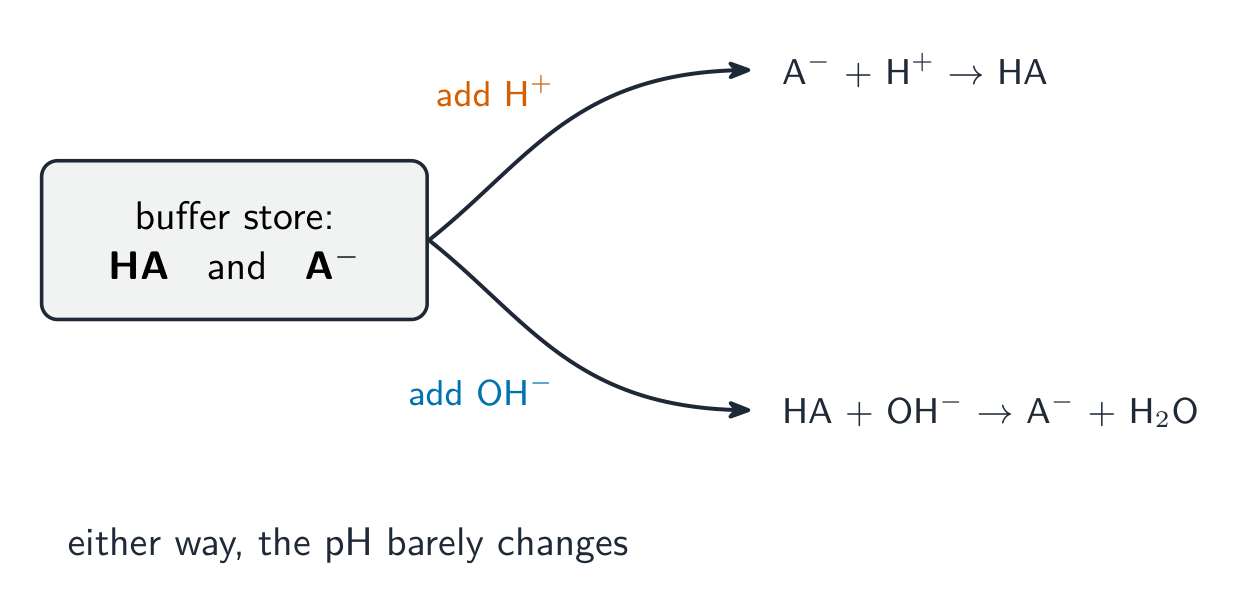
It works because the mixture holds a store of both partners:

  • added $\text{H}^+$ is removed by the conjugate base: $\text{CH}_3\text{COO}^- + \text{H}^+ \rightarrow \text{CH}_3\text{COOH}$.
  • added $\text{OH}^-$ is removed by the weak acid: $\text{CH}_3\text{COOH} + \text{OH}^- \rightarrow \text{CH}_3\text{COO}^- + \text{H}_2\text{O}$.

To find the pH, put the concentrations of the acid and its salt into the $K_a$ expression. Buffers are important in living things — for example, $\text{HCO}_3^-$ keeps the pH of blood close to $7.4$.

עברית

תמיסת בופר עמידה בפני שינוי ב-pH כאשר מוסיפים כמות קטנה של חומצה או בסיס. מכינים אותה מחומצה חלש ובסיס המיוחס אליו (למשל, חומצה אתנויק ונתרן אתנוואט).

המנגנון עובד משום שהתערובת מכילה מלאי של שני החלקים:

  • $\text{H}^+$ המוסף מוסר על ידי הבסיס המצומד: $\text{CH}_3\text{COO}^- + \text{H}^+ \rightarrow \text{CH}_3\text{COOH}$.
  • $\text{OH}^-$ המוסף מוסר על ידי החומצה החלשה: $\text{CH}_3\text{COOH} + \text{OH}^- \rightarrow \text{CH}_3\text{COO}^- + \text{H}_2\text{O}$.
מלאי בופר של HA ו-A-, כאשר H+ המוסף נספג על ידי A- ו-OH- המוסף נספג על ידי HA
תמיסת בופר מכילה מלאי של חומצה חלש ובסיס המיוחס אליו: H$^+$ המוסף נספג על ידי A$^-$ ו-OH$^-$ המוסף נספג על ידי HA, ולכן ה-pH משתנה מעט מאוד

כדי למצוא את ה-pH, הצב את ריכוזי החומצה ומלחו לתוך ביטוי ה$K_a$. בופרים חשובים באורגניזמים חיים — לדוגמה, $\text{HCO}_3^-$ שומר על ה-pH של הדם קרוב ל$7.4$.

Explore · ⁨חקור⁩

Buffers and the titration curve · ⁨בפלושים ועקומת הטיטרציה⁩

Add alkali to acid: the flat part is where a buffer resists pH change, and the steep jump is the equivalence point. · ⁨הוסף בסיס לחומצה: החלק השטוח הוא שם שבפלוס מתנגד לשינוי ב-pH, והקפיצה התלולה היא נקודת השוויון.⁩

25.1

Solubility product · ⁨מכפלת מסיסות⁩

English

For a salt that barely dissolves, the solubility product 溶度积 ($K_{\text{sp}}$) is the product of the ion concentrations in a saturated solution, each raised to the power of its number in the formula:

$$K_{\text{sp}} = [\text{Ag}^+][\text{Cl}^-] \qquad K_{\text{sp}} = [\text{Ca}^{2+}][\text{F}^-]^2$$

You can find $K_{\text{sp}}$ from the solubility, or the solubility from $K_{\text{sp}}$.

The common ion effect

The common ion effect 同离子效应 is the way a salt becomes less soluble in a solution that already contains one of its ions. The extra ion pushes the dissolving equilibrium back (Le Chatelier), so less salt dissolves. You can calculate the new solubility using $K_{\text{sp}}$ and the concentration of the common ion.

עברית

למלח שממס בעקביות, מכפלת המסיסות ($K_{\text{sp}}$) היא מכפלת ריכוזי היונים בתמיסה רוויה, כל אחד מורם בחזקה השווה למספרו בנוסחת המלח:

$$K_{\text{sp}} = [\text{Ag}^+][\text{Cl}^-] \qquad K_{\text{sp}} = [\text{Ca}^{2+}][\text{F}^-]^2$$

ניתן למצוא את $K_{\text{sp}}$ מתוך המסיסות, או את המסיסות מתוך $K_{\text{sp}}$.

סטלקטיטים התלוים תקרת מערה
סטלקטיטים צומחים כאשר סידן קרבונט המומס יוצא לאט מתוך התמיסה — איזון מסיסות אמיתי

אפקט היון המשותף

אפקט היון המשותף הוא האופן שבו מלח הופך לפחות מסיס בתמיסה שמכAlready מכילה אחד מיוניו. היון הנוסף דוחף את איזון המסיסה אחורה (לה שאטלייה), כך שממס פחות מלח. ניתן לחשב את המסיסות החדשה באמצעות $K_{\text{sp}}$ וריכוז היון המשותף.

Explore · ⁨חקור⁩

Solubility product lab · ⁨מעבדת מכפלת מסיסות⁩

ionic product compared with Ksp · ⁨השוואת מכפלה יונית ל-Ksp⁩

Increase ion concentration and see when precipitation becomes likely. · ⁨הגבר ריכוז יונים ובדוק מתי משקע מתחיל להיווצר.⁩

25.2

Partition coefficients · ⁨מקדמי חלוקה⁩

Syllabus · ⁨סיילבוס⁩
English
  1. state what is meant by the term partition coefficient, $K_{\text{pc}}$
  2. calculate and use a partition coefficient for a system in which the solute is in the same physical state in the two solvents
  3. understand the factors affecting the numerical value of a partition coefficient in terms of the polarities of the solute and the solvents used
עברית
  1. לציין מה נדרש במונח מקדם חלוקה, $K_{\text{pc}}$
  2. לחשב ולשתמש במקדם חלוקה למערכת שבה המומס נמצא באותו מצב פיזיקלי בשני הממסים
  3. להבין את הגורמים המשפיעים על הערך המספרי של מקדם חלוקה מבחינת הקוטביות של המומס וממסים המשמשים

Source: Cambridge International syllabus · ⁨מקור: הסיילבוס הבינלאומי של קמבריד'ג'⁩

English

When a solute is shaken with two solvents that do not mix, it spreads between them. The partition coefficient 分配系数 ($K_{\text{pc}}$) is the ratio of its concentrations in the two layers (at constant temperature):

$$K_{\text{pc}} = \frac{[\text{solute in solvent 1}]}{[\text{solute in solvent 2}]}$$

This works when the solute 溶质 is in the same physical state in both solvents. The value depends on the polarity 极性 of the solute and of each solvent 溶剂: a non-polar solute dissolves more in the non-polar solvent, while a polar solute prefers the polar solvent.

עברית

כאשר חומר מומס מעורבב עם שני ממסים שאינם מתערבבים, הוא מתפצל ביניהם. מקדם החלוקה ($K_{\text{pc}}$) הוא היחס בין ריכוזיו בשתי השכבות ( בטמפרטורה קבועה):

$$K_{\text{pc}} = \frac{[\text{solute in solvent 1}]}{[\text{solute in solvent 2}]}$$

דבר זה עובד כאשר החומר המומס נמצא באותו מצב פיזיקלי בשני הממסים. הערך תלוי בקוטביות של החומר המומס ושל כל ממס: חומר מומס לא קוטבי ממס טוב יותר בממס לא קוטבי, בעוד שחומר מומס קוטבי מעדיף ממס קוטבי.

שתי שכבות ממסים שאינן מתערבבות עם חומר מומס המתפצל ביניהן, יותר בשכבת הממס הלא קוטבית העליונה מאשר במים שתחתיה
חומר המומס שנעור עם שני ממיסים שאינם מתערבבים מתפצל ביניהם; קבוע החלוקה הוא היחס בין ריכוזיו בשתי השכבות
Explore · ⁨חקור⁩

Partition coefficient lab · ⁨מעבדת מקדם חלוקה⁩

Kpc = concentration organic / concentration aqueous · ⁨Kpc = ריכוז באורגני / ריכוז במים⁩

Change organic-layer concentration and see the partition ratio. · ⁨שנוי ריכוז בשכבה האורגנית ובדיקת יחס החלוקה.⁩

Vocabulary · ⁨מילון מונחים⁩ Train · ⁨אימון⁩
English עברית
conjugate base/ˈkɒndʒuːɡeɪt beɪs/ בסיס זוגי
conjugate acid/ˈkɒndʒuːɡeɪt ˈæsɪd/ חומצה זוגית
conjugate acid–base pair/ˈkɒndʒuːɡeɪt ˈæsɪd beɪs peə/ זוג חומצה-בסיס זוגי
acid dissociation constant/ˈæsɪd dɪˌsəʊsɪˈeɪʃn ˈkɒnstənt/ קבוע פירוק חומצה (Ka)
ionic product of water/aɪˈɒnɪk ˈprɒdʌkt ɒv ˈwɔːtə/ מכפלת יוני המים
strong acid/strɒŋ ˈæsɪd/ חומצה חזקה
strong alkali/strɒŋ ˈælkəlaɪ/ בסיס חזק
weak acid/wiːk ˈæsɪd/ חומצה חלשה
buffer solution/ˈbʌfə səˈluːʃn/ תמיסת בופר
solubility product/ˌsɒljuːˈbɪlɪti ˈprɒdʌkt/ מכפלת מסיסות
common ion effect/ˈkɒmən ˈaɪɒn ɪˈfekt/ אפקט יון משותף
partition coefficient/pɑːˈtɪʃn ˌkəʊɪˈfɪʃənt/ מקדם חלוקה
solute/ˈsɒljuːt/ תמיסה
polarity/pəʊˈlærɪti/ קוטביות
solvent/ˈsɒlvənt/ ממיס
25.2

Exam tips · ⁨טיפים לבחינות⁩

English
  • $\text{pH} = -\log[\text{H}^+]$; for a strong acid $[\text{H}^+]$ = concentration, for a weak acid use $[\text{H}^+] = \sqrt{K_a[\text{HA}]}$.
  • For a base, get $[\text{H}^+]$ from $K_w = [\text{H}^+][\text{OH}^-] = 1.0 \times 10^{-14}$.
  • For a buffer use $[\text{H}^+] = K_a \times [\text{acid}]/[\text{salt}]$ and explain how it removes added $\text{H}^+$/$\text{OH}^-$.
  • Write the $K_{sp}$ expression with the correct powers; the number of decimal places in a pH equals the significant figures of $[\text{H}^+]$.
עברית
  • $\text{pH} = -\log[\text{H}^+]$; עבור חומצה חזקה $[\text{H}^+]$ = ריכוז, עבור חומצה חלשה השתמש ב$[\text{H}^+] = \sqrt{K_a[\text{HA}]}$.
  • עבור בסיס, קבל את $[\text{H}^+]$ מהערכים של $K_w = [\text{H}^+][\text{OH}^-] = 1.0 \times 10^{-14}$.
  • עבור תמיסת בופר השתמש ב$[\text{H}^+] = K_a \times [\text{acid}]/[\text{salt}]$ והסבר כיצד היא מסירה תוספת $\text{H}^+$/$\text{OH}^-$.
  • כתוב את הביטוי ל-$K_{sp}$ עם הריבועים הנכונים; מספר המקומות העשרוניים ב-pH שווה למספר הספרות המשמעותיות של $[\text{H}^+]$.

Interactive lessons on this topic · ⁨שיעורים אינטראקטיביים בנושא זה⁩

Work through it step by step, with instant-check exercises. · ⁨לעבור על הדברים צעד אחר צעד, עם תרגילים לבדיקה מיידית.⁩

Past Papers · ⁨מבחני עבר⁩

More topics in A-Level Chemistry · ⁨כימיה A-Level⁩ · ⁨נושאים נוספים בA-Level Chemistry · ⁨כימיה A-Level⁩⁩

Log in or create account · ⁨היכנס או צור חשבון⁩

IGCSE, A-Level & AP