Skip to content · ⁨Saltar al contenido⁩
Subjects · ⁨Temas⁩

English Grammar · A1 · ⁨Gramática inglesa · A1⁩

  • 1 The verb to be · ⁨El verbo to be⁩
    1.1

    am / is / are

    English

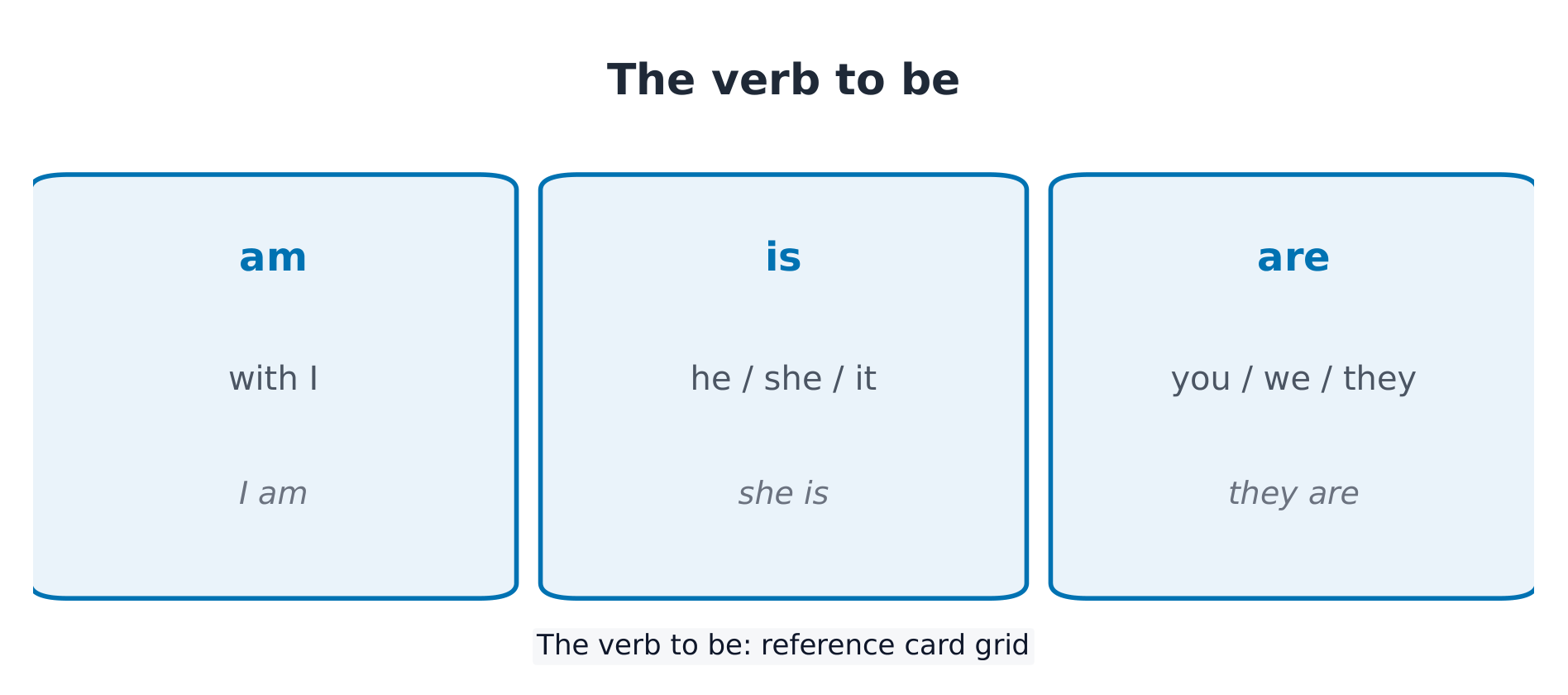
    The verb "to be" means "is / am / are." It changes according to the subject and has three forms:

    • I → am
    • he / she / it → is
    • you / we / they → are

    我I 是am 一名a 学生student.

    I am a student.

    她She 是is 开心happy.

    She is happy.

    他们They (是)are 来自from 中国China.

    They are from China.

    Note: Common spoken contractions: I'm, you're, he's, she's, it's, we're, they're.

    Español
    Verbo to be: am / is / are según el sujeto

    El verbo to be (el verbo ser/estar) significa "ser" o "estar". Cambia según el sujeto y tiene tres formas:

    • I → am
    • he / she / it → is
    • you / we / they → are

    我I 是am 一名a 学生student.

    我是一名学生。

    她She 是is 开心happy.

    她很开心。

    他们They (是)are 来自from 中国China.

    他们来自中国。

    Nota: En el habla cotidiana se usan frecuentemente las contracciones: I'm, you're, he's, she's, it's, we're, they're.
    1.2

    否定与疑问

    English

    Negation: Add not after the be verb (often contracted).

    他He 不是is not 一名a 老师teacher.

    He is not a teacher. (= He isn't a teacher.)

    Interrogative: Place the be verb before the subject.

    (是吗)Are 你you 准备好ready?

    Are you ready?

    Short answers: Yes, I am. / No, I'm not.

    Note: Negative contractions: is not → isn't, are not → aren't; but am not is only contracted to I'm not (there is no ~~amn't~~).

    Common Errors

    • ❌ ~~He busy.~~ → ✓ He is busy. — In Chinese, "He is very busy" can exist without a verb, but an English sentence must have a verb. Use be to link when the predicative is an adjective or noun and there are no other verbs in the sentence (He is busy); do not add be if the sentence already contains an ordinary verb (I go to school).
    • ❌ ~~I am go to school.~~ → ✓ I go to school. — Do not use be and ordinary verbs together; "go" alone suffices for "to go."
    • ❌ ~~They is my friends.~~ → ✓ They are my friends. — Plural subjects (you / we / they) take are.
    • ❌ ~~I am agree.~~ → ✓ I agree. — agree is itself a verb; do not add am before it.
    • ❌ ~~Are you ready? — Yes, I'm.~~ → ✓ Yes, I am. — Contractions cannot be used at the end of affirmative short answers (say Yes, I am); however, negative short answers typically end with a negative contraction (No, he isn't / No, I can't; first person is No, I'm not, as there is no amn't).
    Español

    Negación: Se añade not después del verbo be (que suele contraerse).

    他He 不是is not 一名a 老师teacher.

    Él no es profesor. (= He isn't a teacher.)

    Interrogativo: Se coloca el verbo be antes del sujeto.

    (是吗)Are 你you 准备好ready?

    你准备好了吗?

    Respuestas breves: Yes, I am. / No, I'm not.

    Nota: Las contracciones negativas son: is not → isn't, are not → aren't; pero am not solo se contrae como I'm not (no existe ~~amn't~~).

    常见错误

    • ❌ ~~He busy.~~ → ✓ He is busy. — En chino la frase "Él está muy ocupado" puede omitir el verbo, pero en inglés una oración siempre debe tenerlo. Cuando el predicado es un adjetivo o sustantivo y no hay otro verbo en la oración, se usa be para unirlos (He is busy); si ya hay un verbo ordinario en la oración, no se añade be (I go to school).
    • ❌ ~~I am go to school.~~ → ✓ I go to school. — El verbo be y los verbos ordinarios no pueden usarse juntos; para decir "ir" basta con go.
    • ❌ ~~They is my friends.~~ → ✓ They are my friends. — Los sujetos plurales (you / we / they) requieren are.
    • ❌ ~~I am agree.~~ → ✓ I agree. — Agree (estar de acuerdo) ya es un verbo por sí mismo; no se añade am antes.
    • ❌ ~~Are you ready? — Yes, I'm.~~ → ✓ Yes, I am. — Al final de una respuesta afirmativa breve no se usan contracciones (se dice Yes, I am); sin embargo, en las respuestas negativas breves generalmente se usa la contracción negativa al final (No, he isn't / No, I can't; en primera persona es No, I'm not, ya que no existe amn't).
  • 2 Subject pronouns · ⁨Pronombres personales⁩
    2.1

    Yo, tú, él, ella, eso, nosotros, ellos

    English

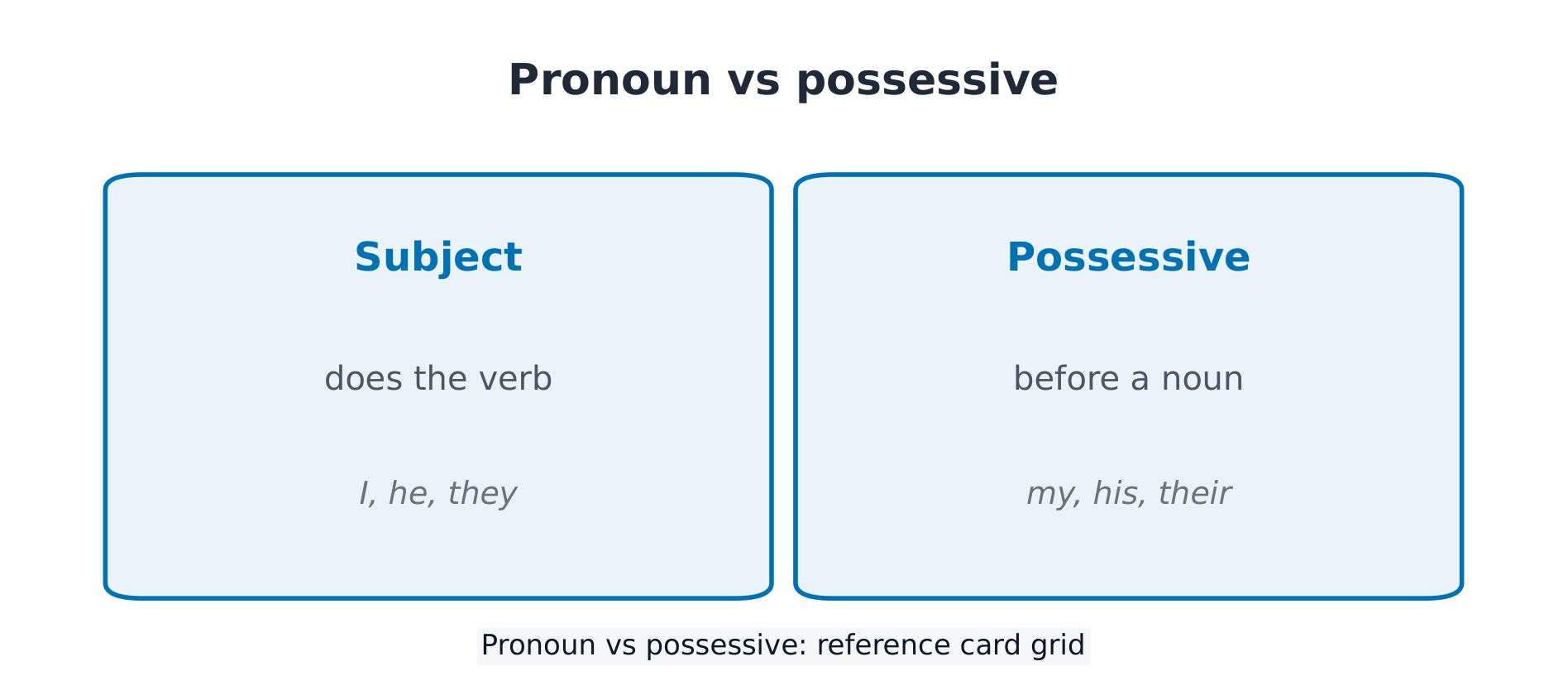
    Subject pronouns replace the subject and are placed before the verb:

    • I(I), you(you), he(he), she(she)
    • it(it), we(we), they(they)

    他He 是is 我的my 哥哥brother.

    He is my brother.

    我们We 喜欢like 音乐music.

    We like music.

    Key Usage Points:

    • I is always capitalized, regardless of its position in the sentence.
    • Things and animals commonly use it: This is my bag. It is new.(This is my bag. It is new.)*
    • Plural people or things both use they: The books are here. They are mine.(The books are here. They are mine.)*

    Note: Subject pronouns are followed by verbs; do not confuse them with object pronouns (me, him, her...) which will be learned later.

    Common Errors

    • ❌ ~~My mother is a doctor. He is very kind.~~ → ✓ She is very kind. — In colloquial Chinese, "he/she" sounds identical, but in English, he and she must be clearly distinguished.
    • ❌ ~~Me am a student.~~ → ✓ I am a student. — Use I for the subject, not me.
    • ❌ ~~My friend he is tall.~~ → ✓ My friend is tall. — The subject needs to be mentioned only once; avoid repeating "noun + pronoun" (the Chinese habit of saying "my friend he..." does not apply in English).
    • ❌ ~~Is raining.~~ → ✓ It is raining. — English sentences must have a subject; weather, time, and dates begin with it.
    Español
    主语代词与物主词

    Los pronombres personales sujeto sustituyen al sujeto y se colocan antes del verbo:

    • I (yo), you (tú / ustedes), he (él), she (ella)
    • it (eso), we (nosotros/as), they (ellos / ellas)

    他He 是is 我的my 哥哥brother.

    他是我哥哥。

    我们We 喜欢like 音乐music.

    我们喜欢音乐。

    用法要点:

    • I 永远大写,不管在句子哪里。
    • Para cosas y animales se suele usar it: This is my bag. It is new. (Este es mi bolso. Es nuevo.)
    • Para personas o cosas en plural se usa they: The books are here. They are mine. (Los libros están aquí. Son míos.)

    Atención: Los pronombres personales van seguidos del verbo; no confundirlos con los pronombres objeto que aprenderás más adelante (me, him, her, etc.).

    常见错误

    • ❌ ~~My mother is a doctor. He is very kind.~~ → ✓ She is very kind. — En el español coloquial "él" y "ella" suenan igual, pero en inglés hay que distinguir claramente entre he y she.
    • ❌ ~~Me am a student.~~ → ✓ I am a student. — Para hacer de sujeto se usa I, no me.
    • ❌ ~~My friend he is tall.~~ → ✓ My friend is tall. — Con un solo sujeto basta; no repitas el nombre y el pronombre (el hábito chino de decir "mi amigo... él..." no se aplica al inglés).
    • ❌ ~~Is raining.~~ → ✓ It is raining. — Las oraciones en inglés deben tener sujeto; para hablar del tiempo, la hora o la fecha se inicia con it.
  • 3 Possessive adjectives · ⁨Adjetivos posesivos⁩
    3.1

    my, your, his, her, our, their

    English

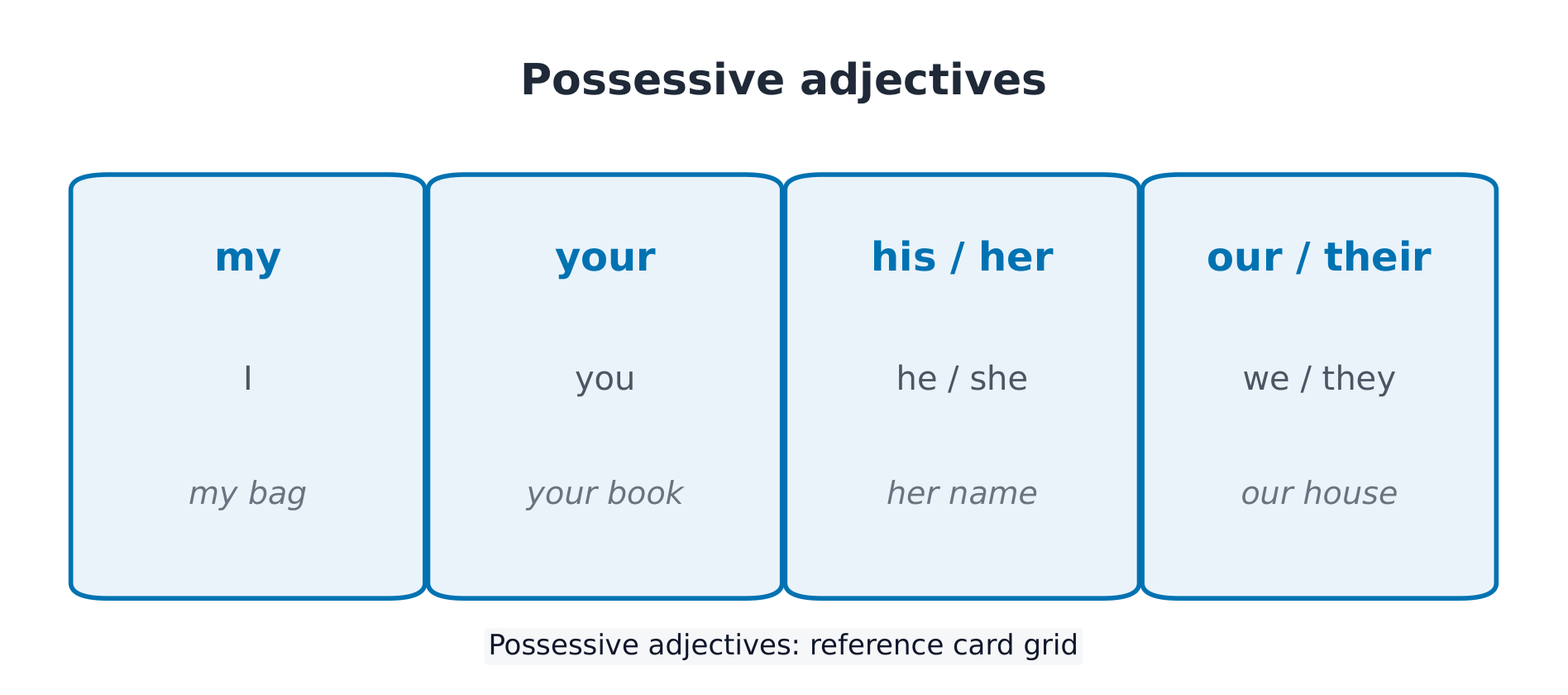
    Possessive adjectives indicate "whose" and are placed before the noun:

    • I → my(my), you → your(your), he → his(his)
    • she → her(her), it → its(its), we → our(our), they → their(their)

    这This 是is 我的my 包bag.

    This is my bag.

    她的Her 名字name 是is 露西Lucy.

    Her name is Lucy.

    Key Usage Points:

    • Possessive adjectives are always followed by a noun: my book, their house.
    • They do not change with noun number: my book, my books(my remains unchanged).

    Note: Be careful to distinguish its (its, no apostrophe) and it's (= it is). For example: The dog wags its tail.(The dog wags its tail.)*

    Common Errors

    • ❌ ~~This is she book.~~ → ✓ This is her book. — A possessive form must precede a noun: he → his, she → her.
    • ❌ ~~He is me friend.~~ → ✓ He is my friend. — The possessive form of I is my.
    • ❌ ~~The dog wags it's tail.~~ → ✓ …wags its tail. — it's = it is; "its" (possessive) has no apostrophe.
    • ❌ ~~Their is a park near here.~~ → ✓ There is a park near here. — their (their) and there (there/here) sound identical; do not mix them up in writing.
    Español
    物主限定词:my / your / his / her

    Los adjetivos posesivos (possessive adjectives) indican "de quién" y se colocan antes del sustantivo:

    • I → my(mi), you → your(tu/su), he → his(su de él)
    • she → her(su de ella), it → its(su de ello), we → our(nuestro/a/os/as), they → their(su de ellos)

    这This 是is 我的my 包bag.

    这是我的包。

    她的Her 名字name 是is 露西Lucy.

    她的名字叫露西。

    用法要点:

    • Después del adjetivo posesivo siempre debe ir un sustantivo: my book, their house.
    • No varía según el número del sustantivo: my book, my books (my no cambia).

    Atención: Diferencia bien entre its (su de ello, sin apóstrofe) e it's (= it is). Ejemplo: The dog wags its tail. (El perro mueve su cola.)

    常见错误

    • ❌ ~~This is she book.~~ → ✓ This is her book. — Antes del sustantivo se usa la forma posesiva: he → his, she → her.
    • ❌ ~~He is me friend.~~ → ✓ He is my friend. — La forma posesiva de I es my.
    • ❌ ~~The dog wags it's tail.~~ → ✓ …wags its tail. — it's = it is; "su de ello" es its, sin apóstrofe.
    • ❌ ~~Their is a park near here.~~ → ✓ There is a park near here. — their (su de ellos) y there (hay / allí) suenan igual, pero no deben confundirse al escribir.
  • 4 this, that, these, those
    4.1

    this 与 that

    English

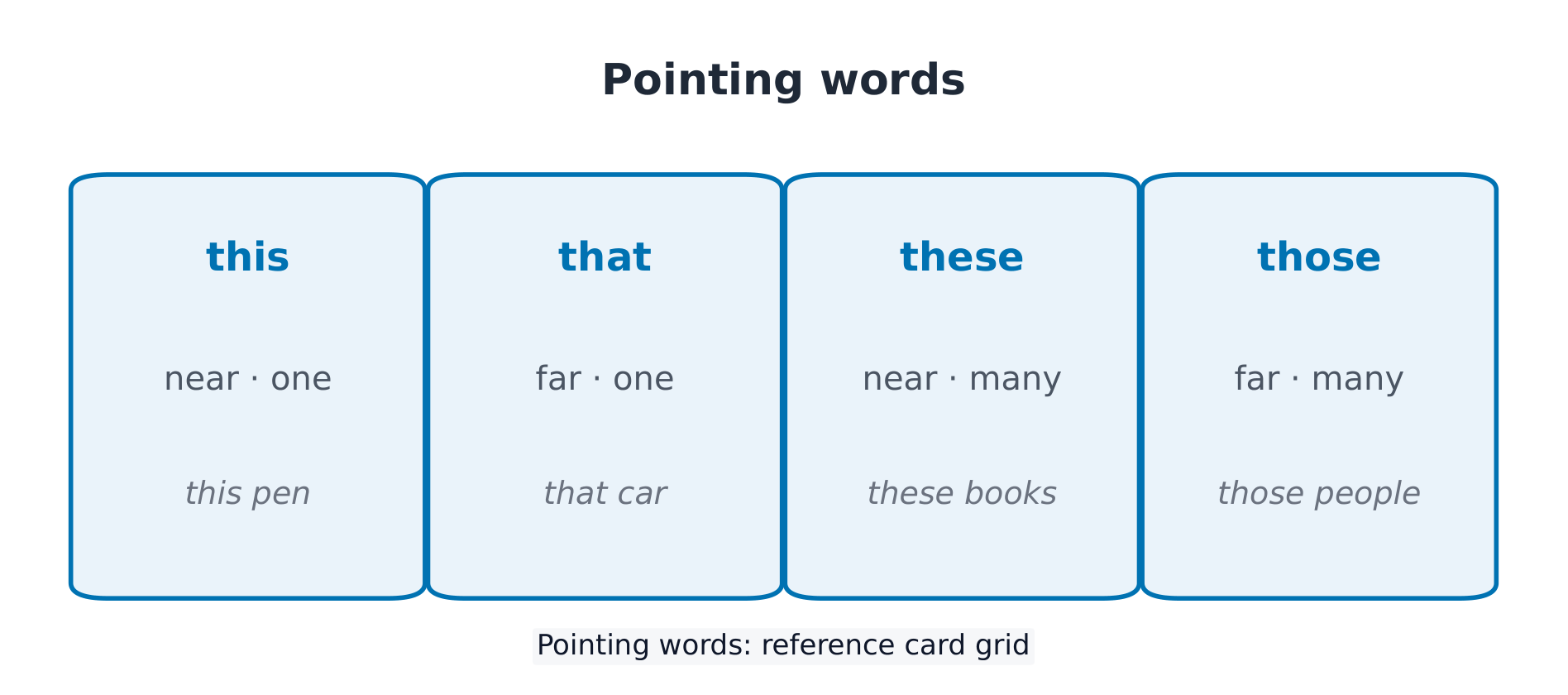
    Demonstratives point out "which one." Use this and that for singular:

    • this(this): Close to the speaker.
    • that(that): Far from the speaker.

    这This 是is 我的my 手机phone.

    This is my phone. (Close)

    那That 是is 你的your 车car.

    That is your car. (Far)

    Español
    近/远 × 单数/复数:this / that / these / those

    Los demostrativos indican "cuál". Para el singular se usan this y that:

    • this(este): cerca del hablante.
    • that(ese): lejos del hablante.

    这This 是is 我的my 手机phone.

    这是我的手机。(近)

    那That 是is 你的your 车car.

    那是你的车。(远)

    4.2

    these 与 those

    English

    Use these and those for plural:

    • these(these): Close. those(those): Far.

    这些These 是are 我的my 书books.

    These are my books.

    那些Those 是are 她的her 朋友friends.

    Those are her friends.

    Contrastive Memory:

    • Near → this (singular) / these (plural).
    • Far → that (singular) / those (plural).

    Note: These / those are followed by plural nouns: these books, not ~~these book~~.

    Common Errors

    • ❌ ~~these book~~ → ✓ these books — Plural nouns must follow these / those.
    • ❌ ~~This books are mine.~~ → ✓ These books are mine. — If the noun is plural, the demonstrative must also be plural.
    • ❌ When introducing yourself on the phone, say ~~I am Tom.~~ → ✓ This is Tom. — In English, introduce yourself on the phone using this is.
    • Remember pairs: Near this / these are often used with here; far that / those are often used with there.
    Español

    Para el plural se usan these y those:

    • these(estos): cerca. those(esos): lejos.

    这些These 是are 我的my 书books.

    这些是我的书。

    那些Those 是are 她的her 朋友friends.

    那些是她的朋友。

    对照记忆:

    • Cerca → this (singular) / these (plural).
    • Lejos → that (singular) / those (plural).

    Atención: después de these / those va un sustantivo en plural: these books, no ~~these book~~.

    常见错误

    • ❌ ~~these book~~ → ✓ these books — después de these / those debe ir siempre un sustantivo en plural.
    • ❌ ~~This books are mine.~~ → ✓ These books are mine. — Si el sustantivo está en plural, el demostrativo también debe estar en plural.
    • ❌ Al hablar por teléfono, no digas ~~I am Tom.~~ → ✓ This is Tom. — En inglés, para presentarse al teléfono se usa this is.
    • Recuerda la asociación: this / these suelen ir con here; that / those suelen ir con there.
  • 5 a, an and plurals · ⁨a, an y plurales⁩
    5.1

    a con an

    English

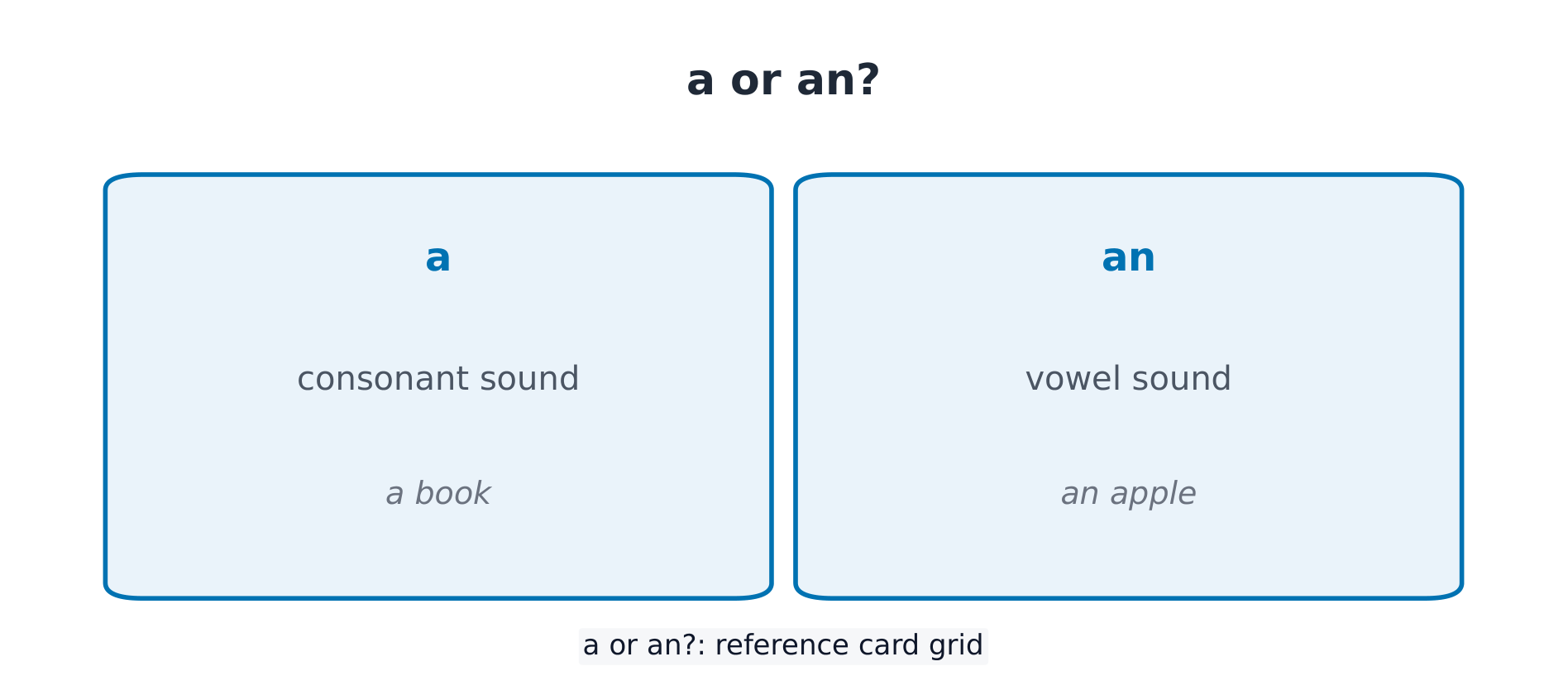
    a and an mean "one" and are used before singular countable nouns. How to choose depends on pronunciation:

    • a + consonant sound: a book, a dog, a cat.
    • an + vowel sound: an apple, an egg, an orange.

    我I 有have 一个a 笔pen.

    I have a pen.

    她She 吃eats 一个an 苹果apple.

    She eats an apple.

    Note: Look at the sound, not the letter: an hour (h is silent), a university (pronounced "yu-").

    Español
    a / an: según la pronunciación (sonoras vs. vocales)

    a y an significan "un" o "una", y se usan delante de sustantivos contables singulares. Para elegir entre uno y otro, hay que fijarse en la pronunciación:

    • a + sonido consonántico: a book (un libro), a dog (un perro), a cat (un gato).
    • an + sonido vocálico: an apple (una manzana), an egg (un huevo), an orange (una naranja).

    我I 有have 一个a 笔pen.

    我有一支笔。

    她She 吃eats 一个an 苹果apple.

    她吃一个苹果。

    Atención: Fíjate en el sonido, no en la letra: an hour (la h no suena), a university (se pronuncia "yu-ni-ver-si-ti").

    5.2

    名词复数

    English

    To indicate "more than one," use the plural form of the noun, usually adding -s:

    • Generally add -s: book → books, car → cars.
    • Words ending in -s / -sh / -ch / -x add -es: bus → buses, box → boxes.
    • Consonant + y ending: change y to i and add -es: baby → babies, city → cities.

    我I 有have 两two 猫cats.

    I have two cats.

    Irregular plurals (must memorize):

    • man → men, woman → women, child → children.
    • foot → feet, tooth → teeth, person → people.

    Note: Do not use a / an before plural nouns: ~~a books~~ ✗ → books / two books ✓.

    Common Errors

    • ❌ ~~I have dog.~~ → ✓ I have a dog. — In Chinese you can say "I have dogs," but singular countable nouns in English must have a / an (or my, the, etc.) before them.
    • ❌ ~~an university~~ → ✓ a university; ❌ ~~a hour~~ → ✓ an hour — Look at pronunciation, not spelling: university starts with a consonant sound /j/, and h is silent in hour.
    • ❌ ~~two book~~ → ✓ two books — Chinese nouns do not change for plurality, but nouns after numbers in English require -s; this is easily forgotten.
    • ❌ ~~three childs~~ → ✓ three children — Irregular plurals must be memorized separately: men, women, children, feet, teeth, people.
    • ❌ ~~a people~~ → ✓ a person (one person) / people (many people) — people is inherently plural.
    Español

    表示"不止一个"时,名词用复数,通常加 -s:

    • Añade -s normalmente: book → books (libros), car → cars (coches).
    • Si termina en -s / -sh / -ch / -x, añade -es: bus → buses (autobuses), box → boxes (cajas).
    • Si termina en consonante + y, cambia la y por i y añade -es: baby → babies (bebés), city → cities (ciudades).

    我I 有have 两two 猫cats.

    我有两只猫。

    不规则复数(要背):

    • man → men (hombres), woman → women (mujeres), child → children (niños).
    • foot → feet (pies), tooth → teeth (dientes), person → people (personas/gente).

    Atención: Delante de un sustantivo plural no se usa a / an: ~~a books~~ ✗ → books / two books ✓.

    常见错误

    • ❌ ~~I have dog.~~ → ✓ I have a dog. — En chino se puede decir "tengo perro", pero en inglés es obligatorio poner a / an (o my, the, etc.) delante de un sustantivo contable singular.
    • ❌ ~~an university~~ → ✓ a university; ❌ ~~a hour~~ → ✓ an hour — Fíjate en la pronunciación, no en la ortografía: university empieza por sonido consonántico /j/, mientras que en hour la h no suena.
    • ❌ ~~two book~~ → ✓ two books — Los sustantivos en chino no tienen plural, pero en inglés los números van seguidos del sustantivo en plural con -s. Es el error más frecuente.
    • ❌ ~~three childs~~ → ✓ three children — Los plurales irregulares deben memorizarse por separado: men, women, children, feet, teeth, people.
    • ❌ ~~a people~~ → ✓ a person (una persona) / people (muchas personas/gente) — People ya es plural, por lo que no puede ir precedido de a.
  • 6 there is and there are · ⁨hay y hay (plural)⁩
    6.1

    单数与复数

    English

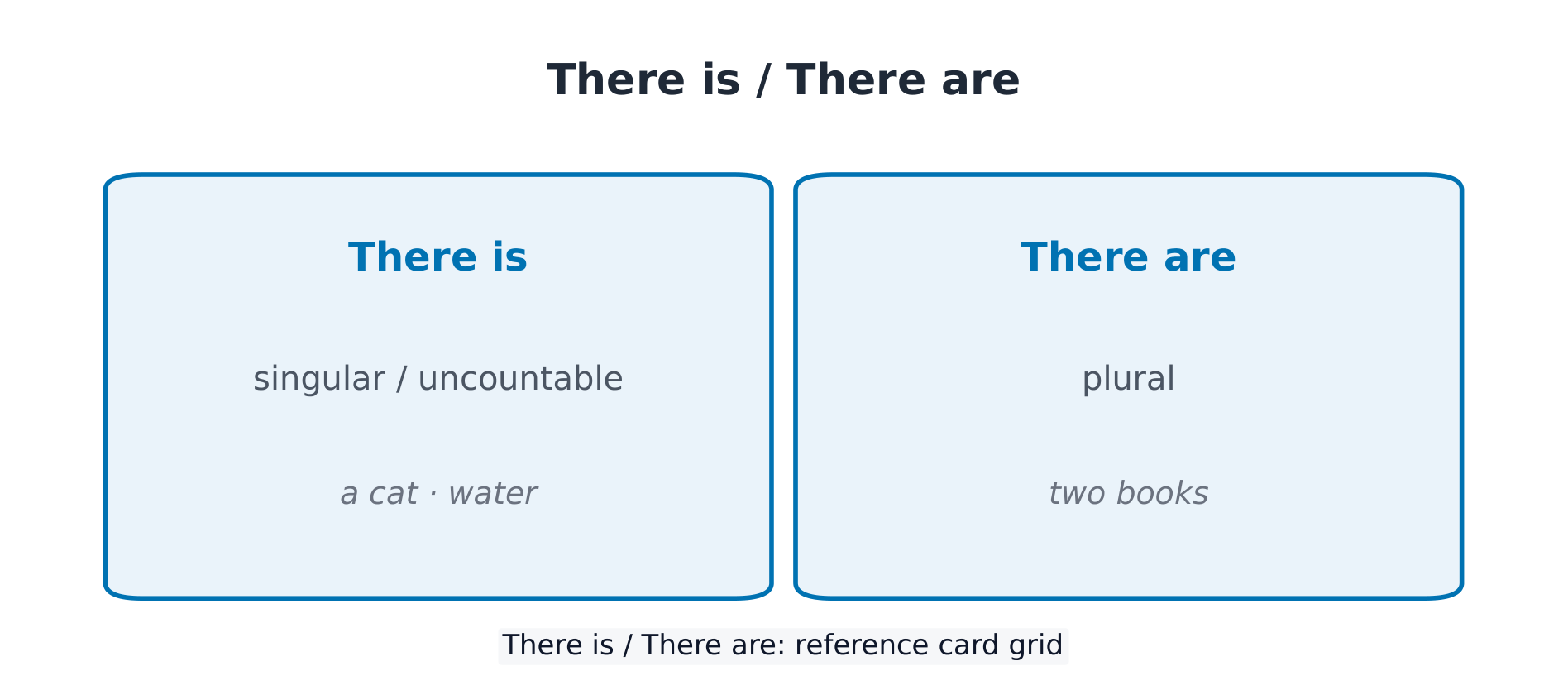
    there is / there are means "there exists" (something exists somewhere).

    • There is + singular / uncountable noun: There is a book.
    • There are + plural noun: There are two books.

    (有)There 有is 一只a 猫cat 在on (冠词)the 沙发上sofa.

    There is a cat on the sofa.

    (有)There 有are 三three 书books 在on (冠词)the 桌上desk.

    There are three books on the table.

    Note: In spoken English, there is is often contracted to there's: There's a problem.

    Español
    There is (singular) / There are (plural)

    there is / there are significan "hay" (algo existe en algún lugar).

    • There is + sustantivo singular / incontable: There is a book.
    • There are + sustantivo plural: There are two books.

    (有)There 有is 一只a 猫cat 在on (冠词)the 沙发上sofa.

    沙发上有一只猫。

    (有)There 有are 三three 书books 在on (冠词)the 桌上desk.

    桌上有三本书。

    Nota: En el habla coloquial, there is a menudo se contrae como there's: There's a problem.

    6.2

    否定与疑问

    English

    Negative: there is not / there are not (contracted as there isn't / there aren't).

    (有)There 没有isn't 任何any 牛奶milk.

    There is no milk left.

    Question: Move is / are to the front of there.

    (有吗)Is (有)there 一家a 银行bank 附近near 这里here?

    Is there a bank nearby?

    Short answer: Yes, there is. / No, there isn't.

    Note: Use any frequently in negative / question sentences: Is there any water? (Is there any water?)

    Common Errors

    • ❌ ~~Here has many people.~~ → ✓ There are many people here. — The "have" in the Chinese "There are many people here" indicates existence; use there is / there are in English, do not translate literally as have.
    • ❌ ~~There have a book on the desk.~~ → ✓ There is a book on the desk. — Use is / are after there; there have does not exist.
    • ❌ ~~There is two cats.~~ → ✓ There are two cats. — If the following noun is plural, use are.
    • ❌ ~~There are a milk.~~ → ✓ There is some milk. — milk is uncountable: use there is + some, do not use a.
    Español

    Negación: there is not / there are not (contraídas there isn't / there aren't).

    (有)There 没有isn't 任何any 牛奶milk.

    没有牛奶了。

    Interrogativo: Coloca is / are antes de there.

    (有吗)Is (有)there 一家a 银行bank 附近near 这里here?

    这附近有银行吗?

    Respuesta corta: Yes, there is. / No, there isn't.

    Nota: En oraciones negativas e interrogativas es común usar any: Is there any water?

    常见错误

    • ❌ ~~Here has many people.~~ → ✓ There are many people here. — El "hay" en chino indica existencia; en inglés se usa there is / there are, no se traduce literalmente con have.
    • ❌ ~~There have a book on the desk.~~ → ✓ There is a book on the desk. — Después de there se usa is / are; no existe la construcción there have.
    • ❌ ~~There is two cats.~~ → ✓ There are two cats. — Si el sustantivo que sigue es plural, se usa are.
    • ❌ ~~There are a milk.~~ → ✓ There is some milk. — Milk es incontable: se usa there is + some, no a.
  • 7 have got
    7.1

    have got / has got

    English

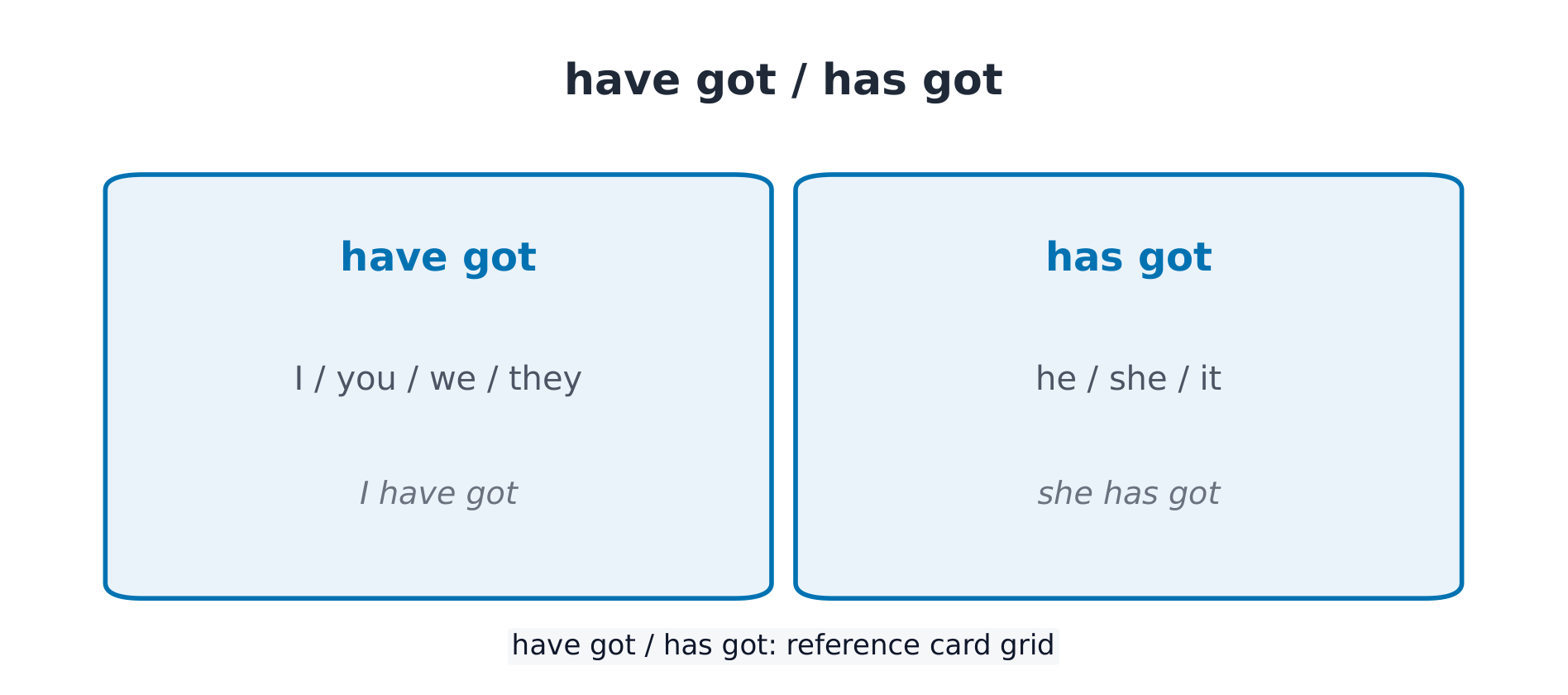
    have got means "to possess" (= have), common in British English.

    • I / you / we / they → have got
    • he / she / it → has got

    我I 有have got 一个a 兄弟brother.

    I have a brother. (= I have a brother.)

    她She 有has got 蓝色blue 眼睛eyes.

    She has blue eyes.

    Note: Often contracted in spoken language: I've got, she's got, they've got. Same meaning as have / has.

    Español
    have got / has got

    have got significa "tener" (= have) y es muy común en el inglés británico.

    • I / you / we / they → have got
    • he / she / it → has got

    我I 有have got 一个a 兄弟brother.

    Tengo un hermano. (= I have a brother.)

    她She 有has got 蓝色blue 眼睛eyes.

    她有一双蓝眼睛。

    Nota: En el habla coloquial se suele abreviar: I've got, she's got, they've got. Tienen el mismo significado que have / has.

    7.2

    否定与疑问

    English

    Negative: haven't got / hasn't got.

    他He 没有hasn't got 一辆a 车car.

    He doesn't have a car.

    Question: Move Have / Has to the front of the subject.

    (有吗)Have 你you 有got 一支a 笔pen?

    Do you have a pen?

    Short answer: Yes, I have. / No, I haven't.

    Note: have got is mostly used for current possession; for past or habits, use regular have / had.

    Common Errors

    • ❌ ~~She have got long hair.~~ → ✓ She has got long hair. — Use has got for he / she / it.
    • ❌ ~~I have got not a car.~~ → ✓ I haven't got a car. — Place not after have / has, then contract.
    • ❌ ~~Do you have got a pen?~~ → ✓ Have you got a pen? / Do you have a pen? — Both question forms are correct, but never mix them.
    • ❌ ~~Yes, I have got.~~ → ✓ Yes, I have. — Short answers end at have / has, without got.
    Español

    Negación: haven't got / hasn't got.

    他He 没有hasn't got 一辆a 车car.

    他没有车。

    Interrogativo: Coloca Have / Has delante del sujeto.

    (有吗)Have 你you 有got 一支a 笔pen?

    你有笔吗?

    Respuesta corta: Yes, I have. / No, I haven't.

    Nota: have got se utiliza principalmente para expresar una situación de posesión actual; para hablar del pasado o de hábitos, sigue usándose el have / had normal.

    常见错误

    • ❌ ~~She have got long hair.~~ → ✓ She has got long hair. — Para he / she / it se usa has got.
    • ❌ ~~I have got not a car.~~ → ✓ I haven't got a car. — El not va detrás de have / has, y luego se contrae.
    • ❌ ~~Do you have got a pen?~~ → ✓ Have you got a pen? / Do you have a pen? — Ambas formas son correctas, pero no deben mezclarse en una sola oración.
    • ❌ ~~Yes, I have got.~~ → ✓ Yes, I have. — En la respuesta corta solo se usa have / has, sin añadir got.
  • 8 Present simple
    8.1

    习惯与第三人称 -s

    English

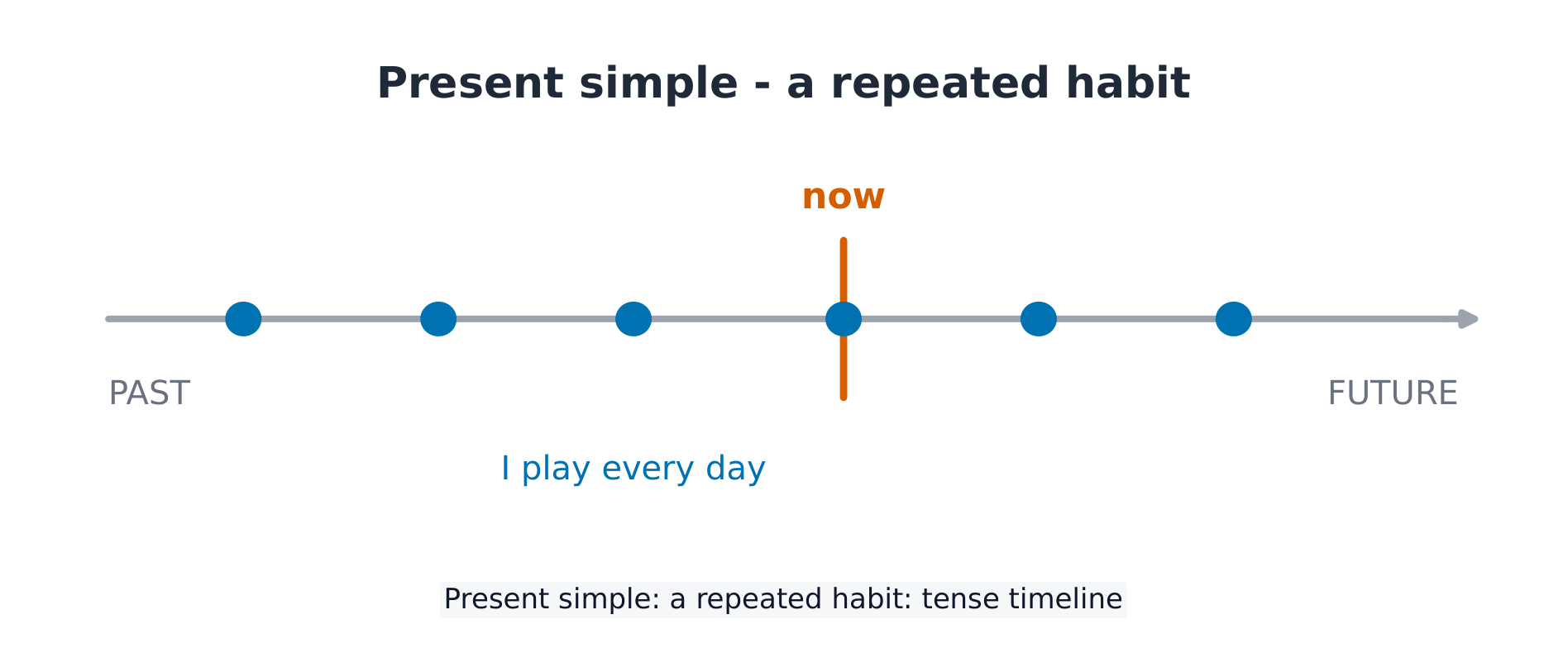
    Present simple (present simple) describes habits and facts. The base form is the infinitive (base verb).

    我I 喜欢like 茶tea.

    I like tea.

    When the subject is he / she / it, add -s to the verb:

    他He 踢plays 足球football.

    He plays football.

    Spelling rules:

    • Generally add -s: like → likes.
    • Words ending in -s / -sh / -ch / -x / -o add -es: go → goes, watch → watches.
    • Consonant + y ending: change y to i and add -es: study → studies.

    Note: Only he / she / it take -s; I / you / we / they use the base form: They like tea.

    Español
    一般现在时:反复的习惯

    El presente simple (present simple) se utiliza para hablar de hábitos y hechos. La forma básica es simplemente el verbo en su forma base.

    我I 喜欢like 茶tea.

    我喜欢茶。

    Cuando el sujeto es he / she / it (él / ella / ello), el verbo añade -s:

    他He 踢plays 足球football.

    他踢足球。

    拼写:

    • Generalmente se añade -s: like → likes.
    • Si termina en -s, -sh, -ch, -x o -o, se añade -es: go → goes, watch → watches.
    • Consonante + y, la y cambia a i y se añade -es: study → studies.

    Nota: Solo he / she / it añaden -s; I / you / we / they usan la forma base: They like tea.

    8.2

    否定与疑问

    English

    For negatives and questions, use auxiliary verbs do / does (does for he / she / it).

    Negative: Subject + don't / doesn't + base verb.

    我I 不don't 喜欢like 咖啡coffee.

    I don't like coffee.

    Question: Do / Does + Subject + base verb ?

    (助动词)Does 她she 住live 这里here?

    Does she live here?

    Note: When using do / does, the verb returns to its base form (no -s): ~~Does she lives~~ ✗ → Does she live ✓.

    Common Errors

    • ❌ ~~He go to school by bus.~~ → ✓ He goes to school by bus. — Forgetting to add -s in third person singular is the most frequent error; check your work afterwards.
    • ❌ ~~She doesn't likes coffee.~~ → ✓ She doesn't like coffee. — When using does / doesn't, the verb returns to its base form.
    • ❌ ~~I very like English.~~ → ✓ I like English very much. — "Very much" in Chinese cannot be translated literally; very cannot directly modify a verb.
    • ❌ ~~You like tea?~~ → ✓ Do you like tea? — Questions must start with do / does; rising intonation alone is insufficient.
    Español
    Hábitos diarios: I have breakfast every morning.

    Para formar negativos e interrogativos se utiliza el auxiliar do / does (se usa does con he / she / it).

    Negativo: Sujeto + don't / doesn't + verbo en forma base.

    我I 不don't 喜欢like 咖啡coffee.

    我不喜欢咖啡。

    Interrogativo: Do / Does + sujeto + verbo en forma base ?

    (助动词)Does 她she 住live 这里here?

    她住在这里吗?

    Nota: Al usar do / does, el verbo vuelve a su forma base (sin añadir -s): ~~Does she lives~~ ✗ → Does she live ✓.

    常见错误

    • ❌ ~~He go to school by bus.~~ → ✓ Él goes to school by bus. — Olvidar añadir -s en la tercera persona del singular es el error más frecuente; revise siempre después de escribir.
    • ❌ ~~She doesn't likes coffee.~~ → ✓ She doesn't like coffee. — Al usar does / doesn't, el verbo debe volver a su forma base.
    • ❌ ~~I very like English.~~ → ✓ I like English very much. — "Muy" no puede modificar directamente un verbo en inglés; la traducción literal de "muy gustar" es incorrecta.
    • ❌ ~~You like tea?~~ → ✓ Do you like tea? — Las oraciones interrogativas deben comenzar con do / does; no basta con subir el tono de voz.
  • 9 can
    9.1

    能力与请求

    English

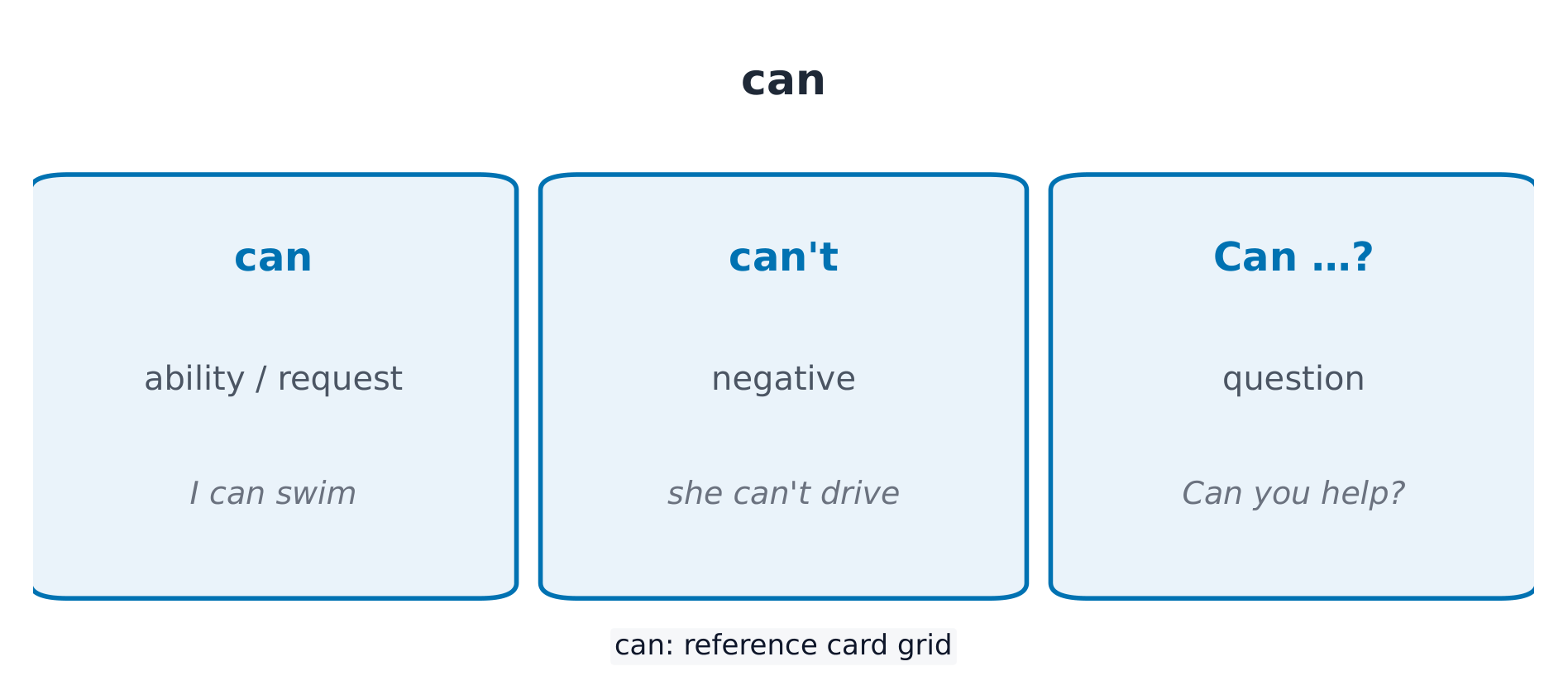
    can expresses ability ("know how to / be able to") or is used for requests. It is followed by the base form of the verb, and remains the same for all persons.

    我I 会can 游泳swim.

    I can swim.

    能Can 你you 帮help 我me?

    Can you help me?

    Note: Use the base form after can: ~~can to swim~~ ✗, ~~can swims~~ ✗ → can swim ✓.

    Español
    can: capacidad, negación, interrogativo

    can indica capacidad ("saber / poder") o se usa para hacer una petición. Va seguido de un verbo en infinitivo; es igual para todas las personas.

    我I 会can 游泳swim.

    我会游泳。

    能Can 你you 帮help 我me?

    你能帮我一下吗?

    Nota: después de can se usa el infinitivo: ~~can to swim~~ ✗、~~can swims~~ ✗ → can swim ✓.

    9.2

    否定与疑问

    English

    Negative: cannot (abbreviation can't) + base form of the verb.

    她She 不会can't 开车drive.

    She cannot drive.

    Question: Place Can before the subject.

    能Can 他he 做饭cook?

    Can he cook?

    Short answer: Yes, I can. / No, I can't.

    Note: can has no -s and does not use do/does: ask directly with Can he…?, not ~~Does he can…?~~

    Common Errors

    • ❌ ~~She cans drive.~~ → ✓ She can drive. — can has no third-person singular -s; it is the same for all persons.
    • ❌ ~~I don't can swim.~~ → ✓ I can't swim. — The negative of can is formed directly with not (can't), without using don't.
    • ❌ ~~He can sings very good.~~ → ✓ He can sing very well. — Use the base form of the verb after can; use the adverb well to modify a verb, not good.
    • ❌ ~~You can help me?~~ → ✓ Can you help me? — When making a request, place can before the subject.
    Español

    Negación: cannot (abreviado can't) + verbo en infinitivo.

    她She 不会can't 开车drive.

    她不会开车。

    Interrogativo: coloca Can antes del sujeto.

    能Can 他he 做饭cook?

    他会做饭吗?

    Respuesta corta: Yes, I can. / No, I can't.

    Nota: can no lleva -s ni do / does: para preguntar se usa directamente Can he…?, no ~~Does he can…?~~

    常见错误

    • ❌ ~~She cans drive.~~ → ✓ She can drive. — can no lleva tercera persona en -s; es igual para todas las personas.
    • ❌ ~~I don't can swim.~~ → ✓ I can't swim. — la negación de can se forma con not (can't), sin usar don't.
    • ❌ ~~He can sings very good.~~ → ✓ He can sing very well. — después de can se usa el verbo en infinitivo; para modificar un verbo se usa el adverbio well, no good.
    • ❌ ~~You can help me?~~ → ✓ Can you help me? — al pedir algo a alguien, se coloca can antes del sujeto.
  • 10 Imperatives · ⁨Imperativos⁩
    10.1

    命令与指示

    English

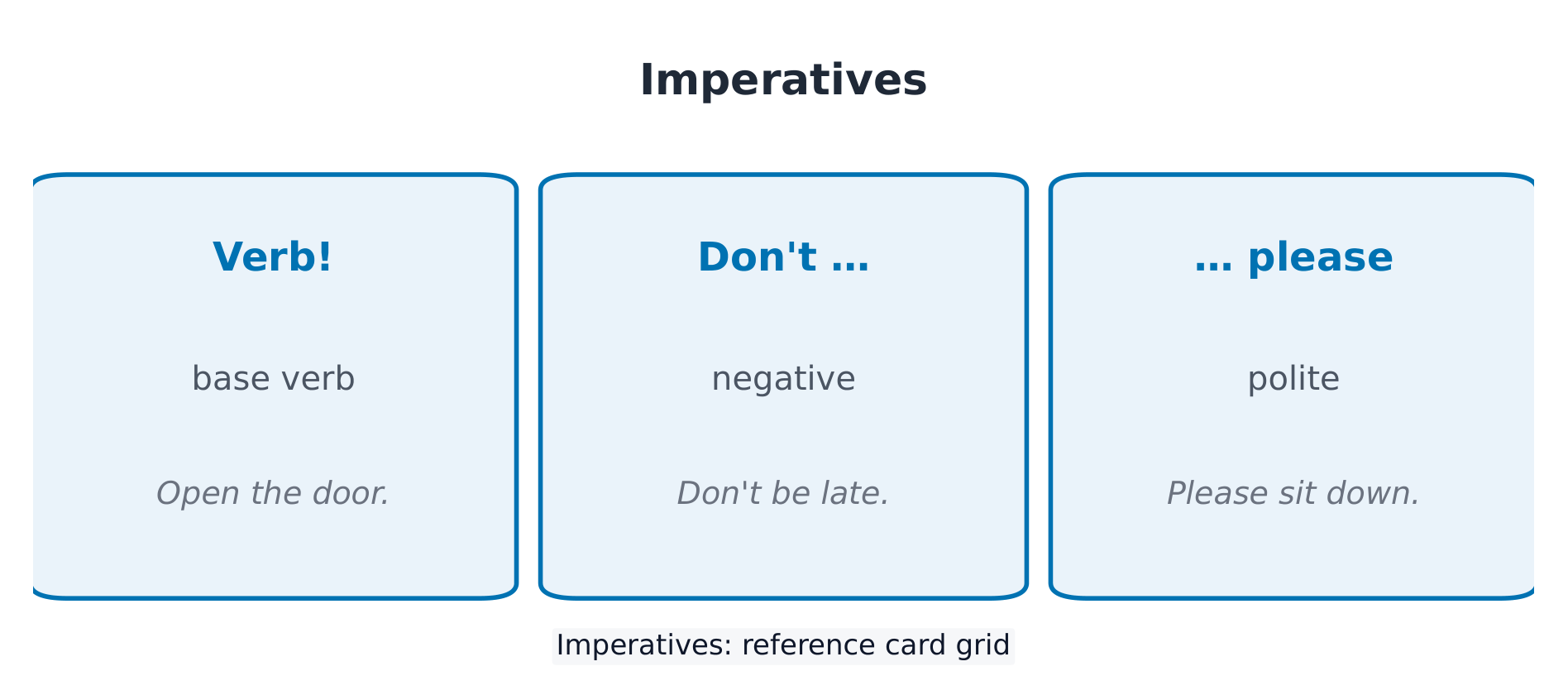
    Imperatives are used to give commands, provide instructions, or make requests. Start directly with the base form of the verb, without a subject.

    打开Open (冠词)the 门door 请, please.

    Please open the door.

    坐Sit 下down.

    Sit down.

    Negative: Add Don't at the beginning.

    不要Don't (是)be 迟到late.

    Don't be late.

    Key Usage Points:

    • Add please to be more polite: Please come in.
    • Also used for directions and instructions: Turn left. Mix the eggs.

    Note: Do not write a subject in imperatives: ~~You open the door~~ (for a command) → Open the door.

    Common Errors

    • ❌ ~~Please open door.~~ → ✓ Please open the door. — Articles must still be included in imperatives.
    • ❌ ~~Don't to touch it.~~ → ✓ Don't touch it. — Follow don't directly with the base form of the verb; do not add to.
    • ❌ ~~No talk in class!~~ → ✓ Don't talk in class! / No talking! — To prohibit an action, use don't + base form; after no, use -ing or a noun.
    • ❌ ~~You sit down!~~ → ✓ Sit down, please. — Adding you to a command sounds angry; add please for politeness, or change to Can you…?
    Español
    祈使句:命令、否定、请求

    Las oraciones imperativas se utilizan para dar órdenes, dar instrucciones o hacer peticiones. Comienzan directamente con el verbo en infinitivo, sin sujeto.

    打开Open (冠词)the 门door 请, please.

    请把门打开。

    坐Sit 下down.

    坐下。

    Negativo: Se añade Don't al principio.

    不要Don't (是)be 迟到late.

    别迟到。

    用法要点:

    • Agregar please lo hace más educado: Please come in. (Por favor, pase).
    • También se usan para rutas y instrucciones: Turn left. (Gire a la izquierda). Mix the eggs. (Bata los huevos).

    Nota: Las oraciones imperativas no llevan sujeto: ~~You open the door~~ (al dar una orden) → Open the door.

    常见错误

    • ❌ ~~Please open door.~~ → ✓ Please open the door. — Los artículos no se omiten incluso en las oraciones imperativas.
    • ❌ ~~Don't to touch it.~~ → ✓ Don't touch it. — Después de don't se coloca directamente el verbo en infinitivo, sin to.
    • ❌ ~~No talk in class!~~ → ✓ Don't talk in class! / No talking! — Para prohibir una acción se usa don't + infinitivo; después de no se debe usar -ing o un sustantivo.
    • ❌ ~~You sit down!~~ → ✓ Sit down, please. — Añadir you a una orden suena agresivo; para ser cortés, agregue please o cambie la estructura a Can you…?
  • 11 Question words · ⁨Palabras interrogativas⁩
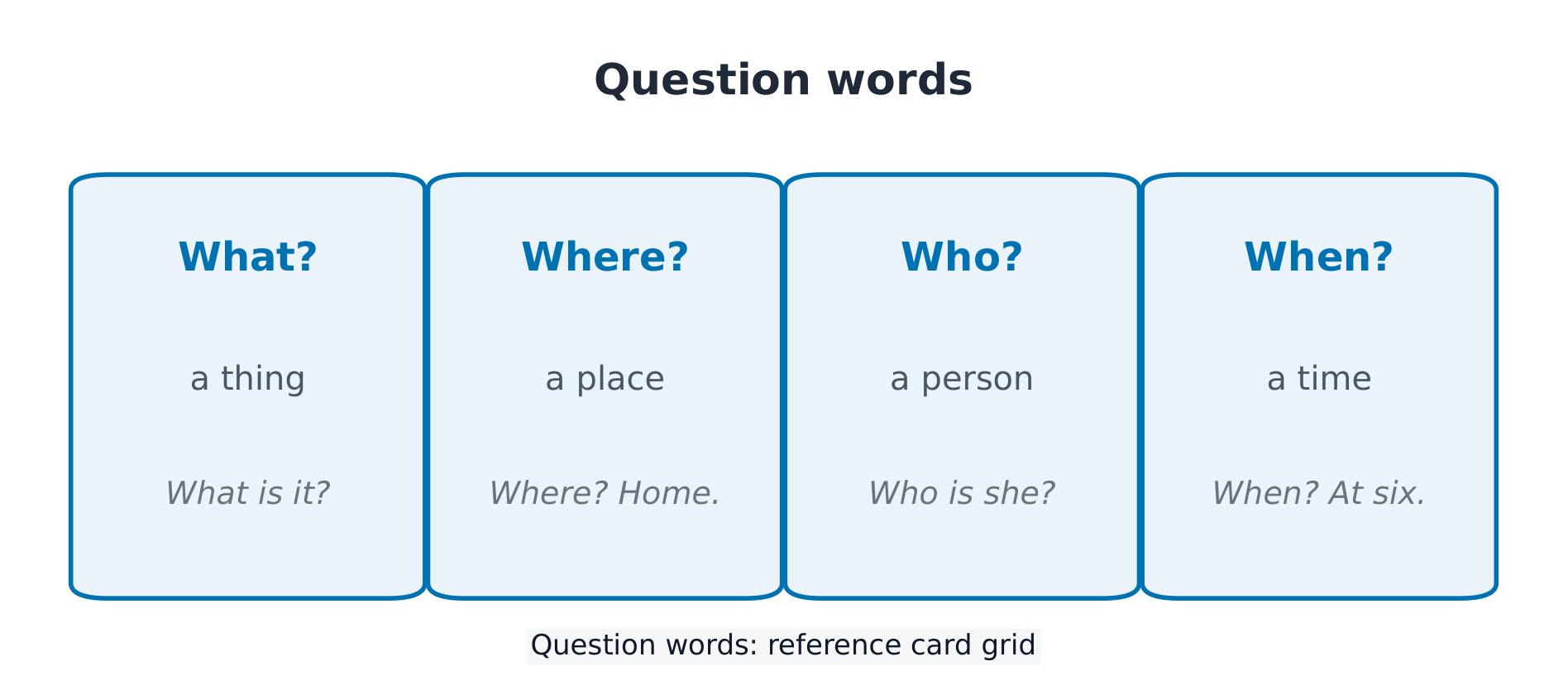
    11.1

    qué, dónde, quién

    English

    Question words are placed at the beginning of a question to ask for specific information.

    • what (what), where (where), who (who)

    什么What 是is 你的your 名字name?

    What's your name?

    哪里Where (助动词)do 你you 住live?

    Where do you live?

    谁Who 是is 那个that 男人man?

    Who is that man?

    Note: A be verb or auxiliary do/does often follows the question word: Where do you work?

    Español
    疑问词:问事物/地点/人/时间

    Las palabras interrogativas (question words) se colocan al inicio de la oración para preguntar información específica.

    • what (qué), where (dónde), who (quién)

    什么What 是is 你的your 名字name?

    你叫什么名字?

    哪里Where (助动词)do 你you 住live?

    你住在哪里?

    谁Who 是is 那个that 男人man?

    那个男人是谁?

    Nota: Tras la palabra interrogativa suele ir el verbo be o el auxiliar do / does: ¿Where do you work?

    11.2

    cuándo, por qué, cómo

    English
    • when (when), why (why), how (how / in what way)

    什么时候When 是is (冠词)the 派对party?

    When is the party?

    为什么Why (是)are 你you 难过sad?

    Why are you sad?

    怎么How (助动词)do 你you 拼写spell 它it?

    How do you spell this?

    Note: how can also combine with adjectives to ask about degree: How old are you? How much is it?

    Common Errors

    • ❌ ~~Where you live?~~ → ✓ Where do you live? — After the question word, you still need do/does or be; you cannot follow directly with the subject.
    • ❌ ~~What means this word?~~ → ✓ What does this word mean? — mean is an ordinary verb: question word + does + subject + base form.
    • ❌ ~~Why you are late?~~ → ✓ Why are you late? — When there is a be verb in the sentence, move be before the subject.
    • ❌ ~~How to spell it?~~ → ✓ How do you spell it? — A literal translation of "How to spell?" loses the subject and auxiliary verb; these must be added.
    Español
    • when (cuándo), why (por qué), how (cómo / de qué manera)

    什么时候When 是is (冠词)the 派对party?

    派对什么时候?

    为什么Why (是)are 你you 难过sad?

    你为什么难过?

    怎么How (助动词)do 你you 拼写spell 它it?

    这个怎么拼?

    Nota: how también puede combinarse con adjetivos para preguntar por grados: How old are you? (¿Cuántos años tienes?) How much is it? (¿Cuánto cuesta?)

    常见错误

    • ❌ ~~Where you live?~~ → ✓ Where do you live? — Después de la palabra interrogativa se requiere do / does o be; no se puede seguir directamente con el sujeto.
    • ❌ ~~What means this word?~~ → ✓ What does this word mean? — mean es un verbo ordinario: estructura = palabra interrogativa + does + sujeto + forma base.
    • ❌ ~~Why you are late?~~ → ✓ Why are you late? — Cuando hay un verbo be en la oración, este debe anteceder al sujeto.
    • ❌ ~~How to spell it?~~ → ✓ How do you spell it? — La traducción literal del chino "¿cómo escribir?" omite el sujeto y el auxiliar; deben restablecerse.
  • 12 Prepositions of place · ⁨Preposiciones de lugar⁩
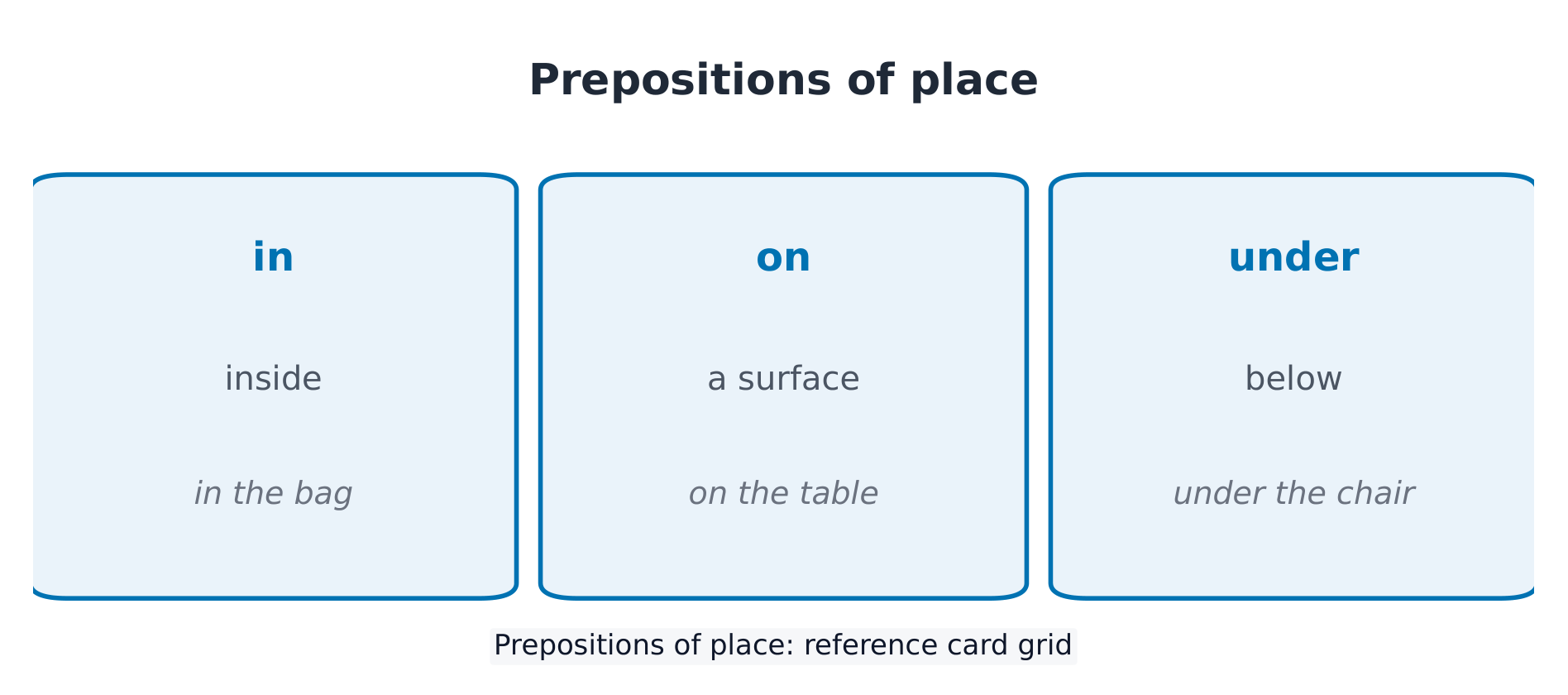
    12.1

    in, on, under

    English

    Prepositions of place indicate where something is located.

    • in (inside...), on (on top of... / surface), under (below...)

    (冠词)The 钥匙keys 在are 在...里in (冠词)the 包里bag.

    The key is in the bag.

    (冠词)The 书book 在is 在...上on (冠词)the 桌上table.

    The book is on the table.

    (冠词)The 猫cat 在is 在...下under (冠词)the 椅子下chair.

    The cat is under the chair.

    Español
    Preposiciones de lugar: in / on / under

    Las preposiciones de lugar (prepositions of place) indican dónde se encuentra algo.

    • in (en el interior de), on (sobre / encima de la superficie), under (debajo de)

    (冠词)The 钥匙keys 在are 在...里in (冠词)the 包里bag.

    钥匙在包里。

    (冠词)The 书book 在is 在...上on (冠词)the 桌上table.

    书在桌上。

    (冠词)The 猫cat 在is 在...下under (冠词)the 椅子下chair.

    猫在椅子下面。

    12.2

    next to, between, behind

    English
    • next to (beside...), between (between...), behind (behind...), in front of (in front of...)

    (冠词)The 商店shop 在is 旁边next to (冠词)the 银行bank.

    The shop is next to the bank.

    她She 坐sits 之间between 汤姆Tom 和and 萨姆Sam.

    She sits between Tom and Sam.

    Note: between means "between two," and is usually followed by A and B: between the door and the window.

    Common Errors

    • ❌ ~~The picture is in the wall.~~ → ✓ The picture is on the wall. — Hanging "on" the wall involves surface contact, so use on.
    • ❌ ~~I read it on the book.~~ → ✓ ...in the book. — Content "inside" a book uses in; people in photos also use in the photo.
    • ❌ ~~The shop is next the bank.~~ → ✓ next to the bank — next to is two words; to cannot be omitted.
    • ❌ ~~between the door with the window~~ → ✓ between the door and the window — between takes the fixed collocation A and B.
    Español
    • next to (al lado de), between (entre), behind (detrás de), in front of (delante de)

    (冠词)The 商店shop 在is 旁边next to (冠词)the 银行bank.

    商店在银行旁边。

    她She 坐sits 之间between 汤姆Tom 和and 萨姆Sam.

    她坐在汤姆和萨姆之间。

    Nota: between indica "entre dos", por lo que suele ir seguido de A and B: entre la puerta y la ventana (between the door and the window).

    常见错误

    • ❌ ~~The picture is in the wall.~~ → ✓ The picture is on the wall. — Un cuadro colgado toca la superficie de la pared, se usa on.
    • ❌ ~~I read it on the book.~~ → ✓ …in the book. — El contenido de un libro se lee in; también se dice in para las personas que aparecen en una foto (in the photo).
    • ❌ ~~The shop is next the bank.~~ → ✓ next to the bank — next to es una locución fija compuesta por dos palabras; no se puede omitir to.
    • ❌ ~~between the door with the window~~ → ✓ between the door and the window — between requiere la construcción fija A and B.

Log in or create account · ⁨Iniciar sesión o crear cuenta⁩

IGCSE, A-Level & AP