يعمل منهج الكيمياء (IGCSE) (0620) بدءاً من حالات المادة والتركيب الذري مروراً بـالحساب الكيميائي، الكهرباء الكيميائية، الديناميكا الحرارية، السرعات، الأحماض والقواعد، الجدول الدوري، المعادن، الكيمياء البيئية والكيمياء العضوية، وينتهي بالتقنيات التجريبية والتحليل.
الحساب الكيميائي يحدد الدرجات. يظهر في أسئلته المستقلة ويظهر مجددًا داخل الكهرباء الكيميائية والديناميكا الحرارية والسرعات، لذا فإن الوقت المنفق على المولات يعوّده عدة مرات.
الخسارة الموثوقة الأخرى هي المعادلات: غير الموزونة، ناقصة رموز الحالات، أو معادلة أيونية مكتوبة بالكامل. توجد أوراق امتحانات لستة مكونات، مقسمة بين الجوهر والممتد — تأكد من النوع الذي تجتازه قبل المراجعة.
2 صف هياكل المواد الصلبة والسائلة والغازية من حيث تباعد الجسيمات وترتيبها وحركتها
3 صف تغيرات الحالة من حيث الانصهار، والغليان، والتبخر، والتجمد، والتكثف
5 اشرح تغيرات الحالة من حيث نظرية الجسيمات الحركية، بما في ذلك تفسير منحنيات التسخين والتبريد
4 صف تأثيرات درجة الحرارة والضغط على حجم الغاز
6 اشرح، من حيث نظرية الجسيمات الحركية، تأثيرات درجة الحرارة والضغط على حجم الغاز
Source: Cambridge International syllabus · المصدر: منهج كامبريدج الدولي
English
Solid, liquid, gas: particle motion
Everything around you is made of tiny particles 粒子 — these can be atoms 原子, molecules 分子, or ions 离子. The kinetic particle theory 粒子动理论 says these particles are always moving. How close the particles are, how they are arranged, and how they move decides whether matter is a solid 固体, a liquid 液体, or a gas 气体.
Properties you can observe
You do not need a microscope to tell the three states apart. They behave in different ways:
A solid has a fixed shape and a fixed volume 体积. It does not flow and you cannot compress 压缩 it (squeeze it smaller).
A liquid has a fixed volume but no fixed shape. It flows and takes the shape of its container. It is almost impossible to compress.
A gas has no fixed shape and no fixed volume. It flows and spreads out to fill the whole container. A gas is easy to compress.
The table below sums up these properties. Density 密度 means how much mass 质量 is packed into a given volume.
Property
Solid
Liquid
Gas
Shape
fixed
takes the shape of the container
fills the whole container
Volume
fixed
fixed
fills the whole container
Can it be compressed?
no
almost none
yes, easily
Does it flow?
no
yes
yes
Density
high
high
low
The particle picture
The kinetic particle theory explains these properties by looking at three things: the separation 间距 of the particles (how far apart they are), their arrangement 排列 (the pattern), and their motion 运动 (how they move).
Solid
Liquid
Gas
Separation
touching, very close
close together
far apart
Arrangement
regular 规则 pattern
random, no pattern
random, no pattern
Motion
vibrate 振动 about fixed positions
move and slide past each other
move quickly in all directions
Strong forces of attraction 引力 hold the particles together. In a solid these forces are strong enough to hold every particle in place, so a solid keeps its shape. In a liquid the forces are weaker, so particles can move around. In a gas the particles move so fast that the forces hardly act at all, so the gas spreads out.
العربية
صلب، سائل، غاز: حركة الجسيمات
كل ما حولك مصنوع من جسيمات صغيرة جداً — وهي يمكن أن تكون ذرات أو جزيئات أو أيونات. تنص نظرية الجسيمات الحركية على أن هذه الجسيمات في حالة حركة دائمة. إن مدى قرب الجسيمات من بعضها، وتوزيعها، وحركتها هو ما يحدد ما إذا كانت المادة صلبة أم سائلة أم غازية.
خصائص يمكنك ملاحظتها
لا تحتاج إلى مجهر لتمييز الحالات الثلاث عن بعضها. فكل منها يتصرف بطريقة مختلفة:
الصلبة لها شكل ثابت وحجم ثابت. لا تتدفق ولا يمكن ضغطها (تقليص حجمها).
السائل له حجم ثابت لكن ليس له شكل ثابت. يتدفق ويأخذ شكل وعائه. ومن شبه المستحيل ضغطه.
الغاز ليس له شكل ثابت ولا حجم ثابت. يتدفق وينتشر ليملأ الوعاء بأكمله. الغاز سهل الضغط.
يلخص الجدول أدناه هذه الخصائص. الكثافة تعني مقدار الكتلة المكدسة في حجم معين.
الخاصية
الصلب
السائل
الغاز
الشكل
ثابت
يأخذ شكل الوعاء
يملأ الوعاء بالكامل
الحجم
ثابت
ثابت
يملأ الوعاء بالكامل
هل يمكن ضغطه؟
لا
شبه مستحيل
نعم، بسهولة
هل يتدفق؟
لا
نعم
نعم
الكثافة
عالية
عالية
منخفضة
صورة الجسيمات
تشرح نظرية الجسيمات الحركية هذه الخصائص من خلال النظر إلى ثلاثة أمور: الفصل بين الجسيمات (مدى تباعدها)، وترتيبها (النمط)، وحركتها (كيف تتحرك).
الصلب
السائل
الغاز
الفصل
متلامسة، قريبة جداً
متقاربة
متباعدة
الترتيب
نمط منتظم
عشوائي، بدون نمط
عشوائي، بدون نمط
الحركة
تهتز حول مواضع ثابتة
تتحرك وتنزلق فوق بعضها البعض
تتحرك بسرعة في جميع الاتجاهات
تمسك قوى التجاذب القوية الجسيمات معاً. في الحالة الصلبة تكون هذه القوى قوية بما يكفي لتثبيت كل جسيم في مكانه، لذلك يحافظ الصلب على شكله. أما في السائل فتكون القوى أضعف، مما يسمح للجسيمات بالحركة. وفي الغاز تتحرك الجسيمات بسرعة كبيرة لدرجة أن القوى几乎 لا تؤثر، لذا ينتشر الغاز.
الجسيمات مكتظة ومنتظمة في الصلب، قريبة وعشوائية في السائل، ومتباعدة في الغاز
Explore · استكشف
States of matter · حالات المادة
Heat the box and watch the particles break free: a vibrating solid melts to a flowing liquid, then spreads out as a gas. Same particles — just more energy. · سخّن الصندوق ولاحظ الجسيمات تتحرر: صلب متذبذب يذوب ليصبح سائلًا متدفقًا، ثم ينتشر كغاز. نفس الجسيمات — فقط طاقة أكبر.
When you heat or cool a substance, it can change from one state to another. You must know the name of each change.
Change
What happens
Name
solid → liquid
melting 熔化
melting
liquid → solid
freezing 凝固
freezing
liquid → gas (at the surface, below the boiling point)
evaporating 蒸发
evaporation
liquid → gas (all through the liquid)
boiling 沸腾
boiling
gas → liquid
condensing 凝结
condensation
A pure solid melts at one fixed temperature, the melting point 熔点. A pure liquid boils at one fixed temperature, the boiling point 沸点. The same substance freezes at its melting point and condenses at its boiling point.
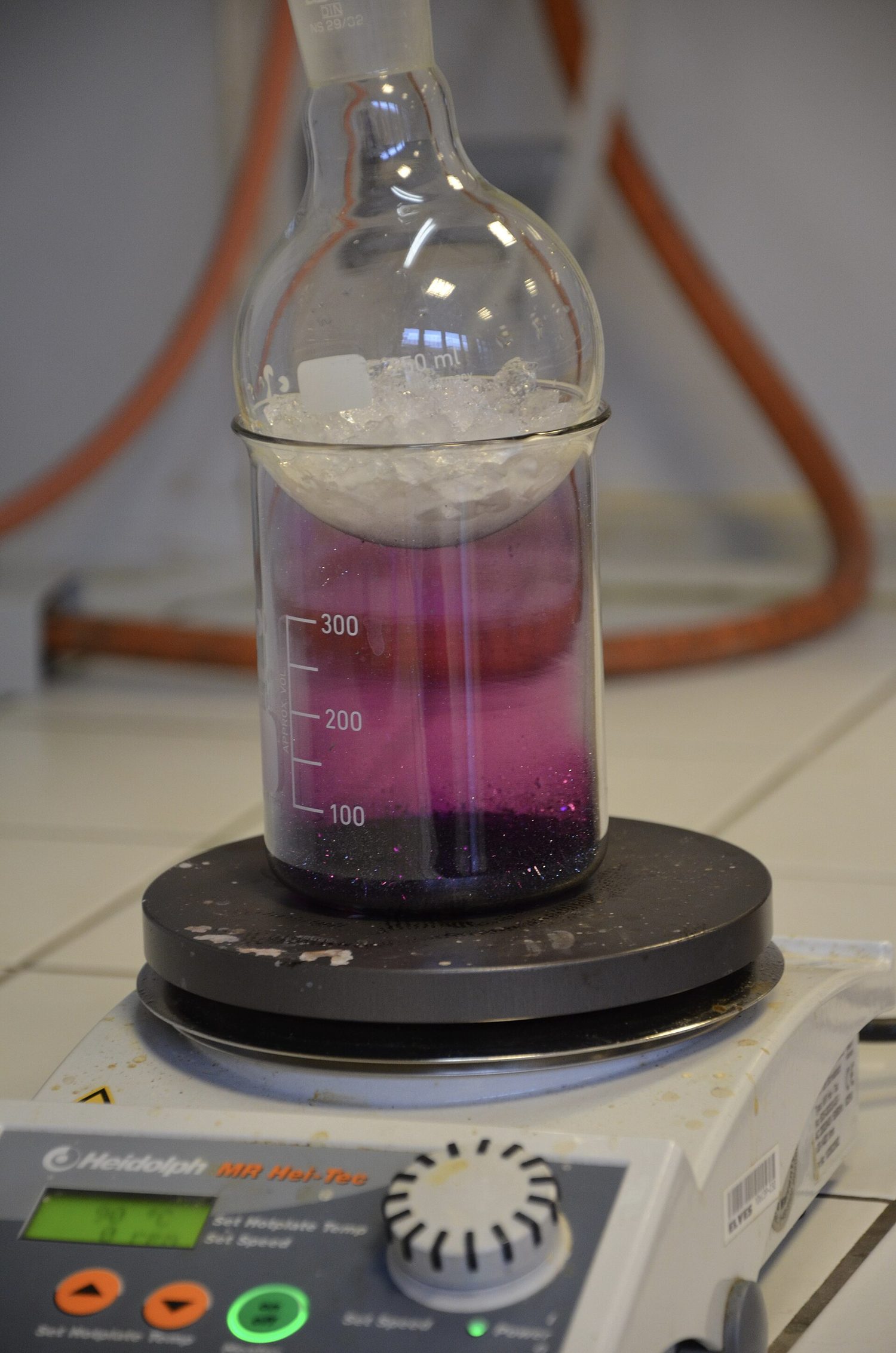
A few substances change straight from solid to gas without melting first. This is called sublimation 升华. In the photo below, warmed solid iodine in a beaker turns directly into a purple gas; the gas then cools on the round flask of ice above and turns back into a solid.
Explaining changes of state with the particle theory
Each change of state is really a change in the energy 能量 of the particles.
When you heat a solid, the particles gain energy and vibrate faster. At the melting point the particles have enough energy to break away from their fixed places and slide around — the solid melts.
When you heat a liquid, the particles move faster. At the boiling point they have enough energy to fully escape the forces of attraction and become a gas.
Cooling does the opposite. The particles lose energy, move more slowly, and the forces of attraction pull them back together.
During a change of state the energy goes into breaking the forces of attraction, not into making the particles move faster. This is why the temperature stays the same while a substance is melting or boiling.
Heating and cooling curves
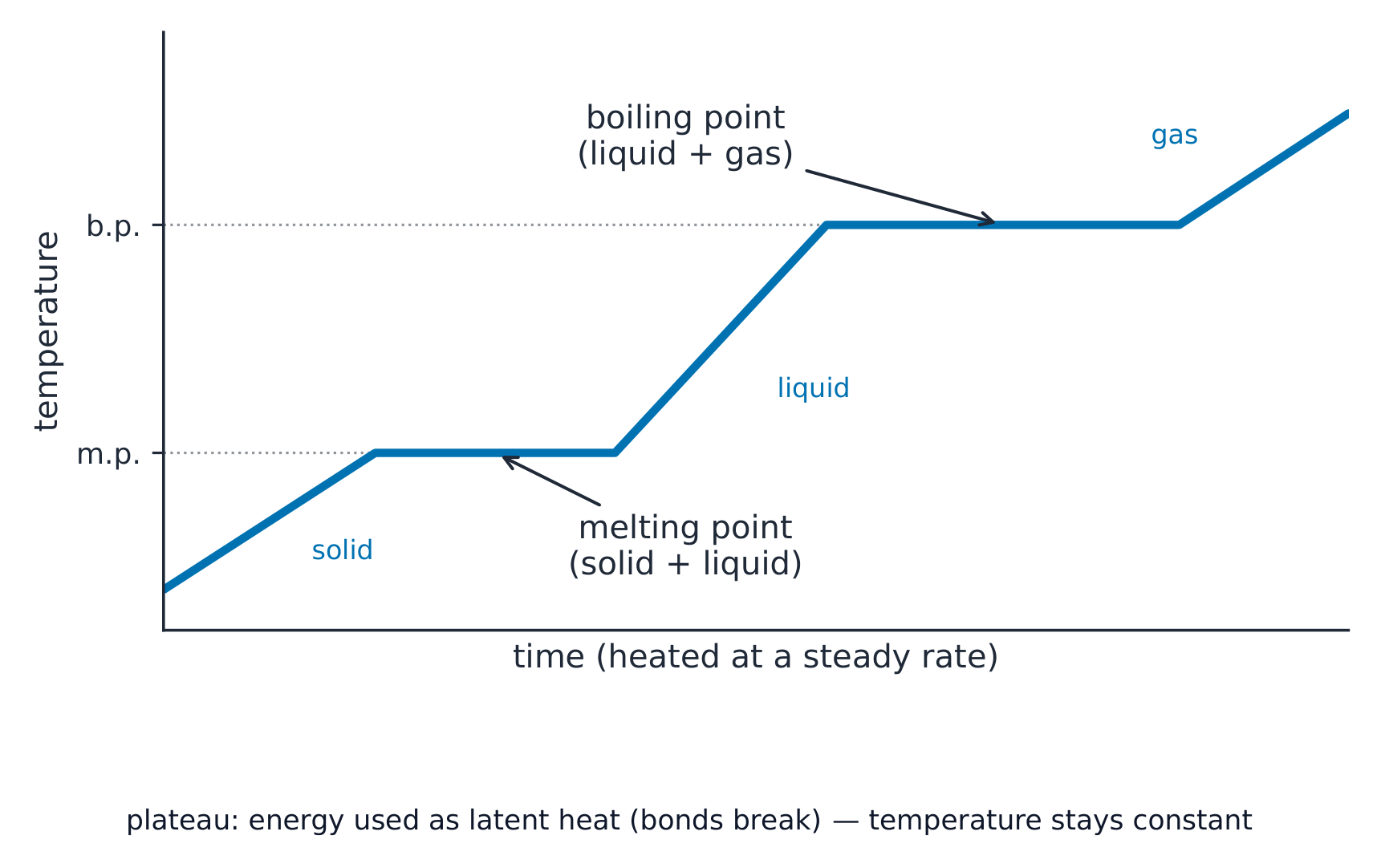
A heating curve 加热曲线 is a graph of temperature against time as you heat a substance steadily. A cooling curve 冷却曲线 is the same graph as the substance cools.
On a heating curve there are two flat (level) parts:
The first flat part is at the melting point. Here solid and liquid are both present. The heat energy breaks the forces holding the solid together, so the temperature does not rise.
The second flat part is at the boiling point. Here liquid and gas are both present, and the temperature again stays constant.
A cooling curve is the reverse. It has a flat part at the boiling point (the gas condenses) and a flat part at the melting point (the liquid freezes). As the particles slow down, thermal energy 热能 is released to the surroundings.
العربية
ذوبان الثلج إلى ماء: تغير في الحالة عندما تدفئ الصلب.
عند تسخين أو تبريد مادة معينة، يمكن أن تتحول من حالة إلى أخرى. يجب أن تعرف اسم كل تغير.
التغير
ماذا يحدث
الاسم
صلب ← سائل
ذوبان
ذوبان
سائل ← صلب
تجمد
تجمد
سائل ← غاز (على السطح، تحت درجة الغليان)
تبخر
تبخر
سائل ← غاز (عبر كامل السائل)
غليان
غليان
غاز ← سائل
تكثف
تكثف
يذوب الصلب النقي عند درجة حرارة ثابتة واحدة، وهي درجة الانصهار. يغلي السائل النقي عند درجة حرارة ثابتة واحدة، وهي درجة الغليان. نفس المادة تتجمد عند درجة انصهارها وتتكاثر عند درجة غليانها.
التسخين: صلب ← سائل ← غاز؛ التبريد يعكس كل تغير
بعض المواد القليلة تتحول مباشرة من صلب إلى غاز دون أن تذوب أولاً. يسمى هذا التسامي. في الصورة أدناه، يتحول اليود الصلب الدافئ في الكوب زجاجياً مباشرة إلى غاز بنفسجي؛ ثم يبرد الغاز على الدائرة الزجاجية المليئة بالثلج الموجودة أعلاه ويعود إلى الحالة الصلبة.
اليود الصلب المسخن يتحول مباشرة إلى غاز بنفسجي (تسامي)المثال اليومي: الثلج الجاف هو ثاني أكسيد الكربون الصلب، ويتسامى أيضاً — فلا يترك بركة مائية أبداً
شرح تغيرات الحالة بنظرية الجسيمات
كل تغير في الحالة هو في الواقع تغيير في طاقة الجسيمات.
عند تسخين صلب، تكتسب الجسيمات طاقة وتتهز بشكل أسرع. وعند درجة الانصهار تصبح لدى الجسيمات طاقة كافية للتحرر من أماكنها الثابتة والانزلاق حول بعضها — فيذوب الصلب.
عند تسخين سائل، تتحرك الجسيمات بشكل أسرع. وعند درجة الغليان تصبح لديها طاقة كافية للهروب تماماً من قوى التجاذب وتتحول إلى غاز.
التبريد يقوم بالعكس. تفقد الجسيمات الطاقة، وتتحرك ببطء أكبر، وتجذبها قوى التجاذب نحو بعضها البعض مرة أخرى.
خلال تغير الحالة، تذهب الطاقة إلى كسر قوى التجاذب، وليس إلى زيادة سرعة حركة الجسيمات. ولهذا السبب تظل درجة الحرارة ثابتة أثناء ذوبان المادة أو غليانها.
منحنيات التسخين والتبريد
منحنى التسخين هو رسم بياني لدرجة الحرارة مقابل الوقت أثناء تسخين مادة بشكل مستمر. منحنى التبريد هو نفس الرسم البياني ولكن للمادة وهي تبرد.
في منحنى التسخين هناك جزآن مسطحيان (أفقيان):
الجزء المسطح الأول هو عند درجة الانصهار. هنا يكون المادة في الحالتين الصلبة والسائلة معًا. تُكسر الطاقة الحرارية القوى التي تربط جزيئات المادة الصلبة، لذا لا ترتفع درجة الحرارة.
الجزء المسطح الثاني هو عند درجة الغليان. هنا تكون المادة في الحالتين السائلة والغازية معًا، وتظل درجة الحرارة ثابتة مرة أخرى.
منحنى التبريد هو العكس. يحتوي على جزء مسطح عند درجة الغليان (يتكثف الغاز) وجزء مسطح عند درجة الانصهار (تتجمد السائلة). ومع تباطؤ الجسيمات، يُطلق الطاقة الحرارية إلى المحيط المحيط بها.
تبقى درجة الحرارة ثابتة عند درجتي الانصهار والغليان بينما تُكسر قوى التجاذب
Explore · استكشف
Heating a substance through its states · تسخين مادة عبر حالاتها
Step up the temperature. Adding heat gives the particles more energy until they break free — and the temperature pauses at each change of state while the energy does that work. · ارفع درجة الحرارة. إضافة الحرارة تعطي الجسيمات طاقة أكبر حتى تتحرر — وتتوقف درجة الحرارة مؤقتًا عند كل تغير حالة بينما تقوم الطاقة بهذا العمل.
Gases: temperature, pressure and volume · الغازات: درجة الحرارة والضغط والحجم
English
A gas pushes on the walls of its container. This push, spread over the area of the wall, is the pressure 压强 of the gas. Pressure comes from the gas particles hitting the walls.
Effect of temperature
If you heat a fixed mass of gas while keeping the pressure the same, its volume increases.
Using the particle theory: heating gives the particles more kinetic energy 动能, so they move faster. They hit the walls harder and more often. To keep the pressure the same, the gas must take up more space, so the volume gets bigger.
If instead the volume is fixed (a sealed, rigid container), heating the gas makes the pressure rise, because the faster particles collide 碰撞 with the walls harder and more often.
Effect of pressure
If you increase the pressure on a fixed mass of gas while keeping the temperature the same, its volume decreases. Squeezing the gas into a smaller space means the particles hit the walls more often, which is what a higher pressure means.
العربية
يُمارس الغاز ضغطًا على جدران وعائه. هذا الضغط، الموزع على مساحة الجدار، هو ضغط الغاز. ينشأ الضغط نتيجة اصطدام جسيمات الغاز بالجدران.
تأثير درجة الحرارة
إذا قمت بتسخين كتلة ثابتة من الغاز مع الحفاظ على ثبات الضغط، فإن حجمه يزداد.
غاز مسخن: جسيمات أسرع تتباعد وتشغل مساحة أكبر
باستخدام نظرية الجسيمات: يعطي التسخين للجسيمات المزيد من الطاقة الحركية، فتتحرك بسرعة أكبر. وتصطدم بالجدران بقوة أكبر وبشكل متكرر أكثر. وللمحافظة على ثبات الضغط، يجب أن يشغل الغاز مساحة أكبر، مما يجعل الحجم يتضخم.
إذا كان الحجم ثابتًا عوضًا عن ذلك (وعاء مغلق وصلب)، فإن تسخين الغاز يؤدي إلى ارتفاع الضغط، لأن الجسيمات الأسرع تتصادم بجدران الوعاء بقوة أكبر وبشكل متكرر أكثر.
تأثير الضغط
إذا زدت الضغط على كتلة ثابتة من الغاز مع الحفاظ على ثبات درجة الحرارة، فإن حجمه يقل. إن ضغط الغاز في حيز أصغر يعني أن الجسيمات تصطدم بالجدران بشكل متكرر أكثر، وهو ما يمثل ارتفاع الضغط.
ضغط الغاز في حجم أصغر يجعل الجسيمات تصطدم بالجدران بشكل متكرر أكثر، مما يرفع الضغط
1 Describe and explain diffusion in terms of kinetic particle theory
2 Describe and explain the effect of relative molecular mass on the rate of diffusion of gases
العربية
أساسي
تكميلي
1 صف واشرح الانتشار من حيث نظرية الجسيمات الحركية
2 صف واشرح تأثير الكتلة الجزيئية النسبية على معدل انتشار الغازات
Source: Cambridge International syllabus · المصدر: منهج كامبريدج الدولي
English
Diffusion: random motion, one-way flow
Diffusion 扩散 is the spreading of particles from a region where they are crowded to a region where they are spread out — that is, from high concentration 浓度 to low concentration. It happens because particles are always moving in random directions.
Diffusion explains why you can smell food from across a room: the smell particles move and mix with the air until they reach your nose. Diffusion happens in gases and in liquids, but not in solids, because solid particles cannot move from place to place.
Rate of diffusion and molecular mass
Lighter gas particles move faster than heavier ones at the same temperature. So a gas with a smaller relative molecular mass 相对分子质量 (a smaller mass for each molecule) has a faster rate 速率 of diffusion.
A classic experiment shows this. Cotton wool soaked in ammonia 氨气 ($\text{NH}_3$) is put at one end of a long glass tube. Cotton wool soaked in hydrogen chloride 氯化氢 ($\text{HCl}$) is put at the other end. Both gases diffuse along the tube and meet to form a white ring of ammonium chloride 氯化铵 ($\text{NH}_4\text{Cl}$).
Ammonia has $M_r = 17$ and hydrogen chloride has $M_r = 36.5$. Ammonia is lighter, so it diffuses faster and travels further along the tube. The white ring forms nearer the hydrogen chloride end.
Worked example. Bromine ($M_r = 160$) and ammonia ($M_r = 17$) are released at the same moment from opposite ends of a long tube. Which travels further before they meet? Compare the relative molecular masses. Ammonia's $M_r$ is far smaller, so its molecules move faster at the same temperature and it diffuses more quickly. Ammonia therefore travels the greater distance, and the two gases meet nearer the bromine end. The rule is always "lighter means faster" - argue from $M_r$, never from how big the formula looks on paper.
العربية
الانتشار: حركة عشوائية، تدفق أحادي الاتجاه
الانتشار هو انتشار الجسيمات من منطقة كثيفة إلى منطقة منتشرة — أي من تركيز عالٍ إلى تركيز منخفض. يحدث الانتشار لأن الجسيمات تتحرك دائمًا في اتجاهات عشوائية.
تنتشر الجسيمات من التركيز العالي إلى المنخفض حتى تنتشر بالتساوي
يشرح الانتشار لماذا يمكنك شم رائحة الطعام عبر الغرفة: جسيمات الرائحة تتحرك وتتداخل مع الهواء حتى تصل إلى أنفك. يحدث الانتشار في الغازات والسوائل، لكن ليس في المواد الصلبة، لأن جسيمات المواد الصلبة لا يمكنها الانتقال من مكان إلى آخر.
معدل الانتشار والكتلة الجزيئية
تتحرك جسيمات الغاز الخفيفة أسرع من الثقيلة عند نفس درجة الحرارة. لذلك، فإن الغاز الذي له كتلة جزيئية نسبية أصغر (كتلة أقل لكل جزيء) يكون له معدل انتشار أسرع.
تُظهر تجربة كلاسيكية ذلك. قطن مبلّ بـ الأمونيا ($\text{NH}_3$) يُوضع عند أحد طرفي أنبوب زجاجي طويل. وقطن مبلّ بـ كلوريد الهيدروجين ($\text{HCl}$) يُوضع عند الطرف الآخر. ينتشر كلا الغازين على طول الأنبوب ويلتقيان لتكوين حلقة بيضاء من كلوريد الأمونيوم ($\text{NH}_4\text{Cl}$).
الأمونيا لها $M_r = 17$ وكلوريد الهيدروجين له $M_r = 36.5$. الأمونا أخف، لذا تنتشر أسرع وتقطع مسافة أطول على طول الأنبوب. تتشكل الحلقة البيضاء أقرب إلى طرف كلوريد الهيدروجين.
الأمونيا ($M_r=17$) أخف، لذا تنتشر أسرع وأبعد؛ تتشكل الحلقة البيضاء أقرب إلى طرف HCl
مثال محلول. يُطلاق البروم ($M_r = 160$) والأمونيا ($M_r = 17$) في نفس اللحظة من طرفي أنبوب طويل. أيهما يقطع مسافة أطول قبل أن يلتقيا؟ قارن الكتل الجزيئية النسبية. كتلة Ammonia الجزيئية $M_r$ أصغر بكثير، لذا تتحرك جزيئاتها بسرعة أكبر عند نفس درجة الحرارة وتنتشر بشكل أسرع. لذلك قطعت الأمونيا مسافة أكبر، والتقى الغازان أقرب إلى طرف البروم. القاعدة هي دائمًا "الأخف أسرع" - استدل بناءً على $M_r$، ولا تستند إلى حجم الصيغة على الورق.
Explore · استكشف
Diffusion · الانتشار
Release the cloud and the particles spread on their own from the crowded corner until they fill the box evenly — diffusion, sped up by heat. · أطلق السحب وستنتشر الجسيمات من تلقاء نفسها من الزاوية المكتظة حتى تمتلئ الصندوق بالتساوي — الانتشار، المسرع بالحرارة.
Explore · استكشف
Diffusion · الانتشار
Set the concentration on each side. Particles spread from high to low concentration until evenly mixed. · حدد التركيز على كل جانب. الجسيمات تنتشر من مرتفع إلى منخفض التركيز حتى تختلط بالتساوي.
During melting and boiling the temperature stays constant (the flat parts of a heating curve), because the energy breaks the forces between particles instead of making them move faster.
Evaporation happens only at the surface and at any temperature; boiling happens throughout the liquid at one fixed temperature.
Explain gas behaviour with the particle theory: heating a gas at fixed volume raises the pressure because the particles hit the walls harder and more often — the particles themselves do not get bigger.
Diffusion is faster for lighter particles (smaller $M_r$) and cannot happen in solids. In the ammonia/hydrogen chloride tube the lighter ammonia travels further, so the white ring forms nearer the HCl end.
العربية
أثناء الانصهار والغليان تظل درجة الحرارة ثابتة (الأجزاء المسطحة لمنحنى التسخين)، لأن الطاقة تكسر القوى بين الجسيمات بدلاً من زيادة سرعتها.
التبخر يحدث فقط عند السطح وعند أي درجة حرارة؛ أما الغليان فيحدث داخل السائل بالكامل عند درجة حرارة ثابتة واحدة.
اشرح سلوك الغاز باستخدام نظرية الجسيمات: تسخين الغاز عند حجم ثابت يرفع الضغط لأن الجسيمات تصطدم بالجدران بقوة أكبر وبشكل متكرر أكثر — الجسيمات نفسها لا تكبر.
الانتشار يكون أسرع للجسيمات الخفيفة (أصغر $M_r$) ولا يمكن أن يحدث في المواد الصلبة. في أنبوب الأمونيا/كلوريد الهيدروجين، قطعت الأمونا الخفيفة مسافة أطول، لذا تتشكل الحلقة البيضاء أقرب إلى طرف HCl.
2
Atoms, elements and compounds · الذرات والعناصر والمركبات
1 Describe the differences between elements, compounds and mixtures
العربية
أساسي
تكميلي
1 صف الفروق بين العناصر والمركبات والمخلوطات
Source: Cambridge International syllabus · المصدر: منهج كامبريدج الدولي
A pure element (vanadium): elements are the simplest substances.
All substances are made from about 100 simple building blocks. Knowing how they are joined lets you sort every substance into one of three groups.
An element 元素 is a substance made of only one type of atom 原子. You cannot break it into anything simpler by a chemical reaction. Examples: copper, oxygen, carbon.
A compound 化合物 is two or more elements chemically joined (bonded) together. The atoms are joined in a fixed ratio. Examples: water, carbon dioxide. A compound has different properties from the elements in it.
A mixture 混合物 is two or more substances that are just mixed, not chemically joined. The parts keep their own properties and can be separated by physical methods. Example: air.
The key difference: in a compound the elements are bonded and can only be separated by chemical reactions; in a mixture they are not bonded and are easy to separate.
An element has one type of atom; a compound has different atoms bonded in a fixed ratio; a mixture is not bonded
Explore · استكشف
Elements, compounds and mixtures lab · معمل العناصر والمركبات والمخلوطات
Classify everyday particle examples by composition. · صنف أمثلة الجسيمات اليومية حسب التركيب.
1 Describe the structure of the atom as a central nucleus containing neutrons and protons surrounded by electrons in shells
2 State the relative charges and relative masses of a proton, a neutron and an electron
3 Define proton number/atomic number as the number of protons in the nucleus of an atom
4 Define mass number/nucleon number as the total number of protons and neutrons in the nucleus of an atom
5 Determine the electronic configuration of elements and their ions with proton number 1 to 20, e.g. 2,8,3
6 State that: (a) Group VIII noble gases have a full outer electron shell (b) the number of outer shell electrons is equal to the group number in Groups I to VII (c) the number of occupied electron shells is equal to the period number
العربية
أساسي
تكميلي
1 صف بنية الذرة على شكل نواة مركزية تحتوي على نيوترونات وبروتونات محاطة بـإلكترونات في أغلفة
3 عرّف عدد البروتونات/الرقم الذري على أنه عدد البروتونات في نواة الذرة
4 عرّف العدد الكتلي/عدد النوكليونات على أنه العدد الكلي للبروتونات والنيوترونات في نواة الذرة
5 حدد التوزيع الإلكتروني للعناصر وأيوناتها ذات الرقم الذري من 1 إلى 20، مثل: 2,8,3
6 أذكر أن: (أ) الغازات النبيلة في المجموعة الثامنة لها غلاف خارجي كامل من الإلكترونات (ب) عدد إلكترونات الغلاف الخارجي يساوي رقم المجموعة في المجموعات من I إلى VII (ج) عدد الأغلفة الإلكترونية المشغولة يساوي رقم الدورة
Source: Cambridge International syllabus · المصدر: منهج كامبريدج الدولي
Inside the atom
Every atom has a small, dense centre called the nucleus 原子核. Around it, electrons 电子 move in shells 电子层 (energy levels). The nucleus contains two kinds of particle: protons 质子 and neutrons 中子.
An atom has a tiny nucleus of protons and neutrons, with electrons in shells around it
Each particle has a relative mass and a relative charge 电荷. You must learn these values:
Particle
Relative mass
Relative charge
proton
1
$+1$
neutron
1
$0$
electron
$\frac{1}{1840}$ (almost 0)
$-1$
An atom has no overall charge because it has equal numbers of protons ($+1$ each) and electrons ($-1$ each).
Proton number and mass number
Two numbers describe an atom:
The proton number 质子数 (also called the atomic number 原子序数) is the number of protons in the nucleus. It tells you which element the atom is.
The mass number 质量数 (also called the nucleon number 核子数) is the total number of protons and neutrons in the nucleus.
So the number of neutrons $=$ mass number $-$ proton number.
Electronic configuration
The electrons fill the shells from the inside out. The first shell holds up to 2 electrons; the next shells hold up to 8 each (for the first 20 elements). The electronic configuration 电子排布 lists how many electrons are in each shell, starting from the inside.
For example, an atom with 13 electrons has the configuration $2,8,3$. Sodium (proton number 11) is $2,8,1$. Calcium (proton number 20) is $2,8,8,2$.
The configuration links to the Periodic Table 周期表:
A Group 族 number (Groups I to VII) equals the number of electrons in the outer shell. So $2,8,1$ is in Group I.
A Period 周期 number equals the number of shells that hold electrons. So $2,8,1$ has three shells, so it is in Period 3.
The noble gases 稀有气体 in Group VIII (or 0) have a full outer shell, which makes them very unreactive.
Sodium's configuration 2,8,1 links to the Periodic Table: one outer electron means Group I, three shells means Period 3
Explore · استكشف
Electron shells · الأغلفة الإلكترونية
Change the atomic number and watch the shells fill (2, 8, 8) — the electron arrangement of the first 20 elements. · غيّر العدد الذري وشاهد امتلاء المدارات (2، 8، 8) — الترتيب الإلكتروني لأول 20 عناصر.
1 Define isotopes as different atoms of the same element that have the same number of protons but different numbers of neutrons
3 State that isotopes of the same element have the same chemical properties because they have the same number of electrons and therefore the same electronic configuration
2 Interpret and use symbols for atoms, e.g. $^{12}_{6}\text{C}$, and ions, e.g. $^{35}_{17}\text{Cl}^-$
4 Calculate the relative atomic mass of an element from the relative masses and abundances of its isotopes
العربية
أساسي
تكميلي
1 عرّف النظائر على أنها ذرات مختلفة لنفس العنصر تمتلك نفس عدد البروتونات لكن أعداداً مختلفة من النيوترونات
3 أذكر أن نظائر العنصر الواحد تمتلك نفس الخصائص الكيميائية لأنها تمتلك نفس عدد الإلكترونات وبالتالي نفس التوزيع الإلكتروني
2 فسر واستخدم الرموز للذرات، مثل: $^{12}_{6}\text{C}$، وللأيونات، مثل: $^{35}_{17}\text{Cl}^-$
4 احسب الكتلة الذرية النسبية لعنصر ما بناءً على الكتل النسبية والوفرة لنظائره
Source: Cambridge International syllabus · المصدر: منهج كامبريدج الدولي
Isotopes 同位素 are atoms of the same element that have the same number of protons but different numbers of neutrons. Because the proton number is the same, they are the same element. Because the neutron number is different, they have different mass numbers.
You write an atom with its mass number on top and proton number below, like $^{12}_{6}\text{C}$. For an ion you add the charge, like $^{35}_{17}\text{Cl}^{-}$.
Isotopes of an element have the same chemical properties. This is because chemical reactions only involve electrons, and isotopes have the same number of electrons and the same electronic configuration. (The extra neutrons change only the mass.)
Calculating relative atomic mass
The relative atomic mass 相对原子质量 ($A_r$) of an element is the average mass of its atoms, taking into account how common each isotope is. The abundance 丰度 is the percentage of each isotope.
Relative atomic mass is a weighted average: chlorine is 75 percent Cl-35 and 25 percent Cl-37, so A_r is 35.5
Worked example. Boron has two isotopes, $^{10}\text{B}$ and $^{11}\text{B}$, and its $A_r$ is 10.8. Find the percentage of each. Let the abundance of $^{11}\text{B}$ be $x$, so the abundance of $^{10}\text{B}$ is $(100 - x)$. Then
$$\frac{11x + 10(100 - x)}{100} = 10.8$$
so $11x + 1000 - 10x = 1080$, giving $x = 80$. Boron is 80%$^{11}\text{B}$ and 20%$^{10}\text{B}$. Check it against common sense: 10.8 lies closer to 11, so the heavier isotope must be the more common one. If your answer gives the majority to the isotope further from $A_r$, you have them the wrong way round.
Change the neutrons to make isotopes (same element, different mass number); change the electrons to make ions. · غيّر النيوترونات لصنع النظائر (نفس العنصر، عدد كتلي مختلف)؛ غيّر الإلكترونات لصنع الأيونات.
Explore · استكشف
Isotope lab · مختبر النظائر
Classify isotope facts by proton, neutron and mass number. · صنّف حقائق النظائر حسب البروتون والنيوترون والعدد الكتلي.
1 Describe the formation of positive ions, known as cations, and negative ions, known as anions
5 Describe the giant lattice structure of ionic compounds as a regular arrangement of alternating positive and negative ions
2 State that an ionic bond is a strong electrostatic attraction between oppositely charged ions
6 Describe the formation of ionic bonds between ions of metallic and non-metallic elements, including the use of dot-and-cross diagrams
3 Describe the formation of ionic bonds between elements from Group I and Group VII, including the use of dot-and-cross diagrams
7 Explain in terms of structure and bonding the properties of ionic compounds: (a) high melting points and boiling points (b) good electrical conductivity when aqueous or molten and poor when solid
4 Describe the properties of ionic compounds: (a) high melting points and boiling points (b) good electrical conductivity when aqueous or molten and poor when solid
5 صف بنية الشبكة العملاقة للمركبات الأيونية على شكل ترتيب منتظم متناوب لأيونات موجبة وسالبة
2 اذكر أن الرابطة الأيونية هي تجاذب كهربوستاتيكي قوي بين أيونات متعاكسة الشحنة
6 صف تكون الروابط الأيونية بين أيونات عناصر معدنية وغير معدنية، بما في ذلك استخدام مخططات النقطة والعلامة المتقاطعة
3 صف تكون الروابط الأيونية بين عناصر المجموعات I وVII، بما في ذلك استخدام مخططات النقطة والعلامة المتقاطعة
7 اشرح بنية وروابط المركبات الأيونية خصائصها: (أ) نقاط انصهار وغليان عالية (ب) توصيل جيد للكهرباء عند ذوبانها أو انصهارها وتوصيل ضعيف وهي صلبة
4 صف خصائص المركبات الأيونية: (أ) نقاط انصهار وغليان عالية (ب) توصيل كهربائي جيد عند ذوبانها في الماء أو تكونها سائلة وسوء التوصيل عندما تكون صلبة
Source: Cambridge International syllabus · المصدر: منهج كامبريدج الدولي
Ionic bonding: electron transfer
An ion 离子 is an atom (or group of atoms) that has lost or gained electrons, so it has an electric charge.
A metal atom loses electrons to form a positive ion, called a cation 阳离子.
A non-metal atom gains electrons to form a negative ion, called an anion 阴离子.
Atoms do this to get a full outer shell, like a noble gas.
How an ionic bond forms
An ionic bond 离子键 is a strong electrostatic attraction 静电引力 between oppositely charged ions (a $+$ ion and a $-$ ion pull together).
Ionic bonds form between a metal 金属 and a non-metal 非金属. Take sodium chloride, $\text{NaCl}$. Sodium ($2,8,1$) gives its one outer electron to chlorine ($2,8,7$). Now sodium is $\text{Na}^{+}$ ($2,8$) and chlorine is $\text{Cl}^{-}$ ($2,8,8$). Both have full outer shells, and the opposite charges attract.
You can show this with a dot-and-cross diagram: draw each atom's outer-shell electrons as dots for one element and crosses for the other, then show the electron moving from the metal to the non-metal.
Sodium gives its outer electron to chlorine; both reach full outer shells and the opposite charges attract (the blue electron came from sodium)
The structure and properties of ionic compounds
An ionic compound 离子化合物 is not made of separate molecules 分子. The ions pack together into a giant lattice 晶格 — a regular pattern of huge numbers of alternating 交替 positive and negative ions.
Ions pack into a giant lattice: a regular, repeating pattern of alternating positive and negative ionsA halite crystal: sodium chloride's cubic shape is the ionic lattice inside it, made big enough to see
This structure explains the properties:
Property
Reason
high melting point 熔点 and boiling point 沸点
the strong electrostatic attraction between ions needs a lot of energy to break
poor electrical conductivity 导电性 when solid
the ions are fixed in place and cannot move
good conductor when molten 熔融 or aqueous 水溶液
the ions are now free to move and carry charge
Explore · استكشف
Forming an ionic bond (NaCl) · تكوين الرابطة الأيونية (NaCl)
Step through it. A metal hands its outer electron to a non-metal; the oppositely charged ions then attract and pack into a giant lattice. · مرر بالخطوات. يمنح فلز إلكترونه الخارجي لغير فلز؛ ثم تجذب الأيونات ذات الشحنات المتضادة وتترتب في شبكة عملاقة.
Step through it: the metal hands its outer electron(s) to the non-metal, both reach full shells, and the resulting + and − ions attract — an ionic bond. · مرر بالخطوات: يمنح الفلز إلكترونه(يه) الخارجي لغير الفلز، ويصل كلاهما لمستويات كاملة، وتتجاذب الأيونات الناتجة + و − — رابطة أيونية.
1 State that a covalent bond is formed when a pair of electrons is shared between two atoms leading to noble gas electronic configurations
2 Describe the formation of covalent bonds in simple molecules, including $\text{H}_2$, $\text{Cl}_2$, $\text{H}_2\text{O}$, $\text{CH}_4$, $\text{NH}_3$ and $\text{HCl}$. Use dot-and-cross diagrams to show the electronic configurations in these and similar molecules
4 Describe the formation of covalent bonds in simple molecules, including $\text{CH}_3\text{OH}$, $\text{C}_2\text{H}_4$, $\text{O}_2$, $\text{CO}_2$ and $\text{N}_2$. Use dot-and-cross diagrams to show the electronic configurations in these and similar molecules
3 Describe in terms of structure and bonding the properties of simple molecular compounds: (a) low melting points and boiling points (b) poor electrical conductivity
5 Explain in terms of structure and bonding the properties of simple molecular compounds: (a) low melting points and boiling points in terms of weak intermolecular forces (specific types of intermolecular forces are not required) (b) poor electrical conductivity
العربية
أساسي
تكميلي
1 اذكر أن الرابطة التساهمية تتكون عندما يتم مشاركة زوج من الإلكترونات بين ذرتين مما يؤدي إلى التوزيع الإلكتروني للغازات النبيلة
2 صف تكون الروابط التساهمية في الجزيئات البسيطة، بما في ذلك $\text{H}_2$، $\text{Cl}_2$، $\text{H}_2\text{O}$، $\text{CH}_4$، $\text{NH}_3$ و $\text{HCl}$. استخدم مخططات النقطة والعلامة المتقاطعة لإظهار التوزيع الإلكتروني في هذه والجزيئات المماثلة
4 صف تكون الروابط التساهمية في الجزيئات البسيطة، بما في ذلك $\text{CH}_3\text{OH}$، $\text{C}_2\text{H}_4$، $\text{O}_2$، $\text{CO}_2$ و $\text{N}_2$. استخدم مخططات النقطة والعلامة المتقاطعة لإظهار التوزيع الإلكتروني في هذه والجزيئات المماثلة
3 صف بخصائص المركبات الجزيئية البسيطة من حيث البنية والروابط: (أ) نقاط انصهار وغليان منخفضة (ب) توصيل ضعيف للكهرباء
5 اشرح بخصائص المركبات الجزيئية البسيطة من حيث البنية والروابط: (أ) نقاط انصهار وغليان منخفضة بسبب قوى بين جزيئية ضعيفة (لا يلزم ذكر أنواع محددة من القوى بين الجزيئية) (ب) توصيل ضعيف للكهرباء
Source: Cambridge International syllabus · المصدر: منهج كامبريدج الدولي
Covalent bonding: a shared pairA model of a water molecule: atoms share electrons in covalent bonds.
A covalent bond 共价键 forms when two atoms share a pair of electrons. By sharing, each atom gets a full outer shell (a noble gas configuration). Covalent bonds form between non-metal atoms.
Some molecules to know:
$\text{H}_2$ — two hydrogen atoms share one pair of electrons (a single bond).
$\text{Cl}_2$, $\text{HCl}$ — one shared pair each.
$\text{H}_2\text{O}$ — oxygen shares one pair with each of two hydrogen atoms.
$\text{NH}_3$ — nitrogen shares a pair with each of three hydrogen atoms.
$\text{CH}_4$ — carbon shares a pair with each of four hydrogen atoms.
$\text{O}_2$ and $\text{CO}_2$ have double bonds (two shared pairs); $\text{N}_2$ has a triple bond (three shared pairs); $\text{C}_2\text{H}_4$ and $\text{CH}_3\text{OH}$ also use shared pairs.
In a dot-and-cross diagram for a molecule, you draw the outer electrons of each atom and show which pairs are shared in the overlap between the atoms.
In a covalent bond, atoms share pairs of electrons so each reaches a full outer shell
Properties of simple molecular compounds
These substances are made of small, separate molecules.
They have low melting points and boiling points. The covalent bonds inside each molecule are strong, but the intermolecular forces 分子间作用力 (the forces between one molecule and the next) are weak, so little energy is needed to separate the molecules.
They are poor conductors of electricity, because the molecules have no overall charge and no free electrons or ions to carry charge.
Explore · استكشف
Why a molecule has its shape · لماذا يمتلك الجزيء شكله المحدد
Shared electron pairs repel one another and spread out as far apart as they can. Four bonding pairs and no lone pairs gives a tetrahedral shape, like methane (CH4). · أزواج الإلكترونات المشتركة تتنافر مع بعضها وتتباعد قدر الإمكان. أربعة أزواج رابطة ولا توجد أزواج وحيدة تعطي شكلاً رباعياً السطوح، مثل الميثان (CH4).
Step through it: two non-metal atoms overlap and share a pair of electrons — counting for both — so each reaches a full outer shell. That shared pair is the covalent bond; O₂ shares two pairs (a double bond). · خطوات العملية: ذرتان غير فلزيتان تتداخلان وتشاركان زوجاً من الإلكترونات — يُحسب لكل منهما — ليصل كل منهما إلى غلاف خارجي ممتلئ. هذا الزوج المشترك هو الرابطة التساهمية؛ O₂ يشارك زوجين (رابطة ثنائية).
1 Describe the giant covalent structures of graphite and diamond
3 Describe the giant covalent structure of silicon(IV) oxide, $\text{SiO}_2$
2 Relate the structures and bonding of graphite and diamond to their uses, limited to: (a) graphite as a lubricant and as an electrode (b) diamond in cutting tools
4 Describe the similarity in properties between diamond and silicon(IV) oxide, related to their structures
العربية
أساسي
تكميلي
1 صف الهياكل التساهمية العملاقة للجرافيت والألماس
3 صف البنية التساهمية العملاقة لأكسيد السيليكون(IV)، $\text{SiO}_2$
2 اربط بين بنية ورابط الجرافيت والألماس واستخداماتهما، مقيدة بـ: (أ) الجرافيت كمادة مزلقة وكقطب كهربائي (ب) الألماس في أدوات القطع
4 صف التشابه في الخصائص بين الألماس وأكسيد السيليكون(IV) المرتبط ببنيتهما
Source: Cambridge International syllabus · المصدر: منهج كامبريدج الدولي
Some covalent substances are not small molecules. Instead, millions of atoms are joined by covalent bonds into one giant covalent structure 巨型共价结构. The two you must know are both forms of carbon.
Diamond 金刚石: each carbon atom is bonded to four other carbon atoms. This makes a very strong, rigid 3-D network. Diamond is extremely hard, so it is used in cutting tools 切割工具.
Graphite 石墨: each carbon atom is bonded to only three others, forming flat layers 层. There are weak forces between the layers, so the layers can slide over each other — this makes graphite a good lubricant 润滑剂. The fourth outer electron of each carbon is free; these delocalised electrons 离域电子 can move, so graphite conducts electricity and is used as an electrode 电极.
Diamond bonds each carbon to four others (hard); graphite forms flat layers with weak forces between them (slippery)Natural graphite: those weak forces between the layers are why the specimen flakes, and why it marks paper
Silicon(IV) oxide 二氧化硅 ($\text{SiO}_2$) has a giant covalent structure like diamond, so it is also very hard and has a very high melting point.
1 Describe metallic bonding as the electrostatic attraction between the positive ions in a giant metallic lattice and a ‘sea’ of delocalised electrons
2 Explain in terms of structure and bonding the properties of metals: (a) good electrical conductivity (b) malleability and ductility
العربية
أساسي
تكميلي
1 صف الرابطة الفلزية على أنها تجاذب كهربوستاتيكي بين أيونات الموجبة في شبكة فلزية عملاقة و"بحر" من الإلكترونات غير المتمركزة
2 اشرح بنية وروابط المعادن خصائصها: (أ) توصيل جيد للكهرباء (ب) المرونة والقابلية للسحب
Source: Cambridge International syllabus · المصدر: منهج كامبريدج الدولي
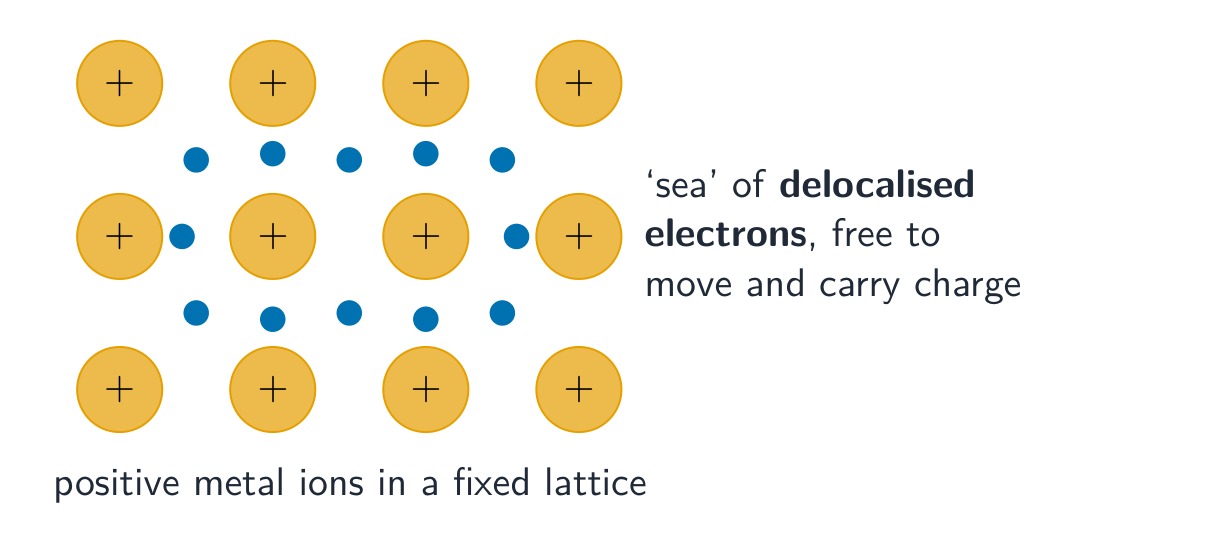
A metal is a giant structure of positive ions surrounded by a 'sea' of delocalised electrons that are free to move through the whole metal. Metallic bonding 金属键 is the strong electrostatic attraction between these positive ions and the sea of electrons.
A metal is positive ions in a 'sea' of delocalised electrons that are free to move and carry charge
This explains two key properties of metals:
Good electrical conductivity: the delocalised electrons are free to move and carry charge through the metal.
Malleability 展性 (can be hammered into sheets) and ductility 延性 (can be pulled into wires): the layers of positive ions can slide over each other without breaking the metallic bond, so the metal changes shape instead of shattering.
Explore · استكشف
Inside a metal — and why it behaves that way · داخل الفلز — ولماذا يتصرف بهذا الشكل
Step through it. Positive ions sit in a shared sea of delocalised electrons — that one picture explains conduction and why metals bend instead of snapping. · خطوات العملية. الأيونات الموجبة تستقر في بحر مشترك من الإلكترونات اللامركزية — هذه الصورة الواحدة تفسر التوصيل ولماذا تنثني المعادن بدلاً من أن تنكسر.
Number of neutrons = mass number − proton number. The proton number is what decides which element an atom is.
Isotopes have the same chemical properties because reactions involve only electrons, and isotopes share the same electron configuration; only the mass differs.
Match structure to properties: ionic = giant lattice (high melting point; conducts only when molten or aqueous); simple molecular = weak forces between molecules (low melting point; no conduction); giant covalent = very hard, very high melting point.
Graphite conducts and is slippery (one free electron per carbon; layers slide); diamond does neither (all four electrons bonded, so hard and non-conducting). Metals conduct and bend thanks to the sea of delocalised electrons.
For relative atomic mass, take the weighted average: $A_r = \dfrac{\sum(\text{isotope mass} \times \text{abundance})}{100}$.
Stoichiometry 化学计量 is the study of the amounts of substances in a reaction — how much reacts and how much is made. This topic is mostly about counting atoms and doing calculations.
العربية
الحساب الكمي هو دراسة كميات المواد في التفاعل — كم يتفاعل وكم يُنتَج. هذا الموضوع يتعلق بشكل رئيسي بعدّ الذرات وإجراء العمليات الحسابية.
3.1
Chemical formulae · الصيغ الكيميائية
Syllabus · المنهج
English
Core
Supplement
1 State the formulae of the elements and compounds named in the subject content
2 Define the molecular formula of a compound as the number and type of different atoms in one molecule
5 Define the empirical formula of a compound as the simplest whole number ratio of the different atoms or ions in a compound
3 Deduce the formula of a simple compound from the relative numbers of atoms present in a model or a diagrammatic representation
6 Deduce the formula of an ionic compound from the relative numbers of the ions present in a model or a diagrammatic representation or from the charges on the ions
4 Construct word equations and symbol equations to show how reactants form products, including state symbols
7 Construct symbol equations with state symbols, including ionic equations
8 Deduce the symbol equation with state symbols for a chemical reaction, given relevant information
العربية
أساسي
تكميلي
1 اذكر صيغ العناصر والمركبات المذكورة في محتوى الموضوع
2 عرّف الصيغة الجزيئية للمركب على أنها عدد ونوع الذرات المختلفة في جزيء واحد
5 عرّف الصيغة الأولية للمركب على أنها أبسط نسبة أعداد صحيحة للذرات أو الأيونات المختلفة في المركب
3 استنتج صيغة المركب البسيط من الأعداد النسبية للذرات الموجودة في نموذج أو تمثيل بياني
6 استنتج صيغة المركب الأيوني من الأعداد النسبية للأيونات الموجودة في نموذج أو تمثيل بياني أو من الشحنات على الأيونات
4 كوّن معادلات لفظية ومعادلات رمزية لتوضيح كيفية تحول المتفاعلات إلى نواتج، بما في ذلك رموز الحالة
7 كوّن معادلات رمزية برموز الحالة، بما في ذلك المعادلات الأيونية
8 استنتج المعادلة الرمزية برموز الحالة لتفاعل كيميائي، بناءً على معلومات ذات صلة
Source: Cambridge International syllabus · المصدر: منهج كامبريدج الدولي
English
A formula 化学式 shows which atoms 原子 are in a substance, and how many of each. There are two kinds of formula you must know.
The molecular formula 分子式 is the actual number of each atom in one molecule 分子. For glucose it is $\text{C}_6\text{H}_{12}\text{O}_6$.
The empirical formula 实验式 is the simplest whole-number ratio 比例 of the atoms or ions 离子 in a compound 化合物. For glucose it is $\text{CH}_2\text{O}$.
Working out a formula
If you are given a model or diagram, just count the atoms of each element and write them as a formula.
For an ionic compound 离子化合物 you can work out the formula from the charges on the ions. The total positive charge must balance the total negative charge, because the compound has no overall charge. Some common ions:
For example, $\text{Na}^{+}$ and $\text{O}^{2-}$: you need two $\text{Na}^{+}$ to balance one $\text{O}^{2-}$, so the formula is $\text{Na}_2\text{O}$.
العربية
الصيغة تُظهر أي الذرات موجودة في المادة، وكم عدد كل نوع منها. هناك نوعان من الصيغ يجب أن تعرفهما.
الصيغة الجزيئية هي العدد الفعلي لكل ذرة في جزيء واحد. بالنسبة للجلوكوز، فهي $\text{C}_6\text{H}_{12}\text{O}_6$.
الصيغة الأولية هي أبسط نسبة بأعداد صحيحة لـالذرات أو الأيونات في المركب. بالنسبة للجلوكوز، فهي $\text{CH}_2\text{O}$.
حساب الصيغة
إذا مُنحت لك نموذجًا أو مخططًا، قم ببساطة بعدّ ذرات كل عنصر واكتبها بصيغة.
بالنسبة لـمركب أيوني، يمكنك استنتاج الصيغة من شحنات الأيونات. يجب أن تتوازن الشحنة الكلية الموجبة مع الشحنة الكلية السالبة، لأن المركب ليس له شحنة إجمالية. بعض الأيونات الشائعة:
على سبيل المثال، $\text{Na}^{+}$ و$\text{O}^{2-}$: تحتاج إلى اثنين من $\text{Na}^{+}$ لتوازن واحدًا من $\text{O}^{2-}$، لذا تكون الصيغة $\text{Na}_2\text{O}$.
بالنسبة للمركب الأيوني، تتقاطع شحنات الأيونات لإعطاء الصيغة (هنا $\text{Al}_2\text{O}_3$)
Explore · استكشف
Formula writing route · طريقة كتابة الصيغة
Follow charges or valencies to a neutral chemical formula. · اتبع الشحنات أو التكافؤ للوصول إلى صيغة كيميائية متعادلة.
You add state symbols 状态符号 in brackets to show the physical state: $(s)$ solid, $(l)$ liquid, $(g)$ gas, and $(aq)$ for aqueous 水溶液 (dissolved in water).
An ionic equation 离子方程式 shows only the ions that actually change. Ions that are the same on both sides are spectator ions 旁观离子 and are left out. For example, when an acid reacts with an alkali:
المعادلة الأيونية تُظهر فقط الأيونات التي تتغير فعليًا. الأيونات المتشابهة على كلا الجانبين تسمى أيونات مشاهدة ويتم استبعادها. على سبيل المثال، عندما يتفاعل حمض مع قاعدة:
Step the coefficients until every element has the same number of atoms on both sides. · غيّر المعاملات حتى يكون لكل عنصر نفس عدد الذرات على كلا الجانبين.
3.2
Relative masses · الكتل النسبية
Syllabus · المنهج
English
Core
Supplement
1 Describe relative atomic mass, $A_r$, as the average mass of the isotopes of an element compared to 1/12th of the mass of an atom of $^{12}\text{C}$
2 Define relative molecular mass, $M_r$, as the sum of the relative atomic masses. Relative formula mass, $M_r$, will be used for ionic compounds
3 Calculate reacting masses in simple proportions. Calculations will not involve the mole concept
العربية
أساسي
تكميلي
1 صف الكتلة الذرية النسبية، $A_r$، بأنها متوسط كتل نظائر العنصر مقارنة بـ 1/12 من كتل ذرة $^{12}\text{C}$
2 عرّف الكتلة الجزيئية النسبية، $M_r$، بأنها مجموع الكتل الذرية النسبية. ستُستخدم الكتلة الصيغية النسبية، $M_r$، للمركبات الأيونية
3 احسب كتل المتفاعلات بنسب بسيطة. لن تتضمن الحسابات مفهوم المول
Source: Cambridge International syllabus · المصدر: منهج كامبريدج الدولي
English
The relative atomic mass 相对原子质量 ($A_r$) of an element 元素 is the average mass 质量 of its atoms compared to $\tfrac{1}{12}$ of the mass of one $^{12}\text{C}$ atom.
The relative molecular mass 相对分子质量 ($M_r$) is the sum of the relative atomic masses of all the atoms in the molecule. For ionic compounds we use the relative formula mass 相对式量, found the same way from the formula.
You can sometimes find a reacting mass without the mole. If 24 g of magnesium makes 40 g of magnesium oxide, then 12 g of magnesium (half as much) makes 20 g of magnesium oxide.
العربية
الميزان المخبري يقيس الكتلة — وهو أساس حسابات المول.
الكتلة الذرية النسبية ($A_r$) لـعنصر هي متوسط كتلة ذراته مقارنة بـ$\tfrac{1}{12}$ من كتلة ذرة واحدة من $^{12}\text{C}$.
الكتلة الجزيئية النسبية ($M_r$) هي مجموع الكتل الذرية النسبية لجميع الذرات الموجودة في الجزيء. بالنسبة للمركبات الأيونية نستخدم الكتلة الصيغية النسبية، يتم الحصول عليها بنفس الطريقة من خلال الصيغة.
$$M_r(\text{H}_2\text{O}) = (2 × 1) + 16 = 18$$
الكتل المتفاعلة بالمقاسب البسيط
يمكنك أحيانًا إيجاد كتلة متفاعلة بدون استخدام المول. إذا أنتجت 24 جرامًا من الماغنيسيوم 40 جرامًا من أكسيد الماغنسيوم، فإن 12 جرامًا من الماغنيسيوم (نصف الكمية) ستنتج 20 جرامًا من أكسيد الماغنسيوم.
Explore · استكشف
Formula mass lab · مختبر كتلة الصيغة
mass = moles x Mr · الكتلة = المولات × الكتلة الجزيئية (Mr)
Change number of formula units and see total mass scale. · غيّر عدد وحدات الصيغة ولاحظ مقياس الكتلة الكلية.
2 State that the mole, mol, is the unit of amount of substance and that one mole contains $6.02 \times 10^{23}$ particles, e.g. atoms, ions, molecules; this number is the Avogadro constant
3 Use the relationship $\text{amount of substance (mol)} = \frac{\text{mass (g)}}{\text{molar mass (g/mol)}}$ to calculate: (a) amount of substance (b) mass (c) molar mass (d) relative atomic mass or relative molecular/formula mass (e) number of particles, using the value of the Avogadro constant
4 Use the molar gas volume, taken as $24\text{ dm}^3$ at room temperature and pressure, r.t.p., in calculations involving gases
1 State that concentration can be measured in $\text{g/dm}^3$ or $\text{mol/dm}^3$
5 Calculate stoichiometric reacting masses, limiting reactants, volumes of gases at r.t.p., volumes of solutions and concentrations of solutions expressed in $\text{g/dm}^3$ and $\text{mol/dm}^3$, including conversion between $\text{cm}^3$ and $\text{dm}^3$
6 Use experimental data from a titration to calculate the moles of solute, or the concentration or volume of a solution
7 Calculate empirical formulae and molecular formulae, given appropriate data
8 Calculate percentage yield, percentage composition by mass and percentage purity, given appropriate data
العربية
أساسي
تكميلي
2 نصّ على أن المول (mol) هو وحدة كمية المادة وأن مولًا واحدًا يحتوي على $6.02 \times 10^{23}$ جسيمات، مثل: الذرات، الأيونات، الجزيئات؛ هذا العدد هو ثابت أفوجادرو
3 استخدم العلاقة $\text{amount of substance (mol)} = \frac{\text{mass (g)}}{\text{molar mass (g/mol)}}$ لحساب: (أ) كمية المادة (ب) الكتلة (ج) الكتلة المولية (د) الكتلة الذرية النسبية أو الكتلة الجزيئية/الصيغية النسبية (هـ) عدد الجسيمات، باستخدام قيمة ثابت أفوجادرو
4 استخدم الحجم المولي للغاز، المأخوذ $24\text{ dm}^3$ عند درجة حرارة الغرفة وضغطها (r.t.p.)، في الحسابات المتعلقة بالغازات
1 اذكر أن التركيز يمكن قياسه بـ $\text{g/dm}^3$ أو $\text{mol/dm}^3$
5 احسب كتل المتفاعلات الستوكيومترية، والمتفاعل المحدد، وحجم الغازات عند درجة حرارة الغرفة وضغطها، وحجم المحاليل، وتركيزات المحاليل المعبرة بـ $\text{g/dm}^3$ و $\text{mol/dm}^3$، بما في ذلك التحويل بين $\text{cm}^3$ و $\text{dm}^3$
6 استخدم البيانات التجريبية من المعايرة لحساب مولات المذاب، أو تركيز أو حجم محلول
7 احسب الصيغ الأولية والصيغ الجزيئية، بناءً على بيانات مناسبة
8 احسب نسبة العائد المئوية، والمكونة المئوية بالكتلة، والنقاء المئوية، بناءً على بيانات مناسبة
Source: Cambridge International syllabus · المصدر: منهج كامبريدج الدولي
English
The mole 摩尔 (symbol mol) is the unit for the amount of substance 物质的量. One mole of any substance contains $6.02 \times 10^{23}$particles 粒子 (atoms, ions or molecules). This number is the Avogadro constant 阿伏伽德罗常数.
The molar mass 摩尔质量 is the mass of one mole, in grams per mole (g/mol). Its number is the same as the $A_r$ or $M_r$. The key relationship is:
$$\text{amount (mol)} = \frac{\text{mass (g)}}{\text{molar mass (g/mol)}}$$
Worked example. How many moles are in 36 g of water? Molar mass of water $= 18$ g/mol.
$$n = \frac{36}{18} = 2 \text{ mol}$$
To find the number of particles, multiply the moles by the Avogadro constant.
Volumes of gases
At room temperature and pressure (r.t.p.), one mole of any gas takes up the same volume 体积. This molar gas volume 摩尔气体体积 is $24 \text{ dm}^3$.
$$\text{volume of gas (dm}^3) = \text{amount (mol)} \times 24$$
Worked example. What volume does $0.25$ mol of carbon dioxide occupy at r.t.p.?
Most calculations follow the same steps: change the known amount into moles, use the balanced equation to find the moles of what you want, then change back into mass, volume or concentration.
Worked example. What mass of magnesium oxide forms when 12 g of magnesium burns completely? $2\text{Mg} + \text{O}_2 \rightarrow 2\text{MgO}$. ($A_r$: Mg $= 24$, O $= 16$.)
Moles of Mg $= 12 / 24 = 0.5$ mol. The ratio Mg : MgO is $1 : 1$, so $0.5$ mol of MgO forms. Its molar mass is $24 + 16 = 40$ g/mol, so the mass is $0.5 \times 40 = 20$ g — the same answer as the simple-proportion method above.
Limiting reactant
When two reactants are mixed, often one runs out first. This is the limiting reactant 限量反应物. It decides how much product can form; any other reactant is in excess (left over).
Worked example. 8 g of hydrogen reacts with 8 g of oxygen: $2\text{H}_2 + \text{O}_2 \rightarrow 2\text{H}_2\text{O}$. Which is the limiting reactant, and what mass of water forms? ($A_r$: H $= 1$, O $= 16$.)
Moles of $\text{H}_2 = 8 / 2 = 4$ mol; moles of $\text{O}_2 = 8 / 32 = 0.25$ mol. The equation needs $2\text{H}_2$ for every one $\text{O}_2$, so $0.25$ mol of $\text{O}_2$ reacts with only $0.5$ mol of $\text{H}_2$. There is far more hydrogen than that, so oxygen is the limiting reactant and the hydrogen is in excess. The oxygen makes $2 \times 0.25 = 0.5$ mol of water, so the mass is $0.5 \times 18 = 9$ g. Always work in moles, not masses — the reactant with the smaller mass is not always the one that runs out.
Titration calculation
In a titration 滴定 you measure the volume of one solution that reacts with another. From the volume and concentration you find the moles of one solute 溶质, then use the equation ratio to find the moles, concentration or volume of the other.
Worked example.$25.0 \text{ cm}^3$ of sodium hydroxide solution is exactly neutralised by $20.0 \text{ cm}^3$ of $0.10 \text{ mol/dm}^3$ hydrochloric acid. $\text{NaOH} + \text{HCl} \rightarrow \text{NaCl} + \text{H}_2\text{O}$. Find the concentration of the sodium hydroxide.
Moles of HCl $= 0.10 \times \dfrac{20.0}{1000} = 0.0020$ mol. The ratio is $1 : 1$, so there are $0.0020$ mol of NaOH in $25.0 \text{ cm}^3$:
To find an empirical formula from masses or percentages:
Divide each element's mass (or %) by its $A_r$.
Divide all the answers by the smallest one to get the simplest ratio.
To find the molecular formula, compare the empirical formula mass with the real $M_r$ and multiply up.
Worked example. A compound contains $40\%$ calcium, $12\%$ carbon and $48\%$ oxygen by mass. Find its empirical formula. ($A_r$: Ca $= 40$, C $= 12$, O $= 16$.)
Divide each percentage by its $A_r$: Ca $= 40/40 = 1$, C $= 12/12 = 1$, O $= 48/16 = 3$. The ratio is $1 : 1 : 3$, so the empirical formula is $\text{CaCO}_3$.
Percentages
Percentage yield 产率 compares how much product you actually got with the most you could get: $\dfrac{\text{actual}}{\text{theoretical}} \times 100$.
Percentage composition by mass 质量分数 of an element $= \dfrac{\text{mass of the element}}{M_r} \times 100$.
Percentage purity 纯度$= \dfrac{\text{mass of pure substance}}{\text{mass of impure sample}} \times 100$.
Worked example. Find the percentage by mass of nitrogen in ammonium nitrate, $\text{NH}_4\text{NO}_3$. ($A_r$: N $= 14$, H $= 1$, O $= 16$.)
$M_r = (2 \times 14) + (4 \times 1) + (3 \times 16) = 80$. The mass of nitrogen is $2 \times 14 = 28$, so
تقيس المعايرة بدقة كمية الحمض التي تتفاعل مع القاعدة.
تتبع معظم الحسابات نفس الخطوات: تحويل الكمية المعروفة إلى مولات، استخدام المعادلة الموزونة لإيجاد عدد مولات المادة المطلوبة، ثم التحويل مرة أخرى إلى كتلة أو حجم أو تركيز.
مثال محلول. ما كتلة أكسيد المغنيسيوم المتكونة عند احتراق 12 جم من المغنيسيوم كلياً؟ $2\text{Mg} + \text{O}_2 \rightarrow 2\text{MgO}$. ($A_r$: Mg $= 24$، O $= 16$.)
مولات Mg $= 12 / 24 = 0.5$ مول. النسبة بين Mg و MgO هي $1 : 1$، لذا يتشكل $0.5$ مول من MgO. كتلتها المولية هي $24 + 16 = 40$ جم/مول، إذن الكتلة هي $0.5 \times 40 = 20$ جم — وهي نفس النتيجة التي نحصل عليها بالطريقة البسيطة للمتناسبيات المذكورة أعلاه.
المتفاعل المحدد
عند خلط متفاعلين، غالباً ما ينتهي أحدهما أولاً. هذا هو المتفاعل المحدد. وهو يحدد كمية المنتج التي يمكن أن تتشكل؛ أما أي متفاعل آخر فهو فائض (يتبقى منه جزء).
ينتهي B أولاً، لذا فهو المتفاعل المحدد ويحدد كمية المنتج المتشكلة؛ أما الفائض من A فيتبقى زائداً
مثال محلول. 8 جم من الهيدروجين تتفاعل مع 8 جم من الأكسجين: $2\text{H}_2 + \text{O}_2 \rightarrow 2\text{H}_2\text{O}$. أيهما المتفاعل المحدد، وما كتلة الماء المتشكلة؟ ($A_r$: H $= 1$، O $= 16$.)
مولات $\text{H}_2 = 8 / 2 = 4$ مول؛ مولات $\text{O}_2 = 8 / 32 = 0.25$ مول. تتطلب المعادلة $2\text{H}_2$ لكل واحد $\text{O}_2$، لذا يتفاعل $0.25$ مول من $\text{O}_2$ مع $0.5$ مول فقط من $\text{H}_2$. هناك هيدروجين أكثر بكثير من ذلك، لذا الأكسجين هو المتفاعل المحدد والهيدروجين فائض. يُنتج الأكسجين $2 \times 0.25 = 0.5$ مول من الماء، إذن الكتلة هي $0.5 \times 18 = 9$ جم. يجب دائماً العمل بالمولات وليس الكتل — فالمتفاعل ذو الكتلة الأصغر ليس بالضرورة الذي ينتهي أولاً.
حساب المعايرة
في المعايرة، تقيس حجم محلول يتفاعل مع محلول آخر. من خلال الحجم والتركيز، تجد عدد مولات أحد المذابات، ثم تستخدم نسبة المعادلة لإيجاد عدد المولات أو التركيز أو الحجم للمادة الأخرى.
مثال محلول.$25.0 \text{ cm}^3$ من محلول هيدروكسيد الصوديوم يتم تعييده تماماً بواسطة $20.0 \text{ cm}^3$ من $0.10 \text{ mol/dm}^3$ حمض الهيدروكلوريك. $\text{NaOH} + \text{HCl} \rightarrow \text{NaCl} + \text{H}_2\text{O}$. أوجد تركيز هيدروكسيد الصوديوم.
مولات HCl $= 0.10 \times \dfrac{20.0}{1000} = 0.0020$ مول. النسبة هي $1 : 1$، لذا يوجد $0.0020$ مول من NaOH في $25.0 \text{ cm}^3$:
حساب المعايرة: المحلول المعروف إلى مولات، النسبة، ثم التركيز المجهول
الصيغ الأولية والجزيئية من البيانات
لإيجاد الصيغة الأولية من الكتل أو النسب المئوية:
قسّم كتلة كل عنصر (أو %) على $A_r$ الخاص به.
قسّم جميع النتائج على أصغر قيمة للحصول على أبسط نسبة.
لإيجاد الصيغة الجزيئية، قارن كتلة الصيغة الأولية بالكتلة $M_r$ الحقيقية واضرب في معامل.
مثال محلول. مركب يحتوي على $40\%$ كالسيوم، و$12\%$ كربون، و$48\%$ أكسجين بالنسبة للكتلة. أوجد صيغته الأولية. ($A_r$: Ca $= 40$، C $= 12$، O $= 16$.)
قسّم كل نسبة مئوية على $A_r$ الخاص بها: Ca $= 40/40 = 1$، C $= 12/12 = 1$، O $= 48/16 = 3$. النسبة هي $1 : 1 : 3$، إذن الصيغة الأولية هي $\text{CaCO}_3$.
النسب المئوية
نسبة العائد المئوية تقارن الكمية الفعلية من المنتج التي حصلت عليها بأقصى كمية كان بإمكانك الحصول عليها: $\dfrac{\text{actual}}{\text{theoretical}} \times 100$.
النسبة المئوية للتكوين الكتلي لعنصر $= \dfrac{\text{mass of the element}}{M_r} \times 100$.
نسبة النقاء المئوية$= \dfrac{\text{mass of pure substance}}{\text{mass of impure sample}} \times 100$.
مثال محلول. أوجد النسبة المئوية للكتلة للنيتروجين في نترات الأمونيوم، $\text{NH}_4\text{NO}_3$. ($A_r$: N $= 14$، H $= 1$، O $= 16$.)
$M_r = (2 \times 14) + (4 \times 1) + (3 \times 16) = 80$. كتلة النيتروجين هي $2 \times 14 = 28$، لذا
Always turn masses, gas volumes and concentrations into moles first, use the balanced equation's ratio, then convert back. Never compare masses directly across an equation.
Key formulas: $n = \dfrac{\text{mass}}{M_r}$, gas volume $= n \times 24\ \text{dm}^3$ at r.t.p., and concentration $= \dfrac{n}{\text{volume in dm}^3}$. Change cm³ to dm³ by dividing by 1000.
To balance a symbol equation you may only change the big numbers in front of a formula, never the small subscripts inside it.
The limiting reactant is the one that runs out (fewest moles once you allow for the ratio); it sets how much product forms. The other reactant is in excess.
Percentage yield = actual ÷ theoretical × 100; percentage purity = mass of pure substance ÷ mass of sample × 100. Both are always 100% or less.
العربية
حوّل دائمًا الكتل وأحجام الغازات والتركيزات إلى مولات أولاً، استخدم نسبة المعادلة الموزونة، ثم أعد التحويل. لا تقارن الكتل مباشرة عبر المعادلة.
الصيغ الأساسية: $n = \dfrac{\text{mass}}{M_r}$، وحجم الغاز $= n \times 24\ \text{dm}^3$ عند r.t.p.، والتركيز $= \dfrac{n}{\text{volume in dm}^3}$. حول cm³ إلى dm³ بالقسمة على 1000.
لتوازن معادلة رمزية، يمكنك تغيير الأرقام الكبيرة أمام الصيغة فقط، ولا تغير أبداً الأرقام الصغيرة السفلية بداخلها.
المتفاعل المحدد هو الذي ينتهي (أقل عدد من المولات بعد مراعاة النسبة)؛ وهو يحدد كمية المنتج المتشكلة. المتفاعل الآخر يكون فائضاً.
نسبة العائد المئوية = الفعلي ÷ النظري × 100؛ نسبة النقاء المئوية = كتلة المادة النقية ÷ كتلة العينة × 100. كلاهما يكون دائماً 100% أو أقل.
1 Define electrolysis as the decomposition of an ionic compound, when molten or in aqueous solution, by the passage of an electric current
8 Describe the transfer of charge during electrolysis to include: (a) the movement of electrons in the external circuit (b) the loss or gain of electrons at the electrodes (c) the movement of ions in the electrolyte
2 Identify in simple electrolytic cells: (a) the anode as the positive electrode (b) the cathode as the negative electrode (c) the electrolyte as the molten or aqueous substance that undergoes electrolysis
3 Identify the products formed at the electrodes and describe the observations made during the electrolysis of: (a) molten lead(II) bromide (b) concentrated aqueous sodium chloride (c) dilute sulfuric acid using inert electrodes made of platinum or carbon/graphite
9 Identify the products formed at the electrodes and describe the observations made during the electrolysis of aqueous copper(II) sulfate using inert carbon/graphite electrodes and when using copper electrodes
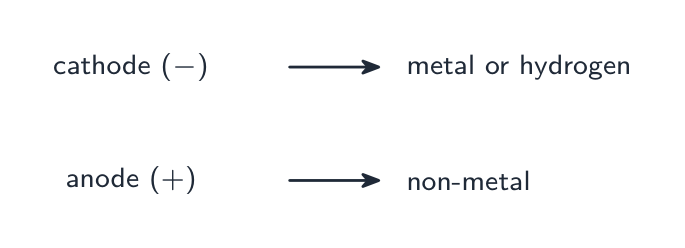
4 State that metals or hydrogen are formed at the cathode and that non-metals (other than hydrogen) are formed at the anode
5 Predict the identity of the products at each electrode for the electrolysis of a binary compound in the molten state
10 Predict the identity of the products at each electrode for the electrolysis of a halide compound in dilute or concentrated aqueous solution
11 Construct ionic half-equations for reactions at the anode (to show oxidation) and at the cathode (to show reduction)
6 State that metal objects are electroplated to improve their appearance and resistance to corrosion
7 Describe how metals are electroplated
العربية
أساسي
تكميلي
1عرّف التحليل الكهربائي بأنه تحلل مركب أيوني، عند انصهاره أو في محلول مائي، بمرور تيار كهربائي
8 صف انتقال الشحنة أثناء التحليل الكهربائي لتشمل: (أ) حركة الإلكترونات في الدائرة الخارجية (ب) فقدان أو اكتساب الإلكترونات عند الأقطاب (ج) حركة الأيونات في المحلول الإلكتروليتي
2 حدد في الخلايا الكهربائية البسيطة: (أ) الأنود كمصعد موجب (ب) الكاثود كمصعد سالب (ج) المحلول الإلكتروليتي كمادة منصهرة أو مائية تخضع للتحليل الكهربائي
3 حدد النواتج المتشكلة عند الأقطاب وصف الملاحظات التي تمت خلال تحليل: (أ) بروميد الرصاص(II) المنصهر (ب) كلوريد الصوديوم المائي المركز (ج) حمض الكبريتيك المخفف باستخدام أقطاب خاملة مصنوعة من البلاتين أو الكربون/الجرافيت
9 حدد النواتج المتشكلة عند الأقطاب وصف الملاحظات التي تمت خلال تحليل كبريتات النحاس(II) المائية باستخدام أقطاب خاملة من الكربون/الجرافيت وعند استخدام أقطاب من النحاس
4 نصّ على أن المعادن أو الهيدروجين تتشكل عند الكاثود وأن اللافلزات (غير الهيدروجين) تتشكل عند الأنود
5 تنبأ بهوية النواتج عند كل مصعد لتحليل مركب ثنائي في الحالة المنصهرة
10 تنبأ بهوية النواتج عند كل مصعد لتحليل مركب هاليد في محلول مائي مخفف أو مركز
11 كوّن معادلات نصف أيونية للتفاعلات عند الأنود (لتوضيح الأكسدة) وعند الكاثود (لتوضيح الاختزال)
6 نصّ على أن الأشياء المعدنية تُطلى كهربائيًا لتحسين مظهرها ومقاومتها للتآكل
7 صف كيفية الطلاء الكهربائي للمعادن
Source: Cambridge International syllabus · المصدر: منهج كامبريدج الدولي
English
Electrolysis: ions discharge at the electrodes
Electrolysis 电解 is the breaking down (decomposition 分解) of an ionic compound 离子化合物 — when it is molten 熔融 or in aqueous 水溶液 solution — by passing an electric current 电流 through it.
It only works when the substance is molten or dissolved, because then the ions 离子 are free to move and carry the charge. A solid ionic compound cannot be electrolysed because its ions are locked in place.
The electrolytic cell
The set-up is called an electrolytic cell 电解池. Two electrodes 电极 (solid conductors) dip into the electrolyte 电解质 — the molten or aqueous substance being broken down.
The anode 阳极 is the positive ($+$) electrode.
The cathode 阴极 is the negative ($-$) electrode.
The electrodes are often inert 惰性 (they do not react), such as platinum 铂 or carbon/graphite 石墨.
What is formed at each electrode
There is a simple rule:
Metals 金属 or hydrogen 氢气 are formed at the cathode.
Non-metals 非金属 (other than hydrogen) are formed at the anode.
For aqueous solutions, the product can depend on whether the solution is dilute 稀 or concentrated 浓. Here are the three Core examples:
Electrolyte
At the cathode ($-$)
At the anode ($+$)
molten lead(II) bromide, $\text{PbBr}_2$
lead 铅 (silvery liquid)
bromine 溴 (red-brown vapour)
concentrated aqueous sodium chloride
hydrogen (bubbles of gas)
chlorine 氯气 (pale green gas)
dilute sulfuric acid 硫酸
hydrogen (bubbles of gas)
oxygen 氧气 (bubbles of gas)
Worked example. Predict the products of electrolysing molten zinc chloride, $\text{ZnCl}_2$. Because it is molten, only zinc ions and chloride ions are present - there is no water to complicate things. Zinc is a metal, so it forms at the cathode: $\text{Zn}^{2+}$ ions gain electrons and silvery zinc appears. Chlorine is a non-metal, so it forms at the anode: pale green chlorine gas bubbles off. Always check the state first. A molten compound simply gives you its own two elements, while an aqueous one brings water into the competition - which is why concentrated sodium chloride solution gives hydrogen at the cathode rather than sodium.
How the charge moves
During electrolysis:
Electrons 电子 move through the wires (the external circuit 外电路) from the power supply.
At the cathode, positive ions gain electrons. Gaining electrons is reduction 还原.
At the anode, negative ions lose electrons. Losing electrons is oxidation 氧化.
Inside the electrolyte, the ions move: positive ions go to the cathode and negative ions go to the anode.
You can write a half-equation 半反应式 for each electrode. For molten lead(II) bromide:
The product at the anode depends on the electrode:
With inert carbon electrodes: copper 铜 forms at the cathode and oxygen forms at the anode. The blue colour of the solution slowly fades as copper is removed.
With copper electrodes: copper forms at the cathode, while the anode itself dissolves into the solution. The blue colour stays the same. This is used to purify copper.
Electroplating
Electroplating 电镀 means covering a metal object with a thin layer of another metal. This improves its appearance and its resistance to corrosion 腐蚀 (rusting and wearing away).
To electroplate an object:
the object to be coated is made the cathode;
the plating metal is made the anode;
the electrolyte is a solution containing ions of the plating metal.
العربية
التحليل الكهربائي: تفريغ الأيونات عند الأقطاب
التحليل الكهربائي هو تكسير (تحلل) مركب أيوني — عندما يكون مسلاً أو في محلول مائي — عن طريق مرور تيار كهربائي خلاله.
خلية التحليل الكهربائي تفصل المركب باستخدام تيار كهربائي.
لا يعمل إلا عندما تكون المادة مسلة أو مذابة، لأن حينها تكون الأيونات حرة الحركة وتحمل الشحنة. لا يمكن تحليل المركب الأيوني الصلب كهربائياً لأن أيونه مقفولة في أماكنها.
تحليل كهربائي للماء: تخرج فقاعات الغاز عند كل قطب وتتجمع في الأنابيب العلوية، مع وجود حوالي ضعف كمية الهيدروجين مقارنة بالأكسجين
الخلية الكهربائية
يُسمى هذا الترتيب الخلية الكهربائية. غوص قطبان (موصلات صلبة) في الإلكتروليت — وهو المادة المصهورة أو المائية التي يتم تفكيكها.
الأنود هو القطب الموجب ($+$).
الكاثود هو القطب السالب ($-$).
غالباً ما تكون الأقطاب خاملة (لا تتفاعل)، مثل البلاتين أو الكربون/الجرافيت.
ما يتكون عند كل قطب
هناك قاعدة بسيطة:
تتشكل المعادن والهيدروجين عند المهبط؛ اللافلزات عند المصعد
تتكون المعادن أو الهيدروجين عند الكاثود.
تتكون غير المعادن (ما عدا الهيدروجين) عند الأنود.
بالنسبة للمحاليل المائية، قد يعتمد الناتج على ما إذا كان المحلول مخففًا أم مركزًا. إليك الأمثلة الأساسية الثلاثة:
الإلكتروليت
عند الكاثود ($-$)
عند الأنود ($+$)
بروميد الرصاص(II) المذاب، $\text{PbBr}_2$
رصاص (سائل فضي اللون)
بروم (بخار أحمر بني)
محلول ملحي مركز
هيدروجين (فقاعات غاز)
كلور (غاز أخضر فاتح)
حمض كبريتيكي مخفف
هيدروجين (فقاعات غاز)
أكسجين (فقاعات غاز)
مثال محلل. تنبأ بنواتج تحليل كلوريد الزنك المذاب، $\text{ZnCl}_2$. بما أنه مذاب، فإن أيونات الزنك وأيونات الكلوريد فقط هي الموجودة - لا يوجد ماء يعقد الأمور. الزنك معدن، لذا يتكون عند الكاثود: أيونات $\text{Zn}^{2+}$ تكتسب إلكترونات ويظهر رصاص فضي اللون. الكلور غير معدني، لذا يتكون عند الأنود: تخرج فقاعات غاز الكلور الأخضر الفاتح. تحقق دائمًا من الحالة أولاً. المركب المذاب يعطيك عناصره المكونة فقط، بينما المركب المائي يُدخل الماء في المنافسة - ولهذا السبب يعطي محلول كلوريد الصوديوم المركز هيدروجين عند الكاثود بدلاً من الصوديوم.
كيف تنتقل الشحنة
أثناء التحليل الكهربائي:
تتحرك الإلكترونات عبر الأسلاك (الدائرة الخارجية) من مصدر الطاقة.
عند الكاثود، تكتسب الأيونات الموجبة إلكترونات. اكتساب الإلكترونات هو اختزال.
عند الأنود، تفقد الأيونات السالبة إلكترونات. فقدان الإلكترونات هو أكسدة.
داخل الإلكتروليت، تتحرك الأيونات: تذهب الأيونات الموجبة إلى الكاثود وتذهب الأيونات السالبة إلى الأنود.
يمكنك كتابة معادلة نصفية لكل قطب. بالنسبة لبروميد الرصاص(II) المذاب:
في بروميد الرصاص(II) المذاب، $\text{Pb}^{2+}$ يتحرك نحو الكاثود و$\text{Br}^-$ نحو الأنود، حيث يتم تفريغ كل منهما
التحليل الكهربائي لكبريتات النحاس(II)
يعتمد الناتج عند الأنود على نوع القطب:
باستخدام أقطاب كربون خاملة: يتكون النحاس عند الكاثود ويتكون الأكسجين عند الأنود. يتلاشى اللون الأزرق للمحلول ببطء مع إزالة النحاس.
باستخدام أقطاب النحاس: يتكون النحاس عند الكاثود، بينما يذوب الأنود نفسه في المحلول. يبقى اللون الأزرق كما هو. يُستخدم هذا لتنقية النحاس.
الطلاء الكهربائي
الطلاء الكهربائي يعني تغطية جسم معدني بطبقة رقيقة من معدن آخر. يحسن هذا مظهره ومقاومته للتآكل (التآكل والصدأ والتلف).
لتطبيق الطلاء الكهربائي على جسم:
يُجعل الجسم المراد طلائه الكاثود;
يُجعل المعدن المُطلّي الأنود;
يكون الإلكتروليت محلولًا يحتوي على أيونات المعدن المُطلّي.
للتطليق الكهربائي، اجعل الجسم مهبطاً ومعدن الطلاء مصعداً، في محلول أيونات معدن الطلاء
Explore · استكشف
Inside an electrolysis cell · داخل خلية التحليل الكهربائي
Pick an electrolyte and watch ions move: positive ions to the cathode, negative ions to the anode. · اختر إلكتروليت وراقب حركة الأيونات: الأيونات الموجبة نحو الكاثود، والأنيونات نحو الأنود.
It is useful to compare a fuel cell with a normal petrol (gasoline) engine in a vehicle.
Hydrogen–oxygen fuel cell
Petrol engine
Main product
water only
carbon dioxide and pollutants 污染物
Effect on air
clean
adds to air pollution
Fuel storage
hydrogen is hard and dangerous to store (flammable, needs high pressure)
petrol is easy to store
Source
hydrogen may be made using fossil fuels
made from crude oil
Advantages of the fuel cell: the only product is water, so it does not pollute the air, and it changes chemical energy into electricity efficiently. Disadvantages: hydrogen is hard to store and transport safely, and producing the hydrogen can still use energy from fossil fuels.
العربية
تستخدم خلية الوقود الهيدروجين والأكسجين لإنتاج الكهرباء مباشرة. المنتج الكيميائي الوحيد هو الماء.
*تحوّل خلية الوقود الهيدروجين-الأكسجين الطاقة الكيميائية مباشرة إلى كهرباء، مع كون الماء هو المنتج الوحيد
من المفيد مقارنة خلية الوقود بمحرك بنزين (وقود) عادي في مركبة.
خلية الوقود الهيدروجين-الأكسجين
محرك البنزين
المنتج الرئيسي
ماء فقط
ثاني أكسيد الكربون والملوثات
تأثير على الهواء
نظيف
يزيد من تلوث الهواء
تخزين الوقود
الهيدروجين صعب وخطير التخزين (قابل للاشتعال، يحتاج ضغطًا عاليًا)
البنزين سهل التخزين
المصدر
يمكن تصنيع الهيدروجين باستخدام الوقود الأحفوري
مصنوع من النفط الخام
مزايا خلية الوقود: المنتج الوحيد هو الماء، لذا فهي لا تلوث الهواء، وتحويل الطاقة الكيميائية إلى كهرباء بكفاءة. عيوب: الهيدروجين صعب التخزين والنقل الآمن، وإنتاج الهيدروجين قد لا يزال يستخدم طاقة من الوقود الأحفوري.
Explore · استكشف
Inside a hydrogen–oxygen fuel cell · داخل خلية الوقود الهيدروجين-الأكسجين
Step through a fuel cell. Hydrogen and oxygen combine to make water, and the energy of that reaction is released as electricity — with no carbon dioxide. · مرحباً بخلايا الوقود. يتحد الهيدروجين والأكسجين لتكوين الماء، وتتم إطلاق طاقة هذا التفاعل على شكل كهرباء — بدون ثاني أكسيد الكربون.
At the cathode (negative) you get a metal or hydrogen; at the anode (positive) you get a non-metal. Positive ions move to the cathode, negative ions to the anode.
A molten compound just gives its two elements. An aqueous solution can give something different (concentrated sodium chloride gives hydrogen and chlorine, not sodium).
Reduction is gain of electrons (at the cathode); oxidation is loss of electrons (at the anode). Remember OIL RIG.
In a half-equation the atoms and the charges must balance, with the electrons on the correct side: $\text{Pb}^{2+} + 2e^- \rightarrow \text{Pb}$ (cathode).
To electroplate an object, make it the cathode, make the plating metal the anode, and use a solution containing ions of the plating metal.
العربية
عند الكاثود (السالب) تحصل على معدن أو هيدروجين؛ عند الأنود (الموجب) تحصل على غير معدني. تهاجر الأيونات الموجبة إلى الكاثود، والأيونات السالبة إلى الأنود.
المركب المصهور يُعطي عندها عنصرينه فقط. أما المحلول المائي فقد يعطي منتجات مختلفة (فمثلاً محلول كلوريد الصوديوم المركز يعطي الهيدروجين والكلور، وليس الصوديوم).
الاختزال هو كسب الإلكترونات (عند الكاثود)؛ والأكسدة هي فقدان الإلكترونات (عند الأنود). تذكر قاعدة OIL RIG.
في معادلة النصف، يجب أن تتساوى الذرات والشحنات، مع وضع الإلكترونات على الجانب الصحيح: $\text{Pb}^{2+} + 2e^- \rightarrow \text{Pb}$ (عند الكاثود).
لـالكهرباء الطلاءية لجسم ما، اجعله كاثوداً، واجعل معدن الطلاء أنوداً، واستخدم محلولاً يحتوي على أيونات هذا المعدن.
5
Chemical energetics · الديناميكا الحرارية الكيميائية
Exothermic and endothermic reactions · التفاعلات الطاردة والماصة للحرارة
Syllabus · المنهج
English
Core
Supplement
1 State that an exothermic reaction transfers thermal energy to the surroundings leading to an increase in the temperature of the surroundings
4 State that the transfer of thermal energy during a reaction is called the enthalpy change, $\Delta H$, of the reaction. $\Delta H$ is negative for exothermic reactions and positive for endothermic reactions
2 State that an endothermic reaction takes in thermal energy from the surroundings leading to a decrease in the temperature of the surroundings
5 Define activation energy, $E_a$, as the minimum energy that colliding particles must have to react
3 Interpret reaction pathway diagrams showing exothermic and endothermic reactions
6 Draw and label reaction pathway diagrams for exothermic and endothermic reactions using information provided, to include: (a) reactants (b) products (c) enthalpy change of the reaction, $\Delta H$ (d) activation energy, $E_a$
7 State that bond breaking is an endothermic process and bond making is an exothermic process and explain the enthalpy change of a reaction in terms of bond breaking and bond making
8 Calculate the enthalpy change of a reaction using bond energies
العربية
أساسي
تكميلي
1 نصّ على أن التفاعل الطارد للحرارة ينقل الطاقة الحرارية إلى المحيط مما يؤدي إلى ارتفاع درجة حرارة المحيط
4 نصّ على أن نقل الطاقة الحرارية أثناء التفاعل يسمى تغير الإنثالبي، $\Delta H$، للتفاعل. $\Delta H$ يكون سالبًا للتفاعلات الطاردة للحرارة وإيجابيًا للتفاعلات الماصة للحرارة
2 نصّ على أن التفاعل الماص للحرارة يمتص الطاقة الحرارية من المحيط مما يؤدي إلى انخفاض درجة حرارة المحيط
5 عرّف طاقة التنشيط، $E_a$، بأنها الحد الأدنى للطاقة التي يجب أن تمتلكها الجسيمات المتصادمة لكي تتفاعل
3 فسّر مخططات مسار التفاعل التي تُظهر التفاعلات الطاردة والماصة للحرارة
6 ارسم ومثّل مخططات مسار التفاعل للتفاعلات الطاردة والماصة للحرارة باستخدام المعلومات المقدمة، وتشمل: (أ) المتفاعلات (ب) النواتج (ج) تغير إنثالبي التفاعل، $\Delta H$ (د) طاقة التنشيط، $E_a$
7 نصّ على أن تكسير الروابط عملية ماصة للحرارة وتكوين الروابط عملية طاردة للحرارة واشرح تغير الإنثالبي للتفاعل بدلالة تكسير وتكوين الروابط
8 احسب تغير الإنثالبي للتفاعل باستخدام طاقات الروابط
Source: Cambridge International syllabus · المصدر: منهج كامبريدج الدولي
English
Reaction profile: exothermic energy change
In every chemical reaction, energy is transferred. The reaction is either exothermic or endothermic, depending on which way the energy moves.
An exothermic reaction 放热反应 gives out thermal energy 热能 to the surroundings 环境. So the temperature of the surroundings goes up.
An endothermic reaction 吸热反应 takes in thermal energy from the surroundings. So the temperature of the surroundings goes down.
Examples of exothermic reactions are combustion 燃烧 (burning a fuel) and neutralisation 中和 (an acid reacting with an alkali). An example of an endothermic reaction is the thermal decomposition 分解 of a compound (breaking it down using heat).
العربية
منحنى التفاعل: تغير الطاقة في تفاعل طارد للحرارةحرق الخشب تفاعل طارد للحرارة، حيث يطلق الحرارة إلى المحيط.
في كل تفاعل كيميائي، يتم نقل الطاقة. يكون التفاعل إما طارداً أو ماصاً للحرارة، اعتماداً على اتجاه انتقال الطاقة.
التفاعل الطارد للحرارة يُطلق طاقة حرارية إلى المحيط. لذلك ترتفع درجة حرارة المحيط أعلى.
التفاعل الماص للحرارة يمتص طاقة حرارية من المحيط. لذلك تنخفض درجة حرارة المحيط أسفل.
أمثلة على التفاعلات الطاردة للحرارة هي الاحتراق (حرق وقود) والتعادل (تفاعل حمض مع قاعد). ومثال على التفاعل الماص للحرارة هو التحلل الحراري للمركبات (تفكيكه باستخدام الحرارة).
Exothermic drops to lower-energy products (releases heat); endothermic climbs to higher. · الطارد للحرارة ينخفض إلى نواتج أقل طاقة (يطلق الحرارة); الامتصاصي للحرارة يرتفع إلى أعلى.
The amount of thermal energy transferred in a reaction is called the enthalpy change 焓变. It is written as $\Delta H$ and has these signs:
$\Delta H$ is negative for an exothermic reaction, because energy leaves the chemicals.
$\Delta H$ is positive for an endothermic reaction, because energy is taken in.
العربية
كمية الطاقة الحرارية المنقولة في التفاعل تُسمى تغير الإنثالبي. يُكتب $\Delta H$ وله هذه الإشارات:
$\Delta H$ يكون سالباً للتفاعل الطارد للحرارة، لأن الطاقة تترك المواد الكيميائية.
$\Delta H$ يكون إيجابياً للتفاعل الماص للحرارة، لأن الطاقة تُمتص.
لهب بنزن يزود بالطاقة: تغير الإنثالبي ΔH هو الحرارة المنقولة عند ضغط ثابت
5.1
Activation energy · طاقة التنشيط
English
Particles do not react every time they meet. The activation energy 活化能 ($E_a$) is the smallest amount of energy that colliding 碰撞particles 粒子 must have before they can react. It is like a hill the particles must get over before the reaction can happen.
العربية
الجسيمات لا تتفاعل كلما تلاقى بعضها البعض. طاقة التنشيط ($E_a$) هي أقل مقدار من الطاقة التي يجب أن تمتلكها الجسيمات المتصادمة قبل أن تتمكن من التفاعل. تشبه تلًا يجب على الجسيمات تجاوزه حتى يحدث التفاعل.
Explore · استكشف
Activation energy · طاقة التنشيط
Ea = the energy barrier · Ea = حاجز الطاقة
Every reaction must climb the activation-energy barrier before products can form. · يجب على كل تفاعل تسلق حاجز طاقة التنشيط قبل أن تتكون النواتج.
5.1
Reaction pathway diagrams · مخططات مسار التفاعل
English
A reaction pathway diagram 反应进程图 shows how the energy changes as a reaction happens. Energy is on the vertical axis, and the progress of the reaction is on the horizontal axis.
The line starts at the energy level of the reactants 反应物.
It rises over a 'hill' — the height of this hill is the activation energy $E_a$.
It then falls or rises to the energy level of the products 生成物.
The gap between the reactant level and the product level is the enthalpy change $\Delta H$.
For an exothermic reaction, the products are lower than the reactants, so energy is given out and $\Delta H$ is negative.
For an endothermic reaction, the products are higher than the reactants, so energy is taken in and $\Delta H$ is positive.
العربية
مخطط مسار التفاعل يوضح كيف تتغير الطاقة أثناء حدوث التفاعل. الطاقة على المحور الرأسي، وتقدم التفاعل على المحور الأفقي.
يبدأ الخط عند مستوى طاقة المواد المتفاعلة.
يرتفع فوق 'تل' — ارتفاع هذا التل هو طاقة التنشيط $E_a$.
ثم ينخفض أو يرتفع ليصل إلى مستوى طاقة النواتج.
المسافة بين مستوى المادة المتفاعلة ومستوى النواتج هي تغير الإنثالبي $\Delta H$.
بالنسبة لتفاعل طارد للحرارة، تكون النواتج أقل من المتفاعلات، لذلك تُطلق الطاقة وتكون $\Delta H$ سالبة.
بالنسبة لتفاعل ماص للحرارة، تكون النواتج أعلى من المتفاعلات، لذلك تُمتص الطاقة وتكون $\Delta H$ موجبة.
تنتهي التفاعلات الطاردة للحرارة أدنى مما بدأت ($\Delta H<0$)؛ وتنتهي التفاعلات الماصة للحرارة أعلى ($\Delta H>0$)
Explore · استكشف
Reaction pathway diagrams · مخططات مسار التفاعل
Drag ΔH and the activation energy. Exothermic releases energy; endothermic takes it in; the hump is the energy barrier. · اسحب ΔH وطاقة التنشيط. طارد للحرارة يُطلق الطاقة؛ ماص للحرارة يمتصها؛ القوس هو حاجز الطاقة.
5.1
Bonds and energy · الروابط والطاقة
English
A reaction involves breaking the bonds in the reactants and making new bonds in the products.
Bond breaking 断键 takes in energy, so it is an endothermic step.
Bond making 成键 gives out energy, so it is an exothermic step.
The bond energy 键能 is the energy needed to break one mole of a particular bond. You can use bond energies to find the enthalpy change:
$$\Delta H = (\text{energy to break all bonds}) - (\text{energy released making all bonds})$$
If more energy is given out making bonds than is taken in breaking bonds, the reaction is exothermic ($\Delta H$ negative). If less energy is given out, it is endothermic ($\Delta H$ positive).
Worked example
For the reaction $\text{H}_2 + \text{Cl}_2 \rightarrow 2\text{HCl}$, use these bond energies (in kJ/mol): H–H $= 436$, Cl–Cl $= 242$, H–Cl $= 431$.
Bonds broken: one H–H and one Cl–Cl $= 436 + 242 = 678$.
Bonds made: two H–Cl $= 2 \times 431 = 862$.
$$\Delta H = 678 - 862 = -184 \text{ kJ/mol}$$
The answer is negative, so this reaction is exothermic.
العربية
تكسر الروابط وتشكيلها ينقل الطاقة — اللهب يزود بها هنا.
التفاعل يتضمن كسر الروابط في المواد المتفاعلة وتشكيل روابط جديدة في النواتج.
كسر الروابط يمتص الطاقة، لذا هو خطوة ماصة للحرارة.
تشكيل الروابط يُطلق الطاقة، لذا هو خطوة طاردة للحرارة.
طاقة الرابطة هي الطاقة اللازمة لكسر مول واحد من رابطة معينة. يمكنك استخدام طاقات الروابط لإيجاد تغير الإنثالبي:
$$\Delta H = (\text{energy to break all bonds}) - (\text{energy released making all bonds})$$
إذا طُلت طاقة أكبر عند تشكيل الروابط مما امتُص عند كسرها، يكون التفاعل طارداً للحرارة ($\Delta H$ سالب). وإذا طُلت طاقة أقل، يكون ماصاً للحرارة ($\Delta H$ موجب).
Exothermic gives out heat, so the surroundings warm up and $\Delta H$ is negative; endothermic takes in heat, so the surroundings cool and $\Delta H$ is positive.
Bond breaking takes energy in (endothermic); bond making gives energy out (exothermic). Use $\Delta H = (\text{energy to break bonds}) - (\text{energy released making bonds})$.
If more energy is released making bonds than is used breaking them, the reaction is exothermic. Always check the sign of your final answer.
On a reaction pathway diagram, an exothermic reaction ends lower than it starts; an endothermic one ends higher. The height of the hill is the activation energy.
العربية
الطارِد للحرارة يُطلق الحرارة، فيدفئ المحيط ويكون $\Delta H$سالباً؛ والماص للحرارة يمتصها، فتبرد المحيط ويكون $\Delta H$موجباً.
كسر الروابط يمتص طاقة (ماص للحرارة)؛ وتشكيل الروابط يُطلق طاقة (طارِد للحرارة). استخدم $\Delta H = (\text{energy to break bonds}) - (\text{energy released making bonds})$.
إذا طُلت طاقة أكبر عند تشكيل الروابط مما استُهلك في كسرها، يكون التفاعل طارداً للحرارة. تحقق دائماً من إشارة إجابتك النهائية.
في مخطط مسار التفاعل، ينتهي التفاعل الطارد للحرارة أدنى مما بدأ منه؛ والماص ينتهي أعلى. ارتفاع التل هو طاقة التنشيط.
1 Identify physical and chemical changes, and describe the differences between them
العربية
أساسي
تكميلي
1 حدد التغيرات الفيزيائية والكيميائية، وصف الفروقات بينهما
Source: Cambridge International syllabus · المصدر: منهج كامبريدج الدولي
Iron rusting is a chemical change — it forms a new substance.
A physical change 物理变化 does not make a new substance. The substance only changes its state or shape, and the change can usually be reversed. Melting ice and dissolving sugar are physical changes.
A chemical change 化学变化 (a chemical reaction) makes one or more new substances and is usually hard to reverse. Signs of a chemical change include a colour change, a gas being given off, an energy change, or a precipitate 沉淀 (a solid) forming.
Physical change
Chemical change
no new substance made
new substance(s) made
easy to reverse
usually hard to reverse
e.g. melting, boiling, dissolving
e.g. burning, rusting
Explore · استكشف
Physical change vs chemical change · التغير الفيزيائي مقابل التغير الكيميائي
Step through the difference. A physical change makes no new substance and is usually easy to reverse; a chemical change makes a new substance and is hard to undo. · مرحباً بالفرق. التغير الفيزيائي لا ينتج مادة جديدة وعادة ما يكون سهل العكس؛ التغير الكيميائي ينتج مادة جديدة وصعب عكسه.
5 Describe collision theory in terms of: (a) number of particles per unit volume (b) frequency of collisions between particles (c) kinetic energy of particles (d) activation energy, $E_a$
1 Describe the effect on the rate of reaction of: (a) changing the concentration of solutions (b) changing the pressure of gases (c) changing the surface area of solids (d) changing the temperature (e) adding or removing a catalyst, including enzymes
6 Describe and explain the effect on the rate of reaction of: (a) changing the concentration of solutions (b) changing the pressure of gases (c) changing the surface area of solids (d) changing the temperature (e) adding or removing a catalyst, including enzymes using collision theory
2 State that a catalyst increases the rate of a reaction and is unchanged at the end of a reaction
7 State that a catalyst decreases the activation energy, $E_a$, of a reaction
3 Describe practical methods for investigating the rate of a reaction including change in mass of a reactant or a product and the formation of a gas
8 Evaluate practical methods for investigating the rate of a reaction including change in mass of a reactant or a product and the formation of a gas
4 Interpret data, including graphs, from rate of reaction experiments
العربية
أساسي
تكميلي
5 صف نظرية التصادم من حيث: (أ) عدد الجسيمات في وحدة الحجم (ب) تكرار التصادمات بين الجسيمات (ج) الطاقة الحركية للجسيمات (د) طاقة التنشيط، $E_a$
1 صف التأثير على معدل التفاعل عند: (أ) تغيير تركيز المحاليل (ب) تغيير ضغط الغازات (ج) تغيير مساحة سطح المواد الصلبة (د) تغيير درجة الحرارة (هـ) إضافة أو إزالة عامل حفاز، بما في ذلك الإنزيمات
6 صف واشرح التأثير على معدل التفاعل عند: (أ) تغيير تركيز المحاليل (ب) تغيير ضغط الغازات (ج) تغيير مساحة سطح المواد الصلبة (د) تغيير درجة الحرارة (هـ) إضافة أو إزالة عامل حفاز، بما في ذلك الإنزيمات باستخدام نظرية التصادم
2 نص أن العامل الحفاز يزيد من معدل التفاعل ويبقى دون تغير في نهاية التفاعل
7 نص أن العامل الحفاز يقلل من طاقة التنشيط، $E_a$، للتفاعل
3 صف الطرق العملية للتحقيق في معدل التفاعل بما في ذلك التغير في كتلة مادة متفاعلة أو ناتج وتكوين غاز
8 قيّم الطرق العملية للتحقيق في معدل التفاعل بما في ذلك التغير في كتلة مادة متفاعلة أو ناتج وتكوين غاز
4 فسر البيانات، بما في ذلك الرسوم البيانية، من تجارب معدل التفاعل
Source: Cambridge International syllabus · المصدر: منهج كامبريدج الدولي
Collision theory: energy and orientation
The rate of reaction 反应速率 tells you how fast the reactants 反应物 change into products 生成物.
Collision theory
Collision theory 碰撞理论 explains what controls the rate. For a reaction to happen, the particles 粒子 must collide 碰撞, and they must collide with enough energy. The least energy they need is the activation energy 活化能 ($E_a$). A faster rate happens when the particles have successful collisions more often.
What changes the rate
Change
Effect
Reason (collision theory)
increase concentration 浓度 of a solution
faster
more particles in the same volume, so collisions happen more often
increase pressure 压强 of gases
faster
particles are pushed closer, so collisions happen more often
increase surface area 表面积 of a solid
faster
more particles are exposed, so collisions happen more often
increase temperature
faster
particles gain kinetic energy 动能 and move faster, so collisions are more frequent and more of them have enough energy
add a catalyst 催化剂
faster
the catalyst lowers the activation energy, so more collisions are successful
More particles in the same volume collide more often, so the rate is fasterBreaking a solid into a powder exposes much more surface, so the rate is faster
Catalysts
A catalyst speeds up a reaction but is not used up — it is unchanged at the end. It works by lowering the activation energy. Enzymes 酶 are biological catalysts (catalysts that work in living things).
A catalyst gives a lower activation energy so more collisions succeed; $\Delta H$ is unchanged
Measuring the rate
You can follow a reaction over time in these ways:
Change in mass: stand the flask on a balance. If a gas escapes, the mass falls. Record the mass at regular times.
Volume of gas: collect the gas in a gas syringe 注射器 and read its volume at regular times.
Formation of a precipitate: in a reaction that turns cloudy, time how long it takes for a mark under the flask to disappear.
A gas syringe collects the gas given off; read its volume at regular times to follow the rate
On a graph of product against time, the line is steepest at the start (fastest rate), becomes less steep as reactants are used up, and goes flat when the reaction has finished.
The rate is fastest at the start (steepest) and the line levels off when the reaction finishes
Explore · استكشف
Rate from a gas-volume graph · السرعة من الرسم البياني لحجم الغاز
The gradient of the volume–time curve is the rate; it is steepest at the start and flattens as reactants run out. · ميل منحنى الحجم-الزمن هو السرعة؛ تكون حادة في البداية وتتسطح مع استهلاك المتفاعلات.
Explore · استكشف
Rate of reaction · سرعة التفاعل
conc = c₀·bᵗ
Concentration falls over time — fast at first, then slower. · تركيز ينخفض بمرور الوقت — بسرعة في البداية، ثم أبطأ.
Explore · استكشف
Collision theory in action · نظرية التصادم في العمل
Watch the particles collide. Heat speeds them up so they collide more often and harder; more particles or a catalyst give more successful collisions — the rate climbs. · شاهد الجسيمات تصطدم. الحرارة تسرعها فتتصادم بشكل أكثر تكرارًا وأقوى؛ زيادة عدد الجسيمات أو استخدام محفز يعطي تصادمات ناجحة أكثر — فترتفع السرعة.
1 State that some chemical reactions are reversible as shown by the symbol $\rightleftharpoons$
3 State that a reversible reaction in a closed system is at equilibrium when: (a) the rate of the forward reaction is equal to the rate of the reverse reaction (b) the concentrations of reactants and products are no longer changing
2 Describe how changing the conditions can change the direction of a reversible reaction for: (a) the effect of heat on hydrated compounds (b) the addition of water to anhydrous compounds limited to copper(II) sulfate and cobalt(II) chloride
4 Predict and explain, for a reversible reaction, how the position of equilibrium is affected by: (a) changing temperature (b) changing pressure (c) changing concentration (d) using a catalyst using information provided
5 State the symbol equation for the production of ammonia in the Haber process, $\text{N}_2\text{(g)} + 3\text{H}_2\text{(g)} \rightleftharpoons 2\text{NH}_3\text{(g)}$
6 State the sources of the hydrogen (methane) and nitrogen (air) in the Haber process
7 State the typical conditions in the Haber process as $450\text{ }^{\circ}\text{C}$, $20\,000\text{ kPa}/200\text{ atm}$ and an iron catalyst
8 State the symbol equation for the conversion of sulfur dioxide to sulfur trioxide in the Contact process, $2\text{SO}_2\text{(g)} + \text{O}_2\text{(g)} \rightleftharpoons 2\text{SO}_3\text{(g)}$
9 State the sources of the sulfur dioxide (burning sulfur or roasting sulfide ores) and oxygen (air) in the Contact process
10 State the typical conditions for the conversion of sulfur dioxide to sulfur trioxide in the Contact process as $450\text{ }^{\circ}\text{C}$, $200\text{ kPa}/2\text{ atm}$ and a vanadium(V) oxide catalyst
11 Explain, in terms of rate of reaction and position of equilibrium, why the typical conditions stated are used in the Haber process and in the Contact process, including safety considerations and economics
العربية
أساسي
تكميلي
1 نص أن بعض التفاعلات الكيميائية عكوسة كما يوضح الرمز $\rightleftharpoons$
3 نص أن التفاعل العكوس في نظام مغلق يكون في حالة توازن عندما: (أ) يكون معدل التفاعل الأمامي مساويًا لمعدل التفاعل العكسي (ب) لم تعد تراكيز المتفاعلات والنواتج تتغير
2 صف كيف يمكن لتغيير الظروف أن يغير اتجاه التفاعل العكوس لـ: (أ) تأثير الحرارة على المركبات المائية (ب) إضافة الماء إلى المركبات اللامائية مقتصرة على كبريتات النحاس(II) وكلوريد الكوبالت(II)
4 تنبأ واشرح، للتفاعل العكوس، كيف يتأثر موضع التوازن بـ: (أ) تغيير درجة الحرارة (ب) تغيير الضغط (ج) تغيير التركيز (د) استخدام عامل حفاز باستخدام المعلومات المقدمة
5 نص معادلة الرموز لإنتاج الأمونيا في عملية هابر، $\text{N}_2\text{(g)} + 3\text{H}_2\text{(g)} \rightleftharpoons 2\text{NH}_3\text{(g)}$
6 نص مصادر الهيدروجين (الميثان) والنيتروجين (الهواء) في عملية هابر
7 نص الظروف النموذجية في عملية هابر وهي $450\text{ }^{\circ}\text{C}$، $20\,000\text{ kPa}/200\text{ atm}$ وعامل حفاز من الحديد
8 نص معادلة الرموز لتحويل ثاني أكسيد الكبريت إلى ثلاثي أكسيد الكبريت في عملية التلامس، $2\text{SO}_2\text{(g)} + \text{O}_2\text{(g)} \rightleftharpoons 2\text{SO}_3\text{(g)}$
9 نص مصادر ثاني أكسيد الكبريت (حرق الكبريت أو تحميص خامات الكبريتيدات) والأكسجين (الهواء) في عملية التلامس
10 نص الظروف النموذجية لتحويل ثاني أكسيد الكبريت إلى ثلاثي أكسيد الكبريت في عملية التلامس وهي $450\text{ }^{\circ}\text{C}$، $200\text{ kPa}/2\text{ atm}$ وعامل حفاز من أكسيد الفاناديوم(V)
11 اشرح، من حيث معدل الت位置和 وموضع التوازن، لماذا تُستخدم الظروف النموذجية المذكورة في عملية هابر وفي عملية التلامس، بما في ذلك اعتبارات السلامة والاقتصاديات
Source: Cambridge International syllabus · المصدر: منهج كامبريدج الدولي
Le Chatelier's principleDynamic equilibrium: the rates converge
Some reactions are reversible 可逆反应: the products can react to form the reactants again. We show this with the symbol $\rightleftharpoons$.
Heating blue copper sulfate drives off water; adding water turns it blue again
Changing the direction
A clear example uses hydrated 水合 and anhydrous 无水 compounds:
Blue hydrated copper(II) sulfate, when heated, loses its water to become white anhydrous copper(II) sulfate. Adding water turns it blue again.
Pink hydrated cobalt(II) chloride loses water when heated to become blue anhydrous cobalt(II) chloride. Adding water turns it pink again.
Adding water to the anhydrous solid (and seeing the colour return) is used as a test for water.
Equilibrium
In a closed system 密闭系统 (where nothing enters or leaves), a reversible reaction reaches equilibrium 平衡 when:
the rate of the forward reaction 正反应 equals the rate of the reverse reaction 逆反应, and
the concentrations of the reactants and products are no longer changing.
Changing the position of equilibrium
The position of equilibrium 平衡位置 tells you whether there are more reactants or more products. You can move it:
Temperature: heating moves the equilibrium in the direction that takes in heat (the endothermic 吸热反应 direction); cooling moves it in the direction that gives out heat (the exothermic 放热反应 direction).
Pressure (gases): more pressure moves the equilibrium to the side with fewer gas molecules.
Concentration: adding more of a substance moves the equilibrium to the other side, to use it up.
A catalyst does not move the position of equilibrium. It only helps the reaction reach equilibrium faster.
The sulfur dioxide comes from burning sulfur 硫 (or roasting sulfide ores); the oxygen 氧气 comes from the air.
Typical conditions: a temperature of $450\,{}^{\circ}\text{C}$, a pressure of about $2$ atm ($200$ kPa), and a vanadium(V) oxide 五氧化二钒 catalyst.
Why these conditions are chosen
The conditions are a compromise 折中:
A higher pressure would give more product, but very high pressure is dangerous and expensive, so a medium pressure is used.
A lower temperature would give more product (both forward reactions are exothermic), but the reaction would be too slow, so a fairly high temperature is used to keep a good rate.
The catalyst speeds up the reaction without changing the position of equilibrium, which lowers cost.
Explore · استكشف
Shifting an equilibrium · إزاحة التوازن
Change temperature, pressure or concentration and watch a reversible reaction shift to a new balance. · غيّر درجة الحرارة أو الضغط أو التركيز وراقب تفاعل عكسي ينزاح لتوازن جديد.
1 Use a Roman numeral to indicate the oxidation number of an element in a compound
2 Define redox reactions as involving simultaneous oxidation and reduction
3 Define oxidation as gain of oxygen and reduction as loss of oxygen
6 Define oxidation in terms of: (a) loss of electrons (b) an increase in oxidation number
7 Define reduction in terms of: (a) gain of electrons (b) a decrease in oxidation number
4 Identify redox reactions as reactions involving gain and loss of oxygen
8 Identify redox reactions as reactions involving gain and loss of electrons
5 Identify oxidation and reduction in redox reactions
9 Identify redox reactions by changes in oxidation number using: (a) the oxidation number of elements in their uncombined state is zero (b) the oxidation number of a monatomic ion is the same as the charge on the ion (c) the sum of the oxidation numbers in a compound is zero (d) the sum of the oxidation numbers in an ion is equal to the charge on the ion
10 Identify redox reactions by the colour changes involved when using acidified aqueous potassium manganate(VII) or aqueous potassium iodide
11 Define an oxidising agent as a substance that oxidises another substance and is itself reduced
12 Define a reducing agent as a substance that reduces another substance and is itself oxidised
13 Identify oxidising agents and reducing agents in redox reactions
العربية
أساسي
تكميلي
1 استخدم رقماً رومانياً للدلالة على عدد تأكسد عنصر في مركب
2 عرّف تفاعلات الأكسدة والاختزال بأنها تتضمن أكسدة واختزالاً متزامنين
3 عرّف الأكسدة بأنها اكتساب الأكسجين والاختزال بأنه فقدان الأكسجين
6 عرّف الأكسدة من حيث: (أ) فقدان الإلكترونات (ب) زيادة عدد التأكسد
7 عرّف الاختزال من حيث: (أ) اكتساب الإلكترونات (ب) انخفاض عدد التأكسد
4 حدد تفاعلات الأكسدة والاختزال بأنها تفاعلات تتضمن اكتساب وفقدان الأكسجين
8 حدد تفاعلات الأكسدة والاختزال بأنها تفاعلات تتضمن اكتساب وفقدان الإلكترونات
5 حدد الأكسدة والاختزال في تفاعلات الأكسدة والاختزال
9 حدد تفاعلات الأكسدة والاختزال عن طريق التغيرات في عدد التأكسد باستخدام: (أ) عدد تأكسد العناصر في حالتها غير المدمجة هو صفر (ب) عدد تأكسد أيون أحادي الذرة هو نفسه شحنة الأيون (ج) مجموع أعداد التأكسد في المركب يساوي صفر (د) مجموع أعداد التأكسد في الأيون يساوي شحنة الأيون
10 حدد تفاعلات الأكسدة والاختزال عن طريق تغيرات اللون المصاحبة عند استخدام برمنغنات البوتاسيوم(VII) المائية الحمضية أو يوديد البوتاسيوم المائية
11 عرّف العامل المؤكسد بأنه مادة تؤكسد مادة أخرى وتختزل نفسها
12 عرّف العامل المختزل بأنه مادة تختزل مادة أخرى وتتأكسد نفسها
13 حدد العوامل المؤكسدة والمختزلة في تفاعلات الأكسدة والاختزال
Source: Cambridge International syllabus · المصدر: منهج كامبريدج الدولي
Oxidation 氧化 and reduction 还原 always happen at the same time, in what is called a redox reaction 氧化还原反应. ('Redox' is short for reduction–oxidation.)
There are three ways to describe oxidation and reduction:
Oxygen: oxidation is the gain of oxygen; reduction is the loss of oxygen.
Electrons 电子: oxidation is the loss of electrons; reduction is the gain of electrons.
Oxidation number 氧化数: in oxidation the oxidation number goes up; in reduction it goes down.
A useful memory aid is OIL RIG: Oxidation Is Loss, Reduction Is Gain — of electrons.
Electrons pass from the substance that is oxidised (loses them) to the one that is reduced (gains them) — the two always happen together
Oxidation number rules
The oxidation number is shown by a Roman numeral, as in iron(II) and iron(III). The rules are:
An element that is not combined has an oxidation number of $0$.
A single-atom ion has an oxidation number equal to its charge (so $\text{Na}^{+}$ is $+1$).
The oxidation numbers in a compound add up to $0$.
The oxidation numbers in an ion add up to the charge on the ion.
Worked example. Find the oxidation number of manganese in the manganate(VII) ion, $\text{MnO}_4^{-}$. Each oxygen is $-2$, and there are four of them, giving $4 \times (-2) = -8$. The oxidation numbers in an ion must add up to the charge on the ion, which here is $-1$. So if manganese is $x$, then $x + (-8) = -1$, giving $x = +7$ - exactly what the (VII) in the name tells you. Set the total to the ion's charge, not to zero: zero is only for a neutral compound.
Oxidising and reducing agents
An oxidising agent 氧化剂 oxidises another substance, and is itself reduced.
A reducing agent 还原剂 reduces another substance, and is itself oxidised.
Some redox reactions show clear colour changes:
Acidified potassium manganate(VII) 高锰酸钾 is purple. When it acts as an oxidising agent it is reduced, and the purple colour fades to colourless.
Potassium iodide 碘化钾 is colourless. When it is oxidised, red-brown iodine 碘 is formed.
Potassium manganate(VII) is deep purple; as it is reduced (or diluted) the purple fades to colourless
Explore · استكشف
Oxidation and reduction happen together · الأكسدة والاختزال يحدثان معًا
Step through a redox reaction. One substance loses electrons while another gains them — you can never have one without the other. · مرر بخطوات تفاعل الأكسدة والاختزال. تفقد مادة إلكترونات بينما تكتسب أخرى — لا يمكنك الحصول على أحدهما دون الآخر.
Explain a faster rate with collision theory: successful collisions happen more often. Concentration, pressure and surface area all raise how often particles collide; a higher temperature does that and gives more particles enough energy.
A catalyst lowers the activation energy and speeds the reaction up, but is not used up and does not change $\Delta H$ or the position of equilibrium.
At equilibrium the forward and reverse rates are equal and the concentrations stop changing — it does not mean the amounts of reactant and product are equal.
Use Le Chatelier's principle: raising temperature favours the endothermic direction; raising pressure favours the side with fewer gas molecules; adding a substance shifts the equilibrium away from it.
Redox — OIL RIG: Oxidation Is Loss, Reduction Is Gain of electrons. They always happen together, and an oxidising agent is itself reduced.
7
Acids, bases and salts · الأحماض والقواعد والأملاح
1 Describe the characteristic properties of acids in terms of their reactions with: (a) metals (b) bases (c) carbonates
2 Describe acids in terms of their effect on: (a) litmus (b) thymolphthalein (c) methyl orange
3 State that bases are oxides or hydroxides of metals and that alkalis are soluble bases
4 Describe the characteristic properties of bases in terms of their reactions with: (a) acids (b) ammonium salts
5 Describe alkalis in terms of their effect on: (a) litmus (b) thymolphthalein (c) methyl orange
6 State that aqueous solutions of acids contain $\text{H}^+$ ions and aqueous solutions of alkalis contain $\text{OH}^-$ ions
9 Define acids as proton donors and bases as proton acceptors
10 Define a strong acid as an acid that is completely dissociated in aqueous solution and a weak acid as an acid that is partially dissociated in aqueous solution
11 State that hydrochloric acid is a strong acid, as shown by the symbol equation, $\text{HCl}(\text{aq}) \rightarrow \text{H}^+(\text{aq}) + \text{Cl}^-(\text{aq})$
12 State that ethanoic acid is a weak acid, as shown by the symbol equation, $\text{CH}_3\text{COOH}(\text{aq}) \rightleftharpoons \text{H}^+(\text{aq}) + \text{CH}_3\text{COO}^-(\text{aq})$
7 Describe how to compare hydrogen ion concentration, neutrality, relative acidity and relative alkalinity in terms of colour and pH using universal indicator paper
8 Describe the neutralisation reaction between an acid and an alkali to produce water, $\text{H}^+(\text{aq}) + \text{OH}^-(\text{aq}) \rightarrow \text{H}_2\text{O}(l)$
العربية
أساسي
تكميلي
1 صف الخصائص المميزة للأحماض من حيث تفاعلاتها مع: (أ) المعادن (ب) القواعد (ج) الكربونات
2 صف الأحماض من حيث تأثيرها على: (أ) ورقة تباعث (ب) ثيمولفثالين (ج) برتقالي الميثيل
3 نص أن القواعد هي أكاسيد أو هيدروكسيدات المعادن وأن القلويات هي قواعد قابلة للذوبان
4 صف الخصائص المميزة للقواعد من حيث تفاعلاتها مع: (أ) الأحماض (ب) أملاح الأمونيوم
5 صف القلويات من حيث تأثيرها على: (أ) ورقة تباعث (ب) ثيمولفثالين (ج) برتقالي الميثيل
6 نص أن المحاليل المائية للأحماض تحتوي على أيونات $\text{H}^+$ والمحاليل المائية للقلويات تحتوي على أيونات $\text{OH}^-$
9 عرّف الأحماض بأنها مانحة للبروتونات والقواعد بأنها مستقبلة للبروتونات
10 عرّف الحمض القوي بأنه حمض منفصل كلياً في المحلول المائي والحمض الضعيف بأنه حمض منفصل جزئياً في المحلول المائي
11 نص أن حمض الهيدروكلوريك هو حمض قوي، كما يظهر في معادلة الرموز، $\text{HCl}(\text{aq}) \rightarrow \text{H}^+(\text{aq}) + \text{Cl}^-(\text{aq})$
12 بيّن أن حمض الإيثانويك هو حمض ضعيف، كما يظهر في المعادلة الرمزية $\text{CH}_3\text{COOH}(\text{aq}) \rightleftharpoons \text{H}^+(\text{aq}) + \text{CH}_3\text{COO}^-(\text{aq})$
7 صف كيفية مقارنة تركيز أيونات الهيدروجين، والتعادل، والحموضة النسبية، والقاعدية النسبية من حيث اللون ودرجة الحموضة باستخدام ورق الكاشف العام
8 صف تفاعل التعادل بين الحمض والقاعدة لإنتاج الماء، $\text{H}^+(\text{aq}) + \text{OH}^-(\text{aq}) \rightarrow \text{H}_2\text{O}(l)$
Source: Cambridge International syllabus · المصدر: منهج كامبريدج الدولي
English
An acid 酸 is a substance that forms hydrogen ions ($\text{H}^{+}$) when dissolved in water. Acids have three typical reactions:
with metals 金属: acid + metal → a salt 盐 + hydrogen 氢气
with bases: acid + base 碱 → a salt + water (this is neutralisation 中和)
with carbonates 碳酸盐: acid + carbonate → a salt + water + carbon dioxide 二氧化碳
Describing what you see
Naming the products is only half of what the exam wants. "State the observations" asks what you would see with your eyes, and it carries its own marks - so learn the words:
So for magnesium added to hydrochloric acid, a full answer is: effervescence, and the solid dissolves (and the tube gets warm). For copper(II) oxide added to warm sulfuric acid: the black solid dissolves and the solution turns blue.
Two rules save most of the lost marks. Never write "hydrogen is given off" as an observation - you cannot see hydrogen, you can only see the bubbles, so write effervescence. And do not write a name you cannot see: "a salt forms" is a conclusion, not an observation.
Indicators
An indicator 指示剂 is a dye that changes colour to show whether a solution is acidic or alkaline.
Indicator
In acid
In alkali
litmus 石蕊
red
blue
thymolphthalein 百里酚酞
colourless
blue
methyl orange 甲基橙
red
yellow
Aqueous solutions of acids contain hydrogen ions 离子 ($\text{H}^{+}$). Aqueous solutions of alkalis contain hydroxide ions ($\text{OH}^{-}$).
العربية
الحامض هو مادة تُنتج أيونات الهيدروجين ($\text{H}^{+}$) عند ذوبانها في الماء. للحامض ثلاث تفاعلات نموذجية:
الأحماض تتفاعل مع المعادن والقواعد والكربونات لإنتاج منتجات مختلفة
مع المعادن: حامض + معدن → ملح + هيدروجين
مع القواعد: حامض + قاعدة → ملح + ماء (هذا تعادل)
مع الكربونات: حامض + كربونات → ملح + ماء + ثاني أكسيد الكربون
وصف ما تراه
تسمية المنتجات هي نصف ما يطلبه الامتحان فقط. "اذكر الملاحظات" تسأل عما ستقوم بـ رؤيته بعينيك، ولها درجات خاصة بها - لذا احفظ الكلمات:
تراه
قُل
فقاعات غاز تنطلق
تفريز (مقبول أيضاً: فوران، تفقّع)
الصلب يصغر ويختفي
الصلب يذوب / يختفي
تغير لون المحلول
سمِّ اللون، مثلاً يصبح أزرق (أملاح النحاس)
الفقاعات تتوقف
لم يعد هناك تفريز - الحامض استُهلك
لذا بالنسبة للمغنيسيوم المضاف إلى حمض الهيدروكلوريك، الإجابة الكاملة هي: تفريز، والصلب يذوب (وتصبح الأنبوبة دافئة). بالنسبة لأكسيد النحاس(II) المضاف إلى حمض الكبريتيك الدافئ: الصلب الأسود يذوب والمحلول يتحول إلى الأزرق.
قاعدتان تحفظان معظم الدرجات المفقودة. لا تكتب أبدًا "يُطلق الهيدروجين" كملاحظة — لا يمكنك رؤية الهيدروجين، بل يمكنك فقط رؤية الفقاعات، لذا اكتب ظهور فقاعات. ولا تكتب اسمًا لا يمكنك رؤيته: "يتكون ملح" هو استنتاج وليس ملاحظة.
الكاشفات
الكاشف هو صبغة تتغير لونها لتبين ما إذا كان المحلول حمضيًا أو قاعديًا.
الكاشف
في الحمض
في القاعدة
الورق الكاشف (الليتموس)
أحمر
أزرق
ثيمول فثالين
عديم اللون
أزرق
مethyl orange
أحمر
أصفر
تحتوي المحاليل المائية للأحماض على أيونات هيدروجين $\text{H}^{+}$. وتحتوي المحاليل المائية للقواعد القلوية على أيونات الهيدروكسيد ($\text{OH}^{-}$).
ورق الليتموس: يتحول الليتموس الأزرق إلى أحمر في الحمض، ويتحول الليتموس الأحمر إلى أزرق في القاعدة
Bases are oxides 氧化物 or hydroxides 氢氧化物 of metals. An alkali 可溶性碱 is a base that dissolves in water (a soluble base).
Bases have two typical reactions:
with acids: base + acid → a salt + water (neutralisation again)
with ammonium salts 铵盐: this releases ammonia gas.
العربية
القواعد هي أكاسيد أو هيدروكسيدات المعادن. القاعدة القلوية هي قاعدة تذوب في الماء (قاعدة قابلة للذوبان).
للقواعد نوعان من التفاعلات المميزة:
مع الأحماض: قاعدة + حمض → ملح + ماء (إعادة التعادل مرة أخرى)
مع أملاح الأمونيوم: هذا يحرر غاز الأمونيا.
شرائط الرقم الهيدروجيني: تحول القواعد القلوية كاشف شامل إلى بنفسجي أو أزرق (pH > 7)
Explore · استكشف
Watch the pH during neutralisation · راقب الرقم الهيدروجيني أثناء التعادل
Adding alkali to acid raises the pH. Near the end point the pH leaps up sharply — that steep jump is where the acid has just been neutralised. · إضافة قلوية إلى حمض ترفع الرقم الهيدروجيني. بالقرب من نقطة النهاية يقفز الرقم الهيدروجيني صعودًا بحدة — هذا القفز الحاد هو المكان الذي تم فيه تعادل الحمض حديثًا.
Slide the pH or tap a substance — lemon, water, soap, bleach. The indicator goes red→green→purple, and each step down in pH is ten times more H⁺ ions. · مرر المؤشر على الرقم الهيدروجيني أو امسح مادة — عصير الليمون، الماء، الصابون، المبيض. يتحول لون المؤشر من أحمر → أخضر → بنفسجي، وكل انخفاض في الرقم الهيدروجيني يعني زيادة بمقدار عشرة أضعاف في أيونات H⁺.
Explore · استكشف
A titration curve · منحنى المعايرة
Add alkali to acid and watch the pH rise. The steep jump is where the acid is just neutralised. · أضف قاعدة إلى حمض وراقب ارتفاع الرقم الهيدروجيني. القفز الحاد هو المكان الذي يكون فيه الحمض قد تعادل تماماً.
7.2
Oxides · الأكاسيد
Syllabus · المنهج
English
Core
Supplement
1 Classify oxides as acidic, including $\text{SO}_2$ and $\text{CO}_2$, or basic, including $\text{CuO}$ and $\text{CaO}$, related to metallic and non-metallic character
2 Describe amphoteric oxides as oxides that react with acids and with bases to produce a salt and water
3 Classify $\text{Al}_2\text{O}_3$ and $\text{ZnO}$ as amphoteric oxides
العربية
أساسي
تكميلي
1 صنّف الأكاسيد على أنها حمضية، بما في ذلك $\text{SO}_2$ و$\text{CO}_2$، أو قاعدية، بما في ذلك $\text{CuO}$ و$\text{CaO}$، ذات الصلة بالخصائص المعدنية وغير المعدنية
2 صف الأكاسيد الأمفوتيرية بأنها أكاسيد تتفاعل مع الأحماض والقواعد لإنتاج ملح وماء
1 Describe the preparation, separation and purification of soluble salts by reaction of an acid with: (a) an alkali by titration (b) excess metal (c) excess insoluble base (d) excess insoluble carbonate
4 Describe the preparation of insoluble salts by precipitation
2 Describe the general solubility rules for salts: (a) sodium, potassium and ammonium salts are soluble (b) nitrates are soluble (c) chlorides are soluble, except lead and silver (d) sulfates are soluble, except barium, calcium and lead (e) carbonates are insoluble, except sodium, potassium and ammonium (f) hydroxides are insoluble, except sodium, potassium, ammonium and calcium (partially)
3 Define a hydrated substance as a substance that is chemically combined with water and an anhydrous substance as a substance containing no water
5 Define the term water of crystallisation as the water molecules present in hydrated crystals, including $\text{CuSO}_4\bullet5\text{H}_2\text{O}$ and $\text{CoCl}_2\bullet6\text{H}_2\text{O}$
العربية
أساسي
تكميلي
1 صف التحضير والفصل وتنقية الأملاح القابلة للذوبان بتفاعل حمض مع: (أ) قاعدة عن طريق المعايرة (ب) فلز فائض (ج) قاعدة غير قابلة للذوبان فائضة (د) كربونات غير قابلة للذوبان فائضة
4 صف تحضير الأملاح غير القابلة للذوبان عن طريق الترسيب
3 عرّف المادة المهيجة بأنها مادة مرتبط كيميائياً بالماء والمادة اللامائية بأنها مادة لا تحتوي على ماء
5 عرّف مصطلح ماء التبلور بأنه جزيئات الماء الموجودة في البلورات المهيجة، بما في ذلك $\text{CuSO}_4\bullet5\text{H}_2\text{O}$ و $\text{CoCl}_2\bullet6\text{H}_2\text{O}$
Source: Cambridge International syllabus · المصدر: منهج كامبريدج الدولي
English
Whether a salt can be made by a certain method depends on whether it is soluble 可溶 (dissolves) or insoluble 不溶 (does not dissolve).
Solubility rules
Salt type
Rule
sodium, potassium, ammonium salts
all soluble
nitrates 硝酸盐
all soluble
chlorides 氯化物
soluble, except lead and silver
sulfates 硫酸盐
soluble, except barium, calcium and lead
carbonates
insoluble, except sodium, potassium and ammonium
hydroxides
insoluble, except sodium, potassium, ammonium and (partly) calcium
Making a soluble salt
You react an acid with one of these:
an alkali, using titration 滴定 (since both are solutions, you must measure the exact volumes);
an excess 过量 of a metal, an insoluble base, or an insoluble carbonate.
When you use an excess of a solid, you then filter 过滤 to remove the leftover solid. Finally you evaporate 蒸发 some water and let the solution crystallise 结晶 to get the salt.
Worked example. Which method would you use to prepare (a) copper(II) sulfate and (b) barium sulfate? Check the solubility rules first. (a) Copper(II) sulfate is soluble (only barium, calcium and lead sulfates are not), so make it from an insoluble solid and an acid: add excess copper(II) oxide to warm dilute sulfuric acid, filter off the leftover solid, then evaporate some water and crystallise. (b) Barium sulfate is insoluble, so make it by precipitation: mix two solutions that each carry one of the needed ions, then filter, wash and dry the solid. The solubility of the salt you want is what decides the method - consult the rules before you choose.
Making an insoluble salt
An insoluble salt is made by precipitation 沉淀: mix two solutions that each contain one of the needed ions, and the insoluble salt forms as a solid. You then filter, wash and dry it.
Water in salts
A hydrated 水合 substance is chemically joined with water.
An anhydrous 无水 substance contains no water.
The water molecules inside hydrated crystals are called the water of crystallisation 结晶水. For example, $\text{CuSO}_4 \bullet 5\text{H}_2\text{O}$ has five water molecules for each formula unit.
العربية
يعتمد إمكانية制备 الملح بطريقة معينة على ما إذا كان قابلًا للذوبان (يذوب) أو غير قابل للذوبان (لا يذوب).
غير قابلة للذوبان، باستثناء الصوديوم والبوتاسيوم والأمونيوم
الهيدروكسيدات
غير قابلة للذوبان، باستثناء الصوديوم والبوتاسيوم والأمونيوم و(جزئيًا) الكالسيوم
تحضير ملح قابل للذوبان
تتفاعل الحمض مع أحد هذه المواد:
قاعدة قلوية، باستخدام التأثير الحجمي (التيترة) (بما أن كليهما محلول، يجب قياس الحجوم بدقة);
فائض من فلز، أو قاعدة غير قابلة للذوبان، أو كربونات غير قابلة للذوبان.
عند استخدام الفائض من المادة الصلبة، تقوم بعد ذلك بـالتصفية لإزالة المادة الصلبة الزائدة. أخيرًا، تبخر بعض الماء ودع المحلول يتبلور للحصول على الملح.
制备 ملح قابل للذوبان من مادة صلبة غير قابلة للذوبان: التفاعل مع الفائض، تصفية الفائض، التبخر، ثم التبلورترك المحلول ليتبلور ببطء يعطي كريستالات ذات شكل جيد — هنا، الكريستالات الزرقاء لكبريتات النحاس ثنائية الفلز
مثال محلول. ما الطريقة التي ستستخدمها لإعداد (أ) كبريتات النحاس الثنائي و(ب) كبريتات الباريوم؟ تحقق أولاً من قواعد الذوبانية. (أ) كبريتات النحاس الثنائي ذائبة (فقط كبريتات الباريوم والكالسيوم والرصاص غير ذائبة)، لذا قم بإعدادها من صلب غير ذائب وحامض: أضف كمية فائضة من أكسيد النحاس الثنائي إلى حمض الكبريتيك المخفف الدافئ، صَفِّ الصلب المتبقي، ثم أبخر بعض الماء وتبلور. (ب) كبريتات الباريوم غير ذائبة، لذا قم بإعدادها عن طريق الترسب: اخلط محلولين يحمل كل منهما أيوناً واحداً مطلوباً، ثم صفّ وغسل وجفف الصلب. ذوبانية الملح الذي تريده هي ما يحدد الطريقة - راجع القواعد قبل الاختيار.
تحضير ملح غير ذائب
يتم تحضير الملح غير الذائب عن طريق الترسب: اخلط محلولين يحتوي كل منهما على أيون واحد مطلوب، ويتكون الملح غير الذائب كصلب. بعد ذلك تقوم بصفّه وغسله وتجفيفه.
يؤدي خلط محلولين يحمل كل منهما أيوناً واحداً مطلوباً إلى ظهور الملح غير الذائب كراسب صلب، والذي يتم صفّه بعد ذلك
الماء في الأملاح
المادة المائية تكون مرتبطة كيميائياً بالماء.
المادة اللا المائية لا تحتوي على ماء.
تُسمى جزيئات الماء داخل البلورات المائية بـ ماء التبلور. على سبيل المثال، $\text{CuSO}_4 \bullet 5\text{H}_2\text{O}$ يحتوي على خمس جزيئات ماء لكل وحدة صيغة.
Explore · استكشف
Preparing a soluble salt · تحضير ملح قابل للذوبان
Step through the method. React an acid with excess insoluble base, filter off what's left over, then evaporate and crystallise to get pure salt crystals. · مر بالخطوات المنهجية. تفاعل الحمض مع فائض من القاعدة غير الذائبة، تصفية الفائض المتبقي، ثم تبخير وتبلور للحصول على بلورات ملح نقية.
Learn the three acid reactions: acid + metal → salt + hydrogen; acid + base → salt + water (neutralisation); acid + carbonate → salt + water + carbon dioxide.
Strong and weak describe how much the acid splits into ions (dissociation), not how concentrated it is. A strong acid is fully dissociated; a weak acid only partly.
A lower pH means a higher hydrogen-ion concentration. pH 7 is neutral, below 7 is acidic, above 7 is alkaline.
Choose the salt method by solubility: a soluble salt is made from an acid + excess solid (then filter, evaporate, crystallise), or by titration with an alkali; an insoluble salt is made by precipitation (mix two solutions, then filter).
Learn the solubility rules — all sodium, potassium, ammonium and nitrate salts are soluble.
العربية
احفظ تفاعلات الأحماض الثلاثة: حمض + فلز → ملح + هيدروجين؛ حمض + قاعدة → ملح + ماء (تعادل)؛ حمض + كربونات → ملح + ماء + ثاني أكسيد الكربون.
تصف كلمات قوي وضعيف مدى تفكك الحمض إلى أيونات (التأين)، وليس تركيزه. الحمض القوي يكون متأيناً بالكامل؛ أما الحمض الضعيف فيتأين جزئياً فقط.
كلما انخفض pH زادت تركيز أيونات الهيدروجين. pH 7 متعادل، وأقل من 7 حمضي، وأكثر من 7 قاعدي.
اختر طريقة制备 الملح بناءً على الذوبانية: الملح الذائب يُعد من حمض + صلب فائض (ثم صفي، أبخر، تبلور)، أو عن طريق المعايرة مع قاعدة؛ أما الملح غير الذائب فيُعد بالترسب (اخلط محلولين، ثم صفي).
احفظ قواعد الذوبانية — جميع أملاح الصوديوم والبوتاسيوم والأمونيوم والنترات ذائبة.
1 Describe the Periodic Table as an arrangement of elements in periods and groups and in order of increasing proton number/atomic number
2 Describe the change from metallic to non‑metallic character across a period
3 Describe the relationship between group number and the charge of the ions formed from elements in that group
4 Explain similarities in the chemical properties of elements in the same group of the Periodic Table in terms of their electronic configuration
5 Explain how the position of an element in the Periodic Table can be used to predict its properties
6 Identify trends in groups, given information about the elements
العربية
أساسي
تكميلي
1 صف الجدول الدوري كترتيب للعناصر في الدورات والمجموعات وبترتيب متزايد لعدد البروتونات/الرقم الذري
2 صف التحول من الخصائص المعدنية إلى غير المعدنية عبر الدورة
3 صف العلاقة بين رقم المجموعة وشحنة الأيونات المتشكلة من عناصر تلك المجموعة
4 اشرح التشابه في الخواص الكيميائية للعناصر في نفس مجموعة الجدول الدوري من حيث تكوينها الإلكتروني
5 اشرح كيف يمكن استخدام موقع العنصر في الجدول الدوري للتنبؤ بخصائصه
6 حدد اتجاهات المجموعات بناءً على معلومات حول العناصر
Source: Cambridge International syllabus · المصدر: منهج كامبريدج الدولي
English
The Periodic Table 周期表 arranges all the elements 元素 in order of increasing proton number 质子数 (the atomic number 原子序数). The horizontal rows are called periods 周期 and the vertical columns are called groups 族.
A few key patterns:
Across a period, the elements change from metals 金属 on the left to non-metals 非金属 on the right.
The group number tells you the charge of the ions 离子 that the elements form. Group I forms $+1$ ions, Group II forms $+2$ ions, and Group VII forms $-1$ ions.
Elements in the same group have similar chemical properties. This is because they have the same number of outer-shell electrons 电子 (the same outer electronic configuration 电子排布).
Because of these patterns, you can use an element's position to predict its properties.
العربية
يُرتب الجدول الدوري العناصر حسب العدد الذري.
الجدول الدوري يرتب جميع العناصر حسب رقم البروتون المتزايد (الـ العدد الذري). تُسمى الصفوف الأفقية الدورات والأعمدة الرأسية المجموعات.
بعض الأنماط الرئيسية:
عبر الدورة الواحدة، تتغير العناصر من فلزات في اليسار إلى لافلزات في اليمين.
رقم المجموعة يخبرك بشحنة الأيونات التي تشكلها العناصر. المجموعة I تُكوّن أيونات $+1$، والمجموعة II تُكوّن أيونات $+2$، والمجموعة VII تُكوّن أيونات $-1$.
العناصر في نفس المجموعة لها خصائص كيميائية مماثلة. وذلك لأن لديها نفس عدد الإلكترونات الخارجية (نفس التوزيع الإلكتروني الخارجي).
بسبب هذه الأنماط، يمكنك استخدام موقع العنصر للتنبؤ بخصائصه.
المجموعات هي الأعمدة والدورات هي الصفوف؛ تقع الفلزات يسار الخط المتدرج، واللافلزات يمينه
Explore · استكشف
Spot a trend across a period · ملاحظة اتجاه عبر الدورة
Reading across a period, properties change in a regular, repeating pattern. Switch the trend to watch atomic radius, ionisation energy or melting point change element by element. · بالقراءة عبر الدورة، تتغير الخصائص بنمط منتظم ومتكرر. غيّر الاتجاه لمراقبة تغير نصف القطر الذري أو طاقة التأين أو درجة الانصهار عن طريق عنصر.
Group I — the alkali metals · المجموعة I — الفلزات القلوية
Syllabus · المنهج
English
Core
Supplement
1 Describe the Group I alkali metals, lithium, sodium and potassium, as relatively soft metals with general trends down the group, limited to: (a) decreasing melting point (b) increasing density (c) increasing reactivity
2 Predict the properties of other elements in Group I, given information about the elements
العربية
أساسي
تكميلي
1 صف فلزات القلوية في المجموعة الأولى، الليثيوم والصوديوم والبوتاسيوم، sebagai فلزات ناعمة نسبياً مع اتجاهات عامة نزولاً في المجموعة، تقتصر على: (أ) انخفاض نقطة الانصهار (ب) زيادة الكثافة (ج) زيادة التفاعل
2 تنبأ بخصائص العناصر الأخرى في المجموعة الأولى، بناءً على معلومات حول العناصر
Source: Cambridge International syllabus · المصدر: منهج كامبريدج الدولي
English
Group I elements are the alkali metals 碱金属: lithium 锂, sodium 钠 and potassium 钾. They are soft 柔软 metals (you can cut them with a knife).
Going down the group, there are clear trends 趋势:
Property
Trend going down the group
melting point 熔点
decreases
density 密度
increases
reactivity 活泼性
increases
You can use these trends to predict the properties of other Group I elements. For example, rubidium (below potassium) would be even more reactive and have an even lower melting point.
Reaction with water, and what you see
This is the reaction the exam asks about most. Every Group I metal reacts with water to give an alkali (the metal hydroxide) plus hydrogen - which is exactly why they are called the alkali metals:
"Describe what you see" is worth marks of its own, so learn the list for sodium on water:
it floats - the metal is less dense than water.
it melts into a ball - the reaction gives out heat, and the metal's melting point is low.
it moves about on the surface - the hydrogen jetting off pushes it around.
there is effervescence 泡腾 (fizzing) - the hydrogen gas escaping.
it gets smaller and disappears as it is used up.
the solution turns alkaline, so universal indicator goes purple (it is now $\text{NaOH}$).
The trend shows up in how violent this is: lithium fizzes steadily but does not melt; sodium melts into a ball and darts around; potassium is fast enough to ignite its own hydrogen, burning with a lilac flame. Two answers to avoid: "hydrogen is given off" is not an observation (you cannot see it - say effervescence), and the metal melts because the reaction is exothermic, not because "water is hot".
العربية
عناصر المجموعة I هي الفلزات القلوية: الليثيوم والصوديوم والبوتاسيوم. وهي فلزات ناعمة (يمكنك قطعها بالسكين).
يتفاعل البوتاسيوم بعنف مع الماء، مطلقاً الهيدروجين الذي يحترق بنيران بنفسجية — يتزايد التفاعل化学ية نزولاً في المجموعة Iكل ذرة في المجموعة الأولى تحتوي على إلكترون واحد في مستواها الخارجي، ولهذا تتفاعل بطرق متشابهة
نزولاً في المجموعة، توجد اتجاهات واضحة:
الخاصية
الاتجاه نزولاً في المجموعة
درجة الانصهار
تنخفض
الكثافة
تزداد
التفاعلChemistry
تزداد
يمكنك استخدام هذه الاتجاهات للتنبؤ بخصائص عناصر أخرى من المجموعة I. على سبيل المثال، الروبيديوم (أسفل البوتاسيوم) سيكون أكثر تفاعلاً وسيكون لديه درجة انصهار أقل.
التفاعل مع الماء وما تراه
هذا هو التفاعل الذي يسأل عنه الامتحان بشكل متكرر. كل فلز من مجموعة I يتفاعل مع الماء ليعطي قاعدة (هيدروكسيد الفلز) بالإضافة إلى الهيدروجين - وهذا بالضبط لماذا سُميت بالفلزات القلوية:
"وصف ما تراه" يستحق درجات خاصة، لذا احفظ القائمة لـ الصوديوم على الماء:
يطفو - الفلز أقل كثافة من الماء.
يذوب كرة - التفاعل يطلق حرارة، ودرجة انصهار الفلز منخفضة.
يتحرك حول على السطح - تدفق الهيدروجين يدفعه حولاً.
يوجد تفجر/رغوة (فوران) - خروج غاز الهيدروجين.
يصغر ويختفي حيث يتم استهلاكه.
المحلول يصبح قاعدياً، لذا يتحول الكاشف الشامل إلى البنفسجي (他现在 هو $\text{NaOH}$).
يظهر الاتجاه في مدى عنف هذا التفاعل: الليثيوم يفور بانتظام لكنه لا يذوب؛ الصوديوم يذوب كرة ويتحرك بسرعة؛ البوتاسيوم سريع بما يكفي لإشعال هيدروجينه الخاص، محترقاً بـ نار بنفسجية. إجابتان يجب تجنبهما: "إطلاق الهيدروجين" ليس ملاحظة (لا يمكنك رؤيتها - قل الفوران)، والفلز يذوب لأن التفاعل طارد للحرارة، وليس لأن "الماء ساخن".
Explore · استكشف
Group I trend lab · تجربة اتجاه المجموعة الأولى
Follow Group I metals down the group and watch reactivity increase. · تابع معادن المجموعة الأولى نزولاً في المجموعة وشاهد زيادة التفاعل.
Group VII — the halogens · المجموعة VII — الهالوجينات
Syllabus · المنهج
English
Core
Supplement
1 Describe the Group VII halogens, chlorine, bromine and iodine, as diatomic non-metals with general trends down the group, limited to: (a) increasing density (b) decreasing reactivity
2 State the appearance of the halogens at r.t.p. as: (a) chlorine, a pale yellow-green gas (b) bromine, a red-brown liquid (c) iodine, a grey-black solid
3 Describe and explain the displacement reactions of halogens with other halide ions
4 Predict the properties of other elements in Group VII, given information about the elements
العربية
أساسي
تكميلي
1 صف الهالوجينات في المجموعة السابعة، الكلور والبروم واليود، sebagai的非金属 ثنائية الذرة مع اتجاهات عامة نزولاً في المجموعة، تقتصر على: (أ) زيادة الكثافة (ب) انخفاض التفاعل
2 بيّن مظهر الهالوجينات في درجة حرارة الغرفة وضغطها الطبيعي كالتالي: (أ) الكلور، غاز أصفر فاتح أخضر (ب) البروم، سائل أحمر بني (ج) اليود، صلب رمادي أسود
3 صف واشرح تفاعلات الاستبدال للهالوجينات مع أيونات الهاليد الأخرى
4 تنبأ بخصائص العناصر الأخرى في المجموعة السابعة، بناءً على معلومات حول العناصر
Source: Cambridge International syllabus · المصدر: منهج كامبريدج الدولي
English
Group VII elements are the halogens 卤素: chlorine 氯气, bromine 溴 and iodine 碘. They are diatomic 双原子 non-metals (each molecule is made of two atoms, such as $\text{Cl}_2$).
Their appearance at room temperature and pressure:
Halogen
Appearance
chlorine
a pale yellow-green gas
bromine
a red-brown liquid
iodine
a grey-black solid
Going down the group, the density increases but the reactivity decreases (the opposite trend to Group I).
Displacement reactions
A more reactive halogen pushes out (displaces) a less reactive halide 卤化物 ion from its solution. This is a displacement reaction 置换反应.
For example, chlorine is more reactive than bromine, so chlorine displaces bromine from potassium bromide:
Worked example. Aqueous chlorine is added to potassium iodide solution; then aqueous iodine is added to potassium bromide solution. What happens in each? Reactivity falls down Group VII: chlorine, then bromine, then iodine. (a) Chlorine is above iodine, so it is more reactive and displaces it: $\text{Cl}_2 + 2\text{KI} \rightarrow 2\text{KCl} + \text{I}_2$, and the solution turns red-brown as iodine is released. (b) Iodine is below bromine, so it is less reactive and cannot displace it - there is no reaction and no colour change. "No reaction" is a complete answer worth marks: check the order in the group before you write any equation.
العربية
عناصر المجموعة VII هي الهالوجينات: الكلور والبروم واليود. وهي لافلزات ثنائية الذرة (كل جزيء مكون من ذرتين، مثل $\text{Cl}_2$).
مظهرها في درجة حرارة وضغط الغرفة:
الهالوجين
المظهر
الكلور
غاز أصفر فاتح مائل للأخضر
البروم
سائل أحمر بني
اليود
صلب رمادي أسود
بالنزول عبر المجموعة، تزداد الكثافة لكن التفاعلية تقل (عكس الاتجاه في المجموعة الأولى).
المجموعة الأولى تصبح أكثر تفاعلية بالنزول، بينما المجموعة السابعة تصبح أقل تفاعلية — اتجاهان متعاكسان
تفاعلات الإزاحة
هالوجين أكثر تفاعلية يطرد (يُزيح) أيون هاليد أقل تفاعلية من محلوله. هذا يُسمى تفاعل إزاحة.
على سبيل المثال، الكلور أكثر تفاعلية من البروم، لذا يزيح الكلور البروم من بروميد البوتاسيوم:
الكلور أكثر تفاعلية، لذا يزيح البروم من المحلول؛ البروم المنطلق يحول المحلول الشفاف إلى اللون البرتقالي
مثال محلل. أضيف كلور مائي إلى محلول يوديد البوتاسيوم، ثم أضيف يود مائي إلى محلول بروميد البوتاسيوم. ماذا يحدث في كل حالة؟ تتناقص التفاعلية للأسفل عبر المجموعة السابعة: الكلور، ثم البروم، ثم اليود. (أ) الكلور فوق اليود، لذا هو أكثر تفاعلية ويزيحه: $\text{Cl}_2 + 2\text{KI} \rightarrow 2\text{KCl} + \text{I}_2$، ويتحول المحلول إلى الأحمر البني عند انطلاق اليود. (ب) اليود أسفل البروم، لذا هو أقل تفاعلية ولا يستطيع إزاحته - لا يوجد تفاعل ولا تغير في اللون. "لا يوجد تفاعل" إجابة كاملة تستحق الدرجات: تحقق من الترتيب في المجموعة قبل كتابة أي معادلة.
Explore · استكشف
Group VII trend lab · تجربة اتجاه المجموعة السابعة
Follow halogens down the group and watch reactivity decrease. · تابع الهالوجينات نزولاً في المجموعة وشاهد انخفاض التفاعل.
1 Describe the transition elements as metals that: (a) have high densities (b) have high melting points (c) form coloured compounds (d) often act as catalysts as elements and in compounds
2 Describe transition elements as having ions with variable oxidation numbers, including iron(II) and iron(III)
العربية
أساسي
تكميلي
1 صف الفلزات الانتقالية sebagai فلزات: (أ) لها كثافات عالية (ب) لها نقاط انصهار عالية (ج) تكون مركبات ملونة (د) تعمل غالباً كمحفزات كعناصر وفي المركبات
2 صف الفلزات الانتقالية بأنها تمتلك أيونات بأرقام تأكسد متغيرة، بما في ذلك الحديد(II) والحديد(III)
Source: Cambridge International syllabus · المصدر: منهج كامبريدج الدولي
English
The transition elements 过渡元素 are the block of metals in the middle of the Periodic Table. Compared with Group I metals, they:
have high densities;
have high melting points;
form coloured 有色compounds 化合物;
often act as catalysts, both as elements and in compounds.
They can also have variable 可变oxidation numbers 氧化数. For example, iron 铁 forms both iron(II) and iron(III) compounds.
العربية
العناصر الانتقالية هي كتلة المعادن في وسط الجدول الدوري. بالمقارنة مع معادن المجموعة الأولى، فإنها:
ذات كثافات عالية؛
نقاط انصهار عالية؛
تُكون مركبات ملونة؛
تعمل غالبًا كمحفزات، سواء كعناصر أو في مركبات.
يمكنها أيضًا أن يكون لها أرقام أكسدة متغيرة. على سبيل المثال، يُكوّن الحديد مركبات حديد(II) وحديد(III).
المعادن الانتقالية تُكون مركبات ملونة: كل من هذه المحاليل يحتوي على أيون عنصر انتقالي مختلف
Explore · استكشف
Transition element lab · تجربة عناصر الانتقال
Match transition-metal properties to real examples. · طابق خصائص فلزات الانتقال مع أمثلة حقيقية.
Group VIII — the noble gases · المجموعة الثامنة — الغازات النبيلة
Syllabus · المنهج
English
Core
Supplement
1 Describe the Group VIII noble gases as unreactive, monatomic gases and explain this in terms of electronic configuration
العربية
أساسي
تكميلي
1 صف الغازات النبيلة في المجموعة الثامنة بأنها غير نشطة، غازات أحادية الذرة واشرح ذلك من حيث التكوين الإلكتروني
Source: Cambridge International syllabus · المصدر: منهج كامبريدج الدولي
English
The Group VIII noble gases 稀有气体 are unreactive 不活泼, monatomic 单原子 gases (they exist as single atoms, not as molecules).
They are unreactive because they already have a full outer shell of electrons. This makes them stable, so they do not need to gain, lose or share electrons.
العربية
الغازات النبيلة للمجموعة الثامنة غير متفاعلة، وهي غازات ذرية مفردة (توجد كذرات فردية وليس كجزيئات).
هي غير متفاعلة لأنها تمتلك بالفعل غلافًا خارجيًا مكتملًا من الإلكترونات. هذا يجعلها مستقرة، لذا لا تحتاج إلى اكتساب أو فقدان أو مشاركة الإلكترونات.
مرور الكهرباء عبر كل غاز نبيل يجعله يتوهج بلون مميز — وهذا هو مبدأ عمل لافتات النيون والإضاءة الأخرى
Explore · استكشف
Noble gas lab · تجربة الغازات النبيلة
Classify noble gas uses by the property that makes them useful. · صنّف استخدامات الغازات النبيلة حسب الخاصية التي تجعلها مفيدة.
The Periodic Table is ordered by proton number. Elements in the same group (column) have the same number of outer electrons, so they react in similar ways; periods are the rows.
Group I (alkali metals) get more reactive going down; Group VII (halogens) get less reactive going down — opposite trends.
A more reactive halogen displaces a less reactive one from a solution of its salt — for example chlorine displaces bromine.
Noble gases are unreactive because they have a full outer shell. Transition elements are hard and dense, form coloured compounds, act as catalysts and have variable oxidation numbers.
العربية
يُرتب الجدول الدوري حسب العدد البروتوني. العناصر في نفس المجموعة (العمود) لها نفس عدد الإلكترونات الخارجية، لذا تتفاعل بطرق مشابهة؛ الدورات هي الصفوف.
المجموعة الأولى (المعادن القلوية) تصبح أكثر تفاعلية بالنزول؛ المجموعة السابعة (الهالوجينات) تصبح أقل تفاعلية بالنزول — اتجاهان متعاكسان.
الهالوجين الأكثر تفاعلية يزيح الأقل تفاعلية من محلول ملحه — على سبيل المثال، يزيح الكلور البروم.
الغازات النبيلة غير متفاعلة لأنها تمتلك غلافًا خارجيًا مكتملًا. العناصر الانتقالية صلبة وكثيفة، وتُكون مركبات ملونة، وتعمل كمحفزات ولها أرقام أكسدة متغيرة.
1 Compare the general physical properties of metals and non-metals, including: (a) thermal conductivity (b) electrical conductivity (c) malleability and ductility (d) melting points and boiling points
2 Describe the general chemical properties of metals, limited to their reactions with: (a) dilute acids (b) cold water and steam (c) oxygen
العربية
أساسي
تكميلي
1 قارن الخواص الفيزيائية العامة للفلزات واللافلزات، بما في ذلك: (أ) التوصيل الحراري (ب) التوصيل الكهربائي (ج) المطيلية والسحابة (د) نقاط الانصهار والغليان
2 صف الخواص الكيميائية العامة للفلزات، مقصورة على تفاعلاتها مع: (أ) الأحماخ المخففة (ب) الماء البارد وبخار الماء (ج) الأكسجين
Source: Cambridge International syllabus · المصدر: منهج كامبريدج الدولي
English
Physical properties
Metals 金属 and non-metals 非金属 behave very differently:
Property
Metals
Non-metals
thermal conductivity 导热性 (conducting heat)
good
poor
electrical conductivity 导电性
good
poor (except graphite)
malleability 展性 and ductility 延性
malleable and ductile
brittle 易碎 (they snap)
melting point 熔点 and boiling point 沸点
usually high
usually low
Chemical properties
Metals react in three main ways:
with dilute acids 酸 → a salt 盐 + hydrogen 氢气
with cold water or steam 蒸汽 → a metal hydroxide (or oxide) + hydrogen
with oxygen 氧气 → a metal oxide 氧化物
العربية
الخصائص الفيزيائية
المعادن واللافلزات تتصرف بشكل مختلف تمامًا:
الخاصية
المعادن
اللافلزات
التوصيل الحراري (نقل الحرارة)
جيد
سيء
التوصيل الكهربائي
جيد
سيء (باستثناء الجرافيت)
الطرق والسحب
مطروقة وقابلة للسحب
هشة (تنكسر)
درجة الانصهار ودرجة الغليان
عادة مرتفعة
عادة منخفضة
الخصائص الكيميائية
تتفاعل المعادن بثلاث طرق رئيسية:
مع الأحماخ المخففة ← ملح + هيدروجين
مع الماء البارد أو البخار ← هيدروكسيد (أو أكسيد) معدني + هيدروجين
Positive ions sit in a sea of delocalised electrons — that is why metals conduct and bend. Push the layers and the bond holds. · تقع الأيونات الموجبة في بحر من الإلكترونات غير المتمركزة — ولهذا السبب توصل المعادن وتُثَنَّى. عند دفع الطبقات، تظل الروابط متماسكة.
Explore · استكشف
Metal property lab · مختبر خصائص المعادن
Link metal properties to the particle model. · ربط خصائص المعادن بالنموذج الجزيئي.
1 Describe the uses of metals in terms of their physical properties, including: (a) aluminium in the manufacture of aircraft because of its low density (b) aluminium in the manufacture of overhead electrical cables because of its low density and good electrical conductivity (c) aluminium in food containers because of its resistance to corrosion (d) copper in electrical wiring because of its good electrical conductivity and ductility
العربية
أساسي
تكميلي
1 صف استخدامات الفلزات من حيث خواصها الفيزيائية، بما في ذلك: (أ) الألمنيوم في صناعة الطائرات بسبب كثافته المنخفضة (ب) الألمنيوم في صناعة الكابلات الكهربائية العلوية بسبب كثافته المنخفضة وتوصيله الكهربائي الجيد (ج) الألمنيوم في حاويات الطعام بسبب مقاومته للتآكل (د) النحاس في الأسلاك الكهربائية بسبب توصيله الكهربائي الجيد ومطيليته
Source: Cambridge International syllabus · المصدر: منهج كامبريدج الدولي
English
A metal is chosen for a job because of its physical properties.
Aluminium 铝 is used to make aircraft because of its low density 密度 (it is light).
Aluminium is used for overhead electrical cables because of its low density and good electrical conductivity.
Aluminium is used for food containers because it resists corrosion 腐蚀.
Copper 铜 is used for electrical wiring because of its good electrical conductivity and its ductility (it can be drawn into wires).
العربية
يُختار المعدن لعمل معين بسبب خصائصه الفيزيائية.
يُستخدم الألمنيوم لصنع الطائرات بسبب انخفاض كثافته (هو خفيف).
يُستخدم الألمنيوم لكابلات الكهرباء العلوية بسبب انخفاض كثافته وجيدة توصيله الكهربائي.
يُستخدم الألمنيوم لأوعية الطعام لأنه يقاوم التآكل.
يُستخدم النحاس للأسلاك الكهربائية بسبب جودته في التوصيل الكهربائي وقابليته للسحب (يمكن رسمه إلى أسلاك).
أجسام الطائرات تستخدم الكثير من الألمنيوم: إنه قوي لكن كثافته منخفضة، لذا يبقى الطائرة خفيفة
Explore · استكشف
Metal use lab · مختبر استخدام المعادن
Choose the property that explains each metal use. · اختر الخاصية التي تفسر كل استخدام معدني.
1 Describe an alloy as a mixture of a metal with other elements, including: (a) brass as a mixture of copper and zinc (b) stainless steel as a mixture of iron and other elements such as chromium, nickel and carbon
2 State that alloys can be harder and stronger than the pure metals and are more useful
5 Explain in terms of structure how alloys can be harder and stronger than the pure metals because the different sized atoms in alloys mean the layers can no longer slide over each other
3 Describe the uses of alloys in terms of their physical properties, including stainless steel in cutlery because of its hardness and resistance to rusting
4 Identify representations of alloys from diagrams of structure
العربية
أساسي
تكميلي
1 صف السبيكة بأنها خليط من فلز مع عناصر أخرى، بما في ذلك: (أ) النحاس الأصفر كخليط من النحاس والزنك (ب) الفولاذ المقاوم للصدأ كخليط من الحديد وعناصر أخرى مثل الكروم والنيكل والكربون
2 بيّن أن السبائك يمكن أن تكون أكثر صلابة وقوة من الفلزات النقية وهي أكثر فائدة
5 اشرح من حيث البنية كيف يمكن للسبائك أن تكون أكثر صلابة وقوة من الفلزات النقية لأن ذرات ذات أحجام مختلفة في السبائك تعني أن الطبقات لم تعد تستطيع الانزلاق فوق بعضها البعض
3 صف استخدامات السبائك من حيث خواصها الفيزيائية، بما في ذلك الفولاذ المقاوم للصدأ في أدوات المائدة بسبب صلابته ومقاومته للصدأ
4 حدد تمثيلات السبائك من مخططات البنية
Source: Cambridge International syllabus · المصدر: منهج كامبريدج الدولي
English
An alloy 合金 is a mixture 混合物 of a metal with one or more other elements.
Brass 黄铜 is a mixture of copper and zinc 锌.
Stainless steel 不锈钢 is a mixture of iron 铁 with other elements such as chromium 铬, nickel 镍 and carbon 碳.
Alloys are usually harder and stronger than the pure metals, which makes them more useful. For example, stainless steel is used for cutlery because it is hard and does not rust.
Why alloys are harder. In a pure metal, the atoms 原子 are all the same size, so the layers 层 can slide over each other easily. In an alloy, the different-sized atoms stop the layers from sliding, so the alloy is harder and stronger.
العربية
السبيكة هي خليط من معدن مع عنصر واحد أو أكثر.
النحاس الأصفر هو خليط من النحاس والخارصين.
الفولاذ المقاوم للصدأ هو خليط من الحديد مع عناصر أخرى مثل الكروم والنيكل والكربون.
السبائك عادة ما تكون أصلب وأقوى من المعادن الخالصة، مما يجعلها أكثر فائدة. على سبيل المثال، يُستخدم الفولاذ المقاوم للصدأ لأدوات المائدة لأنه صلب ولا يصدأ.
لماذا السبائك أكثر صلابة. في المعدن النقي، تكون جميع الذرات من نفس الحجم، لذا يمكن للـ طبقات الانزلاق فوق بعضها البعض بسهولة. أما في السبائك، فإن ذرات مختلف الأحجام تمنع الطبقات من الانزلاق، مما يجعل السبيكة أكثر صلابة وقوة.
في السبيكة، تمنع ذرات مختلف الأحجام انزلاق الطبقات فوق بعضها البعض، لذلك تكون السبيكة أكثر صلابة من المعدن النقي
Explore · استكشف
Alloy property lab · مختبر خصائص السبائك
See why mixing atoms changes metal properties. · انظر لماذا تغيير ذرات المختلط يغير خصائص المعدن.
1 State the order of the reactivity series as: potassium, sodium, calcium, magnesium, aluminium, carbon, zinc, iron, hydrogen, copper, silver, gold
4 Describe the relative reactivities of metals in terms of their tendency to form positive ions, by displacement reactions, if any, with the aqueous ions of magnesium, zinc, iron, copper and silver
2 Describe the reactions, if any, of: (a) potassium, sodium and calcium with cold water (b) magnesium with steam (c) magnesium, zinc, iron, copper, silver and gold with dilute hydrochloric acid and explain these reactions in terms of the position of the metals in the reactivity series
5 Explain the apparent unreactivity of aluminium in terms of its oxide layer
3 Deduce an order of reactivity from a given set of experimental results
العربية
أساسي
تكميلي
1 اذكر ترتيب متسلسلة النشاط الكيميائي كالتالي: البوتاسيوم، الصوديوم، الكالسيوم، المغنيسيوم، الألمنيوم، الكربون، الزنك، الحديد، الهيدروجين، النحاس، الفضة، الذهب
4 صف التفاعلات النسبية للمعادن من حيث ميلها لتكوين أيونات موجبة، عبر تفاعلات الإزاحة، إن وجدت، مع الأيونات المائية للمغنيسيوم والزنك والحديد والنحاس والفضة
2 صف التفاعلات، إن وجدت، لكل مما يلي: (أ) البوتاسيوم والصوديوم والكالسيوم مع الماء البارد (ب) المغنيسيوم مع البخار (ج) المغنيسيوم والزنك والحديد والنحاس والفضة والذهب مع حمض الهيدروكلوريك المخفف واشرح هذه التفاعلات بناءً على موقع المعادن في متسلسلة النشاط الكيميائي
5 اشرح غير التفاعل الظاهري للألمنيوم من خلال طبقة أكسيدته
3 استنتج ترتيباً للتفاعلية من مجموعة معطيات تجريبية معطاة
Source: Cambridge International syllabus · المصدر: منهج كامبريدج الدولي
English
The reactivity series 金属活动性顺序 lists metals in order of how reactive they are. Carbon and hydrogen are included for comparison:
(most reactive at the top, least reactive at the bottom)
The higher a metal is, the more easily it forms positive ions 离子. This explains its reactions:
potassium, sodium and calcium react with cold water.
magnesium reacts with steam (but only very slowly with cold water).
magnesium, zinc and iron react with dilute hydrochloric acid; copper, silver and gold do not.
Displacement reactions
A more reactive metal will displace a less reactive metal from a solution of its ions (a displacement reaction 置换反应). For example, zinc displaces copper from copper(II) sulfate solution, because zinc is more reactive than copper:
Be ready to say what you would see, because those are separate marks:
the blue colour of the solution fades - the blue $\text{Cu}^{2+}$ ions are being used up (zinc sulfate is colourless).
a pink-brown solid coats the zinc - that is the displaced copper.
the grey zinc dissolves and gets smaller.
the mixture warms up - displacement is exothermic.
Metal-and-acid reactions have their own list: effervescence 泡腾 (the hydrogen escaping) and the solid dissolves. With copper(II) oxide or carbonate and acid, add that the solution turns blue. Never write "hydrogen is given off" as an observation - you cannot see the gas, only the bubbles, so write effervescence.
Worked example. Zinc and aluminium are both found as oxides. Which can be extracted by heating with carbon, and why? Find each metal's place relative to carbon in the reactivity series. Zinc sits below carbon, so carbon is the more reactive of the two and can take the oxygen away from it: zinc oxide is reduced by heating with carbon. Aluminium sits above carbon, so carbon is not reactive enough to displace it, and aluminium must be extracted by electrolysis instead - which is why aluminium costs far more to extract. The line in the series that decides the method is carbon's, not the top of the list.
The special case of aluminium
Aluminium seems less reactive than its position suggests. This is because it is covered by a thin, strong oxide layer 氧化层 that stops other substances reaching the metal underneath.
العربية
تدرج سلسلة التفاعل المعادن حسب درجة تفاعليتها. تم تضمين الكربون والهيدروجين للمقارنة:
(الأكثر تفاعلاً في الأعلى، الأقل تفاعلاً في الأسفل)
يتم استخلاص المعادن التي تقع فوق الكربون عن طريق التحليل الكهربائي؛ بينما يمكن استخلاص تلك التي تقع تحت الكربون بالتسخين مع الكربون
كلما كانت المعادن أعلى في السلسلة، كان تكوين أيونات موجبة أبسط. وهذا يفسر تفاعلاتها:
يتفاعل البوتاسيوم والصوديوم والكالسيوم مع الماء البارد.
يتفاعل المغنيسيوم مع البخار (لكن ببطء شديد جداً مع الماء البارد).
يتفاعل المغنيسيوم والزنك والحديد مع حمض الهيدروكلوريك المخفف؛ بينما لا يتفاعل النحاس والفضة والذهب.
تفاعلات الإزاحة
المعدن الأكثر تفاعلاً سيحل محل معدن أقل تفاعلاً من محلول أيونه (وهو ما يسمى تفاعل الإزاحة). على سبيل المثال، يحل الزنك محل النحاس من محلول كبريتات النحاس(II)، لأن الزنك أكثر تفاعلاً من النحاس:
يزول اللون الأزرق للمحلول - لأن أيونات $\text{Cu}^{2+}$ الزرقاء تُستهلك (كبريتات الزنك عديمة اللون).
يترسب صلب وردي-بني على سطح الزنك - وهو النحاس المُزال.
يذوب الزنك الرمادي ويصغر حجمه.
ترتفع حرارة الخليط - تفاعل الإزاحة طارد للحرارة.
تفاعلات المعادن والأحماض لها قائمة خاصة: الفوران (خروج الهيدروجين) وذوبان الصلب. بالنسبة لأكسيد النحاس(II) أو كربونات النحاس مع الحمض، أضف أن المحلول يصبح أزرق. تجنب كتابة "يتصاعد الهيدروجين" كتجربة رصدية - لأنك لا ترى الغاز بل الفقاعات فقط، لذا اكتب الفوران.
مثال محلل. يوجد كل من الزنك والألمنيوم في صورة أكاسيد. أيهما يمكن استخراجه بالتسخين مع الكربون ولماذا؟ حدد مكان كل معدن بالنسبة لـ الكربون في سلسلة التفاعل. يقع الزنك تحت الكربون، لذا فالكربون هو الأكثر تفاعلاً بين الاثنين ويمكنه سحب الأكسجين منه: يتم اختزال أكسيد الزنك بالتسخين مع الكربون. يقع الألمنيوم فوق الكربون، لذا فالكربون ليس نشطاً بما يكفي لإزاحته، ويجب استخلاص الألمنيوم عن طريق التحليل الكهربائي بدلاً منه - ولهذا السبب يكون استخلاص الألمنيوم أغلى بكثير. الخط في السلسلة الذي يحدد الطريقة هو خط الكربون، وليس بداية القائمة.
الحالة الخاصة للألمنيوم
يبدو الألمنيوم أقل تفاعلاً مما تشير إليه موقعه. والسبب في ذلك أنه مغطى بطبقة رقيقة وقوية من الأكسيد تمنع المواد الأخرى من الوصول إلى المعدن الموجود تحتها.
Explore · استكشف
Displacement and the reactivity series · الإزاحة وسلسلة التفاعل
Step through a displacement. A more reactive metal pushes a less reactive one out of its compound — which is exactly what the reactivity series predicts. · مرحلة بخطوات عملية الإزاحة. المعدن الأكثر تفاعلاً يطرد المعدن الأقل تفاعلاً من مركبه — وهو بالضبط ما تتنبأ به سلسلة التفاعل.
1 State the conditions required for the rusting of iron and steel to form hydrated iron(III) oxide
2 State some common barrier methods, including painting, greasing and coating with plastic
4 Describe the use of zinc in galvanising as an example of a barrier method and sacrificial protection
3 Describe how barrier methods prevent rusting by excluding oxygen or water
5 Explain sacrificial protection in terms of the reactivity series and in terms of electron loss
العربية
أساسي
تكميلي
1 اذكر الشروط اللازمة لصدأ الحديد والفولاذ لتكوين أكسيد حديد(III) المائي
2 اذكر بعض طرق الحواجز الشائعة، بما في ذلك الطلاء والتزييت والطلاء بالبلاستيك
4 صف استخدام الزنك في الجلفنة كمثال على طريقة الحاجز والحماية التضحية
3 صف كيف تمنع طرق الحاجر الصدأ عن طريق استبعاد الأكسجين أو الماء
5 اشرح الحماية التضحية من خلال متسلسلة النشاط الكيميائي ومن خلال فقدان الإلكترونات
Source: Cambridge International syllabus · المصدر: منهج كامبريدج الدولي
English
Rusting 生锈 is the corrosion of iron and steel. Two things are needed for rusting: oxygen (from the air) and water. The rust 铁锈 formed is hydrated iron(III) oxide.
Stopping rust
Barrier methods 隔离法 keep oxygen and water away from the iron:
painting, greasing (covering with oil), and coating with plastic.
Galvanising 镀锌 means coating iron with a layer of zinc. This works in two ways:
it is a barrier (the zinc keeps out air and water);
it gives sacrificial protection 牺牲保护. Because zinc is more reactive than iron, the zinc loses electrons 电子 and corrodes instead of the iron — even if the surface is scratched.
العربية
يأكل التآكل المعدن غير المحمي ببطء.
الصدأ هو تآكل الحديد والفولاذ. هناك شيئان مطلوبة للصدأ: الأكسجين (من الهواء) والماء. الراسب الناتج هو أكسيد الحديد(III) المائي.
المياه المالحة والهواء تسببا في صدأ هذا السلسلة الحديدية بشدة — الراسب هو أكسيد الحديد(III) المائيالصدأ يتطلب وجود الماء والأكسجين معاً — المسمار يصدأ فقط في الأنبوب الذي يحتوي على كليهما
منع الصدأ
طرق الحواجز تبقي الأكسجين والماء بعيداً عن الحديد:
يعني الجلفنة طلاء الحديد بطبقة من الزنك. وتعمل هذه الطريقة بطريقتين:
تعمل كحاجز (الزنك يمنع وصول الهواء والماء);
توفر حماية تضحية. لأن الزنك أكثر تفاعلاً من الحديد، يفقد الزنك الإلكترونات ويتآكل بدلاً من الحديد — حتى لو تم خدش السطح.
الزنك الأكثر تفاعلاً يتآكل ويعطي إلكتروناته للحديد، لذلك يكون الحديد محمياً حتى حيث الخدوش في السطح
Explore · استكشف
Why iron rusts — and how to stop it · لماذا صدأ الحديد — وكيفية الوقاية منه
Step through rusting. Iron needs BOTH water and oxygen, and once it starts the rust flakes off to expose fresh metal — which is why we protect iron. · مرحلة بخطوات الصدأ. يحتاج الحديد كلاً من الماء والأكسجين، وبمجرد بدء العملية، يتساقط الصدأ ليكشف عن معدن جديد — ولهذا نصنع حماية للحديد.
1 Describe the ease in obtaining metals from their ores, related to the position of the metal in the reactivity series
2 Describe the extraction of iron from hematite in the blast furnace, limited to: (a) the burning of carbon (coke) to provide heat and produce carbon dioxide (b) the reduction of carbon dioxide to carbon monoxide (c) the reduction of iron(III) oxide by carbon monoxide (d) the thermal decomposition of calcium carbonate/limestone to produce calcium oxide (e) the formation of slag Symbol equations are not required
4 State the symbol equations for the extraction of iron from hematite (a) $\text{C} + \text{O}_2 \rightarrow \text{CO}_2$ (b) $\text{C} + \text{CO}_2 \rightarrow 2\text{CO}$ (c) $\text{Fe}_2\text{O}_3 + 3\text{CO} \rightarrow 2\text{Fe} + 3\text{CO}_2$ (d) $\text{CaCO}_3 \rightarrow \text{CaO} + \text{CO}_2$ (e) $\text{CaO} + \text{SiO}_2 \rightarrow \text{CaSiO}_3$
3 State that the main ore of aluminium is bauxite and that aluminium is extracted by electrolysis
5 Describe the extraction of aluminium from purified bauxite/aluminium oxide, including: (a) the role of cryolite (b) why the carbon anodes need to be regularly replaced (c) the reactions at the electrodes, including ionic half-equations Details of the purification of bauxite are not required
العربية
أساسي
تكميلي
1 صف سهولة الحصول على المعادن من خاماتها، وذلك مرتبطاً بموقع المعدن في متسلسلة النشاط الكيميائي
2 صف استخراج الحديد من الهيماتيت في الفرن العالي، مقتصراً على: (أ) احتراق الكربون (الكوك) لتوفير الحرارة وإنتاج ثاني أكسيد الكربون (ب) اختزال ثاني أكسيد الكربون إلى أول أكسيد الكربون (ج) اختزال أكسيد الحديد(III) بواسطة أول أكسيد الكربون (د) التحلل الحراري لكربونات الكالسيوم/الحجر الجيري لإنتاج أكسيد الكالسيوم (هـ) تكوين الخبث لا تُطلَب المعادلات الرمزية
3 اذكر أن الخام الرئيسي للألمنيوم هو البوكسيت وأن الألمنيوم يُستخرج بالتحليل الكهربائي
5 صف استخراج الألمنيوم من البوكسيت المنقى/أكسيد الألمنيوم، بما في ذلك: (أ) دور الكريوليت (ب) سبب الحاجة إلى استبدال الأنودات الكربونية بانتظام (ج) التفاعلات عند الأقطاب، بما في ذلك معادلات نصف الأيونات تفصيلات تنقية البوكسيت غير مطلوبة
Source: Cambridge International syllabus · المصدر: منهج كامبريدج الدولي
English
How a metal is taken from its ore 矿石 depends on its place in the reactivity series. Metals below carbon can be extracted by heating with carbon (which removes the oxygen). Metals above carbon are too reactive for this and must be extracted by electrolysis 电解.
Iron from the blast furnace
Iron is extracted from its ore hematite 赤铁矿 (iron(III) oxide) in a blast furnace 高炉:
Carbon (coke) burns in hot air to give carbon dioxide and lots of heat.
This carbon dioxide 二氧化碳 reacts with more carbon to form carbon monoxide 一氧化碳.
The carbon monoxide reduces the iron(III) oxide to iron (this is reduction 还原).
Limestone 石灰石 (calcium carbonate) breaks down in the heat to form calcium oxide 氧化钙.
The calcium oxide reacts with sandy impurities to form slag 炉渣, which is removed.
Aluminium by electrolysis
Aluminium is extracted from its ore bauxite 铝土矿 (purified to aluminium oxide) by electrolysis:
The aluminium oxide is dissolved in molten cryolite 冰晶石 to lower its melting point and save energy.
At the cathode 阴极, aluminium ions gain electrons to form aluminium metal.
At the anode 阳极, oxygen is formed. This oxygen reacts with the hot carbon anodes and burns them away, so they must be replaced regularly.
العربية
يعتمد كيفية استخراج المعدن من معدنه الخام على موقعه في سلسلة التفاعل. يمكن استخلاص المعادن التي تقع تحت الكربون بالتسخين مع الكربون (الذي يزيل الأكسجين). أما المعادن التي تقع فوق الكربون فهي شديدة التفاعل لهذه الطريقة ويجب استخلاصها عن طريق التحليل الكهربائي.
المعادن فوق الكربون تحتاج التحليل الكهربائي؛ التي أسفلها تُسخّن بالكربون
الحديد من الفرن العالي
يتم استخلاص الحديد من معدنه الهيماتيت (أكسيد الحديد(III)) في فرن عالي:
يحترق الكربون (الكوك) في الهواء الساخن ليعطي ثاني أكسيد الكربون وكثير من الحرارة.
يتفاعل هذا ثاني أكسيد الكربون مع المزيد من الكربون لتكوين أول أكسيد الكربون.
يقوم أول أكسيد الكربون بـ اختزال أكسيد الحديد(III) إلى حديد (هذا هو الاختزال).
الحجر الجيري (كربونات الكالسيوم) يتحلل بالحرارة لتكوين أكسيد الكالسيوم.
يتفاعل أكسيد الكالسيوم مع الشوائب الرملية لتكوين الخردة (الشلاغ)، والتي يتم إزالتها.
في الفرن العالي، يقوم أول أكسيد الكربون باختزال خام الحديد، ويستخدم الحجر الجيري لإزالة الشوائب الرملية على شكل خردة
الألمنيوم عن طريق التحليل الكهربائي
يُستخرج الألمنيوم من خامه البوكسيت (المُنقّى إلى أكسيد الألمنيوم) عن طريق التحليل الكهربائي:
يُذاب أكسيد الألمنيوم في الكريوليت السائل لتخفيض درجة انصهاره وتوفير الطاقة.
عند الكاثود، تكتسب أيونات الألمنيوم إلكترونات لتكوين فلز الألمنيوم.
عند الأنود، يتكون الأكسجين. يتفاعل هذا الأكسجين مع أنodes الكربون الساخنة ويحرقها، لذا يجب استبدالها بانتظام.
Explore · استكشف
Extracting iron in the blast furnace · استخراج الحديد في الفرن العالي
Iron is below carbon in reactivity, so carbon can reduce its ore to the metal. · الحديد أقل تفاعلاً من الكربون، لذا يمكن للكربون اختزال فله إلى المعدن.
Learn the reactivity series (potassium → gold). A more reactive metal displaces a less reactive one from a solution of its ions.
Metals above carbon are extracted by electrolysis; those below carbon (like iron) can be extracted by heating with carbon.
Rusting needs both water and oxygen. Barrier methods (paint, oil) keep them out; galvanising also gives sacrificial protection, because the more reactive zinc corrodes instead of the iron.
Alloys are harder than pure metals because the different-sized atoms stop the layers of ions sliding over each other.
العربية
احفظ سلسلة النشاط الكيميائي (البوتاسيوم ← الذهب). يحلّ الفلز الأكثر نشاطاً محل الأقل نشاطه من محلول أيونه.
تُستخرج الفلزات أعلى الكربون بـالتحليل الكهربائي؛ أما تلك التي أسفل الكربون (مثل الحديد) فتستخرج بالتسخين مع الكربون.
يحتاج الصدأ إلى كلا الماء والأكسجين. تحجب طرق الحواجز (الدهان، الزيت) وصولهما؛ كما يمنح التجليد حماية تضحيةً، لأن الزنك الأكثر نشاطاً يصدأ بدلاً من الحديد.
السبائك أصلب من الفلزات النقية لأن ذرات ذات أحجام مختلفة تمنع طبقات الأيونات من الانزلاق فوق بعضها البعض.
1 Describe chemical tests for the presence of water using anhydrous cobalt(II) chloride and anhydrous copper(II) sulfate
2 Describe how to test for the purity of water using melting point and boiling point
3 Explain that distilled water is used in practical chemistry rather than tap water because it contains fewer chemical impurities
4 State that water from natural sources may contain substances, including: (a) dissolved oxygen (b) metal compounds (c) plastics (d) sewage (e) harmful microbes (f) nitrates from fertilisers (g) phosphates from fertilisers and detergents
5 State that some of these substances are beneficial, including: (a) dissolved oxygen for aquatic life (b) some metal compounds provide essential minerals for life
6 State that some of these substances are potentially harmful, including: (a) some metal compounds are toxic (b) some plastics harm aquatic life (c) sewage contains harmful microbes which cause disease (d) nitrates and phosphates lead to deoxygenation of water and damage to aquatic life Details of the eutrophication process are not required
7 Describe the treatment of the domestic water supply in terms of: (a) sedimentation and filtration to remove solids (b) use of carbon to remove tastes and odours (c) chlorination to kill microbes
العربية
أساسي
تكميلي
1 صف الاختبارات الكيميائية لوجود الماء باستخدام كلوريد الكوبالت(II) اللامائي وكبريتات النحاس(II) اللامائية
2 صف كيفية اختبار نقاء الماء باستخدام نقطة الانصهار ونقطة الغليان
3 اشرح أن الماء المقطر يُستخدم في الكيمياء العملية بدلاً من ماء الصنبور لأنه يحتوي على شوائب كيميائية أقل
4 اذكر أن الماء من المصادر الطبيعية قد يحتوي على مواد، منها: (أ) الأكسجين المذاب (ب) مركبات معدنية (ج) بلاستيك (د) مياه الصرف الصحي (هـ) ميكروبات ضارة (و) نترات من الأسمدة (ز) فوسفات من الأسمدة والمنظفات
5 اذكر أن بعض هذه المواد مفيدة، منها: (أ) الأكسجين المذاب للكائنات المائية (ب) بعض المركبات المعدنية توفر معادن أساسية للحياة
6 اذكر أن بعض هذه المواد قد تكون ضارة، منها: (أ) بعض المركبات المعدنية سامة (ب) بعض البلاستيك يضر بالكائنات المائية (ج) مياه الصرف الصحي تحتوي على ميكروبات ضارة تسبب الأمراض (د) النترات والفوسفات تؤدي إلى استنفاد الأكسجين في الماء وإضرار بالكائنات المائية لا تُطلب تفاصيل عملية الإثراء الغذائي
7 صف معالجة إمدادات المياه المنزلية من حيث: (أ) الترسيب والترشيح لإزالة المواد الصلبة (ب) استخدام الكربون لإزالة الطعم والرائحة (ج) الكلورة لقتل الميكروبات
Source: Cambridge International syllabus · المصدر: منهج كامبريدج الدولي
English
Testing for water
Two chemical tests show that water is present:
Anhydrous 无水 cobalt(II) chloride turns from blue to pink when water is added.
Anhydrous copper(II) sulfate turns from white to blue when water is added.
These tests only show that water is there. To show that water is pure, you test its melting point 熔点 and boiling point 沸点: pure water melts at exactly $0\,{}^{\circ}\text{C}$ and boils at exactly $100\,{}^{\circ}\text{C}$. Any dissolved substance changes these values.
This is why distilled water 蒸馏水 is used in chemistry instead of tap water — it has far fewer chemical impurities 杂质.
What is in natural water
Water from rivers, lakes and the sea is not pure. It may contain dissolved oxygen 氧气, metal compounds, plastics, sewage 污水, harmful microbes 微生物, and nitrates 硝酸盐 and phosphates 磷酸盐 (which come from fertilisers and detergents).
Some of these are helpful:
dissolved oxygen lets aquatic life 水生生物 (fish and plants) breathe;
some metal compounds give essential minerals 矿物质.
Others are harmful:
some metal compounds are toxic 有毒 (poisonous);
some plastics harm aquatic life;
sewage carries microbes that cause disease;
nitrates and phosphates cause deoxygenation 缺氧 (loss of oxygen) in the water, which harms aquatic life.
Treating drinking water
To make water safe to drink, the water supply is treated in steps:
sedimentation 沉降 and filtration 过滤 remove solid bits;
passing it through carbon 碳 removes bad tastes and smells;
يتحول كلوريد الكوبالت(II) اللامائي من الأزرق إلى الوردي عند إضافة الماء.
يتحول كبريتات النحاس(II) اللامائية من الأبيض إلى الأزرق عند إضافة الماء.
تُظهر هذه الاختبارات فقط وجود الماء. لإثبات أن الماء نقي، تختبر درجة انصهاره ودرجة غليانه: ينصهر الماء النقي تماماً عند $0\,{}^{\circ}\text{C}$ ويغلي تماماً عند $100\,{}^{\circ}\text{C}$. أي مادة مذابة تغير هذه القيم.
تشير اختبارات تغير اللون إلى وجود الماء؛ بينما تدل ثبات درجات الانصهار والغليان على نقائه
ولهذا السبب يُستخدم الماء المقطر في الكيمياء بدلاً من ماء الصنبور - لأنه يحتوي على كميات أقل بكثير من الشوائب الكيميائية.
ما يوجد في المياه الطبيعية
ماء الأنهار والبحيرات والبحار ليس نقيًا. قد يحتوي على أكسجين مذاب، ومركبات معدنية، وبلاستيك، ومياه صرف صحي، ومجريات حيوية ضارة، ونترات وفوسفات (التي تأتي من الأسمدة والمنظفات).
بعضها مفيد:
يسمح الأكسجين المذاب لـالحياة المائية (الأسماك والنباتات) بالتنفس;
تعطي بعض المركبات المعدنية معادن ضرورية.
والبعض الآخر ضار:
بعض المركبات المعدنية سامة (سامة);
يضر البلاستيك بالحياة المائية;
تحمل مياه الصرف الصحي مجريات حيوية تسبب الأمراض;
تتسبب النترات والفوسفات في نقص الأكسجة (فقدان الأكسجين) في الماء، مما يضر بالحياة المائية.
معالجة مياه الشرب
لجعل الماء آمنًا للشرب، تخضع إمدادات الماء لمعالجة متدرجة:
تزيل الترسيب والترشيح القطع الصلبة;
تمريره عبر الكربون يزيل الطعم والرائحة الكريهة;
التطهير بالكلور (إضافة الكلور) يقتل المجريات الحيوية الضارة.
يتم جعل الماء آمناً للشرب على مراحل: ترسيب القطع الكبيرة، ثم التصفية، وإزالة الطعم بالكربون، ثم التطهير بالكلور
Explore · استكشف
Water treatment lab · مختبر معالجة المياه
Classify water processes by what they remove or change. · صنف عمليات المياه حسب ما تزيله أو تغيره.
10.2
Fertilisers · الأسمدة
Syllabus · المنهج
English
Core
Supplement
1 State that ammonium salts and nitrates are used as fertilisers
2 Describe the use of NPK fertilisers to provide the elements nitrogen, phosphorus and potassium for improved plant growth
العربية
أساسي
تكميلي
1 اذكر أن أملاح الأمونيوم والنترات تستخدم كأسمدة
2 صف استخدام أسمدة NPK لتوفير عناصر النيتروجين والفوسفور والبوتاسيوم لتعزيز نمو النبات
Source: Cambridge International syllabus · المصدر: منهج كامبريدج الدولي
English
Fertilisers 肥料 are added to soil to help plants grow. Ammonium salts and nitrates are common fertilisers.
NPK fertilisers contain the three elements plants need most: nitrogen 氮气, phosphorus 磷 and potassium 钾.
العربية
الأسمدة تُضاف للتربة لمساعدة النباتات على النمو. أملاح الأمونيوم والنترات هي أسمدة شائعة.
تحتوي أسمدة NPK على العناصر الثلاثة التي تحتاجها النباتات أكثر من غيرها: النيتروجين، والفوسفور، والبوتاسيوم.
تزود أسمدة NPK العناصر الثلاثة التي تحتاجها النباتات أكثر من غيرها: النيتروجين، والفوسفور، والبوتاسيوم
Explore · استكشف
Fertiliser route lab · مختبر مسار الأسمدة
Follow nitrogen from raw materials to crop growth. · تابع النيتروجين من المواد الخام إلى نمو المحاصيل.
1 State the composition of clean, dry air as approximately 78% nitrogen, $\text{N}_2$, 21% oxygen, $\text{O}_2$ and the remainder as a mixture of noble gases and carbon dioxide, $\text{CO}_2$
2 State the source of each of these air pollutants, limited to: (a) carbon dioxide from the complete combustion of carbon-containing fuels (b) carbon monoxide and particulates from the incomplete combustion of carbon-containing fuels (c) methane from the decomposition of vegetation and waste gases from digestion in animals (d) oxides of nitrogen from car engines (e) sulfur dioxide from the combustion of fossil fuels which contain sulfur compounds
3 State the adverse effect of these air pollutants, limited to: (a) carbon dioxide: higher levels of carbon dioxide leading to increased global warming, which leads to climate change (b) carbon monoxide: toxic gas (c) particulates: increased risk of respiratory problems and cancer (d) methane: higher levels of methane leading to increased global warming, which leads to climate change (e) oxides of nitrogen: acid rain, photochemical smog and respiratory problems (f) sulfur dioxide: acid rain
7 Describe how the greenhouse gases carbon dioxide and methane cause global warming, limited to: (a) the absorption, reflection and emission of thermal energy (b) reducing thermal energy loss to space
4 State and explain strategies to reduce the effects of these environmental issues, limited to: (a) climate change: planting trees, reduction in livestock farming, decreasing use of fossil fuels, increasing use of hydrogen and renewable energy, e.g. wind, solar (b) acid rain: use of catalytic converters in vehicles, reducing emissions of sulfur dioxide by using low-sulfur fuels and flue gas desulfurisation with calcium oxide
8 Explain how oxides of nitrogen form in car engines and describe their removal by catalytic converters, e.g. $2\text{CO} + 2\text{NO} \rightarrow 2\text{CO}_2 + \text{N}_2$
5 Describe photosynthesis as the reaction between carbon dioxide and water to produce glucose and oxygen in the presence of chlorophyll and using energy from light
6 State the word equation for photosynthesis, carbon dioxide + water $\rightarrow$ glucose + oxygen
9 State the symbol equation for photosynthesis, $6\text{CO}_2 + 6\text{H}_2\text{O} \rightarrow \text{C}_6\text{H}_{12}\text{O}_6 + 6\text{O}_2$
العربية
أساسي
تكميلي
1 بيّن تركيب الهواء النظيف الجاف باعتباره تقريباً 78% نيتروجين، $\text{N}_2$، 21% أكسجين، $\text{O}_2$ والباقي كخليط من الغازات النبيلة وثاني أكسيد الكربون، $\text{CO}_2$
2 اذكر مصدر كل من ملوثات الهواء هذه، مقيداً بـ: (أ) ثاني أكسيد الكربون من الاحتراق الكامل للوقود المحتوي على الكربون (ب) أول أكسيد الكربون والجسيمات من الاحتراق غير الكامل للوقود المحتوي على الكربون (ج) الميثان من تحلل النباتات وغازات الهضم في الحيوانات (د) أكاسيد النيتروجين من محركات السيارات (هـ) ثاني أكسيد الكبريت من احتراق الوقود الأحفوري الذي يحتوي على مركبات الكبريت
3 اذكر التأثير الضار لهذه الملوثات الهوائية، مقيداً بـ: (أ) ثاني أكسيد الكربون: مستويات أعلى تؤدي إلى زيادة الاحترار العالمي، مما يؤدي إلى تغير المناخ (ب) أول أكسيد الكربون: غاز سام (ج) الجسيمات: زيادة خطر مشاكل الجهاز التنفسي والسرطان (د) الميثان: مستويات أعلى تؤدي إلى زيادة الاحترار العالمي، مما يؤدي إلى تغير المناخ (هـ) أكاسيد النيتروجين: الأمطار الحمضية والدخان الكيميائي الضوئي ومشاكل الجهاز التنفسي (و) ثاني أكسيد الكبريت: الأمطار الحمضية
7 صف كيف تسبب الغازات الدفيئة ثاني أكسيد الكربون والميثان الاحترار العالمي، مقيداً بـ: (أ) امتصاص الطاقة الحرارية وانعكاسها وإصدارها (ب) تقليل فقدان الطاقة الحرارية إلى الفضاء
4 نصّ وشرِّح استراتيجيات لتقليل آثار هذه القضايا البيئية، مقتصرةً على: (أ) التغير المناخي: زراعة الأشجار، تقليل تربية الماشية، تقليل استخدام الوقود الأحفوري، زيادة استخدام الهيدروجين والطاقة المتجددة، مثل الرياح والشمس (ب) الأمطار الحمضية: استخدام المحولات الحفازة في المركبات، تقليل انبعاثات ثاني أكسيد الكبريت باستخدام وقود منخفض الكبريت وتنقية غاز المدخنة بأكسيد الكالسيوم
8 اشرح كيفية تكون أكاسيد النيتروجين في محركات السيارات وصف عملية إزالتها بواسطة المحولات الحفازة، مثل $2\text{CO} + 2\text{NO} \rightarrow 2\text{CO}_2 + \text{N}_2$
5 صف عملية البناء الضوئي كعملية تفاعل بين ثاني أكسيد الكربون والماء لإنتاج الجلوكوز والأكسجين في وجود الكلوروفيل واستخدام الطاقة من الضوء
6 نصّ المعادلة اللفظية لعملية البناء الضوئي، ثاني أكسيد الكربون + ماء $\rightarrow$ جلوكوز + أكسجين
Source: Cambridge International syllabus · المصدر: منهج كامبريدج الدولي
English
Clean, dry air is approximately:
78% nitrogen ($\text{N}_2$)
21% oxygen ($\text{O}_2$)
the rest is a mixture of noble gases 稀有气体 and carbon dioxide ($\text{CO}_2$).
Air pollutants and their sources
Pollutant
Main source
carbon dioxide ($\text{CO}_2$)
complete combustion 完全燃烧 of carbon-containing fuels
carbon monoxide 一氧化碳 and particulates 颗粒物
incomplete combustion 不完全燃烧 of carbon-containing fuels
methane 甲烷
rotting plants and waste gases from animal digestion
oxides of nitrogen 氮氧化物
car engines
sulfur dioxide
burning fossil fuels 化石燃料 that contain sulfur 硫
Effects of these pollutants
Carbon dioxide 二氧化碳 and methane are greenhouse gases 温室气体: more of them causes global warming 全球变暖, which leads to climate change 气候变化.
Carbon monoxide is a toxic gas.
Particulates increase the risk of respiratory 呼吸 (breathing) problems and cancer 癌症.
Oxides of nitrogen cause acid rain 酸雨, photochemical smog 光化学烟雾 and breathing problems.
Sulfur dioxide causes acid rain.
Worked example. A power station burns coal containing sulfur, and a lake downwind slowly turns acidic. Name the pollutant, explain the link, and give one way to stop it. Burning a fossil fuel that contains sulfur releases sulfur dioxide, which causes acid rain, so the rain falling on the lake is acidic. To stop it at the source, use flue gas desulfurisation, where calcium oxide removes the sulfur dioxide from the waste gases before they leave the chimney, or switch to a low-sulfur fuel. Match the fix to the pollutant: a catalytic converter treats a car's oxides of nitrogen and would do nothing about a coal-fired power station's sulfur dioxide.
Reducing these problems
To slow climate change: plant trees, farm fewer animals, burn fewer fossil fuels, and use more hydrogen and renewable energy 可再生能源 such as wind and solar power.
To reduce acid rain: fit catalytic converters 催化转化器 in cars, use low-sulfur fuels, and use flue gas desulfurisation 烟气脱硫 with calcium oxide 氧化钙 to remove sulfur dioxide from waste gases.
How greenhouse gases warm the Earth
Greenhouse gases such as carbon dioxide and methane let sunlight through, but they absorb the thermal energy 热能 given off by the warm Earth, and send some of it back down. This reduces the thermal energy lost to space, so the Earth gets warmer.
In a car engine, the high temperature makes nitrogen and oxygen from the air react to form oxides of nitrogen. A catalytic converter removes them, for example:
Photosynthesis 光合作用 is the opposite of combustion — it removes carbon dioxide from the air. Plants use light energy and chlorophyll 叶绿素 to turn carbon dioxide and water into glucose 葡萄糖 and oxygen:
مثال محلول. تحرق محطة طاقة فحمًا يحتوي على الكبريت، ويتحول بحيرة تقع في اتجاه الريح ببطء إلى حمضية. اذكر الملوث، واشرح العلاقة، وقدم طريقة واحدة لوقفه. عند حرق الوقود الأحفوري الذي يحتوي على الكبريت، يُطلق ثاني أكسيد الكبريت، مما يسبب المطر الحمضي، لذا يكون المطر الساقط على البحيرة حامضيًا. لوقفه من المصدر، استخدم تنظيف غازات المدخنة (flue gas desulfurisation)، حيث يزيل أكسيد الكالسيوم ثاني أكسيد الكبريت من الغازات العادمة قبل خروجها من المداخن، أو انتقل إلى وقود منخفض الكبريت. طابق الحل بالملوث: المحول الحفاز يعالج أكاسيد النيتروجين في السيارة ولا يؤثر على ثاني أكسيد الكبريت الصادر عن محطة طاقة تعمل بالفحم.
تقليل هذه المشاكل
لتسريع تغير المناخ: زراعة الأشجار، وتقليل تربية الحيوانات، وحرق كميات أقل من الوقود الأحفوري، واستخدام المزيد من الهيدروجين والطاقة المتجددة مثل الطاقة الرياحية والطاقة الشمسية.
لتقليل المطر الحمضي: تركيب المحولات الحفازة في السيارات، واستخدام وقود منخفض الكبريت، واستخدام تنظيف غازات المدخنة مع أكسيد الكالسيوم لإزالة ثاني أكسيد الكبريت من الغازات العادمة.
داخل المحول الحفاز يوجد خلية عسلية مغطاة بمعادن حفازة؛ توفر القنوات الصغيرة الكث مساحة سطح هائلة
كيف تسخن الغازات الدفيئة الأرض
تسمح الغازات الدفيئة مثل ثاني أكسيد الكربون والميثان بمرور ضوء الشمس، لكنها تمتصالطاقة الحرارية المنبعثة من الأرض الدافئة، وترجع جزءًا منها إلى الأسفل. هذا يقلل من الطاقة الحرارية المفقودة للفضاء، فتصبح الأرض أكثر دفئًا.
تسمح الغازات الدفيئة بمرور ضوء الشمس لكن تحتجز بعض الحرارة التي تُصدرها الأرض، فتسخن الأرض
في محرك السيارة، تجعل درجة الحرارة العالية nitrogen وoxygen من الهواء يتفاعلان لتكوين أكاسيد النيتروجين. يزيل المحول الحفاز them، على سبيل المثال:
البناء الضوئي هو عكس الاحتراق — فهو يزيل ثاني أكسيد الكربون من الهواء. تستخدم النباتات الطاقة الضوئية والكلوروفيل لتحويل ثاني أكسيد الكربون والماء إلى جلوكوز وأكسجين:
Two tests show water is present (cobalt(II) chloride blue → pink; copper(II) sulfate white → blue), but only fixed melting and boiling points (0 °C and 100 °C) show it is pure.
Clean, dry air is about 78% nitrogen, 21% oxygen and 1% other gases (mostly noble gases and carbon dioxide).
Match each pollutant to its source and effect: carbon monoxide (incomplete combustion; toxic); sulfur dioxide and oxides of nitrogen (acid rain); carbon dioxide and methane (greenhouse gases → global warming).
Greenhouse gases let sunlight through but absorb the heat the warm Earth gives off and send some back down, so the Earth warms up.
العربية
اختباران يثبتان وجود الماء (كلوريد الكوبالت(II) الأزرق → وردي؛ كبريتات النحاس(II) البيضاء → زرقاء)، لكن فقط نقاط الانصهار والغليان الثابتة (0 درجة مئوية و100 درجة مئوية) تثبت أنه نقي.
الهواء النظيف الجاف يتكون تقريبًا من 78% نيتروجين، 21% أكسجين و1% من الغازات الأخرى (معظمها الغازات النبيلة وثاني أكسيد الكربون).
طابق كل ملوث بمصدره وتأثيره: أول أكسيد الكربون (احتراق غير كامل؛ سام)؛ ثاني أكسيد الكبريت وأكاسيد النيتروجين (مطر حمضي)؛ ثاني أكسيد الكربون والميثان (غازات دفيئة → الاحترار العالمي).
تسمح الغازات الدفيئة بمرور ضوء الشمس لكنها تمتص الحرارة التي تُصدرها الأرض الدافئة وتعيد بعضها إلى الأسفل، فتسخن الأرض.
Organic chemistry is the chemistry of carbon compounds. Carbon is special because it can join to other carbon atoms to make long chains and rings.
العربية
الكيمياء العضوية هي كيمياء مركبات الكربون. يتميز الكربون بأنه يمكنه الارتباط بذرات كربون أخرى لتكوين سلاسل طويلة وحلقات.
11.1
Formulae and key words · الصيغ والكلمات الرئيسية
Syllabus · المنهج
English
Core
Supplement
1 Draw and interpret the displayed formula of a molecule to show all the atoms and all the bonds
2 Write and interpret general formulae of compounds in the same homologous series, limited to: (a) alkanes, $\text{C}_n\text{H}_{2n+2}$ (b) alkenes, $\text{C}_n\text{H}_{2n}$ (c) alcohols, $\text{C}_n\text{H}_{2n+1}\text{OH}$ (d) carboxylic acids, $\text{C}_n\text{H}_{2n+1}\text{COOH}$
3 Identify a functional group as an atom or group of atoms that determine the chemical properties of a homologous series
7 State that a structural formula is an unambiguous description of the way the atoms in a molecule are arranged, including $\text{CH}_2=\text{CH}_2$, $\text{CH}_3\text{CH}_2\text{OH}$, $\text{CH}_3\text{COOCH}_3$
8 Define structural isomers as compounds with the same molecular formula, but different structural formulae, including $\text{C}_4\text{H}_{10}$ as $\text{CH}_3\text{CH}_2\text{CH}_2\text{CH}_3$ and $\text{CH}_3\text{CH}(\text{CH}_3)\text{CH}_3$ and $\text{C}_4\text{H}_8$ as $\text{CH}_3\text{CH}_2\text{CH}=\text{CH}_2$ and $\text{CH}_3\text{CH}=\text{CHCH}_3$
4 State that a homologous series is a family of similar compounds with similar chemical properties due to the presence of the same functional group
9 Describe the general characteristics of a homologous series as: (a) having the same functional group (b) having the same general formula (c) differing from one member to the next by a –CH2– unit (d) displaying a trend in physical properties (e) sharing similar chemical properties
5 State that a saturated compound has molecules in which all carbon–carbon bonds are single bonds
6 State that an unsaturated compound has molecules in which one or more carbon–carbon bonds are not single bonds
العربية
أساسي
تكميلي
1 ارسم وفسّر الصيغة الموضحة للجزيء لإظهار جميع الذرات وجميع الروابط
2 اكتب وفسّر الصيغ العامة للمركبات في نفس السلسلة المتجانسة، مقتصرةً على: (أ) الألكانات، $\text{C}_n\text{H}_{2n+2}$ (ب) الألكينات، $\text{C}_n\text{H}_{2n}$ (ج) الكحوليات، $\text{C}_n\text{H}_{2n+1}\text{OH}$ (د) أحماض الكربوكسيل، $\text{C}_n\text{H}_{2n+1}\text{COOH}$
3 حدد المجموعة الوظيفية على أنها ذرة أو مجموعة ذرات تحدد الخصائص الكيميائية للسلسلة المتجانسة
7 نصّ أن الصيغة البنائية هي وصف غير غامض لطريقة ترتيب الذرات في الجزيء، بما في ذلك $\text{CH}_2=\text{CH}_2$، $\text{CH}_3\text{CH}_2\text{OH}$، $\text{CH}_3\text{COOCH}_3$
8 عرّف المتشاكلات البنائية بأنها مركبات لها نفس الصيغة الجزيئية ولكن صيغ بنائية مختلفة، بما في ذلك $\text{C}_4\text{H}_{10}$ كـ $\text{CH}_3\text{CH}_2\text{CH}_2\text{CH}_3$ و$\text{CH}_3\text{CH}(\text{CH}_3)\text{CH}_3$ و$\text{C}_4\text{H}_8$ كـ $\text{CH}_3\text{CH}_2\text{CH}=\text{CH}_2$ و$\text{CH}_3\text{CH}=\text{CHCH}_3$
4 نصّ أن السلسلة المتجانسة هي عائلة من المركبات المتشابهة ذات خصائص كيميائية متشابهة بسبب وجود نفس المجموعة الوظيفية
9 صف الخصائص العامة للسلسلة المتجانسة كالتالي: (أ)拥有相同的官能团 (b) having the same general formula (c) differing from one member to the next by a –CH2– unit (d) displaying a trend in physical properties (e) sharing similar chemical properties
5 نصّ أن المركب المشبع هو جزيئات تكون جميع روابط الكربون-كربون فيه روابط أحادية
6 نصّ أن المركب غير المشبع هو جزيئات تحتوي فيها رابطة واحدة أو أكثر من روابط الكربون-كربون على روابط ليست أحادية
Source: Cambridge International syllabus · المصدر: منهج كامبريدج الدولي
English
There are several ways to write an organic molecule:
The molecular formula 分子式 shows how many of each atom there are, for example $\text{C}_2\text{H}_6$.
The displayed formula 结构式 shows every atom and every bond drawn out in full.
The structural formula 结构简式 shows how the atoms are arranged without drawing every bond, for example $\text{CH}_3\text{CH}_2\text{OH}$.
The general formula 通式 works for a whole family, for example $\text{C}_n\text{H}_{2n+2}$ for alkanes.
A homologous series 同系物 is a family of compounds with the same functional group 官能团 — the atom or group of atoms that gives the family its chemical properties. Members of a series have the same general formula, differ by a $\text{CH}_2$ unit each step, and have similar chemical properties with a gradual change in physical properties.
Series
Functional group
General formula
alkanes
C–C single bonds only
$\text{C}_n\text{H}_{2n+2}$
alkenes
C=C double bond
$\text{C}_n\text{H}_{2n}$
alcohols
–OH
$\text{C}_n\text{H}_{2n+1}\text{OH}$
carboxylic acids
–COOH
$\text{C}_n\text{H}_{2n+1}\text{COOH}$
A saturated 饱和 compound has only single carbon–carbon bonds. An unsaturated 不饱和 compound has one or more carbon–carbon bonds that are not single (such as a C=C double bond).
Structural isomers 同分异构体 are compounds with the same molecular formula but different structural formulae. For example, $\text{C}_4\text{H}_{10}$ can be a straight chain or a branched chain.
العربية
هناك عدة طرق لكتابة جزيء عضوي:
الصيغة الجزيئية تظهر عدد ذرات كل نوع، على سبيل المثال $\text{C}_2\text{H}_6$.
الصيغة المعروضة تظهر كل ذرة وكل رابطة مرسومة بالكامل.
الصيغة البنائية تظهر كيفية ترتيب الذرات دون رسم كل رابطة، على سبيل المثال $\text{CH}_3\text{CH}_2\text{OH}$.
الصيغة العامة تنطبق على عائلة كاملة، على سبيل المثال $\text{C}_n\text{H}_{2n+2}$ للألكانات.
السلسلة المتجانسة هي family of compounds with the same functional group — atom or group of atoms that gives the family its chemical properties. members have the same general formula, differ by a $\text{CH}_2$ unit each step, and have similar chemical properties with a gradual change in physical properties.
Series
Functional group
General formula
alkanes
C–C single bonds only
$\text{C}_n\text{H}_{2n+2}$
الألكينات
رابطة مزدوجة C=C
$\text{C}_n\text{H}_{2n}$
alcohols
–OH
$\text{C}_n\text{H}_{2n+1}\text{OH}$
carboxylic acids
–COOH
$\text{C}_n\text{H}_{2n+1}\text{COOH}$
الألكانات تمثل سلسلة متجانسة: كل member memiliki satu more $\text{CH}_2$ unit (general formula $\text{C}_n\text{H}_{2n+2}$)
المركب المشبوع يحتوي فقط على روابط أحادية بين الكربون-كربون. المركب غير المشبع يحتوي على رابطة واحدة أو أكثر بين الكربون-كربون ليست أحادية (مثل رابطة C=C مزدوجة).
المركب المشبع يحتوي فقط على روابط C–C أحادية؛ أما غير المشبع则有 rаbond C=C двойная
الأيزومرات البنيوية هي compounds dengan yang sama molecular formula tetapi different structural formulae. On example, $\text{C}_4\text{H}_{10}$ can be a straight chain or a branched chain.
الأيزومرات البنيوية: البيوتان و2-ميثيل بروبان يشتركان في الصيغة $\text{C}_4\text{H}_{10}$ لكنهما يمتلكان بنى مختلفة
Explore · استكشف
Functional group lab · مختبر المجموعة الوظيفية
Classify organic molecules by the group that controls their reactions. · صنّف الجزيئات العضوية حسب المجموعة التي تتحكم في تفاعلاتها.
1 Name and draw the displayed formulae of: (a) methane and ethane (b) ethene (c) ethanol (d) ethanoic acid (e) the products of the reactions stated in sections 11.4–11.7
3 Name and draw the structural and displayed formulae of unbranched: (a) alkanes (b) alkenes, including but-1-ene and but-2-ene (c) alcohols, including propan-1-ol, propan-2-ol, butan-1-ol and butan-2-ol (d) carboxylic acids containing up to four carbon atoms per molecule
2 State the type of compound present, given a chemical name ending in -ane, -ene, -ol, or -oic acid or from a molecular formula or displayed formula
4 Name and draw the displayed formulae of the unbranched esters which can be made from unbranched alcohols and carboxylic acids, each containing up to four carbon atoms
العربية
أساسي
تكميلي
1 سمِّ وارسم الصيغ الموضحة لكل من: (أ) الميثان والإيثان (ب) الإيثين (ج) الإيثانول (د) حمض الإيثانويك (هـ) نواتج التفاعلات المذكورة في الأقسام 11.4–11.7
3 سمِّ وارسم الصيغ البنائية والموضحة للألكانات الخطية غير المتفرعة: (أ) الألكانات (ب) الألكينات، بما في ذلك بيوت-1-ين وبيوت-2-ين (ج) الكحوليات، بما في ذلك بروبان-1-ول وبروبان-2-ول وبيتان-1-ول وبيتان-2-ول (د) أحماض الكربوكسيل التي تحتوي على أربعة ذرات كربون أو أقل في كل جزيء
2 نصّ نوع المركب الموجود، بناءً على اسم كيميائي ينتهي بـ -ane أو -ene أو -ol أو -oic acid أو من خلال صيغة جزيئية أو صيغة موضحة
4 سمِّ وارسم الصيغ الموضحة للإسترات الخطية غير المتفرعة التي يمكن制备ها من كحوليات خطية غير متفرعة وأحماض كربوكسيلية، كل منها يحتوي على أربعة ذرات كربون أو أقل
Source: Cambridge International syllabus · المصدر: منهج كامبريدج الدولي
English
The end of the name tells you the family:
Ending
Family
Example
-ane
alkane
methane, ethane
-ene
alkene
ethene
-ol
alcohol
ethanol
-oic acid
carboxylic acid
ethanoic acid
The start of the name tells you the number of carbon atoms: meth- = 1, eth- = 2, prop- = 3, but- = 4. For longer alkenes and alcohols, a number shows where the functional group is, for example but-1-ene and but-2-ene, or propan-1-ol and propan-2-ol.
العربية
نهاية الاسم تخبرك بالعائلة:
Ending
Family
Example
-ane
alkane
methane, ethane
-ene
alkene
ethene
-ol
alcohol
ethanol
-oic acid
carboxylic acid
ethanoic acid
بداية الاسم تخبرك بعدد ذرات الكربون: meth- = 1، eth- = 2، prop- = 3، but- = 4. For longer alkenes and alcohols, a number shows where the functional group is, on example but-1-ene and but-2-ene, atau propan-1-ol dan propan-2-ol.
Explore · استكشف
Organic naming route · مسار التسمية العضوية
Follow the route from structure to systematic name. · اتبع المسار من البنية إلى الاسم النظامي.
1 Name the fossil fuels: coal, natural gas and petroleum
2 Name methane as the main constituent of natural gas
3 State that hydrocarbons are compounds that contain hydrogen and carbon only
4 State that petroleum is a mixture of hydrocarbons
5 Describe the separation of petroleum into useful fractions by fractional distillation
6 Describe how the properties of fractions obtained from petroleum change from the bottom to the top of the fractionating column, limited to: (a) decreasing chain length (b) higher volatility (c) lower boiling points (d) lower viscosity
7 Name the uses of the fractions as: (a) refinery gas fraction for gas used in heating and cooking (b) gasoline/petrol fraction for fuel used in cars (c) naphtha fraction as a chemical feedstock (d) kerosene/paraffin fraction for jet fuel (e) diesel oil/gas oil fraction for fuel used in diesel engines (f) fuel oil fraction for fuel used in ships and home heating systems (g) lubricating oil fraction for lubricants, waxes and polishes (h) bitumen fraction for making roads
العربية
أساسي
تكميلي
1 سمِّ الوقود الأحفوري: الفحم والغاز الطبيعي والبترول
2 سمّ الميثان كمكون رئيسي للغاز الطبيعي
3 نصّ أن الهيدروكربونات هي مركبات تحتوي على الهيدروجين والكربون فقط
4 نصّ أن البترول هو خليط من الهيدروكربونات
5 صف فصل البترول إلى fractions مفيدة بالتقطيع التجزيئي
6 صف كيف تتغير خصائص fractions الناتجة عن البترول من الأسفل إلى الأعلى في عمود التقطيع، مقتصرةً على: (أ) انخفاض طول السلسلة (ب) ارتفاع التطاير (ج) انخفاض نقاط الغليان (د) انخفاض اللزوجة
7 سمِّ استخدامات fractions كالتالي: (أ) fraction غاز المصفاة لاستخدام الغاز في التدفئة والطبخ (ب) fraction البنزين/البنزين لاستخدامها كوقود في السيارات (ج) fraction النفثا كمواد خام كيميائية (د) fraction الكيروسين/البارافين كوقود للطائرات النفاثة (هـ) fraction زيت الديزل/زيت الغاز لاستخدامها كوقود في محركات الديزل (و) fraction الوقود Oil كوقود في السفن وأنظمة التدفئة المنزلية (ز) fraction زيت التشحيم للتشحيمات والشموع والسيارات (ح) fraction البيتومين لصنع الطرق
Source: Cambridge International syllabus · المصدر: منهج كامبريدج الدولي
English
Fractional distillation of crude oil
The three fossil fuels 化石燃料 are coal 煤, natural gas 天然气 and petroleum 石油 (crude oil). Methane 甲烷 is the main part of natural gas.
A hydrocarbon 碳氢化合物 is a compound made of hydrogen and carbon only. Petroleum is a mixture of many different hydrocarbons.
Fractional distillation
Petroleum is separated into useful fractions 馏分 by fractional distillation 分馏. The mixture is heated, and the different hydrocarbons turn to gas and rise up a tall fractionating column 分馏塔. The column is hot at the bottom and cool at the top, so each fraction turns back to liquid at a different height.
Going from the bottom to the top of the column, the fractions have:
shorter chain length 链长 (smaller molecules);
higher volatility 挥发性 (they turn to gas more easily);
lower boiling points;
lower viscosity 黏度 (they flow more easily).
Fraction
Use
refinery gas
gas for heating and cooking
gasoline / petrol
fuel for cars
naphtha
raw material for making chemicals
kerosene / paraffin
jet fuel
diesel oil
fuel for diesel engines
fuel oil
fuel for ships and home heating
lubricating oil
lubricants, waxes and polishes
bitumen 沥青
making roads
العربية
التقطير الكسري للنفط الخامتقوم مصفاة النفط بفصل النفط الخام إلى وقود مفيد عن طريق التقطير الكسري.
الوقود الأحفوري الثلاثة هي الفحم، الغاز الطبيعي والبترول (النفط الخام). الميثان هو المكون الرئيسي للغاز الطبيعي.
الهيدروكربون هو مركب يتكون من الهيدروجين والكربون فقط. البترول هو خليط من العديد من الهيدروكربونات المختلفة.
التقطير الكسري
يتم فصل البترول إلى كسور مفيدة بواسطة التقطير الكسري. يتم تسخين الخليط، وتتحول الهيدروكربونات المختلفة إلى غاز وتصعد داخل برج تقطير كسري طويل. البرج ساخن في الأسفل وبارد في الأعلى، لذلك يتحول كل كسر مرة أخرى إلى سائل عند ارتفاع مختلف.
تنفصل الكسور حسب نقطة الغليان: الجزيئات الصغيرة تغادر القمة الباردة، والبيتومين السميك يبقى في القاع الساخن
من الأسفل إلى الأعلى في البرج، تحتوي الكسور على:
طول سلسلة أقصر (جزيئات أصغر)؛
تطاوع أعلى (تتحول إلى غاز بسهولة أكبر)؛
نقاط غليان أقل؛
لزوجة أقل (تنساب بشكل أسهل).
الكسر
الاستخدام
غاز المصفاة
غاز للتدفئة والطبخ
بنزين / بترول
وقود للسيارات
نافثا
مادة خام لإنتاج المواد الكيميائية
كيروسين / برافين
وقود الطائرات النفاثة
زيت الديزل
وقود لمحركات الديزل
زيت الوقود
وقود للسفن وتدفئة المنازل
زيت التشحيم
مواد تشحيم، شموع ومواد تلميع
البيتومين
بناء الطرق
Explore · استكشف
Fuel chain lab · مختبر سلسلة الوقود
Follow a fuel from source to combustion products. · تابع وقوداً من المصدر إلى منتجات الاحتراق.
1 State that the bonding in alkanes is single covalent and that alkanes are saturated hydrocarbons
2 Describe the properties of alkanes as being generally unreactive, except in terms of combustion and substitution by chlorine
3 State that in a substitution reaction one atom or group of atoms is replaced by another atom or group of atoms
4 Describe the substitution reaction of alkanes with chlorine as a photochemical reaction, with ultraviolet light providing the activation energy, $E_a$, and draw the structural or displayed formulae of the products, limited to monosubstitution
العربية
أساسي
تكميلي
1 نصّ أن الروابط في الألكانات هي روابط تساهمية أحادية وأن الألكانات هي هيدروكربونات مشبعة
2 صف خصائص الألكانات بأنها غير نشطة كيميائياً بشكل عام، باستثناء الاحتراق والاستبدال بالكلور
3 نصّ أنه في تفاعل الاستبدال يتم استبدال ذرة واحدة أو مجموعة ذرات بذرة أخرى أو مجموعة ذرات
4 صف تفاعل الاستبدال للألكانات مع الكلور كتفاعل ضوئي كيميائي، حيث يوفر الضوء فوق البنفسفي طاقة التنشيط، $E_a$، وارسم الصيغ البنائية أو الموضحة للنواتج، مقتصرةً على الاستبدال الأحادي
Source: Cambridge International syllabus · المصدر: منهج كامبريدج الدولي
English
Alkanes 烷烃 have only single covalent bonds, so they are saturated hydrocarbons. They are generally unreactive. Their two important reactions are:
Combustion 燃烧: they burn in plenty of oxygen to give carbon dioxide and water.
Substitution with chlorine.
In a substitution reaction 取代反应, one atom (or group of atoms) is replaced by another. Alkanes react with chlorine only in ultraviolet light 紫外线 — this is a photochemical reaction 光化学反应, where the light provides the activation energy 活化能. For example:
الألكانات تحتوي فقط على روابط تساهمية أحادية، لذا فهي هيدروكربونات مشبعة. وهي غير نشطة بشكل عام. تفاعلاتها المهمة هي:
احتراق: تحترق في وجود أكسجين كافٍ لتعطي ثاني أكسيد الكربون والماء.
استبدال مع الكلور.
في تفاعل الاستبدال، يتم استبدال ذرة واحدة (أو مجموعة من الذرات) بأخرى. تتفاعل الألكانات مع الكلور فقط في أشعة فوق البنفسجية — وهذا تفاعل ضوئي، حيث توفر الأشعة طاقة التنشيط. على سبيل المثال:
Step through combustion. With plenty of oxygen an alkane burns cleanly; starve it of oxygen and you get toxic carbon monoxide and soot instead. · مر عبر خطوات الاحتراق. مع وفرة الأكسجين يحترق الألكان بنظافة؛ احرمه من الأكسجين لتحصل بدلاً من ذلك على أول أكسيد الكربون السام والسخام.
1 State that the bonding in alkenes includes a double carbon–carbon covalent bond and that alkenes are unsaturated hydrocarbons
2 Describe the manufacture of alkenes and hydrogen by the cracking of larger alkane molecules using a high temperature and a catalyst
3 Describe the reasons for the cracking of larger alkane molecules
5 State that in an addition reaction only one product is formed
4 Describe the test to distinguish between saturated and unsaturated hydrocarbons by their reaction with aqueous bromine
6 Describe the properties of alkenes in terms of addition reactions with: (a) bromine or aqueous bromine (b) hydrogen in the presence of a nickel catalyst (c) steam in the presence of an acid catalyst and draw the structural or displayed formulae of the products
العربية
أساسي
تكميلي
1 نصّ أن الروابط في الألكينات تتضمن رابطة تساهمية مزدوجة بين الكربون-كربون وأن الألكينات هي هيدروكربونات غير مشبعة
2 صف تصنيع الألكينات والهيدروجين عن طريق التكسير لمركبات الألكان الأكبر باستخدام درجة حرارة عالية ومحفز
3 صف أسباب تكسير مركبات الألكان الأكبر
5 نصّ أنه في تفاعل الإضافة يتشكل منتج واحد فقط
4 صف الاختبار للتمييز بين الهيدروكربونات المشبعة وغير المشبعة من خلال تفاعلها مع محلول البروم المائي
6 صف خصائص الألكينات من حيث تفاعلات الإضافة مع: (أ) البروم أو محلول البروم المائي (ب) الهيدروجين في وجود محفز النيكل (ج) البخار في وجود محفز حمضي وارسم الصيغ البنائية أو المعروضة للمنتجات
Source: Cambridge International syllabus · المصدر: منهج كامبريدج الدولي
English
Alkenes 烯烃 have a carbon–carbon double bond (C=C), so they are unsaturated hydrocarbons.
Cracking
Large alkane molecules are not very useful. Cracking 裂化 breaks them into smaller, more useful molecules — smaller alkanes and alkenes — using a high temperature and a catalyst 催化剂. Cracking also makes hydrogen 氢气 and provides alkenes for making plastics.
Worked example. Cracking one molecule of decane, $\text{C}_{10}\text{H}_{22}$, gives octane, $\text{C}_8\text{H}_{18}$, and one other product. Identify it, and say how you would tell the two products apart. Atoms are conserved, so subtract: carbon $10 - 8 = 2$, hydrogen $22 - 18 = 4$. The other product is $\text{C}_2\text{H}_4$, ethene - an alkene, because it fits $\text{C}_n\text{H}_{2n}$. To tell them apart, shake each with orange bromine water: ethene has a C=C, so it decolourises the bromine water, while octane is saturated and leaves it orange. Balance a cracking equation by counting atoms on each side; the alkene is whatever is left over.
Reactions of alkenes
The C=C double bond makes alkenes reactive. They take part in addition reactions 加成反应, where two molecules join to form a single product.
Test for unsaturation: shake the compound with bromine 溴 water (which is orange). An alkene turns the bromine water colourless; an alkane does not change it.
With hydrogen and a nickel 镍 catalyst, an alkene becomes an alkane.
With steam 蒸汽 and an acid catalyst, an alkene becomes an alcohol.
العربية
الألكينات تحتوي على رابطة مزدوجة بين الكربون والكربون (C=C)، لذا فهي هيدروكربونات غير مشبعة.
التحلل الحراري
الجزيئات الكبيرة من الألكانات ليست مفيدة جدًا. يقوم التحلل الحراري بتكسيرها إلى جزيئات أصغر وأكثر فائدة — ألكانات وألكينات أصغر — باستخدام درجة حرارة عالية ومحفز. ينتج التحلل الحراري أيضًا الهيدروجين ويوفر الألكينات لإنتاج البلاستيك.
يحدث التحلل الحراري لكسر ألكان كبير واحد إلى ألكان أصغر بالإضافة إلى ألكين (يحتوي على C=C)، باستخدام الحرارة والمحفز
مثال محلول. تحليل ألكان ديسكان واحد، $\text{C}_{10}\text{H}_{22}$، يعطي أوكتان، $\text{C}_8\text{H}_{18}$، ومنتج آخر. حدد هذا المنتج، واذكر كيف ستفرق بين المنتجين. الذرات محفوظة، لذا اطرح: كربون $10 - 8 = 2$، هيدروجين $22 - 18 = 4$. المنتج الآخر هو $\text{C}_2\text{H}_4$، إيثيلين - وهو ألكين، لأنه يطابق $\text{C}_n\text{H}_{2n}$. للتمييز بينهما، هرّ كل منهما مع ماء البروم البرتقالي: الإيثيلين لديه رابطة C=C، لذا يزيل لون ماء البروم، بينما الأوكتان مشبع ويتركه برتقاليًا.وازن معادلة التحلل الحراري بعدد الذرات في كل جانب؛ الألكين هو ما يتبقى.
تفاعلات الألكينات
تجعل الرابطة المزدوجة C=C الألكينات نشطة. تشارك في تفاعلات الإضافة، حيث ترتبط جزيئان لتكوين منتج واحد.
اختبار عدم التشبع: هزّ المركب مع ماء البروم (الذي يكون برتقاليًا). يحول الألكين ماء البروم إلى عديم اللون؛ لا يغير الألكان لونه.
اختبار ماء البروم: يزيل الألكين اللون البرتقالي لماء البروم (بسبب تفاعل R=C=C)، بينما يترك الألكانه برتقاليًا
مع الهيدروجين ومحفز النيكل، يتحول الألكين إلى ألكان.
مع البخار ومحفز حمضي، يتحول الألكين إلى كحول.
Explore · استكشف
Addition across the C=C double bond · إضافة عبر الرابطة المزدوجة C=C
Step through an addition reaction. The C=C double bond is an alkene's reactive spot — molecules add right across it, which also gives the bromine-water test. · مر عبر تفاعل إضافة. الرابطة المزدوجة C=C هي موقع تفاعل الألكين — تضاف الجزيئات مباشرة عبرها، وهو ما يمنح أيضاً اختبار ماء البروم.
1 Describe the manufacture of ethanol by: (a) fermentation of aqueous glucose at 25–35 °C in the presence of yeast and in the absence of oxygen (b) catalytic addition of steam to ethene at 300 °C and 6000 kPa / 60 atm in the presence of an acid catalyst
4 Describe the advantages and disadvantages of the manufacture of ethanol by: (a) fermentation (b) catalytic addition of steam to ethene
2 Describe the combustion of ethanol
3 State the uses of ethanol as: (a) a solvent (b) a fuel
العربية
أساسي
تكميلي
1 صف عملية تصنيع الإيثانول عن طريق: (أ) تخمر محلول جلوكوز مائي عند درجة حرارة 25–35 °C في وجود الخميرة وفي غياب الأكسجين (ب) الإضافة المحفزة للبخار إلى الإيثيلين عند 300 °C و6000 kPa / 60 atm في وجود محفز حمضي
4 صف مزايا وعيوب تصنيع الإيثانول عن طريق: (أ) التخمر (ب) الإضافة المحفزة للبخار إلى الإيثيلين
2 صف احتراق الإيثانول
3 اذكر استخدامات الإيثانول كـ: (أ) مذيب (ب) وقود
Source: Cambridge International syllabus · المصدر: منهج كامبريدج الدولي
English
Alcohols 醇 contain the –OH functional group. The most important one is ethanol 乙醇. There are two ways to make ethanol.
Method
Conditions
Notes
fermentation 发酵 of glucose
yeast, 25–35 °C, no oxygen
uses renewable sugar, but slow and gives impure ethanol
addition of steam to ethene 乙烯
300 °C, 60 atm, acid catalyst
fast and pure, but uses petroleum (non-renewable)
In fermentation, yeast 酵母 turns glucose 葡萄糖 into ethanol and carbon dioxide.
Ethanol burns well (combustion), so it is used as a fuel. It also dissolves many substances, so it is used as a solvent 溶剂.
العربية
الكحوليات تحتوي على المجموعة الوظيفية –OH. الأهم بينها هو الإيثانول. هناك طريقتان لإنتاج الإيثانول.
طريقان للحصول على الإيثانول: التخمر، وإضافة الماء للإيثيلين
الطريقة
الشروط
ملاحظات
تخمر الجلوكوز
خميرة، 25–35 درجة مئوية، بدون أكسجين
يستخدم سكرًا متجددًا، لكن بطيء ويعطي إيثانول غير نقي
إضافة البخار إلى الإيثيلين
300 درجة مئوية، 60 ضغط جوي، محفز حمضي
سريع ونقي، لكنه يستخدم البترول (غير متجدد)
في التخمر، يحول الخميرةالجلوكوز إلى إيثانول وثاني أكسيد الكربون.
يحترق الإيثانول جيدًا (احتراق)، لذا يُستخدم كـ وقود. كما أنه يذيب العديد من المواد، لذا يُستخدم كـ مذيب.
Explore · استكشف
Making ethanol by fermentation · إنتاج الإيثانول عن طريق التخمر
Step through fermentation. Yeast turns sugar into ethanol with no air — the same alcohol can then be oxidised to vinegar. · خطوات عملية التخمر. يحول الخمير السكر إلى إيثانول بدون هواء — ثم يمكن أكسدة نفس الكحول ليصبح خلًا.
1 Describe the reaction of ethanoic acid with: (a) metals (b) bases (c) carbonates including names and formulae of the salts produced
2 Describe the formation of ethanoic acid by the oxidation of ethanol: (a) with acidified aqueous potassium manganate(VII) (b) by bacterial oxidation during vinegar production
3 Describe the reaction of a carboxylic acid with an alcohol using an acid catalyst to form an ester
العربية
أساسي
تكميلي
1 صف تفاعل حمض الإيثانويك مع: (أ) المعادن (ب) القواعد (ج) الكربونات بما في ذلك أسماء وصيغ الأملاح الناتجة
2 صف تكوين حمض الإيثانويك عن طريق أكسدة الإيثانول: (أ) باستخدام برمنغنات البوتاسيوم(VII) المحمضة المائية (ب) بالأكسدة البكتيرية أثناء إنتاج الخل
3 صف تفاعل الحمض الكربوكسيلي مع الكحول باستخدام محفز حمضي لتكوين إستر
Source: Cambridge International syllabus · المصدر: منهج كامبريدج الدولي
English
Carboxylic acids 羧酸 contain the –COOH functional group. Ethanoic acid 乙酸 is the one to know. Like other acids, it reacts with:
metals 金属 → a salt + hydrogen;
bases 碱 → a salt 盐 + water;
carbonates 碳酸盐 → a salt + water + carbon dioxide.
The salts formed are called ethanoates.
Ethanoic acid can be made by the oxidation 氧化 of ethanol, either using acidified potassium manganate(VII) 高锰酸钾, or by bacteria during the making of vinegar 醋.
When a carboxylic acid reacts with an alcohol (using an acid catalyst), it forms an ester 酯. For example, ethanol + ethanoic acid → ethyl ethanoate + water. The ester's functional group is $-\text{COO}-$, and you name it from its two parents: the alcohol gives the first part with an -yl ending (ethyl), the acid gives the second part with an -oate ending (ethanoate). Its displayed formula is $\text{CH}_3\text{-COO-CH}_2\text{-CH}_3$.
العربية
أحماض الكربوكسيل تحتوي على المجموعة الوظيفية –COOH. حمض الإيثانويك هو الذي يجب معرفته. مثل الأحماض الأخرى، يتفاعل مع:
حمض كربوكسيلي وكحول يتفاعلان لتكوين إستر وماء
المعادن → ملح + هيدروجين؛
القواعد → ملح + ماء؛
الكربونات → ملح + ماء + ثاني أكسيد الكربون.
تسمى الأملاح المتشكلة بإيثانوات.
يمكن制备 حمض الإيثانويك عن طريق أكسدة الإيثانول، إما باستخدام برمنغنات البوتاسيوم(VII) المحمضة، أو بواسطة البكتيريا أثناء制作العسل.
عندما يتفاعل حمض الكربوكسيلي مع كحول (باستخدام محفز حمضي)، فإنه يشكل إستر. على سبيل المثال، إيثانول + حمض الإيثانويك → إيثيل إيثانوات + ماء. المجموعة الوظيفية للإستر هي $-\text{COO}-$، وتُسمّى من والديها: يعطي الكحول الجزء الأول بنهاية -يل (إيثيل)، ويعطي الحمض الجزء الثاني بنهاية -وات (إيثانوات). صيغته المعروضة هي $\text{CH}_3\text{-COO-CH}_2\text{-CH}_3$.
Explore · استكشف
A weak acid's pH · رقم الهيدروجين لحمض ضعيف
Carboxylic acids are weak acids — they only partly ionise, so they sit just below pH 7. Slide the scale to see where they fall. · الأحماض الكربوكسيلية أحماض ضعيفة — تتأين جزئياً فقط، لذا تقع تحت 7 بقليل. اسحب المقياس لترى أين تقع.
1 Define polymers as large molecules built up from many smaller molecules called monomers
6 Identify the repeat units and/or linkages in addition polymers and in condensation polymers
2 Describe the formation of poly(ethene) as an example of addition polymerisation using ethene monomers
7 Deduce the structure or repeat unit of an addition polymer from a given alkene and vice versa
8 Deduce the structure or repeat unit of a condensation polymer from given monomers and vice versa, limited to: (a) polyamides from a dicarboxylic acid and a diamine (b) polyesters from a dicarboxylic acid and a diol
9 Describe the differences between addition and condensation polymerisation
10 Describe and draw the structure of: (a) nylon, a polyamide [image] (b) PET, a polyester [image] The full name for PET, polyethylene terephthalate, is not required
3 State that plastics are made from polymers
4 Describe how the properties of plastics have implications for their disposal
11 State that PET can be converted back into monomers and re-polymerised
5 Describe the environmental challenges caused by plastics, limited to: (a) disposal in landfill sites (b) accumulation in oceans (c) formation of toxic gases from burning
12 Describe proteins as natural polyamides and that they are formed from amino acid monomers with the general structure: [image] where R represents different types of side-chain
13 Describe and draw the structure of proteins as: [image]
العربية
أساسي
تكميلي
1 عرّف البوليمرات على أنها جزيئات كبيرة تتكون من عدد كبير من الجزيئات الأصغر التي تسمى المونومرات
6 حدد وحدات التكرار و/أو الروابط في البوليمرات بالإضافة وبوليمرات التكاثف
2 صف تكوين بولي(إيثيلين) كمثال على بلمرة الإضافة باستخدام مونومرات الإيثيلين
7 استنتج البنية أو وحدة التكرار لبوليمر إضافة من ألكين معطى والعكس
8 استنتج البنية أو وحدة التكرار لبوليمر تكاثف من مونومرات معطاة والعكس، مقصورًا على: (أ) البولي أميدات من حمض ثنائي الكربوكسيل وأمين ثنائي الأمين (ب) البولي إستر من حمض ثنائي الكربوكسيل وكحول ثنائي الهيدروكسيل
9 صف الفروق بين بلمرة الإضافة وتكاثف البلمرة
10 صف وارسم بنية: (أ) النايلون، وهو بولي أميد [image] (ب) PET، وهو بولي إستر [image] لا يلزم ذكر الاسم الكامل لـ PET، وهو بولي إيثيلين تيريفثالات
3 اذكر أن البلاستيك مصنوع من البوليمرات
4 صف كيف تؤثر خصائص البلاستيك على طرق التخلص منها
11 اذكر أنه يمكن تحويل PET إلى مونومرات وإعادة بلمرتها
5 صف التحديات البيئية الناجمة عن البلاستيك، مقصورة على: (أ) التخلص فيها في مدافن النفايات (ب) تراكمها في المحيطات (ج) تكون غازات سامة من الاحتراق
12 صف البروتينات على أنها بولي أميدات طبيعية وتتكون من مونومرات أحماض أمينية ذات البنية العامة: [image] حيث R تمثل أنواعًا مختلفة من السلسلة الجانبية
13 صف وارسم بنية البروتينات كـ: [image]
Source: Cambridge International syllabus · المصدر: منهج كامبريدج الدولي
English
A polymer 聚合物 is a very large molecule built from many small molecules called monomers 单体.
Addition polymerisation
In addition polymerisation 加聚, many unsaturated monomers join together with no other product. For example, many ethene monomers join to make poly(ethene). The small part that repeats along the chain is the repeat unit 重复单元.
Condensation polymerisation
In condensation polymerisation 缩聚, monomers join and a small molecule (usually water) is lost each time a bond forms. This makes two important types:
Polyamides 聚酰胺 are made from a dicarboxylic acid and a diamine. Nylon 尼龙 is a polyamide.
Polyesters 聚酯 are made from a dicarboxylic acid and a diol. PET is a polyester, and it can be broken back into its monomers and re-made.
The new bond joining the monomers is the linkage: an amide linkage 酰胺键 (written $-\text{CO-NH}-$) in a polyamide such as nylon, and an ester linkage 酯键 (written $-\text{CO-O}-$) in a polyester such as PET. A repeat unit is drawn in brackets, e.g. nylon as $-[\text{CO-}(\text{CH}_2)_4\text{-CO-NH-}(\text{CH}_2)_6\text{-NH}]-$; in an exam you may be asked to circle the linkage in a drawn repeat unit.
Plastics and the environment
Plastics 塑料 are made from polymers. Because many plastics do not break down, getting rid of them is a problem:
they build up in landfill 填埋 sites;
they collect in the oceans and harm sea life;
burning them can make toxic gases.
Proteins
Proteins 蛋白质 are natural polyamides. They are made from amino acid 氨基酸 monomers joined in long chains.
العربية
البوليمر جزيء ضخم جداً يتكون من العديد من الجزيئات الصغيرة المسماة المونومرات.
البلمرة بالإضافة
في البلمرة بالإضافة، ترتبط العديد من المونومرات غير المشبعة معاً دون إنتاج منتجات أخرى. على سبيل المثال، ترتبط العديد من مونومرات الإيثين لتكوين بولي(إيثين). الجزء الصغير المتكرر على طول السلسلة هو وحدة التكرار.
في بلمرة الإضافة تفتح روابط C=C وترتبط العديد من مونومرات الإيثين في سلسلة طويلة من بولي(إيثين)
البلمرة بالتكثيف
في البلمرة بالتكثيف، ترتبط المونومرات وتضيع جزيء صغير (عادة ماء) في كل مرة تتكون فيها رابطة. وهذا ينتج نوعين مهمين:
البولي أميد يُصنع من حمض ثنائي الكربوكسيل وثنائي الأمين. النايلون هو بولي أميد.
البولي إستر يُصنع من حمض ثنائي الكربوكسيل وثنائي الكحول. PET هو بولي إستر، ويمكن تفكيكه إلى مونومراته وإعادة تصنيعه.
الرابطة الجديدة التي تربط المونومرات هي الرابط: رابطة أميد (تُكتب $-\text{CO-NH}-$) في بولي أميد مثل النايلون، ورابطة إستر (تُكتب $-\text{CO-O}-$) في بولي إستر مثل PET. تُرسم وحدة التكرار بين أقواس، مثلاً النايلون كما في $-[\text{CO-}(\text{CH}_2)_4\text{-CO-NH-}(\text{CH}_2)_6\text{-NH}]-$؛ وفي الامتحان قد يُطلب منك وضع دائرة حول الرابطة في وحدة تكرار مرسومة.
البلاستيك والبيئة
البلاستيك مصنوع من البوليمرات. وبسبب أن许多 بلاستيك لا تتحلل، فإن التخلص منها يمثل مشكلة:
تتراكم في مدافن النفايات;
تتجمع في المحيطات وتضر بالحياة البحرية;
حرقها يمكن أن ينتج غازات سامة.
معظم البلاستيك غير قابل للتحلل الحيوي، لذا تتراكم نفايات البلاستيك على الشواطئ والمحيطات لمئات السنين
البروتينات
البروتينات هي بولي أميدات طبيعية. تتكون من مونومرات حمض أميني مرتبطة في سلاسل طويلة.
Explore · استكشف
Making a polymer · صنع البوليمر
Small monomers join into a long chain — the basis of all plastics. · ترتبط جزيئات مونومر صغيرة في سلسلة طويلة — وهو أساس جميع البلاستيك.
Learn each homologous series by its functional group and general formula: alkanes $\text{C}_n\text{H}_{2n+2}$, alkenes $\text{C}_n\text{H}_{2n}$, alcohols $-\text{OH}$, carboxylic acids $-\text{COOH}$.
The bromine water test for unsaturation: an alkene (with its C=C) turns orange bromine water colourless; an alkane leaves it orange.
Cracking breaks large, less useful alkanes into smaller alkanes and alkenes, using heat and a catalyst.
Two routes to ethanol: fermentation of glucose (renewable but slow and impure) and adding steam to ethene (fast and pure, but from petroleum).
Addition polymerisation joins unsaturated monomers with no other product; condensation polymerisation joins monomers and loses a small molecule (usually water) each time.
العربية
احفظ كل سلسلة متجانسة بمجموعتها الوظيفية وصيغتها العامة: الألكانات $\text{C}_n\text{H}_{2n+2}$، الألكينات $\text{C}_n\text{H}_{2n}$، الكحولات $-\text{OH}$، أحماض الكربوكسيل $-\text{COOH}$.
اختبار ماء البروم للاشتقاقية: يحول الألكين (ذو R=C=C) ماء البروم البرتقالي إلى عديم اللون؛ بينما يترك الألكان لونه برتقالياً.
التشقيق يكسر الألكانات الكبيرة الأقل فائدة إلى ألكانات وألكينات أصغر باستخدام الحرارة ومحفز.
طريقتان لإنتاج الإيثانول: تخمير الجلوكوز (متجدد لكن بطيء وغير نقي) وإضافة البخار إلى الإيثين (سريع ونقي، لكنه مستخرج من النفط).
بلمرة الإضافة تربط مونومرات غير مشبعة دون منتج آخر؛ بلمرة التكثيف تربط المونومرات وتفقد جزيء صغير (عادة ماء) في كل مرة.
12
Experimental techniques and chemical analysis · التقنيات التجريبية والتحليل الكيميائي
1 Name appropriate apparatus for the measurement of time, temperature, mass and volume, including: (a) stop-watches (b) thermometers (c) balances (d) burettes (e) volumetric pipettes (f) measuring cylinders (g) gas syringes
2 Suggest advantages and disadvantages of experimental methods and apparatus
3 Describe a: (a) solvent as a substance that dissolves a solute (b) solute as a substance that is dissolved in a solvent (c) solution as a mixture of one or more solutes dissolved in a solvent (d) saturated solution as a solution containing the maximum concentration of a solute dissolved in the solvent at a specified temperature (e) residue as a substance that remains after evaporation, distillation, filtration or any similar process (f) filtrate as a liquid or solution that has passed through a filter
العربية
أساسي
تكميلي
1 سمِّ الأجهزة المناسبة لقياس الزمن ودرجة الحرارة والكتلة والحجم، بما في ذلك: (أ) ساعات إيقاف (ب) مرمومات (ج) موازين (د) بيوريتات (هـ) ماصات حجمية (و) أسطوانات قياس (ز) حقنغاز
2 اقترح مزايا وعيوب الأساليب والأجهزة التجريبية
3 صف: (أ) المذيب كمادة تذوب مذاباً (ب) المذاب كمادة تُذوب في مذيب (ج) المحلول كمخلوط من مذاب واحد أو أكثر مذاب في مذيب (د) المحلول المشبع كمحلول يحتوي على التركيز الأقصى للمذاب المذاب في المذيب عند درجة حرارة محددة (هـ) المتبقي كمادة تتبقى بعد التبخر أو التقطير أو الترشيح أو أي عملية مشابهة (و) الرشح كسائل أو محلول مرّ عبر فلتر
Source: Cambridge International syllabus · المصدر: منهج كامبريدج الدولي
English
Apparatus
You should know which piece of apparatus to use for each measurement:
Measurement
Apparatus
time
stop-watch 秒表
temperature
thermometer 温度计
mass
balance 天平
volume (accurate)
burette 滴定管 or volumetric pipette 移液管
volume (rough)
measuring cylinder 量筒
volume of a gas
gas syringe 注射器
Key words
These words are used throughout practical chemistry:
A solvent 溶剂 is a substance that dissolves a solute.
A solute 溶质 is the substance that dissolves in the solvent.
A solution 溶液 is a mixture of one or more solutes dissolved in a solvent.
A saturated solution 饱和溶液 holds the maximum amount of solute that will dissolve at a given temperature.
A residue 残渣 is the substance left behind after evaporation, distillation or filtration.
A filtrate 滤液 is the liquid that has passed through a filter.
العربية
الأدوات
يجب أن تعرف أي قطعة من الأدوات تستخدم لكل قياس:
القياس
الجهاز
الوقت
ساعة إيقاف
درجة الحرارة
مقياس حرارة
الكتلة
ميزان
الحجم (دقيق)
سحاحة أو ماصة حجمية
الحجم (تقريبي)
أسطوانة قياس
حجم الغاز
محقنة غاز
كلمات مفتاحية
تُستخدم هذه الكلمات عبر الكيمياء العملية:
المذيب هو المادة التي تذوب المذاب.
المذاب هو المادة التي تذوب في المذيب.
المحلول هو مزيج من مذاب واحد أو أكثر مذابة في مذيب.
المحلول المشبع يحتوي على الحد الأقصى من المذاب الذي يمكن ذوبانه عند درجة حرارة معينة.
الراسب/الباقي هو المادة المتبقية بعد التبخر أو التقطير أو الترشيح.
الفلتر هو السائل الذي مر عبر الفلتر.
Explore · استكشف
Experiment design route · مسار تصميم التجربة
Follow a fair test from question to reliable conclusion. · اتبع اختباراً عادلاً من السؤال إلى استنتاج موثوق.
12.2
Acid–base titrations · معايرة الحمض والقاعدة
Syllabus · المنهج
English
Core
Supplement
1 Describe an acid–base titration to include the use of a: (a) burette (b) volumetric pipette (c) suitable indicator
2 Describe how to identify the end-point of a titration using an indicator
2 صف كيفية تحديد نقطة النهاية للمعايرة باستخدام مؤشر
Source: Cambridge International syllabus · المصدر: منهج كامبريدج الدولي
English
Titration curve and equivalence point
A titration 滴定 finds the exact volume of one solution that reacts with another.
Use a volumetric pipette to measure a fixed volume of one solution into a flask.
Add a few drops of a suitable indicator 指示剂.
Add the other solution from a burette, slowly, until the colour just changes.
The end-point 终点 is the moment the indicator changes colour, which shows the reaction is exactly complete. You read the burette to find the volume added.
العربية
منحنى المعايرة ونقطة التكافؤ
المعايرة تحدد الحجم الدقيق لمحلول يتفاعل مع محلول آخر.
استخدم ماصة حجمية لقياس حجم ثابت من أحد المحلولين داخل دورق.
أضف بضع قطرات من مؤشر مناسب.
أضف المحلول الآخر من خلال السحاحة ببطء، حتى يتغير اللون قليلاً فقط.
نقطة النهاية هي اللحظة التي يتغير فيها لون المؤشر، مما يدل على اكتمال التفاعل تماماً. تقرأ السحاحة لمعرفة الحجم المضاف.
يُسحب المحلول من السحاحة إلى الدورق حتى يتغير لون المؤشر قليلاً فقط (نقطة النهاية)معايرة فعلية: يُضاف المحلول من السحاحة إلى الدورق حيث تحول المؤشر إلى اللون البرتقالي
pH jumps at the equivalence point · يقفز pH عند نقطة التكافؤ
Track the pH as base is added — it leaps through neutral at the equivalence point. · تتبع رقم الهيدروجين عند إضافة القاعدة — يقفز عبر نقطة التعادل عند نقطة التكافؤ.
1 Describe how paper chromatography is used to separate mixtures of soluble coloured substances, using a suitable solvent
3 Describe how paper chromatography is used to separate mixtures of soluble colourless substances, using a suitable solvent and a locating agent Knowledge of specific locating agents is not required
2 Interpret simple chromatograms to identify: (a) unknown substances by comparison with known substances (b) pure and impure substances
4 State and use the equation for $R_{\text{f}}$:
$$R_{\text{f}} = \frac{\text{distance travelled by substance}}{\text{distance travelled by solvent}}$$
العربية
أساسي
تكميلي
1 صف كيفية استخدام الكروماتوغرافيا الورقية لفصل مخاليط المواد الملونة القابلة للذوبان، باستخدام مذيب مناسب
3 صف كيفية استخدام الكروماتوغرافيا الورقية لفصل مخاليط المواد العديمة اللون القابلة للذوبان، باستخدام مذيب مناسب وعامل كشف لا يلزم معرفة عوامل الكشف المحددة
2 فسّر الكروماتوغرامات البسيطة لتحديد: (أ) مواد مجهولة بالمقارنة مع مواد معروفة (ب) مواد نقية ومواد غير نقية
4 اذكر واستخدم معادلة $R_{\text{f}}$:
$$R_{\text{f}} = \frac{\text{distance travelled by substance}}{\text{distance travelled by solvent}}$$
Source: Cambridge International syllabus · المصدر: منهج كامبريدج الدولي
English
Paper chromatography 纸色谱法 separates a mixture of soluble substances. You put a spot of the mixture near the bottom of the paper, then stand the paper in a solvent. As the solvent rises up the paper, the substances move different distances, so they separate.
For coloured substances you can see the spots directly.
For colourless substances you must spray a locating agent 显色剂 to make the spots show up.
The finished paper is a chromatogram 色谱图. You can use it to:
identify an unknown substance by comparing it with known substances;
tell if a substance is pure (a pure substance gives only one spot).
You can also calculate the $R_{\text{f}}$ value of a spot:
$$R_{\text{f}} = \frac{\text{distance moved by the substance}}{\text{distance moved by the solvent}}$$
Worked example. On a chromatogram the solvent front has risen 8.0 cm from the baseline, and a spot has moved 6.0 cm. Find its $R_{\text{f}}$ value.
$$R_{\text{f}} = \frac{6.0}{8.0} = 0.75$$
Both distances are measured from the baseline (the pencil line), and the spot's distance is taken to the centre of the spot. An $R_{\text{f}}$ has no unit, and it is always less than 1, because a spot can never travel further than the solvent carrying it - an answer above 1 means the two distances have been divided the wrong way round.
العربية
الكروماتوغرافيا الورقية تفصل مزيجاً من المواد القابلة للذوبان. تضع بقعة من المزيج بالقرب من أسفل الورقة، ثم تغمر الورقة في مذيب. مع صعود المذيب عبر الورقة، تتحرك المواد مسافات مختلفة، فتنفصل.
مع صعود المذيب، تسافر المواد مسافات مختلفة وتنفصل؛ $R_f$ هي مسافة البقعة ($a$) مقسومة على مسافة المذيب ($b$)في الكروماتوغرامات الفعلية، تصعد كل مادة في المزيج مسافة مختلفة، تاركاً بقعة ملونة منفصلة
بالنسبة للمواد الملونة يمكنك رؤية البقع مباشرة.
بالنسبة للمواد عديمة اللون يجب رش عامل تحديد لجعل البقع تظهر.
الورقة النهائية هي مخطط كروماتوغرافي. يمكنك استخدامه لـ:
تحديد مادة مجهولة بمقارنتها مع مواد معروفة؛
معرفة ما إذا كانت المادة نقية (المادة النقية تعطي بقعة واحدة فقط).
يمكنك أيضًا حساب قيمة $R_{\text{f}}$ للبقعة:
$$R_{\text{f}} = \frac{\text{distance moved by the substance}}{\text{distance moved by the solvent}}$$
مثال محلول. على مخطط كروماتوغرافي، صعد خط المذيب مسافة 8.0 سم من الخط القاعدي، وتحركت بقعة بمسافة 6.0 سم. أوجد قيمتها $R_{\text{f}}$.
$$R_{\text{f}} = \frac{6.0}{8.0} = 0.75$$
يتم قياس كلتا المسافتين من الخط القاعدي (خط الرصاص)، وتؤخذ مسافة البقعة حتى مركز البقعة. لا توجد وحدة لـ $R_{\text{f}}$، وهي دائمًا أقل من 1، لأن البقعة لا يمكن أن تسافر مسافة أكبر من المذيب الذي تحملها - فالإجابة فوق 1 تعني أن المسافتين قُسِمتا بطريقة خاطئة.
Explore · استكشف
Chromatography route · مسار الكروماتوغرافيا
Watch a mixture separate as the solvent front moves. · شاهد انفصال خليط بينما يتحرك الجبهة المذيب.
1 Describe and explain methods of separation and purification using: (a) a suitable solvent (b) filtration (c) crystallisation (d) simple distillation (e) fractional distillation
2 Suggest suitable separation and purification techniques, given information about the substances involved
3 Identify substances and assess their purity using melting point and boiling point information
العربية
أساسي
تكميلي
1 صف واشرح طرق الفصل والتنقية باستخدام: (أ) مذيب مناسب (ب) الترشيح (ج) التبلور (د) التقطير البسيط (هـ) التقطير الاستقطاعي
2 اقترح تقنيات فصل وتنقية مناسبة، بناءً على معلومات عن المواد المعنية
3 حدد المواد وقيّم نقاءها باستخدام معلومات نقاط الانصهار والغليان
Source: Cambridge International syllabus · المصدر: منهج كامبريدج الدولي
English
You choose a method based on the mixture:
Method
Used to separate
dissolving in a suitable solvent, then filtration 过滤
an insoluble solid from a liquid
crystallisation 结晶
a soluble solid from its solution
simple distillation 蒸馏
a solvent (the liquid) from a solution
fractional distillation 分馏
two or more liquids with different boiling points
You can check the purity of a substance using its melting point 熔点 and boiling point 沸点: a pure substance melts and boils at sharp, fixed temperatures, while impurities lower the melting point and raise the boiling point.
العربية
تختار طريقة بناءً على الخليط:
الطريقة
تُستخدم لفصل
الذوبان في مذيب مناسب، ثم الترشيح
صلب غير قابل للذوبان من سائل
التبلور
صلب قابل للذوبان من محلوله
التقطير البسيط
مذيب (السائل) من المحلول
التقطير الكسري
سائلين أو أكثر بدرجة غليان مختلفة
الترشيح: يبقى الصلب غير الذائب على ورق الترشيح (الراسب) ويمر السائل (الرشح)التقطير البسيط: يتبخر المذيب، يقوم المكثف بتبريده ليصبح سائلًا مرة أخرى، ويتم تجميع الرحيق النقييضيف التقطير التجزيئي عمودًا تجزيئيًا، لفصل السوائل ذات نقاط الغليان المختلفة بشكل واضح
يمكنك التحقق من نقاء مادة باستخدام درجة انصهارها ودرجة غليانها: المادة النقية تنصهر وتغلي عند درجات حرارة حادة وثابتة، بينما تقلل الشوائب درجة الانصهار وترفع درجة الغليان.
Explore · استكشف
Separation method lab · مختبر طريقة الفصل
Choose the method that matches the mixture. · اختر الطريقة التي تطابق الخليط.
Identifying ions and gases · التعرف على الأيونات والغازات
Syllabus · المنهج
English
Core
Supplement
1 Describe tests to identify the anions: (a) carbonate, $\text{CO}_3^{2-}$, by reaction with dilute acid and then testing for carbon dioxide gas (b) chloride, $\text{Cl}^-$, bromide, $\text{Br}^-$, and iodide, $\text{I}^-$, by acidifying with dilute nitric acid then adding aqueous silver nitrate (c) nitrate, $\text{NO}_3^-$, reduction with aluminium foil and aqueous sodium hydroxide and then testing for ammonia gas (d) sulfate, $\text{SO}_4^{2-}$, by acidifying with dilute nitric acid and then adding aqueous barium nitrate (e) sulfite, $\text{SO}_3^{2-}$, by reaction with acidified aqueous potassium manganate(VII)
2 Describe tests using aqueous sodium hydroxide and aqueous ammonia to identify the aqueous cations: (a) aluminium, $Al^{3+}$ (b) ammonium, $NH_4^+$ (c) calcium, $Ca^{2+}$ (d) chromium(III), $Cr^{3+}$ (e) copper(II), $Cu^{2+}$ (f) iron(II), $Fe^{2+}$ (g) iron(III), $Fe^{3+}$ (h) zinc, $Zn^{2+}$
3 Describe tests to identify the gases: (a) ammonia, $NH_3$, using damp red litmus paper (b) carbon dioxide, $CO_2$, using limewater (c) chlorine, $Cl_2$, using damp litmus paper (d) hydrogen, $H_2$, using a lighted splint (e) oxygen, $O_2$, using a glowing splint (f) sulfur dioxide, $SO_2$, using acidified aqueous potassium manganate(VII)
4 Describe the use of a flame test to identify the cations: (a) lithium, $Li^+$ (b) sodium, $Na^+$ (c) potassium, $K^+$ (d) calcium, $Ca^{2+}$ (e) barium, $Ba^{2+}$ (f) copper(II), $Cu^{2+}$
العربية
أساسي
تكميلي
1 صف اختبارات تحديد الأنيونات: (أ) الكربونات، $\text{CO}_3^{2-}$، بالتفاعل مع حمض مخفف ثم اختبار غاز ثاني أكسيد الكربون (ب) الكلوريد، $\text{Cl}^-$، والبروميد، $\text{Br}^-$، واليوديد، $\text{I}^-$، بتحميضها بحمض نيتريك مخفيف ثم إضافة محلول نترات الفضة المائي (ج) النترات، $\text{NO}_3^-$، بالتخفيض بورق الألمنيوم ومحلول هيدروكسيد الصوديوم المائي ثم اختبار غاز الأمونيا (د) الكبريتات، $\text{SO}_4^{2-}$، بتحميضها بحمض نيتريك مخفيف ثم إضافة محلول نترات الباريوم المائي (هـ) الكبريتيت، $\text{SO}_3^{2-}$، بالتفاعل مع برمنغنات البوتاسيوم(VII) المحمضة المائية
3 صف اختبارات تحديد الغازات: (أ) الأمونيا، $NH_3$، باستخدام ورق لتmus أحمر مبلل (ب) ثاني أكسيد الكربون، $CO_2$، باستخدام ماء الجير (ج) الكلور، $Cl_2$، باستخدام ورق لتmus مبلل (د) الهيدروجين، $H_2$، باستخدام عود مشتعل (هـ) الأكسجين، $O_2$، باستخدام عود متوهج (و) ثاني أكسيد الكبريت، $SO_2$، باستخدام محلول برمنغنات البوتاسيوم المائي المحمض
Pick apparatus by the measurement: a burette or pipette for accurate volumes, a measuring cylinder for a rough volume, a gas syringe for a gas volume, a balance for mass.
$R_f = \dfrac{\text{distance moved by the substance}}{\text{distance moved by the solvent}}$, so it is always less than 1. A pure substance gives a single spot.
Learn the anion tests: a carbonate fizzes and the gas turns limewater milky; halides with silver nitrate give a chloride white, bromide cream, iodide yellow precipitate; a sulfate gives a white precipitate with barium nitrate.
Learn the gas tests: hydrogen gives a squeaky pop, oxygen relights a glowing splint, carbon dioxide turns limewater milky, chlorine bleaches damp litmus, ammonia turns damp red litmus blue.
For cations, add sodium hydroxide and read the precipitate colour: copper(II) light blue, iron(II) green, iron(III) red-brown.
العربية
اختر المعدات حسب القياس: سحاحة أو ماصة للحجوم الدقيقة، مخبار مدرج لحجم تقريبى، حقنة غاز لحجم الغاز، ميزان للكتلة.
$R_f = \dfrac{\text{distance moved by the substance}}{\text{distance moved by the solvent}}$، لذا فهي دائمًا أقل من 1. المادة النقية تعطي بقعة واحدة.
احفظ اختبارات الأنيونات: الكربونات فوران والغاز يحول ماء الجير إلى عكر؛ الهاليدات مع نترات الفضة تعطي راسب كلوريد أبيض، بروميد كريمي، يوديد أصفر؛ الكبريتات تعطي راسبًا أبيض مع نترات الباريوم.
ادرس اختبارات الغازات: الهيدروجين يُصدر صوت فرقعة، الأكسجين يوقد عوداً متوهجاً، ثاني أكسيد الكربون يجعل ماء الجير معكراً، الكلور يُبيض ورق زهر رطب، الأمونيا تُغير ورق زهر أحمر رطب إلى الأزرق.
Pick one and the site follows you — notes, papers, videos and practice all open on it. · اختر واحدًا وسيتبعك الموقع — الملاحظات، الأوراق، الفيديوهات والتدريب جميعها تفتح عليه.
Type to search notes, lessons, code, vocabulary and past-paper questions across every subject. · اكتب للبحث عن ملاحظات، دروس، أكواد، مفردات وأسئلة امتحانات سابقة عبر جميع المواد.