| أساسي | تكميلي |
|---|---|
| 1 صف ملامح أسطح التبادل الغازي عند البشر، مقصورة على: مساحة سطح كبيرة، سطح رقيق، إمدام دموي جيد وتهوية جيدة بالهواء | |
| 2 حدد في المخططات والصور الأجزاء التالية من جهاز التنفس: الرئتان، الحجاب الحاجز، الأضلاع، العضلات بين الأضلاع، الحنجرة، القصبة الهوائية، الشعب الهوائية، الشعيبات الهوائية، الحويصلات الهوائية والأوعية الشعرية المرتبطة بها | 6 حدد في المخططات والصور العضلات بين الأضلاع الداخلية والخارجية |
| 7 وضح وظيفة الغضروف في القصبة الهوائية | |
| 8 اشرح دور الأضلاع، والعضلات بين الأضلاع الداخلية والخارجية والحجاب الحاجز في إحداث تغيرات في الحجم والضغط في القفص الصدري مما يؤدي إلى تهوية الرئتين | |
| 3 حقق الاختلافات في التركيب بين الهواء المستنشق والمهجووع باستخدام ماء الجير كاختبار لثاني أكسيد الكربون | 9 اشرح الاختلافات في التركيب بين الهواء المستنشق والمهجووع |
| 4 صف الاختلافات في التركيب بين الهواء المستنشق والمستنشق، مقصورة على: الأكسجين وثاني أكسيد الكربون وبخار الماء | |
| 5 تحقق وصف تأثير النشاط البدني على معدل وعمق التنفس | 10 اشرح العلاقة بين النشاط البدني ومعدل وعمق التنفس من حيث: ارتفاع تركيز ثاني أكسيد الكربون في الدم، والذي يكتشفه الدماغ، مما يؤدي إلى زيادة معدل التنفس وعمقه |
| 11 اشرح دور الخلايا الكأسية والمخاط والخلايا الهدبية في حماية جهاز التنفس من الممرضات والجسيمات |
التبادل الغازي عند البشر
IGCSE علم الأحياء · الموضوع 11
 5:53
تبادل الغازات عند البشر
سيغطي رئتاك نصف ملعب تنس إذا فردهما بشكل مستوٍ. ليست حقيبة واحدة كبيرة — بل ملايين الحويصلات الصغيرة، وهذا هو جوهر الموضوع.…
سرد باللغة الإنجليزية · ترجمة نصية بالإنجليزية و中文 يمكنك التبديل بينهما
11.1
Gas exchange surfaces
المنهج
المصدر: منهج كامبريدج الدولي
English
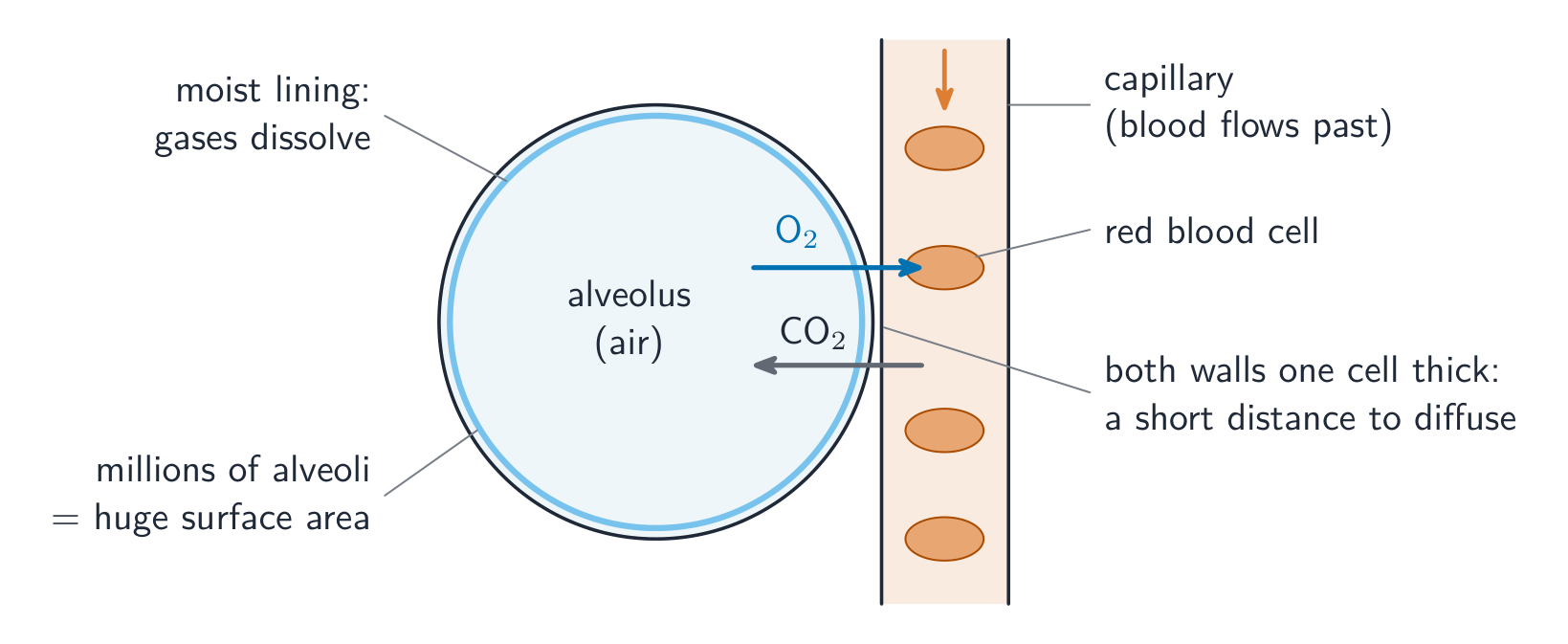
Gas exchange 气体交换 is how oxygen 氧气 gets into the blood and carbon dioxide 二氧化碳 gets out, by diffusion 扩散. A good gas exchange surface has four features:
- a large surface area 表面积 — so more gas can cross at once.
- a thin surface — so gases have only a short distance to diffuse.
- a good blood supply — to keep a steep difference in concentration.
- good ventilation 通气 with air — fresh air keeps the difference steep.
استكشف
سطح جيد لتبادل الغازات
انقر على الحويصلة الهوائية لرؤية الميزات الأربعة التي تجعلها مثالية للتبادل: مساحة سطح كبيرة، وجدار رقيق، وبطانة رطبة وإمداد دموي جيد.
مفردات
تدريب
| English | العربية |
|---|---|
| gas exchange/ɡæs eksˈtʃeɪndʒ/ | تبادل الغازات |
| oxygen/ˈɒksɪdʒn/ | الأكسجين |
| carbon dioxide/ˈkɑːbən daɪˈɒksaɪd/ | ثاني أكسيد الكربون |
| diffusion/dɪˈfjuːʒn/ | انتشار |
| surface area/ˈsɜːfɪs ˈeərɪə/ | مساحة سطح |
| ventilation/ˌventɪˈleɪʃn/ | التنفس (التهوية) |
11.1
جهاز التنفس
English
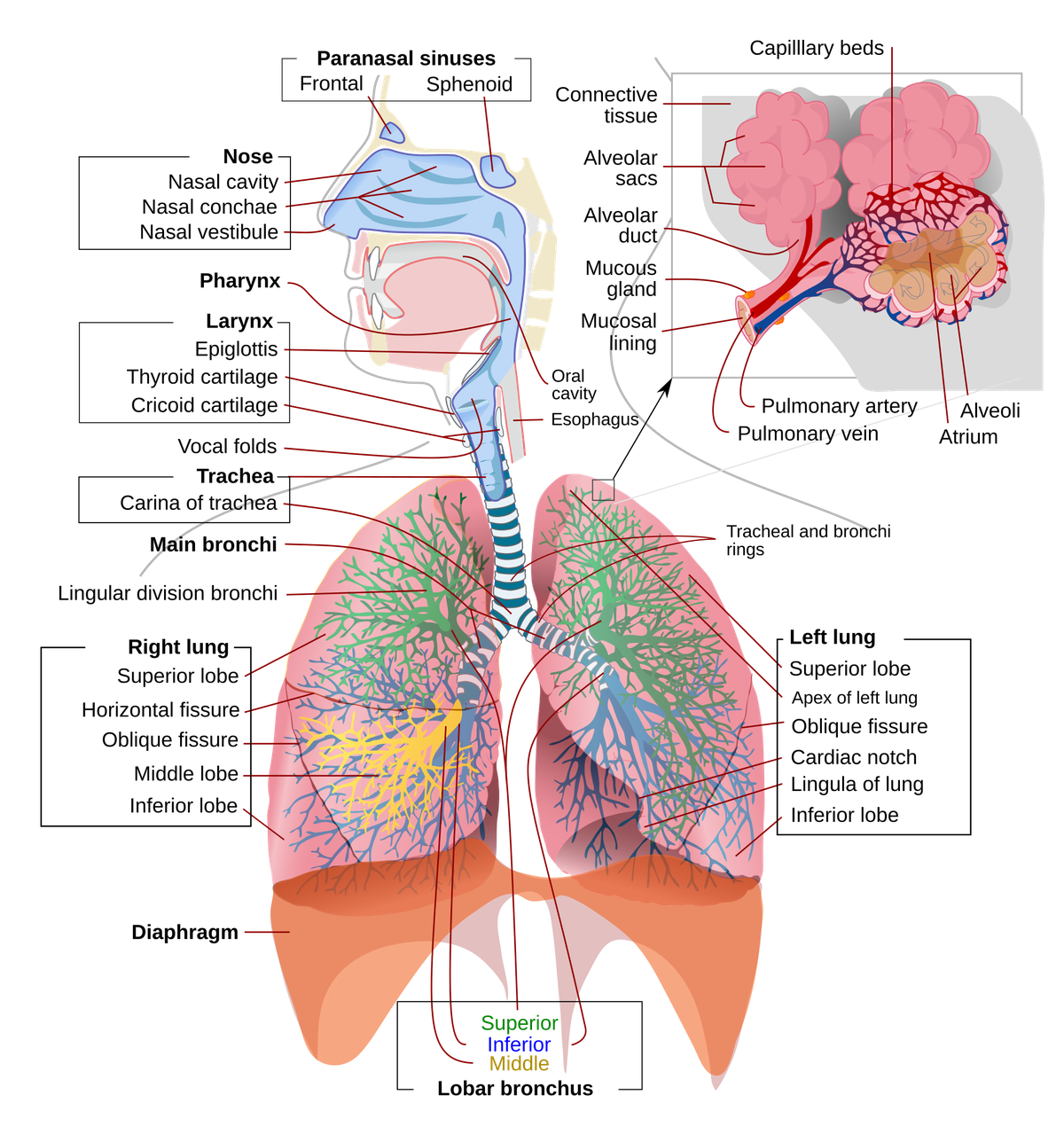
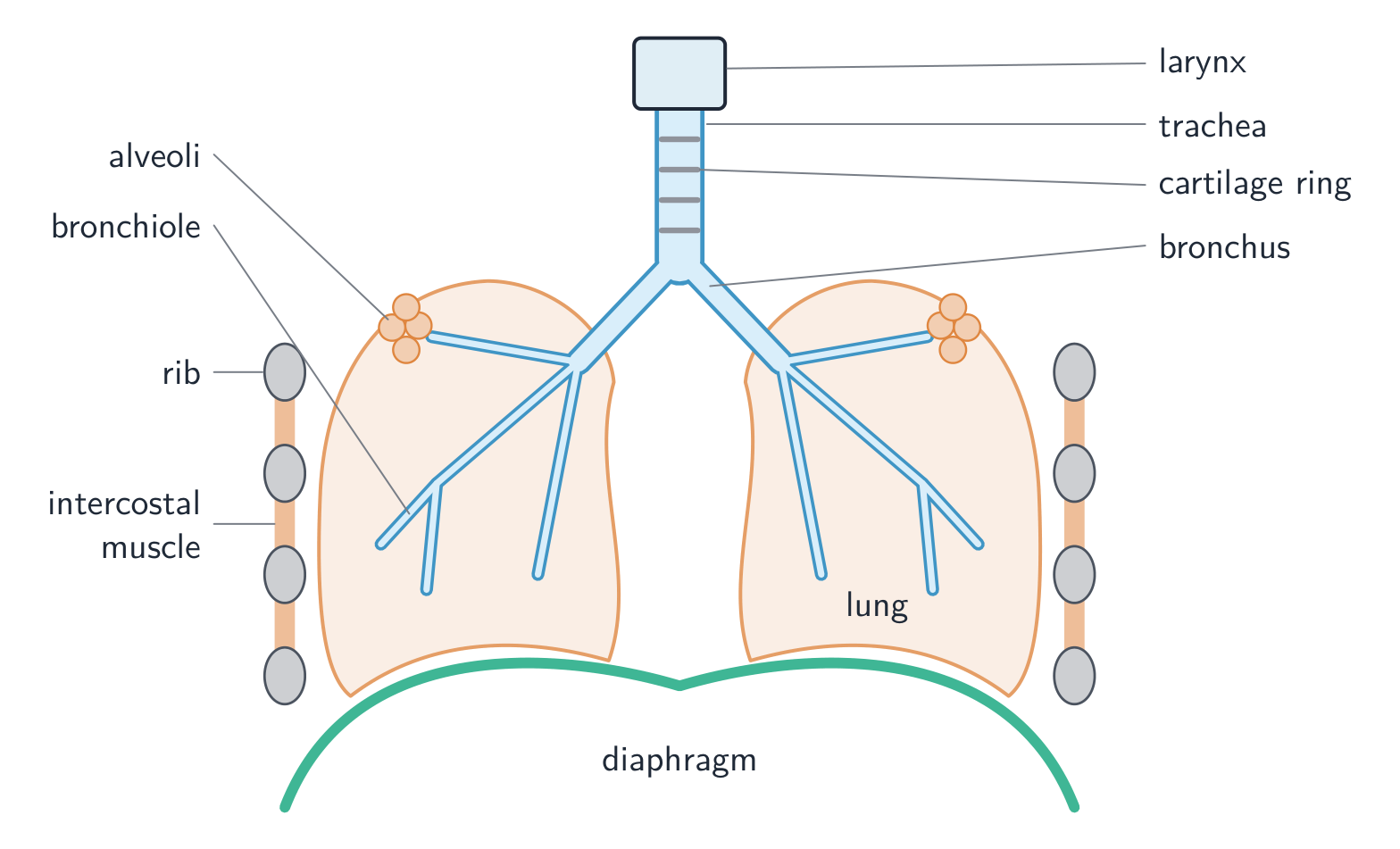
Air reaches the lungs through a series of tubes that branch and get narrower, like an upside-down tree. The table lists each part in the order air passes through it.
| Part | Job |
|---|---|
| larynx 喉 | the voice box, at the top of the windpipe |
| trachea 气管 | the windpipe; carries air towards the lungs |
| bronchi 支气管 | two tubes, one going to each lung |
| bronchioles 细支气管 | smaller branching tubes inside the lungs |
| alveoli 肺泡 | tiny air sacs where gas exchange happens; each is wrapped in capillaries 毛细血管 |
The alveoli make excellent gas exchange surfaces: there are millions of them (a huge surface area), each has a wall only one cell thick (a short distance), and each is surrounded by capillaries (a good blood supply).
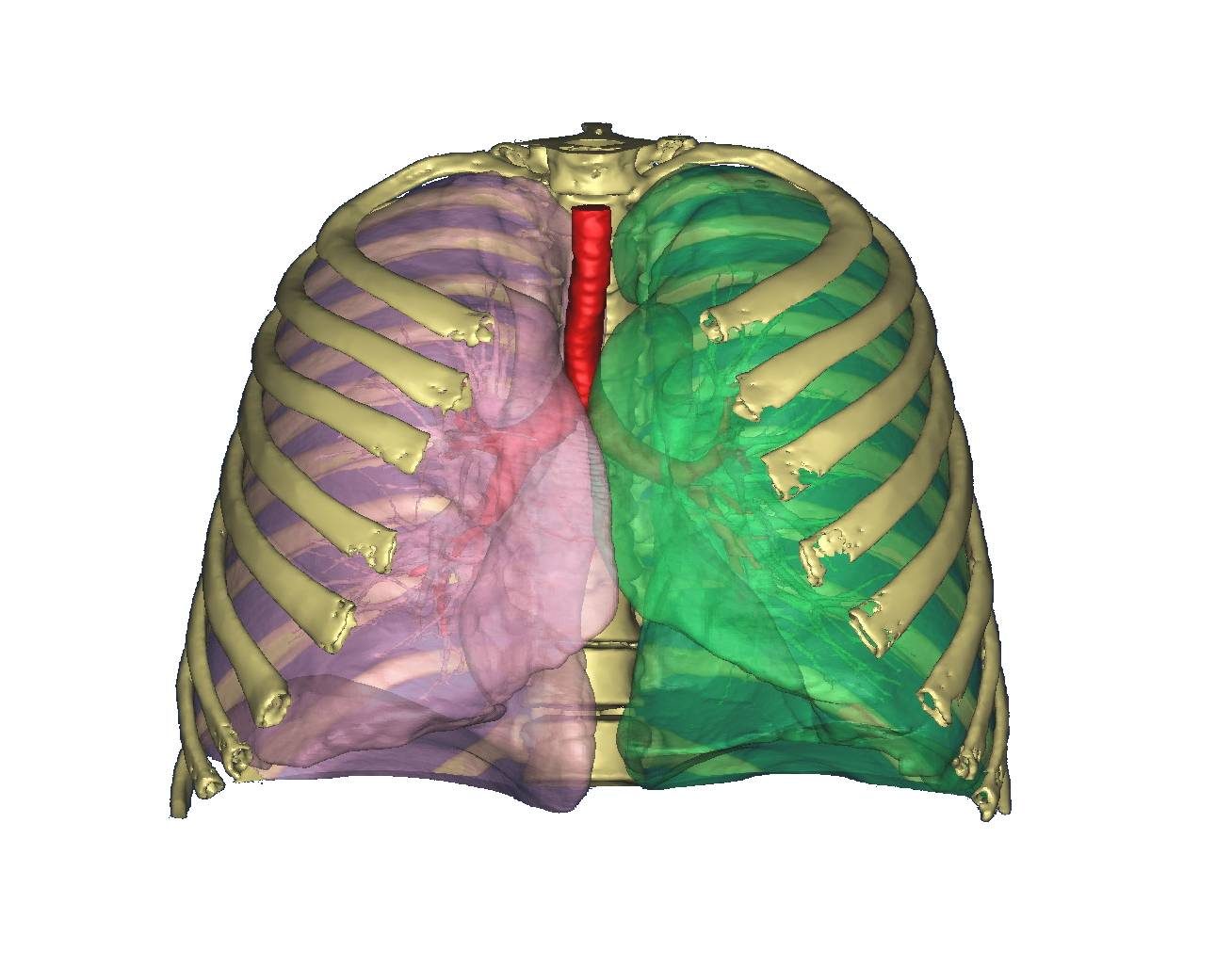
The lungs sit in the chest, protected by the ribs 肋骨. Below them is a sheet of muscle, the diaphragm 膈肌. Between the ribs are the intercostal muscles 肋间肌. (Supplement) The trachea is held open by rings of cartilage 软骨, so it cannot collapse when you breathe in.
مفردات
تدريب
| English | العربية |
|---|---|
| larynx/ˈlærɪŋks/ | الحنجرة |
| trachea/trəˈkɪə/ | الرغامى |
| bronchi/ˈbrɒŋkaɪ/ | الشعب الهوائية |
| bronchioles/ˈbrɒŋkɪəʊlz/ | قصيبات هوائية |
| alveoli/ˈælvɪɒli/ | الحويصلات الهوائية |
| capillaries/ˈkæpɪləriz/ | الشعيرات الدموية |
| ribs/rɪbz/ | أضلاع |
| diaphragm/ˈdaɪəfræm/ | الحجاب الحاجز |
| intercostal muscles/ˌɪntəˈkɒstl ˈmʌslz/ | عضلات بين الأضلاع |
| cartilage/ˈkɑːtɪlɪdʒ/ | غضاريف |
11.1
كيف تتنفس (مكمل)
English
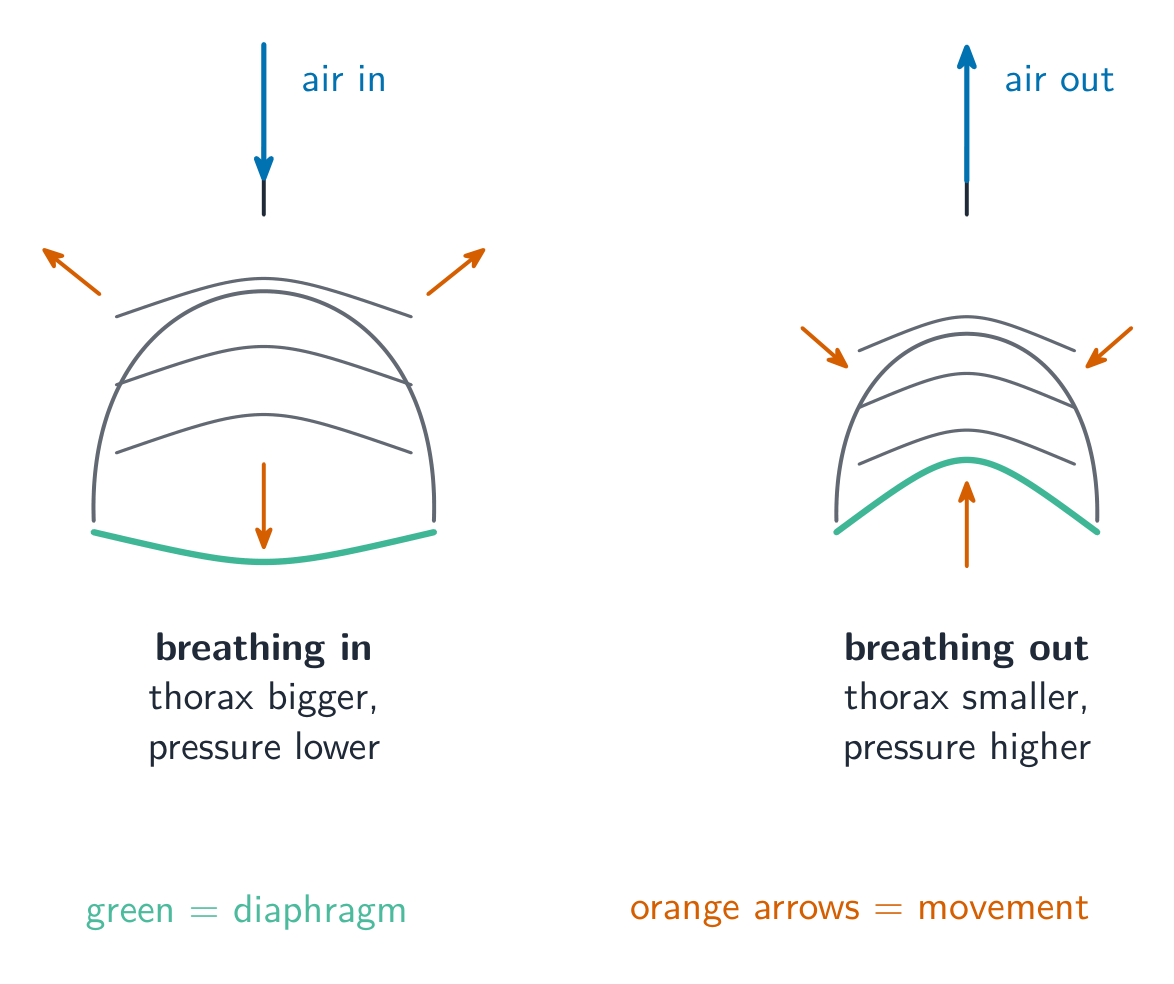
Breathing changes the volume and pressure 压力 inside the chest (the thorax 胸腔).
Breathing in (inhaling 吸气):
- the external intercostal muscles contract, pulling the ribs up and out.
- the diaphragm contracts and flattens (moves down).
- the thorax becomes bigger, so the pressure inside drops below the outside air pressure.
- air is pushed in.
Breathing out (exhaling 呼气) is the opposite: the muscles relax (and the internal intercostal muscles may contract), the thorax becomes smaller, the pressure rises, and air is pushed out.
Two sets of intercostal muscles. On a diagram, the external intercostal muscles 肋间外肌 are the outer layer between the ribs, and the internal intercostal muscles 肋间内肌 are the inner layer. They are antagonistic 拮抗: when one set contracts, the other relaxes.
| Breathing in | Breathing out (forced, as in exercise or coughing) | |
|---|---|---|
| external intercostal muscles | contract | relax |
| internal intercostal muscles | relax | contract, pulling the ribs down and in |
| ribs | move up and out | move down and in |
| diaphragm | contracts and flattens | relaxes and domes upwards |
| volume of thorax | increases | decreases |
| pressure in thorax | decreases (below air pressure) | increases (above air pressure) |
| air | moves in | moves out |
In quiet breathing out, the internal intercostals do little: the external intercostals and diaphragm simply relax, and the elastic lungs recoil. The internal intercostals contract only when you breathe out hard.
Worked example. Explain how the diaphragm and intercostal muscles cause air to enter the lungs. [4 marks] The external intercostal muscles contract, raising the ribs up and out; the diaphragm contracts and flattens. Both make the volume of the thorax larger, so the pressure inside falls below atmospheric pressure, and air moves into the lungs down the pressure difference. Each step is a mark: muscle → movement → volume → pressure → air.
استكشف
الشهيق والزفير
يغير التنفس حجم الصدر، مما يغير الضغط ويجعل الهواء يتدفق داخل أو خارج الجسم.
استكشف
آلية التنفس
راقب نفساً واحداً — ينبسط الحجاب الحاجز وترتفع الأضلاع، يكبر الصدر، ينخفض الضغط، ويدخل الهواء. ويرتاح ثم يُدفع للخارج.
مفردات
تدريب
| English | العربية |
|---|---|
| pressure/ˈpreʃə/ | ضغط |
| thorax/ˈθɔːræks/ | القفص الصدري |
| inhaling/ɪnˈheɪlɪŋ/ | استنشاق |
| exhaling/eksˈheɪlɪŋ/ | زفير |
| external intercostal muscles/ekˈstɜːnl ˌɪntəˈkɒstl ˈmʌslz/ | external intercostal muscles |
| internal intercostal muscles/ɪnˈtɜːnl ˌɪntəˈkɒstl ˈmʌslz/ | internal intercostal muscles |
| antagonistic/ænˈtæɡənɪstɪk/ | Working in opposite pairs, as the iris muscles or the biceps and triceps do. |
11.1
الهواء المستنشق والمنفوخ
English
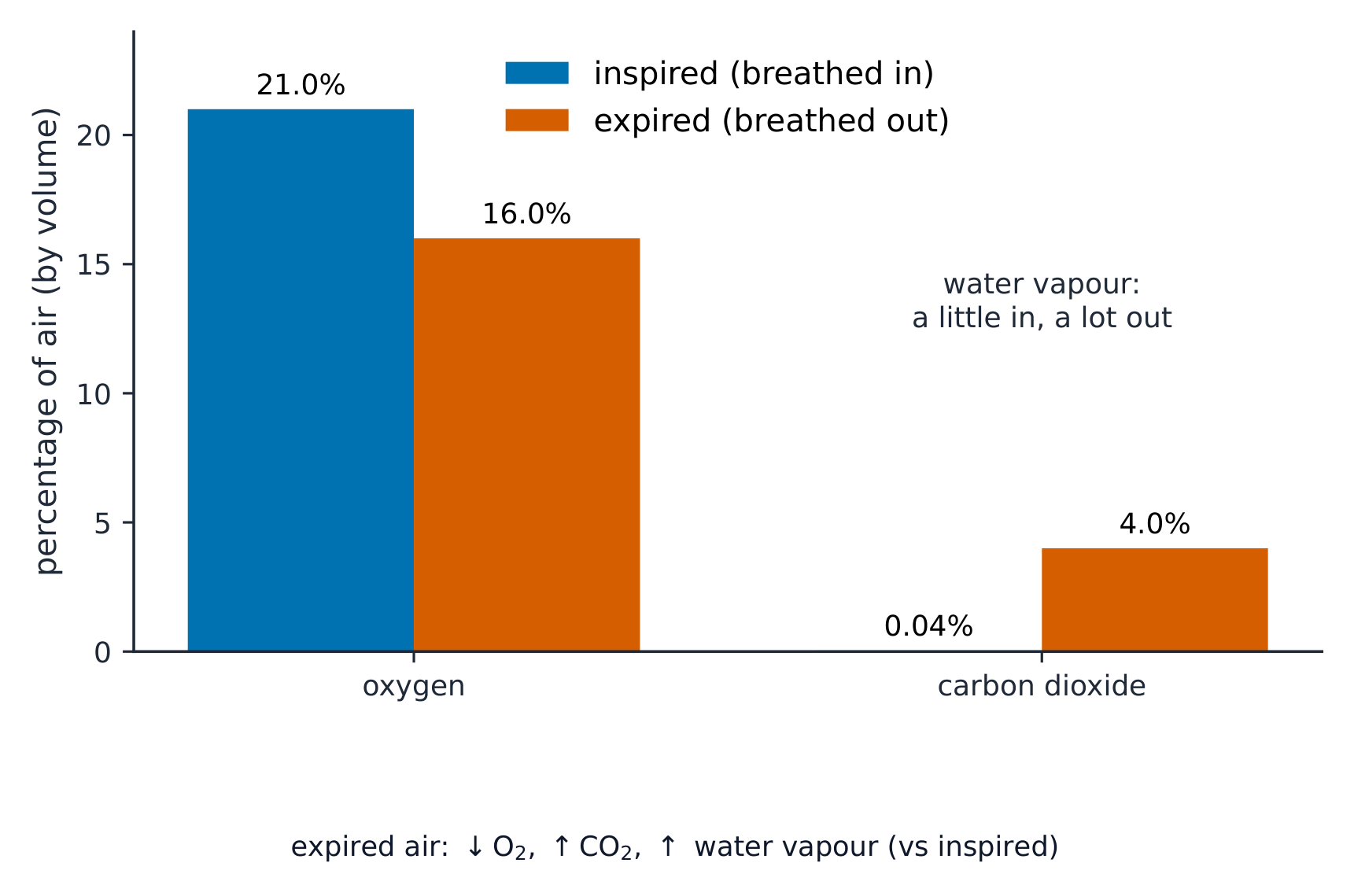
| Gas | Inspired air (breathed in) | Expired air (breathed out) |
|---|---|---|
| oxygen | about 21% | about 16% (less) |
| carbon dioxide | about 0.04% | about 4% (more) |
| water vapour 水蒸气 | a little | a lot (more) |
You can test for carbon dioxide with limewater 石灰水, which turns cloudy. Expired air turns limewater cloudy much faster than inspired air, showing it contains more carbon dioxide.
The investigation. Two boiling tubes each hold the same volume of limewater, joined to one mouthpiece by tubes arranged so that when you breathe in, air is drawn through tube A, and when you breathe out, air bubbles through tube B. After a few breaths, the limewater in B (expired air) turns milky, while A (inspired air) stays clear or turns cloudy only very slowly. Compare the time each takes to go cloudy, or the cloudiness after the same number of breaths. Breathe gently, and never suck limewater into your mouth.
(Supplement) Explaining the differences.
- Less oxygen in expired air: oxygen diffuses from the alveoli into the blood and is used by cells in aerobic respiration.
- More carbon dioxide: carbon dioxide made by respiration in the cells is carried by the blood to the lungs and diffuses into the alveoli.
- More water vapour: water evaporates from the moist lining of the alveoli into the air. (Water is also made by respiration.)
- Expired air is also warmer, because it is warmed by the body.
The nitrogen percentage hardly changes, because the body does not use nitrogen gas.
مفردات
تدريب
| English | العربية |
|---|---|
| water vapour/ˈwɔːtə ˈveɪpə/ | بخار الماء |
| limewater/ˈlaɪmwɔːtə/ | ماء الجير |
11.1
التنفس والتمارين الرياضية
English
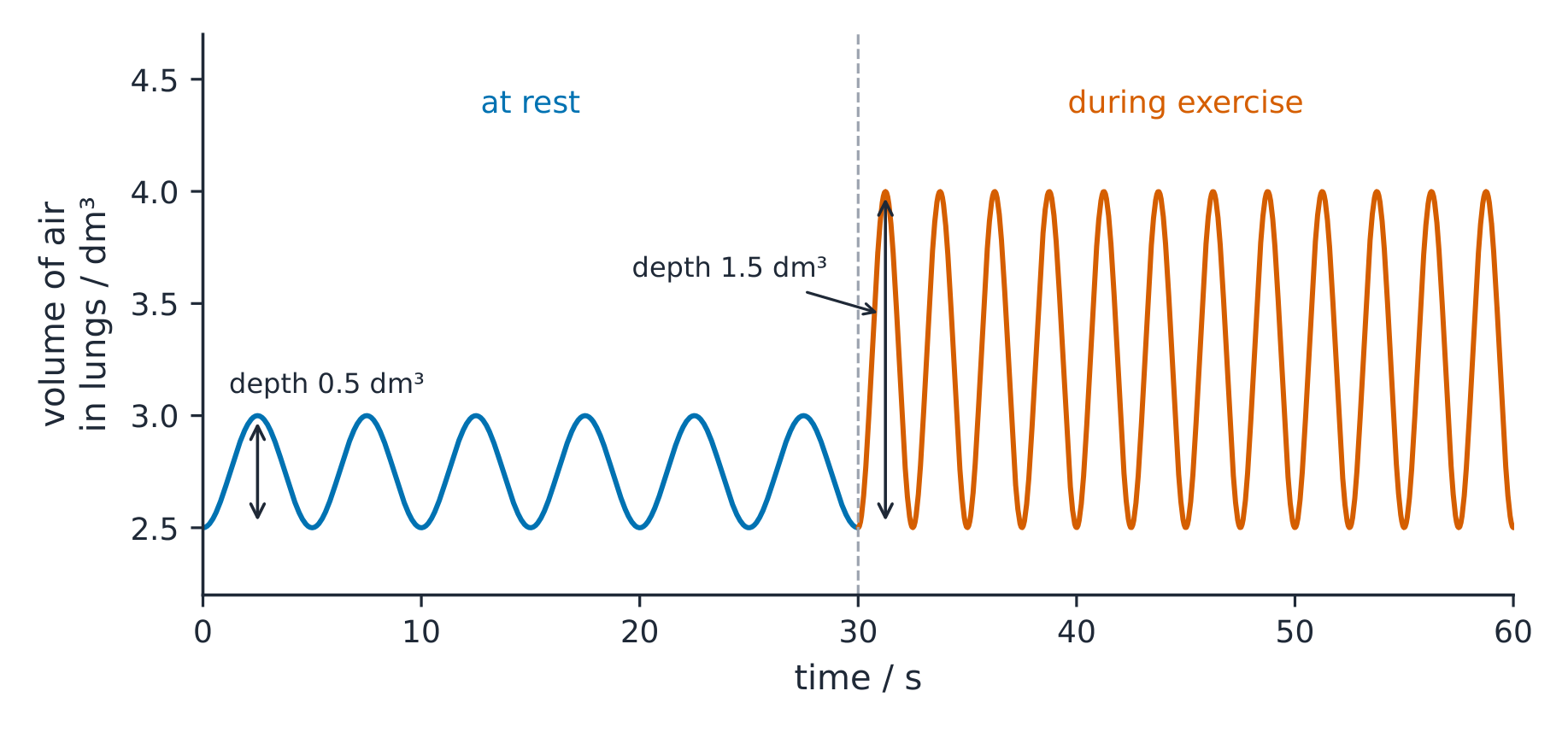
Reading a breathing trace. A machine called a spirometer 肺活量计 draws the volume of air in the lungs against time. Each peak is one breath. The rate is the number of peaks per minute. The depth is the height of one peak, from the bottom of a trough to the top of the next peak. In the trace above, at rest there are 6 peaks in 30 s, so the rate is 6 × 2 = 12 breaths per minute, with a depth of 0.5 dm³. During exercise there are 12 peaks in 30 s (24 per minute), each 1.5 dm³ deep.
Investigating physical activity. Count a student's breaths for one minute while they sit at rest (they should not know you are counting, as this changes their breathing). Then they exercise, for example stepping on and off a box for 2 minutes at a fixed pace, and you count their breaths for one minute straight afterwards. Keep counting each minute until the rate is back to the resting rate: this is the recovery time. Repeat with the same person and the same exercise, or with several people to compare. Controlled variables: the type, length and intensity of exercise, and the time the person rests beforehand.
During exercise your muscles respire faster and make more carbon dioxide. This raises the concentration 浓度 of carbon dioxide in the blood. (Supplement) Your brain 大脑 detects the rise and makes you breathe at a faster rate 速率 and a greater depth. This brings in more oxygen and removes the extra carbon dioxide quickly.
Worked example. At rest a person takes 12 breaths per minute, moving 500 cm³ of air per breath. During exercise this becomes 20 breaths per minute at 900 cm³ per breath. How much air passes through the lungs each minute in each case? Multiply the rate by the depth. At rest: 12 × 500 = 6000 cm³ per minute. During exercise: 20 × 900 = 18 000 cm³ per minute, three times as much. Exercise raises both the rate and the depth of breathing - an answer that changes only the rate throws away half the marks.
(Supplement) The full explanation. Muscles contract more → they need more energy → more aerobic respiration → more carbon dioxide made, which diffuses into the blood → the brain detects the higher carbon dioxide concentration → it sends impulses to the intercostal muscles and diaphragm → they contract faster and more strongly → breathing becomes faster and deeper → more carbon dioxide is removed and more oxygen taken in. Breathing stays fast for a while after exercise, to repay the oxygen debt (see Respiration).
مفردات
تدريب
| English | العربية |
|---|---|
| spirometer/spɪˈrɒmɪtə/ | spirometer |
| concentration/ˌkɒnsənˈtreɪʃn/ | التركيز |
| brain/breɪn/ | الدماغ |
| rate/reɪt/ | معدل |
11.1
إبقاء الممرات الهوائية نظيفة (مكمل)
English
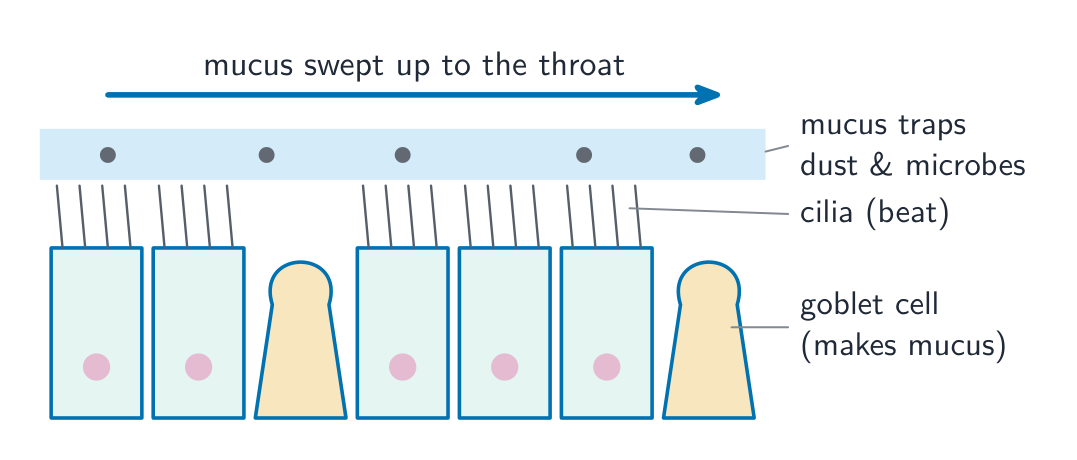
The airways are lined with two kinds of cell that trap and remove dirt:
- goblet cells 杯状细胞 make mucus 黏液, which traps pathogens 病原体 and dust particles 粒子.
- ciliated cells 纤毛细胞 have tiny hairs that sweep the mucus, with the trapped dirt, up to the throat, where it is swallowed.
Together they stop pathogens and particles reaching the alveoli, where they could cause infection or block gas exchange. Swallowed mucus goes to the stomach, where acid kills most of the pathogens. Tobacco smoke paralyses and damages the cilia, so mucus builds up in the airways; smokers cough to move it, and get more chest infections.
Common mistakes.
- Mixing up breathing and respiration. Breathing moves air in and out of the lungs; respiration is the chemical reaction in every cell that releases energy from glucose.
- Saying expired air contains no oxygen. It still has about 16% oxygen; only about a quarter of the oxygen breathed in is taken up.
- (Supplement) Getting the order wrong: "air comes in, so the chest gets bigger". The muscles make the chest bigger first; this lowers the pressure inside, and then air is pushed in.
- (Supplement) Saying the diaphragm moves up when you breathe in. It contracts and flattens (moves down); it moves up when it relaxes as you breathe out.
- (Supplement) Saying the brain detects a lack of oxygen during exercise. The brain detects the rise in carbon dioxide in the blood.
مفردات
تدريب
| English | العربية |
|---|---|
| goblet cells/ˈɡɒblət selz/ | خلايا كأسية |
| mucus/ˈmjuːkəs/ | مخاط |
| pathogens/ˈpæθədʒnz/ | الممرضات |
| particles/ˈpɑːtɪklz/ | الجسيمات |
| ciliated cells/ˈsɪlɪeɪtɪd selz/ | الخلايا الهدبية |
11.1
نصائح الامتحان
English
- A gas exchange surface is large, thin, with a good blood supply and good ventilation.
- Air path: larynx → trachea → bronchi → bronchioles → alveoli.
- Breathing in: external intercostal muscles and diaphragm contract → thorax bigger → pressure lower → air in. Breathing out is the opposite.
- Expired air has less oxygen, more carbon dioxide and more water vapour. Limewater tests for carbon dioxide.
- Exercise → more carbon dioxide in the blood → brain → faster, deeper breathing.
- On a breathing trace, rate = peaks per minute; depth = height of one peak.
- (Supplement) Explain each difference in expired air with its cause: oxygen used in respiration, carbon dioxide made by respiration, water evaporating from the alveoli.
- (Supplement) External intercostals contract to breathe in; internal intercostals contract only for forced breathing out.
دروس تفاعلية حول هذا الموضوع
ا-working عليه خطوة بخطوة، مع تمارين تحقق فوري.