بدأ كل واط تقريباً من الكهرباء التي استخدمتها بنفس الطريقة، بمغناطيس وبلف من الأسلاك يتحركان متجاورين. لا وقود، لا احتراق: فقط…
English narration · English + 中文 subtitles burned in · سرد باللغة الإنجليزية · ترجمة مدمجة بالإنجليزية + الصينية
13.1
Magnetic Flux · التدفق المغناطيسي
Syllabus · المنهج
English
Learning Objective 13.1.A: Describe the magnetic flux through an arbitrary area or geometric shape.
13.1.A.1 For a magnetic field $\vec{B}$ that is constant across an area $\vec{A}$, the magnetic flux through the area is defined as $\Phi_B = \vec{B} \cdot \vec{A}$ .
13.1.A.1.i The area vector is defined as perpendicular to the plane of the surface and outward from a closed surface.
13.1.A.1.ii The sign of flux is given by the dot product of the magnetic field vector and the area vector.
13.1.A.2 The total magnetic flux passing through a surface is defined by the surface integral of the magnetic field over the surface area.
Source: College Board AP Course and Exam Description · المصدر: وصف دورة وامتحان College Board AP
English
Magnetic flux 磁通量 measures how much magnetic field passes through a surface. For a uniform field through a flat loop it is the dot product $\Phi_B=\vec{B}\cdot\vec{A}=BA\cos\theta$; in general it is the surface integral 面积分
$$\Phi_B=\int \vec{B}\cdot d\vec{A}.$$
The area vector 面积矢量 is perpendicular to the surface (outward from a closed one), and the sign of the flux comes from the dot product. Flux changes if $B$ changes, the area changes, or the loop turns – keep all three routes in mind, because each one is an exam question.
العربية
التدفق المغناطيسي يقيس مقدار المجال المغناطيسي المار عبر سطح ما. بالنسبة لمجال منتظم يمر عبر حلقة مسطحة، فهو الضرب القياسي $\Phi_B=\vec{B}\cdot\vec{A}=BA\cos\theta$؛ وفي الحالة العامة هو تكامل سطحي
$$\Phi_B=\int \vec{B}\cdot d\vec{A}.$$
المتجه المساحي عمودي على السطح (نحو الخارج من سطح مغلق)، وإشارة التدفق تأتي من الضرب القياسي. يتغير التدفق إذا تغير $B$، أو تغير المساحة، أو دارت الحلقة – احتفظ بالثلاثة مسارات في اعتبارك، لأن كل واحد منها يمثل سؤال امتحان.
13.2.A.1.i When the area of the surface being considered is constant, the induced emf is equal to the area multiplied by the rate of change in the component of the magnetic field perpendicular to the surface.
13.2.A.1.ii When the magnetic field is constant, the induced emf is equal to the magnetic field multiplied by the rate of change in area perpendicular to the magnetic field.
13.2.A.1.iii When an emf is induced in a long solenoid, the total induced emf is equal to the induced emf in a single loop multiplied by the number of loops in the solenoid.
13.2.A.2 Lenz's law is used to determine the direction of an induced emf resulting from a changing magnetic flux.
13.2.A.2.i An induced emf generates a current that creates a magnetic field that opposes the change in magnetic flux.
13.2.A.2.ii The right-hand rule is used to determine the relationships between current, emf, and magnetic flux.
13.2.A.3 Maxwell's equations are the collection of equations that fully describe electromagnetism. Maxwell's third equation is Faraday's law of induction, which describes the relationship between a changing magnetic flux and an induced electric field.
13.2.A.4 Maxwell's equations can be used to show that electric and magnetic fields obey wave equations and that electromagnetic waves travel at a constant speed in free space.
Boundary statement: AP Physics C: Electricity & Magnetism does not expect students to mathematically derive the speed of light in free space from Maxwell's equations. This relationship is included above solely as an indication of the further applications, implications, and connections to physical phenomena that students may study in more advanced physics courses.
Source: College Board AP Course and Exam Description · المصدر: وصف دورة وامتحان College Board AP
English
Electromagnetic induction
A changing flux induces an emf 电动势 – Faraday's law 法拉第定律:
$$\varepsilon=-\frac{d\Phi_B}{dt}.$$
With constant area, $\varepsilon=-A\,\dfrac{dB_\perp}{dt}$; with constant field, $\varepsilon=-B\,\dfrac{dA_\perp}{dt}$. A coil of $N$ turns multiplies the single-loop emf: $|\varepsilon_{\text{sol}}|=N\left|\dfrac{d\Phi_B}{dt}\right|$.
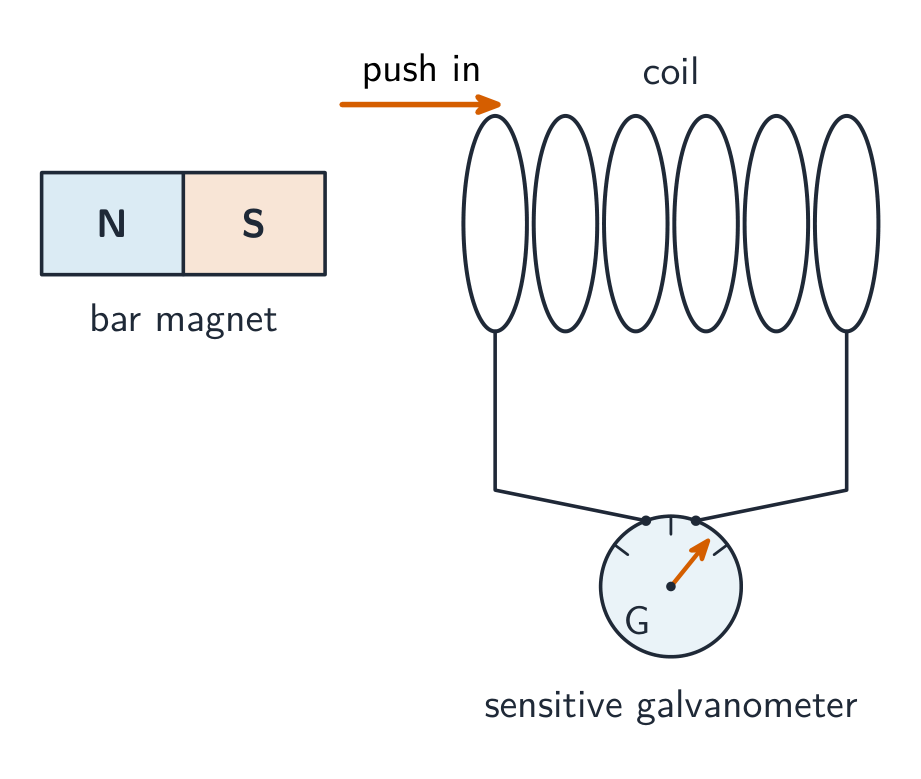
Lenz's law 楞次定律 is the minus sign: the induced current 感应电流 flows so that its own magnetic field opposes the change in flux that created it. Push a magnet toward a loop and the loop pushes back; pull it away and the loop pulls it in. Use the right-hand rule 右手定则 to turn "oppose the change" into a current direction.
A rod of length $L$ sliding at speed $v$ across a field is the special case worth memorising – the motional emf 动生电动势$\varepsilon=BLv$.
Worked example. A $0.20\ \text{m}$ rod slides at $3.0\ \text{m/s}$ across a $0.50\ \text{T}$ field: $\varepsilon=BLv=0.50(0.20)(3.0)=0.30\ \text{V}$. Equivalently, if a single loop's flux drops from $0.020\ \text{Wb}$ to $0.008\ \text{Wb}$ in $0.030\ \text{s}$, the average emf is $\varepsilon=\dfrac{0.012}{0.030}=0.40\ \text{V}$.
Faraday's law is also the third of Maxwell's equations 麦克斯韦方程组, in a deeper form: a changing magnetic flux creates a circulating electric field, $\oint\vec{E}\cdot d\vec{l}=-\dfrac{d\Phi_B}{dt}$ – that field is what pushes the charges around the loop. Together, Maxwell's equations predict electromagnetic waves 电磁波 travelling at $c=1/\sqrt{\varepsilon_0\mu_0}$ (you should know this connection, but AP will not ask you to derive it).
العربية
الحث الكهرومغناطيسي
التدفق المتغير يُحدث قوة دافعة كهربائية – قانون فاراداي:
$$\varepsilon=-\frac{d\Phi_B}{dt}.$$
مع ثبات المساحة، $\varepsilon=-A\,\dfrac{dB_\perp}{dt}$؛ ومع ثبات المجال، $\varepsilon=-B\,\dfrac{dA_\perp}{dt}$. ملف يحتوي على $N$ لفة يضاعف القوة الدافعة الكهربائية للحلقة الواحدة: $|\varepsilon_{\text{sol}}|=N\left|\dfrac{d\Phi_B}{dt}\right|$.
قانون لenz هو الإشارة السالبة: التيار المُحثَّ يتدفق بحيث يكون مجاله المغناطيسي الخاص به معارضًا للتغير في التدفق الذي تسببه. ادفع مغناطيسًا نحو حلقة فتدفع الحلقة رداً عليها؛ اسحبها بعيدًا فتسحب الحلقة المغناطيس إليها. استخدم قاعدة اليد اليمنى لتحويل "معارضة التغير" إلى اتجاه تيار.
تحريك مغناطيس داخل ملف يُحدث قوة دافعة كهربائية تُحدث تياراً
قضيب طوله $L$ ينزلق بسرعة $v$ عبر مجال هو حالة خاصة تستحق الحفظ – وهي القوة الدافعة الكهربائية الحركية$\varepsilon=BLv$.
مثال محلول. قضيب طوله $0.20\ \text{m}$ ينزلق بسرعة $3.0\ \text{m/s}$ عبر مجال شدته $0.50\ \text{T}$: $\varepsilon=BLv=0.50(0.20)(3.0)=0.30\ \text{V}$. وبالمثل، إذا انخفض تدفق حلقة واحدة من $0.020\ \text{Wb}$ إلى $0.008\ \text{Wb}$ خلال زمن $0.030\ \text{s}$، فإن القوة الدافعة الكهربائية المتوسطة هي $\varepsilon=\dfrac{0.012}{0.030}=0.40\ \text{V}$.
قانون فاراداي هو أيضًا الثالث من معادلات ماكسيف، بصيغة أعمق: التدفق المغناطيسي المتغير يولد مجالًا كهربائيًا دواريًا، $\oint\vec{E}\cdot d\vec{l}=-\dfrac{d\Phi_B}{dt}$ – ذلك المجال هو ما يدفع الشحنات حول الحلقة. معًا، تتنبأ معادلات ماكسيف بـ الموجات الكهرومغناطيسية تنتشر بسرعة $c=1/\sqrt{\varepsilon_0\mu_0}$ (يجب أن تعرف هذا الارتباط، لكن AP لن يطلب منك اشتقاقه).
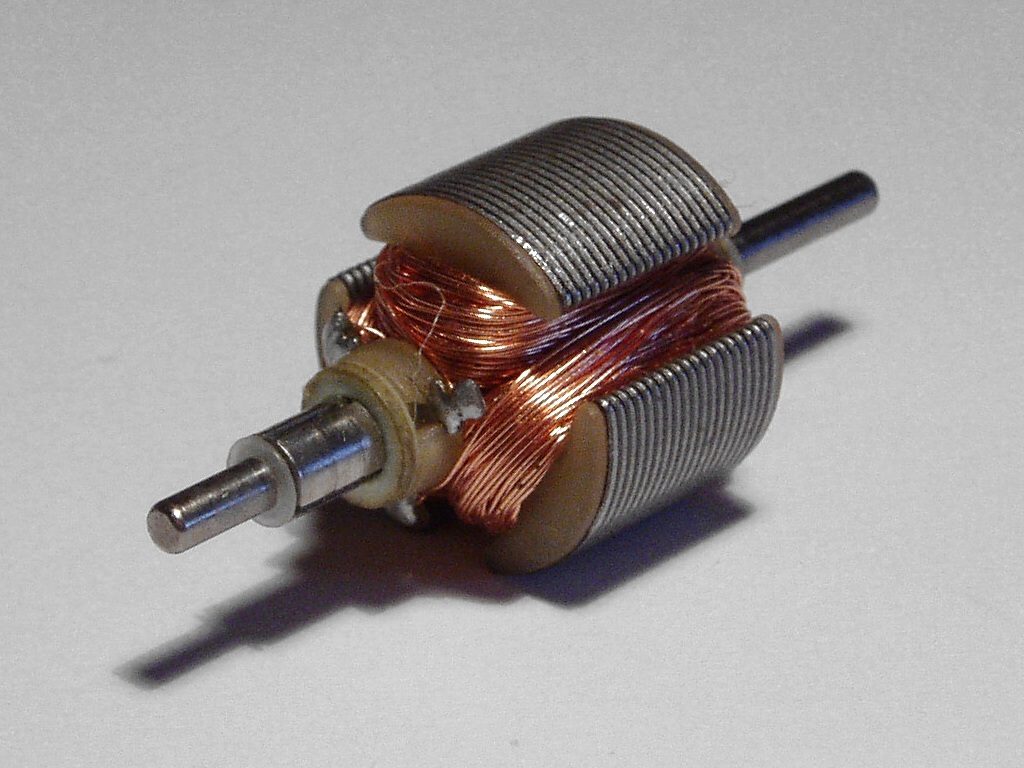
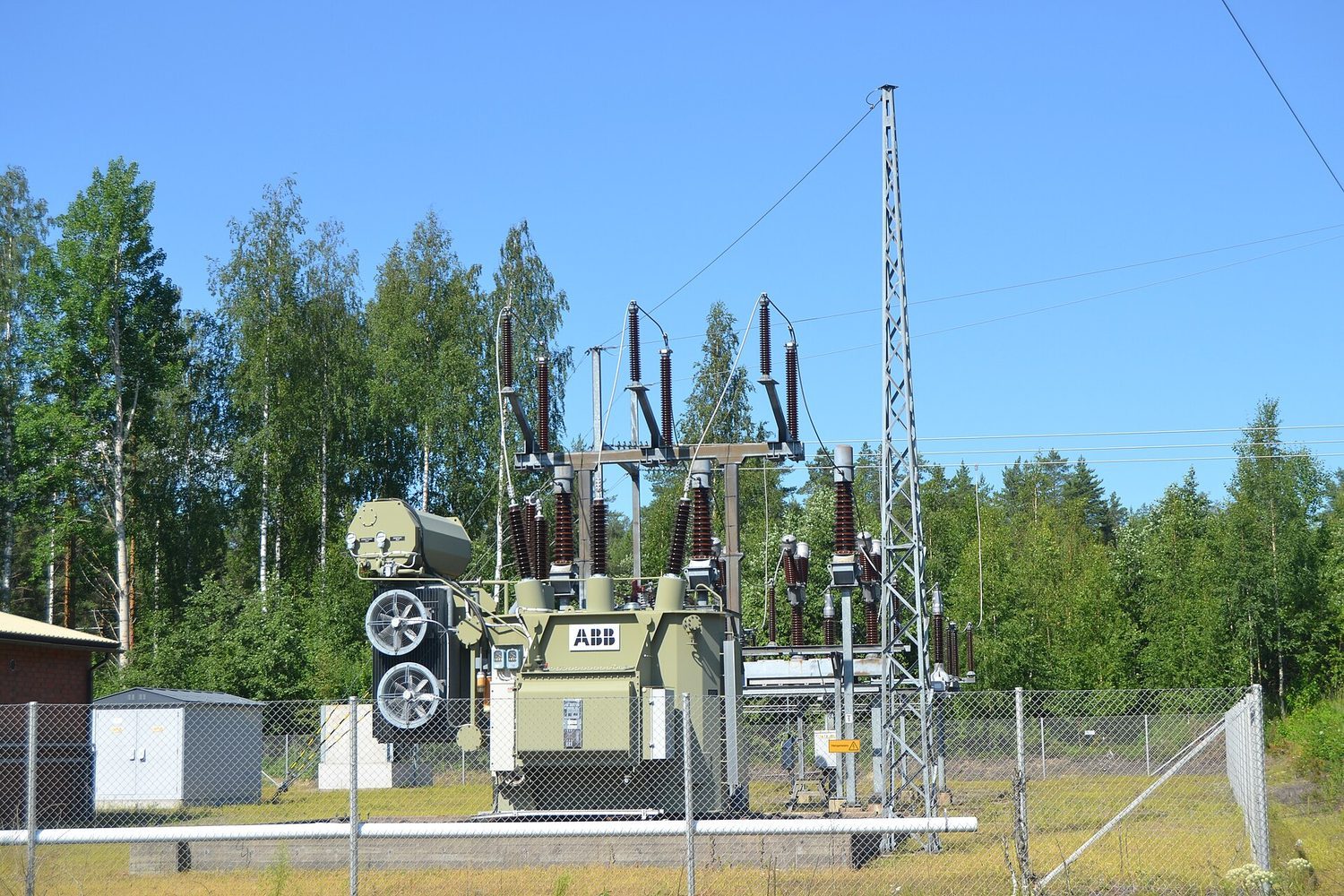
ملفات من الأسلاك تدور في مجال مغناطيسي: تحريكها مقابل المجال يولد تيارًا، وهو أساس المولدمحول محطة تحويل: التدفق المغناطيسي المتغير في الملفات يُحدث الجهود التي تغذي الشبكة
Explore · استكشف
Induce a current by moving a magnet · حفز تيار عن طريق تحريك مغناطيس
A changing magnetic flux through a coil induces an EMF (Faraday's law); its direction opposes the change (Lenz's law). Move the magnet faster for a bigger EMF. · يتغير التدفق المغناطيسي عبر ملف فيولد EMF (قانون فاراداي)؛ واتجاهه يعاكس التغير (قانون لينز). حرّك المغناطيس أسرع للحصول على EMF أكبر.
13.3
Induced Currents and Magnetic Forces · التيارات المُحثَّة والقوى المغناطيسية
Syllabus · المنهج
English
Learning Objective 13.3.A: Describe the force exerted on a conductor due to the interaction between an external magnetic field and an induced current within that conductor.
13.3.A.1 When an induced current is created in a conductive loop, the already-present magnetic field will exert a magnetic force on the moving charge carriers within the loop.
13.3.A.2 When current is induced in a conducting loop, magnetic forces are only exerted on the segments of the loop that are within the external magnetic field. These magnetic forces may cause translational or rotational acceleration.
13.3.A.3 The force on a conducting loop is proportional to the induced current in the loop, which depends on the rate of change of magnetic flux, the resistance of the loop, and the velocity of the loop.
13.3.A.4 Newton's second law can be applied to a conducting loop moving in a magnetic field as it experiences an induced emf.
العربية
الهدف التعليمي 13.3.A: وصف القوة المؤثرة على موصل نتيجة التفاعل بين مجال مغناطيسي خارجي وتيار مستحث داخل ذلك الموصل.
13.3.A.1 عند نشأة تيار مستحث في حلقة موصلة، سيؤثر المجال المغناطيسي الموجود مسبقًا بقوة مغناطيسية على حاملات الشحنة المتحركة داخل الحلقة.
13.3.A.2 عند تحريض تيار في حلقة موصلة، تتعرض القوى المغناطيسية فقط للأجزاء من الحلقة الموجودة داخل المجال المغناطيسي الخارجي. قد تسبب هذه القوى المغناطيسية تسارعًا انتقاليًا أو دورانيًا.
13.3.A.3 تتناسب القوة المؤثرة على الحلقة الموصلة مع التيار المستحث فيها، والذي يعتمد على معدل تغير التدفق المغناطيسي ومقاومة الحلقة وسرعة الحلقة.
13.3.A.4 يمكن تطبيق قانون نيوتن الثاني على حلقة موصلة تتحرك في مجال مغناطيسي حيث تتعرض لقوة دافعة كهربية مستحثة.
Source: College Board AP Course and Exam Description · المصدر: وصف دورة وامتحان College Board AP
English
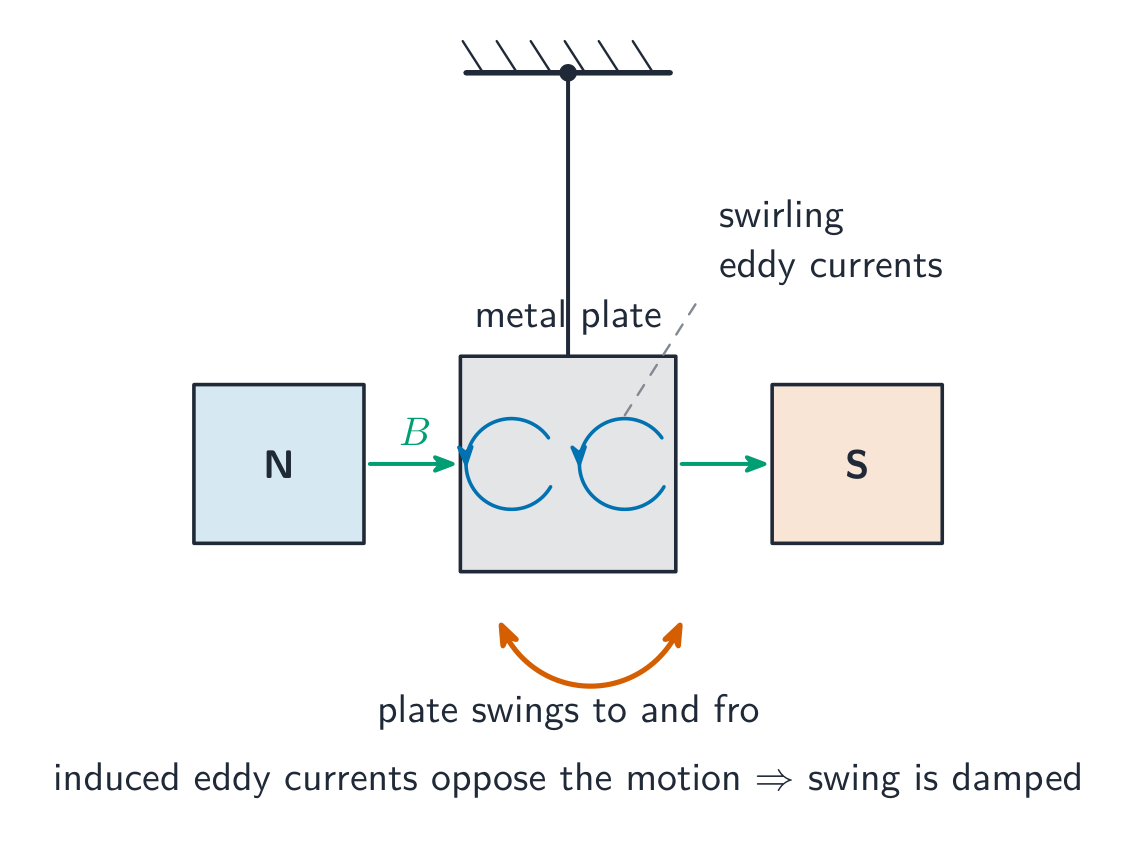
Once an induced current flows, the external field exerts forces on it ($\vec{F}=\int I\,d\vec{l}\times\vec{B}$) – and by Lenz's law those forces always resist the motion that causes the induction. Only the segments of the loop actually inside the field feel a force, which can make a loop accelerate, rotate, or brake. This is the origin of eddy currents 涡电流 braking, and you can apply Newton's second law to a moving loop or rod like any other mechanics problem.
The classic setup is a rod sliding on conducting rails connected by a resistor:
Worked example (the full chain). Rails $L=0.20\ \text{m}$ apart with resistance $R=0.60\ \Omega$ sit in a $0.50\ \text{T}$ field into the page. The rod is pushed at a constant $3.0\ \text{m/s}$. Then: $\varepsilon=BLv=0.30\ \text{V}$; $I=\varepsilon/R=0.50\ \text{A}$; the field pushes back on the rod with $F=BIL=0.50(0.50)(0.20)=0.050\ \text{N}$. The pushing force does work at $P=Fv=0.15\ \text{W}$ – exactly the $P=I^2R=0.15\ \text{W}$ dissipated in the resistor. Mechanical work becomes electrical energy: that is a generator 发电机, and energy is conserved. Released with no push, the rod slows exponentially: $ma=-\dfrac{B^2L^2}{R}v$.
Exam skill. FRQs walk this exact chain: flux $\to$ emf $\to$ current $\to$ force $\to$ Newton's second law. Write each link separately and check the direction with Lenz's law at the end.
العربية
بمجرد أن يتدفق تيار مُحث، يمارس المجال الخارجي قوى عليه ($\vec{F}=\int I\,d\vec{l}\times\vec{B}$) – وبحسب قانون لenz، تكون تلك القوى دائمًا معارضة للحركة التي تسببت في الحث. فقط الأجزاء من الحلقة الموجودة فعليًا داخل المجال تشعر بالقوة، مما قد يجعل الحلقة تتسارع، أو تدور، أو تنكبح. هذا هو أصل تيارات دوامية للفرامل، ويمكن تطبيق قانون نيوتن الثاني على حلقة متحركة أو قضيب مثل أي مشكلة ميكانيكا أخرى.
تيارات دوامية مُحثة تعارض الحركة، وتخمد بسرعة لوح معدني يتأرجح في مجال
الإعداد الكلاسيكي هو قضيب ينزلق على قضبان موصلة متصلتين بمقاومة:
قضيب ينزلق على قضبان: التيار المُحث يشعر بقوة تعارض الحركة
مثال محلول (السلسلة الكاملة). قضبان متباعدة مسافة $L=0.20\ \text{m}$ ذات مقاومة $R=0.60\ \Omega$ موضوعة في مجال شدته $0.50\ \text{T}$ يتجه نحو الداخل. يتم دفع القضيب بسرعة ثابتة $3.0\ \text{m/s}$. إذن: $\varepsilon=BLv=0.30\ \text{V}$؛ $I=\varepsilon/R=0.50\ \text{A}$؛ المجال يدفع عكس القضيب بقوة $F=BIL=0.50(0.50)(0.20)=0.050\ \text{N}$. قوة الدفع تبذل شغلاً بمعدل $P=Fv=0.15\ \text{W}$ – تماماً مقدار $P=I^2R=0.15\ \text{W}$ المشتت في المقاومة. يتحول الشغل الميكانيكي إلى طاقة كهربائية: هذا مولد، والطاقة محفوظة. عند إطلاقه بدون دفع، يتباطأ القضيب أسيًا: $ma=-\dfrac{B^2L^2}{R}v$.
مهارة الامتحان. أسئلة الإجابة المقالية (FRQs) تتبع هذه السلسلة بالضبط: تدفق $\to$ قوة دافعة كهربائية $\to$ تيار $\to$ قوة $\to$ قانون نيوتن الثاني. اكتب كل رابط على حدة وتحقق من الاتجاه باستخدام قانون لenz في النهاية.
13.4
Inductance · الحث الذاتي
Syllabus · المنهج
Learning Objective
Essential Knowledge
13.4.A
Describe the physical and electrical properties of an inductor.
13.4.A.1 Inductance is the tendency of a conductor to oppose a change in electrical current.
13.4.A.1.i Inductance of a conductor depends on the physical properties of the conductor. Straight wires are typically modeled as having zero inductance.
13.4.A.1.ii An inductor, such as a solenoid, is a circuit element that has significant inductance.
13.4.A.1.iii The inductance of a solenoid is dependent on the total number of turns, the length of the solenoid, the cross-sectional area of the solenoid, and magnetic permeability of the solenoid's core.
13.4.A.2 Inductors store energy in the magnetic field that is generated by current in the inductor.
Equation:$U_L = \dfrac{1}{2} L I^2$
13.4.A.2.i The energy stored in the magnetic field generated by an inductor in which current is flowing can be dissipated through a resistor or used to charge a capacitor.
13.4.A.2.ii The transfer of energy generated in an inductor to other forms of energy obeys conservation laws.
13.4.A.3 By applying Faraday's law to an inductor and using the definition of inductance, induced emf can be related to inductance and the rate of change of current.
Equation:$\mathcal{E}_i = -L\dfrac{dI}{dt}$
Source: College Board AP Course and Exam Description · المصدر: وصف دورة وامتحان College Board AP
English
Inductance 电感 is a conductor's tendency to oppose a change in its own current: changing current changes its own flux, which self-induces an emf. From Faraday's law,
$$\varepsilon=-L\frac{dI}{dt}.$$
An inductor 电感器 is a circuit element built to have large inductance – usually a solenoid 螺线管, where geometry gives
with $N$ total turns, area $A$, length $\ell$, and the magnetic permeability 磁导率 of the core. (Straight wires are modelled as having zero inductance.) An inductor carrying current $I$ stores energy in its magnetic field:
$$U_L=\tfrac{1}{2}LI^2,$$
which can later be dissipated in a resistor or moved into a capacitor – conservation of energy applies as usual.
العربية
الحث الذاتي هو ميل الموصل لمعارضة تغيير تياره الخاص:改变的电流改变其自身的磁通量,从而自感产生电动势。根据法拉第定律,
$$\varepsilon=-L\frac{dI}{dt}.$$
المحث هو عنصر دوائر كهربائية مصمم ليكون له حث كبير – عادة ما يكون ملفًا لولبيًا، حيث تمنح الهندسة
مع $N$ عدد لفات كلي، مساحة $A$، طول $\ell$، والنفاذية المغناطيسية للنواة. (تُصوّر الأسلاك المستقيمة بأنها تملك حثًا صفرًا.) يحفظ المحث الذي يمر به تيار $I$ طاقة في مجاله المغناطيسي:
$$U_L=\tfrac{1}{2}LI^2,$$
والتي يمكن تبديدها لاحقًا في مقاومة أو نقلها إلى مكثف – تنطبق قانون حفظ الطاقة كما هو معتاد.
13.5
Circuits with Resistors and Inductors · الدوائر التي تحتوي على مقاومات ومحثات
Syllabus · المنهج
Learning Objective
Essential Knowledge
13.5.A
Describe the physical and electrical properties of a circuit containing a combination of resistors and a single inductor.
13.5.A.1 A resistor will dissipate energy that was stored in an inductor as the current changes.
13.5.A.2 Kirchhoff's loop rule can be applied to a series LR circuit with a battery of emf $\mathcal{E}$, resulting in a differential equation that describes the current in the loop.
Equation (derived):$\mathcal{E} = IR + L\dfrac{dI}{dt}$
13.5.A.3 The time constant is a significant feature of the behavior of an LR circuit.
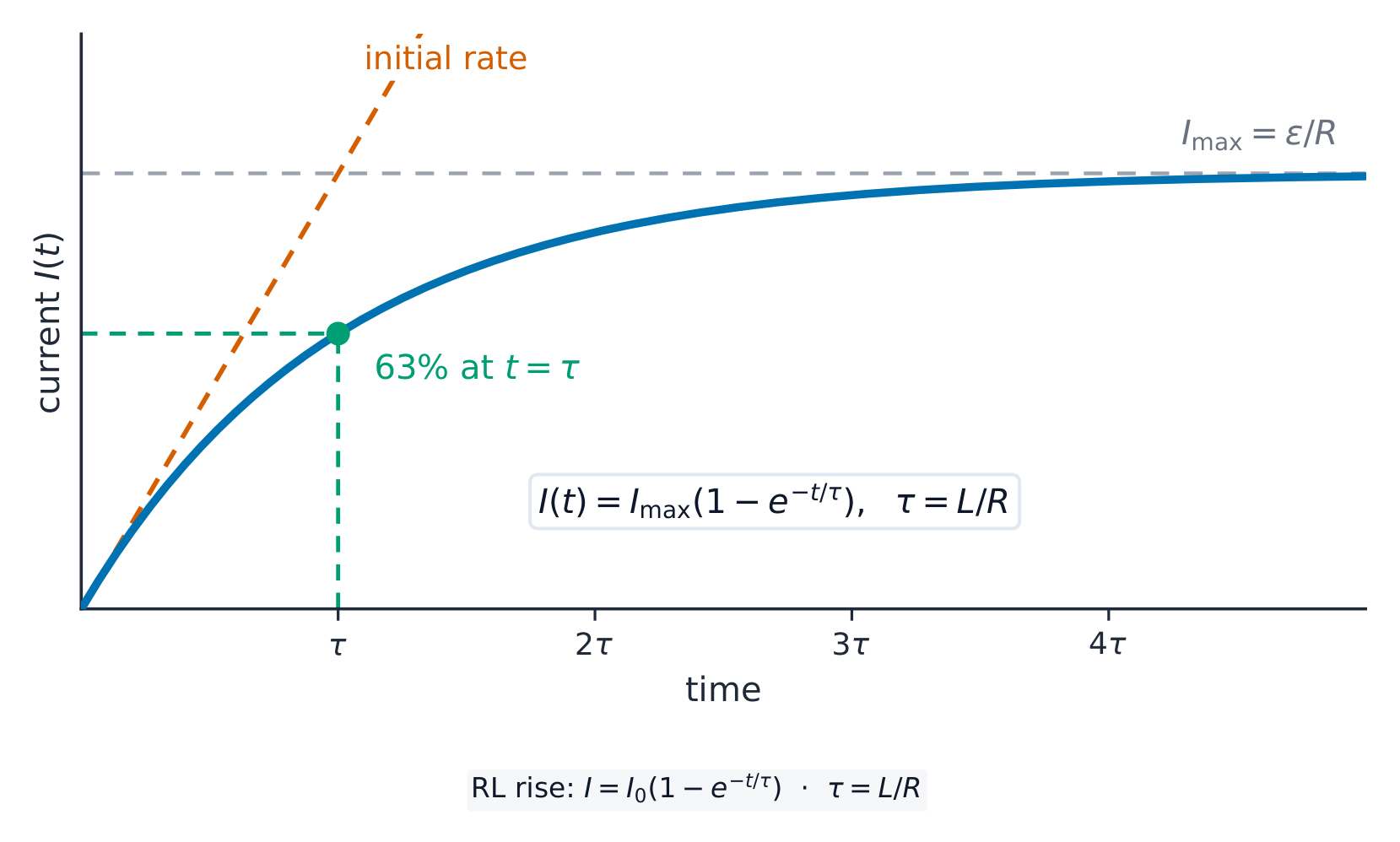
13.5.A.3.i The time constant of a circuit is a measure of how quickly an LR circuit will reach a steady state and is described with the equation $\tau = \dfrac{L}{R_{\text{eq}}}$ .
13.5.A.3.ii The time constant represents the time an LR circuit would take to reach a steady state if the system continued to change at the initial rate of change.
13.5.A.3.iii For an inductor that has zero initial current, the time constant represents the time required for the current in the inductor to reach approximately 63 percent of its final asymptotic value.
13.5.A.3.iv For an inductor with an initial current, the time constant represents the time required for the current in the inductor to reach approximately 37 percent of its initial value.
13.5.A.4 The electric properties of inductors change during the time interval in which the current in the inductor changes, but will exhibit steady state behavior after a long time interval.
13.5.A.4.i When a switch is initially closed or opened in a circuit containing an inductor, the induced emf will be equal in magnitude and opposite in direction to the applied potential difference across the branch containing the inductor.
13.5.A.4.ii The potential difference across an inductor, the current in the inductor, and the energy stored in the inductor are exponential with respect to time and have asymptotes that are determined by the initial conditions of the circuit.
13.5.A.4.iii After a time much greater than the time constant of the circuit, an inductor will behave as a conducting wire with zero resistance.
Source: College Board AP Course and Exam Description · المصدر: وصف دورة وامتحان College Board AP
English
In an RL circuit RL电路, Kirchhoff's loop rule for a battery $\varepsilon$, resistor $R$, and inductor $L$ in series gives a differential equation 微分方程:
The time constant 时间常数$\tau$ sets the pace: after one $\tau$ a rising current reaches about $63\%$ of its final value (a decaying one falls to $37\%$); it is also how long the change would take at the initial rate. Learn the two limits – they answer most conceptual questions:
Just after the switch closes ($t=0$): current cannot jump, so the inductor momentarily blocks it, self-inducing an emf equal and opposite to the applied potential difference.
Long after ($t\gg\tau$): the current is steady, $dI/dt=0$, and the inductor behaves as a plain wire – the exact opposite of a capacitor.
Worked example.$\varepsilon=12\ \text{V}$, $R=6.0\ \Omega$, $L=3.0\ \text{H}$: final current $\varepsilon/R=2.0\ \text{A}$, $\tau=L/R=0.50\ \text{s}$. At $t=0.50\ \text{s}$ the current is $2.0(1-e^{-1})\approx1.3\ \text{A}$. At $t=0$ the inductor's potential difference is the full $12\ \text{V}$; as $t\to\infty$ it falls to zero. Current, inductor voltage, and stored energy are all exponential in time.
العربية
في دائرة RLRL، تعطي قاعدة كيرشوف للحلقة لبطارية $\varepsilon$، مقاومة $R$، ومحث $L$ متصلة على التوالي معادلة تفاضلية:
يحدد الثابت الزمني$\tau$ الوتيرة: بعد واحد $\tau$ يصل التيار المتزايد إلى حوالي $63\%$ من قيمته النهائية (أما المتناقص فيصل إلى $37\%$)؛ وهو أيضًا المدة التي ستستغرق التغير لو استمر بمعدل البداية. احفظ الحدين الإثنين – فهما يجيبان عن معظم الأسئلة المفاهيمية:
بعد إغلاق المفتوح مباشرةً ($t=0$): لا يمكن للتيار أن يقفز، لذا يعيق المحث التيار لحظيًا، مستحثًا قوة دافعة ذاتية مساوية وعكسية للجهد المطبق.
بعد مرور وقت طويل ($t\gg\tau$): يصبح التيار ثابتًا، $dI/dt=0$، ويتصرف المحث كسلك عادي – وهو بالضبط عكس المكثف.
يزداد التيار في دائرة RL بشكل أسّي، ويصل إلى 63% عند ثابت زمني واحد
مثال محلول.$\varepsilon=12\ \text{V}$، $R=6.0\ \Omega$، $L=3.0\ \text{H}$: التيار النهائي $\varepsilon/R=2.0\ \text{A}$، $\tau=L/R=0.50\ \text{s}$. عند $t=0.50\ \text{s}$ يكون التيار $2.0(1-e^{-1})\approx1.3\ \text{A}$. عند $t=0$ يكون الجهد عبر المحث مساويًا لـ $12\ \text{V}$ بالكامل؛ مع $t\to\infty$ ينخفض إلى الصفر. كل من التيار، وجهد المحث، والطاقة المخزنة هي كميات أسية بالنسبة للزمن.
13.6
Circuits with Capacitors and Inductors · الدوائر التي تحتوي على مكثفات ومحثات
Syllabus · المنهج
English
Learning Objective 13.6.A: Describe the physical and electrical properties of a circuit containing a combination of capacitors and a single inductor.
13.6.A.1 In circuits containing only a charged capacitor and an inductor (LC circuits), the maximum current in the inductor can be determined using conservation of energy within the circuit.
13.6.A.2 In LC circuits, the time dependence of the charge stored in the capacitor can be modeled as simple harmonic motion.
13.6.A.3 يمكن اشتقاق التردد الزاوي لدائرة LC المتذبذبة من المعادلة التفاضلية التي تصف دائرة LC.
معادلة (مشتقة):$\omega = \dfrac{1}{\sqrt{LC}}$
Source: College Board AP Course and Exam Description · المصدر: وصف دورة وامتحان College Board AP
English
LC circuit: energy sloshes like a spring
An LC circuit LC电路 has no resistance, so nothing dissipates energy: it oscillates 振荡, sloshing energy between the capacitor's electric field and the inductor's magnetic field. The loop rule gives
$$\frac{d^2q}{dt^2}=-\frac{1}{LC}\,q,$$
the same equation as a mass on a spring – simple harmonic motion 简谐运动 with charge playing the role of displacement and
$$\omega=\frac{1}{\sqrt{LC}}.$$
The total energy $\dfrac{q^2}{2C}+\tfrac12LI^2$ stays constant: all in the capacitor at maximum charge, all in the inductor at maximum current.
Worked example.$L=2.0\ \text{H}$, $C=8.0\ \mu\text{F}$: $\omega=\dfrac{1}{\sqrt{2.0(8.0\times10^{-6})}}=250\ \text{rad/s}$, period $T=2\pi/\omega\approx0.025\ \text{s}$. If the capacitor starts charged to $12\ \text{V}$, then $U=\tfrac12CV^2=5.8\times10^{-4}\ \text{J}$, and the maximum current follows from $\tfrac12LI_{\max}^2=U$: $I_{\max}=\sqrt{2U/L}=0.024\ \text{A}$ – conservation of energy 能量守恒, no calculus needed.
العربية
دائرة LC: تتذبذب الطاقة مثل الزنبرك
تمتلك دائرة LCLC مقاومة معدومة، فلا شيء يبدد الطاقة: فهي تتذبذب، تناوب الطاقة بين المجال الكهربائي للمكثف والمجال المغناطيسي للمحث. تعطي قاعدة الحلقة
$$\frac{d^2q}{dt^2}=-\frac{1}{LC}\,q,$$
نفس المعادلة لجسم على زنبرك – حركة توافقية بسيطة حيث تلعب الشحنة دور الإزاحة و
$$\omega=\frac{1}{\sqrt{LC}}.$$
تبقى الطاقة الكلية $\dfrac{q^2}{2C}+\tfrac12LI^2$ ثابتة: كلها في المكثف عند أقصى شحنة، وكلها في المحث عند أقصى تيار.
مثال محلول.$L=2.0\ \text{H}$، $C=8.0\ \mu\text{F}$: $\omega=\dfrac{1}{\sqrt{2.0(8.0\times10^{-6})}}=250\ \text{rad/s}$، الدور $T=2\pi/\omega\approx0.025\ \text{s}$. إذا بدأت الشحنة مشحونة بـ $12\ \text{V}$، فإن $U=\tfrac12CV^2=5.8\times10^{-4}\ \text{J}$، ويتبع أقصى تيار من $\tfrac12LI_{\max}^2=U$: $I_{\max}=\sqrt{2U/L}=0.024\ \text{A}$ – حفظ الطاقة، بدون الحاجة للتفاضل والتكامل.
13.6
Exam tips · نصائح للامتحان
English
Compute flux$\Phi_B=\int \vec B\cdot d\vec A$ and get the induced EMF from Faraday's law$\varepsilon=-\tfrac{d\Phi_B}{dt}$.
Use Lenz's law (the minus sign) to fix the direction: the induced current opposes the change in flux.
Flux changes three ways — changing $B$, changing area, or changing angle — identify which and differentiate.
For a rod of length $L$ moving at speed $v$, the motional EMF is $BLv$.
An inductor stores energy $\tfrac12 LI^2$ and resists changes in current (RL time constant $\tau=L/R$).
العربية
احسب التدفق$\Phi_B=\int \vec B\cdot d\vec A$ واحصل على القوة الدافعة الكهربية المستحثة من قانون فاراداي$\varepsilon=-\tfrac{d\Phi_B}{dt}$.
استخدم قانون لنز (الإشارة السالبة) لتحديد الاتجاه: التيار المستحث يعارض تغيير التدفق.
يتغير التدفق بثلاث طرق — تغيير $B$، أو تغيير المساحة، أو تغيير الزاوية — حدد أيًا كان ثم اشتق.
قضيب طوله $L$ يتحرك بسرعة $v$، تكون القوة الدافعة الحركية $BLv$.
يحفظ المحث طاقة $\tfrac12 LI^2$ ويعارض التغيرات في التيار (الثابت الزمني RL $\tau=L/R$).
Interactive lessons on this topic · دروس تفاعلية حول هذا الموضوع
Work through it step by step, with instant-check exercises. · ا-working عليه خطوة بخطوة، مع تمارين تحقق فوري.
More topics in AP Physics C: Electricity and Magnetism · AP الفيزياء C: الكهرباء والمغناطيسية · المزيد من المواضيع في AP Physics C: Electricity and Magnetism · AP الفيزياء C: الكهرباء والمغناطيسية
Pick one and the site follows you — notes, papers, videos and practice all open on it. · اختر واحدًا وسيتبعك الموقع — الملاحظات، الأوراق، الفيديوهات والتدريب جميعها تفتح عليه.
Type to search notes, lessons, code, vocabulary and past-paper questions across every subject. · اكتب للبحث عن ملاحظات، دروس، أكواد، مفردات وأسئلة امتحانات سابقة عبر جميع المواد.