Skip to content · ⁨الانتقال إلى المحتوى⁩

Geometric Optics · ⁨البصريات الهندسية⁩

AP Physics 2 · ⁨AP الفيزياء 2⁩ · Topic 13 · ⁨الموضوع 13⁩

Video lesson for this topic · ⁨درس فيديو لهذا الموضوع⁩ Open the video page · ⁨افتح صفحة الفيديو⁩
9:32

البصريات الهندسية

ضع قلم رصاص مستقيماً في كوب ماء، ويبدو مكسوراً. انظر إلى مقعرة ملعقة لامعة، وسيكون وجهك مقلوباً. لم ينحني شيء، ولم يحدث…

English narration · English + 中文 subtitles burned in · ⁨سرد باللغة الإنجليزية · ترجمة مدمجة بالإنجليزية + الصينية⁩

13.1

Reflection · ⁨التأمل⁩

Syllabus · ⁨المنهج⁩
English

Learning Objective 13.1.A: Describe light as a ray.

  • 13.1.A.1 A light ray is a straight line that is perpendicular to the wavefront of a light wave and points in the direction of travel of the wave.
    • 13.1.A.1.i Light rays can be used to determine the behavior of light in geometric optics, where the wave nature of light can be neglected.
    • 13.1.A.1.ii Rays are not sufficient to understand the spreading of light. In interference and diffraction, the wave nature of the light is important.
    • 13.1.A.1.iii A laser is a common source of a single coherent, monochromatic beam of light that can be modeled as a ray. The wave nature of lasers will be considered in Unit 14.
  • 13.1.A.2 Ray diagrams depict the path of light before and after an interaction with matter.

Learning Objective 13.1.B: Describe the reflection of light from a surface.

  • 13.1.B.1 Light that is incident on a surface can be reflected.
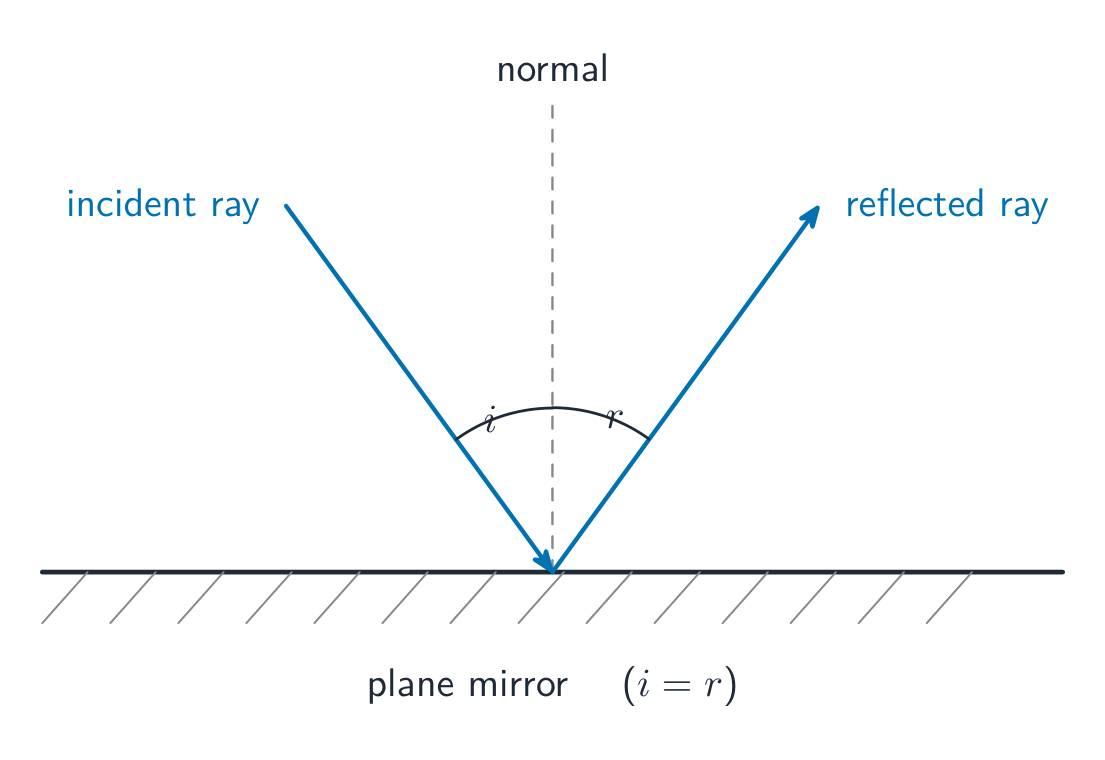
  • 13.1.B.2 The law of reflection states that the angle between the incident ray and the normal (the line perpendicular to the surface) is equal to the angle between the reflected ray and the normal.
    • Equation: $\theta_i = \theta_r$
  • 13.1.B.3 Diffuse reflection is the reflection of light from a rough surface and results in light reflected in many different directions, because the line normal to the surface varies over the area over which the light is incident.
  • 13.1.B.4 Specular reflection is the reflection of light from a smooth surface and results in light uniformly reflected from the surface, because the line normal to the surface has an approximately constant direction over the area the light strikes.
العربية

الهدف التعليمي 13.1.A: وصف الضوء كـ شعاع ضوئي.

  • 13.1.A.1 الشعاع الضوئي هو خط مستقيم عمودي على جبهات الموجة للضوء ويشير إلى اتجاه انتشار الموجة.
    • 13.1.A.1.i يمكن استخدام الأشعة الضوئية لتحديد سلوك الضوء في البصريات الهندسية، حيث يمكن إهمال الطبيعة الموجية للضوء.
    • 13.1.A.1.ii لا تكفي الأشعة لفهم انتشار الضوء. في ظاهرتي التداخل والتشعب، تكون الطبيعة الموجية للضوء مهمة.
    • 13.1.A.1.iii الليزر مصدر شائع لحزمة ضوئية واحدة متجانسة ومفردة اللون يمكن نمذجتها كشعاع ضوئي. سيتم النظر في الطبيعة الموجية للأزواج الليزرية في الوحدة 14.
  • 13.1.A.2 توضح المخططات الشعاعية مسار الضوء قبل وبعد التفاعل مع المادة.

الهدف التعليمي 13.1.B: وصف انعكاس الضوء من سطح ما.

  • 13.1.B.1 يمكن أن تنعكس أشعة الضوء الساقطة على سطح ما.
  • 13.1.B.2 تنص قانون الانعكاس على أن الزاوية بين الشعاع الساقط والعمود (الخط العمودي على السطح) تساوي الزاوية بين الشعاع المنعكس والعمود.
    • المعادلة: $\theta_i = \theta_r$
  • 13.1.B.3 الانعكاس المشتت هو انعكاس الضوء من سطح خشن ويؤدي إلى انعاكس الضوء في اتجاهات مختلفة متعددة، لأن الخط العمودي على السطح يتغير عبر المنطقة التي يسقط عليها الضوء.
  • 13.1.B.4 الانعكاس النعيمي (المرايا) هو انعكاس الضوء من سطح أملس ويؤدي إلى انعاكس الضوء بشكل منتظم من السطح، لأن الخط العمودي على السطح له اتجاه ثابت تقريباً عبر المنطقة التي يصطدم بها الضوء.
Source: College Board AP Course and Exam Description · ⁨المصدر: وصف دورة وامتحان College Board AP⁩

English

Geometric optics 几何光学 treats light as straight-line rays. The law of reflection 反射定律: when light bounces off a surface, the angle of incidence 入射角 equals the angle of reflection 反射角, both measured from the normal (the line perpendicular to the surface). Smooth surfaces reflect a clear image; rough surfaces scatter the rays.

العربية

البصريات الهندسية تعامل الضوء كأشعة خطية. قانون الانعكاس: عندما يرتد الضوء عن سطح، يكون زاوية السقوط مساوية لـ زاوية الانعكاس، وكلاهما يُقاس من العمودي (الخط العمودي على السطح). الأسطح الناعسة تعكس صورة واضحة؛ الأسخاخ تشتت الأشعة.

قانون الانعكاس: زاوية السقوط تساوي زاوية الانعكاس
Watch lesson · ⁨شاهد الدرس⁩
13.2

Images Formed by Mirrors · ⁨الصور المُكونة بالمرايا⁩

Syllabus · ⁨المنهج⁩
English

Learning Objective 13.2.A: Describe the image formed by a mirror.

  • 13.2.A.1 Incident light rays parallel to the principal axis of a concave (converging) mirror will be reflected toward a common location, called the focal point.
  • 13.2.A.2 Incident light rays parallel to the principal axis of a convex (diverging) mirror will be reflected such that they appear to have originated from a common location behind the mirror, called the focal point.
  • 13.2.A.3 The focal point of a plane mirror is an infinite distance from the mirror.
  • 13.2.A.4 The focal point of a spherical mirror may be approximated as a point located on the principal axis of the mirror halfway between the surface of the mirror and the center of the mirror's radius of curvature.
  • 13.2.A.5 A real image is formed by a mirror when light rays emanating from a common point are reflected and then intersect at a common point.
  • 13.2.A.6 A virtual image is formed by a mirror when reflected light rays diverge such that they appear to have originated from a common point.
  • 13.2.A.7 The location of an image depends on the focal length of the mirror and the distance between the object and the surface of the mirror.
    • Equation: $\dfrac{1}{s_i} + \dfrac{1}{s_o} = \dfrac{1}{f}$
    • 13.2.A.7.i The locations of a mirror's focal point, an object near the mirror, and the image of the object formed by the mirror follow sign conventions that are used to determine those locations relative to the mirror itself.
    • 13.2.A.7.ii The distance between the image formed and a plane mirror is equal to the distance between the object and the plane mirror.
  • 13.2.A.8 The magnification of an image formed by a mirror is the ratio of the size of the image produced to the size of the object itself and depends on the locations of the object and image relative to the mirror.
    • Equation: $|M| = \left| \dfrac{h_i}{h_o} \right| = \left| \dfrac{s_i}{s_o} \right|$
  • 13.2.A.9 Ray diagrams can be used to determine the location, type, size, and orientation of images formed by mirrors.
    • 13.2.A.9.i The three principal rays are typically used to find the images formed by mirrors. The principal rays are 1) the ray parallel to the principal axis, 2) the ray that reflects at the center of the mirror where the principal axis intersects the mirror, and 3) the ray that passes through the focal point of the mirror.
    • 13.2.A.9.ii Images formed by a mirror can be upright or inverted, virtual or real, and reduced, enlarged, or the same size as the object.

Boundary statement: AP Physics 2 limits the study of mirrors to plane mirrors, convex spherical mirrors, and concave spherical mirrors.

العربية

الهدف التعليمي 13.2.A: وصف الصورة المتكونة بواسطة المرآة.

  • 13.2.A.1 ستنعكس أشعة الضوء الساقطة الموازية للمحور الرئيسي للمرآة المقعرة (المتقاربة) نحو نقطة مشتركة تُعرف بالتركيز.
  • 13.2.A.2 ستنعكس أشعة الضوء الساقطة الموازية للمحور الرئيسي للمرآة المحدبة (المتباعدة) بحيث تبدو وكأنها نشأت من نقطة مشتركة خلف المرآة، وتُعرف هذه النقطة بالتركيز.
  • 13.2.A.3 يقع مركز بؤرية المرآة المسطحة على مسافة لا نهائية من المرآة.
  • 13.2.A.4 يمكن تقريب مركز بؤرية المرآة الكروية كنقطة تقع على المحور الرئيسي للمرآة في منتصف المسافة بين سطح المرآة ومركز نصف قطر تقعرها.
  • 13.2.A.5 تتكون صورة حقيقية بواسطة مرآة عندما تنبعث أشعة الضوء من نقطة مشتركة وتنعكس ثم تتقاطع عند نقطة مشتركة.
  • 13.2.A.6 تتكون صورة وهمية بواسطة مرآة عندما تتفرع أشعة الضوء المنعكسة بحيث تبدو وكأنها نشأت من نقطة مشتركة.
  • 13.2.A.7 يعتمد موقع الصورة على البعد البؤري للمرآة والمسافة بين الجسم وسطح المرآة.
    • المعادلة: $\dfrac{1}{s_i} + \dfrac{1}{s_o} = \dfrac{1}{f}$
    • 13.2.A.7.i تتبع مواقع البؤرة للمرآة، والجسم القريب منها، والصورة المتكونة للجسم قواعد للإشارات تُستخدم لتحديد تلك المواقع بالنسبة للمرآة نفسها.
    • 13.2.A.7.ii تساوي المسافة بين الصورة المتكونة والمرآة المستوية المسافة بين الجسم والمرآة المستوية.
  • 13.2.A.8 التكبير للصورة المتكونة بواسطة مرآة هو نسبة حجم الصورة الناتجة إلى حجم الجسم نفسه ويعتمد على مواقع الجسم والصورة بالنسبة للمرآة.
    • المعادلة: $|M| = \left| \dfrac{h_i}{h_o} \right| = \left| \dfrac{s_i}{s_o} \right|$
  • 13.2.A.9 يمكن استخدام المخططات الشعاعية لتحديد موقع ونوع وحجم واتجاه الصور المتكونة بواسطة المرايا.
    • 13.2.A.9.i عادةً ما تُستخدم الأشعة الرئيسية الثلاثة لإيجاد الصور المتكونة بواسطة المرايا. الأشعة الرئيسية هي: 1) الشعاع الموازي للمحور الرئيسي، 2) الشعاع الذي ينعكس عند مركز المرآة حيث يتقاطع المحور الرئيسي معها، و3) الشعاع الذي يمر عبر البؤرة المرآة.
    • 13.2.A.9.ii يمكن أن تكون الصور المتكونة بواسطة المرآة معتدلة أو مقلوبة، وهمية أو حقيقية، مصغرة أو مكبرة أو بنفس حجم الجسم.

بيان الحدود: يحدّ برنامج AP Physics 2 دراسة المرايا بالمرايا المسطحة والمرايا الكروية المحدبة والمرايا الكروية المقعرة.

Source: College Board AP Course and Exam Description · ⁨المصدر: وصف دورة وامتحان College Board AP⁩

English

A curved mirror focuses parallel rays at its focal point, a distance $f$ from the mirror. The mirror equation relates object and image distances:

$$\frac{1}{d_o}+\frac{1}{d_i}=\frac{1}{f},\qquad m=-\frac{d_i}{d_o}.$$
A concave mirror 凹面镜 (converging) can form a real image 实像 (rays actually meet, projectable, inverted); a convex mirror 凸面镜 always forms a virtual image 虚像 (rays only appear to meet, upright, reduced). The magnification $m$ gives the image's size and orientation. Sign convention matters: a negative image distance means a virtual image behind the mirror or lens.

العربية

المريا المنحنية تُركز الأشعة المتوازية عند نقطتها البؤرية، على مسافة $f$ من المرآة. معادلة المرآة تربط بين مسافة الجسم والصورة:

$$\frac{1}{d_o}+\frac{1}{d_i}=\frac{1}{f},\qquad m=-\frac{d_i}{d_o}.$$
المرآة المحدبة (المتقاربة) يمكن أن تكون صورة حقيقية (الأشعة تجتمع فعلياً، قابلة للإسقاط، مقلوبة)؛ المرآة المقعرة دائماً ما تكون صورة وهمية (الأشعة تبدو أنها تجتمع فقط، معتدلة، مصغرة). يعطي التكبير $m$ حجم الصورة واتجاهها. إشارات التوقيع مهمة: المسافة السلبية للصورة تعني صورة وهمية خلف المرآة أو العدسة.

Explore · ⁨استكشف⁩

Form an image with a curved mirror · ⁨تشكيل صورة بعد مرآة مقعرة⁩

A concave mirror reflects rays through its focus. The object's distance relative to the focal length decides whether the image is real or virtual, enlarged or reduced. · ⁨المرآة المقعرة تعكس الأشعة عبر بؤرتها. مسافة الجسم بالنسبة للبعد البؤري تحدد ما إذا كانت الصورة حقيقية أو وهمية، مكبرة أو مصغرة.⁩

Watch lesson · ⁨شاهد الدرس⁩
13.3

Refraction · ⁨الانكسار⁩

Syllabus · ⁨المنهج⁩
English

Learning Objective 13.3.A: Describe the refraction of light between two media.

  • 13.3.A.1 Refraction is the change in direction of a light ray as the ray passes from one medium into another.
  • 13.3.A.2 Refraction is a result of the speed of light changing when light enters a new medium.
  • 13.3.A.3 The index of refraction of a given medium is inversely proportional to the speed of light in the medium.
    • Equation: $n = \dfrac{c}{v}$
  • 13.3.A.4 Snell's law relates the angles of incidence and refraction of a light ray passing from one medium into another to the indices of refraction of the two media.
    • Equation: $n_1 \sin\theta_1 = n_2 \sin\theta_2$
    • 13.3.A.4.i When a light ray travels from a medium with a higher index of refraction into a medium with a lower index of refraction, the ray refracts away from the normal.
    • 13.3.A.4.ii When a light ray travels from a medium with a lower index of refraction into a medium with a higher index of refraction, the ray refracts toward the normal.
    • 13.3.A.4.iii When a light ray is incident along the normal to a surface, the transmitted ray is not refracted.
  • 13.3.A.5 Total internal reflection may occur when light passes from one medium into another medium with a lower index of refraction.
    • 13.3.A.5.i Total internal reflection of light occurs beyond a critical angle of incidence.
      • Derived equation: $\theta_{\text{critical}} = \sin^{-1}\left( \dfrac{n_2}{n_1} \right)$
    • 13.3.A.5.ii For incident rays at the critical angle, the ray refracts at 90 degrees and travels along the surface of the material.
    • 13.3.A.5.iii For incident rays beyond the critical angle, all light is reflected (no light is transmitted into the other medium).
العربية

الهدف التعليمي 13.3.A: وصف انكسار الضوء بين وسطين.

  • 13.3.A.1 الانكسار هو تغير اتجاه الشعاع الضوئي أثناء انتقاله من وسط إلى آخر.
  • 13.3.A.2 ينتج الانكسار عن تغير سرعة الضوء عند دخول وسط جديد.
  • 13.3.A.3 معامل انكسار وسط معين يتناسب عكسياً مع سرعة الضوء في ذلك الوسط.
    • المعادلة: $n = \dfrac{c}{v}$
  • 13.3.A.4 تربط قانون سنيل بين زوايا السقوط والانكسار لشعاع ضوئي ينتقل من وسط إلى آخر ومعاملات الانكسار للوسطين.
    • المعادلة: $n_1 \sin\theta_1 = n_2 \sin\theta_2$
    • 13.3.A.4.i عندما ينتقل شعاع ضوئي من وسط ذو معامل انكسار أعلى إلى وسط ذو معامل انكسار أقل، ينكسر الشعاع مبتعداً عن العمود.
    • 13.3.A.4.ii عندما ينتقل شعاع ضوئي من وسط ذو معامل انكسار أقل إلى وسط ذو معامل انكسار أعلى، ينكسر الشعاع مقترباً من العمود.
    • 13.3.A.4.iii عندما يسقط شعاع ضوئي على طول العمود على سطح ما، لا ينكسر الشعاع المنقول.
  • 13.3.A.5 قد يحدث الانعكاس الكلي الداخلي عندما يمر الضوء من وسط إلى وسط آخر ذات معامل انكسار أقل.
    • 13.3.A.5.i يحدث الانعكاس الكلي الداخلي للضوء عند زوايا سقوط تتجاوز الزاوية الحرجة.
      • معادلة مشتقة: $\theta_{\text{critical}} = \sin^{-1}\left( \dfrac{n_2}{n_1} \right)$
    • 13.3.A.5.ii بالنسبة للأشعة الساقطة عند الزاوية الحرجة، تنكسر الشعاع بزاوية 90 درجة وتنتقل على طول سطح المادة.
    • 13.3.A.5.iii بالنسبة للأشعة الساقطة التي تتجاوز الزاوية الحرجة، يتم انعكاس جميع الأشعة (لا يتم تمرير أي ضوء إلى الوسط الآخر).

Source: College Board AP Course and Exam Description · ⁨المصدر: وصف دورة وامتحان College Board AP⁩

English

Light bends when it passes between materials because its speed changes – refraction 折射. Each material has an index of refraction 折射率 $n=\dfrac{c}{v}$ (how much it slows light). Snell's law 斯涅尔定律:

$$n_1\sin\theta_1=n_2\sin\theta_2.$$
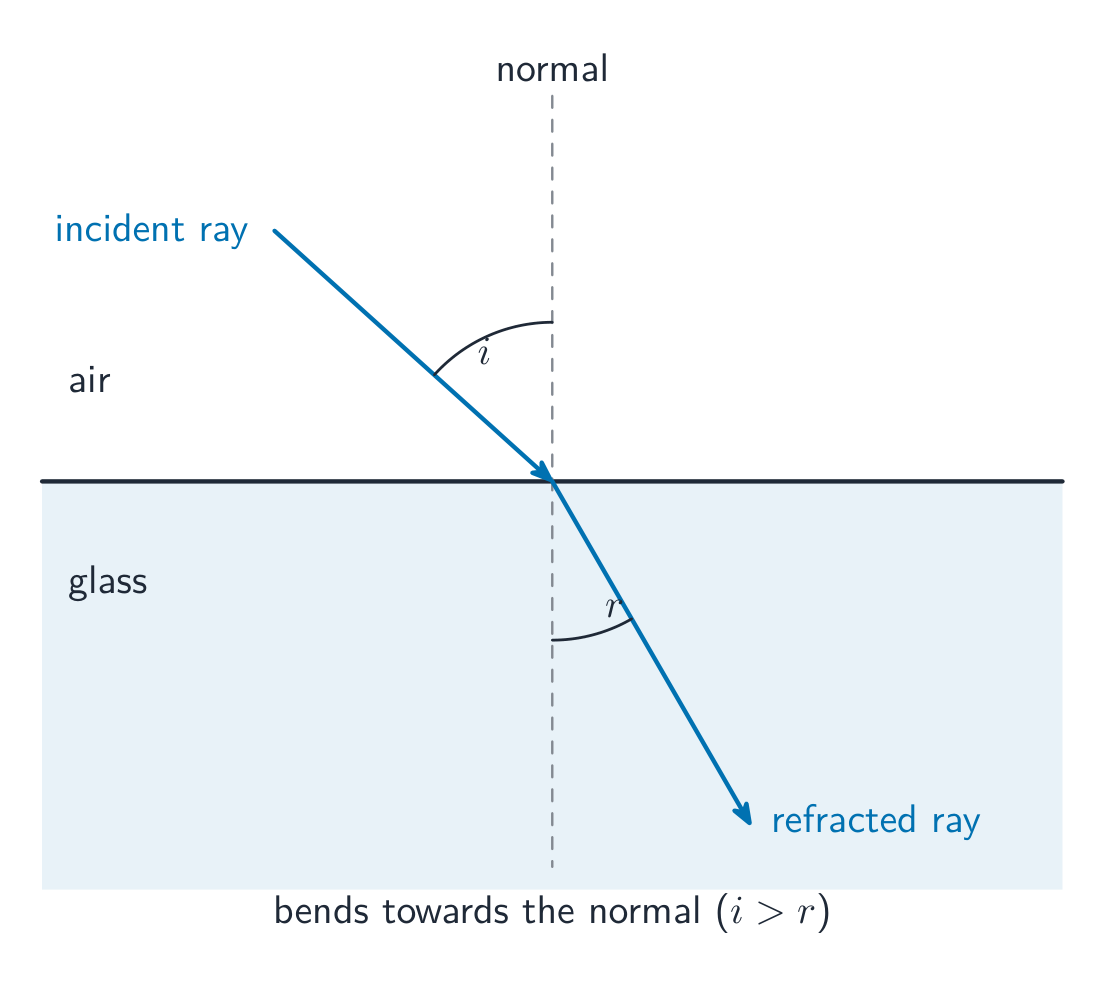
Light entering a denser medium (larger $n$) bends toward the normal. Beyond a critical angle, light going to a less-dense medium reflects entirely – total internal reflection 全反射, used in fibre optics.

Worked example. A ray in air ($n_1=1.00$) strikes water ($n_2=1.33$) at $40^{\circ}$ to the normal. By Snell's law,

$$\sin\theta_2=\frac{n_1}{n_2}\sin\theta_1=\frac{1.00}{1.33}\sin 40^{\circ}=0.483\;\Rightarrow\;\theta_2=29^{\circ}.$$
The ray bends toward the normal, as expected going into the denser medium.

Worked example (critical angle). For light trying to leave glass ($n=1.50$) for air, total internal reflection begins at the critical angle $\theta_c$ where the refracted ray grazes the surface:

$$\sin\theta_c=\frac{1}{n}=\frac{1}{1.50}=0.667\;\Rightarrow\;\theta_c=42^{\circ}.$$
Any ray hitting the inside surface more steeply than $42^{\circ}$ is trapped – the reason optical fibres carry light for kilometres.

العربية

ينحني الضوء عند مروره بين المواد بسبب تغير سرعته – الانكسار. لكل مادة معامل انكسار $n=\dfrac{c}{v}$ (مدى بطئه للضوء). قانون سنيل:

$$n_1\sin\theta_1=n_2\sin\theta_2.$$
يدخل الضوء وسطاً أكثر كثافة (أكبر $n$) وينحني نحو العمودي. فوق زاوية حرجة، عندما ينتقل الضوء إلى وسط أقل كثافة، يتم انعكاسه كلياً – الانعكاس الكلي الداخلي، المستخدم في الألياف الضوئية.

ينكسر الضوء، منحنيًا نحو العمودي عند دخوله الزجاج

مثال محلول. شعاع في الهواء ($n_1=1.00$) يصطدم بالماء ($n_2=1.33$) بزاوية $40^{\circ}$ مع العمودي. طبقاً لقانون سنيل،

$$\sin\theta_2=\frac{n_1}{n_2}\sin\theta_1=\frac{1.00}{1.33}\sin 40^{\circ}=0.483\;\Rightarrow\;\theta_2=29^{\circ}.$$
ينحني الشعاع نحو العمودي، كما هو متوقع عند الدخول إلى وسط أكثر كثافة.

مثال محلول (الزاوية الحرجة). للضوء محاولاً الخروج من الزجاج ($n=1.50$) إلى الهواء، يبدأ الانعكاس الكلي الداخلي عند الزاوية الحرجة $\theta_c$ حيث يلامس الشعاع المنكسر السطح:

$$\sin\theta_c=\frac{1}{n}=\frac{1}{1.50}=0.667\;\Rightarrow\;\theta_c=42^{\circ}.$$
أي شعاع يصطدم بالسطح الداخلي بزاوية أكبر من $42^{\circ}$ يبقى محبساً – وهذا سبب قدرة الألياف الضوئية على نقل الضوء لمسافات كيلومترات.

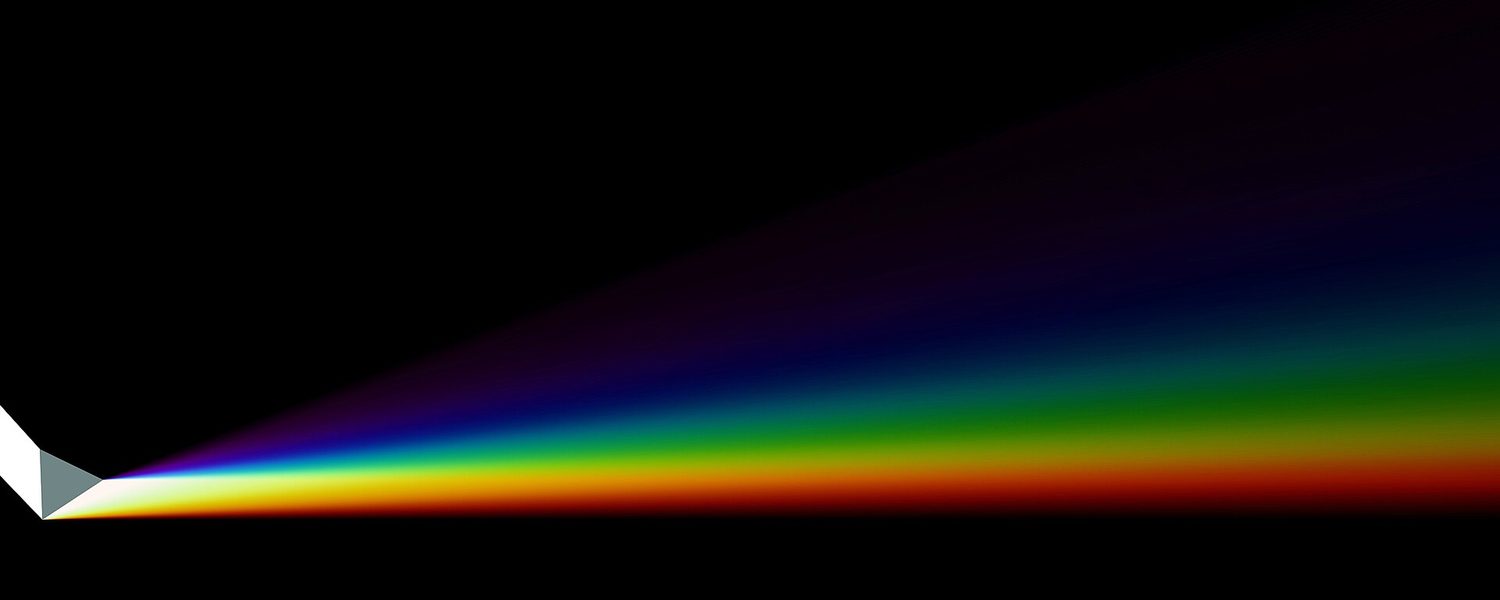
انقسام الضوء الأبيض إلى طيف عبر منشور زجاجي
ينحني كل لون بزاوية مختلفة، لذا يقوم المنشور بتوزيع الضوء الأبيض على شكل قوس قزح
Explore · ⁨استكشف⁩

Bend light as it enters glass · ⁨انحناء الضوء عند دخوله الزجاج⁩

Light refracts (bends) when it changes speed between media, following Snell's law. The denser the medium, the more it bends toward the normal. · ⁨ينكسر الضوء (ينحني) عند تغيير سرعته بين وسطين، following قانون سنيل. كلما كان الوسط أكثر كثافة، انحنى أكثر نحو العمودي.⁩

Vocabulary · ⁨مفردات⁩ Train · ⁨تدريب⁩
English العربية
Geometric optics/ˌdʒiːəʊˈmetrɪk ˈɒptɪks/ البصريات الهندسية
law of reflection/lɔː ɒv rɪˈflekʃn/ قانون الانعكاس
angle of incidence/ˈæŋɡl ɒv ˈɪnsɪdəns/ زاوية السقوط
angle of reflection/ˈæŋɡl ɒv rɪˈflekʃn/ زاوية الانعكاس
concave mirror/kɒnˈkeɪv ˈmɪrə/ المرآة المقعرة
real image/rɪəl ˈɪmɪdʒ/ صورة حقيقية
convex mirror/kɒnˈveks ˈmɪrə/ المرآة المحدبة
virtual image/ˈvɜːtʃuːəl ˈɪmɪdʒ/ صورة وهمية
refraction/rɪˈfrækʃn/ انكسار
index of refraction/ˈɪndeks ɒv rɪˈfrækʃn/ معامل الانكسار
Snell's law/snelz lɔː/ قانون سنل
total internal reflection/ˈtəʊtl ɪnˈtɜːnl rɪˈflekʃn/ الانعكاس الكلي الداخلي
Watch lesson · ⁨شاهد الدرس⁩
13.4

Images Formed by Lenses · ⁨الصور المتشكلة بواسطة العدسات⁩

Syllabus · ⁨المنهج⁩
English

Learning Objective 13.4.A: Describe the image formed by a lens.

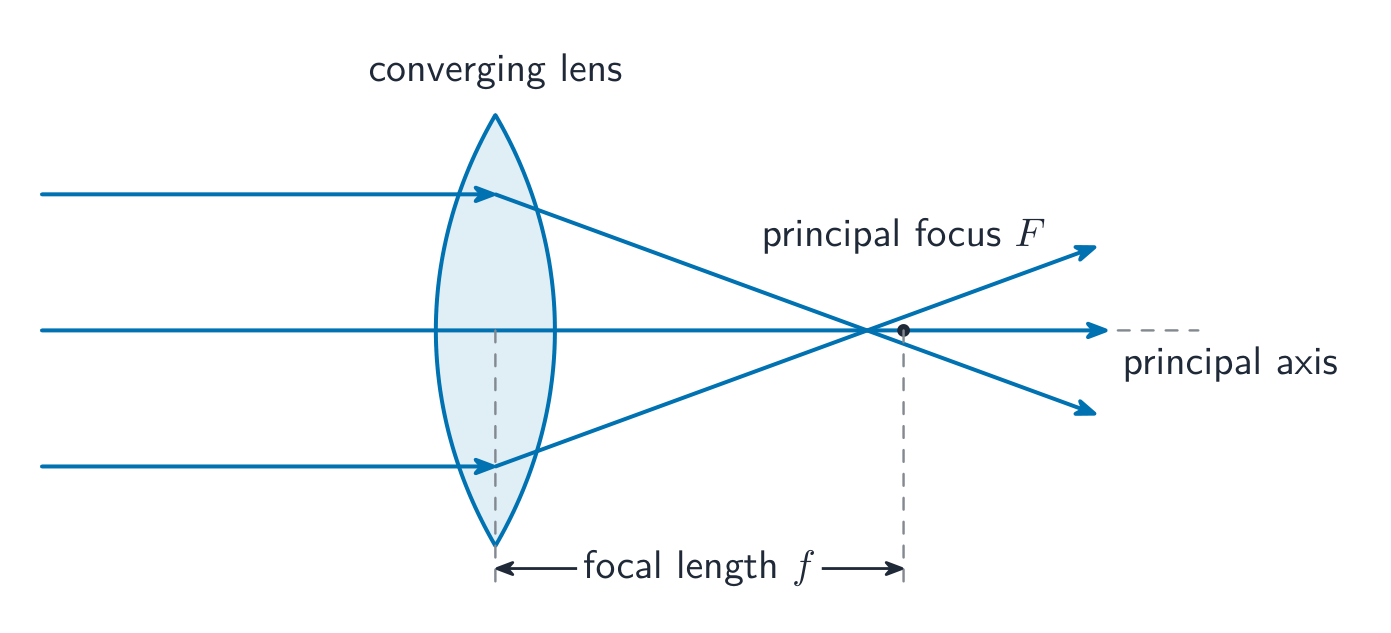
  • 13.4.A.1 Incident light rays parallel to the principal axis of a thin convex (converging) lens will be refracted and converge toward a common location on the transmitted side of the lens, called the focal point.
  • 13.4.A.2 Incident light rays parallel to the principal axis of a thin concave (diverging) lens will be refracted and diverge as if they originated from a focal point on the incident side of the lens.
  • 13.4.A.3 A real image is formed by a lens when light rays originating from a common point are refracted such that they intersect at another common point.
  • 13.4.A.4 A virtual image is formed by a lens when refracted light rays diverge such that they appear to have originated from a common point.
  • 13.4.A.5 For a thin lens, the location of an image depends on the focal length of the lens and the distance between the object and the midline of the lens, as given by the thin-lens equation:
    • Equation: $\dfrac{1}{s_i} + \dfrac{1}{s_o} = \dfrac{1}{f}$
    • 13.4.A.5.i The locations of a lens's focal point, an object, and the image of the object formed by the lens follow sign conventions that are used to determine those locations relative to the lens itself.
    • 13.4.A.5.ii Lenses have a focal point on both sides of the lens that depends on the shape of the respective side of the lens.
  • 13.4.A.6 For a thin lens, the magnification of an image is the ratio of the size of the image produced to the size of the object itself and depends on the locations of the object and image relative to the lens.
    • Equation: $|M| = \left| \dfrac{h_i}{h_o} \right| = \left| \dfrac{s_i}{s_o} \right|$
  • 13.4.A.7 Ray diagrams can be used to determine the location, type, size, and orientation of images formed by lenses.
    • 13.4.A.7.i The three principal rays are typically used to find the images formed by lenses. The principal rays are 1) the ray parallel to the principal axis, 2) the ray that passes through the center of the lens where the principal axis intersects the lens, and 3) the ray that passes through the focal point of the lens.
    • 13.4.A.7.ii Images formed by a lens can be upright or inverted, virtual or real, and reduced, enlarged, or the same size as the object.
العربية

هدف التعلم 13.4.A: صف الصورة المتكونة عن عدسة.

  • 13.4.A.1 ستتنكسر أشعة الضوء الساقطة الموازية للمحور الرئيسي لعدسة محدبة رقيقة (مُجمِّعة) وتتجمع نحو نقطة مشتركة على الجانب المار منه الضوء للعدسة، تسمى البؤرة.
  • 13.4.A.2 ستتنكسر أشعة الضوء الساقطة الموازية للمحور الرئيسي لعدسة مقعرة رقيقة (مُشتتة) وتتفرق وكأنها تنشأ من بؤرة على جانب سقوط الأشعة للعدسة.
  • 13.4.A.3 تتشكل صورة حقيقية عن عدسة عندما تنكسر أشعة الضوء المنبثقة من نقطة مشتركة بحيث تتقاطع في نقطة مشتركة أخرى.
  • 13.4.A.4 تتشكل صورة وهمية عن عدسة عندما تتفرق أشعة الضوء المنكسرة بحيث تبدو وكأنها نشأت من نقطة مشتركة.
  • 13.4.A.5 بالنسبة للعدسات الرقيقة، يعتمد موقع الصورة على البعد البؤري للعدسة والمسافة بين الجسم ومحور العدسة، كما هو موضح بالمعادلة الخاصة بالعدسات الرقيقة:
    • المعادلة: $\dfrac{1}{s_i} + \dfrac{1}{s_o} = \dfrac{1}{f}$
    • 13.4.A.5.i تتبع مواقع البؤرة للعدسة والجسم والصورة المتكونة للجسم بواسطة العدسة قواعد الإشارات المستخدمة لتحديد تلك المواقع بالنسبة للعدسة نفسها.
    • 13.4.A.5.ii للعدسات بؤرتان على كلا جانبي العدسة تعتمدان على شكل الجانب المعني من العدسة.
  • 13.4.A.6 بالنسبة للعدسة الرقيقة، هي تكبير الصورة نسبة حجم الصورة الناتجة إلى حجم الجسم نفسه وتعتمد على مواقع الجسم والصورة بالنسبة للعدسة.
    • المعادلة: $|M| = \left| \dfrac{h_i}{h_o} \right| = \left| \dfrac{s_i}{s_o} \right|$
  • 13.4.A.7 يمكن استخدام مخططات الأشعة لتحديد الموقع والنوع والحجم والاتجاه للصور المتكونة عن العدسات.
    • 13.4.A.7.i عادةً ما تُستخدم ثلاثة أشعة رئيسية لإيجاد الصور المتكونة عن العدسات. الأشعة الرئيسية هي: 1) الشعاع الموازي للمحور الرئيسي، 2) الشعاع الذي يمر عبر مركز العدسة حيث يتقاطع المحور الرئيسي مع العدسة، و3) الشعاع الذي يمر عبر البؤرة للعدسة.
    • 13.4.A.7.ii يمكن أن تكون الصور المتكونة عن العدسة مستقيمة أو مقلوبة، وهمية أو حقيقية، ومصغرة أو مكبرة أو بنفس حجم الجسم.

Source: College Board AP Course and Exam Description · ⁨المصدر: وصف دورة وامتحان College Board AP⁩

English
A converging lens forms a real image

A lens bends light through refraction. The thin-lens equation has the same form as the mirror equation:

$$\frac{1}{d_o}+\frac{1}{d_i}=\frac{1}{f},\qquad m=-\frac{d_i}{d_o}.$$
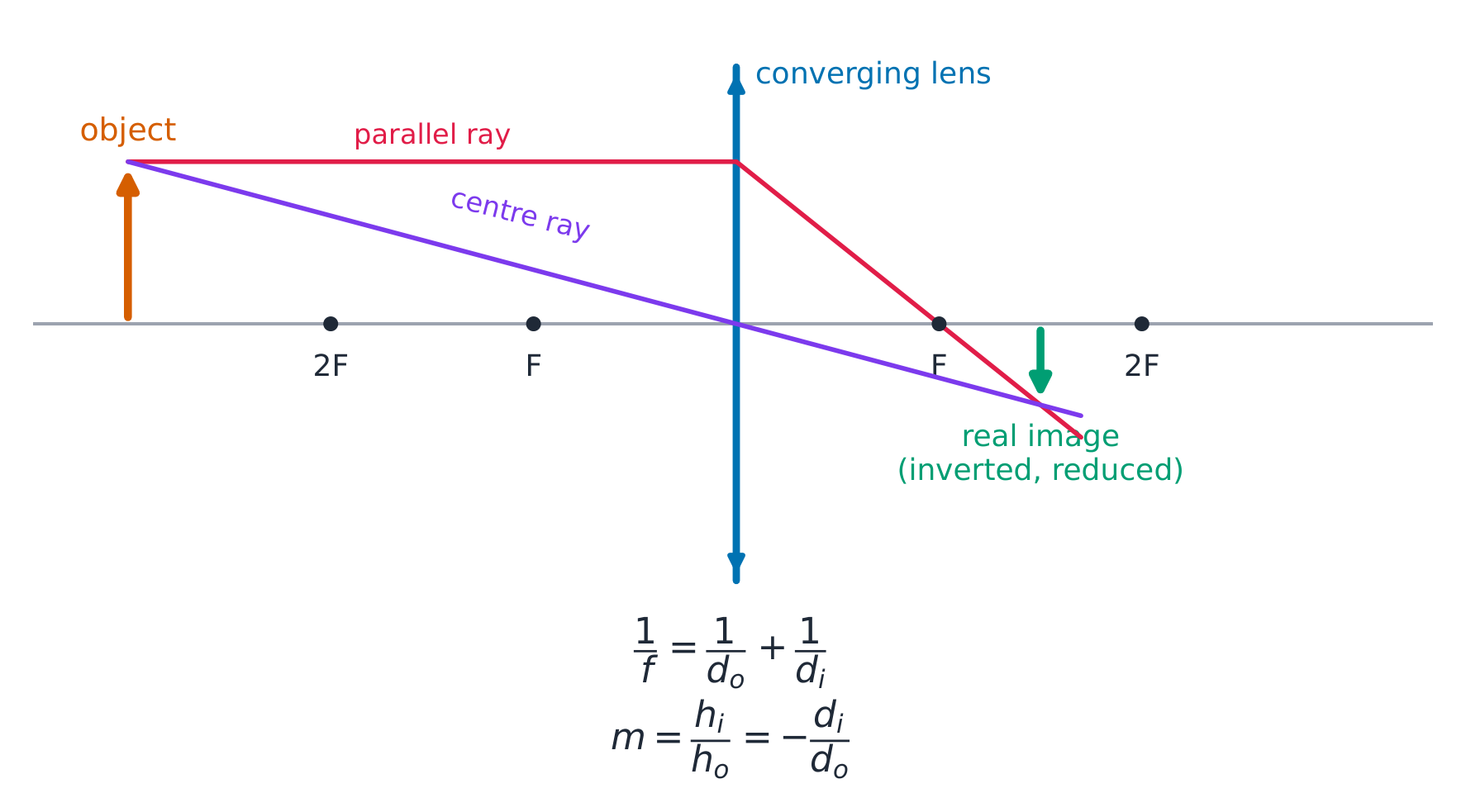
A converging 会聚 (convex) lens can form a real, inverted image or, for a close object, a virtual, upright, enlarged image (a magnifying glass). A diverging 发散 (concave) lens always forms a virtual, upright, reduced image. Ray diagrams locate the image quickly using two easy rays: one parallel to the axis that bends to pass through the far focus, and one straight through the centre of the lens (undeviated).

Worked example. An object sits $30\ \text{cm}$ from a converging lens of focal length $f=10\ \text{cm}$. Find the image. From the thin-lens equation,

$$\frac{1}{d_i}=\frac{1}{f}-\frac{1}{d_o}=\frac{1}{10}-\frac{1}{30}=\frac{2}{30}\;\Rightarrow\;d_i=15\ \text{cm},$$
and the magnification is $m=-d_i/d_o=-15/30=-0.5$. The image is real (positive $d_i$), inverted (negative $m$), and half the object's size – just what a camera lens does.

العربية
تكون العدسة المقاربة صورة حقيقية

الـعدسة تنحني الضوء عن طريق الانكسار. معادلة العدسة الرقيقة لها نفس صيغة معادلة المرآة:

$$\frac{1}{d_o}+\frac{1}{d_i}=\frac{1}{f},\qquad m=-\frac{d_i}{d_o}.$$
يمكن للـمقاربة (المحدبة) أن تكون صورة حقيقية مقلوبة أو، لجسم قريب، صورة وهمية مستقيمة ومكبرة (كمكبر). أما الـمتباعدة (المحدبة) فتكون دائماً صورة وهمية مستقيمة مصغرة. تحدد مخططات الأشعة موقع الصورة بسرعة باستخدام شعاعين سهلين: أحدهما موازٍ للمحور ينحني ليمر عبر البعد البعيد، والآخر يمر مستقيماً عبر مركز العدسة (بدون انحراف).

ضوءان يحددان موقع الصورة: أحدهما موازٍ ثم يركز، والثاني يمر مباشرة عبر المركز
أشعة لتحديد موقع الصورة: الموازي ثم التركيز، والمستقيم عبر المركز
عدسة مقاربة تجمع الأشعة الموازية في بؤرتها الرئيسية
العدسة المقاربة تجمع الأشعة الموازية في بؤرتها الرئيسية

مثال محلول. يقع جسم $30\ \text{cm}$ من عدسة مقاربة طولها البؤري $f=10\ \text{cm}$. أوجد الصورة. من معادلة العدسة الرقيقة،

$$\frac{1}{d_i}=\frac{1}{f}-\frac{1}{d_o}=\frac{1}{10}-\frac{1}{30}=\frac{2}{30}\;\Rightarrow\;d_i=15\ \text{cm},$$
والتكبير هو $m=-d_i/d_o=-15/30=-0.5$. الصورة حقيقية ($d_i$ موجب)، مقلوبة ($m$ سالب)، ونصف حجم الجسم – تماماً ما تفعله عدسة الكاميرا.

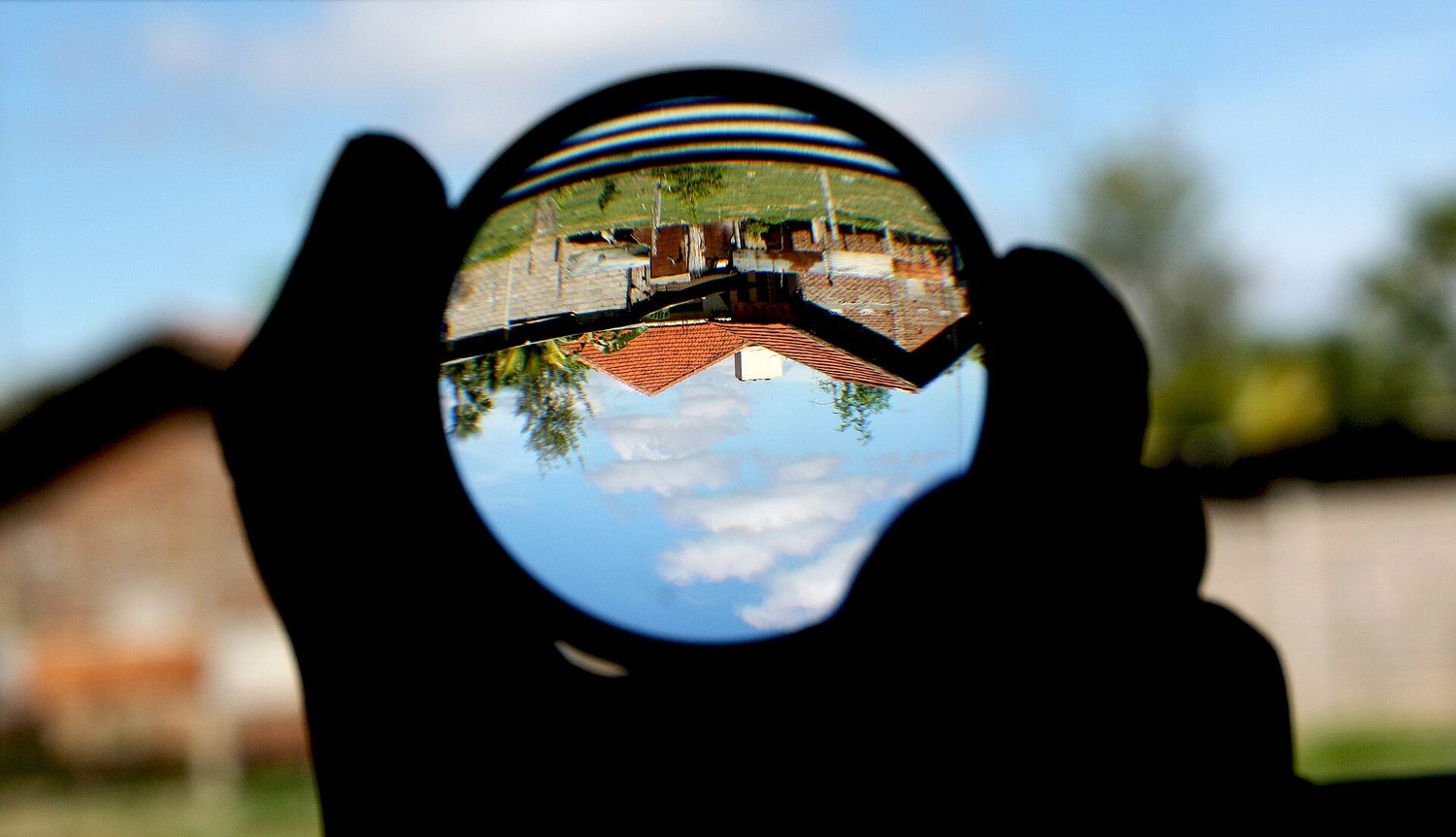
عدسة مكبرة تُظهر صورة مقلوبة خلفها
تكون العدسة المحدبة صورة حقيقية مقلوبة لمشهد بعيد، تماماً كما يتوقع الرسم الشعاعي
Explore · ⁨استكشف⁩

Form an image with a converging lens · ⁨تشكيل صورة بعد عدسة مقاربة⁩

A converging lens bends parallel rays to its focal point. Move the object and watch the image change from large and inverted to virtual and upright inside the focal length. · ⁨العدسة المقاربة تنحني الأشعة الموازية نحو بؤرتها. حوّل الجسم ولاحظ تغير الصورة من كبيرة ومقلوبة إلى وهمية ومعتدة داخل البعد البؤري.⁩

Vocabulary · ⁨مفردات⁩ Train · ⁨تدريب⁩
English العربية
converging/kənˈvɜːdʒɪŋ/ متجمع
diverging/daɪˈvɜːdʒɪŋ/ متفرق
Watch lesson · ⁨شاهد الدرس⁩
13.4

Exam tips · ⁨نصائح للامتحان⁩

English
  • Measure all angles from the normal, not the surface.
  • Light entering a denser medium (larger $n$) bends toward the normal; use Snell's law $n_1\sin\theta_1=n_2\sin\theta_2$.
  • Total internal reflection happens only going into a less dense medium, beyond the critical angle ($\sin\theta_c=1/n$).
  • For mirrors and lenses use $\tfrac1{d_o}+\tfrac1{d_i}=\tfrac1f$ and $m=-d_i/d_o$: a positive $d_i$ is a real image, negative is virtual.
  • $n=c/v$, so a bigger index means a slower speed of light in the material.
العربية
  • قِس جميع الزوايا من الـعمود، وليس من السطح.
  • عند دخول الضوء إلى وسط أكثر كثافة (دلالة انكسار $n$ أكبر)، ينحني نحو العمود؛ استخدم قانون سنيل $n_1\sin\theta_1=n_2\sin\theta_2$.
  • يحدث الانعكاس الكلي الداخلي فقط عند الدخول إلى وسط أقل كثافة، بعد الزاوية الحرجة ($\sin\theta_c=1/n$).
  • للمرآيات والعدسات استخدم $\tfrac1{d_o}+\tfrac1{d_i}=\tfrac1f$ و$m=-d_i/d_o$: الـ$d_i$ الموجب يمثل صورة حقيقية، والسالب وهمية.
  • $n=c/v$، لذا فإن دلالة الانكسار الأكبر تعني سرعة ضوء أبطأ في المادة.

Interactive lessons on this topic · ⁨دروس تفاعلية حول هذا الموضوع⁩

Work through it step by step, with instant-check exercises. · ⁨ا-working عليه خطوة بخطوة، مع تمارين تحقق فوري.⁩

Past Papers · ⁨أوراق الامتحانات السابقة⁩

More topics in AP Physics 2 · ⁨AP الفيزياء 2⁩ · ⁨المزيد من المواضيع في AP Physics 2 · ⁨AP الفيزياء 2⁩⁩

Log in or create account · ⁨تسجيل الدخول أو إنشاء حساب⁩

IGCSE, A-Level & AP