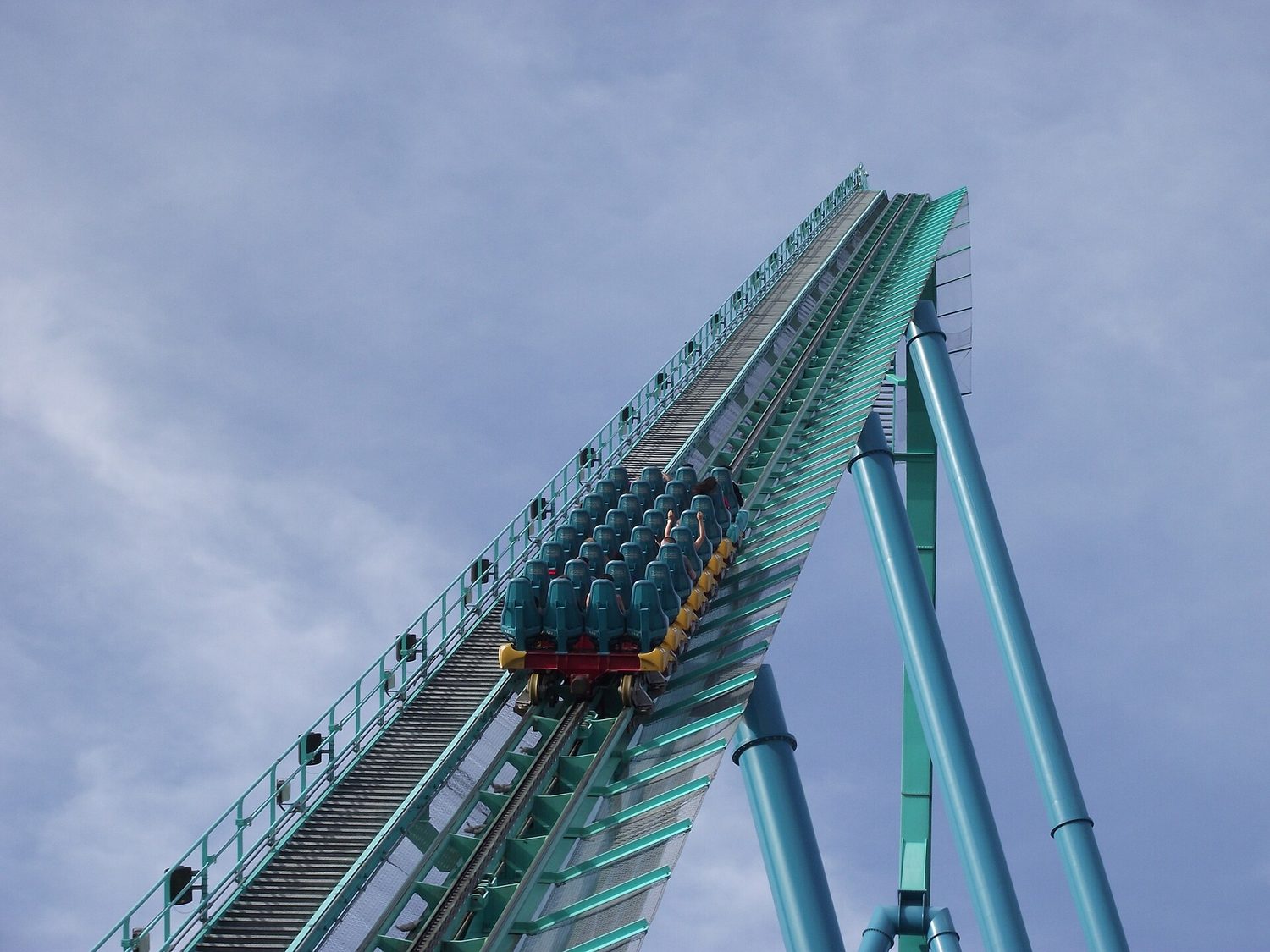
لا يوجد محرك لجسر التسلق على مساره. تسحبه سلسلة إلى أعلى أول تلة — وبعد ذلك، هو في طريقه وحده. إذن كيف يندفع عبر كل حلقة…
English narration · English + 中文 subtitles burned in · سرد باللغة الإنجليزية · ترجمة مدمجة بالإنجليزية + الصينية
5.1
Work, energy and power · الشغل والطاقة والقدرة
Syllabus · المنهج
English
understand the concept of work, and recall and use $\text{work done} = \text{force} \times \text{displacement in the direction of the force}$
recall and apply the principle of conservation of energy
recall and understand that the efficiency of a system is the ratio of useful energy output from the system to the total energy input
use the concept of efficiency to solve problems
define power as work done per unit time
solve problems using $P = W/t$
derive $P = Fv$ and use it to solve problems
العربية
فهم مفهوم الشغل، وتذكر واستخدام $\text{work done} = \text{force} \times \text{displacement in the direction of the force}$
تذكر وتطبيق مبدأ حفظ الطاقة
تذكر وفهم أن الكفاءة لنظام ما هي نسبة الطاقة المفيدة الناتجة من النظام إلى إجمالي الطاقة الداخلة إليه
استخدام مفهوم الكفاءة لحل المسائل
تعريف القدرة كشغل مقوم لكل وحدة زمن
حل المسائل باستخدام $P = W/t$
اشتقاق $P = Fv$ واستخدامه لحل المسائل
Source: Cambridge International syllabus · المصدر: منهج كامبريدج الدولي
English
Work done by a force
Work 功 is done when a force moves its point of contact along the line of the force. For the one-mark definition write: work done is the product of the force and the distance moved in the direction of the force. The work done by a constant force $F$ that causes a displacement 位移$s$ is
$$W = F \cdot s \cdot \cos\theta,$$
where $\theta$ is the angle between the force and the displacement. Only the component 分量 of the force along the displacement does work.
Worked example. A child pulls a sledge $5.0\ \text{m}$ across the snow with a rope, using a force of $20\ \text{N}$ at $60°$ to the ground. Find the work done by the rope.
Unit: $\text{J} = \text{N m}$. Work is a scalar 标量.
Special cases:
force in the same direction as the motion ($\theta = 0$): $W = Fs$, positive work, energy 能量 given to the object.
force at right angles to the motion ($\theta = 90°$): $W = 0$. The normal contact force 支持力 on a car on a flat road does no work.
force opposite to the motion ($\theta = 180°$): $W = -Fs$, negative work, energy taken from the object (for example friction 摩擦力).
For an object moving up a slope at angle $\alpha$ to the horizontal 水平, the work done against gravity in rising a height $h$ is $mgh$, while the work done by a horizontal push over the slope length $L$ uses $\cos\alpha$.
Two multiple-choice tests of the definition: no work is done on an object that slides at constant velocity along a frictionless surface (no force along the motion), or on one that is simply held still (no distance moved); work is done when a force lifts it. And when a box is pushed at constant velocity across a rough floor, the work done by the push is $F \times d$ for the whole distance, however the path is split into stages.
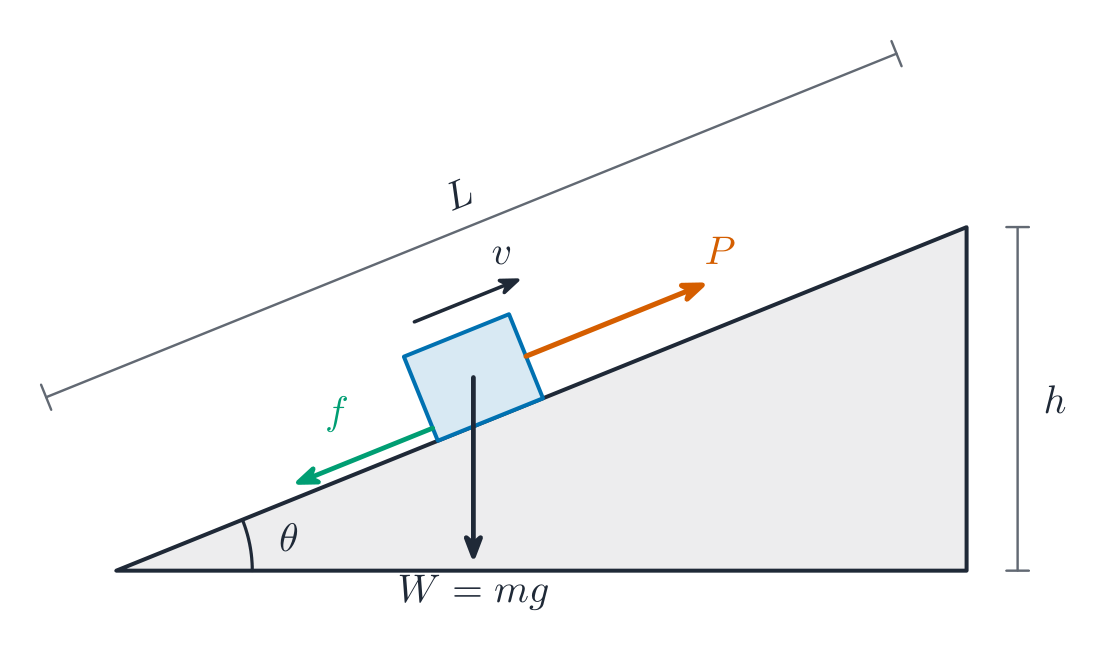
Worked example. A block of mass $4.9\ \text{kg}$ is pushed at constant velocity up a rough slope of length $8.0\ \text{m}$ that rises $1.5\ \text{m}$, by a force of $12\ \text{N}$ acting along the slope. Find the work done against friction.
Constant velocity means no change in kinetic energy, so the work done by the push is shared between the gain in gravitational potential energy and the work done against friction. Work by the push: $12 \times 8.0 = 96\ \text{J}$. Gain in GPE, using the vertical rise: $4.9 \times 9.81 \times 1.5 = 72\ \text{J}$. So the work done against friction is $96 - 72 = 24\ \text{J}$, and the friction force is $24 / 8.0 = 3.0\ \text{N}$. Using the slope length in $mgh$ is the commonest error on this question.
Conservation of energy
Energy is never made or destroyed — it only changes from one form to another, or moves from one object to another. In a closed system 封闭系统, the total energy stays constant. This is conservation of energy 能量守恒, stated for the marks as: energy cannot be created or destroyed; it can only be transferred from one form to another (so the total energy of a closed system is constant).
When you write an energy equation, list every form the energy starts as and ends as. Common forms in this syllabus: kinetic, gravitational potential, elastic potential energy 弹性势能, electrical 电能, thermal, sound, chemical energy 化学能.
A ball rolling down a frictionless 无摩擦ramp 斜坡 turns gravitational potential energy 重力势能 into kinetic energy 动能: $mgh = \tfrac{1}{2} m v^{2}$, so $v = \sqrt{2gh}$. With friction, some of this energy becomes thermal energy 热能 of the ramp and the air.
Worked example. A ball is released from rest at the top of a smooth ramp $1.2\ \text{m}$ high. Find its speed at the bottom (take $g = 9.81\ \text{m s}^{-2}$).
All the gravitational potential energy becomes kinetic energy, so $v = \sqrt{2gh}$ (the mass cancels):
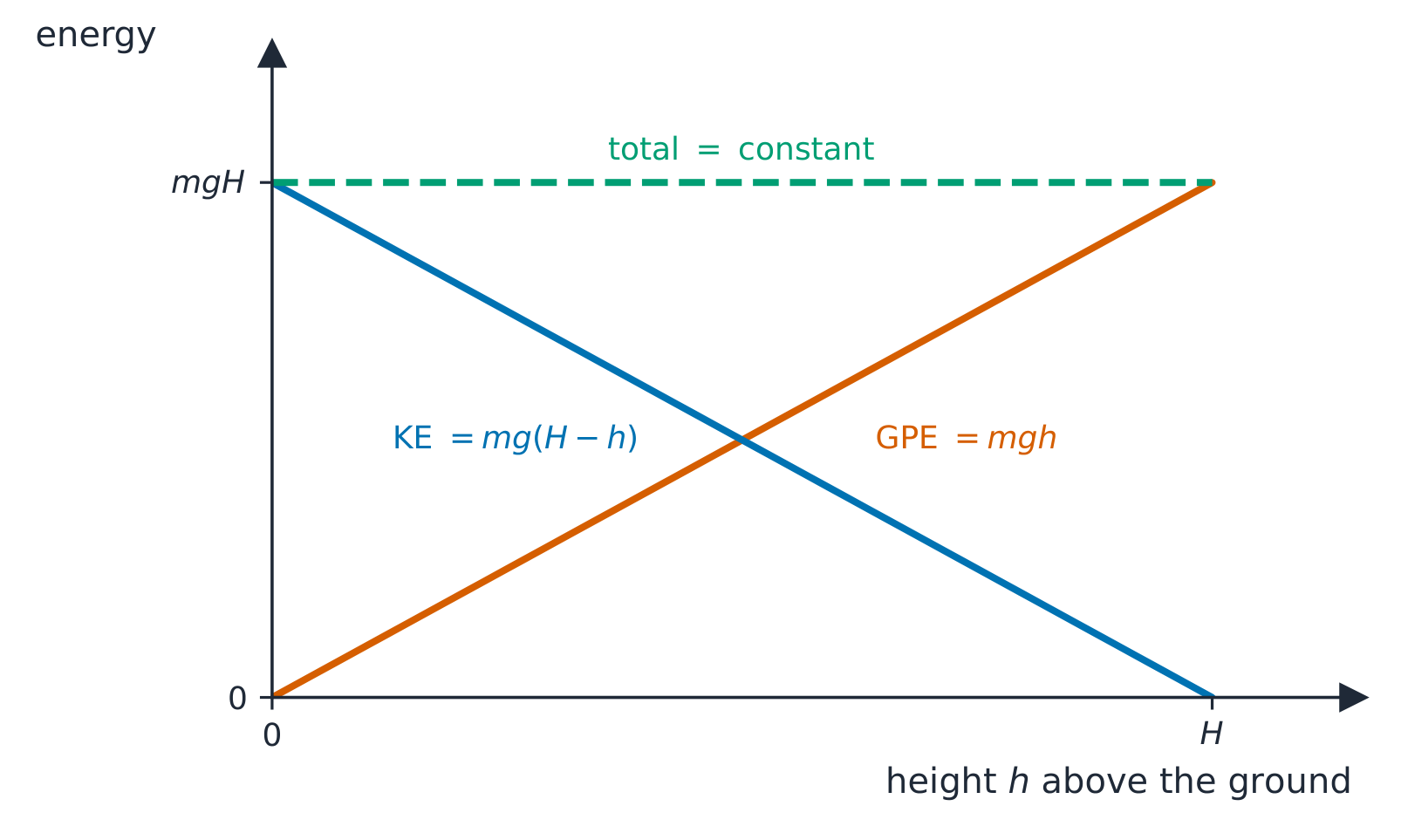
The same idea reads a graph. For a ball falling from height $H$ with air resistance negligible, the GPE falls in a straight line with height ($mgh$), the KE rises in a straight line ($mg(H - h)$), and the two add to the constant $mgH$ at every height.
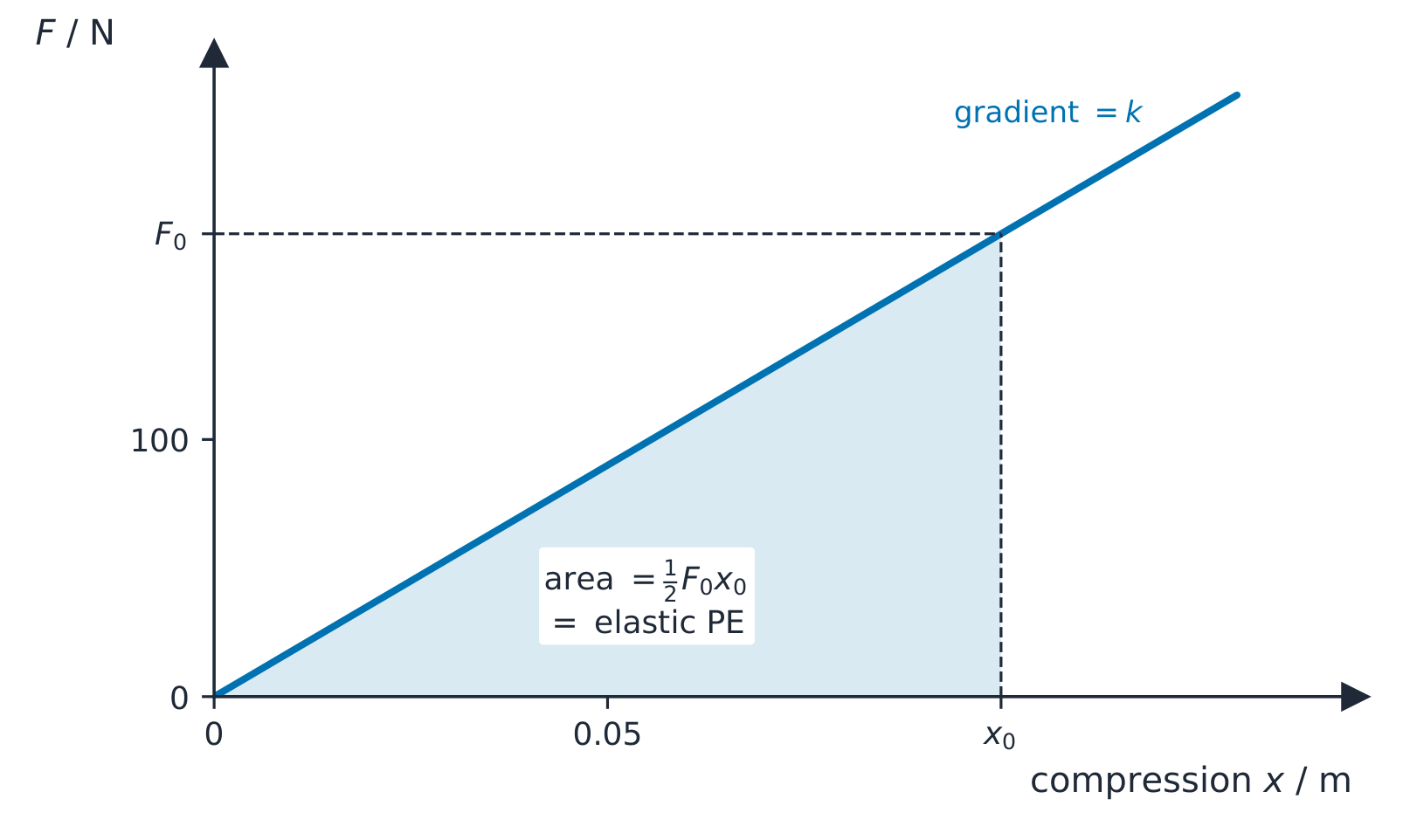
The energy chain can pass through a spring. A block that hits a spring with kinetic energy $110\ \text{J}$ while sliding a little downhill, so that its GPE falls by a further $20\ \text{J}$ before the spring stops it, stores $110 + 20 = 130\ \text{J}$ of elastic potential energy at the greatest compression, if nothing is lost to friction. The spring's force–compression graph then gives the compression: the energy stored is the area under the line, $\tfrac{1}{2} F_{0} x_{0}$ for a spring that obeys Hooke's law (topic 6), so a maximum force of $2600\ \text{N}$ means $x_{0} = 2 \times 130 / 2600 = 0.10\ \text{m}$. At that instant the resultant force on the block is the spring force minus the component of the weight down the slope, and its acceleration follows from $F = ma$ (topic 3).
Efficiency
The efficiency 效率 of a system is
$$\text{efficiency} = \frac{\text{useful energy output}}{\text{total energy input}} \times 100\%.$$
The same idea with power:
$$\text{efficiency} = \frac{\text{useful power output}}{\text{total power input}} \times 100\%.$$
Efficiency is always less than 100% in a real system, because some input energy becomes "useless" forms — usually thermal energy. If a total energy $E$ is supplied and an amount $Q$ is wasted, the useful output is $E - Q$ and the efficiency is $(E - Q) / E$; a motor rated at $1.7\ \text{kW}$ input with efficiency $53\%$ delivers $0.53 \times 1.7 = 0.90\ \text{kW}$ of useful output.
For an electric motor lifting a load with efficiency $\eta$ at voltage 电压$V$ and current 电流$I$, the useful output power is $\eta V I$. From this you can find a force, a lifting speed, or a tension 张力.
Worked example. An electric motor lifts a $50\ \text{kg}$ load at a steady $0.40\ \text{m s}^{-1}$ while drawing $250\ \text{W}$ of electrical power. Find its efficiency (take $g = 9.81\ \text{m s}^{-2}$).
The useful output power is $P = mgv = 50 \times 9.81 \times 0.40 = 196\ \text{W}$, so
Worked example. A motor raises a block with a force of $240\ \text{N}$ through a vertical distance of $12\ \text{m}$ in $60\ \text{s}$. The input power to the motor is $900\ \text{W}$. Find the useful output power and the efficiency.
Work done on the block: $W = Fd = 240 \times 12 = 2880\ \text{J}$. Useful output power: $P = W / t = 2880 / 60 = 48\ \text{W}$. Efficiency: $48 / 900 \times 100\% = 5.3\%$. Most of the input goes into thermal energy in the motor and its cable. Turned round, a lift motor of useful output $20\ \text{kW}$ raising $1500\ \text{kg}$ through $20\ \text{m}$ takes $t = mgh / P = 1500 \times 9.81 \times 20 / 20\,000 = 15\ \text{s}$.
العربية
تحوّل توربينات الرياح الطاقة الحركية للرياح إلى طاقة كهربائية.
الشغل المبذول بواسطة قوة
الشغل يُنجز عندما تحرك قوة نقطة تلامسها على طول خط عملها. لتعريف الدرجة الواحدة اكتب: الشغل المنجز هو حاصل ضرب القوة والمسافة المقطوعة في اتجاه القوة. الشغل المنجز بواسطة قوة ثابتة $F$ تسبب إزاحة$s$ هو
$$W = F \cdot s \cdot \cos\theta,$$
حيث $\theta$ هي الزاوية بين القوة والإزاحة. فقط مركبة القوة على طول الإزاحة تنجز شغلاً.
فقط مركبة القوة على طول الإزاحة ($F\cos\theta$) تنجز شغلاً
مثال محلول. يسحب طفل عربة ثلجية $5.0\ \text{m}$ عبر الثلج بحبل، باستخدام قوة مقدارها $20\ \text{N}$ عند زاوية $60°$ مع الأرض. أوجد الشغل المنجز بواسطة الحبل.
الوحدة: $\text{J} = \text{N m}$. الشغل كمية قياسية.
حالات خاصة:
قوة في نفس اتجاه الحركة ($\theta = 0$): $W = Fs$، شغل موجب، طاقة تُمنَح إلى الجسم.
قوة عمودية على الحركة ($\theta = 90°$): $W = 0$. لا تقوم قوة التماس العمودية المؤثرة على سيارة في طريق مستوٍ بإنجاز شغل.
قوة في عكس اتجاه الحركة ($\theta = 180°$): $W = -Fs$، شغل سالب، طاقة تُسحب من الجسم (على سبيل المثال احتكاك).
شغل موجب ($W = +Fs$): قوة على طول الحركة (الأعلى). شغل سالب ($W = -Fs$): قوة عكس الحركة، مثل الاحتكاك (الأسفل)
بالنسبة لجسم يتحرك صعوداً على منحدر بزاوية $\alpha$ مع الأفقي، يكون الشغل المبذول ضد الجاذبية عند ارتفاع ارتفاع $h$ هو $mgh$، بينما الشغل المبذول بواسطة دفع أفقي على طول طول المنحدر $L$ يستخدم $\cos\alpha$.
اختباران متعدد الخيارات لتعريف الشغل: لا يُنجز شغل على جسم ينزلق بسرعة ثابتة على سطح أملس (لا توجد قوة على طول الحركة)، أو على جسم ممسوك بسكون (لم تُقطع مسافة)؛ يُنجز شغل عندما ترفعه قوة. وعندما يُدفع صندوق بسرعة ثابتة عبر أرضية خشنة، يكون الشغل المنجز بواسطة الدفع $F \times d$ لكامل المسافة، بغض النظر عن تقسيم المسار إلى مراحل.
مثال محلول. كتلة كتلتها $4.9\ \text{kg}$ تُدفع بسرعة ثابتة صعوداً على منحدر خشن طوله $8.0\ \text{m}$ يرتفع ارتفاع $1.5\ \text{m}$، بواسطة قوة مقدارها $12\ \text{N}$ تعمل على طول المنحدر. أوجد الشغل المنجز ضد الاحتكاك.
صندوق يُدفع صعوداً على منحدر خشن بسرعة ثابتة: الشغل المنجز بواسطة الدفع يغطي زيادة الطاقة الكامنة الثقالية، والتي تحتاج فقط الارتفاع الرأسي $h$، والشغل المبذول ضد الاحتكاك على طول الطول الكلي $L$
الحركة بسرعة ثابتة تعني عدم تغير الطاقة الحركية، لذا فإن الشغل المنجز بواسطة الدفع يتوزع بين زيادة الطاقة الكامنة الثقالية والشغل المبذول ضد الاحتكاك. الشغل من الدفع: $12 \times 8.0 = 96\ \text{J}$. الزيادة في الطاقة الكامنة الثقالية، باستخدام الارتفاع الرأسي: $4.9 \times 9.81 \times 1.5 = 72\ \text{J}$. إذن الشغل المنجز ضد الاحتكاك هو $96 - 72 = 24\ \text{J}$، وقوة الاحتكاك هي $24 / 8.0 = 3.0\ \text{N}$. استخدام طول المنحدر في $mgh$ هو الخطأ الأكثر شيوعاً في هذا السؤال.
حفظ الطاقة
الطاقة لا تُنتَج ولا تُدمَر — بل تتحول فقط من شكل إلى آخر، أو تنتقل من جسم إلى آخر. في نظام مغلق، تبقى الطاقة الكلية ثابتة. هذا هو حفظ الطاقة، المصاغ للدرجات كالتالي: لا يمكن إنشاء الطاقة أو تدميرها؛ بل يمكن نقلها فقط من شكل إلى آخر (وبذلك تكون الطاقة الكلية لنظام مغلق ثابتة).
عند كتابة معادلة الطاقة، اذكر كل شكل تبدأ به الطاقة وتنتهي به. الأشكال الشائعة في هذا المنهج: الطاقة الحركية، الطاقة الكامنة الثقالية، الطاقة الكامنة المرنة، الكهربائية، الحرارية، الصوتية، الطاقة الكيميائية.
كرة تتدحرج لأسفل منحدرأملس تحول الطاقة الكامنة الثقالية إلى الطاقة الحركية: $mgh = \tfrac{1}{2} m v^{2}$، لذا $v = \sqrt{2gh}$. مع وجود الاحتكاك، تتحول بعض هذه الطاقة إلى طاقة حرارية للمنحدر والهواء.
على منحدر أملس، تتحول GPE إلى KE بينما تظل الطاقة الكلية ثابتة
مثال محلول. تُطلق كرة من السكون في أعلى منح أملس ارتفاعه $1.2\ \text{m}$. أوجد سرعتها في الأسفل (باستخدام $g = 9.81\ \text{m s}^{-2}$).
تتحول كل الطاقة الكامنة الثقالية إلى طاقة حركية، لذا $v = \sqrt{2gh}$ (تختصر الكتلة):
ينطبق نفس المبدأ على قراءة الرسم البياني. لكرة تسقط من ارتفاع $H$ مع إهمال مقاومة الهواء، تنخفض GPE في خط مستقيم مع الارتفاع ($mgh$)، ترتفع KE في خط مستقيم ($mg(H - h)$)، ويجمعهما الثابت $mgH$ عند كل ارتفاع.
كرة تسقط: GPE وKE كلاهما يتغيران في خط مستقيم مع الارتفاع، ومجموعهما ثابت
يمكن أن تمر سلسلة الطاقة عبر نابض. كتلة تصطدم بنابض بطاقة حركية $110\ \text{J}$ وهي تنزلق قليلاً إلى الأسفل، بحيث تنخفض طاقتها الكامنة الجاذبية بمقدار $20\ \text{J}$ إضافي قبل أن يوقفها النابض، وتخزن $110 + 20 = 130\ \text{J}$ من الطاقة الكامنة المرنة عند أقصى انضغاط، إذا لم تفقد شيئاً بسبب الاحتكاك. يعطي رسم القوة–الانضغاط للنابض بعد ذلك الانضغاط: الطاقة المخزنة هي المساحة تحت الخط، $\tfrac{1}{2} F_{0} x_{0}$ لنابض يخضع لقانون هوك (موضوع 6)، لذا فإن قوة قصوى مقدارها $2600\ \text{N}$ تعني $x_{0} = 2 \times 130 / 2600 = 0.10\ \text{m}$. في تلك اللحظة تكون محصلة القوى المؤثرة على الكتلة هي قوة النابض ناقص مركبة الوزن على طول المنحدر، وتتبع تسارعها من $F = ma$ (موضوع 3).
الطاقة المخزنة في نابض تساوي المساحة تحت رسم قوته–انضغاطه: $\tfrac{1}{2} F_{0} x_{0}$، والتي تساوي $\tfrac{1}{2} k x_{0}^{2}$
الكفاءة
الكفاءة للنظام هي
$$\text{efficiency} = \frac{\text{useful energy output}}{\text{total energy input}} × 100\%.$$
نفس الفكرة مع القدرة:
$$\text{efficiency} = \frac{\text{useful power output}}{\text{total power input}} × 100\%.$$
تكون الكفاءة دائماً أقل من 100% في النظام الحقيقي، لأن جزءاً من الطاقة الداخلة يتحول إلى أشكال "عديمة الفائدة" — عادةً طاقة حرارية. إذا تم تزويد طاقة كلية $E$ وهدرت كمية $Q$، فإن المخرج المفيد هو $E - Q$ والكفاءة هي $(E - Q) / E$؛ محرك مُصنف بقدرة دخل $1.7\ \text{kW}$ وكفاءة $53\%$ يُنتج $0.53 \times 1.7 = 0.90\ \text{kW}$ من المخرج المفيد.
الكفاءة: جزء فقط من الطاقة الداخلة يخرج كمخرج مفيد؛ والباقي يُهدر، عادةً كحرارة
لمحرك كهربائي يرفع حملاً بكفاءة $\eta$ عند جهد$V$ وتيار$I$، تكون قدرة الخرج المفيدة $\eta V I$. ومن هذا يمكنك إيجاد قوة، أو سرعة رفع، أو شدّة.
مثال محلول. يرفع محرك كهربائي حملاً قدره $50\ \text{kg}$ بسرعة ثابتة قدرها $0.40\ \text{m s}^{-1}$ بينما يسحب قدرة كهربائية قدرها $250\ \text{W}$. أوجد كفاءته (اعتبر $g = 9.81\ \text{m s}^{-2}$).
قدرة الخرج المفيدة هي $P = mgv = 50 \times 9.81 \times 0.40 = 196\ \text{W}$، لذا
مثال محلول. يرفع محرك كتلة بقوة قدرها $240\ \text{N}$ مسافة رأسية قدرها $12\ \text{m}$ خلال زمن $60\ \text{s}$. قدرة الدخل للمحرك هي $900\ \text{W}$. أوجد قدرة الخرج المفيدة والكفاءة.
الشغل المبذول على الكتلة: $W = Fd = 240 \times 12 = 2880\ \text{J}$. قدرة الخرج المفيدة: $P = W / t = 2880 / 60 = 48\ \text{W}$. الكفاءة: $48 / 900 \times 100\% = 5.3\%$. يذهب معظم الدخل إلى طاقة حرارية في المحourgse its cable. مقلوباً، فإن محرك مصعد بقوة خرج مفيدة $20\ \text{kW}$ يرفع $1500\ \text{kg}$ مسافة $20\ \text{m}$ يستهلك $t = mgh / P = 1500 \times 9.81 \times 20 / 20\,000 = 15\ \text{s}$.
Explore · استكشف
Energy flow & efficiency · تدفق الطاقة والكفاءة
The input energy divides into useful work and wasted energy; efficiency = useful ÷ input, and useful + wasted always equals the input. · ينقسم الطاقة الداخلة إلى شغل مفيد وطاقة ضائعة؛ الكفاءة = المفيد ÷ الداخل، والمفيد + الضائع يساوي دائماً الداخل.
Explore · استكشف
Work, energy & power · الشغل والطاقة والقدرة
PE + KE = constant · PE + KE = ثابت
Work transfers energy; as it falls, PE becomes KE with the total fixed. · الشغل ينقل الطاقة؛ أثناء السقوط، يتحول PE إلى KE مع ثبات المجموع الكلي.
Power 功率 is the rate of doing work, or the rate of transferring energy:
$$P = \frac{W}{t} = \frac{\Delta E}{\Delta t}.$$
Unit: $\text{W} = \text{J s}^{-1}$. Power is a scalar.
Power, force and velocity
For an object moving at velocity 速度$v$ with a force $F$ along the direction of motion, in a short time $\Delta t$ the displacement is $v\,\Delta t$ and the work done is $F v\,\Delta t$. Dividing by $\Delta t$:
$$P = F v.$$
This is one of the most useful results in mechanics. A "derive $P = Fv$" answer needs exactly those three lines: $P = W / t$, $W = Fs$ for a force along the motion, and $s / t = v$; then use it to solve problems in which a vehicle or a load moves at constant speed.
Worked example. A car travels at a steady $25\ \text{m s}^{-1}$ against a total resistive force of $600\ \text{N}$. Find the output power of its engine.
At constant speed the driving force equals the resistive force, so
For a car at constant velocity $v$ on a flat road, the engine power must balance the total resistive force: $P = F_{\text{resist}} \cdot v$. If the drag 阻力 grows with $v^{2}$, doubling the speed roughly quadruples the power needed.
For lifting a weight 重力$mg$ straight up at constant speed $v$, the useful output power is $P = mg \cdot v$.
For an aircraft hovering at a fixed height, the lift force equals the weight, and a large power is needed because air must be pushed downwards all the time.
A crane raising $600\ \text{kg}$ at a steady $12\ \text{m}$ per minute lifts at $v = 0.20\ \text{m s}^{-1}$, so its useful output power is $mgv = 600 \times 9.81 \times 0.20 = 1.2\ \text{kW}$. Convert the speed to $\text{m s}^{-1}$ first.
A sailboat pushed by a constant wind force at constant velocity must also feel an equal resistive force from the water: constant velocity means zero resultant force, so the wind's power $Fv$ is all going into work against the water.
العربية
القدرة هي معدل انجام الشغل، أو معدل نقل الطاقة:
إنجاز نفس الشغل في وقت أقل يعني قدرة أكثر
$$P = \frac{W}{t} = \frac{\Delta E}{\Delta t}.$$
الوحدة: $\text{W} = \text{J s}^{-1}$. القدرة كمية قياسية.
القدرة والقوة والسرعة
لجسم يتحرك بـسرعة$v$ وقوة $F$ في اتجاه الحركة، خلال زمن قصير $\Delta t$ يكون الإزاحة $v\,\Delta t$ والشغل المبذول هو $F v\,\Delta t$. بالقسمة على $\Delta t$:
$$P = F v.$$
هذا أحد أكثر النتائج فائدة في الميكانيكا. إجابة "استنتج $P = Fv$" تحتاج بالضبط إلى هذه الأسطر الثلاثة: $P = W / t$، $W = Fs$ لقوة في اتجاه الحركة، و$s / t = v$؛ ثم استخدمها لحل مسائل يتحرك فيها مركبة أو حمل بسرعة ثابتة.
مثال محلول. سيارة تسير بسرعة ثابتة قدرها $25\ \text{m s}^{-1}$ ضد مجمل قوة مقاومة قدرها $600\ \text{N}$. أوجد قدرة خرج محركها.
عند السرعة الثابتة، تكون قوة الدفع مساوية لقوة المقاومة، لذا
لسيارة تتحرك بسرعة ثابتة $v$ على طريق مستوٍ، يجب أن توازن قدرة المحرك مجمل قوة المقاومة: $P = F_{\text{resist}} \cdot v$. إذا كان السحب الهوائي يزداد مع $v^{2}$، فإن مضاعفة السرعة تقريباً تضاعف أربع مرات القدرة المطلوبة.
لرفع وزن قدره $mg$ رأسياً بسرعة ثابتة قدرها $v$، تكون قدرة الخرج المفيدة $P = mg \cdot v$.
لطائرة تحلق عند ارتفاع ثابت، تكون قوة الرفع مساوية للوزن، وتُطلَق قدرة كبيرة لأن الهواء يجب دفعه للأسفل باستمرار.
رافعة ترفع $600\ \text{kg}$ بسرعة ثابتة $12\ \text{m}$ في الدقيقة ترفع عند $v = 0.20\ \text{m s}^{-1}$، لذا فإن طاقتها المفيدة الناتجة هي $mgv = 600 \times 9.81 \times 0.20 = 1.2\ \text{kW}$. حول السرعة إلى $\text{m s}^{-1}$ أولاً.
قارب شراعي يُدفع بقوة رياح ثابتة بسرعة ثابتة يجب أن يشعر أيضاً بقوة مقاومة مساوية من الماء: السرعة الثابتة تعني صفر محصلة القوى، لذا فإن قدرة الرياح $Fv$ تذهب بالكامل لأداء الشغل ضد الماء.
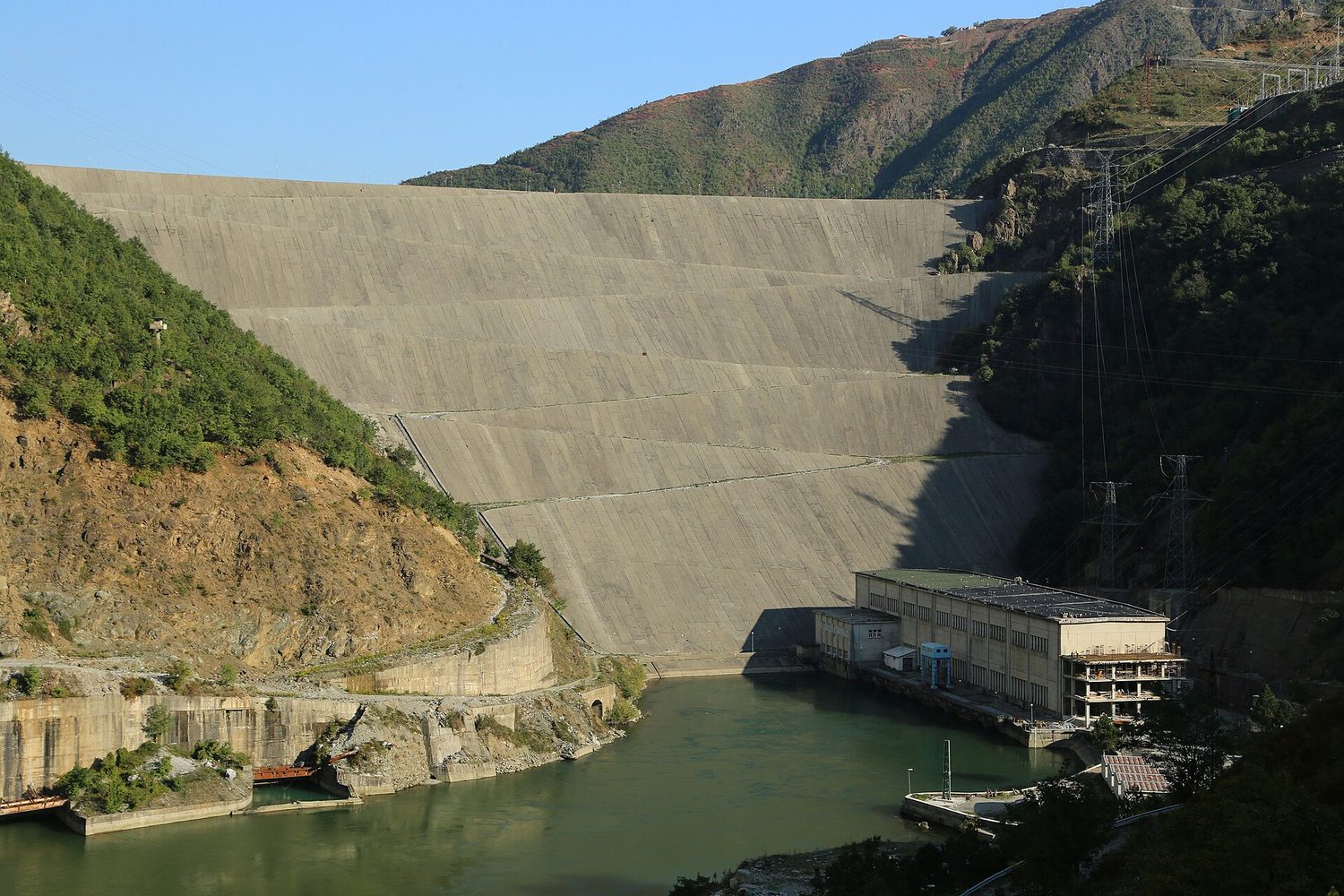
تُصنف محطة كهرومائية بالميغاواط: طاقة الماء المخزون مقسومة على الوقت المستغرق لإطلاقه
5.2
Gravitational potential energy · الطاقة الكامنة الجاذبية
Syllabus · المنهج
English
derive, using $W = Fs$, the formula $\Delta E_{\text{P}} = mg\Delta h$ for gravitational potential energy changes in a uniform gravitational field
recall and use the formula $\Delta E_{\text{P}} = mg\Delta h$ for gravitational potential energy changes in a uniform gravitational field
derive, using the equations of motion, the formula for kinetic energy$E_{\text{K}} = \frac{1}{2}mv^2$
recall and use $E_{\text{K}} = \frac{1}{2}mv^2$
العربية
اشتقاق، باستخدام $W = Fs$، الصيغة $\Delta E_{\text{P}} = mg\Delta h$ لـالتغيرات في الطاقة الكامنة الجاذبية في مجال جاذبي منتظم
تذكر واستخدام الصيغة $\Delta E_{\text{P}} = mg\Delta h$ للتغيرات في الطاقة الكامنة الجاذبية في مجال جاذبي منتظم
اشتقاق، باستخدام معادلات الحركة، الصيغة الخاصة بـالطاقة الحركية$E_{\text{K}} = \frac{1}{2}mv^2$
التذكر واستخدام $E_{\text{K}} = \frac{1}{2}mv^2$
Source: Cambridge International syllabus · المصدر: منهج كامبريدج الدولي
English
Energy exchange in a pendulum
In a uniform gravitational field (close to a planet's surface), the change in gravitational potential energy of mass 质量$m$ rising or falling through a height $\Delta h$ is
$$\Delta E_{\text{P}} = m g \Delta h.$$
Where it comes from
The work done against gravity to raise a mass $m$ slowly (no change in kinetic energy) through height $\Delta h$ equals the gravitational potential energy gained:
the gravitational force on the mass is $mg$ downwards,
the force needed to lift it slowly is $mg$ upwards,
the work done by this force is $W = F \cdot s = mg \cdot \Delta h$,
this work becomes $\Delta E_{\text{P}}$.
So $\Delta E_{\text{P}} = mg \Delta h$. To use it you need $m$ and $\Delta h$ (and $g$). You do not need speed or time. The two-mark derivation wants the same four lines, with the condition stated: the block is raised at constant speed, so the lifting force equals the weight $mg$, and the work done by that force over the vertical distance $\Delta h$ is $mg\Delta h$, which is the gain in gravitational potential energy. A $100\ \text{g}$ object falling $10\ \text{m}$ loses $0.100 \times 9.81 \times 10 = 9.8\ \text{J}$, about $10\ \text{J}$; the mass must be in kilograms.
العربية
تبادل الطاقة في البندول
في مجال جاذبي متجانس (قريباً من سطح كوكب)، يكون التغير في الطاقة الكامنة الجاذبية لـكتلة$m$ ترتفع أو تهبط عبر ارتفاع $\Delta h$ هو
$$\Delta E_{\text{P}} = m g \Delta h.$$
مصدرها
الشغل المبذول ضد الجاذبية لرفع كتلة $m$ ببطء (بدون تغير في الطاقة الحركية) عبر ارتفاع $\Delta h$ يساوي الطاقة الكامنة الجاذبية المكتسبة:
القوة الجاذبية المؤثرة على الكتلة هي $mg$ لأسفل،
القوة اللازمة لرفعها ببطء هي $mg$ لأعلى،
الشغل المبذول بواسطة هذه القوة هو $W = F \cdot s = mg \cdot \Delta h$،
يتحول هذا الشغل إلى $\Delta E_{\text{P}}$.
إذن $\Delta E_{\text{P}} = mg \Delta h$. لاستخدامها، تحتاج إلى $m$ و$\Delta h$ (و$g$). لا تحتاج إلى السرعة أو الزمن. اشتقاق الدرجتين يتطلب نفس الخطوط الأربعة، مع ذكر الشرط: يتم رفع الكتلة بسرعة ثابتة، لذا فإن قوة الرفع تساوي الوزن $mg$، والعمل المبذول بواسطة تلك القوة على المسافة الرأسية $\Delta h$ هو $mg\Delta h$، وهو مقدار الكسب في الطاقة الكامنة الثقالية. جسم $100\ \text{g}$ يسقط مسافة $10\ \text{m}$ يفقد $0.100 \times 9.81 \times 10 = 9.8\ \text{J}$، حوالي $10\ \text{J}$؛ يجب أن تكون الكتلة بالكيلوجرام.
تعتمد الطاقة الكامنة الثقالية فقط على الارتفاع المتصاعد، وليس المسار المتبعقطار ترفيهي يُسحب عبر التل المرتفع: العمل المبذول ضد الجاذبية يُخزن كطاقة كامنة ثقالية
5.2
Kinetic energy · الطاقة الحركية
English
The kinetic energy of an object of mass $m$ moving at speed $v$ is
$$E_{\text{K}} = \tfrac{1}{2} m v^{2}.$$
Where it comes from
Apply a resultant force $F$ to a mass $m$ that starts at rest. It speeds up evenly from $0$ to $v$ over a displacement $s$. From $v^{2} = u^{2} + 2as$ with $u = 0$,
$$s = \frac{v^{2}}{2a}.$$
The work done on the mass is
$$W = F \cdot s = m a \cdot \frac{v^{2}}{2a} = \tfrac{1}{2} m v^{2}.$$
All this work becomes kinetic energy, so $E_{\text{K}} = \tfrac{1}{2} m v^{2}$. In the exam, state the assumptions as you go: the object starts from rest, the force is constant, so the acceleration is uniform, and $F = ma$ is Newton's second law.
Because $E_{\text{K}} \propto v^{2}$, quadrupling the speed multiplies the kinetic energy by sixteen: an object with $1500\ \text{J}$ at $10\ \text{m s}^{-1}$ has $24\,000\ \text{J}$ at $40\ \text{m s}^{-1}$. The same square is why a stopping force is found from energy: a ball of mass $1.2\ \text{kg}$ moving at $3.0\ \text{m s}^{-1}$ that is stopped by a cushion over $0.020\ \text{m}$ loses $\tfrac{1}{2} \times 1.2 \times 3.0^{2} = 5.4\ \text{J}$, so the average force on it is $5.4 / 0.020 = 270\ \text{N}$: the work done by the cushion equals the kinetic energy lost.
Kinetic energy and momentum
Combining $p = mv$ and $E_{\text{K}} = \tfrac{1}{2} m v^{2}$:
$$E_{\text{K}} = \frac{p^{2}}{2m}.$$
This is handy when the momentum 动量 is given but not the velocity. For a momentum change from $p_{1}$ to $p_{2}$ at constant mass, the change in kinetic energy is $(p_{2}^{2} - p_{1}^{2}) / (2m)$.
العربية
الطاقة الحركية لجسم كتلته $m$ يتحرك بسرعة $v$ هي
$$E_{\text{K}} = \tfrac{1}{2} m v^{2}.$$
مصدرها
طبق قوة محصلة $F$ على كتلة $m$ تبدأ من السكون. تتسارع بانتظام من $0$ إلى $v$ خلال إزاحة $s$. من $v^{2} = u^{2} + 2as$ مع $u = 0$،
$$s = \frac{v^{2}}{2a}.$$
العمل المبذول على الكتلة هو
$$W = F \cdot s = m a \cdot \frac{v^{2}}{2a} = \tfrac{1}{2} m v^{2}.$$
كل هذا العمل يتحول إلى طاقة حركية، إذن $E_{\text{K}} = \tfrac{1}{2} m v^{2}$. في الامتحان، اذكر الافتراضات أثناء الحل: الجسم يبدأ من السكون، والقوة ثابتة، لذا التسارع منتظم، و$F = ma$ هو قانون نيوتن الثاني.
لأن $E_{\text{K}} \propto v^{2}$، فإن مضاعفة السرعة بأربعة أضعاف تضرب الطاقة الحركية في ستة عشر: جسم كتلته $1500\ \text{J}$ بسرعة $10\ \text{m s}^{-1}$ يمتلك طاقة $24\,000\ \text{J}$ عند سرعة $40\ \text{m s}^{-1}$. نفس المربع هو السبب في إيجاد قوة الفرملة من الطاقة: كرة كتلتها $1.2\ \text{kg}$ تتحرك بسرعة $3.0\ \text{m s}^{-1}$ تتوقف بواسطة وسادة على مسافة $0.020\ \text{m}$ تفقد طاقة $\tfrac{1}{2} \times 1.2 \times 3.0^{2} = 5.4\ \text{J}$، لذا فإن متوسط القوة المؤثرة عليها هو $5.4 / 0.020 = 270\ \text{N}$: الشغل الذي تقوم به الوسادة يساوي الطاقة الحركية المفقودة.
الطاقة الحركية والزخم
دمج $p = mv$ و$E_{\text{K}} = \tfrac{1}{2} m v^{2}$:
$$E_{\text{K}} = \frac{p^{2}}{2m}.$$
هذا مفيد عندما يكون الزخم معطى لكن ليس السرعة. لتغير زخم من $p_{1}$ إلى $p_{2}$ عند كتلة ثابتة، يكون التغير في الطاقة الحركية هو $(p_{2}^{2} - p_{1}^{2}) / (2m)$.
متسلق بالعمود: الطاقة الحركية من الركض تُخزن في العمود المنثني، ثم تُعاد كارتفاع
Explore · استكشف
Kinetic & potential energy · الطاقة الحركية والطاقة الكامنة
PE + KE = constant · PE + KE = ثابت
Potential energy turns into kinetic energy — the total never changes. · الطاقة الكامنة تتحول إلى طاقة حركية — ولا يتغير المجموع الكلي أبداً.
5.2
Using energy methods · استخدام طرق الطاقة
English
A useful plan for problems that mix forces and energy:
Find the start and end states. Write the kinetic and potential energies in each.
List any work done by outside forces (friction, a push). Friction usually takes energy out; a push can add it.
Conservation of energy: $E_{\text{start}} + W_{\text{in}} = E_{\text{end}} + W_{\text{lost as heat etc.}}$.
Examples:
A box pushed at constant velocity up a ramp of length $L$ rising by $h$: $E_{\text{K}}$ does not change, so the work done by the push goes into $\Delta E_{\text{P}}$ plus the work done against friction.
A block sliding into a spring 弹簧 with kinetic energy $E_{\text{K}}$ on a frictionless surface: at greatest compression 压缩$x$, all the kinetic energy has become elastic potential energy $\tfrac{1}{2} k x^{2}$ (where $k$ is the spring constant 劲度系数).
A ball dropped from height $h_{1}$ that bounces to height $h_{2}$: the ratio $h_{2}/h_{1}$ is the fraction of mechanical energy kept, $h_{2}/h_{1} = (v_{\text{up}}/v_{\text{down}})^{2}$.
A projectile 抛体 thrown to the same height at different angles: the final speed is the same (only the height matters); use components to get its direction.
A bungee jumper 蹦极者: from the platform to the point where the cord goes taut, GPE becomes KE; from there the cord stretches and takes energy as elastic potential energy, so the KE reaches its maximum where the cord's pull first equals the weight, then falls to zero at the lowest point, where GPE lost $=$ elastic PE stored (plus any thermal energy).
العربية
خطة مفيدة لمسائل力量的混合力和能量:
حدد الحالات الابتدائية والنهائية. اكتب الطاقات الحركية والكامنة في كل حالة.
عدد أي عمل مبذول بواسطة قوى خارجية (احتكاك، دفع). الاحتكاك عادة يزيل الطاقة؛ الدفع يمكن أن يضيفها.
حفظ الطاقة: $E_{\text{start}} + W_{\text{in}} = E_{\text{end}} + W_{\text{lost as heat etc.}}$.
أمثلة:
صندوق يُدفع بـ سرعة ثابتة صعود منحدر طوله $L$ يرتفع بمقدار $h$: $E_{\text{K}}$ لا يتغير، لذا العمل المبذول بالدفع يذهب إلى $\Delta E_{\text{P}}$ بالإضافة للعمل المبذول ضد الاحتكاك.
كتلة تنزلق داخل زنبرك بطاقة حركية $E_{\text{K}}$ على سطح عديم الاحتكاك: عند أقصى انضغاط$x$، كل الطاقة الحركية تحولت إلى طاقة كامنة مرنة $\tfrac{1}{2} k x^{2}$ (حيث $k$ هو ثابت الزنبرك).
كرة تُسقط من ارتفاع $h_{1}$ وترتد إلى ارتفاع $h_{2}$: النسبة $h_{2}/h_{1}$ تمثل الكسر من الطاقة الميكانيكية المتبقية، $h_{2}/h_{1} = (v_{\text{up}}/v_{\text{down}})^{2}$.
قذيفة تُطلق إلى نفس الارتفاع بزوايا مختلفة: السرعة النهائية متساوية (الارتفاع فقط مهم)؛ استخدم المركبات للحصول على اتجاهها.
قافز بالمطاط: من المنصة إلى النقطة التي يصبح فيها الحبل مشدوداً، تتحول الطاقة الكامنة الثقالية إلى حركية؛ من هناك يتمدد الحبل ويأخذ الطاقة كطاقة كامنة مرنة، لذا تصل الطاقة الحركية إلى قيمتها القصوى حيث يساوي سحب الحبل الوزن لأول مرة، ثم تنخفض إلى الصفر عند أدنى نقطة، حيث الطاقة الكامنة الثقالية المفقودة $=$ الطاقة الكامنة المرنة المخزنة (بالإضافة لأي طاقة حرارية).
طاقة كتلة حركية تتحول إلى طاقة كامنة مرنة أثناء انضغاطها للزنبرك
Explore · استكشف
Conservation of energy · حفظ الطاقة
Drop the mass and watch GPE turn into KE. With no friction the total energy stays the same — that's the energy method. · أفلل الكتلة وشاهد تحول طاقة الوضع الجاذبية (GPE) إلى طاقة حركية (KE). بدون احتكاك، تبقى الطاقة الكلية ثابتة — هذه هي طريقة الطاقة.
5.2
Definitions the examiner accepts · التعريفات التي يقبلها المصحح
English
A definition question is marked against fixed wording. Learn these exactly, and give one answer only.
Term
Definition
work done by a force
the product of the force and the distance moved in the direction of the force
principle of conservation of energy
energy cannot be created or destroyed, only transferred from one form to another, so the total energy of a closed system is constant
efficiency
the ratio of useful energy (or power) output from a system to the total energy (or power) input, usually as a percentage
power
the work done per unit time, or the rate at which energy is transferred
gravitational potential energy
the energy an object has because of its position in a gravitational field
kinetic energy
the energy an object has because of its motion
elastic potential energy
the energy stored in an object that has been stretched or compressed
العربية
تُصنّف أسئلة التعريف بناءً على صياغة ثابتة. احفظ هذه التعريفات بدقة، وقدم إجابة واحدة فقط.
مصطلح
تعريف
العمل المبذول بواسطة قوة
حاصل ضرب القوة والمسافة المقطوعة في اتجاه القوة
مبدأ حفظ الطاقة
الطاقة لا تُخلق ولا تُستحدث، بل تنتقل من شكل لآخر، لذا فإن إجمالي الطاقة للنظام المغلق ثابت
الكفاءة
نسبة الطاقة المفيدة (أو القدرة) الناتجة من نظام ما إلى إجمالي الطاقة (أو القدرة) الداخلة، عادة كنسبة مئوية
القدرة
العمل المبذول لكل وحدة زمن، أو معدل انتقال الطاقة
الطاقة الكامنة الثقالية
الطاقة التي يمتلكها الجسم بسبب موقعه في مجال جاذبي
الطاقة الحركية
الطاقة التي يمتلكها الجسم بسبب حركته
الطاقة الكامنة المرنة
الطاقة المخزنة في جسم تم مدّه أو ضغطه
5.2
Exam tips · نصائح للامتحان
English
Work $=$ force $\times$ distance moved in the direction of the force — use $Fs\cos\theta$ when they are at an angle.
Use conservation of energy: loss in GPE $=$ gain in KE ($+$ work done against resistance).
Power $=$ work $/$ time $= Fv$; efficiency $=$ useful output $\div$ total input.
GPE uses the vertical height gained, not the distance along a slope.
Common mistakes
Giving the change in height as the answer to a change-in-energy question. Finish the calculation: $\Delta E_{\text{P}} = mg\Delta h$.
Using the distance along a slope as the height in $mg\Delta h$, or using mass where weight is needed. Use the vertical height gained, and check whether the quantity wanted is $m$ in kg or $W$ in N.
Putting the resistive force into $P = Fv$ for a car that is accelerating. $F$ is the driving force; only at constant speed does it equal the resistive force.
Efficiency above 100%, or efficiency as output divided by wasted. It is useful output divided by total input, and the total input is always the larger number.
Reading a force–extension graph's gradient when the question wants the energy. Energy stored is the area under the line, not its slope.
العربية
العمل $=$ القوة $\times$ المسافة المقطوعة في اتجاه القوة — استخدم $Fs\cos\theta$ عندما تكون بزاوية.
استخدم حفظ الطاقة: النقص في الطاقة الكامنة الثقالية $=$ الزيادة في الطاقة الحركية ($+$ العمل المبذول ضد المقاومة).
القدرة $=$ العمل $/$ الزمن $= Fv$؛ الكفاءة $=$ المخرجات المفيدة $\div$ المدخلات الكلية.
تستخدم الطاقة الكامنة الثقالية الارتفاع الرأسي المتصاعد، وليس المسافة على المنحدر.
أخطاء شائعة
إعطاء التغير في الارتفاع كإجابة لسؤال عن تغير الطاقة. أكمل الحساب: $\Delta E_{\text{P}} = mg\Delta h$.
استخدام المسافة على طول ميل كارتفاع في $mg\Delta h$، أو استخدام الكتلة حيث يُطلَب الوزن. استخدم الارتفاع الرأسي المكتسب، وتحقق مما إذا كانت الكمية المطلوبة هي $m$ بوحدة kg أم $W$ بوحدة N.
وضع القوة المقاومة في $P = Fv$ لمركبة تتسارع. $F$ هو قوة الدفع؛ وتساوي فقط القوة المقاومة عند السرعة الثابتة.
كفاءة تفوق 100%، أو حساب الكفاءة بقسمة المخرجات على الطاقة المهدرة. الكفاءة هي الطاقة المفيدة مقسومة على إجمالي المدخلات، وإجمالي المدخلات دائماً العدد الأكبر.
قراءة ميل منحنى القوة-الاستطالة عندما تطلب السؤال الطاقة. الطاقة المخزنة هي المساحة تحت المنحنى، وليست ميله.
Interactive lessons on this topic · دروس تفاعلية حول هذا الموضوع
Work through it step by step, with instant-check exercises. · ا-working عليه خطوة بخطوة، مع تمارين تحقق فوري.
Pick one and the site follows you — notes, papers, videos and practice all open on it. · اختر واحدًا وسيتبعك الموقع — الملاحظات، الأوراق، الفيديوهات والتدريب جميعها تفتح عليه.
Type to search notes, lessons, code, vocabulary and past-paper questions across every subject. · اكتب للبحث عن ملاحظات، دروس، أكواد، مفردات وأسئلة امتحانات سابقة عبر جميع المواد.