اضغط هواء في إطار دراجة، بسرعة وقوة، وسيحدث شيء مذهل: يسخن المضخة. دافئ بما يكفي للإحساس به. لم تقم بتسخينه بلهب. لذا أين…
English narration · English + 中文 subtitles burned in · سرد باللغة الإنجليزية · ترجمة مدمجة بالإنجليزية + الصينية
16.1
Internal energy · الطاقة الداخلية
Syllabus · المنهج
English
understand that internal energy is determined by the state of the system and that it can be expressed as the sum of a random distribution of kinetic and potential energies associated with the molecules of a system
relate a rise in temperature of an object to an increase in its internal energy
العربية
فهم أن الطاقة الداخلية تُحدد بحالة النظام ويمكن التعبير عنها كمجموع توزيع عشوائي للطاقات الحركية والكامنة المرتبطة بجزيئات النظام
ربط ارتفاع درجة حرارة جسم ما بزيادة طاقته الداخلية
Source: Cambridge International syllabus · المصدر: منهج كامبريدج الدولي
English
The internal energy 内能$U$ of a system is the sum of:
the random kinetic energies 动能 of its molecules 分子 — they fly through space (translational 平动 motion), and unless they are single atoms they also spin (rotational 转动) and shake (vibrational 振动), and
the potential energies from the forces between the molecules.
For a real solid, liquid or gas, both parts matter. In the ideal-gas 理想气体 model the intermolecular 分子间 forces are ignored, so the molecular potential energy is zero and the internal energy is purely kinetic.
The two-mark definition.The internal energy of a system is the sum of the random distribution of the kinetic and potential energies of its molecules (or atoms). Both marks need "sum of kinetic and potential energies" and "random" (or "of the molecules") — leaving out "random" describes the energy of a moving object, not its internal energy. For an ideal gas, "with reference to kinetic and potential energy": the internal energy is the total kinetic energy of the molecules only, because there are no intermolecular forces and therefore no potential energy.
Two key points:
$U$ depends only on the state of the system (its temperature 温度, pressure 压强, volume 体积, amount of substance 物质的量) — not on the path taken to get there.
$U$ is a sum over the molecules, not the kinetic energy of the whole object moving. A moving train of gas has bulk kinetic energy, but that is separate from $U$ — $U$ is the energy of the random molecular motion.
Temperature and internal energy
Raising an object's temperature raises the random kinetic energy of its molecules, and so raises its internal energy.
For an ideal gas every molecule has average translational kinetic energy $\tfrac{3}{2} k T$ (Topic 15). With zero intermolecular potential energy, the total internal energy is
$$U = \tfrac{3}{2} N k T = \tfrac{3}{2} n R T.$$
So the internal energy of an ideal gas is directly proportional to the thermodynamic temperature 热力学温度. Doubling $T$ doubles $U$. This is only exact for an ideal gas.
During a phase change 相变 (melting or boiling) of a real substance, $U$ rises because the molecular potential energy rises (bonds breaking), even though the temperature stays constant.
Describing a change in internal energy — always name both energies. A three-mark "describe and explain, with reference to molecular kinetic and potential energies" answer says what happens to each:
a gas heated at constant volume: the kinetic energy of the molecules increases, because temperature is a measure of their mean kinetic energy; the potential energy is unchanged (no work is done, the molecules' separation does not change); so the internal energy increases.
a wire stretched within its elastic limit at constant temperature: the kinetic energy of the atoms is unchanged (same temperature); the potential energy increases, because the atoms are pulled further apart against the interatomic forces; so the internal energy increases.
ice melting at $0\ ^{\circ}\text{C}$: the kinetic energy is unchanged (constant temperature); the potential energy increases as the bonds between molecules are broken and the separation grows; so the internal energy increases by the latent heat supplied.
Worked example. A fixed mass of ideal gas is heated at constant pressure. Sketch the variation of its internal energy $U$ with its volume $V$.
At constant pressure $V \propto T$ (Charles's law) and for an ideal gas $U \propto T$, so $U \propto V$: a straight line through the origin. The origin is on the line because at absolute zero both $V$ (extrapolated) and $U$ are zero.
العربية
الطاقة الداخلية$U$ للنظام هي مجموع:
الطاقات الحركية العشوائية لـجزيئاته — تطير عبر الفضاء (حركة انتقالية)، وفي حال لم تكن ذرات فردية فإنها تدور أيضاً (دورانية) وتهتز (اهتزازية)، و
الطاقات الكامنة الناتجة عن القوى بين الجزيئات.
بالنسبة للمادة الصلبة الحقيقية أو السائلة أو الغازية، كلا الجزأين مهمان. في نموذج الغاز المثالي يتم إهمال القوى بين الجزيئية، لذا تكون الطاقة الكامنة للجزيئات مساوية للصفر وتكون الطاقة الداخلية حركية بحتة.
تعريف العلامتين.الطاقة الداخلية للنظام هي مجموع التوزيع العشوائي للطاقات الحركية والكامنة لجزيئاته (أو ذراته). تحتاج كلتا العلامتين إلى "مجموع الطاقات الحركية والكامنة" و "العشوائية" (أو "لجزيئاته") — فاستبعاد كلمة "العشوائية" يصف طاقة جسم متحرك وليس طاقته الداخلية. بالنسبة للغاز المثالي، "بالإشارة إلى الطاقة الحركية والكامنة": الطاقة الداخلية هي إجمالي الطاقة الحركية للجزيئات فقط، لأنه لا توجد قوى بين جزيئية وبالتالي لا توجد طاقة كامنة.
الطاقة الداخلية هي الطاقة الحركية العشوائية للجزيئات (الأسهم) زائد الطاقة الكامنة للقوى بينها (الأربطة)
نقطتان أساسيتان:
$U$ تعتمد فقط على حالة النظام (درجة حرارته، ضغطه، حجمه، كمية المادة) — ولا تعتمد على المسار المتبع للوصول إليها.
$U$ هي مجموع لطاقة الجزيئات، وليست الطاقة الحركية للجسم بأكمله وهو يتحرك. قطار من الغاز له طاقة حركية جماعية، لكنها منفصلة عن $U$ — $U$ هي طاقة الحركة الجزيئية العشوائية.
درجة الحرارة والطاقة الداخلية
رفع درجة حرارة الجسم يزيد الطاقة الحركية العشوائية لجزيئاته، وبالتالي يرفع طاقته الداخلية.
بالنسبة للغاز المثالي، كل جزيء يمتلك متوسط طاقة حركية انتقالية $\tfrac{3}{2} k T$ (الموضوع 15). وبما أن الطاقة الكامنة بين الجزيئية تساوي صفراً، فإن إجمالي الطاقة الداخلية هو
$$U = \tfrac{3}{2} N k T = \tfrac{3}{2} n R T.$$
لذا فإن الطاقة الداخلية لغاز مثالي طرد طردي مع درجة الحرارة الديناميكية. مضاعفة $T$ تضاعف $U$. هذا صحيح تماماً فقط لغاز مثالي.
أثناء التحول الطوري (الذوبان أو الغليان) لمادة حقيقية، يرتفع $U$ لأن الطاقة الكامنة للجزيئات ترتفع (بسبب كسر الروابط)، حتى لو ظلت درجة الحرارة ثابتة.
وصف التغير في الطاقة الداخلية — دائماً اذكر كلا نوعَي الطاقة. إجابة ثلاث علامات "صِف واشرح بالإشارة إلى الطاقة الحركية والكامنة للجزيئات" توضح ما يحدث لـكلٍ: -
غاز يُسخّن عند ثبوت الحجم: تزداد الطاقة الحركية للجزيئات، لأن درجة الحرارة مقياس لمتوسط طاقتها الحركية؛ الطاقة الكامنة غير متغيرة (لا شغل مبذول، مسافة الجزيئات لا تتغير)؛ إذن الطاقة الداخلية تزداد.
سلك مشدود ضمن حدوده المرنة عند ثبوت درجة الحرارة: الطاقة الحركية للذرات غير متغيرة (نفس درجة الحرارة)؛ الطاقة الكامنة تزداد، لأن الذرات تُسحب لأبعد مما كانت عليه ضد القوى بين الذرية؛ إذن الطاقة الداخلية تزداد.
ذوبان الثلج عند $0\ ^{\circ}\text{C}$: الطاقة الحركية غير متغيرة (درجة حرارة ثابتة)؛ الطاقة الكامنة تزداد مع كسر الروابط بين الجزيئات وزيادة المسافة بينها؛ إذن الطاقة الداخلية تزداد بمقدار الحرارة الكامنة المضافة.
مثال محلول. كتلة ثابتة من غاز مثالي يتم تسخينها عند ضغط ثابت. ارسم تغير طاقته الداخلية $U$ مع حجمه $V$.
عند ضغط ثابت $V \propto T$ (قانون شارل) ولغاز مثالي $U \propto T$، لذا $U \propto V$: خط مستقيم يمر بنقطة الأصل. نقطة الأصل تقع على الخط لأن عند الصفر المطلق كل من $V$ (ممدداً) و $U$ يساويان الصفر.
Explore · استكشف
The spread of molecular energies · انتشار طاقات الجزيئات
Internal energy is the total random kinetic + potential energy of the molecules. Heat the gas and the whole speed distribution shifts to higher energy. · الطاقة الداخلية هي مجموع الطاقة الحركية + الكامنة العشوائية للجزيئات. سخّن الغاز ويتحول توزيع السرعات بالكامل إلى طاقة أعلى.
first law of thermodynamics/fɜːst lɔː ɒv ˌθɜːməʊdaɪˈnæmɪks/
القانون الأول للديناميكا الحرارية
conservation of energy/ˌkɒnsəˈveɪʃn ɒv ˈenədʒi/
حفظ الطاقة
isothermal/ˌaɪsəˈθɜːml/
متساوي الحرارة
adiabatic/ˌædiəˈbætɪk/
أديباتيكي (معزول حراريًا)
heat capacity/hiːt kəˈpæsɪti/
السعة الحرارية
monatomic/ˌmɒnəˈtɒmɪk/
أحادي الذرة
16.2
Work done on or by a gas · الشغل المبذول على غاز أو بواسطة غاز
Syllabus · المنهج
English
recall and use $W = p\Delta V$ for the work done when the volume of a gas changes at constant pressure and understand the difference between the work done by the gas and the work done on the gas
recall and use the first law of thermodynamics$\Delta U = q + W$ expressed in terms of the increase in internal energy, the heating of the system (energy transferred to the system by heating) and the work done on the system
العربية
التذكر واستخدام $W = p\Delta V$ لـالشغل المبذول عندما يتغير حجم غاز عند ضغط ثابت وفهم الفرق بين الشغل المبذول بواسطة الغاز والشغل المبذول على الغاز
التذكر واستخدام القانون الأول للديناميكا الحرارية$\Delta U = q + W$ المُعبَّر عنه بدلالة الزيادة في الطاقة الداخلية، وتسخين النظام (انتقال الطاقة إلى النظام بالتسخين) والشغل المبذول على النظام
Source: Cambridge International syllabus · المصدر: منهج كامبريدج الدولي
English
When a gas changes volume against an outside pressure, mechanical work is done. At constant pressure $p$ with a small volume change $\Delta V$, the size of the work is
$$W = p \Delta V.$$
Worked example. A gas at a constant pressure of $1.0 \times 10^{5}\ \text{Pa}$ expands from $2.0 \times 10^{-3}\ \text{m}^{3}$ to $5.0 \times 10^{-3}\ \text{m}^{3}$. Find the work done by the gas.
Worked example. An ideal gas of mass $0.35\ \text{kg}$ is heated at a constant pressure of $2.0 \times 10^{5}\ \text{Pa}$; its internal energy rises by $7600\ \text{J}$ and its volume increases by $1.2 \times 10^{-2}\ \text{m}^{3}$. Find the work done by the gas and the thermal energy supplied. The gas is then heated at constant volume until its internal energy rises by the same $7600\ \text{J}$; explain why less thermal energy is needed.
Work done by the gas $= p\Delta V = 2.0 \times 10^{5} \times 1.2 \times 10^{-2} = 2400\ \text{J}$, so the work done on it is $W = -2400\ \text{J}$. First law: $q = \Delta U - W = 7600 - (-2400) = 1.0 \times 10^{4}\ \text{J}$. At constant volume no work is done ($\Delta V = 0$, $W = 0$), so the whole of the thermal energy goes into internal energy: $q = \Delta U = 7600\ \text{J}$. The extra $2400\ \text{J}$ at constant pressure was the work the gas did pushing back the surroundings as it expanded.
Worked example. An aluminium block of volume $3.612 \times 10^{-3}\ \text{m}^{3}$ is heated from $0\ ^{\circ}\text{C}$ to $40\ ^{\circ}\text{C}$; its volume increases by $1.0 \times 10^{-5}\ \text{m}^{3}$ against atmospheric pressure ($1.0 \times 10^{5}\ \text{Pa}$). Compare the work it does on the atmosphere with the thermal energy it receives ($m = 9.75\ \text{kg}$, $c = 900\ \text{J kg}^{-1}\ \text{K}^{-1}$).
Work done by the block $= p\Delta V = 1.0 \times 10^{5} \times 1.0 \times 10^{-5} = 1.0\ \text{J}$; thermal energy $q = mc\Delta T = 9.75 \times 900 \times 40 = 3.5 \times 10^{5}\ \text{J}$. The work is about $3 \times 10^{-6}$ of the heating, so for a solid $\Delta U \approx q$: solids and liquids barely expand, and $p\Delta V$ only matters for a gas.
Sign convention in this syllabus
This syllabus writes the first law as $\Delta U = q + W$, where $W$ is the work done on the gas and $q$ is the energy put in by heating.
when the gas is compressed, $\Delta V$ is negative and the work done on the gas is positive — the gas gains energy.
when the gas expands, $\Delta V$ is positive and the work done on the gas is negative — the gas loses energy (it does work on the surroundings).
Watch which form a question wants:
"work done on the gas" — positive when compressing.
"work done by the gas" — the opposite sign, positive when expanding.
At constant volume ($\Delta V = 0$), no work is done.
العربية
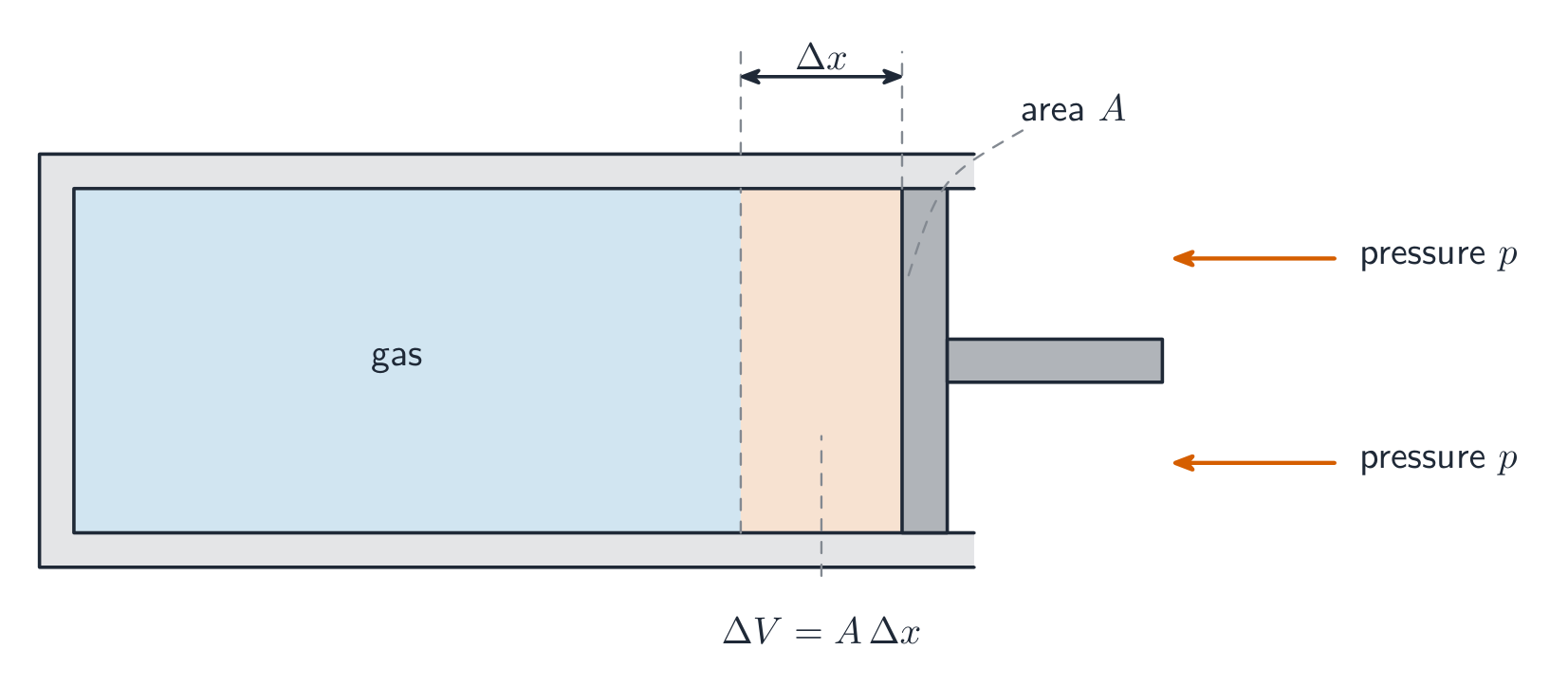
يقوم التوربين البخاري بالشغل بينما يدفع البخار المتوسع شفراته.غاز يدفع مكبساً مساحته $A$ لمسافة $\Delta x$ يقوم بشغل $W = p\,\Delta V$ على المحيط (الحجم المنزلق $\Delta V = A\,\Delta x$)
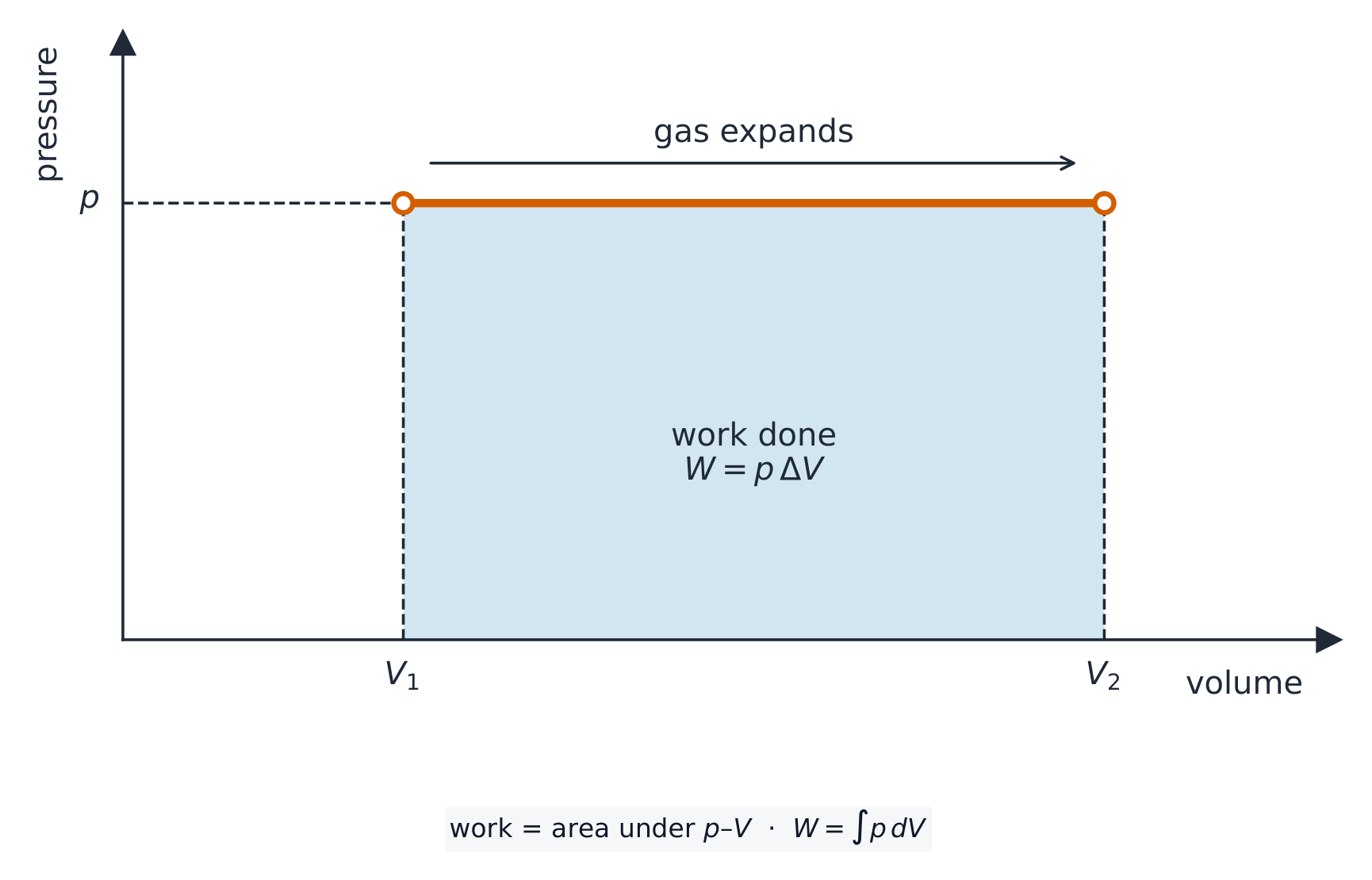
عندما يتغير حجم الغاز مقابل ضغط خارجي، يُبذل شغل ميكانيكي. عند ضغط ثابت $p$ مع تغير حجم صغير $\Delta V$، يكون مقدار الشغل هو
$$W = p \Delta V.$$
مثال محلول. غاز عند ضغط ثابت قدره $1.0 \times 10^{5}\ \text{Pa}$ يتمدد من $2.0 \times 10^{-3}\ \text{m}^{3}$ إلى $5.0 \times 10^{-3}\ \text{m}^{3}$. أوجد الشغل المبذول بواسطة الغاز.
مثال محلول. غاز مثالي كتلته $0.35\ \text{kg}$ تُسخّن عند ضغط ثابت قدره $2.0 \times 10^{5}\ \text{Pa}$؛ ارتفع طاقته الداخلية بمقدار $7600\ \text{J}$ وازداد حجمه بمقدار $1.2 \times 10^{-2}\ \text{m}^{3}$. أوجد الشغل المبذول بواسطة الغاز والحرارة الموردة. ثم يُسخّن الغاز عند حجم ثابت حتى ترتفع طاقته الداخلية بنفس المقدار $7600\ \text{J}$؛ اشرح لماذا تكون الحرارة اللازمة أقل.
الشغل المبذول على الغاز $= p\Delta V = 2.0 \times 10^{5} \times 1.2 \times 10^{-2} = 2400\ \text{J}$، وبالتالي الشغل المبذول ضده هو $W = -2400\ \text{J}$. القانون الأول: $q = \Delta U - W = 7600 - (-2400) = 1.0 \times 10^{4}\ \text{J}$. عند ثبوت الحجم لا يُبذل شغل ($\Delta V = 0$، $W = 0$)، لذا يتحول كل الطاقة الحرارية إلى طاقة داخلية: $q = \Delta U = 7600\ \text{J}$. الجزء الإضافي $2400\ \text{J}$ عند ثبوت الضغط كان الشغل الذي قام به الغاز في دفع الوسط المحيط أثناء تمدده.
مثال محلول. كتلة من الألمنيوم حجمها $3.612 \times 10^{-3}\ \text{m}^{3}$ تُسخّن من $0\ ^{\circ}\text{C}$ إلى $40\ ^{\circ}\text{C}$؛ تزداد حجمها بمقدار $1.0 \times 10^{-5}\ \text{m}^{3}$ ضد ضغط الجو ($1.0 \times 10^{5}\ \text{Pa}$). قارن بين الشغل الذي تبذله على الغلاف الجوي والطاقة الحرارية التي تستقبلها ($m = 9.75\ \text{kg}$، $c = 900\ \text{J kg}^{-1}\ \text{K}^{-1}$).
الشغل المبذول بواسطة الكتلة $= p\Delta V = 1.0 \times 10^{5} \times 1.0 \times 10^{-5} = 1.0\ \text{J}$؛ الطاقة الحرارية $q = mc\Delta T = 9.75 \times 900 \times 40 = 3.5 \times 10^{5}\ \text{J}$. الشغل يساوي تقريبًا $3 \times 10^{-6}$ من التسخين، لذا بالنسبة للمادة الصلبة $\Delta U \approx q$: المواد الصلبة والسائلة تتمدد بشكل ضئيل جدًا، و$p\Delta V$ مهم فقط للغاز.
في الرسم البياني للضغط–الحجم، الشغل المبذول عند الضغط الثابت هو المساحة تحت الخط: $W = p\,\Delta V$
اتفاقية الإشارات في هذا المنهج
يكتب هذا المنهج القانون الأول على شكل $\Delta U = q + W$، حيث $W$ هو الشغل المبذول على الغاز و$q$ هي الطاقة المضافة بالسخّن.
الشغل المبذول على الغاز: موجب عند الانضغاط، وسالب عند التمدد
عندما يتم ضغط الغاز، $\Delta V$ يكون سالبًا والشغل المبذول على الغاز موجب —Gas gains energy.
عندما يتمدد الغاز، $\Delta V$ يكون موجبًا والشغل المبذول على الغاز سالب —Gas loses energy (it does work on the surroundings).
انتبه إلى صيغة السؤال المطلوبة:
"الشغل المبذول على الغاز" — يكون موجبًا عند الانضغاط.
"الشغل المبذول بواسطة الغاز" — العكس تمامًا، يكون موجبًا عند التمدد.
First law of thermodynamics · قانون الديناميكا الحرارية الأول
English
The first law of thermodynamics 热力学第一定律 says that energy is conserved when heat and work pass between a system and its surroundings:
$$\Delta U = q + W,$$
where $\Delta U$ is the rise in internal energy, $q$ is the energy added by heating (positive in, negative out), and $W$ is the work done on the gas (positive when compressed). This is conservation of energy 能量守恒 for a gas.
As the exam asks it. "State the first law of thermodynamics, identifying any symbols" (2 marks): the increase in internal energy of a system, $\Delta U$, is equal to the sum of the thermal energy transferred to the system by heating, $q$, and the work done on the system, $W$: $\Delta U = q + W$. Every symbol must be defined with its direction — "to the system" and "on the system" are what make the signs mean something. "State two ways in which the first law says the internal energy of a system may be changed": by heating (thermal energy transferred into or out of the system) and by doing work on or by the system.
Worked example. A gas absorbs $500\ \text{J}$ of heat while it expands and does $200\ \text{J}$ of work on its surroundings. Find the change in its internal energy.
The gas does work, so the work done on it is $W = -200\ \text{J}$:
$$\Delta U = q + W = 500 + (-200) = 300\ \text{J}.$$
Explaining with the first law. A three-mark "use the first law to explain" answer has three steps: say what $q$ is (and its sign), say what $W$ is (and its sign), then combine them for $\Delta U$ — and, if asked, say what the change in internal energy means for the molecules.
Why a bicycle pump gets hot when used quickly: the air is compressed, so work is done on it ($W > 0$); the compression is fast, so there is no time for thermal energy to leave ($q \approx 0$); therefore $\Delta U = W > 0$ — the internal energy, and so the temperature, of the air rises, and the pump warms up.
A spring stretched at constant temperature within its elastic limit: work is done on the spring by the stretching force ($W > 0$); there is no thermal energy transfer ($q = 0$); so the internal energy increases — stored as the elastic potential energy of the atoms, which are pulled further apart.
Water evaporating from a puddle on a hot day: thermal energy is transferred to the water from the surroundings ($q > 0$); the vapour formed occupies a far larger volume than the liquid, so the system does work on the atmosphere ($W < 0$); the internal energy still increases ($q$ is larger than the work done), and the increase is potential energy — the molecules are separated against the attractive forces between them.
Reading the equation
$\Delta U$ is fixed by the change of state (for an ideal gas, by the change in temperature). The same $\Delta U$ can come from different mixes of $q$ and $W$:
all heat, no work: $\Delta U = q$ (constant-volume heating).
all work, no heat: $\Delta U = W$ (insulated compression or expansion).
Standard processes
For an ideal gas, $\Delta U = \tfrac{3}{2} n R \Delta T$ — it depends only on $\Delta T$.
Process
What stays constant
$\Delta U$
$W$ (on gas)
$q$
Isothermal
$T$
$0$
$W$
$-W$
Constant volume
$V$
$\tfrac{3}{2}n R \Delta T$
$0$
$\Delta U$
Constant pressure
$p$
$\tfrac{3}{2}n R \Delta T$
$-p \Delta V$
$\Delta U - W$
Adiabatic
(no heat)
varies
$W$
$0$
Read each row with the first law $\Delta U = q + W$:
Isothermal 等温 (constant $T$): $\Delta T = 0$, so $\Delta U = 0$. Then $q = -W$ — any heat that goes in comes straight back out as work.
Adiabatic 绝热 (no heat flow): $q = 0$, so $\Delta U = W$. The gas warms up only because work is done on it.
Constant volume (sealed rigid container): no work is done ($\Delta V = 0$), so all the heat goes into internal energy: $q = \Delta U$.
Constant pressure (gas pushing a piston 活塞): the gas does work as it expands, so the heat you supply does two jobs — it raises the internal energy and does the expansion work.
So for the same rise in internal energy, heating at constant pressure needs more thermal energy than heating at constant volume, by exactly the work $p\Delta V$ the gas does while expanding — the constant-volume gas keeps every joule; the constant-pressure gas hands some back to the surroundings.
Worked example: two-step process
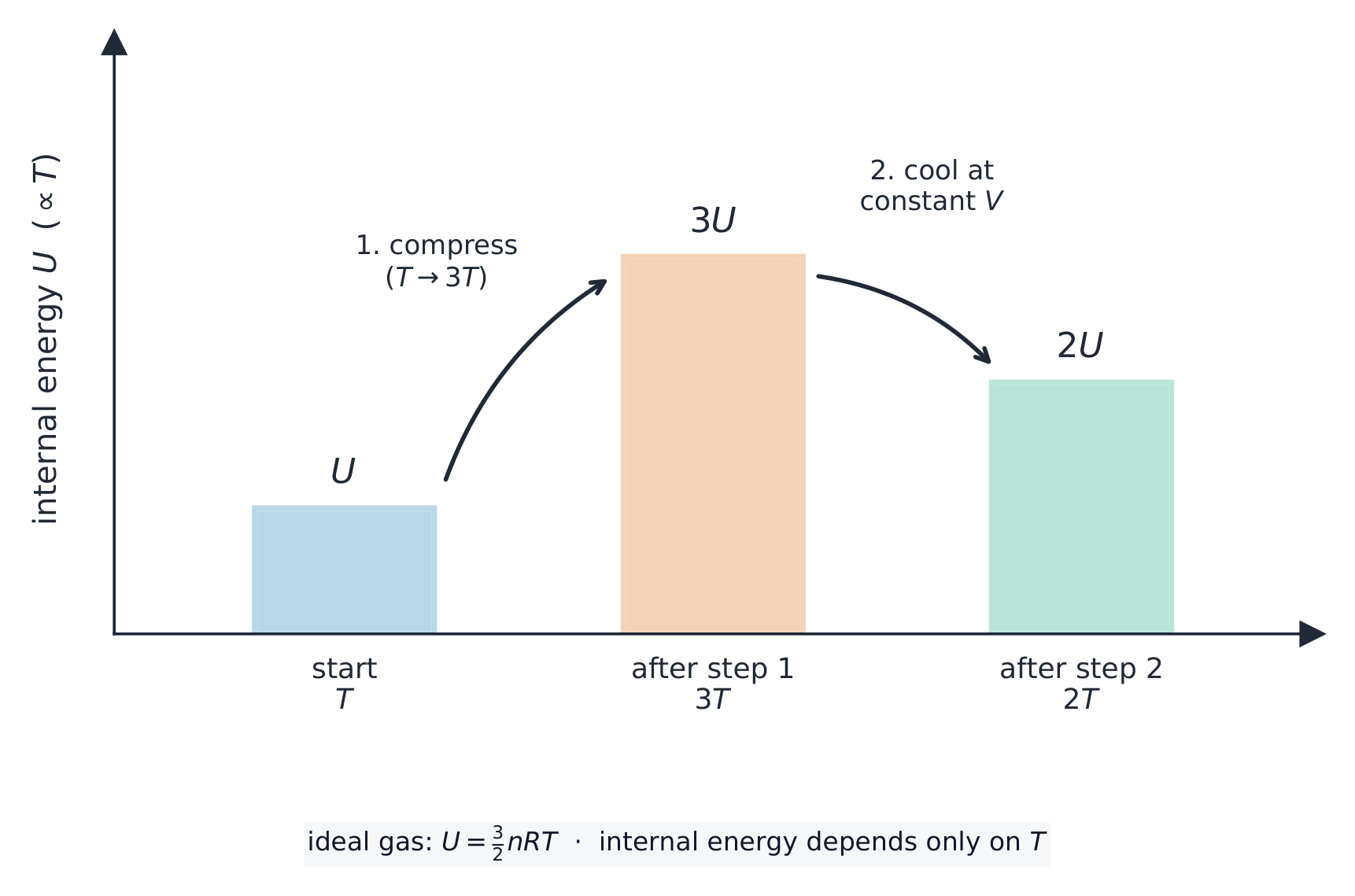
A sample of ideal gas at temperature $T$ with internal energy $U$ goes through:
compression to temperature $3T$; work $W$ is done on the gas.
Check: total $\Delta U = 2U - U = U$, taking the gas from $T$ to $2T$ ($U \to 2U$) — consistent.
Worked example: a cycle on a $p$–$V$ diagram
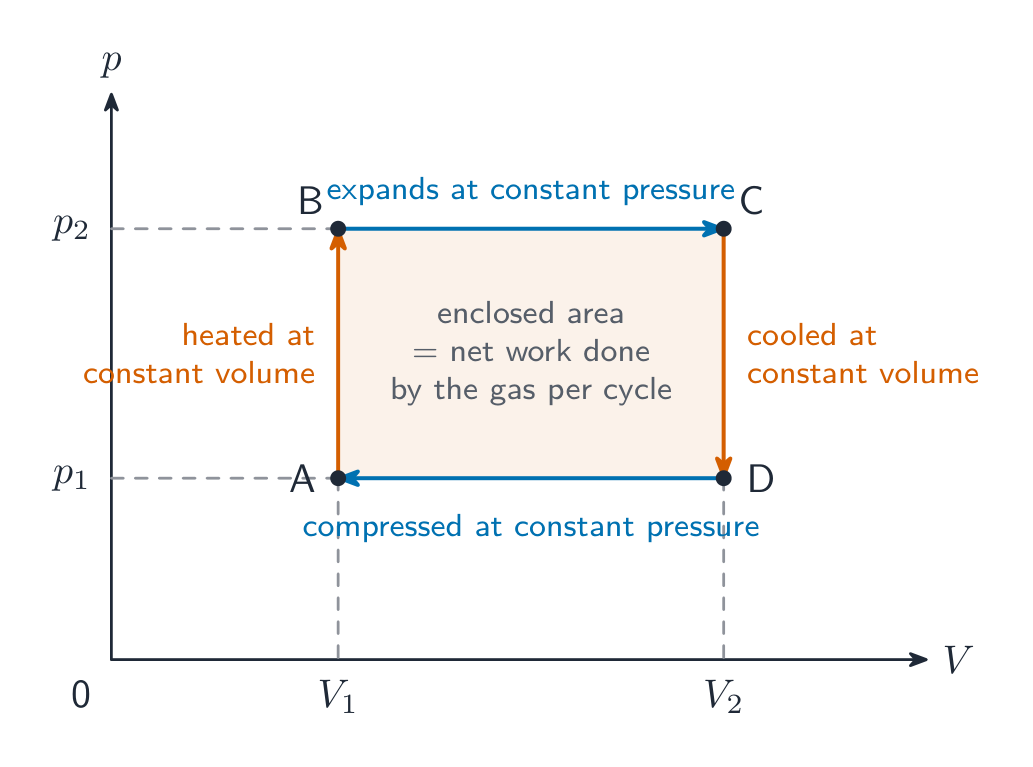
A fixed mass of ideal gas is taken round the cycle ABCDA: A to B at constant volume $V_{1}$ (pressure $p_{1} \to p_{2}$), B to C at constant pressure $p_{2}$ (volume $V_{1} \to V_{2}$), C to D at constant volume, D to A at constant pressure $p_{1}$. Complete a table of the signs of $q$, $W$ and $\Delta U$ for each leg, and explain the internal-energy change from B to C.
Leg
Process
$W$ (on gas)
$\Delta U$
$q$
A → B
constant volume, pressure rises
$0$ (no volume change)
$+$ (temperature rises, $pV$ larger)
$+$ ($q = \Delta U$)
B → C
constant pressure, expands
$-$ (gas does work $p_{2}(V_{2} - V_{1})$)
$+$ ($T \propto V$ at constant $p$)
$+$ (and larger than $\Delta U$)
C → D
constant volume, pressure falls
$0$
$-$
$-$ (thermal energy leaves)
D → A
constant pressure, compressed
$+$ (work done on the gas $p_{1}(V_{2} - V_{1})$)
$-$
$-$ (larger in size than $\Delta U$)
From B to C the gas expands at constant pressure, so its temperature rises ($V/T$ constant) and its internal energy increases; it does work on the surroundings ($W$ negative), so the thermal energy supplied must cover both: $q = \Delta U - W$, larger than the rise in internal energy. Round the whole cycle $\Delta U = 0$ (the gas returns to its starting state), so the net thermal energy in equals the net work done by the gas — the area enclosed by the rectangle, $(p_{2} - p_{1})(V_{2} - V_{1})$.
Heat capacity at constant volume
For constant-volume heating of an ideal gas, $q = \Delta U = \tfrac{3}{2} n R \Delta T$. So the molar heat capacity 热容 at constant volume is $\tfrac{3}{2} R$ for a monatomic 单原子 ideal gas. (You are not required to use the symbol $C_V$, but the result $q = \tfrac{3}{2} n R \Delta T$ for constant-volume heating is.)
Heating without a temperature change
If heat is supplied during a phase change at constant pressure (e.g. boiling water), the temperature stays constant but the internal energy still rises (the latent heat 潜热 separates the molecules), and the gas does expansion work. The first law still holds: $\Delta U = q + W$.
العربية
المحطة الكهربائية محرك حراري: تحول الحرارة إلى شغل مفيد.
يقول قانون الديناميكا الحرارية الأول أن الطاقة محفوظة عندما تنتقل الحرارة والشغل بين نظام ومحيطه:
$$\Delta U = q + W,$$
حيث $\Delta U$ هو الزيادة في الطاقة الداخلية، و$q$ هي الطاقة المضافة عن طريق التسخين (موجبة عند الدخول وسالبة عند الخروج)، و$W$ هو الشغل المبذول على الغاز (موجب عند الانضغاط). هذا يمثل حفظ الطاقة للغاز.
كما يطلب الامتحان: "اذكر القانون الأول للديناميكا الحرارية، مع تحديد الرموز" (2 علامات): زيادة الطاقة الداخلية لنظام ما، $\Delta U$، تساوي مجموع الطاقة الحرارية المنتقلة إلى النظام عن طريق التسخين، $q$، والشغل المبذول على النظام، $W$: $\Delta U = q + W$. يجب تعريف كل رمز مع اتجاهه — "إلى النظام" و"على النظام" هما ما يعطيان للإشارات معناها. "اذكر طريقتين يمكن بهما تغيير الطاقة الداخلية لنظام وفقاً للقانون الأول": عن طريق التسخين (انتقال الطاقة الحرارية إلى النظام أو منه) وعن طريق تبذيل شغل عليه أو بواسطة النظام.
كلا السخّن ($q$) والشغل المبذول على الغاز ($W$) يضيفان طاقة، مما يرفع الطاقة الداخلية بمقدار $\Delta U$
مثال محلول. امتص غاز $500\ \text{J}$ من الحرارة بينما يتمدد وبذل $200\ \text{J}$ من الشغل على محيطه. أوجد التغير في طاقته الداخلية.
الغاز يبذل شغلًا، لذا فإن الشغل المبذول على الغاز هو $W = -200\ \text{J}$:
$$\Delta U = q + W = 500 + (-200) = 300\ \text{J}.$$
الشرح باستخدام القانون الأول. إجابة من ثلاث درجات "استخدم القانون الأول لشرح" تتكون من ثلاث خطوات: قل ما هو $q$ (وعلامته)، قل ما هو $W$ (وعلامته)، ثم جمعهما للحصول على $\Delta U$ — وإذا طُلب ذلك، قل ماذا يعني التغير في الطاقة الداخلية للجزيئات.
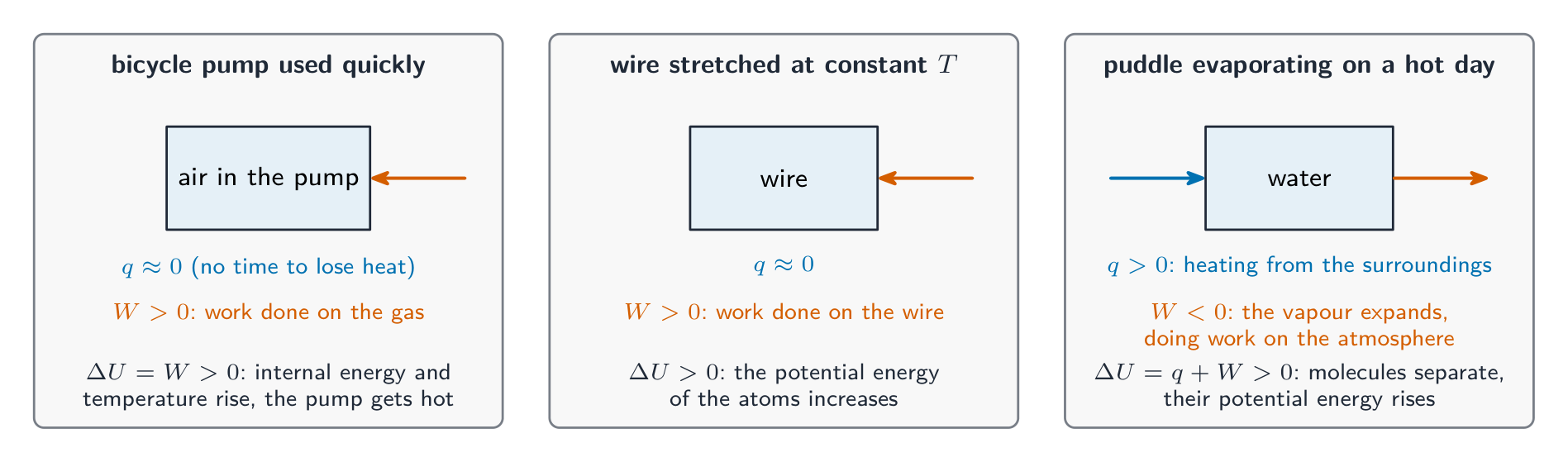
التفسيرات الكلاسيكية الثلاثة للقانون الأول: أعطِ $q$ مع علامته، $W$ مع علامته، ثم $\Delta U$
لماذا تسخن مضخة الدراجة عند استخدامها بسرعة: يتم ضغط الهواء، مما يعني أن شغلاً يُبذل عليه ($W > 0$)؛ عملية الضغط سريعة، لذا لا يوجد وقت لانتقال الطاقة الحرارية إلى الخارج ($q \approx 0$)؛ وبالتالي $\Delta U = W > 0$ — تزداد الطاقة الداخلية، وبالتالي درجة الحرارة، للهواء، وتسخن المضخة.
زنبرك ممدود عند درجة حرارة ثابتة ضمن حدوده المرنة: يُبذل شغل على الزنبرك بواسطة قوة الشد ($W > 0$)؛ لا توجد انتقال للطاقة الحرارية ($q = 0$)؛ لذلك تزداد الطاقة الداخلية — مخزنة كطاقة كامنة مرورية للذرات التي تُسحب مبتعدة أكثر عن بعضها.
تبخر الماء من بركة ماء في يوم حار: تنتقل الطاقة الحرارية إلى الماء من المحيطين ($q > 0$)؛ البخار المتكون يشغل حجماً أكبر بكثير من السائل، لذا يقوم النظام بشغل على الغلاف الجوي ($W < 0$)؛ تزداد الطاقة الداخلية مع ذلك ($q$ أكبر من الشغل المبذول)، والزيادة تكون طاقة كامنة — الجزيئات مُبعَدة ضد قوى التجاذب بينها.
قراءة المعادلة
يُحدد $\Delta U$ بتغير الحالة (بالنسبة للغاز المثالي، بالتغير في درجة الحرارة). يمكن أن يأتي نفس $\Delta U$ من مزيج مختلف من $q$ و$W$:
كلهم حرارة، بدون شغل: $\Delta U = q$ (تسخين بحجم ثابت).
كلهم شغل، بدون حرارة: $\Delta U = W$ (انضغاط أو تمدد معزول حرارياً).
العمليات القياسية
بالنسبة للغاز المثالي، $\Delta U = \tfrac{3}{2} n R \Delta T$ — تعتمد فقط على $\Delta T$.
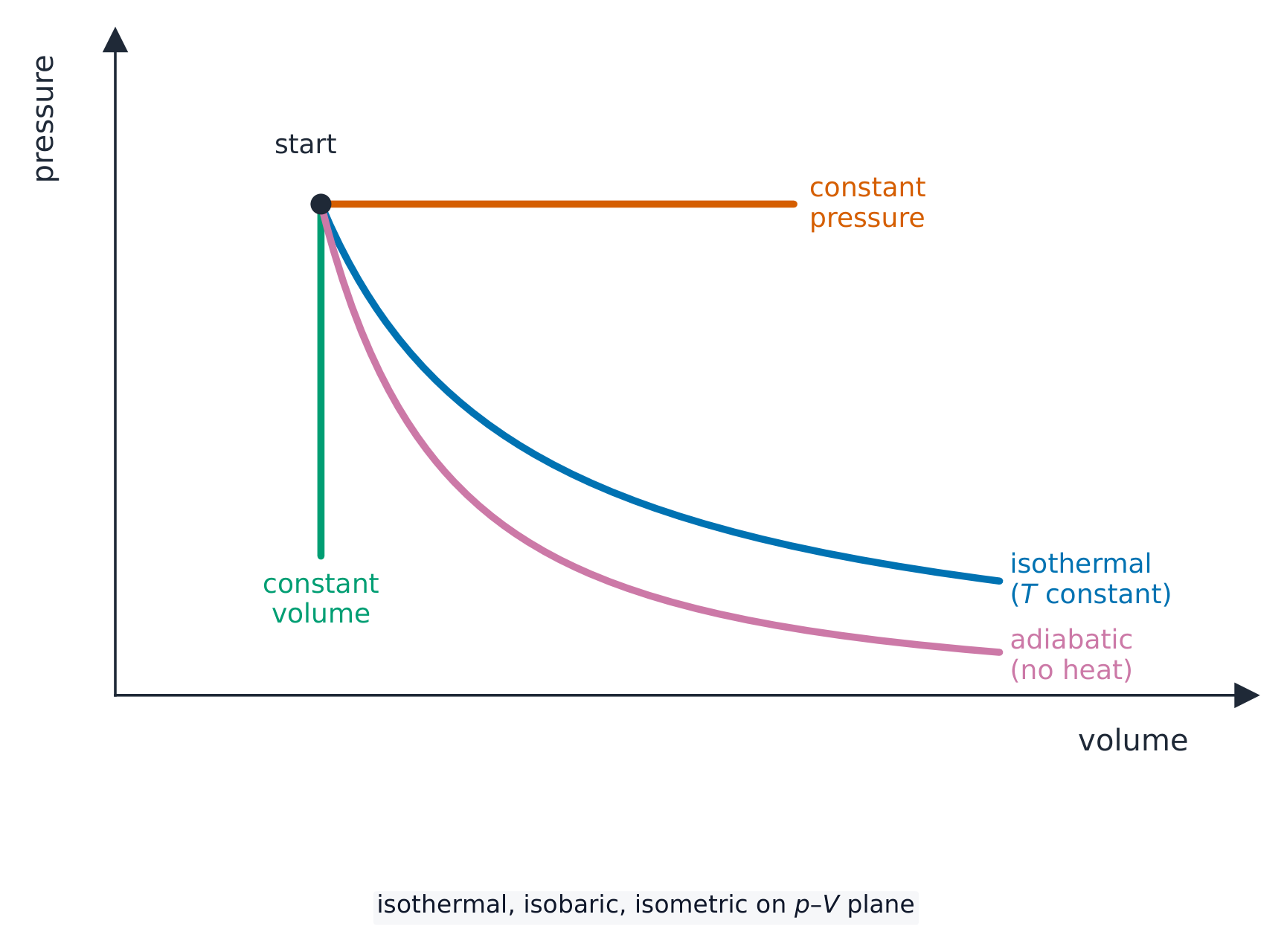
العمليات القياسية الأربع، جميعها تبدأ من نفس الحالة
العملية
ما يبقى ثابتاً
$\Delta U$
$W$ (على الغاز)
$q$
أيزوثيرمي
$T$
$0$
$W$
$-W$
حجم ثابت
$V$
$\tfrac{3}{2}n R \Delta T$
$0$
$\Delta U$
ضغط ثابت
$p$
$\tfrac{3}{2}n R \Delta T$
$-p \Delta V$
$\Delta U - W$
أدياباتي
(بدون حرارة)
يتغير
$W$
$0$
اقرأ كل صف باستخدام القانون الأول $\Delta U = q + W$:
أيزوثيرمي (ثبات $T$): $\Delta T = 0$، لذا $\Delta U = 0$. ثم $q = -W$ — أي حرارة تدخل تخرج مباشرة كشغل.
أدياباتي (بدون تدفق حراري): $q = 0$، لذا $\Delta U = W$. يسخن الغاز فقط لأن شغلاً يُبذل عليه.
حجم ثابت (وعاء محكم صلب): لا يُبذل شغل ($\Delta V = 0$)، لذا تتجه كل الحرارة إلى الطاقة الداخلية: $q = \Delta U$.
ضغط ثابت (غاز يدفع مكبساً): يبذل الغاز شغلاً أثناء تمدده، لذا تقوم الحرارة الموردة بمهمتين — رفع الطاقة الداخلية وقيام شغل التمدد.
لذلك، بالنسبة لـ نفس الارتفاع في الطاقة الداخلية، يحتاج التسخين عند ضغط ثابت إلى طاقة حرارية أكثر من التسخين عند حجم ثابت، بمقدار الشغل $p\Delta V$ الذي يبذله الغاز أثناء التمدد — غاز الحجم الثابت يحتفظ بكل جول؛ أما غاز الضغط الثابت فيعيد جزءاً منه للمحيطين.
مثال محلול: عملية ذات مرحلتين
عينة من غاز مثالي عند درجة حرارة $T$ وطاقة داخلية $U$ تمر بما يلي:
انضغاط إلى درجة حرارة $3T$؛ يُبذل شغل $W$ على الغاز.
تبريد عند حجم ثابت إلى درجة حرارة $2T$.
تتبع الطاقة الداخلية درجة الحرارة: $U \to 3U$ عند الانضغاط إلى $3T$، ثم $3U \to 2U$ عند التبريد إلى $2T$
المرحلة 1 ($T \to 3T$): $U = \tfrac{3}{2}nRT$، لذا $U \to 3U$، مما يعطي $\Delta U_{1} = 2U$. $W_{1} = +W$. إذن $q_{1} = \Delta U_{1} - W_{1} = 2U - W$.
المرحلة 2 ($3T \to 2T$، حجم ثابت): $\Delta U_{2} = -U$. $W_{2} = 0$. إذن $q_{2} = -U$ (تتدفق الحرارة للخارج).
تحقق: المجموع الكلي لـ $\Delta U = 2U - U = U$، بنقل الغاز من $T$ إلى $2T$ ($U \to 2U$) — متوافق.
مثال محلول: دورة على رسم بياني $p$–$V$
دورة: لكل جزء حدد $W$ من تغير الحجم و$\Delta U$ من تغير درجة الحرارة، وسيأتي $q$ تلقائياً من القانون الأول
كتلة ثابتة من غاز مثالية تأخذ حول الدورة ABCDA: من A إلى B عند حجم ثابت $V_{1}$ (ضغط $p_{1} \to p_{2}$)، من B إلى C عند ضغط ثابت $p_{2}$ (حجم $V_{1} \to V_{2}$)، من C إلى D عند حجم ثابت، ومن D إلى A عند ضغط ثابت $p_{1}$. أكمل جدولاً لإشارات $q$ و$W$ و$\Delta U$ لكل جزء، واشرح تغير الطاقة الداخلية من B إلى C.
الجزء
العملية
$W$ (على الغاز)
$\Delta U$
$q$
A → B
حجم ثابت، يرتفع الضغط
$0$ (لا تغير في الحجم)
$+$ (ترتفع درجة الحرارة، $pV$ أكبر)
$+$ ($q = \Delta U$)
B → C
ضغط ثابت، يتمدد
$-$ (الغاز يبذل شغلاً $p_{2}(V_{2} - V_{1})$)
$+$ ($T \propto V$ عند ثبات $p$)
$+$ (أكبر من $\Delta U$)
C → D
حجم ثابت، ينخفض الضغط
$0$
$-$
$-$ (تغادر الطاقة الحرارية)
D → A
ضغط ثابت، يُضغط
$+$ (يُبذل شغل على الغاز $p_{1}(V_{2} - V_{1})$)
$-$
$-$ (أكبر حجماً من $\Delta U$)
من B إلى C يتم تمدد الغاز عند ضغط ثابت، وبالتالي ترتفع حرارته ($V/T$ ثابت) وتزداد طاقته الداخلية؛ ويؤدي شغلاً على المحيط ($W$ سالب)، لذا يجب أن تغطي الطاقة الحرارية الموردة كلاهما: $q = \Delta U - W$، وهي أكبر من الزيادة في الطاقة الداخلية. يُختتم الدورة كاملةً $\Delta U = 0$ (يعود الغاز إلى حالته الأصلية)، لذا فإن صافي الطاقة الحرارية الداخلة يساوي صافي الشغل المبذول بواسطة الغاز — وهو المساحة المحصورة داخل المستطيل، $(p_{2} - p_{1})(V_{2} - V_{1})$.
السعة الحرارية عند حجم ثابت
للتسخين عند حجم ثابت لغاز مثالي، $q = \Delta U = \tfrac{3}{2} n R \Delta T$. إذن السعة الموليةللحرارة عند حجم ثابت هي $\tfrac{3}{2} R$ للغاز المثالي أحادي الذرة. (لا يُشترط عليك استخدام الرمز $C_V$، لكن النتيجة $q = \tfrac{3}{2} n R \Delta T$ للتسخين عند حجم ثابت هي).
عند حجم ثابت ترفع الحرارة كل منها $U$ ($q = \Delta U$)؛ أما عند ضغط ثابت فيقوم الغاز أيضاً ببذل شغل
التسخين دون تغير درجة الحرارة
إذا تم تزويد الطاقة الحرارية أثناء تحول طور عند ضغط ثابت (مثل غليان الماء)، تبقى درجة الحرارة ثابتة لكن الطاقة الداخلية تظل تتزايد (فإن الحرارة الكامنة تفصل الجزيئات)، ويقوم الغاز ببذل شغل تمدد. لا يزال القانون الأول قائماً: $\Delta U = q + W$.
Explore · استكشف
Work done on a gas · الشغل المبذول على غاز
Push the piston in and you do work on the gas (W = pΔV); the first law says that work plus the heat added equals the rise in internal energy. · ادفع المكبس للداخل وتقوم بعمل على الغاز (W = pΔV); القانون الأول يقول إن الشغل بالإضافة إلى الحرارة المضافة يساوي الارتفاع في الطاقة الداخلية.
16.2
Definitions the examiner accepts · التعريفات التي يقبلها المصحح
English
A definition question is marked against fixed wording. Learn these exactly, and give one answer only.
Term
Definition
internal energy
the sum of the random distribution of the kinetic and potential energies of the molecules of a system
internal energy of an ideal gas
the total random kinetic energy of its molecules, since with no intermolecular forces there is no potential energy
first law of thermodynamics
the increase in internal energy of a system equals the thermal energy transferred to the system by heating plus the work done on the system: $\Delta U = q + W$
work done on a gas at constant pressure
$W = p\Delta V$ in size; positive when the gas is compressed, negative when it expands (the gas then does work on its surroundings)
thermal energy transfer (heating)
energy transferred to or from a system because of a temperature difference; $q$ is positive when it enters
isothermal change
a change at constant temperature, so for an ideal gas $\Delta U = 0$ and $q = -W$
adiabatic change
a change with no thermal energy transfer, $q = 0$, so $\Delta U = W$
العربية
تُصنّف أسئلة التعريف بناءً على صياغة ثابتة. احفظ هذه التعريفات بدقة، وقدم إجابة واحدة فقط.
مصطلح
تعريف
الطاقة الداخلية
مجموع التوزيع العشوائي للطاقة الحركية والكامنة لجزيئات النظام
طاقة غاز مثالي داخلية
إجمالي الطاقة الحركية العشوائية لجزيئاته، لأنه بدون قوى بين جزيئية لا توجد طاقة كامنة
القانون الأول الديناميكا الحرارية
مقدار الزيادة في الطاقة الداخلية للنظام يساوي الطاقة الحرارية المنقولة إلى النظام بالتسخين زائد الشغل المبذول على النظام: $\Delta U = q + W$
شغل مبذول على غاز عند ضغط ثابت
$W = p\Delta V$ في المقدار؛ موجب عندما يُضغط الغاز، وسالب عندما يتمدد (حيث يقوم الغاز حينها ببذل شغل على محيطه)
انتقال الطاقة الحرارية (التسخين)
الطاقة المنقولة إلى أو من النظام بسبب فرق درجات الحرارة؛ $q$ تكون موجبة عند دخولها
تغير إيزوثيرمي
تغير عند درجة حرارة ثابتة، لذا بالنسبة لغاز مثالي $\Delta U = 0$ و$q = -W$
تغير أدياباتي
تغير بدون انتقال للطاقة الحرارية، $q = 0$، لذا $\Delta U = W$
16.2
Exam tips · نصائح للامتحان
English
First law: $\Delta U = q + W$ — define every symbol with its direction: $q$ is energy transferred to the system by heating, $W$ is work done on the system.
For an ideal gas, internal energy depends only on temperature ($\Delta U \propto \Delta T$) and is kinetic energy only; for a solid or liquid the potential energy changes too.
Work done by a gas at constant pressure $= p\Delta V$; read the sign from expansion (by) or compression (on), and remember that at constant volume $W = 0$.
A "describe and explain" answer names both kinetic and potential energy and says what happens to each; an "explain using the first law" answer gives $q$, $W$ and then $\Delta U$, each with its sign.
Round a complete cycle $\Delta U = 0$, so net heating equals net work done by the gas — the area enclosed on the $p$–$V$ diagram.
Common mistakes
Defining internal energy as "the total energy of the molecules" or forgetting "random" or "potential". The mark scheme wants the sum of random kinetic and potential energies.
Using $W = p\Delta V$ with the wrong sign. When the gas expands the work done on it is negative.
Saying the internal energy of an ideal gas rises when it is compressed isothermally. At constant temperature $\Delta U = 0$: the work done on it leaves again as heat.
Treating a phase change as $\Delta U = 0$ because the temperature is constant. The potential energy rises; $\Delta U$ is the latent heat minus any expansion work.
Forgetting that a gas heated at constant pressure does work, so it needs more heating than at constant volume for the same $\Delta U$.
Applying $\Delta U = \tfrac{3}{2}nR\Delta T$ to a real gas, a liquid or a solid. It is the ideal-gas result only.
العربية
القانون الأول: $\Delta U = q + W$ — عرّف كل رمز مع اتجاهه: $q$ هو الطاقة المنقولة إلى النظام بالتسخين، و$W$ هو الشغل المبذول على النظام.
بالنسبة لغاز مثالي، تعتمد الطاقة الداخلية فقط على درجة الحرارة ($\Delta U \propto \Delta T$) وهي طاقة حركية فقط؛ أما في الصلب أو السائل فتتغير الطاقة الكامنة أيضاً.
شغل يؤديه غاز عند ضغط ثابت $= p\Delta V$؛ استنتج الإشارة من التمدد (بواسطة) أو الانضغاط (على)، وتذكر أنه عند حجم ثابت $W = 0$.
إجابة "وصف واشرح" تذكر كل من الطاقة الحركية والكامنة وتقول ماذا يحدث لكل منهما؛ أما إجابة "اشرح باستخدام القانون الأول" فتقدم $q$، و$W$ ثم $\Delta U$، كل منها بإشارته.
تُختصر دورة كاملة $\Delta U = 0$، لذا فإن التسخين الصافي يساوي الشغل الصافي المبذول بواسطة الغاز — وهو المساحة المحصورة على مخطط $p$–$V$.
أخطاء شائعة
تعريف الطاقة الداخلية بأنها "إجمالي طاقة الجزيئات" أو نسيان كلمة "عشوائي" أو "كامنة". مخطط الدرجات يطلب مجموع الطاقة الحركية الكامنة والعشوائية للجزيئات.
استخدام $W = p\Delta V$ بإشارة خاطئة. عندما يتمدد الغاز يكون الشغل المبذول عليه سالباً.
القول بأن طاقة غاز مثالي داخلية تزداد عند انضغاطه إيزوثيرمياً. عند درجة حرارة ثابتة $\Delta U = 0$: الشغل المبذول عليه يخرج مجدداً كحرارة.
اعتبار تحول الطور $\Delta U = 0$ لأن درجة الحرارة ثابتة. تزداد الطاقة الكامنة؛ $\Delta U$ هو الحرارة الكامنة ناقص أي شغل تمدد.
نسيان أن الغاز المُسخّن عند ضغط ثابت يؤدي شغلاً، لذا يحتاج لتسخين أكثر عند نفس $\Delta U$ مقارنة بحجم ثابت.
تطبيق $\Delta U = \tfrac{3}{2}nR\Delta T$ على غاز حقيقي أو سائل أو صلب. إنه نتيجة خاصة بالغاز المثالي فقط.
Interactive lessons on this topic · دروس تفاعلية حول هذا الموضوع
Work through it step by step, with instant-check exercises. · ا-working عليه خطوة بخطوة، مع تمارين تحقق فوري.
Pick one and the site follows you — notes, papers, videos and practice all open on it. · اختر واحدًا وسيتبعك الموقع — الملاحظات، الأوراق، الفيديوهات والتدريب جميعها تفتح عليه.
Type to search notes, lessons, code, vocabulary and past-paper questions across every subject. · اكتب للبحث عن ملاحظات، دروس، أكواد، مفردات وأسئلة امتحانات سابقة عبر جميع المواد.