لمس ملعقة معدنية، ثم طاولة خشبية، في نفس الغرفة. يبدو المعدن أبرد بكثير. إذن يجب أن يكون أبرد — صحيح؟ خطأ. أحضر مقياس حرارة، وكلاهما…
English narration · English + 中文 subtitles burned in · سرد باللغة الإنجليزية · ترجمة مدمجة بالإنجليزية + الصينية
14.1
Thermal equilibrium · التوازن الحراري
Syllabus · المنهج
English
understand that (thermal) energy is transferred from a region of higher temperature to a region of lower temperature
understand that regions of equal temperature are in thermal equilibrium
العربية
فهم انتقال الطاقة (الحرارية) من منطقة ذات درجة حرارة أعلى إلى منطقة ذات درجة حرارة أقل
فهم أن المناطق المتساوية في درجة الحرارة تكون في اتزان حراري
Source: Cambridge International syllabus · المصدر: منهج كامبريدج الدولي
English
Heat 热量 (thermal energy) flows from a higher temperature to a lower temperature. When two bodies touch, energy moves until their temperatures are equal — they reach thermal equilibrium 热平衡. At equilibrium there is no net flow of energy.
Two regions at the same temperature 温度 are in thermal equilibrium with each other — no net energy flows, even though particles still exchange energy.
Temperature decides the direction of heat flow. It is not a measure of how much thermal energy 热能 a body holds. A small cup of boiling water (100 °C) holds far less energy than a swimming pool at 25 °C, but a piece of metal put in the cup gains energy while one put in the pool loses it.
The examiner's wording.Two objects are in thermal equilibrium when there is no net transfer of thermal energy between them; that happens when they are at the same temperature. Asked for "the reason why two objects at the same temperature are in thermal equilibrium", the one mark is: there is no net flow of thermal energy between them — energy still passes both ways, but equally. Thermal energy is the energy transferred because of a temperature difference; temperature is what decides the direction.
Worked example. Two metal cuboids P and Q are in thermal contact and in thermal equilibrium. State what this means, and describe what happens when a hotter cuboid is placed against them.
No net thermal energy passes between P and Q, because they are at the same temperature. A hotter cuboid transfers thermal energy to them (from higher to lower temperature) until all three reach one common temperature; then, and only then, is the whole group in thermal equilibrium.
العربية
الحرارة (الطاقة الحرارية) تتدفق من درجة حرارة أعلى إلى درجة حرارة أقل. عندما يلمس جسمان بعضهما، تنتقل الطاقة حتى تتساوى درجات حرارتهما — يصلان إلى التوازن الحراري. عند التوازن لا يوجد تدفق صافي للطاقة.
منطقتان لهما نفس درجة الحرارة تكونان في توازن حراري مع بعضهما البعض — لا يوجد تدفق صافي للطاقة، حتى لو كانت الجسيمات لا تزال تتبادل الطاقة.
تحدد درجة الحرارة اتجاه تدفق الحرارة. إنها ليست مقياساً لكمية الطاقة الحرارية التي يحتويها جسم ما. كوب صغير من الماء المغلي (100 °C) يحتوي على طاقة أقل بكثير من مسبح عند 25 °C، لكن قطعة معدن وضعت في الكوب تكتسب طاقة بينما تفقد طاقة إذا وُضعت في المسبح.
تتدفق الحرارة من الساخن إلى البارد حتى يصل كلاهما إلى نفس درجة الحرارة — التوازن الحراري
صياغة المصحح.يكون جسمان في توازن حراري عندما لا يكون هناك انتقال صافٍ للطاقة الحرارية بينهما؛ ويحدث ذلك عندما يكونا في نفس درجة الحرارة. عند الطلب "السبب الذي يجعل جسمين في نفس درجة الحرارة في توازن حراري"، الإجابة بعلامة واحدة هي: لا يوجد تدفق صافي للطاقة الحرارية بينهما — فالطاقة لا تزال تنتقل في كلا الاتجاهين، ولكن بالتساوي. الطاقة الحرارية هي الطاقة المنقولة بسبب فرق درجات الحرارة؛ ودرجة الحرارة هي ما يحدد الاتجاه.
مثال محلول. مكعبان فلزيان P وQ في تلامس حراري وفي توازن حراري. اشرح ماذا يعني ذلك، واصف ما يحدث عند وضع مكعب آخر أكثر سخونة عليهما.
لا تمر طاقة حرارية صافية بين P وQ، لأنهما في نفس درجة الحرارة. ينقل المكعب الساخن طاقة حرارية إليهما (من درجة حرارة أعلى إلى أدنى) حتى تصل الثلاثة جميعاً إلى درجة حرارة مشتركة واحدة؛ حينئذٍ، فقط حينئذٍ، يصبح المجموع بأكمله في حالة توازن حراري.
understand that a physical property that varies with temperature may be used for the measurement of temperature and state examples of such properties, including the density of a liquid, volume of a gas at constant pressure, resistance of a metal, e.m.f. of a thermocouple
understand that the scale of thermodynamic temperature does not depend on the property of any particular substance
convert temperatures between kelvin and degrees Celsius and recall that $T/\text{K} = \theta/\text{ }^{\circ}\text{C} + 273.15$
understand that the lowest possible temperature is zero kelvin on the thermodynamic temperature scale and that this is known as absolute zero
العربية
فهم أن خاصية فيزيائية تتغير مع درجة الحرارة يمكن استخدامها لقياس درجة الحرارة وذكر أمثلة على مثل هذه الخصائص، بما في ذلك كثافة سائل، حجم غاز عند ضغط ثابت، مقاومة معدن، القوة الدافعة الكهربائية لـزوج حراري
فهم أن مقياس درجة الحرارة الديناميكية الحرارية لا يعتمد على خاصية أي مادة معينة
تحويل درجات الحرارة بين الكلفن ودرجة مئوية والتذكر أن $T/\text{K} = \theta/\text{ }^{\circ}\text{C} + 273.15$
فهم أن أدنى درجة حرارة ممكنة هي صفر كلفن على مقياس درجة الحرارة الديناميكية الحرارية وأن هذا يُعرف بـالصفر المطلق
Source: Cambridge International syllabus · المصدر: منهج كامبريدج الدولي
English
Any physical property that changes in a repeatable way with temperature can make a thermometer 温度计. Examples:
volume of a liquid — a liquid-in-glass thermometer (mercury or alcohol). As the temperature rises, the liquid expands and rises up a narrow capillary 毛细管.
volume of a gas at constant pressure — a gas thermometer. The gas volume rises in step with the absolute temperature.
resistance of a metal — a resistance thermometer. A metal's resistance 电阻 rises nearly in step with temperature over a wide range.
e.m.f. of a thermocouple — a thermocouple 热电偶 is two different metals joined at two points; the electromotive force 电动势 it makes depends on the temperature difference between the joins.
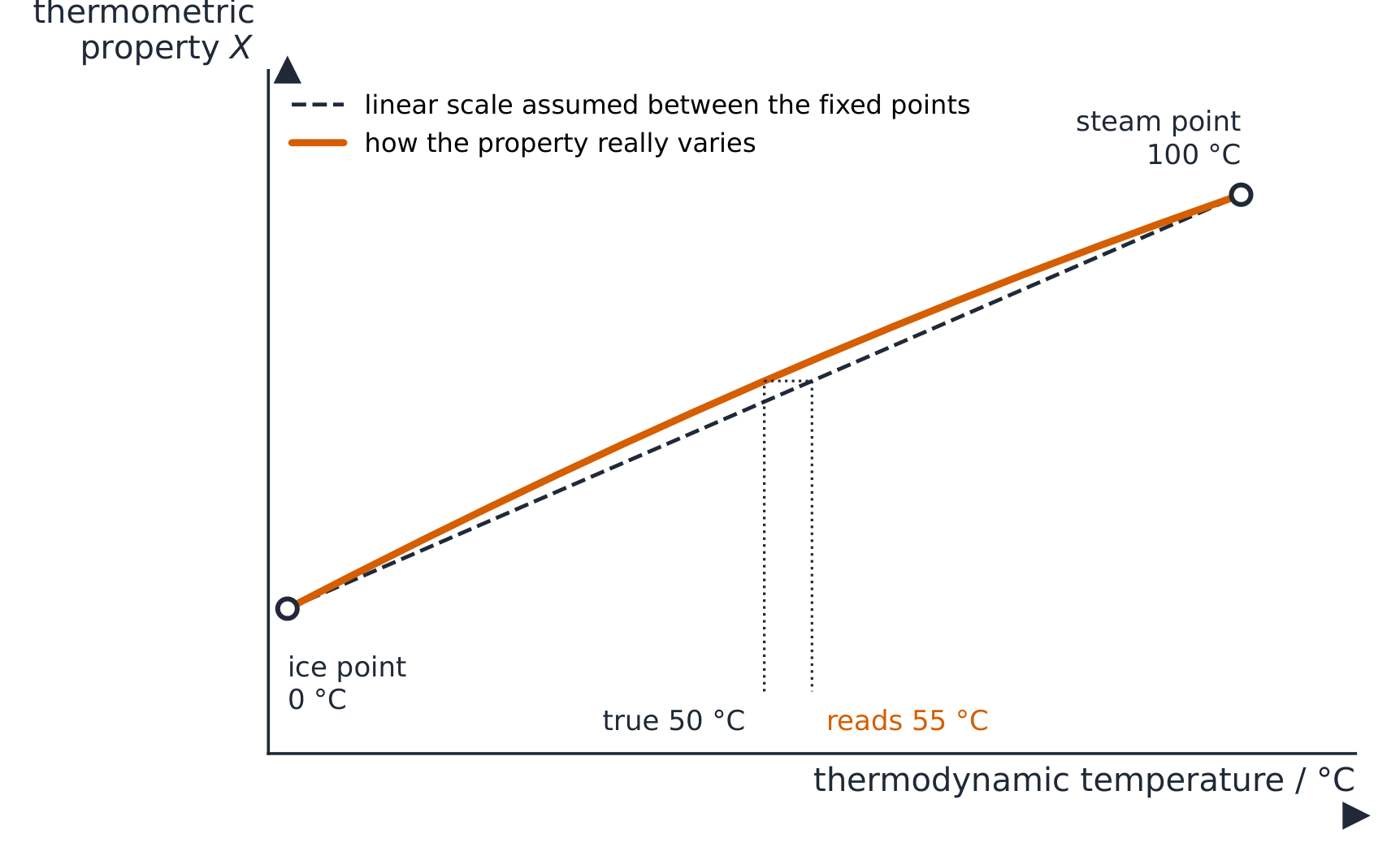
Different thermometers can read slightly differently if the property does not change in a straight line; they agree only at the calibration 校准 points.
Fixed points and calibration. A thermometer is calibrated at two fixed points 固定点 that are easy to reproduce — the ice point ($0\ ^{\circ}\text{C}$, pure melting ice) and the steam point ($100\ ^{\circ}\text{C}$, steam above boiling water at standard pressure). The value of the property is measured at each, and the scale between them is drawn assuming the property changes linearly with temperature. That assumption is the weakness: mercury's expansion, a metal's resistance and a thermocouple's e.m.f. all vary slightly differently between the fixed points, so two thermometers that agree at $0$ and $100\ ^{\circ}\text{C}$ can disagree at $50\ ^{\circ}\text{C}$.
Why a liquid-in-glass thermometer does not measure thermodynamic temperature (the one-mark reason): its reading depends on the property of a particular substance — the expansion of mercury or alcohol — and on the assumption that this expansion is linear between the fixed points. The thermodynamic scale depends on no substance at all.
Why water is a poor thermometric liquid. Its density does not change steadily with temperature: it is greatest at $4\ ^{\circ}\text{C}$, so between $0$ and $8\ ^{\circ}\text{C}$ two different temperatures give the same density and the reading is ambiguous, and the change per degree is small, so the thermometer is insensitive. Mercury's density falls steadily and almost linearly over the whole range, which is why it was chosen.
Worked example. A platinum resistance thermometer is a coil of platinum wire in a glass tube, connected to a circuit that measures its resistance. Explain how it measures temperature, and give one disadvantage compared with a thermocouple.
The resistance of the platinum increases with temperature in a known, almost linear way; the resistance is measured at the ice point and the steam point, and any other temperature is read from where the measured resistance falls on the linear scale between them (or from a calibration graph). Disadvantage: the coil, tube and the fluid around them have a large thermal capacity, so the thermometer responds slowly and cannot follow a rapidly changing temperature; it is also bulky and needs a circuit to read it. (Its advantages: accurate, stable and usable over a very wide range.)
Worked example. In a constant-volume gas thermometer the pressure of the gas is $1.05 \times 10^{5}\ \text{Pa}$ when the bulb is in melting ice and $1.19 \times 10^{5}\ \text{Pa}$ when it is in a warm room. Find the thermodynamic temperature of the room, and explain why this thermometer, unlike a liquid-in-glass one, gives thermodynamic temperature directly.
For a fixed mass of gas at constant volume the pressure is proportional to the thermodynamic temperature, so $\dfrac{T}{273.15} = \dfrac{1.19 \times 10^{5}}{1.05 \times 10^{5}}$, giving $T = 310\ \text{K}$ ($36\ ^{\circ}\text{C}$). The pressure of a (nearly) ideal gas depends only on its temperature, not on which gas it is, so the reading does not rely on the property of a particular substance — the defining feature of the thermodynamic scale.
العربية
المقياس الحراري يقيس درجة الحرارة على مقياس معرّف.
أي خاصية فيزيائية تتغير بطريقة قابلة للتكرار مع درجة الحرارة يمكن أن تُستخدم كـ مقياس حراري. أمثلة:
حجم سائل — مقياس حرارة زجاجي بالسوائل (زئبق أو كحول). مع ارتفاع درجة الحرارة، يتمدد السائل ويرتفع داخل أنبوب شعري ضيق.
حجم غاز عند ضغط ثابت — مقياس حرارة غازي. يرتفع حجم الغاز بنفس خطى درجة الحرارة المطلقة.
مقاومة المعدن — مقياس حرارة مقاوم. ترتفع مقاومة المعدن بشكل شبه متناسب مع درجة الحرارة عبر نطاق واسع.
القوة الدافعة الكهربائية لمزدوجة حرارية — المزدوجة الحرارية عبارة عن معدنين مختلفين ملحقين عند نقطتين؛ تعتمد القوة الكهروموتورية التي تولدهما على فرق درجات الحرارة بين الوصلات.
قد تعطي مقاييس الحرارة قراءات مختلفة قليلاً إذا لم تتغير الخاصية بخط مستقيم؛ وتتفق فقط عند نقاط الـ ** المعايرة**.
النقاط الثابتة والمعايرة. يُعاير المقياس الحراري عند نقطتين ثابتتين سهل إعادة إنتاجهما — نقطة الجليد ($0\ ^{\circ}\text{C}$، جليد نقي ذائب) ونقطة البخار ($100\ ^{\circ}\text{C}$، بخار فوق ماء مغلي عند الضغط القياسي). يُقاس قيمة الخاصية عند كل منهما، ويتم رسم المقياس بينهما بافتراض أن الخاصية تتغير خطياً مع درجة الحرارة. هذا الافتراض هو نقطة الضعف: فإن تمدد الزئبق، ومقاومة المعدن، والقوة الكهروموتورية للمزدوجة الحرارية تتغير جميعها بشكل مختلف قليلاً بين النقاط الثابتة، لذا قد يتفق مقياسا حرارة عند $0$ و$100\ ^{\circ}\text{C}$ ويتعارضان عند $50\ ^{\circ}\text{C}$.
معاير على نقطتين ثابتين ومفروض أنه خطي بينهما، يعرض المقياس الحراري درجة حرارة تعتمد على كيفية تغير خاصيته الفعلية حقاً
لماذا لا يقيس المقياس الحراري بالسوائل درجة الحرارة الديناميكية الحرارية (السبب بعلامة واحدة): تعتمد قراءته على خاصية مادة معينة — تمدد الزئبق أو الكحول — وعلى افتراض أن هذا التمدد خطي بين النقاط الثابتة. يعتمد المقياس الديناميكي الحراري على أي مادة على الإطلاق.
لماذا يعد الماء سائلاً سيئاً للمقاييس الحرارية. كثافته لا تتغير بانتظام مع درجة الحرارة: فهي العظمى عند $4\ ^{\circ}\text{C}$، لذا بين $0$ و$8\ ^{\circ}\text{C}$ تعطى درجتا حرارة مختلفتان نفس الكثافة وتصبح القراءة غير واضحة، والتغير لكل درجة صغيرة، مما يجعل المقياس غير حساس. كثافة الزئبق تنخفض بانتظام وشبه خطي عبر النطاق بأكمله، ولهذا السبب تم اختياره.
مثال محلول. مقياس حرارة مقاوم بالبلاتينيوم هو ملف من سلك البلاتينيوم في أنبوب زجاجي، متصل بدائرة تقيس مقاومته. اشرح كيف يقيس درجة الحرارة، وأعط عيباً واحداً مقارنة بالمزدوجة الحرارية.
تزداد مقاومة البلاتينيوم مع درجة الحرارة بطريقة معروفة وشبه خطية؛ تُقاس المقاومة عند نقطة الجليد ونقطة البخار، وتُقرأ أي درجة حرارة أخرى من موقع سقوط المقاومة المقاسة على المقياس الخطي بينهما (أو من رسم معايرة). عيب: الملف والأنبوب والسائل المحيط بهما له سعرة حرارية كبيرة، لذا يستجيب المقياس ببطء ولا يستطيع متابعة تغير سريع في درجة الحرارة؛ كما أنه ضخم ويحتاج إلى دائرة لقراءته. (مزاياه: دقيق، مستقر، وقابل للاستخدام عبر نطاق واسع جداً.)
مقياس حرارة غازي بحجم ثابت — يُستنتج ضغط الغاز من فرق الارتفاع h
مثال محلول. في مقياس حرارة الغاز بحجم ثابت، يكون ضغط $1.05 \times 10^{5}\ \text{Pa}$ عندما يكون المصباح في الثلج المنصهر و$1.19 \times 10^{5}\ \text{Pa}$ عندما يكون في غرفة دافئة. أوجد درجة الحرارة الديناميكية للغرفة، واشرح لماذا يعطي هذا المقياس (على عكس مقياس السائل في الزجاج) درجة الحرارة الديناميكية مباشرةً.
بالنسبة لكتلة ثابتة من الغاز عند حجم ثابت، يكون الضغط متناسبًا مع درجة الحرارة الديناميكية، لذا $\dfrac{T}{273.15} = \dfrac{1.19 \times 10^{5}}{1.05 \times 10^{5}}$، مما يعطي $T = 310\ \text{K}$ ($36\ ^{\circ}\text{C}$). يعتمد ضغط الغاز (المثالي تقريبًا) فقط على درجة حرارته، وليس على نوع الغاز، لذا لا يعتمد القراءة على خاصية مادة معينة — وهو ما يميز المقياس الديناميكي.
تقوم الكاميرا الحرارية (تحت الحمراء) برسم خريطة للتemperature إلى اللون: البطاطس الساخنة تلمع البرتقالي الفاتح، بينما يبقى المشروب البارد داكنًا
Explore · استكشف
Temperature scale lab · مختبر مقياس درجة الحرارة
Kelvin index = Celsius index + 2.73 · مؤشر كلفن = مؤشر السيلسيوس + 2.73
Slide Celsius temperature and see the Kelvin scale shift by 273. · حرك مؤشر درجة الحرارة بالسيلزيوس لترى كيف يتغير مقياس كلفن بمقدار 273.
Thermodynamic temperature scale · مقياس درجة الحرارة الديناميكية
English
The thermodynamic temperature 热力学温度 (or absolute temperature 绝对温度) scale does not depend on any one substance — only on the laws of thermodynamics. Its unit is the kelvin 开尔文 (K).
Absolute zero
The lowest possible temperature is zero kelvin ($0\ \text{K}$), called absolute zero 绝对零度. There a system has its least possible internal energy 内能 — particles have no random motion to speak of. Nothing can be cooled below this.
As the exam asks it. "State the magnitude and unit of absolute zero on the thermodynamic scale": $0\ \text{K}$ (the unit is the kelvin). "State the temperature of absolute zero on the Celsius scale": $-273.15\ ^{\circ}\text{C}$ (accept $-273\ ^{\circ}\text{C}$). "What is absolute zero?": the temperature at which a system has its minimum internal energy — the particles have the least kinetic and potential energy they can have — and below which it is impossible to go. The thermodynamic scale is fixed by absolute zero and by the triple point 三相点 of water, defined as $273.16\ \text{K}$; it does not depend on the property of any particular substance.
Celsius scale
The Celsius 摄氏度 scale $\theta$ is shifted from the thermodynamic scale by a fixed amount:
So $0\ ^{\circ}\text{C} = 273.15\ \text{K}$ and $100\ ^{\circ}\text{C} = 373.15\ \text{K}$. A kelvin and a degree Celsius are the same size, so a temperature difference of $1\ \text{K}$ equals $1\ ^{\circ}\text{C}$ — but the absolute values differ by $273.15$.
In gas-law calculations you must always use absolute temperatures in kelvin. Using °C gives wrong answers.
العربية
لا يعتمد مقياس درجة الحرارة الديناميكية (أو درجة الحرارة المطلقة) على أي مادة واحدة — بل فقط على قوانين الديناميكا الحرارية. وحدته هي الكلفن (K).
الصفر المطلق
أدنى درجة حرارة ممكنة هي صفر كلفن ($0\ \text{K}$)، وتسمى الصفر المطلق. عندها يكون للنظام أقل طاقة داخلية ممكنة — حيث لا توجد حركة عشوائية للجسيمات تقريبًا. لا يمكن تبريد أي شيء دون هذه الدرجة.
كما يُطلب في الامتحان. "اذكر المقدار والوحدة للصفر المطلق على المقياس الديناميكي": $0\ \text{K}$ (الوحدة هي الكلفن). "اذكر درجة حرارة الصفر المطلق على مقياس سيلزيوس": $-273.15\ ^{\circ}\text{C}$ (يقبل $-273\ ^{\circ}\text{C}$). "ما هو الصفر المطلق؟": درجة الحرارة التي يكون فيها للنظام أقل طاقة داخلية ممكنة — حيث تمتلك الجسيمات أقل طاقة حركية وطاقة وضع يمكنها امتلاكها — ولا يمكن النزول دونها. يتم تثبيت المقياس الديناميكي بواسطة الصفر المطلق والنقطة الثلاثية للماء، المُعرفة بأنها $273.16\ \text{K}$؛ ولا تعتمد على خاصية أي مادة معينة.
تمديد خط الضغط-درجة الحرارة للخلف نحو صفر الضغط يعطي الصفر المطلق، حوالي -273 °C
مقياس سيلزيوس
يُزاح مقياس سيلزيوس$\theta$ عن المقياس الديناميكي بمقدار ثابت:
إذن $0\ ^{\circ}\text{C} = 273.15\ \text{K}$ و$100\ ^{\circ}\text{C} = 373.15\ \text{K}$. الكلفن والدرجة المئوية لـ سيلزيوس لهما نفس الحجم، لذا فإن فارق درجة حرارة قدره $1\ \text{K}$ يساوي $1\ ^{\circ}\text{C}$ — لكن القيم المطلقة تختلف بمقدار $273.15$.
في حسابات قانون الغازات يجب دائمًا استخدام درجات الحرارة المطلقة بالكلفن. استخدام الدرجات المئوية يعطي إجابات خاطئة.
specific latent heat of fusion/spəˈsɪfɪk ˈleɪtənt hiːt ɒv ˈfjuːʒn/
حرارة التميؤ النوعية
specific latent heat of vaporisation/spəˈsɪfɪk ˈleɪtənt hiːt ɒv ˌveɪpəraɪˈzeɪʃn/
حرارة التبخر النوعية
atmospheric pressure/ˌætməsˈferɪk ˈpreʃə/
الضغط الجوي
phase change/feɪz tʃeɪndʒ/
التغير الطوري
intermolecular/ˌɪntəməˈlekjʊlə/
بين جزيئي
14.3
Specific heat capacity · السعة الحرارية النوعية
Syllabus · المنهج
English
define and use specific heat capacity
define and use specific latent heat and distinguish between specific latent heat of fusion and specific latent heat of vaporisation
العربية
تعريف واستخدام السعة الحرارية النوعية
تعريف واستخدام الحرارة الكامنة النوعية والتمييز بين الحرارة الكامنة للانصهار النوعية والحرارة الكامنة للتبخر النوعية
Source: Cambridge International syllabus · المصدر: منهج كامبريدج الدولي
English
The specific heat capacity 比热容$c$ of a substance is the energy 能量 needed to raise the temperature of unit mass by one kelvin:
$$c = \frac{Q}{m \Delta T} \qquad\Longleftrightarrow\qquad Q = m c \Delta T.$$
Unit: $\text{J kg}^{-1}\ \text{K}^{-1}$.
The two-mark definition:specific heat capacity is the energy required per unit mass of the substance to raise its temperature by one kelvin (or by one degree). Both "per unit mass" and "per unit temperature rise" are needed; "the energy to heat 1 kg by 1 K" scores, "the energy to heat the substance" does not.
Examples:
water: $c \approx 4200\ \text{J kg}^{-1}\ \text{K}^{-1}$ (high — why water is a good coolant and why oceans steady the climate).
To find an unknown $c$ by experiment: supply known energy $Q$ electrically ($Q = VIt$, from the power 功率), then measure the temperature rise $\Delta T$ of a known mass 质量$m$. Then $c = Q/(m\Delta T)$. Reduce heat loss with insulation 隔热 and use a rise of about 10 K (big enough to measure well, small enough to limit losses).
Worked example. How much energy is needed to heat $0.50\ \text{kg}$ of water from $20\ ^{\circ}\text{C}$ to $100\ ^{\circ}\text{C}$? (Specific heat capacity of water $c = 4200\ \text{J kg}^{-1}\ \text{K}^{-1}$.)
A temperature difference is the same in K and °C, so $\Delta T = 80$:
When two bodies reach thermal equilibrium with no heat lost to the surroundings, the energy gained by the colder one equals the energy lost by the hotter one:
Worked example.$0.20\ \text{kg}$ of water at $80\ ^{\circ}\text{C}$ is mixed with $0.30\ \text{kg}$ of water at $20\ ^{\circ}\text{C}$, with no heat lost. Find the final temperature.
The heat lost by the hot water equals the heat gained by the cold water (the $c$ of water cancels):
Worked example. A beaker of mass $42\ \text{g}$ and specific heat capacity $840\ \text{J kg}^{-1}\ \text{K}^{-1}$ contains $120\ \text{g}$ of a liquid. A heater supplies energy at $810\ \text{W}$ and the temperature of the beaker and liquid rises from $19\ ^{\circ}\text{C}$ to $47\ ^{\circ}\text{C}$ in $15\ \text{s}$. Find the specific heat capacity of the liquid. The experiment is then repeated with water in place of the liquid; state and explain how the temperature rise differs.
Energy supplied $Q = Pt = 810 \times 15 = 1.22 \times 10^{4}\ \text{J}$, $\Delta T = 28\ \text{K}$. It heats both the beaker and the liquid: $Q = m_{\text{b}}c_{\text{b}}\Delta T + m_{\text{l}}c_{\text{l}}\Delta T$, so $1.215 \times 10^{4} = 0.042 \times 840 \times 28 + 0.120 \times c_{\text{l}} \times 28$, i.e. $1.215 \times 10^{4} = 988 + 3.36c_{\text{l}}$, giving $c_{\text{l}} = 3.3 \times 10^{3}\ \text{J kg}^{-1}\ \text{K}^{-1}$. Forgetting the beaker is the usual lost mark. With water ($c = 4200$, higher) the same energy in the same time produces a smaller temperature rise, since $\Delta T = Q/(mc)$ and $mc$ is larger. If energy is lost to the surroundings the true $Q$ absorbed is less than $Pt$, so a value of $c$ found this way is an overestimate.
Worked example. Two metal blocks X and Y are placed in contact and insulated from the surroundings. X (mass $0.50\ \text{kg}$, initially $80\ ^{\circ}\text{C}$, $c = 390\ \text{J kg}^{-1}\ \text{K}^{-1}$) and Y (mass $0.50\ \text{kg}$, initially $20\ ^{\circ}\text{C}$, $c = 900\ \text{J kg}^{-1}\ \text{K}^{-1}$) reach a common final temperature. Explain, in terms of energy, why the final temperature is nearer to Y's starting temperature, and find it.
Thermal energy flows from X (hotter) to Y until they are in thermal equilibrium; the energy lost by X equals the energy gained by Y. Because Y has the larger specific heat capacity, a given amount of energy changes its temperature less than it changes X's, so Y warms by fewer degrees than X cools and the final temperature lies nearer to $20\ ^{\circ}\text{C}$. Numerically: $0.50 \times 390 \times (80 - T) = 0.50 \times 900 \times (T - 20)$, so $390(80 - T) = 900(T - 20)$, $31200 + 18000 = 1290T$, $T = 38\ ^{\circ}\text{C}$.
Worked example. An aluminium block has volume $3.612 \times 10^{-3}\ \text{m}^{3}$ and density $2.70 \times 10^{3}\ \text{kg m}^{-3}$. Find the energy needed to raise its temperature by $40\ \text{K}$ ($c = 900\ \text{J kg}^{-1}\ \text{K}^{-1}$).
Mass $= \rho V = 2.70 \times 10^{3} \times 3.612 \times 10^{-3} = 9.75\ \text{kg}$, so $Q = mc\Delta T = 9.75 \times 900 \times 40 = 3.5 \times 10^{5}\ \text{J}$. A mass hidden behind a density and a volume is a common first step.
العربية
السعة الحرارية النوعية$c$ لمادة ما هي الطاقة اللازمة لرفع درجة حرارة وحدة الكتلة بمقدار كلفن واحد:
$$c = \frac{Q}{m \Delta T} \qquad\Longleftrightarrow\qquad Q = m c \Delta T.$$
Unit: $\text{J kg}^{-1}\ \text{K}^{-1}$.
تعريف markين:السعة الحرارية النوعية هي الطاقة المطلوبة لكل وحدة كتلة من المادة لرفع درجة حرارتها بكلفن واحد (أو بدرجة واحدة). كلتا العبارتين "لكل وحدة كتلة" و"لكل ارتفاع في درجة الحرارة" ضروريتان؛ جملة "الطاقة لتسخين 1 كجم بمقدار 1 K" تحظى بالدرجات، أما "الطاقة لتسخين المادة" فلا.
أمثلة:
الماء: $c \approx 4200\ \text{J kg}^{-1}\ \text{K}^{-1}$ (مرتفع — لماذا يعتبر الماء مبردًا جيدًا ولماذا تضبط المحيطات المناخ).
السعة الحرارية النوعية للماء أعلى بكثير من المواد الصلبة الشائعة — لماذا يعتبر مبردًا ممتازًا
لعلم كتلة مجهولة $c$ بالتجربة: زوّد طاقة معروفة $Q$ كهربائيًا ($Q = VIt$، من الطاقة)، ثم قِس ارتفاع درجة الحرارة $\Delta T$ لكتلة معروفة $m$. afterward $c = Q/(m\Delta T)$. قلل فقدان الحرارة باستخدام العزل واستخدم ارتفاعًا حوالي 10 كلفن (كبير بما يكفي للقياس بدقة، وصغير بما يكفي لتقليل الفواقد).
مثال محلول. كم الطاقة اللازمة لتسخين $0.50\ \text{kg}$ من الماء من $20\ ^{\circ}\text{C}$ إلى $100\ ^{\circ}\text{C}$؟ (السعة الحرارية النوعية للماء $c = 4200\ \text{J kg}^{-1}\ \text{K}^{-1}$.)
فارق درجة الحرارة واحد في K و°C، لذا $\Delta T = 80$:
مثال محلول. تم خلط $0.20\ \text{kg}$ من الماء عند $80\ ^{\circ}\text{C}$ مع $0.30\ \text{kg}$ من الماء عند $20\ ^{\circ}\text{C}$، بدون فقدان حرارة. أوجد درجة الحرارة النهائية.
الحرارة المفقودة من الماء الساخن تساوي الحرارة المكتسبة من الماء البارد (تختصر $c$ من الماء):
مثال محلول. كأس كتلته $42\ \text{g}$ وسعته الحرارية النوعية $840\ \text{J kg}^{-1}\ \text{K}^{-1}$ يحتوي على $120\ \text{g}$ من سائل. مزود طاقة يمد الطاقة بمعدل $810\ \text{W}$ وترتفع درجة حرارة الكأس والسائل من $19\ ^{\circ}\text{C}$ إلى $47\ ^{\circ}\text{C}$ خلال $15\ \text{s}$. أوجد السعة الحرارية النوعية للسائل. تُعاد التجربة ثم باستخدام الماء بدلاً من السائل؛ اذكر واشرح كيف يختلف ارتفاع درجة الحرارة.
الطاقة المزودة $Q = Pt = 810 \times 15 = 1.22 \times 10^{4}\ \text{J}$، $\Delta T = 28\ \text{K}$. تسخن كل من الكأس والسائل: $Q = m_{\text{b}}c_{\text{b}}\Delta T + m_{\text{l}}c_{\text{l}}\Delta T$، لذا $1.215 \times 10^{4} = 0.042 \times 840 \times 28 + 0.120 \times c_{\text{l}} \times 28$، أي $1.215 \times 10^{4} = 988 + 3.36c_{\text{l}}$، مما يعطي $c_{\text{l}} = 3.3 \times 10^{3}\ \text{J kg}^{-1}\ \text{K}^{-1}$. نسيان الكأس هو العلامة المفقودة المعتادة. مع الماء ($c = 4200$، أعلى) نفس الطاقة في نفس الوقت تنتج ارتفاعاً أصغر في درجة الحرارة، لأن $\Delta T = Q/(mc)$ و$mc$ أكبر. إذا فقدت الطاقة إلى المحيط، فإن القيمة الحقيقية $Q$ الممتصة تكون أقل من $Pt$، لذا فإن القيمة $c$ التي تم العثور عليها بهذه الطريقة هي تقدير مبالغ فيه.
مثال محلول. صلبان معدنيان X و Y موضوعان في تلامس ومعزولان عن المحيط. X (كتلته $0.50\ \text{kg}$، في البداية $80\ ^{\circ}\text{C}$، $c = 390\ \text{J kg}^{-1}\ \text{K}^{-1}$) وY (كتلته $0.50\ \text{kg}$، في البداية $20\ ^{\circ}\text{C}$، $c = 900\ \text{J kg}^{-1}\ \text{K}^{-1}$) يصلان إلى درجة حرارة نهائية مشتركة. اشرح، بدلالة الطاقة، لماذا تكون درجة الحرارة النهائية أقرب إلى درجة حرارة بداية Y، وأوجدها.
تتدفق الطاقة الحرارية من X (الأكثر سخونة) إلى Y حتى يتساويا في التوازن الحراري؛ الطاقة المفقودة من X تساوي الطاقة المكتسبة من Y. وبما أن Y لديه سعة حرارية نوعية أكبر، فإن كمية معينة من الطاقة تُغير درجة حرارته أقل مما تُغير درجة حرارة X، لذا ترتفع درجة حرارة Y بمقدار درجات أقل مما تنخفض فيه درجة حرارة X، وتقع درجة الحرارة النهائية أقرب إلى $20\ ^{\circ}\text{C}$. حسابياً: $0.50 \times 390 \times (80 - T) = 0.50 \times 900 \times (T - 20)$، إذن $390(80 - T) = 900(T - 20)$، $31200 + 18000 = 1290T$، $T = 38\ ^{\circ}\text{C}$.
مثال محلول. كتلة من الألومنيوم حجمها $3.612 \times 10^{-3}\ \text{m}^{3}$ وكثافتها $2.70 \times 10^{3}\ \text{kg m}^{-3}$. أوجد الطاقة اللازمة لرفع درجة حرارتها بمقدار $40\ \text{K}$ ($c = 900\ \text{J kg}^{-1}\ \text{K}^{-1}$).
الكتلة $= \rho V = 2.70 \times 10^{3} \times 3.612 \times 10^{-3} = 9.75\ \text{kg}$، إذن $Q = mc\Delta T = 9.75 \times 900 \times 40 = 3.5 \times 10^{5}\ \text{J}$. استنتاج الكتلة من الكثافة والحجم هو خطوة أولى شائعة.
Explore · استكشف
Energy to heat it: E = mcΔT · الطاقة لتسخينه: E = mcΔT
Pick a material, set the mass and the temperature rise, and read the energy. Water needs far more energy than the metals. · اختر مادة، حدد الكتلة وارتفاع درجة الحرارة، واقرأ الطاقة. الماء يحتاج طاقة أكبر بكثير من المعادن.
Explore · استكشف
Specific heat capacity · السعة الحرارية النوعية
Q = mcΔT
The heat needed is proportional to the temperature rise — the gradient depends on mass and the material's specific heat capacity. · الحرارة اللازمة تناسب طردياً مع ارتفاع درجة الحرارة — الميل يعتمد على الكتلة والسعة الحرارية النوعية للمادة.
14.3
Specific latent heat · الحرارة الكامنة النوعية
English
When a substance changes state (solid ↔ liquid, or liquid ↔ gas) at constant temperature, energy must be supplied (or removed) with no temperature change. This energy is the latent heat 潜热.
The specific latent heat 比潜热$L$ is the energy to change the state of unit mass at constant temperature:
$$L = \frac{Q}{m} \qquad\Longleftrightarrow\qquad Q = m L.$$
Unit: $\text{J kg}^{-1}$.
The two-mark definition:specific latent heat is the energy required per unit mass to change the state of a substance without a change of temperature. "Without a change in temperature" (or "at constant temperature") is the second mark and the one most often missed. Add "from solid to liquid" for fusion or "from liquid to gas" for vaporisation when a particular one is asked for.
Two kinds:
specific latent heat of fusion 熔化$L_{\text{f}}$ — for melting or freezing (solid ↔ liquid).
specific latent heat of vaporisation 汽化$L_{\text{v}}$ — for boiling or condensing (liquid ↔ gas).
For water at atmospheric pressure: $L_{\text{f}} \approx 3.34 \times 10^{5}\ \text{J kg}^{-1}$ (at $0\ ^{\circ}\text{C}$); $L_{\text{v}} \approx 2.26 \times 10^{6}\ \text{J kg}^{-1}$ (at $100\ ^{\circ}\text{C}$). So $L_{\text{v}}$ is about 7 times $L_{\text{f}}$.
Worked example. A $2.0\ \text{kW}$ heater boils water already at $100\ ^{\circ}\text{C}$. How long does it take to turn $0.10\ \text{kg}$ of this water into steam? ($L_{\text{v}} = 2.26 \times 10^{6}\ \text{J kg}^{-1}$, no heat lost.)
The energy needed is $Q = mL_{\text{v}} = 0.10 \times 2.26 \times 10^{6} = 2.26 \times 10^{5}\ \text{J}$. From $Q = Pt$,
Worked example. Water in a kettle stays at $100\ ^{\circ}\text{C}$ while it boils, even though the element keeps heating it. Explain this with reference to molecular energies (3 marks).
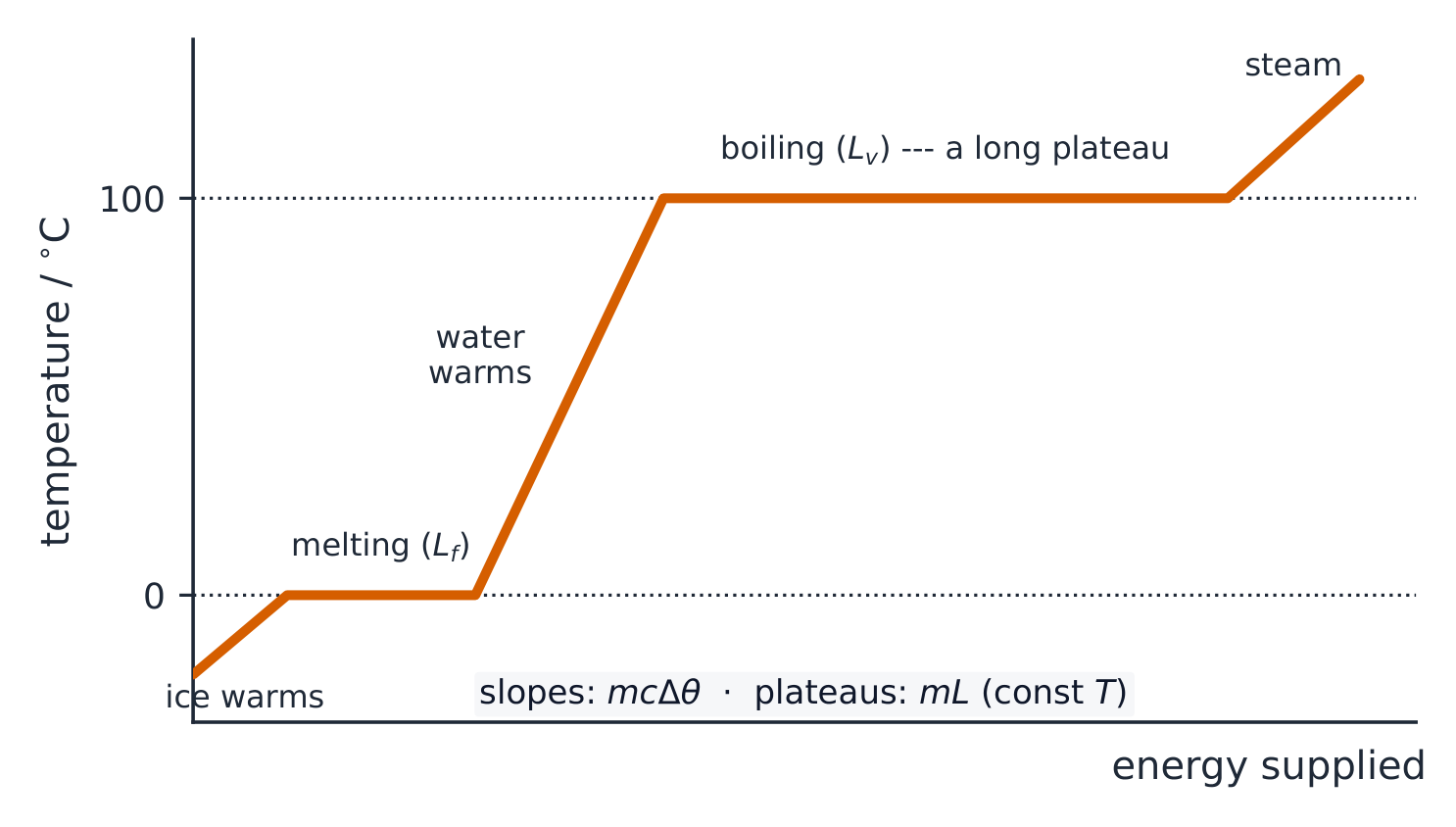
Temperature is a measure of the mean kinetic energy of the molecules. During boiling the energy supplied is used to separate the molecules — to do work against the attractive forces between them and against the atmosphere as the vapour expands — so it increases the potential energy of the molecules, not their kinetic energy. With the mean kinetic energy unchanged, the temperature stays constant until all the water has become steam.
Why $L_{\text{v}} > L_{\text{f}}$
Two reasons, both from the particle picture of matter:
Bonds: in melting, only some of the intermolecular 分子间 bonds break; the particles stay close as a liquid. In boiling, all the bonds must break so the particles can separate. Breaking all of them needs more energy.
Work against the atmosphere: when a liquid turns to gas it expands hugely (vapour has about $10^{3}$ times the liquid's volume 体积), so it does work pushing back the surrounding atmospheric pressure 大气压强. That work comes from the energy supplied.
Write both reasons and name the energies: the marks are for bonds broken (potential energy increased) — some in melting, all in boiling, and work done against the atmosphere in the large expansion. "Boiling needs more energy" restates the question.
Worked example. A dish holds $7.2 \times 10^{-5}\ \text{m}^{3}$ of a liquid of density $710\ \text{kg m}^{-3}$ and specific latent heat of vaporisation $3.6 \times 10^{5}\ \text{J kg}^{-1}$. It evaporates completely. Find the energy absorbed, and suggest, with a reason, whether the substance's specific latent heat of fusion is likely to be smaller or larger than this.
Mass $= \rho V = 710 \times 7.2 \times 10^{-5} = 5.1 \times 10^{-2}\ \text{kg}$, so the energy absorbed is $Q = mL_{\text{v}} = 5.1 \times 10^{-2} \times 3.6 \times 10^{5} = 1.8 \times 10^{4}\ \text{J}$. Its $L_{\text{f}}$ is likely to be smaller: melting breaks only some of the intermolecular bonds and the volume barely changes, whereas vaporising breaks them all and does work against the atmosphere — for water $L_{\text{f}}$ is about a seventh of $L_{\text{v}}$.
Multi-step problems
If a problem mixes temperature change and a phase change 相变 (e.g. ice at $-5\ ^{\circ}\text{C}$ warming to water at $30\ ^{\circ}\text{C}$):
heat the solid from $-5\ ^{\circ}\text{C}$ to $0\ ^{\circ}\text{C}$: $Q_{1} = m c_{\text{ice}} \times 5$.
melt at $0\ ^{\circ}\text{C}$: $Q_{2} = m L_{\text{f}}$.
heat the water from $0\ ^{\circ}\text{C}$ to $30\ ^{\circ}\text{C}$: $Q_{3} = m c_{\text{water}} \times 30$.
Total: $Q_{1} + Q_{2} + Q_{3}$. A phase change is at constant temperature, so use $mL$ there, not $mc\Delta T$.
When a question gives heater power $P$ and asks for the time, use $Q = Pt$ (assuming no heat loss). Insulating (lagging) the container and using a small mass are common ways to improve the experiment.
Worked example. An ice cube of mass $37.0\ \text{g}$ at $0.0\ ^{\circ}\text{C}$ is dropped into $208\ \text{g}$ of water at $26.4\ ^{\circ}\text{C}$ in an insulated beaker. Find the final temperature when all the ice has melted. ($c_{\text{water}} = 4.20\ \text{kJ kg}^{-1}\ \text{K}^{-1}$, $L_{\text{f}} = 334\ \text{kJ kg}^{-1}$.)
The ice gains energy twice — to melt, then to warm from $0$ to $T$ — and the water loses energy cooling from $26.4$ to $T$. Working in grams and kilojoules: $37.0 \times 0.334 + 37.0 \times 4.20 \times 10^{-3}\,T = 208 \times 4.20 \times 10^{-3}\,(26.4 - T)$, i.e. $12.4 + 0.155T = 23.1 - 0.874T$, so $1.03T = 10.7$ and $T = 10\ ^{\circ}\text{C}$. Three energy terms, one equation; the commonest error is to forget that the melted ice must also be warmed.
العربية
عند تغير حالة المادة (صلب ↔ سائل، أو سائل ↔ غاز) عند درجة حرارة ثابتة، يجب تزويد الطاقة (أو إزالتها) بدون تغيير في درجة الحرارة. هذه الطاقة هي الحرارة الكامنة.
الحرارة الكامنة النوعية$L$ هي الطاقة اللازمة لتغيير حالة وحدة الكتلة عند درجة حرارة ثابتة:
$$L = \frac{Q}{m} \qquad\Longleftrightarrow\qquad Q = m L.$$
Unit: $\text{J kg}^{-1}$.
تعريف mark two:الحرارة الكامنة النوعية هي الطاقة المطلوبة لكل وحدة كتلة لتغيير حالة مادة دون تغيير درجة حرارتها. عبارة "بدون تغيير في درجة الحرارة" (أو "عند درجة حرارة ثابتة") هي العلامة الثانية والأكثر شيوعاً التي يتم نسيانها. أضف "من الصلب إلى السائل" للاندماج أو "من السائل إلى الغاز" للتبخير عندما يُطلب نوع محدد.
نوعان:
الحرارة الكامنة النوعية للانصهار$L_{\text{f}}$ — للانصهار أو التجمد (صلب ↔ سائل).
الحرارة الكامنة النوعية للتبخر$L_{\text{v}}$ — للغليان أو التكثف (سائل ↔ غاز).
بالنسبة للماء عند الضغط الجوي: $L_{\text{f}} \approx 3.34 \times 10^{5}\ \text{J kg}^{-1}$ (عند $0\ ^{\circ}\text{C}$)؛ $L_{\text{v}} \approx 2.26 \times 10^{6}\ \text{J kg}^{-1}$ (عند $100\ ^{\circ}\text{C}$). إذن $L_{\text{v}}$ أكبر بحوالي 7 مرات من $L_{\text{f}}$.
منحنى التسخين: الأجزاء المائلة تُسخّن المادة ($mc\Delta T$)؛ المستويات الأفقية تمثل تحولات الطور ($mL$)
مثال محلول. سخّان قوته $2.0\ \text{kW}$ يغلي ماءً موجوداً بالفعل عند $100\ ^{\circ}\text{C}$. كم تستغرق من الوقت لتحويل $0.10\ \text{kg}$ من هذا الماء إلى بخار؟ ($L_{\text{v}} = 2.26 \times 10^{6}\ \text{J kg}^{-1}$، بدون فقدان حرارة.)
الطاقة اللازمة هي $Q = mL_{\text{v}} = 0.10 \times 2.26 \times 10^{6} = 2.26 \times 10^{5}\ \text{J}$. من $Q = Pt$،
مثال محلول. يبقى الماء في الغلاية عند $100\ ^{\circ}\text{C}$ أثناء غليانه، رغم أن العنصر المسخّن يستمر في تسخينه. اشرح ذلك بالإشارة إلى طاقات الجزيئات (3 علامات).
درجة الحرارة مقياس لمتوسط الطاقة الحركية للجزيئات. أثناء الغليان، تُستخدم الطاقة المزودة لفصل الجزيئات — للقيام بعمل ضد قوى التجاذب بينها وضد الضغط الجوي أثناء تمدد البخار — مما يزيد من الطاقة الكامنة للجزيئات، لا طاقتها الحركية. وبما أن متوسط الطاقة الحركية لم يتغير، تظل درجة الحرارة ثابتة حتى يتحول كل الماء إلى بخار.
لماذا $L_{\text{v}} > L_{\text{f}}$
سببان، كلاهما من الصورة الجسيمية للمادة:
الروابط: في الانصهار، تنكسر فقط بعض الروابط بين الجزيئات؛ تبقى الجسيمات متقاربة كسائل. أما في الغليان، فيجب كسر كل الروابط حتى تتمكن الجسيمات من الانفصال. كسر جميعها يتطلب طاقة أكثر.
العمل ضد الغلاف الجوي: عندما يتحول السائل إلى غاز يتمدد بشكل كبير (البخار له حجم يقارب $10^{3}$ مرة من حجم السائل)، لذا يقوم بعمل دافعاً ضغط الغلاف الجوي المحيط. يأتي هذا العمل من الطاقة المزودة.
اكتب السببَين وسمِّ الطاقات: العلامات مخصصة لـ روابط مكسورة (زيادة الطاقة الكامنة) — بعضها في الانصهار، وكلها في الغليان، و العمل المنجز ضد الضغط الجوي في التمدد الكبير. عبارة "الغليان يحتاج طاقة أكثر" هي إعادة صياغة للسؤال.
مثال محلول. طبق يحتوي على $7.2 \times 10^{-5}\ \text{m}^{3}$ من سائل كثافته $710\ \text{kg m}^{-3}$ وحرارته الكامنة النوعية للتبخر $3.6 \times 10^{5}\ \text{J kg}^{-1}$. تبخر بالكامل. أوجد الطاقة الممتصة، واقترح، مع سبب، ما إذا كانت الحرارة الكامنة النوعية لانصهار المادة من المرجح أن تكون أصغر أم أكبر من هذه القيمة.
الكتلة $= \rho V = 710 \times 7.2 \times 10^{-5} = 5.1 \times 10^{-2}\ \text{kg}$، لذا الطاقة الممتصة هي $Q = mL_{\text{v}} = 5.1 \times 10^{-2} \times 3.6 \times 10^{5} = 1.8 \times 10^{4}\ \text{J}$. إن $L_{\text{f}}$ الخاص به من المرجح أن يكون أصغر: الذوبان يكسر فقط بعض الروابط بين الجزيئات ولا يتغير الحجم تقريباً، بينما التبخر يكسرها جميعاً ويقوم بعمل ضد الغلاف الجوي — بالنسبة للماء $L_{\text{f}}$ تساوي تقريباً سابع $L_{\text{v}}$.
مسائل متعددة الخطوات
إذا مزجت مسألة بين تغير درجة الحرارة و تحول طور (مثل ثلج عند $-5\ ^{\circ}\text{C}$ يسخن ليصبح ماءً عند $30\ ^{\circ}\text{C}$):
سخن الصلب من $-5\ ^{\circ}\text{C}$ إلى $0\ ^{\circ}\text{C}$: $Q_{1} = m c_{\text{ice}} \times 5$.
انصهر عند $0\ ^{\circ}\text{C}$: $Q_{2} = m L_{\text{f}}$.
سخن الماء من $0\ ^{\circ}\text{C}$ إلى $30\ ^{\circ}\text{C}$: $Q_{3} = m c_{\text{water}} \times 30$.
المجموع: $Q_{1} + Q_{2} + Q_{3}$. تحول الطور يكون عند درجة حرارة ثابتة، لذا استخدم $mL$ هنا، لا $mc\Delta T$.
قسّم المسألة المختلطة إلى مراحل — تسخين، تحول طور، تسخين — ثم اجمع الطاقات
عندما تعطي المسألة قوة السخّان $P$ وتطلب الزمن، استخدم $Q = Pt$ (بافتراض عدم وجود فقدان حرارة). عزل (تغليف) الوعاء واستخدام كتلة صغيرة هما طريقتان شائعتان لتحسين التجربة.
مثال محلول. مكعب ثلج كتلته $37.0\ \text{g}$ عند درجة حرارة $0.0\ ^{\circ}\text{C}$ يُسقط في $208\ \text{g}$ من الماء عند درجة حرارة $26.4\ ^{\circ}\text{C}$ في كأس معزول. أوجد درجة الحرارة النهائية بعد ذوبان الثلج تماماً. ($c_{\text{water}} = 4.20\ \text{kJ kg}^{-1}\ \text{K}^{-1}$، $L_{\text{f}} = 334\ \text{kJ kg}^{-1}$.)
يكتسب الثلج الطاقة مرتين — ليذوب ثم ليسخن من $0$ إلى $T$ — بينما يفقد الماء طاقة أثناء تبريده من $26.4$ إلى $T$. بالحساب بوحدة الجرام والملي جول: $37.0 \times 0.334 + 37.0 \times 4.20 \times 10^{-3}\,T = 208 \times 4.20 \times 10^{-3}\,(26.4 - T)$، أي $12.4 + 0.155T = 23.1 - 0.874T$، لذا $1.03T = 10.7$ و$T = 10\ ^{\circ}\text{C}$. ثلاثة حدود للطاقة ومعادلة واحدة؛ الخطأ الأكثر شيوعاً هو نسيان أن الثلج المذاب يجب أن يُسخن أيضاً.
Definitions the examiner accepts · التعريفات التي يقبلها المصحح
English
A definition question is marked against fixed wording. Learn these exactly, and give one answer only.
Term
Definition
thermal equilibrium
the state of two objects between which there is no net transfer of thermal energy; they are at the same temperature
thermal energy
energy transferred from one object to another because of a temperature difference
thermodynamic temperature scale
a temperature scale that does not depend on the property of any particular substance, fixed by absolute zero and the triple point of water
absolute zero
the lowest possible temperature, $0\ \text{K}$ ($-273.15\ ^{\circ}\text{C}$), at which a system has its minimum internal energy
kelvin and Celsius
$T/\text{K} = \theta/^{\circ}\text{C} + 273.15$; a temperature difference is the same number in both
specific heat capacity
the energy required per unit mass of a substance to raise its temperature by one kelvin
specific latent heat
the energy required per unit mass to change the state of a substance without a change of temperature
specific latent heat of fusion
the specific latent heat for the change from solid to liquid
specific latent heat of vaporisation
the specific latent heat for the change from liquid to gas
العربية
تُصنّف أسئلة التعريف بناءً على صياغة ثابتة. احفظ هذه التعريفات بدقة، وقدم إجابة واحدة فقط.
مصطلح
تعريف
التوازن الحراري
حالة يوجد بين جسمين لا يتم فيها انتقال صافي للطاقة الحرارية؛ فهما على نفس درجة الحرارة
الطاقة الحرارية
الطاقة المنقولة من جسم إلى آخر نتيجة لاختلاف في درجة الحرارة
مقياس درجة الحرارة الديناميكية
مقياس درجة حرارة لا يعتمد على خاصية أي مادة معينة، تم تحديده بواسطة الصفر المطلق ونقطة الثلاثي للماء
الصفر المطلق
أدنى درجة حرارة ممكنة، وهي $0\ \text{K}$ ($-273.15\ ^{\circ}\text{C}$)، يكون عندها النظام في أقل طاقة داخلية له
الكلفن والسيلزيوس
$T/\text{K} = \theta/^{\circ}\text{C} + 273.15$؛ فإن فرق درجات الحرارة يمثل نفس الرقم في كلا المقياسين
السعة الحرارية النوعية
الطاقة المطلوبة لكل وحدة كتلة من المادة لرفع درجة حرارتها بمقدار كلفن واحد
الحرارة الكامنة النوعية
الطاقة المطلوبة لكل وحدة كتلة لتغيير حالة المادة دون تغيير درجة حرارتها
الحرارة الكامنة للاندماج النوعية
الحرارة الكامنة النوعية للتغير من الحالة الصلبة إلى السائلة
الحرارة الكامنة للتبخير النوعية
الحرارة الكامنة النوعية للتغير من الحالة السائلة إلى الغازية
14.3
Exam tips · نصائح للامتحان
English
Thermal equilibrium means no net flow of thermal energy (equal temperature); the thermodynamic scale does not depend on any particular substance and is fixed by absolute zero and the triple point.
Convert temperatures with $T/\text{K} = \theta/^\circ\text{C} + 273.15$ and use kelvin in energy and gas equations; a temperature difference is the same in K and °C.
Use $Q = mc\Delta T$ for heating and $Q = mL$ for a change of state (no temperature change) — never mix the two, and in a mixing problem write one equation: energy lost $=$ energy gained, with every term.
A container heated with the liquid takes its share of the energy: include $m_{\text{beaker}}c_{\text{beaker}}\Delta T$.
For a "why" about latent heat, name the energies: potential energy of the molecules rises (bonds broken, work against the atmosphere), kinetic energy and hence temperature do not.
Common mistakes
Defining specific heat capacity without "per unit mass" or without "per kelvin". Both are needed; the unit $\text{J kg}^{-1}\ \text{K}^{-1}$ is the reminder.
Leaving "at constant temperature" out of the latent-heat definition. That phrase is what distinguishes latent heat from heating.
Using $mc\Delta T$ across a change of state, or $mL$ for a temperature rise.
Forgetting the beaker, the calorimeter or the melted ice's own warming in an energy equation.
Saying the thermodynamic scale "uses kelvin" as its defining feature. The feature is that it depends on no particular substance.
Adding $273.15$ to a temperature difference. Differences are the same in both scales.
العربية
التوازن الحراري يعني عدم وجود صافي تدفق للطاقة الحرارية (تساوي في درجة الحرارة)؛ والمقياس الديناميكي لا يعتمد على أي مادة معينة ويتم تحديده بالصفر المطلق ونقطة الثلاثي.
حول درجات الحرارة باستخدام $T/\text{K} = \theta/^\circ\text{C} + 273.15$ واستخدم الكلفن في معادلات الطاقة والغازات؛ فإن فرق درجات الحرارة يكون متساوياً في K و°C.
استخدم $Q = mc\Delta T$ للتسخين و$Q = mL$ لتغيير الحالة (بدون تغير في درجة الحرارة) — ولا تخلط بينهما أبداً، وفي مسائل الخلط اكتب معادلة واحدة: الطاقة المفقودة $=$ الطاقة المكتسبة، مع كل حد.
الوعاء الذي يُسخن مع السائل يأخذ نصيبه من الطاقة: قم بإدراج $m_{\text{beaker}}c_{\text{beaker}}\Delta T$.
للإجابة عن سؤال "لماذا" بخصوص الحرارة الكامنة، اذكر الطاقات: تزداد طاقة وضع الجزيئات (تكسر الروابط، الشغل ضد الغلاف الجوي)، أما الطاقة الحركية وبالتالي درجة الحرارة فلا تتغير.
أخطاء شائعة
تعريف السعة الحرارية النوعية بدون عبارة "لكل وحدة كتلة" أو بدون "لكل كلفن". كلاهما مطلوب؛ فالوحدة $\text{J kg}^{-1}\ \text{K}^{-1}$ هي التذكير بذلك.
إبقاء عبارة "عند درجة حرارة ثابتة" خارج تعريف الحرارة الكامنة. تلك العبارة هي ما يميز الحرارة الكامنة عن التسخين.
استخدام $mc\Delta T$ عبر تغير حالة، أو $mL$ لارتفاع درجة الحرارة.
نسيان الكأس، أو الكالوريمتر، أو تسخين الثلج المذاب نفسه في معادلة الطاقة.
القول بأن المقياس الديناميكي "يستخدم الكلفن" كسمة تعريفية له. السمة الحقيقية هي أنه لا يعتمد على أي مادة معينة.
إضافة $273.15$ إلى فرق درجة حرارة. الفروق متساوية في كلا المقياسين.
Interactive lessons on this topic · دروس تفاعلية حول هذا الموضوع
Work through it step by step, with instant-check exercises. · ا-working عليه خطوة بخطوة، مع تمارين تحقق فوري.
Pick one and the site follows you — notes, papers, videos and practice all open on it. · اختر واحدًا وسيتبعك الموقع — الملاحظات، الأوراق، الفيديوهات والتدريب جميعها تفتح عليه.
Type to search notes, lessons, code, vocabulary and past-paper questions across every subject. · اكتب للبحث عن ملاحظات، دروس، أكواد، مفردات وأسئلة امتحانات سابقة عبر جميع المواد.