رياضيات A-Level (9709) مبنية من مكونات، ولا تُدرَّس ككتلة واحدة: بحت 1 و2 و3، الميكانيكا، واحتمالات وإحصاء 1 و2. يعتمد اختيارك على شروط القبول في مدرستك — تحقق من ذلك قبل التخطيط للمراجعة. لا فائدة من تكرار الميكانيكا إذا كنت مسجلاً في الإحصاء.
البحت هو العمود الفقري. كل شيء آخر يفترض أنك تستطيع الاشتقاق والتكامل والتعامل مع الجبر دون تفكير. ضعف البحت يظهر كخسارة درجات في الميكانيكا والإحصاء، وليس في البحت نفسه.
درجات الطريقة generous، وتُمنح لما كتبته. إظهار كل سطر هو أعلى عادة عائد في هذا المادة.
This handout covers Topic 1: Pure Mathematics 纯数学 1. It is the algebra 代数 and calculus 微积分 core of the course. Each ## section is one syllabus subtopic.
العربية
يتناول هذا الملف الموضوع 1: الرياضيات البحتة 1. إنه الجوهر الجبري والتفاضلي للتخصص. كل قسم ## هو موضوع فرعي في المنهج الدراسي.
1.1
Quadratics · المعادلات التربيعية
Syllabus · المنهج
English
Candidates should be able to:
Notes and examples
carry out the process of completing the square for a quadratic polynomial $ax^2 + bx + c$ and use a completed square form
e.g. to locate the vertex of the graph of $y = ax^2 + bx + c$ or to sketch the graph
find the discriminant of a quadratic polynomial $ax^2 + bx + c$ and use the discriminant
e.g. to determine the number of real roots of the equation $ax^2 + bx + c = 0$. Knowledge of the term ‘repeated root’ is included.
solve quadratic equations, and quadratic inequalities, in one unknown
By factorising, completing the square and using the formula.
solve by substitution a pair of simultaneous equations of which one is linear and one is quadratic
e.g. $x + y + 1 = 0$ and $x^2 + y^2 = 25$, $2x + 3y = 7$ and $3x^2 = 4 + 4xy$.
recognise and solve equations in $x$ which are quadratic in some function of $x$.
Source: Cambridge International syllabus · المصدر: منهج كامبريدج الدولي
English
Completing the square finds the vertex
A quadratic 二次式 is an expression of the form $ax^2 + bx + c$, where $a \neq 0$. The letters $a$, $b$, $c$ are the coefficients 系数 (the fixed numbers). Much of this section is about solving the equation$ax^2 + bx + c = 0$.
Completing the square
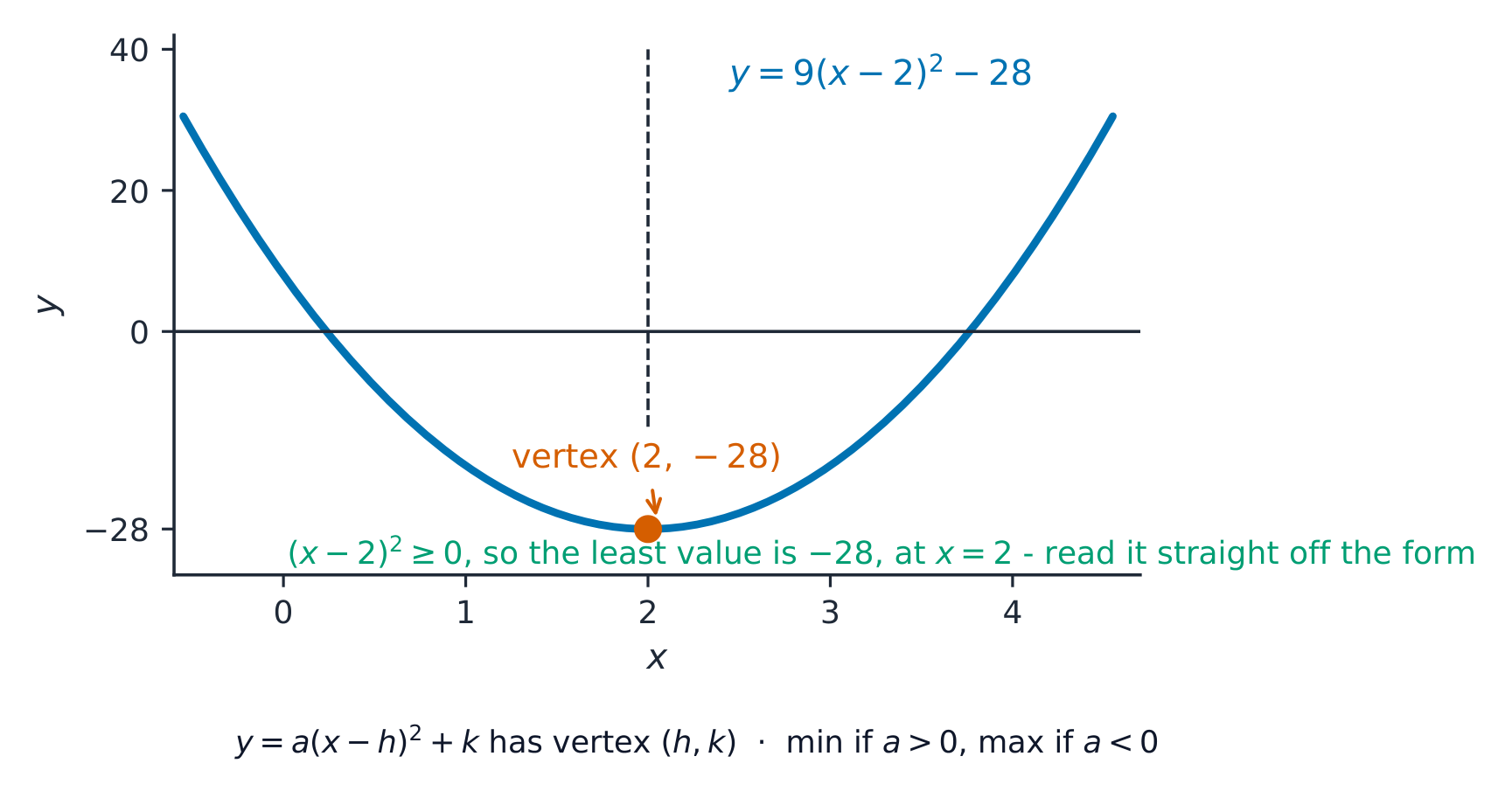
To complete the square 配方 means to write the quadratic in the form
$$a(x + p)^2 + q.$$
This form is useful: it shows the vertex 顶点 (turning point) of the curve at $(-p,\ q)$, and it gives a quick way to solve the equation.
Worked example. Write $9x^2 - 36x + 8$ in the form $p(x + q)^2 + r$.
Take the factor $9$ out of the first two terms, then complete the square inside:
Factorise: $(k - 4)(k - 16) > 0$, so $k < 4$ or $k > 16$. You also need $a \neq 0$, so $k \neq 0$.
Quadratic equations and inequalities
To solve a quadratic equation 二次方程, factorise, complete the square, or use the formula
$$x = \frac{-b \pm \sqrt{b^2 - 4ac}}{2a}.$$
To solve a quadratic inequality 二次不等式 such as $(k - 4)(k - 16) > 0$, find the two roots, then decide which side of each root makes the statement true. A sketch of the parabola 抛物线 helps: the curve is above the $x$-axis (positive) outside the roots and below it (negative) between them.
Simultaneous equations
To solve a pair of simultaneous equations 联立方程 where one is linear and one is quadratic, use substitution 代入: rearrange the linear equation for one letter, then put that into the quadratic. This gives a single quadratic to solve.
Equations that are quadratic in disguise
Some equations are quadratic in some function of$x$. For example $x^4 - 5x^2 + 4 = 0$ is quadratic in $x^2$: let $u = x^2$, solve $u^2 - 5u + 4 = 0$, then go back to $x$. You will use this idea again in trigonometry.
العربية
إكمال المربع يجد الرأسجسر معلق: الكابل الرئيسي يتدلى على شكل قطع مكافئ.
التربيعية هي تعبير من الشكل $ax^2 + bx + c$، حيث $a \neq 0$. الأحرف $a$، $b$، $c$ هي المعاملات (الأرقام الثابتة). جزء كبير من هذا القسم يتعلق بحل المعادلة$ax^2 + bx + c = 0$.
إكمال المربع
يعني إكمال المربع كتابة التربيعية على الشكل
$$a(x + p)^2 + q.$$
هذا الشكل مفيد: فهو يُظهر الرأس (نقطة الانعطاف) للمنحنى عند $(-p,\ q)$، ويعطي طريقة سريعة لحل المعادلة.
مثال محلول. اكتب $9x^2 - 36x + 8$ على الشكل $p(x + q)^2 + r$.
خذ العامل $9$ خارج الحدين الأولين، ثم أكمل المربع داخل القوسين:
حلل: $(k - 4)(k - 16) > 0$، إذن $k < 4$ أو $k > 16$. تحتاج أيضًا $a \neq 0$، إذن $k \neq 0$.
المعادلات والتفاوتات التربيعية
لحل معادلة تربيعية، قم بتحليلها، أو أكمل المربع، أو استخدم الصيغة
$$x = \frac{-b \pm \sqrt{b^2 - 4ac}}{2a}.$$
لحل تفاوت تربيعي مثل $(k - 4)(k - 16) > 0$، أوجد الجذرين، ثم حدد أي جانب من كل جذر يجعل العبارة صحيحة. يساعد رسم بياني للقطع المكافئ: المنحنى فوق محور $x$ (موجب) خارج الجذور وأسفله (سالب) بينهما.
المعادلات المتزامنة
لحل زوج من المعادلات المتزامنة حيث واحدة خطية والأخرى تربيعية، استخدم التعويض: أعد ترتيب المعادلة الخطية لإحدى الحروف، ثم ضع ذلك في التربيعية. هذا يعطي معادلة تربيعية واحدة للحل.
المعادلات التي هي تربيعية بشكل خفي
بعض المعادلات هي تربيعية في بعض دوال$x$. على سبيل المثال $x^4 - 5x^2 + 4 = 0$ هي تربيعية في $x^2$: دع $u = x^2$، حل $u^2 - 5u + 4 = 0$، ثم عد إلى $x$. ستستخدم هذه الفكرة مجددًا في حساب المثلثات.
Explore · استكشف
The shape of a quadratic · شكل الدالة التربيعية
y = ax² + bx + c
Drag a, b and c. Watch the vertex, the line of symmetry and the roots (where it cuts the x-axis) move as the coefficients change. · اسحب a وb وc. راقب حركة الرأس، وخط التماثل والجذور (حيث يقطع محور x) مع تغير المعاملات.
understand the terms function, domain, range, one-one function, inverse function and composition of functions
identify the range of a given function in simple cases, and find the composition of two given functions
e.g. range of $f : x \mapsto \frac{1}{x}$ for $x \geqslant 1$ and range of $g : x \mapsto x^2 + 1$ for $x \in \mathbb{R}$. Including the condition that a composite function $gf$ can only be formed when the range of $f$ is within the domain of $g$.
determine whether or not a given function is one-one, and find the inverse of a one-one function in simple cases
e.g. finding the inverse of $h : x \mapsto (2x + 3)^2 - 4$ for $x < -\frac{3}{2}$.
illustrate in graphical terms the relation between a one-one function and its inverse
Sketches should include an indication of the mirror line $y = x$.
understand and use the transformations of the graph of $y = f(x)$ given by $y = f(x) + a$, $y = f(x + a)$, $y = af(x)$, $y = f(ax)$ and simple combinations of these.
Including use of the terms ‘translation’, ‘reflection’ and ‘stretch’ in describing transformations. Questions may involve algebraic or trigonometric functions, or other graphs with given features.
تحديد النطاق لدالة معطاة في الحالات البسيطة، وإيجاد تركيب دالتين معطاتين
مثلاً نطاق $f : x \mapsto \frac{1}{x}$ لـ $x \geqslant 1$ ونطاق $g : x \mapsto x^2 + 1$ لـ $x \in \mathbb{R}$. شمل الشرط الذي ينص على أنه لا يمكن تكوين دالة مركبة $gf$ إلا عندما يكون نطاق $f$ ضمن مجال $g$.
تحديد ما إذا كانت الدالة المعطاة أحادية One-one أم لا، وإيجاد العكس لدالة أحادية One-one في الحالات البسيطة
مثلاً إيجاد العكس لـ $h : x \mapsto (2x + 3)^2 - 4$ لـ $x < -\frac{3}{2}$.
توضيح العلاقة بيانياً بين الدالة الأحادية One-one وعكسها
يجب أن تشمل الرسومات تلميحا لخط الانعكاس $y = x$.
فهم واستخدام التحويلات لمنحنى $y = f(x)$ المعطاة بواسطة $y = f(x) + a$، $y = f(x + a)$، $y = af(x)$، $y = f(ax)$ والمجموعات البسيطة منها.
شمل استخدام المصطلحات 'الإزاحة' و'الانعكاس' و'التمدد' في وصف التحويلات. قد تتضمن الأسئلة دوال جبرية أو مثلثية، أو منحنيات أخرى بخصائص معطاة.
Source: Cambridge International syllabus · المصدر: منهج كامبريدج الدولي
English
Transforming graphs: shift and stretch
A function 函数 is a rule that sends each input to exactly one output. Write it as $f(x)$. The composition of functions 复合函数$fg(x)$ means apply $g$ first, then apply $f$ to the result.
The domain 定义域 is the set of allowed inputs $x$.
The range 值域 is the set of outputs the function actually produces.
A function is one-one 一一对应 if different inputs always give different outputs. (No output is repeated.) Only a one-one function has an inverse function 反函数$f^{-1}$, which reverses the rule.
The composition 复合 of two functions means doing one after the other. $fg(x)$ means "do $g$ first, then $f$": $fg(x) = f(g(x))$. The composite function $fg$ exists only when the range of $g$ lies inside the domain of $f$.
Finding an inverse
To find $f^{-1}$: write $y = f(x)$, make $x$ the subject, then swap letters.
Worked example. The function $f(x) = (x + 3)^2 - 12$ is defined for $x \geqslant 0$. Find $f^{-1}(x)$.
Write $y = (x + 3)^2 - 12$ and solve for $x$:
$$(x + 3)^2 = y + 12 \;\Rightarrow\; x + 3 = \sqrt{y + 12} \;\Rightarrow\; x = \sqrt{y + 12} - 3.$$
You take the positive square root because $x \geqslant 0$ means $x + 3 \geqslant 3 > 0$. So
$$f^{-1}(x) = \sqrt{x + 12} - 3.$$
Graphs of inverses and transformations
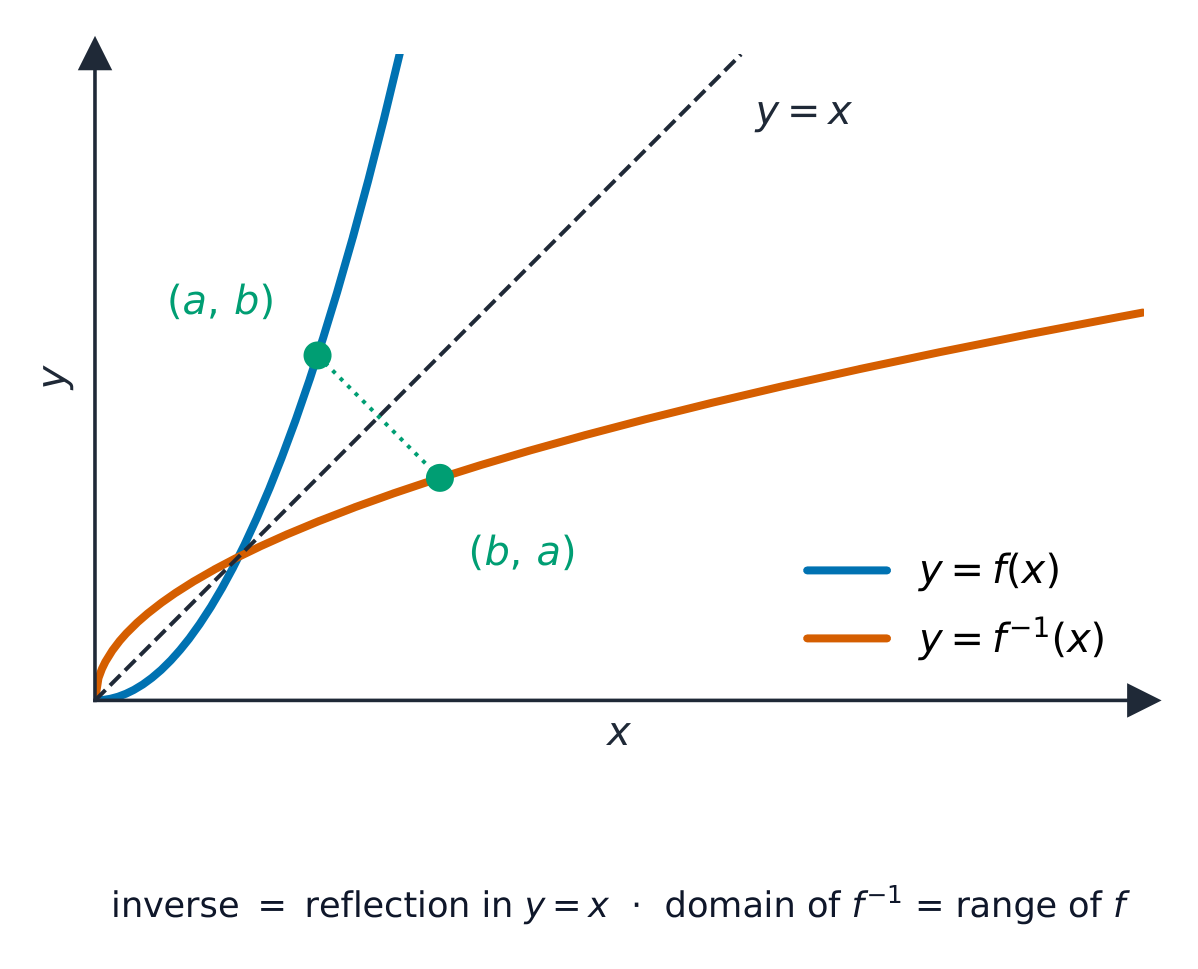
The graph of $y = f^{-1}(x)$ is the reflection 反射 of $y = f(x)$ in the line $y = x$.
You should know these transformations 变换 of $y = f(x)$:
New equation
Effect on the graph
$y = f(x) + a$
translation 平移 up by $a$
$y = f(x + a)$
translation left by $a$
$y = a\,f(x)$
stretch 伸缩 in the $y$-direction, scale factor $a$
$y = f(ax)$
stretch in the $x$-direction, scale factor $\tfrac{1}{a}$
When two transformations are combined, the order can matter. State each one fully (type, direction, and amount).
العربية
تحويل الرسوم البيانية: الإزالة والتمدد
الدالة function هي قاعدة ترسل كل مدخل إلى مخرج واحد بالضبط. اكتبها كـ $f(x)$. تركيب الدوال$fg(x)$ يعني تطبيق $g$ أولاً، ثم تطبيق $f$ على النتيجة.
المجال هو مجموعة المدخلات المسموحة $x$.
المدى هو مجموعة النواتج التي تنتجها الدالة فعلياً.
الدالة تكون واحدة لواحد إذا كانت المدخلات المختلفة تعطي دائماً نواتج مختلفة. (لا يتم تكرار أي ناتج.) فقط الدالة الواحدة لواحد لها دالة عكسية$f^{-1}$، والتي تعكس القاعدة.
تركيب دالتين يعني القيام بإحداهما بعد الأخرى. $fg(x)$ تعني "افعل $g$ أولاً، ثم $f$": $fg(x) = f(g(x))$. توجد الدالة المركبة $fg$ فقط عندما يكون مدى $g$ داخل مجال $f$.
إيجاد الدالة العكسية
لإيجاد $f^{-1}$: اكتب $y = f(x)$، اجعل $x$ موضوع المعادلة، ثم استبدل الأحرف.
مثال محلول. الدالة $f(x) = (x + 3)^2 - 12$ معرفة لـ $x \geqslant 0$. أوجد $f^{-1}(x)$.
اكتب $y = (x + 3)^2 - 12$ وحل من أجل $x$:
$$(x + 3)^2 = y + 12 \;\Rightarrow\; x + 3 = \sqrt{y + 12} \;\Rightarrow\; x = \sqrt{y + 12} - 3.$$
أنت تأخذ الجذر التربيعي الموجب لأن $x \geqslant 0$ تعني $x + 3 \geqslant 3 > 0$. لذا
$$f^{-1}(x) = \sqrt{x + 12} - 3.$$
رسوم بيانية للدوال العكسية والتحويلات
الرسم البياني لـ $y = f^{-1}(x)$ هو انعكاس لـ $y = f(x)$ في الخط $y = x$.
انعكاس $y=f(x)$ في الخط $y=x$ يعطي دالتها العكسية؛ النقطة $(a,b)$ تصبح $(b,a)$.
يجب أن تعرف هذه التحويلات لـ $y = f(x)$:
معادلة جديدة
التأثير على الرسم البياني
$y = f(x) + a$
إزاحة لأعلى بمقدار $a$
$y = f(x + a)$
إزاحة لليسار بمقدار $a$
$y = a\,f(x)$
تمدّد في اتجاه $y$، معامل القياس $a$
$y = f(ax)$
تمدد في اتجاه $x$، عامل مقياس $\tfrac{1}{a}$
عند دمج تحويلين، قد يهم الترتيب. حدد كل تحويل بالكامل (النوع، الاتجاه، والكمية).
إضافة للمخرجات أو المدخلات تُزيح المنحنى؛ المضروب يمدده.
Explore · استكشف
Explore a function · استكشف دالة
y = ax³ + bx² + cx + d
A function turns each input into exactly one output — drag the coefficients and watch where the curve rises and falls. · تحول الدالة كل مدخل إلى خرج واحد بالضبط — اسحب المعاملات ولاحظ أين يرتفع المنحنى وينخفض.
find the equation of a straight line given sufficient information
e.g. given two points, or one point and the gradient.
interpret and use any of the forms $y = mx + c$, $y - y_1 = m(x - x_1)$, $ax + by + c = 0$ in solving problems
Including calculations of distances, gradients, midpoints, points of intersection and use of the relationship between the gradients of parallel and perpendicular lines.
understand that the equation $(x - a)^2 + (y - b)^2 = r^2$ represents the circle with centre $(a, b)$ and radius $r$
Including use of the expanded form $x^2 + y^2 + 2gx + 2fy + c = 0$.
use algebraic methods to solve problems involving lines and circles
Including use of elementary geometrical properties of circles, e.g. tangent perpendicular to radius, angle in a semicircle, symmetry. Implicit differentiation is not included.
understand the relationship between a graph and its associated algebraic equation, and use the relationship between points of intersection of graphs and solutions of equations.
e.g. to determine the set of values of $k$ for which the line $y = x + k$ intersects, touches or does not meet a quadratic curve.
العربية
يجب أن يكون المرشحون قادرين على:
ملاحظات وأمثلة
إيجاد معادلة الخط المستقيم عند توفر معلومات كافية
مثلاً عند إعطاء نقطتين، أو نقطة واحدة وميل.
تفسير واستخدام أي من الصيغ $y = mx + c$، $y - y_1 = m(x - x_1)$، $ax + by + c = 0$ في حل المسائل
شمل حسابات المسافات، الميل، نقاط المنتصف، نقاط التقاطع واستخدام العلاقة بين الميل لـالخطوط المتوازية والخطوط العمودية.
فهم أن المعادلة $(x - a)^2 + (y - b)^2 = r^2$ تمثل الدائرة ذات المركز $(a, b)$ ونصف القطر $r$
شمل استخدام الصورة الموسعة $x^2 + y^2 + 2gx + 2fy + c = 0$.
استخدام الطرق الجبرية لحل المسائل الخطوط والدوائر
شمل استخدام الخصائص الهندسية الأولية للدوائر، مثلاً المماس عمودي على نصف القطر، الزاوية في نصف الدائرة، التناظر. لا يُشمل الاشتقاق الضمني.
فهم العلاقة بين المنحنى ومعادلته الجبرية المرتبطة بها، واستخدام العلاقة بين نقاط تقاطع المنحنيات وحلول المعادلات.
مثلاً لتحديد مجموعة قيم $k$ التي تجعل الخط $y = x + k$ يقطع المنحنى التربيعي أو يلمسه أو لا يلقاه.
Source: Cambridge International syllabus · المصدر: منهج كامبريدج الدولي
English
Coordinate geometry 坐标几何 studies lines and circles using their equations.
Straight lines
The gradient 斜率 (steepness) of the line joining $(x_1, y_1)$ and $(x_2, y_2)$ is
$$m = \frac{y_2 - y_1}{x_2 - x_1}.$$
You can write the equation of a straight line 直线方程 in any of these forms:
$$y = mx + c, \qquad y - y_1 = m(x - x_1), \qquad ax + by + c = 0.$$
Two lines are parallel 平行 when their gradients are equal, and perpendicular 垂直 (at right angles) when the product of their gradients is $-1$.
Circles
The circle 圆 with centre 圆心$(a, b)$ and radius 半径$r$ has equation
$$(x - a)^2 + (y - b)^2 = r^2.$$
An expanded form like $x^2 + y^2 - 6x + 10y - 27 = 0$ is the same circle: complete the square in $x$ and in $y$ to find the centre and radius.
A tangent 切线 to a circle touches it at one point and is perpendicular to the radius at that point. This right-angle fact solves most circle problems.
Worked example. The points $P(1, 1)$ and $Q(7, 11)$ are the ends of a diameter 直径 of a circle. Find the equation of the circle.
understand the definition of a radian, and use the relationship between radians and degrees
use the formulae $s = r\theta$ and $A = \frac{1}{2}r^2\theta$ in solving problems concerning the arc length and sector area of a circle.
Including calculation of lengths and angles in triangles and areas of triangles.
العربية
يجب أن يكون المرشحون قادرين على:
ملاحظات وأمثلة
فهم تعريف الراديان، واستخدام العلاقة بين الراديان والدرجات
استخدام الصيغ $s = r\theta$ و $A = \frac{1}{2}r^2\theta$ في حل المسائل المتعلقة بـ طول القوس و مساحة القطاع للدائرة.
بما في ذلك حساب الأطوال والزوايا في المثلثات ومساحاتها.
Source: Cambridge International syllabus · المصدر: منهج كامبريدج الدولي
English
What is a radian?
Radians
A radian 弧度 is another way to measure angles. One radian is the angle at the centre of a circle that cuts off an arc 弧 equal in length to the radius. The link between radians and degrees 度 is
$$\pi \text{ radians} = 180^\circ.$$
So to change degrees to radians, multiply by $\dfrac{\pi}{180}$; to change radians to degrees, multiply by $\dfrac{180}{\pi}$.
Arc length and sector area
For a sector 扇形 with radius $r$ and angle $\theta$in radians:
$$\text{arc length} = s = r\theta, \qquad \text{sector area} = A = \tfrac12 r^2 \theta.$$
A chord 弦 cuts the sector into a triangle and a segment 弓形. The segment area is the sector minus the triangle:
Worked example. A sector has centre $O$ and the angle at $O$ is $\tfrac{2}{3}\pi$ radians. Show that the segment cut off by the chord has area about $0.614 r^2$.
الراديان هو طريقة أخرى لقياس الزوايا. الراديان الواحد هو الزاوية في مركز الدائرة التي تقطع قوساً طوله يساوي نصف القطر. العلاقة بين الراديان والدرجات هي
$$\pi \text{ radians} = 180^\circ.$$
لذا لتحويل الدرجات إلى راديان، اضرب في $\dfrac{\pi}{180}$؛ ولتحويل الراديان إلى درجات، اضرب في $\dfrac{180}{\pi}$.
راديان واحد: الزاوية التي يساوي قوسها نصف القطر
طول القوس ومساحة القطاع
بالنسبة لـقطاع نصف قطره $r$ وزاويته $\theta$بالراديان:
$$\text{arc length} = s = r\theta, \qquad \text{sector area} = A = \tfrac12 r^2 \theta.$$
الوتر يقسم القطاع إلى مثلث وجزء مقطع. مساحة الجزء المقطع هي القطاع ناقص المثلث:
Radians, arcs and sectors · الدرجات القوسية والقوس والمقطع الدائري
Change the angle (in radians) and radius. See the arc length$s = r\theta$ and the sector area$\tfrac12 r^2\theta$ update. · غيّر الزاوية (بالدرجات القوسية) ونصف القطر. شاهد تحديث طول القوس$s = r\theta$ ومساحة المقطع الدائري$\tfrac12 r^2\theta$.
sketch and use graphs of the sine, cosine and tangent functions (for angles of any size, and using either degrees or radians)
Including e.g. $y = 3 \sin x$, $y = 1 - \cos 2x$, $y = \tan(x + \frac{1}{4}\pi)$.
use the exact values of the sine, cosine and tangent of $30^\circ$, $45^\circ$, $60^\circ$, and related angles
e.g. $\cos 150^\circ = -\frac{1}{2}\sqrt{3}$, $\sin \frac{3}{4}\pi = \frac{1}{\sqrt{2}}$.
use the notations $\sin^{-1} x$, $\cos^{-1} x$, $\tan^{-1} x$ to denote the principal values of the inverse trigonometric relations
No specialised knowledge of these functions is required, but understanding of them as examples of inverse functions is expected.
use the identities $\frac{\sin \theta}{\cos \theta} \equiv \tan \theta$ and $\sin^2 \theta + \cos^2 \theta \equiv 1$
e.g. in proving identities, simplifying expressions and solving equations.
find all the solutions of simple trigonometrical equations lying in a specified interval (general forms of solution are not included).
e.g. solve $3 \sin 2x + 1 = 0$ for $-\pi < x < \pi$, $3 \sin^2 \theta - 5 \cos \theta - 1 = 0$ for $0^\circ \leqslant \theta \leqslant 360^\circ$.
العربية
يجب أن يكون المرشحون قادرين على:
ملاحظات وأمثلة
رسم واستخدام بيانيات دالتي الجيب و جيب التمام و ظل الزاوية (لزوايا من أي حجم، باستخدام الدرجات أو الراديان)
بما في ذلك على سبيل المثال $y = 3 \sin x$، $y = 1 - \cos 2x$، $y = \tan(x + \frac{1}{4}\pi)$.
استخدام القيم الدقيقة لـ جيب الزاوية و جيب تامة الزاوية و ظل الزاوية عند $30^\circ$، $45^\circ$، $60^\circ$، والزاويات ذات الصلة
على سبيل المثال $\cos 150^\circ = -\frac{1}{2}\sqrt{3}$، $\sin \frac{3}{4}\pi = \frac{1}{\sqrt{2}}$.
استخدام الرموز $\sin^{-1} x$، $\cos^{-1} x$، $\tan^{-1} x$ للإشارة إلى القيم الأساسية لعلاقات المقلوب المثلثاتي
لا يُشترط معرفة متخصصة بهذه الدوال، لكن يُتوقع فهمها كأمثلة على الدوال العكسية.
استخدام المتطابقات $\frac{\sin \theta}{\cos \theta} \equiv \tan \theta$ و $\sin^2 \theta + \cos^2 \theta \equiv 1$
على سبيل المثال في إثبات المتطابقات، وتبسيط التعبيرات وحل المعادلات.
إيجاد جميع حلول المعادلات المثلثية البسيطة الواقعة في مجال محدد (لا تُشمل الأشكال العامة للحلول).
على سبيل المثال: حل $3 \sin 2x + 1 = 0$ عندما $-\pi < x < \pi$، و$3 \sin^2 \theta - 5 \cos \theta - 1 = 0$ عندما $0^\circ \leqslant \theta \leqslant 360^\circ$.
Source: Cambridge International syllabus · المصدر: منهج كامبريدج الدولي
English
Amplitude, period and midline of a sine curveThe unit circle draws the sine curve
Graphs and exact values
You must know the shape of the graphs of the sine 正弦, cosine 余弦 and tangent function 正切 (written $\sin$, $\cos$, $\tan$). The sine and cosine graphs wave between $-1$ and $1$ and repeat every $360^\circ$ ($2\pi$). Learn these exact values:
$\theta$
$30^\circ$
$45^\circ$
$60^\circ$
$\sin\theta$
$\tfrac12$
$\tfrac{1}{\sqrt2}$
$\tfrac{\sqrt3}{2}$
$\cos\theta$
$\tfrac{\sqrt3}{2}$
$\tfrac{1}{\sqrt2}$
$\tfrac12$
$\tan\theta$
$\tfrac{1}{\sqrt3}$
$1$
$\sqrt3$
The notations $\sin^{-1}x$, $\cos^{-1}x$, $\tan^{-1}x$ mean the inverse angle (the principal value 主值).
Identities
An identity 恒等式 is true for every value of the angle. The two you must know are
$\sin\theta = -\tfrac12$: $\theta = -30^\circ$ or $\theta = -150^\circ$.
The four solutions are $\theta = -150^\circ,\ -30^\circ,\ 41.8^\circ,\ 138.2^\circ$.
العربية
السعة، الدورة، والخط الوسطى لمنحنى الجيبالدائرة الوحدة ترسم منحنى الجيبعجلة عجيبة: نقطة على الحافة ترتفع وتنخفض كمنحنى جيب.
الرسوم البيانية والقيم الدقيقة
يجب أن تعرف شكل الرسوم البيانية لـالجيب، جيب التمام وظل الدالة (تُكتب $\sin$، $\cos$، $\tan$). رسوم الجيب وجيب التمام تتذبذب بين $-1$ و $1$ وتتكرر كل $360^\circ$ ($2\pi$). احفظ هذه القيم الدقيقة:
$\theta$
$30^\circ$
$45^\circ$
$60^\circ$
$\sin\theta$
$\tfrac12$
$\tfrac{1}{\sqrt2}$
$\tfrac{\sqrt3}{2}$
$\cos\theta$
$\tfrac{\sqrt3}{2}$
$\tfrac{1}{\sqrt2}$
$\tfrac12$
$\tan\theta$
$\tfrac{1}{\sqrt3}$
$1$
$\sqrt3$
في دورة واحدة $\sin$ و $\cos$ يبقى بين $-1$ و $1$؛ $\tan$ يهرب عند $90^\circ$ و $270^\circ$.
الرموز $\sin^{-1}x$، $\cos^{-1}x$، $\tan^{-1}x$ تعني زاوية عكسية (الـقيمة الرئيسية).
المتطابقات
المتطابقة صحيحة لكل قيمة للزاوية. المتطابقتان اللتان يجب أن تعرفهما هما:
$\sin\theta = -\tfrac12$: $\theta = -30^\circ$ أو $\theta = -150^\circ$.
الحلول الأربعة هي $\theta = -150^\circ,\ -30^\circ,\ 41.8^\circ,\ 138.2^\circ$.
Explore · استكشف
Sine & cosine graphs · منحنيات الجيب وجيب التمام
Drag the amplitude, period and shifts of y = a·sin(bx + c) + d and watch the curve change against the base wave. · اسحب السعة والدورة والإزاحات لـ y = a·sin(bx + c) + d ولاحظ تغير المنحنى مقابل الموجة الأساسية.
Explore · استكشف
Sine and cosine on the unit circle · الجيب وجيب التمام على دائرة الوحدة
Drag the angle round the unit circle. The height is $\sin\theta$, the across-distance is $\cos\theta$ — that's where the graphs come from. · اسحب الزاوية حول دائرة الوحدة. الارتفاع هو $\sin\theta$ والمسافة الأفقية هي $\cos\theta$ — ومن هنا تأتي الرسوم البيانية.
use the expansion of $(a + b)^n$, where $n$ is a positive integer
Including the notations $\begin{pmatrix} n \\ r \end{pmatrix}$ and $n!$ Knowledge of the greatest term and properties of the coefficients are not required.
recognise arithmetic and geometric progressions
use the formulae for the $n$th term and for the sum of the first $n$ terms to solve problems involving arithmetic or geometric progressions
Including knowledge that numbers $a$, $b$, $c$ are 'in arithmetic progression' if $2b = a + c$ (or equivalent) and are 'in geometric progression' if $b^2 = ac$ (or equivalent). Questions may involve more than one progression.
use the condition for the convergence of a geometric progression, and the formula for the sum to infinity of a convergent geometric progression.
العربية
يجب أن يكون المرشحون قادرين على:
ملاحظات وأمثلة
استخدام مفكوك $(a + b)^n$، حيث $n$ عدد صحيح موجب
بما في ذلك الرموز $\begin{pmatrix} n \\ r \end{pmatrix}$ و $n!$. لا يُشترط معرفة الحد الأكبر وخصائص المعاملات.
التعرف على التسلسلات الحسابية و التسلسلات الهندسية
استخدام صيغ الحد الـ $n$ والمجموع للحدود الـ $n$ الأولى لحل مسائل تتعلق بـ التسلسلات الحسابية أو الهندسية
بما في ذلك المعرفة بأن الأعداد $a$، $b$، $c$ تكون 'في تسلسل حسابي' إذا $2b = a + c$ (أو ما يكافئها)، وهي 'في تسلسل هندسي' إذا $b^2 = ac$ (أو ما يكافئها). قد تتضمن الأسئلة أكثر من تسلسل واحد.
استخدام شرط تقاربالتسلسل الهندسي، وصيغة المجموع اللانهائي لـ التسلسل الهندسي المتقارب.
Source: Cambridge International syllabus · المصدر: منهج كامبريدج الدولي
English
Pascal's triangle gives the coefficientsSum to infinity fills the square
The binomial expansion
For a positive integer $n$, the binomial expansion 二项展开式 is
A progression 数列 (sequence) is a list of terms following a rule.
An arithmetic progression 等差数列 (AP) adds a fixed common difference 公差$d$ each step. The $n$th term 项 is $u_n = a + (n - 1)d$, and the sum of the first $n$ terms is $S_n = \tfrac{n}{2}\big(2a + (n - 1)d\big)$.
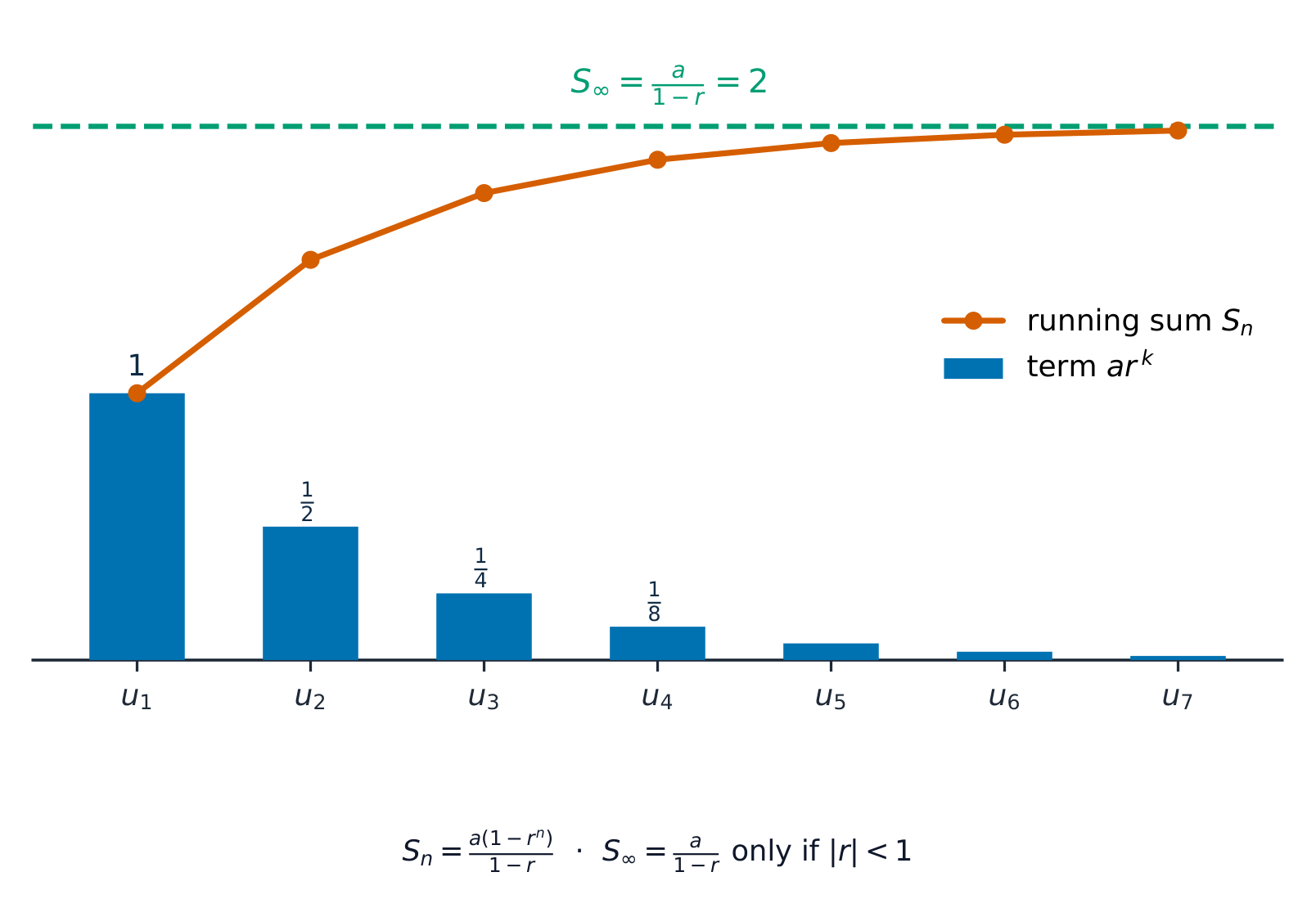
A geometric progression 等比数列 (GP) multiplies by a fixed common ratio 公比$r$ each step. The $n$th term is $u_n = ar^{\,n-1}$, and $S_n = \dfrac{a(1 - r^n)}{1 - r}$.
A GP is convergent — it converges 收敛 (settles to a limit) — when $|r| < 1$. Then it has a sum to infinity 无穷和
$$S_\infty = \frac{a}{1 - r}.$$
Worked example. The third term of a GP is $18$ and the sum of the first three terms is $26$. The common ratio is negative. Find the sum to infinity.
From $ar^2 = 18$ you get $a = \dfrac{18}{r^2}$. Put this into $a(1 + r + r^2) = 26$:
المتتالية (Sequence) هي قائمة من الحدود تتبع قاعدة معينة.
المتتالية الحسابية (AP) تضيف فرقاً ثابتاً$d$ في كل خطوة. الـ$n$th حد هو $u_n = a + (n - 1)d$، ومجموع أول $n$ حدود هو $S_n = \tfrac{n}{2}\big(2a + (n - 1)d\big)$.
المتتالية الهندسية (GP) تضرب في نسبة ثابتة$r$ في كل خطوة. الـ$n$th حد هو $u_n = ar^{\,n-1}$، و$S_n = \dfrac{a(1 - r^n)}{1 - r}$.
تصعد AP بخطوات متساوية؛ خطوات GP تنمو بنفس النسبة
متتالية هندسية متقاربة — تتقارب (تستقر عند حد) — عندما $|r| < 1$. حينها يكون لها مجموع إلى ما لا نهاية
$$S_\infty = \frac{a}{1 - r}.$$
مثال محلول. الحد الثالث لمتتالية هندسية هو $18$ ومجموع أول ثلاثة حدود هو $26$. النسبةCOMMON ratio سالبة. أوجد المجموع إلى ما لا نهاية.
من $ar^2 = 18$ تحصل على $a = \dfrac{18}{r^2}$. ضع هذا في $a(1 + r + r^2) = 26$:
متتالية هندسية متقاربة: الأعمدة تتناقص نحو الصفر بينما المجموع التراكمي يقترب من S infinity = a/(1-r)
Explore · استكشف
Arithmetic and geometric sequences · السلاسل الحسابية والهندسية
Switch between an arithmetic (add d) and a geometric (multiply by r) sequence and watch the terms and their sum build up. · التبديل بين سلسلة حسابية (جمع d) وسلسلة هندسية (ضرب r) وراقب بناء الحدود ومجموعها.
understand the gradient of a curve at a point as the limit of the gradients of a suitable sequence of chords, and use the notations $f'(x)$, $f''(x)$, $\frac{\text{d}y}{\text{d}x}$, and $\frac{\text{d}^2y}{\text{d}x^2}$ for first and second derivatives
Only an informal understanding of the idea of a limit is expected. e.g. includes consideration of the gradient of the chord joining the points with $x$ coordinates $2$ and $(2 + h)$ on the curve $y = x^3$. Formal use of the general method of differentiation from first principles is not required.
use the derivative of $x^n$ (for any rational $n$), together with constant multiples, sums and differences of functions, and of composite functions using the chain rule
e.g. find $\frac{\text{d}y}{\text{d}x}$, given $y = \sqrt{2x^3 + 5}$.
apply differentiation to gradients, tangents and normals, increasing and decreasing functions and rates of change
Including connected rates of change, e.g. given the rate of increase of the radius of a circle, find the rate of increase of the area for a specific value of one of the variables.
locate stationary points and determine their nature, and use information about stationary points in sketching graphs.
Including use of the second derivative for identifying maxima and minima; alternatives may be used in questions where no method is specified. Knowledge of points of inflexion is not included.
العربية
يجب أن يكون المرشحون قادرين على:
ملاحظات وأمثلة
فهم ميل المنحنى عند نقطة على أنه نهاية أقطار متسلسلة مناسبة من الأوتار، واستخدام الرموز $f'(x)$، $f''(x)$، $\frac{\text{d}y}{\text{d}x}$، و $\frac{\text{d}^2y}{\text{d}x^2}$ للاشتقاق الأول والثاني
يُتوقع فقط فهم غير رسمي لمفهوم النهاية. على سبيل المثال: يشمل دراسة ميل الوتر الذي يربط النقطتين ذات الإحداثيات $x$$2$ و $(2 + h)$ على المنحنى $y = x^3$. لا يُشترط الاستخدام الرسمي للطريقة العامة للاشتقاق من المبادئ الأولى.
استخدام مشتقة$x^n$ (أي عدد ناطق $n$)، جنباً إلى جنب المضاعفات الثابتة ومجموعات و farks الدوال، والدوال المركبة باستخدام قاعدة السلسلة
على سبيل المثال: إيجاد $\frac{\text{d}y}{\text{d}x}$، مع给定 $y = \sqrt{2x^3 + 5}$.
تطبيق الاشتقاق على الأقطار و المماسات و الأعمدة العمودية والدوال المتزايدة والمتناقصة و معدلات التغير
بما في ذلك معدلات التغير المرتبطة، على سبيل المثال: مع给定 معدل زيادة نصف قطر دائرة، إيجاد معدل زيادة مساحتها لقيمة محددة لأحد المتغيرات.
تحديد النقاط الثابتة وتحديد طبيعتها، واستخدام المعلومات حول النقاط الثابتة في رسم البيانات.
بما في ذلك استخدام المشتقة الثانية لتحديد القيم العظمى والصغرى؛ يمكن استخدام بدائل في الأسئلة التي لم يتم فيها تحديد طريقة. لا يُشمل معرفة نقاط الانعطاف.
Source: Cambridge International syllabus · المصدر: منهج كامبريدج الدولي
English
Differentiation from first principles
Differentiation 微分 finds the gradient of a curve 曲线斜率 at each point. The gradient is the limit 极限 of the gradients of shorter and shorter chords, called the derivative 导数.
The rules
Write the derivative as $f'(x)$ or $\dfrac{dy}{dx}$. The basic rule is
$$\frac{d}{dx}\left(x^n\right) = n x^{n-1} \quad \text{for any rational } n.$$
Differentiate sums term by term, and use the chain rule 链式法则 for a function inside a function:
$$\frac{d}{dx}\,f(g(x)) = f'(g(x)) \cdot g'(x).$$
Differentiating again gives the second derivative 二阶导数$f''(x)$ or $\dfrac{d^2y}{dx^2}$.
Using the derivative
Tangent and normal. The gradient of the curve at a point is the gradient of the tangent there. The normal 法线 is perpendicular to the tangent, so its gradient is $-\dfrac{1}{\text{(tangent gradient)}}$.
Increasing or decreasing. The function is an increasing function 增函数 where $\dfrac{dy}{dx} > 0$, and a decreasing function 减函数 where $\dfrac{dy}{dx} < 0$.
Rate of change. A derivative is a rate of change 变化率. Linked rates use the chain rule, e.g. $\dfrac{dy}{dt} = \dfrac{dy}{dx}\cdot\dfrac{dx}{dt}$.
Stationary points
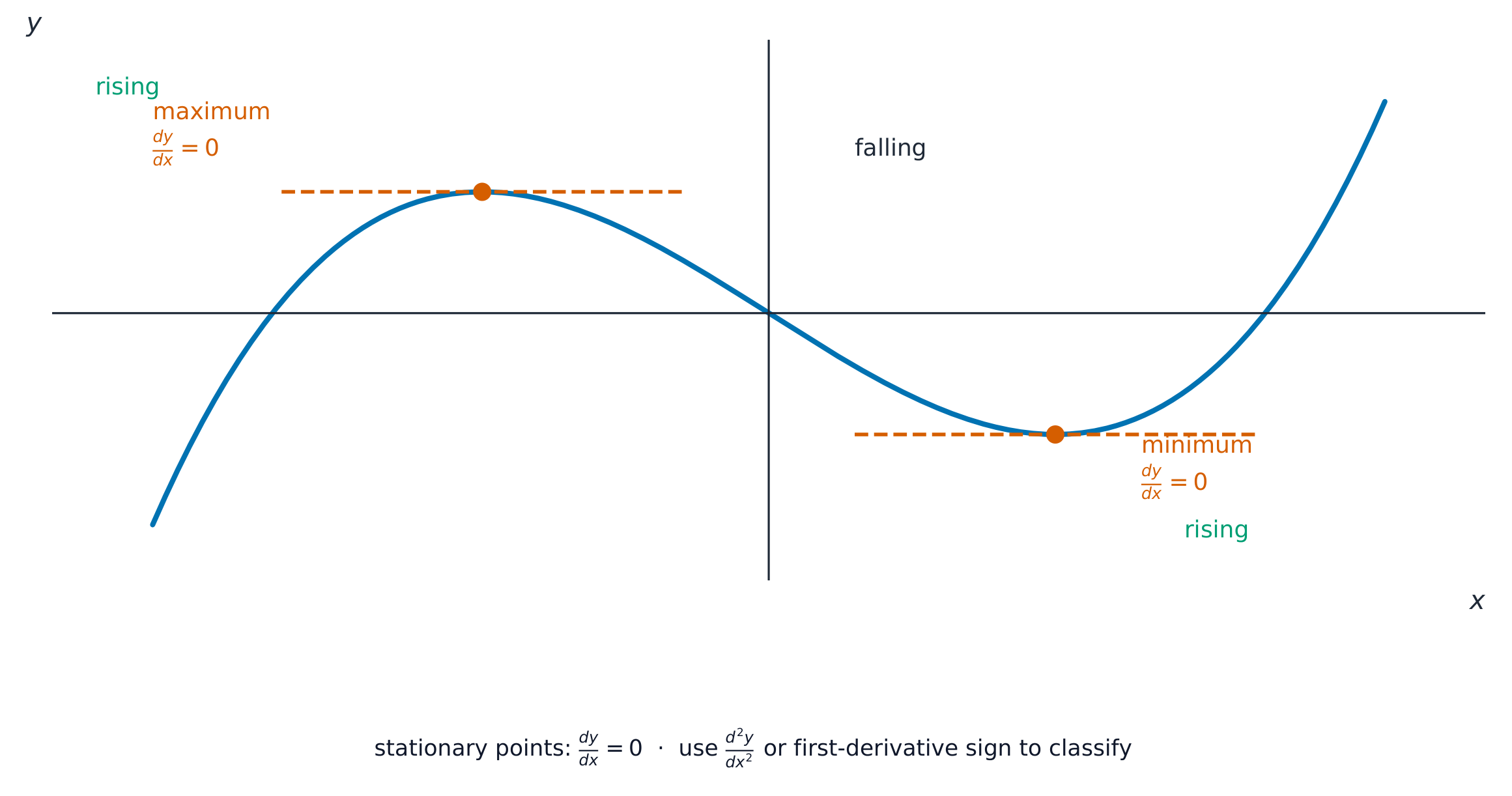
A stationary point 驻点 is where $\dfrac{dy}{dx} = 0$. Test its nature with the second derivative: $f''(x) > 0$ gives a minimum point 极小值点, and $f''(x) < 0$ gives a maximum point 极大值点. When $f''(x) = 0$ the test is inconclusive: the point may be a point of inflexion 拐点, where the curve changes concavity (the way it bends) – check the sign of $\dfrac{dy}{dx}$ just before and after to decide.
Worked example. The curve $y = 4x^{1/2} - x$ has a maximum point at $x = a$. Find $a$.
الاشتقاق يجد ميل المنحنى عند كل نقطة. الميل هو الحد لميل الوتر القصير والمتناقص، يسمى المشتقة.
القواعد
اكتب المشتقة كـ $f'(x)$ أو $\dfrac{dy}{dx}$. القاعدة الأساسية هي:
$$\frac{d}{dx}\left(x^n\right) = n x^{n-1} \quad \text{for any rational } n.$$
اشتق المجاميع حداً تلو الآخر، واستخدم قاعدة السلسلة لدالة داخل دالة:
$$\frac{d}{dx}\,f(g(x)) = f'(g(x)) \cdot g'(x).$$
الاشتقاق مرة أخرى يعطي المشتقة الثانية$f''(x)$ أو $\dfrac{d^2y}{dx^2}$.
استخدام المشتقة
المماس والعمودي. ميل المنحنى عند نقطة هو ميل المماس هناك. العمودي عمودي على المماس، لذا ميله هو $-\dfrac{1}{\text{(tangent gradient)}}$.
التزايد أو التناقص. الدالة دالة متزايدة حيث $\dfrac{dy}{dx} > 0$، ودالة متناقصة حيث $\dfrac{dy}{dx} < 0$.
معدل التغير. المشتقة هي معدل تغير. معدلات مرتبطة تستخدم قاعدة السلسلة، مثلاً $\dfrac{dy}{dt} = \dfrac{dy}{dx}\cdot\dfrac{dx}{dt}$.
النقاط الثابتة
النقطة الثابتة هي حيث $\dfrac{dy}{dx} = 0$. اختبر طبيعتها باستخدام المشتقة الثانية: $f''(x) > 0$ يعطي نقطة صغرى، و$f''(x) < 0$ يعطي نقطة عظمى. عندما $f''(x) = 0$ الاختبار غير حاسم: قد تكون النقطة نقطة انعطاف، حيث يتغير تقعر المنحنى (طريقة انحنائه) — تحقق من إشارة $\dfrac{dy}{dx}$ قبل وبعد لتحديد ذلك.
عند العظمى أو الصغرى يكون المماس مسطحاً، لذا $\frac{dy}{dx}=0$.
مثال محلول. المنحنى $y = 4x^{1/2} - x$ له نقطة عظمى عند $x = a$. أجد $a$.
Slide the point along the curve. The tangent shows the gradient $\frac{dy}{dx}$ there — steeper where the curve bends more. · اسحب النقطة على طول المنحنى. يظهر المماس الانحدار $\frac{dy}{dx}$ هناك — حيث يكون أكثر انحداراً كلما انحنى المنحنى أكثر.
equation of a straight line/ɪˈkweɪʒn əvə streɪt laɪn/
معادلة الخط المستقيم
parallel/ˈpærəlel/
التوازي
perpendicular/ˌpɜːpənˈdɪkjʊlə/
عمودية
stationary point/ˈsteɪʃənəri pɔɪnt/
نقطة ثابتة
minimum point/ˈmɪnɪməm pɔɪnt/
نقطة صغرى
maximum point/ˈmæksɪməm pɔɪnt/
نقطة عظمى
point of inflexion/pɔɪnt ɒv ɪnˈflekʃn/
نقطة انعطاف
Integration/ˌɪntɪˈɡreɪʃn/
التكامل
constant of integration/ˈkɒnstənt ɒv ˌɪntɪˈɡreɪʃn/
ثابت التكامل
definite integral/ˈdefɪnət ˈɪntɪɡrəl/
تكامل محدد
region/ˈriːdʒn/
منطقة
improper integral/ɪmˈprɒpə ˈɪntɪɡrəl/
التكامل غير الصحيح
volume of revolution/ˈvɒljuːm ɒv ˌrevəˈluːʃn/
حجم الدوران
algebra/ˈældʒɪbrə/
الجبر
calculus/ˈkælkjʊləs/
التفاضل والتكامل
coefficient/ˌkəʊɪˈfɪʃənt/
المعامل
1.8
Integration · التكامل
Syllabus · المنهج
English
Candidates should be able to:
Notes and examples
understand integration as the reverse process of differentiation, and integrate $(ax + b)^n$ (for any rational $n$ except $-1$), together with constant multiples, sums and differences
solve problems involving the evaluation of a constant of integration
e.g. to find the equation of the curve through $(1, -2)$ for which $\frac{\text{d}y}{\text{d}x} = \sqrt{2x + 1}$.
evaluate definite integrals
Including simple cases of 'improper' integrals, such as $\int_{0}^{1} x^{-\frac{1}{2}} \text{d}x$ and $\int_{1}^{\infty} x^{-2} \text{d}x$.
use definite integration to find: - the area of a region bounded by a curve and lines parallel to the axes, or between a curve and a line or between two curves - a volume of revolution about one of the axes.
A volume of revolution may involve a region not bounded by the axis of rotation, e.g. the region between $y = 9 - x^2$ and $y = 5$ rotated about the $x$-axis.
العربية
يجب أن يكون المرشحون قادرين على:
ملاحظات وأمثلة
فهم التكامل كعملية عكسية للاشتقاق، وتكامل $(ax + b)^n$ (أي عدد ناطق $n$ باستثناء $-1$)، جنباً إلى جنب المضاعفات الثابتة والمجموع والفرك
على سبيل المثال $\int (2x^3 - 5x + 1) \text{d}x$، $\int \frac{1}{(2x + 3)^2} \text{d}x$.
حل المسائل التي تتضمن تقييم ثابت التكامل
على سبيل المثال لإيجاد معادلة المنحنى المار بنقطة $(1, -2)$ حيث $\frac{\text{d}y}{\text{d}x} = \sqrt{2x + 1}$.
تقييم التكاملات المحددة
بما في ذلك الحالات البسيطة من التكاملات 'غير الصحيحة'، مثل $\int_{0}^{1} x^{-\frac{1}{2}} \text{d}x$ و $\int_{1}^{\infty} x^{-2} \text{d}x$.
استخدام التكامل المحدد لإيجاد: - المساحة لمنطقة محصورة بمنحنى وخطوط موازية للمحاور، أو بين منحنى وخط أو بين منحنيين - حجم الدوران حول أحد المحورين.
قد يتضمن حجم الدوران منطقة غير محصورة بمحور الدوران، على سبيل المثال المنطقة بين $y = 9 - x^2$ و $y = 5$ تدور حول محور $x$.
Source: Cambridge International syllabus · المصدر: منهج كامبريدج الدولي
English
Integration as area: Riemann rectangles
Integration 积分 is the reverse of differentiation. Reversing the power rule gives
The area of the region 区域 between a curve and the $x$-axis, from $x = p$ to $x = q$, is $\displaystyle\int_p^q y \, dx$. For the area between two curves, integrate (top curve $-$ bottom curve).
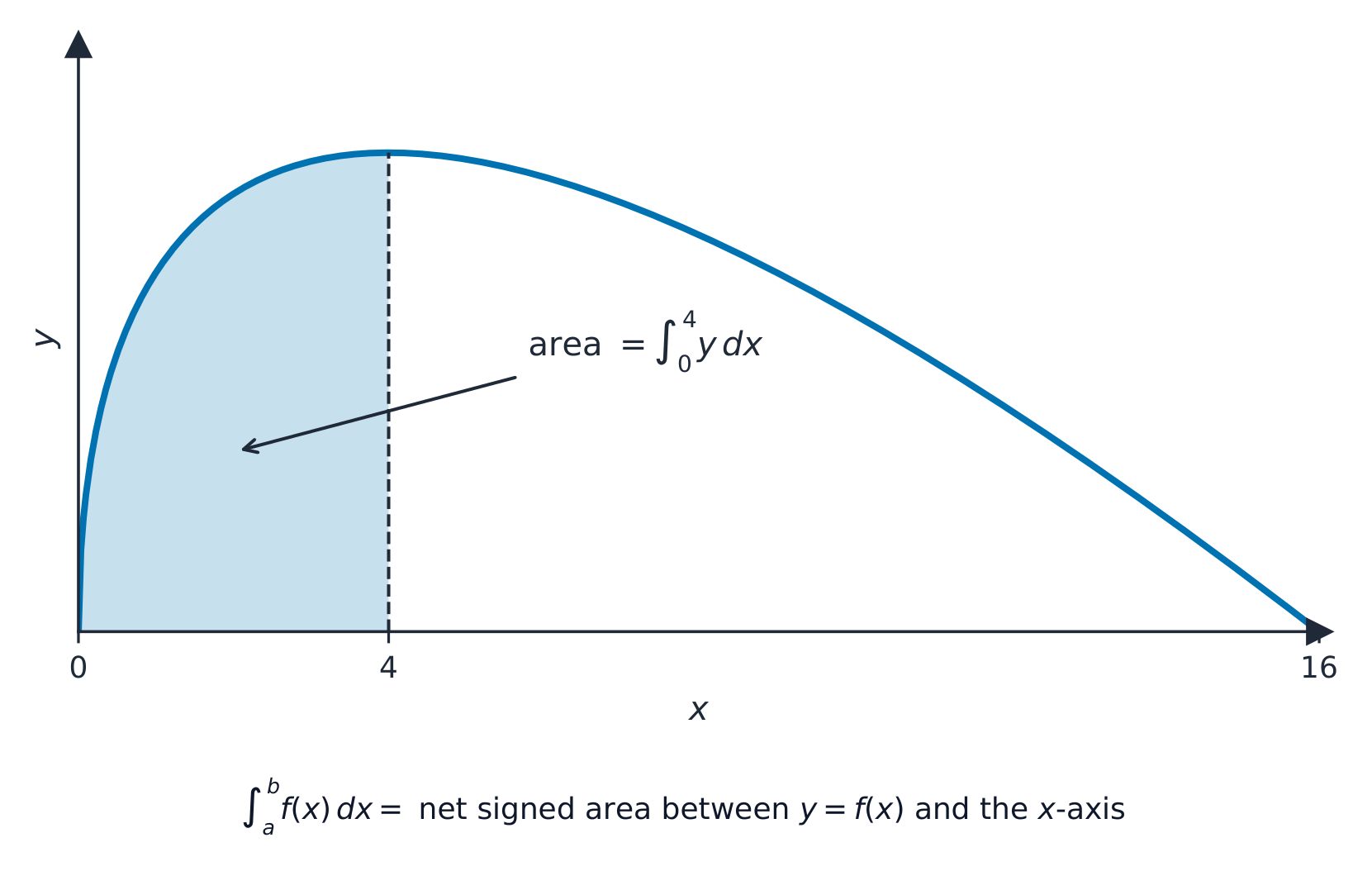
Worked example. The curve $y = 4x^{1/2} - x$ meets the $x$-axis again at $x = 16$. Find the area between the curve and the $x$-axis from $x = 0$ to $x = 4$.
and $\displaystyle\int_0^{1}x^{-1/2}\, dx=\left[2x^{1/2}\right]_0^{1}=2$, which is finite even though the integrand blows up at $x=0$.
Volume of revolution
When a region is turned all the way around an axis it sweeps out a solid. The volume of revolution 旋转体体积 about the $x$-axis is
$$V = \pi \int_p^q y^2 \, dx,$$
and about the $y$-axis it is $V = \pi \displaystyle\int x^2 \, dy$. For example, the region under $y = \sqrt{x}$ from $x = 0$ to $x = 4$, turned about the $x$-axis, has volume $\pi\displaystyle\int_0^4 x\, dx = \pi\big[\tfrac{x^2}{2}\big]_0^4 = 8\pi$.
مساحة المنطقة بين منحنى ومحور $x$، من $x = p$ إلى $x = q$، هي $\displaystyle\int_p^q y \, dx$. بالنسبة للمساحة بين منحنيين، اشتق (المنحنى العلوي $-$ المنحنى السفلي).
التكامل المحدد $\int_0^4 y\,dx$ هو المساحة المظللة تحت المنحنى.
مثال محلول. المنحنى $y = 4x^{1/2} - x$ يقطع محور $x$ مرة أخرى عند $x = 16$. أجد المساحة بين المنحنى ومحور $x$ من $x = 0$ إلى $x = 4$.
و $\displaystyle\int_0^{1}x^{-1/2}\, dx=\left[2x^{1/2}\right]_0^{1}=2$، وهو عدد محدود على الرغم من أن الدالة المكاملة تتجه إلى اللانهاية عند $x=0$.
حجم الدوران
عند تدوير منطقة حول محور بشكل كامل، فإنها تحدد مجسماً. حجم الدوران حول محور $x$ هو
$$V = \pi \int_p^q y^2 \, dx,$$
وحول محور $y$ تكون $V = \pi \displaystyle\int x^2 \, dy$. على سبيل المثال، المنطقة تحت $y = \sqrt{x}$ من $x = 0$ إلى $x = 4$، عند تدويرها حول محور $x$، يكون حجمها $\pi\displaystyle\int_0^4 x\, dx = \pi\big[\tfrac{x^2}{2}\big]_0^4 = 8\pi$.
تدوير المنطقة تحت المنحنى حول محور $x$ يُحدد مجسماً؛ كل شريحة رقيقة هي قرص مساحته $\pi y^2$، لذا $V = \pi\int y^2\,dx$
Explore · استكشف
Area under a curve · المساحة تحت المنحنى
y = ax³ + bx² + cx + d
Drag the limits. The definite integral is the shaded area between the curve and the x-axis. · اسحب الحدود. التكامل المحدد هو المساحة المظللة بين المنحنى ومحور x.
1.8
Exam tips · نصائح للامتحان
English
Show every line of algebra — method marks are lost by jumping steps; use the discriminant$b^2 - 4ac$ to decide the number of real roots.
Work in radians for circular measure (arc $= r\theta$, sector area $= \frac{1}{2}r^2\theta$) and for calculus of trig functions.
For differentiation, set $\frac{dy}{dx} = 0$ for stationary points and use the second derivative to classify them.
For integration, add $+ c$ to an indefinite integral and use limits for area; an area below the axis gives a negative integral.
العربية
أظهر كل سطر من الحساب الجبري — تُفقد علامات الطريقة عند تخطي الخطوات؛ استخدم المميز$b^2 - 4ac$ لتحديد عدد الجذور الحقيقية.
اعمل بـ الدرجات الزاوية للقياس الدائري (قوس $= r\theta$، مساحة المقطع $= \frac{1}{2}r^2\theta$) ولتفاضل دوال المثلثات.
بالنسبة لـ التفاضل، ضع $\frac{dy}{dx} = 0$ لإيجاد النقاط الثابتة واستخدم المشتقة الثانية لتصنيفها.
بالنسبة لـ التكامل، أضف $+ c$ للتكامل غير المحدد واستخدم الحدود لحساب المساحة؛ المساحة أسفل المحور تعطي تكاملاً سالباً.
This handout covers Topic 2: Pure Mathematics 纯数学 2. It adds the modulus and polynomial algebra, logarithms 对数 and the exponential function 指数函数, more trigonometry, and new ways to differentiate and integrate.
2.1
Algebra
Syllabus · المنهج
English
Candidates should be able to:
Notes and examples
understand the meaning of $|x|$, sketch the graph of $y = |ax + b|$ and use relations such as $|a| = |b| \iff a^2 = b^2$ and $|x - a| < b \iff a - b < x < a + b$ when solving equations and inequalities
Graphs of $y = |f(x)|$ and $y = f(|x|)$ for non-linear functions $f$ are not included. e.g. $|3x - 2| = |2x + 7|$, $2x + 5 < |x + 1|$
divide a polynomial, of degree not exceeding 4, by a linear or quadratic polynomial, and identify the quotient and remainder (which may be zero)
use the factor theorem and the remainder theorem.
e.g. to find factors and remainders, solve polynomial equations or evaluate unknown coefficients. Including factors of the form $(ax + b)$ in which the coefficient of $x$ is not unity, and including calculation of remainders.
العربية
يجب أن يكون المرشحون قادرين على:
ملاحظات وأمثلة
فهم معنى $|x|$، ورسم بيانية $y = |ax + b|$ واستخدام علاقات مثل $|a| = |b| \iff a^2 = b^2$ و $|x - a| < b \iff a - b < x < a + b$ عند حل المعادلات والمتباينات
لا تشمل بيانيات $y = |f(x)|$ و $y = f(|x|)$ للدوال غير الخطية $f$. على سبيل المثال $|3x - 2| = |2x + 7|$، $2x + 5 < |x + 1|$
قسمة كثير حدود من الدرجة لا تتجاوز 4 على كثير حدود خطي أو تربيعي، وتحديد الحاصل و الباقي (الذي قد يكون صفراً)
استخدام نظرية العامل و نظرية الباقي.
على سبيل المثال لإيجاد العوامل والبقايا، وحل معادلات كثير الحدود أو تقييم المعاملات المجهولة. بما في ذلك عوامل من الشكل $(ax + b)$ حيث معامل $x$ ليس واحداً، بما في ذلك حساب البواقي.
Source: Cambridge International syllabus · المصدر: منهج كامبريدج الدولي
The modulus
The modulus 绝对值$|x|$ is the size of a number with its sign removed, so $|x| \geqslant 0$ always. The graph of $y = |ax + b|$ is a "V" shape that bounces off the $x$-axis. Two useful rules for solving equations and inequalities are
$$|a| = |b| \;\Leftrightarrow\; a^2 = b^2, \qquad |x - a| < b \;\Leftrightarrow\; a - b < x < a + b.$$
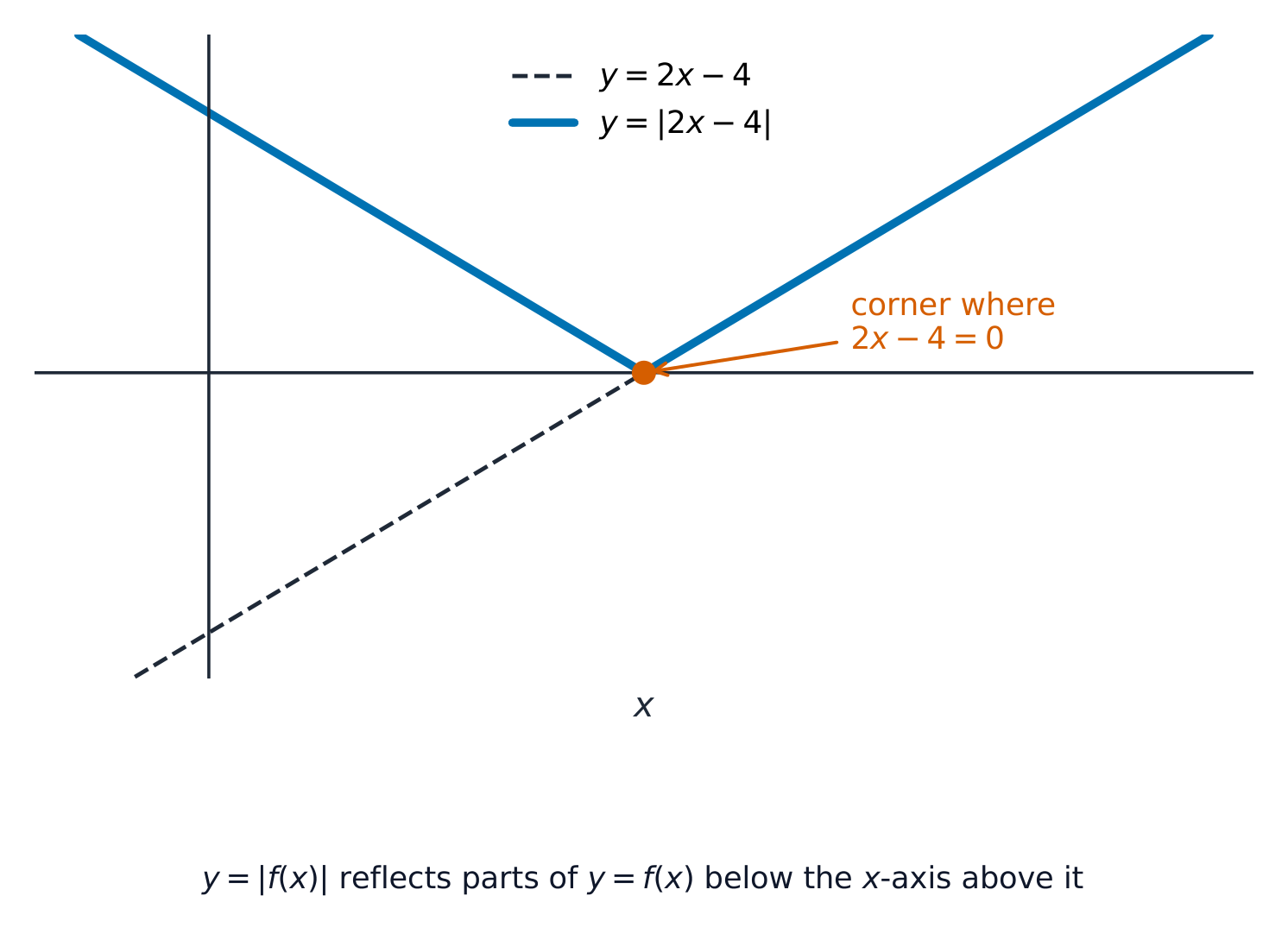
Taking the modulus folds the part of the line below the axis upward into a V.
Worked example. Solve $|3x + 8| < 9$.
Using the second rule with the inequality written as $-9 < 3x + 8 < 9$:
Polynomial division and the factor and remainder theorems
A polynomial 多项式 is a sum of powers of $x$, such as $2x^4 + 3x^2 - 5$. Its degree 次数 is the highest power. When you divide one polynomial by another you get a quotient 商 and a remainder 余数.
Remainder theorem 余数定理: the remainder when $p(x)$ is divided by $(x - a)$ is $p(a)$.
Factor theorem 因式定理: $(x - a)$ is a factor of $p(x)$ exactly when $p(a) = 0$.
Worked example. The polynomial $p(x) = 2x^4 + kx^3 + kx^2 + 17x + 18$ has factor $(x + 2)$. Find $k$.
The modulus makes a V-shape. Move its vertex with b and c; change how steep the arms are with a. · تجعل القيمة المطلقة الشكل V. حرك رأسها باستخدام b و c؛ غيّر مدى انحدار أذرعها باستخدام a.
use logarithms to transform a given relationship to linear form, and hence determine unknown constants by considering the gradient and/or intercept.
e.g. $y = kx^n$ gives $\ln y = \ln k + n \ln x$ which is linear in $\ln x$ and $\ln y$$y = k(a^x)$ gives $\ln y = \ln k + x \ln a$ which is linear in $x$ and $\ln y$.
العربية
يجب أن يكون المرشحون قادرين على:
ملاحظات وأمثلة
فهم العلاقة بين اللوغاريتمات و الأسس، واستخدام قواعد اللوغاريتمات (باستثناء تغيير الأساس)
فهم تعريف وخصائص $e^x$ و $\ln x$، بما في ذلك علاقتهما كـ دوال عكسية وبيانياتهما
بما في ذلك معرفة بيانية $y = e^{kx}$ لكل من القيم الموجبة والسالبة لـ $k$.
استخدام اللوغاريتمات لحل المعادلات والمتباينات التي يظهر فيها المجهول في الأسس
على سبيل المثال $2^x < 5$، $3 \times 2^{3x-1} < 5$، $3^{x+1} = 4^{2x-1}$
استخدم اللوغاريتمات لتحويل علاقة معطاة إلى صيغة خطية، ومن ثم تحديد الثوابت المجهولة عن طريق النظر في الميل و/أو المقطع.
مثل: $y = kx^n$ يعطي $\ln y = \ln k + n \ln x$ وهو خطي بالنسبة لـ $\ln x$ و $\ln y$$y = k(a^x)$ يعطي $\ln y = \ln k + x \ln a$ وهو خطي بالنسبة لـ $x$ و $\ln y$.
Source: Cambridge International syllabus · المصدر: منهج كامبريدج الدولي
Earthquake strength is measured on the logarithmic Richter scale.Populations can grow exponentially when resources are plentiful.
A logarithm answers the question "what power?". If $a^x = y$ then $x = \log_a y$. Logarithms and indices 指数 (powers) are reverse ideas. The laws of logarithms 对数定律 are
$$\log(mn) = \log m + \log n, \qquad \log\!\frac{m}{n} = \log m - \log n, \qquad \log(m^k) = k\log m.$$
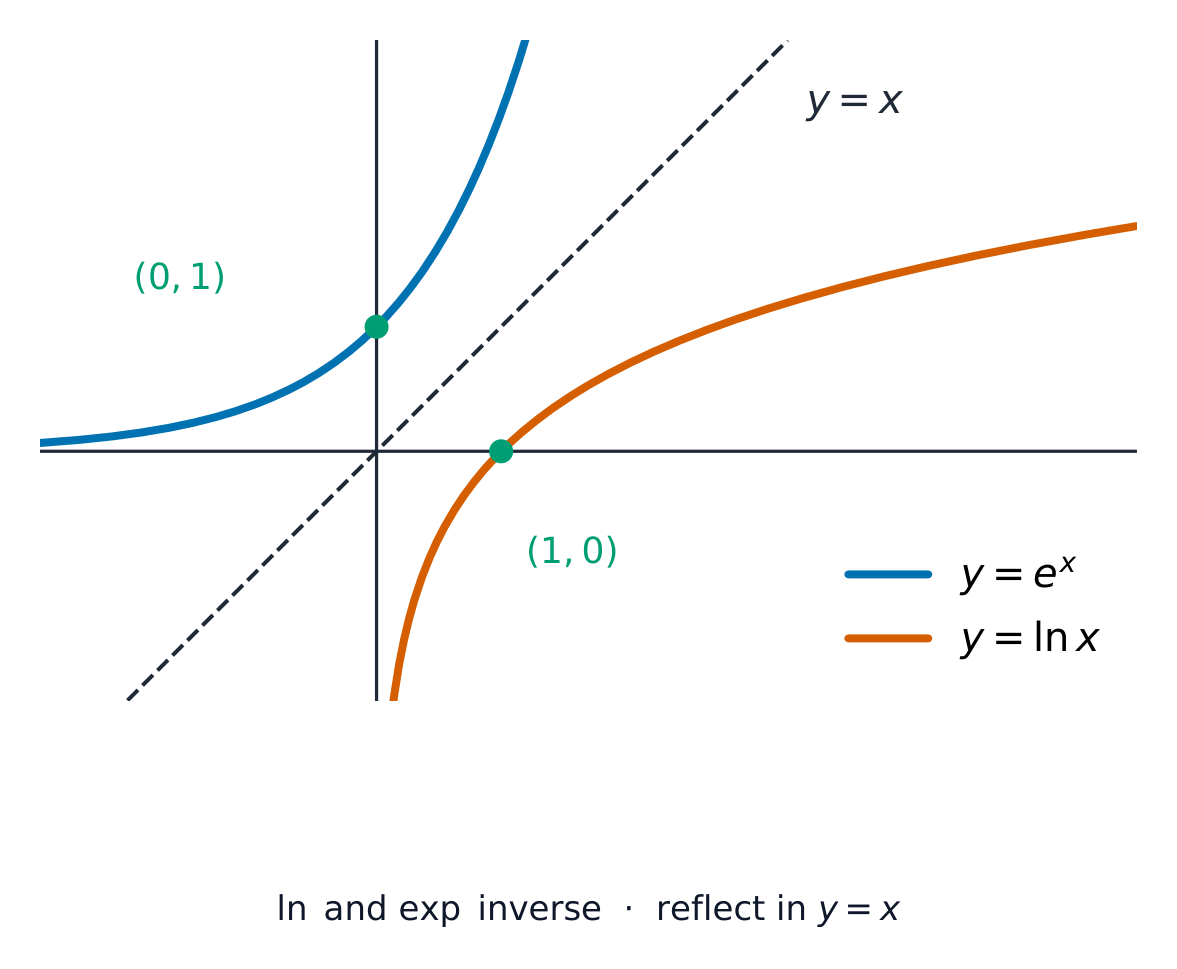
The exponential function $e^x$ and the natural logarithm 自然对数$\ln x$ are inverse functions, so $\ln(e^x) = x$ and $e^{\ln x} = x$. When the unknown is in the power, take logs of both sides.
$e^x$ and $\ln x$ undo each other, so each is the other reflected in $y=x$.
Linear form 线性形式: a relationship like $y = Ax^n$ becomes a straight line if you take logs: $\ln y = \ln A + n\ln x$. Plotting $\ln y$ against $\ln x$ gives a line with gradient $n$ and intercept $\ln A$, so you can find the unknown constants.
Explore · استكشف
Exponential growth · النمو الأسي
y = a·bˣ
Change the base b: when b > 1 the curve grows, when 0 < b < 1 it decays — and it always passes through (0, a). · غيّر القاعدة b: عندما b > 1 ينمو المنحنى، وعندما 0 < b < 1 يتلاشى — ويمر دائماً عبر (0, a).
understand the relationship of the secant, cosecant and cotangent functions to cosine, sine and tangent, and use properties and graphs of all six trigonometric functions for angles of any magnitude
use trigonometrical identities for the simplification and exact evaluation of expressions, and in the course of solving equations, and select an identity or identities appropriate to the context, showing familiarity in particular with the use of: – $\sec^2 \theta \equiv 1 + \tan^2 \theta$ and $\csc^2 \theta \equiv 1 + \cot^2 \theta$ – the expansions of $\sin(A \pm B)$, $\cos(A \pm B)$ and $\tan(A \pm B)$ – the formulae for $\sin 2A$, $\cos 2A$ and $\tan 2A$ – the expression of $a \sin \theta + b \cos \theta$ in the forms $R \sin(\theta \pm \alpha)$ and $R \cos(\theta \pm \alpha)$.
Source: Cambridge International syllabus · المصدر: منهج كامبريدج الدولي
There are three more functions, each the reciprocal of one you know: the secant 正割$\sec\theta = \dfrac{1}{\cos\theta}$, the cosecant 余割$\csc\theta = \dfrac{1}{\sin\theta}$, and the cotangent 余切$\cot\theta = \dfrac{1}{\tan\theta}$.
$\sec\theta=1/\cos\theta$ rises to an asymptote wherever $\cos\theta=0$.
You must know these trigonometric identities 三角恒等式 and choose the right one for each problem:
So $\sec\theta = \tfrac52$ or $\sec\theta = -4$, giving $\cos\theta = \tfrac25$ or $\cos\theta = -\tfrac14$. The solutions are $\theta = \pm 66.4^\circ$ and $\theta = \pm 104.5^\circ$.
Explore · استكشف
The unit circle · الدائرة الوحدة
Drag the angle to see how $\sin$, $\cos$ and $\tan$ relate — the key to solving trig equations. · اسحب الزاوية لرؤية العلاقة بين $\sin$ و$\cos$ و$\tan$ — المفتاح لحل المعادلات المثلثية.
إيجاد واستخدام المشتقة الأولى لدالة مُعرَّفة بشكل بارامتري أو ضمني.
مثال: $x = t - e^{2t}$، $y = t + e^{2t}$. مثال: $x^2 + y^2 = xy + 7$. بما في ذلك الاستخدام في مسائل涉及 المسالك العمودية والأعمدة.
Source: Cambridge International syllabus · المصدر: منهج كامبريدج الدولي
Learn these standard derivatives:
$$\frac{d}{dx}e^x = e^x, \quad \frac{d}{dx}\ln x = \frac{1}{x}, \quad \frac{d}{dx}\sin x = \cos x, \quad \frac{d}{dx}\cos x = -\sin x, \quad \frac{d}{dx}\tan x = \sec^2 x.$$
For a product or a quotient of two functions, use:
the product rule 乘积法则: $(uv)' = u'v + uv'$;
the quotient rule 商法则: $\left(\dfrac{u}{v}\right)' = \dfrac{u'v - uv'}{v^2}$.
When a curve is given by parametric equations 参数方程$x = x(t)$, $y = y(t)$, the gradient is $\dfrac{dy}{dx} = \dfrac{dy/dt}{dx/dt}$. When $y$ is defined implicitly 隐式 (not made the subject), differentiate every term with respect to $x$, using the chain rule on the $y$ terms, then solve for $\dfrac{dy}{dx}$.
Worked example. Given $y = 6x\cos(x^2 + 1)$, find $\dfrac{dy}{dx}$.
Use the product rule with $u = 6x$ and $v = \cos(x^2 + 1)$ (and the chain rule for $v$):
Move the point: the tangent line is the derivative at that x. Where the curve turns, the gradient is zero. · حرك النقطة: خط المماس هو المشتقة عند ذلك الـ x. حيث يلتوي المنحنى يكون الانحدار صفراً.
• extend the idea of ‘reverse differentiation’ to include the integration of $e^{ax + b}$, $\frac{1}{ax + b}$, $\sin(ax + b)$, $\cos(ax + b)$ and $\sec^2(ax + b)$
Knowledge of the general method of integration by substitution is not required.
• use trigonometrical relationships in carrying out integration
e.g. use of double-angle formulae to integrate $\sin^2 x$ or $\cos^2(2x)$.
• understand and use the trapezium rule to estimate the value of a definite integral.
Including use of sketch graphs in simple cases to determine whether the trapezium rule gives an over-estimate or an under-estimate.
لا يُشترط معرفة الطريقة العامة لـ التكامل بالتعويض.
• استخدام العلاقات المثلثية في إجراء التكامل
مثال: استخدام صيغ الزاوية المزدوجة لتكامل $\sin^2 x$ أو $\cos^2(2x)$.
• فهم واستخدام قاعدة شبه المنحرف لتقدير قيمة التكامل المحدد.
بما في ذلك استخدام الرسوم البيانية التقريبية في الحالات البسيطة لتحديد ما إذا كانت قاعدة شبه المنحرف تعطي تقديراً مبالغاً فيه أو مقصراً.
Source: Cambridge International syllabus · المصدر: منهج كامبريدج الدولي
Integration is reverse differentiation — reverse each new derivative; harder integrals may need integration by substitution 换元积分 (developed in Pure 3). For a linear inside function $(ax + b)$:
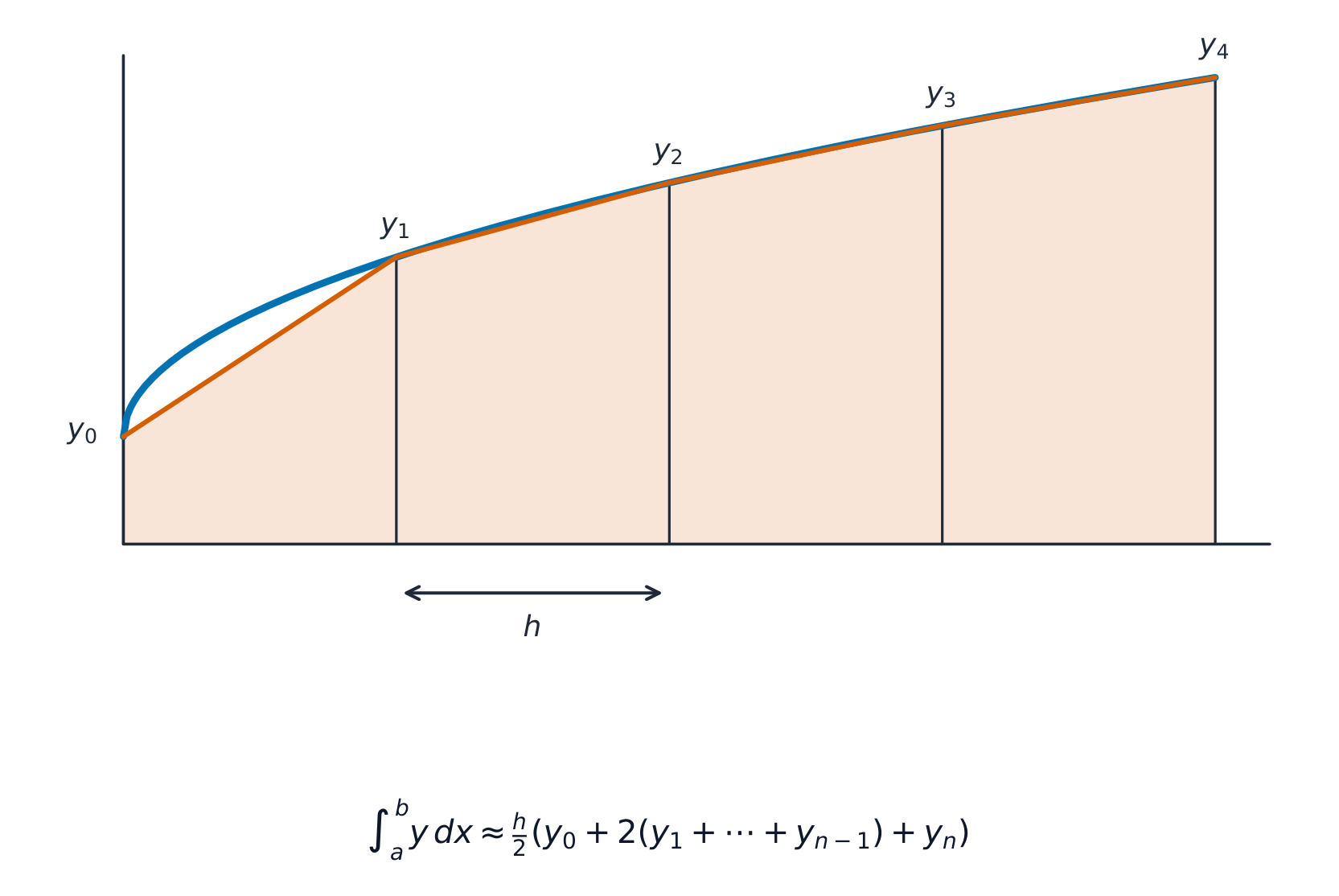
To integrate a power of $\sin$ or $\cos$, first use an identity to remove the power. When you cannot integrate exactly, the trapezium rule 梯形法则 estimates a definite integral:
The integral still measures area — drag a and b to total the strip under the curve. · لا يزال التكامل يقيس المساحة — اسحب a و b لتجميع الشريط تحت المنحنى.
integration by substitution/ˌɪntɪˈɡreɪʃn baɪ ˌsʌbstɪˈtjuːʃn/
التكامل بالتعويض
2.6
Numerical solution of equations
Syllabus · المنهج
English
Candidates should be able to:
Notes and examples
• locate approximately a root of an equation, by means of graphical considerations and/or searching for a sign change
e.g. finding a pair of consecutive integers between which a root lies.
• understand the idea of, and use the notation for, a sequence of approximations which converges to a root of an equation
• understand how a given simple iterative formula of the form $x_{n + 1} = \text{F}(x_n)$ relates to the equation being solved, and use a given iteration, or an iteration based on a given rearrangement of an equation, to determine a root to a prescribed degree of accuracy.
Knowledge of the condition for convergence is not included, but an understanding that an iteration may fail to converge is expected.
العربية
يجب أن يكون المرشحون قادرين على:
ملاحظات وأمثلة
• تحديد جذر المعادلة تقريبياً، عن طريق الاعتبارات البيانية و/أو البحث عن تغير الإشارة
مثال: إيجاد زوج من الأعداد الصحيحة المتتالية التي يقع فيها الجذر.
• فهم فكرة، واستخدام رمز، لسلسلة من التقاربات التي تتقارب نحو جذر لمعادلة
• فهم كيفية ارتباط صيغة تكرارية بسيطة معطاة من الشكل $x_{n + 1} = \text{F}(x_n)$ بالمعادلة المُحلَّلة، واستخدام تكرار معطى، أو تكرار مبني على إعادة ترتيب معطى لمعادلة، لتحديد جذر بدقة محددة مسبقاً.
لا يُدرج شرط الـ التقارب، ولكن يُتوقع أن يكون هناك فهم بأن التكرار قد يفشل في التقارب.
Source: Cambridge International syllabus · المصدر: منهج كامبريدج الدولي
Iterating to a root: ride the tangent
Many equations cannot be solved exactly. Two ideas help you find a root 根 (a solution).
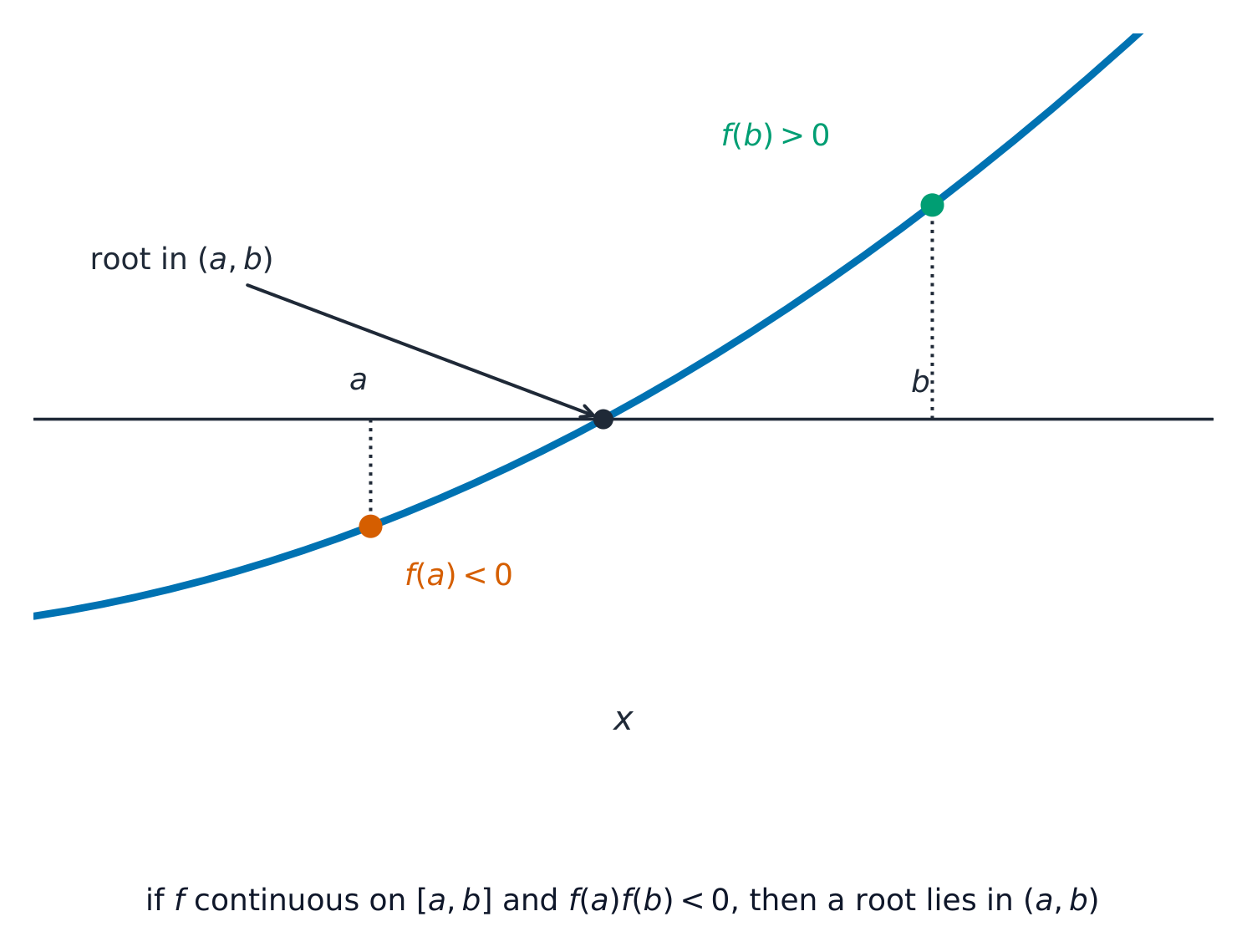
Sign change 变号: if $f(a)$ and $f(b)$ have opposite signs (and the graph has no break between them), a root lies between $a$ and $b$.
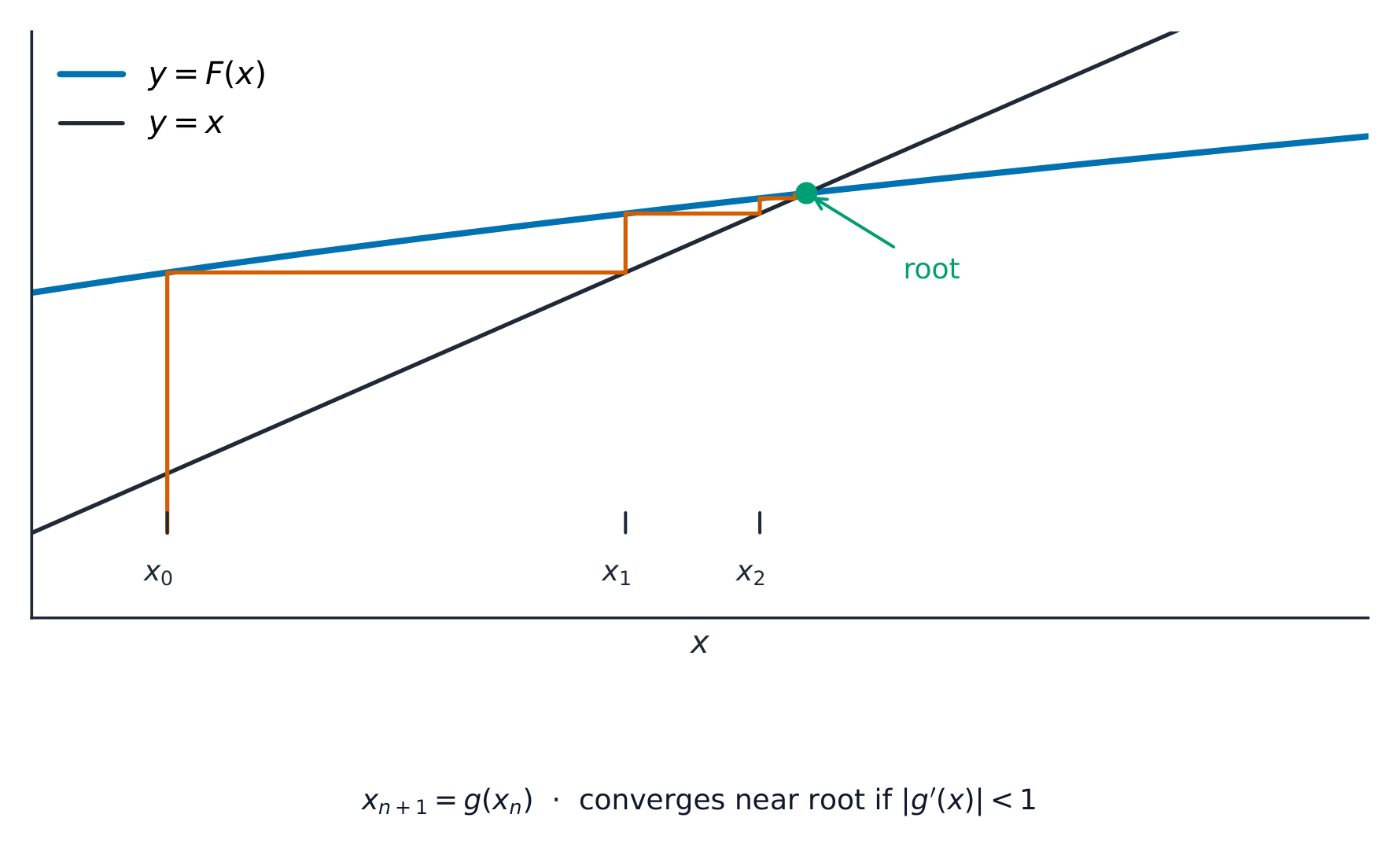
Iteration 迭代: rearrange the equation into the form $x = F(x)$, then use the iterative formula 迭代公式$x_{n+1} = F(x_n)$. Start from a first guess $x_0$ and repeat. If the values are convergent they settle down and converge 收敛 to a root. Keep going until the answer is steady to the accuracy asked for.
$f(a)$ and $f(b)$ have opposite signs, so a root is trapped between $a$ and $b$.Each step goes up to $y=F(x)$ then across to $y=x$; the staircase closes in on the root.
Worked example. A root $\beta$ of an equation satisfies $x = \sqrt[3]{-2x - 4.5}$, and $-1.4 < \beta < -1.0$. Use the iteration $x_{n+1} = \sqrt[3]{-2x_n - 4.5}$ with $x_0 = -1.2$.
The values settle near $-1.26$, so $\beta = -1.26$ (3 s.f.).
Explore · استكشف
Where is the root? · أين الجذر؟
y = ax³ + bx² + cx + d
A root is where the curve crosses zero. A sign change in f(x) traps a root between two x-values. · الجذر هو حيث يعبر المنحنى الصفر. التغير في الإشارة في f(x) يحبس جذراً بين قيمتي x.
This handout covers Topic 3: Pure Mathematics 纯数学 3. Subtopics 3.1–3.6 build on the algebra, logarithms, trigonometry, differentiation, integration and numerical methods of Pure Mathematics 2, so this handout explains what is new in Pure 3 and then covers the three big new areas: vectors, differential equations and complex numbers.
3.1
Algebra
Syllabus · المنهج
English
Candidates should be able to:
Notes and examples
• understand the meaning of $|x|$, sketch the graph of $y = |ax + b|$ and use relations such as $|a| = |b| \iff a^2 = b^2$ and $|x - a| < b \iff a - b < x < a + b$ when solving equations and inequalities
Graphs of $y = |\text{f}(x)|$ and $y = \text{f}(|x|)$ for non-linear functions $\text{f}$ are not included. e.g. $|3x - 2| = |2x + 7|$, $2x + 5 < |x + 1|$.
• divide a polynomial, of degree not exceeding 4, by a linear or quadratic polynomial, and identify the quotient and remainder (which may be zero)
• use the factor theorem and the remainder theorem
e.g. to find factors and remainders, solve polynomial equations or evaluate unknown coefficients. Including factors of the form $(ax + b)$ in which the coefficient of $x$ is not unity, and including calculation of remainders.
• recall an appropriate form for expressing rational functions in partial fractions, and carry out the decomposition, in cases where the denominator is no more complicated than – $(ax + b)(cx + d)(ex + f)$ – $(ax + b)(cx + d)^2$ – $(ax + b)(cx^2 + d)$
Excluding cases where the degree of the numerator exceeds that of the denominator
• use the expansion of $(1 + x)^n$, where $n$ is a rational number and $|x| < 1$.
Finding the general term in an expansion is not included. Adapting the standard series to expand e.g. $(2 - \frac{1}{2}x)^{-1}$ is included, and determining the set of values of $x$ for which the expansion is valid in such cases is also included.
العربية
يجب أن يكون المرشحون قادرين على:
ملاحظات وأمثلة
• فهم معنى $|x|$، ورسم بياني لـ $y = |ax + b|$، واستخدام علاقات مثل $|a| = |b| \iff a^2 = b^2$ و $|x - a| < b \iff a - b < x < a + b$ عند حل المعادلات والمتباينات
الرسوم البيانية لـ $y = |\text{f}(x)|$ و $y = \text{f}(|x|)$ للدوال غير الخطية $\text{f}$ غير مدرجة. مثال: $|3x - 2| = |2x + 7|$، $2x + 5 < |x + 1|$.
• قسمة كثير حدود، whose degree is not exceeding 4، على كثير حد線ي أو تربيعي، وتحديد المقام و الباقي (الذي قد يكون صفراً)
استخدام نظرية العامل و نظرية الباقي
مثال: لإيجاد العوامل والباقيات، وحل معادلات كثيرة الحدود أو تقييم المعاملات المجهولة. بما في ذلك عوامل من الشكل $(ax + b)$ حيث معامل $x$ ليس واحداً، بما في ذلك حساب البواقي.
استرجاع شكل مناسب للتعبير عن الدوال الكسرية في الكسور الجزئية، وإجراء التفكيك، في الحالات التي لا يكون فيها المقام أكثر تعقيداً من – $(ax + b)(cx + d)(ex + f)$ – $(ax + b)(cx + d)^2$ – $(ax + b)(cx^2 + d)$
استبعاد الحالات التي يتجاوز فيها درجة البسط درجة المقام
استخدام مفكوك $(1 + x)^n$، حيث $n$ هو عدد نسبي و $|x| < 1$.
لا يُدرج إيجاد الحد العام في المفكوك. تكييف السلسلة القياسية لتوسيع مثل $(2 - \frac{1}{2}x)^{-1}$ مدرج، وتحديد مجموعة قيم $x$ التي يكون فيها المفكود صالحاً في مثل هذه الحالات مدرج أيضاً.
Source: Cambridge International syllabus · المصدر: منهج كامبريدج الدولي
Two new tools join the algebra from Pure 2.
Partial fractions
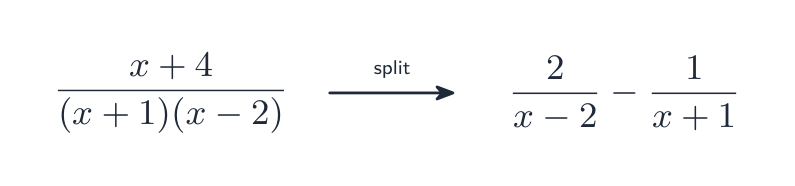
A single fraction with a factorised bottom can be split into a sum of simpler fractions. This is called writing it in partial fractions 部分分式, and it makes a rational function 有理函数 (a fraction of polynomials) easy to integrate or expand. Match the form to the bottom:
First check the top is lower degree than the bottom. If it is not ("top-heavy"), divide the polynomial first: dividing gives a quotient 商 plus a remainder 余数 over the original bottom, and you split only that remaining proper fraction.
One fraction with a factorised bottom splits into a sum of simpler fractions.
For example $(1 + x)^{1/2} = 1 + \tfrac12 x - \tfrac18 x^2 + \cdots$ for $|x| < 1$.
Explore · استكشف
Reciprocal curves · منحنيات المقلوب
y = a/(x − b) + c
Partial fractions split a hard fraction into simple reciprocal pieces — each with a vertical and a horizontal asymptote. · الكسور الجزئية تقسم كسراً صعباً إلى أجزاء بسيطة مقلوبة — كل جزء له خط مقارب رأسي و خط مقارب أفقي.
use logarithms to transform a given relationship to linear form, and hence determine unknown constants by considering the gradient and/or intercept.
e.g. $y = kx^n$ gives $\ln y = \ln k + n \ln x$ which is linear in $\ln x$ and $\ln y$. $y = k(a^x)$ gives $\ln y = \ln k + x \ln a$ which is linear in $x$ and $\ln y$.
العربية
يجب أن يكون المرشحون قادرين على:
ملاحظات وأمثلة
فهم العلاقة بين اللوغاريتمات و الأسس، واستخدام قوانين اللوغاريتمات (باستثناء تغيير الأساس)
فهم تعريف وخصائص $e^x$ و $\ln x$، بما في ذلك علاقتهما كـ دوال عكسية وبيانياتهما
بما في ذلك معرفة بيانية $y = e^{kx}$ لكل من القيم الموجبة والسالبة لـ $k$.
استخدام اللوغاريتمات لحل المعادلات والمتباينات التي يظهر فيها المجهول في الأسس
استخدام اللوغاريتمات لتحويل علاقة معطاة إلى صيغة خطية، ومن ثم تحديد الثوابت المجهولة عن طريق النظر في الميل و/أو المقطع.
مثال: $y = kx^n$ يعطي $\ln y = \ln k + n \ln x$ وهو خطي بالنسبة لـ $\ln x$ و $\ln y$. $y = k(a^x)$ يعطي $\ln y = \ln k + x \ln a$ وهو خطي بالنسبة لـ $x$ و $\ln y$.
English
Candidates should be able to:
Notes and examples
understand the relationship of the secant, cosecant and cotangent functions to cosine, sine and tangent, and use properties and graphs of all six trigonometric functions for angles of any magnitude
use trigonometrical identities for the simplification and exact evaluation of expressions, and in the course of solving equations, and select an identity or identities appropriate to the context, showing familiarity in particular with the use of: – $\sec^2 \theta \equiv 1 + \tan^2 \theta$ and $\cosec^2 \theta \equiv 1 + \cot^2 \theta$ – the expansions of $\sin(A \pm B)$, $\cos(A \pm B)$ and $\tan(A \pm B)$ – the formulae for $\sin 2A$, $\cos 2A$ and $\tan 2A$ – the expression of $a \sin \theta + b \cos \theta$ in the forms $R \sin(\theta \pm \alpha)$ and $R \cos(\theta \pm \alpha)$.
• locate approximately a root of an equation, by means of graphical considerations and/or searching for a sign change
e.g. finding a pair of consecutive integers between which a root lies.
• understand the idea of, and use the notation for, a sequence of approximations which converges to a root of an equation
• understand how a given simple iterative formula of the form $x_{n+1} = \text{F}(x_n)$ relates to the equation being solved, and use a given iteration, or an iteration based on a given rearrangement of an equation, to determine a root to a prescribed degree of accuracy.
Knowledge of the condition for convergence is not included, but an understanding that an iteration may fail to converge is expected.
العربية
يجب أن يكون المرشحون قادرين على:
ملاحظات وأمثلة
• تحديد جذر لمعادلة تقريبياً، عن طريق الاعتبارات البيانية و/أو البحث عن تغير الإشارة
مثال: إيجاد زوج من الأعداد الصحيحة المتتالية يقع بينهما جذر.
• فهم فكرة، واستخدام رمز، لتسلسل من التقريبات التي تتقارب نحو جذر لمعادلة
• فهم كيفية ارتباط قانون تكراري بسيط معطى من الشكل $x_{n+1} = \text{F}(x_n)$ بالمعادلة المحلولة، واستخدام تكرار معطى، أو تكرار مبني على إعادة ترتيب معطاة لمعادلة، لتحديد جذر بدقة محددة مسبقاً.
لا يُشمل معرفة شرط التقارب، لكن يُتوقع فهم أن التكرار قد يفشل في التقارب.
Source: Cambridge International syllabus · المصدر: منهج كامبريدج الدولي
Iterating to a root: ride the tangent
Subtopics 3.2, 3.3 and 3.6 are the same skills you met in Pure 2: the laws of logarithms with $e^x$ and $\ln x$; the identities $\sec^2\theta \equiv 1 + \tan^2\theta$ and $\csc^2\theta \equiv 1 + \cot^2\theta$, the compound- and double-angle formulae, and the $R$-form of $a\sin\theta + b\cos\theta$; and solving an equation numerically by a sign change 变号 and an iterative formula 迭代公式$x_{n+1} = F(x_n)$. Use them exactly as before.
The three new trig functions are the reciprocals 倒数 of the familiar ones: the secant 正割$\sec\theta = \dfrac{1}{\cos\theta}$, the cosecant 余割$\csc\theta = \dfrac{1}{\sin\theta}$, and the cotangent 余切$\cot\theta = \dfrac{1}{\tan\theta} = \dfrac{\cos\theta}{\sin\theta}$. (Memory aid: match the third letter — sec goes with cosine.) The two Pythagorean identities above come straight from dividing $\sin^2\theta + \cos^2\theta \equiv 1$ by $\cos^2\theta$ or $\sin^2\theta$. For a numerical method, an iteration $x_{n+1}=F(x_n)$converges 收敛 to the root when successive values get closer together.
Explore · استكشف
The unit circle · الدائرة الوحدة
(cos θ, sin θ)
The R-formula rewrites a sin θ + b cos θ as one wave — and it all lives on this circle. · إعادة كتابة صيغة R لـ a sin θ + b cos θ كموجة واحدة — وكل ذلك يقع على هذه الدائرة.
إيجاد和使用 المشتقة الأولى لدالة مُعرَّفة بشكل بارامتري أو ضمني.
مثال: $x = t - e^{2t}$، $y = t + e^{2t}$. مثال: $x^2 + y^2 = xy + 7$. بما في ذلك الاستخدام في مسائل涉及 المسالك العمودية والأعمدة.
Source: Cambridge International syllabus · المصدر: منهج كامبريدج الدولي
The methods are those of Pure 2 (the product, quotient and chain rules, with parametric and implicit curves). One derivative is added — the inverse tangent 反正切:
$$\frac{d}{dx}\tan^{-1} x = \frac{1}{1 + x^2}.$$
Worked example. Differentiate $y = \tan^{-1}(3x)$.
Use the chain rule with the result above: $\dfrac{dy}{dx} = \dfrac{1}{1 + (3x)^2} \times 3 = \dfrac{3}{1 + 9x^2}.$
Explore · استكشف
The gradient at a point · الميل عند نقطة ما
gradient = dy/dx · الميل = dy/dx
Implicit or not, the derivative is still the slope of the tangent — slide the point to see it. · سواء كان ضمنيًا أم لا، لا تزال المشتقة هي ميل المماس — اسحب النقطة لترى ذلك.
extend the idea of 'reverse differentiation' to include the integration of $e^{ax + b}$, $\frac{1}{ax + b}$, $\sin(ax + b)$, $\cos(ax + b)$, $\sec^2(ax + b)$ and $\frac{1}{x^2 + a^2}$
Including examples such as $\frac{1}{2 + 3x^2}$.
use trigonometrical relationships in carrying out integration
e.g. use of double-angle formulae to integrate $\sin^2 x$ or $\cos^2(2x)$.
integrate rational functions by means of decomposition into partial fractions
Restricted to types of partial fractions as specified in topic 3.1 above.
recognise an integrand of the form $\frac{k f'(x)}{f(x)}$, and integrate such functions
e.g. integration of $\frac{x}{x^2 + 1}$, $\tan x$.
recognise when an integrand can usefully be regarded as a product, and use integration by parts
e.g. integration of $x \sin 2x$, $x^2 e^{-x}$, $\ln x$, $x \tan^{-1} x$.
use a given substitution to simplify and evaluate either a definite or an indefinite integral.
e.g. to integrate $\sin^2 2x \cos x$ using the substitution $u = \sin x$.
Integration by substitution/ˌɪntɪˈɡreɪʃn baɪ ˌsʌbstɪˈtjuːʃn/
التكامل بالتعويض
3.7
Vectors
Syllabus · المنهج
English
Candidates should be able to:
Notes and examples
• use standard notations for vectors, i.e. $\begin{pmatrix} x \\ y \end{pmatrix}$, $x\mathbf{i} + y\mathbf{j}$, $\begin{pmatrix} x \\ y \\ z \end{pmatrix}$, $x\mathbf{i} + y\mathbf{j} + z\mathbf{k}$, $\overrightarrow{AB}$, $\mathbf{a}$
• carry out addition and subtraction of vectors and multiplication of a vector by a scalar, and interpret these operations in geometrical terms
e.g. ‘$OABC$ is a parallelogram’ is equivalent to $\overrightarrow{OB} = \overrightarrow{OA} + \overrightarrow{OC}$. The general form of the ratio theorem is not included, but understanding that the midpoint of $AB$ has position vector $\frac{1}{2}(\overrightarrow{OA} + \overrightarrow{OB})$ is expected.
• calculate the magnitude of a vector, and use unit vectors, displacement vectors and position vectors
In 2 or 3 dimensions.
• understand the significance of all the symbols used when the equation of a straight line is expressed in the form $\mathbf{r} = \mathbf{a} + t\mathbf{b}$, and find the equation of a line, given sufficient information
e.g. finding the equation of a line given the position vector of a point on the line and a direction vector, or the position vectors of two points on the line.
• determine whether two lines are parallel, intersect or are skew, and find the point of intersection of two lines when it exists
Calculation of the shortest distance between two skew lines is not required. Finding the equation of the common perpendicular to two skew lines is also not required.
• use formulae to calculate the scalar product of two vectors, and use scalar products in problems involving lines and points.
e.g. finding the angle between two lines, and finding the foot of the perpendicular from a point to a line; questions may involve 3D objects such as cuboids, tetrahedra (pyramids), etc. Knowledge of the vector product is not required.
العربية
يجب أن يكون المرشحون قادرين على:
ملاحظات وأمثلة
• استخدام الرموز القياسية لـ المتجهات، أي $\begin{pmatrix} x \\ y \end{pmatrix}$، $x\mathbf{i} + y\mathbf{j}$، $\begin{pmatrix} x \\ y \\ z \end{pmatrix}$، $x\mathbf{i} + y\mathbf{j} + z\mathbf{k}$، $\overrightarrow{AB}$، $\mathbf{a}$
• إجراء عمليات جمع وطرح المتجهات وضرب متجه في عدد حقيقي، وتفسير هذه العمليات هندسياً
مثال: '$OABC$ متوازي أضلاع' يكافئ $\overrightarrow{OB} = \overrightarrow{OA} + \overrightarrow{OC}$. لا يُشمل الصيغة العامة لـ نظرية النسبة، لكن يُتوقع فهم أن نقطة المنتصف لـ $AB$ لها متجه موقع $\frac{1}{2}(\overrightarrow{OA} + \overrightarrow{OB})$.
• فهم دلالة جميع الرموز المستخدمة عند كتابة معادلة خط مستقيم بالشكل $\mathbf{r} = \mathbf{a} + t\mathbf{b}$، وإيجاد معادلة الخط بمعلومية معلومات كافية
مثال: إيجاد معادلة خط معلوم متجه موقع نقطة عليه ومتجه اتجاه، أو متجهات موقع نقطتين عليه.
• تحديد ما إذا كان خطان متوازيين أو يتقاطعان أو متخالفين، وإيجاد نقطة تقاطعهما عند وجودها
لا يُطلب حساب أقصر مسافة بين خطين متخالفين. ولا يُطلب أيضاً إيجاد معادلة العمود المشترك لخطين متخالفين.
• استخدم الصيغ لحساب الجداء القياسي لمتجهين، واستخدم الجداء القياسي في مسائل涉及 الخطوط والنقاط.
مثال: إيجاد الزاوية بين خطين، وإيجاد قدم العمود من نقطة إلى خط؛ قد تتضمن الأسئلة أجساماً 3D مثل المكعبات المستطيلة، رباعيات الأسطح (الأهرامات)، إلخ. لا يُشترط معرفة بـ الجداء الاتجاهي.
Source: Cambridge International syllabus · المصدر: منهج كامبريدج الدولي
Forces like wind and water are vectors — they have both size and direction.
A vector 向量 has both size and direction. Write it as a column, or as $x\mathbf{i} + y\mathbf{j} + z\mathbf{k}$, or as $\overrightarrow{AB}$.
The magnitude 模长 (length) of $\mathbf{v} = x\mathbf{i} + y\mathbf{j} + z\mathbf{k}$ is $|\mathbf{v}| = \sqrt{x^2 + y^2 + z^2}$.
A unit vector 单位向量 has magnitude $1$; divide a vector by its magnitude to make one.
A position vector 位置向量 gives a point's place from the origin; a displacement vector 位移向量$\overrightarrow{AB} = \mathbf{b} - \mathbf{a}$ goes from one point to another. Multiplying by a scalar 标量 (a plain number) stretches a vector.
Lines and the scalar product
A straight line through point $\mathbf{a}$ in direction $\mathbf{b}$ has vector equation $\mathbf{r} = \mathbf{a} + t\mathbf{b}$. Two lines may be parallel 平行, may intersect 相交 at a point, or may be skew lines 异面直线 (not parallel and never meeting).
Start at the point $\mathbf{a}$, then add $t$ copies of the direction $\mathbf{b}$ to reach any point on the line.
The scalar product 数量积 (dot product) of $\mathbf{a}$ and $\mathbf{b}$ is
where $\theta$ is the angle between them. So $\mathbf{a}\cdot\mathbf{b} = 0$ means the vectors are perpendicular.
The scalar product picks out $|\mathbf{b}|\cos\theta$, how far $\mathbf{b}$ reaches along $\mathbf{a}$.
Worked example. Find the angle between $\mathbf{a} = \mathbf{i} + 2\mathbf{j} + 2\mathbf{k}$ and $\mathbf{b} = 2\mathbf{i} + 2\mathbf{j} + \mathbf{k}$.
Adding vectors and the dot product · جمع المتجهات والجداء السلمي
Drag the two vectors. See the resultant (tip-to-tail) and the dot product, which is zero when they are perpendicular. · اسحب المتجهين. شاهد المحصلة (رأساً لذيل) والجداء السلمي، الذي يساوي صفرًا عندما يكونان متعامدين.
formulate a simple statement involving a rate of change as a differential equation
The introduction and evaluation of a constant of proportionality, where necessary, is included.
find by integration a general form of solution for a first order differential equation in which the variables are separable
Including any of the integration techniques from topic 3.5 above.
use an initial condition to find a particular solution
interpret the solution of a differential equation in the context of a problem being modelled by the equation.
Where a differential equation is used to model a 'real-life' situation, no specialised knowledge of the context will be required.
العربية
يجب أن يكون المرشحون قادرين على:
ملاحظات وأمثلة
صياغة عبارة بسيطة تتضمن معدل التغير كـ معادلة تفاضلية
يشمل إدخال وتقييم ثابت تناسب، عند الحاجة.
إيجاد صيغة عامة للحل لمعادلة تفاضلية من الرتبة الأولى عبر التكامل تكون فيها المتغيرات منفصلة
بما في ذلك أي من تقنيات التكامل من الموضوع 3.5 أعلاه.
استخدام شرط ابتدائي لإيجاد حلاً خاصاً
تفسير حل معادلة تفاضلية في سياق مسألة يتم نمذجتها بواسطة المعادلة.
عندما تُستخدم معادلة تفاضلية لنمذجة موقف 'واقعي'، لن يكون مطلوباً معرفة متخصصة في السياق.
Source: Cambridge International syllabus · المصدر: منهج كامبريدج الدولي
A differential equation 微分方程 links a quantity to its rate of change. To solve a first-order equation whose variables are separable 可分离变量, put all the $y$ terms on one side and all the $x$ terms on the other, then integrate both sides. This gives the general solution 通解, which contains a constant. An initial condition 初始条件 (a known value) fixes the constant and gives the particular solution 特解.
Worked example. Solve $\dfrac{dy}{dx} = xy$, given that $y = 1$ when $x = 0$.
Separate the variables and integrate:
$$\int \frac{1}{y}\,dy = \int x\,dx \;\Rightarrow\; \ln y = \tfrac12 x^2 + c \;\Rightarrow\; y = A e^{x^2/2}.$$
Using $y = 1$ at $x = 0$ gives $A = 1$, so $y = e^{x^2/2}$.
The constant $A$ gives a whole family of curves; the condition $y=1$ at $x=0$ selects $y=e^{x^2/2}$.
Explore · استكشف
A slope field · حقل الميل
Each little line shows the gradient $\frac{dy}{dx}$ there. A solution curve follows the arrows — change the starting point to see a different one. · كل خط صغير يمثل الانحدار $\frac{dy}{dx}$ هناك. يتبع منحنى الحل الأسهم — غيّر نقطة البداية لرؤية حل مختلف.
understand the idea of a complex number, recall the meaning of the terms real part, imaginary part, modulus, argument, conjugate, and use the fact that two complex numbers are equal if and only if both real and imaginary parts are equal
Notations $\text{Re } z$, $\text{Im } z$, $|z|$, $\arg z$, $z^*$ should be known. The argument of a complex number will usually refer to an angle $\theta$ such that $-\pi < \theta \leqslant \pi$, but in some cases the interval $0 \leqslant \theta < 2\pi$ may be more convenient. Answers may use either interval unless the question specifies otherwise.
carry out operations of addition, subtraction, multiplication and division of two complex numbers expressed in Cartesian form$x + \text{i}y$
For calculations involving multiplication or division, full details of the working should be shown.
use the result that, for a polynomial equation with real coefficients, any non-real roots occur in conjugate pairs
e.g. in solving a cubic or quartic equation where one complex root is given.
represent complex numbers geometrically by means of an Argand diagram
carry out operations of multiplication and division of two complex numbers expressed in polar form$r(\cos \theta + \text{i}\sin \theta) \equiv r\text{e}^{\text{i}\theta}$
Including the results $|z_1 z_2| = |z_1||z_2|$ and $\arg(z_1 z_2) = \arg(z_1) + \arg(z_2)$, and corresponding results for division.
find the two square roots of a complex number
e.g. the square roots of $5 + 12\text{i}$ in exact Cartesian form. Full details of the working should be shown.
understand in simple terms the geometrical effects of conjugating a complex number and of adding, subtracting, multiplying and dividing two complex numbers
illustrate simple equations and inequalities involving complex numbers by means of loci in an Argand diagram
e.g. $|z - a| < k$, $|z - a| = |z - b|$, $\arg(z - a) = \alpha$.
العربية
يجب أن يكون المرشحون قادرين على:
ملاحظات وأمثلة
فهم فكرة العدد المركب، وتذكر معنى مصطلحات الجزء الحقيقي، الجزء التخيلي، المقياس، الوسيط، المترافق، واستخدام حقيقة أن عددين مركبين متكافئان إذا وفقط إذا كان كل من الجزء الحقيقي والتخيلي متساويين
يجب معرفة رموز $\text{Re } z$، $\text{Im } z$، $|z|$، $\arg z$، $z^*$. عادة ما يشير وسيط العدد المركب إلى زاوية $\theta$ بحيث $-\pi < \theta \leqslant \pi$، ولكن في بعض الحالات قد يكون الفترة $0 \leqslant \theta < 2\pi$ أكثر ملاءمة. يمكن للإجابات استخدام أي من الفترتين ما لم يحدد السؤال خلاف ذلك.
إجراء عمليات الجمع والطرح والضرب والقسمة لعددَيْن مركبين معبرين عنهما الصيغة الديكارتية$x + \text{i}y$
بالنسبة للحسابات التي تتضمن الضرب أو القسمة، يجب عرض تفاصيل الحساب بالكامل.
استخدام النتيجة القائلة بأنه، بالنسبة لمعادلة كثير حدود ذات معاملات حقيقية، فإن أي جذور غير حقيقية تظهر في أزواج مترافقة
مثال: في حل معادلة مكعبة أو رباعية حيث تم إعطاء جذر مركب واحد.
تمثيل الأعداد المركبة هندسياً عن طريق مخطط آרגاند
إجراء عمليات الضرب والقسمة لعددين مركبين معبر عنهما في الشكل القطبي$r(\cos \theta + \text{i}\sin \theta) \equiv r\text{e}^{\text{i}\theta}$
بما في ذلك النتائج $|z_1 z_2| = |z_1||z_2|$ و $\arg(z_1 z_2) = \arg(z_1) + \arg(z_2)$، والنتائج المقابلة للقسمة.
إيجاد الجذر التربيعي للعدد المركب
مثال: الجذور التربيعية لـ $5 + 12\text{i}$ بالصيغة الديكارتية الدقيقة. يجب عرض تفاصيل العمل كاملة.
فهم ببساطة التأثيرات الهندسية لمترافق عدد مركب، وجمع وطرح وضرب وقسمة عددين مركبين
توضيح المعادلات والمتباينات البسيطة المتعلقة بالأعداد المركبة عن طريق الأماكن الهندسية في مخطط آרגاند
Source: Cambridge International syllabus · المصدر: منهج كامبريدج الدولي
Multiplying complex numbers: lengths multiply, angles addMultiplying by i is a rotationSelf-similar patterns like Romanesco arise from iterating functions in the complex plane.
A complex number 复数 has the form $z = x + iy$, where $i^2 = -1$. Here $x$ is the real part 实部 and $y$ is the imaginary part 虚部. This $x + iy$ is the Cartesian form 直角坐标形式. Two complex numbers are equal only when their real parts match and their imaginary parts match.
The conjugate 共轭 of $z = x + iy$ is $z^* = x - iy$. For a polynomial with real coefficients, any non-real roots come in conjugate pairs.
The modulus 模 is $|z| = \sqrt{x^2 + y^2}$ (its distance from the origin) and the argument 辐角 is the angle the point makes, measured from the positive real axis.
You can plot $z$ as a point on an Argand diagram 阿干图 (the complex plane).
The polar form 极坐标形式 is $z = r(\cos\theta + i\sin\theta) = re^{i\theta}$, where $r = |z|$ and $\theta$ is the argument. Multiplying multiplies the moduli and adds the arguments.
The loci of points satisfying a condition on $z$ are drawn on the Argand diagram — e.g. $|z - a| = r$ is a circle, $|z - a| = |z - b|$ a perpendicular bisector, and $\arg(z - a) = \theta$ a half-line. The square roots of a complex number come from solving $w^2 = z$.
On the Argand diagram $|z|$ is the distance from $O$, $\arg z$ the angle, and $z^{*}$ the reflection in the real axis.
To divide, multiply top and bottom by the conjugate of the bottom.
Worked example. Write $\dfrac{3 + i}{1 - i}$ in the form $x + iy$.
An equation or inequality in $z$ describes a locus 轨迹 (a path or region) on the Argand diagram. For example $|z - a| = r$ is a circle of radius $r$ centred at $a$.
$|z-a|=r$ is the set of points a fixed distance $r$ from $a$ — a circle.
Explore · استكشف
The Argand diagram · مخطط أرجاند
Drag the point. A complex number $a + bi$ is a point on the plane; its modulus is the distance from the origin and its argument is the angle. · اسحب النقطة. العدد المركب $a + bi$ هو نقطة على المستوى؛ قيمته المطلقة هي المسافة من نقطة الأصل وحجته هي الزاوية.
This handout covers Topic 4: Mechanics 力学. It studies how forces make objects move. Throughout this topic, take the acceleration of free fall as $g = 10\ \text{m s}^{-2}$.
العربية
تغطي هذه الورقة الموضوع 4: الميكانيكا. تدرس كيف تجعل القوى الأجسام تتحرك. طوال هذا الموضوع، خذ تسارع السقوط الحر مساوياً لـ $g = 10\ \text{m s}^{-2}$.
4.1
Forces and equilibrium · القوى والتوازن
Syllabus · المنهج
English
Candidates should be able to:
Notes and examples
identify the forces acting in a given situation
e.g. by drawing a force diagram.
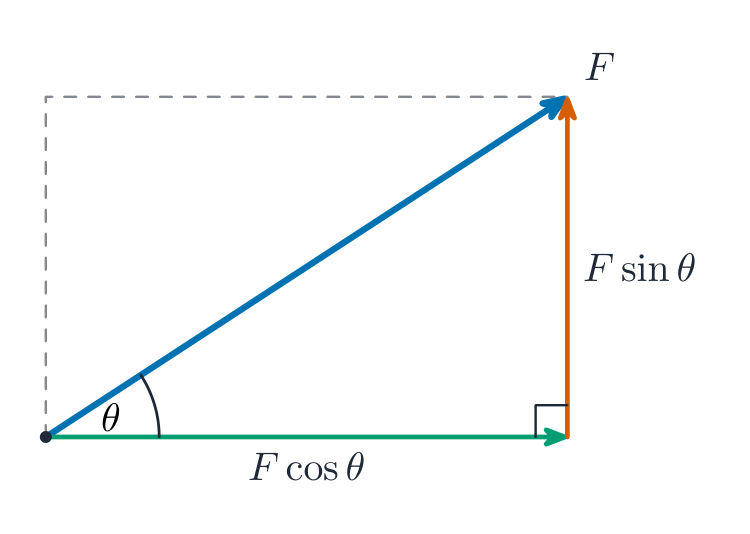
understand the vector nature of force, and find and use components and resultants
Calculations are always required, not approximate solutions by scale drawing.
use the principle that, when a particle is in equilibrium, the vector sum of the forces acting is zero, or equivalently, that the sum of the components in any direction is zero
Solutions by resolving are usually expected, but equivalent methods (e.g. triangle of forces, Lami's Theorem, where suitable) are also acceptable; these other methods are not required knowledge, and will not be referred to in questions.
understand that a contact force between two surfaces can be represented by two components, the normal component and the frictional component
use the model of a 'smooth' contact, and understand the limitations of this model
understand the concepts of limiting friction and limiting equilibrium, recall the definition of coefficient of friction, and use the relationship $F = \mu R$ or $F \leqslant \mu R$, as appropriate
Terminology such as 'about to slip' may be used to mean 'in limiting equilibrium' in questions.
use Newton's third law.
e.g. the force exerted by a particle on the ground is equal and opposite to the force exerted by the ground on the particle.
العربية
يجب أن يكون المرشحون قادرين على:
ملاحظات وأمثلة
تحديد القوى المؤثرة في موقف معطى
مثال: برسم مخطط للقوى.
فهم الطبيعة المتجهية للقوة، وإيجاد مركباتها ومحصلة القوة واستخدامها
الحسابات مطلوبة دائمًا، وليس الحلول التقريبية عن طريق الرسم المقياسي.
استخدام مبدأ أن المجموع المتجهي للقوى المؤثرة على جسيم في حالة اتزان يساوي صفرًا، أو ما يكافئ ذلك من أن مجموع المركبات في أي اتجاه يساوي صفرًا
عادةً ما يُتوقع الحل عن طريق تحليل القوى، ولكن الطرق المكافئة (مثل مثلث القوى، وقانون لامي، عند ملاءمتها) مقبولة أيضًا؛ هذه الطرق الأخرى ليست معرفة مطلوبة، ولن يتم الإشارة إليها في الأسئلة.
فهم أن قوة التلامس بين سطحين يمكن تمثيلها بمركبتين: المركبة العمودية والمركبة الاحتكاكية
استخدام نموذج "التلامس الناعم" وفهم حدود هذا النموذج
فهم مفاهيم الاحتكاك الحرج والاتزان الحرج، وتذكر تعريف معامل الاحتكاك، واستخدام العلاقة $F = \mu R$ أو $F \leqslant \mu R$، حسب المناسبة
قد تُستخدم مصطلحات مثل "على وشك الانزلاق" لتعني "في حالة الاتزان الحرج" في الأسئلة.
استخدام قانون نيوتن الثالث.
مثال: القوة التي يؤثر بها جسيم على الأرض تساوي وتعاكس القوة التي تؤثر بها الأرض على الجسيم.
Source: Cambridge International syllabus · المصدر: منهج كامبريدج الدولي
English
A force 力 is a push or a pull. It is a vector, so it has size and direction. Because it is a vector, you can split a force into components 分量 (usually horizontal and vertical), and you can add several forces into one resultant 合力.
A particle is in equilibrium 平衡 when the forces are balanced: the vector sum of the forces is zero. In practice this means the components in any direction add to zero.
Friction
When two surfaces touch, the contact force 接触力 between them has two parts: the normal reaction 法向反作用力$R$, at right angles to the surface, and the friction 摩擦力$F$, along the surface, which opposes sliding. A "smooth" surface is a model with no friction.
Friction can only grow up to a maximum. At that maximum the body is in limiting equilibrium 极限平衡, about to slip, and the friction is limiting friction 最大静摩擦力. The maximum is set by the coefficient of friction 摩擦系数$\mu$:
$$F \leqslant \mu R, \qquad \text{with } F = \mu R \text{ at the point of slipping}.$$
By Newton's third law 牛顿第三定律, the two surfaces push on each other with equal and opposite forces.
Worked example. A block of weight $20\text{ N}$ rests on a rough horizontal table with coefficient of friction $\mu = 0.4$. Find the largest horizontal force that can be applied before the block slides.
The table's normal reaction balances the weight, so $R = 20\text{ N}$. The block is on the point of slipping when friction reaches its maximum $F = \mu R = 0.4 \times 20 = 8\text{ N}$. In equilibrium the applied force equals the friction, so the largest force it can resist is $8\text{ N}$.
العربية
القوة هي دفع أو سحب. وهي متغير،所以她 لها حجم واتجاه. وبما أنها متغير، يمكنك تقسيم القوة إلى مكونات (عادة أفقية وعمودية)، وجمع عدة قوى في قوة محصلة واحدة.
قوة بزاوية $\theta$ لها جزء أفقي $F\cos\theta$ وجزء عمودي $F\sin\theta$.
الجسيم يكون في توازن عندما تكون القوى متوازنة: المجموع المتغيري للقوى يساوي صفراً. عملياً، هذا يعني أن المكونات في أي اتجاه تجمع لتصبح صفراً.
كل مسألة في الميكانيكا تشبه هذه الصورة. تؤثر ثلاث قوى على المتسلق — الوزن لأسفل مباشرة، والشد عبر الحبل، ودفع من الصخرة — وبسبب توازنها يعلق المتسلق ساكناً في حالة اتزان. بتحليل كل قوة إلى مركبات أفقية وعمودية تتحول الصورة إلى معادلات
الاحتكاك
عند تلامس سطحين، يكون القوة التلامسية بينهما مكونة من جزأين: رد الفعل العمودي$R$، وهو عمودي على السطح، والاحتكاك$F$، وهو موازٍ للسطح ويمنع الانزلاق. السطح "الملساء" هو نموذج خالٍ تماماً من الاحتكاك.
لا يمكن أن يتجاوز الاحتكاك قيمة حدية معينة. عند هذه القيمة القصوى يكون الجسم في اتزان حرج، وشبه مستعد للانزلاق، ويكون الاحتكاك حينها احتكاكاً حرجاً. يُحدد هذا الحد الأقصى بواسطة معامل الاحتكاك$\mu$:
$$F \leqslant \mu R, \qquad \text{with } F = \mu R \text{ at the point of slipping}.$$
على سطح خشن، تنقسم قوة التلامس إلى رد الفعل العمودي $R$ والاحتكاك $F$ (أقصى قدر له $\mu R$).
وفقاً لـ قانون نيوتن الثالث، يتنافر السطحان بقوتين متساويتين ومتعاكستين في الاتجاه.
مثال محلل. صندوق وزنه $20\text{ N}$ مستقر على طاولة أفقية خشنة بمعامل احتكاك $\mu = 0.4$. أوجد أكبر قوة أفقية يمكن تطبيقها قبل أن ينزلق الصندوق.
رد الفعل العمودي للطاولة يوازن الوزن، لذا $R = 20\text{ N}$. تكون الكتلة على وشك الانزلاق عندما يصل الاحتكاك إلى قيمته القصوى $F = \mu R = 0.4 \times 20 = 8\text{ N}$. في حالة الاتزان يساى القوة المطبقة الاحتكاك، لذا فإن أكبر قوة يمكنها مقاومتها هي $8\text{ N}$.
Explore · استكشف
Adding forces · جمع القوى
resultant = a + b · القوة المحصلة = a + b
Forces add tip-to-tail. They are in equilibrium when the resultant is zero. · تُجمع القوى رأسًا بذيل. تكون في توازن عندما تكون القوة المحصلة صفرًا.
Kinematics of motion in a straight line · حركة الجسيم في خط مستقيم
Syllabus · المنهج
English
Candidates should be able to:
Notes and examples
understand the concepts of distance and speed as scalar quantities, and of displacement, velocity and acceleration as vector quantities
Restricted to motion in one dimension only. The term 'deceleration' may sometimes be used in the context of decreasing speed.
sketch and interpret displacement–time graphs and velocity–time graphs, and in particular appreciate that – the area under a velocity–time graph represents displacement, – the gradient of a displacement–time graph represents velocity, – the gradient of a velocity–time graph represents acceleration
use differentiation and integration with respect to time to solve simple problems concerning displacement, velocity and acceleration
Calculus required is restricted to techniques from the content for Paper 1: Pure Mathematics 1.
use appropriate formulae for motion with constant acceleration in a straight line.
Questions may involve setting up more than one equation, using information about the motion of different particles.
مقيد بالحركة في بُعد واحد فقط. قد يُستخدم مصطلح "التباطؤ" أحيانًا في سياق انخفاض السرعة.
رسم وتفسير رسوم الإزاحة–الزمن ورسوم السرعة–الزمن، وتحديداً إدراك أن – المساحة تحت منحنى السرعة–الزمن تمثل الإزاحة، – ميل منحنى الإزاحة–الزمن يمثل السرعة، – ميل منحنى السرعة–الزمن يمثل التسارع
استخدام الاشتقاق والتكامل بالنسبة للزمن لحل مسائل بسيطة تتعلق بالإزاحة والسرعة والتسارع
يقتصر التفاضل والتكامل المطلوب على التقنيات الواردة في محتوى ورقة 1: الرياضيات البحتة 1.
استخدام الصيغ المناسبة للحركة ذات التسارع الثابت في خط مستقيم.
قد تتضمن الأسئلة إعداد أكثر من معادلة، باستخدام معلومات حول حركة جسيمات مختلفة.
Source: Cambridge International syllabus · المصدر: منهج كامبريدج الدولي
English
Distance 距离 and speed 速率 are scalars (size only). Displacement 位移, velocity 速度 and acceleration 加速度 are vectors (size and direction).
On a velocity-time graph 速度时间图, the area under the graph is the displacement and the gradient is the acceleration (a negative acceleration is a deceleration 减速度). On a displacement-time graph, the gradient is the velocity. More generally, differentiate with respect to time to go from displacement to velocity to acceleration, and integrate to go back.
For motion with constant acceleration 匀加速, use these formulae (the "suvat" equations):
$$v = u + at, \qquad s = ut + \tfrac12 at^2, \qquad v^2 = u^2 + 2as, \qquad s = \tfrac12(u + v)t.$$
Worked example. A car starts from rest and accelerates at $2.5\ \text{m s}^{-2}$ for $4\ \text{s}$. Find its speed and the distance travelled.
المسافة والسرعة كميات قياسية (يتميزان بالمقدار فقط). أما الإزاحة والسرعة العينية والتسارع فهي كميات متجهة (تتميز بالمقدار والاتجاه).
في الرسم البياني للسرعة-الزمن، المساحة تحت المنحنى تمثل الإزاحة والميل يمثل التسارع (والتسارع السالب هو تباطؤ). وفي الرسم البياني للإزاحة-الزمن، الميل يمثل السرعة. بشكل عام، اشتق بالنسبة للزمن للانتقال من الإزاحة إلى السرعة ثم التسارع، وأعد التكامل للعودة إلى الخلف.
المساحة المظللة تعطي المسقط الأفقي المقطوع؛ وميل الخط يعطي التسارع.
للحركة ذات التسارع الثابت، استخدم هذه القوانين (معادلات "suvat"):
$$v = u + at, \qquad s = ut + \tfrac12 at^2, \qquad v^2 = u^2 + 2as, \qquad s = \tfrac12(u + v)t.$$
مثال محلل. سيارة تبدأ من السكون وتتسارع بمقدار $2.5\ \text{m s}^{-2}$ لمدة $4\ \text{s}$. أوجد سرعتها والمسقط الأفقي المقطوع.
Change the start velocity and acceleration. The gradient is the acceleration; the area under the line is the displacement. · غيّر السرعة الابتدائية والتسارع. الانحدار هو التسارع؛ والمساحة تحت الخط هي الإزاحة.
use the definition of linear momentum and show understanding of its vector nature
For motion in one dimension only.
use conservation of linear momentum to solve problems that may be modelled as the direct impact of two bodies.
Including direct impact of two bodies where the bodies coalesce on impact. Knowledge of impulse and the coefficient of restitution is not required.
العربية
يجب أن يكون المرشحون قادرين على:
ملاحظات وأمثلة
استخدام تعريف الزخم الخطي وإظهار الفهم لطبيعته المتجهية
للحركة في بُعد واحد فقط.
استخدام حفظ الزخم الخطي لحل المسائل التي يمكن نمذجة تأثيرها المباشر لجسمين.
بما في ذلك التأثير المباشر لجسمين حيث يلتحم الجسمان عند الاصطدام. لا يُشترط معرفة الدفع ومعامل الاسترداد.
Source: Cambridge International syllabus · المصدر: منهج كامبريدج الدولي
English
The linear momentum 动量 of a body is $\text{mass} \times \text{velocity}$. It is a vector. In a direct collision of two bodies, the total momentum is unchanged. This is the conservation of linear momentum 动量守恒:
$$m_1 u_1 + m_2 u_2 = m_1 v_1 + m_2 v_2.$$
Worked example. A body of mass $2\ \text{kg}$ moving at $3\ \text{m s}^{-1}$ hits a stationary body of mass $1\ \text{kg}$, and they stick together. Find their common speed afterwards.
زخم الجسم الخطي هو $\text{mass} \times \text{velocity}$. وهو كمية متجهة. في تصادم مباشر بين جسمين، يبقى الزخم الكلي دون تغيير. هذا هو حفظ الزخم الخطي:
$$m_1 u_1 + m_2 u_2 = m_1 v_1 + m_2 v_2.$$
يبقى مجموع العزوم ثابتاً قبل وبعد الاصطدام.
مثال محلل. جسم كتلته $2\ \text{kg}$ يتحرك بسرعة $3\ \text{m s}^{-1}$ يصطدم بجسم ساكن كتلته $1\ \text{kg}$، ويلتصقان ببعضهما. أوجد السرعة المشتركة لهما بعد ذلك.
Set each mass and speed and collide them. Total momentum stays the same before and after. · ضبط كتلة وسرعة كل جسم وتصادمهما. كمية التحرك الكلية تبقى كما هي قبل وبعد التصادم.
conservation of momentum/ˌkɒnsəˈveɪʃn ɒv məʊˈmentəm/
حفظ الزخم
Newton's laws of motion/ˈnjuːtnz lɔːz ɒv ˈməʊʃn/
قوانين نيوتن للحركة
mass/mæs/
الكتلة
weight/weɪt/
الوزن
tension/ˈtenʃn/
قوة الشد
4.4
Newton's laws of motion · قوانين نيوتن للحركة
Syllabus · المنهج
English
Candidates should be able to:
Notes and examples
• apply Newton’s laws of motion to the linear motion of a particle of constant mass moving under the action of constant forces, which may include friction, tension in an inextensible string and thrust in a connecting rod
If any other forces resisting motion are to be considered (e.g. air resistance) this will be indicated in the question.
• use the relationship between mass and weight
$W = mg$. In this component, questions are mainly numerical, and use of the approximate numerical value $10\text{ (ms}^{-2}\text{)}$ for $g$ is expected.
• solve simple problems which may be modelled as the motion of a particle moving vertically or on an inclined plane with constant acceleration
Including, for example, motion of a particle on a rough plane where the acceleration while moving up the plane is different from the acceleration while moving down the plane.
• solve simple problems which may be modelled as the motion of connected particles.
e.g. particles connected by a light inextensible string passing over a smooth pulley, or a car towing a trailer by means of either a light rope or a light rigid tow-bar.
العربية
يجب أن يكون المرشحون قادرين على:
ملاحظات وأمثلة
• تطبيق قوانين نيوتن للحركة على الحركة الخطية لجسيم كتلته ثابتة يتحرك تحت تأثير قوى ثابتة، والتي قد تشمل الاحتكاك وشد خيط غير قابل للتمدد والدفع في قضيب توصيل
إذا كانت هناك قوى أخرى تعيق الحركة يجب اعتبارها (مثل مقاومة الهواء) فسيتم ذلك الإشارة إليه في السؤال.
• استخدام العلاقة بين الكتلة والوزن
$W = mg$. في هذا الجزء، تكون الأسئلة عددية بشكل رئيسي، ويُتوقع استخدام القيمة العددية التقريبية $10\text{ (ms}^{-2}\text{)}$ لـ $g$.
• حل مسائل بسيطة يمكن نمذتها بحركة جسيم يتحرك عموديًا أو على مستوى مائل بتسارع ثابت
بما في ذلك، على سبيل المثال، حركة جسيم على مستوى خشن حيث يكون التسارع أثناء الحركة صعودًا مختلفًا عن التسارع أثناء الحركة نزولًا.
• حل مسائل بسيطة يمكن نمذتها بحركة جسيمات متصلة.
مثال: جسيمات متصلة بخيط خفيف غير قابل للتمدد يمر فوق بكرة ناعمة، أو سيارة تسحب عربة عن طريق حبل خفيف أو قضيب سحب خفيف وصلب.
Source: Cambridge International syllabus · المصدر: منهج كامبريدج الدولي
English
Newton's laws of motion 牛顿运动定律 connect force and acceleration. The key one is: resultant force $=$mass 质量$\times$ acceleration,
$$F = ma.$$
The weight 重力 of a body is the force of gravity on it: $W = mg$. Forces in a problem may include weight, friction, tension 张力 in a string, the thrust 推力 (push) in a rod, and air resistance 空气阻力.
For motion on an inclined plane 斜面, split each force into a part along the slope and a part at right angles to it, then apply $F = ma$ along the slope. For connected particles 连接质点 (joined by a string), apply $F = ma$ to each body, or to the whole system.
Worked example. A block of mass $12\ \text{kg}$ is pulled up a rough plane by a rope parallel to the slope. The plane is at $20^\circ$ to the horizontal, the coefficient of friction is $0.4$, and the acceleration is $2\ \text{m s}^{-2}$. Find the tension in the rope.
The normal reaction is $R = mg\cos 20^\circ = 120\cos 20^\circ = 112.8\ \text{N}$, so the friction is $F = \mu R = 0.4 \times 112.8 = 45.1\ \text{N}$. Along the slope, $T - mg\sin 20^\circ - F = ma$:
قوانين نيوتن للحركة تربط بين القوة والتسارع. أهمها: محصلة القوى $=$الكتلة$\times$ التسارع،
$$F = ma.$$
وزن الجسم هو قوة الجاذبية المؤثرة عليه: $W = mg$. قد تشمل القوى في المسألة الوزن، والاحتكاك، والشد في الحبل، والدفع (الضغط) في القضيب، ومقاومة الهواء.
بالنسبة للحركة على مسار مائل، قم بتفكيك كل قوة إلى جزء موازٍ للمسار وجزء عمودي عليه، ثم طبق $F = ma$ الموازي للمسار. أما بالنسبة للأجسام المترابطة (الموصولة بحبل)، فطبق $F = ma$ على كل جسم، أو على النظام ككل.
على مسار مائل، قم بتفكيك القوى موازيةً للمسار وعموديةً عليه.
مثال محلول. تُسحب كتلة كتلتها $12\ \text{kg}$ لأعلى مستوى خشن بحبل موازٍ للمنحدر. يكون المستوى مائلاً بزاوية $20^\circ$ عن الأفقي، ومعامل الاحتكاك هو $0.4$، والتسارع هو $2\ \text{m s}^{-2}$. أوجد الشد في الحبل.
رد الفعل العمودي هو $R = mg\cos 20^\circ = 120\cos 20^\circ = 112.8\ \text{N}$، لذا فإن الاحتكاك هو $F = \mu R = 0.4 \times 112.8 = 45.1\ \text{N}$. على طول المنحدر، $T - mg\sin 20^\circ - F = ma$:
• understand the concept of the work done by a force, and calculate the work done by a constant force when its point of application undergoes a displacement not necessarily parallel to the force
$W = Fd \cos \theta$; Use of the scalar product is not required.
• understand the concepts of gravitational potential energy and kinetic energy, and use appropriate formulae
• understand and use the relationship between the change in energy of a system and the work done by the external forces, and use in appropriate cases the principle of conservation of energy
Including cases where the motion may not be linear (e.g. a child on a smooth curved ‘slide’), where only overall energy changes need to be considered.
• use the definition of power as the rate at which a force does work, and use the relationship between power, force and velocity for a force acting in the direction of motion
Including calculation of (average) power as
$$\frac{\text{Work done}}{\text{Time taken}}$$
$P = Fv$.
• solve problems involving, for example, the instantaneous acceleration of a car moving on a hill against a resistance.
العربية
يجب أن يكون المرشحون قادرين على:
ملاحظات وأمثلة
• فهم مفهوم الشغل المبذول بواسطة قوة، وحساب الشغل المبذول بواسطة قوة ثابتة عندما تخضع نقطة تطبيقها لإزاحة ليست بالضرورة موازية للقوة
$W = Fd \cos \theta$؛ لا يُشترط استخدام الجداء القياسي.
• فهم مفاهيم الطاقة الكامنة الجاذبية والطاقة الحركية، واستخدام الصيغ المناسبة
• فهم واستخدام العلاقة بين التغير في طاقة النظام والشغل المبذول بواسطة القوى الخارجية، واستخدام مبدأ حفظ الطاقة في الحالات المناسبة
بما في ذلك الحالات التي قد لا تكون فيها الحركة خطية (مثل طفل على منحدر منحنٍ أملس)، حيث يُنظر فقط إلى التغيرات الكلية في الطاقة.
• استخدام تعريف القدرة كمعدل بذل القوة للشغل، واستخدام العلاقة بين القدرة والقوة والسرعة لقوة تعمل في اتجاه الحركة
بما في ذلك حساب (المتوسط) القدرة كـ
$$\frac{\text{Work done}}{\text{Time taken}}$$
$P = Fv$.
• حل مسائل تتعلق، على سبيل المثال، بـالتسارع اللحظي لسيارة تتحرك على تلة ضد مقاومة.
Source: Cambridge International syllabus · المصدر: منهج كامبريدج الدولي
English
The work done 功 by a constant force is the scalar product of force and displacement — the force times the distance moved in the direction of the force: $W = Fd\cos\theta$, where $\theta$ is the angle between the force and the motion. Work is measured in joules (J).
Energy comes in forms you can calculate:
Kinetic energy 动能 (energy of movement): $\text{KE} = \tfrac12 mv^2$.
Gravitational potential energy 重力势能 (energy of height): $\text{PE} = mgh$.
The work done by the outside forces equals the change in the total energy. When no friction acts, the total energy stays the same — the conservation of energy 能量守恒.
Power 功率 is the rate of doing work. For a force pulling in the direction of motion, $P = Fv$ (power $=$ force $\times$ velocity). Power is measured in watts (W).
Worked example. A car engine works at $12\ \text{kW}$ while the car moves at $20\ \text{m s}^{-1}$ on a level road. Find the driving force.
تعوض عربة التسلق الطاقة الكامنة بالطاقة الحركية كلما صعدت ونزلت.
الشغل المبذول بواسطة قوة ثابتة هو الجداء السعري للقوة والإزاحة — أي مقدار القوة مضروباً في المسافة المقطوعة في اتجاه القوة: $W = Fd\cos\theta$، حيث $\theta$ هي الزاوية بين القوة واتجاه الحركة. يقاس الشغل بالوحدة جول (J).
تأتي الطاقة بأشكال قابلة للحساب:
الطاقة الحركية (طاقة الحركة): $\text{KE} = \tfrac12 mv^2$.
الطاقة الكامنة الثقالية (طاقة الارتفاع): $\text{PE} = mgh$.
الشغل المبذول بواسطة القوى الخارجية يساوي التغير في الطاقة الكلية. وعند عدم وجود احتكاك، تبقى الطاقة الكلية ثابتة — وهذا هو حفظ الطاقة.
القدرة هي معدل بذل الشغل. بالنسبة لقوة تسحب في اتجاه الحركة، $P = Fv$ (القدرة $=$ = القوة $\times$ × السرعة). تقاس القدرة بالوحدة واط (W).
مثال محلول. يعمل محرك سيارة بقوة $12\ \text{kW}$ بينما تتحرك السيارة بسرعة $20\ \text{m s}^{-1}$ على طريق مستوٍ. أوجد قوة الدفع.
Drop the object and watch energy change form. With no friction, GPE + KE stays constant the whole way down. · أفلق الجسم وراقب تحول الطاقة. بدون احتكاك، يبقى مجموع الط потенци + ط حرك ثابتاً طوال الهبوط.
4.5
Exam tips · نصائح للامتحان
English
Draw a clear force diagram and resolve into perpendicular components; for equilibrium, each direction sums to zero.
Use SUVAT only for constant acceleration and keep a consistent positive direction.
Apply $F = ma$ along the direction of motion, including friction ($F = \mu R$) on a rough surface.
State your assumptions (light inextensible string, smooth pulley, particle) — they are often worth a mark.
العربية
ارسم رسمة القوى بوضوح وقم بتفكيكها إلى مركبات متعامدة؛ ومن أجل الاتزان، يجب أن يكون مجموع القوى في كل اتجاه صفراً.
استخدم معادلات SUVAT فقط للتسارع الثابت واحافظ على اتجاه موجب موحد.
طبق $F = ma$ في اتجاه الحركة، بما في ذلك الاحتكاك ($F = \mu R$) على الأسطح الخشنة.
حدد افتراضاتك (حبل خفيف غير قابل للامتداد، بكرة ملساء، جسيم) — وغالباً ما تمنح هذه الافتراضات درجة.
This handout covers Topic 5: Probability & Statistics 概率统计 1. It is about describing data, counting choices, and working out the chance of events.
العربية
يغطي هذا الملف الموضوع 5: الاحتمالات والإحصاء 1. يتعلق بأوصاف البيانات، وحساب الخيارات، وحساب احتمال الأحداث.
5.1
Representation of data · تمثيل البيانات
Syllabus · المنهج
English
Candidates should be able to:
Notes and examples
• select a suitable way of presenting raw statistical data, and discuss advantages and/or disadvantages that particular representations may have
• draw and interpret stem-and-leaf diagrams, box-and-whisker plots, histograms and cumulative frequency graphs
Including back-to-back stem-and-leaf diagrams.
• understand and use different measures of central tendency (mean, median, mode) and variation (range, interquartile range, standard deviation)
e.g. in comparing and contrasting sets of data.
• use a cumulative frequency graph
e.g. to estimate medians, quartiles, percentiles, the proportion of a distribution above (or below) a given value, or between two values.
• calculate and use the mean and standard deviation of a set of data (including grouped data) either from the data itself or from given totals $\Sigma x$ and $\Sigma x^2$, or coded totals $\Sigma(x - a)$ and $\Sigma(x - a)^2$, and use such totals in solving problems which may involve up to two data sets.
العربية
يجب أن يكون المرشحون قادرين على:
ملاحظات وأمثلة
• اختيار طريقة مناسبة لعرض البيانات الإحصائية الخام، ومناقشة مزايا و/أو عيوب التمثيلات المحددة
فهم واستخدام مقاييس مختلفة لـالمركز (المتوسط، الوسيط، المنوال) والتباين (النطاق، المدى الربيعي، الانحراف المعياري)
مثال: في المقارنة والمفاضلة بين مجموعات البيانات.
• استخدام مخطط التكرار التراكمي
مثلًا لتقدير الوسيط، الربيعيات، النسب المئوية، أو نسبة التوزيع التي تقع فوق (أو تحت) قيمة معينة، أو بين قيمتين.
• حساب واستخدام المتوسط الحسابي والانحراف المعياري لمجموعة من البيانات (بما في ذلك البيانات المبوبة) إما من البيانات نفسها أو من المجاميع المعطاة $\Sigma x$ و$\Sigma x^2$، أو مجاميع مُرمَّزة $\Sigma(x - a)$ و$\Sigma(x - a)^2$، واستخدام هذه المجاميم في حل المسائل التي قد تتضمن ما يصل إلى مجموعتي بيانات.
Source: Cambridge International syllabus · المصدر: منهج كامبريدج الدولي
English
Choose a diagram that suits the data. You should be able to draw and read:
a stem-and-leaf diagram 茎叶图 (keeps the original values and shows the shape); two data sets are compared with a back-to-back 背靠背 version – a shared central stem, one set's leaves increasing to the left and the other's to the right, so you can compare their medians and spreads at a glance;
a box-and-whisker plot 箱线图 (shows the lowest value, the three quartiles, and the highest value);
a histogram 直方图 (for grouped data, where the area of each bar shows the frequency);
a cumulative frequency 累积频数 graph (running totals, used to estimate the median and quartiles).
Averages and spread
A measure of central tendency 集中趋势 is a single "middle" value:
the mean 平均数$\bar{x} = \dfrac{\sum x}{n}$ (the average);
the median 中位数 (the middle value when the data is in order);
the mode 众数 (the most common value).
A measure of variation 离散程度 shows how spread out the data is:
the range (of data) 极差 (highest $-$ lowest);
the interquartile range 四分位距 (upper quartile $-$ lower quartile);
the standard deviation 标准差$\sigma = \sqrt{\dfrac{\sum x^2}{n} - \bar{x}^2}$.
You often work from the totals $\sum x$ and $\sum x^2$. The square of the standard deviation is the variance 方差.
Worked example. For $10$ values, $\sum x = 50$ and $\sum x^2 = 300$. Find the mean and standard deviation.
Coding 编码 makes big numbers easier. Replace each value by $t=x-a$ for a convenient assumed mean 假定平均数$a$. Then $\bar{x}=a+\bar{t}$, while the standard deviation is unchanged (shifting every value does not spread the data). So from the coded totals $\sum(x-a)$ and $\sum(x-a)^2$ you get $\bar x$ and $\sigma$ directly, and two data sets can be compared through their coded totals.
العربية
اختر مخططاً يناسب البيانات. يجب أن تكون قادراً على رسم وقراءة:
مخطط الجذع والورقة (يحافظ على القيم الأصلية ويظهر الشكل)؛ يتم مقارنة مجموعتين من البيانات باستخدام نسخة متقابلة – جذر مركزي مشترك، تتزايد أوراق مجموعة إلى اليسار وأوراق الأخرى إلى اليمين، مما يسمح بمقارنة وسطيها وتشتتهما بلمحة واحدة؛
منحنى التكرار المتراكم على شكل S؛ اقرأ الوسيط أفقياً من نصف التكرار الكلي، والأرباع من الربع الأول والثلاثة أرباعيمتد الصندوق عبر الأرباع $Q_1$ إلى $Q_3$؛ تمتد الوسائد إلى أدنى وأعلى قيمة.
المتوسطات والتشتت
مقياس النزوع المركزي هو قيمة "وسط" واحدة:
المتوسط الحسابي$\bar{x} = \dfrac{\sum x}{n}$ (المتوسط)؛
التشفير يجعل الأعداد الكبيرة أسهل. استبدل كل قيمة بـ $t=x-a$ لمتوسط مفترض مريح $a$. ثم $\bar{x}=a+\bar{t}$، بينما يبقى الانحراف المعياري غير متغير (إزاحة كل قيمة لا تباعد البيانات). لذا من مجاميع الشفرة $\sum(x-a)$ و$\sum(x-a)^2$ تحصل مباشرة على $\bar x$ و$\sigma$، ويمكن مقارنة مجموعتين من البيانات من خلال مجاميع الشفرة الخاصة بهما.
Explore · استكشف
Spread and the bell · التشتت ومنحنى الجرس
P(−k < Z < k)
Spread is measured in standard deviations — about 68% of data lies within 1 sd, 95% within 2. · التشتت يُقاس بـ انحرافات معيارية — حوالي 68% من البيانات تقع ضمن 1 انحراف معياري، و95% ضمن 2.
measure of central tendency/ˈmeʒə ɒv ˈsentrəl ˈtendənsi/
مقياس النزعة المركزية
mean/miːn/
متوسط
median/ˈmiːdiːən/
الوسيط
mode/məʊd/
المنوال
variation/ˌveərɪˈeɪʃn/
التنوع
5.2
Permutations and combinations · التباديل والتوافيق
Syllabus · المنهج
English
Candidates should be able to:
Notes and examples
• understand the terms permutation and combination, and solve simple problems involving selections
• solve problems about arrangements of objects in a line, including those involving – repetition (e.g. the number of ways of arranging the letters of the word ‘NEEDLESS’) – restriction (e.g. the number of ways several people can stand in a line if two particular people must, or must not, stand next to each other).
Questions may include cases such as people sitting in two (or more) rows. Questions about objects arranged in a circle will not be included.
العربية
يجب أن يكون المرشحون قادرين على:
ملاحظات وأمثلة
• فهم مصطلحي التبديل والتوافق، وحل المسائل البسيطة المتعلقة بالاختيارات
• حل مسائل حول ترتيبات الأجسام في خط مستقيم، بما في ذلك تلك التي涉及到 – التكرار (مثل عدد طرق ترتيب حروف كلمة 'NEEDLESS') – القيد (مثل عدد طرق وقوف مجموعة من الأشخاص في صف إذا كان يجب على شخصين معينين الوقوف بجانب بعضهما البعض، أو لا يجب).
قد تتضمن الأسئلة حالات مثل جلوس الأشخاص في صفين (أو أكثر). لن تُدرج أسئلة حول ترتيب الأجسام في دائرة.
Source: Cambridge International syllabus · المصدر: منهج كامبريدج الدولي
English
A permutation 排列 is an arrangement where order matters; a combination 组合 is a selection where order does not matter. The numbers are
evaluate probabilities in simple cases by means of enumeration of equiprobable elementary events, or by calculation using permutations or combinations
e.g. the total score when two fair dice are thrown. e.g. drawing balls at random from a bag containing balls of different colours.
use addition and multiplication of probabilities, as appropriate, in simple cases
Explicit use of the general formula $\text{P}(A \cup B) = \text{P}(A) + \text{P}(B) - \text{P}(A \cap B)$ is not required.
understand the meaning of exclusive and independent events, including determination of whether events $A$ and $B$ are independent by comparing the values of $\text{P}(A \cap B)$ and $\text{P}(A) \times \text{P}(B)$
calculate and use conditional probabilities in simple cases.
e.g. situations that can be represented by a sample space of equiprobable elementary events, or a tree diagram. The use of $\text{P}(A|B) = \frac{\text{P}(A \cap B)}{\text{P}(B)}$ may be required in simple cases.
العربية
يجب أن يكون المرشحون قادرين على:
ملاحظات وأمثلة
تقييم الاحتمالات في الحالات البسيطة عن طريق تعداد الأحداث الأولية المتساوية الاحتمال، أو بالحساب باستخدام التباديل أو التوافيق
مثال: المجموع الكلي عند رمي حجرين نرد عاديين. مثال: سحب كرات عشوائيًا من كيس يحتوي على كرات بألوان مختلفة.
استخدام جمع وضرب الاحتمالات، حسب الحاجة، في الحالات البسيطة
لا يُشترط الاستخدام الصريح للصيغة العامة $\text{P}(A \cup B) = \text{P}(A) + \text{P}(B) - \text{P}(A \cap B)$.
فهم معنى الأحداث المنفصلة والأحداث المستقلة، بما في ذلك تحديد ما إذا كانتا $A$ و$B$ مستقلتين عن طريق مقارنة قيمتي $\text{P}(A \cap B)$ و$\text{P}(A) \times \text{P}(B)$
حساب واستخدام الاحتمالات الشرطية في الحالات البسيطة.
مثال: المواقف التي يمكن تمثيلها بمجال عينة لأحداث أولية متساوية الاحتمال، أو بمخطط شجري. قد يكون استخدام $\text{P}(A|B) = \frac{\text{P}(A \cap B)}{\text{P}(B)}$ مطلوبًا في الحالات البسيطة.
Source: Cambridge International syllabus · المصدر: منهج كامبريدج الدولي
English
Find a probability by counting equally likely outcomes, or by using permutations and combinations. Combine probabilities with these rules:
addition for "or": $P(A \cup B) = P(A) + P(B) - P(A \cap B)$;
multiplication for "and" when events are independent: $P(A \cap B) = P(A)\,P(B)$.
Two events are mutually exclusive events 互斥事件 if they cannot both happen, and independent events 独立事件 if one happening does not change the chance of the other. To test independence, check whether $P(A \cap B) = P(A)\times P(B)$. A conditional probability 条件概率 is the chance of $A$ given that $B$ has happened: $P(A \mid B) = \dfrac{P(A \cap B)}{P(B)}$.
Worked example. Events have $P(A) = 0.5$, $P(B) = 0.4$ and $P(A \cap B) = 0.2$. Are $A$ and $B$ independent?
Test: $P(A)\times P(B) = 0.5 \times 0.4 = 0.2 = P(A \cap B)$. The values are equal, so $A$ and $B$ are independent.
العربية
العصي: نقطة بداية مألوفة للاحتمالات.
أوجد احتمالاً بعدد النتائج المتساوية الاحتمال، أو باستخدام التباديل والتوافيق. اجمع الاحتمالات بهذه القواعد:
الجمع لـ "أو": $P(A \cup B) = P(A) + P(B) - P(A \cap B)$;
الضرب لـ "و" عندما تكون الأحداث مستقلة: $P(A \cap B) = P(A)\,P(B)$.
تقاطع الدائرتين هو $A\cap B$؛ قاعدة الجمع تطرحه مرة واحدة حتى لا يُحسب مرتين.
حدثان هما أحداث متنافية إذا لم يستطع كلاهما الحدوث، وأحداث مستقلة إذا لم يغير حدوث أحدها احتمال الآخر. لاختبار الاستقلالية، تحقق مما إذا كان $P(A \cap B) = P(A)\times P(B)$. الاحتمال الشرطي هو احتمال $A$ بشرط أن $B$ قد حدث: $P(A \mid B) = \dfrac{P(A \cap B)}{P(B)}$.
مثال محلول. الأحداث لها $P(A) = 0.5$، $P(B) = 0.4$ و$P(A \cap B) = 0.2$. هل $A$ و$B$ مستقلان؟
Change the probabilities and read the tree. This is how P(A and B) and conditional probability fit together. · غيّر الاحتمالات واقرأ الشجرة. هكذا تكمل P(A و B) والاحتمال الشرطي بعضهما البعض.
Discrete random variables · المتغيرات العشوائية المنفصلة
Syllabus · المنهج
English
Candidates should be able to:
Notes and examples
draw up a probability distribution table relating to a given situation involving a discrete random variable$X$, and calculate $\text{E}(X)$ and $\text{Var}(X)$
use formulae for probabilities for the binomial and geometric distributions, and recognise practical situations where these distributions are suitable models
Including the notations $\text{B}(n, p)$ and $\text{Geo}(p)$. $\text{Geo}(p)$ denotes the distribution in which $p_r = p(1 - p)^{r-1}$ for $r = 1, 2, 3, \dots$.
use formulae for the expectation and variance of the binomial distribution and for the expectation of the geometric distribution.
Proofs of formulae are not required.
العربية
يجب أن يكون المرشحون قادرين على:
ملاحظات وأمثلة
إعداد جدول توزيع احتمالي يتعلق بموقف معين يتضمن متغيرًا عشوائيًا متقطعًا$X$، وحساب $\text{E}(X)$ و$\text{Var}(X)$
استخدام صيغ الاحتمالات لتوزيعات ثنائية الحد وهندسية، والتعرف على المواقف العملية التي تكون فيها هذه التوزيعات نماذج مناسبة
بما في ذلك الرموز $\text{B}(n, p)$ و$\text{Geo}(p)$. يرمز $\text{Geo}(p)$ للتوزيع الذي يكون فيه $p_r = p(1 - p)^{r-1}$ لـ $r = 1, 2, 3, \dots$.
استخدام صيغ القيمة المتوقعة والتباين لتوزيع ثنائي الحد وصيغة القيمة المتوقعة للتوزيع الهندسي.
لا يُشترط إثبات الصيغ.
Source: Cambridge International syllabus · المصدر: منهج كامبريدج الدولي
English
A discrete random variable 离散型随机变量$X$ takes separate values, each with a probability. List them in a probability distribution table 概率分布表; the probabilities must add to $1$. Then the expectation 期望 (mean) and variance are
the binomial distribution 二项分布$X \sim B(n, p)$, for the number of successes in $n$ independent trials: $P(X = r) = \binom{n}{r}p^r(1-p)^{n-r}$, with $E(X) = np$ and $\mathrm{Var}(X) = np(1-p)$;
the geometric distribution 几何分布, for the trial on which the first success happens: $P(X = r) = (1-p)^{r-1}p$, with $E(X) = \dfrac{1}{p}$.
Worked example.$X \sim B(10, 0.3)$. Find $P(X = 2)$ and $E(X)$.
المتغير العشوائي المنفصل$X$ يأخذ قيماً منفصلة، لكل منها احتمال. عدها في جدول توزيع احتمالي؛ يجب أن تضاف الاحتمالات إلى $1$. بعد ذلك يكون التوقع (المتوسط) والتباين هما
التوزيع $B(10,0.3)$: كل عمود هو $P(X=r)$، متجمع حول المتوسط $np=3$.
Explore · استكشف
A discrete distribution · توزيع منفصل
Change n and p for a binomial distribution and watch the bars — the probability of each number of successes. · غيّر n وp لتوزيع ذو الحدين وراقب الأعمدة — احتمال كل عدد من النجاحات.
understand the use of a normal distribution to model a continuous random variable, and use normal distribution tables
Sketches of normal curves to illustrate distributions or probabilities may be required.
solve problems concerning a variable $X$, where $X \sim N(\mu, \sigma^2)$, including: – finding the value of $P(X > x_1)$, or a related probability, given the values of $x_1$, $\mu$, $\sigma$. – finding a relationship between $x_1$, $\mu$ and $\sigma$ given the value of $P(X > x_1)$ or a related probability
For calculations involving standardisation, full details of the working should be shown. e.g. $Z = \frac{(X - \mu)}{\sigma}$
recall conditions under which the normal distribution can be used as an approximation to the binomial distribution, and use this approximation, with a continuity correction, in solving problems.
$n$ sufficiently large to ensure that both $np > 5$ and $nq > 5$.
العربية
يجب أن يكون المرشحون قادرين على:
ملاحظات وأمثلة
فهم استخدام التوزيع الطبيعي لنموذج متغير عشوائي مستمر، واستخدام جداول التوزيع الطبيعي
قد يُطلب رسم منحنيات طبيعية توضيحية للتوزيعات أو الاحتمالات.
حل مسائل تتعلق بمتغير $X$، حيث $X \sim N(\mu, \sigma^2)$، بما في ذلك: – إيجاد قيمة $P(X > x_1)$، أو احتمالًا=requestًا، بناءً على قيم $x_1$، $\mu$، $\sigma$. – إيجاد علاقة بين $x_1$، $\mu$ و$\sigma$ بناءً على قيمة $P(X > x_1)$ أو احتمال=request.
لحسابات تتضمن المعايرة (التحويل إلى القيم القياسية)، يجب عرض تفاصيل الحل كاملة. مثال: $Z = \frac{(X - \mu)}{\sigma}$
استرجاع الشروط التي يمكن فيها استخدام التوزيع الطبيعي كـتقريب لـالتوزيع الثنائي، واستخدام هذا التقريب، مع تصحيح الاستمرارية، في حل المسائل.
$n$ كبيرة بما يكفي لضمان أن كل من $np > 5$ و $nq > 5$.
Source: Cambridge International syllabus · المصدر: منهج كامبريدج الدولي
English
The 68-95-99.7 rule
The normal distribution 正态分布 models a continuous random variable 连续型随机变量 with a symmetric bell shape. Write $X \sim N(\mu, \sigma^2)$, where $\mu$ is the mean and $\sigma$ is the standard deviation. To use the tables, by standardisation 标准化 convert to the variable $Z \sim N(0, 1)$:
$$Z = \frac{X - \mu}{\sigma}.$$
Then $P(X < x) = P\!\left(Z < \dfrac{x - \mu}{\sigma}\right)$, which you read from the normal table $\Phi$.
The normal distribution is also a good approximation 近似 to the binomial when $n$ is large. Because you replace a discrete variable by a continuous one, apply a continuity correction 连续性校正 (adjust by $0.5$).
Worked example. Bags of rice have mass $X \sim N(\mu, 0.14^2)$. Given that $P(X < 1.48) = 0.22$, find $\mu$.
From the table, $P(Z < z) = 0.22$ gives $z = -0.772$. So
قاعدة 68-95-99.7لوحة غالتون: كرات تسقط عبر دبابيس وتتكدس لتشكل التوزيع الطبيعي على شكل جرس.
يُمثل التوزيع الطبيعيمتغيراً عشوائياً متصلاً بشكل جرسي متماثل. اكتب $X \sim N(\mu, \sigma^2)$، حيث $\mu$ هو المتوسط و$\sigma$ هو الانحراف المعياري. لاستخدام الجداول، عن طريق التقييس حوّله إلى المتغير $Z \sim N(0, 1)$:
$$Z = \frac{X - \mu}{\sigma}.$$
بعد ذلك $P(X < x) = P\!\left(Z < \dfrac{x - \mu}{\sigma}\right)$، والذي يمكنك قراءته من جدول التوزيع الطبيعي $\Phi$.
الاحتمال الطبيعي هو مساحة تحت المنحنى الجرسي؛ التقييع يعيد مقياسه إلى $Z\sim N(0,1)$.
التوزيع الطبيعي هو أيضًا تقريب جيد للتوزيع الثنائي عندما $n$ كبير. نظرًا لأنك تحل محل متغير منفصل بمتغير مستمر، تطبق تصحيح استمرارية (تعديل بمقدار $0.5$).
عندما يكون $n$ كبيرًا، تتبع أعمدة التوزيع الثنائي منحنياً طبيعياً بنفس المتوسط وتباين.
مثال محلول. أكياس الأرز كتلتها $X \sim N(\mu, 0.14^2)$. بافتراض أن $P(X < 1.48) = 0.22$، أوجد $\mu$.
من الجدول، $P(Z < z) = 0.22$ يعطي $z = -0.772$. لذا
Shade the area to find a probability. A z-value measures how many standard deviations a point is from the mean. · ظلل المساحة لإيجاد احتمال. قيمة z تقيس عدد انحرافات معيارية التي تبعد عنها نقطة ما عن المتوسط.
This handout covers Topic 6: Probability & Statistics 概率统计 2. It adds the Poisson model, combining random variables, continuous distributions, and the ideas of estimation and testing.
6.1
The Poisson distribution
Syllabus · المنهج
English
Candidates should be able to:
Notes and examples
• use formulae to calculate probabilities for the distribution $\text{Po}(\lambda)$
• use the fact that if $X \sim \text{Po}(\lambda)$ then the mean and variance of $X$ are each equal to $\lambda$
Proofs are not required.
• understand the relevance of the Poisson distribution to the distribution of random events, and use the Poisson distribution as a model
• use the Poisson distribution as an approximation to the binomial distribution where appropriate
The conditions that $n$ is large and $p$ is small should be known; $n > 50$ and $np < 5$, approximately.
• use the normal distribution, with continuity correction, as an approximation to the Poisson distribution where appropriate.
The condition that $\lambda$ is large should be known; $\lambda > 15$, approximately.
العربية
يجب أن يكون المرشحون قادرين على:
ملاحظات وأمثلة
• استخدام الصيغ لحساب الاحتمالات لتوزيع $\text{Po}(\lambda)$
• استخدام حقيقة أنه إذا $X \sim \text{Po}(\lambda)$ فإن المتوسط والتباين لـ $X$ يساويان كل منهما $\lambda$
لا يُشترط الإثبات.
• فهم صلة توزيع بواسون بتوزيع الأحداث العشوائية، واستخدام توزيع بواسون كنموذج
• استخدام توزيع بواسون كتقريب لـالتوزيع ثنائي الحد عندما يكون ذلك مناسبًا
يجب معرفة الشروط التي تكون فيها $n$ كبيرة و$p$ صغيرة؛ تقريبًا $n > 50$ و$np < 5$.
• استخدام التوزيع الطبيعي مع تصحيح الاستمرارية كتقريب لـتوزيع بواسون عندما يكون ذلك مناسبًا.
يجب معرفة شرط أن $\lambda$ كبيرة؛ تقريبًا $\lambda > 15$.
Source: Cambridge International syllabus · المصدر: منهج كامبريدج الدولي
People arriving at random in a queue follow a Poisson distribution.
The Poisson distribution 泊松分布$X \sim \mathrm{Po}(\lambda)$ models the number of random events in a fixed interval, when events happen at a steady average rate $\lambda$:
$$P(X = r) = e^{-\lambda}\frac{\lambda^r}{r!}.$$
For a Poisson variable the mean and the variance are both equal to $\lambda$. The Poisson distribution is a good approximation 近似 to the binomial distribution when $n$ is large and $p$ is small. The normal distribution (with continuity correction) approximates the Poisson when $\lambda$ is large.
Worked example.$X \sim \mathrm{Po}(3)$. Find $P(X = 2)$.
The Poisson distribution $\mathrm{Po}(3)$: for a Poisson variable the mean and variance both equal $\lambda$.
Explore · استكشف
The Poisson distribution · توزيع بواسون
Change the mean λ. Poisson models the number of random events in a fixed interval — rare events give a skewed shape. · غيّر المتوسط λ. نمذج باسون عدد الأحداث العشوائية في فترة زمنية ثابتة — تعطي الأحداث النادرة شكلاً مائلًا.
• use, when solving problems, the results that – $\text{E}(aX + b) = a\text{E}(X) + b$ and $\text{Var}(aX + b) = a^2\text{Var}(X)$ – $\text{E}(aX + bY) = a\text{E}(X) + b\text{E}(Y)$ – $\text{Var}(aX + bY) = a^2\text{Var}(X) + b^2\text{Var}(Y)$ for independent $X$ and $Y$ – if $X$ has a normal distribution then so does $aX + b$ – if $X$ and $Y$ have independent normal distributions then $aX + bY$ has a normal distribution – if $X$ and $Y$ have independent Poisson distributions then $X + Y$ has a Poisson distribution.
Proofs of these results are not required.
العربية
يجب أن يكون المرشحون قادرين على:
ملاحظات وأمثلة
• عند حل المسائل، استخدام النتائج التالية: – $\text{E}(aX + b) = a\text{E}(X) + b$ و $\text{Var}(aX + b) = a^2\text{Var}(X)$ – $\text{E}(aX + bY) = a\text{E}(X) + b\text{E}(Y)$ – $\text{Var}(aX + bY) = a^2\text{Var}(X) + b^2\text{Var}(Y)$ للمتغيرات المستقلة $X$ و $Y$ – إذا كان $X$ يتبع توزيعًا طبيعيًا فإن $aX + b$ يتبع أيضًا توزيعًا طبيعيًا – إذا كان $X$ و $Y$ يتبعان توزيعات طبيعية مستقلة فإن $aX + bY$ يتبع توزيعًا طبيعيًا – إذا كان $X$ و $Y$ يتبعان توزيعات بواسون مستقلة فإن $X + Y$ يتبع توزيع بواسون.
لا يُطلب إثبات هذه النتائج.
Source: Cambridge International syllabus · المصدر: منهج كامبريدج الدولي
When you change a variable by a linear rule, the expectation 期望 (mean) and variance 方差 follow these rules:
$$E(aX + b) = aE(X) + b, \qquad \mathrm{Var}(aX + b) = a^2\,\mathrm{Var}(X).$$
• understand the concept of a continuous random variable, and recall and use properties of a probability density function
For density functions defined over a single interval only; the domain may be infinite, e.g. $\frac{3}{x^4}$ for $x \geqslant 1$.
• use a probability density function to solve problems involving probabilities, and to calculate the mean and variance of a distribution.
Including location of the median or other percentiles of a distribution by direct consideration of an area using the density function. Explicit knowledge of the cumulative distribution function is not included.
العربية
يجب أن يكون المرشحون قادرين على:
ملاحظات وأمثلة
• فهم مفهوم المتغير العشوائي المستمر، واسترجاع واستخدام خصائص دالة الكثافة الاحتمالية
لدوال الكثافة المعرفة على فترة واحدة فقط؛ قد يكون المجال لا نهائيًا، مثل $\frac{3}{x^4}$ لـ $x \geqslant 1$.
• استخدام دالة الكثافة الاحتمالية لحل مسائل تتعلق بالاحتمالات، ولحساب المتوسط والتباين لتوزيع.
بما في ذلك تحديد الوسيط أو أي نسبة مئوية أخرى للتوزيع عبر النظر المباشر في المساحة باستخدام دالة الكثافة. لا يُشترط المعرفة الصريحة بـدالة التوزيع التراكمي.
Source: Cambridge International syllabus · المصدر: منهج كامبريدج الدولي
A continuous random variable 连续型随机变量 can take any value in a range. Its probabilities come from a probability density function 概率密度函数$f(x)$, with two key properties:
A probability is the area under $f$, and the mean is found by integration:
$$P(a < X < b) = \int_a^b f(x)\,dx, \qquad E(X) = \int_{-\infty}^{\infty} x\,f(x)\,dx.$$
The cumulative distribution function 累积分布函数 is $F(x) = P(X \leqslant x) = \int_{-\infty}^{x} f(t)\,dt$; the median 中位数 solves $F(m) = 0.5$, and other percentiles 百分位数 solve $F(x) = p$.
For a continuous variable, the probability $P(a is the area under $f(x)$ between $a$ and $b$.
Worked example. A continuous variable has $f(x) = \tfrac12 x$ for $0 \leqslant x \leqslant 2$ (and $0$ elsewhere). Find $E(X)$.
The variance uses the same idea, $\mathrm{Var}(X)=\displaystyle\int_{-\infty}^{\infty}x^2 f(x)\,dx-\big(E(X)\big)^2$. For the same $f(x)=\tfrac12 x$ on $[0,2]$: $\displaystyle\int_0^2 x^2\cdot\tfrac12 x\,dx=\left[\tfrac{x^4}{8}\right]_0^2=2$, so $\mathrm{Var}(X)=2-\left(\tfrac43\right)^2=2-\tfrac{16}{9}=\tfrac{2}{9}$.
Explore · استكشف
Area = probability · المساحة = الاحتمال
P(a < X < b) = ∫ f(x) dx
For a continuous variable, probability is the area under the density curve between two values. · بالنسبة للمتغير المستمر، الاحتمال هو المساحة تحت منحنى الكثافة بين قيمتين.
• understand the distinction between a sample and a population, and appreciate the necessity for randomness in choosing samples
• explain in simple terms why a given sampling method may be unsatisfactory
Including an elementary understanding of the use of random numbers in producing random samples. Knowledge of particular sampling methods, such as quota or stratified sampling, is not required.
• recognise that a sample mean can be regarded as a random variable, and use the facts that $\text{E}(\overline{X}) = \mu$ and that $\text{Var}(\overline{X}) = \frac{\sigma^2}{n}$
• use the fact that $\overline{X}$ has a normal distribution if $X$ has a normal distribution
• use the Central Limit Theorem where appropriate
Only an informal understanding of the Central Limit Theorem (CLT) is required; for large sample sizes, the distribution of a sample mean is approximately normal.
• calculate unbiased estimates of the population mean and variance from a sample, using either raw or summarised data
Only a simple understanding of the term 'unbiased' is required, e.g. that although individual estimates will vary the process gives an accurate result 'on average'.
• determine and interpret a confidence interval for a population mean in cases where the population is normally distributed with known variance or where a large sample is used
• determine, from a large sample, an approximate confidence interval for a population proportion.
العربية
يجب أن يكون المرشحون قادرين على:
ملاحظات وأمثلة
• التمييز بين العينة والمجتمع، وإدراك ضرورة العشوائية في اختيار العينات
• شرح بأسلوب بسيط لماذا قد تكون طريقة عينة معينة غير مرضية
يتضمن ذلك فهمًا أوليًا لاستخدام الأرقام العشوائية في إنتاج عينات عشوائية. لا يُ مطلوب معرفة بطرق عينة محددة مثل العينة الكمية أو العينة الطبقاتية.
• إدراك أن متوسط العينة يمكن اعتباره متغيرًا عشوائيًا، واستخدام الحقائق القائلة بأن $\text{E}(\overline{X}) = \mu$ وأن $\text{Var}(\overline{X}) = \frac{\sigma^2}{n}$
• استخدام حقيقة أن $\overline{X}$ يتبع توزيعًا طبيعيًا إذا كان $X$ يتبع توزيعًا طبيعيًا
• استخدام نظرية الحد المركزي حيثما كان ذلك مناسبًا
يُ مطلوب فقط فهم غير رسمي لـنظرية الحد المركزي (CLT)؛ بالنسبة لحجم عينة كبير، يكون توزيع متوسط العينة تقريبًا طبيعيًا.
• حساب تقديرات غير منحازة لـمتوسط المجتمع والتباين من عينة، باستخدام بيانات خام أو ملخصة
يُ مطلوب فقط فهم بسيط لمصطلح 'غير منحاز'، على سبيل المثال، أنه على الرغم من أن التقديرات الفردية قد تتفاوت إلا أن العملية تعطي نتيجة دقيقة 'بشكل متوسط'.
• تحديد وتفسير فترة ثقة لمتوسط المجتمع في الحالات التي يكون فيها المجتمع متوزعًا طبيعيًا بتباين معروف أو عندما يتم استخدام عينة كبيرة
• تحديد فترة ثقة تقريبية لـنسبة المجتمع من عينة كبيرة.
Source: Cambridge International syllabus · المصدر: منهج كامبريدج الدولي
Statistics studies a sample to learn about a whole population.
A sample 样本 is a small group chosen from the whole population 总体. A random sample needs randomness 随机性, so that every member has a fair chance of being chosen.
Some methods are unsatisfactory because they are biased 有偏: sampling only volunteers, or the first 20 people to arrive, over-represents certain kinds of people. A genuinely random sample uses random numbers – number every member of the population, then draw numbers (from a table or a generator) to decide who is in the sample.
The sample mean $\bar{X}$ is itself a random variable, with
By the Central Limit Theorem 中心极限定理, for a large sample $\bar{X}$ is approximately normal, whatever the shape of the population.
Whatever the population's shape, the sample mean $\bar{X}$ has a narrow, near-normal distribution centred on $\mu$.
From a sample you can find unbiased estimates 无偏估计 of the population mean and variance. A confidence interval 置信区间 gives a range that probably contains the true mean. When the population is normal with known $\sigma$ (or the sample is large), a $95\%$ interval is
$$\bar{x} \pm 1.96\,\frac{\sigma}{\sqrt{n}}.$$
A $95\%$ confidence interval stretches $1.96$ standard errors each side of the sample mean.
You can also find a confidence interval for a population proportion 总体比例 from a large sample.
Worked example. A sample of $n = 64$ has mean $\bar{x} = 50$, from a population with $\sigma = 8$. Find a $95\%$ confidence interval for the population mean.
By the Central Limit Theorem, sample means follow a normal curve — narrower for bigger samples. · بحسب نظرية الحد المركزي، تتبع عينات الوسط منحنيات طبيعية — أضيق للعينات الأكبر.
• understand the nature of a hypothesis test, the difference between one-tailed and two-tailed tests, and the terms null hypothesis, alternative hypothesis, significance level, rejection region (or critical region), acceptance region and test statistic
Outcomes of hypothesis tests are expected to be interpreted in terms of the contexts in which questions are set.
• formulate hypotheses and carry out a hypothesis test in the context of a single observation from a population which has a binomial or Poisson distribution, using – direct evaluation of probabilities – a normal approximation to the binomial or the Poisson distribution, where appropriate
• formulate hypotheses and carry out a hypothesis test concerning the population mean in cases where the population is normally distributed with known variance or where a large sample is used
• understand the terms Type I error and Type II error in relation to hypothesis tests
• calculate the probabilities of making Type I and Type II errors in specific situations involving tests based on a normal distribution or direct evaluation of binomial or Poisson probabilities.
العربية
يجب أن يكون المرشحون قادرين على:
ملاحظات وأمثلة
• فهم طبيعة اختبار الفرضية، والفرق بين الاختبارات ذات الذيل الواحد وذات الذيلين، والمصطلحات: الفرضية الصفرية، الفرضية البديلة، مستوى الدلالة، منطقة الرفض (أو المنطقة الحرجة)، منطقة القبول وإحصاء الاختبار
يُ توقع تفسير نتائج اختبارات الفرضية بدلالة السياقات التي طُرحت فيها الأسئلة.
• صياغة الفرضيات وإجراء اختبار فرضية في سياق ملاحظة واحدة من مجتمع يتبع توزيعًا ثنائيًا أو توزيع بواسون، باستخدام – التقييم المباشر الاحتمالات – تقريب طبيعي للتوزيع الثنائي أو لتوزيع بواسون، حيثما كان ذلك مناسبًا
• صياغة الفرضيات وإجراء اختبار فرضية يتعلق بمتوسط المجتمع في الحالات التي يكون فيها المجتمع متوزعًا طبيعيًا بتباين معروف أو عندما يتم استخدام عينة كبيرة
• فهم مصطلحي خطأ النوع الأول وخطأ النوع الثاني فيما يتعلق باختبارات الفرضيات
• حساب احتمالات ارتكاب أخطاء النوع الأول والنوع الثاني في مواقف محددة تتضمن اختبارات تعتمد على التوزيع الطبيعي أو التقييم المباشر للاحتمالات الثنائية أو لتوزيع بواسون.
Source: Cambridge International syllabus · المصدر: منهج كامبريدج الدولي
A hypothesis test 假设检验 uses sample data to judge a claim. You set up two statements: the null hypothesis 原假设$H_0$ (the claim being tested, usually "no change") and the alternative hypothesis 备择假设$H_1$ (what you suspect instead). The test is one-tailed 单尾 if $H_1$ points one way (e.g. $\mu > 50$) and two-tailed 双尾 if it allows both ways ($\mu \neq 50$).
You fix a significance level 显著性水平 (often $5\%$), work out a test statistic 检验统计量 from the data, and see whether it lands in the rejection region 拒绝域 (also called the critical region); if it does you reject $H_0$, otherwise the statistic is in the acceptance region.
A two-tailed test at $5\%$ rejects $H_0$ only if the test statistic falls in a shaded tail beyond $\pm1.96$.
Two mistakes are possible: a Type I error 第一类错误 is rejecting $H_0$ when it is actually true; a Type II error 第二类错误 is accepting $H_0$ when it is actually false. You can find their probabilities from the rejection region: $P(\text{Type I})=P(\text{statistic in the rejection region}\mid H_0)$ – this equals the significance level – and $P(\text{Type II})=P(\text{statistic in the acceptance region}\mid H_1$ true for a stated value$)$, computed from the binomial, Poisson, or normal distribution.
Worked example. A population is claimed to have mean $50$, with $\sigma = 8$. A sample of $n = 64$ gives $\bar{x} = 52$. Test at the $5\%$ level whether the mean has changed.
$H_0\!: \mu = 50$ and $H_1\!: \mu \neq 50$ (two-tailed). The test statistic is
The critical value at $5\%$ (two-tailed) is $1.96$. Since $2 > 1.96$, you reject $H_0$: there is evidence the mean has changed.
Worked example (a binomial test). A coin is claimed fair but suspected of landing heads too rarely: $H_0\!:p=0.5$, $H_1\!:p<0.5$. In $n=30$ tosses you see $X=9$ heads. Under $H_0$, $X\sim B(30,0.5)$, so the one-tailed tail probability is
Since $0.021<0.05$, reject $H_0$: the coin does seem biased against heads. (For large $n$ the binomial is approximated by a normal; a Poisson test works the same way for rare events. And here, if the rule is "reject when $X\leqslant 9$", then $P(\text{Type I})=P(X\leqslant 9\mid p=0.5)\approx0.021$.)
Explore · استكشف
The rejection region · منطقة الرفض
reject H₀ if z < −z* · ارفض H₀ إذا z < −z*
The shaded tail is the rejection region — if the test statistic lands there, reject H₀. · ذيل ظلال هو منطقة الرفض — إذا هبط إحصاء الاختبار هناك، ارفض H₀.
Pick one and the site follows you — notes, papers, videos and practice all open on it. · اختر واحدًا وسيتبعك الموقع — الملاحظات، الأوراق، الفيديوهات والتدريب جميعها تفتح عليه.
Type to search notes, lessons, code, vocabulary and past-paper questions across every subject. · اكتب للبحث عن ملاحظات، دروس، أكواد، مفردات وأسئلة امتحانات سابقة عبر جميع المواد.