يتموضع الصوديوم والأرغون في نفس الصف من الجدول الدوري، مع وجود ستة عناصر بينهما فقط. ألقِ الصوديوم في ماء بارد فيذوب ليصبح كرة لامعة…
English narration · English + 中文 subtitles burned in · سرد باللغة الإنجليزية · ترجمة مدمجة بالإنجليزية + الصينية
9.1
Physical properties across Period 3 · الخصائص الفيزيائية عبر الدورت 3
Syllabus · المنهج
English
describe qualitatively (and indicate the periodicity in) the variations in atomic radius, ionic radius, melting point and electrical conductivity of the elements
explain the variation in melting point and electrical conductivity in terms of the structure and bonding of the elements
العربية
وصف (وإشارة إلى الدورية فيها) التغيرات في نصف القطر الذري، نصف القطر الأيوني، درجة الانصهار والموصلية الكهربائية للعناصر
شرح التغير في درجة الانصهار والموصلية الكهربائية بدلالة البنية والروابط في العناصر
Source: Cambridge International syllabus · المصدر: منهج كامبريدج الدولي
English
Periodicity 周期性 means that properties repeat in a regular pattern as you go across each period 周期 of the Periodic Table. Period 3 (Na to Ar) is the standard example.
Property
Trend across Period 3
atomic radius 原子半径
gets smaller (more nuclear charge pulls the same shell in)
ionic radius 离子半径
positive ions are small; from $\text{P}^{3-}$ onwards the negative ions are larger
melting point 熔点
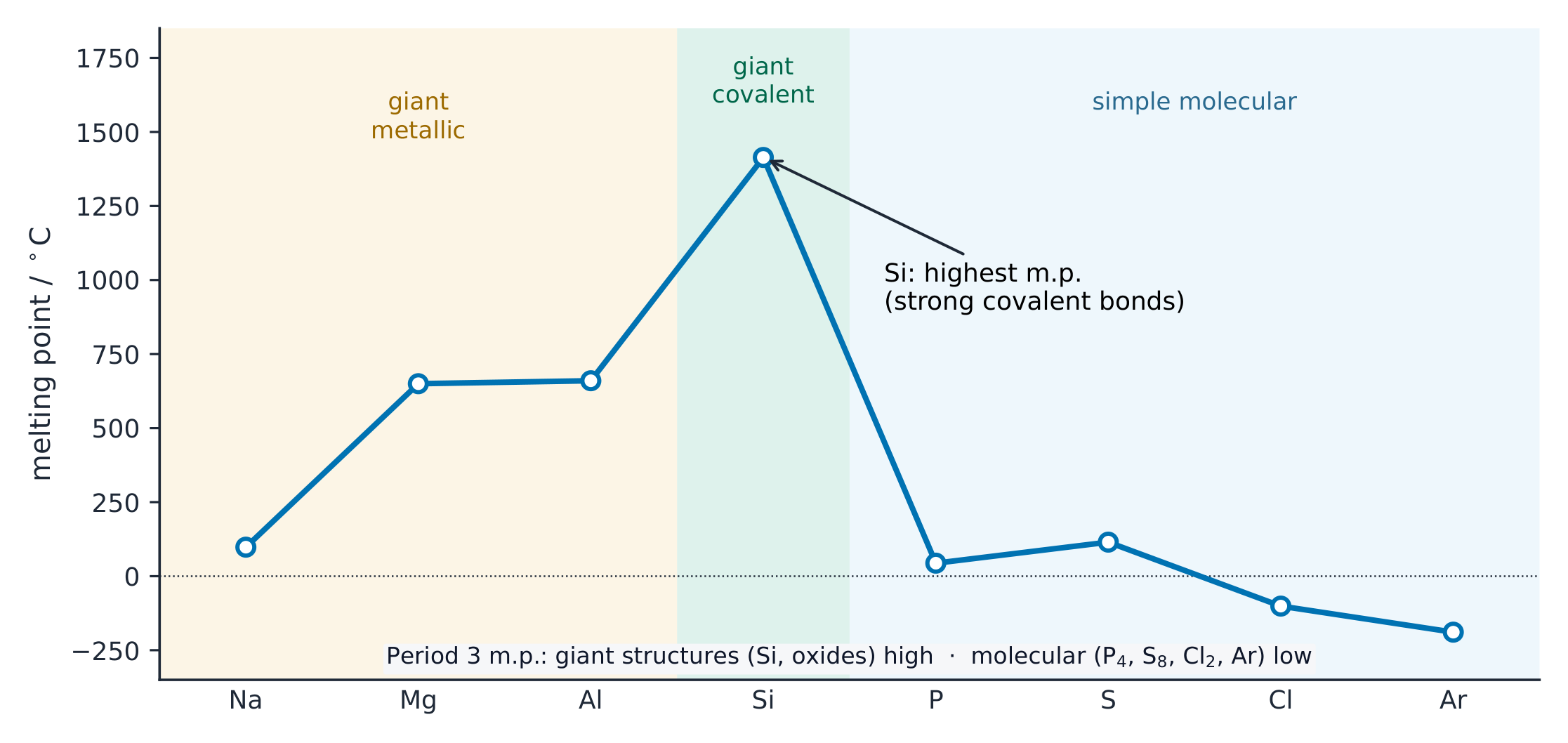
rises to a peak at silicon, then falls sharply
electrical conductivity 导电性
high for Na, Mg, Al; almost zero from Si onwards
The melting point and conductivity follow from the structure and bonding:
Na, Mg, Al are giant metallic 金属晶体. Melting points rise (Na → Al) because each atom gives more delocalised electrons and the ions get smaller, so the bonding is stronger. They conduct well.
Si is giant molecular 原子晶体 (giant covalent). It has the highest melting point, because strong covalent bonds must be broken. It barely conducts.
P, S, Cl, Ar are simple molecular 分子晶体 (or single atoms). Their melting points are low, because the only forces that break are the weak van der Waals' forces 范德华力between the molecules - the strong covalent bonds inside each molecule are never broken at all. They do not conduct.
Name van der Waals' forces when you explain that drop: it is the marking point, and "the covalent bonds are weak" is the error that loses it. Melting $\text{S}_8$ pulls whole molecules apart from each other; it does not touch a single $\text{S–S}$ bond. Their sizes still follow the molecule: $\text{S}_8$ melts higher than $\text{P}_4$ because it is bigger, with more electrons and so stronger van der Waals' forces, while $\text{Ar}$ (a single atom) is lowest of all.
العربية
تتكرر الخصائص بنمط منتظم عبر كل دورة في الجدول.
الدورية تعني تكرار الخصائص بنمط منتظم عند الانتقال عبر كل دورة في الجدول الدوري. الدورة 3 (من الصوديوم إلى الأرجون) هي المثال القياسي.
يقل نصف القطر الذري عبر الدورة 3: لأن زيادة الشحنة النووية تسحب نفس الغلاف الخارجي إلى الداخل
الخاصية
الاتجاه عبر الدورة 3
نصف القطر الذري
يصغر (الشحنة النووية الأكثر تسحب نفس الغلاف للداخل)
نصف القطر الأيوني
أيونات الموجب صغيرة؛ من $\text{P}^{3-}$ فابداً تكون أيونات السالب أكبر
درجة الانصهار
ترتفع لتصل إلى ذروة عند السيليكون، ثم تنخفض بشدة
التوصيل الكهربائي
عالي بالنسبة لـ Na و Mg و Al؛ يكاد يكون صفراً من Si فابداً
تنبثق درجة الانصهار والتوصيل من البنية والروابط:
Na و Mg و Al لها بنية فلزية عملاقة. ترتفع درجات انصهارها (من Na إلى Al) لأن كل ذرة تعطي إلكترونات لا محلية أكثر والأيونات تصبح أصغر، مما يجعل الرابطة أقوى. وهي توصل الكهرباء جيداً.
Si له بنية جزيئية عملاقة (ترابط تساهمي عملاق). له أعلى درجة انصهار، لأنه يجب كسر روابط تساهمية قوية. وهو barely يوصل الكهرباء.
P و S و Cl و Ar لها بنية جزيئية بسيطة (أو ذرات فردية). درجات انصهارها منخفضة، لأن القوى الوحيدة التي تُكسَر هي قوى فاندرفالس الضعيفة بين الجزيئات - الروابط التساهمية القوية داخل كل جزيء لا تُكسَر أبداً. لا توصل الكهرباء.
سمّ قوى فان دير فال عند شرح هذا الانخفاض: فهي النقطة الممنوحة، و"الروابط التساهمية ضعيفة" هي الخطأ الذي يُحرم منها. انصهار $\text{S}_8$ يفصل جزيئات كاملة عن بعضها؛ ولا يلمس رابطة $\text{S–S}$ فردية. ما زالت أحجامها تتبع الجزيء: $\text{S}_8$ ينصهر بدرجة أعلى من $\text{P}_4$ لأنه أكبر، يحتوي على إلكترونات أكثر وبالتالي قوى فان دير فال أقوى، بينما $\text{Ar}$ (ذرة مفردة) هو الأدنى على الإطلاق.
تصل نقطة الانصهار عبر الدورة 3 إلى ذروتها عند السيليكون (شبكة تساهمية ضخمة); وهي مرتفعة للمعادن ومنخفضة للعناصر الجزيئية البسيطة
Explore · استكشف
Trends across Period 3 · الاتجاهات عبر الدورة 3
Switch between atomic radius, ionisation energy and melting point, and step across Period 3 to see each periodic trend. · التبديل بين نصف القطر الذري وطاقة التأين ونقطة الانصهار، والانتقال عبر الدورة 3 لرؤية كل اتجاه دوري.
Chemical properties across Period 3 · الخصائص الكيميائية عبر الدورة 3
Syllabus · المنهج
English
describe, and write equations for, the reactions of the elements with oxygen (to give $\text{Na}_2\text{O}$, $\text{MgO}$, $\text{Al}_2\text{O}_3$, $\text{P}_4\text{O}_{10}$, $\text{SO}_2$), chlorine (to give $\text{NaCl}$, $\text{MgCl}_2$, $\text{AlCl}_3$, $\text{SiCl}_4$, $\text{PCl}_5$) and water ($\text{Na}$ and $\text{Mg}$ only)
state and explain the variation in the oxidation number of the oxides ($\text{Na}_2\text{O}$, $\text{MgO}$, $\text{Al}_2\text{O}_3$, $\text{P}_4\text{O}_{10}$, $\text{SO}_2$ and $\text{SO}_3$ only) and chlorides ($\text{NaCl}$, $\text{MgCl}_2$, $\text{AlCl}_3$, $\text{SiCl}_4$, $\text{PCl}_5$ only) in terms of their outer shell (valence shell) electrons
describe, and write equations for, the reactions, if any, of the oxides $\text{Na}_2\text{O}$, $\text{MgO}$, $\text{Al}_2\text{O}_3$, $\text{SiO}_2$, $\text{P}_4\text{O}_{10}$, $\text{SO}_2$ and $\text{SO}_3$ with water including the likely pHs of the solutions obtained
describe, explain, and write equations for, the acid/base behaviour of the oxides $\text{Na}_2\text{O}$, $\text{MgO}$, $\text{Al}_2\text{O}_3$, $\text{P}_4\text{O}_{10}$, $\text{SO}_2$ and $\text{SO}_3$ and the hydroxides $\text{NaOH}$, $\text{Mg(OH)}_2$ and $\text{Al(OH)}_3$ including, where relevant, amphoteric behaviour in reactions with acids and bases (sodium hydroxide only)
describe, explain, and write equations for, the reactions of the chlorides $\text{NaCl}$, $\text{MgCl}_2$, $\text{AlCl}_3$, $\text{SiCl}_4$, $\text{PCl}_5$ with water including the likely pHs of the solutions obtained
explain the variations and trends in 9.2.2, 9.2.3, 9.2.4 and 9.2.5 in terms of bonding and electronegativity
suggest the types of chemical bonding present in the chlorides and oxides from observations of their chemical and physical properties
العربية
وصف وكتابة معادلات تفاعل العناصر مع الأكسجين (لتكوين $\text{Na}_2\text{O}$، $\text{MgO}$، $\text{Al}_2\text{O}_3$، $\text{P}_4\text{O}_{10}$، $\text{SO}_2$)، والكلور (لتكوين $\text{NaCl}$، $\text{MgCl}_2$، $\text{AlCl}_3$، $\text{SiCl}_4$، $\text{PCl}_5$) والماء ($\text{Na}$ و$\text{Mg}$ فقط)
ذكر وشرح التغير في رقم التأكسد للأكاسيد ($\text{Na}_2\text{O}$، $\text{MgO}$، $\text{Al}_2\text{O}_3$، $\text{P}_4\text{O}_{10}$، $\text{SO}_2$ و$\text{SO}_3$ فقط) والكلوريدات ($\text{NaCl}$، $\text{MgCl}_2$، $\text{AlCl}_3$، $\text{SiCl}_4$ و$\text{PCl}_5$ فقط) بدلالة إلكترونات الغلاف الخارجي (المدار التكافؤي)
وصف وكتابة معادلات تفاعل، إن وجدت، الأكاسيد $\text{Na}_2\text{O}$، $\text{MgO}$، $\text{Al}_2\text{O}_3$، $\text{SiO}_2$، $\text{P}_4\text{O}_{10}$، $\text{SO}_2$ و$\text{SO}_3$ مع الماء بما في ذلك قيم الـpH المحتملة للمحاليل الناتجة
وصف وشرح وكتابة معادلات للسلوك الحمضي/القاعدي للأكاسيد $\text{Na}_2\text{O}$، $\text{MgO}$، $\text{Al}_2\text{O}_3$، $\text{P}_4\text{O}_{10}$، $\text{SO}_2$ و$\text{SO}_3$ والهيدروكسيدات $\text{NaOH}$، $\text{Mg(OH)}_2$ و$\text{Al(OH)}_3$ بما في ذلك، حيثما ينطبق، السلوك المتصاعد في التفاعلات مع الأحماض والقواعد (هيدروكسيد الصوديوم فقط)
وصف وشرح وكتابة معادلات لتفاعلات كلوريدات $\text{NaCl}$، $\text{MgCl}_2$، $\text{AlCl}_3$، $\text{SiCl}_4$، $\text{PCl}_5$ مع الماء بما في ذلك قيم الأس الهيدروجيني المتوقعة للمحاصيل الناتجة
شرح الاختلافات والاتجاهات في 9.2.2، 9.2.3، 9.2.4 و 9.2.5 من حيث الروابط الكيميائية والكهروسالبية
اقتراح أنواع الروابط الكيميائية الموجودة في الكلوريدات والأكاسيد بناءً على ملاحظات خصائصها الفيزيائية والكيميائية
Source: Cambridge International syllabus · المصدر: منهج كامبريدج الدولي
Sodium reacts fast; magnesium reacts only very slowly with cold water.
Oxidation number of the oxides and chlorides
The oxidation number 氧化数 of the Period 3 element in its oxide or chloride rises across the period, because it equals the number of outer-shell (valence shell 价层) electrons 电子 the atom uses in bonding:
Oxides
$\text{Na}_2\text{O}$
$\text{MgO}$
$\text{Al}_2\text{O}_3$
$\text{P}_4\text{O}_{10}$
$\text{SO}_2$ / $\text{SO}_3$
oxidation number
$+1$
$+2$
$+3$
$+5$
$+4$ / $+6$
The chlorides $\text{NaCl}$, $\text{MgCl}_2$, $\text{AlCl}_3$, $\text{SiCl}_4$, $\text{PCl}_5$ show oxidation numbers $+1$ to $+5$ in the same way.
Oxides with water, and acid–base behaviour
Across the period the oxides 氧化物 change from basic to acidic:
Metal oxides (left) are basic; non-metal oxides (right) are acidic. $\text{Al}_2\text{O}_3$ and its hydroxide 氢氧化物$\text{Al(OH)}_3$ are amphoteric — they react with both acids and bases:
These trends follow from the change in bonding and electronegativity 电负性. On the left, the elements are metals with low electronegativity, so their oxides and chlorides are ionic and basic (or neutral). On the right, the elements are non-metals with high electronegativity, so their oxides and chlorides are covalent and acidic. You can use a chloride's or oxide's properties (melting point, conductivity, effect on water) to suggest whether its bonding is ionic or covalent.
Worked example. Predict the pH when $\text{Na}_2\text{O}$, $\text{Al}_2\text{O}_3$ and $\text{SO}_3$ are each added to water. Acid-base character follows the metal to non-metal change across Period 3. $\text{Na}_2\text{O}$ is ionic and basic: it dissolves to give $\text{NaOH}$, so the pH is about 13. $\text{SO}_3$ is covalent and acidic: it reacts to give $\text{H}_2\text{SO}_4$, so the pH is about 1. $\text{Al}_2\text{O}_3$ sits at the changeover - it is amphoteric and essentially insoluble in water, so the pH stays about 7. The trap is that last one: amphoteric does not mean neutral, it means the oxide reacts with acids and with alkalis - it simply does not react with water.
يتفاعل الصوديوم بسرعة؛ يتفاعل المغنيسيوم ببطء شديد جداً مع الماء البارد.
عدد التأكسد في أكاسيد وكلوريدات الدورة الثالثة
يرتفع عدد التأكسد لعنصر الدورة 3 في أكسيد أو كلوريد عبر الدورة، لأنه يساوي عدد الإلكترونات في الغلاف الخارجي (غلاف التكافؤ) التي يستخدمها الذرة في الروابط:
الأكاسيد
$\text{Na}_2\text{O}$
$\text{MgO}$
$\text{Al}_2\text{O}_3$
$\text{P}_4\text{O}_{10}$
$\text{SO}_2$ / $\text{SO}_3$
عدد التأكسد
$+1$
$+2$
$+3$
$+5$
$+4$ / $+6$
تُظهر الكلوريدات $\text{NaCl}$، $\text{MgCl}_2$، $\text{AlCl}_3$، $\text{SiCl}_4$، $\text{PCl}_5$ أعداد تأكسد من $+1$ إلى $+5$ بنفس الطريقة.
الأكاسيد مع الماء، والسلوك الحمضي-القاعدي
عبر الدورة، تتغير الأكاسيد من قاعدية إلى حمضية:
تتحول أكاسيد الدورة 3 من القاعدية (المعادن) عبر المترددة (Al$_2$O$_3$) إلى الحمضية (لا فلزات)
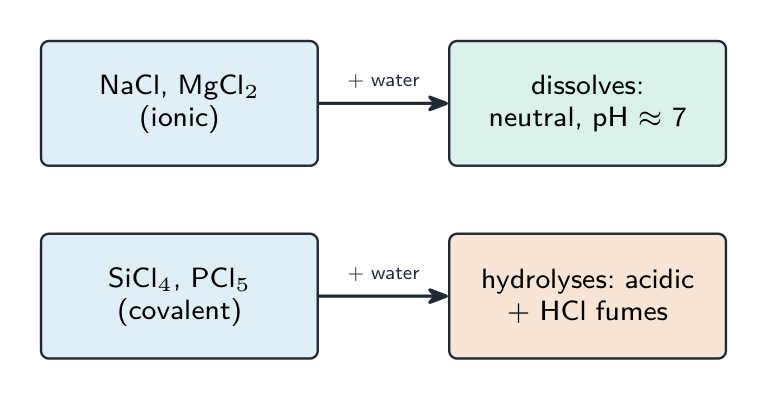
تذوب الكلوريدات الأيونية فقط (متعادل)؛ تتفاعل الكلوريدات التساهمية مع الماء (تحلل مائي) لتعطي محلولاً حمسياً ودخان HCl
شرح الاتجاهات
تنبع هذه الاتجاهات من التغير في الروابط والكهروسالبية. على اليسار، العناصر فلزات ذات كهروسالبية منخفضة، لذا فإن أكاسيدها وكلوريداتها أيونية وقاعدية (أو متعادلة). على اليمين، عناصر غير فلزية ذات كهروسالبية عالية، لذا فإن أكاسيدها وكلوريداتها تساهمية وحامضية. يمكنك استخدام خصائص كلوريد أو أكسيد (درجة الانصهار، التوصيل، التأثير على الماء) لاقتراح ما إذا كانت روابطه أيونية أم تساهمية.
مثال محلول. تنبأ بـpH عند إضافة $\text{Na}_2\text{O}$ و$\text{Al}_2\text{O}_3$ و$\text{SO}_3$ لكل على حدة إلى الماء. يتبع السلوك الحمضي-القاعدي التحول من معدن إلى لا فلز عبر الدورة 3. $\text{Na}_2\text{O}$ أيوني وقاعدي: يذوب ليعطي $\text{NaOH}$، لذا يكون الـpH حوالي 13. $\text{SO}_3$ تساهمي وحامضي: يتفاعل ليعطي $\text{H}_2\text{SO}_4$، لذا يكون الـpH حوالي 1. $\text{Al}_2\text{O}_3$ يقع عند نقطة التحول - فهو متردد وغير قابل للذوبان عملياً في الماء، لذا يبقى الـpH حوالي 7. الفخ يكمن في هذه الأخيرة: متردد لا يعني متعادل، بل يعني أن الأكسيد يتفاعل مع الأحماض ومع القواعد - فقط لا يتفاعل مع الماء.
Explore · استكشف
Period 3 reaction lab · مختبر تفاعلات الدورة 3
Classify Period 3 reactions by what they reveal about bonding and acidity. · صنّف تفاعلات الدورة 3 بناءً على ما تكشفه عن الروابط والحموضة.
Periodicity of other elements · الدورية لعناصر أخرى
Syllabus · المنهج
English
predict the characteristic properties of an element in a given group by using knowledge of chemical periodicity
deduce the nature, possible position in the Periodic Table and identity of unknown elements from given information about physical and chemical properties
العربية
التنبؤ بالخصائص المميزة لعنصر في مجموعة معينة باستخدام معرفة الدورية الكيميائية
استنتاج طبيعة وموقع محتمل في الجدول الدوري وهوية عناصر مجهولة من معلومات معطاة حول الخصائص الفيزيائية والكيميائية
Source: Cambridge International syllabus · المصدر: منهج كامبريدج الدولي
English
The same idea works for any group. If you know the pattern down a group and across a period, you can:
predict the properties of an element from its position (for example, a Group 1 element will be a reactive metal forming a $+1$ ion).
deduce the likely position and identity of an unknown element from its physical and chemical properties.
العربية
ينطبق نفس المفهوم على أي مجموعة. إذا عرفت النمط في اتجاه المجموعة وعبر الدورة، يمكنك:
التنبؤ بخصائص عنصر من موقعه (على سبيل المثال، عنصر من المجموعة 1 سيكون فلزًا نشطًاكوين أيون $+1$).
استنتاج الموقع والهوية المحتملة لعنصر مجهول من خصائصه الفيزيائية والكيميائية.
Explore · استكشف
Periodic trends · الاتجاهات الدورية
Step across Period 3 to see a property rise or fall, then repeat in the next period — that recurring pattern is periodicity. · خطوة عبر دورة 3 لرؤية خاصية ترتفع أو تنخفض، ثم تكرار ذلك في الدورة التالية — هذا النمط المتكرر هو الدورية.
Pick one and the site follows you — notes, papers, videos and practice all open on it. · اختر واحدًا وسيتبعك الموقع — الملاحظات، الأوراق، الفيديوهات والتدريب جميعها تفتح عليه.
Type to search notes, lessons, code, vocabulary and past-paper questions across every subject. · اكتب للبحث عن ملاحظات، دروس، أكواد، مفردات وأسئلة امتحانات سابقة عبر جميع المواد.